
35 Stunning Modern Christmas Tree Ideas for 2026 That Will Amaze Everyone
Most people decorate their tree the same way they did five years ago, then wonder why it never looks like the photos they’ve been saving since October. This year the holiday tree got a quiet, confident upgrade: saturated jewel tones instead of all-neutral, heavy flocking instead of tinsel, wide velvet ribbon instead of plastic garland, and a whole lot of restraint in the rooms where restraint counts.
We spent weeks combing through real homes and real retailers — Target, Walmart, HomeGoods, Amazon, and Etsy — to pull together 35 modern Christmas tree ideas for 2026. That covers everything from a $40 slim tree that fits a studio corner to a double-height foyer installation that takes two people and a ladder. Prices in this guide run from about $15 to $970, and every idea comes with honest cost breakdowns and the small details that actually make the look work.
And stay until the end — we break down the most common mistakes that can ruin these looks.
Some links in this post are affiliate links. If you buy through them, we may earn a small commission at no extra cost to you.
📌 Save this to Pinterest for later — you’ll want to revisit these ideas.
1. Minimalist Green Tree With a Paper Star and Candle Clips
Those clip-on candle lights are the entire personality of this tree, so space them like you mean it. Work in a spiral: start at the bottom, rise about 12 inches per rotation, and keep 10 to 12 inches between candles. Ten to fourteen clips is plenty for a 6-foot tree — any more and you lose the calm. Angle each candle slightly upward and outward so the glow travels down the branch instead of straight into the needles.
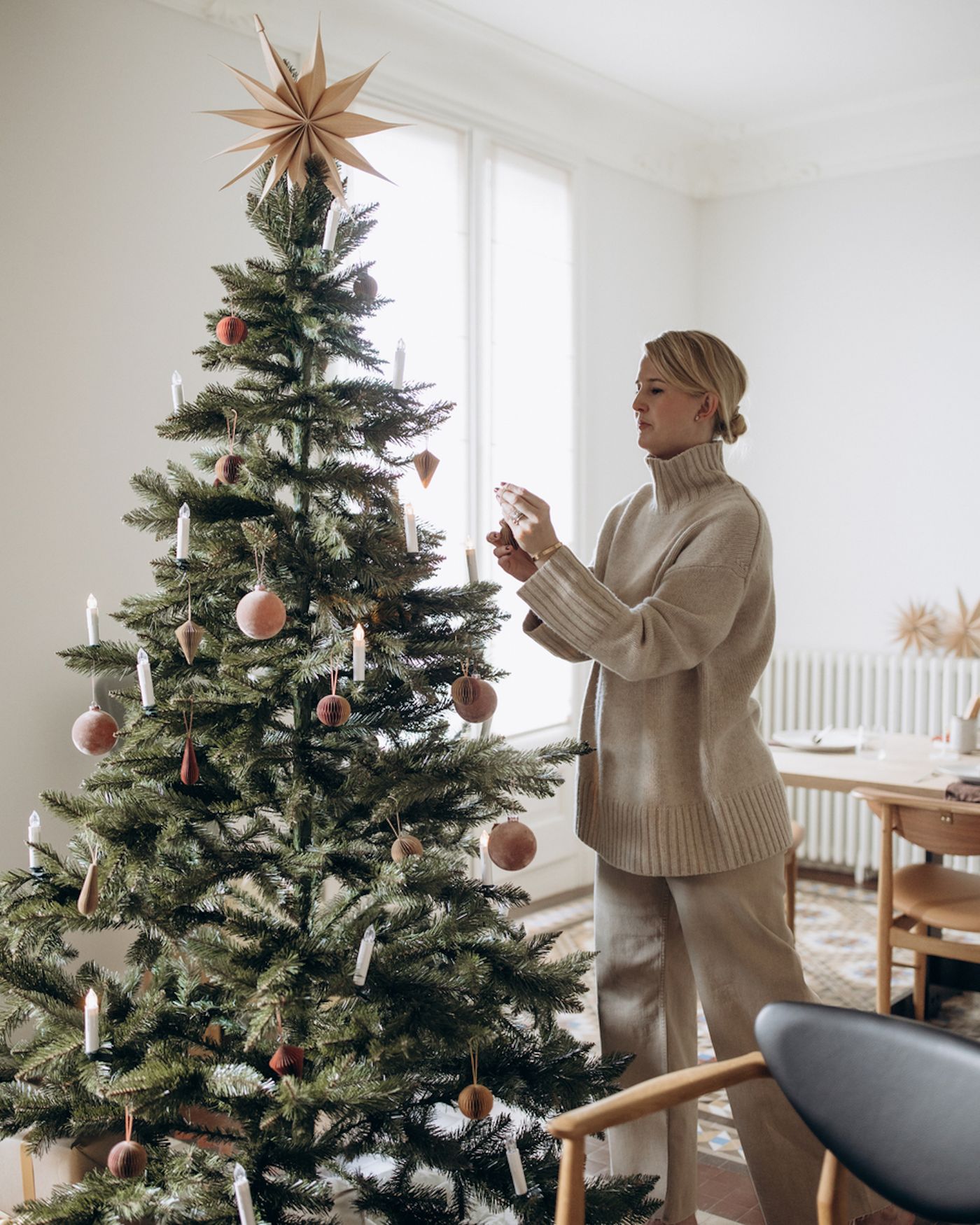
The star is doing the heavy lifting. At roughly a tenth of the tree’s height, that large paper topper gives the eye one place to land, which lets everything below stay quiet. Then there’s the color math: forest green is a cool base, terracotta and dusty pink are warm, so the palette balances instead of going flat. Paper honeycomb ornaments absorb light while the candles bounce it back — matte and glow, side by side on the same branch.
2. Mushroom Ornaments, Red Berries, and a Mossy Log Base
Take away the arched wooden shadow boxes on the wall and this is just a tree with cute ornaments. What makes the whole vignette sing is repetition: mushroom figurines on the wall, mushroom ornaments in the branches, moss and log slices at the base. The eye keeps meeting the same motif at three heights — wall, tree, floor — and that’s what turns a corner into a scene. Repeat a theme three times in three different materials and it reads as intentional rather than themed.
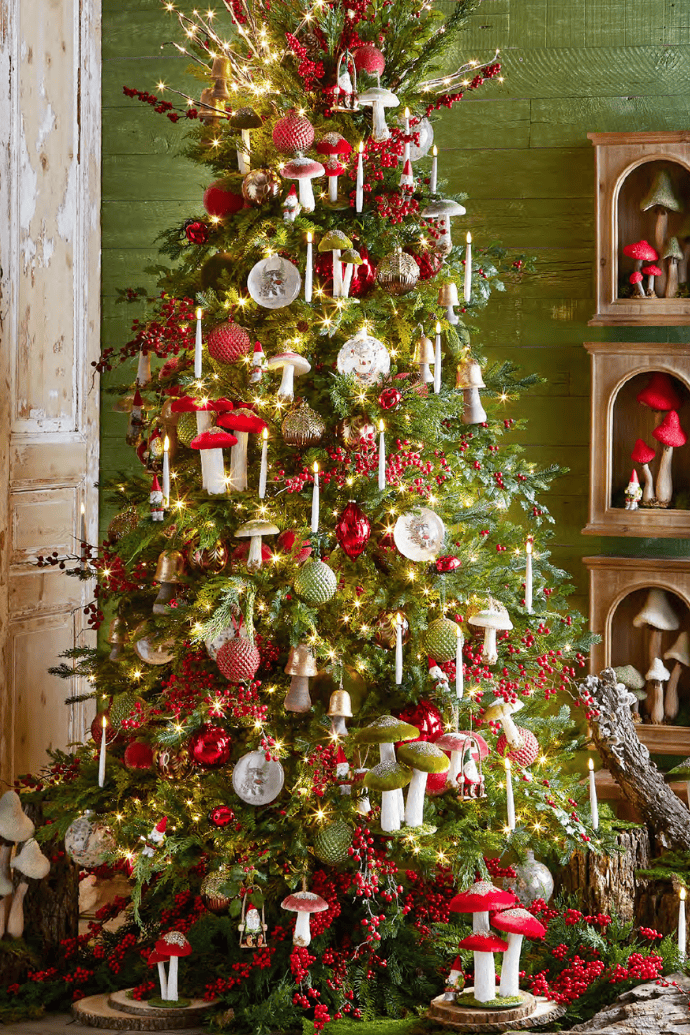
- Cut six to eight log slices, 2 to 3 inches thick, or buy a bag online.
- Arrange them in a loose crescent around the trunk — a perfect circle looks store-bought.
- Tuck preserved moss into the gaps between slices.
- Set two or three mushroom figurines at different heights.
- Finish with red berry sprigs poking up between the logs.
About 45 minutes, and materials run $25 to $40.
3. Jewel-Tone Baubles Glowing Under Warm White Lights
Here’s roughly what it costs to pack a 7-foot tree this densely:
- Artificial tree, 7 ft: $120–$400
- Warm white string lights, 600–800 bulbs: $25–$60
- Glossy and glitter baubles, 150–200 pieces: $90–$250
- Ribbon or floral picks to fill gaps: $20–$50
- Skirt or collar: $25–$70
Total: roughly $280 to $830, and the ornament count is where the money actually goes. Budget alternative: buy two 100-piece shatterproof assortments at Walmart for about $60 total and let the lights do the rest.
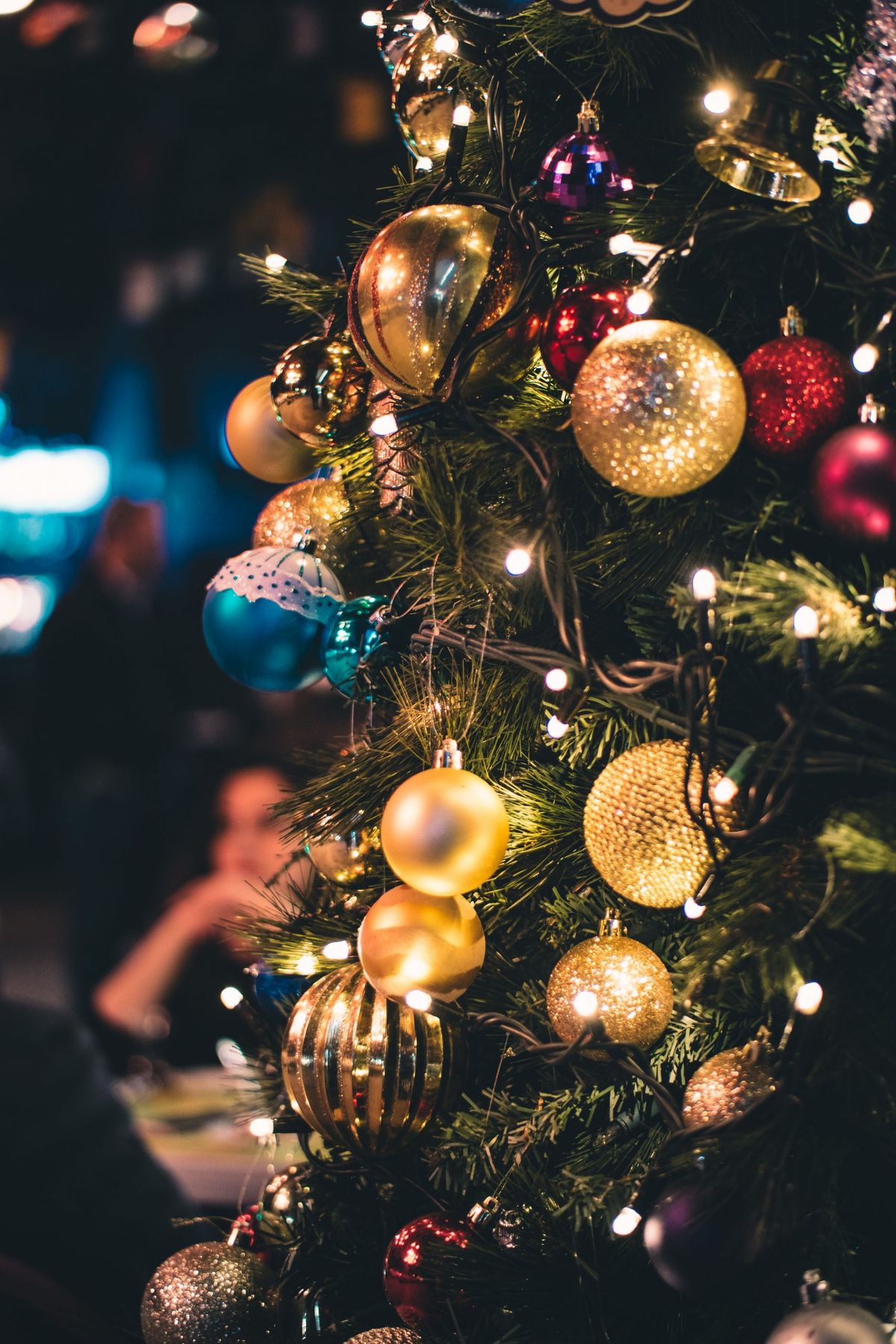
Think of this tree as 55% green base, 30% mixed metallic and jewel accents, 15% warm light. The 30% is what you notice, but the 55% is what keeps it from looking like a pile. To shift the palette, keep the ratio and change one family at a time — trade blue and pink for copper and cream and you get a warmer, almost autumnal tree with identical density.
Color is back, and 2026 is the year people stopped apologizing for it. After several seasons of beige-on-beige holiday styling, interest in vintage glass ornaments and dense, glittering trees climbed steadily through 2025. The look borrows from the eighties but the trick is light temperature — warm white keeps the nostalgia, cool white just looks chaotic.
4. A Quiet Evergreen Beside a Contemporary Fireplace Wall
When a tree sits next to built-ins, treat it as one more shelf rather than the star of the show. Mirror the shelf spacing with your light placement — warm bulbs every 10 to 12 inches vertically — and cluster ornaments in three loose bands instead of scattering them evenly. Charcoal and warm white read as a pair, so if your sofa is a cool grey, stay at 2700K. If your sofa is a warm greige or oatmeal, 3000K still reads cozy rather than clinical.
This setup wants a room of roughly 200 square feet or more, with at least 3 feet of clear floor on the tree’s left so it can breathe next to the shelving. Ceilings over 9 feet let you push a 7.5- to 8-foot tree. In a living room under 150 square feet, skip the built-in symmetry entirely and use the slim silhouette in Idea #19 — same calm, less crowding around the fireplace.
5. An Understated Tree With No Clutter, Just Soft Glow
Quiet holiday styling has quietly become the loudest thing on Pinterest. Searches for understated Christmas decor grew steadily through 2025 as people leaned into fewer, better ornaments and warmer, dimmer lighting. The appeal is practical: less to store, less to untangle, less to pack away in January. And because the tree is doing less work, it photographs beautifully in daylight, which is exactly why it keeps getting saved to mood boards that have nothing to do with December.
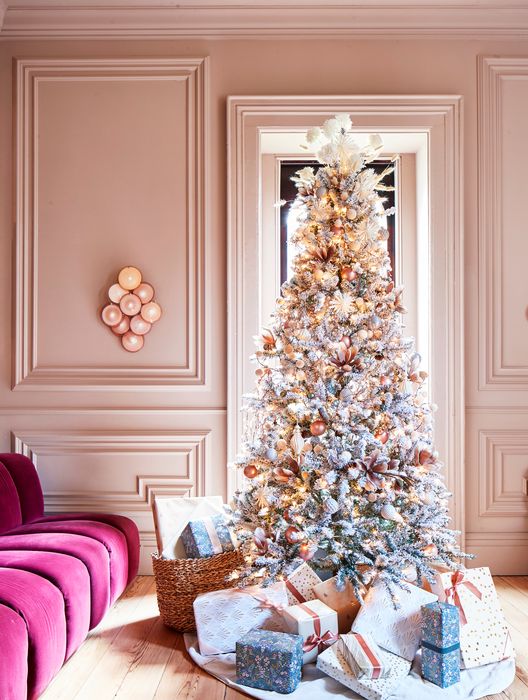
You can build this look for under $150. A 6-foot artificial tree from IKEA or Walmart runs $40 to $90. Skip the ornament set and pick up wooden and felt pieces at a thrift store — $10 to $20 gets you 30 or 40. Warm white LED string lights, 300 count, are about $15 at Target. Then let one quiet detail carry the whole room, the way the sheer curtain of light in Idea #34 proves you don’t need ornaments at all.
6. Emerald Walls and a Chartreuse Ceiling Behind a Vintage Tree
The ceiling is the one thing. Paint it back to white and the room survives — the tree still glows, the zebra rug still snaps, the vintage glass still sparkles. But that chartreuse overhead turns a decorated corner into a set. It bounces a yellowish light back down onto the branches, warms the emerald walls from above, and makes the ornaments read as jewel-like instead of cluttered. If you’re going to be bold anywhere in December, be bold where nobody expects it.
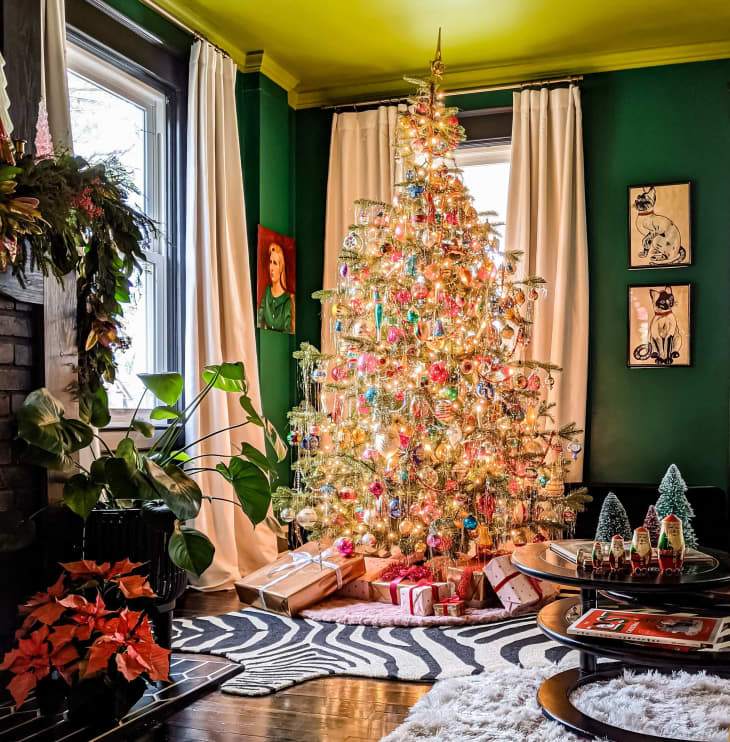
Two honest notes before you buy chartreuse paint. Saturated ceilings show every drywall flaw, so use a matte finish or skim-coat first. And deep emerald walls swallow light, which means you’ll need roughly 40% more string lights than in a white room — plan on 800 to 1,000 warm bulbs. Budget for primer tinted grey and three coats, because green over white almost never covers in two.
7. Bare Limbs, Fairy Lights, and a Pinecone Garland
Three things carry this room. One: the tree is deliberately under-decorated, so the fairy lights become the ornament. Two: the mantel garland is asymmetric, which keeps a symmetrical fireplace from looking staged. Three: the materials are all matte — brick, wool rug, pine, wood mirror — and the only shine comes from candle flames. Textural contrast beats color contrast in a room this pale, and the round mirror quietly reflects the tapers back into the room.
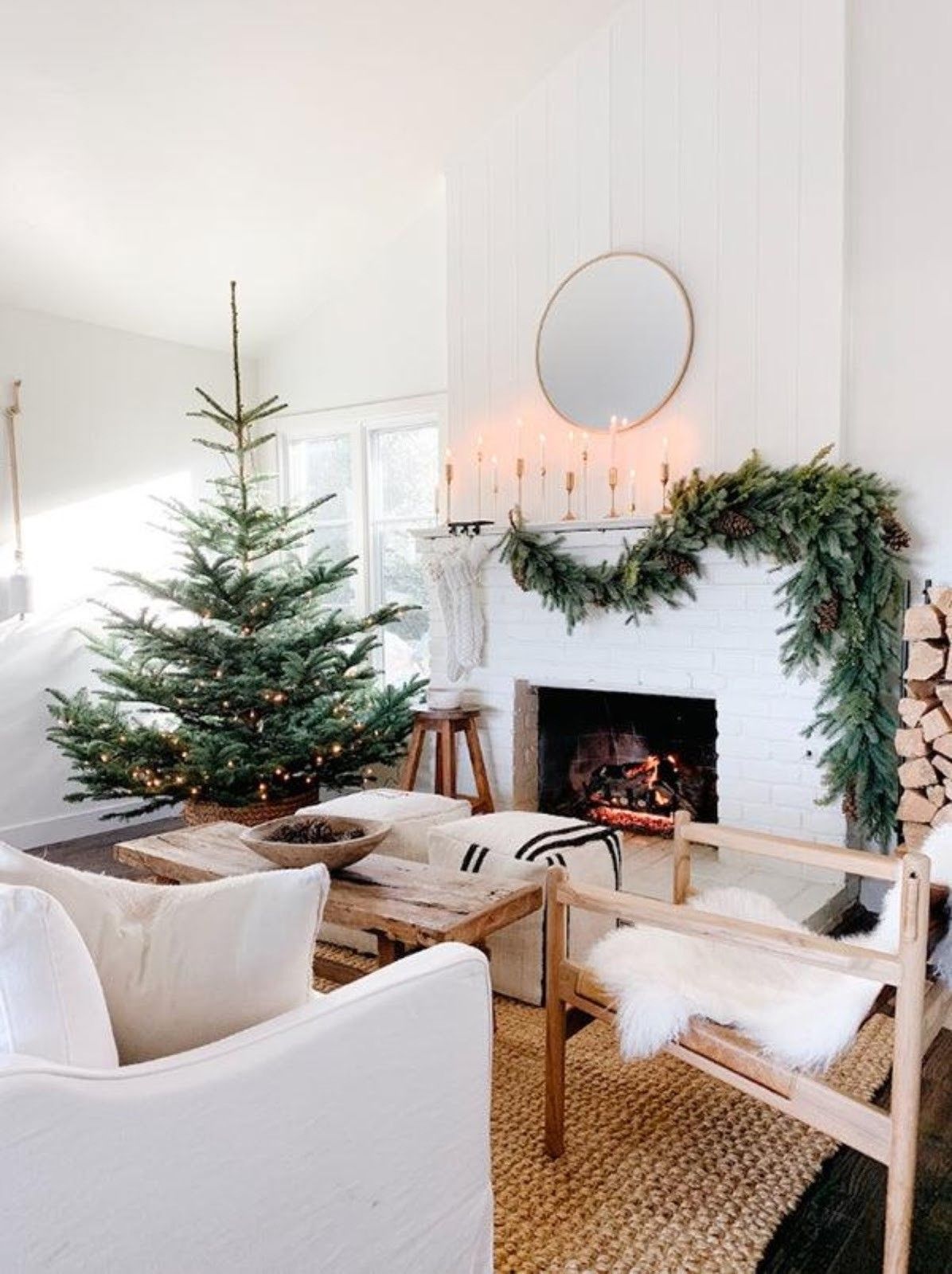
- Lay two 6-foot garlands end to end and fluff them so the branches cross.
- Anchor the heavy end at the mantel’s left corner with a cup hook or adhesive strip.
- Let the garland droop 4 to 6 inches below the mantel edge in the center.
- Tuck pinecones in threes, never evenly spaced.
- Set taper candles at least 8 inches from any pine.
About 35 minutes and $45 to $75 in materials.
8. Pastel Pink Baubles and Velvet Bows by the Fire
- Tree, 7.5 ft: $150–$450
- Oversized pastel baubles, 40–60: $80–$220
- Velvet bows, 12–20: $25–$70
- Warm fairy lights: $25–$55
- Ribbon, sage picks, filler: $30–$60
- Tree collar or skirt: $30–$90
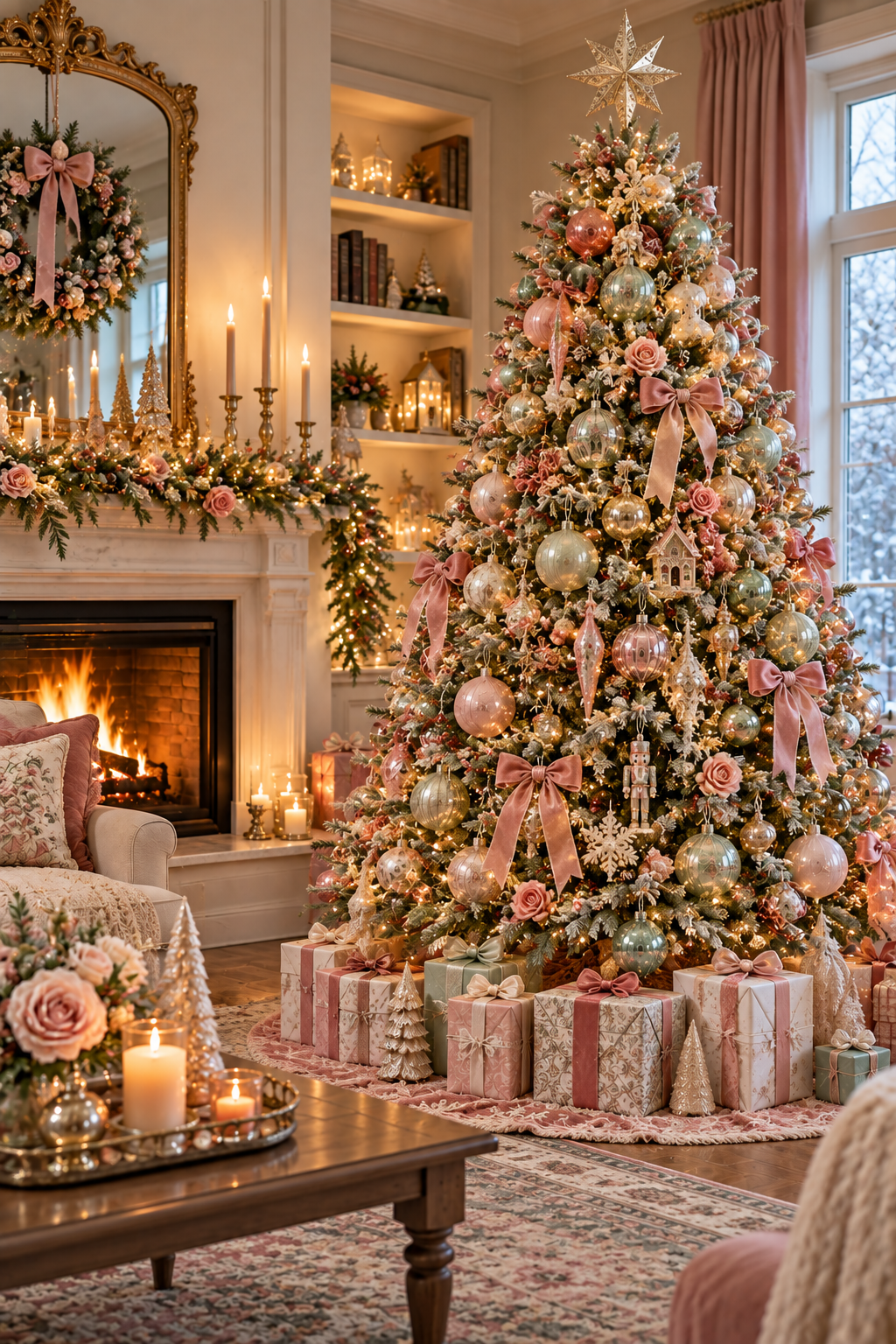
Total: roughly $340 to $945. Budget alternative: blush and sage ornament six-packs run $4 to $8 in Target’s holiday aisle, and velvet ribbon by the yard costs a fraction of pre-tied bows.
Velvet bows and pastel ornaments are high-maintenance in one specific way: they show dust. Pale pink and sage turn grey faster than any other palette, so keep a lint roller in the room and give the bows a pass every week. Matte pastel baubles also scuff easily. If you have toddlers or cats, tie bows with elastic loops rather than wire hooks so they snap off instead of dragging a whole branch down.
On a pink tree, sage isn’t decoration — it’s the anchor. Cap pastel pink at about 40% of the ornaments, give sage green 25%, and let gold and cream carry the rest. Without the green, pastel drifts straight toward nursery. And place your largest baubles in the bottom third, where their weight doesn’t make the branches sag in the sightline.
9. Gold Mesh Ribbon and a Feathery White Topper
The formula is 50% gold, 30% white, 20% green showing through — a high-shine take on the usual neutral base. Gold pulls double duty because it behaves like two colors: bronze in shadow, creamy where the lights hit. Swap gold for champagne and silver for warm pewter and you get a cooler, modern tree with identical proportions. The one rule: never let gold and silver sit at exactly fifty-fifty. Pick a winner and let the other support it.
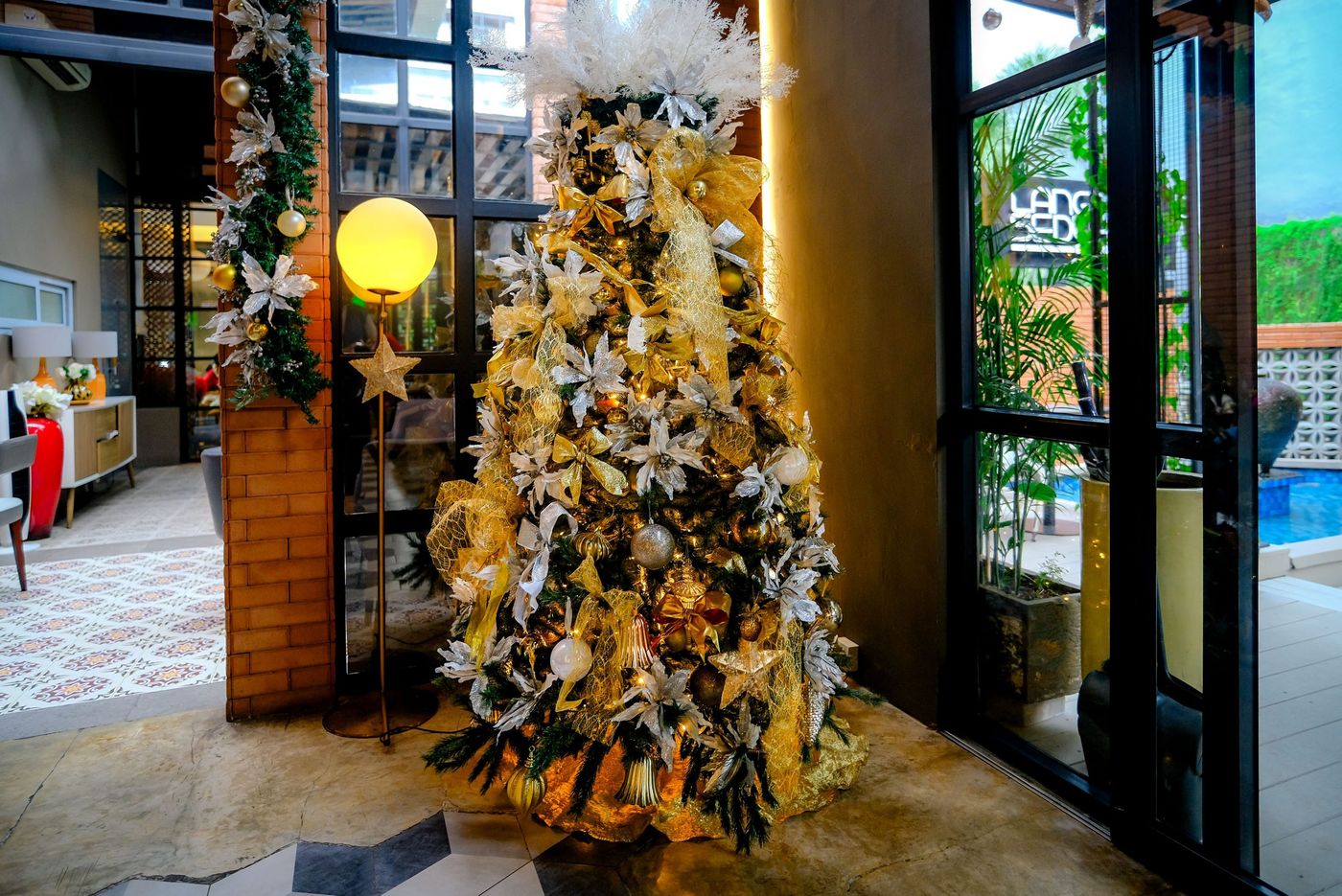
- Buy two rolls of 4-inch gold mesh ribbon — mesh holds a shape that satin won’t.
- Start at the top, tuck the end into a branch, and let it fall in a wide spiral rather than a tight wrap.
- Every 8 to 10 inches, pinch the ribbon into a soft S and tuck it in.
- Weave a second ribbon in the opposite direction, a third of the way down.
- Finish with two loose tails at the base so the eye follows the ribbon all the way down.
About 40 minutes and roughly $30 in ribbon for a 7-foot tree.
10. Flocked White Tree Against White Built-In Shelves
The white-on-white effect doesn’t require a designer tree. A 6-foot flocked tree from Walmart runs $60 to $120; Target’s 7.5-foot versions sit around $100 to $180. Fill it with plain white baubles from Dollar Tree — their shatterproof sets are $1.25 and 40 pieces costs under $25. The bookshelf styling is free: pull every book with a white or cream spine to the front and turn the rest around. The tulip side table is the one piece worth paying for, or paint a thrifted pedestal table white.
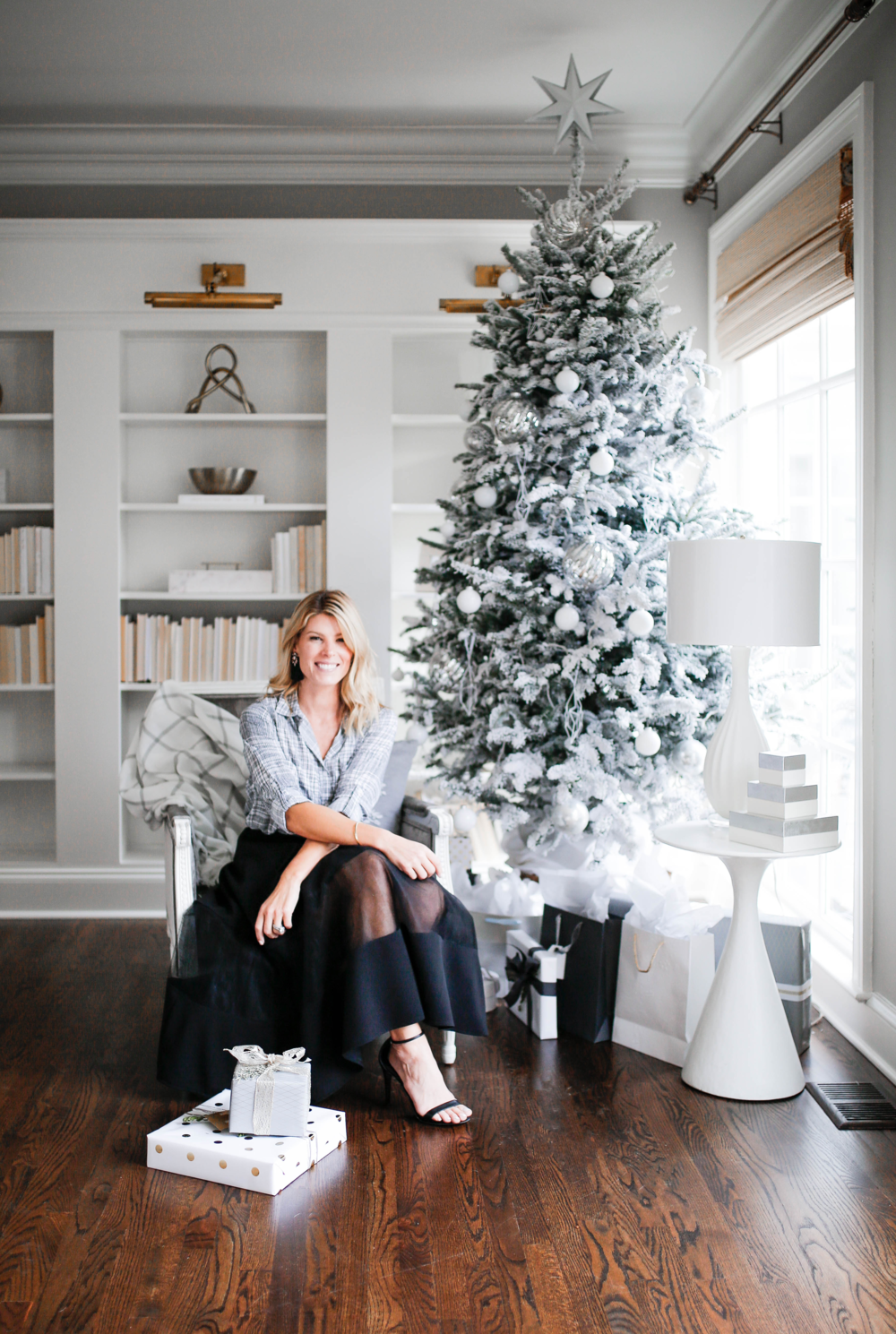
- Measure between the tree and the nearest shelf — leave at least 18 inches of walkway.
- Check your flooring: flocking sheds, so put a felt pad under the stand, especially on dark hardwood.
- Confirm the outlet can handle the lights plus a table lamp on one circuit.
- Decide your texture mix before you shop, because all-white trees photograph flat without felt, wood, or paper in the mix.
11. A Macramé Ornament Hanging in Heavy Snow Flocking
One handmade macramé ornament is doing something no bauble can. On a tree that’s 90% manufactured shine — flocking, gold picks, glass balls — that single knot of cotton thread reads as human. It’s also a scale trick: it’s matte and small, so it gives the eye somewhere to rest between all that glitter. Take it away and the tree is still pretty, but it’s a catalog tree. Hang three and it becomes a collection. One is the sweet spot.
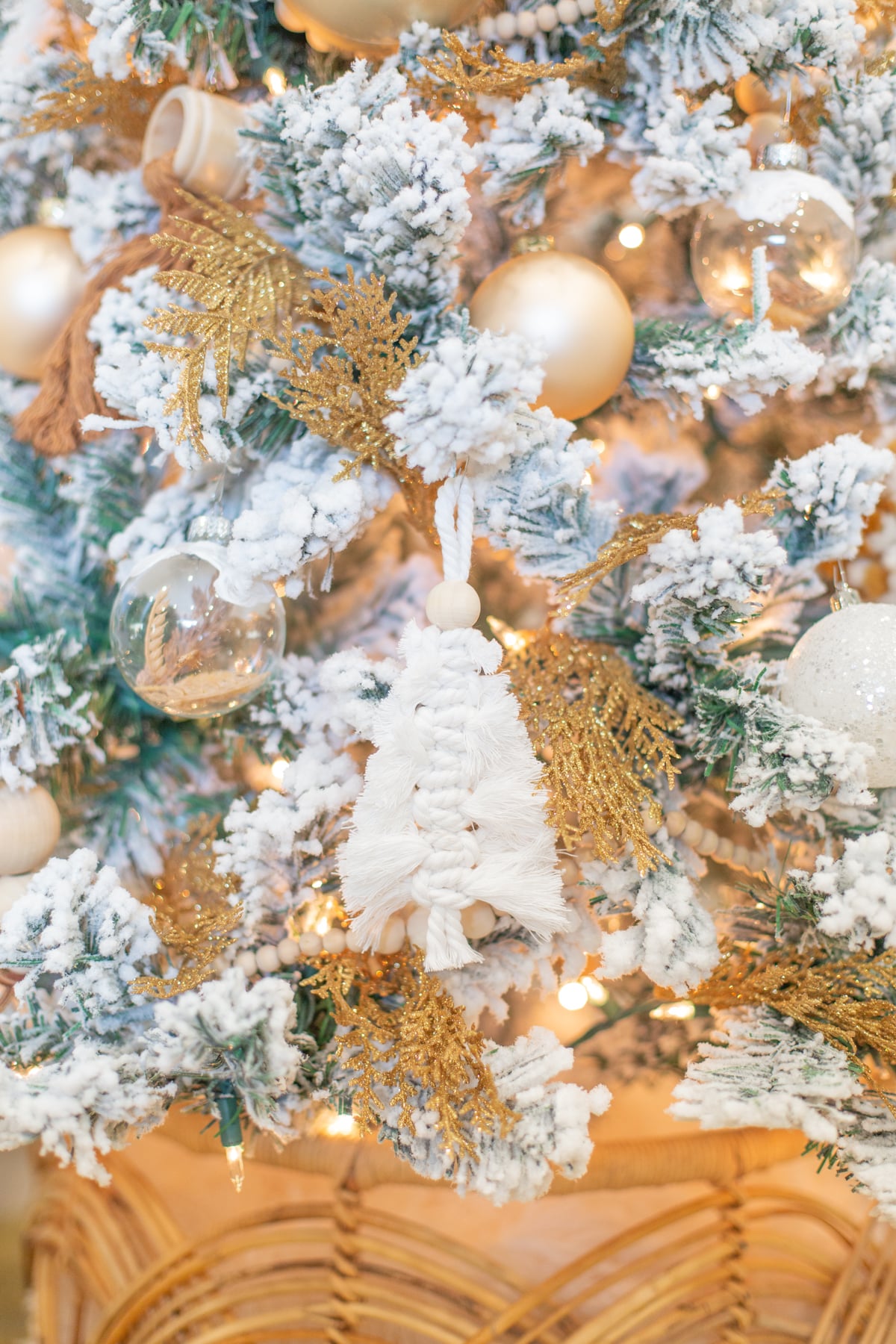
Contrast is the whole story here. Heavy flocking is soft, matte, and cool white; gold baubles are hard, reflective, and warm. Together, each exaggerates the other. Then the woven rattan collar grounds everything — it’s the only thing in the vignette that isn’t pretending to be snow or metal, which is why the base looks finished rather than decorated. Three materials, three jobs: flock, metal, natural fiber. Add a fourth and it gets busy.
12. Double-Height Foyer Tree With Eucalyptus and Bauble Swags
- Measure your banister run and multiply by 1.5 so the garland can sag instead of stretch.
- Thread 3-inch metallic and 2-inch matte balls onto heavy floral wire, alternating sizes.
- Attach with clear zip ties every 18 inches so nothing slides downhill.
- Fill the gaps with eucalyptus stems angled upward, as if they grew there.
- Repeat on the second-story railing at a smaller scale — 2-inch balls — so it reads as an echo, not a copy.
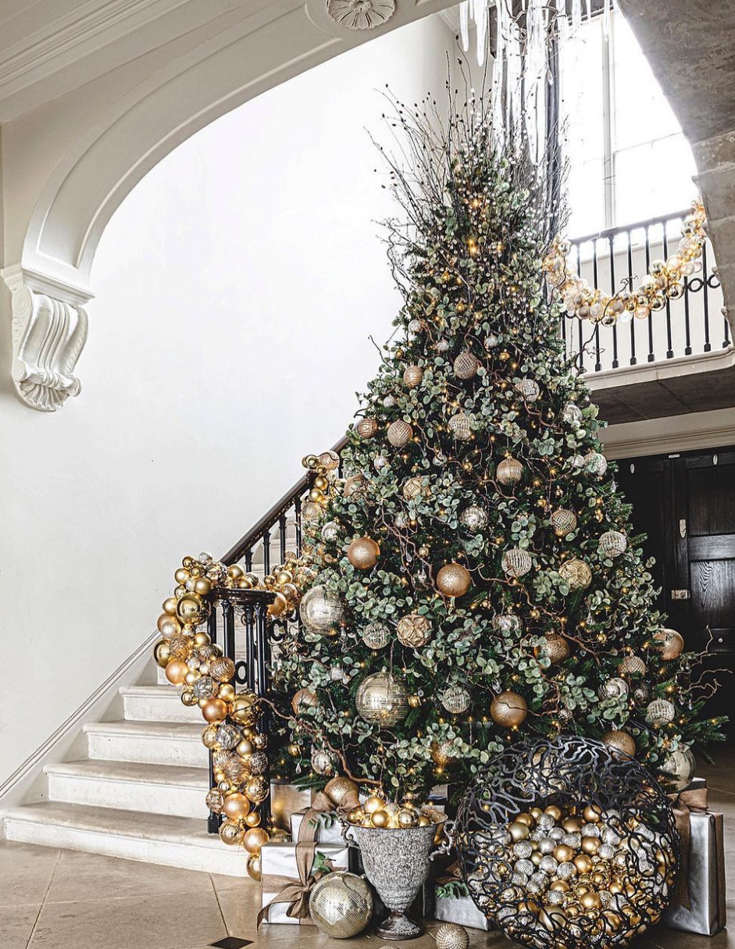
About 90 minutes and $80 to $150 in materials for a full staircase.
This is a foyer idea, and it needs the foyer to earn it. You want at least a 14-foot ceiling, a 10-by-10 footprint, and — the part people skip — a sightline from the front door. A tree this size in a hallway you never see is just a chore. For an 8- or 9-foot entry, look at the tapering approach in Idea #16, where a low cabinet carries the holiday weight at eye level instead.
13. Red-and-White Fabric Hearts on a Bright Green Tree
Puffy fabric hearts read best when they’re the only soft thing on the tree. Keep everything else hard and small — glass, wood, metal — and hang the hearts in a loose triangle: three low, two in the middle, one near the top. Six to ten hearts is the sweet spot on a 6-foot tree. Past that they stop feeling homemade and start feeling like a craft fair booth, which is a different thing entirely.
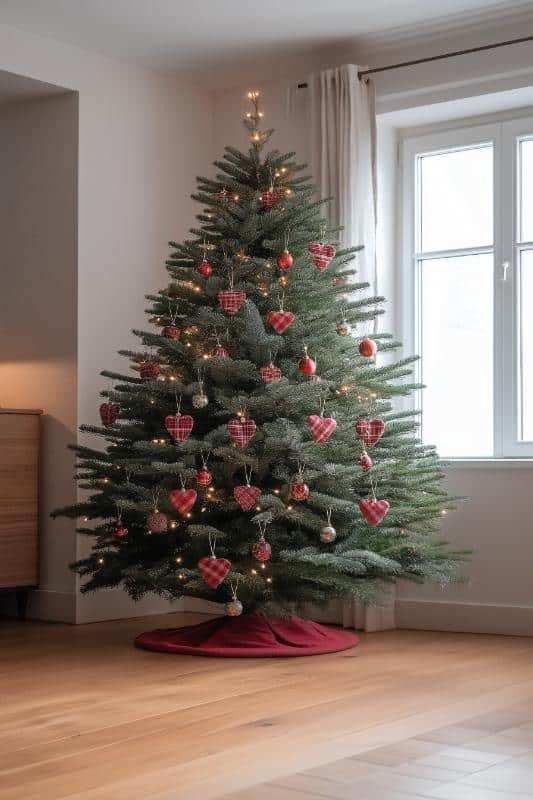
This is a two-color tree and it should stay one. Roughly 70% green from the branches, 20% red from the hearts and the round skirt, 10% white from the window light and trim. Swap the red for navy and the same formula gives you something snowy and slightly preppy. The proportion is the recipe; the color is just seasoning.
Fabric ornaments and a wood floor are a good pair, with two caveats. Printed cotton fades in direct sun, and this tree’s white-framed window is both its best light source and its biggest risk — rotate the hearts every few weeks or hang them on the shaded side. Fabric also holds cooking smells, so if the room opens to a kitchen, plan on a gentle cold wash and a full air-dry before storage.
14. Kraft Paper Gifts and Dried Citrus at the Base
- Dense artificial tree, 7 ft: $130–$400
- Warm white string lights, 500–700: $20–$50
- Wood, felt, and matte ornaments: $60–$180
- Kraft paper, twine, dried orange slices: $15–$30
- Textured cream tree skirt: $35–$90
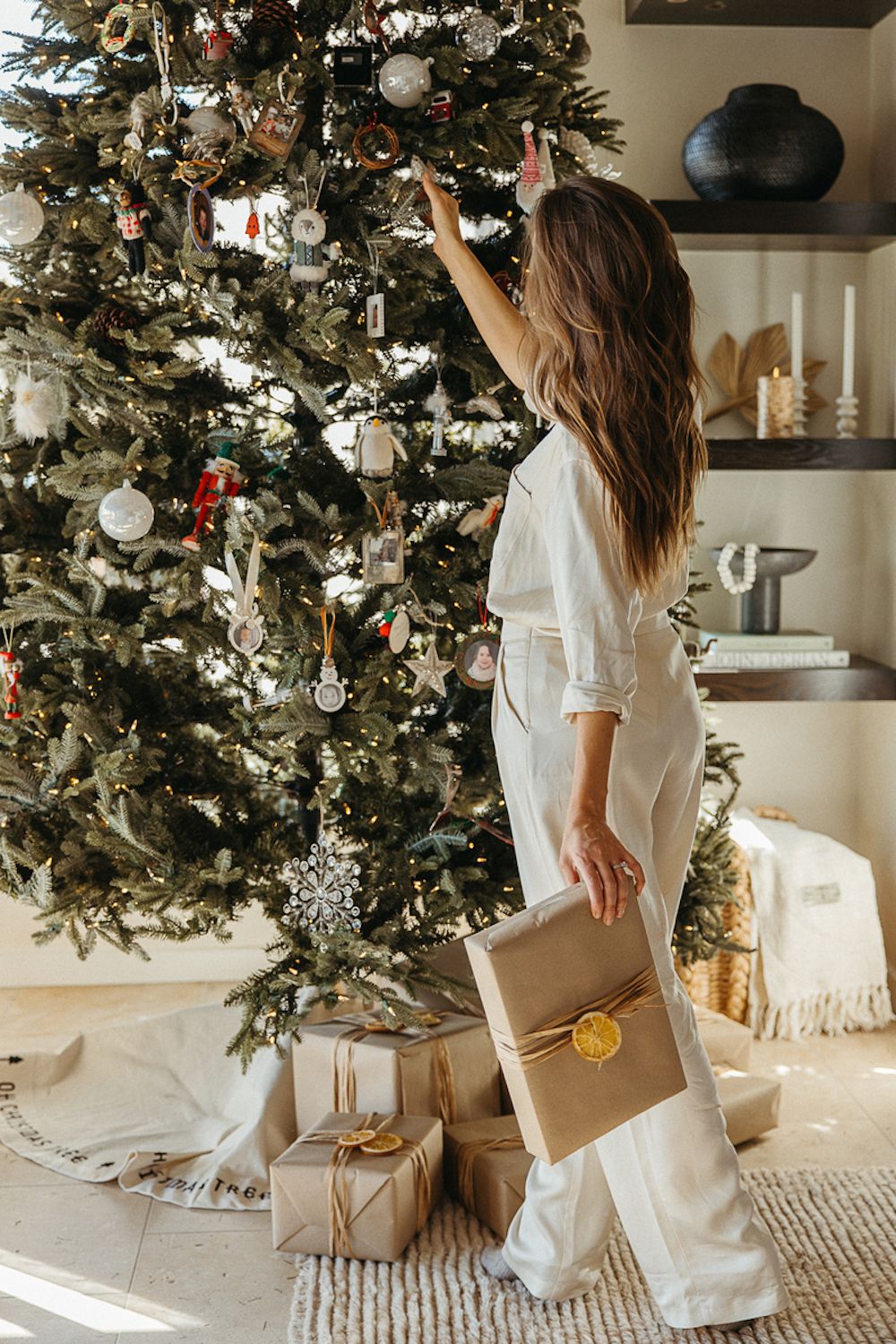
Total: $260 to $750. Budget alternative: skip the ornament set and buy three bags of wood beads and felt shapes at a craft store for about $30. Kraft paper is $6 a roll and dried oranges cost nothing but oven time.
The gifts are doing double duty here. Kraft paper sits at the same value as the tree trunk and the dark shelving, so the whole vignette stays in one tonal family — that’s why it looks styled instead of just decorated. The dried citrus is a color move rather than a texture one: a small hit of orange wakes up all that green and brown without introducing a new material. Consistent tones plus one warm accent. That’s the whole formula.
15. Corner Tree With Buffalo Check and a Leather Armchair
Red and blue is the sleeper palette of the season. Holiday styling in the U.S. has split for years into two camps — the red-and-green traditionalist and the all-neutral minimalist — and 2026 is when the two finally met in the middle. Buffalo check brings a heritage, almost cabin feeling that plays nicely with the grandmillennial revival, while the leather chair keeps it from sliding into country store. It’s traditional without being fussy, which is exactly what’s getting saved right now.
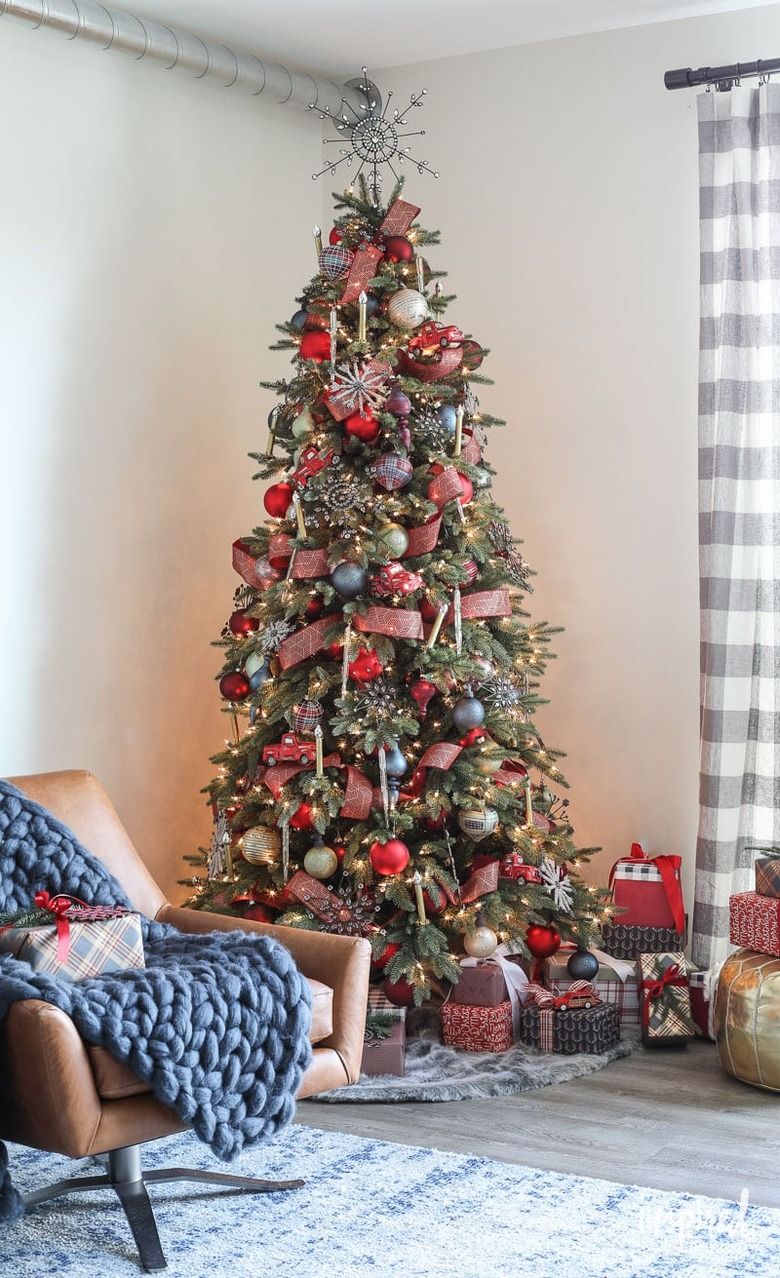
The blue knit blanket is the whole idea. Without it you have a red-and-green tree with plaid curtains — pleasant, familiar, forgettable. Drape that chunky throw over the leather armrest and suddenly the room has a third color nobody expected, sitting at eye level right next to the tree. It connects the presents, cools the red, and makes the leather look considered instead of inherited. Cost of the upgrade: about $35 and one armrest.
16. The Wooden Cabinet Dressed Like a Mantel
This is a mantel that isn’t one. The cabinet gives you a horizontal surface at eye level, which is the real job a fireplace mantel does — a place to layer greenery, candles, and a little character. Three heights keep it from going flat: garland low and trailing, pillar candles in the middle, the nutcracker tallest of all. Odd numbers, three tiers, warm wood underneath. If your living room has no fireplace, find your longest, flattest piece of furniture and treat it exactly the same way.
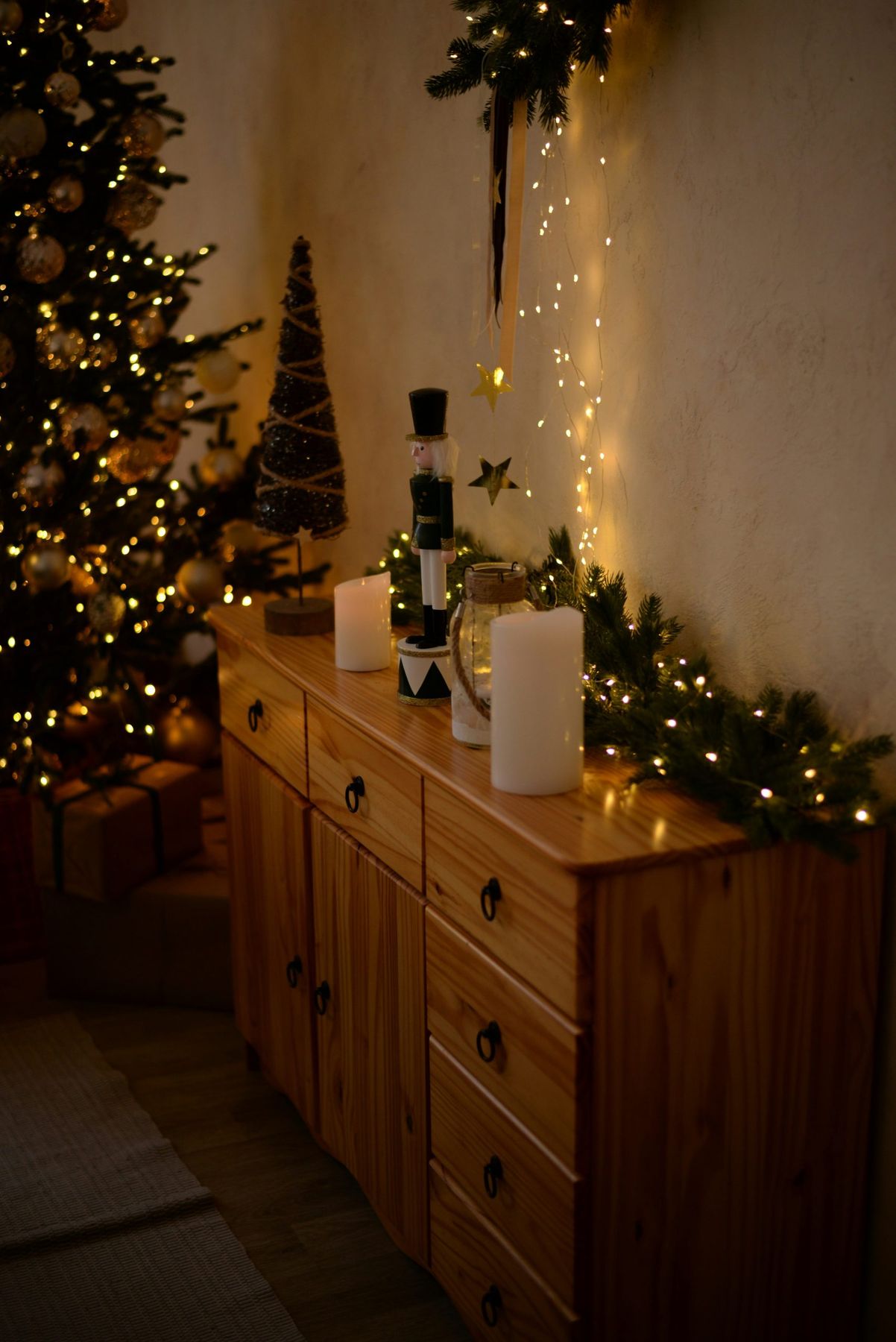
You need a surface 30 to 40 inches wide and a free wall at least 6 feet long — this cabinet sits under about 5 feet of garland before it starts looking stingy. A 9-foot ceiling handles the tree beside it at 7 to 7.5 feet without crowding. In a studio, scale the whole thing down: a 24-inch console, a 4-foot tree, one candle. Same composition, half the footprint.
17. Blue Lights on Frosted Branches, Stone Fireplace Glow
Blue lights are a commitment, and the mistake people make is mixing them with warm white on the same tree. Pick one temperature. If blue is the star, let it run 80% of the bulbs and have the colorful ornaments supply the warmth instead — otherwise the tree reads as two rooms arguing. Blue LEDs also look flat against a pale rug, so position the tree where it overlaps something darker, like the stone fireplace here. Contrast, not brightness, is what makes blue glow.
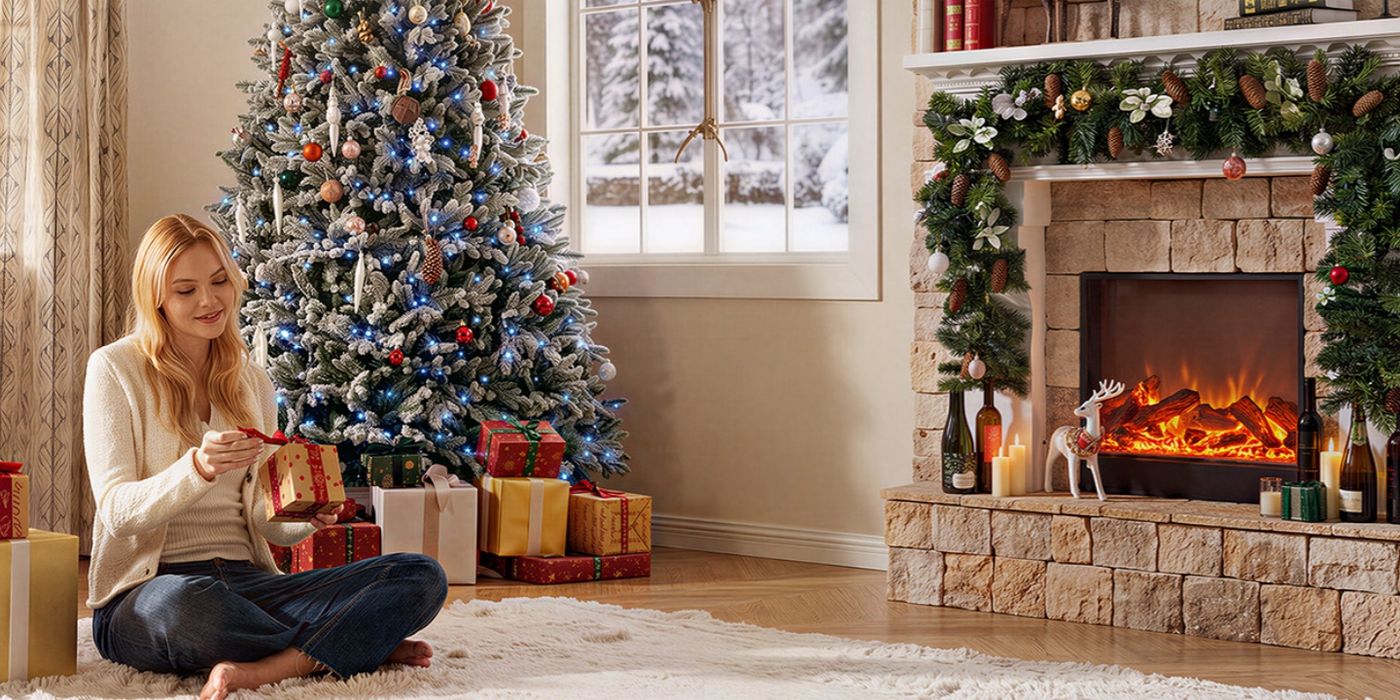
Flocked trees shed. Expect a light dusting of fake snow every time someone brushes past for the first two weeks. Vacuum with a brush attachment rather than sweeping, which grinds flakes into the carpet fibers. Flocking also yellows in a hot attic or garage, so store it in a cool closet wrapped in a breathable cotton sheet instead of plastic. A well-kept flocked tree lasts six to eight seasons; most people get four, and storage is always the reason.
18. Turquoise and Ruby Baubles Against a Turquoise Library
The trick here is that the tree isn’t the focal point — the room is. Turquoise baubles in front of turquoise cabinetry make the tree feel like part of the library rather than an object dropped into it. That’s why it looks expensive. Most people decorate the tree and ignore what stands behind it; here the ornaments were clearly chosen after the room was finished. To steal the effect at home, photograph your wall color, take it to the ornament aisle, and buy the closest match plus one metallic.
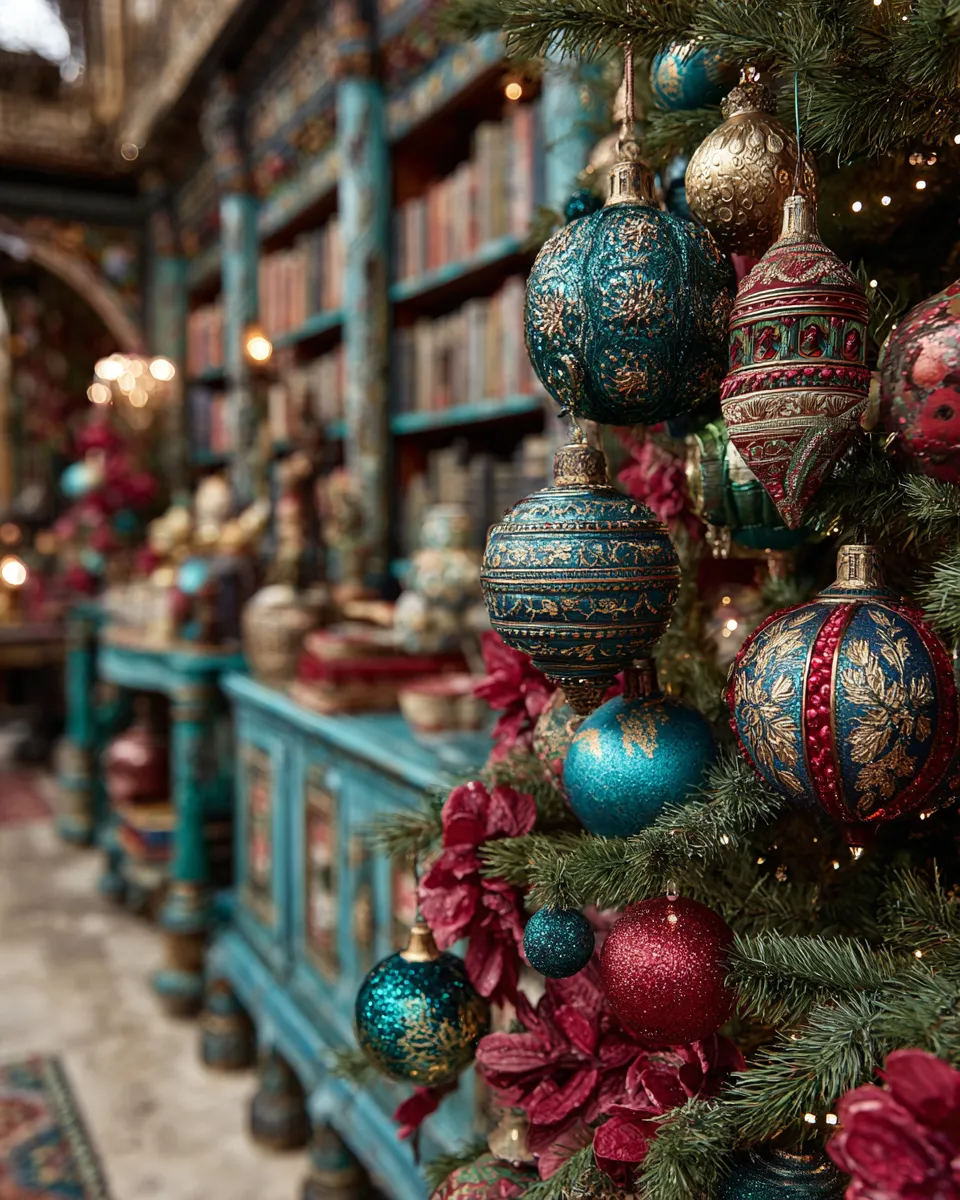
Count the colors: turquoise at about 45%, ruby at 25%, gold at 20%, and the tree’s own green at 10%. That’s a lot of saturation, and it works because the values are all similarly deep — nothing is pale. Keep the proportions and swap in plum, mustard, and copper for a warm, almost Persian palette. Two dominant colors, one metallic, one supporting green.
- Pick one patterned ornament style and buy 8 to 12 of it — repetition makes pattern look intentional.
- Hang patterned pieces in clusters of two or three, never alone.
- Frame each cluster with solid matte balls in a matching color.
- Put the most intricate ornaments at eye level, where people actually look.
- Fill the leftover gaps with narrow gold picks.
About an hour of arranging; a patterned set runs $30 to $80.
19. The Slender Tree That Fits Any Awkward Corner
A slim tree is the single best holiday purchase for a small home, and it doesn’t have to cost much. A 5- to 6-foot pencil tree from Big Lots or Walmart runs $35 to $80. Add 200 warm white LEDs ($12 at Target), a set of unfinished wood ornaments you can paint yourself ($10 for 20 online), and a linen scrap for the base. Total: under $110. Facebook Marketplace is full of slim trees every November — people buy them, then upgrade, and you get a $200 tree for $40.
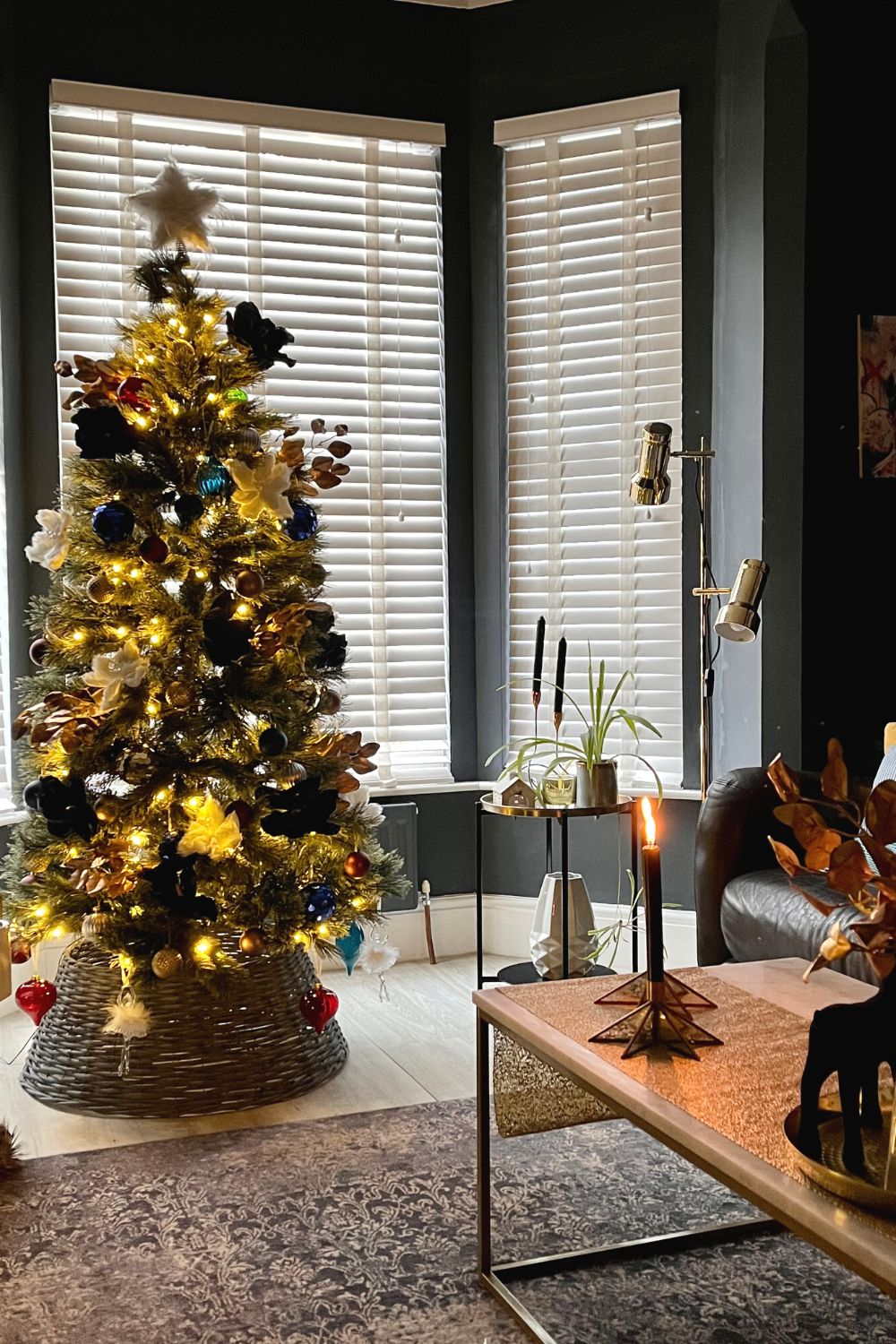
Slim trees come with a real limitation: you can only decorate the front and two sides. Expect to use about 40% fewer ornaments, which is fine, but it also means placement mistakes are visible from across the room. They also tip easily. Weight the base with a bag of rice under the skirt, especially with pets, and keep heavy ornaments out of the top third. If tipping worries you, the flocked version in Idea #10 has a much wider footprint.
20. Flocked Tree Framed by Multi-Pane Windows
- Watch how the sun travels across those panes — flocking goes golden in the afternoon and flat grey after dark.
- Measure your window trim and leave at least 12 inches of clearance on each side.
- Confirm your window covering situation; no shades means no way to tame glare in photos.
- Test every strand of lights before decorating, because a dead run on a white tree is painfully obvious.
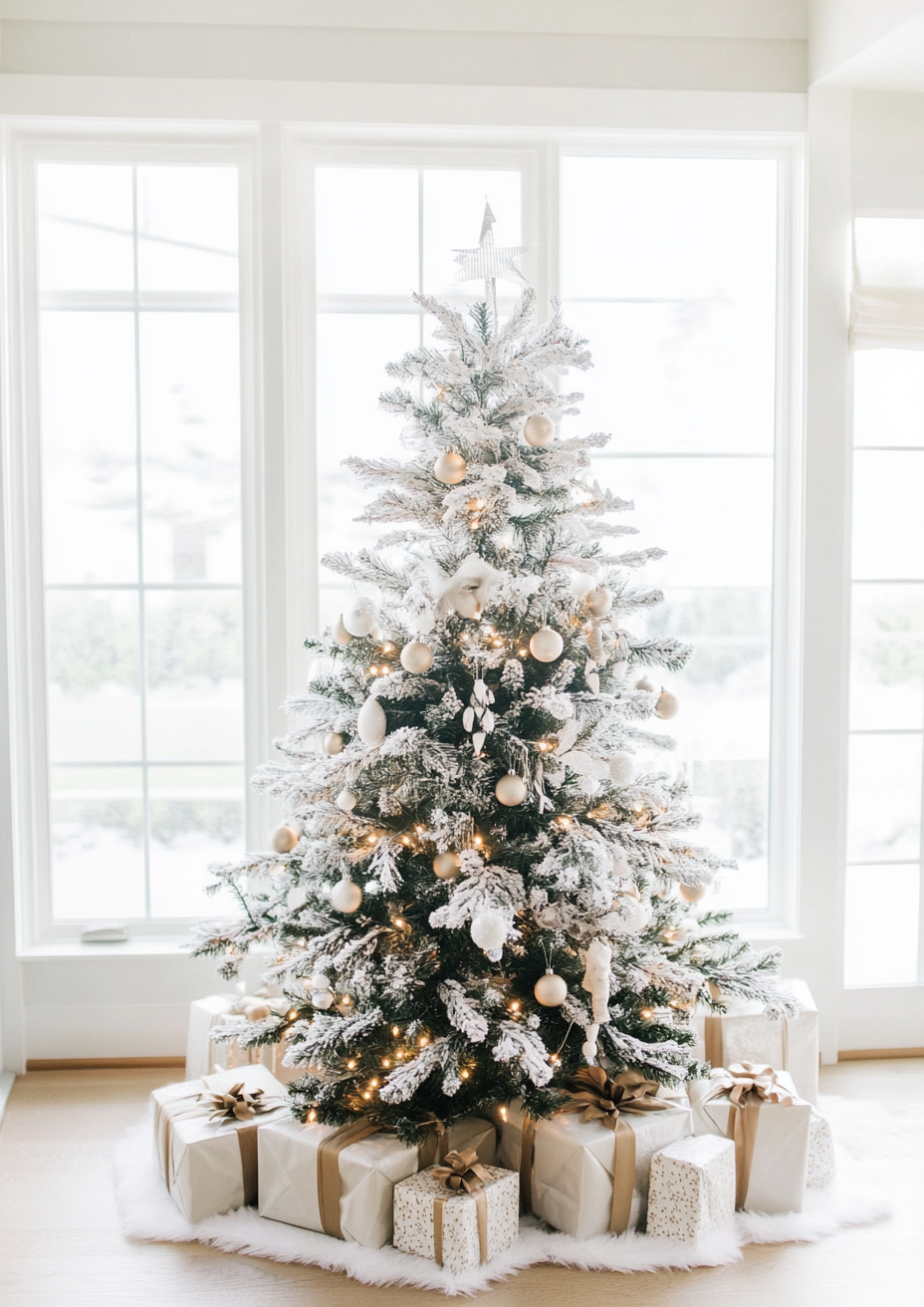
The faux fur skirt is doing something structural: it stops the tree from looking like it’s floating above the floor. Give it 6 to 8 inches of overhang past the widest branches and pile gifts at uneven heights — tall box at the back, short ones in front. On flocking, use champagne and warm gold ribbon only; silver reads cold against all that white. And keep the topper simple, because an oversized finial on a flocked tree starts to look like a costume.
21. Champagne Ornaments and a Dough Bowl of Pine
The dough bowl is the best $30 you’ll spend this season. A distressed wooden trencher on the coffee table, piled with pine sprigs and a few loose metallic ornaments, does three jobs at once: it repeats the tree’s materials at a lower height, it hides candle clutter, and it makes the room look collected rather than shopped. Swap the contents by season — pinecones and dried oranges in winter, eucalyptus come spring — and the same bowl earns its place year-round.
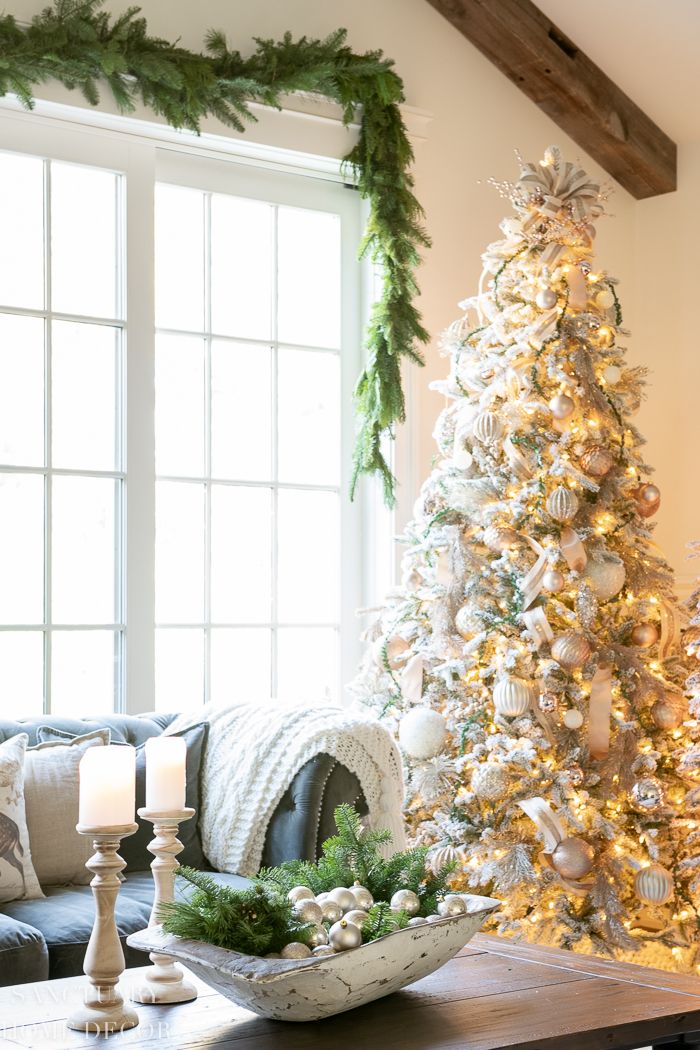
Warm alpine styling keeps growing because it’s the rare trend that works in a rental. A flocked tree, champagne ornaments, and a wooden dough bowl don’t require a single nail in the wall, and everything packs into two boxes in January. Interest in woodland and alpine Christmas decor has climbed steadily through 2025, and the reason is simple: it’s cozy without being themed, and it photographs beautifully against the dark upholstery most people already own.
22. Green Velvet Ribbon Woven Through Frosted Branches
- Cut two 10-foot lengths of 4-inch ribbon — one deep green velvet, one burlap — before you start.
- Anchored at the top, weave the velvet in a loose vertical zigzag, tucking every 12 inches.
- Run the burlap behind it in a horizontal spiral so the two cross like a lattice.
- Pinch the intersections into soft knots rather than bows — too many bows and it goes Victorian fast.
- Hang the miniature lanterns and snowflakes in the pockets the ribbon creates.
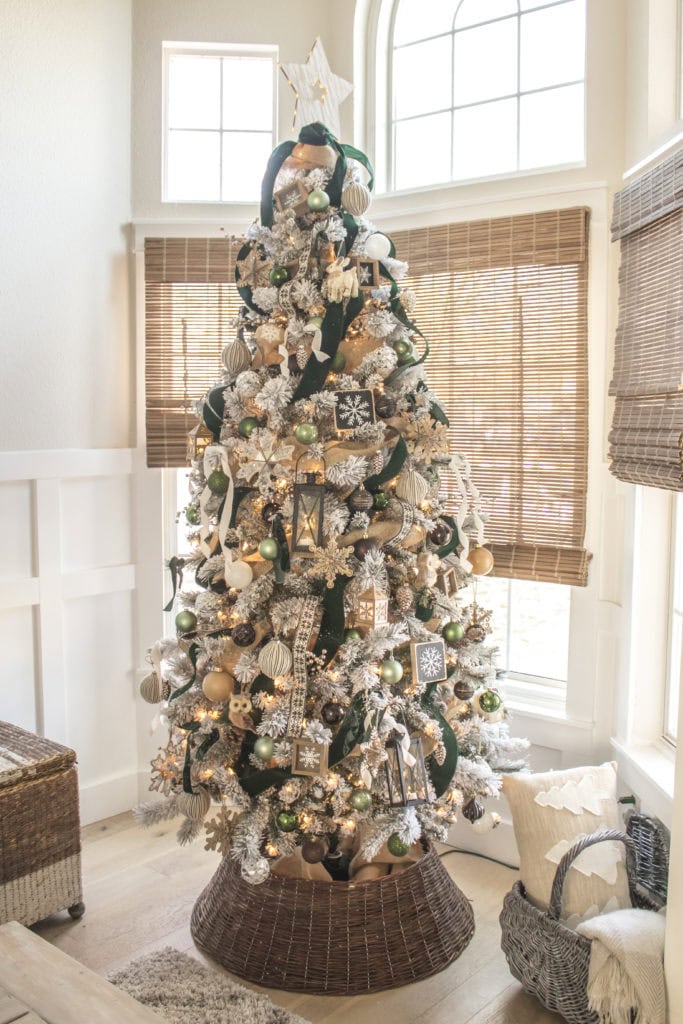
Give it 45 minutes; two rolls of ribbon run about $30 to $45.
Flocked trees are physically wide, so give this one room: a 7.5-foot tree needs roughly a 5-foot footprint and 6 feet of clear wall behind it. The woven collar wants at least 24 inches in diameter to hold the trunk without pinching. Bamboo shades look best with a ceiling of 9 feet or more — below that, tree and window treatment start stacking visually. In a smaller space, the tabletop grouping in Idea #27 carries this same sage-and-burlap palette without the footprint.
23. Framed Wreath on the Wall, Flocked Tree by the Sofa
- Flocked tree, 7.5 ft: $180–$500
- White and champagne ornaments, 80–120: $70–$200
- Warm white string lights: $25–$50
- Neutral throw pillows: $40–$120
- Small wreath plus frame: $30–$70
- Gold and white gift wrap: $15–$35
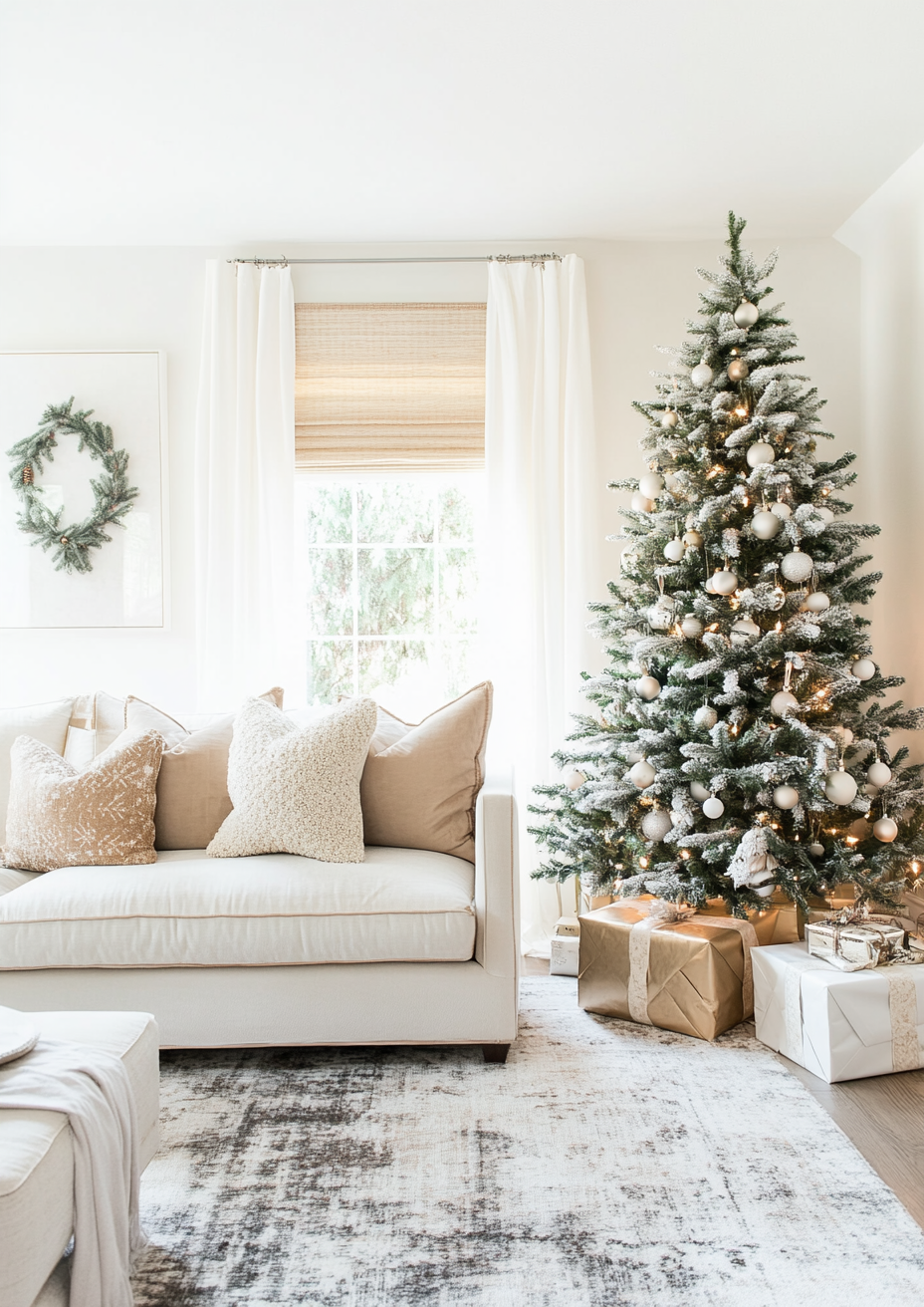
Total: $360 to $975. Budget alternative: keep the tree and palette and buy plain white ornaments in bulk — $25 gets you 100 shatterproof balls. The framed wreath can be a $5 thrift-store frame and a $12 faux wreath.
The framed wreath is the quiet hero. Hanging a wreath inside a picture frame turns a temporary holiday object into something that reads as permanent art, which is why the whole wall looks designed rather than decorated. The rest of the room follows the same logic: everything sits in one value family — cream, tan, pale gold — with charcoal anchoring the rug underneath. One dark value, everything else light. That’s the trick, and it’s repeatable in any room.
24. Yes, a Christmas Tree Belongs in the Kitchen
A tree in the kitchen is charming and also a little risky. Cooking grease travels — airborne fat settles on branches within a couple of weeks, and it’s nearly impossible to wash off artificial needles. Keep the tree at least 6 feet from the range and run the exhaust fan while you cook. Skip fabric ornaments entirely in a working kitchen, and keep the tree away from the dishwasher, where steam and heat will cook your lights. Also: this is a walkway. Don’t block the path from the fridge.
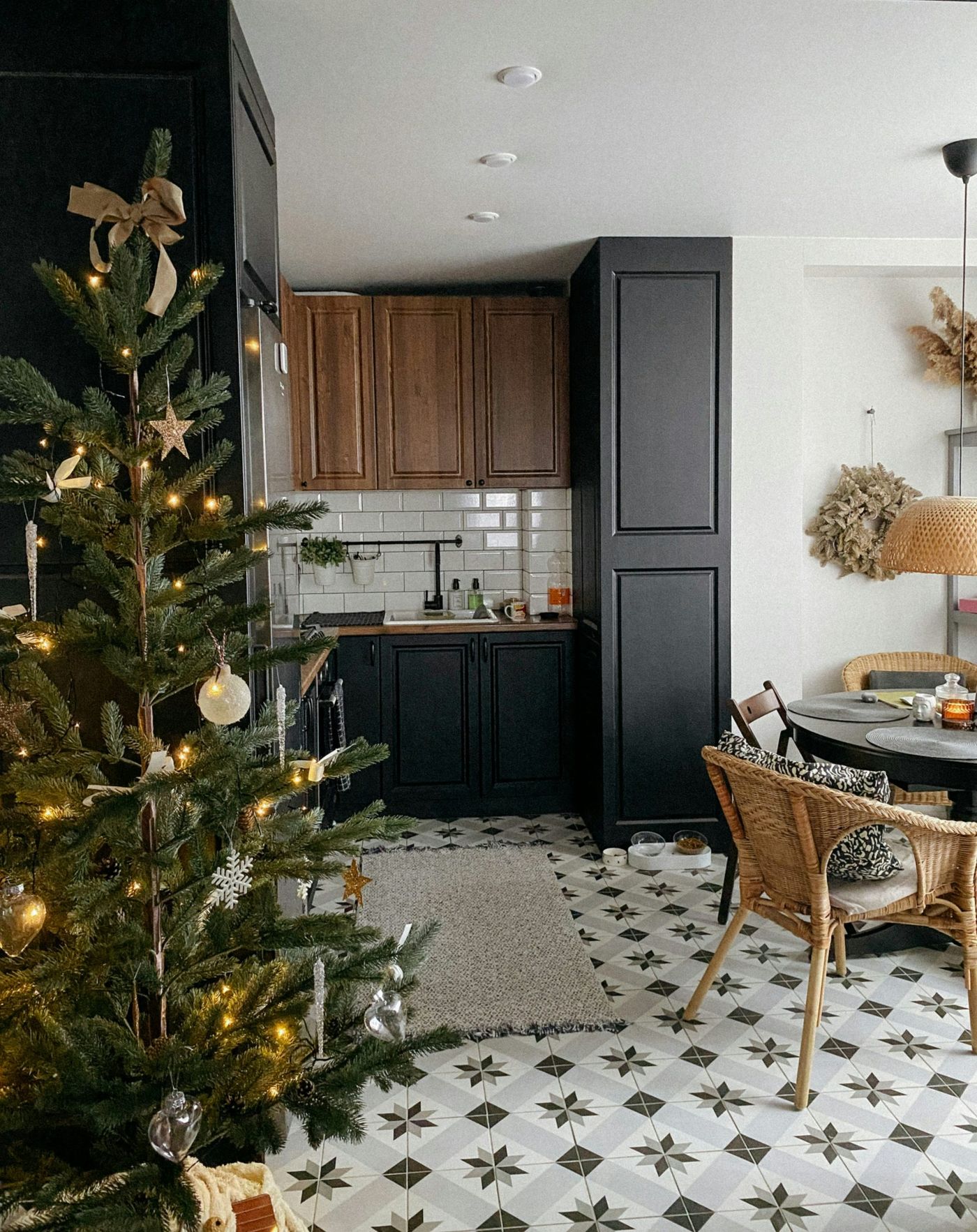
You don’t need more than $120 for this. A 5-foot slim tree is $45 to $90 at Target or Walmart. White and clear ornaments are the cheapest thing in the holiday aisle — Dollar Tree sells six-packs for $1.25, so 40 pieces runs about $10. For the bow, buy 3-inch beige ribbon by the yard at Michaels for around $4 and tie it yourself. The room’s palette — matte black, medium wood, white tile — costs nothing and does most of the work.
25. Champagne Poinsettia Picks and Taupe Wrapped Gifts
This tree is 45% frost, 25% metallic, 20% ribbon, 10% gift wrap. That first number matters most, because heavy flocking is what makes metallics look expensive — silver and gold read as bright rather than cheap when there’s white behind them. To shift the palette, change one variable at a time: swap silver picks for rose gold and the whole thing warms up; swap taupe boxes for deep green and it goes traditional instead of bridal. Keep the frost constant either way.
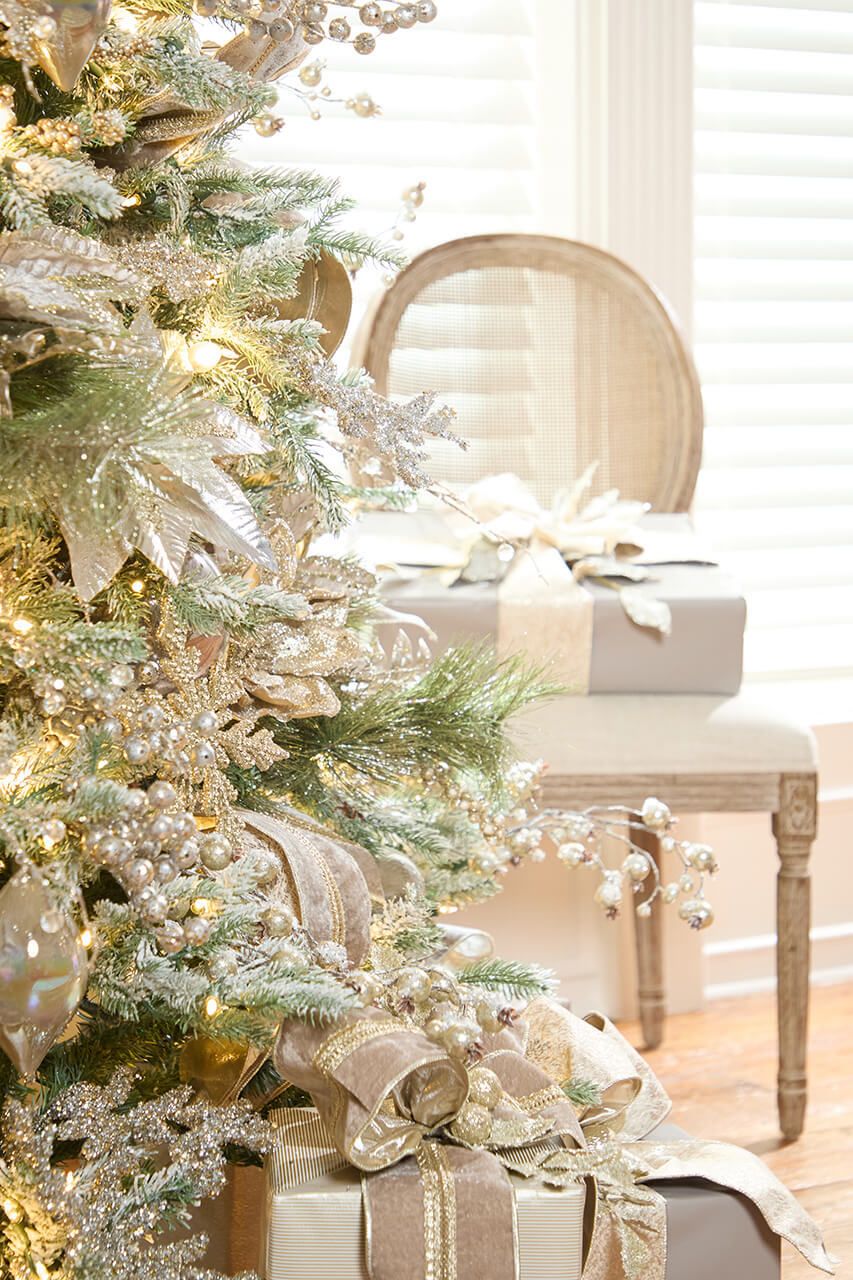
Metallic floral picks are delicate in one specific way: the petals crease. Store them flat in a box with tissue between layers, never stuffed into a bag, or you’ll unwrap crushed flowers next December. Flocking wants a cool, dry closet — heat yellows it and humidity turns it to paste. Velvet ribbon should never be folded; roll it around a cardboard tube so the pile doesn’t crush. Fifteen careful minutes in January buys you three more seasons.
26. Starburst Mirror Over a Teal Sofa and Mini Tinsel Tree
The starburst mirror wins. It’s the largest reflective surface in the room, and it quietly pulls the tree’s lights into the center of the composition and throws them back across the ceiling. It also gives an eclectic room one clean geometric shape, when everything else is tufted, patterned, or hand-painted. Remove it and you’ve got a flea-market room. Keep it and you’ve got a designed one. If you buy one thing to chase this vibe, buy the biggest vintage mirror you can carry.
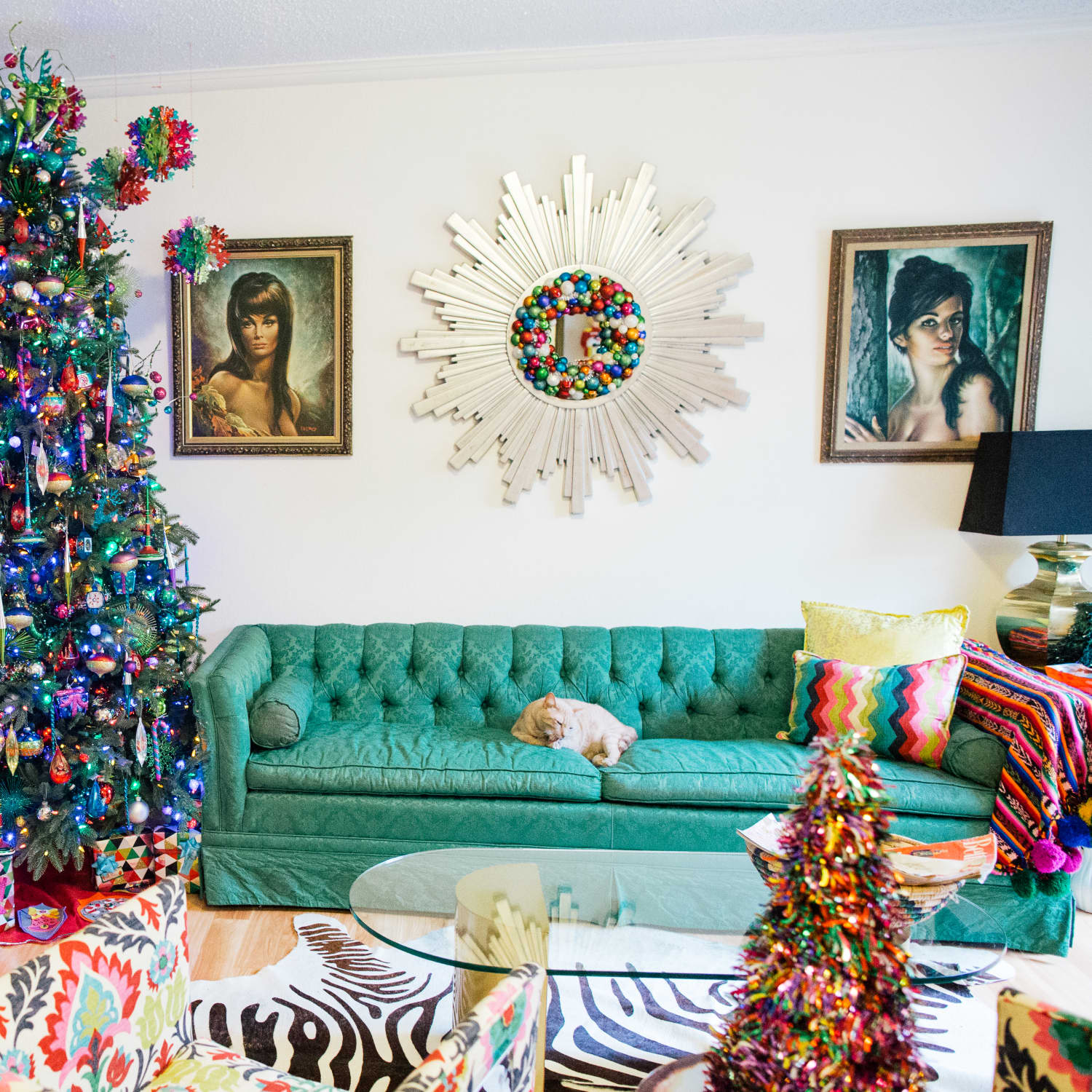
Eclectic rooms live or die on a strict color count: three loud, everything else quiet. Here it’s teal, silver, and multicolor tinsel. Pin the palette by repeating each color twice — teal on the sofa and in the tree ornaments, silver on the mirror and in the tinsel. Also, keep the smallest tree at roughly one-quarter the height of the big one so the pair reads as parent and child rather than rivals competing for the same corner.
27. A Credenza Full of Tiny Lit Trees
The tabletop trees on the credenza are what make a big room feel furnished. Keep them 18 to 24 inches tall — under 12 inches they read as figurines, over 30 and they compete with the main tree. Space them 10 to 14 inches apart so their glow reads as one continuous line rather than three separate objects. The credenza itself should sit within sight of the main tree, ideally no more than 12 feet away, or the room splits into two separate holidays. In a smaller living room, one tabletop tree is plenty.
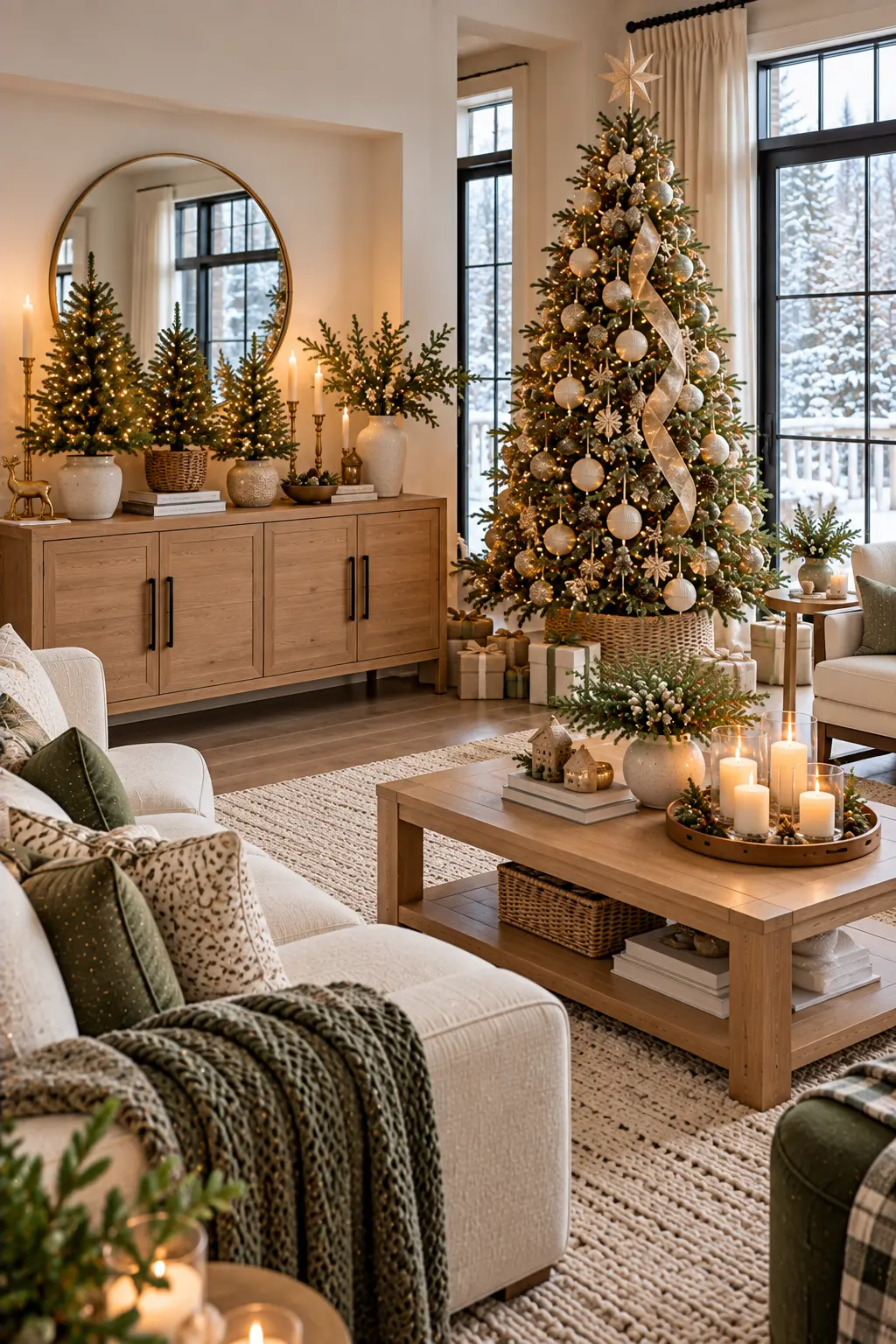
The palette is warm beige, olive green, and gold — three values that never fight because they all sit on the warm side of the wheel. The dark green knit throw on the cream sofa is doing the heavy lifting: without it, everything is pale and flat. One deep, saturated neutral at sofa level anchors a room full of light tones, and it costs about $40 at HomeGoods. Repeat that formula anywhere and it works.
28. Red Velvet and Matte White Over a Brushed Gold Collar
- Tree, 7.5 ft: $150–$450
- Matte white and brown baubles, about 60: $50–$140
- Deep red velvet ornaments, 20–30: $40–$110
- Gold bell clusters and berries: $25–$60
- Warm string lights: $25–$50
- Brushed gold metal collar: $60–$160
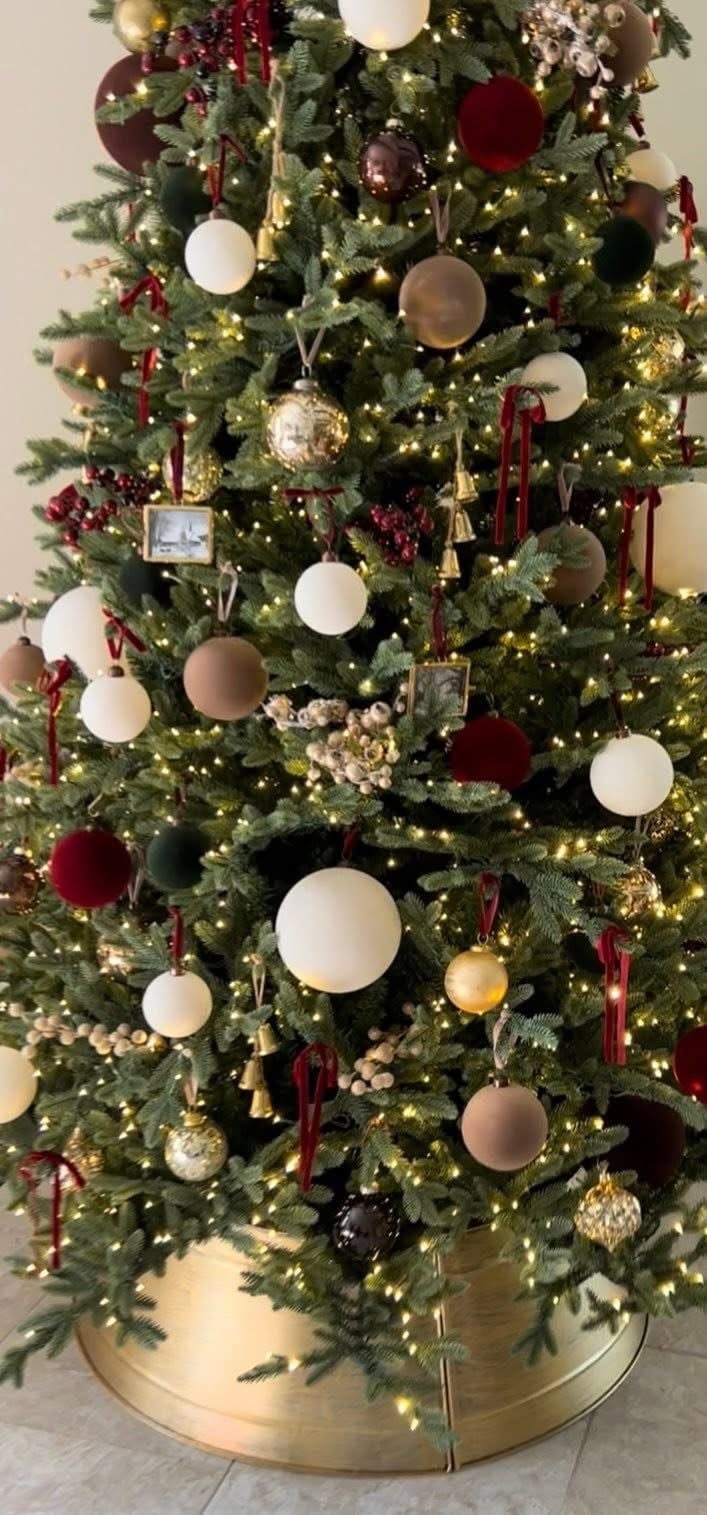
Total: $350 to $970. Budget alternative: velvet-look ornaments from Walmart run about $8 for a set of six, and the collar is easy to fake — a wide gold wire basket flipped upside down does the same job for $20.
- Measure the collar or skirt against your actual trunk diameter before ordering online.
- Check ornament weight, because velvet and glass pull branches down hard on a 6-foot tree.
- Decide your red-to-white ratio in advance; this palette goes muddy past 40% red.
- Confirm your light count — 100 warm bulbs per foot of tree height is the working minimum.
29. Jewel-Tone Pillows and Glass Baubles in the Window
Maximalism still follows math: 40% deep red, 25% emerald, 20% magenta, 15% gold. The proportions matter because the eye needs one color to lead — here it’s red, in the ornaments and on the pillows. The trick with jewel tones is keeping the values equally deep. The moment you add a pastel, the whole thing looks like a mistake. Want to shift the palette? Swap magenta for cobalt and gold for copper. The mood changes, the formula doesn’t.
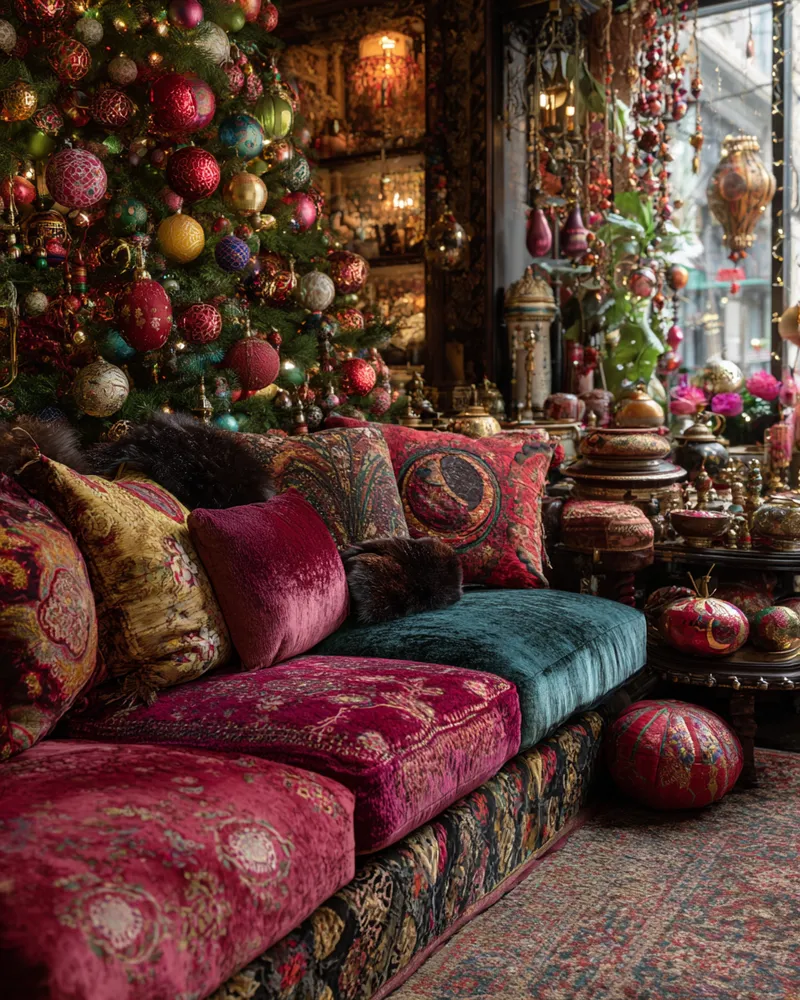
Jewel tones are the cheapest palette to fake, because thrift stores are full of them. Velvet pillows at Goodwill run $4 to $8; estate-sale glass ornaments are often fifty cents apiece by the box. Target’s Threshold line does deep red and emerald velvet pillow covers for $12 to $18, and HomeGoods always has a bin of patterned jewel-tone ornaments for under $10 a set. Hang a few glass baubles in the window on fishing line — a 10-minute, $5 project that reads as a designer touch. Full look for under $200.
30. Books Stacked Inside a Dead Fireplace Opening
The books inside the fireplace are the detail that makes this room feel like it belongs to a person. Stacking paperbacks in a dead hearth turns a useless architectural feature into a display shelf, and it echoes the gallery wall without hanging one more thing. If your fireplace works, absolutely do not do this — but if it’s capped or purely decorative, it’s the best free real estate in the house. Just keep the stacks low so the mantel still reads as the top layer.
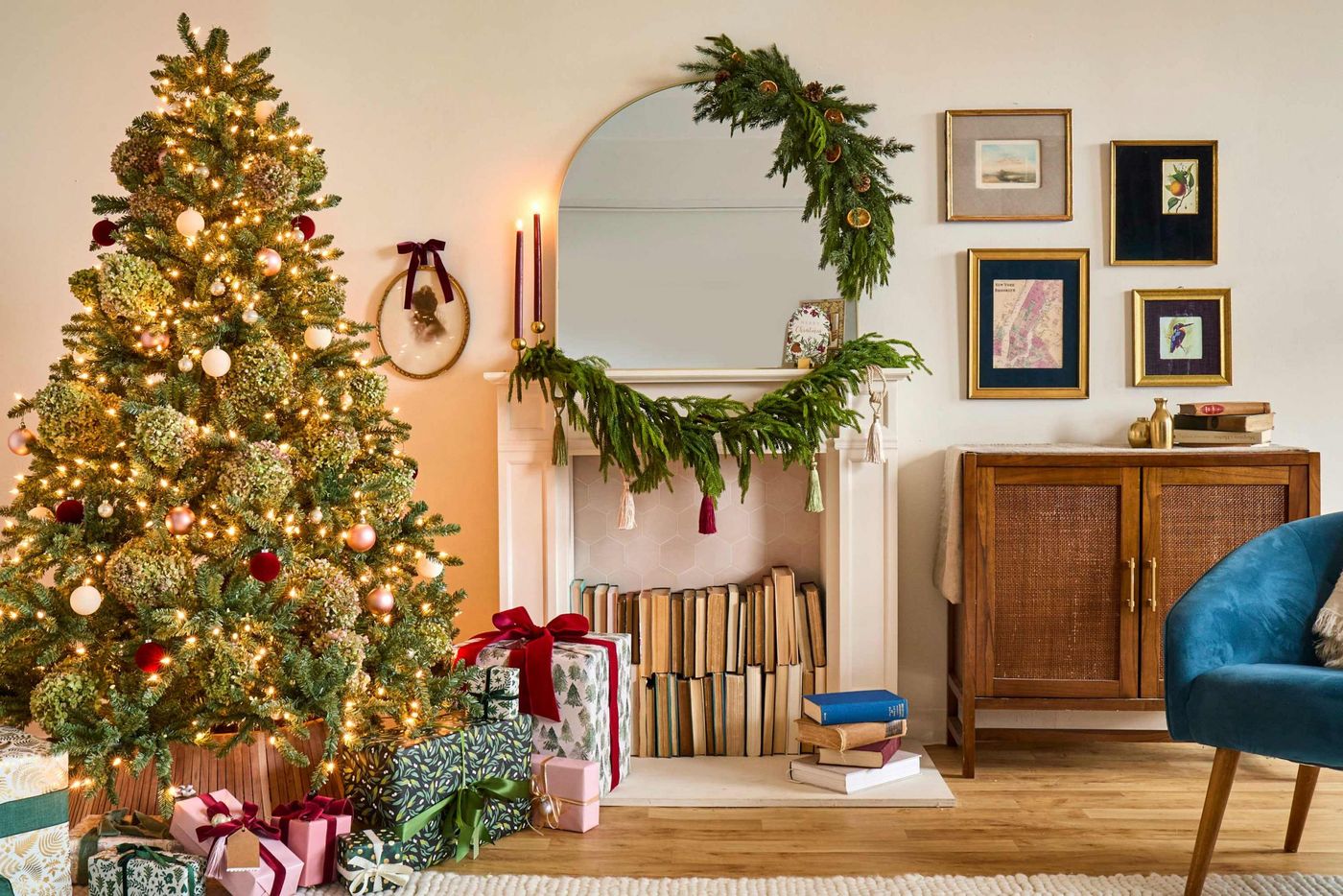
Before you stack anything in a hearth, confirm it’s genuinely non-functional: check for a closed damper, a capped flue, or a gas line. If there’s any chance it could be lit, keep it empty and set a basket of blankets in front instead. Hearths are also dusty — books stored there need a vacuum brush every couple of weeks, and paper absorbs soot smell over time. If the chimney has ever been used, seal the opening with a board first or skip the idea.
31. Paper Chains Draped Across a Peach Ceiling
- Cut 1-inch strips from three or four colors of heavyweight paper — leftover wrapping paper works and costs nothing.
- Loop the first strip into a circle and tape it closed.
- Thread the next strip through, loop, tape. Repeat, alternating colors irregularly.
- Build in 6-foot sections so they’re easy to drape, store, and repair.
- Attach to the ceiling with clear pushpins or removable adhesive hooks, letting each section sag 8 to 12 inches.
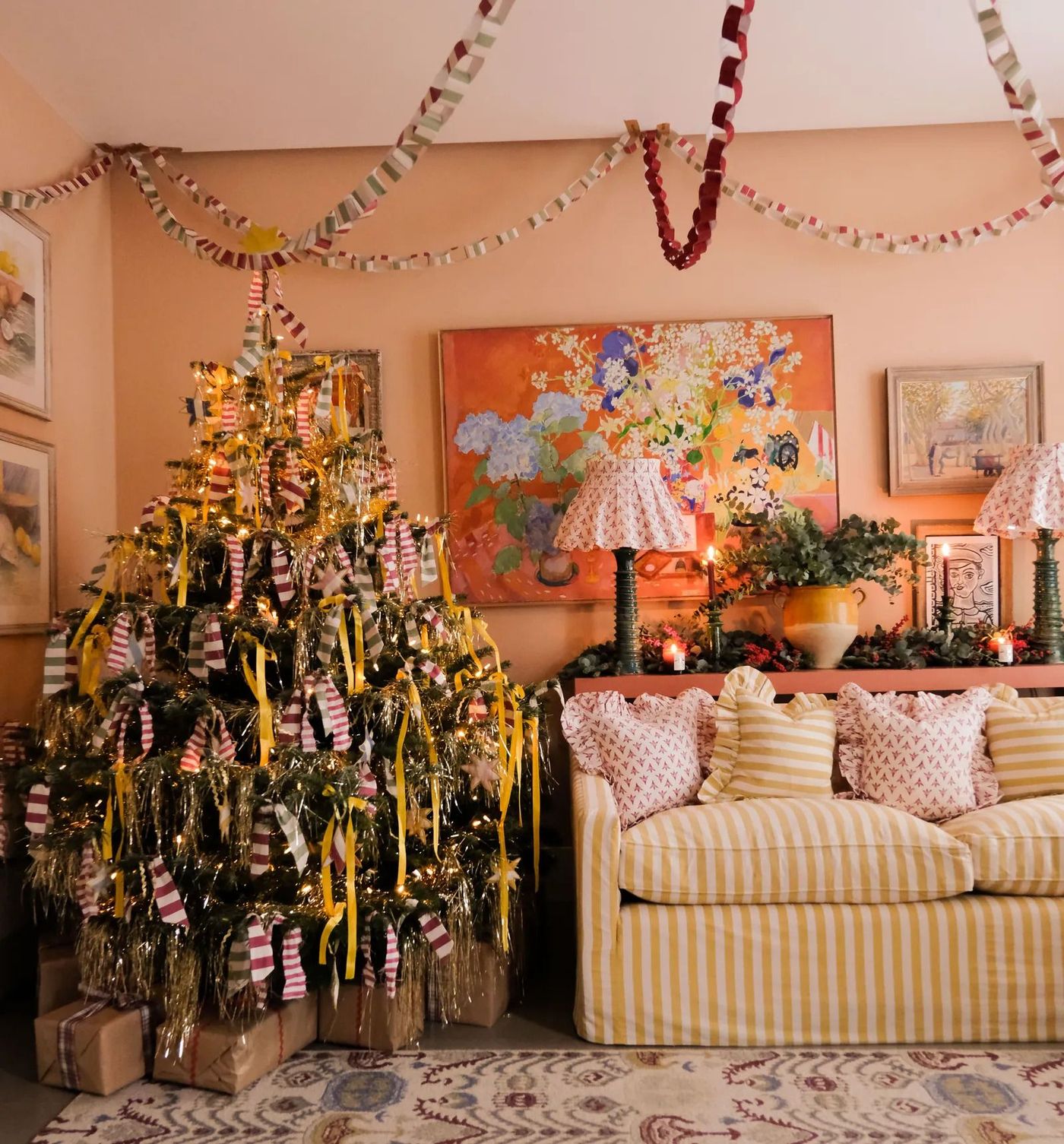
About 2 hours for 30 feet. Paper and tape: under $12.
Paper chains are back, and not for nostalgia’s sake. As holiday budgets tightened through 2025, people started hunting for decorations that cost almost nothing and fill a lot of space — and a ceiling garland does more visual work per dollar than anything else in the room. It also fits the wider cluttercore and grandmacore movements building on Pinterest, where handmade and slightly imperfect beats polished.
- Tinsel tree garland, 3 strands: $15–$30
- Yellow and striped ribbon: $12–$25
- Paper and tape for chains: $8–$15
- Warm string lights: $20–$40
- Patterned throw pillows: $40–$100
Total: $95 to $210. Budget alternative: the entire paper chain system comes in under $15, and tinsel garland from Dollar Tree is $1.25 a strand — which leaves your budget for the pillows that carry the color story.
32. Burgundy and Orange Against Grey Paneled Walls
The curtains are doing more for this tree than any ornament hanging on it. Rust-red drapes against grey wainscoting create exactly the temperature contrast that makes burgundy ornaments glow instead of disappear — the tree is essentially borrowing the wall’s color scheme. Pull those curtains back to neutral and the tree would still be pretty, just quieter. If you’re styling a tree in a grey room and wondering why your warm-toned ornaments look dull, this is the answer: you need a warm textile somewhere in the frame.
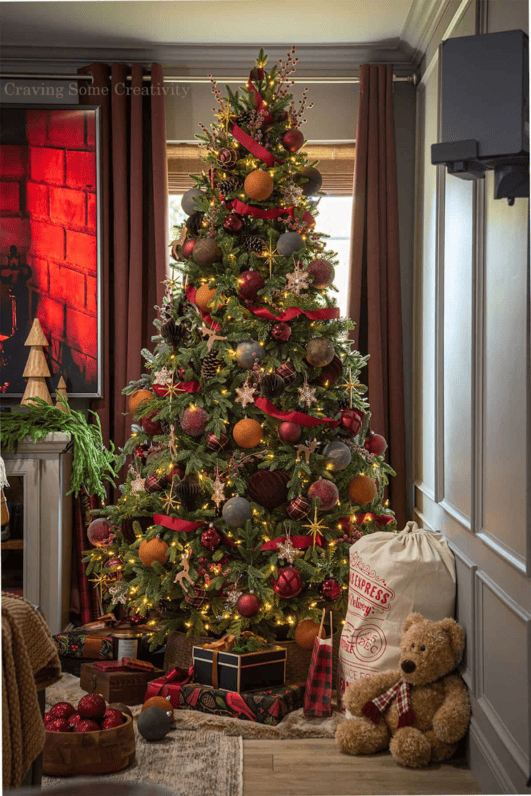
Burgundy and orange is a hard pairing to keep elegant, and the number that saves it is seventy-thirty. Keep burgundy at about 70% of the ornaments and orange at 30%, then add plaid as a third, smaller pattern only near the base. Gifts and the Santa sack should stay in the same family — kraft, deep red, or white — so the floor doesn’t become a competing display. Hang the star ornaments closest to the lights so their points catch and scatter.
33. Black and White Ornaments on a Flocked Tree
- Anchor the contrast with one warm material — here it’s the light wood floor and the pale upholstery.
- Use 12 to 15 black ornaments maximum on a 7-foot tree; black reads heavier than its actual size.
- Cluster black with white, never alone, so it looks patterned rather than scattered.
- Add gold in small doses — ribbon, bell caps, gift trim — to warm the palette by degrees.
- Repeat the black at floor level with gift boxes so the eye completes a triangle.
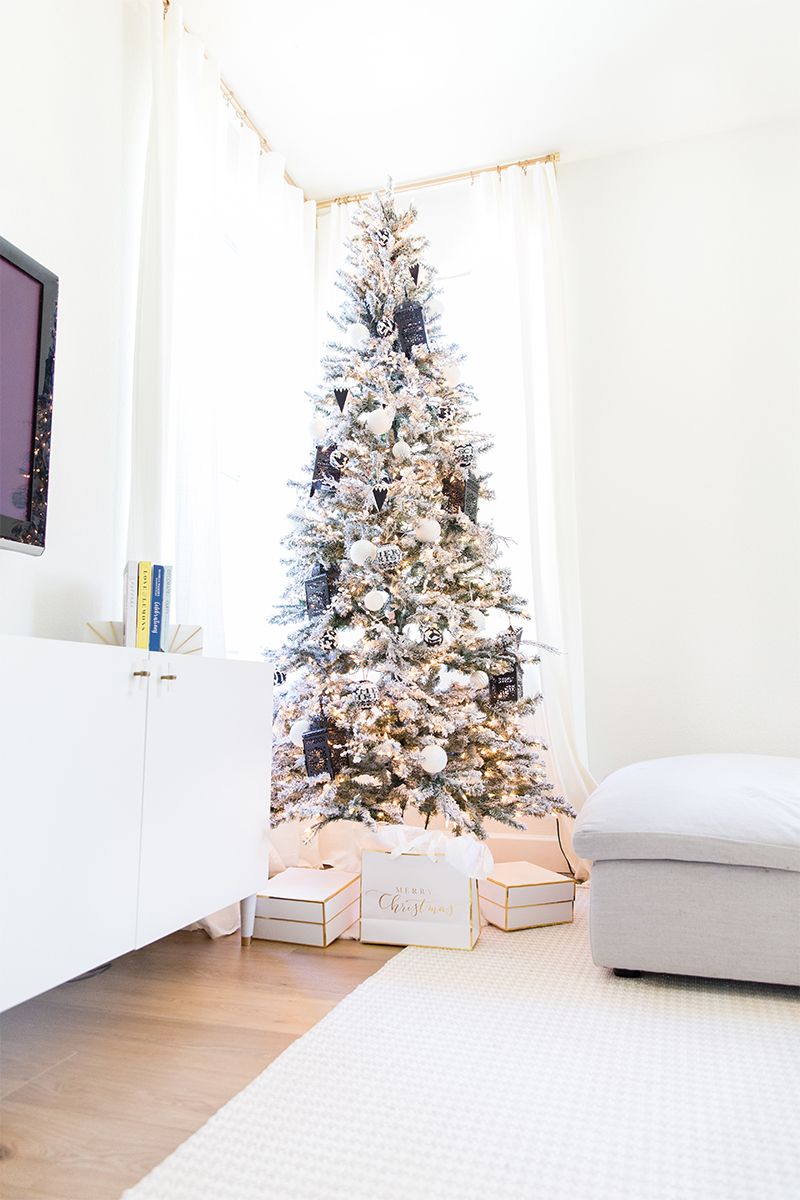
About 45 minutes to restyle an existing tree.
Black-and-white styling wants a modern room of at least 180 square feet with furniture in the light-to-mid grey range; in a warm, traditional room, black ornaments turn heavy fast. Standard 8-foot ceilings allow a 7-foot flocked tree without crowding, but if a credenza sits beside it, keep 24 inches between the two. Open floor plans should keep the tree’s silhouette visible from the kitchen — this palette reads from a distance better than almost any other. Warmer options like Idea #21 are the safer bet in tight, cozy rooms.
34. Fairy Lights Against a Bare White Wall
On a bare white wall, the magic is bulb count, not ornament count. A 6-foot tree needs 300 to 400 warm-white micro lights to look this even — roughly double what most people use. Wrap the trunk first, then spiral outward through the branches every 4 to 6 inches. Keep the color temperature at 2700K; above 3000K the light goes white-blue and the illusion dies instantly. Six to eight ornaments total is all this silhouette wants.
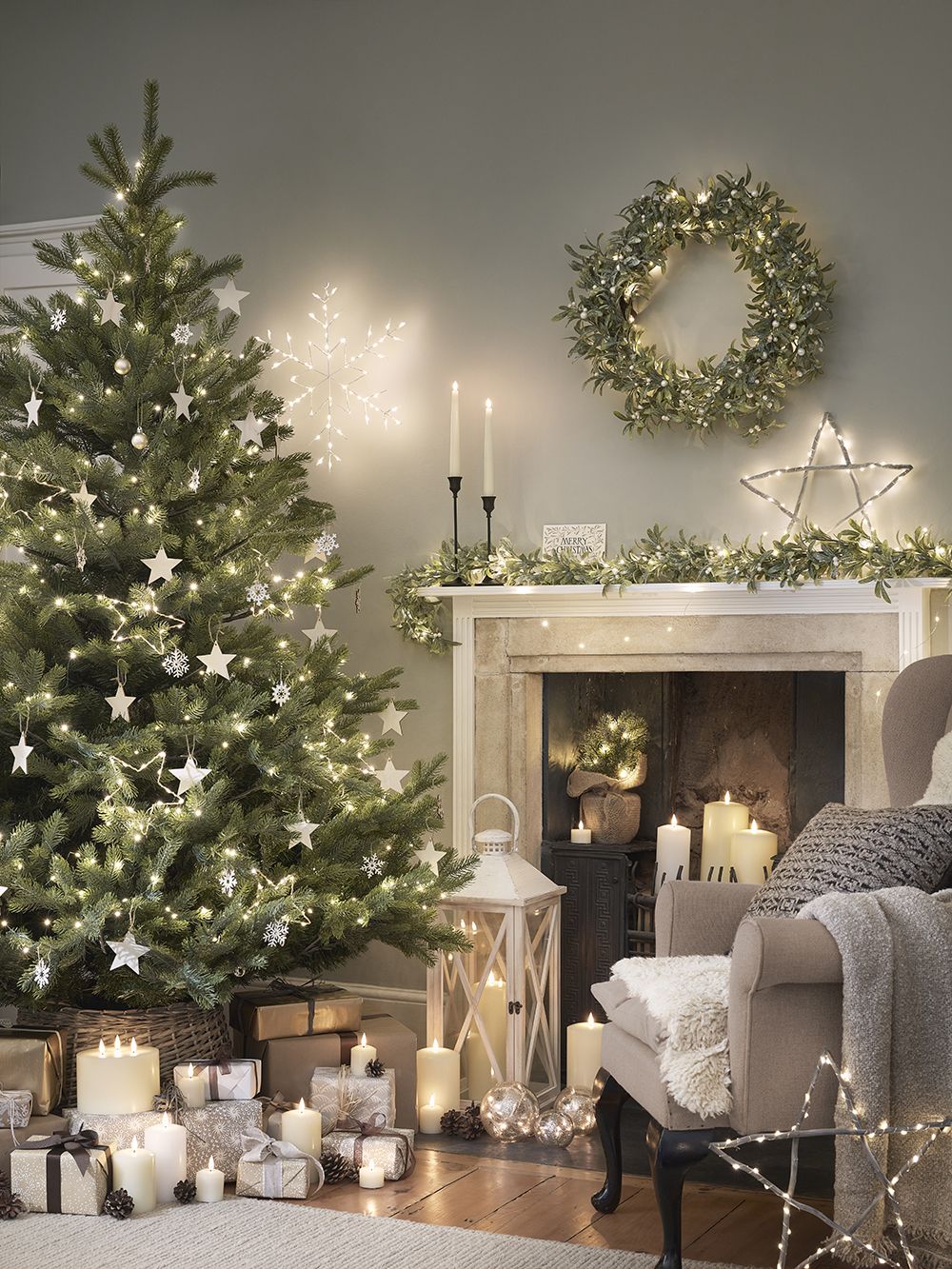
This is a study in negative space. The white wall isn’t a limitation, it’s the frame — everything in the composition is either light or shadow, which is why the tree looks almost drawn rather than decorated. The wood floor adds one warm value at the bottom to keep the scene from going clinical. Nothing competes. If you build this at home, resist adding a garland, a wreath, or a second tree nearby. Space is the ornament.
35. Red Velvet Bows and Honeycomb Spheres by the Stone Fireplace
Velvet bows, knit stockings, and flocked branches are three different dust magnets, and each needs different care. Velvet: brush gently with a soft-bristle brush, never water. Knit stockings: hand-wash cold once a season and dry flat, or the cuffs stretch permanently. Honeycomb paper spheres: dust with a dry brush and store them flat, because they crease for good if anything heavy rests on them. Budget about 20 minutes a week through December, or the whole vignette looks tired by the twentieth.
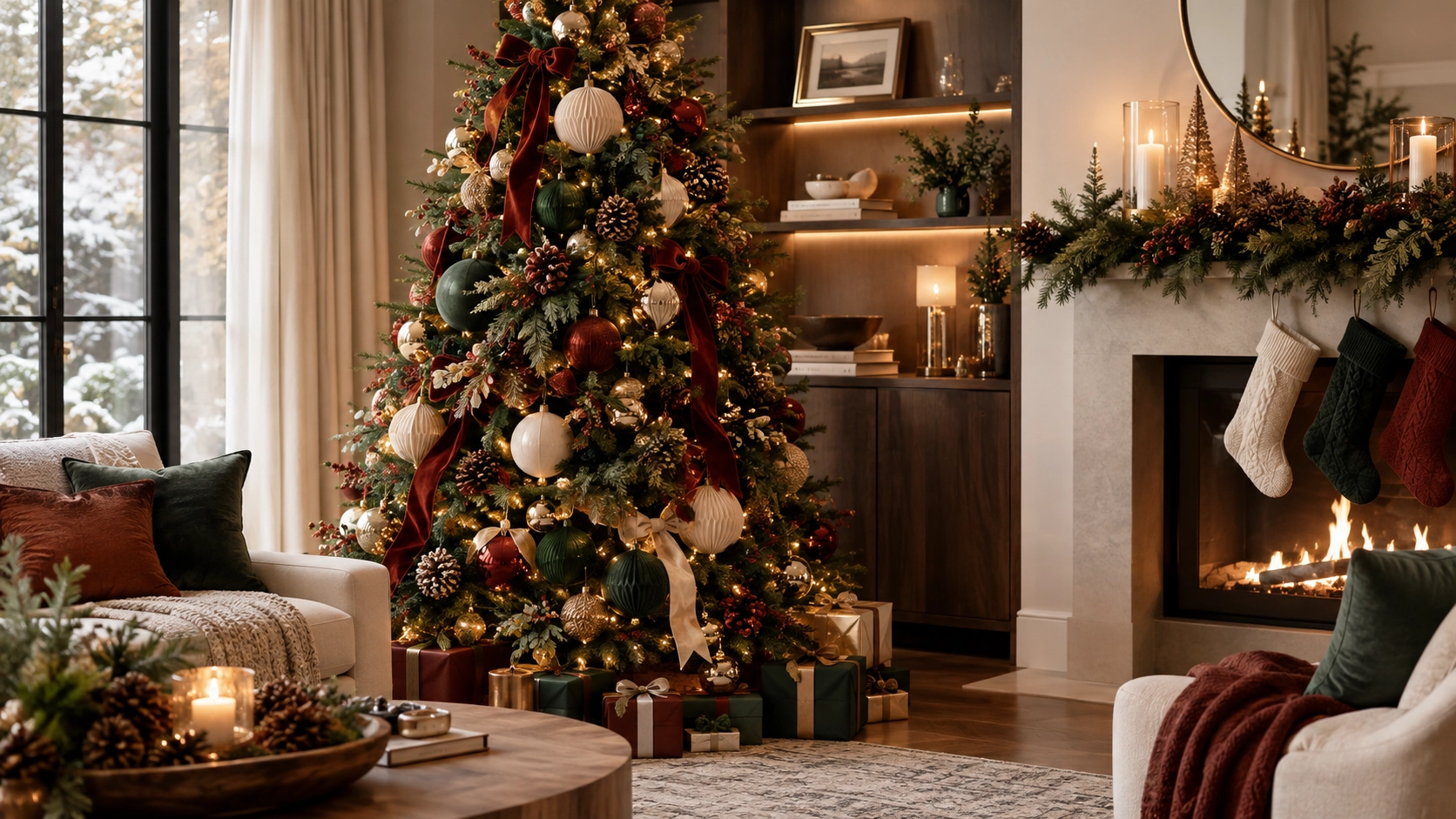
You can get 80% of this for a third of the price. Velvet ribbon by the yard at Joann runs $6 to $9 and ties 15 bows. Honeycomb spheres are $8 to $14 a set at Target. For the stockings, buy plain cream knit ones at Walmart for $8 each and dip-dye the cuffs yourself. The biggest saving is the shelving glow — battery LED strip lights cost $15 to $25 and give the same built-in effect without an electrician.
- Check whether your built-ins have an outlet nearby; battery LEDs solve it if they don’t.
- Test your mantel’s load, since a heavy garland plus metal stocking hooks needs solid anchoring.
- Confirm the tree’s width fits between fireplace and seating — velvet bows add 3 to 4 inches of spread.
- Decide between mantel hooks and a standing holder based on your mantel depth.
Thirty-Five Trees Later, It’s Your Turn
You don’t have to copy any of these exactly — that’s the whole point of having thirty-five of them. Pick the palette that matches the room you already have, borrow two or three details, and let the rest be yours. A tree that looks like your house always beats one that looks like a catalog.
📌 Pin your favorites now, so when December gets busy you already know exactly what you’re doing.
