
33 Stunning Vintage Christmas Tree Decoration Ideas You Need to Try in 2026
You know the feeling: you spot a tree on Pinterest, save it, scroll on — and three weeks later your board has forty-two trees that all kind of look the same, and you still don’t know where to start. Let’s fix that.
We spent the season digging through World Market, Etsy, HomeGoods, Amazon, and Target to pull the 33 vintage Christmas tree ideas actually worth copying in 2026 — from $8 thrifted indent ornaments to a $420 statement tree covered in velvet blooms and rose gold.
Inside you’ll find rustic natural, mid-century retro, traditional red-and-gold, and full-on eclectic maximalist looks, with budget and luxury versions compared side by side so you can pick a lane and stay in it. Every idea is shoppable with direct product links, so you’re not guessing at sources at 11pm on December 12th.
2026 is the year vintage got specific: ceramic light-up trees are back on credenzas, mercury glass outsells plastic, and shoppers are hunting one-of-a-kind pieces instead of another identical box of baubles.
Go ahead and save this — you’re going to want to reference it before you drag the boxes out of the attic.
1. A Muted Natural Tree With Paper Ornaments in a Woven Collar
Restraint is doing all the heavy lifting here. The tree is the only green mass in the frame, so the cream paper ornaments, the muted green glass baubles, and the natural-toned wrapped gifts read as one soft chord instead of competing notes. The woven basket collar replaces the usual fabric skirt and ties the base into the same taupe-and-wood family as the herringbone floor. Nothing sparkles. Everything breathes. And the ruffled white pendant above pulls cream straight off the ornaments and repeats it in the light fixture — a quiet trick that makes the corner feel designed rather than decorated.
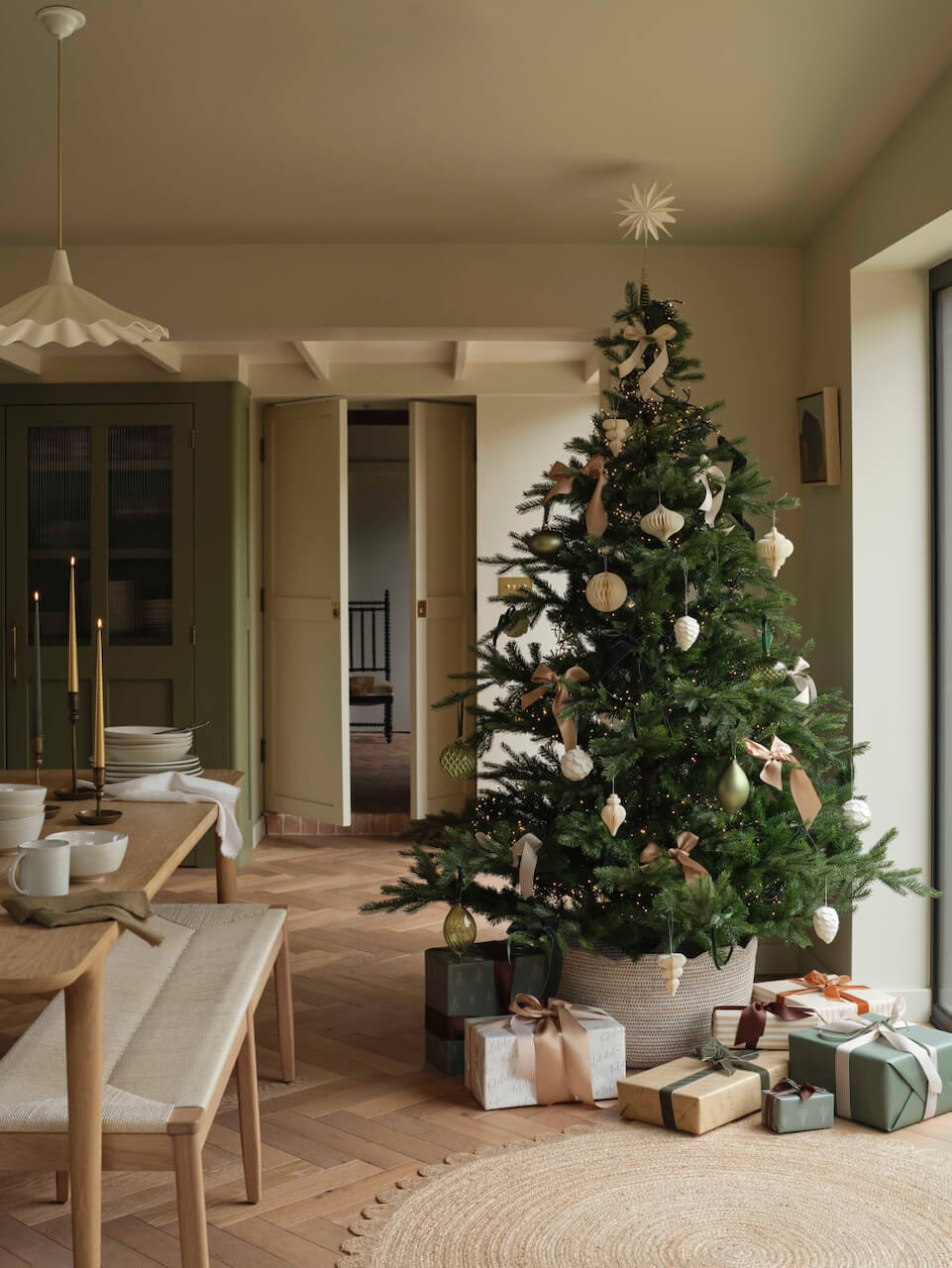
Want this look without it going flat? Keep exactly one metallic in the mix — here it’s the warm gold of the string lights and a few brass hooks. When your palette is this muted, three or more shine levels turn to mush. Pick one finish and repeat it at least four times across the tree, the table, and the gifts. Wrap presents in paper that matches the tree, not the room. It sounds fussy, but it’s the difference between a styled vignette and a pile of gifts under a bush.
2. Matte Baubles, Silver Tinsel, and the Return of Icicle Ornaments
The formula runs roughly 50% dark green tree + 30% matte glass in muted red, gold, and sage + 15% silver (tinsel plus clear icicles) + 5% warm glow. The matte finish is what keeps the baubles from turning into a disco ball — shine is reserved almost entirely for the tinsel and the icicles, which catch the string lights instead of reflecting the room back at you. Swap the muted reds for dusty blue and you have the same tree in a cooler key. Swap the tinsel for bead garland and the whole thing goes quiet.
Tinsel is the most opinionated material on this tree and also the fussiest. Wide foil tinsel sheds, tangles around light strands, and shows every gap once the bulbs come on. If you have pets that investigate strings, this is the look they’ll investigate first. The good news: fine silver tinsel in short strands, added last and only on the outer third of the branches, gives the same shimmer with about a third of the mess. Just don’t buy the flimsy stuff — thin tinsel reads as tinsel, heavy tinsel reads as vintage.
3. Mercury Glass, Finials, and Deep Red on a Loaded Tree
- Mercury glass ball ornaments (set of 12): $28–$60
- Finial and teardrop ornaments (set of 6): $22–$48
- Red glass spheres, matte and shiny mixed (set of 20): $18–$35
- Warm white string lights, 300-count: $18–$30
- Vintage-style hooks and a storage box: $12–$25
Budget alternative: the mercury glass is what you’re paying for, so buy it secondhand. Thrift stores and estate sales move mercury balls for $1–$3 each, and eBay lots of 20 vintage glass ornaments regularly close under $40. World Market and Target both run mercury-finish sets at $20–$30 a dozen in November. Skip the finials year one — they’re the cherry on top, and you can add three or four each season until the tree fills in.
Take away the finials and this tree is still pretty. Take away the mercury glass and it’s just another red-and-gold Christmas tree. That oxidized, slightly cloudy silver finish makes the warm lights bloom across the surface instead of bouncing off it — the difference between a candlelit room and a room with the overheads on. Buy the mercury first, in odd numbers, and cluster them in threes rather than spreading them evenly. Clustering is what makes a dense tree feel curated instead of packed.
4. A Glossy Ceramic Tree With Snow Detail and a Bottle Brush Backdrop
Ceramic Christmas trees have been quietly climbing back for a few years, but 2026 is the season they moved from grandma’s attic to styling centerpiece. The reason is simple: they’re the rare vintage decoration that works on a shelf, a console, or a windowsill — no tree required. Pinterest saves for these light-up trees keep climbing, and original 60s and 70s versions now sell on Etsy and Facebook Marketplace for more than they cost new. Those multi-colored plastic bulbs are the entire point. Don’t swap them for LEDs.
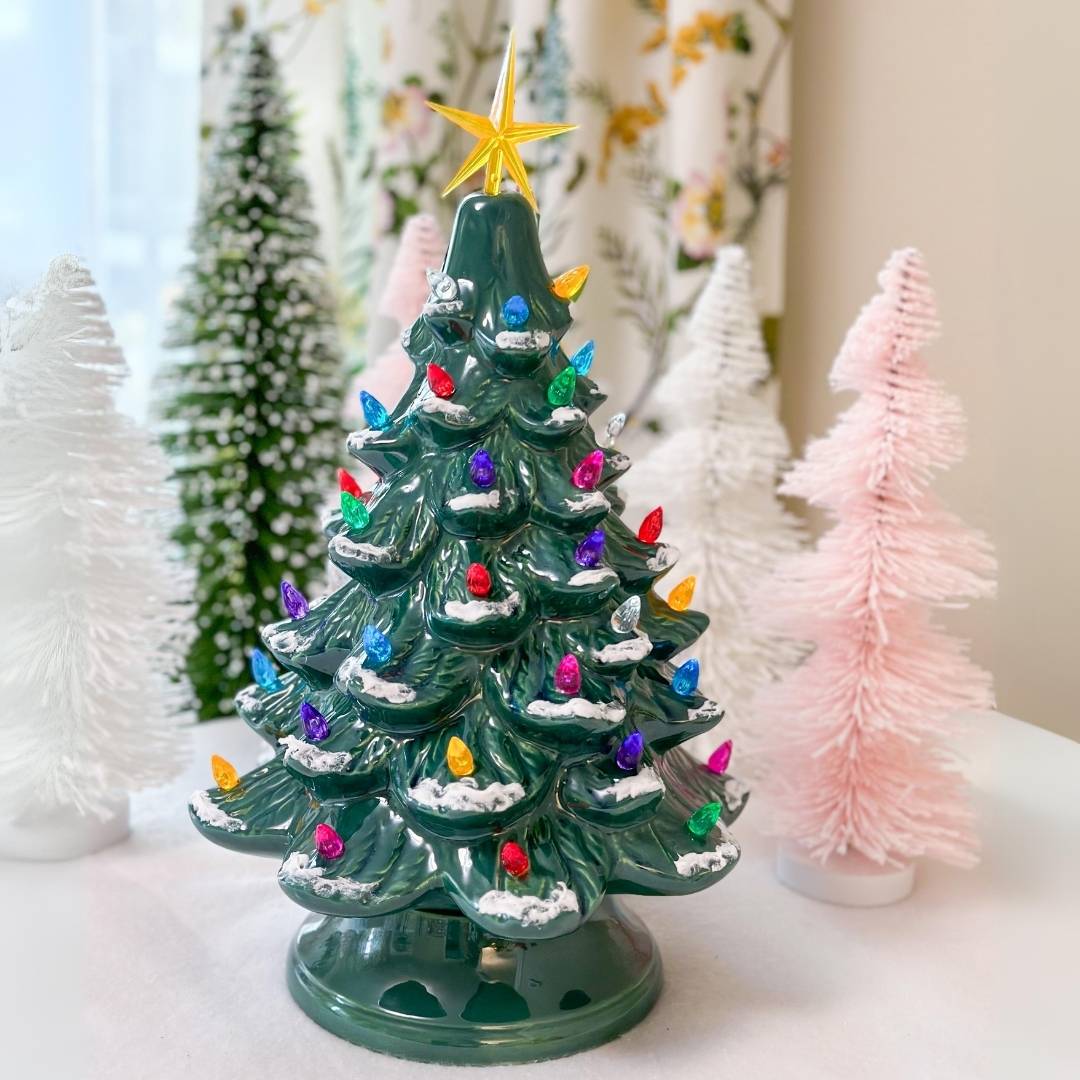
- Find a ceramic tree at a thrift store, estate sale, or Etsy — expect $35–$90 for an original with all bulbs intact.
- Test every socket with a single bulb before buying. Replacements are easy; dead sockets aren’t.
- Clean with a damp cloth only — never submerge, and never scrub the glossy glaze.
- Display on a white or light wood surface so the dark green reads as a silhouette.
- Group with two or three bottle brush trees in white, green, and one surprise pink for scale contrast.
Time: 20 minutes. Cost: $50–$120 all in.
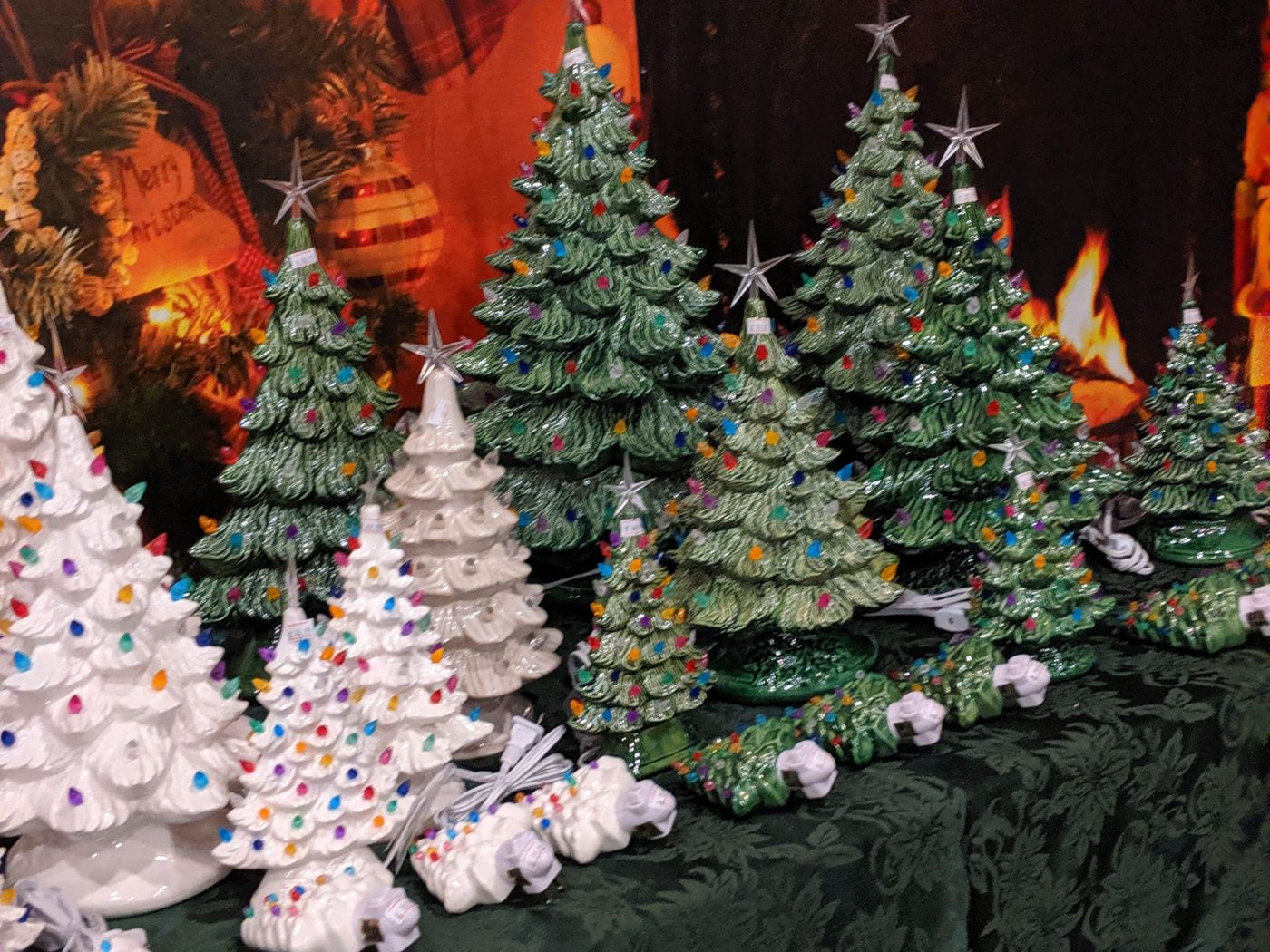
5. A Credenza of Light-Up Ceramic Trees Against Botanical Wallpaper
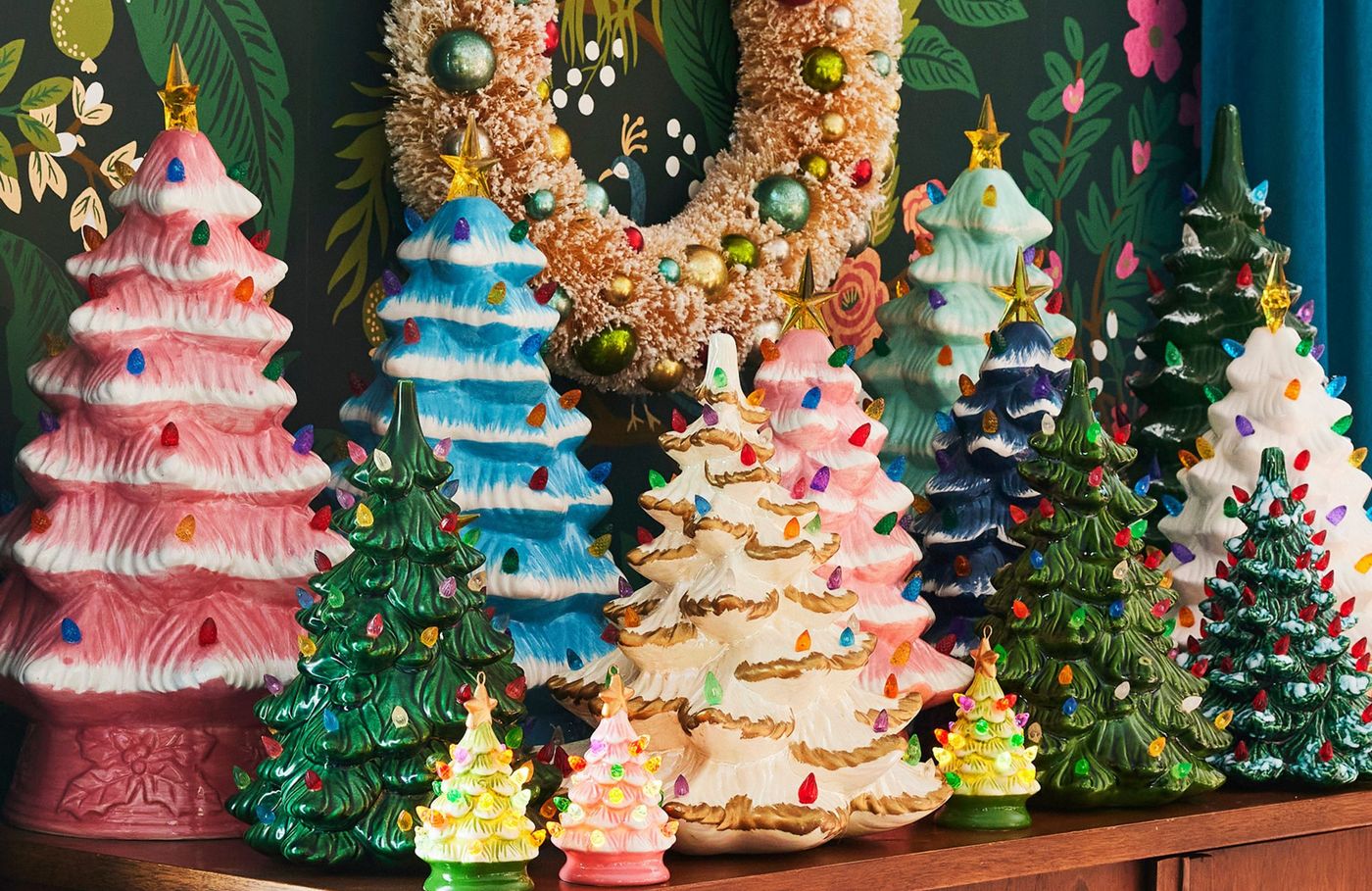
This one needs a wall, not a corner. Plan on at least five feet of linear surface — a credenza, sideboard, or long console — with roughly 18 inches of depth, because the trees range from 6 inches to 2 feet tall and you want them staggered front to back. The botanical wallpaper and teal velvet curtains are doing as much work as the trees themselves, so if your wall is plain white, give yourself a taller backdrop: a large mirror, a hanging textile, anything with pattern. Rooms under 100 square feet can absolutely do this — drop to three trees and keep the tallest one centered.
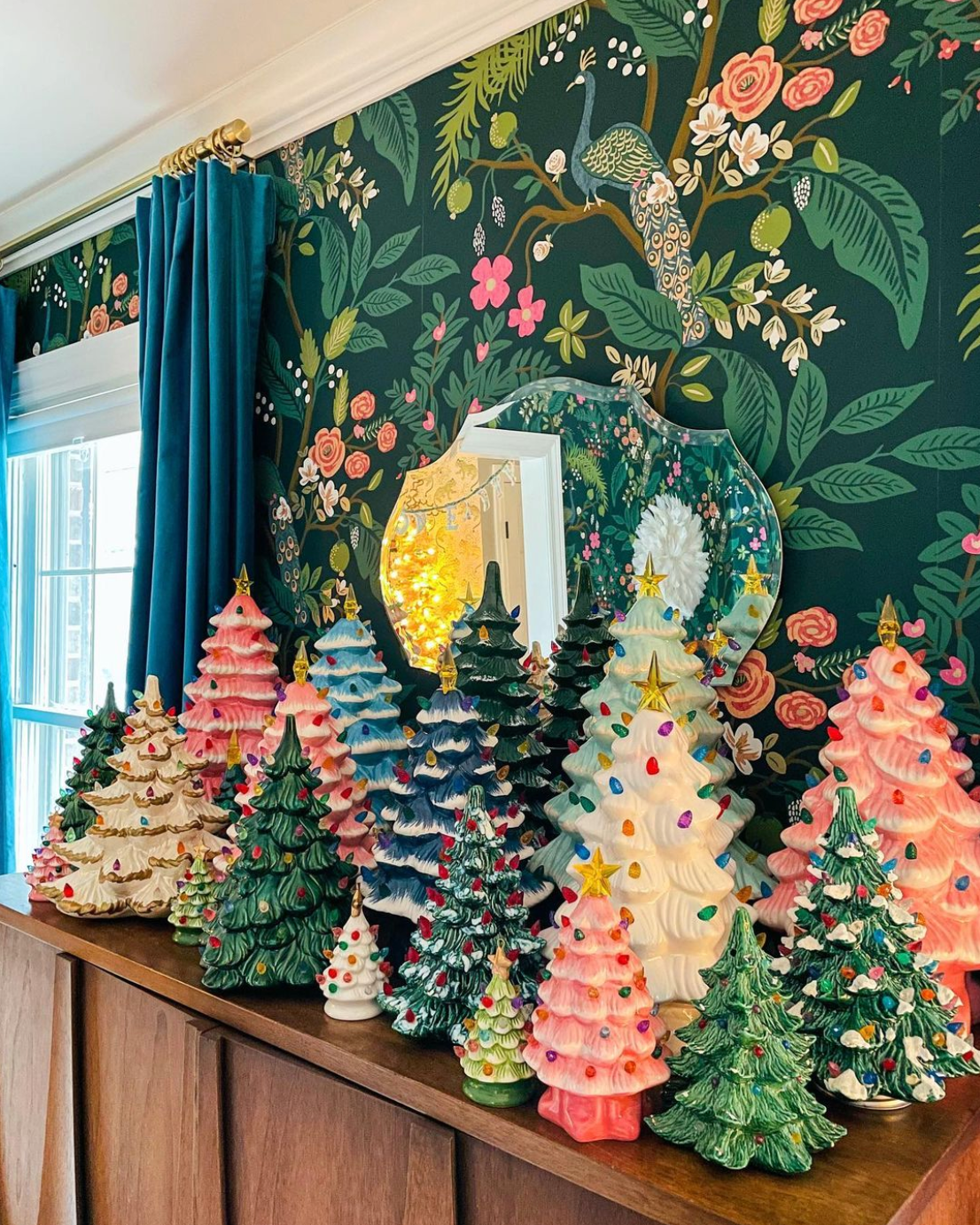
Why does a dozen ceramic trees on one credenza read as a collection instead of clutter? Two things: a shared material and a shared backdrop. Every piece is glossy ceramic, so the eye stops noticing individual objects and starts reading the group as one mass. The dark green wallpaper and teal curtains then do the opposite of what you’d expect — instead of competing with the pink and blue, they push the pastels forward. Compare with Idea #21 — same go-big-on-the-backdrop logic, completely different mood.
6. A Mid-Century Miniature Village on Snowflake Kraft Paper
You don’t need a $200 collectible village set. Plain light wood house blanks run about $3–$6 each at craft stores, and a hole drilled in the back with a battery tea light inside gets you glowing windows. Bottle brush trees are the real budget win — a 20-piece mixed-size pack is usually $12–$18 on Amazon, and Target’s dollar section carries them as singles from November. Set the whole thing on kraft paper with white snowflakes drawn in gel pen. Under $60 for a village that looks like it cost triple.
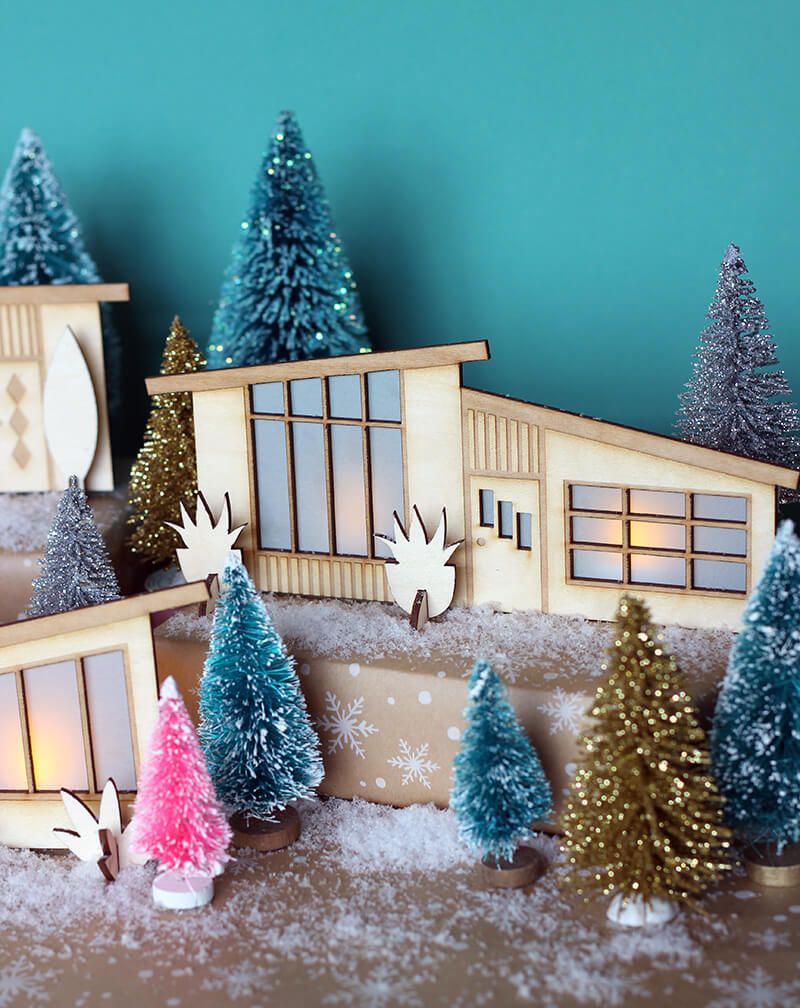
Bottle brush trees look best when you fight their natural instinct to line up. Use three sizes minimum — 1.5 inch, 3 inch, and 5 inch — and always place the tallest one off-center. Two-thirds back, one-third forward is the ratio that gives a miniature scene real depth; flat rows read as shelf inventory. Keep base height consistent, too: artificial snow packed to an even depth across the whole footprint is what sells the illusion that these little houses share one snowy street.
7. Tinsel Wall, Bright Glass Balls, and Fuchsia Bottle Brushes
Silver tinsel as a backdrop is gorgeous and genuinely high-maintenance. It sheds every time you move something, it dents permanently if it’s crushed in storage, and the reflective side shows every fingerprint. If you’re using it as a display backdrop rather than on a tree, buy foil garland with a wired core so it holds its shape. Keep it away from windows with direct sun — silver foil yellows over a season or two, and no, you can’t fix that.
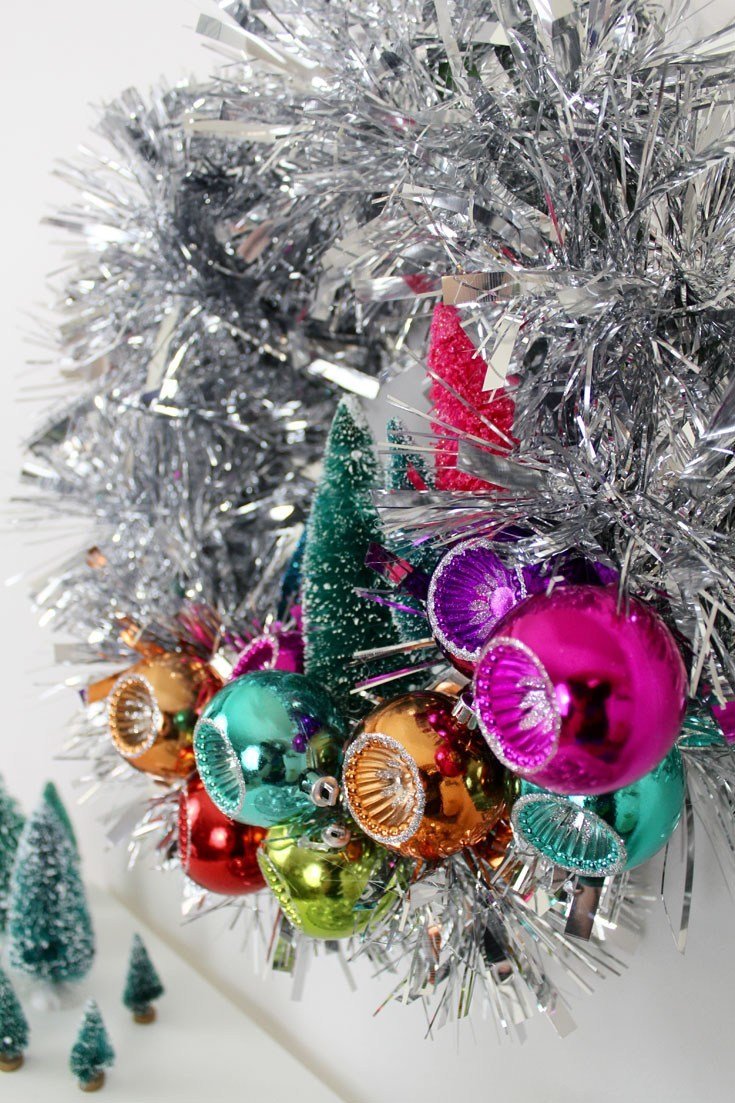
Here’s the formula: 55% silver (tinsel plus reflective glass) + 30% saturated jewel tones like fuchsia, teal, and purple + 10% warm gold from the ornament caps + 5% green from the bottle brush trees. Silver is the neutral here, which is why it can hold this much candy color without tipping into chaos. Want a calmer version? Keep the identical ratio, swap the fuchsia for deep emerald and the purple for navy. The silver base stays exactly where it is.
8. Classic Red, Gold, and Silver Baubles With Foil-Wrapped Gifts
It’s the foil-wrapped gifts, and it’s not close. The tree underneath is beautiful — dense, warm, traditional — but every other tree on the block looks like it. That mirrored paper under the branches catches the string lights and throws the glow back up into the lower third of the tree, which is the part most people leave in shadow. Choose wrapping with a real mirror finish, keep the ribbon matte so it doesn’t compete, and match the paper to your ornament metal. Cheapest upgrade in this entire article.
Glass ball ornaments are essentially maintenance-free — dust them once a year with a microfiber cloth and they’ll outlive you. Foil wrapping paper is the opposite. It creases permanently, so it wraps once and only once, and it shows every thumbprint. If you wrap early, keep gifts away from the tree lights and radiators; foil dulls near heat. Tarnished gold baubles can be revived with a soft cloth and a drop of olive oil — but skip that on anything with glitter or hand-painting.
9. A Multicolor-Lit Tree in a Galvanized Tub on a Plaid Rug
- Measure your tree stand’s footprint and buy a tub 2–3 inches wider in diameter.
- Line the tub with a heavy contractor bag, then set the stand inside — the bag catches dropped needles.
- Fill the gap between stand and tub wall with crumpled kraft paper or bubble wrap so the tree can’t wobble.
- Cover the fill with faux snow, quilt batting, or a folded plaid blanket so nothing shows.
- Nudge the top third of the tree to test stability; if it moves, add more fill.
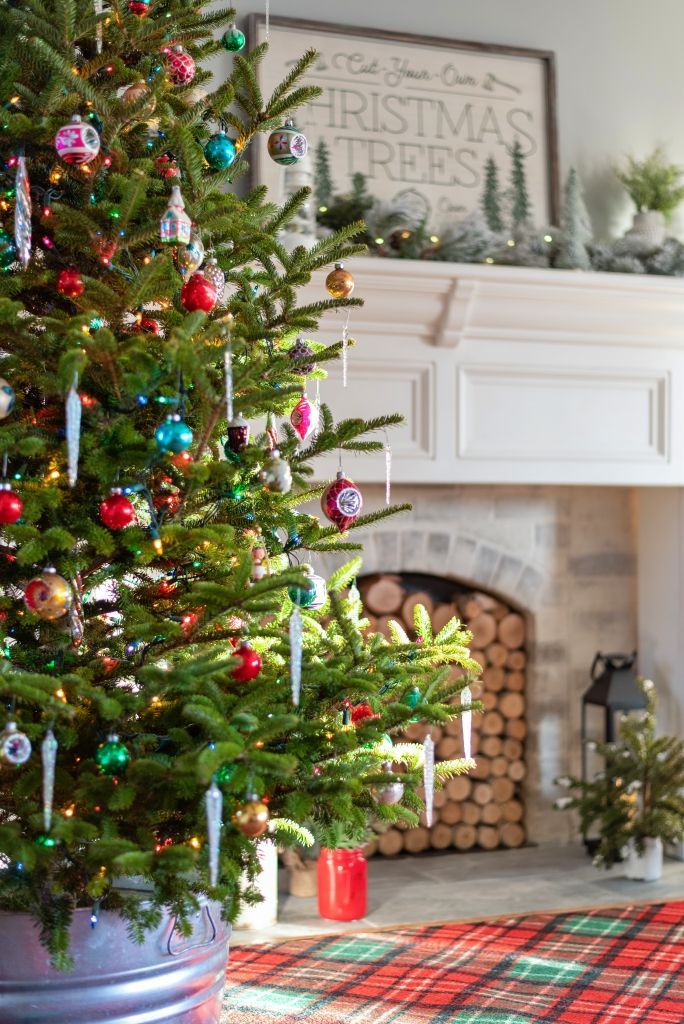
Time: 30 minutes. Cost: $25–$45 for the tub.
Galvanized tubs add about 6 inches of width to your tree’s footprint, so plan on a 3-foot circle of clear floor minimum — closer to 4 feet if you’re stacking gifts on one side. This look sings with 8 to 9 foot ceilings. In a room with 8-foot ceilings and a 7.5-foot tree you’ll have roughly 4 inches of clearance for the star, which is tight but workable. Smaller spaces should look at Idea #18, where a knit skirt does the same grounding job without the extra footprint.
10. Tassels, Dried Orange Slices, and a Tree Framed by Bookshelves
This tree breaks the two most common ornament rules at once and gets away with it. First, it mixes textures that shouldn’t get along — glass, silk tassels, dried citrus — and lets sheer density smooth them out. Second, it uses a muted grey-green rug and dark wood shelving as a neutral frame, so the color explosion stays contained. Repetition does the real work: roughly the same red-gold-teal palette repeats across ornaments, tassels, and the vintage card garland, so the eye reads the whole thing as intentional rather than accidental.
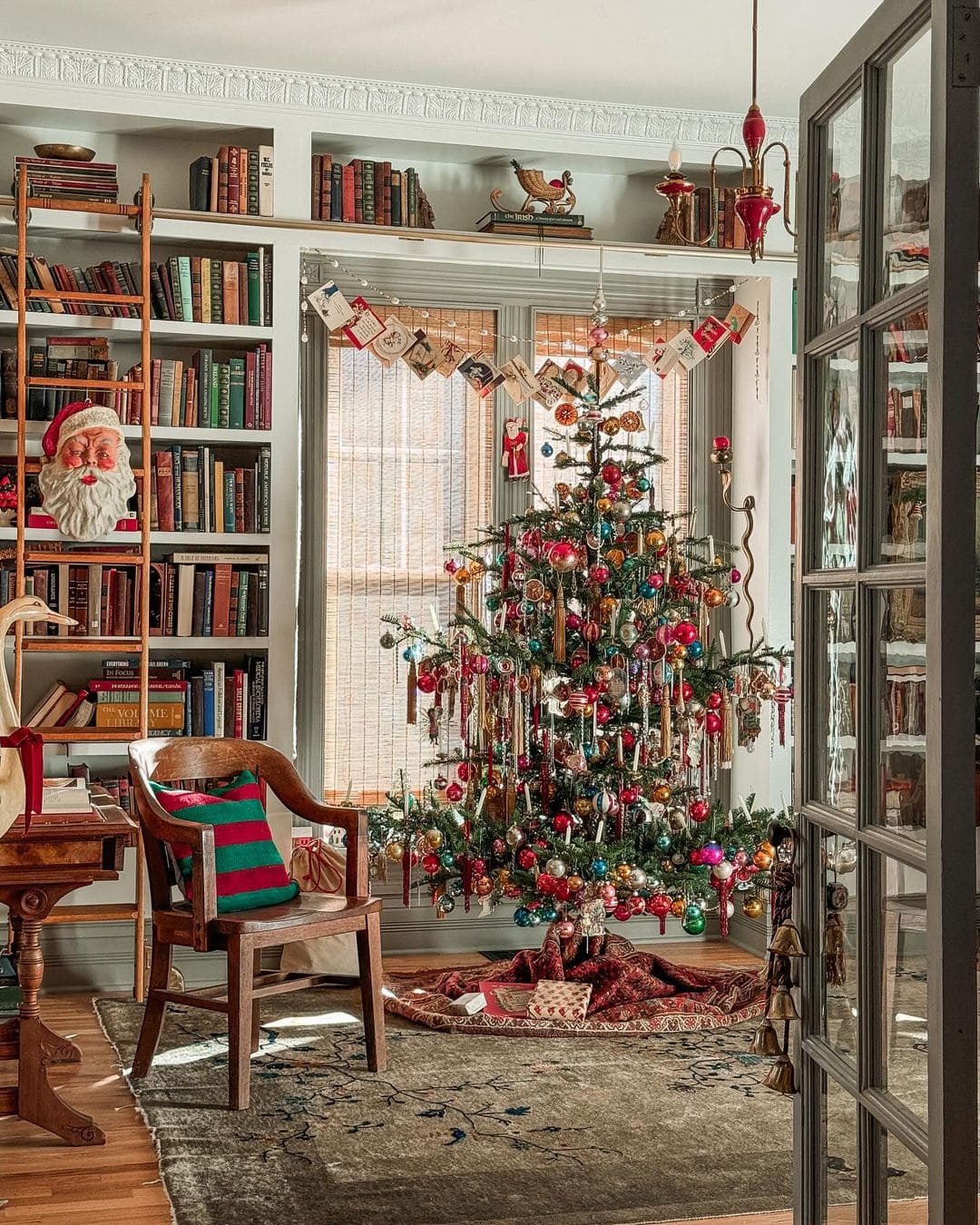
- Mixed glass ornaments, thrifted lot of 40: $40–$80
- Silk tassel ornaments (set of 12): $24–$55
- Dried orange slices (DIY): $6–$12 for oranges plus twine
- Multicolor string lights, 200-count: $15–$25
- Vintage Christmas card garland: $10–$30
11. Red and Gold Baubles With Gold Beaded Garlands and a Star
Beaded garland is the most underrated way to make a tree look expensive, and the sizing rule is simple: cut each strand to about two and a half times your tree’s height, then drape in loose, uneven swags rather than tight spirals. Tight spirals look like ribbon on a maypole. Loop it over the branch tips, never around the branch, and let a few sections sag low near the bottom. On a 7-foot tree, four strands is the sweet spot — enough to read as luxury, not enough to look like a bead curtain.
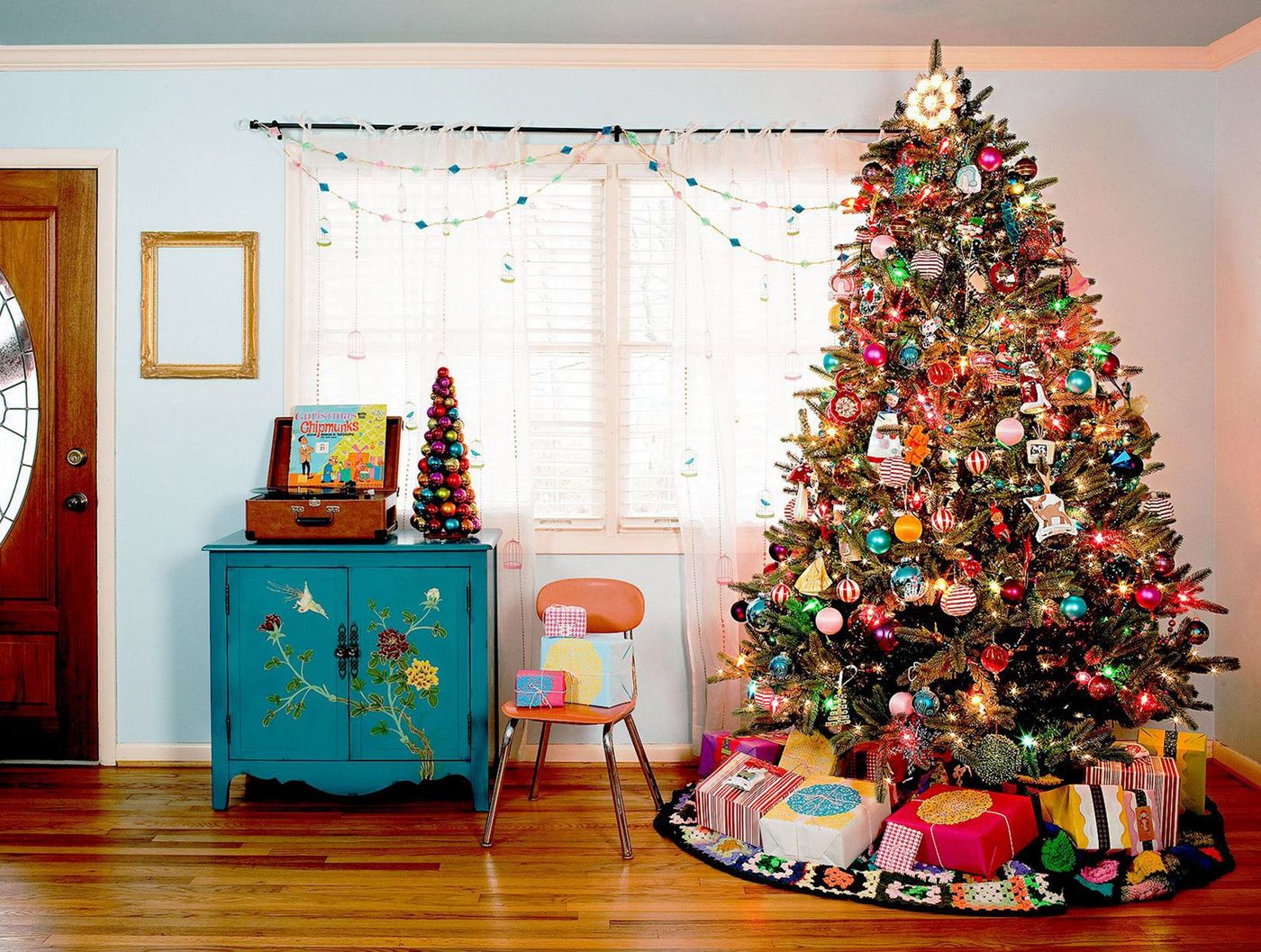
- Measure your tree’s real height before buying garland — a 7.5-foot tree is often 6.5 feet of usable branch.
- Test every light strand before it goes on. One dead section after decorating is a bad night.
- Sort ornaments into three piles: large, medium, small. Large goes low and deep, small goes high and outer.
- Check your skirt’s diameter against the stand — 48 inches is generous, 36 fits tighter spaces.
- Confirm a working outlet within cord distance, or add an indoor-rated extension cord.
12. A Blue-and-Plaid Sitting Room Anchored by a Red-and-Green Tree
The formula is 45% dusty blue and white plaid + 30% red (pillows, ornaments, mantel berries) + 15% evergreen + 10% natural rattan. Blue and red only work together when the blue is desaturated — think denim, slate, or the pale blue-green on these walls. Swap the red for rust and you get an autumn-leaning version. Swap the plaid for a solid and the room goes formal. The plaid is the informal element keeping this from feeling like a hotel lobby in December.
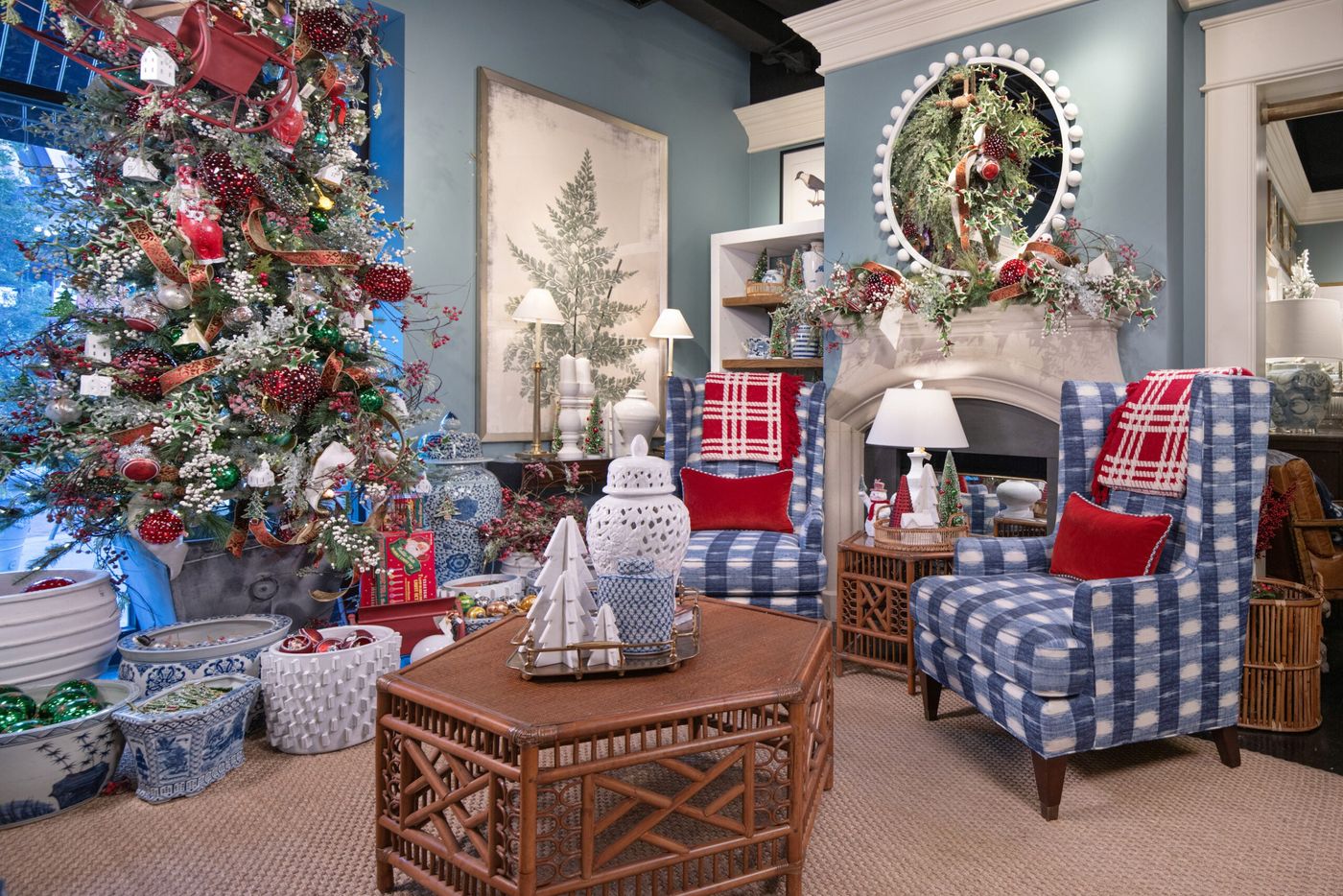
Plaid wingback chairs in a Christmas sitting room are a commitment, because those chairs are there in July too. If you love the look but don’t want year-round plaid, put the pattern on throws and pillows instead and keep the chairs solid — you’ll get 90% of the effect for about 15% of the cost. One more thing: red velvet pillows show every pet hair and lint ball known to humankind. A lint roller by the sofa is not optional.
13. Lace Figures, Beaded Spheres, and an Etched Amber Bauble
It’s the cast iron tree stand. Everything else in this scene is lovely and replaceable, but that dark red, fluted, cast-iron base is a piece of furniture, not a stand — and it’s the reason a close-up of a tree trunk reads as a curated vignette. Vintage stands from the 40s and 50s turn up at estate sales and on Etsy for $40–$120, and they honestly hold a real tree better than most modern stands do. A beautiful base changes how you style and photograph the bottom third of your tree.
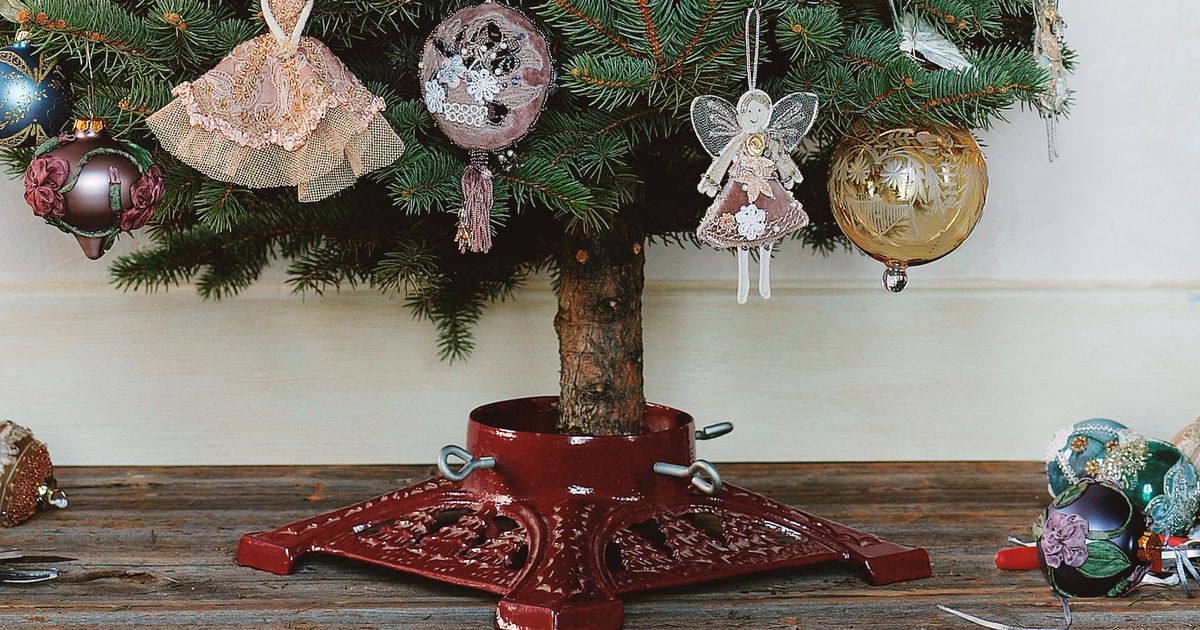
- Choose one hero ornament per cluster — the etched amber glass here — and place it at eye level, slightly forward.
- Add two smaller ornaments within 3 inches, same color family, different materials.
- Slip a rougher texture — lace, fabric, beadwork — just behind the hero, half hidden.
- Repeat the trio every 10–12 inches around the tree, rotating which piece is the hero.
- Leave a few branches bare between clusters so the eye has somewhere to rest.
14. A Silver Tinsel Tree Beside a Cream Tufted Sofa and Cane Cabinet
Silver tinsel on a full-size tree means one thing: glitter everywhere, forever. Expect to vacuum the surrounding floor weekly through December, and expect a few strands in the sofa cushions by February. Tinsel also tarnishes — the foil dulls after two or three seasons, especially stored in a humid attic. Keep it flat in tissue paper, never crushed in a bin. Want the shimmer without the fallout? Silver-toned ribbon woven loosely through the branches gives about 70% of the effect with none of the shedding.
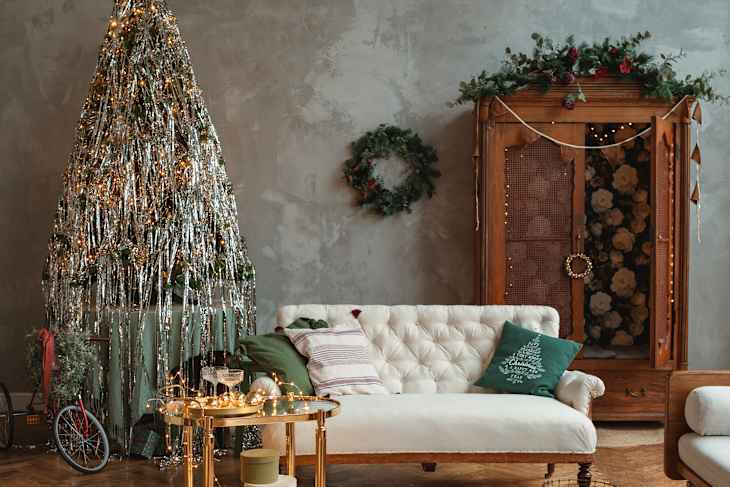
The structure of this look is the sofa, the wood cabinet, and the warm lighting — the tree is the exclamation point at the end. Facebook Marketplace moves solid wood cabinets for $40–$120 all year long, and a cream slipcover for a sofa you already own runs $60–$150 at IKEA or Amazon. Gold mirrored side tables show up at HomeGoods under $100. Skip tinsel entirely your first year and put that money into warm bulbs — 2700K, always.
15. Red and Gold Spheres, Warm Lights, and a Snow-Trimmed Skirt
Red and gold is the most-searched Christmas palette every single year, and 2026 is no exception — but the version people are saving is specific. Spheres only, no novelty shapes. Densely packed, no visible branch gaps. And a skirt with a contrasting trim instead of a plain solid. It reads as a reaction against the maximalist multicolor trees of the last few seasons: after years of more-is-more, shoppers are gravitating toward a palette that photographs clean and won’t look dated in a decade.
Ornament count is the number most people get wrong. For a traditional, densely loaded look, plan roughly 10 ornaments per foot of tree height on a 7-footer with a 4-foot base — that’s about 70 ornaments, not the 24 that come in one box. Buy in sets of 12 or 20 and split them roughly 60% red to 40% gold. Add the star last, then step back. If you can see trunk through the branches at eye level, you’re not done yet.
16. Wooden Beads, Purple Berries, and Felted Ornaments in Earth Tones
This tree is a masterclass in temperature mixing. The deep purple berries and the orange-brown felted spheres sit in the same warm family, but the purple pulls cool enough to keep the whole thing from sliding into pumpkin spice. The wooden bead garland then acts as a unifying neutral — it functions as both texture and color, which is why it travels across tan, white, and rust without ever feeling out of place. Texture density replaces shine density, and that’s the entire idea.
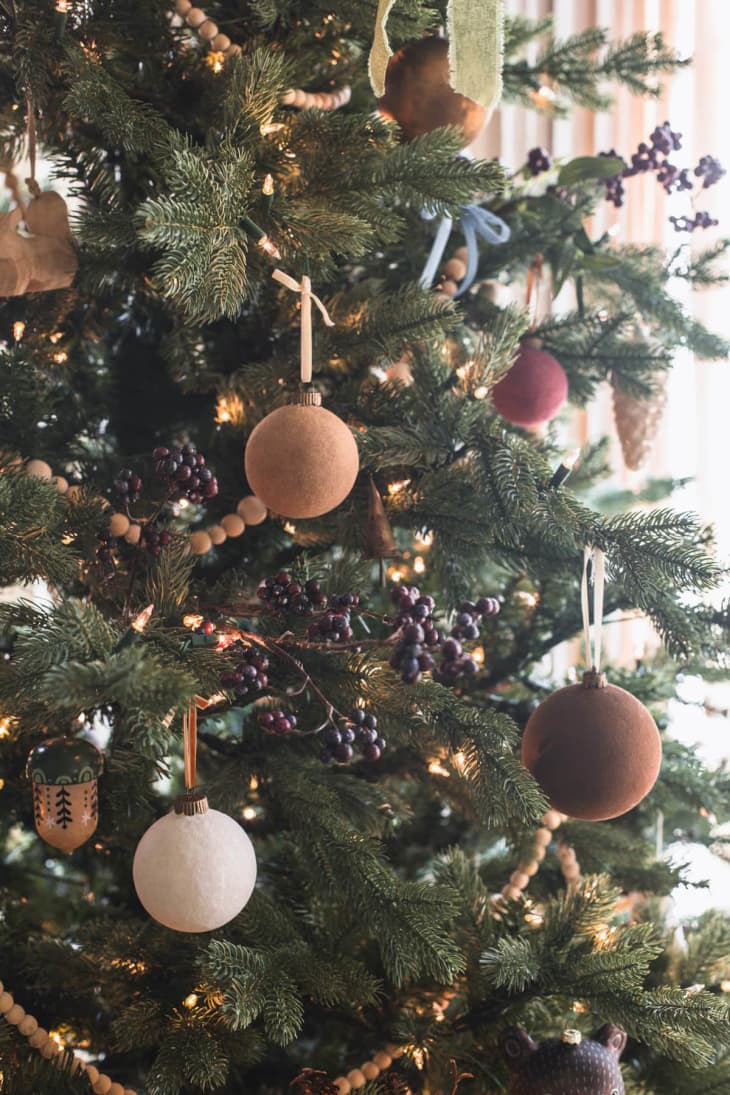
Muted, matte trees photograph smaller than they actually are, so this look benefits from a taller tree — 7 to 9 feet reads best. Felt and wood add visual weight, which means a narrow tree under 40 inches at the base can look top-heavy. Give it room: at least 2 feet of clearance on all sides so the texture is legible from across the room. Great choice for a 9-foot ceiling with a narrow footprint. Poor choice for a bright, sun-flooded space where matte finishes vanish.
17. Pearl Bead Garlands, Plaid Ribbon, and Champagne Baubles
- Champagne and silver baubles (set of 30): $30–$65
- White pearl bead garland, 4 strands: $20–$45
- Wired plaid ribbon, 3 rolls: $18–$36
- Frosted greenery picks (set of 12): $15–$30
- Silver snowflake tree topper: $15–$40
- Warm white string lights, 300-count: $18–$30
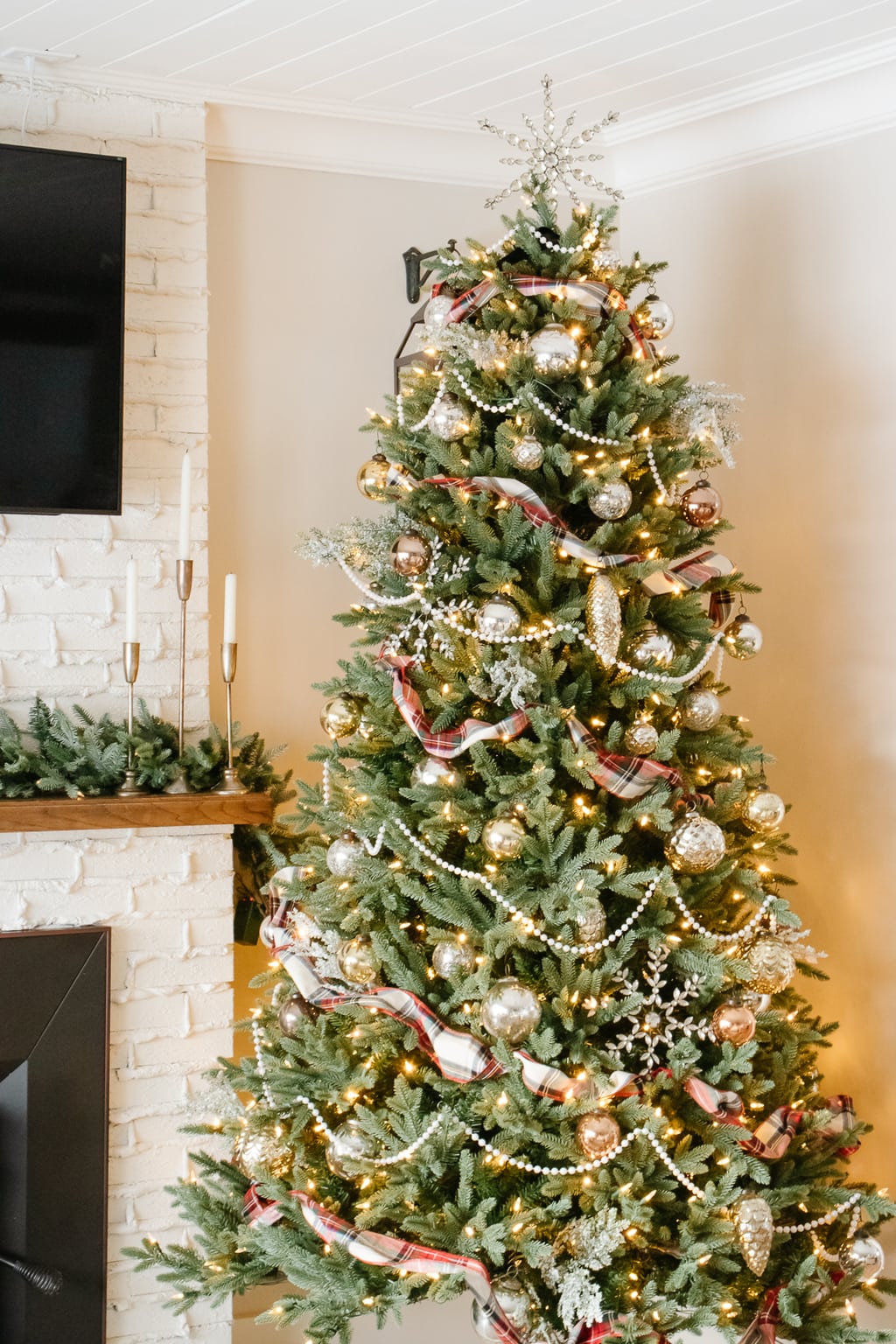
The ratio is 40% emerald green tree + 25% warm white light + 20% champagne and silver + 10% plaid pattern + 5% frost. It’s a near-monochrome tree with one pattern and one temperature break — the warm champagne against the cool silver is what keeps it from reading like a bridal shower. Trade the plaid for solid velvet ribbon and it goes formal. Trade the pearls for wooden beads and it goes rustic. Everything else stays put.
18. A Frosted Tree With Muted Metallics and a Chunky Knit Skirt
Flocked trees are beautiful and they are messy. The faux snow sheds for the first season or two, and it will find its way onto dark floors, into carpet fibers, and onto whatever you’re wearing when you water the thing. Flocking also rules out a real tree and makes ornaments harder to hang because the branch tips get thick. If you have kids or pets who get handsy with the tree, this look shows every touch. A lighter dusting of flock reads nearly the same and behaves far better.
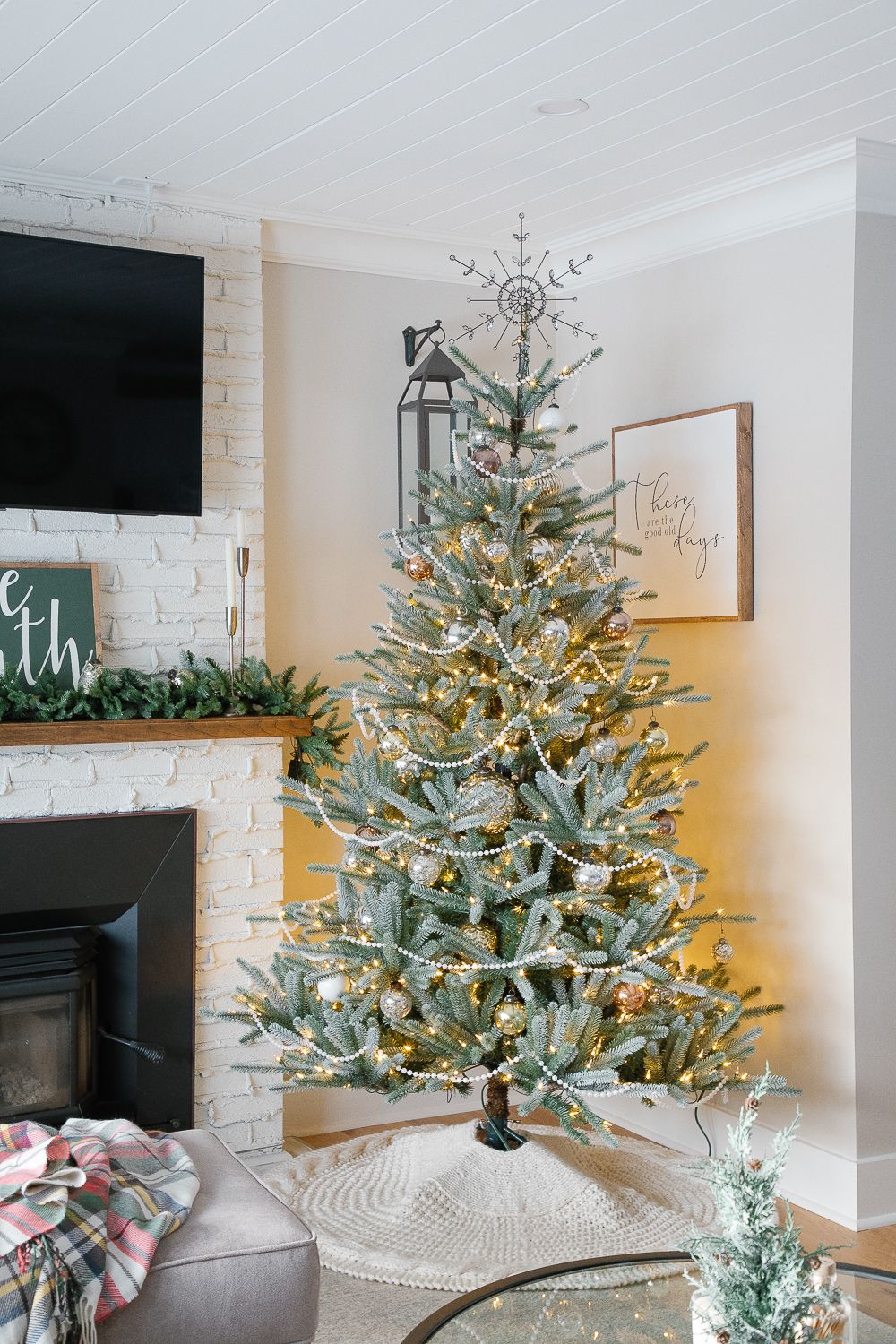
The chunky knit cream tree skirt is the one thing you can’t substitute. Everything above it is a palette anyone could assemble — silver, gold, mauve, pearls. The skirt is what makes this feel like a room rather than a display. That soft matte texture is a counterweight to all the shine, and the cream pulls warm against frosty grey-green branches. Buy the skirt first and build the ornaments around it. A tree this metallic needs one thing that isn’t.
19. Blue Baubles, a Silver Star, and Gifts Beneath the Branches
Monochrome ornament schemes live or die on finish variety. For a blue tree, aim for roughly 50% glossy, 30% matte, and 20% mercury or frosted — all in the same blue family but spanning at least three shades, from pale sky to deep navy. The glossy ones reflect the room and read almost black in low light; the matte ones stay flat blue and give your eye somewhere to land. If every ornament has the same finish, the tree becomes a blue blur from six feet away.
Blue ornaments are the easiest thing in this article to thrift, because blue is the color people purge. Thrift stores in January are full of them at $0.50–$2 each, and Marketplace lots of 50 blue baubles regularly go for $20–$35. The silver star topper is where you spend — a well-made topper reads from across the room and lasts decades. Also hit the dollar store for hooks and light clips. This is the budget version of Idea #18, just in a cooler key.
20. A Flocked White Tree With Vertical Ribbons and Tinsel Pom-Poms
- Cut ribbon into 4-foot lengths — roughly the height of your tree’s visible section.
- Anchor each strand near the trunk with floral wire or a hook, hidden behind a branch.
- Let the ribbon fall straight down, weaving through branch tips only every 8–10 inches.
- Space strands 6–8 inches apart around the tree; closer than that and it reads as a curtain.
- Add the tinsel pom-poms last, clustered in threes, so they read as accents rather than a pattern.
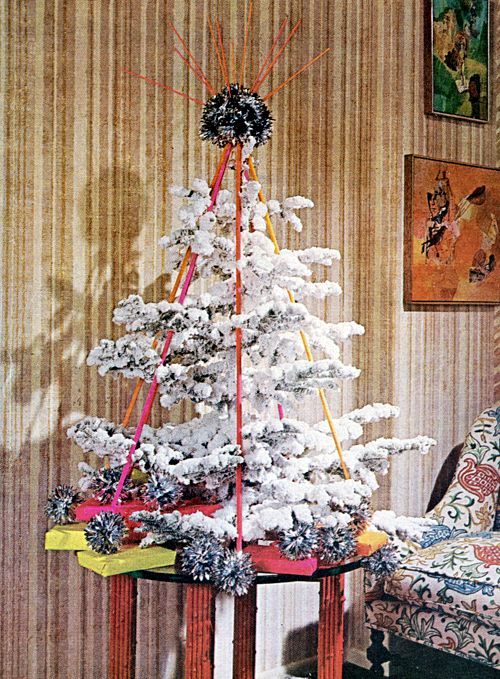
Time: 45 minutes. Cost: $15–$30 for ribbon.
This tree shouldn’t work. White flocking, three saturated ribbon colors, and silver pom-poms is a lot of competing ideas. It survives because the ribbons are vertical and the pom-poms are round — the eye gets one strong direction and one strong shape, and those two things organize everything else. The flocking then acts as the neutral letting pink, orange, and yellow sit together without a fight. Remove the vertical ribbon and you have a messy pile.
21. Magenta Velvet Blooms and Rose Gold in a Grand Ornate Hall
- Faux velvet magnolia or peony stems (set of 12): $40–$90
- Gold and rose gold baubles (set of 40): $45–$95
- Champagne glitter branch picks (set of 10): $25–$55
- Deep magenta velvet tree skirt: $60–$140
- Warm white string lights, 400-count: $25–$40
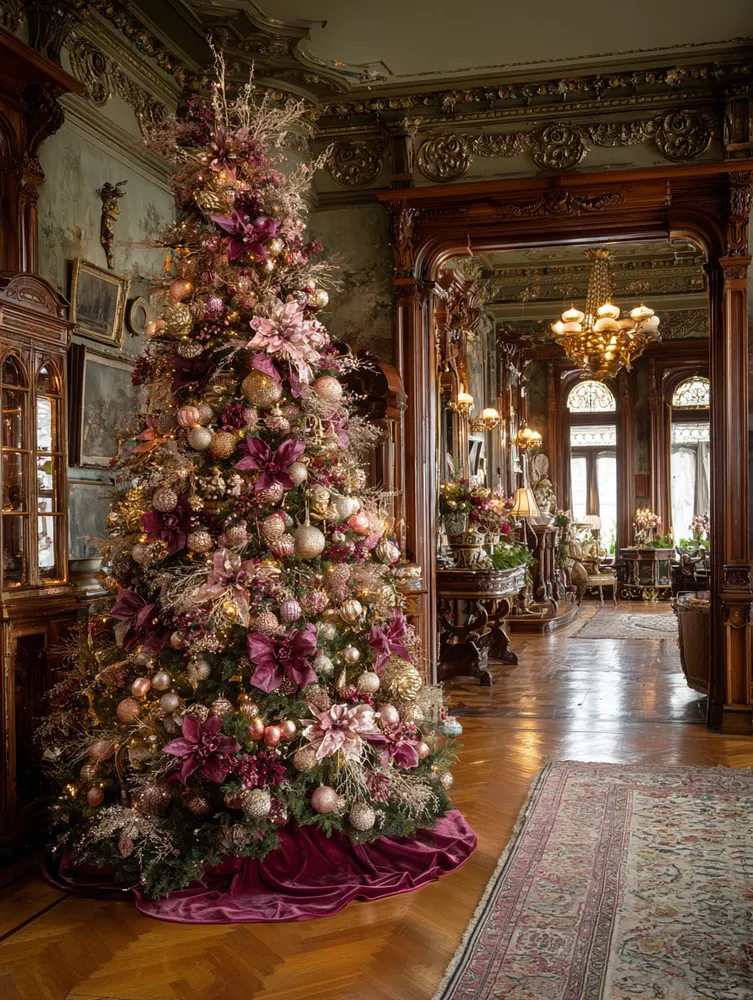
Budget alternative: buy velvet flowers as one bunch from a craft store and split each stem into three with wire cutters — you’ll get 36 blooms from 12 stems for the same money.
This is a tree that needs altitude. Velvet blooms and long baubles add presence, but they add width too — a 7-footer styled this way can read as 5 feet across at the base. Rooms with 10-foot ceilings and at least 12 feet of wall behind the tree are the sweet spot. In a standard 8-foot-ceiling living room, drop to a 6.5-foot tree and cluster the flowers in the top two-thirds so the silhouette stays narrow.
22. A Fawn Diorama Ornament With a Bottle Brush Tree Inside
It’s the open front. Plenty of ornaments have a figure glued to a disc and sealed under glass. This one leaves the front open, so the little fawn and the white bottle brush tree sit in actual air against a glossy light blue interior that reads as sky. That’s a completely different experience — you see it from an angle, and it changes as you move past the tree. If you’re making these yourself, open-faced brass and bronze shells run $4–$8 each, and the interior paint is just craft acrylic.
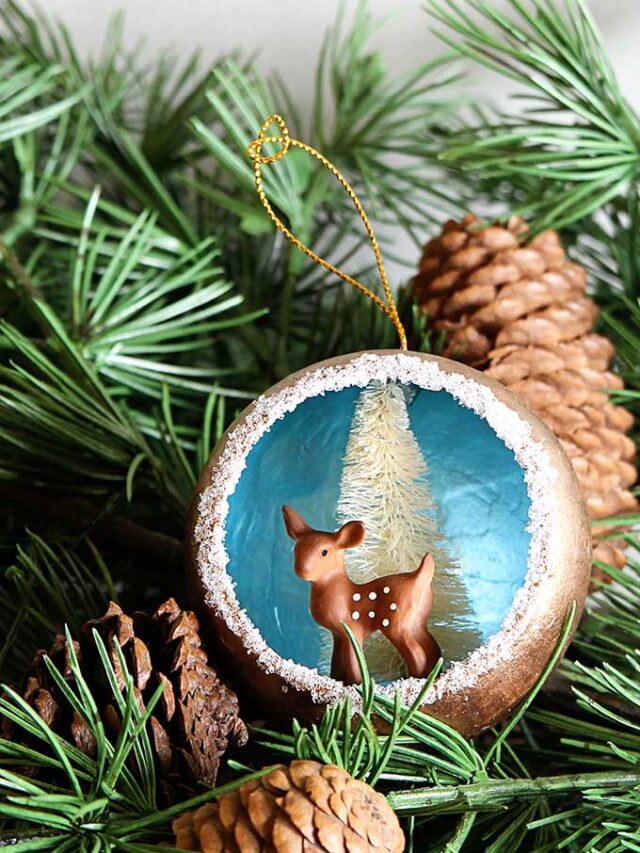
Diorama ornaments are the one place where scale rules flip. Everything inside must be smaller than you think — a 1-inch figurine max, and a bottle brush tree under 2 inches, or the whole scene disappears behind the ornament rim. Fill the bottom third with a base layer of craft snow, flocking, or sawdust, and leave the top two-thirds as open air. That frame-within-a-frame is what makes a small object feel like a window instead of a container.
23. A Glossy Green Ceramic Tree Ornament With a Glowing Star
Ceramic tree ornaments in this style are usually resin or glazed ceramic, and those tiny bulbs are painted, not lit — which is fine, but it means they won’t glow on a dark tree. If you want actual light, look for the battery version: a small LED inside a hollow ornament, usually $8–$15 each, and you’ll be swapping or recharging batteries about once a season. Check the hanging loop, too. These are heavier than glass balls and the gold cord on cheaper versions frays fast.
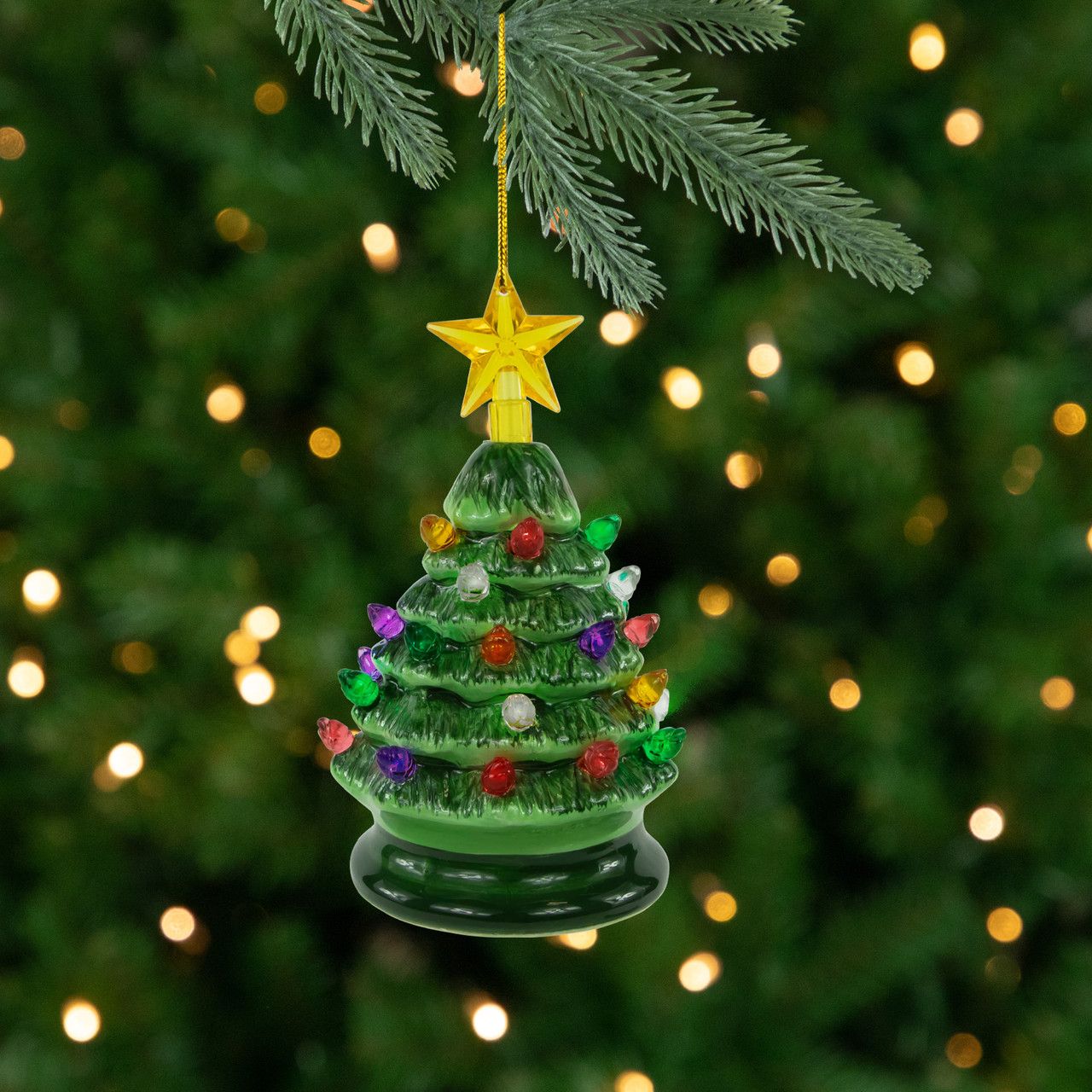
The ceramic tree has officially become its own ornament category. What started as a shelf decoration has been miniaturized, and in 2026 you can find that tiered silhouette in every size from a 2-inch ornament to a 3-foot floor piece. It’s part of a broader shift toward heirloom-adjacent decor — new objects designed to look like they’ve been in the family for decades. Pinterest boards are full of them mixed in with genuine vintage pieces, which is exactly the point.
24. Hand-Beaded Fabric Ornaments Tucked Into a Shredded-Paper Crate
- Cut two 3.5-inch circles of cotton fabric and sew right sides together, leaving a 1-inch gap.
- Turn right side out, stuff firmly with fiberfill, and hand-stitch the gap closed.
- Sketch a simple shape — a star, a wreath, a tree — in pencil on the front.
- Sew seed beads along the pencil line on a single thread, working outward from the center.
- Add a fabric loop at the top with doubled thread and a sturdy knot.
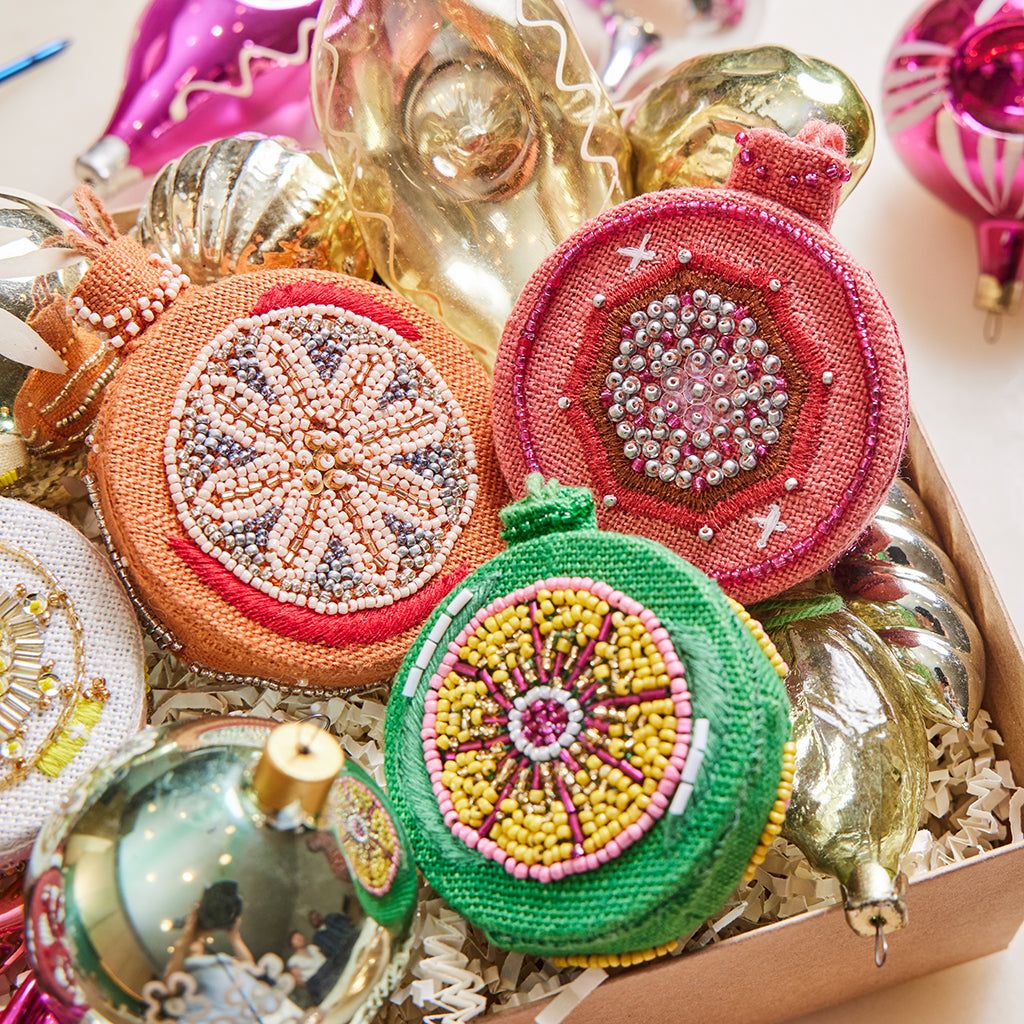
Time: 60–90 minutes per ornament. Cost: about $3–$5 each in materials.
Seed bead embroidery is a slow hobby, not a fast project — so buy your first few. Etsy sellers make hand-beaded fabric ornaments in the $12–$25 range, and vintage beaded pieces from the 60s and 70s turn up at estate sales for a few dollars each. The crate display costs almost nothing: a corrugated box lined with white shredded filler runs about $8 and makes even three ornaments look curated. This is the thrift answer to Idea #29.
25. A Miniature Snow-Roofed House Lit With Colorful Bulbs
The formula is 45% white (roof snow, sculpted base) + 25% red (trim, door, bows) + 20% grey and natural wood + 10% green brush trees. It’s a two-color scheme with neutrals, which is why it reads festive without a single drop of glitter. Swap the red trim for navy and you get a wintery, less-Christmassy version that can stay up through January. Swap the grey walls for cream and the whole thing warms. Keep snow depth identical across every house you display — that’s the thread that holds a village together.
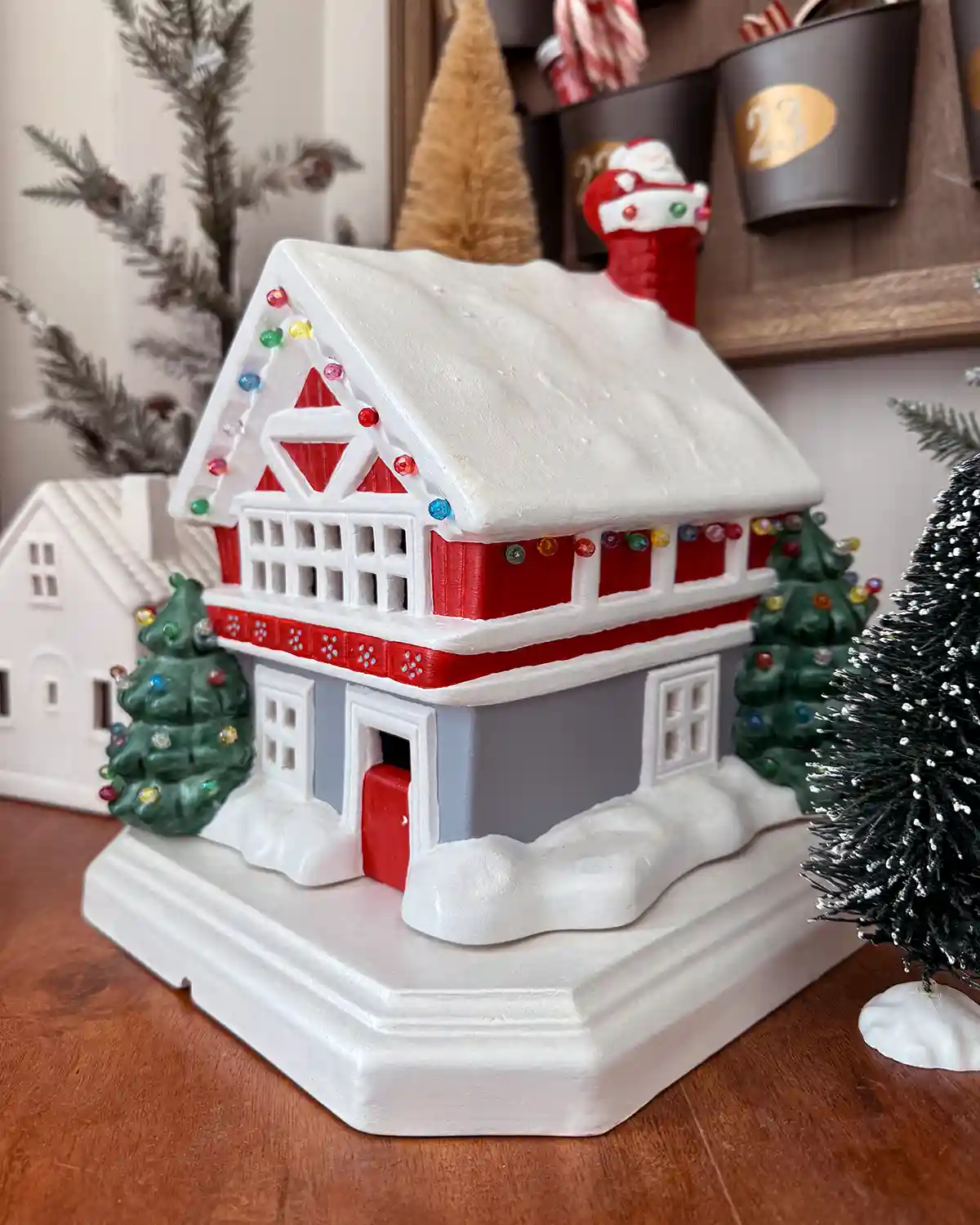
Miniature houses with sculpted snow are dust magnets, and the flocking yellows if it sits in direct sun. Store them in a sealed bin with a silica packet — humidity is what turns white snow beige. If yours already looks off, a light dusting of baking soda brushed on with a soft brush will brighten it, but that’s temporary. Also pull the batteries out before summer storage; corroded batteries stain the base badly.
26. A Pink Wall, Woven Baskets, and Polka-Dot Stockings
There’s an unusual amount of pattern in this room — polka dots, woven baskets, plaid, faux fur — and it holds together because color is doing all the organizing. Every element is drawn from the same four colors: dusty pink, royal blue, emerald, and natural rattan. When you’re mixing this many textures, color discipline is the only thing between you and a rummage sale. Notice too that the tree sits beside the console rather than in front of it, so the stockings stay visible. That’s staging, not decoration.
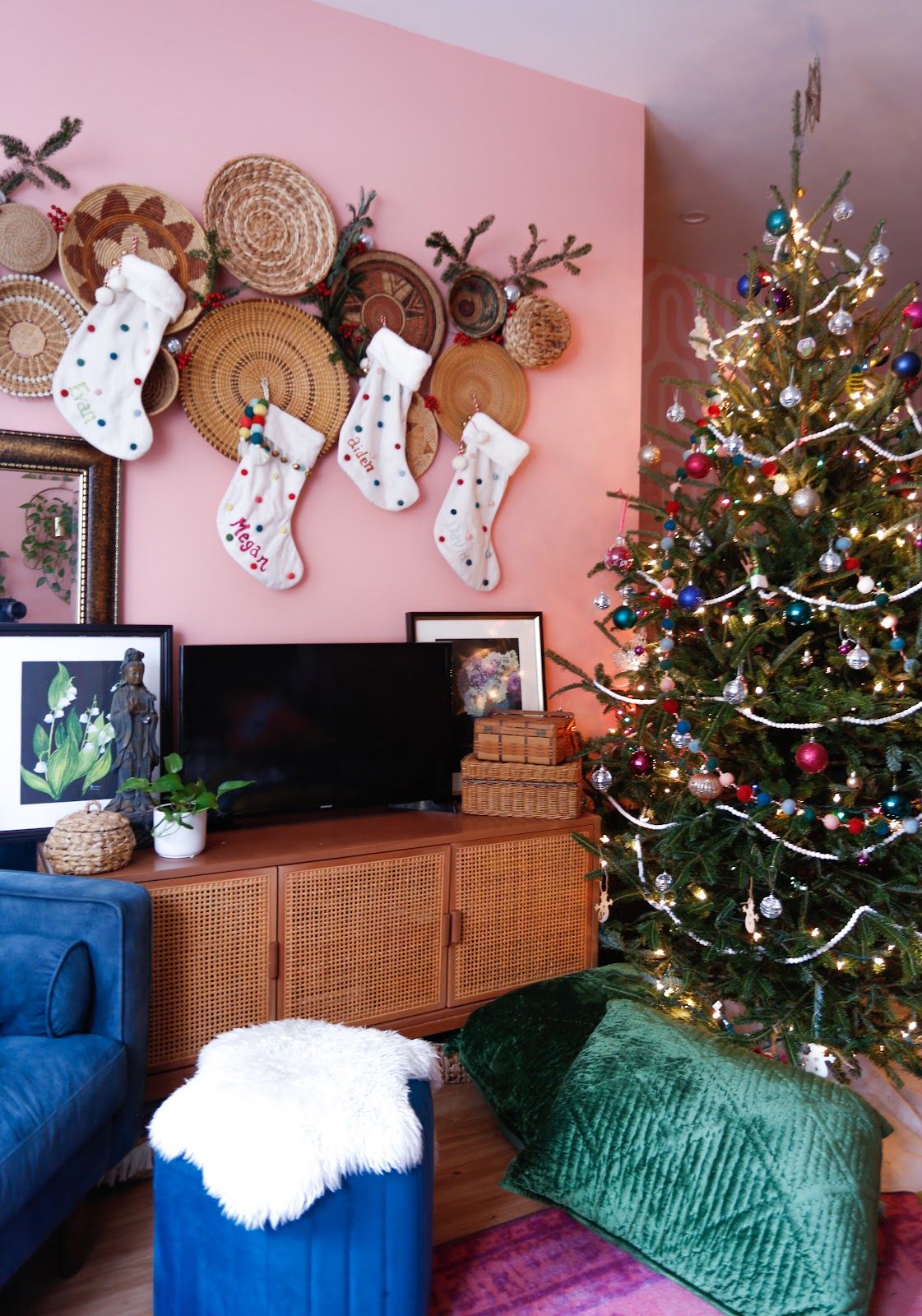
- Measure the wall before hanging baskets — irregular arrangements need at least 4 inches of spacing to look deliberate.
- Confirm your stockings can hold weight; appliquéd and personalized ones often need an extra stitch at the hanger.
- Check outlets behind the media console before the tree goes up — you’ll want two free plugs.
- Write your palette down and stick to it. Four colors, no exceptions.
27. Ribbed Teardrop Mercury Glass, Lit From Behind
Mercury glass ornaments need backlighting to do their thing. The ribbed teardrop shape here works because the string lights sit behind the ornament, not in front — light passes through the glass and scatters across the ridges instead of blowing out the surface. When you hang yours, tuck the bulb a half-inch behind the ornament, not beside it. And keep the bulbs warm white, 2700K max. Anything cooler turns silver mercury glass grey, and you’ll spend December wondering why your tree looks flat.
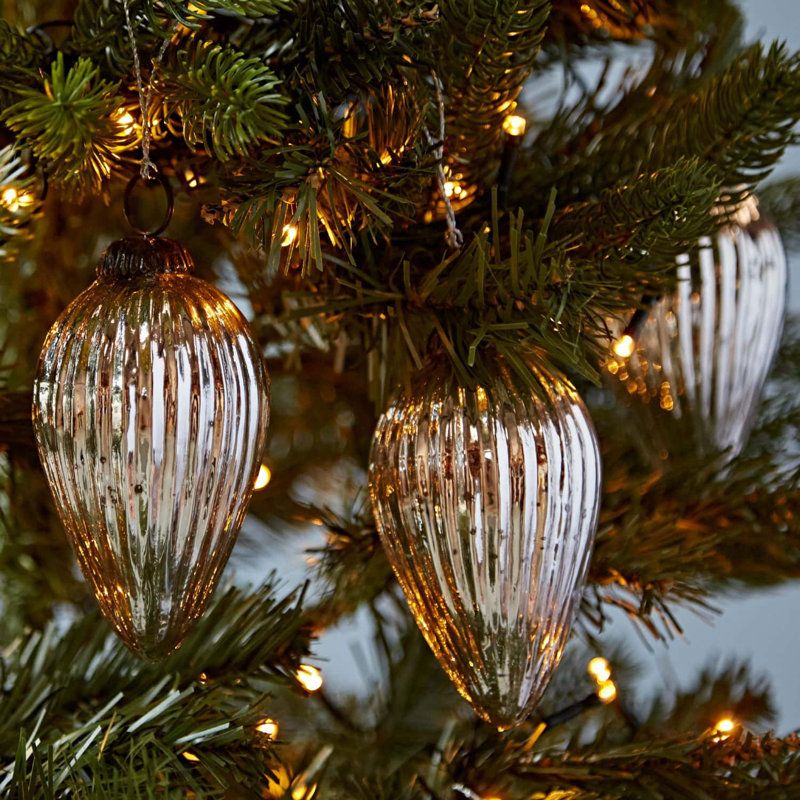
The vertical ribbing is the whole trick. A smooth mercury glass ball reflects a distorted version of the room — you, the couch, the lamp. A ribbed one breaks that reflection into dozens of vertical slivers and turns it into pure light instead. That single detail is why these glow from across the room and plain glass balls don’t. If you’re buying vintage, look for ribbed, fluted, or faceted surfaces first; smooth ones are cheaper for a reason.
28. A Climbing Santa, a Faux Fur Skirt, and Glitter Gift Boxes
- Climbing Santa figure with ladder: $25–$60
- Red velvet and faux fur tree skirt: $35–$85
- Green glitter gift boxes with red bows (set of 3): $15–$35
- Large vintage-style colorful light strand: $12–$28
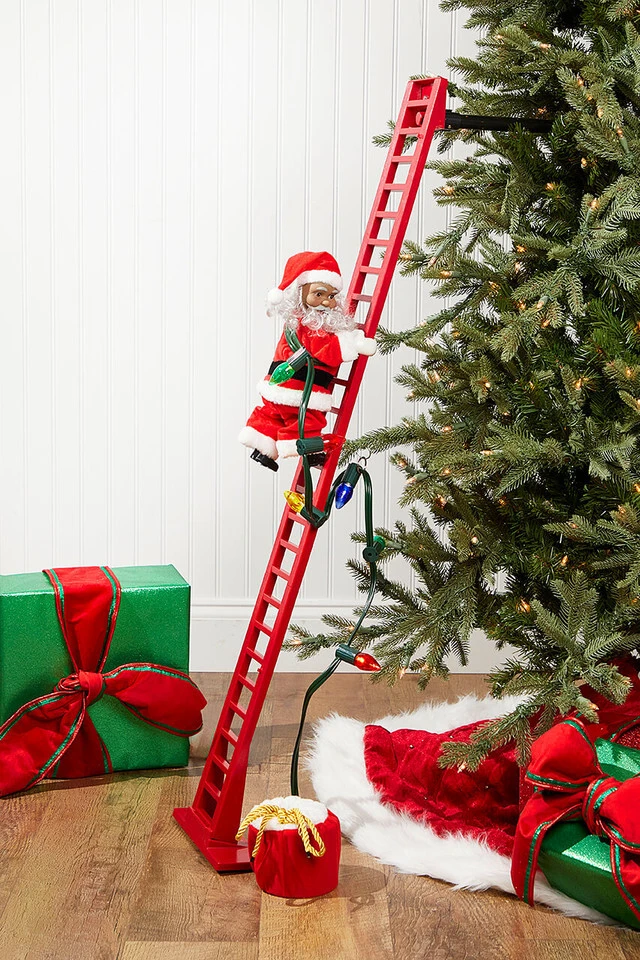
Climbing Santas are charming and they’re also the most knocked-over item in any home with a toddler or a cat. Look for a weighted base or a clamp, and stand the ladder on hard flooring rather than carpet where it can’t tip. The faux fur skirt is the other thing to think about: it sheds, it traps pine needles, and it looks rough after a season of being walked on. Shake it weekly and store it in a breathable cotton bag, not plastic.
29. Indent Ornaments Displayed in a Compartmented Wooden Crate
A display crate works on any surface at least 18 inches wide and 12 inches deep — a console, a bookshelf ledge, a windowsill. Because the ornaments are all roughly the same size, the crate’s compartments do the scale work; aim for cells about 3.5 to 4 inches square so each ornament is cradled, not rattling. Leave one compartment empty and fill it with pine picks. That single gap is what keeps a grid from looking like inventory. For smaller surfaces, see Idea #27 — same vintage glass, less square footage.
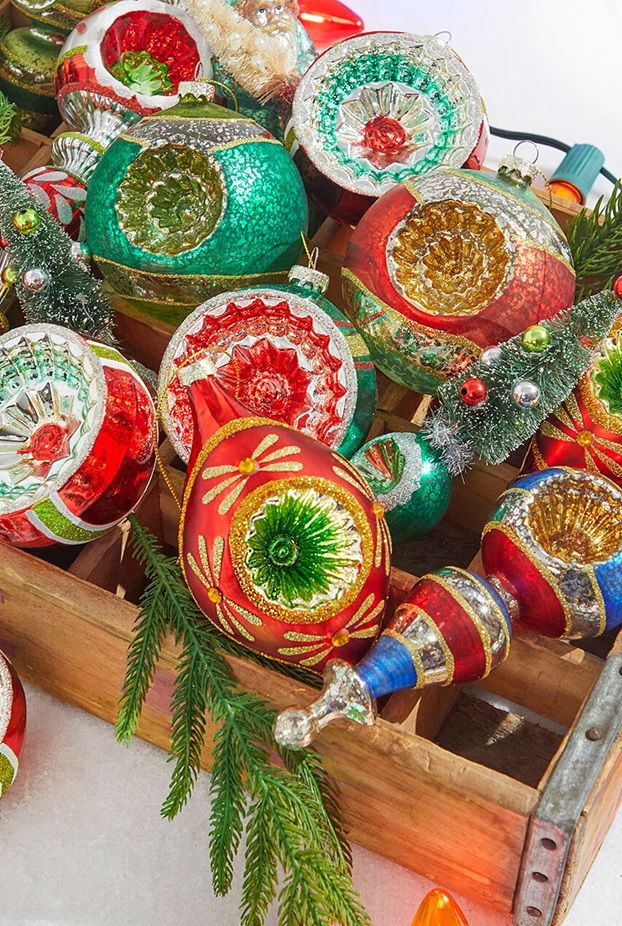
- Line each compartment with a scrap of velvet or felt so the glass can’t chip.
- Sort by color first, size second — reds together, greens together, golds together.
- Place the largest, most ornate pieces in center compartments and build outward.
- Tuck faux pine sprigs into two or three edge cells, never the middle.
- Add one small battery puck light at the back to catch the indent reflections.
Time: 20 minutes. Cost: nothing if you already own the crate.
30. Crystal, Gold, and a Chandelier Above a Twelve-Foot Tree
You can’t buy this room on a budget, but you can absolutely get the feeling. The two elements doing the most work are the crystal chandelier and the mirror reflecting a second lit tree — and a large mirror is one of the cheapest ways to double your Christmas decor. Overmantel mirrors run $60–$180 at HomeGoods and Wayfair. For ornaments, mix clear glass, gold, and a few deep reds from a thrift lot: clear and gold read opulent from across the room, and nobody’s checking price tags.
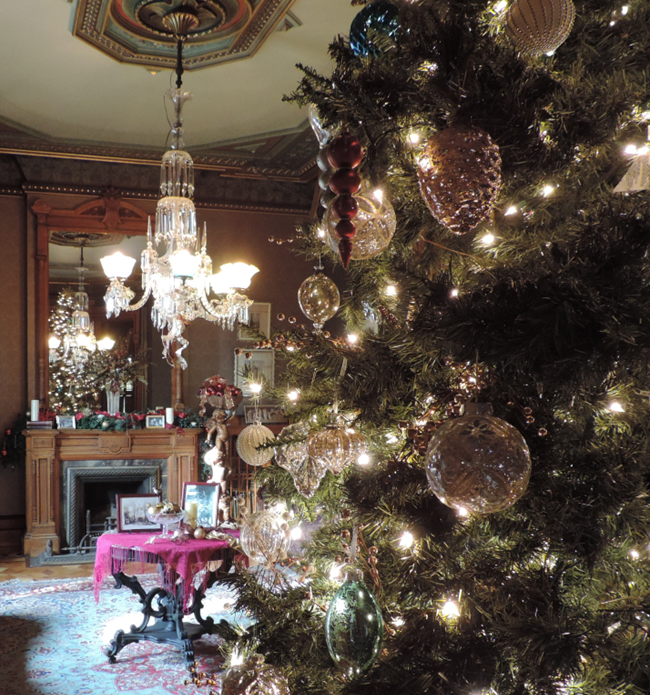
This is a 12-foot-ceiling look. Trees in this style want 9 to 12 feet of height and a rug at least 8×10 so the base doesn’t crowd the fireplace. Spacing matters too: leave 30 to 36 inches between tree and mantel so both can breathe, and hang the mirror’s center at 60 to 66 inches so it reflects the tree’s middle third rather than the star. Under 200 square feet, this arrangement feels stuffed — go with Idea #21 instead, which compresses the opulence into a taller, narrower shape.
31. Glittery Little Houses With Warm Yellow Windows
The formula is 50% dark green branches + 25% white (snow and glitter) + 15% warm yellow glowing windows + 10% red from background lights. The contrast that makes these houses pop isn’t the glitter at all — it’s the yellow-to-green ratio. Warm yellow windows against near-black needles is a complementary pairing, which is why the glow reads from across the room. Swap those windows for white light and the whole effect flattens. Warmth is doing the work here, not sparkle.
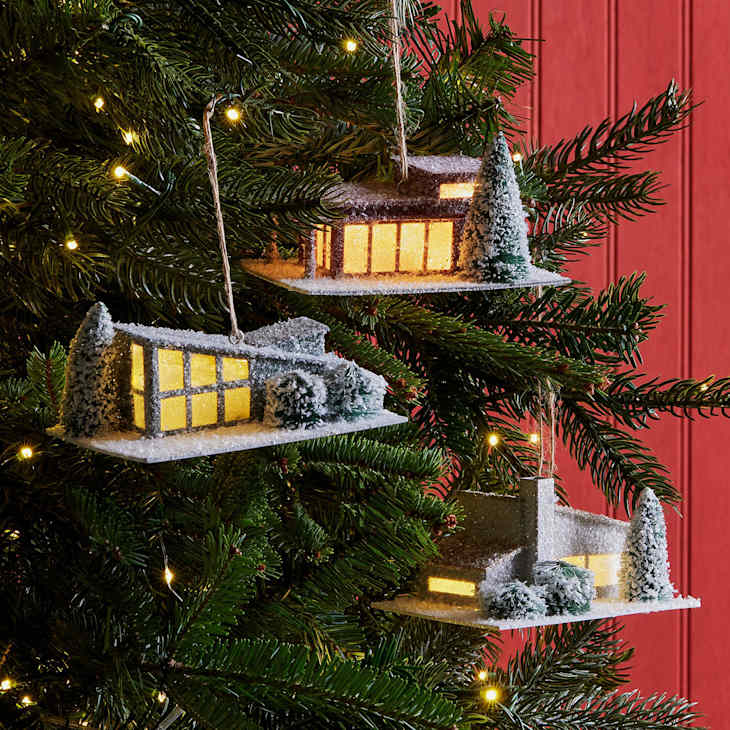
Hanging three similar ornaments in a vertical stack almost always beats spreading them across the tree. Space them 6 to 8 inches apart, offset slightly left and right so the stack forms a gentle zigzag rather than a rigid line, and place it just off-center. On a tree with hundreds of small ornaments, that repetition creates a mini-collection the eye can follow. Same principle behind displaying plates or framed art in groups.
32. Nutcrackers, a Vintage Train, and Red Baubles Up Close
- Weigh your heavier ornaments — nutcrackers and trains often pass 4 ounces and need wire hooks, not bent paperclips.
- Check branch strength near the top; heavy pieces belong on thicker, lower branches.
- Inspect each hanging loop for fraying before it goes up. A cracked loop means a broken heirloom.
- Photograph your finished tree so next year’s setup is faster.
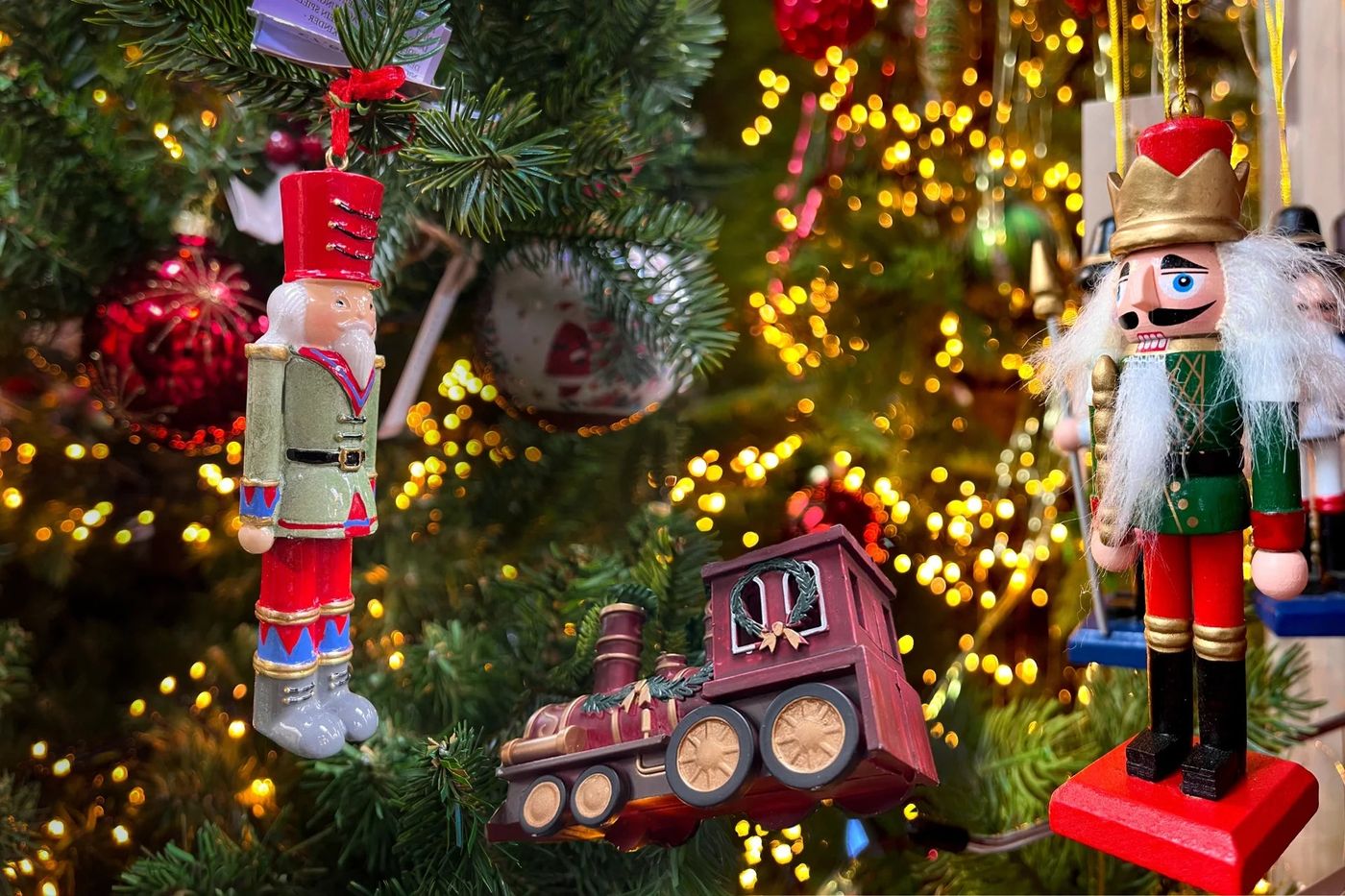
This is 40% green tree + 35% red + 15% warm light + 10% natural wood and beige. It’s the classic ratio, and the reason it never fails is that red and green sit at nearly equal value — neither overwhelms the other. Add gold and you get sparkle. Add white and you get candy-cane Christmas. Add blue and you’ve broken the formula entirely, which is fine, but you’ll need a much larger neutral base to hold it.
33. Matte Red, Shiny Silver, and Glass Birds With Feathered Tails
- Matte red baubles (set of 24): $18–$40
- Shiny silver baubles (set of 24): $18–$40
- Silver tinsel garland, 3 strands: $12–$24
- Glass bird ornaments with feathered tails (set of 6): $24–$65
- Candy cane ornaments (set of 12): $8–$18
Glass bird ornaments are one of the few Christmas decorations that genuinely hold value. Vintage versions from Germany and the former Czechoslovakia sell for $15–$60 each on Etsy, and the feathered-tail style has been collected continuously since the 1950s. That’s the real argument for buying good ornaments instead of a new box every year: they don’t depreciate, they don’t go out of style, and in ten years you own a collection instead of a storage bin. It’s the opposite of fast decor.
Your Tree Doesn’t Need More Decor — It Needs Older Decor
Here’s the thing nobody says out loud: the trees that stick with you aren’t the ones with the most ornaments. They’re the ones with one specific, slightly odd, clearly-sourced-from-somewhere piece that makes you lean in. Start with a single vintage element — a mercury glass cluster, a ceramic tree on the credenza, a set of indent ornaments in a crate — and build the rest of your tree around it this year and next.
📌 Pin this guide now so it’s waiting for you next November, when you’re standing in the garage staring at the same six boxes you’ve had since 2019.
