
29 Magical Candy Land Christmas Tree Ideas and Outdoor Decorations to Try
You’ve got forty screenshots of candy-colored Christmas trees saved and no idea which one you’re actually building. That’s the funny thing about candyland Christmas — it’s the most forgiving theme in holiday decor and also the easiest one to overdo. So we did the sorting, pulling from Target, Walmart, Etsy, thrift stores, and one very good Facebook Marketplace haul, across a price range of about $3 to $845.
Inside you’ll find 29 ideas — pastel candyland, classic red-and-white gingerbread, retro lollipop maximalism, frosted white whimsy — with budget and luxury versions compared side by side, so you can see exactly where to spend and where to fake it.
2026 is the year holiday decor got loud again. Dopamine color and photo-wall backdrops are driving the whole look, and candy palettes are the fastest way to get there without repainting a single wall.
And stay until the end — we break down the most common mistakes that can ruin these looks.
📌 Save this to Pinterest for later — you’ll want to revisit these ideas.
1. The Glittery Candy Train Ornament That Steals the Whole Branch
Oversized novelty ornaments like this train only work when they have room to breathe. Hang anything 4 inches or wider at eye level — 60 to 66 inches off the floor — and keep a 10 to 12 inch gap between big pieces. Push the branch tips toward you and set the ornament 4 to 6 inches inside the canopy.
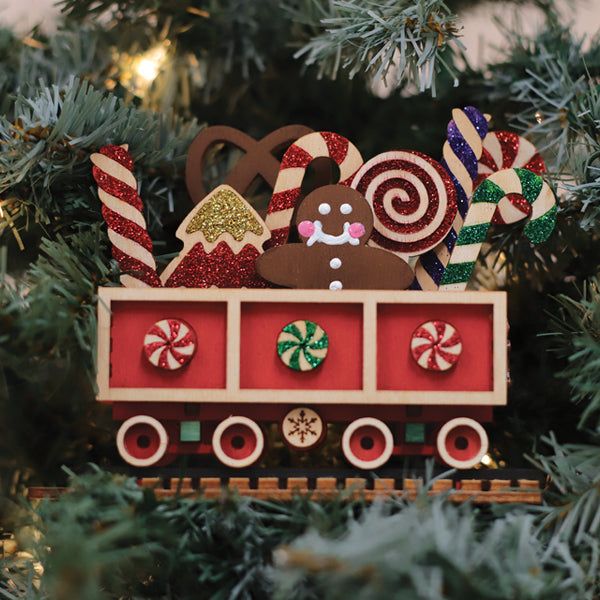
That setback is what makes a big ornament look nested in the tree instead of stuck on top of it. If your tree is under 7 feet, cap it at eight oversized pieces total.
The single thing holding this ornament together is the loaded flatbed — candy canes, gingerbread man, and a swirled lollipop all riding on one little red wooden train car. Take those away and you’ve got a plain red train, which is a completely different and much quieter ornament.
When you’re shopping candy ornaments this year, look for the ones that tell a story in a single glance. Story ornaments get remembered. Matching baubles get forgotten.
2. Blue Glitter Overalls and the 5% Rule That Makes Him Pop
The formula on this guy: 60% glittery brown gingerbread, 25% white icing detail, 10% candy pink from the striped cane, 5% surprise blue from the overalls. That last sliver is doing all the heavy lifting — it’s the reason your eye lands on him first on a fully lit tree.

Swap it and the math still holds: cream gingerbread, white icing, red cane, 5% forest green overalls. Or go full pastel with lavender overalls and a mint cane. Just never let the surprise color creep past 5%, or it stops being a surprise.
Glitter ornaments shed. Not sometimes — always. That blue glitter will leave a fine dusting on your tree skirt, your hands, and whatever gift you wrap in December. It’s not a dealbreaker, but know what you’re signing up for.
Keep glitter-heavy pieces above the 30-inch mark so pets and toddlers aren’t grabbing them. A quick pass with a lint roller before guests arrive handles the rest.
3. The Full Dessert Tree: Cupcakes, Lollipops and Gingerbread Everywhere
- Flocked-look 7.5 ft tree: $120 – $450
- Gingerbread + dessert ornaments, 40–60 pieces: $80 – $220
- Warm white string lights, 600–900 bulbs: $25 – $60
- Red satin ribbon and gift wrap: $20 – $45
- Tree skirt or collar: $25 – $70
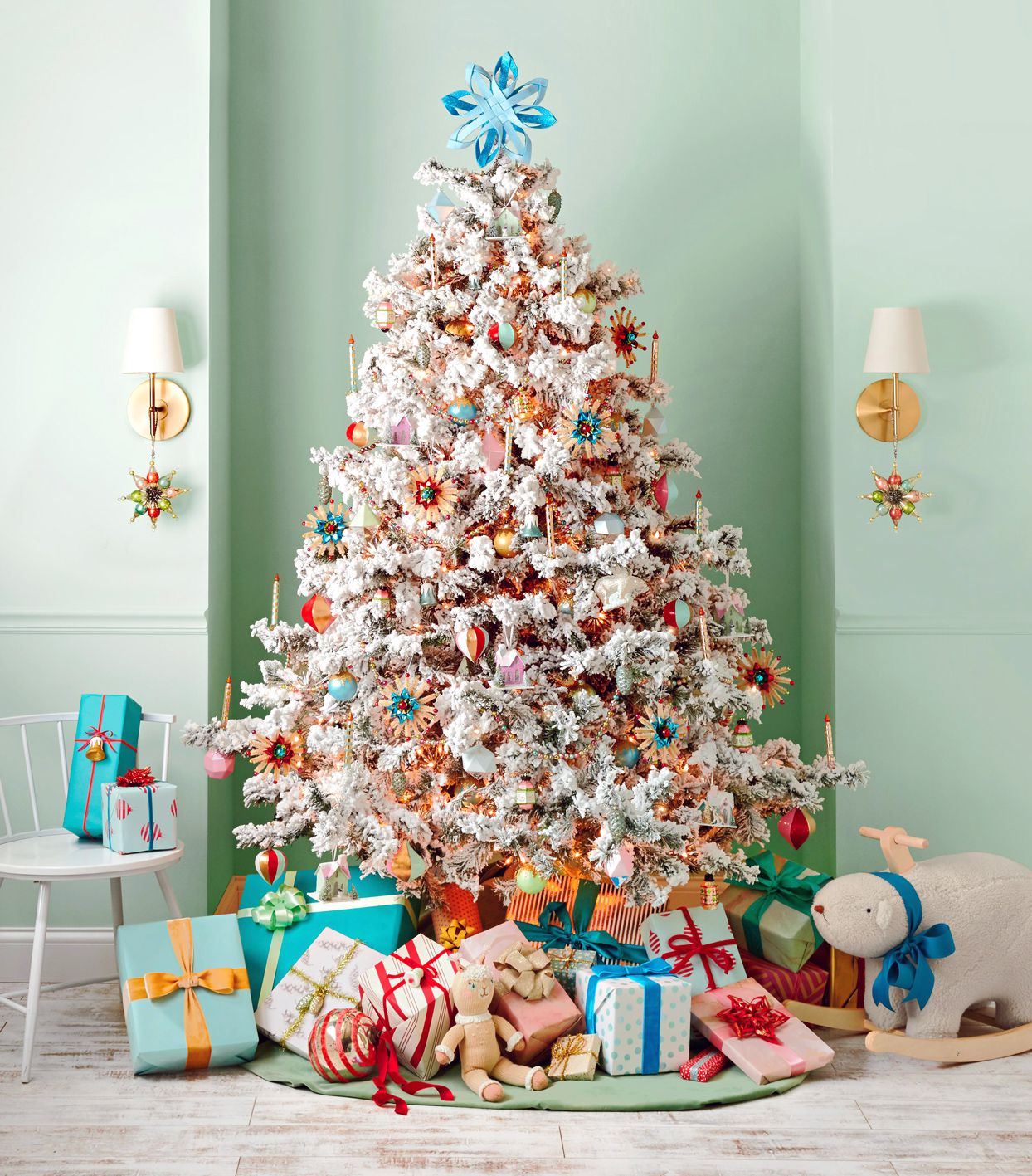
Total: roughly $270 – $845 depending on how deep you go.
Budget alternative: hit the dollar store for gingerbread cutouts in bulk, use a thrifted 7 ft tree, and put your money into lights instead of ornaments. You can land the same look for about 45% less.
Three things are happening on this tree. Repetition — one motif, dessert shapes, repeated fifty times reads as a theme instead of a clutter problem. Scale variance — tiny lollipops sitting next to 6-inch gingerbread men keeps the eye moving. And color anchoring: the brown gingerbread and warm lights hold everything down while the pastels bounce off them.
Take away the scale variance and you get a flat, wallpaper-y tree. That’s the piece people forget every single year.
4. Tiered Gingerbread Tree with Pink and Blue Icing Drizzle
- Bake or buy five round cookies in graduated sizes, 6 inches down to 2 inches.
- Stack them with royal icing between layers, offsetting each one by about half an inch.
- Pipe a scalloped icing border along each tier’s edge before it sets.
- Press sprinkles and mini candy canes into the wet icing.
- Top with a star cutout and let it dry four hours.
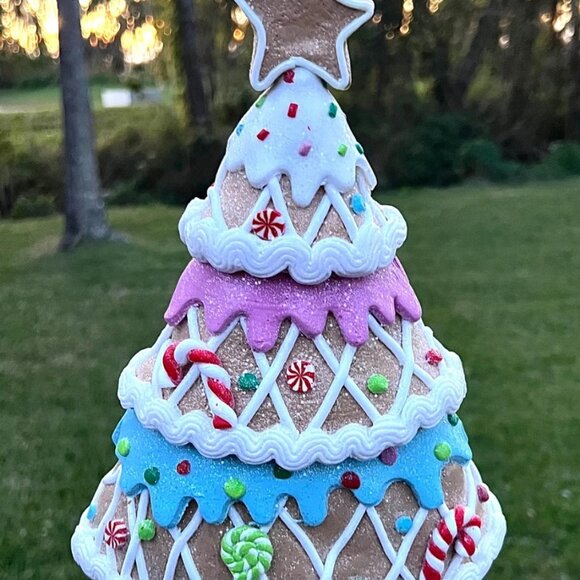
About 90 minutes of hands-on time and roughly $12 in ingredients for a batch of three.
The tiered gingerbread look is a reaction to a few years of very serious, very neutral holiday decor. People got tired of oatmeal linen and dried orange slices. 2026’s candy moment is loud on purpose — it photographs well, it’s cheap to build, and it reads instantly on a phone screen.
Staying power? The novelty ornaments will rotate out. The gingerbread shape itself has survived 400 years and counting, so that’s a safe place to spend your money.
5. A Flocked Tree with Elf Legs Kicking Out of the Branches
The elf legs. A flocked tree covered in candy canes, ribbons and swirled lollipops is a beautiful, well-mannered tree. Add a pair of striped legs sticking straight out of the branches and it becomes a scene — you’ve turned the tree into a hiding place, and everyone who walks in starts looking for the rest of the elf.
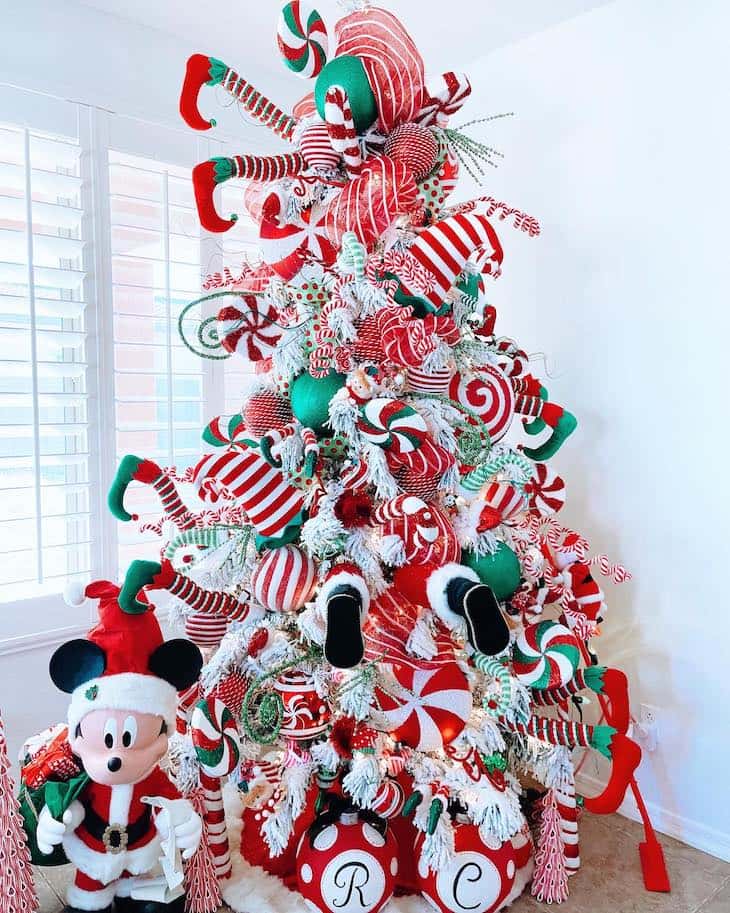
That’s a six-dollar piece of decor generating a whole narrative. Pair it with the dessert tree in Idea #3 and you’ve got a candy shop instead of a candy corner.
Flocking sheds every time you move the tree — expect a dusting of white powder on your floor the first week and again in January when you pack it up. Put a cheap white sheet underneath during assembly, not your good tree skirt.
Candy colors plus a licensed character plus polka-dot gift boxes is also a lot of competing signals. Cap it at two motifs — candy and one character — or the whole vignette turns into visual noise.
6. Pastel Nutcrackers Standing Guard Over a Heavily Frosted Tree
This vignette runs on 55% frosted white — the tree, the flocking, the snow globe base — 25% pastel pink, 15% mint and lavender, and 5% gold glitter. That’s it. Nothing saturated, nothing dark, nothing that hums.
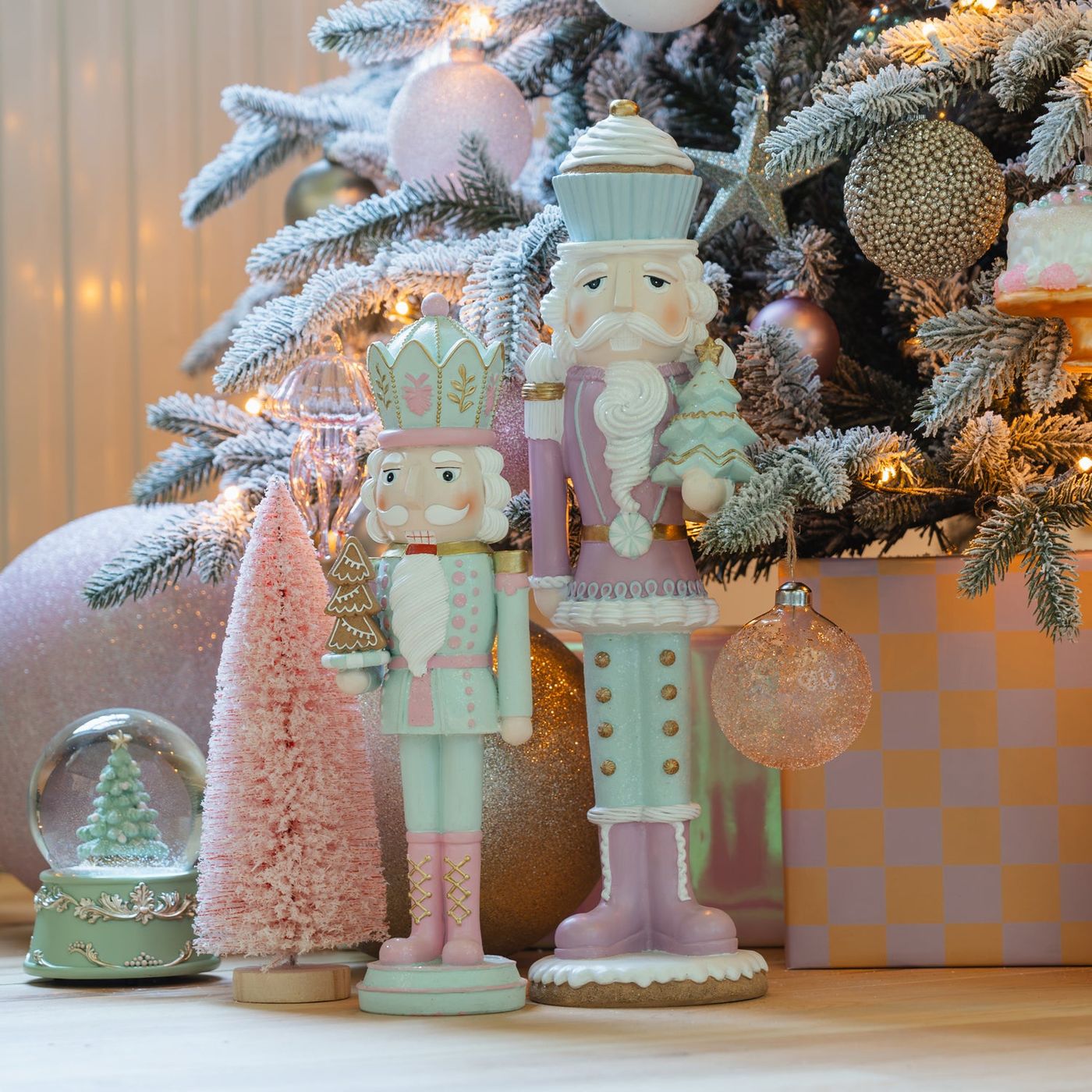
To swap palettes without losing the softness, keep frosted white at 50% or more and trade pink for butter yellow or powder blue. What kills this look is one bright red or one black piece. Add either and the frosting suddenly reads chalky.
Life-size nutcrackers usually run 40 to 60 inches tall and 12 to 16 inches wide at the base. Two of them need about 3 feet of floor width and a clear 24 inches in front so they don’t look crowded.
This setup wants 8-foot ceilings and roughly 100 square feet of open floor — a foyer or living room corner, not a hallway. For tighter spaces, the tabletop version in Idea #10 does the same job in 18 inches of countertop.
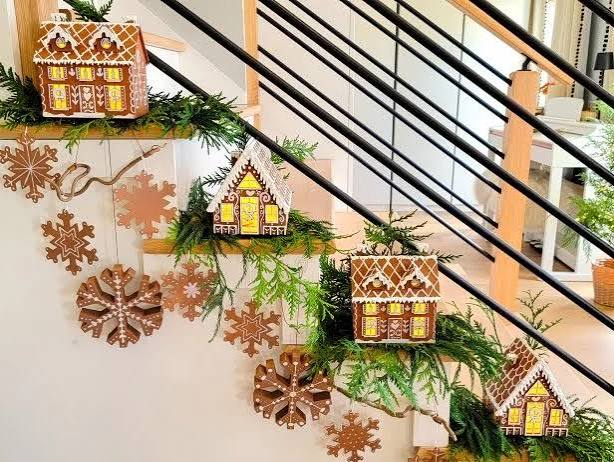
7. An Illuminated Gingerbread Village Lit From the Inside
Two moves make this read as a scene instead of a shelf of knickknacks. First, internal light — a warm glow from inside the windows makes the house feel occupied. Second, those two small flocked pines flanking it: symmetrical, taller than the house is wide, framing it like bookends.
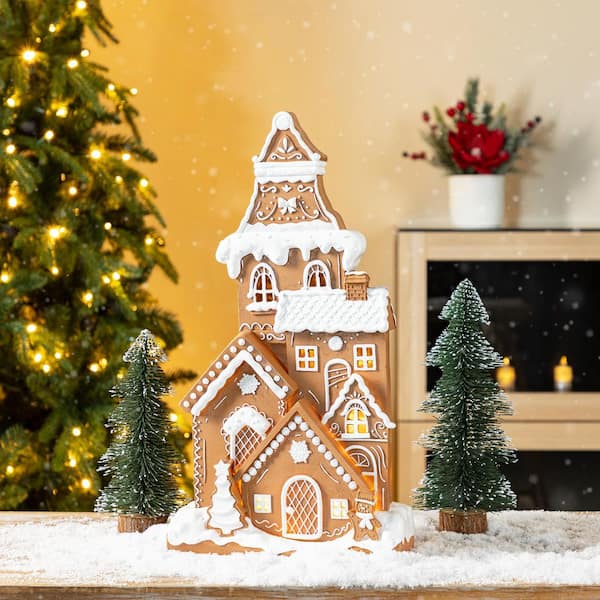
Compare that to a lone lit house on a sideboard. Same object, no story. Framing and glow are what turn decor into a tableau.
Ceramic village houses run $30–$90 each at retail. Do it for a fraction instead: thrift stores are drowning in light-up village pieces in November and December for $3–$8, and dollar stores sell mini bottle-brush trees in six-packs.
Fake snow is about $4 a bag, and a $6 string of LED fairy lights tucked behind the houses gives you the window glow. A four-house scene lands around $40 total, and nobody will guess.
8. Oversized Baubles on the Floor Beside Pastel Nutcrackers
Floor baubles are the fastest way to make a tree look professionally styled, and most people do it wrong. Use odd numbers — three or five, never four — with the biggest piece 8 to 10 inches in diameter and the rest descending by about a third each.
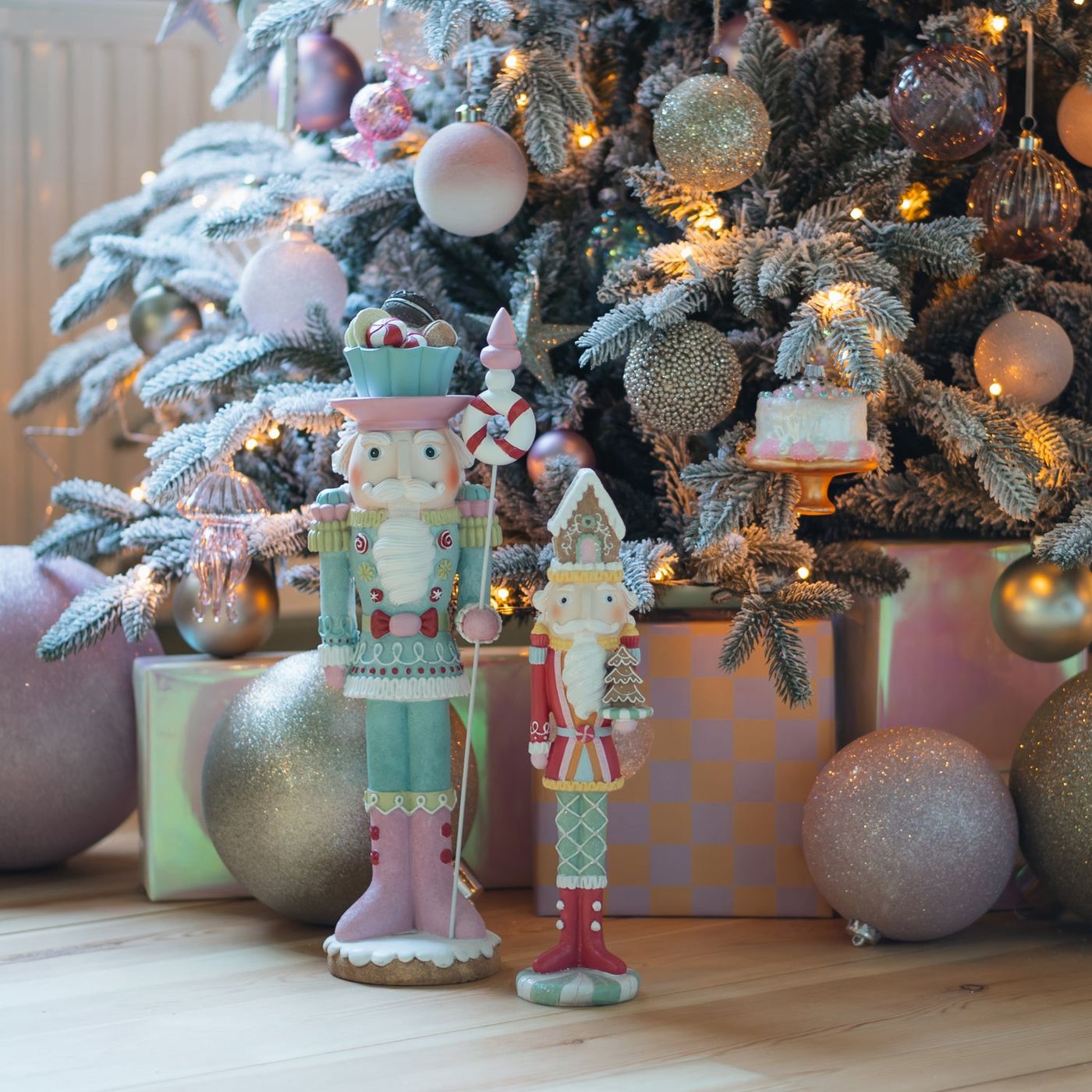
Cluster them so they touch or nearly touch. Baubles scattered evenly around a tree base read as clutter; baubles nested in one deliberate pile read as styling. Same objects, completely different composition.
Flocked trees and glitter baubles are high-maintenance in a specific way: they shed onto whatever sits below. On light wood floors, that white flocking shows up within a day, and glitter gets ground into the finish by foot traffic.
Put a felt pad under the vignette, vacuum weekly with a brush attachment — never a beater bar — and expect to replace a cheap flocked tree every three to four seasons. A plain green tree with a white throw at the base gives you most of the look with none of the shedding.
9. A Three-Tier Pink and Blue Gingerbread House That Glows
- Drill a 1/4-inch hole in the back wall of the house, low and centered.
- Feed a battery-operated LED fairy light strand through the hole.
- Coil the strand inside so no bulb presses against a wall.
- Wrap the battery pack in brown felt and hide it behind the house.
- Set a 6-hours-on timer and check the batteries monthly.
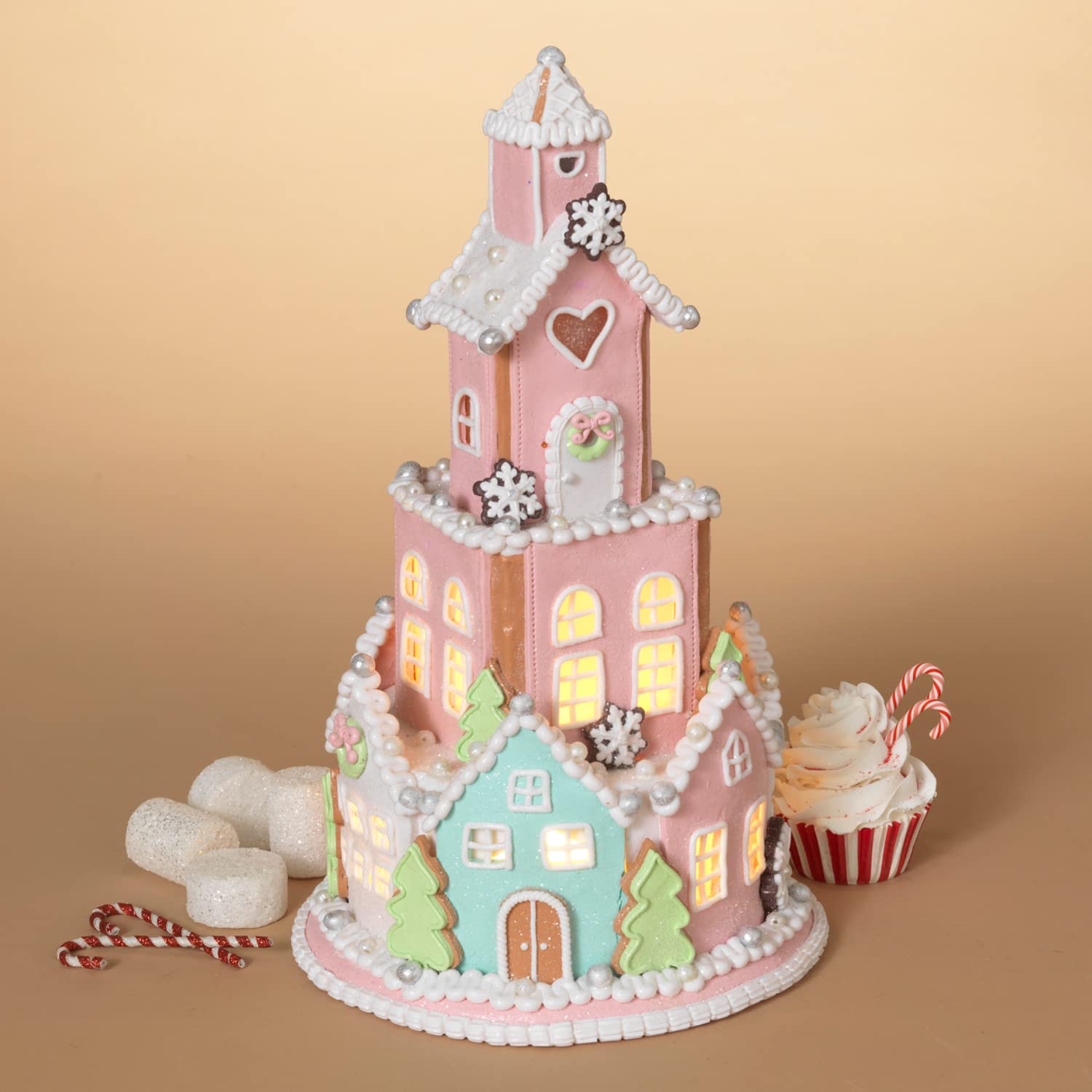
Twenty minutes with a drill and about $9 for a battery strand.
The glow. This is a lovely pastel house with pearl accents and icing detail, but unplug it and it’s a nice object. Turn it on and the pink and blue facades pick up a warm yellow cast from inside, and suddenly you can’t stop looking at those arched windows.
The tiered, three-story shape is the smaller cousin of Idea #4 in a different medium — but the light is what makes it a centerpiece instead of a figurine.
10. Gingerbread Houses Styled with Dahlias and Vintage Teacups
The formula here isn’t candy at all — it’s flowers doing the color work. Roughly 50% fresh blooms in pink, peach and coral, 30% pastel gingerbread, 15% vintage porcelain, 5% glitter. The dahlias cost more than everything else combined, and they’re the reason the arrangement feels grown-up instead of childish.
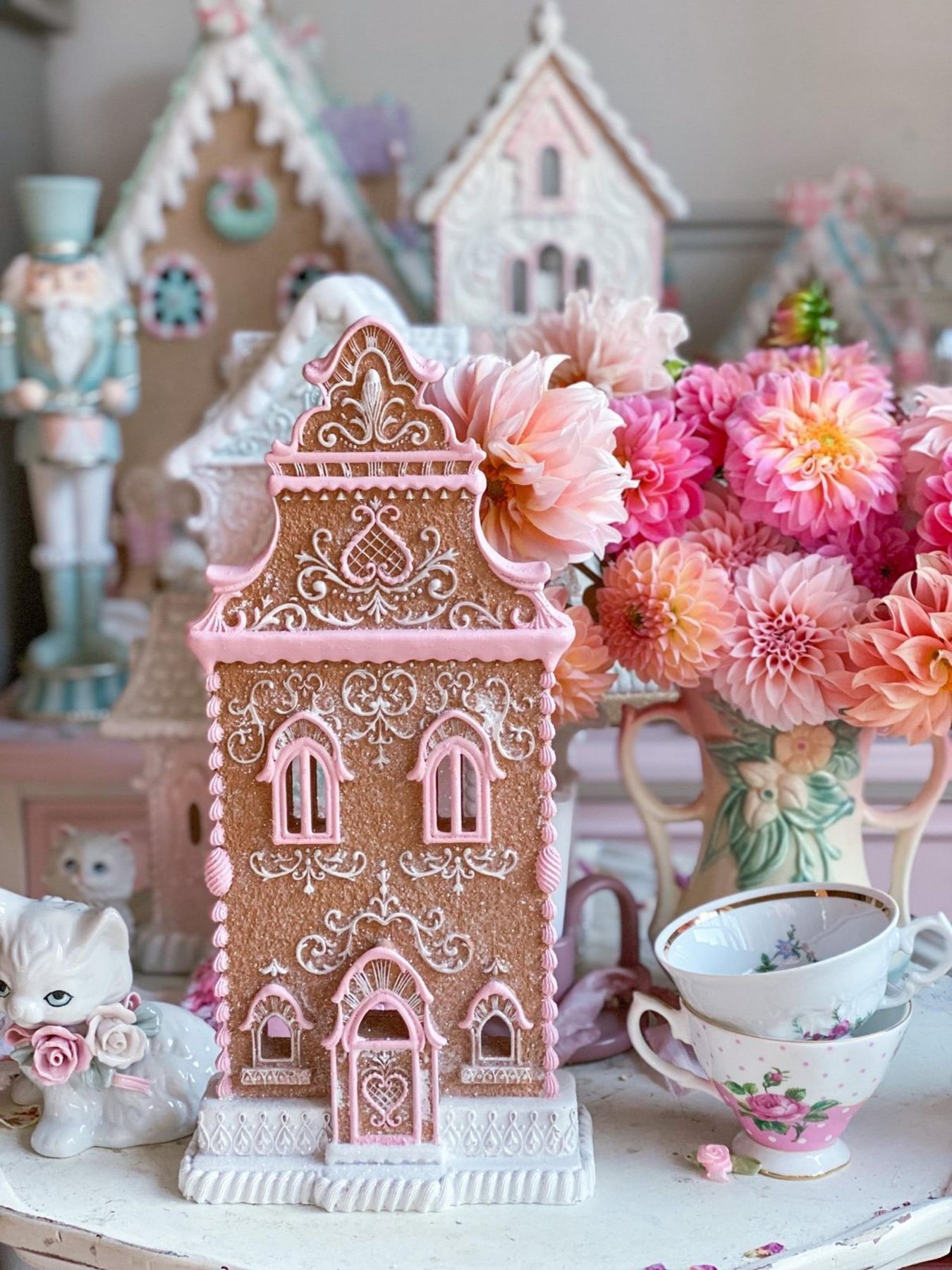
To shift it for a different season, keep the flower share and swap dahlias for tulips in the same palette. The gingerbread stays put. The pastel base carries the theme; the flowers just carry the month.
Dahlias are the expensive part and also the most replaceable. Grocery store bunches run $8–$14 in season, and carnations, mums, or a mixed pastel bunch look nearly as good in a pitcher.
The teacups? Thrift stores, 99 cents each, and mismatched is the point — floral, polka dot, gold rim, all together. Even that white porcelain cat was probably $3 at a flea market. This whole display comes in under $60 if you shop secondhand.
11. Pink Gingerbread House with a Mint Green Door
One unconventional color is all it takes. A pale pink house with white glitter icing reads sweet; add a mint green door and window frames at maybe 5% of the surface area and it reads designed. That mint is a direct complement to pink, which is why your eye finds it instantly even though it’s tiny.
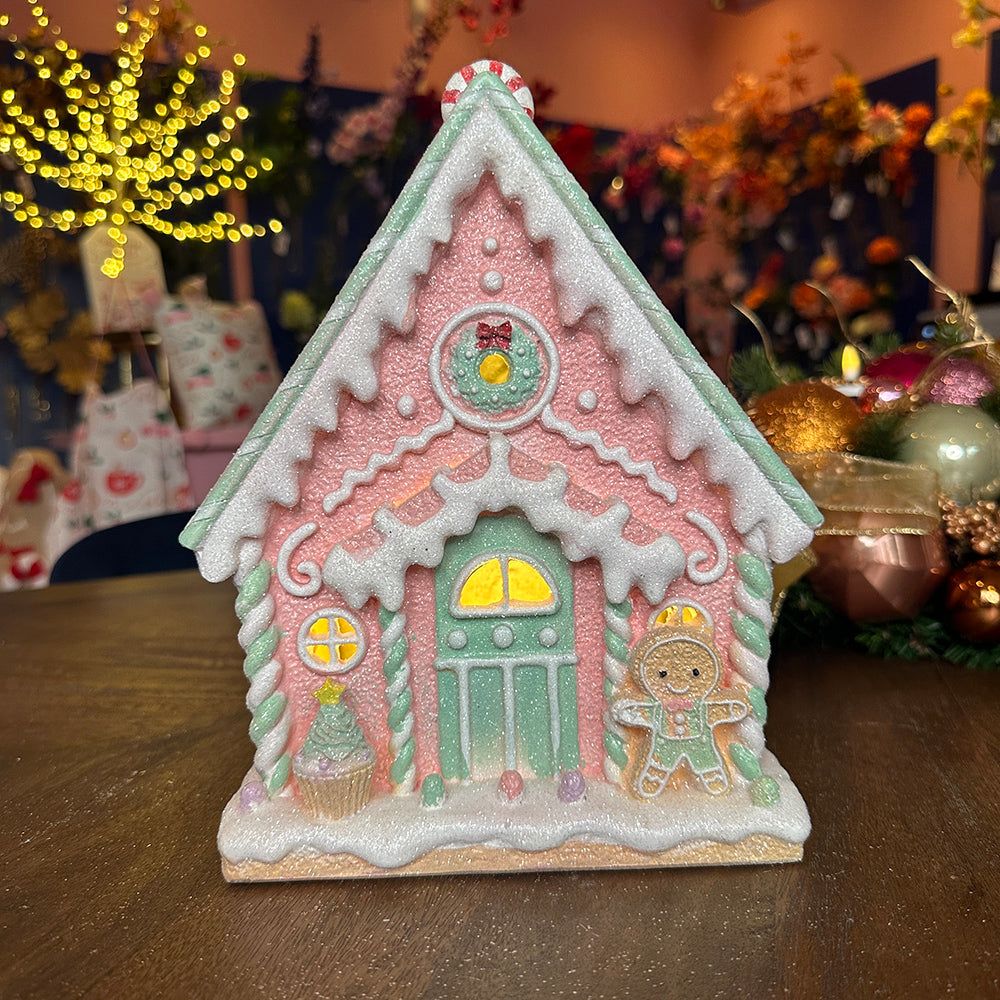
Apply the same rule anywhere: pick one unexpected hue and keep it under 10% of the total. Mint on pink, mustard on cream, black on blush. The small color is what makes the big color look considered.
Light-up houses like this usually run 7 to 10 inches tall and 8 to 12 inches wide — small enough for a console, big enough to be a focal point. Give each one 18 inches of clear surface on either side, or group three at staggered heights along a 24-inch stretch of wall.
Keep them at eye level, 40 to 60 inches off the floor, where the interior glow actually shows. Below 30 inches, all that lighting detail is wasted on shins.
12. Red, Teal and White: A Candy Tree With No Pink in Sight
Teal. In a tree packed with red, white and forest green, the teal ornaments are the only thing here that isn’t a candy cliché, and they’re what keeps this from looking like a grocery store aisle in December. Pull them out and you have a perfectly nice, perfectly predictable Christmas tree.
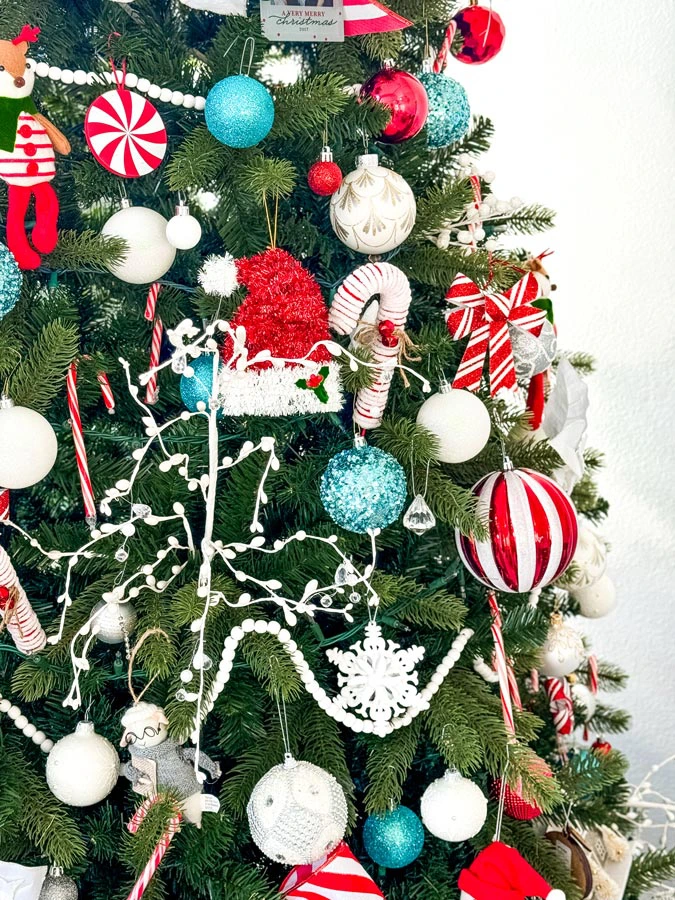
If you’re building a red-and-white candy tree, this is your escape hatch: add one cool color at about 10% of your ornaments. Teal, ice blue, aqua. It costs nothing and changes everything.
Red and green sit close together on the color wheel, which means neither one pops against the other — they just hum along. Teal sits opposite red, so it snaps. That temperature contrast is doing the real work here.
The second principle is texture. The white beaded garland is the only matte, uninterrupted line on the tree, and it draws a soft diagonal that keeps your eye traveling instead of stopping dead on one ornament.
13. A Glitter-Dusted Pink Gingerbread House and Its Gnome Sidekick
Candyland figurines got cheap. Target and Walmart both stock light-up gingerbread houses and gnomes in the $12–$25 range from October onward, and once the lights are on they’re nearly indistinguishable from the $60 boutique versions.
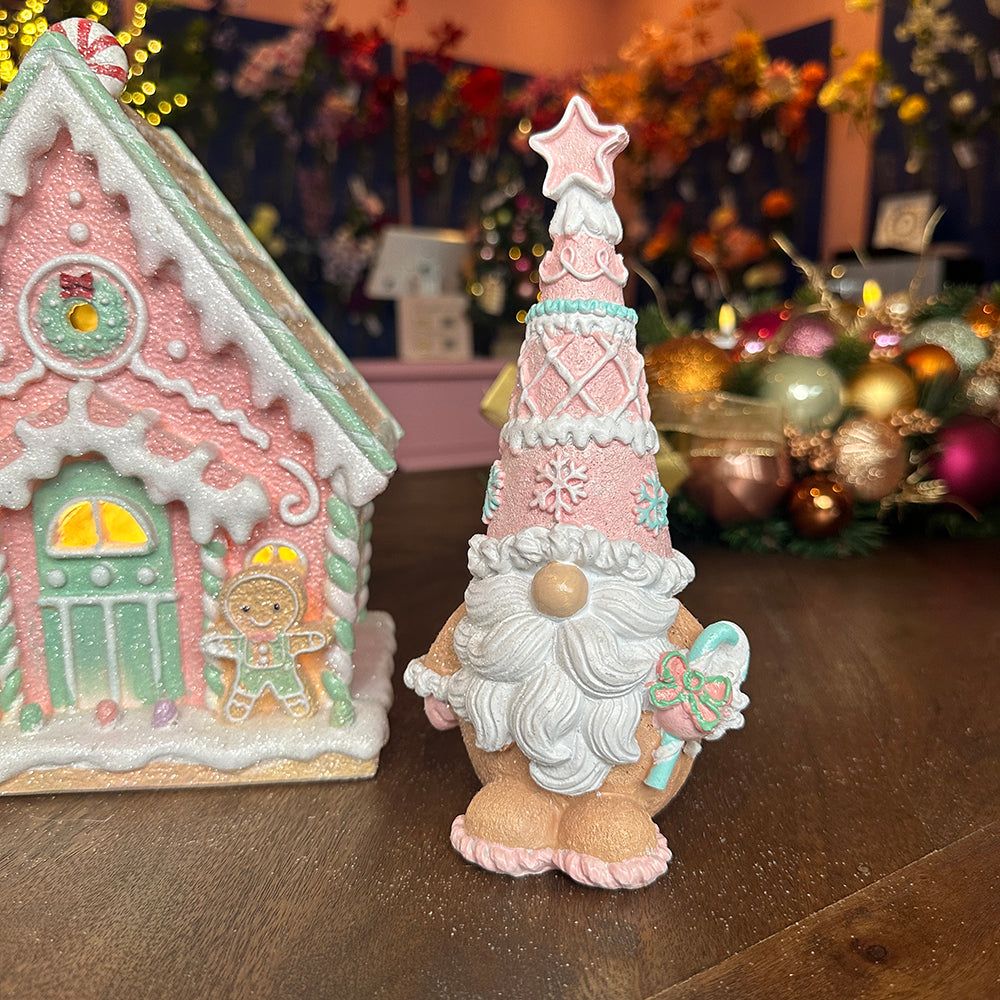
Or go secondhand: thrift stores and Facebook Marketplace in early December, where ceramic Christmas houses and village pieces go for $3–$10 because everyone else is buying new. A pair like this — house plus gnome — for under $30 is completely doable.
The gnome problem is real. Gnomes had a moment, then a backlash, then settled in as a normal Christmas thing. If you love it, buy it. But if you’re on the fence, the house alone carries the vignette fine.
Smaller issue: a 6-inch figurine on a big surface just disappears. Put it on a stack of two books or a small riser so it sits at least 4 inches above the table, and give it a light source nearby. Unlit, this pink house goes flat in a dim corner.
14. The Gingerbread Castle: When a House Simply Isn’t Enough
- Cut a 12-inch round of 1/2-inch plywood, or use a cake stand you already own.
- Spray it with white gloss so the reflections read as snow.
- Hot-glue a 6-inch battery puck light to the center, facing down.
- Set the castle on top, centered over the light.
- Ring the base with fake snow and candy canes to hide the gap.
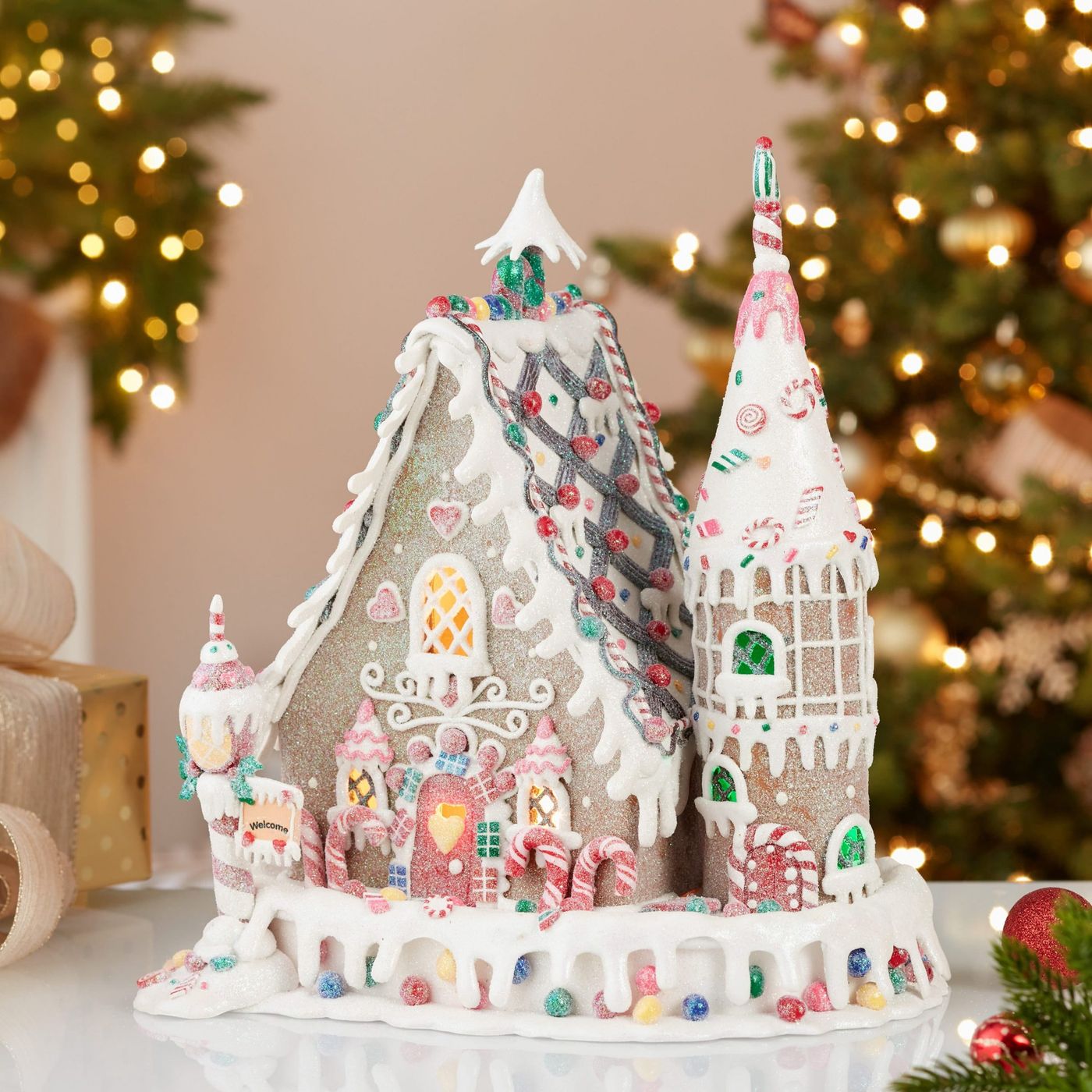
About 40 minutes and $15 in materials, puck light included.
Glitter is a commitment. This castle will leave a trail on every surface it touches, and once it’s on white batting that’s basically permanent — you can’t shake it out.
Store it in a zip bag inside a labeled box, not loose in a bin with everything else, or you’ll be pulling glitter off next year’s nutcrackers. Budget for a wipe-down of the reflective surface underneath every couple of weeks too; dust shows badly on gloss white.
15. A Candy Cane Tree Centerpiece Set for the Dining Table
- Candy cane centerpiece, built or bought: $25 – $90
- Red and white patterned placemats, set of 6: $22 – $60
- Glass apothecary jars plus candy to fill them: $30 – $75
- Accent plates, red stripe on white: $24 – $70
- Teal and silver ornaments scattered down the runner: $15 – $40
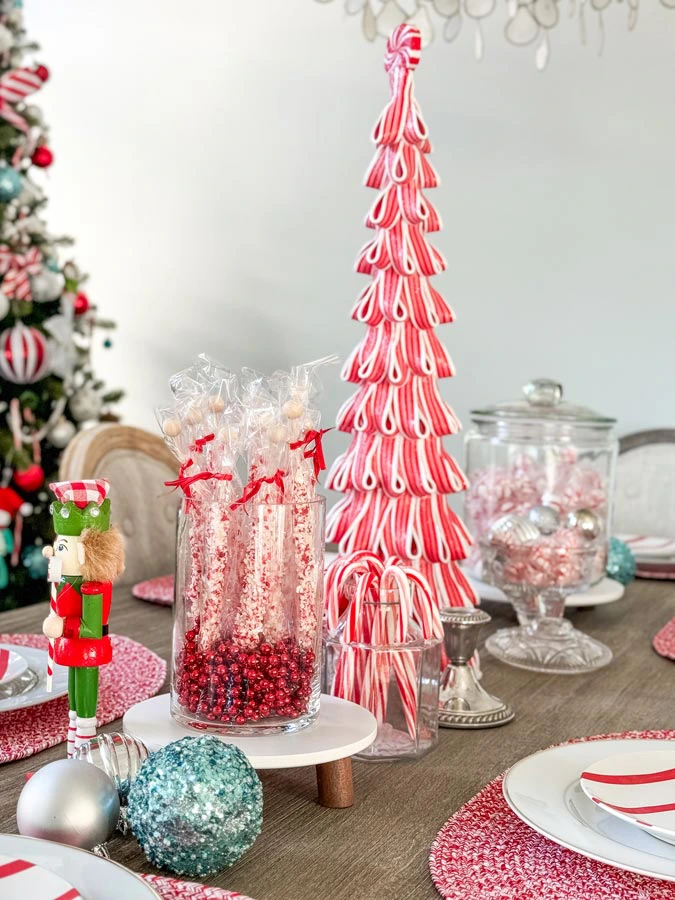
Total to set the table: about $116 – $335.
Budget alternative: skip the jars entirely and use mason jars you already own with bulk candy from the grocery bin. Thrift the placemats. You can land this under $70.
Centerpiece height is the whole ballgame on a dining table. Anything over 14 inches tall blocks the person across from you — but only if it’s also wide. A tall, narrow centerpiece under 8 inches across is fine; a tall, bushy one is not.
Rule of thumb: if you can’t see the far placemat while seated, it’s too big. On a 60-inch round table, keep the centerpiece base under 20 inches wide and leave a 15-inch ring of clear table for each setting.
16. Two Stacked Gingerbread Figures Wearing Pink and Mint
- Measure usable surface depth — you need at least 12 inches front to back.
- Check what’s behind it: a mirror doubles the impact, a dark wall swallows pastels.
- Confirm an outlet or batteries are within reach for anything lit.
- Place your tallest piece first, then build everything else down from it.
- Clear the surface completely before you start arranging — no half-styling.
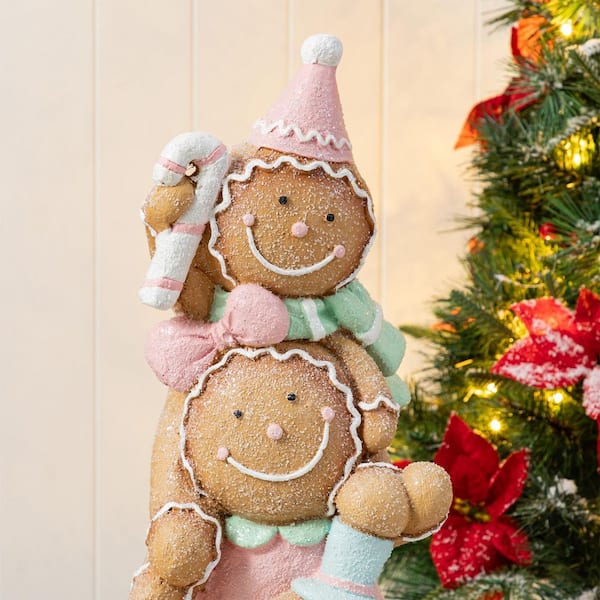
A stacked figurine like this runs about 16 to 20 inches tall once both pieces are together. Count on a footprint of roughly 10 inches wide, and don’t let anything sit closer than 6 inches to its edges or the stack starts looking crowded.
This belongs on a console, sideboard, or wide bookshelf — 36 inches of table minimum. If you’re working with a narrow mantel, go flat instead: a low bowl of oversized ornaments in the same palette covers the same ground in half the height.
17. A Glitter Snowman Built Around One Giant Pink Lollipop
Numbers for this one: 45% white glitter, 30% pink, 15% red, 10% gold. Notice red isn’t the star — it shows up only as Santa’s hat, the mittens, and a few ornaments in the tree behind. Gold appears almost exclusively in those two tall striped poles.
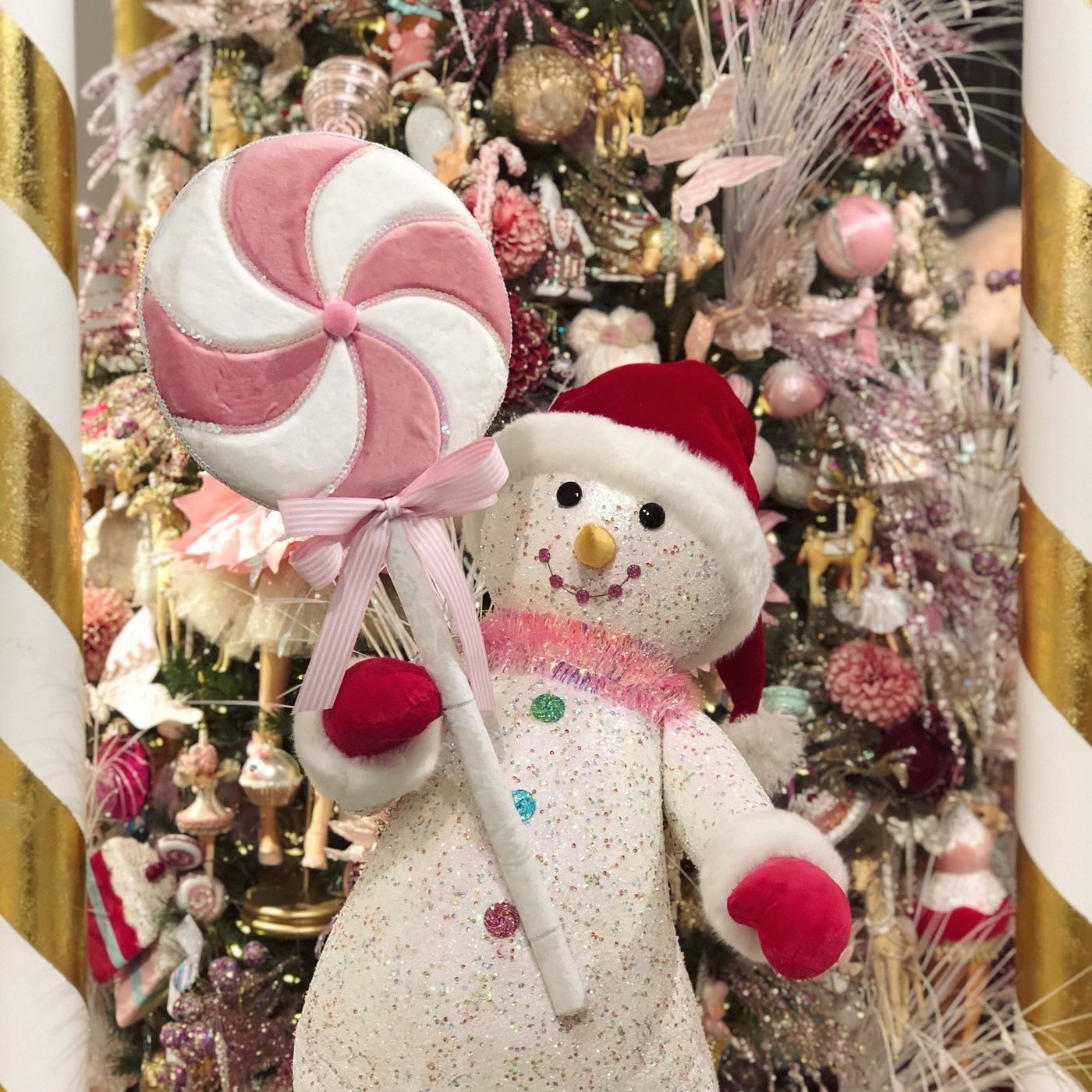
Change the ratio and it falls apart. Push pink to 50% and it turns into a kid’s bedroom. Push red past 25% and the snowman stops reading as white. The dominant color has to actually dominate.
This is a monochrome-plus-one composition: white glitter everywhere, pink as the single accent, everything else in small doses. That’s why a lollipop the size of the snowman’s torso doesn’t look ridiculous.
The two gold-striped poles add vertical rhythm. They’re structural, not decorative — they bracket the scene and tell your eye where it starts and stops. Without them, it’s just a cute snowman on a table.
18. Loose Candy Picks: The Cheapest Way to Candyland a Whole Tree
- Gather 5 to 7 floral picks: gingerbread men, candy canes, wrapped candies, a round swirl.
- Stagger the heights so the tallest is roughly double the shortest.
- Wrap the stems together with 22-gauge floral wire in two tight bands.
- Cover the wire with a 6-inch strip of white ribbon, tucking the end under.
- Slide the bundle into a vase, or wire it into the interior branches of a flocked tree.
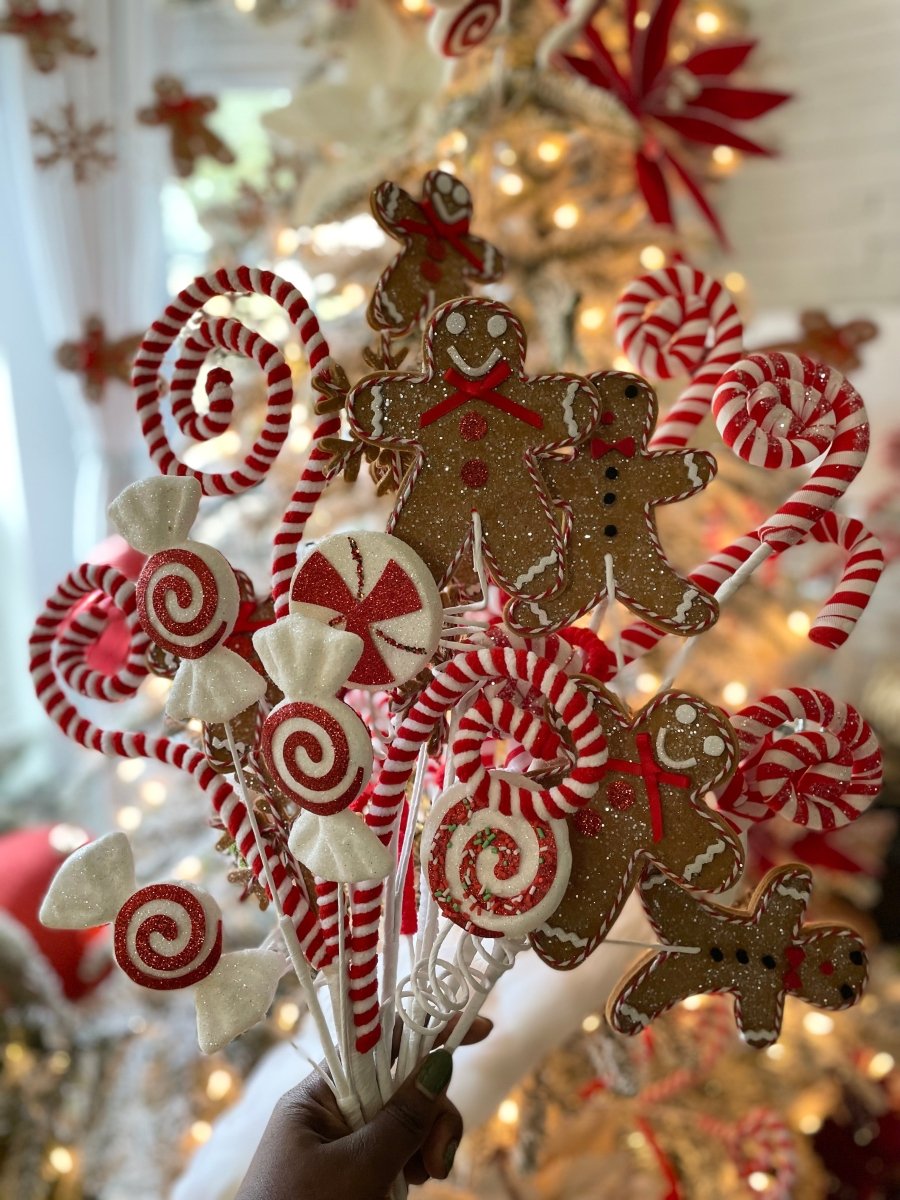
Fifteen minutes and about $18 if you buy picks on sale after Thanksgiving.
The bundle itself. Individually, each of these picks is a two-dollar impulse buy you’d lose in a drawer by January. Wire five of them together with the stems fanned and you’ve made an object — something you can set in a vase, tuck into a wreath, or stick in the middle of a white tree like a bouquet.
Grouping is free. It’s the one styling technique that costs nothing and changes everything about how expensive your decor looks.
19. A White Tree with Pom-Pom Garland Against a Pink Wall
- White flocked 7 ft tree: $90 – $400
- Candy and gingerbread ornaments, 50 pieces: $75 – $200
- Multi-color pom-pom garland, 9 ft: $12 – $35
- Peppermint-shaped pillow: $18 – $45
- Candy-patterned gift bags and wrapping paper: $15 – $40
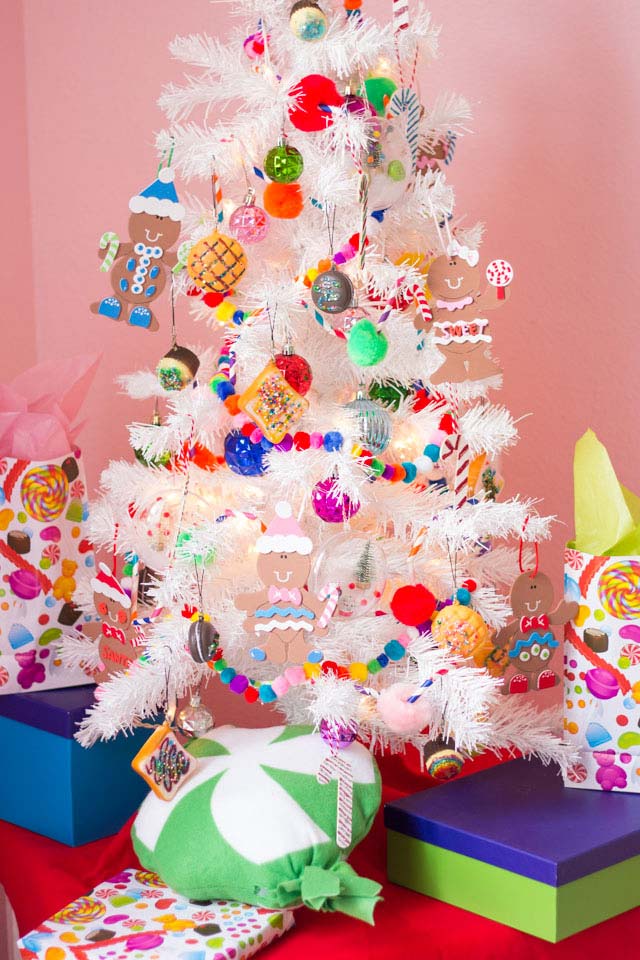
Total: roughly $210 – $720.
Budget alternative: pom-pom garland is a 20-minute DIY with dollar store pom-poms and twine for about $6. Shop ornament sets after December 26 and store them for next year at 70% off.
Two things are driving this look in 2026. First, dopamine decor — the deliberate return of bright, high-saturation color after years of beige everything. Second, the photo wall. A solid pink or blush backdrop behind a decorated tree gives you a holiday photo spot that needs zero editing.
This trend has real shelf life because it’s built on color, not on a specific product. Swap the ornament theme and the same pink wall works for a decade.
20. Classic Gingerbread Houses Anchored by a Nutcracker
A three-piece vignette like this — two gingerbread houses plus a nutcracker — needs about 30 inches of surface width and 12 inches of depth. The nutcracker should be the tallest element at 14 to 18 inches, with the houses at 8 to 10 so the group forms a triangle.
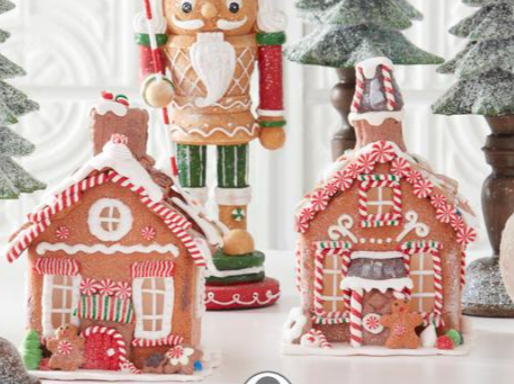
Frosted evergreen trees placed behind the houses should be at least 4 inches taller than the houses, so they read as a backdrop rather than clutter. Mantels, sideboards and bookshelf tops all work. Anything narrower than 24 inches will feel cramped.
This is the traditional version of candyland — brown, red, green, gold. If your tree is pastel, this vignette will look like it wandered in from another house. Pastels and traditionals don’t blend; they argue.
Pick a lane. If you want the warm classic look, this is it and it’s timeless. If you’re already committed to pink and mint over in Idea #11, skip the red-and-green nutcracker and go pastel instead.
21. Candy Ornaments on a White Tree, Gifts Piled on a Shag Rug
This is the budget version of Idea #19 — same white tree, same candy ornaments, same pink wall. The difference is that everything here can come from a dollar store or a discount aisle.
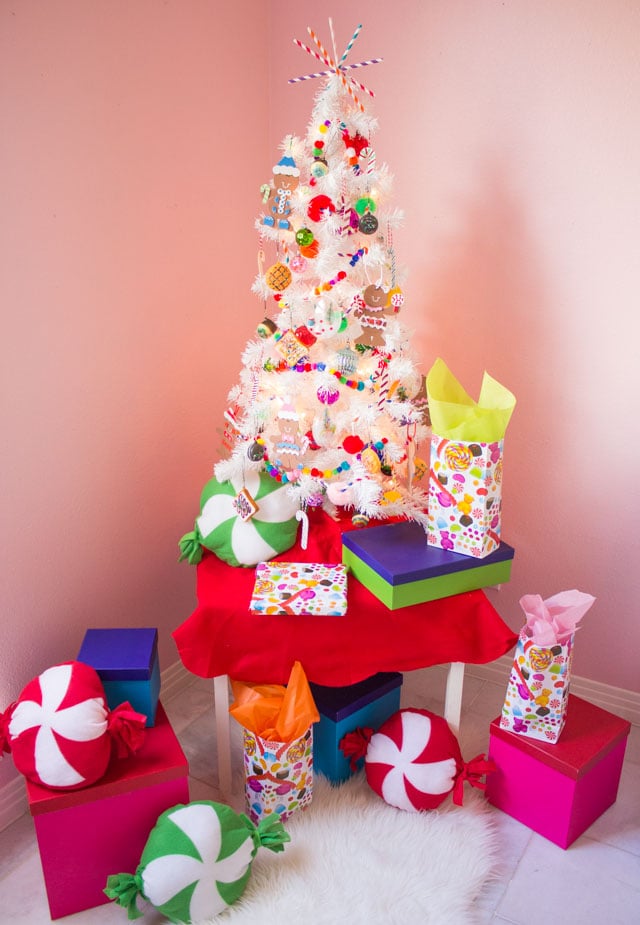
Ornament sets five for $5, a candy-print pillow for $12 at Target, gift bags at $3 each. The white shag rug is the biggest spend at $40–$80 and it’s optional. Total under $200 if you already own the tree; a Marketplace white tree in November runs $40–$90.
Wrap your gifts like a designer: three papers, one ribbon color, one tag style. Three patterns maximum, mixed at roughly 60% neutral, 30% candy print, 10% solid bright. Ribbon in a single color across every package is what makes a pile of presents read as a styled moment instead of a pile.
If you’re staging gifts under a tree for photos, use empty boxes. Nobody’s opening them, and you can reuse the same eight boxes for a decade.
22. Gingerbread Cone Trees with Icing Lattice and Sprinkles
- Buy three foam cones: 12, 9 and 6 inches tall.
- Base-coat each with two thin layers of brown craft paint and let them dry fully.
- Pipe white puffy paint in a lattice pattern down the sides.
- Add a scalloped icing border at each tier edge.
- Press sprinkles and mini candy canes in while the paint is tacky.
- Top each with a star cutout and let cure for 24 hours.
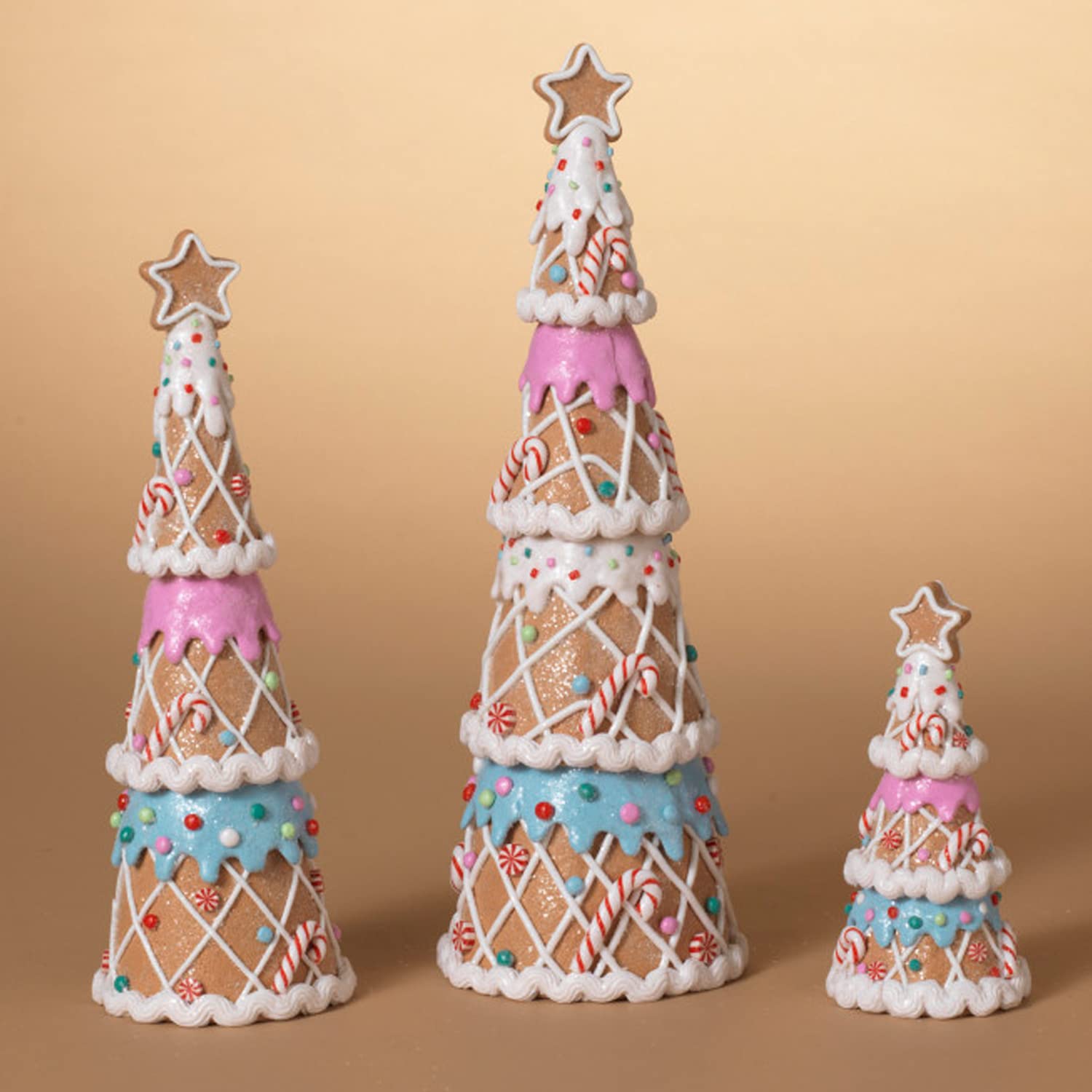
About two hours across an evening and roughly $14 in supplies for all three.
Height hierarchy is the whole trick with a set of three: 12 / 9 / 6 inches, each a quarter shorter than the last, grouped with their bases nearly touching. Pastel pink and blue icing drips take up roughly 20% of the surface; the rest stays brown and white.
Want a different palette? Keep the lattice white and swap the drips. Brown plus white plus mint. Brown plus white plus lilac. Or brown plus white plus nothing, which is honestly underrated.
23. Oversized Candy Props Beside a Flocked White Tree
White flocked trees and white props are gorgeous for exactly two seasons, then they start looking dingy. Flocking yellows slightly, picks up dust, and once it’s dusty you can’t really clean it — brushing it off just makes it shed more.
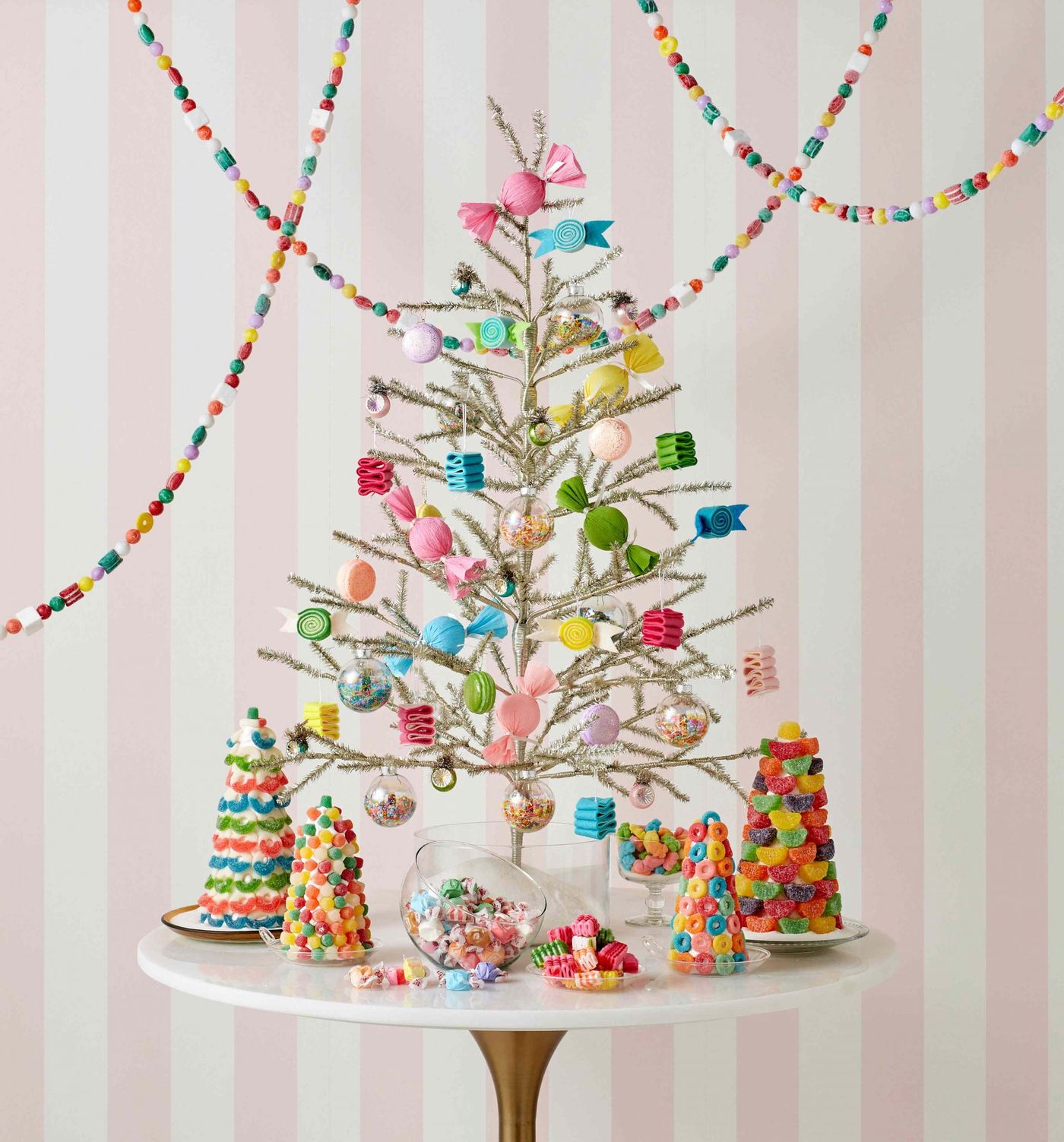
Store the tree in a sealed bag in a climate-controlled space, never a garage or attic. Run a handheld vacuum on low over the ornaments in December. Budget on replacing a cheap flocked tree every 3 to 4 years; the good ones last 8 to 10.
The real design move here is putting big decor on the floor instead of on the tree. That white gingerbread house and the striped candy props sit at the base, which stretches the composition downward and makes the tree feel like part of a scene rather than a lone object.
Second principle: the ornaments are oversized relative to the tree. Small ornaments vanish on white; 5- to 7-inch lollipops and cupcakes hold their shape from across the room. Bigger reads better on white, always.
24. A Hot Pink Tree, a Gold Bar Cart and a Fluffy Wreath
- Hot pink Christmas tree, 6.5 ft: $80 – $300
- Candy and snowflake ornaments, 40 pieces: $60 – $160
- Gold bar cart, or a thrifted stand-in: $70 – $250
- Fluffy pink wreath: $20 – $60
- Glass jars plus bulk candy: $18 – $45
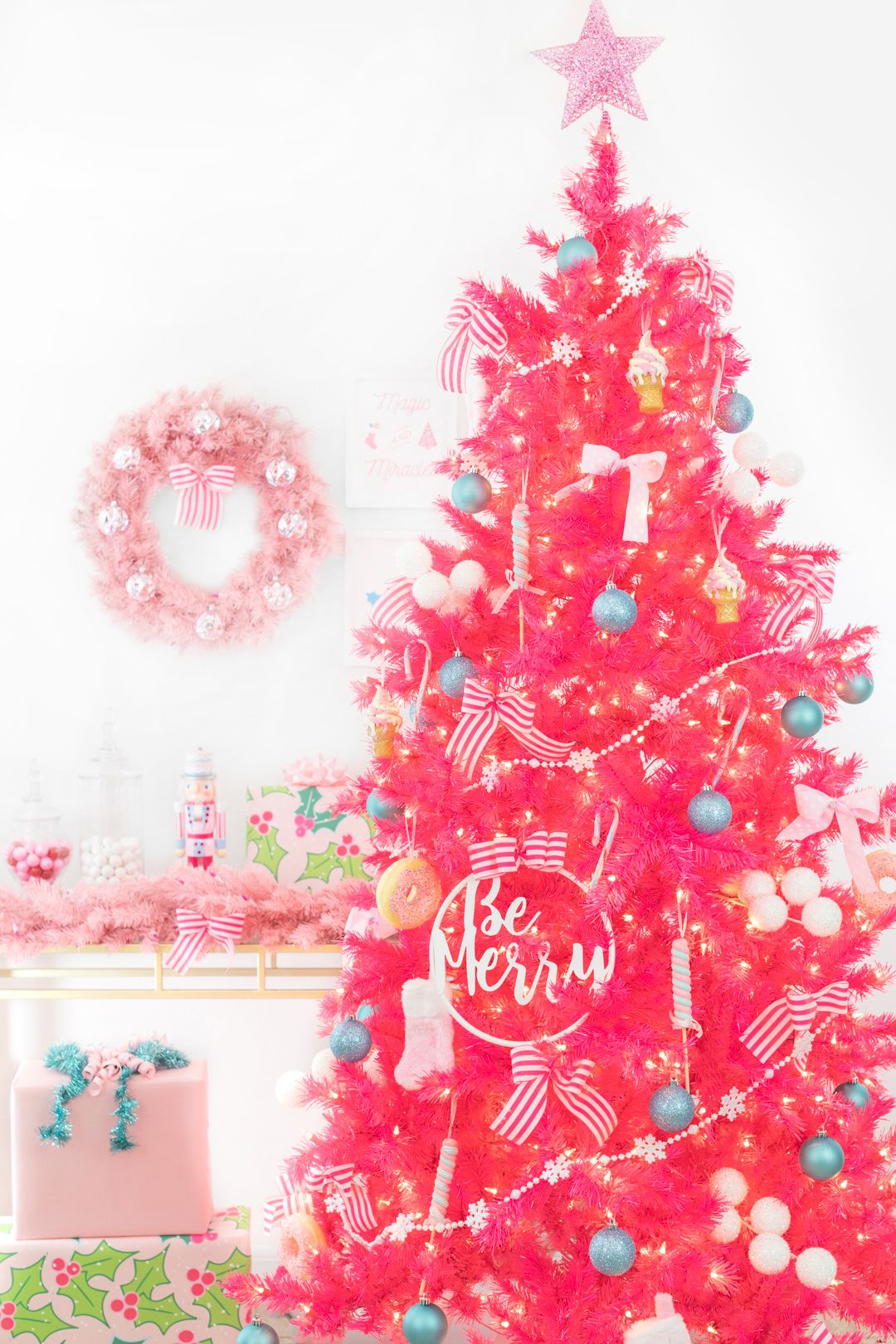
Total: about $248 – $815.
Budget alternative: a gold spray-painted thrift cart is $15 plus $8 of paint. Ornament sets in pink, blue and white are cheapest in bulk multi-packs, and a pink feather boa wreath is a $12 DIY.
- Measure the wall — a colored tree is a statement and needs 6 inches of clearance all around.
- Check your wall color in daylight. Hot pink against cool gray goes punk; against warm cream it goes sweet.
- Confirm you have somewhere to store a tree that only works in one color scheme.
- Check whether your ornament collection is mostly red and green — you’ll be buying a whole new set.
25. An Illuminated Candy Cane with a Lime Green Bow
Outdoor decor fails for boring reasons. Wind knocks it over, snow buries the connection, and the outlet you need is 30 feet from where you want the light. This style of candy cane is lightweight, so stake the base or zip-tie it to a hidden ground stake — a real storm will take it otherwise.
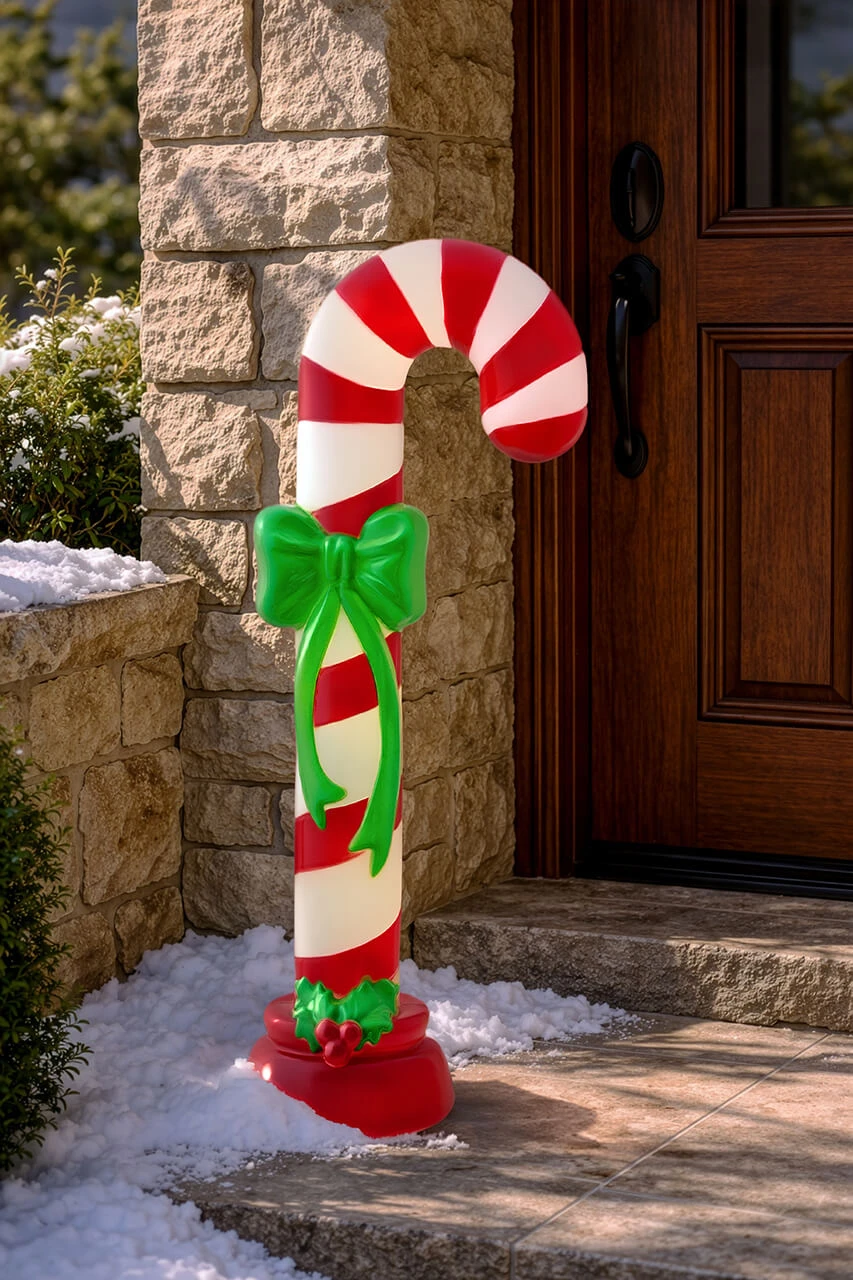
Check the rating too. Anything outdoors should be UL-listed for wet locations, and the plug connection should point downward or be wrapped in a waterproof cover. An indoor-only strand outside is a fire risk no matter how good it looks from the street.
Two purchases under $15 each make outdoor decor survivable: a plug-in timer set for 5 pm to 11 pm, and a 14-gauge outdoor extension cord in a color that matches your siding or mulch. Black cords disappear against dark shrubs; green ones vanish in grass.
Run the cord along the base of the wall rather than across the walkway, and secure it with clips every 18 inches. That’s the difference between a display that looks installed and one that looks dragged out of the garage.
26. A Candy Cane Pathway That Leads Right to the Door
Candy cane path lights usually stand 24 to 30 inches tall, and you want them spaced 3 to 4 feet apart on center. A 20-foot path takes about 7 canes per side, 14 total. Stagger the two sides slightly so they don’t line up like a fence.
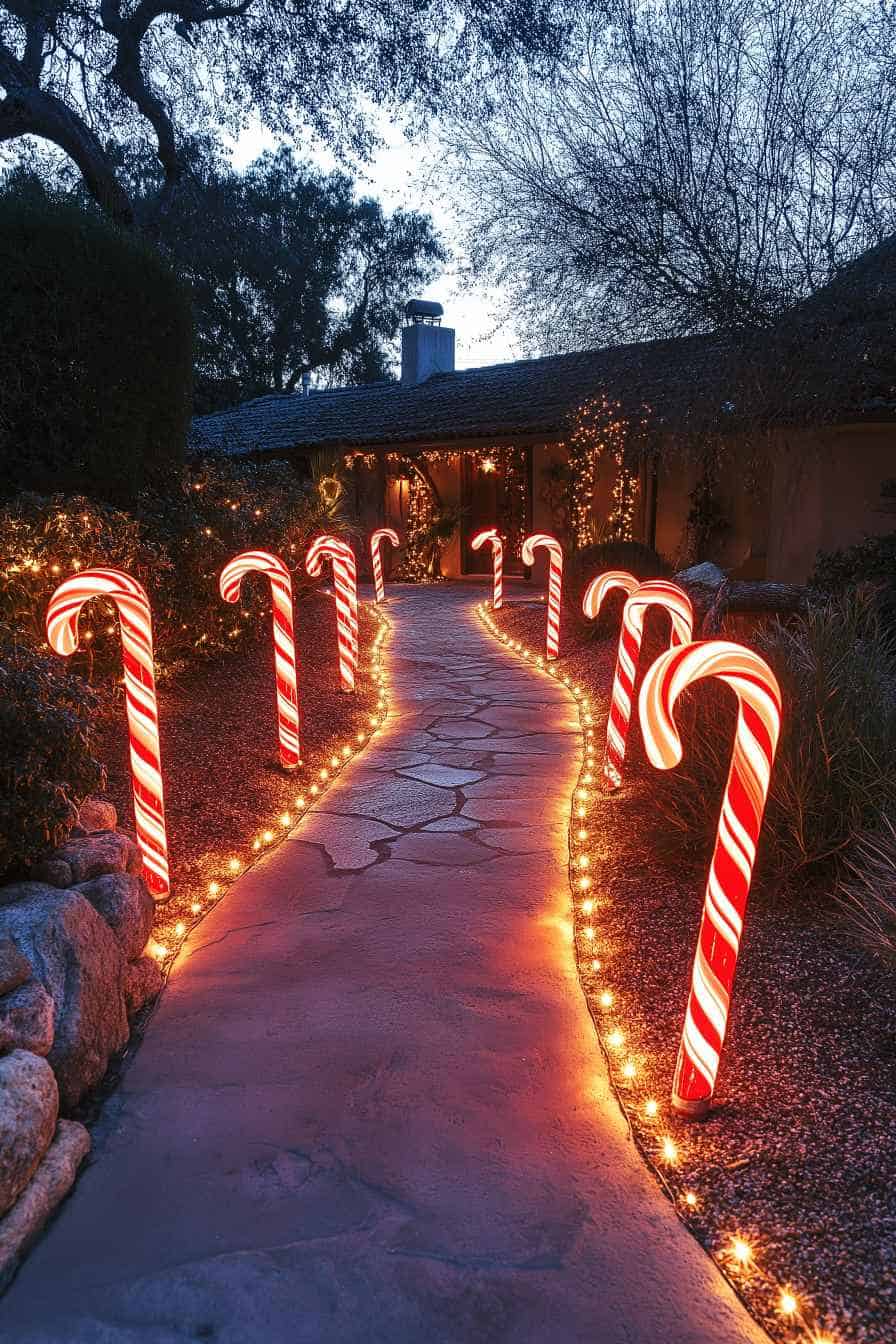
Keep them at least 18 inches off the path edge so nobody catches a base with a foot, and aim the warm string lights so they wash the pavers instead of shining into your neighbor’s window. Paths 4 feet and wider look best; anything under 3 feet starts to feel cluttered.
The double line. One row of candy canes is a decoration. Two mirrored rows leading toward a lit door is an invitation — your eye reads the path as a corridor and follows it home without being told to.
That’s the only reason this works. Everything else is standard issue: stone pavers, warm string lights, a normal house. The symmetry is the entire design.
27. Pink Florals Meet Lollipops on a Green Christmas Tree
This tree breaks the usual rule. Instead of a neutral base, it runs about 65% green tree, 20% pink between the ornaments and those big floral heads, 10% red, 5% white. The flowers are the wild card — full magnolia or peony heads tucked into a candy tree is an unusual mix, and it’s what keeps this from looking like a store display.
To soften the palette, swap hot pink for blush and drop the red. To go bolder, replace the white lights with pink. Both work. Just don’t add a third accent color on top.
Floral stems are where this gets expensive — a single large faux peony head runs $8–$15. Buy one big bush on sale and pull it apart into six or seven individual heads, which is how pros make a $20 stem go three times as far.
Striped lollipop ornaments are cheapest in multi-packs; 12-piece sets land around $20. Compare with Idea #12 — same candy idea, completely different palette, and the same $20 ornament packs work for both.
28. The Double Candy Cane Topper That Makes the Whole Tree
Two colors, executed all the way. There’s no third accent here — the tree is red and white, and the only green is the foliage itself. That discipline is why it looks expensive.
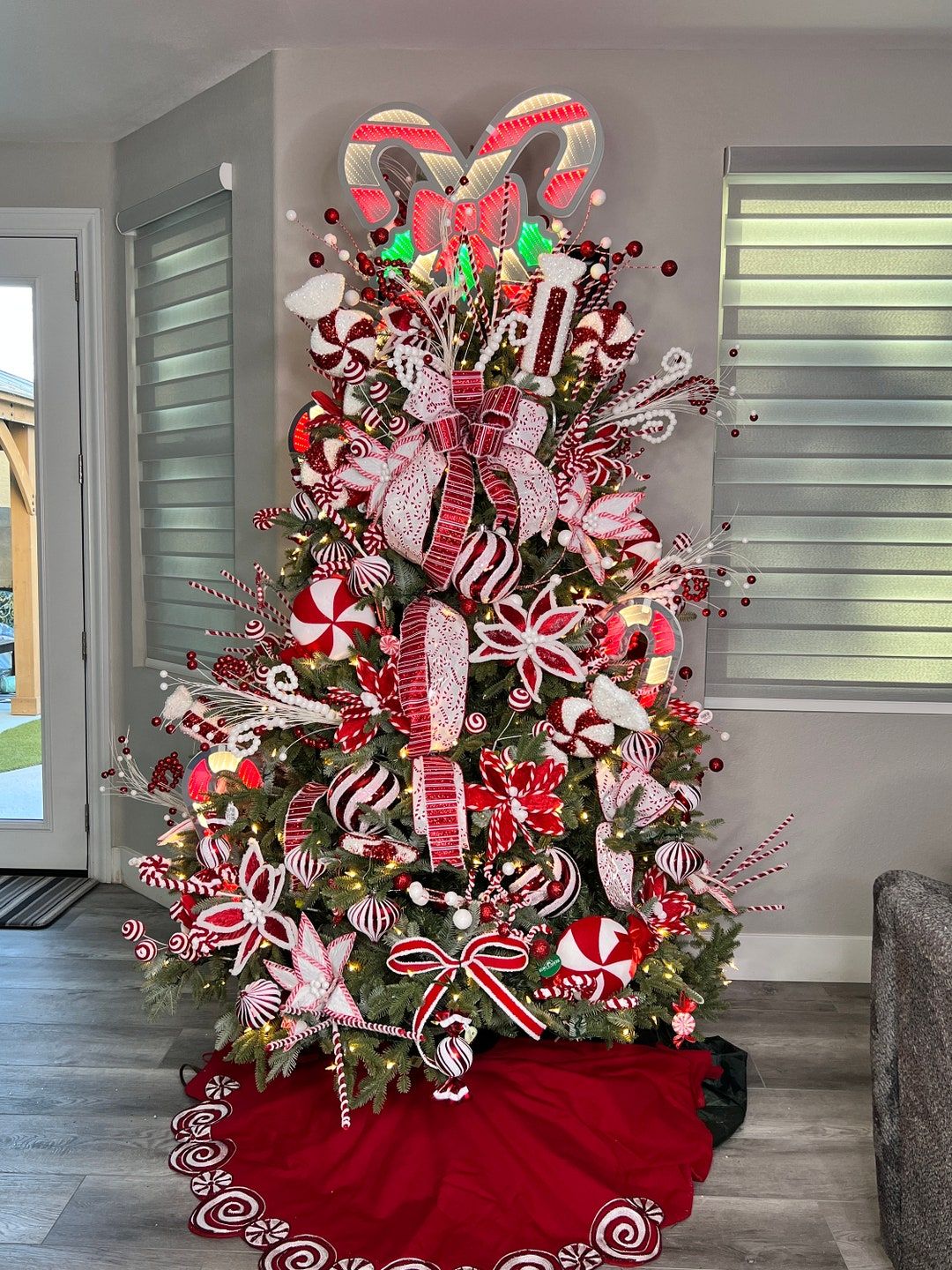
The topper does most of the work. That illuminated double candy cane with the glitter present is nearly a foot tall, and scale at the top matters more than scale anywhere else on a tree. A small topper on a heavily decorated 7.5-foot tree looks like an afterthought. Go big or go home.
Red-and-white trees show everything. Red glitter flakes onto white ornaments, and white ornaments show fingerprints and dust immediately. Plan on a full wipe-down with a microfiber cloth before and after the season.
Those big satin bows are the fragile part — store them flat in a shoebox, not folded into a bin, or they’ll carry creases all December. And if you have a red skirt with a peppermint border like this one, spot-clean only. One machine cycle takes the border off.
29. A Candyland Tree That Matches the Art on the Wall
- Heavily flocked 7 ft tree: $100 – $380
- Candy ornaments and lollipop picks: $70 – $180
- Sprinkle-covered sphere, large: $25 – $70
- Gingerbread man cutout, 30 in: $20 – $60
- Striped candy pillars, pair: $30 – $80
- Pink shag tree skirt: $30 – $75
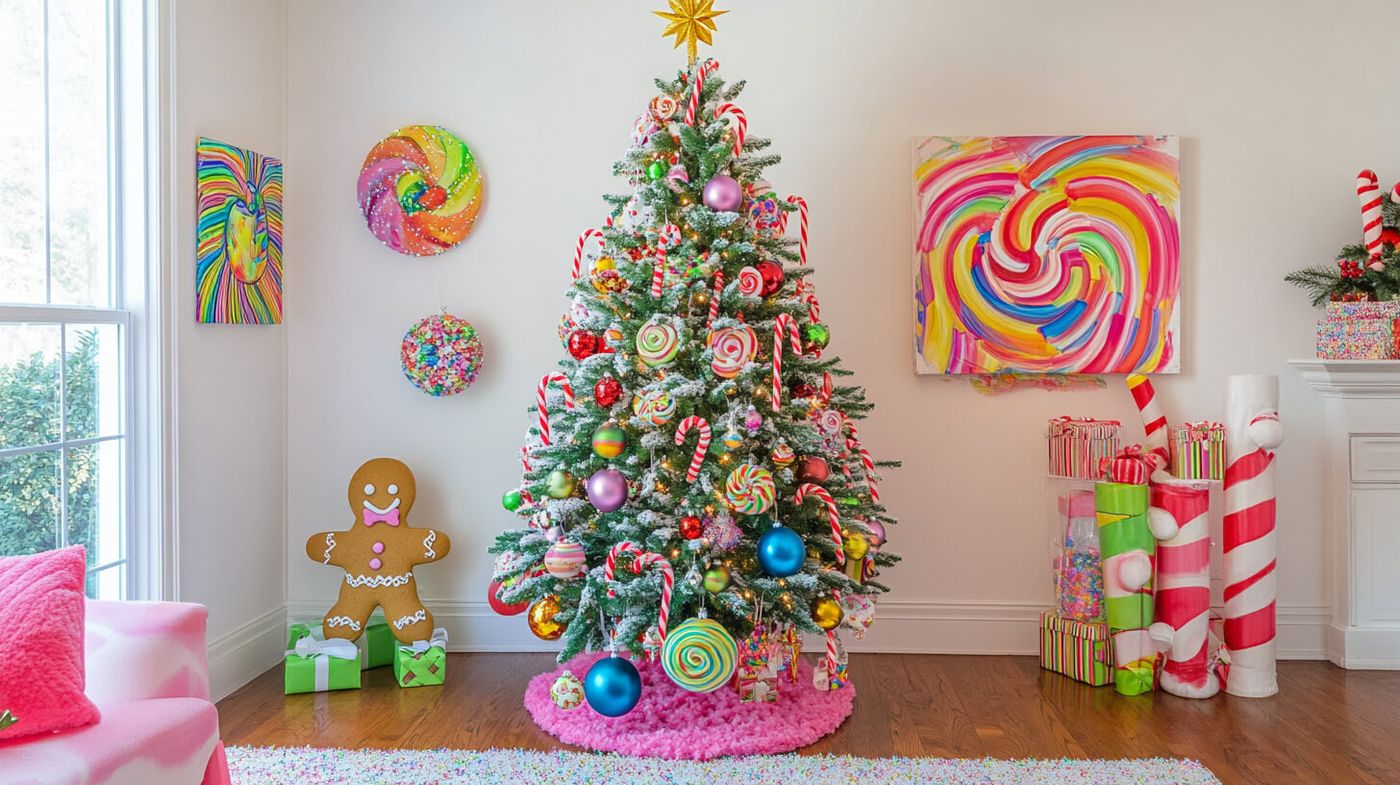
Total: roughly $275 – $845.
Budget alternative: a plywood gingerbread cutout and acrylic paint is a $15 afternoon. The sprinkle sphere is a $6 foam ball covered in craft sprinkles. And the pillars are the easiest thing here to fake with white cardboard tubes and red tape.
The biggest shift in holiday decorating for 2026 is that the room is part of the theme. Wall art in candy colors, cutouts mounted at eye level, tree skirts that match the palette — decor is being treated as an installation rather than a single object in the corner.
This works best in a room you can commit to. It’s a strong choice for a playroom or kids’ bedroom. In a formal living room, it will feel like a costume.
Your Candyland, Your Rules — Now Go Hang the First Ornament
You don’t need every idea here. Pick one tree, one palette, and one wild card — the elf legs, the teal ornaments, the giant pink lollipop — and let everything else play a supporting role. That’s how candyland stays charming instead of chaotic.
Start with the lights, finish with the candy, and photograph it before you second-guess yourself.
📌 Pin your favorite version now so you can find it again in November — and tag us when it’s up.
