
25 Festive Christmas Bathroom Decor Ideas You Need to Try This Season
Still scrolling through Christmas bathroom decor photos at 11 p.m. without knowing where to start? You’re not alone. The bathroom is the last room anyone decorates and the first one every guest actually walks into.
We spent serious time browsing Target, HomeGoods, and Amazon to bring you only what’s worth your attention this year — 25 ideas ranging from a $9 hand towel to a $1,400 vanity wall. You’ll find minimalist winter greenery, warm traditional plaids, modern marble luxury, and a few cozy rustic setups. Budget and luxury versions are compared side by side, and every idea is shoppable with direct product links.
In 2026, the shift is toward greenery you can leave up past January — pine boughs, eucalyptus, and deep green tile instead of inflatable Santas. And stay until the end, because we break down the most common mistakes that can ruin these looks.
Save this post now — you’ll want it when you’re ready to shop. Some links here are affiliate links, which means we may earn a small commission at no extra cost to you.
1. One Pine Branch, Warm Brass, Zero Clutter
Hang your holiday greenery at eye level, not down on the counter. A single pine branch in a clear glass vase should sit so the top of the greenery lands 14 to 18 inches above the countertop — that puts it in the same sightline as the brass faucet instead of disappearing behind the soap. Cut the stems at a 45-degree angle and change the water every three days; a $6 branch holds for about two weeks indoors. Skip floral foam entirely. A narrow-mouth vase does the work for free.
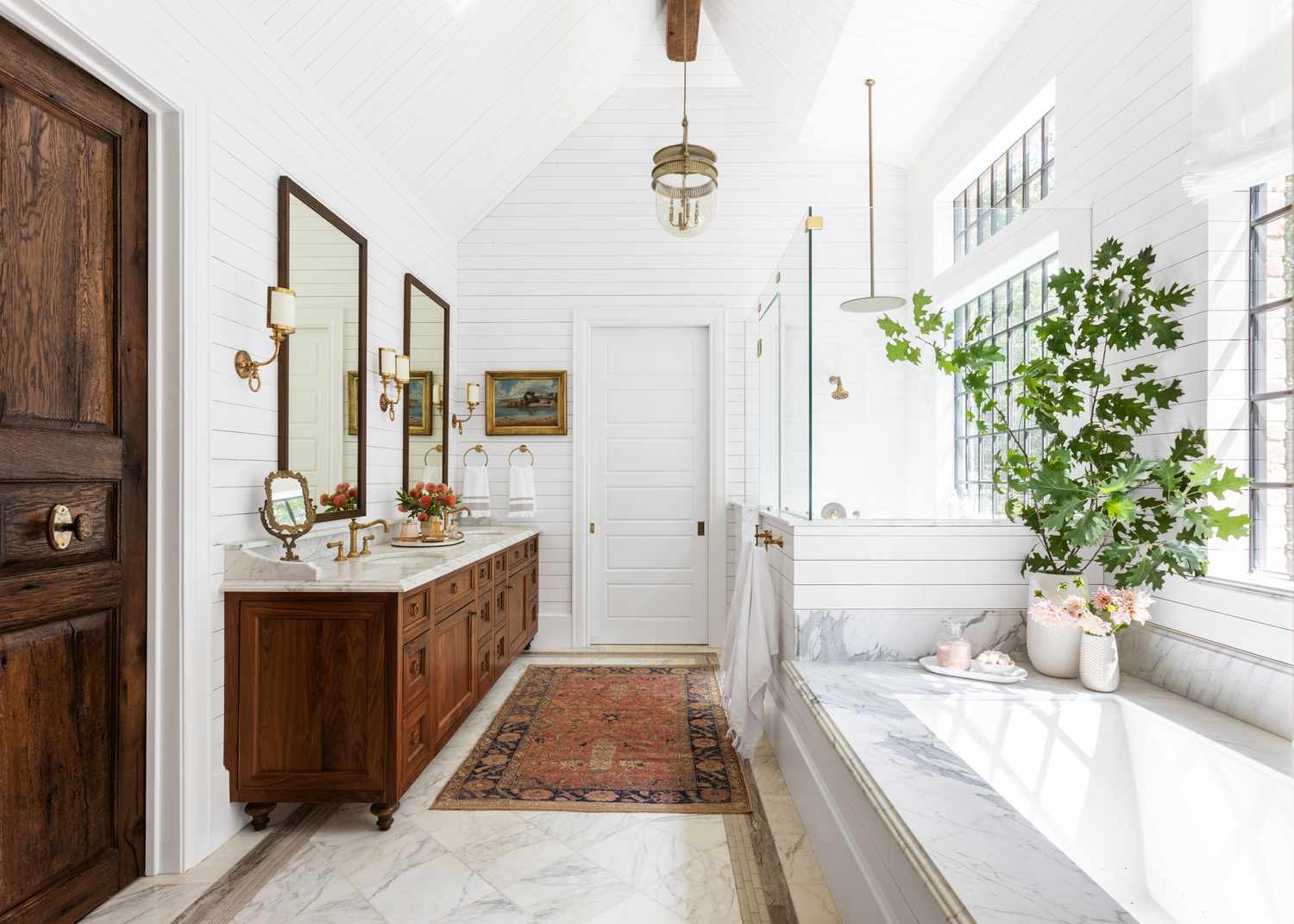
60% off-white stone and tile + 25% warm brass + 15% forest green. That is the entire formula. The brass does the heavy lifting here because it’s the only warm metal in the room, so it reads as intentional rather than leftover. Swap the pine for eucalyptus in January and the ratio still works. If your fixtures are chrome, borrow the warmth from a wooden tray instead, and drop the greenery to 10% so the counter never looks crowded.
2. The Floating Double Vanity That Skips Tinsel Entirely
- Floating double vanity with dual vessel sinks: $1,200–$3,500
- Crystal sphere ceiling pendant: $180–$600
- Freestanding soaking tub: $900–$2,800
- Frameless glass shower enclosure: $1,400–$4,000 installed
- Polished chrome fixtures for tub, sinks, and shower: $600–$1,800
- Textiles and styling: $120–$350
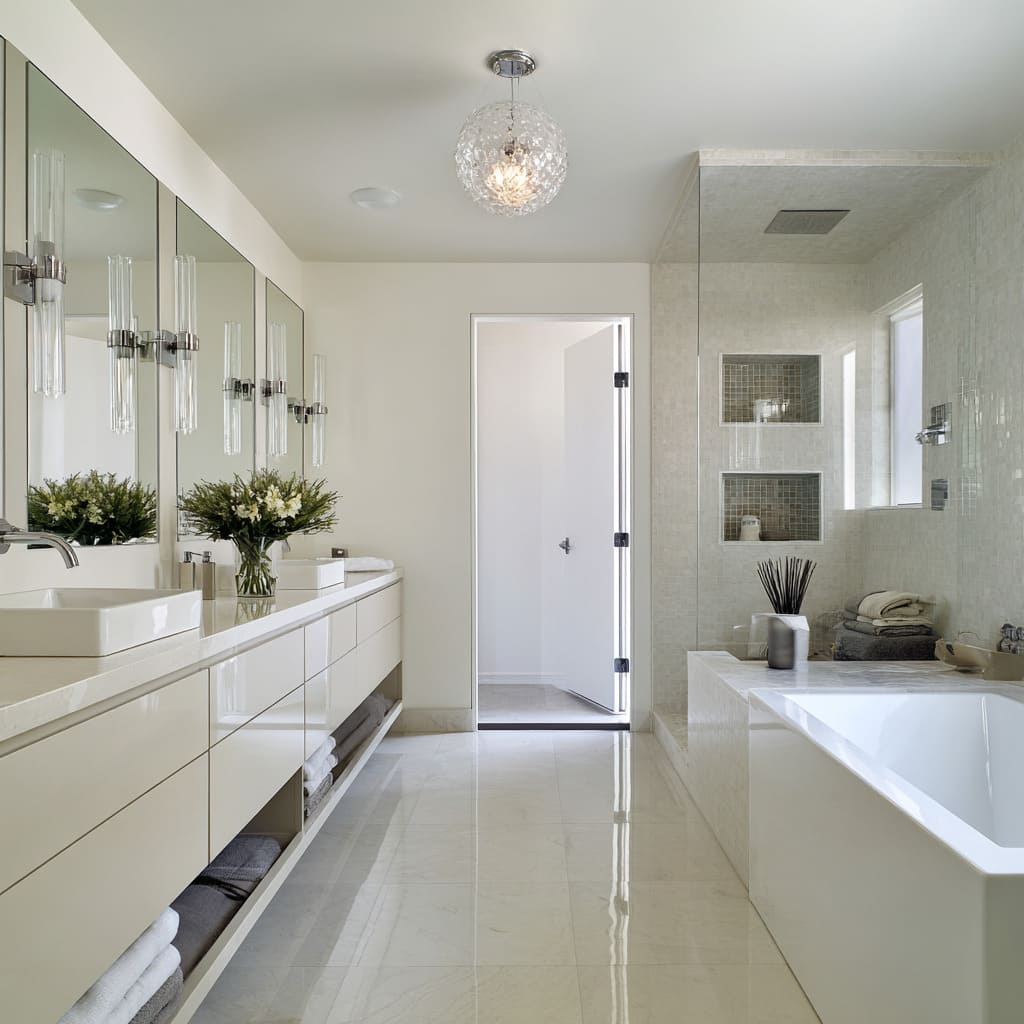
Total: roughly $4,400 to $13,050 — and the vanity is where you’ll feel the difference most.
Budget alternative: keep the floating vanity and trade the freestanding tub for a tiled alcove tub with a chrome deck-mount filler. That single swap trims $2,000 or more.
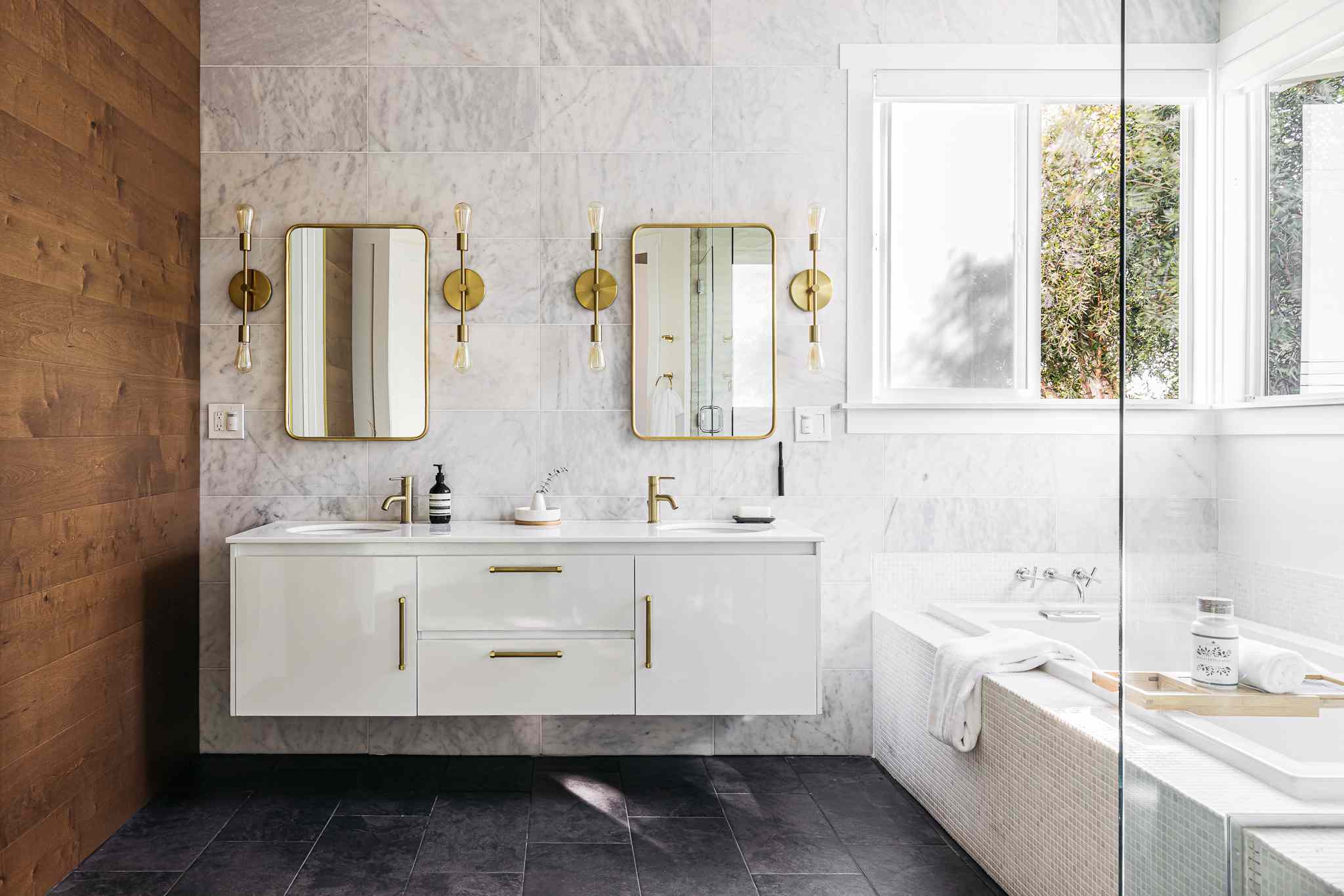
The reason this reads expensive isn’t the stone — it’s the symmetry. Two vessel sinks, two mirrors, one centered light source overhead. Your eye finds the middle and stops. Notice how the polished light floor bounces the ceiling pendant back up into the room; that reflected glow does more for the luxury feeling than any single object. Short on natural light? A glossy floor is the cheapest way to fake it.
3. Floor-To-Ceiling Marble With Twin Dark Wood Vanities
This layout needs room to breathe: a minimum of 100 square feet, with at least 4 feet of clear floor between the two facing vanities. Ceiling height matters more than you’d expect — floor-to-ceiling marble only reads as dramatic above 9 feet. Below that, stop the tile at 7 feet and paint above it. Working with something much smaller? Idea #10 shows how a compact vanity earns its keep in under 45 square feet.
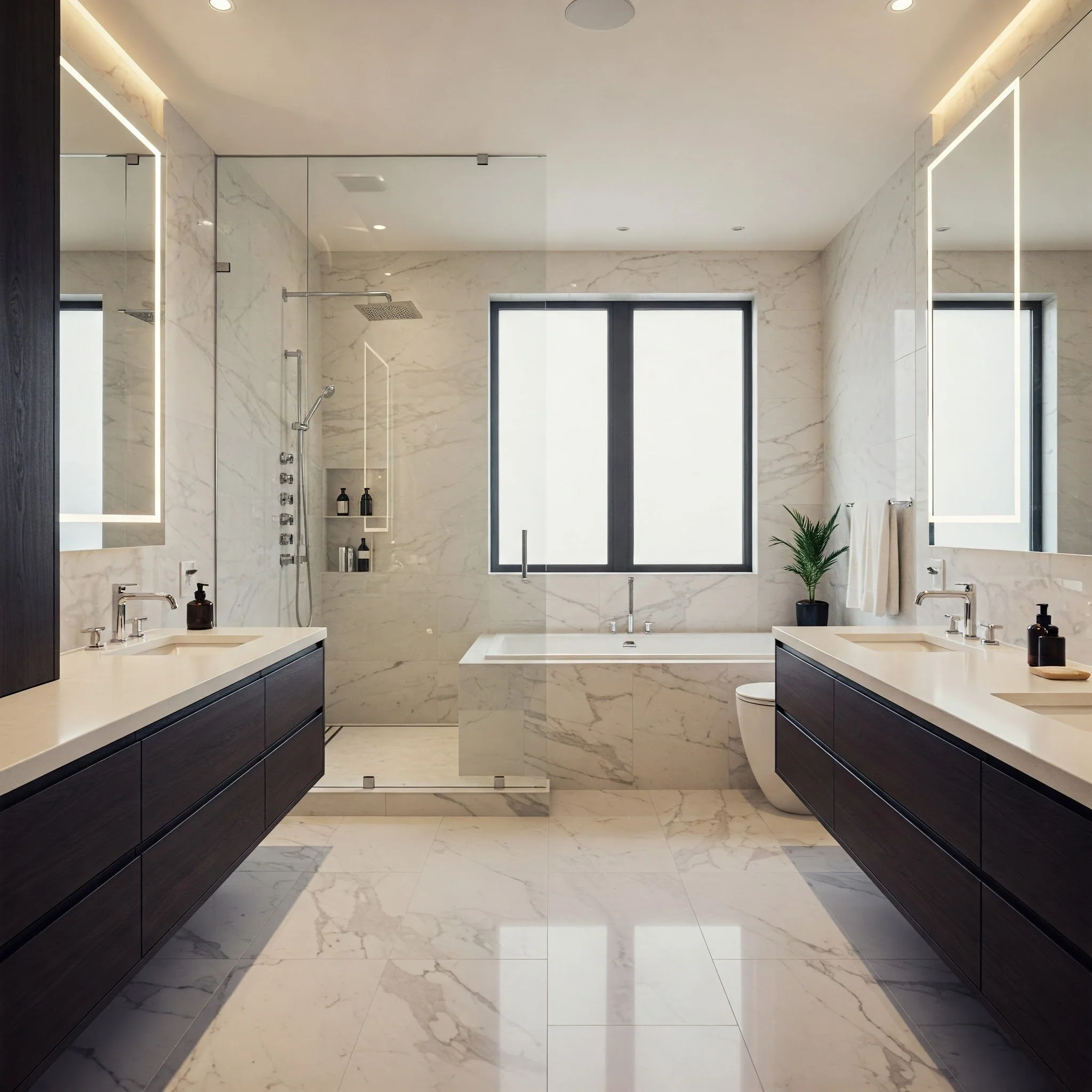
It’s the backlit mirrors. Take them away and you have a very nice marble bathroom that looks like a hotel lobby. The glow warms the white marble at night, doubles as the only ambient light you need, and throws soft light onto the dark wood vanities — which is the contrast that makes the wood look rich instead of heavy. Hardwire them on a dimmer. It’s worth the electrician’s invoice.
4. A Red Penguin Towel That Does All The Talking
The whole look costs about $34. Target and Walmart both carry embroidered holiday hand towels in the $8–$12 range, and a small flocked tabletop pine runs $10–$15 at HomeGoods or Dollar Tree. Add a frosted pine stem from Michaels on a 40%-off sale week and a $6 white soap dispenser. Thrift stores are goldmines in early December — last year’s snowman towels turn up for a dollar and nobody knows the difference.
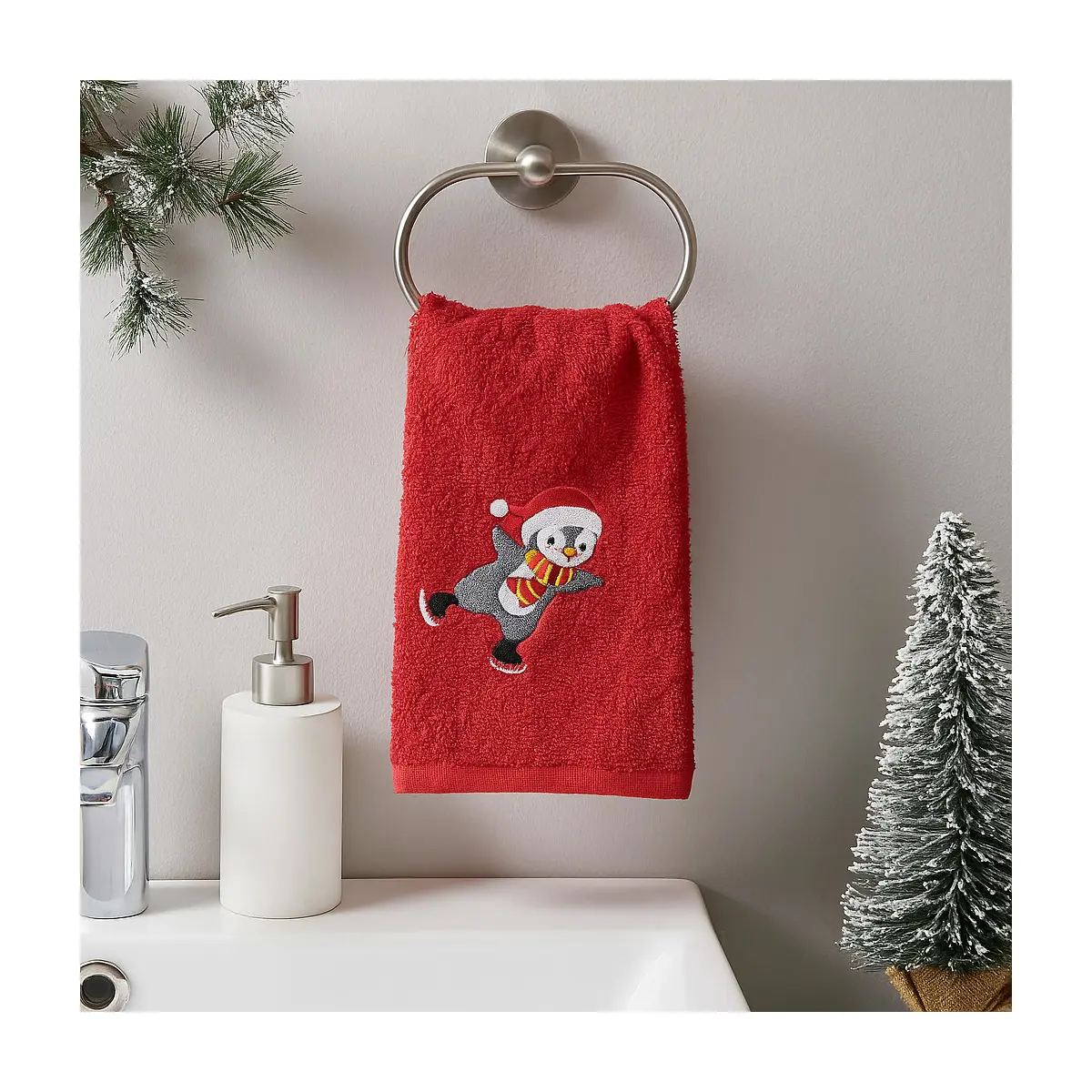
Embroidered towels are lovely and also terrible. The raised stitching collects soap scum, and if anyone in the house uses a benzoyl peroxide face wash, that red towel will bleach out in patches within a week. Keep decorative towels on the ring for looks and hang a plain white one within arm’s reach of the sink. Also: flocked trees shed. Put a small felt pad underneath or you’ll be vacuuming white fuzz off the grout until March.
5. Fluted Glass, A Freestanding Tub, And A View
Fluted tile is having a moment, but the vertical orientation is the whole trick. Run the flutes floor to ceiling behind the mirrors and you’ll visually add about a foot of height. Keep the flutes 1 to 1.5 inches wide — anything wider reads as corrugated metal. Space those glass pendants 30 to 36 inches apart, hung so the bottom of each shade sits roughly 32 inches above the counter. Any lower and you’ll be ducking them while you brush your teeth.
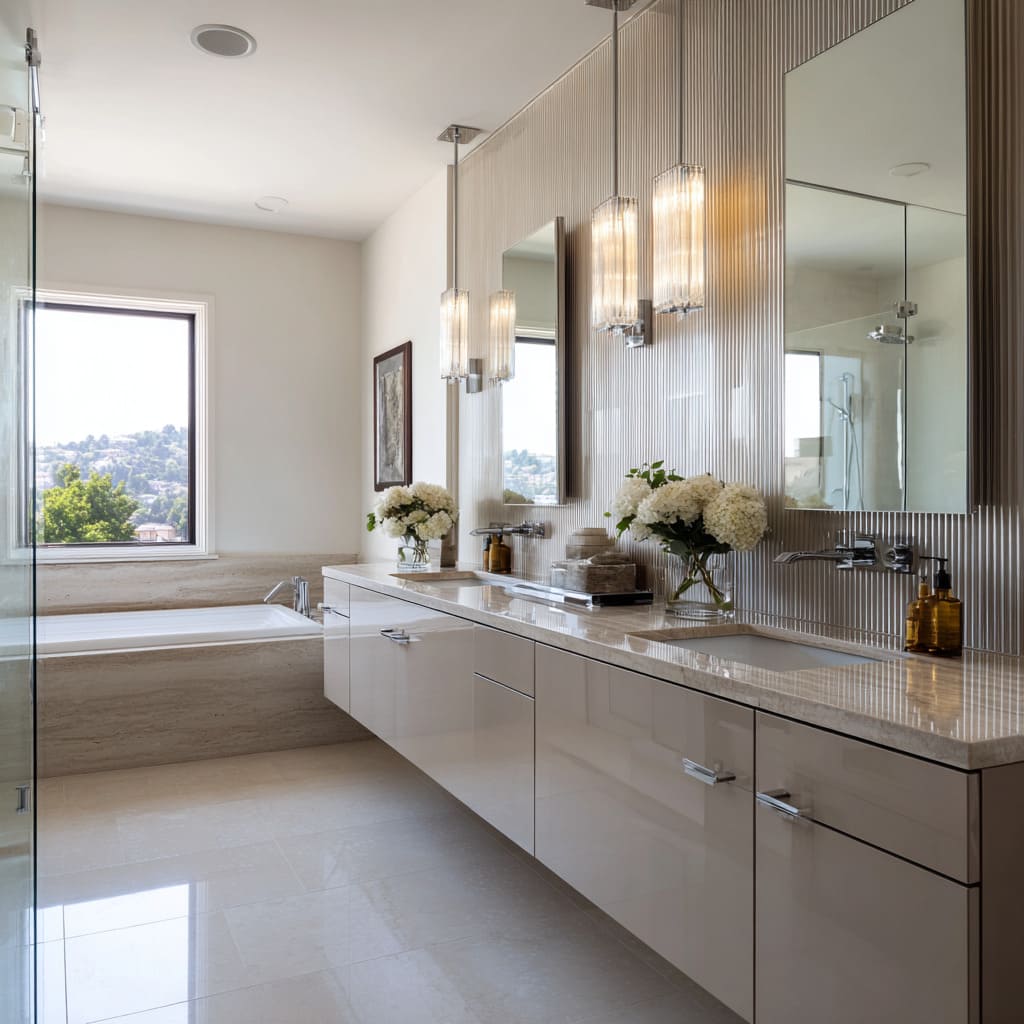
Three materials, three jobs. The glossy vanity cabinets bounce light back into the room. The stone counter sits matte so it doesn’t compete. The fluted wall adds shadow and texture without adding a single color. Notice there’s no separate backsplash above the counter — the fluted wall runs right down to it, which is exactly why the space feels taller and calmer than a typical double vanity.
6. Poinsettia Towels On Warm Wood Shelving
- Wash and press your cream towels so the printed pattern isn’t distorted — a 10-minute job with an iron on medium.
- Fold in thirds, then fold again so the poinsettia print sits centered on the front edge.
- Stack no more than three high. More reads as a store display rather than a home.
- Set the wood-handled brush and glass soap dispenser slightly right of center for an off-balance, natural look.
- Tuck a single pine sprig behind the stack so it peeks out on one side only.
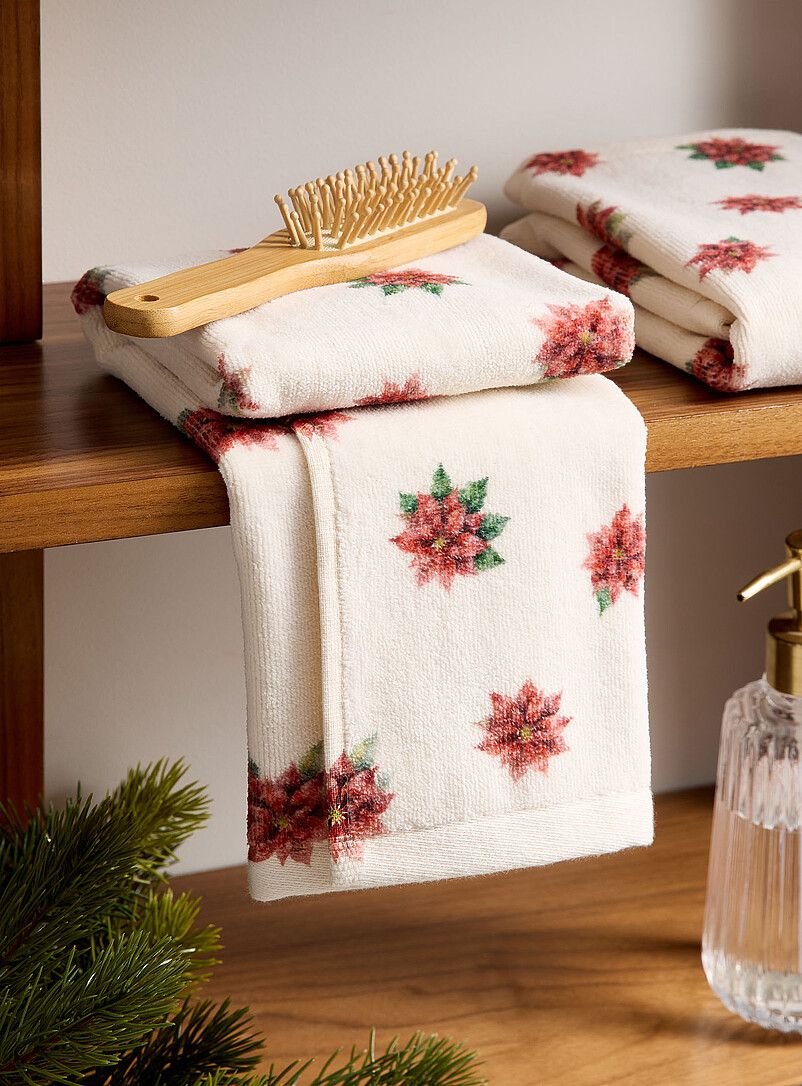
Time: 20 minutes. Cost: about $40 if you’re buying everything new, closer to $18 if you already own the towels.
- Four cream poinsettia print hand towels: $28–$48
- Warm-toned floating ledge or shelf: $25–$70
- Glass soap dispenser with gold pump: $9–$22
- Beechwood hairbrush: $8–$18
- Faux pine sprig: $4–$12
Total: about $74 to $170 for a shelf that looks like it came out of a catalog. Budget alternative: a $12 IKEA picture ledge does the same job. For the $20 version of this styling approach, see Idea #15, where one towel carries the entire vignette.
7. Frosted Tabletop Tree And A Jar Of Fairy Lights
Fairy lights inside a glass jar look magical for exactly three weeks, and then the batteries die in the middle of a dinner party. Use a jar with a timer switch — the ones that run 6 hours on and 18 off — so they wake up before you do. Keep the strand under 10 feet, and choose warm white at 2700K, never cool white. Cool white lights in a bathroom turn skin tones green in the mirror. That’s not a look anyone is going for.
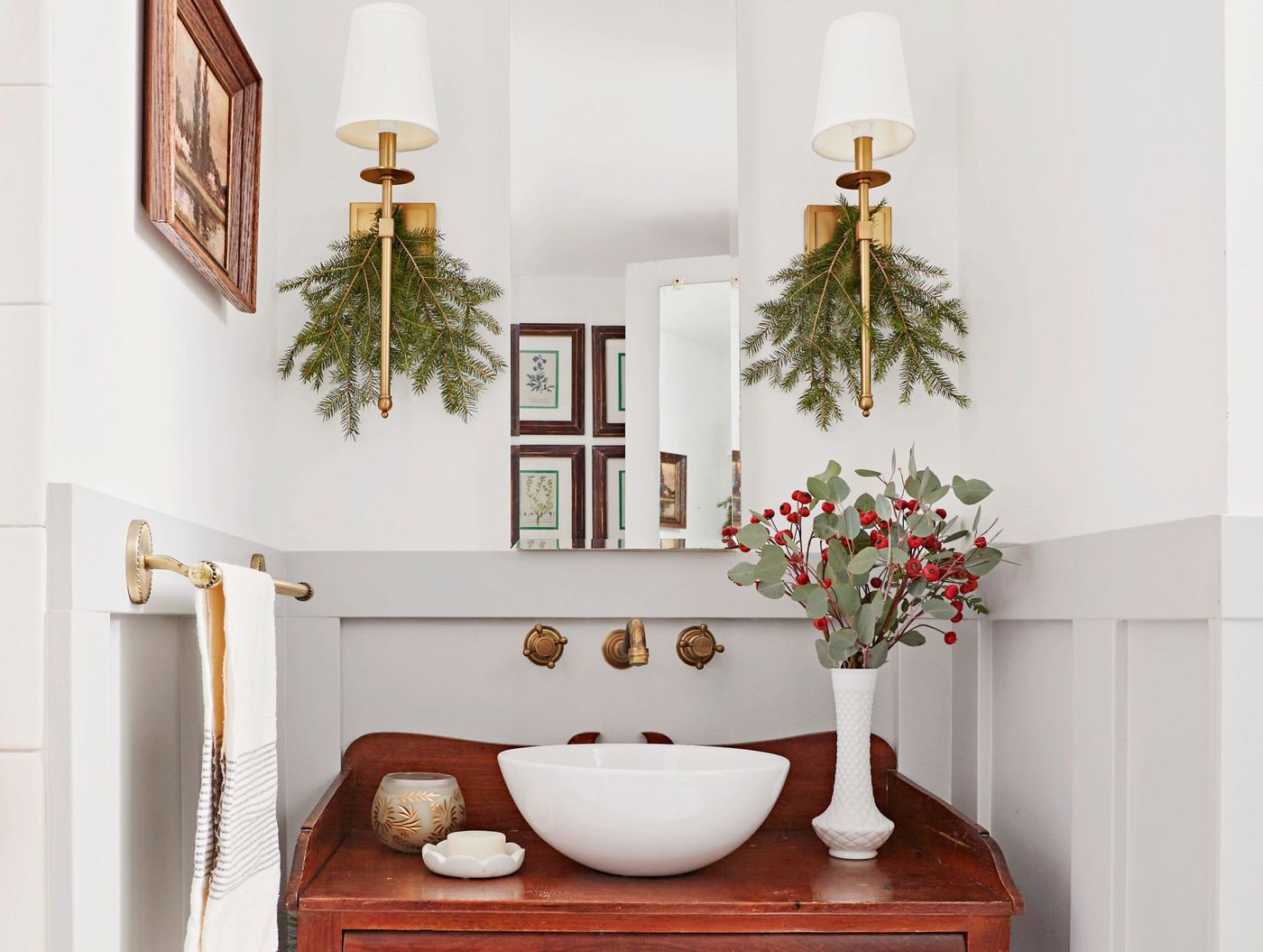
The frosted tree. Everything else on this counter — the fairy light jar, the framed print, the brass faucet — is quiet. The tree is the one object with silhouette, and the frost gives it softness so it doesn’t read as a plastic mini-tree from a clearance bin. Look for flocked branch tips and a weighted base. Under $25 at Target, and it comes back out every single year.
8. Pine Garland Framing The Mirror On A Marble Vanity
70% white marble + 20% green + 10% gold and black. The garland carries the green, the brushed gold faucet and drawer pulls carry the metal, and the black pendant shade is the punctuation mark. If you swap the gold for matte black hardware, drop the black pendant — otherwise you’ll have too many dark notes and the marble stops feeling bright. When the garland comes down in January, the room still works. That’s the test.
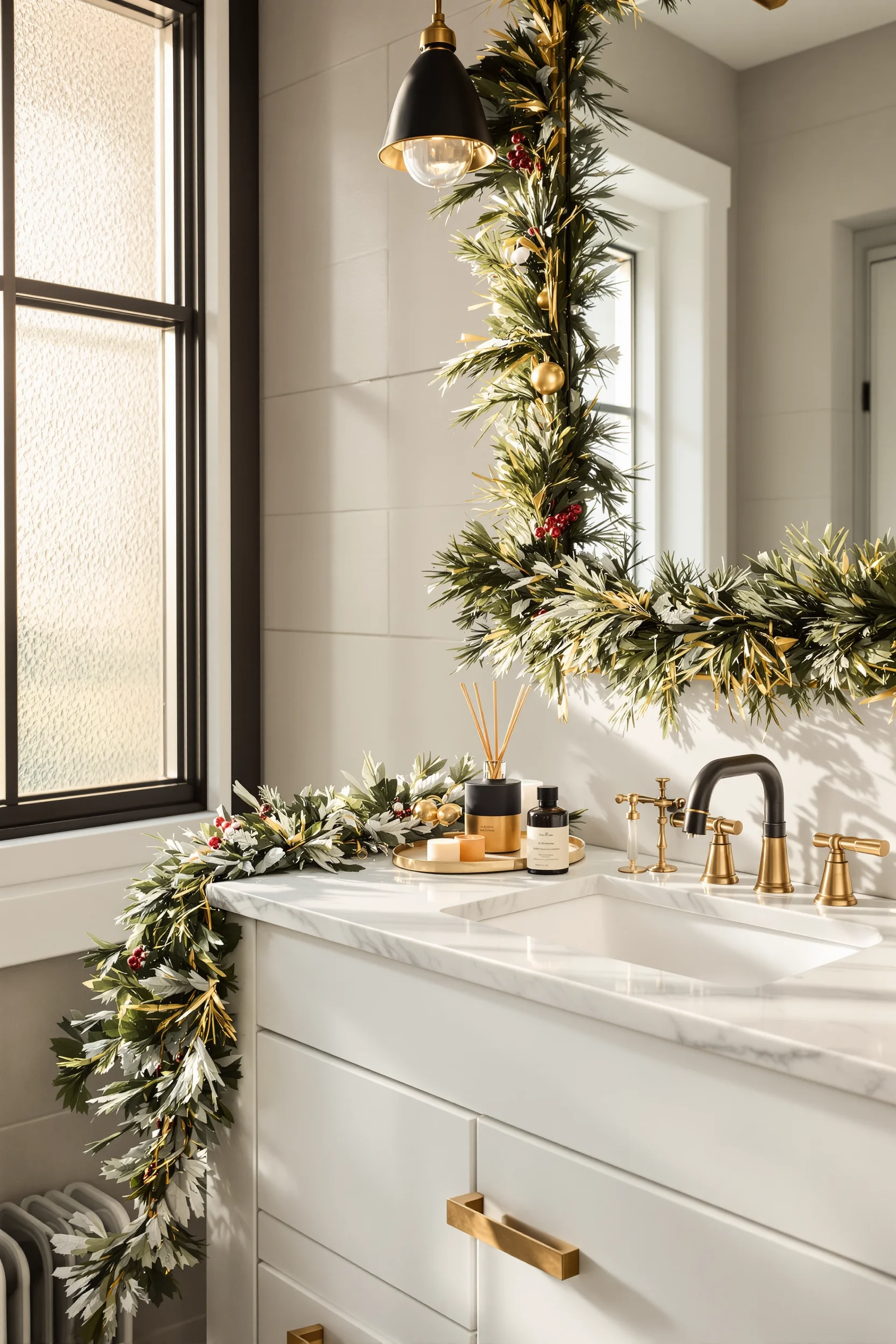
Two garlands means twice the shedding. Real pine drops needles daily and will stain a white marble countertop if it sits wet — the tannins leave a yellow ghost you cannot scrub out. Faux garland avoids that but shows dust by week two. Whichever you choose, put a felt or cork pad under every loop and never let greenery touch the stone directly. Garland wrapped around a mirror frame can also scratch the finish when you pull it down, so line the wire with felt tape first.
9. Nutcrackers Take Over A White Subway Tile Bathroom
Nutcrackers are back in a big way, and it isn’t nostalgia for nostalgia’s sake — it’s the pendulum swinging away from the ultra-neutral “quiet” holidays of the last few years. People want a little theater again, and a nutcracker is the cheapest character you can buy. The risk is going full theme park. Confine the motif to two or three objects and keep everything else white, black, and green, the way it’s handled here.
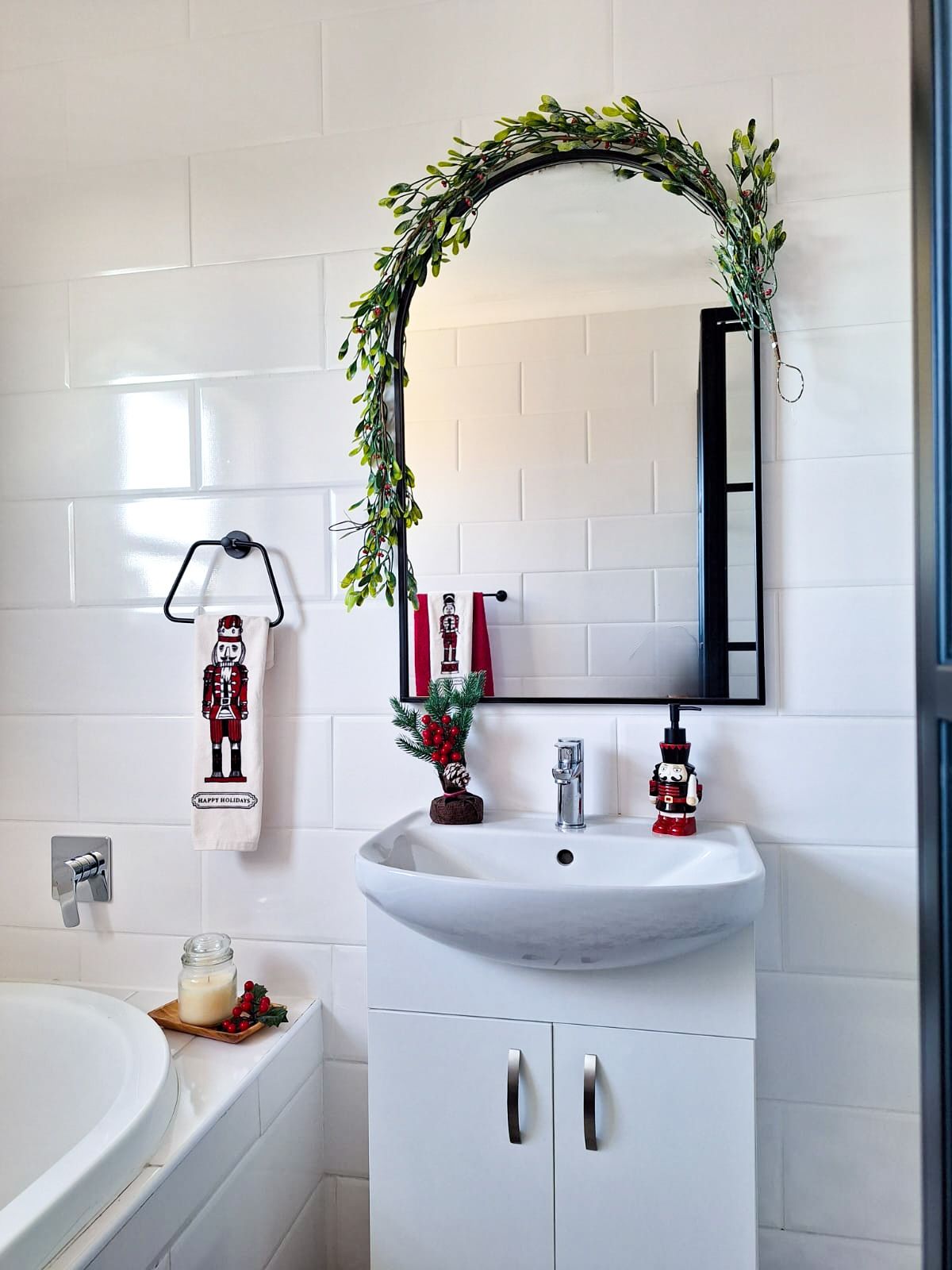
Nutcracker towels and a matching soap dispenser run about $22 at Target and Walmart during the November drop, and a plain green garland for the arched mirror is $12 at Dollar Tree. The mirror itself is the real find — you don’t need a nutcracker-specific one, just an arched black frame, which Walmart sells for around $40. Everything else in this bathroom is standard white subway tile you probably already have.
10. Red Toile Curtain And A Tiny Vanity That Works Hard
- Measure the wall above the toilet before buying prints — you need at least 30 inches of width for a three-piece gallery.
- Check your shower curtain length; a toile pattern only reads well if the repeat isn’t chopped mid-motif.
- Confirm the vanity depth clears the door swing by 2 inches minimum.
- Decide now whether your red is burgundy or true red. Mixing the two is what makes small bathrooms look chaotic.
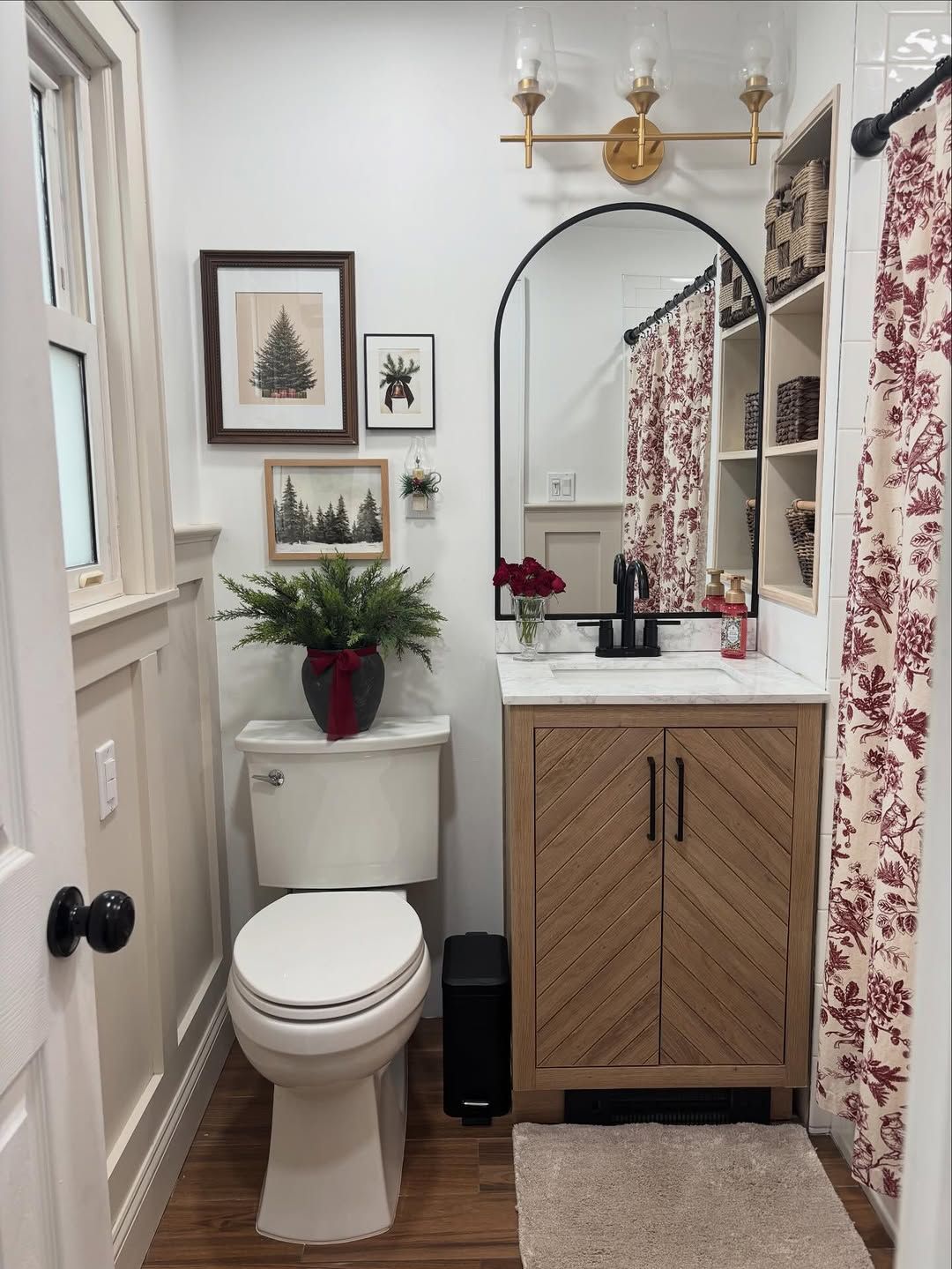
The gallery wall height is what saves this room. The framed prints sit low, with their bottom edge roughly 8 inches above the toilet tank, so the arrangement reads as one block instead of scattered clutter. And the toile curtain repeats the burgundy from the artwork, which is why a 45-square-foot bathroom feels deliberate rather than cramped. One color, three places, no exceptions.
11. Dark Wood, Beige Zellige, And An Arched Brass Mirror
Zellige-style tile is handmade-looking by design, so unevenness is the point — but that also means you can’t use standard 1/8-inch spacers and expect a clean grid. Ask your installer for 1/16-inch spacers and a grout that matches the tile, not white. White grout on beige zellige draws a hard grid over a surface that’s supposed to look soft. And order 15% overage. Breakage on square zellige runs higher than standard ceramic, and a dye-lot mismatch mid-wall is unfixable.
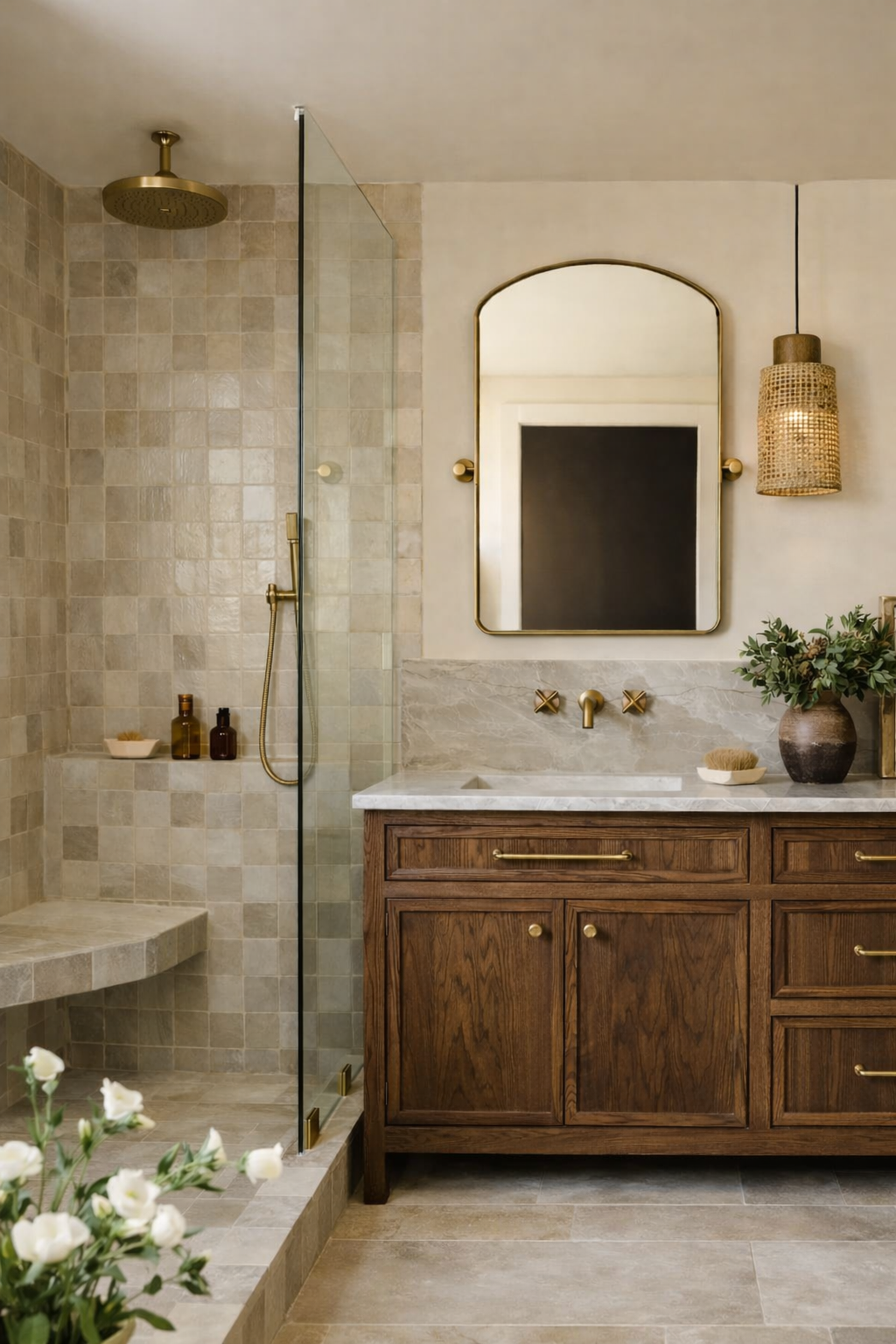
- Dark wood vanity with marble top and backsplash: $900–$2,400
- Arched brass-framed mirror: $120–$380
- Woven pendant light: $90–$320
- Beige zellige-look shower tile, 40 sq ft: $280–$700
- Brass faucet and shower trim: $350–$900
Total: roughly $1,740 to $4,700, not counting labor. Budget alternative: keep the dark vanity and swap real marble for a marble-look quartz remnant — often $200 or less from a fabricator’s offcut pile.
12. Snowman Towels On A Double Brass Rack
A double towel rack needs 24 inches of clear wall width and should hang 48 inches from the floor to the center of the bar — that’s the sweet spot for kids and adults alike. If your bathroom is under 40 square feet, go with a single bar and layer one decorative towel over a plain one. Larger bathrooms can carry two bars stacked 10 inches apart, which is what you’re seeing here. Hang the garland below the bar, never through it — otherwise every towel snags. If wall space is tight, the vertical stacking in Idea #6 solves the same problem on a shelf.
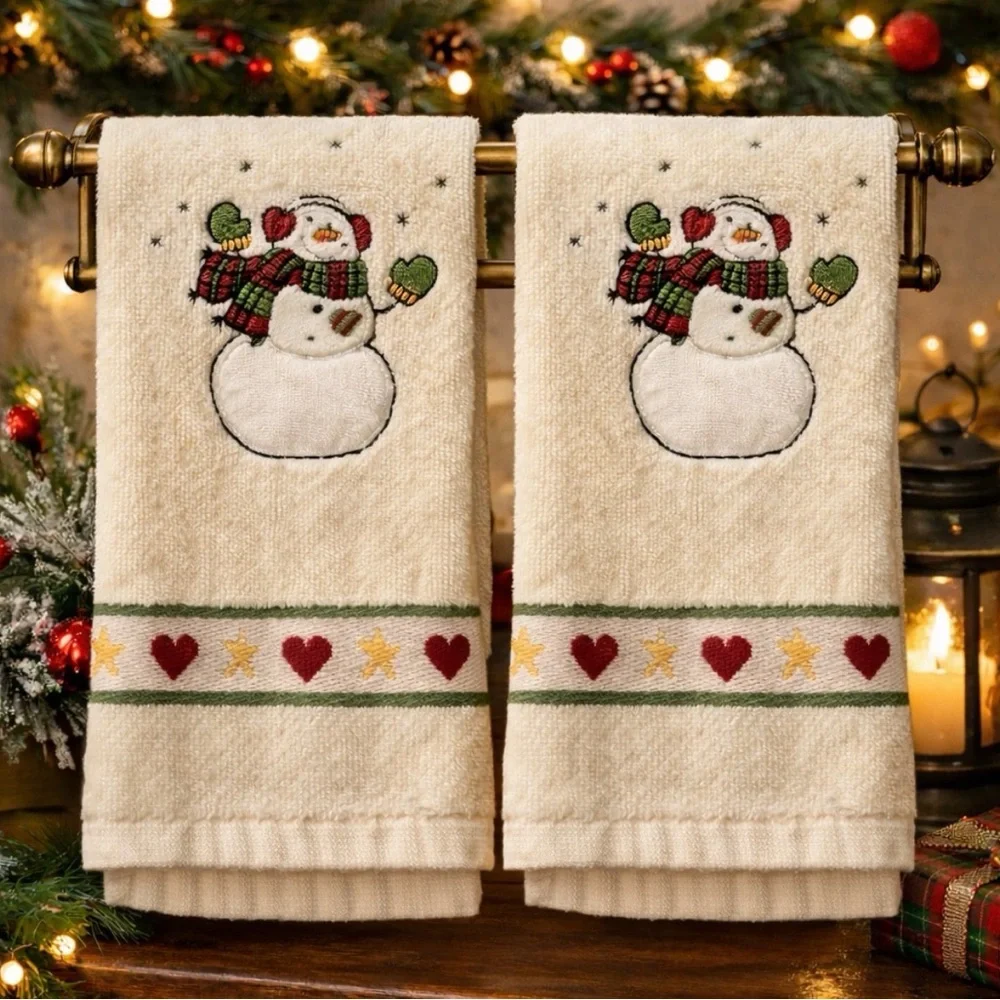
- Embroidered towels: wash cold, inside out, never with bleach. Expect fading on the red border after about 20 washes.
- Frosted garland: shake it outside monthly; flocking sheds for the first two seasons.
- String lights: replace batteries every 3–4 weeks with a 6-hour timer, or switch to USB-rechargeable.
- Brass rack: wipe with a dry cloth only. Polish strips the lacquer and it tarnishes unevenly.
13. One Cardinal Towel On Beige Marble
It’s the cardinal. A single embroidered bird on a folded white towel does more work than an entire shelf of Christmas decor, because it’s the only spot of red in a beige-and-white bathroom. Remove it and the counter is just… a counter. The lesson: one graphic element, rendered well, beats five generic ones. If cardinals aren’t your thing, swap in a single evergreen sprig or a moose silhouette. Same principle, different animal.
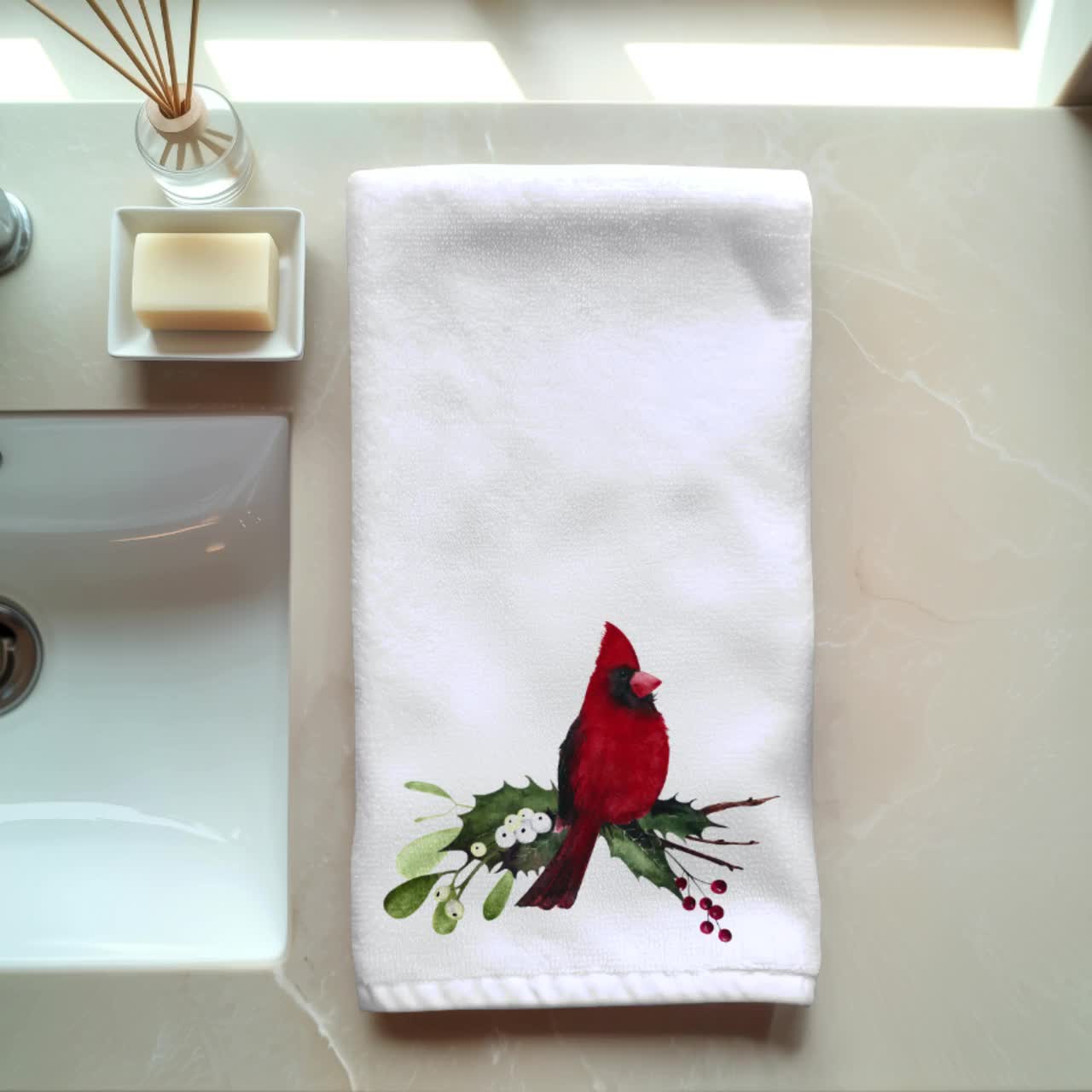
This is a $30 vignette. Etsy sellers print cardinal designs on hand towels for $14–$20, and Crate & Barrel has a similar single-motif towel for about $18. The square soap dish is $6 at Target, and a glass reed diffuser with a neutral scent runs $12 at Walmart. The beige marble counter you can’t fake cheaply — but a marble-look tray under the diffuser gives you the same warm veining without the remodel.
14. Snowman Embroidery Meets Red Plaid Textiles
- Pick one plaid and one embroidery motif. Two plaids in one bathroom is a fight nobody wins.
- Hang the shower curtain so the bottom hem clears the tub rim by 1 inch — plaid looks sloppy when it pools.
- Layer: plain beige towel on the bar, plaid accent towel folded over it, snowman hand towel at the sink.
- Place the plaid bath mat so it runs parallel to the tub, not perpendicular to the door.
- Stop there. Five festive textiles in a small bathroom is the ceiling.
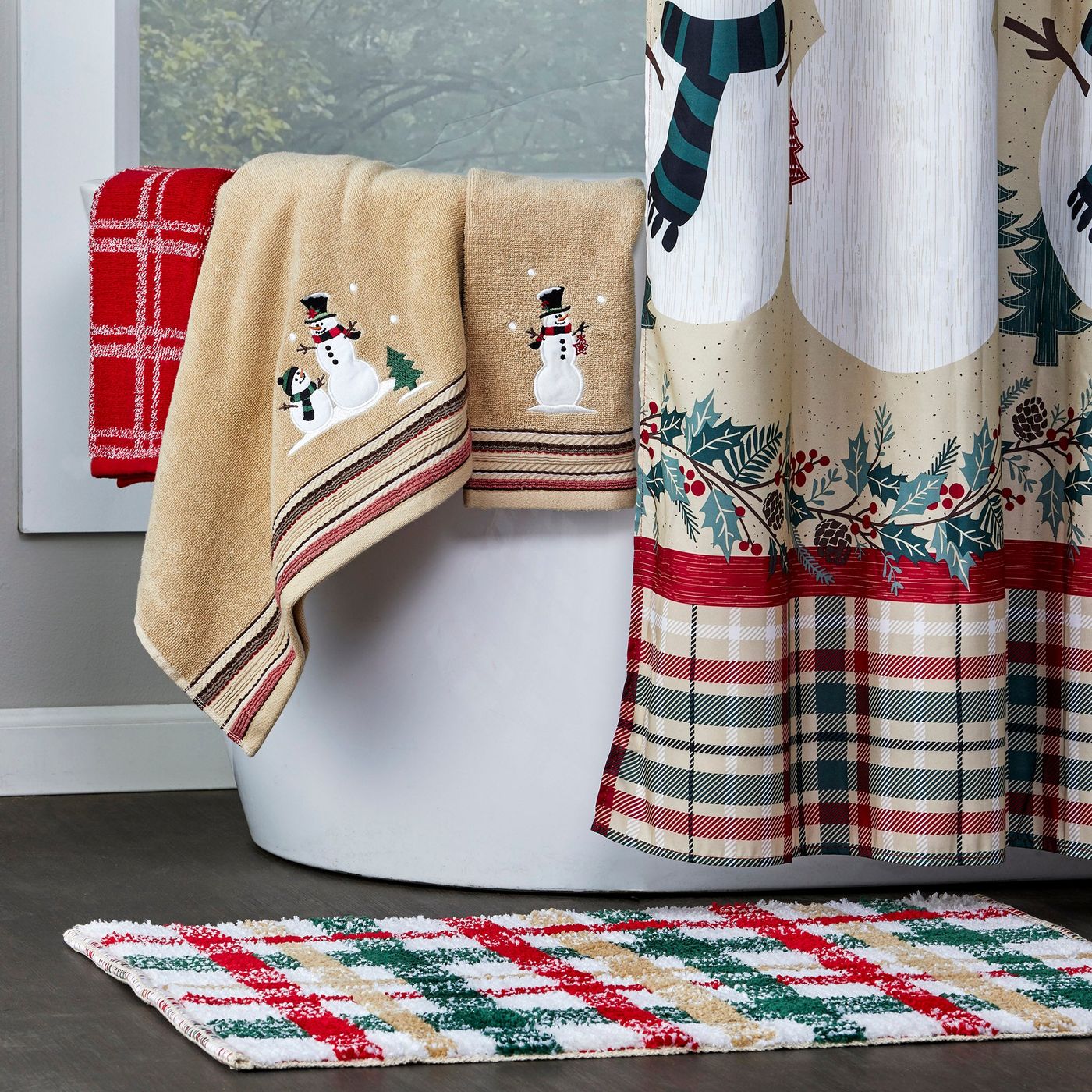
Time: 30 minutes. Cost: roughly $85 for the full set at Target or Kohl’s on a sale weekend.
Red and green plaid on a bath mat is charming for about six weeks, and then it’s February and you’re stepping on Christmas. Buy mats in a size you can rotate out easily, or choose the beige plaid version without the red so it survives into January. Ruffle-edge mats are delicate-cycle only — toss one in a hot dryer and the trim puckers permanently. Been there.
15. A Grey Snowflake Towel With Turquoise Accents
Here’s a formula that works in almost any small bathroom: 55% white tile + 25% grey + 15% turquoise + 5% natural wood. The grey towel and snowflake graphic are your neutral anchor, the turquoise accessories are the accent, and the wood shelf is the only warm note. Swap turquoise for blush pink and the same formula reads softer and more modern. That 5% wood is non-negotiable — it’s what stops the palette from feeling cold and clinical.
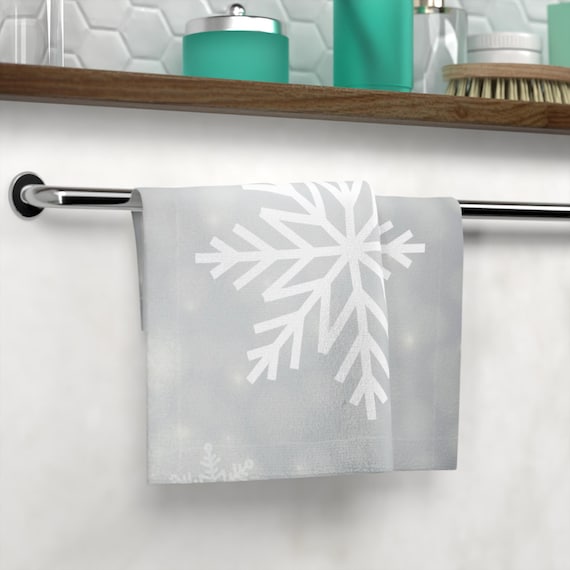
Hexagonal tile hides water spots better than subway tile, but the grout lines are your enemy. Use a light gray grout, not white — white grout on hex tile turns into a high-contrast honeycomb that makes a small room feel busy. And if you’re hanging a floating shelf above a chrome towel bar, keep 12 inches of clearance between them. Any tighter and the shelf reads as an afterthought. Compare with Idea #21 for the same restrained approach at a bigger scale.
16. River Rock Shower Floor For A Spa Bathroom
Pebble floors work because of a contrast in scale. The river rock is small and irregular, the wall tile is large and geometric, and the frameless glass removes the last hard vertical line. Your eye gets softness underfoot and calm above. It also does something practical that photos can’t show: the uneven surface gives you grip on a wet floor without a single visible texture strip. That’s a big reason pebble floors keep showing up in aging-in-place remodels.
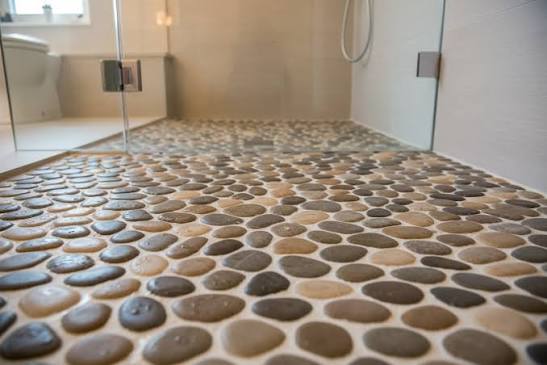
- Sweep or vacuum the pebbles weekly — the grout valleys trap hair like nothing else on earth.
- Seal the grout annually, about $30 for a bottle and an hour of your time.
- Skip acidic cleaners. They eat the sealer and the stone starts looking chalky within a year.
- Frameless glass needs a squeegee after every shower or you’ll get hard water etching by month six.
Total annual upkeep: roughly $50 and maybe four hours of your life.
17. Deep Green Tile, Pine Garland, And Hanging Stockings
Deep green tile with brass is the holiday palette that refuses to date, and 2026 is its strongest year yet — searches for forest green bathrooms have been climbing steadily as people move away from all-white everything. What makes this a smart buy rather than a trend: you can leave the tile up year-round. Only the garland, the stockings, and the candle are seasonal. The bones stay, and they stay looking good in July.
- Forest green glazed or zellige backsplash tile, 20 sq ft: $220–$600
- Light wood vanity cabinet: $450–$1,400
- Brass wall sconces, pair: $140–$420
- Pine garland, ornaments, and stockings: $60–$180
- Lit candle and holder: $15–$50
Total: about $885 to $2,650 for a vanity wall you’ll never want to repaint. Budget alternative: peel-and-stick deep green tile runs about $60 for the same wall and comes off without damaging the drywall.
18. Under-Vanity Glow And A Floating White Vanity
Under-vanity lighting is the upgrade nobody plans for, and it’s the one guests notice. Use a warm 2700K LED strip tucked 2 inches back from the vanity’s front edge so you see the glow but never the diode itself. Wire it to the same switch as the mirror and put it on a dimmer — you’ll want it at about 20% at 2 a.m. Total cost is usually under $80 if the vanity is floating and you have access below it.
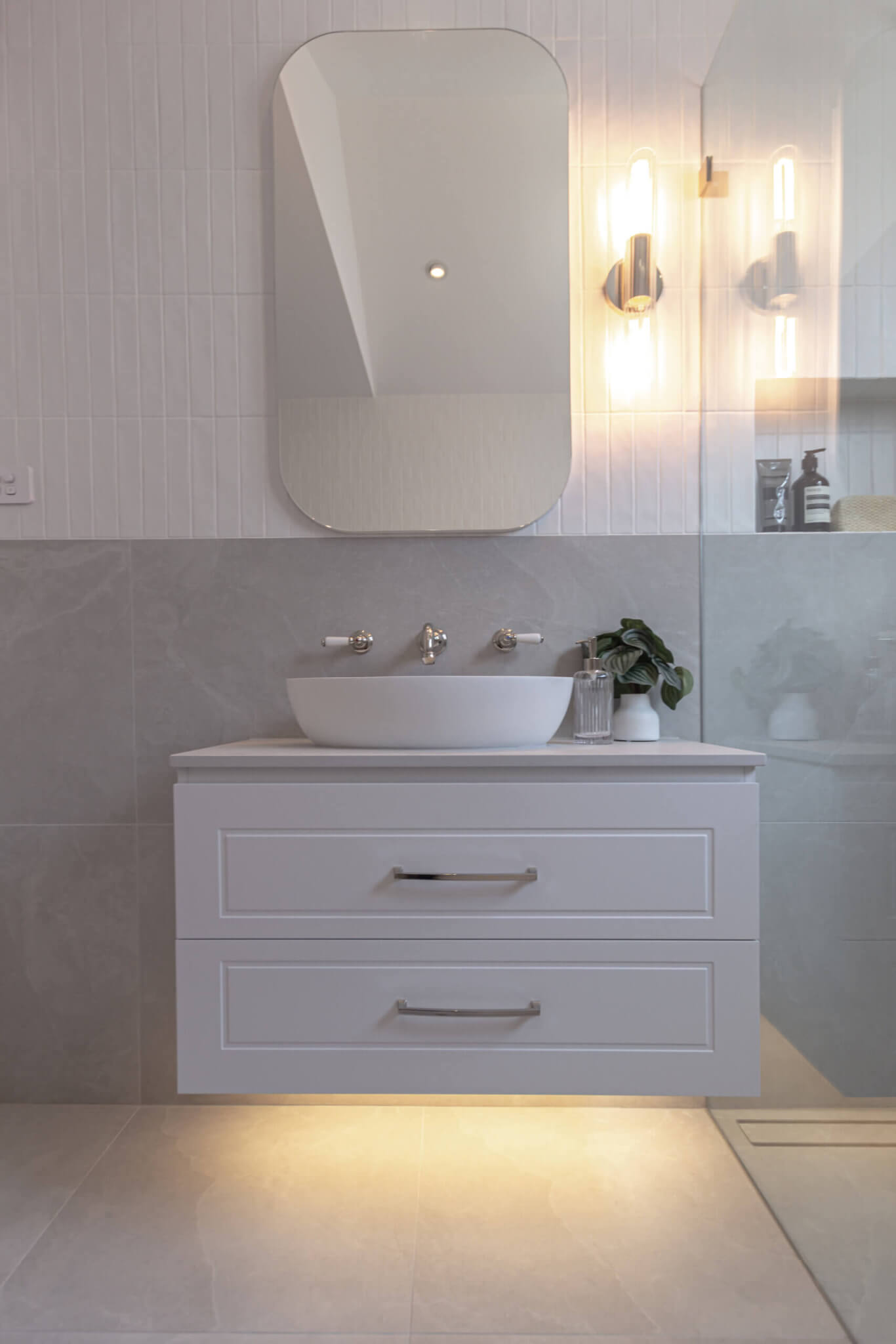
A floating vanity like this one wants 30 to 36 inches of clear floor in front of it, so plan on a bathroom of at least 50 square feet. That vertical white mosaic band above the gray tile is a smart move for 8-foot ceilings — it draws the eye up without the cost of tiling all the way up. If your bathroom is tighter than 40 square feet, see Idea #23 for how a small footprint still feels warm.
19. Pine Boughs In A Ceramic Vase, Nothing More
It’s the ceramic vase. Not the pine, not the ornaments — the vase. A matte, unglazed vessel in off-white turns a cut branch into an arrangement. Swap it for a glass jar and the exact same pine looks like you forgot to put the groceries away. This is the difference between minimalist and unfinished, and it costs about $20 at a pottery market or $14 at IKEA.
- Cut pine boughs in the morning when stems are hydrated, and recut at an angle under running water.
- Strip the bottom 3 inches of needles so nothing sits below the waterline.
- Fill the vase two-thirds with cool water and add a drop of bleach-free floral preservative.
- Arrange three stems at different heights — one tall, one medium, one arching sideways.
- Keep it away from heat vents. Pine dries out fast near forced air.
Time: 15 minutes. Cost: free if you have pine, $8–$15 if you don’t.
20. Warm Wood Mirror Under A Four-Light Vanity Fixture
The warm wood mirror is the whole personality here, and you can build one for under $60 — a $22 IKEA mirror plus four feet of 1×3 oak trim and wood glue. The four-light vanity fixture is $70–$120 at Home Depot in a chrome finish with frosted shades. Wood-paneled ceilings are the expensive part, but a $40 cedar plank pack and a weekend will get you most of the way there. That wood tone is where the warmth actually comes from — see Idea #11 for another dark-wood-and-brass take.
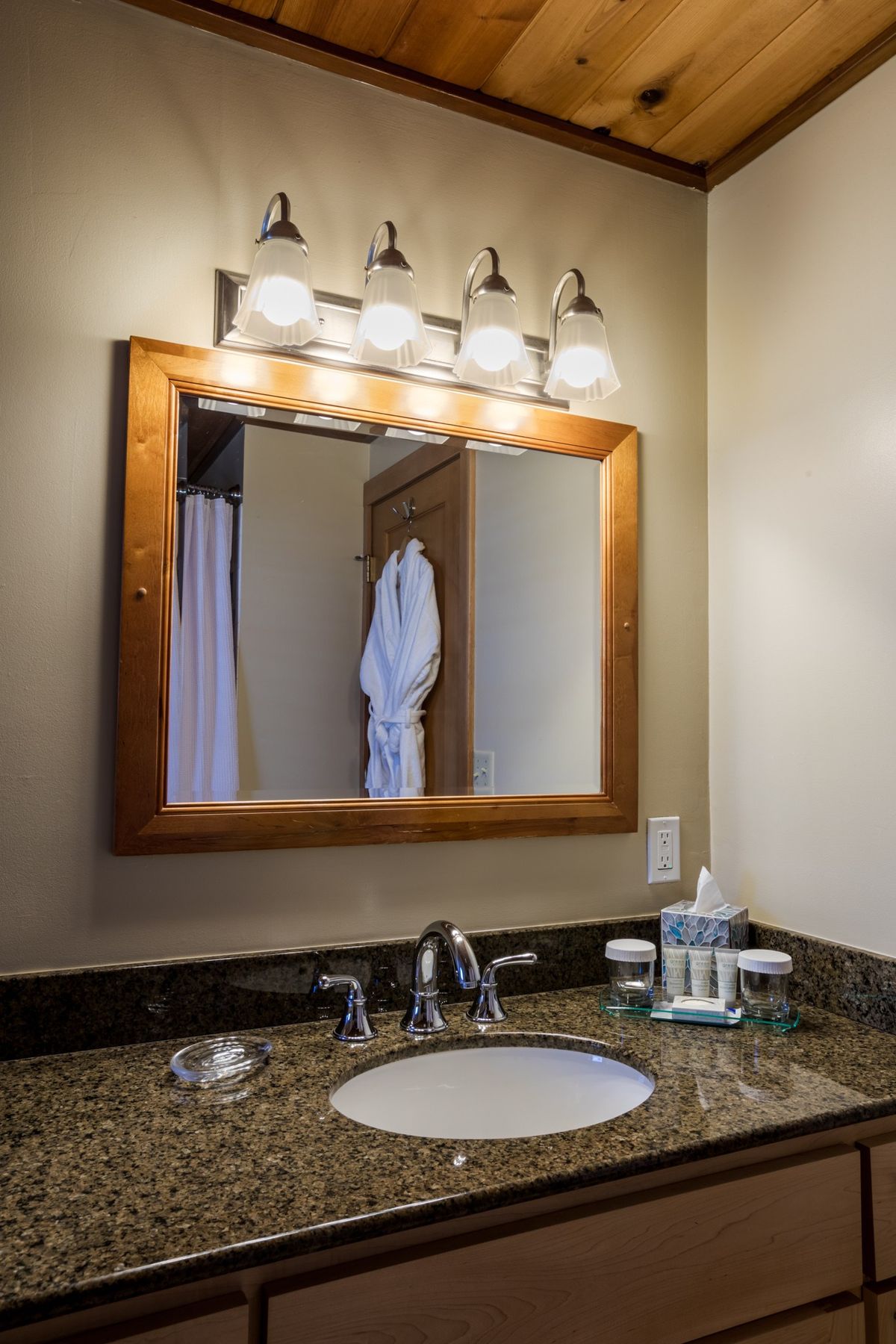
The granite is dark, the walls are beige, and the ceiling is wood — three warm tones at three different values, which keeps the room from flattening out. Then the chrome faucet and frosted shades add the only cool notes. That’s a deliberate temperature mix. Swap the chrome for brushed nickel and the whole room goes soft and sleepy. The little bit of cool metal is what keeps it awake.
21. A Blue Geometric Rug Anchors This Minimalist Bath
50% white + 25% light wood + 15% blue and grey + 10% chrome. The bathtub and walls hold the white, the floating vanity brings the wood, and the geometric bath mat carries the blue. Change that mat to terracotta and black and the exact same room reads warm and Moroccan. One accent object, one palette shift — that’s how much power a single rug has in a minimalist bathroom.
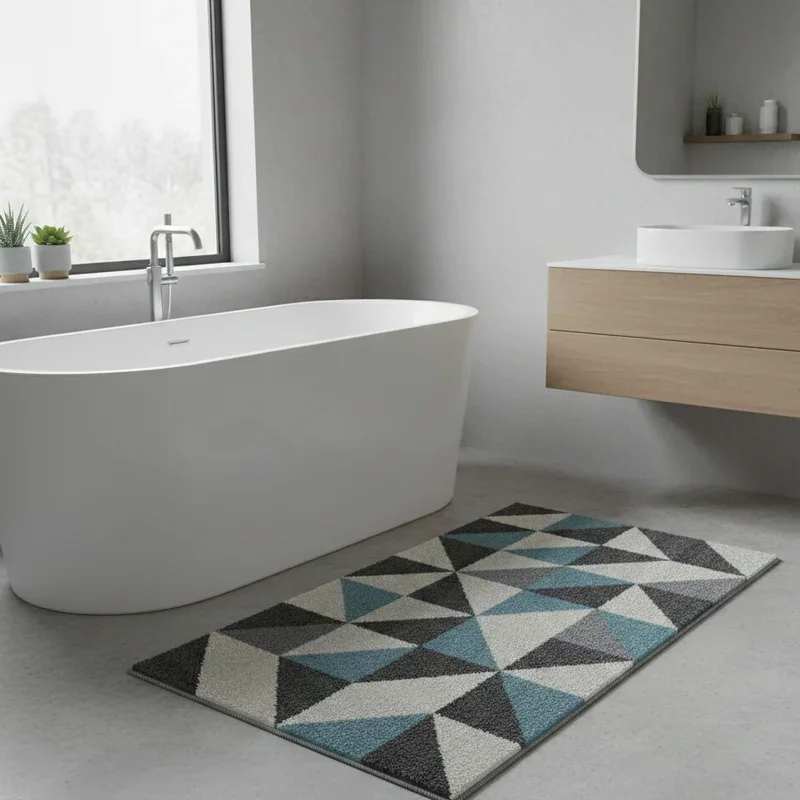
Concrete floors in a bathroom are beautiful and unforgiving. They’re cold underfoot eleven months of the year, they show every water spot, and they’re slippery when wet — a real consideration if anyone in the house is over 70 or under 6. A washable bath mat like this geometric one solves most of it. If you’re pouring new floors anyway, put radiant heat underneath. You will not regret it in February.
22. Herringbone Marble Wall And A Warm Floor Secret
- Confirm you have a dedicated circuit available — most underfloor mats draw 3–5 amps and can’t share with a hair dryer.
- Measure the free floor area, not the whole room. Mats can’t run under the vanity or the toilet flange.
- Check that your thermostat is GFCI-protected and rated for a wet location.
- Make sure your tile is compatible — natural stone needs a mat with a built-in uncoupling membrane.
- Schedule the install before tile goes down. Retrofitting means pulling the floor back up.
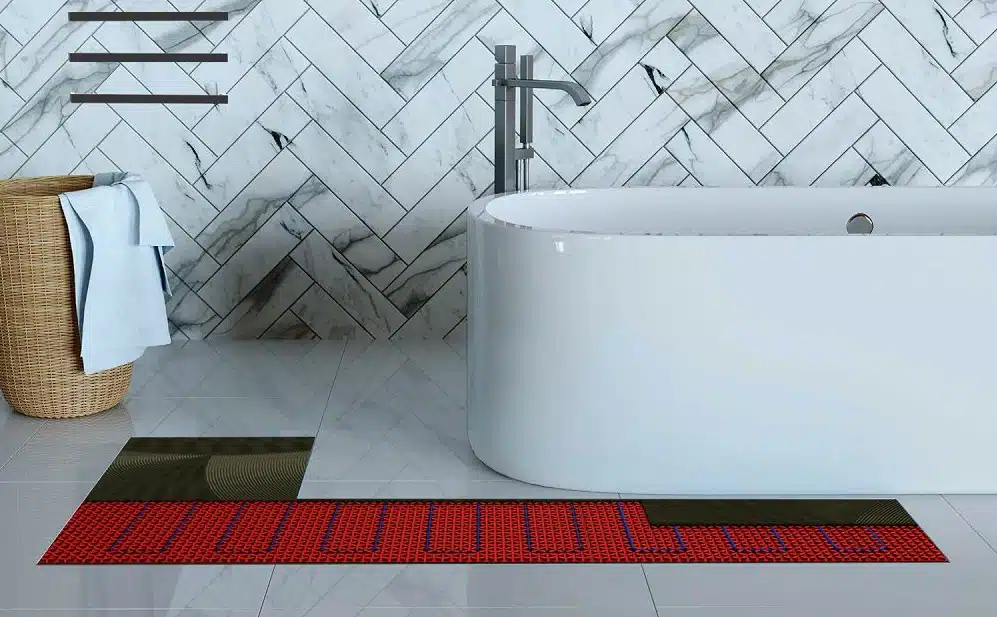
- Roll the mat out and let it relax flat for an hour before setting it — cold mats curl at the edges.
- Test the resistance reading with a multimeter and write that number on the wall for future reference.
- Secure with the included tape and keep the thermostat lead out of the traffic path.
- Cover with self-leveling compound, then tile as normal, avoiding the lead wire with your trowel.
- Wait 7 days for the thinset to cure before you power it on.
23. Tan Shower Curtain, Checkered Mats, Clawfoot Tub
Tan and black is the quietest holiday palette there is, and it costs almost nothing to copy. Textured tan shower curtains run $25–$40 at Target and Wayfair, and the checkered ruffle mats are $18–$30 each on Amazon. A white clawfoot tub is the splurge, but a $400 acrylic freestanding tub plus $40 in black-and-tan accessories gets you within arm’s reach of the look. The potted plant is $12 at Trader Joe’s and it does a surprising amount of work.
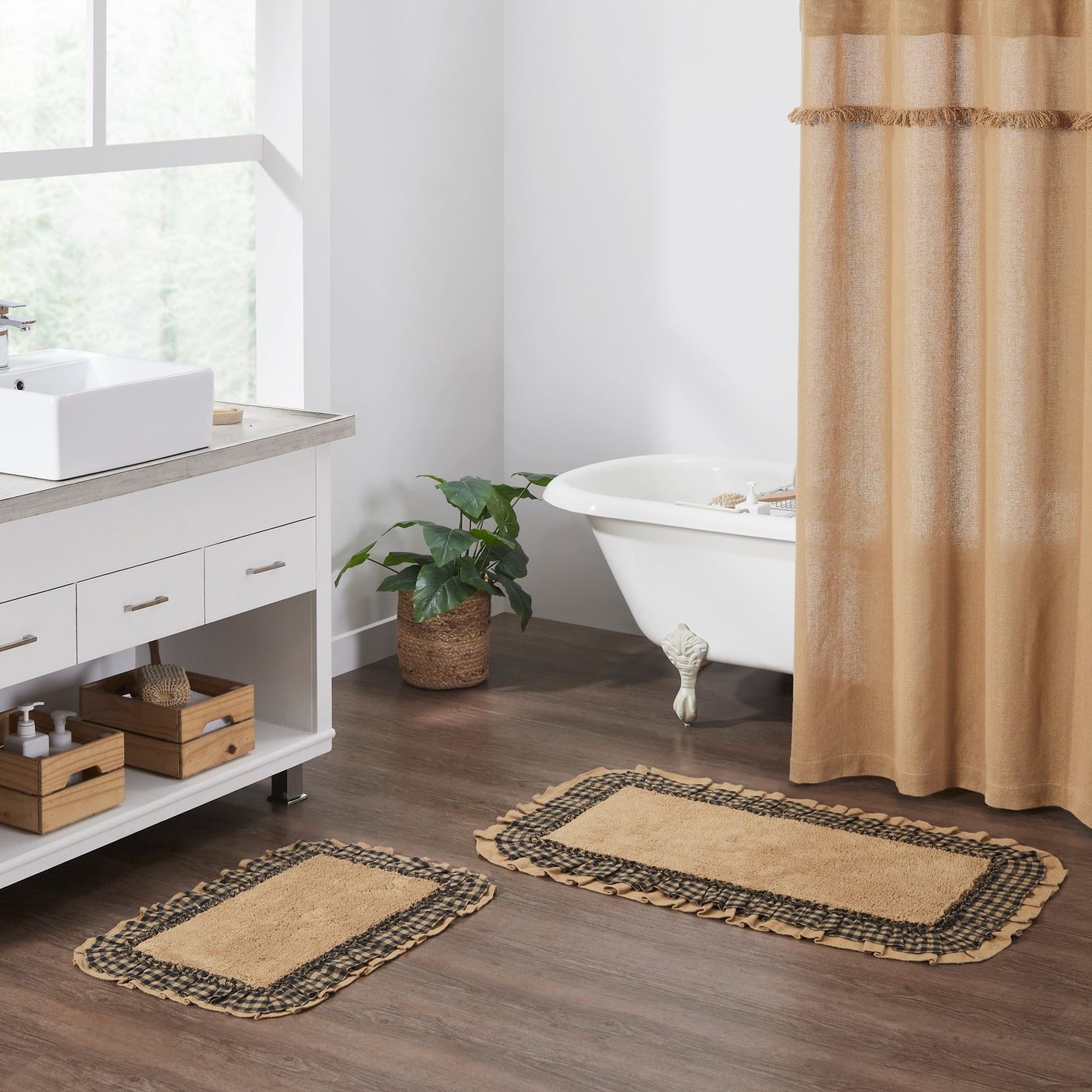
- Textured shower curtains hold moisture — machine wash monthly on gentle and air dry, or mildew sets into the weave.
- Checkered ruffle mats need a delicate cycle and never a hot dryer. The trim puckers permanently.
- Clawfoot tub exteriors chip. Touch up with enamel paint ($12) the same week you notice it.
- Woven baskets in a humid bathroom can grow mold on the underside. Elevate them or rotate them out.
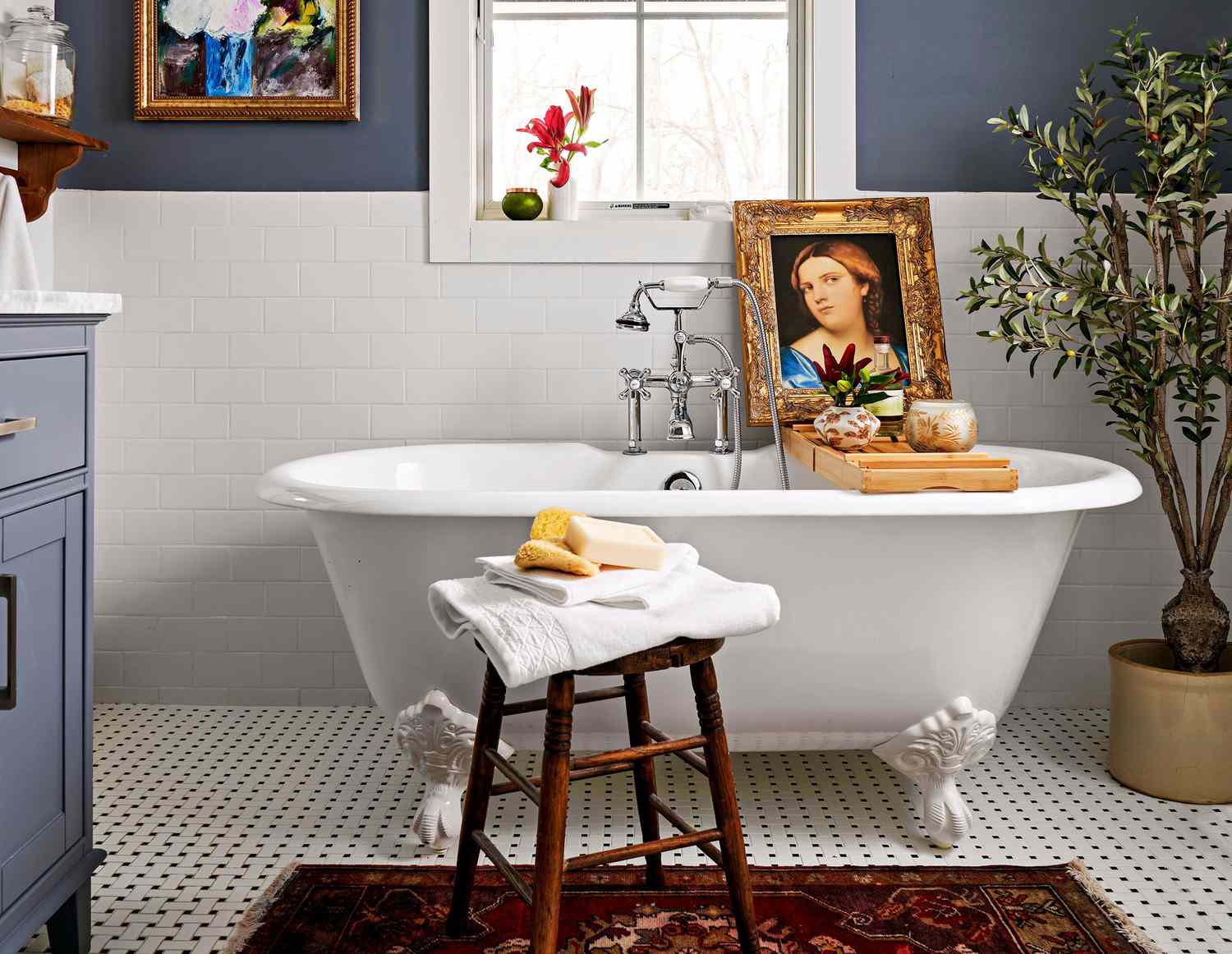
24. Shiplap, Soaking Tub, And A Vintage Runner
If you’re pairing a freestanding tub with shiplap, keep the horizontal lines at 6 to 8 inches and run them no higher than the tub’s rim plus 18 inches. Full-height shiplap makes a small bathroom feel like a sauna. Also, matte black floor-mounted tub fillers need 4 inches of clearance from the tub edge to the wall for the rough-in, so frame that out before the floor goes down. Discovering it after tiling is a very expensive lesson.
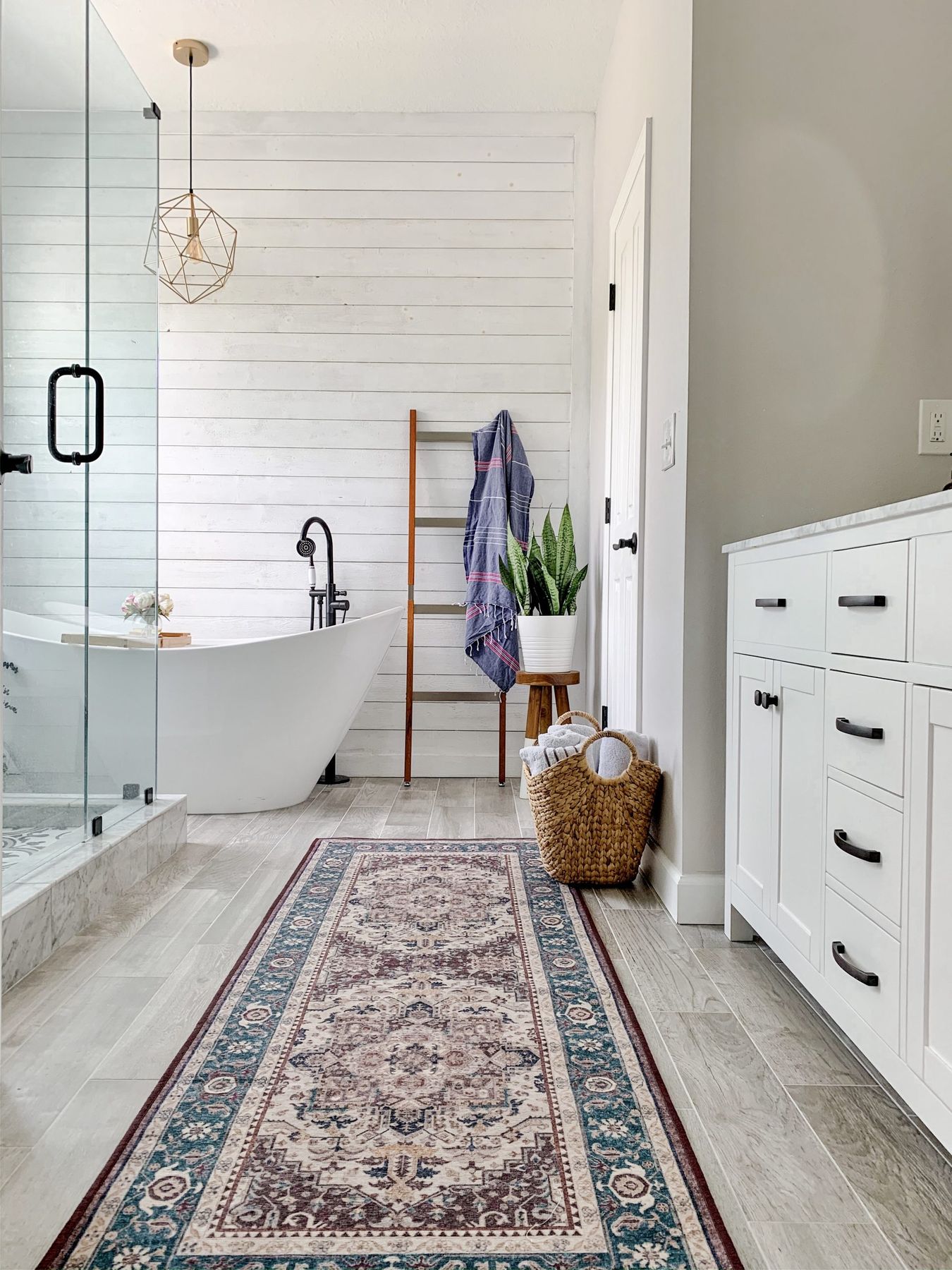
This layout wants at least 60 square feet and a 9-foot run of wall for the tub and shower to sit side by side. The vintage runner should be no wider than 2 feet so it reads as a path, not a rug — anything wider and it swallows the floor. Working with a compact bathroom instead? Idea #15 proves a 40-square-foot space can still feel styled and finished.
25. Wavy Abstract Rug With A Floating Dark Wood Double Vanity
The abstract wavy rug. In a room built entirely from hard surfaces — tile, glass, concrete, stone — that rug is the only thing without an edge. It softens the acoustics, warms the concrete visually, and gives the eye somewhere to rest between the tub and the double vanity. Take it out and the bathroom is technically perfect and completely cold. Rugs in wet rooms are counterintuitive, but a low-pile one with a non-slip pad holds up just fine.
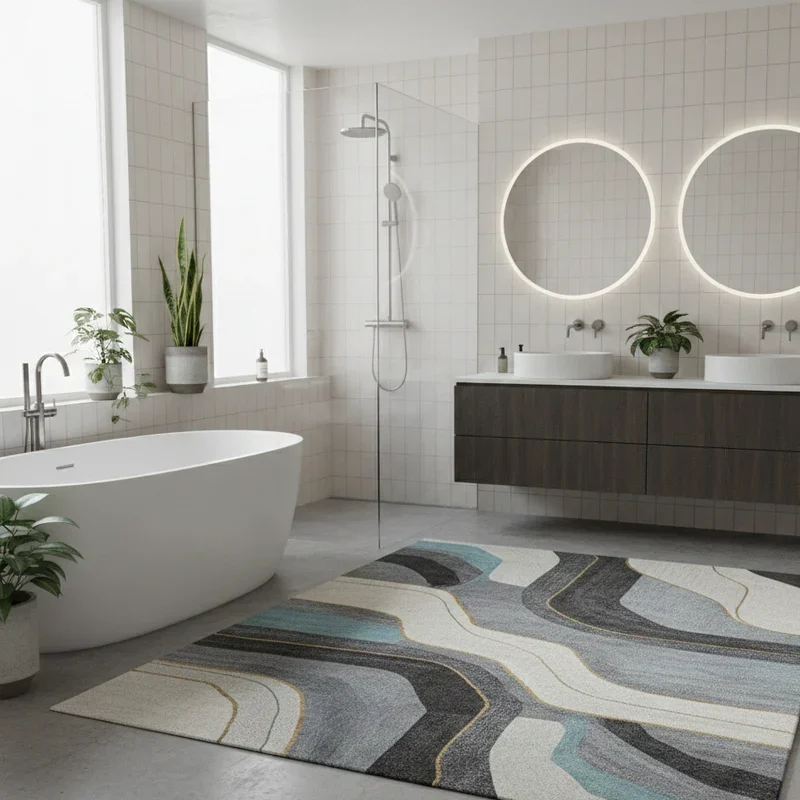
- Floating dark wood double vanity with vessel sinks: $1,100–$3,200
- Two round backlit mirrors: $260–$700
- Freestanding oval tub: $800–$2,400
- Walk-in shower with glass partition: $1,600–$4,500 installed
- Large abstract low-pile rug: $80–$350
- Potted plants: $40–$140
Total: about $3,880 to $11,290 before tile and labor. Budget alternative: keep the rug, mirrors, and plants, and paint your existing vanity dark walnut instead of replacing it.
Ready To Make The Bathroom Everyone Sneaks A Photo Of?
Pick one idea, not five. A single pine branch in the right vase or one great towel on a brass ring will do more than a counter full of ornament bins ever could — and it’s the version you’ll still love on January 4th. Start with the smallest change, live with it for a week, and add from there.
📌 Pin your favorite to your holiday board now so you can find it when the decorations come out of the attic next year.
