
22+ Jaw-Dropping Christmas Pathway Lights Ideas That Will Make Your Yard Sparkle This Holiday Season
If your idea of holiday decorating starts with a Pinterest board and ends with you standing in the driveway at 9 p.m. wondering why it doesn’t look like the photo — you’re in good company. The gap is almost never the lights themselves. It’s spacing, color temperature, and where you aim them.
We dug through Amazon, Walmart, Target, Wayfair and Etsy — everything from $12 solar stakes to $189 light sets — and narrowed it down to 22 ideas that actually deliver along a walkway. Solar lanterns, candy cane stakes, spiral tree forms, C9 runs and full landscape uplighting, with budget and luxury versions compared side by side so you can see what the extra money buys.
Multicolor is back on Pinterest this year — staged, not chaotic — and path lighting is where that shift shows up first.
And stay until the end — we break down the most common mistakes that can ruin these looks.
Quick note: some links here are affiliate links, which may earn us a small commission at no cost to you.
📌 Save this to Pinterest for later — you’ll want to revisit these ideas.
1. Solar Lanterns on Concrete Pavers, Framed by Grasses
Spacing is where most walkways fall apart. Fluted-glass solar lanterns on slim black posts read best 6 to 8 feet apart on a straight run, but tighten to 4 or 5 feet through a curve — the eye needs more guidance once the path bends. Keep the posts 12 to 14 inches back from the paver edge, too. Closer and the mower clips them; farther and the glow lands on gravel instead of the walkway.
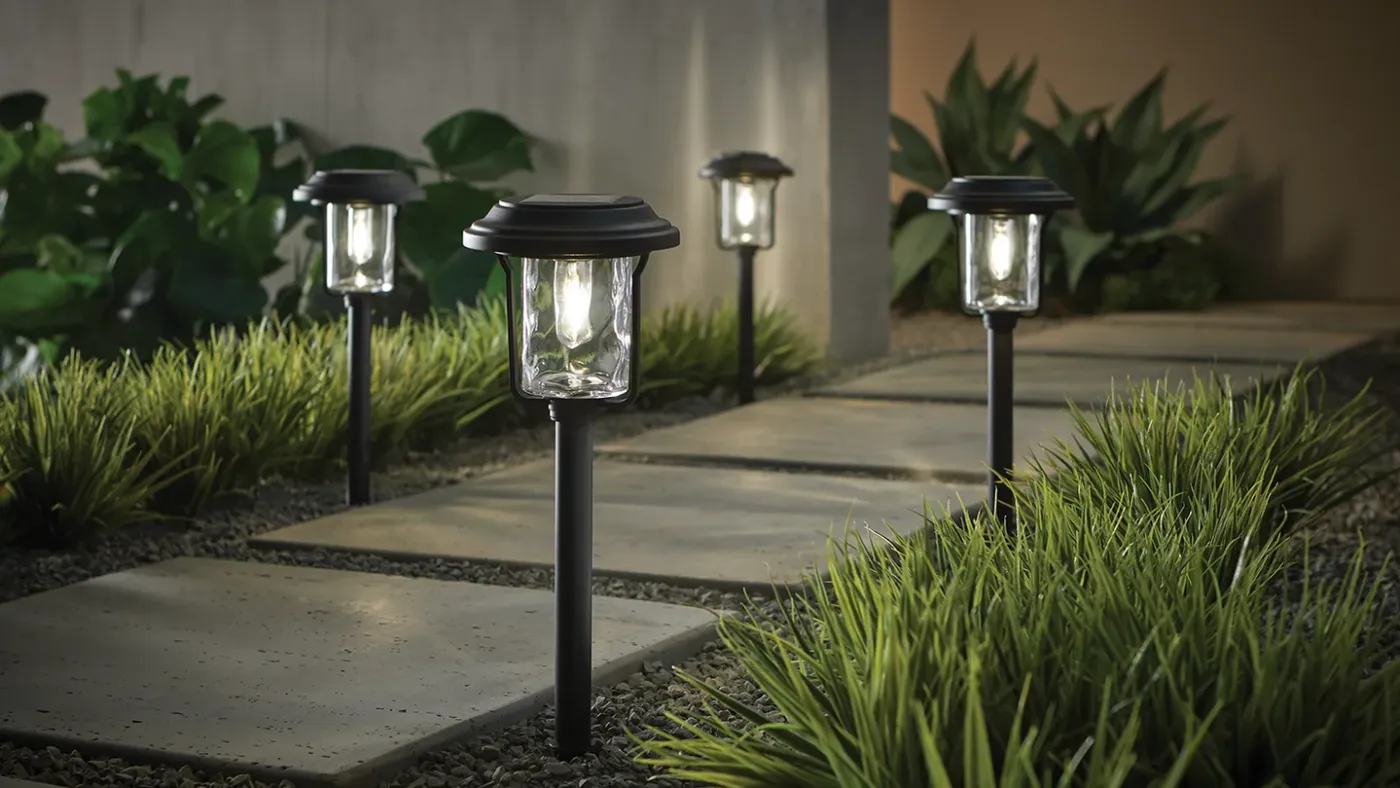
Credit the rhythm. Large square pavers with dark gray gravel between them already give the eye a repeating beat, and the lights simply double it after dark. The ornamental grasses matter more than they look — they break up the hard geometry of concrete and gravel, and they catch a little spill light along the blades so the border never goes fully black.
2. Candy Cane Stakes Alternating With Warm White Ground Lights
Candy cane stakes have quietly become the nostalgia buy of the season, and it isn’t nostalgia alone. Alternating red and white creates contrast that still reads from the street — a distance where plain warm white bulbs vanish into the dark. Pair them with simple warm white ground lights and you get whimsy up top, calm at your feet.
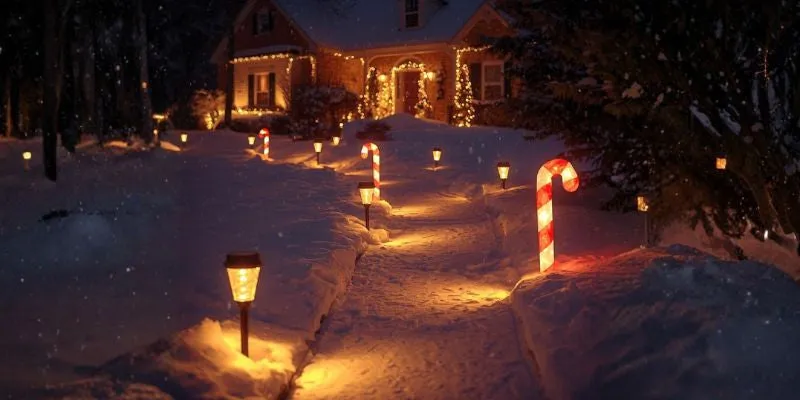
The alternating pattern is the whole trick. Swap every other candy cane for a plain warm white stake and the path still looks festive, but it stops looking like a story. That repeating red-white-red-white is what makes a snowy walk feel deliberate instead of just decorated.
Staking candy canes so they survive the season:
- Wait for the first real freeze — soft ground lets stakes lean by January.
- Push each stake 6 to 8 inches down, straight, tapping the base with a rubber mallet rather than the cane.
- Space them 3 feet apart if you’re alternating with ground lights, 2 feet if canes are the only source.
- Run the cord along the back edge of the bed and cover it with an inch of snow.
- Check after every storm and refirm anything leaning more than 15 degrees.
About 45 minutes for 20 feet, plus $25 to $60 in stakes.
3. A Timber Archway Wrapped in Warm String Lights
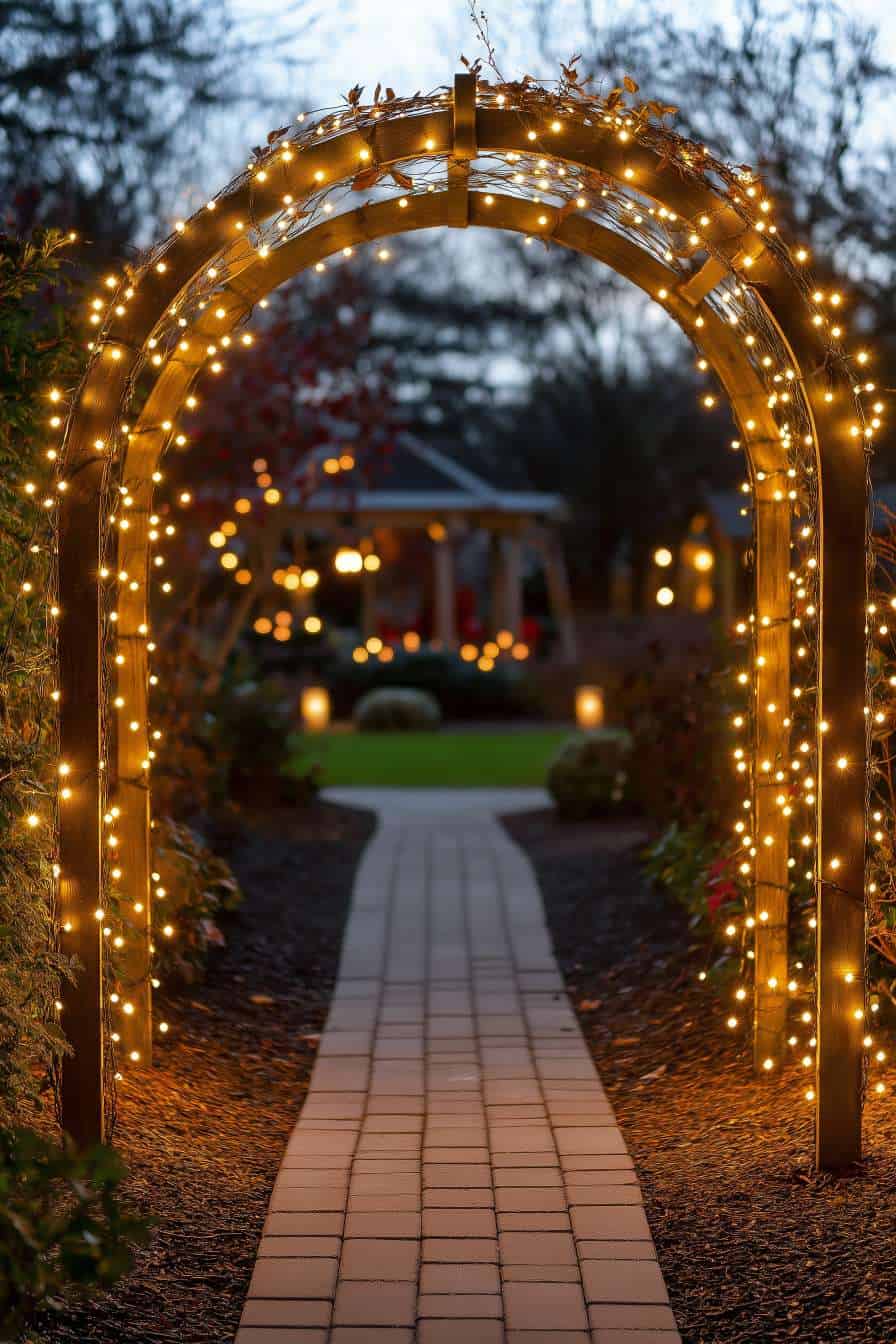
A timber archway draped in warm string lights over a brick path, priced honestly:
- Wooden garden arch: $120–$260
- Outdoor-rated warm white string lights (about 200 feet): $35–$70
- Ground stakes and clips: $12–$20
- Extension cord and timer: $20–$35
- Brick or paver path, if you’re adding one: $400–$1,200
Total: about $190 to $385 for the lighting alone, or $590 to $1,585 with a new path.
Budget alternative: skip the arch entirely and wrap two tall stakes or a mature shrub at the path entrance — $60 to $90 buys most of the tunnel effect.
An archway becomes a tunnel, and a tunnel becomes a wind tunnel. On an open, exposed path, garland and lights catch every gust, and the arch itself will rock in a storm unless the feet are anchored into something solid rather than pushed into soil. If your walkway faces the prevailing winter wind, weight the feet or bolt them to pavers.
4. Cobblestone Walk, Deep Green Door, Three Lantern Posts
The formula here is roughly 50% warm white light, 30% deep green foliage and door, 15% orange brick, 5% stone gray. It works because the greens and bricks are both muted — nothing competes with the glow. Want to swap it? Trade orange brick for charcoal siding and keep the green door; the composition holds. Trade warm white for cool white and it collapses, because cool light goes gray against green.
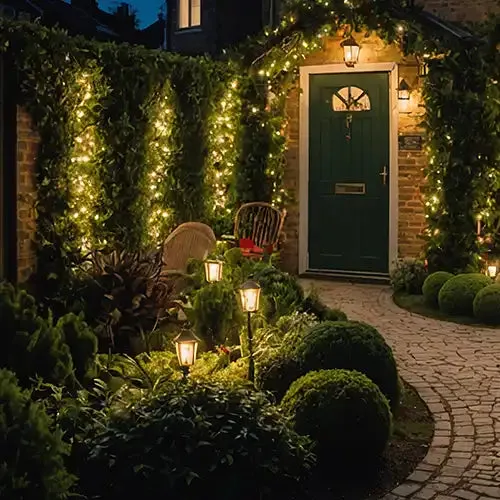
Three lantern posts along one short walk is a mistake waiting to happen. If you’re using three, set them at the two ends plus the midpoint rather than evenly stepped — the middle one anchors the eye and the ends bracket the composition. Also drop your lantern bulbs to 2700K. Anything above 3000K turns a dark green door olive and makes cobblestone look permanently wet.
It’s the way the string lights echo the arch of the doorway. They don’t just hang above the path — they trace the same curve as the entrance itself, so the eye travels from the street, under the glow, straight into the door without a break. Remove that framing and you have a lit path in front of a house.
5. Mini Evergreens Staked Straight Into the Snow
Four mini lit evergreens staked into snow do the work of a landscaper’s install for about $80. Grab 3-foot artificial trees at Walmart or Target in early November ($18–$30 each), then add a $12 strand of multicolor LEDs per tree. Facebook Marketplace in late January is where the real steals live — people dump lighted trees for $5 to $15. Same silhouette, a fraction of the price, and you can pull them inside when the snow melts.
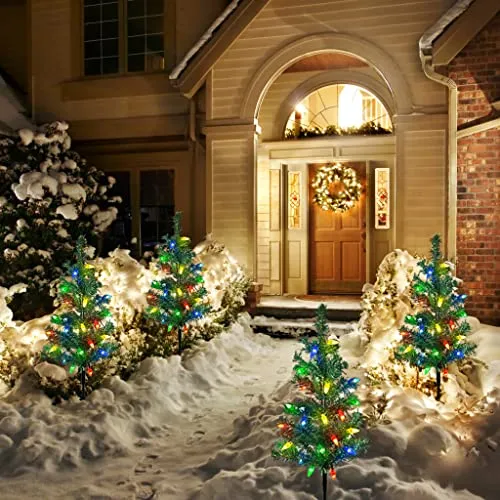
Staking the trees directly into the snow, rather than setting them in pots, is what makes this read as a real planting. They sit at the same height as the snow-covered bushes behind them, so the path looks bordered instead of decorated. The lighted wreath on the door gives the eye a destination — a path with a glowing endpoint always feels shorter and friendlier than one that trails off.
6. Spiral Tree Lights With Star Toppers in the Garden Bed
Getting spiral tree lights to stand up straight in a garden bed:
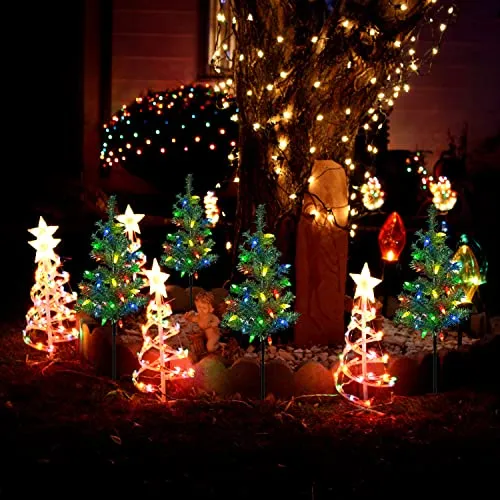
- Clear the bed edge first — spiral forms look messy against weeds.
- Push the ground stake in until the spiral base sits 1 to 2 inches above the soil.
- Face the star topper toward the walkway, not the house.
- Stagger heights by 6 to 10 inches so the row steps down toward the path.
- Zip-tie the cords to a single hidden stake behind the row.
Plan on an hour for six trees, about $20 to $45 each depending on size.
The star toppers. A plain lit spiral reads as abstract — pretty, but shapeless in the dark. The star tells your brain instantly that it’s a tree, and once you see one, you see all of them. That tiny detail turns a cluster of glowing cones into a coordinated garden border, and it’s almost always the first thing people cheap out on.
7. Icicle Rooflines, Wireframe Deer, and a Wrapped Tree
This level of coverage — roofline icicles, a wrapped deciduous tree, outlined beds and figures on the lawn — needs a frontage of at least 40 feet and a setback of 20 feet or more. On a narrow city lot, the same lights read as a wall. If your yard is smaller, see Idea #11 for a tighter, facade-only approach that shines at close range.
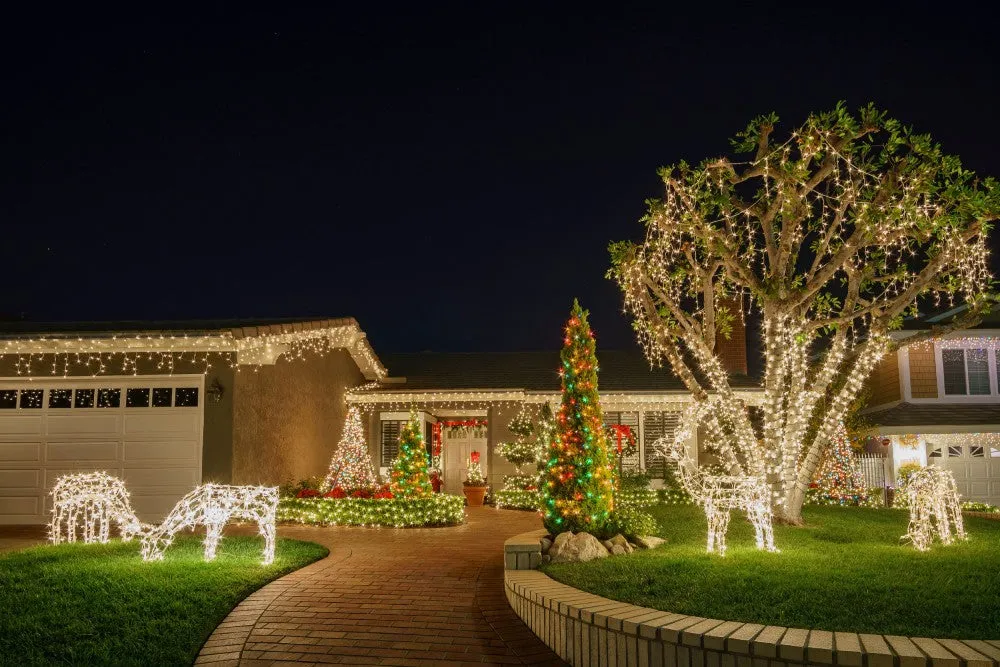
Wrapping a mature deciduous tree in warm white is the most labor-intensive thing on this list. Expect 4 to 8 hours for a 25-foot tree, plus a ladder and a second person. Then budget for reality: LED strands last 3 to 5 seasons outdoors before moisture kills a section, and one dead strand on a wrapped trunk is very visible. Label and coil them, and test every strand in October.
8. A Four-Pack of Solar Stakes Along the Bed Edge
Check these before you commit to solar stakes:
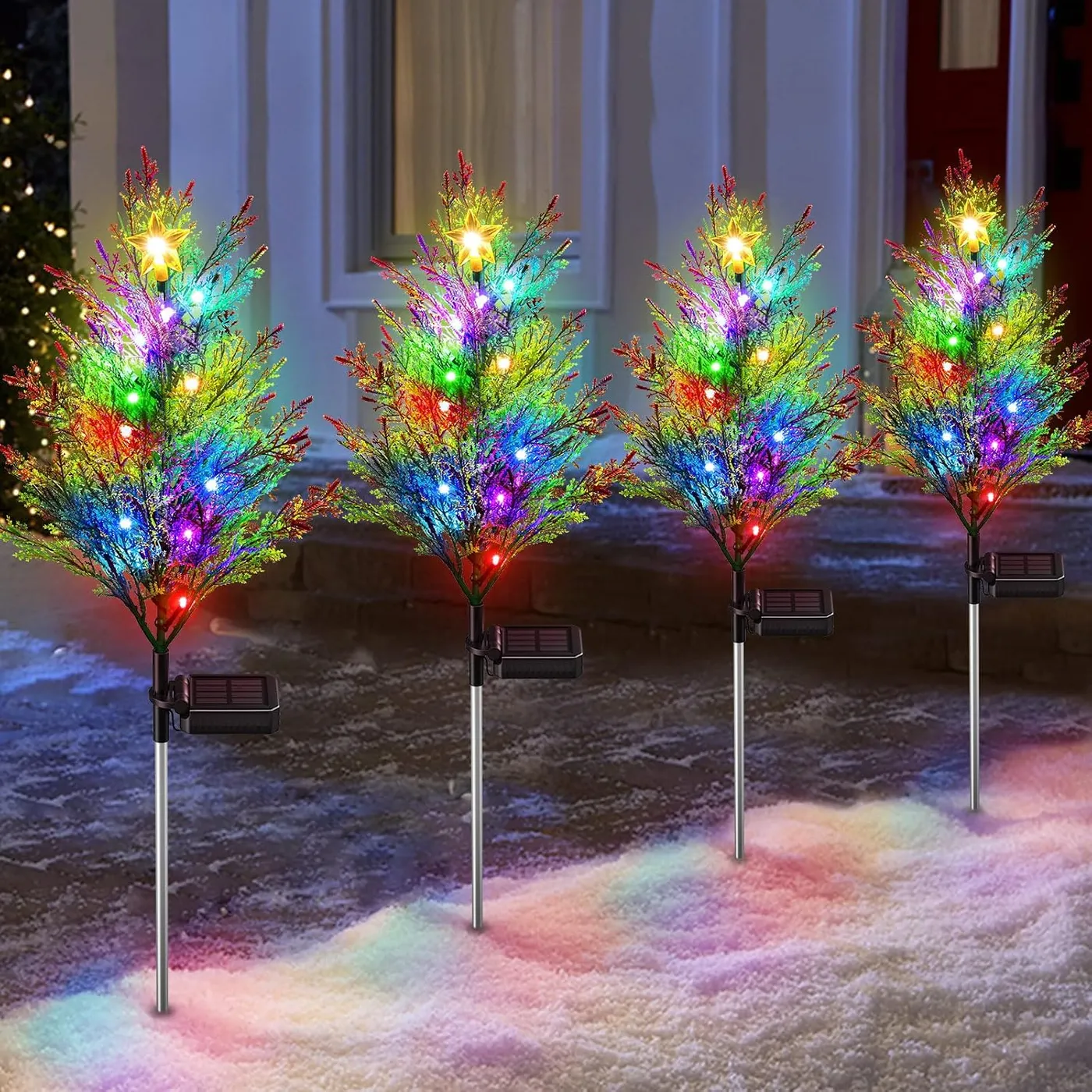
- Direct sun on the panel for 5 to 6 hours a day — partial shade halves runtime.
- Stake length versus your soil; sandy or gravelly beds may need a longer shank.
- Spacing plan: 4 to 6 feet apart for consistent pools of light.
- Whether the bed gets plowed or shoveled — snowbanks bury short stakes.
- Bulb color: most budget four-packs are cool white, which reads harsher than it looks online.
One honest note about multi-packs: the four lights in a budget set rarely match. Slight differences in panel quality mean one runs 8 hours and another runs 3 by mid-winter. Buy two packs and rotate them, or choose a set with a replaceable AA battery you can swap for a high-capacity rechargeable in January. It’s a $15 fix for the most annoying part of solar lighting.
Simple solar stakes work along a bed edge because they set the boundary without competing with your house lights. They’re low, they’re quiet, and when they fade out around 10 p.m. the rest of the display keeps the yard alive. That fade is a feature, not a flaw.
9. Rainbow Spiral Trees Topped With Blue Stars
This is roughly 70% saturated multicolor, 20% cool blue accents, 10% dark ground. The blue star toppers matter more than they seem — they give four identical objects a shared focal point and pull the palette slightly cool, which is why the group reads playful rather than chaotic. Want it warmer? Swap the stars for warm white and keep the rainbow spirals. Just don’t add red bows on top; that’s a fourth color too many.
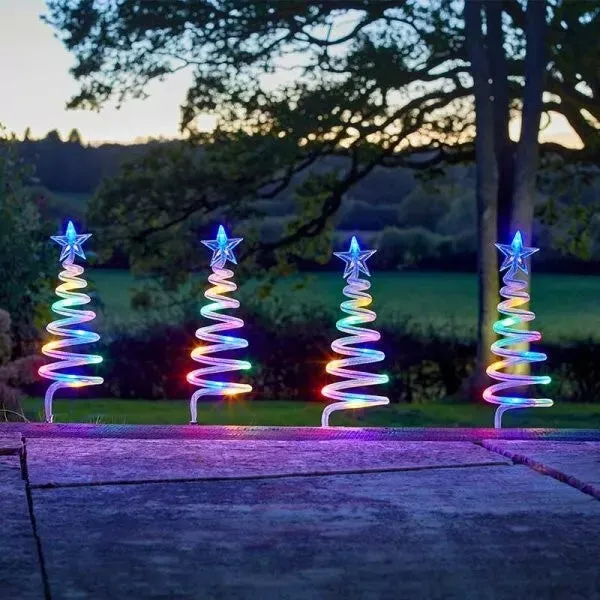
Rainbow spiral lights photograph better than they live. On a dark paved surface with nothing else around, they’re charming. Place them two feet from a busy sidewalk and they’ll be gone by New Year’s — small, light, and easy to walk off with. If your path is public-facing, run a thin cable through the stake bases, or choose a fixed-wired style that’s a nuisance to remove.
10. Stake Lights That Throw Ornate Patterns on the Path
Patterned stake lights that cast ornate designs onto the path:
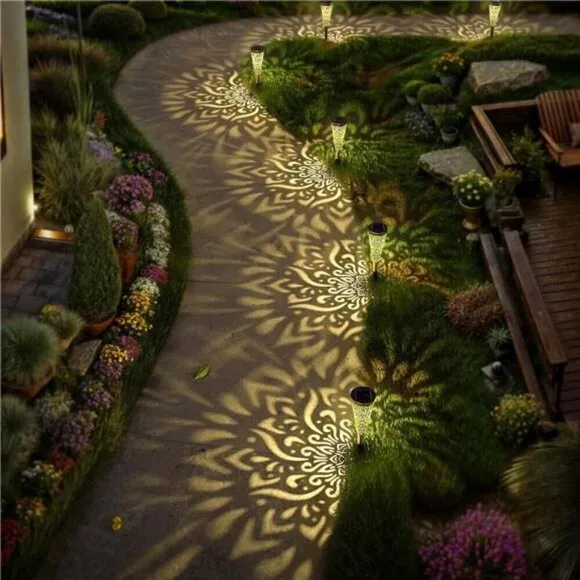
- Decorative projection stakes: $22–$45 each, or $70–$150 for a set of four
- Extra ground stakes for soft soil: $10–$18
- Outdoor timer with dusk sensor: $18–$30
- Landscape edging to sharpen the pattern on grass: $40–$90
- Replacement bulbs, if not LED: $10–$20
Total: about $130 to $290 for four lights plus the supporting bits.
Budget alternative: two projection stakes aimed at a pale path do most of the visual work for under $80 — the pattern reads best on light surfaces anyway.
The path curves, and the lights don’t fight it. Each stake throws its pattern across the concrete at a slightly different angle, so the ornament repeats and shifts the way a pattern on a rug does. The surrounding planting matters too — green shrubs and purple blooms give the warm light something to contrast against.
11. String Lights on a Dark Facade, Topiaries Wrapped Tight
You don’t need a lighting designer to wrap a hedge. One 100-foot strand of warm white string lights from Target or Walmart ($15–$25) covers a 6-foot hedge generously. Add two $12 topiaries from IKEA in late November and wrap each with a 25-foot strand ($8). Total: under $60 for the whole gravel-bed vignette. The dark facade does the rest — dark backgrounds make warm light look twice as bright for free.
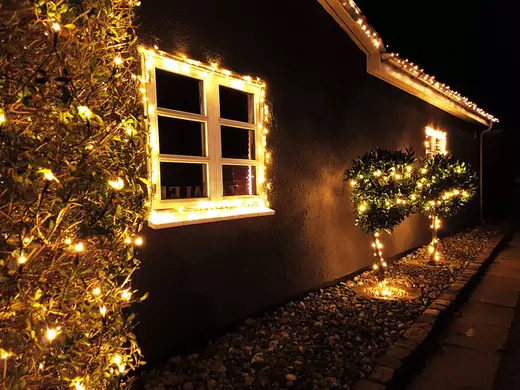
Hedges and topiaries are fine for LEDs but hard on the shrubs themselves. Wrapping too tightly in a cold snap can snap branches, and lights left on through a thaw trap moisture against the leaves. Wrap in a loose spiral, not a chokehold, and pull everything off by early February. Evergreens that stay wrapped into spring often come out of winter with dead patches on the lit side.
12. A White Door Outlined in Warm White, Snowman Included
Outlining a door frame cleanly:
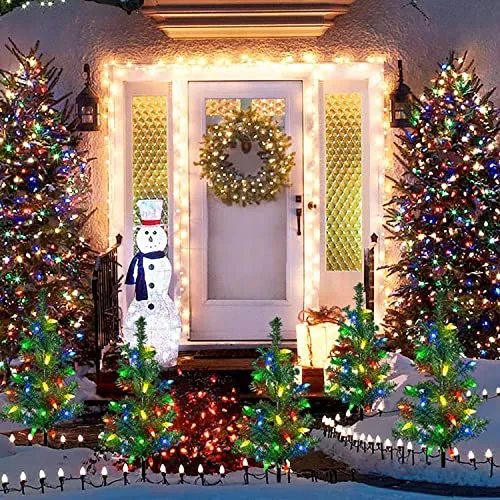
- Measure the full perimeter and add 10 percent — you want slack at the corners.
- Start at the bottom left and work up, so the plug ends up hidden by the hedge.
- Clip the strand every 12 to 16 inches; zip ties work but can bite into vinyl siding over time.
- At each corner, form a small loop of slack so the strand doesn’t pull tight in wind.
- Hang the wreath last, centered on the door rather than the transom.
Roughly 90 minutes and $30 to $50 in lights and clips.
Multicolor is back, and this is what it looks like done well. After a decade of all-white minimalism, buyers in 2026 are leaning into color again — but staged color, not chaos: big trees in multicolor, the entry itself in warm white, figure accents in red. If outlines feel too formal for your place, the candy canes in Idea #2 cover similar ground with more whimsy.
13. Landscape Uplighting Along Curved Stone Paths and Patios
Uplighting a garden like this starts around 1,500 square feet of planted space, with paths at least 4 feet wide so the light has room to pool. Ceiling height doesn’t matter here — tree height does. You want canopies at 12 feet or more to make the uplights worth the wattage. Working with a smaller garden? Idea #1 delivers a similar serene mood in a fraction of the footprint.
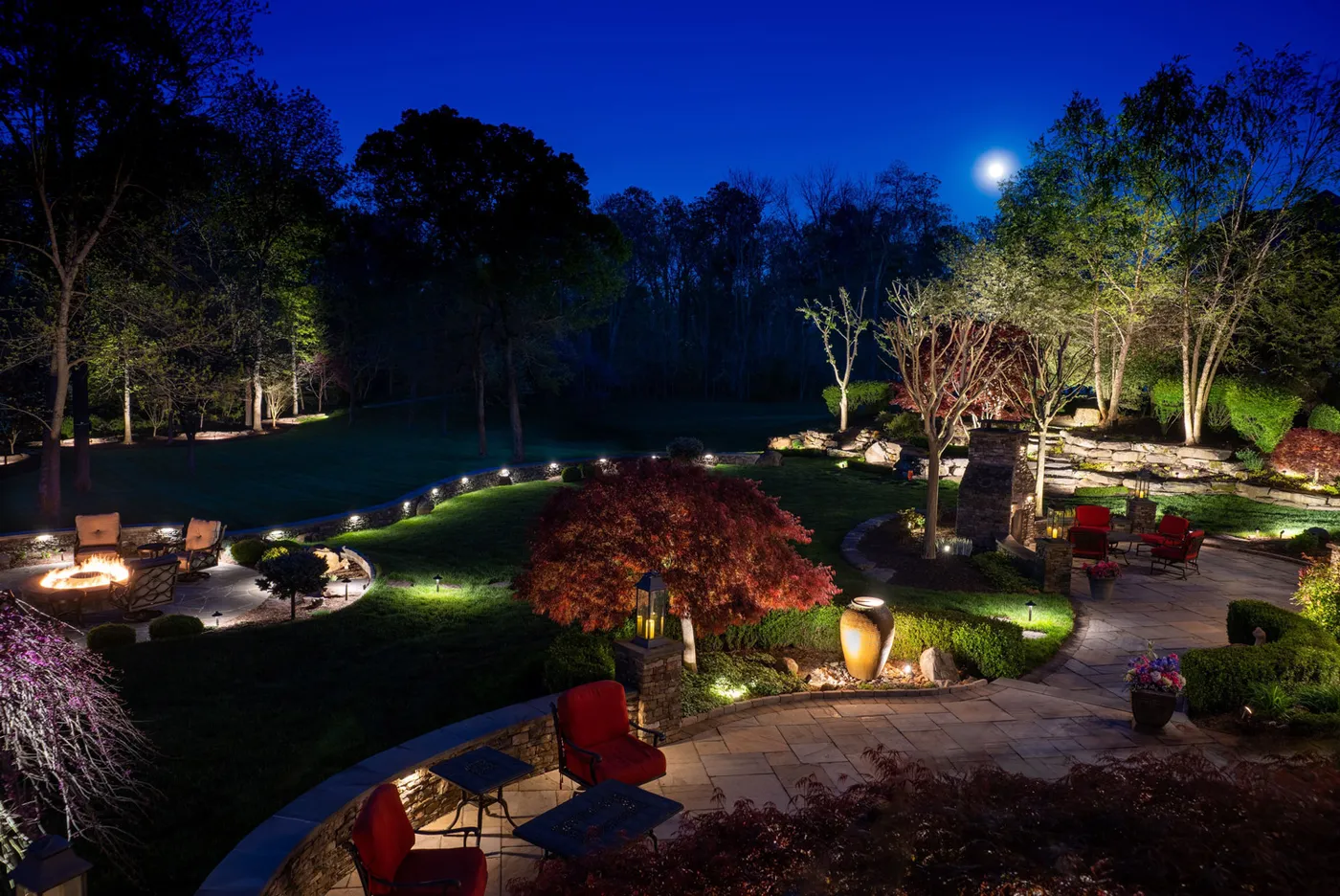
Uplight the trunks, never the canopies. Aim fixtures at a 10 to 15 degree angle from 2 to 3 feet off the trunk base, and keep them at the same color temperature as your interior bulbs — 2700K to 3000K. Mixed color temperatures across a big garden are the most common reason a professionally lit yard still looks off in photos.
14. Bushes Blanketed in Warm White and Red
Blanketing bushes is one of the cheapest big-impact moves in holiday lighting. Six strands of warm white plus two of red, all from Walmart at about $6 to $12 each, will cover four medium shrubs. Thrift stores in early December are gold for red bows and garland. Total: under $100 for a front yard that reads like a neighborhood landmark from half a block away.
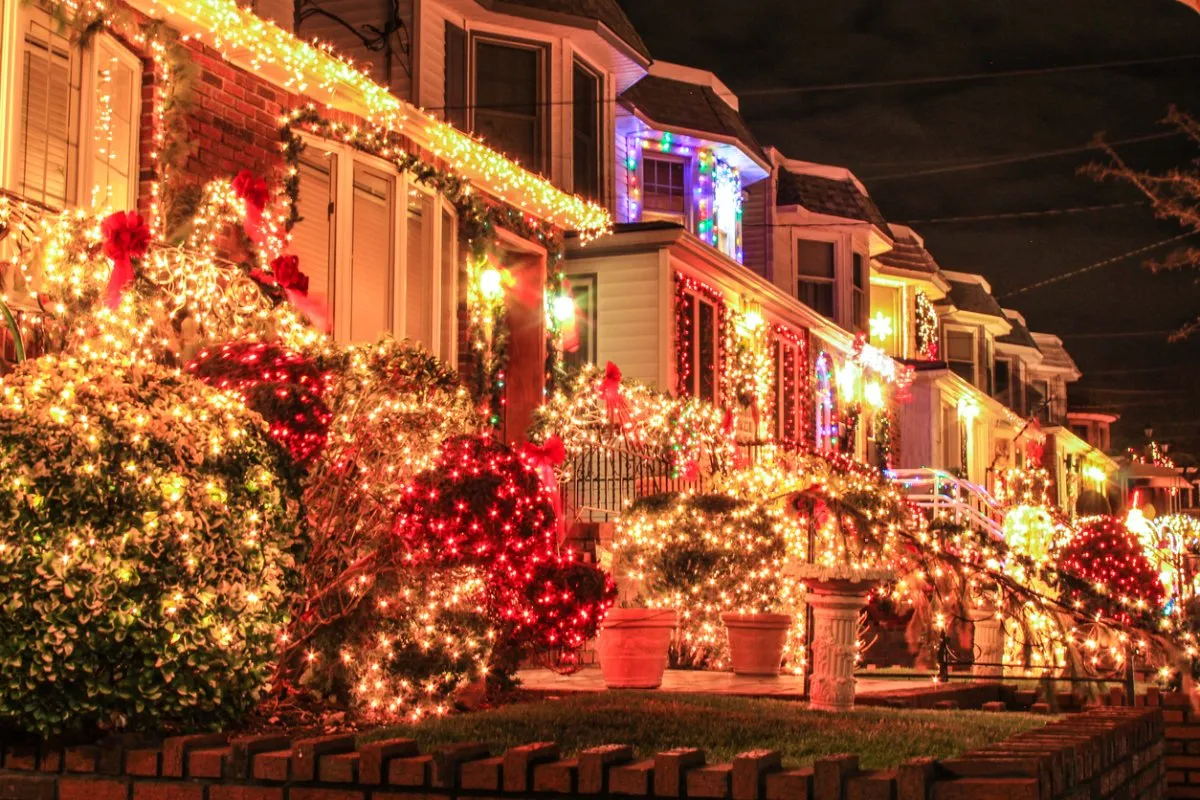
Be honest about the neighbors. Fully covering your shrubs in red and white is spectacular, and it’s also bright enough to light up the house across the street. If your front beds face someone else’s bedroom windows, put the red on the far end and thin it out near the property line. A dusk-to-dawn timer that shuts everything off at 10:30 p.m. solves most of this for about $20.
15. Flocked Mini Trees With Red Bows on a Snowy Path
Flocked trees shed. That white coating is a spray-on finish, and every time you bump one, you lose a little. Expect visible thinning after two or three seasons outdoors, plus flocking drift on the snow around the base. Keep them out of direct wind — a gusty corner will strip them in one winter. If you want the look with less mess, white-lit bare-branch stakes give a similar snow-dusted feel.
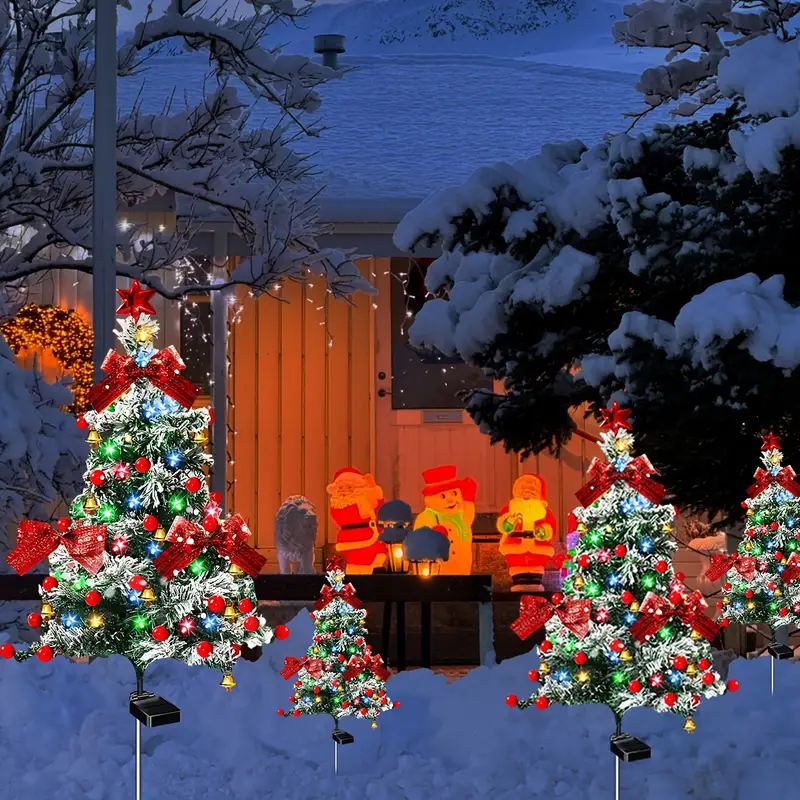
Roughly 60% white — snow and flocking — with 25% red from bows and ornaments, and 15% multicolor bulbs. The white base is why the red reads so crisply; on a green lawn the same bows would look muddy. Want to shift it? Swap the red bows for silver-blue and keep everything else. The snowy palette holds, and it picks up a cooler, more modern edge.
Flocked mini trees with bows, staked along a path:
- 3-foot flocked artificial trees: $25–$60 each, four needed
- Multicolor LED strands, 25 feet each: $8–$15 per tree
- Red bows and shatterproof ornaments: $15–$30 total
- Ground stakes with tie-downs: $10–$18
- Timer and outdoor extension cord: $20–$35
Total: about $190 to $390 for four decorated trees.
Budget alternative: unlit flocked trees plus a single multicolor strand each gets you 80 percent of the look for around $130.
16. Clear Tree Stakes Glowing Multi-Color on Pebbles
Clear plastic stakes look cheap in daylight and wonderful at night — so lean into that. Push them into pebbles or gravel rather than grass; blades crossing in front of the clear housing break up the light. And check the stake collar: if it doesn’t sit flush against the ground, moisture wicks up into the LED housing and you’ll lose the lower third of the tree by February. Compare with Idea #9 — same rainbow palette, taller silhouettes.
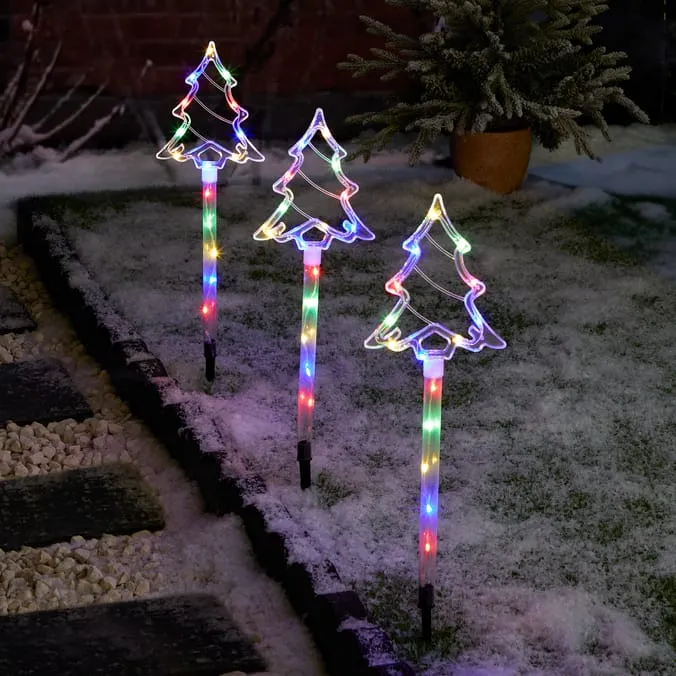
The clear housing is doing the heavy lifting. A solid, opaque tree stake glows at you. A clear one glows around the multicolor LEDs, so you see each bulb’s color instead of a blended blur — red, blue, green and yellow all reading separately. That transparency is the upgrade, and it’s why these look brighter than their wattage suggests.
17. One Multi-Branch Stake, Nine Lit Tree Lanterns
Running a multi-branch solar stake with tree lanterns:
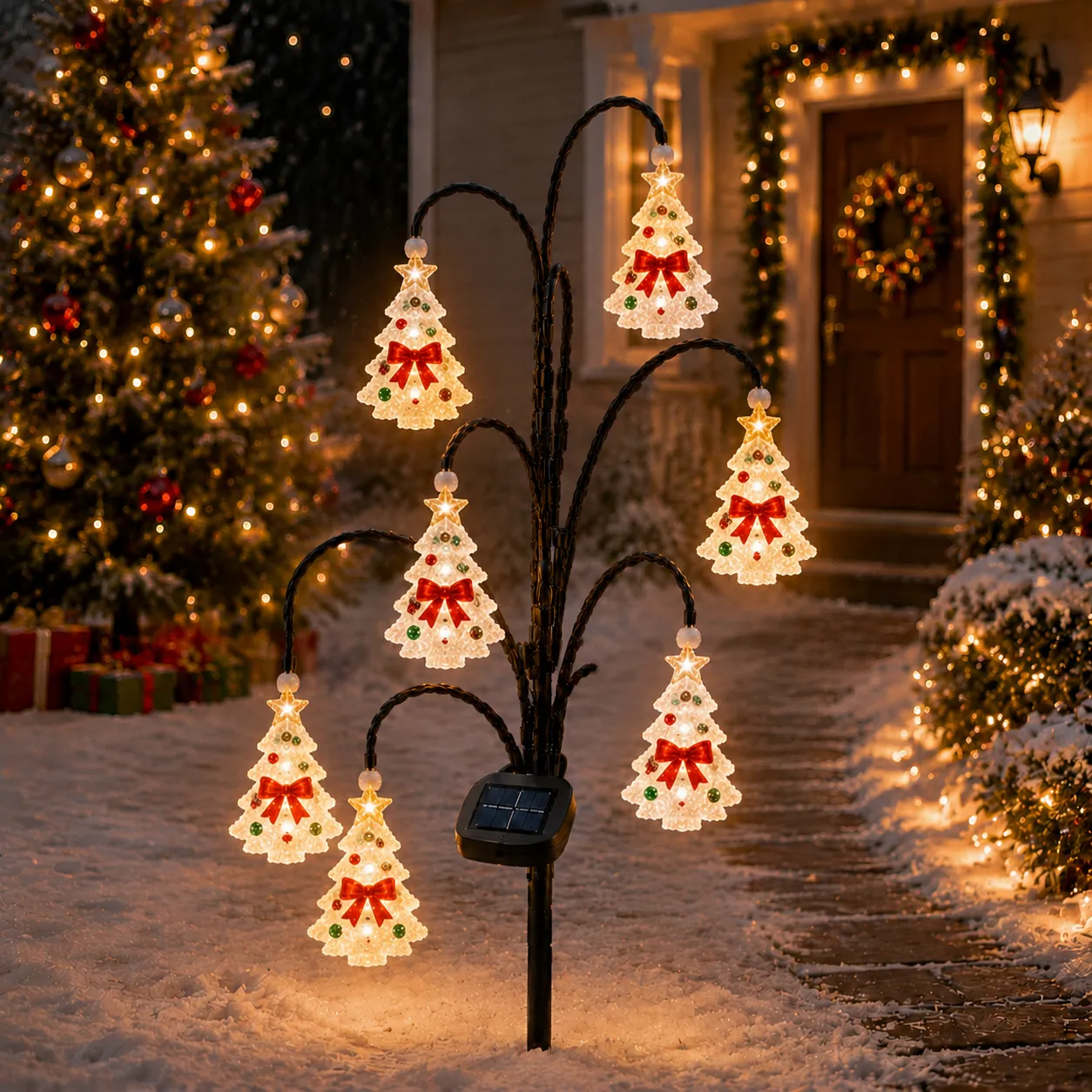
- Pick the sunniest spot within reach of the path — the panel is on the pole, so it can’t move separately.
- Assemble the branches before staking; it’s much harder once the pole is in frozen ground.
- Angle the panel south and wipe it monthly — snow and dust cut charging dramatically.
- Hang the small lanterns so each red bow faces the walkway.
- Give it 8 hours of sun before expecting a full night’s run.
Assembly is about 15 minutes; the stake costs $25 to $45.
A solar tree-lantern stake in a snowy bed:
- Multi-branch solar stake with tree lanterns: $28–$48
- Second stake for symmetry: $28–$48
- Replacement rechargeable AA batteries: $10–$16
- Extra bows or ribbon: $6–$12
- Ground sleeve for hard or frozen soil: $10–$18
Total: about $82 to $142 for a matched pair.
Budget alternative: one stake plus a $12 strand of warm white lights draped across the porch gets a similar scene for around $45.
18. Snowflakes on Candy Cane Poles
Measure twice before you buy snowflake stakes:
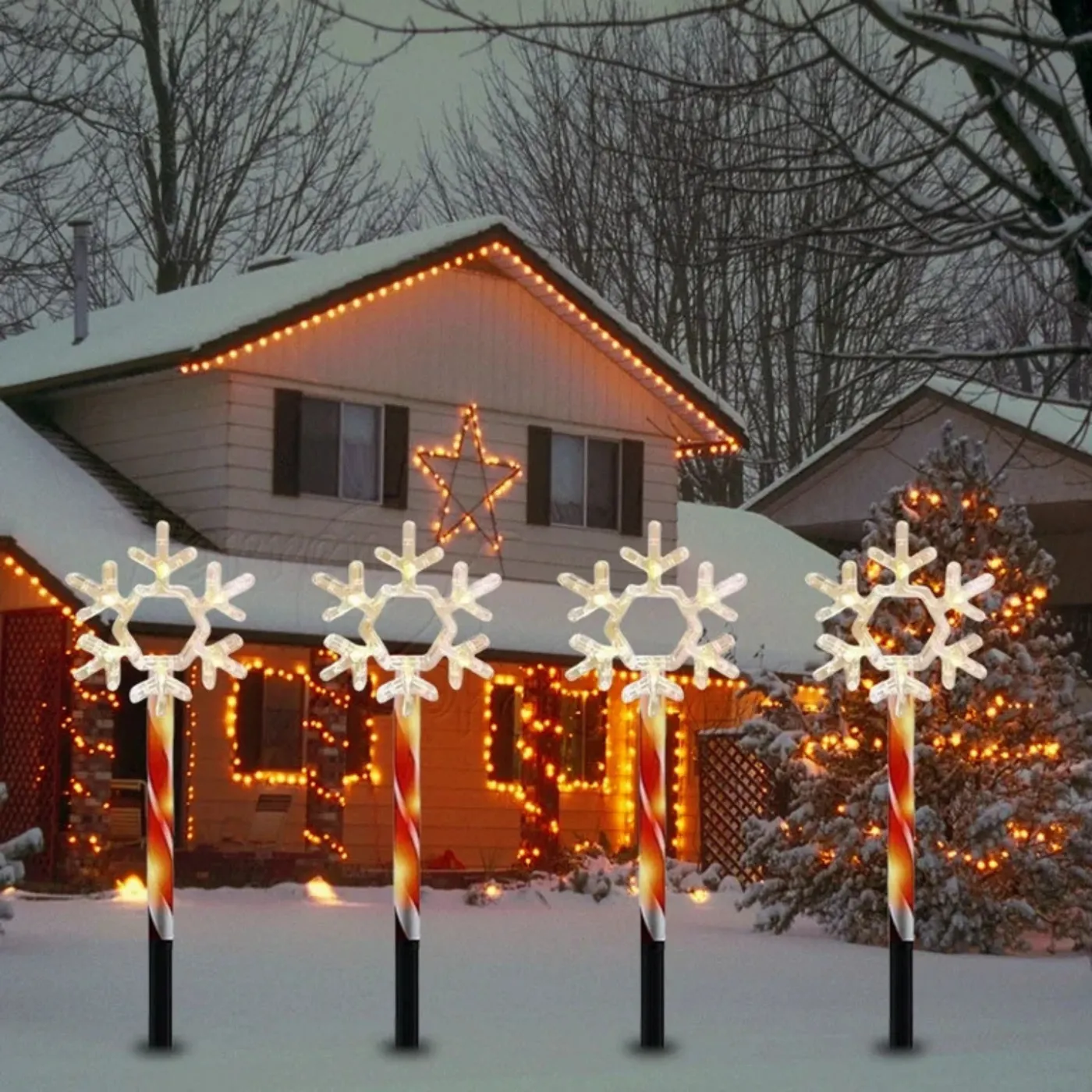
- Pole height versus your snow line — a 24-inch pole disappears in a heavy winter.
- Whether the candy stripe is painted or molded plastic; painted ones chip.
- Distance to the nearest outlet, if they’re corded rather than solar.
- Foot traffic: snowflakes at knee height snag on boots and dogs.
- Count needed for the run — four lights cover roughly 10 feet at even spacing.
Snowflakes sit on candy cane poles, and that combination is more deliberate than it looks. The white snowflake echoes the snow on the ground, while the red-and-white stripe ties the lights back to the candy cane tradition without another cane in sight. It’s a way of getting a classic motif into the path without literally repeating last year’s display.
19. Columns, Eaves, and Railing All in Warm White
A two-story brick facade with a covered porch, columns and a balcony railing needs roughly 350 to 500 feet of string lights to wrap properly — a real budget line, not an afterthought. It also assumes a frontage of 35 feet or more. Below that, pick one architectural feature and commit to it. Compare with Idea #4, where a single door frame does the same job at close range.
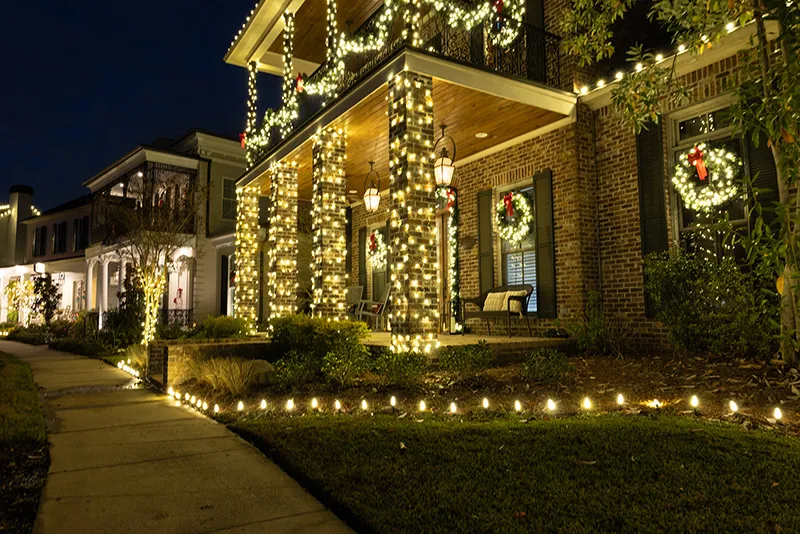
Wreaths on every window look incredible and cost more than the lights do. Illuminated wreaths with red bows run $35 to $90 each, and a wide brick house can easily have eight windows. Buy four for the front-facing windows only and leave the sides bare — nobody sees them anyway. Or buy unlit wreaths at $12 to $20 and add a small battery strand.
Wrapping columns and balcony railings means a lot of clips, and clips mean paint. Adhesive hooks can pull brick sealant or siding paint when they come down in January, and staples leave rust marks by spring. Use wrap-around ties on columns and zip ties around railings — or magnetic hooks, if the railing is metal.
20. Santa Figures Pouring Lights From Golden Watering Cans
Whimsical figures are having a moment. Holiday displays shifted from pure light coverage toward storytelling props around 2023 and haven’t slowed down since. A Santa pouring light from a watering can is a small piece of theater, and Pinterest loves a prop that photographs well from the doorway — especially one that pairs with the golden-hour glow people were already chasing.
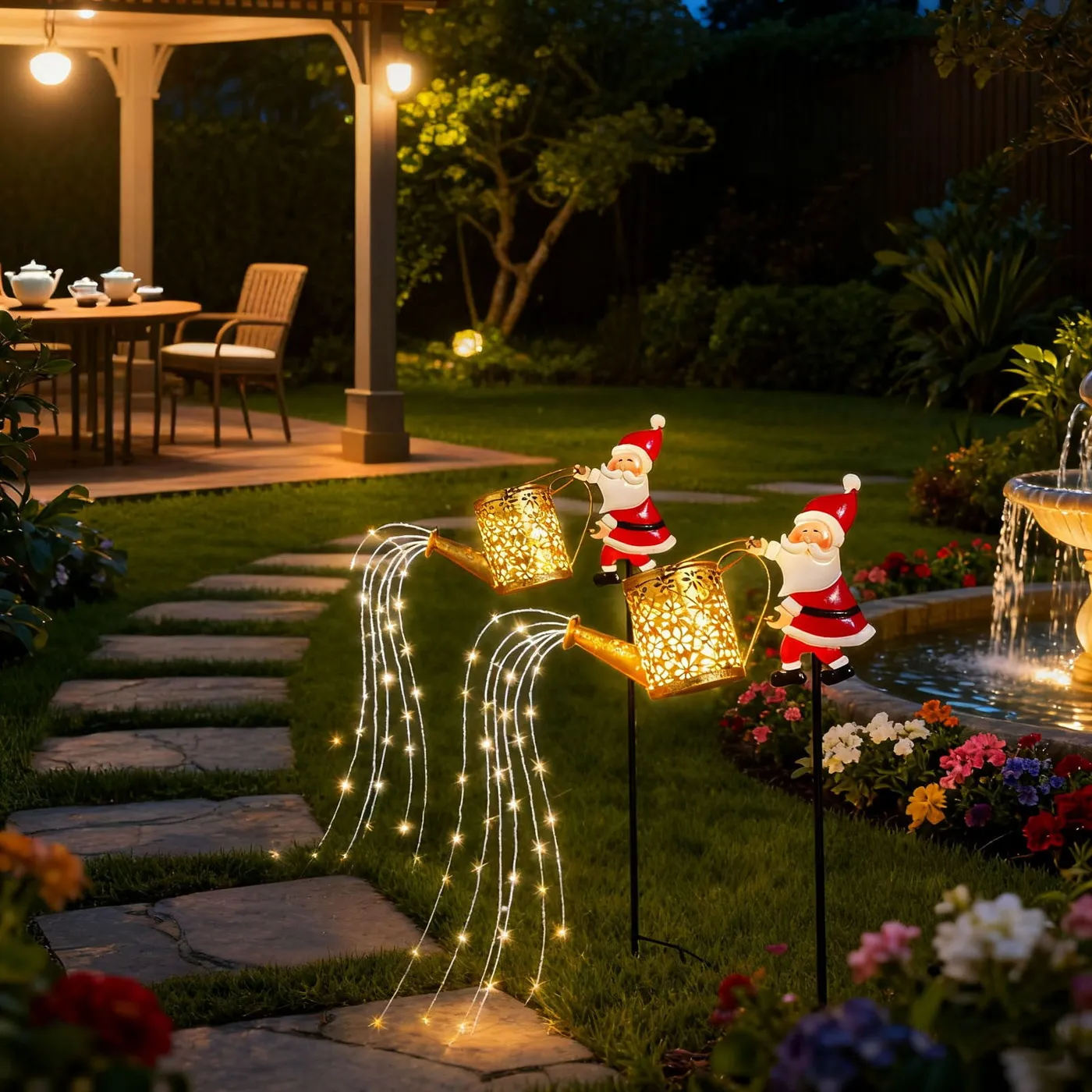
The watering can is the point. Two Santas alone would be cute but static; the moment they appear to be pouring light onto the stone path, the display has a narrative — light literally falling onto your walkway. It’s the difference between a decoration and a small scene, and it’s why guests stop and look instead of walking straight past.
21. Nine Glowing Santa Heads on a Black Metal Stand
With a nine-branch fixture, the temptation is to point every head outward. Don’t. Angle three or four slightly inward toward the pole so the light overlaps in the middle — it reads as one glowing object instead of nine separate dots, and it hides the shadowed gap at the center. The same logic applies to any multi-arm light: overlap the output and the fixture looks twice as expensive as it was.
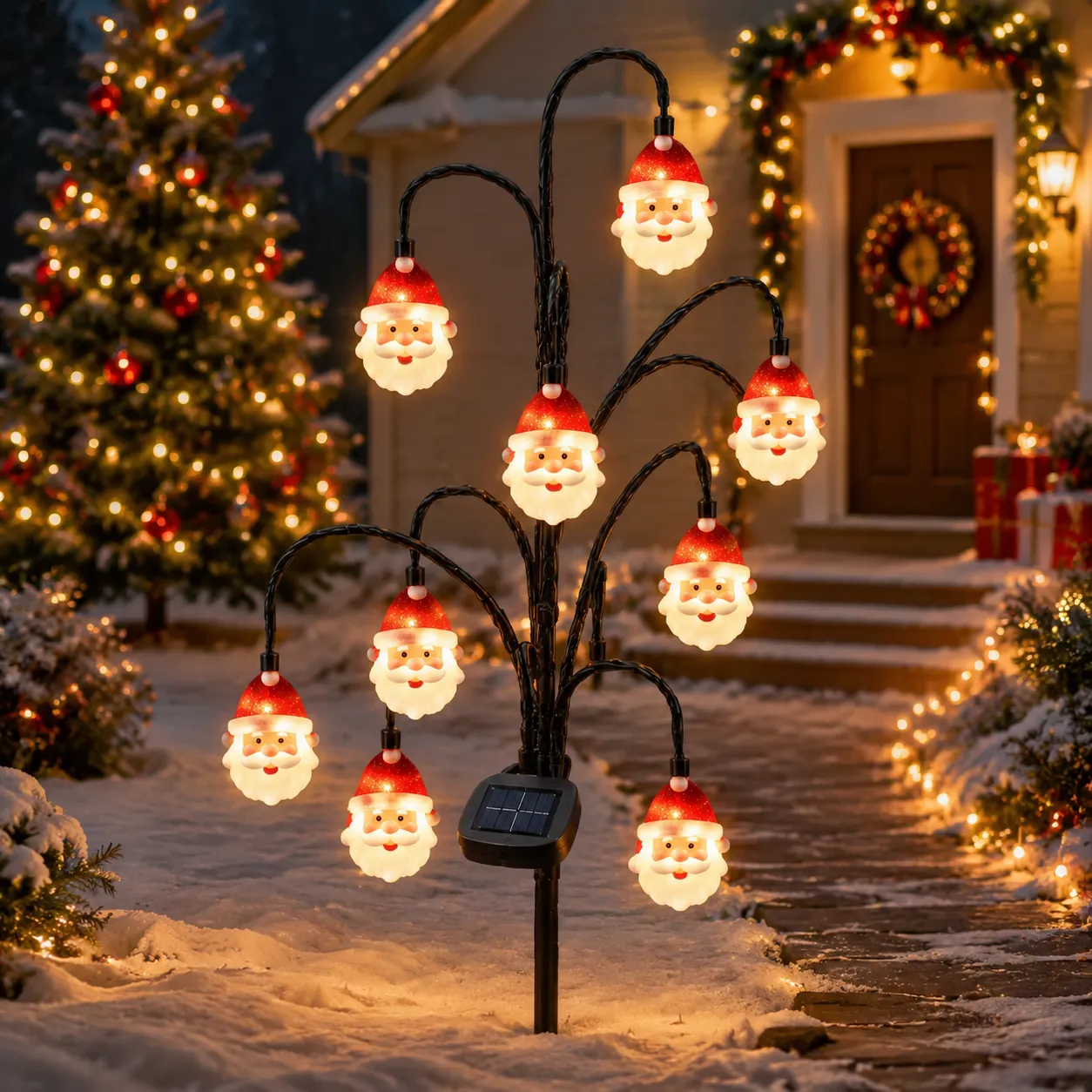
You can get very close to this for around $40. A three-head solar Santa stake runs $14 to $22 at Walmart or Amazon, and a 100-count strand of warm white lights for the nearest tree is $10 to $15. Skip the nine-branch version if your yard is small — three glowing Santa faces read better up close, and one fixture is far easier to store.
22. Two Rows of C9 Lights Framing a Concrete Driveway
Two parallel lines of C9s work on any driveway at least 9 feet wide — that’s the minimum for the rows to read as a framed route rather than one stripe. Run them 12 to 18 inches in from the concrete edge. Narrower than that? Line one side and let the grass do the rest. Longer spans, or paths through planting beds, are better served by Idea #10.
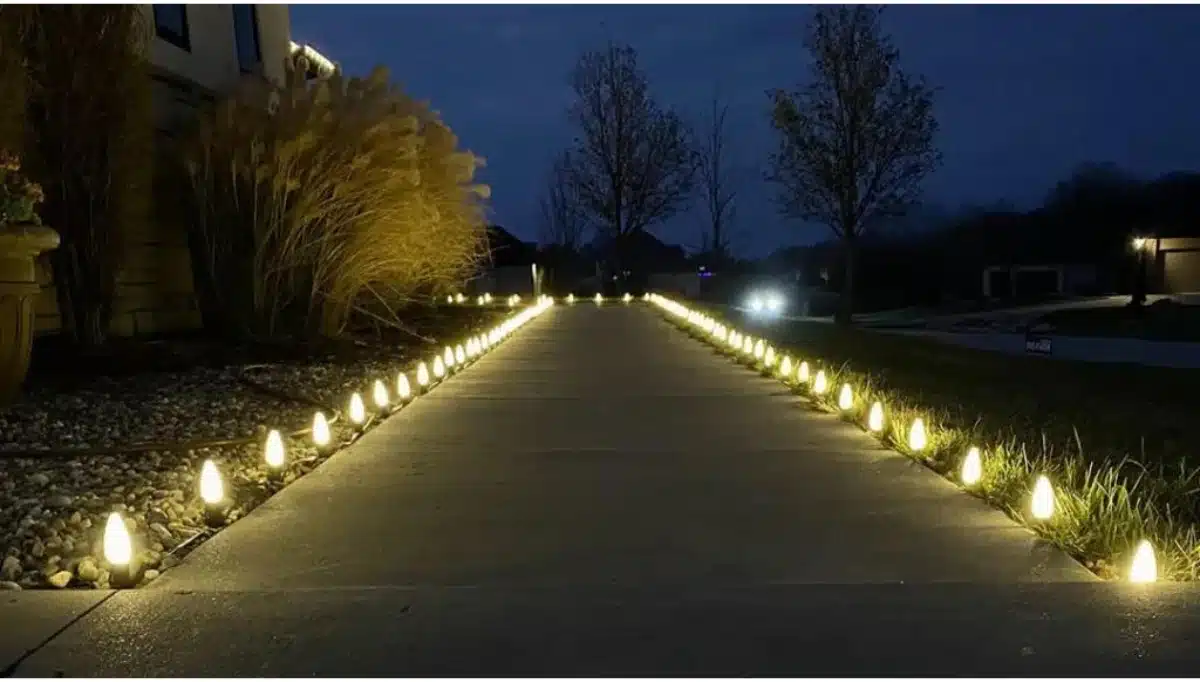
The formula is 55% dark pavement and night sky, 30% warm yellow glow, 15% golden-brown ornamental grass. The grass is the underrated part — its tawny color picks up the warm light and keeps the edges from going black. Swap the C9s for cool white and the driveway turns industrial, because cool light on gray concrete has nowhere warm to land.
Laying out a straight C9 run:
- Mark the first and last stake positions, then stretch a string line between them.
- Space sockets 30 to 36 inches apart — closer looks busy, wider goes dark between bulbs.
- Push stakes in at a consistent 12 to 18 inches from the pavement edge.
- Leave a small drip loop wherever the cord changes direction so water runs off.
- Set a dusk-to-dawn timer and walk the whole run on one evening.
Budget two hours for 40 feet and $40 to $90 in stakes and bulbs.
Let the Walk to Your Door Do the Talking
Start with one stretch of path — ten feet is plenty — and get the spacing and color temperature right before you add anything else. You’ll learn more from one well-lit run than from a full cart of strands.
📌 Pin this guide to your Holiday Exteriors board so it’s waiting for you next November, and send us a photo when yours is up. We love seeing these built in real yards.
