
35 Stunning Round Christmas Door Hanger Ideas to Elevate Your Holiday Decor
You know that feeling when you finally spot a round Christmas door hanger that looks exactly like your house — and it’s sold out until next December? Us too. So we did the digging, working through Etsy shops, Amazon listings, the Hobby Lobby and Michaels holiday aisles, and Walmart’s seasonal wall to land on 35 round door hangers that actually earn their hook space, with prices running from about $18 to $185.
Inside you’ll find every direction this shape goes in 2026 — rustic buffalo plaid, farmhouse shiplap and burlap, vintage Santa illustration, two-tone wood and matte black — with budget and luxury versions of the same look compared side by side. And stay until the end — we break down the most common mistakes that can ruin these looks.
The round hanger has quietly overtaken the classic wreath in a lot of entryways, partly because a circle photographs better than a rectangle and takes up less of the door. This post contains affiliate links — if you buy through them, we may earn a small commission at no cost to you.
📌 Save this to Pinterest for later — you’ll want to revisit these ideas.
1. Rustic Split-Wood Merry Christmas Hanger With Buffalo Plaid
Hang it so the center of the circle lands about 60 inches off the floor — roughly the height of a knocker — rather than centering it on the door itself. On a standard 80-inch door that leaves the bow floating just under the top rail, which is where the eye expects a hanger to start. Go lower and the greenery fights the handle; go higher and the sign reads as an afterthought. A Command hook rated for 5 pounds holds a 12-inch wood circle fine, but anything wider than 18 inches wants an over-the-door hook with a 1.5-inch bracket.
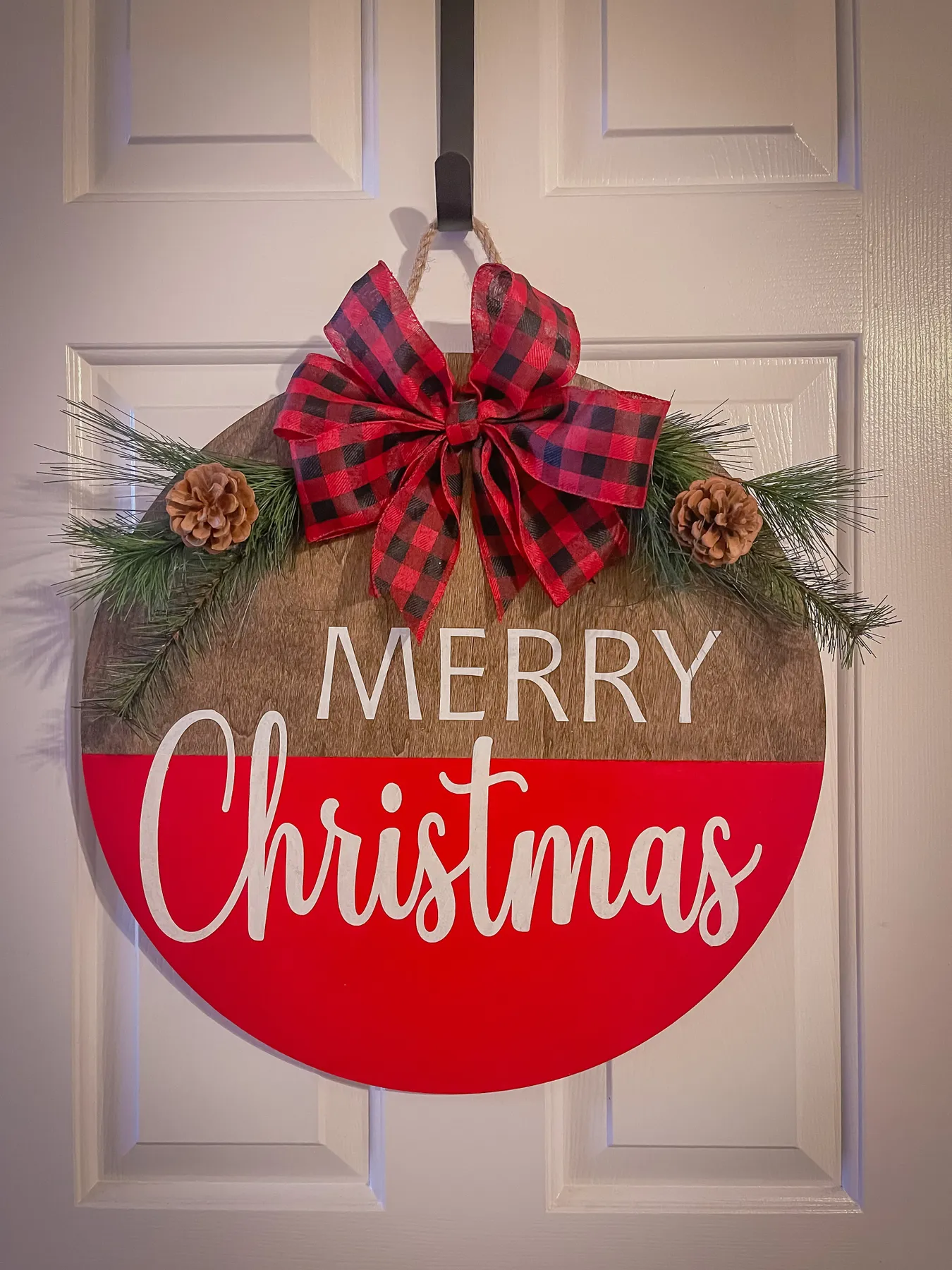
The bow is doing more work here than the lettering. A red and black buffalo plaid ribbon set against rustic wood grain gives you pattern, texture, and a color echo at once — the black repeats the over-the-door hook, the red repeats the painted bottom half of the sign. Swap it for a plain red bow and the whole piece flattens into two flat shapes. If you’re building this yourself, buy the widest plaid ribbon you can find, 2.5 inches minimum, and work at least six loops so it reads as architecture rather than trim.
2. Teal Reindeer Sign With Light-Up Antlers
The formula is roughly 50% teal, 25% white, 20% red, 5% warm light. Teal carries the background so the Santa hat and the bright red nose pop without fighting a red field, while white handles the snowflakes, the banner, and the lettering so your eye has somewhere to rest. Swap the teal for deep navy and you get a calmer, more grown-up sign; swap it for kraft brown and the whole thing turns rustic. The proportions stay identical either way.
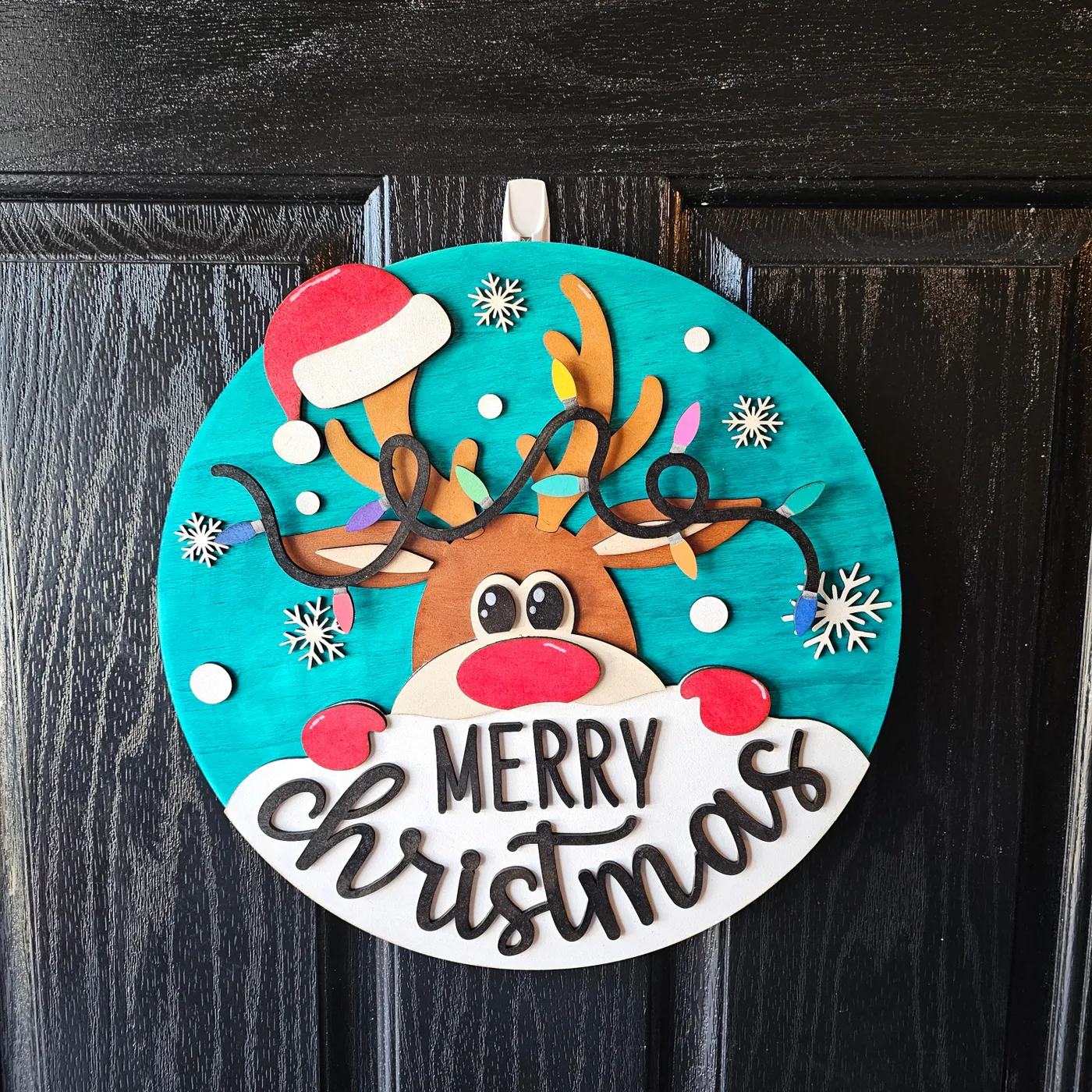
Two things are quietly doing the design work: complementary contrast and repetition. Teal and red sit opposite each other on the color wheel, so the hat reads instantly from the sidewalk, and the scattered white dots repeat the banner’s white so the sign never feels like a sticker slapped on a circle. The string lights strung across the antlers add a third layer — movement — which is why this one gets photographed constantly. Notice the reindeer itself is deliberately simple, with no shading, so it still reads at twenty feet.
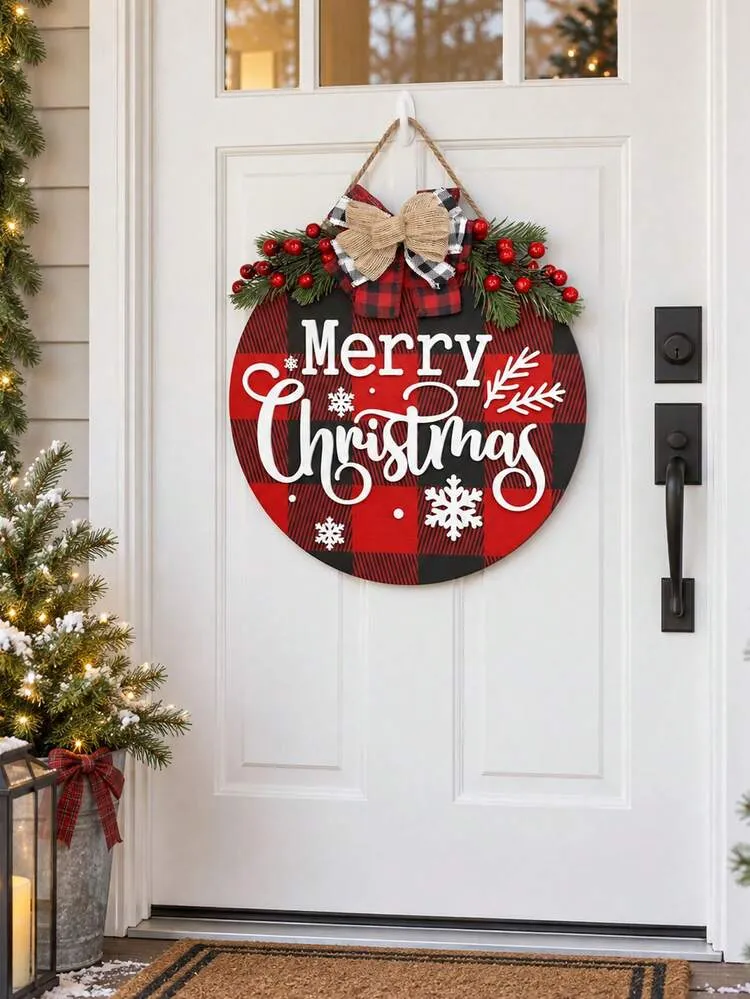
3. Buffalo Plaid Script Merry Christmas Circle
- 18-inch round wood blank or pre-cut sign: $12–$28
- Plaid vinyl decal or stencil kit: $6–$16
- Burlap ribbon plus buffalo plaid ribbon, two rolls: $9–$20
- Faux pine sprigs and red berry clusters: $6–$15
- Snowflake cutouts and adhesive: $4–$10
Total to recreate: $37–$89
Budget alternative: buy a plain wood circle at Walmart for about $7 and hand-letter it with a white paint pen instead of vinyl, which drops you to roughly $25–$40. Slightly imperfect lettering genuinely suits buffalo plaid.
Stagger your layers instead of stacking them flat. Glue the pine sprigs down first, then the berries slightly higher and off to one side, then the bow last, so each layer sits a quarter inch proud of the one below it. Flat, stacked layers look like a craft kit; offset layers throw small shadows that let a 12-inch sign read from the end of the driveway.
Buffalo plaid is a seasonal commitment. It looks glorious from November through December and slightly odd by January 3, so plan a storage box that fits the full diameter — a 20-inch circle won’t slide into a standard wreath bag. Red-and-black plaid on a white door is also a lot of contrast, so if your door has ornate molding or leaded glass, the pattern may fight the door itself. Solid cream and black doors carry it best.
4. Navy-and-Wood Merry Christmas Hanger on a Red Door
You can get close to this for a fraction of the price. Pick up a 14-inch round wood blank at Michaels during a sale week ($8–$12), tape off the bottom half, and brush on one coat of navy craft paint. Add white lettering with a paint pen. Greenery and berry clusters from the dollar store’s floral aisle run about $1 a stem, and red-and-black check ribbon at Walmart is $4 a roll. Realistic landing zone: $22–$35, versus $70–$95 for a boutique version where the cost is mostly pre-cut vinyl and a retail bow.
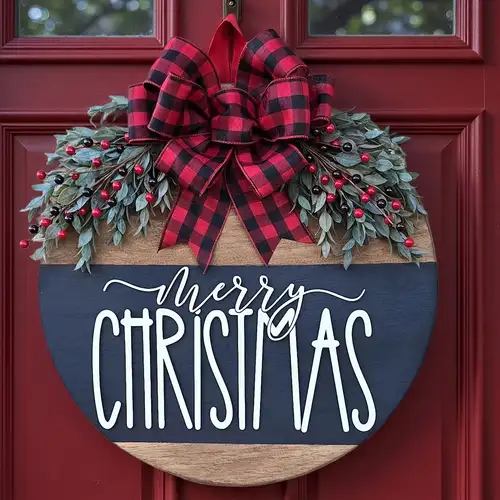
Roughly 45% natural wood, 30% dark blue, 15% white, 10% red and black. Because the wood grain is left bare on top, the navy below doesn’t read as heavy — it reads as shadow. If you’d rather go warmer, swap navy for deep forest green and keep the buffalo check bow exactly as is. Swap navy for black and the red door behind it suddenly feels formal instead of friendly, which is a completely different mood from the same $12 of paint. Idea #1 uses the same bow on a fully rustic sign — this is the more tailored version of that same idea.
5. Evergreen, Pinecone and Red Berry Wreath
Real evergreens drop needles the moment your house hits 68 degrees, and they’ll leave a ring of brown debris on a light-colored threshold. If your door faces direct afternoon sun, fresh greenery can look tired by mid-December. Faux evergreens hold their shape for years but collect dust, which shows up fast on dark green. Either way, hang the wreath a couple of inches below the top of the door so the bow doesn’t get crushed every time someone pulls it shut.
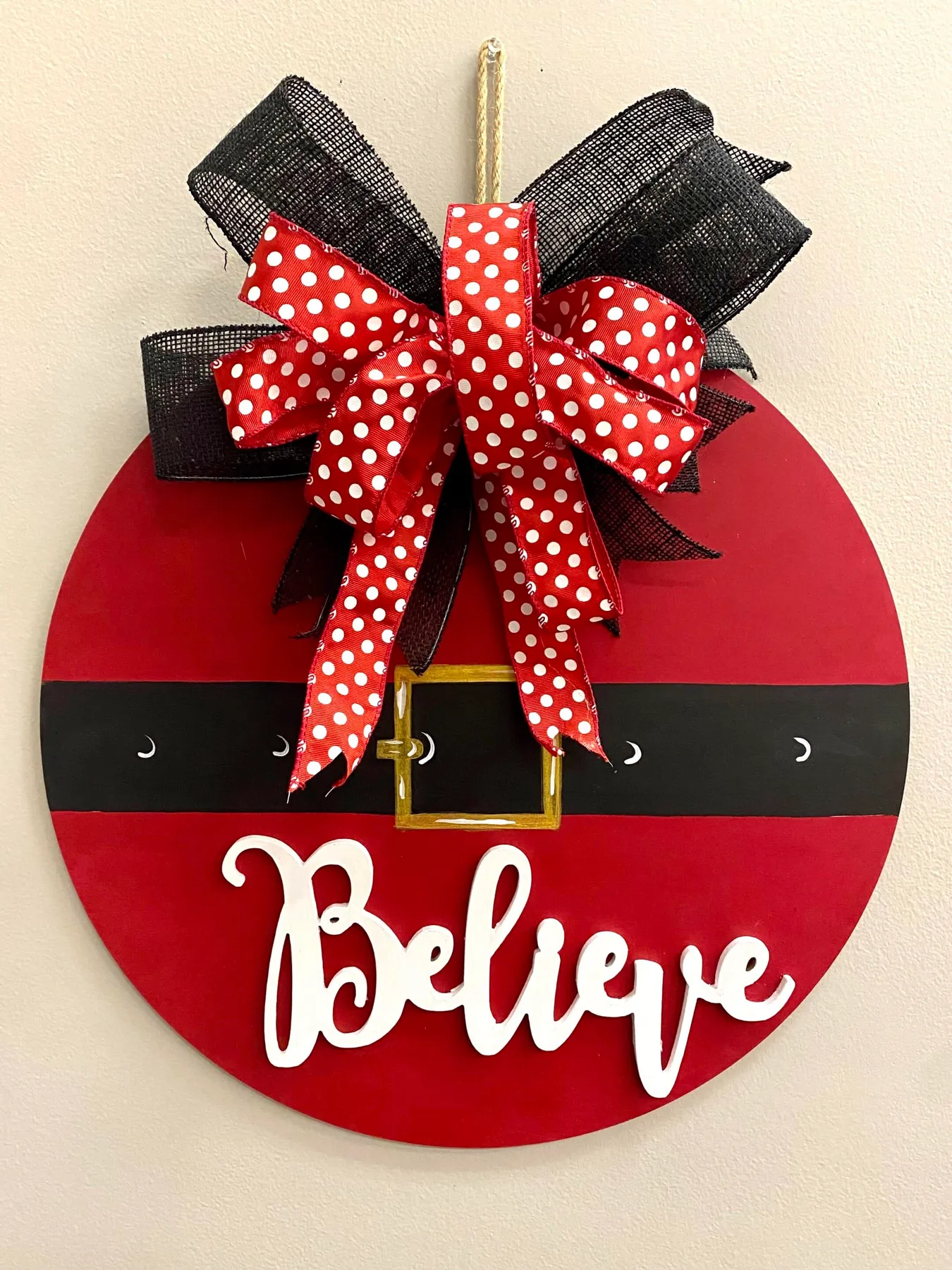
Building the big loopy bow is the part people overthink:
- Cut about 3 yards of 2.5-inch red ribbon and wire the ends.
- Form six loops, pinching each at the center as you go.
- Wire the loops together, then fluff them outward into a full circle.
- Cut two tails, notch the ends at an angle, and wire them behind.
- Attach at the bottom center, slightly off-axis so it doesn’t look stamped.
About 25 minutes and $8–$14 in ribbon.
6. Monogrammed K Wreath With Buffalo Plaid Border
Personalization only works when the monogram is scaled to the circle, not to the letter. Keep the initial around 30% of the sign’s diameter — roughly 5 inches on an 18-inch round — and let the wreath graphic fill the remaining space. Monograms that run edge to edge look like a truck decal; ones that float confidently in the middle look intentional. If your initial is wide, like an M or a W, set it in a condensed face so it doesn’t crowd the foliage border.
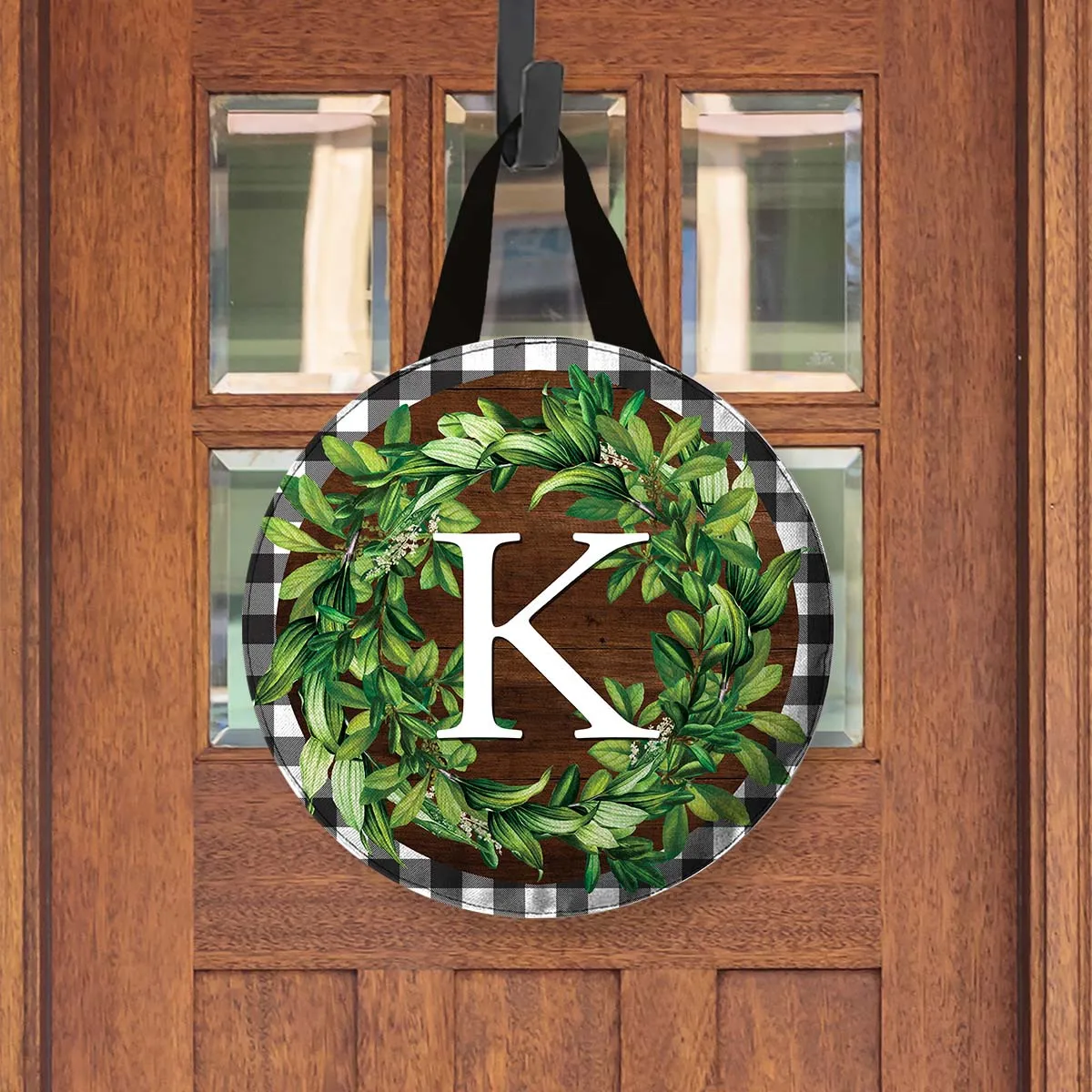
The black-and-white buffalo plaid border is the one element holding this together. It frames the green wreath graphic so the whole piece reads as a picture rather than a floating letter, and the black echoes the strap and hook above it so the design feels resolved top to bottom. Take the border away and the monogram drifts in a sea of dark wood. Take the strap away and you lose the vertical line that ties it to the door. Keep both and a fairly simple sign looks custom-built.
7. Dark Wood Dog Welcome Sign With Fairy Lights
Fairy lights mean batteries, and batteries mean remembering. Expect to swap two or three AA cells every three to four weeks if the strand runs nightly, so buy rechargeable and keep a spare set in the entry drawer. The dark stained wood hides dust beautifully, but the frosted greenery does the opposite — faux frost yellows in direct sun within a season or two. Wipe the foliage with a dry microfiber cloth monthly, never wet, or the frost finish will streak and you’ll never get it back.
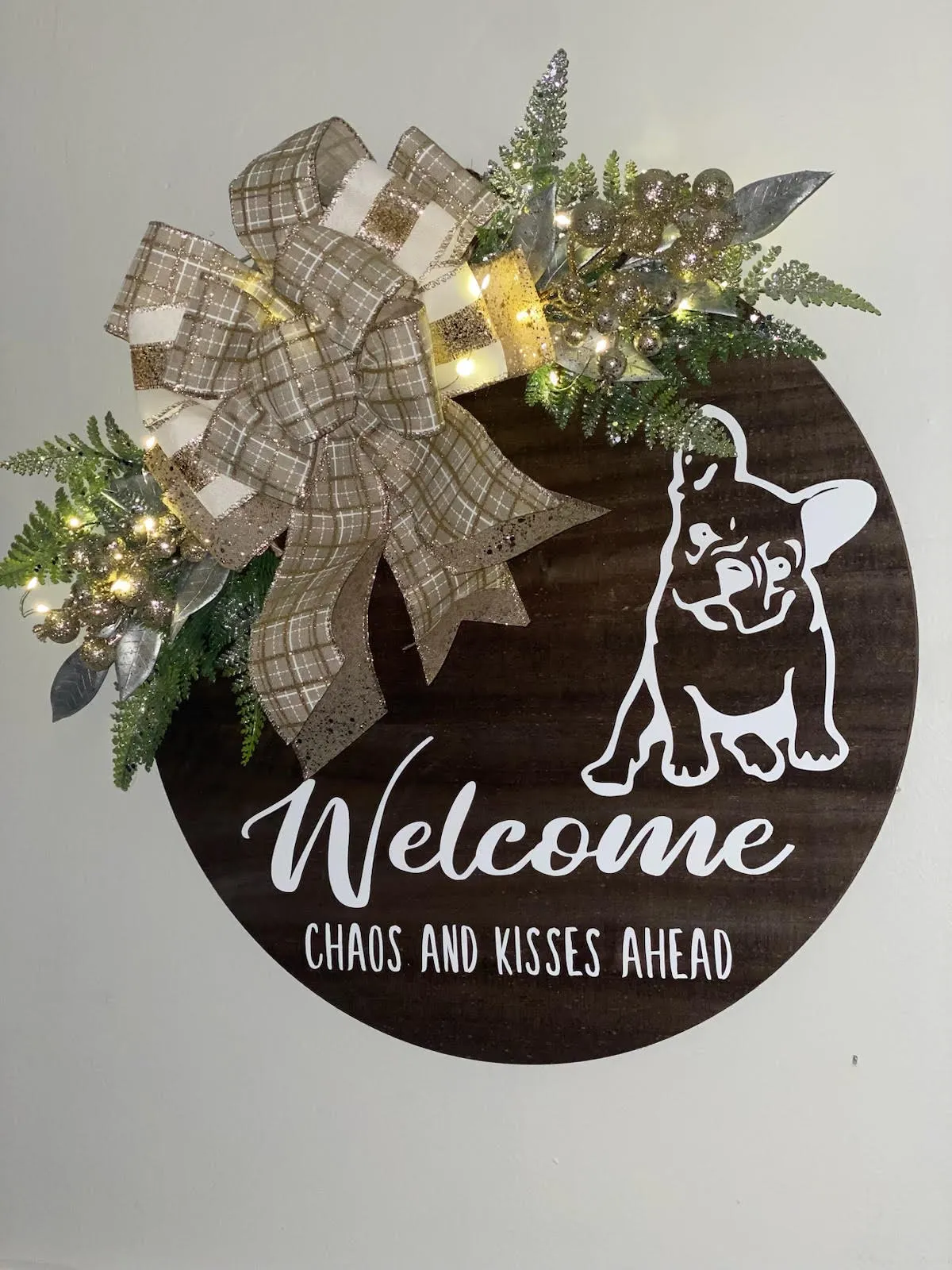
The dog silhouette is the only part that has to be perfect; the rest is negotiable. Find a French Bulldog outline online, trace it onto contact paper, and use that as a stencil over a $10 round wood blank from Walmart. Beige-and-gold plaid ribbon runs $3–$5 at Michaels, frosted sprigs about $5, and a ten-light strand $4 at Target. You land near $28 total versus $75–$110 for a personalized Etsy version — and you skip the three-week production wait.
8. Deep Blue Happy Holidays Hanger With Twine Loop
This one wants a door with a little breathing room. An 18–20 inch circle works on a standard 32–36 inch door, but on glass-paneled doors like these, stay at 16 inches or under or the sign starts blocking the light it’s hanging next to. Ceiling height barely matters here; door width does. For a narrow closet door under 28 inches, size down to 12–14 inches, where a lighter visual weight keeps the frame from feeling crowded.
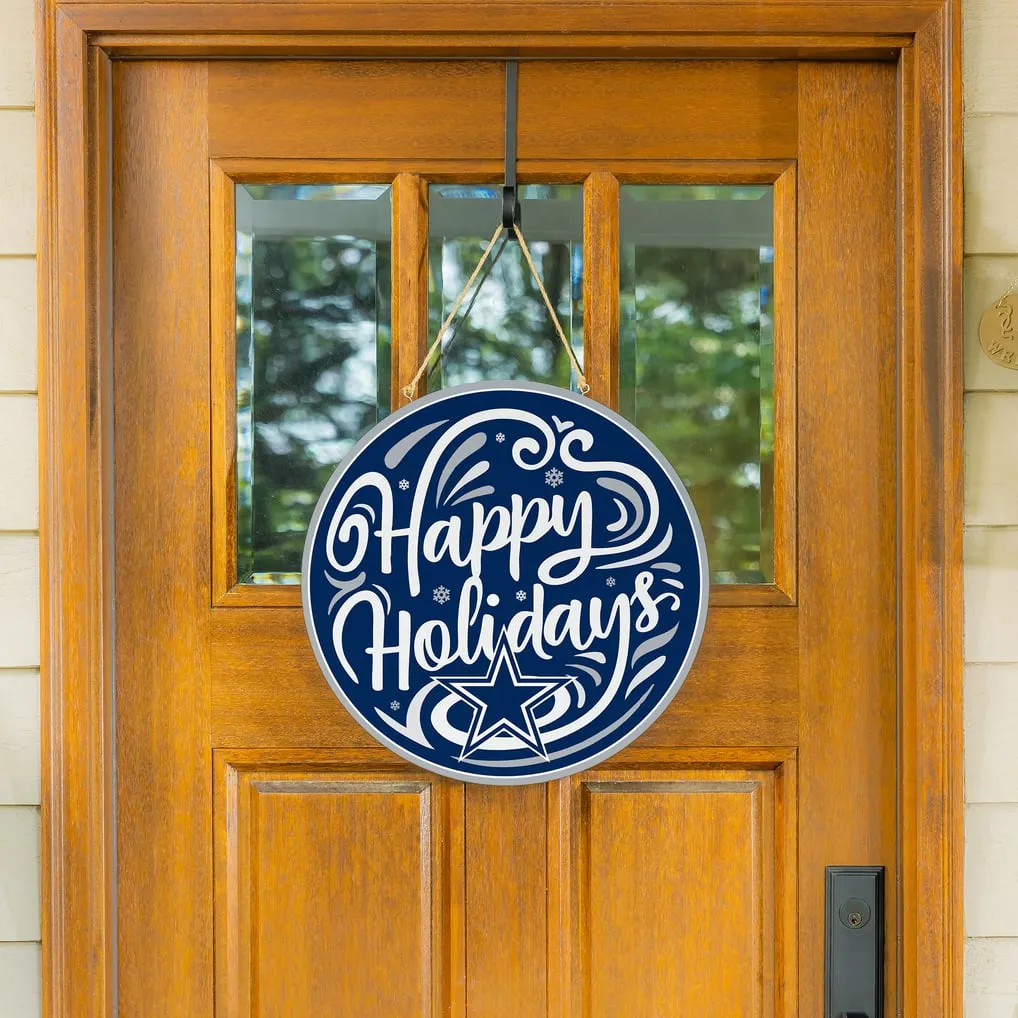
Before you commit:
- Measure the door’s flat panel width, not the frame.
- Confirm whether the surface is wood, glass, or metal — that decides your hook.
- Check which way the door swings so the sign never hits a wall.
- Note where the handle and lock sit; you need 4 inches of clearance below.
9. Red Welcome Sign With Checkered Bow and Planters
The layered front-door look — planters, a rocker, a mat, a sign — is a direct descendant of the 2010s porch decorating boom, and it’s still the most photographed exterior on Pinterest every December. What changed in 2026 is restraint: fewer inflatables, more black doors and checkered textiles. Round signs survive trend cycles because they’re the cheapest upgrade with the biggest visual return. Here, a checkered pillow does the same work a matching wreath would, for about $20.
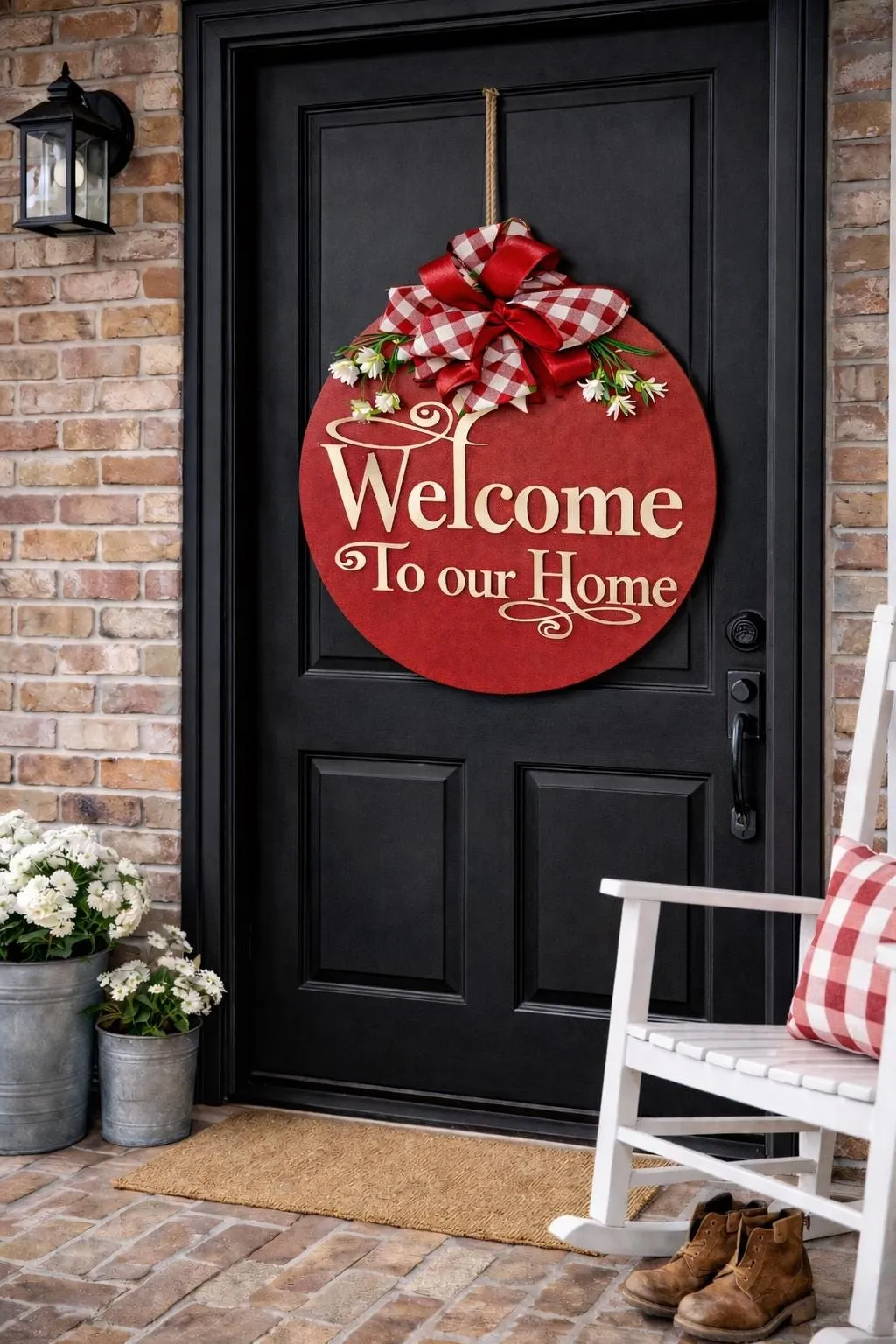
Three principles are stacking. First, repetition — the checkered bow, the checkered pillow, and the galvanized planters all pull from the same quiet palette, so nothing looks random. Second, vertical layering: tall planters, mid-height rocker, low sign, which keeps the eye traveling instead of landing on one object. Third, a red sign against a black door gives you maximum contrast exactly where visitors look first. That’s not luck; that’s editing.
10. Red-Banded Wooden Merry Christmas Circle
- Round wood blank, 18 inch: $12–$26
- Red acrylic paint plus white paint pen: $7–$14
- Red, white, and gold striped ribbon, 2.5 inch: $8–$16
- Faux pine needles and red berry clusters: $6–$13
- Hook and hanging hardware: $5–$11
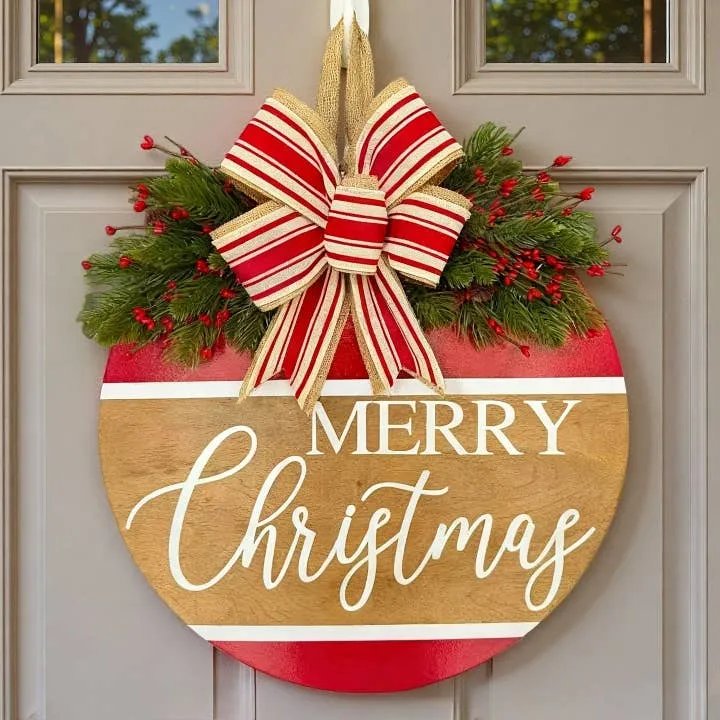
Total: $38–$80
Budget alternative: start with a pre-painted $5 wood circle, print the lettering on waterproof label paper, and finish with clearance ribbon from last season. A realistic $18–$25 build that photographs just as well.
Those thin white lines between the wood and the red bands aren’t decoration — they’re what makes two large color fields feel deliberate instead of accidental. If you’re painting this yourself, lay down 1/4-inch painter’s tape for the stripes and pull it while the paint is still slightly tacky. A crisp edge at that scale reads professional; a fuzzy one reads craft fair. Keep each red band to about 20% of the circle’s height and no more.
11. Layered White Sign Framed by Lit Garland
Hanging the flanking garland so it looks like it grew there:
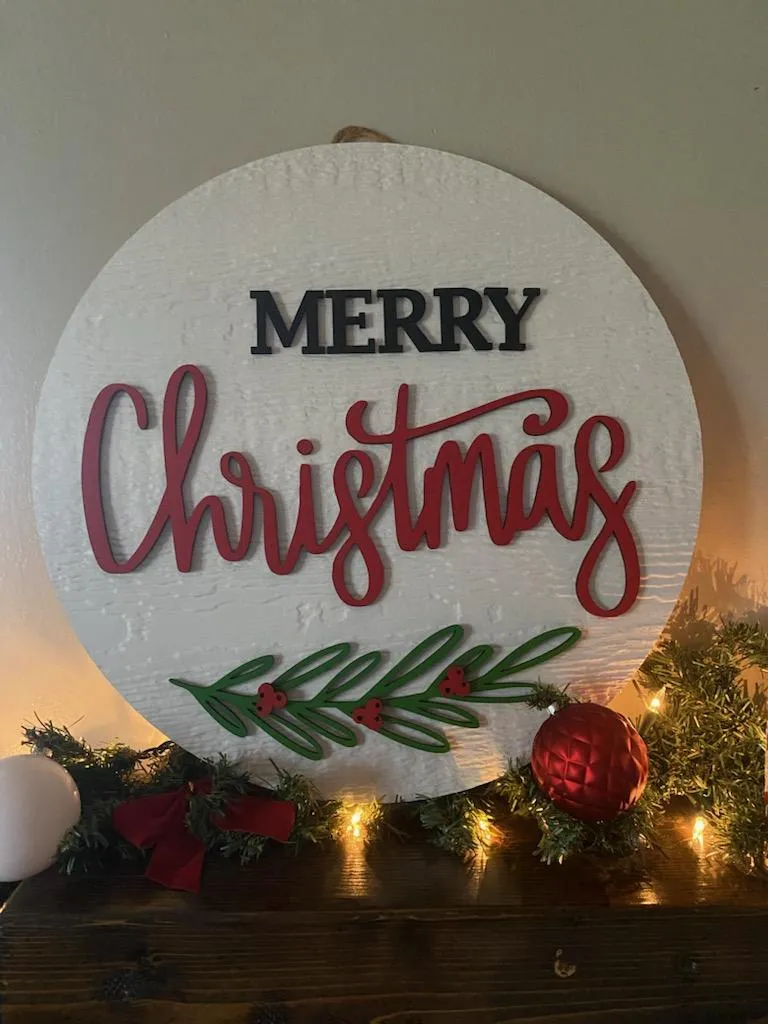
- Measure your door trim and cut garland about 6 inches longer than you think you need.
- Start at the top corner, not the center, and work outward.
- Zip-tie the garland to the trim every 12 inches so it can’t sag.
- Tuck ornaments in where the garland changes direction, not in straight lines.
- Run the lights last, wrapping counterclockwise so the plugs end near the hinge.
Roughly 45 minutes and $35–$60 in materials for an average single door.
60% white, 25% green, 10% red, 5% warm light. The sign itself is nearly blank, which is precisely the point — it gives the garland somewhere to point. To shift the mood, trade the red ornaments for copper and the warm bulbs for amber and the same setup turns a little more vintage. Trade the green garland for snowy flocked branches and the identical sign tells an entirely softer story.
12. Planked Wood Merry Christmas With Black Check Bow
The dimensional lettering is what separates this from a flat circle. Raised white letters throw a shadow down the wood planks, which makes an 18-inch sign readable from across the street — and the plank construction reinforces it, because the horizontal seams give the eye texture before it ever reaches the words. Remove the letters and you have a nice wooden disc. Everything else, the bow, the sprigs, the berries, is support for those four words.
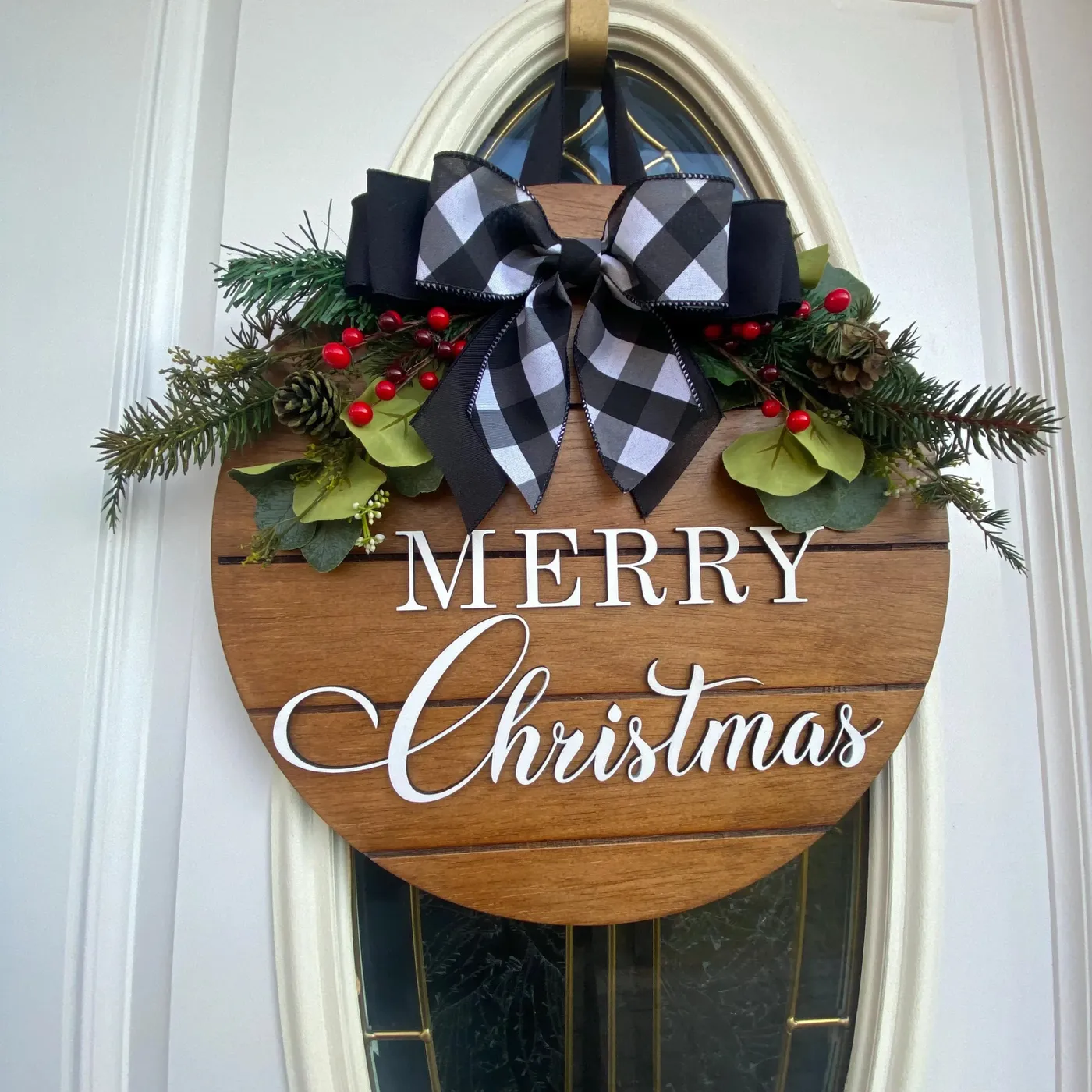
Wood planks and weather don’t mix forever. If this hangs outside, seal the face with two coats of matte polyurethane or the plank seams will open and warp within a season or two. Black-and-white buffalo check also shows every speck of pollen, so plan on a monthly wipe through the holidays. And check your hook rating: plank-built signs run heavier than solid blanks, often two to three pounds, which is more than most suction cups will hold. Compare with Idea #3, where the same check pattern stays flat and featherweight.
13. Wonderful Life Sign on a Snowy Wood Window
The bell and tree graphics around the lettering are what push boutique versions toward $90, and they’re the easiest part to fake. Print simple bell and tree silhouettes on cardstock, cut them out, and glue them slightly proud of the surface for the same layered effect. A $10 wood circle from Walmart, a red paint pen, and clearance ribbon gets you in around $25 total. One place worth spending: a matte sealer, because this one lives on a window and sun fades red ink faster than anything else.
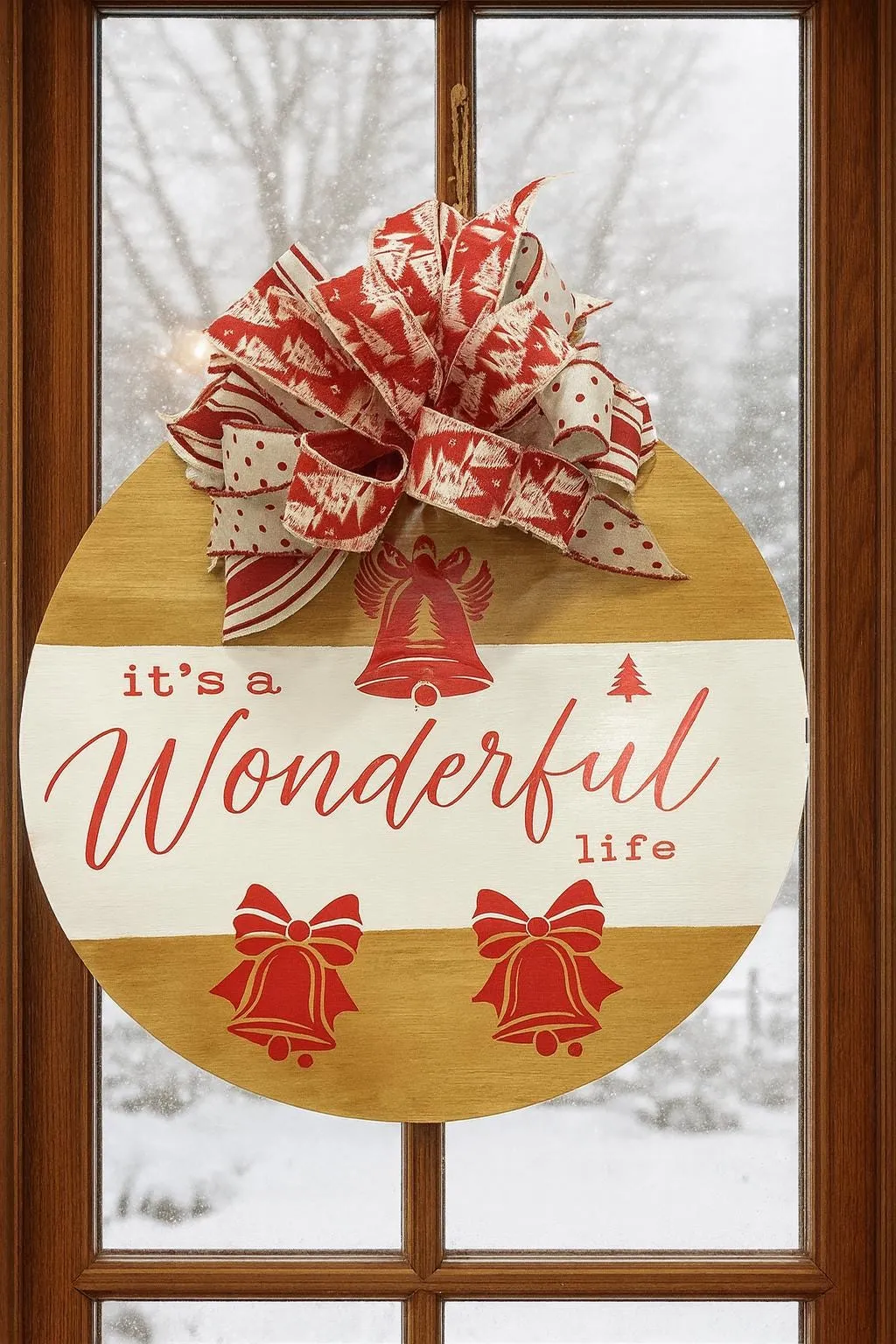
Hanging a sign on glass is a different problem than hanging it on wood. Humidity swings make suction cups fail, so use a small adhesive hook rated 3 pounds minimum and clean the glass with alcohol first. Place the sign so its center sits around 60% of the window’s height — high enough to still see the snow outside, low enough that it doesn’t block the view from inside. Skip this step and you’ll be straightening a crooked sign all December.
14. White Shiplap Nativity Hanger With Burlap Bow
The restraint is the story. A shiplap base, one dark wood cutout, and a bow built from three different ribbons give you pattern without color chaos — everything stays in white, black, gold, and burlap, so the nativity silhouette becomes the focal point instead of the decoration. Splitting the text into raised black and light wood finishes also makes your eye read it in two passes rather than one long line. Quiet, but very deliberate.
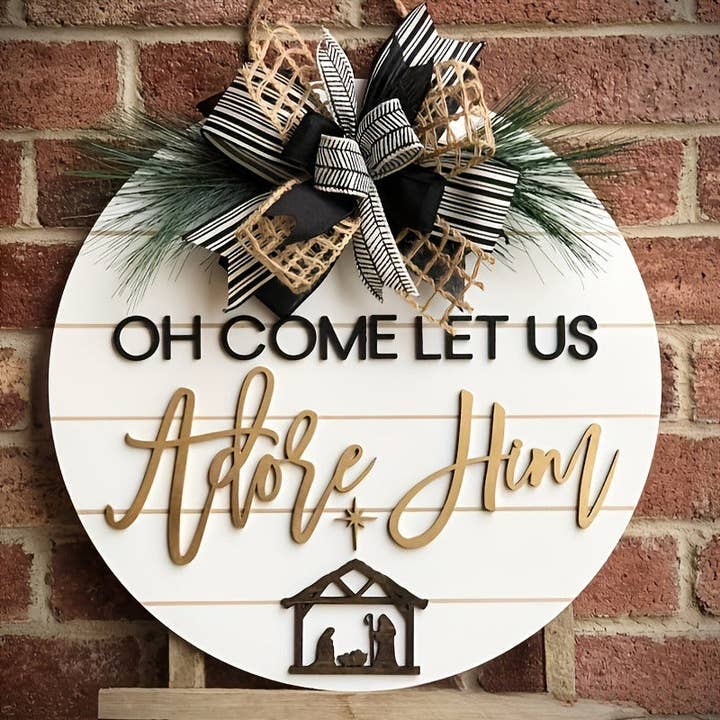
This reads best at 20–24 inches, which means it wants a door at least 34 inches wide and ideally some approach distance, since the nativity cutout gets lost when you’re standing right beside it. Standard 36-inch single doors handle the larger size easily; narrow doors with sidelights cap out around 18 inches. Indoors it also works beautifully on a pantry door or a mudroom entry with 8-foot ceilings or higher.
15. Plush Rudolph Hanger With Tinsel Antlers
If you’re building the plush version, order of assembly matters:
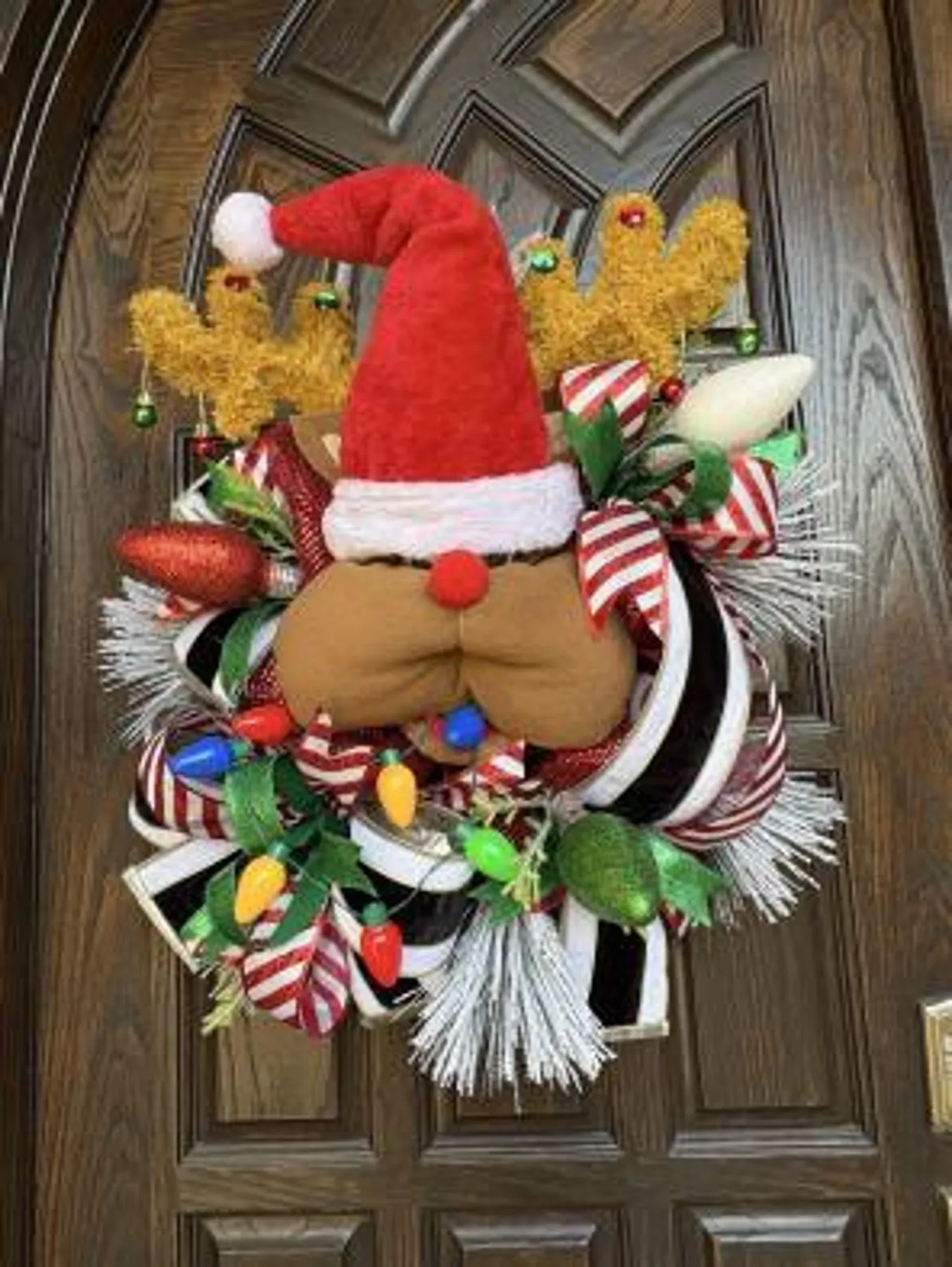
- Cut a 16-inch circle from 1/2-inch plywood and seal both faces.
- Attach the reindeer face with hot glue, then let it cool fully before moving anything.
- Wrap the tinsel antlers around the top edge, twisting the ends to the back.
- Layer the striped ribbons behind the hat so the tails hang free.
- Thread the light strand last, hiding the battery pack behind the sign.
About two hours and $30–$55 depending on the plush piece you start with.
The red nose. It sounds ridiculous, but a plush reindeer without one is just a brown blob on a circle — the nose is the anchor your eye lands on first, and it tells you what you’re looking at in half a second from thirty feet. Everything else, the tinsel antlers, the candy-striped ribbons, the multicolor lights, is texture built outward from that single dot of saturated red.
16. Wood-and-Matte-Black Hanger With Red Lettering
50% natural wood, 30% matte black, 15% red, 5% green. Splitting the circle horizontally lets the top half read as raw material and the bottom as a painted frame, which is why red lettering stays legible on a dark field. For a softer look, keep the split but trade black for deep charcoal and red for burgundy. Reverse the two — black top, wood bottom — and the sign suddenly feels top-heavy, because the darker mass lands above your eye line.
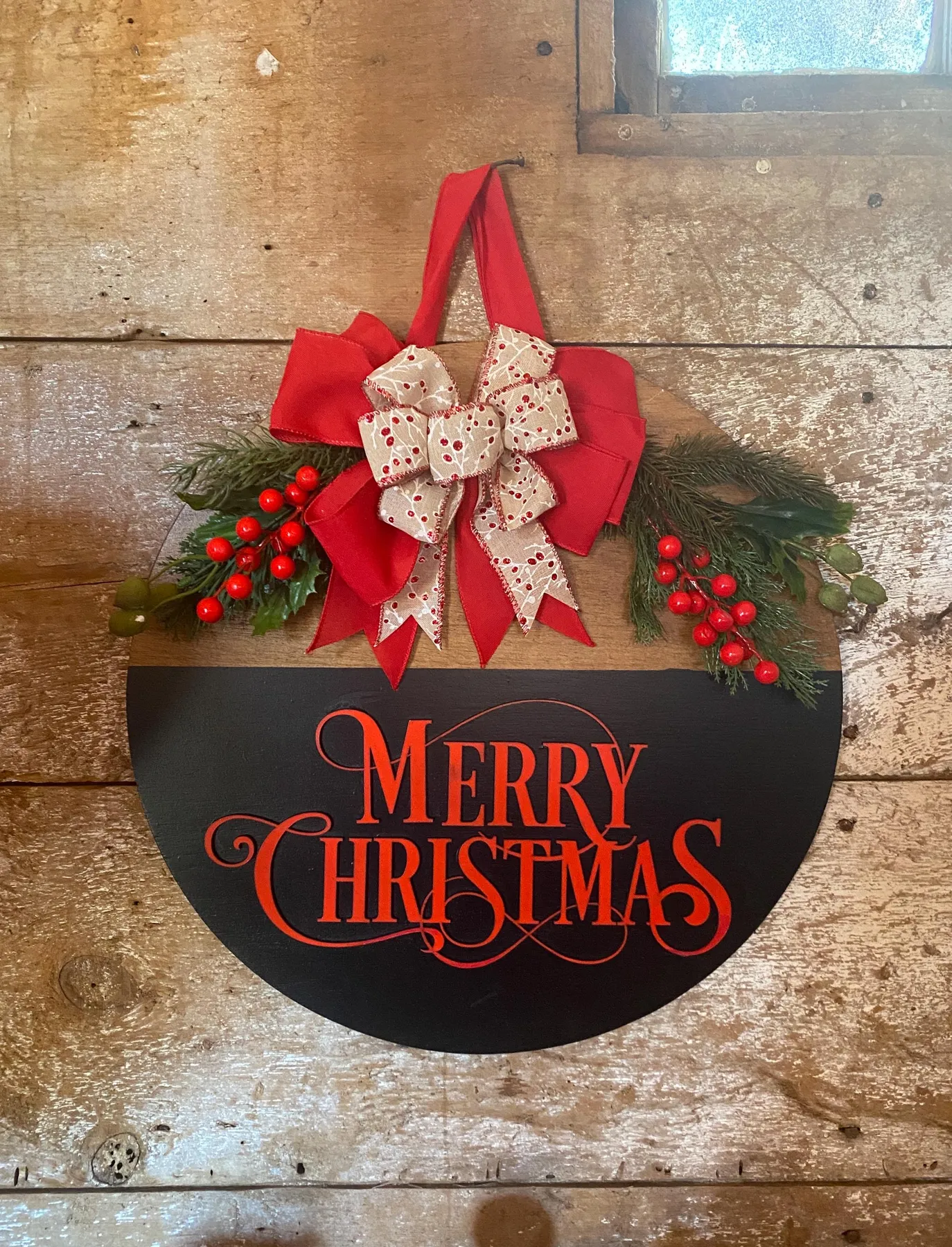
Matte black paint is unforgiving about fingerprints, and a door hanger gets touched constantly. Keep a microfiber cloth nearby and wipe the lower half about once a week; shiny spots where hands have been show up badly under porch light. The wood half wants re-oiling roughly once a year if it lives outdoors, and red fabric bows fade faster than ribbon in direct sun, so expect to replace the bow long before you replace the sign.
17. Frosted Pine Wreath With Let It Snow Cabin
The cabin scene works because the plaque is proportionally small — about one-third of the wreath’s interior diameter. If the sign takes up more than half the opening, the wreath stops reading as a wreath and starts reading as a frame. Keep the sign’s width under 40% of the wreath’s outer diameter, and hang the whole thing so the bottom of the greenery lands at eye height when you’re standing on the walk.
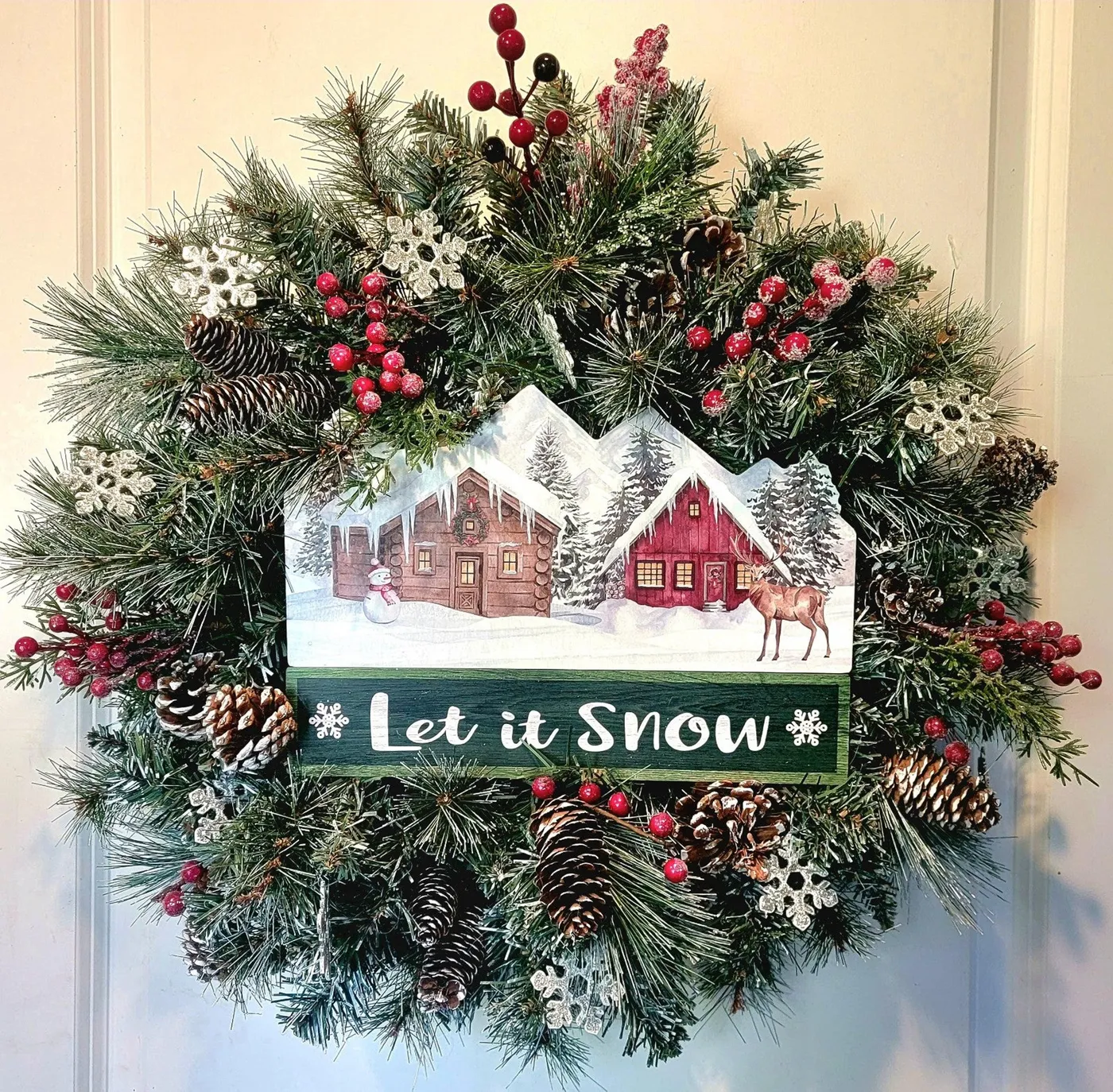
Flocked wreaths are pricey because flocking is a second manufacturing pass. Buy a plain 24-inch faux pine wreath ($18–$25 at Michaels with a coupon) and flock it yourself with a can of spray snow — two light passes, never one heavy one, or it clumps. Add pinecones from a craft bag, red berry picks at about $1 a stem, and a printed sign glued to foam board. Total lands near $45 instead of $120, and you control exactly how frosty it gets.
18. Dark Red-Brown Wood Sign With Burlap Plaid Bow
Dark wood signs photograph beautifully and hide imperfections, but they also disappear against a dark-stained door. If your entry is wood-toned, the white script will be the only thing visible from the street, so it needs to be crisp — any wobble in hand-painted letters will show from the sidewalk. Burlap in the bow also sheds fibers for weeks and snags on screen doors. And if your door catches full sun, plan on re-sealing the wood every fall.
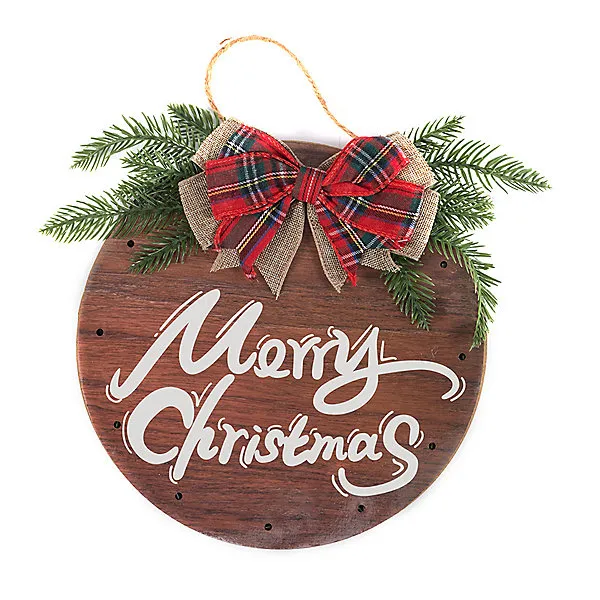
Contrast, texture, and a tightly controlled palette. White script on deep reddish-brown wood gives you roughly a 12:1 value contrast, which is why this sign stays legible when other hangers read as blurry blobs. The burlap and the red plaid ribbon pair two different textures in the same color family, so the bow registers as one object rather than two competing ones. The jute twine loop keeps the top quiet, so nothing fights the greenery.
19. Gray Door Garland With Urn Planters and Truck Sign
This is a full-door treatment, and it needs a door worth dressing: 36 inches wide at minimum, with at least 18 inches of clear wall on each side for the planters. On a narrow entry or a shared condo corridor, the urns crowd everything and you’re better off with one statement piece instead. Ceilings above the door should be 8 feet or more, since the garland adds visual height you don’t want compressed into a small facade.
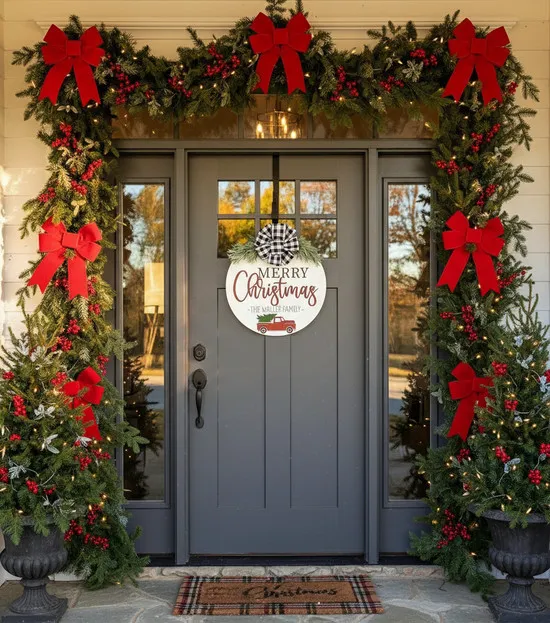
Before you commit:
- Measure door width plus frame — garland needs 6 extra inches per side.
- Confirm outdoor outlet access if you want the garland lit.
- Check whether your HOA restricts door color or exterior decor.
- Weigh the sign; a truck-sign circle with hardware can hit 3 pounds.
- Decide where the urns live for the other ten months of the year.
20. Plank Hanger With Green Tree and Gold Stars
- Round wood plank blank, 18 inch: $14–$30
- Dark green tree cutout plus craft paint: $8–$16
- Five gold glitter star accents: $3–$7
- White paint pen for the script lettering: $4–$8
- Red velvet ribbon and burlap strap: $7–$15
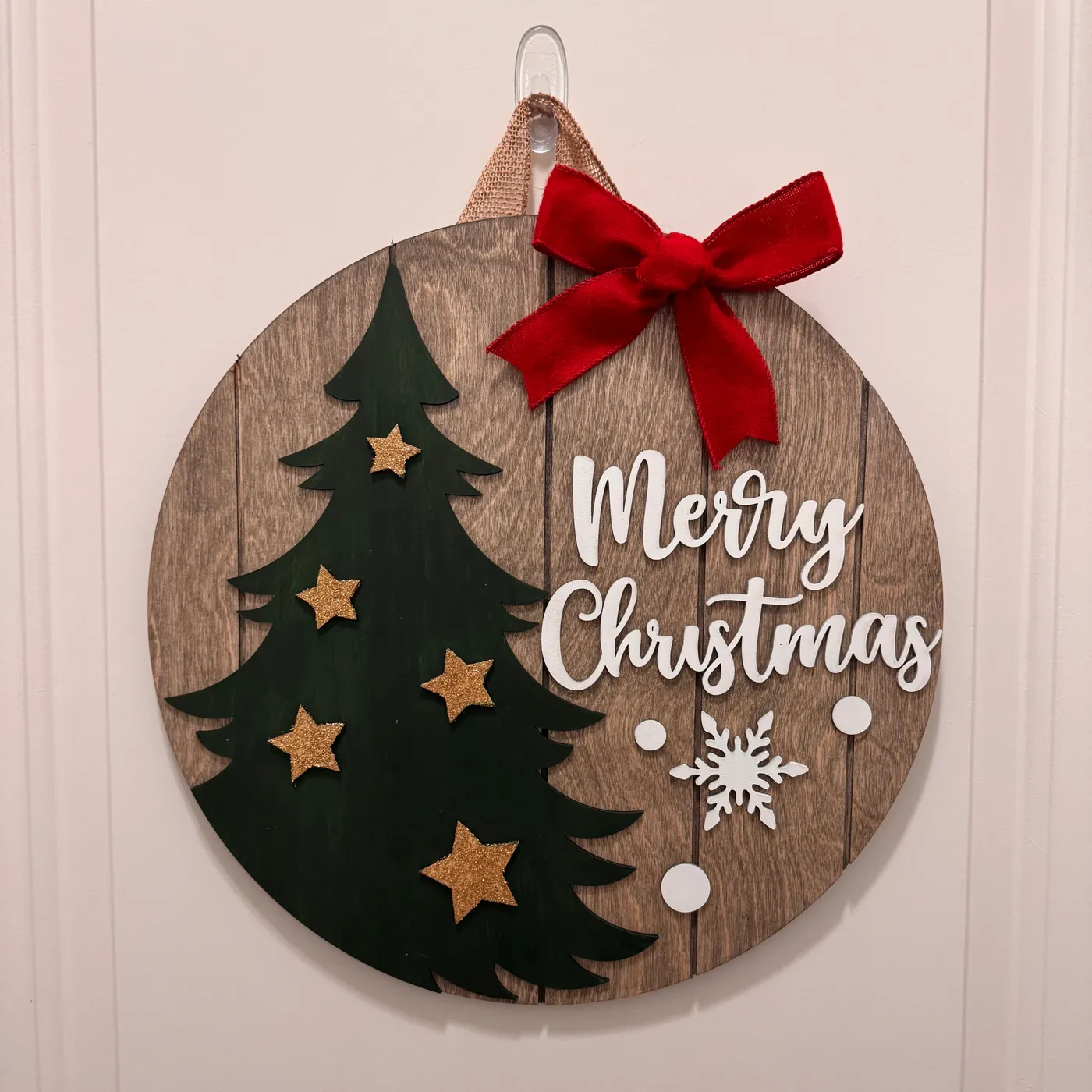
Total: $36–$76
Budget alternative: skip the cutout entirely and paint the tree straight onto the blank with two coats of craft green. Saves $10–$15 and looks nearly identical from the sidewalk.
Getting five stars evenly spaced on a tree cutout without eyeballing it:
- Cut a paper template of the tree and fold it in half vertically.
- Mark placement points at roughly 15%, 35%, 50%, 65%, and 85% of the height.
- Punch the template and pencil-dot through onto the painted tree.
- Set each star with tweezers and press firmly for five seconds.
- Seal with matte spray so glitter stops shedding on your threshold.
Twenty minutes and about $5 in supplies.
21. Sage Green Door With Snow-Dusted Evergreen
Sage green doors have been climbing on Pinterest for three years running, and the reason is photographic: green reads as evergreen against snow in a way red-on-white never quite does. The matched wreath-and-garland pairing is a 2026 habit too — designers are treating the door as one composition instead of buying a single wreath and calling it finished. It’s a look with real staying power, because the door color itself isn’t seasonal.
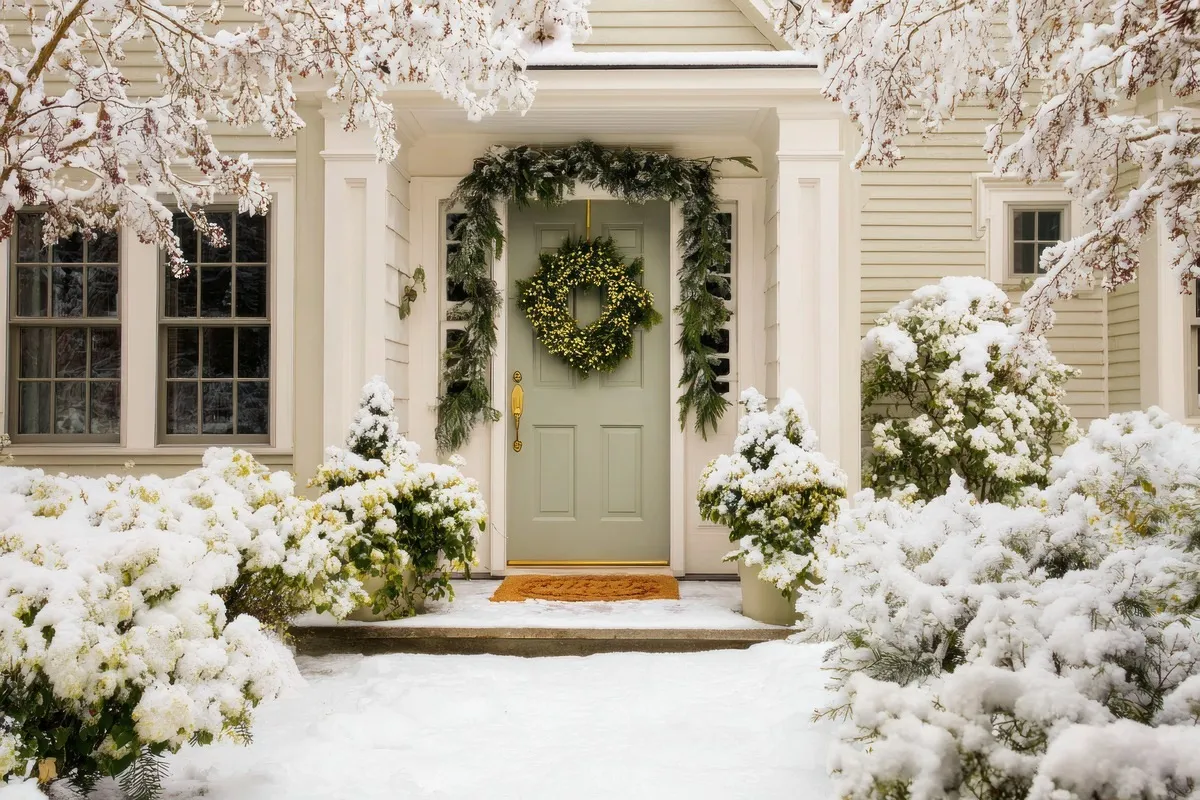
Sage green with cream siding and white trim flatters almost any entry, but wreath size should match door width: 24 inches on a 36-inch door, 30 inches on a 42-inch door or wider. Anything under 20 inches looks like a dinner plate on a large door. The garland should run close to the door’s height minus about a foot at the bottom, so snow doesn’t pile up against it.
22. Gingham Bow Wonderful Life Wood Circle
- Round wood blank, 16–18 inch: $10–$26
- Off-white paint plus red paint pen: $6–$12
- Red gingham ribbon, two rolls: $8–$16
- Red-dotted off-white ribbon: $4–$9
- Two small red bell ornaments: $4–$8
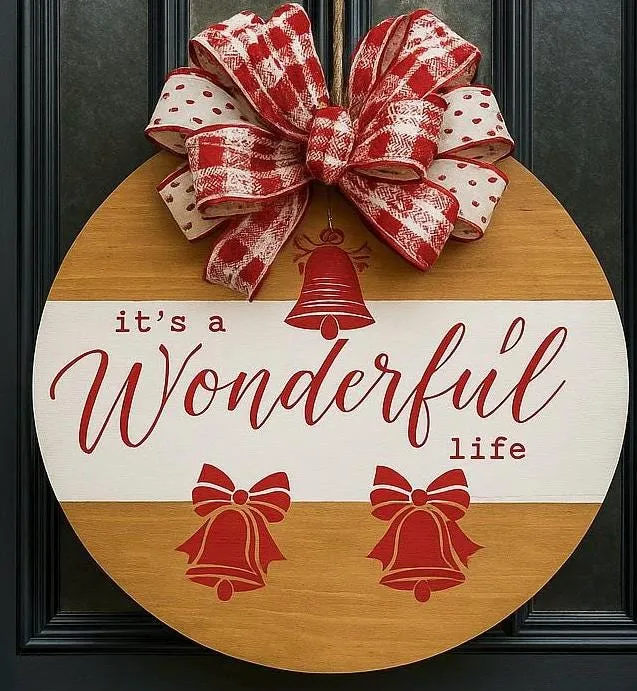
Total: $32–$71
Budget alternative: buy the blank already sealed at a craft store, use a printable decal for the lettering, and pull bell ornaments off an old garland. A realistic $20 build that reads the same from five feet away.
That off-white horizontal band across the middle is the quiet hero. It’s just a painted stripe, but it separates the wood grain from the lettering, gives the red text a clean field to sit on, and echoes the cream ribbon in the bow so both ends of the sign look related. Without it, red script on bare wood turns muddy fast. Almost any two-color circle benefits from a band like this — it’s the cheapest design move on the piece.
23. Twine-Hung Santa Portrait Circle
Illustration loyalty. This Santa is drawn in a warm, mid-century storybook style rather than a photoreal one, and that’s what makes a wooden disc feel like an heirloom instead of a novelty. The holly wreath surrounding him repeats the red and green from his own coat, so the composition closes back on itself, and the gold accents warm up what could otherwise be a very primary-color scene. Nothing here is trend-driven, which is exactly why it will still work in ten years.
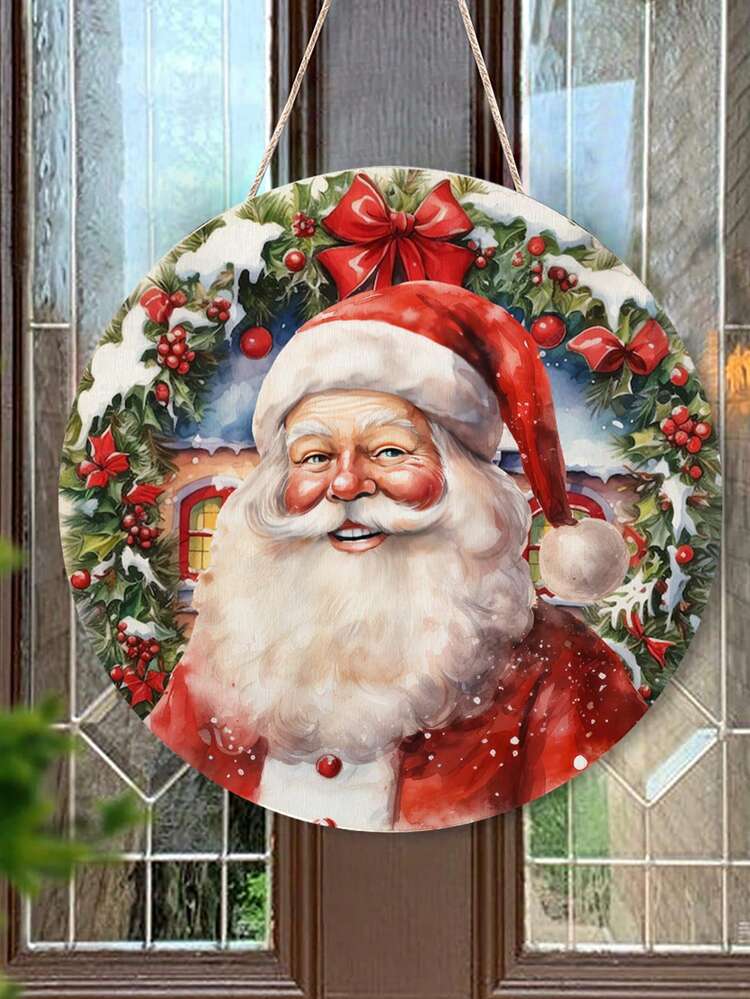
If you can’t find an illustration you love, print one. Public-domain vintage Santa images are free on museum and library archives, and a $2 copy-shop print on matte paper looks convincing when decoupaged onto a $10 wood circle. Mod Podge, a foam brush, and a jute loop put you under $20 total. Buy the bow pre-made for $5 rather than building one from scratch — nobody inspects your ribbon work from the sidewalk.
24. Pinecone and Dried Orange Wreath With Moss Balls
Dried orange slices are the cheapest way to make a wreath look expensive:
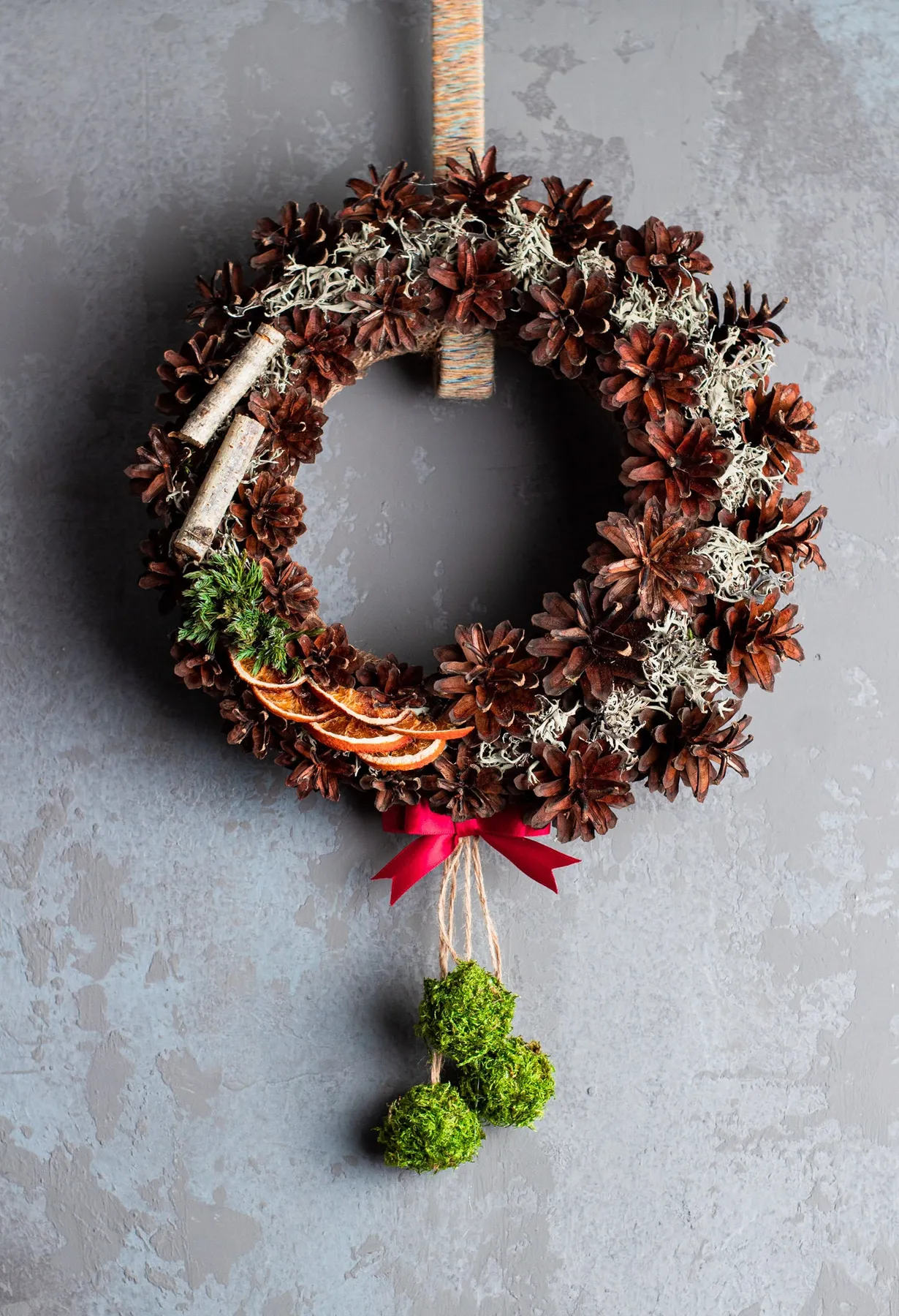
- Slice oranges 1/4 inch thick and blot them dry.
- Bake at 200°F for three to four hours, flipping once, until leathery.
- Cool completely — warm slices crack when you wire them.
- Wire each slice to the frame at a slight angle so it catches light.
- Add lichen and birch bark last, tucking rather than gluing.
Two hours including oven time, roughly $25 in materials.
Moss balls on twine look wonderful in photographs and shed like crazy. If pets or toddlers are anywhere near your entry, expect green crumbs on the threshold within a week. Dried orange slices also darken in sunlight, so plan to replace them yearly. Pinecone wreaths are heavy, too — wire yours to a proper metal frame, not a grapevine base, or the whole thing sags by New Year’s.
25. Blessed Sign With Magnolia and Eucalyptus
Roughly 45% green foliage, 25% cream, 20% neutral ribbon, 10% navy. Navy is the surprise here — it reads as a neutral next to cream magnolias and keeps the wreath from sliding into a green-and-red cliché. Swap the navy ribbon for black and everything sharpens up; swap it for rust and you get a warmer, more autumnal feel that still works in December. The gingham and the burlap stay in every version.
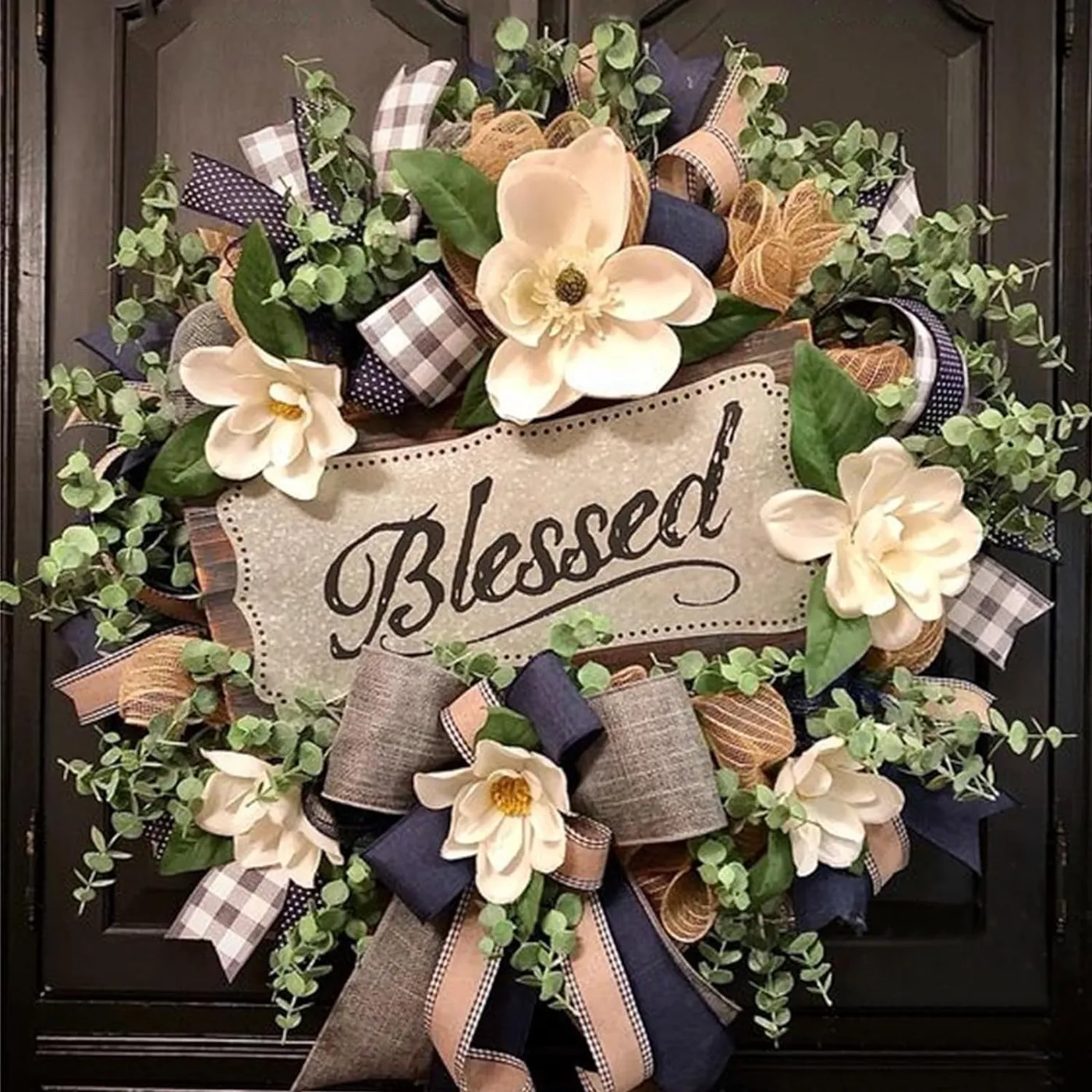
Eucalyptus is the expensive part and the most forgiving to fake. A bunch of faux eucalyptus at Walmart runs $5–$7 and covers a 20-inch frame; magnolia blossoms from the same aisle are about $4 a stem and two or three is plenty. The galvanized-look plaque is a $6 blank with a stencil. All in, roughly $30 versus $110 for a florist-made version. For another botanical direction that leans even more natural, see Idea #24.
26. Crisp White Circle With Red Plaid Bow
White signs show everything — pollen, spider webs, and the occasional muddy handprint. Keep a magic eraser on hand and expect to use it monthly. The bigger issue is sun: white paint and red plaid ribbon both yellow over time, and the ribbon goes first, usually within one season on a west-facing door. Storing it indoors in a breathable cotton bag beats a plastic bin, which traps moisture and dulls the paint finish.

A 16–18 inch circle is the sweet spot here. The crisp white layout needs to stay visually light, and pushing to 22 inches starts to feel like a parking sign. It suits standard 32–36 inch doors and looks especially strong on dark doors, where the white does the work of a spotlight. On very wide double doors, hang one on each leaf rather than one oversized single.
27. ‘Tis the Season Character Hanger With Striped Bow
With four illustrated characters in a small space, spacing is everything. Give each motif about the same visual footprint — roughly 3 inches on a 16-inch disc — and leave a consistent 1.5-inch margin from the painted red bands at top and bottom. Cluster the gingerbread man and candy cane slightly closer together, and let Santa claim a little more room. Even spacing makes a shelf-bought sign look designed; uneven spacing makes it look like clip art.
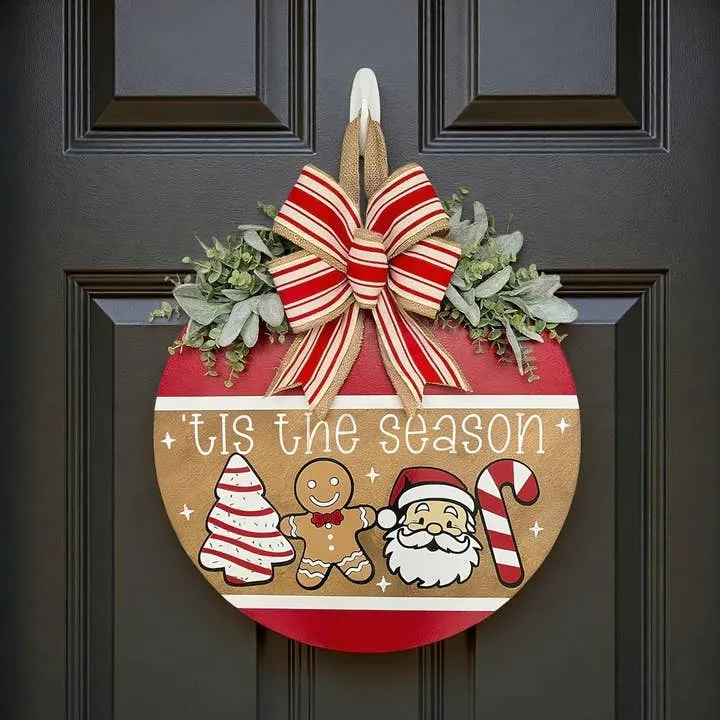
Symmetry plus silliness. The red bands act like a frame, so the eye reads the middle as a stage — and once it’s framed, four cartoon characters stop feeling cluttered. The oversized striped-and-burlap bow does heavy lifting too, adding volume and pattern at a scale the small illustrations can’t compete with. Take away the framing and this same sign would look chaotic.
28. Half-Wood Half-White Sign With Sleigh Bells
Two-tone signs like this photograph best at 18–20 inches, because the split line needs enough width to read as deliberate rather than accidental. That size suits doors 32 inches and wider, and ceiling height doesn’t matter much since the sign is short. The bells and frosted greenery add about 4 inches above the circle, so measure your door’s top rail before ordering — a 20-inch sign with a tall bow crowds a standard 80-inch door frame more than people expect.
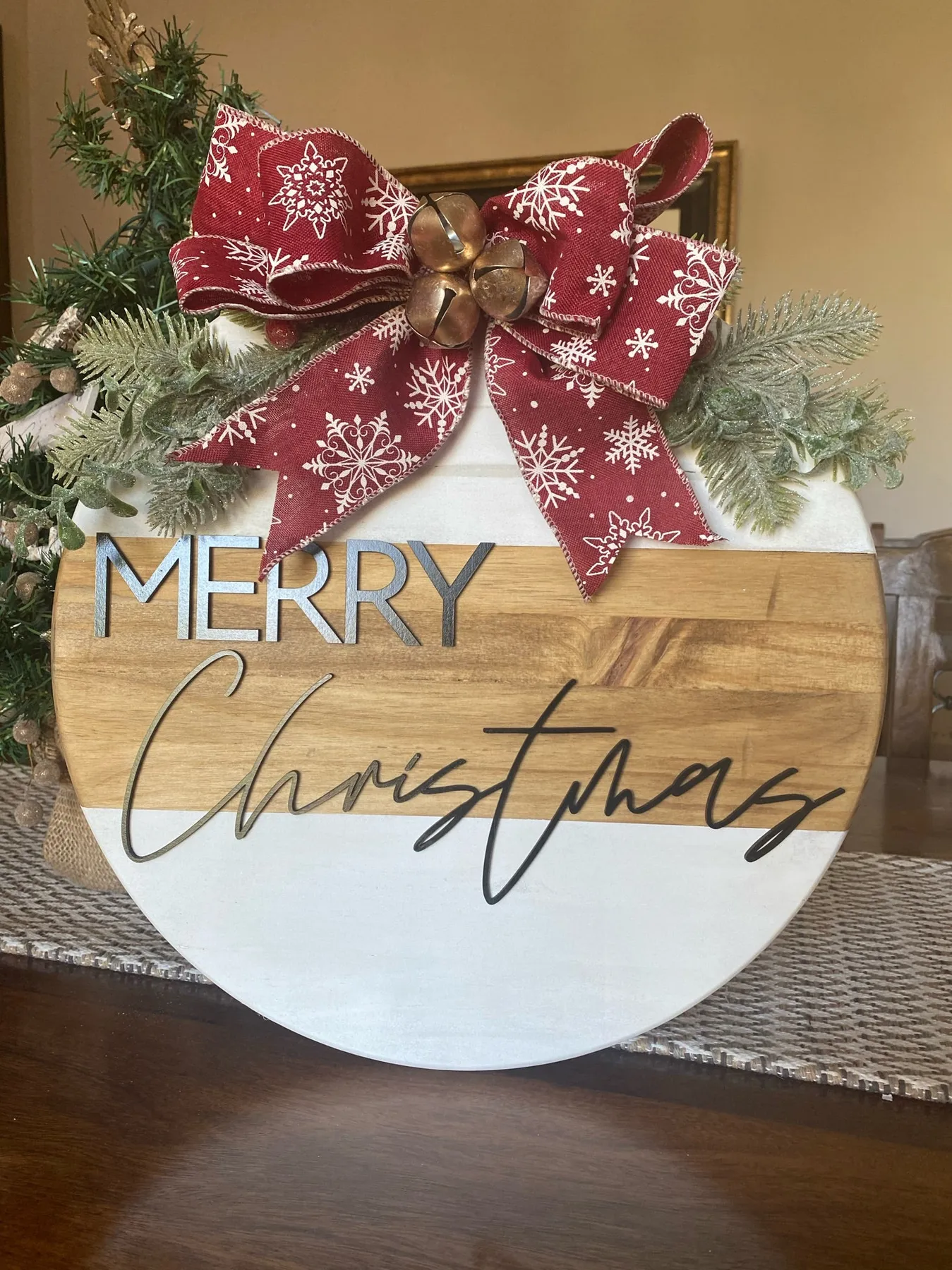
Before you commit:
- Measure from the top of the door to the handle; you want 26 inches or more.
- Check the hook weight rating — bells and wood push toward 2.5 pounds.
- Confirm the letter finish (metallic vs. matte) before ordering.
- Decide inside or outside; gold bells tarnish quickly in coastal air.
29. Dark Stain Merry And Bright With Draped Fairy Lights
Running fairy lights on a wood sign without a visible cord:
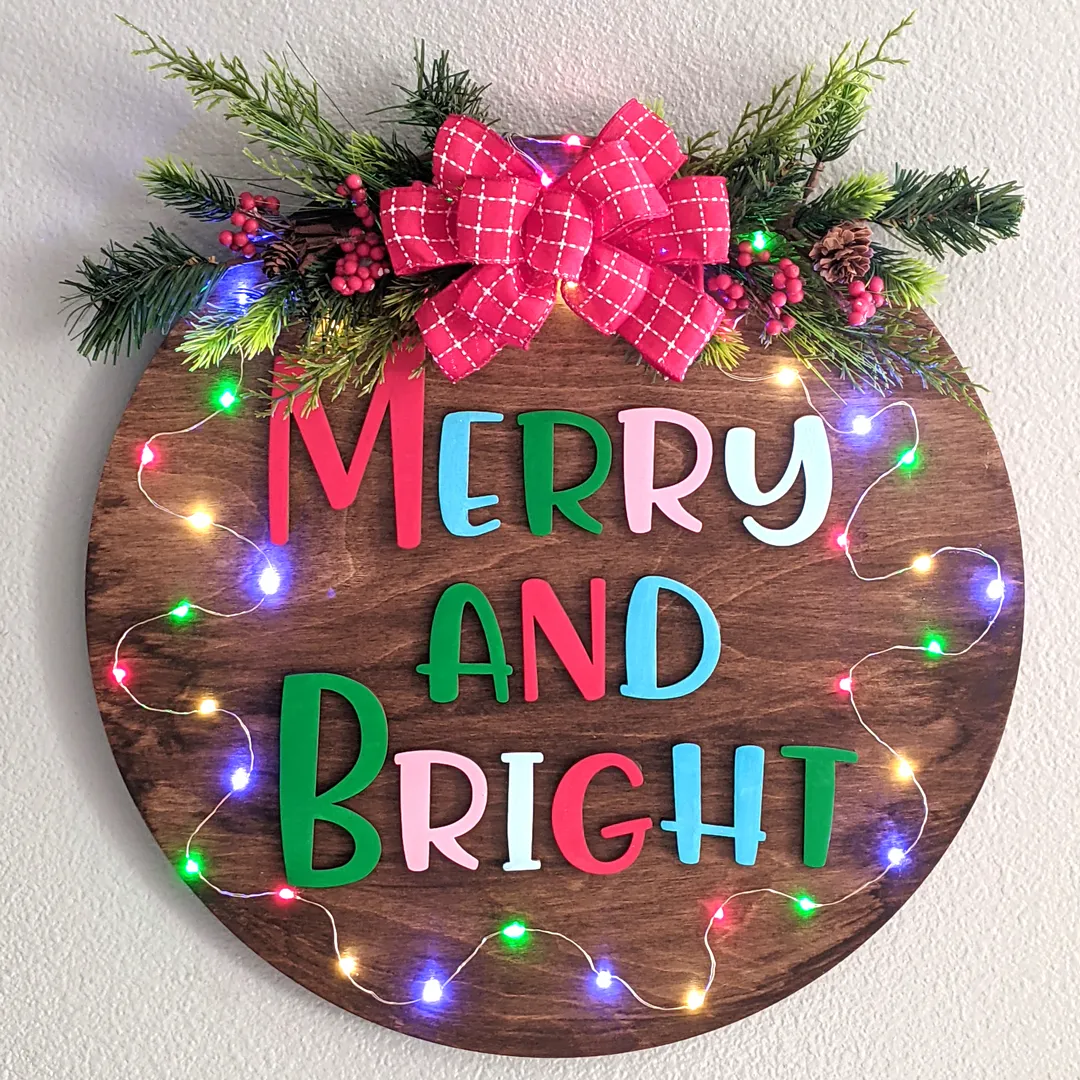
- Drill a single 1/4-inch hole in the back, near the top edge.
- Feed the strand through from the front, leaving the first bulb flush.
- Drape in a loose S-curve and tack each bend with a dot of hot glue.
- Route the tail and battery pack back through the rear hole.
- Mount the pack in a small zip pouch behind the sign.
About 40 minutes; the light strand runs $6–$12.
- Round dark-stained wood blank, 16 inch: $10–$24
- Colorful block letters, pre-cut or printed: $8–$18
- Faux pine, berries, and mini pinecones: $8–$16
- Red and white plaid bow: $5–$12
- Multicolor LED strand with batteries: $6–$14
Total: $37–$84
Budget alternative: hand-paint the letters instead of buying cutouts and use a $3 dollar-store strand — you still get the glow, for closer to $25.
30. Oversized White Ornament Sign With Navy Lettering
If you’re hanging an oversized circle on shiplap, find a stud or use a French cleat — a 24-inch wood ornament can weigh 8–12 pounds, and most adhesive hooks top out at 5. Leave at least 6 inches between the sign and the tree too; overlapping branches make the lettering unreadable and the needles scratch paint. On white shiplap, add a thin dark outline to the sign or it visually dissolves into the wall. See Idea #26 for a similar white-on-white balance handled at a smaller scale.
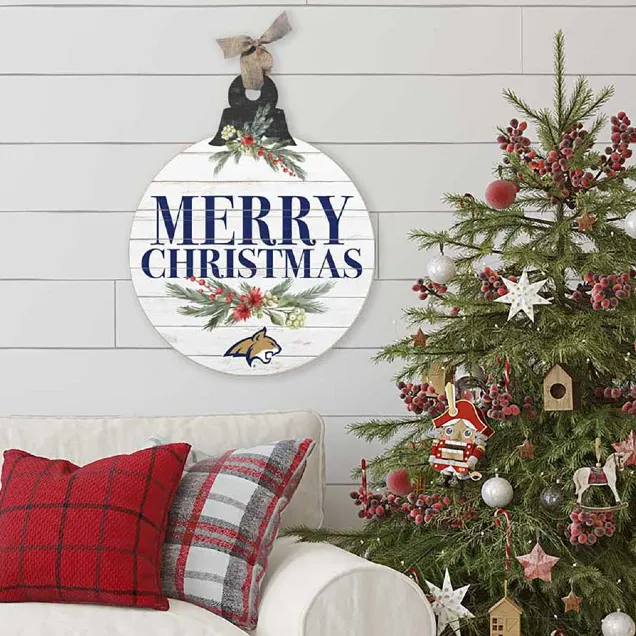
70% white, 20% navy, 10% red and green. Navy lettering is the smart choice on a white circle because it holds up at distance better than red, and it reads as school spirit rather than Christmas-only — which matters if this is a team sign. Swap navy for black for something more neutral, or deep green to lean traditional. The painted berries stay red in every version.
31. Red Christmas Nuthouse Sign With Cheers Glasses
Humorous signs are a coin flip with guests. About half your visitors will love it; the other half will ask what it means, and you’ll explain it every year. That’s fine when the door is yours to decorate — less fine in a shared hallway or a rental with a strict lease. Also check the lettering depth: raised white letters on red can snag on a screen door and chip at the edges. A quick clear coat before it goes up solves most of that.
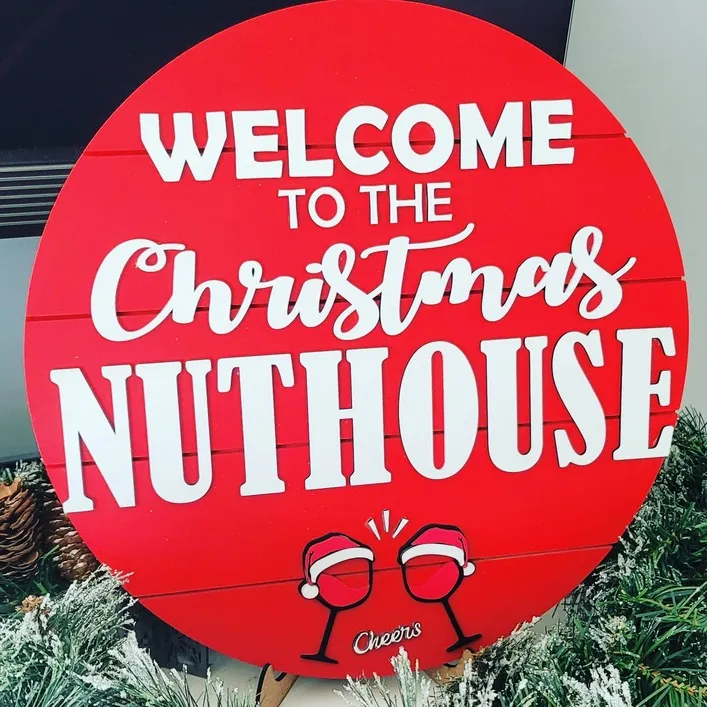
Wine-humor door decor has quietly become its own category online, and it’s a reaction to years of matching-farmhouse sameness. Buyers in their thirties and forties are choosing signs that sound like them rather than signs that match a catalog, and the round format makes a joke feel like a design decision instead of a novelty. This one will keep selling; the humor ages better than the trend does.
32. Split Dark-and-White Sign With Plaid Pinecones
55% dark brown stain, 30% white, 10% red-and-black plaid, 5% green. The high-contrast split is what makes black script legible without clutter, and placing the plaid bow off-center keeps the composition from feeling like a bullseye. Reverse the proportions — white on top, dark below — and the sign suddenly demands a heavier bow to stay balanced. Keep the dark half up top if you want the greenery to feel like it’s growing out of the wood itself.
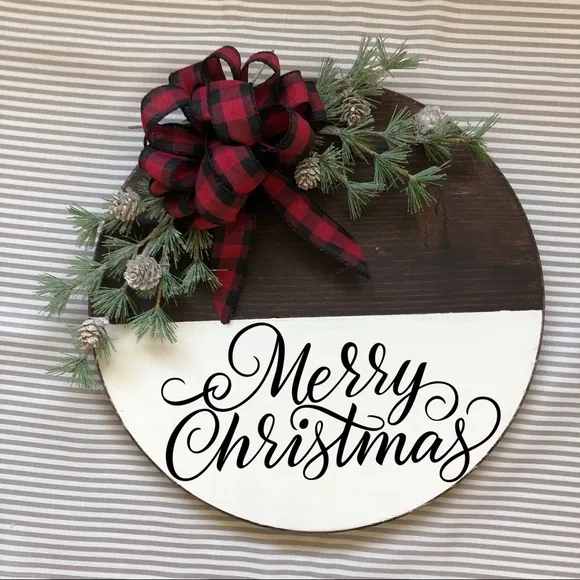
Two-tone signs are easy to fake because they’re literally two paint jobs. Stain the top half of a $10 wood blank, mask it off, paint the bottom white, then hand-letter in black. Plaid ribbon is about $4 a roll at Walmart and frosted pinecones come in a $6 bag at Michaels, putting you near $24 versus $85 for a boutique piece. Compare with Idea #16 — same split idea, flipped colors, very different mood.
33. Typography Ribbon Wreath With Gold Ornaments
Building the layered bow that makes this wreath read expensive:
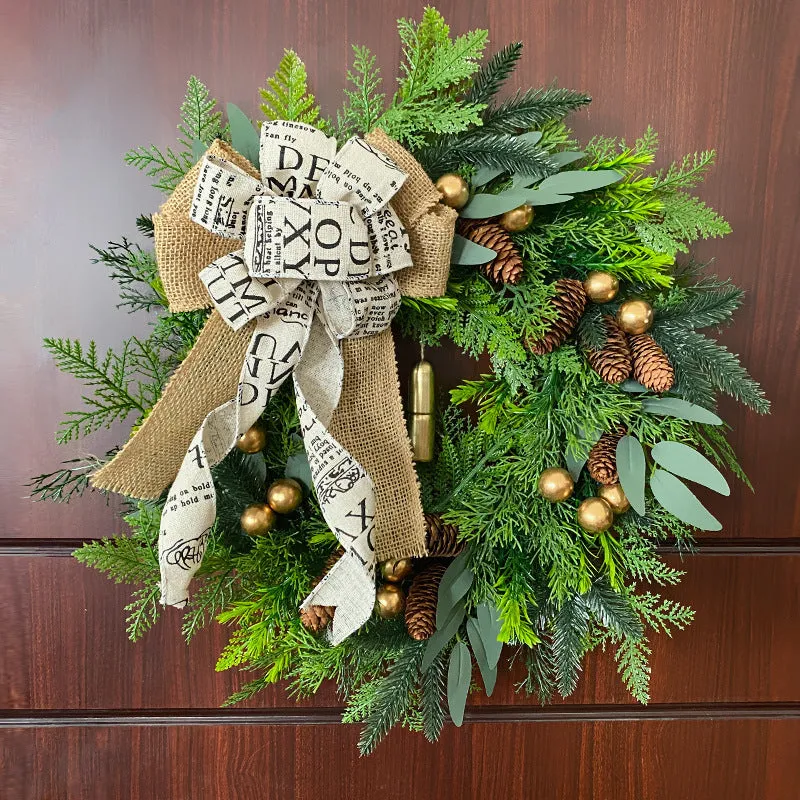
- Cut 4 yards of burlap ribbon and 3 yards of the printed cream ribbon.
- Form six loops with the printed ribbon, pinning each as you go.
- Layer the burlap bow behind it, offset about a half inch lower.
- Wire the two together at the center with florist wire.
- Attach the elongated gold ornament so it hangs just below the loops.
Thirty minutes and about $18 in ribbon.
Typography ribbon is a pattern, not a text message — so treat it like a stripe. Stand back six feet before you commit. If you can’t read the words, the bow is working. If you can read them clearly and they’re fighting the greenery, flip the ribbon so the printed side faces inward and let the cream side do the talking. Same ribbon, two completely different effects.
34. Bright Yellow Reindeer Welcome Sign
Bright yellow is a risk that pays off against a dark wood door — it’s the highest-contrast pairing available, and it keeps a small sign visible from the sidewalk even in flat winter light. The dark blue WELCOME text repeats those cool tones, and the red nose gives you exactly one warm accent to land on. The snowflakes are the quiet hero: they echo the white lines in the plaid ribbon and tie a very colorful sign back to the door it hangs on.
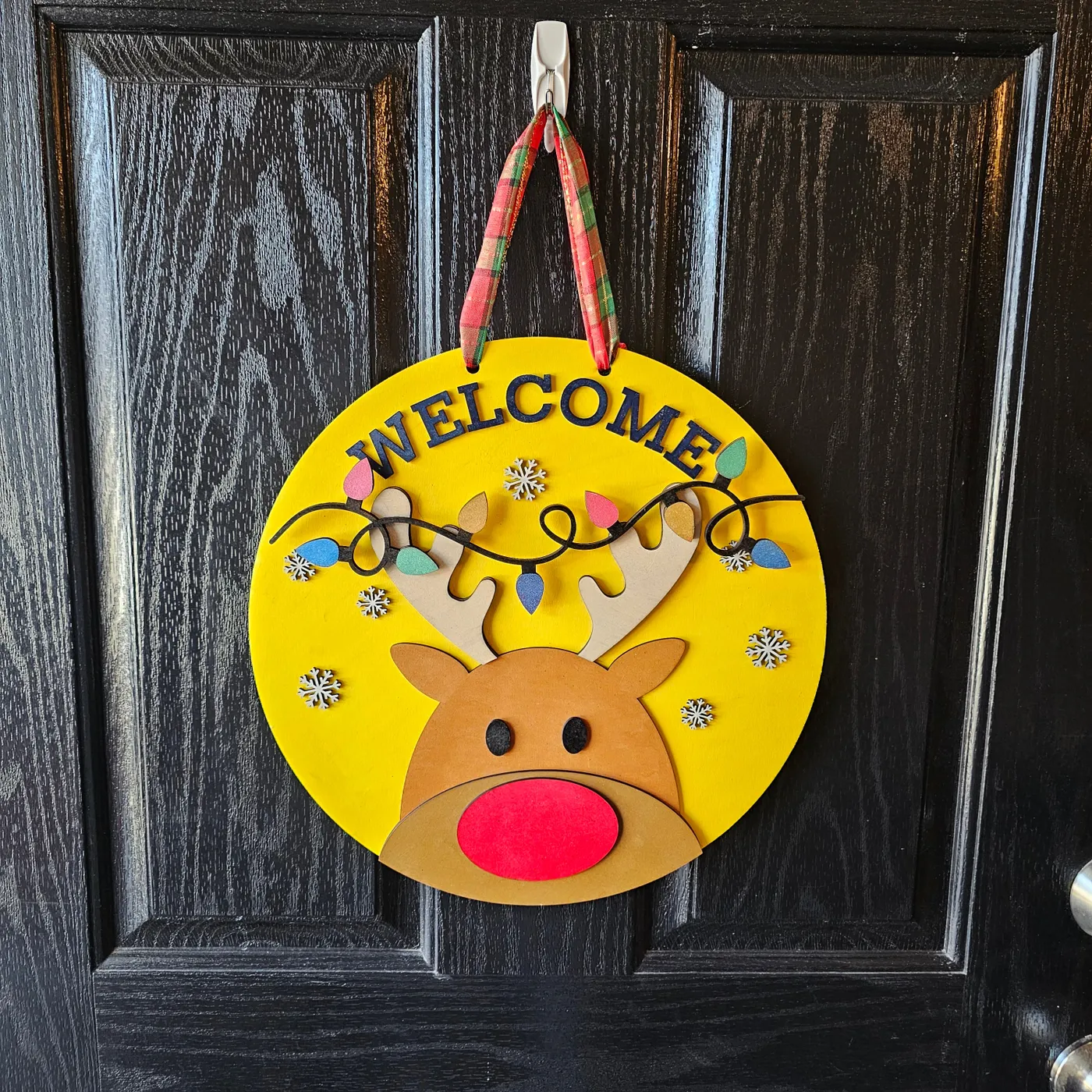
Yellow paint fades faster than any other color in sunlight, so expect this one to soften after a season or two on a south-facing door; a clear UV topcoat buys you an extra year. Plaid ribbon hangers fray at the cut ends, so seal them with a quick pass of a lighter. And a plastic hook on a wood-grain door leaves a mark over time, so move it a half inch each spring. See Idea #2 for the same reindeer theme in a palette that lasts longer.
35. Red Wagon Wheel Over the Stone Fireplace
A 24-inch wagon wheel wants a fireplace wall with real width — think a 6-foot-plus stone surround and 9-foot ceilings, or the piece starts to look like a spare part. On a standard 5-foot surround, size down to 18 inches or hang a swag of greens instead. This is the format for that awkward expanse of stone above a mantel where nothing else works; hang it so the bottom of the wheel sits 40–48 inches above the mantel shelf.
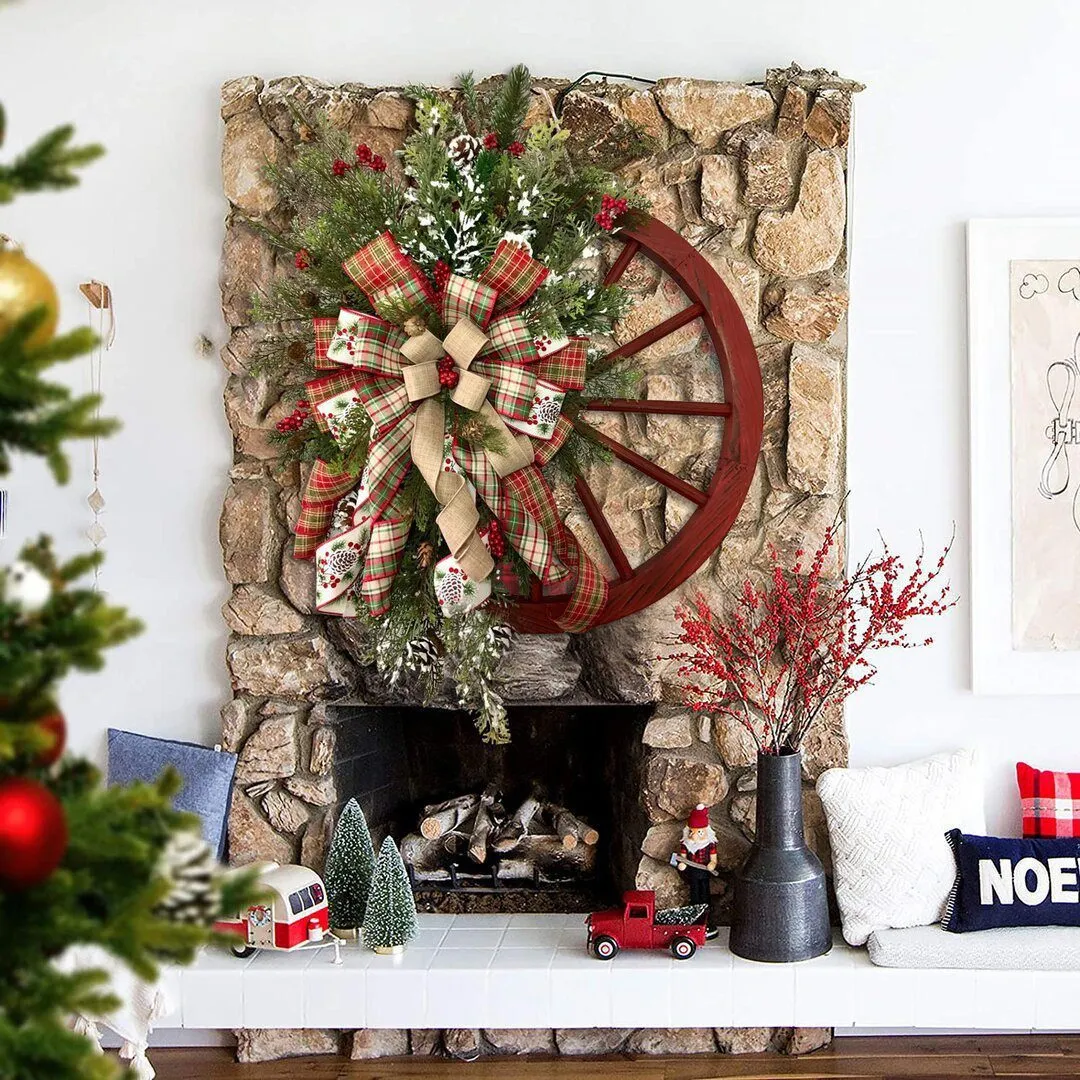
The wheel itself. A round swag of greens and berries would vanish into the stone, but red painted spokes give you a graphic shape that reads instantly and a built-in structure for everything else to attach to. Take the wheel away and it’s just another garland. If you find one at a flea market, check for loose spokes and repaint before you decorate — grease and rust make ribbon and hot glue fail.
One Round Sign, Thirty-Five Ways to Say It
Start with the door you actually have — its color, its width, how much light hits it every afternoon — and one of these thirty-five will click into place. Pick a palette you can live with for six weeks, hang it at 60 inches, and let everything else in the entry fall in line behind it.
📌 Pin your favorite to a front-door board now, so next November it’s waiting for you instead of the other way around.
