
35 Stunning Black Christmas Tree Decoration Ideas You Need to Try in 2026
You know that feeling when you’ve saved forty black Christmas tree photos and still can’t picture one in your own living room? Same. So we went digging through Amazon, Target, Walmart, HomeGoods, and Etsy and pulled out 35 black Christmas tree ideas that actually hold up in a real house — everything from $8 ornament packs to $1,200 flocked statements.
Inside you’ll find monochrome modern, flocked wintry glam, moody velvet and charcoal, black-and-white graphic, and a couple of genuinely colorful wildcards. We compare budget and luxury versions side by side, and every idea is linked so you can shop it directly.
Black trees are having their biggest season yet in 2026, driven by the same moody, high-contrast interiors that have dominated Pinterest for two years running. And stay until the end — we break down the most common mistakes that can ruin these looks. 📌 Save this to Pinterest for later — you’ll want to revisit these ideas.
1. Glass Baubles and Gold Snowflakes on Black
On a black tree, the lighting ratio matters far more than the ornaments. For a 7.5-foot black tree, plan on 700 to 900 warm white micro lights and wrap them branch by branch instead of draping one strand down the outside. Translucent glass baubles work hardest on the inner two-thirds of the branches, where the glow passes through them from behind — space them roughly 6 to 8 inches apart and let the opaque gold snowflakes handle the outer layer.
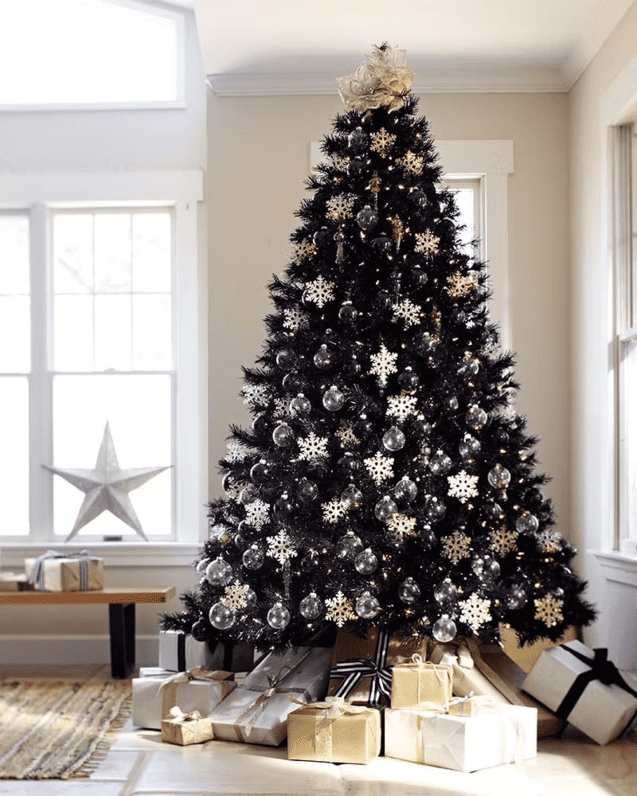
The reason this reads as elegant instead of heavy is contrast cycling: matte black base, then a glossy or translucent element, then a warm light source, repeating around the whole tree. The gold and silver snowflake cutouts add flat matte shapes that break up all that shine. And because the beige walls and wide windows stay quiet, nothing competes with the tree.
- 7.5 ft black artificial tree: $120–$400
- 700–900 warm white micro lights: $25–$60
- Translucent glass ball ornaments (60–80 count): $60–$150
- Gold and silver snowflake cutouts: $20–$45
- Wrapping paper, ribbon, gift tags: $25–$50
- Textured gold bow topper: $15–$40
- Total: roughly $265–$745
Budget alternative: save the glass look for the top third only. A 30-count set of clear glass balls reads the same from across the room, and the bottom half can be filled with dollar-store metallic picks.
2. Glossy Black and Silver Monochrome Moment
The single element that makes this tree land is the wrapping paper. Black paper with crisp white ribbon turns the space under the tree into part of the design instead of an afterthought — it carries the same story from the branches down to a white floor so your eye never hits a stop sign at the base. Swap those gifts for a red-and-green pile and the whole room snaps back to ordinary Christmas. Same tree, completely different effect.
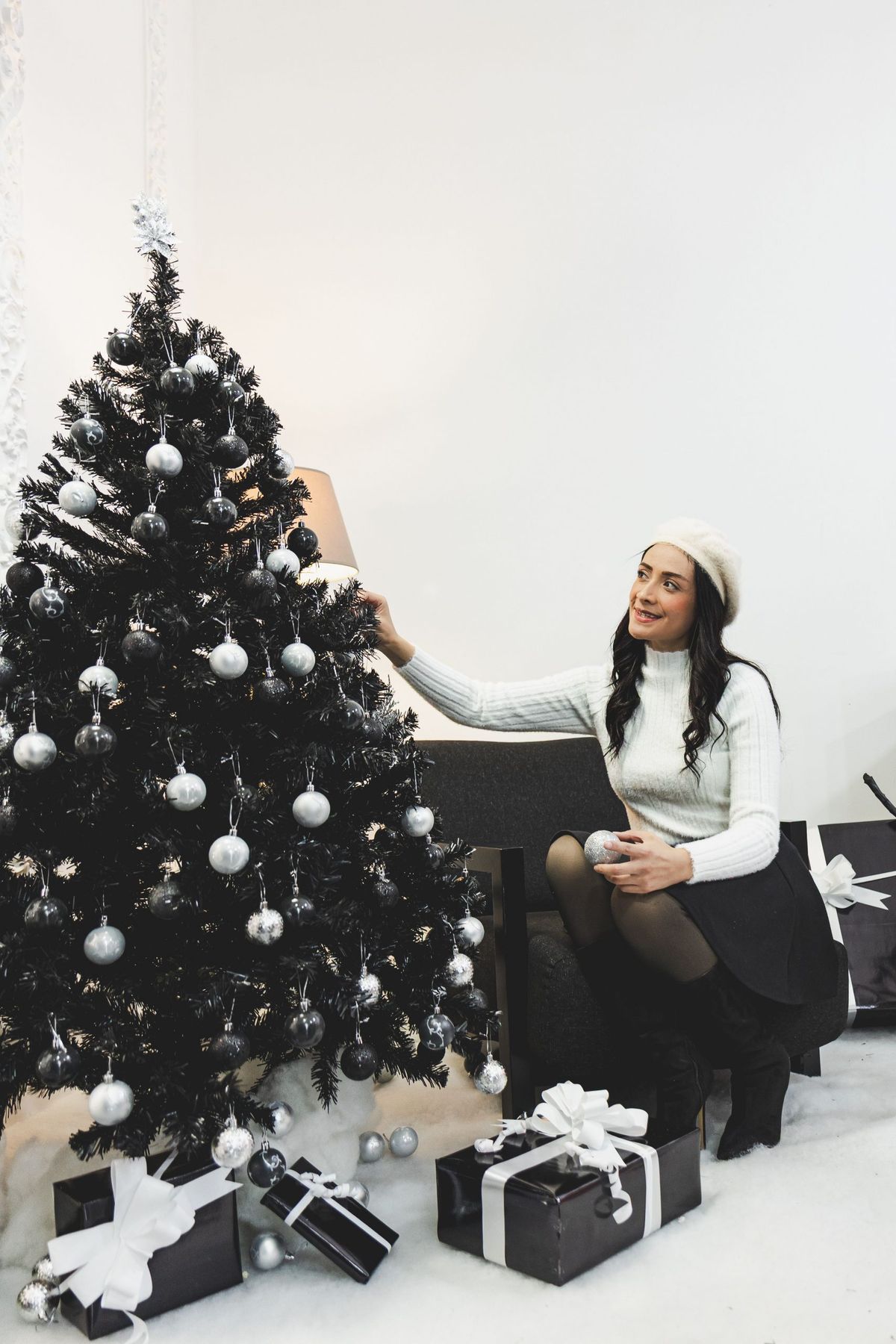
This is about 80% black (tree, ornaments, wrapping) plus 15% metallic silver and 5% white, and the white only shows up as thin lines — ribbons, light reflections, the floor. That tiny percentage is doing all the lifting. To swap it while keeping the formula, change the metal: 80% black, 15% gold, 5% cream gives you the same look at a warmer temperature, and copper with ivory goes slightly retro without losing any drama.
3. Dark Fir, Silver Snowflakes, Quiet Lights
Silver snowflakes and white string lights on a dark fir sound effortless, but the camera lies a little. In a room without much natural light, silver ornaments go grey and flat after dark, and white LED strands can read cold blue against green needles. Test your lights at night before committing to the whole tree, and mix in a few warm-white strands so the silver has something to reflect. Snowflake ornaments also tangle constantly — store them on a hanger in a garment bag rather than loose in a bin.
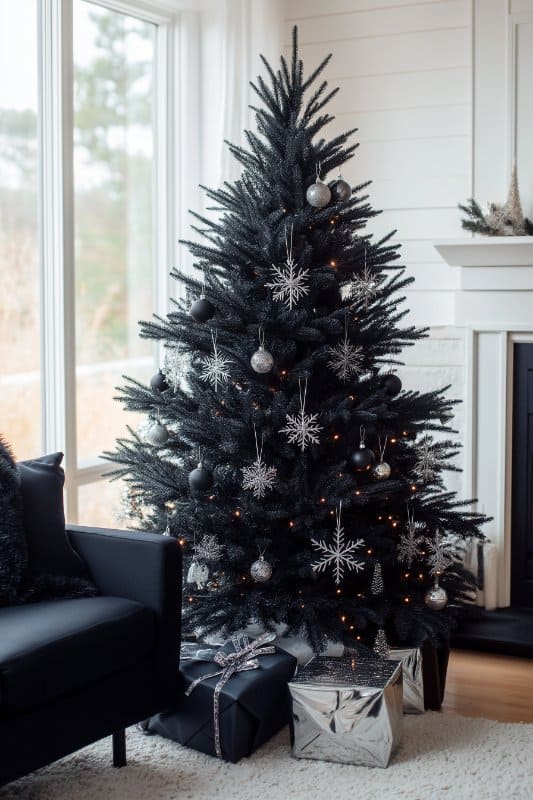
You don’t need designer ornaments to get this mood. A thrift run for silver and white pieces — church bazaars and estate sales are goldmines in early November — often nets 40 snowflakes for under $30. Walmart and Target both carry white wire snowflake sets in packs of 12 for $8–$15, and a plain dark green tree from IKEA or Facebook Marketplace runs $40–$90 used. Whole look: under $150 if you shop the last week of November, when things get marked down twice.
4. Velvet Ribbons and Matte Black Baubles
- Cut velvet ribbon into 24-inch lengths — anything longer slips and looks limp.
- Start at the top and tuck the first end behind a branch so the cut edge disappears.
- Weave inward and out every third branch, letting the ribbon vanish into the needles.
- Pinch a soft loop every 8 to 10 inches and secure it with a florist wire twist, never a hook.
- Work top to bottom so gravity sets the final drape.
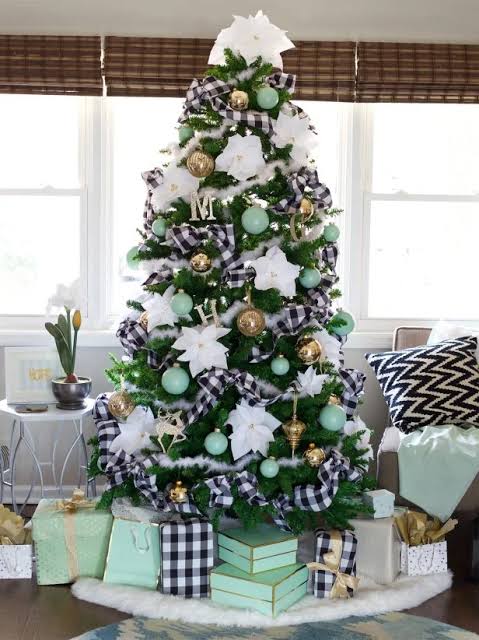
Time: 45 to 60 minutes. Materials: two 10-yard velvet spools, $18–$40 total.
Matte black ornaments vanish on a black tree unless you give them texture. The fix is finishes, not colors — pair flat matte black balls with brushed gold, crackle glaze, beaded, and ribbed pieces, and count on roughly 60 percent textured to 40 percent matte for ornaments to register at all. Warm 2700K fairy lights at about 100 lights per two feet of tree height give matte surfaces something to catch. Skip colored lights here entirely; they flatten everything.
5. Monogrammed Baubles and Beaded Gold Garland
This look wants room to breathe. Monogrammed baubles and beaded garland read as luxury at 9 to 12 feet of ceiling height with at least 10 feet of wall space — anything tighter and the tree starts to feel like furniture you have to walk around. In a standard eight-foot-ceiling living room, drop to a 7.5-foot tree and space monograms every 12 inches instead of 8. If your space is tighter than that, the compact tree in Idea #14 is the better starting point.
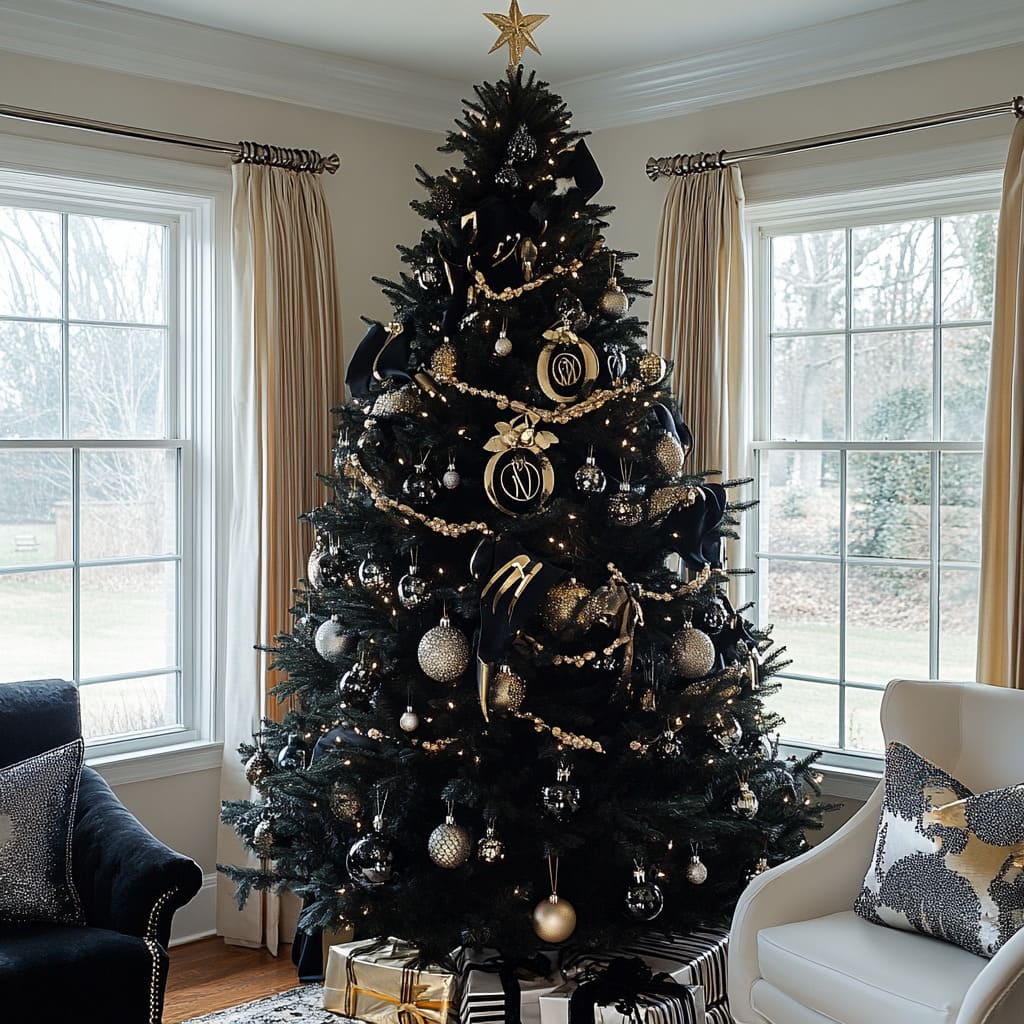
If you stripped everything but one thing off this tree, keep the gold beaded garland. Round ornaments sit still and read graphic; beaded strands move, catch light at every angle, and tie the monogrammed discs to the baubles so the tree reads as one continuous object instead of a collection. Without it, the star topper and silver balls just float.
- 9 ft black tree: $250–$700
- Gold beaded garland (4–5 strands): $40–$90
- Mixed gold and silver baubles, 100 count: $80–$200
- Monogrammed ornaments (12–16): $40–$120
- Black satin ribbon spools: $15–$35
- Gold star topper: $20–$60
- Total: roughly $445–$1,205
6. Silver, Black, and One Glossy Red Sphere
The one-glossy-red-ornament move is very 2026. After a decade of strictly monochrome trees, Pinterest searches for a black tree with a single red accent have been climbing fast, and it’s easy to see why — one high-shine red sphere gives the eye somewhere to land without breaking the palette. It’s the same instinct behind the red sweater styled into these photos: one warm, saturated note against all that silver and black. Expect it to stick around, because it’s cheap, reversible, and photographs like a magazine cover.

A glossy red ball the size of a grapefruit is a commitment. In a low-light room it will reflect every lamp and window in sight, which is either the best or worst thing about it. If a large window faces the tree, that sphere reads as a bright dot from across the house at night. Black wrapping paper with white ribbon also behaves terribly around toddlers — it scuffs, shows fingerprints, and satin ribbon slides right off box corners.
7. Royal Blue Ornaments Against a Matte Black Wall
Three things are doing the work here. First, the matte black accent wall kills reflections, so the royal blue ornaments are the only color in the frame and they read twice as saturated as they would against beige. Second, the tree’s dark green needles separate from the wall by value rather than hue, which is why it never disappears. Third, the blue star topper and blue gift boxes create a vertical line of the same color from ceiling to floor — simple repetition that makes a small corner feel intentional.
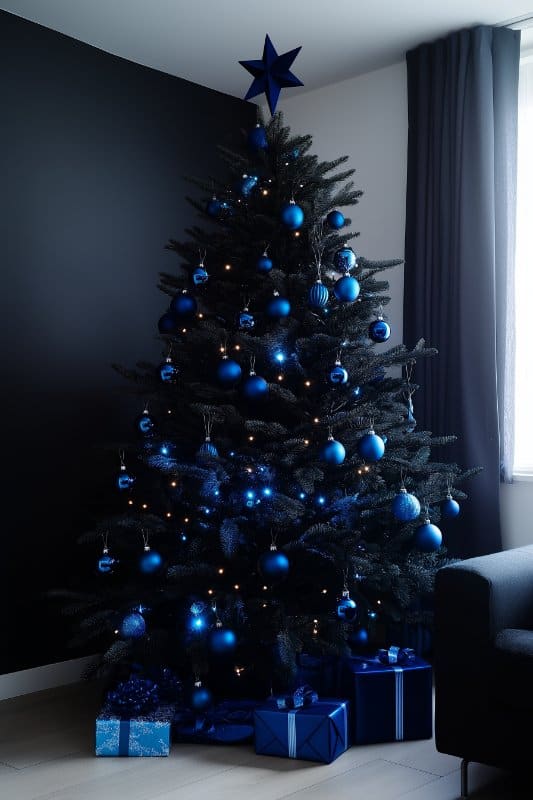
- Measure wall width and ceiling height — the matte black wall needs at least 8 ft of uninterrupted surface.
- Check how your paint reads at night; matte black often goes brown under warm bulbs.
- Confirm outlet placement on that wall, or plan for a flat extension cord.
- Commit to ONE accent color — blue here — and refuse everything else.
8. Black Tree, White Lights, Gallery Wall Backdrop
White faux fur skirts and white string lights are the two highest-maintenance choices on this tree. Faux fur collects dust, pet hair, and pine needles, and it won’t survive a washing machine cycle without matting — plan on a lint roller every few days and a hand wash in cold water at season’s end. White wire and white bulbs yellow over about five seasons, and once they do they look dingy against black branches. Buy LED strands with a five-year warranty and store them coiled loose in a labeled box.
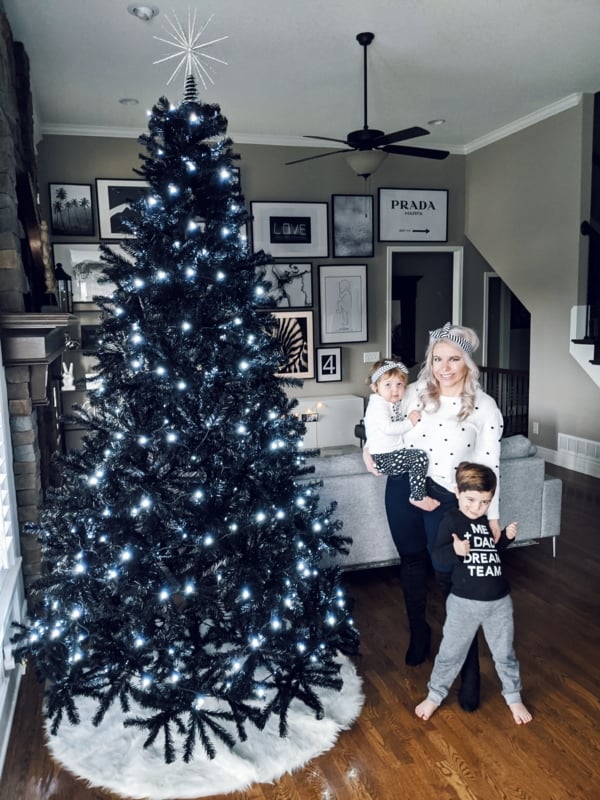
If your black tree sits in front of a gallery wall, run the light strand in a slight spiral rather than straight down, roughly one full turn per two feet of height. A straight vertical strand reads as a hard line and fights the framed art behind it; the spiral keeps the eye moving and lets the black-and-white prints show through. Bonus: it hides the wire. You’ll use about 20 percent more strand this way, so buy one extra set.
9. Purple Poinsettias and Wire-Wrapped Ornaments
Figure roughly 55% deep green foliage, 30% purple (poinsettias and baubles), 10% warm white light, and 5% black accents like the tree skirt and wire ornament outlines. Purple and green sit close on the color wheel, which is exactly why this feels moody rather than clashing. Swap the purple for burgundy and you get a Victorian library; swap it for deep teal and the same formula goes cool and wintry. Keep the light percentage steady either way — drop it to 5% and everything goes flat.
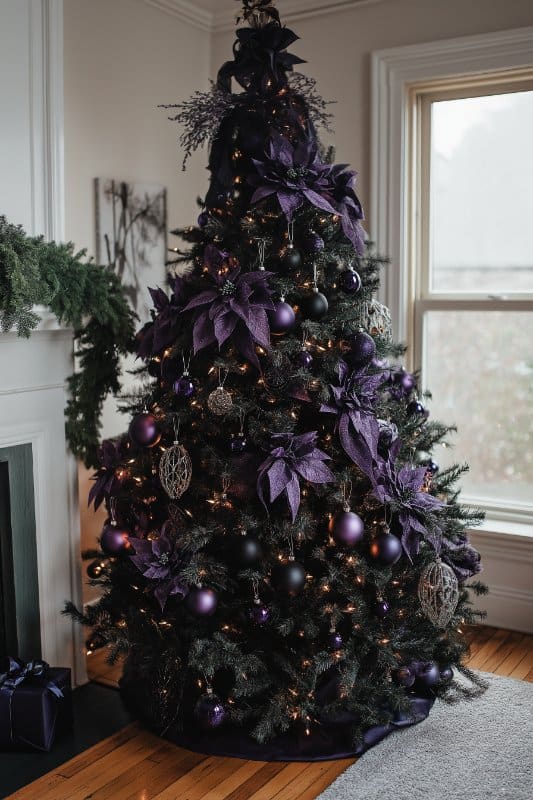
It’s the oversized purple poinsettias, not the ornaments. Ball ornaments can only ever be dots — they repeat and fill, but they don’t give a tree a direction. Large blooms add flat, irregular shapes that read botanical rather than decorative, and they’re what makes this corner feel gothic-elegant instead of just “a purple tree.” Pull them and you’re left with a very ordinary tree in an unusual color.
10. Pink Faux Fur Skirt and a Rainbow of Globes
This is the most affordable look in the whole article, because it’s supposed to look collected rather than curated. Hit after-Christmas clearance at Target and Walmart (ornament multi-packs drop to $3–$8 a box), grab a pink faux fur skirt from Five Below or Amazon for under $20, and buy one bag of mixed metallic balls at a thrift store for $5. Add a gold star topper from Dollar Tree and a strand of warm lights, and you’re at roughly $60–$90 for the entire tree.
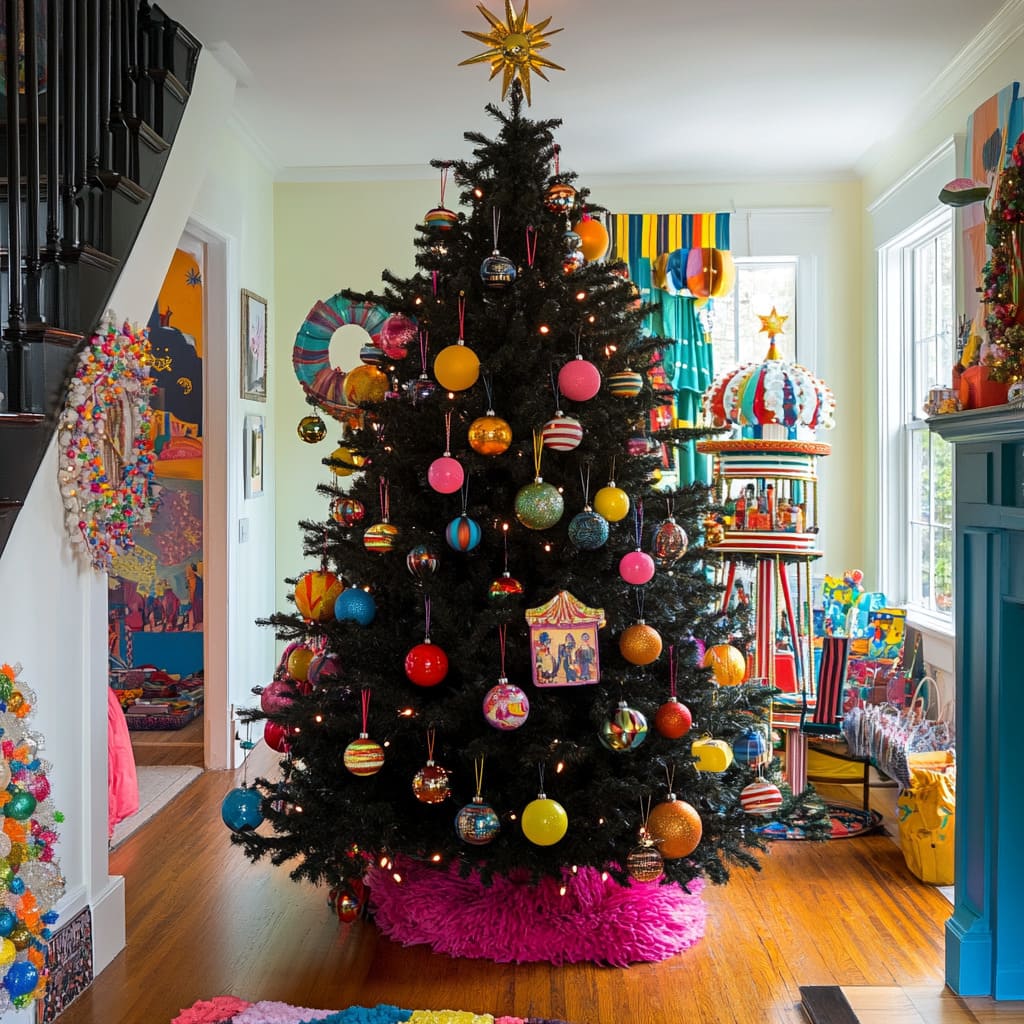
The mismatched-ornament tree is having a real moment, and black trees are its best canvas. Against beige or green, a random assortment of hot pink, orange, and blue globes can read like a mistake; against black, every color is a deliberate pop. It’s the same saturated-color instinct that’s been driving interiors for two years, now translated to holiday styling. It has staying power because restyling costs almost nothing — swap the skirt, add three new colors, done.
11. Frosted Branches with Matte Black and Beaded Texture
- Buy frosted picks or flocking spray and mist only the outer 2 inches of each branch tip.
- Layer in this order: warm lights, then beaded garland, then matte black spheres.
- Place silver metallic baubles last so they catch light on top of everything else.
- Cluster ornaments in threes — one large, two small — instead of spacing them evenly.
- Step back three feet and squint; if the tree reads flat, add one more texture, not one more color.
Time: 20 minutes per section. Materials: flocking spray $12–$25, beaded garland $10–$30.
Up close, this works because of finish contrast: fuzzy frosted needles, hard glossy silver, soft matte black, and a beaded texture that sits somewhere in between. Four surfaces, one near-black color story, and warm string lights giving every finish something to respond to. When your palette is down to two colors, texture has to carry all the visual interest — this shot is basically a textbook on how.
12. Corner Vignette: Black Tree, Dark Armchair, Tripod Lamp
This corner vignette needs about 6 by 6 feet of floor — enough for the tree, the chair, and a walkway you won’t trip over. It works best under an eight-foot ceiling with the tree topping out around 6.5 to 7 feet, since the tripod lamp and chair already claim the vertical space above. If your corner is smaller, lose the chair and keep the lamp; the tree plus a light source alone still reads as a designed moment. In a big open room this scales up fine — see how Idea #35 handles a fireplace wall instead of a corner.
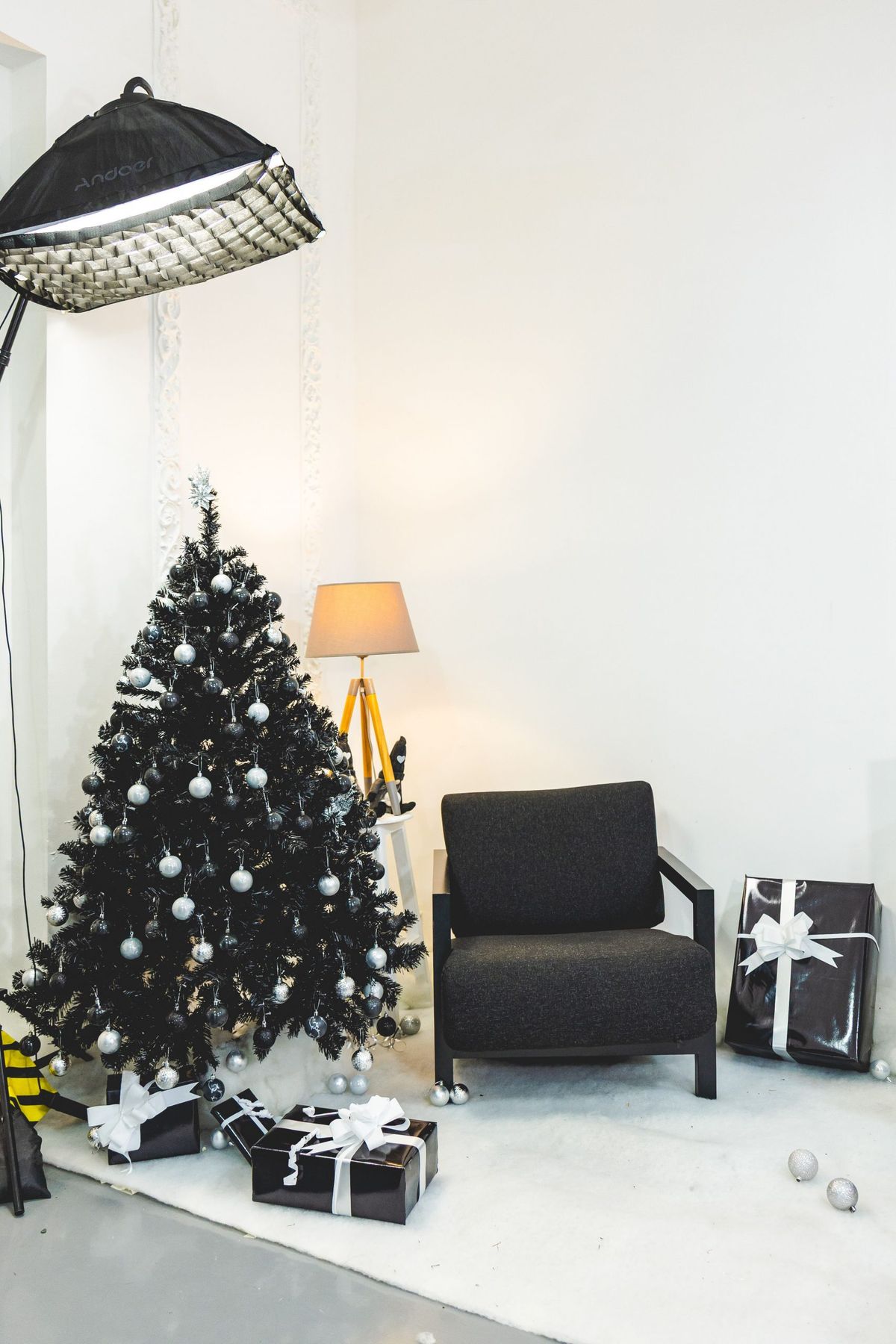
Dark tree, dark chair, dark gifts, white rug. It photographs beautifully and it eats light in a real room. Sit in that chair at 8pm with the overheads off and see whether it feels cozy or like a black hole. If it’s the latter, add a warm lamp with a fabric shade and swap the rug for something textured rather than shiny. One more thing: black wrapping paper shows every scuff from being pushed under a tree, so keep boxes on the rug.
13. Copper Frames, White Ceramic, and Faux Fur Garland
Clip-on candle ornaments are the most underrated thing you can add to a black tree. On dark branches they read as tiny points of warm light and instantly make a tree look collected rather than bought. Space them every 10 to 12 inches, angle each one slightly upward, and use battery-operated LEDs rated for indoor use. Never real candles. If you want the geometric copper frames to register at all, hang those on the outer third of the branches where they catch a hard edge of light.
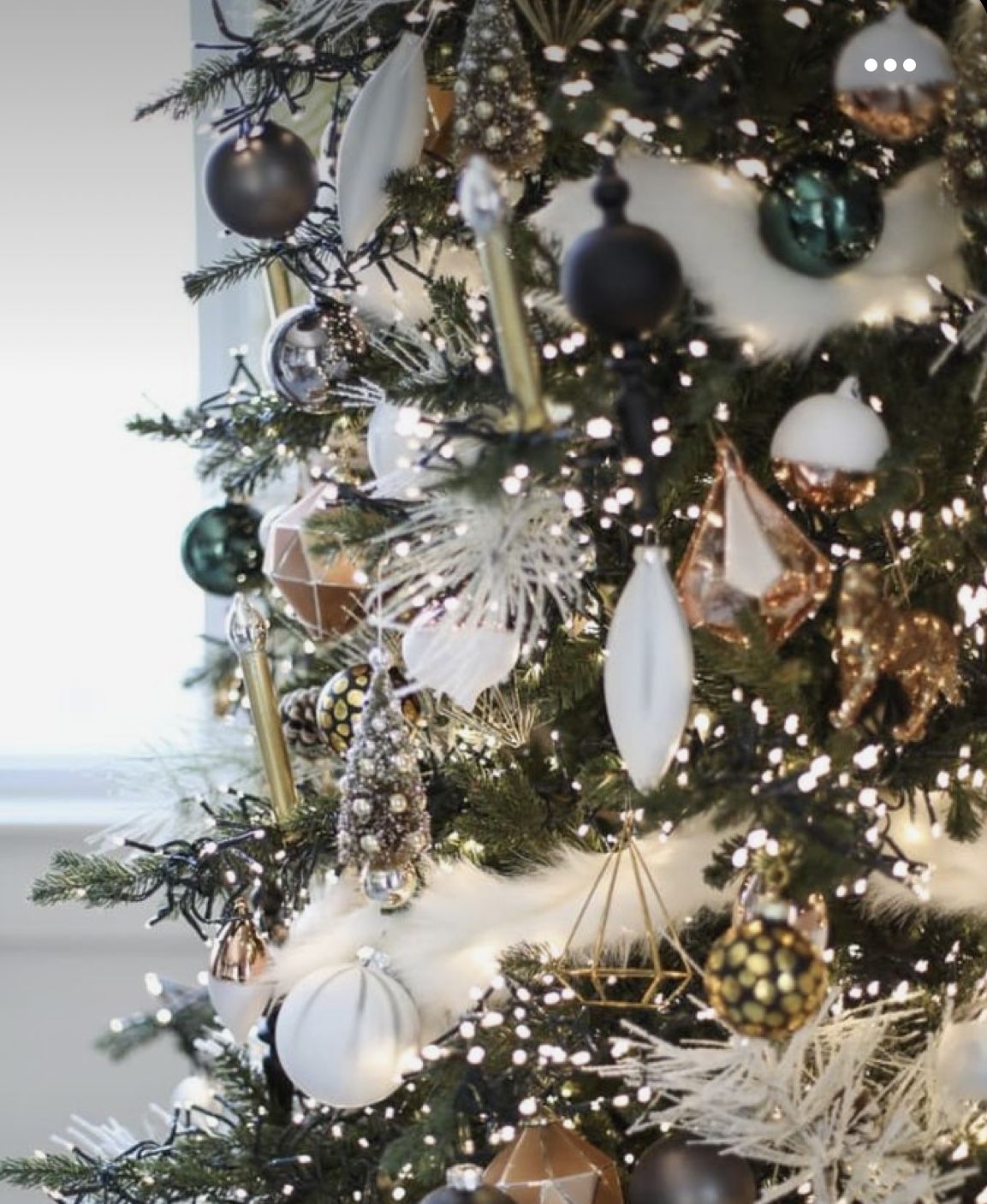
- Flocked or plain tree base: $150–$550
- Matte black bauble set (60 count): $30–$70
- White ceramic teardrop ornaments (12): $35–$80
- Copper geometric frames (8–10): $30–$80
- White faux fur garland (2 strands): $25–$60
- Clip-on LED candles (12): $20–$45
- Total: roughly $290–$885
14. Compact Black and Gold Tree by the Window
- Check what’s in front of the window — a globe, plants, or a chair crowds a compact tree fast.
- Measure from sill to floor; small trees look best when they clear the sill by 8 to 12 inches.
- Confirm an outlet within 6 feet, or plan for a battery strand.
- Decide your metal mix first — black, gold, and silver only work together if the black stays matte.
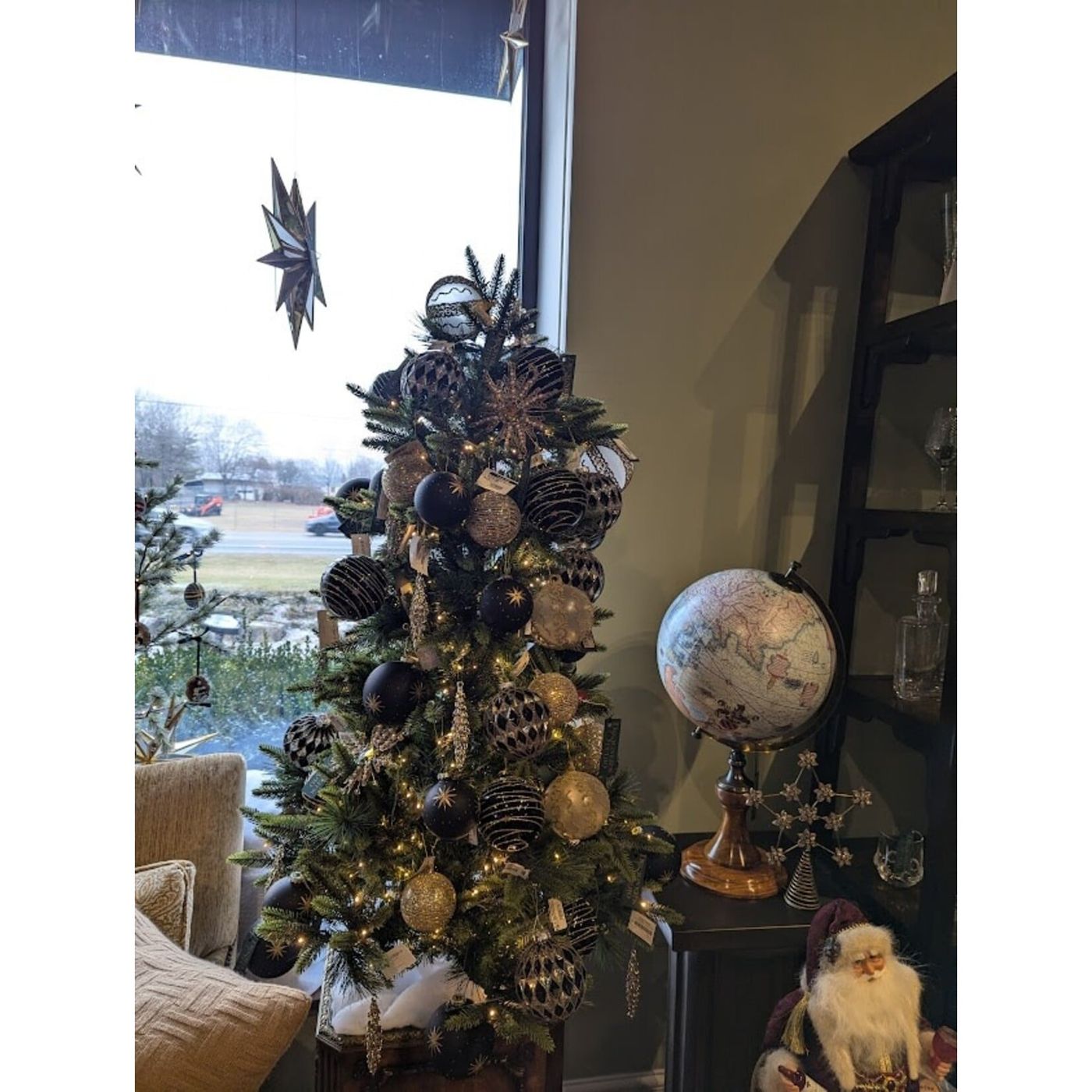
This is a 50-30-20 formula: 50% foliage, 30% black ornaments, 20% metallic gold and silver combined. The black sits low and the metals sit high, which pulls the eye upward and makes a small tree feel taller than it is. To adapt while keeping the ratio, trade gold for copper and you get a warmer mid-century lean; trade it for champagne and everything goes soft and neutral. Just never let the metals overtake the black.
15. Two Black Trees: Stars, Crowns, and a Santa Hat
Star and crown ornaments look expensive and usually aren’t. Target’s Threshold line and Walmart’s holiday aisle both carry shaped metal ornaments in multi-packs for $10–$20, and Amazon has flat gold star sets 24-for-$18. The hat is the cheapest luxury here: a plain black Santa hat runs $8–$15 and instantly gives a formal tree a sense of humor. Black artificial trees also drop hard after December 26 — buying one off-season for $60–$120 means your December budget goes entirely to ornaments.
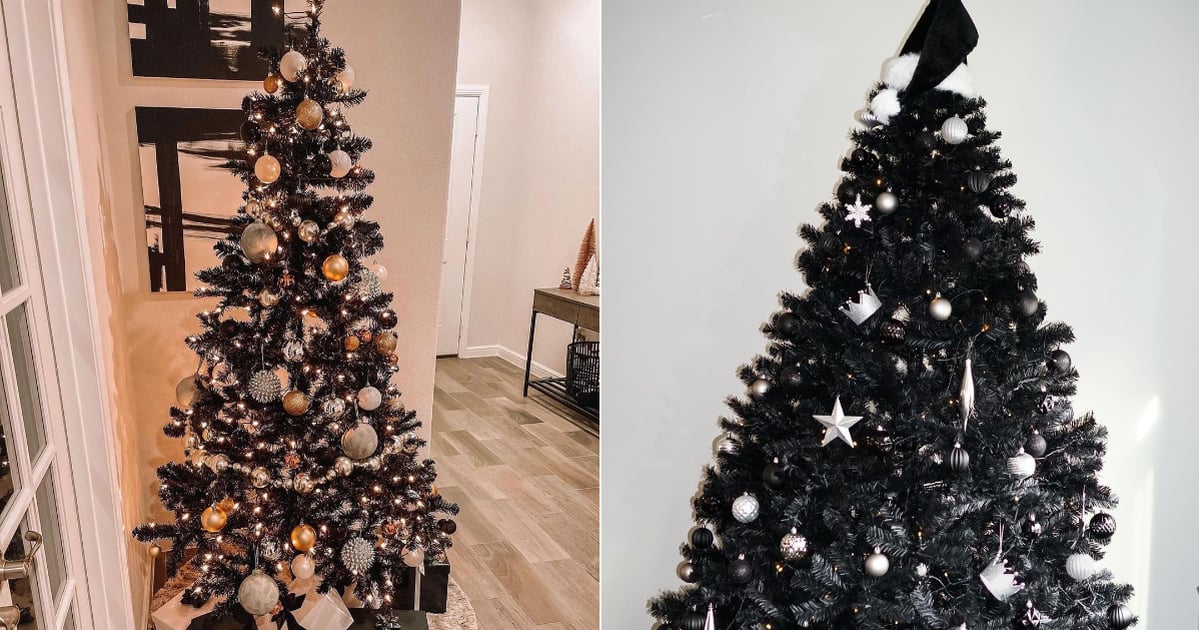
The black Santa hat on the right-hand tree. It’s silly, it costs almost nothing, and it’s the difference between a decorated tree and a tree with a personality. A star topper is a period at the end of a sentence; a Santa hat is a wink. Remove it and you have a very competent, very forgettable modern tree. Keep it and guests will mention it before they mention a single ornament. Compare with Idea #18 for the same two-tree idea pushed glam instead of goofy.
16. Buffalo Check Bows and Wooden Bead Garlands
- Cut buffalo check ribbon into 18-inch lengths and notch the ends in a shallow V.
- Fold into a bow, pinch the center, and secure with a 4-inch length of florist wire.
- Slide the wire onto a branch so the bow sits just below the branch line, not on top of it.
- Fluff the loops between your fingers — flat bows always look store-bought.
- Space bows every 10 to 12 inches, offsetting each row so they never stack vertically.
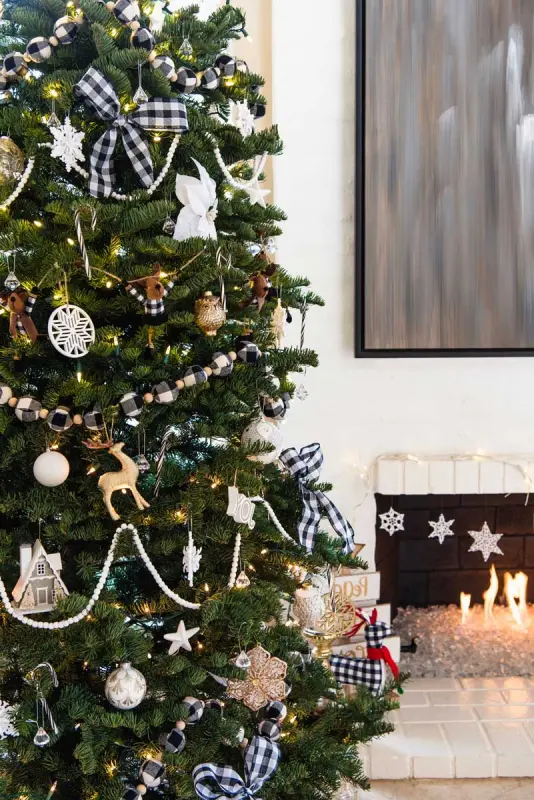
Time: 1 to 1.5 hours for a seven-foot tree. Cost: two spools of wired ribbon, $16–$30.
Buffalo check keeps returning because it’s the rare pattern that works in both a farmhouse and a modern room — here it sits beside a black-framed painting and a white fireplace without fighting either. The 2026 update is scale: wider 2.5- to 3-inch checks instead of the tiny gingham of a few years back. Wooden bead garlands are on the same trajectory, and they’re why this tree doesn’t feel dated — natural wood is the neutral black-and-white palettes were missing.
17. Lit Green Tree Against Charcoal Built-Ins
Kraft paper with black ribbon is the least forgiving wrapping on this list. It creases permanently, shows every oily fingerprint, and dents if you stack gifts on top of each other. It’s also completely recyclable, which is why it keeps showing up in moody modern homes. Budget for one extra roll. As for the charcoal built-ins: dark paint shows dust at a rate light paint never does. Get a microfiber duster with an extendable handle and plan on three minutes a week through December.
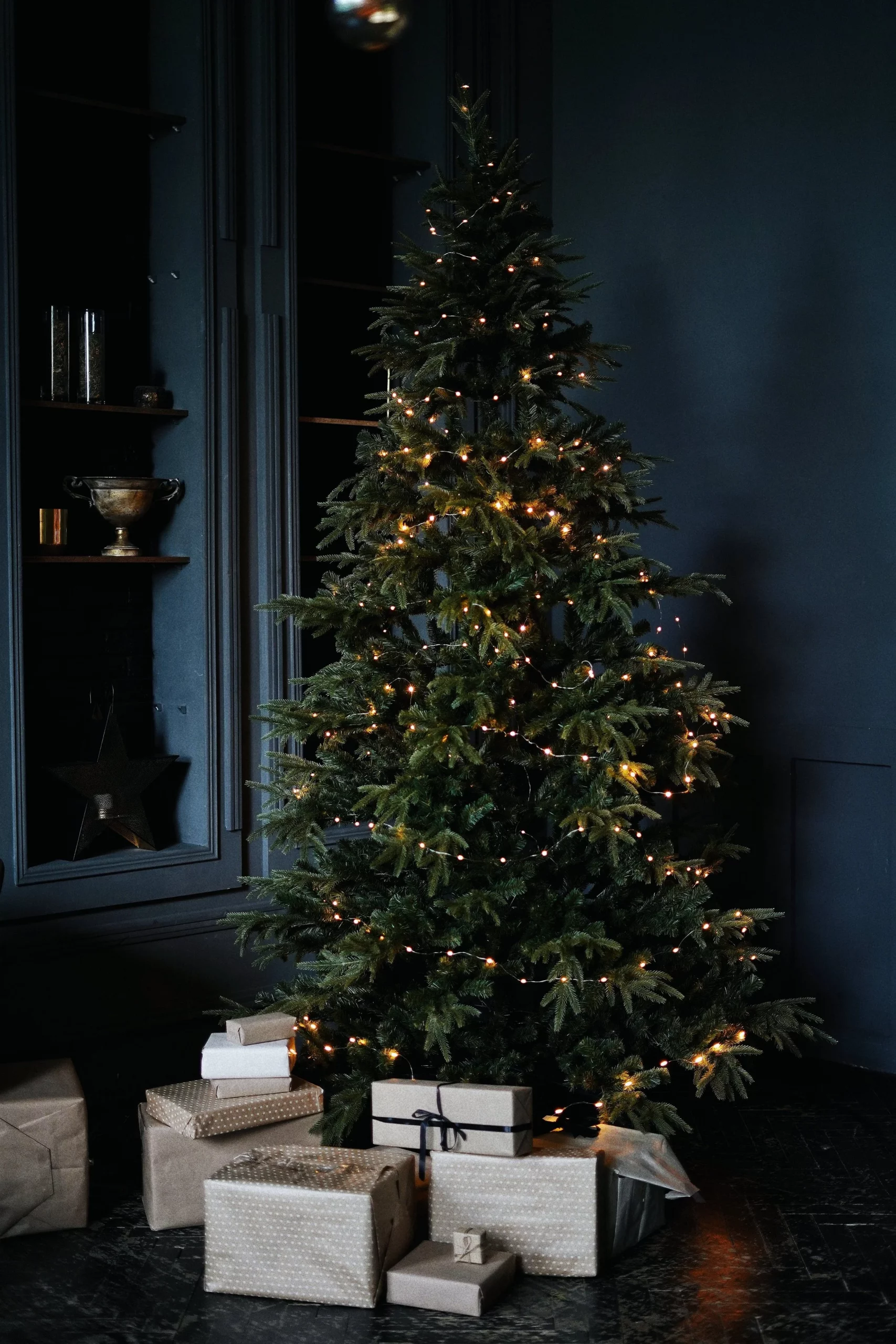
Warm light is what keeps a dark room from going grim. On a green tree against charcoal walls, use 2200K to 2700K bulbs only — anything cooler reads blue against the paint and makes the corner look like a showroom. Figure roughly 100 lights per two feet of tree height, and add one small warm lamp at low height so the tree isn’t the only light source. That second light is what makes the shelves and gifts visible at all.
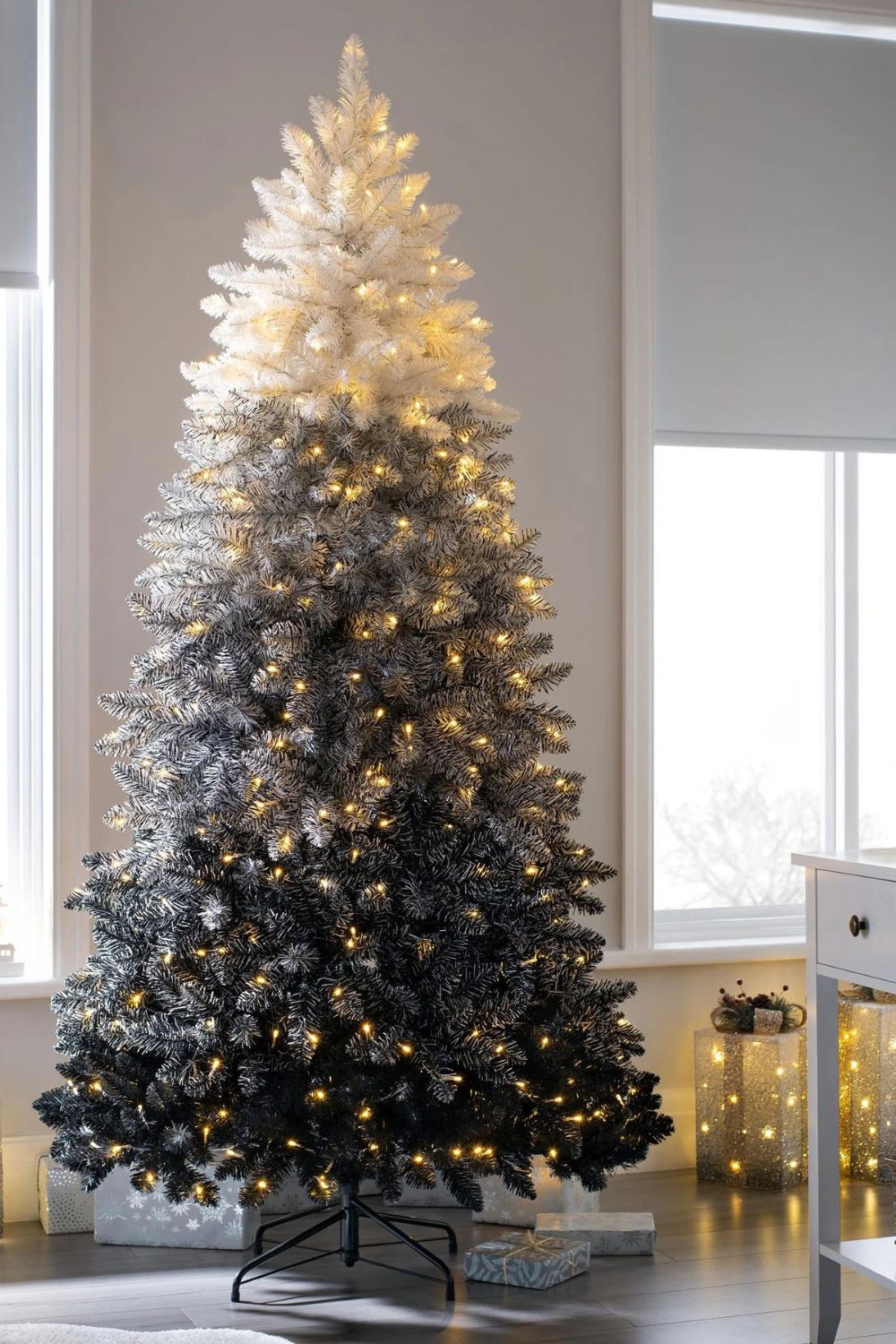
18. Slim Ombré Tree: Black Top, Gold Base
The ombré gradient gives this tree a built-in focal point without a single ornament color doing the heavy lifting. Black at the top keeps the silhouette sharp against a light gray wall; gold at the base grounds it and picks up the wood of the credenza. Paper rosettes add matte handmade texture, and geometric baubles keep it from reading crafty. And nothing here is accidental — the wall art is a sunburst, the topper is a sunburst, the ornaments are fans. That repetition of shape is what makes it look designed.
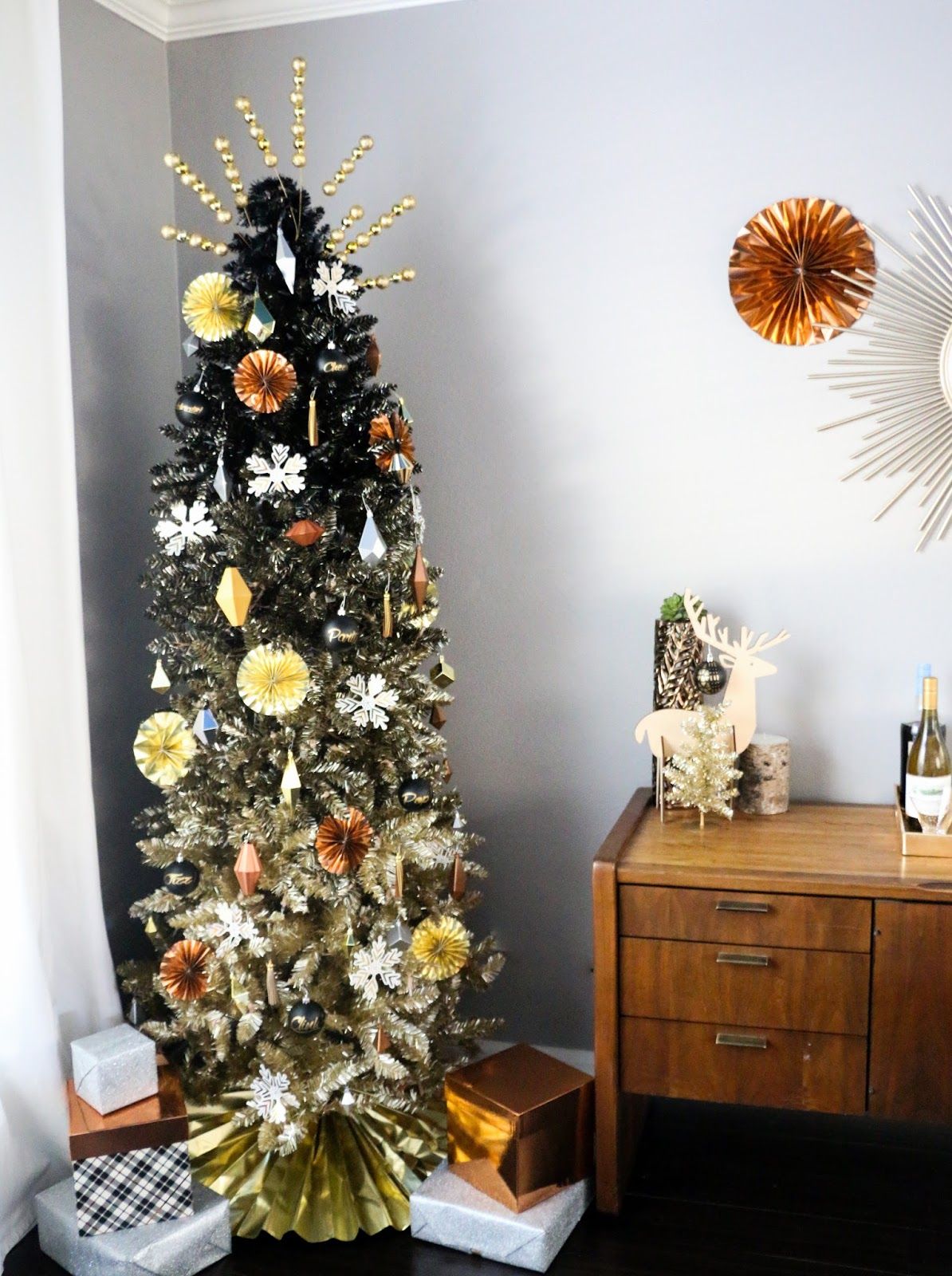
A slim tree is the answer for narrow rooms, but it has rules. This one wants a 10- to 12-inch footprint and at least 4 feet of clearance in front, or the paper rosettes get crushed every time you walk past. Slim trees work best at 7 to 9 feet under ceilings of 9 feet or more. If your room is wider than 14 feet, place two on opposite sides of the space, the way Idea #15 does.
- Slim 7.5 ft ombré or two-tone tree: $180–$500
- Paper rosette and fan ornaments (20–25): $30–$75
- Geometric and starburst baubles: $25–$60
- Starburst tree topper: $18–$45
- Wrapping paper, ribbon, tags: $20–$45
- Total: roughly $273–$725
19. White Tree, Black Lace, Checkered Ribbon
This breaks down to exactly 50% white tree, 35% black ornaments, 10% checkered pattern, and 5% typographic accents. The pattern layer is what stops a two-color tree from looking like a graphic design exercise — checks and lace break up the solid masses. Strip the pattern out and you have a high-contrast tree that’s striking for about four seconds. Swap the checker for thin black-and-white stripes and it goes Deco; swap it for polka dots and it goes playful without changing a single ornament.
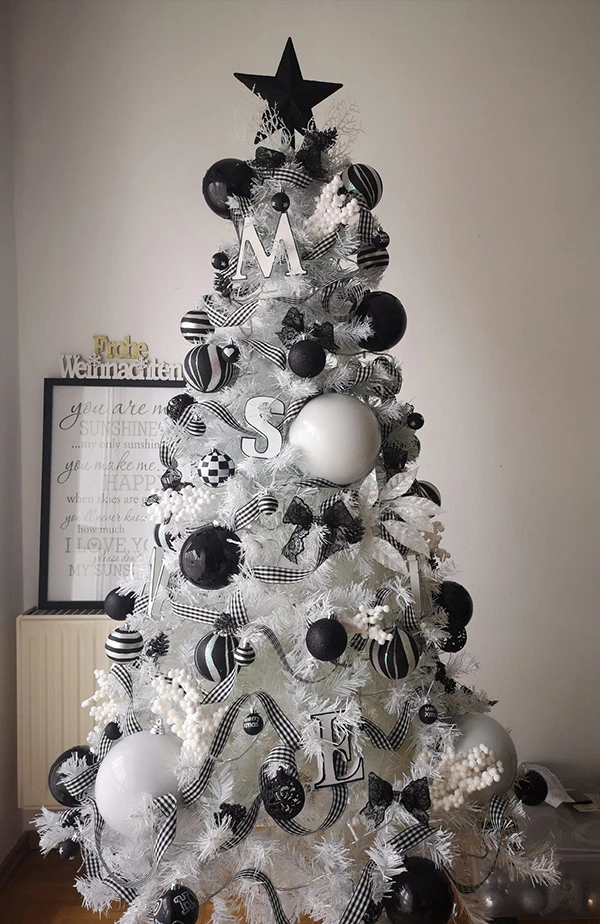
A white tree is a commitment. It shows dust, tinsel residue, and any ornament that’s been handled with cocoa on fingers. It also needs a storage bag with a white lining, or it’ll pick up dye from whatever’s next to it in the garage. On the plus side, it photographs better than anything else here in daylight. If you have pets, know that white branches make black pet hair extremely visible.
20. Flocked Black Tree with Silver Pom-Poms
Flocking plus black is a delicate balance. Look for light, even flocking — heavy flock on black starts reading as grey rather than black, and you lose the whole point. When you decorate, keep silver ornaments in the upper two-thirds where the lights hit them, and let white pom-poms sit low where the flocking is densest. Pom-poms are also the closest visual cousin to snow, so cluster them in threes rather than spacing them evenly, and skip any additional white garland on a flocked tree.
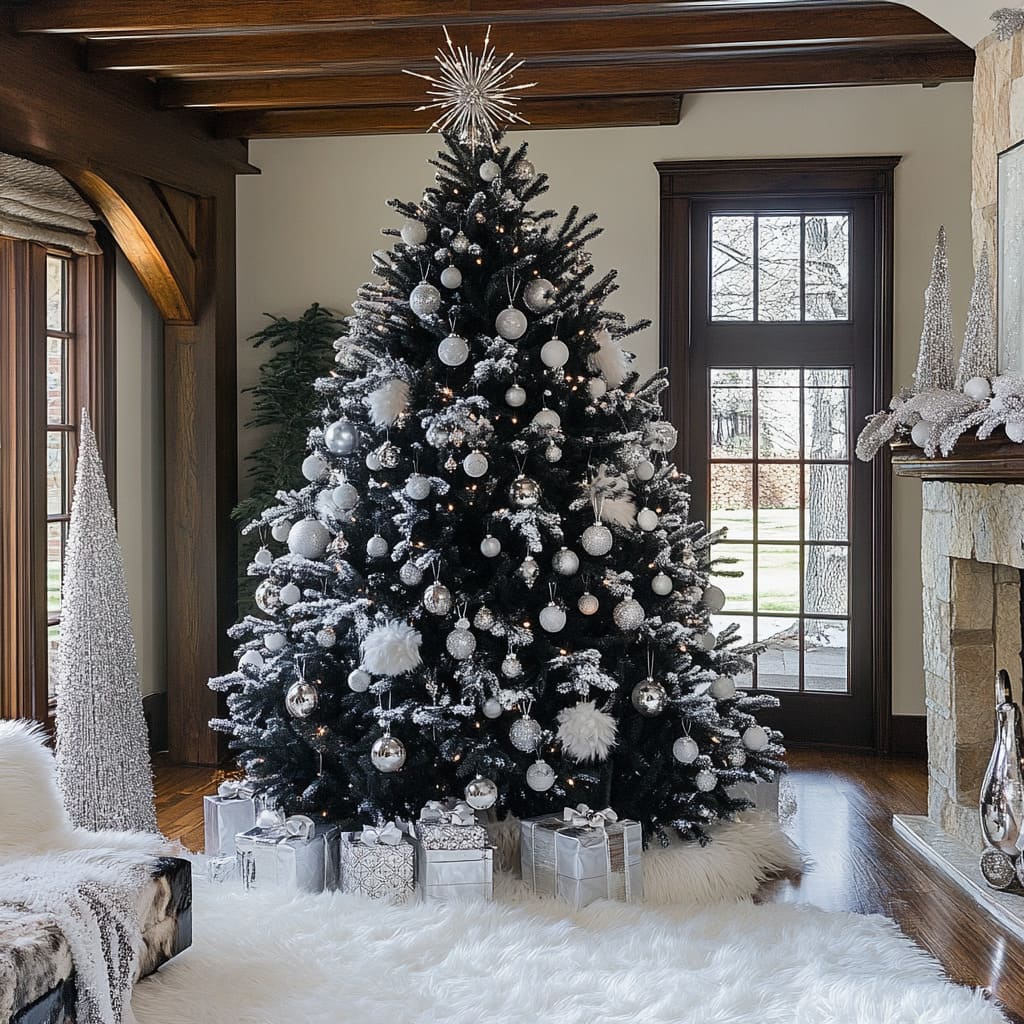
Flocked black trees are the expensive piece here, and they’re the one thing worth buying in January. Off-season pricing drops from $300–$600 to $90–$200 at Walmart, Home Depot, and Wayfair. Everything else is cheap: silver shatterproof ball sets run $12–$25 for 50 at Target, white pom-poms come in craft packs at Michaels for $6–$10, and a white faux fur skirt is $18–$35 on Amazon. Total look under $300 if you’re patient.
21. Lime Green and Champagne with a Grey Armchair
The Santa figurine standing at the base. It’s not a sophisticated element and that’s exactly why it works — after all the lime green and champagne, one slightly kitschy figure warms the whole corner up and makes the tree feel lived-with instead of styled. Remove it and the vignette becomes a showroom display. Keep it, and the grey armchair suddenly reads as a chair someone actually sits in with cocoa.
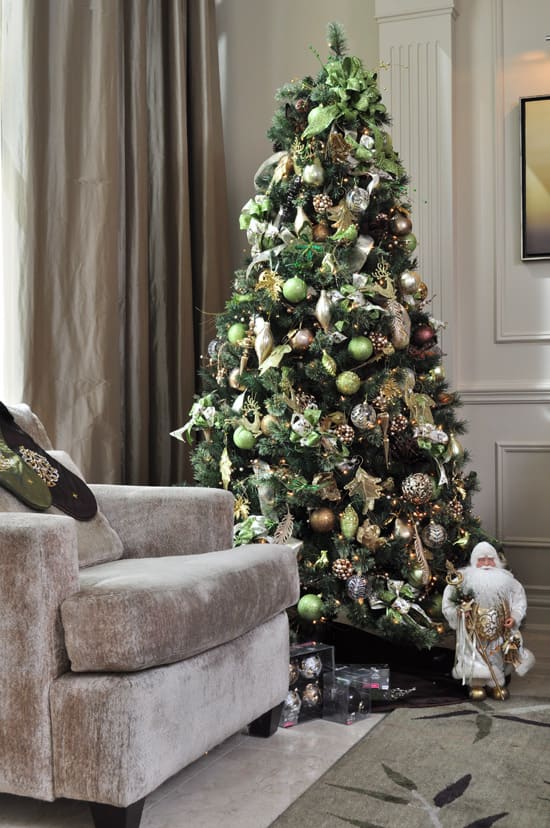
- Choose two ribbon widths — 1.5 inch and 3 inch — in the same champagne tone.
- Cut the wide ribbon into 30-inch tails and clip one to every branch on the bottom third.
- Spiral the narrow ribbon from top to bottom, letting it fall behind the ornaments.
- Tuck a lime green sprig into every third ribbon cluster to tie the palette together.
- Curl the wide tails with a scissor blade for volume.
Time: about 40 minutes. Materials: three ribbon spools, $30–$60.
22. A White-to-Black Gradient Tree with XMAS Blocks
Gradient trees live or die by wall contrast. This white-to-black one needs a mid-tone wall — light grey, greige, or pale wood paneling — because against white the top half disappears entirely. Minimum eight-foot ceiling and about 5 feet of clear wall behind. Small rooms can absolutely use one, but keep it to 6 feet tall and tuck it into a corner where it reads as a vertical stripe. If your walls are dark, flip the gradient the way Idea #18 does with gold at the base.
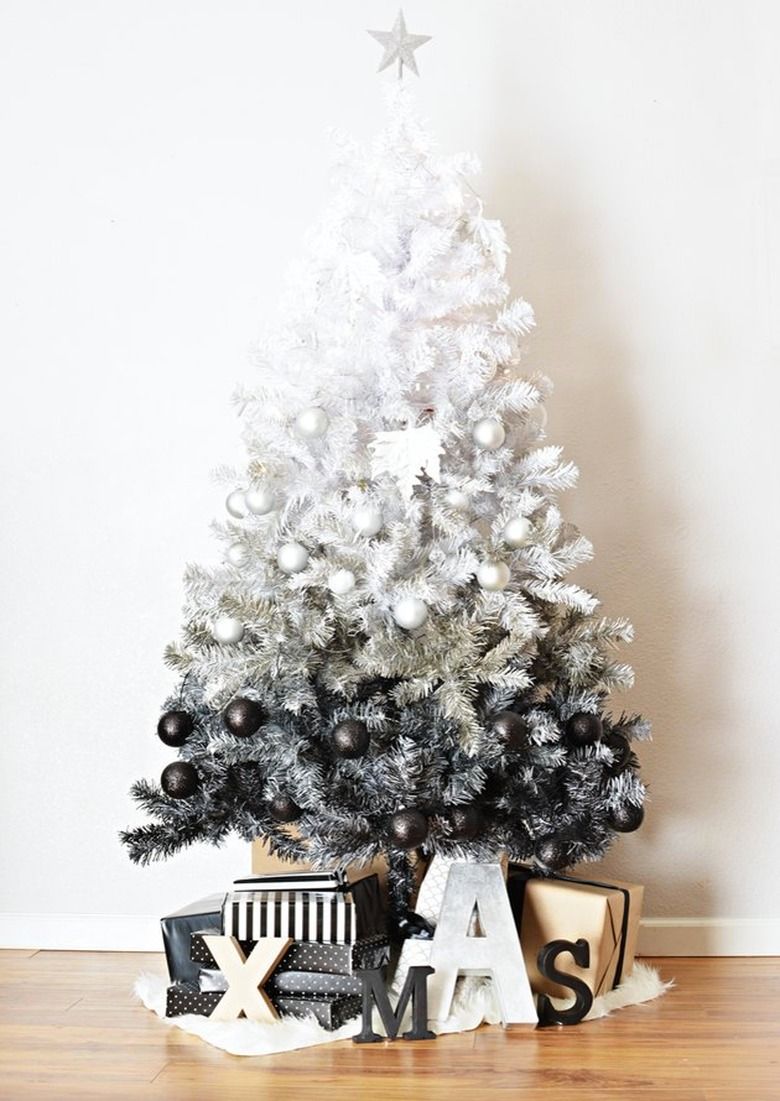
A gradient is really just contrast management. The white top matches the star and the silver ornaments, the black base matches the dark baubles and the shadow under the skirt, so every element sits on a background it belongs to. That’s why nothing feels random even though the tree itself is unusual. The freestanding XMAS blocks add a heavy grounded mass at floor level, which matters — without something solid down there, a gradient tree looks like it’s floating.
23. Flocked Tree, Gold Ribbon, Black Gift Boxes
- Flocked 7.5 ft tree: $150–$500
- Gold metallic ribbon garland (3 spools): $25–$60
- Matte black and silver ornaments (80 count): $45–$110
- White flower picks and cotton stems: $20–$45
- Patterned wrapping paper and ribbon: $25–$55
- Tree skirt or collar: $25–$70
- Total: roughly $290–$840
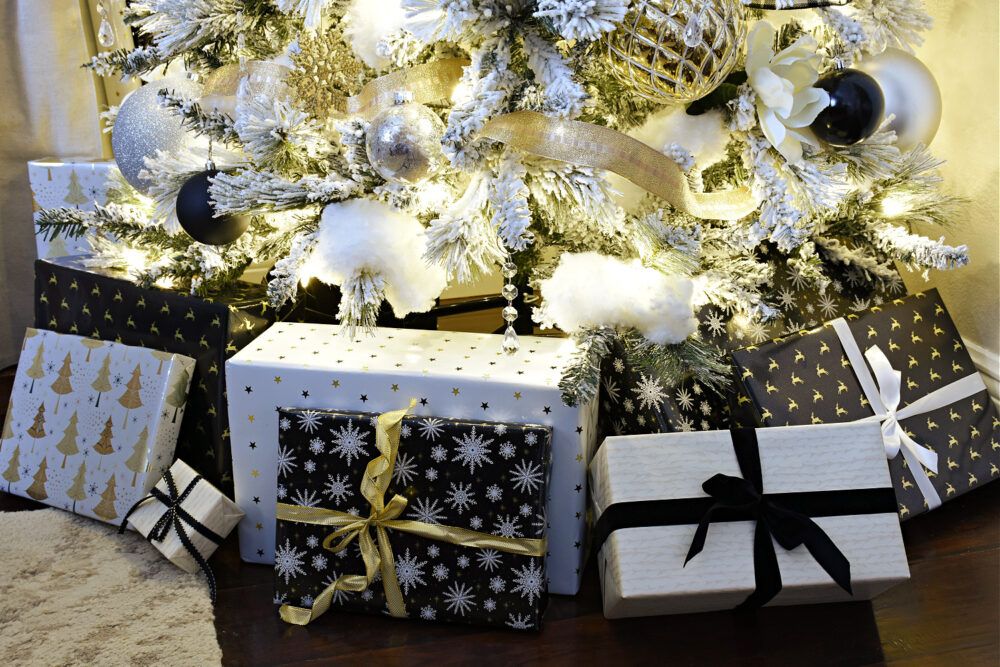
Flocking sheds. Expect a fine white dust on the floor for the first two weeks, and expect it every year, not just the first. A flocked tree should never live in a damp garage — moisture turns the coating into a sticky film, and once that happens it’s done. Vacuum the skirt weekly with a brush attachment, not a beater bar. Keep flocked branches away from heat vents and fireplaces; warmth softens the coating and makes shedding much worse.
24. Wired Buffalo Check Ribbon, Close Up
- Buy wired ribbon, not unwired — florist wire is what holds the bow shape all season.
- Check the check size: 2 to 3 inches reads well on a large tree, 1 inch only works up close.
- Count branch tips and estimate one bow per 8 to 10 branches.
- Have florist wire, sharp fabric scissors, and a lighter for sealing cut ends on hand.
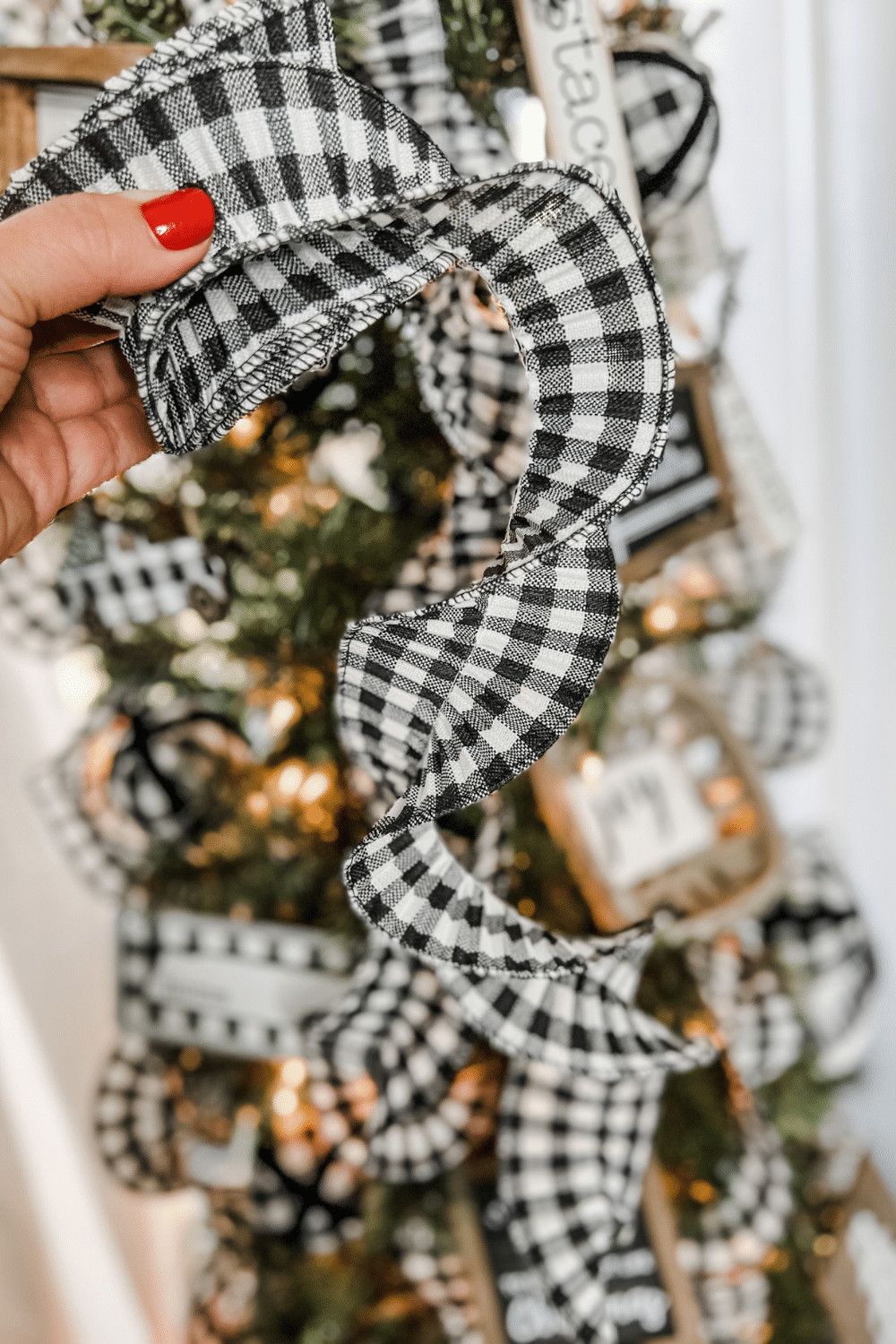
Buffalo check is best treated as 20% of the tree, never more. The formula that holds: 55% green foliage, 25% ornaments, 20% pattern. Push the pattern past 30% and a tree starts looking like a gift shop display; drop it below 10% and nobody notices you matched anything. Because check is a black-and-white pattern, it plays perfectly with a black tree — you’re just repeating the palette in a new texture. Swap for black-and-cream plaid to warm it up, or houndstooth to cool it down.
25. Flocked Tree with Striped Black-and-White Ornaments
Striped ornaments are the most useful filler in holiday decorating and almost nobody hangs them correctly. Pair them vertically — a large stripe above a small stripe on the same branch — so the lines read as one continuous mark instead of two unrelated balls. On a flocked tree, keep striped pieces toward the middle where they bridge the white flocking and the darker inner branches. Buy stripes in multi-packs of 12 or 24; they cost about a third of what a single designer striped ball runs.
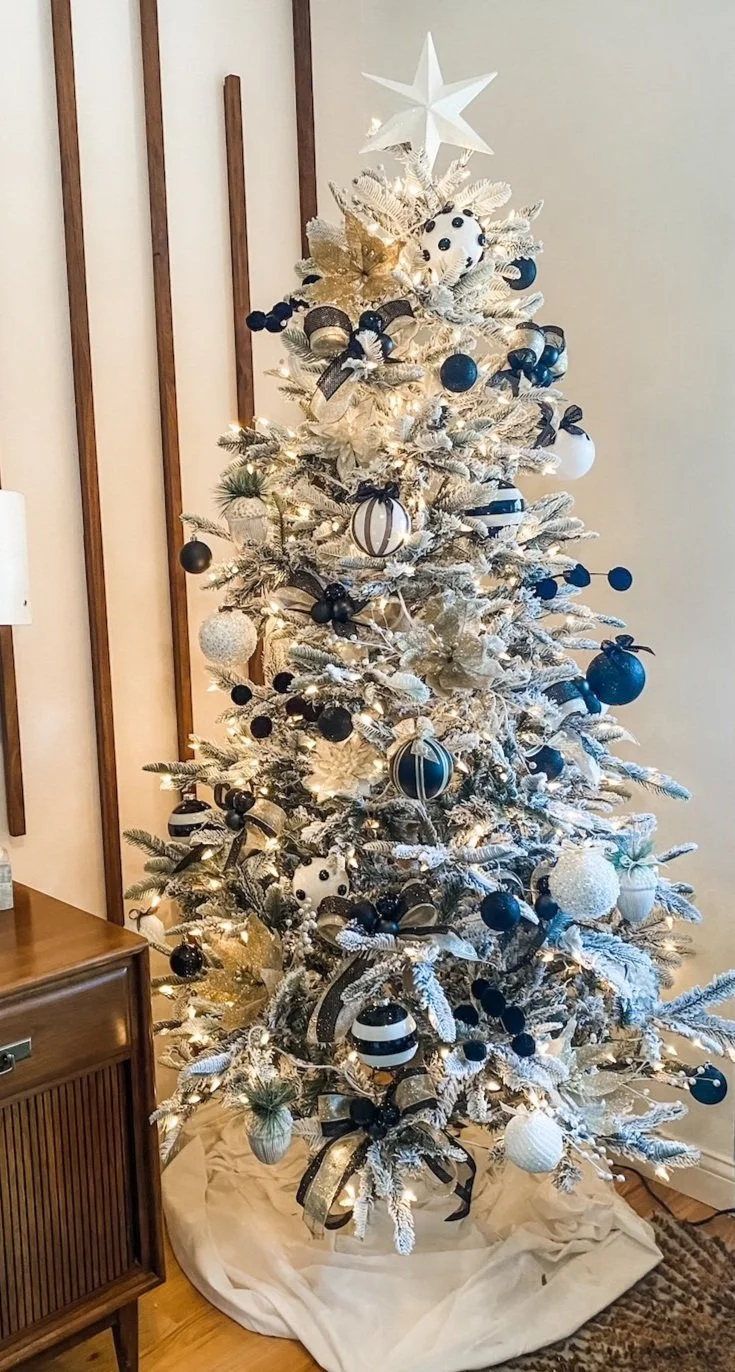
Flocked trees and heavy ornament loads don’t mix well. Snow coating adds weight, and a fully loaded flocked tree will start dropping branches by mid-December if you clip on anything heavy — berry picks are fine, glass is not. If you’re using a fabric skirt rather than a collar, keep it off bare hardwood; white fabric picks up dye from floor stain over time. Flocked trees also need a bigger storage bag than the box claims.
26. Black Velvet Ribbon and a Twig Topper
Black velvet ribbon is the one splurge worth making — real velvet drape isn’t replicable, and a 10-yard spool runs $15–$35. Everything else here can go cheap. Gold glitter bows come in 12-packs at Dollar Tree for $3. Dark brown and black spheres are the easiest ornaments to find secondhand because nobody else wants them; check Goodwill in November and expect $4–$8 a bag. The twig topper is literally foraged — a bundle of branches from your own yard beats anything at the store.
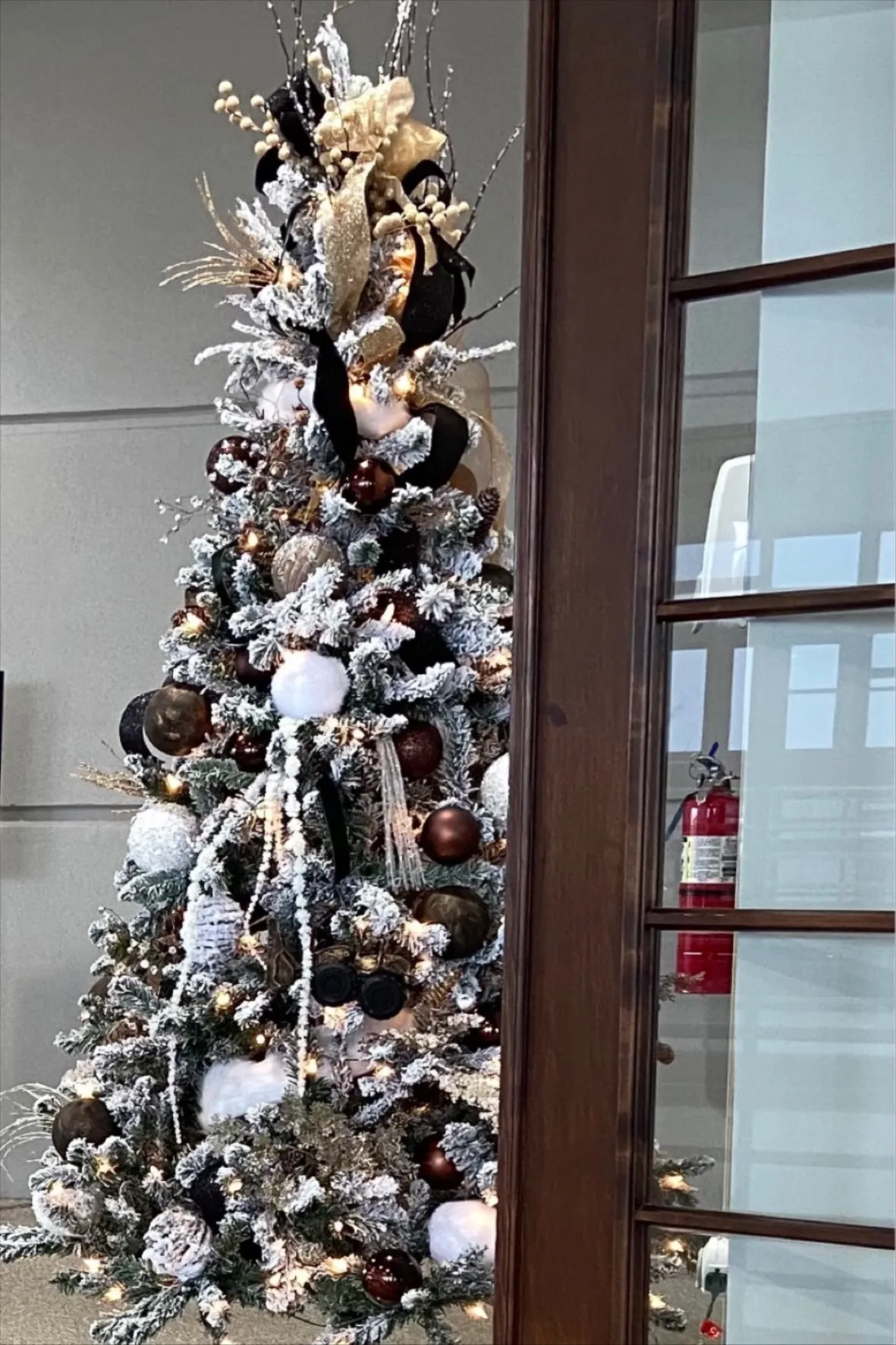
- Gather 8 to 12 thin dried branches, roughly 14 to 18 inches long.
- Spray-paint them matte black or antique gold in two thin passes; dry overnight.
- Bundle with florist wire, splaying the branches into a fan shape.
- Weight the base with a small foam block and tuck it into the tree’s top opening.
- Weave in two short strands of warm lights to soften the silhouette.
Time: two days including drying. Cost: $8–$15.
27. Blue and White Balls over a Mauve Sofa
Blue-and-white on a black tree is quietly becoming the 2026 alternative to red-and-green. It borrows from classic chinoiserie palettes, which have been surging in interiors since 2023, and it looks intentional against black in a way traditional red often doesn’t. The silver sequin backdrop is the giveaway that this is a styled set — but the underlying idea transfers: pick a heritage color pairing, put it on black, and everything reads more modern. It’s a trend with real legs because it costs nothing extra.
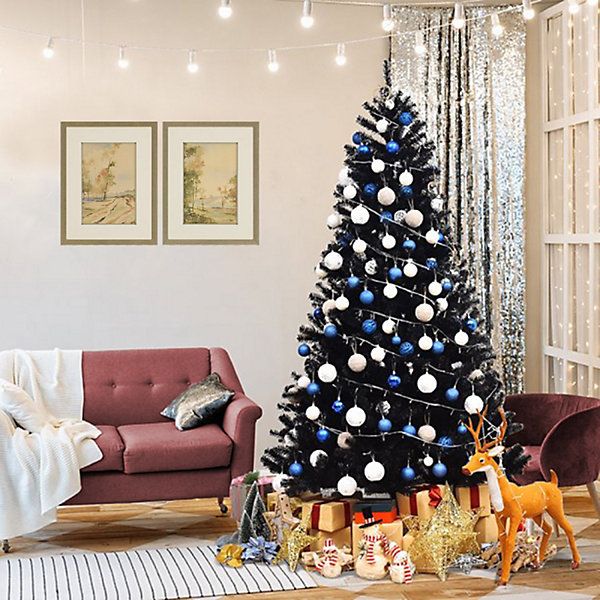
Blue ornaments are nothing new. Blue ornaments next to a mauve tufted sofa are. The sofa is what turns this from a nice tree into a styled room — mauve and navy sit nearly opposite each other on the color wheel, so the warmth of the sofa makes the cool blue balls look almost electric. Remove the sofa and you’ve got a decent tree in a blank corner. Keep it, and the tree has a job to do in the room.
28. Gold Tinsel Base with Copper Paper Fans
The gold tinsel at the base is doing something clever: it fades the tree into the floor so the bottom half of the room reads as one warm mass, while the black upper branches stay crisp against the wall. Copper paper fans and white snowflakes sit in the middle, bridging matte and metallic. And the composition repeats itself — fan ornaments, sunburst mirror, spiky topper, all radiating shapes. That’s why it hangs together even though there’s a lot of stuff here.
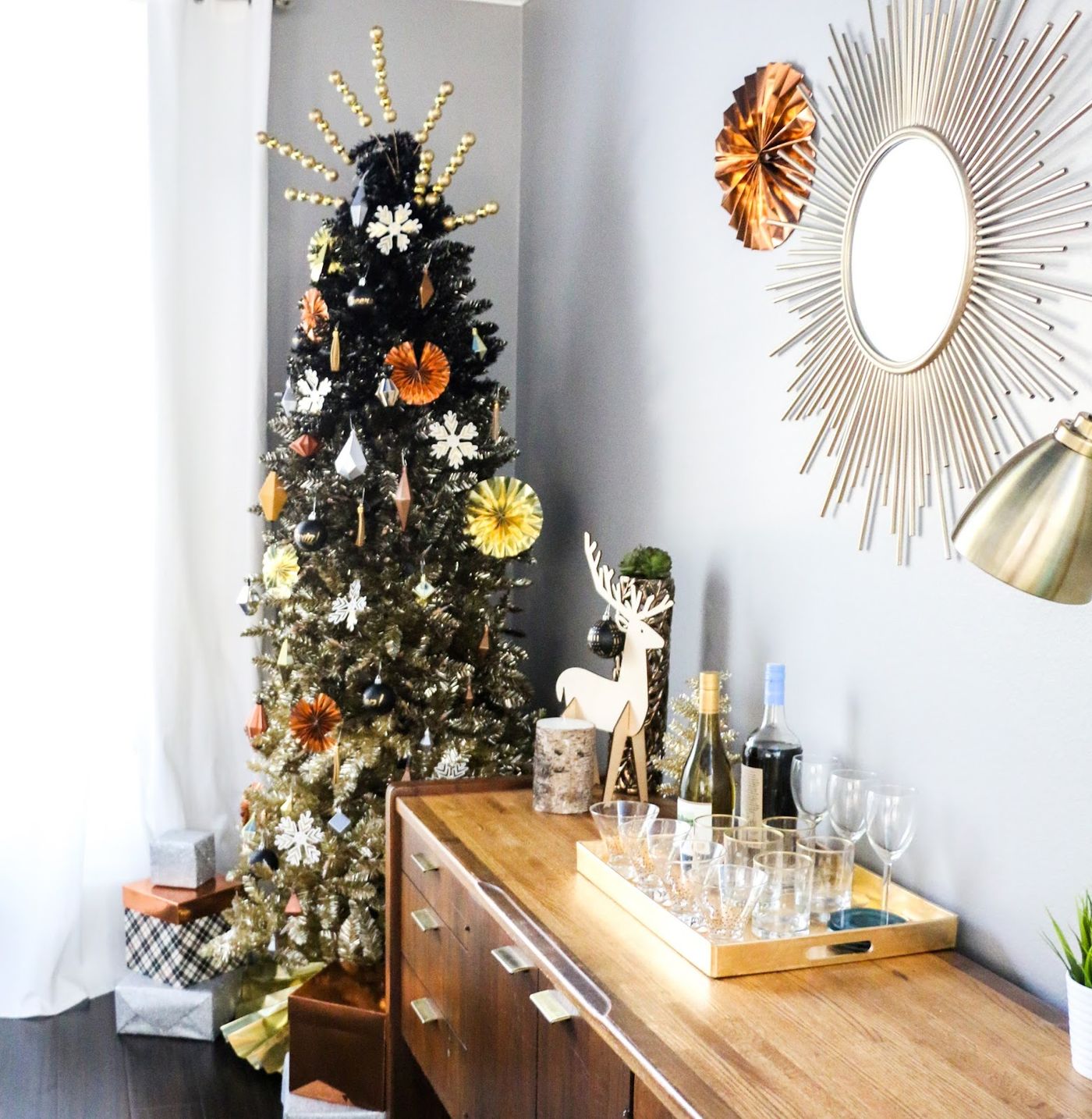
- Tall black tree: $200–$600
- Gold tinsel garland for the base (3–4 strands): $15–$35
- Copper paper fan ornaments (10–12): $20–$50
- White snowflake ornaments: $15–$35
- Spiky gold starburst topper: $20–$55
- Black round baubles (60 count): $25–$60
- Total: roughly $295–$835
29. Flocked Branches, Magnolia Picks, Patterned Gifts
White magnolia picks and gold ribbon garland are two of the fussiest things you can put on a tree. Magnolia leaves are usually fabric over wire; they crease, and once creased they never sit flat again, so store them in a flat box rather than a bin. Metallic garland snags on flocking — every strand catches snow dust you can’t get out. Spot-clean fabric picks with a barely damp cloth, never soak them. If you want the same softness with none of the upkeep, switch to white cotton stems.
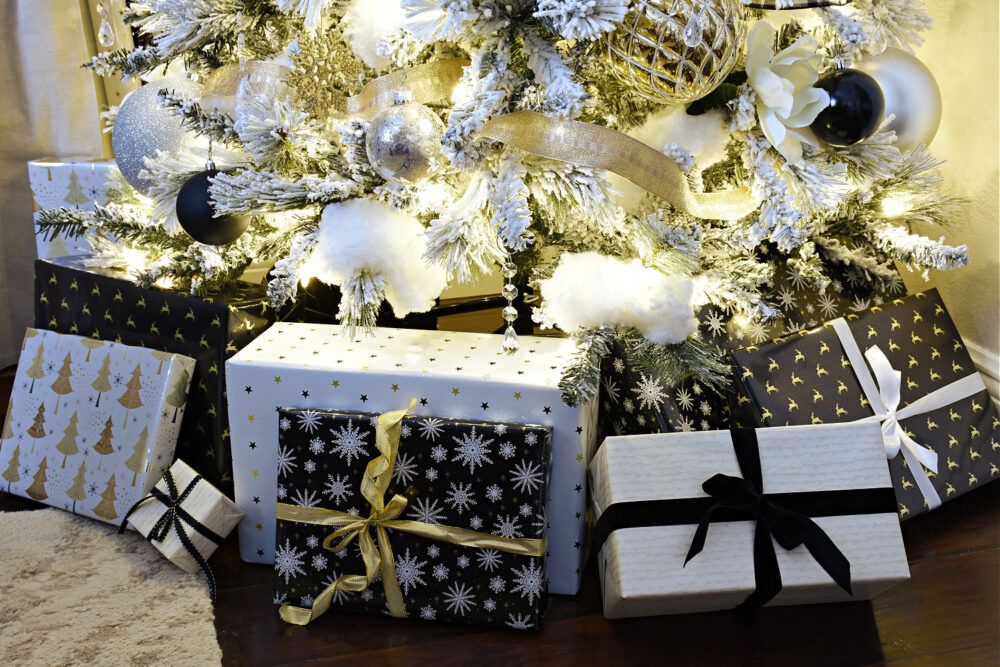
Dense, heavily decorated looks need volume, and volume eats space. Plan on a tree at least seven feet tall in a room with nine-foot ceilings and eight feet of usable wall. In a room under 200 square feet, this level of density starts to feel cluttered — go with the slimmer silhouette in Idea #18 and keep the same black, gold, and white palette. Leave at least 30 inches of walking room on the gift side of the tree.
30. Frosted Glass, Gold, and a Concrete Side Table
Frosted glass ornaments are the stealth move in a neutral room, because they pick up whatever color is around them — including an olive throw pillow six feet away. Hang them at eye level, roughly 40 to 60 inches off the floor, where they catch the most ambient light. Pair them with a matte-finish metal so the shine reads soft rather than sharp. And if you’re styling next to concrete or stone, keep your ornaments slightly warmer in tone; cool grey furniture makes cool ornaments look grey and dusty.
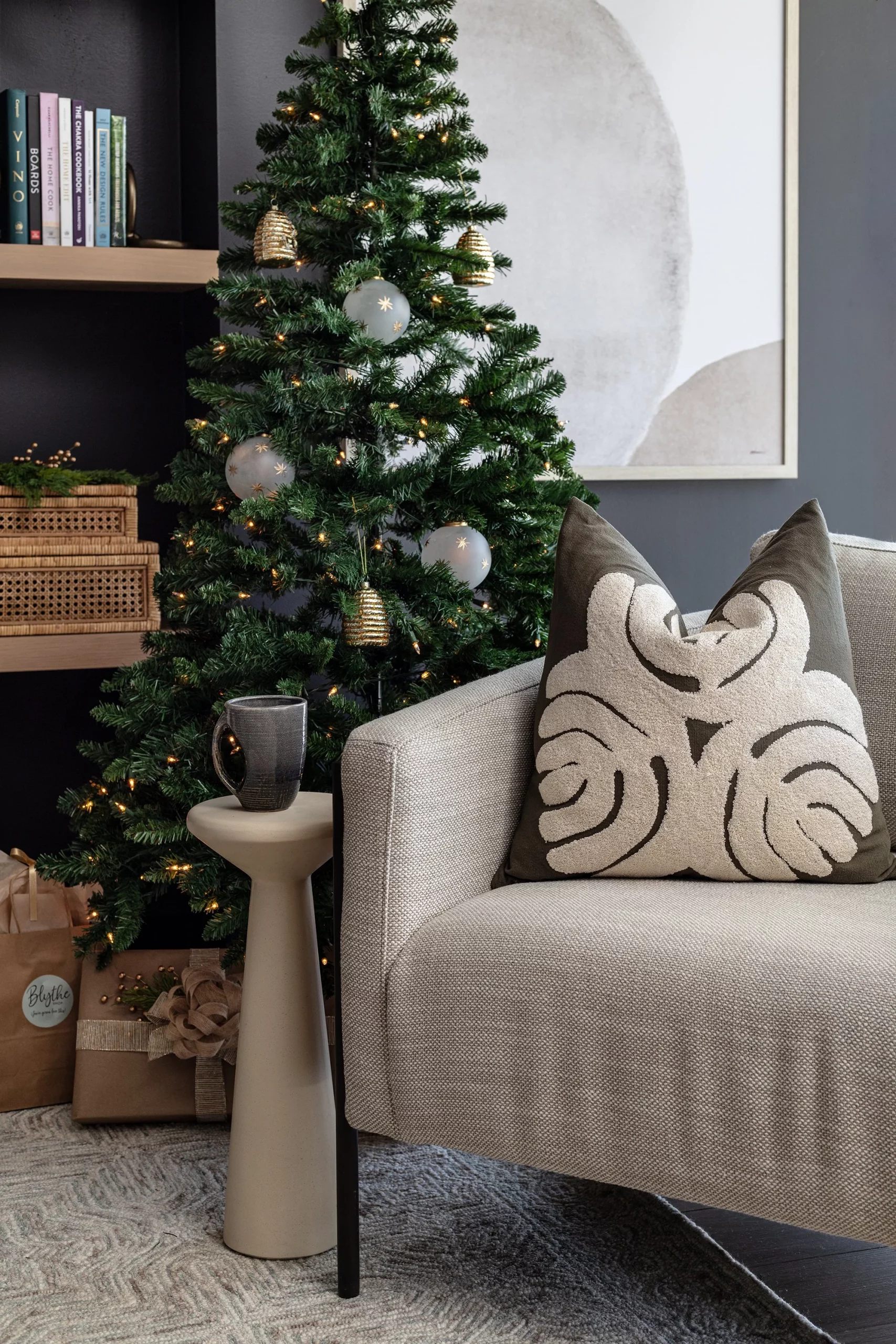
The quietest version of this look is also the cheapest. Frosted glass ball ornaments come in packs of 12 to 24 at Target and Walmart for $10–$25, and a green seven-foot tree sells for $50–$120 at Walmart or $30–$70 used on Facebook Marketplace. The beige armchair equivalent is a Marketplace find at $80–$200. The one thing worth buying new is the olive patterned pillow, $20–$35 at HomeGoods. Under $300 for the whole refresh.
31. Deep-Toned Ornaments and Glowing Ambient Light
Moody is a lighting condition before it’s a decor choice. A dark tree against dark walls with nothing but fairy lights looks like a black hole in daylight — and phone photos come out grainy and flat. Two things fix it: warm lamps at two different heights, and at least one light source above the tree. Dark ornaments also scratch visibly. Matte finishes hide it; high-gloss shows every scuff from the storage bin. If you’re building a dark collection, buy matte first.
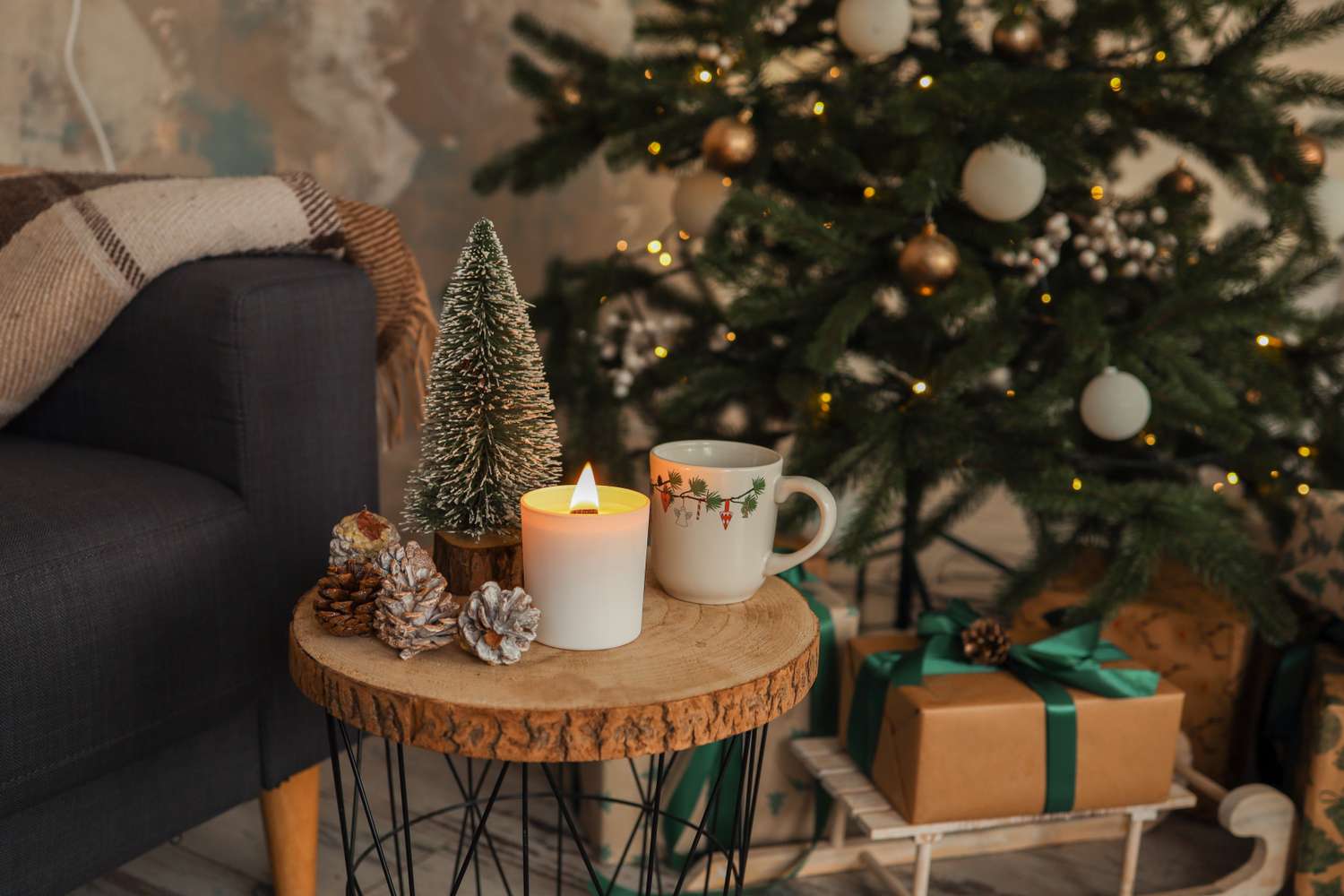
This reads as roughly 60% dark (tree, ornaments, walls), 25% warm light, 10% metallic accents, and 5% light-valued object — a mug, a book, a white ceramic piece — so the eye has somewhere to rest. Without that last 5% the room has no anchor and feels unfinished. Swap the metallic from gold to bronze and the mood warms; swap to pewter and it cools toward industrial. The light percentage should essentially never change.
32. Black Tree in a Woven Collar on a Shaggy Rug
The white woven tree collar. It’s one object, it costs less than a decent tree skirt, and it does three jobs at once — it hides the stand, it introduces a shape you don’t see anywhere else in the room (round, open, structured), and it creates a clean white ring at floor level that makes the black branches above look sharper. Swap it for a red plaid skirt and the whole minimalist composition falls apart.
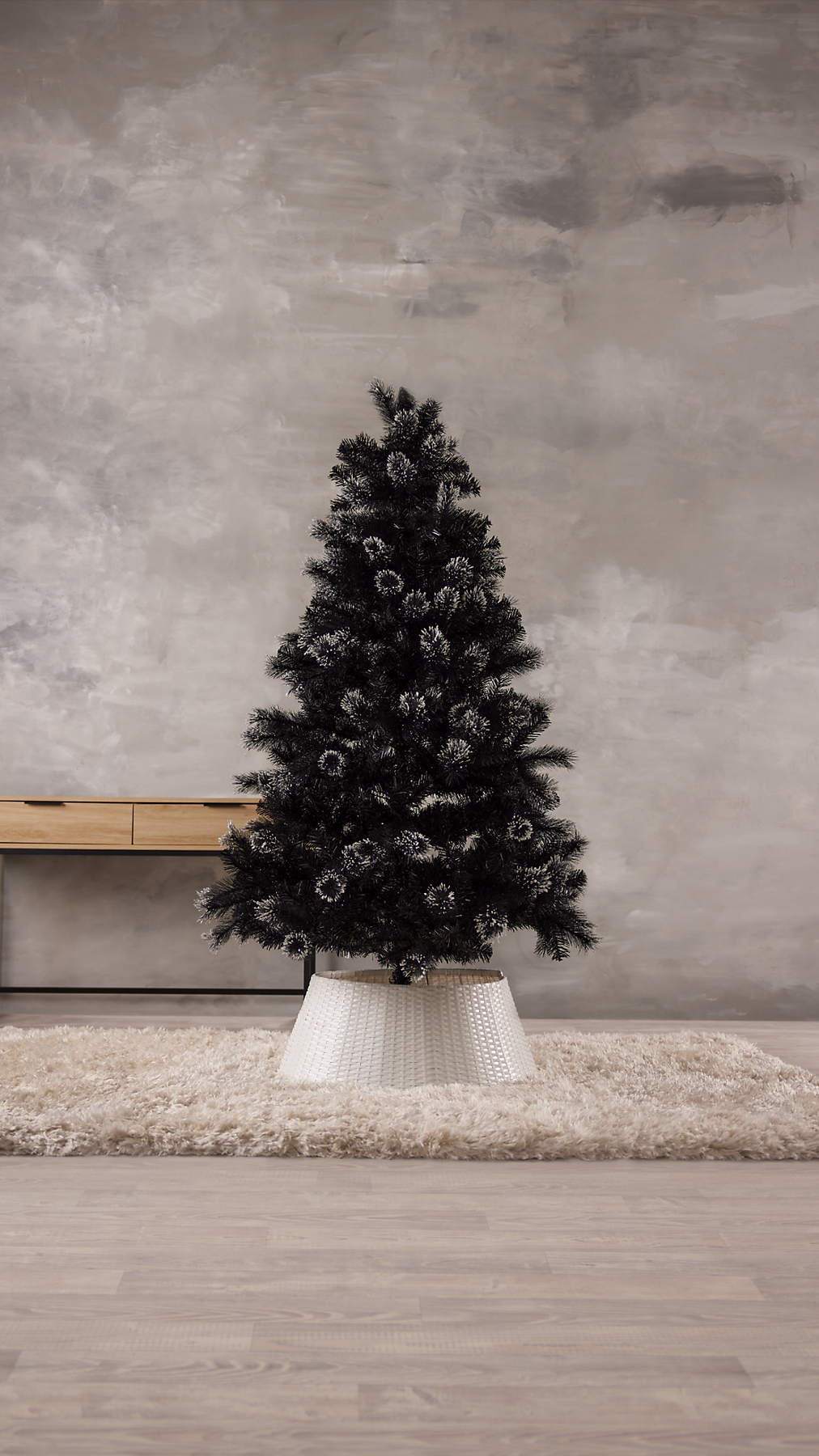
Three layers, three values: black tree, grey plaster wall, white floor covering. Nothing repeats, and everything reads. The frosted needle tips are what make it feel wintry rather than goth — a bare black tree on this same wall would go severe. And the shaggy rug does the work of a tree skirt and an area rug in one shot, which is the kind of efficiency that makes small spaces feel considered instead of crowded.
33. Three Flat Metal Tree Silhouettes on a Tabletop
- Start with the tallest silhouette at the back left, about 4 inches off center.
- Place the medium tree forward and right, overlapping the first by about a third.
- Set the smallest one slightly forward again — the stagger is what makes flat objects read as depth.
- Drape one short strand of warm lights across all three bases, not around each individually.
- Finish with two gold candle holders at different heights on the outer edge.
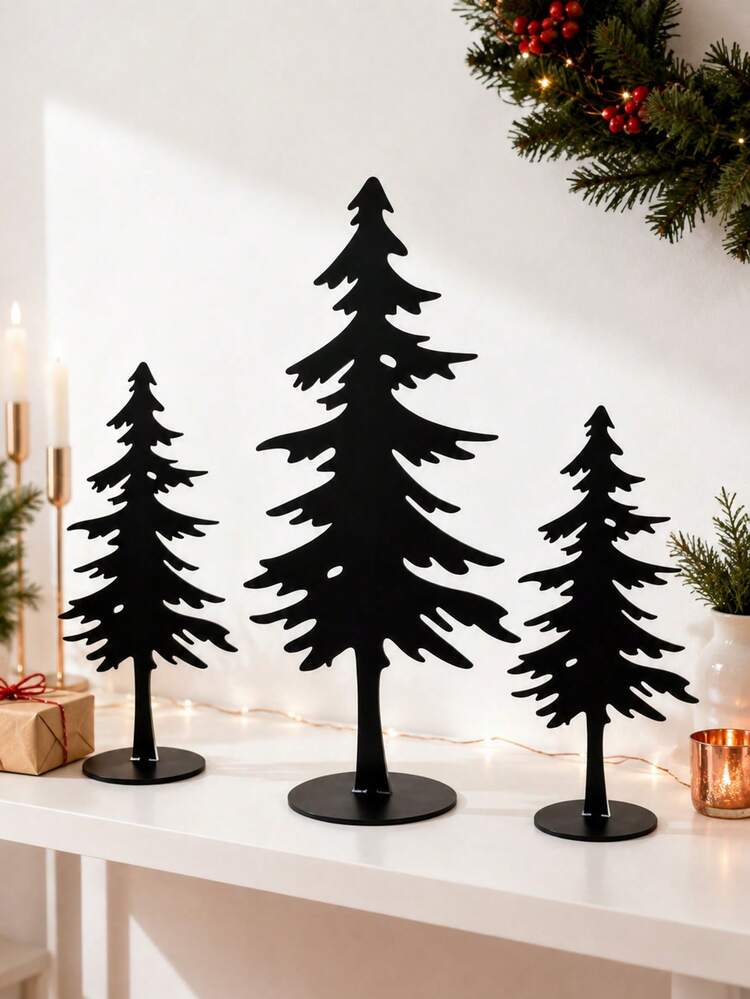
Time: 15 minutes. Cost: $25–$60 for the trio.
Tabletop trees are for surfaces, not corners. This set wants a console, mantel, or buffet at least 30 inches wide with a calm wall behind it. They’re the right answer for apartments under 600 square feet, dorms, and anyone who has already committed the main tree to another room, like the fireplace setup in Idea #35. Keep the tallest silhouette under 18 inches or it competes with whatever hangs above it. And flat metal needs backlighting — a warm LED strip behind the tallest piece gives a flat sheet of steel actual dimension.
34. Blue Velvet Ribbon and Dried Orange Slices
Dried orange slices are the reason this tree doesn’t feel like one more blue-and-gold setup. They bring in a warm amber that sits between the ribbon’s blue and the gold angel topper, and they’re translucent, so fairy lights pass through and make the fruit glow from inside. Against black paneled walls, the tree’s only job is to be the brightest thing in the room — between the oranges, the candle clips, and the angel, it is. Everything here is warm except the ribbon, which is exactly why the ribbon reads.
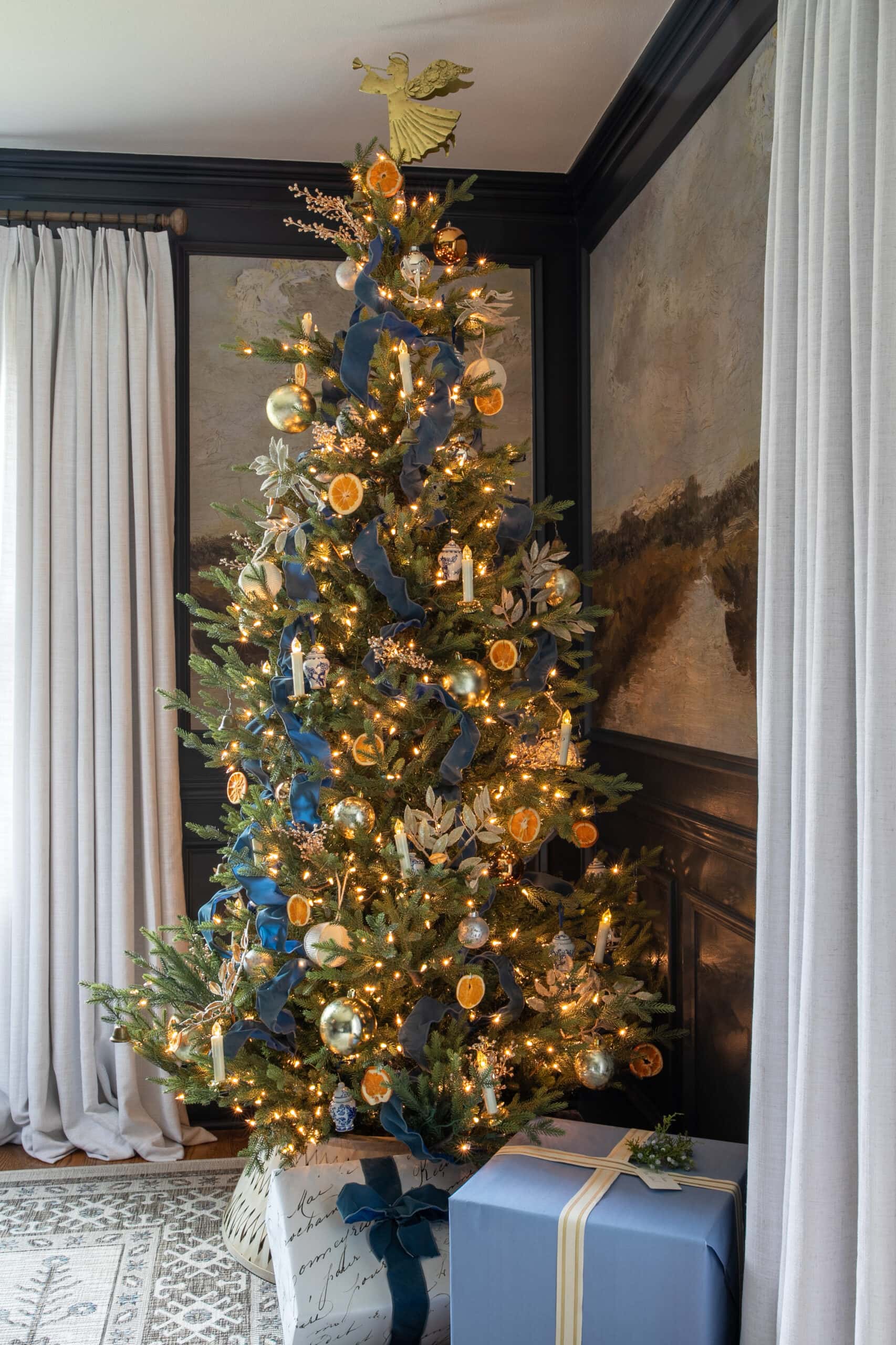
- Full 7.5 ft tree: $120–$450
- Blue velvet ribbon (2 spools): $20–$50
- Dried orange slices (homemade or bought): $0–$25
- Candle clip ornaments (12): $20–$45
- Gold angel tree topper: $25–$70
- Mixed gold and glass ornaments: $50–$140
- Total: roughly $235–$780
Budget alternative: dry your own orange slices. Four oranges, two hours at 200°F, and the kitchen smells incredible.
35. Slim Black Tree and Starburst Lights by the Mantel
A slim black tree beside a working fireplace solves one problem and creates another. Heat is the enemy of any artificial tree — real flames within three feet will soften branches and eventually crack the coating on a black tree, which shows up as grey streaks. Keep at least three feet of clearance and never let the skirt touch the hearth. Starburst lights are also the first thing to fail because the wire bends at sharp angles; buy a set with a warranty and don’t fold them tightly for storage.
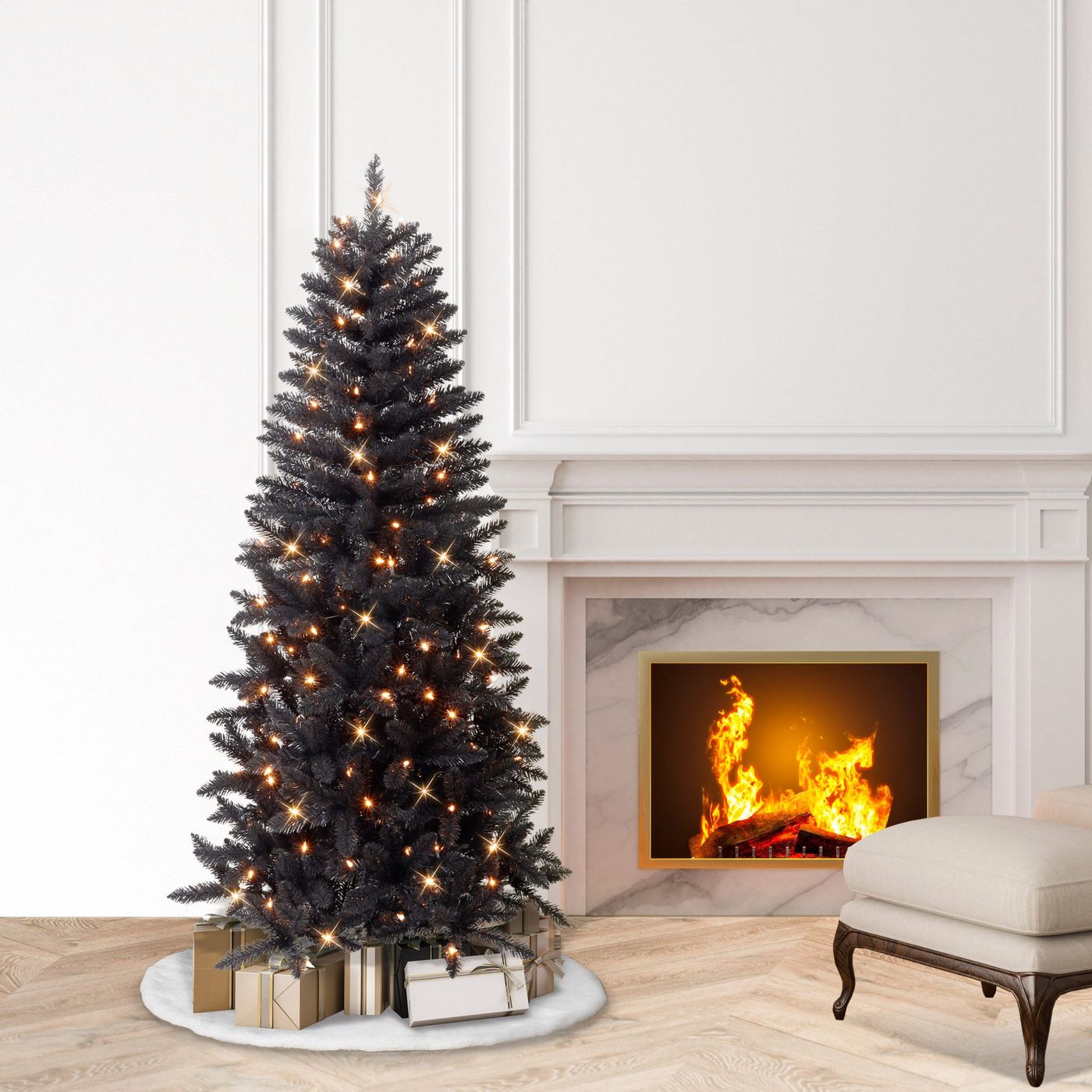
On a slim tree, ornament scale is everything. Use small and medium pieces only — nothing wider than 3 inches — or the tree looks like it’s wearing a coat two sizes too big. Hang them in vertical rows of three on the outer branches and leave the interior mostly bare so you can see through. That’s the whole appeal of slim: negative space. Want a focal point? Make it the topper, not a cluster in the middle.
Neutral metallic gifts under a black tree have been quietly overtaking the red-and-green pile for a couple of years, and 2026 is the season it goes mainstream. The driver is practical — silver, gold, and champagne wrapping works with whatever palette you already own, so you can restyle next December without rebuying paper. Combine that with reusable fabric wrap and faux fur skirts and you get a look that’s photogenic and less wasteful. That’s what makes a trend stick.
Your Black Tree, Your Rules
Black trees aren’t a risk anymore — they’re the rare holiday choice that looks more current every year, and the ones that work always come down to the same three things: warm light, contrast finishes, and a clear palette you refuse to break. Pick one idea above, steal the formula, and ignore the rest. Then pin the one you’re actually going to do so it’s waiting for you in November.
