
33 Stunning Classic Christmas Tree Ideas to Elevate Your Holiday Decor in 2026
Classic Christmas trees are having a very loud moment on Pinterest right now — and it’s not because anyone reinvented the wheel. It’s because after a few years of sparse, beige, eleven-ornament trees, people started saving the ones that look like Christmas actually happened in the room.
We spent serious time digging through Target, Etsy, Wayfair, Amazon, and Walmart to bring you only what’s worth your attention this year — 33 ideas running from $12 clearance ornaments to $1,200 for a fully flocked twelve-footer. Everything is compared side by side, budget against luxury, with shoppable picks for each look.
Inside you’ll find traditional red-and-gold, flocked white, minimalist neutral, rustic handmade, and vintage retro trees — plus the lighting math, ribbon widths, and collar measurements that make the difference between decorated and styled. And stay until the end — we break down the most common mistakes that can ruin these looks.
Nostalgia decorating is the engine behind 2026’s biggest shift: colored lights are back, ribbon is doing more work than novelty picks, and people are saving trees that feel lived-in rather than staged. 📌 Save this to Pinterest for later — you’ll want to revisit these ideas.
1. Dense Evergreen With Red Baubles and Gold Fans
Here’s the number that separates a tree that looks lit from one that looks lit from within: 100 bulbs per vertical foot. On a 7.5-foot fir that’s roughly 750 warm-white minis, woven in and out of the branches rather than spiraled around the outside. Then work ornaments in odd clusters of three — one glossy red bauble, one gold sphere, one flat metallic fan — about a hand-width apart, rotating each fan so it faces outward. Flat ornaments read as sunbursts when they catch light, and as nothing at all when they’re turned sideways.
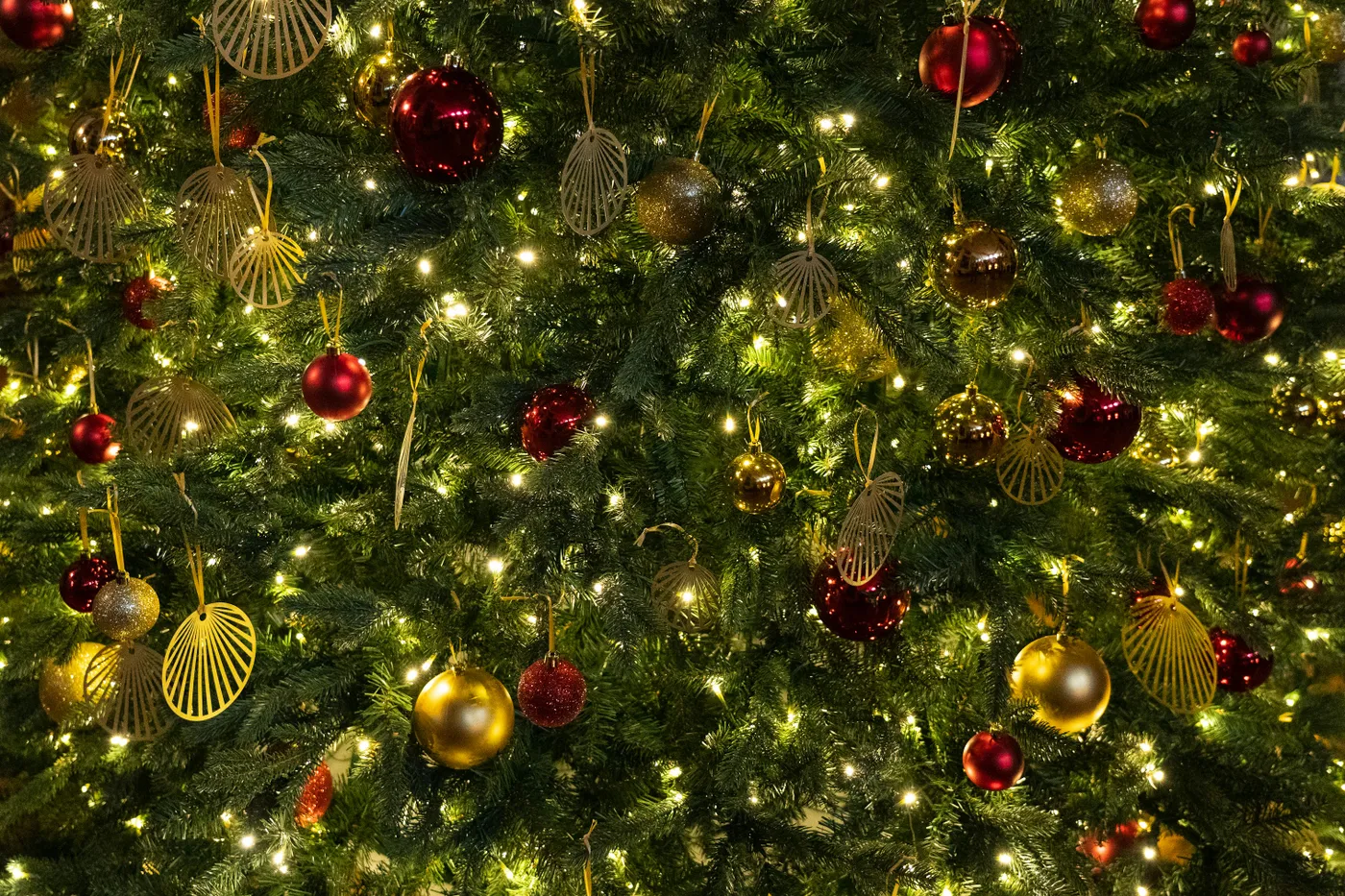
Red on green is the oldest contrast trick there is, but what makes a tree like this feel collected rather than purchased is finish, not color. Matte needles swallow light; glossy glass, gold spheres, and flat metal fans throw it right back. One matte surface against three shiny ones gives the eye somewhere to travel. Keep the palette to four notes — forest green, ruby red, gold, and the warm yellow of the bulbs — and repeat those four all the way up, sizing the ornaments slightly smaller near the top so the whole thing doesn’t look bottom-heavy.
2. Lit Birch Trees, Teddy Bears, and a Fireside Garland
Strip the three white birch trees out of this corner and you still have a nice mantel and a tidy pile of presents. Put them back and it becomes a scene. That’s what they’re doing — they’re the thing you’d miss first. Note the choreography: three heights, an odd number, staggered instead of lined up like soldiers, all glowing at the same warm temperature as the garland above the stone fireplace. The teddy bears in Santa hats are the punchline. The birch trees are the setup.
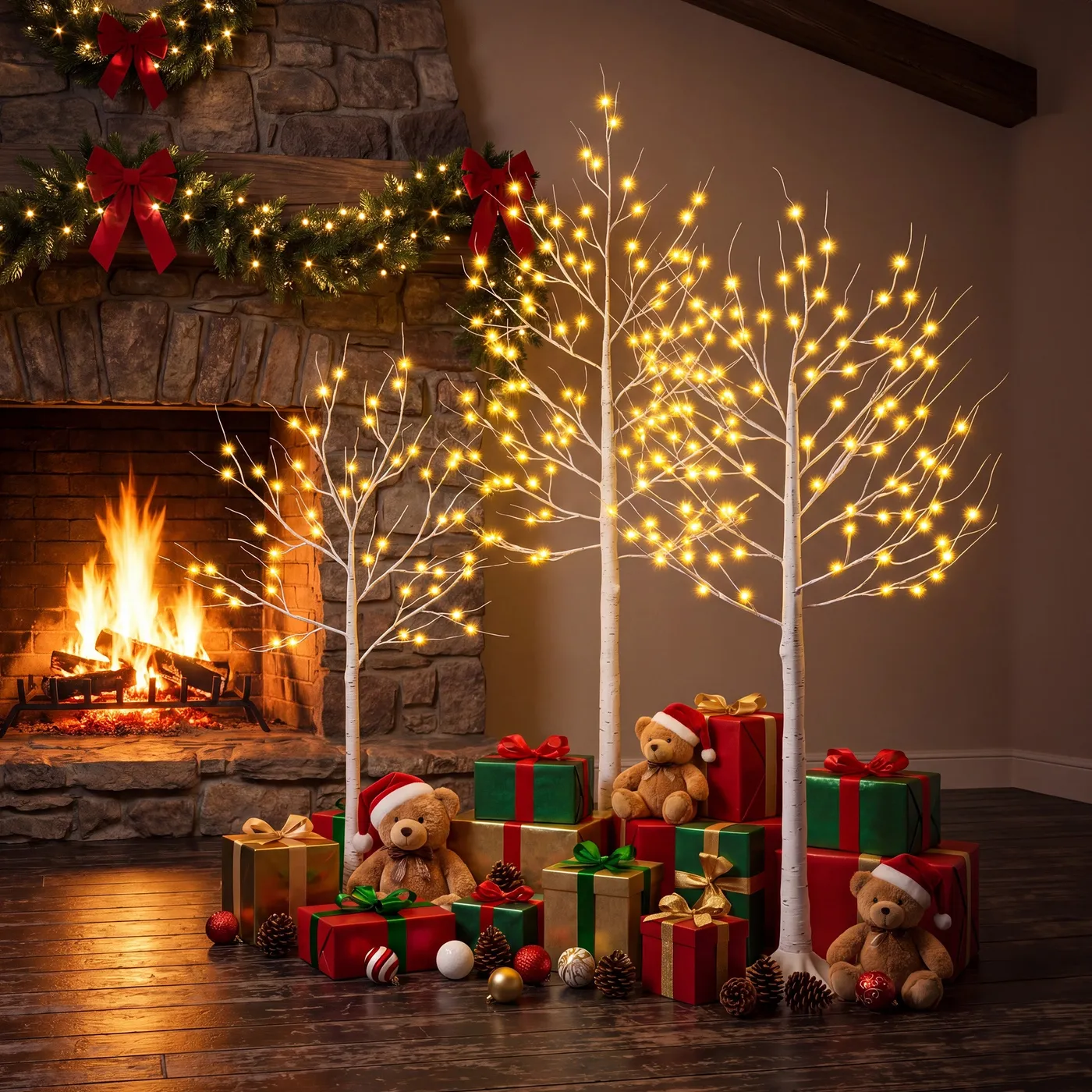
Target and Walmart both sell pre-lit birch trees in the $50–90 range for a four-footer, and that’s the whole look. You can also go genuinely free: branches from a neighbor’s yard, a can of white spray paint, and a 100-count strand of warm white string lights ($9 at Walmart) wrapped up each trunk. Santa-hat bears come from thrift stores for $2–4 apiece. Three rolls of paper and a spool of ribbon handle the gifts, and nobody has ever inspected the corners of a present under a lit tree.
3. A Vaulted-Room Tree Draped in Red Ribbon
This tree earns its drama from the room, not the other way around. Vertical ribbon streamers pull the eye upward, so you need vertical space: think 14-foot ceilings with a 10- to 12-foot tree, or a 7.5-footer raised on a two-foot riser so the ribbons and silver baubles still land in your sightline instead of hovering near your knees. Leave 30 inches between the tree and those multi-pane windows so it doesn’t read as a dark shadow against daylight, and keep a 36-inch walkway behind the cream sofa.
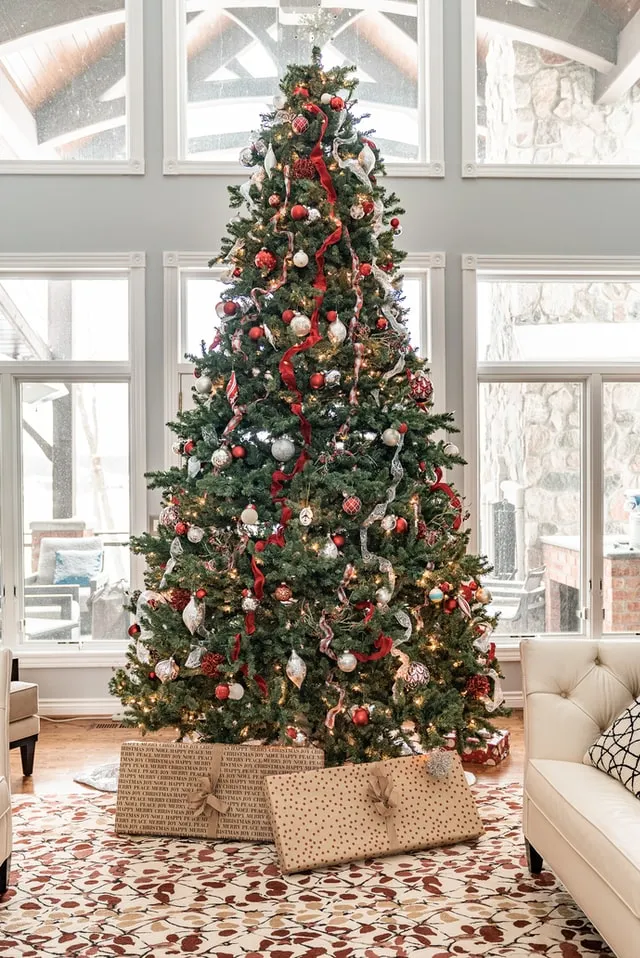
The formula here is roughly 55% evergreen, 25% crimson, 15% silver and white, and 5% kraft paper. That last 5% is doing quiet work — twine-tied packages keep the red from turning into a fire engine. Swap crimson for deep burgundy and the silver for brushed gold and you get a warmer, moodier version of the same tree without changing a single proportion. Swap kraft for glossy white boxes and it turns modern. Same math, different answer.
Ribbon-forward trees are the 2026 face of what designers keep calling quiet traditional — the nostalgia pull that’s been building on Pinterest for three seasons, now settled into real ribbon instead of novelty picks. Vertical streamers are popular because they make an artificial tree look styled rather than stuffed. This one has staying power: ribbon has shown up in holiday windows for a century, and it photographs beautifully, which is exactly why it keeps getting saved.
4. Paper Honeycombs and Acorns on a Full Green Fir
Paper honeycombs are the cheapest way to fill a tree with things that catch light:
- Cut 12 circles of tissue or 90-lb paper, 4 inches across.
- Fold each circle in half, crease it, and stack them all facing the same direction.
- Glue the folded halves to each other one at a time, leaving the two outer flaps free.
- Punch a small hole through the center of the stack and thread a loop of twine.
- Open it gently like a fan until the honeycomb holds its own shape.
About 20 minutes and 40 cents per ornament.
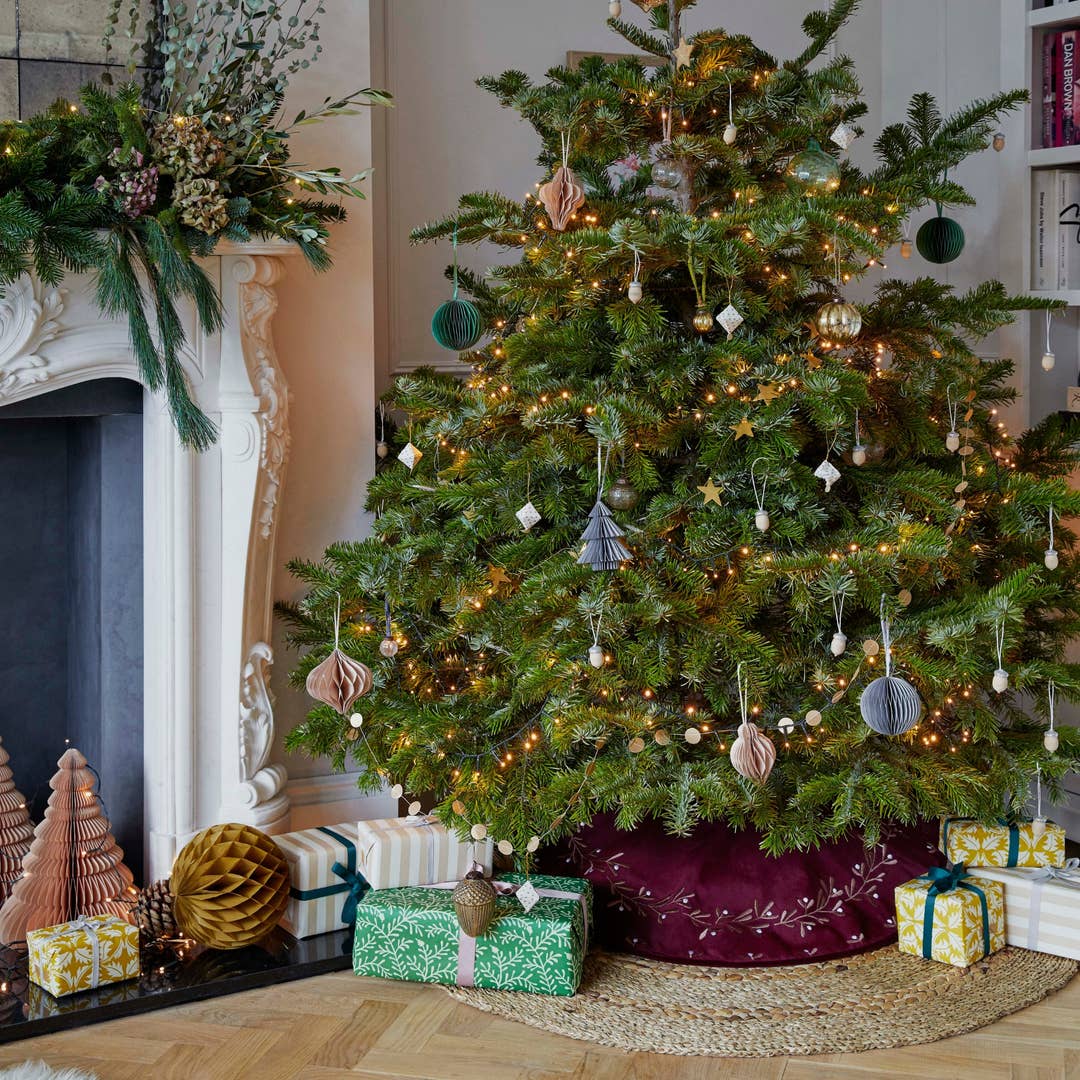
Paper ornaments and a working fireplace are a fragile friendship. Heat warps honeycombs, humidity makes them sag, and a stray ember is a very bad day. Keep paper decorations at least three feet from any firebox and away from floor vents, and store them flat in a box with tissue between layers — never in the same bin as metal baubles, which will crush them. If your tree lives in a humid room, spray both sides of each piece with a light matte sealant first. Two minutes per ornament, years of re-use.
5. Openwork Gold Baubles Up Close
Openwork metal ornaments are beautiful and also tiny dust traps. Once a month, hit them with a can of compressed air (about $8, and it lasts several seasons) or a soft dry brush. Water and polish will dull the finish and pack dust into the gaps. Store them in a single layer wrapped in tissue — a shoebox works fine — because that thin filigree bends under the weight of a full ornament bin. Expect to replace one or two a decade, which is honestly a bargain.

Two numbers worth remembering. First, 2700K: that’s the color temperature that reads as candlelight rather than office lighting, and it’s what makes gold look gilt instead of brassy. Mixing 2700K with a strand of 3000K is what makes a tree look accidentally mismatched. Second, 57 to 60 inches — eye level. Hang your single best ornament, the one with the story attached, at that height rather than at the very top, where nobody actually looks after Christmas morning.
6. Blue Ribbon Christmas Tree in a White-Beamed Living Room
Run these checks before you commit to a blue-and-white scheme under a vaulted ceiling:
- Measure floor to beam, then subtract 12 inches for the topper and its clearance.
- Budget ribbon by the foot — a 7.5-foot tree eats about 30 feet of 1.5-inch blue ribbon.
- Note where those twin silver ring chandeliers hang; your tree top should finish 2 feet below them.
- Confirm an outlet within cord reach so you’re not running a white cord across a white floor.
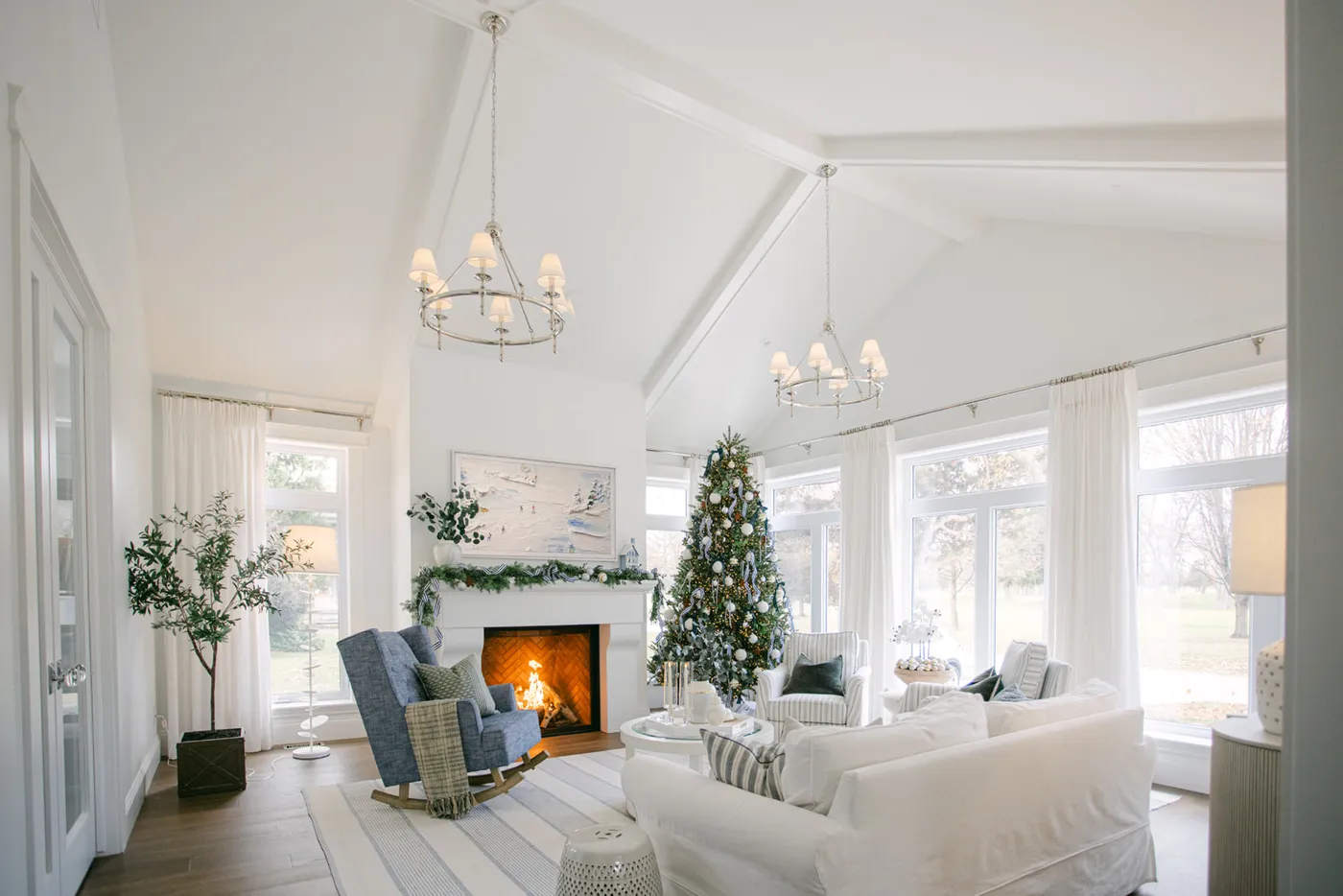
Blue-and-white Christmas — cobalt ribbon, silver rings, white slipcovers — is having a bigger year than red in a lot of design circles, and it makes sense. It photographs cool and calm against all the warm-gold trees flooding feeds, and it works in rooms that already lean neutral. The catch is commitment: blue only reads as festive when it’s saturated. A dusty pastel ribbon on a tree looks like spring. Cobalt, navy, or a proper French blue with silver keeps it solidly in December.
7. Warm String Lights Beside a White Brick Fireplace
A tree with lights and almost nothing else is a commitment, not a shortcut. Every gap in the branches is visible, every shortcut in fluffing shows, and a 7.5-foot tree needs 800-plus bulbs before it reads as finished rather than abandoned. Fluff it in daylight, in sections, branch by branch, and don’t rely on the glow to hide the seams — it never does. The upside: you can redecorate this entire look in ten minutes when you get bored of it in January.
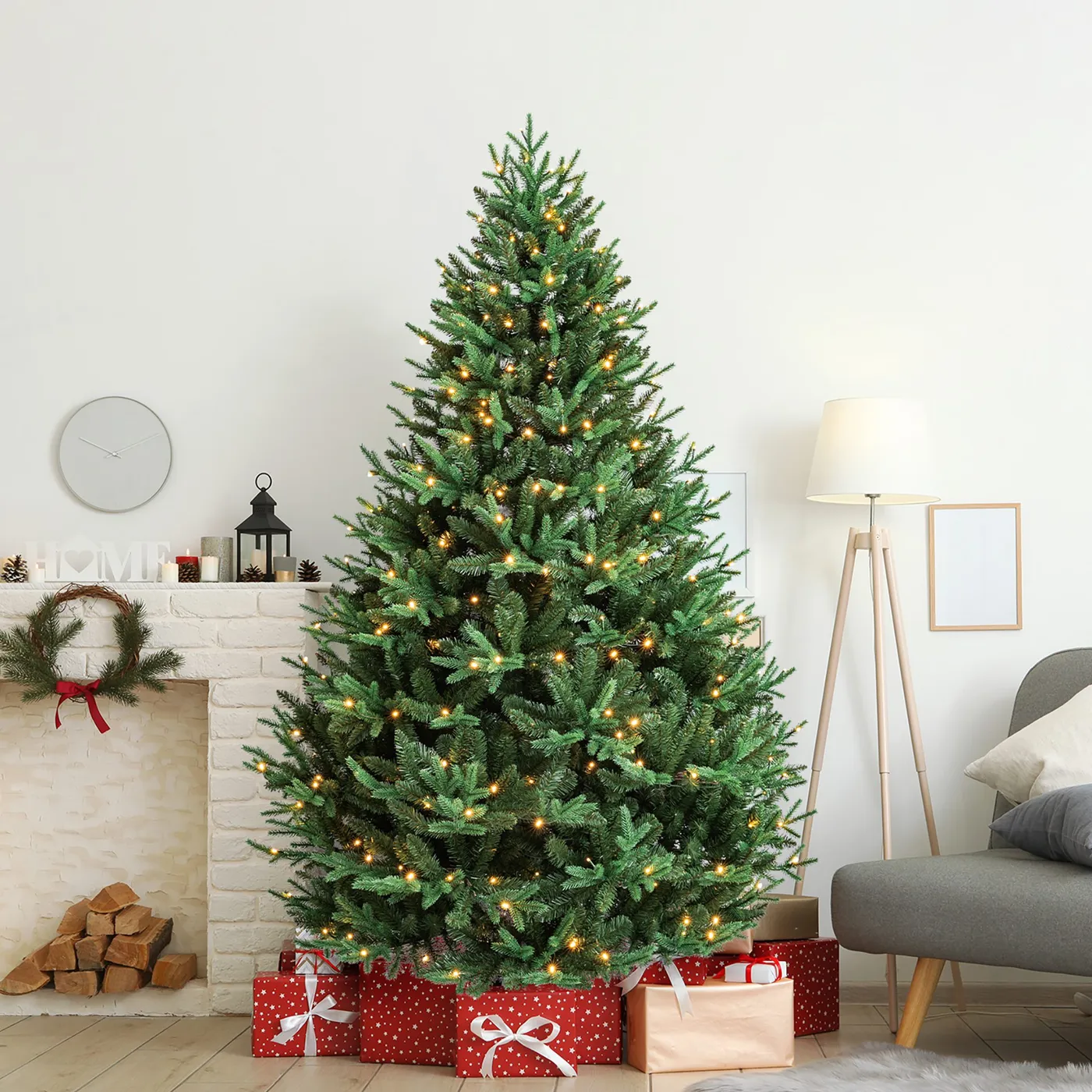
The tripod floor lamp with the wooden legs. It’s easy to scroll past, but look at what it does: it puts a second warm light source in the corner at eye level, so the tree isn’t the only thing glowing. Without it, this vignette has one note. With it, the grey armchair and the white brick fireplace get pulled out of the shadow, and the whole corner reads as a room at night instead of a tree in a room.
What a lights-only tree actually needs:
- 800–1,000 warm white minis on a 7.5-footer
- A skirt or collar wide enough to hide the stand and every cord
- The same bulb temperature across every single strand
- Daylight fluffing, then one final walk-around at night
8. Striped Armchairs and a White-Ornament Tree Under Vaulted Ceilings
Roughly 70% white, 20% green, 10% charcoal and silver metal — and notice how the stripes on those armchairs quietly re-introduce the white-and-green ratio in miniature. Swap the white ornaments for pale blue and the room goes coastal. Swap the charcoal pillows for black watch plaid and it goes English country. The proportion stays the same: one dominant neutral, one strong color, one accent that shows up in at least three places — the tree, the pillows, the rug.
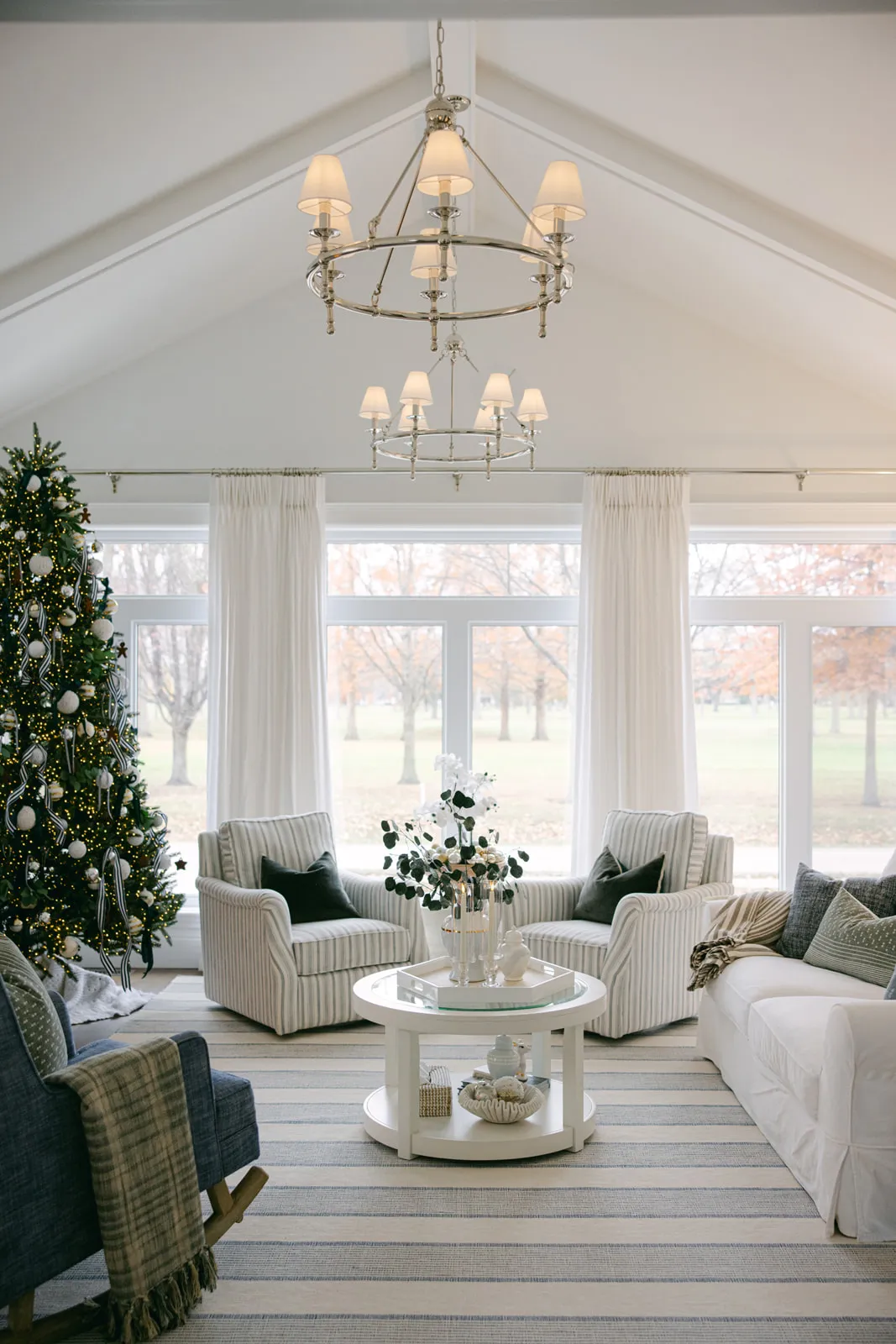
A vaulted room with 18-foot ceilings will swallow a 7.5-foot tree whole. You want a 12- to 14-footer, or a smaller tree on a substantial riser, so the top third still sits inside the architecture instead of beneath it. Those two tiered metal chandeliers give you a measurement to work from: hang them so the lowest point clears the floor by about 7 feet, and let the tree finish roughly 2 feet below. In a standard 9-foot room? Go with the proportions in Idea #18.
9. Handmade Fabric Ornaments Against Grey Wood Paneling
This is the tree that proves you don’t need a single new ornament. Thrift stores, estate sales, and Facebook Marketplace sell handmade and vintage ornaments for 50 cents to $2 apiece; sixty of them is a $50 tree, and it’ll look like it came from Anthropologie. Fabric scraps from a quilting bin make the easiest filler — a 3-inch circle of cotton, a pinch of batting, a running stitch, pull tight, done. Kraft paper and a spool of ribbon handle the gifts for under $25. If you liked the paper ornaments in Idea #4, this is the same instinct on a thrift-store budget.
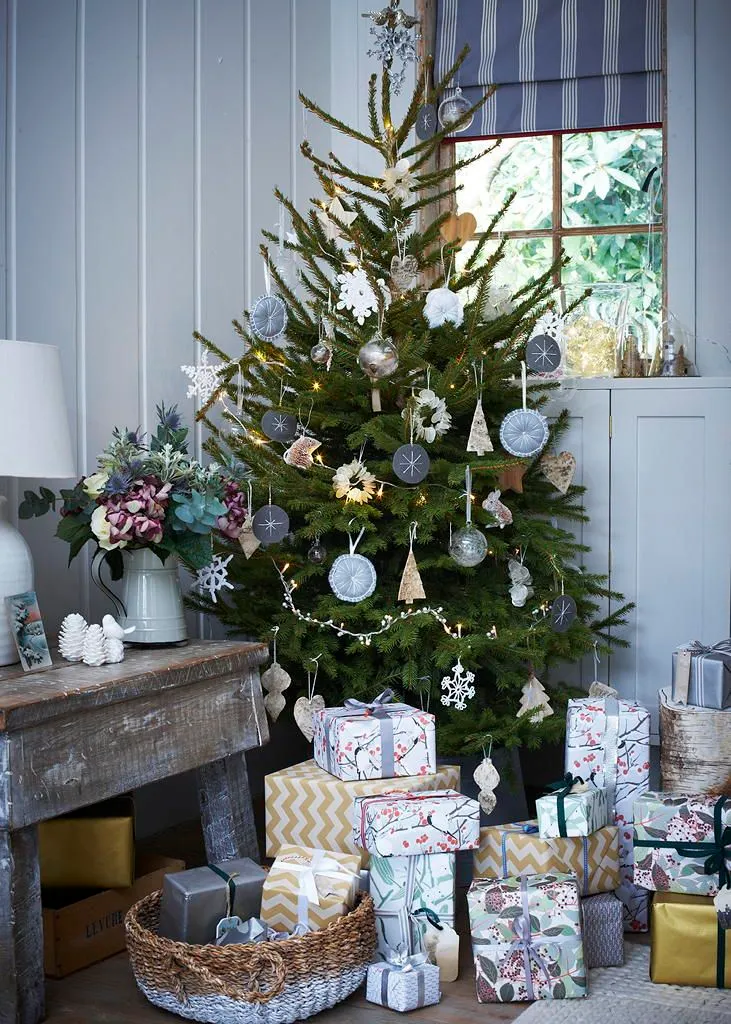
Ribbon width should scale with the tree, and most people get this wrong in the wrong direction. For a 7- to 9-foot tree, 2.5-inch wired ribbon is the sweet spot; anything narrower disappears into the branches, anything wider starts looking like a pageant. Trees 10 feet and up can handle 4-inch. Budget about 1.5 yards per bow plus tails — a 7.5-footer with twelve bows needs roughly 20 yards, which is exactly why good ribbon from a fabric store beats a $6 pre-made bow every time.
10. Flocked Tree With Red Plaid and White Poinsettias
The flocking isn’t just a snow effect — it’s what makes the red work. By pushing the tree toward white, flocking turns the branches into a neutral base, so crimson ornaments pop even in a dim corner of the room. Then the white poinsettias add a third texture: matte ball, soft petal, woven basket. Three surfaces, one palette. A plain green tree with the same ornaments would read heavier and darker, especially in a room that doesn’t get much natural light.
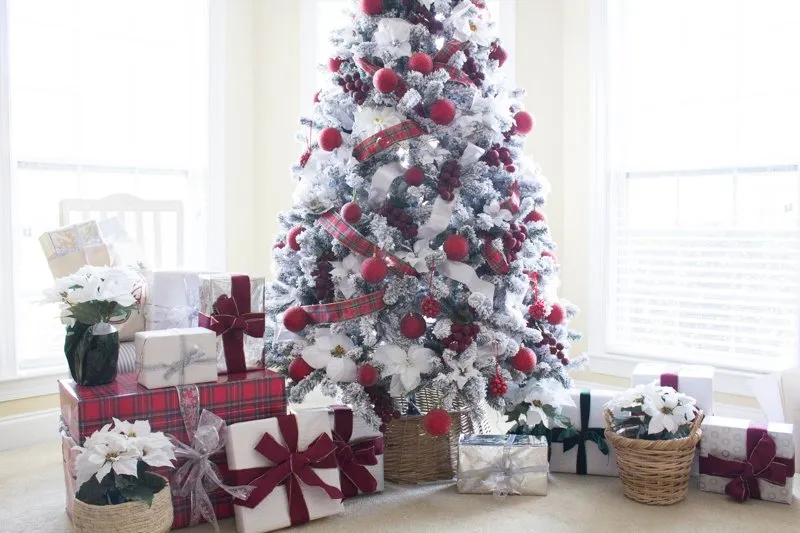
- Flocked tree, 7.5 ft: $180–600
- Red matte baubles, 60–80 count: $60–150
- Plaid ribbon, 20–25 yards: $18–35
- White poinsettias: $8–15 each real, $6–12 faux
- Woven baskets under the tree: $15–40
Total: roughly $300–900 Budget alternative: buy a plain tree on clearance and use a DIY flocking kit ($20–30) for a soft dusting instead of full coverage. You’ll get 80% of the effect, and it’s far easier to undo.
11. Green Velvet Bows Climbing the Staircase
The staircase is quietly becoming the most photographed spot in the house, and green velvet bows are the reason. Velvet reads as expensive even when it isn’t; the nap catches light the way satin never does, and a good bow holds its shape for years instead of sagging by week two. Paired with simple twig wreaths and red baubles, this is the warmer, less precious cousin of the minimalist holiday look — traditional without feeling like a department store window display.
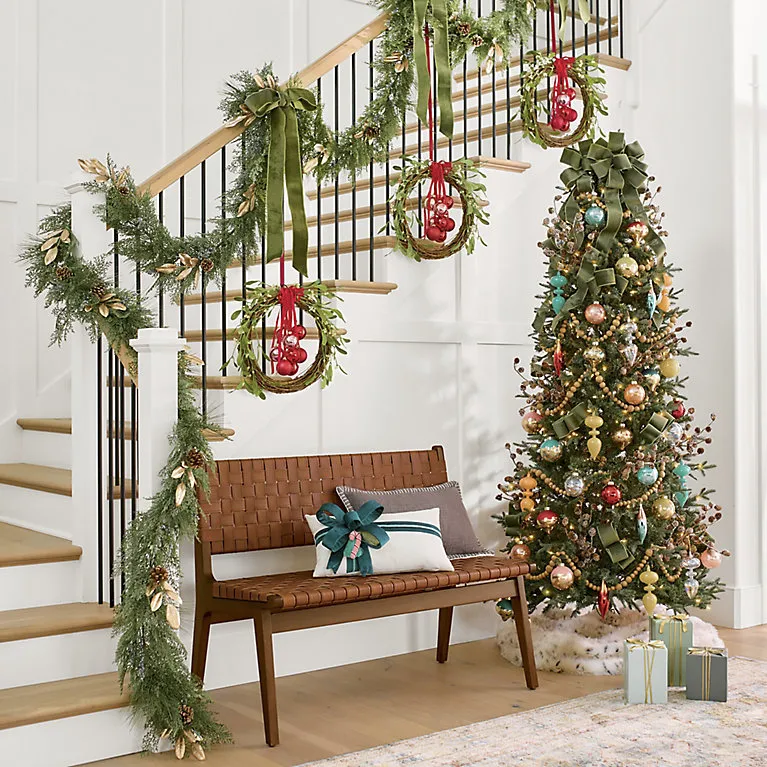
Garland on a railing has one hard rule: never cover the part a hand actually grips. Keep the greenery wrapped on the outside of the handrail or between the balusters, not over the top rail, so nobody grabs a fistful of pine on the way down the stairs at 2 a.m. Secure every length with zip ties in the same green as the branches — twist ties slip, and metal wire scratches the finish. Skip fresh garland entirely if the stairs get direct sun; it’ll drop needles within the week.
12. A Towering Atrium Tree With Moravian Stars
It’s the white paper Moravian stars. Without them, this tree is a very large red-and-green blur; with them, it has a rhythm that carries the eye up five stories. Scale is not the same thing as impact — light is. The stars are folded paper, they cost a few dollars each, and they read as clearly from the mezzanine as the glass baubles do from the ground floor, which is exactly what you want on a tree this size.
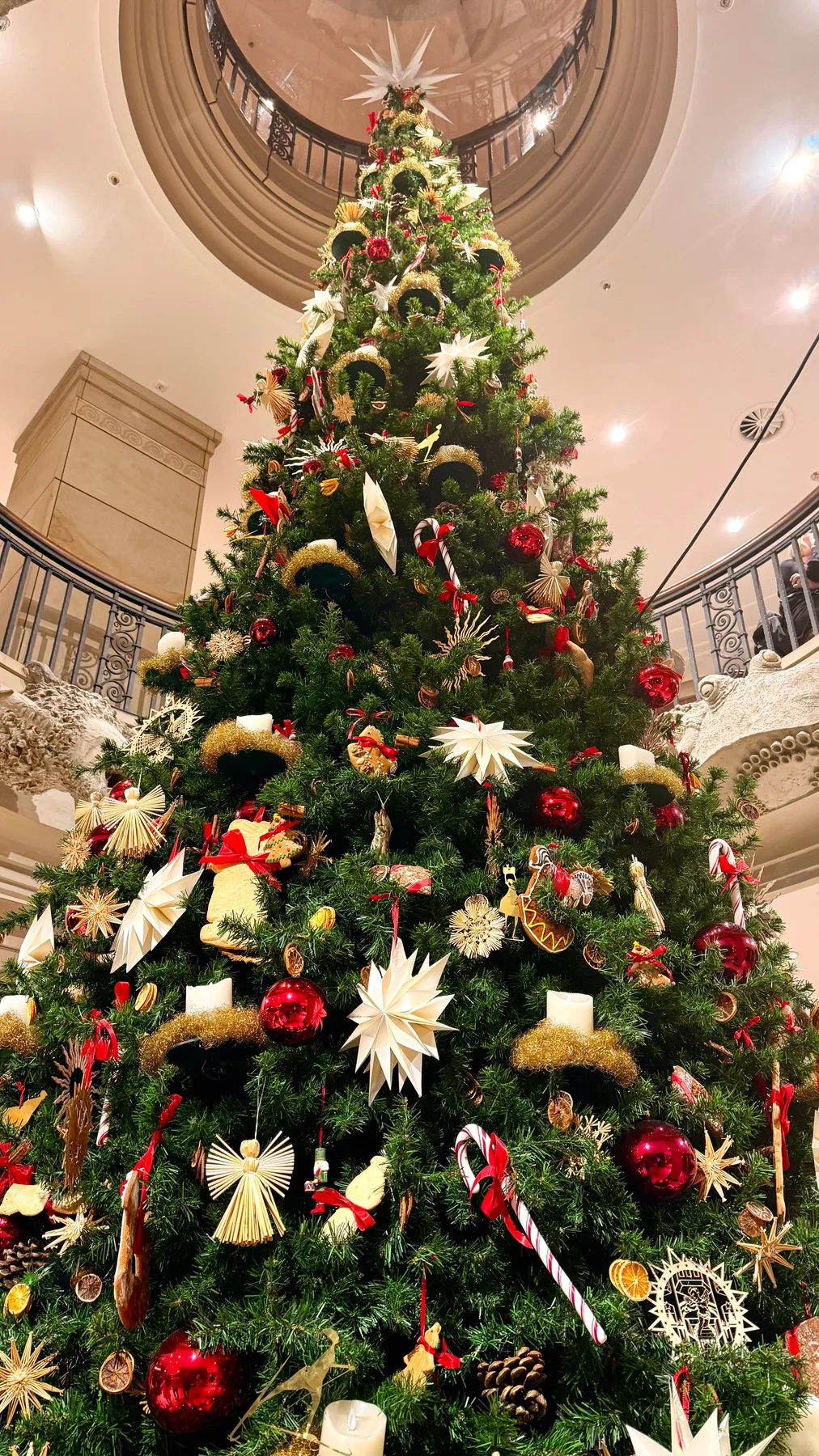
Trees like this live in spaces most of us never measure: 30-foot clearances, domed ceilings, and a structural team. The useful lesson for a home is the ratio. A tree should fill roughly two-thirds of the vertical space between the floor and whatever hangs above it, and it needs 5 feet of clearance on all sides for walking, plus 3 feet from any heat source. A two-story foyer with an 18-foot ceiling wants a 12- to 14-footer, and it will still read as grand.
- 12–14 ft artificial tree: $400–1,200
- Moravian star ornaments (40+): $8–14 each
- Large red glass baubles: $90–200
- Straw and dried wheat ornaments: $40–90
- Clip-on flameless candles with rings: $50–120
Total: roughly $900–2,400 Budget alternative: paper stars folded from cardstock at home cost about 40 cents each, and a 12-foot tree bought in the January clearance is often half price.
13. Frosted Tree in a Deep Blue Victorian Parlor
In a room this dark — patterned wallpaper, dark wood, deep blue velvet — the standard 2700K starts to look grey. Drop to 2400–2500K bulbs, and choose glass ornaments with a mirrored or metallic finish, because matte decor vanishes against dark walls. Anything with a sheen reflects the tree’s glow and gives the room depth. Then repeat one light element up high (the stained glass windows help here) so the tree isn’t the only thing glowing below eye level.
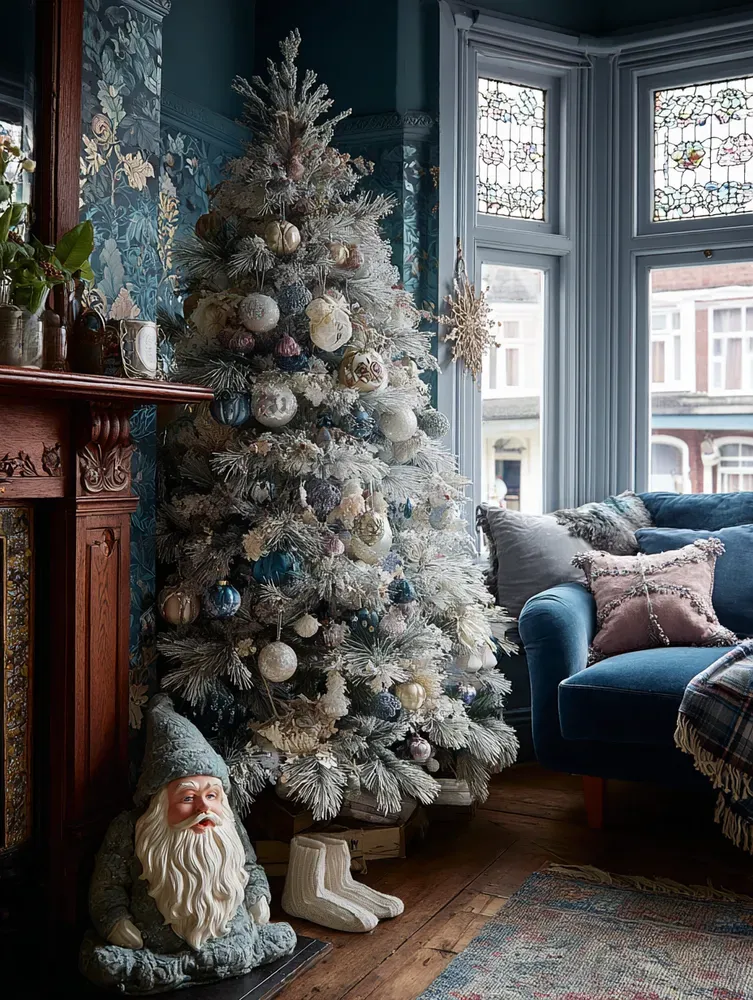
Two materials, two routines. Flocking sheds — expect a light dusting of white every time you move the tree, so vacuum with a brush attachment and no beater bar, or you’ll grind the flocking into the wood. Velvet needs brushing in one direction to lift the nap and rotating the cushions monthly so the seat doesn’t flatten into a permanent shape. Neither job is difficult. Both are the kind of thing that looks shabby by year three if you skip them.
14. Tartan Ribbon and Red Velvet Bows on a Traditional Fir
The no-fail bow, every time:
- Cut 24 inches of 2.5-inch wired ribbon.
- Fold it into a loop, cross the ends at the center, and pinch.
- Fold a second, smaller loop on top and pinch again.
- Secure the middle with a 6-inch piece of floral wire, twisted tight.
- Fluff the loops sideways, then trim the tails on a diagonal.
About three minutes and $1.20 per bow with fabric-store ribbon.
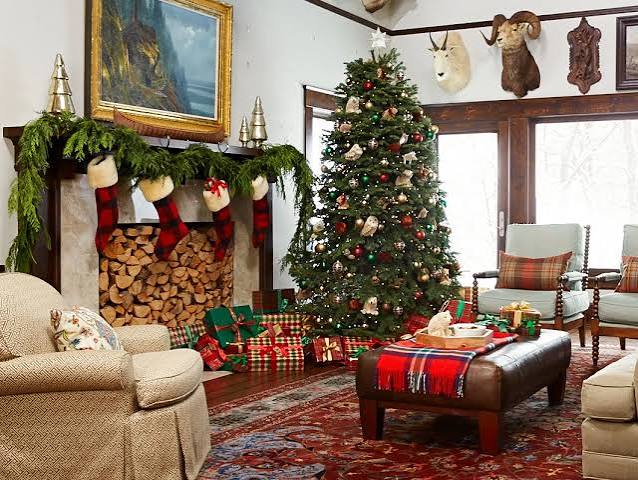
Roughly 60% evergreen, 25% plaid and red velvet, 10% warm gold, 5% light itself. The plaid does the heavy lifting: a single tartan pattern repeating across bows, ribbon tails, and gift wrap is what keeps a busy tree from looking chaotic. Swap tartan for solid burgundy velvet and it goes quiet and modern. Swap the gold baubles for black and white and it turns graphic. The vertical ribbon in Idea #3 is this same idea taken to full height.
15. Champagne and Rose Gold on a Frosted Tree
- Frosted tree, 7.5 ft: $200–700
- Mixed metallic baubles, 80 count: $70–180
- Glittering floral picks, 20–30: $6–12 each
- Matching garland for the mantel or doorway: $45–120
- Wired champagne ribbon: $20–40
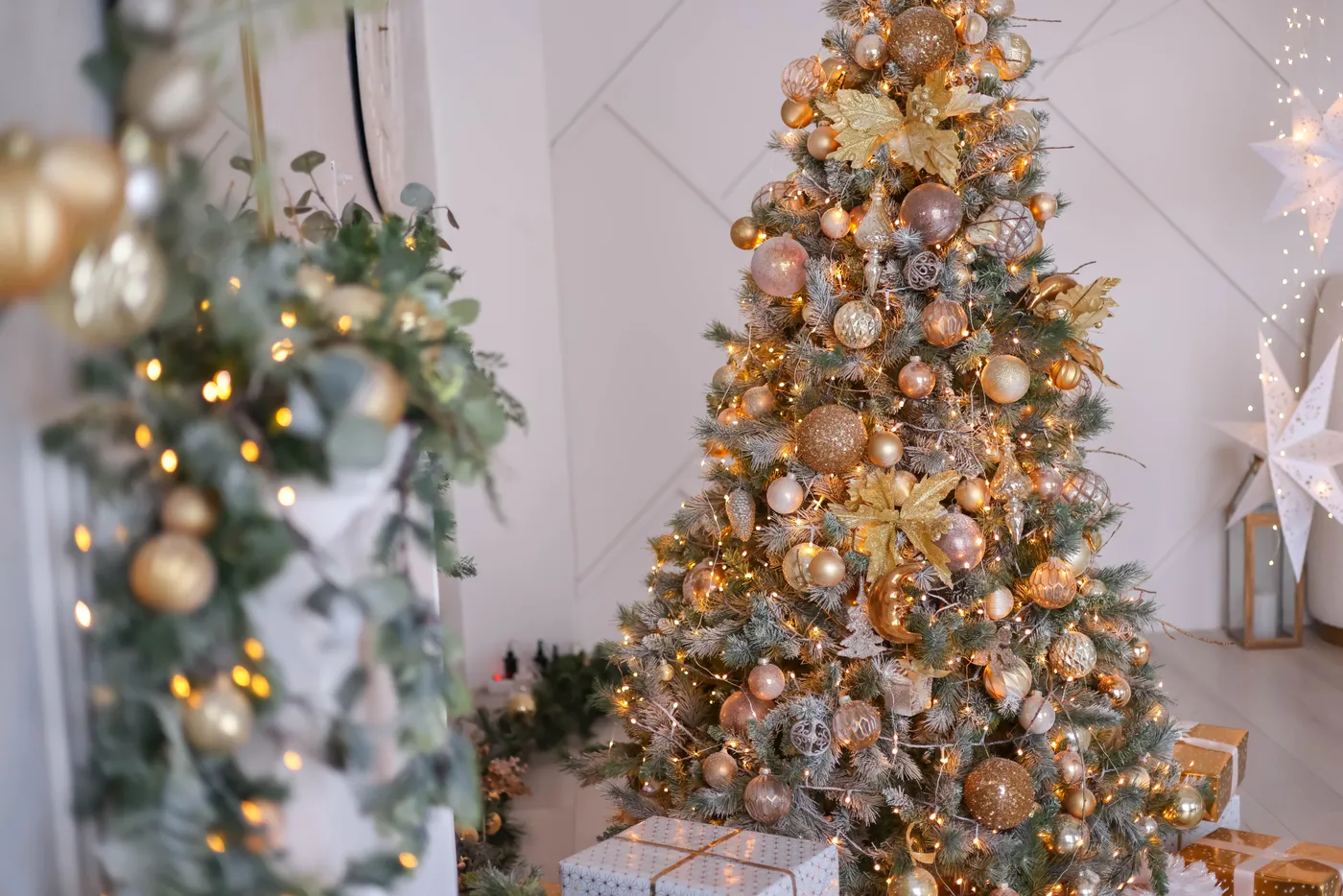
Total: roughly $350–1,100 Budget alternative: dollar-store floral picks plus a can of gold spray paint get you the same silhouette for about $25, and a good champagne ribbon can be reused for three seasons.
The glittering floral picks. Most people stop at baubles, and the tree ends up looking like a bead necklace. Picks are what make a tree look like it grew its ornaments — they push past the branch line, add spiky texture against all those spheres, and catch light at angles a round bauble never will. Twenty of them, tucked at intervals near the tips, is the entire difference between a decorated tree and a styled one.
16. A Hammered Metal Tree Collar Against Dark Bookshelves
Dark built-in shelves behind a lit tree sounds cozy; in practice it turns the tree into a silhouette. Light gets absorbed instead of bounced, so you need roughly 30% more bulbs than you’d use against a pale wall, plus glass, mirrored, or high-gloss ornaments to pick up whatever light is left. The reward is drama — that geometric gold star topper against charcoal is a genuinely striking combination. Just don’t expect a sparsely lit tree to hold its own back there.
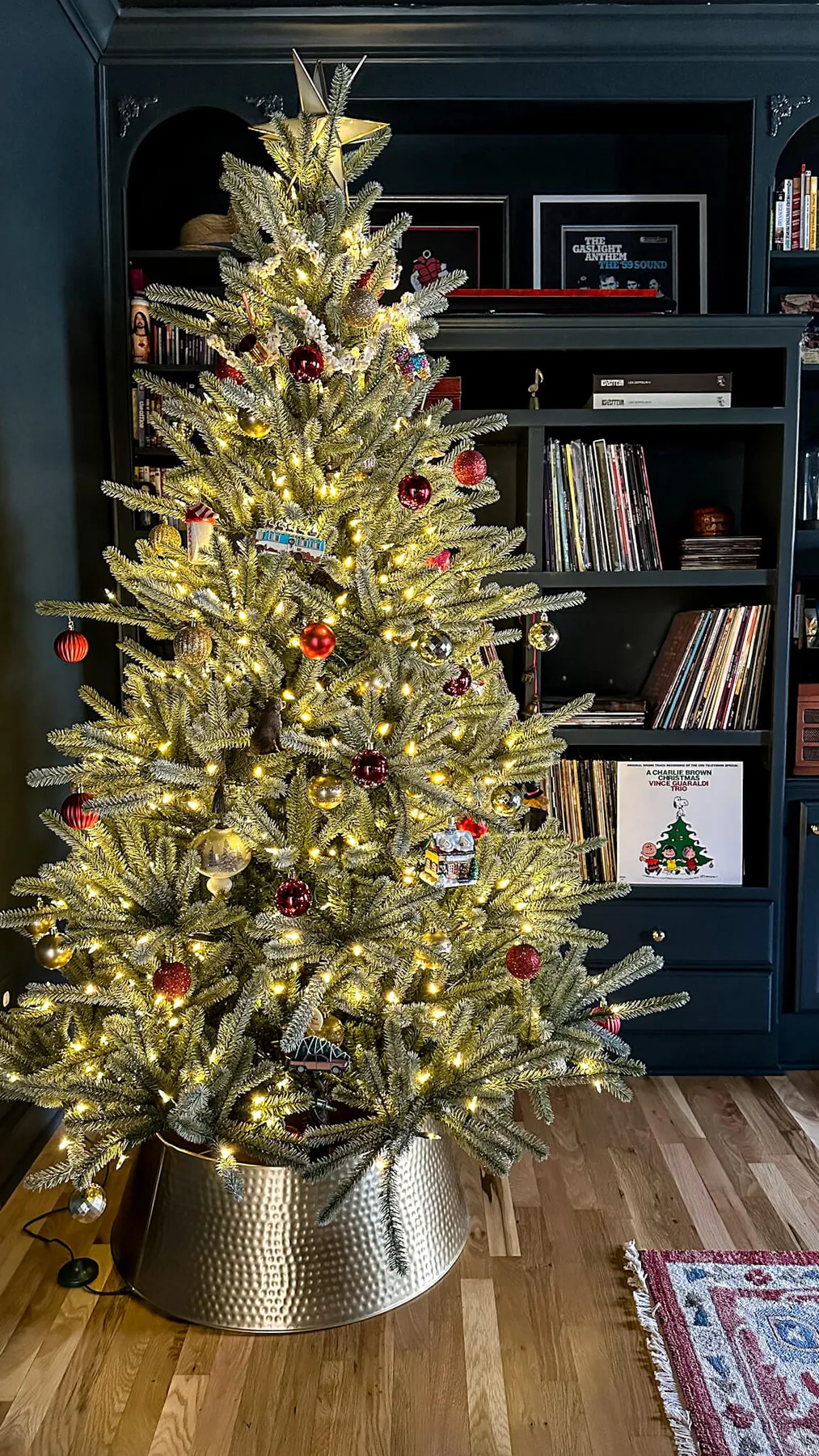
A hammered metal tree collar runs $80–150, which is a lot for a ring. A galvanized tub from a farm store does the same job for about $22 and looks deliberate in a rustic room. A large woven basket, a wooden crate flipped upside down, or a wide ceramic planter all work too — the only rules are that it hides the stand completely and sits 3–4 inches wider than the stand’s widest span. Nobody has ever complimented a plastic stand.
Measure your tree stand’s widest span, then add 3 to 4 inches. That’s your collar diameter — smaller and the stand peeks out, bigger and the tree looks like it’s floating in a bucket. Weight matters too: a 12-inch metal collar on a 9-foot tree is fine, but if you’re using a basket, line the bottom with a paver or a bag of sand so a curious cat doesn’t take the whole thing down at 3 a.m.
17. White Bead Garlands and Silver Glass Ornaments
Four things to verify before you commit to the frosted-and-white look:
- Clearance between the tree and the fireplace — 36 inches minimum from any firebox, more if the mantel runs hot.
- The mantel’s usable length, doubled, for garland; a 6-foot mantel wants about 9 feet of greenery to drape properly.
- An outlet reachable without a cord crossing a walkway.
- Whether your white ornaments match the fireplace white, or you’ll get a warm-versus-cool clash that’s hard to unsee.
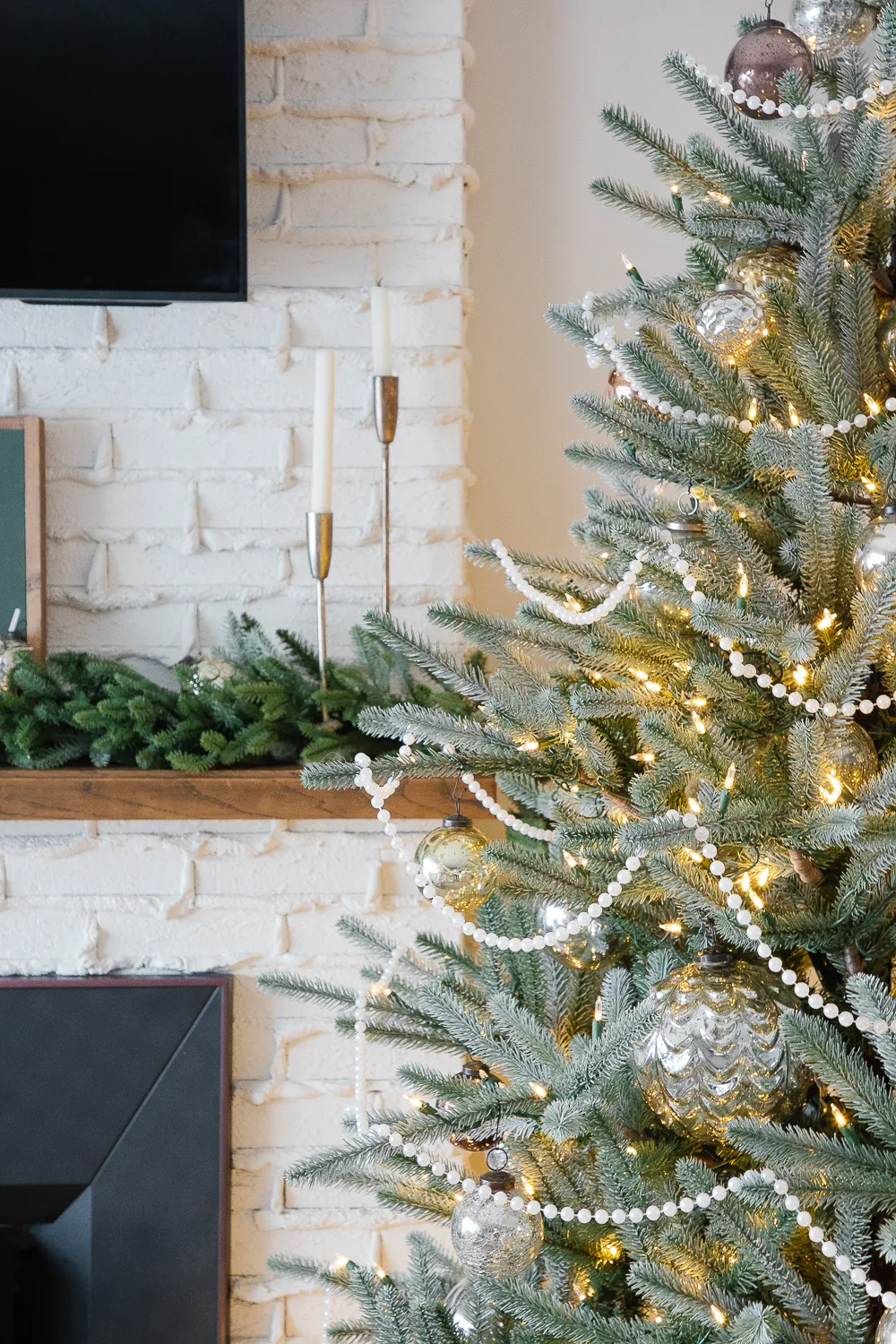
This is white-on-white done correctly, and the trick is the single green anchor. Frosted branches, painted brick, silver glass, warm lights — almost everything here is pale, so the pine garland on the mantel and the evergreen itself become the only saturation in the frame. Beaded garlands also add something spheres can’t: a continuous line. Your eye follows the beads up and around, which makes a modest tree feel taller without a single extra ornament.
18. Minimal Ornaments in a Bright Neutral Corner
A 9-foot ceiling with a 9-foot tree is the classic mistake — there’s no room for a topper and the whole thing looks like it’s straining. Go 7 to 7.5 feet instead, and the proportions relax immediately. Keep 18 to 24 inches between the tree and those windows so daylight doesn’t silhouette the branches, and leave a 36-inch walkway if the textured armchair is your main reading spot. Big rooms want the proportions in Idea #8; this corner wants restraint.
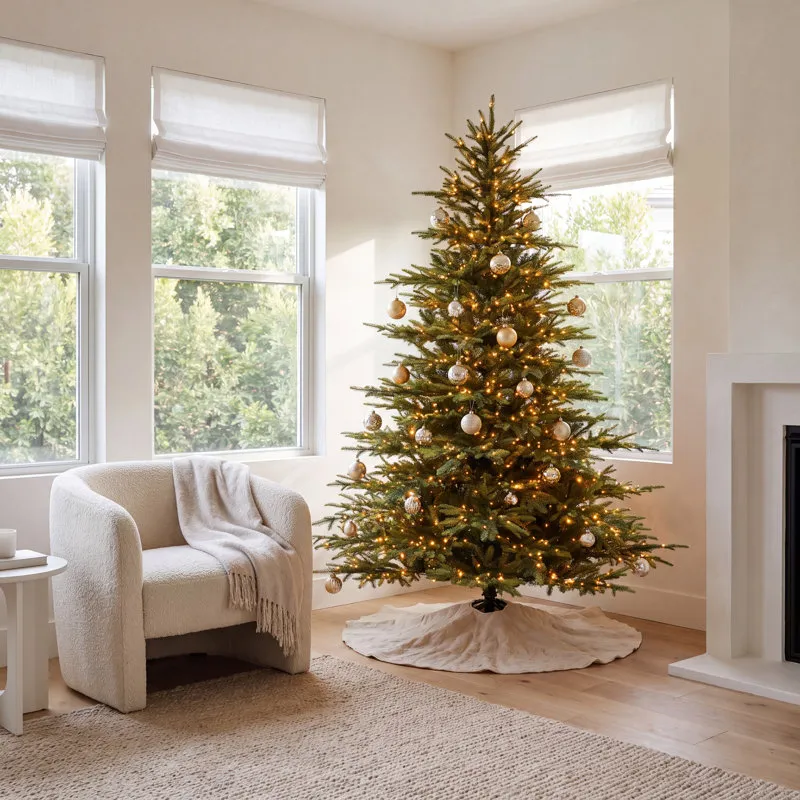
Tree skirt diameter should be roughly one-third of the tree’s height — a 7.5-foot tree wants a 30- to 36-inch skirt, not the 48-incher everyone buys. And if you’re going minimal, buy bigger ornaments, not more of them. A 3-inch bauble is legible from 10 feet away; a 1.5-inch bauble disappears into the branches and reads as clutter from across the room. Twenty large ornaments beat a hundred small ones every single time.
19. The Family Sofa Facing a Wall of Tree Lights
The lights-first tree is the sleeper trend of the last two seasons, and it isn’t really about decorating at all — it’s about how people actually use the room in December. Trees that glow without demanding to be looked at, so the sofa can face them instead of a screen. Pinterest saves for cozy Christmas living rooms spike every November, and the common thread is almost never ornaments. It’s warm light at eye level and a good place to sit.
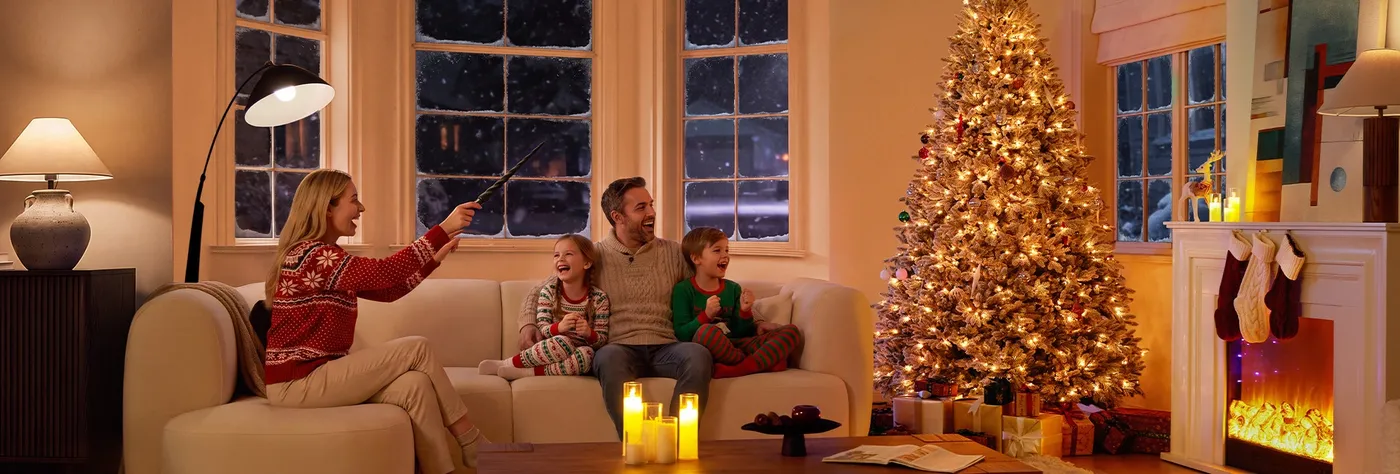
Where you put the tree matters more than what’s on it when there’s a TV in the room. A tree behind the sofa looks lovely in photos and then fights the screen every evening, because your eyes can’t decide which glow to settle on. Put the tree in your peripheral vision — beside the sofa, angled toward the fireplace — and keep the lamps at 2700K so nothing ends up looking blue by comparison. Then check that the cord isn’t crossing a doorway.
20. A Hall of Mirrors Behind One Evergreen
The arched mirror. With a tree this dense and this warm, the mirror is what turns a good corner into a room you can’t stop looking at — it doubles the lights, doubles the depth, and bounces the chandelier back at you. Take it away and you have a beautifully decorated tree against a plain wall. That’s the entire difference, and it costs nothing if you already own a mirror.
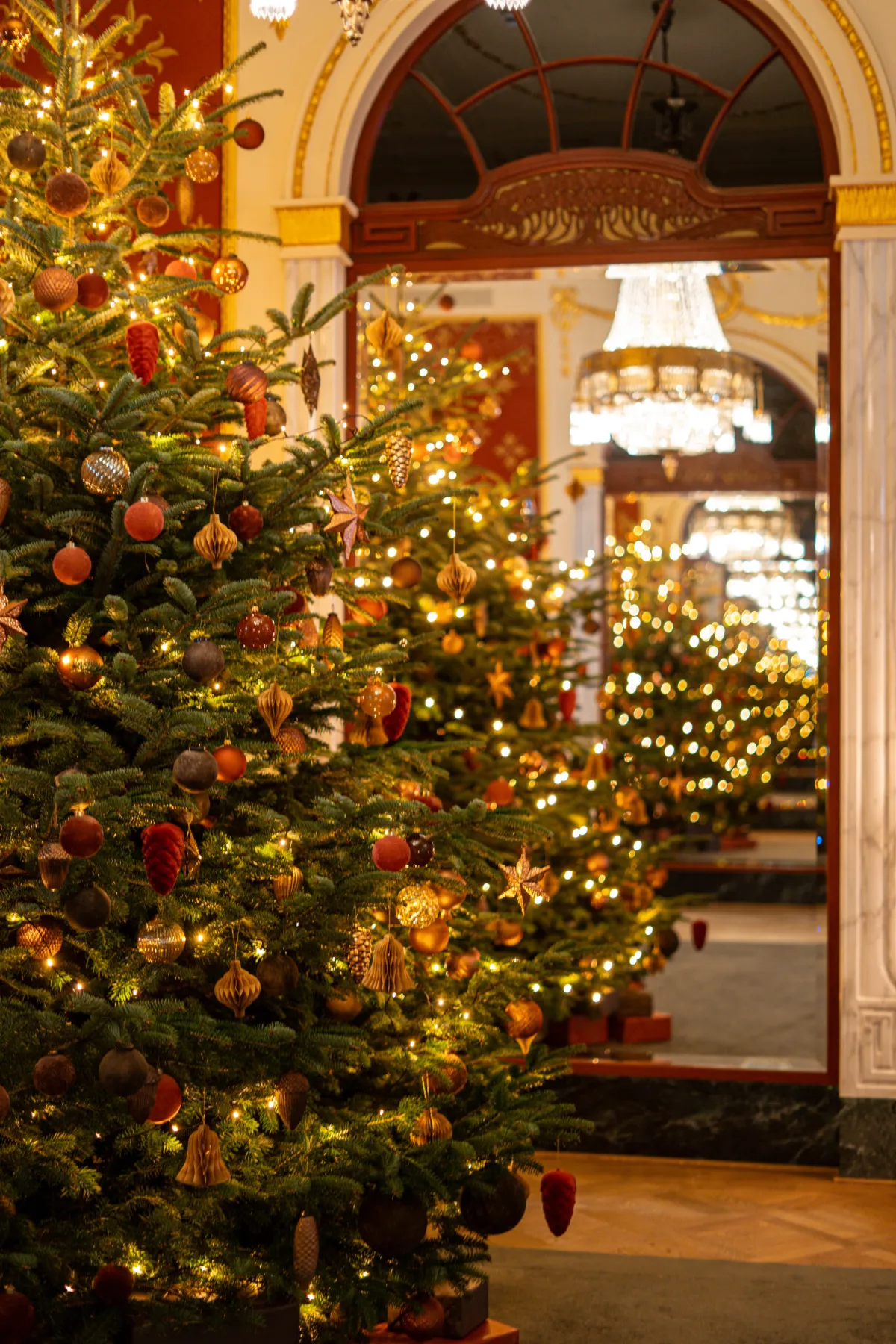
Roughly 50% evergreen, 25% warm gold, 20% deep red and bronze, 5% white. Bronze is the underrated note — it’s what keeps the red from looking like a theme park and gives the gold something to sit against. Swap bronze for pewter and it goes cool and wintry. Swap the red for ivory and you’re in a hotel lobby, in a good way. The mirror repeats whatever you choose, so keep the palette tight.
Rules for hanging a mirror behind a tree:
- Mirror width should be at least two-thirds of the tree’s widest point.
- Leave 12–18 inches between the glass and the branches.
- Anchor it to a stud — a leaning mirror plus a toddler is a bad equation.
- Aim your lights toward the glass, not away from it.
21. A Glowing Twig Tree Beside a Traditional Fir
- Pre-lit twig or light-burst tree, 6 ft: $60–150
- Traditional evergreen, 7.5 ft: $150–500
- Gold ornaments for the traditional tree: $60–140
- Pine garland for the mantel: $40–90
- Three stockings plus holders: $30–80
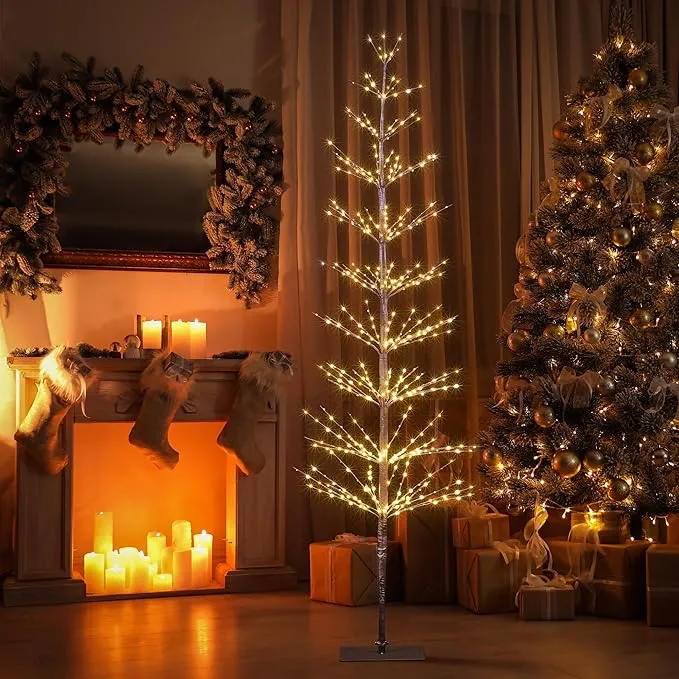
Total: roughly $340–960 Budget alternative: build the light tree yourself with a bundle of birch branches from a craft store ($15) and two strands of warm LED string lights ($20) — same twin-tree effect for under $40.
Two trees in one room only works when they’re clearly different sizes. The rule of thumb: the twig tree should be about two-thirds the height of the traditional one, so a 6-footer next to a 9-footer reads as a deliberate pairing rather than a mistake. Keep 24 to 36 inches between them so each has its own pool of light, and don’t line them up on the same plane — stagger one forward. In a small room, one tree as in Idea #25 is plenty.
22. Thousands of Fairy Lights, Barely Any Ornaments
100 to 150 bulbs per vertical foot is worth the extra strand. On a 7.5-foot tree, that’s 900 to 1,100 minis, and the difference between 700 and 1,000 is the difference between lit and glowing from within. String them in loose vertical zigzags down each section rather than spiraling around the outside, and if you want depth, mix about 80% warm white with 20% cool white — the cool bulbs read as distance and make the tree look deeper than it actually is.
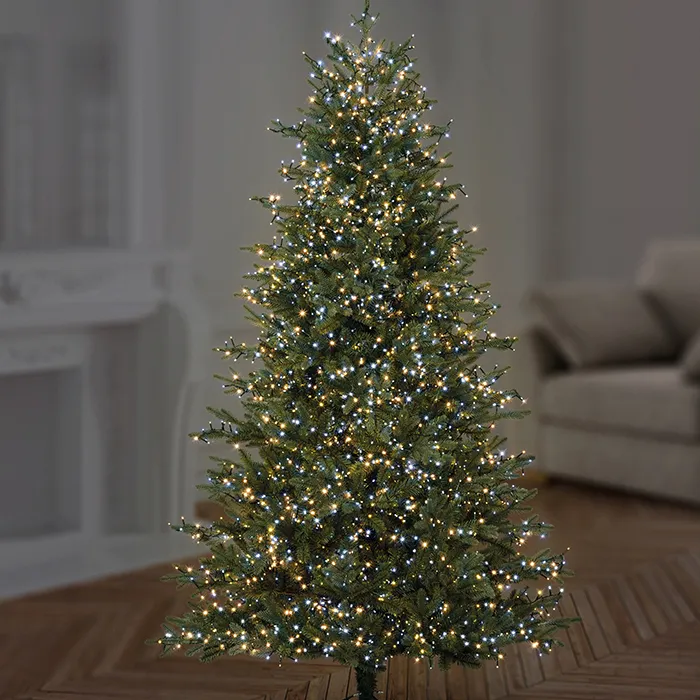
The honest reason a tree like this works: it stops behaving like furniture and starts behaving like a lamp. At 900-plus bulbs, it becomes the brightest object in the room, and every other surface — wood floor, armchair, mantel — picks up a soft second-hand glow. Nothing else is decorated, and nothing else needs to be. You’re not looking at ornaments. You’re looking at light, which is also why it photographs better than almost any heavily decorated tree.
23. Blue and Silver Gifts Beneath a Warmly Lit Fir
Gift wrapping that looks styled instead of just wrapped:
- Pick exactly two papers — one patterned, one solid — and one ribbon color.
- Wrap every gift in those two papers, alternating, so the pile reads as a set.
- Use the same ribbon on all of them; vary only the width.
- Add one non-paper element to three or four gifts — a sprig, a tiny ornament, a name tag in gold pen.
- Stack by size, largest at the back, and don’t line them up in a row.
Two papers and one ribbon, about $25 total.
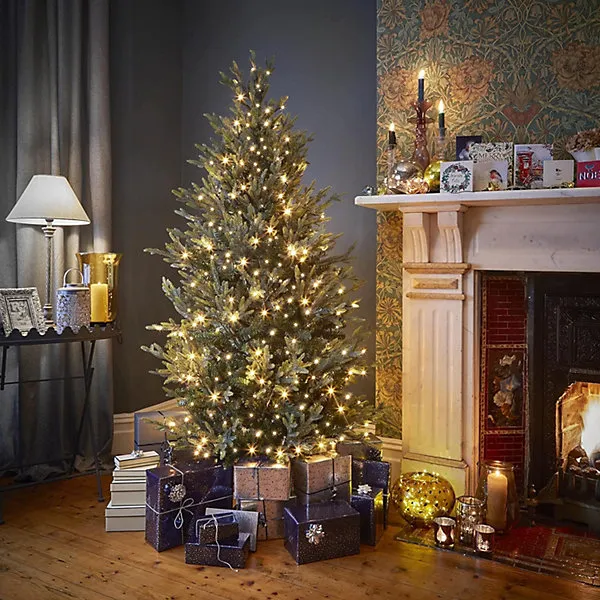
A densely lit tree against floral wallpaper is already two patterns talking, and a busy ornament collection makes it three. The fix isn’t fewer ornaments — it’s a tighter palette. Stick to blue, silver, and white so the wallpaper reads as texture rather than competition, and keep the ornaments slightly larger and fewer than you’d normally use. The red tile surround on the fireplace is your one warm note. Let it be the only one.
24. Four Miniature Tabletop Trees on a Dark Wood Tray
- Ribbed ceramic trees, 8–12 in: $18–45 each
- Illuminated mercury glass trees: $12–30 each
- Dark wood tray, 20 x 14 in: $20–40
- Pinecones and filler greens: free to $12
- Fairy lights for the glass trees: $6–10
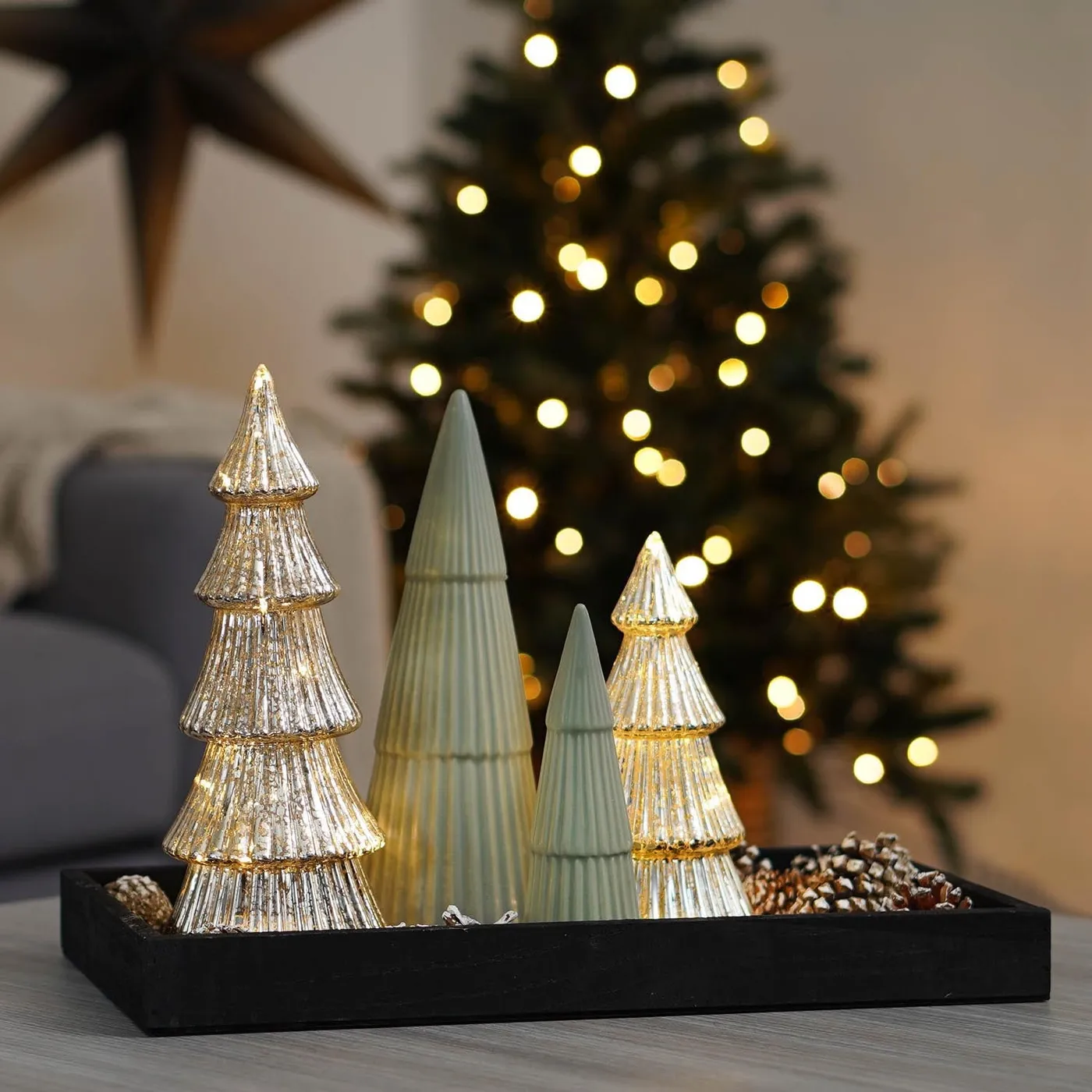
Total: roughly $90–215 Budget alternative: skip the tray entirely and group the trees on a stack of two hardcover books you already own — same vignette, zero dollars, and it looks intentional.
This is one of the most thriftable looks in the whole article. Vintage ceramic Christmas trees — the ribbed ones with the little colored bulbs — turn up at estate sales for $5 to $15, and the old ones are better made than the reproductions. Mercury glass can be faked with a Dollar Tree votive holder, a short strand of fairy lights, and a dab of silver rub-on. Total spend if you’re patient: under $30 for four trees that look like they’ve been in the family for decades.
25. Red and White Baubles in a Woven Basket Collar
Roughly 70% green, 20% red, 10% cream white — and that’s it. No ribbon, no picks, no garland. The restraint is the style. Swap the red for cobalt blue and you get a completely different room with the very same tree. Swap the woven basket collar for a galvanized bucket and it turns farmhouse; swap it for a brass ring and it turns modern. The formula survives every one of those swaps, which is the entire point of having a formula.
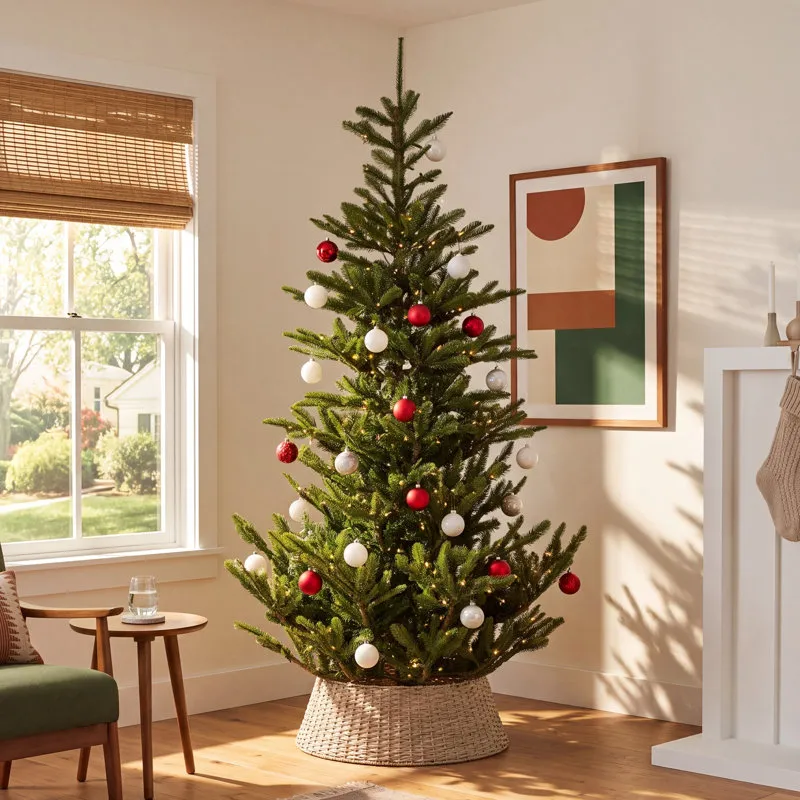
Three ornaments per square foot of visible tree surface is the number most people overshoot. A 7.5-foot tree has roughly 40 square feet of visible branch, which means about 120 ornaments — and if you’re going sparse like this one, 60 to 70 is plenty. The non-negotiable part is size: a 3-inch ornament reads from 10 feet away, a 1.5-incher vanishes. Fewer, bigger, spaced with visible gaps, always looks more expensive than dense and small.
26. A Flocked Tree, Red Gifts, and One Classical Bust
Flocking and faux fur are a maintenance pair. The white faux fur rug will collect shed flocking, and flocking is not vacuum-friendly with a beater bar — use a brush attachment on low, or shake the rug out a doorway once a week through December. The flocked tree itself can’t be hosed down or wiped; a soft dry brush and a can of compressed air are your entire toolkit. Set aside ten minutes a week and it stays crisp all season.
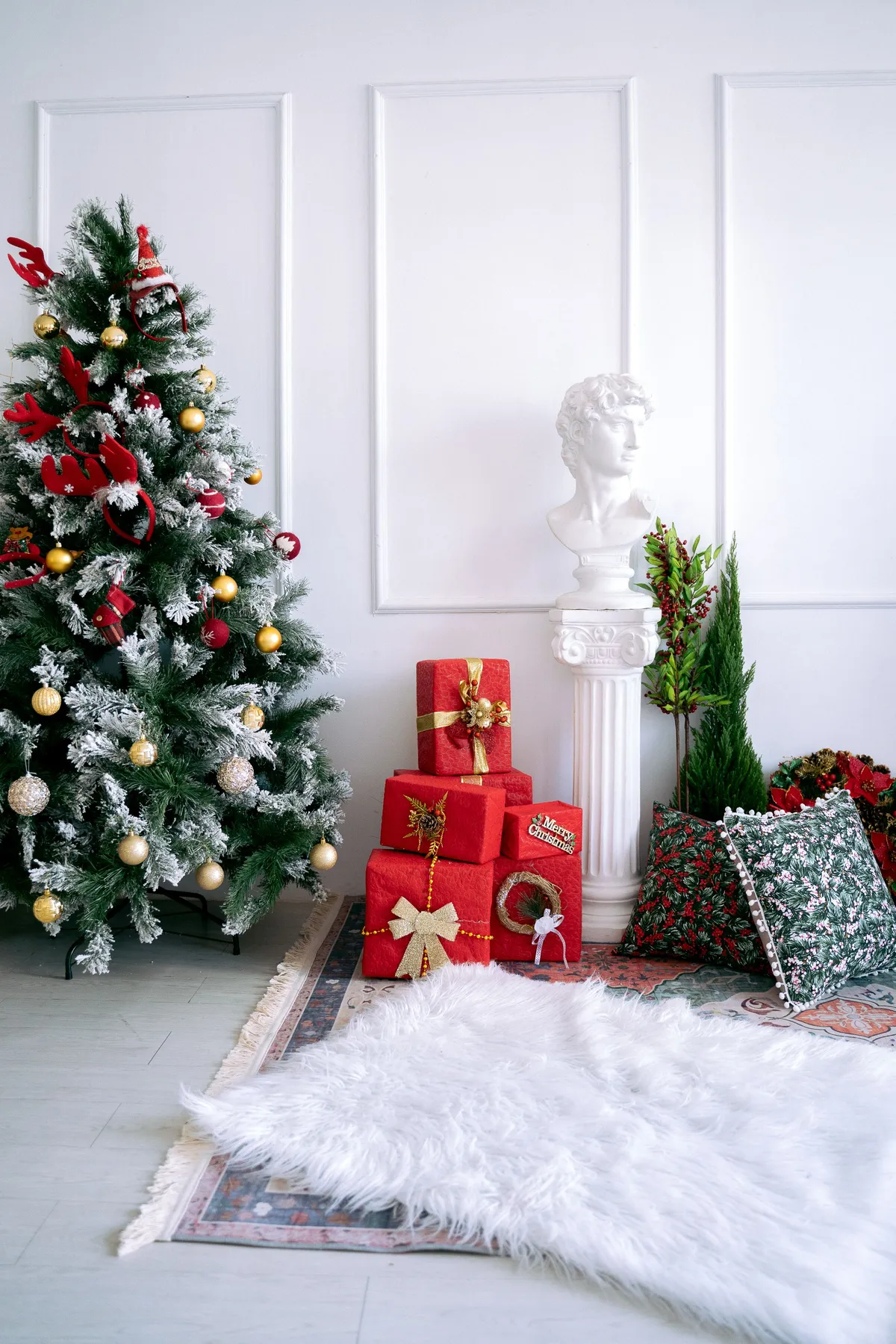
It’s the tension between the classical bust on its column and a stack of bright red boxes on a faux fur rug. High and low, old and new, formal and playful — the contrast is the whole composition. The column also echoes the tree’s vertical line, which is why the corner doesn’t feel crowded even with three objects in it. A cheap reproduction bust is fine here. Honestly, a reproduction is better — nobody worries about the nose.
27. Star-Shaped Lights Under Exposed Wooden Beams
Rooms with exposed beams and a wood stove need volume and distance. If the ceiling runs 12 feet, a 9-footer is the minimum before the tree starts looking like a houseplant; anything under 8 feet disappears entirely. Keep the tree at least 36 inches from a wood stove or fireplace — that’s the standard clearance, and it’s about safety, not aesthetics. Leave 3 feet behind the tree too, so all those star lights have wall to throw their pattern onto. Compare with Idea #22, which uses the same light-first approach in a much smaller room.
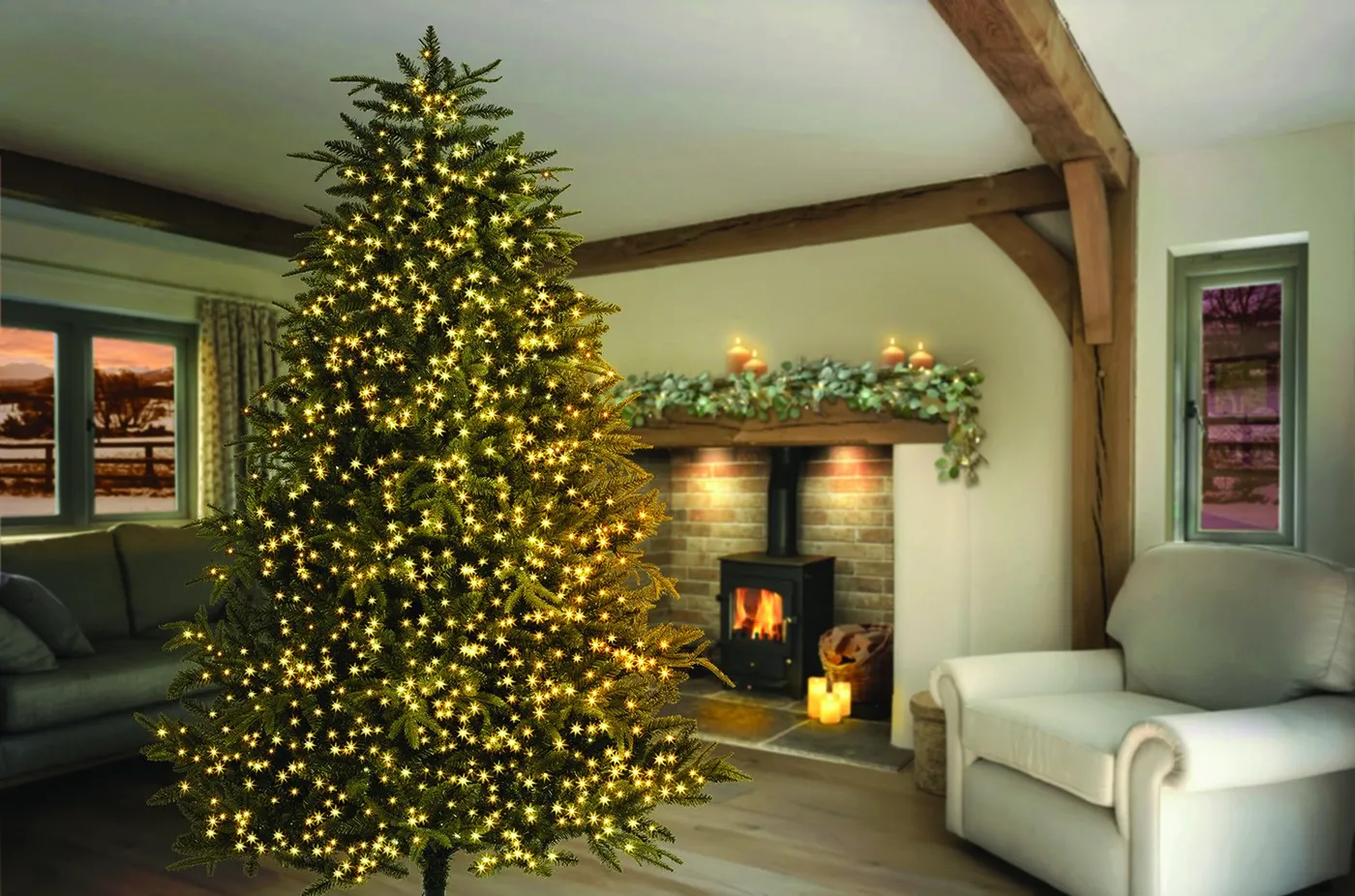
Star-shaped string lights are the whole trick here, and they’re cheap. A 20-foot strand runs $16 to $25 at Walmart or on Amazon; four strands wrap a 7.5-foot tree thoroughly for under $90. If you want the designer version, expect $45 to $70 a strand — the bulbs are warmer and the wire is thinner, but at night, from the sofa, nobody is comparing. Buy two extra strands. You will always want more.
28. A Lit Tree in a Wooden Barrel by the Front Door
Anchoring a tree in a barrel planter:
- Drill four to six 1/2-inch drainage holes in the barrel’s base.
- Add 4 inches of gravel, then set a paver in the center.
- Stand the tree’s own base on the paver and tighten it down.
- Fill the gap between the stand and the barrel with sand, packed firm.
- Test the wobble by pushing the trunk — if it moves, add sand until it doesn’t.
About 30 minutes and $10 in sand.
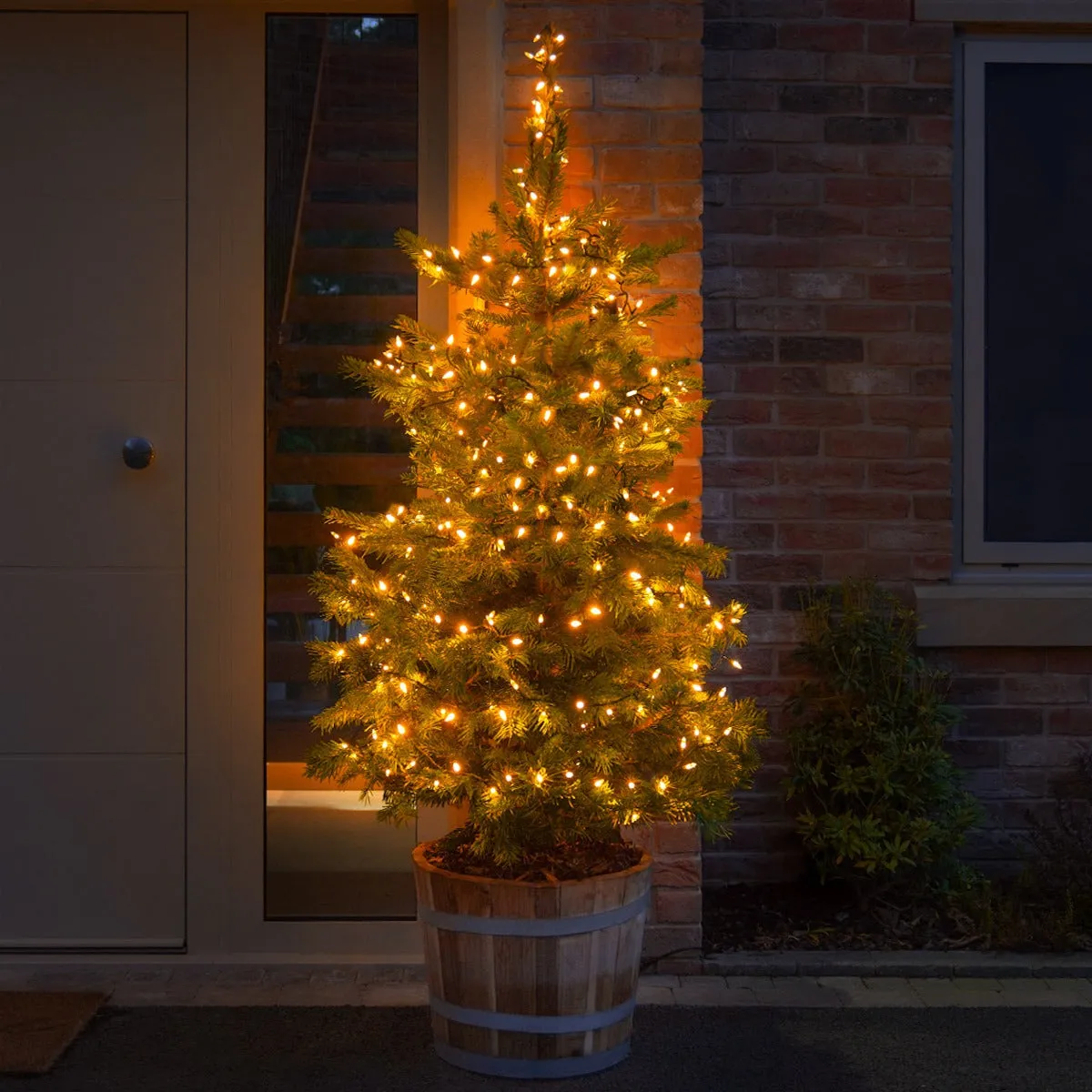
Four checks before you put a lit tree outside the front door:
- Does the door still swing fully open with the barrel in place? Measure the arc, then add 6 inches.
- Is there a GFCI outdoor outlet within cord reach? Extension cords and snow do not mix.
- Is the tree rated for outdoor use, or will one wet night rust the frame?
- Is the barrel at least 4 inches wider than the stand so nothing shifts in the wind?
29. Vintage Elf Dolls and Wooden Toys in the Branches
The wooden pull-toy horse. Anyone can hang a glass ball, and most trees do. A painted wooden toy with wheels adds a shape nothing else on a tree has — an animal, a little vehicle, a story. It’s also the piece that makes guests lean in and ask where you found it. One or two odd objects per tree is enough. Three is a collection. Ten is a problem, and the tree stops being a tree.
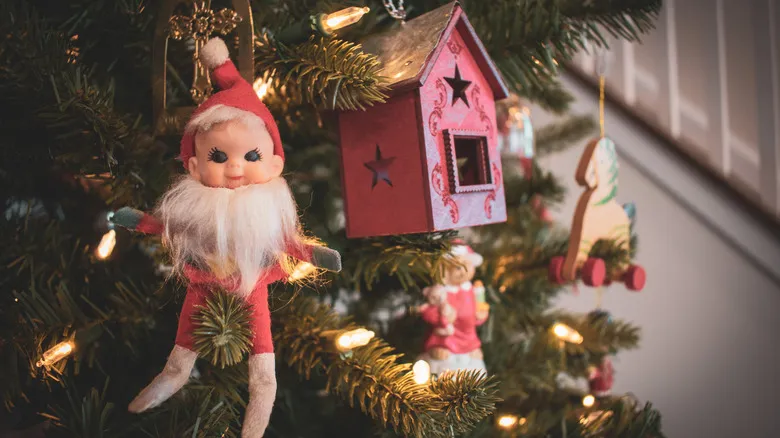
Vintage-style ornaments — plush elves with white beards, wooden birdhouses, painted pull toys — are the fastest-growing category in holiday resale right now, and the good pieces are getting harder to find. Etsy and eBay listings for mid-century wooden ornaments have climbed steadily since 2022, and thrift stores are picked over by October. The upside: these look better with age and scratches, so you can collect slowly and never overpay for a piece you don’t love.
What to look for when you’re collecting vintage ornaments:
- Paint worn at the edges — not cracked and peeling off in sheets.
- A still-intact hanging loop; replacement wires are cheap, but original hardware is half the charm.
- Faces, if there are any. A plush elf with a faded nose has more personality than a mint one.
- Anything under $8 that you actually like. Buy it.
30. Kraft Paper Gifts Under a Slender Green Tree
- Slim artificial tree, 7.5 ft: $80–200
- Kraft wrapping paper, 2 rolls: $8–15
- Ribbon in green and gold, 30 yards: $12–24
- Round woven rug or tree skirt: $25–70
- Pine garland for the mantel: $30–60
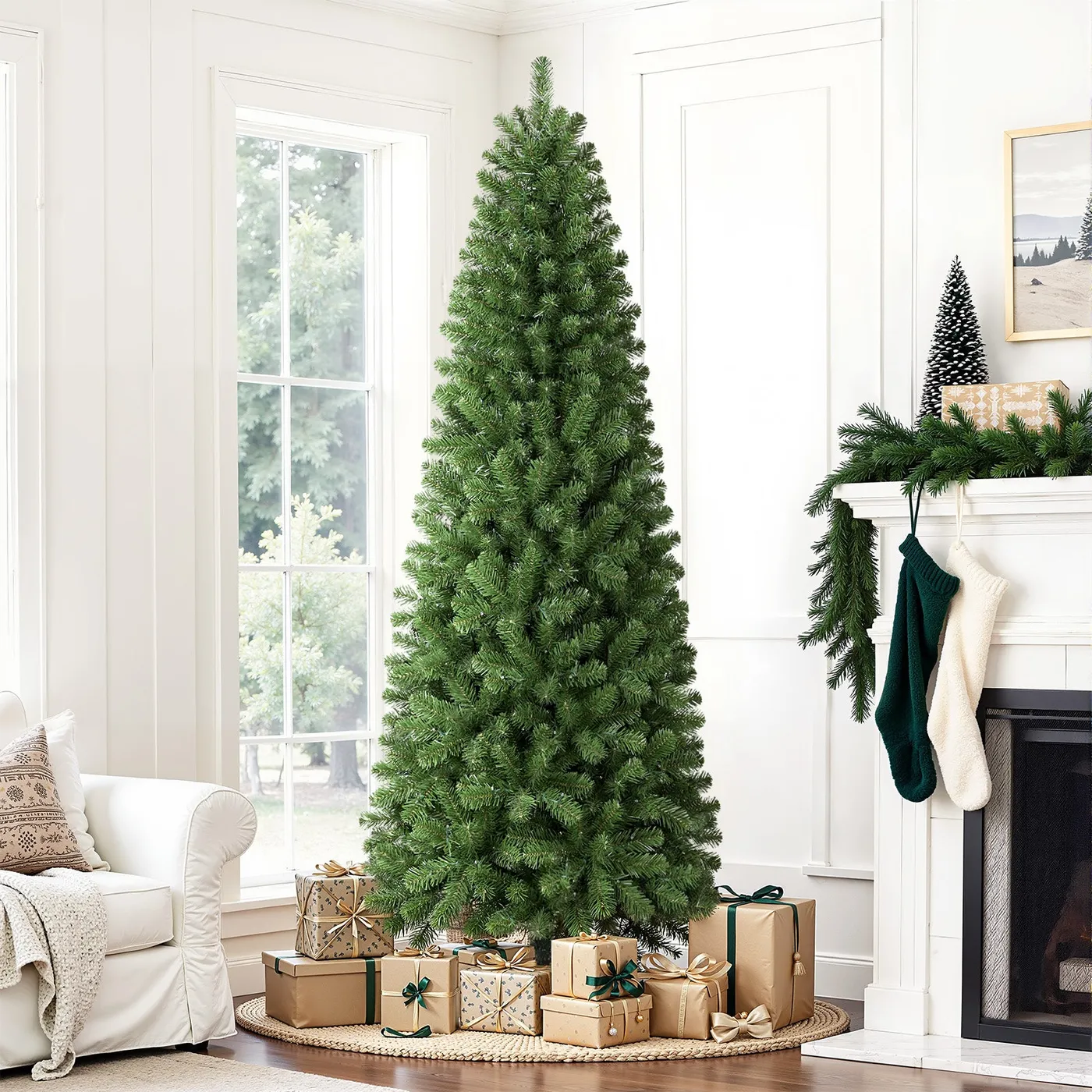
Total: roughly $155–370 Budget alternative: kraft paper is the budget alternative — that’s the whole point of this look. Add a sprig of real greenery and a handwritten tag, and a $12 roll does the work of $60 worth of printed wrap.
Yes, you can wrap like this:
- Cut the paper wide enough to overlap by 2 inches in the back, and crease every fold hard with a fingernail.
- Skip tape on the front; use a single piece on the underside seam only.
- Wrap the ribbon around twice, then tie a simple square knot — not a bow — on top.
- Trim the tails on a diagonal so they don’t fray.
- Write the name in gold pen directly on the paper instead of using a tag.
About four minutes per gift, no scissor anxiety.
31. Copper, Bronze, and Tinsel Up Close
Pick three metal finishes and give one of them more than half the tree. Copper, bronze, and gold all read as warm metallic, but together they create depth a single finish can’t — copper reflects a softer, pinker light, bronze goes dark and disappears into shadow, gold throws bright highlights. On a green tree, the ratio that works is roughly 50% the dominant finish, 30% the second, 20% the third. Then run your tinsel deep in the branches rather than along the tips.
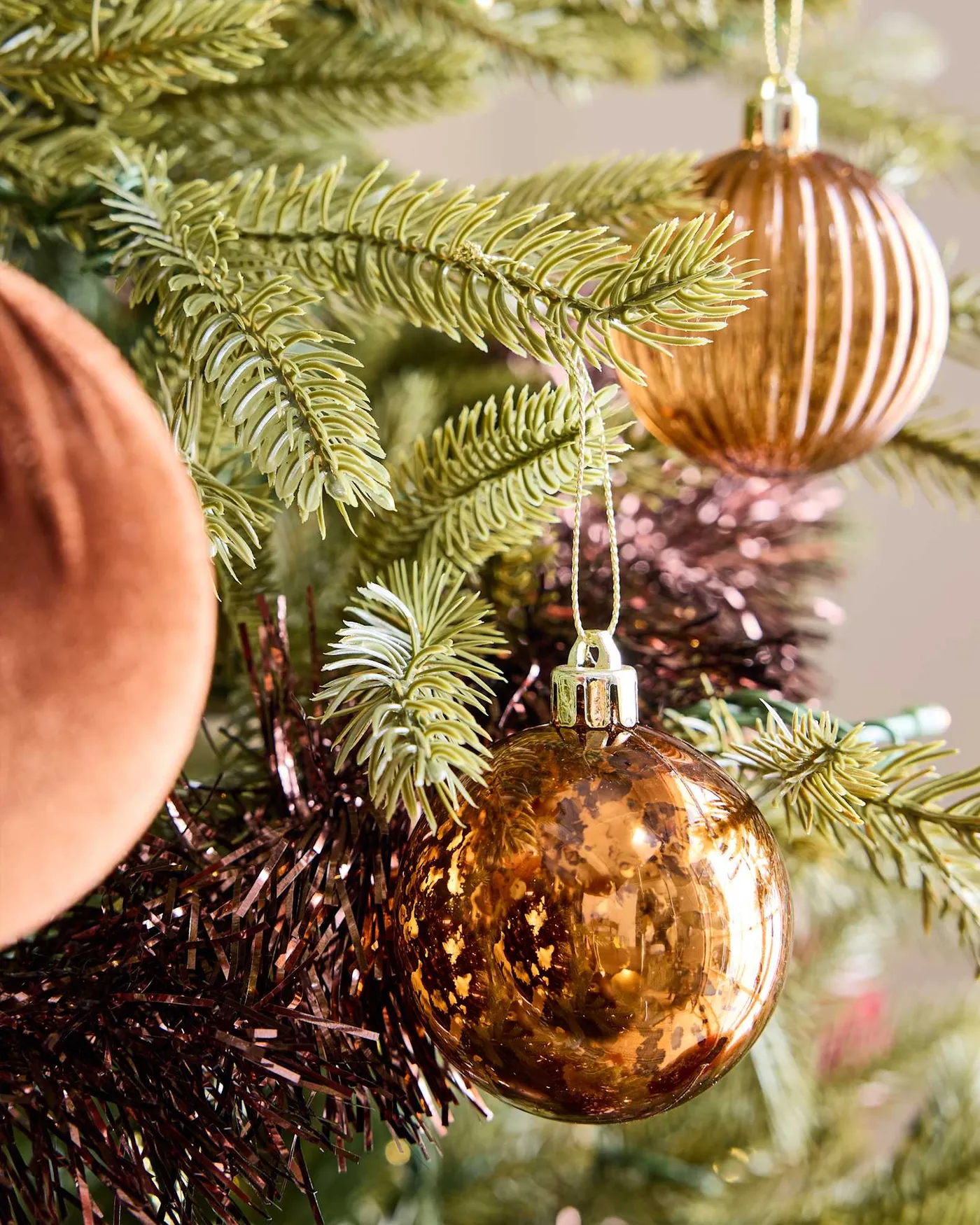
Tinsel sheds — there’s no way around it, and the cheap stuff sheds forever. Sweep or vacuum beneath the tree every few days with a brush attachment, and never let tinsel near a dog or cat, since the metallic strands are genuinely dangerous if swallowed. Copper ornaments will tarnish in humid rooms and near the kitchen; wipe them with a dry cloth once a season and store them in a sealed box with a silica packet. Ten minutes of care buys you years.
32. Star Lights That Paint the Wall
Roughly 65% glow, 25% evergreen, 10% neutral — gifts, lantern, bare wall. The wall matters more than it looks like it should: warm light thrown onto a matte neutral surface is what makes this corner read as soft rather than busy, and it’s why the tree can be almost bare of ornaments. Swap the white walls for deep blue and the same lights go jewel-box. Swap the gifts for kraft paper and it turns quiet. Lights first, everything else second.
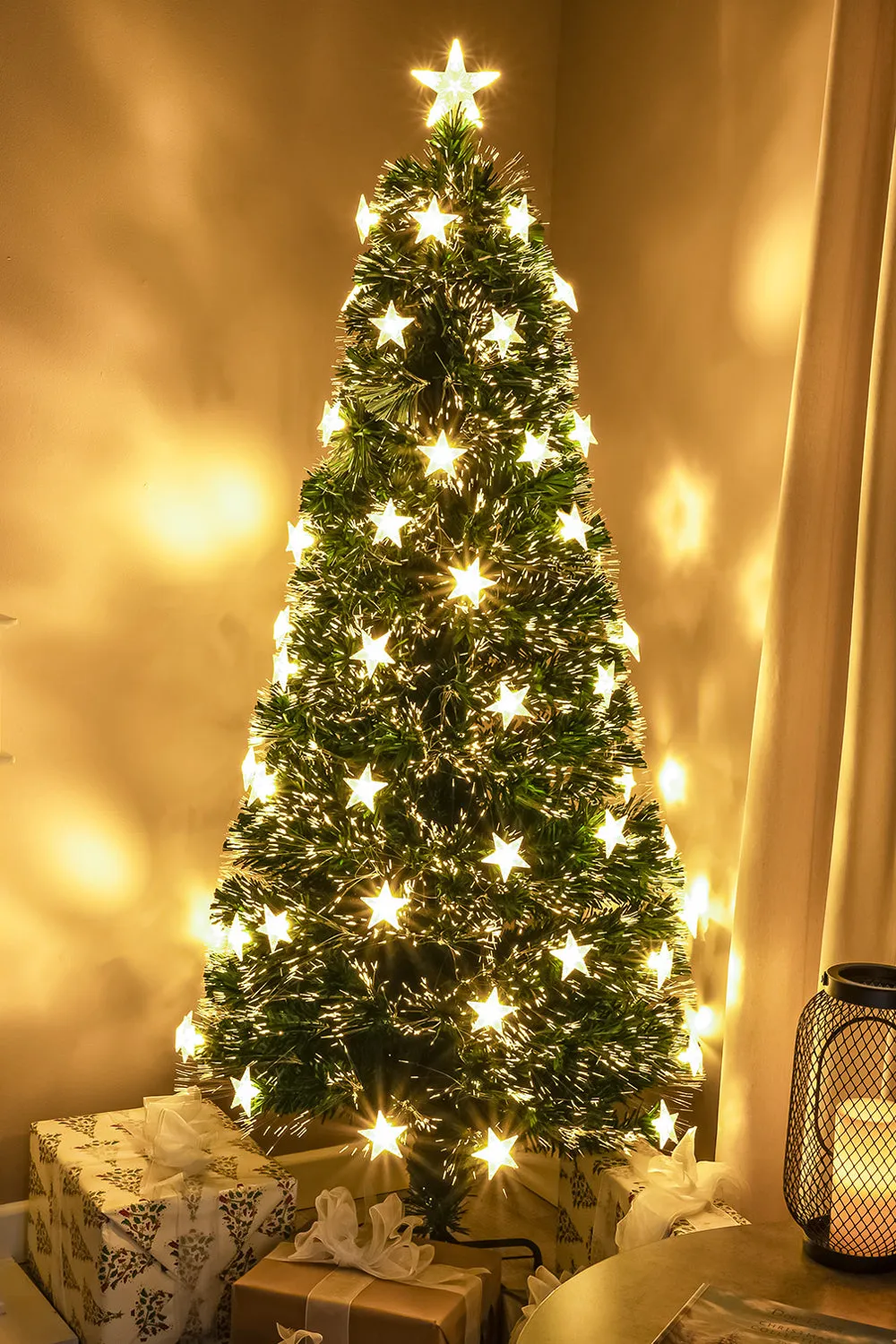
A pre-lit star-light tree runs $180 to $450. The DIY version: a $60 unlit 7.5-footer, four strands of star-shaped lights at $18 each, and one large star topper for $15. That’s about $147 total — roughly half price, and you can replace a single dead strand instead of the whole tree. Buy lights in the off-season, in January, when the identical strand costs $8. Wrap them in vertical zigzags, not spirals.
33. Flocked Branches in a Textured Gold Collar
Before you commit to a flocked tree beside curtains:
- Measure the tree stand and add 4 inches — that’s your collar diameter.
- Check the gap between the tree and the drapes; flocking sheds constantly, and white dust on navy velvet is very visible.
- Keep the tree 36 inches from the fireplace and pull the curtains clear of the mantel.
- Confirm the collar is heavy enough to hold a wide tree without tipping.
And yes, you will be vacuuming under it weekly.
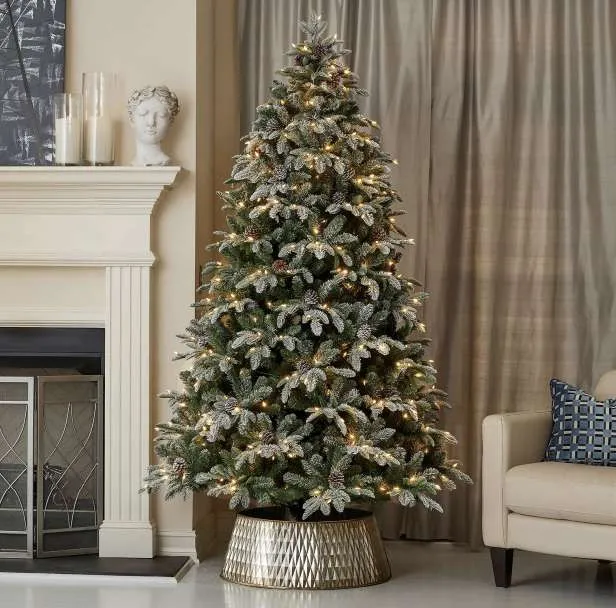
The textured gold collar. It’s the smallest object in the frame and it’s the one that makes the whole corner look considered. A flocked tree on a bare stand reads craft-store; the same tree in a hammered gold ring reads like a hotel lobby, because the collar repeats the warmth of the lights at floor level and gives your eye somewhere to land after all that white. Take it away and the composition loses its base.
Thirty-Three Trees Later — Go Pick Your Corner
Classic doesn’t mean plain, and it definitely doesn’t mean a carbon copy of your mother’s tree. Pick one idea from this list that fits your ceiling height, your light sockets, and your actual December habits — then commit to it fully, because one tree done confidently always beats three done halfway. Start with the lights. Everything else follows.
📌 Save this to Pinterest for next year, and send it to whoever you decorate with. Now go fluff some branches.
