32 Jaw-Dropping Christmas Door Decorating Ideas That Will Win the 2026 Contest
Most Christmas door decorating contests are won and lost before anyone hangs a single wreath. You know the feeling — scrolling Pinterest at 11 p.m., saving forty photos, still torn between a gingerbread house and a Grinch.
We filtered through hundreds of options across Target, Dollar Tree, Amazon, Etsy, and Walmart to land on 32 ideas that actually deliver, from a $2 pack of snowflakes to a $600 pair of life-size nutcrackers.
Inside: traditional evergreen entries, playful character and classroom doors, culturally specific celebrations, and full outdoor light displays. Every budget idea is paired with its luxury counterpart, so you can see exactly what the extra money buys.
In 2026 the winners are character doors and displays that spill off the door and onto walls and ceilings.
And stay until the end — we break down the most common mistakes that can ruin these looks. 📌 Save this to Pinterest for later — you’ll want to revisit these ideas.
1. The Whole-House Light Outline That Reads From the Street
Three decisions make this house read as magical rather than chaotic. Repetition first: one warm white string light traces every roofline, window frame, and porch pillar, so your eye follows a single continuous line instead of jumping between colors. Restraint second — red only appears in the shrubs, never on the architecture itself. And the lit star on the chimney gives the whole composition a peak. Take that away and the facade flattens into a glowing rectangle.
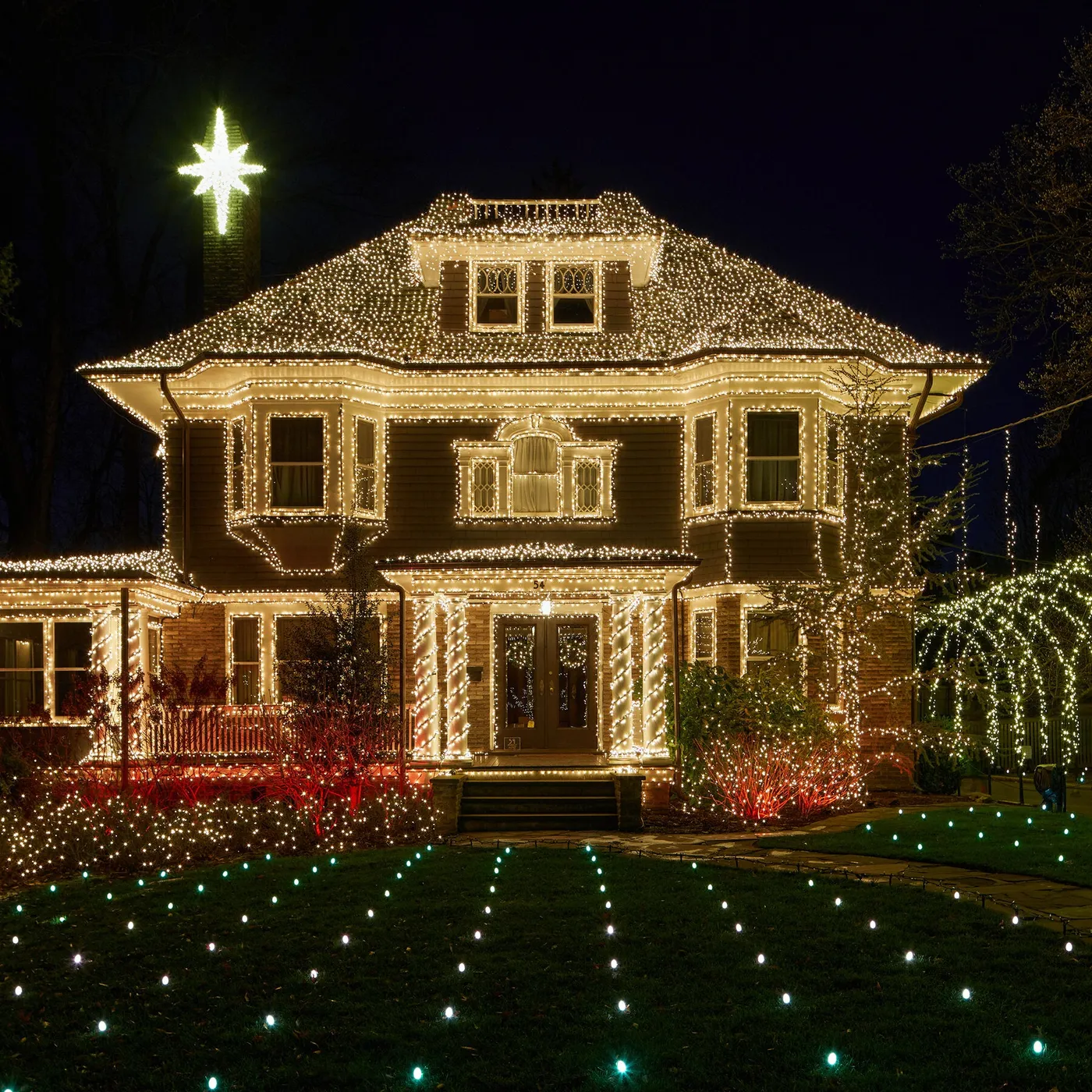
This approach needs architectural height. Two stories or more, 40-plus feet of roofline, and gutters you’re comfortable reaching with a ladder — or paying someone to reach. On a single-story ranch, outlining every edge starts to read like a picket fence instead of a landmark. If your facade is modest, cherry-pick: the porch, the two front windows, one tree. Same wattage, half the visual noise.
2. Arched Double Doors Dressed in Lit Garland and Twin Wreaths
Hang each wreath so its center sits at roughly 60 percent of the door’s height — about 48 inches on a standard 80-inch door. Higher and the wreaths start reading as transom decor; lower and they crowd the handle. Use one removable hook rated for at least 5 pounds per wreath, and zip-tie the garland to the top hinge pin rather than the frame so the door still swings. Close it once and open it again before you walk away — that’s the test that catches 90 percent of garland disasters.
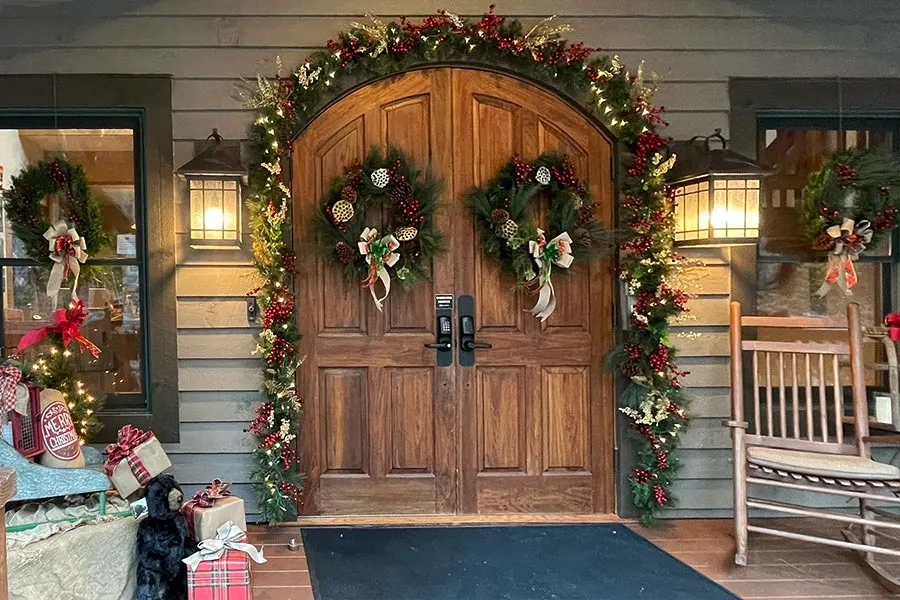
The matching pairs. Two wreaths at identical height, identical bow, identical pinecone count, echoed again on the windows. Remove that symmetry and the entry turns into a flea market. Symmetry is what tells your brain someone planned this, and it costs nothing but a tape measure and the discipline to buy four of the same wreath instead of four different ones you loved individually.
3. A Gingerbread House Door Made From Brown Paper and Candy Cutouts
- Wrap the door in kraft paper, taping to the frame so it still opens.
- Add a scalloped white strip as the roofline, about 2 inches below the top edge.
- Layer gumdrops, lollipops, and candy canes, biggest shapes at eye level.
- Center a small green wreath with a red bow as the house’s front door.
- Finish with a gingerbread man at the base and a welcome sign beside the frame.
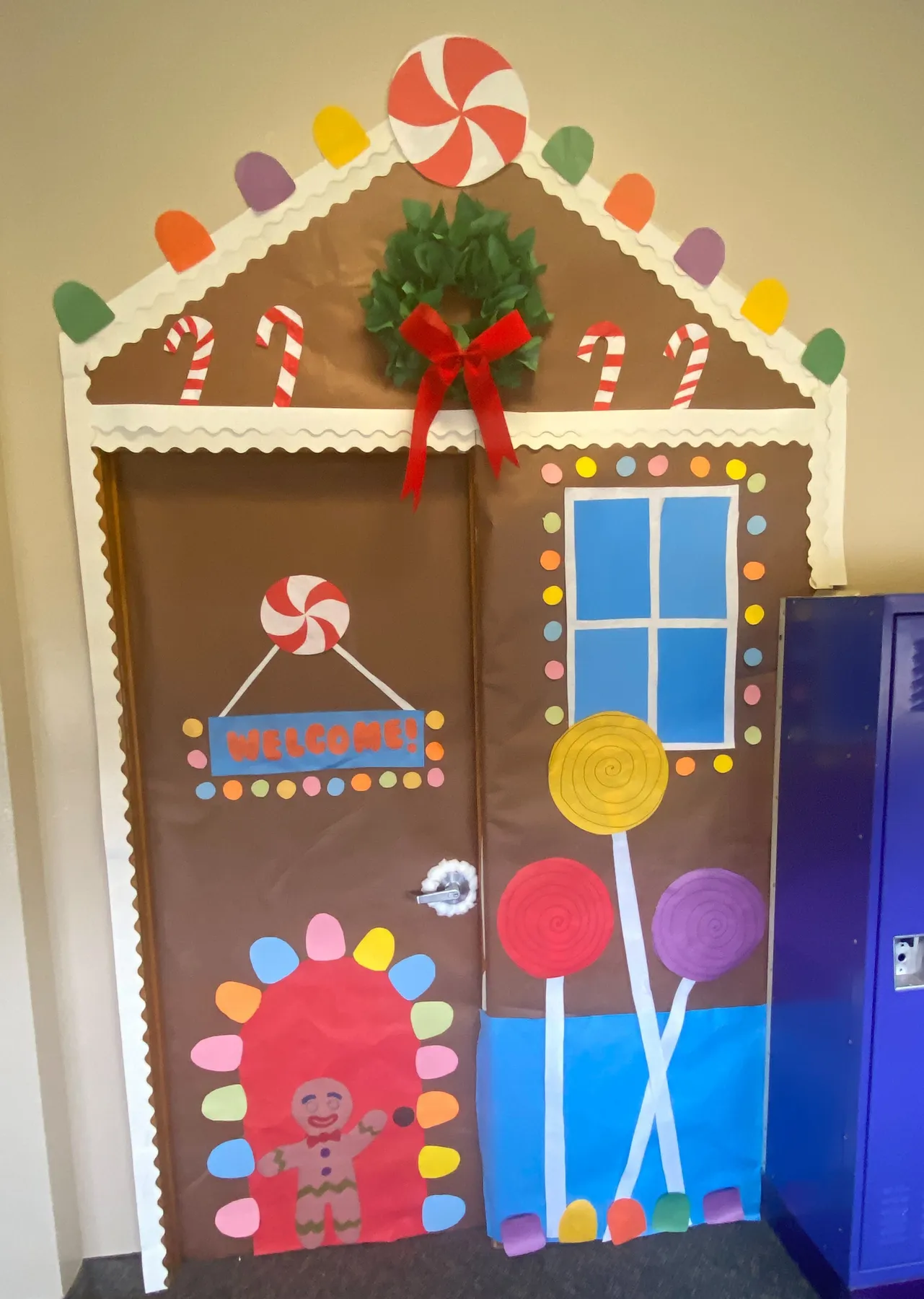
Time: about 3 hours. Materials: $25–$40 in kraft paper, cardstock, and removable tape.
Two things undo this. Kraft paper wrinkles the moment you pull it tight over a recessed panel — go slow with a squeegee and accept one or two creases. And anything below 30 inches will get demolished by backpacks and wet boots, so keep the bottom two feet simple and easy to repair. If the door catches direct afternoon sun, cheap cardstock fades to beige in about two weeks; matte photo paper holds its color all season.
4. A Hallway of Themed Doors, Candy Canes, and Hanging Snowflakes
Whole-hallway decorating — where every classroom or office picks its own theme — has become the format everyone copies in 2026. It’s cheap, it photographs beautifully, and schools have embraced it as a community event with no ticket price. Two directions are dominating: loud pop-culture doors and quiet handcrafted ones. The garland and ceiling snowflakes here are the connective tissue that makes twelve completely different doors feel like one installation instead of twelve lonely projects.
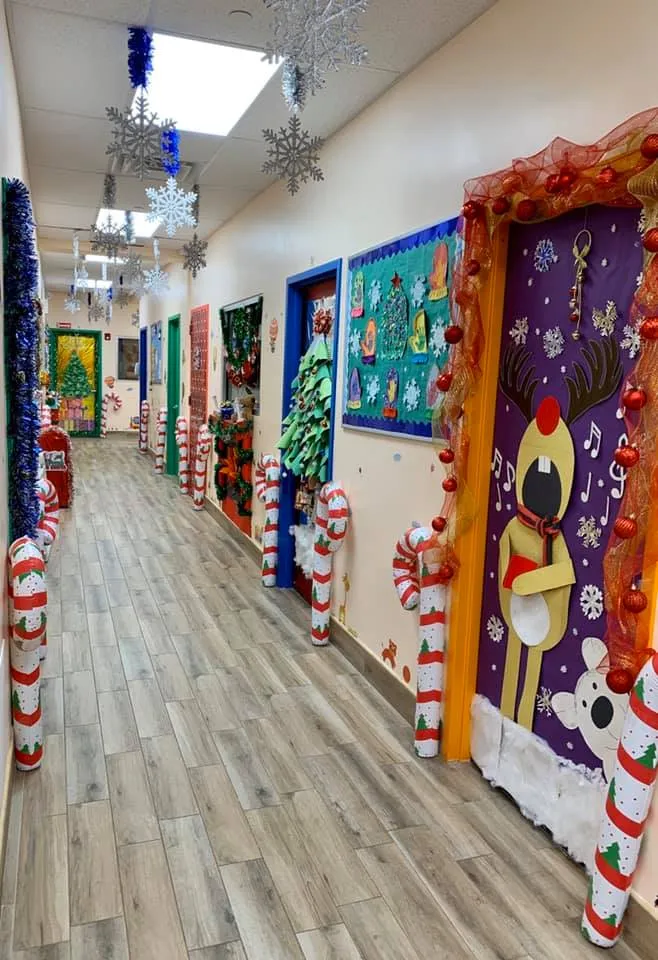
Treat the corridor as one composition instead of twelve separate doors: 60 percent warm neutral base (beige walls, wood-look tile), 30 percent red and green holiday accents, 10 percent silver metallic. Swap silver for chalkboard black and the whole hall turns farmhouse. Swap red for bubblegum pink and it turns candy shop. Three layers keep it from looking like a party store aisle:
- Floor: oversized candy canes, evenly spaced — repetition is the entire trick
- Door: one hero theme each, no cross-contamination
- Ceiling: hanging snowflakes, all in one color family
5. Dark Arched Doors Framed by Evergreen, Red Bows, and Lit Planters
- Two 24-inch evergreen wreaths with bows: $60–$180
- Lighted garland, 9–12 feet: $40–$120
- Two tall planters: $80–$300
- Two pre-lit mini trees: $60–$200
- Berries, pinecones, ribbon: $25–$60
- Outdoor cords and clips: $20–$40
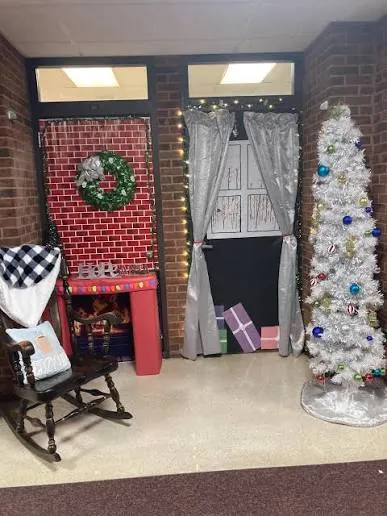
Budget alternative: re-fluffed thrift-store wreaths, discount garland, and spray-painted plastic planters bring this in near $150.
Bows are where DIY wreaths fall apart. Skip the pre-tied version and build a proper six-loop bow from 2.5-inch wired velvet ribbon — wired is non-negotiable outdoors because it holds shape in wind. Budget about 3 yards per bow. Attach it at the 12 o’clock position on the wreath and let the tails fall toward 4 and 8 o’clock instead of straight down. Straight tails read cheap; angled tails read florist.
6. Buddy the Elf Takes Over a Dark Blue Door and Paper Skyline
This entire scene is a $35 project. Black foam core for the skyscrapers runs about $6 a sheet, and the tower windows are yellow sticker dots, not LEDs. Snow is a $4 bag of poly-fill or a retired white bedsheet, deliberately wrinkled — smooth snow looks fake. Frosted mini trees drop to $10 the week after Thanksgiving, and early December Facebook Marketplace is a goldmine for abandoned office-party decor. This is the paper-cutout cousin of Idea #22, which trades a printed skyline for an actual lit tree.
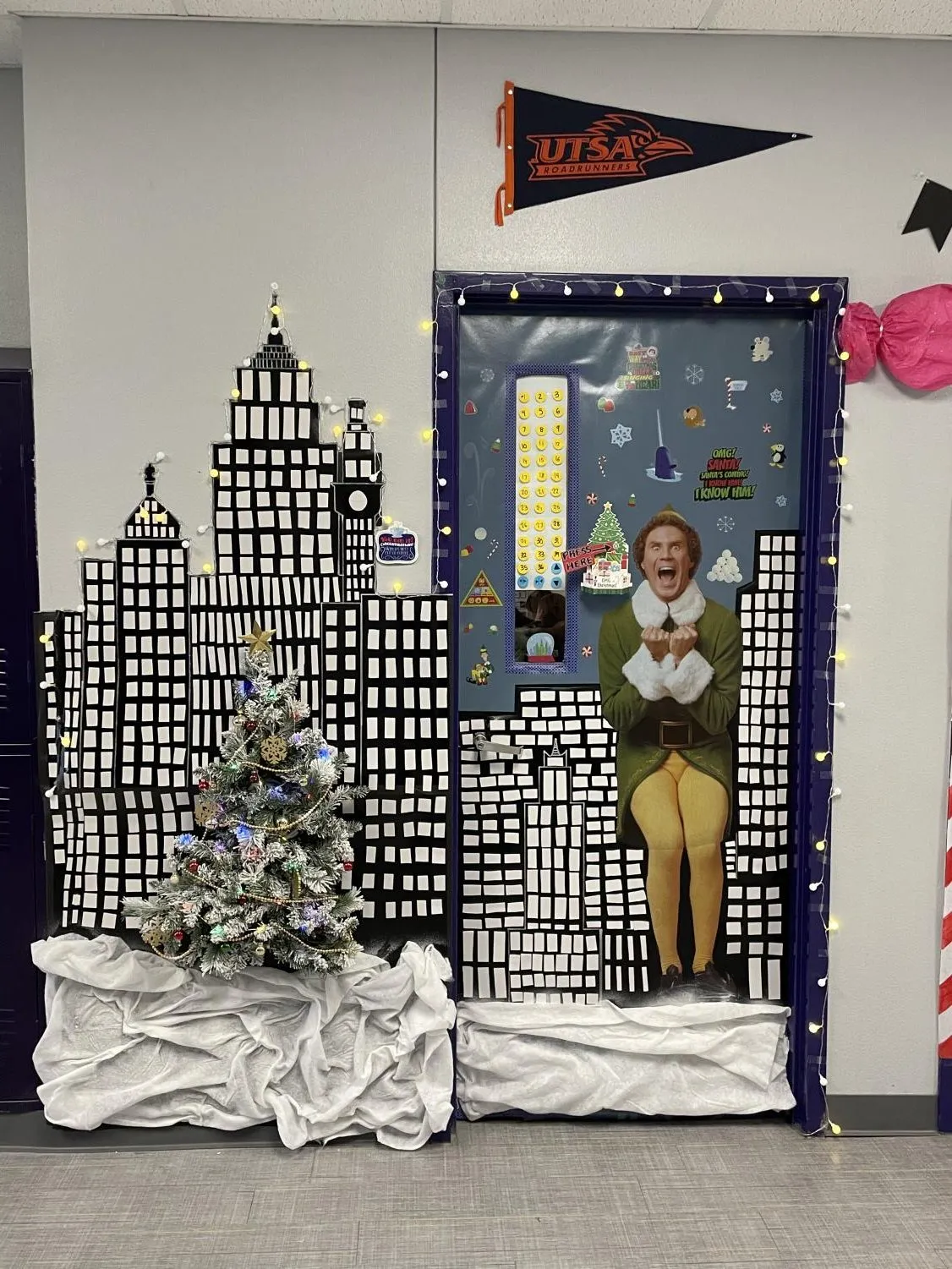
Scale does the heavy lifting. The skyscrapers rise taller than the door, so the entry reads as a set piece rather than a poster taped to a panel. The dark blue door then acts as night sky, and every warm element sits on top of it. The crumpled snow isn’t filler either — it hides the gap where the door frame meets the floor, which is exactly where paper displays start looking sloppy. Cover that transition and people forgive everything else.
7. A Rudolph Door With Twig Antlers and One Enormous Red Nose
The nose. Not the antlers, not the eyes — the nose. One oversized red ornament or painted sphere placed exactly where a reindeer’s nose belongs is the entire joke, and it lands from thirty feet down the hall. Make it big: 8 to 12 inches across. A 4-inch ornament vanishes and the face reads as a generic deer. In a contest, one dramatic and slightly ridiculous focal point beats ten tasteful ones every single time.
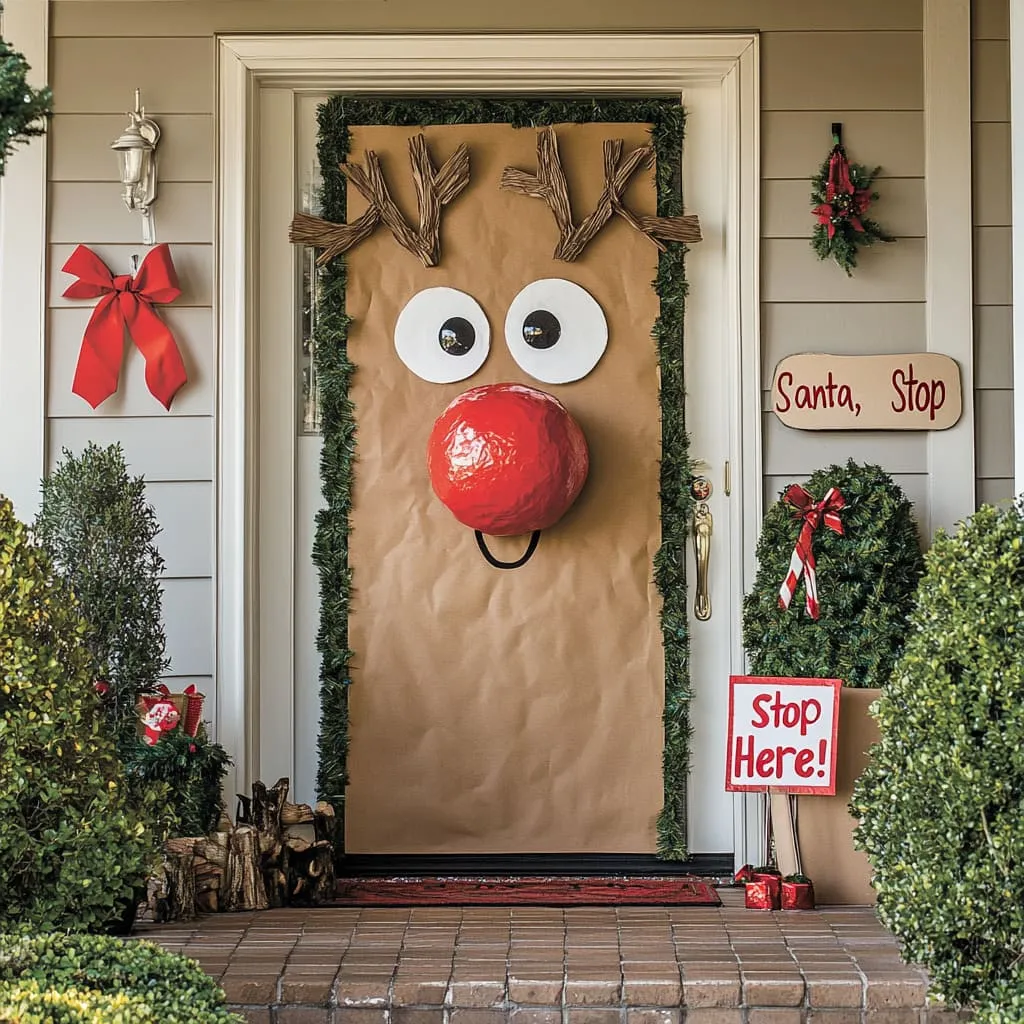
Honest talk about outdoor paper: it does not survive rain, and twig antlers snap in a stiff wind. If your entry faces the weather, laminate the paper or build this on a covered porch. Real evergreen will drop needles for about two weeks — sweep every few days or you’ll track brown bits through the house. Faux garland skips the shedding entirely and only needs a rinse with the hose each spring.
8. The Head-in-the-Hole Elf Selfie Door Everyone Queues For
- Cover the door in yellow kraft paper, taping to the frame.
- Trace the elf body and hat onto cardstock, tall enough that a 6-foot adult still crouches.
- Cut the face hole at adult head height, roughly 60 to 65 inches off the floor.
- Add LET’S TAKE A SELFIE across the top in bold block letters.
- Scatter white paper snowflakes and loop gold tinsel over the handle.
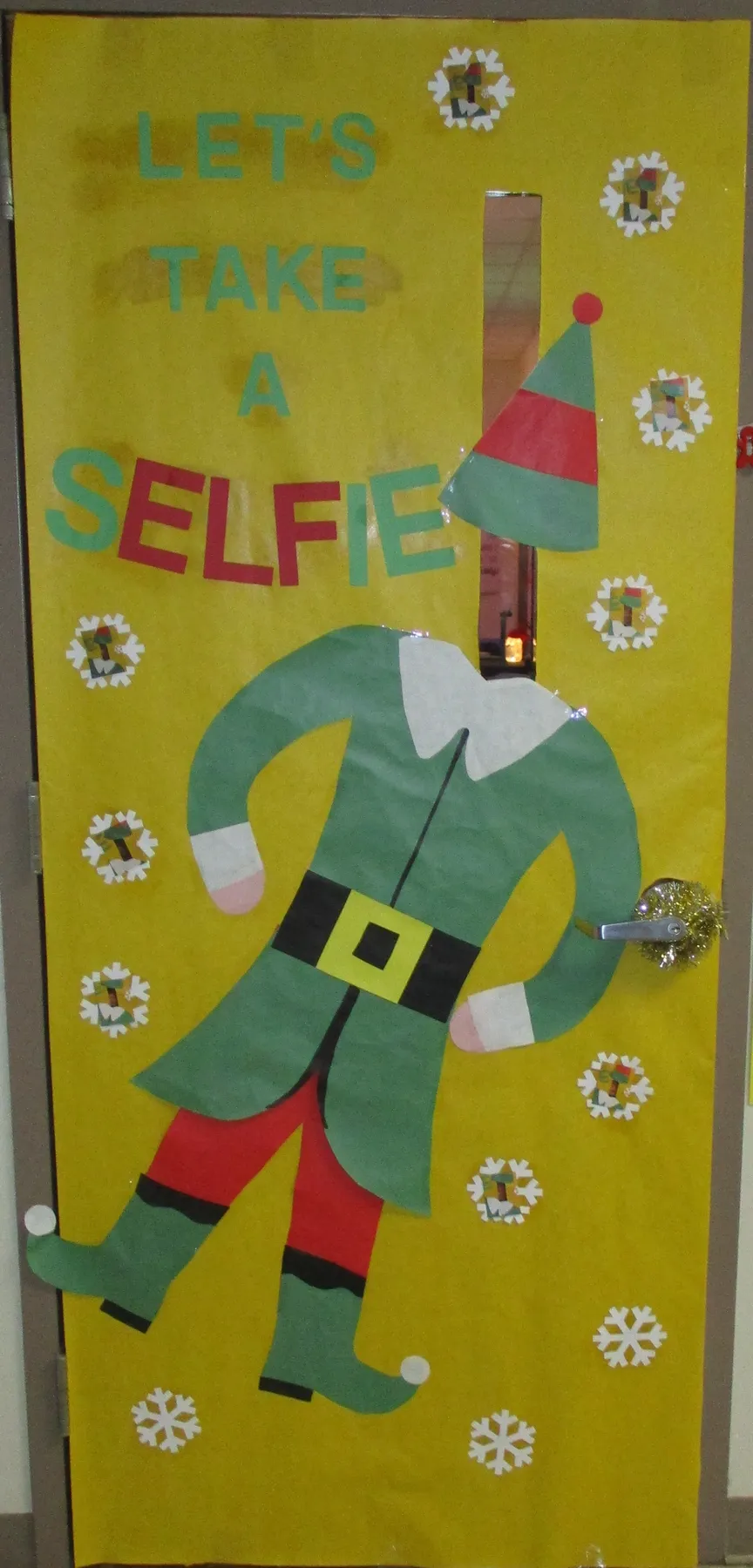
Time: 2 to 3 hours. Materials: $20–$35 in kraft paper, cardstock, and glue dots.
Run these checks before you cut anything:
- Measure the door’s actual width — a 36-inch door needs more paper than you think
- Confirm the head hole lands at 60–65 inches for adults, 48–52 for kids
- Make sure the door still opens without tearing the paper
- Photograph it early — this one gets crowded fast
9. A Handprint Paper Tree With Ribbon Messages and Tinsel Garland
This one runs on 70 percent white ground, 20 percent forest green tree, 10 percent red-and-yellow accents. The white door is what lets a hundred cut-paper handprints read as texture instead of clutter — the green stays the hero and red only shows up in the ribbon and tinsel. Swap the green handprints for deep plum and the same layout becomes an elegant modern tree. Swap white for kraft brown and it turns rustic. The proportions matter more than the colors.
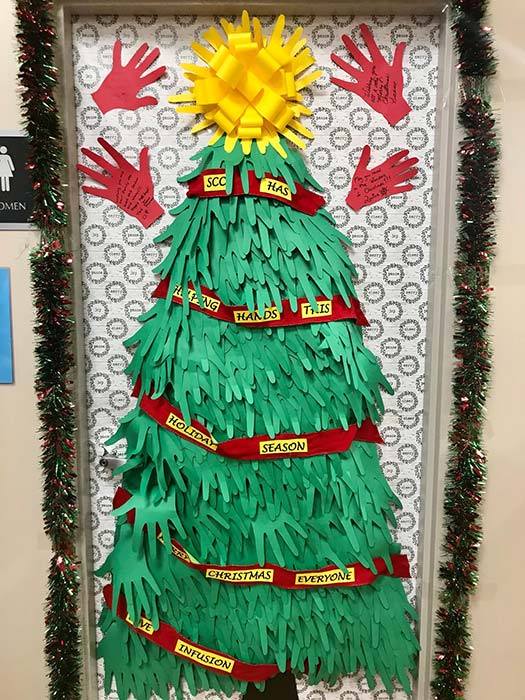
Overlap the handprints like roof shingles, starting at the bottom and working up. Each row should cover about a third of the row beneath it. Space them too evenly and the tree looks like a spreadsheet; overlap them and it looks grown. Use glue dots rather than liquid glue on glossy doors — they hold better and lift off in spring without a residue ring, which matters if this is a classroom door you have to give back clean.
10. An Ocean Scene Door With a Sailboat and Cut-Paper Fish
Two-tone water is harder than it looks. If the horizon line sits at the exact middle of the door, the composition feels dead — put it about a third of the way up instead. Stick-on letters also lift in humidity. Press each one down for a full ten seconds, and if your door sits near a warm hallway register or a radiator, add a swipe of glue stick underneath. Otherwise you’ll find a vowel on the floor by December 15.
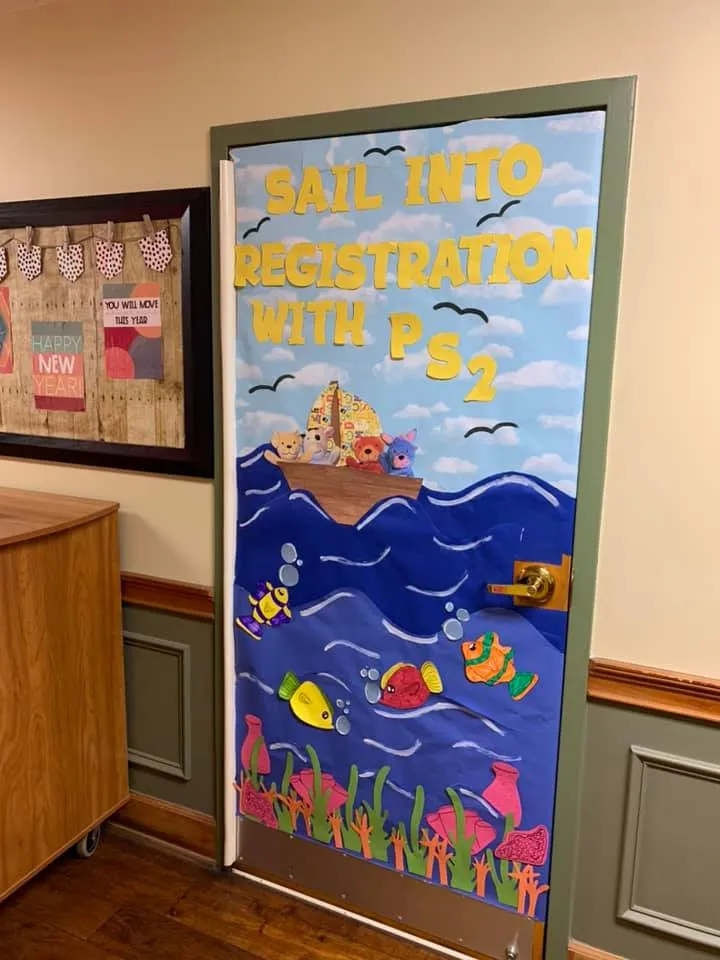
This is roughly a $20 door. Construction paper by the pack runs $4, and the waves are just torn edges — no scissors needed. The sailboat hull is a brown grocery bag, and those plush toys were almost certainly already in the classroom. Skip the printed letter set and cut your own from yellow cardstock. Fish can be recycled from last year’s door, and a roll of blue painter’s tape keeps the whole thing removable in ten minutes flat.
11. Red Paper, a Mirror, and a Selfie Elf That Actually Works
The mirror. Every head-hole door gets photographed, but a cheap acrylic mirror mounted inside the hole is what makes people linger, fix their hair, and take three shots instead of one. It also solves the weird shadow problem you get when a printed face is replaced by a real one. Compare with Idea #8 — same selfie gag, completely different palette and energy.
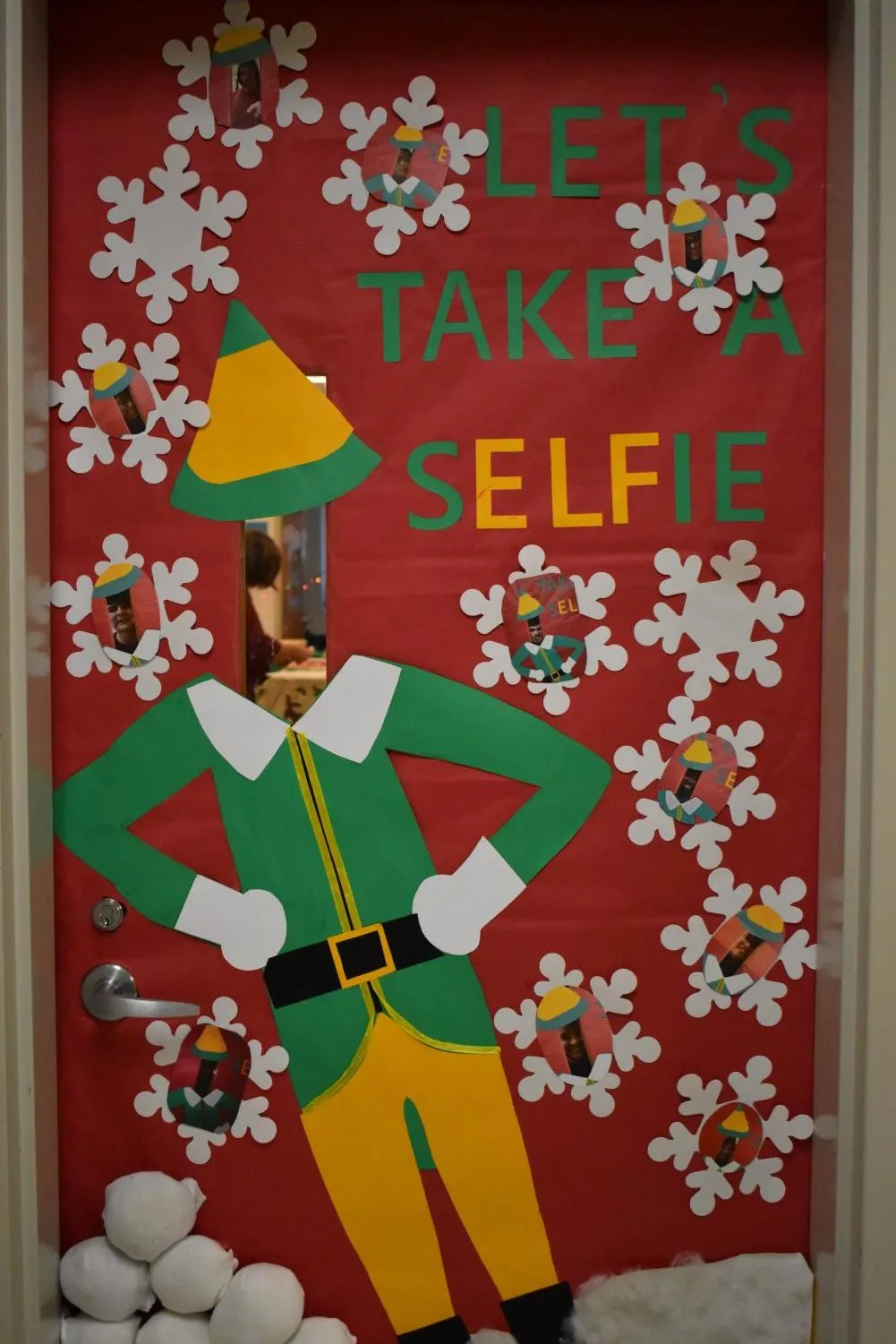
- Cover the door in red kraft paper, edge to edge.
- Cut the elf body and hat from green and yellow cardstock, sized so a guest’s face aligns with the elf’s.
- Mount a shatterproof acrylic mirror behind the opening for group photos.
- Add LET’S TAKE A SELFIE across the top in white block letters.
- Finish with paper snowflakes and small elf-hatted face cutouts around the frame.
Time: about 2 hours. Cost: $25 or less with dollar-store paper and an acrylic mirror.
12. Evergreen Garland and a Red Velvet Bow on Black Double Doors
This is the door treatment that works on almost any entry — but the proportions change with the opening. On a standard 36-inch single door, a 24-inch wreath is the sweet spot; on double doors like these, go 30 inches or you’ll be staring at a doorknob wearing a hat. Garland should span the full width of the frame and drop about a quarter of the way down each side. If your entry is narrow, skip the side drops entirely. Narrow entries want a wreath and nothing else.
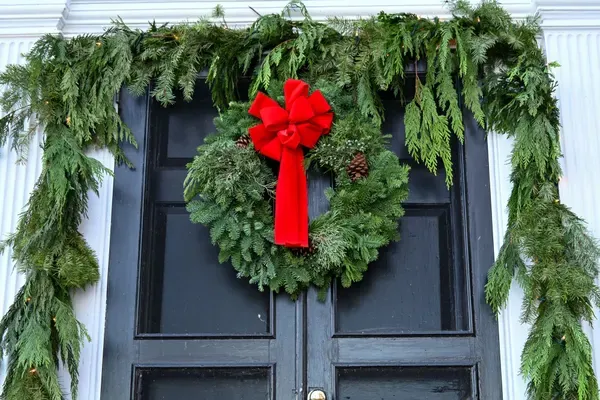
- Two 30-inch wreaths, mixed evergreen: $80–$220
- Lit garland, 12 feet: $50–$140
- Wired velvet ribbon, 3 yards: $15–$35
- Pinecones and berries: $15–$40
- Removable hooks and clips: $10–$20
Trim the budget by buying plain wreaths and dressing them yourself — pinecones and one good ribbon turn a $15 wreath into something that looks like $90.
13. Grinch, Frosty, and String Lights on a Light Blue Door
The pale blue background is the unsung hero. Green Grinch, green tree, and a white snowman would all disappear against a green or red door — against light blue, every character pops and the scene reads as winter rather than Christmas clutter. The other smart move is framing the whole door with battery-operated lights. One continuous outline turns four unrelated cutouts into a single stage set, and it photographs far better than flat paper alone.
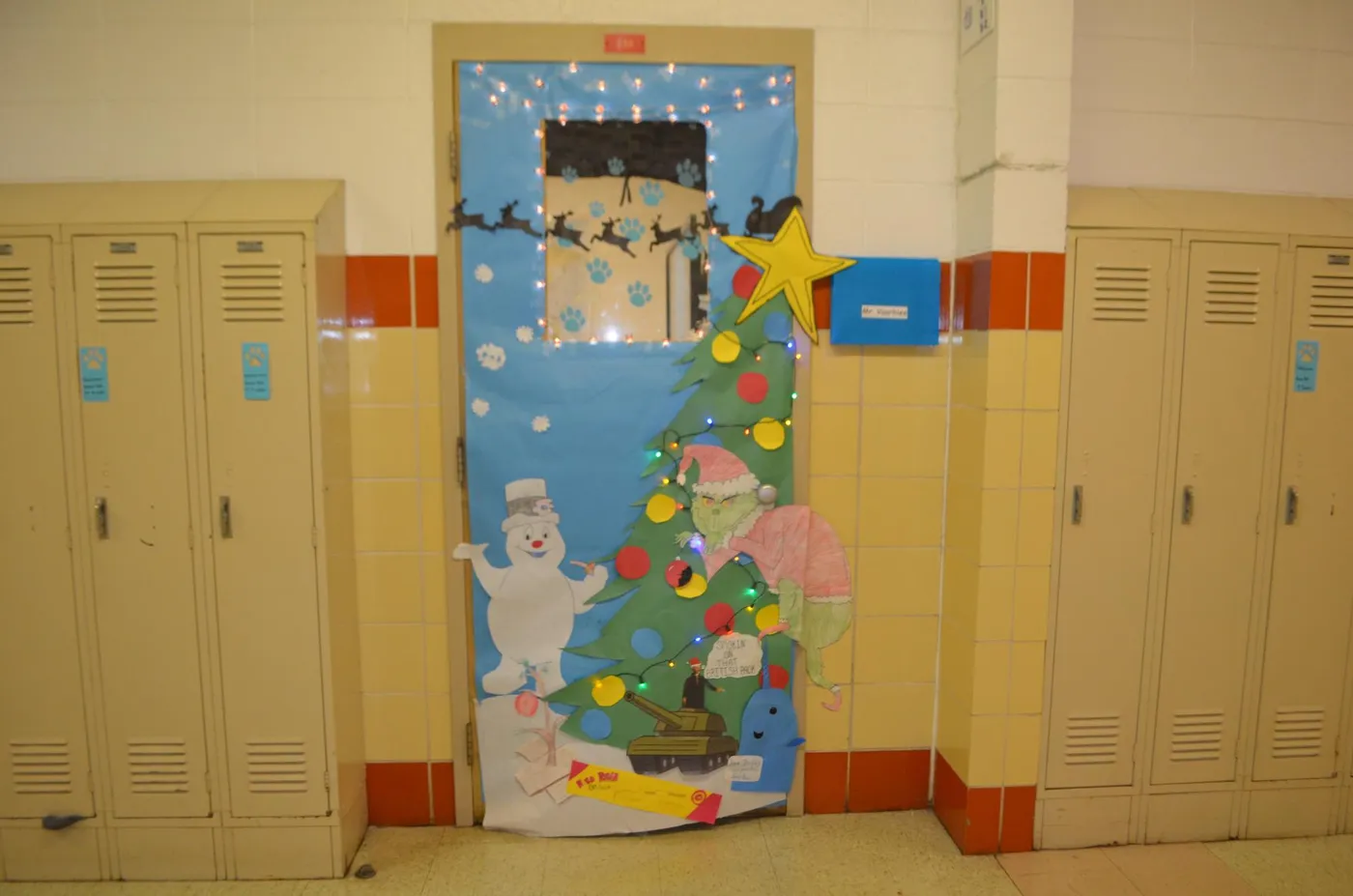
Character doors keep winning contests because they’re instantly recognizable from across a gymnasium, and they photograph beautifully for the parent group chat. The Grinch-and-snowman pairing is the safest bet in 2026: two beloved characters, no printing costs if you cut the shapes yourself, and enough color to read in dim hallway lighting. It’ll age well, too — these are evergreen characters, not a meme that expires in six months.
14. The Office Grinch Door With Green and Silver Tinsel
Office doors are fire doors more often than people realize, so nothing can block the latch or cover the vision panel. Keep decorations on the face of the door and stop 2 inches shy of all four edges. Use removable strips rated for 3 pounds and pull them off slowly at a 45-degree angle when January comes. Tinsel attached with staples leaves pinholes that facilities will charge you for — tape, every time.
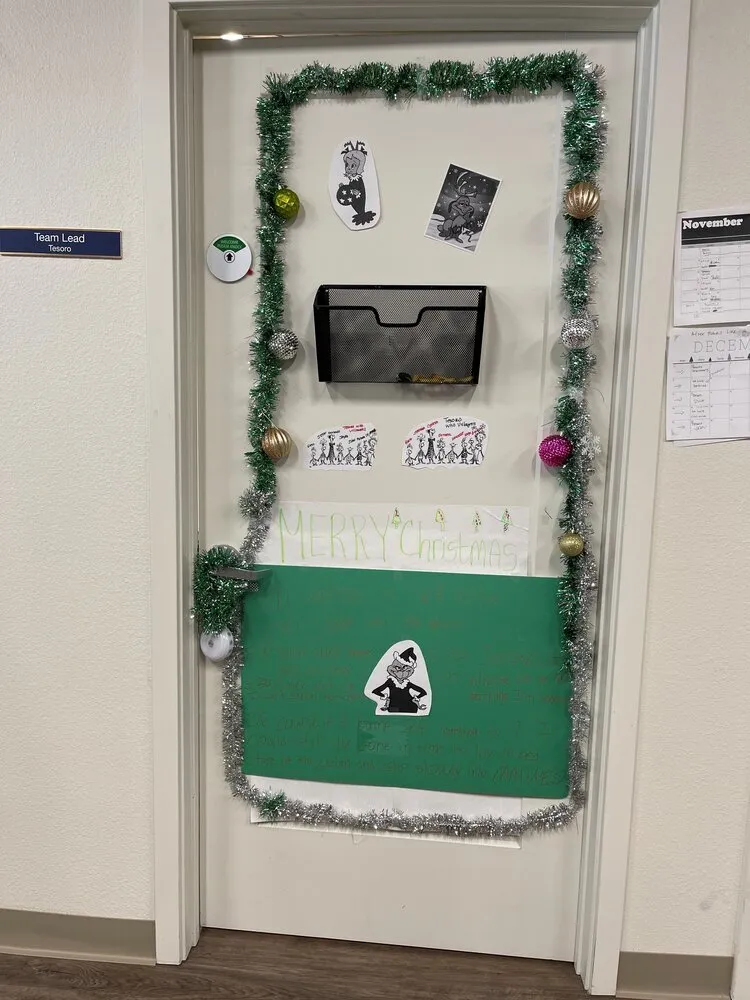
Tinsel looks incredible the day you hang it and tired by week three, especially near a hallway vent where it collects dust like a lint trap. Give it a light shake once a week. Ornaments hung on invisible hooks will disappear into someone’s pocket, so skip the family heirlooms for office doors. And check whether HR allows full-door coverage before you spend an evening on it — some buildings restrict anything covering more than half the surface.
15. A Black Door, a Deep Green Wreath, and a Gold-Tipped Bow
The fanlight. That semicircular window above the door is the reason this entry feels grand rather than merely decorated — the wreath sits exactly beneath an arch of evening sky. Leave the fanlight dark and the composition loses its crown. On an entry without one, fake it: a shallow arch of lit garland across the top of the door frame does nearly the same job for about $30 and twenty minutes of work.

The palette is strict: 70 percent deep green foliage, 20 percent black architecture, 10 percent red-and-gold accents. That ratio is why it feels traditional instead of busy. Adjust it and the character shifts:
- More gold, less red: elegant, slightly formal
- White ribbon instead of red: crisp, snowy, modern farmhouse
- Copper instead of gold: warm, aged, English cottage
Green stays the anchor no matter which direction you take.
16. The Polar Express Door That Emerges From a Paper Brick Tunnel
- Cut red kraft paper into brick shapes and layer it over the frame as a tunnel arch.
- Cover the door opening with black paper, then scatter white and blue paper snowflakes.
- Build the engine from three cardboard boxes — body, cab, smokestack.
- Paint the wheels silver and hot-glue a green wreath to the front of the boiler.
- Run silver tinsel along the top edge and clip on two battery puck lights.
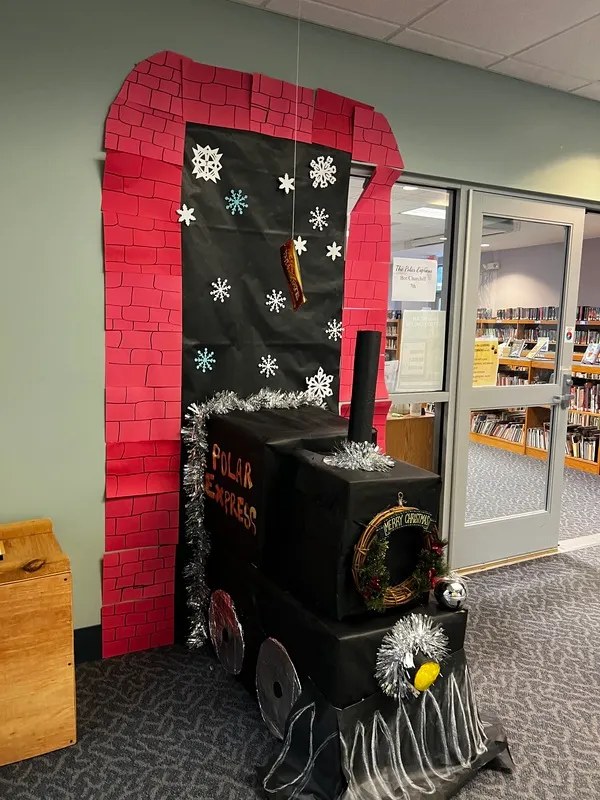
Time: a full weekend. Materials: $30–$50 in cardboard, paint, kraft paper, and tinsel.
Cardboard is free if you ask the grocery store for apple boxes instead of buying craft board. Silver spray paint runs $6 a can and covers three boxes. Battery puck lights are $8 for a two-pack, far cheaper than running an extension cord across a hallway. Paper snowflakes come from printer paper you already own, and last year’s wreath can be re-fluffed with a rinse and a new bow.
Three quick checks before the cardboard comes out:
- Measure the opening — the train must sit clear of the frame so the door still closes
- Confirm the display doesn’t narrow a hallway below 36 inches
- Decide where the boxes live afterward, or they’ll ride in your trunk until March
17. A Vintage Santa Banner Framed by Lit Garland and Baubles
- Santa door banner, 30 x 60 inches: $20–$60
- Greenery garland with lights, 9 feet: $40–$110
- Red glitter bows, set of four: $12–$25
- Assorted baubles, 40-count: $15–$35
- Black lantern with LED candle: $25–$60
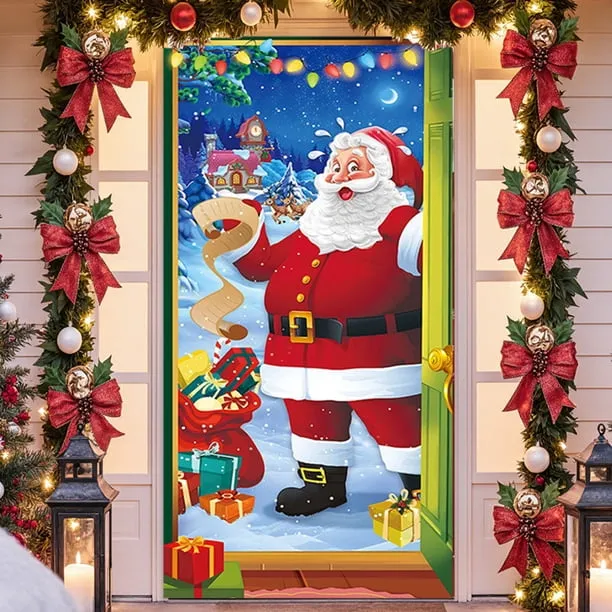
If the banner feels like too much pattern for your entry, Idea #12 does the same job with pure greenery and one velvet bow.
Hang the garland slightly wider than the door frame, not flush with it. Swagging it 3 to 4 inches out on each side makes the entry feel bigger, and it hides the awkward corner where siding meets trim. Zip-tie the garland to screw-in cup hooks rather than taping it — tape fails in cold, and a falling garland at 11 p.m. is not the holiday memory you’re after.
18. Feliz Navidad: A Sombrero Santa, Lit Cactus, and Fabric Snow
Culturally specific doors are the quiet winners of the 2026 contest circuit. Instead of another red-and-green door, this one leans into a Mexican Christmas with bright cut-paper color, a sombrero-topped Santa, and Feliz Navidad a todo el mundo across the top. Judges reward originality, and families who celebrate this way finally get a door that looks like their December. It’s a great classroom move, too — the conversation it starts is worth more than the ribbon.
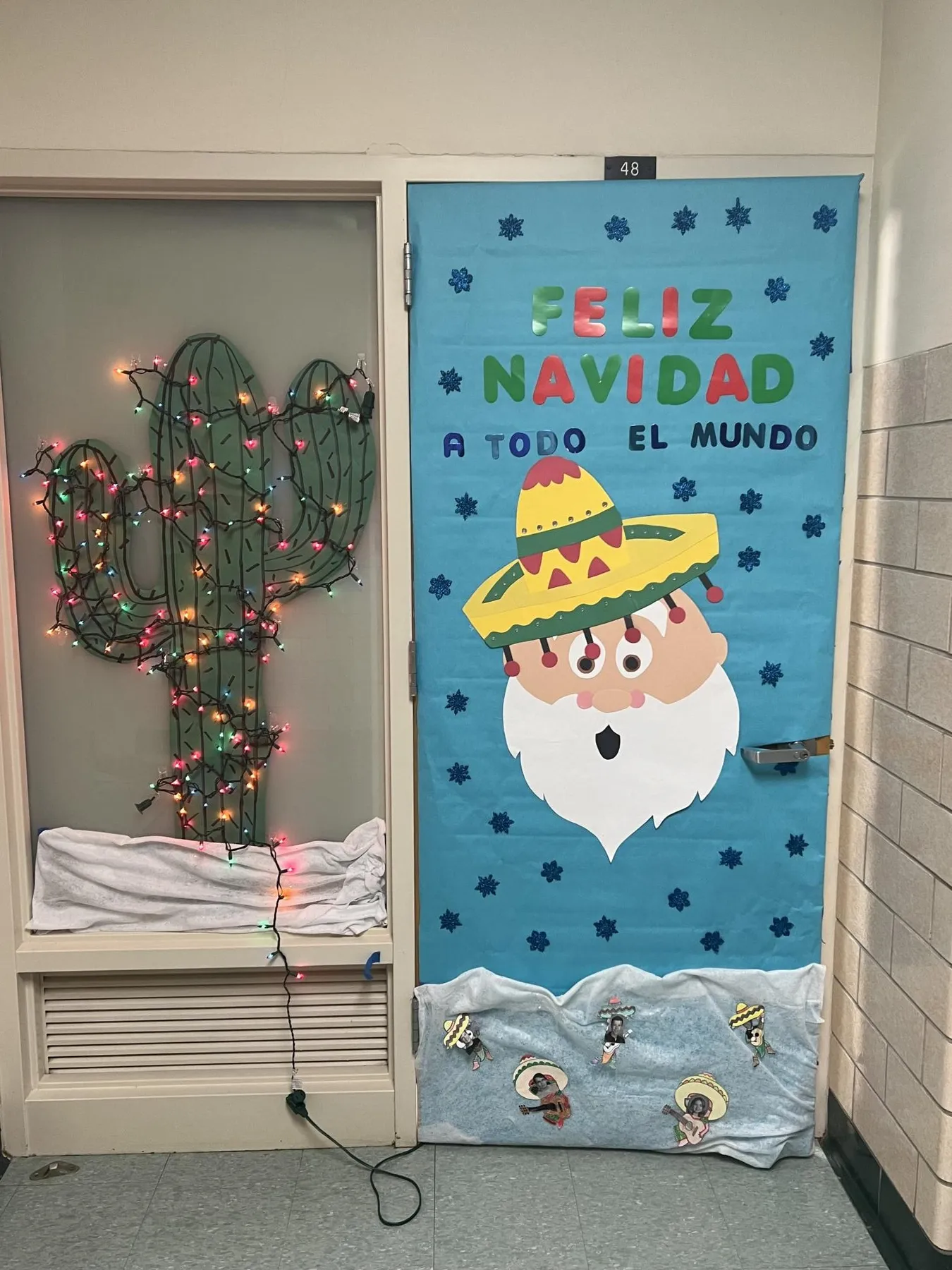
Two things keep this playful instead of chaotic. First, the light blue background holds everything together — every red, green, and yellow shape sits on a calm ground. Second, the composition splits cleanly: door for the portrait, window for the cactus, floor for the snowdrifts. Spreading a theme across three surfaces makes a small entry feel intentional rather than crammed, and it gives guests three separate things to point at.
19. A Red Door, Faux Pine Garland, and a Natural Twig Wreath
A red door is a strong host and it does not share. Add multicolor lights and the whole entry turns into a fire engine. Keep the extra color to a minimum — warm white lights, a brown twig wreath, and that’s it. Also check your door’s finish: some painted doors hold tape beautifully and some release it in a cold snap. Test one strip on the hinge side for a full day before you commit to running garland the whole way around.
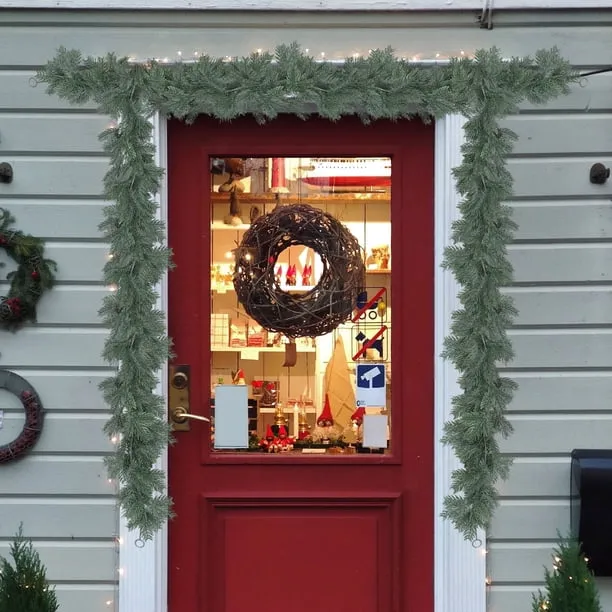
Faux pine is the low-effort win here. It doesn’t drop needles, doesn’t brown, and rinses clean with a hose each spring — but it does collect pollen and cobwebs, so plan on one wash per year. Real garland smells better for about ten days and then sheds for another twenty. Twig wreaths are the hardiest option: no watering, no shedding, just a yearly dusting and a touch of clear spray to keep the brown from graying.
20. Plaid Bows and Twin Evergreen Trees at a Dark Wood Door
Match the plaid to the door, not the other way around. A busy red, green, and white tartan against dark stained wood needs a bow at least 12 inches wide to register; anything smaller gets swallowed whole. Wire the bow so its loops sit higher than the wreath’s center, then fluff the wreath’s outer branches forward so the ribbon doesn’t look pressed flat against the door. That single fluffing step is the difference between store-bought and designer.
This setup wants a porch at least 6 feet deep and a door surround wide enough for two planters without crowding the walkway. Small trees should stay between 24 and 36 inches — taller and they fight the wreath for attention. If your stoop is shallow, use two small urns instead of full planters and skip the trees entirely. A single wreath and one pot will always beat two crowding planters.
21. A Chocolate Bar Door With a Golden Ticket and Balloon Arch
Brown kraft paper across the whole door costs about $8. The foil is a $4 emergency blanket or a roll of aluminum foil, crumpled and re-smoothed so it catches light like a real wrapper. Balloons are the biggest variable — a 24-piece metallic set runs $12 to $18, and a hand pump is worth every penny at $6. If you’re decorating for a room full of kids, extra balloons always get used; buy the bigger pack.
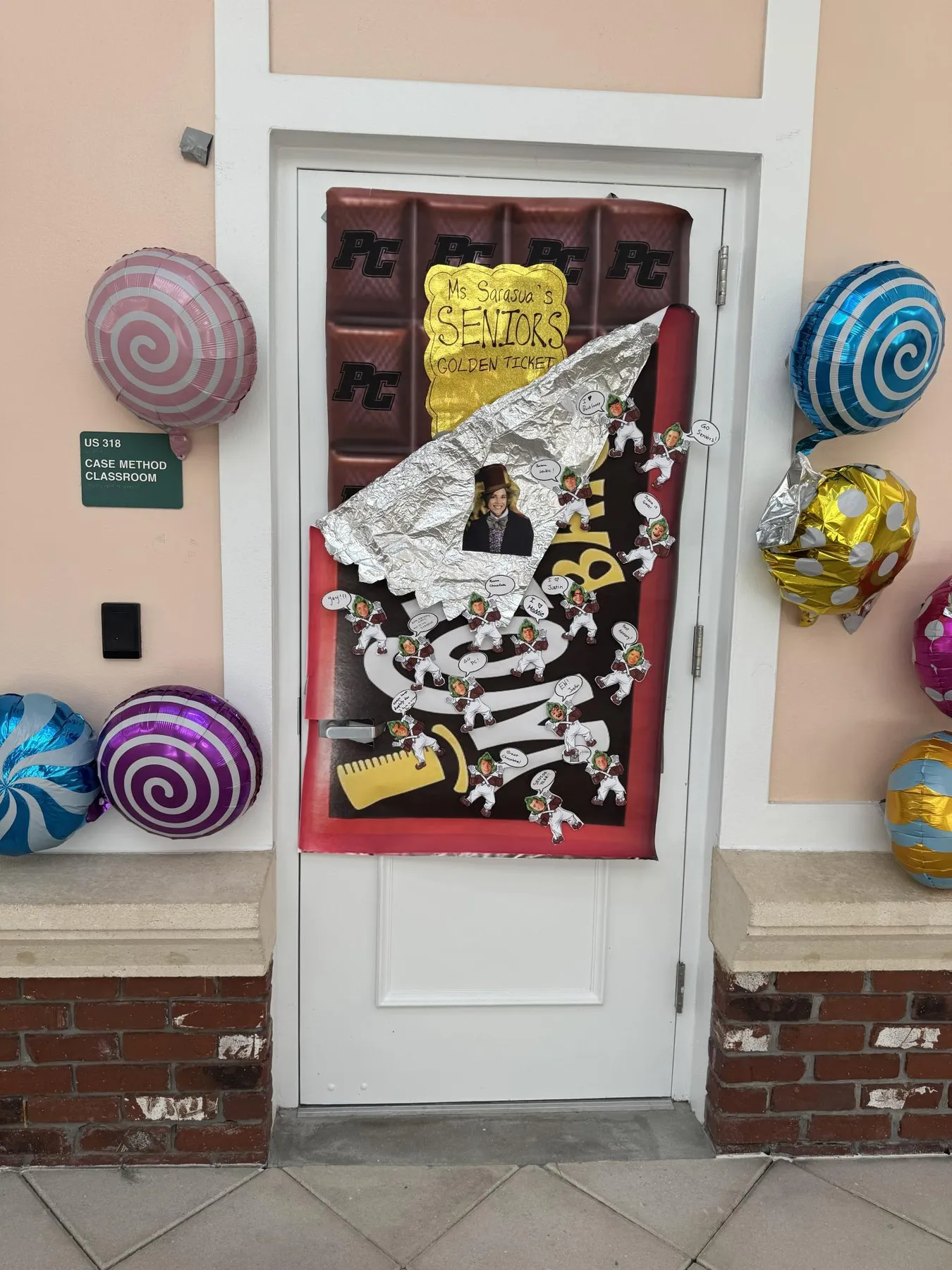
- Cover the door in brown kraft paper and add darker squares to suggest chocolate segments.
- Crumple foil and tape a peeled-back section across the top third.
- Print the golden ticket on gold paper and tuck it into the foil edge.
- Add small character cutouts in a loose grid, slightly rotated for movement.
- Build the balloon cluster on the wall beside the door, never on the door itself.
Time: about 2 hours. Cost: $35–$50.
22. A Lit Grinch Tree With Whoville Cutouts and Stacked Gifts
The lights on the paper tree. Cutting a tree from green cardstock is a Tuesday-night craft; threading warm string lights through it turns the door into a glowing object you can see from the end of the hall. Keep the bulbs small and the wire green so it disappears into the paper. Everything else — the Grinch, Cindy Lou Who, Max, the stacked gifts — is set dressing that only works because there’s a light source at the center.
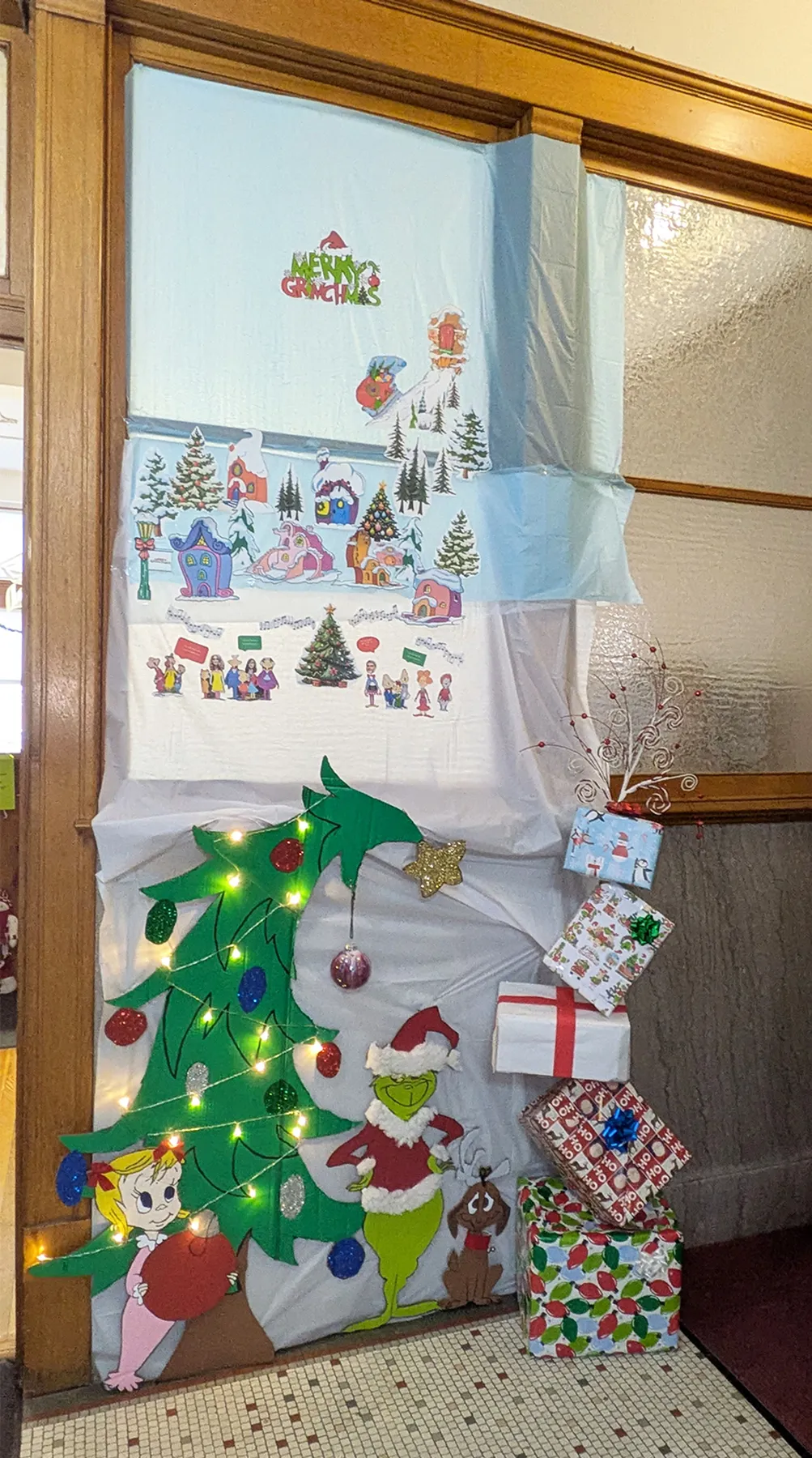
Nostalgia-driven doors are outperforming generic ones in every contest I’ve seen this year, and Dr. Seuss sits right at the top. It’s a story everyone already knows, which means judges recognize it in two seconds and kids point at it from across the room. Pair it with the paper-cutout approach in Idea #6 and you’ve got a full pop-culture installation for under $50.
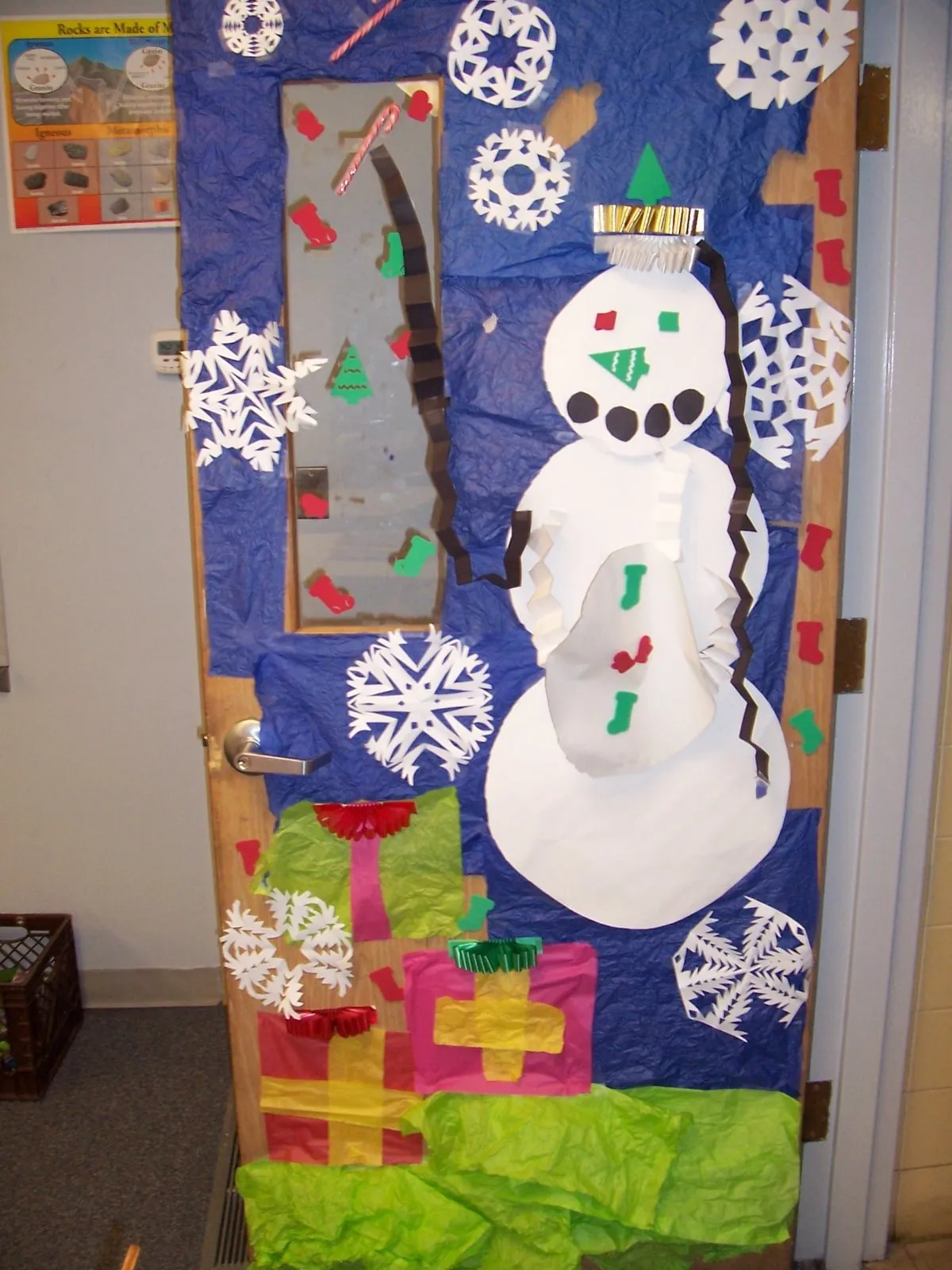
23. Three Doors, Three Stories: Fireplace, Tree, and Snowman
What makes a multi-door display work is that each door carries one single, different idea. Fireplace, tree, snowman — no overlap, no competition. Repetition carries the rest: the same paper palette, the same bow, the same tiny string lights on all three. Do that and the set feels curated. Skip it and you get three unrelated crafts taped to three doors. The shared materials are doing more work here than any individual door.
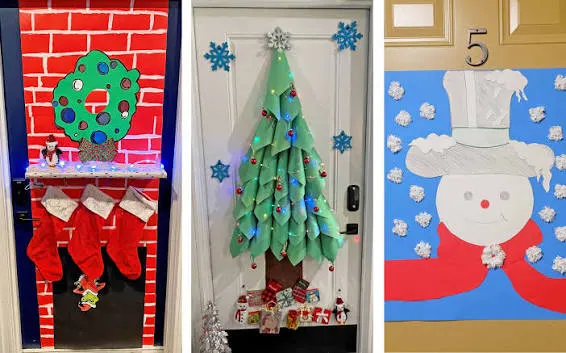
Before you take on three doors at once:
- Assign one theme per door and write it down — overlap kills the effect
- Buy paper and lights in bulk so the palettes actually match
- Check that each door still opens fully; the fireplace door is the usual offender
- Set a hard two-evening limit or this quietly becomes a week
24. Illuminated Snowflakes and Life-Size Nutcrackers on Brick
Snowflake motifs need wall space to breathe — figure on one 24-inch flake per 8 feet of facade, centered between windows rather than beside them. Nutcrackers should top out between 4 and 5 feet so they read as figures instead of yard gnomes; a 6-footer starts blocking sightlines from inside. Poinsettias along the steps work best at a 12-inch pot width. On a smaller house, run one flake over the door and two 4-foot nutcrackers. That’s plenty.
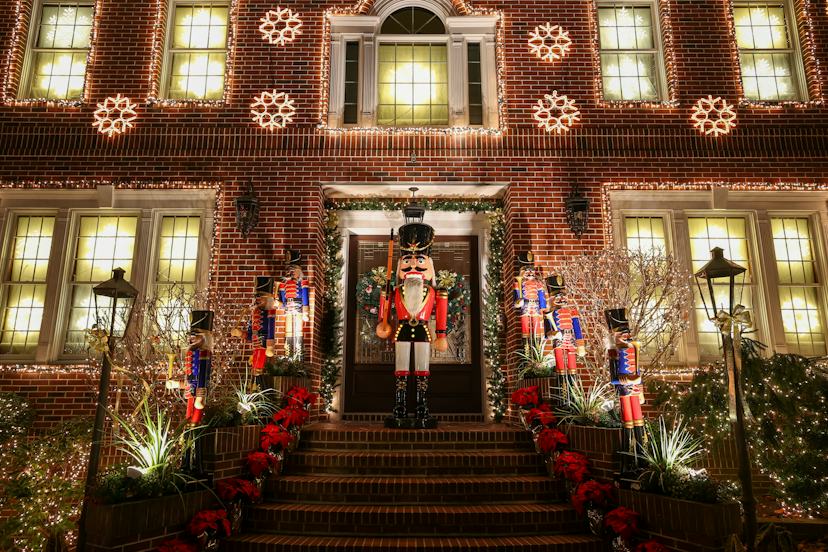
- Three 24-inch LED snowflake motifs: $90–$240
- Two 4-foot nutcracker figures: $150–$500
- Warm white string lights, 300 feet: $60–$150
- Six potted poinsettias: $60–$120
- Green garland for the entry: $30–$80
Rent the nutcrackers if you can — many party suppliers rent them for about $40 each per season.
25. A Candy Land Door With a Checkerboard Header and Lollipops
- Wrap the door and frame in brown kraft paper.
- Build a header panel of bright checkerboard squares and center it above the door.
- Cut oversized lollipops, gumdrops, and wrapped candies from cardstock.
- Add gingerbread figures at the base and outline the frame with striped tape.
- Tuck cotton batting behind the lollipops so they read as candy on a stick.
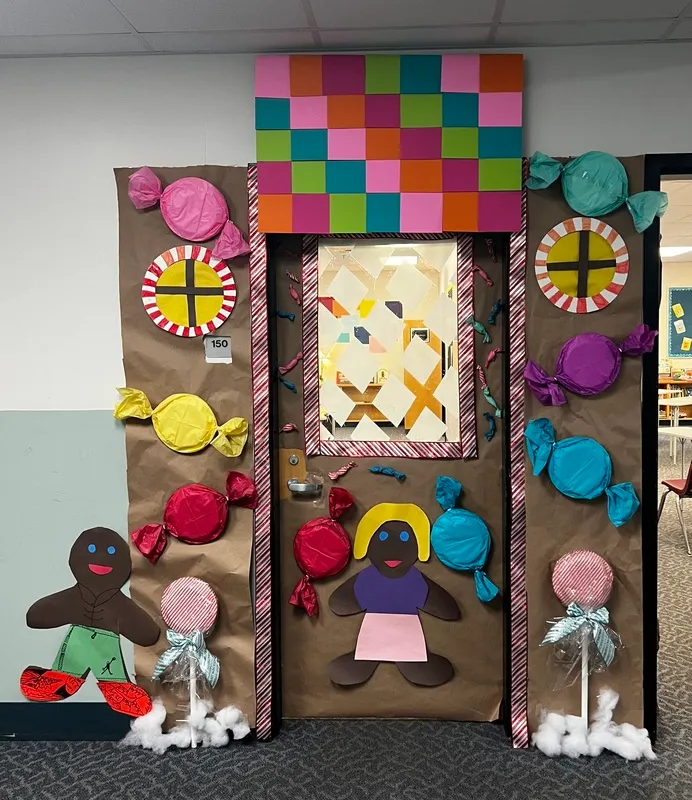
Time: 3 to 4 hours. Cost: $30–$45.
The checkerboard header is where this goes wrong most often. Squares drift out of alignment fast, so measure and mark the grid in pencil before you cut anything — a crooked checkerboard ruins an otherwise charming door. Cardstock also curls at the edges in humid hallways; press each piece flat under a book for an hour before hanging and you’ll buy yourself two extra weeks. Fading is on our list of common mistakes, and it’s the number one reason doors look tired by mid-December.
26. Snoopy on a Red Doghouse, Santa on the Door Next Door
When two doors sit side by side, give them the same background value or they’ll fight each other. Here, dark blue and dark blue. The characters can be completely different — Snoopy, Santa — but if the surrounding color matches, the pair reads as one display. It also lets you borrow the same pack of snowflakes for both. Side-by-side doors with clashing backgrounds look like two neighbors who never met.
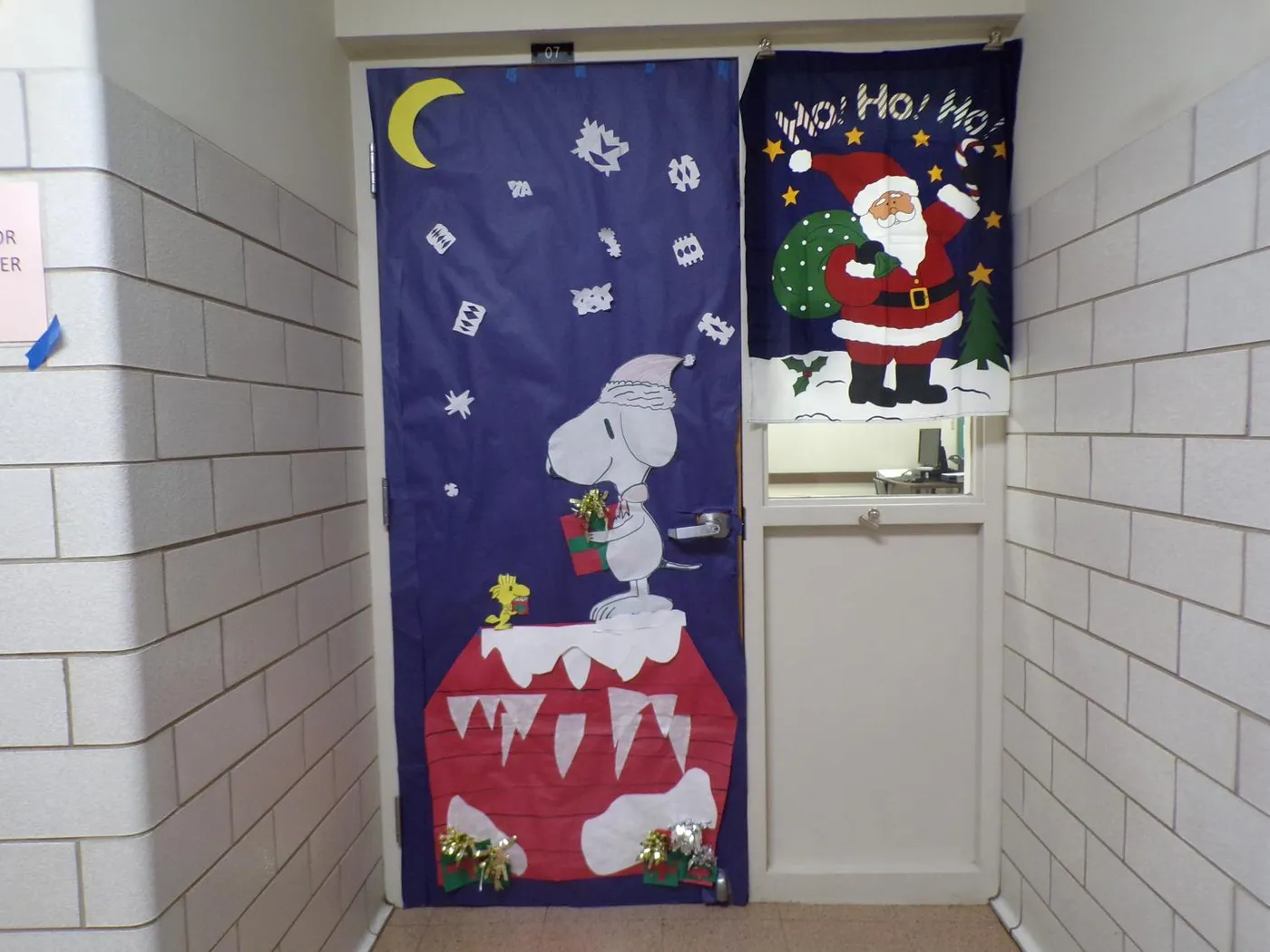
The dark blue sky. Both doors use it, and it’s the reason the red doghouse and the Santa banner both feel like evening scenes rather than flat paper. Swap it for white and Snoopy floats in a void; swap it for red and the doghouse disappears. One background color, chosen deliberately, does more for a pair of doors than any amount of extra ornament.
27. A Reindeer Door Whose Antlers Climb Onto the Wall
The move driving door decor in 2026 is extension — decorations that spill off the door and onto the frame, the wall, the ceiling. Antlers reaching across a cream tiled wall is a perfect example: the display stops being a rectangle and starts being a room. It’s a low-cost way to look ambitious, and it photographs beautifully from an angle. Expect more of it next year, especially ribbon and garland running up walls.
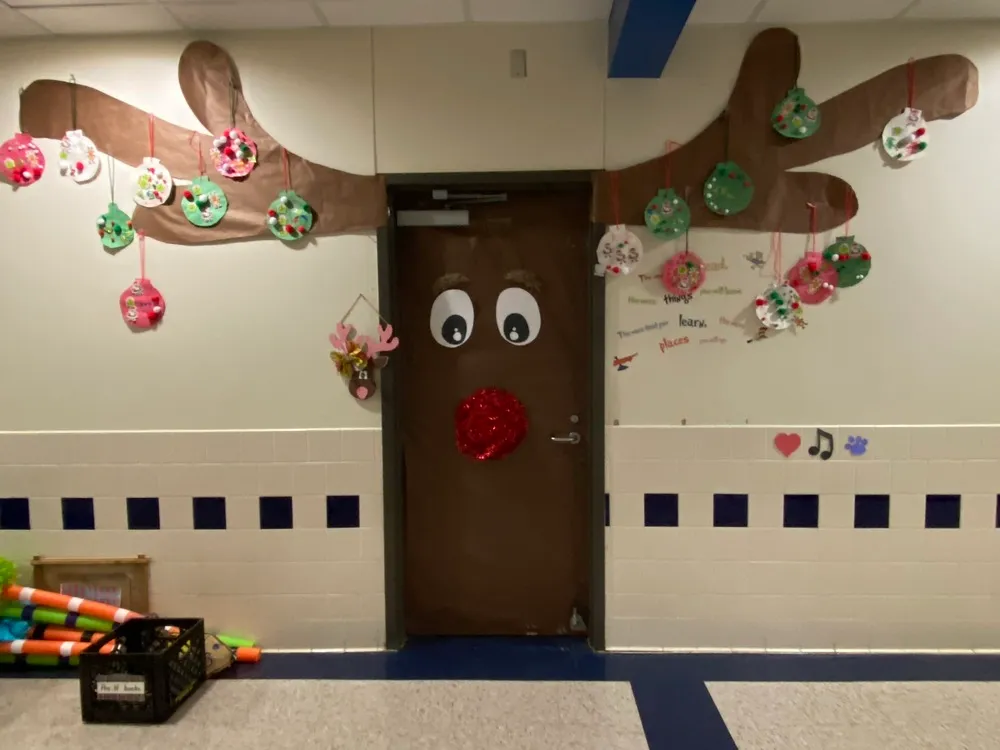
Roughly $30, start to finish. Kraft paper covers the door; the nose is a single dollar-store ornament spray-painted glossy red. The round ornaments hanging from the antlers are handmade paper circles — cheap, light, and they don’t shatter if someone bumps them:
- Kraft paper roll: $6
- Red ornament for the nose: $2
- Fishing line for hanging: $4
- Cardstock for ornaments: $5
- Glue dots and removable tape: $6
28. A Saguaro Cactus Christmas Tree Under Papel Picado Banners
The formula is 50 percent warm wood and white architecture, 30 percent saturated red-and-green, 20 percent multicolor lights. That last slice is what keeps it festive instead of tasteful-boring — the string lights do the sparkle so the ornaments can stay simple. Compare with Idea #18 — same border-crossing spirit, but where that one works in flat color, this one works in volume and texture.
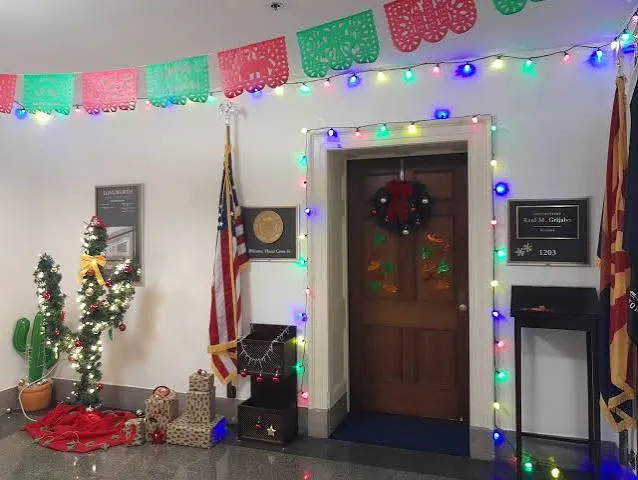
Contrast and repetition, in that order. A cactus-shaped tree is genuinely funny next to a real wreath and a formal bow — the contrast is the joke, and it lands because everything else on the door plays it straight. Then repetition takes over: chili peppers marching around the frame, papel picado banners in one repeating pattern, gifts in a single print. Absurd hero, disciplined supporting cast. That’s the recipe.
29. Inflatables Everywhere, and Candy Canes Marking the Path
Inflatables are the easiest way to fill a big yard and the fastest way to lose a weekend. Every figure needs its own outlet and a stake kit, and one windy night can flatten three of them against a fence. Anchor everything with two stakes per leg, not one. Also check your breaker — eight inflatables on a single outdoor circuit will trip it around 6 p.m. on the coldest night of the year. Plan for two circuits.
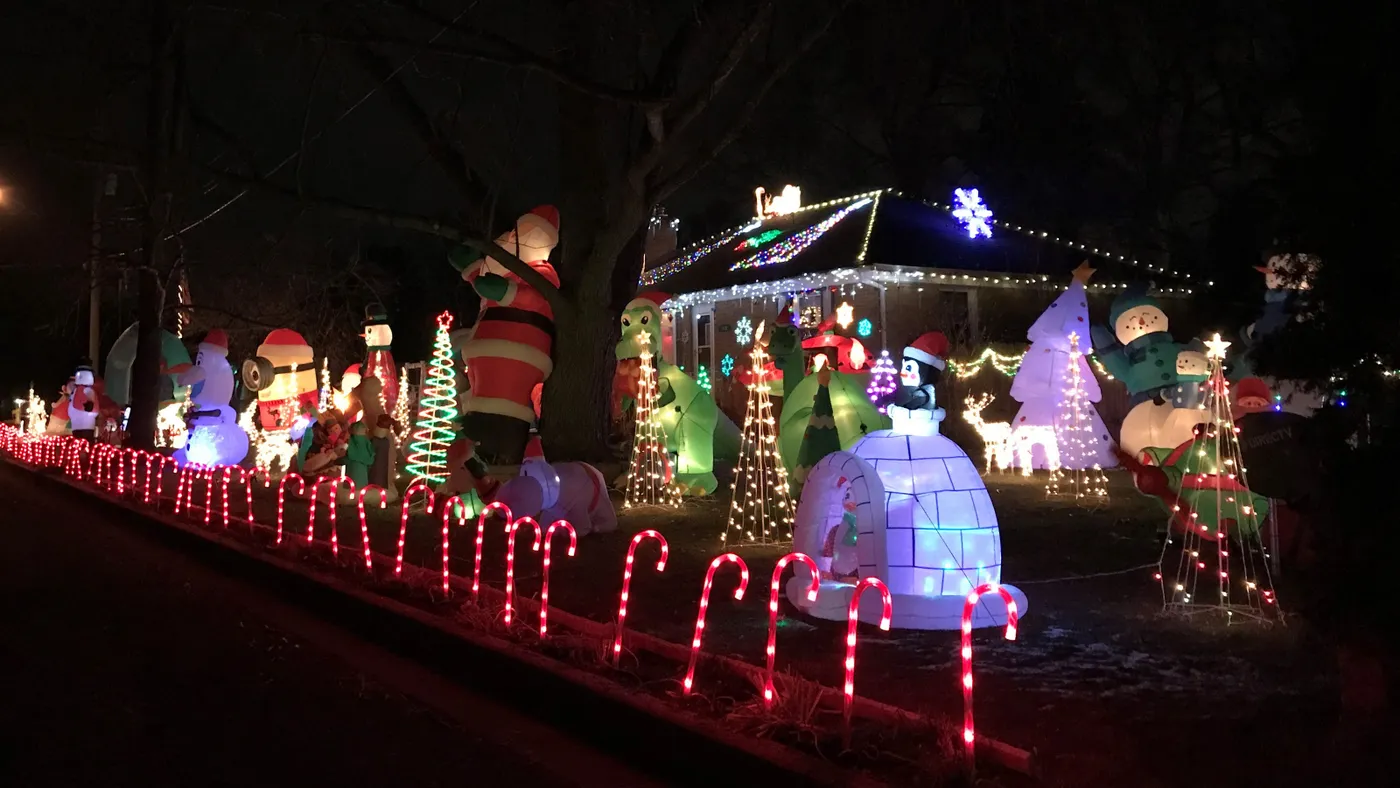
This approach suits a yard 30 feet wide or more with some setback from the street — up close, a dozen inflatables read as a storage unit. Candy cane path markers want 4 to 5 feet of spacing, which means about 20 of them for a standard driveway. On a smaller lot, choose three inflatables and one lit path, then put the rest of the budget into outlining the house itself with warm white lights.
30. A Tiered Brick Facade Wrapped in Multicolor Lights
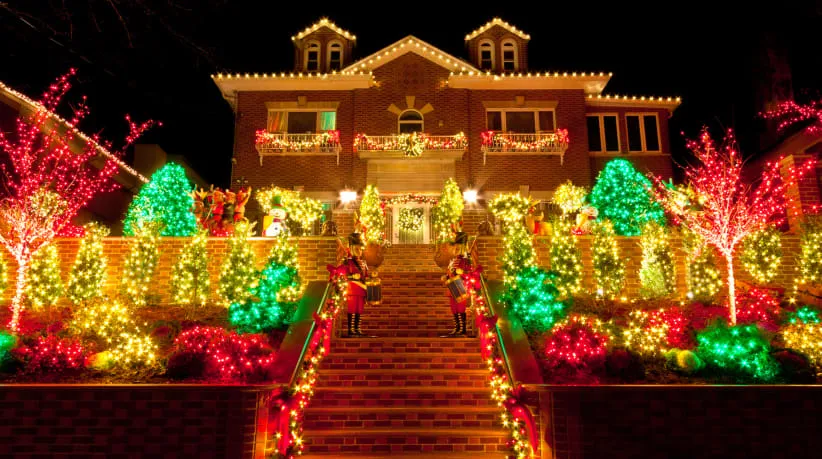
- Roofline string lights, 400 feet: $80–$200
- Net lights for shrubs, 6 sets: $90–$180
- Lit stair garland, 30 feet: $60–$140
- Two 5-foot nutcrackers: $200–$600
- Extension cords and stakes: $40–$90
Shop the after-Christmas clearance in January for next year — the same light count often costs 60 percent less.
Buy one color temperature and never mix. Multicolor LED sets from different brands vary wildly — some reds read orange, some blues read purple — and the mismatch is visible from the sidewalk. Stick to a single brand and a single product line. Then count your circuits before you climb: a standard 15-amp outdoor outlet handles several thousand LEDs, but only if nothing else is drawing on that line.
31. A Handmade Grinch Door With Max, Tinsel, and Fairy Lights
Paper doors have a shelf life and it’s about five weeks. Tinsel collects dust and starts looking gray by week four — a quick shake outdoors resets it. Cardstock edges curl upward in heated classrooms, so press pieces flat before hanging and touch up with double-sided tape mid-month. If you want to reuse the Grinch next year, cut him from heavier poster board and store him flat between two sheets of cardboard, never rolled.
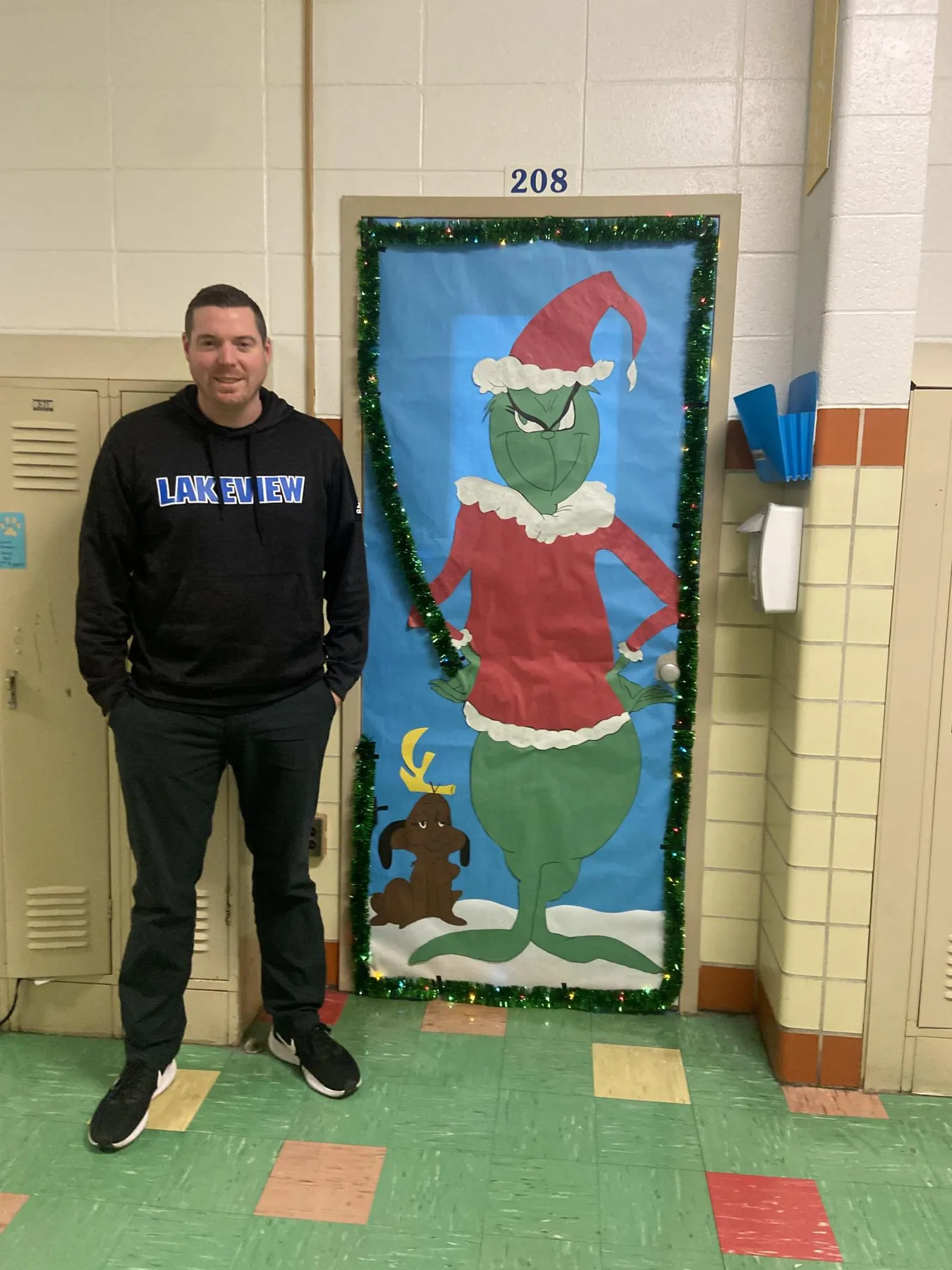
- Cover the door in light blue paper for a winter sky.
- Cut the Grinch from green poster board, plus a red hat and coat from felt.
- Add Max at his feet with white paper snow built up around the base.
- Frame the whole door in green tinsel garland.
- Weave battery fairy lights through the tinsel and tape the pack to the frame.
Time: 3 hours. Cost: $25–$40 with poster board, felt, and a thrifted garland.
32. Cone-Shaped Light Trees That Turn a Path Into a Wonderland
Light cones are the friendliest entry point for anyone who’s never done outdoor decor. Standard sizes run 2, 3, and 4 feet tall; a path reads best when you alternate heights rather than lining them up like bowling pins. Space them 3 feet apart along the walk. For a garden bed, cluster three sizes together as one unit and repeat every 8 to 10 feet. Small yards can borrow just the tall cone at the entry and stop there.

Variation in height. A row of identical cones looks like traffic bollards; three different heights clustered together looks designed. The tall light trees in the background are what sell the whole scene — they give the cones something to be small against. If you can only afford one element, buy the tall tree first and add cones later, because the contrast is where the magic lives, not in any single fixture.
Thirty-Two Doors, One Trophy — Go Win It
Whether you’re covering a classroom door in handprint trees or outlining an entire two-story facade in warm white lights, the doors that win are the ones with one clear idea and a little discipline about where it stops. Pick your favorite from these 32, start with the cheap layers first, and give yourself a full weekend instead of a frantic Thursday night.
And when your door is finished, photograph it before the tape starts lifting — then pin it alongside the rest. 📌 Save this guide to Pinterest so next December you’re not starting from zero.