
31 Gorgeous Holiday Table Settings You Need to Try in 2026 That Will Turn Heads
There’s a reason your Pinterest feed has been wall-to-wall candles, greenery runners, and stacked plates since October — holiday table settings are the decorating obsession of 2026, and honestly, we get it. We spent serious time browsing Anthropologie, Target, World Market, and Etsy to bring you only what’s actually worth your attention this year, pulling ideas that run from about $12 to $480 depending on how far you want to take it. Inside you’ll find 31 curated settings, from elegant pastels and bottle-brush whimsy to jewel-toned drama, rustic buffalo check, and crisp winter white and gold, with budget and luxury versions compared side by side and every idea shoppable with direct product links. The 2026 shift is toward mix-and-match vintage glassware and off-tradition palettes, which is exactly what’s driving saves right now. And stay until the end — we break down the most common mistakes that can ruin these looks. 📌 Save this to Pinterest for later — you’ll want to revisit these ideas. This post contains affiliate links, and we may earn a small commission at no cost to you.
1. Pastel Bottle-Brush Trees and Faux Fur Cutlery Holders
Charger plates are the cheapest way to make a table look expensive, but only if you get the size right: the charger should extend at least two inches beyond your dinner plate on every side, and never go larger than 13 inches or your guests will be eating off a hubcap. For the furry cutlery holders, buy half a yard of faux fur from a fabric store and cut it into 4-by-10-inch rectangles — that’s under $15 for eight settings versus $60 or more for ready-made ones. Tuck the silverware inside and set each one at an angle across the plate.
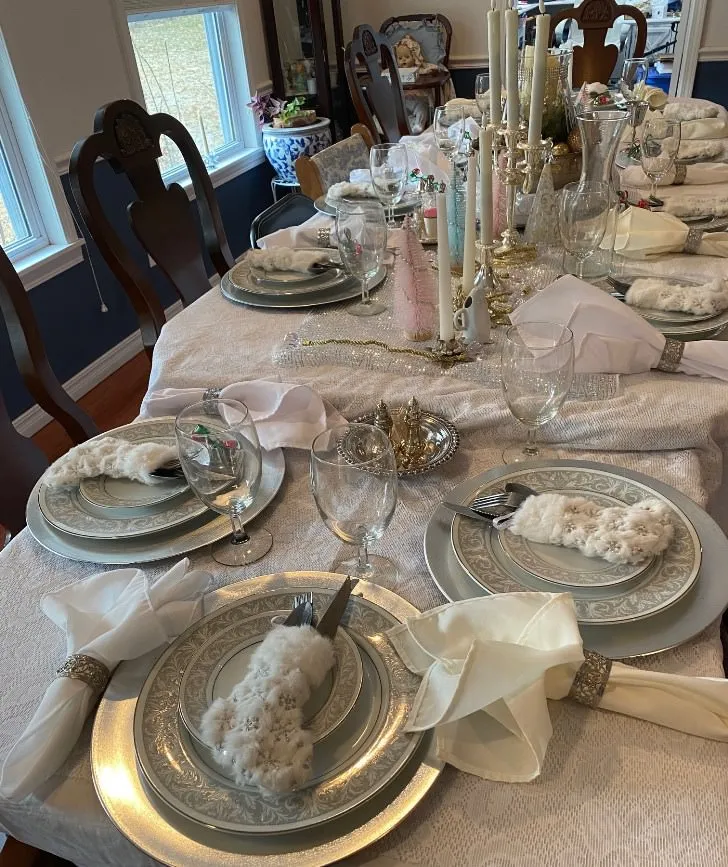
What makes this table sing is temperature contrast. Everything here is cool — icy white damask, silver rings, pale blue and pink bottle-brush trees — except the gold. The candelabras, the charger rims, and the warm candle glow pull the whole thing back from feeling like a frosted wedding cake. Remove the gold and it goes flat and slightly cold. Remove the pastels and it turns into every other metallic holiday table you’ve seen. It’s the tension between the two that holds your eye.
2. A Christmas Ornament Runner Instead of a Centerpiece
Think of this runner as a formula rather than a decoration: about 60 percent dark green foliage as the base, 25 percent ornaments in bright and pastel shades, and 15 percent candlelight. Keep those proportions and you can swap the palette without losing the look — all-white ornaments with silver foliage for a frosty version, or all red and brass for something more traditional. The one rule is density. Greenery goes down first, then ornaments get tucked into it so they look found rather than placed. If you can see tablecloth through the middle, you’re not done.
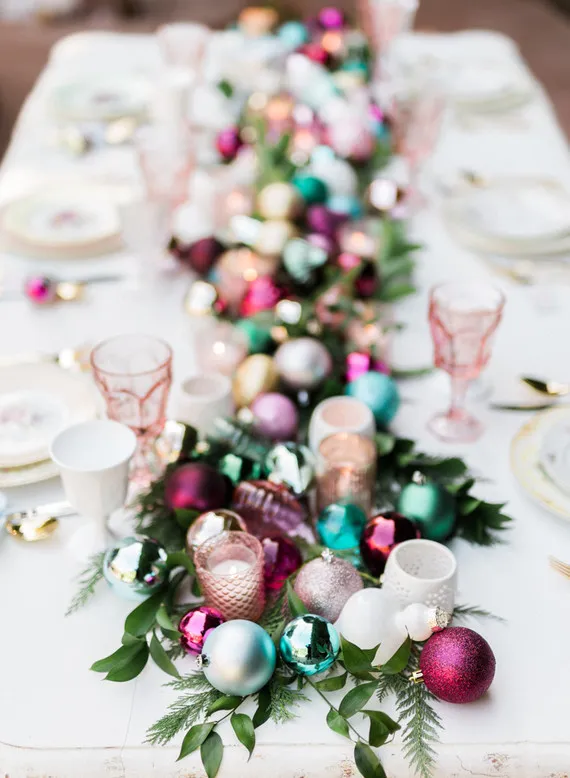
If you take away nothing else, take away this: the runner is the centerpiece. There’s no vase, no sculptural object, no tall arrangement blocking conversation — just a long, low ribbon of greenery and glass running the length of the table. That single decision frees up every inch of sightline, which is why the pink textured glasses and gold-rimmed plates get to shine. Swap in a traditional bouquet and the table instantly gets more formal, more crowded, and a whole lot less fun.
3. Peach and Aqua: The Unlikely Palette That Feels Luxurious
- Linens and tablecloth: $60–$180
- Blue and white gold-rimmed china, 8 settings: $120–$900
- Mixed clear and blue glassware: $40–$200
- Peach, orange, and pink floral centerpiece: $85–$350
- Tapers and candle holders: $30–$120
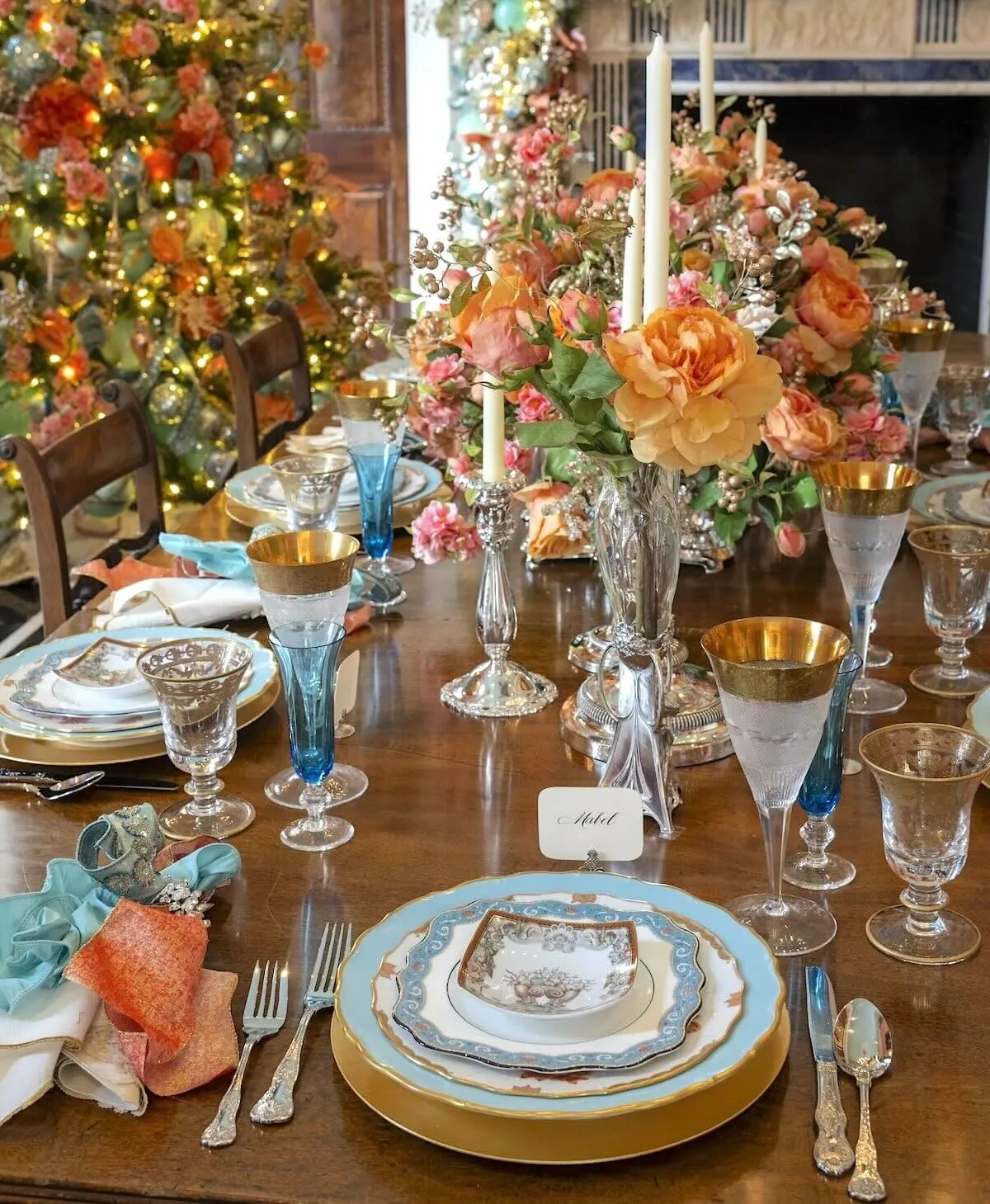
Budget alternative: skip the matching china and layer plain white plates with a gold-rimmed salad plate on top. Thrift stores and Facebook Marketplace turn up single gold-rimmed plates for $2–$5 each, which cuts this table by 60 percent without losing the layered look.
Here’s the thing nobody tells you about peach and aqua: it’s a daylight palette. Under 2700K warm bulbs — which is what most overhead fixtures and string lights throw — the peach goes muddy and the blue turns slightly gray. Test your table at night before the party, with the actual candles lit. If it falls flat, switch the bulbs over the table to 3000K or add a couple of clear glass hurricanes to bounce more light around. If you’d rather stay in traditional territory, the red-and-candlelight table in Idea #19 gives you the same glow without the color risk. Also worth knowing: pale pink glassware shows water spots instantly, so hand-wash and dry it right before guests arrive.
4. Greenery and Hydrangeas Against Dark Wood and Copper
Dark tables are a gift, and most people treat them as a problem. Here, the dark wood does the work of a shadow box — it makes the white plates with gold rims read like they’re lit from within, and it lets the light green hydrangeas glow instead of compete. The copper flatware is a smart choice too. Copper sits warmer than silver and softer than brass, so it bridges the cream candles and the dark blue ornaments without either one looking out of place. Three neutrals, two metals, one bloom.
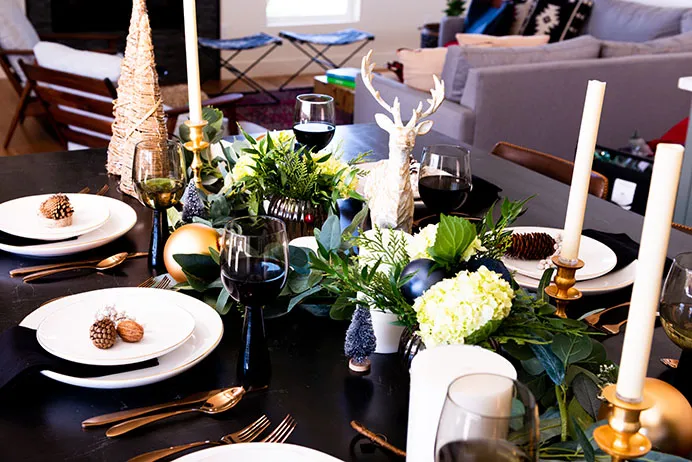
This look wants a table at least 40 inches wide and 72 inches long — a runner needs room to wander rather than sit in a straight, apologetic line. Ceiling height matters less than you’d think, because nothing here rises past 14 inches; the tallest element is a taper candle, not a floral tower. That makes it a solid choice for low-ceilinged dining rooms and open-plan spaces where you don’t want a visual wall between the kitchen and the table. Under 36 inches wide? Skip the runner and do two matching clusters, one at each end.
5. Faux Snow and Felt Evergreens for a Winter Forest Table
Felt trees look best in odd-numbered groupings and staggered heights — think 6, 9, and 12 inches — because your eye reads a triangle as intentional and a matched pair as an accident. Put the tallest in the back third of the table, not dead center, so guests can still see each other. For the glass cylinders, use a one-inch layer of artificial snow under the candle rather than filling them. It hides the candle’s base, keeps the flame stable, and means you’re not vacuuming glitter flakes out of a tablecloth in January.
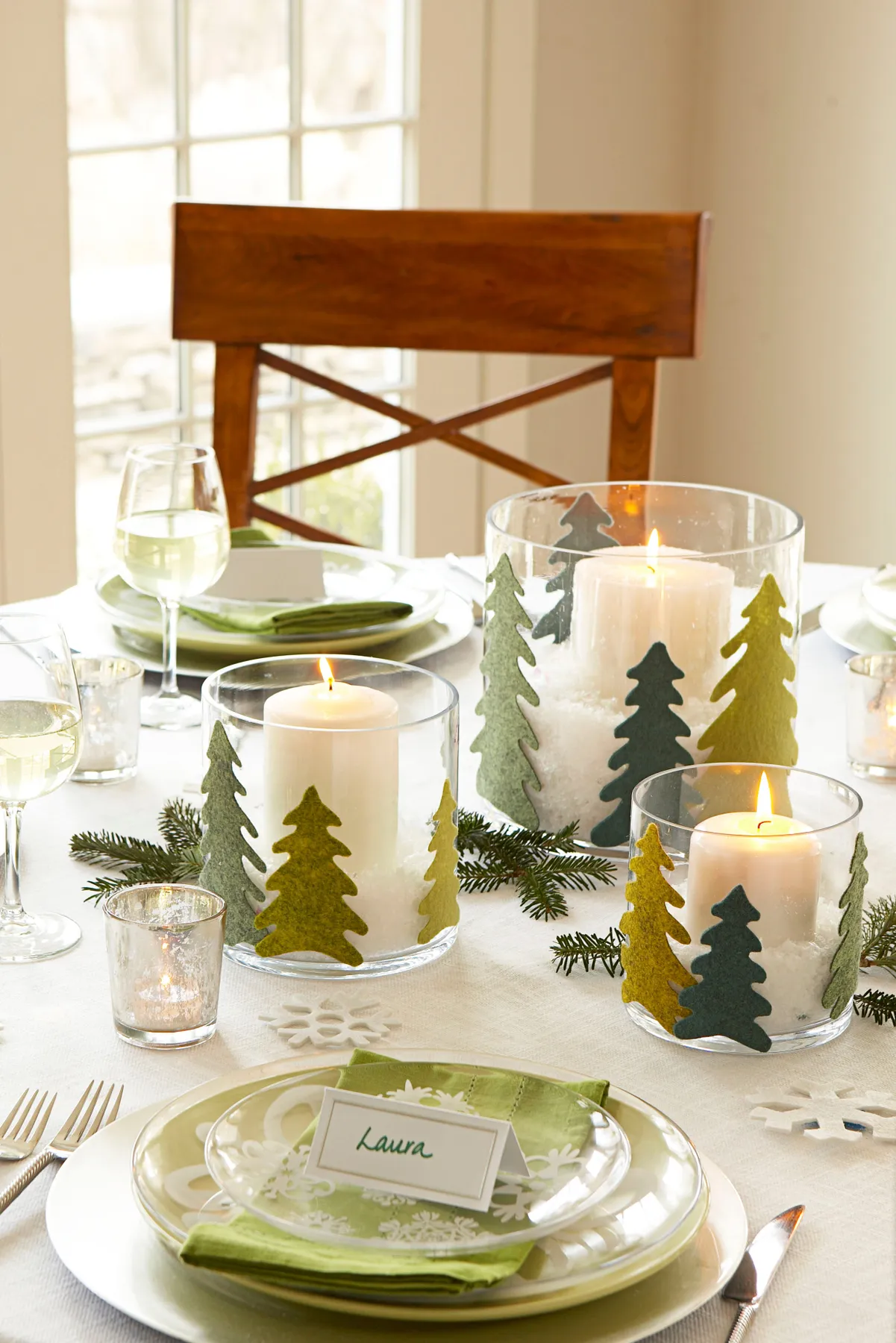
The winter forest table has quietly replaced the full-blown Santa-and-reindeer setup for a lot of hosts, and the reason is simple: it works from Thanksgiving through February. Instead of packing it away on December 26, you swap the ornaments for pinecones and it carries you into the new year.
- Dollar Tree and Target’s dollar spot for felt trees and snow filler
- Thrifted mercury glass votives, usually $1–$3 each
- Fresh pine sprigs from a tree lot — often free in the discard pile
No storage bin, no December-only shelf life.
6. Buffalo Check, Cotton Stems, and Gold Wire for a Rustic Table
The wood slice is doing more for this table than anything else on it. Under the wire basket, under the stemless glasses, it pulls black-and-white buffalo check — which can read sharp and coastal — straight back into cabin territory. Take the wood away and the same runner, pinecones, and floral plates feel like a farmhouse kitchen in July. So if you’re recreating this, don’t skip the coasters. Six slices from a fallen branch, sanded and sealed, cost you an afternoon and about $10.
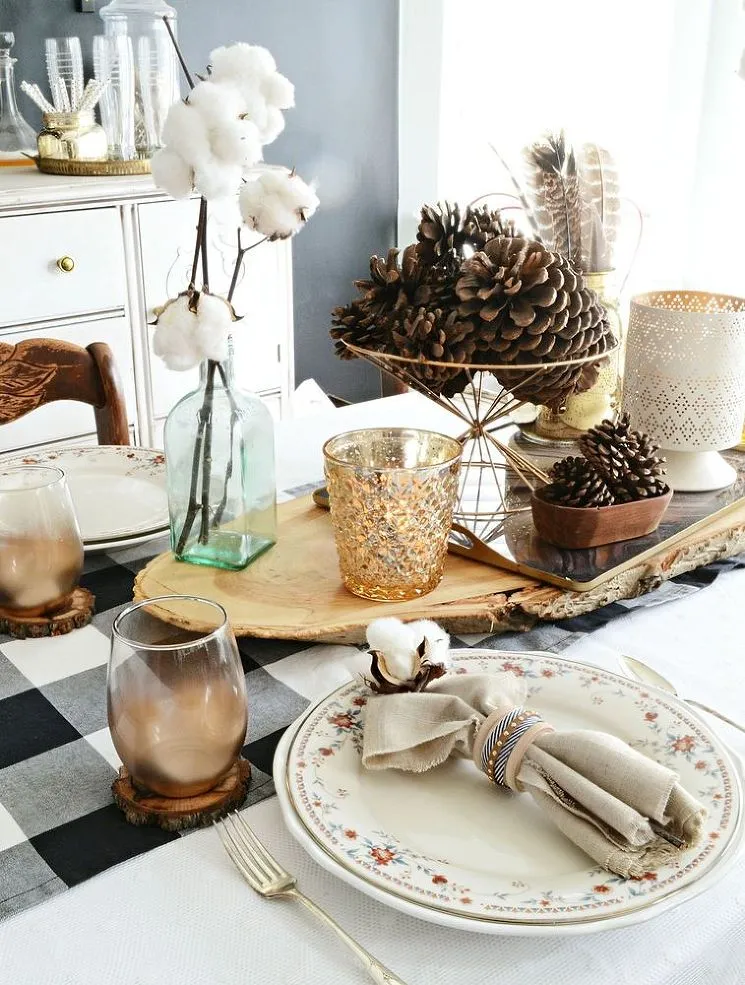
Build the pinecone and cotton centerpiece:
- Line a gold wire basket with a 12-inch square of burlap or a folded linen napkin.
- Nestle 6–8 pinecones around the edges, tips facing out.
- Add three cotton stems in the center at slightly different angles.
- Tuck in two mercury glass votives and one clear glass bottle.
- Finish with a few loose pinecones on the wood slice.
Time: about 20 minutes. Cost: $25–$40 if you already own the basket, closer to $60 if you’re buying it new at a craft store.
7. Jewel Tones and Ornate Goblets for a Deep, Dramatic Table
You don’t need Waterford to get this look. Target and HomeGoods regularly stock jewel-toned goblets in blue and ruby for $6–$10 each, and mixing two or three shapes looks more collected than a matched set ever does. For the patterned runner, a length of upholstery-weight fabric from the remnant bin — usually $8–$15 a yard — does the job. Just hem the edges with iron-on tape, no sewing required. Gold chargers are the other big-ticket item, and Walmart’s run about $3 each versus $25 at a specialty store. Same drama, roughly half the price.
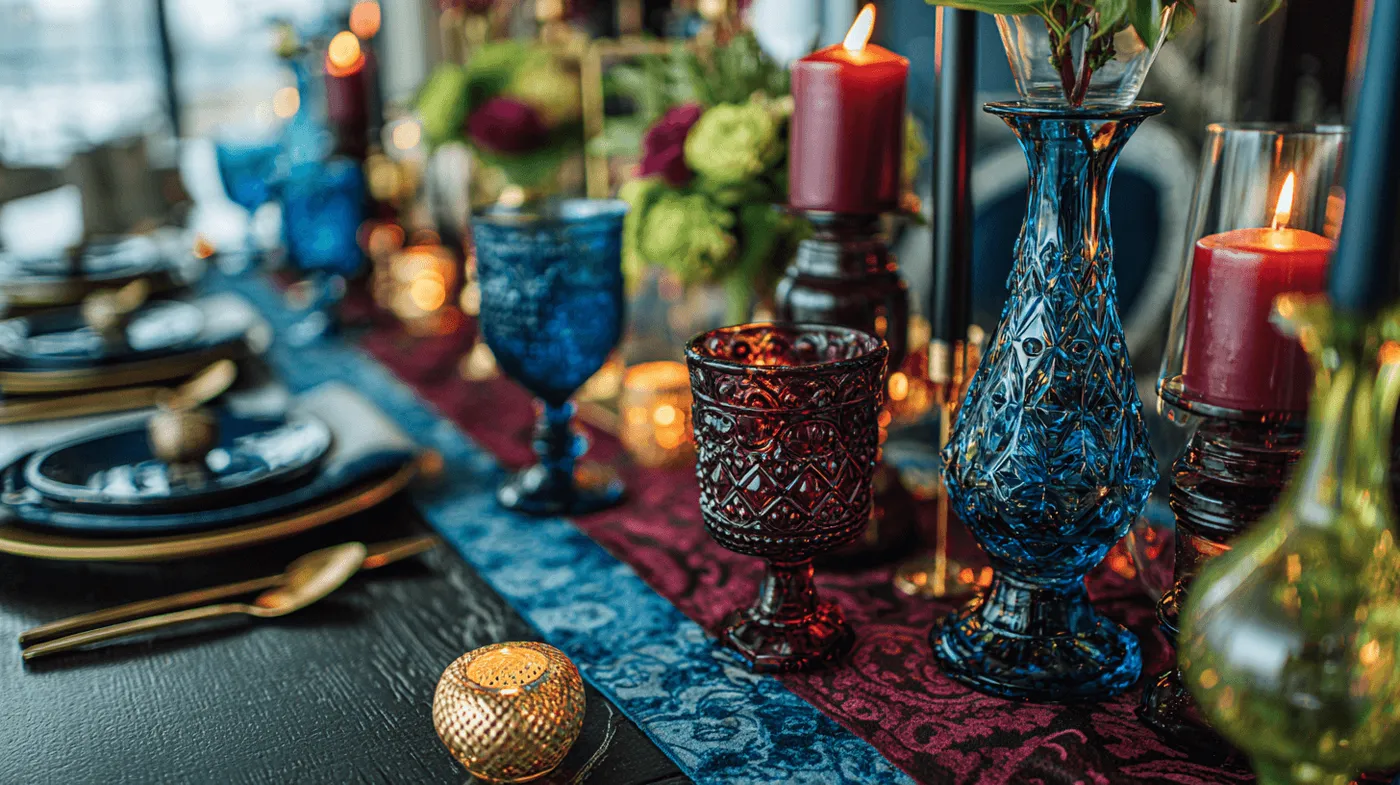
Jewel tones are the rare palette that actually benefits from a dark background, so the formula runs a little differently: 45 percent dark wood and deep linen, 40 percent saturated blue and burgundy, 15 percent gold. Keep the gold at 15 percent — chargers, flatware, votive rims — or the whole table tips into gaudy. Swapping colors is easy here. Emerald and plum instead of blue and burgundy reads more Victorian, while navy and copper skews modern. Just protect the 15 percent rule in every version.
8. A Low Botanical Garland with Quilted Blue Chairs
A centerpiece this lush needs breathing room, and that means a table of at least 84 inches. At 60 inches, the same arrangement swallows the plates and guests end up holding their glasses in the air. Aim for a garland that runs no more than two-thirds of the table’s length so there’s clear space at each end for serving dishes. Height-wise, keep the greens under six inches above the table and let the gold pillar candles be the tallest thing on it, roughly 10 to 12 inches.
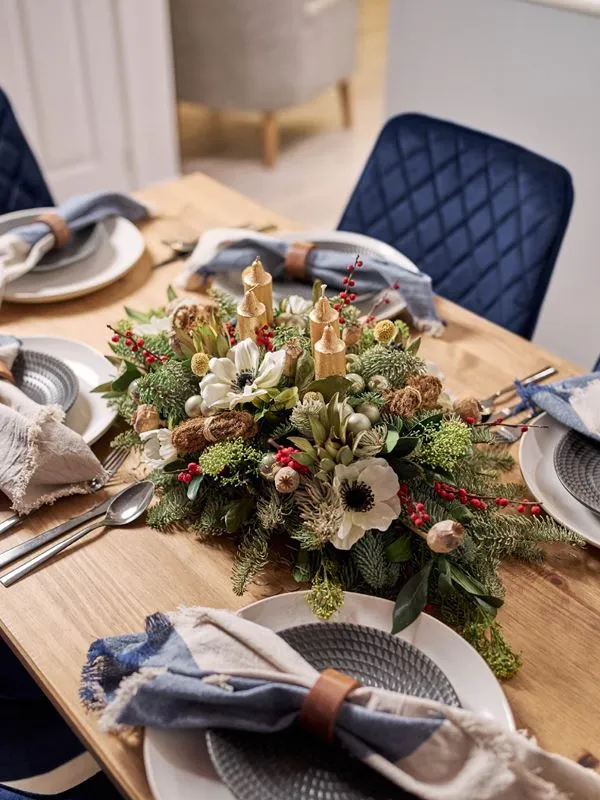
Fresh greenery is gorgeous and it is also a commitment. Cedar and fir drop needles the moment the room gets dry, and if your centerpiece sits near a heat vent, you’ll be picking needles out of the butter by the second course. Mist the garland every morning and keep it out of direct sun and you’ll get about 10 days. Realistically, the smart play is a faux garland base with a few fresh sprigs and berries tucked in. The eye reads it as real, and it lasts from Thanksgiving to New Year’s.
9. Pears, Pomegranates, and Amber Glass on Burlap
Woven placemats and burlap runners are forgiving in ways linen never is — spills blot rather than spread, and a quick shake outside handles most crumbs. The trade-off is fragility: burlap sheds, and cheap woven mats fray at the corners after a season or two. The fruit in the garland is the real variable. Pears and pomegranates look beautiful for about four days before they start to spot, so build the arrangement the day before your dinner and don’t set it up a week out. Swap in faux fruit if you want the look to hold through multiple gatherings.
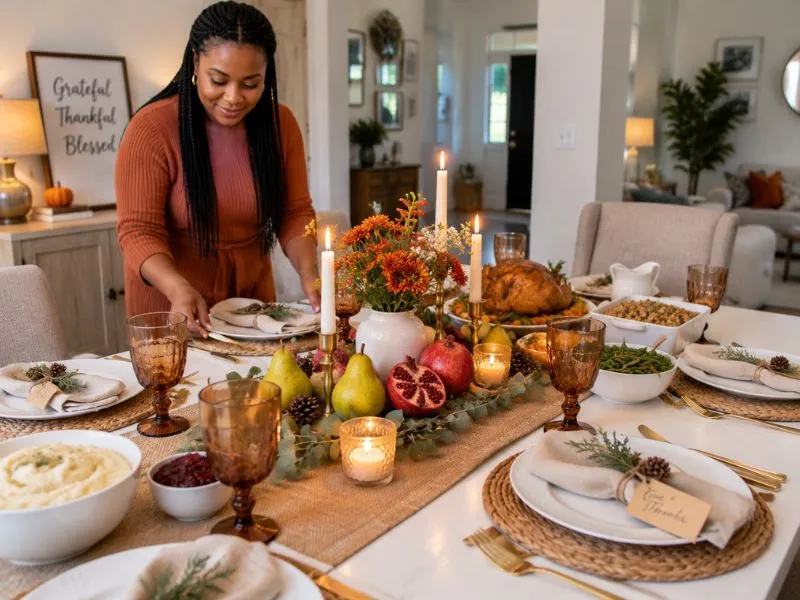
Everything here is warm — burlap, amber glass, brass, deep orange blooms — and that’s why it feels abundant instead of themed. There’s no cool gray or bright white anywhere to interrupt the glow, and the amber glasses even tint the wine. It’s a good reminder that a table doesn’t need a single holiday object on it to read as festive; the color temperature is doing all the work. If you want the same warmth with a more traditional feel, the cranberry-and-rosemary setup in Idea #14 gets there with red instead of orange.
10. Gold-Dusted Conical Trees for a Winter Woodland Table
Before you commit to this one, check a few things:
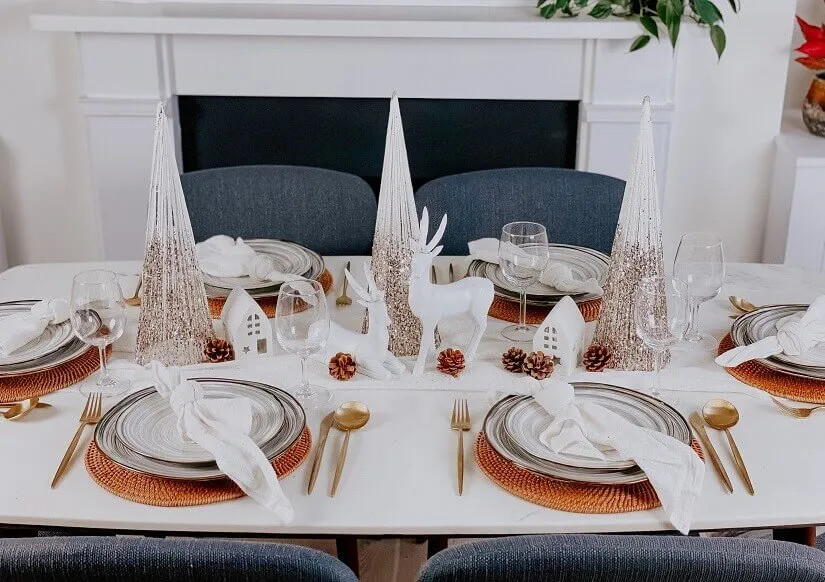
- Measure your table’s clear width — the runner with three trees needs about 14 inches of center space.
- Note where your overhead light falls; glitter trees catch it beautifully but can throw glare onto plates below.
- Confirm your tablecloth and runner are wash or dry-clean safe, because glitter travels.
- Decide now whether the deer and little houses stay out past New Year’s, since white ceramic reads winter, not Christmas.
Woven placemats under gray-and-white swirl plates are a small move with an outsized effect. The warm brown tones keep the cool gray plates from going clinical, and they add a textural ring that a plain white cloth doesn’t have. Buy them oversized — 15 inches, not 13 — so a 10.5-inch dinner plate still leaves a visible border. And put your gold flatware on the right of the plate only. Laying it on both sides makes the place setting look cluttered at this scale.
11. Baby’s Breath and Tea Lights for a Quietly Romantic Table
Baby’s breath has a reputation as a filler flower, which is exactly why it’s inexpensive and exactly why it works here. A dozen stems scattered across eight small vases costs about $20 and looks intentional. The catch is that fresh baby’s breath wilts fast in a warm room and drops tiny white petals everywhere. Trim the stems at an angle, change the water daily, and keep the vases away from the candles. Or do what most hosts secretly do: buy the dried version, which lasts months and looks nearly identical in low light.
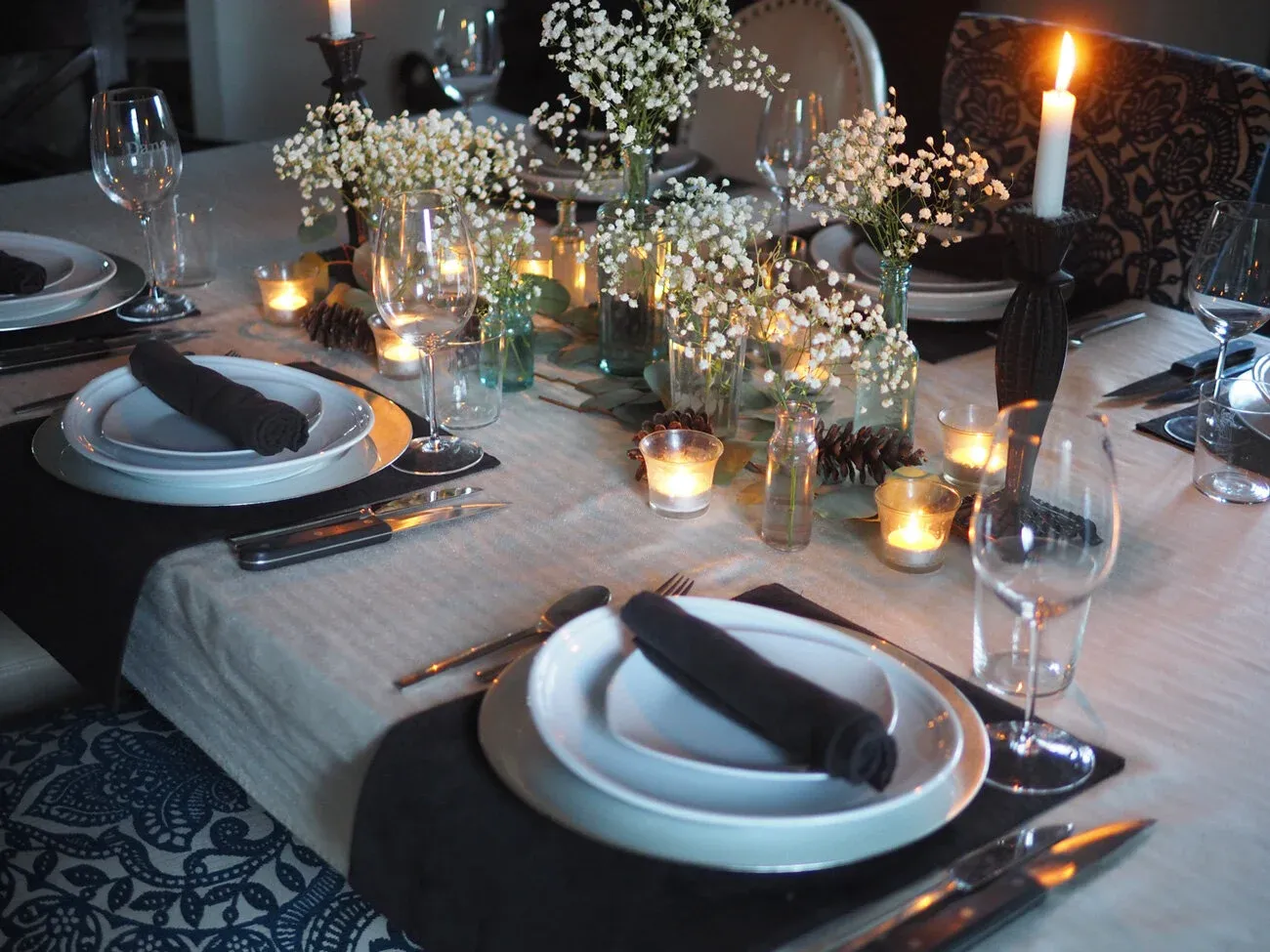
The dark placemats under white plates. That’s it. Take them away and this is a pretty but soft table with no anchor. Keep them and the white dinnerware pops, the tea lights read as pools of light rather than clutter, and the whole setting gets a moody, dinner-party-in-December feeling. It’s a two-second change with the biggest payoff on the table — and it costs nothing if you already own a dark table runner you can cut into squares.
12. Evergreen, Beaded Placemats, and Twig Napkin Rings
The formula here is about 70 percent off-white and evergreen, 20 percent gold, and 10 percent natural texture — twig, wood, glass. That balance is why it works in a room with almost any wall color. Want it warmer? Trade the off-white for ivory and the gold for aged brass. Want it more modern? Drop the beaded placemats for plain gold chargers and keep everything else. The one constant is the low, horizontal garland. The moment you switch to a vertical centerpiece, the proportions change and the gold starts to feel heavy.
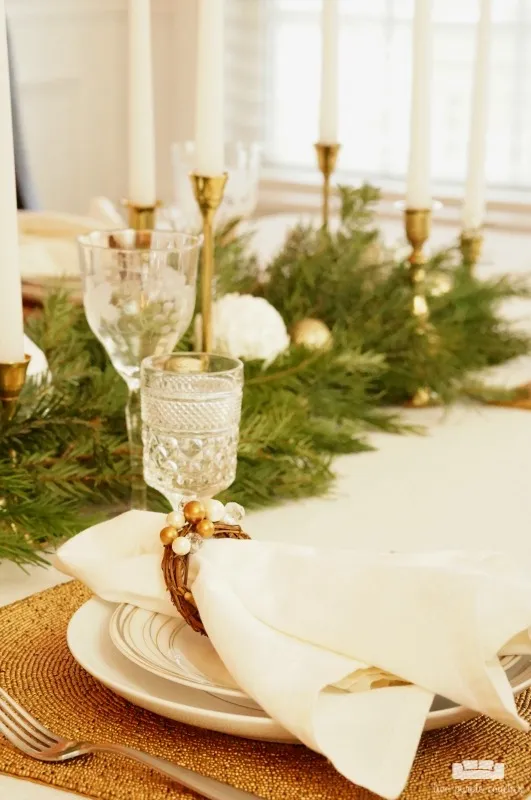
- Gold beaded placemats, set of 8: $60–$200
- White plates and etched glassware: $80–$400
- Evergreen garland, fresh or faux: $35–$120
- Brass candlesticks and white tapers: $50–$180
- Twig and berry napkin rings: $20–$70
Budget alternative: skip the beaded placemats and use gold-painted cork or rattan chargers from a dollar store, roughly $2 each, and make the napkin rings yourself from grapevine wire and faux berries for about $12 total. That alone takes 40 percent off the bottom line.
13. Ruffled Chargers and a Gold Wishbone Napkin Ring
A gold wishbone napkin ring works because it’s asymmetrical — it stops a formally stacked place setting from looking machine-made. Pair it with a napkin folded flat rather than in a fan so the ring becomes the focal point instead of competing with the fold. And if you’re using a ruffled charger, keep everything above it smooth and simple. Two ruffles, or a ruffle plus a scallop, and the plate stack starts to look like a bakery window.
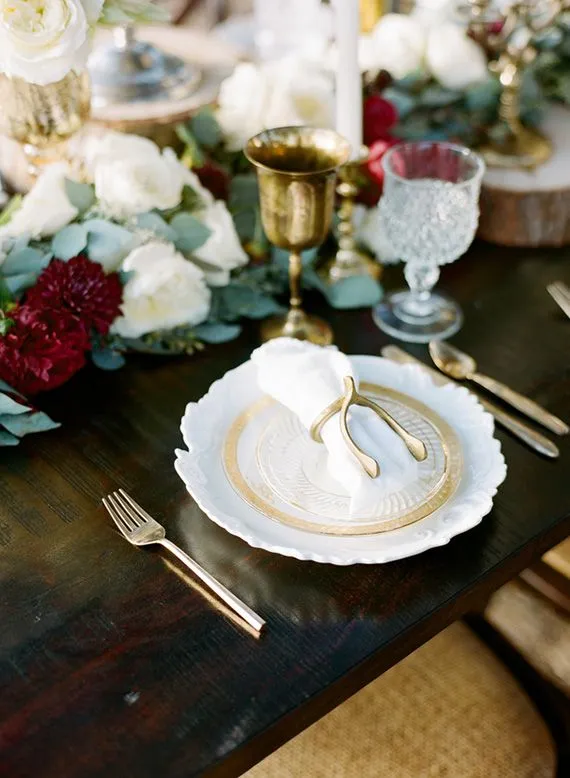
Formal layered settings like this one eat about 16 inches of linear space per guest once you account for the charger and glassware, so budget 32 inches of table per couple and no less than 24. A 96-inch table seats eight this way comfortably; squeeze in ten and someone’s elbow lives in the floral arrangement. Depth matters too — plan for at least 30 inches from the table’s edge to the wall so guests can push back from the charger. In a tight room, drop to just a dinner plate and a salad plate and you reclaim three inches instantly.
14. Cranberries, Rosemary, and Lace for a Natural Holiday Table
Make the rosemary place cards:
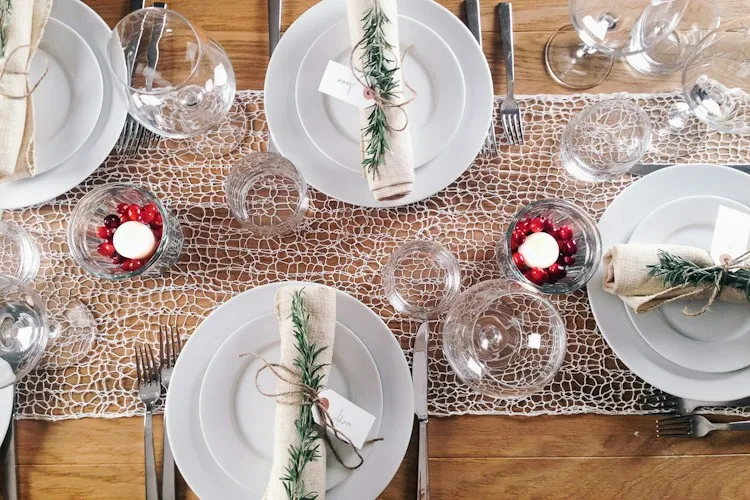
- Cut 3-inch sprigs of fresh rosemary, one per guest.
- Write names on small kraft tags with a fine-tip pen.
- Roll a linen napkin and tie it with kitchen twine.
- Slip the rosemary sprig and tag under the twine and knot once.
- Trim the twine ends at an angle and lay the napkin across the plate.
Time: 15 minutes for eight settings. Cost: about $8 total if you grow rosemary, closer to $14 with grocery-store bunches.
Three elements are doing the heavy lifting: the open-knit lace runner, the cranberries, and the fresh rosemary. The lace adds pattern without color, the cranberries add color without pattern, and the rosemary adds scent — the most underrated design tool at a dinner table. That’s why this setting reads as holiday without a single ornament on it. If you want the same restraint with more sparkle, the gold-beaded version in Idea #12 gets there with metallic instead of fruit.
15. Green-and-White Stripes with a Citrus and Greenery Garland
Stripes on a tablecloth are a risk most hosts avoid, and this is the reason to try it: horizontal stripes stretch a table visually, making a small dining room feel wider. The trick is keeping the stripe narrow — under an inch — and the contrast low, like this sage-and-white pairing. Anything bolder starts to fight the centerpiece, and the centerpiece always loses.
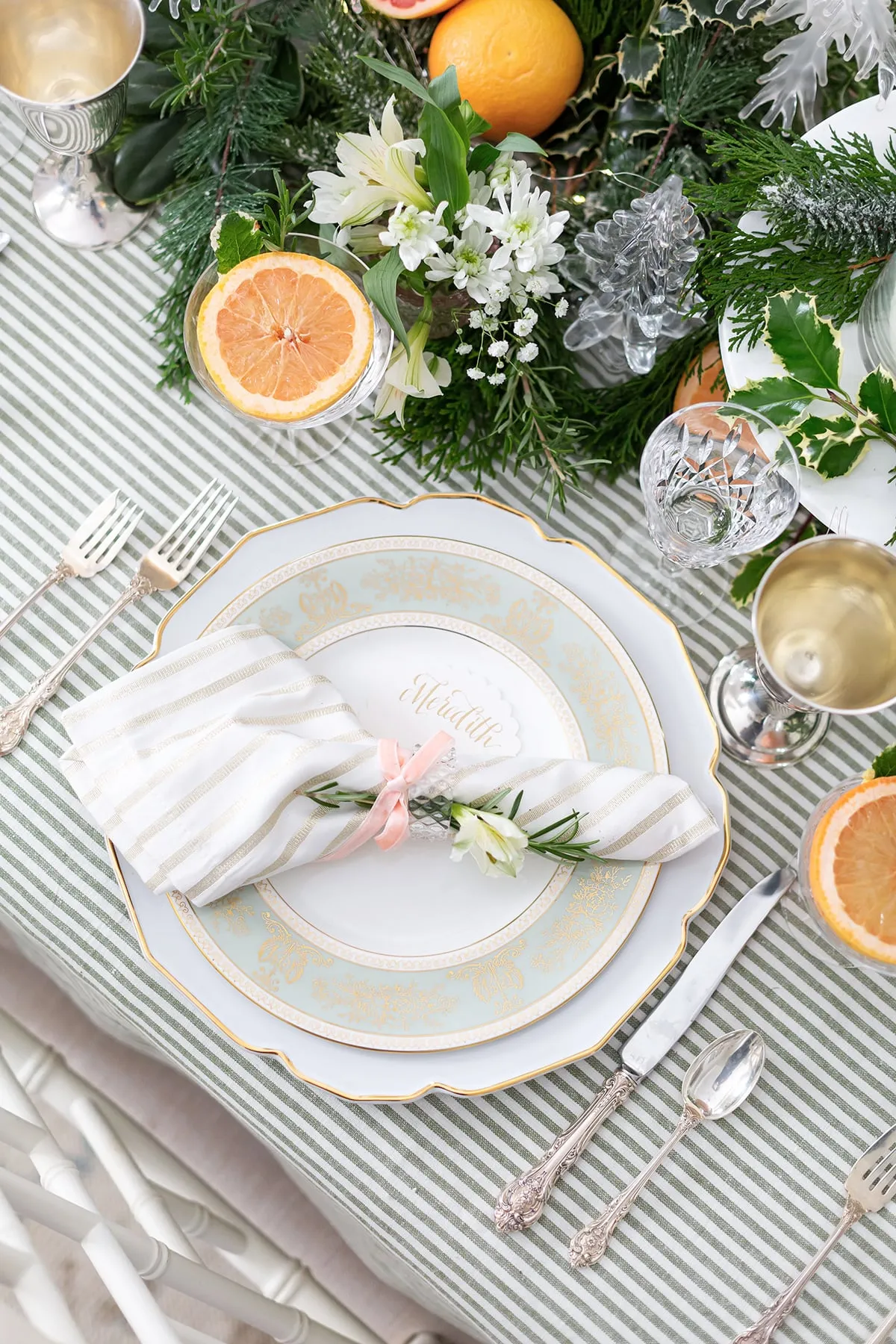
- Choose stripes that echo a color already in the garland, not a new one
- Keep plates plain so the cloth stays the pattern
- Use solid-color napkins with a ribbon detail rather than a second print
Everything above the cloth should be quieter than everything below it.
Citrus in holiday decorating has been building for a few years now, and 2026 is the year it stopped being a niche coastal thing and started showing up in traditional rooms. Oranges, lemons, and kumquats read as abundance in a way that’s older than Christmas trees — a nod to Victorian kissing balls and old-world pomanders. The upside for hosts: citrus is cheap, it doesn’t shed, and it looks as good on day ten as it did on day one.
16. Lanterns, Mercury Glass, and Pinecone Napkin Ties on Wood
Open-flame pillar candles inside metal lanterns are safer than bare tapers, but they still need supervision and they will leave a soot mark on the lantern’s glass if the wick gets long. Trim wicks to a quarter inch before every dinner. Mercury glass votives cloud up after a few seasons — hand-wash with warm water only, never the dishwasher, and dry immediately with a soft cloth. As for the evergreen garland, a real one needs misting and a faux one needs a lint roller. Budget five minutes of upkeep per dinner.
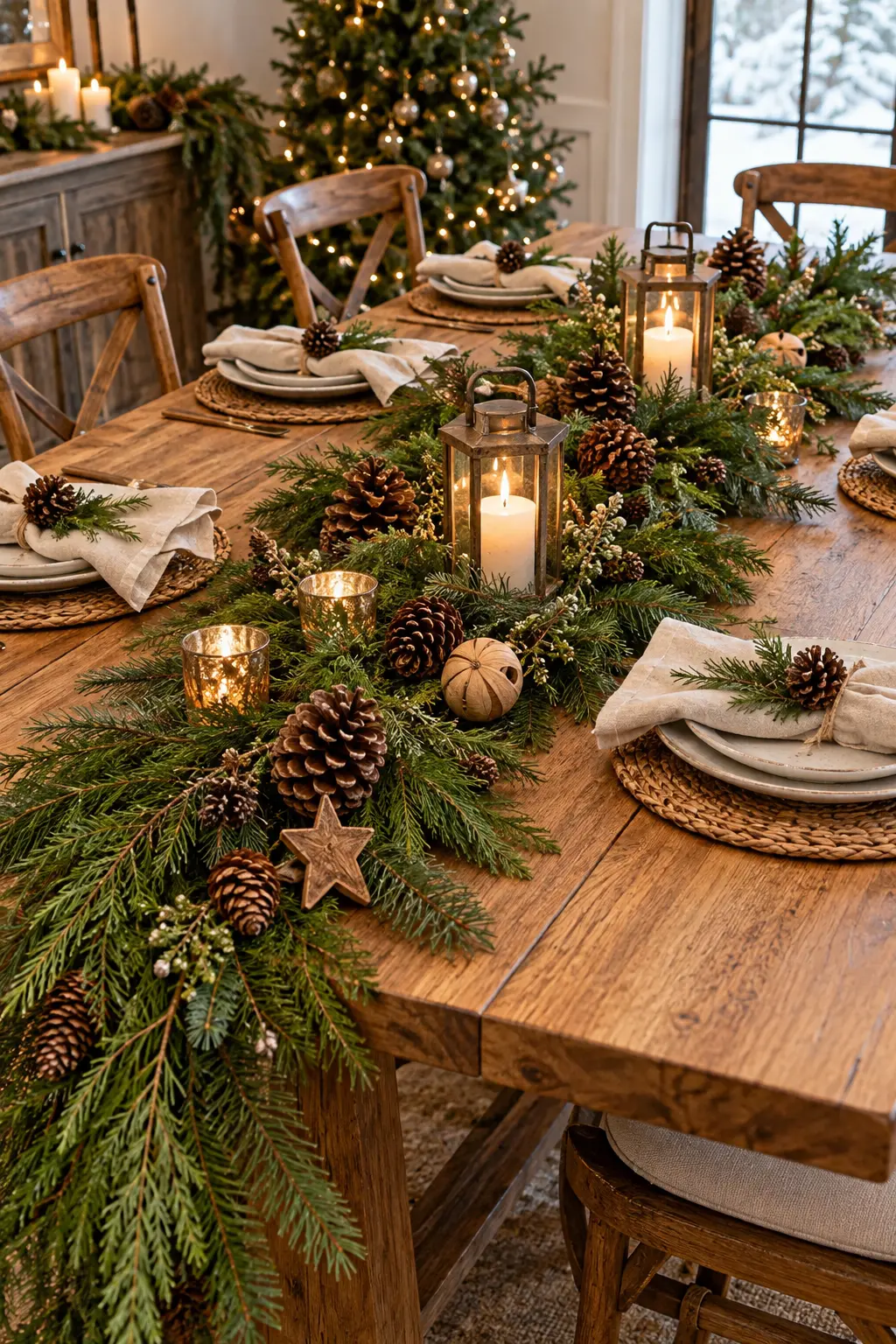
The lanterns. A wire basket of pinecones is lovely, but three aged metal lanterns marching down the center of a wood table turn a good tablescape into a scene. There’s height, there’s a warm glow at eye level, and there’s a rustic material that makes all the linen and glass feel deliberate. Take them away and it’s pinecones on a table. The good news is that lanterns are the cheapest high-impact object in holiday decorating; thrift stores are full of them in January for $4 to $12.
17. Gold Deer, Pearl-Draped Glasses, and a Cream Palette
- White tablecloth and napkins, 8 settings: $50–$180
- Cream and taupe dinnerware: $90–$400
- Faux evergreen garland: $30–$110
- Gold candelabra with white tapers: $60–$250
- Gold deer figurines and pearl accents: $25–$90
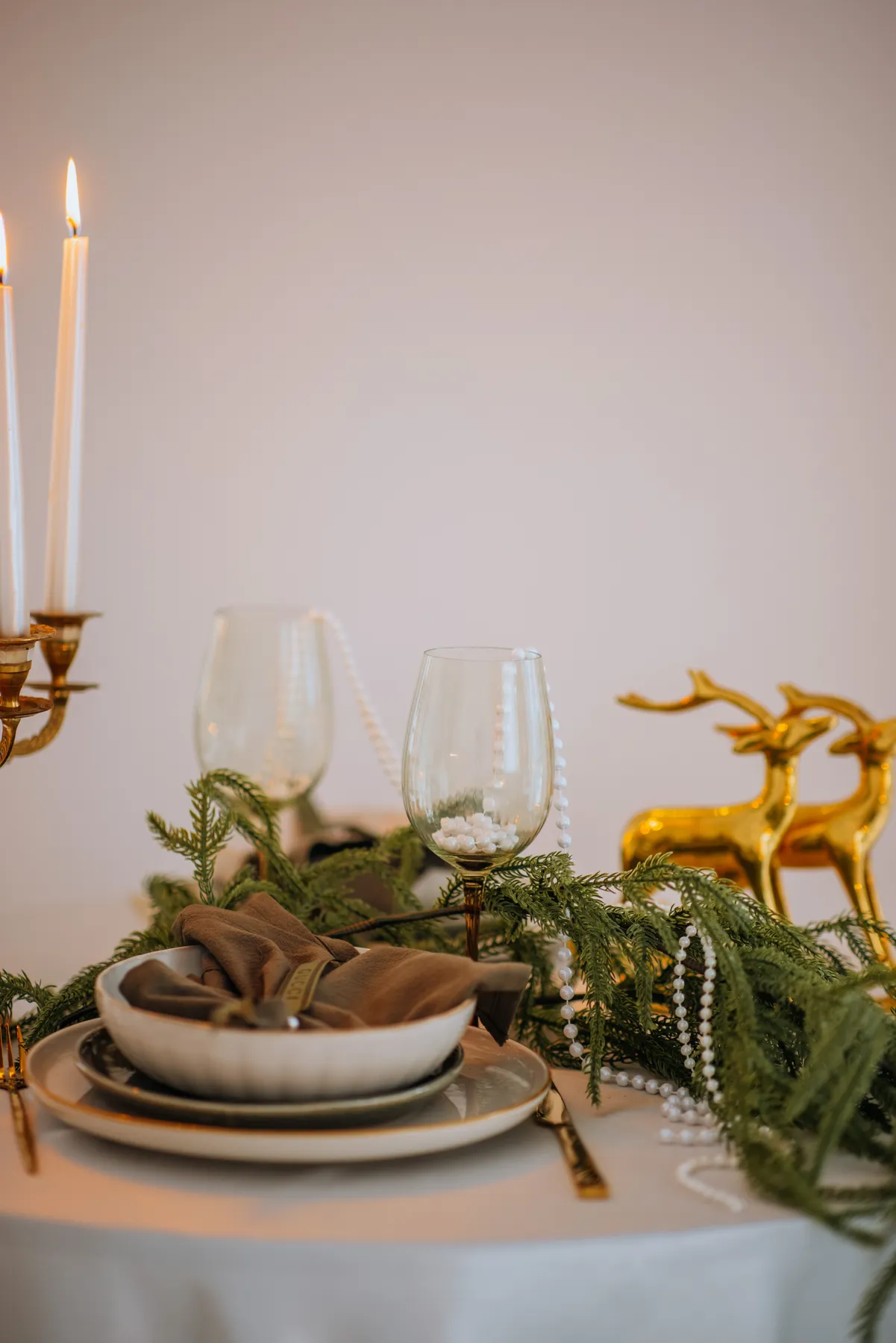
Budget alternative: skip the candelabra and group three mismatched brass candle holders from a thrift store instead, usually under $15 for all three. And those pearl-strung glasses are simple to fake — thread a strand of craft pearls around the stem and secure it with a dot of clear glue, about $6 for a set of eight.
Pearl strings around the base of a wine glass aren’t just decoration, they’re a seating trick. Guests find their glass by the bead color, which cuts down on the whose-chardonnay-is-this dance. Use a different color or count per setting and skip wine charms entirely. One more thing: cream and taupe dishes photograph warmer than white, so if you’re planning to shoot your table, this is the palette that consistently looks like the real thing instead of washed-out blue.
18. Black Tapers and Gold Ornaments on a Green Placemat
This is a great setup for a mid-size round table — 48 to 60 inches — because the centerpiece stays contained in a 16-inch circle instead of running the length of anything. Round tables and tall, thin candles are a natural pair; the verticals break up the circle so it doesn’t read as one big plate. If your dining space is under 120 square feet, this is the format to copy. For very long rectangular tables, a linear garland like the one in Idea #16 handles the proportions better.
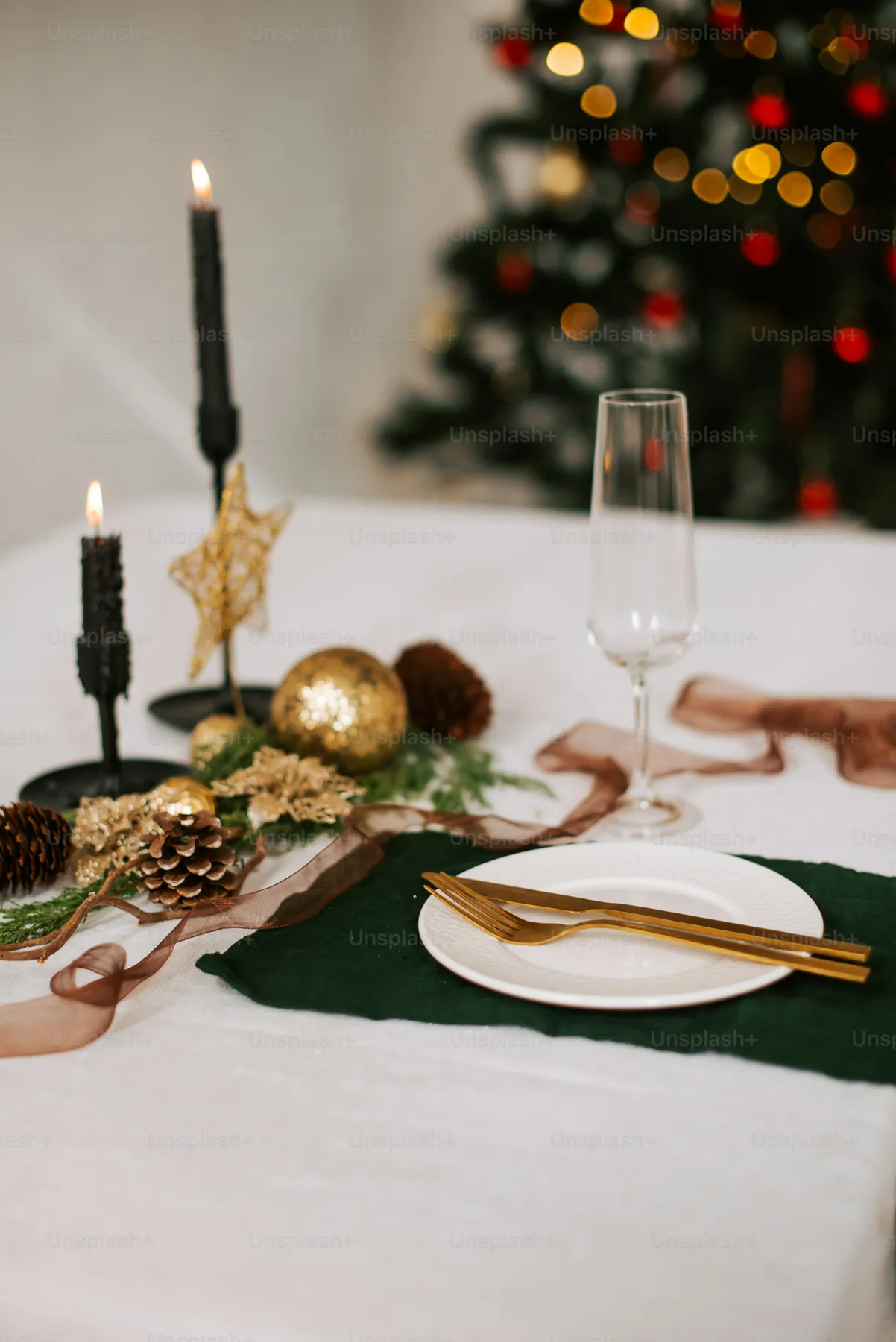
Black candles on a holiday table are a love-it-or-hate-it move, and there’s a practical reason to think twice: black tapers show every drip and they photograph as flat, heavy shapes rather than glowing light. If you want the contrast without the heaviness, switch to dark green or deep burgundy candles — same mood, more warmth. Also, gold ornaments scattered loose on a table will roll the second someone reaches across. Put a felt pad under each one or nestle them into the greenery so they stay put.
19. Red Tapers in a Pinecone Wreath on a Wooden Table
The wreath. A centerpiece made of a wreath lying flat on the table with red tapers rising out of the middle is the single detail that makes this table feel like a celebration rather than a dinner. It gives you height, a ring of texture, and a built-in seasonal signal in one object. Lose the wreath and you have candles; keep it and you have a moment. Build it on a grapevine base, tuck in pinecones and faux berries, and set a small plate or florist’s frog in the center to hold the candles upright.
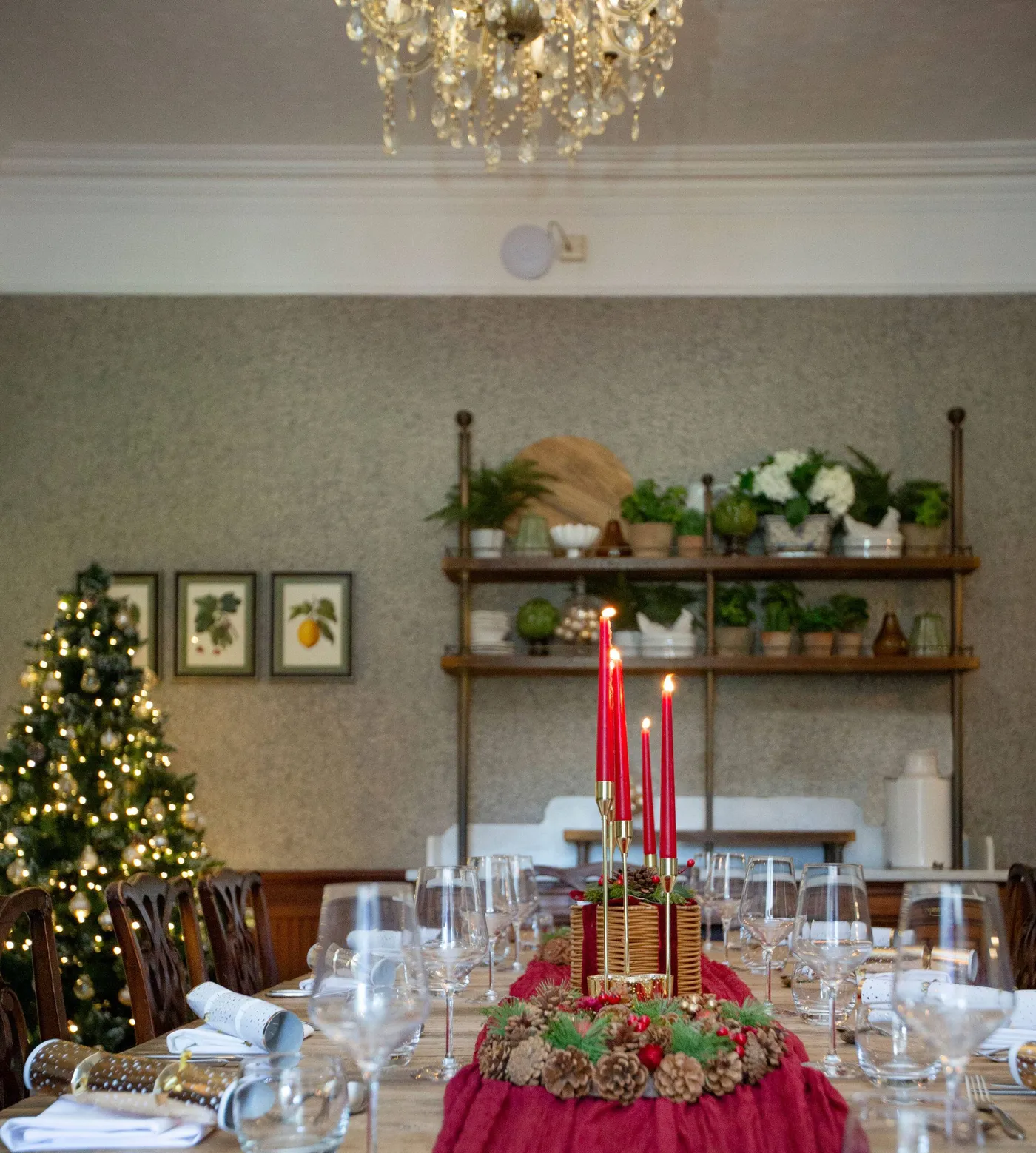
Count the proportions here: roughly 50 percent warm wood, 30 percent red — runner, candles, and the glow from the tree — and 20 percent green and cream. It’s a classic formula and it’s forgiving, which is why it’s survived a hundred years of holiday tables. To shift the mood without breaking it, change only the 30 percent: ivory candles and a neutral runner for a quiet version, or emerald rather than red for something that reads more English country. Keep the wood and cream constants and it’ll still look like the same table.
20. Gold Beaded Chargers, Plaid Napkins, and Red Tapers
Plaid napkins and a garland centerpiece can turn fussy fast, so give the pattern a boundary: fold the napkin in a plain square and let it sit flat on the plate rather than fanning it up into a tent. And use a napkin ring that’s smaller than the napkin’s folded width — oversized rings pucker the fabric and make everything look squeezed. One more detail worth stealing: the hammered-gold flatware ties directly to the beaded charger. When your metal repeats, the table reads as designed rather than decorated.
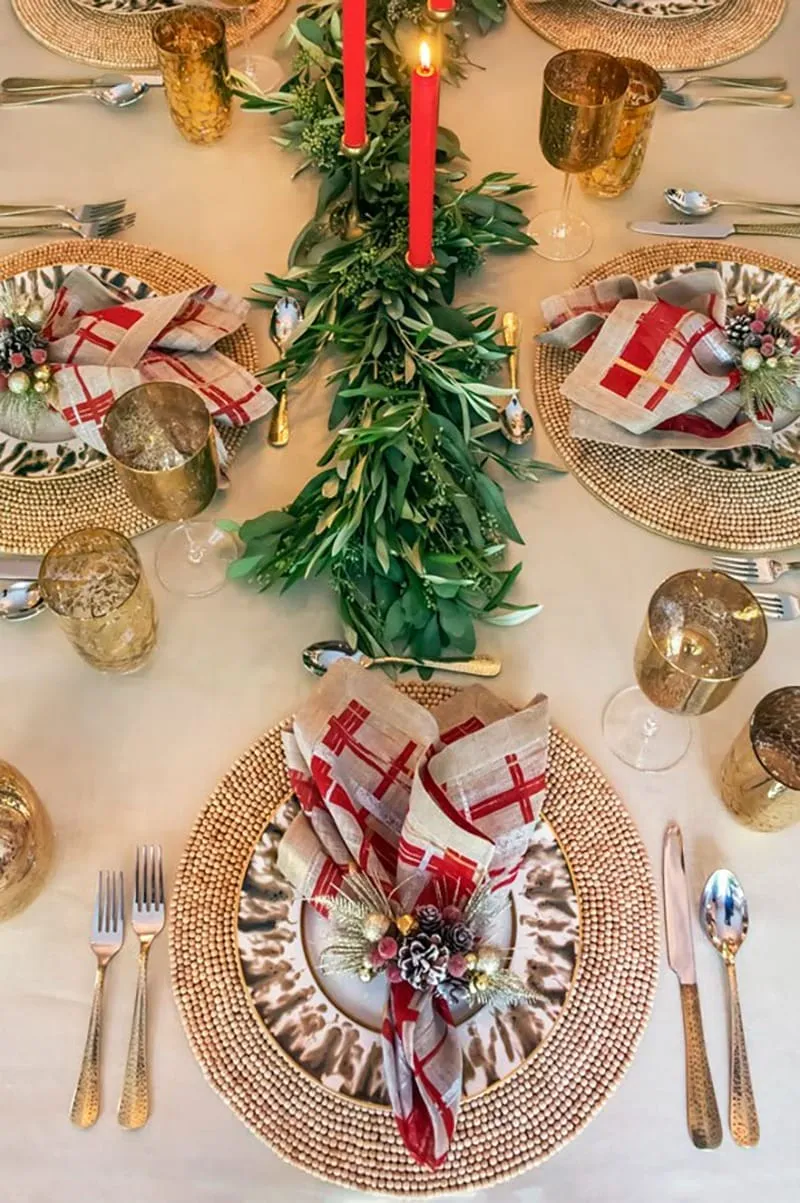
Gold beaded chargers are the most expensive thing on this table, and there’s a workaround. Buy one stack of plain gold plastic chargers at $1–$2 each and glue a thin strand of craft beads around the rim. Twenty minutes and about $25 gets you eight chargers that fool almost everyone. For the plaid napkins, skip the $40-a-set versions — a half-yard of plaid cotton from a fabric store makes four napkins for around $10, and pinking shears mean you don’t have to sew a thing. Total savings: 50 percent or better.
21. Miniature Trees and Beaded Placemats for a Cheerful Table
Run through this before you buy anything:
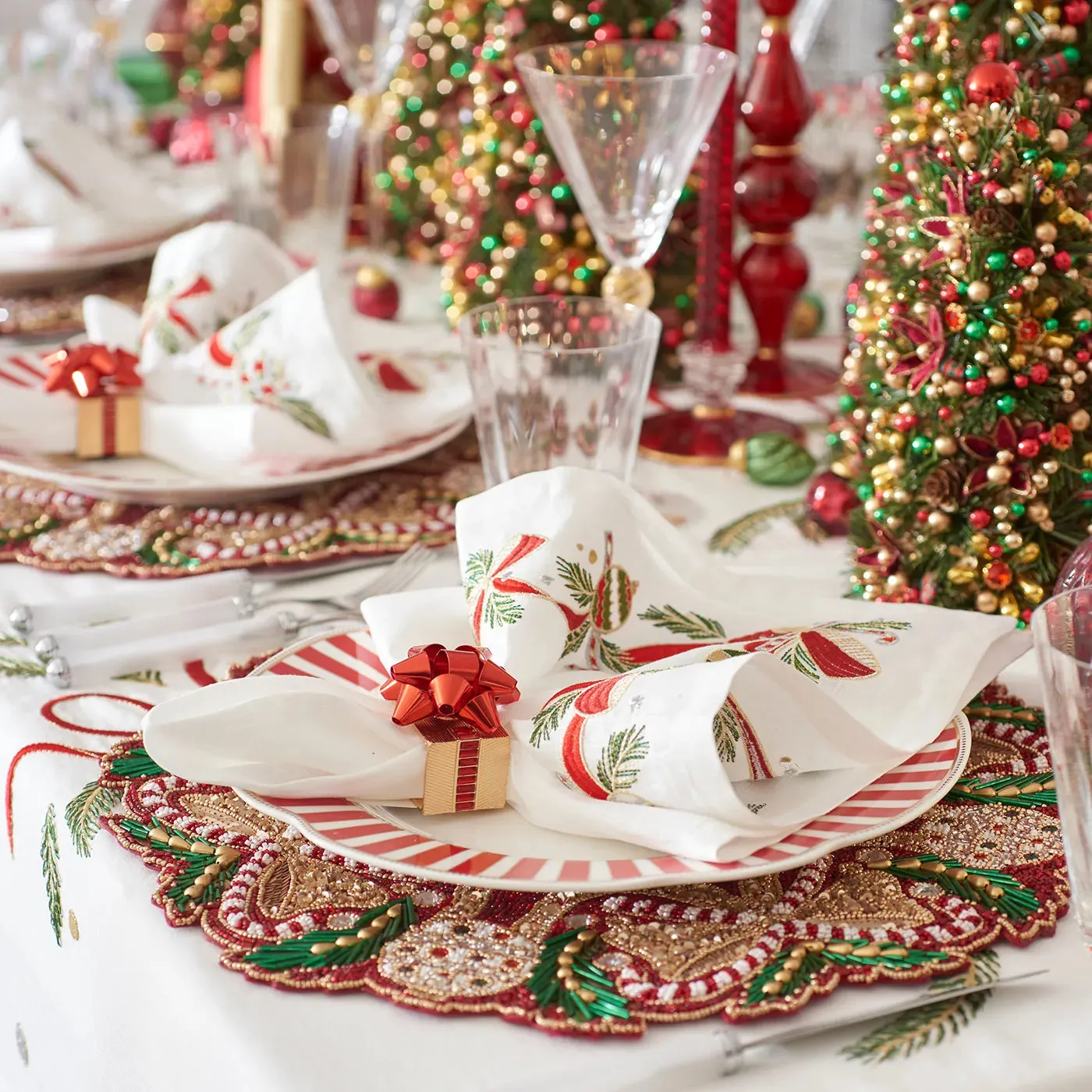
- Measure the space between your plates — miniature trees need about 5 inches each, so a 72-inch table fits two, not four.
- Check whether your beaded placemats are round or rectangular; round ones need a table with at least 36 inches of depth.
- Confirm the little trees have battery packs you can hide under greenery rather than cords running to an outlet.
- Decide whether you’re serving family-style — if so, keep the trees at the table’s ends, not the middle.
The charm here comes from repetition at a small scale. Beaded placemats repeat the tree ornaments’ colors, the red glass candle holders repeat the plates’ red stripe, and the gift-box napkin rings repeat the gold. Nothing matches exactly, but everything rhymes — which is why the table reads as abundant instead of chaotic. If you want to test whether a tablescape will work, squint at it. If you can still see the color story with your eyes half closed, the repetition is doing its job.
22. Green Velvet, Dark Chargers, and an Ornament in a Glass
A stemmed glass bowl holding a single ornament is one of the prettiest tricks on this list, and also one of the most tippy. Use a bowl with a wide base, keep it near the center rather than at a guest’s elbow, and skip it entirely if you’ve got small kids or a cat. The velvet and dark linens hold up well — velvet is remarkably stain-resistant, and a dark charger hides everything. The one thing to watch is the gold filigree: gilded rims chip in the dishwasher, so these are hand-wash pieces, full stop.
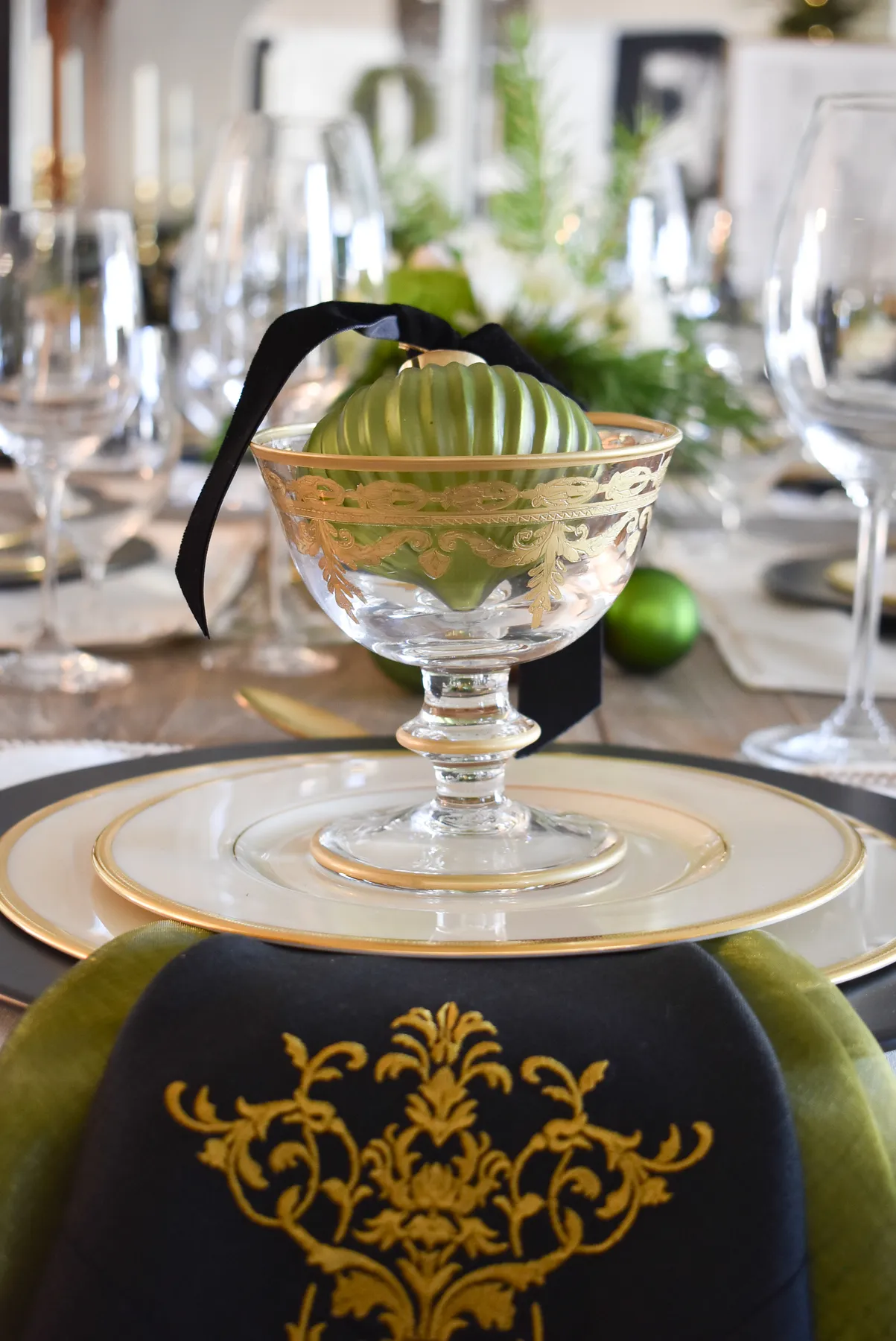
Green velvet needs almost no care beyond a good shake and a lint brush. Don’t wash it, don’t steam it against the nap, and store it rolled rather than folded to avoid a permanent crease. Ribbed glass ornaments scratch easily, so wrap them in tissue, not plastic, when they go back in the bin. Gilded plates and stemware want warm water, mild soap, and immediate drying with a soft towel. Realistically, this is a once-a-season setup you put away carefully — and if you do, it’ll come out looking new for a decade.
23. Candy Canes and Berries Tucked Into White Napkins
Dress the napkin in under two minutes:
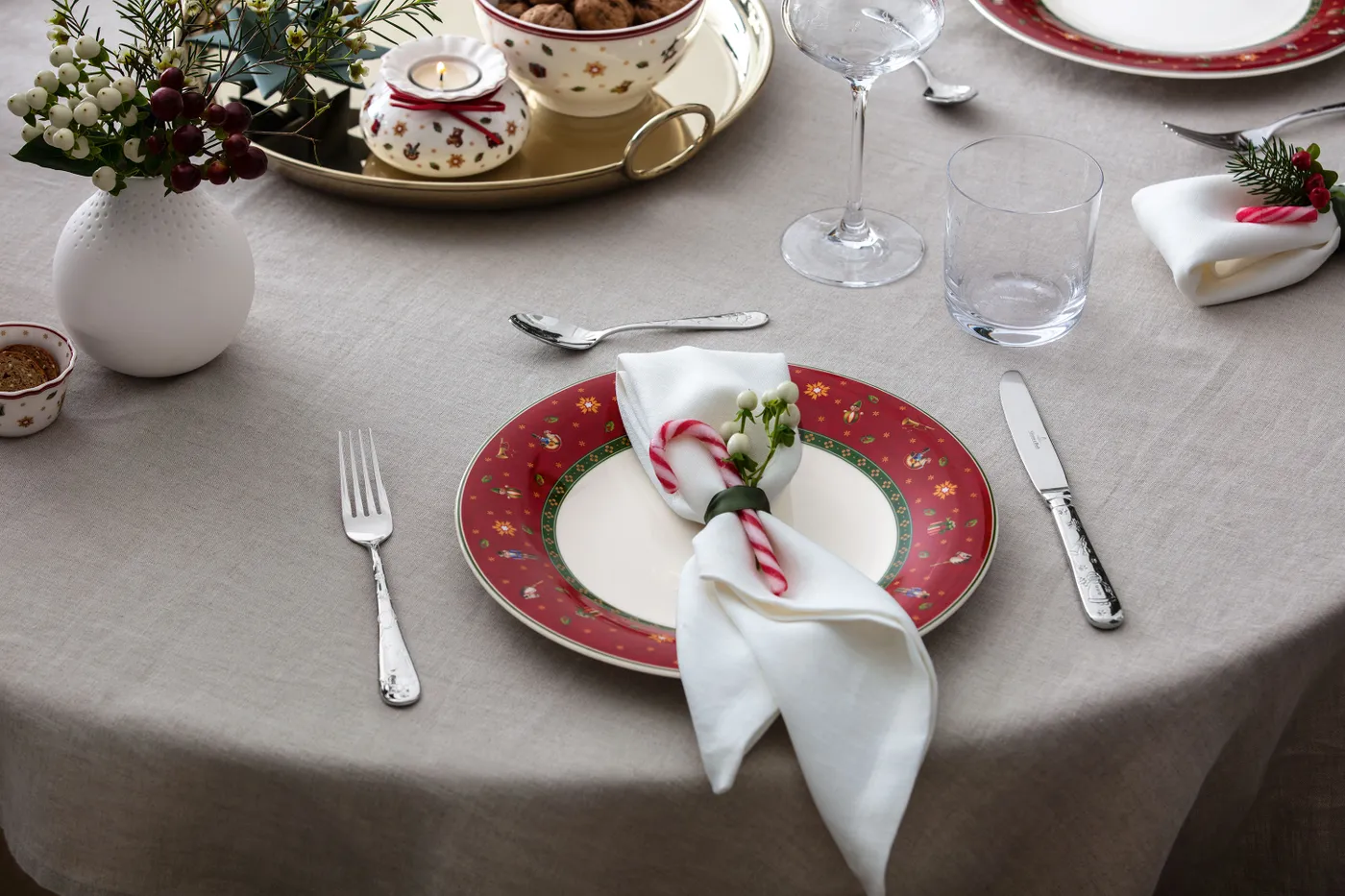
- Fold a white linen napkin into a simple rectangle, about 4 by 8 inches.
- Lay a miniature candy cane on top at a slight diagonal.
- Add three fresh cranberries or a small sprig of berries alongside it.
- Slide both under a plain napkin ring and cinch gently.
- Set the bundle across the plate at an angle.
Cost: about $10 for a dozen mini candy canes plus a bag of cranberries, which covers eight settings with plenty left over for the table itself.
The light gray linen tablecloth is quietly the best decision on this table. Against white it would look stark; against red it would look like a theme party. Gray gives the red-and-white patterned plates and candy canes somewhere soft to land, so the whole thing reads warm and nostalgic instead of loud. It’s also the most practical choice here — a mid-tone gray hides a wine spill in a way white linen absolutely does not, and you’ll be grateful for that at 9 p.m.
24. Santa Placemats, Red Bows, and Lit Pillars on a Garland
Themed placemats are the one place where more is more, but only if everything above them stays plain. Round Santa and reindeer mats need simple gold-rimmed white plates, plain gold cutlery, and a single uncomplicated napkin tie. The moment you add a printed napkin or a patterned glass, the mat stops being charming and starts being busy. Pick one star per place setting and let it have the whole stage.
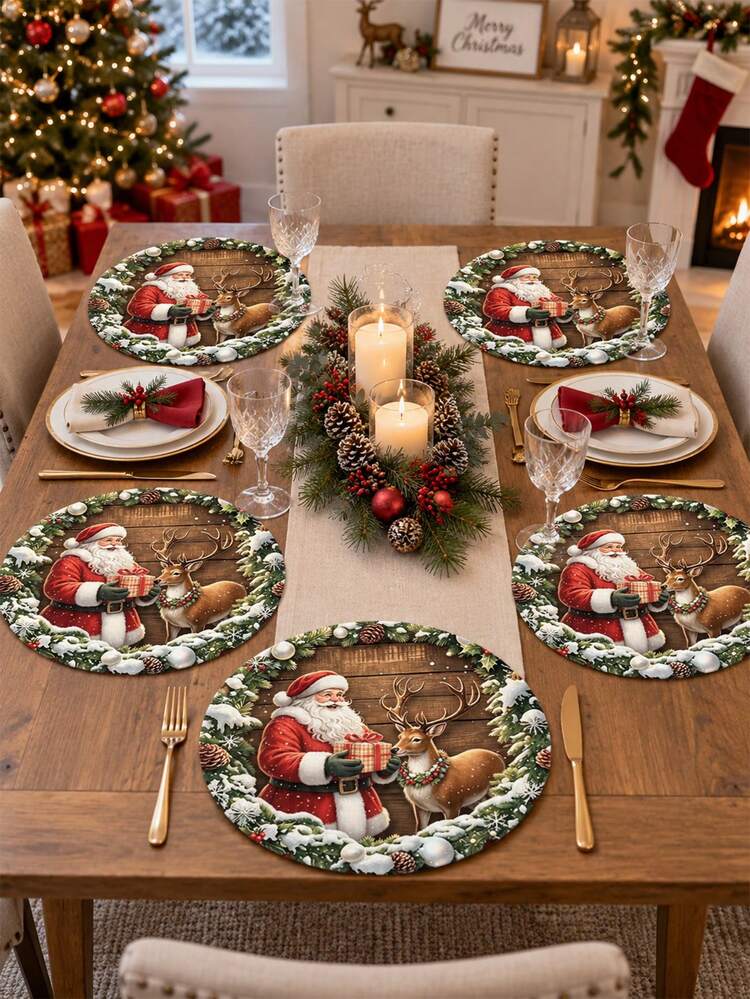
This setting shines on a casual table 60 to 72 inches long seating six to eight, and it’s the format I’d hand to anyone with kids at the table — the pillar candles sit in glass, the placemats are wipeable, and nothing is precious. Where it doesn’t work: very formal dining rooms and long tables over 96 inches, because the garland starts to look thin in the middle. For an oversized table, the candle-lined approach in Idea #29 fills the space more evenly. Otherwise, double the garland or layer two shorter ones and meet them in the center with the candle cluster.
25. Purple Tapers, Gold Pinecones, and a Reindeer on Pine
Here’s the math: 55 percent deep green pine and dark gray, 25 percent gold, 20 percent white candlelight and linens — plus a 5 percent wildcard, which is the purple. That dash of purple is what stops this from being another green-and-gold table, and it’s the part people remember. It works because purple and green sit next to each other on the color wheel, so the contrast is soft rather than jarring. Trade the purple for copper and you keep the formula but lose the surprise.
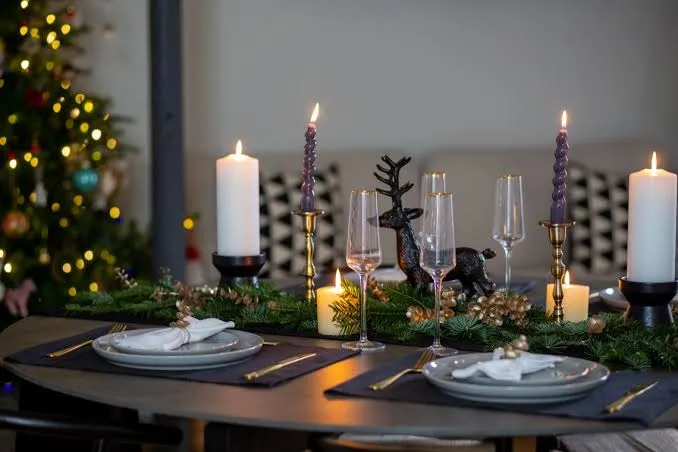
- Dark gray placemats, set of 8: $40–$120
- Light gray dinnerware: $70–$320
- Fresh or faux pine garland: $35–$130
- Gold pinecones and a reindeer figurine: $25–$95
- Twisted purple tapers and white pillars: $25–$80
Budget alternative: paint plain pinecones yourself with gold spray paint — about $9 for a can that covers 30 cones — and pick up white pillars and purple tapers at a dollar store for $1 each. Hand-painted pinecones honestly look better than the mass-produced ones.
26. Candlelit Crackers and Baubles Down a Dark Wood Table
Christmas crackers have been creeping back into American tables for a few years, and 2026 is when they stopped being a British novelty and became a styling choice. They’re the rare decoration that does something — a paper crown, a joke, a small gift — and they photograph beautifully when they’re patterned rather than foil. The trend is part of a bigger shift: hosts are spending less on objects and more on the experience of the meal itself. Crackers, a garland, and candles. That’s the whole table.
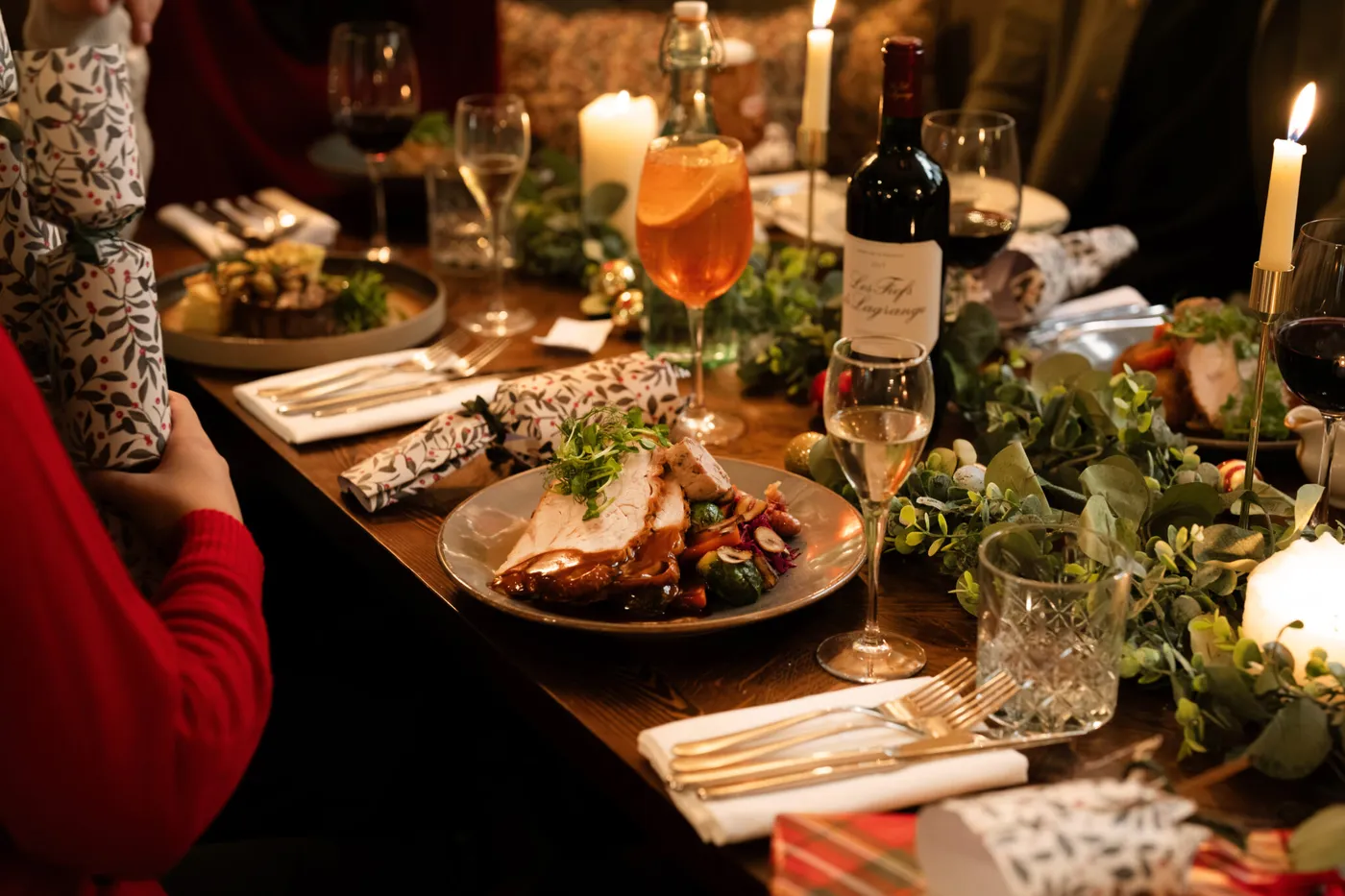
Build the garland-and-bauble centerpiece:
- Lay a faux pine garland down the center and fluff it so it looks uneven.
- Tuck in 12–15 small gold baubles at varying depths.
- Place three tall tapers in slim holders between the baubles.
- Add two clusters of low pillars in clear glass at either end.
- Weave in a few battery-operated fairy lights for the after-dinner glow.
Time: 25 minutes. Cost: $40–$90 depending on whether your garland is fresh.
27. Gold Chargers and a Damask Runner for a Pristine Table
The gold charger. Everything else on this table — white cloth, white plates, clear glass, gold flatware — is quiet. The charger is the one element with a metallic finish sitting directly under the food, and it lifts the setting out of nice-hotel-banquet territory and into someone-thought-about-this. That’s why you can keep the rest so restrained. Without it, the place setting disappears into the white. With it, the table looks formal without a single flower on it.
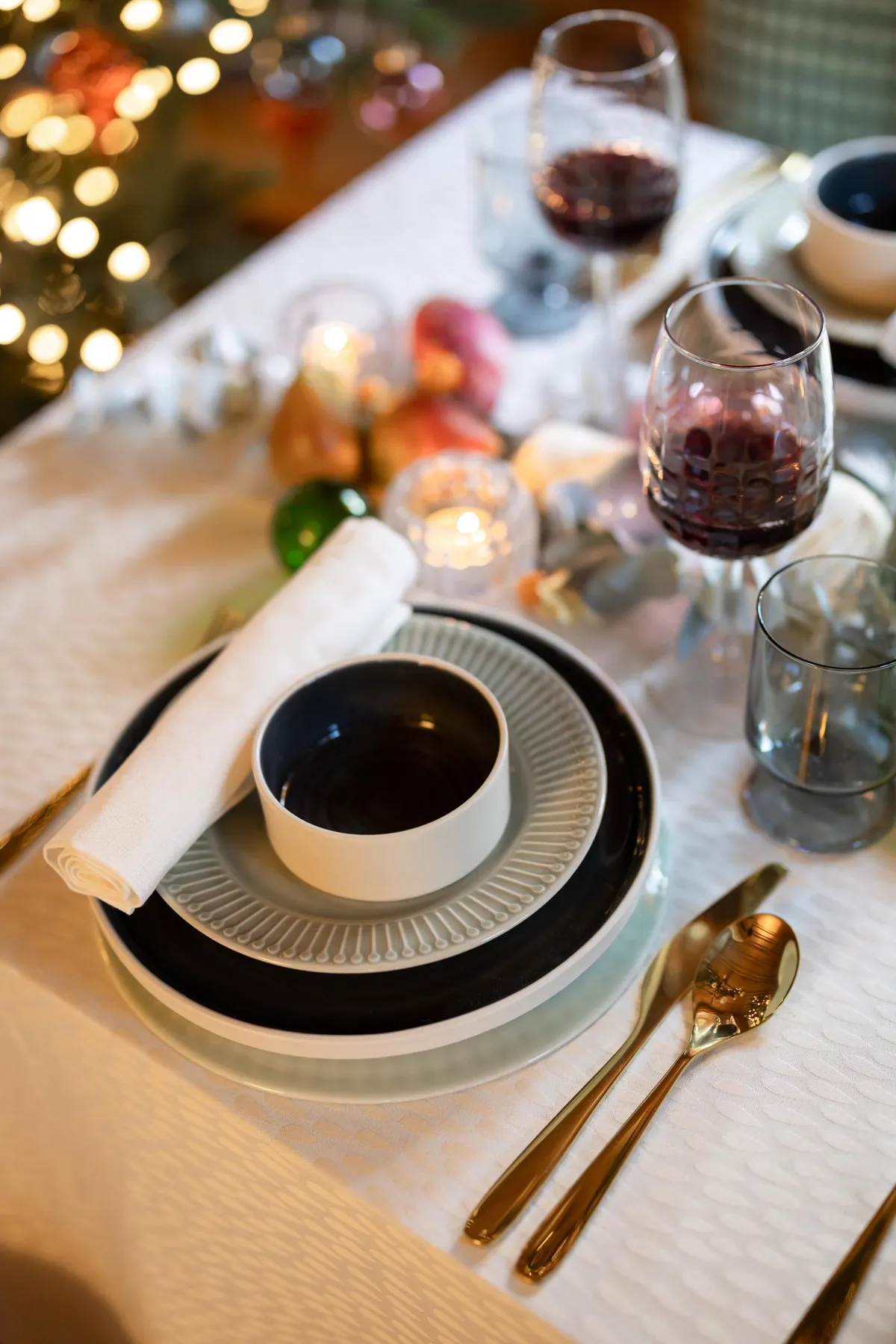
Fully white tables are beautiful and unforgiving. Every wine drip, every buttery fingerprint, every bit of cranberry sauce lands on a surface with nowhere to hide. If you’re serving anything red, put a runner or a few low bowls between guests and the cloth, and keep a small spray bottle of cold water and a clean towel within reach — the trick is blotting, never rubbing. The other consideration: white linen needs ironing after washing, so budget 30 minutes of prep the day before, not the day of.
28. Eucalyptus, Red Apples, and Striped Linen for a Cozy Table
Nothing on this table has to be expensive, and that’s the point. Eucalyptus is the cheapest greenery in the grocery store floral department, usually $4 to $6 a bunch, and three bunches will run the whole length of a table. Red apples are apples. The striped linen is the one upgrade worth making, and even that has a shortcut: a plain beige cloth with two thin fabric-paint stripes down the edges costs about $12 and reads exactly the same from a chair.
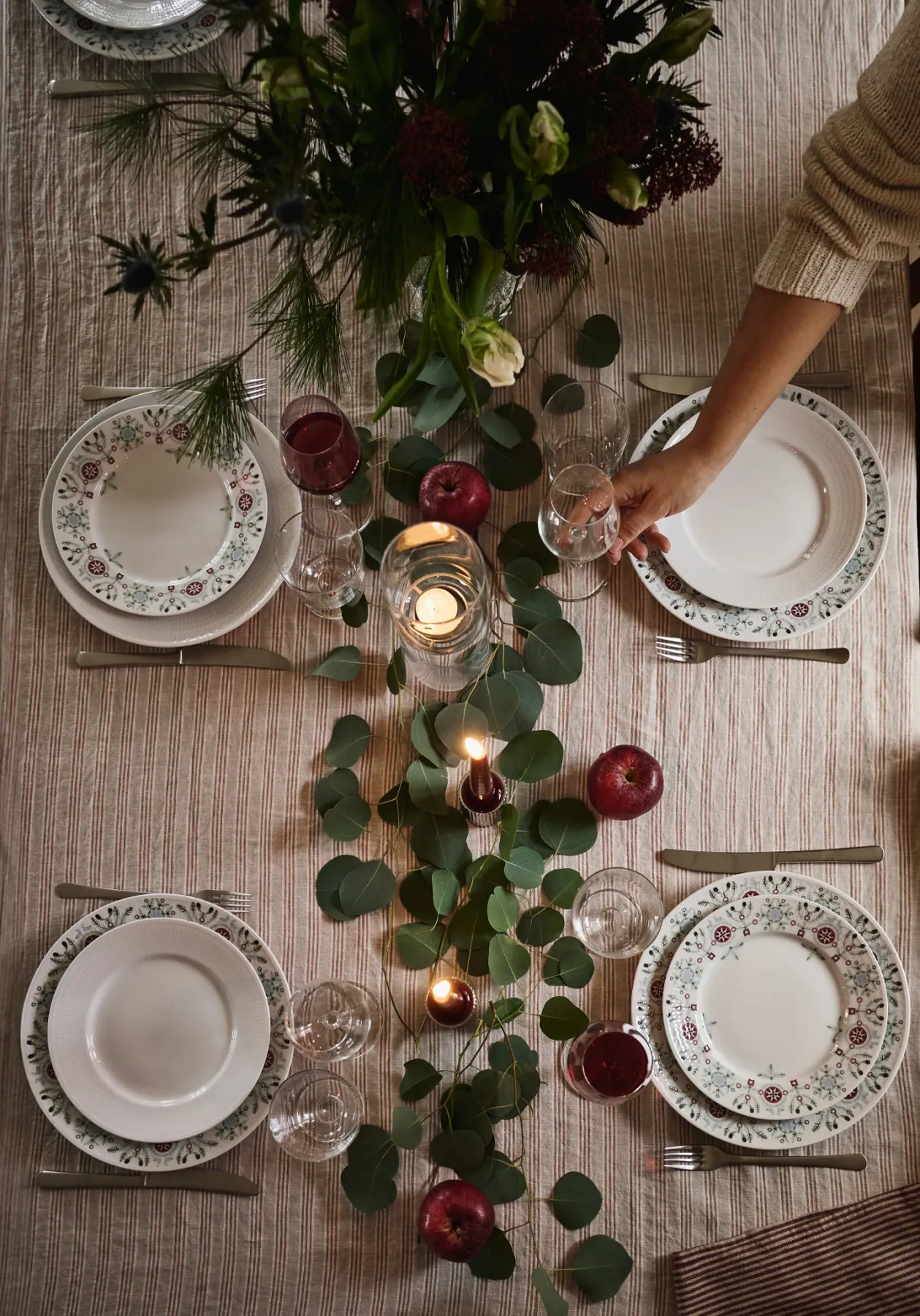
- Apples: $5 for a bag, and you eat the leftovers
- Candles: dollar store pillars at $1 each
- Dark floral centerpiece: $15 from a supermarket bunch
Under $50 for the whole table.
Apples on a holiday table are a very old idea — they show up in Victorian Christmas prints and Dutch still lifes — and they work for the same reason they always have: they add gloss. Everything else here is matte. Linen, eucalyptus, dark red blooms. The shine of the fruit catches candlelight and gives the table a pulse. If you like the fruit-and-greenery idea but want something a little brighter, Idea #9 swaps apples for pears and pomegranates with a warmer, amber palette.
29. Red-and-White Stripes with a Row of Glass Candlesticks
A row of individual candlesticks is the best centerpiece there is for an extra-long table, and this one proves it. Twelve to sixteen clear glass holders, spaced 8 inches apart, read as continuous decoration without ever blocking a sightline. It’s the format I’d recommend for anything over 96 inches, and it’s remarkably forgiving: if your table is 8 feet instead of 10, just use fewer and space them evenly. Pair it with a low garland runner beneath and the table looks dressed even though nothing is tall.
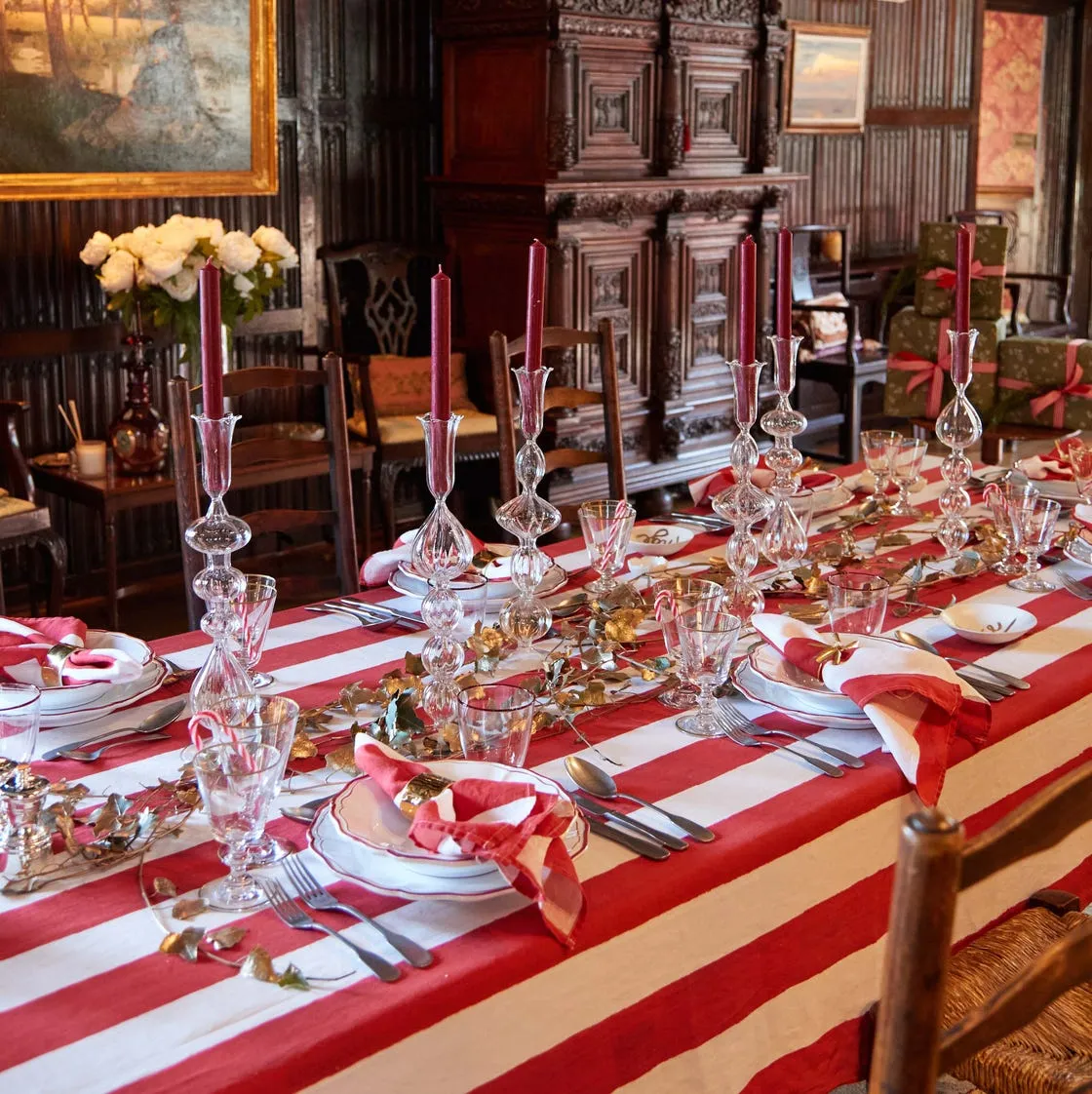
Order of operations matters when you set a long table like this. Candlesticks first, spaced evenly and straight — use a tape measure, it’s worth it. Garland second, woven around the bases so the holders look like they’re growing out of it. Plates third, so the place settings line up with the candles instead of the other way around. Napkins last. Doing it in this order takes about 12 minutes instead of 30, and the result looks markedly more deliberate.
30. Red Walls, Crystal Glassware, and a Pineapple Centerpiece
A room this saturated needs restraint on the table, and this setting gets it right — mostly white and dark wood, with the red coming from the walls, the candles, and the napkins. Maintenance-wise, the real work is the walls. Deep red paint scuffs easily and touches up badly, so keep a spare can for trim. Crystal should always be hand-washed in warm water with a drop of mild soap and dried with a lint-free cloth, because the dishwasher will eventually cloud it. Lace-edged placemats want a cool iron and a storage bag, not a drawer.
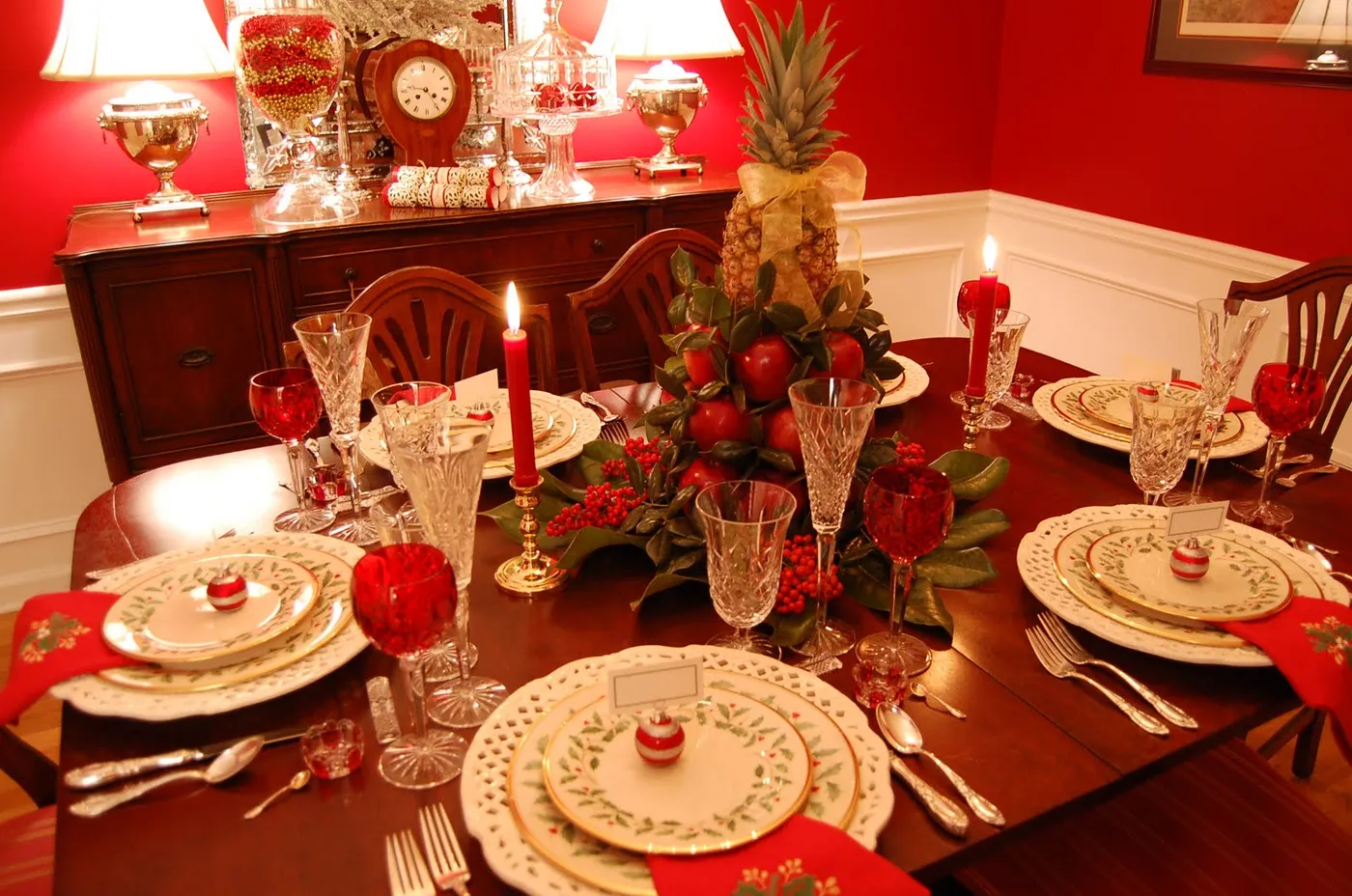
Read the room first: the walls are already 40 percent of the color story, so the table keeps only 20 percent red — napkins, candles, and the fruit. The rest is dark wood, white porcelain, gold accents, and green foliage. That’s the lesson here. In a strong-colored room, your table’s job is contrast, not competition. If you have a red dining room, resist the matching red tablecloth. Pull back to white, wood, and green, and let the walls be the loud one.
31. Red-and-White Plates with Lanterns and a Berry Garland
Quick pre-flight before you build this one:
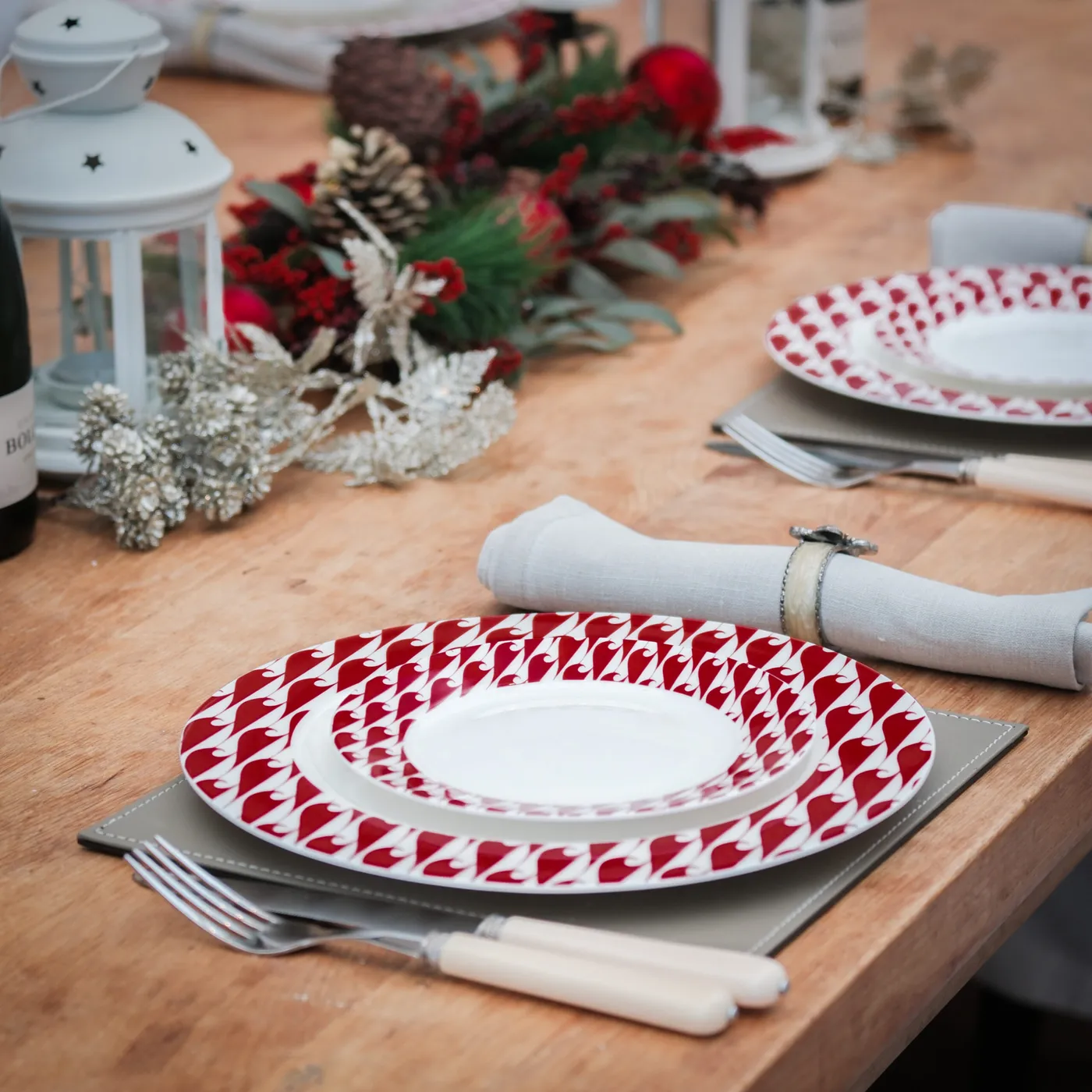
- Measure your table’s clear center — the garland plus lanterns needs about 12 inches of width.
- Check that your patterned plates are dishwasher-safe if you’re feeding a crowd; not all red-and-white ceramics are.
- Confirm the lanterns are battery-lit or short-candle only, so you’re not managing open flames under greenery.
- Test the garland against your placemats — silver and gray can look cold next to warm wood, so add a cream napkin to bridge it.
- Red-and-white patterned plates, 8 settings: $60–$240
- Gray fabric napkins and textured rings: $25–$80
- Pine and red berry garland: $30–$110
- White metal lanterns with star cutouts: $30–$120
- Silver cutlery with cream handles: $50–$200
Budget alternative: buy the patterned plates as a four-piece set and mix them with plain white ones you already own — alternating is a classic move and no one will notice. Grab lanterns at a craft store’s post-holiday sale for half price, and a $6 faux garland plus a handful of loose berries looks identical from three feet away.
Set the Table, Then Pour Something Warm
Here’s the truth about all 31 of these: the ones that look effortless are almost always the ones where the host picked two or three ideas and ignored the rest. Start with the palette that already matches your glassware, steal one centerpiece trick, and let everything else stay simple. Your table doesn’t need to be photographed — it needs to be sat at.
📌 Save this to your Pinterest board before you shop, and pin the mistake photos too — they’re the fastest way to catch a problem before the party does.