
30 Stunning Red And Green Christmas Tree Ideas For 2026 Holiday Decorating
Most red-and-green Christmas trees don’t fail because of the colors — they fail because everything gets equal billing. The ornaments shout, the ribbon shouts, the lights shout, and by December 10th you’re quietly switching the whole thing off. The fix is usually two or three decisions, not a whole new tree.
We spent serious time browsing Target, Walmart, Etsy, and a few very good thrift stores to bring you only what’s worth your attention this year, across prices from $12 to $395. After filtering through hundreds of options, we narrowed it down to 30 ideas that actually deliver — spanning traditional, rustic, maximalist, and minimalist holiday styling, with budget and luxury versions compared side by side.
In 2026 the shift is toward trees that look collected rather than coordinated: mixed ribbon widths used sparingly, single-palette ornaments, and far less tinsel. And stay until the end — we break down the most common mistakes that can ruin these looks.
This post contains affiliate links, which means we may earn a small commission at no cost to you. 📌 Save this to Pinterest for later — you’ll want to revisit these ideas.
1. A Flocked Foyer Tree in Red, Gold, and White Blossoms
Flocking is doing real work here — it turns every branch into a soft white backdrop, so the deep red ornaments read as crisp dots instead of disappearing into green. The oversized white blossoms are the second move: same color as the snow, so they add volume without adding a competing hue. And because this tree sits beside a staircase with dark metal railings under a crystal chandelier, all that overhead light keeps the white from ever going flat or gray.
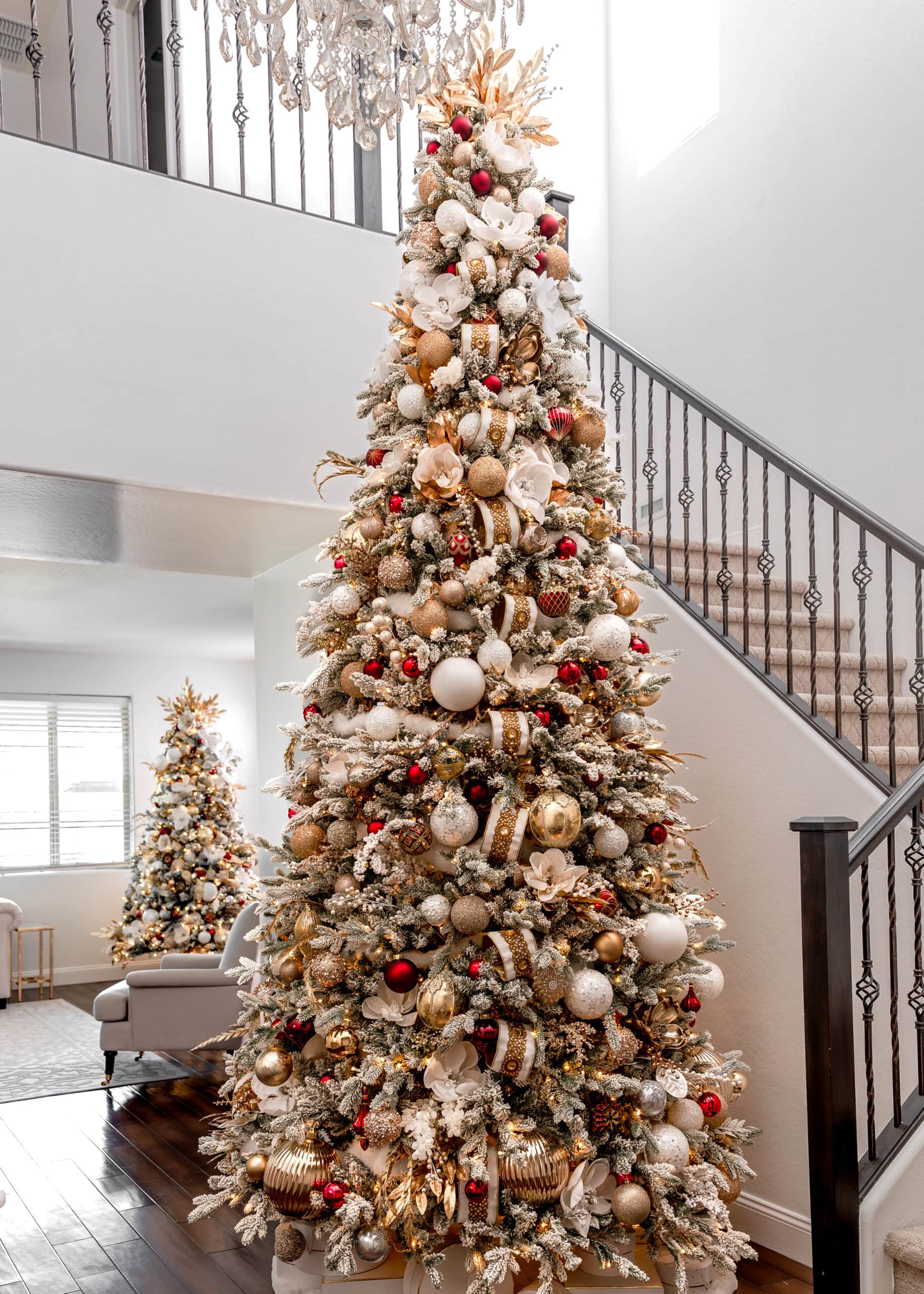
On a flocked tree, hang at three depths instead of one. Put small gold and red balls about an inch from the branch tip, mid-size ornaments four inches in, and your largest pieces eight inches deep for background fill. Then place florals in odd numbers — five, seven, nine — and keep the biggest blossom two-thirds up the tree. Leave the top quarter light so the chandelier glow reads through it.
2. Poinsettia Picks and Gold Ribbon Garland on a Classic Red Tree
The single element carrying this tree is the oversized red poinsettia picks. Take them out and you’d still have a perfectly nice red-and-gold Christmas tree — but you’d lose the thing that makes it feel grown-up. Poinsettias are flat and broad where ornaments are round and small, so they fill visual gaps fast and give the tree a floral, almost garden quality that baubles alone never produce.

The formula is roughly 60% forest green foliage under warm white light, 30% red split between poinsettia picks and round baubles, and 10% metallic gold in the patterned ribbon garland. Change the red to burgundy and the tree reads moodier and more vintage. Swap the gold ribbon for champagne velvet and everything softens without losing structure. Keep the ratio and you can restyle this tree every year without buying a thing.
3. Oversized Velvet Bows and Gnomes in a Bright White Room
Oversized velvet bows are gorgeous and also heavy. If your tree is a lightweight artificial with thin wire branches, four or five large bows will start dragging the tips down by mid-December. Look for wired velvet ribbon that holds a shape on its own, and clip bows onto sturdier inner branches rather than the outer tips. Also worth knowing: velvet collects dust and pet hair like nothing else, so a lint roller lives permanently near this tree.
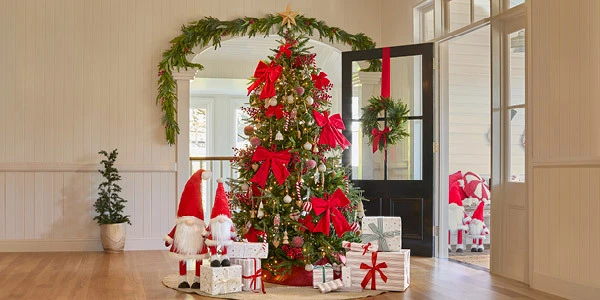
Gnome figurines have quietly become one of the most-saved holiday accessories on Pinterest two years running, and the reason is simple — they add a face to a room that’s otherwise all pattern and texture. Pairing them with velvet bows works because both share a soft, matte, slightly old-fashioned quality. The look has staying power too, since it leans on traditional red and green rather than a color trend that dates in a single season.
4. Glass Cone Snow Globes With Red and Green Spirals
You don’t need the designer version of this. Glass cone trees with internal lighting run $40 to $90 each at big-box holiday shops, but a plain glass hurricane or a tall bud vase filled with red and green bead garland and a strand of battery fairy lights gets you 80% of the shimmer for under $15. Grouping three at staggered heights on a tray makes them read as one intentional display instead of three random objects on a sideboard.
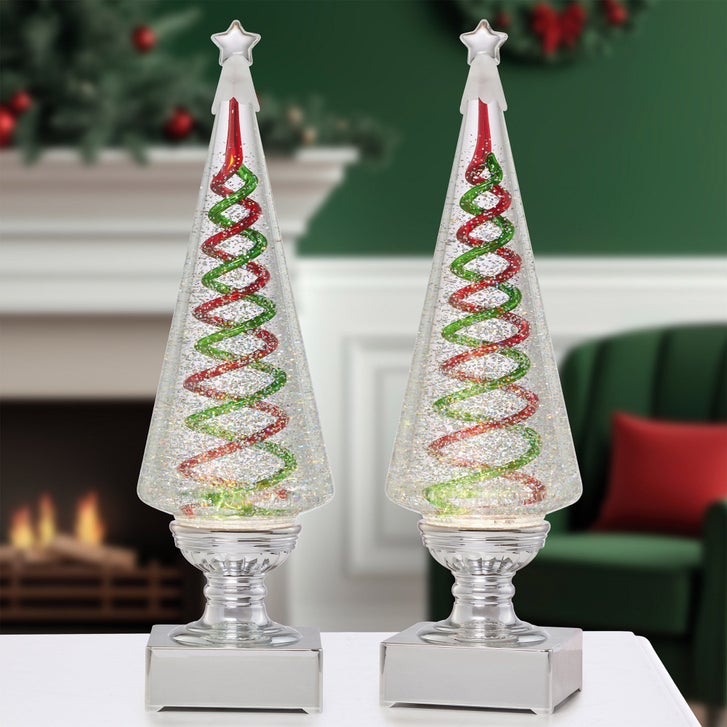
Two things make these work. First, the glass is clear, so the red and green interior never competes with whatever sits behind it — it just glows. Second, the silver pedestal bases lift the cones off the table, adding height without adding visual weight. Place them on a reflective surface and you double the sparkle for free. It’s the tabletop version of the height drama in Idea #1, scaled down to fit a console.
5. A Buffalo Check Star and Wooden Beads Over a Plaid Tree Skirt
Wooden bead garland is the cheapest way to add texture to a tree, and the trick is drape count. One strand reads sparse. Three strands, each starting at a different branch and drooping in shallow U shapes rather than tight loops, reads intentional. Measure your tree height and buy roughly 1.5 feet of garland per vertical foot. On a 7-foot tree, that’s about 10 feet total, split across three separate strands.
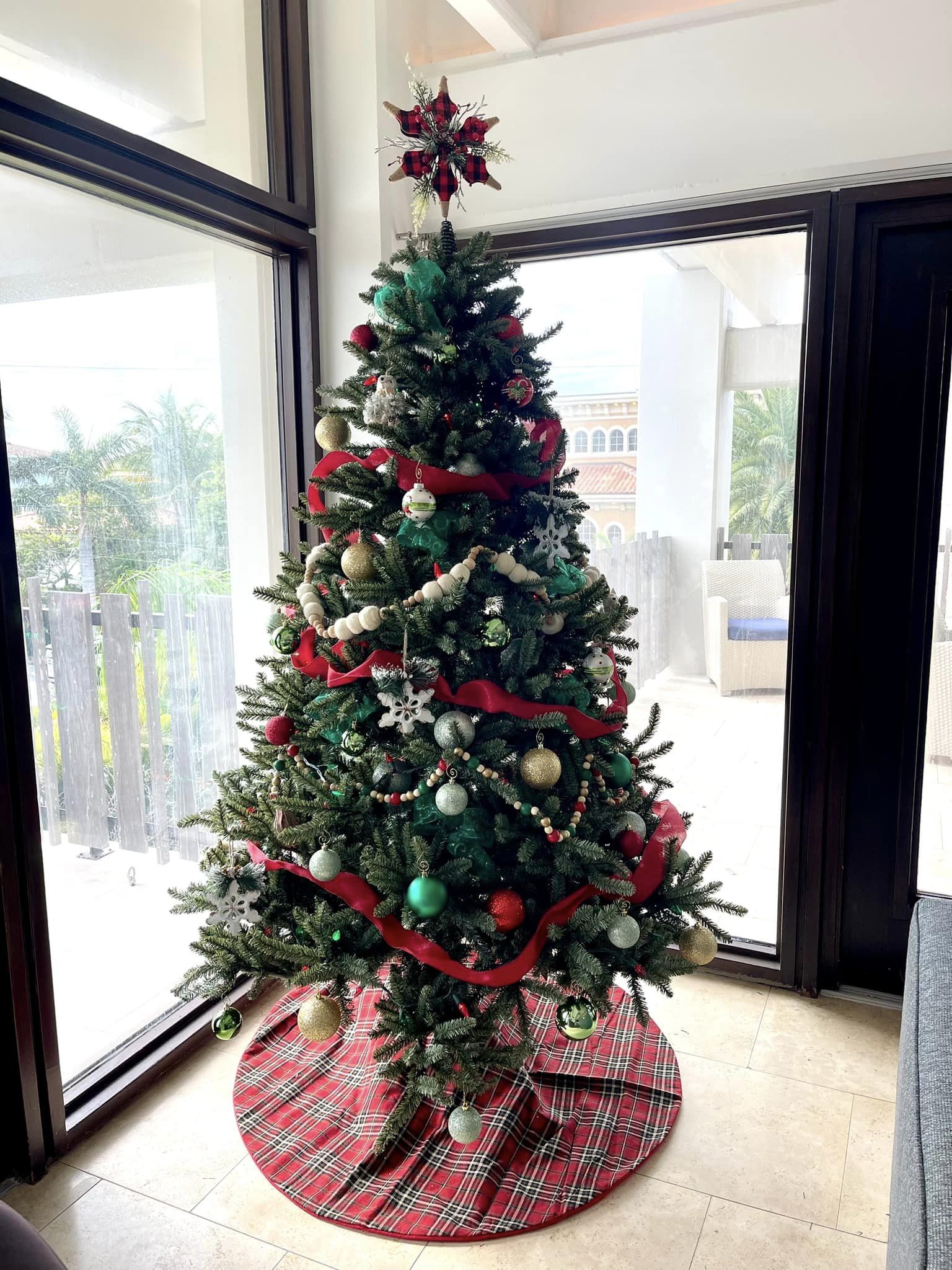
This setup needs breathing room or it becomes a wall of pattern. It works best in a room at least 12 by 14 feet with 9-foot ceilings, with the tree at least 18 inches from the glass so daylight hits the ornaments from the side. Under 10 feet of wall width, drop the red ribbon garland entirely and keep only the bead strands and the plaid skirt — same concept, half the visual noise.
6. Buffalo Plaid Ribbon Meets a Rustic Twig Star
The rustic twig star topper is the piece that decides this tree’s entire personality. Trade it for a gold glitter star and you’d have a pretty but generic flocked tree. The twig star’s irregular, matte-brown silhouette is what pulls the buffalo plaid, the burlap sack, and the gray built-in cabinetry into one coherent story. It’s also the cheapest element on the tree, which is a nice reminder that the topper sets the tone more than any ornament does.
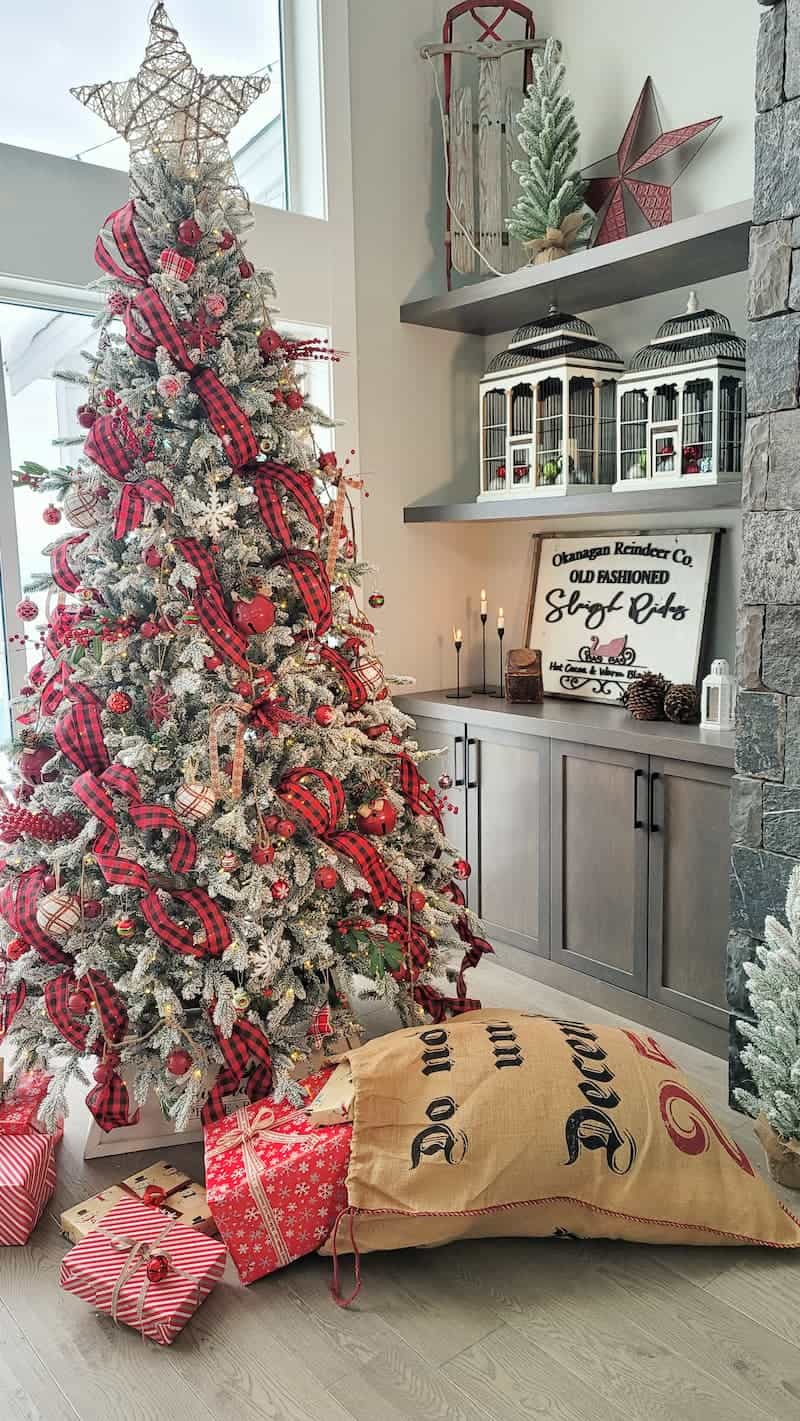
Flocked trees shed. Expect a light dusting of white particles on the floor for the first week after setup, and again every time you move a branch. A vacuum with a brush attachment handles it in two minutes. Flocking also yellows over time if it’s stored somewhere hot, so keep the box cool and dry and skip the attic. Buffalo plaid ribbon, meanwhile, is washable — hand-wash cold and air-dry flat to keep the edges crisp.
7. Red Velvet Ribbon Cascading Over a Tall Evergreen
This tree runs on a clean three-part split: 55% green foliage and warm light, 35% red between the velvet ribbon and the baubles, and 10% silver and white for sparkle and breathing room. The silver matters more than people think — without it, red on green starts to feel heavy by the third week of December. Want a softer version? Keep the exact same percentages but push the red toward dusty rose.
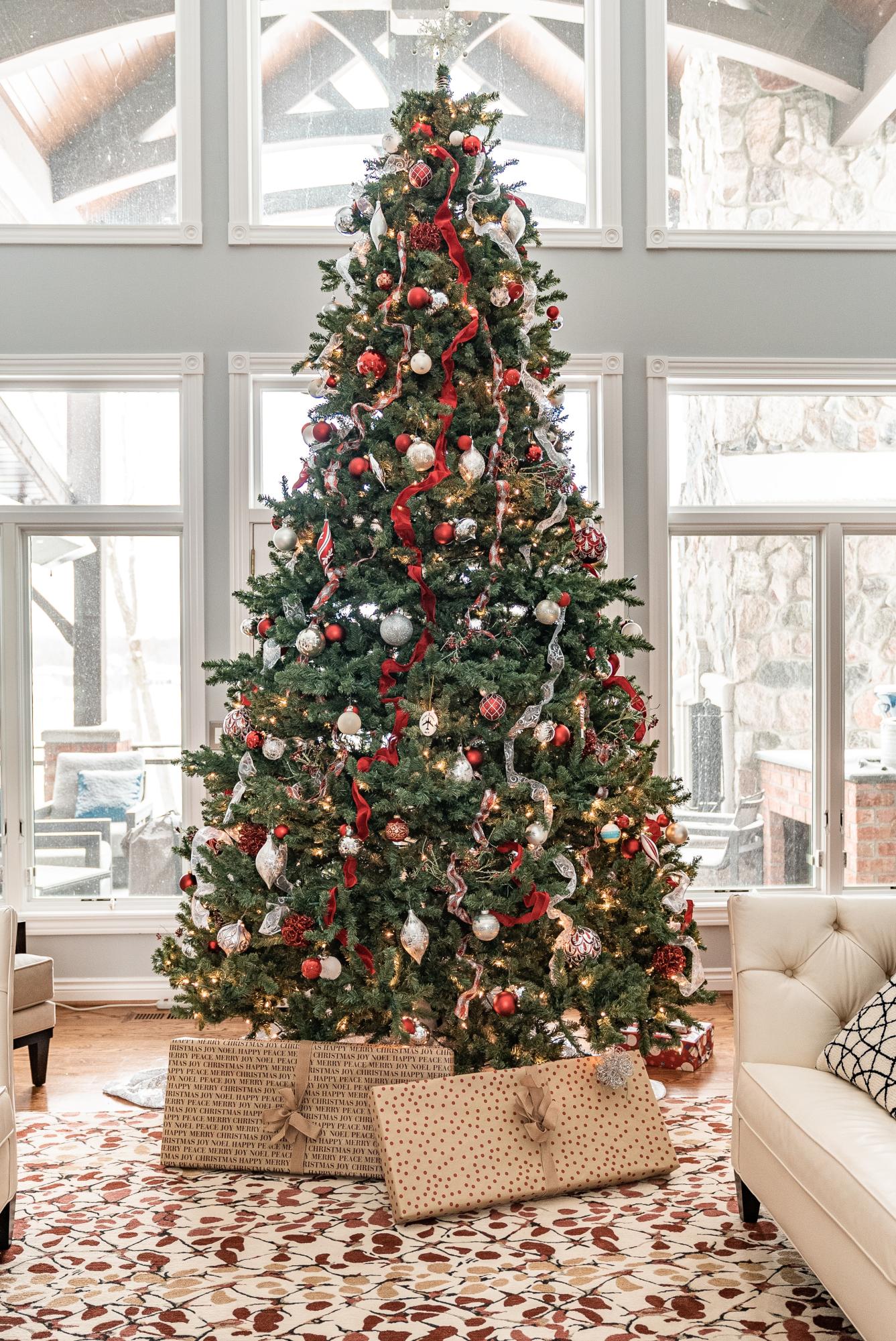
Red velvet ribbon is the most photogenic and least forgiving garland you can buy. It crushes if it’s stored coiled tightly, and it shows every fingerprint. Buy wired ribbon with a matte finish, store it rolled around a cardboard tube, and steam it lightly before it goes on the tree. One more thing: if you have cats, expect the ribbon to become a toy. Tucking the tails inside branches instead of letting them dangle saves the whole display.
8. Pinecones, Wide Ribbon, and a Patterned Ceiling Above a Grey Sofa
Pinecones are the quiet hero of this tree. They’re matte and brown in a sea of shiny color, which gives your eye somewhere to rest. The patterned ceiling with dark geometric accents does the same job up top — it repeats a shape without repeating a color. Notice how the wide ribbon echoes the vertical lines of the grey drapes. That kind of mirroring is why the room feels composed even though it’s full of stuff. If your living room is tighter than this one, the corner setup in Idea #22 borrows the same warm-light-first approach at half the scale.
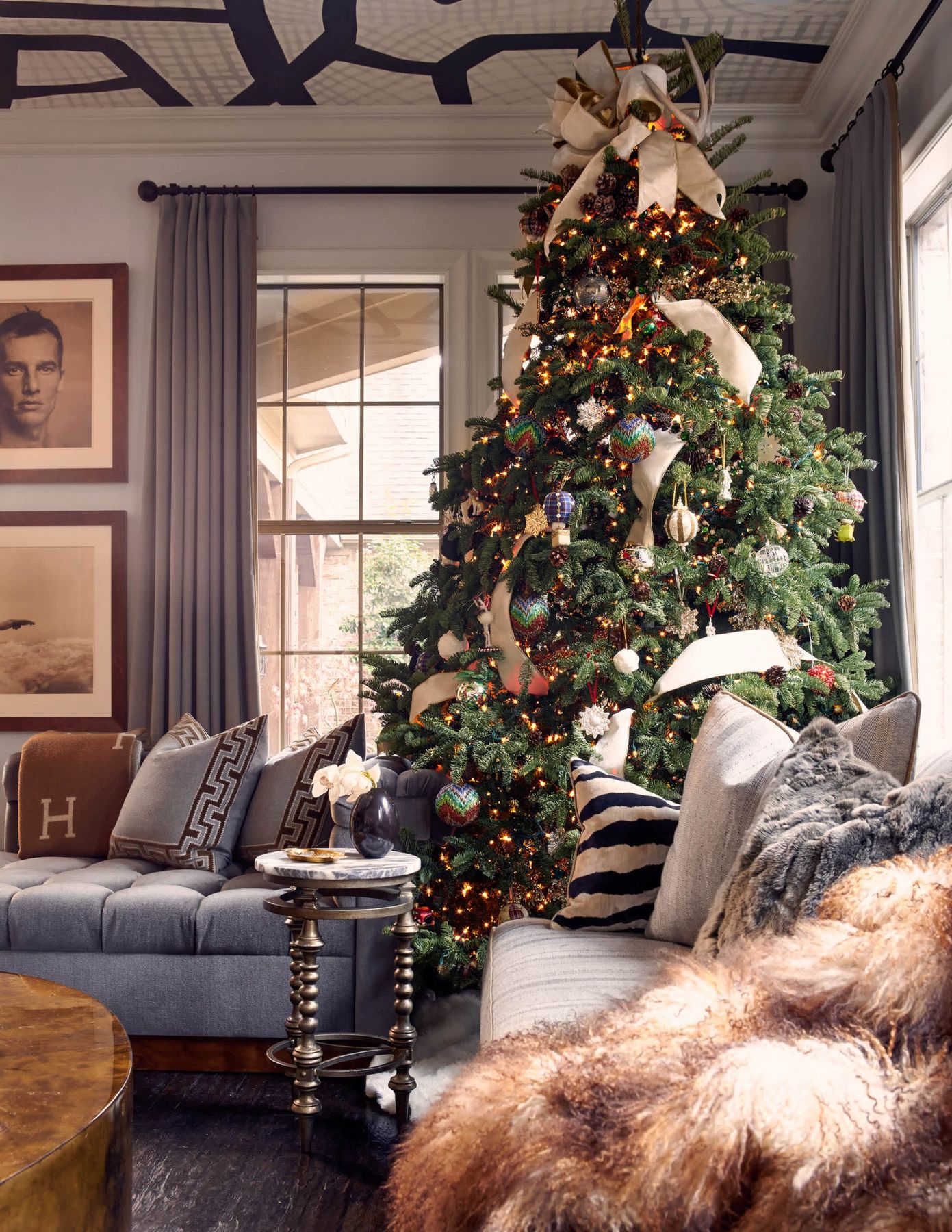
Making a wide ribbon topper takes about 20 minutes and costs under $12.
- Cut three 24-inch lengths of 3-inch-wide wired ribbon.
- Fold each into a loop, pinch the center, and fan the loops outward.
- Stack all three and bind the centers tightly with florist wire.
- Fluff the loops, then slide the wire down over the top branch.
- Add one long tail angled to the left so it doesn’t look symmetrical.
9. Red Mesh Ribbon and Toy Drum Ornaments Beside the Mantel
Mesh ribbon is the sleeper trend of the last few seasons — it looks like a designer splurge but costs about a third of velvet, and it holds a bow shape without any wiring. The red ’25 December’ sign above the mantel is part of the same movement: holiday decor leaning on typography and nostalgia instead of more sparkle. Both are cheap to replicate and neither will look dated next year, which is more than you can say for most seasonal buys.
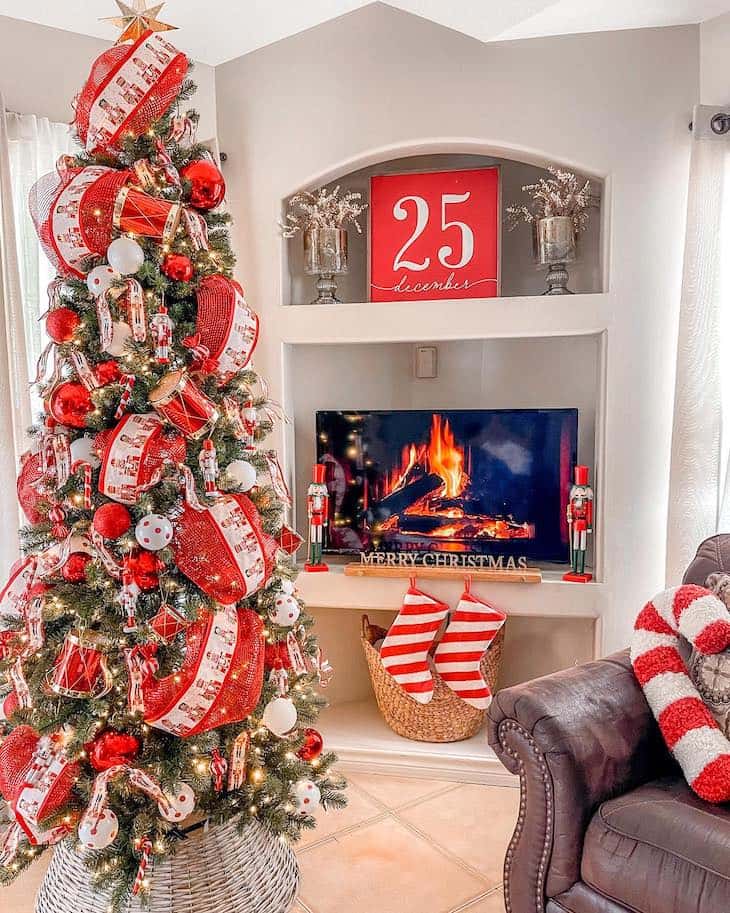
Number, don’t scatter. On this tree, mesh ribbon runs as a single continuous spiral from top to bottom — roughly one full wrap every 8 to 10 inches of tree height. Skip the temptation to weave it back and forth. A clean spiral reads as intentional from across the room, and it costs you one roll of ribbon instead of three. Same logic applies to the mantel garland: one clean line beats three tangled ones every single time.
10. A Red Feather Topper With Black-and-Gold Striped Ribbon
Feather toppers are big. A topper like this adds 10 to 14 inches above the tree, which matters a lot with 8-foot ceilings. Measure your tree, add the topper height, and leave at least 6 inches of clearance so the feathers never brush the ceiling. This look wants vertical space — a two-story foyer, a 10-foot ceiling, a formal dining room. In a standard living room, use the same feather idea at half scale and skip the long tail pieces.
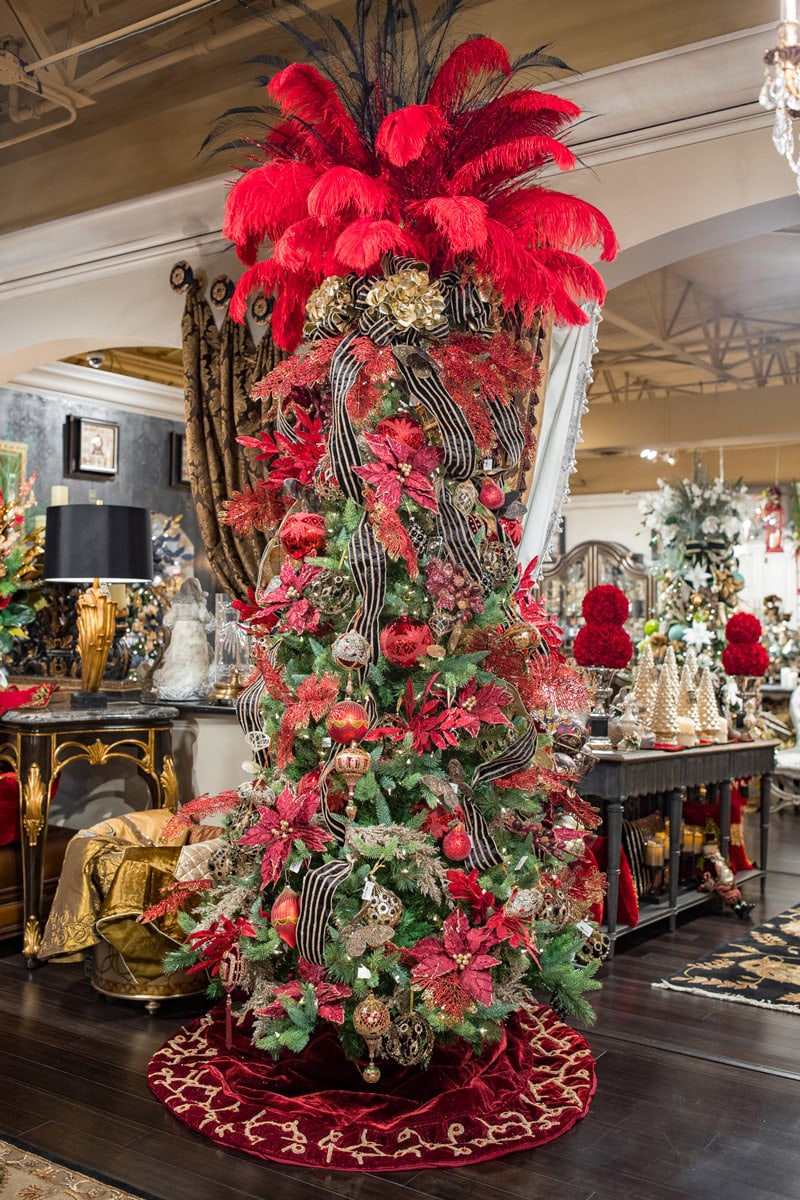
Take away the red feathers and this is a well-dressed but ordinary red-and-gold tree. The feathers are what turn it theatrical. They’re also doing a practical job: because the topper is so tall and dense, your eye travels up the full height of the tree in one motion, which makes a standard 7.5-foot tree feel considerably taller. That’s the trade. Drama costs you about a foot of headroom.
11. Red Velvet Bows and a Gold Star, Styled From a Wooden Ladder
Count the bows before you buy. This tree uses about 12 large bows spread evenly from just below the topper down through the bottom third, weighted so the top and middle carry more than the base. Pair each bow with two or three gold baubles nearby so red and gold always appear together. That’s the whole formula — 50% green, 30% red, 20% gold — and those repeated pairs are what make it look styled rather than sprinkled.
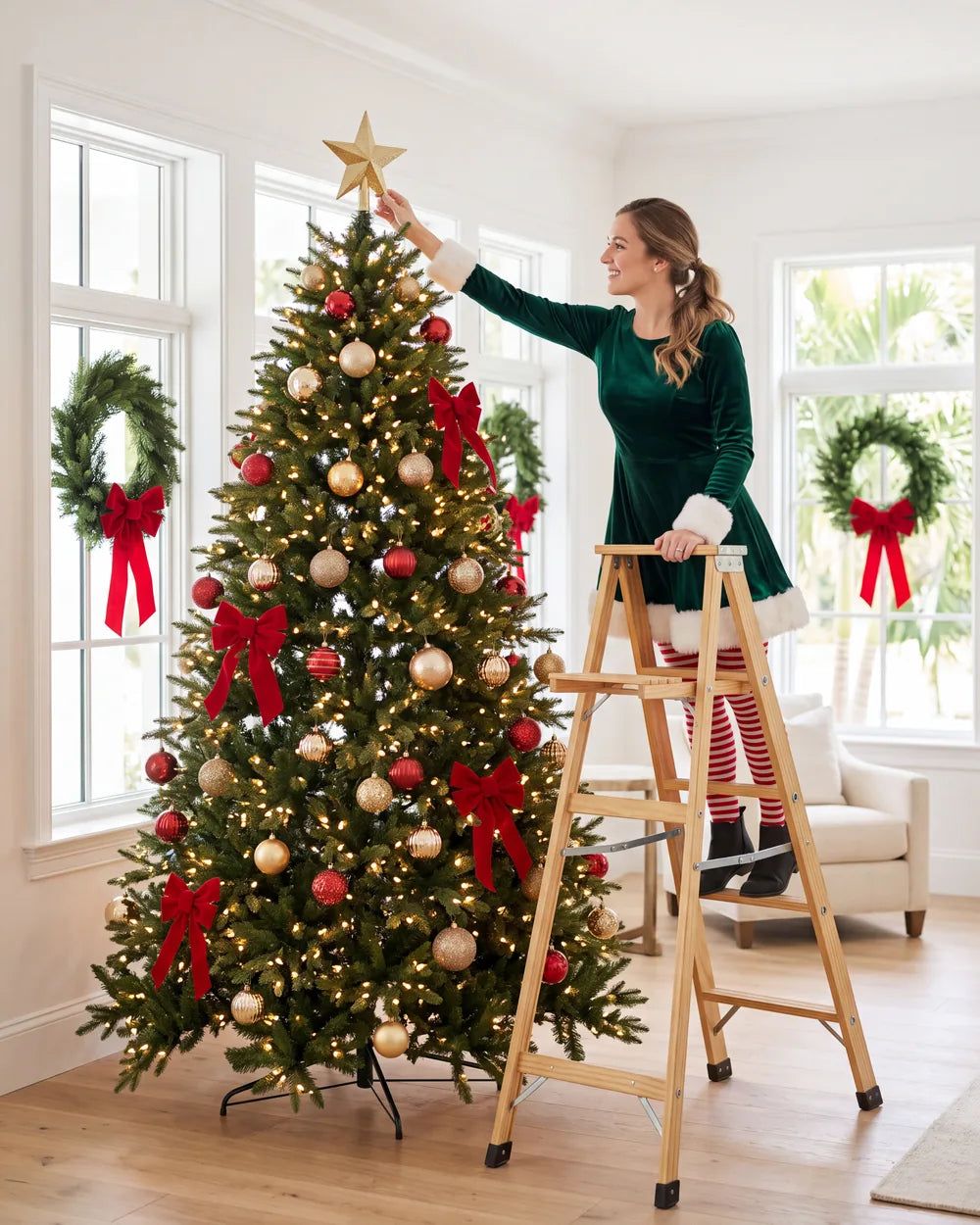
Velvet bows at a craft store run $6 to $12 each, which adds up fast. Buy a roll of red velvet ribbon instead — about $10 for 20 yards — and tie your own with a simple loop-and-knot. They’ll look slightly less structured and completely fine. For ornaments, big-box stores sell oversized gold and red ball sets for around $15 per 30 pieces. The whole look lands near $45 instead of $200.
12. Red Berry Garland Above a Fireplace With a Gold Mirror
Two fire hazards live in this room, and both are easy to manage. The tree sits within a few feet of an active fireplace, so keep a minimum of 3 feet of clearance and never leave a burning fire unattended with the tree lit. The pillar candles on the mantel are the second one — swap them for battery-operated pillars with a realistic flicker. Nobody has ever noticed the difference from across the room, and you stop worrying about it entirely.
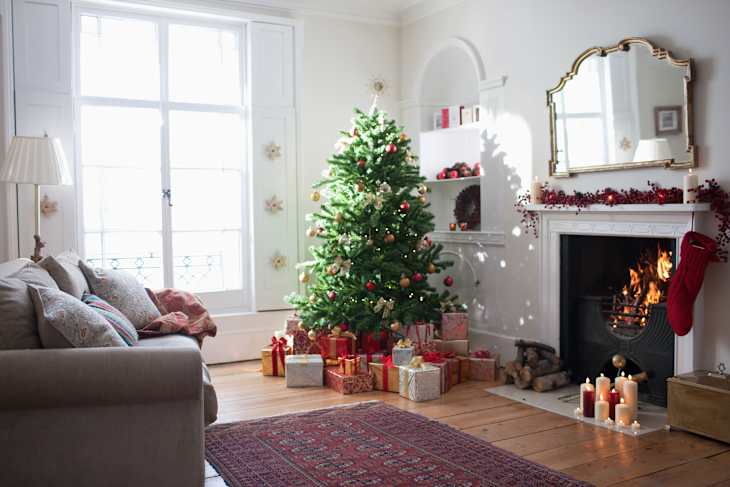
The gold mirror is doing more than decorating. It reflects both the tree lights and the fire, which effectively doubles the glow in a room that only has one real light source. The red patterned rug underneath ties the berry garland and the tree together without matching either one exactly — a good reminder that coordinating doesn’t mean identical. And the gray sofa gives your eye a neutral place to land between all that red.
13. Red-and-White Patterned Balls and a Bold Star Topper
Pattern on a tree reads best when you limit yourself to two patterns and repeat each at least eight times. Here it’s red-and-white stripes and red-and-white dots, distributed evenly from top to bottom. Mix in a third pattern and the tree turns into visual noise from six feet away. If you want to add heart ornaments for sentimental value, keep them solid red so they sit quietly between the patterned pieces instead of competing with them.
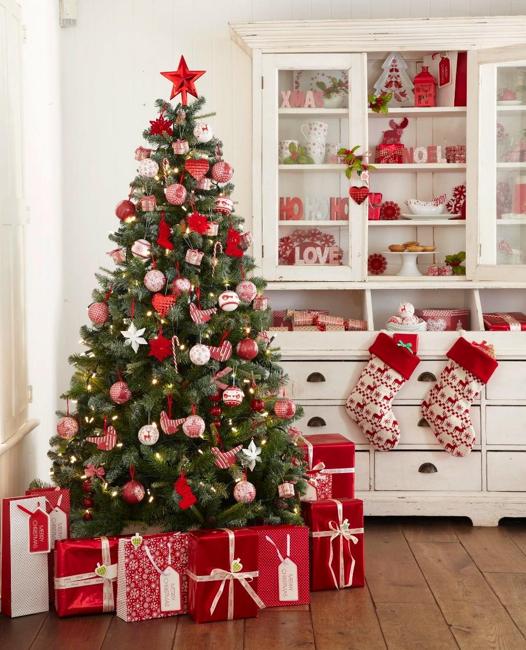
This tree-and-cabinet pairing needs horizontal space as much as vertical. Plan on about 6 feet of wall for the tree plus 3 feet for the cabinetry beside it, with a walkway of at least 30 inches in front. It works beautifully in a dining room or a wide hallway. In a narrower space, skip the cabinet styling and hang the stockings on a simple rail — the tree carries the look on its own.
Patterned ornaments show dust less than solid glossy ones, which is genuinely nice. But glittered balls shed. Plan a light pass with a dry microfiber cloth once a season, and store ornaments in divided trays rather than one big bin — patterned finishes chip along the edges when they knock together. Heart ornaments on ribbon hangers should be stored flat. Ten extra minutes in January saves you a replacement run in November.
14. Three Ribbed Glass Cone Trees on a Glass Coffee Table
The three ribbed glass cone trees on the coffee table are the detail that makes this room feel collected instead of decorated. They’re small, they’re clear, and they repeat a cone shape three times, which is just enough to register as a theme. Remove them and the coffee table becomes a flat empty surface in a busy room. Add a fourth and it becomes a collection instead of a composition. Three is the number that reads as intentional.
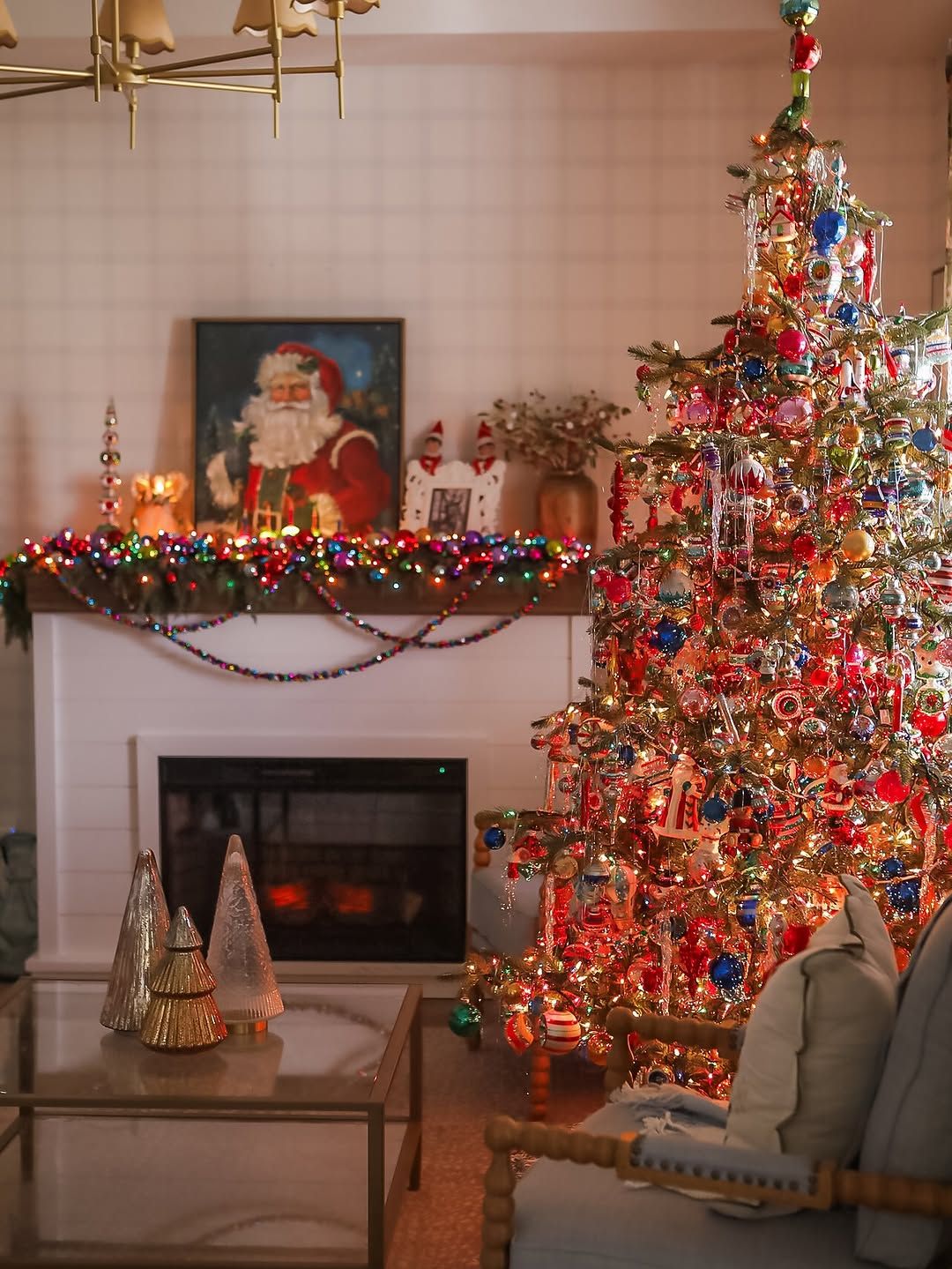
This room leans on a 50% white base — walls, mantel, coffee table — 30% multi-color from the tree, lights, and garlands, and 20% light blue from the sofa. That blue is the secret: it cools down a palette that would otherwise be pure red and green, and it makes the white read warmer by contrast. Swap the blue for cream and the room goes cozy and traditional. Keep the blue and it stays fresh. Compare with Idea #25 — same red-and-green foundation, completely different energy.
15. Large Red Baubles and Plaid Ribbon, Mantel Dressed to Match
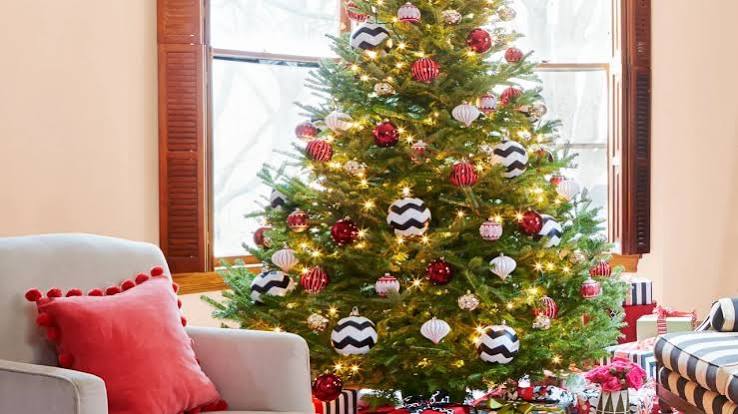
Large ornaments on a mid-size tree is a scale gamble that pays off here. Oversized red balls make the tree look fuller and more expensive because each piece covers more branch, and they read clearly from across the room. The plaid ribbon repeats at the mantel, which is what stitches the two areas together into one scene. Repetition over matching — that’s the principle doing the work in this room.
Hanging stockings so they actually look even takes about 15 minutes.
- Measure the mantel width and divide by your stocking count, leaving 3 inches between each.
- Mark the spacing lightly with painter’s tape and check it from across the room.
- Use adhesive hooks rated for at least 2 pounds instead of nails.
- Hang every stocking so the toe points the same direction.
- Step back and adjust anything that looks off before the tape comes down.
16. White Brick Fireplace, Neutral Chairs, and One Very Full Tree
White brick fireplaces are beautiful and slightly unforgiving — every stray needle and loose hook shows against them. Skip glittery garlands and tinsel here; they read as mess rather than sparkle on a pale surface. The plaid throw on the ottoman is doing double duty as a texture layer and as the one place red is allowed to live, which is smart. One caution: if this fireplace is ever used, keep greenery at least 12 inches above the firebox opening.
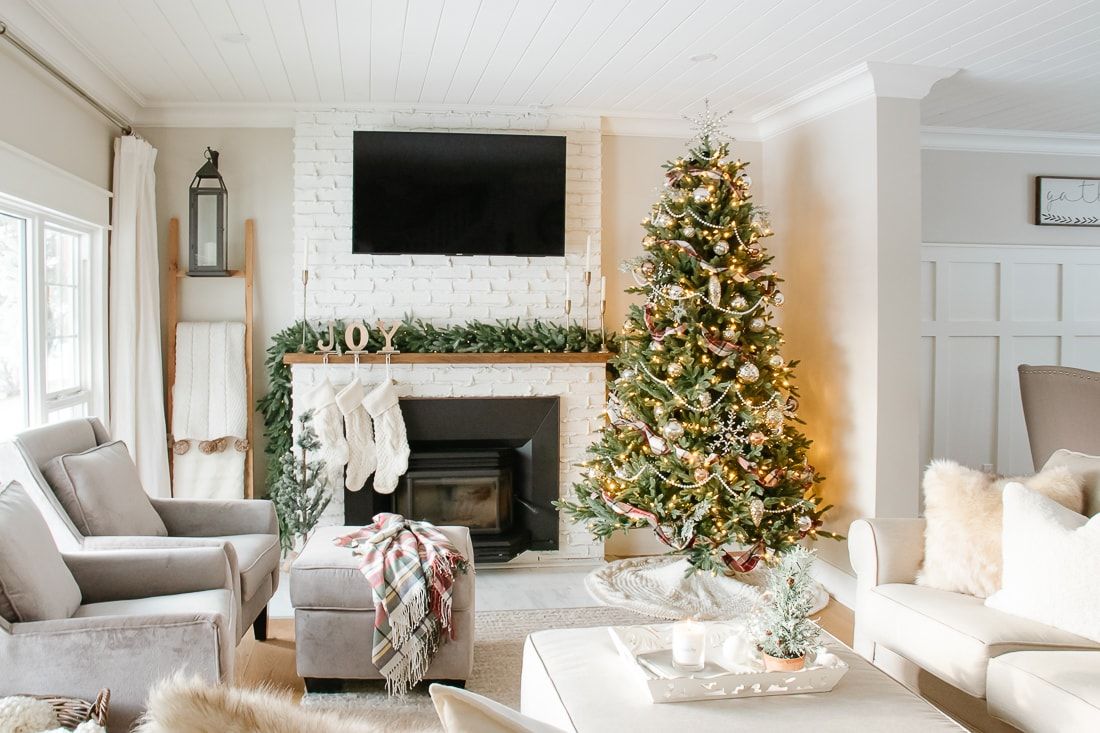
The neutral-room-with-one-bold-tree approach has grown steadily on Pinterest because it solves a real problem — people love holiday color but don’t want to repaint their living room every December. By keeping chairs, fireplace, and walls in beige and white, the tree becomes the only loud object in the room, so it gets to be far bolder than it could be in a busier space. This is the look with the longest shelf life on the list.
17. Tartan Bow Topper and Red Cardinals Against White Paneling
Cardinal ornaments are the easiest collectible in holiday decor and one of the cheapest. Thrift stores and estate sales turn them up for $1 to $3 apiece, and because they’re already an assortment, mismatched sizes look intentional rather than sloppy. Tartan ribbon runs about $8 for 10 yards at a craft store — far less than pre-made plaid bows, which often cost $15 each. A full tree’s worth of plaid and cardinals can come in under $40 if you shop secondhand first.
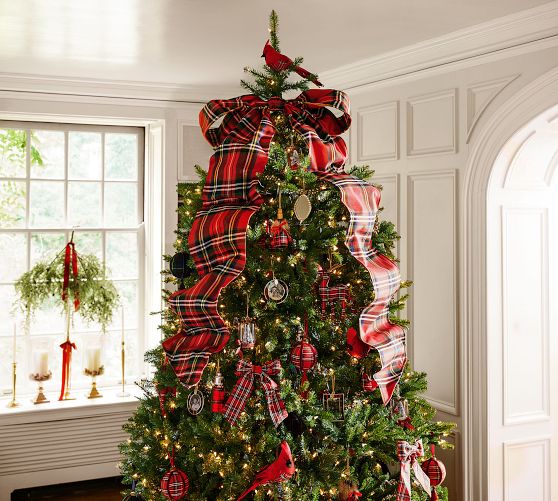
Cascading ribbon takes roughly 30 minutes on a 7-foot tree.
- Cut four ribbon lengths roughly equal to your tree’s height.
- Start each strip at a different point around the top, not all from the topper.
- Weave each strip in and out of branches every 8 to 10 inches.
- Let the ends fall slightly below the lowest branches instead of tucking them in.
- Fluff the bow topper last, after the cascades are already set.
18. Matching Lit Garland Over the Doorway and a Stone Fireplace
Garland over a doorway arch is a commitment, and it only works if the arch is at least 6 feet wide. On a narrower opening, garland crowds the trim and blocks light from the next room. Measure from the top of the arch down 12 inches on each side — that’s your natural stopping point. This room also has the ceiling height for a tall tree plus garland, which is why it doesn’t feel heavy. With 8-foot ceilings, choose one garland location, not both.
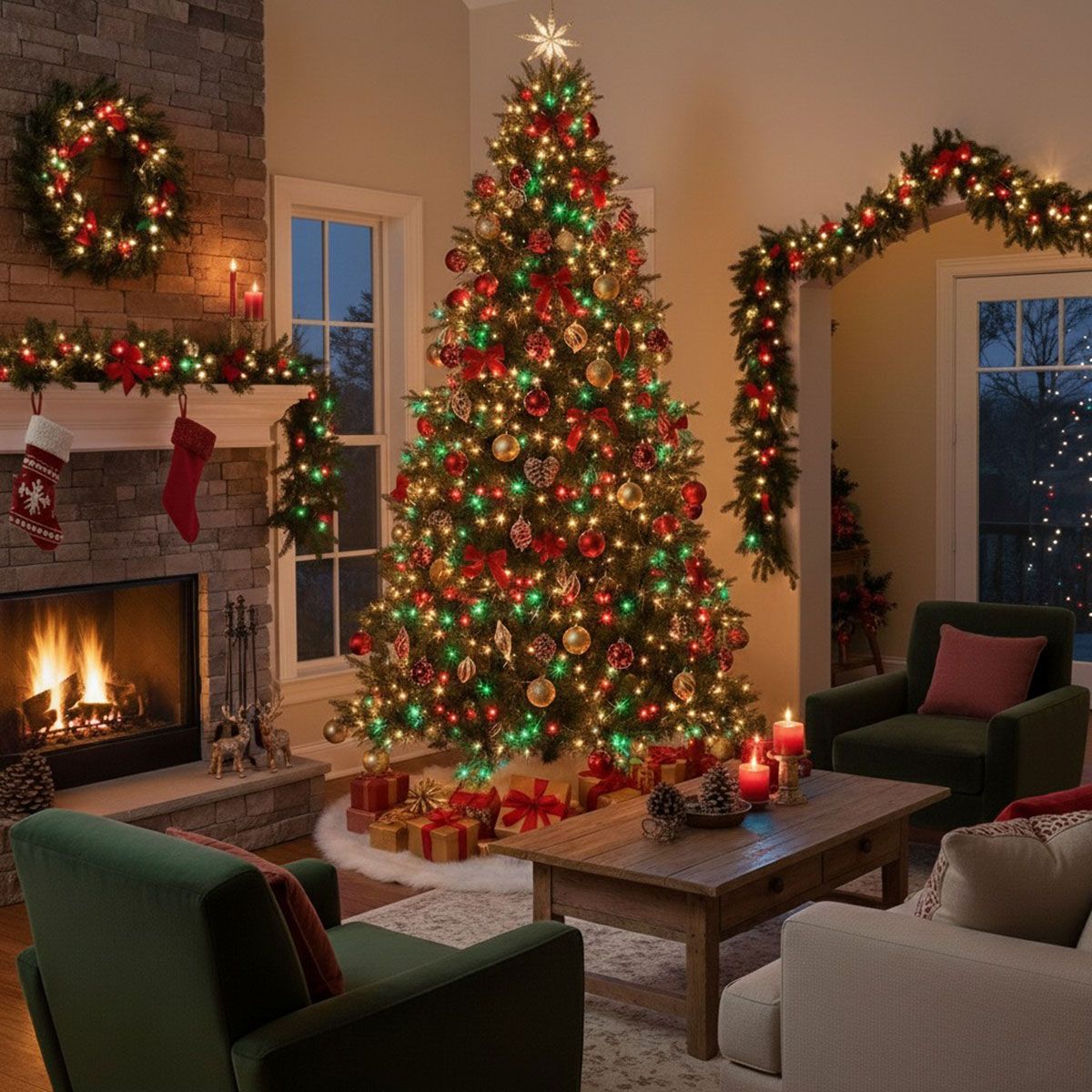
Repeating lit greenery at three heights — mantel, doorway, tree — creates a rhythm that makes the room feel decorated rather than accessorized. The green armchairs are the other smart move: they pick up the tree’s color without adding another pattern. And the stone fireplace gives all that warmth a cool gray balance. Without the stone, this much green and red and gold would tip straight into claustrophobic.
Three sets of lit garland means three plugs. Before you commit, count your outlets and pick up grounded power strips with flat plugs so furniture can still sit flush against the wall. Check that every strand is rated for indoor use too — some budget garlands are outdoor-only and run hotter. Lit garland over a doorway means a cord running down a wall, so plan that route on paper first. It’s much harder to hide after the fact.
19. Glittered Red and Green on a Heavily Flocked Tree
On a flocked tree, put your shiniest ornaments deepest into the branches and your matte ones out at the tips. Glitter and jewel finishes catch light best when surrounded by white, so nesting them inside the flocking creates dozens of small glints instead of one bright surface. Then repeat one accent — here it’s the red bow shape — on the mantel, the wreath, and the tree. Three locations is the minimum for a room to read as coordinated.
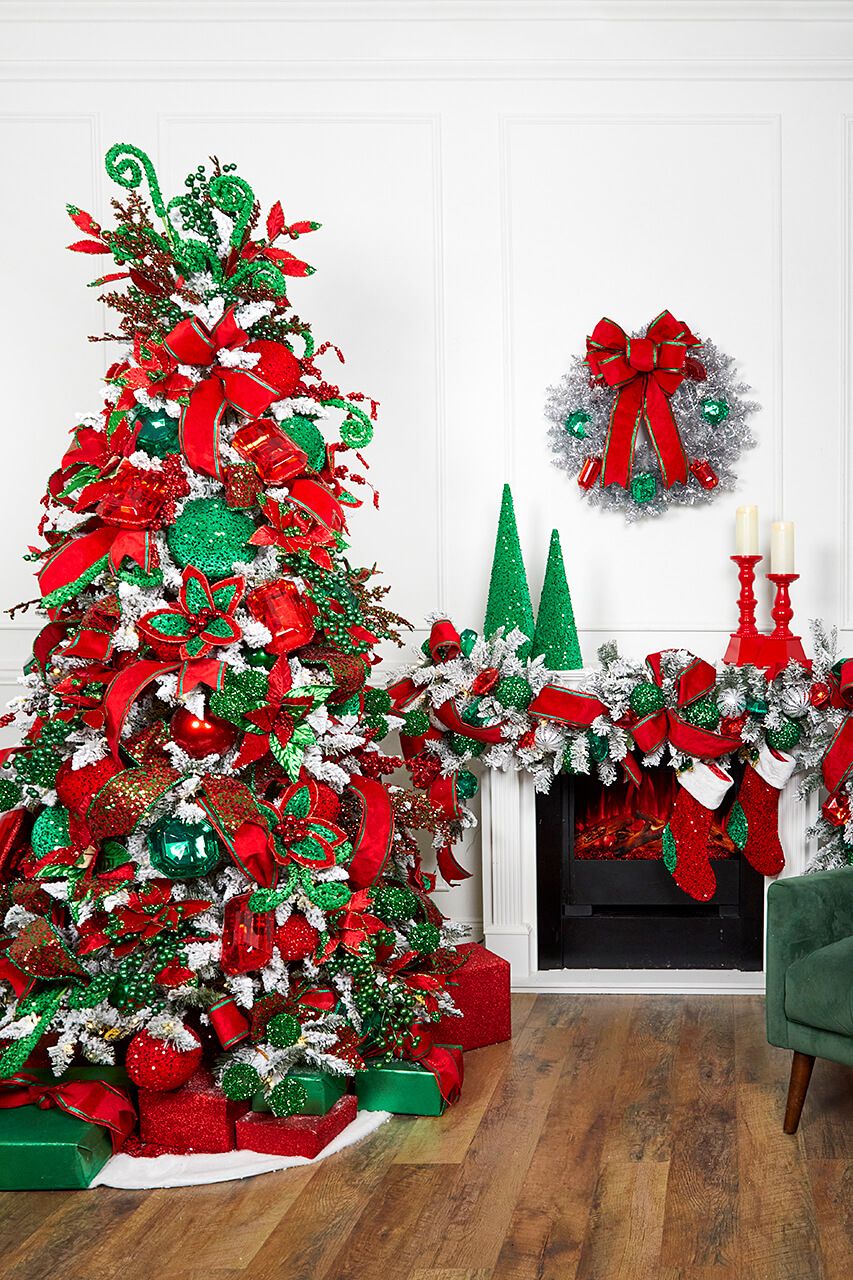
Tinsel wreaths look expensive and cost almost nothing to fake. A plain silver tinsel wreath is about $10 at a dollar store or big-box retailer, and a wide red velvet bow is another $3, giving you a $13 wreath that photographs like a $60 one. For the flocked look, skip pre-flocked trees and grab a $15 can of spray snow instead — you control exactly how much goes where, at a fraction of the price difference.
20. A Lighted Wire Deer and Kraft Paper Gifts by the Mantel
Run through this list before you buy a single thing.
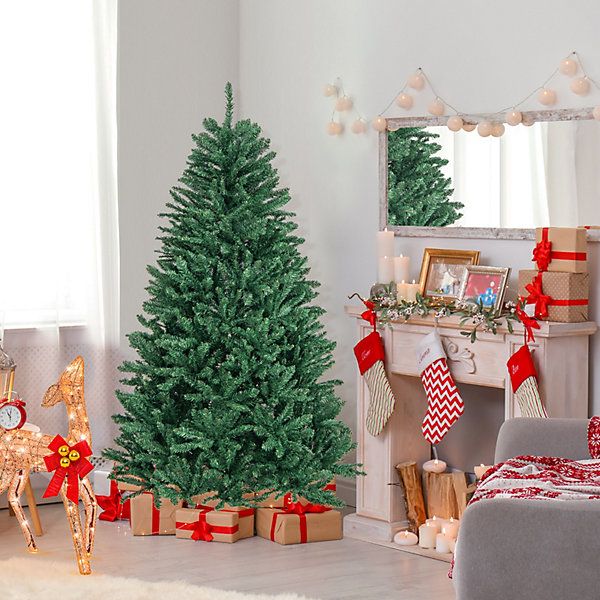
- Measure the mantel width and confirm you can space stockings at least 10 inches apart.
- Check whether the mirror above the mantel can take adhesive clips without damaging the frame.
- Count your outlets — the deer, the tree, and the mirror lights need three separate power sources.
- Lock your paper palette first: kraft, red, and white only, no exceptions.
Stringing lights across a mirror takes about 20 minutes.
- Clean the mirror frame and let it dry completely.
- Run a battery strand along the top edge, hiding the pack behind the frame.
- Secure with small clear adhesive clips every 8 inches.
- Let the strand drape in gentle swags rather than a straight line.
- Set the timer so it switches off an hour after bedtime.
21. Ochre Walls and a Floral Sofa Around a Maximalist Tree
Ochre walls change the math completely. Here it’s roughly 40% ochre, 30% tree green and red, 20% cream and gold from the sconces and mirror, and 10% everything else. The ochre acts as a warm neutral, which is why a tree this densely decorated doesn’t overwhelm the room — the walls are already doing some of the talking. If your walls are cool gray, add a warm wood piece or an amber lamp before you copy this look.
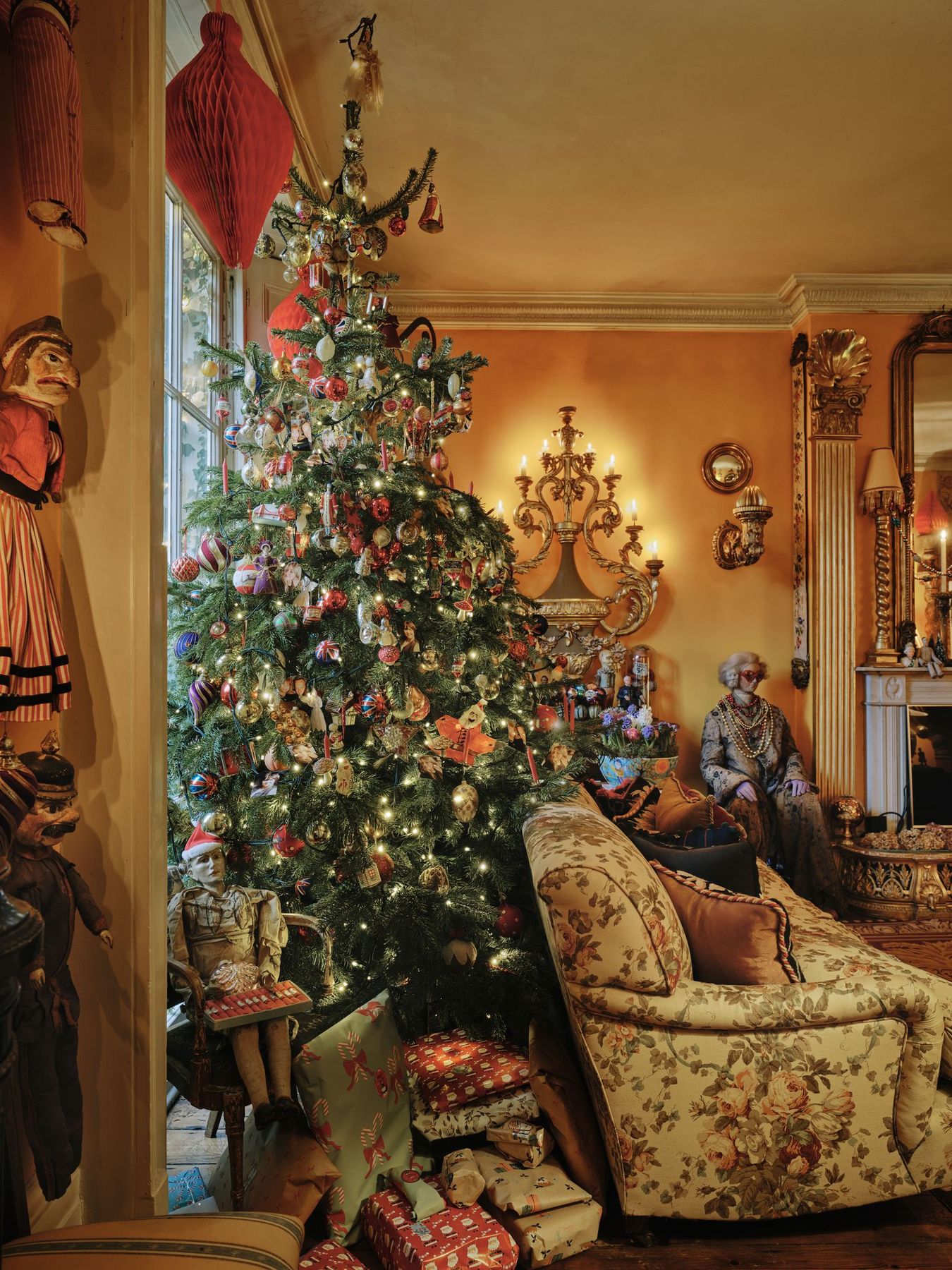
Maximalist rooms need volume, not just floor space. This arrangement wants at least 14 by 16 feet and 9-foot ceilings, because the tree, the sofa, and the wall decor all compete for the same visual plane. Below 12 feet of wall width, cut the ornament count by a third and keep the figurines to one surface only. If you love this density but live small, use it in a dining room or study instead of the living room.
22. Pennant Garlands and Striped Baubles in a Corner Nook
White pennant garlands and striped baubles are the two things in this corner that age fastest. Fabric pennants crease when stored in a bag — hang them on a hanger in a closet instead. Striped ornaments are usually painted, and paint chips at the cap, so lift them by the hanger, never by the ball. The pleated lamp shade, meanwhile, wants a lint roller more than a duster. Budget about 15 minutes of upkeep in early December and again in January.
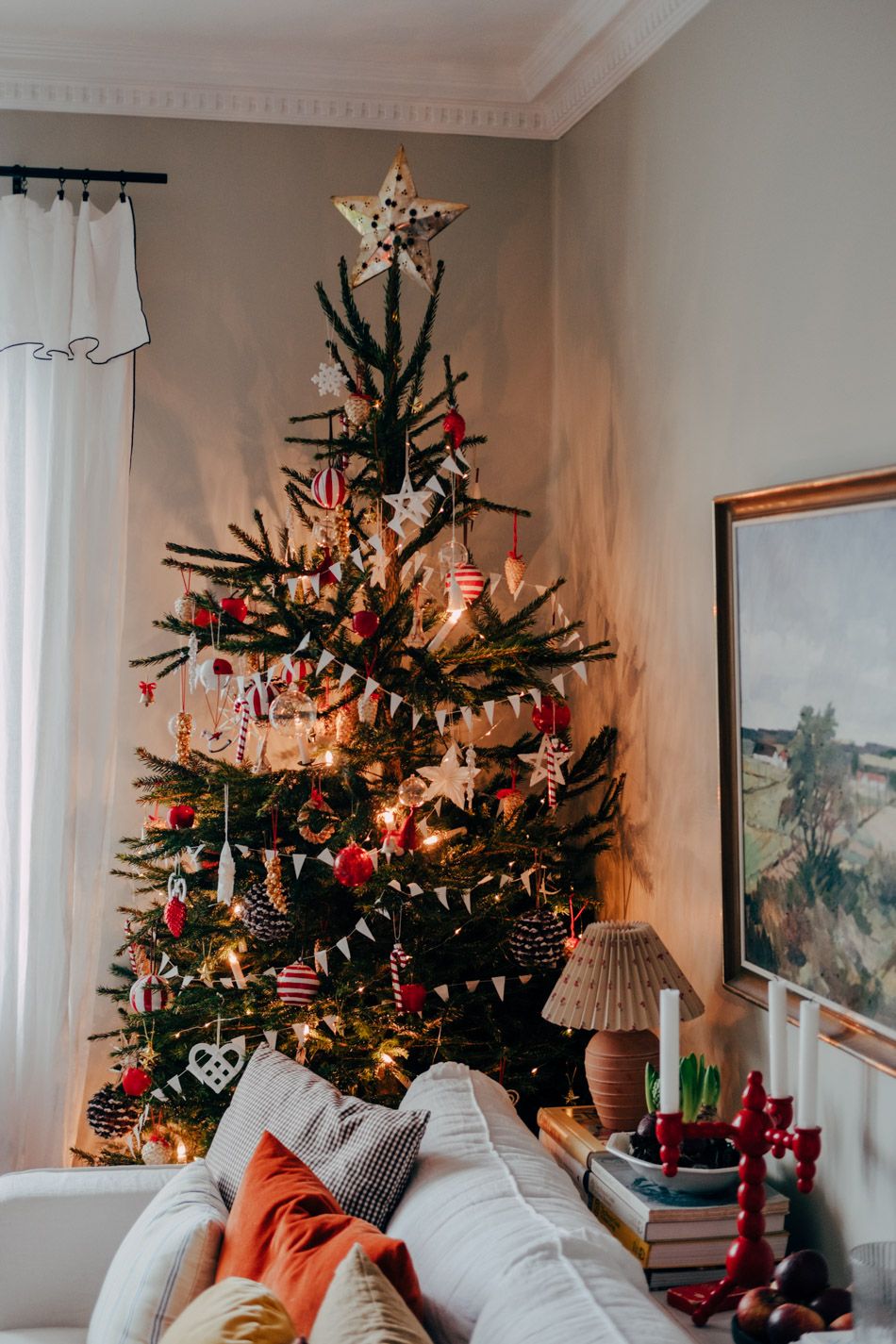
Here’s what this corner actually costs to recreate:
- Tree, 6.5 ft unlit: $60–$180
- String lights and star topper: $20–$45
- Ornaments, striped and solid red, about 60 pieces: $35–$90
- Pennant garland and ribbon: $12–$30
- Skirt or woven basket collar: $15–$50
Total: roughly $142 to $395 — and the star topper is where I’d spend the extra $15.
23. Tartan Ribbon and Ruby Baubles Above the Hardwood
Warm white lights, not cool white — and if your strand has a color switch, warm is usually around 2700K. On a green tree, cool-white LEDs read blue and make red ornaments look muddy in photos. Count your lights too: 100 bulbs per vertical foot is the classic rule, so a 7-foot tree wants roughly 700 lights. Most people use half that and then wonder why their tree looks flat in every December photo.
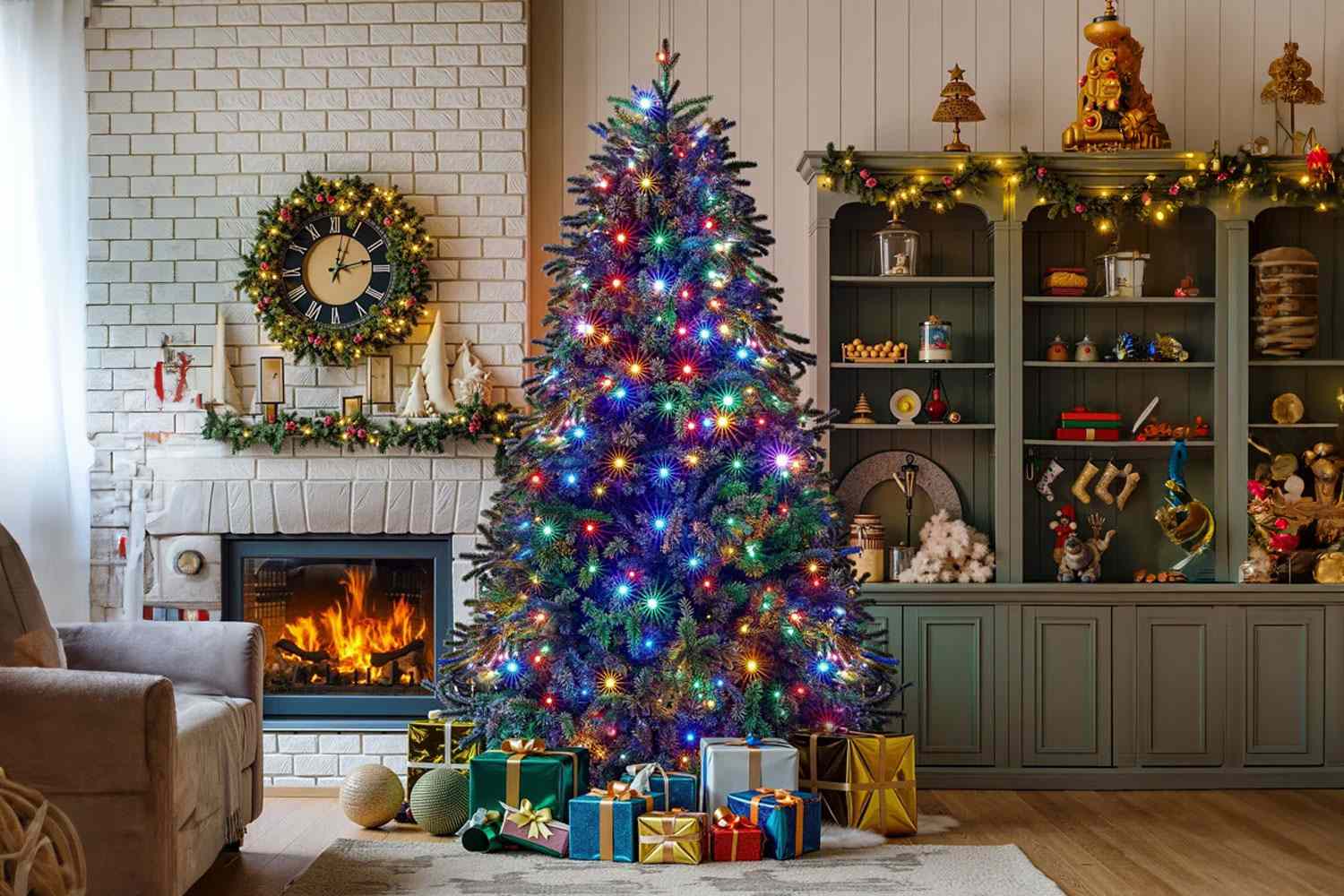
Tartan ribbon is a seasonal item, which means it sells out by the second week of December and comes back in a slightly different shade the next year. If you love a specific plaid, buy extra now. On hardwood floors, put a felt pad or mat under the tree stand — water rings and sap stains are the two most common holiday floor disasters, and both are preventable with a $6 piece of protection you’ll never see.
24. Deep Red Fringe Curtains Framing a Metallic-Ribbon Tree
The deep red curtains are the reason this room feels rich instead of cluttered. They repeat the tree’s red in a second texture — fabric instead of glass — which makes the color feel deliberate rather than accidental. The white built-in bookcase then does the opposite job: it gives all that saturation somewhere neutral to sit against. And the large blue and white vase is the wild card that keeps the whole thing from looking like a catalog page.
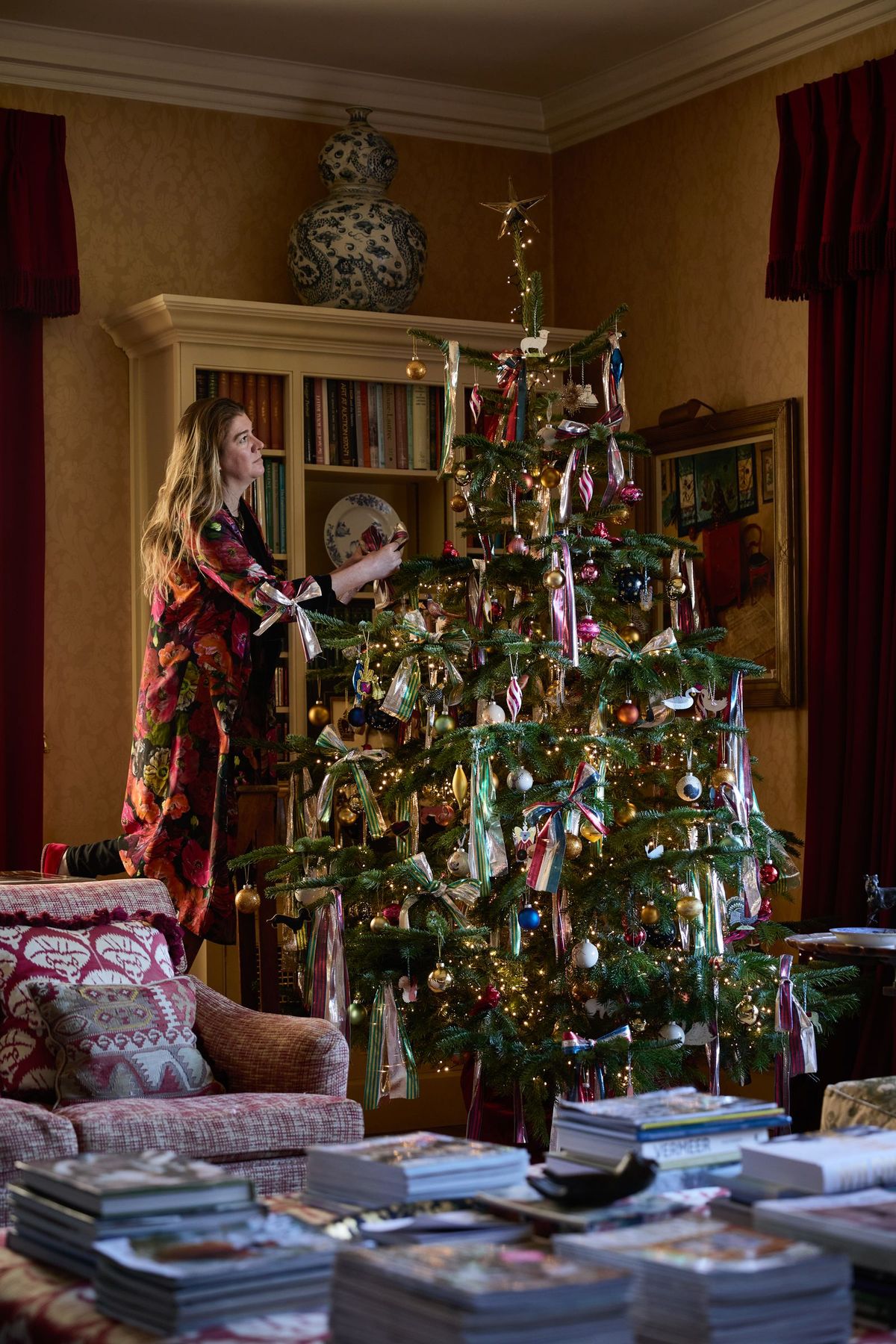
Metallic ribbon takes about 25 minutes to place on a full tree.
- Choose one ribbon width — 2.5 inches works on most trees.
- Cut four strips, each about 1.2 times your tree’s height.
- Anchor each strip at a different point near the top, working around the tree.
- Weave in and out of branches, keeping the ribbon flat rather than twisted.
- Finish by tucking any loose ends behind the lowest branches.
25. Red Roses and Cream Sofas in a Paneled Parlor
Fresh flowers at Christmas is the decor move that’s quietly replaced the themed centerpiece. A vase of red roses next to a lit tree costs about $20 and does something faux greenery can’t — it makes the room feel inhabited. Designers have leaned on this for a few seasons because it photographs beautifully and takes four minutes to arrange. It also signals that the room is for living in, not just looking at through a doorway.
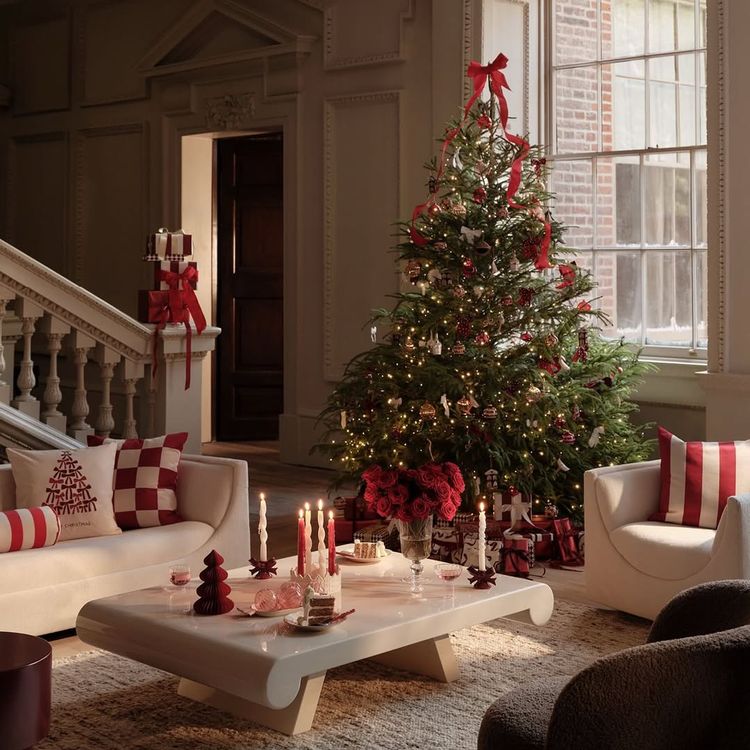
The formula is 60% cream and white from sofas, coffee table, and paneling, 30% crimson across four different materials — ribbon, ornaments, roses, pillows — and 10% dark wood from the floor and trim. That material mix is what keeps the red from going flat. Swap the roses for white hydrangeas and the room reads cooler and far more formal. Compare with Idea #14, where that cooler version is basically what’s already happening.
26. A Candy-Cane Wreath Above the Gray Upholstered Bench
The candy cane on the wreath is one tiny decision that changes everything. Without it, the wreath is just a green circle on a tan wall — fine, but forgettable. With it, the wreath becomes part of the story the wrapped presents and the wooden reindeer are telling. It costs about fifty cents. That’s the thing about this corner: it isn’t minimalist because it’s sparse, it’s minimalist because every single object has a job.
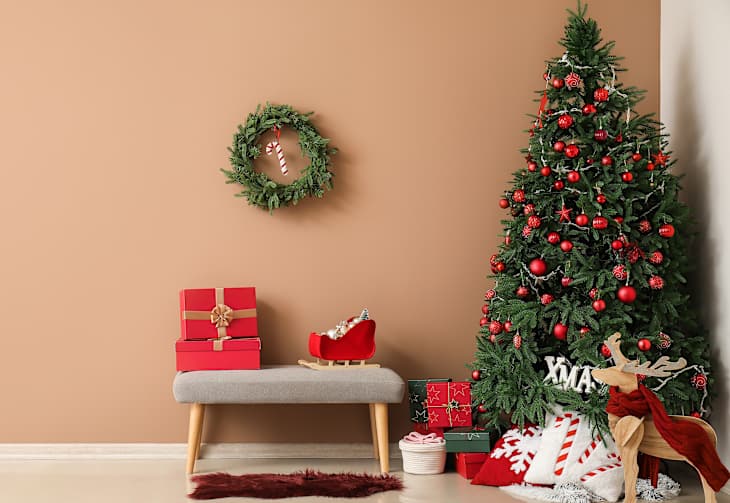
This setup is the most apartment-friendly look in the whole list. It works in a space as small as 6 by 8 feet, as long as you keep the tree under 6.5 feet and mount the wreath no more than 30 inches above the bench. The bench itself needs about 40 inches of wall. If your entry is narrower than 4 feet, drop the bench and hang the wreath above a slim console — see Idea #22 for how a tight corner handles a full-size tree.
27. Red Pom-Poms and Pink Stars on a Snow-Flocked Tree
Pom-pom garland takes about 45 minutes and costs roughly $12 to make.
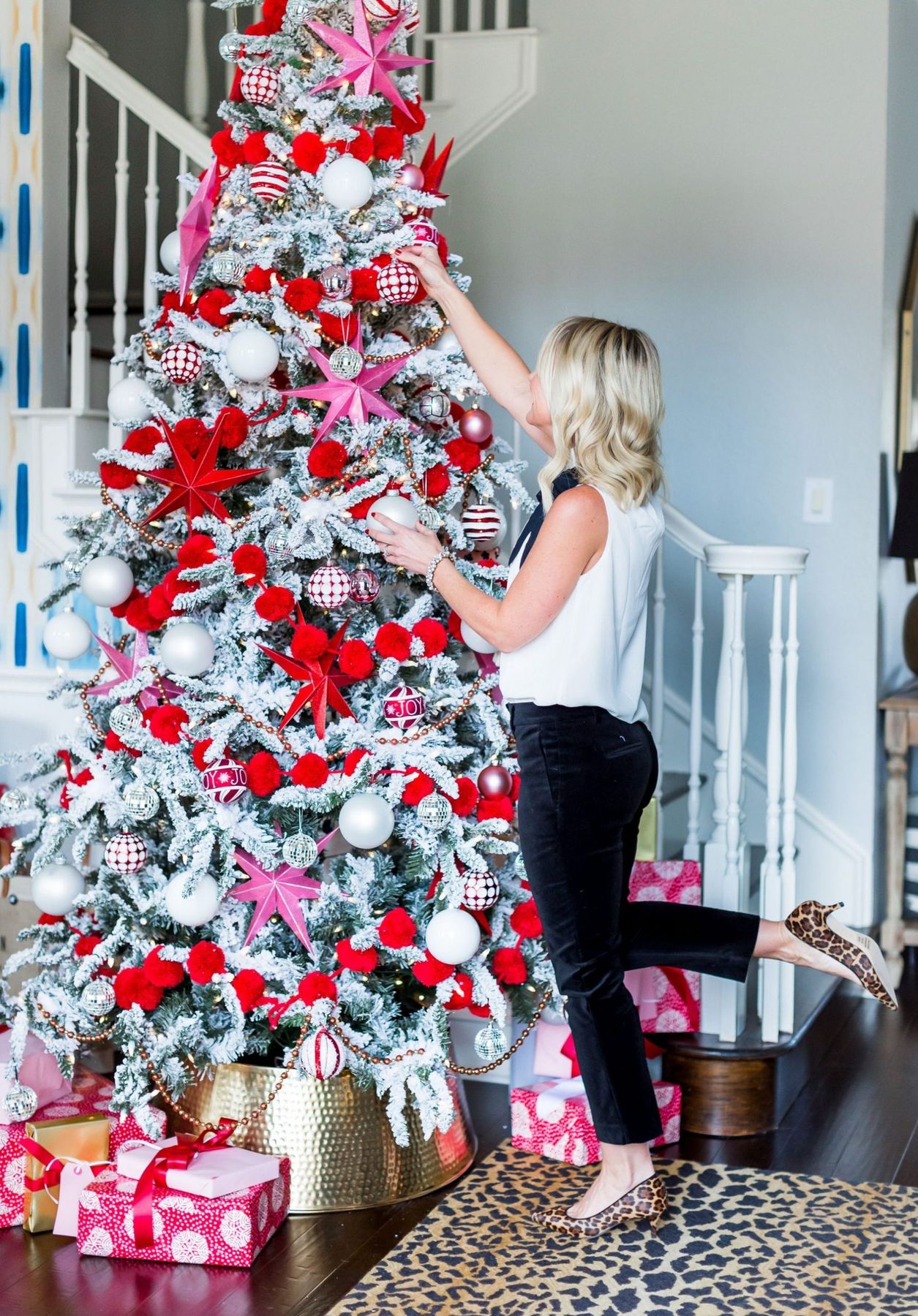
- Buy 2-inch pom-poms in red — about 60 for a 7-foot tree.
- Thread a long needle with fishing line or thin twine.
- Push through each pom-pom center, spacing them 4 inches apart.
- Tie a loop at each end and drape in loose swags across the branches.
- Fluff each pom-pom by rolling it between your palms.
Skip pre-strung pom-pom garland at $25 a strand. A bag of 100 red pom-poms runs about $8 at a craft store, and fishing line is $3. The hammered gold tree collar is the one piece genuinely worth buying — it’s what keeps a flocked tree from looking unfinished at the base. Collars generally run $30 to $60, or you can spray-paint a plain metal drum from a thrift store for about $12 total.
28. Navy Blue Mixed Into Red Baubles and Tied Bows
Adding navy to a red-and-green tree is a small risk with a big payoff. Blue sits right next to green on the color wheel, so it deepens the tree’s cool tones while letting the red pop harder. It also echoes the grey armchair and the stone fireplace, which keeps the whole room in one temperature family. Too much blue and it turns patriotic — about 10% of the total look is the sweet spot.
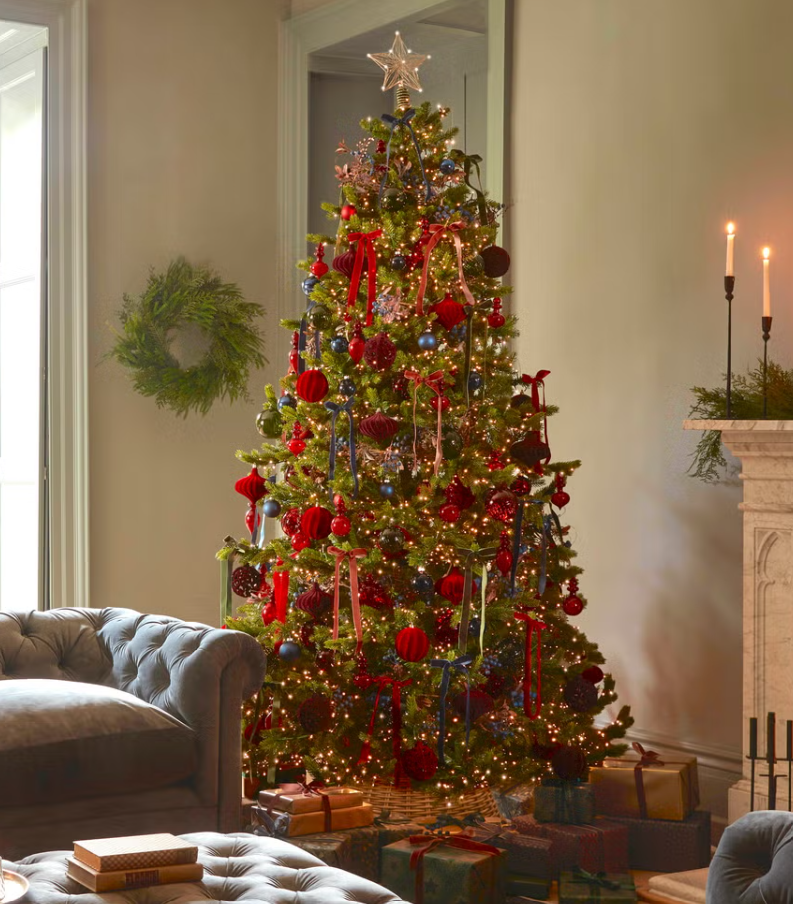
Tied ribbon bows are lovely and also the first thing to sag. If you’re tying them onto branches, use wire-edged ribbon, tie a double knot, and trim the tails on a diagonal so they don’t fray. Real candles on a mantel are a genuine hazard with greenery nearby — battery pillars with a remote cost about $25 and look convincing from across the room. The tufted armchair, meanwhile, will collect ornament hooks. Check the cushion seams in January.
29. The Bent-Top Tree That Curves Like a Hat
With a bent-top tree, the curve is the star — so resist a topper. Adding a star or angel to a curved top fights the silhouette and makes the whole thing look like a mistake instead of a choice. Instead, cluster your smallest ornaments along the inside of the curve so the eye follows it naturally. Light these trees at 100 bulbs per foot like any other; the curve needs the same density or it reads as a bare hook.
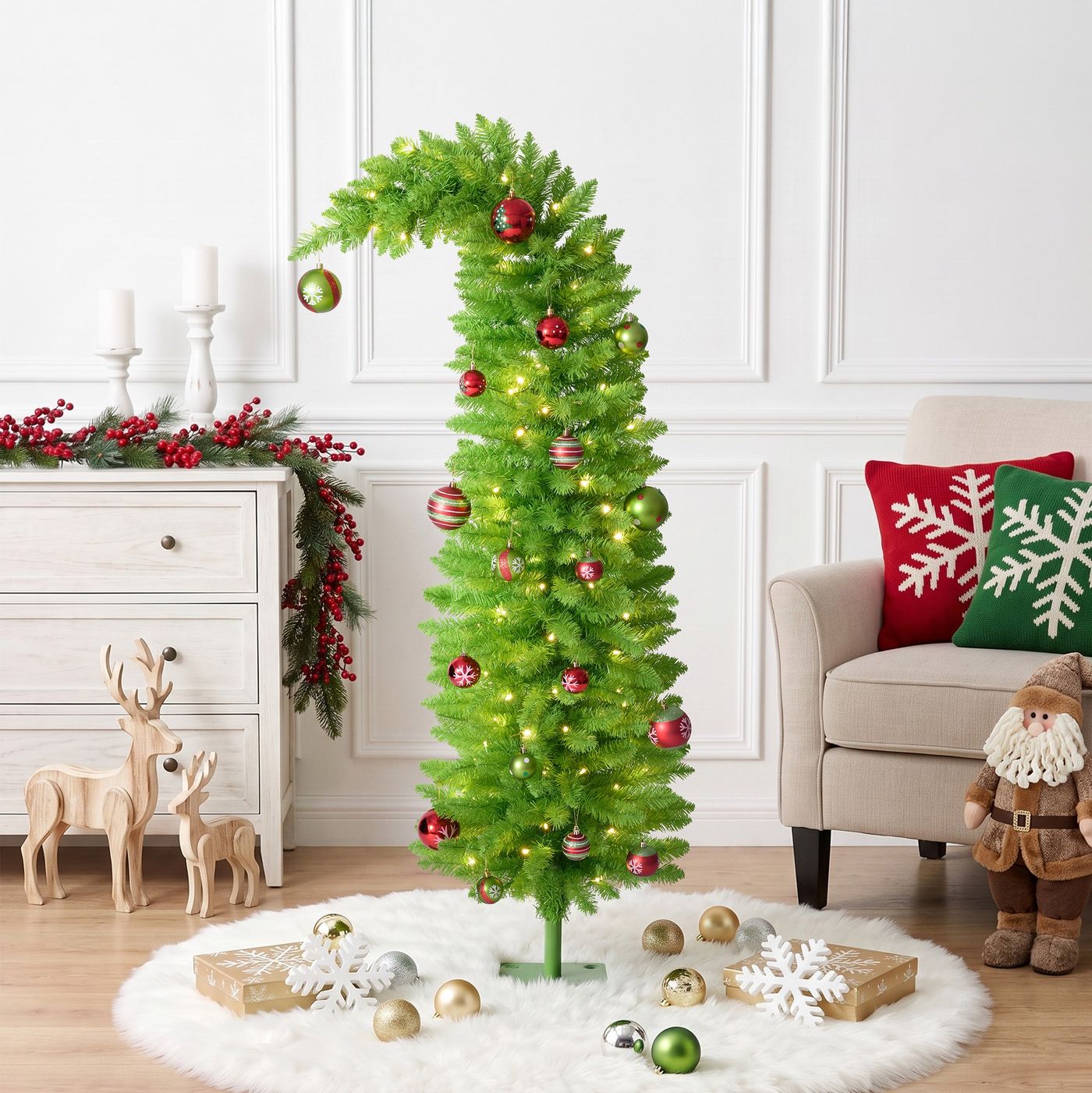
A fluffy round tree skirt is wonderful and permanently full of glitter and pine needles. Shake it out over a trash can before storage and wash on gentle if the care tag allows. Bent-top trees also store differently — most fold down rather than collapsing straight, so keep the original box or measure before buying a storage bag. These novelty trees tend to have thinner branches, so heavy ornaments should sit close to the trunk. Compare with Idea #19, where a fully flocked tree handles heavier ornaments far better for exactly this reason.
30. Buffalo Check Sofa Meets Wooden Snowflake Ornaments
A buffalo check sofa is a commitment piece, and it needs room to be the loudest thing in the room. Give it at least 7 feet of wall and keep 4 feet between it and the tree so the two patterns never touch. This arrangement works in living rooms from 12 by 14 feet upward. In a smaller room, choose the sofa or the tree — not both — and let one pattern carry the space.
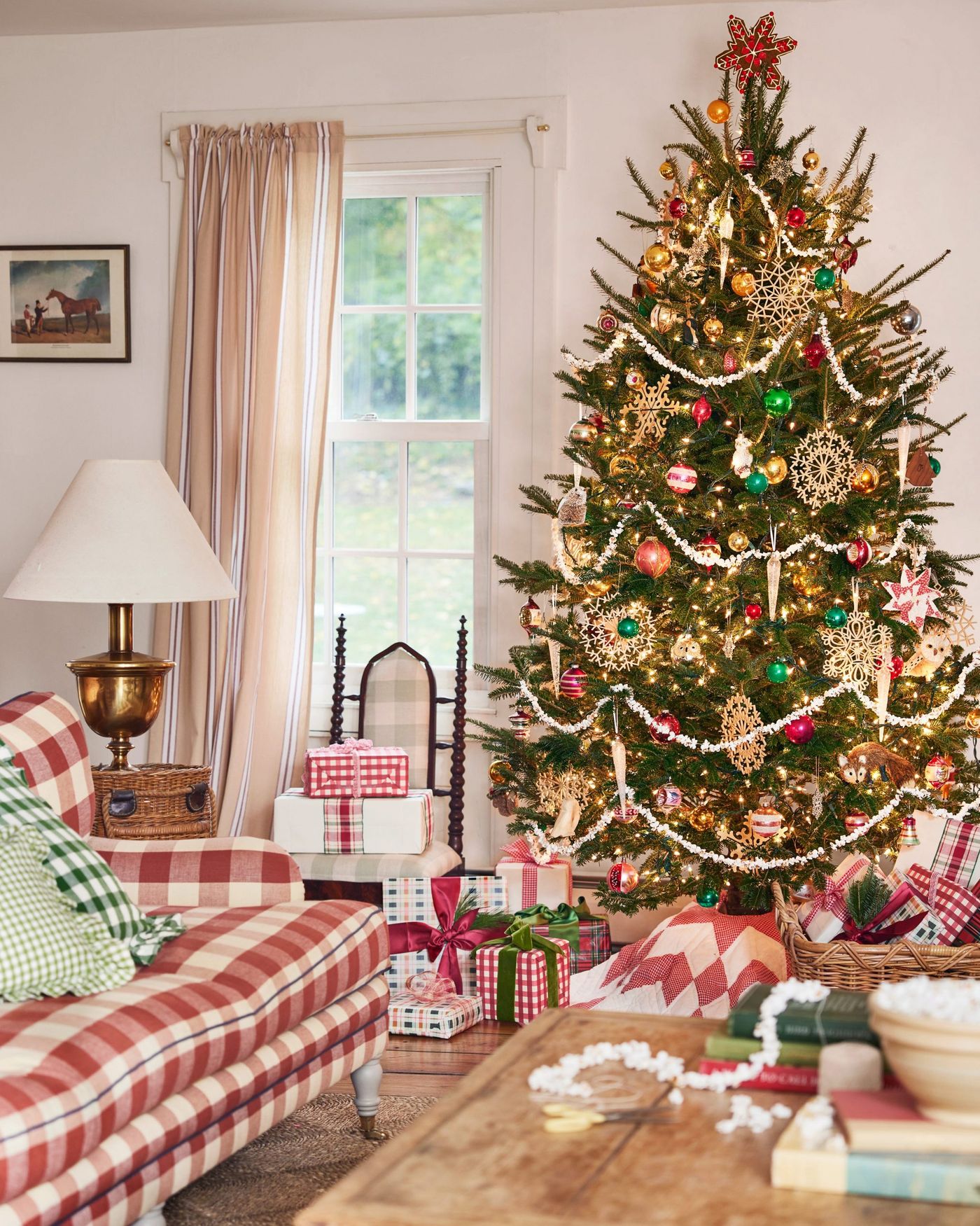
Check these four things first.
- Confirm your sofa fabric is a true red-and-green check, not orange-red, before building the palette around it.
- Measure the gap between sofa and tree — 4 feet minimum for the patterns to breathe.
- Decide on garland material now: popcorn, wooden bead, or both.
- Make sure the brass lamp’s shade reads white, not cream, against the window light.
The wooden snowflake ornaments are what keep this room from tipping into full theme-park. They’re matte, natural, and slightly imperfect, which gives your eye a break from the buffalo check and the glossy red baubles. Remove them and the room becomes a set. Keep them and it becomes a home. They run about $2 each and work on any tree you own.
One Palette, Thirty Trees, Zero Tinsel Regret
You don’t need a bigger tree or a bigger budget — you need one idea to commit to. Pick the palette that fits your room, copy the ribbon trick that matches your patience level, and skip everything else. Red and green has worked for a hundred years because it’s familiar; it works in 2026 because you’re styling it with restraint.
📌 Save this to Pinterest for later — you’ll want to revisit these ideas when December sneaks up on you again.
