
27 Sweet Candy Theme Christmas Tree Ideas for a Magical Holiday Season
Candy-themed Christmas trees are having a serious Pinterest moment right now, and 2026’s version looks nothing like the sugar-slick trees of a few seasons ago. It’s pastel gingerbread houses, heavily flocked branches, and candy canes tied with satin ribbon.
We spent real time combing Target, Etsy, Hobby Lobby, Walmart, and Amazon to bring you the ideas actually worth your December — 27 of them, from about $8 to $240. Inside you’ll find pastel gingerbread whimsy, traditional peppermint red-and-white, frosted flocked elegance, and handmade felt-and-yarn craft, with budget and splurge versions compared side by side.
What’s driving it in 2026 is the soft-nostalgia shift on Pinterest: people want childhood sweetness without the plastic-bright chaos. Think glass ornaments, felt candy canes, and one statement topper doing all the talking.
Some links in this guide are affiliate links, which means we may earn a small commission if you buy through them — at no extra cost to you.
And stay until the end — we break down the most common mistakes that can ruin these looks.
📌 Save this to Pinterest for later — you’ll want to revisit these ideas.
1. Pastel Gingerbread House Ornament in Glass and Glitter
Pastel ornaments need breathing room to read as a collection instead of leftover Easter decor. Cluster them in odd-numbered groups of three or five inside an 18-inch band — the eye finishes a cluster, it never finishes a scatter. On a standard 7.5-foot tree, keep the pastel pieces between 48 and 66 inches off the floor, where the light actually strikes them. Fill everything above and below with matte white or clear glass so the color stays a moment instead of the whole story.
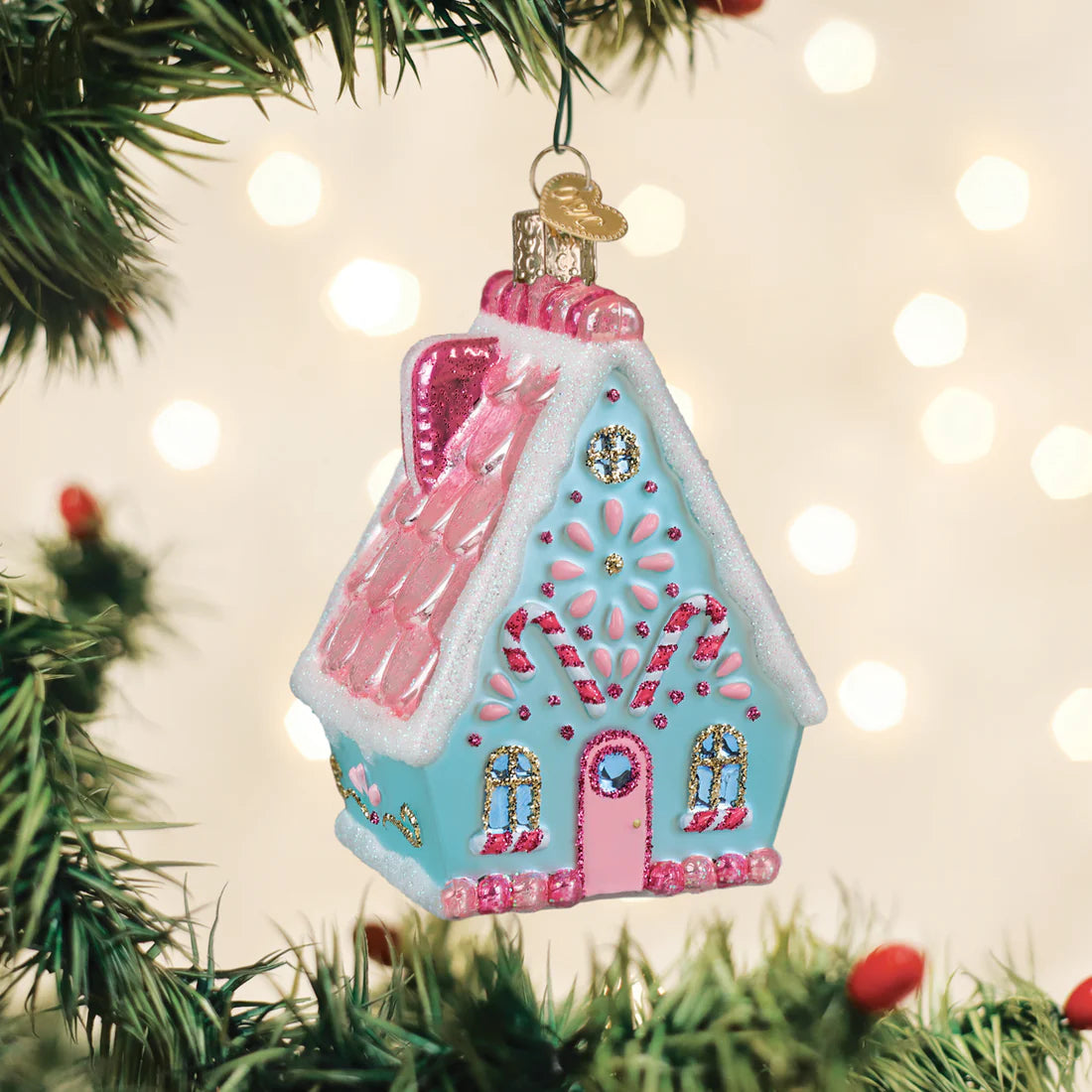
Three things are doing the work here. Temperature contrast comes first: pastel blue and blush pink sit opposite deep evergreen, so the color pops without being bright. Then there’s texture layering — the glass body is smooth, the pink roof is granulated and glittery, and the white snow trim is raised, so one ornament catches the tree lights three different ways. Finally, scale discipline: it’s a miniature, which makes it feel collected rather than mass-produced. Swap the blues for sage and cream and the same formula still holds.
2. An Ornate Santa Doll Holding Gingerbread and Candy
Take away everything but the doll and he’s just a Santa. What makes him a candy-theme piece is the gingerbread snowflake and the red-and-white candy cane tucked into his arms — and honestly, the patterned pointed hat. Traditional Santas wear a plain red cone; this one’s is printed, so the eye reads storybook before it reads Christmas figurine. If you already own a plain Santa, don’t replace him. Spend $9 to $14 on a small gingerbread or candy cane pick and tuck it into his hands or belt. Same effect, ten minutes.
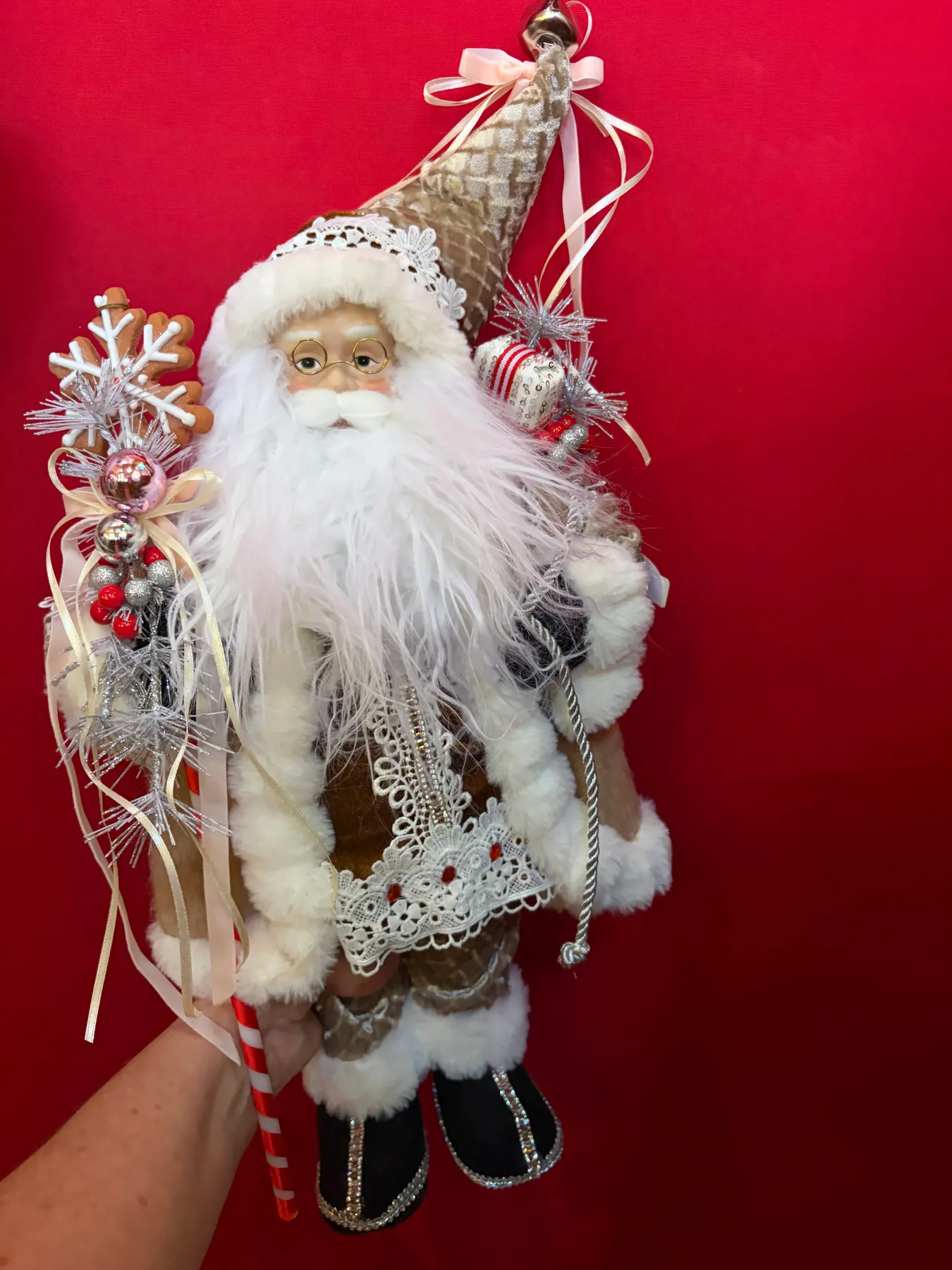
Sculptural Santas and dolls are back in 2026, but reshaped. The last five years ran on minimal, matte, Scandinavian-adjacent holiday decor, and the pendulum is swinging toward detail and craft again — lace trim, silver rope, embellished boots. Pinterest searches for vintage Santa figurines have climbed steadily as people raid grandparents’ attics. The candy angle is what keeps it from tipping into dusty heirloom territory. This one has real staying power through 2028, because handmade figurines don’t date the way plastic novelty decor does.
3. Classic Peppermint: Red, White, and Green Done Right
- Main tree and candy ornaments (candy cane picks, peppermint discs, red and white baubles): $95–$180
- Lighting (clear mini strand set, 300-count): $12–$30
- Textiles (tree skirt, knitted stocking): $20–$60
- Decor and accents (green wire bows, Santa planter, filler baubles): $15–$45
- Paint or wall treatment (none needed — this look lives on the tree): $0
- Total: roughly $142 to $315 for a full traditional candy tree.
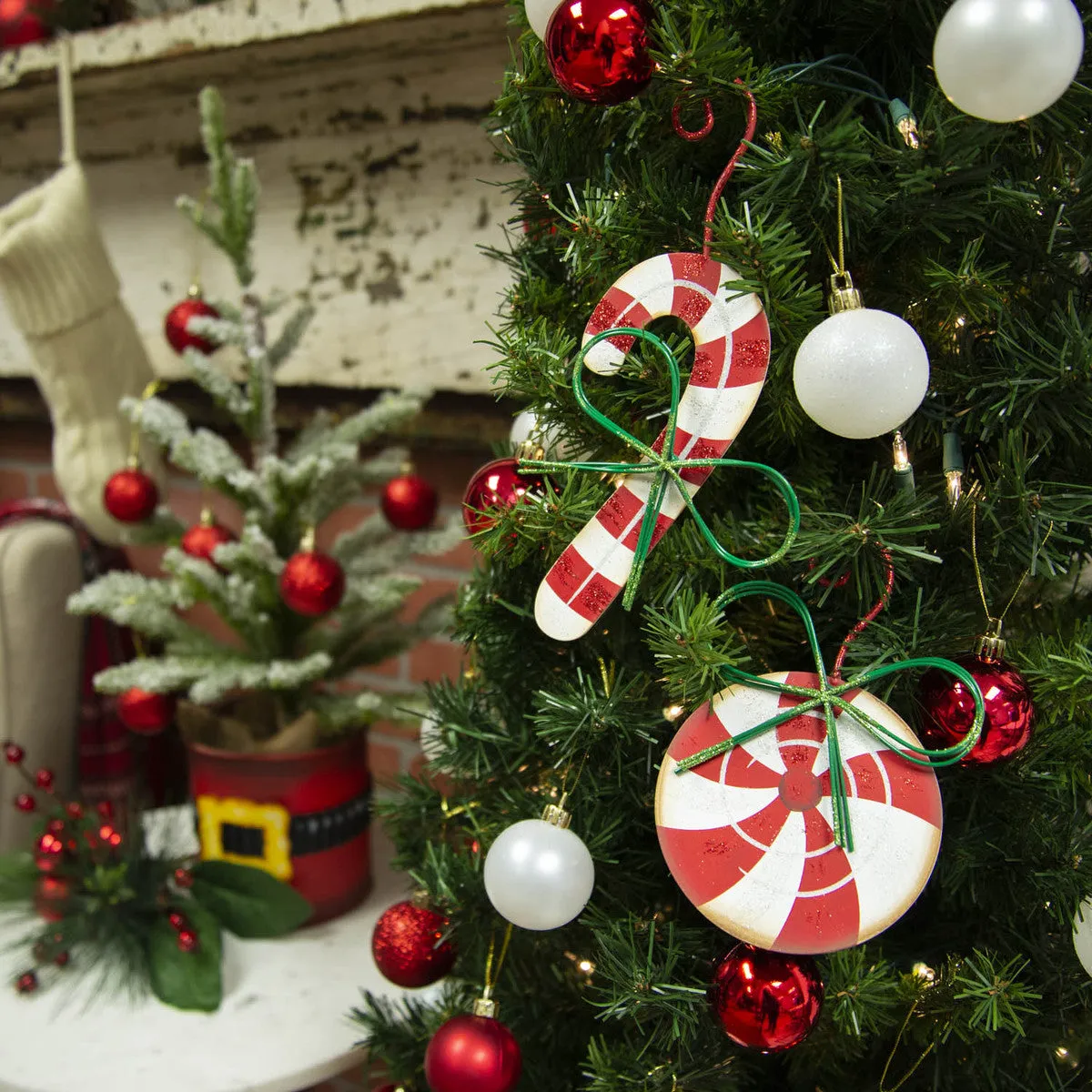
Run the numbers and the formula is simple: 60% green tree showing through, 25% white from baubles, lights, and snow dust, and 15% red. That 15% is where the candy lives — candy cane picks, peppermint swirl discs, and nothing else competing for it. Swap red for hot pink and you get the energy of Idea #4‘s mantel; swap the discs for ribbon candy shapes and you land on Idea #20. Keep the ratio and you can change the whole color story next year without rethinking the tree.
4. A Pink Candy Cane Garland With a Sugar & Spice Sign
A pink garland is gorgeous and slightly high-maintenance in ways nobody warns you about. Glitter picks shed, so if your mantel is dark wood you’ll be wiping it down every few days. Fairy light strands on garland get warm — confirm you’re using LED, not incandescent, and never sandwich them under ribbon. Pink also reads differently depending on your wall: against warm cream it goes peachy, against cool gray it goes bubblegum. Tape a ribbon swatch to the wall and look at it at night before you commit to 20 feet of it.
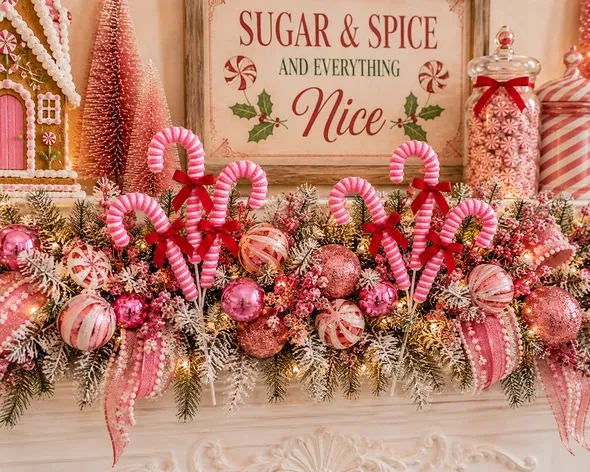
Garland looks store-bought when it’s a single rope. The fix is what stylists call picking — pushing short stems of candy cane picks, berry sprays, and ribbon clusters into the garland at a slight downward angle, roughly every 10 to 12 inches. Use a 4:1 ratio: four plain evergreen inches for every one pick. Twist each pick’s wire around the garland spine, not the outer branch, because branches move and spines don’t. Shift alternate picks forward and back so the whole thing reads three-dimensional instead of flat.
Frosted and glittered garland is a dust magnet. Plan on a two-minute pass with a hairdryer on cool every week through December, and store it in a breathable cotton bag rather than a vacuum-sealed bin — trapped moisture is what turns flocking yellow. Real evergreen is a different animal: expect needle drop within 10 to 14 days indoors, and keep it away from heat vents. Faux frosted garland at $25 to $45 holds for years. Replace it once flocking starts flaking onto your hands.
5. The Glitter-Dipped Candy Cane Close-Up
The spiraling white string is the entire trick. Strip it away and you’ve got a red glitter candy cane — the exact ornament hanging on a million trees. That wrapped thread is what makes it look handmade, and it’s what breaks up the glitter so the light reflects in broken flecks instead of one flat sheet of shine. If you’re DIYing it, use cotton butcher’s twine and wrap counter to the cane’s curve. Counter-wrapping is what creates the spiral shadow. Ten minutes per ornament, roughly $0.60 each.
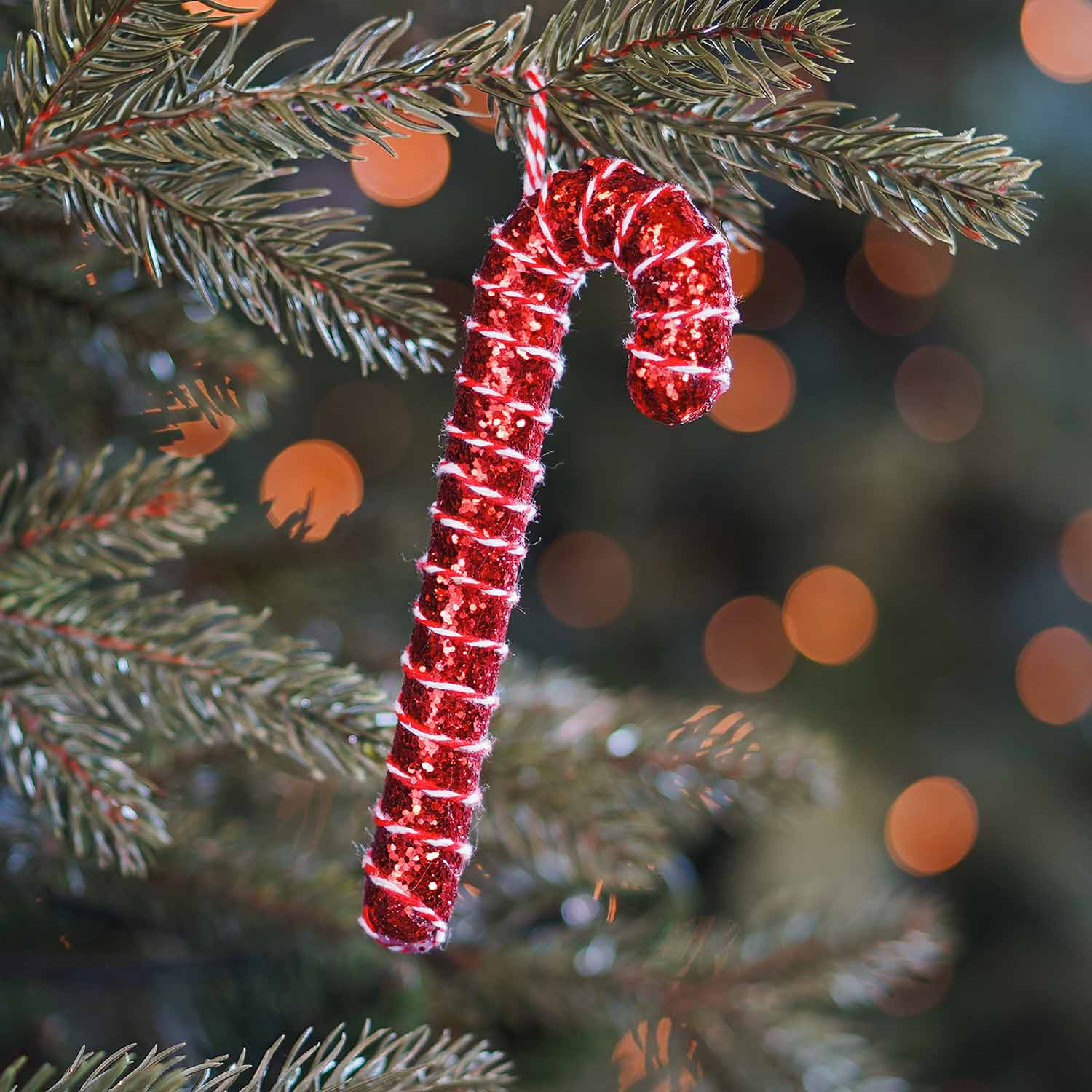
Single-ornament styling like this works best on trees 6 to 8 feet tall. Below 6 feet, a candy cane longer than about 7 inches starts to dominate its branch. Above 8 feet, go up to 9 inches or it disappears entirely. Ceiling height matters less than the tree-to-ceiling gap: leave at least 6 inches of clearance above the top so a topper can breathe. In a room under 100 square feet this tree feels dense — see Idea #18 for a tabletop version that keeps the same candy feel in tight corners.
6. Gingerbread Men and Lollipop Discs in a Black Planter
You don’t need a designer planter for this. A basic black tapered pot from Walmart runs $12 to $20, and a bundle of mixed evergreen branches from a tree lot’s discard pile is often free — just ask. Add red berry sprays at $6 to $10, then cut your own gingerbread men from craft foam or stiffened felt (about $8 for a sheet bundle) and paint lollipop discs onto round wood blanks. Total: $35 to $50 for the whole look. Facebook Marketplace is also full of abandoned pots every January, if you can wait a season.
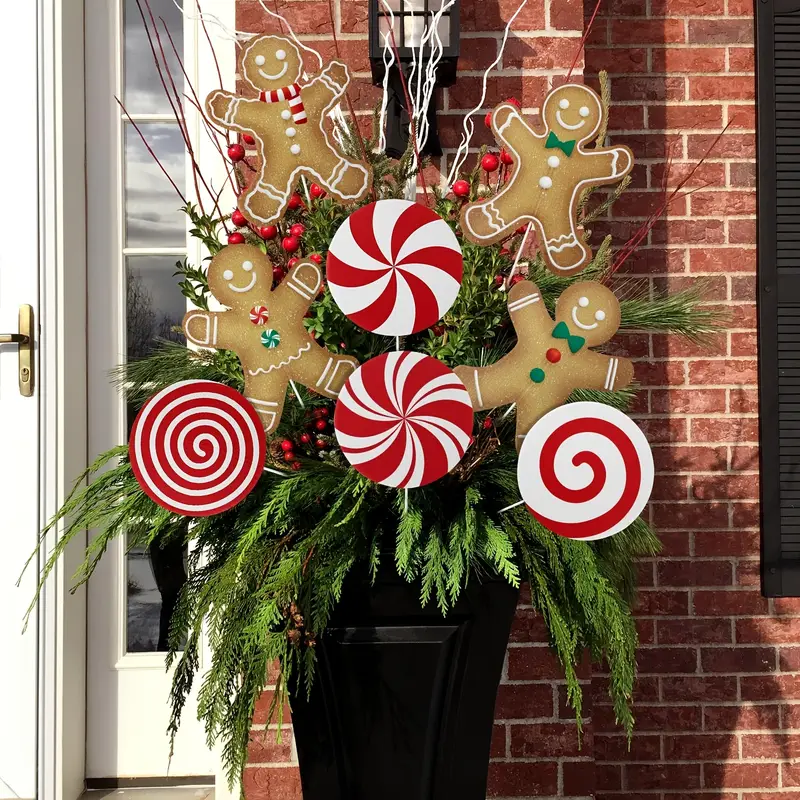
What makes this read festive rather than cluttered is that the greens do the heavy lifting. There’s a solid mass of evergreen and berries first, and the gingerbread men and lollipop discs sit on top like garnish. Flip that ratio and you get a craft-store explosion. The white-painted branches are doing quiet work too — they pick up frost and snow and give the arrangement a value range beyond green, which is what stops an outdoor pot from becoming a dark blob at dusk.
Outdoor candy decor has one enemy: moisture. Felt and paper cutouts will sag and bleed within a week of rain. Seal anything porous with two coats of matte clear spray, about $8 a can, which covers a whole pot’s worth. Anchor pieces with a 12-inch length of 14-gauge floral wire pushed into the soil rather than tucked into branches. And if the pot sits under a porch overhang, check it won’t tip — a 14-inch pot needs roughly 12 pounds of base weight.
7. The Gingerbread-Hatted Nutcracker on Soft Pink
- Gather bottle brush trees in two or three heights — pink and frosted green read best together; a mixed set of six runs $14–$22.
- Base-coat a thrifted nutcracker ($5–$15) in soft pink spray paint, two light coats 20 minutes apart.
- Glue a small gingerbread house cutout to the crown as a hat — foam or balsa, about $3.
- Arrange on a tray or cake stand, tallest in back, and tuck artificial snow around the bases.
- Light from below with a warm LED puck light, $8, so pastel paint glows instead of flattening.
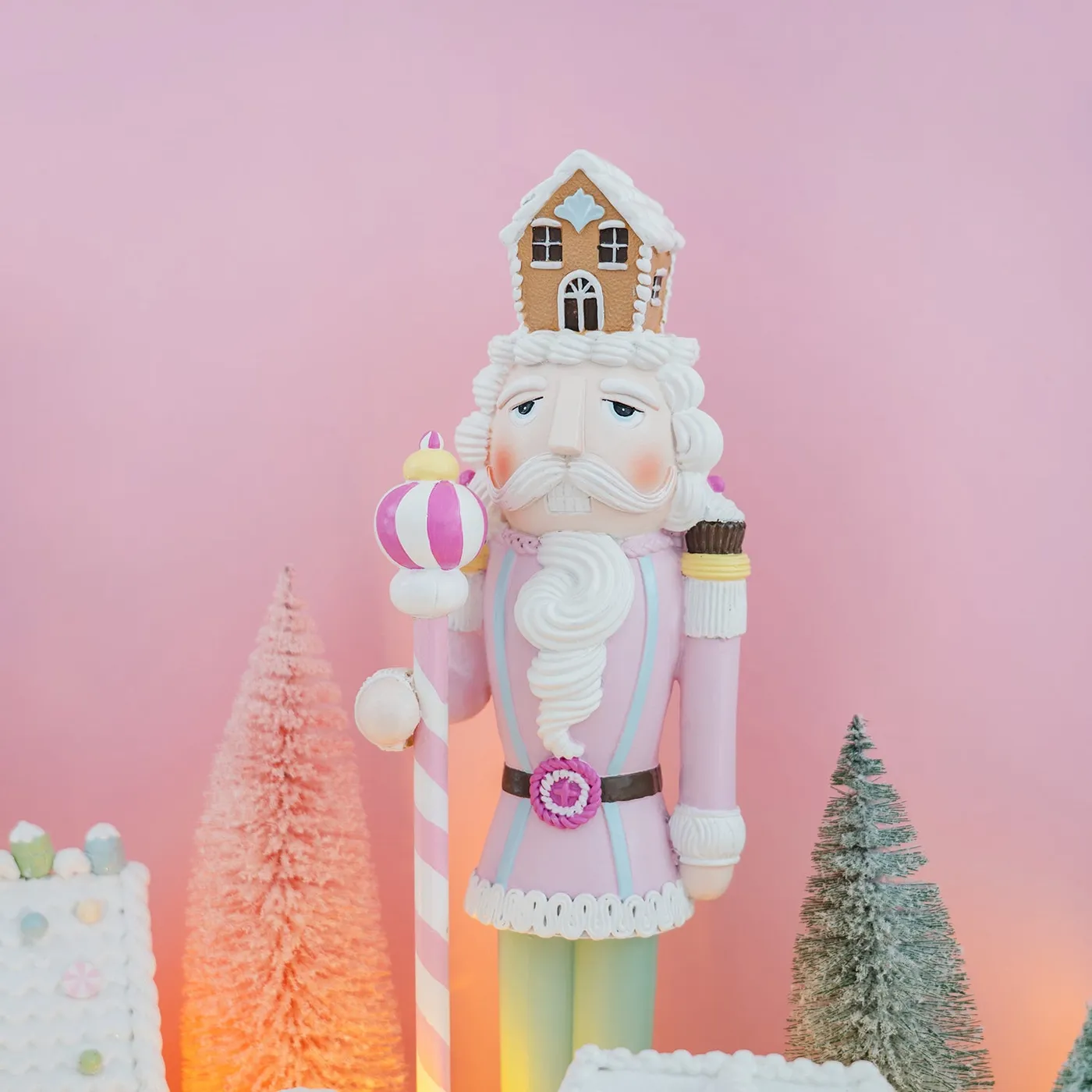
Roughly two hours of work and $35 to $55 in materials, most of which you’ll reuse next year.
Pastel Christmas got dismissed as a 2020 fad and refused to die, which is usually the sign of something with legs. What changed in 2026 is the palette — it moved from candy-bright pink and mint into dustier, food-inspired tones: buttercream, strawberry milk, pistachio. That shift makes it work in adult homes instead of just nurseries. This nutcracker is the perfect example: a traditional silhouette wearing a new costume, which is why it photographs so well next to a classic red-and-green tree.
Pastel decor is unforgiving in bad light. Pink, mint, and cream all sit in a narrow value range, so under a single warm bulb they collapse into one flat wash of beige. If your shelf has no light source of its own, add one — a warm LED puck or clip lamp at 2700K. Be honest about kids and pets, too: spray-painted figurines chip, and this paint chips white, which is very visible. Keep the nicest pieces above 4 feet and use the already-scuffed ones below.
8. Pastel Nutcrackers, Faux Snow, and a Mint Window
Faux snow is the most misused prop in holiday styling. The rule: never cover more than about a third of any base surface, and always build it thicker at the back and thinner at the front. Flat, even snow reads like a craft aisle; uneven snow reads like a windowsill. Use two textures — fluffy batting for volume under the pieces, and a fine glitter-flake for the top layer. A 10-ounce bag at $6 covers a 30-inch shelf. Skip snow near open windows or heat, since it yellows under direct sun.
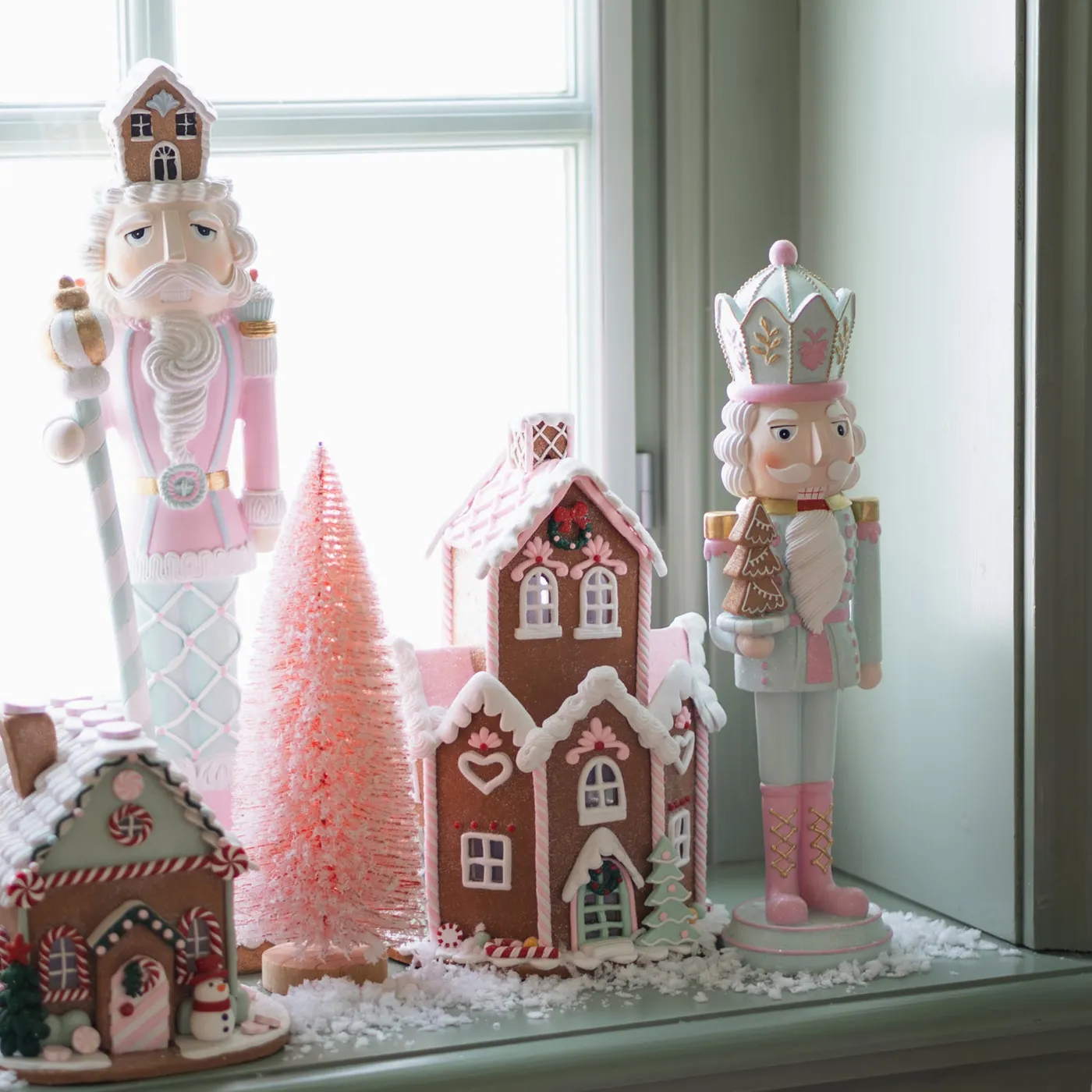
- Figurines and houses (two nutcrackers, three gingerbread houses, one bottle brush tree): $70–$160
- Lighting (warm LED puck or short strand): $8–$25
- Textiles and snow (artificial snow, batting, shelf runner): $12–$30
- Decor and accents (small gold pieces, tray or cake stand): $15–$40
- Paint and touch-ups (pastel spray for thrifted pieces): $8–$14
- Total: about $113 to $269 for a vignette you rebuild every year.
9. One Candy Cane on a Heavily Flocked Tree
The flocking. On a plain green tree, a red-and-white candy cane is one of forty ornaments competing for attention. On a heavily flocked tree, the white branches become a neutral backdrop and the candy cane is suddenly the loudest thing in the frame. That’s the entire reason this composition works. It’s also why flocked trees photograph so beautifully. The trade-off is real: flocking sheds, it’s heavy, and it makes a tree look fuller than it actually is. Go in knowing that.
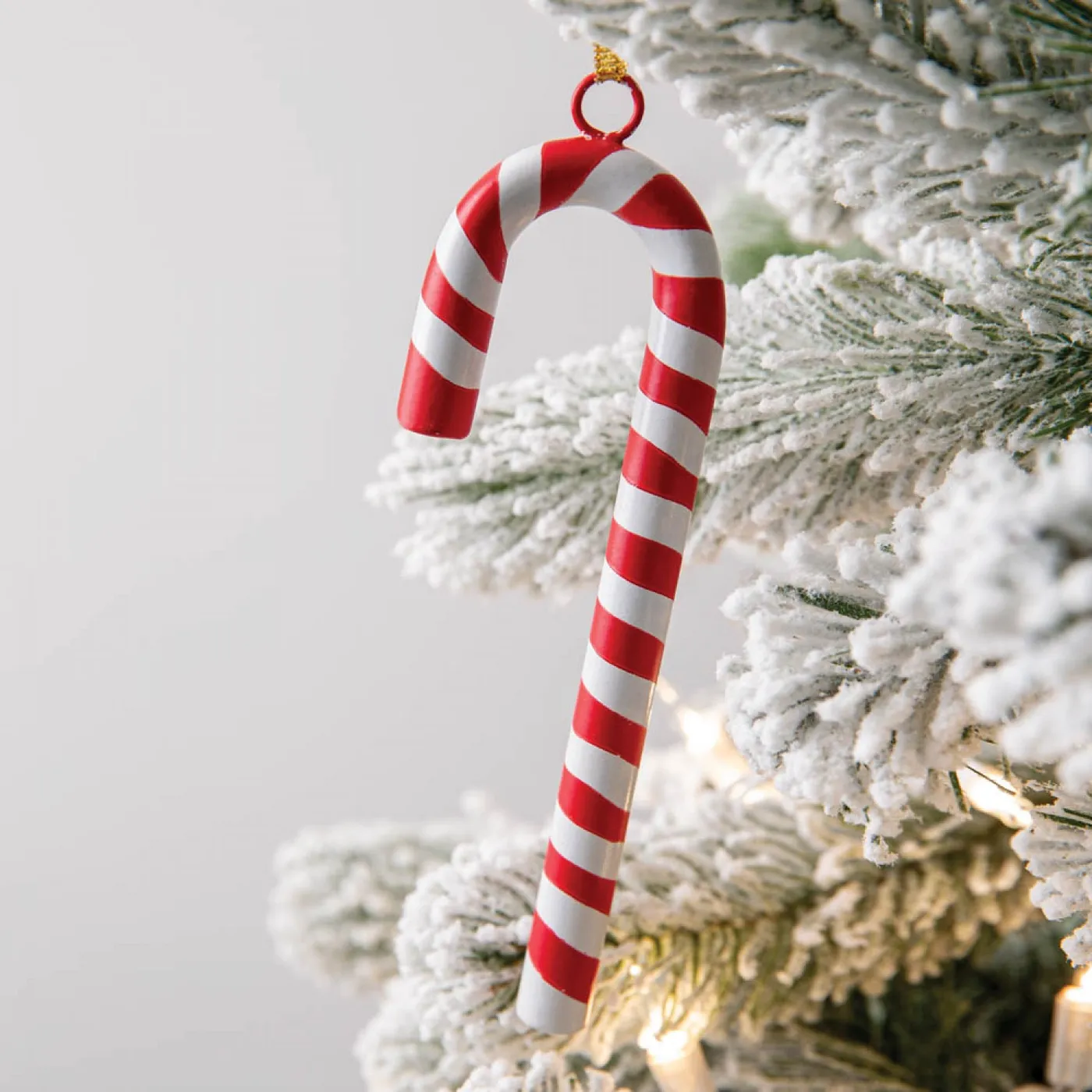
Flocked trees shed. Expect a light dusting of white flakes every time you move a branch, and give the tree a gentle shake over the box before carrying it through the house. Store it standing in a breathable cover if you can, and never vacuum-seal it — compression cracks the flocking. Most quality flocked trees hold their look for three to five seasons, then start dropping noticeably; cheaper ones go in about two. Pre-lit models save the wiring headache, but you’ll pay $60 to $120 more up front for the same silhouette.
Flocked trees read smaller than they are because the white dulls the outline. Practically, that means a 7-foot flocked tree fills a space roughly like a 6-footer — so don’t downsize for a small room or you’ll end up with a stump. Ideal rooms here run 120 to 250 square feet with 8-foot ceilings or higher. Under 8 feet of ceiling, stay at 6.5 to 7 feet and skip the topper or use a flat bow. Compare with Idea #19, which uses full green to hold up beside a bright, snowy window.
10. Before You Start: The Candy Tree Prep Checklist
- Measure your tree’s height and its widest branch spread — ornaments sized by height alone overcrowd a narrow tree.
- Count your outlets. Lights, a topper, and a tabletop display often need three separate ones.
- Pick your candy motifs and cap them at two. Candy canes plus peppermints. Candy canes plus gingerbread. Three or more and it turns into a craft store.
- Check the tree’s base footprint against the floor you’re willing to give up — budget 24 to 36 inches of walking clearance.
- Set a hard spending number before you shop, or you’ll buy a little of everything.
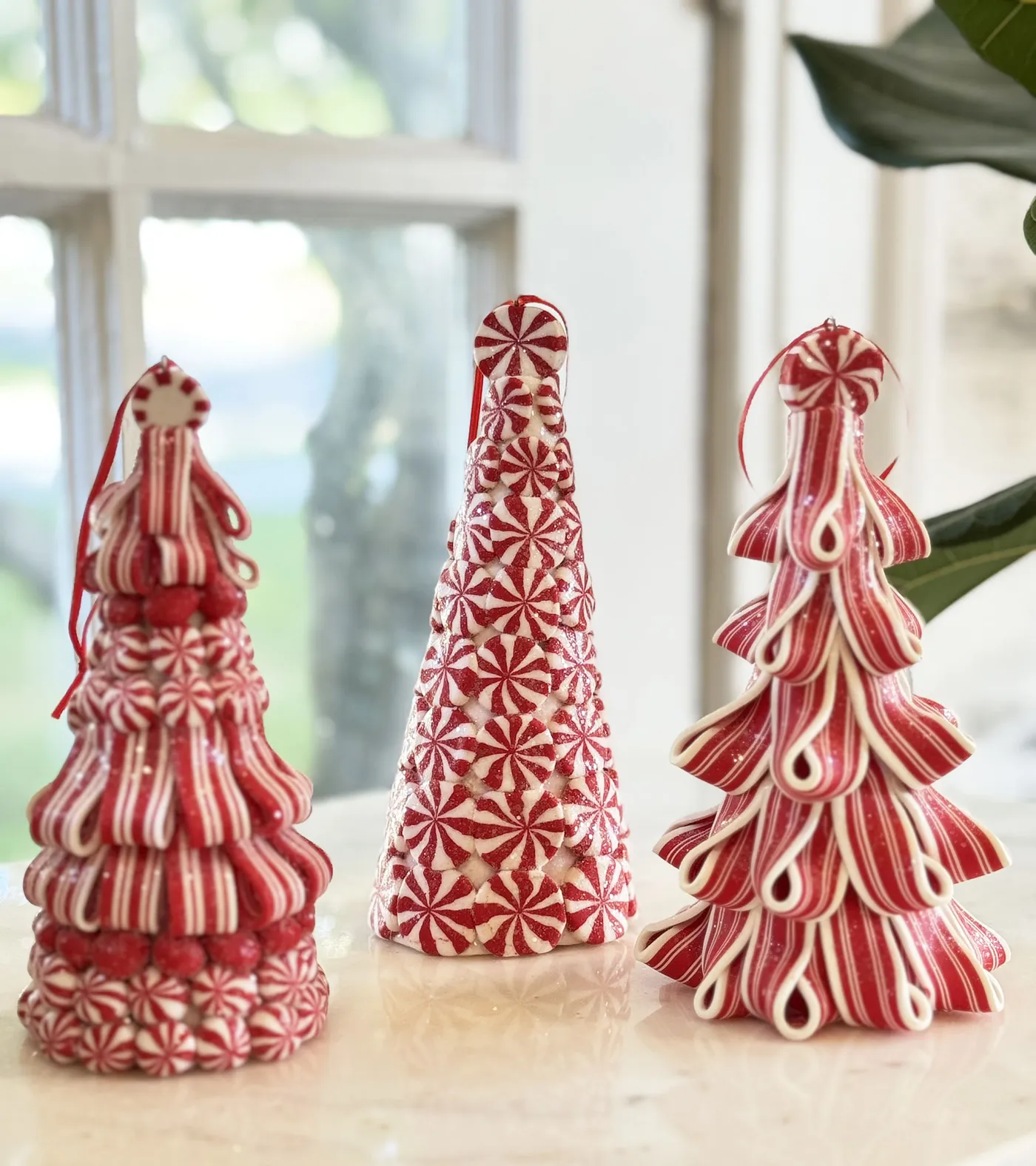
Pick your candy motif by location, not by mood. Entryways and porches can take oversized props because people move past them: giant lollipop discs, foam gingerbread men, big swirls. Rooms where you sit still need small, high-detail pieces — glass ornaments, felt candy canes, crochet. The eye wants more detail the longer it stays. If you’re running one motif in both spots, scale it up 3x for the porch and down to ornament size indoors. Same theme, two jobs.
Here’s the thing nobody says out loud: candy decor is the easiest holiday theme to overshoot. Two motifs and it’s charming. Add gumdrops, lollipops, peppermint swirls, and gingerbread and it stops being a theme and becomes a pile. Also worth checking — if you have toddlers or a determined dog, anything under 30 inches off the floor is going to get licked. Keep real candy off the tree entirely. Sugar attracts ants and wrappers read cheap up close. Faux candy is the whole point.
11. Felt Candy Canes on Spiral Wire Hooks
These are the easiest ornaments on this list to make yourself. A sheet of stiffened felt in white and red runs $1.50 to $3, and one sheet makes six to eight candy canes. Cut half-inch strips, wrap them around a 12-inch pipe cleaner or a length of 16-gauge wire bent into a hook, and hot-glue the ends. Spiral wire hooks come in a 100-pack for about $6, and a $4 bag of small pinecones finishes the branch. Under $15 total. Compare with Idea #15 if you’d rather buy crocheted versions ready-made.
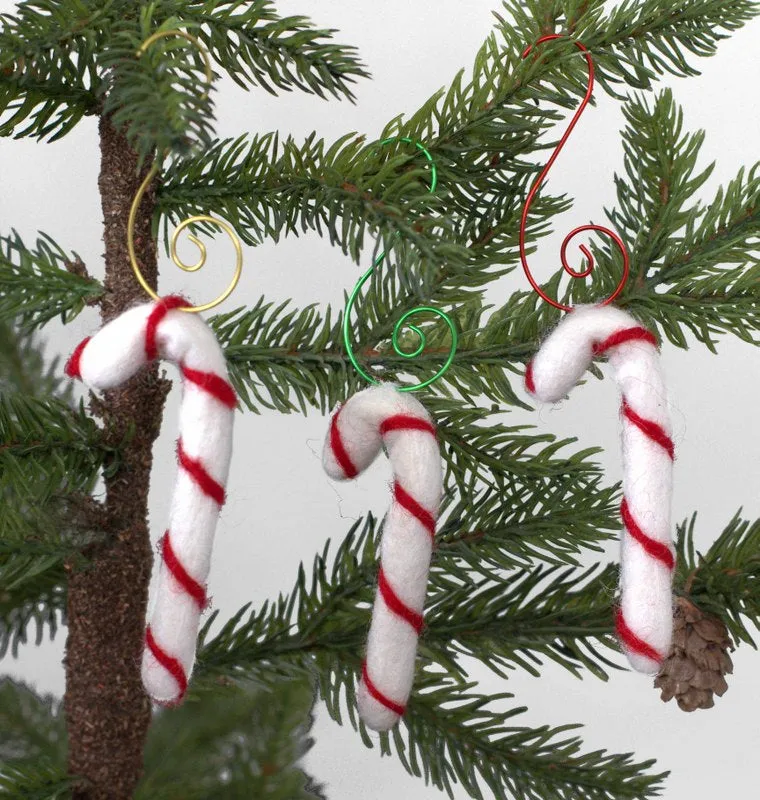
The formula here is 50% white, 30% red, and 20% natural brown. That brown is the piece most people forget — the pinecone is what keeps red-and-white felt from looking like a craft fair. Swap brown for silver glitter and the whole branch shifts modern. Swap it for gold and it warms into traditional. The candy cane shape itself does soft work too: a curved silhouette surrounded by straight needles reads friendly instead of rigid. Repeat the curve three times per branch, and not one more.
12. Blue Patterned Baubles Meet Candy Canes and Tartan
Blue and red is a beautiful pairing and a risky one. Push the blue toward royal and the whole tree goes nautical; keep it deep and slightly dusty and it stays holiday. The real gambit here is the leopard-print tree skirt and the mixed gift wraps — high-contrast pattern play only works when the palette is tight. Swap one ribbon into a different color family and everything unravels. Give yourself a 48-hour cooling-off period before buying any wrapping paper that isn’t already in your three colors.
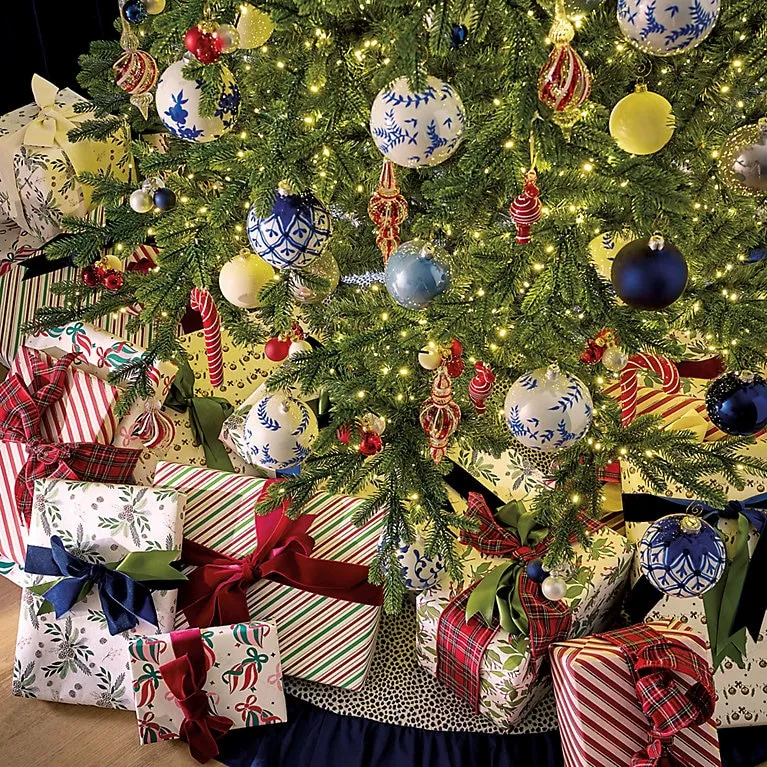
Two principles carry this tree. First, pattern scale variation — the blue-and-white baubles are small and dense, the candy canes are long and thin, and the gift wrap prints are bold and large. Nothing repeats a scale. Second, controlled color: forest green, bright red, snow white, and one deep blue, held to four and no more. The leopard skirt gets a pass because brown and black read as neutrals here. Try the same mix with five colors and it becomes a rummage sale. This is edited chaos, and it’s deliberate.
13. Handmade Felt Santa and Snowman With a Candy Cane
- Cut two Santa bodies from red felt and one beard from white; stack and stitch around the edge, leaving a 1-inch gap.
- Stuff lightly with polyfill — overstuffing makes the shape lumpy, so keep it soft.
- Glue a small candy cane into his hands; a 3-inch piece of striped pipe cleaner works just as well.
- Add a tiny black bead or a french knot for the eyes, then clip a 4-inch red felt bow to the back.
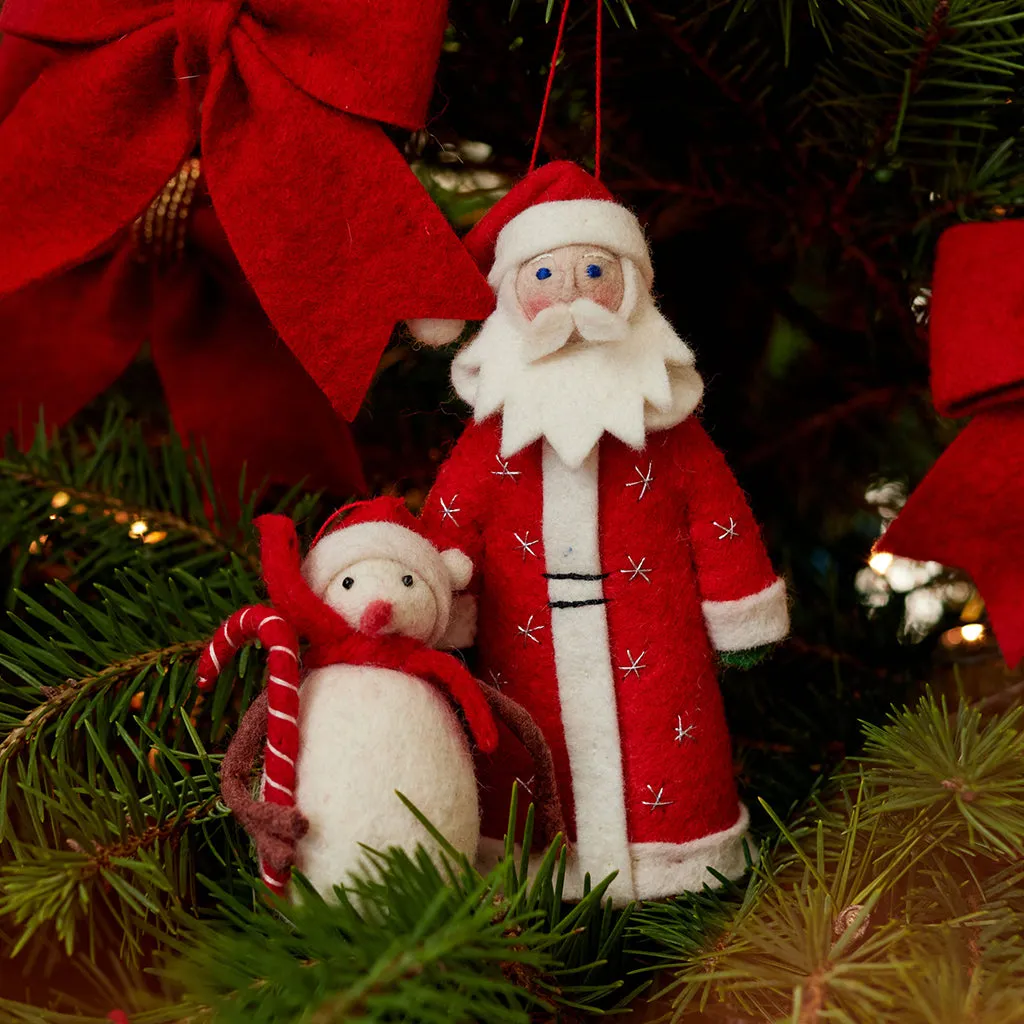
Cost runs $6 to $10 per ornament, and no sewing machine is needed — a hand whipstitch holds fine.
Felt ornaments like these want a tree with visible needle texture, real or high-quality faux. On a 6-foot tree, place them in the middle third, roughly 36 to 54 inches up, where hands and eyes naturally land. Felt disappears above 6 feet. In rooms under 100 square feet, this is your best ornament format: light, unbreakable, and quiet. For a bigger room, see Idea #14, where glitter and metallics give the same candy story enough weight to register from across a large space.
14. Glitter Nutcracker and Ballet Dancer on One Branch
Nutcracker decor is having a genuinely big 2026 — partly because the ballet’s 130-plus-year history makes it evergreen, and partly because glittered versions photograph exceptionally well under warm LED. What’s new is the pairing. Designers are styling nutcracker ornaments next to ballet dancer figures as a set, which turns two separate ornaments into a two-part story on a single branch. It’s a small move with a lot of payoff, and it’s spreading fast across Pinterest boards that mix holiday decor with theatrical themes.
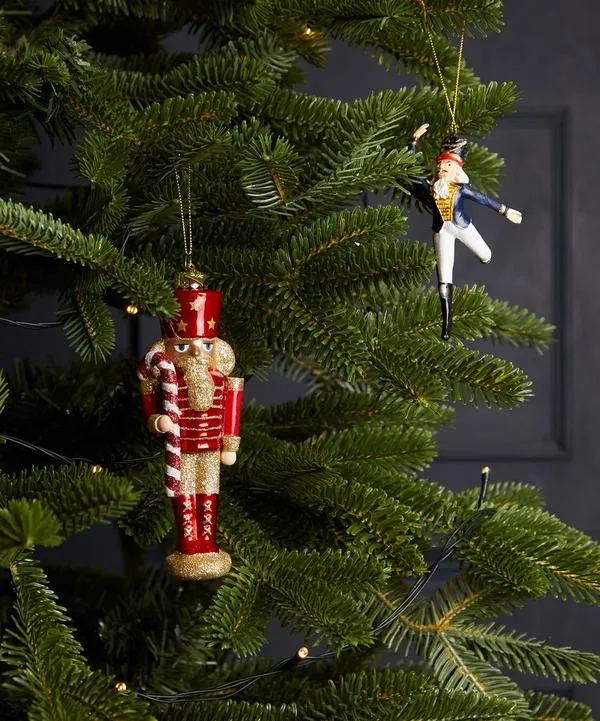
Glitter ornaments need contrast to look expensive. Put them directly against matte foliage or matte ornaments — never beside another glitter piece, or the two cancel each other into a flat sparkly blur. On a tree, that means a matte red bauble above and a matte white below any glittered figure. Also, hang heavy ornate ornaments on interior branches rather than outer tips. A glitter nutcracker runs 4 to 6 ounces and will droop a weak outer branch within a week, which reads sloppy from every angle in the room.
15. Crochet Candy Canes Against Matte Red and Frosted Silver
Matte is the hero. Crochet candy canes are soft and slightly fuzzy, and most people pair them with glossy baubles, which is exactly the mistake. Against matte red and frosted silver spheres, the crochet texture finally registers. Against shiny glass, it just looks dusty. So if you’re buying one thing to make your handmade ornaments look intentional, buy the matte finish. Matte red baubles run $6 to $12 for a set of six, frosted silver $8 to $14. That single swap changes how the whole branch reads.

Crochet candy canes look boutique and cost almost nothing to make. A skein of white cotton yarn and a skein of red runs about $6 total and yields 10 to 14 ornaments. Work a 3-inch tube of single crochet around a 6-inch length of pipe cleaner so the cane holds its curve, then spiral a contrasting yarn stripe and tie off. Add a loop of the same yarn for hanging — no metal hooks required. Thrift stores are also full of handmade ornaments from estate sales, often $1 to $3 apiece.
16. Candy Stripe, Matte Red, and Glossy Gold in a Bowl
Red, white, and gold is one of the safest holiday palettes and one of the easiest to make look cheap, because gold is the variable. Yellow-gold reads discount; champagne, antique, and brushed gold read expensive. If you’re buying online, search for the words champagne or antique gold rather than plain gold. The red velvet ribbon is doing the same job — velvet absorbs light while satin bounces it. A $4 spool of velvet ribbon changes a bowl of ornaments more than a $40 ornament does.

- Choose a bowl at least 12 inches wide — narrower and the ornaments stack instead of pool.
- Line the base with a 20-inch square of velvet or tissue so the bottom layer doesn’t scrape glass.
- Place the largest ornament first at the back left, slightly tilted.
- Fill around it with medium baubles, keeping one gap for a candy-stripe piece to stand vertical.
- Thread velvet ribbon loosely through the top layer so it drapes rather than coils.
Time: about 15 minutes. Cost: $40 to $70 for the whole bowl.
Three values, three finishes, one bowl. The spiraled candy-stripe ornament is the tallest and most textured, so it reads as the focal point even though it’s the same size as its neighbors. The matte red baubles recede because matte surfaces absorb rather than reflect. And the glossy gold ornament picks up room light and acts like a tiny lamp inside the arrangement. One shiny, one matte, one textured — that’s the formula, and it works for a bowl, a mantel, or a whole tree.
17. Yarn Candy Canes With Tassels on Rustic Wood
70% natural, 20% red, 10% green. The cream tassel and the bare wooden surface carry most of this look, and that’s on purpose — the candy cane shape only reads as candy because the surrounding palette is quiet. Move the ratio to 50/25/25 and you’re back to standard Christmas. The nice part is how forgiving this formula is: swap the wood for a linen runner and it goes modern farmhouse, swap the tassel for a bead and it goes boho, and the red and green amounts never have to change at all.
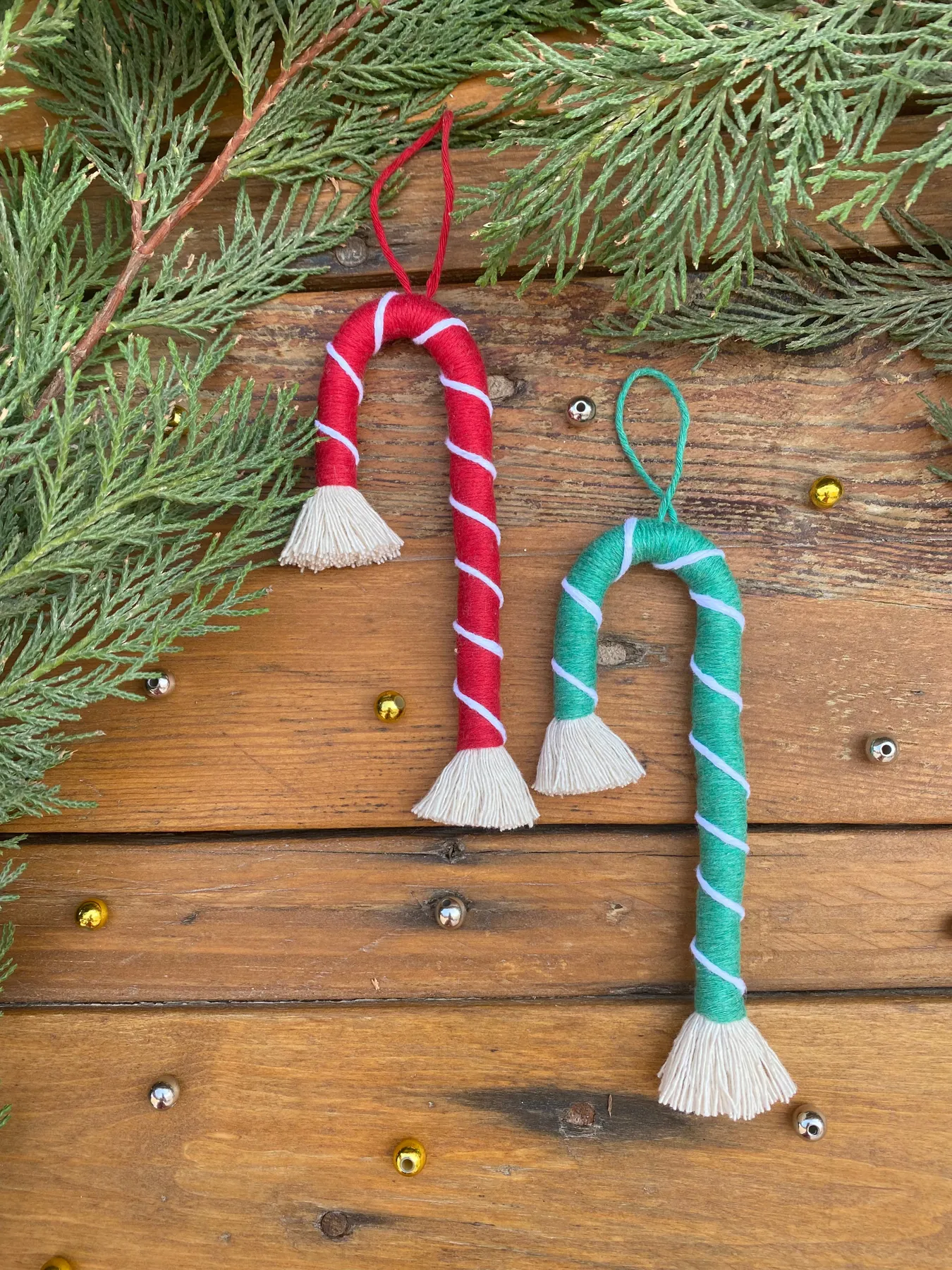
Yarn ornaments attract dust and lint, and they pill. Hand wash in cool water with a drop of gentle soap once a season, press flat between towels, and never wring — wringing stretches the yarn permanently. Red and dark green yarn can transfer color onto light fabrics while damp, so dry everything completely before storing. Tassels especially will frizz after two seasons; a quick trim of the ends with sharp scissors resets them. Store flat rather than hanging, so the pipe cleaner inside doesn’t take a permanent bend.
18. Pink Felt Candy Canes on a Tabletop Pine
Small trees fail for one reason: people decorate them like big trees. On a tabletop tree 2 to 3 feet tall, use ornaments no larger than 3 inches and space them 4 to 5 inches apart — half the density you’d use on a full-size tree. Leave the lower third bare; it’s going into a pot or basket anyway. And flatten your palette hard. Pink and white with one brown accent, as here, reads far more intentional at that scale than a full ornament range ever will.
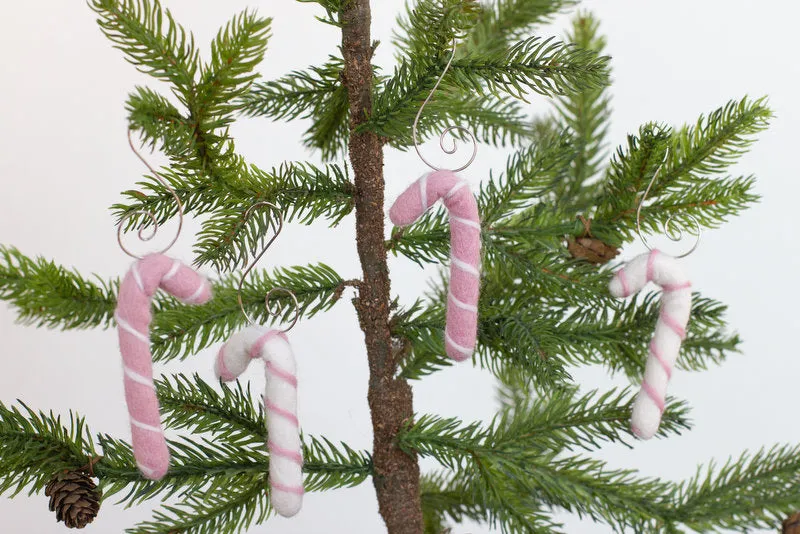
A 2- to 3-foot tabletop tree fits on any surface at least 14 inches wide and needs about 18 inches of clear height above it. That makes it the right call for apartments under 700 square feet, dorm rooms, kitchen counters, and bathrooms. Ceiling height is irrelevant at this size; what matters is walk-by clearance, so keep it out of the path between two doors. For a full-size alternative with the same candy story, see Idea #3 — same red and white, much bigger footprint.
19. Oversized Peppermint Discs by a Snowy Window
Oversized flat ornaments solve a specific problem: they read from across a room. Standard baubles disappear into a tree at 15 feet; a 6- to 8-inch flat disc is legible from the doorway. Because they’re flat, they also don’t push branches out, so a slim tree stays slim. The white sheer curtain behind is doing real work too — it bounces light back onto the tree and gives those red swirls a soft white halo instead of a dark window. That isn’t decoration, that’s lighting.
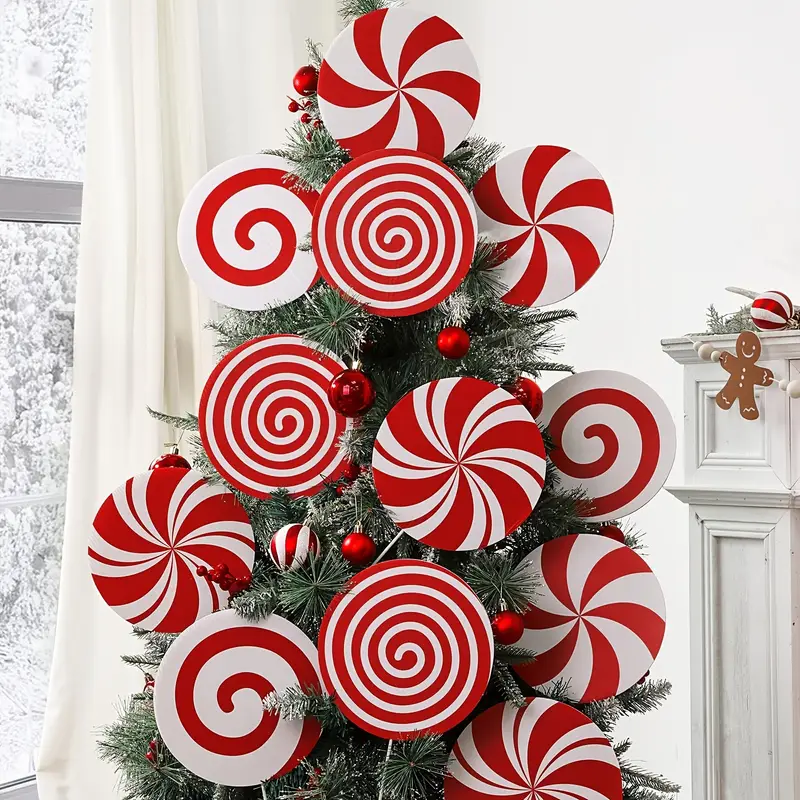
Giant peppermint discs are the easiest candy prop to fake. Buy 8-inch round wood or foam blanks, $12 to $20 for a set of six online, then paint a spiral with acrylic craft paint in red and white — a lazy Susan makes the spiral genuinely easy. Add a pipe cleaner loop with a pin and you’re done. Dollar Tree sells 10-inch foam discs seasonally for $1.25 each. A dozen comes in at $25 to $35 versus $90-plus for commercial versions. See also Idea #23 for the lit outdoor version.
- Attach a 6-inch loop of monofilament or ribbon, not a short hook — long loops let discs lie flat against branches.
- Hang on interior branches only; outer tips can’t hold 5 ounces.
- Place two discs on the same vertical line, 18 to 24 inches apart, to create a column.
- Secure the bottom edge with a clear clip if the disc keeps turning sideways.
Time: 10 minutes. Materials: about $4.
20. The Ribbon Candy Ornament With Wavy Green Edges
It’s the wavy edge that does it. A flat disc would read as a peppermint; a straight-edged ribbon would read as a bow. The scalloped green sides are what make the eye say candy — specifically ribbon candy, the old-fashioned kind your grandmother kept in a dish on the sideboard. That’s a very particular reference, and it’s why this ornament works even on a tree that’s otherwise standard red-and-white. If you’re hunting secondhand, search ribbon candy ornament rather than candy cane. Completely different listing.
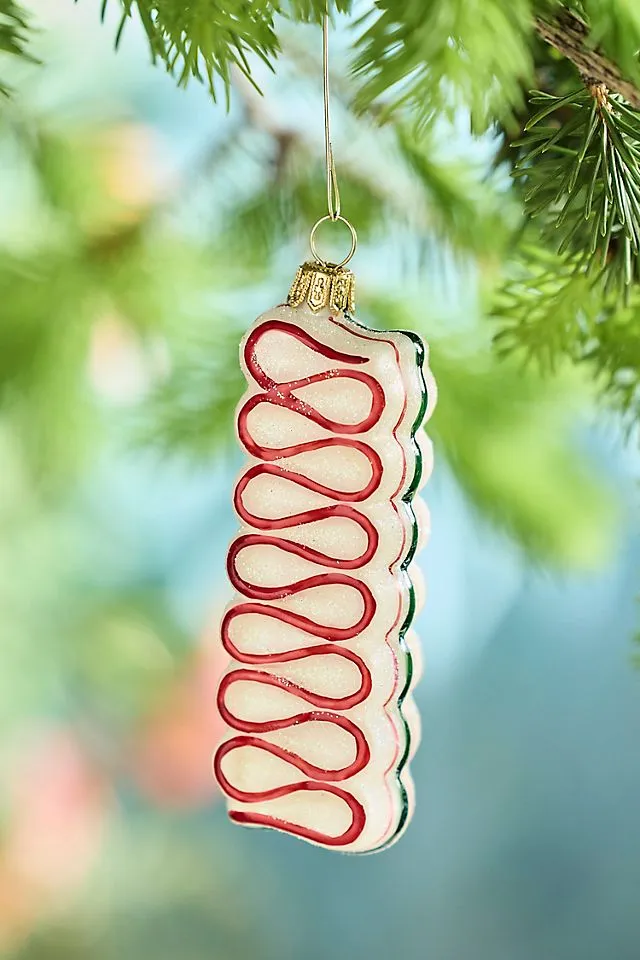
Ribbon candy is having a quiet comeback, and it’s tied to a bigger 2026 trend: nostalgia for specific mid-century objects rather than vague retro. People aren’t asking for vintage Christmas, they’re asking for ribbon candy, glass bird ornaments, and Shiny Brite bulbs by name. Vintage-style glass and plastic ornaments with glitter detailing are selling strongly on resale sites, and new-production versions now run $6 to $12 each. Modern manufacturing keeps them from becoming collector’s items, which is good news for anyone who actually wants to use them on a tree.
21. A Glitter Paw Print Ornament in Silver and Gold
Personal ornaments work best when they match the tree’s material language instead of standing apart. A glittery silver paw print on a tree full of glittery silver and gold reads as part of the story; the same ornament on a matte felt tree looks like a souvenir. If you’re adding a pet or baby ornament, match the finish — glitter with glitter, matte with matte — and give it a slightly larger ribbon so it’s findable. A 1-inch white satin ribbon at $3 a spool beats the flimsy gold cord they ship with.
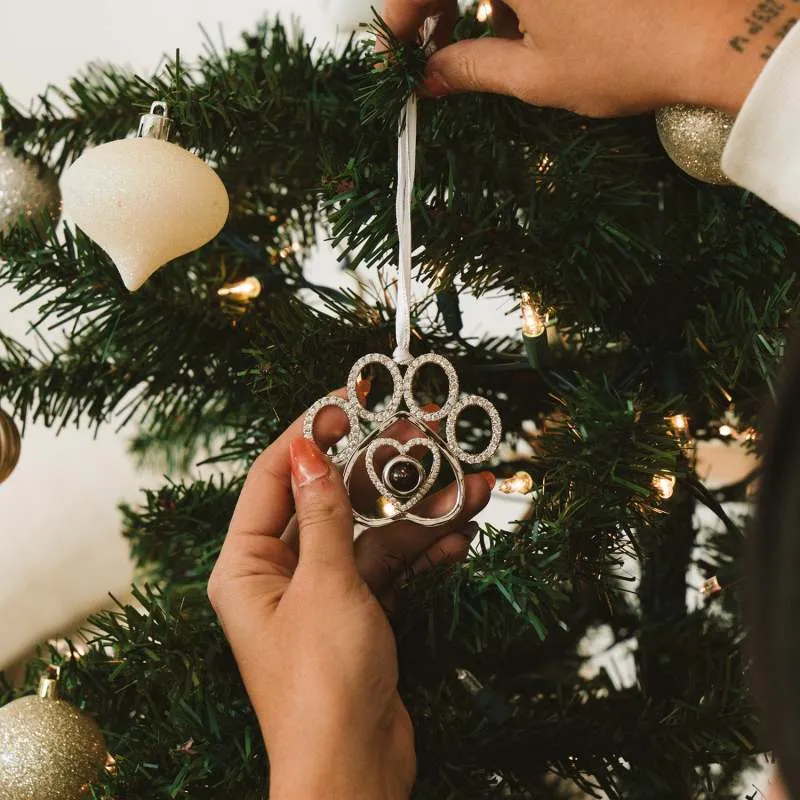
Here’s the honest part about sentimental ornaments: they multiply, and by year five they fight the theme. The fix isn’t hiding them, it’s giving them a dedicated zone. Cluster personal ornaments in one band, usually the middle third, or put them on a small secondary tree. That way the candy theme stays intact and the paw prints still get their moment. Also, silver glitter on a light-colored tree skirt sheds permanently. Shake ornaments over the sink before they go on, and vacuum the skirt once mid-December.
22. Mini Candy Canes in a White Wooden Trough
This is countertop and shelf decor, not tree decor. Mini candy canes run 2 to 3 inches and disappear on anything bigger than a tabletop tree — so the white trough is doing exactly the right job as a low, contained vessel where a dozen minis read as a mass. A 12-inch trough holds about 20 pieces. Perfect for kitchen islands, bathroom counters, and entryway benches. If your surface is under 14 inches deep, use a shallow bowl instead. For full-size arrangements, see Idea #6.
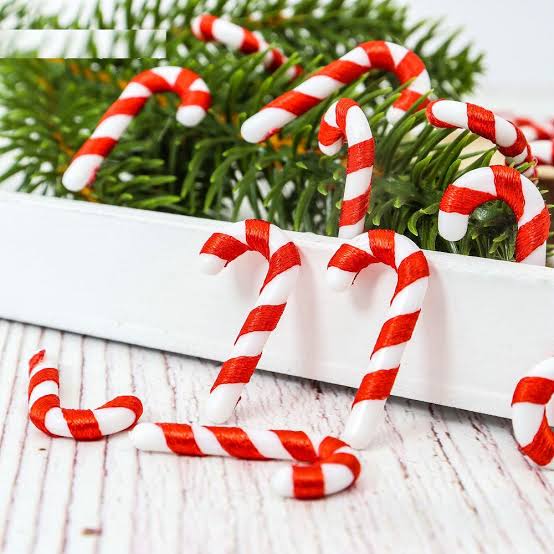
50% white, 30% green, 20% red, with natural light wood as the neutral. The white container and pale distressed surface are what let the candy canes feel fresh instead of pediatric. Swap the white trough for galvanized metal and this becomes farmhouse; swap it for clear glass and it becomes a candy shop display. The green foliage mass is the anchor either way — fill at least half the trough with greens before placing a single candy cane, or the whole thing collapses into a pile of red sticks.
23. Giant Lighted Peppermint Swirls Under a Star
Giant lighted peppermint swirls are sold commercially for $60 to $120 each, and you need three for a proper display. That’s a lot for something that lives outside four weeks. Build them instead: buy 24-inch white corrugated plastic or foam rounds, $8 to $14 each online, sketch a swirl in pencil, then hot-glue a strand of red LED rope light ($15 to $25 for 16 feet) along the line. Battery packs beat extension cords for yard placement. Three swirls for roughly $90 total versus $250-plus retail — and they store flat.
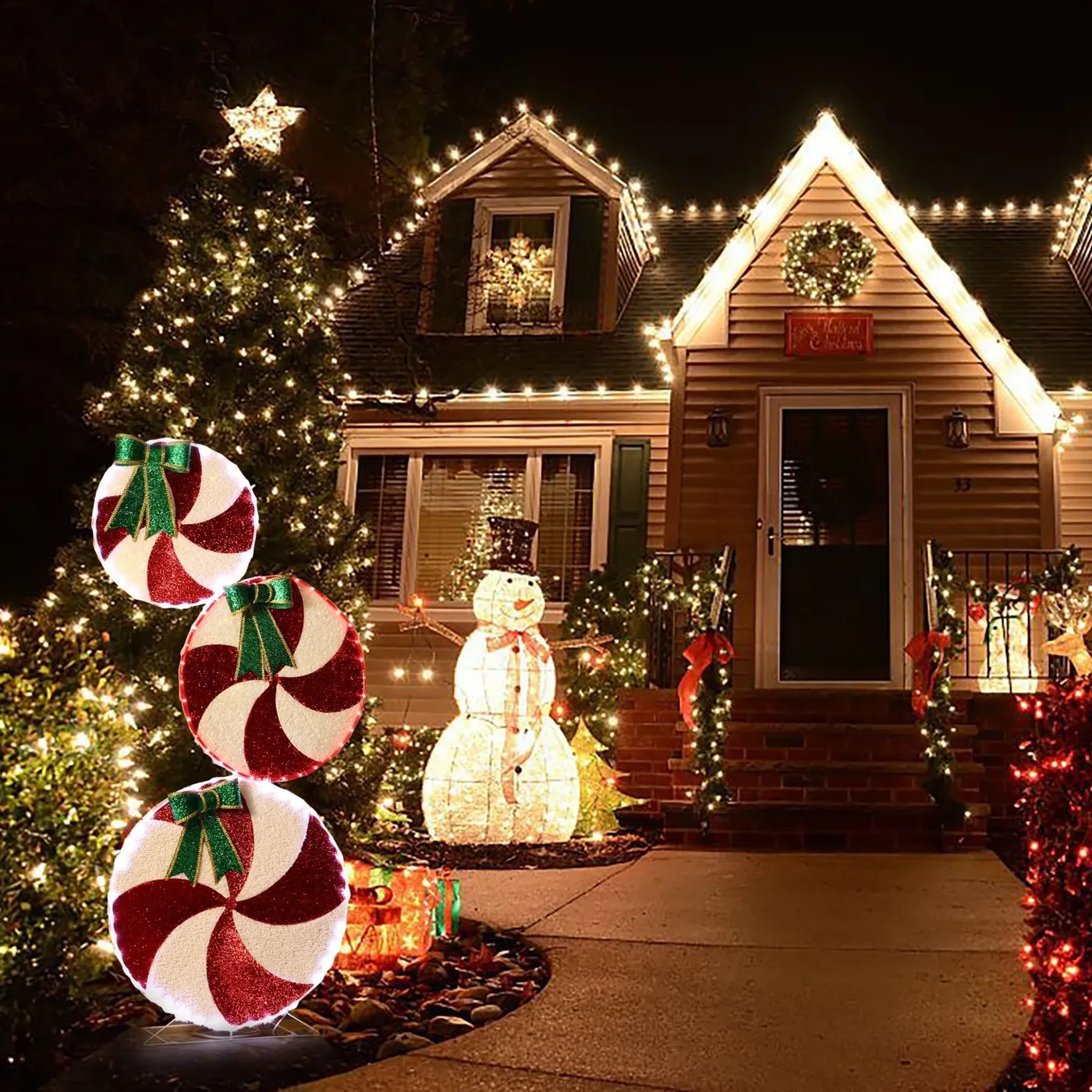
- Wrap the trunk and inner branches first; that’s the glow people actually see from 50 feet away.
- Add a warm white strand along the outer silhouette to define the shape.
- Top with a star or bow, not a lighted figure — silhouettes read better at distance.
- Place candy swirls at the base, angled about 15 degrees toward the road rather than straight up.
Time: roughly 2 hours. Outdoor-rated extension cords add $15 to $30.
24. Gingerbread Man With a Santa Hat and Candy Cane
Textured gingerbread ornaments — the ones with a rough, cookie-like finish — collect dust in the crevices and can’t be wiped. Blow them out with compressed air or a hairdryer on cool, twice a season. The red felt Santa hat will fade if the tree sits in direct sun through a window, so rotate the ornament each year. And if you’re using real baked cookie ornaments, understand they’re not food: varnish or seal them, and expect mice to show interest in storage. Baked ornaments usually last three to five years before they crack.
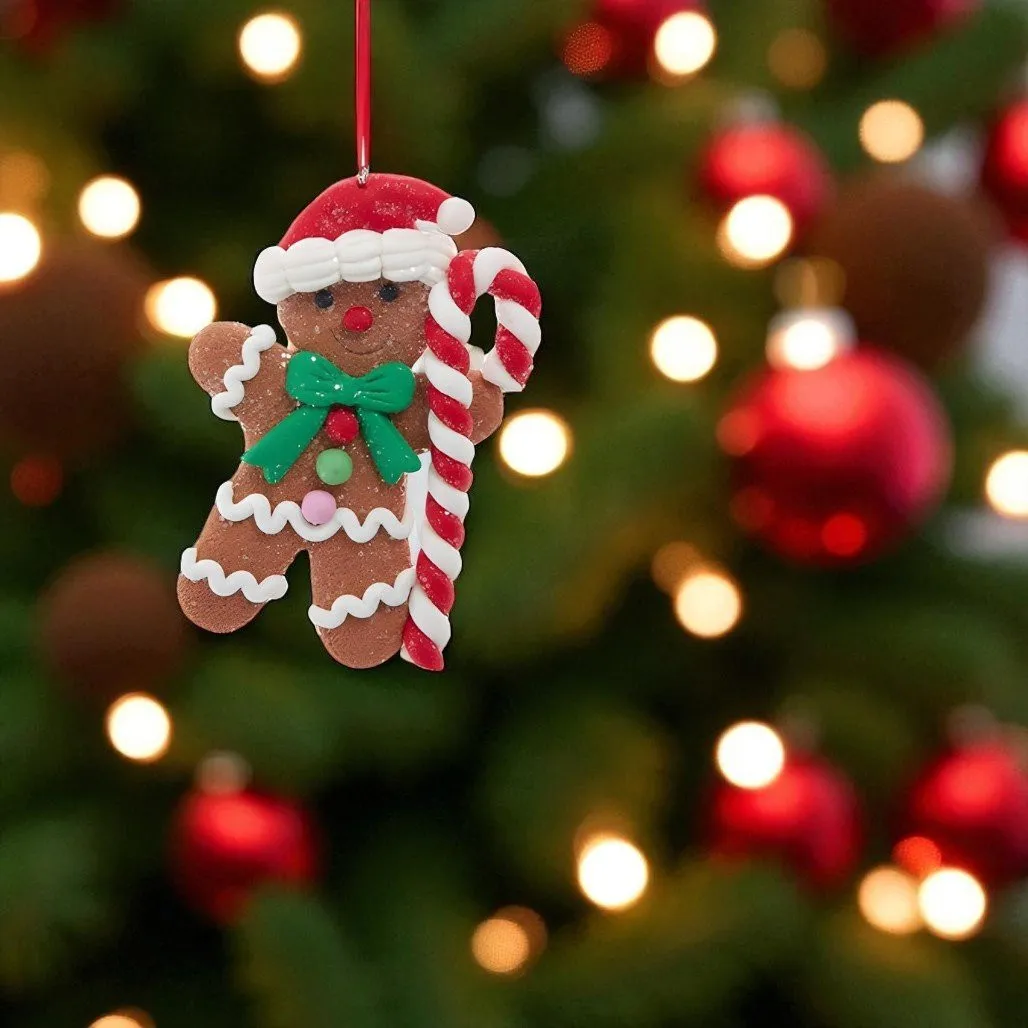
The candy cane he’s holding is the whole reason he belongs on this tree. A gingerbread man ornament is generic; a gingerbread man grasping a striped candy cane ties him to the theme and gives the eye a second, tiny pattern to read inside one ornament. That’s a real design principle — nested pattern. The red Santa hat does the same job in red. If you’re buying gingerbread ornaments this year, buy the ones with props in hand. They photograph twice as well and they hold their own on a busier tree.
25. Cocktail Glass Ornaments for Grown-Up Candy Trees
Novelty ornaments only work when they’re the minority. On a tree of 120 ornaments, cap theme pieces at 12 to 15 percent — about 15 to 18 ornaments — and keep everything else classic. Cocktail glass ornaments are the perfect example: two or three on a tree reads witty, twelve reads like a bar cart. Group them if you must, but keep the grouping to a single quadrant. And hang them where light catches the amber glass from the side. Backlit amber glass goes muddy brown in an instant.
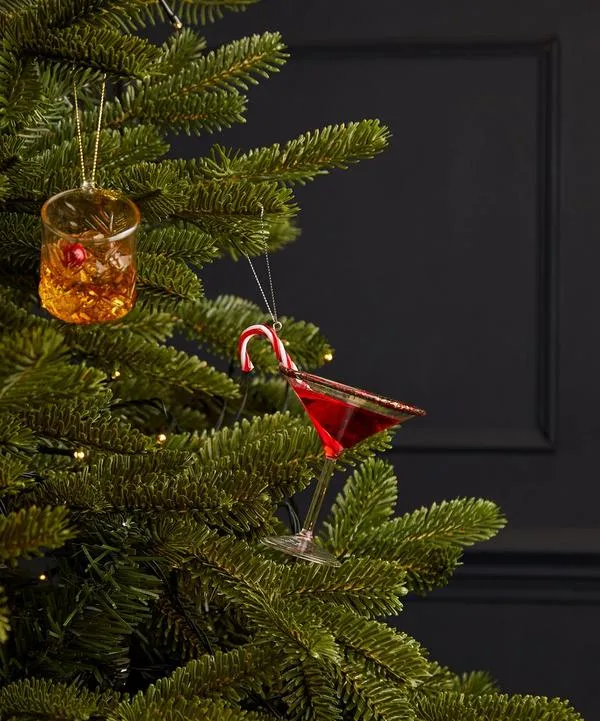
Grown-up novelty ornaments are the 2026 answer to the all-neutral tree. Two years of beige, cream, and dried-orange decor left people wanting a joke back in the room. Cocktail, dog, and hobby-themed ornaments are selling especially well in glass, because glass reads as an heirloom even when the subject is a martini. It’s a smart little move: the silhouette is traditional and the content is funny, so the ornament survives past the trend. Expect the category to keep growing through 2027.
26. The Red Top Hat Topper and Its Ribbon Cascade
A topper has one job: tell the eye where the tree ends. A top hat does that in a way a star can’t, because it’s a solid mass with a strong horizontal brim — the silhouette is unmistakable even from across a room. Then the cascading ribbons add vertical lines that pull the eye back down into the tree, connecting the top to everything below. It’s the transition, not the hat, that makes this work. Without the cascade, the hat would just look like a floating object.
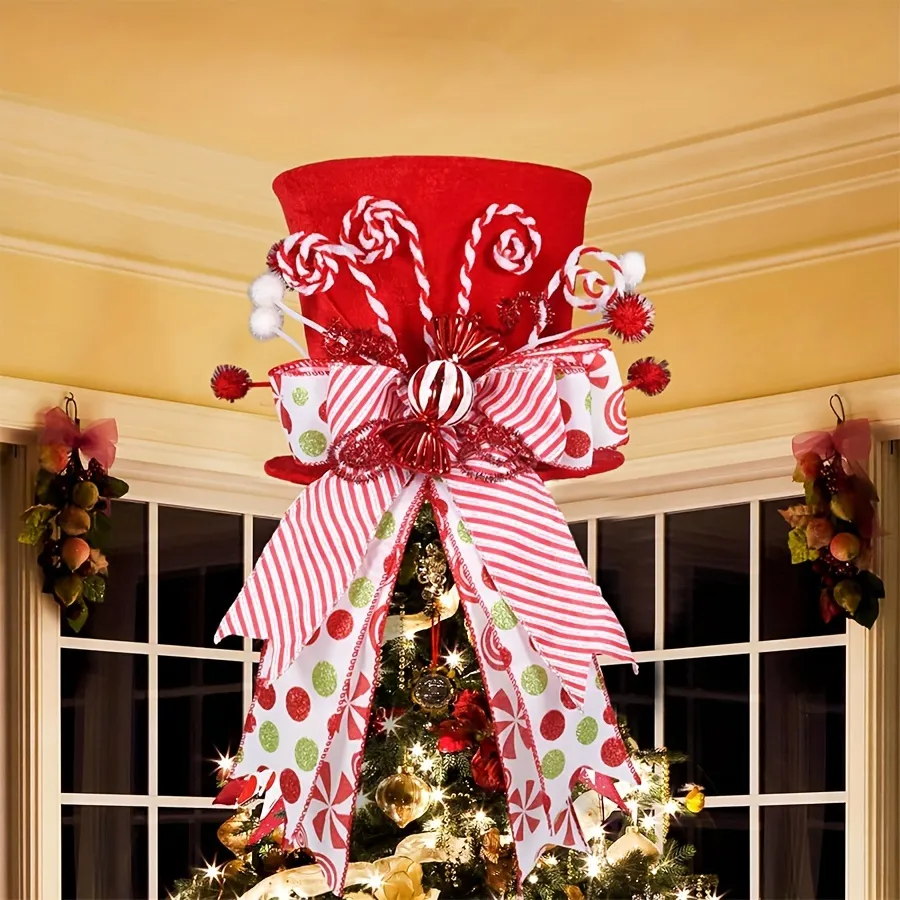
A top hat topper needs a tree with a real crown. For a hat 8 to 10 inches tall, you want a tree 7 feet and up, plus about 10 inches of clear vertical space above the top branch, because hats sit tall. Eight-foot ceilings are the practical minimum; at 7.5 feet, use a bow instead. Wide conical trees hold the hat shape better than slim pencil trees, which pinch the brim. Ribbon cascades should run about a third of the tree’s height — roughly 2 to 2.5 feet on a 7-footer.
40% red, 30% white, 20% green, 10% gold. That’s the recipe for a candy topper that still reads Christmas. The ribbons are your multiplier: one striped, one polka dot, one pinwheel pattern, all inside the same three colors. Swap the polka dot ribbon for metallic gold and the topper shifts formal. Swap it for plaid and it goes country. Leave the red and white stripes in place no matter what — that single ribbon is what makes it a candy topper instead of just a hat.
27. Silver Twisted Candy Cane With a Red Satin Bow
Silver and red is a clean pairing and a cold one. Metal ornaments absorb the warmth out of a tree, so if the rest of your decor leans traditional red and green, one silver piece can look like a mistake. Give it company — two or three more metallic ornaments, or a silver ribbon woven through nearby branches — and it reads as intentional. Metal dents, too. Wrap each one in tissue when storing, and never store them in the same bin as heavier wood or ceramic pieces.
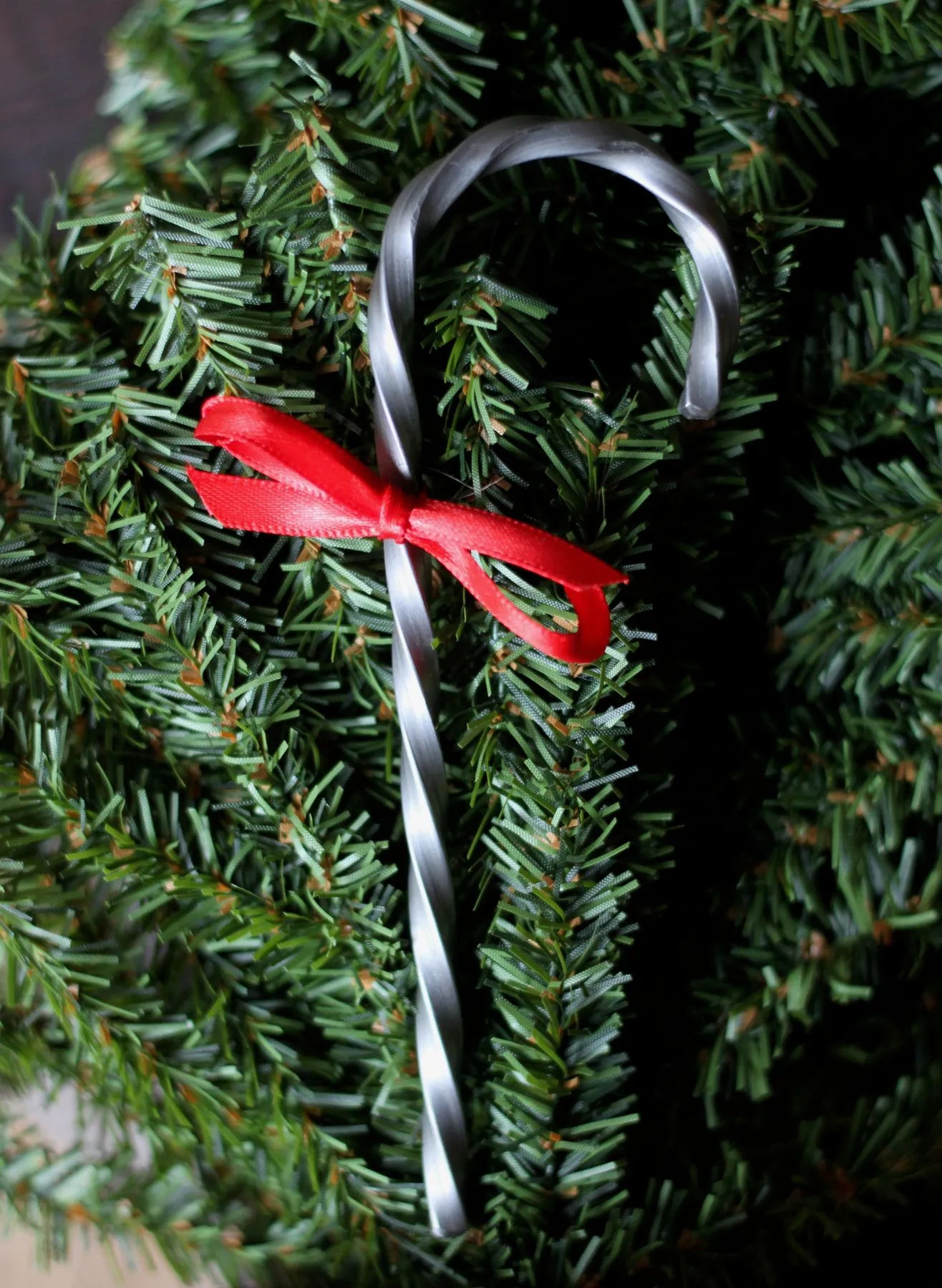
Metallic ornaments photograph badly under cool white light and beautifully under warm. If you’re shooting your tree, or you just want it to look good at night, keep bulbs at 2700K and put metal pieces on the same side as your main room lamp. Satin ribbon especially needs angled light to show its sheen; flat overhead light turns it matte. One $10 clip-on lamp aimed up at a low branch does more for metallic decorations than another hundred dollars of ornaments.
Twisted metal candy canes look expensive and aren’t. Vintage silver-toned ones turn up constantly at estate sales and thrift stores for $1 to $4 each — look for the heavy, barely-magnetic ones, which usually means silver plate. New versions run $6 to $12 for a set of four online. The red satin ribbon here is 1/8-inch width, about $3 a spool and enough for a dozen ornaments. If you like the shape but not the price, aluminum craft wire wrapped around a dowel gives you the twist for pennies.
Your Candy Tree, One December at a Time
Start with a single idea — one ornament cluster, a tabletop pine, a mantel garland — and let the rest of the candy story build from there. These are the details that get better the second year, once you know what your room and your light actually do from November through January.
📌 Pin your favorites now, before the stores get picked over and you’re trying to remember which ornament you loved.
