
35 Jaw-Dropping Front Door Christmas Decorations That Will Make Your Home Sparkle in 2026
You know that feeling when the front door finally looks so good you almost don’t want to go back inside? That’s what we’re chasing here. We spent serious time browsing HomeGoods, Target, and Etsy to bring you only what’s worth your attention this year — 35 real front doors from real homes, from $9 ribbon to $765 whole-entry installations.
Inside you’ll find traditional red-and-green, rustic woodland, flocked winter white, and jewel-toned maximalist entries, with budget and luxury versions compared side by side and every idea shoppable through direct product links. In 2026 the front door has become the most photographed square footage of the house — flocked greenery is finally outselling plain pine, and the gift-wrapped door is still holding strong.
And stay until the end — we break down the most common mistakes that can ruin these looks. 📌 Save this to Pinterest for later — you’ll want to revisit these ideas.
1. A Dark Brown Door Wrapped Like a Gift With Crossed Red Ribbon
The bow isn’t the star here — the cross is. That wide red ribbon runs the full height of the dark brown panels and crosses at the upper third, exactly where ribbon sits on a wrapped box, which is why the door registers as a gift before your brain even names it.
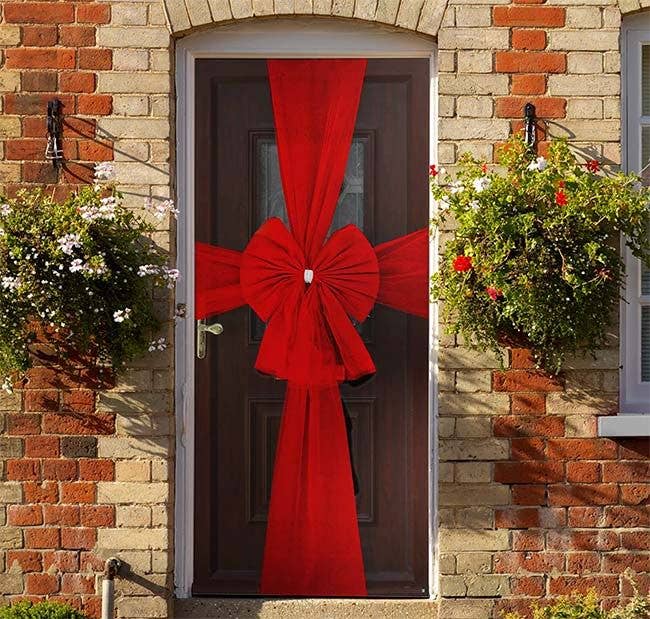
Take the horizontal band away and you have a nice bow on a nice door. Keep it, and the whole entry becomes an object. The red-and-tan brick behind it gives the red something soft to sit against instead of shouting into white siding, and the hanging planters on either side echo the greenery without competing.
Ribbon width is where gift-wrapped doors fall apart. On a standard 36-inch door, use 4-inch wire-edged ribbon — 2-inch looks like a shoelace from the sidewalk. Set the horizontal run one-third down from the top edge, never at the middle. Two adhesive hooks rated for 5 pounds, placed at the hinge and latch sides, will hold a 12-foot run through cold snaps. Buy three yards of ribbon per foot of door width if you want generous tails.
2. A Silver Pine Wreath With a Glowing Lantern in the Middle
Three things are happening on that pink door, and they’re happening in the right order. First, contrast: cool silver glitter poinsettias against the warm yellow candlelight inside that miniature lantern, so the wreath never flattens into one metallic blob. Second, dimension — the lantern pushes the center of the wreath off the door by a few inches, which is what makes it read as sculpture instead of a circle.
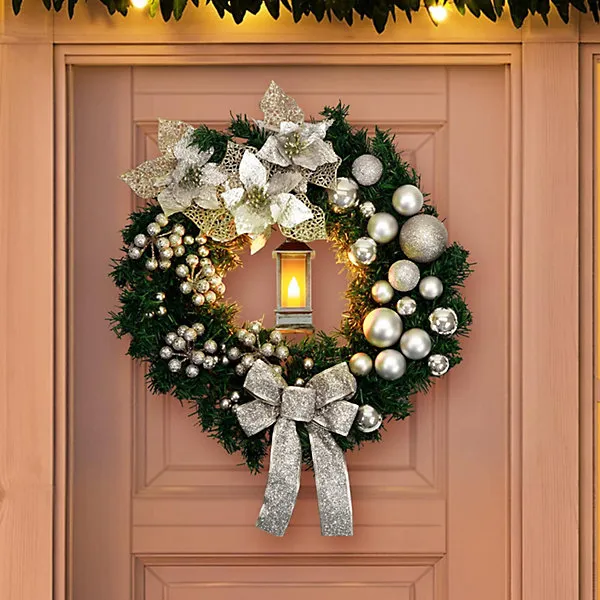
Third, restraint. The wreath is loaded with baubles, but they all live in one color family, so the pink door stays the loudest thing in the frame — silver baubles and beaded berry clusters just amplify it.
Here’s the formula: 55% pine green base + 25% silver ornament + 15% warm light + 5% pink door. That last 5% is doing more work than the 25%. Swap silver for unlacquered brass and the mood goes old-world. Swap the pink door for deep charcoal and the exact same wreath turns formal. The proportions never change — only the temperature does.
3. A Snow-Covered Colonial With Red and Silver Garland on Every Post
The matched-set exterior is back, and it’s louder than the minimalist Christmas of the last few years. Symmetry, repetition, and one repeated ornament mix carried across every surface — that’s the 2026 version of quiet luxury pointed at the front of the house.
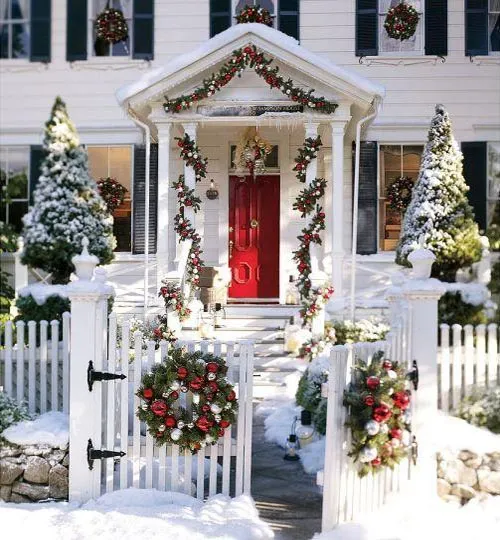
What makes it stick is restraint in color: red and silver, nothing else, plus snow-dusted topiaries and wreaths on the picket gate to continue the rhythm. If you want to see the same idea pushed in a completely different direction, compare with Idea #13, where a single red velvet bow does the work of forty ornaments.
- Three 9-foot evergreen garlands: $60–$180
- Two matching accent wreaths: $40–$120
- Box of 100 red and silver ornaments: $25–$60
- Two snow-dusted topiaries: $70–$200
- Outdoor clips, hooks, and extension cords: $20–$40
Total: $215–$600
Budget alternative: buy plain pine garland from a tree lot at $25 a strand and wire on your own ornaments — roughly $110 for the whole facade.
4. Candy Cane Garland Loaded With Oversized Red and White Baubles
Building a garland this packed, start to finish:
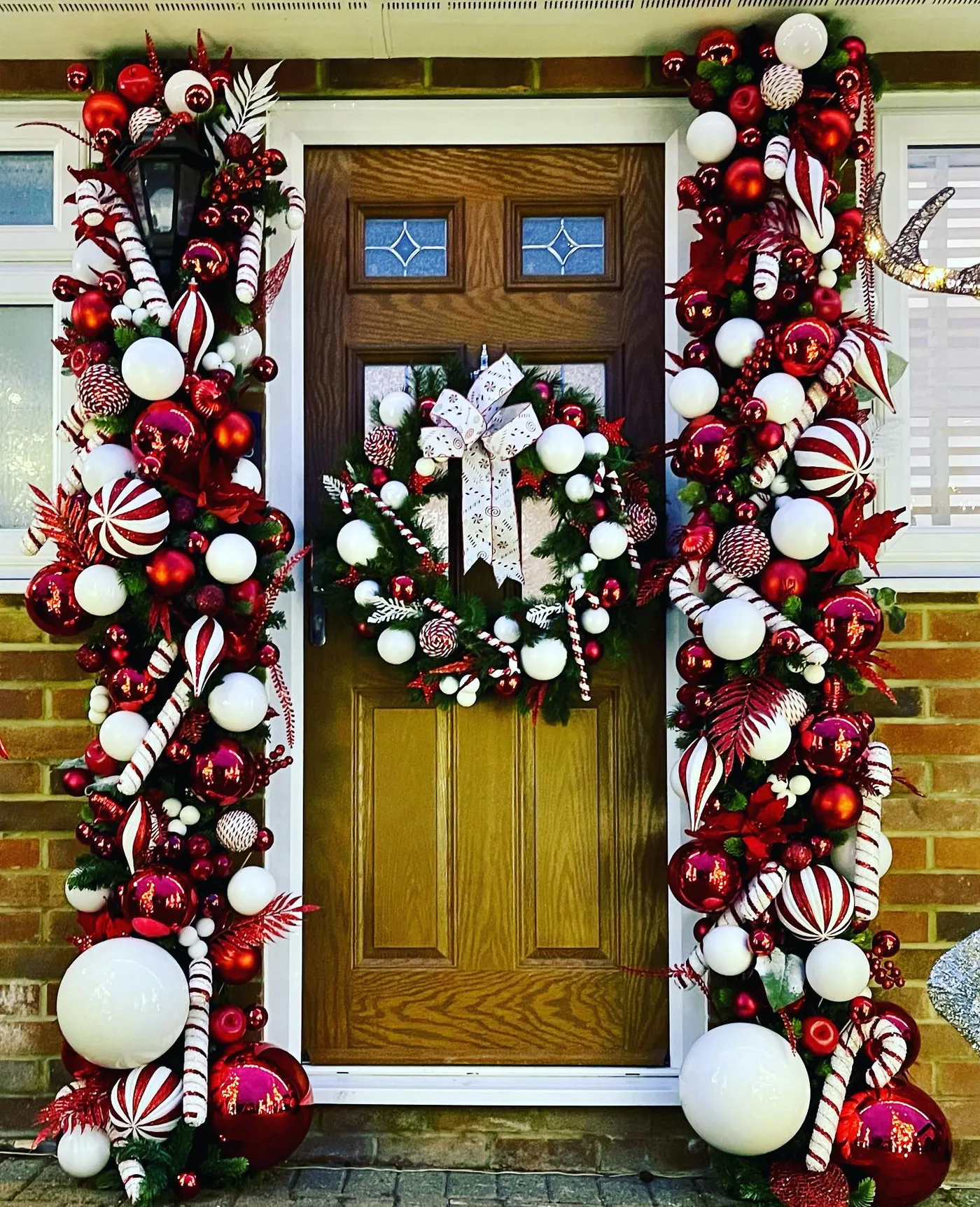
- Zip-tie two 9-foot strands together so you have a thick, full base to work on.
- Wire the biggest glossy baubles on first, 10 to 12 inches apart — they set the rhythm.
- Fill the gaps with medium ornaments in the same two colors, not new ones.
- Tuck in striped candy cane picks and ribbon loops last, so nothing crushes them.
- Hang from two hooks, not one, or the middle will sag by the second week.
Time: about 90 minutes per 9-foot section. Materials: $75–$150.
A garland this packed gets heavy — 15 to 20 pounds on a medium-brown wood door. Hot glue will fail the first time the temperature drops below freezing, so wire everything with 22-gauge floral wire instead. And check your storm door swing: a stuffed garland adds about three inches of depth and will crush those oversized baubles every time the door opens.
5. A Lantern-Lit Porch With a Vertical JOY Sign and Vintage Skates
Height is what makes a collected porch look intentional instead of cluttered. Mount the JOY sign so its center hits 60 inches — your natural sightline — and line the bottom of the sign up with the bottom of your wreath. Then stagger everything else at three heights only: floor lanterns under 18 inches, mid-level trees and the vintage sled at 24 to 36 inches, hanging elements above 60. Three heights reads as styled. Five heights reads as storage.
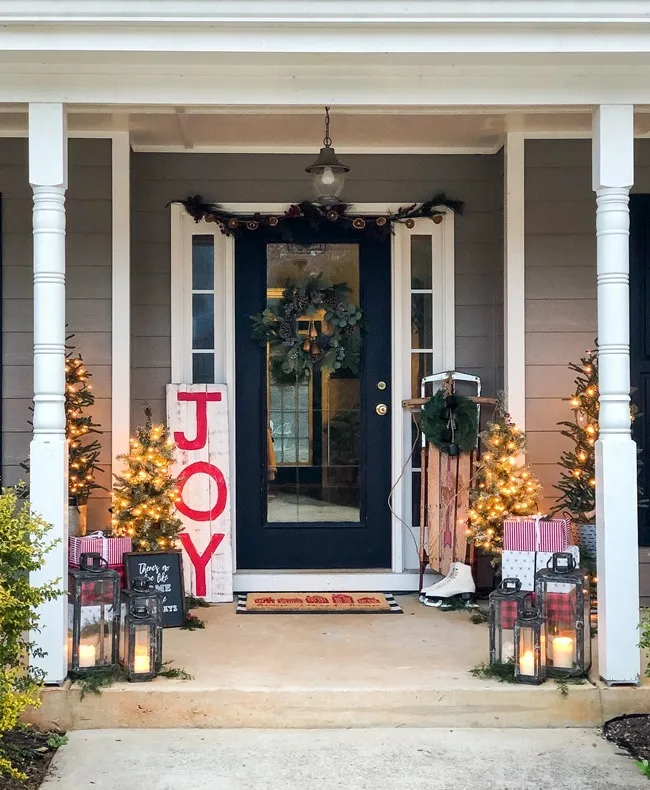
The dark glass door is the trick nobody mentions. It reflects the lit miniature trees back into the entry, so the porch appears twice as deep as it actually is, for free.
Everything else follows a scale ladder: tiny glowing trees, mid-size metal lanterns with pillar candles, one large wooden sled, a pair of ice skates. Same warm color temperature throughout, same rustic material story, three different sizes. That’s repetition with variation, which is why your eye keeps traveling instead of landing.
6. A Light Blue Door Framed in Poinsettia and Copper Garland
50% evergreen + 20% light blue door + 15% dark red poinsettia + 10% copper and bronze ornaments + 5% gold metallic leaves. Copper is what separates this from a standard red-and-gold door — bronze reads older and softer against pale blue than shiny brass ever will.
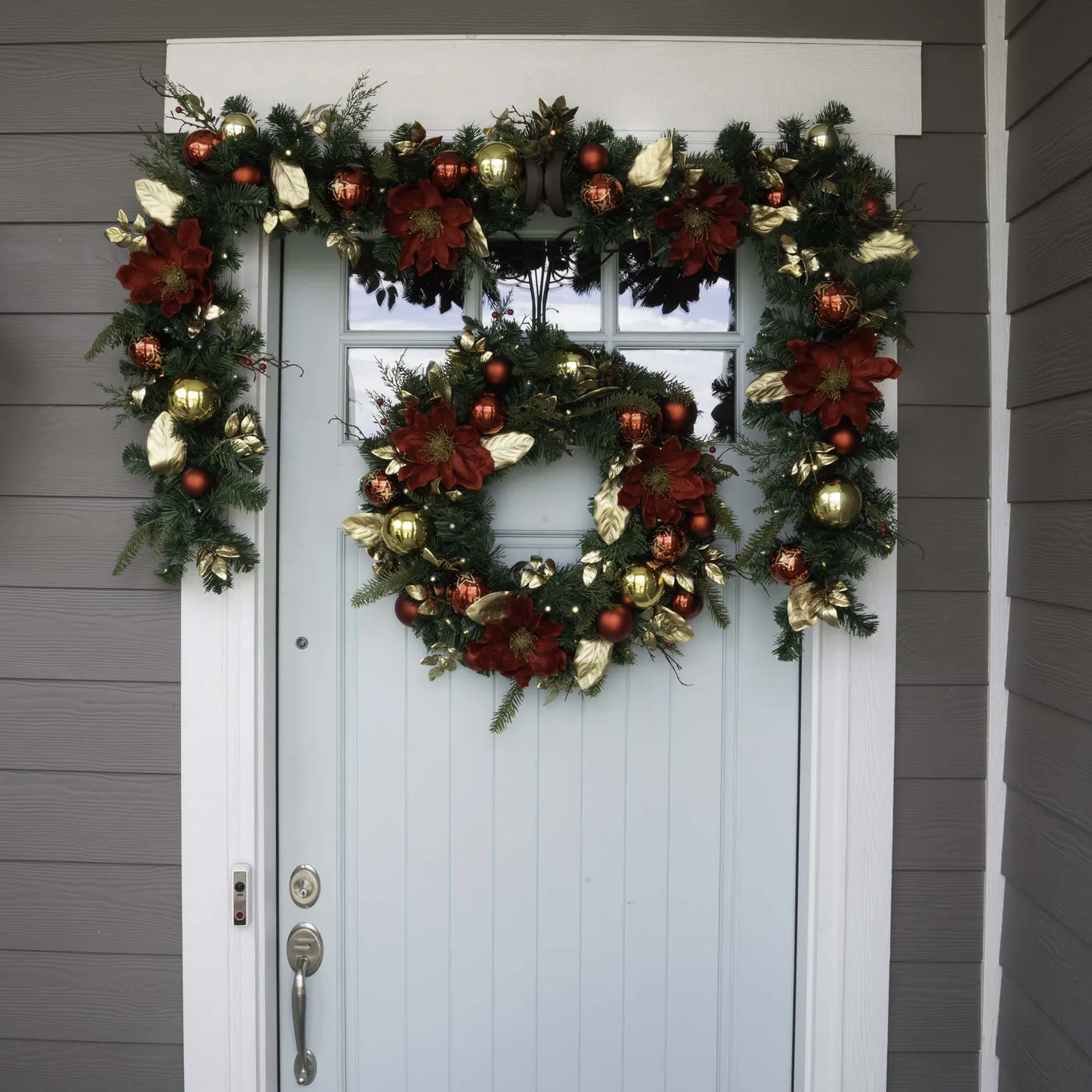
Keep the equation and change one variable: silver instead of copper gives you an icy, almost Scandinavian entry. Forest green instead of blue gives you the classic. The proportions stay put.
Poinsettia picks run $1.25 each at dollar stores — six of them fill a 9-foot garland. Walmart’s bulk ornament tubes are around $10 for 50, and Target’s plain pine garland drops to about $25 right after Thanksgiving. A thrifted copper-toned bowl can be cut into leaf picks with wire snips. Total for the whole door: under $90 versus $400 for the designer version.
7. Warm White Lights Tracing Every Roofline and Porch Column
Warm white LED strands cost pennies to run — a fully outlined two-story facade adds roughly $3 to $5 to your December electric bill. The real maintenance is your knees. Clip, don’t staple: staples puncture the jacket and that’s exactly where water gets in. Take everything down by mid-January while the plastic is still flexible, and store each strand in its own labeled zip bag or you’ll spend next November untangling a garbage bag of light spaghetti.
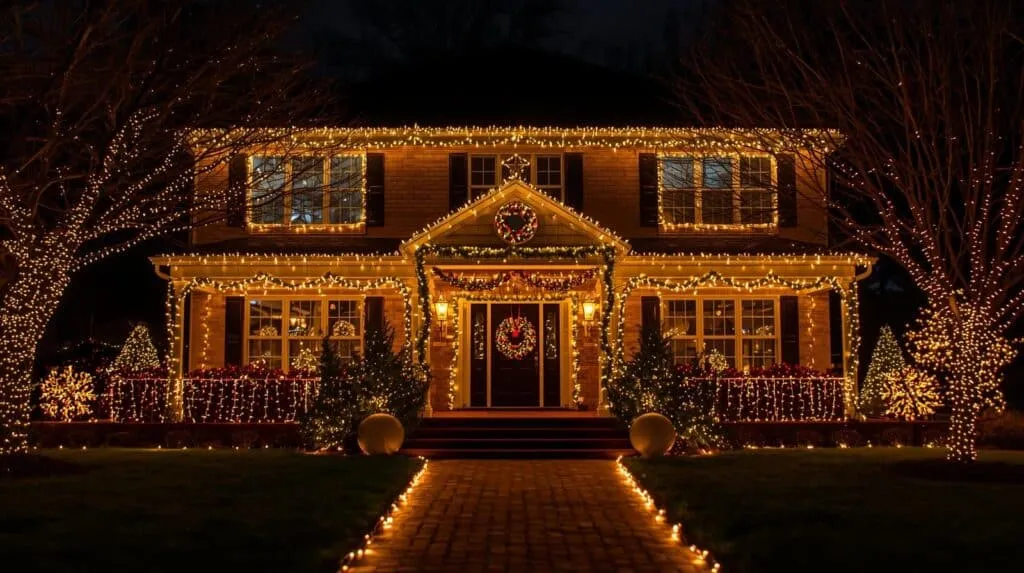
Outlining a whole roofline takes real footage — plan on 200 to 250 feet for a two-story home with columns and a gable, plus another 40 feet for the lit pathway edging.
This look also needs a facade with actual architecture to trace: gables, columns, deep eaves, upper windows. On a small single-story ranch the same technique gets busy fast. If your entry is compact, go vertical instead — one door, one wreath, one lantern — and keep the light runs short.
8. Buffalo Plaid Bows on a Black Door With White Deer on the Porch
The plaid is doing two jobs at once. It’s high contrast against the black door — which is why those bows read from the street — and it repeats: on the garland, on the wreath, echoed again in the red berries and the stacked topiary balls.
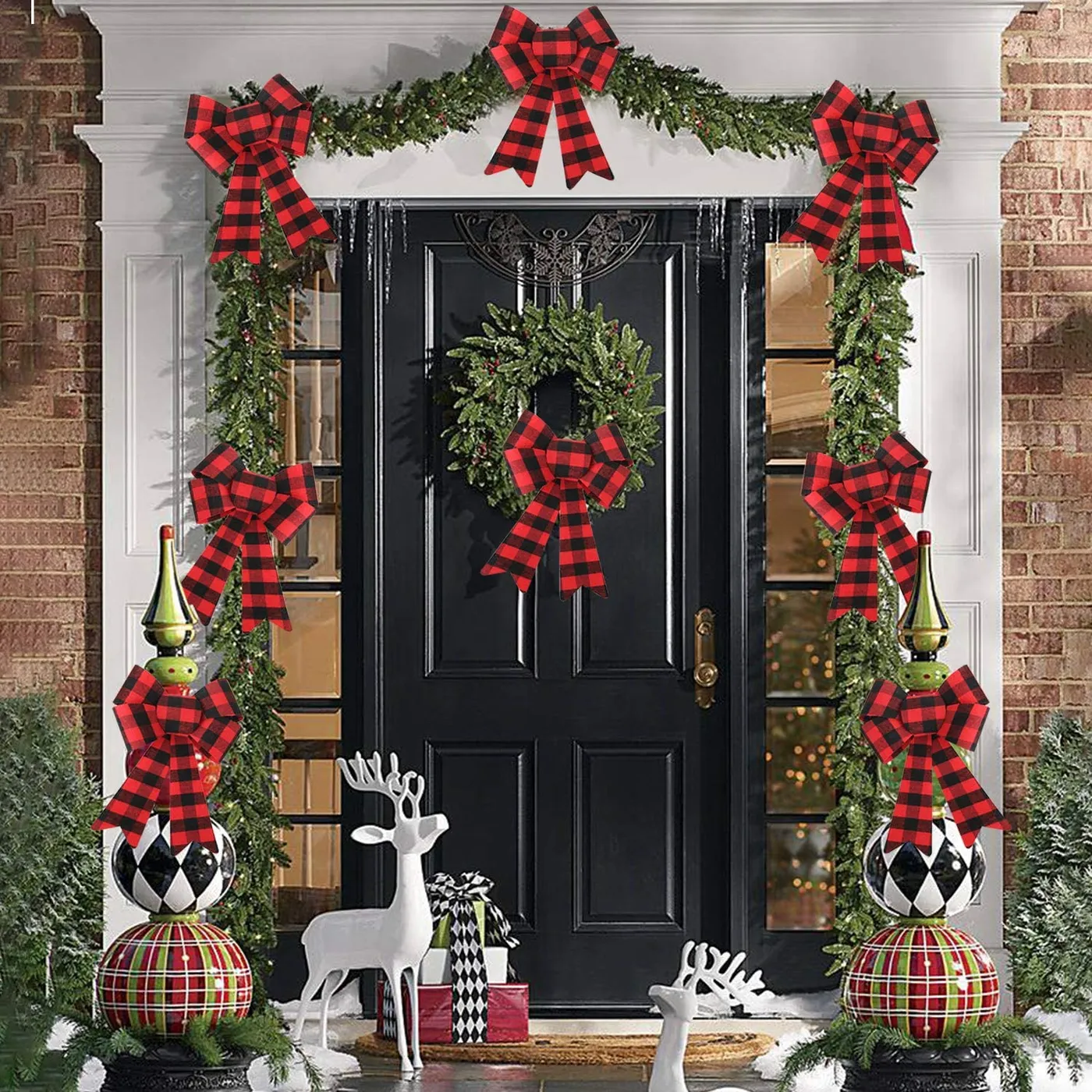
The white deer figurines then reset the scale. Without them, everything sits at one height and the porch looks like a wall of decoration rather than a scene.
Match your bow width to your garland thickness. With a 10-inch-deep garland, 6-inch bows look right; 3-inch bows disappear. Cap your pattern at three placements — plaid on the wreath, the garland, and one topiary — or the eye stops distinguishing any of them. Ribbon: 2.5-inch wired buffalo plaid, about 18 inches per bow, tails notched at an angle.
9. A Garland-Wrapped Archway Over the Front Steps
- Two 12-foot garland strands for the arch: $80–$240
- Warm white fairy lights, 100 feet: $15–$40
- Two potted evergreens: $60–$200
- Two large urns or planters: $40–$160
- Two wreaths with plaid ribbon: $40–$100
- Clips, zip ties, and cord: $10–$25
Total: $245–$765
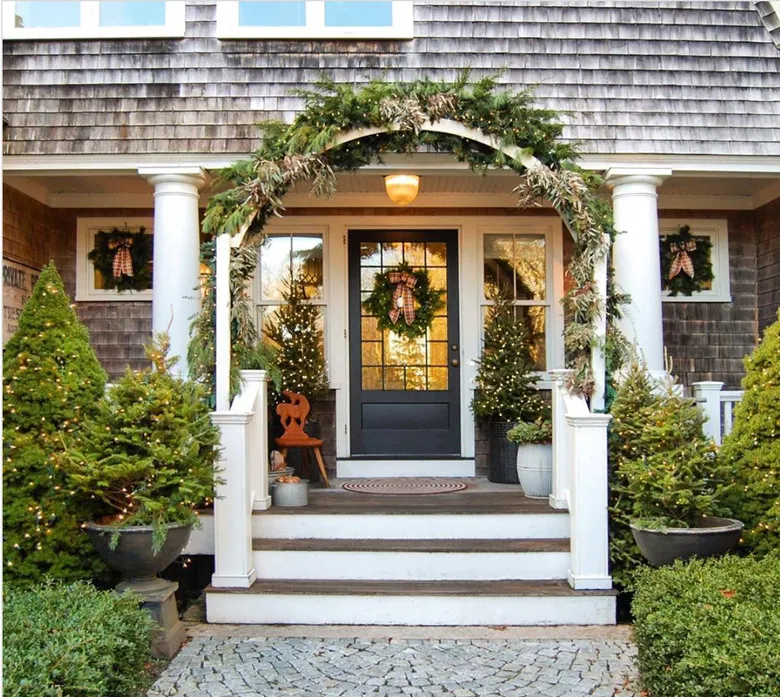
Budget alternative: one 25-foot strand from a big-box store plus solar fairy lights and urns you already own gets you about 80% of the look for roughly $110.
- Measure the full arch and add 3 feet of slack on each end.
- Zip-tie the garland at 18-inch intervals so it follows the curve instead of cutting the corner.
- Run the fairy lights along the inside first, so the wire hides.
- Layer ornaments and plaid ribbon picks from the top down.
- Wrap the urn rims with leftover garland so the base connects visually to the arch.
Time: about 2 hours for two people. See Idea #27 for the same technique scaled onto double doors.
10. Jewel-Toned Ornaments Swinging From an Overhead Branch
Color is back, and it’s not apologizing. After years of neutral Christmas palettes, saturated doors with magenta, gold, and cobalt ornaments are the fastest-growing look on Pinterest — the maximalist school, applied to the entry. The overhead branch installation is why this one works for renters: no drilling, no wreath hanger, no damage. It just hangs.
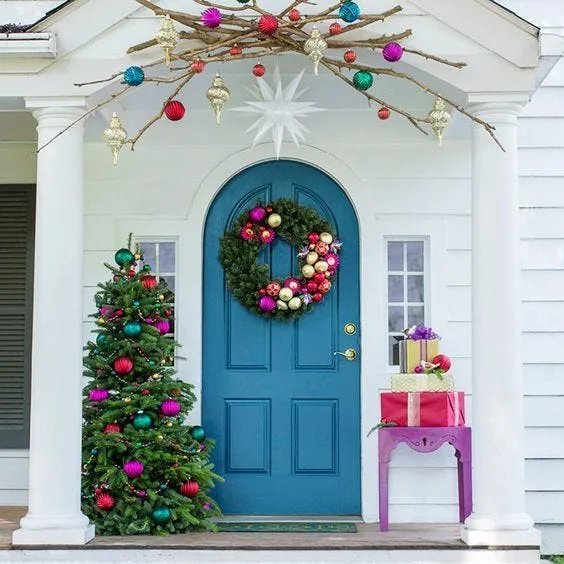
Cut lengths of fishing line between 8 and 14 inches and vary them on purpose — a straight line of ornaments looks like a store display. Stick to 2- to 4-inch ornaments so total weight stays under 8 pounds, and anchor the branch to two points, not one, so it doesn’t rotate in the wind. A white paper star at the center gives the composition somewhere to land, and the potted tree on the left and wrapped gifts on the small purple table keep the color story moving sideways instead of stopping at the door.
11. Light-Up Penguins Guarding a Garland-Draped Green Door
Animated figures are rated for outdoor use, but their weak point is always the plug connection, which tends to sit exactly where the snow piles up. Elevate the connector on a brick or a planter riser, plug into a GFCI outlet, and seal the joint with electrical tape. A $12 outdoor timer saves you from trudging out at 11 p.m. to switch them off.
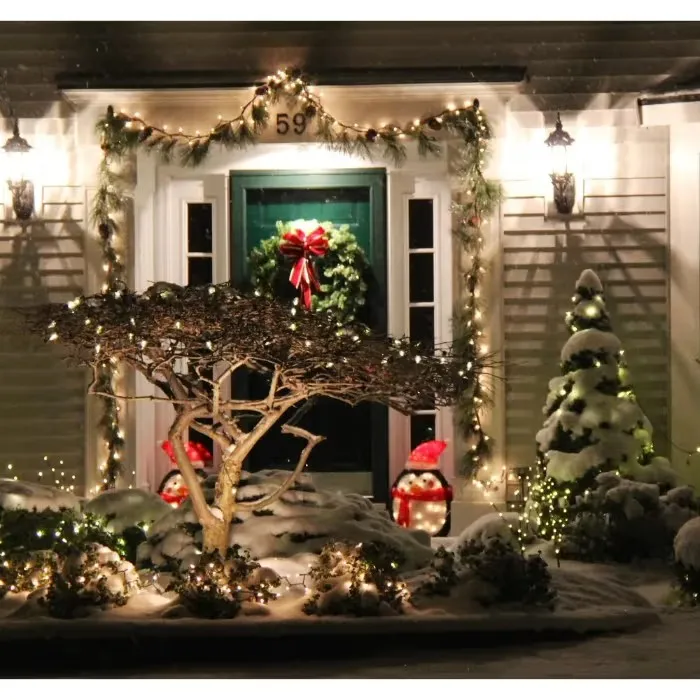
Whimsy next to formality is a real design move, not an accident. That dark green paneled door is about as traditional as it gets, and two penguins in Santa hats undercut it just enough to keep the entry from feeling like a storefront window. The pine garland runs the full frame in warm white light, so the figures read as accessories rather than the whole story.
LED bulbs inside a light-up figure will run 20,000 hours, but the failure point is usually the wiring at the base, where it flexes. Store figures in a dry bin with cords coiled loosely — not wrapped tight around the body — and they’ll last four or five seasons. If one goes dark mid-December, check the fuse in the plug before buying a replacement.
12. Vintage Sleds, Cedar Boughs, and a Wooden Deer Head Wreath
It’s the little white wooden deer head centered in the pine wreath. Take it out and you have a perfectly pleasant wreath with a plaid ribbon — one you’ve seen on a hundred doors since October. Put it in and the wreath becomes a specific object with a point of view.
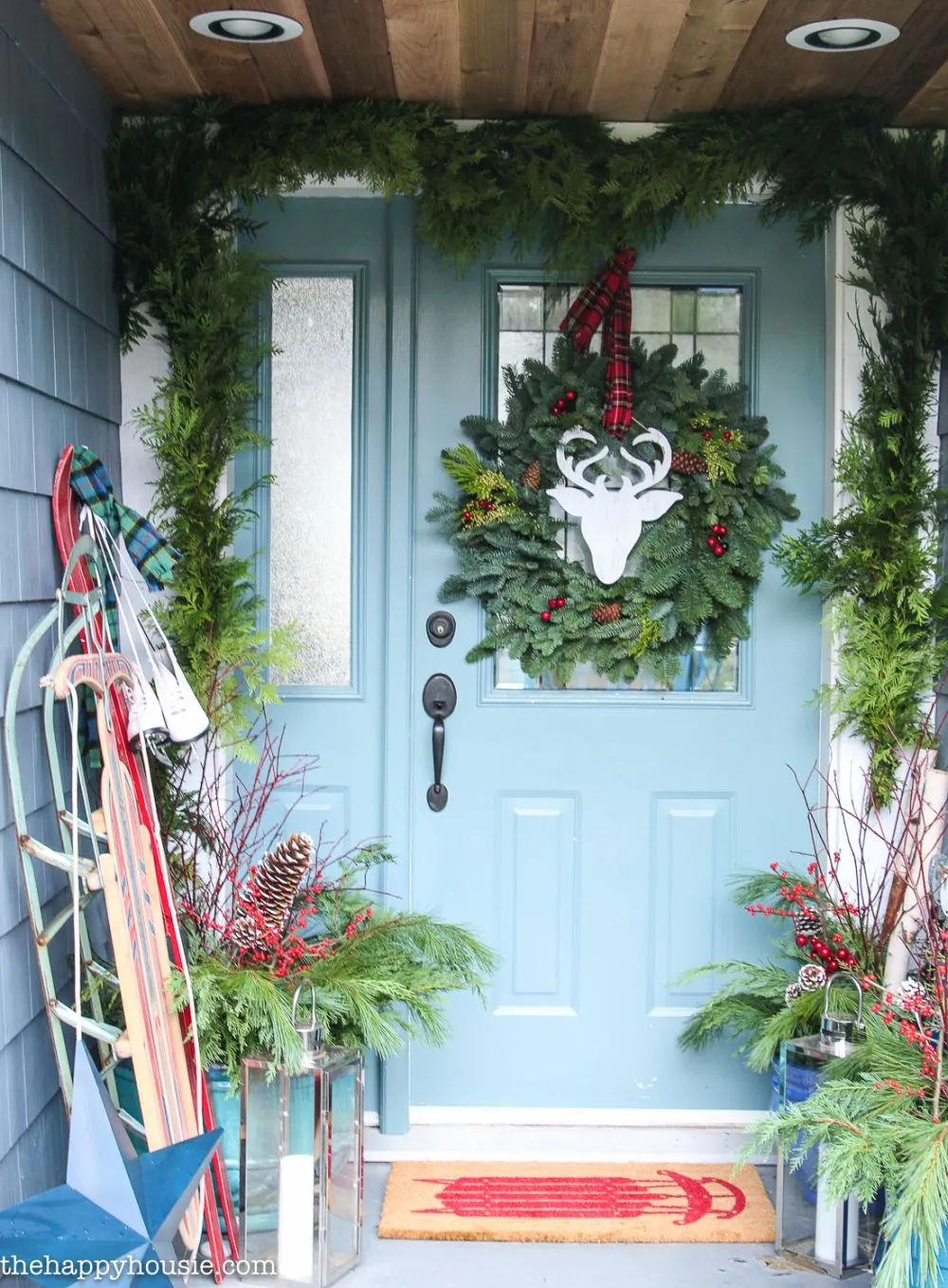
It also gives the muted blue door and the red berry branches something to organize around, so the cedar garland, the leaning sleds, and the lanterns with pillar candles feel like a collection instead of a pile.
Vintage sleds turn up on Facebook Marketplace for $10 to $25, and thrift stores sell old ice skates for $5 to $15 a pair. Cedar and pine boughs are free if you ask a tree lot for trimmings on the day they’re chipping — bring a bag and be polite. The wooden deer head, metal lanterns, and berry sprays all have $5 to $12 versions at craft stores. Full porch for around $120.
13. Red Velvet Bows on Evergreen Garland Under a White Arch
50% evergreen + 20% white trim + 15% crimson velvet + 10% light blue door + 5% brass. Velvet is the sleeper: it absorbs light where satin ribbon shines, which is why three big bows can carry an entire archway without looking cheap.
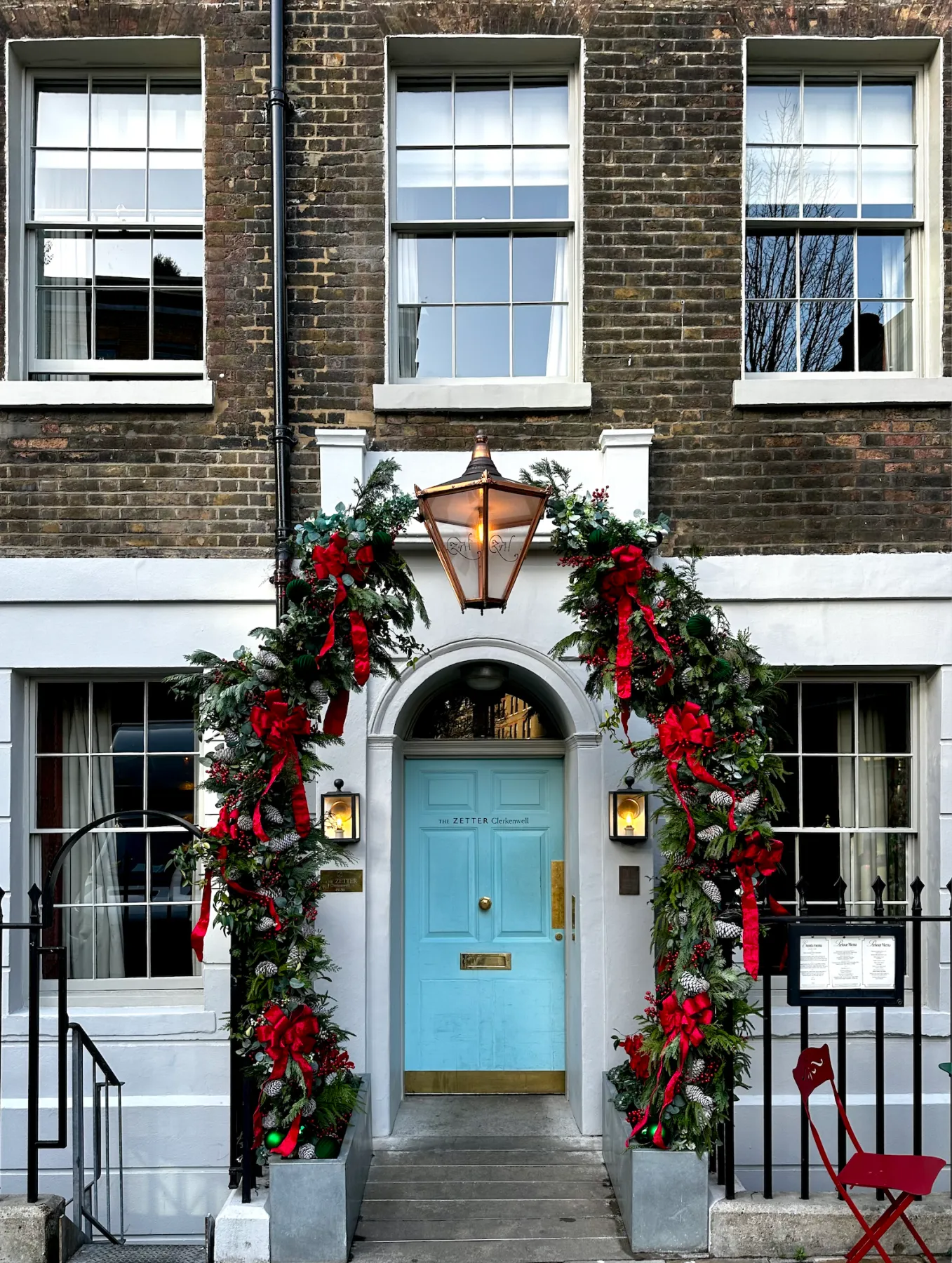
Switch crimson to blackwatch plaid and the entry goes preppy. Switch velvet to grosgrain and it goes casual. Same 50/20/15/10/5 split, different personality.
This arrangement needs real architecture — an actual arch, at least 9-foot ceilings at the entry, and a doorway 6 feet wide or wider. The brass lantern belongs centered above the door with 12 to 18 inches of clearance beneath the arch, and the garland should sit on the arch’s underside, not draped in front of it. On an 8-foot entry the same garland just crowds the door; compare with Idea #24, where one wreath and a handful of brass bells do the entire job.
14. A White Porch Styled in Blue and Silver Ornaments
A monochrome palette goes flat when every surface has the same finish. The fix: keep the color, vary the sheen. Aim for roughly 70% matte ornaments, 20% glossy, and 10% glitter, then repeat that mix on the garland, the trees, and the wreath. On white architecture, also keep your blue within one family — icy silver-blue and gray-blue can share a porch; cobalt and sky blue usually can’t.
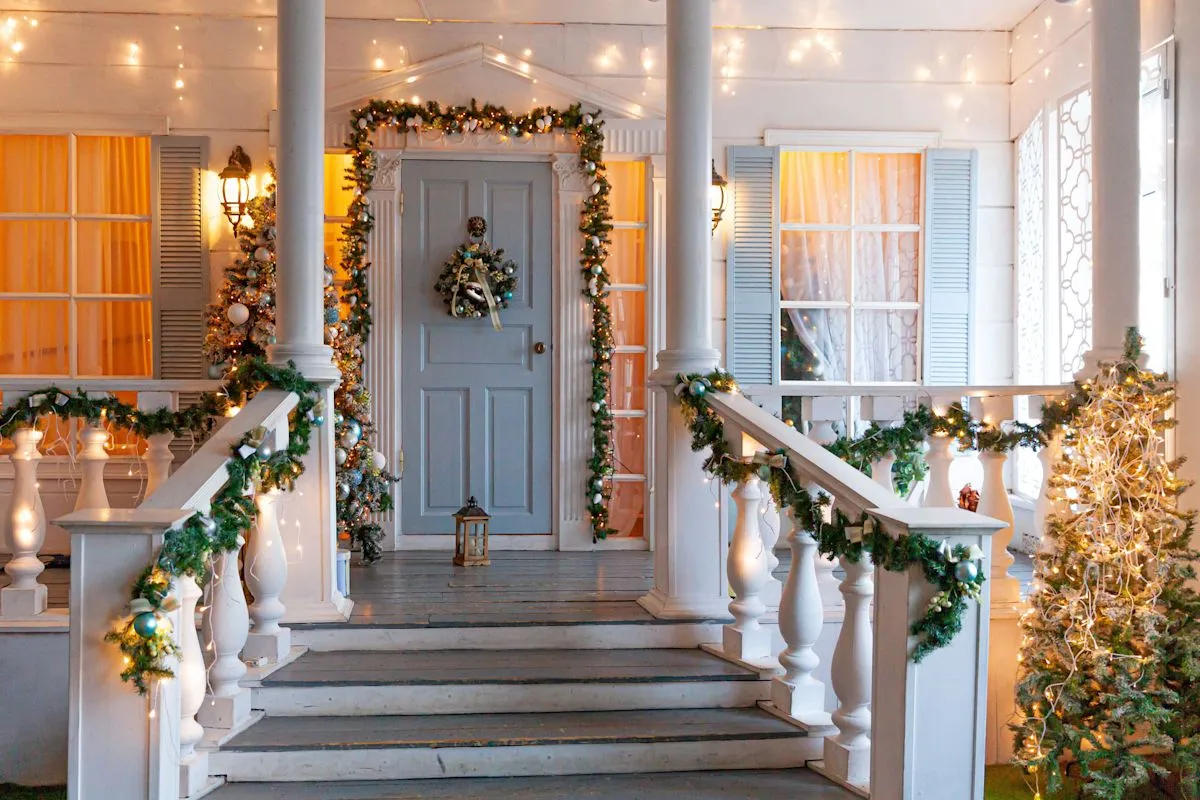
Painted white porch floors are beautiful until December arrives. Garland dragging across them leaves gray scuff marks, and wet greenery plus a painted surface equals mildew in a mild climate. Sweep weekly, lift garlands rather than pulling them, and set a rubber-backed mat at the threshold to catch meltwater. Touch-ups on white porch floors are an annual job — budget a quart of porch paint every couple of years.
15. Striped Bow Wreath and Layered Doormats on a Black Door
- Measure door width and pick a wreath about one-third of it — 20 to 24 inches on a standard 36-inch door.
- Check the swing. A storm door will flatten garland against the frame.
- Confirm 24 inches of clear floor on each side for the two wooden planters.
- Find your outdoor outlet and measure cord distance; 12 feet is typical.
- Layer mats correctly: the larger outdoor mat underneath, the coir mat on top, overlapping by about 4 inches.
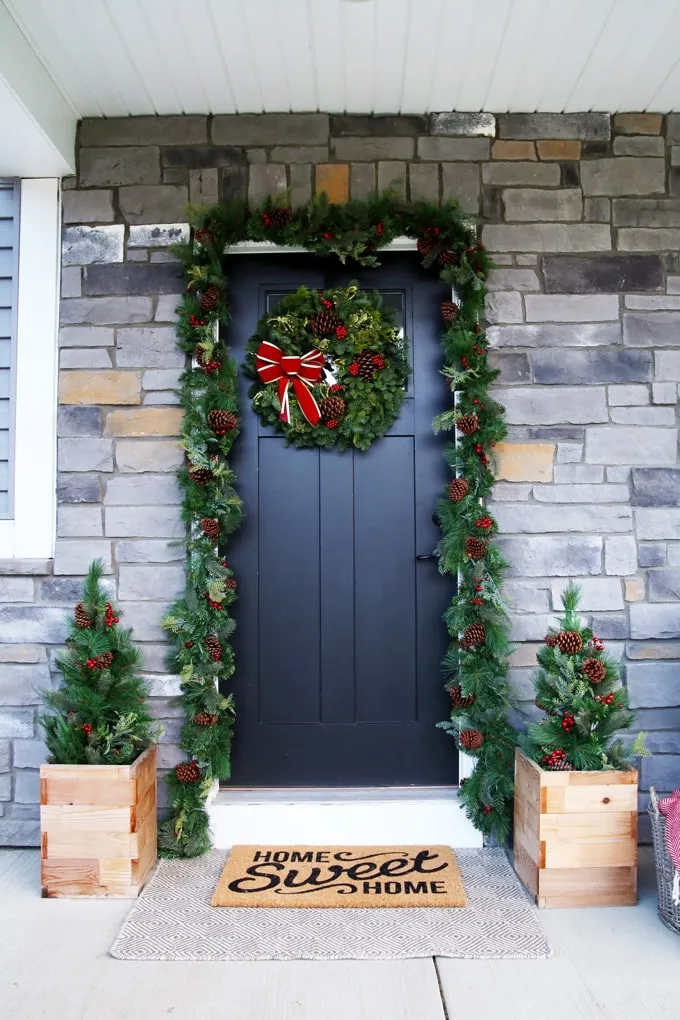
- 9-foot garland with pinecones and berries: $45–$120
- 26-inch wreath: $40–$95
- Striped ribbon for the bow: $12–$28
- Two wooden square planters: $50–$140
- Two mini evergreens: $30–$70
- Two doormats: $35–$80
Total: $212–$533
Budget alternative: keep your existing mats and use urns you already own — about $150 all in.
16. A Textured Star Centered on a Red Door With Snowy Greenery
Anything hung on a door adds depth, and a chunky textured star can add two inches. If you have a storm door, that’s a hard no — it’ll knock the star loose the first time you close it. Worth knowing too: faux snow spray yellows after a season of direct sun, and the warm white lights in those potted Christmas trees won’t melt real snow, which is fine, because real snow won’t stick to them anyway.
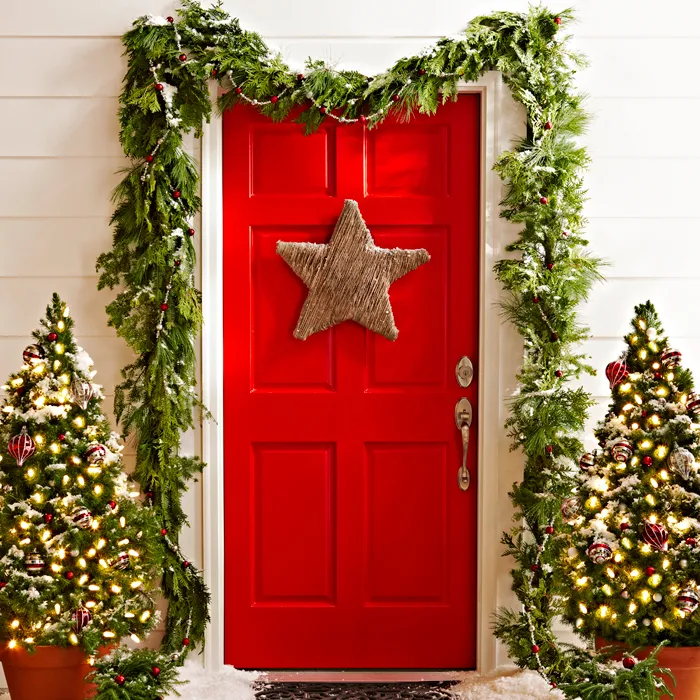
Star door hangings are the quiet alternative to the wreath, and they’ve been climbing for two seasons — partly because they photograph beautifully, and partly because a star reads as winter rather than strictly Christmas, so people leave it up longer. The bright red door does the heavy lifting here: red plus white faux snow plus warm light is a combination that’s been working for a hundred years.
Frosting your own garland in about 45 minutes:
- Work in a garage or covered area — flocking powder goes everywhere.
- Mix the powder with water to a thin pancake-batter consistency.
- Spray from 12 inches away, aiming up so it settles on top of the branches.
- Dust dry powder through a sieve for the fresh-fallen look.
- Let it cure 24 hours before hanging.
Cost: $20–$35 for enough to do a 9-foot garland.
17. A Window Wreath With Fresh Apples and Red Plaid Bows
Six apples from the grocery store cost about $5 and look better than any ornament on this window. Plaid ribbon is $8 a roll at Walmart or Michaels with a coupon. Mini evergreens drop to $12 each at big-box stores the weekend after Thanksgiving. The black planter box can be a thrifted urn or a plastic window box spray-painted satin black for about $6. Full window arrangement for $60 to $80.
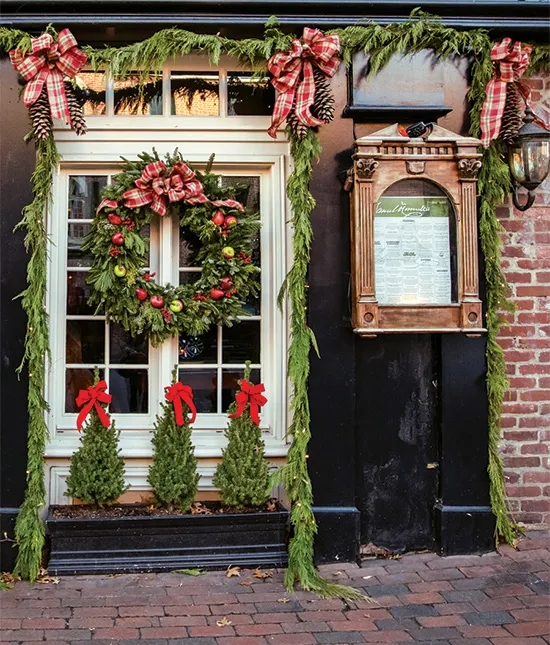
Two rules for window wreaths. Size: the wreath diameter should be roughly one-third of the window width — a 20-inch wreath on a 60-inch window. Placement: hang the center about 6 inches above the window’s midpoint, so the bow lines up with the top rail instead of floating in glass. If you’re using real fruit, secure each apple with 22-gauge wire through the core rather than glue, and swap them out every five to seven days before they bruise.
18. A Flocked Blue and Silver Wreath With a Light Blue Santa
45% frosted green + 25% silver + 15% light blue + 10% red + 5% natural wood. The frosted white is the base that lets everything else stay pale — without it, blue and silver on a wood door reads thin and cold.
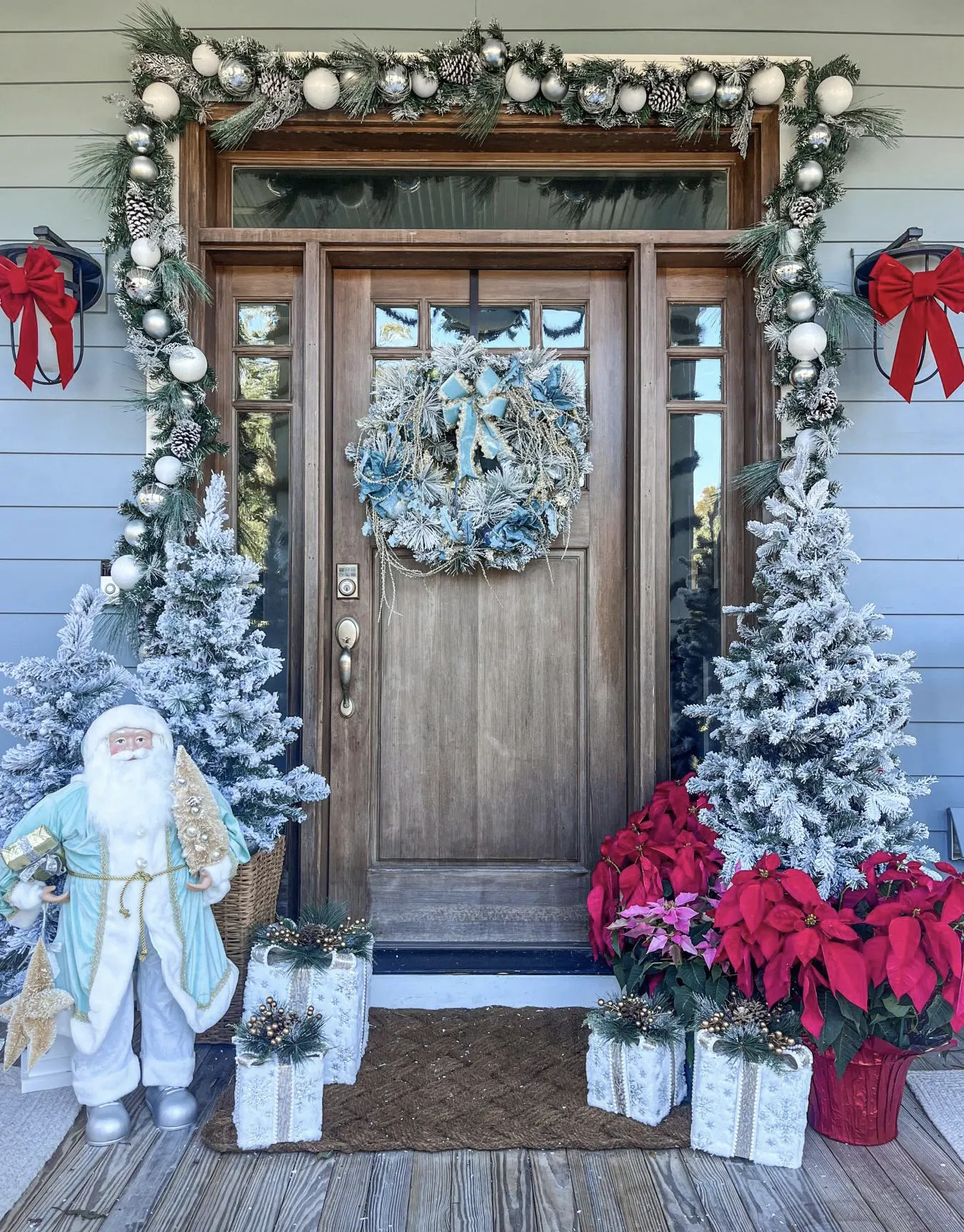
Want it warmer? Trade silver for champagne gold and keep the blue. Want it cooler? Trade the red poinsettias for white hydrangeas. The skeleton holds either way.
The light blue Santa figurine is the element that ties the whole porch together. Without him you have a flocked wreath, flocked mini trees, white gift boxes, and potted poinsettias — pretty, but generic winter décor you could find on any shelf. With him, the palette suddenly has a reason to exist: the blue in the wreath, the blue-tinged greenery, and the white boxes all clearly belong to the same story.
19. A Glossy Red Door With a Eucalyptus Wreath and a Potted Fir
This is the arrangement for a narrow entry — a single door, no sidelights, maybe 40 inches of off-white brick on each side. It needs almost nothing: 18 inches of clearance for the potted fir, one white metal lantern, and a wreath that fits the door’s proportions rather than overpowering it.
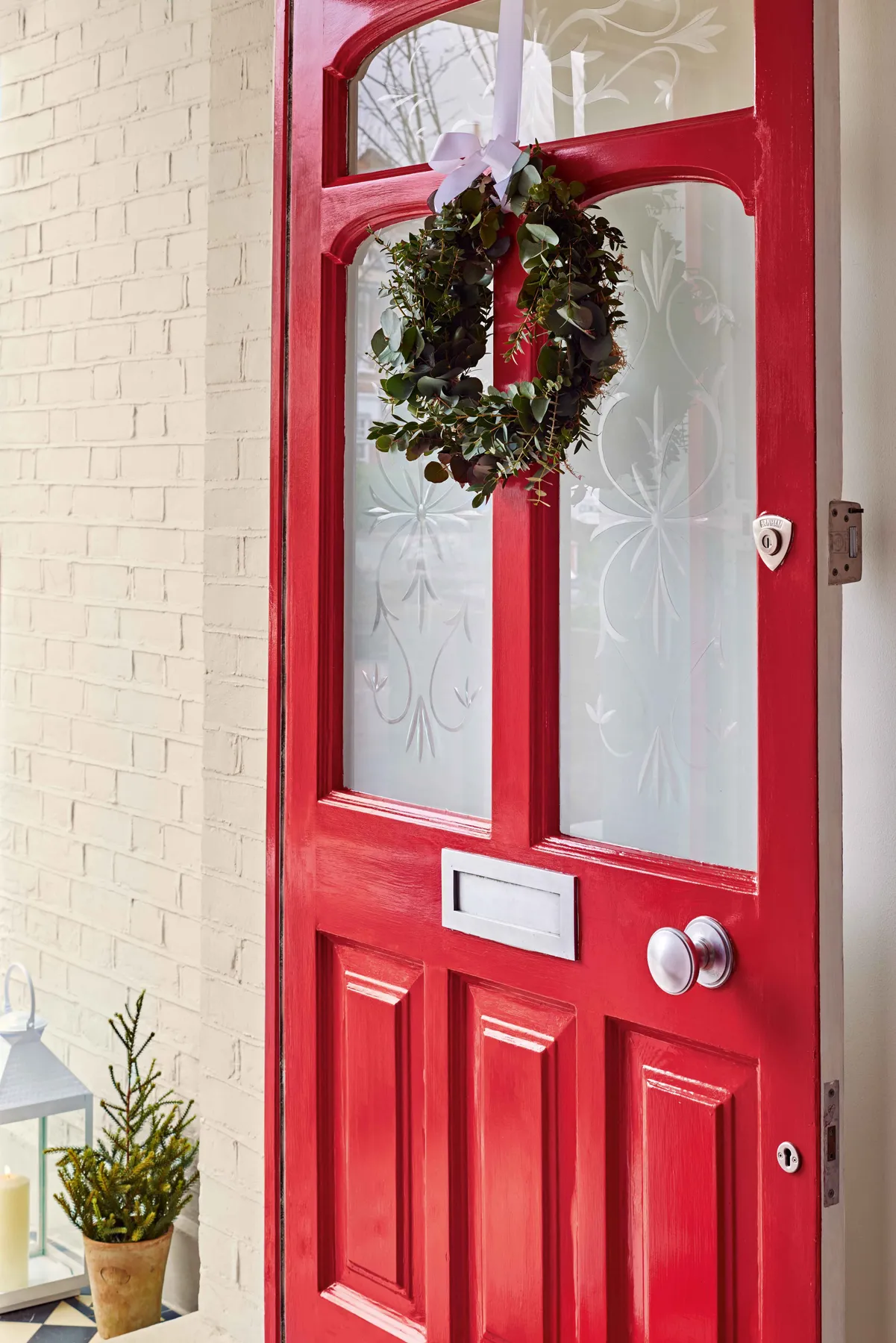
In a small entry everything stays under 30 inches tall, and the wreath hangs slightly higher than center, around 66 inches, so it doesn’t fight the letterbox or the knob. White ribbon instead of a patterned bow keeps the focus on that glossy red and the etched glass panels.
Eucalyptus is the cheapest fancy-looking greenery there is — $8 to $14 a bunch at Trader Joe’s, and it dries beautifully if you want to keep it for next year. The white lantern is a $15 Walmart find, and a terracotta pot with a mini fir runs about $20 at a hardware store. Mix real eucalyptus into a $12 artificial pine wreath base and nobody will notice. Whole entry: under $60.
20. Twin Wreaths and a Plaid Runner Between Double Doors
- Hang the garland across the top of both doors first, leaving slack in the middle so it arcs instead of running dead straight.
- Center one wreath on each door leaf — nesting them is what makes double doors read as a pair.
- Match the ribbon on both wreaths even if the ornament mixes differ slightly.
- Set the red plaid runner down the center of the porch floor, aligned with the seam between doors.
- Cluster lanterns, mini trees, and wrapped gifts in odd-numbered groups of three.
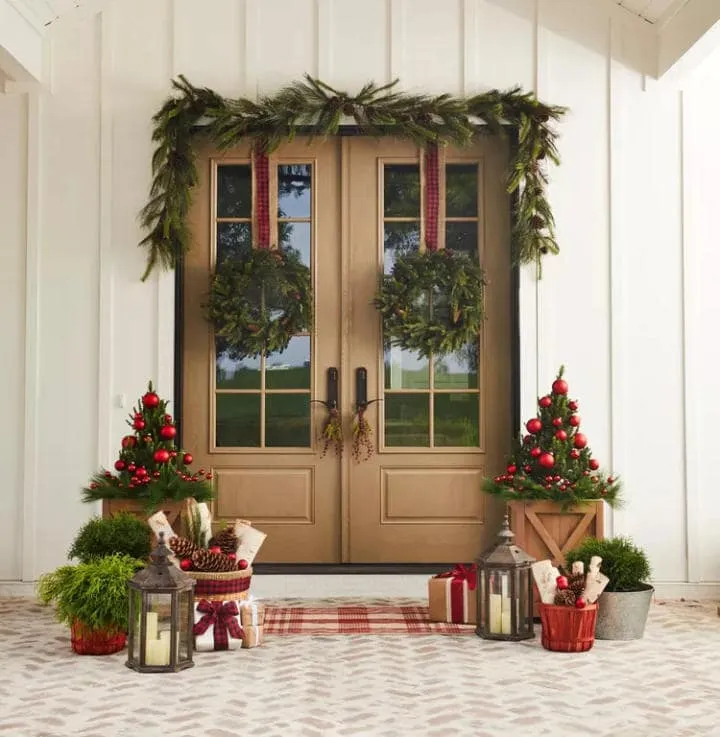
Time: about 2 hours. Materials: $120–$300.
- Two 26-inch wreaths with plaid ribbon: $70–$190
- 12-foot garland with pinecones: $40–$110
- Two mini Christmas trees with red ornaments: $50–$130
- Three dark metal lanterns with candles: $45–$120
- Plaid floor runner: $25–$60
- Reusable wrapped gift boxes: $20–$45
Total: $250–$655
Budget alternative: skip the runner and re-ribbon two wreaths you already own — under $100.
21. The Door Dressed as a Giant Gift With a Glossy Red Bow
The oversized glossy bow. Not the ribbon runs, not the white Victorian fretwork above it, not the window box of yellow and orange flowers beside it — the bow. It’s roughly a third of the door’s width, and at that scale it stops being decoration and becomes the entire concept. Scale is the whole trick. A smaller bow would just look like a wreath substitute that lost its wreath.
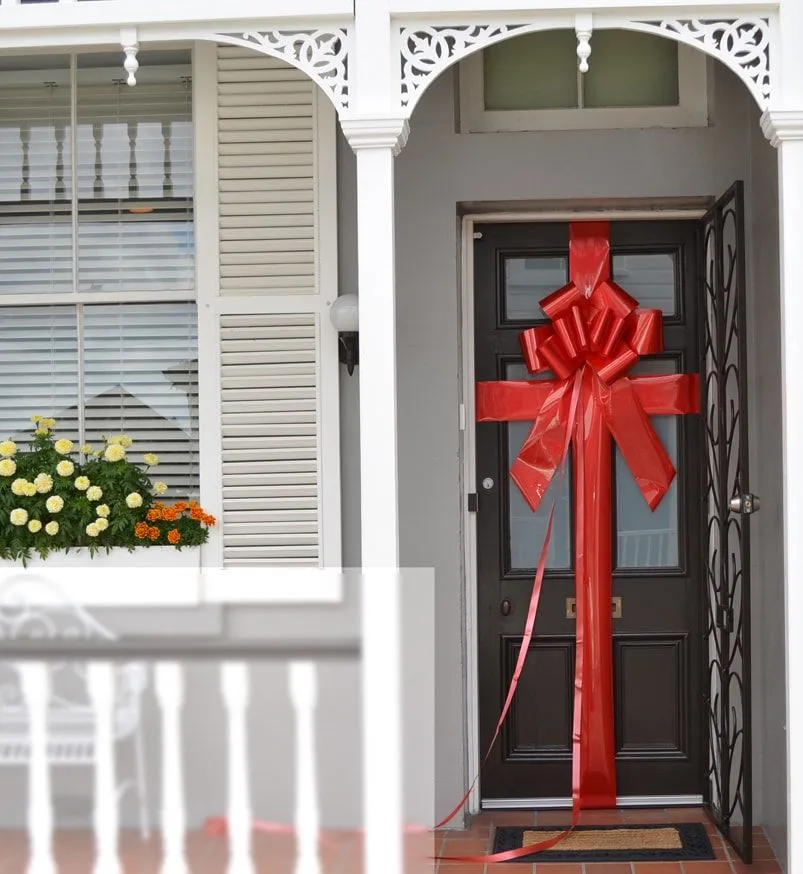
Gift-wrapped doors have been on trend for a few seasons and they’re holding, because it’s the cheapest wow available — a roll of ribbon instead of a wreath, garland, and lights. This one lands on our list of the most common front door mistakes only when it’s done at half the size. The finish matters too: matte ribbon on a dark brown door goes flat from the sidewalk, while high-shine fabric catches the porch light and reads all the way to the curb.
22. A Heavily Flocked Wreath With Red Berries on a Dark Gray Door
Flocking works as a visual trick. All that white powder lightens the evergreen just enough that the red berries and metallic silver baubles pop individually instead of blending into one dark mass. On a dark gray door, the wreath becomes the only bright object on the facade, which is exactly what you want at eye level.
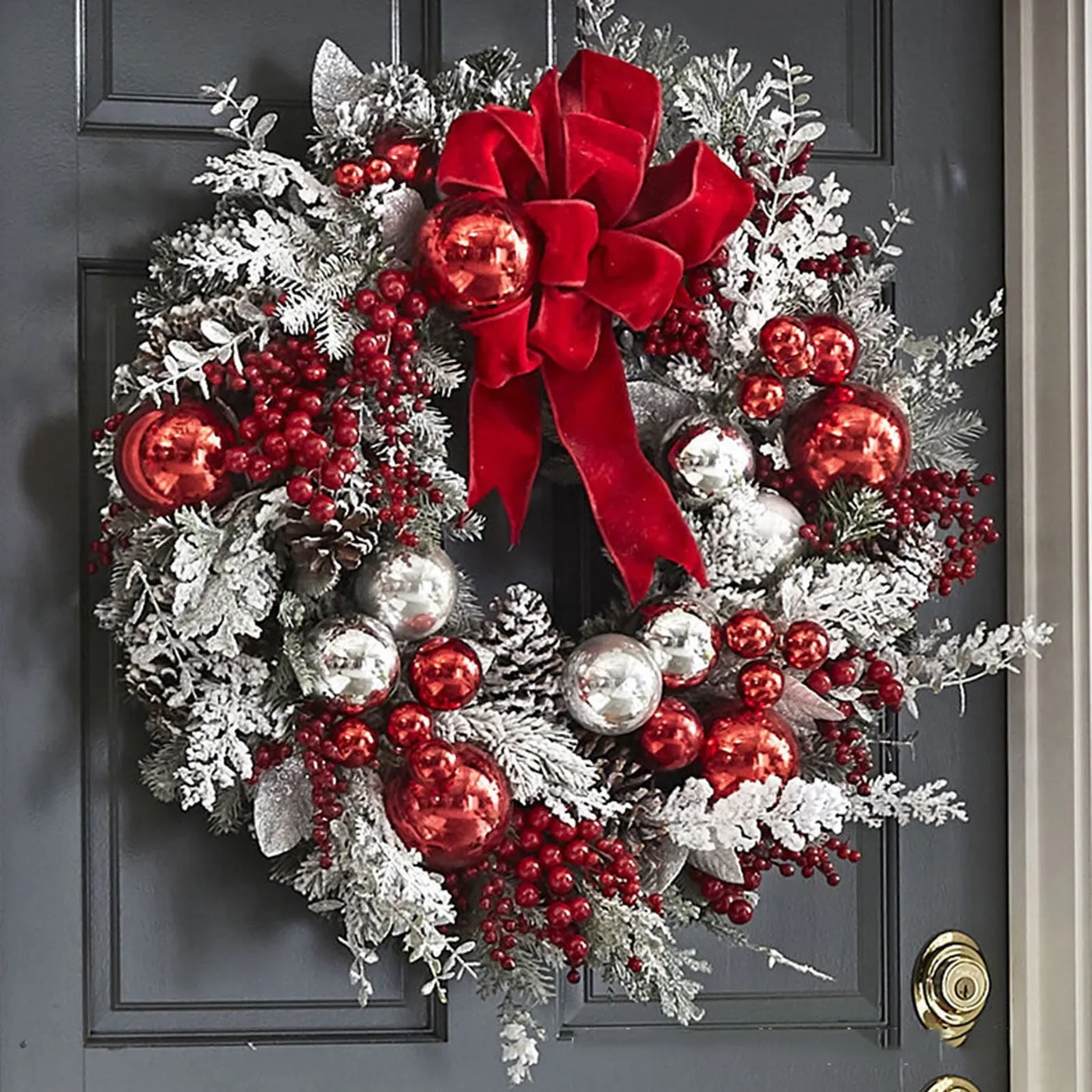
Clustered ornament sizes do the rest — three sizes of baubles, grouped rather than evenly spread, so the eye has somewhere to rest instead of scanning.
40% white-flocked evergreen + 25% red + 20% silver + 10% dark gray door + 5% natural pinecone. The flocking is doing the job a lighter background usually does in a room. Want it less sweet? Swap the red velvet bow for silver satin and cut the red down to 15%. Want it softer still? Trade the metallic silver spheres for pearl-finish ones and the whole wreath goes quiet and expensive-looking without changing a single proportion.
23. A Door Framed in Glittering Red Ribbon and Light
Glitter is a commitment. Those red glittered ribbon runs will shed onto your threshold, into your entry, and eventually into your hallway, and once it’s in the grout it’s staying. If your door gets direct western sun, budget two seasons of color before the red softens toward pink.
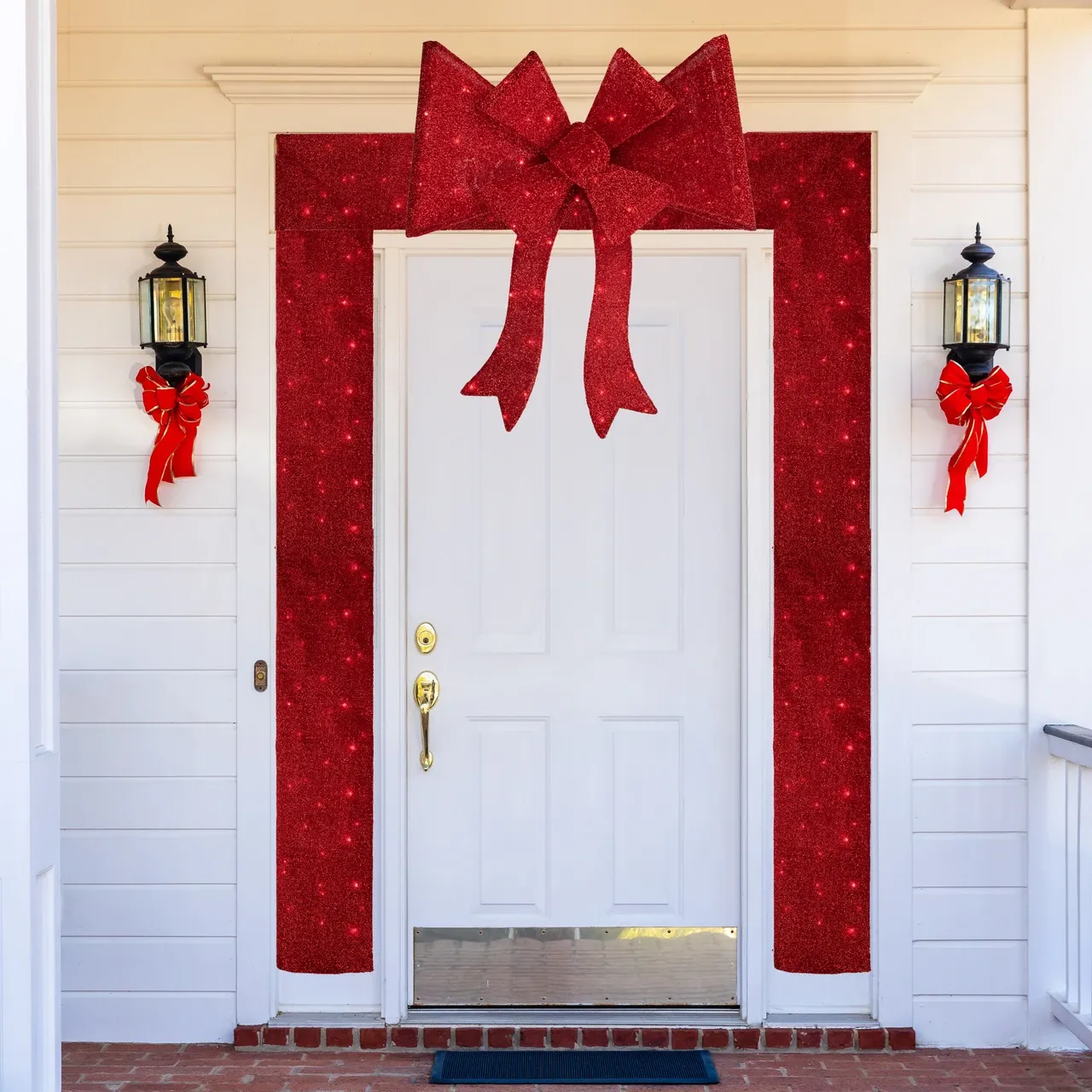
Check your wattage too: light-up ribbon plus two lit lanterns on one circuit is usually fine, but add a timer and a second illuminated strand and you’ll trip the GFCI.
The look itself is easy to fake on a budget. Glittered mesh ribbon runs $10 to $15 a roll at Michaels with a coupon, and a battery-operated string of warm white lights is $8 at Target — no outlet needed at all. Thrifted black lanterns turn up for $8 to $15, and small red velvet bows from the dollar store finish each one. Full entry for about $75 against $300 for the designer version.
24. A Rust Velvet Bow With Brass Bells on a Deep Blue Door
The bells. A full evergreen wreath with a good bow is on a million doors right now. That cluster of tarnished brass bells hanging on braided cord from a rust velvet bow is the thing that makes this one yours — and it’s cheap. Rust instead of red is deliberate: against deep blue it reads warmer and older, less candy cane.
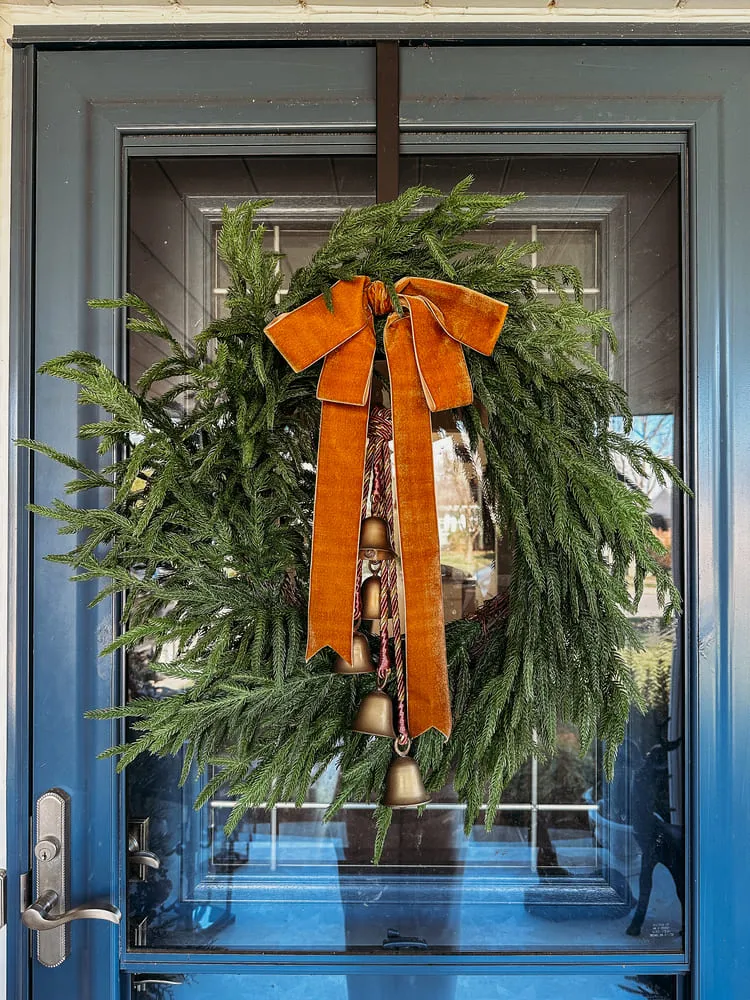
This is the wreath for a single 36-inch door with a glass panel — the bells need dark glass behind them to show up. Keep the wreath at 24 to 26 inches so the bow sits around 60 inches, roughly eye level. Two bells, not six; a cluster that’s too big starts looking like a chime. If your door is recessed, check depth first — a hanger plus bells needs about 3 inches of clearance.
Mixed-metal brass has been moving through interiors for two years and it’s finally reaching the front door — tarnished brass and aged bronze replacing polished chrome. Rust as a holiday accent tracks alongside the broader 2026 shift toward earthy tones over bright primaries. This one has legs, because the elements aren’t trendy in themselves, just rearranged.
25. The One Thing to Check Before You Hang Anything Else
Before you buy a single bow, test your door. Tape your decorations in place, then open and close it a few times. Most my-wreath-keeps-falling problems aren’t wreath problems — they’re an outward-swinging storm door, a metal door that no adhesive hook will stick to, or a wreath hanger too thin for the gap. Ten minutes now saves a return trip later.
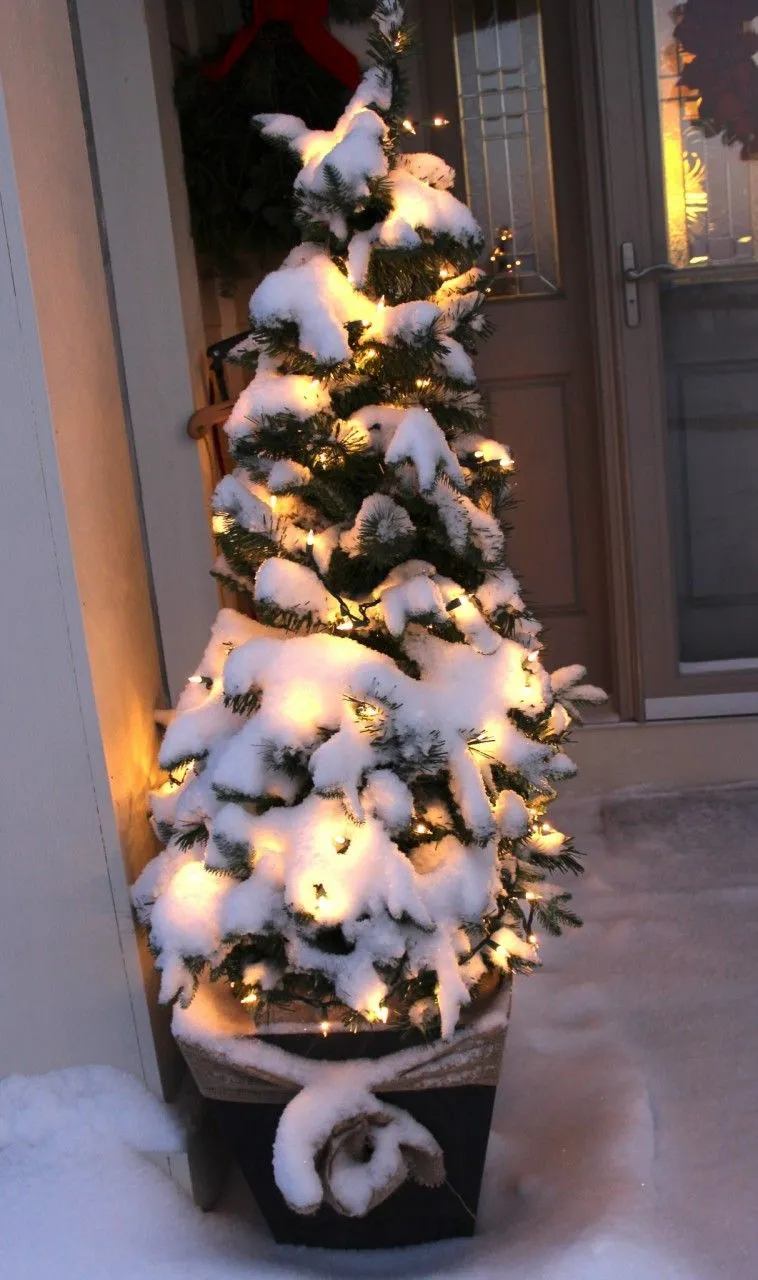
- Confirm whether your door opens inward or outward, and whether it has a storm door.
- Check the door material — vinyl and metal doors reject most adhesive hooks.
- Measure the top gap; wreath hangers need at least 1/16 inch of clearance.
- Locate your nearest outdoor outlet and confirm it’s GFCI protected.
- Walk to the sidewalk and look back — that’s your real viewing distance.
26. A Dried Wreath With Orange Slices and Cinnamon Sticks on Deep Blue
Dried elements give you variety without color noise. Build a wreath with roughly 60% evergreen, 20% dried hydrangea, 10% dried orange and red berries, and 10% hard objects — pinecones and cinnamon bundles. Bundle the cinnamon sticks with red-and-white twine in groups of five and tuck them in at odd angles, never straight up. Budget about an hour for the build, and let the brass knocker above the wreath stay visible so it reads as part of the arrangement.
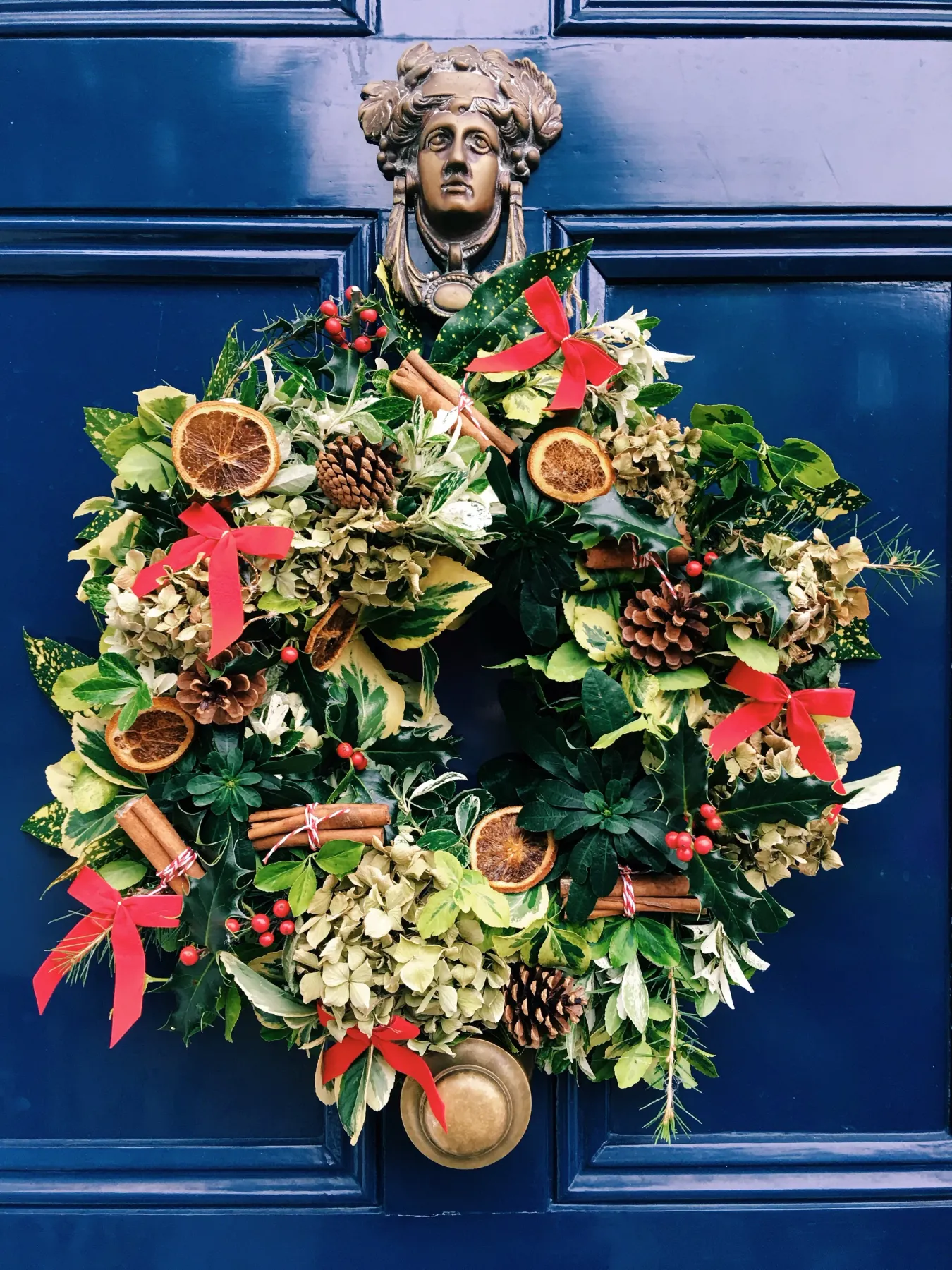
- Grapevine or mixed greenery wreath base: $25–$60
- Dried hydrangea stems: $12–$30
- Dried orange slices (DIY from 3 oranges): $4–$12
- Cinnamon stick bundles: $8–$18
- Red berries and small bows: $10–$25
- Brass accents or extra bells: $10–$35
Total: $69–$180
Budget alternative: dry your own orange slices in a 200°F oven for three hours and start from a $10 grapevine base — about $40 all in.
27. Tall Planters and Red Bows Framing Dark Arched Double Doors
55% deep green + 20% charcoal door + 15% bright red + 10% light stone. The stone steps are the secret ingredient — they give the dark doors and dark planters a light base, so nothing gets lost in shadow. Swap bright red for burgundy velvet and it reads more formal. Swap the light stone for brick and you’ll want a paler garland to preserve the same contrast.
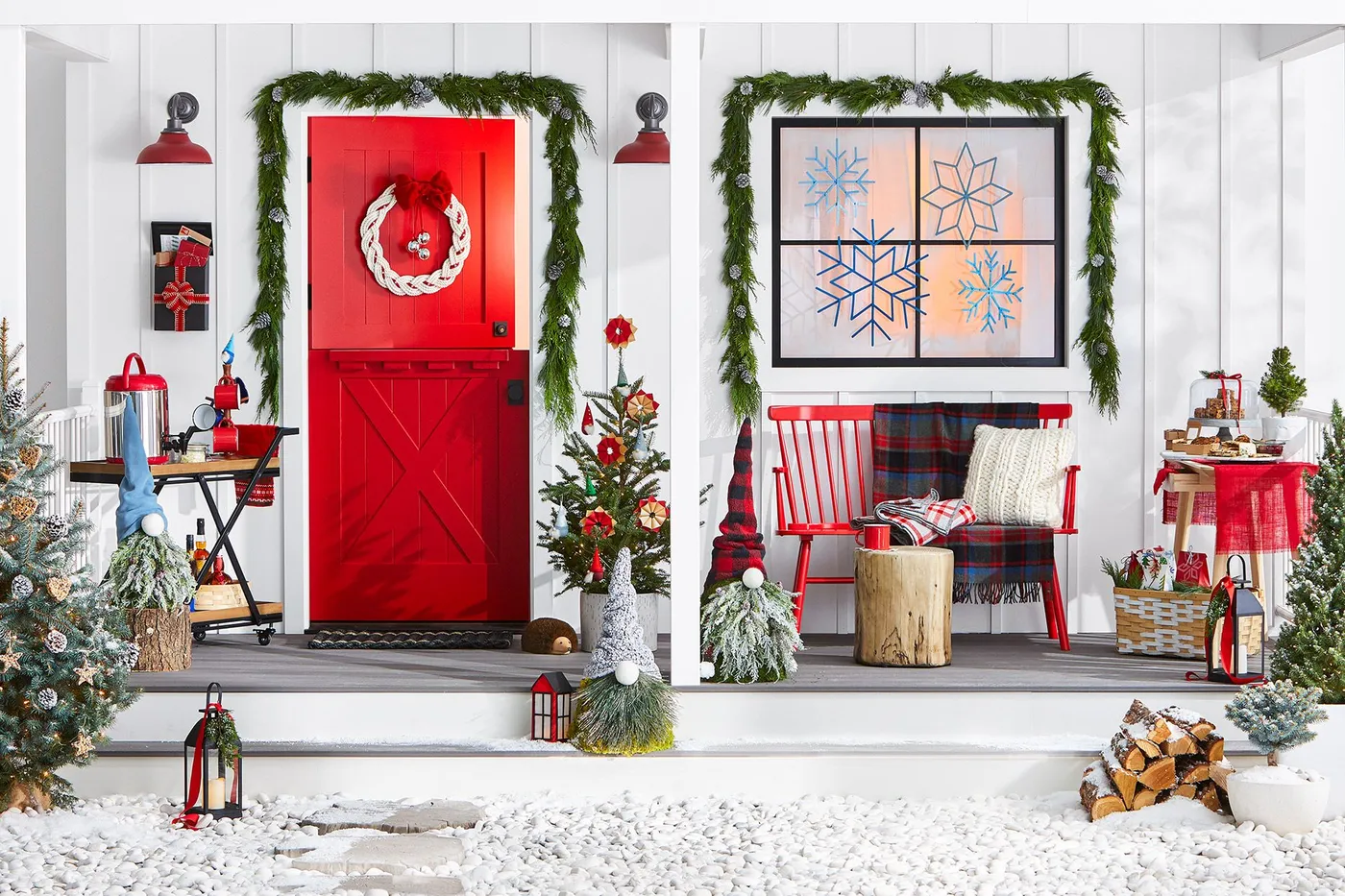
The tall planters do the work a wreath can’t on double doors. Arch-topped doors are wide, so a single wreath gets swallowed in the middle of all that wood. By putting the visual weight at the outside edges — planters at the base, garland along the outer frames, one wreath on one leaf — the composition pulls your eye outward and then back to the center. Asymmetry on a symmetrical door is deliberate here. It reads as designed rather than matched, and it’s what keeps the entry from looking like a catalog set.
28. Lit Garland Along Every Railing and Column on a Brown Porch
Railing garland takes the most weather of anything on the porch — rain runs down the rails and sits in the greenery. Real garland will drop needles within two weeks, so artificial is the honest choice for railings. Expect to replace the cheap wire-hooked strands every three seasons, and test the light connections each November before you climb the ladder.
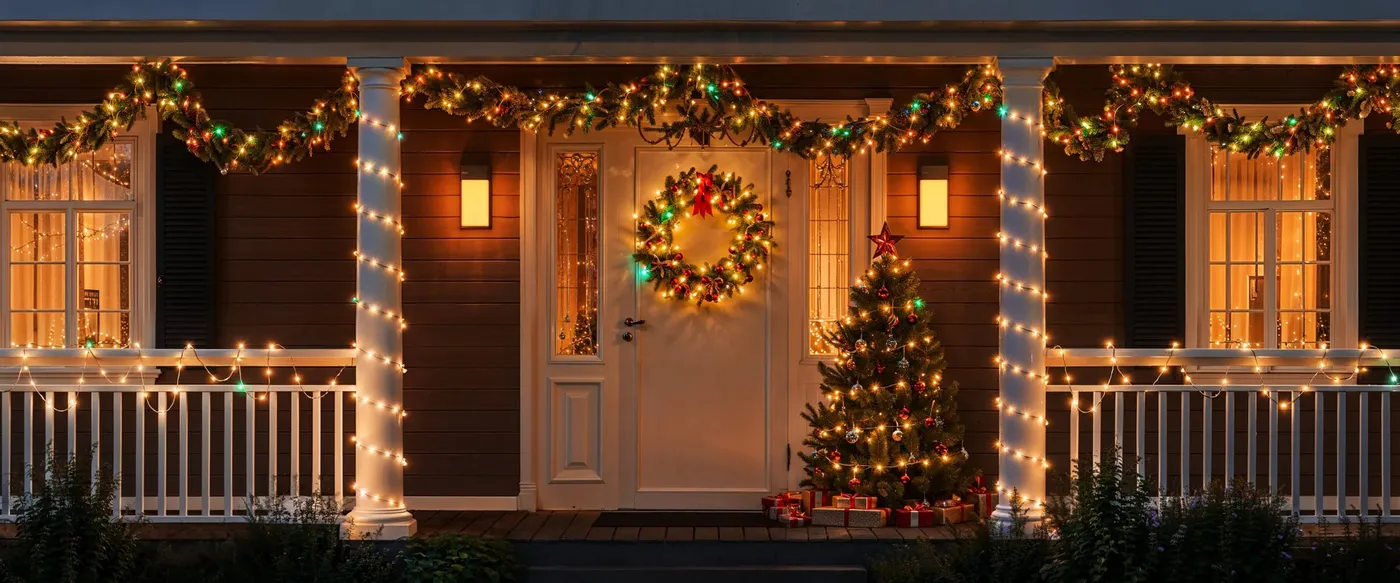
- Start at the top of the column and work down, so gravity helps you.
- Zip-tie the garland to the railing every 12 inches — wire scratches paint.
- Run string lights along the back side so bulbs peek through the greenery.
- Hang the lighted wreath on the white door last, centered at 60 inches.
- Place the small decorated tree and gifts at the hinge side, never in the walking path.
Time: about 3 hours for a full porch. Materials: $150–$350.
29. Frosted Garlands and Red Ribbon Draped Across White Columns
Frosting is a technique, not a price point. Walmart and Lowe’s both sell pre-frosted garland for $18 to $30 per 9 feet, a fraction of what designer flocked greenery costs. Red-and-gold ornament sets are $10 for 40 at Target after Thanksgiving, and round green topiaries with faux snow run $25 each at big-box garden centers. Warm orange string lights are the trick — they read warmer and cheaper than cool white, and they’re what makes frosted greenery glow gold instead of blue.
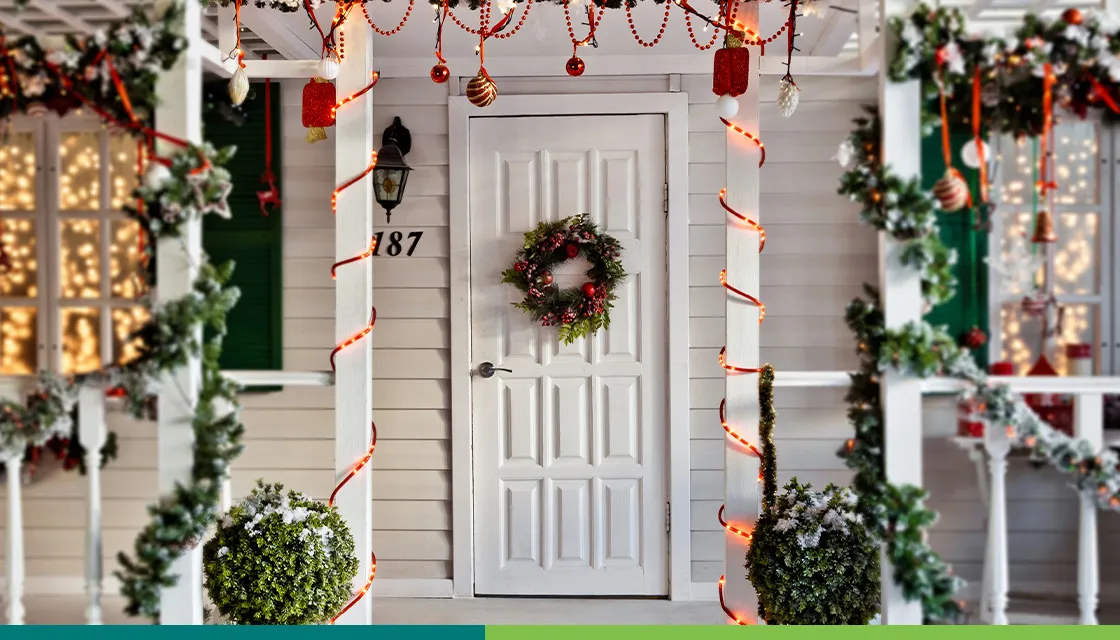
On a white porch, everything you add needs a dark anchor or the whole entry washes out. Here it’s the evergreen and the red. Try the same frosted garland with white ornaments on white siding and you’ll lose the entire arrangement by 4 p.m. in December. Keep ribbon width at 2.5 inches on a porch railing — wider gets floppy in wind, narrower reads like a gift tag.
30. A Snowman, a Reindeer, and Lights on Every Brick Line
Yard figures need room to read as a scene rather than a pile. Give each figure 4 to 6 feet of space and set them at slightly different depths — snowman closer to the walk, reindeer farther back — so the arrangement has layers from the sidewalk. This is a front-yard look, not a door look: it needs at least 12 feet of setback to work, and it swallows small urban entries. If your frontage is tight, see Idea #33 for the scaled-down version.
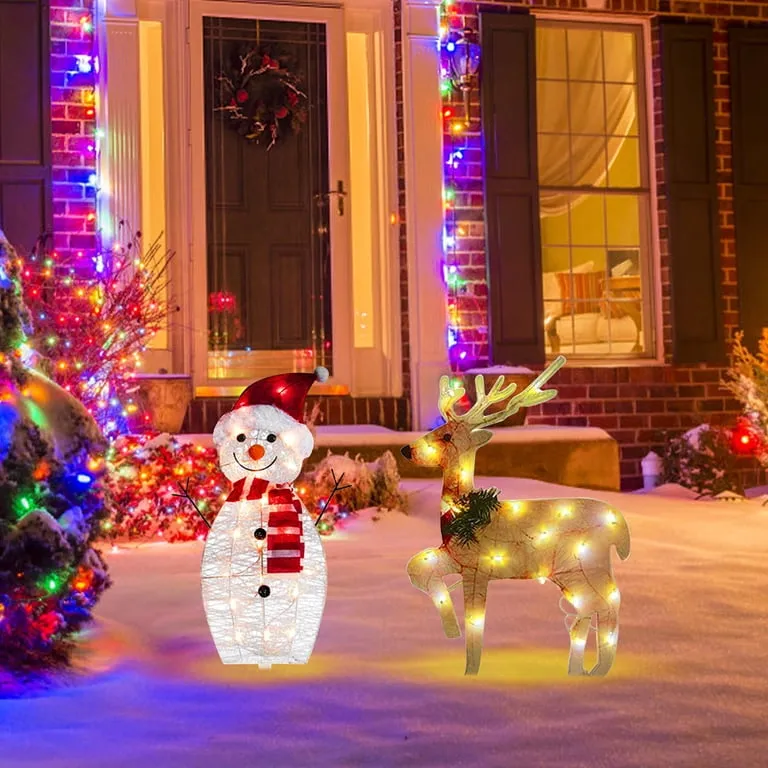
Multi-color is having a comeback after a decade of warm white dominance. The shift tracks with a broader nostalgia for the lights people grew up with — Griswold energy, tidier execution. The brick facade is why the multicolor mix doesn’t look chaotic: red brick already carries orange and red undertones, so warm bulbs blend into the wall and the cool greens and blues are the only things that truly pop.
31. A Plaid-Bowed Wreath With Gold Baubles on a Dark Door
- Start with a 24-inch mixed-needle wreath — the variety in greens is what makes it look full.
- Wire the red-and-black plaid bow at the top, off-center by an inch or two so it feels handmade.
- Add six to eight ornaments in two finishes, matte red and shiny gold.
- Tuck pinecones into the lower half to add weight and stop it floating.
- Finish with frosted red berry picks at the outer edges for silhouette.
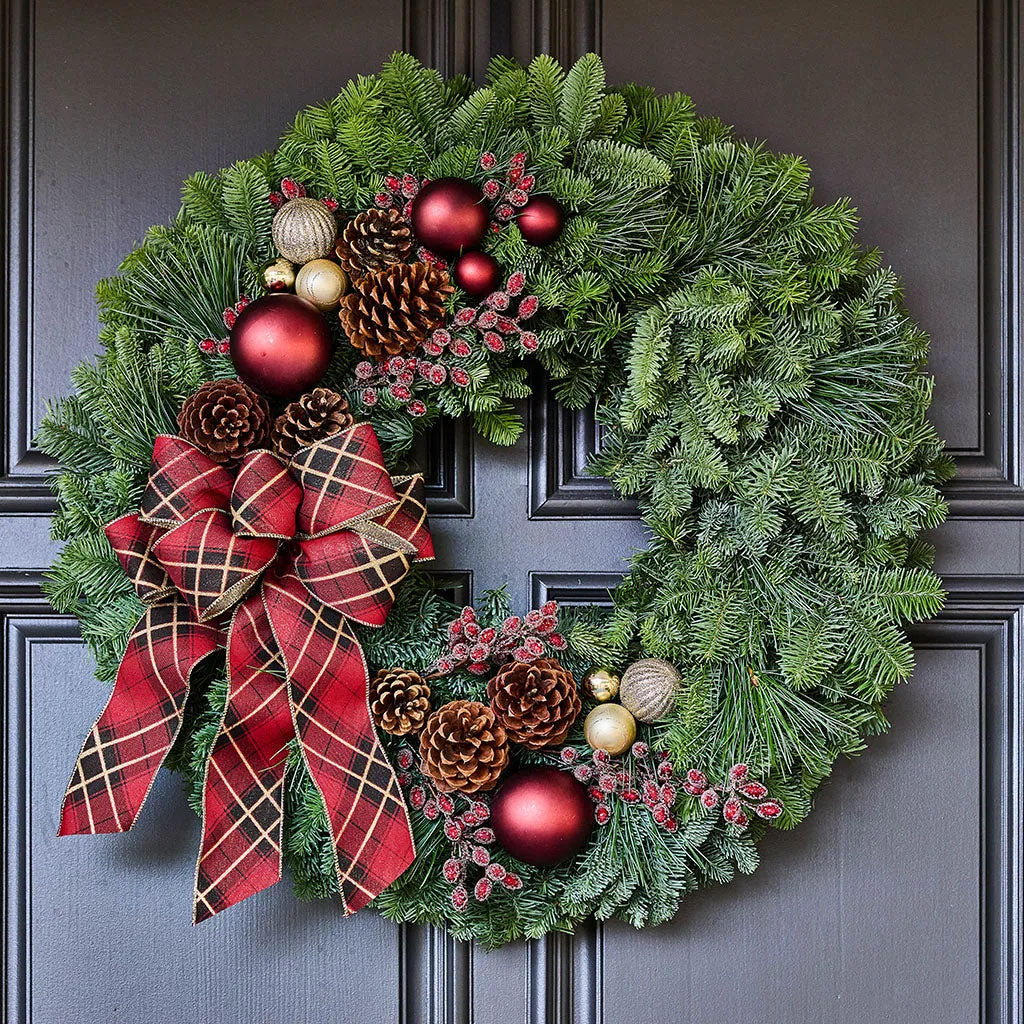
Time: about 40 minutes. Materials: $45–$90 if you’re building on a plain wreath base.
The plaid bow is the one thing. Evergreen wreaths with gold ornaments are everywhere; the bow is what dates this to now and gives the whole thing a casual, cabin-adjacent personality that an ornament-only wreath simply doesn’t have. It also solves a practical problem: a bow at the top hides the wreath hanger, so you don’t have a metal hook poking out above your greenery.
32. Red Door, Poinsettias, and Garland on a Small White Cottage
- Two 9-foot garlands with red and gold picks: $55–$140
- Three potted poinsettias: $30–$75
- Mixed string lights, 100 feet: $20–$55
- Red and green ornament set (60 pieces): $18–$45
- Two hanging black lanterns: $30–$80
- Two potted green plants with red flowers: $25–$60
Total: $178–$455
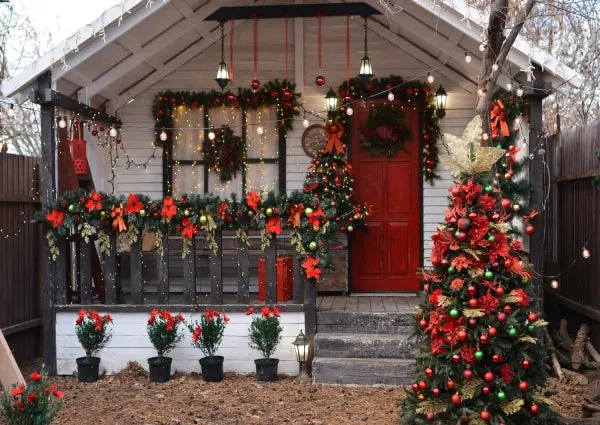
Budget alternative: two garlands, one poinsettia, and lights you already own gets you the same impression for about $85.
Small cottages tip into cluttered fast, because there’s less wall to spread across. This porch works because it uses one red door and repeats red everywhere else, so the eye tracks a single color from railing to roofline. Start adding blue or pink accents and it goes from charming to chaotic. One more thing: real poinsettias hate cold. Below 50°F the leaves drop, so if your porch is unheated in a cold climate, faux poinsettias are the honest choice.
33. A Lighted Snowman and Reindeer Against a Lit Brick Wall
This is the scaled-down version: two figures, two lit trees, one red lighted wreath on the wall — a display that works in about 10 feet of frontage. Keep the figures 5 feet apart and at least 3 feet from the wall so the wall lighting reads behind them instead of silhouetting them. Snow-dusted trees should be slightly taller than the figures; if they’re shorter, the whole scene flattens out.
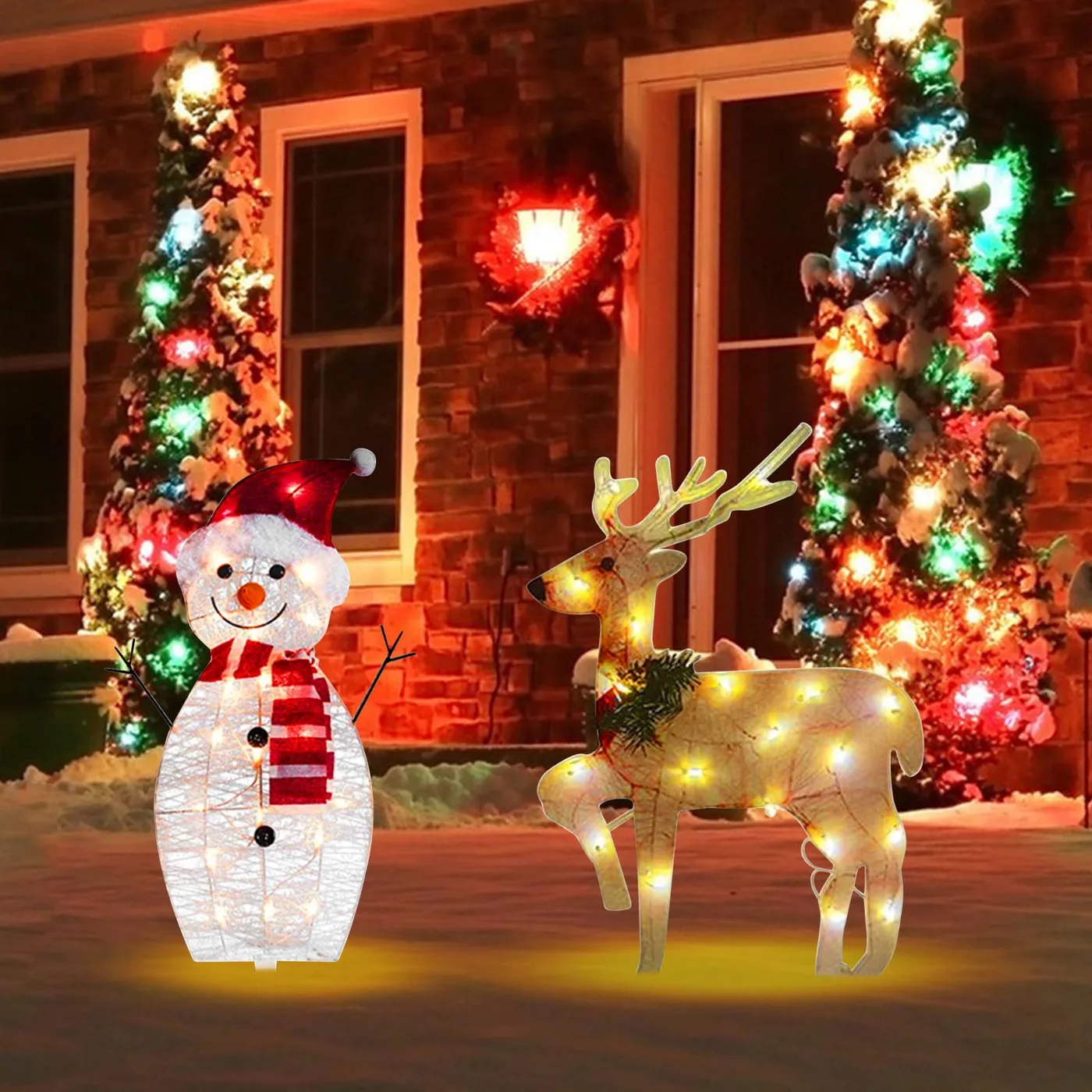
Light-up snowmen and reindeer run $30 to $70 each at Walmart and big-box hardware stores, and they drop to $20 to $40 in post-Thanksgiving sales. Multicolor LED strands are $8 per 100 lights, and the red lighted wreath is about $20 at Target. The dark brick wall behind it does the rest for free. Complete scene for around $130.
Light-up figures and snow don’t mix as well as the box claims. Bring them in when temperatures drop below 10°F — the PVC shells get brittle and crack if something lands on them. Store figures standing upright in a dry space if you can; folded into a bin, the frames slowly deform and next year your reindeer has a lean.
34. A Glittering Red Lighted Bow on a Sage Green Door
Light-up bows work best when they’re the only light source on the door. Keep the strand count low — a 20-light bow is plenty — and make sure the color temperature matches your porch fixture, or you’ll get a bow glowing cool blue against a warm yellow porch. Hang it 8 to 10 inches below the transom, not at the very top of the frame. That gap is what makes it look placed rather than stuck.
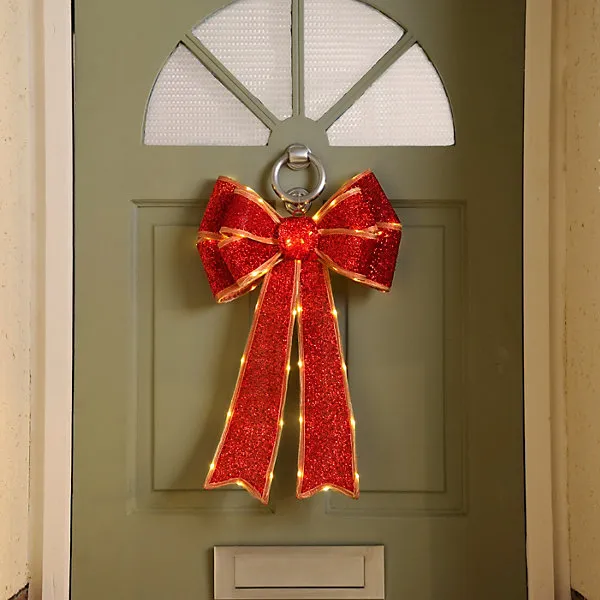
Red against sage green is the whole idea. Red-and-green is the most predictable combination in Christmas decorating, but this green is desaturated and slightly gray — a muted, almost modern green — so the red bow reads bright and contemporary instead of traditional. Notice the silver too: the knocker, the letterbox, the frosted transom. Cool metal hardware is what keeps that sage from turning into a farmhouse cliché.
35. A Berry-and-Light Wreath on a White Door With an Ornate Hanger
Compare with Idea #15 — same wreath-plus-planters structure, a much darker door. Before you commit, run this quick check:
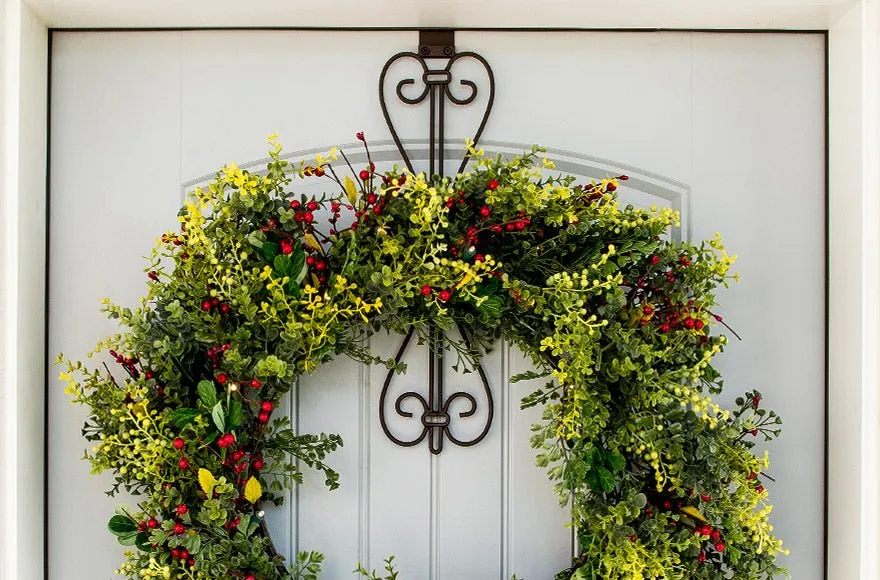
- Confirm your wreath hanger fits over the door without scraping the frame.
- Check the hanger’s weight rating — a lit 30-inch wreath can hit 6 pounds.
- Measure door-to-screen clearance before hanging anything with berries.
- Test the lights before you climb the ladder, not after.
- Decide hook placement now: a heart-top hanger sits better dead center than offset.
Artificial greenery with built-in lights is the lowest-maintenance option on this list — no watering, no needle drop, and LED bulbs that will outlast the wreath. What does need attention: wreath hangers scuff white doors over time, so add a felt pad behind the hook, and dust the greenery once a season with a hair dryer on the cool setting. Expect five to seven years before the foliage looks tired and the lights start flickering.
Your Front Door Only Gets One December
Start with one thing — a wreath, a bow, a ribbon run across the door — and let the porch fill in around it over a weekend. The entries that look best on this list aren’t the most expensive ones; they’re the ones where a single idea was carried all the way through.
📌 Pin your favorites now so you’re not scrolling in the cold on December 20th, and tag us when your entry goes up — we want to see which idea you claimed.
