
35+ Gorgeous Scandinavian Folk Art Christmas Decor Ideas You Need to Try in 2026
Scandinavian folk Christmas is having a serious moment on Pinterest right now — and the second you see a hand-painted Dala horse hanging from a rope-wrapped chandelier, you get it.
We spent real time browsing Etsy, Target, IKEA, Walmart, and Facebook Marketplace to bring you only what’s actually worth your attention this year, from a $1 felt heart ornament to a $4,200 three-tree setup. Consider this your curated shortlist.
Inside you’ll find 35 ideas spanning Scandinavian folk, rustic Nordic cabin, traditional Danish Christmas, and cozy cottage styles — and every single one gets a budget version and a luxury version compared side by side, so you can see exactly where the money goes. And stay until the end — we break down the most common mistakes that can ruin these looks. Some links in this guide are affiliate links, which may earn us a small commission at no extra cost to you.
What’s driving it in 2026 is the move away from matching sets toward collected handwork: painted wood, straw stars, cross-stitch, and pieces that look inherited rather than purchased. Save this post now — you’ll want it when you’re ready to shop. 📌
1. A Chunky Knit Throw and Black Window Grids in a Reading Nook
A natural light-wood armchair with cream cushions reads calm because nothing in the frame is shouting. The black window grids do the heavy lifting — they hand your eye a hard geometry to rest on while the chunky knit throw, textured grey rug, and tree blur into softness. The frosted glass candle holder repeats that matte finish at a smaller scale. Crisp line against fuzzy surface: that’s the entire trick, and it costs nothing to copy.
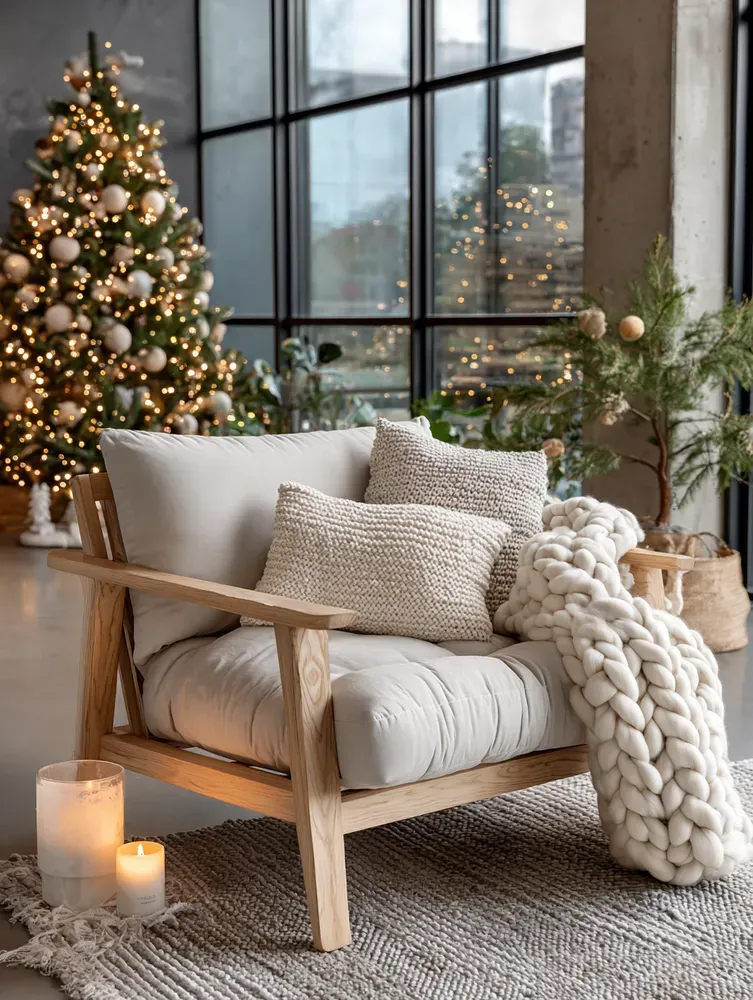
Push your tree lights to a warm 2700K and keep them off the same circuit as any cool-white lamp. The reason this nook feels like candlelight is temperature consistency — one 4000K bulb in the corner will make the tree look yellow and cheap. If your lamp isn’t dimmable, put it on a smart plug and drop it to 30% after 6pm. Warm light on cool grey is what makes a corner read as evening even at noon.
2. The Carved Wood Candle Tree That Earns Its Own Shelf
- Start with a tray or wood slice at least 2 inches wider than the holder on every side.
- Line it with preserved moss and dried lichen, packed tight so nothing shifts.
- Set the painted tree holder dead center and anchor it with museum putty.
- Fit the five twisted cream candles into the red cups and trim wicks to 1/4 inch.
- Light the back candles first so you’re never reaching over a flame.
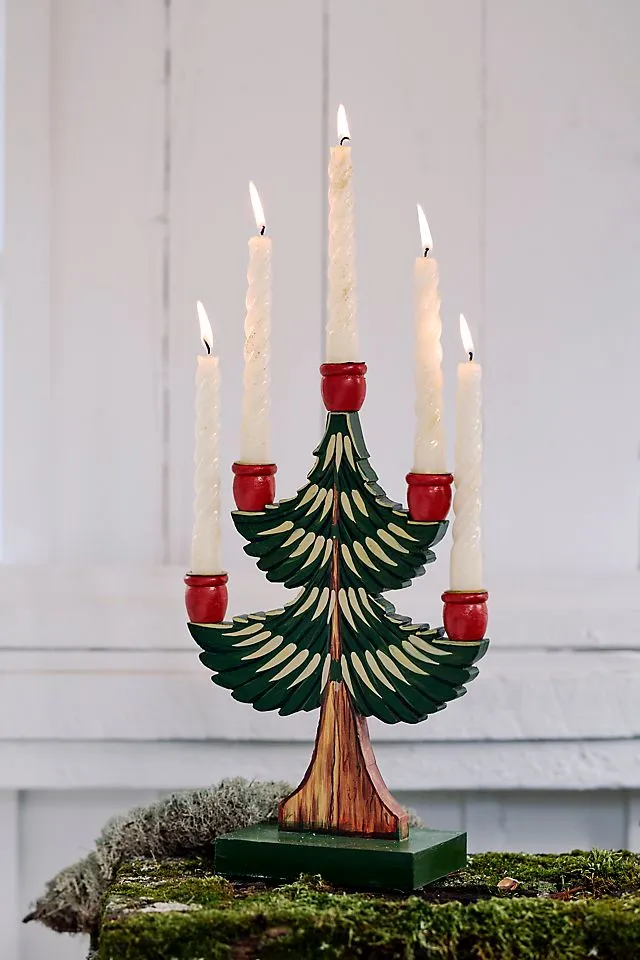
Time: about 20 minutes. Materials: $18–$35 for moss and candles if you already own the holder.
Take away the moss and lichen and you have a nice carved object sitting on a bare shelf. The moss is what makes those candles feel like they’re burning in a forest instead of on a sideboard — and it does practical work too, hiding the base seam and catching wax drips before they reach the wood. Buy two bags. One is never enough to look intentional.
3. Leaf-Patterned Wallpaper and a Basket-Grown Evergreen
Roughly 60% warm wood and forest green — the table, the leaf-print wallpaper, the little lit evergreen — plus 25% soft neutrals from the grey credenza and white pillar candle, plus 15% glass and light from that spherical chandelier. The wallpaper is the bold move, so everything else stays deliberately quiet, which is why the wooden crate on the credenza holds plain evergreens instead of more pattern. Swap the leaf print for a fine stripe and the same math holds.
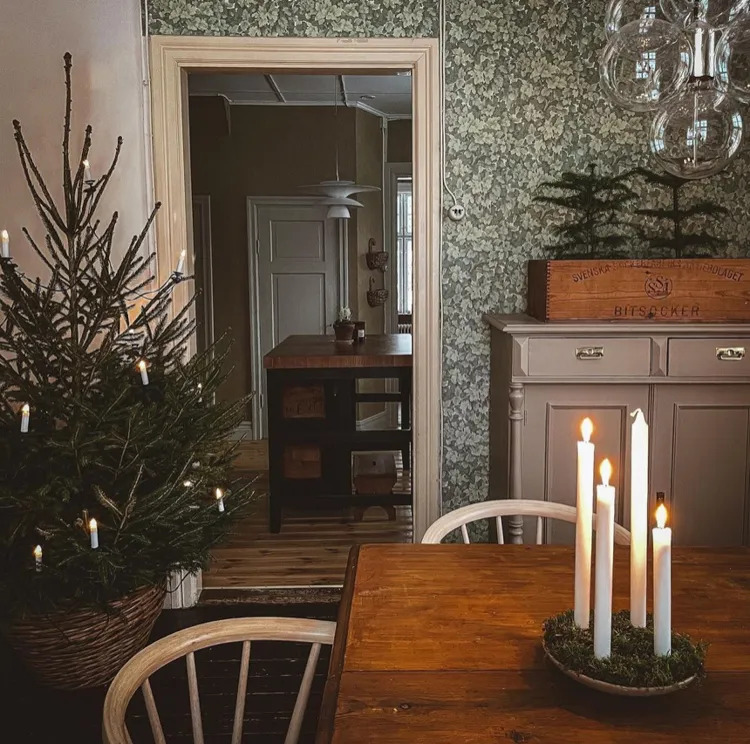
Leaf-patterned wallpaper in a dining room is a real commitment, and small-scale prints turn into visual static from across the room. If your table seats six or more, go bigger with the motif or you’ll feel like you’re eating inside a hedge. Also check your light direction before you hang paper — raking light from a side window shows every seam and every slightly-off repeat.
4. Real Taper Candles Clipped to a Fir Tree — Yes, Really
Lit tapers on a live tree need attention every single evening. Expect to replace candles every 25 to 35 minutes of burn time, trim wicks before each lighting, and never leave the room. Clips can scar soft new growth, so rotate positions weekly. If that sounds like a chore, battery-operated tapers in the same dark metal clips deliver 90% of the effect with zero smoke and no wax on the patterned rug — and you can actually enjoy dinner.
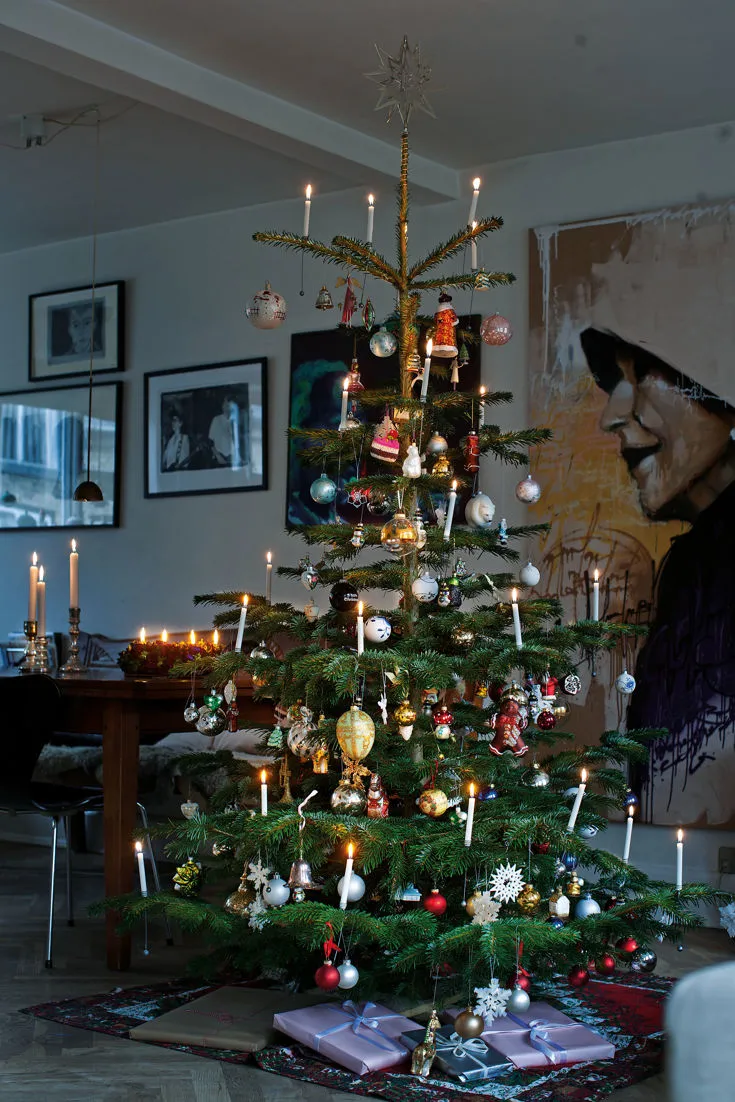
The mix works because it’s generational, not themed. Glass baubles, folk-painted ornaments, a clear star on top: three different eras of decoration sharing one tree, with muted gift wrap underneath so the base doesn’t turn into a color explosion. Compare with Idea #2, where five candles on a small wooden tree give you the same flicker without the fire risk.
5. Snowflake Embroidery and a Frosted Tree in a Tan Bedroom
A frosted tree this size wants about 30 inches of clearance from the bed frame so you’re not brushing needles every time you get up. It works in bedrooms from roughly 120 square feet up, with ceilings at 8 feet or higher — the dark metal chandelier needs headroom to hang safely. In a tighter room, drop to a 4-foot frosted tree on a stand and keep the snowflake bedding, which is doing half the work here anyway.
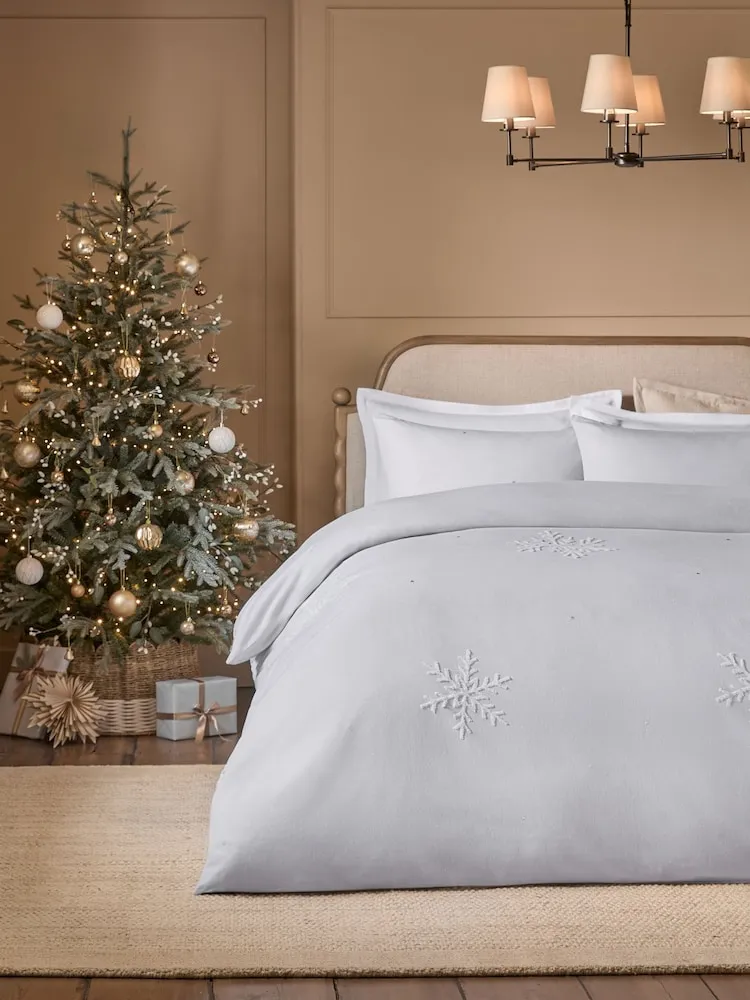
Embroidered snowflakes on white bedding only read from a distance if the thread is slightly off-white. Pure optic white on pure optic white vanishes under warm lamplight. Look for ivory or cream stitching on a white ground, then match your euro shams to the embroidery tone rather than the sheet tone. That half-shade difference is what makes a bed photograph well and feel layered in person.
6. Painting a Red Stocking Ornament With Teal and Yellow Motifs
- Cut a stocking shape from 1/4-inch birch plywood and sand the edges to a soft round.
- Base-coat in barn red — two thin coats beat one thick one every time.
- Sketch the little white tree and the dot border in pencil before you commit to paint.
- Add teal-green and yellow motifs with a fine liner brush: dots first, florals second.
- Drill a small hole, thread jute twine, and slide on one red and one white wooden bead.
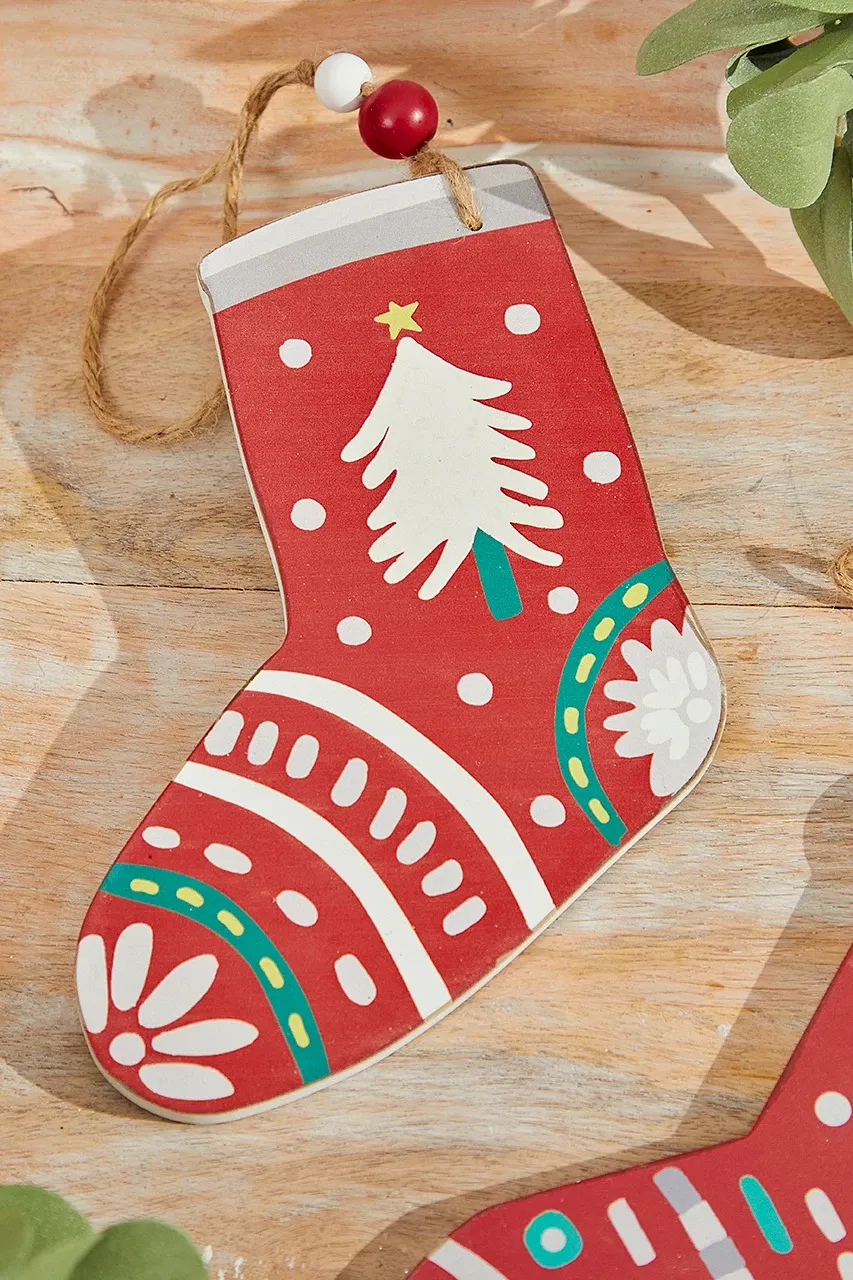
Time: about 2 hours plus drying. Materials: roughly $12 for paint and plywood, less if you already own brushes.
Hand-painted wooden ornaments are riding the same wave as the craft revival that took over Pinterest heading into 2026 — people want decorations that look collected, not pulled from a coordinated box. Teal and ochre against barn red is the specific shift away from red-and-green-only palettes. This one has staying power because it isn’t a color trend; it’s a habit of making.
7. A Folk Art Bear Family Ornament in Warm Earthy Tones
The embracing pose is the entire ornament. Take it away and you have a decorated bear shape; keep it and you have a small story about family that works on a tree, a wreath, or a gift tag. The floral and geometric fill patterns in dark brown, orange-brown, and deep blue are secondary — they’re the frame, not the picture. Choose ornaments by silhouette first and pattern second, always.
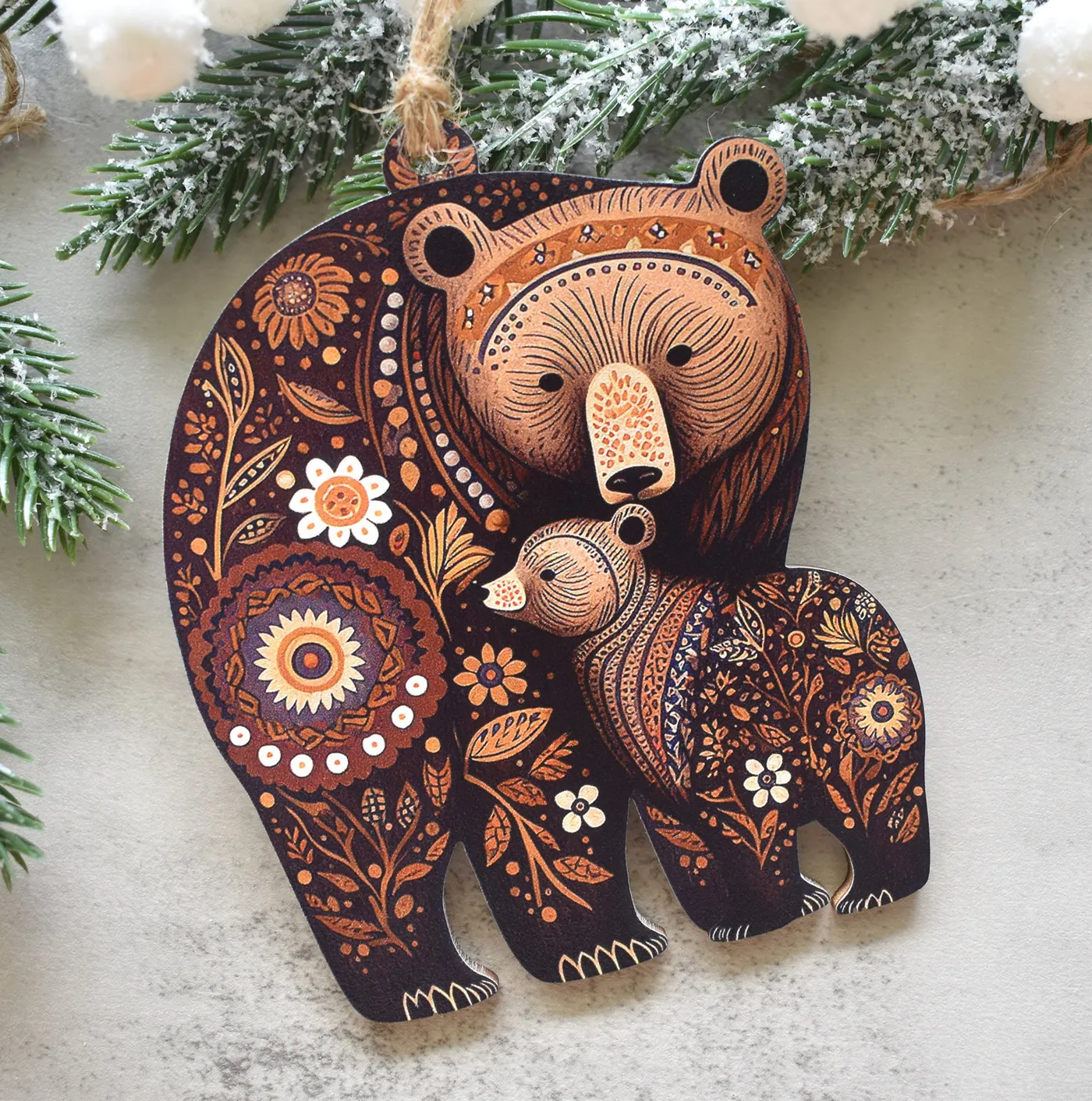
You can build a similar collection for a fraction of the price:
- Unfinished wooden cutouts from a craft store: $1.50–$3 each
- Acrylic paint in burnt umber, ochre, and navy: about $6 for three
- Jute twine and a fine liner brush: $5
- Frosted branch garland and white pom-poms for staging: $12–$18 at Target or Walmart
That’s under $30 for six ornaments, versus $12–$20 each for hand-painted versions.
8. A Suspended Branch Above the Table Instead of a Chandelier
- Main furniture: wooden table and bench, $600–$2,400 (Facebook Marketplace often has solid pine under $400)
- Lighting: brass candlesticks and pillar candles, $40–$120
- Textiles: red-and-white patterned runners, $30–$90
- Decor: branch ornaments, reindeer figurines, themed candles, $50–$150
- Greenery: fresh or faux tree with lights, $80–$400
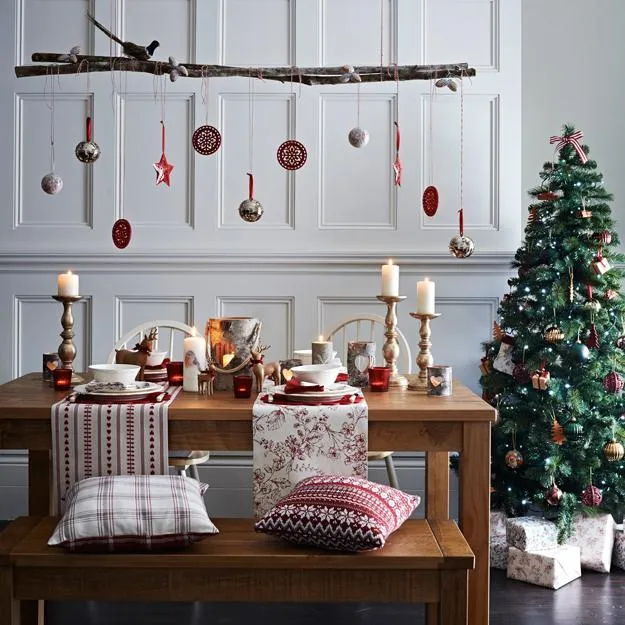
Total: roughly $800–$3,160. Budget alternative: keep your existing table and put the money into the branch, the runners, and good candles — that’s where this look actually lives.
Hanging ornaments from a branch instead of a fixture keeps sightlines open, so you can see the person across the table. The red and silver baubles cluster into three loose groups rather than spacing evenly, which is what stops it from looking like a store display. Brass candlesticks add the one warm metal the scheme needs. Compare with Idea #26 — same natural materials, but built around fireplace glow instead of an overhead branch.
9. Live-Edge Wood, Pinecones, and Three White Pillar Candles
About 70% white and cream — the sofa, cable knit pillows, the three pillar candles — plus 20% raw natural wood from the live-edge slab and pinecones, plus 10% deep evergreen. That ratio is why the coffee table doesn’t compete with the tree glowing behind it. Want a darker mood? Hold the ratios and swap the white candles for amber glass. The wood stays; only the quality of light changes.
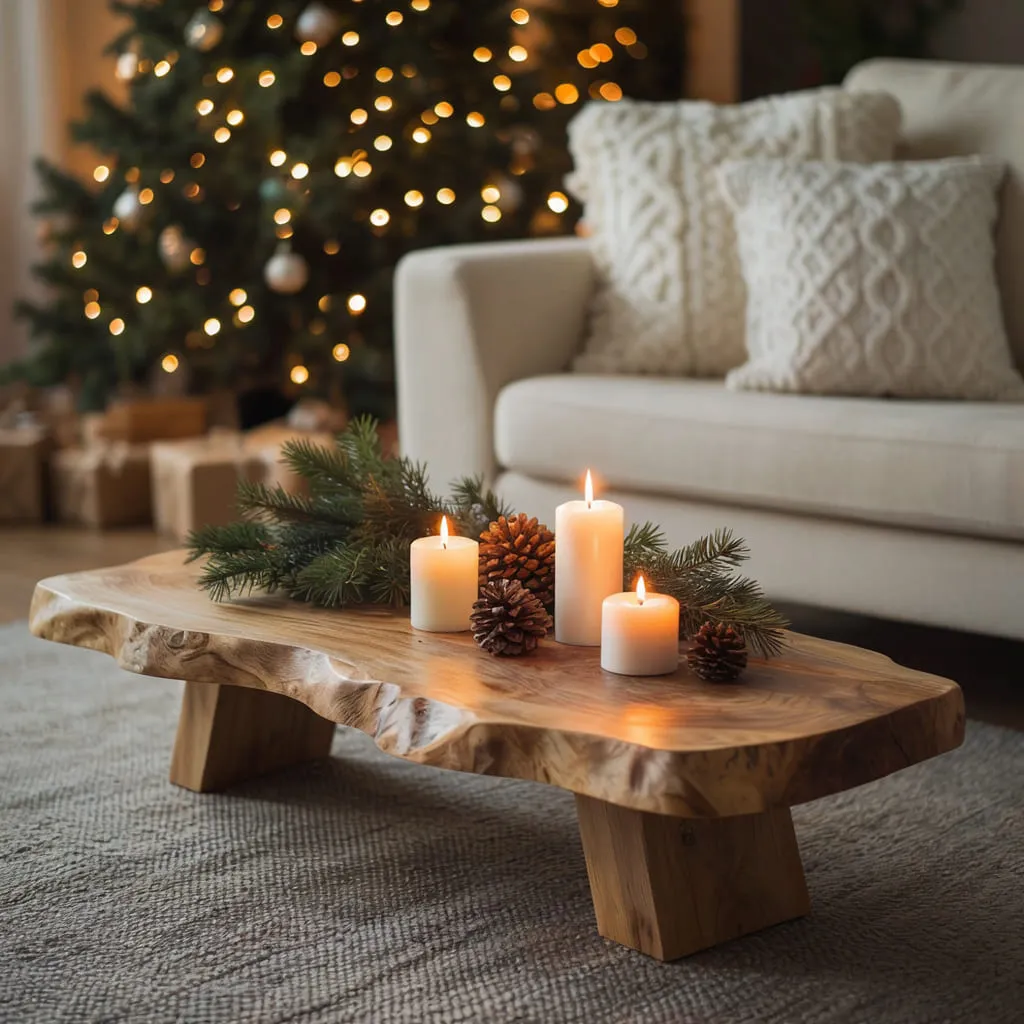
Group candles in odd numbers and vary heights by at least 2 inches — three pillars all cut to 4 inches will look like a shop display. On a live-edge table, keep the arrangement inside the widest part of the slab so the raw edge stays visible on both sides. And put a felt pad under every holder; wax and wood are not friends, and a ring on a live edge is permanent.
10. The Antique Santa in Wooden Clogs Nobody Else Owns
Collectors have been pulling vintage Santa dolls out of estate sales for years, but 2026 is when the folk-painted version — green textured suit, red pants, black wooden clogs — became the one to hunt. It fits the broader drift away from cartoon Christmas toward pieces with visible handwork. Genuinely old Santas hold their value; reproductions don’t. Buy the one you like looking at, not the one that says rare in the listing.
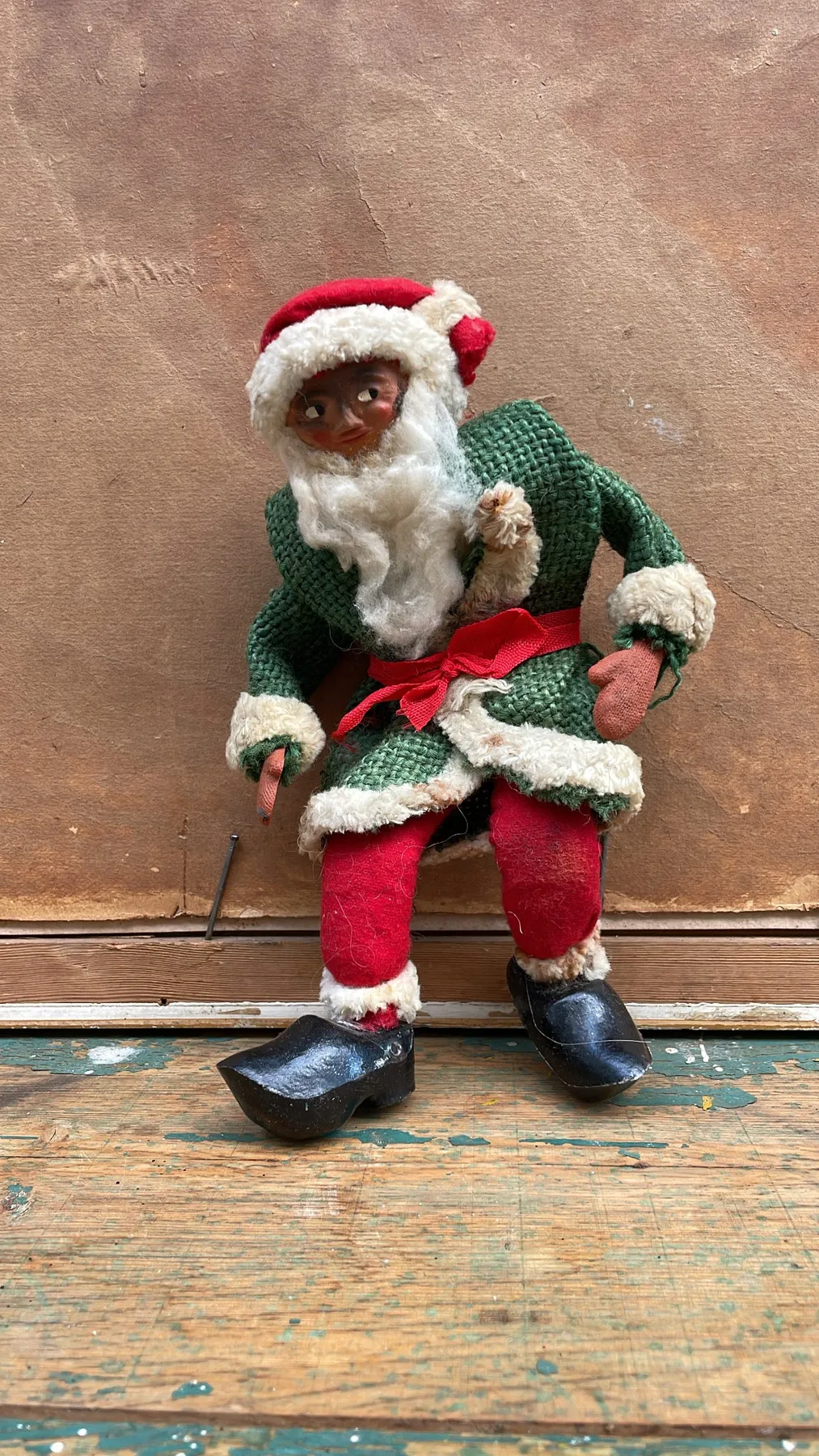
Old textiles and painted wood hate forced-air heat and sunlight. Keep an antique doll off the mantel above an active fire and out of direct window light, or that green suit fades to grey within a season. If you have pets or toddlers, put it behind glass — a wooden clog is a choking hazard and a chew toy in equal measure, and that red ribbon sash will be the first thing to go.
11. Gold Tablecloth, Red Velvet Stocking, Garland-Draped Mantel
- Main furniture: your existing table and seating (or $500–$2,200 if you’re buying)
- Lighting: candlesticks, tapers, tree lights, $60–$180
- Textiles: gold tablecloth, red velvet stocking, $45–$140
- Decor: garland, red berries, gold-accent ornaments, gift boxes, $90–$260
- Greenery: tree plus fresh mantel garland, $100–$450
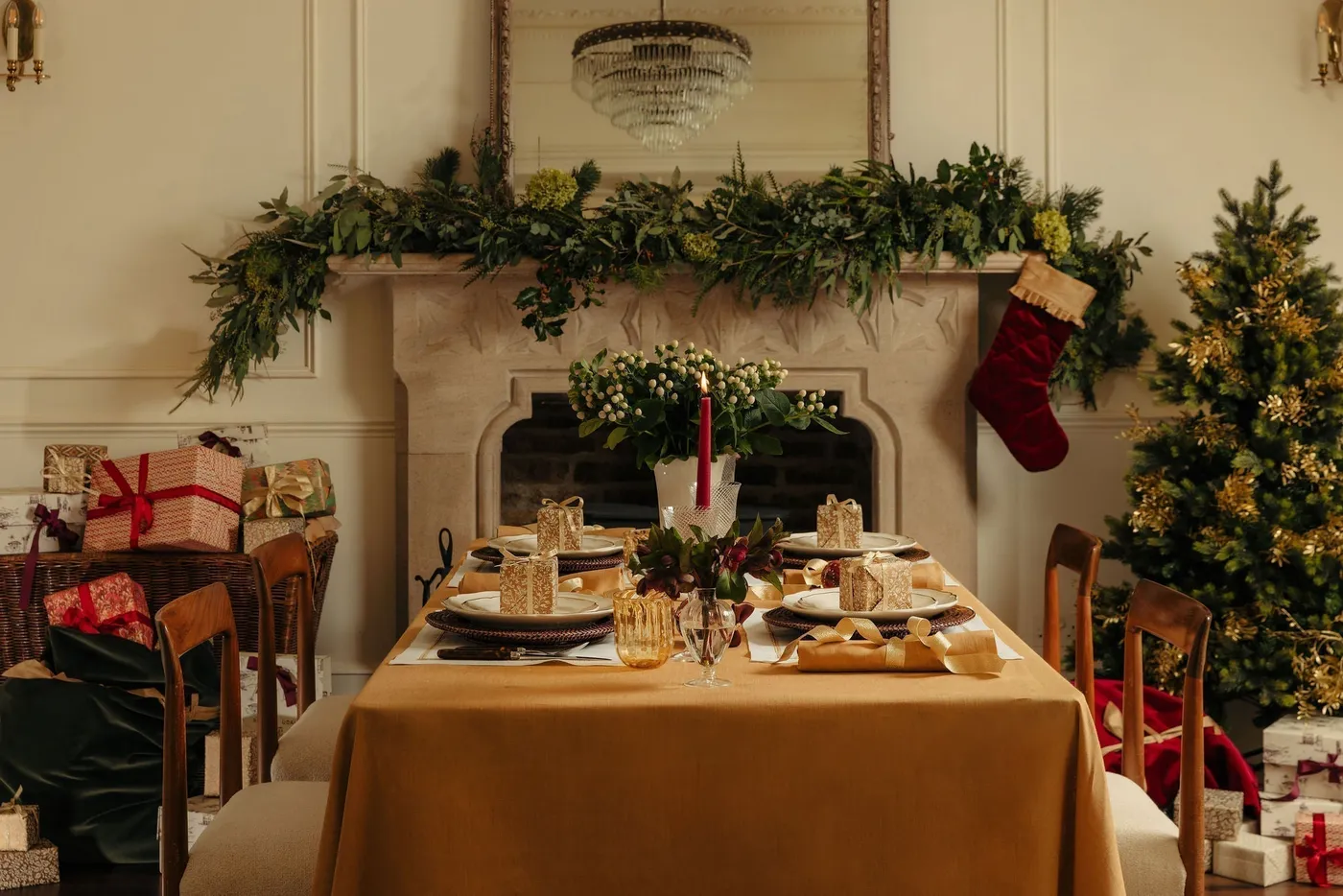
Total: roughly $795–$3,230. Budget alternative: a gold-hemmed table runner instead of a full cloth, and a faux garland with real berries tucked in — saves about 55% and nobody at the table will know.
Real garland on a mantel needs hidden support or it sags by day three. Run a thin green floral wire along the underside of the mantel first, then zip-tie the garland to it in four or five spots. Weave in berries and a second foliage type — cedar next to magnolia, say — so there’s more than one texture. A single foliage always reads as though it came off a roll, no matter what you paid.
12. Blue-Gray Painted Floors Under an Old-Fashioned Tree
Painted floorboards in a cool blue-gray give your eye a rest from all the red and green. White wainscoting keeps the walls from going dark, and the whole room reads as one continuous surface because floor and walls share a value. Mismatched dining chairs add just enough irregularity to make the table look lived at. It’s the opposite instinct of Idea #8, which leans hard on raw wood and suspended branches instead.
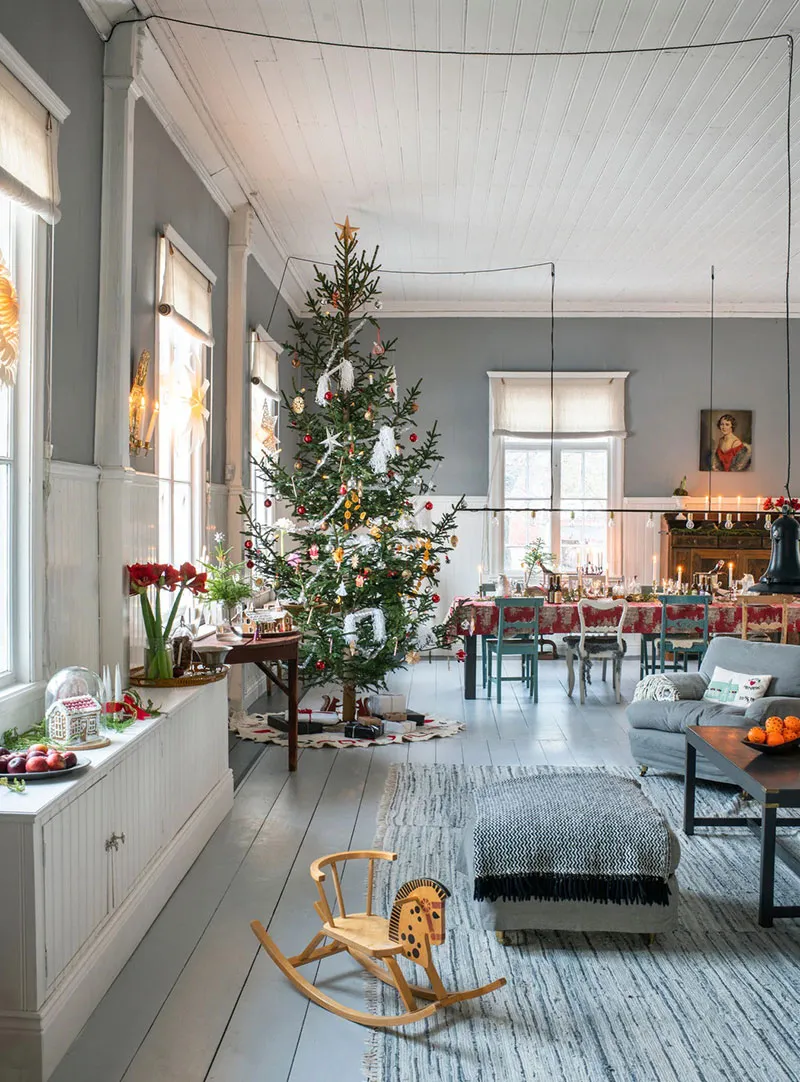
Painting a floor is the cheapest square-foot makeover there is: roughly $0.50–$1.25 per square foot for porch-and-floor enamel plus primer. A 200-square-foot room lands around $150–$300 in materials and one weekend of drying time. Skip the sanding if the floor is already sealed — a good bonding primer earns its reputation. And the rocking horse and sideboard don’t need to be vintage; paint a thrift-store find in the same white as the wainscoting.
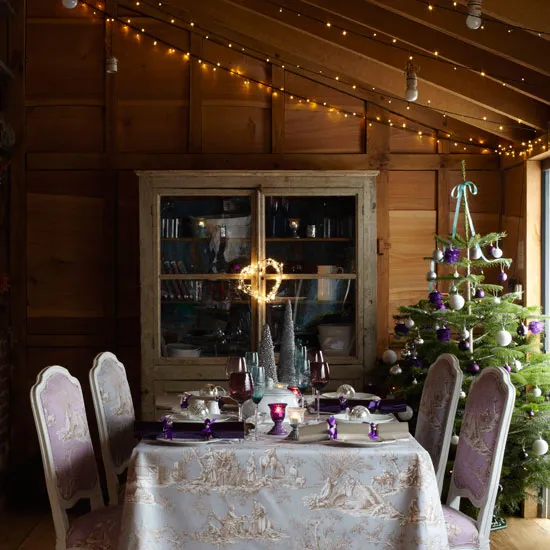
13. Dark Wallpaper, Lace Curtains, and a Frosted Oil Lamp
This layered, formal look wants a room at least 12 by 14 feet with 9-foot ceilings. Dark patterned wallpaper in anything smaller will feel like a hallway with a table in it. The long table needs 36 inches of clearance on all sides just for chairs to pull out, so measure that before you fall in love with a paper pattern. For a tighter footprint, look at Idea #3, where a leaf print works in a compact Nordic dining room.
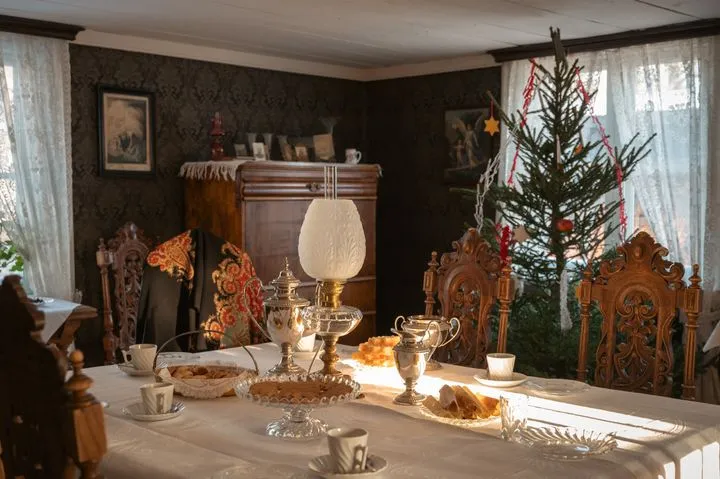
The vintage oil lamp with its frosted glass shade is what turns this from old-fashioned into inherited. Everything else in the room could have been bought last month, but that lamp says someone’s grandmother ate here. If you only add one thing to a formal dining room, add a light source that isn’t electric — a lamp, a pair of tall tapers, anything with a soft globe and a visible glow.
14. The Ceramic Deer Ornament With a Red Scalloped Border
- Cut a circle template from cardstock so every ornament in the set matches.
- Transfer the deer in pencil first — the antlers are the hard part, so start there.
- Paint the deep blue background and let it dry completely before anything else.
- Add white fir trees and snowflakes with the smallest brush you own.
- Finish the red scalloped border dot by dot, seal with matte varnish, and thread a gold loop.
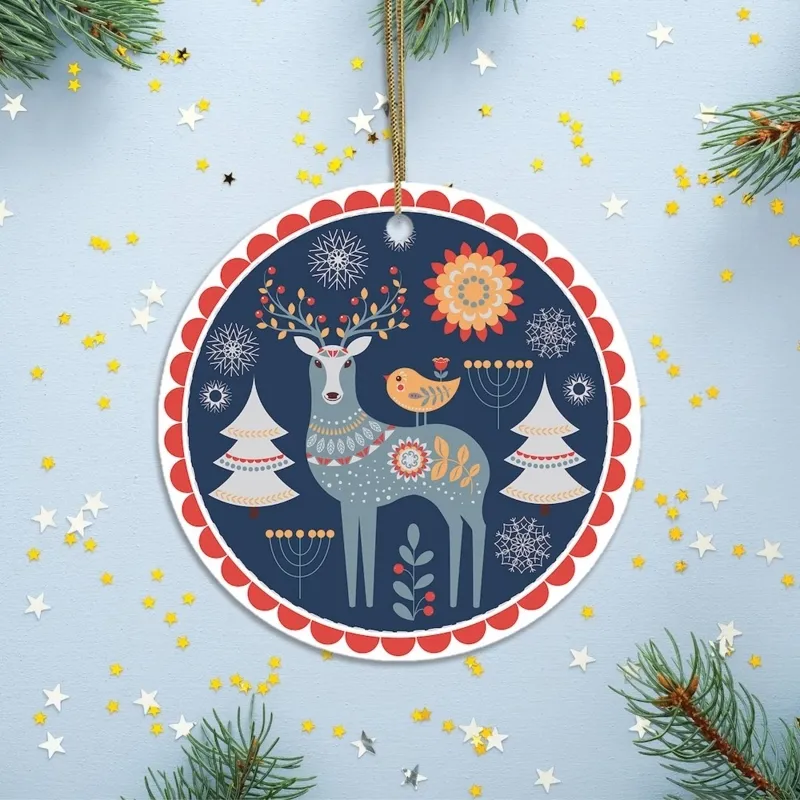
Time: 2–3 hours. Materials: about $15 for blank rounds, paint, and thread.
Here’s the formula inside the ornament itself: 55% dark blue ground, 25% white from the trees, snowflakes, and deer filigree, 15% red border, and 5% yellow for that little bird and the floral accents. That last 5% is what people forget — one tiny warm note keeps a cool palette from feeling chilly. You can run identical math on a whole room: dominant, supporting, accent, and a pinch of surprise.
15. The Painted Folk Art Cabinet That Justifies the Whole Cabin
The cabinet is the reason this corner exists. Wood paneling, a rough stone fireplace, plaid cushions, knit throws — all lovely, all replaceable. But that tall narrow cabinet, hand-painted in reds and blacks with folk patterns, is a one-of-a-kind object that sets the room’s temperature. Remove it and you have a pleasant cabin. Keep it and you have a story worth telling guests about.
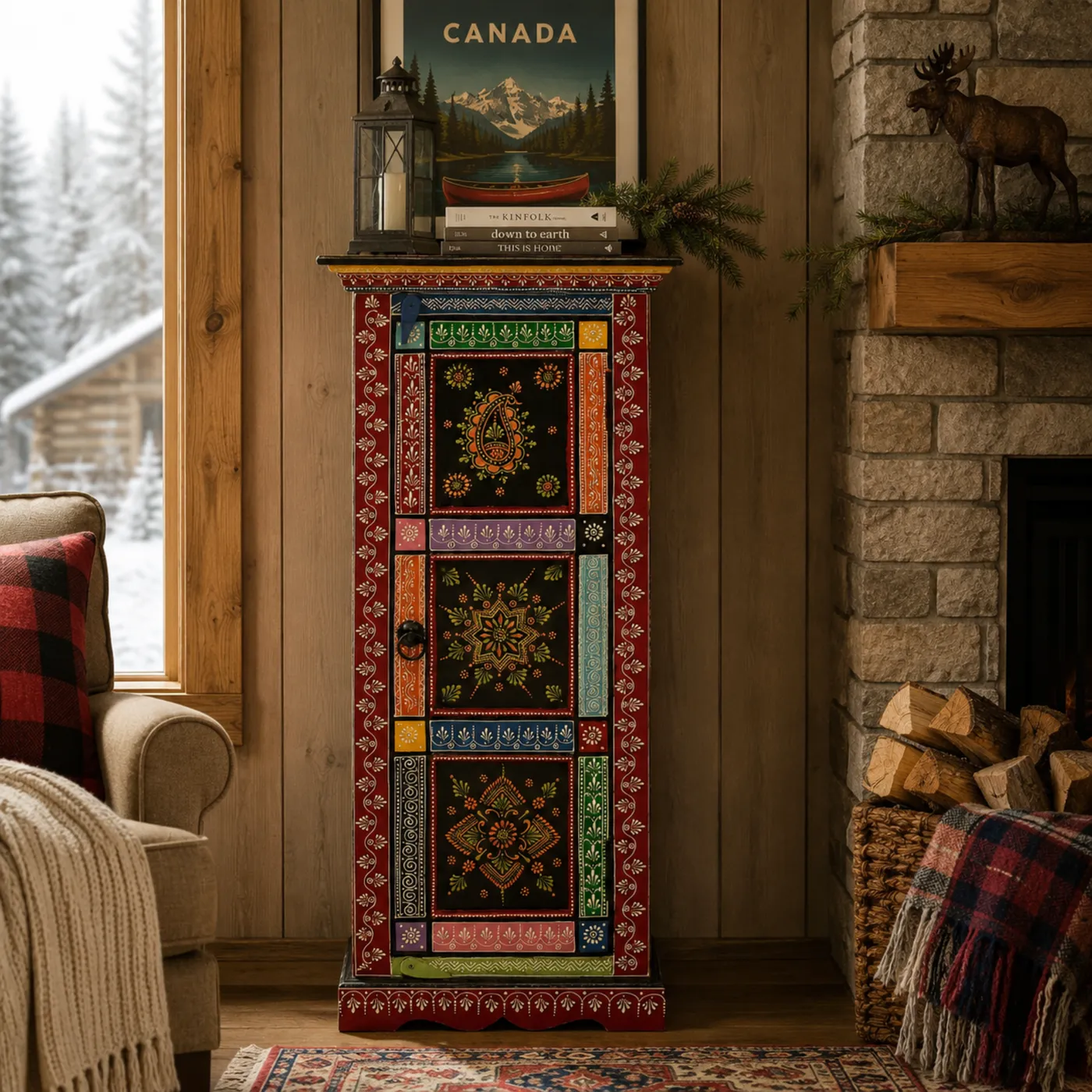
You don’t need a commissioned piece to start. Here’s what to source first:
- A narrow unfinished pine or flat-pack cabinet, $80–$400
- Milk paint in barn red, lamp black, and cream, about $60 for three quarts
- Fine liner brushes and a matte topcoat, $25
- A folk pattern reference — museum catalogs beat Pinterest for accuracy
Budget 15 to 20 hours of painting. Patterns go on bare wood, then get sealed; skip the topcoat and it will scuff inside a year.
16. Sheepskin on the Chairs, Reindeer on the Plates
Striped linen and stylized reindeer share the same visual weight, so neither fights the other. Sheepskin draped over chair backs adds a texture you want to touch, and it softens hard wooden chair edges in photos. The white-painted fireplace with a live fire is the anchor — everything else arranges itself around that warm rectangle of light. Notice that the red taper candles are the only saturated color on the entire table.
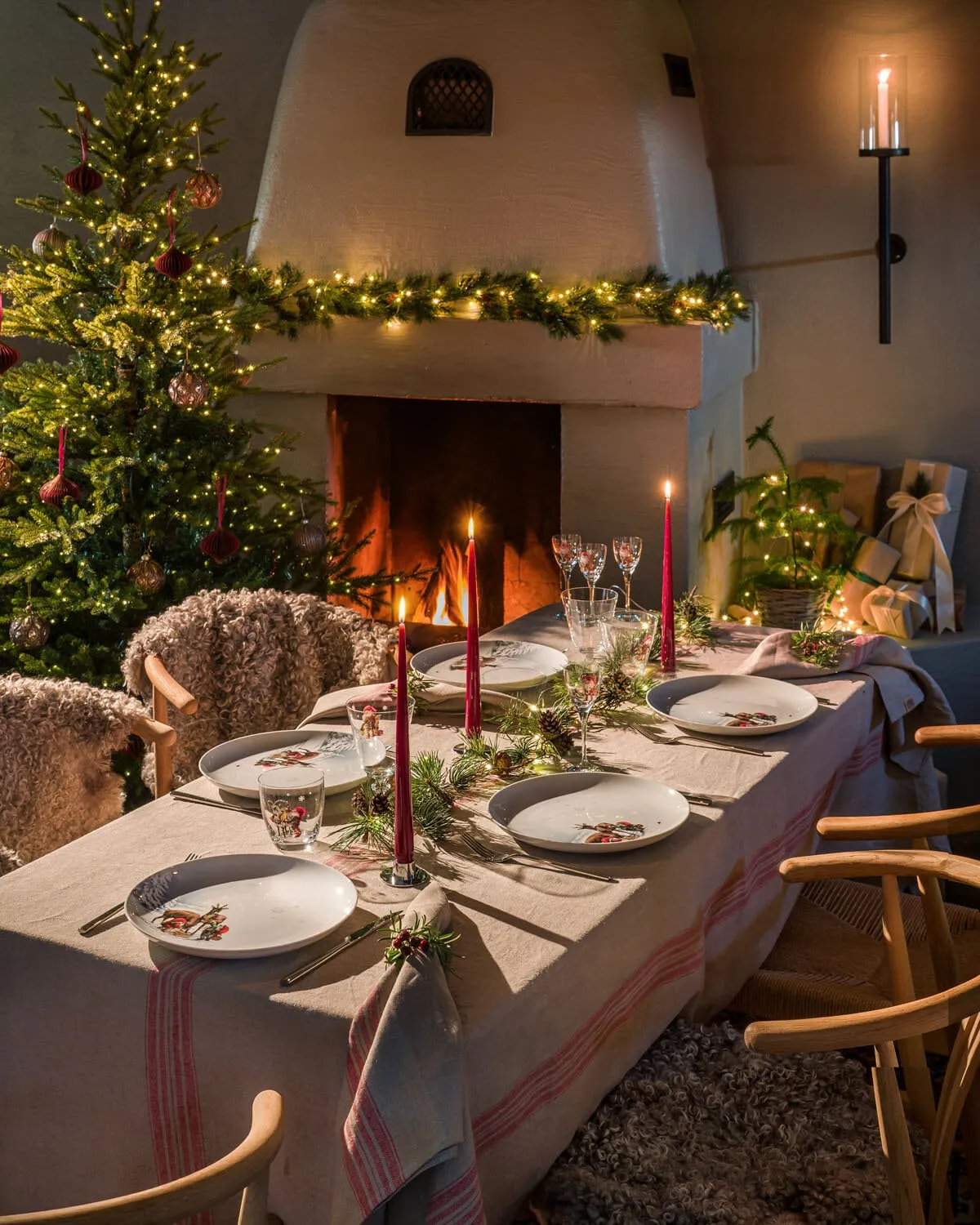
Four quick checks before you set this table:
- Measure your table’s usable width — sheepskin over a chair back eats 4 to 6 inches of pull-out room.
- Confirm the fireplace actually draws, or you’ll perfume the roast.
- Count candles against table length: one taper per two place settings reads intentional, more reads church.
- Test the tablecloth stripe against your plate color in daylight, not under the chandelier.
- Keep baking soda within reach if you’re using real flame near linen.
17. Three Wooden Tree Ornaments in Green, Green, and White
A set of three hand-painted wooden tree ornaments runs $40–$75 from a folk artist. You can make a dozen for about $25: a bag of flat wooden tree cutouts ($8–$12), acrylics in dark green, light green, red, and gold ($10), a fine liner brush, and small wooden star toppers ($5). Paint them on three different backgrounds so they read as a collection rather than a matching set — the reverse of what a store-bought dozen does.
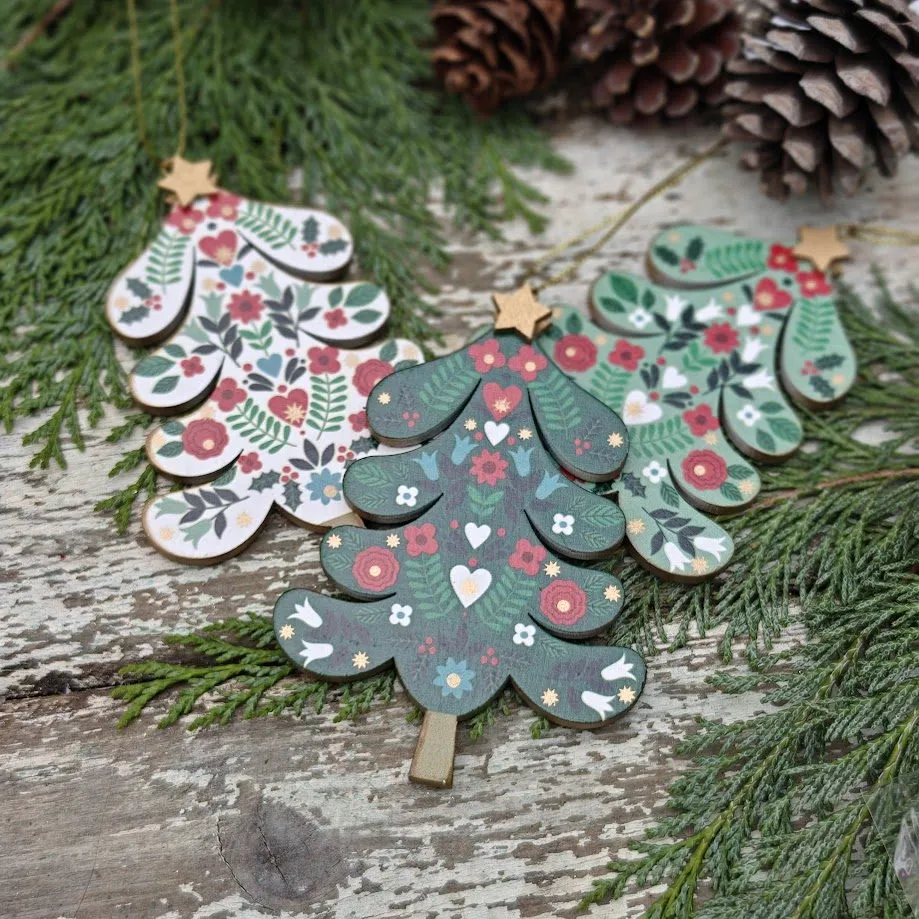
Stage ornaments the way you’d stage a vignette: on a distressed board, grouped in threes, with one pinecone breaking the row and one piece turned slightly off-axis. Photograph them at table height, never from directly above — a flat lay kills the dimension in painted wood. And if you gift or sell them, show the back. A raw, sanded reverse side is what separates handmade from manufactured.
18. Sage Green Credenza, Black Wood Stove, Vaulted Shiplap
About 60% white and light wood — the shiplap ceiling, floors, sectional — plus 25% sage green from the credenza, 10% black from the stove and hardware, and 5% deep red from the berries. That sage credenza does the work of an accent wall without the commitment. Swap sage for a muted clay or soft ochre and the formula holds, but keep the black hardware — it’s what stops the green from going pastel.
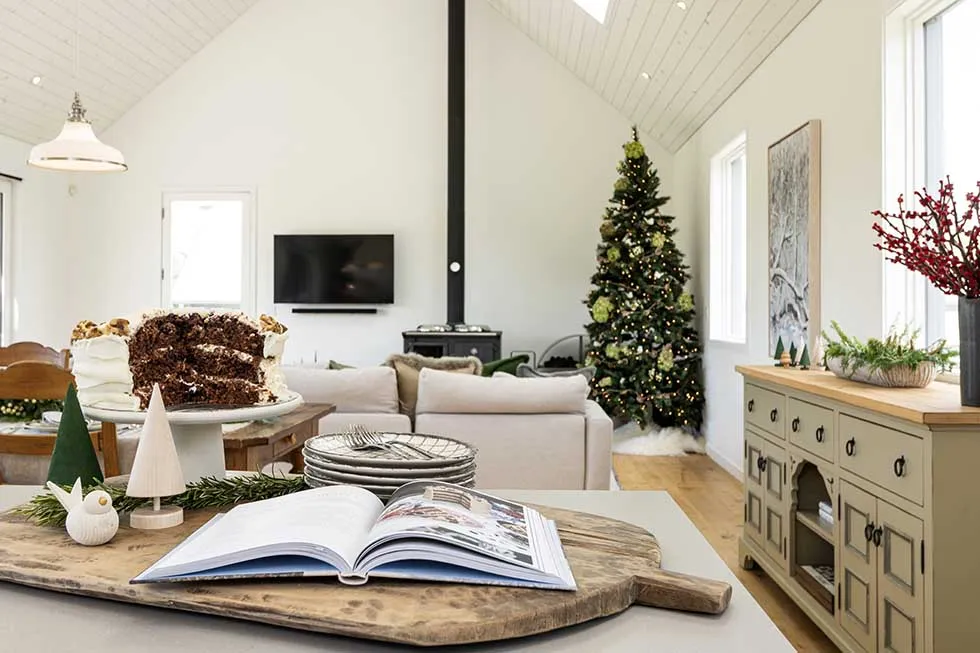
Vaulted shiplap plus a black wood stove is the Nordic cabin look that’s been climbing since 2024, and in 2026 it merged with the folk color revival. Sage green in particular has become the new neutral for cabinetry because it photographs well against both snowlight and firelight. This one will age fine — it’s architecture and color, not novelty decor that dates in a season.
19. Paper Stars in the Windows and a Dark Floral Rug
A white slipcovered sofa on a dark floral rug is a value-contrast play: light object, dark ground. The glowing paper stars in the windows add three small points of warm light at eye level, which pulls your gaze up and around the room. The wooden bench with its woven seat adds a horizontal line that stops the rug from swallowing the floor. Layered, yes — but each layer has a separate job.
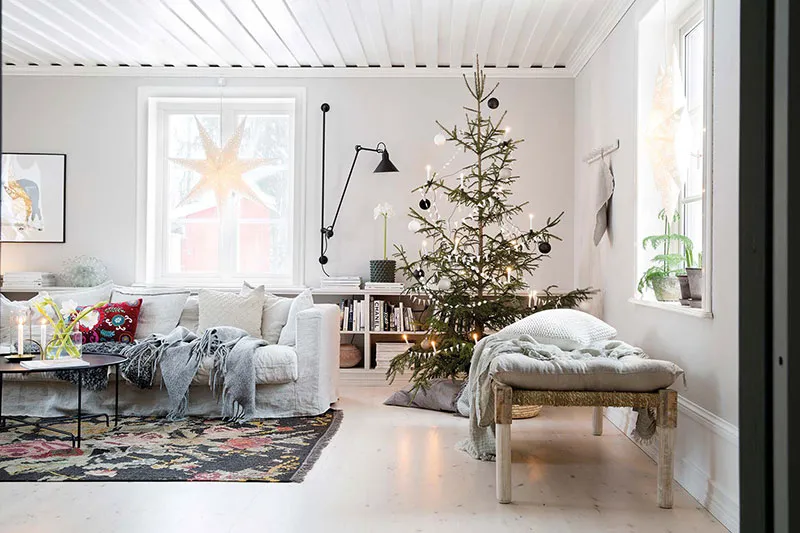
Paper star lanterns want windows at least 24 inches wide and a sill you can hang from without blocking the frame. This arrangement suits rooms from about 150 square feet up. Below that, use one star instead of three and switch to a lighter rug, because a dark floral pattern will shrink a small living room fast. Compare with Idea #9, which keeps the rug a textured grey for a much lighter footprint.
20. The Golden Christmas Pyramid Your Grandmother Would Approve Of
A candle-powered pyramid needs level placement or the fan won’t spin evenly. Expect to straighten the blades once a season, replace candles every 30 minutes of burn time, and clean soot off the gold with a dry soft brush — never a damp cloth, which dulls the finish permanently. Store it in its original box with the blades supported. Wobbly or bent blades are the number one reason these end up in a basement.

The spinning fan is the whole point. A static gold pyramid is a pretty object; a spinning one is a small machine that makes people stop mid-sentence. Four white pillar candles do the work, which means the magic only exists while it’s lit. Battery-powered versions exist if you want the silhouette without the upkeep, but you lose the quiet whir that makes it feel alive.
21. ‘Uff da’ in Cross-Stitch — The Ornament That Starts Conversations
Hand-stitched ornaments go missing. Kids take them to school, pets bat them under the sofa, and one always ends up on the back of the tree where nobody sees it. If a piece carries real sentimental weight, hang it high and slightly toward the front. And handle it by the hanger, not the cloth — white cross-stitch fabric shows every fingerprint, and folk stitching picks up oils from your hands within a season.

You don’t need an heirloom to get the effect. Blank scalloped felt or perforated paper ornaments run about $1 each in craft packs, and embroidery floss is 60 cents a skein. A set of eight with lettering and folk motifs lands under $20. If needlework isn’t your thing, Etsy sellers make custom uff da ornaments for $12–$22 each. Check thrift stores first — mid-century Danish cross-stitch kits turn up regularly for pocket change.
22. A Lit Garland Above the Headboard and a FALA LALA Shelf
Garland over a bed looks intentional only if it’s the same width as the headboard or slightly wider — never shorter. Mount it on two small cup hooks a quarter inch above the headboard’s top edge, and run the lights on a timer so you’re not unplugging it every night. If you’re layering a floating shelf above it, keep 8 inches of clear space so the garland has room to drape. And LED only: real candles within three feet of a duvet is a hard no.
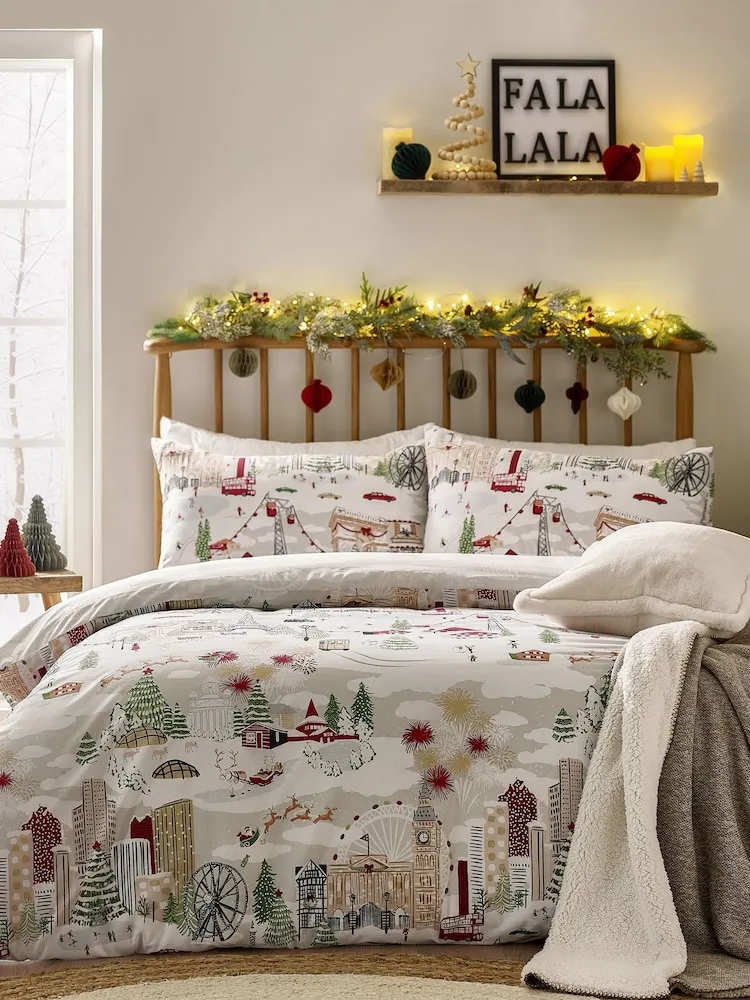
- Measure the duvet and headboard before you buy anything — the illustrated cityscape pattern should stop at the bed frame.
- Install the floating shelf at least 8 inches above the headboard so the garland can hang.
- Layer throws from heaviest to lightest at the foot: cream sherpa underneath, grey woven on top.
- Anchor the shelf decor in odd numbers and vary heights by 2 inches or more.
- Add the beaded spiral tree last, as the vertical element tying both sides together.
Time: one afternoon. Materials: $60–$180 depending on how much you already own.
23. Layered Wood and Cut-Out Folk Patterns in One Ornament
The layered construction is the trick. A cut-out front panel over a solid dark backing means the folk flowers, small stars, and dots read as silhouettes with shadow behind them. Remove the backing and it’s just a stencil. Any ornament built around negative space needs something behind it — dark felt, contrasting wood, even a painted card — and that’s the difference between intricate and unfinished.
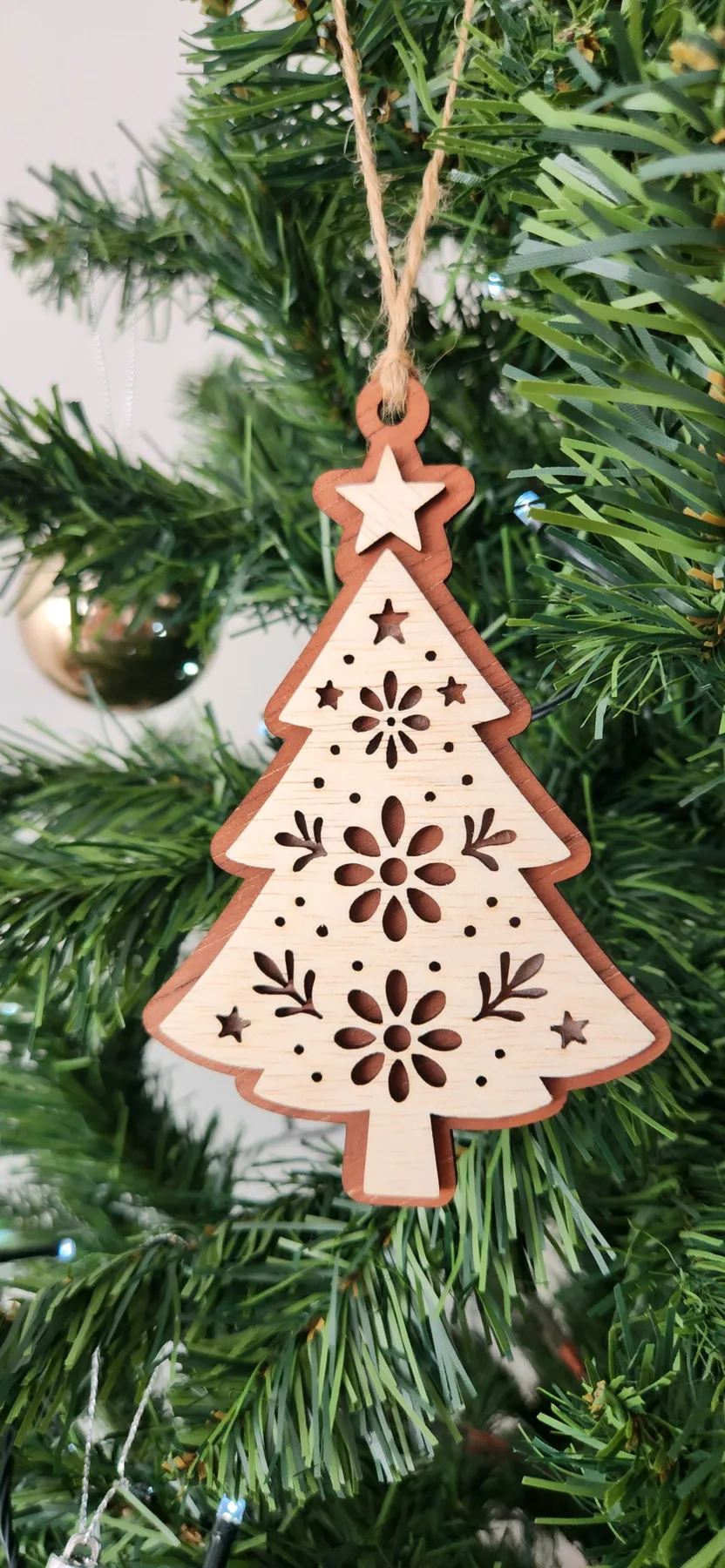
Two woods, one palette: light maple or birch on top, walnut or stained pine behind, natural twine as the third material. Nothing else. That restraint is why it reads folk rather than craft-fair. Scale the same logic to a shelf: 60% light wood objects, 30% darker wood, 10% fiber. Swap maple for ash or walnut for smoked oak and the composition still holds together.
24. A Garlanded Banister and a Santa Sack on the Bottom Step
Garland looks generous at roughly 1.5 times the run of your banister — you want visible swag, not a straight line sagging along the rail. This works on any stair with at least 4 feet of railing and a banister you can zip-tie to without damaging the finish. Grand staircases can take 20 feet or more. In a narrow entry, a single swag at the newel post plus the Santa sack on a step gets you 80% of the impact.
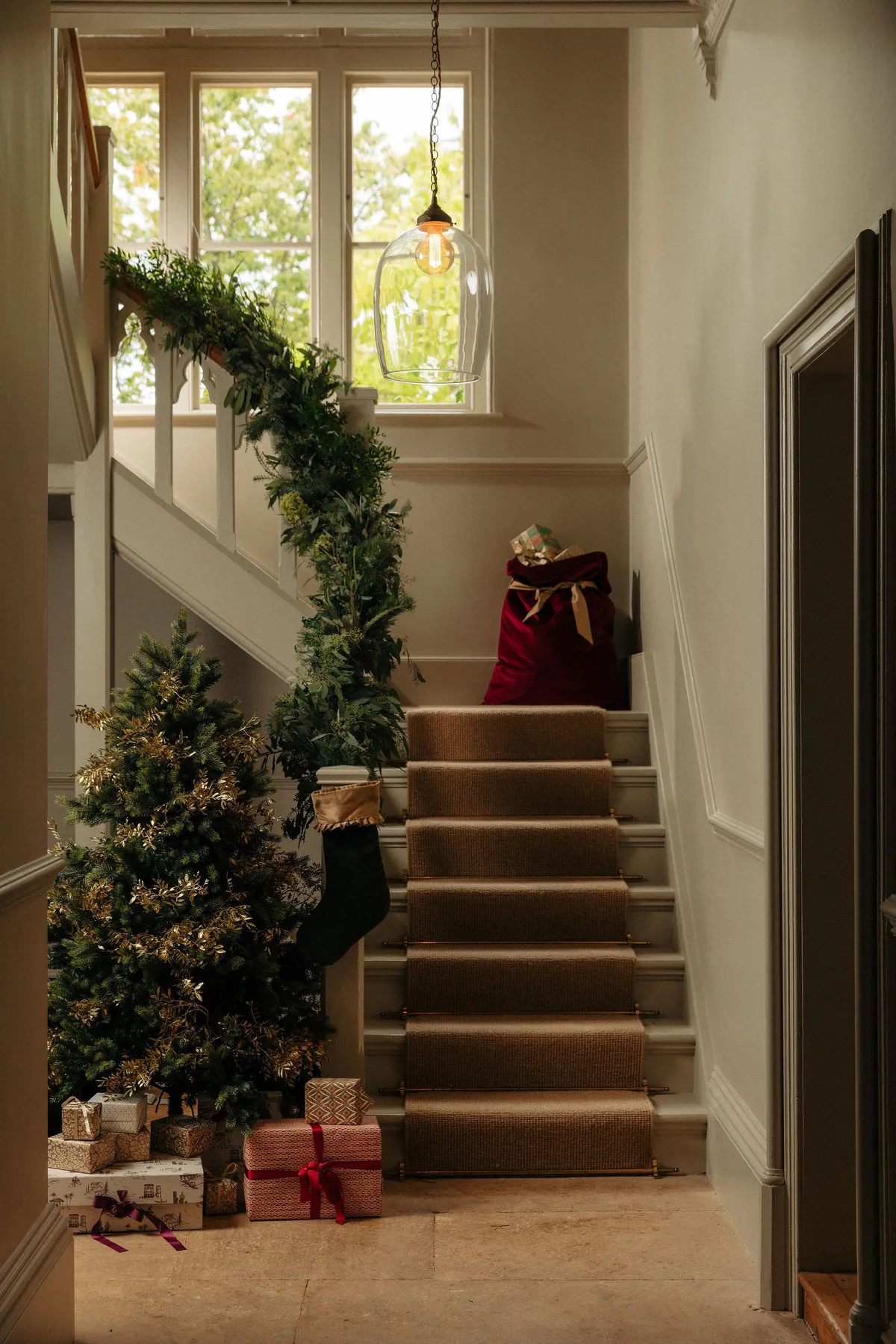
- Main furniture: nothing new needed — use your existing entry tree or bench
- Lighting: clear glass pendant and tree lights, $80–$260
- Textiles: carpeted runner with brass rods, $120–$500
- Decor: garland, gold accents, red velvet Santa sack, gift wrap, $90–$240
- Greenery: fresh garland, $60–$200 depending on length
Total: roughly $350–$1,200. Budget alternative: reuse last year’s faux garland and tuck fresh sprigs into the swag points — looks brand new for about $25.
25. Turned Wood Trees, Snowmen, and Mushrooms on a Live-Edge Slab
- Find a live-edge offcut at least 10 inches long, sand to 220 grit, and oil it.
- Choose three or four turned trees in graduated heights — tallest about 1.5 times the shortest.
- Cluster them off-center. Never in a straight line.
- Tuck the small turned snowmen and mushrooms between, slightly overlapping the tree bases.
- Add one textured or carved tree as the odd one out, then stop.
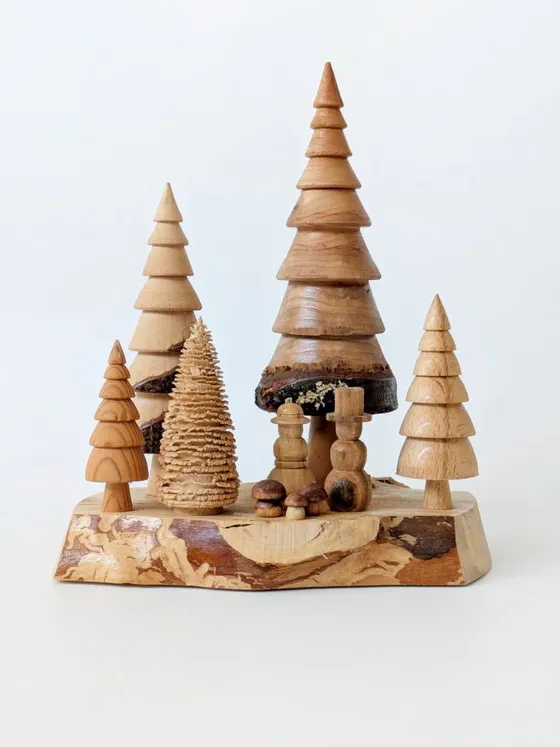
Time: a weekend if you’re turning them yourself; 20 minutes if you’re just arranging.
Turned and carved wooden decor is having a real moment — it’s the craft-adjacent answer to the mass-produced figurine aisle. In 2026 the specific look is bare natural grain with no stain, and mixed sizes of the same silhouette instead of a themed set. Small makers on Etsy and local woodworkers are driving it. It’ll last because it isn’t tied to a color; it’s a material story.
26. A Tall Vase of Evergreen Instead of Flowers on the Table
A tall glass vase of evergreen is a centerpiece you can see through, which is the entire reason it works on a dining table — no wall of foliage blocking the people across from you. Silver-toned ornaments and pinecones give it sparkle without color. Add the lit candles in clear glass and the black fireplace beyond, and you get three layers of warm light at three different heights. That’s what makes the whole scene feel candlelit rather than switched on.
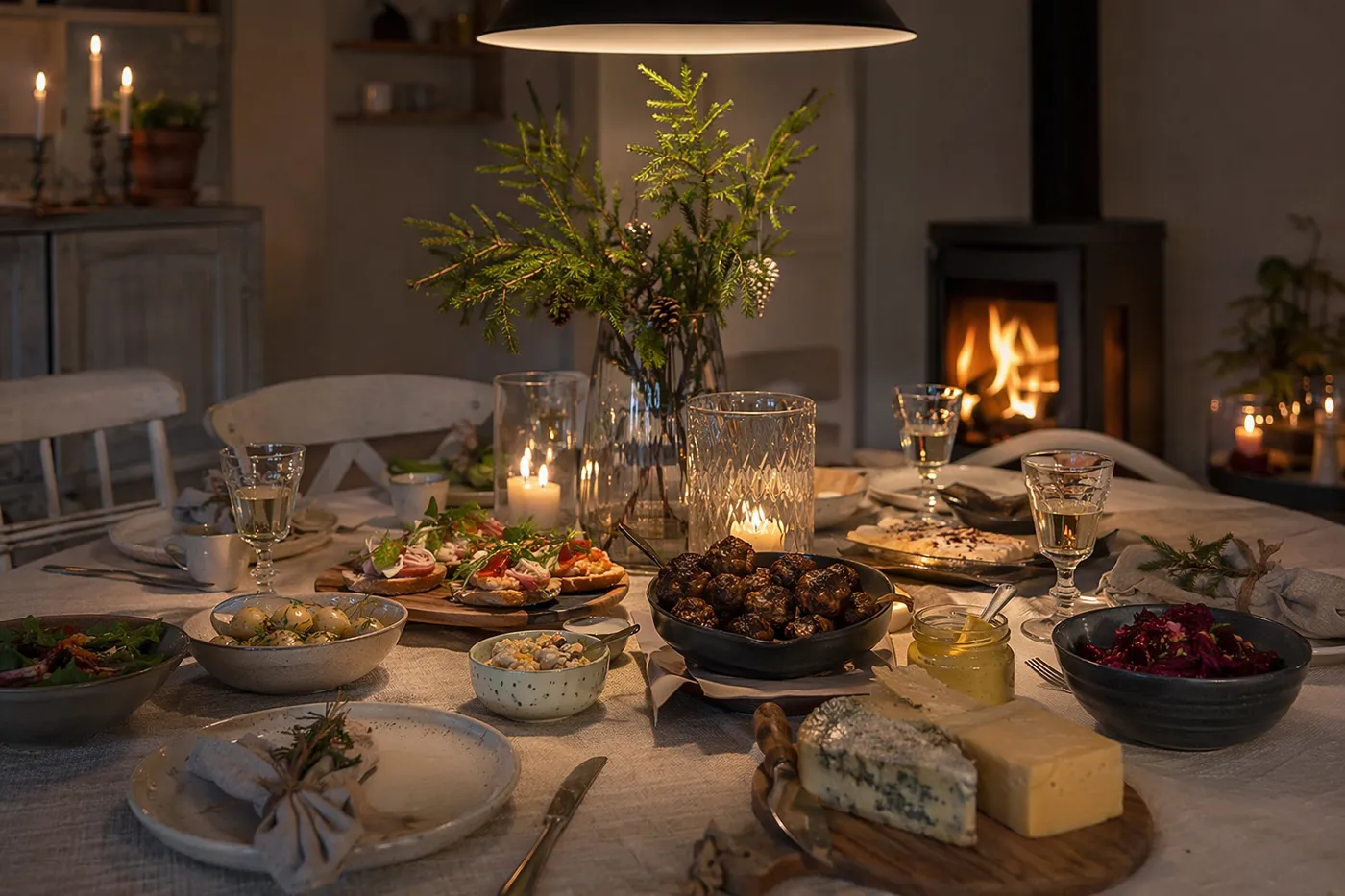
Aim for a vase at least 14 inches tall on a table seating six or more; anything shorter vanishes into the place settings. Branches should top out around 22 to 26 inches so they stay below eye level when seated. In a smaller dining area, drop to a 10-inch vase and spread evergreen along a runner instead. Rooms under 100 square feet should treat this as a sideboard arrangement.
27. Red Hearts and Straw Stars — Nothing Else Needed
This might be the cheapest tree in the whole article. Straw star ornaments run about $6–$10 for a dozen from Scandinavian import shops or Etsy. Embroidered red felt hearts are $1–$3 each, or free if you cut them from felt squares at 50 cents apiece. Add one strand of warm white lights for $12 and you’re done under $40 total. Skip the ribbon, skip the garland, skip the topper. The restraint is the style.
Straw ornaments crush. Store them in a rigid box with tissue between layers, not a zip bag, or you’ll be gluing stars back together next December. Felt hearts are sturdier but fade in direct sun, so keep this tree away from a south-facing window. And if you have cats, this is the tree they will destroy — straw is essentially a toy. Hang the hearts higher than the stars.
28. Dala Horses on a Rope-Wrapped Chandelier
Roughly 40% jute and natural fiber from the chandelier wrap and linen runner, 30% deep blue from the china cabinet, 20% forest green, and 10% bright red accents. The blue cabinet is the bold move; the folk horses and woven greens are what tie it back to the table. If blue feels like too much, swap it for deep charcoal and keep the red — this is really a value-contrast composition, not a specific-hue one.
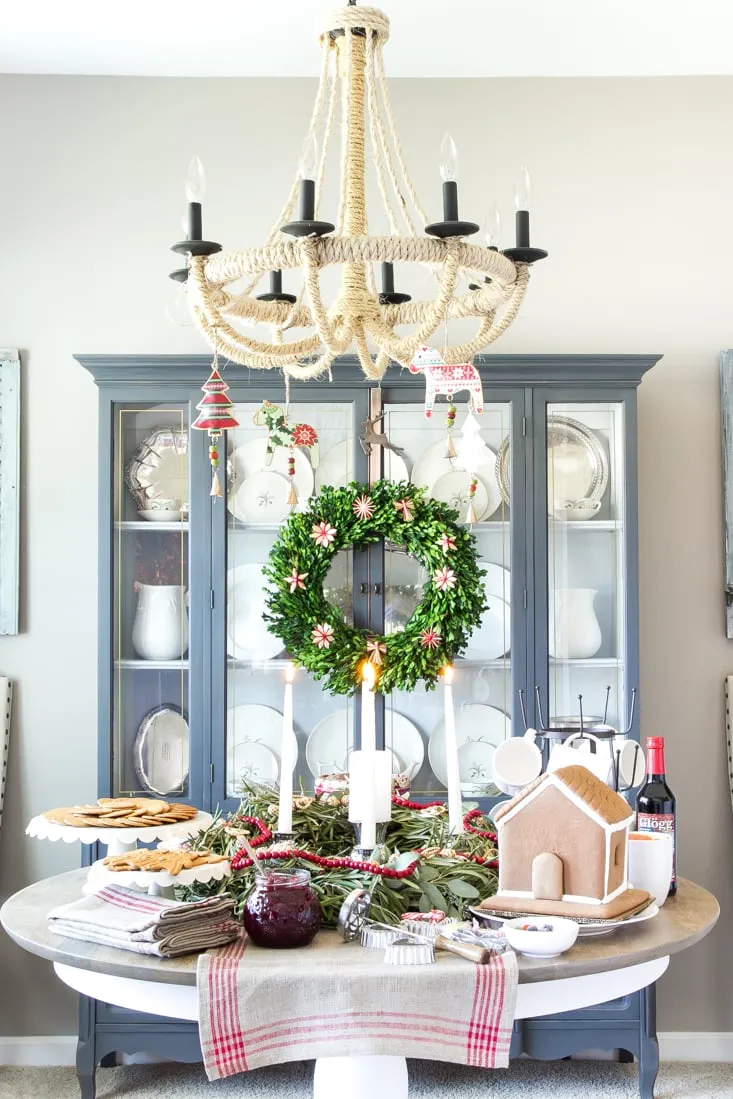
Hanging small folk ornaments from a chandelier works if you cap it at six to eight pieces and hang them at least 8 inches above the tallest object on the table. Space them so they don’t all fall on one sightline. Use lightweight pieces only — a turned wood Dala horse is fine, ceramic is not. Crimp a small hook over the chain link instead of tying knots; knots slip once the fixture warms up.
29. Cedar, Juniper, and Eucalyptus Garland on a White Mantel
- Measure the mantel and buy garland at 1.5 times that length so it can swag.
- Attach a green floral wire along the underside of the mantel before anything else.
- Layer cedar as the base, juniper for fine blue-green detail, eucalyptus for drape.
- Tuck in three to five brass candlesticks at graduated heights, with the gold-framed mirror as the anchor.
- Stack logs in the firebox even if you’re not burning — an empty box reads unfinished.
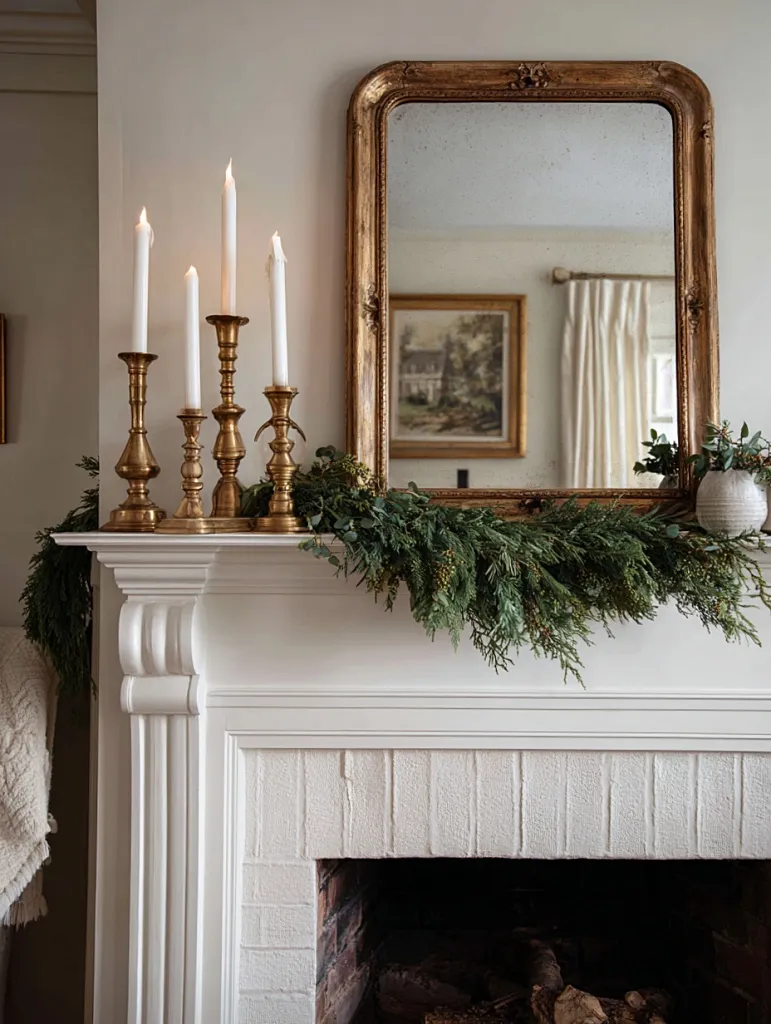
Time: 45 minutes. Materials: $80–$220 for fresh mixed garland and candles.
Fresh mixed garland sheds. Cedar and juniper drop needles for the first three days, so put a sheet down during installation and expect to vacuum daily for a week. Eucalyptus dries beautifully, going grey-green and holding its shape, so it can stay up longer than the cedar. Mist the greens every other day and keep them well away from the fireplace opening — heat turns them brown in a weekend.
30. Deep Teal Walls Make the Christmas Tree Look Expensive
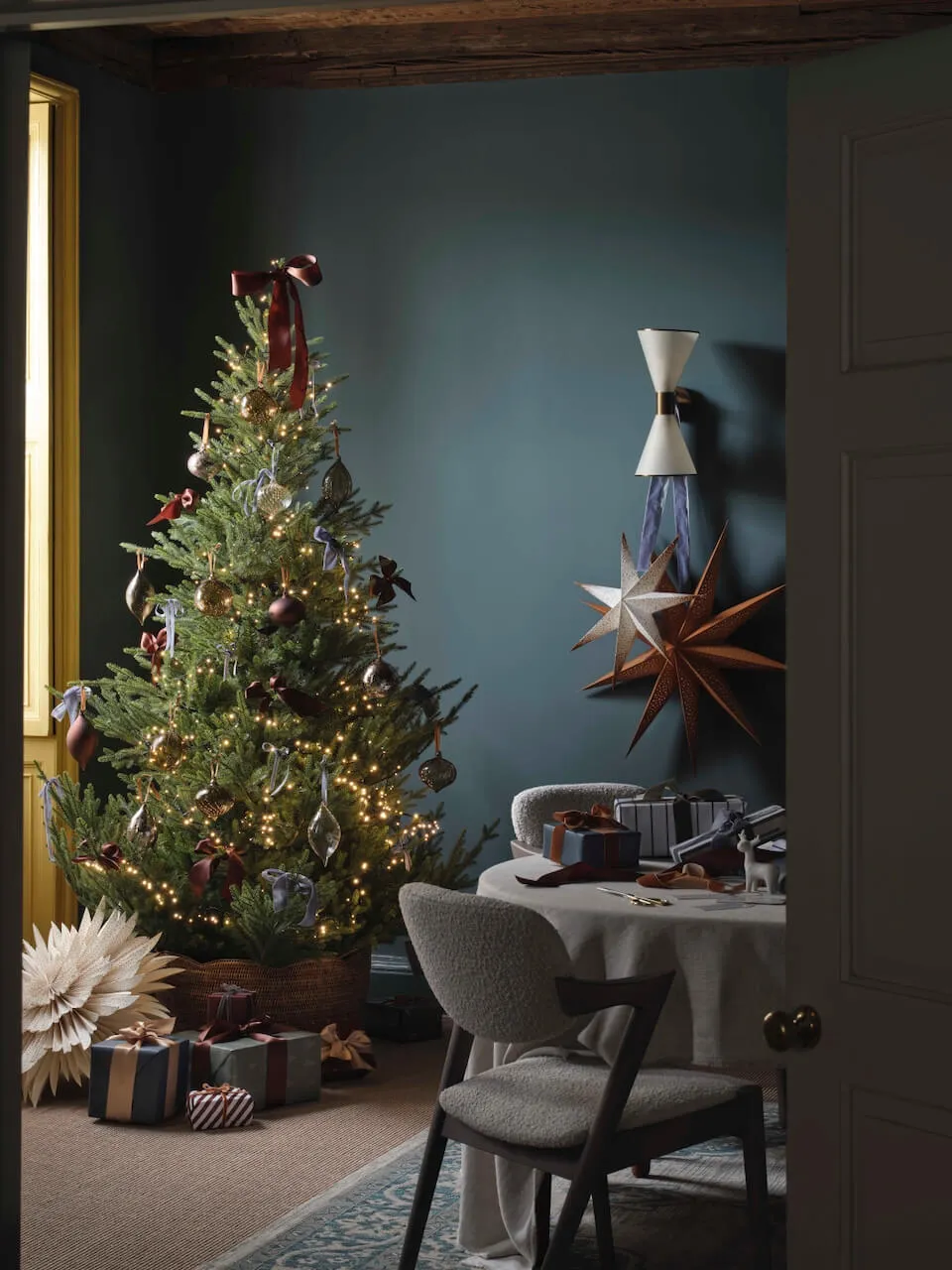
Deep teal is a commitment in a room with limited light. In a north-facing space it can go muddy and pull the warmth out of your tree lights, so you’ll want 2700K bulbs and probably more of them than you think. Test it properly before you commit:
- A 12-inch swatch on two different walls
- A look at both swatches at 7pm, not midday
- A photo with your tree lights on and off
- A ribbon test — burgundy next to gold next to the paint chip
Teal plus burgundy is beautiful and difficult. If you’re unsure, keep the ribbons gold instead and let the walls carry the drama.
The tree looks more expensive against teal because the greens are analogous and the burgundy ribbons are complementary — harmony plus one deliberate jolt. White tablecloth, gold paper, grey chair: all neutral, all letting the walls talk. The paper stars on the wall repeat the tree’s light at a smaller scale, which is why your eye keeps moving around the room instead of parking on the tree.
31. Red Lanterns and Blue-and-White Woven Chairs in a Cabin
- Main furniture: white dining table and woven chairs, $700–$2,600 (thrifted chairs plus a repainted table can land under $500)
- Lighting: red lanterns, tree lights, $50–$160
- Textiles: chair cushions, napkins, $40–$110
- Decor: animal ornaments, garland, mantel greenery, $90–$240
- Greenery: tree plus garland, $90–$380
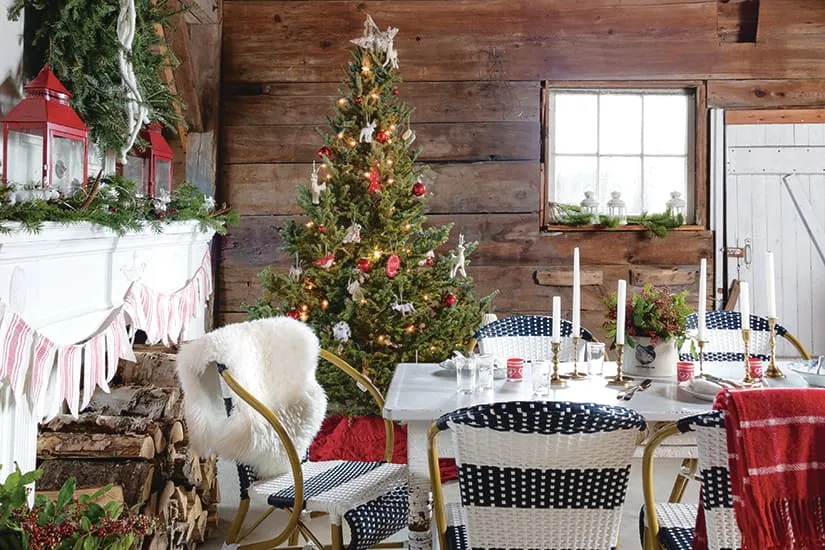
Total: roughly $970–$3,490. Budget alternative: buy two lanterns instead of six and paint an existing table white — saves roughly 60% without losing any character.
Blue and white woven chairs need breathing room — allow 30 inches between chair centers or the weave starts to look busy. This layout suits rooms from 180 square feet up. In a smaller cabin dining area, use two woven chairs at the ends and a bench along the wall. Warm wooden walls make any cool blue read stronger, so pick a weathered navy rather than a bright cobalt.
32. Danish Flag Banners and Tinsel: A Nostalgic Tree, Unedited
The un-Instagrammed tree is having a moment. Danish flag banners, silver tinsel, handcrafted paper stars and hearts, lit tapers in fluted metal holders — this is the tree people actually grew up with, and in 2026 they’re photographing it on purpose instead of apologizing for it. The shift tracks with the wider move toward lived-in holiday decor over styled minimalism. It has staying power because it’s memory, not a trend cycle.
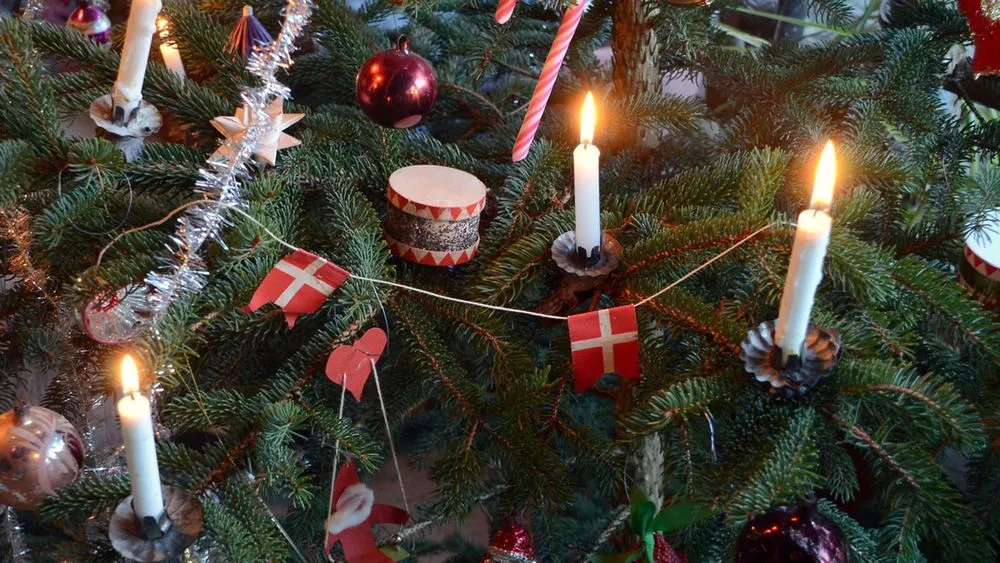
Tinsel means you’ll still find tinsel in March. Silver strands shed, catch in vacuum brushes, and tangle in ornament hooks — accept that or skip it entirely. Paper ornaments need a dry room; humidity will curl them by New Year’s. If you’re using real white tapers in metal clips, keep them at least 12 inches from any wall or curtain and never above a heat vent. Tallow drips are part of the charm, but they will mark a wood floor.
33. A Five-Minute Centerpiece of Pine Branches and Red Tapers
Four quick checks before you set this table:
- Table width — the centerpiece should leave 12 inches of clear space in front of each setting.
- Candle clearance — at least 10 inches between a lit taper and the nearest napkin or branch.
- Plate pattern — if your rims are red, keep the glassware plain. Two red patterns fight.
- Branch freshness — needles should snap, not bend. Droopy pine is already drying out.
Fresh pine branches sweat resin onto wood. Set them on a strip of parchment or a simple linen runner before you add anything else, and trim cut ends at a 45-degree angle so they sit flat instead of rolling. For the tapers, use a low-profile holder with a wide base — narrow stick holders tip the second someone brushes the table, and a fallen taper onto dry pine is not the drama you want mid-dinner.
34. Two Red Stocking Ornaments on a Carved Wooden Tray
A pair of hand-painted stocking ornaments sells for $30–$50. Making four costs about $15 total: birch cutouts at roughly $6 a pack, barn red and white acrylics for $8, a fine brush, and jute twine with wooden beads from the craft aisle. Paint one with a white tree motif and one with hearts and geometry so they read as a set without matching. You’ll have spares for gift tags, too.
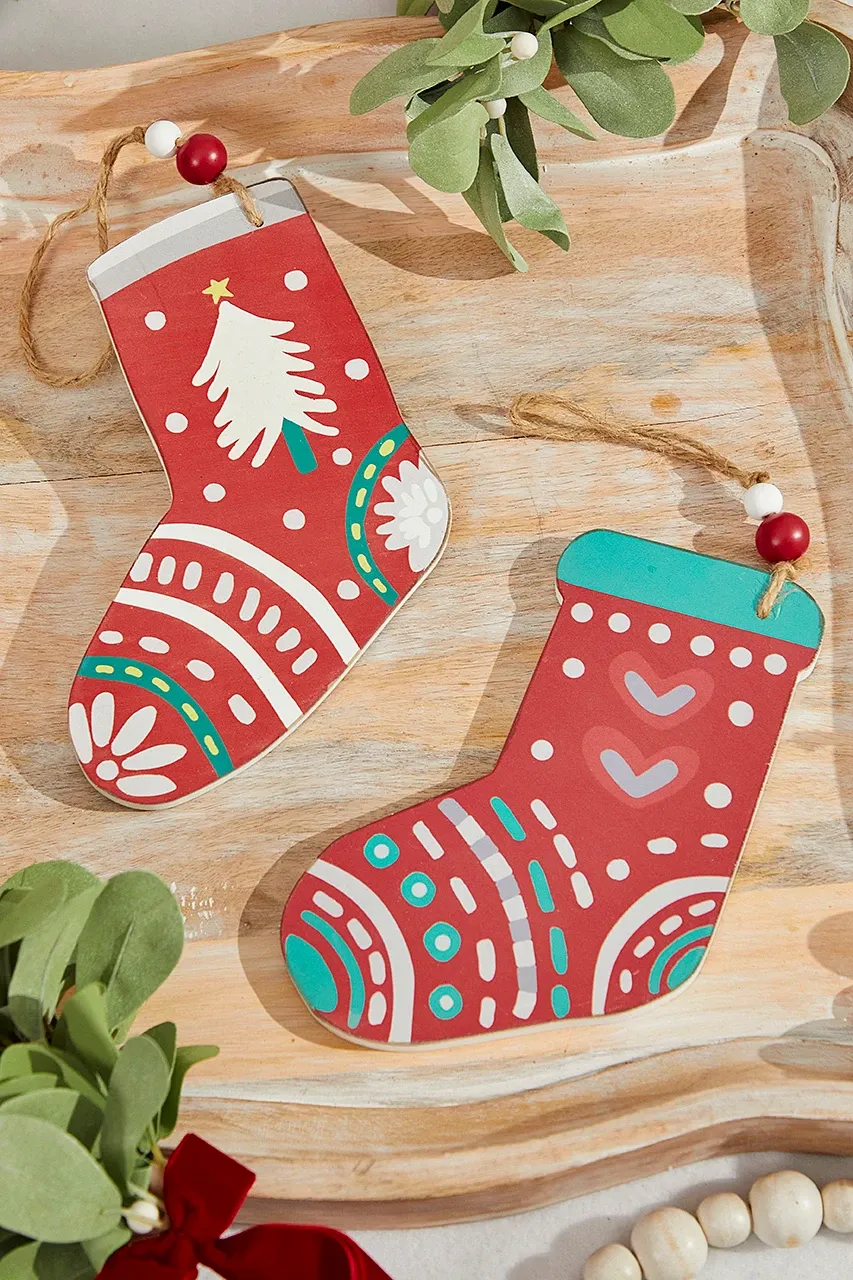
The carved wooden tray is doing more than holding ornaments. It gives the pair a boundary, so two small objects read as a display instead of clutter on a sideboard. Swap the tray for a plate and the whole thing shrinks. Any time you group small decor, give it a defined edge — a tray, a slab, a shallow bowl. That single move is the reason styled shelves look styled.
35. Three Lit Trees, Two Barrel Chairs, One Very Red Palette
Three illuminated trees need a wide sightline — roughly 10 feet of wall, or a room of at least 250 square feet with 36 inches of walkway between the outermost tree and the barrel chairs. In a smaller room, use two trees at different heights and keep the berry sprays. The graduated-height rule still applies: tallest about 1.5 times the shortest, arranged so the tallest sits at the visual end of the room.
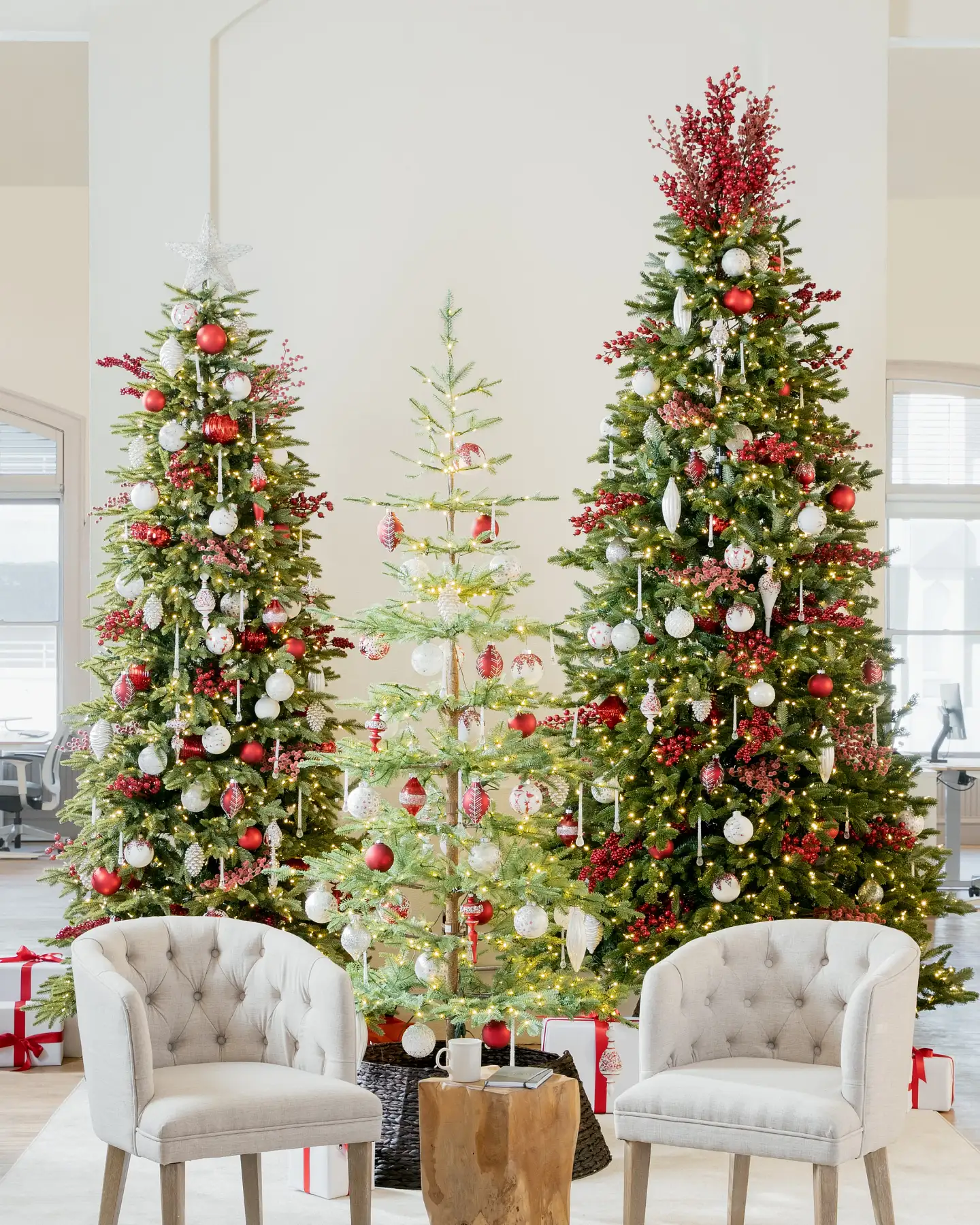
- Main furniture: two light beige barrel chairs and wood block side table, $700–$2,400
- Lighting: three pre-lit trees, $250–$1,200
- Textiles: dark woven basket, throws, $60–$180
- Decor: red and white ornaments, berry sprays, icicles, $120–$320
- Greenery: extra sprays and filler, $40–$120
Total: roughly $1,170–$4,220. Budget alternative: buy one pre-lit tree and two unlit trees secondhand, then add two strands of lights to each — cuts the lighting line by more than half. For a quieter take on the same idea, look back at Idea #11, where gold does the accent work instead of red.
Your Folk Christmas Starts With One Handmade Thing
You don’t need to repaint a floor or commission a cabinet this month — pick the one idea here that fits the room you already have, and start there. A cross-stitched ornament, a moss-lined candle holder, or three red tapers on a pine branch will do more for the mood than a cart full of matching sets ever will.
And when you get it right, take the photo at 7pm with the tree lights on. That’s the version worth pinning. 📌 Save this guide to Pinterest so it’s waiting for you next December — and tag us when your folk corner comes together.