30 Stunning Chocolate Brown Christmas Tree Ideas to Elevate Your Holiday Decor in 2026
You know that feeling when you’ve saved fifteen Christmas tree photos at midnight and still can’t tell which one is actually yours? That was us with chocolate brown trees — until we noticed the ones that work all share the same trick: warm browns, layered texture, and lighting that flatters instead of flattens. We dug through Anthropologie, Target, IKEA, Walmart, and Etsy to pull 30 ideas that actually deliver, from $12 ornaments to a $4,500 leather-and-concrete lounge setup, covering warm rustic, modern neutral, earthy glam, and traditional cabin looks — with budget and luxury versions compared side by side so you can decide with your wallet, not your envy. Chocolate brown is having a real 2026 moment for one reason: after years of sterile white-and-silver trees, people want warmth they can still live with in January. And stay until the end — we break down the most common mistakes that can ruin these looks. 📌 Save this to Pinterest for later — you’ll want to revisit these ideas.
1. A Pale Tan Tree in a Sunlit Dining Nook
Pale trees live or die by their surroundings, and this dining nook gets the math right. A tan tree against white walls and muted green wainscoting keeps the whole scene soft, while the wooden table and plaid-cushioned chairs supply the visual weight it would otherwise lack. Floor-to-ceiling windows with cream sheers do the rest, because diffuse daylight makes the branches look lit from within instead of washed out. Four tones, no more. That restraint is why a fully set holiday table still reads calm instead of chaotic.
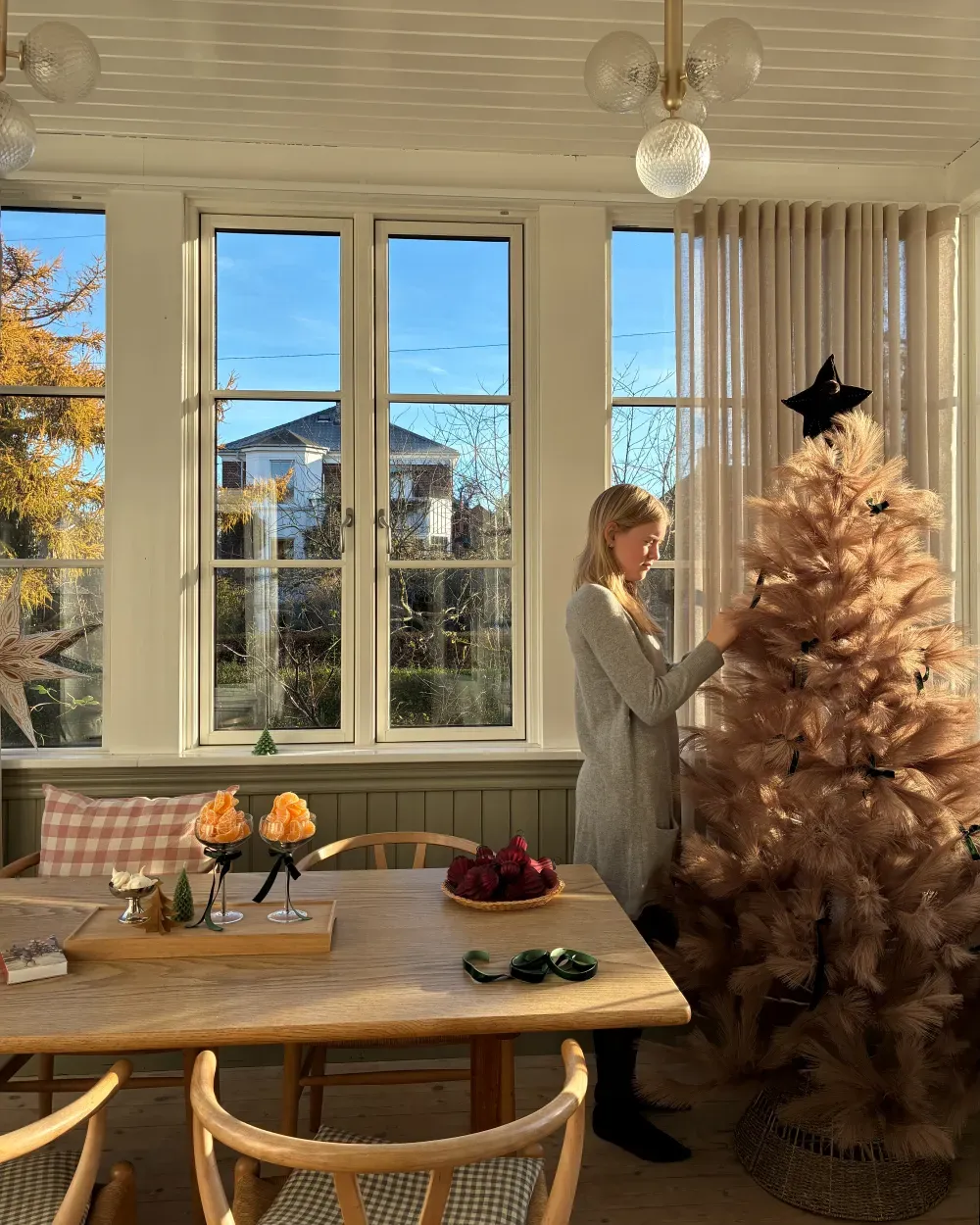
Low-contrast trees swallow small ornaments. On a tan or pale brown tree, keep baubles between 4 and 6 inches so they register against the needles, and vary the finish — matte, velvet, pearlized — rather than the color itself. For a dining-room tree, leave 24 to 36 inches between the outermost branches and the nearest chair back. Any tighter and your guests spend Christmas dinner dodging pine.
2. Stone Chimney, Grey Armchairs, and One Green Tree
It’s the stone fireplace, full stop. That stacked natural stone gives a traditional green tree with white and red ornaments permission to sit in a room full of black-framed modern chairs and a dark blue rug. The chimney bridges old and new in a way no paint color could. Take the stone away, swap in a flat painted wall, and the tree starts looking like a decoration fighting the architecture instead of belonging to it.
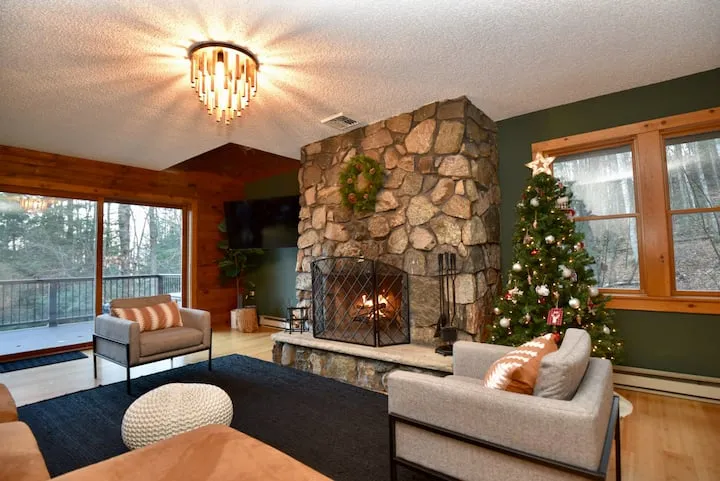
Read the room as a formula: 45% warm wood and stone, 25% soft grey upholstery, 18% forest green from the tree, 12% dark blue rug. The tree isn’t the dominant tone — it’s the accent, which is exactly why a big green tree doesn’t overwhelm a grey sofa. Want it warmer? Trade the blue rug for rust and the greens still hold. Want it crisper? Go grey-on-grey and let the tree carry every bit of the color.
3. Dark Plank Walls, Red-and-Gold Tree, Cabin Comfort
Dark wood plank walls eat light for breakfast. If your room looks like this one, budget roughly three times the string lights you’d normally buy, and position the tree where a window can hit it during the day so it doesn’t disappear by 4 p.m. One thing people skip: keep a live tree at least 3 feet from an active hearth, water it daily, and never leave the fire burning unattended.
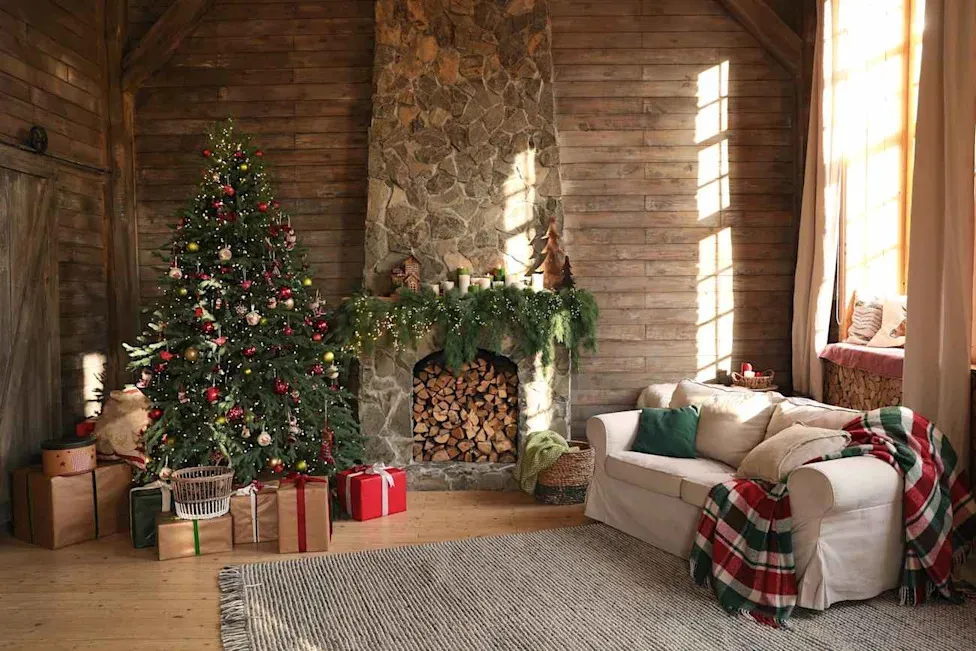
Cabin-core isn’t going anywhere in 2026. After several years of sleek, cool-toned minimalism, searches for plank walls, plaid throws, and red-and-gold trees keep climbing — partly as a reaction to rooms that felt more like showrooms than homes. This is the warm side of the trend: saturated color, real texture, ornaments that look collected instead of curated. Traditional reds age better than any micro-trend, which is precisely why they keep coming back.
4. A Dark Brown Tree Above a Reeded Mantel
- Sofa with cream throw and pillows: $900–$1,800
- Dark brown artificial tree, 7.5 ft: $150–$450
- Faux fireplace with reeded mantel: $250–$700
- Round gold mirror and tree candles: $80–$200
- Warm white string lights: $25–$60
- Kraft paper, ribbon, and gift tags: $15–$40
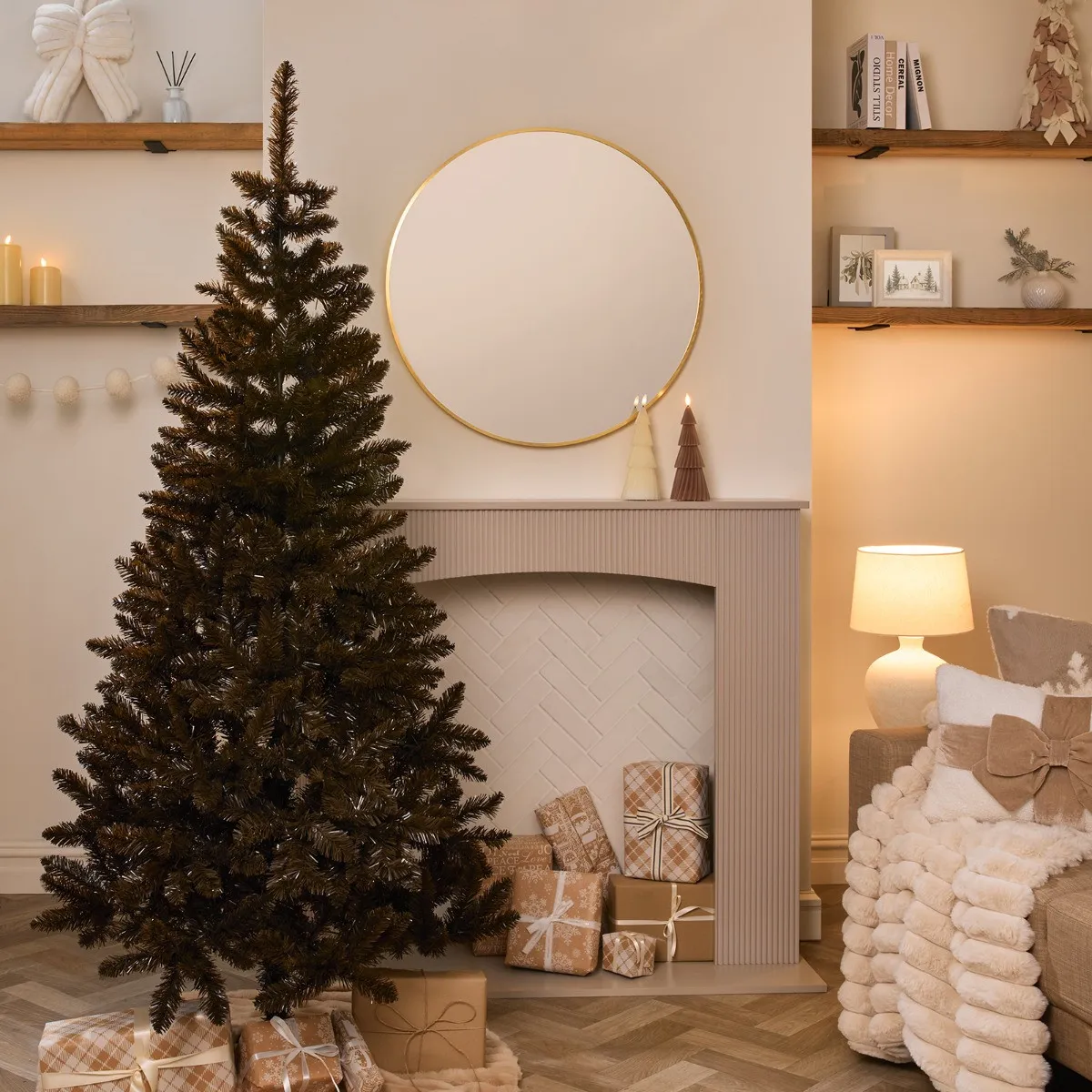
Total: roughly $1,420 to $3,250. Budget alternative: keep the tree, wrap gifts in kraft paper you already own, and hunt Facebook Marketplace for the mantel — most people sell theirs in January at 60% off.
Reeded and fluted details photograph beautifully and hide fingerprints, which is why they’re suddenly everywhere. If you’re DIYing it, buy half-round pine trim at 3/4 inch width, space the reeds 1.5 inches on center, and paint everything in the same sheen. Mixing sheens on one color is the fastest way to make a faux fireplace look like a weekend project instead of a mantel.
5. Bronze, Copper, and Chocolate Orbs on a Full Green Tree
Here’s the mix: 60% green needles, 25% warm metallics — bronze, copper, warm gold — and 15% matte chocolate brown. Because two of the three are warm and the third is dark, the tree never tips into glitter-bomb territory. Swap the metallics for pewter and the whole thing turns icy. Swap the chocolate for black and you get something moodier and more modern. Same formula, completely different mood.
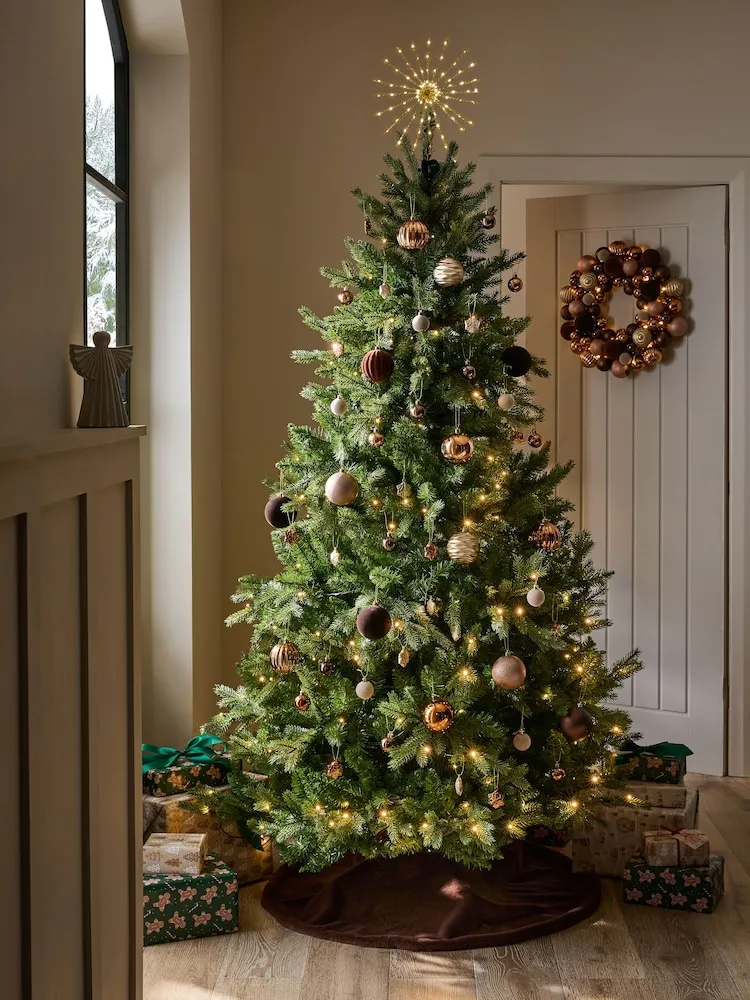
The matched ornament wreath on the white door is the piece that makes this look intentional rather than just decorated. It repeats the tree’s palette on a surface you pass through constantly, so the scheme feels continuous instead of confined to one corner. Lose it and you still have a pretty tree. Keep it and you have a decorated home. Total difference: about $30 and an afternoon.
6. Feathery Brown Branches Over a Woven Jute Skirt
Give any tree the grounded, natural base this one has:
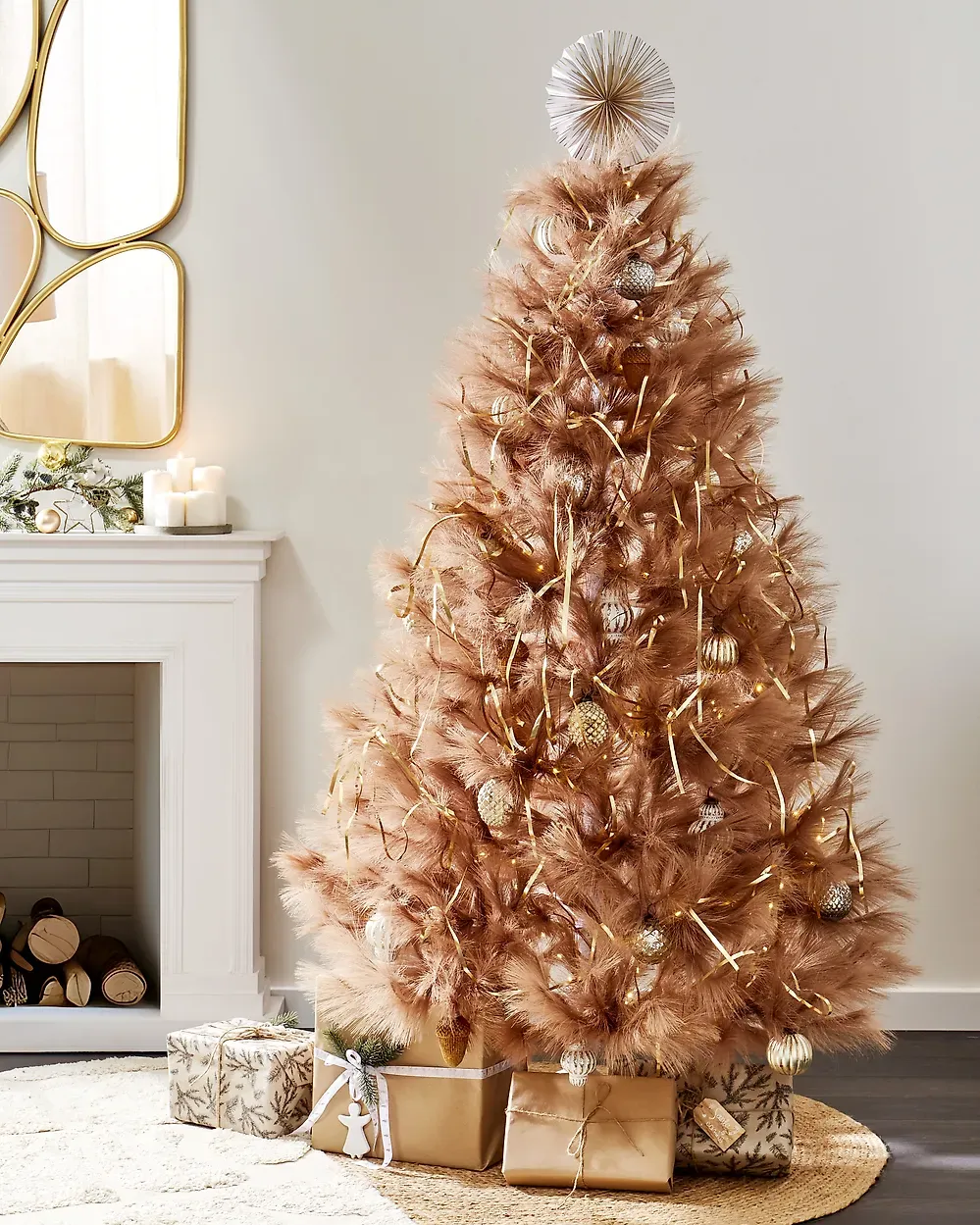
- Measure the widest point of your tree stand and add 3 inches.
- Cut a 60-inch round of jute or burlap to that radius, or use a jute rug you already own.
- Gather the fabric around the stand, right side out, and fold the edge under once for a finished hem.
- Secure with twine at four points, hidden under the lowest branches.
- Fluff the fabric so it pools slightly on the floor.
Time: about 45 minutes. Cost: $25–$40.
You don’t need a designer tree to get this look. Target and Walmart both carry brown-and-gold ornament sets for $12–$25 a box, and a plain jute rug from IKEA makes a convincing skirt for around $20. That gold ribbon? A 10-yard spool runs $8, and hand-tied bows beat the $6 pre-made ones every time. Thrift stores are gold mines for gold and silver baubles in January — most sell for a quarter apiece.
7. Birch Ribbon and Plaid on a Champagne-Flowered Tree
Two things are doing the heavy lifting here: ribbon width and wall color. Those birch-bark and dark green plaid ribbons look like 3 to 4 inches wide, which is what keeps them visible inside a dense tree packed with fabric poinsettias. And the dark taupe wall is the reason the champagne flowers read bright rather than beige. Trim those ribbons down to 1 inch and the whole tree flattens into mush.
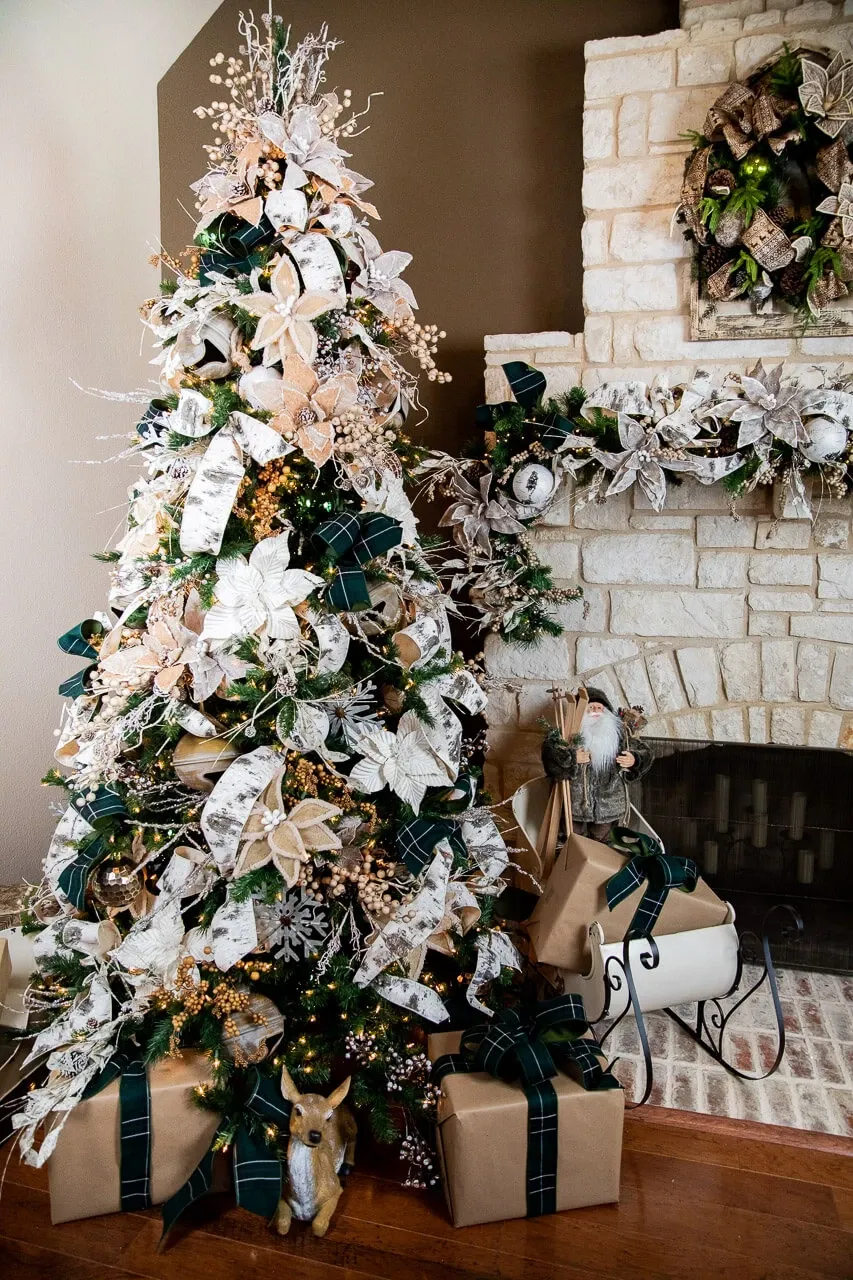
This level of layering needs room to breathe. Aim for a 12 x 14 foot space with 9-foot ceilings, and keep 30 to 36 inches of walkway on the tree’s busiest side. Working with something smaller? Drop to a 6.5-foot tree and move the extra garland to the fireplace, like the cozy setup in Idea #17. Tall ceilings but a narrow footprint? A slim 9-foot tree gives you height without the width.
8. Chocolate, Bronze, and Rose Gold in Four Finishes
Texture is what separates a bronze-and-chocolate tree from a muddy one. For every 12 inches of branch, hang three ornaments in different diameters — 2 inch, 3 inch, and 4 inch — and rotate through four finishes: matte, glitter, velvet, and high gloss. The eye reads that variety as depth rather than clutter. Keep the palette to five tones maximum, counting the needles. Six is where it starts getting noisy.
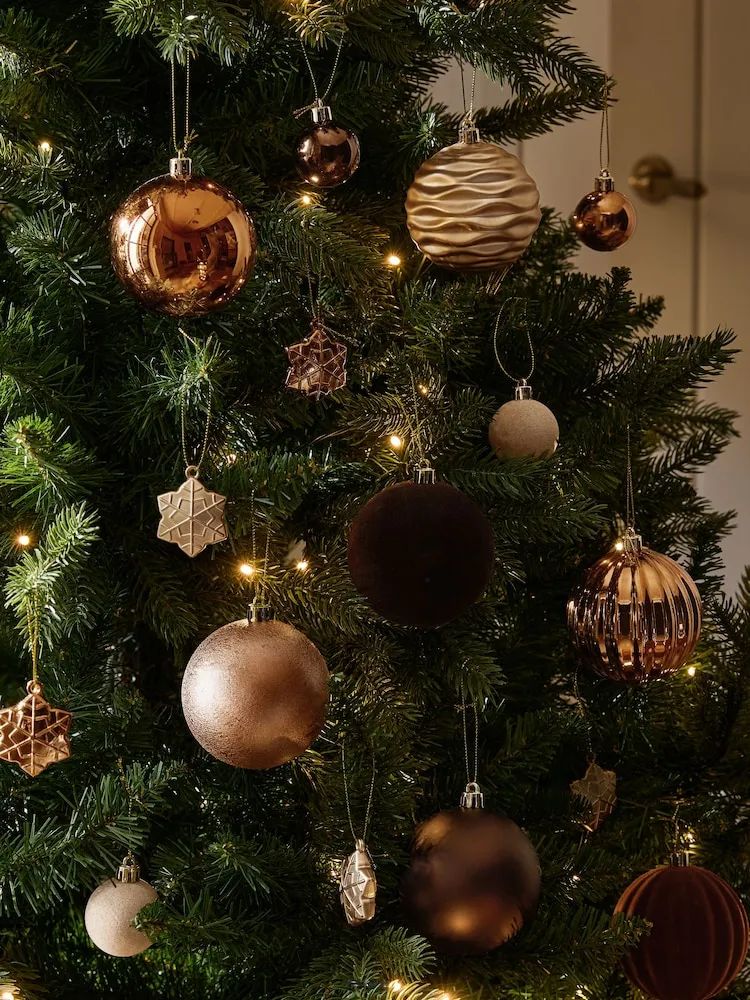
Glitter sheds. It will end up on your hands, your sofa, and your dog. Keep a lint roller by the tree and vacuum the skirt weekly with a brush attachment. Store mixed-finish ornaments in tissue inside a divided bin — tossing them loose chips the paint and dulls the shiny ones within two seasons. If the tree sits near a window, rotate it in January, because UV fades chocolate faster than it fades green.
9. Flocked Branches and a Chocolate Beaded Garland
- Measure ceiling height minus topper clearance and table base.
- Count your branch tips — plan on roughly 10 ornaments per foot of tree.
- Confirm where the nearest outlet is; you’ll want lights on a timer.
- Check that your flocking is true white, not yellowed — it changes how brown reads.
- Keep a lint roller nearby; flocking sheds for the first week.
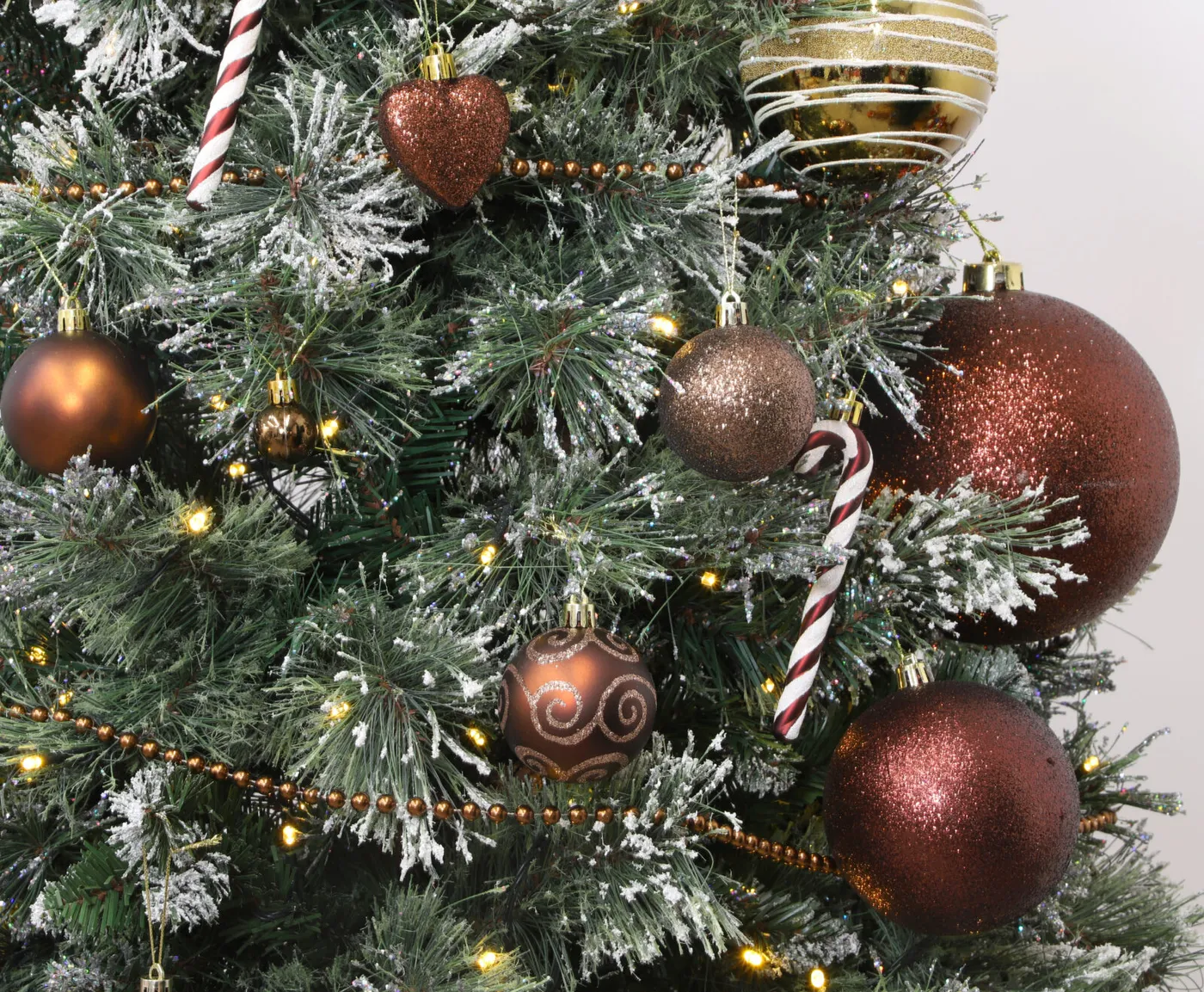
- Flocked 7.5 ft artificial tree: $200–$600
- Chocolate, bronze, and gold ornament set (100–150 pieces): $60–$150
- Brown beaded garland, 9 ft: $20–$45
- Warm white string lights, 300 count: $25–$60
- Tree skirt: $30–$80
Total: about $335 to $935. Budget alternative: skip the flocked tree, buy a plain green one on clearance in early January, and add a $12 can of spray flocking yourself next November.
10. Chocolate Baubles Finished with Pearl Brooches
- Buy plain dark brown satin or matte ornaments, about 3 inches across.
- Tie a 5/8-inch brown satin ribbon into a flat bow with 2-inch tails.
- Hot glue the bow to the ornament cap.
- Center a pearl-and-rhinestone brooch on the bow and glue it down.
- Hang on frosted branches only — the frost is what makes the pearls read.
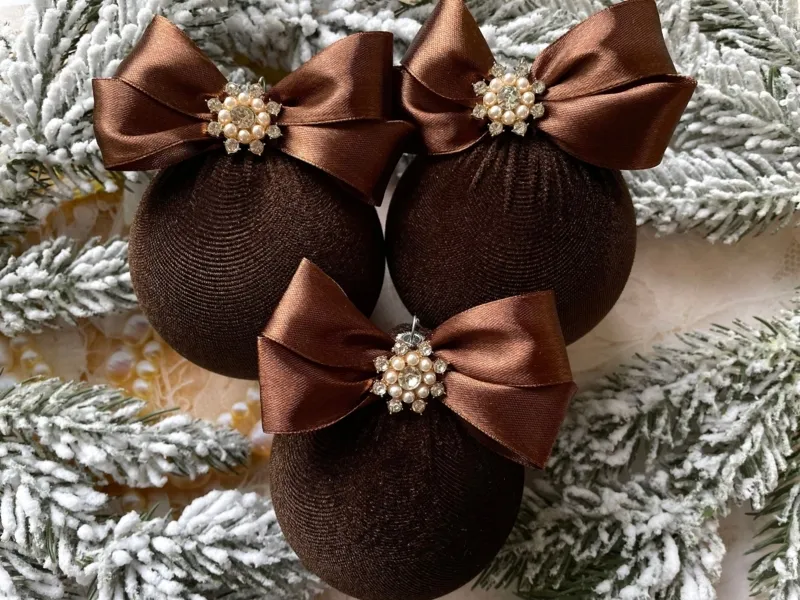
Time: 20 minutes for six ornaments. Cost: $12–$18 total, versus $8–$14 each for the boutique version.
It’s the brooch. Strip it away and you have a perfectly nice brown ornament you’ve seen a hundred times before. Add the pearl-and-rhinestone cluster and the same sphere turns into something that looks inherited. That’s the whole lesson of this look: the distance between generic and special is almost always one small, jewelry-scale detail.
11. Velvet Baubles in Three Browns, Straight From the Box
Velvet ornaments are one of the easiest upgrades to fake. Target and Walmart both run 12-piece velvet sets in brown, tan, and cream for $12–$20, and thrift stores routinely sell them for $1–$3 each in January. That straw filler in the box? A $6 bag of excelsior from any craft store. Skip the box entirely and display them in a wood bowl or on a vintage tray you already own.
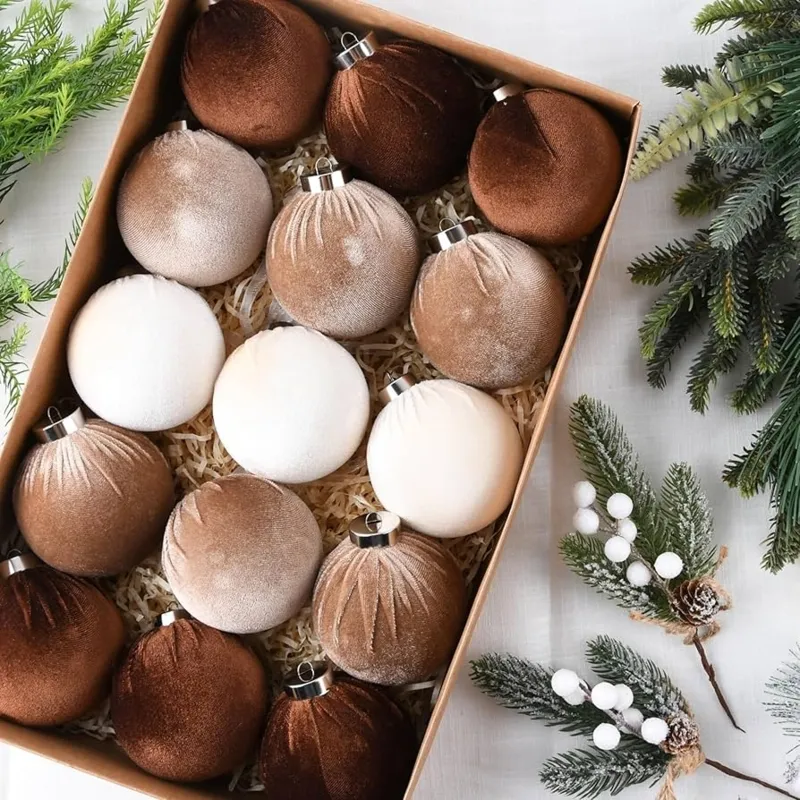
Velvet is visually heavy, so it needs either height or restraint. On a 7.5-foot tree, 40 to 60 pieces read as luxurious; on a 6-footer, cap it around 30. Working with a 4-foot tabletop tree? Use six to eight and let the texture be the statement. Compare with Idea #9 — same chocolate palette, completely different finish.
12. One Glittered Chocolate Ornament, Backlit by Fairy Lights
String your lights vertically, not horizontally. Run each strand top to bottom in 4-to-6 inch loops so every branch tier gets its own bulb — that’s what gives a single ornament this kind of halo. Then place your dark, glittery ornaments last, directly in front of a bulb, so the sparkle catches light instead of sitting in shadow. Twenty extra minutes of light placement beats two extra strands of lights every single time.

Negative space. This close-up works because the background is dark and out of focus, which means the restraint is the design. On a real tree, that translates to leaving gaps — roughly 30% of your branches bare, especially near the top. A tree with nothing to look at between the ornaments reads flat, no matter how pretty each individual bauble is.
13. An Oversized Plush Chocolate Ornament on the Floor
Giant floor ornaments are gorgeous and slightly dangerous. If you have toddlers, a senior dog, or anyone who navigates the room at 2 a.m., a 12-inch plush sphere on a rug is a trip hazard waiting to happen. Keep them against a wall or under a console, not in a walking path. Also check the weight — plush versions are light, but ceramic ones are not, and they will dent hardwood.
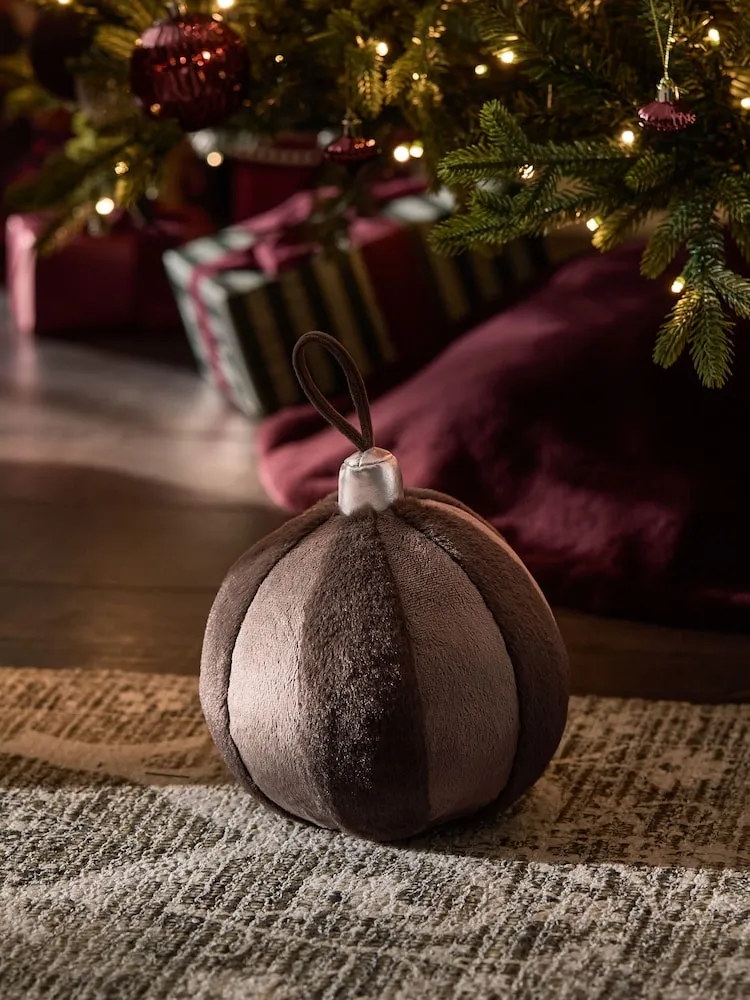
Plush velvet crushes. In high-traffic spots it flattens within a season, and the pile holds dust, pet hair, and glitter like a magnet. Vacuum on the lowest setting with a brush head, or roll it with a lint brush weekly. Store it stuffed with tissue inside a breathable cotton bag — plastic traps moisture and can leave mildew spots on the fabric by next December.
14. A Layered Paper Ornament on a Gold Chain
- Punch or cut 1-inch circles from kraft and dark chocolate cardstock — about 80 per ornament.
- Fold each circle in half around a pencil to create a soft curve.
- Starting at the bottom of a 3-inch foam sphere, hot glue rows of folded circles, overlapping each row by half.
- Work upward in tight, scale-like rows.
- Cap with a gold bead and thread a gold chain through the hanger.
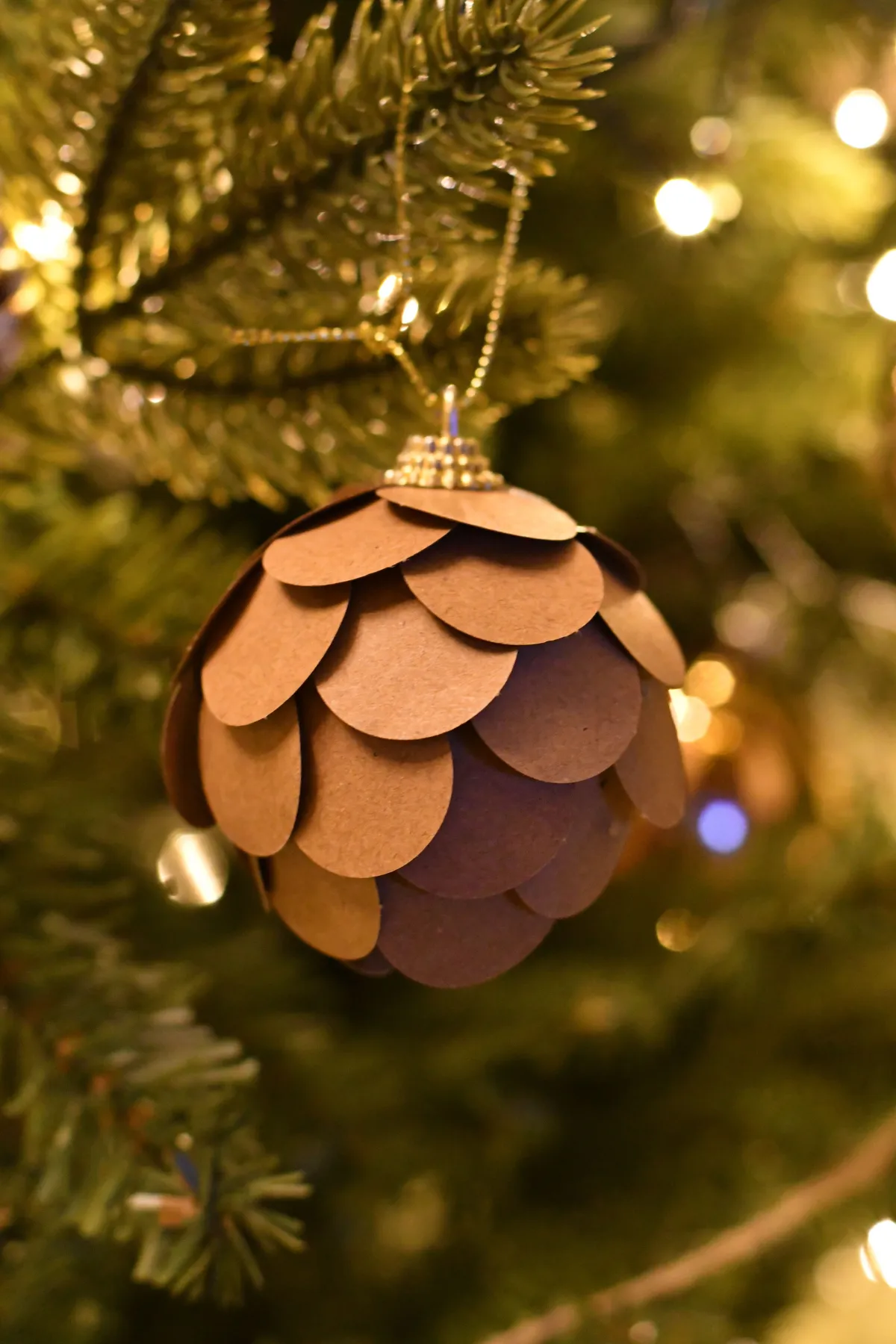
Time: 30–40 minutes. Cost: $8–$12 per ornament.
Handmade ornaments are quietly outperforming mass-produced ones on Pinterest this year, and layered paper is leading the charge. It fits two 2026 moods at once: the slow-decorating habit people picked up and never dropped, and the thrift-flip culture that turns a $4 bag of cardstock into something guests actually ask about. Paper also survives moves, kids, and pets far better than glass.
15. Frosted Brown Bottle Brush Trees on a White Stool
Bottle brush trees cost $3–$8 at craft stores and a dollar apiece at dollar stores in November. To get that deep brown, dip a plain tree in strong coffee and let it dry completely, or brush on thinned acrylic in burnt umber. Frost the tips with a light dusting of white acrylic, dry-brushed on rather than sprayed. Three trees, a thrifted stool, and you’re still under $25.
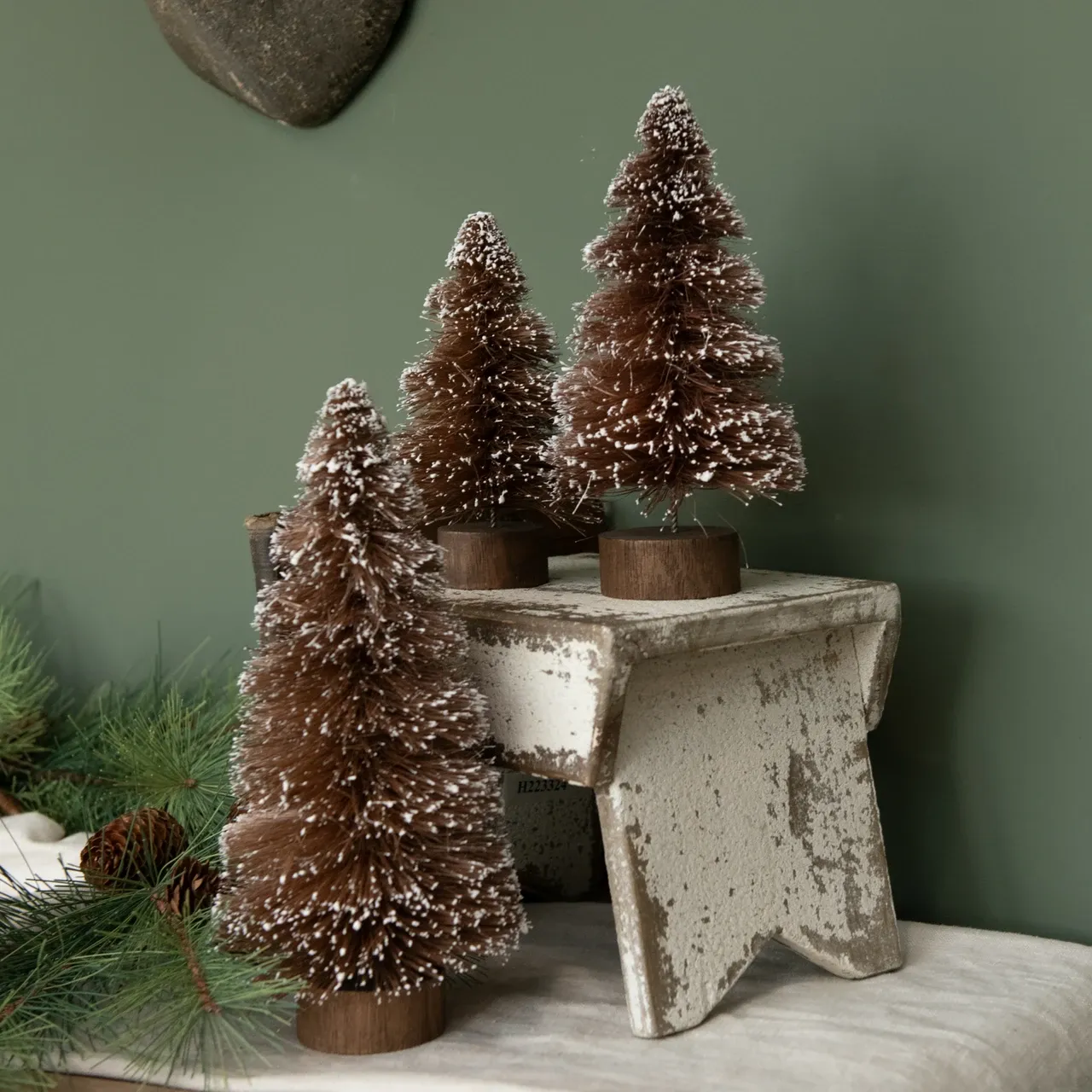
Group odd numbers, vary the heights, and keep the tallest at the back — 4, 6, and 8 inches is the classic trio. Bottle brush trees look best when they’re not pretending to be a real tree, so skip the ornaments and let the frosted tips do the work. And keep them off the main tree: a small vignette on a stool or shelf reads as styling instead of clutter.
16. Chocolate Trees You Can Actually Eat
Edible styling follows the same percentages as upholstery: 60% neutral base (wood surface, linen runner), 30% chocolate tones spanning white to dark, 10% bright accent — here, a few red berries and gold baubles. Because the confections span the entire brown range, they mirror a chocolate ornament collection almost perfectly. Swap the red berries for dried orange slices and you get the same contrast with a warmer, more rustic feel.

Chocolate and open flame don’t mix. Keep the candle at least 10 inches from the confections, and skip real candles entirely if the room runs warm — chocolate blooms, that chalky white film, above 70°F. Also, if you have dogs, remember chocolate is toxic to them. Style this on a high console or at the far corner of the table, out of reach.
17. A Burlap-Wrapped Mini Tree by a White Brick Hearth
Small trees solve real problems. A 3-to-4-foot pre-lit tree fits a corner about 30 inches wide and works in rooms under 150 square feet, where a 7.5-footer would swallow the entire seating area. Keep 36 inches of clearance from any heat source, and place it on the side of the fireplace that isn’t in the traffic path to the kitchen. Bigger room? Go back to the layered approach in Idea #7.
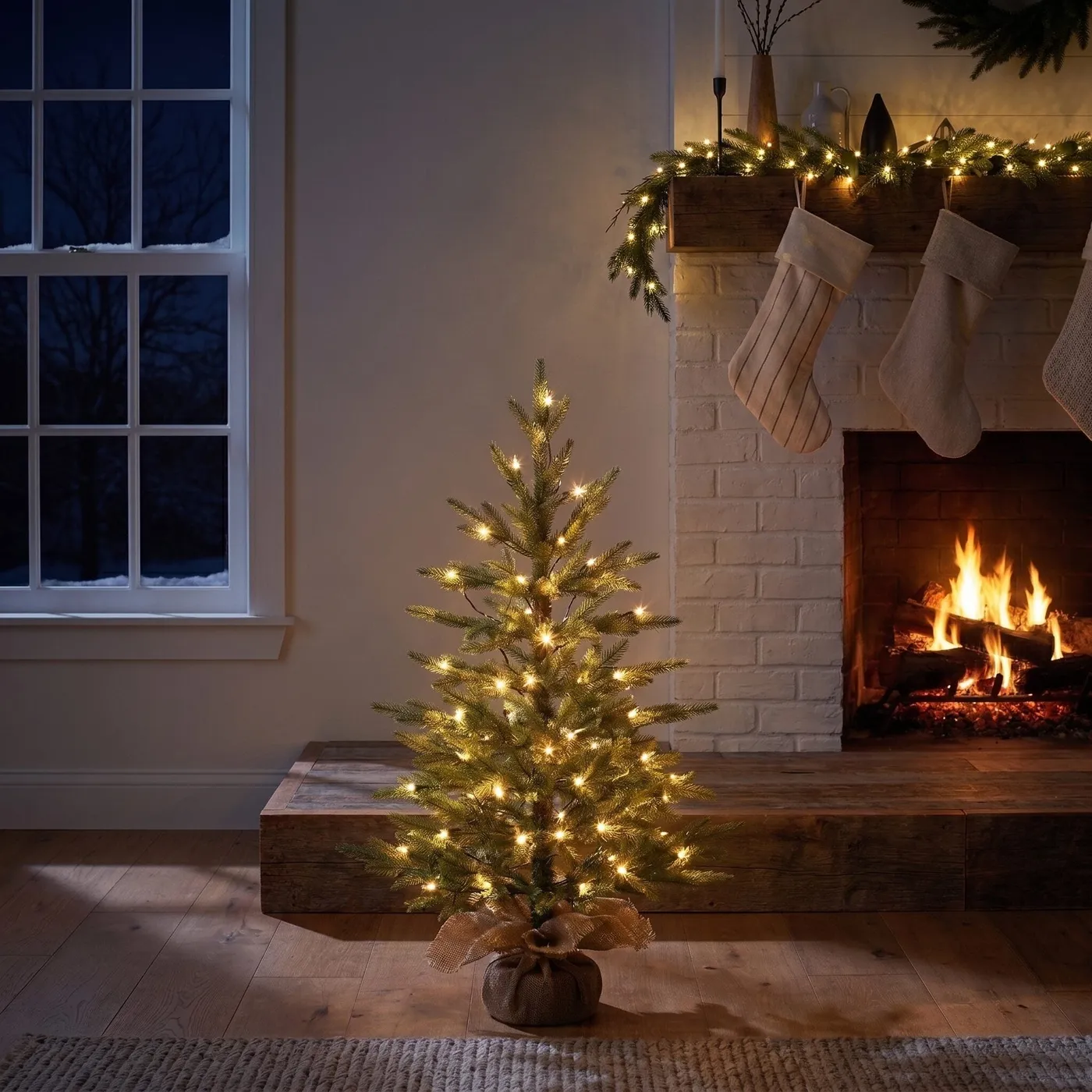
The burlap wrap is a $6 fix that hides the plastic stand and ties the little tree to the rustic mantel above without matching anything exactly. Remove it and the tree becomes a generic pre-lit unit sitting on the floor with its cords showing. Keep it and the whole vignette reads styled. Same tree, same lights, completely different result.
18. A Scalloped Chocolate Pinecone Ornament
- Cut 1.5-inch scalloped circles from brown felt or heavy cardstock — about 40.
- Roll each circle into a loose cone and glue the edge closed.
- Attach the cones to a 3-inch foam ball in overlapping rows, starting at the base.
- Point the tips outward and slightly downward for a pinecone silhouette.
- Add a gold hanging loop at the top.
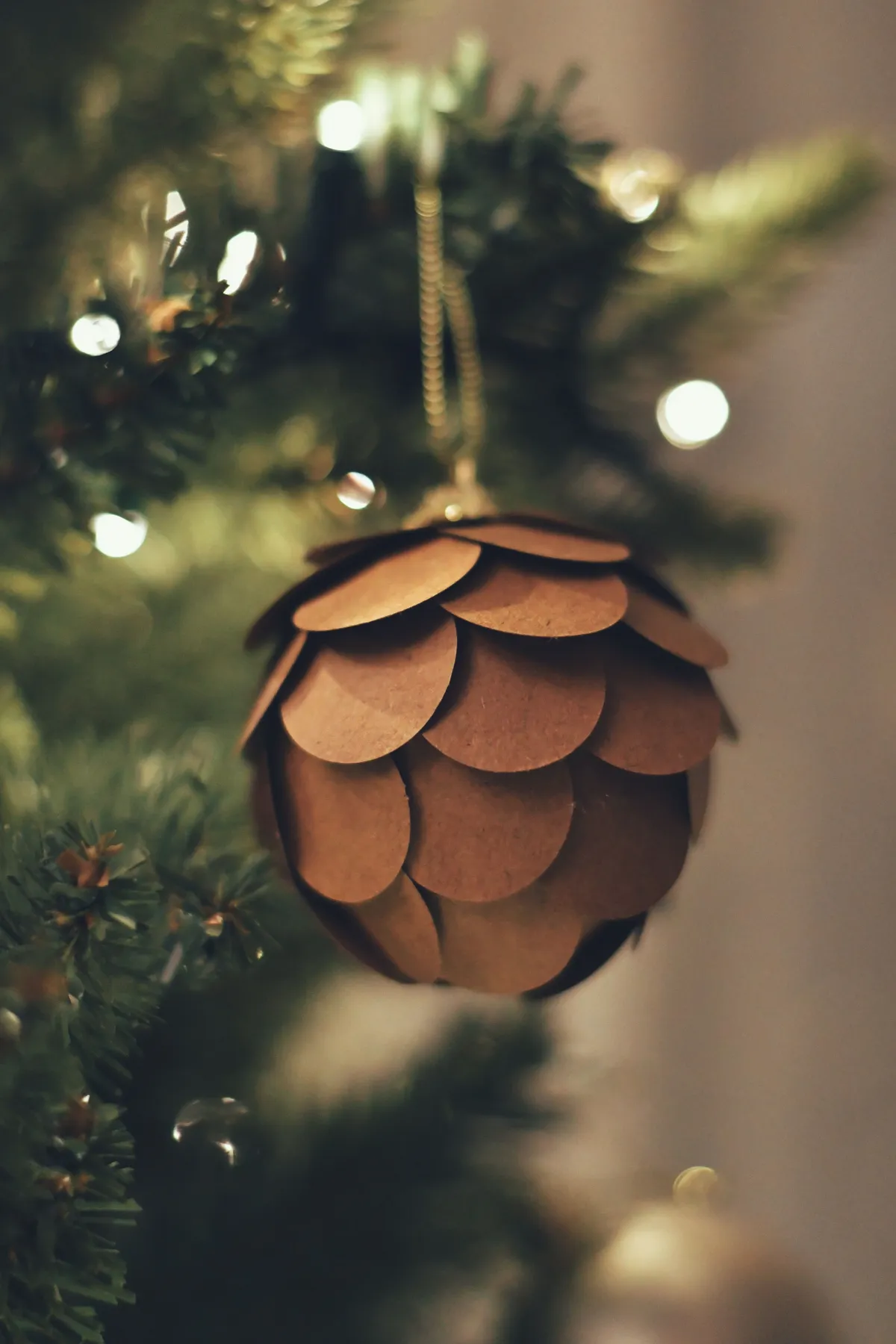
Time: 25 minutes. Cost: $6–$10.
Scale is everything with sculptural ornaments. Anything 3 to 4 inches wide belongs at eye level and below, where it can actually be seen; small 2-inch baubles can float higher, including the top third of the tree. Hang your heaviest pieces on the lowest, thickest branches and wire them in — a felt pinecone is light, but a cluster of five can still pull a branch forward.
19. Three Lit Trees Against Concrete and Cognac Leather
- Three 6–7 ft trees: $450–$1,200
- Ornaments, 300+ pieces in gold, purple, and red: $200–$500
- Tufted cognac leather sofa and ottoman: $1,800–$4,500
- Black pleated pendant lights: $120–$350
- Tree skirts or baskets: $60–$180
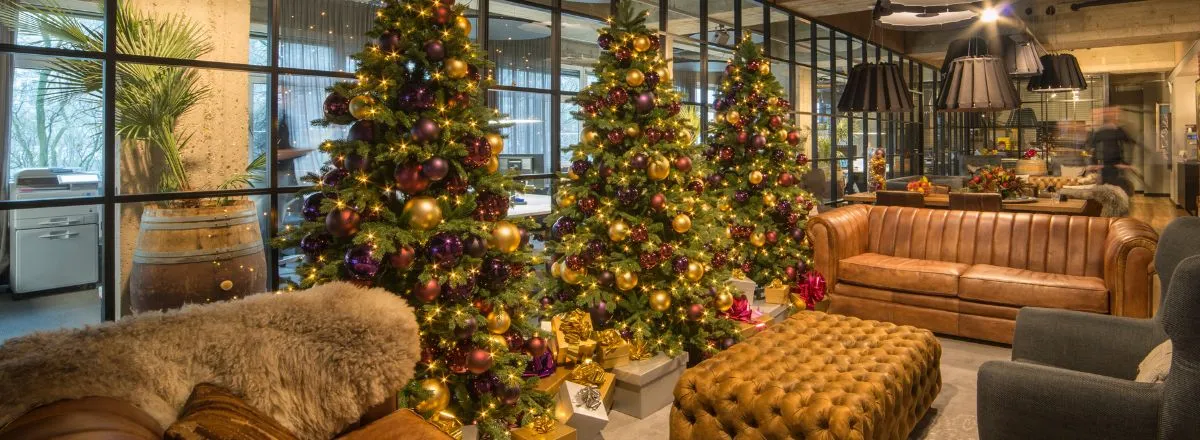
Total: roughly $2,630 to $6,730. Budget alternative: rent or borrow two of the trees for the season, or use two trees plus one tall potted evergreen and space them a little wider.
Repetition with variation. Three trees of the same height and shape create a rhythm the eye can follow, while the gold, purple, and deep red ornaments keep it from looking like a showroom display. The cognac leather does the important work — it brings warm browns into a room made of concrete and black metal, so the space feels festive instead of cold. If three trees is two too many, Idea #5 gives you the same warm metallics on a single tree.
20. Blue and Silver Baubles on a Pre-Lit Green Tree
Here’s the trap with cool-colored ornaments: warm white lights turn pale blue and silver slightly grey. If your tree already has warm LEDs, test three ornaments before committing to a 200-piece set. This room gets away with it because the walls are a light blue-green that echoes the baubles. On a beige or brown wall, the same ornaments can go completely flat — the light-temperature issue we cover in the mistakes section below.
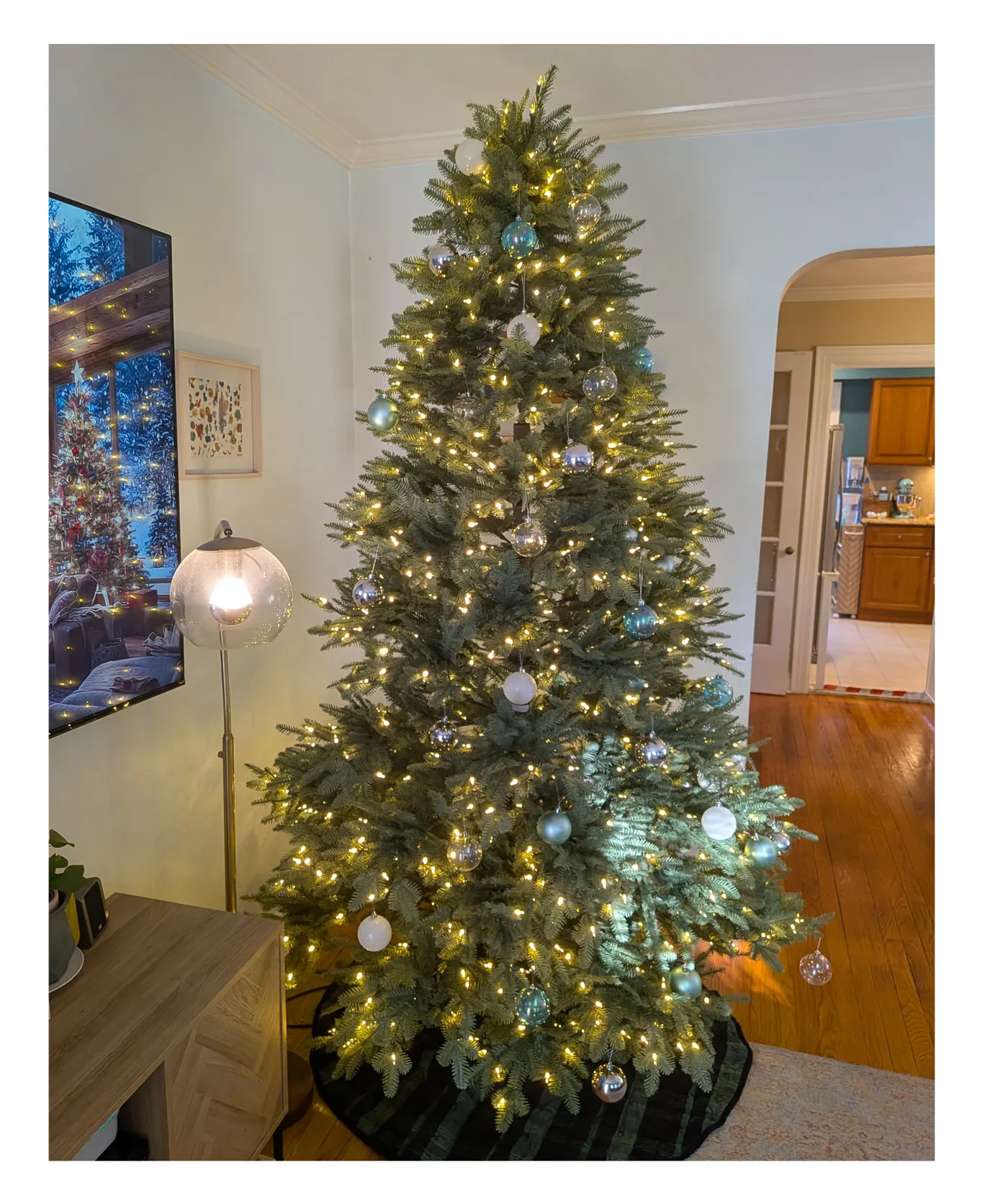
Dollar-store glass orbs are the best-kept secret in holiday decor: $1.25 each, and they’re genuine glass with real weight. Buy 40 in blue, silver, and clear for about $50, then spray a few with a $7 can of frosted glass finish for variation. A plain green fabric remnant makes a quick skirt, or shop the IKEA clearance rack for a solid green one around $15.
- Photograph your wall color in daylight and compare it to the ornament.
- Count your tree’s bulbs; under 300 will look dim on a 7.5-foot tree.
- Measure the corner — you need 36 inches of wall plus 12 inches of clearance.
- Decide on a skirt or basket before you shop for ornaments.
21. A Full-Color Tree Beside a Grey Wingback Chair
A 7-to-7.5-foot tree needs a 9-foot ceiling and about a 3-foot radius of clear floor. In a 10 x 12 room, that leaves roughly 6 feet of usable seating depth — enough for a wingback like this one, but not much else. Keep 36 inches between the tree’s widest branches and the chair so people can actually sit down. Smaller room? Look at the mini-tree approach in Idea #17.
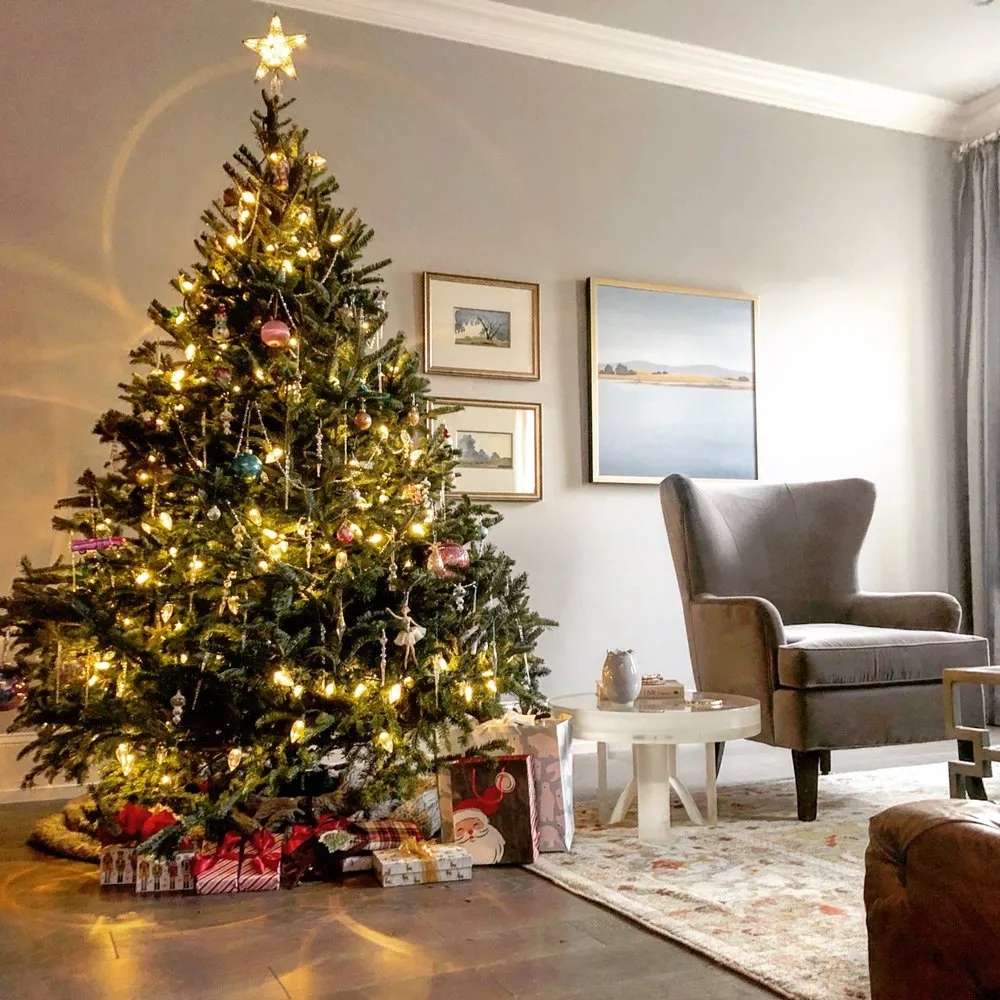
Colorful glass ornaments are back, and honestly, it’s a relief. After a long stretch of monochrome trees, 2026 has people digging through their parents’ ornament boxes again. The reason is partly economic — reusing what you own beats buying a new theme every year — and partly emotional. A tree that looks collected over decades is hard to fake, and designers have stopped trying. Warm white lights make multicolor glass glow rather than clash, which is the only rule that matters.
22. Matte, Distressed Ornaments with a Soft Satin Ribbon
55% muted rust and brown ornaments, 25% off-white and beige, 15% deep evergreen, 5% brass hardware. That last 5% is what keeps an earthy tree from reading dusty — a little metal at the caps is genuinely enough. Want it cooler? Push the browns toward taupe and the brass toward pewter. Want it richer? Bump the rust to 30% and add dark chocolate. The proportions stay the same either way.
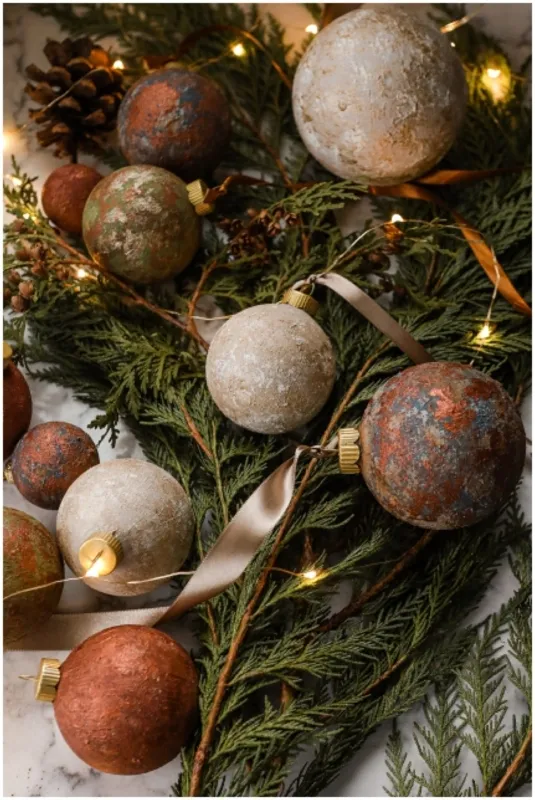
Distressed finishes are the easiest thing to DIY. Buy plain matte ornaments in mixed browns at Walmart for about $15 a box, then sand a few edges with fine-grit paper and dab the caps with brass rub-on wax. Thrift stores sell old ornaments for a dime each, and matte spray paint runs $7 a can. The satin ribbon? Two yards for $4 at any craft store is more than enough for a full tree.
23. A Mini Lit Tree and a Village on a Wooden Console
- Check the outlet position — you’ll need two plugs: tree and village houses.
- Measure the console depth; village houses need 6 inches minimum.
- Confirm your floor lamp isn’t already the brightest thing in the room.
- Make sure the rug extends at least 6 inches beyond the console legs.
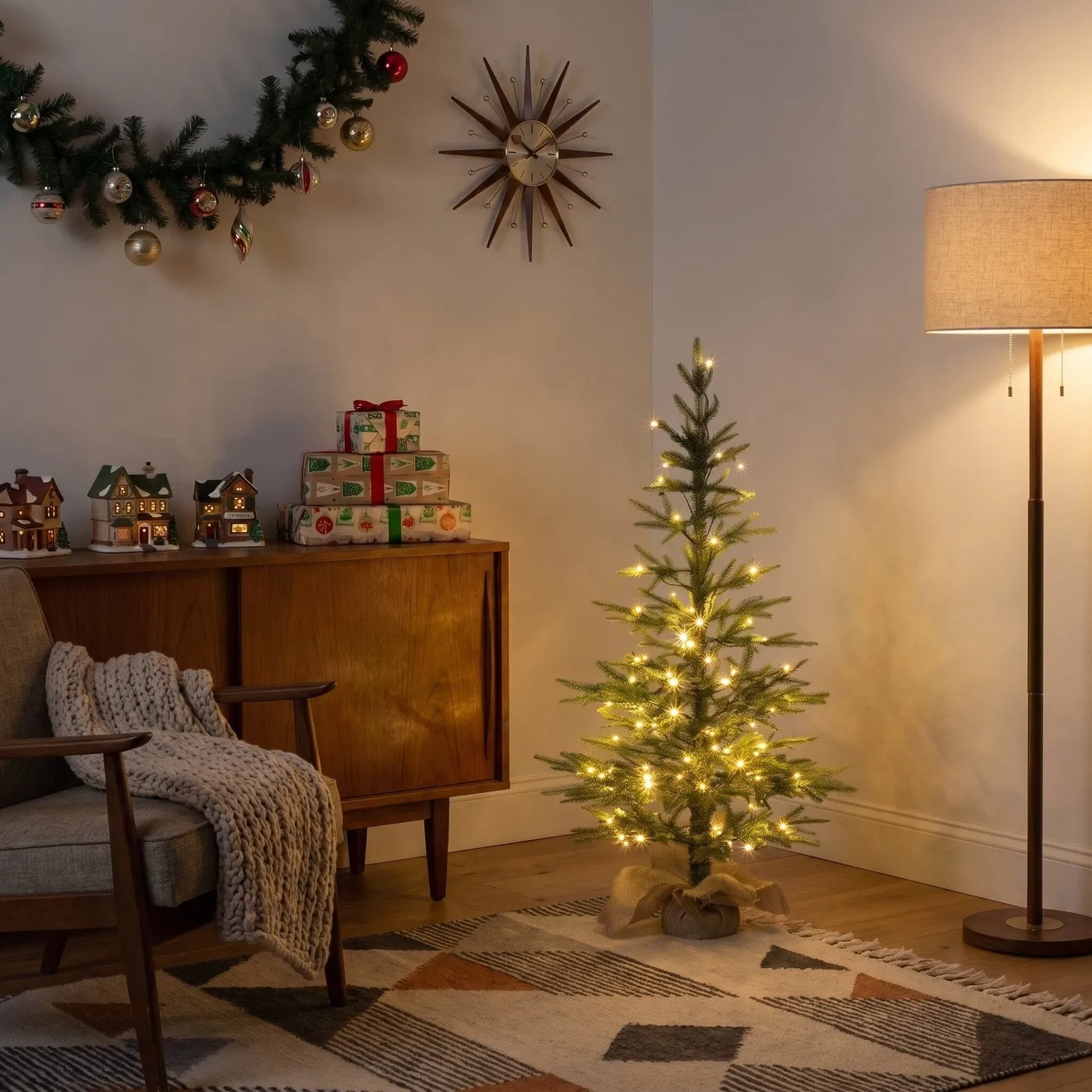
Then build the vignette in five moves:
- Anchor the surface with a runner or tray, roughly two-thirds the console’s length.
- Place the tallest item — the tree — on one end, never dead center.
- Group the village houses at three heights using stacked books underneath.
- Add one vertical element above: a clock, a mirror, or a framed print.
- Finish with a low bowl or greenery to soften the hard edges.
Time: 30 minutes. Cost: $0 if you shop your own shelves.
24. A Star-Topped Tree and a Lighted Mantel Garland
Three light sources, three heights. The tree glows vertically, the garland runs horizontally across the mantel, and the fire flickers low — that triangle of light is what makes this room feel warm from every seat. The stone chimney and white mantel also frame the tree instead of competing with it. Take away the garland and the mantel goes dark, and the whole composition loses its middle. Compare with Idea #2 — same stone fireplace logic, completely different tree.
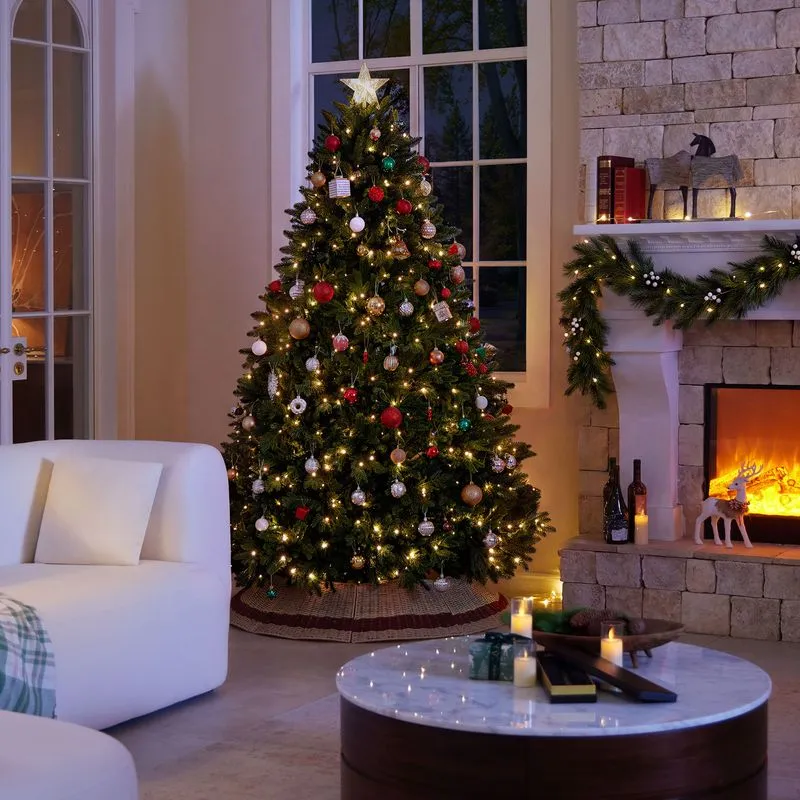
- Pre-lit 7.5 ft tree: $200–$550
- Assorted red, gold, and silver ornaments: $70–$180
- Lighted garland, 9 ft: $45–$120
- White sofa and marble coffee table: $1,600–$3,800
- Tree skirt and stockings: $50–$130
Total: about $1,965 to $4,780. Budget alternative: keep your existing sofa, add a $30 corded garland, and reuse ribbon scraps from last year.
25. A Chocolate Stocking with a Natural Linen Cuff
Stocking math: hang them 4 to 6 inches apart and at least 6 inches above the firebox. On stone or brick, skip nails entirely and use adhesive hooks rated for 5 pounds — they hold a stuffed stocking fine and peel off clean in January. If your mantel is short, layer instead: stockings in front, garland behind, and nothing that blocks airflow to the flame.
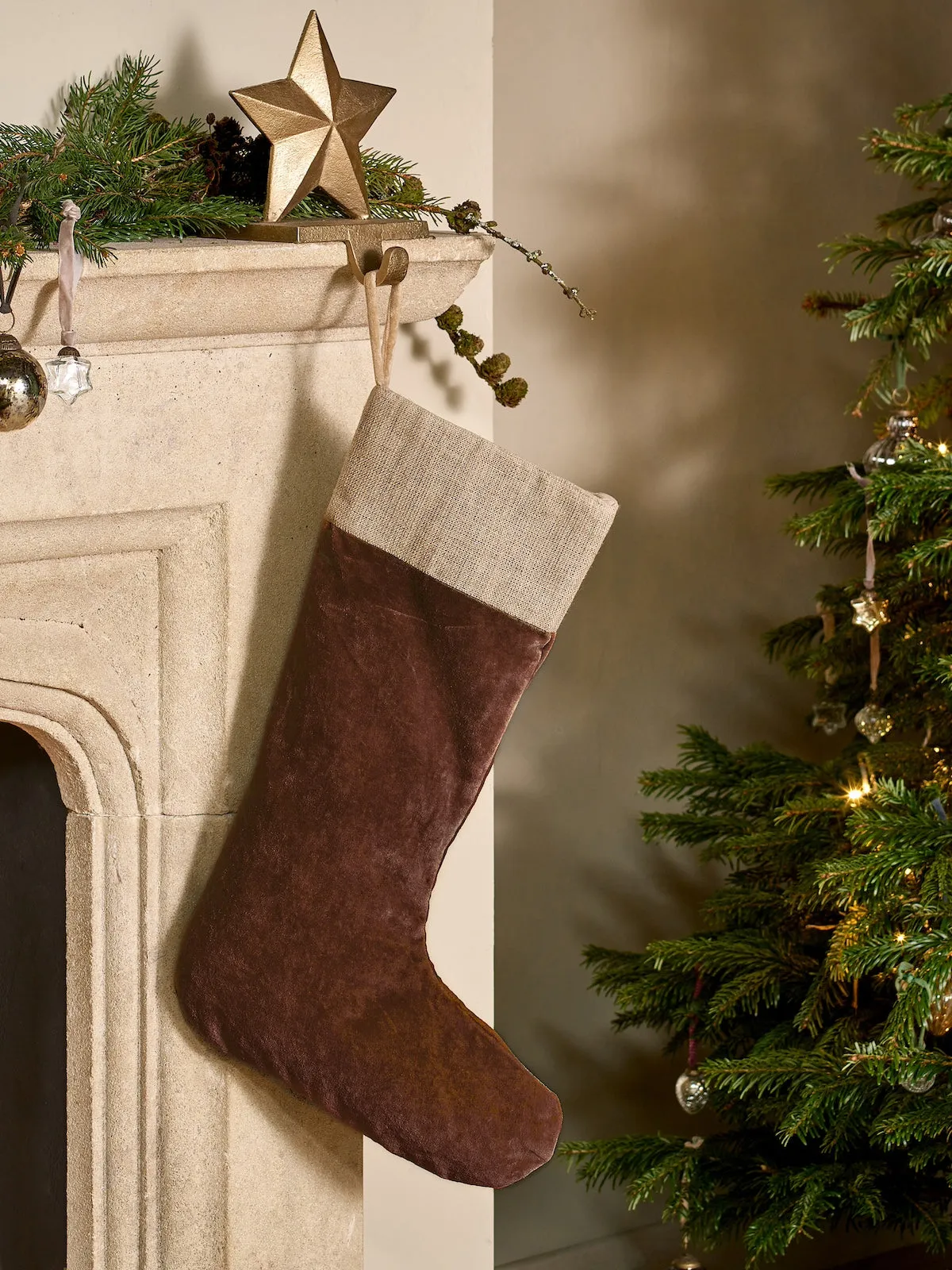
As a rule, allow 12 inches of mantel length per stocking. A 6-foot mantel fits five comfortably; a 4-foot shelf is a three-stocking job, so if your household has four people, that’s your cue to hang one on the tree instead. The carved stone mantel here is generous, which is exactly why the gold star and the clear glass ornaments get room to breathe.
26. A Carved Tree-Trunk Shelf with a Mirror Core
The embedded mirror. It reflects the tree lights back into the room, which doubles the sparkle without adding a single bulb, and it makes a narrow wall feel deep. Everything else on this shelf — the candles, the knitted stockings, the carved mushroom details — is charming, but the mirror is the actual design decision. Lose it and you have a nice rustic shelf. Keep it and you have a focal point.
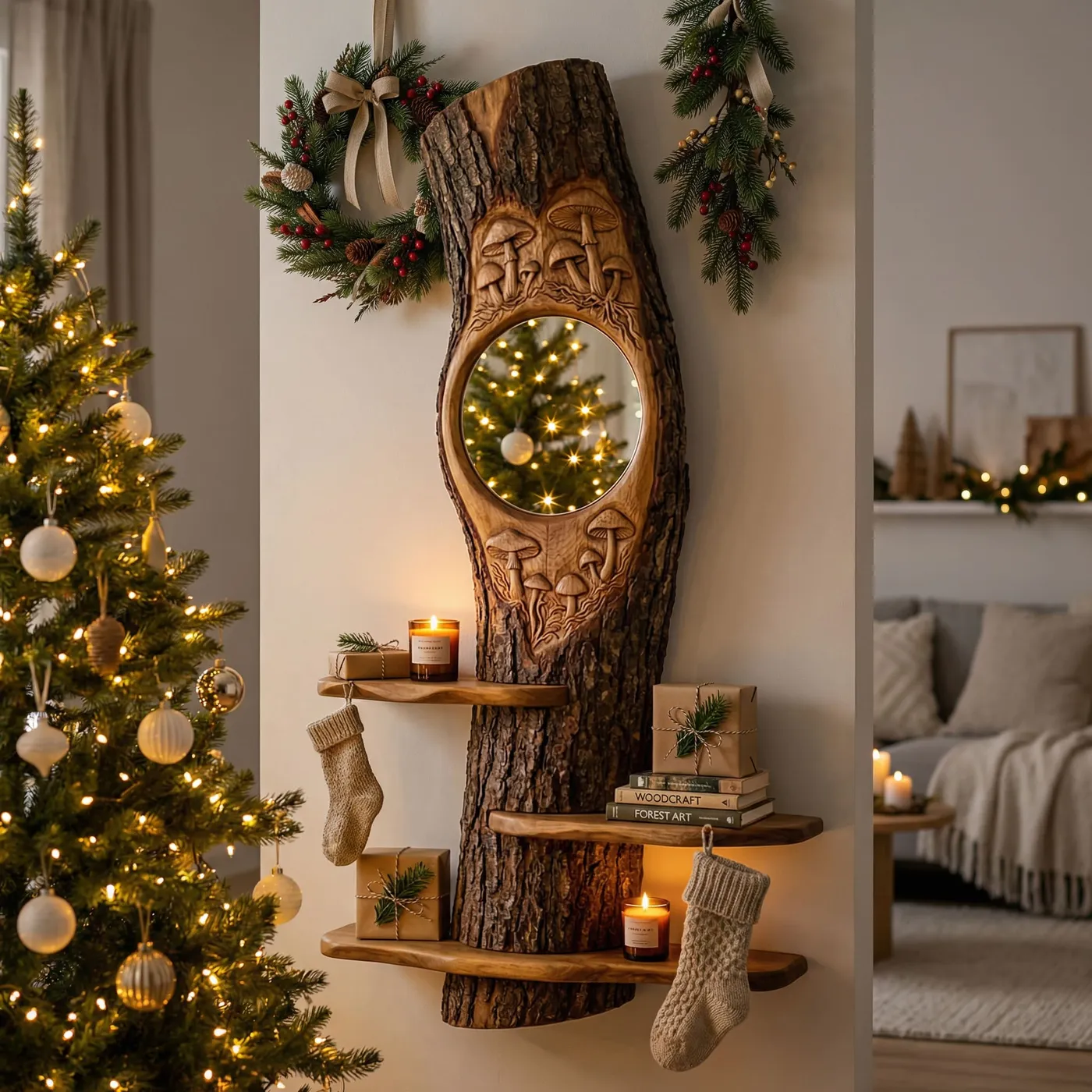
Raw wood, candles, and greenery mean a little upkeep. Dust the shelf grooves monthly with a soft brush, because crevices in carved wood collect everything. Never burn candles directly under evergreen — the heat dries needles fast and creates a fire risk. Knitted stockings pill, so hand-wash them cold at season’s end, and give the mirror a streak-free wipe before everything goes back in the bins.
27. A Mocha Flocked Tree That Reads Almost Dreamy
Mocha is a tricky tree color. In a bright room it looks like soft cocoa; in a dark room under warm bulbs, it can go muddy and brown-grey. Before you commit, stand the tree in the actual corner at the actual time of day you’ll use it. Also expect shedding — flocked trees drop for the first week, so keep a vacuum handy and don’t shake the box open over carpet.
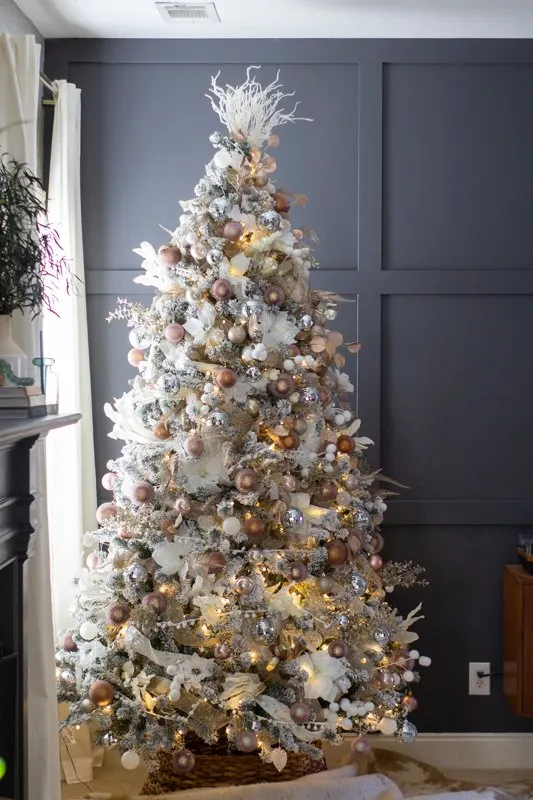
Go with 65% mocha branches, 20% ivory and cream ornaments, 10% soft gold, 5% greenery or a hint of red. Because mocha is already a mid-tone, your ornaments need to go either lighter or darker — mid-tone on mid-tone simply disappears. Swap the gold for brushed silver and the tree turns cool and wintry. Swap the ivory for pure white and it turns crisp and modern.
28. A Chocolate Faux Fur Skirt Under Bronze and Velvet Ribbon
- Faux fur tree skirt: $60–$180
- Dark brown and bronze bauble set: $50–$140
- Deep red velvet ribbon, 10 yards: $15–$35
- Warm white string lights: $25–$60
- Faux fir 7.5 ft tree: $180–$500
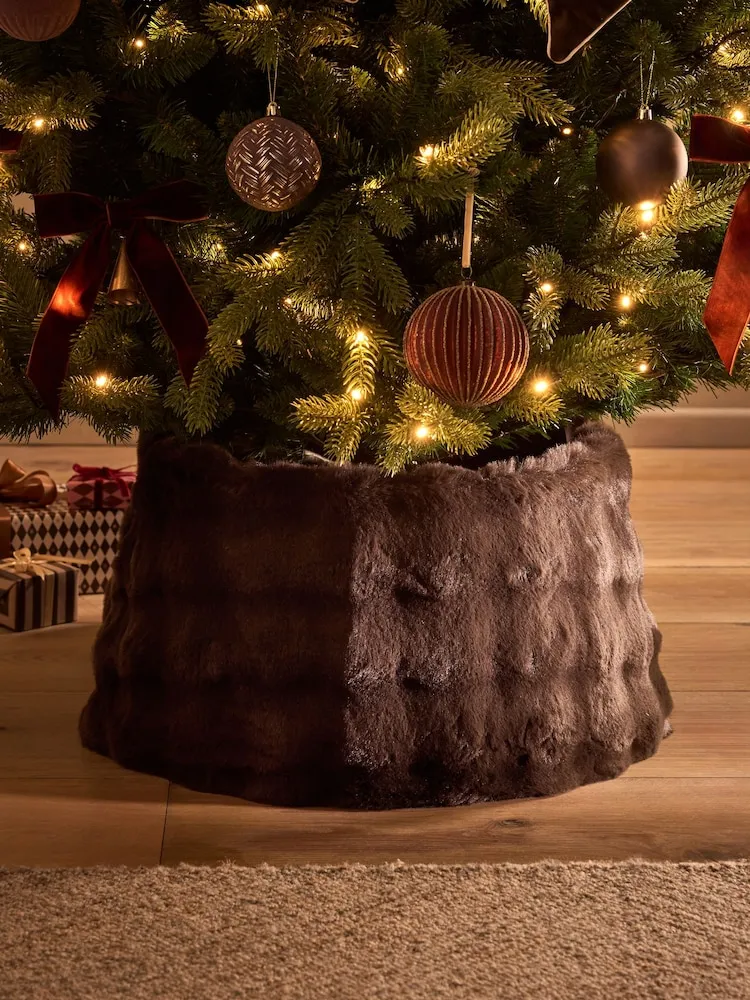
Total: about $330 to $915. Budget alternative: two yards of chocolate faux fur from a fabric store runs $30–$45 and wraps a stand in ten minutes flat.
Faux fur is dramatic and high-maintenance. It crushes where gifts press into it, holds static and pet hair, and needs brushing rather than vacuuming. Shake it outside at the end of the season, brush the pile with a soft-bristle brush, and store it flat — never folded tightly into a bin, or the creases will still be there next December. Roll velvet ribbon instead of folding it to avoid permanent lines.
29. Champagne and Bronze Baubles Framed by Wooden Doors
Champagne, white, and bronze is the palette that refuses to quit. It started with the neutral-everything wave, but it’s lasted because it’s genuinely flexible — it works with wood, grey, cream, and black, and it photographs beautifully without looking like a trend piece. The 2026 twist is texture: people are mixing satin, mercury glass, and matte ceramic inside the same scheme instead of buying matching sets.
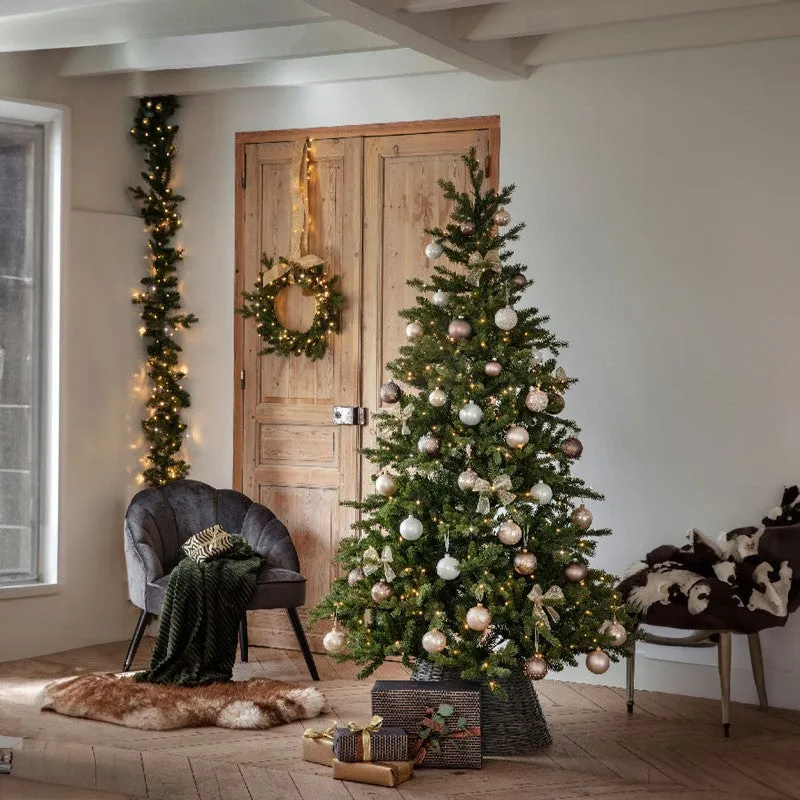
Ribbon bows on a 7.5-foot tree should be 3 to 4 inches wide; anything narrower vanishes into the branches. Space them 12 to 15 inches apart and clip rather than tie, so you can reposition in seconds. Hanging a wreath on a double door? Center it 5 to 6 feet off the floor — higher and it looks like it’s floating, lower and it reads as a door knocker.
30. Glossy, Matte, and Glitter Chocolate on a Mini Flocked Tree
- Start with a 2-foot flocked tree in a small gold or brass pot.
- Drape a light wooden bead garland first, working in loose loops.
- Add ornaments in threes: one glossy, one matte, one glitter.
- Cluster the largest pieces near the bottom to ground the shape.
- Finish with one oversized chocolate bauble in the top third and leave the tip bare.
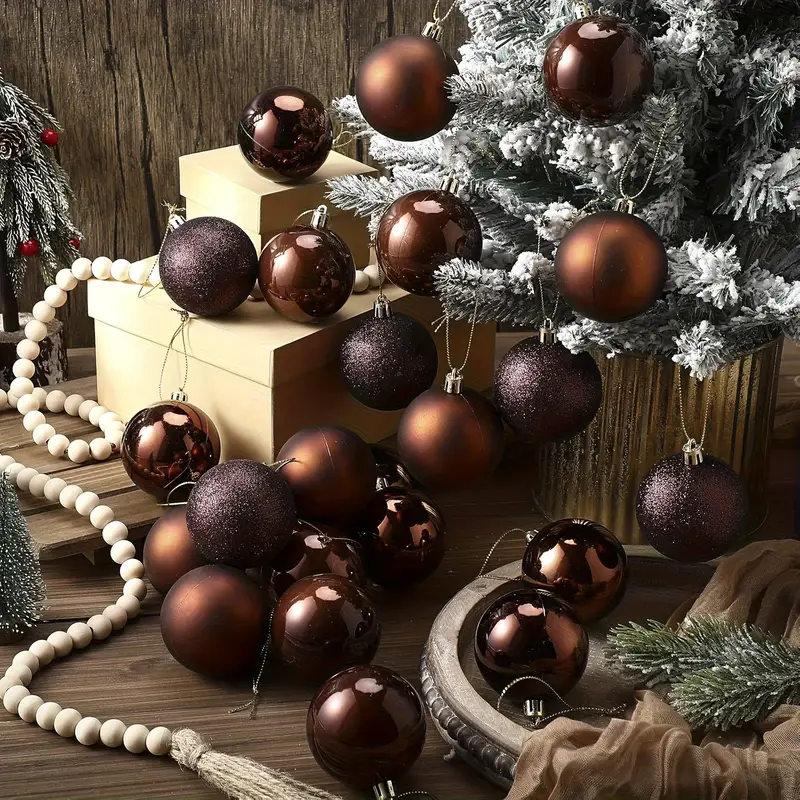
Time: 20 minutes. Cost: $35–$60 including the tree.
Chocolate ornaments are cheapest in January, so buy ahead. Walmart and Target clear out browns for $5–$10 a box after the holidays, and dollar stores carry matte brown spheres year-round at $1.25 each. A brass fluted pot from a thrift store runs about $4, and a bead garland is a $6 spool of wooden beads plus twine. The full-size version is in Idea #8.
One Brown Tree, Thirty Ways to Style It
Chocolate brown works because it’s warm without being loud — it plays nicely with oak, brass, cream, and even the deep reds and greens you already have in storage. Start with the one idea that fits your room’s actual light and footprint, then build outward from there. 📌 Pin your favorites now so they’re waiting for you when the holiday bins come down from the attic.