32 Jaw-Dropping Outdoor Christmas Light Ideas That Will Make Your Home Sparkle
Outdoor Christmas light displays are having another moment on Pinterest, and the displays getting saved aren’t the loudest yards on the block. They’re the ones with a plan: a roofline that reads clean from the street, a palette someone actually chose, and a ground layer that pulls the whole thing together.
We spent serious time comparing what’s on the shelves at Target, Home Depot, Walmart, and Lowe’s, then pulled 32 displays that work at every price point, from about $18 worth of clips and a starter strand to a $600-plus full-facade show.
Inside you’ll find classic warm-white roofline outlining, multicolor maximalist lawns, animated figure scenes, and rustic rope-light cabins, with budget and splurge versions compared side by side.
In 2026 the shift is toward smart timers and warm-white outlining with one saturated accent color, which is exactly why so many of these displays photograph so well after dark.
And stay until the end, because we break down the most common mistakes that can ruin these looks. 📌 Save this to Pinterest for later, you’ll want to revisit these ideas.
1. Multi-Color Bulbs Tracing Every Gable and Dormer
What sells this one is rhythm. The multiple gables and the dormer give the strand somewhere to travel, so your eye follows the roofline instead of bouncing around in the dark. Multicolor bulbs read as traditional here because they’re doing a job, drawing the architecture, rather than competing with it. The spotlights washing the light beige siding are the quiet third player; without that ambient glow, the outline would just float.
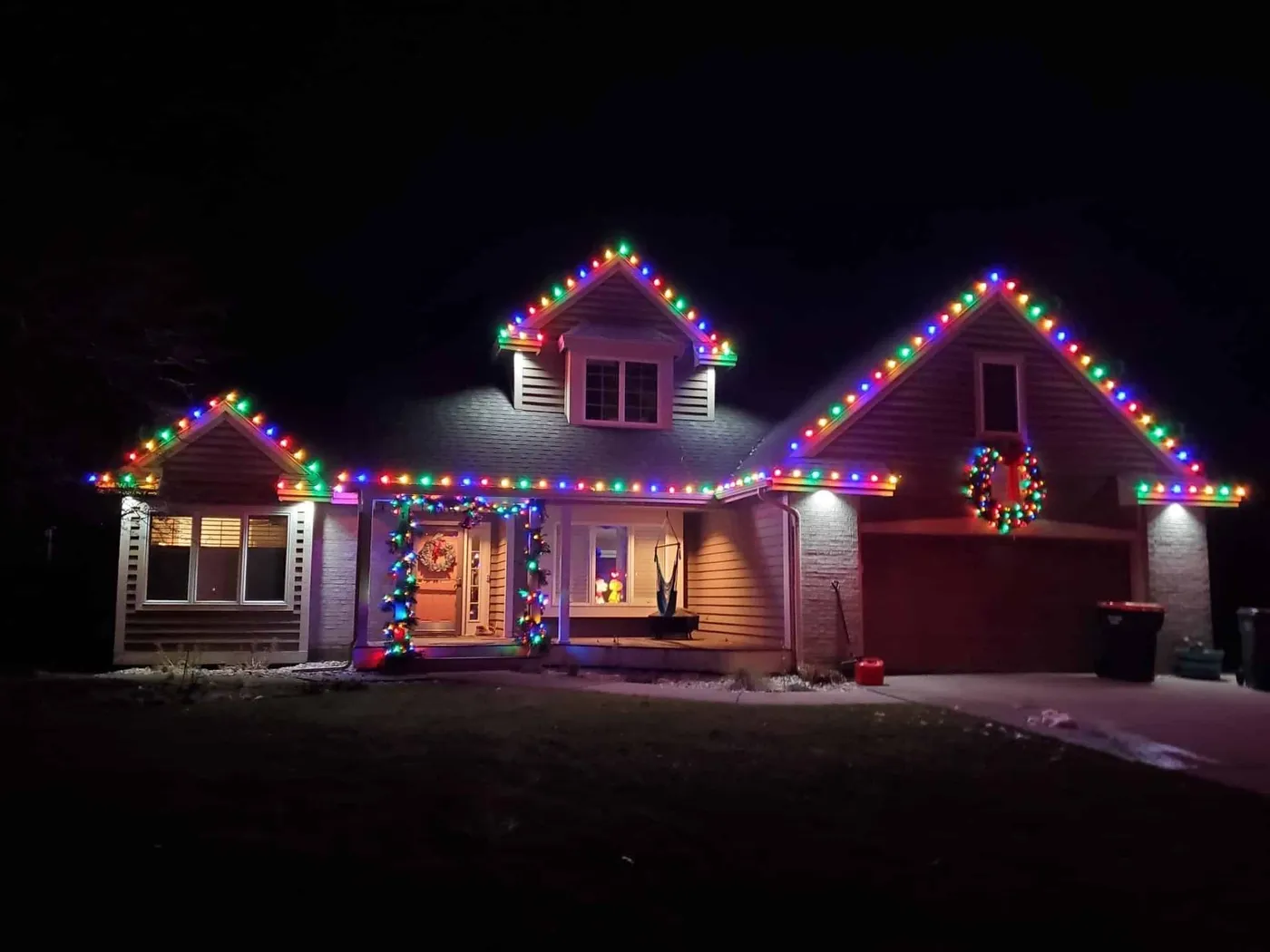
Spacing is where most DIY outlines fail. Use C9 strands with bulbs every 8 to 12 inches and clip every 12 to 15 inches along the fascia, never the shingle edge where wind gets underneath. If you’re wrapping the porch columns too, stop the wrap 2 inches below the top so the light line visually lifts off the porch instead of strangling it.
2. Red-and-White Wrapped Driveway Trees With a Teal Glow Behind
Here’s the formula: about half of this display is cool white doing structural work, tracing the roofline and window frames so the house still reads as a house. Roughly a third is the alternating red and white on the bare driveway trees, which gives you a rhythmic candy-cane beat as you pass. The last slice is the teal green, white, and blue on the big background trees, and that layer is what creates depth. Swap the teal for amber and it goes traditional; swap it for purple and it turns playful.
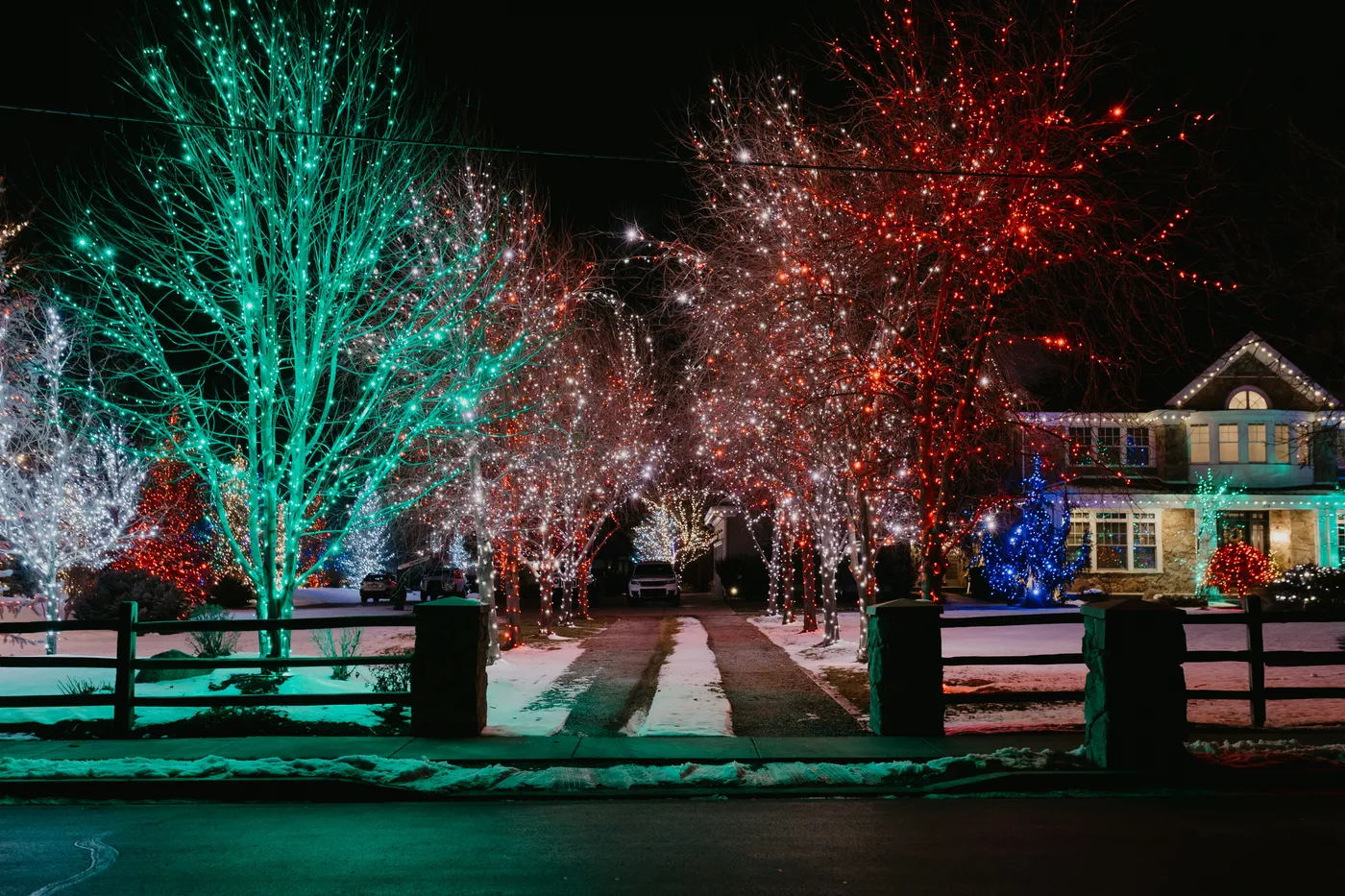
Wrapping bare trunks in an alternating pattern eats strand footage fast. A 12-foot tree can swallow 300 to 400 feet of light, and every extra run adds to what one outlet has to carry. LEDs draw far less than incandescent, but check the tag and stay under about 80 percent of the circuit. Snow on the ground is doing you a favor too, because it bounces light back up and makes the yard feel twice as bright.
3. Warm White Outlines and Icy Branches on a Snow-Covered Brick Home
The single element that makes this display work is the wrap. Every deciduous tree, every evergreen bush, and the small pine in the front yard sit under the same warm white as the roofline and gables. Take those away and you still have a nicely outlined house, but you lose the thing that makes people slow down: the sense that the light is coming out of the landscape, not resting on top of it.
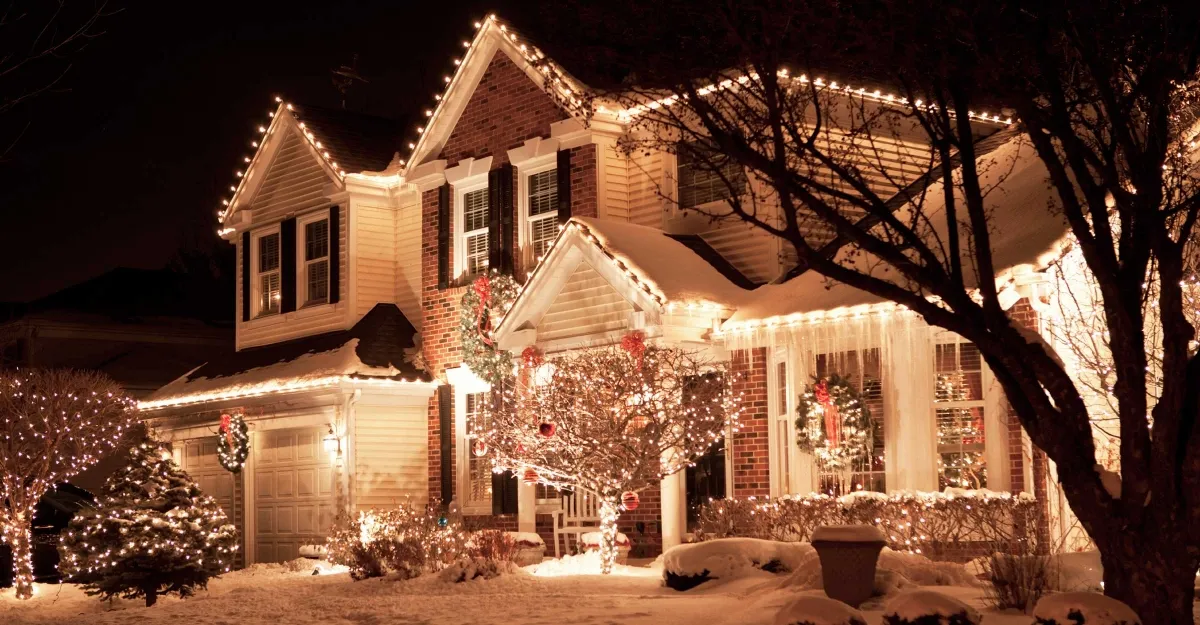
Icicle strands along a roof edge are beautiful for about six weeks and annoying for the other forty-six. Snow and ice load them, the little drops snap in cold snaps, and you’ll spend a February afternoon hunting dead sections. Budget one spare set per 30 feet, cap the ends with electrical tape, and store them coiled in a labeled bin instead of a garbage bag, which is how most people end up buying new ones every single year.
4. A Glowing Star on the Roof Ties the Roofline Together
Before you mount a roof star, stand across the street and find the sightline. Most people put it dead center on the main gable, where it disappears behind the ridge from the sidewalk. Instead, place it on the visible roof plane about two-thirds of the way up so it reads as a crown rather than a rooftop satellite dish. Secure it with a weighted ridge mount or a purpose-built bracket, never zip ties run straight into shingles, which will void a roof warranty faster than you can say December.
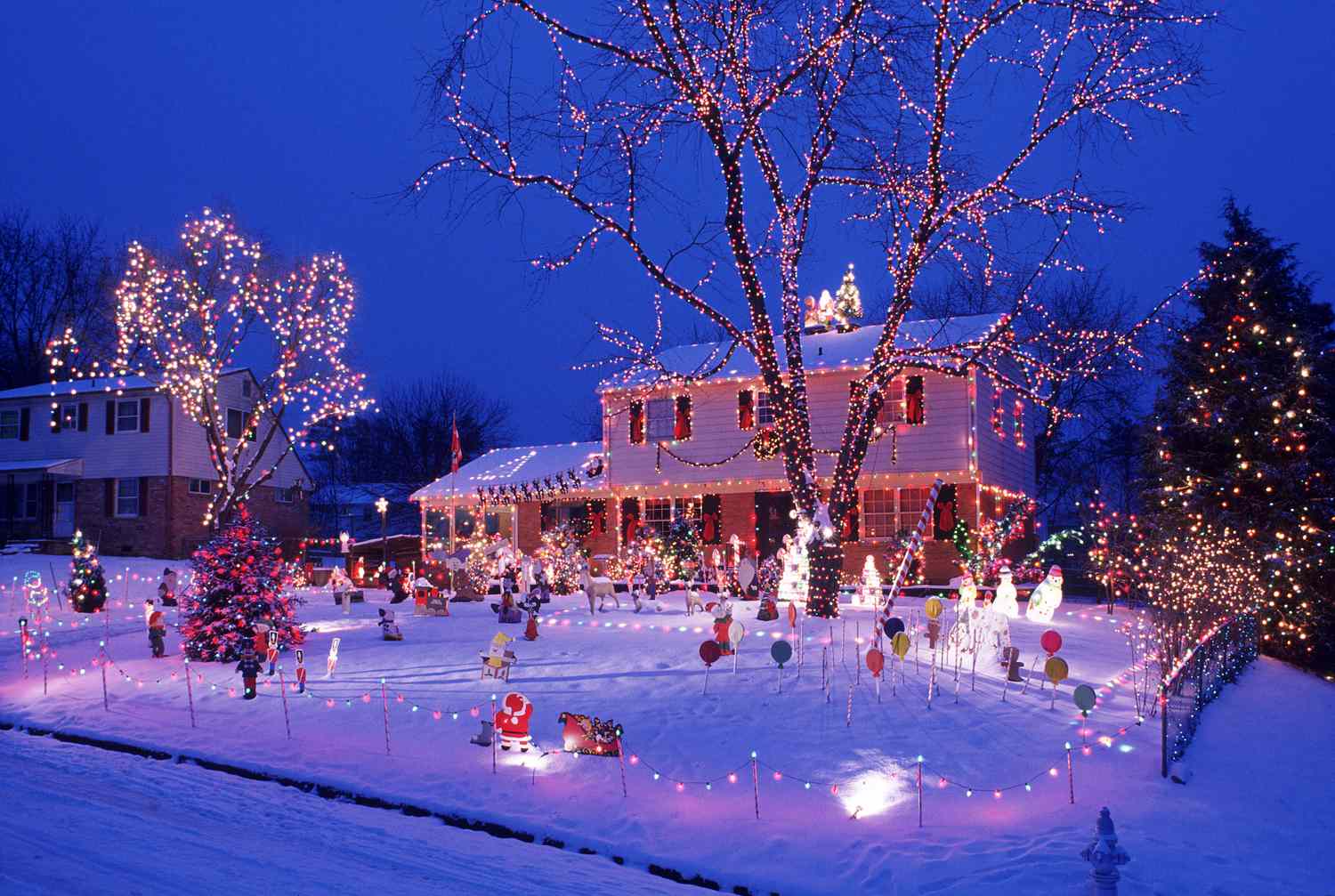
This layout suits a two-story home roughly 1,800 to 2,800 square feet with 40 to 60 feet of setback from the street. Closer than that and the star reads as one more bright blob. If your home sits right on the sidewalk, skip the roof star and put the statement piece in the yard at eye level instead, where it will actually get seen.
5. Lit Conical Trees Standing Sentinel at a Brick Facade
You don’t need a five-figure display to get this look. Pre-lit cone trees run $40 to $90 each at Home Depot and Target, and they’re the fastest way to add vertical light without touching a ladder. Two of them flanking the door, plus two more beside the front windows, gets you the same silhouette as a professionally wired setup for under $300. Facebook Marketplace in mid-January is where the real steals live; people who paid $120 in November let them go for $25.
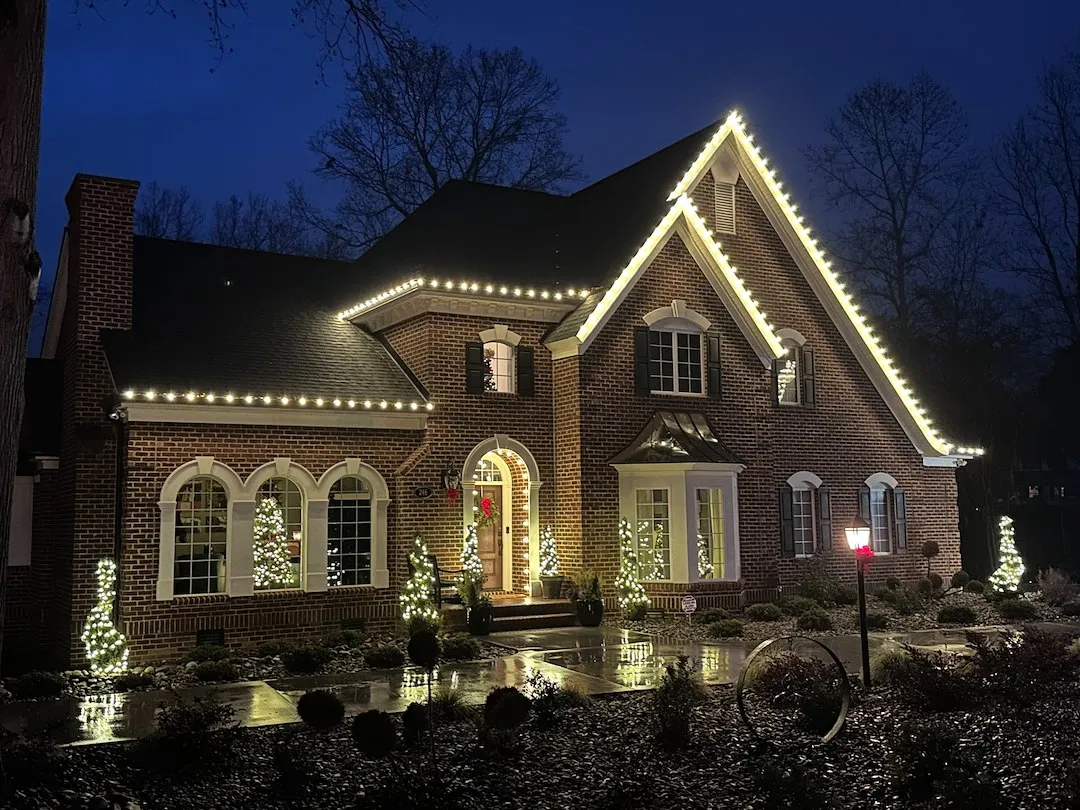
The reason this approach keeps winning on Pinterest is restraint with repetition. Instead of covering every surface, you’re placing the same object four or five times and letting the eye do the rest. It photographs beautifully, it survives wind, and it takes twenty minutes to set up, which is roughly the amount of patience most of us have left after Thanksgiving.
6. When the Whole Facade Becomes the Display
here is density. This isn’t a house with lights on it, it’s a house made of light, with warm white strands running over brick, into the trees, and through the bushes until you can’t quite tell where the building ends and the landscaping begins. The illuminated snowflakes and the big wreath with the red bow matter because they give your eye two or three places to rest in all that glow.
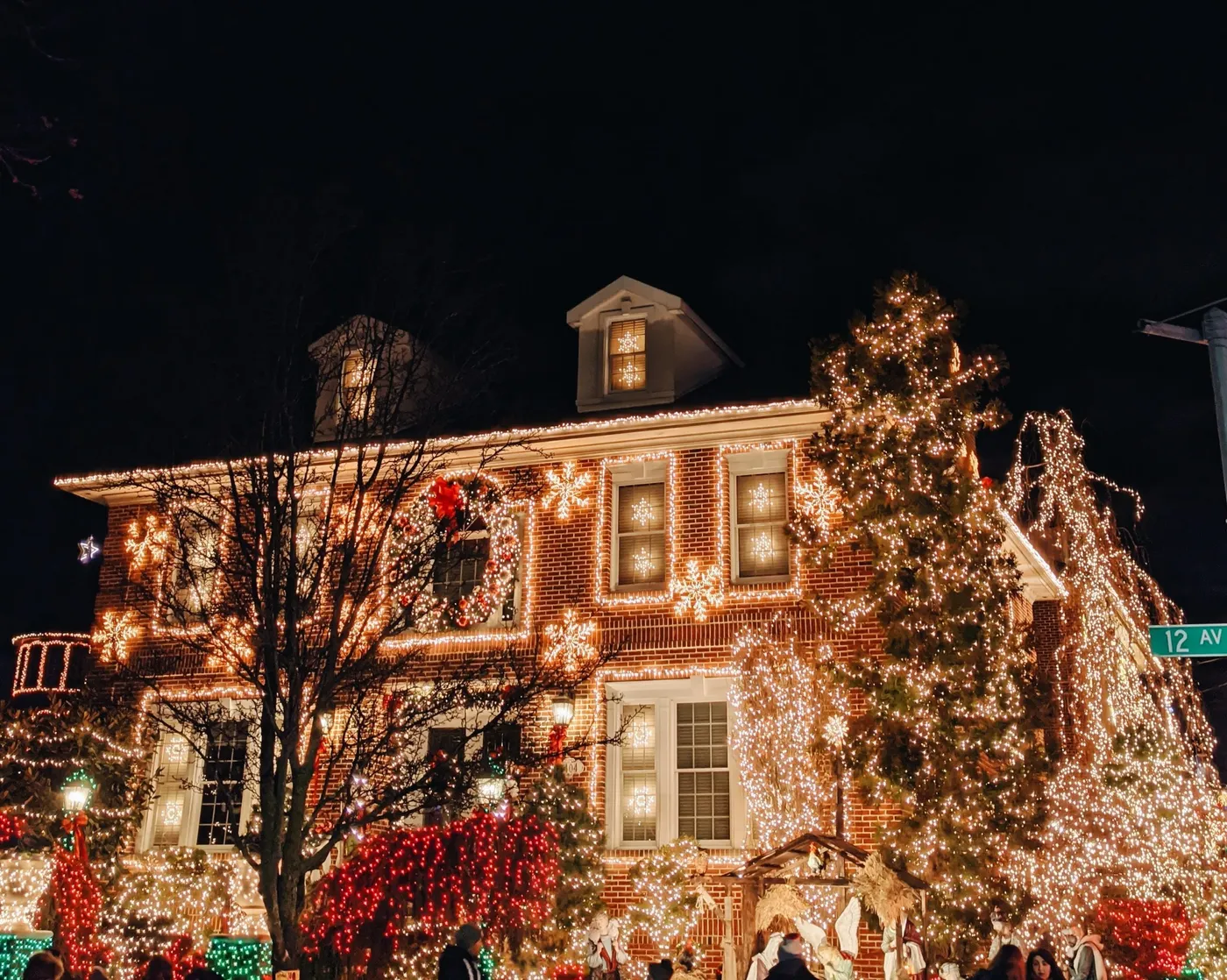
Set realistic expectations before you commit to this level. A display this dense pulls real wattage, needs at least two dedicated circuits, and takes a full weekend to install even with help. You also want a timer rated for the load, because forgetting to shut this off is a phone call from your neighbor at 2 a.m. And yes, storage becomes a permanent commitment: this is a garage-shelf situation, not a tote under the stairs.
7. What a Professional Install Crew Actually Fixes
Pro crews earn their money on three things you can copy at home. They clip every 12 to 18 inches so the line stays dead straight, they use commercial-grade C9 strands with thicker wire that won’t sag in a thaw, and they map the load across dedicated circuits instead of one overloaded outlet. The other upgrade is a service loop: a little slack hidden behind a bush so the strand has somewhere to go when it expands and contracts.
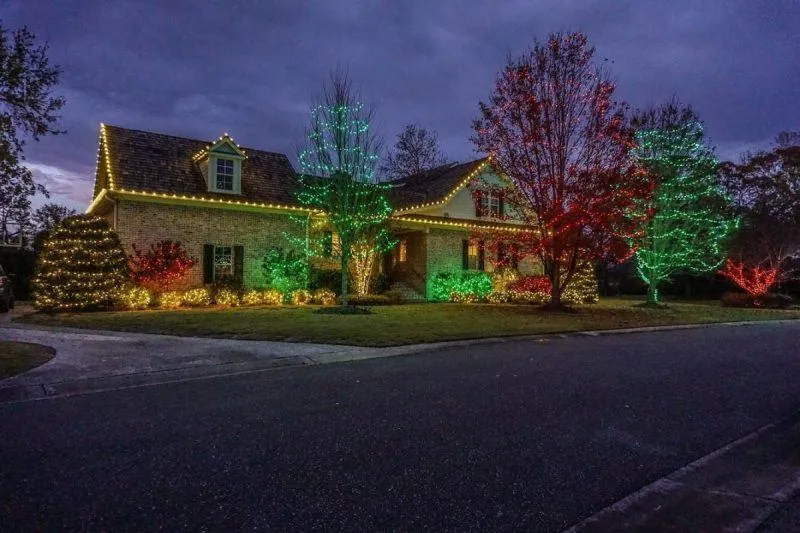
Hiring it out typically runs $600 to $2,500 depending on roofline length and height, plus takedown in January. If that’s out of range, this is the budget version of Idea #3: buy the same warm white strands, rent a stabilized ladder for a weekend, and pay a neighbor’s teenager $50 to spot you. You’ll spend a Saturday and save a mortgage payment.
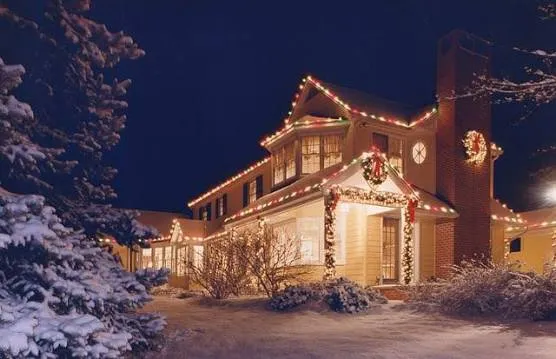
8. Cream Siding, Red-and-Green Rooflines, and a Wreath on the Chimney
The mix here is roughly 50 percent soft white on the porch pillars and shrubs, 35 percent red and green outlining the roof edges, and 15 percent green with red bows in the wreaths. That last slice is small, but it’s the part that makes the display feel handmade rather than purchased. If red and green feels too literal for your street, keep the same proportions and swap to warm white plus burgundy, which reads festive but a touch more grown-up.
- Measure the chimney face and add 6 inches on each side.
- Use a masonry-safe hook or a heavy-duty magnetic hanger rated for 15 pounds.
- Hang the wreath so the bottom sits just below the chimney cap, not above it.
- Run a single extension cord down the back of the chimney and secure it every 3 feet.
- Test the lights before you climb anything.
Budget about 45 minutes and $30 to $60 for wreath and hardware if you already own a ladder.
9. Red Bows and Reflective Ornaments Anchoring a Stone Walkway
If you removed the planters, the warm white outlining the stucco and wrapped through the trees would still be lovely, but it would be light without a focal point. The oversized red bows and the reflective spheres sitting in the planters give the ground plane a color echo of the front door, and they stop the display from feeling like it starts at the roofline and ends at your ankles.
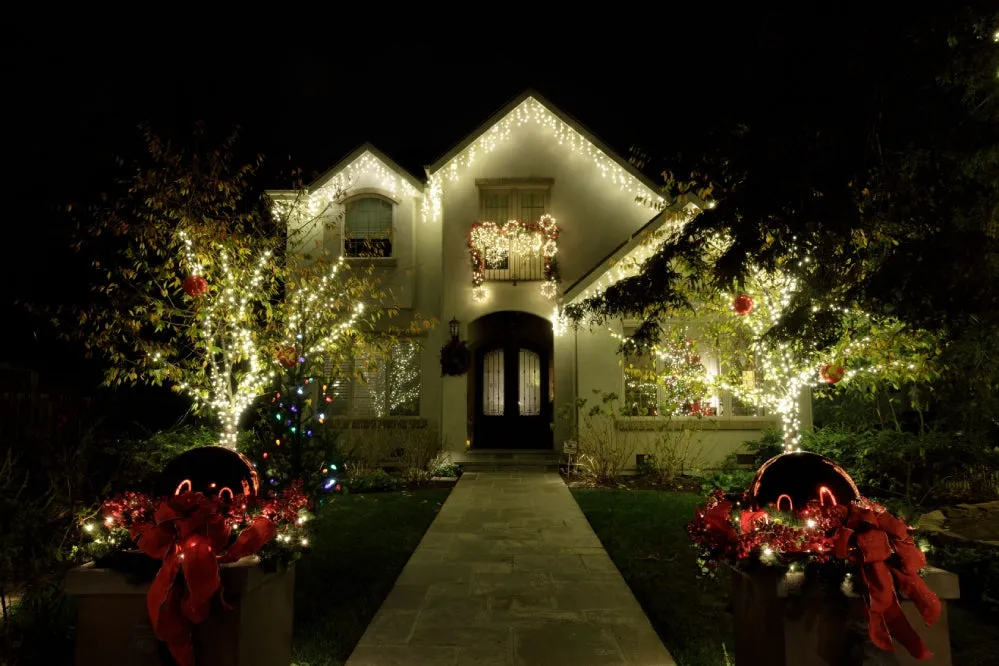
This layout wants a proper entry courtyard, ideally 6 to 8 feet of walkway width with room for planters at least 20 inches across so the ornaments don’t look apologetic. On a narrow stoop, use one planter per side and keep the bows smaller, because scale is everything here. Big decor in a small entry reads as clutter no matter how good the pieces are.
10. Twin Yard Trees Wrapped to Match the Roofline
Two things are doing the heavy lifting: symmetry and matched color temperature. The two front yard trees mirror each other across the entry, and because they’re wrapped in the exact same warm white as the roofline, the composition reads as one gesture instead of three separate projects. The lit wreath on the gable is the punctuation mark that finishes the sentence.
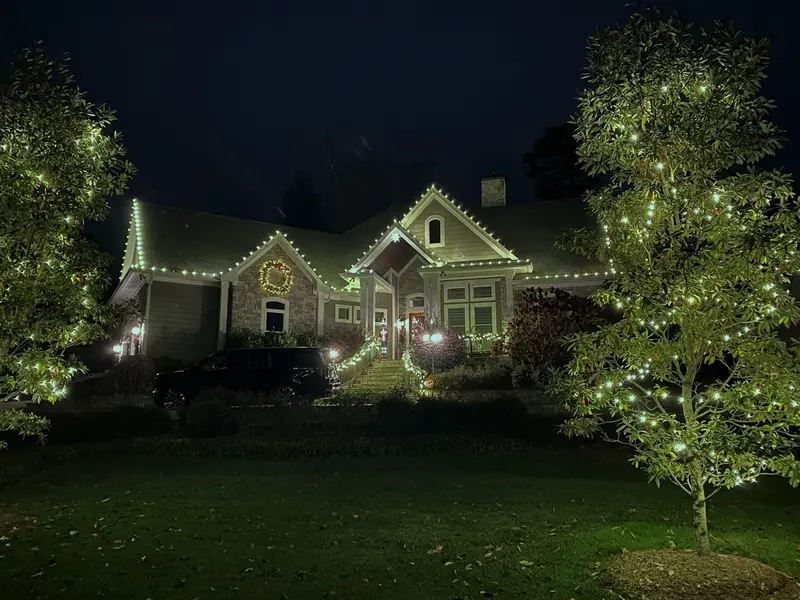
Wrapping a mature trunk so it looks intentional comes down to angle. Keep your spiral at a consistent 45 degrees and leave 10 to 12 inches between passes. Tighter than that and you’re just building a light cylinder. Start at the base, work up to the first major branch union, then stop, because the trunk is what reads from the street anyway and nobody expects you to light the whole canopy.
11. Vertical Light Panels on a Wide Wraparound Porch
- Measure each opening you want to frame and land on a consistent size, like 3 by 5 feet.
- Build a rectangle from 1/2-inch PVC or rigid wire and zip tie the corners.
- Wrap the frame in warm white strands at 2-inch intervals, keeping tension even.
- Hang from the porch beam using cup hooks spaced 24 inches apart.
- Run all frames to a single smart plug so one tap turns the whole porch on.
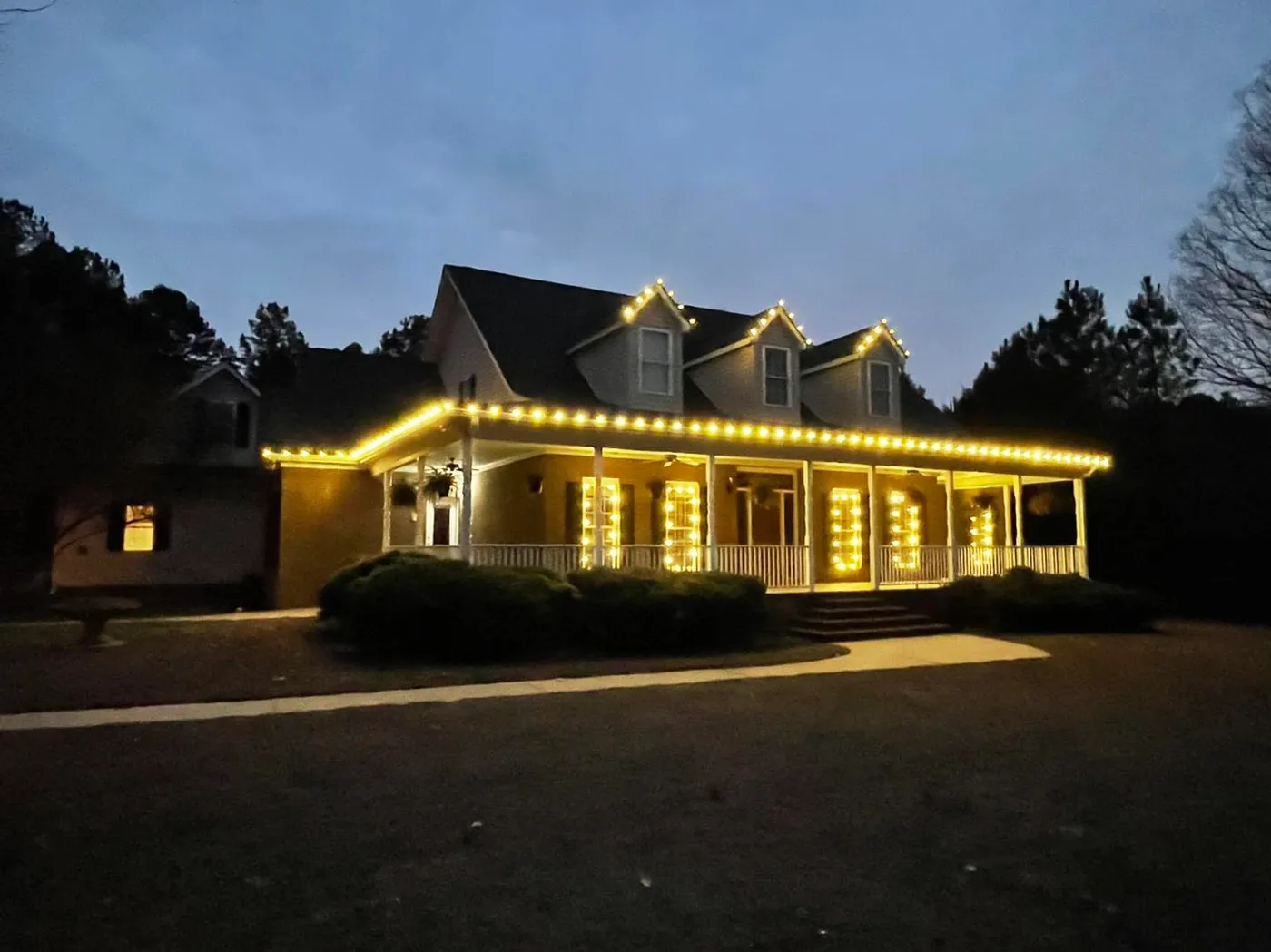
Plan on a Saturday afternoon and about $25 per frame in materials. Figure on replacing one or two frames a season, since painted wood, wet winters, and thin wire are not friends. Check the railings for chipped paint each fall, because a strand rubbing bare wood will leave a mark you’ll be touching up in April.
12. Colonial Columns Draped in Garland and Warm White
The garland is the element you can’t remove. Everything else here, the outlined brick, the lit wreaths, the freestanding trees, is light and line and hard edges. The deep green garland with red bows is the only soft, tactile thing in the composition, and without it the house would read as a very well-lit office building.
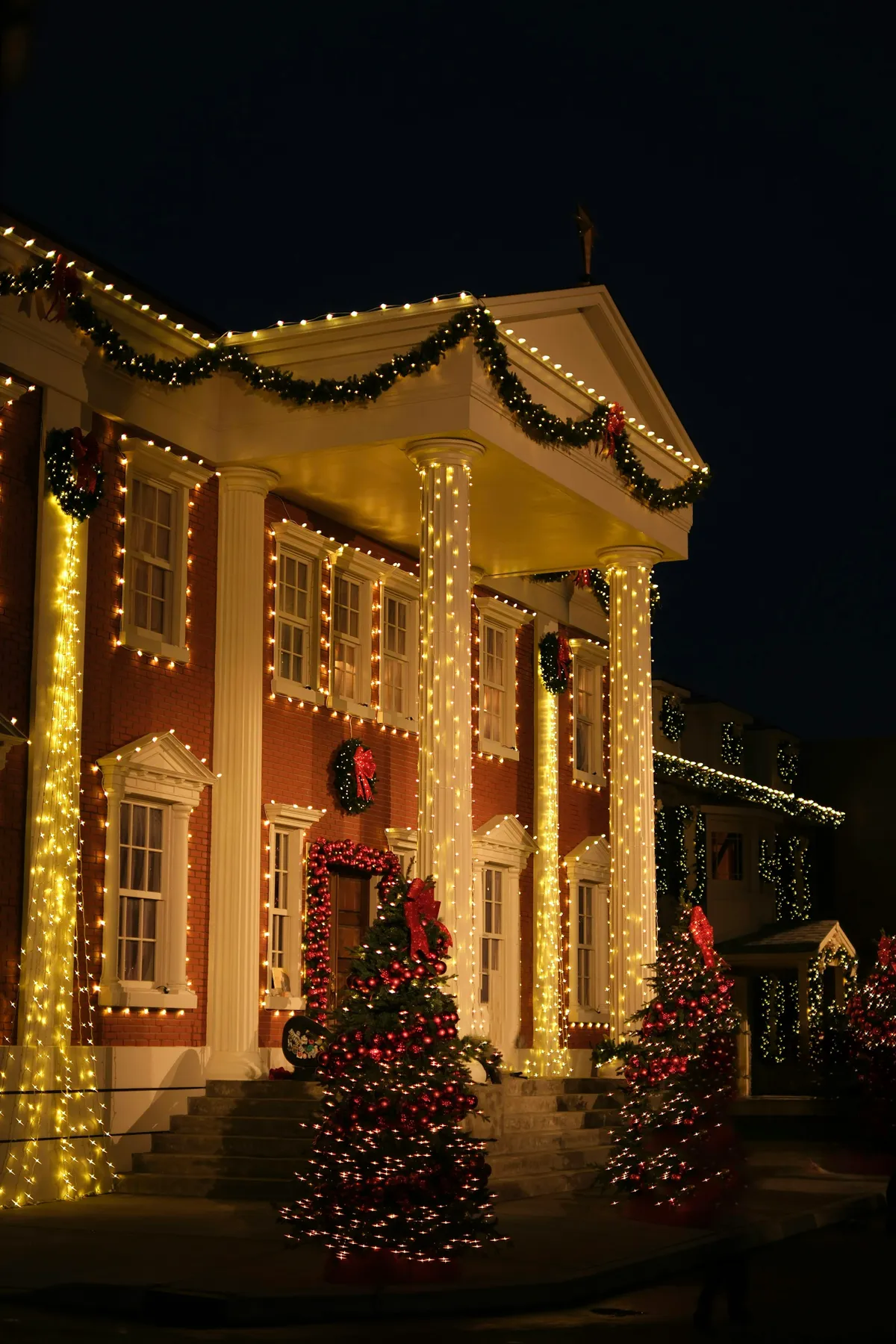
Fresh garland runs $25 to $45 per 9-foot length and smells like the entire point of December; faux garland is $12 to $20 and will still look good in year four. Either way, wrap warm white through it loosely instead of weaving it tight, and zip tie to the column rather than nailing into mortar. A 20-foot front porch is about four lengths, so call it $100 fresh or $60 faux.
13. Porch Garland on a White Railing With a Glowing Swing
Porch-first decorating is the quiet trend of the season. People are spending their light budget on the 15 feet they actually sit in rather than the 60 feet nobody sees after dark, and a swing lit at 2400K to 2700K is the proof. That warm range is what makes yellow siding and white trim look cozy instead of clinical.
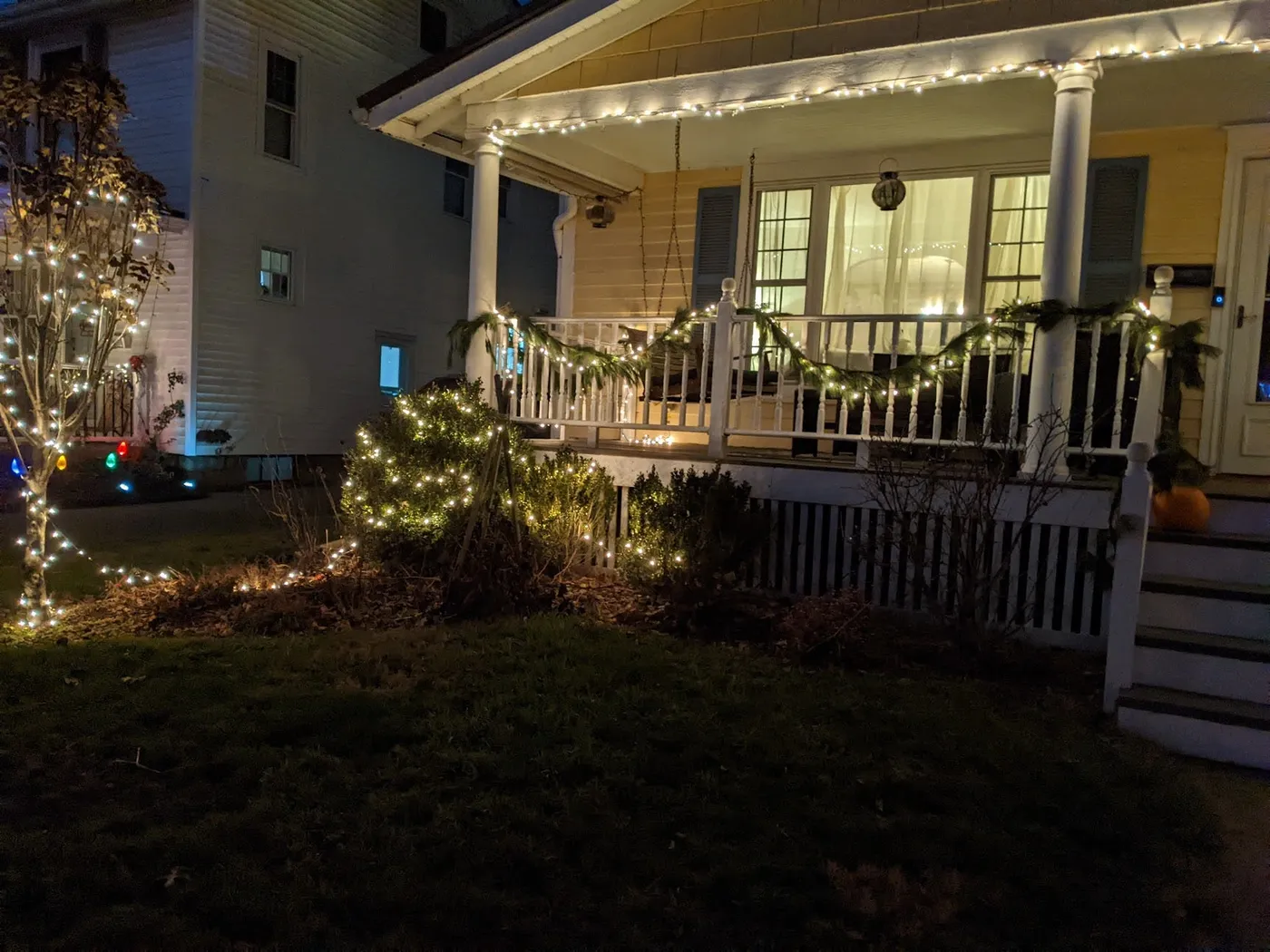
The formula is simple: 50 percent warm string lights on the railing and porch beam, 30 percent greenery, 20 percent glow from the swing and a couple of lanterns. Swap the white railing for dark wood and you can push the light count higher without it feeling fussy. Compare with Idea #12, which uses the same garland logic on a much grander facade.
14. Nutcrackers and Window Wreaths in an Elaborate Front Yard
This one needs room to breathe. For oversized figures and a nativity to read as a composition rather than a pile, you want at least 25 feet of yard depth and a 60-foot-wide lot, with figures set back 10 feet or more from the sidewalk. Window wreaths work at any size, so if your yard is postage-stamp small, keep those and save the six-foot nutcrackers for a bigger property.
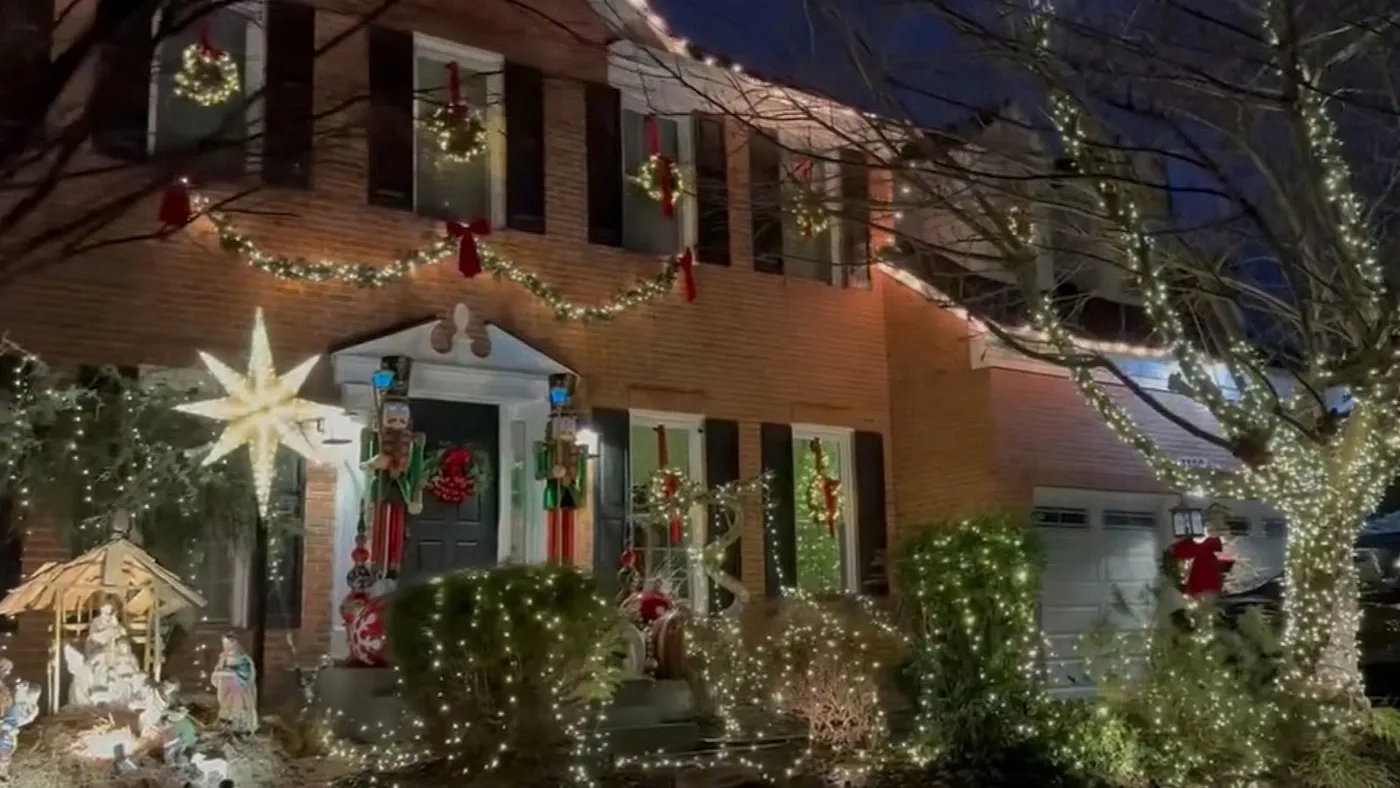
Nobody warns you about the storage. Life-size figures eat an entire garage bay from January to November, and if they’re fabric or blow-mold, they need to be dry before they go in or they’ll smell like a wet basement by spring. Wind is the other problem; stake everything, and treat any figure over 4 feet tall as something that needs a real ground anchor.
15. Crystal-Mesh Snowmen Lit From Within
- Three-piece illuminated snowman set: $60 to $120
- Two cone trees with star toppers: $50 to $90 each
- Snowflake ground stakes: $15 to $25 for a set of three
- Blue icicle strands for the eaves: $20 to $35
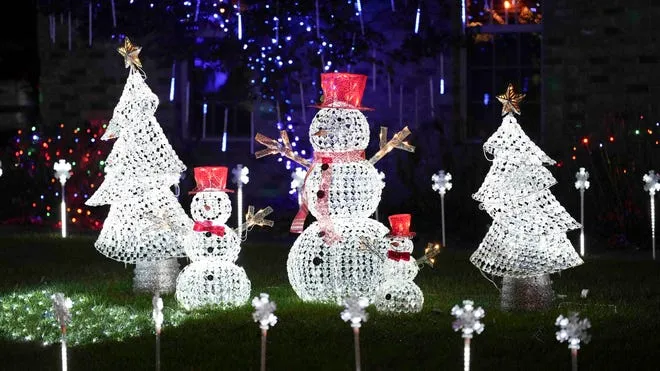
That’s a full scene for under $300 if you shop early, and closer to $150 if you hit the after-Christmas markdowns and store everything for next year. Walmart and At Home carry the crystal-look sets seasonally, and those are the ones that photograph best.
is the internal glow. Because the figures are made from a clear mesh material, the light source stays hidden and the shape reads as one soft continuous volume instead of a bunch of bulbs. The descending snowman heights and the snowflakes staked in front give your eye a path, which is the difference between a display and a pile of decorations.
16. Playful Animated Figures With a Smiling Tree Centerpiece
Animated pieces need sequencing, not just placement. Put the loudest element, the big smiling tree, at the front corner where cars slow down, then step the rest of the display back in size and brightness: snowflake on the wall, candy cane, then plain strands on the bush. If you’re running a music broadcast, keep the transmitter sign at eye level near the sidewalk so people aren’t hunting for a station from a moving car.
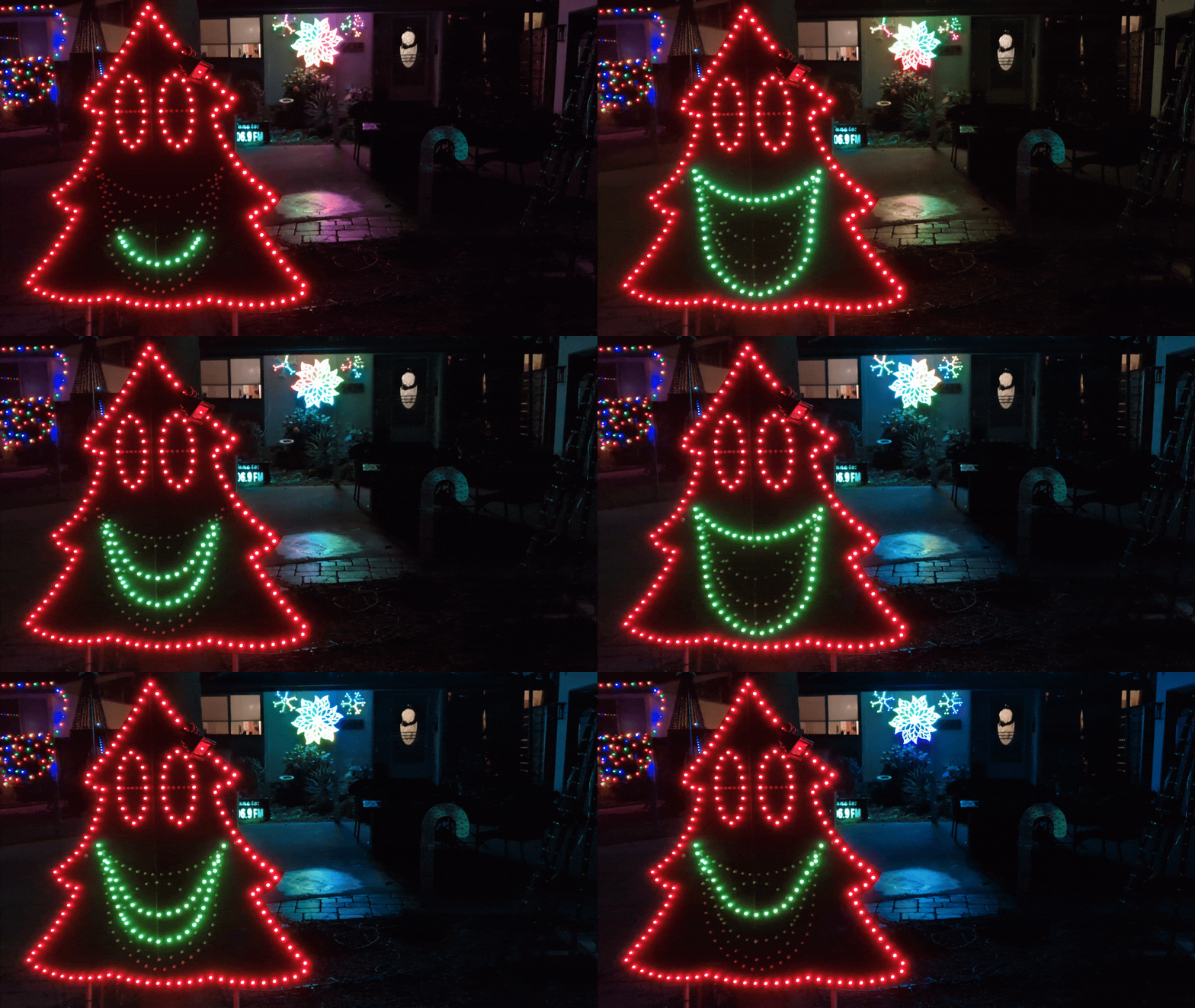
Computer-controlled displays have moved from hobbyist forums to the neighborhood standard, mostly because the controllers got cheaper and the apps got friendlier. You can run a 16-channel show from a phone for a few hundred dollars now. The trade-off is setup time, so expect to spend a full weekend programming before you ever plug in a strand.
17. A White Yeti, a Sleigh, and a Blue-Lit Canopy
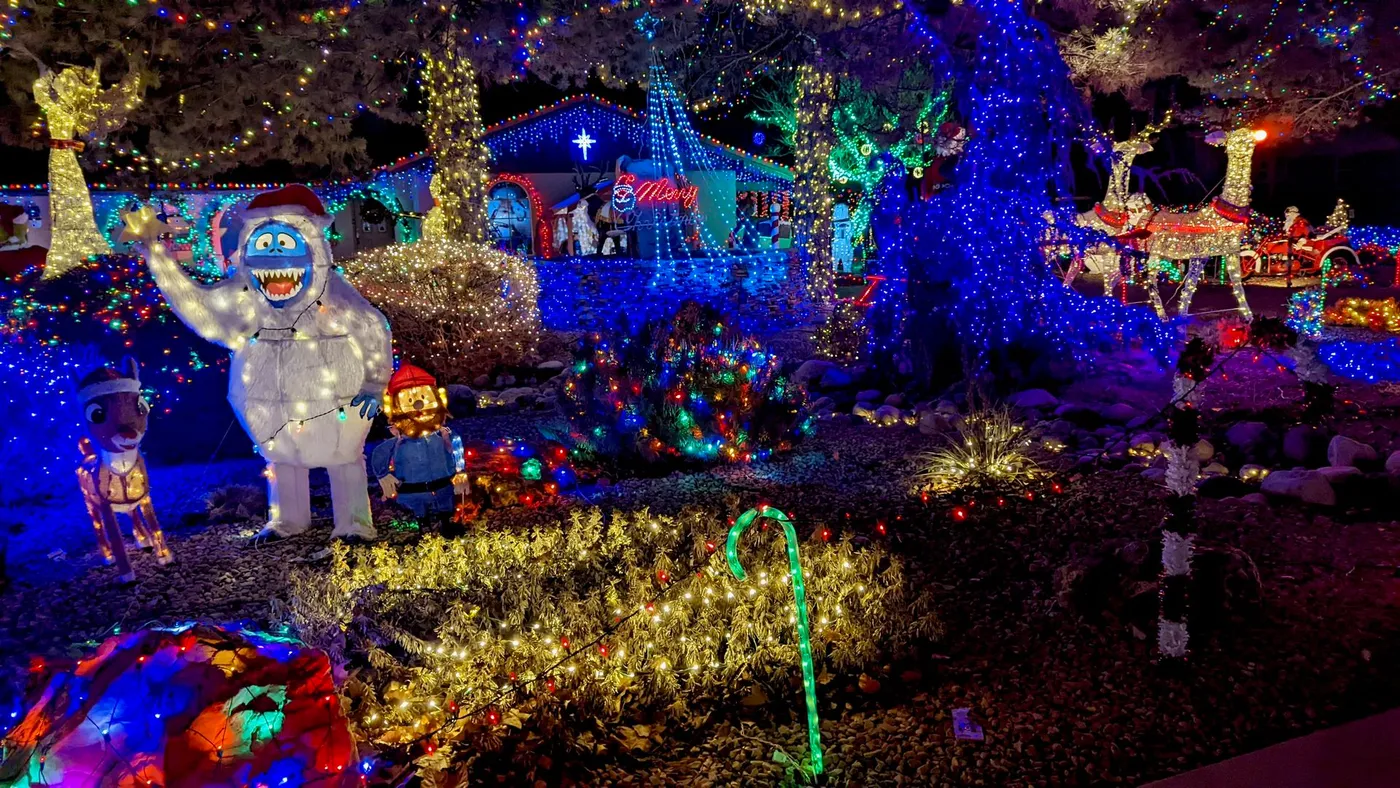
The element that makes this feel like an event rather than a yard is the blue. Blue LED sheeting over the big tree and across the house facade creates a background color that everything else sits against, and it turns the multicolor strands on the bushes into highlights instead of noise. Pull the blue and the whole thing flattens into a busy pile of red and green.
- Choose a tree with an obvious trunk and clear branch structure.
- Drape the net or sheet from the top down, letting it follow the branches.
- Secure it at three or four points with zip ties, not at every branch.
- Hide the power feed along the trunk with dark zip ties.
- Test the full run before it gets dark and cold.
Two people, about 90 minutes, and $80 to $150 for a quality blue net.
18. The Maximalist Blow-Mold Lawn With a Dinosaur
Inflatables and blow-molds are the most honest form of holiday decorating and also the most demanding. Inflatable fans pull 60 to 100 watts each, which adds up fast if you’ve got eight of them, so split the yard across two outdoor GFCI circuits. Wind will lay a tall inflatable flat in about ten minutes, and a deflated gingerbread man on the roof is a very sad sight at 7 a.m.
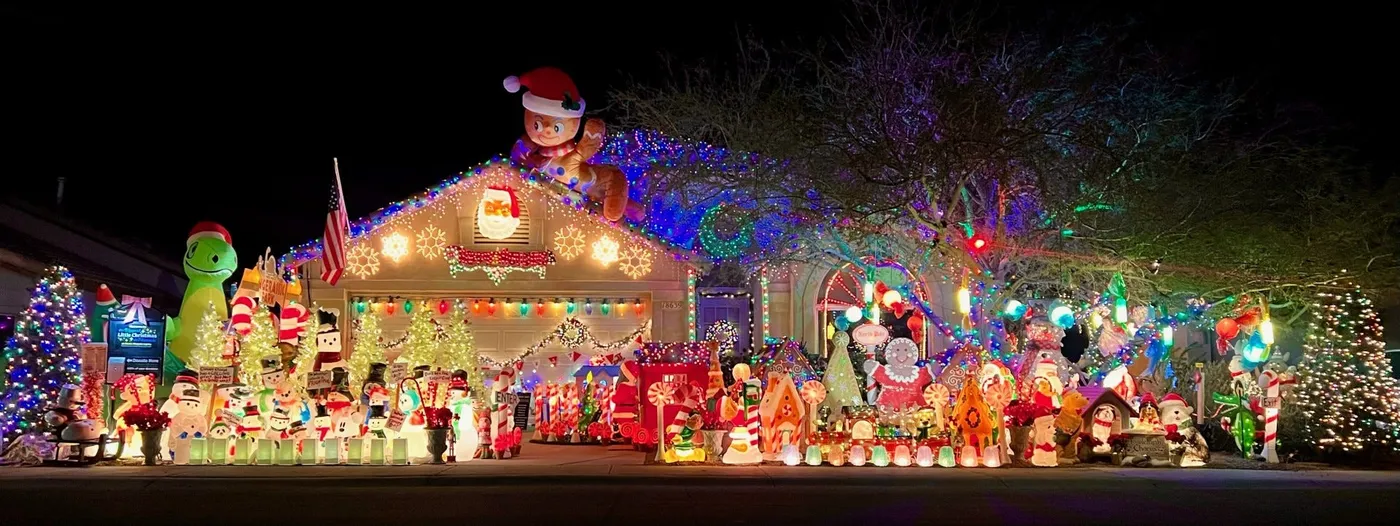
The formula underneath the chaos is more disciplined than it looks: about 70 percent multicolor string lights on every bush, tree, and roofline, 20 percent warm white framing the house architecture, and 10 percent actual figures. Drop the warm white and the display loses structure. Drop the figures and it’s just a lot of strands. Keep the proportions and you can add a dinosaur without losing the plot.
19. C9 Multi-Color Outlining a Modern Facade and Paver Drive
Square, clean-lined houses on wide lots love this treatment, and they need it: a modern facade with few architectural breaks can look flat once it’s dark. This approach suits lots 80 feet wide and up, where a lit paver perimeter has room to sweep instead of crowding the garage. On a narrow lot, keep the roofline and skip the drive entirely.
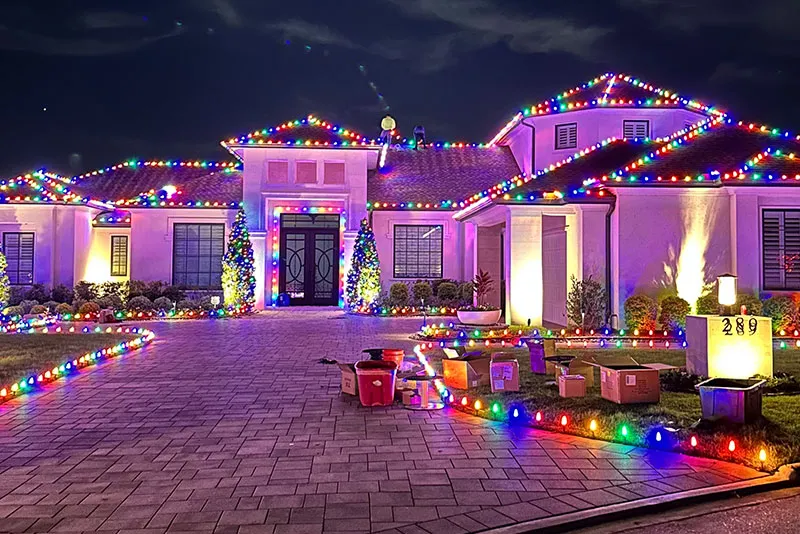
Stake path lighting every 6 to 8 feet for an even rhythm, and run it off a low-voltage transformer rather than tapping into your house circuits. Two conical evergreens flanking dark double doors are the cheapest way to add formality; keep them the same height and the same light color or they’ll fight each other all night. This is the more restrained cousin of Idea #20, where color blocking takes over the entire facade.
20. Solid Red, Green, and White Blocks on Brick and Stone
Color blocking is why this reads so cleanly. Instead of scattering all three colors randomly, each surface gets a single one: red on the first evergreen, green on the next, white on the bare tree by the porch, then repeat. Your eye picks up the pattern without knowing it’s a pattern, and the brick and stone stay visible behind the light instead of getting swallowed by it.
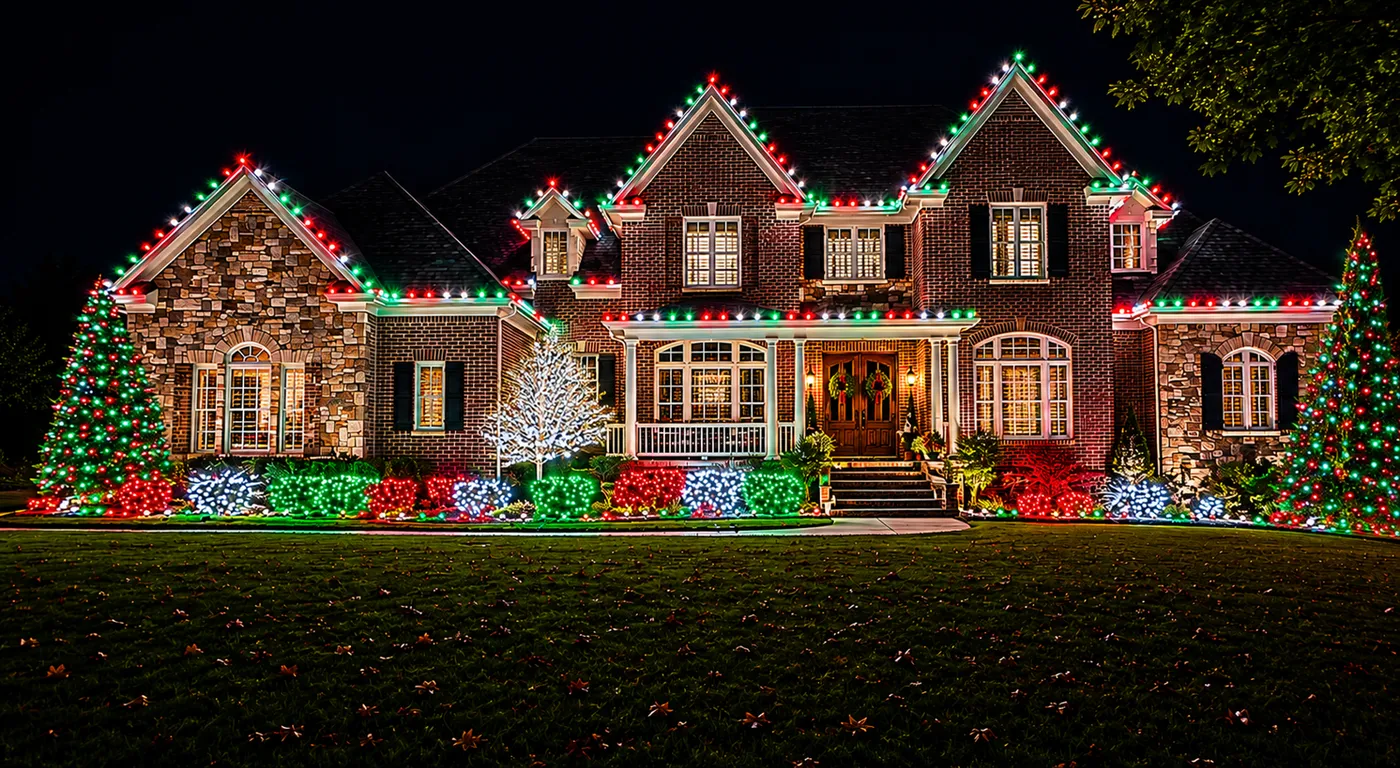
Single-color C9 strands are the cheapest thing in the holiday aisle, especially in the first week of January when they drop 50 to 70 percent. Buy next year’s red and green now and you’ll spend $3 to $5 per 25-foot strand instead of $12. That’s how a display like this gets built for a few hundred dollars instead of a few thousand.
21. Red-and-White Sections Wrapping Mature Trees
- Start at the trunk base and wrap upward in 12-inch increments.
- Switch from warm white to red at the first branch union so the break looks deliberate.
- Alternate every 3 to 4 feet so the sections read as stripes from the street.
- Zip tie the transition point so the color change doesn’t sag.
- Run a separate extension cord up the back of the trunk to each color.
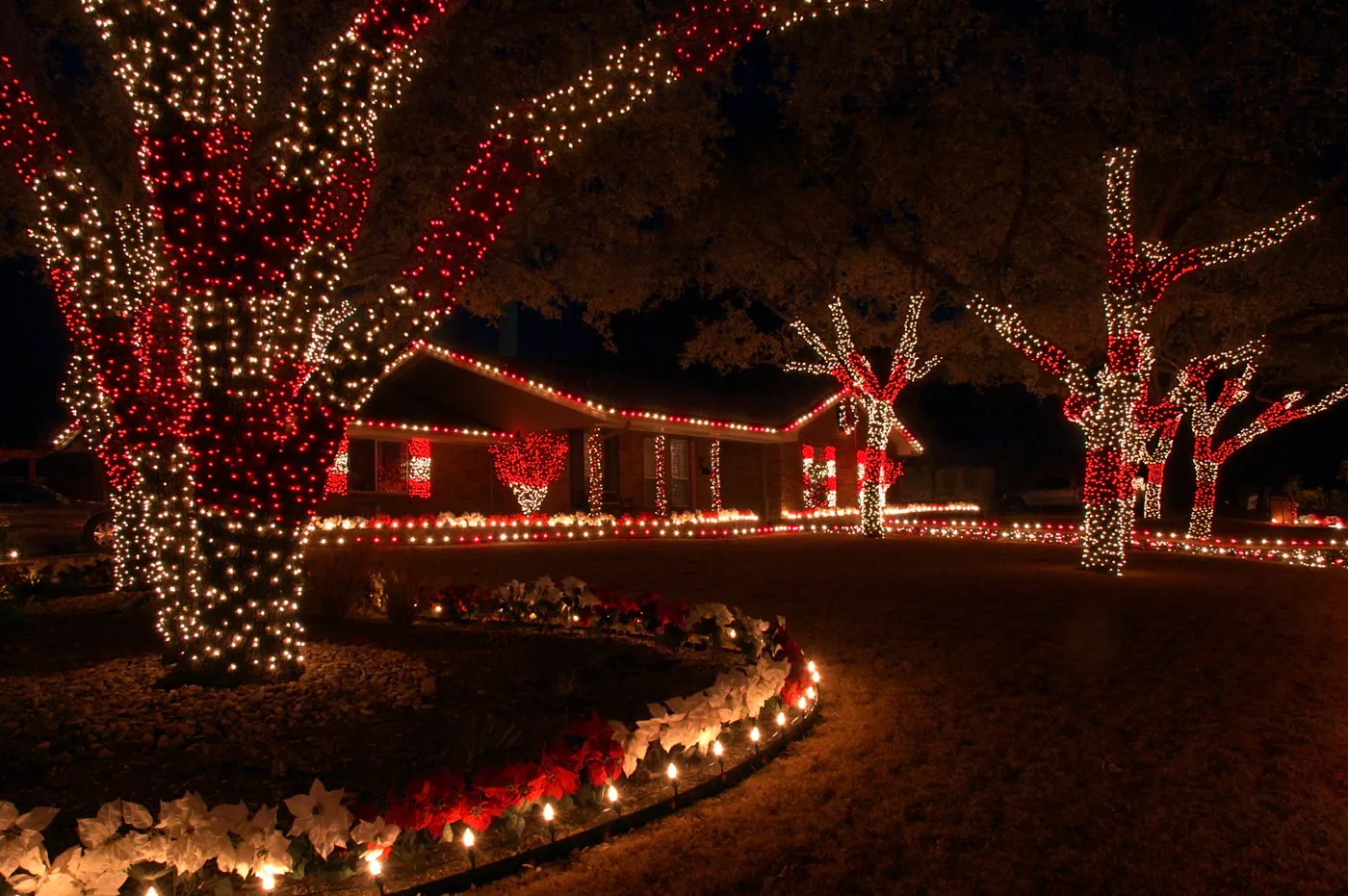
Give yourself two hours per large tree and about $60 in strands. Trees don’t hold still, and that’s the catch. Trunks add girth every year, so a wrap that fits snugly now will be biting into bark in a few seasons. Leave a little slack, check the bark each spring for girdling marks, and re-wrap annually, since UV turns cheap white wire yellow and brittle in a single summer.
22. Icicle Lights Above, Multi-Color Canopy Below
The layering is the whole trick. Warm white icicle lights hang along the eaves in clean vertical drops, and beneath them the trees and bushes are wrapped in dense multicolor. That contrast between orderly white on top and loose color below is what keeps a busy display feeling designed. Take away the icicles and the yard starts to look like a yard with lights on it.
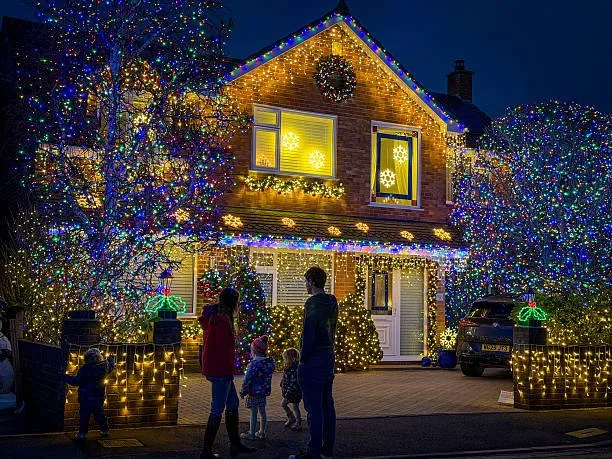
This format works best on a two-story house with a broad frontage, 50 feet or more, where the icicle strands have room to repeat. On a smaller single-story home, shorten the drop length to 18 inches so the icicles don’t dominate the facade. If your yard is tight, Idea #11 gets similar drama out of a porch instead.
23. Stacked Stone, Tan Stucco, and Classic Red and Green
The split here is close to 55 percent red and 45 percent green across the light runs, with snow and the warm lanterns at the door providing the neutral relief. The stacked stone is doing something important: it’s a mid-tone surface, so both colors sit on it without vibrating. On a pure white house, that same red and green would look louder and considerably less expensive.
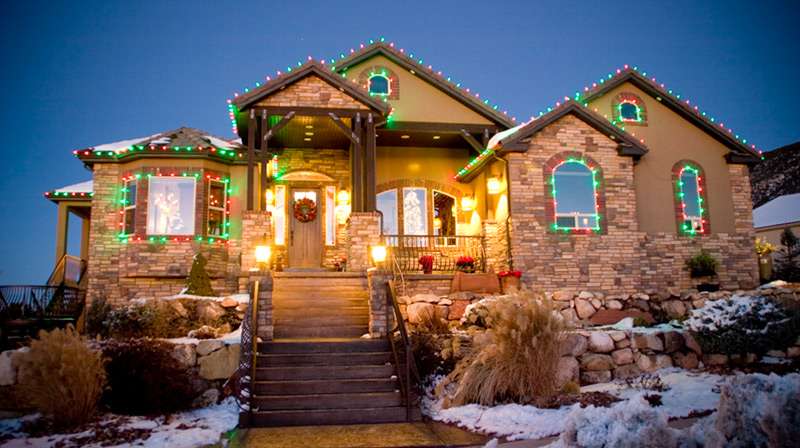
Red and green bulbs vary wildly between brands. A red from one box can read orange next to a red from another, and you’ll notice it from the driveway even if you don’t in the store. Buy all your strands from one brand in a single trip. Also check that your porch lanterns run under 2700K, or the doorway will look cold against all that warm red.
24. Warm Rope Lights Looping Along a Log Cabin
Rope lights are the right call on rough-hewn log walls because they hold a straight line without a dozen clips fighting the surface. The trick is mounting channel: a shallow aluminum or plastic track screwed into the log with the rope pressed into it. Staples and nails are why most rope light installations fail, because they pinch the copper and kill a whole run you can’t repair.
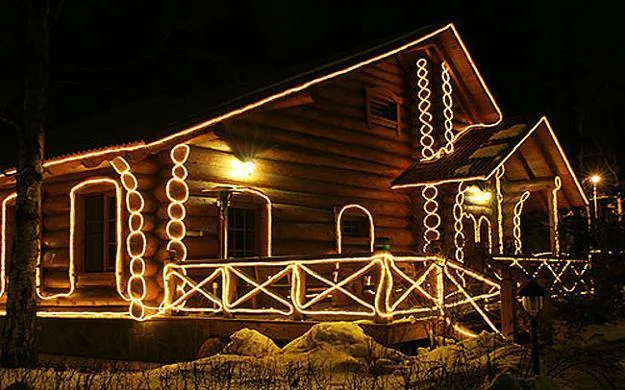
- Trace the roofline, window frames, and balcony rail with pencil marks first.
- Screw the mounting channel every 18 inches along the traced line.
- Press the rope into the channel, working from one corner outward.
- Add the decorative vertical loops as separate sections with their own feeds.
- Seal every connection with dielectric grease before closing it up.
Plan a full afternoon plus $120 to $250 depending on run length.
25. Santa, Teddy Bears, and Stacked Gift Boxes on the Lawn
Nostalgia decorating is driving a lot of what’s being saved this year. Lighted Santas, teddy bears, and glowing gift boxes aren’t new, but they’re back because they photograph with warmth and they make people stop the car, which is the whole point of a walkable neighborhood display. Vintage blow-molds in particular have become collectible, and prices have followed.
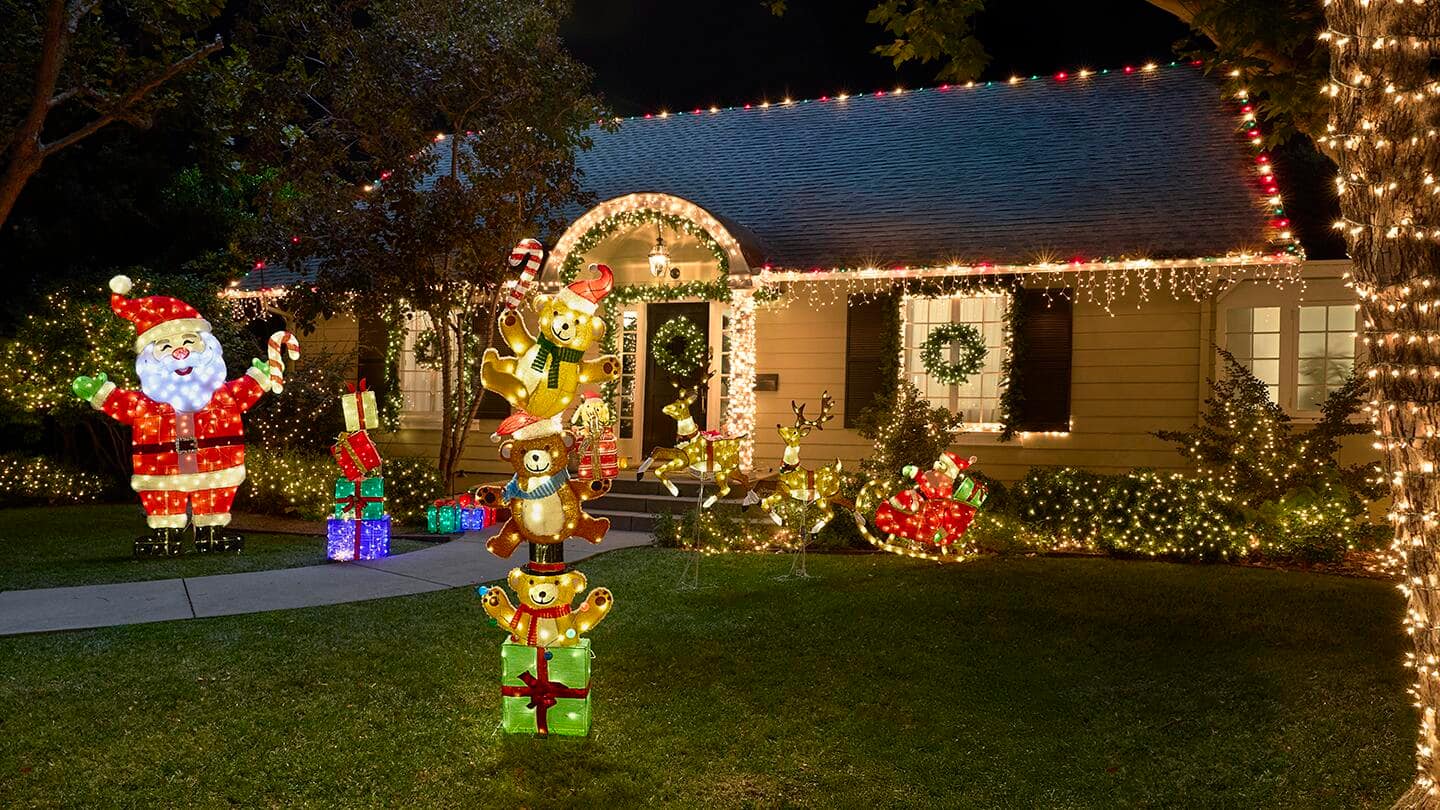
- Thrift stores and estate sales: 1960s to 1980s blow-molds for $10 to $40
- Facebook Marketplace in late November: lit figures for 40 to 60 percent off retail
- Walmart and Big Lots: new gift box sets for $25 to $60
- Dollar Tree: replacement bulbs and spare fuses for a couple of dollars
Whatever you buy, test it in the driveway before you arrange the yard, because half of these pieces need a bulb swap to look their best.
26. Warm White Tracing Steep Pitch and Dormer Edges
Steeply pitched roofs look incredible outlined, and they’re also the reason people end up on the evening news. If your ridge sits above 25 feet, this is one to hire out or handle entirely from the ground with a pole and clip system. Anything shorter, and a stabilizer bar plus a spotter is a reasonable Sunday afternoon.
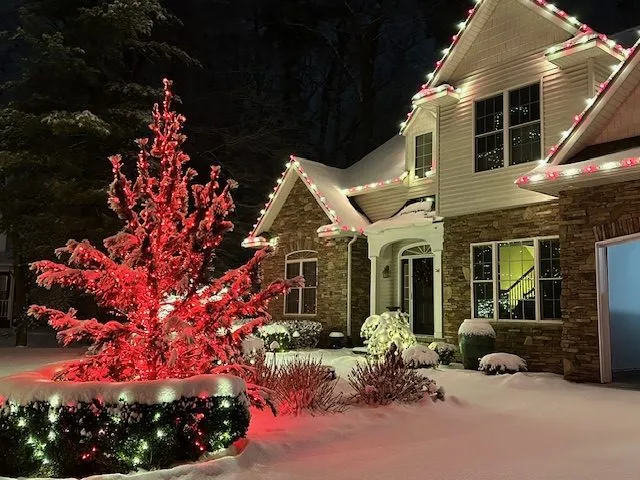
Dormers and window frames are what make this read as deliberate rather than generic. Outline the roofline, then outline each dormer and each window individually, keeping the same warm white throughout. Save the front door and the bushes for last: a lit wreath on the door and a soft wrap on the landscape shrubs ground a display that would otherwise live entirely in the sky.
27. A Towering Lit Tree Surrounded by Glowing Gifts
A 10-foot illuminated tree is a sail. Anchor it with at least four ground stakes, tension each one, and check the lines after the first windy night, because a leaning light tree looks worse than no tree at all. If the frame is metal, store it assembled in a garage corner rather than taking it apart every year; the connectors are always the first thing to fail.
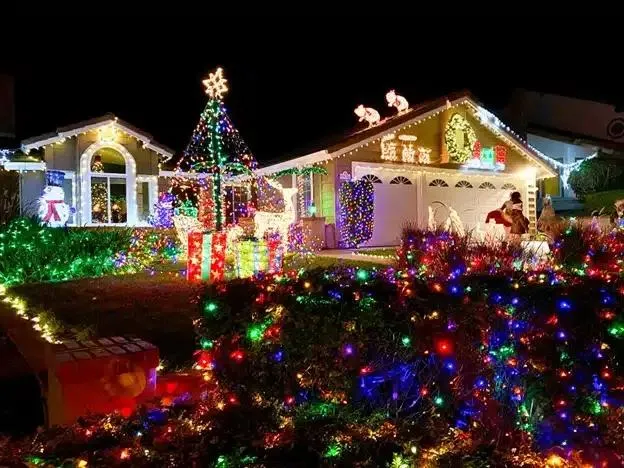
What makes this composition work is hierarchy. The tall tree with the star gives the yard one unmistakable vertical, the gift boxes at its base create a low, dense counterweight, and the deer placed farther out add movement around the edges. One clear focal point with smaller supporting objects beats five objects of the same size every single time.
28. Palm Trees, a Roof Nativity, and an Arch of Light
The nativity on the roofline, crowned with a star and lit from below, is what turns this from a light show into a story. Every other element, the draped strands, the wrapped palms, the arched tunnel, is atmosphere. Without the scene up top, the yard would be beautiful and completely anonymous.
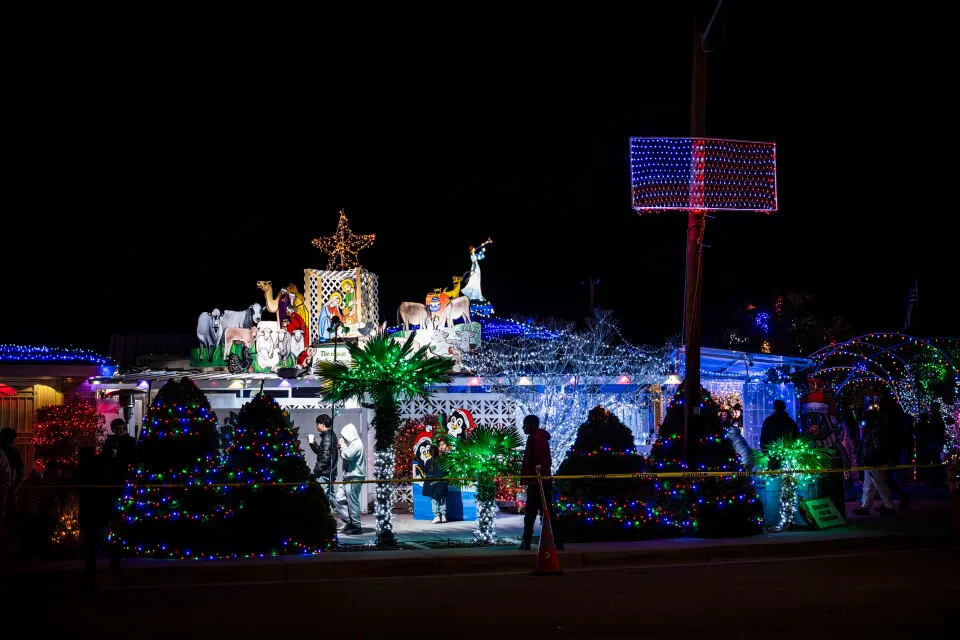
- Cutout nativity scene: $80 to $200, or build your own from plywood for about $60 in materials
- Trunk wrapping on palms: $30 to $50 per tree in strands
- PVC arch tunnel with multicolor strands: $40 to $90
- Star topper with a warm white bulb: $20 to $40
Compare with Idea #6 if you’d rather spend the same money on density than on a single scene.
29. Star Motifs Reflecting in a Rain-Slicked Driveway
- Mark the wall position with painter’s tape and step back to check spacing from the street.
- Mount each star to brick with a masonry anchor rated for the weight, not adhesive hooks.
- Run a short strand up the wall behind the star and hide it in the mortar line.
- Group the stars in a triangle rather than a straight row.
- Add small lit trees below to carry the light down to the ground.
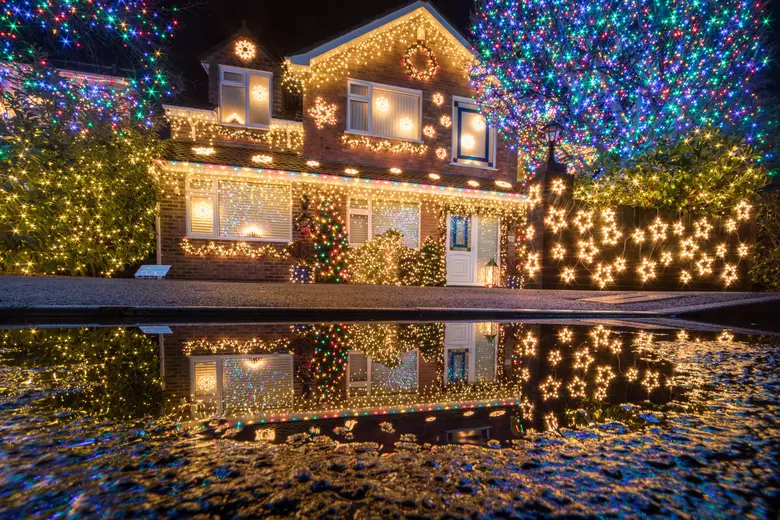
Two hours, roughly $40 per star. Wet pavement doubles the effect, which makes this one worth photographing on a rainy night.
The ratio here is about 60 percent warm white on the architecture and hedges, 25 percent multicolor in the big left-hand tree, and 15 percent white in the star motifs. Swap the multicolor tree for warm white and the wall stars stop reading as accents, and the whole display goes to sleep.
30. Multi-Color in the Bare Tree, Red and Green on the House
Here’s the rule that saves a lot of decorating arguments: assign colors by surface. The big bare tree gets the full spread of red, yellow, blue, and purple, while the house gets only two, red along the roofline and green on the bush. It reads as intentional because your brain sorts by object, and the two-color house keeps the architecture legible under all the noise.
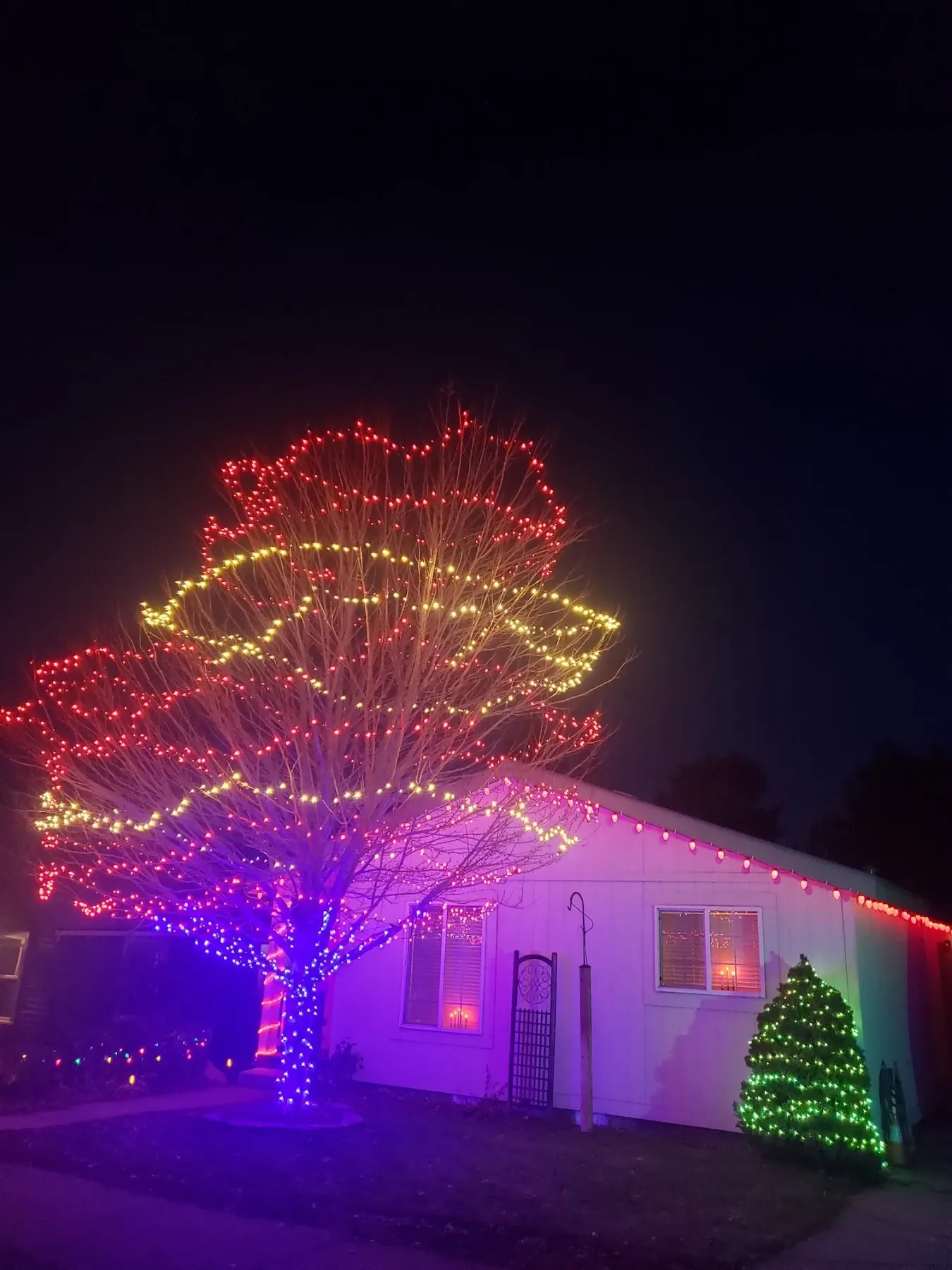
Multicolor strands are the least consistent product in the aisle. One box of multi may run warm, another may skew toward lime and hot pink, and mixing them on the same tree looks like an accident. Buy one extra box from the same batch for spares, and if you’re building a display over two years, buy it all at once and date the bins.
31. Blue Ground Lights Lining a Yard Full of Figures
The blue ground lights are the element that turns a crowded yard into a composition. They draw a bright line along the edge of the lawn, which acts like a picture frame, and everything inside that frame reads as part of a scene rather than clutter. Wrap the frame in blue and the elves stop looking random.
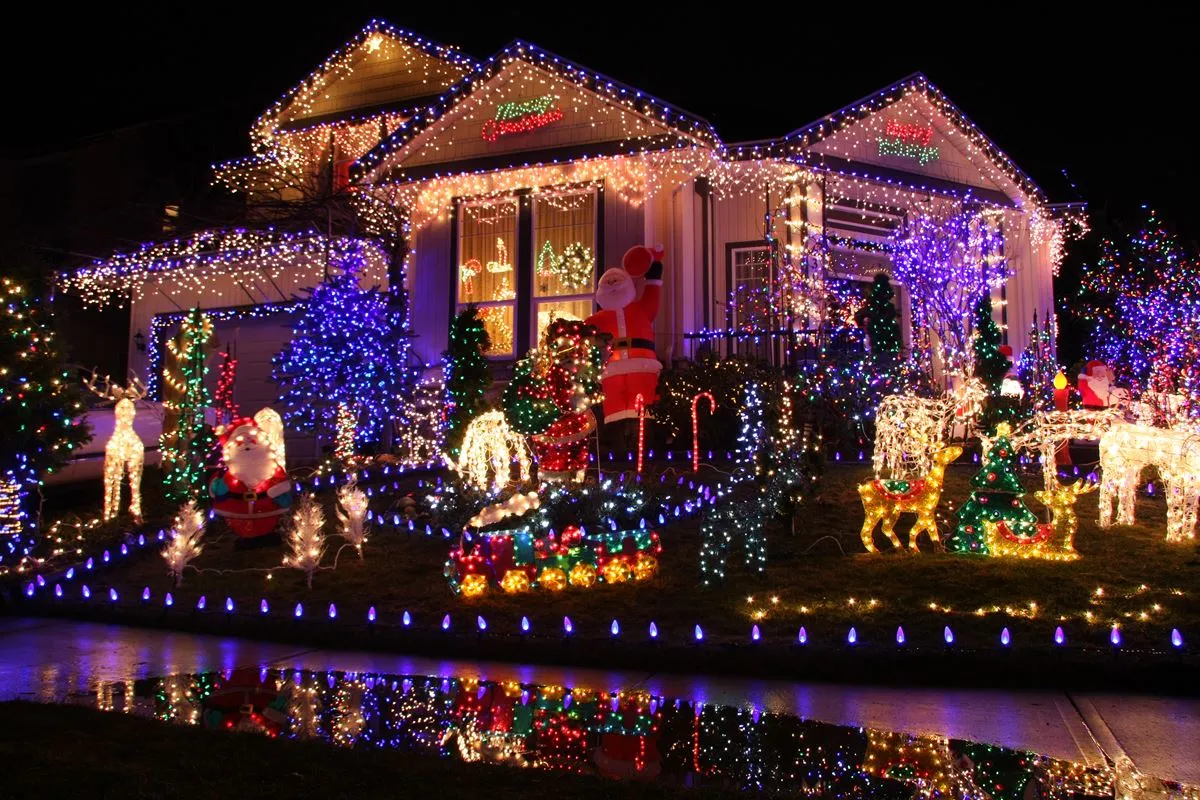
This style wants space: at least 20 feet of yard depth and 40 feet of frontage, or the figures start overlapping from the street view. On a smaller lot, keep the blue border and choose three large figures instead of nine small ones. If you love the figure-heavy look but have a shallow yard, Idea #25 keeps the nostalgia at a friendlier scale.
32. Cascading Lights, an Angel, and a Path to the Playhouse
Cascading strands poured down a slope do something no roofline can: they make the ground feel like part of the light. Combined with the angel, the reindeer, and the candy cane placed along a lit path, the yard becomes walkable rather than just viewable. The little playhouse at the end is the payoff, and it’s the reason people get out of the car.
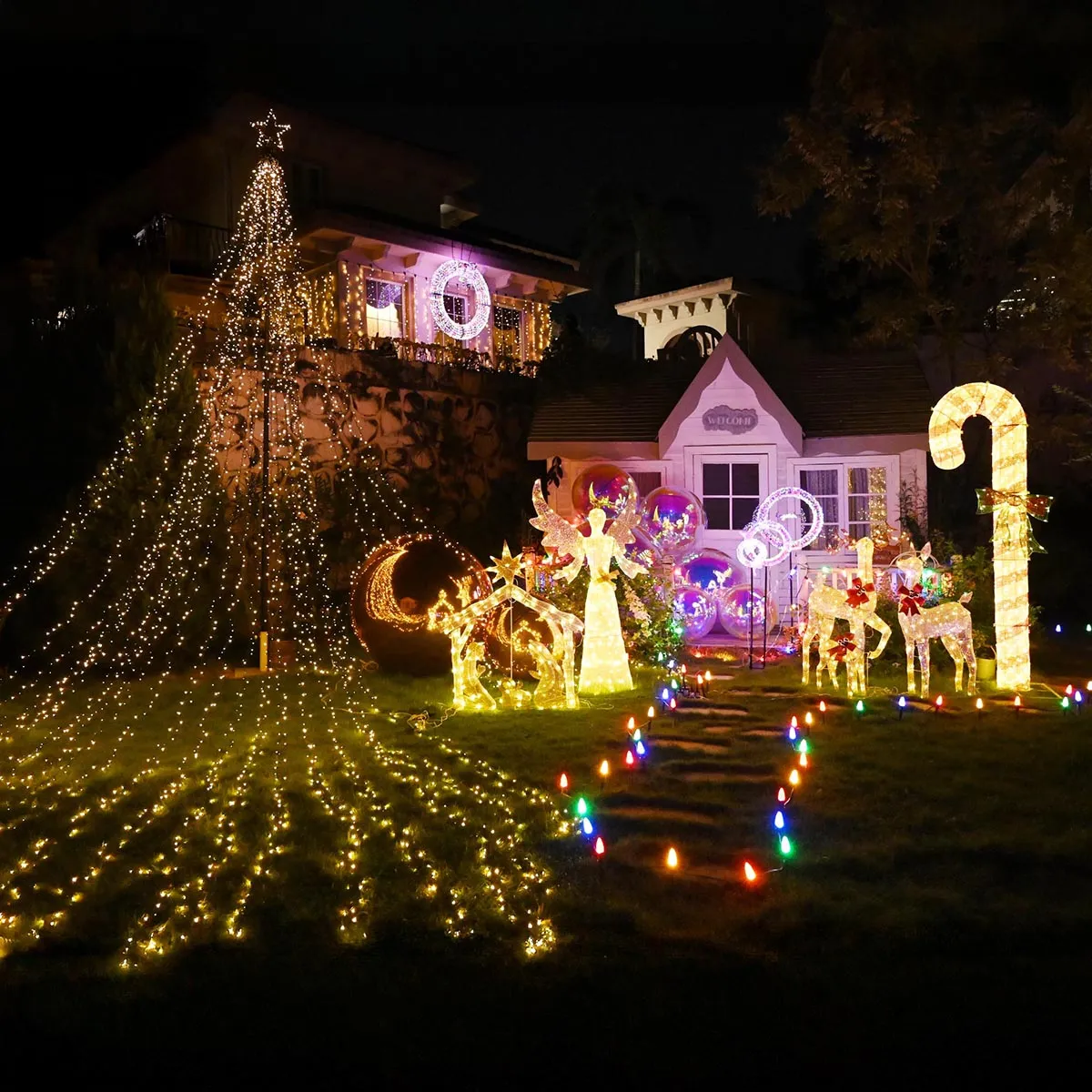
Walk-through and immersive displays are the direction holiday decorating is heading, driven by people who want an experience they can share rather than a facade they photograph from the curb. It’s more work and more cord, but the reward is a yard that works for your own family on a random Tuesday night.
Now Go Make Your Curb the One People Slow Down For
Pick one idea, steal the formula, and don’t worry about matching anyone else on the block, because the displays people remember are the ones with a plan behind them. Start with the roofline, add one ground layer, and let the timer do the rest.
📌 Pin your favorite to your holiday board now, so next November you’re decorating instead of scrolling.