
31 Stunning Porch Christmas Decor Ideas That Will Make Your Home Sparkle in 2026
Most porch Christmas decorating fails at exactly the same spot, and it isn’t the garland. It’s the light color. You can buy the most expensive evergreen on the market and still end up with an entryway that reads like a parking lot because half your strands run cool white and the other half run warm.
We spent serious time browsing Target, Amazon, Walmart, and Home Depot to bring you only what’s worth your attention this year — everything from $12 doormats to a $480 statement planter setup.
What’s inside: 31 curated porch Christmas ideas for 2026, spanning classic red-and-green traditional, rustic natural, elegant gold-and-navy, and full-on playful multicolor. Budget and luxury versions get compared side by side, and every idea is shoppable with direct product links.
2026 is the year porches went layered — two light colors, mixed foliage, and one oversized statement instead of twenty small ones. This post contains affiliate links, which means we may earn a small commission at no cost to you. 📌 Save this to Pinterest for later — you’ll want to revisit these ideas.
1. A Stone Lodge Wrapped in Warm White Light
Dark stone absorbs light instead of bouncing it, which is why this lodge reads so warm at dusk. Every strand is the same warm white, so the rooflines, porch posts, and window frames all glow at one consistent temperature — no competing patches. The deep green trees and dark facade give that light something to sit against. And the repetition matters: the same garland runs the porch, the same wreath shows up on every facade plane, so your eye travels the whole house in a single sweep instead of stopping at the driveway.
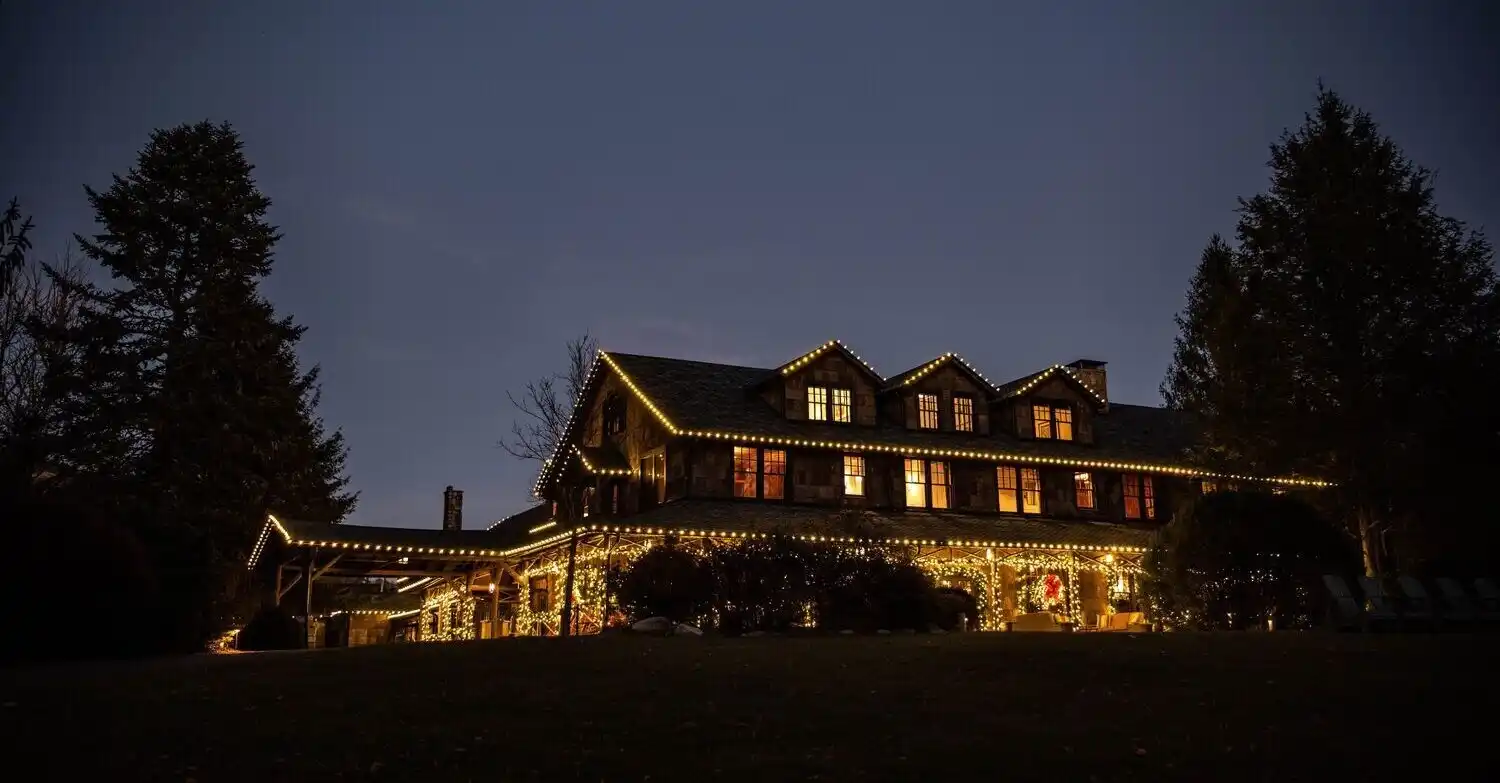
When you outline a roofline, run your lights along the underside of the eave rather than the top edge. From the street you get the same glow, but rain, snow, and wind can’t grab the clips as easily, and the strands last a season longer. Use clips made for shingles or standing-seam metal instead of staples, keep every run at one color temperature — 2700K to 3000K — and put each zone on its own timer so the porch can stay lit an hour after the roofline goes dark.
2. Black Door, Red Velvet Bows, and Lit Evergreen Garlands
The red velvet bows. Everything else here — the lit garland with pinecones, the black urns, the candle lanterns on the steps — is doing quiet, tasteful work in dark green and warm white. The bows are what turn it from “nice porch” into “somebody decorated this on purpose.” Take them off and you still have a pretty entryway. Skip the lanterns, skip the urns, skip the wreath before you skip those bows.
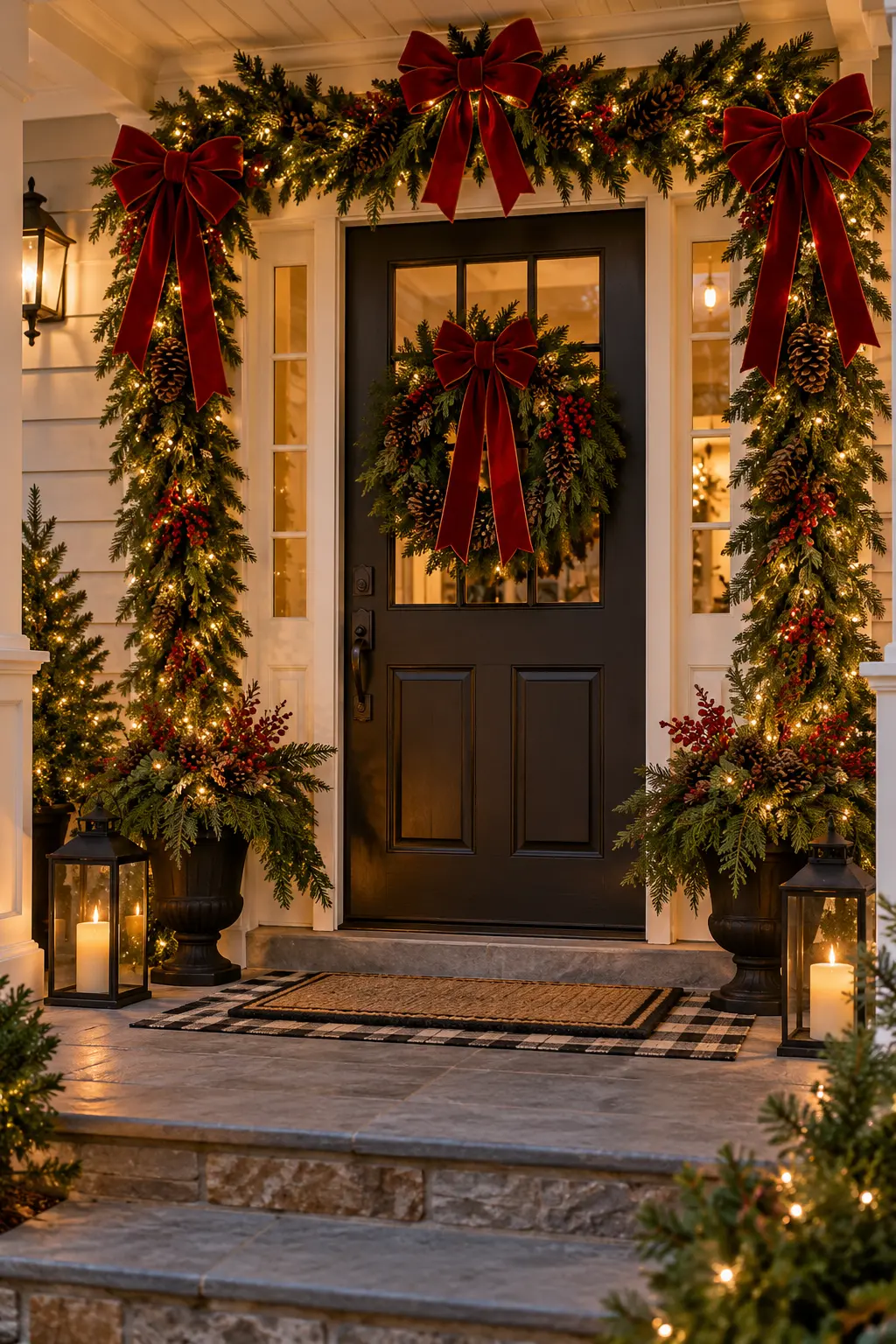
Building the urn arrangement takes about 20 minutes per planter once you have your materials, which run $35–$70 if you’re using faux stems you can reuse:
- Set a tall, narrow evergreen branch upright in the center of the urn — this is your height.
- Ring it with shorter cedar or fir sprigs angled outward and slightly down, so the greenery spills over the rim.
- Tuck in three to five pinecones at different depths instead of lining them up like beads.
- Weave one strand of warm white mini lights through the arrangement, hiding the plug behind the urn.
- Add red berry picks last, pushing them in at the outer edge where they’ll catch the light.
3. White Planters and Striped Bows on Wooden Steps
Think of it as 70% evergreen, 20% bright white, and 10% black — with cranberry red used only as punctuation, never as a field of color. The white planters carry the white, the black lanterns carry the black, and the berries and striped bows do the accenting. Swap the white planters for galvanized buckets and the whole thing shifts rustic without changing a single proportion. Trade the stripes for solid velvet and it turns formal in an instant.
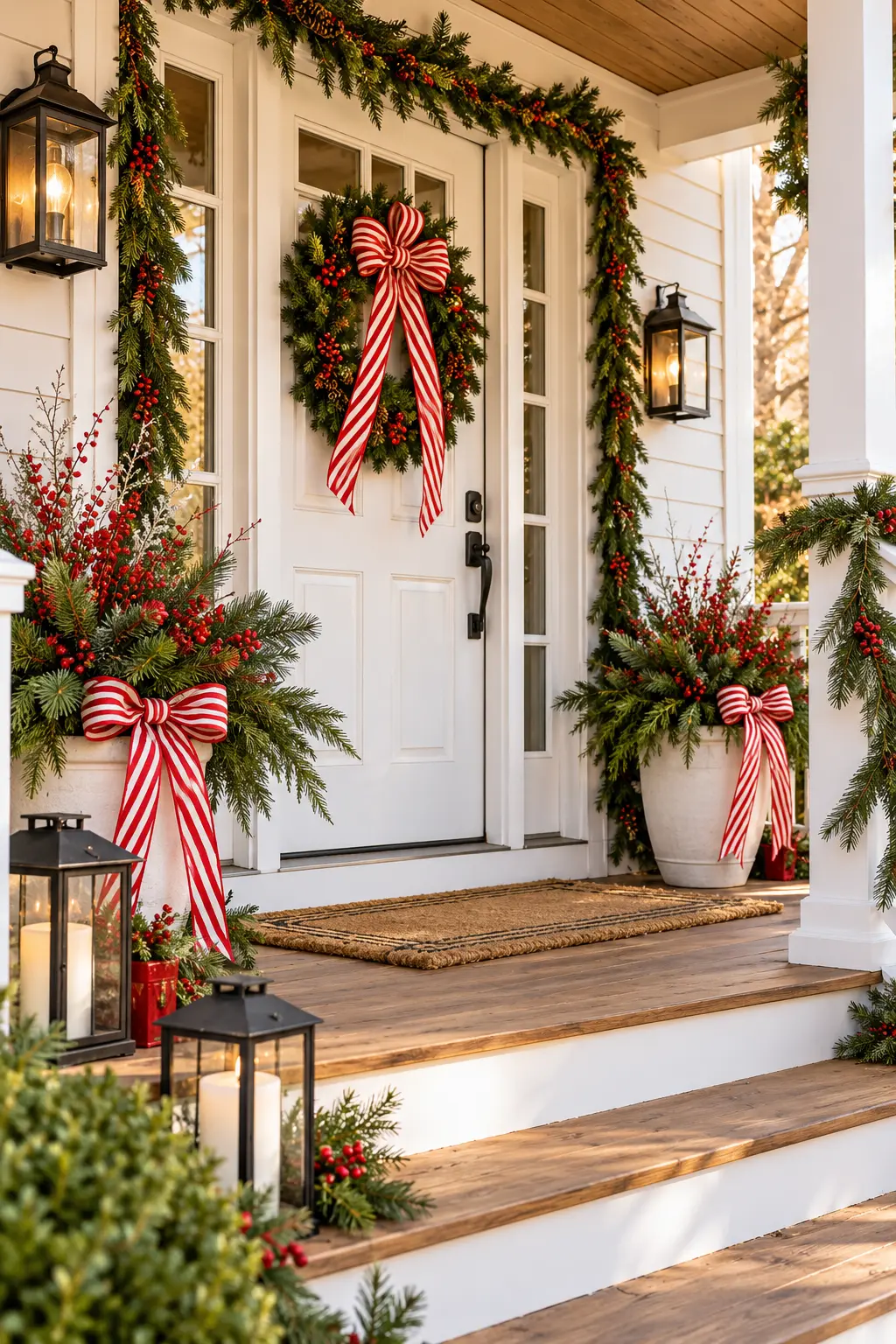
Natural wood steps in winter are a genuine slip hazard once they ice over, and a woven coir mat sitting on top makes it worse — the mat freezes flat and becomes a sheet of ice underfoot. Look for a mat with a rubber backing and lift it after storms. If your steps face north, plan on more salt than you think you need. Also, garland draped low over a door gets brushed by every visitor’s shoulder, so secure it above the handle line.
4. Red Poinsettias in Woven Baskets and a Plaid Welcome
- Main furniture & planters — 2 woven baskets + small faux evergreens: $60–$140
- Lighting — pre-lit garland (9 ft) + wreath lights: $45–$110
- Textiles — red and white plaid outdoor mat: $25–$60
- Decor — red poinsettias (4) + silver lanterns (3): $50–$120
- Paint/wall treatment — none needed: $0
- Total: $180–$430
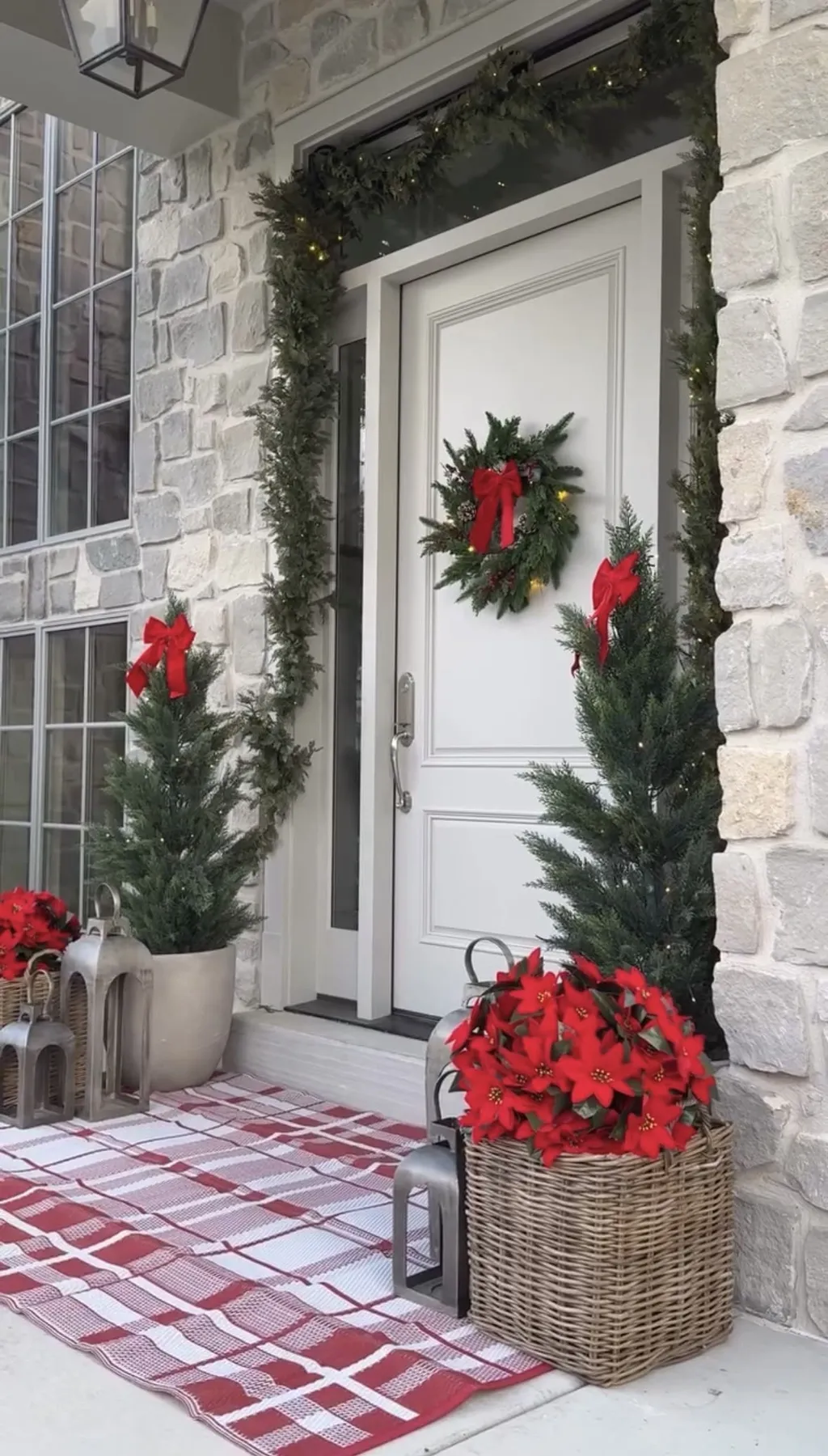
Budget alternative: skip the potted evergreens and tuck free tree-lot clippings into baskets you already own. Swap the real poinsettias for $6 faux stems and reuse them for years. That brings the whole entry to roughly $95–$150.
This layout needs a porch at least 6 feet wide and 4 feet deep so the flanking baskets and lanterns don’t crowd the walk-through. Door width matters more than square footage: under 36 inches and you should drop the tall trees entirely in favor of low baskets, or people will have to turn sideways to get in. A tighter single-door entry handles the symmetric treatment in Idea #16, which keeps everything close to the doorframe.
Real poinsettias hate cold drafts and drop leaves within a week on an exposed porch. If you want the real thing, park them in a sheltered corner and bring them inside at night — otherwise faux is genuinely the smarter call outside. Watch your mat size too. Anything under 24 by 36 inches looks like a postage stamp on a wide porch. Aim for roughly 60–75% of your door’s width.
5. Frosted Garland and a Wooden Sled by the Dutch Door
Frosted greenery is the biggest shift in 2026 holiday decorating, and it’s a direct reaction to a decade of hyper-saturated red-and-green porches. Frosted stems photograph beautifully in low light, mix cleanly with white and gray siding, and read as winter rather than Santa — which means you can leave them up well into January without anyone raising an eyebrow. It also plays nicely with the vintage pastel Christmas trend that’s been building on Pinterest. Good news for your wallet: frosted faux greenery is often cheaper than good unfrosted faux.
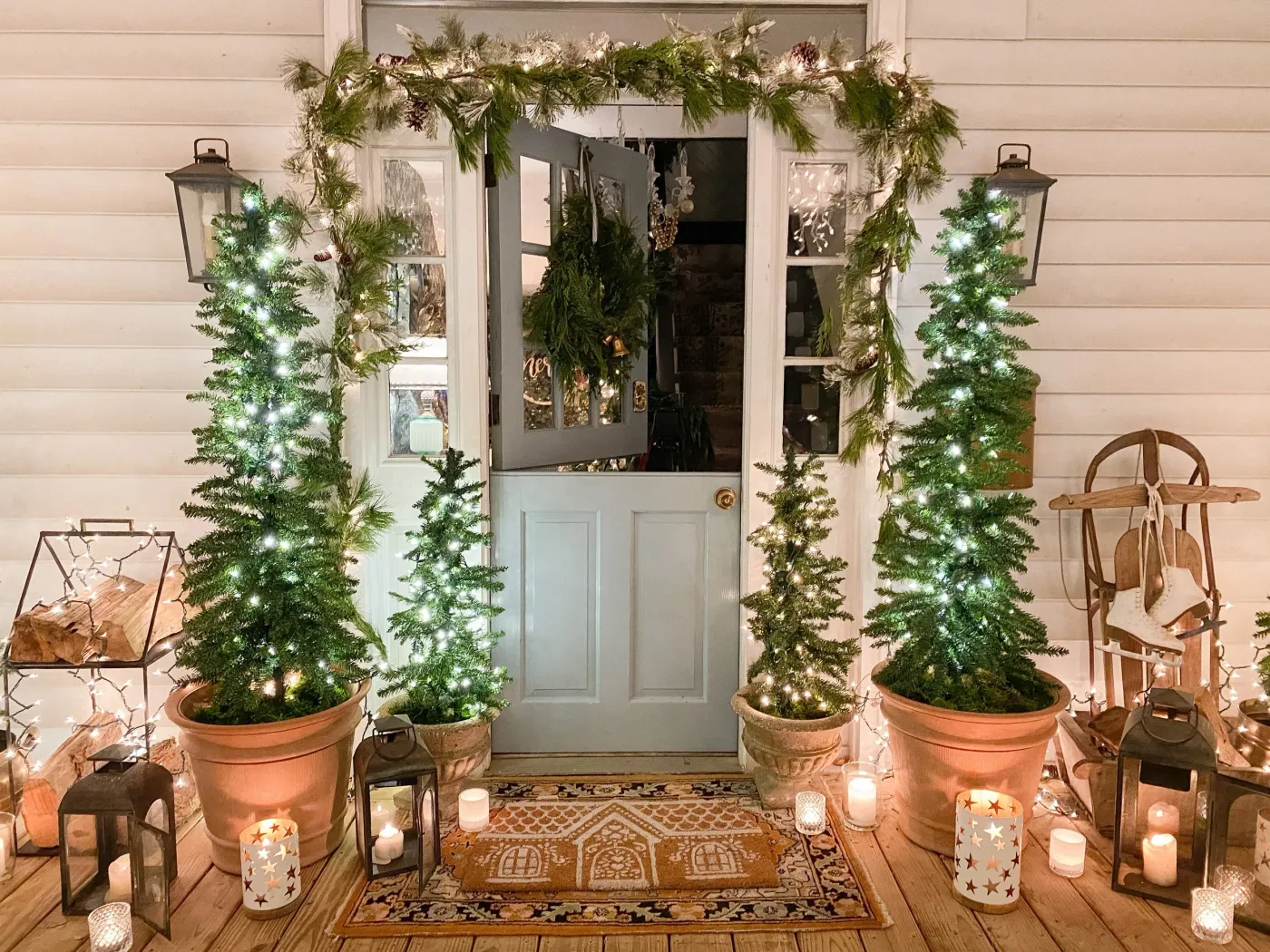
The wooden sled leaning against the siding with white ice skates resting on it. It costs almost nothing, does zero work functionally, and it’s the detail people photograph. A lit garland and potted trees are expected; a vintage sled with skates is a story. If you own one, this is the year to drag it out of the garage. If you don’t, a thrifted sled plus a pair of white skates from Facebook Marketplace will run you about $25 and do exactly the same thing.
6. Teal Door, Plaid Bow, and Garland on the Snowy Railing
A teal door with warm white lights is a beautiful pairing — until snow buries your bottom step and the railing garland has to survive freeze-thaw cycles for six weeks. Look for garland with sealed LED bulbs, because cheap unsealed strands fail fast when they’re wet and cold. Battery packs don’t love single-digit temperatures either, so bring them inside overnight or run outdoor-rated extension cords. And secure rail garland every 12 inches, since a heavy wet garland pulls zip ties loose in a single storm.
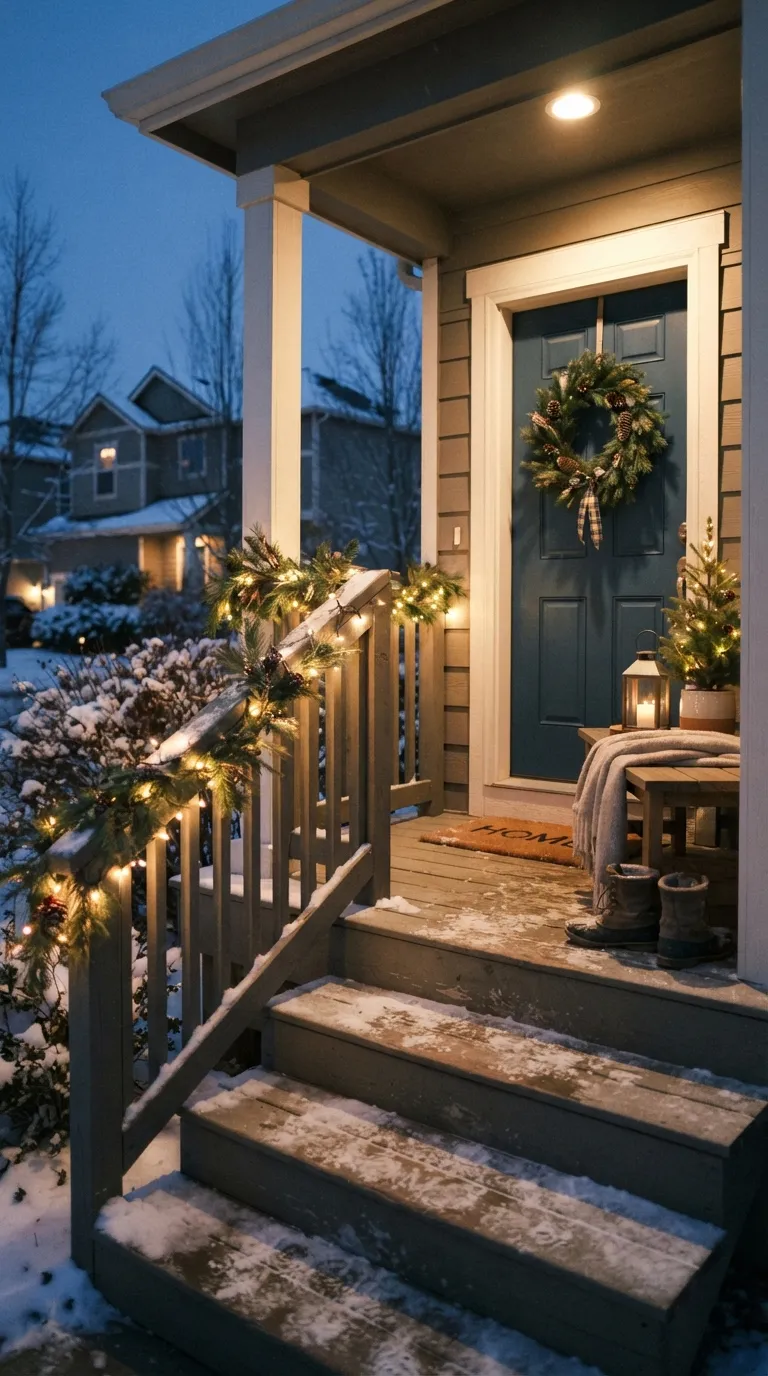
Three things are doing the heavy lifting here. First, contrast: crisp teal against warm white light makes both colors pop. Second, the asymmetry — the garland runs the railing, the tree sits on the bench, and nothing is mirrored, which keeps a small porch from feeling cramped. Third, restraint. One wreath, one garland, one small tree, one lantern. Any more and the snow would be competing with the decor instead of setting it off.
7. Glossy Black Planters with Birch Logs and Red Berries
Twenty minutes per planter and $40–$80 in materials, assuming you save the logs for next year:
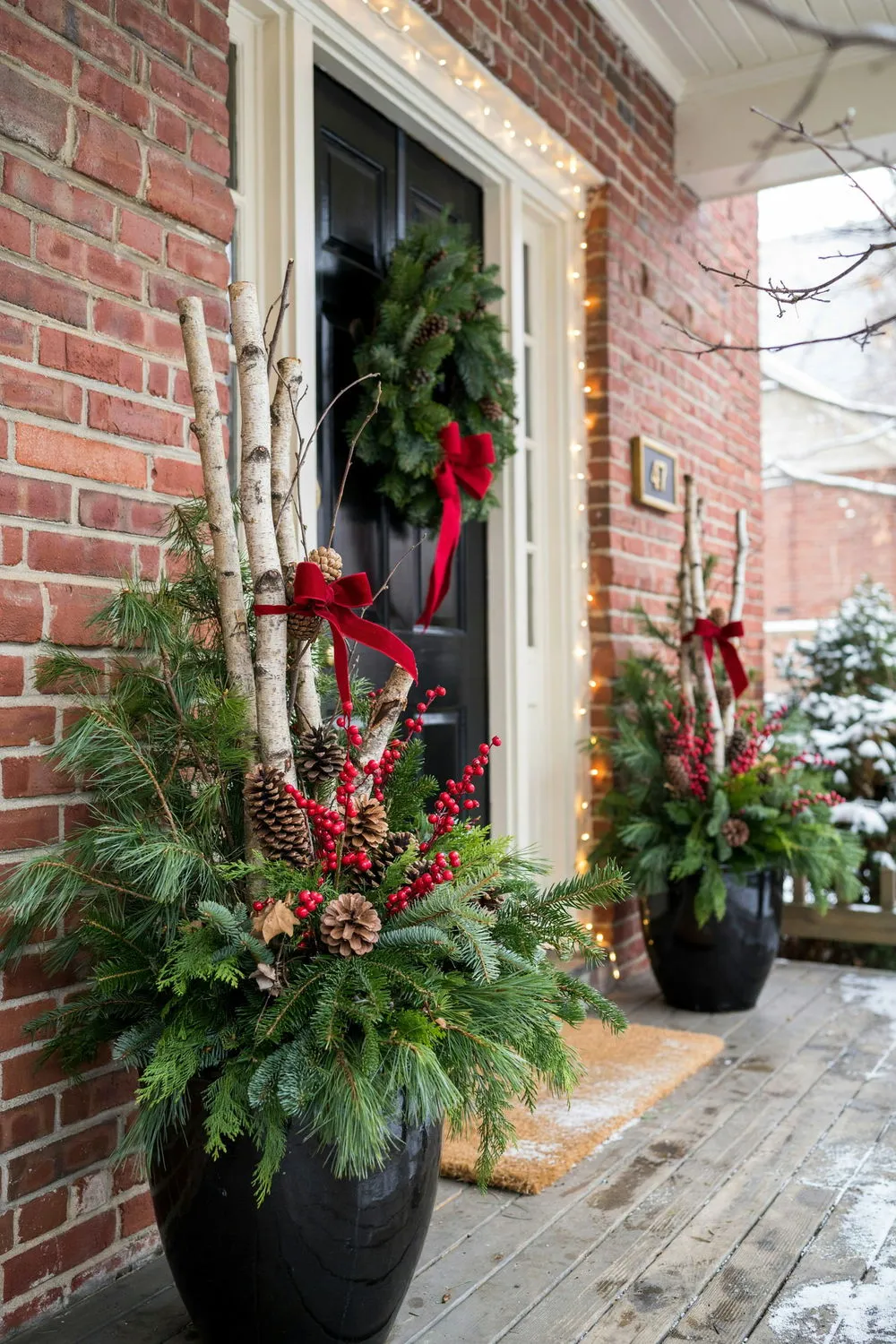
- Stand three birch logs at different heights in the back third of the planter — 18, 24, and 30 inches reads as intentional.
- Pack evergreen branches in front of and around the logs, angling them outward so they drape over the rim.
- Push pinecones into the gaps between sprigs, keeping them low and toward the front.
- Add red berry stems in odd numbers — three or five clusters, never four.
- Thread warm white lights up through the greenery, then coil the last two feet around the tallest log.
The birch logs. Evergreen and red berries are everywhere in December; cut birch is what separates this planter from the one three doors down. They give the arrangement vertical structure, they’re pale enough to catch string lights, and they cost almost nothing — a bundle from a craft store or a neighbor’s fallen tree covers both planters. Without the logs you’d have a good-looking pot of greenery. With them, it looks styled.
8. The Porch Swing That Carries You From Fall Into December
- Measure the hanging height — the seat should sit 17–19 inches off the floor.
- Confirm the beam or joist can hold 250+ pounds of swing, cushions, and two adults.
- Check that your pillows and throws are outdoor-rated, or plan on hauling them in nightly.
- Pick your pivot weekend — the day you swap gourds for greenery.
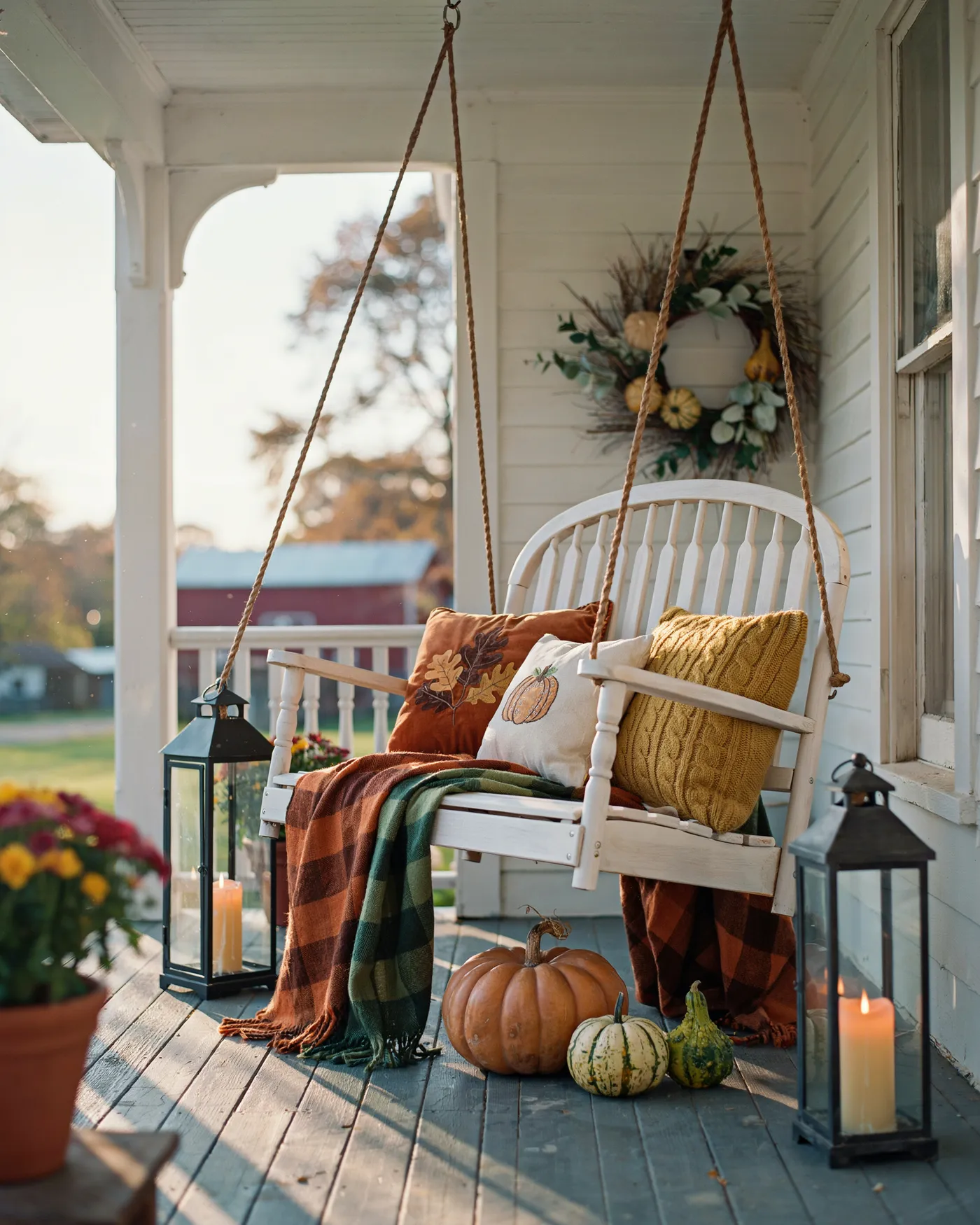
Everything here is a thrift-store category. Porch swings show up on Facebook Marketplace constantly for $40–$90, especially in October when people are clearing space for winter. Plaid blankets run $12 at Walmart, lanterns are $8–$15 at IKEA or the dollar store, and pumpkins come off a farm stand at $3–$5 each in late September. Swap the black lanterns for ones you already own and the entire setup lands under $150 — then carry the swing, blankets, and lanterns straight into December by trading the gourds for evergreen.
9. The Blank-Slate Farmhouse Porch You Build On
A porch like this needs about 8 feet of width to fit the swing, the door, and flanking plants without anyone feeling pinched. The warm wood plank ceiling is the unsung hero — it makes a covered porch feel taller and gives you somewhere to hang a fan or, come December, a long swag of garland. If your porch is under 6 feet deep, skip the swing and use two chairs instead. Skinnier entries do better with a door-only treatment that fits a 4-foot landing.
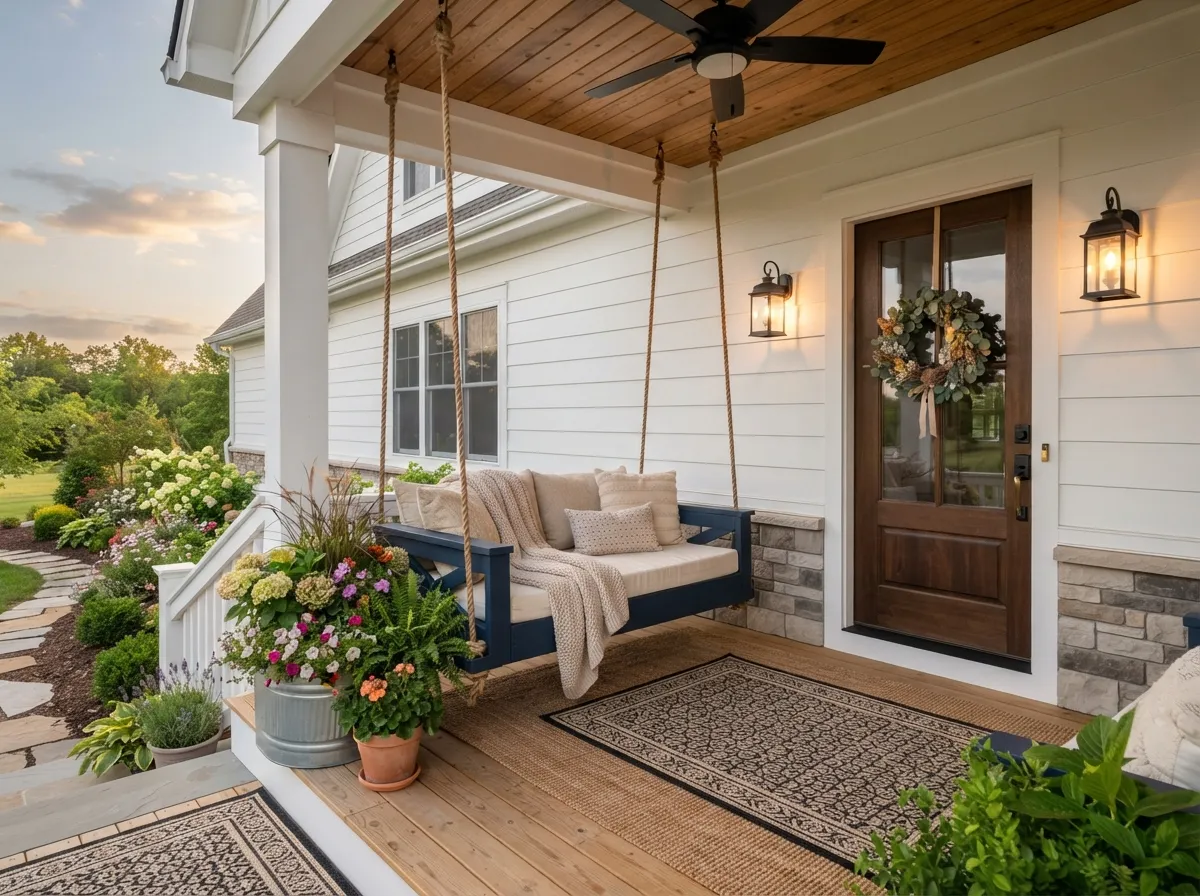
Layer your rugs by size, not by pattern. A 2×3 jute mat in the doorway with a 5×8 patterned rug underneath handles weather and looks intentional — the small mat takes the abuse, the big one stays clean. Leave a 4-inch gap between the door swing and the edge of any rug so it doesn’t catch. And if you hang a ceiling fan on a plank porch, make sure the downrod puts the blades at least 7 feet off the floor.
10. Pine Garland Wrapped Around the Porch Columns
Wrapping garland around the porch columns instead of just hanging it on the doorframe is the single move that makes this entrance look professionally done. It turns a flat facade into something with depth. The two wreaths on the upstairs windows then repeat the same shape at a smaller scale — a classic rule-of-thirds play: one large focal point at the door, two small echoes above. The red brick floor does the rest, warming up all that deep green without any extra effort.
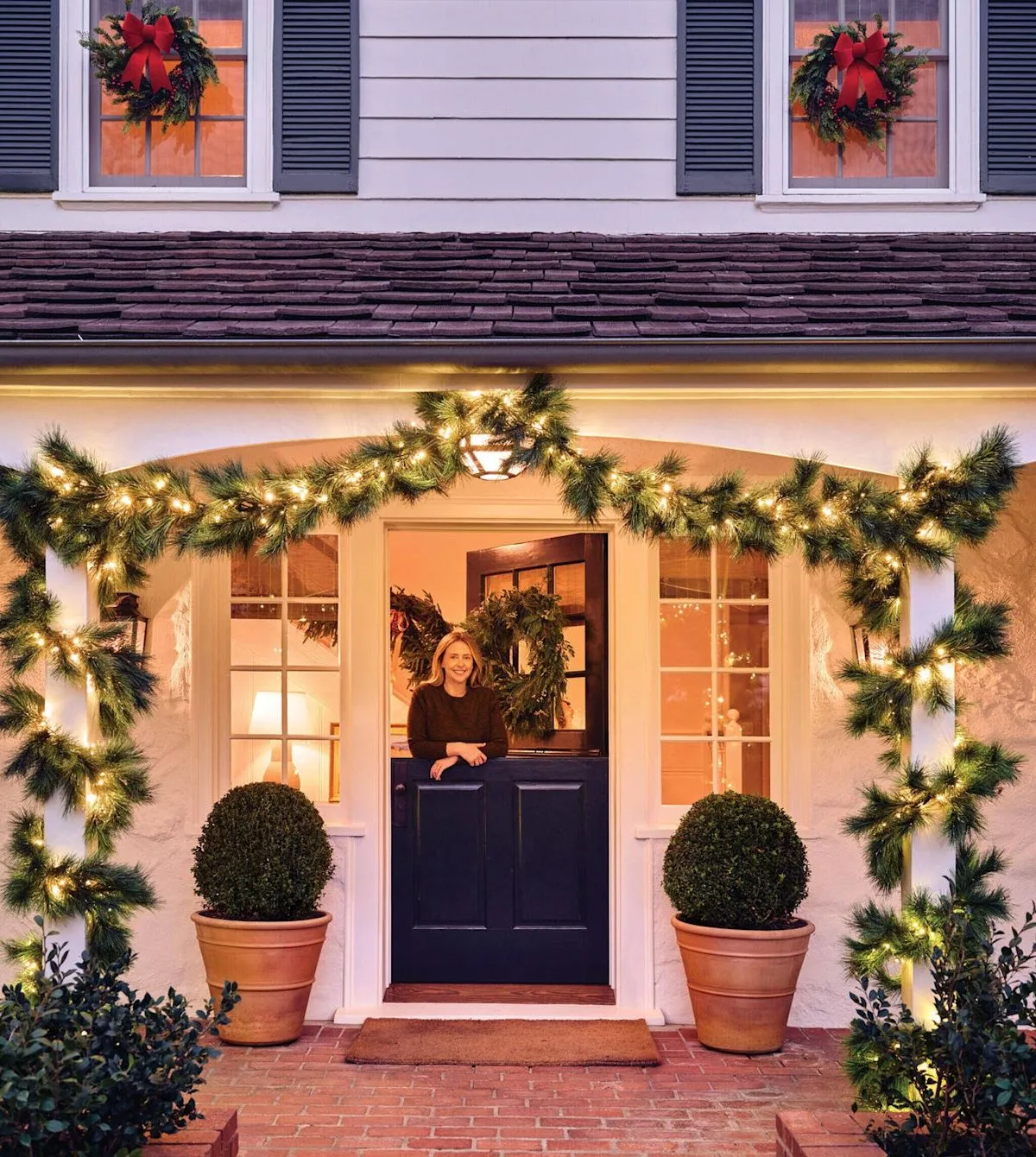
Real pine garland on a warm porch drops needles within two weeks and leaves a sap-and-needle mess all over that brick. Faux holds up for years but fades in direct sun — expect to replace it every three or four seasons if your porch faces south. The bigger issue is the lights. Incandescent strands draw real wattage and stay hot, so if you’re wrapping four columns, switch to LED and put them on a 6-hour timer. That alone trims a surprising amount off your December electric bill.
11. Gold Ornaments and Frosted Evergreens on a Brick Porch
- Main furniture & planters — 2 frosted evergreen planters: $70–$150
- Lighting — pre-lit garland (12 ft) + wreath: $70–$180
- Textiles — none required: $0
- Decor — gold ornaments + berry picks + LED candle lanterns: $55–$130
- Paint/wall treatment — none: $0
- Total: $195–$460
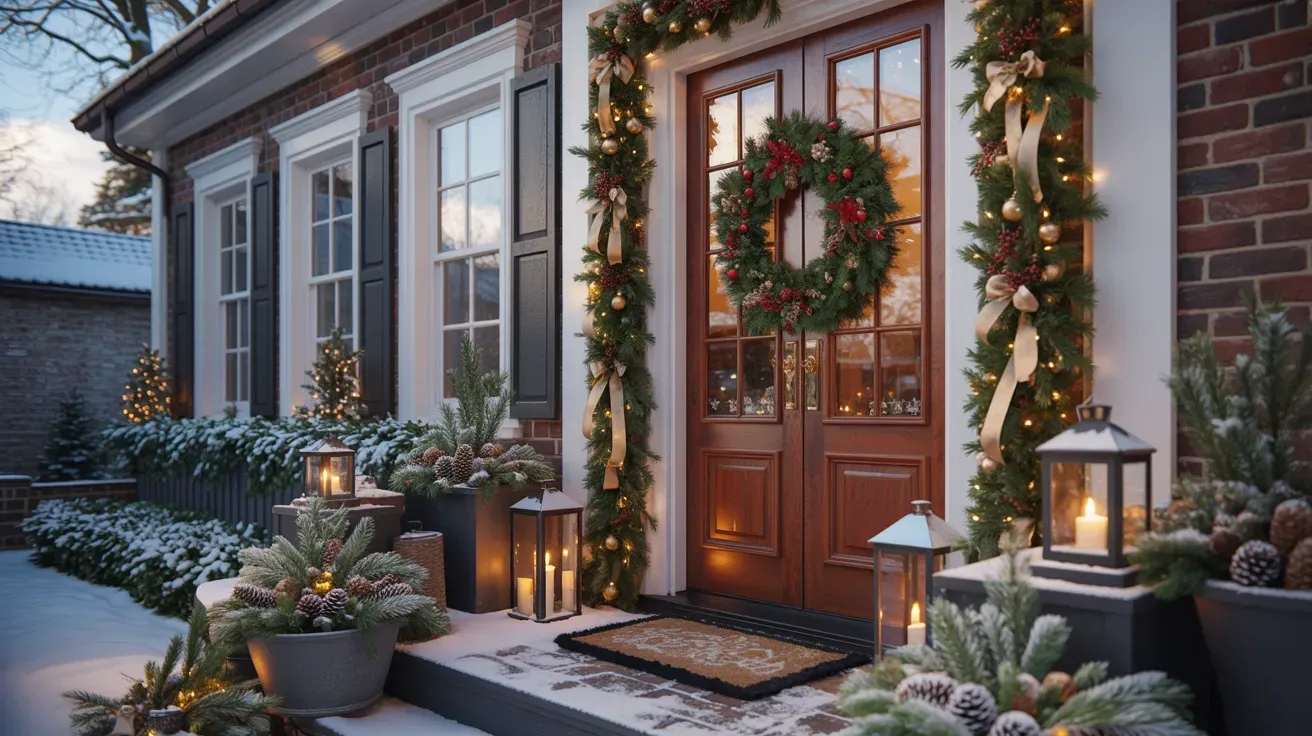
Budget alternative: buy plain garland and add your own gold baubles from a dollar-store multipack, plus a $10 bag of berry picks. Same look, roughly $95–$160.
Snow on brick steps is slicker than snow on wood, and LED candle lanterns set directly on the treads get kicked. Put lanterns to the side of each tread, never in the middle of the walking path. Check your wreath hanger before January too — a heavy garland on a glass door can pull a suction cup loose during a freeze-thaw cycle, and a falling wreath on tile is a broken-ornament situation.
Decorating the garland before it goes up takes about 20 minutes per strand and $20–$45 in extra ornaments:
- Lay the garland flat on the floor — decorating it in place is twice the work.
- Wire gold baubles on in clusters of three, spacing clusters roughly 10 inches apart.
- Add red berry picks between clusters so the color rhythm alternates.
- Test the lights now and replace any dead sections before the garland leaves the ground.
- Hang it with clips every 12 inches, hiding the wires behind the greenery.
12. A Blue and White Rug Under Topiary in Black Urns
The blue and white patterned rug. This porch has almost no Christmas decoration at all — topiary, a wreath, two lanterns, brick. What makes it look finished is that rug covering the floor. It establishes a color story of blue, white, and brick that everything else falls in line with. Remove it and you have a nice brick porch with two shrubs. It’s also the fix for a common problem: if your door color isn’t working, put a rug under it and the palette corrects itself.
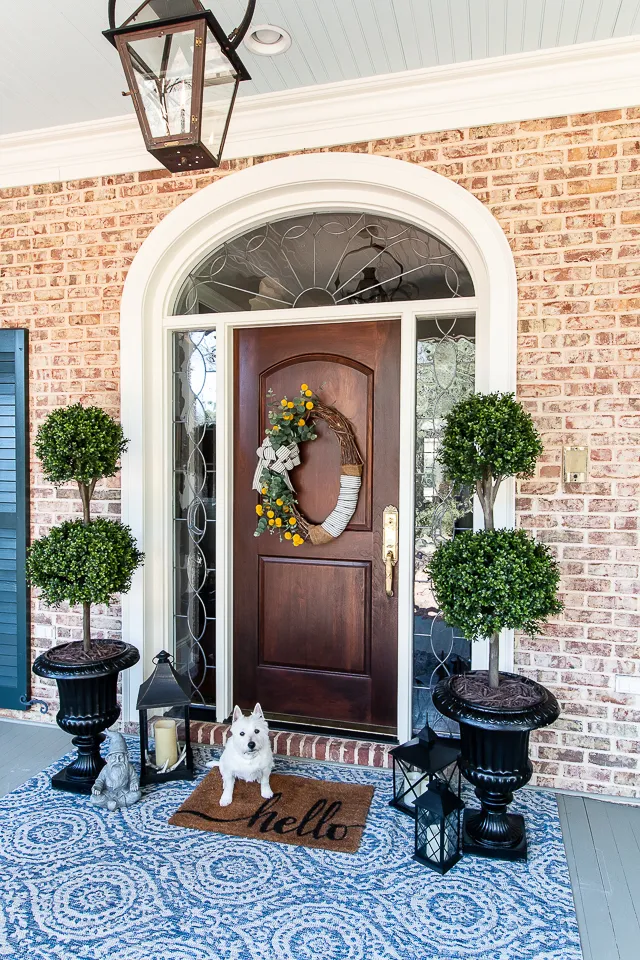
60% brick and dark wood + 30% blue and white + 10% dark green. That’s the entire formula, and it holds because blue and green are neighbors on the color wheel, so nothing fights. Want it warmer? Swap the blue rug for rust and cream and the topiary for something with burgundy berries — same proportions, completely different mood. Want it crisper? Go black and white on the rug and add silver-toned lanterns. Change the accent, never the ratio.
13. Birch Logs, Juniper, and Red Berries in a Metal Bucket
Roughly 15 minutes and $25–$45 in materials, and it’ll survive a full season of freeze-thaw:
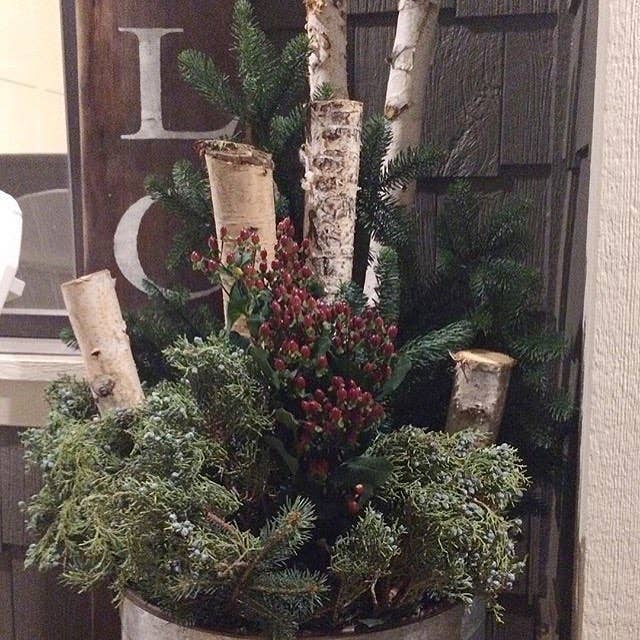
- Fill the metal bucket two-thirds with floral foam or crumpled chicken wire to hold stems in place.
- Stand birch logs upright against the back rim, tallest in the center.
- Insert evergreen branches at a 45-degree angle all the way around, letting them spill over the edge.
- Tuck juniper sprigs in front — their blue-green tone breaks up the flat dark green.
- Finish with three clusters of red berries pushed in low and toward the front.
The trick to a planter that looks planted rather than stuffed is depth. Push your longest branches in first, all the way to the bottom of the container, and let the shorter sprigs sit on top like a nest. Then step back six feet — that’s the distance people actually see it from — and fill any holes you can spot from there. Fewer than three foliage varieties reads flat. Three to five varieties, in odd numbers of stems, reads designed.
14. Twin Wood Doors Framed by Black Sconces and Ferns
Twin wood doors with black sconces is a look you can get for under $200 if you’re patient. Black lantern sconces at Walmart run $20–$35 each. Potted ferns are $12–$18 at a hardware store in early summer and will live on the porch until frost. A natural fiber doormat is $15 at IKEA, and individual green wreaths start around $10 at Target. Skip custom pot fillers entirely — set plastic nursery pots inside a basket and nobody sees the difference from the sidewalk.
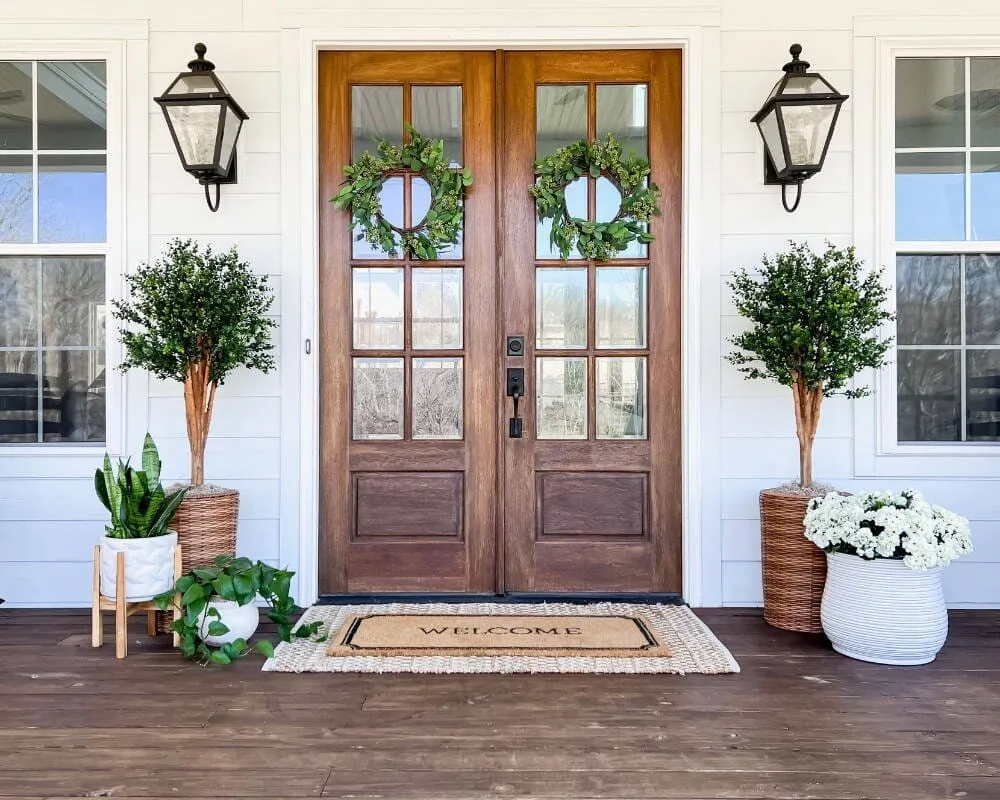
Double doors need double everything, and that’s the trap. Your two sconces should sit roughly 66–72 inches off the floor and about 8–12 inches outside the doorframe — any closer and they crowd the trim. For flanking plants, aim for containers at least one-third the door’s height; on an 80-inch door that means roughly 26-inch planters. Porches under 5 feet deep should stick with a single-door approach instead, like the striped-bow entry in Idea #3.
15. Multicolor Lights and a Santa Sleigh in the Front Yard
Maximalist multicolor is genuinely back in 2026, and it’s mostly a nostalgia play — Pinterest saves for vintage Christmas lights and retro yard displays keep climbing as millennials recreate the lawns they grew up with. The shift is generational: the people decorating porches right now are the ones who remember incandescent C9 bulbs and plastic Santa molds. The upside is that this style is not precious. Nothing has to be tasteful, which makes it the cheapest and most forgiving look in this entire list.
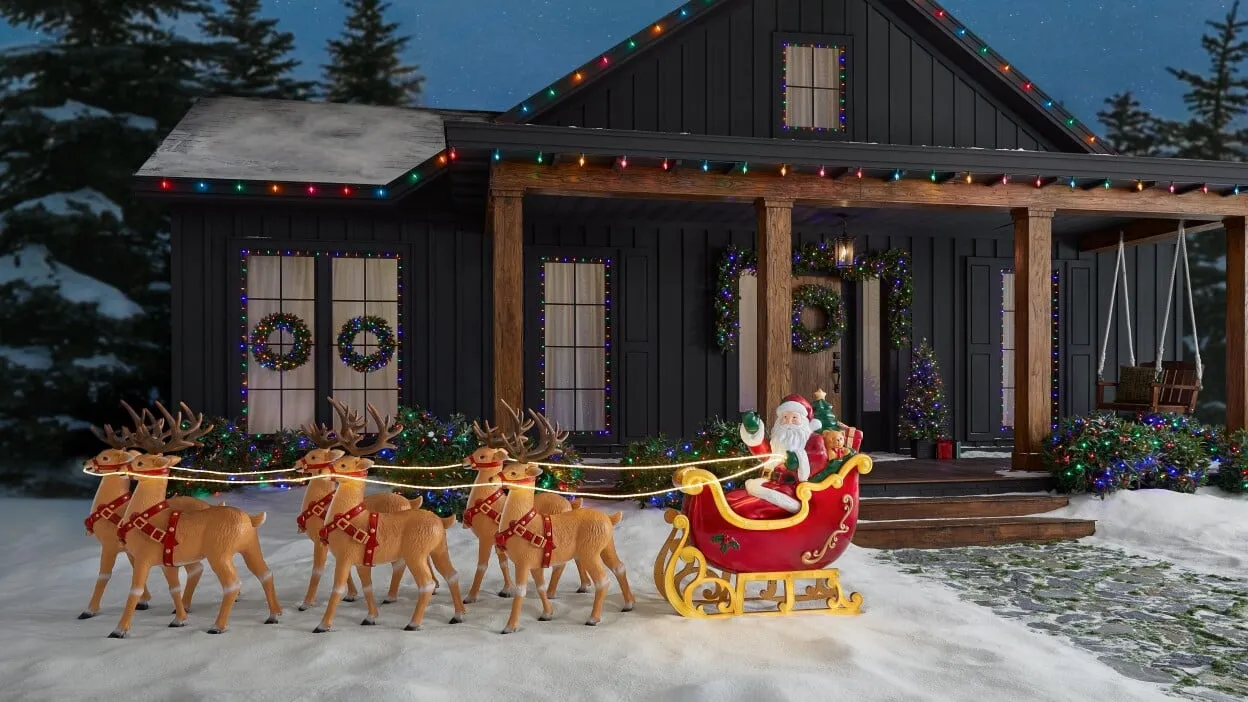
It works because of scale, not restraint. The Santa sleigh is far too big for a normal yard, and that’s the point — a display this size reads from the street and from a car doing 25 mph. Everything else supports it: the roofline lights define the house, the multicolor bushes light the approach, and the wreaths tell your eye where the entrances are. The whole yard becomes one composition instead of a pile of decorations.
An inflatable-and-figure yard display needs power you probably don’t have at the curb. Run outdoor-rated 12-gauge extension cords, keep every connection off the ground in a covered junction box, and put the whole thing on a GFCI outlet. Budget for a storage problem too, because a Santa sleigh and reindeer eats a shocking amount of garage. And check your HOA rules before you buy anything — some covenants cap the number of lit figures or ban them outright.
16. Symmetry First: Urns, Garland, and One Big Wreath
The symmetry. Two identical urns, one wreath dead center, garland mirrored on both sides of the doorframe, and smaller potted trees flanking the big ones. A porch this balanced reads instantly as deliberate — your brain registers the composition before it registers any individual object. Break it and everything looks like it drifted. If you do only one thing from this entire list, measure your urns and set them the same distance from the center of the door.
- Main furniture & planters — 2 dark urns + 2 small potted trees: $90–$200
- Lighting — wreath lights plus existing wall lanterns: $25–$70
- Textiles — none required: $0
- Decor — wreath + garland + red berry picks: $75–$170
- Paint/wall treatment — none: $0
- Total: $190–$440
Budget alternative: the urns are the expensive part. Concrete-look resin urns start around $22 each at Walmart, and thrifted urns sprayed matte black look identical from the sidewalk. That gets you to $110–$190.
17. Candy-Stripe Bows on White Planters and Black Lanterns
65% evergreen + 20% white + 10% black + 5% candy stripe. The stripes are deliberately tiny in terms of area — one bow on the wreath, one on each planter — but they’re the thing your eye lands on first. That’s the trick: the smallest percentage carries the personality. Change the stripes to solid burgundy and you land on the classic look in Idea #21. Go buffalo check instead and it turns farmhouse. Same ratio, different accent.
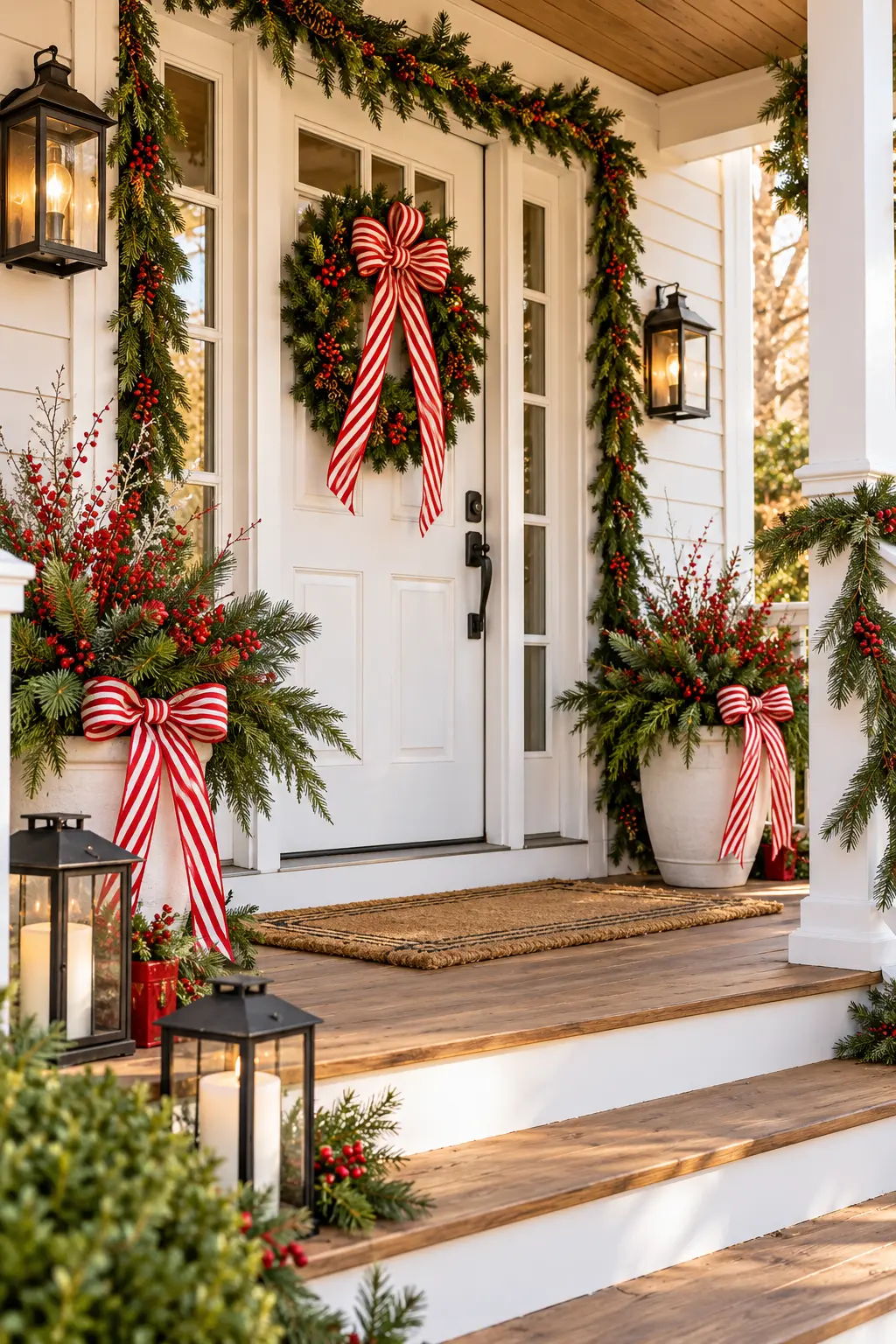
Red and white striped ribbon is beautiful and unforgiving. It fades in direct sun faster than any other ribbon color — expect the white to yellow slightly by year three if your porch faces south. Store it wound around a cardboard tube, never folded, or you’ll have permanent creases on the loop of every bow. Outdoor ribbon also gets beaten up by wind, so use wired ribbon and secure each bow’s center with a zip tie rather than relying on the ribbon’s own knot.
18. Roofline Lights That Trace a Curved Driveway
String lights have a lifespan, and it’s shorter than you think. Even good LEDs lose a section every couple of years, and once one bulb in a sealed strand fails you’re replacing the whole run. Plan on rotating inventory — buy one new strand every year and retire your worst one. Winter wind is what actually kills lights, too: strands that whip against stone or brick chafe and short. Secure every run at 18-inch intervals with clips matched to your surface.
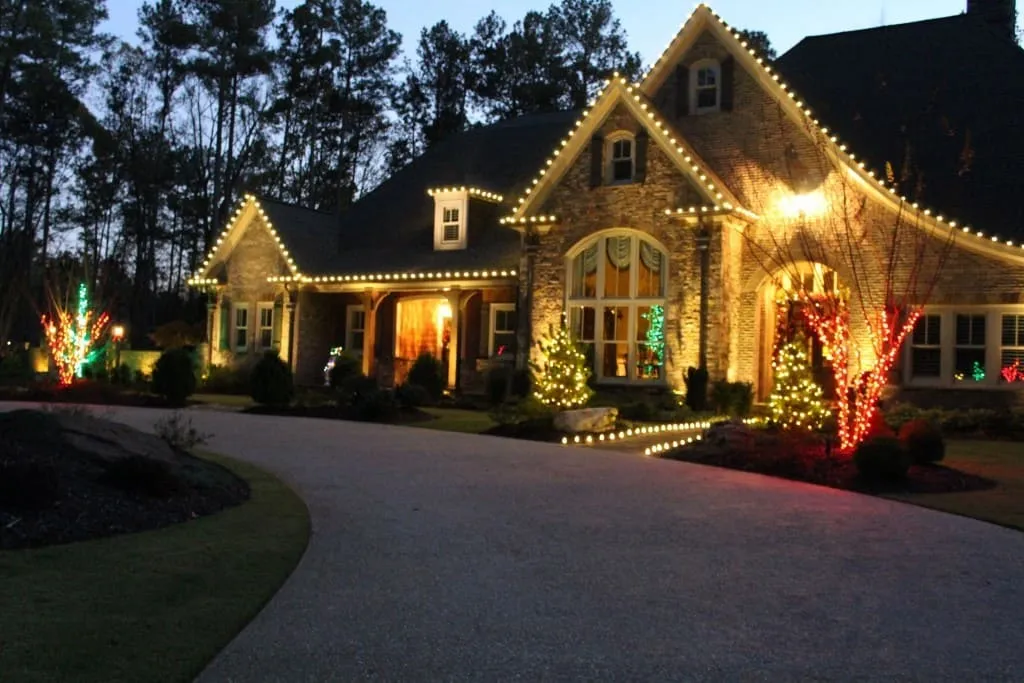
Outline your driveway the way you’d outline a room. Ground lights set 8–10 feet apart along the drive create a visual path and make a long approach feel intentional instead of dark. Use warm white stakes for the drive and save the colored lights for the landscaping. Mixing both in the same zone is what makes a yard look chaotic. Put the whole property on two timers: roofline on at 5pm, driveway on at dusk, everything off by 11.
19. Red Tulle Bows Along a White Arched Entry
- Measure the arch or doorway width — you want roughly 1.5x the span for a good swag.
- Find your outdoor outlets and count how many strands you can safely put on one circuit.
- Confirm your pots are frost-proof; terracotta cracks when wet soil freezes.
- Decide whether this entrance is a pass-through or a display — if people walk it, keep the floor clear.
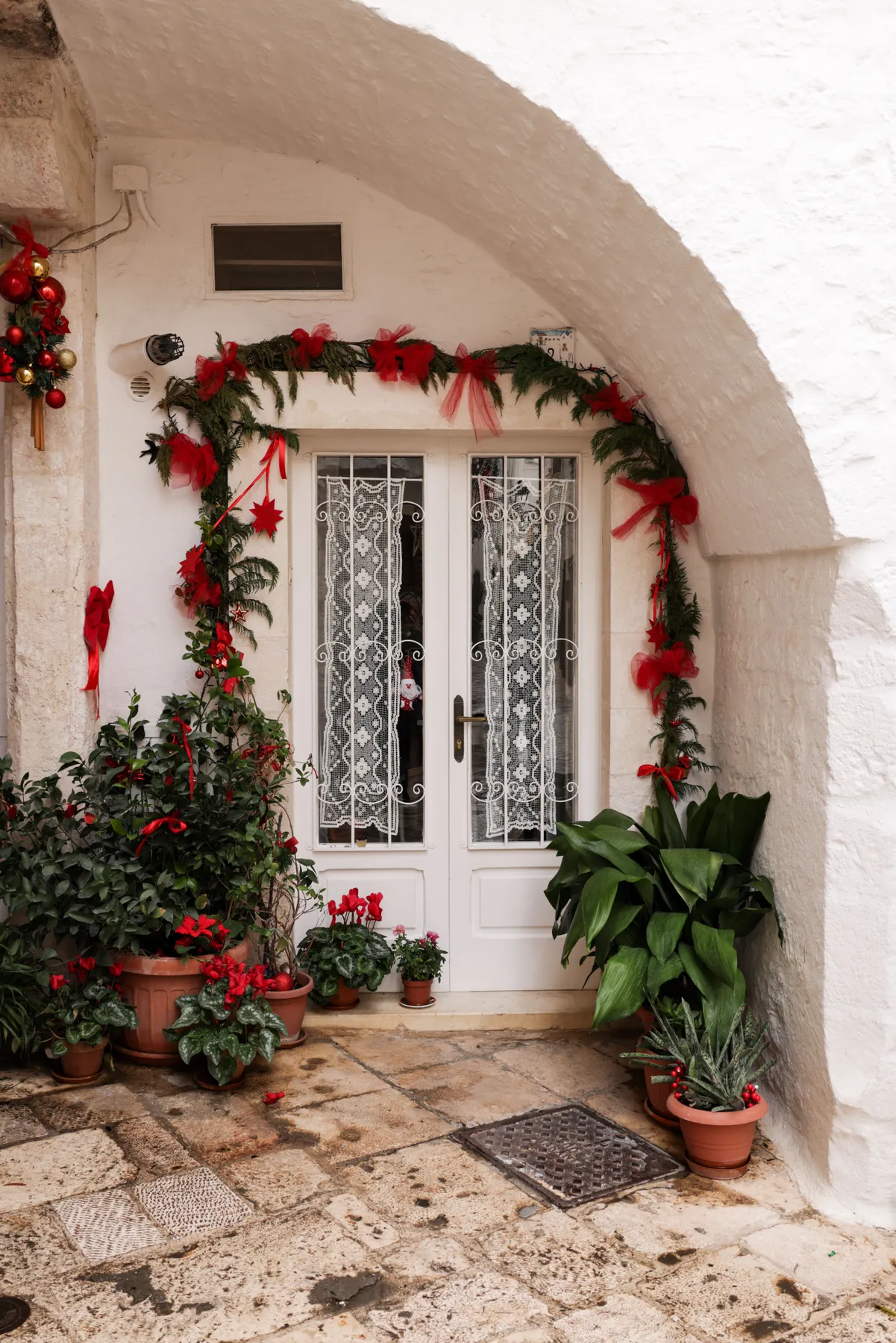
Red tulle is one of the cheapest decorating materials there is. A roll runs $4–$8 and yields about a dozen bows. The garland is the real cost, so buy plain unfrosted greenery and add your own ornaments, or grab a $25 pre-lit strand and bulk it up with a wreath you already own. Potted red flowering plants can be swapped for red-painted cans with faux blooms at about $3 apiece. The whole entrance lands roughly $80–$140.
20. A Rainbow Ruffled Wreath on a Bright Blue Door
Color theory, but joyful. The blue door and the orange mums are near-complementary, which makes both feel brighter than they actually are. The ruffled rainbow wreath pulls every color already present in the display and repeats it, so nothing looks random. And the oversized candy canes at the base give your eye a place to land at ground level — most porch displays stop at eye height and end up feeling top-heavy. This one is weighted properly, top to bottom.
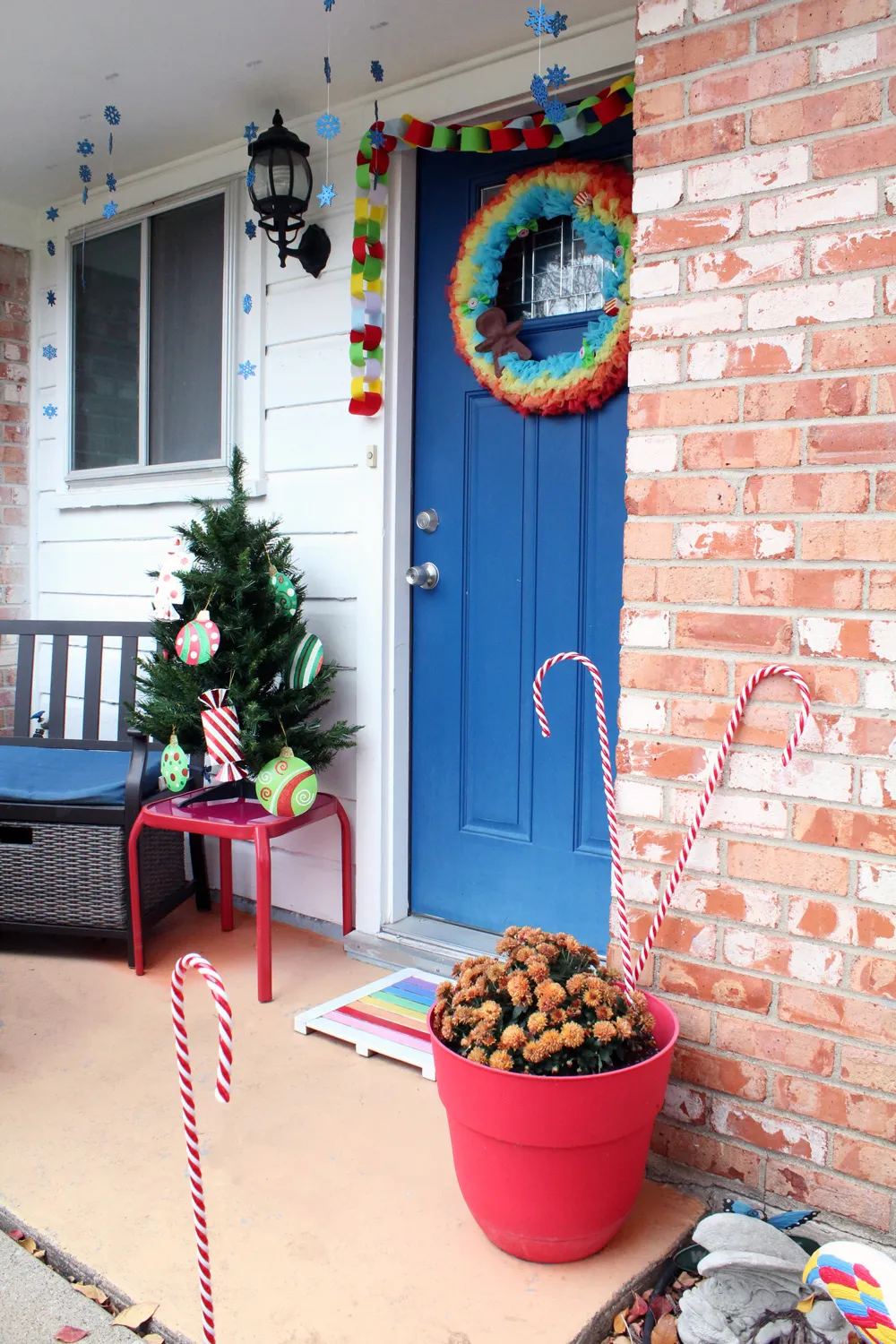
The paper chain garland. It’s the least expensive object on this porch and the one that makes the whole thing feel handmade instead of purchased. A rainbow wreath from a store is cheerful; a rainbow wreath with a paper chain strung behind it is a decision. Twenty minutes, a pad of construction paper, and a stapler. Kids can make it. It also gives you an easy way to change the display next year — new chain, new color story.
If you’re going colorful, commit to a floor and a ceiling for the palette. Pick four or five colors max and repeat each one at least twice in the display — blue door, blue snowflakes; red planter, red candy canes. Two appearances is what makes a color read as intentional rather than leftover. And photograph the porch at dusk, not full night, so the sky still holds a little blue and your door doesn’t disappear.
21. Buffalo Check and Velvet Bows at the Black Door
About 30 minutes and $60–$130 depending on garland quality:
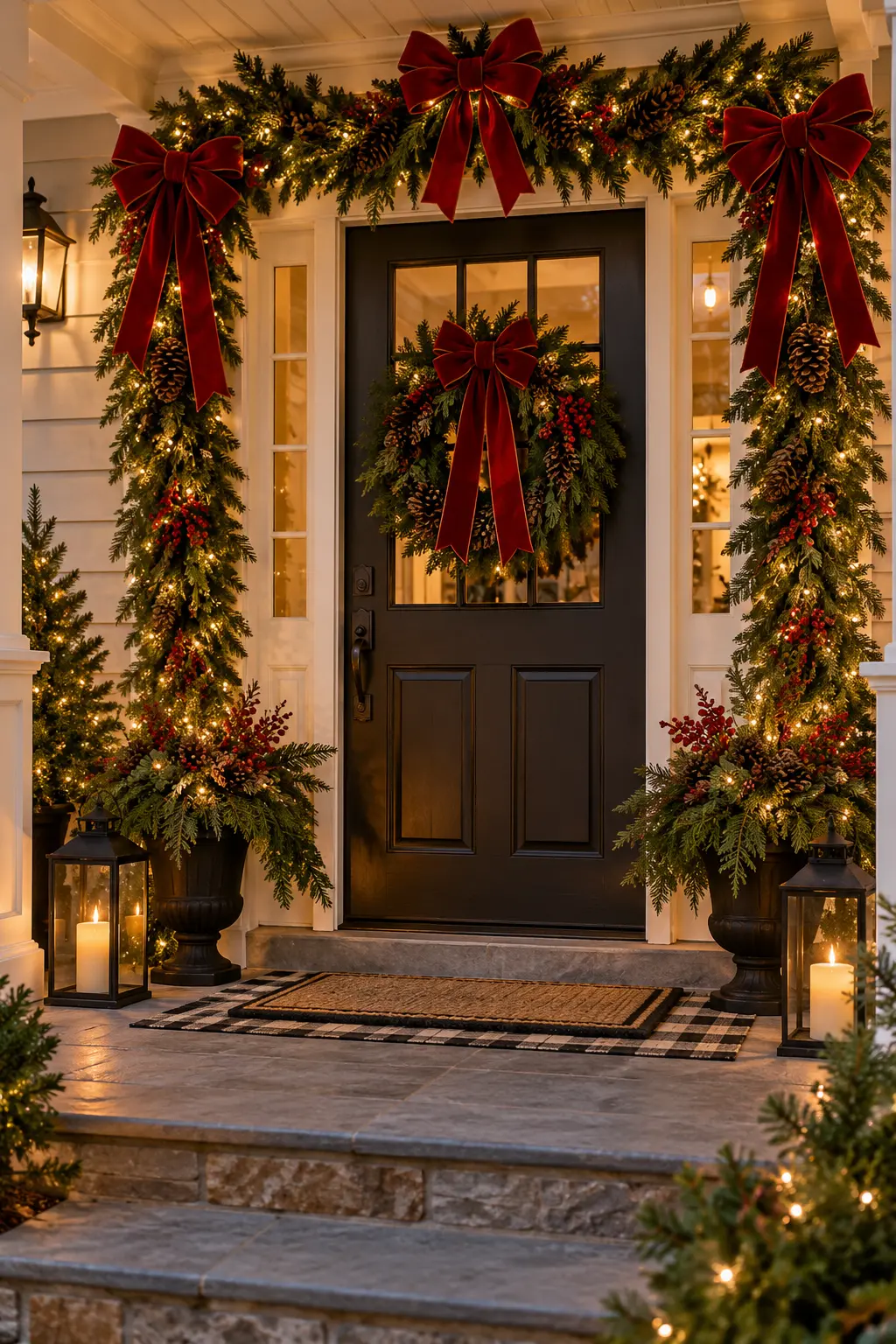
- Measure from the outer edge of the doorframe up and over the top, then buy garland roughly 1.5 times that length.
- Attach a cup hook at each top corner of the trim, then drape the garland so it hangs 6–8 inches down each side.
- Wire on three velvet bows — one per side and one at center top.
- Push pinecones in behind the bows to add bulk and hide the wire.
- Thread the warm lights last so the cord hides under the greenery instead of across it.
This treatment wants a door at least 36 inches wide and a stoop 4 feet deep, so the flanking urns don’t block the swing. Grey stone steps typically run 11 inches deep, which gives you just enough room for a lantern beside the doormat — not on it. If your steps are narrower, move the lanterns down to the porch floor. A porch this size also handles the fuller garland-and-gold look in Idea #27. Anything smaller gets swallowed.
22. Frosted Garland, White Pumpkins, and Silver Spheres
Frosted greenery photographs lighter than it looks in person, so balance it with something matte. White pumpkins and raw wood do that job here. A display that’s 100% shiny — frost, glitter, glass — reads as cheap even when it isn’t. Cap your glitter at about 20% of the total arrangement and let the matte textures carry the rest. Frosted branches also hold dust, and a quick pass with a hair dryer on cool air restores them at the start of each season.
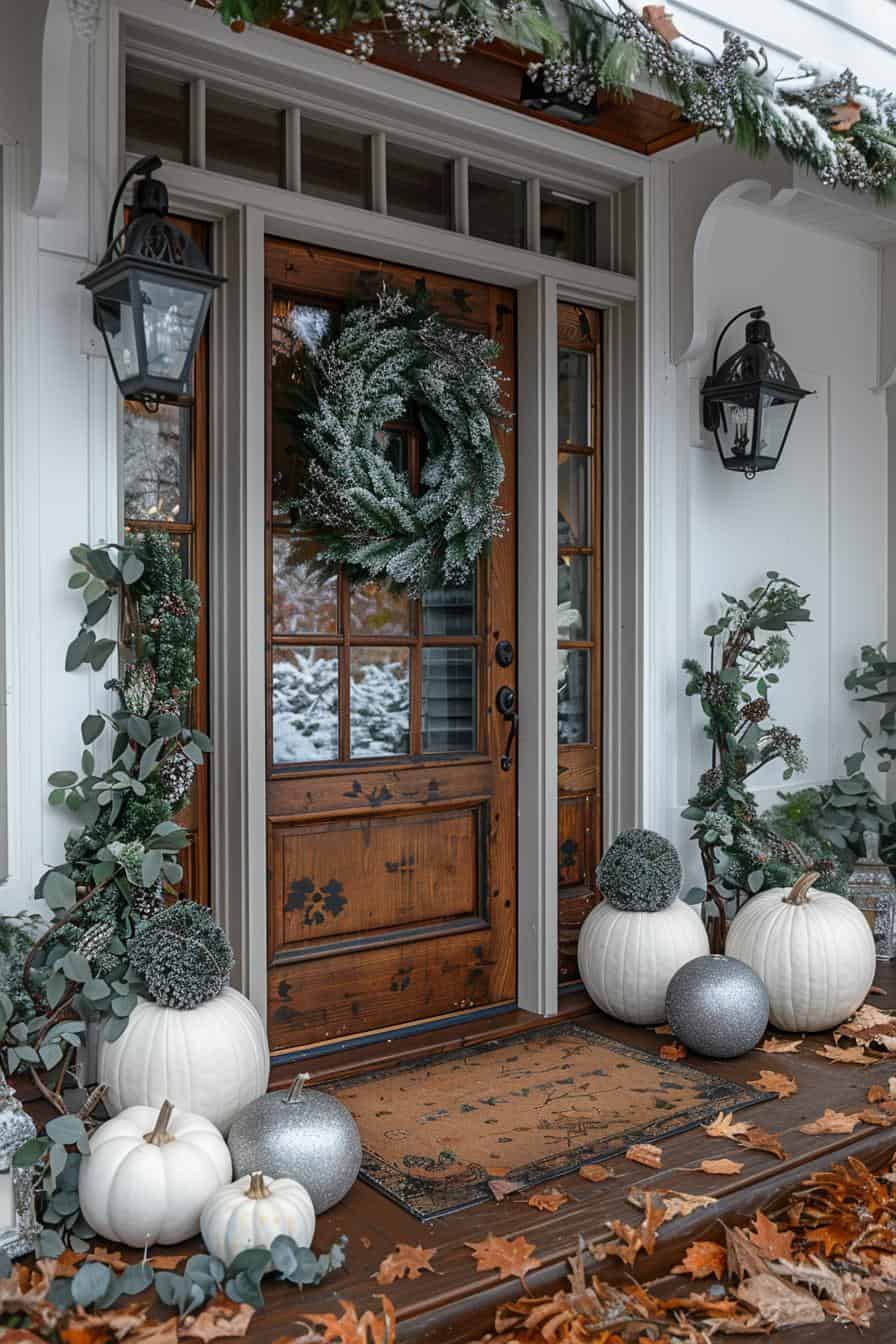
55% frosted green + 25% brown wood + 15% white + 5% silver. The brown is doing more work than you’d expect — the rustic door, the wooden steps, and the fallen leaves all sit in the same warm-neutral family, which stops the frost from reading icy. Swap the white pumpkins for white birch logs and the formula still holds. Push silver above 10% and the whole thing goes cold and modern instead of wintry.
23. The Illuminated Tree That Greets Everyone at the Entrance
Communal entrance trees are one of the fastest-growing holiday decorating habits — apartment lobbies, condo entries, and small business doorways all get the same treatment, and it’s a smart one. A single illuminated tree at an entrance reads at a distance, needs no symmetry, and works in spaces where you can’t attach anything to the walls. In 2026 the trend has shifted toward fewer, larger trees instead of several small ones, plus warm white only.
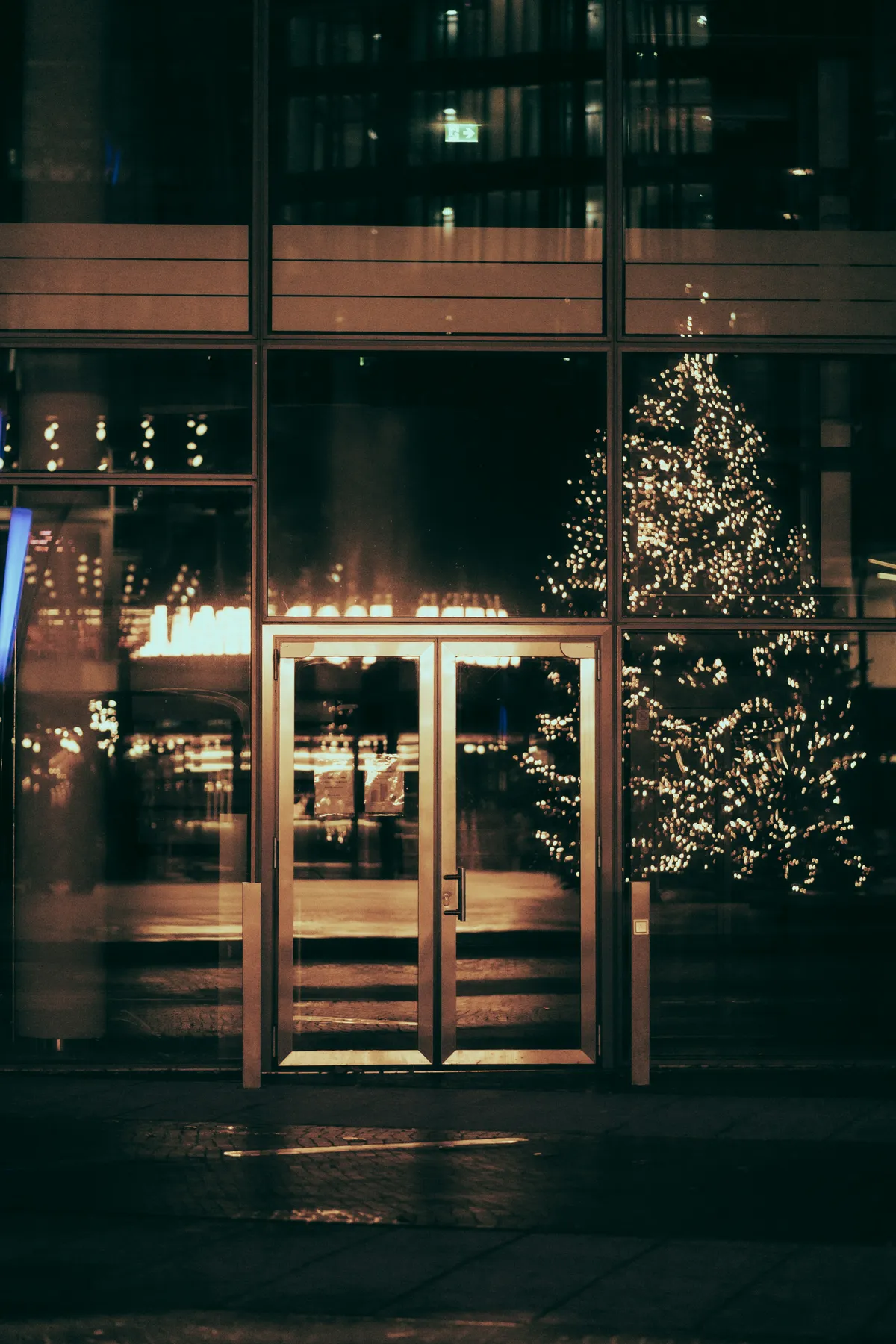
An entrance tree in a shared building is a security consideration as much as a decorating one. Anything plugged into a communal outlet needs to be on a timer and tied down, and anything valuable will walk. Skip glass ornaments and heirloom pieces, use shatterproof baubles, and weight the base — a tree that tips in wind becomes someone’s liability claim. Find out who’s responsible for that outlet, too, because a tripped breaker at midnight is nobody’s favorite phone call.
24. The Upcycled Boat Planter Full of Pinecones and Lights
Twenty minutes and $20–$40, most of it free clippings:

- Drill a few drainage holes if your boat or tub doesn’t have any — standing water kills the arrangement.
- Fill it two-thirds with foam or a sand-and-soil mix, then set a brick in the center for weight.
- Push evergreen branches in at a downward angle around the rim so they cascade.
- Add pinecones and red berry stems in odd-numbered clusters at varying depths.
- Weave the light strand from back to front, leaving the plug at the rear where it’s hidden.
The boat is the whole point, and it’s the cheapest part. Distressed planters, old washtubs, and wooden crates show up at estate sales and on Facebook Marketplace for $10–$25, and a can of dark blue paint left over from another project finishes it. Free evergreen clippings from a tree lot or a neighbor’s hedge cover the greenery, pinecones come from a park, and a $6 strand of warm white lights handles the glow. Under $50, all in.
25. Magnolia Leaves, Frosted Berries, and Gold Ornaments
45% mixed evergreen + 20% dried brown foliage + 15% gold + 10% pinecones + 10% frosted red. The two textural anchors are the magnolia leaves and the gold-painted twigs — they give the arrangement a second silhouette so it never reads as one green blob. This formula translates straight to a wreath: same five components, same proportions, just worked in a circle. Drop the gold and it becomes woodland. Drop the red and it turns metallic and modern.
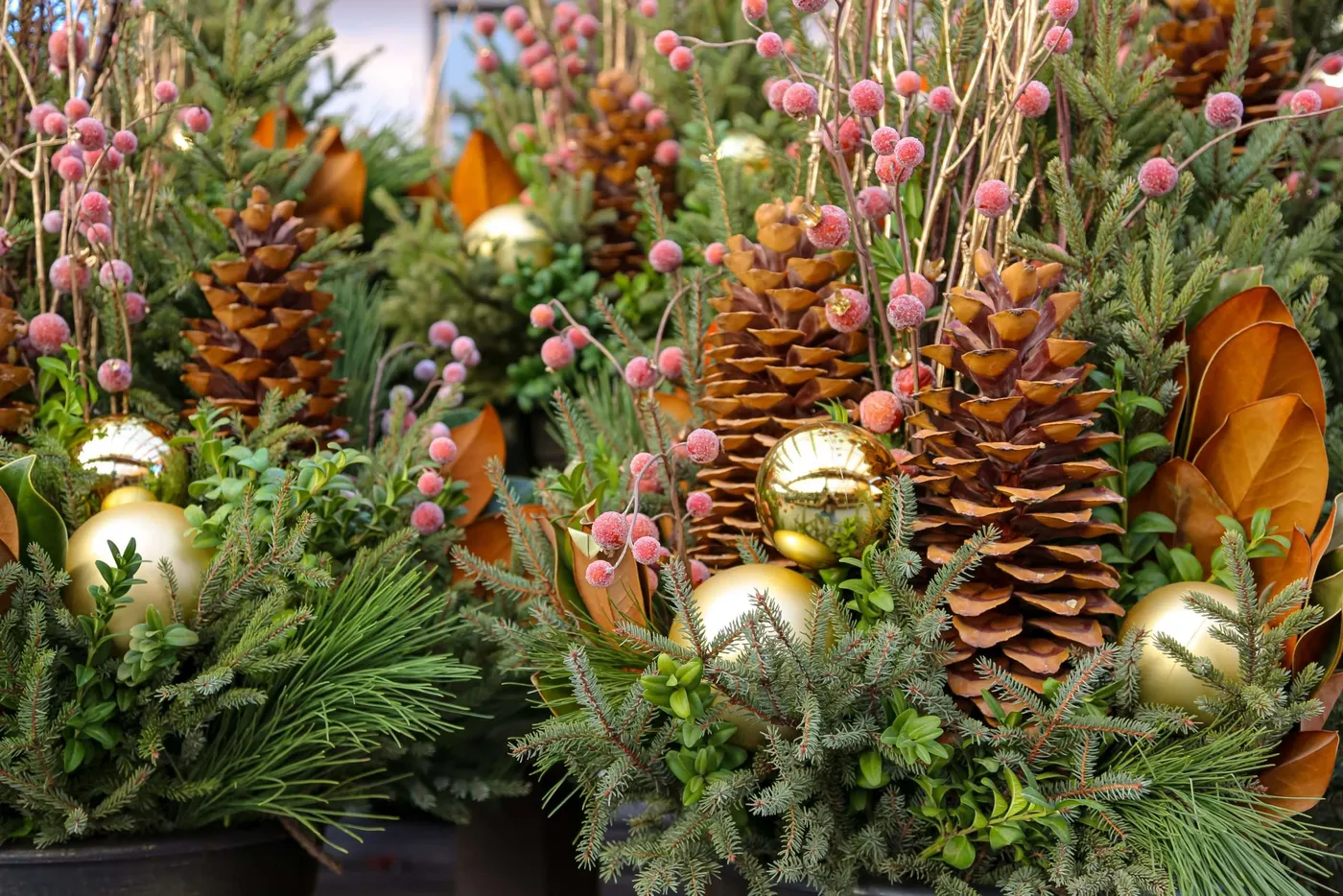
It’s about layering density against airiness. Most arrangements pile everything at the same depth, which reads as a solid mass. Here the pine and spruce fill the back, the magnolia leaves push forward, and the frosted berry branches poke out at odd angles — so there’s foreground, middle ground, and background in one bowl. That’s why it looks expensive. It’s the same principle as floral arranging, applied to something that never needs water.
The gold-painted twigs. Anyone can buy a bag of ornaments and a bag of pinecones. Painting a few thin branches with gold craft paint and pushing them through the arrangement is the step 95% of people skip, and it’s what makes this look like it came from a florist. They catch warm light at the tips, add height without weight, and cost about $4. Once you’ve done it, you’ll notice it missing in every arrangement that doesn’t have it.
26. A Mini Winter Village Inside a Wooden Lantern
- Main furniture — distressed wooden lantern, medium-large: $30–$75
- Lighting — battery fairy lights + tiny LED lamp: $12–$25
- Textiles — burlap ribbon: $6–$12
- Decor — 2 frosted miniature trees + village figures: $25–$60
- Paint/wall treatment — none: $0
- Total: $73–$172
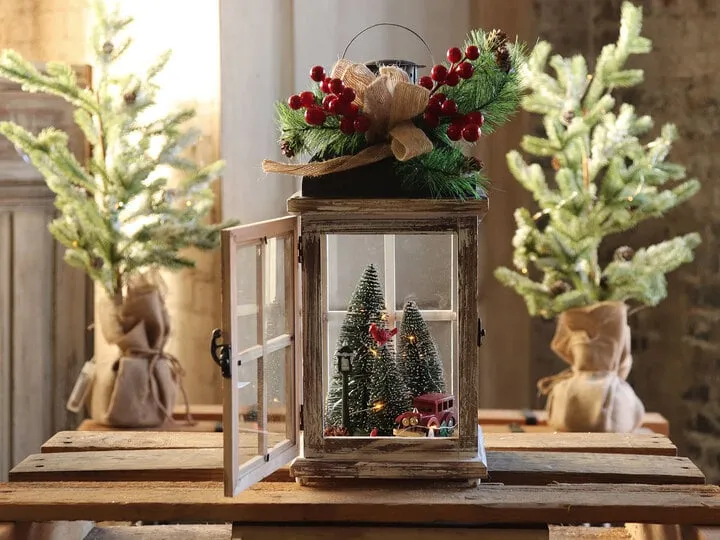
Budget alternative: buy a plain lantern and a dollar-store village set. A battery tea light stands in for the tiny street lamp, and burlap comes free from a coffee sack. Under $45.
Fifteen minutes, and it’s a great project to do with kids on a snow day:
- Line the lantern floor with batting or white felt to read as snow.
- Set your largest ceramic house in the back corner, angled slightly inward.
- Place two or three bottle brush trees in front of and beside it at different heights.
- Coil the fairy lights behind the village so the glow comes from behind, not the front.
- Wrap a short evergreen sprig and a burlap bow around the lantern’s top handle.
27. Gold and Champagne on a Dark Blue-Grey Door
Match your metallics. Gold ornaments on a dark blue-grey door look deliberate; gold mixed with silver looks accidental. Pick one metal for the garland, one for the wreath, and one for the door hardware — and yes, matte black hardware counts as a neutral, so it works with either. If you want both metals, separate them by height: gold up top, champagne lower down. Your eye reads vertical zones far more easily than it reads a random mix.
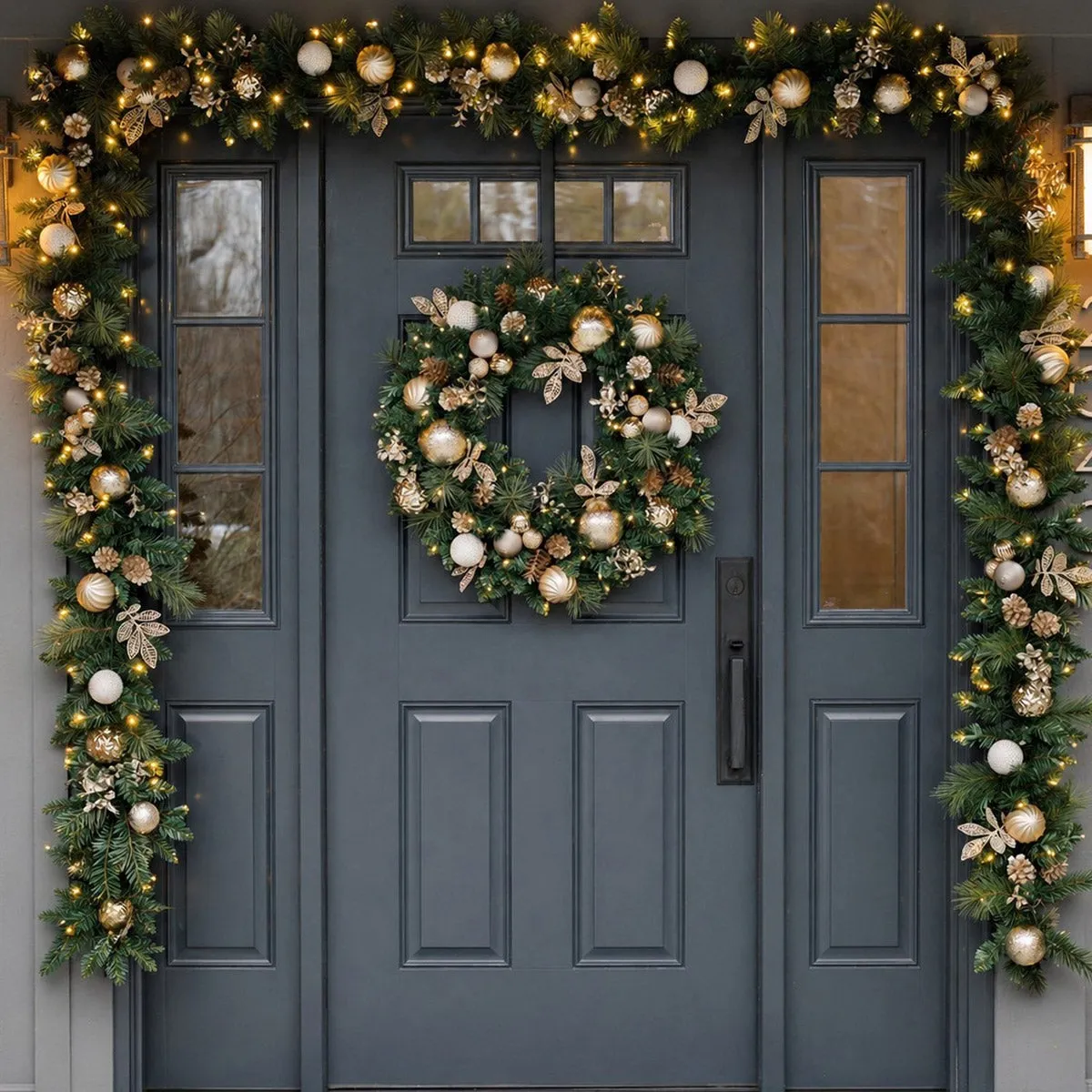
Gold finishes are the most fragile thing here. Cheaper ornaments use a sprayed coating that chalks and flakes after a season or two outdoors, especially in wet climates. Look for shatterproof ornaments with a lacquered finish, and store them in a zip bag with a silica packet. The garland over a painted door will also leave faint marks over time — put a strip of painter’s tape behind the wire if you care about the finish.
Dark doors with gold trim is the holiday version of a trend that’s been running in interiors for three years: deep saturated color plus warm metal. It reads luxurious without needing luxury materials, which is exactly why it’s all over Pinterest this season. It also has real staying power, because it isn’t tied to red-and-green Christmas at all — swap the ornaments for silver and it becomes a New Year’s door.
28. The Lit Teddy Bear That Stops the Whole Street
A lit figure this large is a commitment, not a decoration. It needs a dedicated outlet or a hefty extension cord, it’s an easy target for wind, and it will be the loudest thing on your street in a good way or a bad way depending on your neighbors. Anchor it with ground stakes and sandbags. An illuminated figure running 12 hours a night will also need new bulbs or a full replacement within two or three seasons, so store it dry and off the concrete floor.
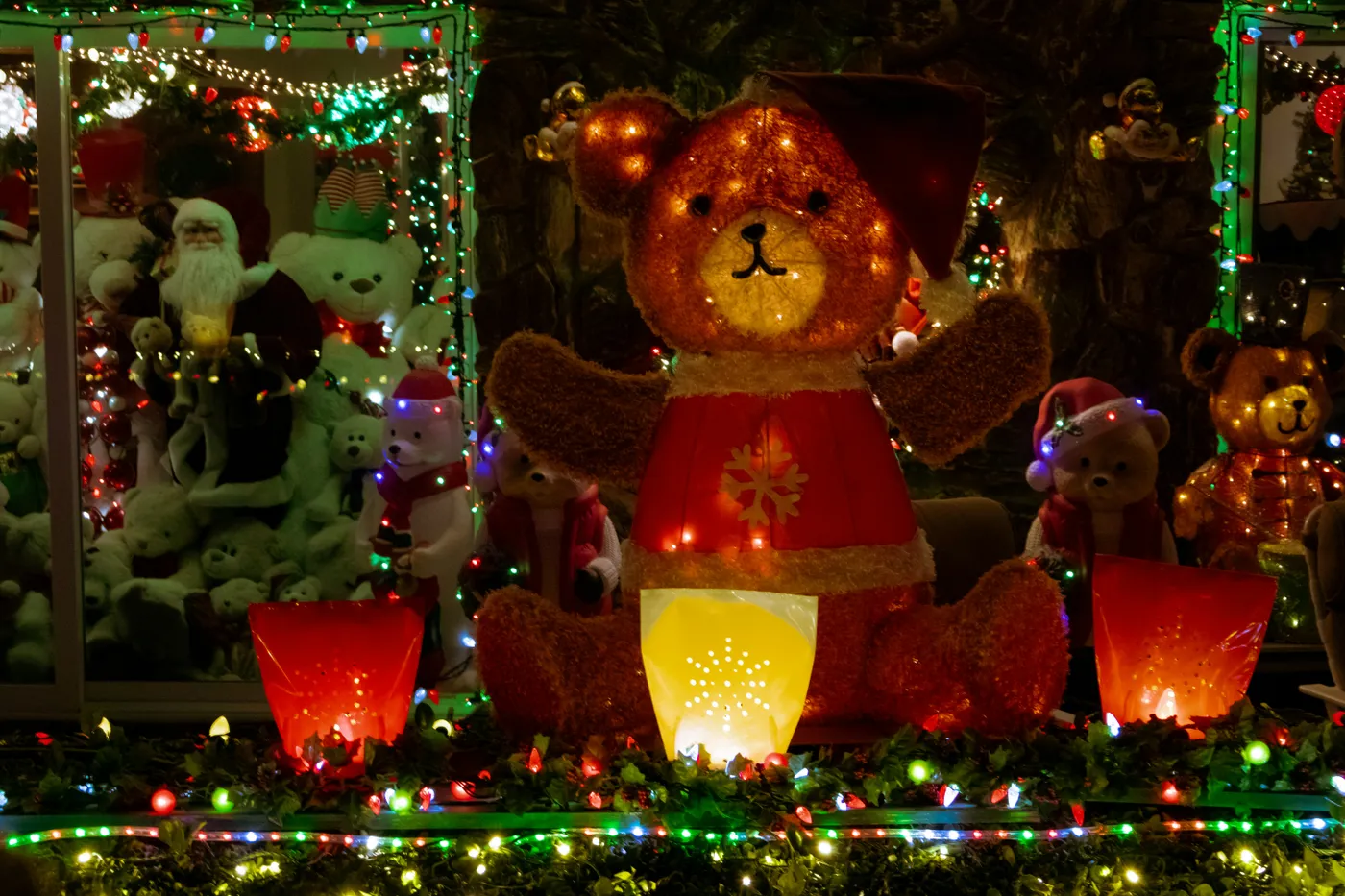
Figure displays need a front yard at least 20 feet deep so people can take in the whole vignette from the sidewalk. On a shallow 10-foot setback, the bear ends up nose-to-nose with the porch and the effect is lost. Keep the figure roughly one-third the width of your frontage — a 12-foot-wide yard can handle one bear, not two. If your yard is smaller, the planter-scale storytelling in Idea #26 gives you the same charm in a fraction of the space.
29. Dried Apples and Star Anise on a Red Ladder
- Check that your ladder or hook can hold the wreath’s weight — dried fruit adds up fast.
- Confirm the wreath base is faux or preserved; fresh evergreen dries and drops against warm siding.
- Test one dried apple slice first — humidity turns them soft and they can mold against greenery.
- Decide your backdrop before you build; this wreath needs a matte, weathered surface to read well.
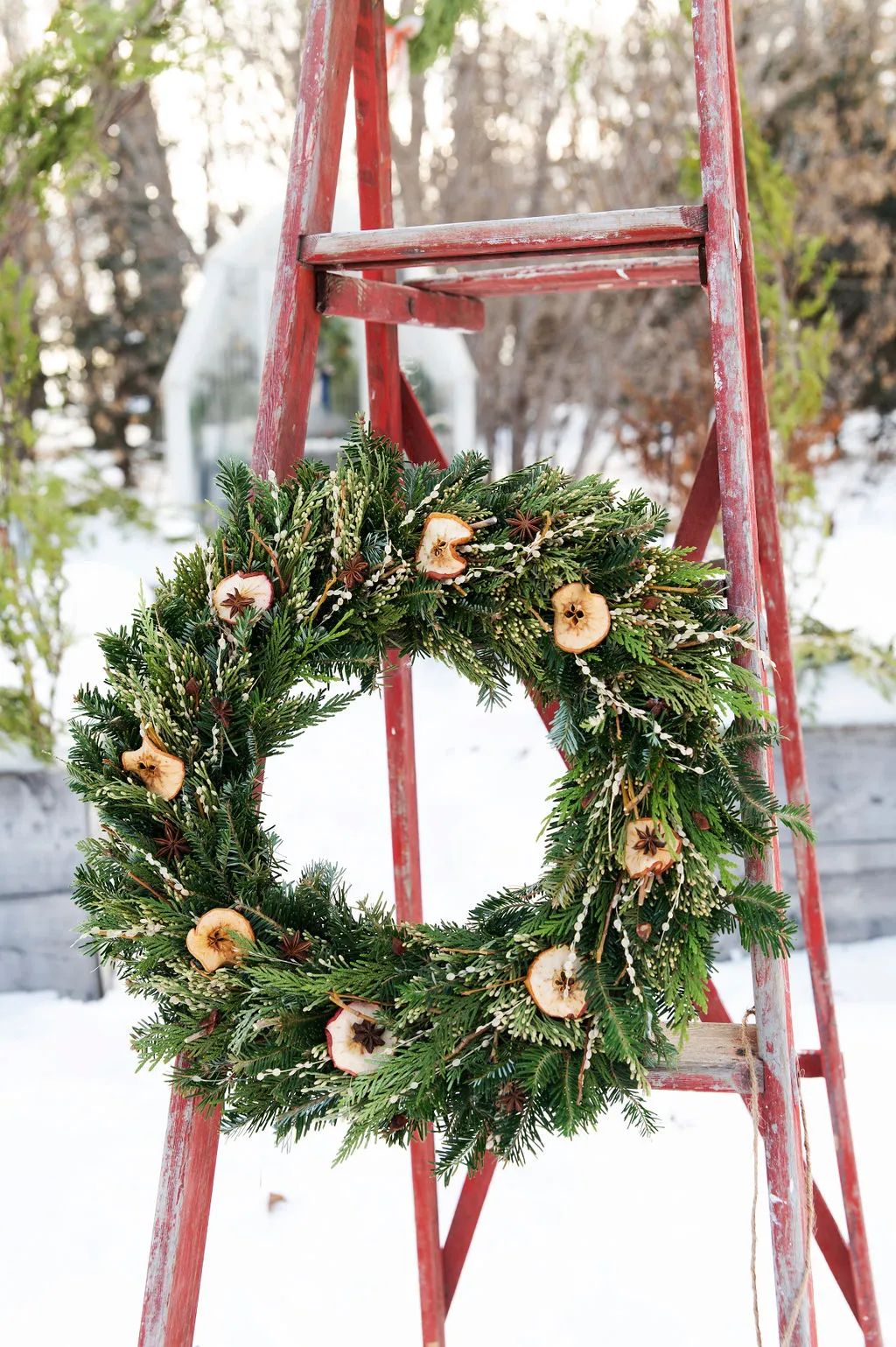
Dried apple slices cost about $4 worth of apples and a few hours in a low oven. Star anise is $5 for a bag that lasts several seasons. The wreath base runs $12–$18 at a craft store, and white berry sprigs are a dollar-store find. The red ladder is the splurge — but a thrifted step ladder plus a can of barn-red paint is a $20 afternoon. Whole project, under $60.
30. Bottle Brush Trees Under a Cream Ribbon Bow
Scale is the whole trick. A miniature village inside a lantern works because the container creates a frame and a limit — your brain accepts the tiny houses as a scene rather than as toys. The cream ribbon and twig wreath do something important too: they stop the lantern from reading as dorm decor. Adding natural materials to the outside of a container tells the eye it belongs outdoors. The same principle applies to any planter you put together this season.
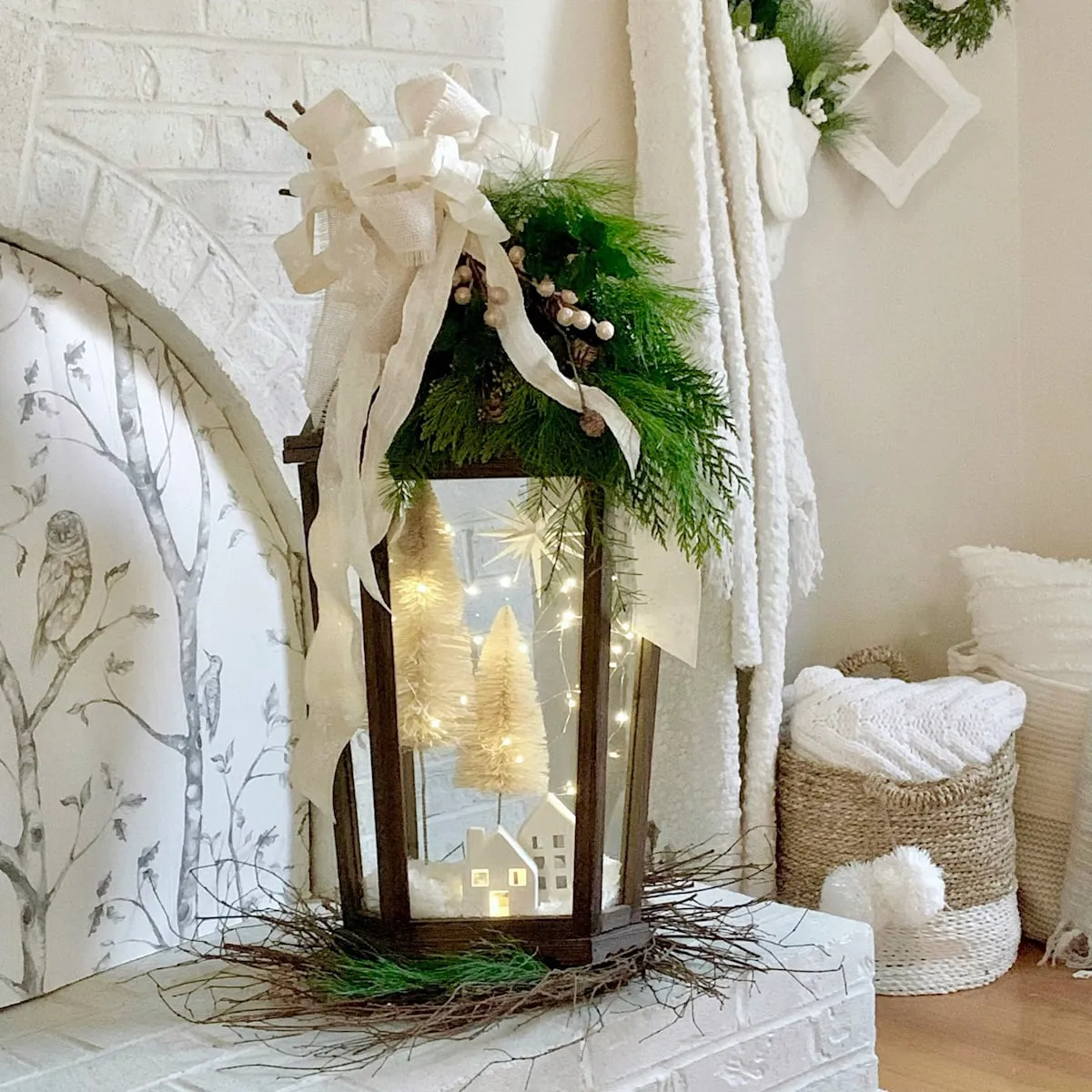
The fairy lights hidden behind the houses. Light a miniature scene from the front and it flattens into a diorama. Run the strand behind the buildings and the light rakes across the trees, giving the whole interior depth. It’s the difference between a lantern with stuff in it and a lantern with a place in it. Bundle the excess cord at the bottom, and use a battery pack you can reach without opening the glass door.
31. Poinsettias by the Dozen at a Light Blue Door
Poinsettias on stone steps need containers at least 10 inches across, or the whole arrangement looks like an afterthought — small pots vanish against grey stone. Cluster three pots of different heights rather than lining up identical ones in a row. And if your steps get salted, keep the pots on a hidden saucer or a mat. Salt spray scorches poinsettia leaves within days, and the foliage is the entire point of using them.
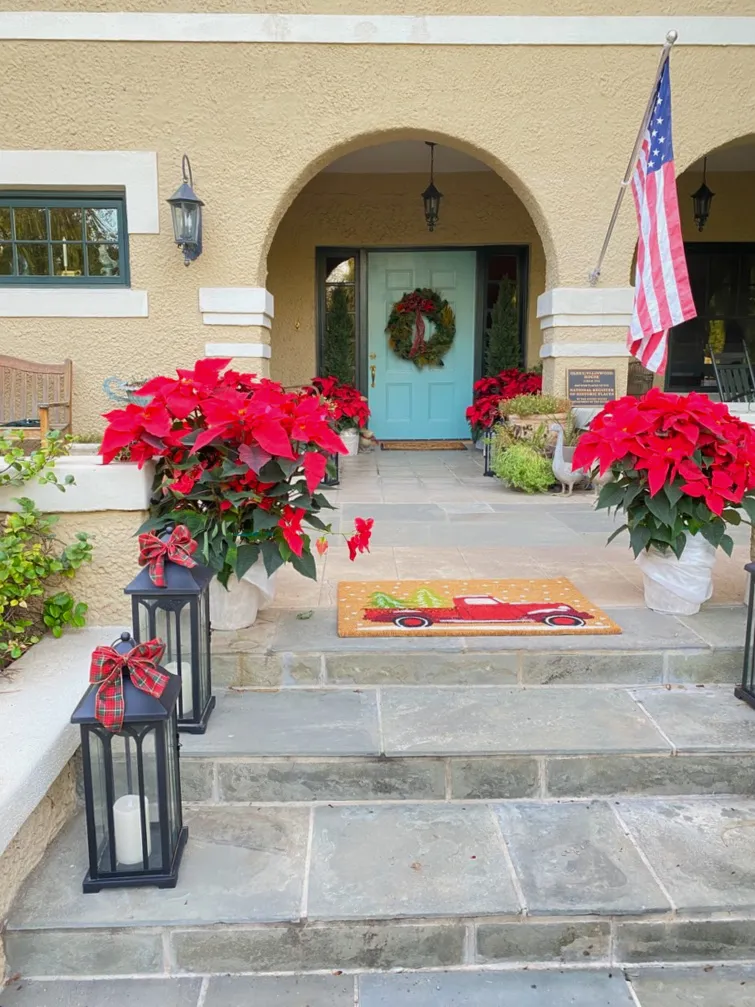
- Main furniture & planters — 6–8 potted poinsettias: $60–$180
- Lighting — none required: $0
- Textiles — red truck doormat: $20–$40
- Decor — green wreath + 2 black lanterns with plaid bows: $50–$120
- Paint/wall treatment — none: $0
- Total: $130–$340
Budget alternative: real poinsettias are the cost driver. Faux stems at $4–$6 each from Walmart bring the whole display to around $60–$110, and the second season costs you nothing.
This one loves a wide, shallow porch. Stone steps at least 4 feet wide can take a poinsettia on each side without blocking the path; anything narrower and you’re down to two pots on the landing. The arch above is a bonus — it frames the blue door and gives the wreath somewhere to visually hang from. Entryways narrower than 4 feet should move to a tight, door-hugging treatment instead.
Your Porch Is One Weekend Away From Looking Exactly Like This
You don’t need thirty-one ideas — you need two: one treatment for the door and one for the ground. Everything else is repetition, and repetition is what makes a porch look designed instead of decorated. Start with the light temperature, pick your palette from the formulas above, and let the rest of December be the fun part.
📌 Pin your favorites now so you’re not scrolling in a cold driveway on December 14th wondering what you bought.