31 Jaw-Dropping Colorful Christmas Tree Ideas You Need to See for 2026 That Will Turn Heads
Colorful Christmas trees are having a major moment on Pinterest right now — and the 2026 versions look nothing like the multicolor tree your grandmother put up.
We spent serious time combing through Etsy, Target, Walmart, Amazon, and Anthropologie to bring you only what’s worth your attention this year, and every idea here lands somewhere between $6 and $420. After filtering through hundreds of ornaments, garlands, and tree setups, we kept the 31 that actually deliver.
Inside you’ll find rustic naturals, ombre rainbows, acrylic light sculptures, saturated pinks, and handcrafted felt collections — with budget and luxury versions compared side by side.
The shift tracks a bigger 2026 move away from the all-white neutral holiday. People are painting rooms in saturated colors and building trees that can hold their own against the walls.
And stay until the end — we break down the most common mistakes that can ruin these looks.
📌 Save this to Pinterest for later — you’ll want to revisit these ideas.
1. Rustic Red and Gold Tree Against a Wood-Paneled Wall
Working with a dense, full tree? Follow the ten-per-foot rule: a 7-foot tree wants roughly 70 large statement ornaments before you add a single filler. Here, gold and deep red spheres do the heavy lifting while pinecones and novelty pieces stay capped at about 20 percent of the total. That ratio keeps the metallics reading as one continuous field of light rather than a junk drawer of memories.
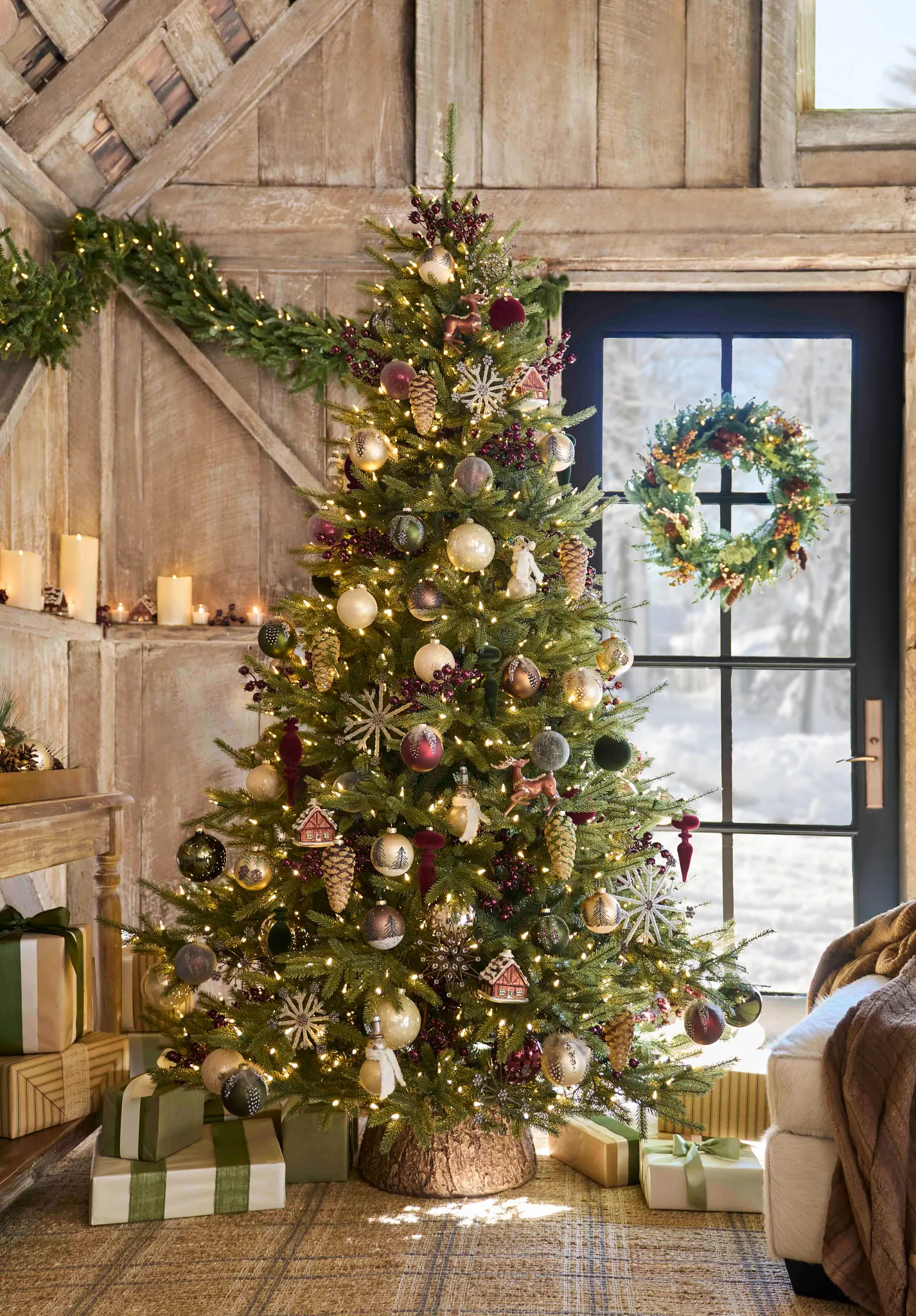
The lighted greenery garland draped across the wood paneling is doing more work than anything on the branches. It pulls the glow three feet past the tree and turns the wall into part of the display. Take it away and the tree becomes a bright object sitting in a dark room — the paneling goes flat and the gold ornaments lose the reflected warmth that makes them look expensive.
2. A Pre-Lit Spruce Softened by Wood Slat Paneling
Two things are happening here. First, contrast: a cool-leaning forest green tree against warm beige wood slats keeps the green from going gray in indoor light. Second, repetition — the vertical slat lines echo the tree’s upward shape, so the whole corner feels intentional rather than plopped down. The framed mountain print above adds a third green note, tying wall art to branches without a single ornament in common.
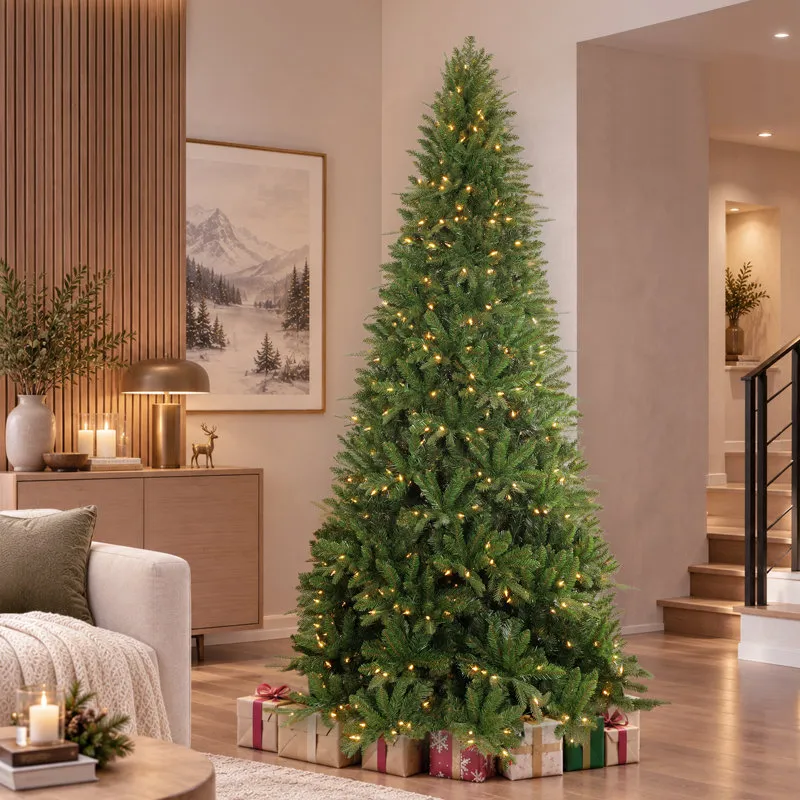
Roughly 60 percent light beige and cream (slat panel, sofa, gift wrap) plus 30 percent forest green (tree, artwork, a few ornaments) plus 10 percent brass and warm white light. Swap the beige base for warm greige and the brass for matte black and the formula still holds. Keep the green at 30 percent, no more, or the room tips into holiday-shop territory.
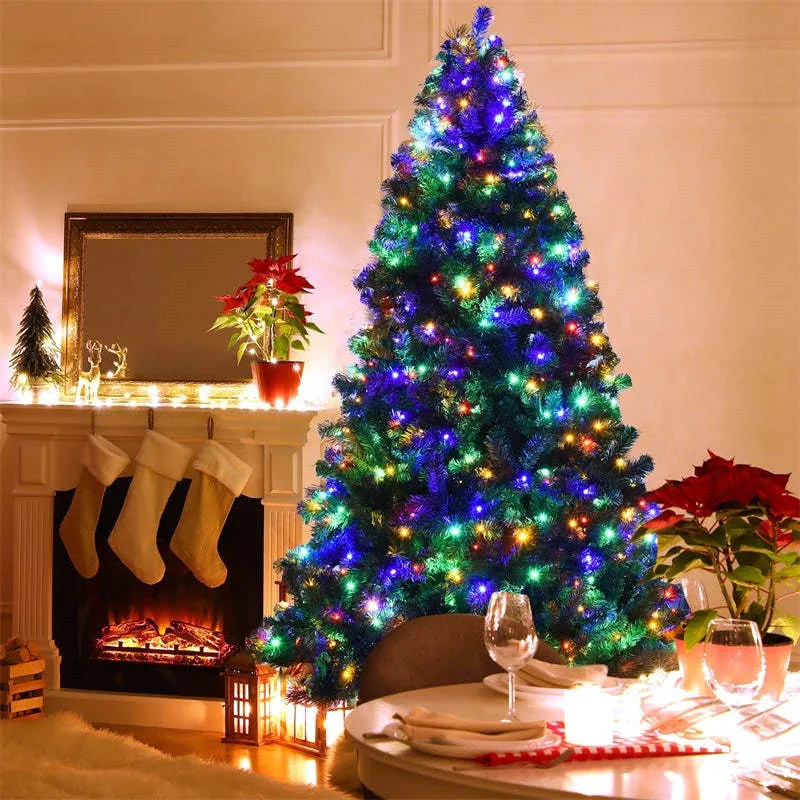
3. Multicolor LED Lights on a Full 7.5-Foot Spruce
Here’s what a 7.5-foot pre-lit tree with 550 multicolor LEDs actually runs:
- Pre-lit spruce with multicolor LEDs: $180–$450
- Mixed-size ornament set: $75–$250
- Tree collar or skirt: $25–$80
- Timer, spare bulbs, extension cord: $15–$40
- Wrapping paper and ribbon: $20–$60
Total: $315–$880. Budget alternative: a Walmart or Big Lots 7-foot pre-lit tree at $99–$160 with two thrift-store ornament bags at $8–$15 each gets you most of the look for closer to $180.
A 7.5-foot tree needs an 8-foot ceiling at minimum for the tree alone; add a topper and you’re looking at 8.5 to 9 feet of clearance. Floor footprint runs 48 to 56 inches wide, so a 10-by-10 room is the realistic minimum — and keep it 12 inches off the wall so the back branches aren’t crushed. A 6-to-7-foot tree suits apartments far better.
4. Wood Bead Garland and Dried Oranges on a Rustic Tree
Dried orange slices, start to finish:
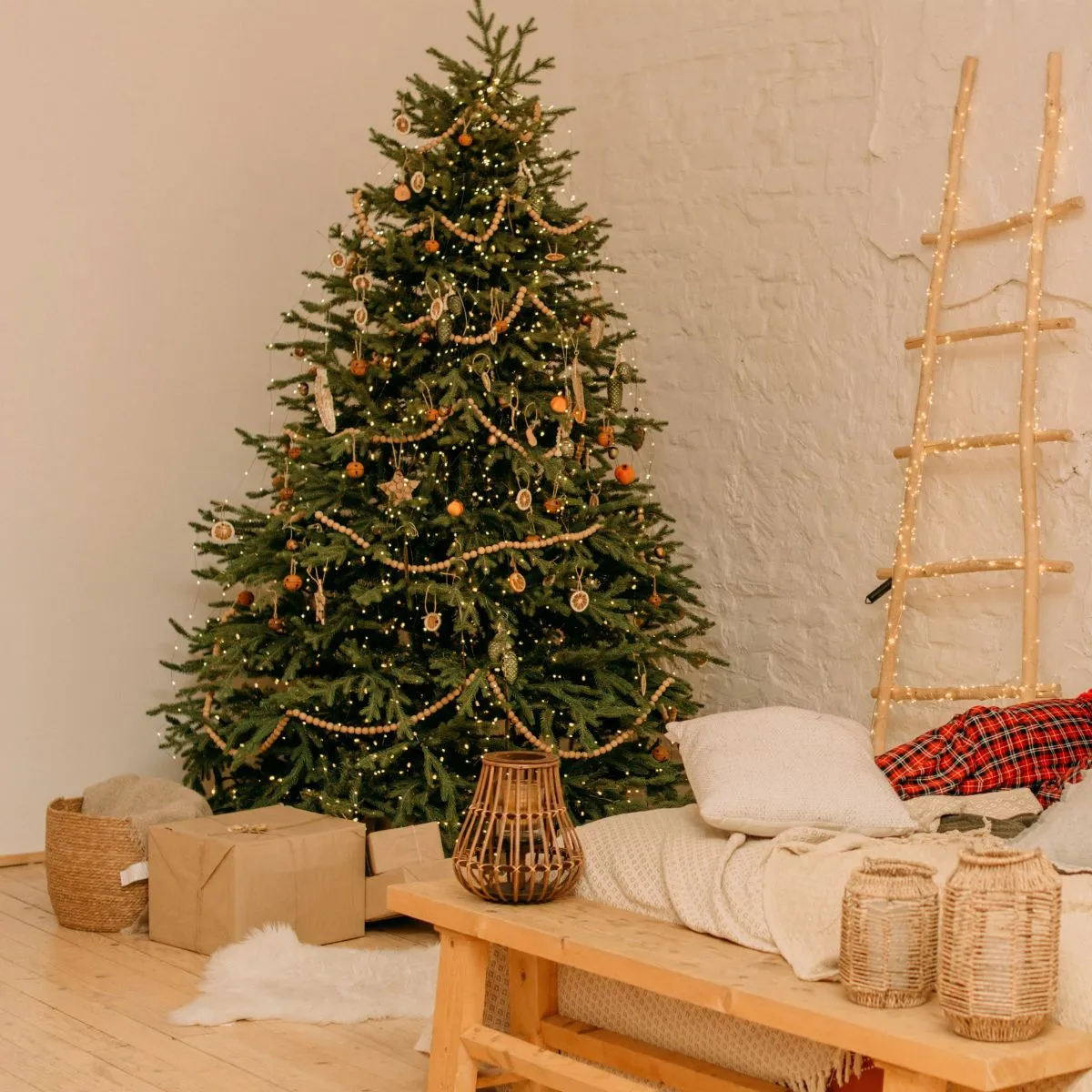
- Slice navel oranges a uniform 1/4 inch thick and blot both sides with a towel.
- Lay them flat on a parchment-lined sheet — no overlap, no stacking.
- Bake at 200°F for 2.5 to 3 hours, flipping once at the halfway mark.
- Cool completely on a rack; anything still tacky goes back in for 20 minutes.
- Poke a hole 1/2 inch from the edge with a skewer and thread baker’s twine.
Cost: about $6 for a dozen slices. Time: 3.5 hours, most of it unattended.
Dried citrus is fragile. Thin slices snap when you move them, and if they aren’t fully dehydrated they’ll mold inside a humid house — you’ll smell it before you see it. Keep them off the bottom third of the tree if you have toddlers or a dog with a long reach. Wooden bead garlands are the tougher option: they last a decade, but they’re heavier than ribbon and sag if you skip a branch.
5. Multicolor Lights Glowing Against Coral Pink Walls
The all-white holiday backdrop is losing ground. Color-drenched rooms and saturated wall paint have been the dominant decorating story of the mid-2020s, and people who painted a coral or terracotta room aren’t repainting it for December. So the tree has to hold its own against a bold wall — and multicolor lights do, where a single-tone white strand can look washed out. The paper chain garland on the mantel is the tell: craft-store nostalgia is back in a real way.
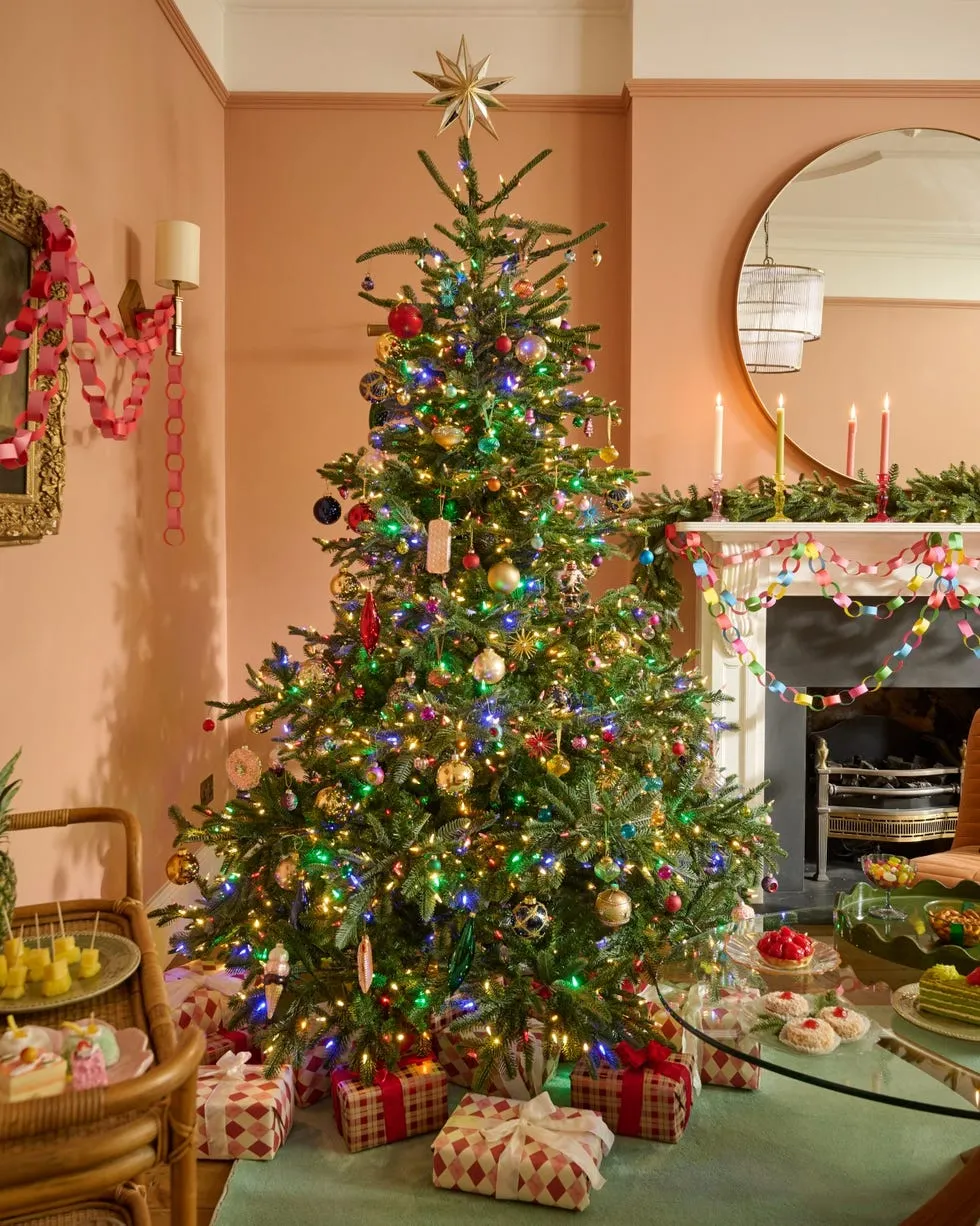
Coral pink and deep green sit close to opposite each other on the color wheel, so the tree reads as vivid without any added decoration. The white mantel does the quiet job — it gives the eye a neutral landing strip between a saturated wall and a saturated tree. Without it, the room would be one long color argument. Notice how the gold star and gold ribbon echo each other across the view, keeping the chaos composed.
6. An Ombre Rainbow Tree That Fades Silver to Red
The gradient is the expensive-looking part, and it’s mostly labor. Sort whatever ornaments you own into four color families, then fill gaps with budget packs: Target and Walmart sell 30-piece ball sets for $12 to $20, and dollar-store beaded garland runs $1.25 a strand. A hand-strung bead garland — 200 beads on fishing line — costs about $12 in materials. Total for a full ombre makeover: under $90. Compare with the acrylic light sculpture in Idea #20, which gets its color from light instead of ornaments.
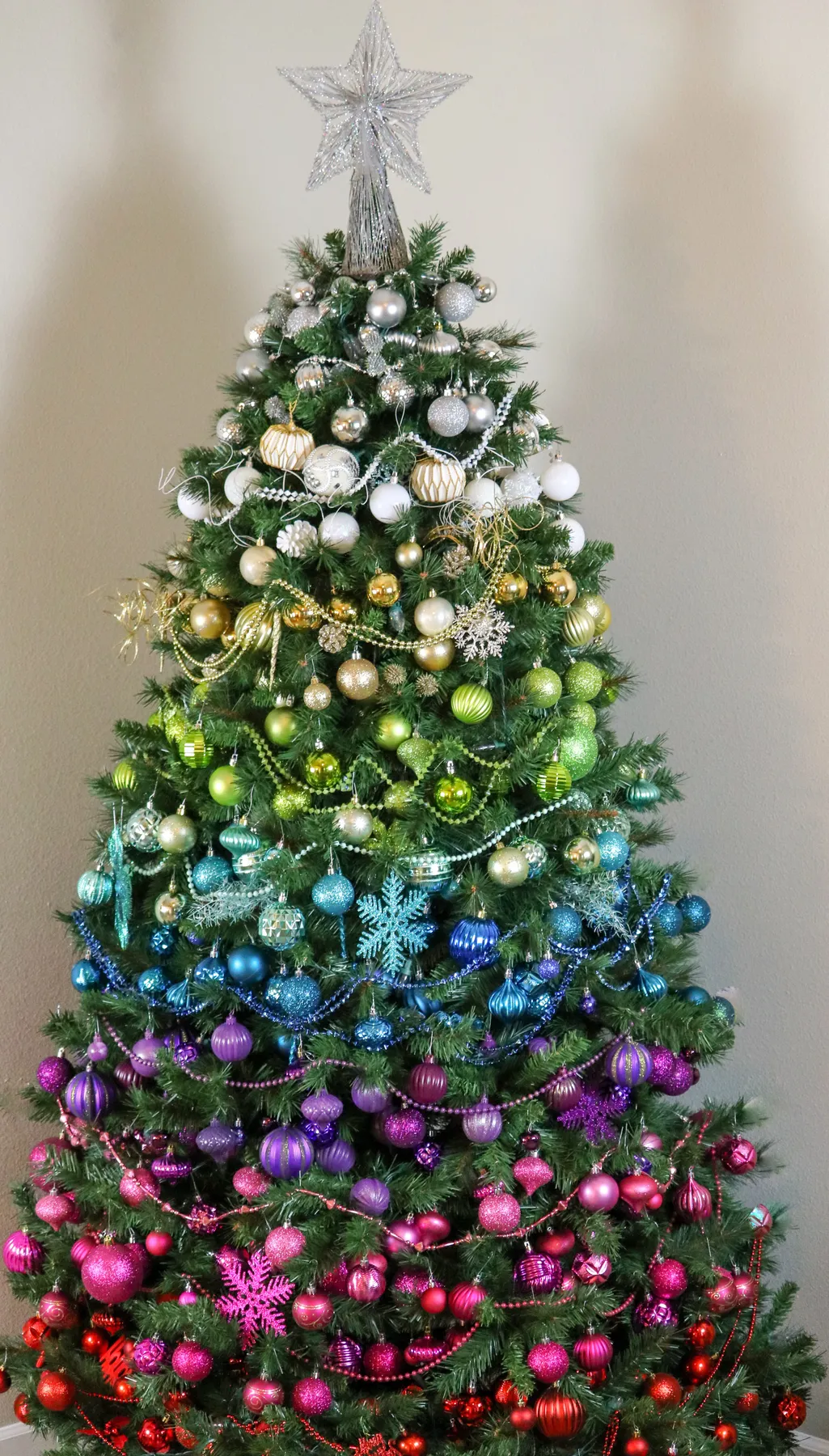
Before hanging anything, divide the tree into four horizontal zones and decide the color for each. Then commit: within a zone, keep sphere sizes consistent and mix only the finishes — matte, glitter, pearl. The gradient reads because color changes while scale doesn’t. If sizes and colors both shift every few inches, the ombre turns into confetti. Run the beaded garland in one continuous spiral rather than looping it at each zone.
7. Fuchsia, Magenta and Glitter, Head to Toe
The oversized glitter snowflake cutouts. They’re flat, they’re cheap, and they’re the reason this tree has depth. Round baubles bounce light back at you, but a flat shape catches light and casts a shadow — so you get silhouette in a tree that would otherwise read as a solid ball of pink. Pull them out and you still have a pretty tree. You just lose the layering that makes people stop and look twice.

Glitter is a commitment. Expect a fine dusting on the tree skirt, the floor, and your hands for the whole season, and expect to find it again in July. A damp microfiber cloth handles the tree collar; a lint roller handles the rug. Matte magenta ornaments show dust, so a monthly wipe-down keeps them saturated. Store everything in tissue or individual bags — loose glitter ornaments rubbing together in a bin come out patchy.
8. Pink and Orange on a Flocked Tree by the Stone Fireplace
About 50 percent white and light stone (flocked branches, fireplace surround, mirrored credenza) plus 35 percent hot pink and orange, plus 15 percent gold with a few purple spikes for bite. Swap the orange for cobalt and the same formula goes cool and graphic. Swap the flocking for a plain green tree and you’ll need to push ornament share to 40 percent — flocking is doing free work as a neutral.
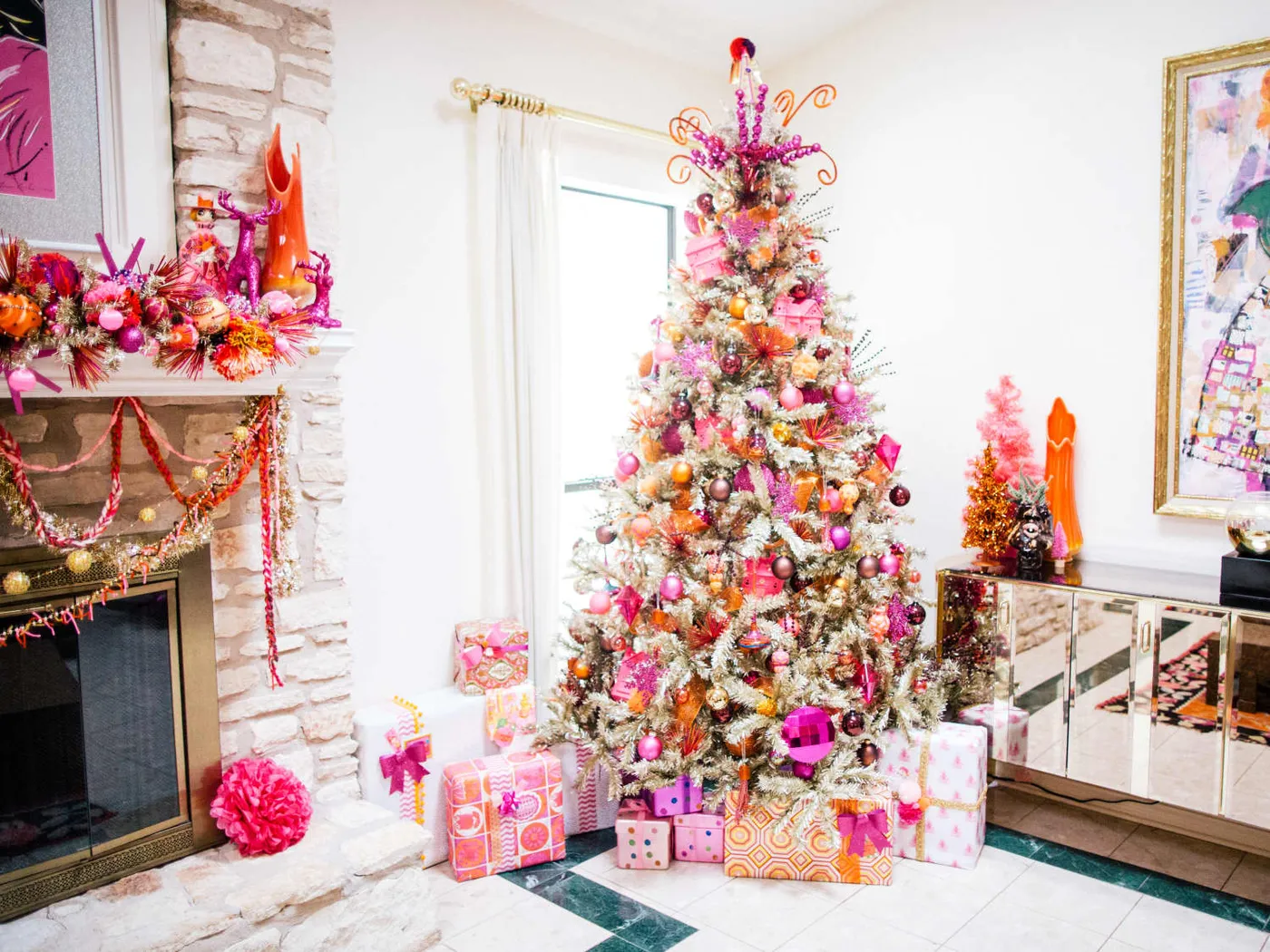
Run through this first:
- Measure ceiling height — flocked trees plus a curly topper run tall fast.
- Decide how much snow you’re willing to vacuum; flocking sheds for the first two weeks.
- Confirm the mantel can carry a full garland and anchoring hooks.
- Test ornament colors against the stone — warm grays dull orange, cool grays sharpen it.
- Pick where gifts land before you build; a mirrored credenza shows every stray box.
9. Pink and Red Maximalism in a White-Walled Living Room
Busy tree plus busy patterned rug is a lot of competition — the white sofas are what keep this from tipping over, and they’re also the reason flocking becomes a twice-a-week vacuum job. Before you copy the palette, look at your own floor. A boldly patterned rug already doing the talking may need a calmer tree, or a solid-colored one underneath to separate them. Compare with Idea #6, where a single-color gradient does the same job with less noise.
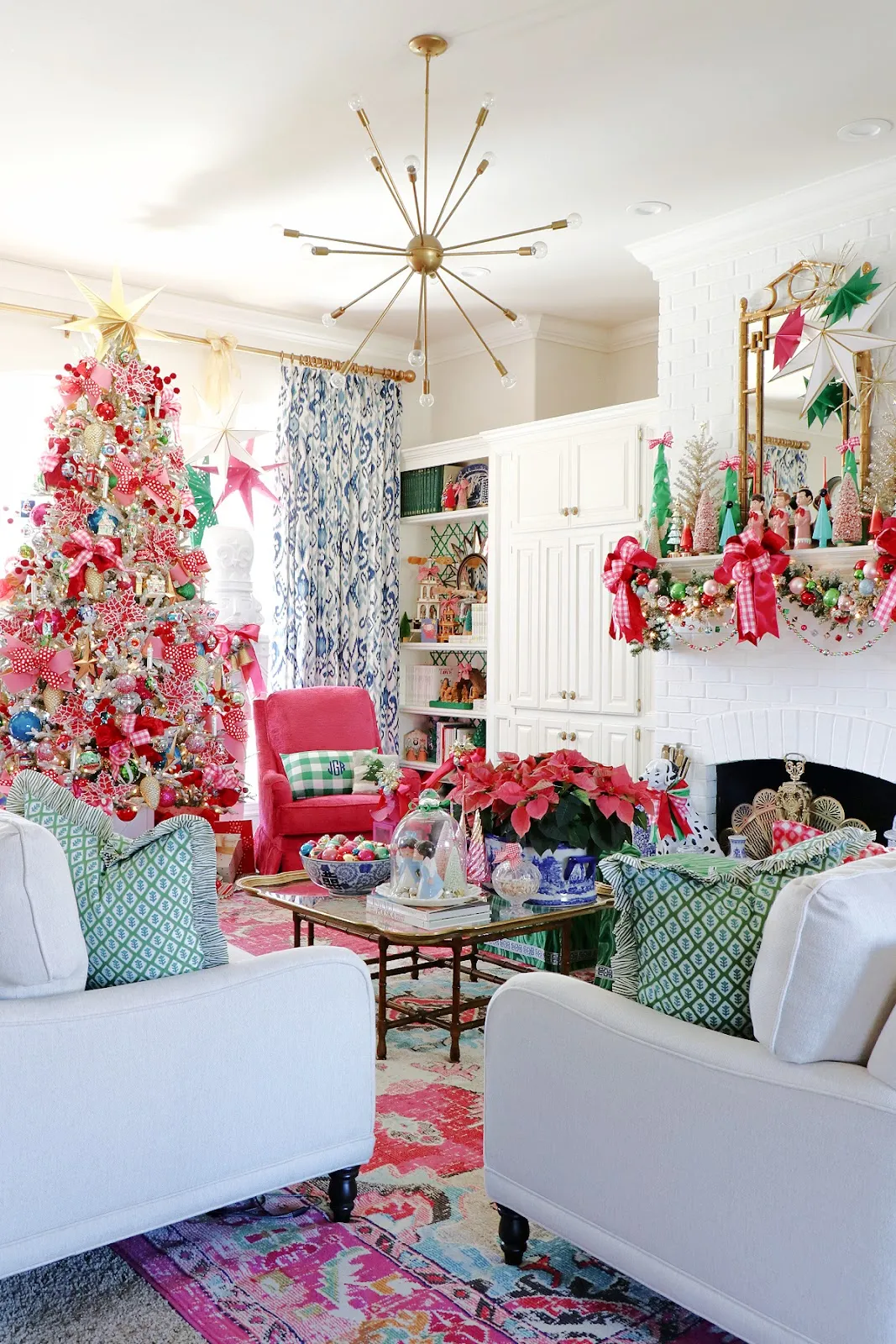
Pink shows up three times — armchair, ornaments, ribbon — and that repetition is what reads as intentional rather than accidental. The brass sputnik chandelier is the second trick: it repeats the gold from the star and garland while sitting far enough away to feel like a separate decision. Red stays in the ornaments only, which is why it punches instead of shouting. Two colors, one metal, three locations each.
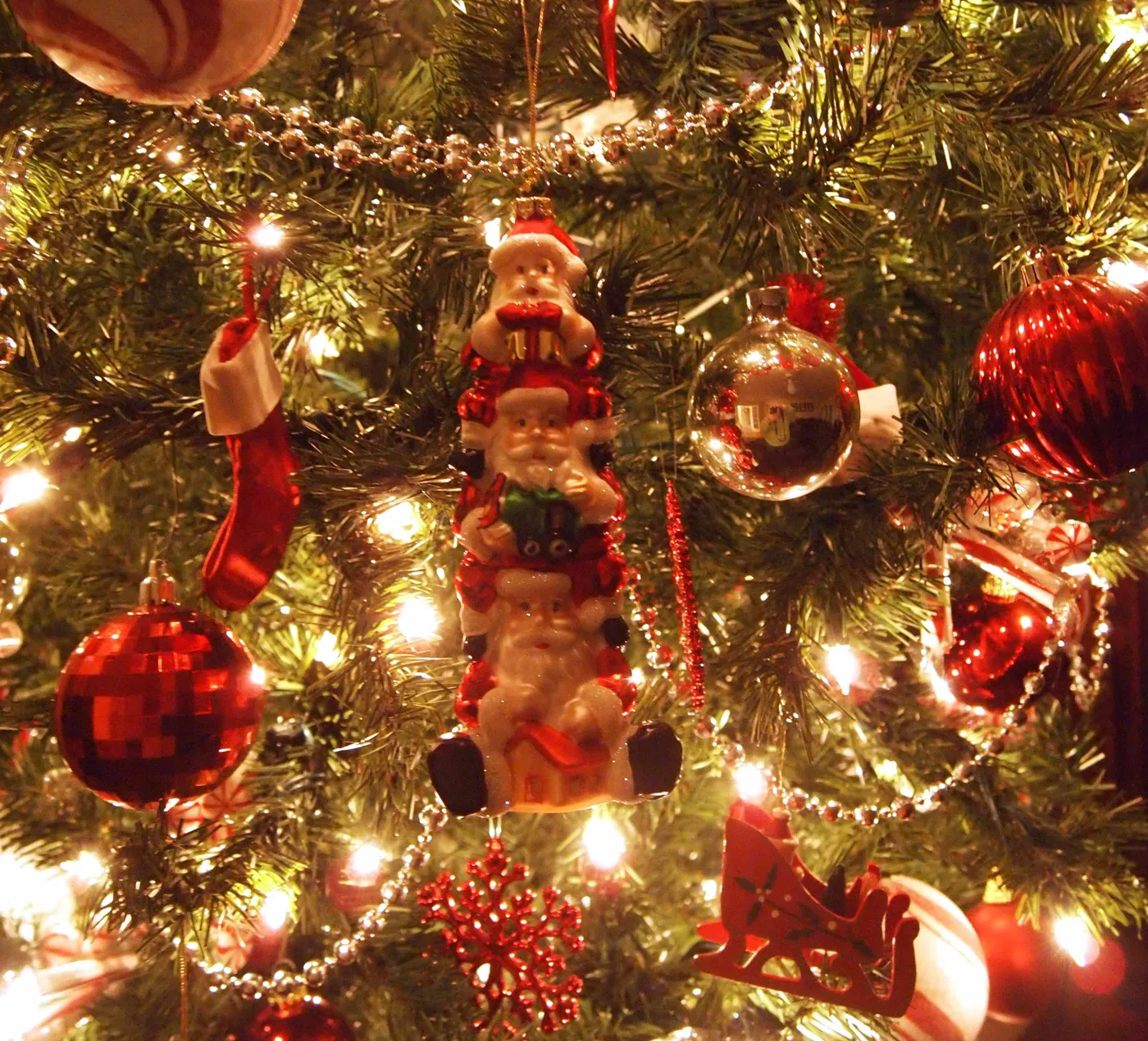
10. Red, White and a Stacked Santa in the Branches
Hanging a beaded garland so it doesn’t droop:
- Measure tree height and cut roughly 1.5 times that length of garland.
- Anchor the top end behind the leader branch, not on it — the topper hides the knot.
- Spiral down with one full loop every 18 to 24 inches, resting each pass on a branch.
- Twist small pipe cleaners around the garland at each loop so it can’t slide.
- Fluff branches over the garland so it looks nested, not draped.
Twenty minutes, about $10 in supplies.
A red-and-white tree can tip into candy cane fast. The fix is a third finish, not a third color: keep red ornaments in shiny, matte, and glitter versions and repeat each at least six times so the eye reads texture rather than a stripe. Add exactly one non-red accent — here it’s the silver beading — and let it live in the garland and the sled, never in the spheres.
11. An Acrylic Spiral Tree Strung With Disco Balls
Mirrored and prismatic holiday decor has been climbing for a couple of seasons, and 2026 is the year it moved off the tabletop and into full-size trees. Part of it is photography — reflective surfaces look incredible on a phone, which is exactly how these rooms get shared. Part of it is practical: a clear acrylic structure takes up visual space without blocking daylight, so small apartments get a tree-shaped glow without a wall of fake pine.
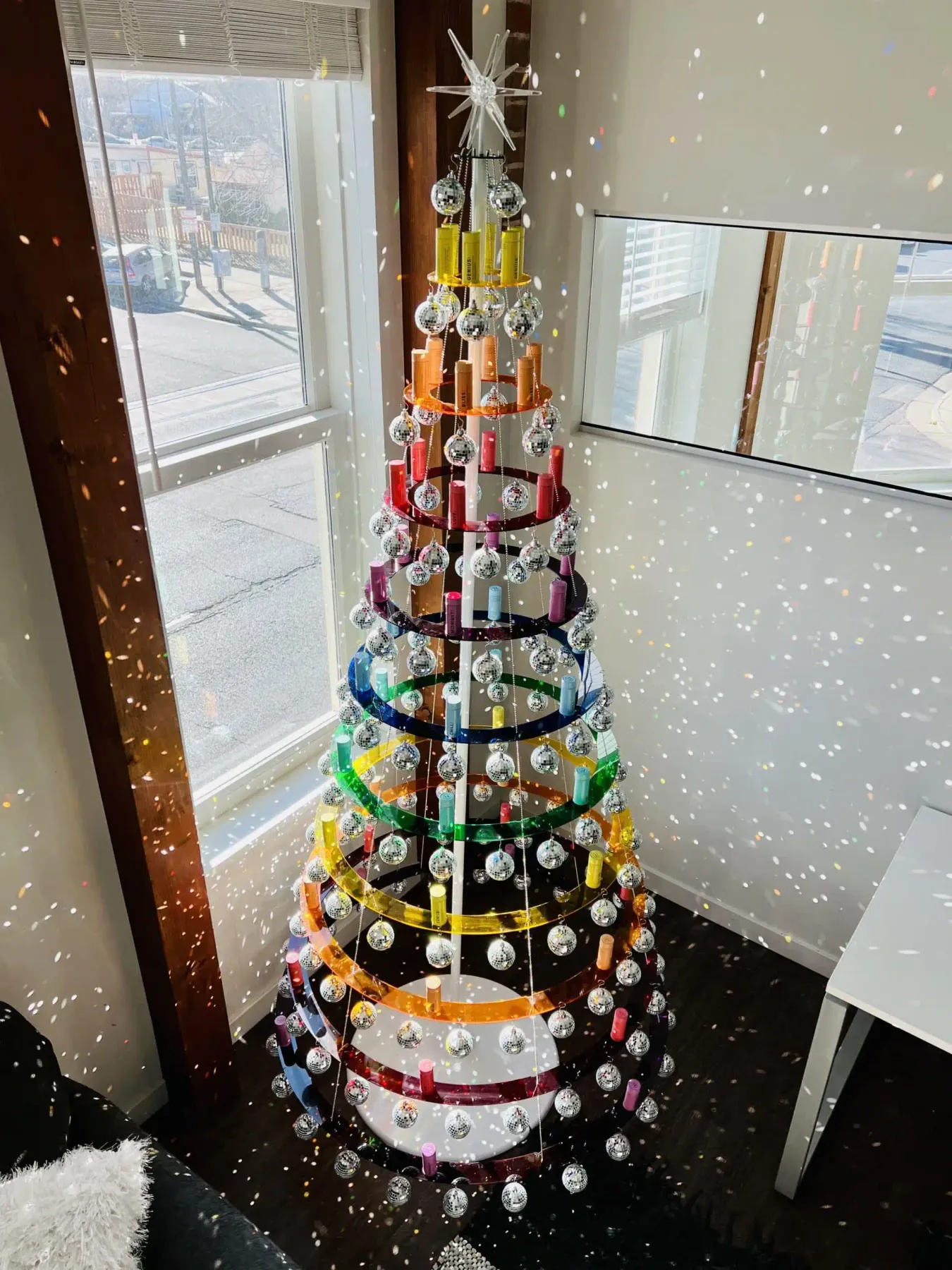
It’s the acrylic rings themselves. Disco balls are everywhere right now; a spiral frame is what turns a pile of them into a tree. The tiered rings hold ornaments at eye level where they catch light from the window, and the gaps between rings scatter sparkle across the white walls. Remove the frame and you have a bag of ornaments. The clear star topper matters too — anything opaque would kill the transparency.
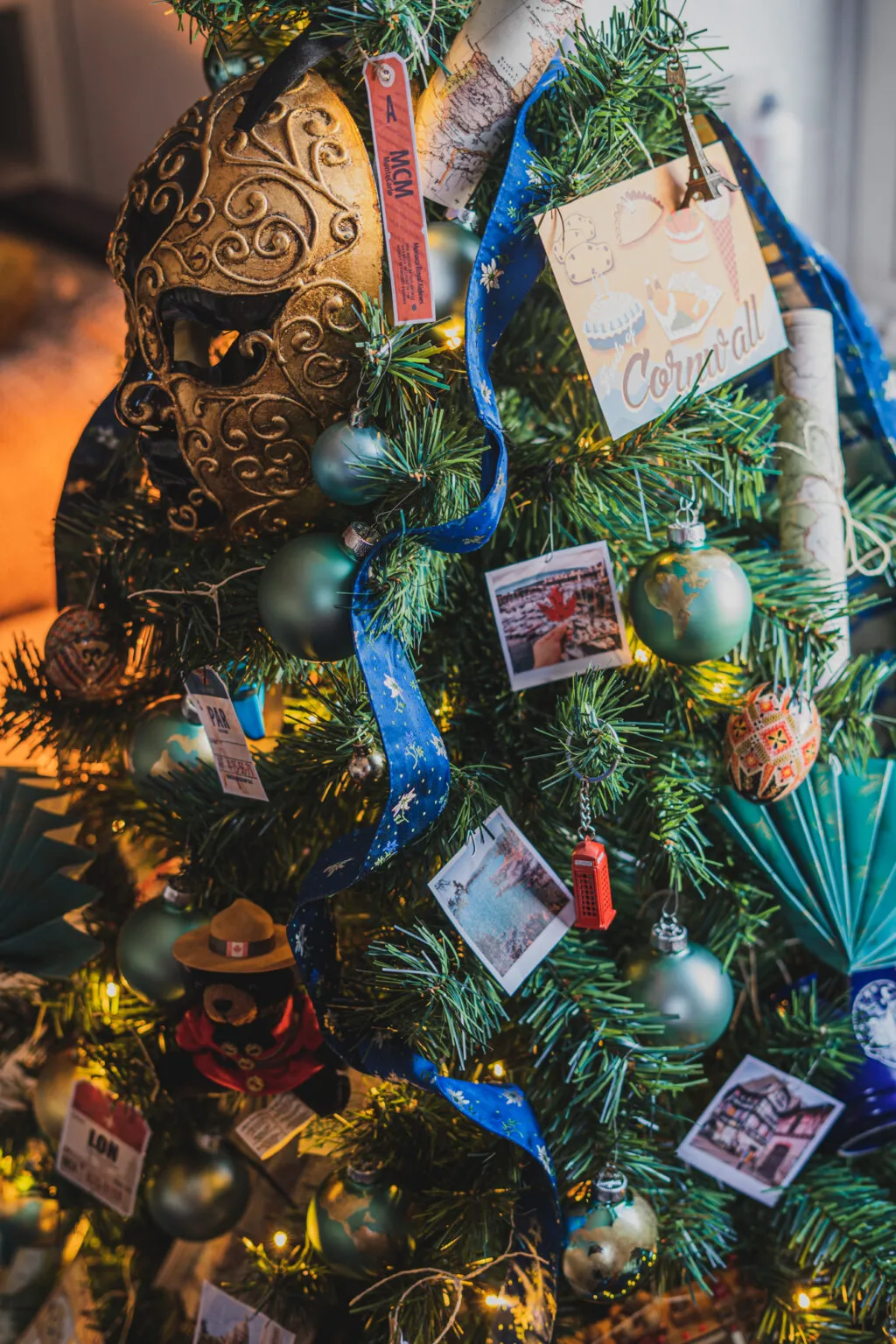
12. A Travel Tree Full of Globes, Maps and Mini Landmarks
A theme tree built from souvenirs costs less than people expect:
- Landmark miniatures and keychains: $8–$20 each
- One statement piece (ornate gold mask): $25–$70
- Globe and matte blue-teal baubles, 40-piece: $25–$60
- Blue patterned ribbon, 3 rolls: $10–$18
- Printed photo ornaments, DIY: $6–$15
Total: $74–$183 plus whatever you already brought home from trips. Cheaper still: print map pages on cardstock and cut them into circles backed with ribbon.
Theme trees only work when a palette carries them. Miniature landmarks, masks, and keychains have nothing in common visually — deep blue, teal, and gold are what make them read as one collection. Choose your two colors first, then buy ornaments to match. Warm string lights do the rest, because they flatter both gold and cool blue, which is not true of daylight-white LEDs.
13. A Chullo Hat Topper and Pom-Poms on a Bright Tree
A textile topper needs a tree that can hold it. On anything under 6 feet, a chullo-style hat reads like a beanie on a shrub — the proportions fight each other. Six to seven feet is the sweet spot, in a room of at least 8 by 8 feet so the topper isn’t crowding the ceiling. Working with a slim 5-foot tree? A woven star or a bundle of matching ribbons will read better than a hat every time.
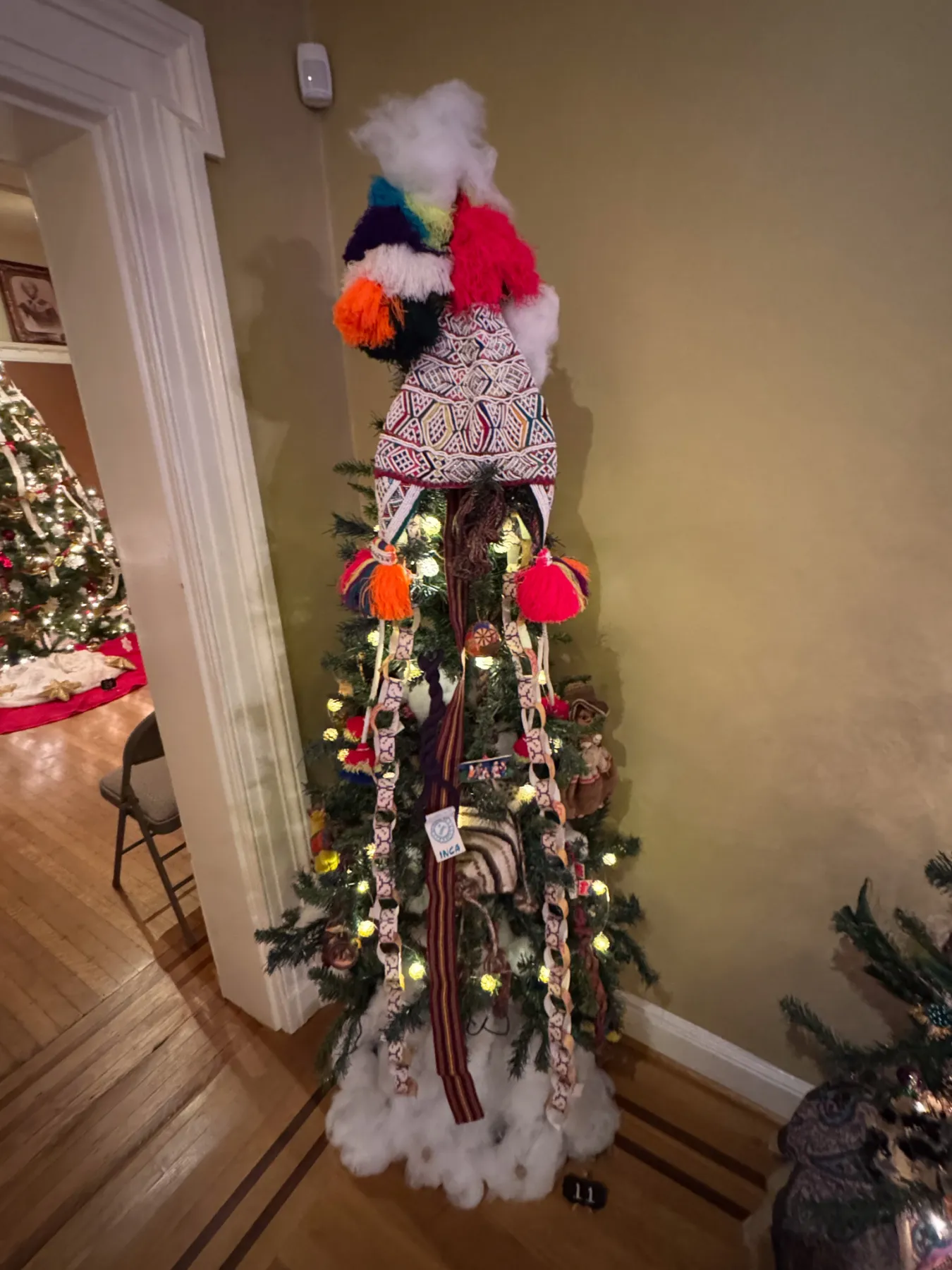
Stuff the hat lightly with polyfill so it keeps its shape from every angle, then anchor it with a thin wooden dowel pushed down the center and zip-tied to the leader branch. Rule of thumb: a topper should run about one-eighth to one-tenth of your tree’s height. That’s around 9 inches for a 6-foot tree. Go bigger and it starts to look like the tree is wearing somebody else’s hat — charming once, tiring by December 20th.
14. Oversized Paper Bows in a Grand Marble Lobby
Scale. The bows are enormous — several times the size of a standard ornament — and that’s the entire design. Against marble walls and a black-and-white checkerboard floor, a tree covered in normal baubles would simply disappear. Oversized bows hold their own in a room built at a grand scale, and the paper-like finish keeps them from reading as cheap foil. Remove them and you have a perfectly nice lobby tree that nobody photographs.
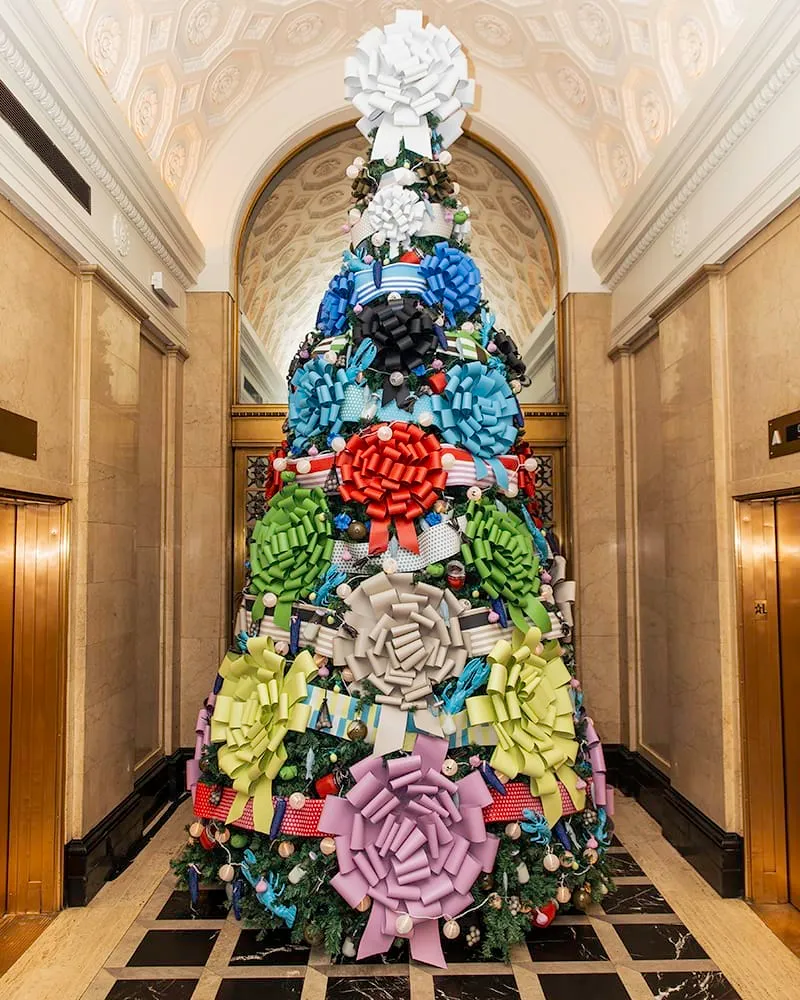
Designer oversized bows run $18 to $40 each, and a lobby tree can easily take thirty. Do the math and it’s over $600 in bows alone. Instead, buy ribbon by the roll — 4-inch to 6-inch width works — and build your own with a simple loop-and-tie technique. Fifty dollars in ribbon gets you thirty bows, plus florist wire, a hot glue gun, and an hour on the couch.
15. The Felt Polar Bear That Steals the Whole Tree
Wool felt is durable, but it’s a magnet. Lint, pet hair, and sweater fuzz stick to it, and hand washing is out once the ornament is stuffed and stitched. A lint roller does most of the work; a soft brush handles the rest. Store felt pieces in acid-free tissue rather than a plastic bin and add a cedar block — moths like wool more than you’d expect, and one casualty a year is the usual tax. Cedar refills run about $8 annually.

Felt absorbs light instead of reflecting it, which means these ornaments look smaller and softer on the tree than glass pieces of the same diameter. Buy handmade felt up one size, and place it in the front 40 degrees of view — the side that faces where people actually sit. More than about a dozen felt pieces on one tree and the reflective ornaments start disappearing behind them.
16. A Pink Felt Llama Wearing Its Own Tiny Garland
Felt ball garlands are one of the easiest things to make at home. Loose wool-blend felt balls run $8 to $20 for a hundred on Etsy or at craft stores; retail-strung garlands of the same length sell for $45 to $70. Thread them on baker’s twine with a needle, knotting every tenth ball so nothing bunches when you drape it. Under $25 for nine feet. The mini garland around the llama’s neck is the same technique with ten balls and a dab of glue, echoing the felt ball garland in Idea #17.
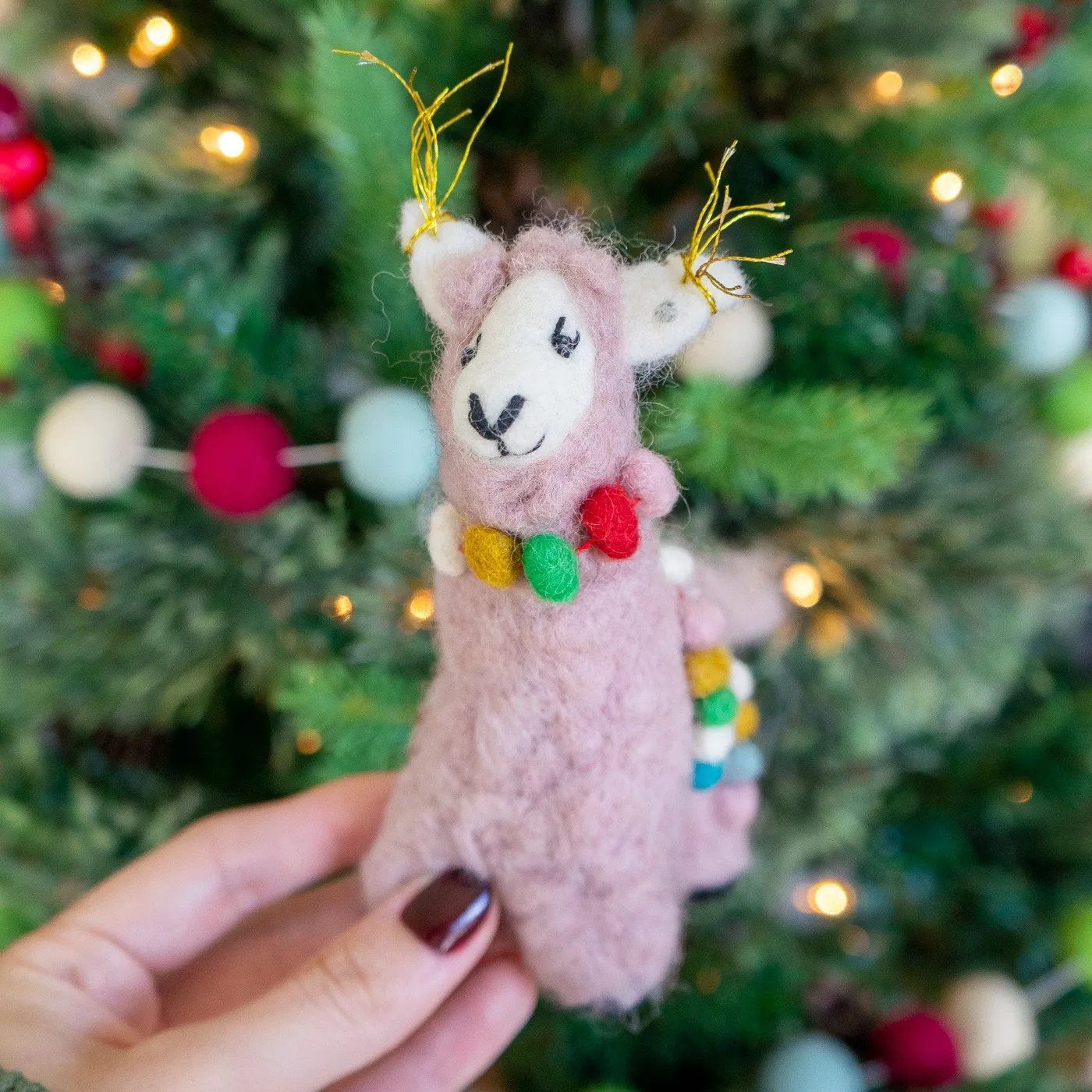
For a felt ball garland that reads intentional rather than random: 70 percent one color family — pinks or creams — plus 30 percent accent, and keep that ratio consistent along the whole length instead of clustering colors in patches. Alternate a 1-inch ball with a 2-inch ball for rhythm. Swap pink for rust and cream and the same garland goes cozy instead of playful.
17. A Wool Raccoon Peeking Out of the Evergreens
Small stuffed ornaments are toys to a dog and prey to a cat. If you have either, keep felt animals above the 4-foot mark and skip low-hanging garlands — a cat can pull an entire felt ball strand down in an afternoon. Loose fuzz around a chewed ornament is the bigger risk. If you love the look and live with pets, display the handcrafted pieces on a wreath or a wall hook instead of the tree.

The felt ball garland in red, cream, and pale blue-green. It’s what keeps the whimsy from turning childish. Without it, a raccoon in the branches could read like a nursery display; the muted vintage palette reframes it as collected craft. Notice the garland colors repeat on the animal itself — that tiny callback is the difference between a themed tree and a tree that just has a theme.
18. A Felt Rainbow Nestled in Fresh Winter Blooms
Styling a small ornament as a centerpiece with fresh flowers:
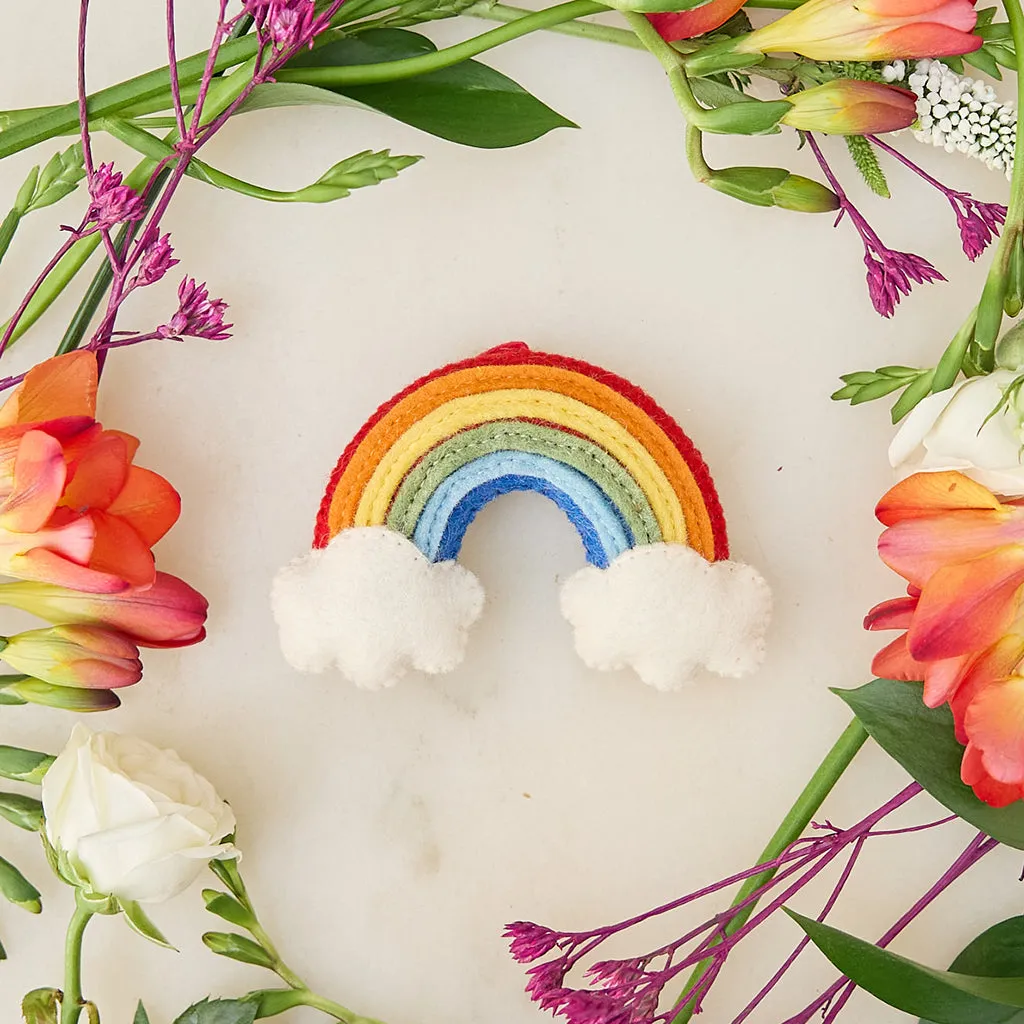
- Choose a shallow dish at least 10 inches across so the blooms don’t crowd the ornament.
- Set a small water cup in the middle and hide it with a bed of damp moss.
- Place the ornament slightly off-center — a third of the way in reads better than dead center.
- Arrange orange and magenta flowers in loose groups of three, never evenly spaced.
- Add trailing greens so the whole thing looks gathered, not installed.
Twenty minutes and about $18 in grocery-store flowers.
Matte felt against glossy petals is the whole trick — the two surfaces read as different materials at a glance, which makes a $12 ornament look curated. The loose, asymmetric arrangement matters too: a tight grid of blooms would frame the rainbow like a product shot. And the flowers repeat colors from the rainbow itself, so the ornament looks placed rather than dropped.
19. Iridescent Rainbow Bauble Beside a Glass Tree
Roughly 60 percent white and reflective surface, 30 percent iridescent — the hero ornament, the glass tree, the blurred lights behind — and 10 percent gold from the ornament cap. Swap the glass tree for clear acrylic and the formula still works. Swap the white surface for dark walnut and the iridescence gets louder, which is a different look entirely. Keep the gold either way; it’s the anchor that says Christmas instead of birthday.
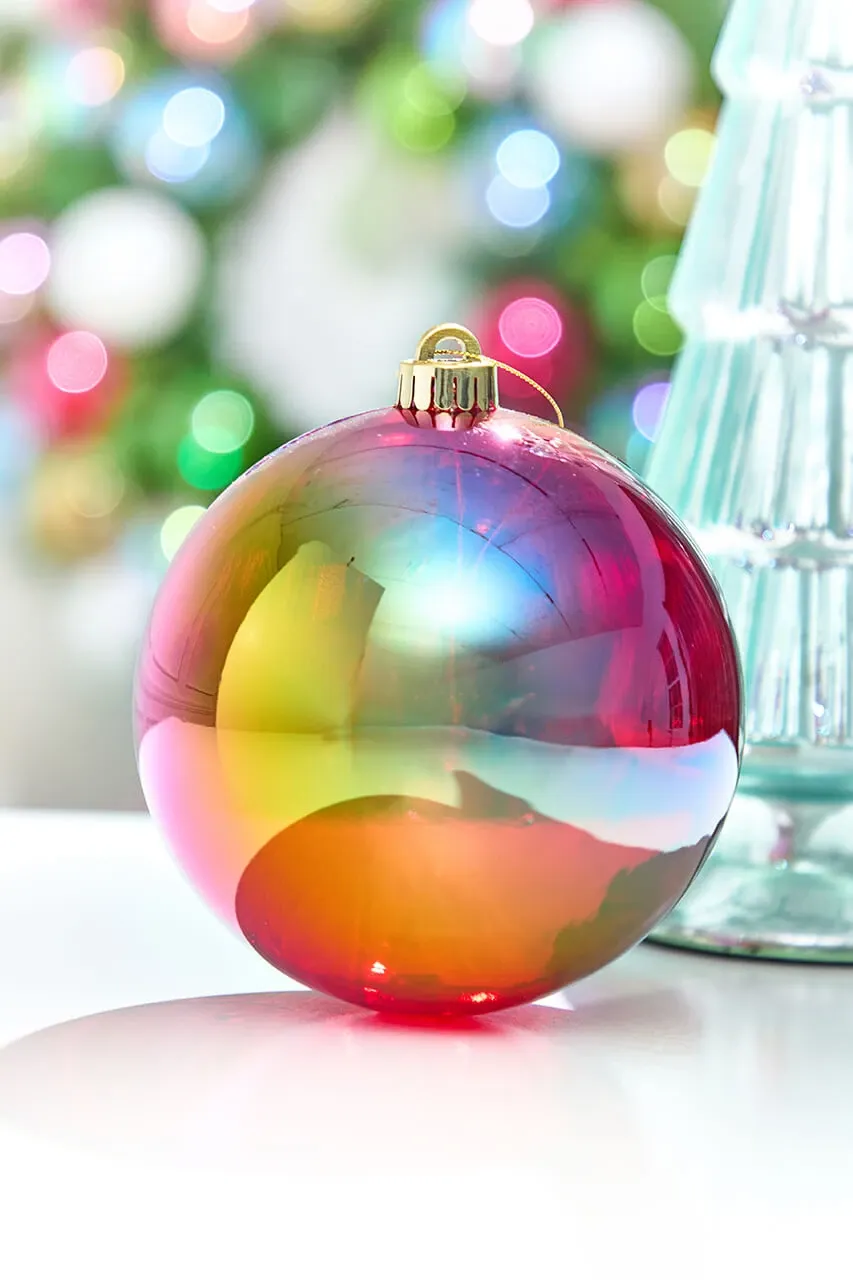
This is a tabletop vignette, not a tree strategy. Give it about 24 inches of surface, with the lights 3 to 4 feet behind the ornament so the bokeh stays soft rather than shapeless. A 4-to-6-inch sphere is the right hero size for a console or entry table. For a full-size version of the same idea, a clear acrylic spiral tree with mirrored ornaments gets you there.
20. A Prismatic Pyramid Tree Built From Light
Internal lights need darkness behind them to read as sparkle. Set a prismatic tree against a matte wall — flat paint or a large flat panel — and the reflections multiply across the surface. Against glossy paint or a mirror, the effect turns into glare and the shape goes muddy. Keep the light source inside the structure rather than wrapped around it, and put the whole thing on a timer; one hour before guests arrive is plenty of warm-up.

Light sculptures have been creeping into holiday decor for a while, and holographic finishes crossed over from fashion into home accessories around 2024. What’s new in 2026 is the price. These used to be boutique pieces; now flat-pack versions ship for under $100, which is why they’re showing up in rentals where a real tree isn’t practical. Staying power? Moderate — people love it for three or four seasons, then pass it along.
21. Four Trees, Four Collars, One Wood Floor
For a multi-tree display against one wall:
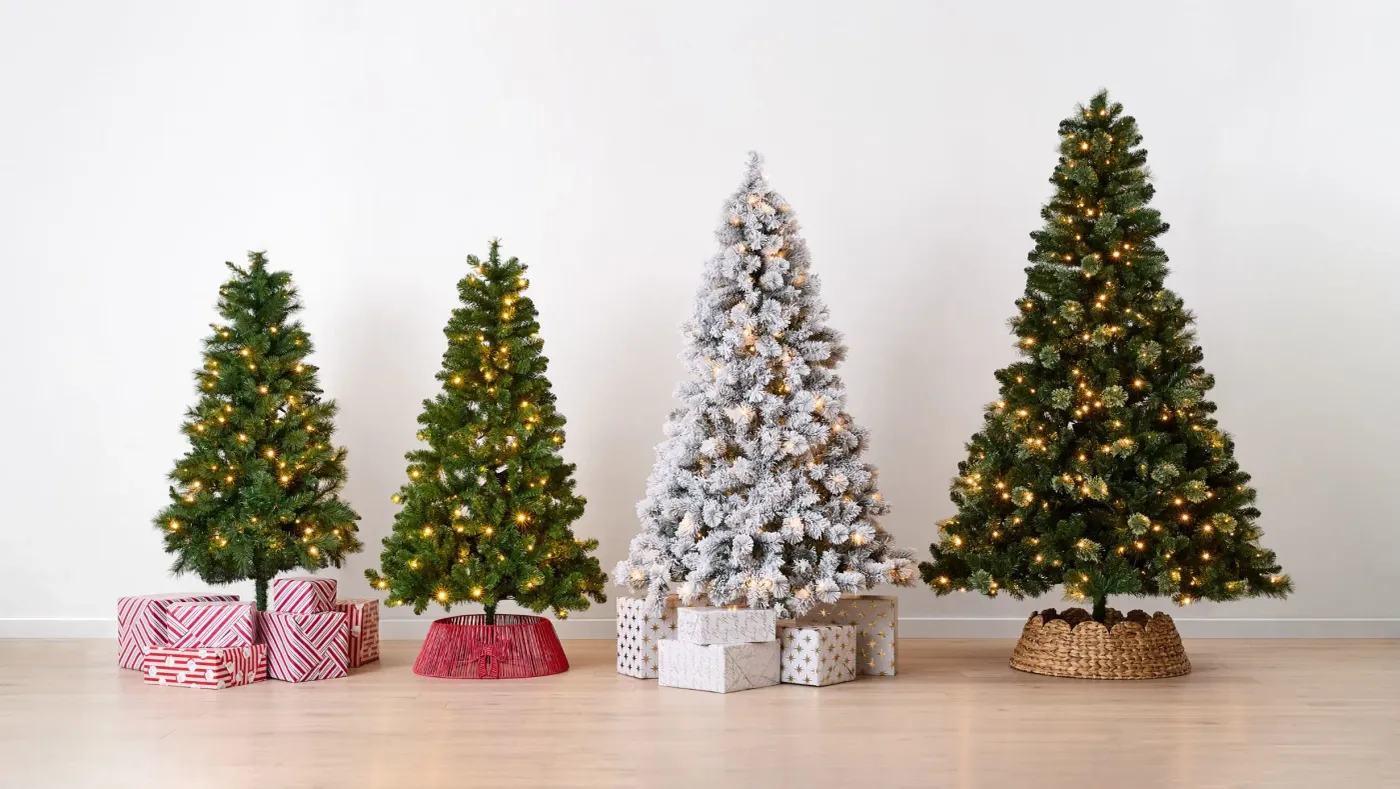
- Pre-lit 4.5-foot trees, three of them: $50–$130 each
- Flocked white tree, 5 to 6 feet: $70–$180
- Woven or metal tree collars: $25–$70 each
- Coordinating gift wrap and ribbon: $30–$80
- Extension cords and one remote power strip: $25–$45
Total: $300–$815. Buy one tree a year in the post-holiday sales and you’ll cut that roughly in half.
Four trees means four boxes. If storage is already at capacity, a three-tree cluster is the practical ceiling, and two of them should share a height so they stack into one bin. Multi-tree displays also need width: give the grouping at least 12 feet of uninterrupted wall, or the trees crowd into a corner where nobody sees the composition. The deep green room in Idea #29 shows what one larger tree can do instead.
22. Rainbow Tinsel Trees Against a Polka Dot Wall
sticking dots on a wall:

- Mark your grid with painter’s tape first — 8 to 10 inches apart reads best.
- Check the wall finish; flat paint holds adhesive dots better than satin or semi-gloss.
- Test one dot in a hidden spot for 48 hours, especially in a rental.
- Plan the removal — a hairdryer on low loosens most adhesives.
- Keep a paint sample or touch-up jar handy for edges that lift.
The oversized metallic ornaments resting on the floor. They look like leftovers, and that’s exactly why they work: without them, the tinsel trees float against the wall with nothing tying the display to the room. Two or three huge balls on a shaggy pink rug create a base line, so your eye travels floor to tree to dots instead of stopping in the middle. Big plastic ornaments run $6 to $12 apiece.
23. A White Tree Wired With Gradient Rainbow Lights
A slim white tree in the 5-to-6-foot range fits where full trees won’t. You need about 6 by 8 feet of floor, and 18 inches of clearance from a fireplace or radiator — the candles here want at least that much. If your ceiling is 8 feet, cap the tree at 6 feet so the light gradient has room to read top to bottom. In tighter rooms, the frosted corner tree in Idea #25 covers the same footprint with less glow.
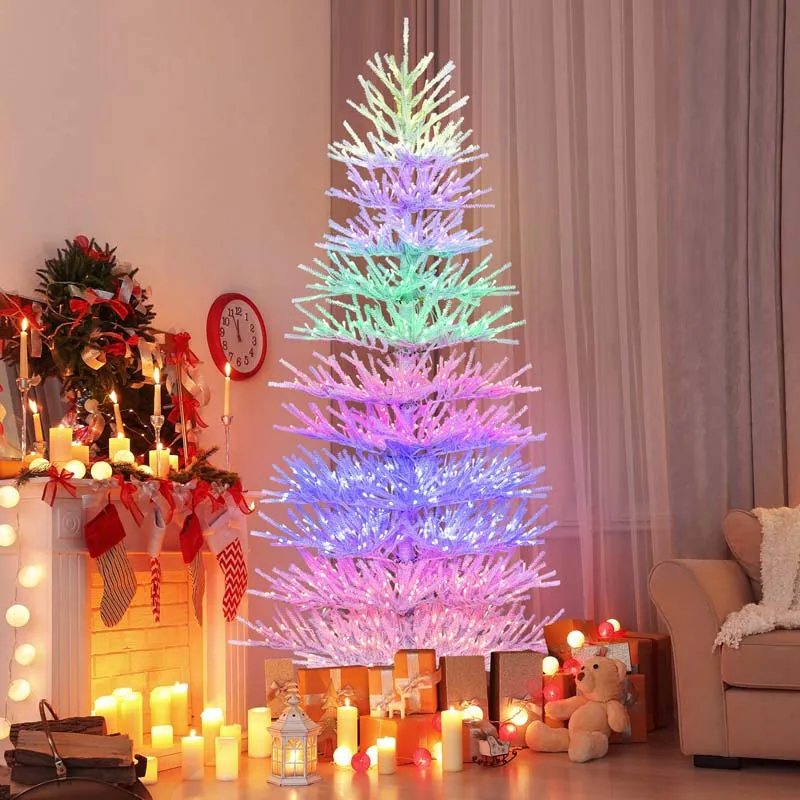
White trees show everything: dust on the branches, fingerprints on the stand, a smear of glitter that never fully comes off. A soft brush or the upholstery attachment on your vacuum, once a month, is the whole routine. The LED candles are the real cost — battery versions eat four to six AA cells each per season, so rechargeable candles pay for themselves in about two years. Buy two spare boxes of bulbs at the same color temperature, because gradient strands are hard to patch later.
24. A Maximalist Tree in Front of Peacock Chinoiserie
The wallpaper is doing the heavy lifting, and the tree is answering it. Emerald foliage, deep red ornaments, and teal pillows pull straight from the peacock motif — so a heavily decorated tree reads as part of the wall instead of a fight with it. The gold sunburst mirror centers everything and bounces light back onto the branches. It’s a maximalist room that works because nothing introduces a color the wallpaper hasn’t already approved.
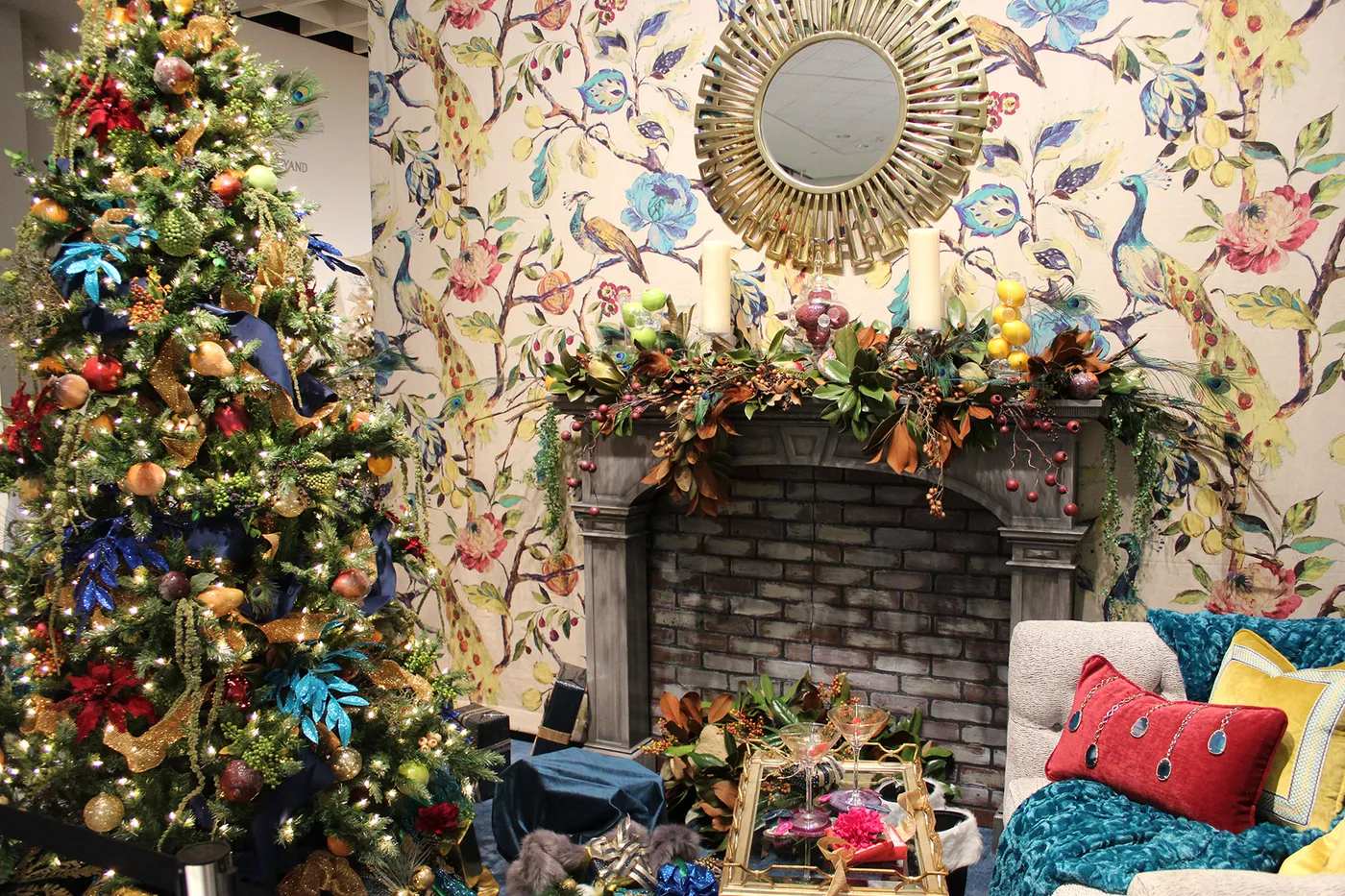
Real chinoiserie wallpaper runs $300 to $900 per roll installed, which is a lot for a seasonal look. Peel-and-stick mural panels in a peacock or floral pattern start around $40 to $90 for a 4-by-8-foot section, and they come down without a trace — which matters in a rental. Pair them with a faux fireplace insert ($120 to $250) and a thrifted sunburst mirror ($25 to $60) and you’re at a fraction of the cost.
25. A Frosted Spruce in a Blue and White Toile Corner
Flocking sheds, and blue-and-white toile is unforgiving about it — every stray white fleck lands on a pattern where it shows. Vacuum the tree skirt and floor weekly with a brush attachment, and shake out any textile that lives nearby. Also check the wicker collar’s weight: a full 7-foot tree in a wicker base is awkward to move alone, so assemble it exactly where it’s going to stand.
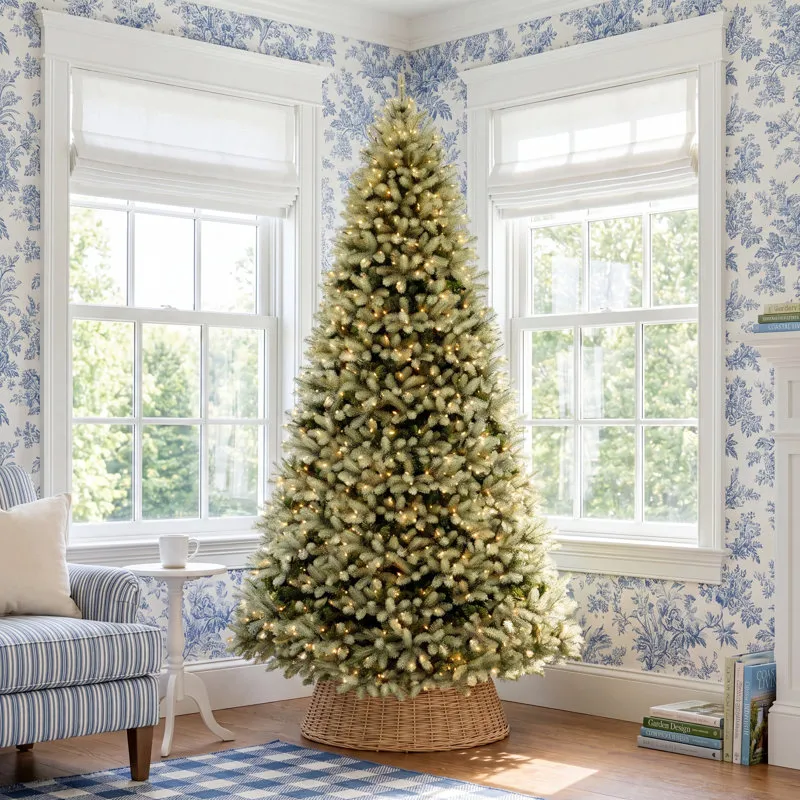
About 60 percent blue and white (toile wallpaper, striped armchair, window trim), 30 percent frosted green with warm light, and 10 percent natural wicker and wood. To warm it up, swap the blue-and-white stripes for cream and camel. To cool it down, trade the wicker collar for galvanized metal. The frosted tree stays constant — it’s the neutral that lets the blue do the talking.
26. The Colossal City Tree Ringed With Illuminated Angels
Multicolor lights are back. After more than a decade of warm-white-only displays, public tree designers are mixing saturated reds, greens, and blues again, and the crowd response has been strong enough that private displays are following. The illuminated angel figures and starburst lights in the foreground are the other half of the trend: the tree is the backdrop and the surrounding light field is the actual attraction.
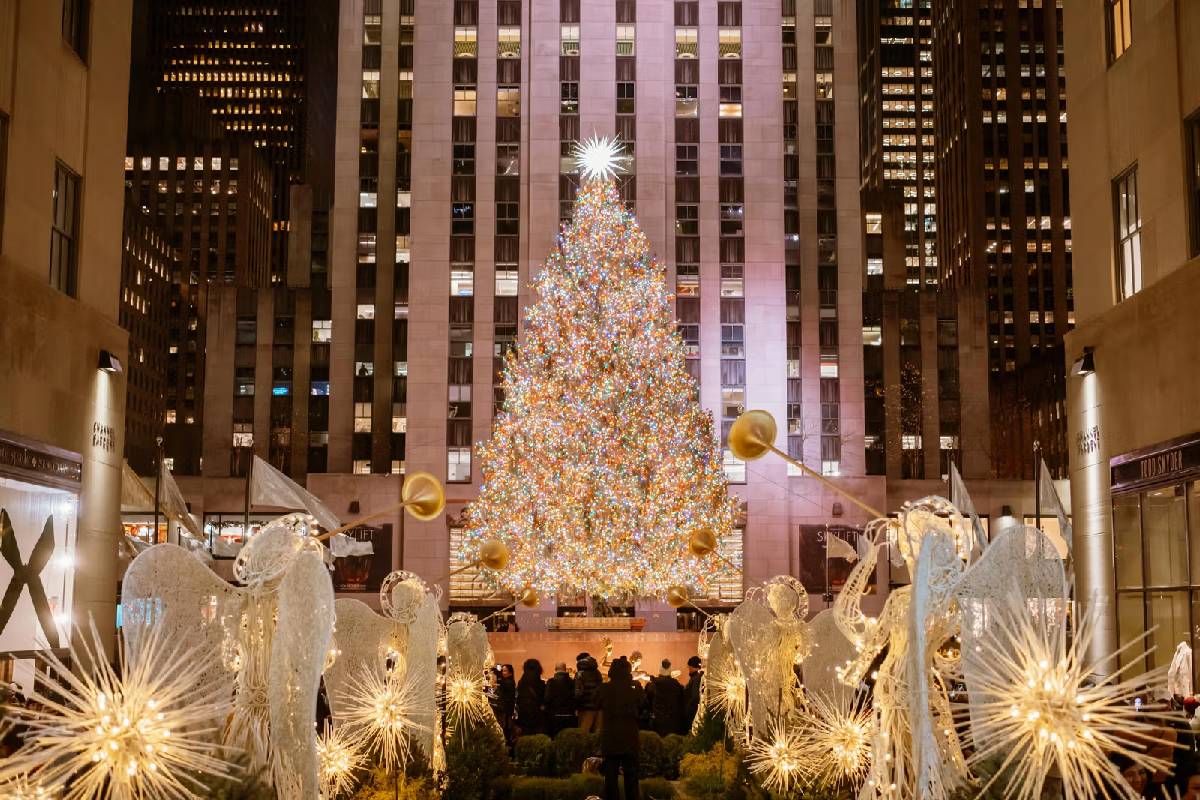
You can’t scale this down directly — the proportions only work in a plaza, where the tree is 40 to 60 feet tall and the surrounding figures sit 30 feet out. The transferable idea indoors is the halo: place lights or smaller glowing objects at ground level, 6 to 10 feet from the tree, so it reads as the center of a field instead of a lone object. A 6-foot tree with three small light figures around it gets a hint of the effect.
27. A Fluffy Beige Tree Covered in Butterflies
Butterflies need to catch light to look alive, so place them at the outer tips of branches rather than pressed against the core — one tucked inside the tree just reads as a smudge of color. Cluster them in odd numbers, three or five at a time, and leave real gaps between clusters. Because they’re lightweight, the outermost branches handle them fine, where heavier glass would droop. Same rule applies to pom-poms and paper fans.
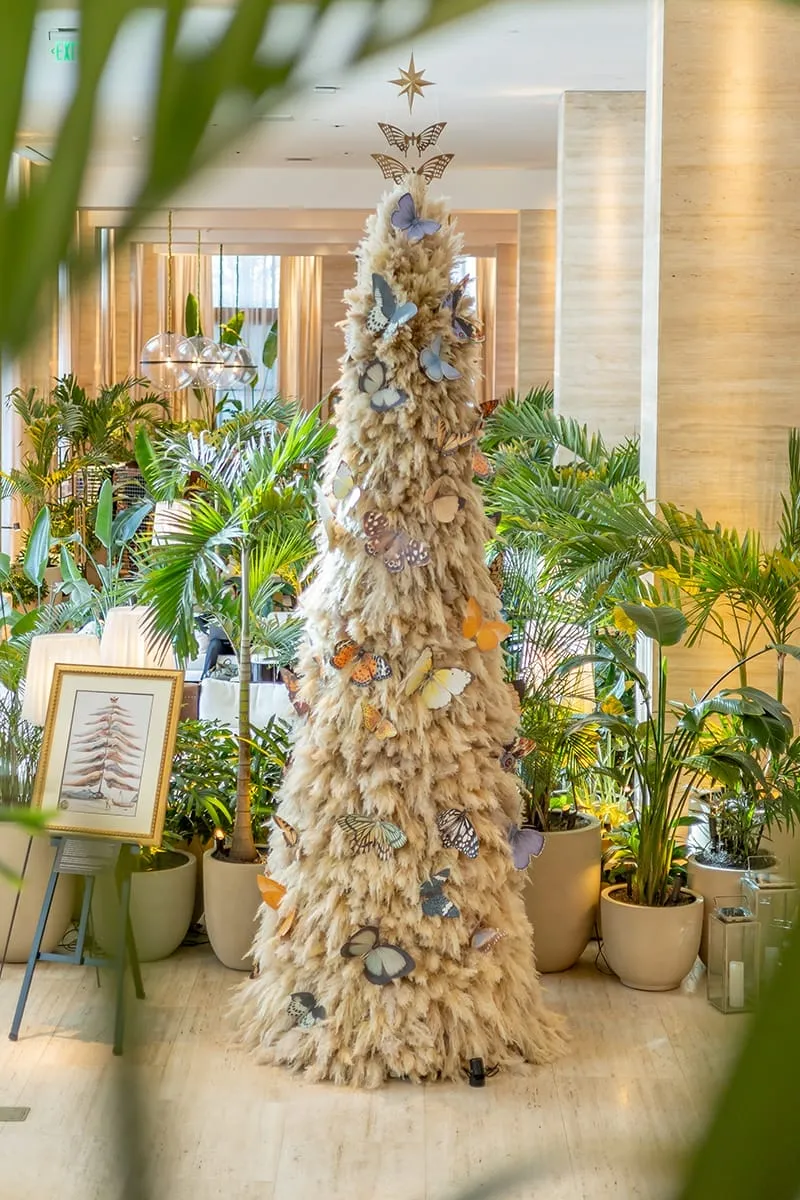
The beige fluffy covering. It’s the reason this works in a room full of potted plants instead of looking like a holiday prop dropped into a greenhouse. A green tree would fight the foliage; a flocked white one would look like snow against tropical plants. Soft beige reads as another texture in the room — closer to a dried arrangement than a Christmas tree, which is why it holds up from November through February.
28. Three Flocked Trees Lighting Up a Cozy Living Room
Roughly 50 percent white flocking and white mantel, 30 percent multicolor light, and 20 percent red and green accents — the plaid armchair, the stockings, the wreath. The lights are the color here, which is what lets three trees share one room without becoming a traffic jam. To shift the mood, swap the multicolor strands for warm white and the plaid for buffalo check: same formula, much calmer result.
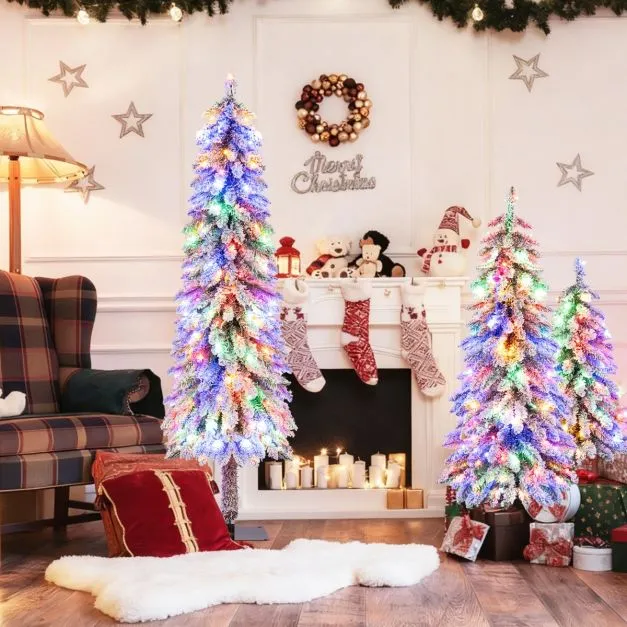
Check these before you commit to a cluster:
- Measure the wall — three flocked trees need 10 to 12 feet of run.
- Verify heat clearance from the fireplace; flocking and open flame don’t mix.
- Choose one light color temperature and stay with it across all three trees.
- Position the tallest tree first; the others arrange around it.
- Test the faux fur rug against the flocking in daylight — whites rarely match exactly.
29. Multicolor Ornaments in a Deep Green Damask Room
Building a multicolor ornament set that survives a dark room:
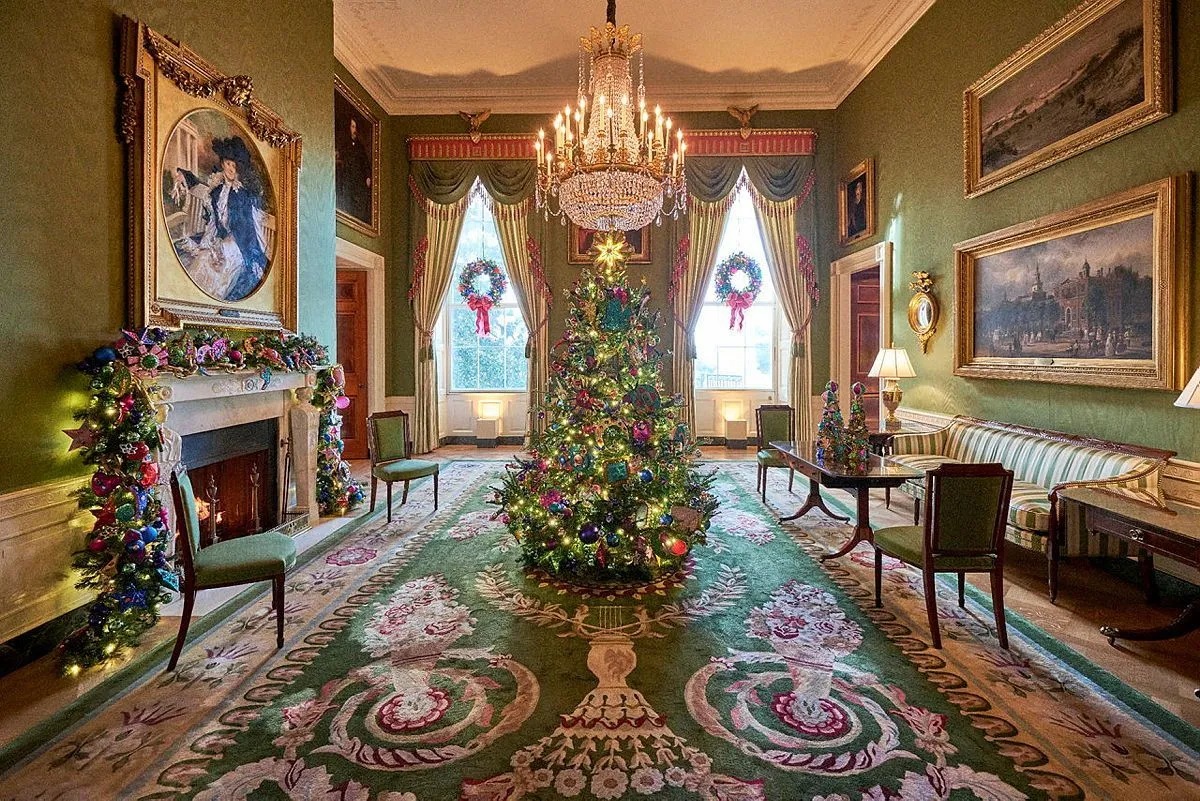
- Pick gold first as the connector and buy it in bulk — it’s the thread through everything.
- Cap yourself at five hues; pinks, blues, purples, and reds are plenty.
- Repeat each hue at least six times so it reads as a color story, not one-offs.
- Keep a third of the ornaments metallic or glittered to catch the chandelier light.
- Test against the wall in evening light, not daylight — green walls shift everything.
Deep green walls absorb light, so ornaments can carry far more saturation here than they could in a white room without feeling loud. The gold chandelier and gold frames repeat the metallic notes in the tree, which keeps the multicolor scheme tied to the architecture. The elaborate patterned rug is busy enough to hold its own under a bright tree — a pale rug would get visually flattened.
30. Handmade Ornaments: Woven Balls, Felt Hearts, Purple Stars
Pricing out an eclectic handmade collection, roughly 30 pieces:
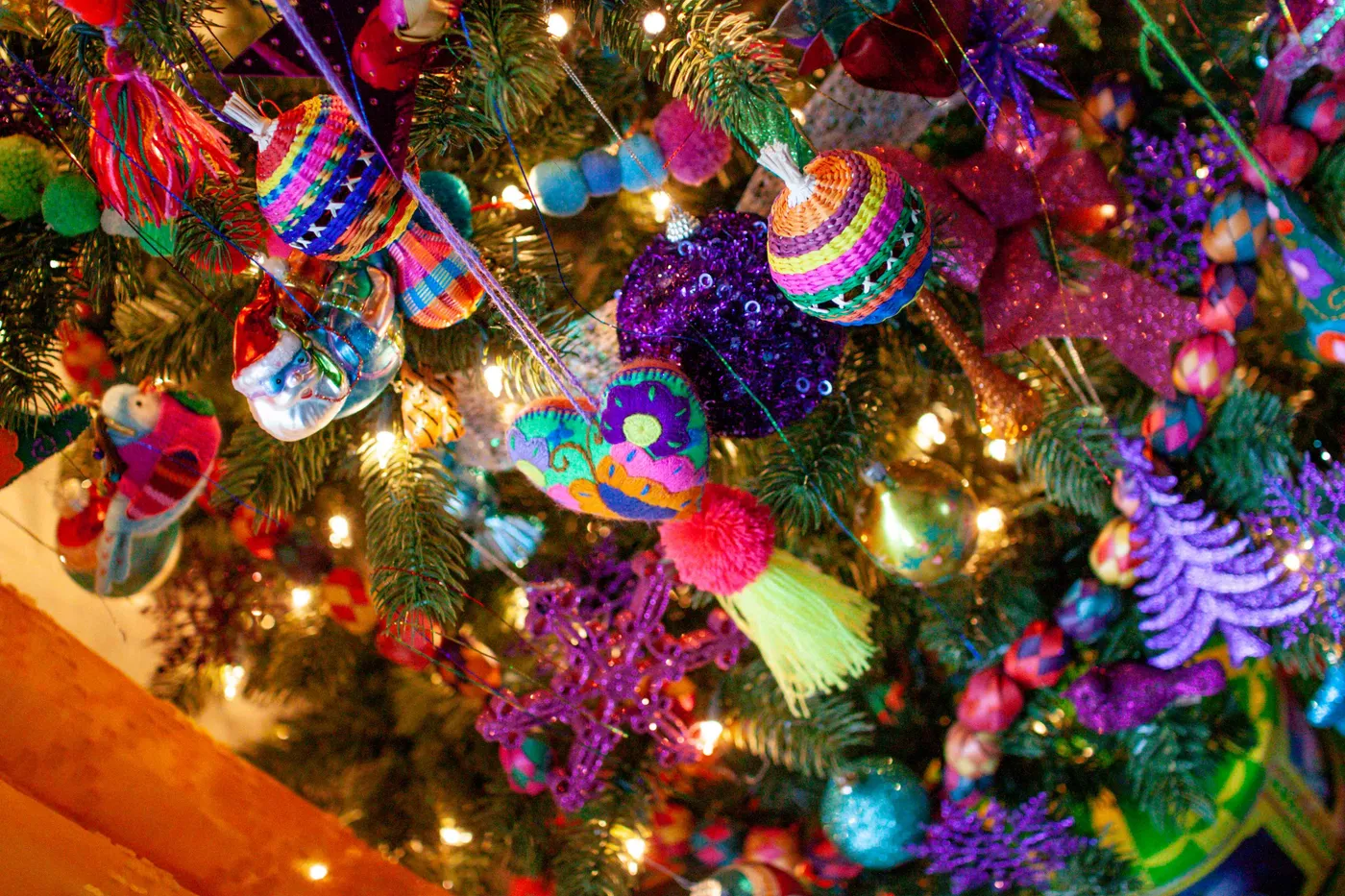
- Woven striped balls: $6–$15 each
- Felt embroidered hearts: $5–$12 each
- Glitter stars and spheres: $4–$10 each
- Pom-poms and tassels: $3–$8 each
- Warm white string lights, 100 count: $12–$25
Total: $180–$450 for a fully mixed set. Sheets of felt and a needle get you ten hearts for about $15 if you’d rather make them yourself.
Eclectic trees fail when everything is different. Keep one constant — sphere size is the easiest — and vary only color and texture. At least 60 percent of your ornaments should share that single dimension, whether it’s a 3-inch diameter or a woven finish. The novelty tree in Idea #31 breaks this rule on purpose and works because the pink ribbon and bow impose order instead.
31. Novelty Ornaments and a Big Pink Bow on Top
The oversized pink bow. Novelty trees drift toward chaos, and the bow is what tells your eye where the design ends. It repeats the pink ribbon garland running through the branches, so the top echoes the middle, and its scale — roughly a tenth of the tree’s height — gives the whole thing a finish line. Replace it with a small star and the tree suddenly looks like a collection instead of a composition.
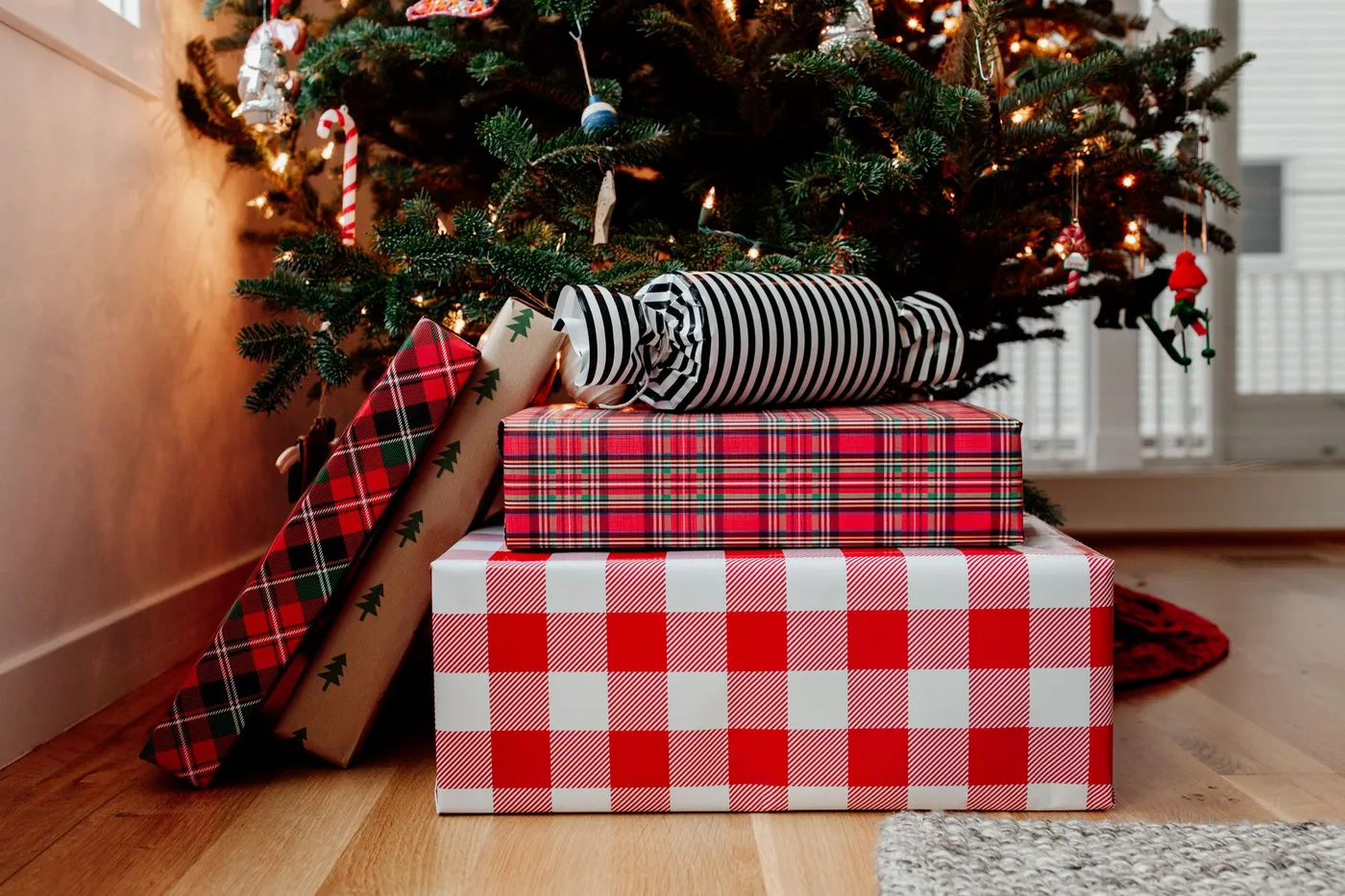
Food-shaped ornaments are tempting with kids and pets in the house, and that’s exactly the problem: a felt donut and a real donut look identical to a puppy. Skip the realistic food pieces if you have a chewer, or hang them above four feet. Also check the paint or glaze on novelty ornaments — cheap ones flake, and small flakes are a choking hazard for toddlers.
Playful, personal ornament collections have been gaining on perfectly matched sets for a few years, and 2026 is peak “my tree, my rules.” The shift tracks a broader move away from showroom styling — people want rooms that look lived in. It has legs financially too: novelty ornaments get bought one at a time all year, so the tree grows into itself instead of costing $400 in October.
Pick Your Palette, Then Let the Tree Do the Talking
Thirty-one trees, one takeaway: the ones that stick with people aren’t the most expensive, they’re the ones with a clear color decision behind them. Pick your palette, decide your one hero element, and build outward from there.
📌 Pin your favorite to your holiday board now — next December you’ll be glad you saved it.