31 Stunning Orange Slice Garland Ideas You Need to Try for a Chic 2026 Look
There’s a reason your saved folder is full of dried citrus right now — a dried orange slice garland is the rare holiday project that costs less than a pizza, smells like a candle you’d pay $40 for, and looks like it came from a shop in the Cotswolds. We combed through Etsy, Target, and Michaels (plus more than a few thrift-store finds) to pull together 31 garlands, mantels, and ornaments that actually work in a real house.
Everything here lands between $6 and $180, with budget and luxury versions compared side by side — and every idea is shoppable, so you can go straight from inspiration to cart. You’ll find rustic natural citrus, traditional Christmas mantels, farmhouse bead-and-twine strands, and a handful of modern organic takes. In 2026 the pull is toward handmade, low-waste decor you can compost in January, and dried citrus is the poster child.
And stay until the end — we break down the most common mistakes that can ruin these looks.
📌 Save this to Pinterest for later — you’ll want to revisit these ideas.
1. Marble-Topped Flat Lay: Dried Orange Slices Meet Gold Thread
Slice your oranges a scant 1/8 inch thick. Any thicker and the centers stay tacky for weeks and eventually mold; any thinner and they curl into crisps that shatter when you thread them. A 2.5- to 3-inch round is the sweet spot — below 2 inches, slices visually vanish the moment they’re on a tree or a mantel. And if you’re using metallic cord like the fine gold thread here, double it. Single-strand gold snaps under the weight of three dried slices, and you won’t find out until you’re standing on a chair.
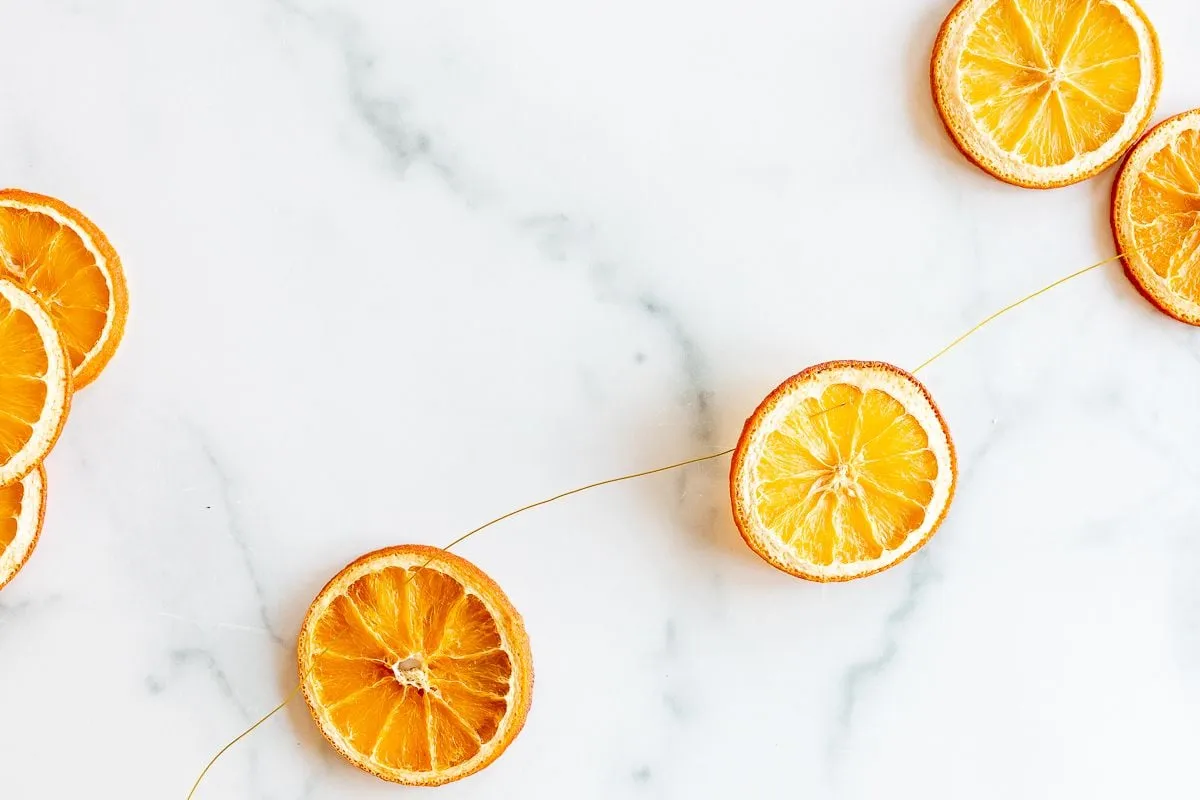
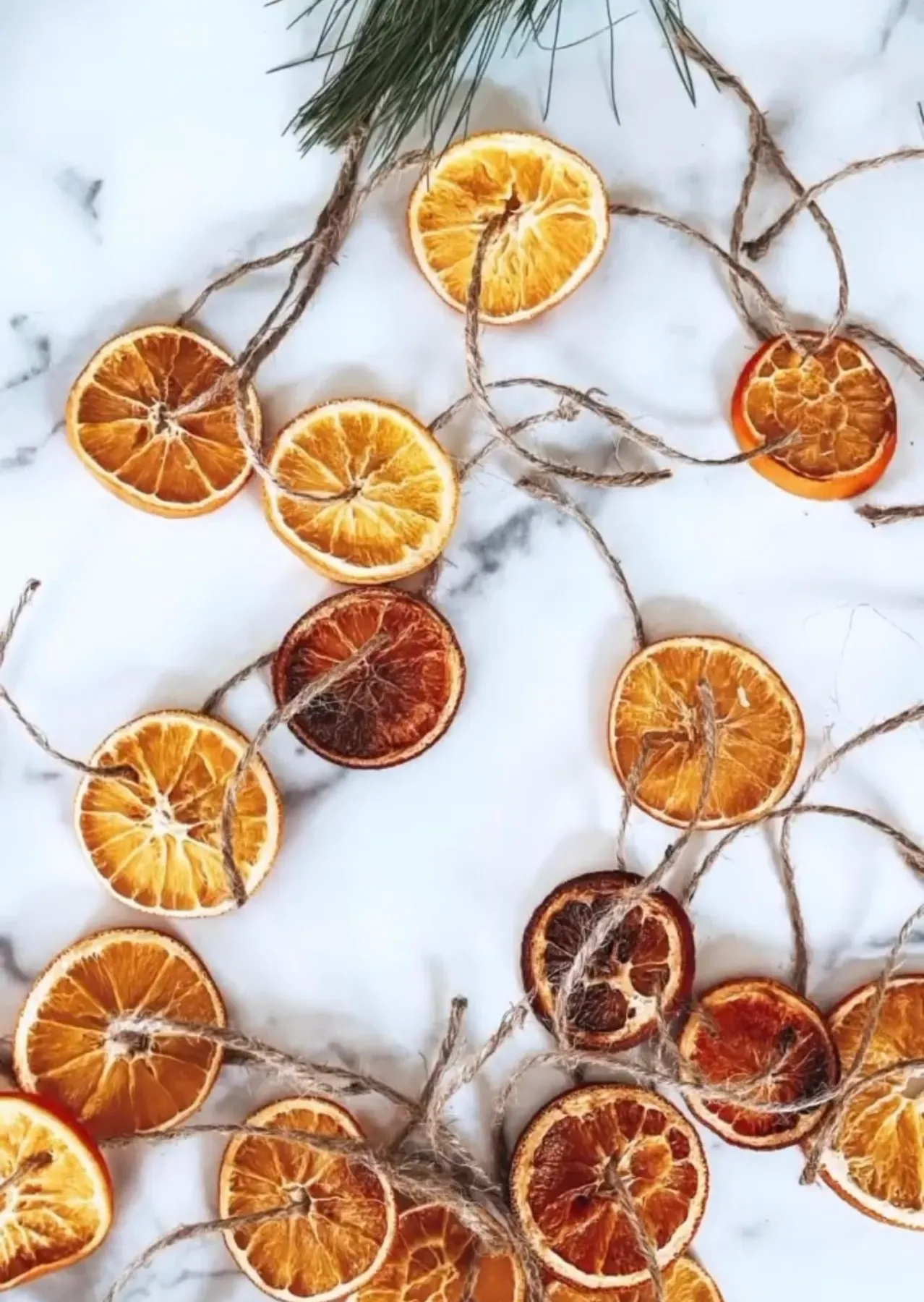
Strip away the marble and the styling and what’s left is an ordinary craft: dried orange rounds and a bit of string. The gold cord is the thing that changes the conversation. Swap it for jute and you get a farmhouse ornament; keep the metallic thread and those same slices read like something from a design shop. If you upgrade exactly one supply this season, upgrade the string.
2. Bead-and-Twine Orange Garland on a Rustic Craft Table
- Cut 8 feet of jute twine for every 3 feet of finished garland — knots eat length fast.
- Fold the twine in half and tie a loop at the fold so the strand hangs flat instead of twisting.
- Thread a large-eye tapestry needle and slide on three 8mm wooden beads, then one dried slice.
- Knot snugly behind each slice so nothing creeps down the strand over the season.
- Repeat, and keep the bead count identical every time — irregular spacing is what makes DIY garlands look homemade in the bad way.
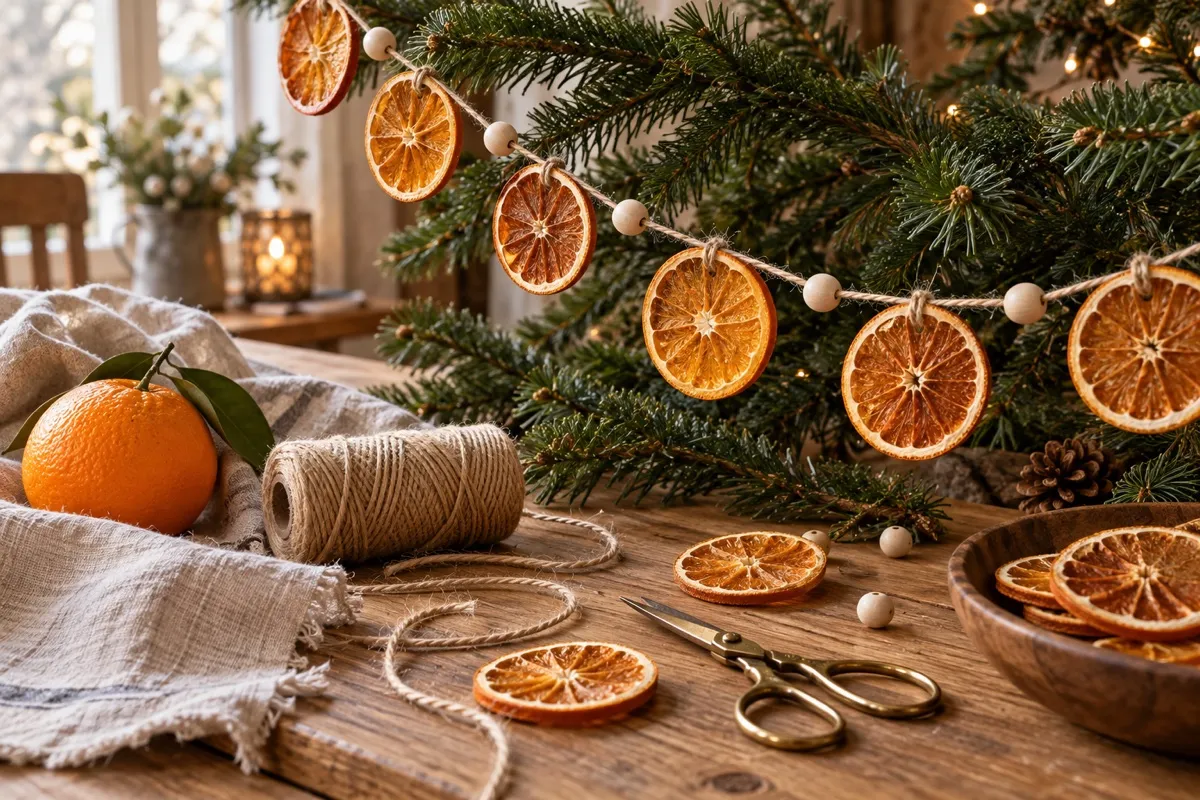
Roughly 45 minutes and about $12 for eight feet.
Dried orange slices are essentially kindling with a nice smell. That lit candle in the background is a beautiful styling choice and a genuinely bad idea if the garland hangs within a foot of it. Keep citrus strands at least 18 inches from any open flame. Also, wood beads add weight quickly: eight feet of bead-and-slice garland is about a pound and a half, so use finishing nails or hooks rated for two pounds, not the flimsy clear ones.
3. White Mantel, Terracotta Tile, and a String of Dried Orange
The restraint here is doing the heavy lifting. Four stockings, four different textiles, and not a single competing pattern — the only color on them is one embroidered initial. That lets the orange slices read as the accent instead of one more thing in a pile. Add pinecones for texture and the terracotta tile beneath for warmth, and you get contrast in material without contrast in color, which is exactly why this mantel looks collected rather than cluttered. The wooden candlesticks with green tapers echo the same idea one layer deeper.
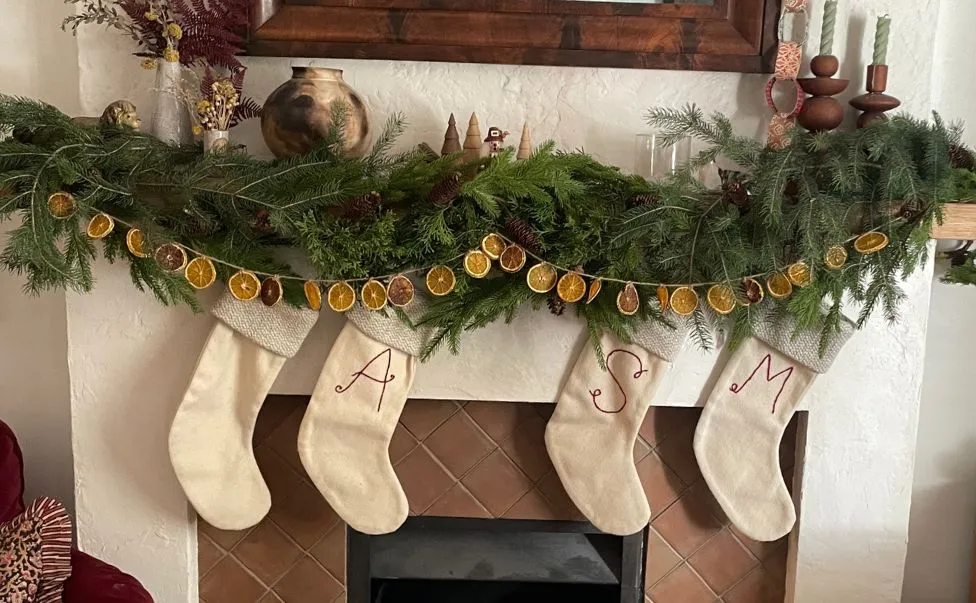
- Faux pine garland, 9 ft: $35–$90
- Dried orange slices, 40-count: $18–$40
- Pinecones, set of 12: $8–$20
- Four cream stockings: $40–$120
- Wooden candlesticks and green tapers: $30–$75
Total: $131–$345
Budget alternative: thrifted stockings run $5–$12 each, pinecones are free at any park in October, and drying your own oranges costs about $6 for 40 slices. Same mantel, roughly $70.
4. Three Garlands, One Mantel: Layering Beads, Greenery, and Citrus
This is the layered version of Idea #3 — same cream-and-citrus palette, three times the texture. Read it as a formula: 60% greenery garland as the base, 25% white wooden bead strand for brightness, 15% dried orange slices as the finishing accent. Want it moodier? Keep the percentages and swap the beads to matte black and the slices to blood orange. Want it softer? Trade the greenery for eucalyptus. The ratio is what makes it work, not the specific materials.
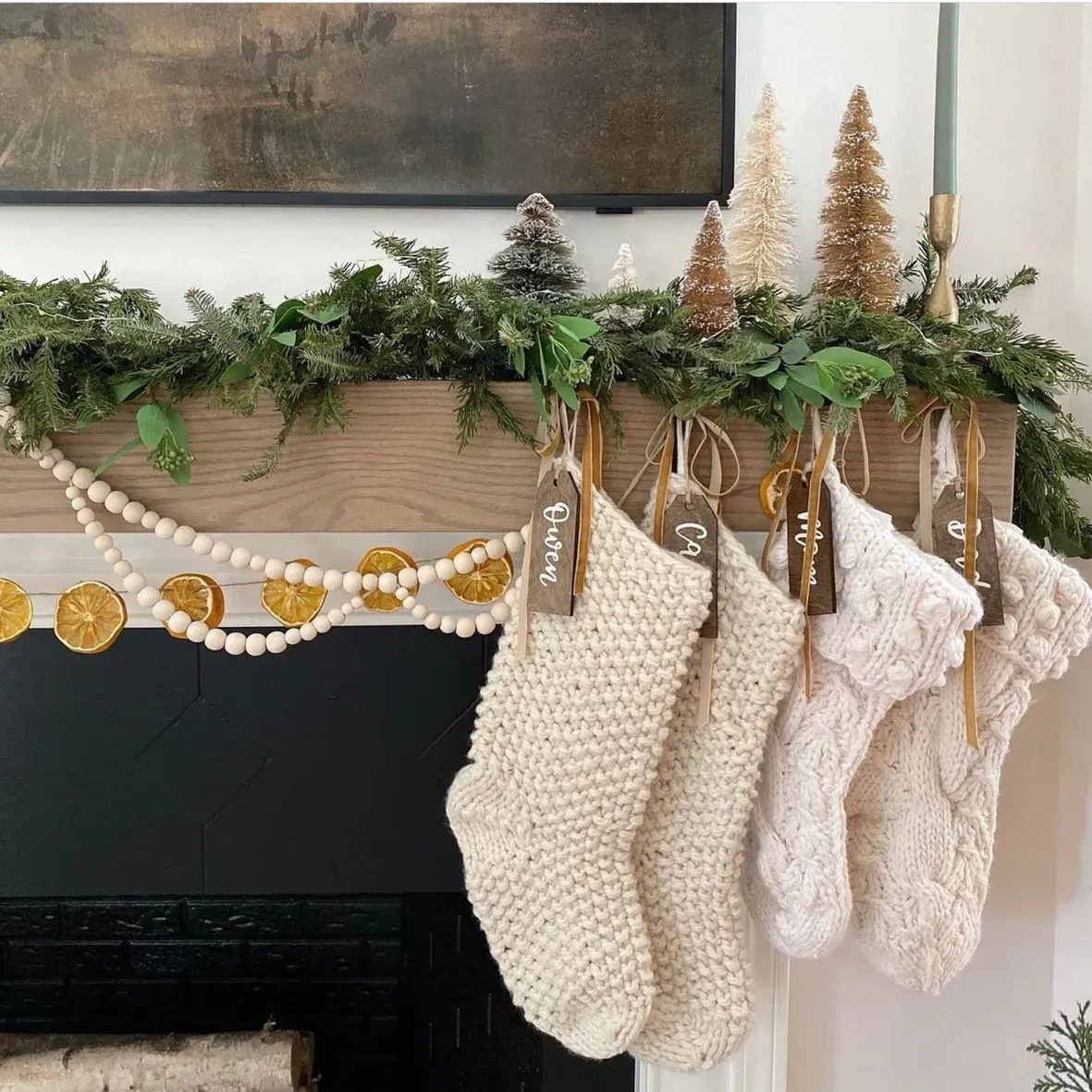
Layer in this order and you’ll never fight it: greenery first, beads second, citrus last and always on top. Secure the greenery with floral wire every 12 inches — not twist ties, which rust — then drape the bead strand in loose swags rather than a straight line. Put the citrus strand on top because dried slices crush and flake when anything heavier sits against them. The four cream stockings with wooden name tags finish it without adding a fifth color.
5. Bay Leaf and Orange Garland Finished With a Yarn Tassel
Part of what’s driving the dried citrus wave in 2026 is a shift away from disposable holiday decor — people want something they can make in an afternoon, hang for six weeks, and compost in January. This bay leaf and orange garland is the refined end of that movement: culinary herbs instead of plastic berries, a white stitched ribbon at the top, and a thick white yarn tassel weighting the bottom. It’s the cottagecore idea that finally grew up.
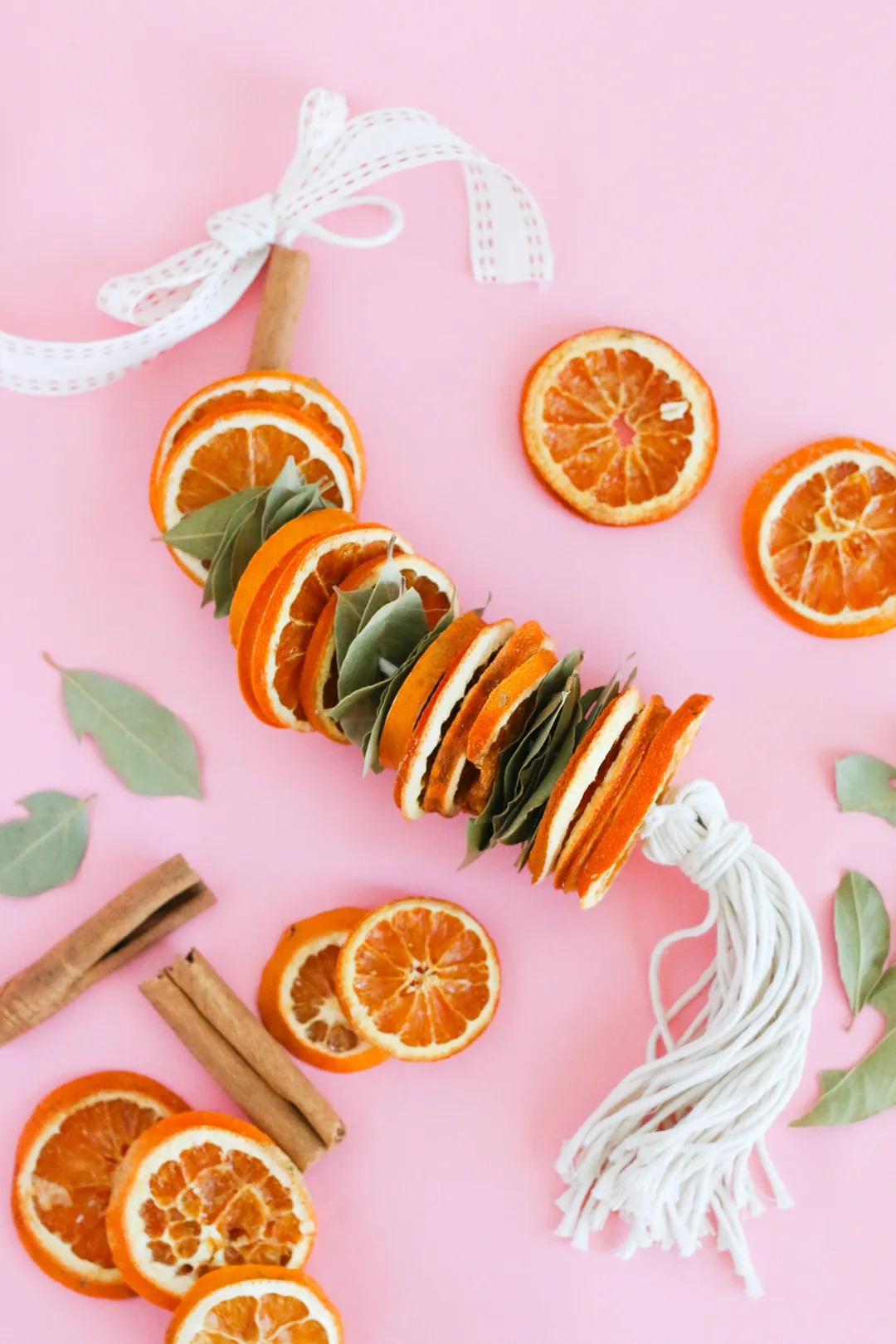
Scale matters more than people expect with a single diagonal strand. This one wants a 14- to 18-inch drop and a 30- to 36-inch door or a narrow wall panel — anything wider and it reads as a thin stripe lost in space. Ceiling height is not the constraint, wall width is. For a standard 36-inch exterior door, hang the top loop about 8 inches below the frame. If you’re working with a big double door instead, go wider rather than longer, and see Idea #9 for a table-scale version.
6. Parchment, Racks, and Baker’s Twine: A Citrus Drying Station
- Slice oranges 1/8 inch thick with a mandoline or a very sharp serrated knife.
- Blot both sides with a paper towel — surface moisture is what turns them brown instead of gold.
- Lay them in a single layer on parchment over a wire rack. No overlapping, no crowding.
- Bake at 200°F for 2.5 to 3 hours, flipping at the 90-minute mark.
- Cool completely before threading. Warm slices tear at the needle hole.
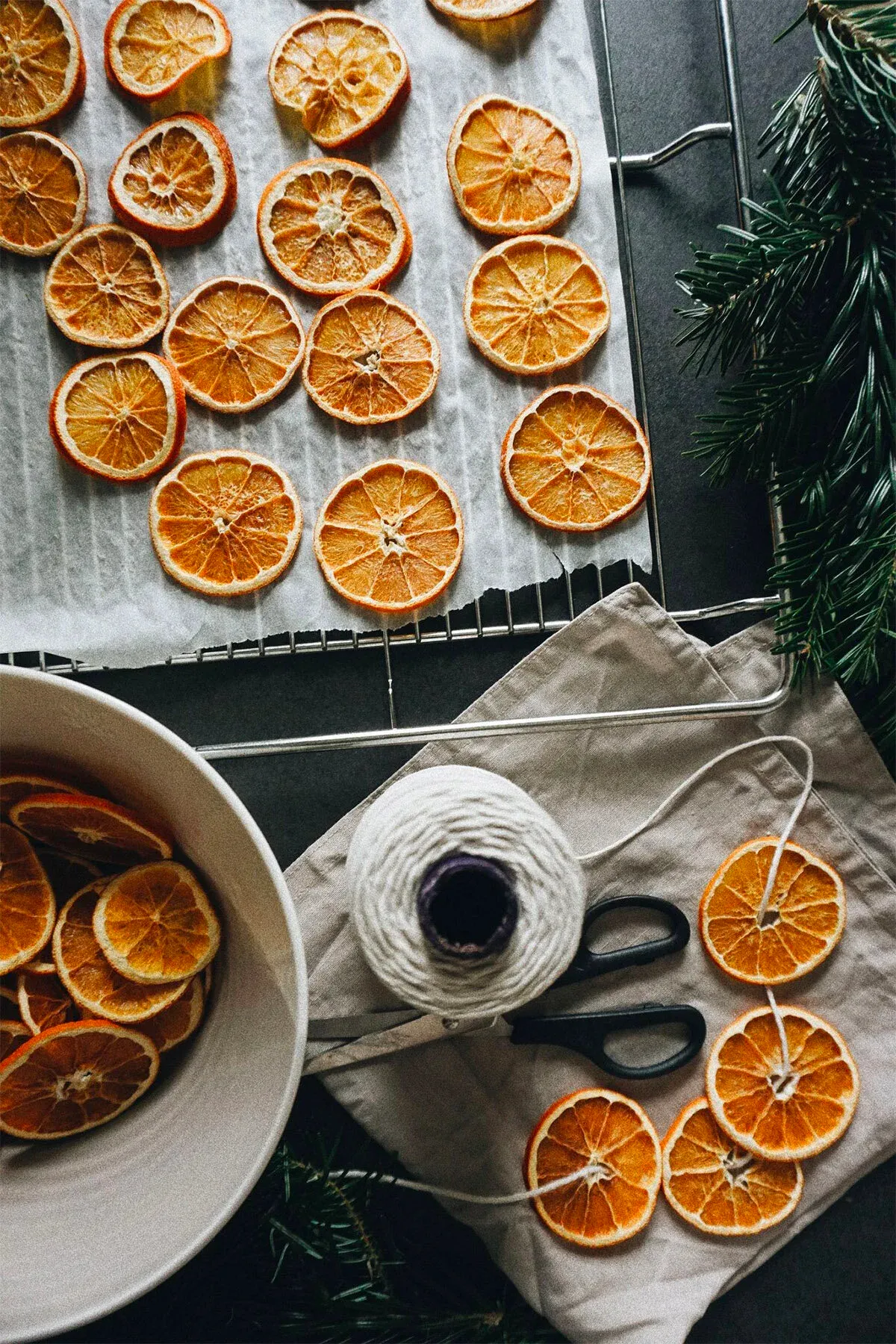
About $6 of oranges makes 40 slices and three hours of oven time.
Here’s the part nobody mentions: dried citrus does not last forever. In a dry house, slices hold their color for one to two seasons. In a humid climate, they soften and fade within a few months, usually starting at the pith. Store them in an airtight container with a silica packet between uses, and never tuck a garland into a cabinet or attic — pantry moths and carpet beetles both consider dried fruit a snack. If a slice goes soft or dull, toss it and thread a fresh one. Replacing four slices costs pennies; dealing with an infestation doesn’t.
7. Twig-Branch Garland: Dried Oranges on Bare Winter Stems
You don’t need to spend $60 on a garland to get this look. The structure here is literally twigs — thin, dark, twisting stems — and those are free. Walk any park or yard after a windy day and you’ll have a bundle in ten minutes. Wire dried orange slices to the branches with 24-gauge floral wire (about $4 a spool), spacing them every 5 to 6 inches. Total spend for a 4-foot strand: under $12 if you’re buying oranges anyway. If you’d rather not forage, IKEA and Michaels both sell natural branch bundles for $8–$15.
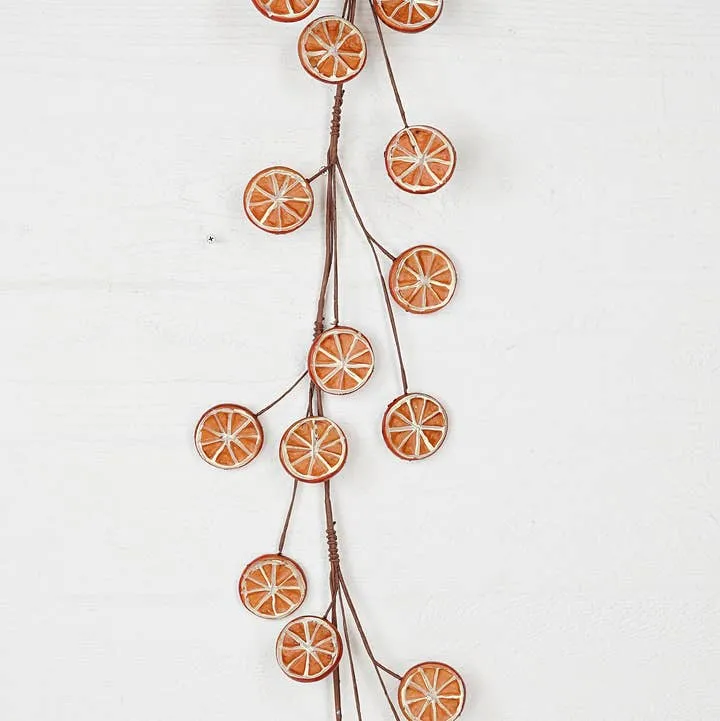
The twig substrate is doing two jobs at once. First, it gives the slices architecture — a bare string of citrus sags and curves unpredictably, while a stiff branch holds a deliberate line. Second, the thin dark stems create a graphic, almost drawing-like silhouette against a white wall. The orange reads as color, the twigs read as line, and the white background does the rest. Remove the branches and you have a limp necklace. Remove the slices and you have a stick.
8. Translucent Citrus and Leaf Clusters on Barely-There Twine
Translucent slices like these are the ones that were dried fully — the pith has gone glassy and light passes straight through. That’s the whole point, and it’s also the catch. Compare with Idea #30, where the same slices finally get real daylight behind them. Hang this garland against a white, cream, or pale grey wall and it glows. Hang it against navy or a dark wood panel and the same slices turn muddy brown and disappear. Do the lamp test before you commit: hold each slice up to a bulb. If you can’t see the light, it needed another 30 minutes in the oven.
When you’re mixing slices with individual leaf clusters, group the leaves in threes and wire them as a single unit before you thread anything. Single leaves spin freely on twine and end up facing backward half the time. A three-leaf cluster has enough mass to stay oriented. Keep the twine fine — anything heavier than button thread visually competes with the delicate leaves. And tie off every cluster with a half hitch so the spacing stays even down the strand.
9. Clove, Juniper, and Star Anise: A Citrus Garland Styling Station
Take away the fresh oranges and this table is still pretty. Keep them and it becomes a whole sensory event. Those oranges studded with whole cloves are the single element that lifts the scene — they add a second scent layer, a second texture, and a little bit of pattern that keeps the eye moving. Clove-studding takes ten minutes per orange and about $4 of cloves. Without them, the juniper berries, cinnamon sticks, and star anise are just a pile of nice-smelling objects. With them, the whole thing reads as a recipe.
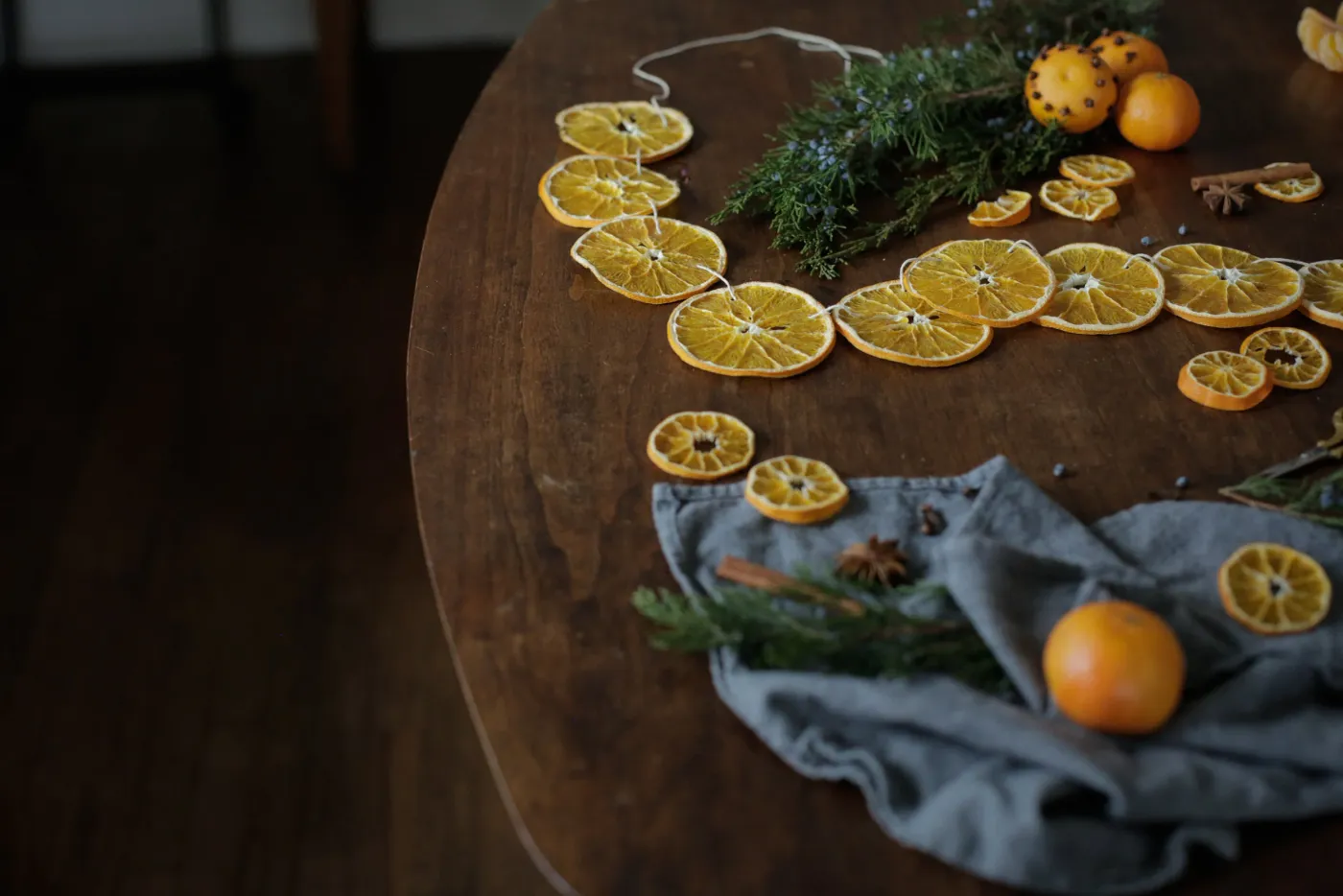
Think of the scent as a formula, because that’s how good holiday styling actually works: 50% bright citrus (dried slices, fresh oranges, a little peel), 30% warm spice (cinnamon sticks, star anise, cloves), 15% green and resinous (juniper branches, pine needles), and 5% something sweet and slightly funky to keep it from smelling like a cleaning product — a vanilla bean, a drizzle of honey on the plate, a beeswax candle nearby. Skip the resin and it smells thin. Skip the spice and it smells like a smoothie.
10. Vertical Citrus Garlands Behind a Scalloped-Plate Table Setting
Vertical strands like these need a table with room behind it. Plan on a 6- to 8-foot table with at least 3 feet of clearance between the chairs and the wall or window frame you’re hanging from — otherwise guests lean back into the garlands all night. Hang the strands so the lowest point sits 24 to 30 inches above the tabletop (people need sightlines across the table). If your ceiling is under 8 feet, shorten the strands rather than raising the table. For a smaller dining nook, see Idea #9 — the same centerpiece idea works on a 4-foot round.
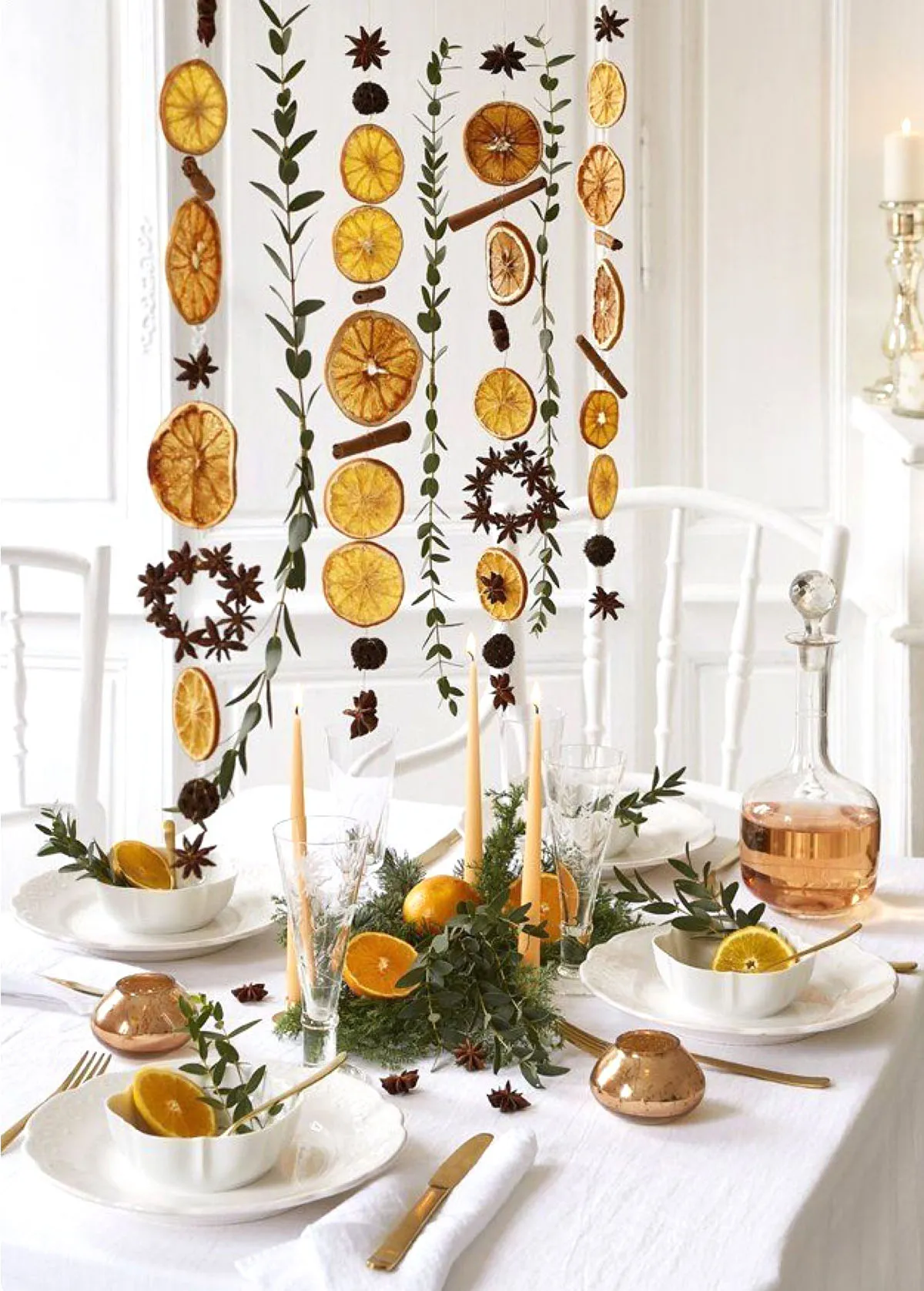
- Linen tablecloth and napkins: $40–$110
- Scalloped dinnerware, set of 8: $60–$160
- Gold flatware, set of 8: $30–$90
- Four vertical citrus and spice strands: $25–$60
- Taper candles and holders: $18–$45
Total: $173–$465
Budget alternative: borrow the good plates from a relative, cut your own citrus strands, and use white pillars you already own. The centerpiece itself — whole oranges, greenery, a few stems — runs about $15.
11. Slices Draped Over Evergreen, Catching Every Bit of Light
Look closely and you’ll notice the slices aren’t lying flat — several are tilted, stacked, or peeking out at an angle. That’s not sloppy, that’s the whole effect. Flat slices read as flat circles. Angled slices catch light on their cut faces, cast small shadows on each other, and turn a single strand into something with actual depth. Think of this as the un-beaded twin of Idea #16: same citrus, same greenery, but here the texture comes from the draping rather than the beads. Deep green behind warm orange also does quiet work — near-complementary colors, no clash.
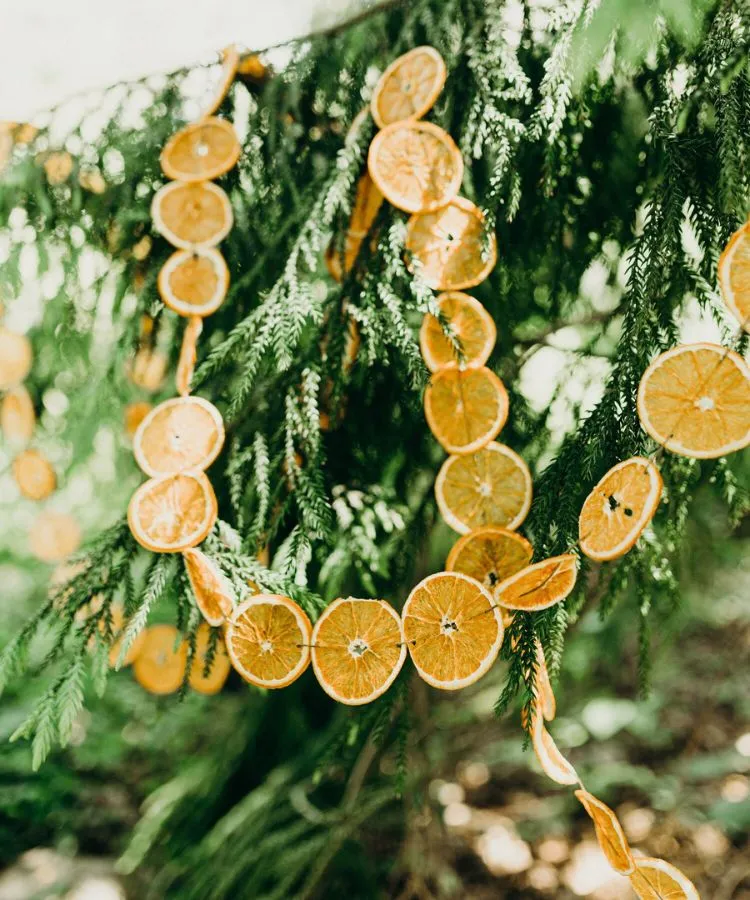
Here’s the trick for keeping that tilt: after you knot behind each slice, give the twine a half twist before the next one. That offsets every slice by roughly 20 to 30 degrees and prevents the whole strand from hanging face-forward like a wheel. Space slices 2.5 inches apart on a greened mantel and 1.5 inches on a bare one, where they need to carry the show alone. And drape in loose, uneven swags — a perfectly straight line of citrus looks like a measurement, not a decoration.
12. Three Citrus Colors, One Branch: Orange, Grapefruit, Lemon
The expensive version of this is a boutique dried citrus set — $48 for a curated strand on Etsy, sometimes $70. The version that looks identical: three grocery store citrus, one afternoon, one oven. A bag of oranges ($5), two grapefruits ($4), and a handful of lemons ($3) yields enough slices for six strands. Grapefruit dries down to a dusty rose, lemon to pale butter yellow, orange to amber — that tonal range is exactly what people are paying for. Twine is $3 at any craft store. Hang the strands from one branch and you’re at 95% of the boutique look for about $15.
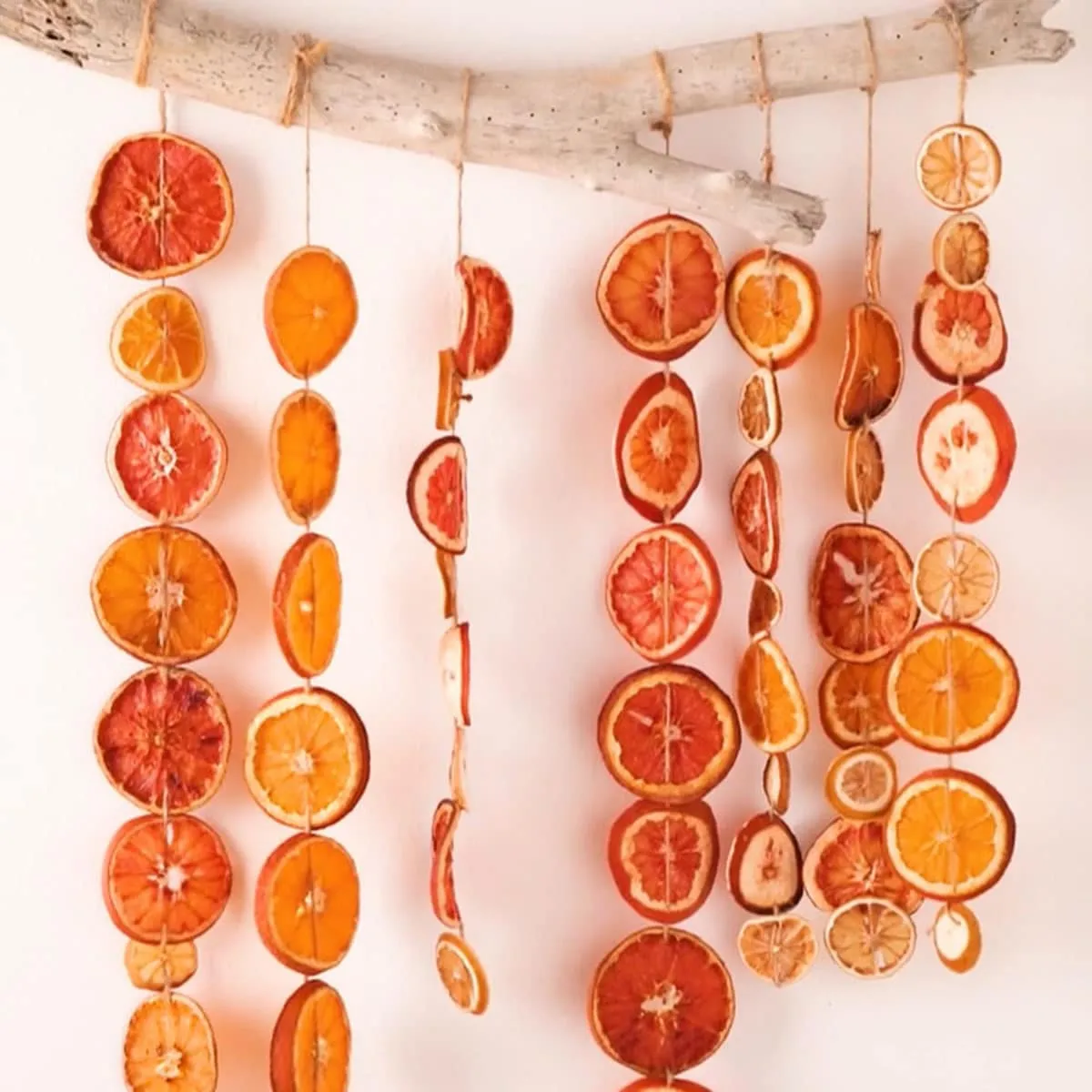
What’s pushing mixed-citrus strands in 2026 is a broader move away from the red-and-green default. Designers have been leaning on amber, ochre, and dusty pink for winter palettes for a couple of seasons now, and dried grapefruit happens to deliver all three without a single artificial dye. It’s a warm-weather palette doing cold-weather work. Whether it outlasts the trend cycle is anyone’s guess, but the materials are compostable, which means the downside is basically zero.
13. A Flat Lay of Bay Leaves, Wooden Beads, and Green Tassel
- Count your slices first: 40 dried slices makes about 8 feet of garland at 2.5-inch spacing.
- Check that your needle eye actually fits your twine — jute needs a 2-inch eye.
- Decide the finish now: tassel, ribbon bow, or a bare knot. Changing your mind later means restringing.
- Measure your drop height on the actual door before tying the top loop.
- Lay the entire pattern out flat on the table before threading a single bead.
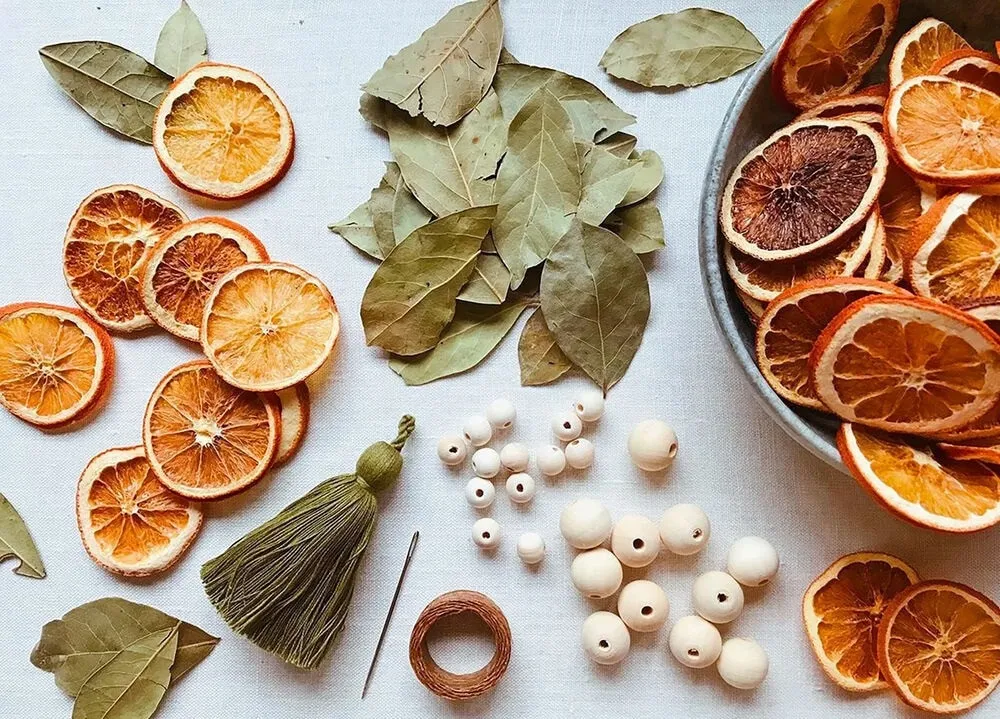
Making a yarn tassel is easier than it looks:
- Wrap yarn around a 4-inch piece of cardboard 30 times.
- Slide the loops off and tie tightly around the middle with a 12-inch tail.
- Fold the bundle in half and wrap the top third tightly with the tail, tying it off.
- Trim the bottom loops so they’re even.
Fifteen minutes, about $5 of yarn, and you get the finished weight that keeps this garland hanging straight.
14. Clothespin Evergreen Sprigs and a Red Tree Dish on the Counter
A garland draped across a cutting board on the counter looks styled in a photo and mildly annoying in a real kitchen. Wooden clothespins holding evergreen sprigs will leave small pinch marks on softer greenery, and any sprig near the sink gets splashed constantly — wet needles drop fast and clog a drain trap. Also worth knowing: that red tree-shaped dish is adorable and extremely seasonal. Twelve weeks from now it’s a red dish. If you’re spending real money here, spend it on the cutting board and the dried slices, both of which work in July.
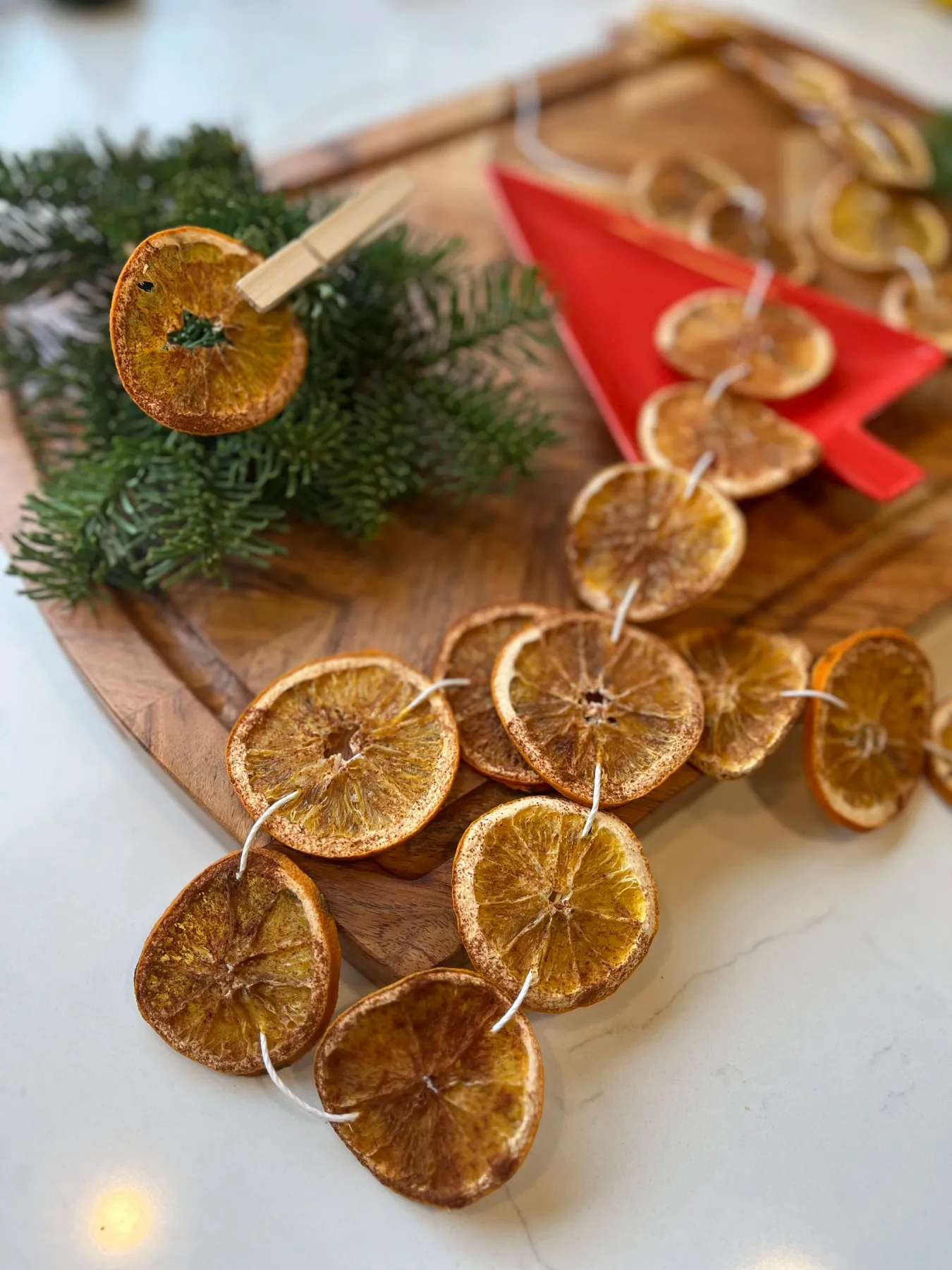
The palette is tighter than it looks. Roughly 60% natural wood tones (board, counter, clothespins), 20% white (the marble, the string, the walls), 15% deep green (evergreen sprigs), and 5% red — and that 5% is doing all the holiday signaling. Want it for Thanksgiving instead? Keep every percentage and swap the red dish for a mustard-yellow one. Want it for spring? Trade red for barely-pink and the green for olive branches. The formula travels; the occasion doesn’t have to.
15. Hands, Twine, and a Green Bowl: Threading the First Slice
White baker’s twine is the prettiest and the least durable option. Within one season it yellows, especially in a kitchen, and it holds grease and dust in a way jute doesn’t. If you love the white look, expect to restring every year or two — that’s a $4 fix, not a tragedy. The bigger issue is storage: dried citrus kept in a dark cabinet draws pantry moths, and once they find your garland they’ll find your flour. Store slices in a glass jar with a silica packet, in a cool dry room, never in the same cabinet as dry goods.
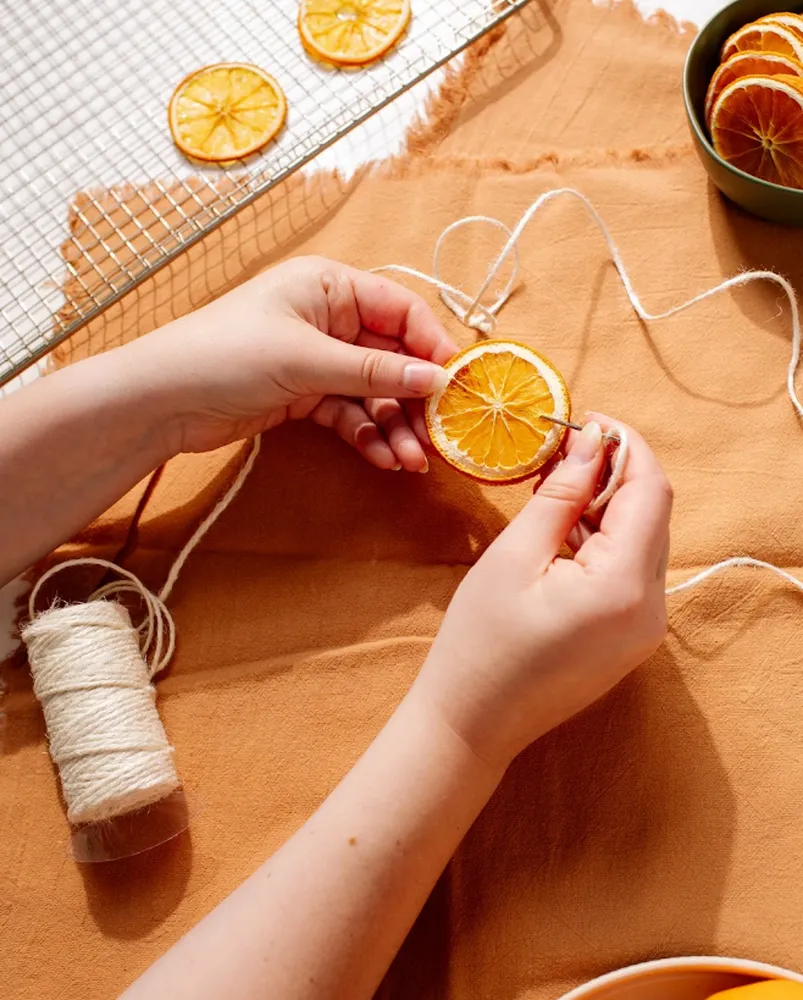
Run your twine across a block of beeswax before you thread it — one pass, both sides. Waxed twine grips itself, so knots stay put instead of loosening as the garland settles, and it resists the moisture that makes plain cotton twine swell and sag in humid rooms. A $6 beeswax block lasts years and it’s the single change that separates garlands that still hang straight in February from the ones drooping in the middle by New Year’s.
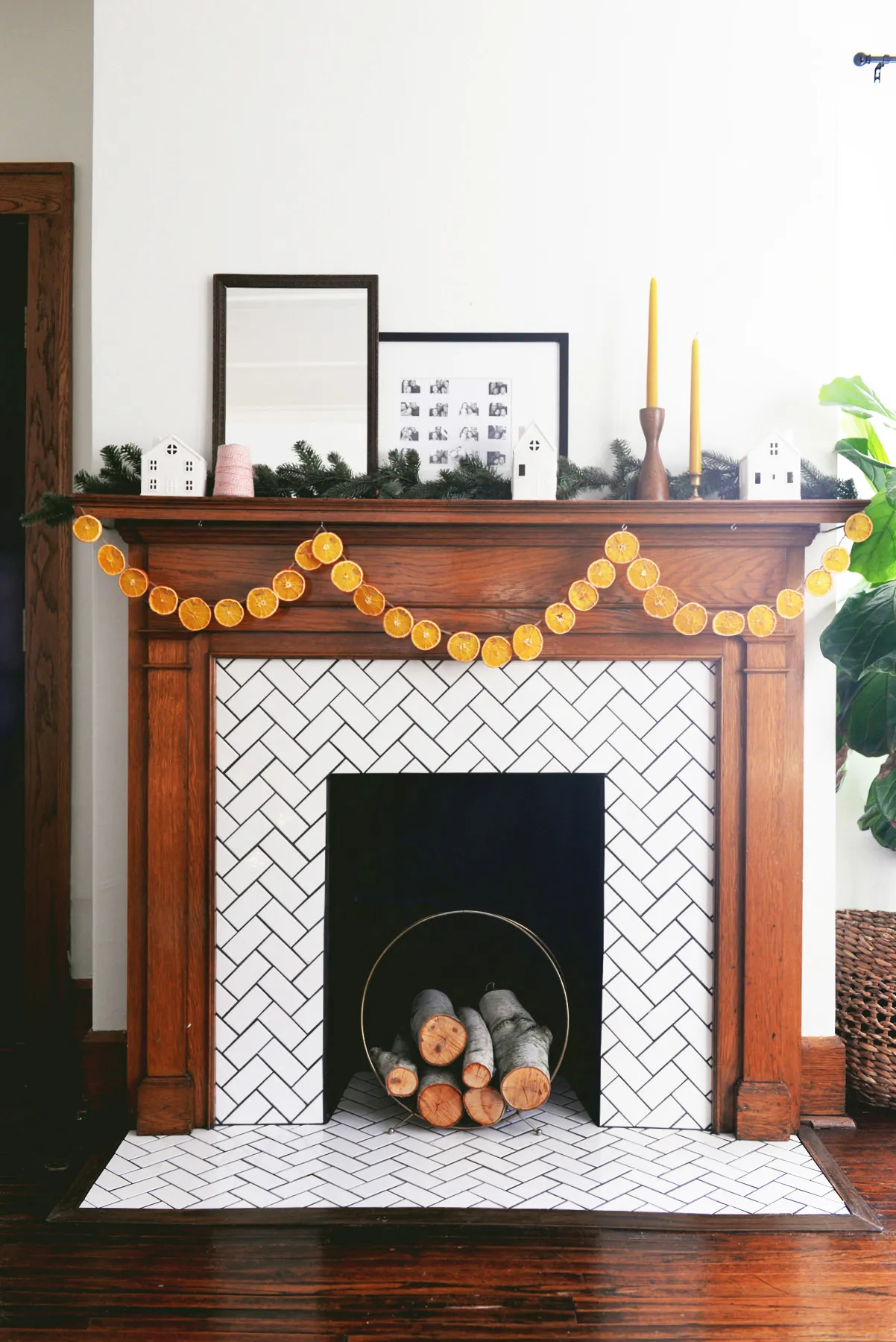
16. Pine and Bead Strand Across a Herringbone Tile Fireplace
- Pine garland, 9 ft: $35–$95
- Wooden bead strand, 9 ft: $12–$28
- Dried orange slices, 40-count: $18–$40
- Oversized pinecones, set of 3: $12–$25
- Textured white vase and diffuser: $25–$70
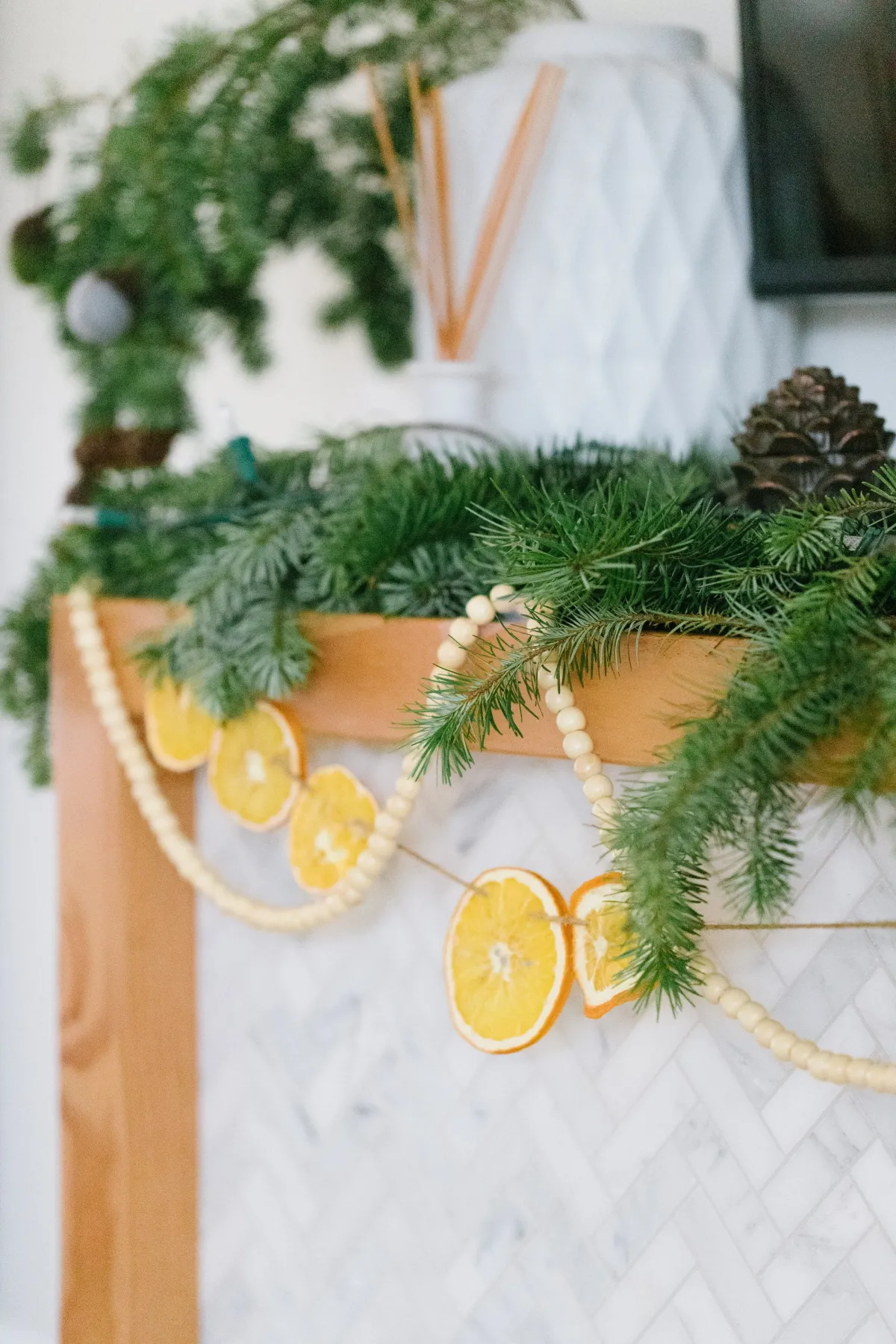
Total: $102–$258
Budget alternative: skip the bead strand entirely and thread supermarket oranges yourself — that’s about $60 for the whole mantel, and the herringbone tile does the expensive-looking part for free.
That single oversized pinecone is the element holding the scale together. The mantel runs long, the garland runs long, the herringbone tile creates tiny repeating shapes across a big surface, and without something chunky to break the pattern your eye slides right past the whole arrangement. One pinecone the size of your hand says stop here. Two would compete. Three would look like a collection. If you take it away, the orange slices read as too small for the space and the whole mantel goes flat.
17. Spice Bundles and Seed Pods, Tied Off With Natural Twine
Bundle crafting is having a moment because it’s the rare project that does three jobs. Tie one to a tree, tie one to a gift, or lay one on a folded napkin at the table as a name card and you’ve covered a whole holiday for about 40 cents a piece. People who wouldn’t commit to a full garland will happily make twelve of these in an evening, which is probably why they keep showing up in 2026 craft roundups alongside slow-living and low-waste decorating content.
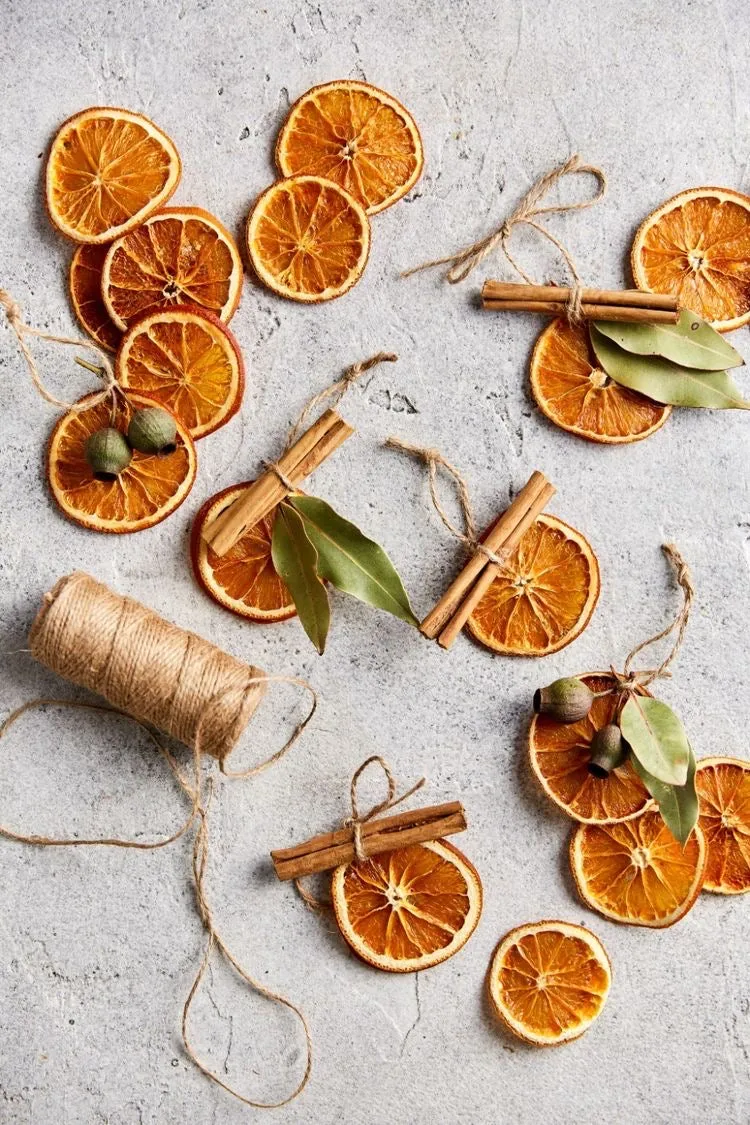
Here’s how to build one that doesn’t fall apart:
- Lay a dried orange slice flat on the table.
- Cross a cinnamon stick and two pale green leaves over it in a loose X.
- Add one small dried seed pod or a single star anise at the center.
- Wrap twine around the middle three times and tie a square knot.
- Trim the tails to about 2 inches and fan them out.
Each bundle takes roughly two minutes once you’ve got a rhythm. Forty slices and a bag of cinnamon sticks makes about 30 bundles for under $30.
18. Laser-Cut Peach Ornaments With Red Ribbon Accents
Weight is the whole story with ornaments like these. A laser-cut wood or acrylic slice weighs under half an ounce; a real dried orange slice runs closer to three quarters of an ounce, and once you add twine you’re at four to five times the weight. That makes these cutouts ideal for a 4- to 5-foot tabletop tree with thin wire branches, or for a shelf garland strung on light thread. Real citrus belongs on a full-size tree or a mantel where the branches and hooks can carry it. For the real thing, see Idea #26, where a single slice steals the whole frame.
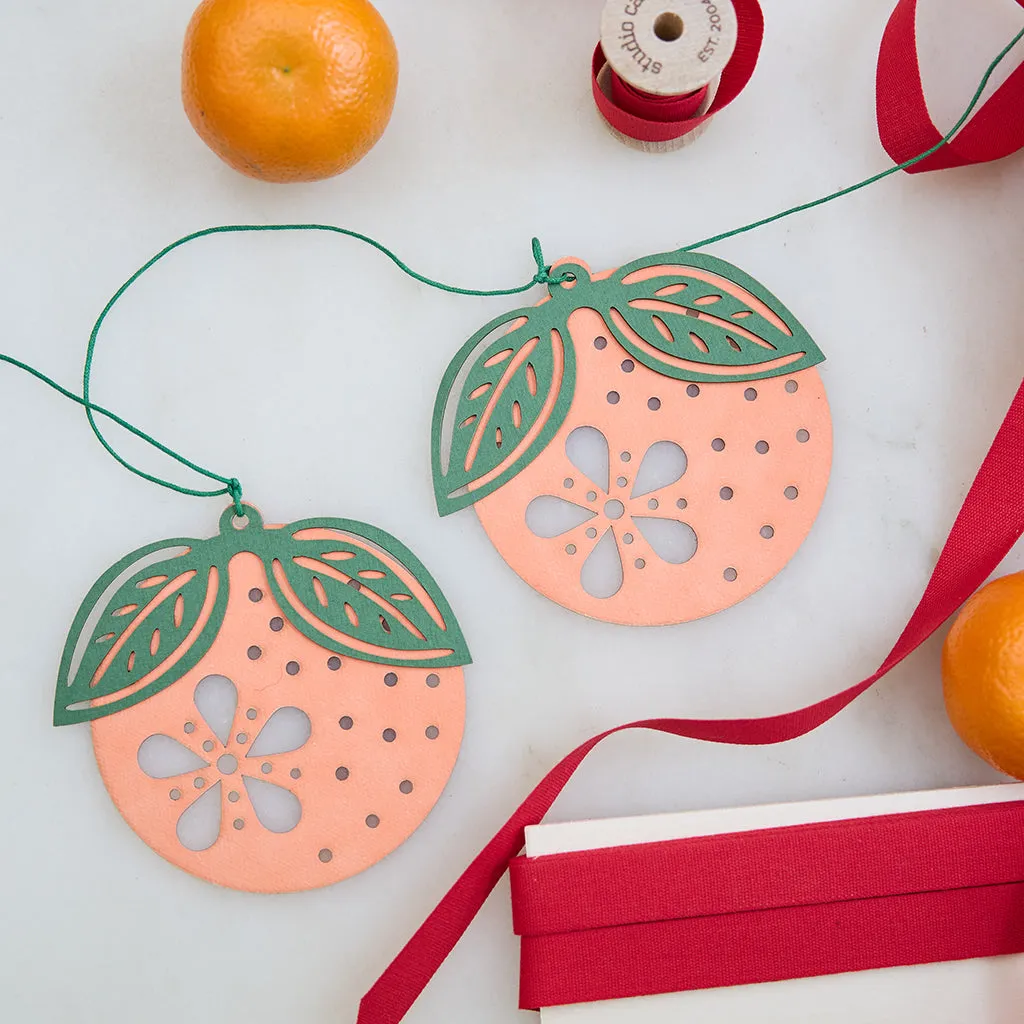
The DIY version costs almost nothing. Trace a 3-inch circle onto 1/8-inch basswood or heavy cardstock, cut it with a craft knife, and paint the body a soft peach with a deep green leaf shape on top — craft paint runs $2 a bottle and covers about 20 ornaments. Punch a small hole, thread a green cord through, and you’re done at under $15 for two dozen. Store-bought versions run $18–$35 for a set of six, so the savings are real if you don’t mind a Saturday afternoon.
19. Berries, Pinecones, and Brass Under a Scalloped Gold Mirror
The mirror is the reason this mantel photographs so well. A scalloped gold frame creates a soft, repeating edge that echoes the round orange slices, and the reflection doubles the garland without adding an ounce of weight. Then there’s the red: berries, maybe 5% of the whole arrangement, sitting just above the firebox where the eye lands. That tiny hit of red against forest green, burnt orange, and brass is the difference between a nice natural mantel and one that reads as Christmas. Remove the berries and it becomes autumn decor.
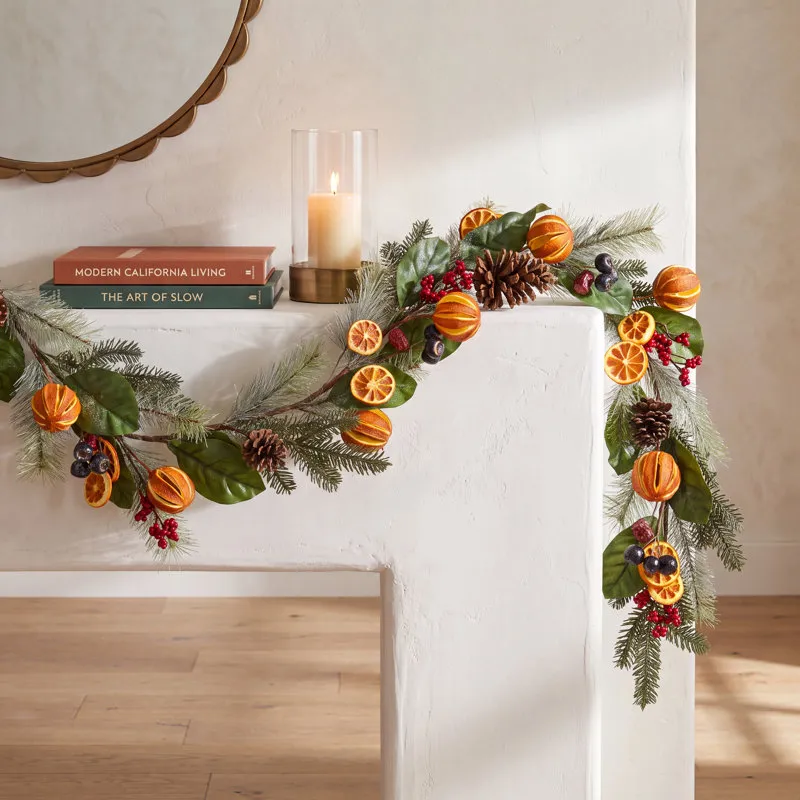
Two practical notes before you copy this. Real berries drop and stain — within a week you’ll have red speckles on white marble that need a blotting cloth, not a wipe. Faux berry sprays ($6–$12) hold up far better. And that lit candle inside the brass hurricane gets hot; brass discolors with direct flame exposure, so keep the wick trimmed short and the hurricane at least an inch clear of the garland. Also, garlands over mirrors scratch the glass at the contact points — felt pads behind the greenery solve it for $3.
20. Gingerbread Men and Orange Slices on Checkered Linen
If you’re stringing real cookies, seal them or don’t bother. Baked gingerbread absorbs humidity, goes soft, and snaps at the threading hole within about ten days in a heated house. Two coats of clear polyurethane or Mod Podge on cooled cookies makes them last for years and keeps them from crumbling onto a tablecloth. Drill the hanging hole with a skewer before baking, while the dough is still soft — trying to poke a hole into a finished gingerbread man shatters him about half the time. Sealed cookies also stop attracting ants, which is worth the $8 can alone.

The palette math here is unusually strict and that’s why it works: about 40% warm brown (gingerbread, light wood, the table), 30% cream (the checkered linen, the candle jar, the frosting), 20% orange (the dried slices), and 10% red (holly berries, the check pattern). Swap the checkered cloth for solid cream and it goes flat. Swap the gingerbread for plain stars and it loses its charm. The pattern and the figures are both load-bearing.
21. Birch Logs, White Ceramic Houses, and a Citrus Garland
- Evergreen garland, 9 ft: $30–$80
- Dried orange slice garland, 9 ft: $20–$45
- White ceramic village houses, set of 5: $35–$110
- Birch logs and circular gold holder: $30–$75
- Herringbone tile (if you’re tiling): $8–$14 per sq ft
Total: $115–$310 before any tile work
Budget alternative: skip the ceramic village and line up five white pillar candles of varying heights instead — about $15 at Target — and use a wire basket you already own in place of the gold holder.
A mantel garland should run about 1.5 times the width of the shelf it sits on, so a 60-inch mantel wants 7.5 to 8 feet of greenery, and a 72-inch mantel wants 9 feet. Anything shorter and the ends dangle mid-air. Ceiling height matters less than mantel width here, but leave 4 to 6 inches of wall above the tallest item — the ceramic houses and the mirror in Idea #19 both need breathing room or the whole arrangement feels wedged.
22. One Slice, One Cinnamon Stick, Deep in the Pine Needles
This is the close-up cousin of Idea #1, and it proves something useful: you don’t need a garland, a mantel, or a theme. One dried orange slice and one cinnamon stick, tied together with twine and tucked into a pine branch, reads as intentional. The cinnamon stick is the difference-maker — it adds a vertical line in a frame that’s otherwise all circles and needles, and it releases scent every time the room warms up. Lose it and you have a slice on a string.
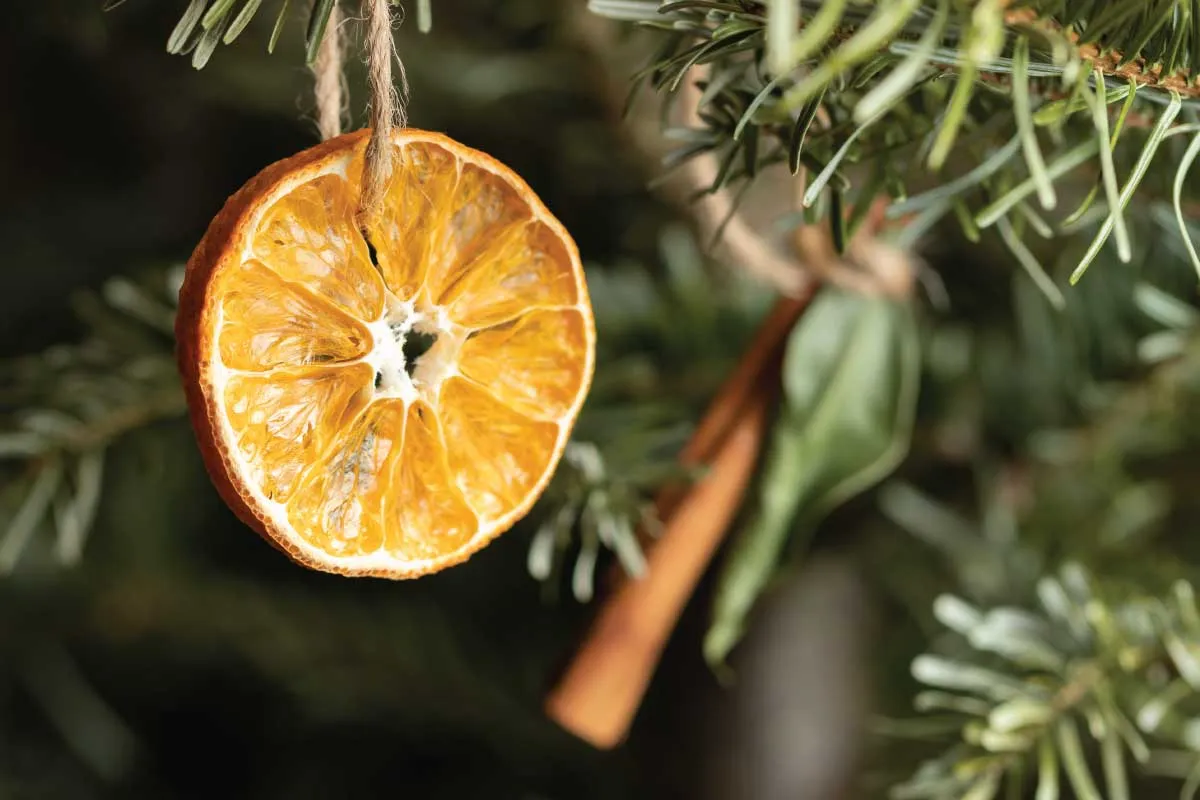
Cinnamon sticks are more fragile than they look. They crack along the grain when they dry out further, and every crack drops a little curl of bark onto whatever’s underneath. If you’re hanging these over a white tablecloth or a light rug, wrap the stick once with twine in the middle to hold the bark in place, and expect to replace them every couple of years. Whole star anise does the same job with far less shedding — it’s harder, denser, and holds its shape for a decade.
23. Walnuts and Apple Slices Join the Citrus Garland Prep
- Apple slices need 30 extra minutes in the oven — they hold far more water than citrus.
- Dry everything fully before stringing. Any tacky slice will mold inside a garland.
- Weigh your walnuts: a shelled half runs about 4 grams, so five per foot adds real load.
- Check your needle eye against your string before you start threading.
- Keep apples and citrus on separate strands — apple browns faster and looks tired sooner.
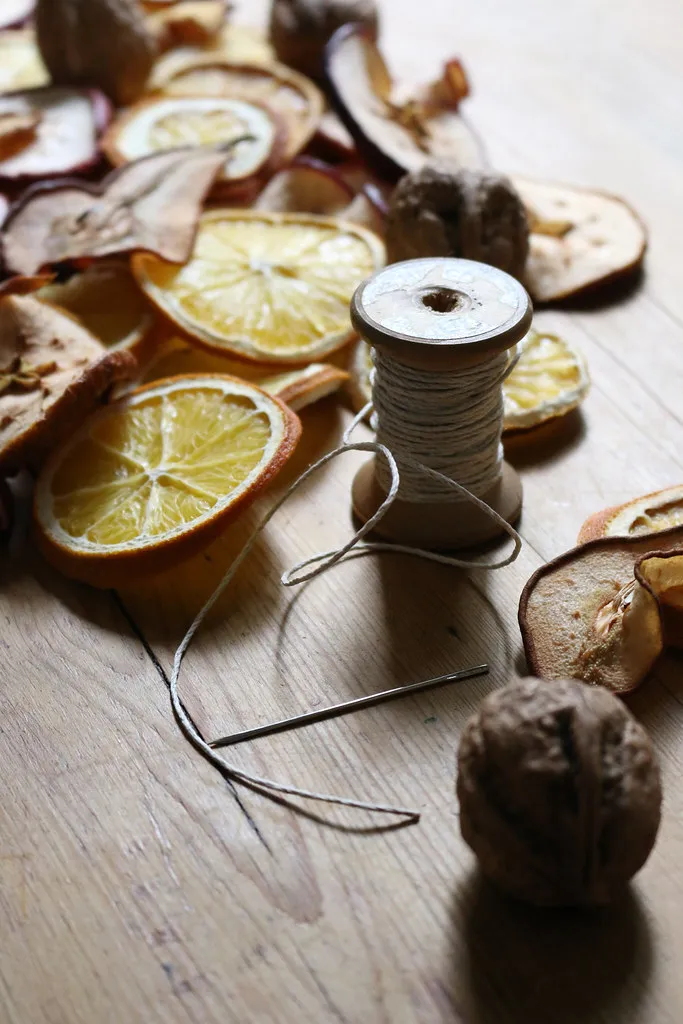
Apples are the budget hack nobody talks about. A bag of four apples costs about $4 and yields 20 to 24 slices, versus $5 for three oranges that give you 18. Walnuts are cheaper still — a pound bag in the baking aisle runs $6 and gives you enough halves for three full strands. Combined, a mixed-fruit garland comes in under $15 for eight feet. The one caveat: apple slices brown to a warm caramel rather than staying pale, which is either charming or disappointing depending on what you were expecting.
24. Flowers, Lemons, and a White Ribbon Bow on Two Strands
Adding dried flowers without crushing them takes a specific order of operations:
- Choose small, sturdy dried blooms — strawflower, statice, or dried chamomile, not anything with brittle petals.
- Wire each flower head individually with 26-gauge wire, leaving a 3-inch stem.
- Twist that wire around your garland twine between two citrus slices.
- Alternate flower, slice, flower, slice — never two flowers together.
- Finish with a white ribbon bow at the top, wired, not glued.
Roughly an hour and $14 in materials for six feet.
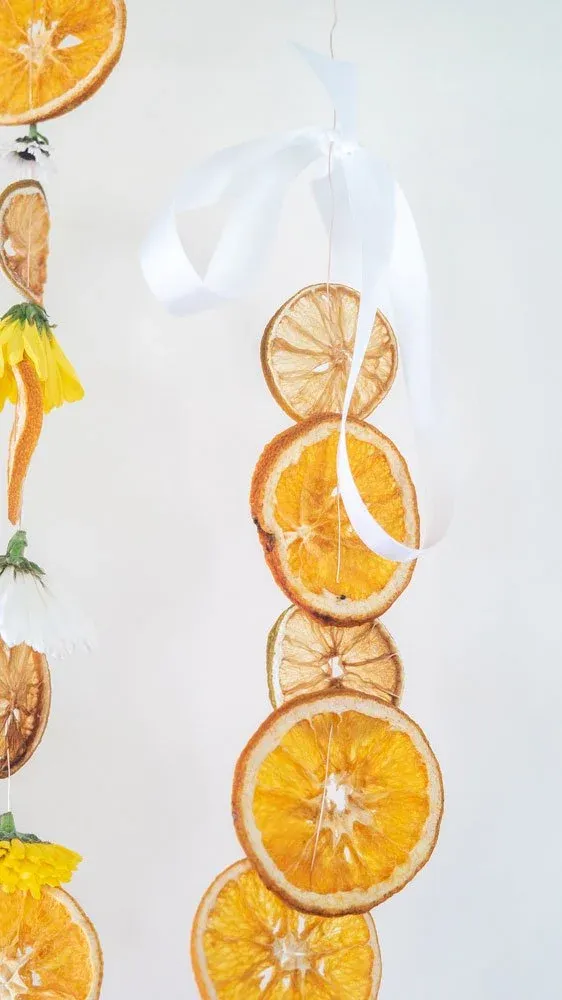
Two strands hanging side by side is a deliberate design move, not indecision. Repetition tells the eye these belong together; variation — one bow-topped with lemon, one flowered with no bow — keeps it from looking like a mistake. The shared elements (citrus slices, thin string, a white background) hold the pair as a set, while the differences give each strand its own job. Hang them 6 to 8 inches apart so they read as a pair rather than one badly spaced garland.
25. Magnolia, Pomegranate, and Gold Candle Holders on the Runner
Real pillar candles, dried citrus, and evergreen on one table is a beautiful combination and an actual fire risk. Pine needles flash fast. Keep every flame at least 12 inches from foliage — with three candles on a runner, that usually means spreading them wider than feels natural. If you want the look without monitoring it all evening, swap to flameless pillars with a warm bulb; the good ones run $20–$30 a pair and nobody notices after the first glass of wine. Magnolia leaves also curl within about a week indoors, so mist them or accept the curl as part of the charm.
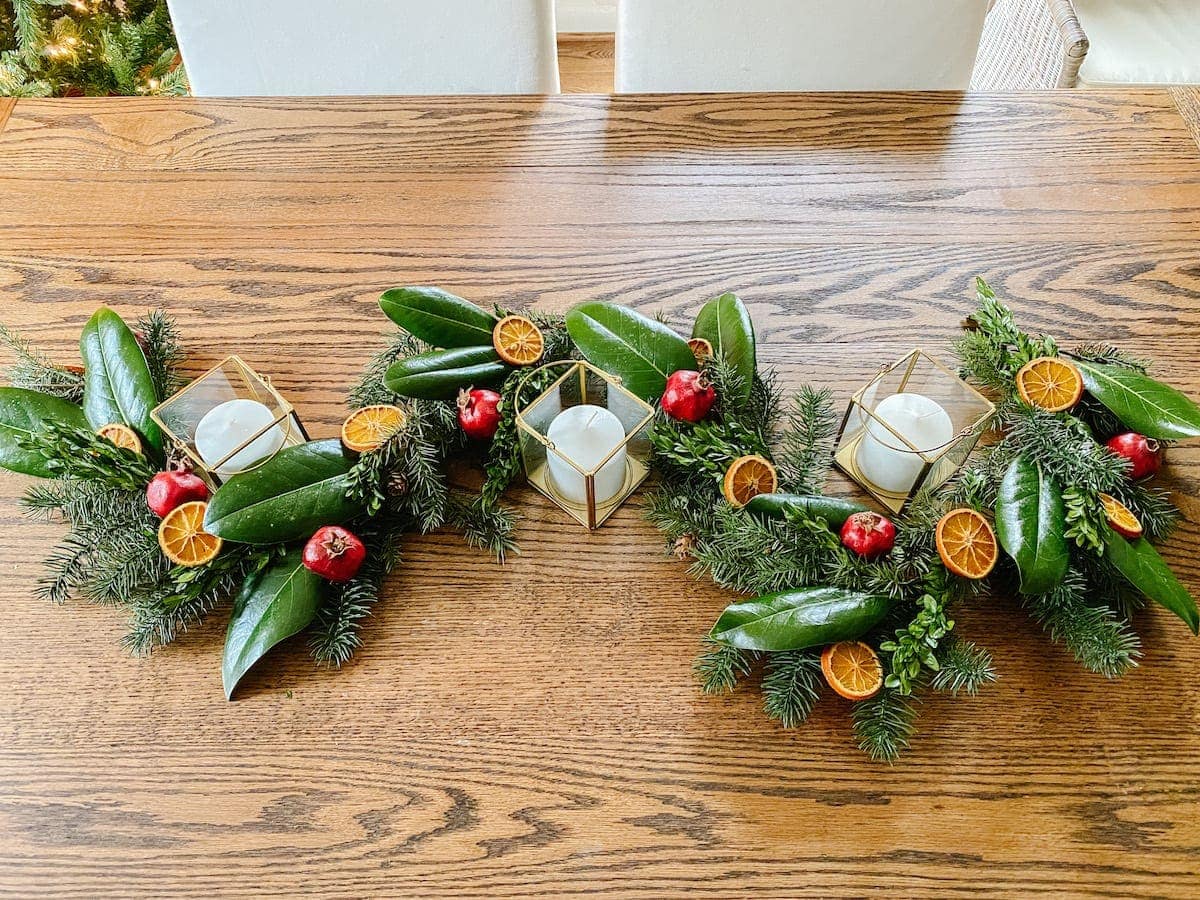
- Evergreen and magnolia branches: $20–$45
- Dried orange slices, 40-count: $18–$40
- Decorative pomegranates, set of 6: $15–$35
- Three gold geometric candle holders: $30–$85
- White pillar candles, set of 3: $12–$28
Total: $95–$233
Budget alternative: use clippings from your own trees or a neighbor’s, and swap the gold holders for plain brass candlesticks from a thrift store at $4 apiece.
26. Backlit Citrus: The Ornament That Glows From Behind
Hang a dried orange slice in front of a window or a warm bulb and it stops being a slice and starts being a lantern. Everything else in this frame — the pinecone, the conifer branch, the twine — is supporting cast. Move the same slice to a wall with no light behind it and you get a flat brown circle. That’s the entire difference, and it’s free.
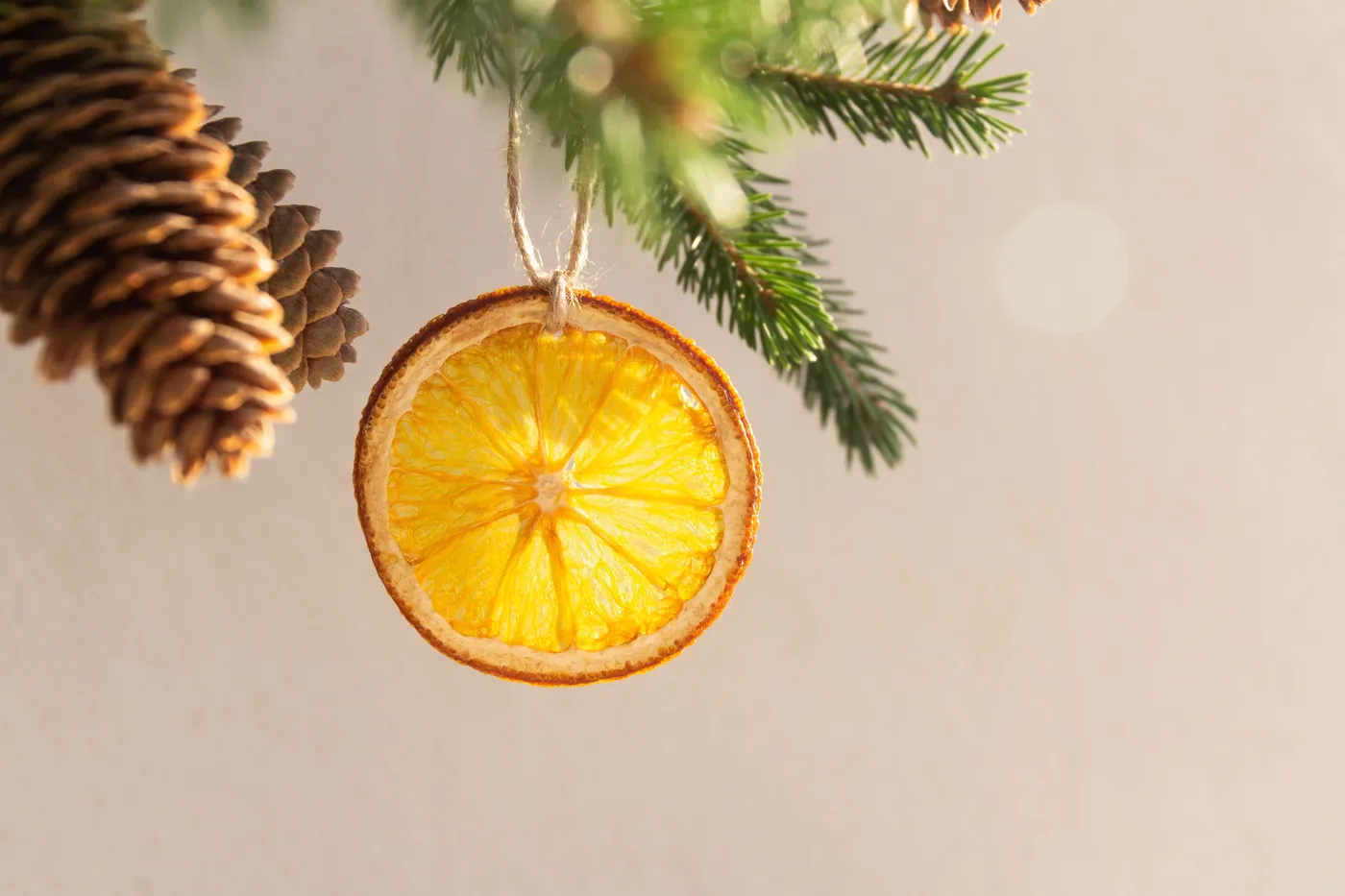
Test your slices before you commit them to a tree. Hold each one an inch in front of a lamp. If you can see the segment lines glowing through the flesh, it’s fully dried and will light up. If it’s opaque, it needed another 30 to 45 minutes at 200°F or another week of air drying. Undried slices also mold inside a warm house, so this test does double duty. For a guaranteed glow indoors, clip a $6 battery puck light behind the branch, or hang these in front of a window where afternoon sun does the work for you.
27. Wooden Beads and Jute Twine on Burlap
Same beads, same twine, darker mood than Idea #2. The formula: 50% jute and burlap (the twine, the fabric underneath, the raw wood), 30% dried citrus for warmth, 15% small wooden beads as rhythm, and 5% black metal — the scissors, and honestly anything else in the frame that’s black. That last 5% matters more than it should. Without a hard, dark note, natural materials can blur into one beige mass. A black-handled tool left in the shot, a black iron hook, a length of dark ribbon — any of those anchors it.
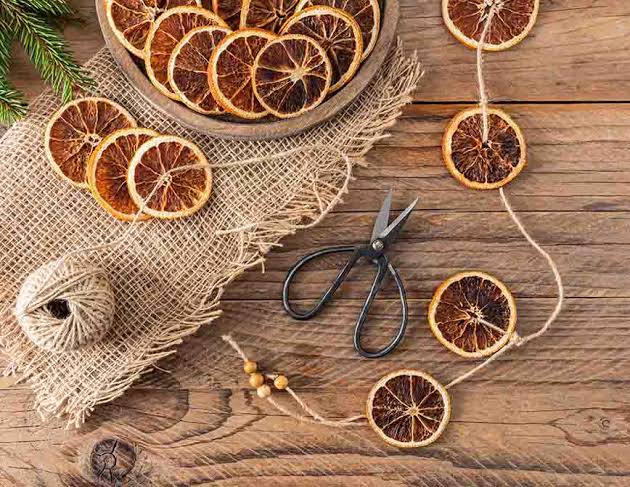
Burlap and jute are the cheapest way to get this look. A 5-yard roll of burlap ribbon is $5, and a 400-foot spool of jute twine is $4 — that’s enough for four full garlands. Wooden beads are the one thing worth buying new rather than scrounging; 8mm natural beads run about $8 for 300, which is years of supply. Total for a strand like this: roughly $9 if you’re using grocery store oranges. Compare that to the $30–$45 boutique versions and it’s almost embarrassing.
28. Cranberries on Striped String Over Pine and Cypress
Cranberries are the sleeper material of the 2026 season. They’re cheap, they’re already in every grocery store from October through December, and they hold their color far better than dried fruit — a cranberry strand stays bright red for a month, while dried citrus slowly warms toward brown. The catch is that fresh cranberries eventually shrivel and drop, so this is a December-only garland, not something you pack away. Budget about $4 of berries per six-foot strand.
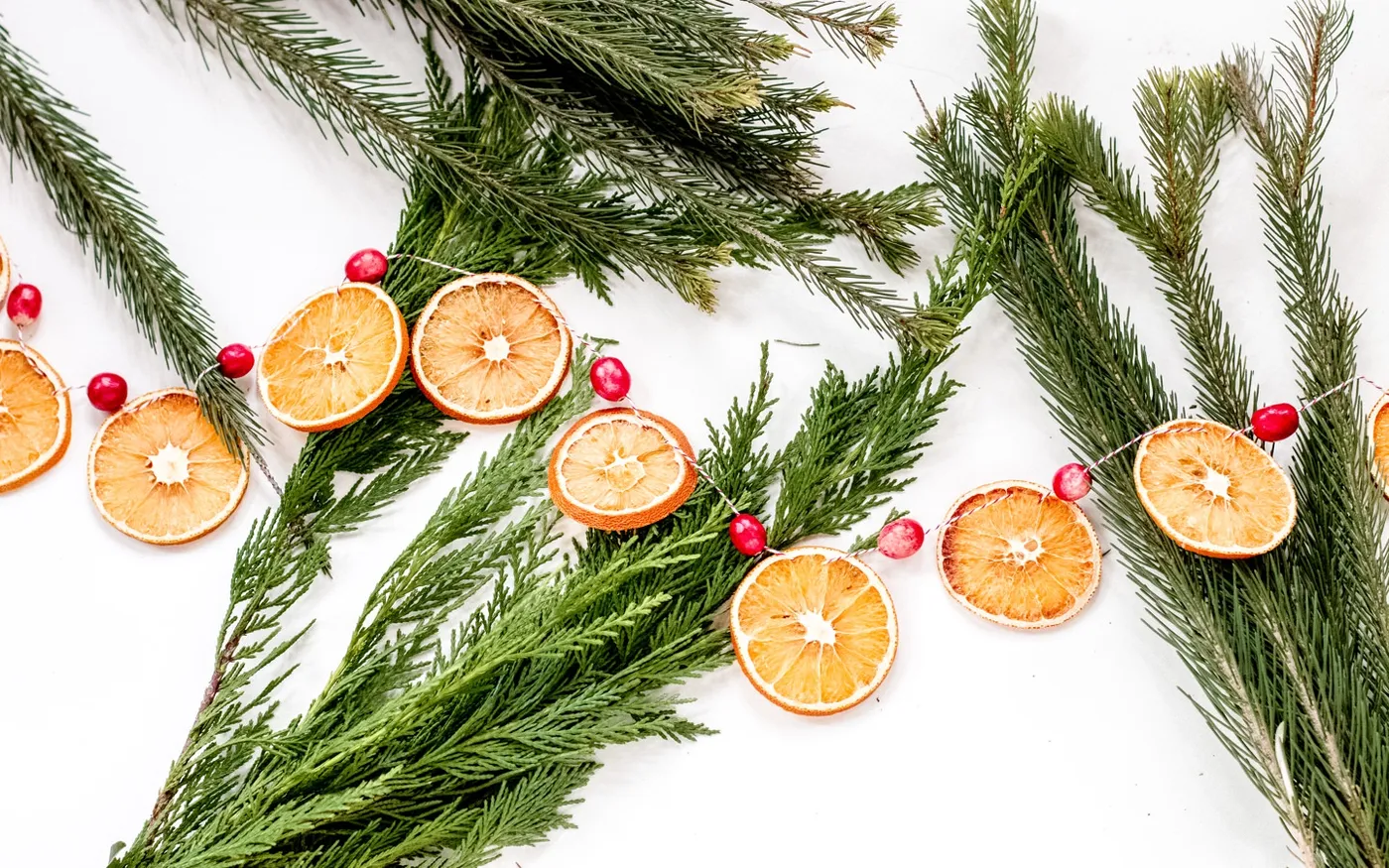
Pairing two greens — dark pine as the base, lighter cypress layered over it — is what gives this depth, and it’s the detail most people skip. A single green flattens out. For scale: a garland like this works on a mantel 48 to 72 inches wide, hung from a window frame, or draped across a 6-foot sideboard. Anywhere taller than 8 feet of wall and you’ll want the strands doubled, as in Idea #25, or the arrangement looks small and apologetic against the space.
29. The Half-Finished Garland on a Rustic Wood Table
- Lay your full pattern on the table before threading — every bead and slice in position.
- Measure the finished length twice against the spot it’s going.
- Cut twine 3x longer than you think you need. Knots and tassels eat a lot.
- Have a second needle on hand; large-eye needles bend, and you will drop one.
- Keep a bowl for rejects — cracked, uneven, or under-dried slices.
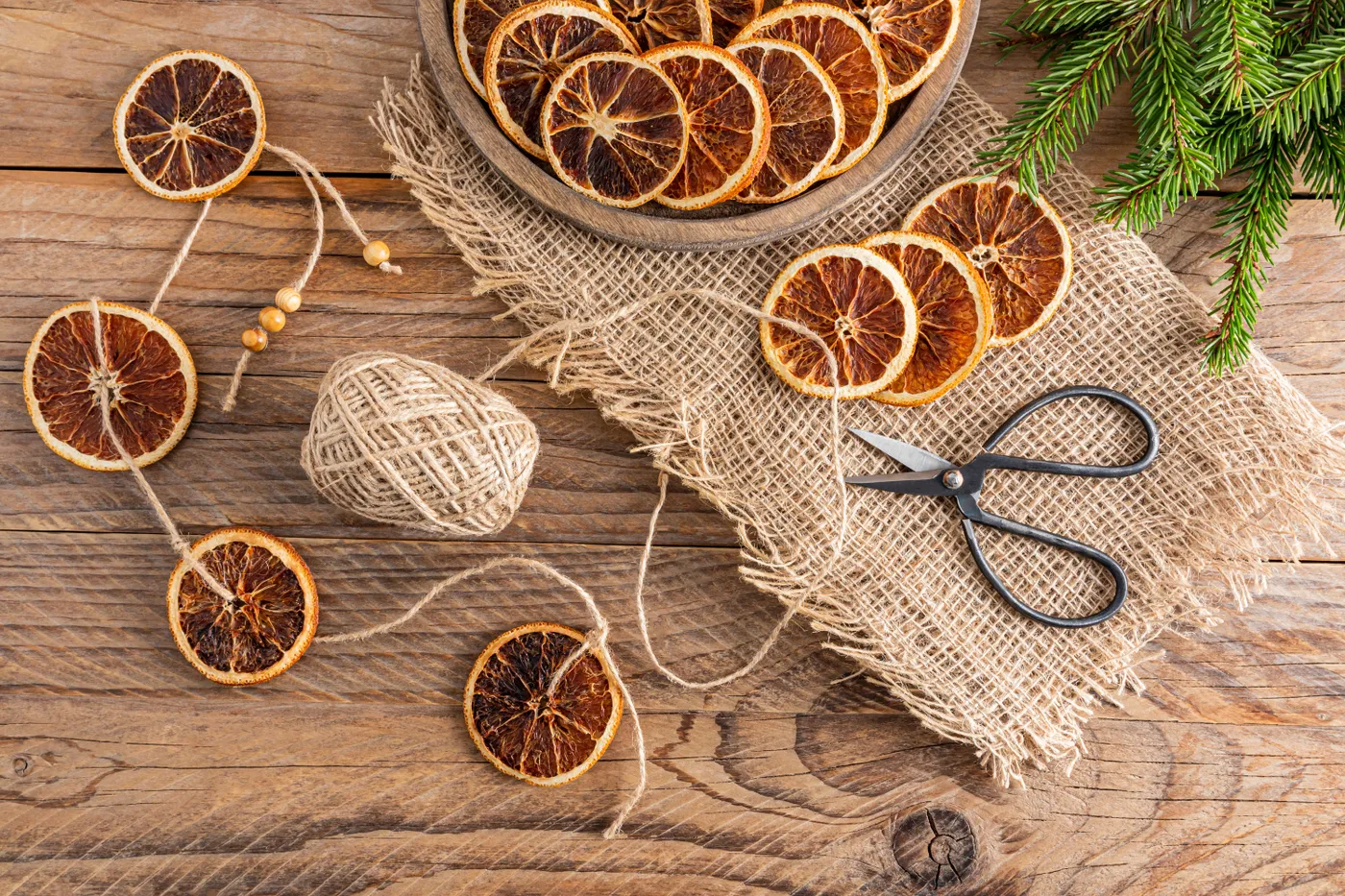
The real problem with a garland like this isn’t the crafting, it’s the stopping. Most people get two-thirds of the way through, leave it coiled on the table, and come back three weeks later to find the twine has loosened and the beads have all slid to one end. Finish in one sitting if you can — 90 minutes for eight feet. If you can’t, tape the free end of the twine to the table so the strand can’t unspool, and write your place on a sticky note. It sounds fussy. It saves the whole project.
30. Citrus Across the Window With a Glass Star
Hanging citrus across a window turns the garland into a silhouette instead of an object. Backlit, orange and lime slices go translucent, the string nearly disappears, and the whole thing reads as a stained-glass panel made of fruit. The clear glass star beside it is doing the same trick — it catches and bends the daylight rather than blocking it. Put the identical setup against a solid interior wall and it loses most of its magic. The light source is the design.
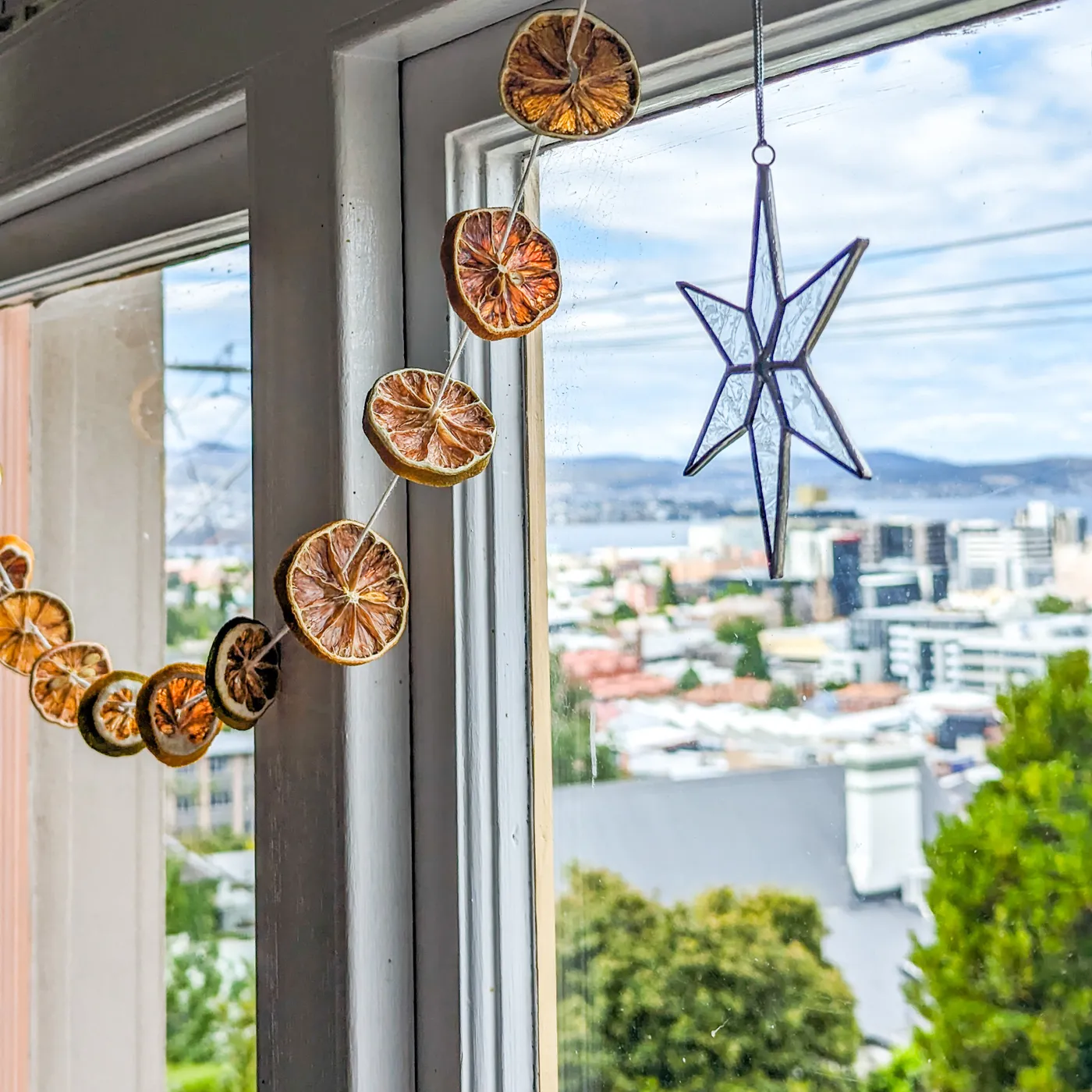
Mounting matters here. Use a white tension rod inside the window frame or two cup hooks screwed into the top of the trim — never adhesive hooks on glass, which fail in cold weather. Keep the strand 2 to 3 inches away from the pane so winter condensation doesn’t soak the slices and so you can still open the window. If your window gets direct southern sun, expect the citrus to darken by about a shade over six weeks. Rotate the strand occasionally and it’ll stay even.
31. A Single Slice, a Gold Satin Bow, and That’s It
One perfect dried slice, one gold satin bow, one loop of natural string. That’s the entire ornament. The restraint is the point — a fully filled slice with visible segments and no cracks is genuinely beautiful on its own, and the satin ribbon adds a sheen that matte twine can’t. If the slice is broken, uneven, or pale, this design exposes it instantly, so save your best three slices for these and use the rest in garlands where nobody’s inspecting them.
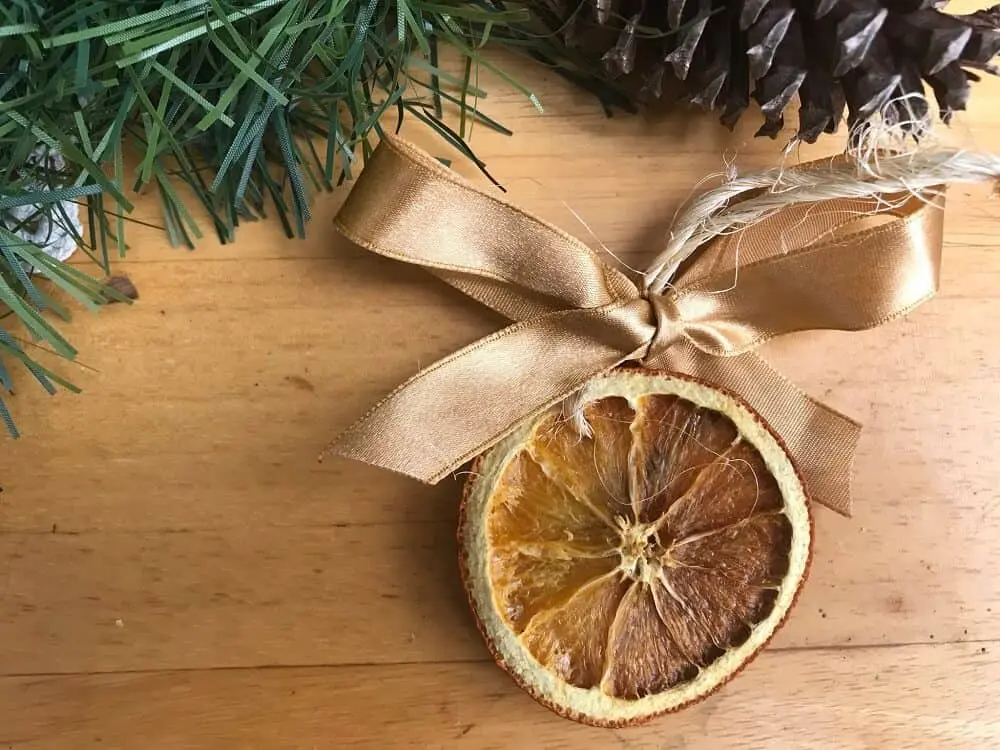
- Dried orange slices, 24-count (make your own): $4–$8
- Gold satin ribbon, 3/8 inch, 10 yards: $5–$12
- Natural fiber string, 100 ft: $3–$6
- Faux pine sprigs and pinecones: $8–$18
Total: $20–$44 for two dozen ornaments
Budget alternative: cut 1-inch strips from a thrifted gold satin scarf or a clearance roll of ribbon from Michaels — often $1.50 a spool after the holidays — and you’re under $10 for the whole set.
Your Windows Are Going to Smell Amazing by Sunday
Thirty-one garlands later, the honest takeaway is that dried citrus is one of the few holiday projects where the cheap version genuinely looks as good as the expensive one — it just takes an afternoon and a working oven. Start with one strand, get your slice thickness right, and let the rest of the mantel follow. And pin your favorite version now, because come November you will not remember which idea had the bay leaves.