
30 Stunning Outdoor Christmas Window Box Ideas You Need to Try in 2026
Still scrolling saved photos of Christmas window boxes, wondering which one actually suits the front of your house? It’s the fastest way to make a plain facade look like it belongs on a holiday card — and the easiest place to overspend on details nobody sees from the sidewalk.
We spent serious time browsing Amazon, Etsy, and Walmart to bring you only what’s worth your attention this year, across every price point from about $15 for a bag of berry sprays to $325 for a fully planted black slatted box.
Inside you’ll find 30 curated ideas covering traditional evergreen-and-berry, rustic natural textures, candy-cane classics, and bold jewel-tone baubles, with budget and luxury versions compared side by side. And stay until the end — we break down the most common mistakes that can ruin these looks.
Why now? Holiday styling in 2026 has drifted away from tinsel and toward foraged, collected arrangements — birch logs, seed pods, and silvery junipers are being saved on Pinterest far more than glitter. This post contains affiliate links. 📌 Save this to Pinterest for later — you’ll want to revisit these ideas.
1. An Evergreen Window Box Loaded With Red and Gold
Start with structure, not sparkle. For a 36-inch box, work in three layers: four or five cedar or fir bunches laid in at a 45-degree angle so the stems point down and inward, then three pine sprigs for needle contrast, then your accents. Tuck the stems into damp foam or a soaked coir liner, and wire the whole thing through the black wrought iron bracket so a January wind doesn’t take it with it.
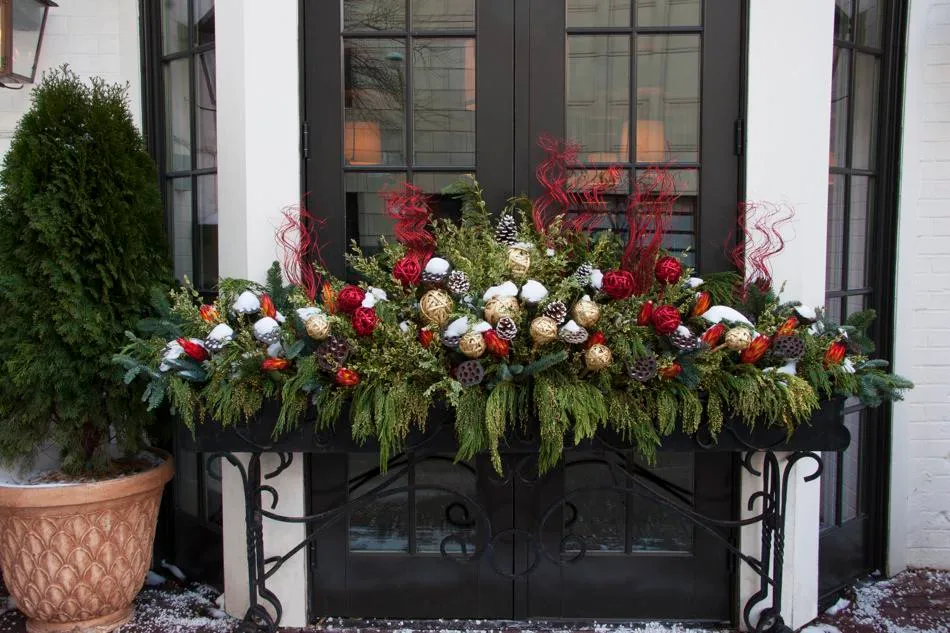
Three things are doing the heavy lifting here. First, contrast — bright red curly twigs and gold spheres read instantly against near-black evergreen. Second, repetition: round ornaments at uneven intervals keep the eye moving instead of parking in one spot. Third, temperature mixing. That warm gold and red against the cold dusting of snow is what makes it feel like a snow globe instead of a craft project.
2. A Rustic Birdhouse Window Box With Frosted Berries
It’s the weathered black birdhouse. Take it out and you still have a perfectly nice evergreen box — but you lose the story. That little house gives the arrangement a center of gravity and a reason to look twice, and it doubles as a scale anchor: everything around it gets sized in relation to it. If you swap in a different focal object, match its visual weight, not its literal size.
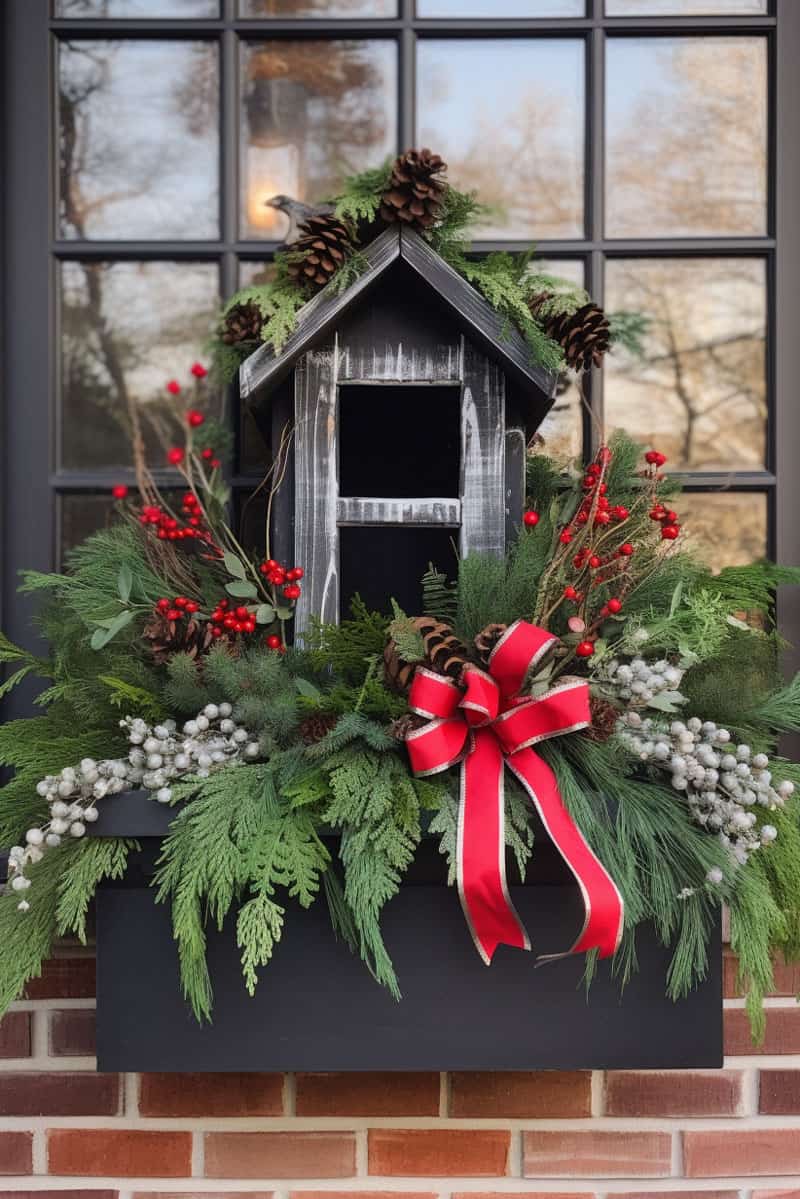
Be honest about frost and thaw. Real berries and frosted-white berries look gorgeous in week one, then go brown and mushy after a few freezes, usually right before your guests arrive. Same story for a wooden birdhouse sitting in standing water. Drill drainage holes in the liner, and if you want berries that hold through January, look for faux clusters with a matte finish instead of shiny plastic.
3. Lotus Pods and Burgundy Stems in a Concrete Planter
Here’s the formula: roughly 55% evergreen body, 25% color from the red berries and tall burgundy stems, and 20% texture oddities — the lotus seed pods and brown magnolia leaves. Swap the burgundy stems for silver-painted branches and the whole thing turns icy; swap the gray concrete planter for terracotta and it goes warmer and more farmhouse. The percentages matter far more than the specific plants you pick.
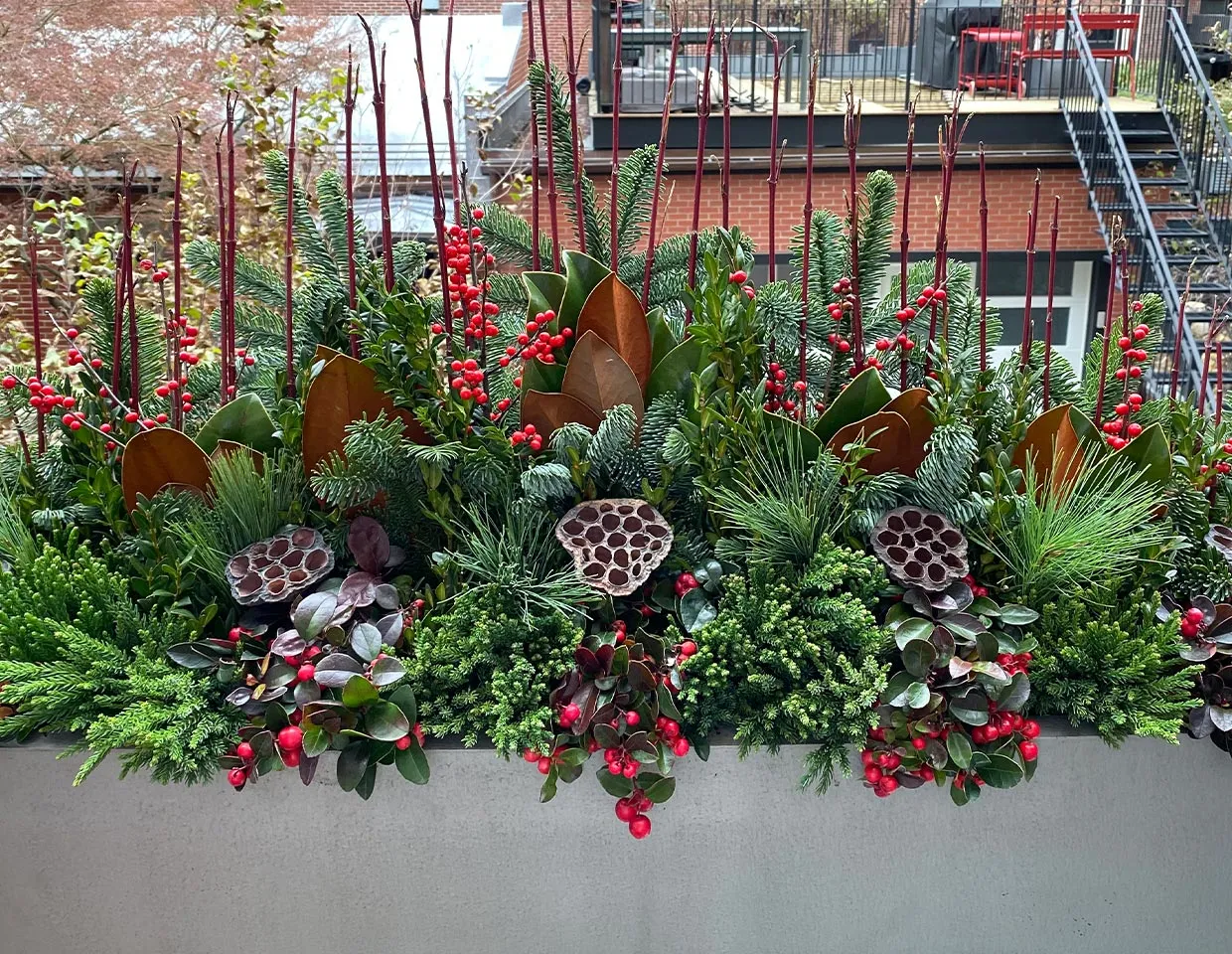
This is the look that’s been quietly replacing tinsel for the last few holiday seasons. Call it collected-winter styling: seed pods, dried stems, foraged shapes, and a whole lot of restraint. It photographs beautifully, and it ages well — you’ll still like the pod-and-pine thing in 2030, which is more than most theme decor can promise.
4. A Long White Box of Mini Spruces and Velvet Bows
Those little conical evergreens are usually just potted Alberta spruce, and you don’t need a nursery budget for them. Big-box stores and even grocery chains sell 12–18 inch potted spruces for $12–20 each in late November. Red velvet ribbon runs $4–6 a roll and berry sprays $3–5 each, and tree lots will often hand you clipped branches for free if you ask before they close. Compare with Idea #27 — same white box, a completely different mood.
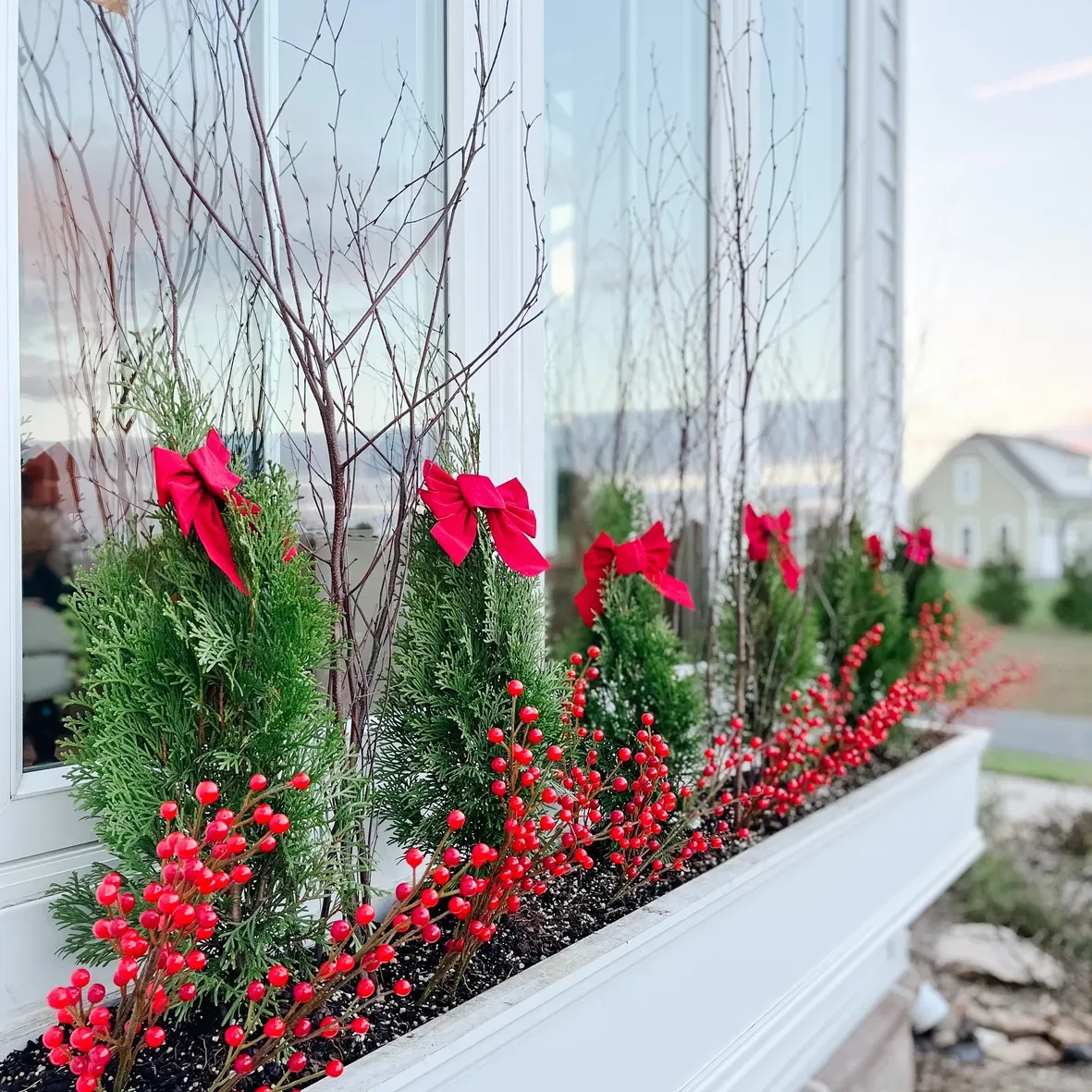
Rhythm is what makes this work. Five or six identical plants in a row, each with the same bow at the same height, turn a long window box into a colonnade — it makes a wide arrangement feel intentional instead of stretched. The bare dark branches between them are the detail that keeps it from looking like a garden center display: they add air, and air is what stops repetition from turning monotonous.
5. Two Oversized Red Ornaments Against Grey Shutters
- Light grey fiberglass or painted wood window box, 36–48 in: $60–140
- Small potted pine tree plus two or three evergreen bunches: $25–45
- Two oversized ribbed ornaments, 6–8 in: $12–30
- Coir liner and mounting brackets: $20–35
- Outdoor-rated extension cord and timer: $15–25
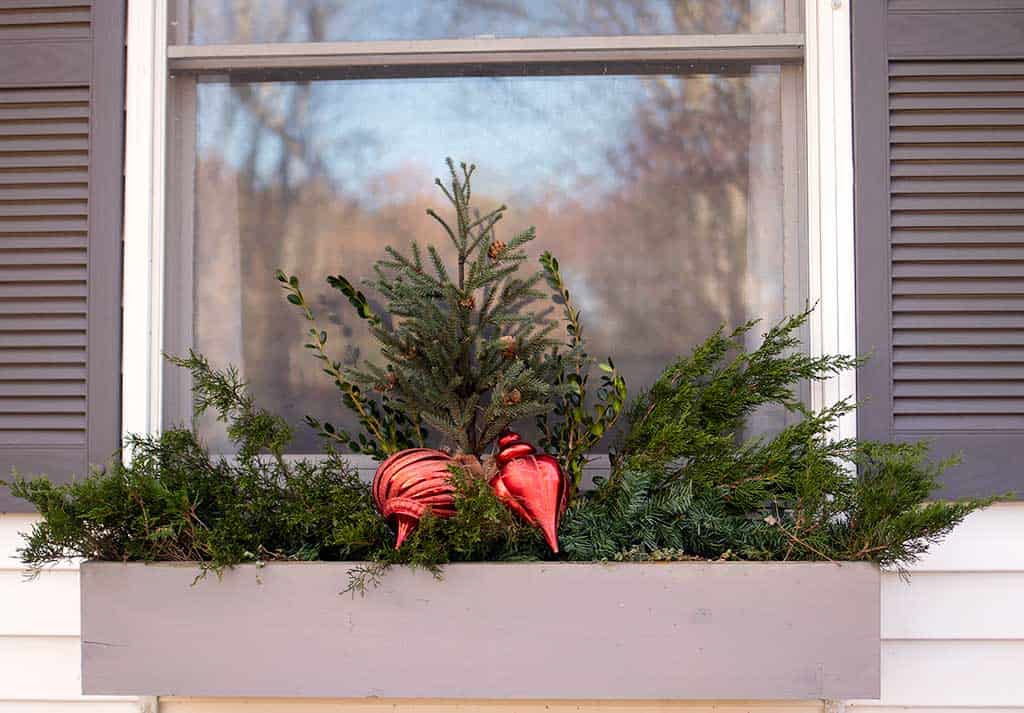
Total: roughly $130–275 for a single window.
Oversized ornaments only work if you commit. The rule I use: one ornament in the 6–8 inch range for every 18 inches of box length, and never more than three total. A 48-inch box gets two, maybe three. That ribbed red pair reads all the way from the street because there are exactly two of them — five smaller baubles in the same spot would just look like clutter.
6. Pine Needles, Fluted Ornaments, and a Tiny Wreath
That wreath hanging off the front of the box is charming and also the first thing to go in a windstorm. Secure it with two zip ties through the liner, not one hook. And check your palette in daylight: a glittery orange bow next to true red ornaments can look mismatched under gray winter light, even when it looked festive under warm bulbs indoors. If orange and red are fighting each other, pick one as the star and mute the other.
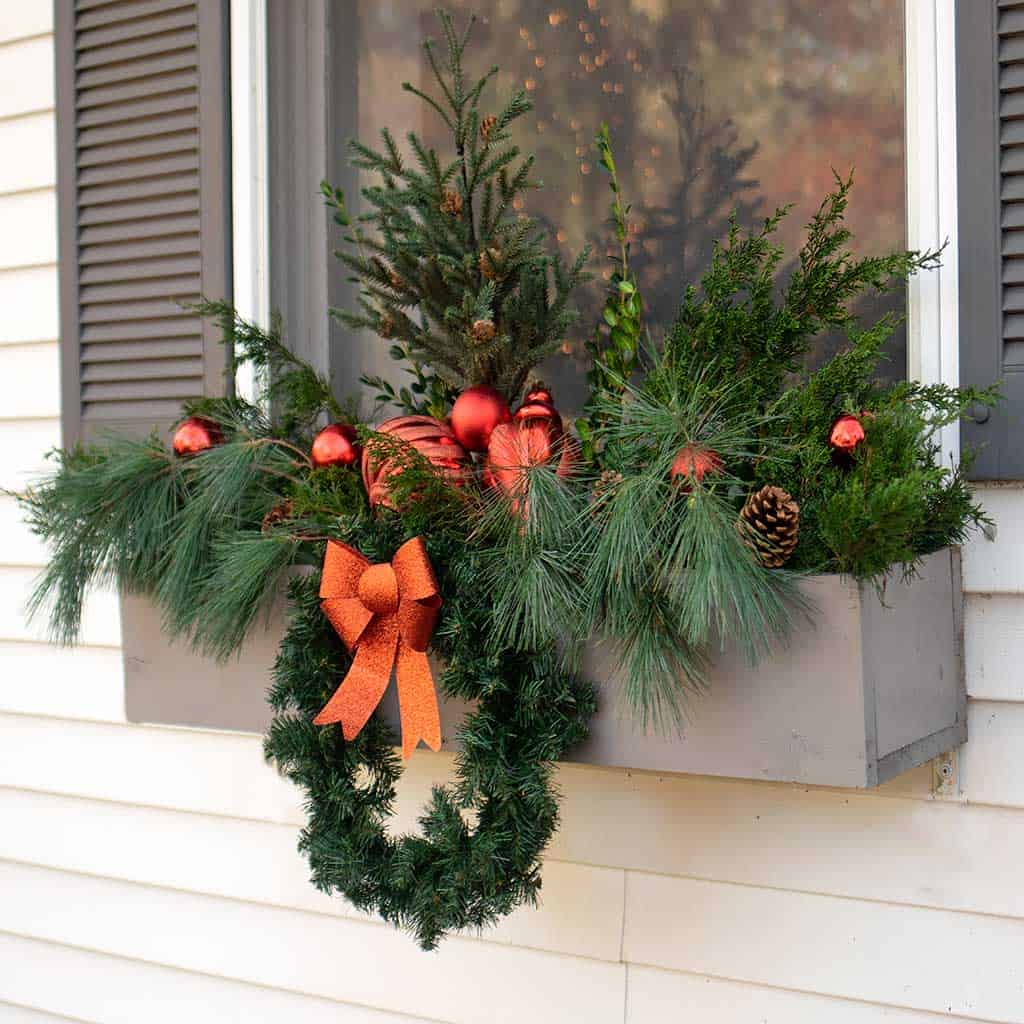
The small green wreath with the orange bow is the whole personality of this box. Without it you have a very pleasant, very ordinary evergreen arrangement with red baubles — you’ve seen it a hundred times. The wreath breaks the horizontal line of the planter and gives the display a face. Just make sure it’s at least a third the width of the box, or it reads as an afterthought.
7. Birch Branches and Lotus Pods in a Black Box
Building the birch armature:
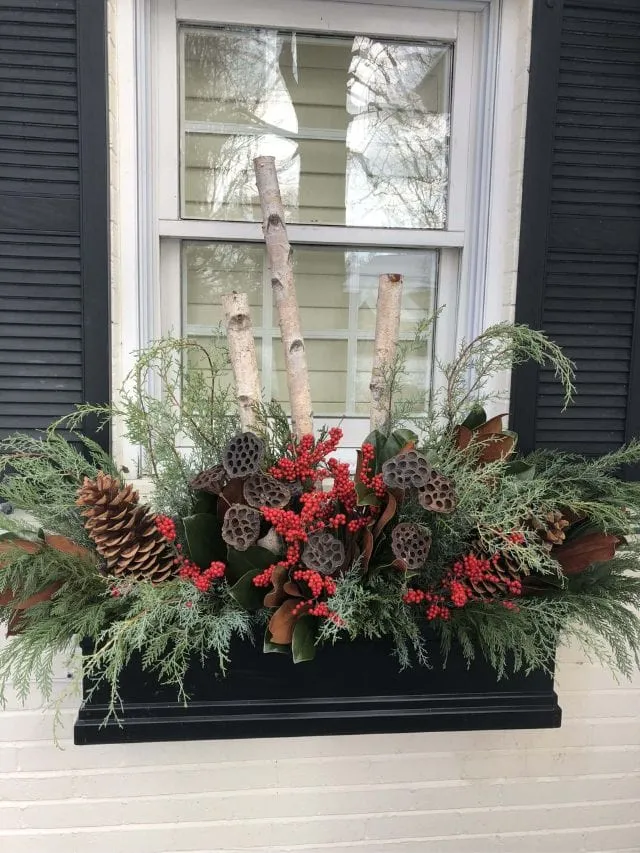
- Cut three or five birch branches to different heights between 12 and 20 inches.
- Bundle them loosely with jute twine about 2 inches from the bottom.
- Push the bundle into the liner at the back third of the box, angled about 10 degrees back.
- Pack evergreens around the base so the bundle disappears.
- Weave berries and lotus pods into the mid-layer, never the top — that’s what keeps it from going top-heavy.
Twenty minutes of work, about $15 in twine and birch if you forage locally.
This one runs 60% evergreen, 20% vertical natural elements, 20% red. The trick is that the red never appears alone — every berry cluster sits beside something brown or white, so the color reads seasonal rather than shouty. Want it cooler? Trade the cranberry red for burgundy and leave everything else exactly as it is.
8. Fir, Juniper, and a Red Glitter Bow Under Dark Shutters
This arrangement is built for a roughly 48-inch box that’s 9–11 inches deep, mounted under a window with the sill at least 4 feet off the ground. Any shallower and the small fir tree tips forward; any deeper and the long-needle pine gets lost. If your windows are narrow, drop to a 30-inch box and cut the plant count by a third rather than shrinking every element — the same proportions at a smaller scale always look fussy.
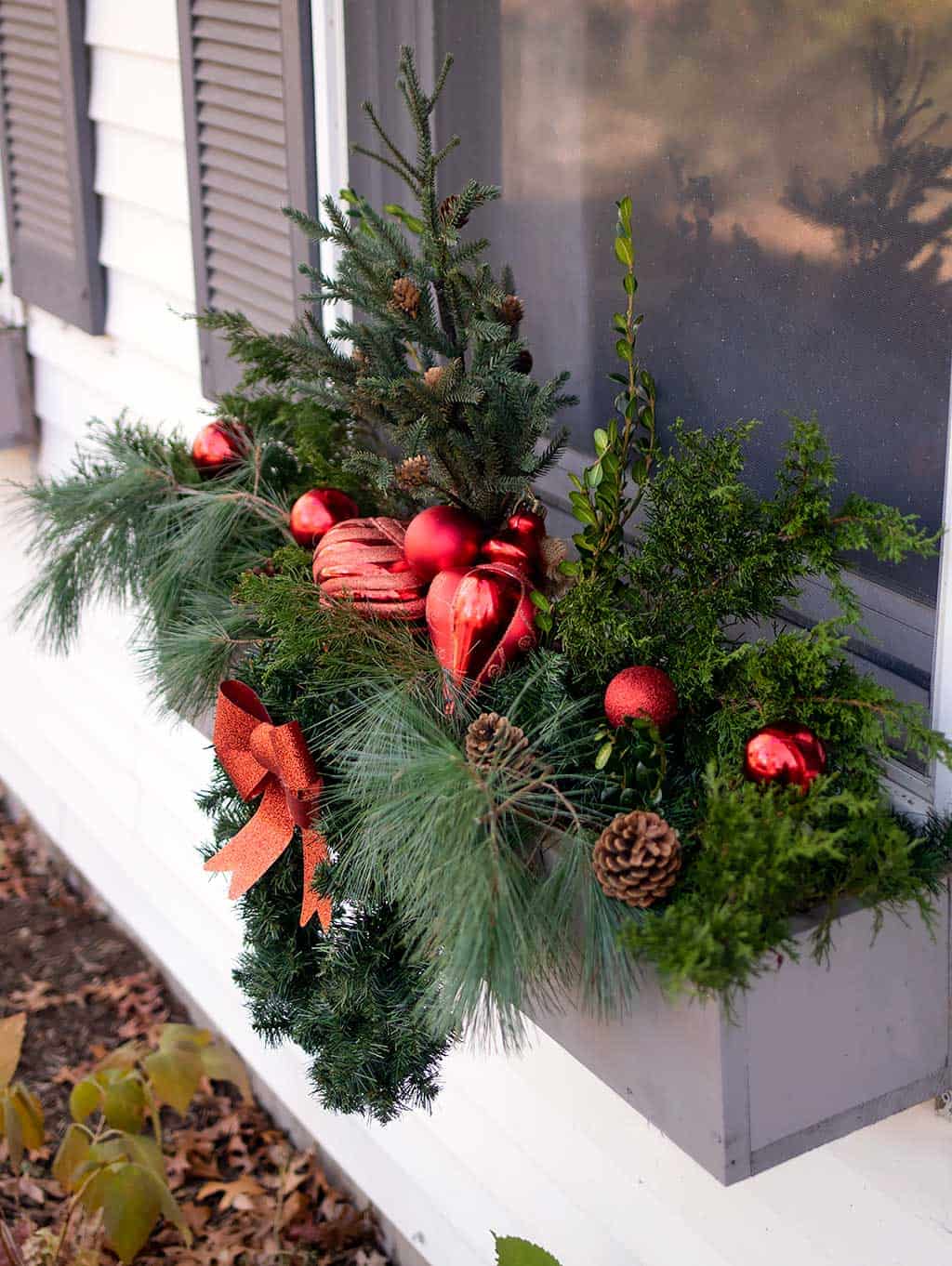
Fresh greens in an outdoor box typically hold 4–6 weeks in cold, dry weather and closer to three weeks if it’s mild and wet. That fir tree wants water every two to three days; once it dries out it drops needles onto your porch and nothing brings it back. The red glitter bow will shed for its first week — spray a matte sealer on it before you hang it, because glitter does not biodegrade.
9. Twin Window Boxes With Lanterns and Velvet Bows
A real candle inside a window box full of dry evergreen is a genuine fire hazard, especially on a windy night — the flame leans, the needles are bone-dry by mid-December, and one gust does the rest. Use a battery LED pillar with a flicker setting inside that black lantern. It looks nearly identical from the sidewalk, and you can put it on a timer so it’s already lit when you pull into the driveway. For a single-box version of this mood, see Idea #17.
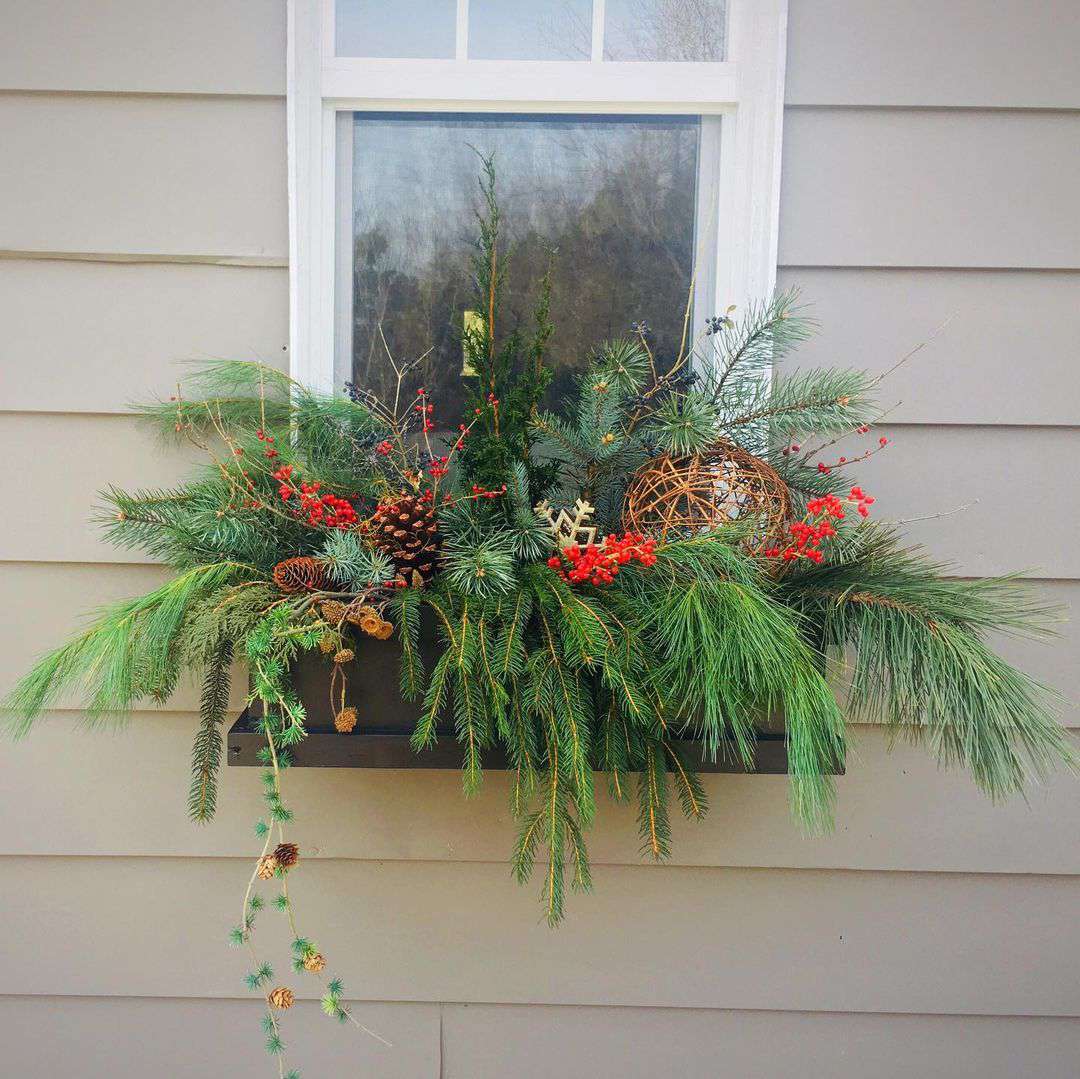
With two matching boxes, symmetry is your friend — but perfect symmetry reads flat. Keep the boxes identical and vary one thing: the lantern sits dead center in the left box and slightly right of center in the right one. Your eye registers balance without registering boredom. Keep both velvet bows at the same height, about 3 inches up from the bottom edge, so the two windows feel related.
10. Silver Ornaments and Snow on a Grey Stone Wall
The dark box against pale grey stone is the whole reason this works. A light-colored planter would vanish into the wall; a dark one turns the greenery into a silhouette. The silver-white ornaments are the second smart move — they pick up the cool undertone of the stone instead of fighting it, which is why this reads elegant rather than cute. That light dusting of snow on top simply seals it.
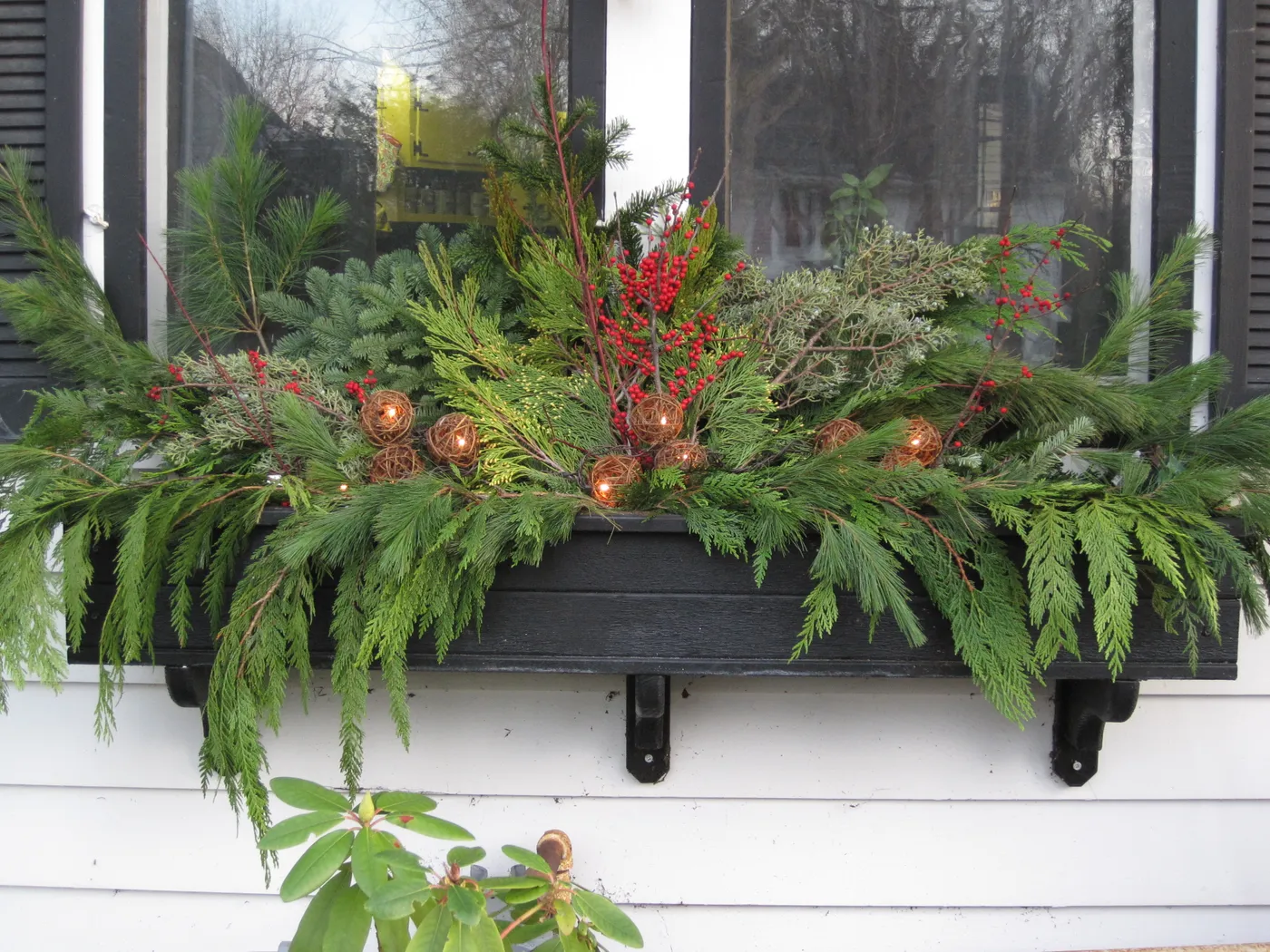
Silver and white ornaments are the cheapest thing in this photo. A tube of 20 shatterproof balls runs $6–10 at a dollar store or Walmart, and outdoors the difference between those and designer baubles is genuinely hard to spot from the sidewalk. January thrift stores are goldmines for the boxes themselves. Shopping smart, this whole look lands under $50.
11. Silvery Juniper With Amber Berries and Red Twigs
Silvery-blue juniper next to yellow-orange berries is a deliberately odd pairing, and it’s part of a larger shift: holiday decor that doesn’t center red and green. Designers have leaned into unexpected winter color for a few seasons now, and saves for non-traditional Christmas palettes keep climbing on Pinterest. This one works because the red bare twigs still nod to tradition — it’s a compromise, not a rebellion.
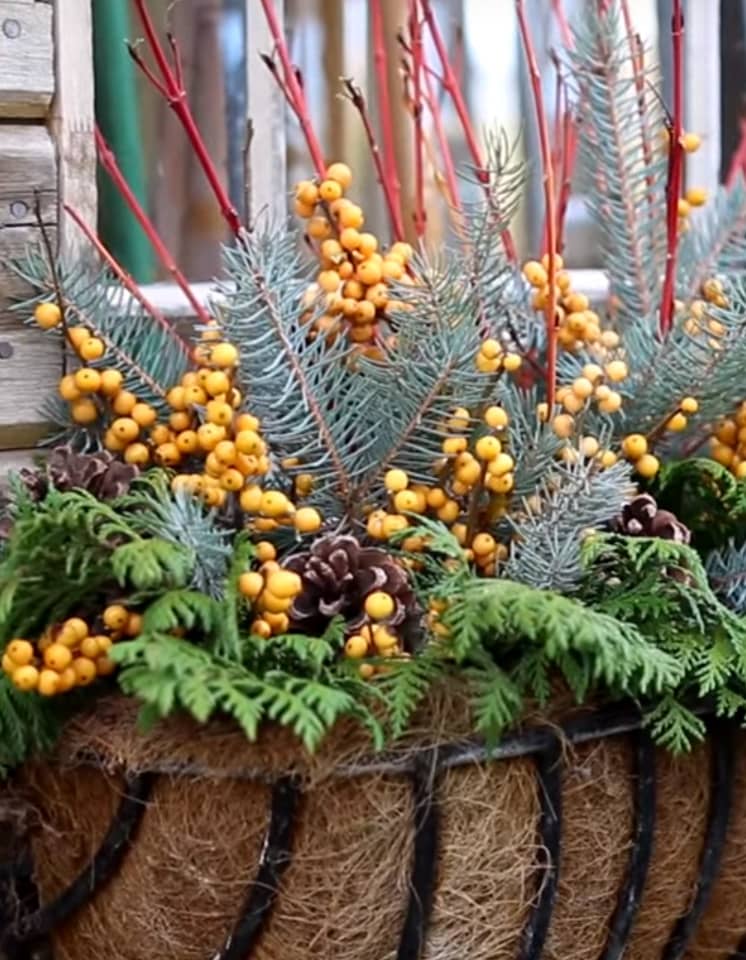
Those yellow-orange berries are the moment. Everything else here — silvery juniper, dark fern-like foliage, pinecones, coir — is standard winter fare. The amber-toned berries are what make you stop and look, and they’re doing real color work by warming up an otherwise cool, silvery arrangement. If you can’t find them, hypericum or bittersweet in that same amber range gets you 90% of the effect.
12. Warm White Lights in a Classic Berry Box
Window boxes under 24 inches are the hardest to style because there’s no room for layers. This density works from about 30 inches up. Ceiling height is irrelevant outdoors, but sill height isn’t: below 3 feet, people see straight into the box from the porch, so pack the front edge. Above 6 feet, you can go simpler — nobody is inspecting your stems from a ladder.
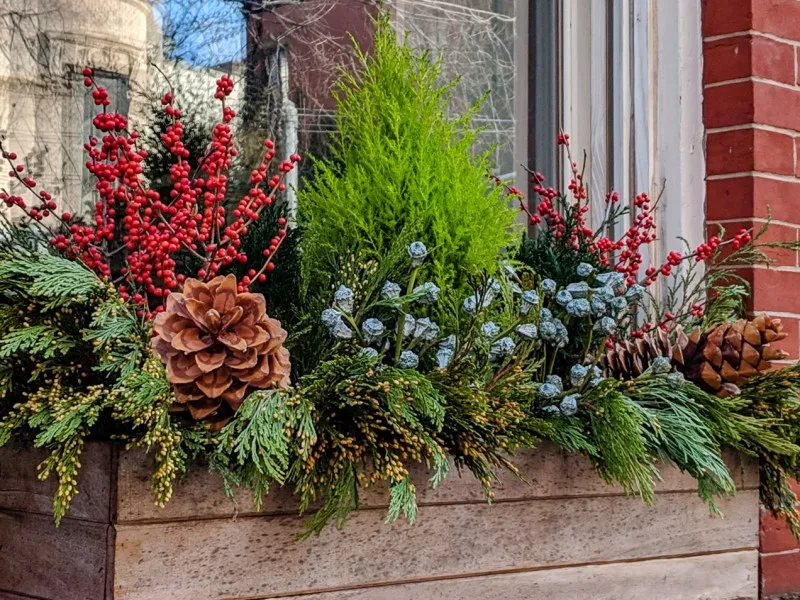
Lighting is what separates a daytime window box from a December one. Budget 200–300 micro LED lights per 36 inches of box, warm white, and weave them through the middle layer rather than wrapping the outside — the greens should glow, not wear a necklace. Battery packs with built-in timers save you from running cords to an outlet, and one set of batteries usually lasts the whole season.
13. Red Clusters and Gold Lotus Pods in a Coco-Lined Rail Planter
The formula here is 50% mixed evergreen, 25% bright red clusters, 25% silvery foliage and pale lotus pods. That last quarter is the quiet part — it does the job neutrals do indoors, giving your eye somewhere to rest between the reds. Swap the silvery-green foliage for plain dark fir and this goes heavy and traditional fast. Keep the ratio and you can change the flowers entirely. Idea #3 plays the same natural-texture game with a very different planting.
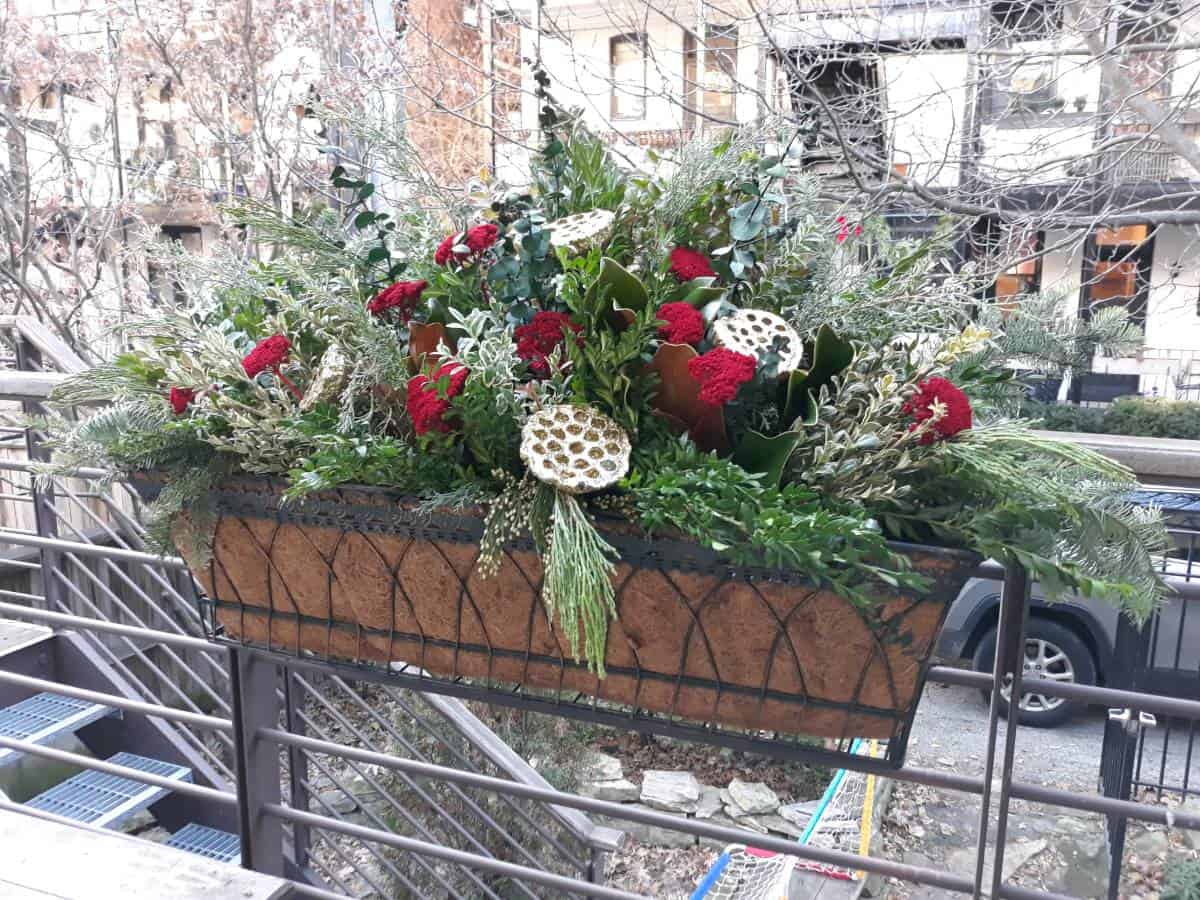
Prepping a coco liner so it doesn’t wreck your railing:
- Soak the liner in a bucket for 20 minutes until fully saturated.
- Line the inside with a sheet of landscape fabric to slow drainage.
- Add an inch of potting mix, not garden soil — it’s lighter and drains better.
- Set the liner into the metal frame and confirm the drainage holes aren’t blocked.
- Water sparingly; a coco liner in winter stays wet far longer than you’d expect.
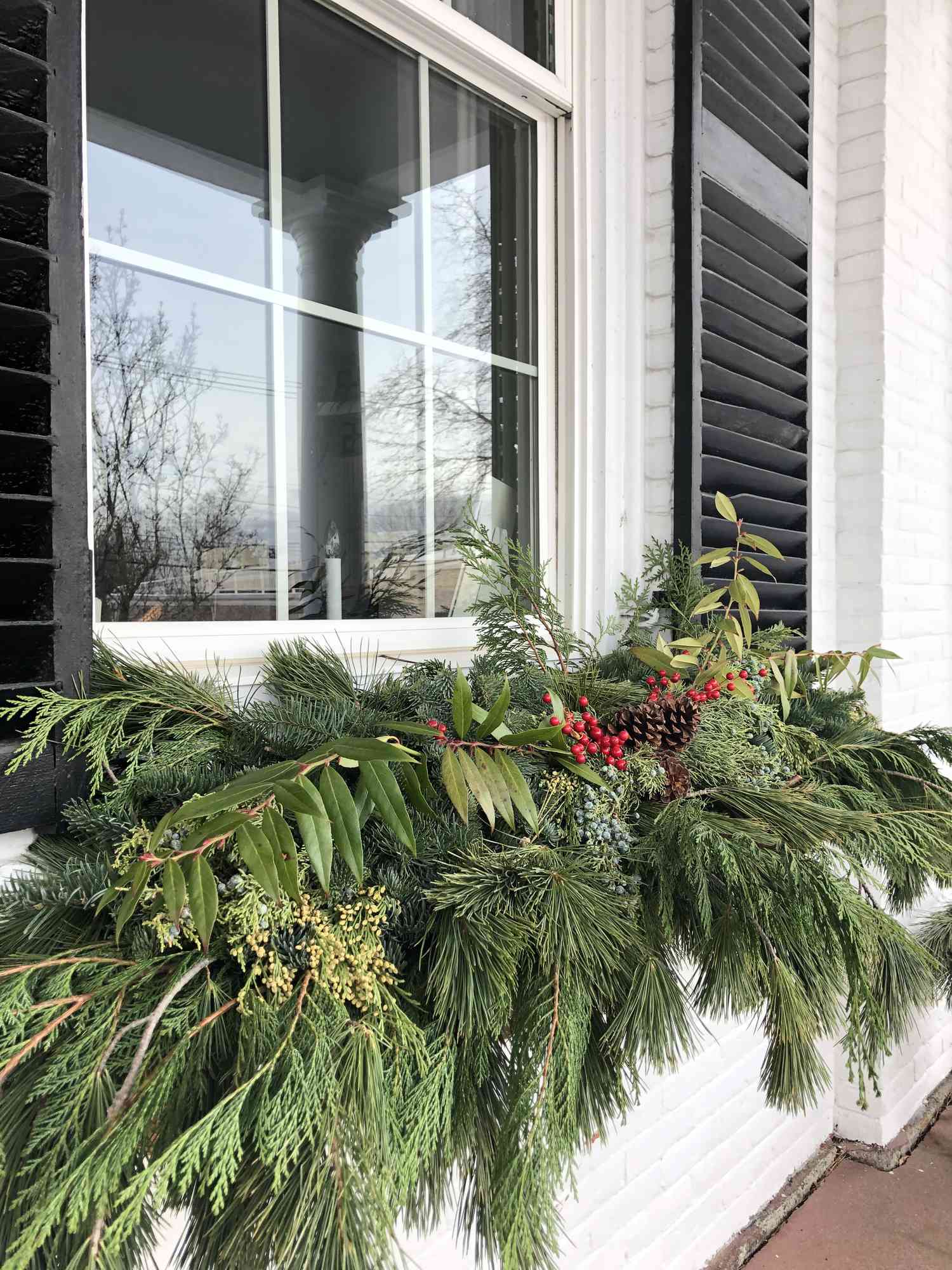
14. Fresh Evergreens and Berry Clusters on a Pale Wall
Cheap faux greens are the most common regret in this whole category. The tell is the stem: good faux evergreen has a bendable wire core and needles in two tones, while the bargain version is flat, single-tone, and reflects light like plastic. Mixing fresh and faux in the same box is perfectly fine — just put faux at the back and fresh at the front, where people actually look.
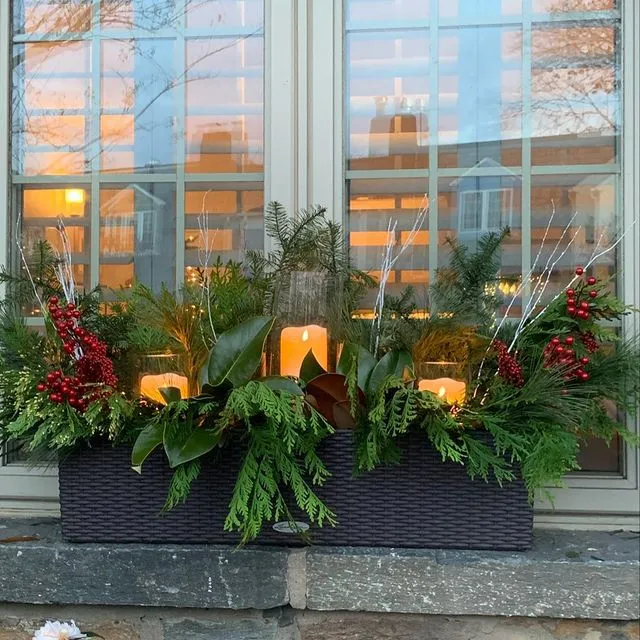
Fresh evergreens are the rare holiday material that’s genuinely free. Tree lots trim hundreds of branches a day and most will let you take armfuls if you ask before closing. Add $8 of red berry clusters and $5 of pinecones from a craft store and you’ve recreated this for under $15, assuming you already own the dark planter. Looking for the box itself? Facebook Marketplace is flooded with them every November.
15. Candy Canes and Snowflakes on a Stone Ledge
- Measure your box’s interior length and depth — candy canes need at least 6 inches to sit upright
- Check which way the window faces; south-facing boxes bake and dry greens out faster
- Confirm you have drainage or a liner, because candy canes and standing water don’t mix
- Count your window boxes and buy decorations in multiples, not singles
- Decide on real or faux boughs before you shop — it changes your budget by three times
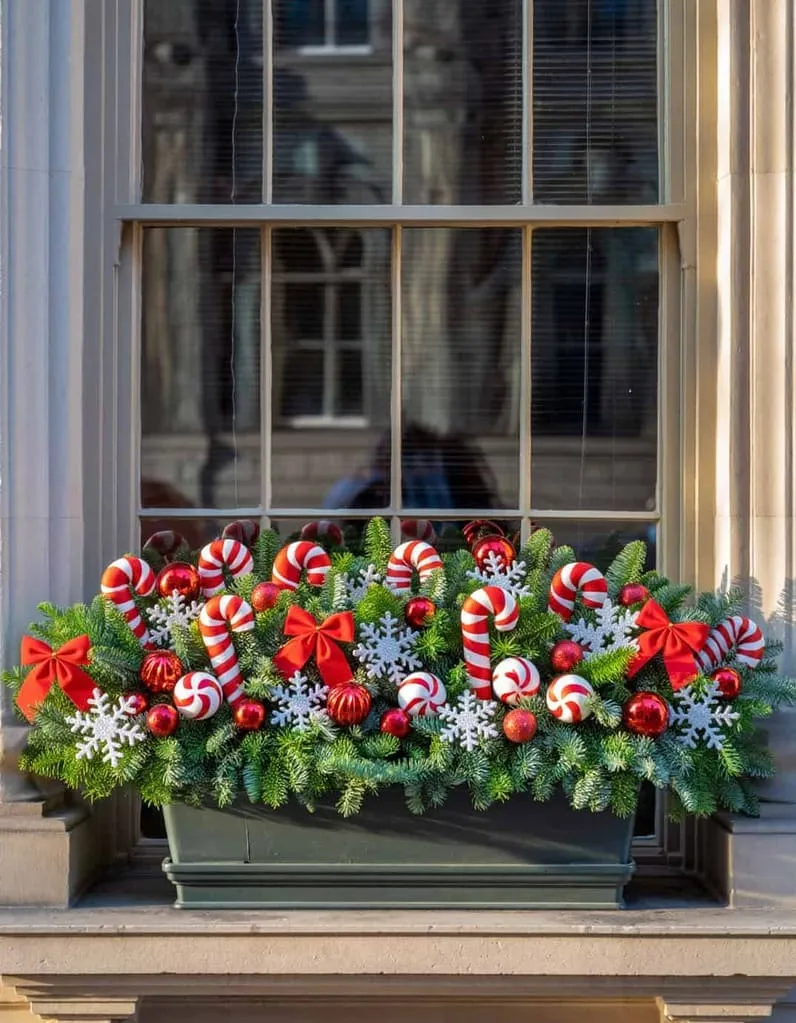
Now look at the finish mix: matte ornaments beside glossy ones, matte candy canes beside shiny ribbon. That contrast is why a red-and-white box doesn’t look like a candy shop — your eye gets texture, not just color. The white snowflake cutouts do the same job in a different way, adding hard-edged shapes that break up all those soft, rounded needles.
16. Snowman Figurines, Apples, and Trailing Ivy
Novelty figurines live or die on scale. Keep them under a third of the box height and cluster them in a group of three — a single snowman floating in the middle of a planter looks lost, while three read as a little scene. Then anchor them: the trailing variegated ivy here is what ties the figurines into the greenery instead of letting them look like toys dropped into a box.
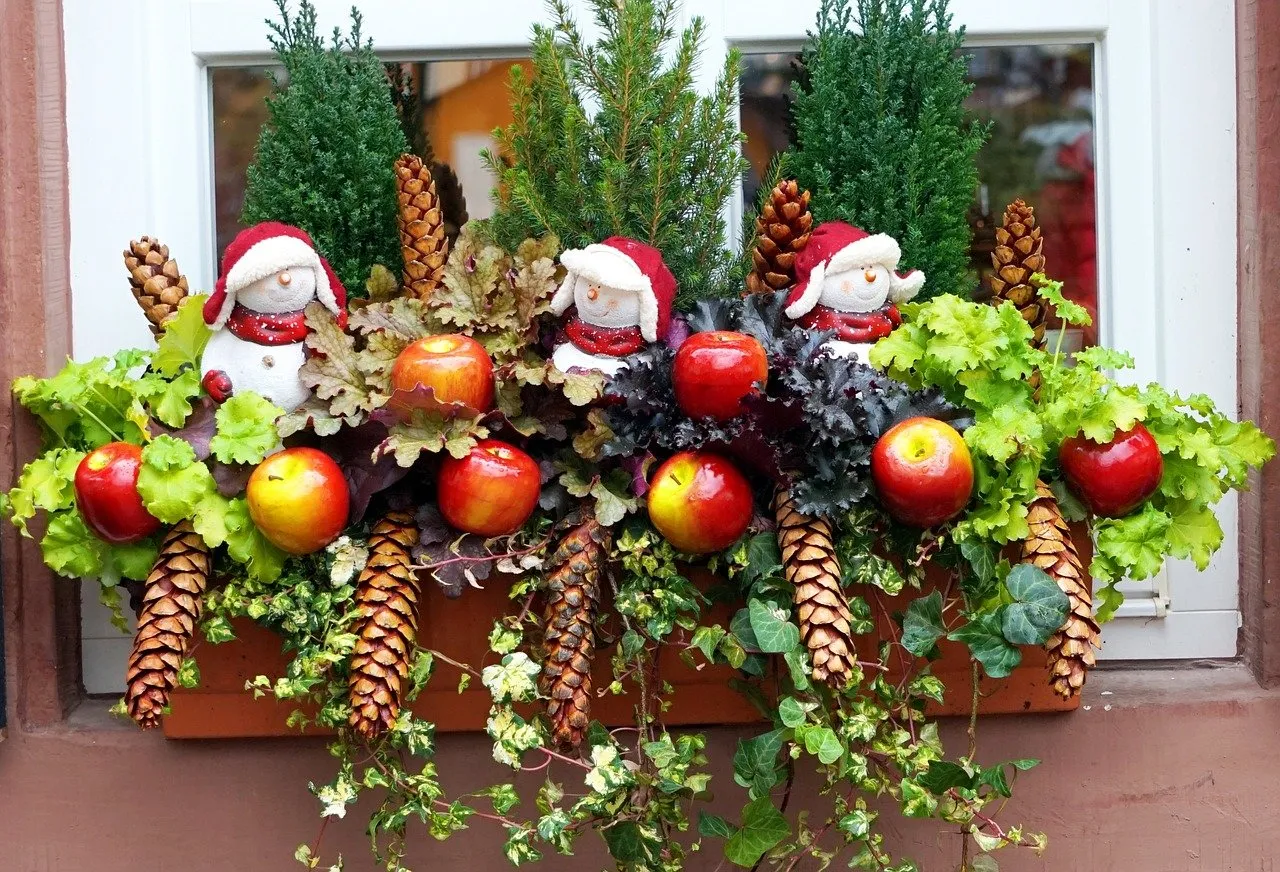
Apples look fantastic for about ten days. After that they soften, spot, and eventually drop — and when they drop onto a porch they stain concrete. If you want the orchard look past mid-December, use faux apples on wire picks. Same story for the ivy: real trailing ivy in a winter box needs consistently moist soil, which is a losing battle in a freeze-thaw cycle.
17. Red Berries Tuned to a Brick Facade
The red brick. Not the box, not the bows — the wall. Brick has red, brown, and sometimes orange undertones, and the berry and ribbon reds you choose should echo whichever of those runs strongest. On a cooler brick like this one, a true blue-based red sings. On a warmer, orange-toned brick, that same red goes muddy and slightly cheap-looking.
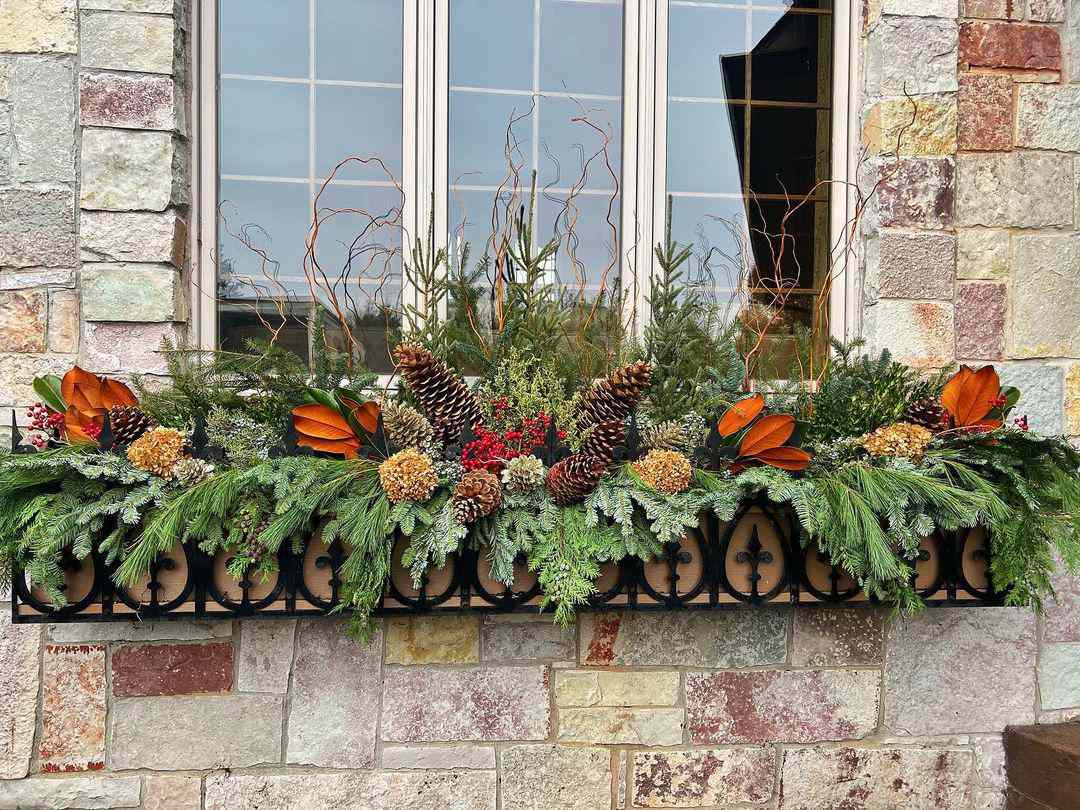
Brick facades usually mean deep sills and taller first-floor windows, so a box in the 42–60 inch range tends to look right. Mounting is the real constraint: masonry anchors are non-negotiable, and each bracket should be rated for at least 25 pounds, because the box, wet liner, and fresh greens add up fast. If you rent and can’t drill brick, go with railing planters instead.
18. Jewel-Tone Baubles Tumbling Out of a White Box
Big, colorful baubles are the easiest thing in this whole article to buy on a budget — 20-piece shatterproof sets in mixed jewel tones run $8–15 at Walmart or Target. The garland matters more than the ornaments, though, so spend your money there. A $15–20 artificial pine garland with realistic needle texture beats a $6 one every single time, because the garland is the base everything else sits on.
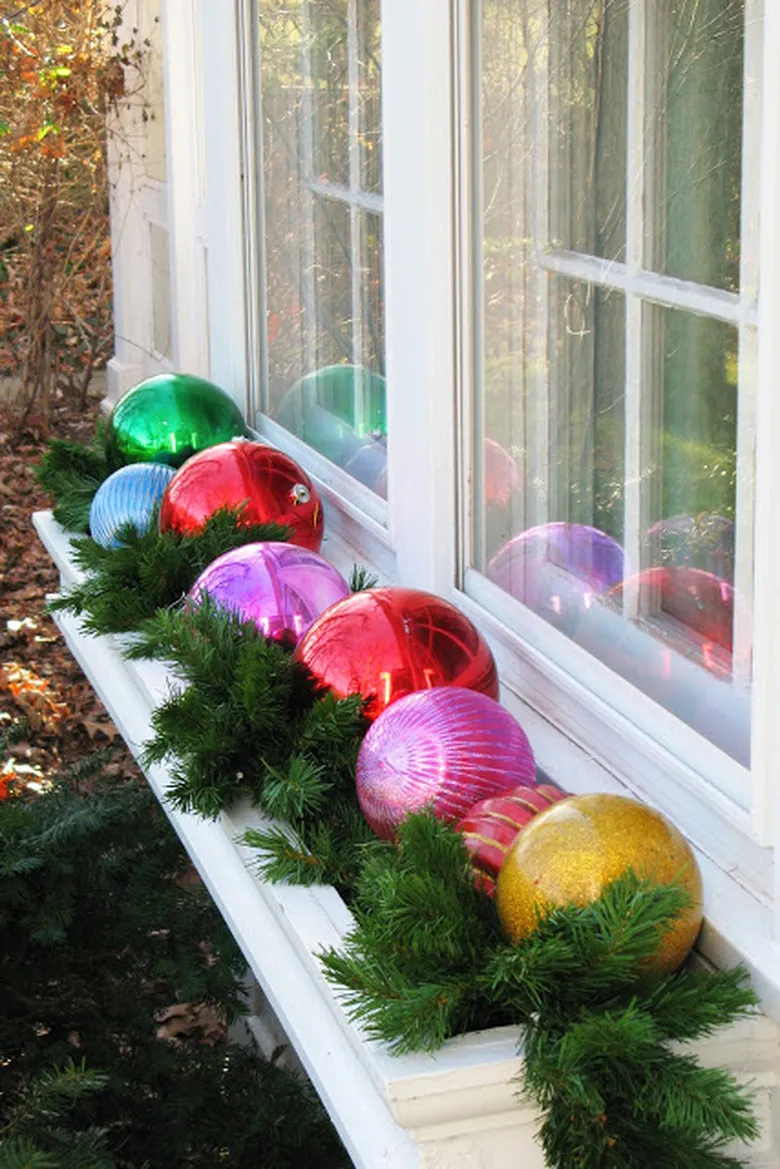
This look flips the usual ratio: about 70% green garland, 30% color, and the color is intentionally loud. The reason it doesn’t turn chaotic is that every ornament sits in the same jewel-tone family — saturated, slightly deep, nothing pastel. Want it calmer? Keep the exact same 70/30 split but switch to all silver and white, and the whole box instantly quiets down.
19. Eucalyptus, Silver Ornaments, and Grey Louvered Shutters
Two smart moves here. First, silver is the only metal — no gold, no copper — which keeps the cool palette clean against those grey shutters and sets up the eucalyptus beautifully. Second, the eucalyptus itself: unlike pine, it drapes rather than spikes, so it softens the box’s hard rectangular edge. Blue-green spruce tones keep all that silver from reading icy. For a smaller version of the same grey-and-silver thinking, see Idea #5.
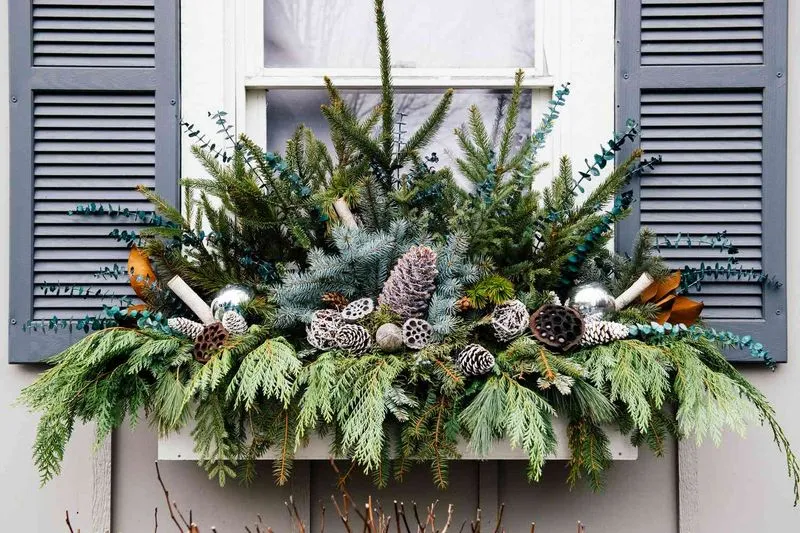
Getting the eucalyptus to cascade:
- Choose stems with flexible, long branches — silver dollar and seeded both work.
- Strip the lower 4 inches of leaves so stems don’t rot in the liner.
- Insert at the front corners, angled outward at roughly 45 degrees.
- Wire each stem to the liner edge so the weight doesn’t drag it down.
- Trim any tips hanging lower than the bottom of the box.
Ten minutes, about $12 in stems.
20. Mixed Pine and Berries on a Textured Stone House
Stone facades are beautiful and unforgiving. Dark window boxes show mineral dust and water streaks far more than light ones, so plan on wiping them down a couple of times each winter. Mounting is the bigger headache: drilling into stone or mortar means masonry bits, anchors, and no easy do-overs. Measure your bracket spacing twice, because patches in stone are permanent.
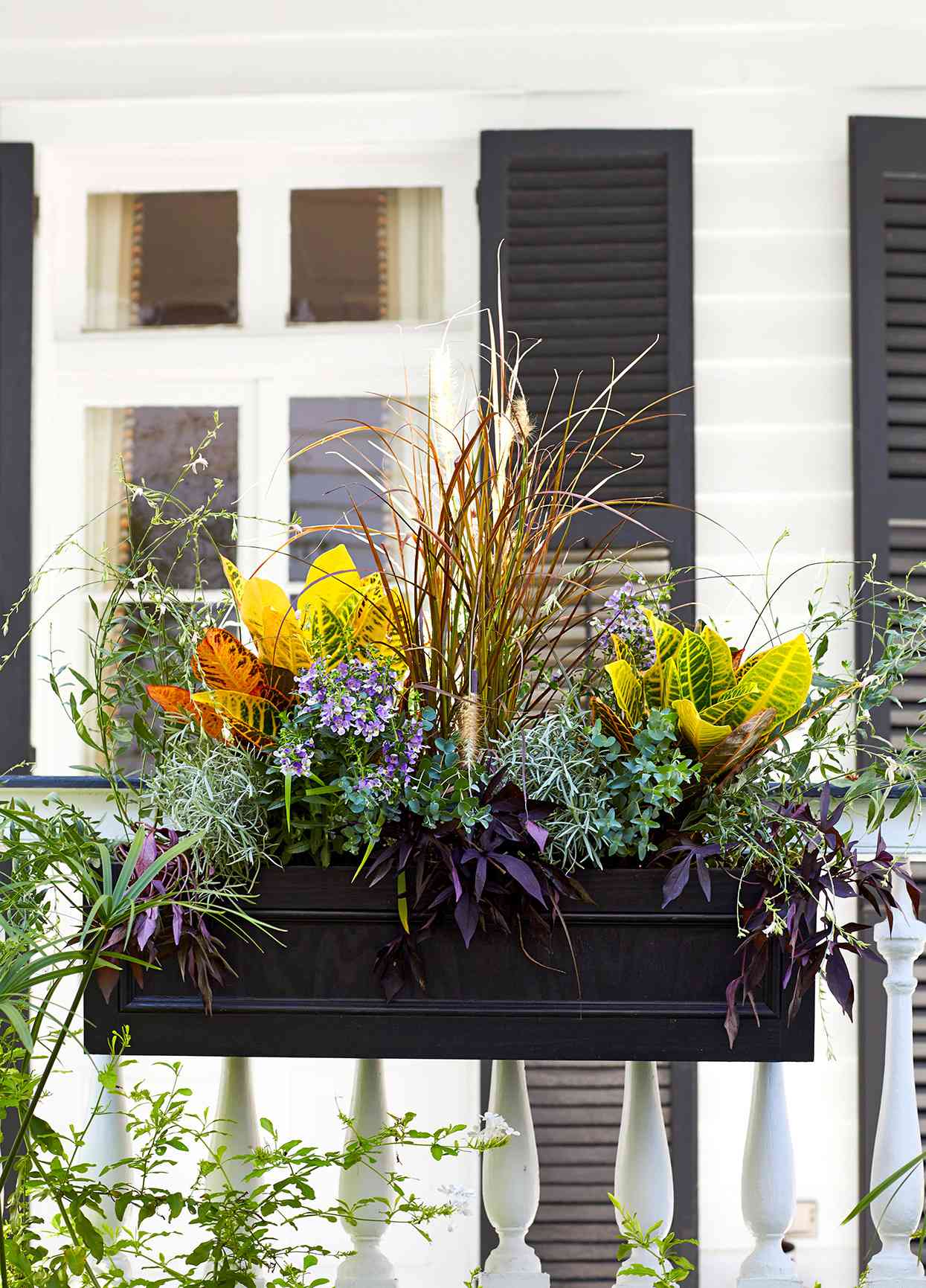
Space mounting brackets no more than 24 inches apart, and never more than 4 inches in from each end. A window box loaded with a soaked liner and fresh greens can weigh 40 to 60 pounds, and a box supported at only two points will bow in the middle by February. Over 48 inches, add a third bracket even if the manufacturer never mentions it.
21. Plaid Bows, Dried Hydrangeas, and Rattan Spheres
Tying a plaid bow that survives the outdoors:
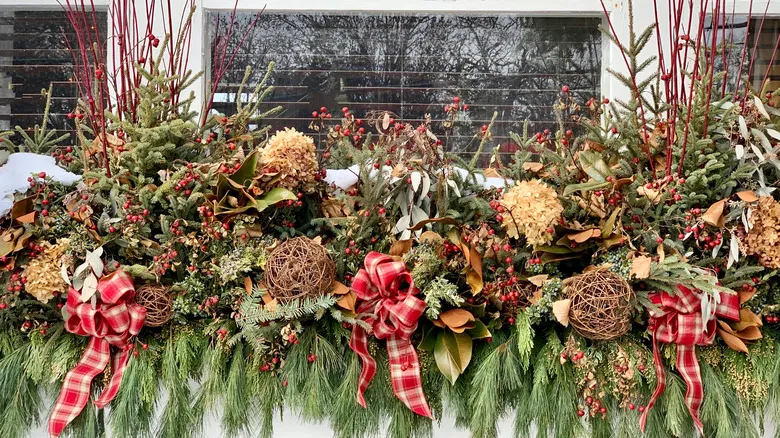
- Use wired 2.5-inch ribbon, about 3 yards per bow.
- Make four loops, twisting each at the center so the plaid faces outward.
- Cinch the middle with a 6-inch piece of florist wire, not string.
- Trim the tails on a diagonal and seal the cut ends with a lighter.
- Attach with two zip ties so the wind can’t spin it sideways.
Roughly 8 minutes per bow and $6–9 in ribbon.
Dried hydrangeas and rattan spheres belong to the same movement pulling plaid back into holiday decor — call it the grandmillennial Christmas, where nothing looks mass-produced. The nice thing about this direction is that it doesn’t date: natural texture and classic plaid will still work in a decade.
22. Upright Birch Logs in a Black Winter Box
The upright birch logs are the sizing key. Three logs between 10 and 16 inches work in a box 30–42 inches long and at least 10 inches deep; anything shorter reads as stubs, anything taller blocks the window. They should top out below the middle of the window glass so they frame the view rather than fight it. In a 24-inch box, use a single log and let the greens do the rest.
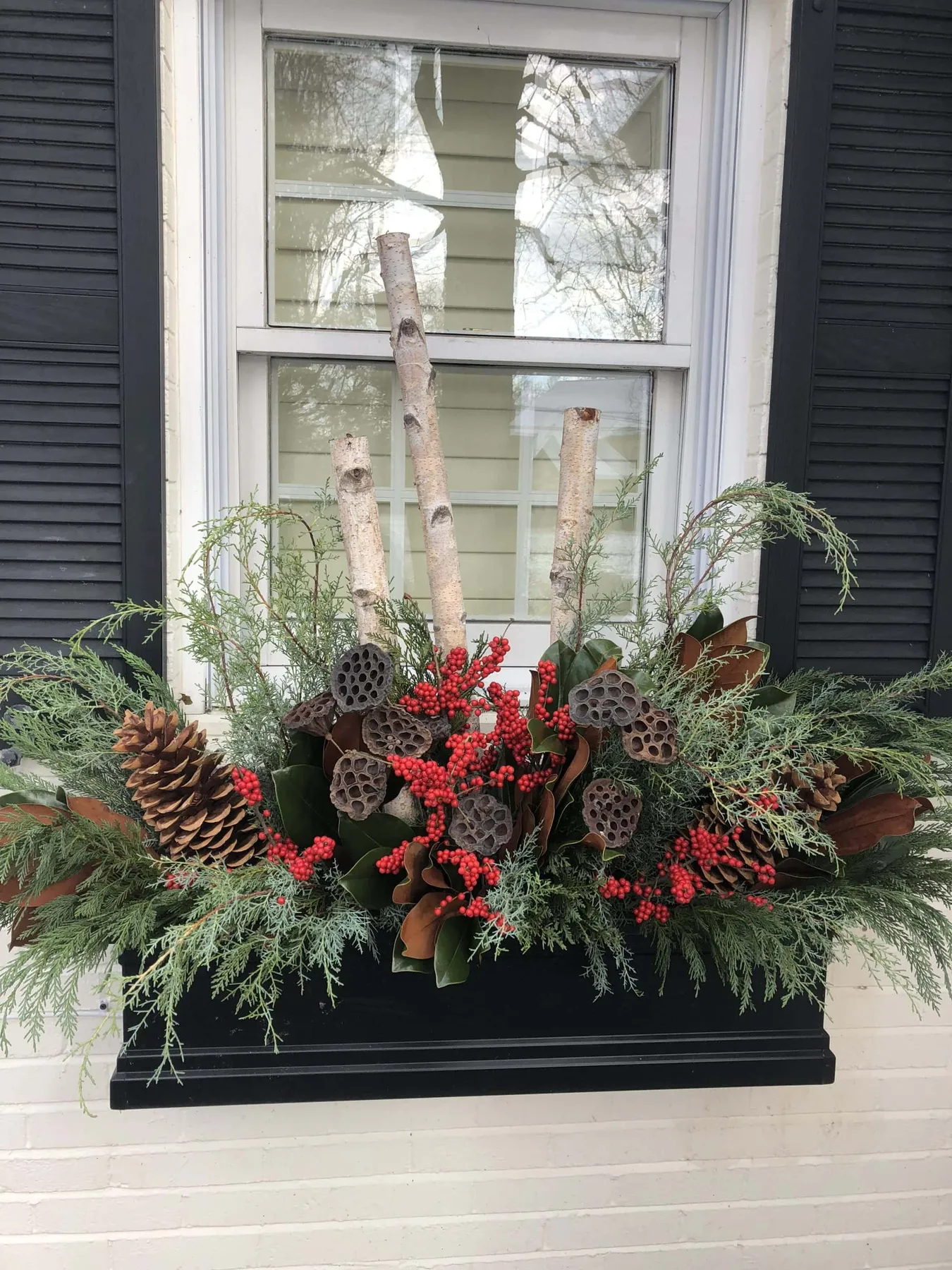
The birch logs are also the one thing. Remove them and you still have a solid evergreen box with berries, magnolia leaves, and pinecones — pleasant, familiar, forgettable. The pale bark is what makes this arrangement stick, because it’s the only light value in a dark composition, which is exactly why your eye lands there first. Light wood against near-black evergreens is the most reliable contrast trick in winter styling.
23. Cyclamen and Silver Foliage on a Stone Ledge
Cyclamen is the diva of winter planters. It wants cool, bright conditions and evenly moist soil — not wet, not dry — and it collapses fast if it freezes solid without protection. Water at the edge of the pot, never over the crown, and pinch off spent blooms every few days. In a mild climate you’ll get 6–8 weeks of color; in hard freezes, plan on replacing them in January.
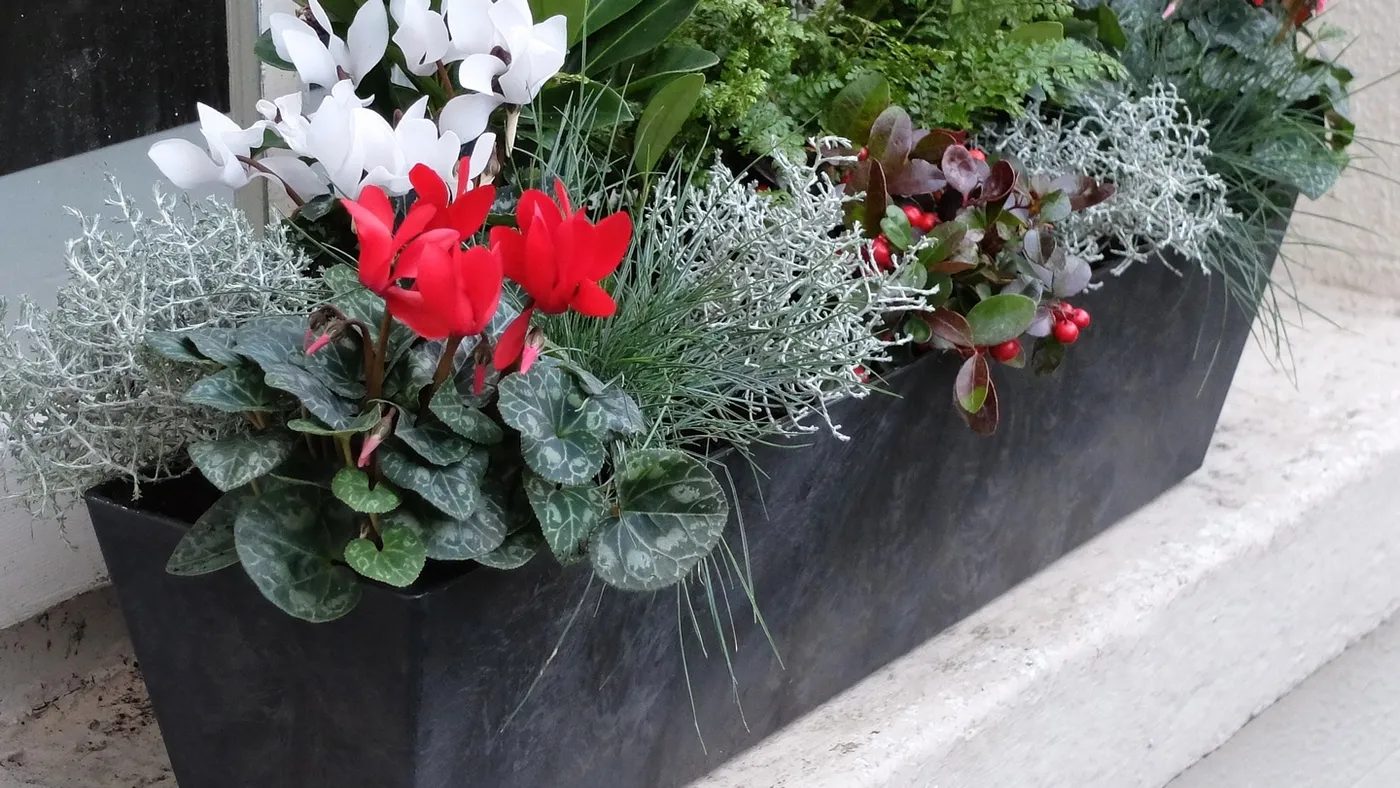
That said, cyclamen is one of the cheapest winter plants going — $5–9 for a 4-inch pot at grocery stores, Home Depot, or Trader Joe’s in December. The silvery foliage is the harder half; look for dusty miller or silver-kissed lamium, both under $6. Five plants plus the feathery silver sprigs fills a 30-inch box for around $30.
24. Candy Canes, Snowflakes, and Glossy Red Baubles
Candy canes need to be grouped, not sprinkled. Place them in odd-numbered clusters of three or five, angled slightly in different directions, and push them deep enough that only the hook shows above the needles. If you’re using real candy canes outdoors, wrap the exposed section with clear packing tape — humidity softens them within days and the hooks start drooping. The Idea #15 box uses canes too, with a lighter matte finish.
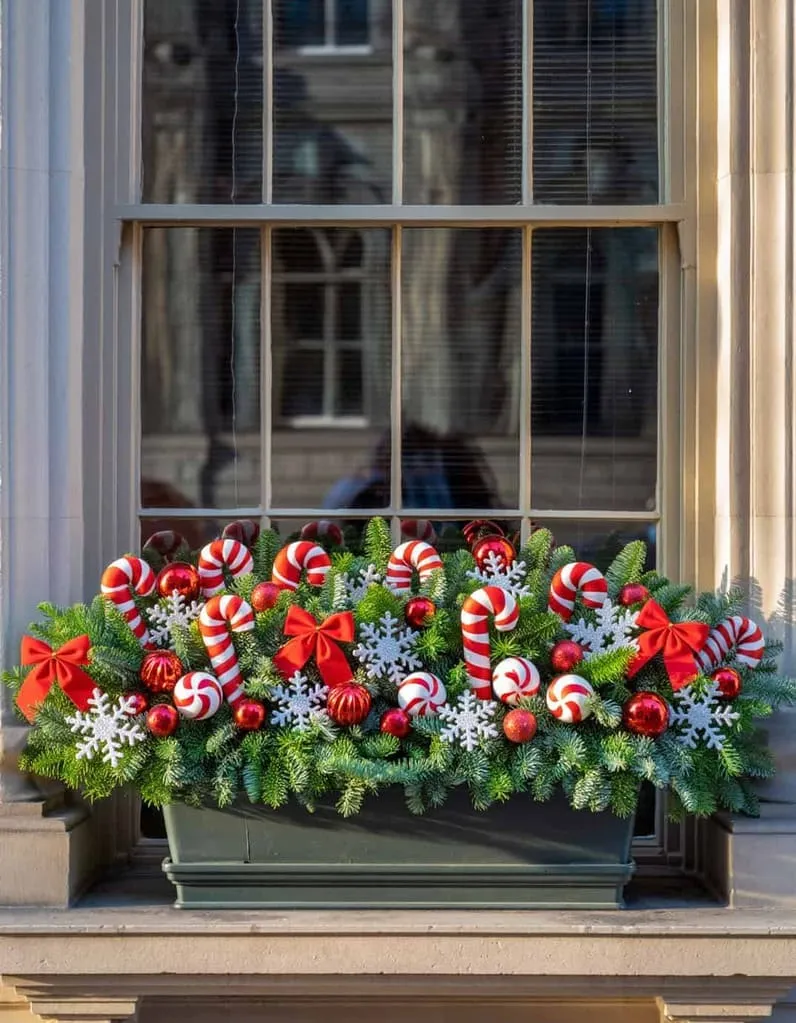
The white snowflake cutouts are the sleeper hit. In a box that’s almost entirely soft, rounded shapes — needles, baubles, bow loops — a few hard-edged white stars give your eye something crisp to grab. Because they’re flat and matte, they read as bright without competing with the shiny red ornaments. Repetition plus one contrasting shape: that’s the entire formula.
25. Black Slats, Cedar, and One Matte Gold Sphere
- Black slatted window box, 48 in: $80–180
- Cedar and fir bunches, or good faux equivalents: $30–70
- Red berry clusters and pinecones: $15–30
- One matte gold sphere and one red glitter ornament: $10–22
- Magnolia leaves and dried accents: $12–25
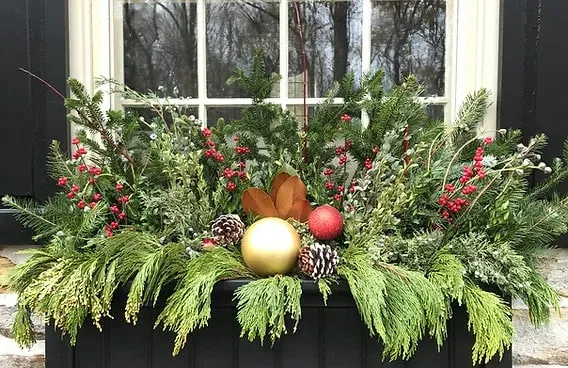
Total: about $145–325 per window.
Ninety percent green and natural brown, ten percent shine. That’s it. The two ornaments matter precisely because there are only two — one matte gold, one red glitter. Matte finishes read expensive outdoors, while high-gloss can look plasticky in flat winter light. Swap the gold for bronze and the black box for charcoal, and the entire formula still holds.
26. Apples and Red Berries Under a Fresh Snow Dusting
Apples in an outdoor window box are an open invitation. Squirrels, birds, and the occasional raccoon will find them within a week, and they’ll knock half your greens out doing it. They also freeze, thaw, and turn to mush against the liner. If you love the orchard look, use faux fruit pushed onto wire picks — it survives weather, wildlife, and the neighbor’s cat.
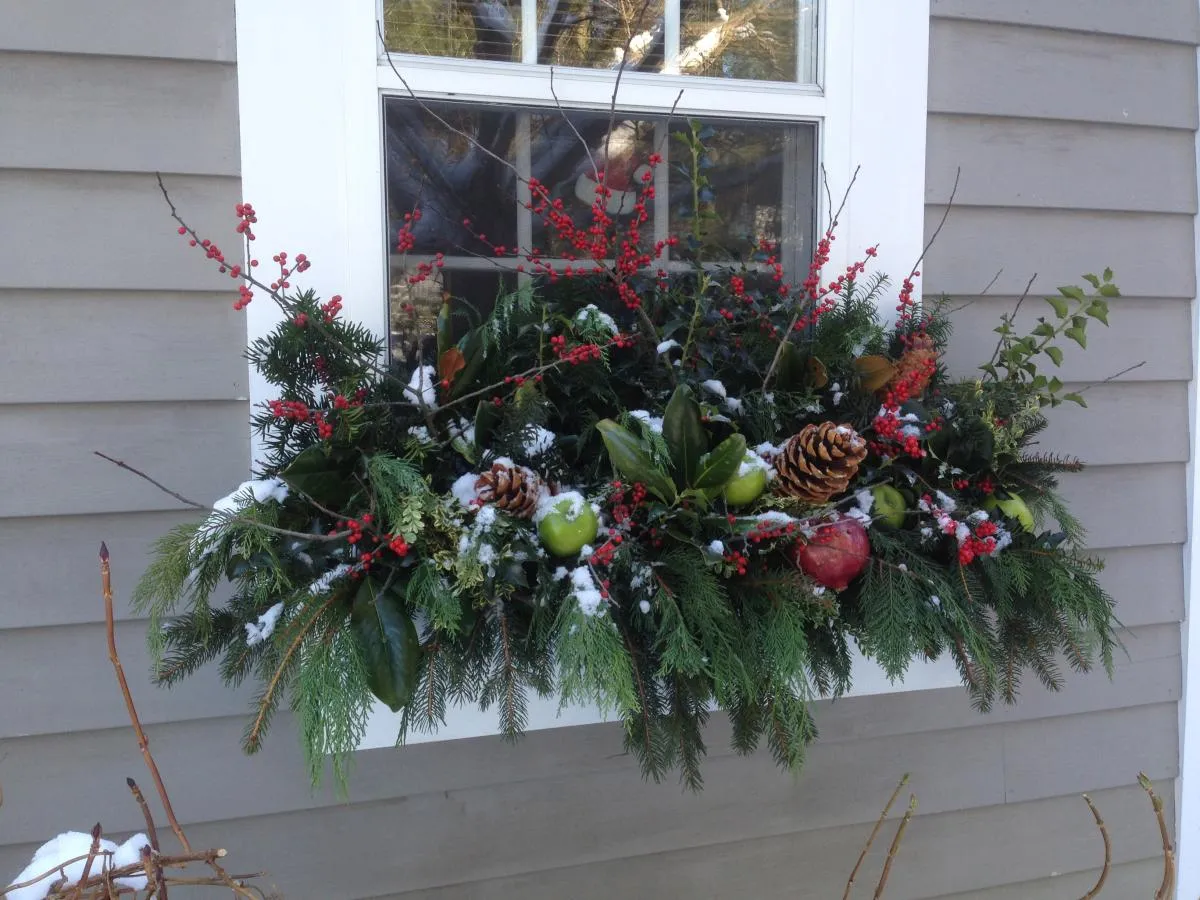
White boxes on grey siding is a low-contrast pairing, so this look depends on volume. A small, sparse box washes out completely. Go at least 36 inches wide and 10 inches deep, and let the greens mound 4–6 inches above the rim. On darker siding, a white box pops with far less planting and you can get away with a much thinner arrangement.
27. Vertical Red Twigs Beside Light Blue Shutters
Adding vertical red branches without wrecking the shape:
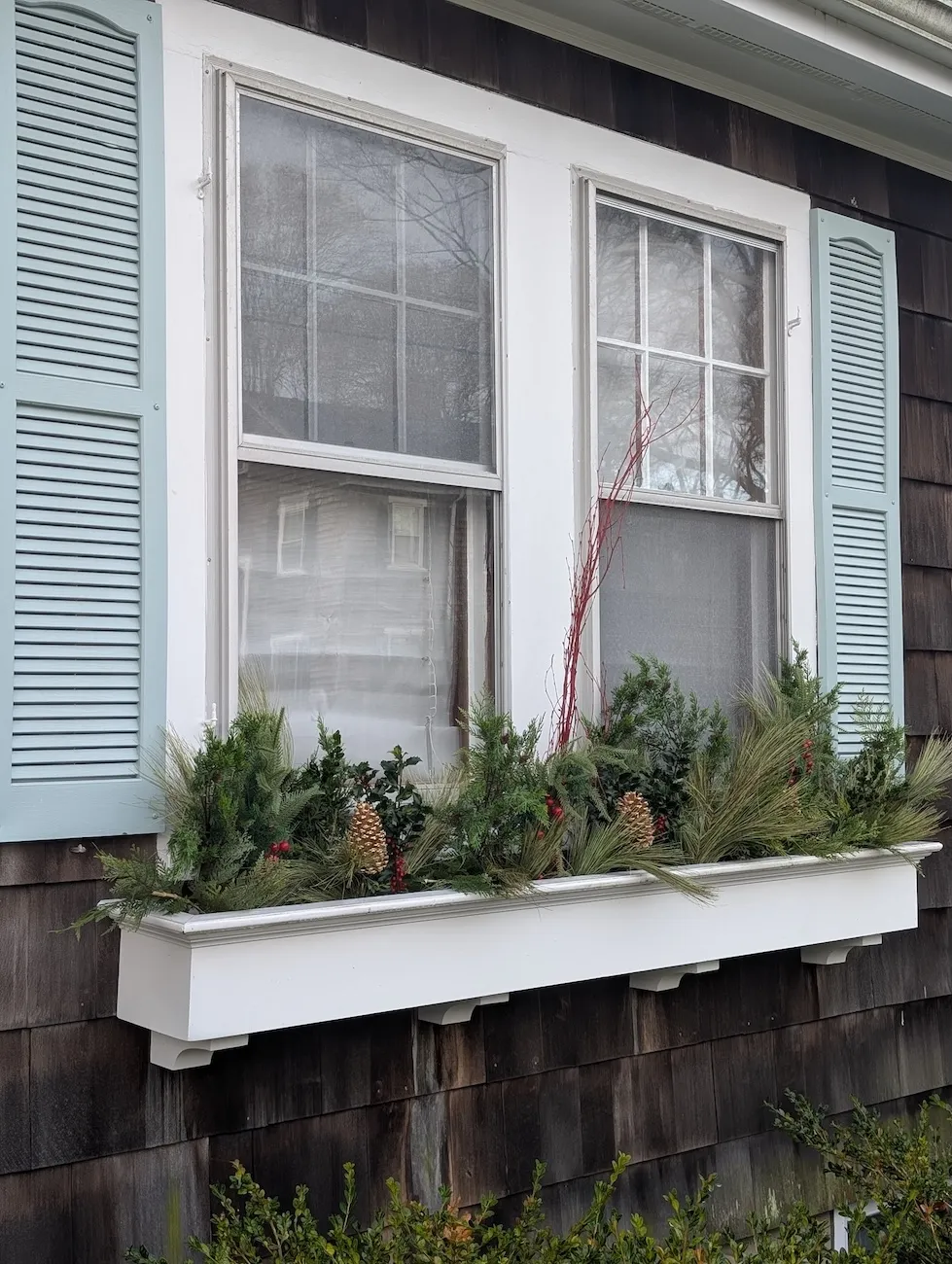
- Choose straight, thin branches — red dogwood or painted twigs both work.
- Cut them to no more than 1.5 times the box height above the rim.
- Insert in odd-numbered groups of three at the back third of the box.
- Angle them slightly outward so they don’t rub against the siding.
- Secure each group with florist wire to a horizontal branch below.
Fifteen minutes, $8–15 in branches.
Your shutters are a free color cue. Light blue louvered shutters next to a red-and-green box can look accidental — unless you echo them. One or two silvery-blue juniper sprigs, or a single ornament in soft denim blue, ties the window together and makes the whole thing look designed rather than assembled.
28. Long Needles Cascading Over Twin White Boxes
The cascade. Long-needle branches spilling over the front edge and hanging 6–10 inches below the rim are what make these boxes look established instead of newly stuffed. It’s also a practical trick: the drape hides the liner and the gap between box and siding. Aim for one cascading bunch per 12 inches of box length. Without it, you’re looking at two tidy but thoroughly ordinary planters.
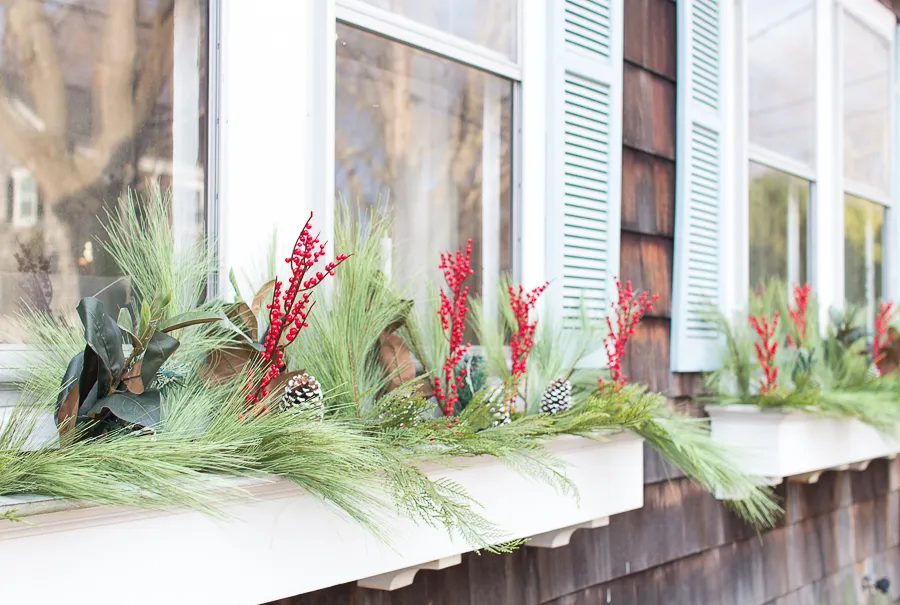
Pinecones with white tips are having a moment — the light flocking reads as fresh snow without the mess of full flocking, which yellows and sheds over time. Combined with brown shingle siding, this is the coziest corner of the current holiday look: less glitter, more texture. It’s also the version that still looks intentional in January.
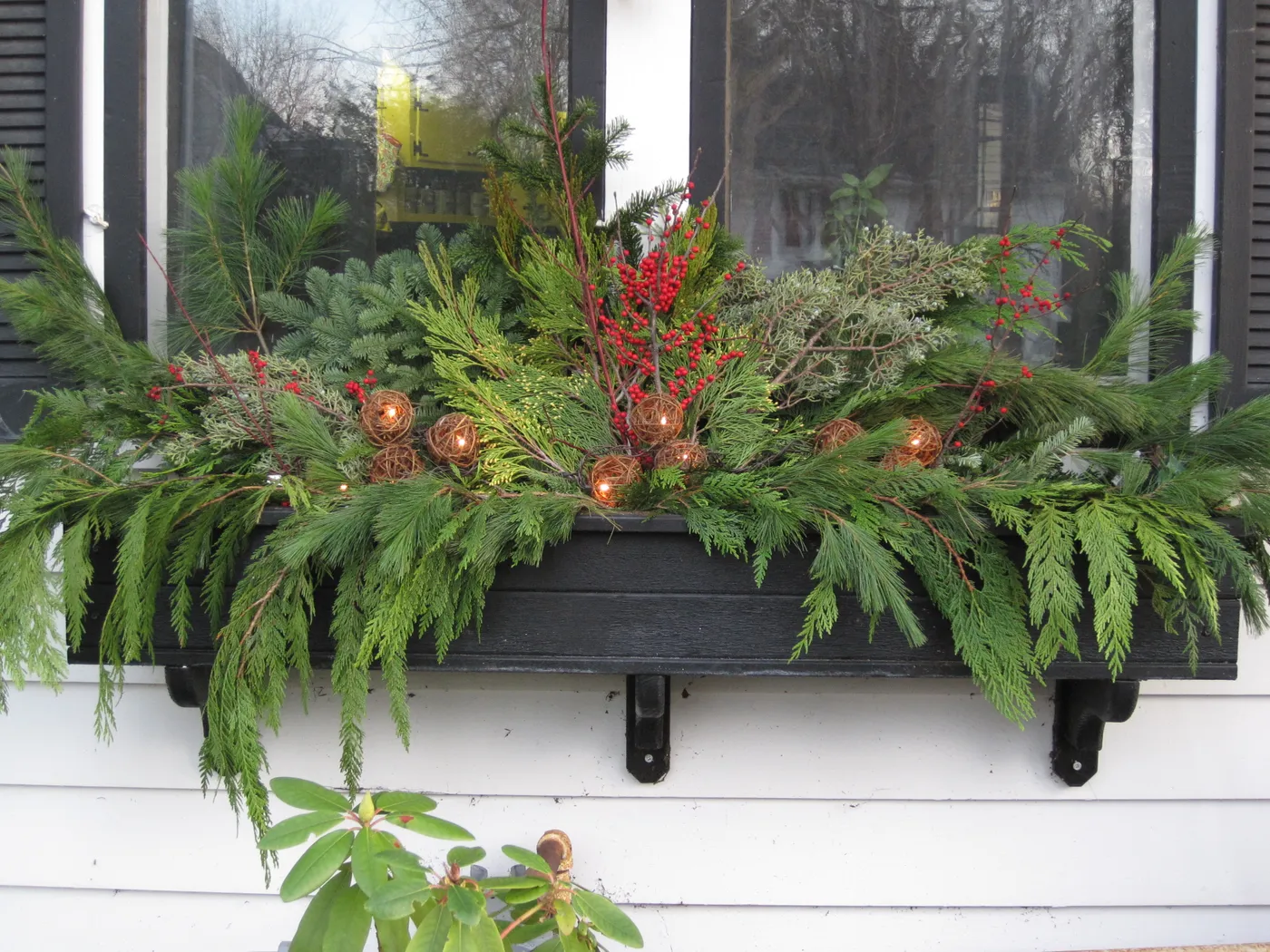
29. Warm String Lights Against a Red Brick House
Warm white lights at dusk are doing more for this facade than any ornament could. Their color temperature — around 2700K — glows gold against a blue winter evening, and that warm-cool contrast is what makes a house look welcoming instead of merely decorated. Cool-white lights on the same window would read clinical, especially against red brick. Compare with Idea #20, which is the same house style with no lighting at all.
String lights are the highest-impact, lowest-cost element in all of holiday decorating. A 33-foot strand of outdoor-rated warm white LEDs runs $10–18 and covers two windows. Red berry sprays are $4–8 each, and pinecones you can gather yourself — though bake them at 200°F for an hour first to kill anything living inside. This whole look lands under $60 per window.
30. White Painted Branches and Big Red Baubles
White-painted branches are a cheap, high-contrast trick — spray a few thin twigs with flat white outdoor paint and push them through the middle of the arrangement, then let the big glossy red baubles sit in front of them. Keep it to three or four branches per box; any more and you get a spiky, beachy look that fights the season. Weave the lights on the same plane so they catch the white without blowing out the greenery behind.
Outdoor lights need an outdoor rating, a GFCI outlet, and a timer — in that order. Indoor-rated strands crack in the cold and short out. Run cords down the siding with clear clips instead of letting them dangle, and never bury a connection in the liner’s soil. Snowmelt and standing water kill light sets, not the cold.
Your Windows Will Do the Talking This December
Pick one direction, commit to it, and resist the urge to add just one more thing — the boxes that look best from the sidewalk are almost always the ones with a clear idea and room to breathe. Start with the greens, add texture from the yard, and finish with lighting you can put on a timer.
📌 Save this to Pinterest and tag us when your windows go up — we love seeing which direction you chose.