
31 Gorgeous Winter Wreath Ideas You Need to Try in 2026 That Will Turn Heads
Most winter wreath roundups hand you the same frosted pinecone wreath in fifteen different colorways. This one doesn’t. We spent a few very pleasant evenings combing Target, Etsy, Terrain, and Amazon to pull together 31 wreaths that actually look like something — from an $18 dried-wheat circle to a $285 gold teardrop with a Nativity ornament dangling from it. Inside you’ll find woodland wreaths with dried orange slices and a little hanging mushroom, minimalist metal hoops with one sweep of greenery, and traditional frosted evergreens loaded with red berries and silver-tipped pinecones.
Every idea here is described from a real wreath in a real home, so you know exactly what you’re recreating — and the 2026 mood is texture you can actually see: dried botanicals, painted pinecones, mismatched metals, and a lot less plastic. And stay until the end — we break down the most common mistakes that can ruin these looks. A couple of links in this post are affiliate links, so we may earn a small commission if you buy through them, at no cost to you. 📌 Save this to Pinterest for later — you’ll want to revisit these ideas.
1. A Full Evergreen Wreath Loaded With Gold and Pinecones
This wreath works because nothing in it matches, and that’s the entire point. Deep evergreen, dark brown pinecones, and gold spheres all live in the warm range, so the gold reads as light bouncing off the branch rather than ornaments stuck on top. The big textured beige bow does the quiet work — it gives your eye one place to land before the ornaments take over. Mounted on dark stained wood, the whole thing looks expensive without trying very hard.
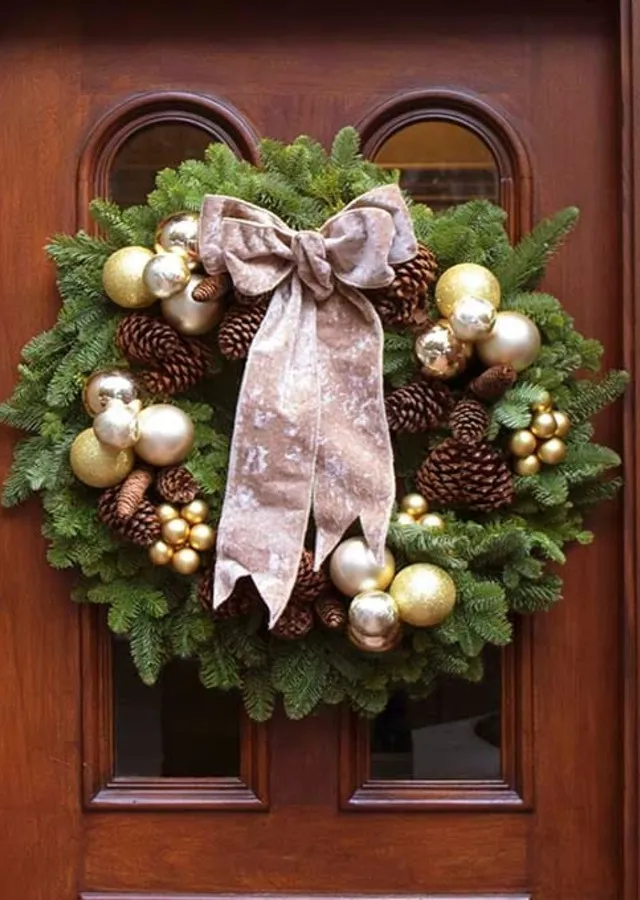
Here’s the number that matters: on a standard 36-inch door, a 24-inch wreath fills about two-thirds of the width, which is the sweet spot. Anything under 20 inches reads stingy; anything over 28 inches swallows the panels. And when you cluster ornaments, work in odd numbers of three and keep the heaviest cluster slightly below center so the wreath feels bottom-weighted instead of top-heavy.
2. Frosted Evergreen With Apples, Pears, and Yellow Berries
The peach-colored faux pears are the reason this wreath doesn’t look like every other red-and-green door decoration on the block. Everything else — the heavily frosted branches, the dark pinecones, the little red apples, the bright yellow berries — is a supporting player. Swap the peach for another red apple and the whole thing collapses into a standard Christmas wreath. Keep it and you get that slightly odd, abundant, English-garden-in-December feeling.
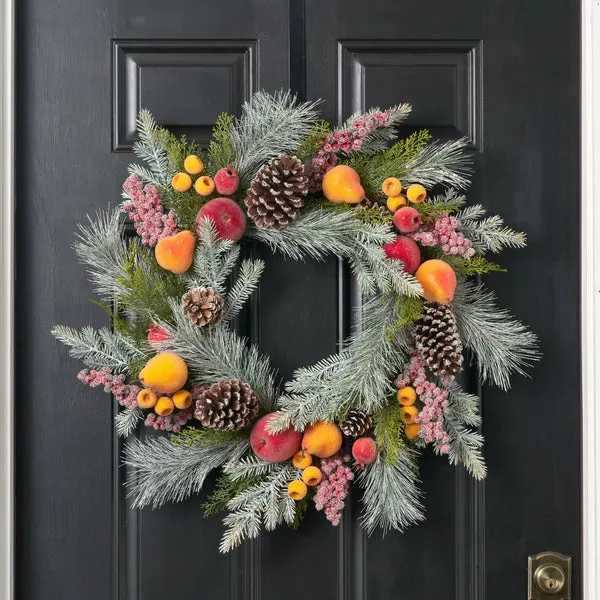
Roughly 60 percent frosted evergreen, 25 percent dark pinecone, 15 percent fruit and berries. The fruit itself runs in three warm stops — red, peach, yellow — which is why it reads abundant instead of cluttered. Want a cooler version? Hold the exact percentages and switch the fruit to pear, cream, and dusty blue. The formula stays put; the mood changes entirely.
3. White Velvet Blooms and Pearl Berries on a Frosted Wreath
A white wreath against a peeling white door is a beautiful idea and a slightly risky one, because you’re stacking white on white on white. If that surface catches strong afternoon sun, the velvet flowers will fade toward cream by February and the wreath will visually dissolve into the paint. It also collects dust like a wool sweater. Plan on a soft brush every two weeks, or move it to a darker interior door — compare with Idea #27, where the same white flowers sit on black and never disappear.

You don’t need a $180 floral wreath to get this. Start with a $12 wire or grapevine base, then hit the thrift store for white artificial blooms — most stems run $1 to $3 apiece and nobody can tell they’re secondhand once they’re nestled into evergreen. Pearl berry picks from the craft store are about $4 a bunch. Realistically you’re in for $35 to $50 and one evening with a glue gun.
4. Frosted Pine and Red Berries Against a White Paneled Door
This is the classic proportion: a 24-inch wreath on a standard 32-to-36-inch paneled door, with the top of the wreath sitting roughly 6 to 8 inches below the door’s top edge. It’s also forgiving in a narrow entry — you want at least 36 inches of clear width so the door swings without the wreath catching on the frame. For big blank walls, skip doors entirely and look at Idea #15, which lines five wreaths up on a single grey wall.
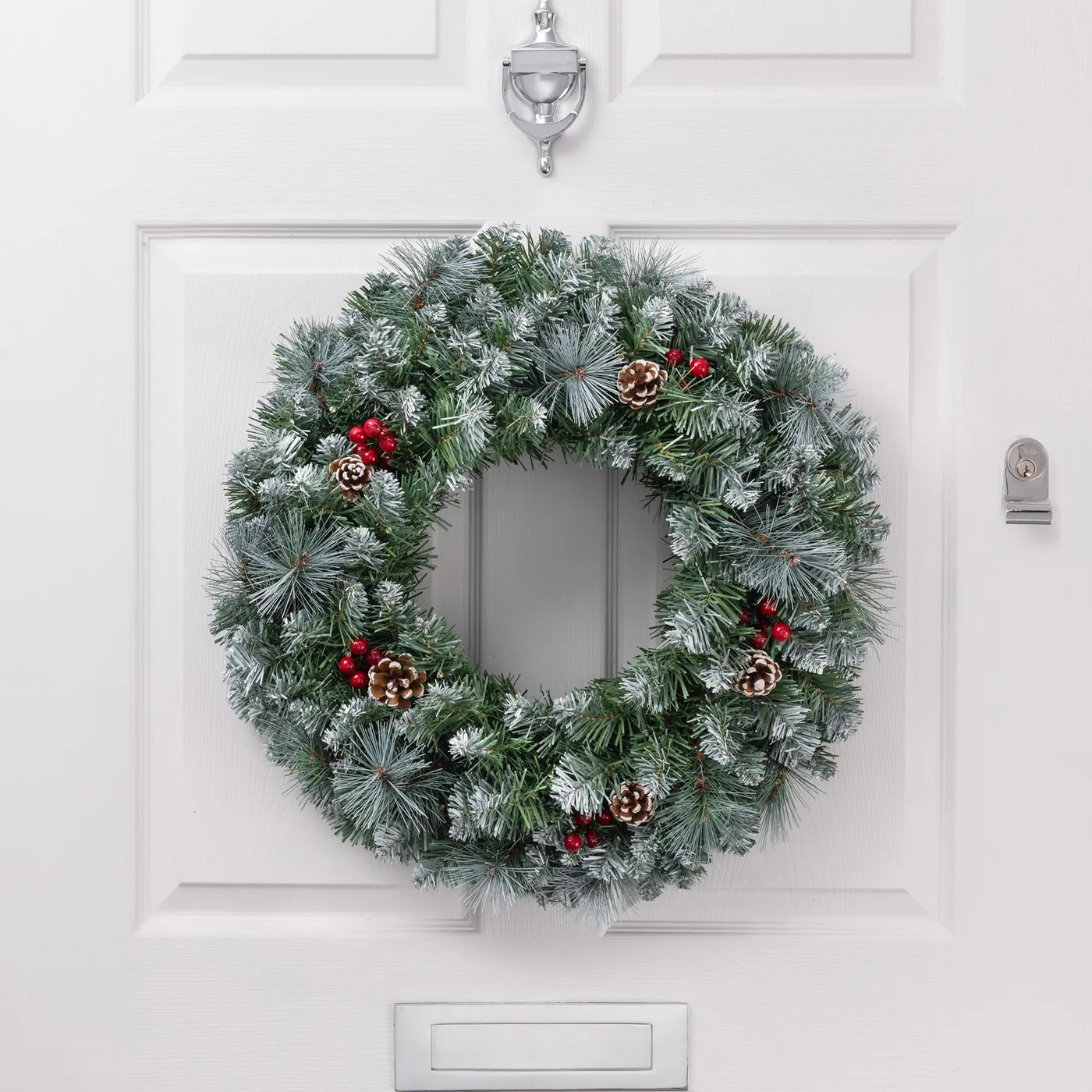
Clear your hardware before you commit. Measure from the wreath’s bottom edge down to your knocker, mail slot, or lock — you want a minimum of 3 inches of daylight or the wreath will bang against metal every time the door moves. A flat over-the-door hanger beats a nail every time, and it won’t leave a hole in a rental.
5. Frosted Red Berries and Oversized Pinecones on Glass
Those glass panels are doing more than letting light in — they break the dark wood door into rectangles, which makes the round wreath pop. The designer also tucked lighter green frosted leaf sprigs between the big red berry clusters, so the red never sits directly against dark green. That thin pale buffer is why the whole arrangement reads crisp instead of muddy.
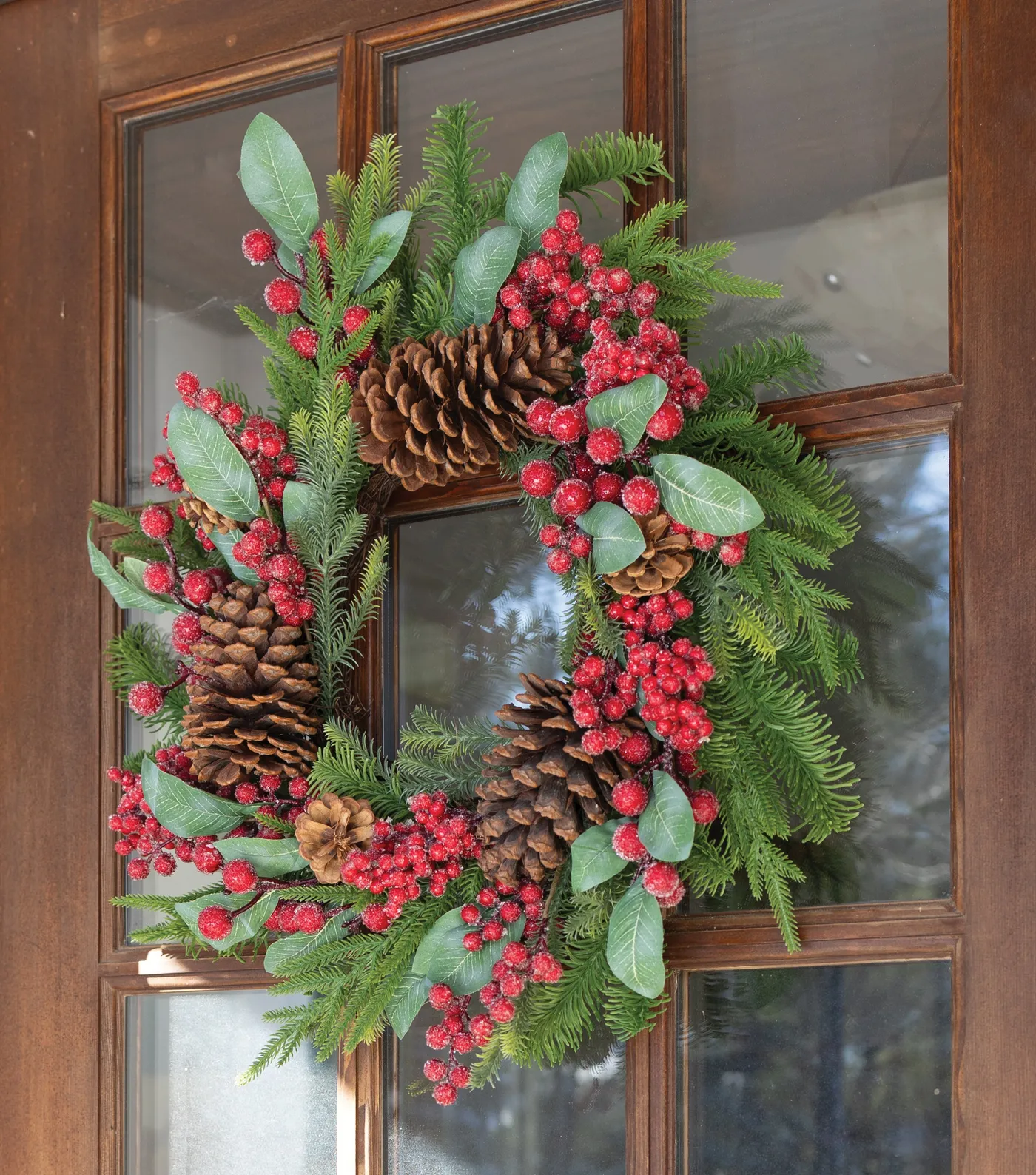
Frosted berries shed. Expect a light dusting of glitter across your threshold for the first two weeks, and plan to vacuum the entry mat more than usual. The glass is the other issue — a wreath on a suction hook will occasionally slide, so clean the pane first and re-set the hook at the start of every season. Wipe the panels monthly and you’ll keep the contrast that makes this whole setup work.
6. Glitter-Frosted Evergreen With Mixed Pinecones on Dark Teal
It’s the small reddish-brown pinecone clusters on thin stems. Everything else is large — big needles, big brown cones — and those little stemmed clusters are what give the wreath a sense of scale. Without them, it’s a wreath. With them, it looks foraged. They cost almost nothing, and they’re the detail people can’t quite name when they tell you it looks real.
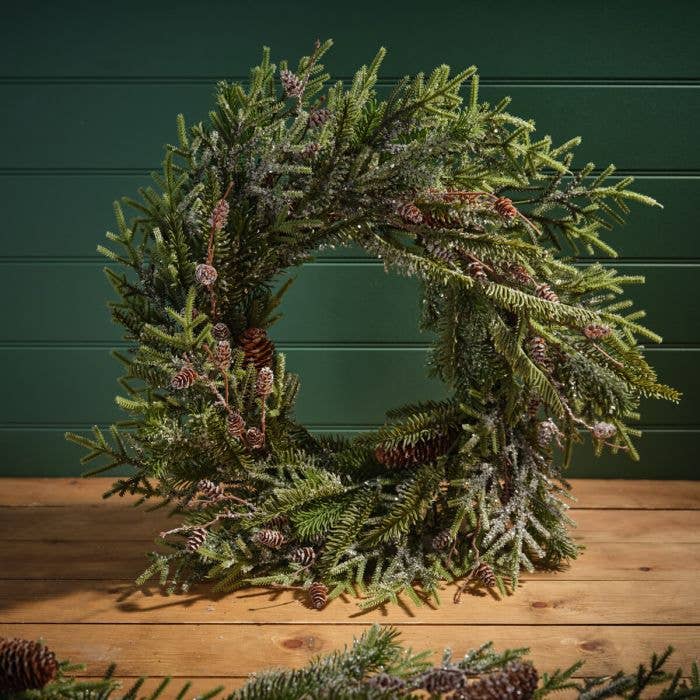
About 70 percent green, 20 percent brown, 10 percent sparkle. The green itself splits between dark and lighter needles, which is what stops artificial evergreen from looking flat and plastic. The glitter lives on the needle tips only, not the whole branch — a dusting, not a coating. Warm it up by swapping white glitter for copper and holding that accent under 10 percent.
7. Dried Flowers, Orange Slices, and One Little Mushroom
Dried botanicals have been creeping in for a few seasons, and 2026 is the year they took over the front door. Muted purple and pink dried flowers, orange slices, seed pods, wispy foliage, and that one hanging mushroom ornament on a long frayed blue ribbon — it’s cottagecore that grew up. The staying power is real, because dried materials don’t announce a specific holiday and can hang from November straight through February.

Dried orange slices are the cheapest luxury in wreath-making. Slice a navel orange a quarter-inch thick, blot it dry, and bake at 200°F for two to three hours, flipping halfway — that’s about a dollar of fruit for a whole wreath’s worth. Dried flower bunches run $5 to $8, a bag of seed pods is under $10, and you can build the whole thing for under $40 if you own a glue gun. See Idea #23 for the fuller, gold-accented version of this same idea.
8. A Heavily Flocked Wreath With Red-Tipped Pinecones
Red-tipped pinecones are easier to make than to buy. Hold each cone by the stem, dip just the tips into craft paint — no brushing — and stand them stem-down in a foam block to dry for about two hours. Dip, don’t paint. Painted cones get heavy and glossy; dipped cones look like they were nipped by frost, and you’ll use a fraction of the paint doing it.
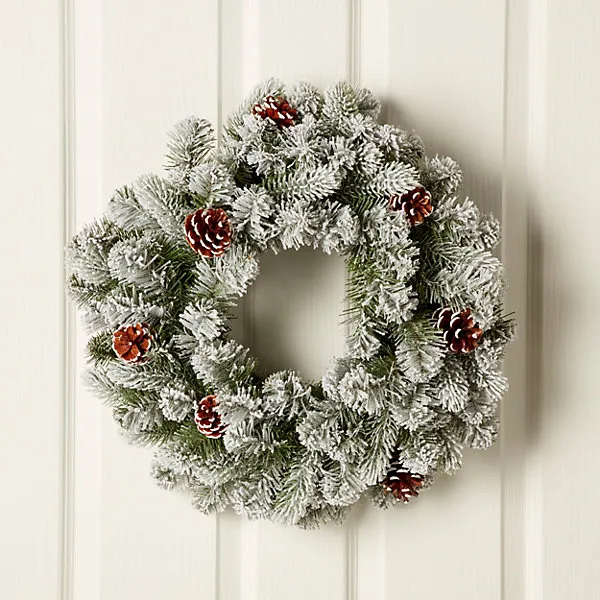
Flocking a wreath yourself takes about 20 minutes and $12.
- Work outside or over a big trash bag — this is a messy job.
- Hold the can 10 to 12 inches away and spray in short passes, not one heavy coat.
- Let it dry 15 minutes, then add a second light pass to the tips only.
- Shake off the loose flakes and cure overnight before hanging.
- Seal with a matte craft spray if the wreath will live outdoors.
9. Silver-White Pinecones Doing the Job of Ornaments
Painted pinecones chip, and there’s no graceful way to say otherwise. On an exterior door in freezing weather, that silver coating will flake at the tips by mid-January and the chips land on your welcome mat. Keep painted cones under a porch or on an interior door and they’ll hold for years. If your door gets full weather, use factory-frosted cones instead — that coating is applied and cured, and it behaves much better.
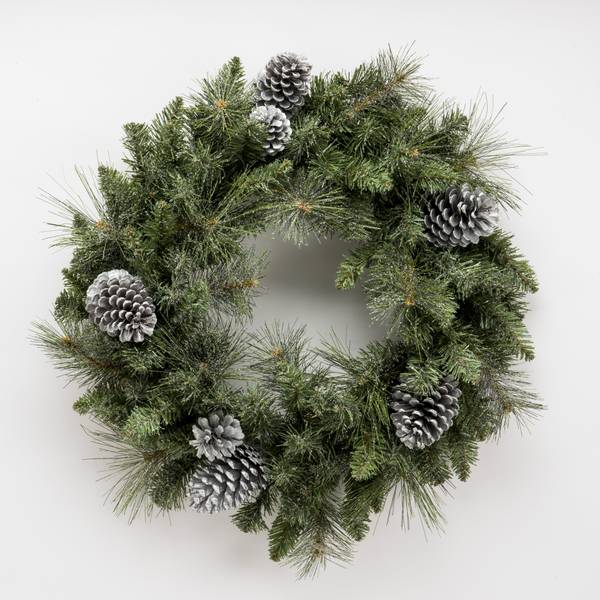
The painted cones are the whole idea. There are no baubles here, no ribbon, no berries — just silver-white pinecones doing the job ornaments usually do. That means the wreath can hang in January and February without looking like leftover Christmas. Pull them out and you’re left with a plain frosted wreath. One decision buys you two extra months of display.
10. Dusty Blue-Green Wreath With a Sheer Pale Gold Ribbon
Roughly 55 percent dusty blue-green foliage, 30 percent dark matte blue berries, 15 percent gold and cream. The trick is that the blue-green is the base, not the accent — most people layer color on top of green and then wonder why it looks busy. Here the base itself runs cool, and the metallic gold leaf accents and pale gold ribbon warm it back up just enough.

This one shines in a small entry where a heavy evergreen wreath would feel stuffed. Aim for 20 to 22 inches on a door under 34 inches wide, and let the sheer ribbon tails hang long — they add height without adding width. A suction hook works on clean glass and won’t mark the door, which matters if you rent. If your entry is broad and bright, compare with Idea #26 — same cool palette, fuller silhouette.
11. Lightly Flocked Pine With Just a Few Pinecones
Restraint. There are maybe six pinecones on this entire wreath, and that’s the whole design. The white door behind it has recessed rectangles, so the wreath gets a built-in frame, and the flocking picks up the door’s off-white and pushes it brighter. Nothing competes with anything. It’s the wreath equivalent of a plain white shirt — hard to get wrong, quietly good in every photo.
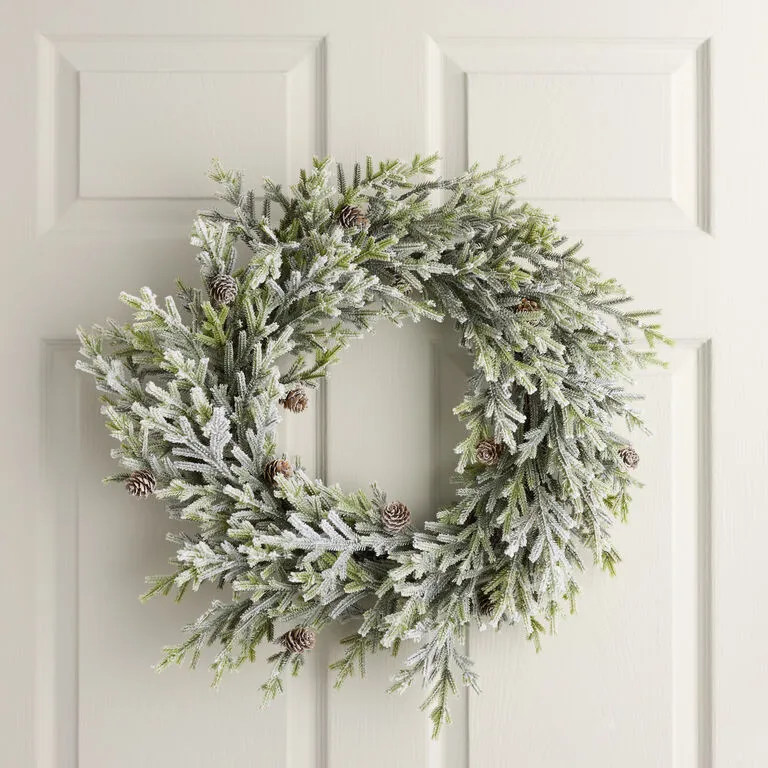
Odd numbers and clusters, not even spacing. Six pinecones scattered at regular intervals reads like a pattern; six pinecones grouped as a three, a two, and a one reads like nature. Keep at least a hand’s width of open flocked branch between clusters. That gap is what makes the wreath look snow-dusted rather than stuffed.
12. All-White Dried Botanicals on Dark Planked Wood
Pampas sheds. Lunaria seed pods are papery and crack if you look at them wrong. This is a dry, delicate wreath, so keep it out of steamy entries and away from a door that gets slammed. Dust it with a hairdryer on the cool setting, held at least a foot away, once a month. Store it flat in a box with tissue between the layers and it will last several seasons; hang it in a humid hallway and it won’t.

The silver-sprayed foliage is what saves it. Without those metallic leaves, this is a beige wreath, and beige against dark wood can read dusty rather than elegant. A handful of leaves hit with silver spray gives the arrangement a cool, frosty edge that has nothing to do with glitter. It’s about $8 of spray paint and it’s the difference between nice and how-much-did-that-cost.
13. A Gold Teardrop Wreath With a Nativity Ornament
- Wreath base and faux pine: $25–$45
- Gold sheer ribbon, two rolls: $10–$16
- Metallic and frosted leaf sprays: $15–$30
- Gold baubles and pinecones: $12–$20
- Nativity or focal ornament: $8–$25
Total: $70–$136, versus $200+ for a finished designer version. Budget alternative: skip the ornament, use one ribbon roll, and buy baubles after the holidays — you’ll land near $45.

The teardrop shape is the flex. A circle hung over a door frame can look generic; a vertical teardrop draws the eye down and makes a tall, narrow wall feel intentional. Centering that sheer gold bow on the wide part of the drop also fixes a proportion problem — it anchors the visual weight so the long tail doesn’t feel like it’s sliding off the top.
14. Cream Dahlias, Roses, and Hydrangeas, All the Way Around
Full floral wreaths are heavy. A 24-inch ring packed with dahlias, roses, and hydrangeas can weigh five pounds, and that’s before a single drop of humidity. Use a metal frame or a reinforced wire base rather than a cheap foam ring, and hang it on a hook rated for the weight. Also, artificial blooms fade in direct sun — put this one on an interior door or a shaded porch, never a south-facing exterior.

Sixty percent flowers, forty percent green — that ratio is why it reads lush instead of funereal. The blooms all live within two tones, cream and white, so your eye reads a mass of light instead of counting individual flowers. Want it for spring? Hold the ratio and shift the two tones to blush and pale apricot. Same formula, different season.
15. Five Wreaths and a Wire Star on One Grey Wall
Five wreaths plus a star on one wall needs roughly 8 feet of horizontal space and about a 6-inch gap between pieces; tighter than 4 inches and they visually merge into a clump. This arrangement sits above a sofa, so the bottom row should land 8 to 10 inches above the sofa back. It’s a great fix for a roomy living room — if your wall is under 6 feet wide, one wreath is plenty. Single-door version: Idea #4.

Mixing price points is easier here than anywhere else, because nobody compares wreath to wreath. Buy two decent ones and make three: a $10 wire frame wrapped in hardware-store garland, a plain wreath you already own with new ribbon, and a grapevine base hit with spray paint. Five wreaths for under $150 total is completely doable if you start scouting Facebook Marketplace in early November.
16. Frosted Pinecones and Glittery Leaves, Up Close
That pale green glitter on the large leaves is the detail doing the heavy lifting. Frosting an entire wreath makes everything look uniform; frosting a handful of oversized leaves in a slightly lighter green creates depth, like snow catching on one side of a branch. Buy a single stem of glittered magnolia or eucalyptus leaves, cut them into singles, and tuck them in at roughly 10 and 2 o’clock.
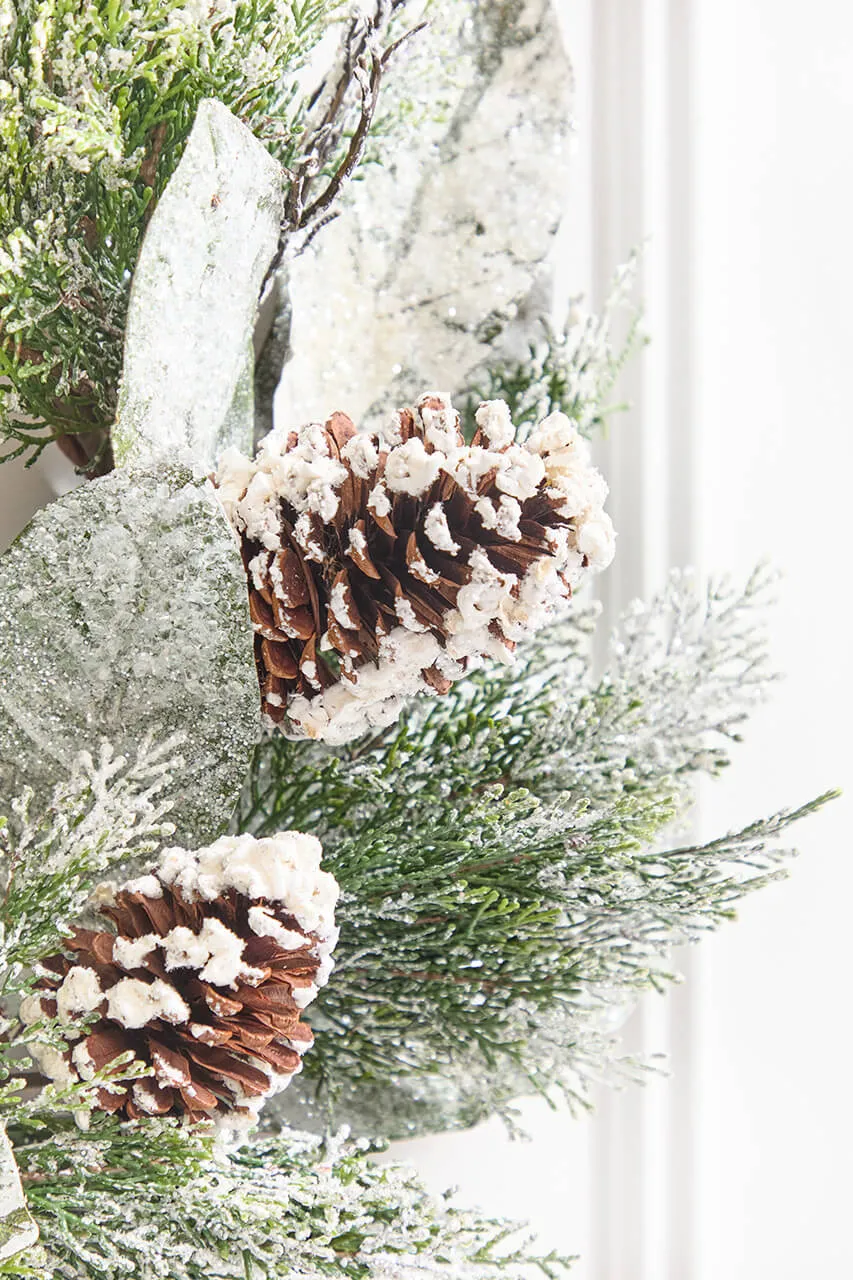
Glitter travels. It will end up on the floor, on the door, and eventually in your car. A light coat of matte craft sealer over the glittered elements keeps most of it in place — apply it outdoors, two thin passes an hour apart. Frosted wreaths also collect dust in the crevices where faux snow meets branch, and a soft paintbrush reaches in there far better than a cloth.
17. Dried Wheat Stalks With Bright Red Spikes
Dried wheat is having a moment because it sits between seasons — harvest, not holiday. Paired with those small bright red spikes, it reads winter without being Christmas, which is exactly what people are searching for in 2026. It’s cheap, it’s renewable, and it photographs beautifully against the mottled, limewashed-looking walls that have taken over Pinterest.

Building a wheat wreath takes about 45 minutes and $20 to $25.
- Start with an 18-inch straw or grapevine base.
- Cut wheat stalks to 4-inch lengths, keeping the heads intact.
- Hot glue in overlapping rows, always laying the heads in the same direction.
- Tuck a red spike cluster into every third gap.
- Attach a fabric loop to the back before hanging — wheat is light but brittle.
18. White-Tipped Pinecones Against a Dark Paneled Wall
Dark walls are a gift to pale wreaths. The flocked needles and white-tipped cones get maximum contrast against horizontal dark paneling, so the wreath reads from across the room rather than only at the door. The other quiet move: the base is dark too. Nothing pale peeks through the gaps, so the silhouette stays clean and the frosting looks deliberate instead of accidental.
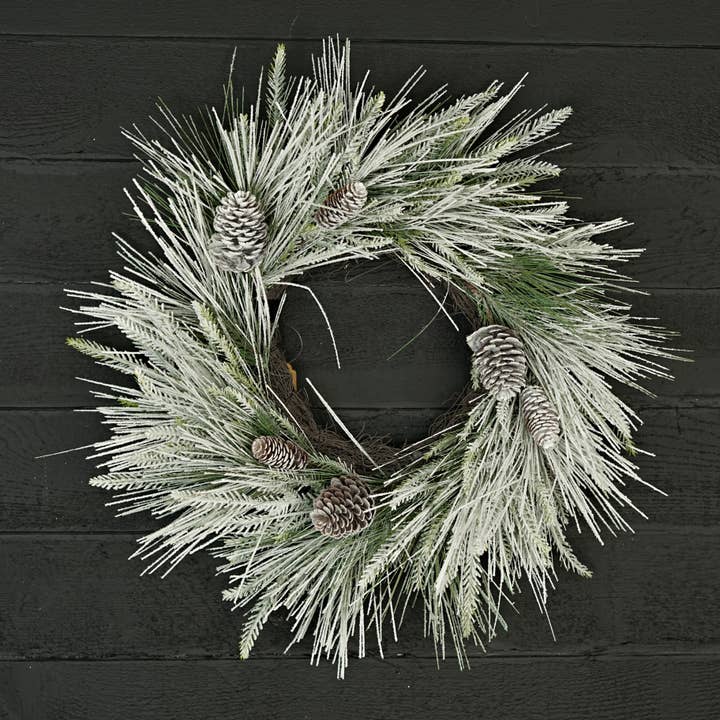
Use a dark base — grapevine, wire, or painted — underneath a frosted wreath. A light green plastic ring will show through every gap and cheapen the whole thing, especially against a dark wall. Two dollars of matte black spray paint on the base before you start decorating solves it permanently, and you’ll never think about it again.
19. An Evergreen Wreath With the Bow at the Bottom
The bow is at the bottom. That’s the whole idea, and it solves a real problem — most doors have a knocker, a peephole, or a mail slot exactly where a top bow wants to sit. Moving the bow low clears the hardware and gives the wreath a slightly old-fashioned, hand-tied look. Without it, this is a nice pinecone wreath. With it, people ask where you got it.
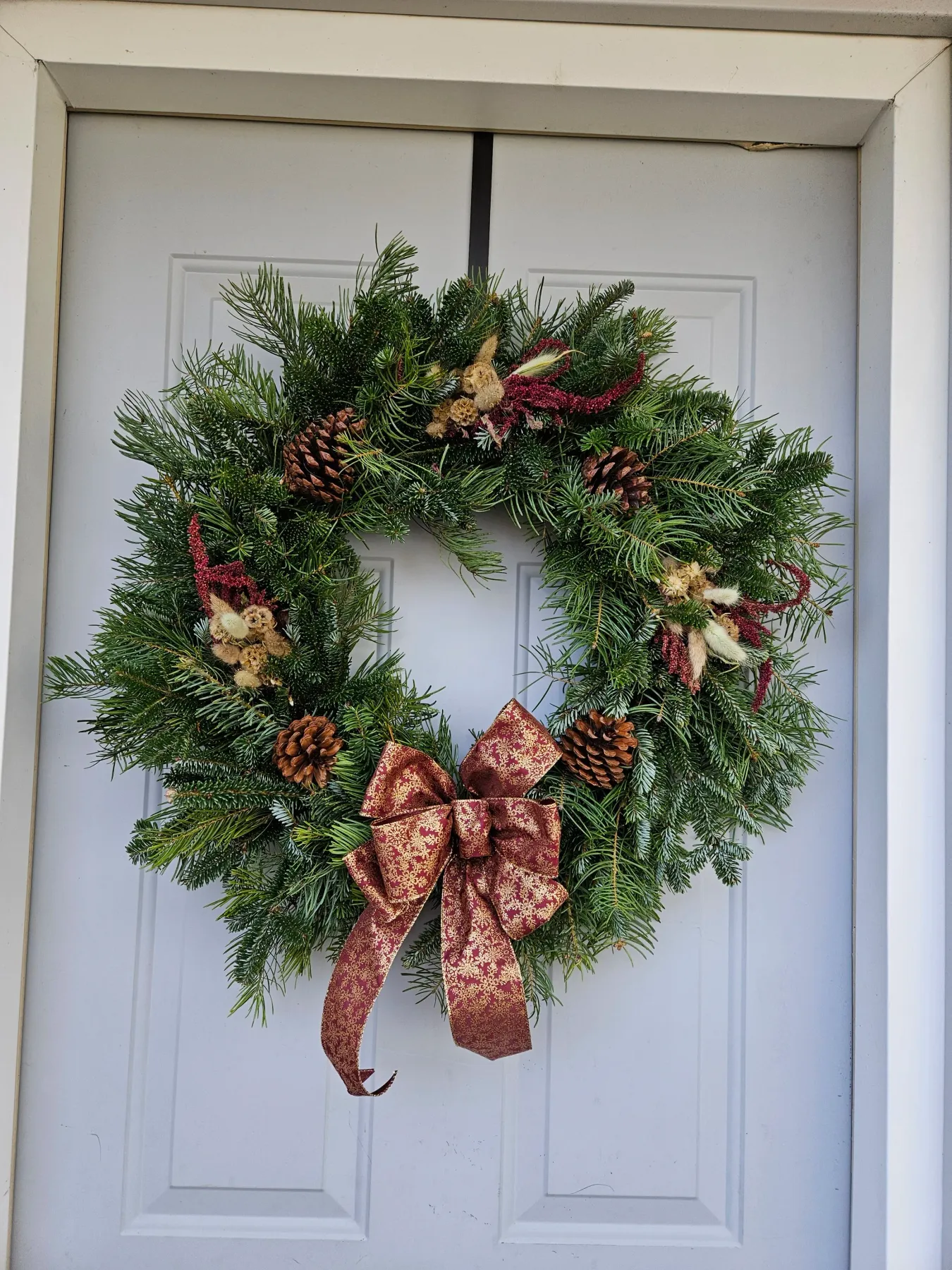
A bottom bow hides your best greenery, though. Once it’s tied, the lower third of the wreath is ribbon, so the base has to be genuinely full or the bottom will look thin next to the top. It also swings every time the door moves. Two small wire loops through the back of the ribbon will hold it still, and they take five minutes.
20. A Bare Metal Hoop With One Sweep of Greenery
A hoop wreath takes about 20 minutes and $15 to $18.
- Buy a 14-to-18-inch metal hoop — brass, black, or bronze all work.
- Gather one bunch of evergreen and one of eucalyptus, about eight stems total.
- Wire the stems to the hoop on the bottom-left curve, wrapping in one direction.
- Fan them so they follow the hoop’s arc instead of sticking straight out.
- Wire three dried orange slices at the bottom center and trim the wire ends.
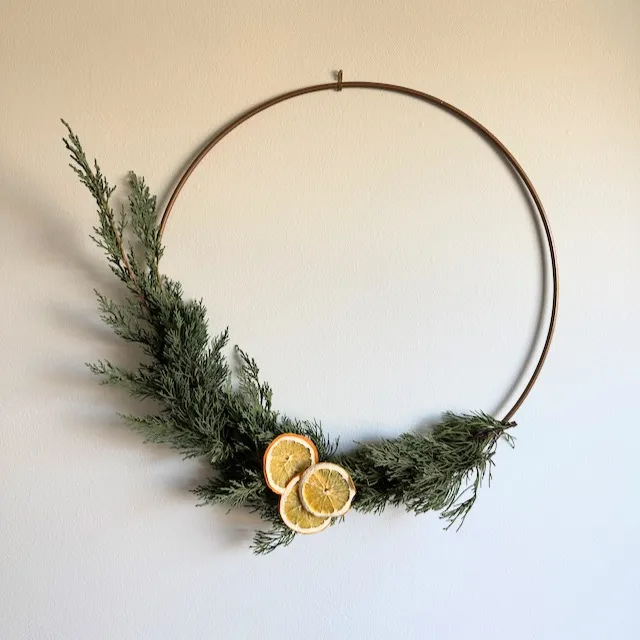
Negative space is the point. A traditional wreath fills a circle; this one leaves most of the hoop bare so the metal itself becomes part of the design. It works in small rooms because it adds almost no visual weight, and it works on a plain wall because that single sweep of green gives the eye somewhere to land without asking for much.
21. Flocked Pine and a Checkered Bow With Gold Edges
Bow math: ribbon width should be about one-eighth of your wreath’s diameter, so a 20-inch wreath wants 2.5-inch ribbon. Tails should run about 1.5 times the wreath’s radius — long enough to read, short enough not to catch the doorknob. And always buy wired ribbon for a multi-loop bow. Unwired grosgrain will sag by New Year’s, no matter how well you tied it.

A heavily flocked wreath against warm wood planks is a close-up design, which means proportion carries everything. Keep it between 20 and 24 inches if it’s hanging on an interior wall where people stand within a few feet; larger starts to look like a decoration rather than a detail. On a front door, go up to 26 inches — you’re viewing it from the curb.
22. Red Baubles, White Berries, and Silver-Frosted Pinecones
Sixty percent green and frosted branch, 25 percent red, 15 percent white and silver. Red is a strong color, so the frosted branches are what keep it from screaming — they act as a built-in neutral. Want the same energy in a different palette? Hold the ratio and swap red for deep plum and the silver cones for copper. Everything else stays exactly where it is.

Shiny red baubles are the one thing you should never pay full price for. A value pack of 24 shatterproof ornaments runs $8 to $12, and you only use the large ones on the wreath — the small ones go back in the box for the tree. White berry sprays are $3 to $5 at a craft store, and a bag of pinecones is about $6. Start from a wreath you already own and this whole look lands near $35.
23. Cinnamon Sticks, Orange Halves, and Gold-Painted Leaves
- Grapevine or mixed-green base: $15–$30
- Pinecones, bag of 12: $6–$12
- Dried orange slices or three whole oranges: $4–$10
- Cinnamon sticks: $4–$8
- Red berry sprays: $6–$12
- Gold craft paint and small ornaments: $8–$14
Total: $43–$86, and most of it is reusable next year. Budget alternative: dry your own oranges and skip the ornaments — under $30.

The gold-painted leaves are the sleeper hit. They cost about $6 in craft paint and they’re the reason this wreath looks collected rather than assembled. Every other element is brown, green, orange, or red — all warm, all similar in value. A handful of gold leaves breaks that up and reads like candlelight. Take them out and the wreath goes flat and slightly dusty.
24. Frosted Pine Above a Mantel Stacked With Vintage Books
Open flames and dried greenery are a bad combination if you’re careless. Keep taper candles at least 12 inches from the wreath, and never let them burn down unattended — a wall-mounted wreath above a mantel sits directly in the rising heat. Battery-operated tapers are convincing now. If you want the real thing, burn them for the hour you’re actually in the room, then snuff them.
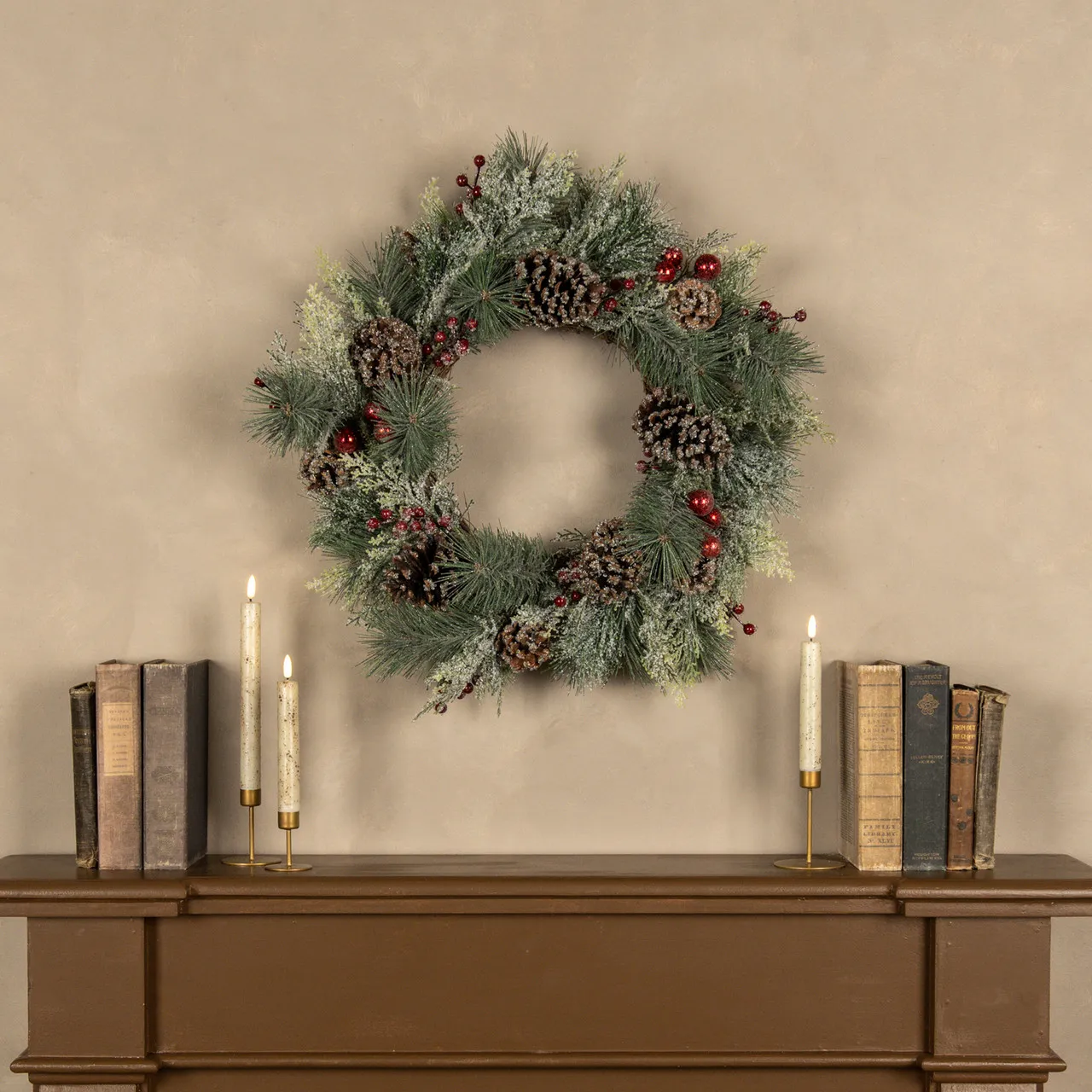
Above a 60-to-72-inch mantel, a 30-to-36-inch wreath is the right scale — smaller gets lost against the wall. Hang it so the bottom edge sits 8 to 10 inches above the mantel top, which leaves room for candle glow to reach it. With 9-foot ceilings you can go bigger; in an apartment with 8-foot ceilings, stay at 30 inches and add height with ribbon tails instead.
25. Cypress, Frosted Eucalyptus, and Tiny String Lights
Adding fairy lights takes 15 minutes and about $10 to $20.
- Buy a battery strand with slim wire and a small pack — 20 to 30 lights is plenty for a 24-inch wreath.
- Weave the wire along the back of the wreath, not the front, so it hides.
- Spiral loosely so the lights sit at different depths.
- Tuck the battery box into a cluster of foliage near the top and secure with floral wire.
- Set the timer if your strand has one — you’ll actually use it.

The battery pack is the whole game with lit wreaths. Cheap strands eat AA batteries in four to six weeks, so buy rechargeables or pick a strand with a built-in timer that runs six hours on, eighteen off. Check the wire before you hang, too — thin craft wire breaks at the bend where it meets the box, and it’s always the week before guests arrive.
26. Sage Eucalyptus With Clustered Silver Baubles
The silver baubles are clustered, not scattered. Three or four tiny shiny spheres tucked into a single pinecone gap reads as frost catching the light; the same baubles distributed evenly around the wreath would look like a craft project. Clustering is also cheaper — you get the whole impact from a six-pack of small ornaments instead of three packs of large ones.
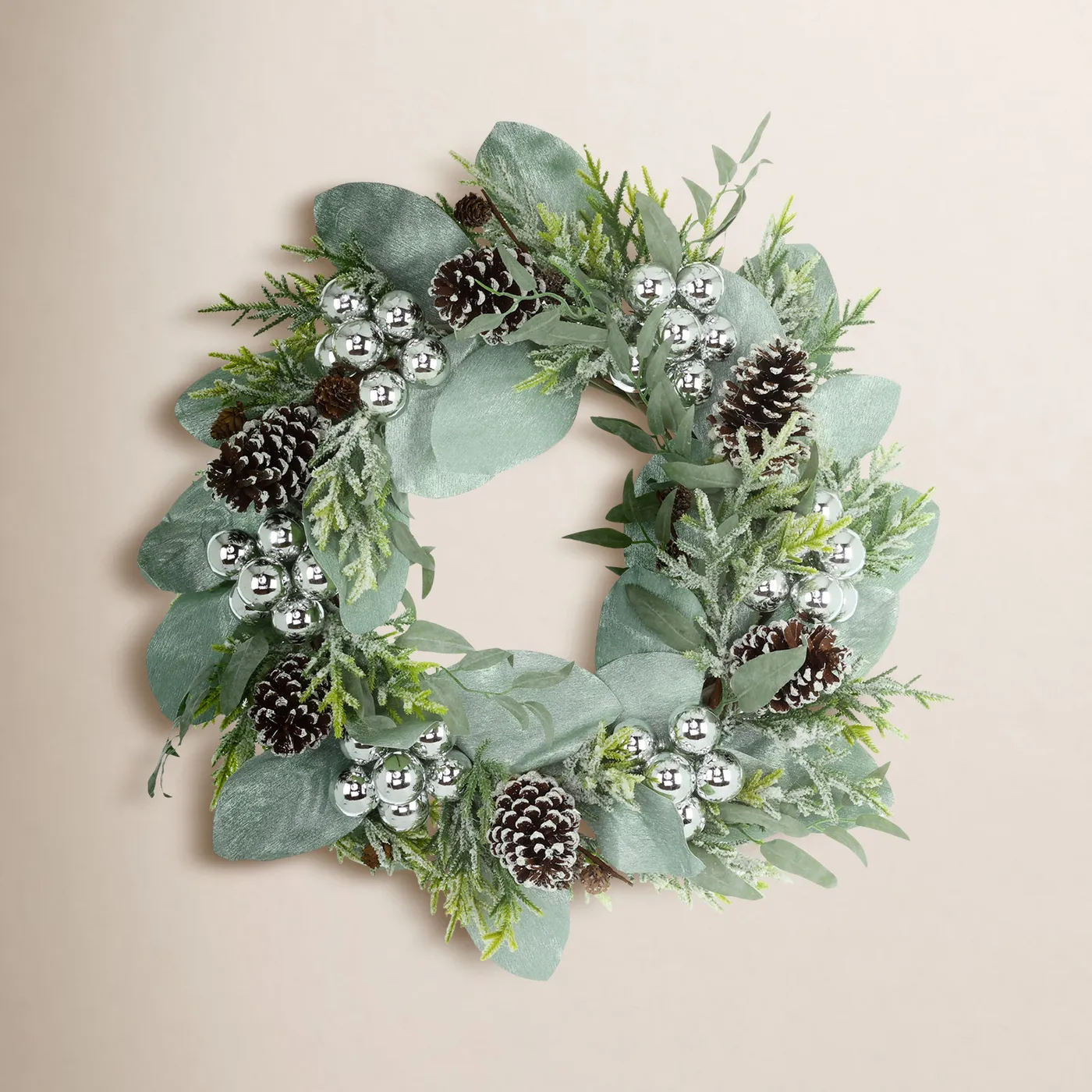
Not everyone wants red at the front door, and 2026 has finally caught up. Sage eucalyptus layered with frosted evergreen and a few silver baubles is the palette people are saving on Pinterest right now — it reads wintry without announcing a specific holiday, works from November through February, and photographs beautifully in low winter light.
27. White Ranunculus and Ferns on a Textured Black Door
A wreath that covers your door knocker is a design failure, not a win. Before you hang, hook a tape measure on the knocker and mark 4 inches above it — your wreath’s bottom edge should clear that line. If the door’s proportions won’t allow it, use an offset hanger so the wreath sits slightly to one side. Off-center looks deliberate; a wreath slung over hardware looks like an accident.
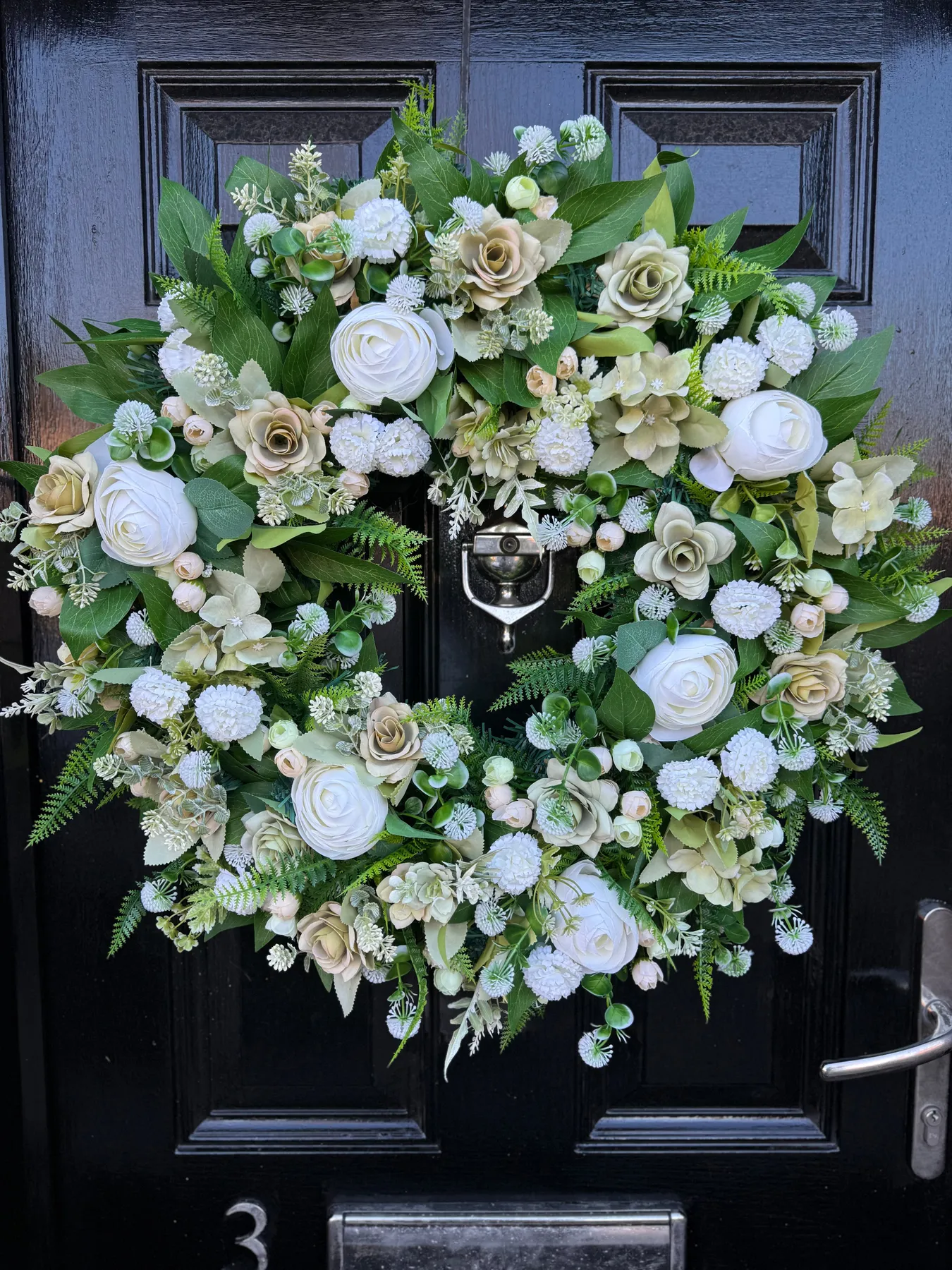
White flowers on a black door is the highest-contrast combination available to you, and contrast is what makes an entry read from the sidewalk. The ferns and darker greenery keep the white from feeling bridal, and the wreath’s fullness matches the door’s rough texture — a flat, thin wreath would vanish against it. Big, soft, and slightly overgrown beats tidy here.
28. Snow-Dusted Pine With Frosted Red Berries
Spray snow is the cheapest drama in the craft aisle. A can runs $6 to $9 and covers two wreaths. Pair it with a $15 plain evergreen wreath, a $5 bag of pinecones, and one $6 red berry spray, and you have this exact look for under $30. Buy the wreath in early November before the good ones sell out, and spray it on a dry, mild day so the coating cures properly.
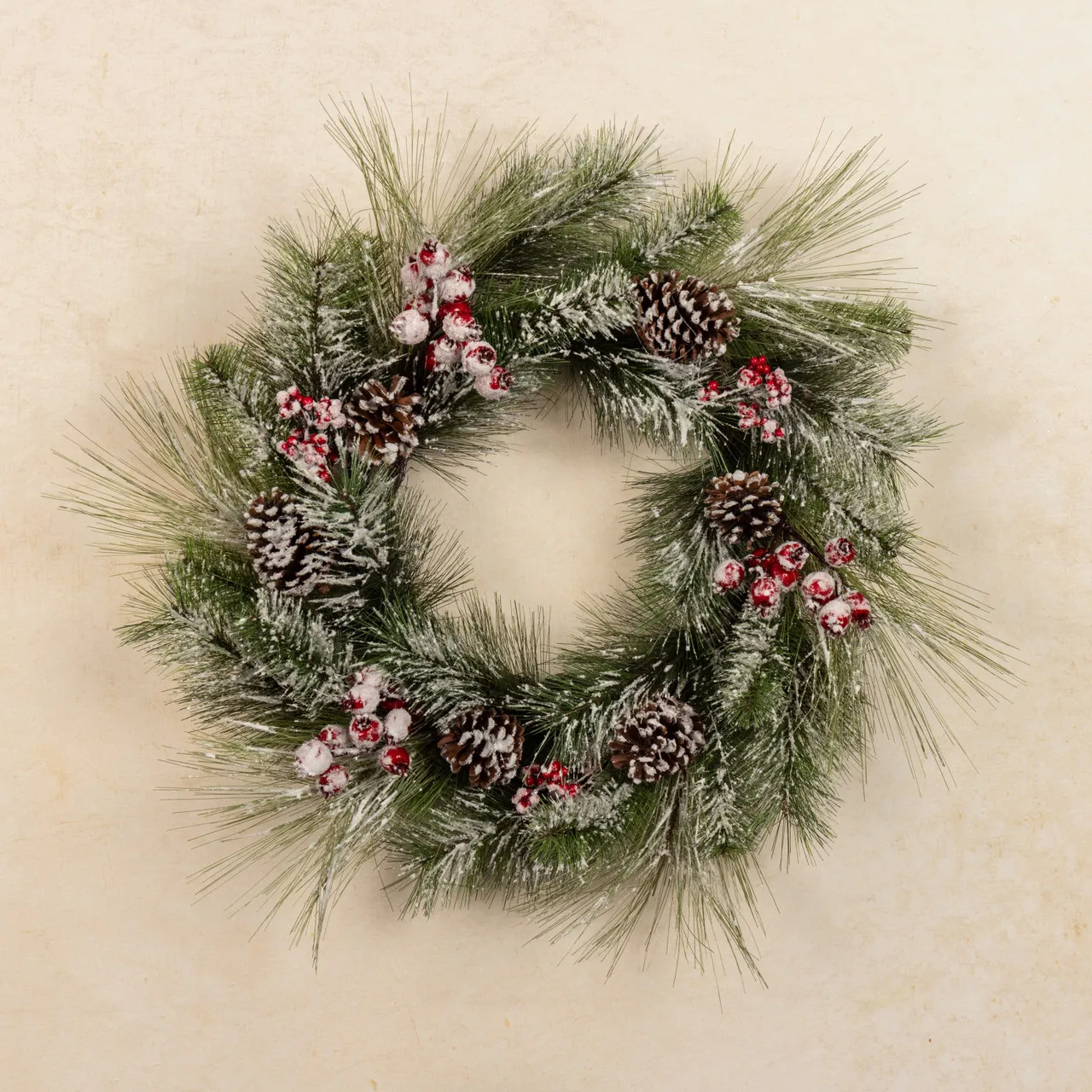
Spray snow yellows. It’s fine for one season, sometimes two, but the coating picks up dust and turns an unflattering cream by year three — and there’s no fixing it short of respraying. Indoors, it also sheds onto carpet and dark floors. If your wreath hangs over a wood floor or a wool rug, consider a factory-flocked wreath instead; compare with Idea #24 and you’ll see the difference in the cleaner finish.
29. Two Greens, Frosted Pinecones, and a Very Full Shape
Artificial pine is easy — flocking is the fussy part. Dust it monthly with a soft brush or a hairdryer on cool, and never wipe it with a damp cloth, which just pushes dust into the flocking. At the end of the season, store it in a breathable bag rather than a vacuum-sealed one; trapped moisture is what makes faux snow go crunchy. Ten minutes of care in January buys you three more seasons.
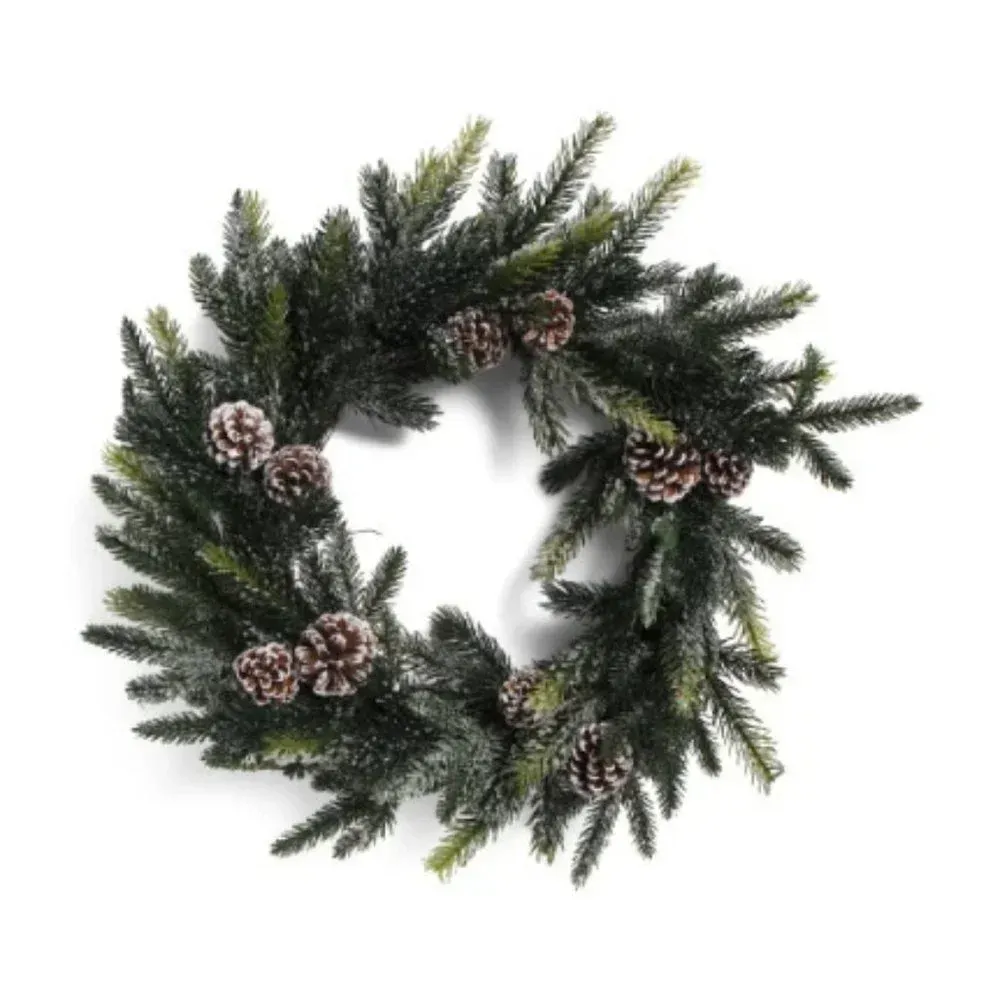
- Measure your door width and pick a wreath about two-thirds of it.
- Check your hanging surface — glass, metal, and painted wood each need a different hook.
- Confirm the wreath’s weight and match your hook rating.
- Decide indoor or covered outdoor; flocking behaves differently in both.
- Set a budget ceiling before you walk into the craft store.
30. Sage Cupped Leaves and Tiny Cream Flowers
Density comes from leaf shape, not leaf count. Those cupped, overlapping sage leaves stack like scales, so the wreath reads full even where there’s nothing underneath. Then the tiny cream flowers do the opposite work — small, bright, and scattered, they pull your eye around the circle instead of letting it rest. Full base, small accents. That’s the formula.
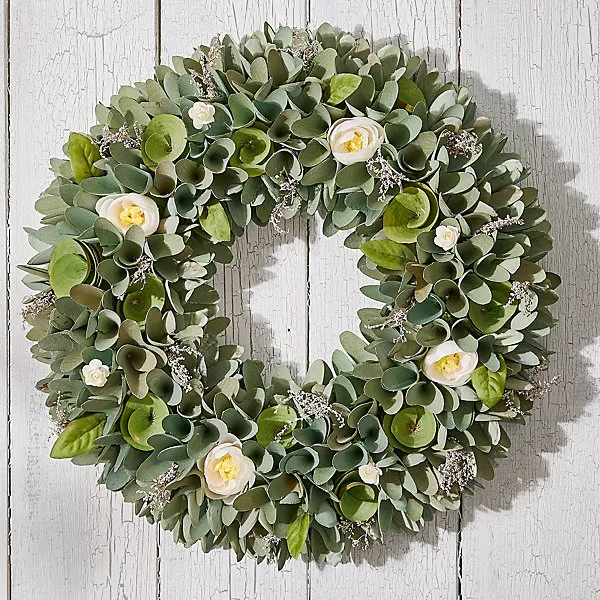
Getting that cupped-leaf density takes about 30 minutes and $22 to $28.
- Start with a flat 16-inch wire base, not a wreath ring.
- Cut sage leaf bunches to 3-inch stems.
- Wire them on in overlapping rows, each row slightly above the last.
- Angle every bunch outward so the leaves cup toward the viewer.
- Finish with small cream flower picks pushed into the gaps.
31. Muted Blue-Green Blooms on a Dark Paneled Door
About 50 percent large blue-green and beige blooms, 35 percent green foliage, 15 percent small cream and bright blue accents. The big flowers set the mood, the foliage gives the eye somewhere to rest, and the tiny accents keep the whole thing from going flat. Swap the bright blue for soft coral and the same structure reads completely different — same math, new season.
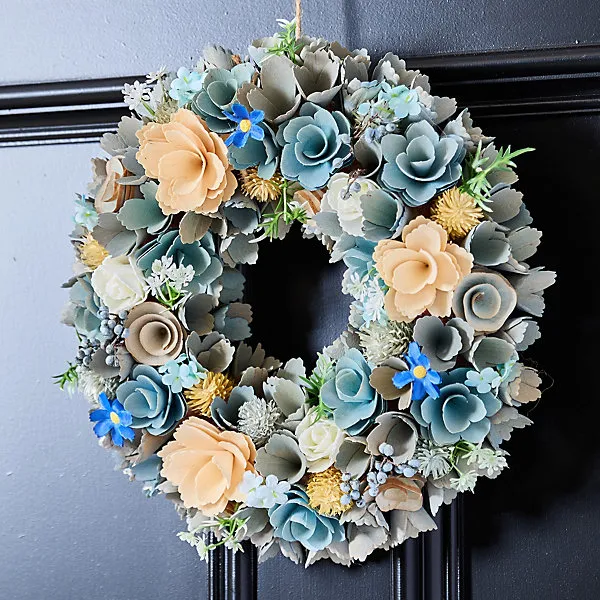
One bright blue bloom, placed slightly off-center, is the reason this wreath isn’t sleepy. Everything else is muted — blue-green, beige, cream — and that single saturated pop gives your eye a starting point. Move it to dead center and it becomes a bullseye. Leave it at roughly 4 o’clock, and the wreath feels alive instead of symmetrical.
Hang It, Step Back, and Let Winter In
The best winter wreath isn’t the most decorated one — it’s the one that suits the door it’s hanging on and the season you actually want to keep it up for. Start with one of these 31, change two things to make it yours, and give yourself permission to skip the rest. And if one of them stuck with you, go ahead and pin it — December-you will be very glad you did.