
29 Jaw-Dropping Christmas Table Set Up Ideas for 2026 That Will Dazzle Your Guests
Somewhere between the third roll of ribbon and the fourth saved pin, the Christmas table stops being a table and becomes a small stage — which is exactly where most of us get stuck. We spent days browsing Target, Anthropologie, Etsy, and IKEA to pull together 29 table setups that real people photographed in real dining rooms, from a burlap runner scattered with dried orange slices to a centerpiece lit by glowing ice cubes.
Everything here lands between $18 and $460, so there’s a version for the paper-plate years and a version for the year you finally host. You’ll find traditional red-and-gold, rustic woodland, frosted silver-and-blue, and one gloriously hot-pink table that refuses to behave — and where it makes sense, budget and luxury versions sit side by side. In 2026 the pendulum has swung toward layered, collected tables: mismatched candle holders, foraged greenery, and heirloom plates pulled from the cabinet instead of bought new. And stay until the end — we break down the most common mistakes that can ruin these looks. A few links here are affiliate links, which costs you nothing and keeps the candles lit. 📌 Save this to Pinterest for later — you’ll want to revisit these ideas.
1. Natural Garland and Black Candlesticks on a Two-Tone Table
The thing that makes this table feel like a room instead of a display is the garland running flat down the middle with black candlesticks stuck straight into it. Not a centerpiece bowl, not a stack of ornaments — a long, low line of greenery that keeps both ends of the conversation connected. Everything else stays quiet: the light grey tabletop, the cream tufted chairs with nailhead trim, the white bench with a faux fur throw tossed across it, the wreath hung in the window behind. Pull the garland and you’d have nice furniture and no Christmas.
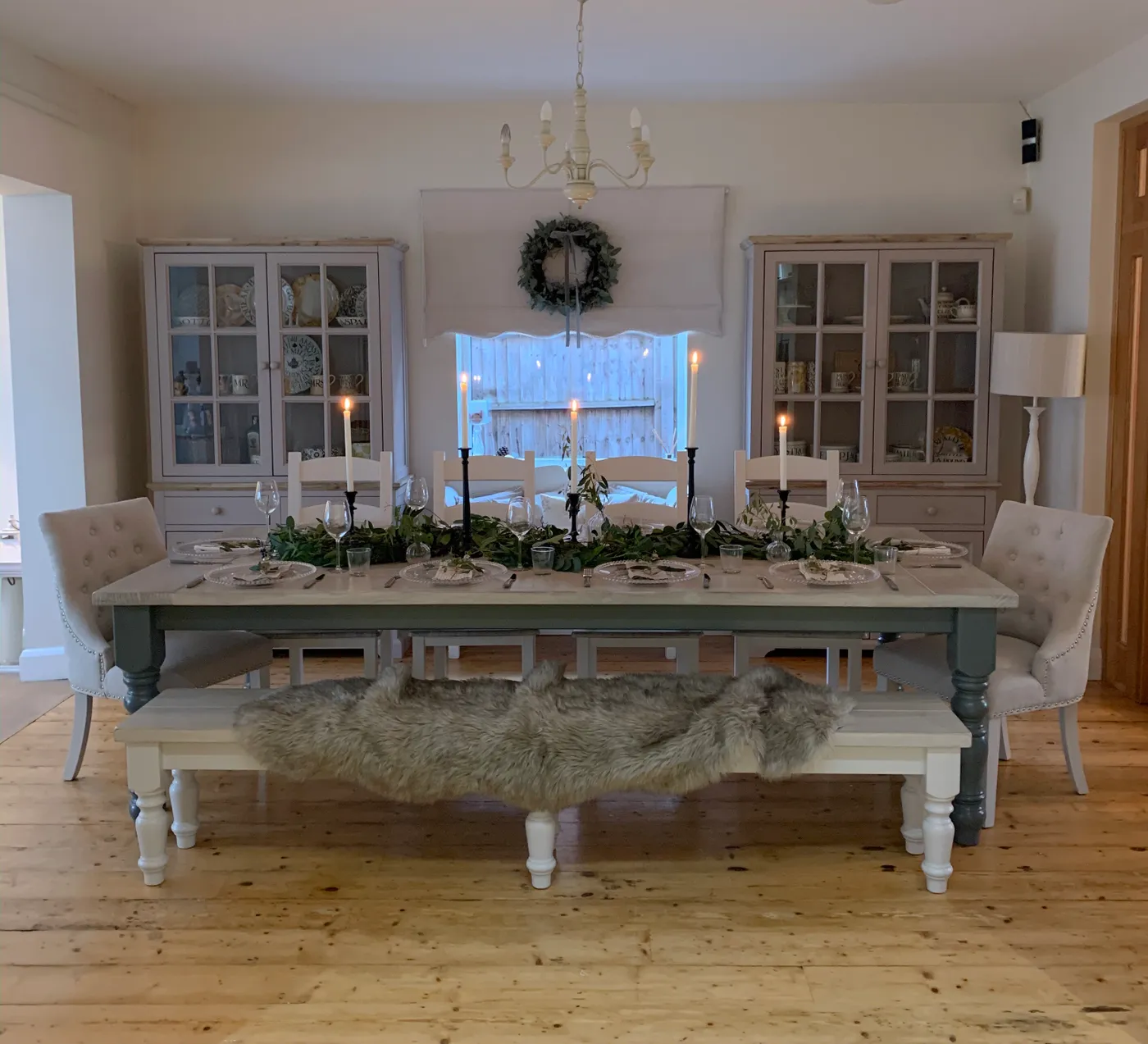
Buy three 6-foot cedar or fir garlands, not one. Twist them together and wire them to a length of floral wire so the seams disappear, then run the whole thing 12 to 14 inches in from each edge so there’s room for a dinner plate. Cluster the candlesticks in threes at uneven heights — 6, 9, and 12 inches — instead of spacing them evenly. Even spacing reads like a restaurant; uneven clusters read like a home.
2. Poinsettia Centerpiece with Gold Reindeer and Red Woven Placemats
- Centerpiece: 3 mini poinsettias, pine branches, berries, pinecones — $45–$90
- Candles: 3 white pillars in glass hurricanes — $30–$70
- Linens: beige paper runner + 6 red woven placemats — $35–$65
- Place settings: holiday plates, white napkins, red ribbon bows — $60–$140
- Accents: gold reindeer figurine + gold flatware — $40–$110
- Total: roughly $210–$475 for a table for six, less if you already own the plates.
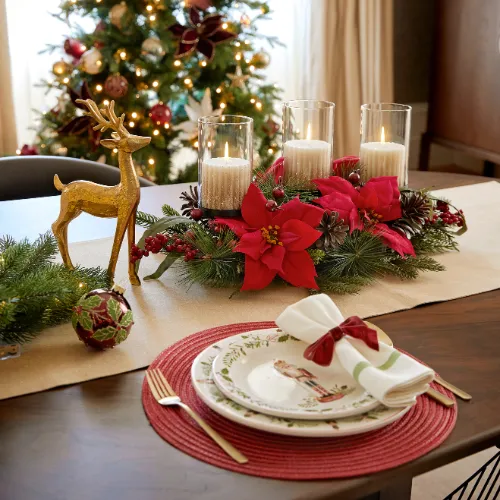
Paper runners are gorgeous and forgiving — until a gravy boat comes within six inches of one. If you’re serving anything hot or red, swap in a fabric runner or treat the paper as a single-evening luxury. Also: poinsettias in a warm dining room drop leaves with a vengeance. Keep them in their nursery pots, water before dinner, and move them out from under the candles, because heat is what kills them.
3. Bright Red Tablecloth with Frosted Pinecones and Gold Tapers
A full red tablecloth, white plates, frosted pinecones, gold tapers, and silverware at retail is a $300 proposition. Do it for about $110: a red cotton-blend cloth from Target runs $25 to $35, plain white dinnerware from IKEA covers eight for $60, and a bag of pinecones with white spray paint plus craft-store gold tapers handles the rest for under $25. The gold flatware is the one thing worth hunting on Facebook Marketplace — full sets surface constantly in December from people who inherited them and never use them.
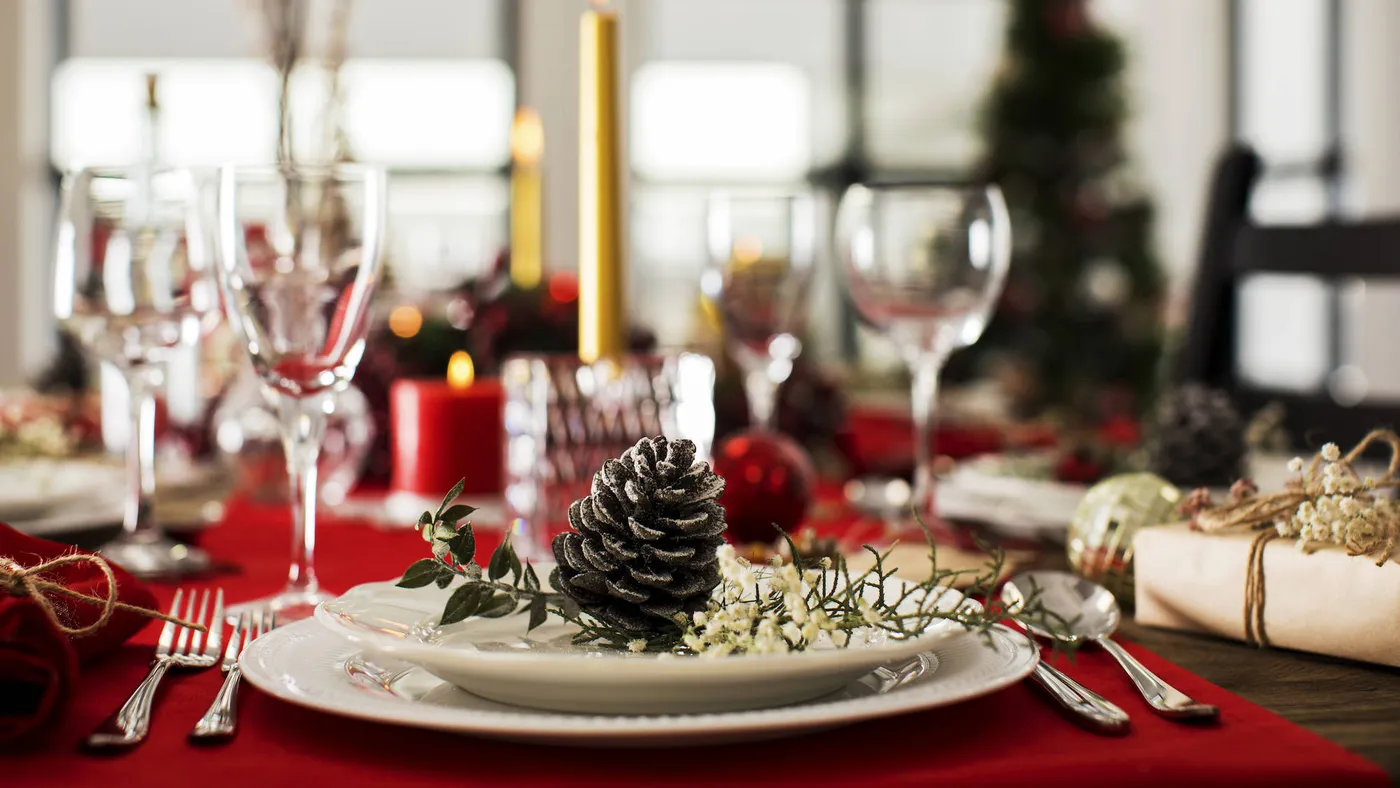
The formula here is 65% red, 25% white, 10% metallic, and the whole table lives or dies on that last 10%. Keep the reds to one shade — bright cherry, not cherry next to crimson — so the white plates read as a deliberate stripe rather than a mistake. Swap the gold tapers for brass and the table turns warmer and older; swap to polished silver and the same setting goes crisp and formal. The pinecones stay either way.
4. Burlap Runner with Dried Oranges and White Pillar Candles
- Slice navel oranges 1/8 inch thick and blot them dry.
- Bake at 200°F for 2.5 to 3 hours, flipping at the halfway mark.
- Cool completely on a rack — they crisp as they cool.
- Dip each slice for 30 seconds in a 1:1 water-and-craft-glue bath to seal and shine.
- Lay them along the burlap in overlapping rows with pinecones and evergreen sprigs, then add the pillar candles.
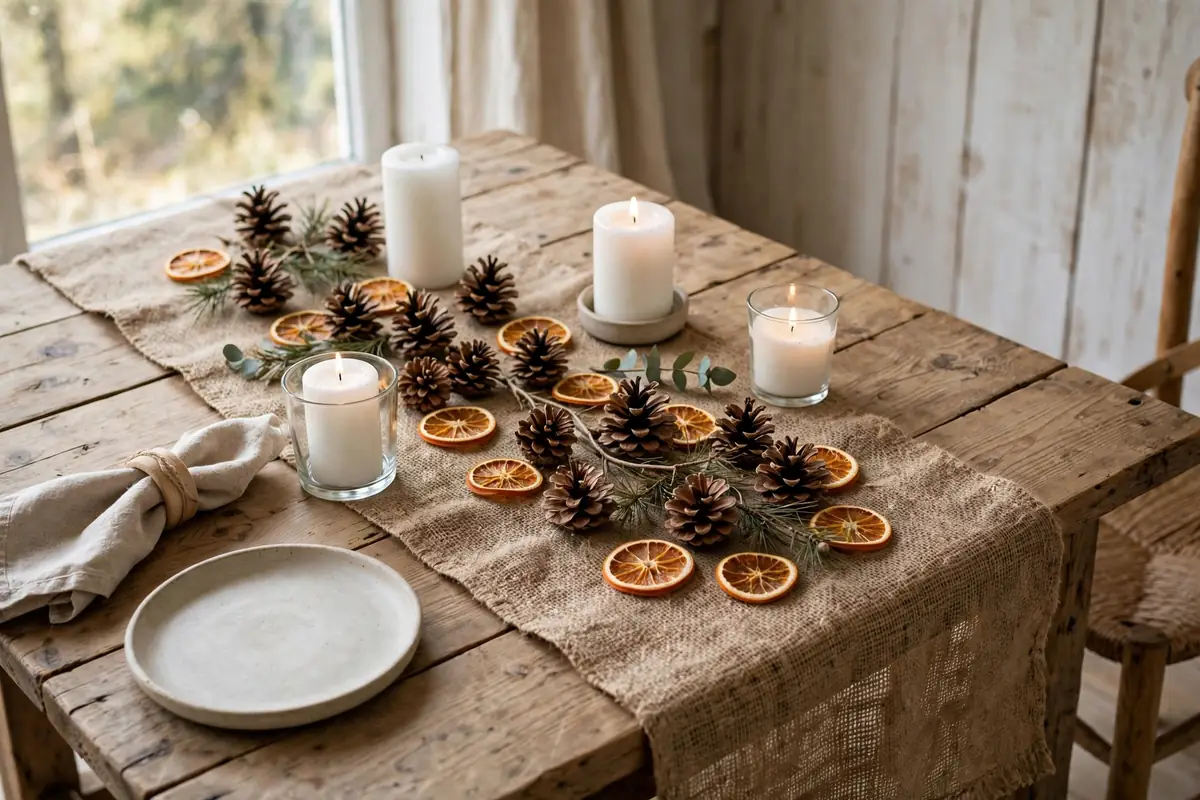
Cost: about $12 in fruit plus the burlap and candles. Time: one evening, most of it unattended in the oven.
Three things are doing the work. Texture contrast — rough burlap against pale ceramics against glass — which is why the table reads expensive despite being nearly free. Repetition of shape: circles (orange slices, pinecones, candle tops, plates) laid in a horizontal rhythm over a distressed wood top. And restraint in color: brown, cream, burnt orange, no red, no tinsel. It’s a fall table that got festive by adding candles.
5. Green Leaf Plates and Pomegranates on Pink Checkered Linen
Leaf-molded plates photograph beautifully but they hate a wet salad. Use them as a charger or a dessert plate and keep the actual food on the flat middle. And when you’re mixing a checkered cloth with patterned crackers and textured plates, run a solid white or cream charger under every setting — it gives the eye one place to rest between all that pattern.
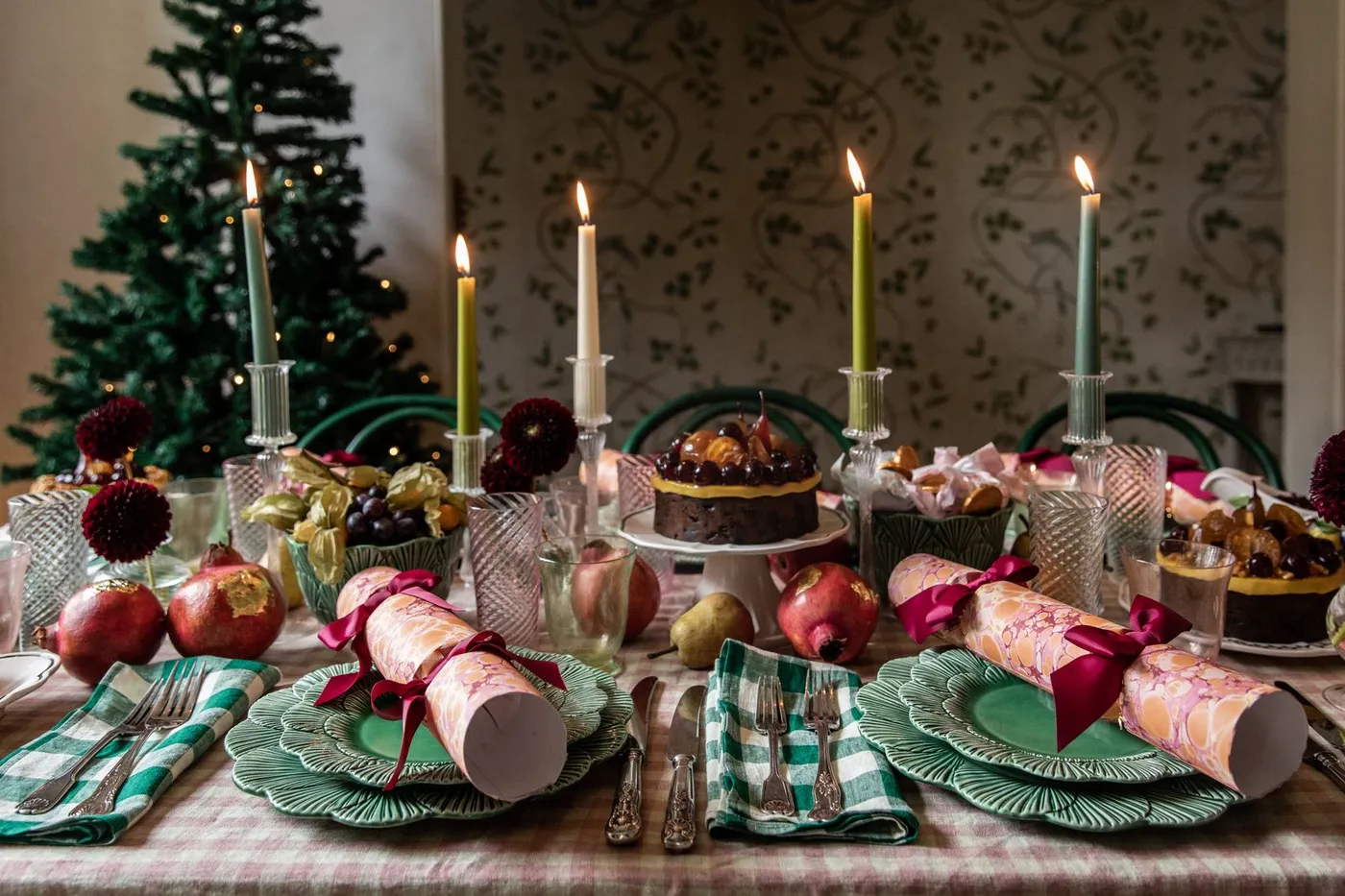
The pomegranates. Some of them brushed with gold, tucked between candle holders and the dark glazed fruit cakes — that’s the detail that pulls this from nice Christmas table into something you photograph. They echo the green leaf plates without matching them, and the gold-dusted ones pick up the taper holders. Take them away and the table becomes a checkered cloth with plates on it. Keep them and the abundant, slightly vintage mood holds together.
6. Nutcracker Centerpiece with Plaid Runners and Green Goblets
Nutcrackers are top-heavy, and a table with kids, elbows, and a turkey will take them out. Put the tall ones at the ends or on a side table and keep only the short ones in the center. Also test the plaid runner on dark wood before dinner — cheap polyester plaid slides on a polished finish, so lay a thin felt strip or rubberized pad underneath or you’ll be straightening it between every course.
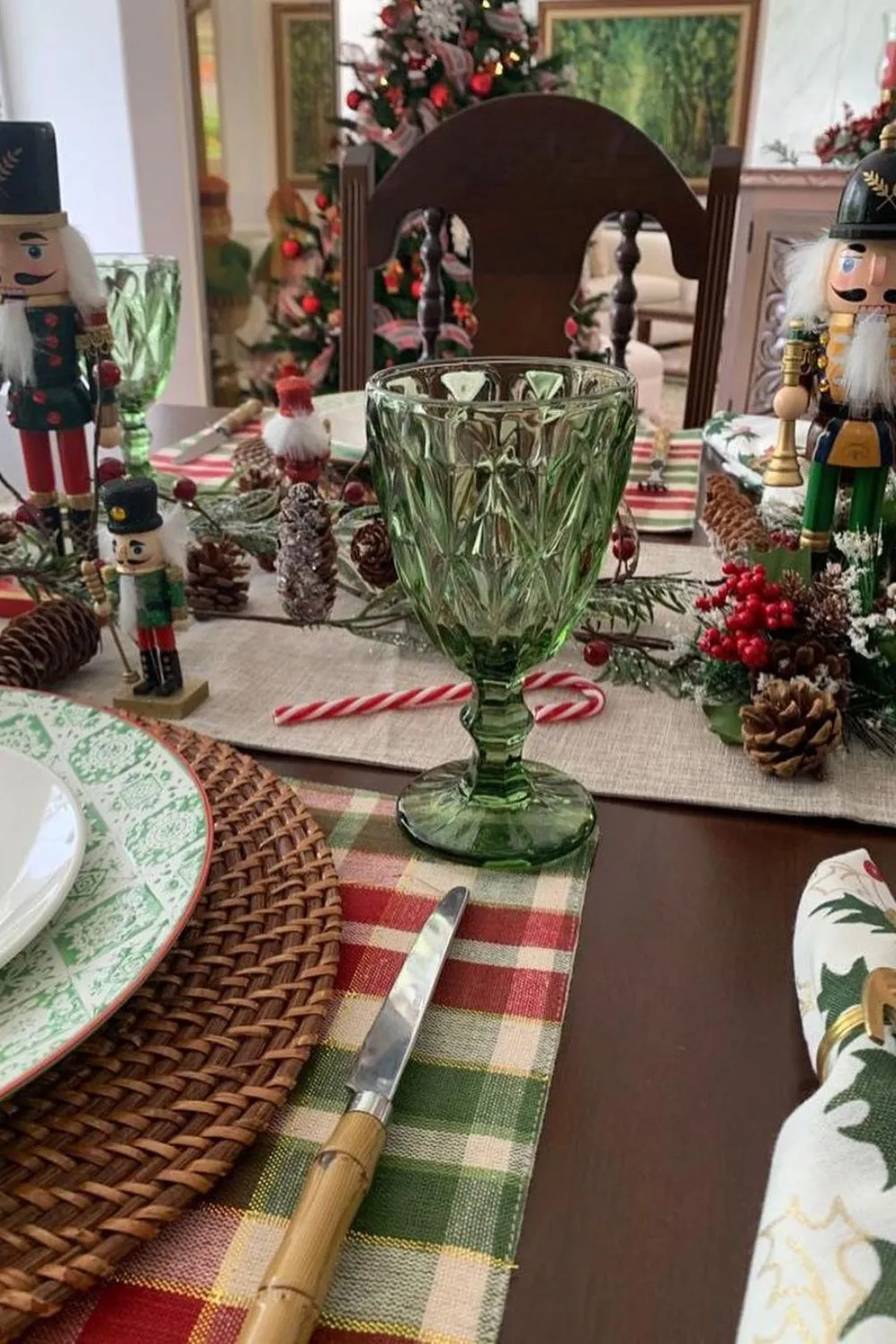
The return of proper plaid is a 2026 thing, and it’s not the rustic buffalo check of a decade ago — it’s tartan, in green and red, layered with woven chargers and colored glass. Call it the inherited Christmas look: tables that reference a grandmother’s dining room without literally recreating it. It has staying power because the components are things people already own and the palette never goes out of season.
7. Buffalo Check Runner with Winter Village Plates on a Round Table
Round tables between 42 and 54 inches across are where this setup sings. A 12-foot buffalo check runner is too much for anything smaller than 48 inches; on a 60-inch round you can push to 14 feet and still have plate room. Ceiling height doesn’t matter here — floor space does. You need about 30 inches of clearance per chair, so a 48-inch round seats four comfortably and six in a pinch. For a long rectangular footprint, see Idea #13.
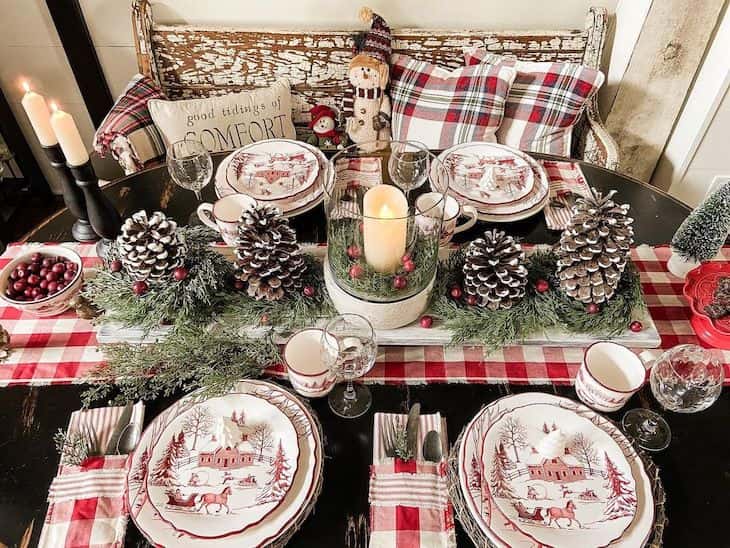
The winter village plates are the splurge; everything else isn’t. Buffalo check runners run $15 to $25 at Walmart and Target, a plain wooden tray from a thrift store is $4, and frosted pinecones plus a bag of cranberries costs under $15. Skip the matching plaid napkins and use plain white ones — nobody notices and you save $30. The distressed white bench is a Facebook Marketplace find almost any week in December.
8. Gold Tapers and White Flowers on a Round White Table
This is 70% white, 20% green, 10% gold — the cleanest possible Christmas formula, and the reason it reads elegant instead of busy. The trick is that the gold is almost entirely vertical: taper holders, cutlery, the rims of the glasses. Swap the gold for matte black and the same table goes modern and moody. Swap the white flowers for red and you land squarely on traditional. Keep the proportions and it’s hard to break.
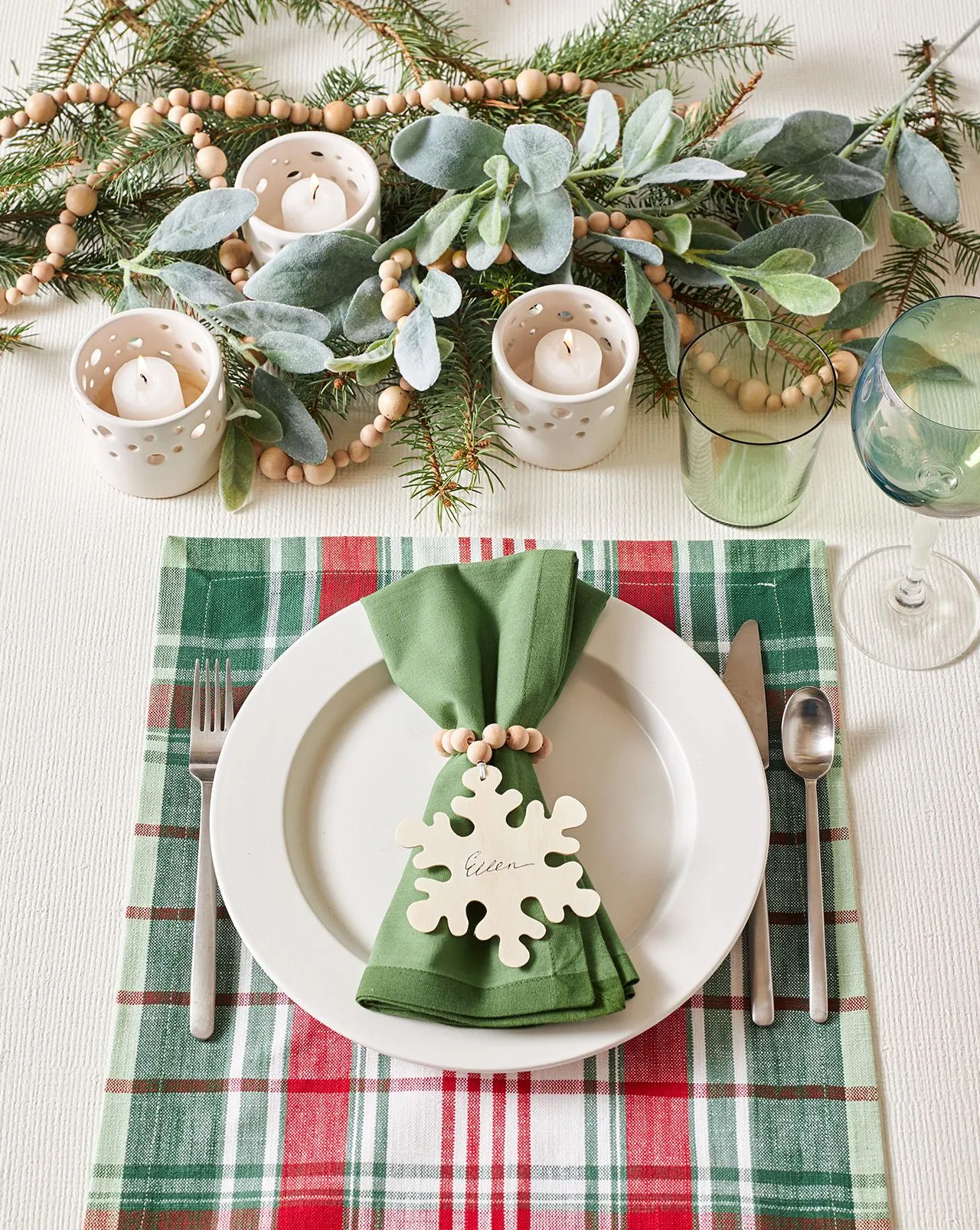
Fresh white flowers on a Christmas table means changing water on Wednesday and Saturday, and they’ll still sulk if the room runs warm. Eucalyptus lasts longer but drops oil onto white cloth — set a saucer under it. And affordable gold flatware is plated: it spots in the dishwasher and wears at the tines within a year or two of heavy use. Hand wash it through December and it will stay bright for a decade.
9. Spode Christmas Tree Plates Layered with Plain White
Patterned Christmas china works when you give it a plain neighbor. The green tree motif is busy enough on its own, so set it against plain white chargers and an off-white cloth and it reads as the star instead of one voice in an argument. The scalloped edge on the salad plate does quieter work: it softens a table that would otherwise be all circles and straight lines. Layer, don’t match.
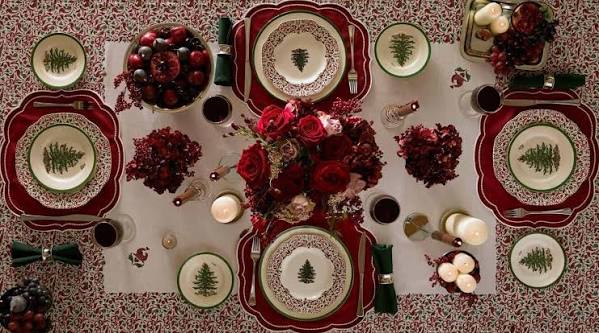
Collectible patterns are sold in open stock, which means you can buy two salad plates instead of a service for eight. Start with the salad plate — it’s the cheapest piece in almost every pattern and the one guests actually look at. Then build: white dinner plates you already own underneath, plain glassware, one patterned piece per setting. It reads collected rather than themed, and it costs a fraction of the full set.
10. Mini Wreaths Tied to Chair Backs with Red Ribbon
The mini wreaths on the chair backs. Six of them, tied with red ribbon, doing more for the room than the centerpiece does — because they push the decoration upward and outward instead of keeping it all in a horizontal stripe down the middle. It’s also the cheapest moment on this table: small faux wreaths run $4 to $8 each. Without them you’d have a pretty table. With them, the whole dining room is decorated.
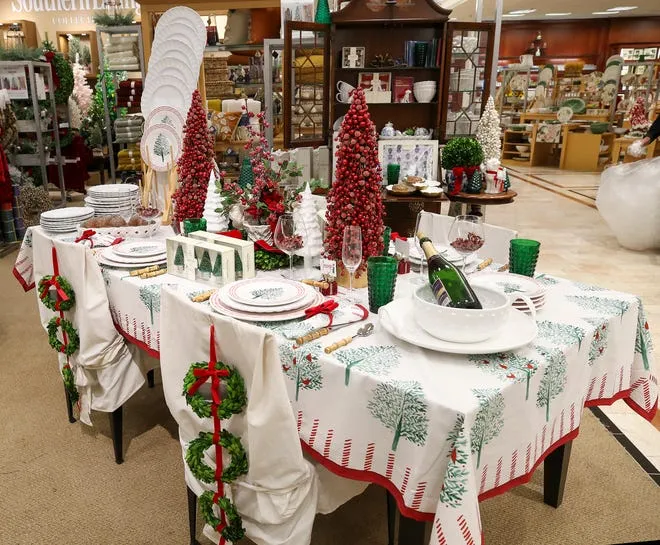
The full picture — patterned cloth, red berry topiaries, white ceramic trees, themed plates, green faceted glasses, a wreath on every chair — is a $400 table if you buy it new. Cut it to about $120: printed tablecloth from Target around $30, plain white plates you already own, green glasses at $1.25 each, and wreaths grabbed after December 15th when craft stores halve them. The ceramic trees are the piece to thrift; they turn up constantly in January.
11. Gold Chargers Under Tartan Plaid Plates and Rosemary Sprigs
- Set a gold scalloped charger one inch from the table edge.
- Center the tartan-bordered dinner plate on it, then the small white plate on top.
- Fold a dark green plaid napkin into a triangle and lay it left of the forks.
- Tie a red velvet ribbon around a pastry or small gift and set it on the top plate.
- Tuck a rosemary sprig behind the ribbon and slide the name card beneath it.
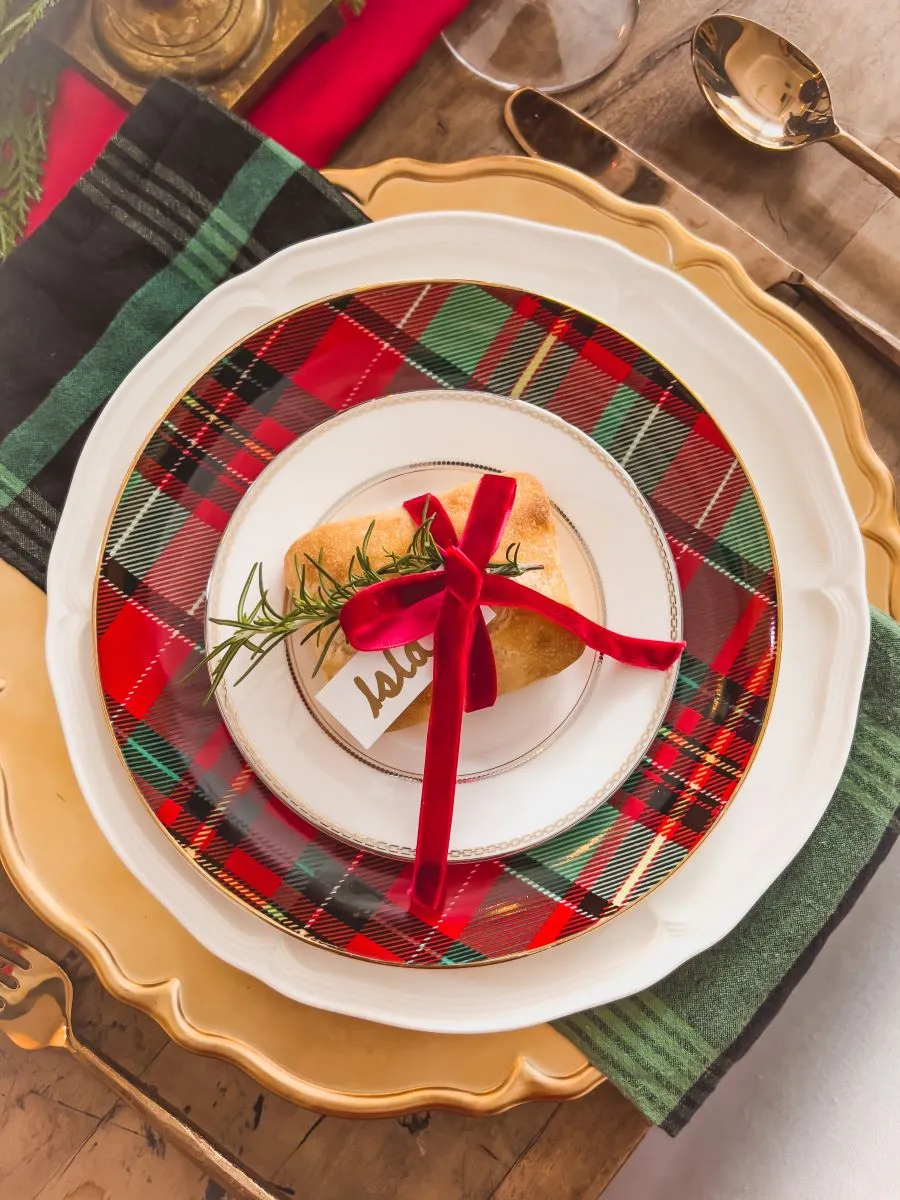
About ten minutes per setting once everything is out. Ribbon and rosemary cost roughly $8 for the whole table.
Chargers are 13 inches, and that dictates everything: you need 24 inches of table width per setting, so this stack wants a surface at least 40 inches deep. On a narrow 36-inch table, skip the charger and let the plaid plate sit directly on the wood. It also needs breathing room — this is a four-to-six-person setting, not a ten. For a version that scales to a crowd, see Idea #27.
12. Forest Green Napkin Roll with Gold Flatware and Rosemary
Napkin rolls are the quiet 2026 trend — not folded fans, not rings, just a loose bundle with the cutlery inside and something green sticking out. It photographs well because it adds height at each seat without cluttering the middle, and it’s the fastest way to make mismatched flatware look intentional. Expect to see a lot of it on Pinterest this season alongside dark green linen, which has finally overtaken white as the default holiday napkin color.
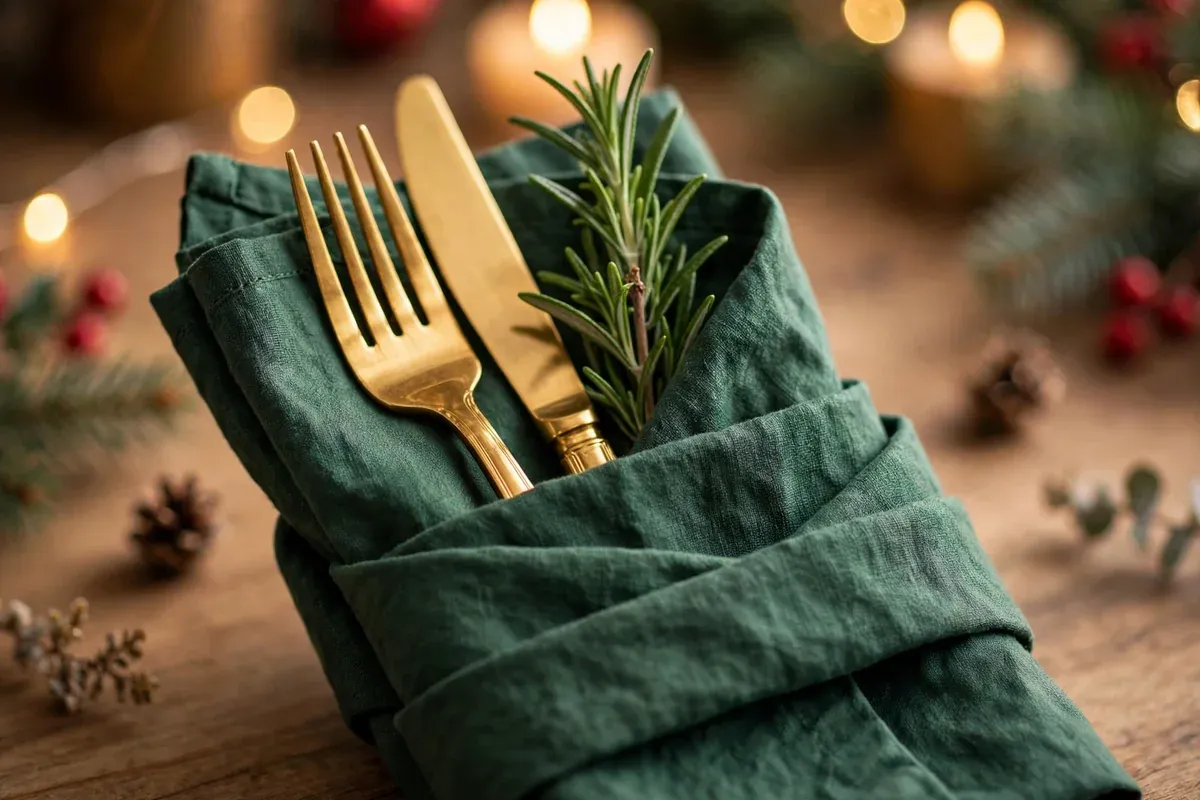
Rosemary is beautiful and it will absolutely shed needles into the gravy. Wipe the sprigs, use them for one evening, and don’t lay them directly against a light cloth — the oil leaves a mark that survives washing. If you’re doing this for a crowd, roll the napkins the night before and stack them covered; linen creases if it sits folded under weight for two days, and gold-plated flatware tarnishes fast when it’s pressed against green fabric in a warm room.
13. White Tapers in Dark Holders Along an Evergreen Runner
- White linen runner, 14 x 108 inches — $20–$45
- Evergreen branches (two bunches fresh or one garland) — $25–$60
- Eight white tapers plus eight dark holders — $40–$90
- White dinnerware with patterned salad plates — $60–$160
- Gold flatware for six plus clear glassware — $50–$130
- Total: about $195–$485, and the runner and flatware come back out every single year.
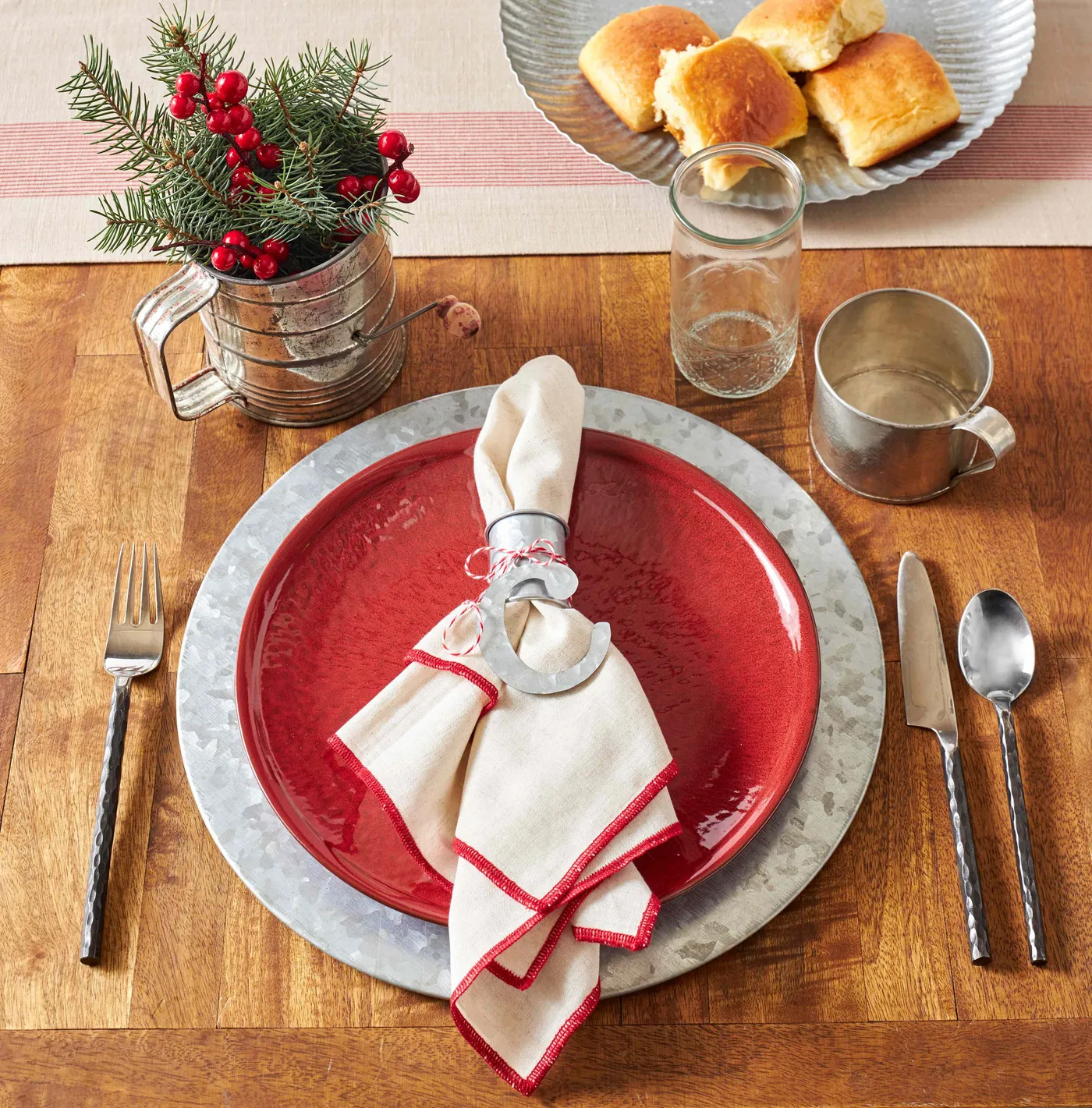
Candles on a dining table need to sit below eye level when people are seated — roughly 16 to 18 inches from tabletop to flame, lower if your chairs are tall. Anything higher and your guests spend dinner looking around a candle. Taper holders with a wide base and a snug cup won’t wobble; if yours do, a dab of museum putty under the base solves it and saves you from wax on white linen.
14. Orange-and-Evergreen Runner with Gold Taper Holders
Elongated centerpieces want a long table and a low profile — keep the greenery under 8 inches tall and let the candles do the vertical work. A 72-inch rectangular table takes a runner of about 60 inches with breathing room at each end; anything less and the arrangement swallows the place settings. If you’re working with a smaller round table, Idea #8 packs a similar palette into a tighter footprint.
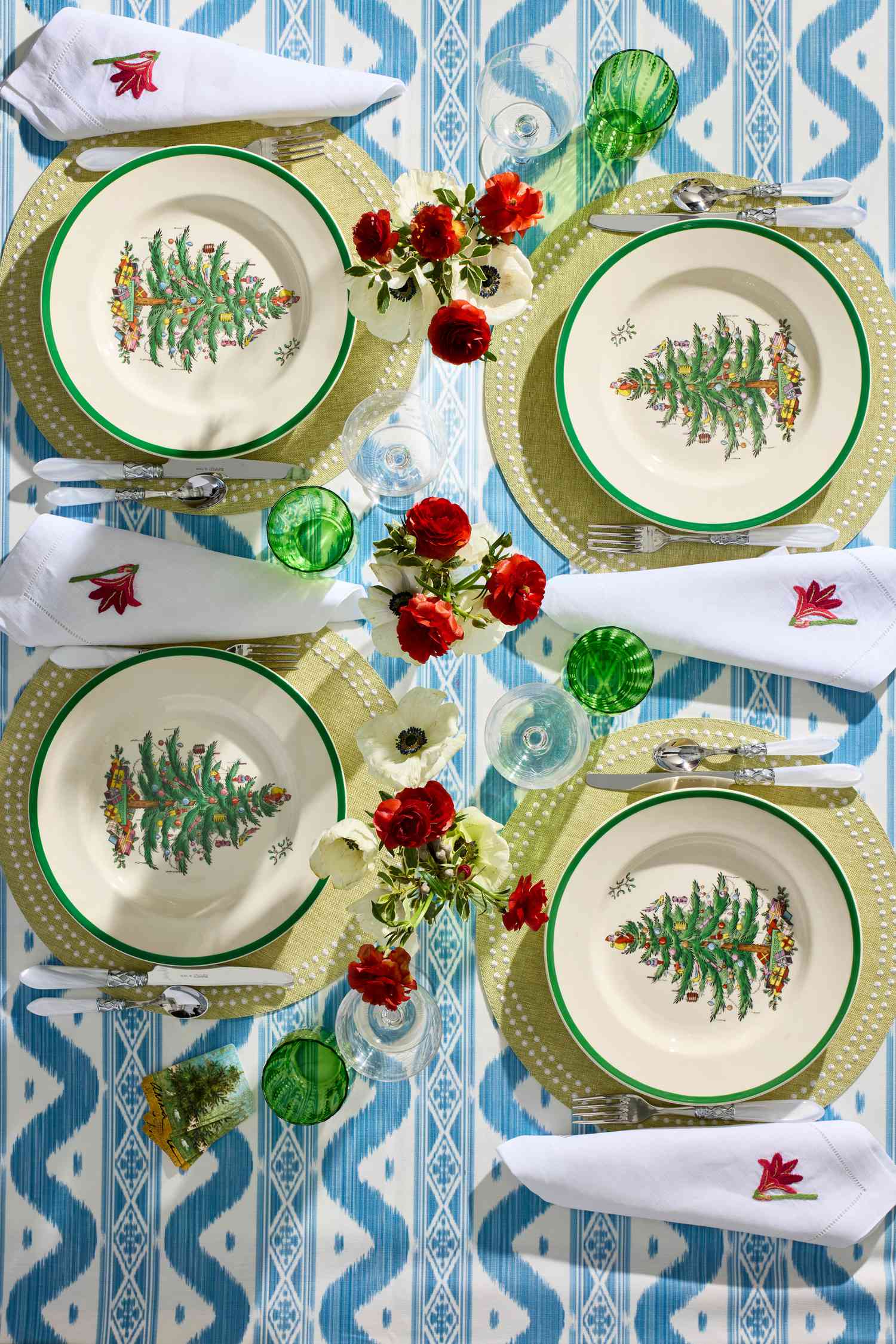
Count the colors: deep green, white, gold, and orange. That’s four, which is one more than most tables can carry — and it works because orange is doing the job red usually does. Swap the oranges for red apples and you get a more traditional table; swap them for pears and it turns slightly English-country. The gold stays either way, because gold is what keeps fruit from looking like a grocery run.
15. Red Woven Placemats Under Gold-Rimmed Glassware
Round woven placemats in red run $3 to $6 each at Target and Walmart, and that’s the entire trick. Keep your white plates, use whatever gold flatware you have, and pick up gold-rimmed glasses at a dollar store or thrift shop — mismatched is fine as long as the rims all read gold. The tall white candles in gold holders are the only real purchase; eight of them, holders included, is about $45. The whole table lands under $110.
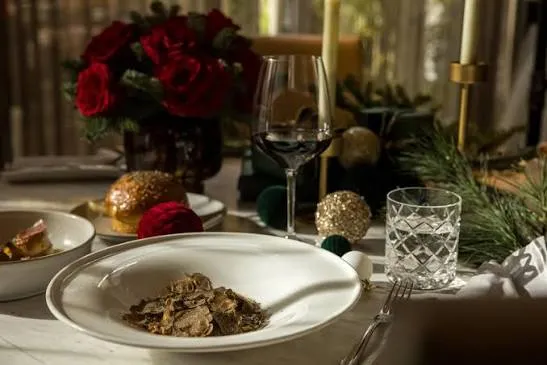
The red woven placemats, though — not the candles, not the tree glowing in the background — are what stop this from being another white-and-gold table. They put a saturated ring of color under each plate and add a matte woven texture that makes the gold cutlery and gold-rimmed glass look more expensive than they are. Take them away and the dark wood has to carry everything alone, and the table goes flat.
16. A Gold Reindeer Candelabra Holding Five Tea Lights
- Set the candelabra slightly off-center — dead center blocks the person across from you.
- Drop each tea light into a clear cup rather than the bare metal, to catch wax.
- Trim every wick to 1/4 inch so the five flames burn evenly.
- Light it five minutes before guests sit, not twenty.
- Keep a spare bag of tea lights in a small bowl nearby for the mid-meal swap.
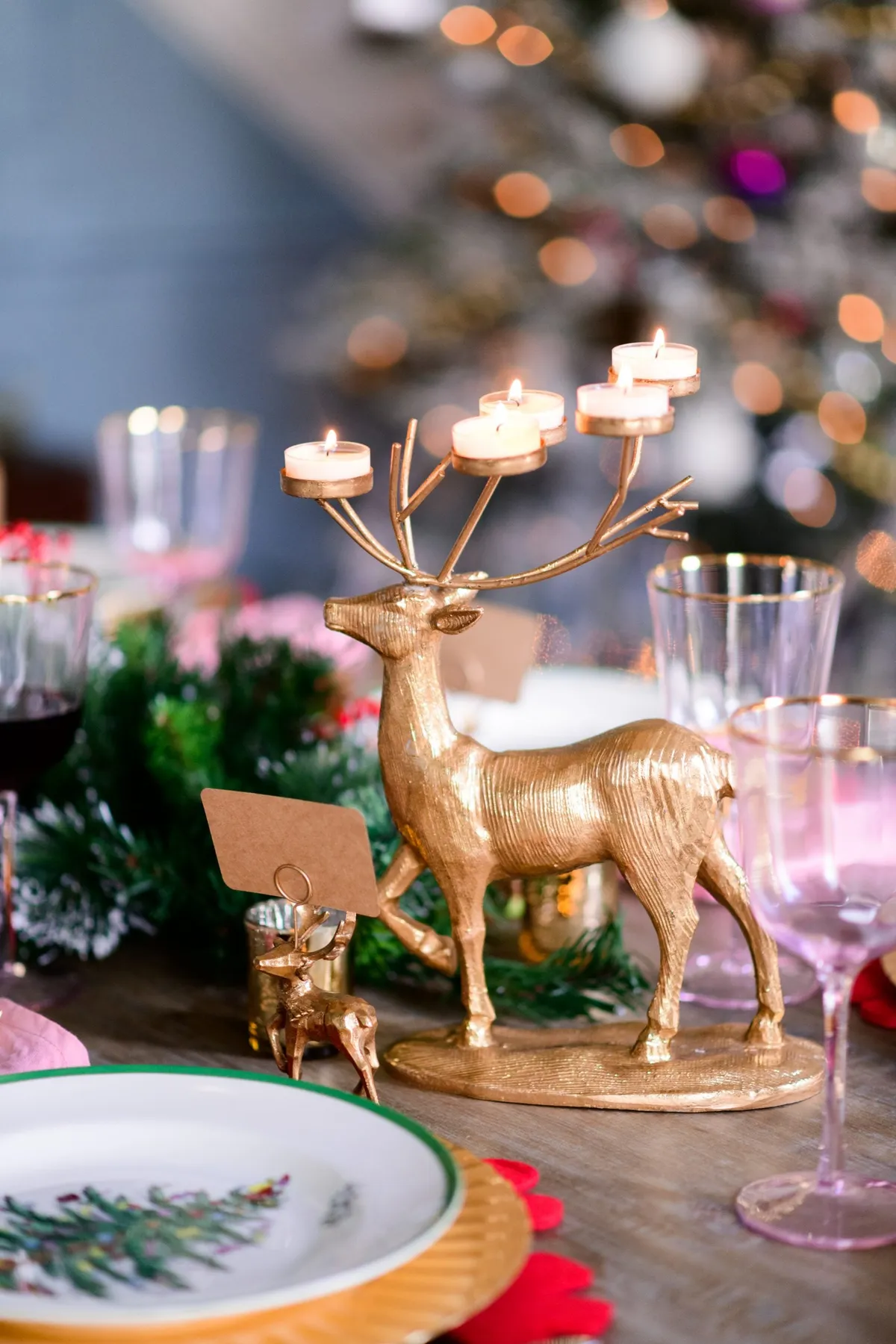
Tea lights burn three to four hours, which means this centerpiece dies mid-dinner if you light it at five. The reindeer itself is almost certainly gold-painted metal or resin, and both show fingerprints along the antlers — wipe with a dry cloth and never polish, which strips the finish right off.
17. Frosted Evergreens and Silver Baubles on White Linen
Two principles are at play. First, value contrast with no hue contrast: everything is light, but the frosted branches sit a half-step darker than the linen, so the eye finds the centerpiece without a single bright color. Second, the candles sit inside the greenery rather than beside it, which makes the arrangement read as one object instead of five. That’s the difference between decorated and composed.
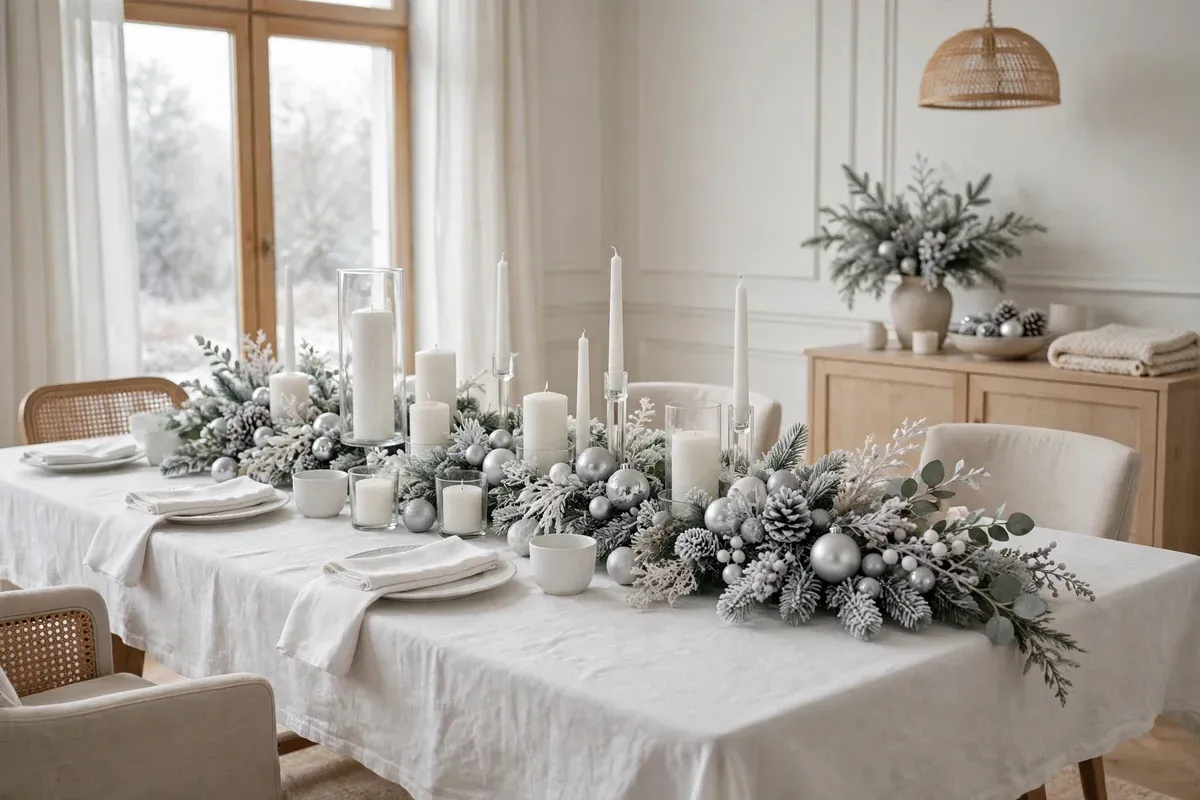
Almost monochrome: 75% white and frost, 15% silver, 10% green. That ratio is why it feels calm rather than cold — just enough green to remind you it’s a plant, just enough silver to catch the candlelight. Swap the silver for warm brass and the same table turns golden and cozy; swap the white cloth for pale grey and it goes full winter wonderland. The formula survives both.
18. Blue Napkins and Snowflakes in a Silver-and-White Scheme
When you’re building a cool-toned table, keep bulb temperature in mind: warm white bulbs will turn pale blue and silver muddy yellow after dark. Swap the chandelier bulbs to 3000K or dim them and lean on candles, and the blues stay blue. Also, one saturated note per place setting is plenty — here it’s the napkin. Blue napkins plus blue glasses plus blue ornaments plus blue chargers is how a serene table turns cold.
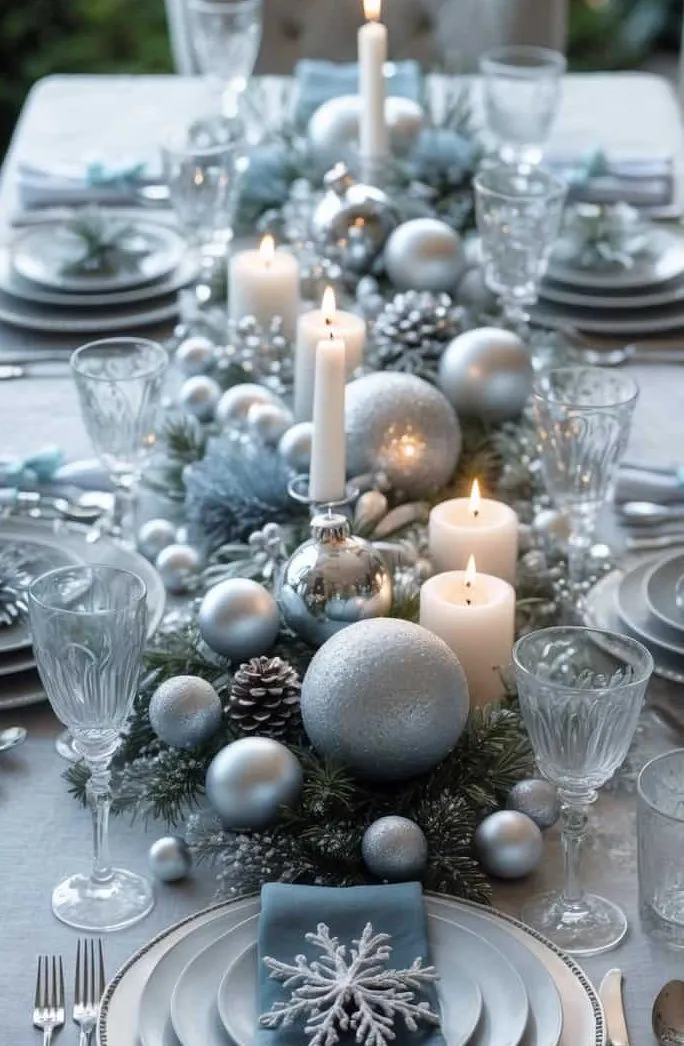
Frosted garlands shed. If yours is flocked, shake it outdoors before it comes anywhere near white linen, and expect a light dusting for the first two seasons. Blue and silver also photograph brighter than they look in person — in a dim dining room this palette can read grey. Test it at night under your actual lighting before you commit to twelve napkins in that shade.
19. Hot Pink Poinsettias and Gingham Napkins with Bamboo Flatware
- Runners: pink geometric plus two green polka dot — $30–$60
- Hot pink poinsettias, three potted plants — $36–$60
- Layered pink and green plates, service for six — $60–$140
- Red and white gingham napkins, set of six — $20–$40
- Gold bamboo flatware, service for six — $40–$90
- Pom-pom decor and scattered ornaments — $25–$55
- Total: roughly $210–$445. This is the one table where more is genuinely the point.
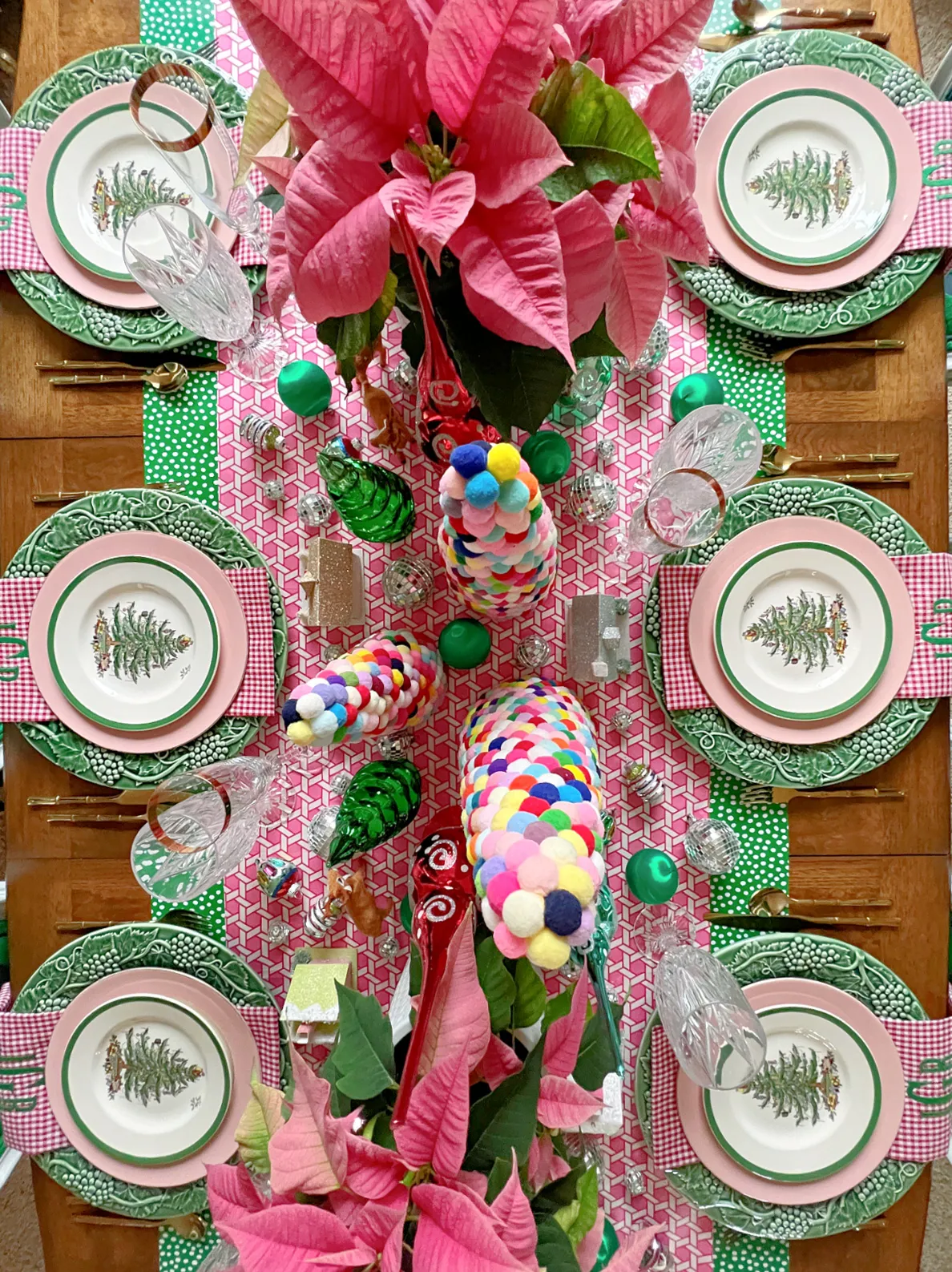
Maximalist tables need room to sprawl. This one wants at least 40 inches of width because you’re layering two runners and still need plate space, and it works best on a table seating six or more — the pattern reads generous on a long table and chaotic on a four-top. Small dining room? Steal the palette, drop the second runner. Compare with Idea #5, which uses the same green-and-pink instinct with far more restraint.
20. A Miniature Train Running Past Silver Candlesticks
The train. It’s a $30 toy on a tablecloth, and it’s the reason adults stop mid-sentence and children sit through dinner. Everything else — the buffalo plaid, the watercolor trees, the silver candlesticks, the little tree — is lovely but expected. The train adds narrative, and narrative is what people remember. Put it slightly off-center so it has somewhere to travel, and don’t fuss when it derails.
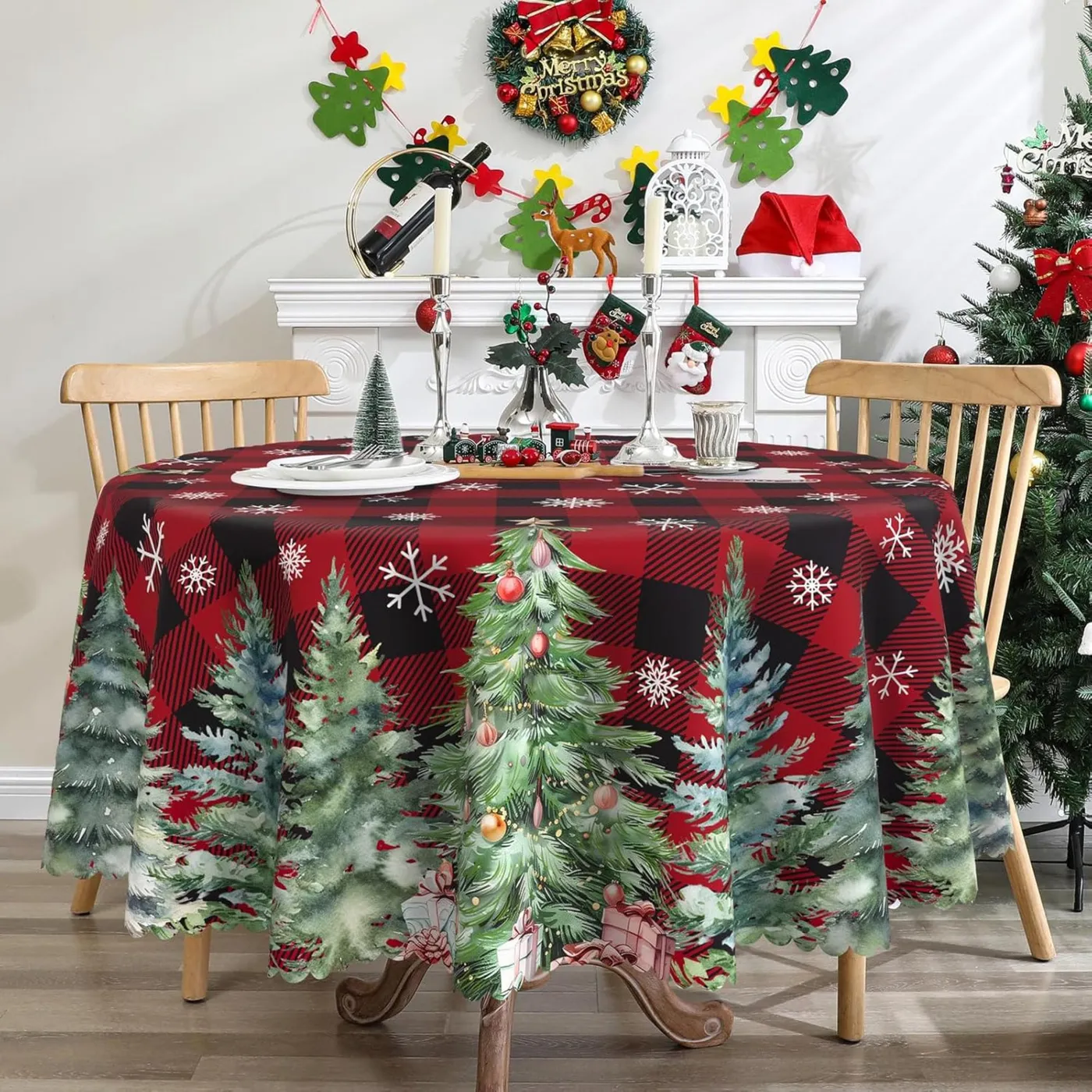
Playful tables are the counter-trend to 2026’s very polished, very beige holiday styling — miniature trains, figurines, pom-poms, things you’d normally banish to the kids’ table. Pinterest searches for nostalgic, toy-accented Christmas decor keep climbing as people look for tables that feel like a memory instead of a catalog. It’s not going anywhere: nostalgia is the most reliable engine in December.
21. Olive Green Chargers with Red Mercury Glass Votives
- Lay a burlap runner down first, letting it overhang 6 inches on each end.
- Lay fresh evergreen branches along it, tucking the cut ends under each other.
- Space red mercury glass votives every 12 inches, alternating with the branches.
- Set olive chargers, then the tree-patterned plates on top.
- Place the crystal green goblet an inch above the knife at each setting.
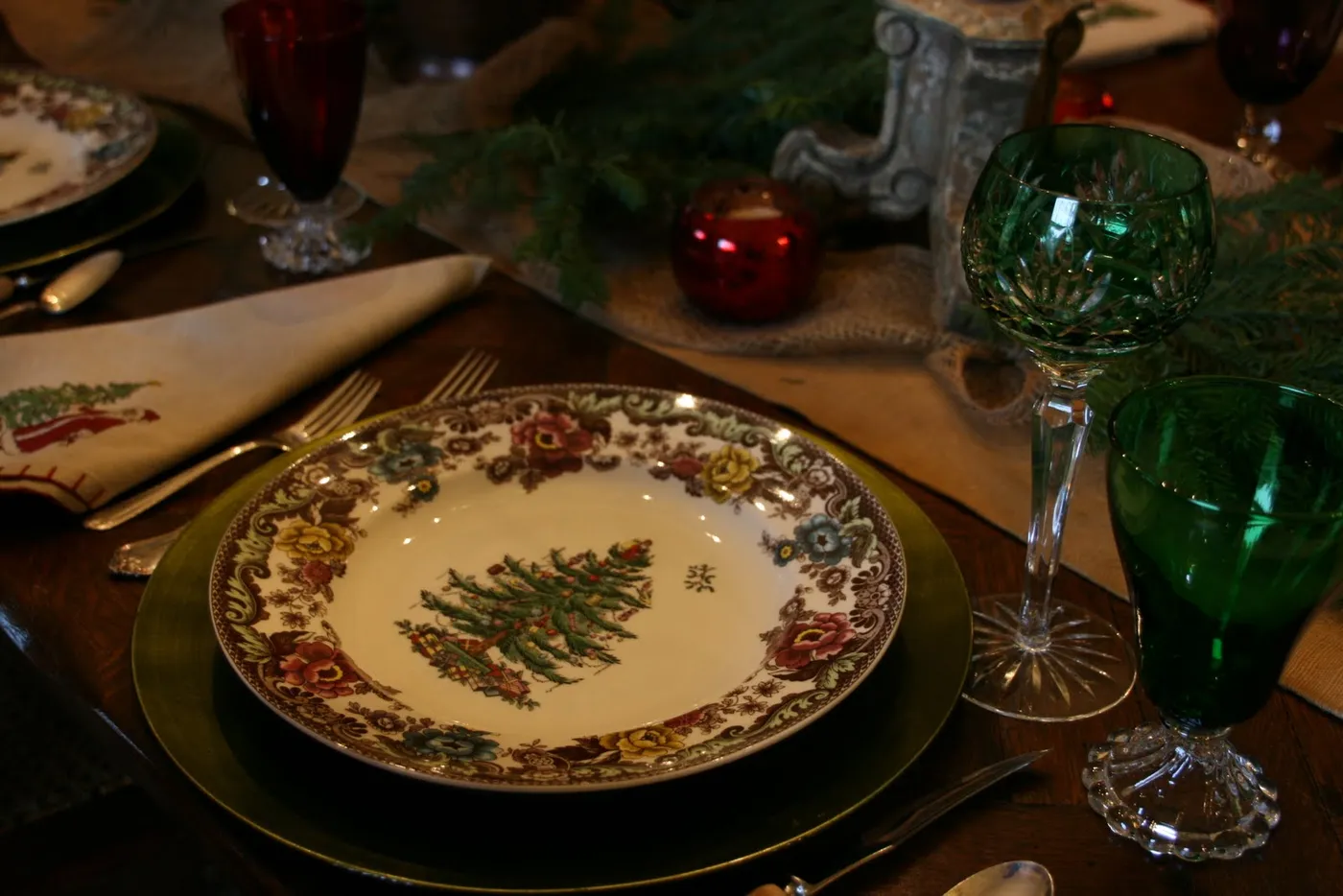
Fifteen minutes, start to finish. Mercury votives run $4 to $8 each; fresh greens about $20 for the whole table.
Tree-patterned plates with a floral border are the expensive part — often $20 to $30 each. Buy two and alternate them with plain cream plates you already own; nobody counts. Olive chargers are $2 to $4 at craft stores, red mercury votives turn up in thrift shops every December, and burlap is $6 a yard and cuts into three runners. Total: about $85 instead of $300.
22. Glowing Ice Cube Lights Under Frosted Pine Branches
It works because the light source is inside the table, not above it. Every plate, glass, and pinecone is lit from below and beside, which flattens shadows and makes clear glass look like ice. The white and pale blue LEDs sit at the cool end of the spectrum, so mixing them with candles is what creates that faintly magical, slightly unreal glow. Remove the cubes and you have a nice frosted table with no atmosphere at all.
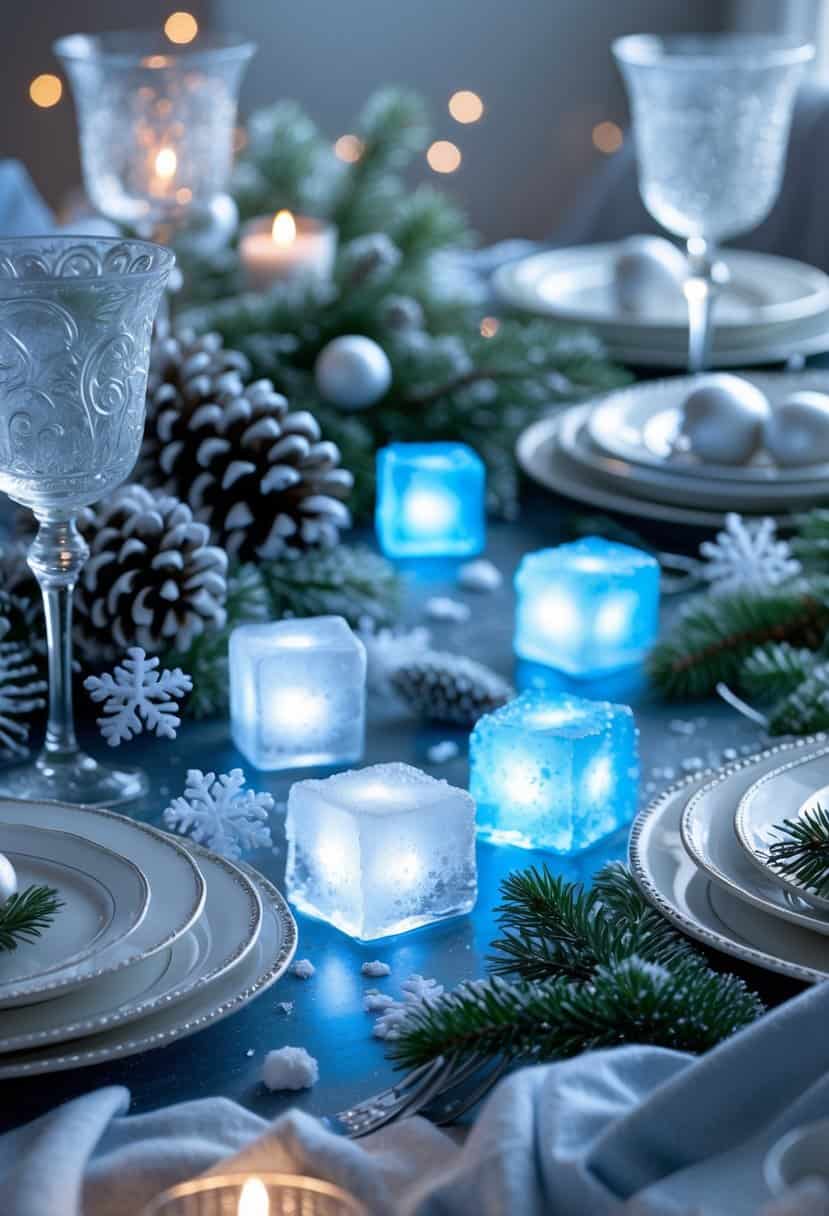
This one is better on a longer table, because the effect depends on distance — six or eight light cubes spread over 6 feet reads as a landscape; three on a small round reads as a science project. It’s also strictly a dim-room idea. At midday with the curtains open you’ll barely see the glow. Best in a dining room of 120 square feet or more where you can kill the overhead light. Pair it with Idea #17 for the same frost without the blue.
23. Rose Gold Flatware and Hammered Gold Stems for a Formal Table
Rose gold flatware is plated, and plated flatware is a commitment: no dishwasher, no lemon juice, no soaking in the sink. Dry it immediately or water spots etch in permanently. Hammered gold stems have the same issue plus texture, which traps polish in every dimple — a soft toothbrush and warm soapy water is the only thing that gets it out. Budget ten minutes of hand washing after each dinner. Worth it, but know what you’re signing up for.
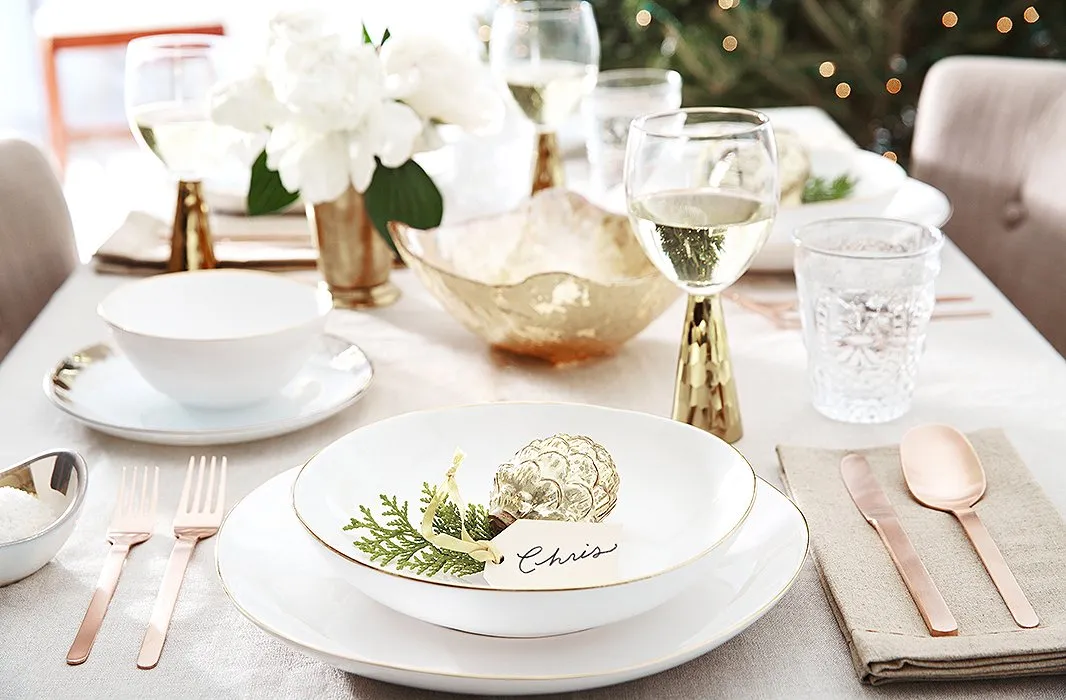
On a formal table, put the name card where the eye lands first: centered on the top plate, tucked under a pine branch, not off to the side. And keep the pinecone ornament and the branch small — a 3-inch ornament and a 4-inch sprig are enough. Oversized favors tip a formal setting into a party-favor table, and they knock into the wine glasses when people sit down.
24. Striped Pink Tapers and Scalloped Cream Plates
85% cream and off-white, 10% deep red, 5% pale pink. That tiny pink slice is doing all the personality work, and the cream base is what lets it happen — the botanical print on the cloth is soft enough to read as texture rather than pattern. Swap the pink taper for forest green and the table goes properly traditional. Swap it for black and it turns modern. The cream, red, and gold proportions stay exactly the same.
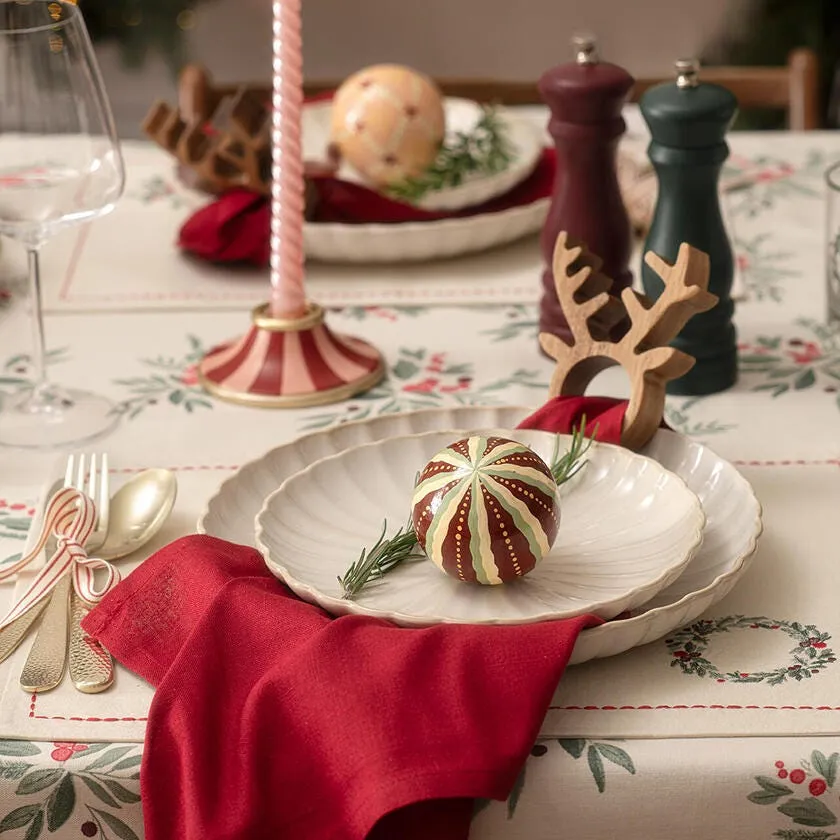
The single striped pink taper in the red-and-gold holder. Everything else is safe — scalloped cream plates, red linen napkins, gold cutlery tied with ribbon, a wooden reindeer napkin ring. The pink stripe is the one decision that could have gone wrong, and it’s exactly why the table looks styled instead of assembled. One unexpected color, held to one object, is the cheapest design trick there is.
25. Red and White Flowers in a Copper Pot as Centerpiece
Fresh flowers for a holiday table cost $35 to $80 and last four to six days if you’re diligent about water. Copper needs polishing — it oxidizes to brown within weeks, and a pot that holds water will verdigris on the inside. Use a glass or plastic liner and polish the outside twice a season with lemon and salt. If that sounds like too much upkeep, a copper-colored ceramic pot gives you the warmth with none of the work.
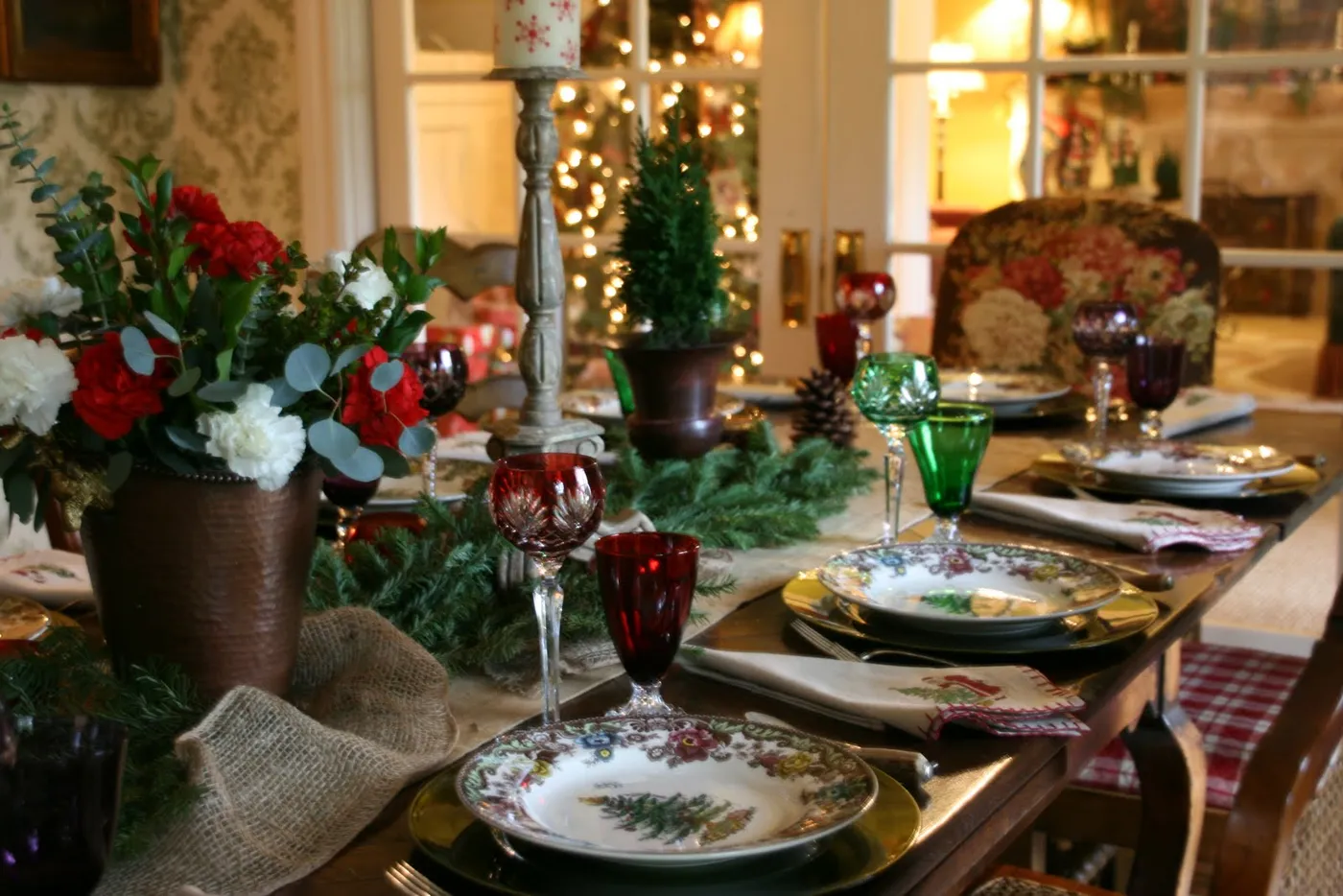
A copper pot is heavy, and heavy centerpieces get moved — usually by a guest, usually over your grandmother’s tablecloth. Line the bottom with a towel, set a plastic saucer inside, and keep the arrangement low enough that nobody has to lean around it. Real flowers in a warm room with candles nearby will wilt by dessert, so condition them in cold water for six hours beforehand.
26. A Weathered Wood Lantern with Birch Pillar Candles
- Set the lantern just off center, on a woven placemat to protect the wood.
- Fill the base with a layer of pinecones to hide the candle cup.
- Use one birch-wrapped pillar inside — 4 inches wide, 6 tall — and light it last.
- Place the flocked pine in its burlap-wrapped base at the opposite end for balance.
- Run three smaller pillar candles in glass holders behind it to build depth.
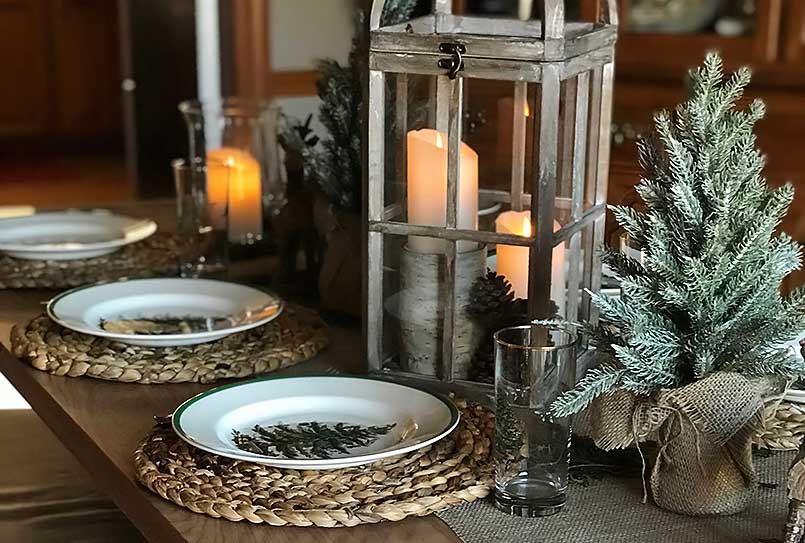
Twenty minutes. Lantern $25 to $45, birch pillar $12, flocked tree $15 to $25.
Depth, mostly. Because the lantern has glass panes, you see the candle through a surface, then pinecones through it, then the room behind — three layers in one object, which is how a $30 lantern reads as an heirloom. The flocked tree balances it at the far end so the centerpiece isn’t one lump in the middle, and the round woven placemats tie the natural fiber back to the wood.
27. Black Candlesticks and Beaded Chargers on a Dark Table
Black taper holders are the cheapest thing on this table and the most effective — $4 to $9 each at IKEA, Target, or any craft store, and they instantly make a garland look grown-up. Clear beaded chargers run $5 to $8, and honestly the table still works without them. That beige upholstered chair with nailhead trim in the foreground is the kind of thing people assume cost $400 and you can find for $60 at consignment. Total: under $130.
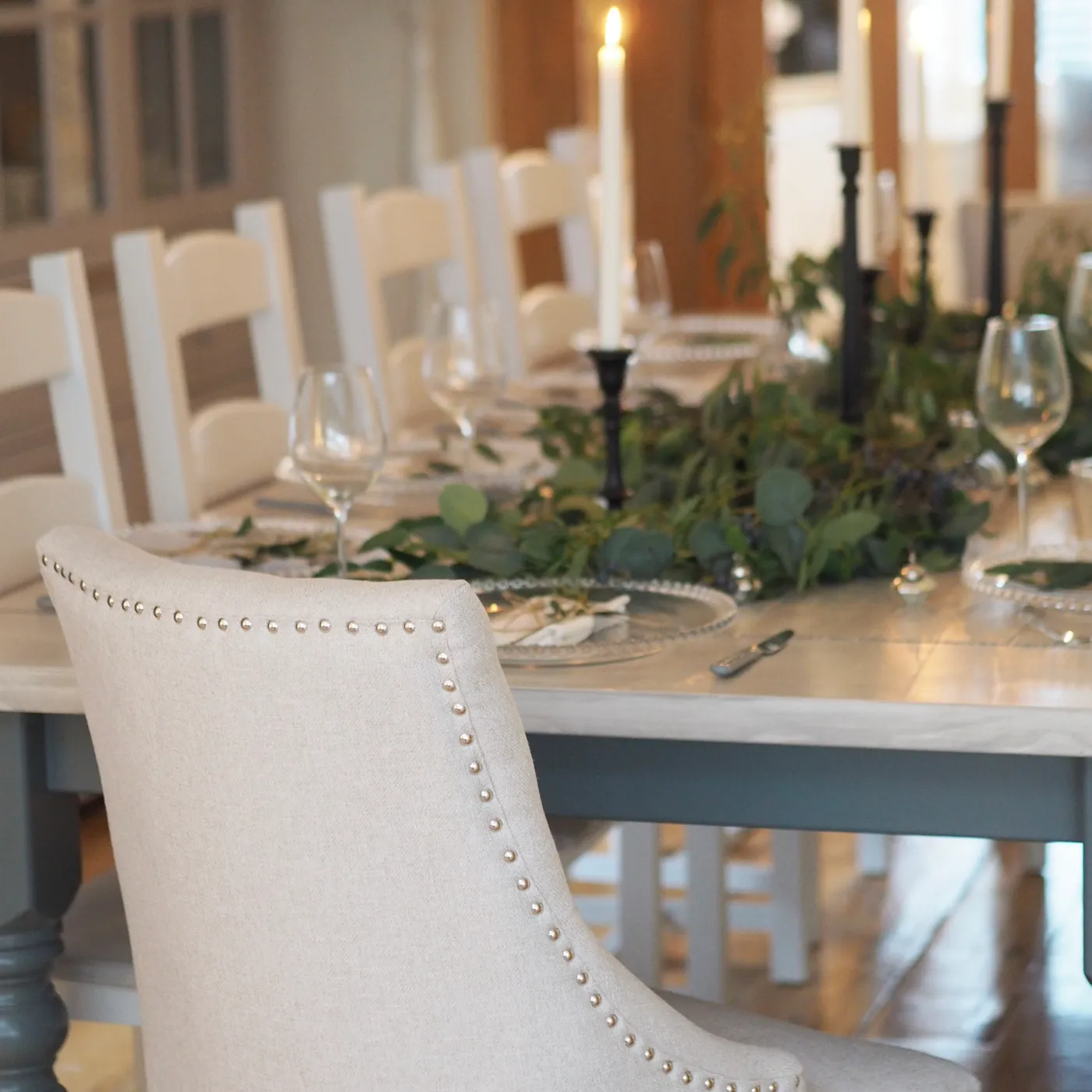
Dark tables hide candle wax beautifully and also hide water rings, spills, and dust. Wipe it down before guests arrive or a phone camera flash will reveal everything. Black candles look incredible and drip visibly on white linen — use white tapers with black holders, and keep the two ideas apart. And if your chairs are upholstered, as these are, seat the messy eaters on the wood side.
28. Speckled Plates with Plaid Napkins and Fairy Lights
Speckled stoneware has quietly replaced plain white as the default plate over the last two years, and seeing it on a Christmas table is the tell that this isn’t a formal house. It’s part of a broader shift toward tables that look lived-in year-round and just get a December layer — greenery, plaid, battery lights — rather than a full seasonal overhaul. That’s a trend with legs, because it costs almost nothing to maintain.
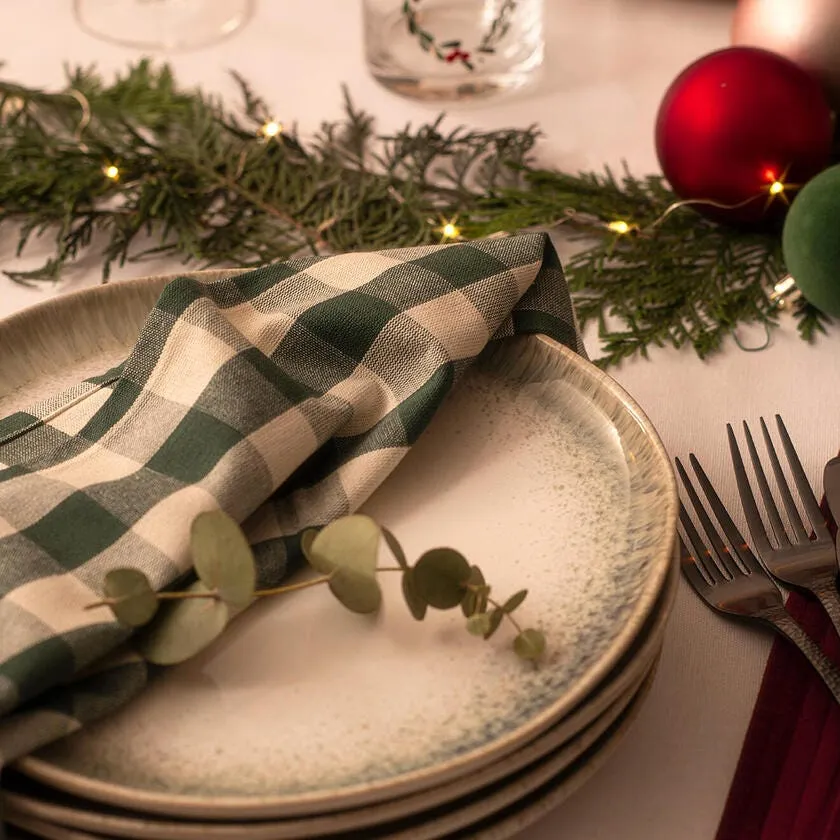
Battery fairy lights on a dining table are wonderful and very easy to get wrong. Use warm white only, keep them on thin copper wire rather than a green cord, and hide the battery pack under the garland at the end nearest the wall. Two strands of 20 lights is plenty for a 6-foot run — any more and the greenery starts to look like a runway. Buy rechargeables, because you will forget batteries in December.
29. Amber Tumblers and Wrapped Gifts Along a Candlelit Garland
The wrapped gifts on the table. Not under the tree — on the table, tucked between candle holders, in kraft paper with red ribbon. They add height, color, and a little anticipation to a table that would otherwise be a very lovely garland with candles. Buy nothing: wrap three empty boxes from the recycling bin and nobody will ever know. It’s the single change that turns a tablescape into a scene.
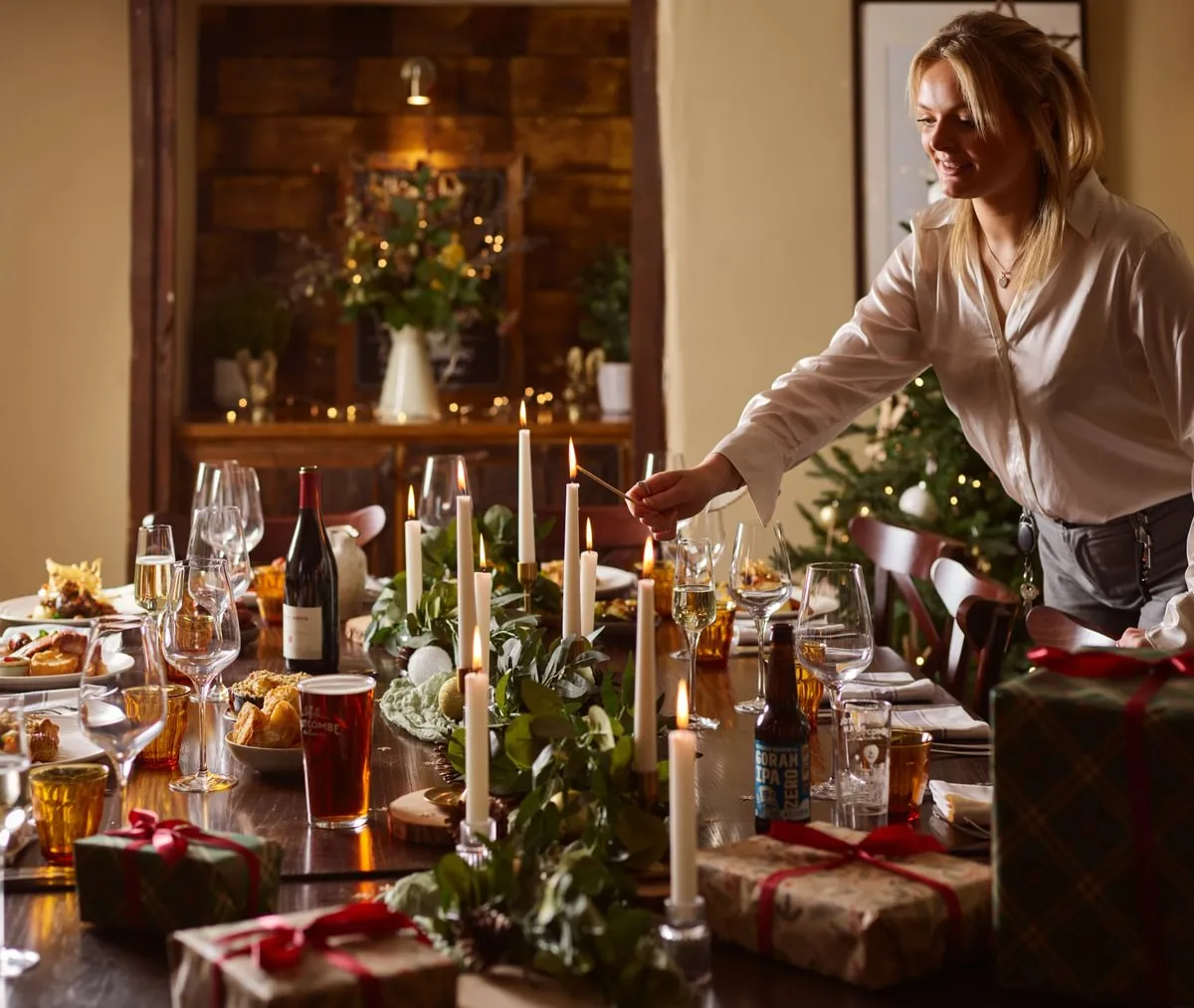
This is the setup for a long table — 8 feet or more — because it depends on length: garland running the full span, candles at three heights, gifts and amber glassware filling the gaps. Under 6 feet, cut the candle count in half and drop the gifts. Generous ceiling height helps too; tall tapers feel cramped under a low ceiling. Compare with Idea #1 — same garland instinct, smaller footprint.
Your Christmas Table, Minus the 11 p.m. Panic
Pick one idea, steal two details from another, and stop scrolling — the table that gets remembered is never the most expensive one, it’s the one where the candles were lit and nobody was stressed. Start with what you already own, add one thing that surprises you, and let the rest be good enough. Pin this guide now so next December you’re setting the table with a glass of wine instead of hunting for inspiration at midnight.