
30 Jaw-Dropping Front Porch Christmas Decor Ideas You Need to Try This Season for a Magical Welcome
Most front porch Christmas decor guides hand you a color palette and call it done — and then you’re standing on frozen brick at 4:30 in the afternoon with a tangle of lights and no idea where the outlets are.
We spent weeks combing through Home Depot, Dollar Tree, Target, and Facebook Marketplace listings, plus a mountain of photos from real porches in real neighborhoods, to land on 30 ideas that actually hold up outside in the cold — from about $8 worth of berry picks to a $615 double-door install. You’ll find snowy frosted entries, classic red-and-green brick facades, moody navy-and-gold jewel tones, and a few unapologetically pink ones. Budget and luxury versions are compared side by side throughout, so you can see exactly where to spend and where to save.
The 2026 shift is away from matched sets and toward mixed greens, layered ribbon, and 2700K bulbs that read as candlelight instead of parking lot. And stay until the end — we break down the most common mistakes that can ruin these looks.
📌 Save this to Pinterest for later — you’ll want to revisit these ideas.
1. Snow-Dusted Black Door With a Frosted White Wreath
A pair of flanking trees should top out around 60% of your door height — on a standard 80-inch door, that’s roughly 48 inches including the urn. The shorter planters in front should be about half that, so the eye steps down in a clean diagonal from the wreath to the ground. Also: run that extension cord behind the garland, not under the doormat. Tuck it along the door trim with clear outdoor clips rated for freezing temps, or you’ll be fishing a cracked cord out of the snow in January.
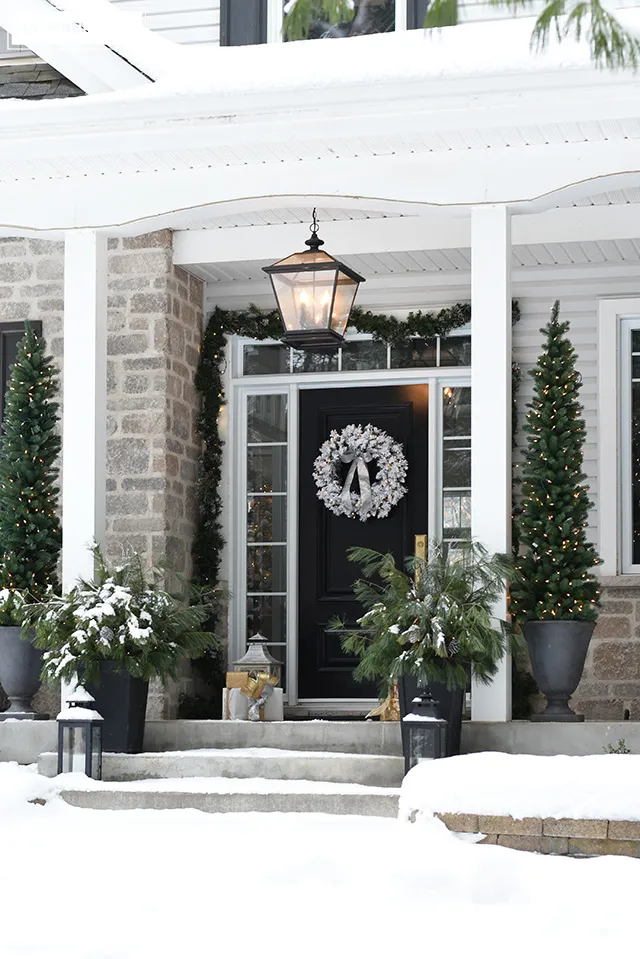
It’s the two tall, narrow pre-lit evergreens standing in dark urns. Take them away and you still have a lovely frosted wreath and a snowy garland — but you lose the vertical frame that makes a black door read as a deliberate focal point rather than a door with decorations attached to it. The narrow profile matters too: fat cone-shaped trees would crowd the transom window and block the light spilling out of it. Skinny, tall, symmetrical. That’s the whole trick.
2. Gold Leaf Wreath With Black Urns and Mixed Metallics
Two things are doing the heavy lifting. First, the gold leaf wreath and the gold ornaments echo each other without matching — same metal, different scale — which reads as collected over several years rather than purchased in one trip. Second, the black urns, black square planters, and black hanging lantern repeat a single dark note three times across the facade, which keeps a busy entry from feeling cluttered. Repetition, not variety, is what makes this look expensive.
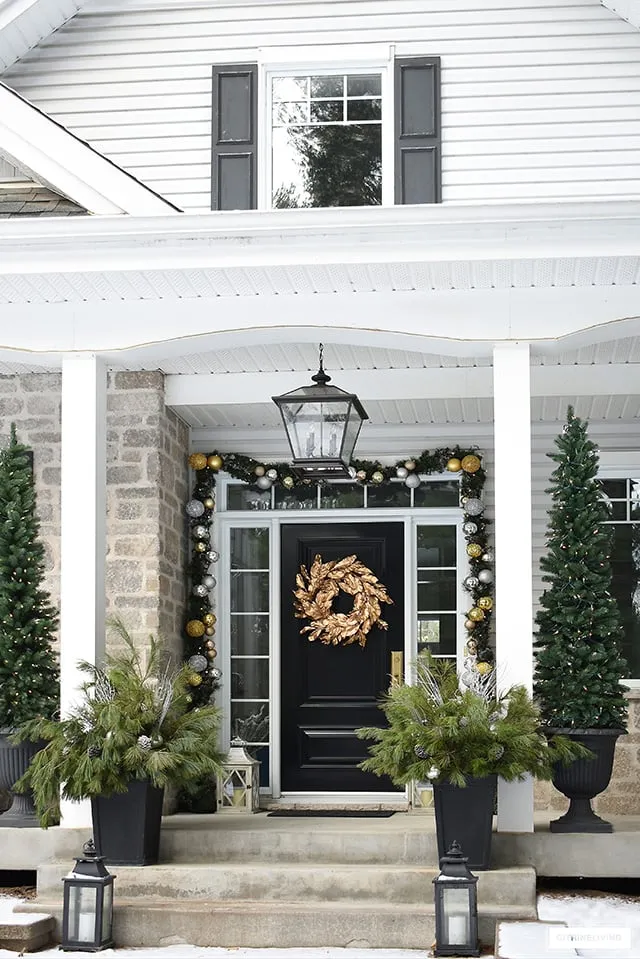
Think of it as roughly 60% evergreen, 25% black, 10% mixed metallics, and 5% white. Swap the metallics to copper and pewter and the formula still holds — same black anchor, warmer glow. Trade the black urns for aged terracotta and you’ve shifted the whole entry toward rustic. The percentages keep it balanced, not the specific colors. Keep greenery dominant and the metals under 15%, or the porch starts to read like a gift shop shelf.
3. Red Plaid Rocking Chairs Beside Flocked Trees With Red Bows
Red plaid throws on outdoor rocking chairs photograph beautifully and behave terribly in a wet climate. Wool soaks up moisture, and by mid-January a damp blanket smells like a basement. If your porch is covered and you live somewhere cold and dry, go for it. Otherwise buy a poly-blend plaid marketed for outdoor use, and bring the pillows inside whenever rain is in the forecast. If you have dogs, expect a muddy nose print on the lumbar pillow within a week.
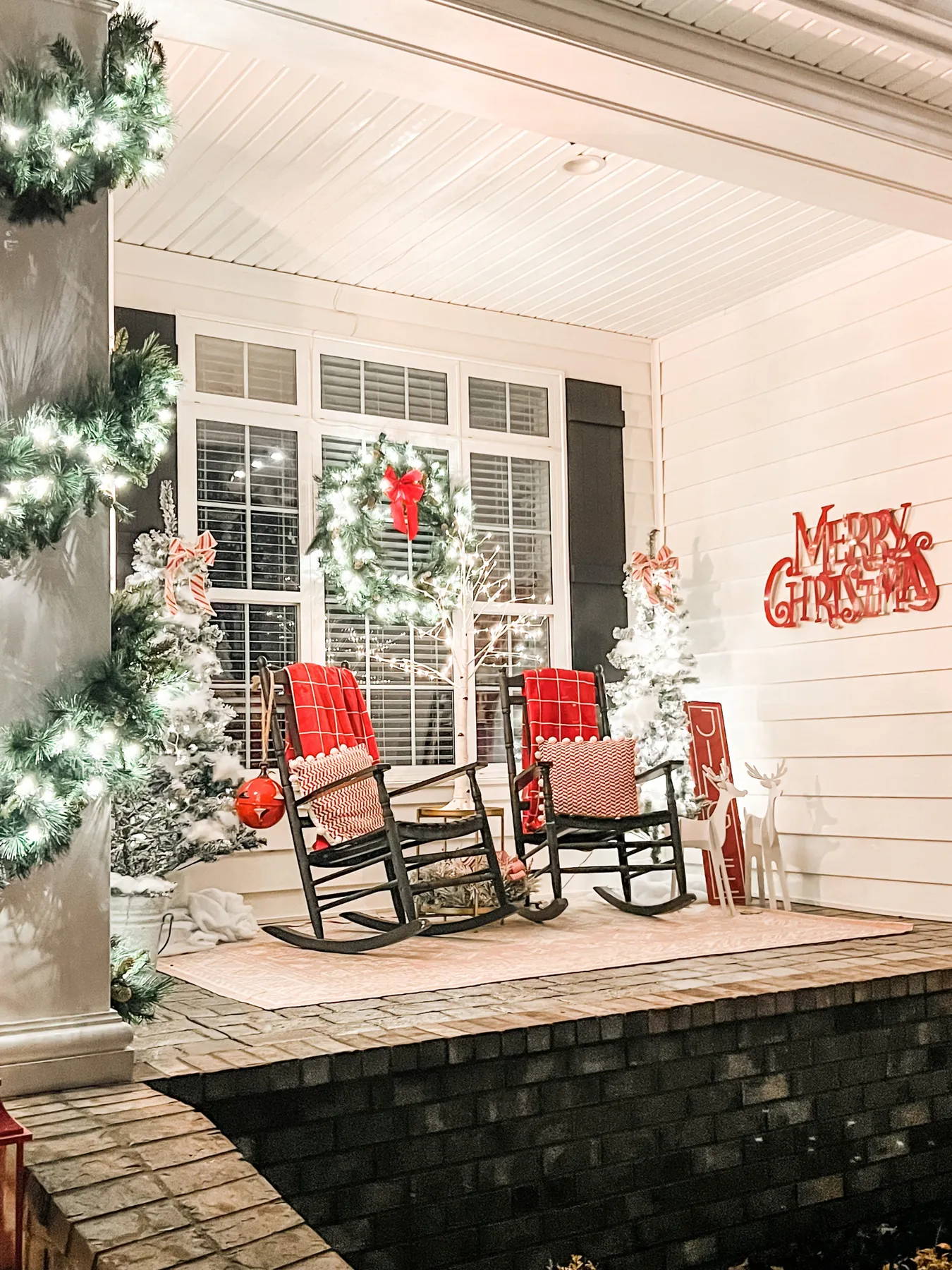
Two black rocking chairs don’t have to cost $800. Walmart and Target both carry poly-resin rockers in the $120–$180 range, and Facebook Marketplace is lousy with real wood ones every October — people sell them right after they move. The flocked trees are the easiest save of all: a plain 4-foot artificial tree plus two cans of spray snow runs about $45. Clip-on red bows from Dollar Tree, and nobody knows the difference from the curb. Think of it as the cozy, nostalgic cousin of Idea #1.
4. Spiral Topiaries and Red Velvet Bows on Shingle Siding
- Pre-lit spiral evergreen topiaries (2): $90–$180
- Black ornate urns (2): $60–$160
- Wired red velvet bows (3–4): $20–$60
- Pre-lit garland, 9 ft: $35–$90
- Wrapped gift boxes: $15–$40
- Silver or pewter lantern: $25–$70
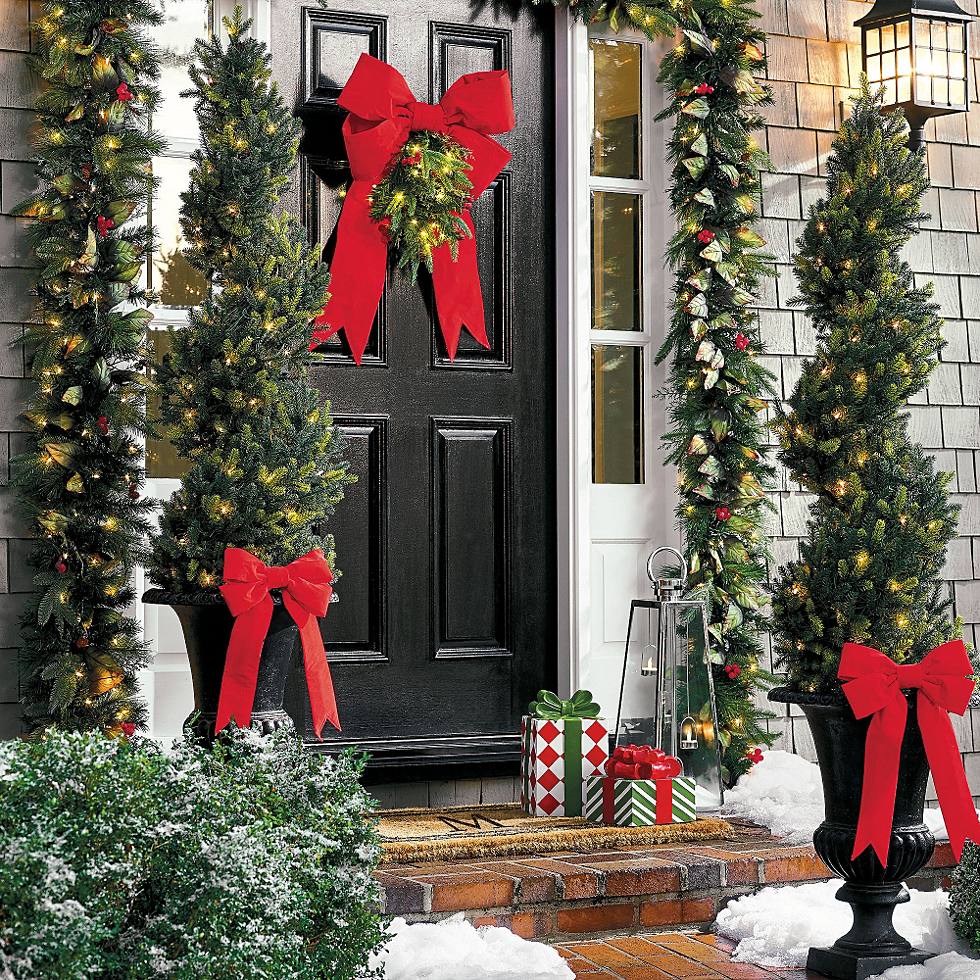
Total: $245–$600. Budget version: skip the pre-lit topiaries, buy two plain cones for $25 each, wrap your own lights, and use $8 of nylon mesh ribbon instead of velvet. Same silhouette, about $110.
For garland running vertically down shingle siding, skip the drill. Use outdoor clips rated for 5 lbs, spaced every 16 inches, and run the extension cord behind the greenery. Anything heavier than a 9-foot pre-lit garland needs a cup hook, and cup hooks should bite into trim or a stud — never into the shingle itself, which will crack in a hard freeze. One more: real red berries drop and stain when they thaw, so go faux on light-colored siding.
5. Navy Door Framed in Red, Gold, and Blue Ornament Garland
The garland doesn’t stop at the door frame — it flows down the black metal railing. That one decision links the doorway to the walkway so the entry reads as a single composition instead of a decorated door hovering above an undecorated staircase. It’s also the cheapest part of the install: the same garland, the same ornaments, just eight more feet and a handful of zip ties. Once you notice it, you can’t unsee it on other porches.
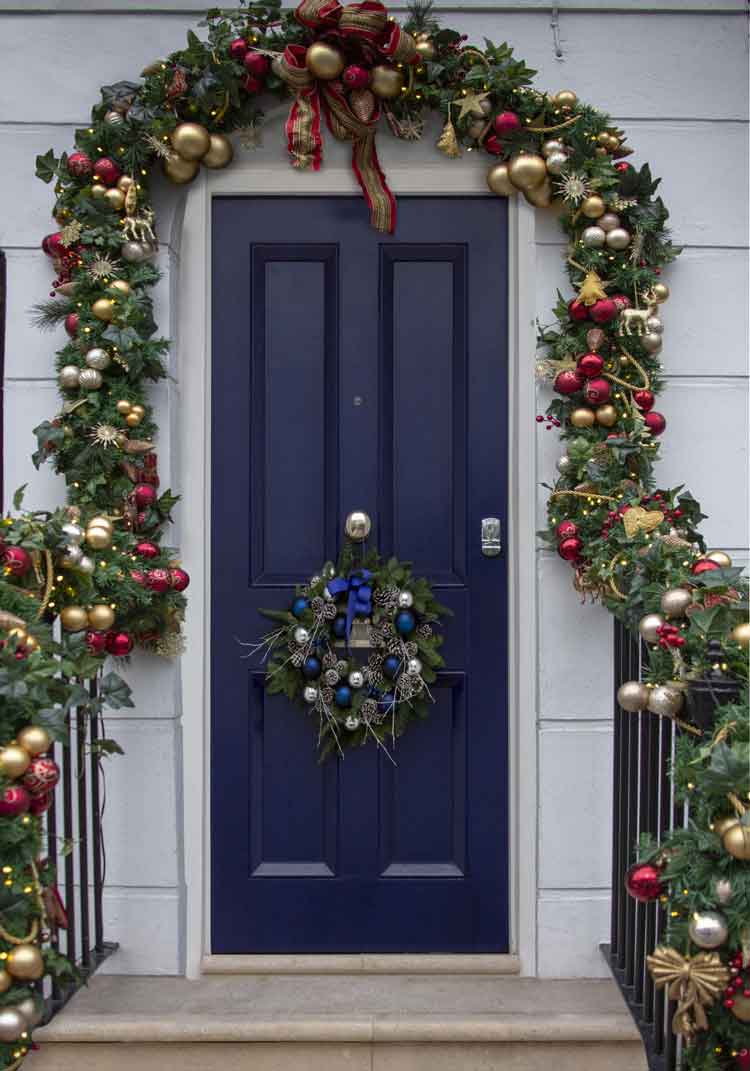
Navy front doors have been the quiet hit of the last few years, and 2026 is when people stopped treating them as a neutral. Pairing navy with deep red and warm gold instead of the usual white-and-silver pushes the palette moodier and more collected. It’s part of a broader drift away from bright red-and-green maximalism toward richer jewel tones. This one has staying power — navy is a door color people keep for a decade.
6. Warm White Roofline Lights and Red Rockers at Dusk
This is a two-story facade with multiple gables, and roofline lights only make sense when there’s enough horizontal run to carry them — figure 30 feet of frontage minimum. On a 20-foot cottage, outlining every gable turns into visual noise. Pick one. The red rocking chairs need at least 6 feet of porch depth to rock without clipping the railing, so measure before you buy. Working with a shallow entry? The planter-only vignette in Idea #20 fills the same space without any seating at all.
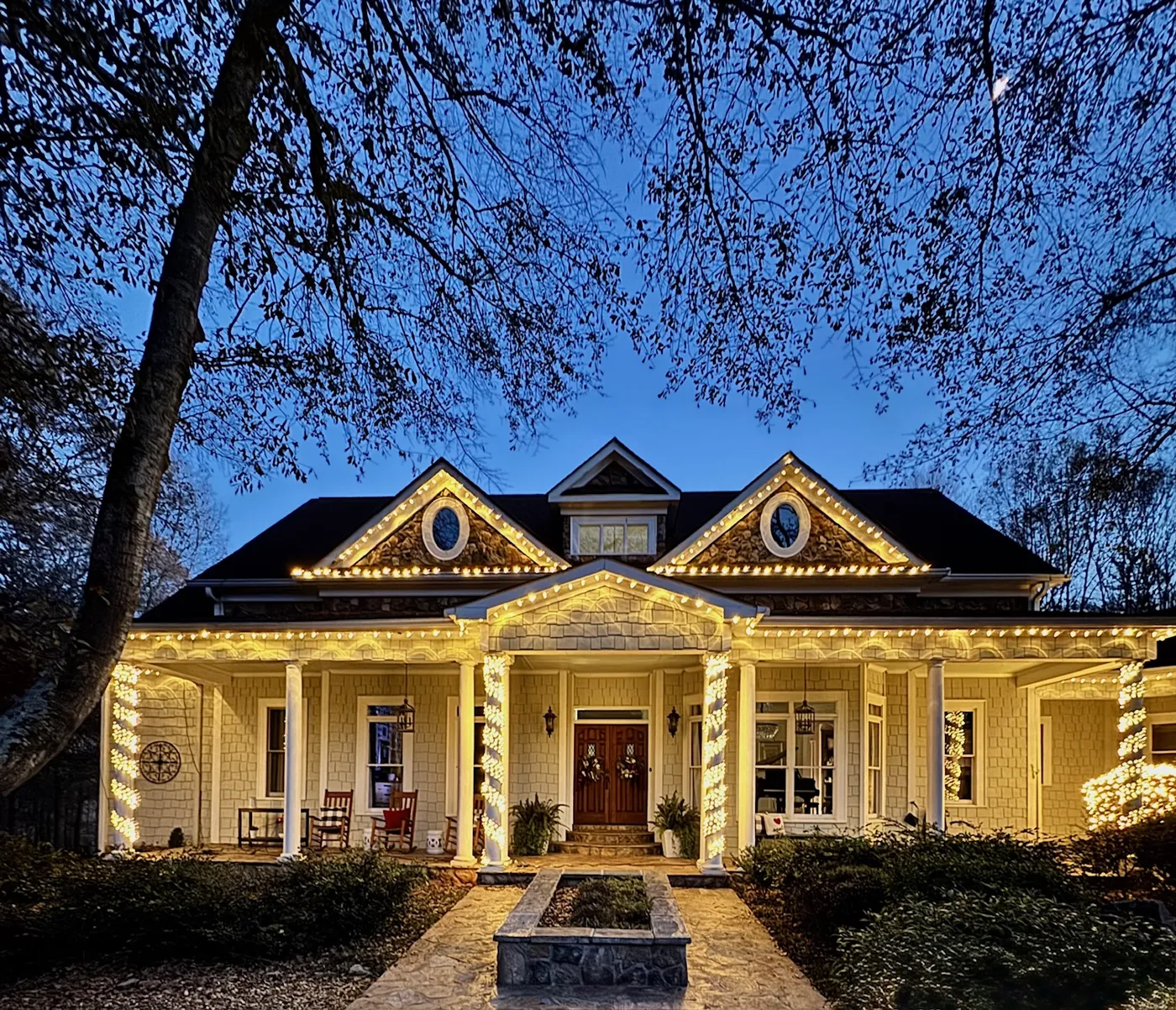
- Measure the full run and add 20% — rooflines eat length at every peak.
- Clip in daylight, in dry weather, starting from the closest outdoor outlet so the cord always has somewhere to go.
- Use plastic shingle clips, never staples. One staple through a wire is one fire hazard.
- Run it on a GFCI outlet with a timer set from 5 p.m. to 11 p.m.
Roughly three hours for a single-story roofline, $45–$120 in lights and clips.
7. Mixed-Green Garland With Red Berries on Painted Brick
Pinecones shed. Real red berries stain painted brick when they thaw, and artificial ones fade toward pink by season three. Warm white mini lights burn out in clusters, so buy a strand with replaceable bulbs rather than a sealed one. Budget 20 minutes in November for the install and a 10-minute check in early January, when a windstorm inevitably yanks one end loose. Store the garland in a breathable cotton bag, not a vacuum-sealed tote — crushed pinecones never fluff back.
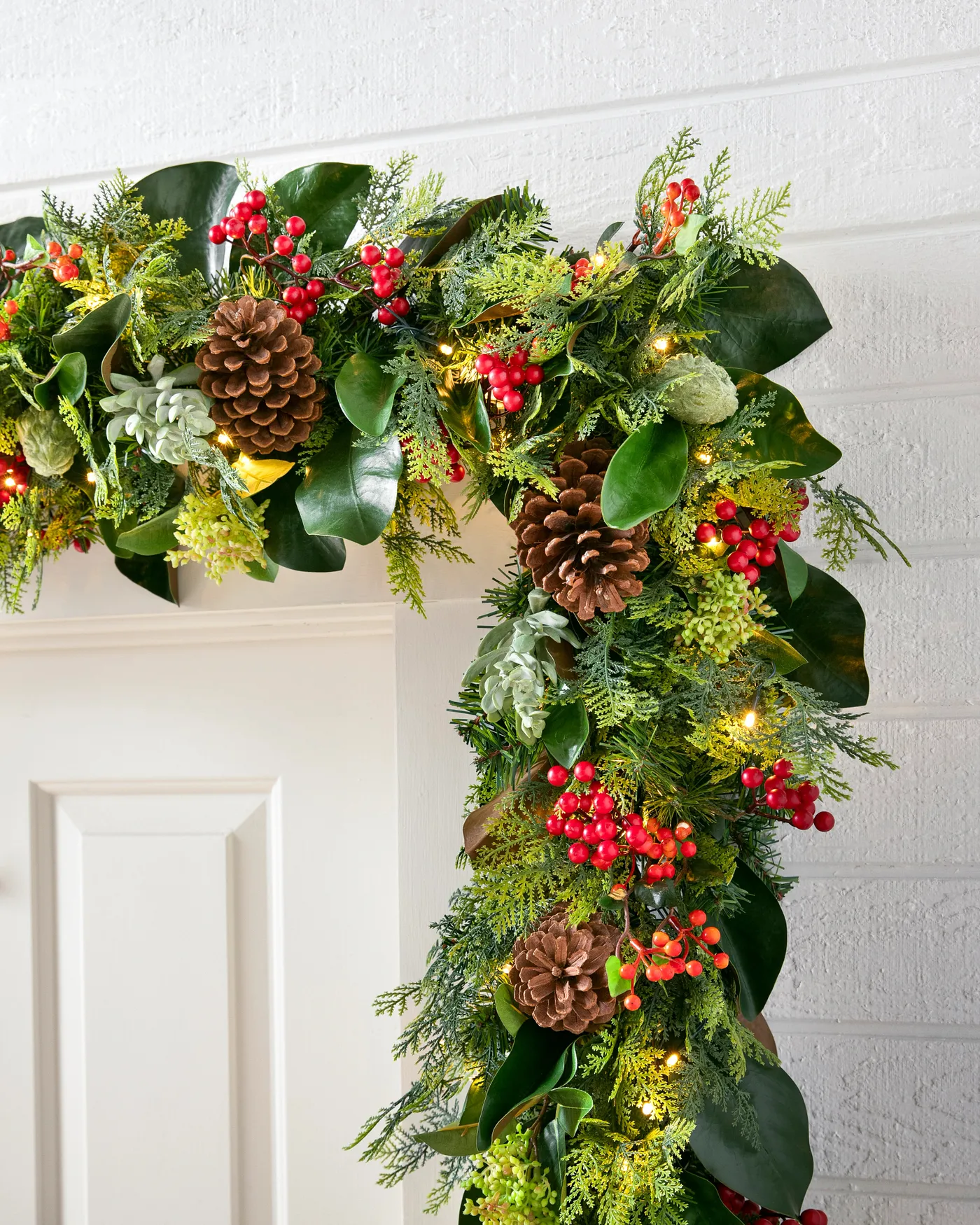
The magic here is mixed greens — dark, almost-black fir next to lighter, brighter sprigs. A single shade of green looks flat no matter how much you spend. Add red berries and brown pinecones and you’ve introduced three textures (smooth, matte, woody) on what is basically a two-color palette. Set all of it against white painted brick and the greens sing. Classic 60/30/10: green, white, red.
8. Oversized Antique Gold Bells and Thick Cedar Garland
- Measure the garland run around the frame — a single door needs about 9 feet, a double needs 16.
- Confirm an outdoor outlet sits within 6 feet of the door, or plan for a cold-rated extension cord.
- Check what your trim can hold — a cluster of antique gold bells runs 3–6 lbs and swings.
- Know whether your porch is covered; cedar and pine wreaths mold fast in exposed rain.
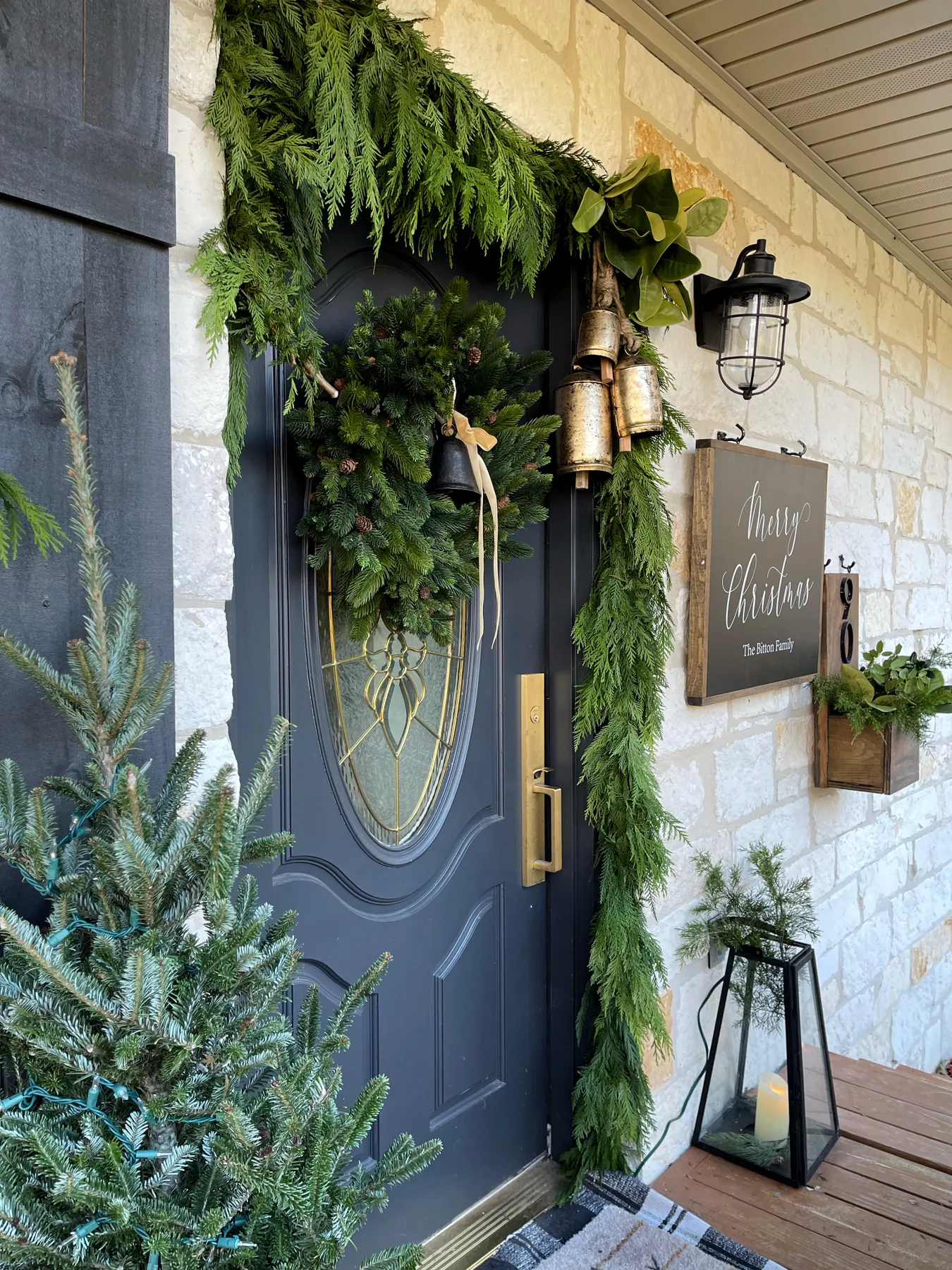
Hang a cluster of oversized bells at least 6 feet 6 inches off the ground so nobody walks into them, and anchor the hook into framing rather than trim — a 5-pound cluster swings, and swing multiplies load. Offset the bells 8 to 10 inches beside the door frame instead of centering them above it. Centered, they fight the wreath for the same patch of attention. Cedar also dries to a soft grey-green over a season, so if you want saturated Christmas green through January, choose fir.
9. Williamsburg Fruit Urns and Ribbon Garland on Red Brick
Call it 45% red brick — a color you didn’t choose and have to work with — 30% deep green foliage, 15% white trim, and 10% fruit-and-ribbon accents. The fruit urns are the wild card. Swap apples and pineapple for all-green magnolia and cedar and you get a quieter, more modern entry. Swap the red ribbons for tartan and it tilts Scottish-country. Either way, keep the fruit to about a third of each urn’s volume. Packed solid, it reads like a grocery display instead of a greeting.
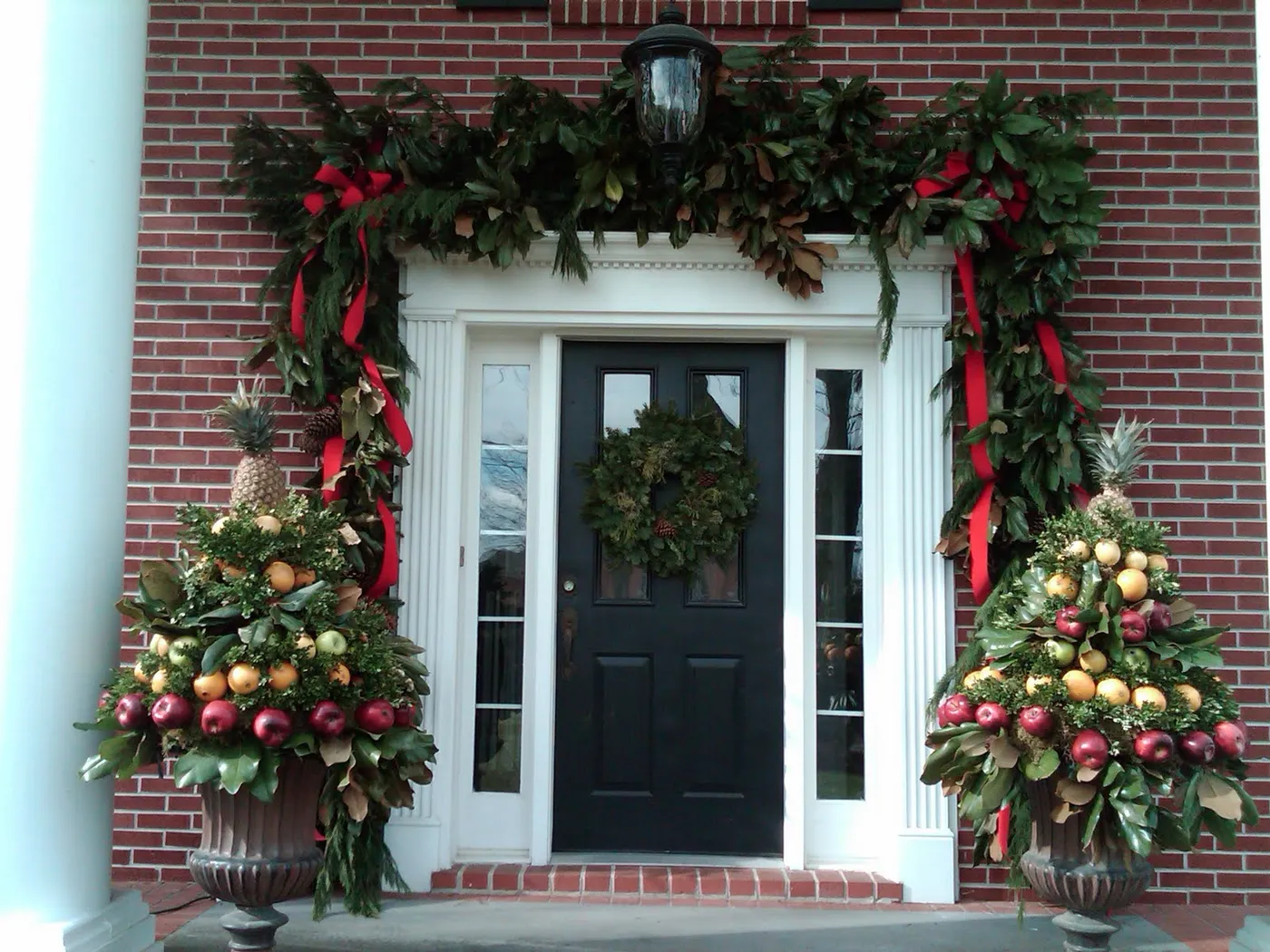
- Two large urns: $80–$220
- Fresh cedar, magnolia, and pine: $60–$120
- Wired ribbon, two rolls: $20–$45
- Faux apples and lemons: $25–$60
- Pre-lit garland for the door frame: $40–$95
Total: $225–$540. Budget version: reuse your summer planters, buy fruit the day after Thanksgiving when grocery stores discount it, and ask a tree lot for the cedar trimmings they sweep up. Most lots hand them over free.
10. Bushel-Basket Poinsettias Flanking a Black Paneled Door
Two red poinsettias at a nursery run $35–$60 each in late November. Here’s the move: buy plain 6-inch plants for around $8 at Home Depot, then group three or four together in a single bushel basket you already own. Clustered, they read as one big statement plant instead of four small ones. Baskets are $12–$20 at farm supply stores, or free if you ask around at a pumpkin patch in October. Both sides come in under $60.
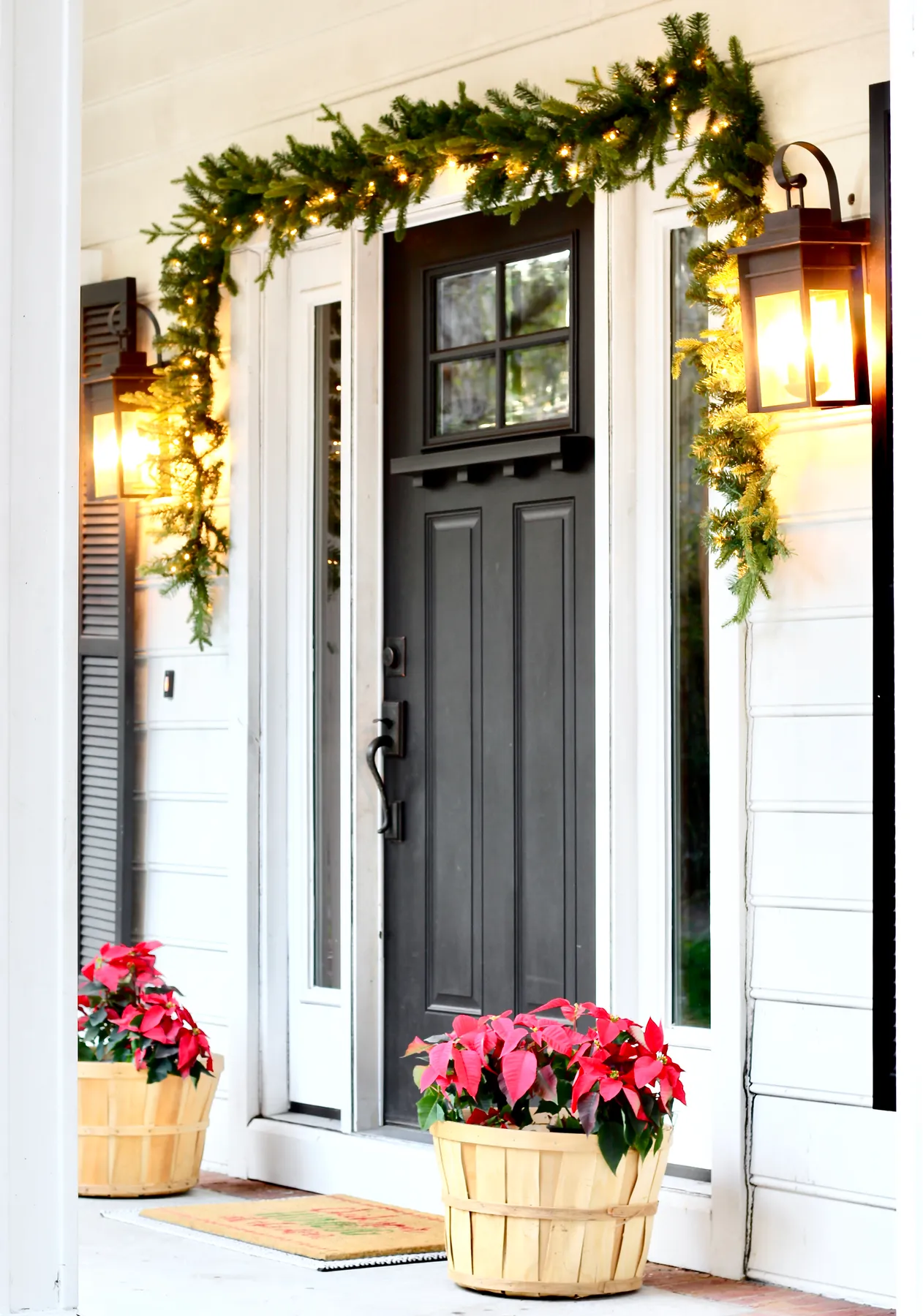
Poinsettias are tropical and they will die the first time it freezes — usually in a single night. If your entry is uncovered, treat them as a November-to-early-December display and swap in evergreen arrangements before the hard frost. In Zone 8 or warmer with a sheltered porch, they can last through New Year’s if you bring them in at night. Water only when the soil is dry to the touch, because a soggy basket freezes solid.
11. Dense Pine Garland Wrapped Around a White Glass-Panel Door
- Start at the top center of the frame and work outward — the apex is where gaps show most.
- Zip-tie the garland to the inner edge of the frame, not over the hinge side, so the door still closes fully.
- Attach pinecones with floral wire rather than hot glue; glue cracks in the cold.
- Wind the light strand last so bulbs sit on the outside of the needles where you can see them.
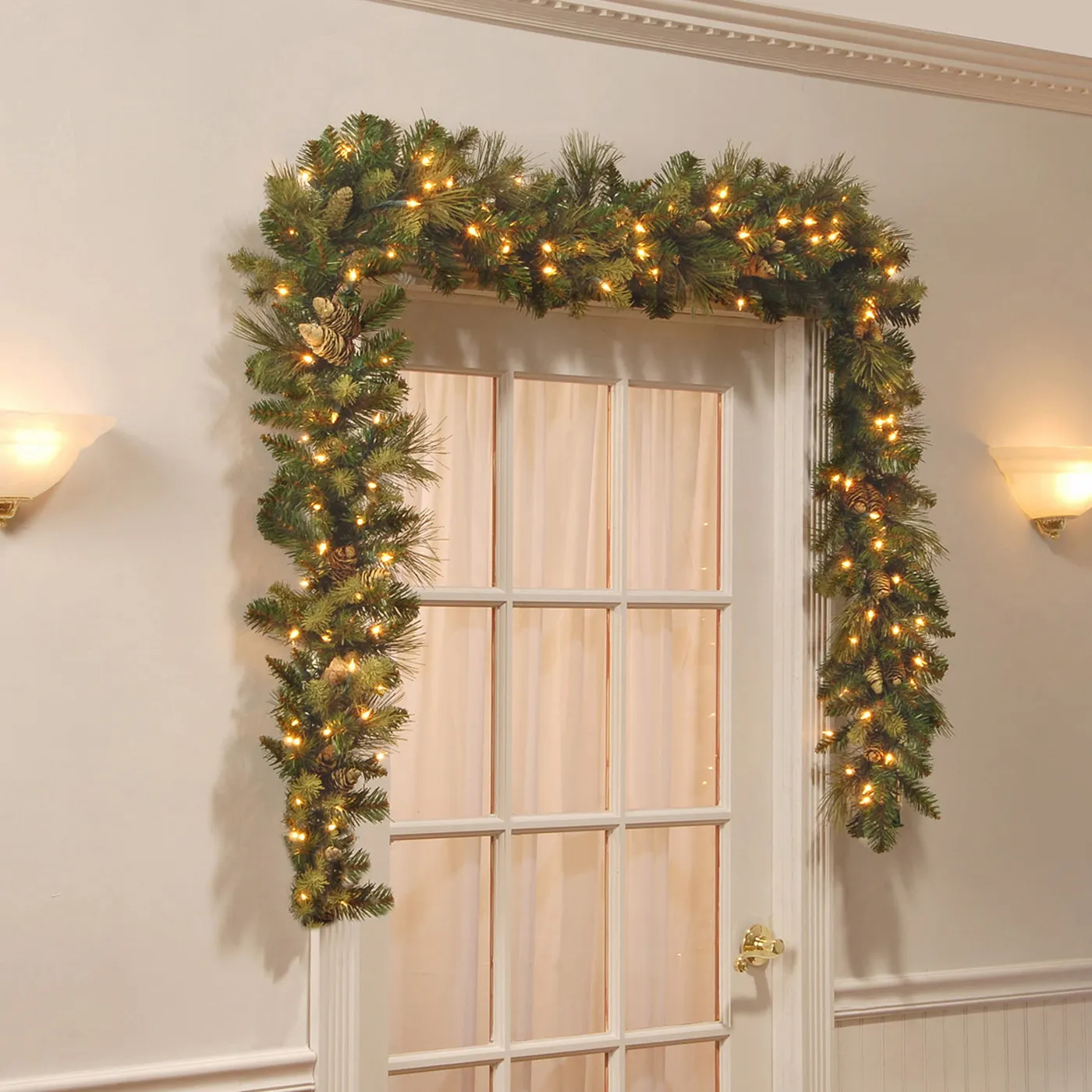
About 45 minutes, $30–$70 for a 12-foot garland and a strand of warm mini lights.
It’s the density. This isn’t a thin strand looped over a frame — it’s a needle-heavy wrap that reads as a solid green border, with pinecones and warm bulbs pushed to the front. That thickness is what separates a decorated door from a decorated doorframe. Two cheap 6-foot garlands twisted together gets you there for half the price of one premium 12-foot piece, and from the sidewalk nobody can tell.
12. Red Door, Snow-Dusted Evergreens, and Matching Wall Lanterns
Pick 2700K bulbs, not 4000K. Warm bulbs next to a red door and green evergreens look like candlelight; anything cooler turns the foliage blue-grey and kills the scene. If your lanterns are hardwired, swap in LED candelabra bulbs at 2700K and roughly 40 lumens each — you want glow, not illumination. Then run the planter lights on their own timer so the wreath, the wall lanterns, and the shrubs all come on at the same moment.
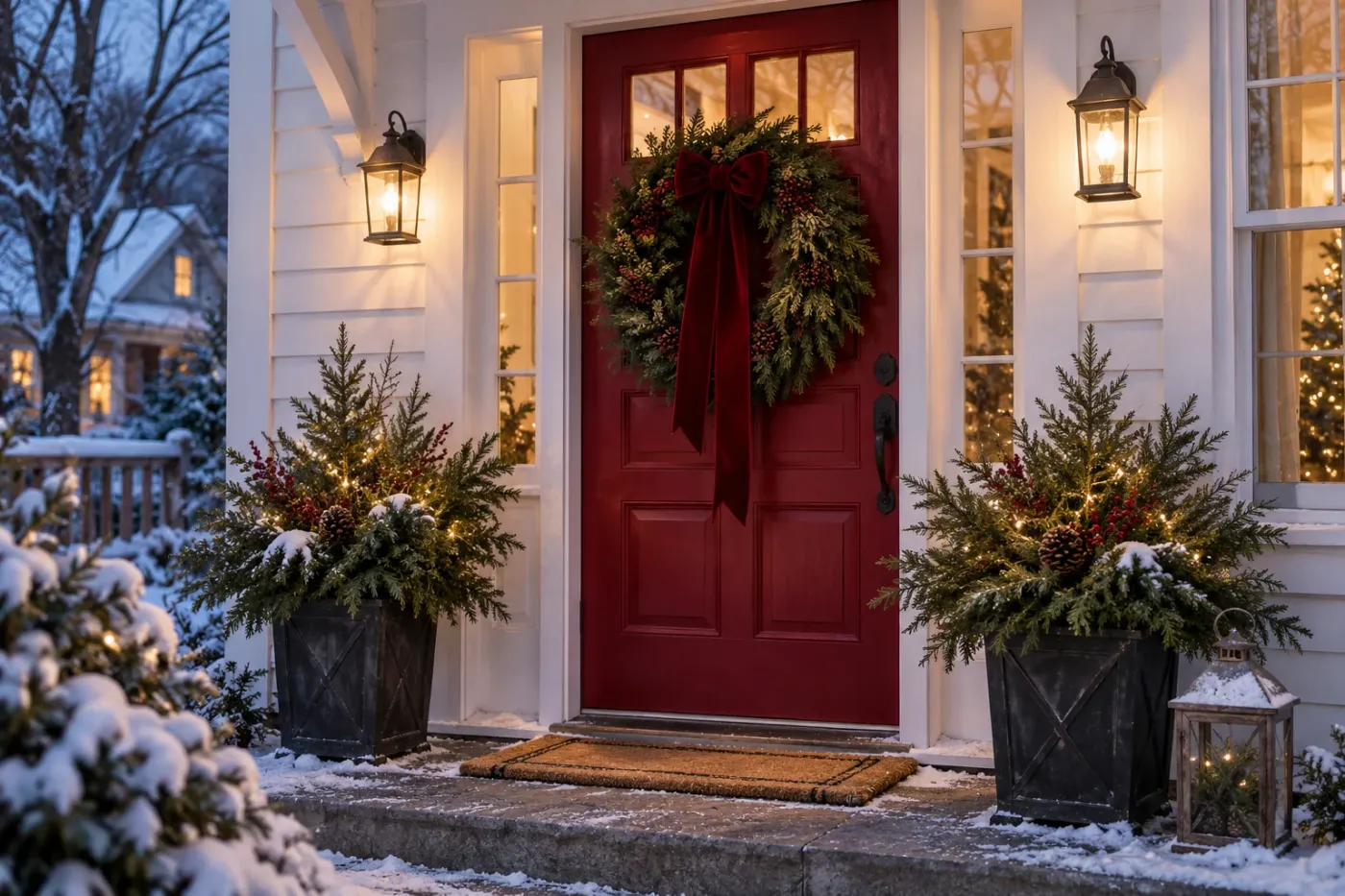
This setup wants a landing at least 3 feet deep and steps 4 feet wide or wider — the planters need about 18 inches on each side of the door, and narrower steps make them feel stuffed into corners. In snow country, leave 6 inches of clearance from the door swing so drifts don’t get shoved against the glass. On a tight city stoop, skip the planters entirely and hang matching wreaths on the door and sidelight instead.
13. Landscape Uplights Turning a Brick Entryway Into a Stage
Everything here is about light placement, not decor volume. Uplights wash the brick and stone so the facade itself becomes the decoration, and the wreaths stay simple so the architecture keeps the attention. The silver deer tucked into the wreaths are the only small, funny detail — and that’s exactly how many you want. One unexpected accent per wreath, not five. The warm wall sconces do the rest by pulling the eye to the double doors at the center of the composition.
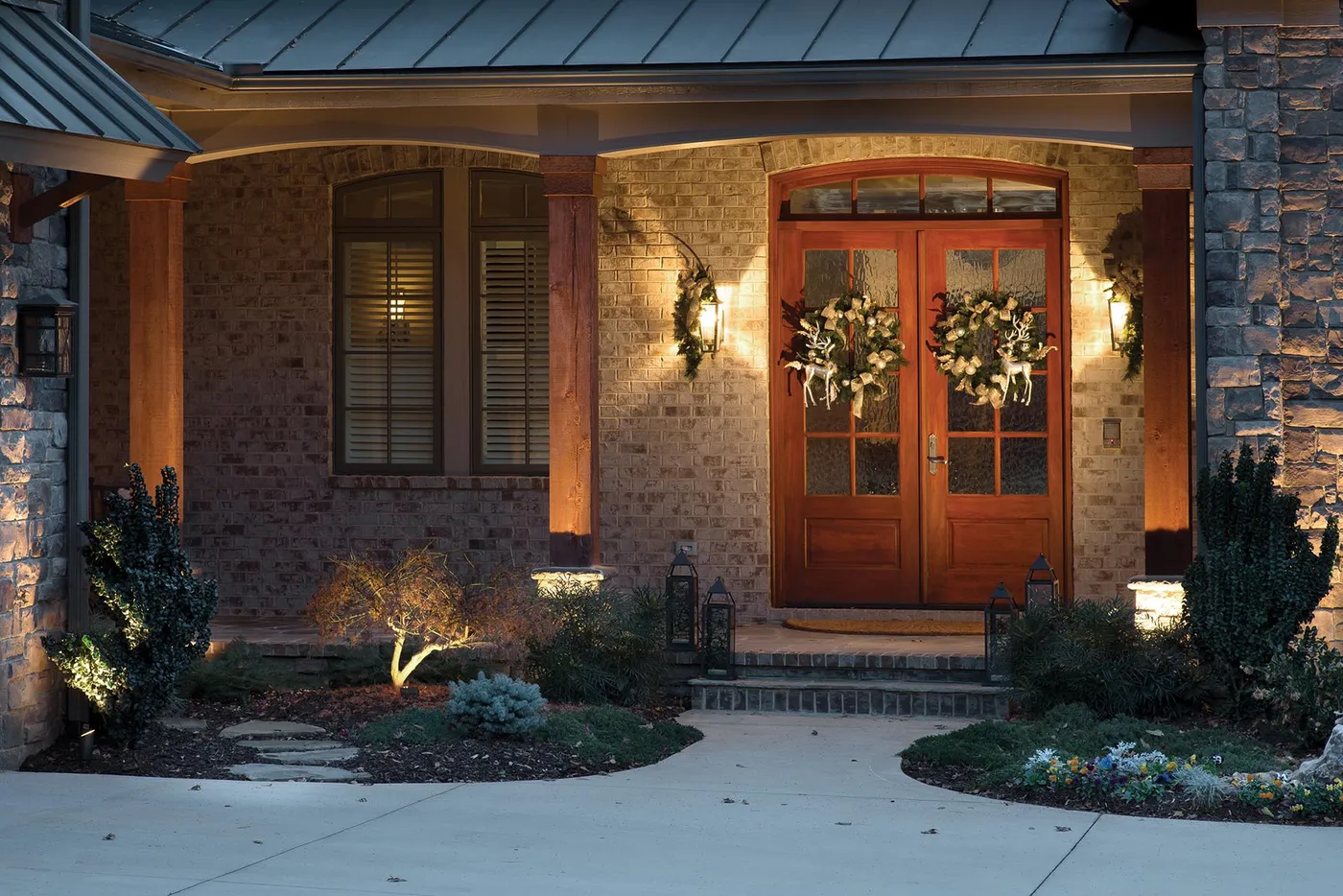
Landscape lighting used to be a summer thing: path lights for the garden, uplights for the trees. In 2026 it’s a Christmas tool. Homeowners are aiming existing uplights at wreaths and door surrounds instead of adding more strings, which is faster, safer, and cheaper than another ladder session. It fits a bigger cultural shift too — people want holiday decor that works with their smart home setup rather than against it. One Wi-Fi plug on the uplight circuit brings the whole facade to life at once.
14. Grapevine and Flocked Pinecone Garland, Built by Hand
- Lay a 10-foot grapevine form flat and wire fresh evergreen sprigs in 8-inch bundles, overlapping each by half.
- Tuck artificial red berries in clusters of three — odd numbers read as intentional.
- Attach white-tipped pinecones with floral wire, angled slightly downward so they show from below.
- Weave one strand of white mini lights through the finished garland, alternating over and under.
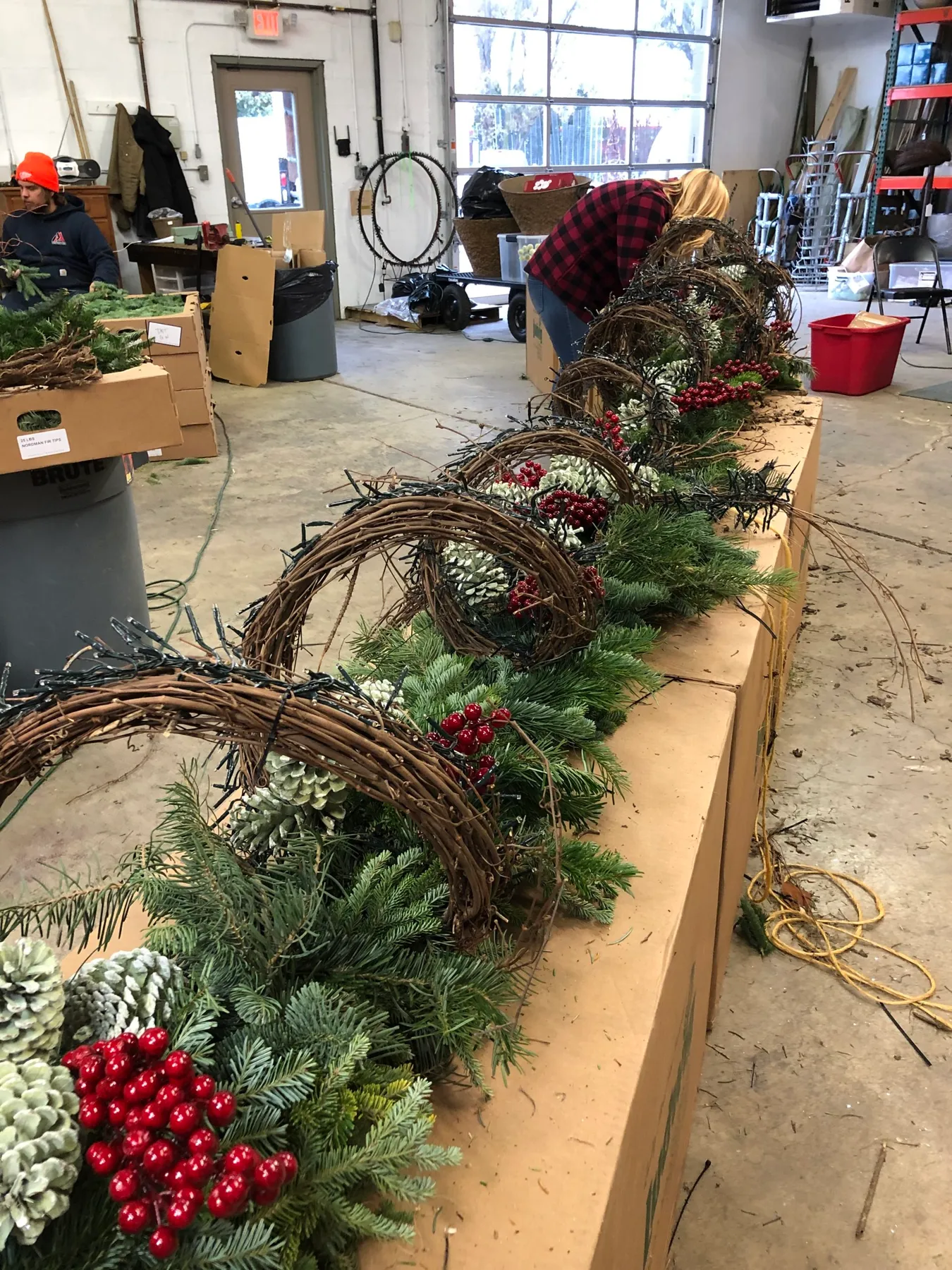
Ninety minutes for 10 feet, $40–$80 in materials — less if you forage your own cedar.
Fresh garland is gorgeous and thirsty. Outdoors in cold weather it holds 4 to 6 weeks; indoors in dry heat it starts dropping needles in 10 days. Mist the greenery every few days and keep it away from heat registers. Real berries stain white and light stone when they thaw, so go artificial on pale surfaces. After New Year’s, the whole thing goes in the yard waste bin — no storage, no tangles, no guilt.
15. Galvanized Planters, Spiral Topiaries, and a Lighted Reindeer
Roughly 55% green, 20% dark grey door and steps, 15% galvanized metal, 10% red-and-black plaid ribbon. Galvanized is the quiet hero — cool and slightly industrial, it holds its own against snow without competing with the evergreens. Trade it for black metal and the porch goes formal. Trade it for raw wood and it goes farmhouse. Keep the plaid under 10% and it stays an accent; push past that and you’ve built a lumberjack cabin.
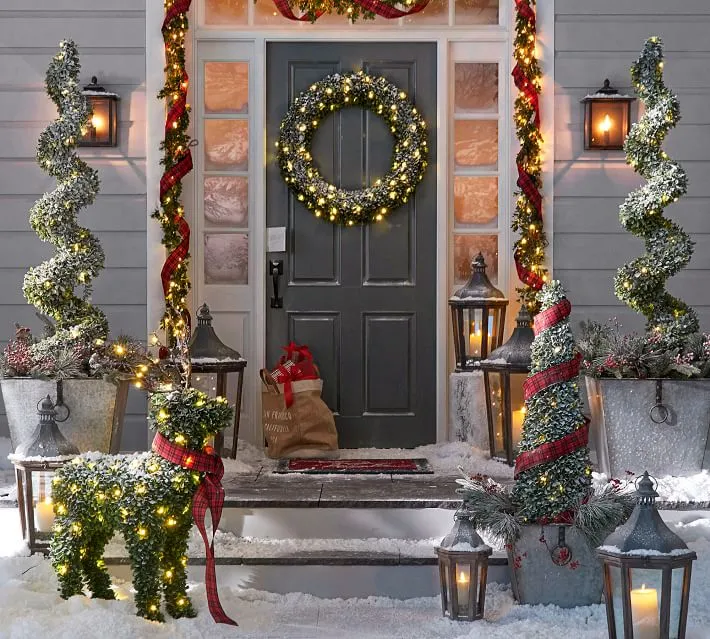
Pre-lit spiral topiaries run $80–$150 each, which is steep for six weeks a year. The hack: buy two plain 36-inch cone topiaries for about $25 each, then wrap a $12 strand of warm white minis around each in a spiral starting at the base. Twenty minutes of winding gets you the same silhouette. Galvanized planters are $15–$35 at any farm store, and the lighted reindeer can come from Facebook Marketplace in January for $20.
16. Cobalt Blue Door Under a Giant Hot Pink Bow
The bright pink and cobalt formula is genuinely fun and genuinely hard to pull off. Get the pink wrong — a bubblegum that leans orange — and the door looks like a birthday party. Buy your ribbon and ornaments on the same trip, and check them against each other under the store lights and again outside at home. Bold doors also demand a clean backdrop: if the brick is busy or recycling bins live on the landing, the bow competes instead of sings. Prefer this energy at lower volume? The pastel version in Idea #23 keeps the same layered-ornament approach in a much quieter key.
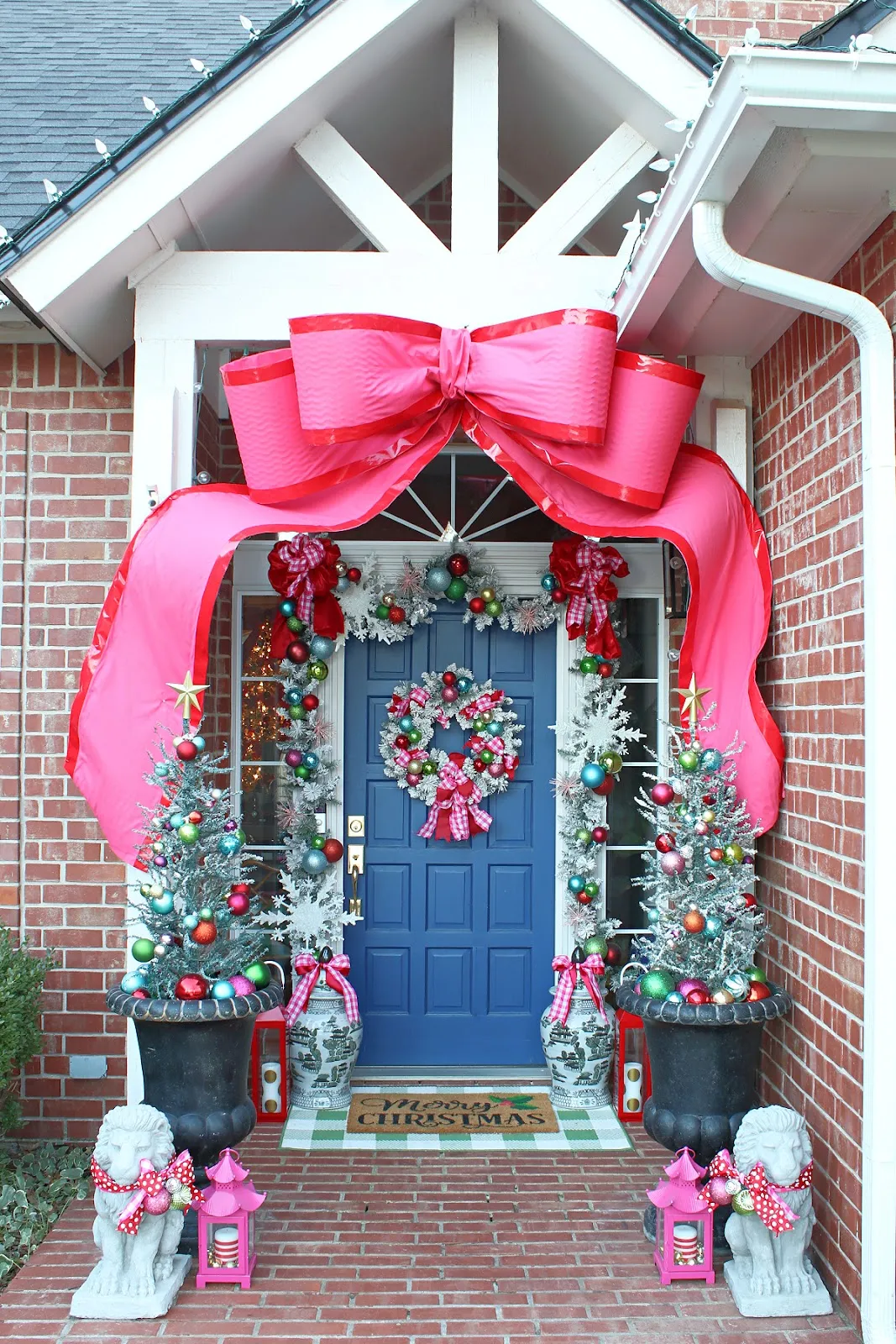
It’s the oversized bow. Remove it and you have a blue door with flocked garland and colorful ornaments — pleasant, a little busy, easily forgotten. The bow gives the arrangement one loud voice and an obvious focal point, and it’s what makes the ornament colors look curated instead of random. It also does something practical: at three feet wide, it pulls the eye up and away from whatever is sitting on the ground. One loud element, everything else supporting.
17. Flocked Garland Along the Railing, Wired With Warm Bulbs
Two reasons this works. First, flocking and warm light are a perfect pair — the fake snow reads cold, the bulbs read warm, and your eye loves the tension. Second, the garland sits at eye level along a railing, which means people actually see it. Garland on a high door frame gets admired from the street; garland on a railing gets touched and enjoyed every time someone walks past. Natural wood shingles behind it add a third texture that keeps all that white from turning sterile.
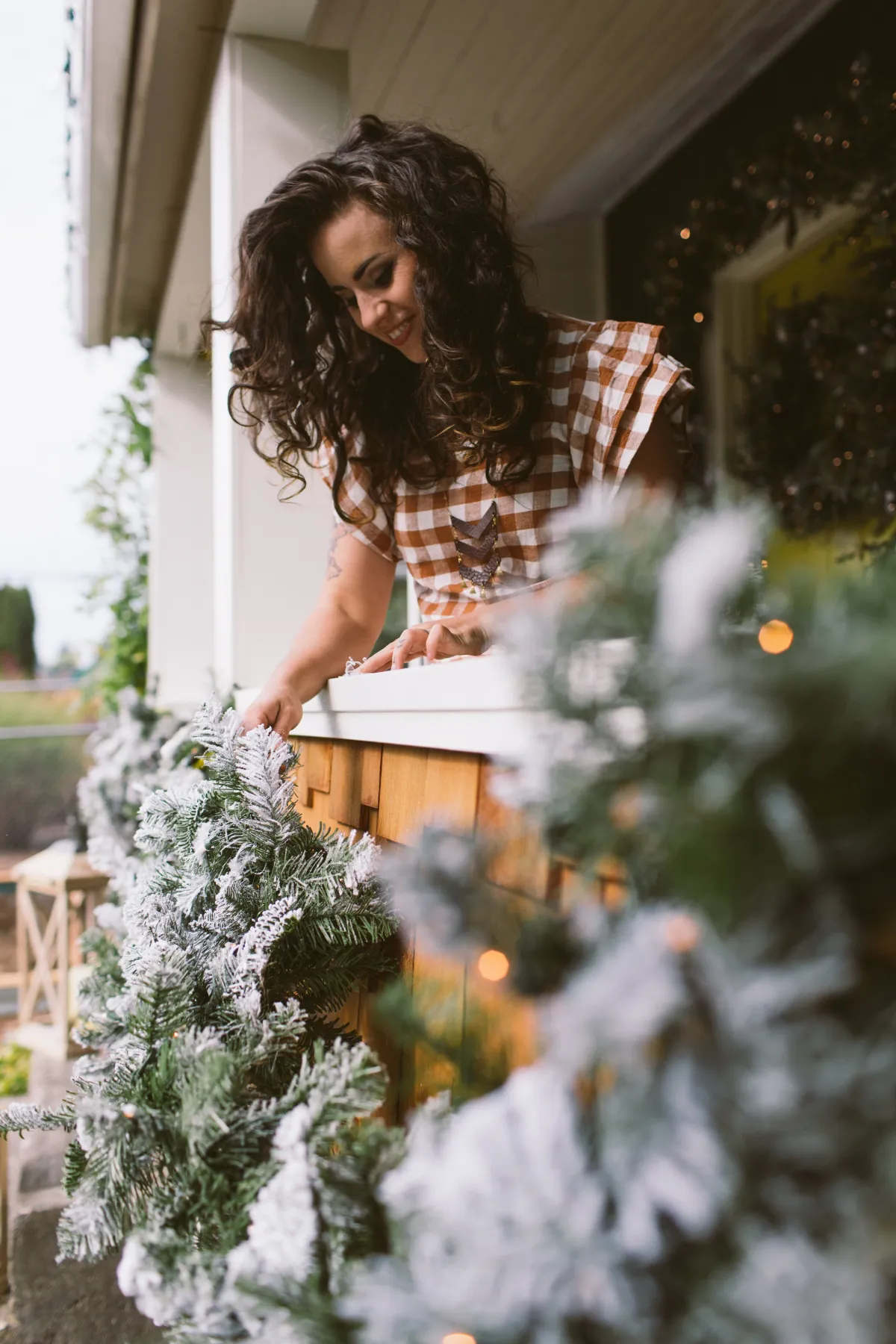
Space your attachment points every 12 to 16 inches, and use green or clear zip ties rather than white — white ties glow under porch light like little stitches. Trim the tails flush with nail clippers, not scissors, so you don’t nick the wire. On a railing, run the garland slightly in front of the top rail rather than on top of it, so snow slides off and the greenery doesn’t crush against the wood. Loop the light strand so the plug ends up nearest the outlet.
18. Light Teal Door With Buffalo Check and Copper Lanterns
- Check your door color in daylight — teal shifts green or blue depending on the hour, and your greens need to flatter it.
- Measure both flanking spaces; slender trees need about 14 inches of footprint each.
- Confirm the mat clears your door swing and fits your step depth.
- Decide fresh or faux berries — real ones stain concrete and stone.
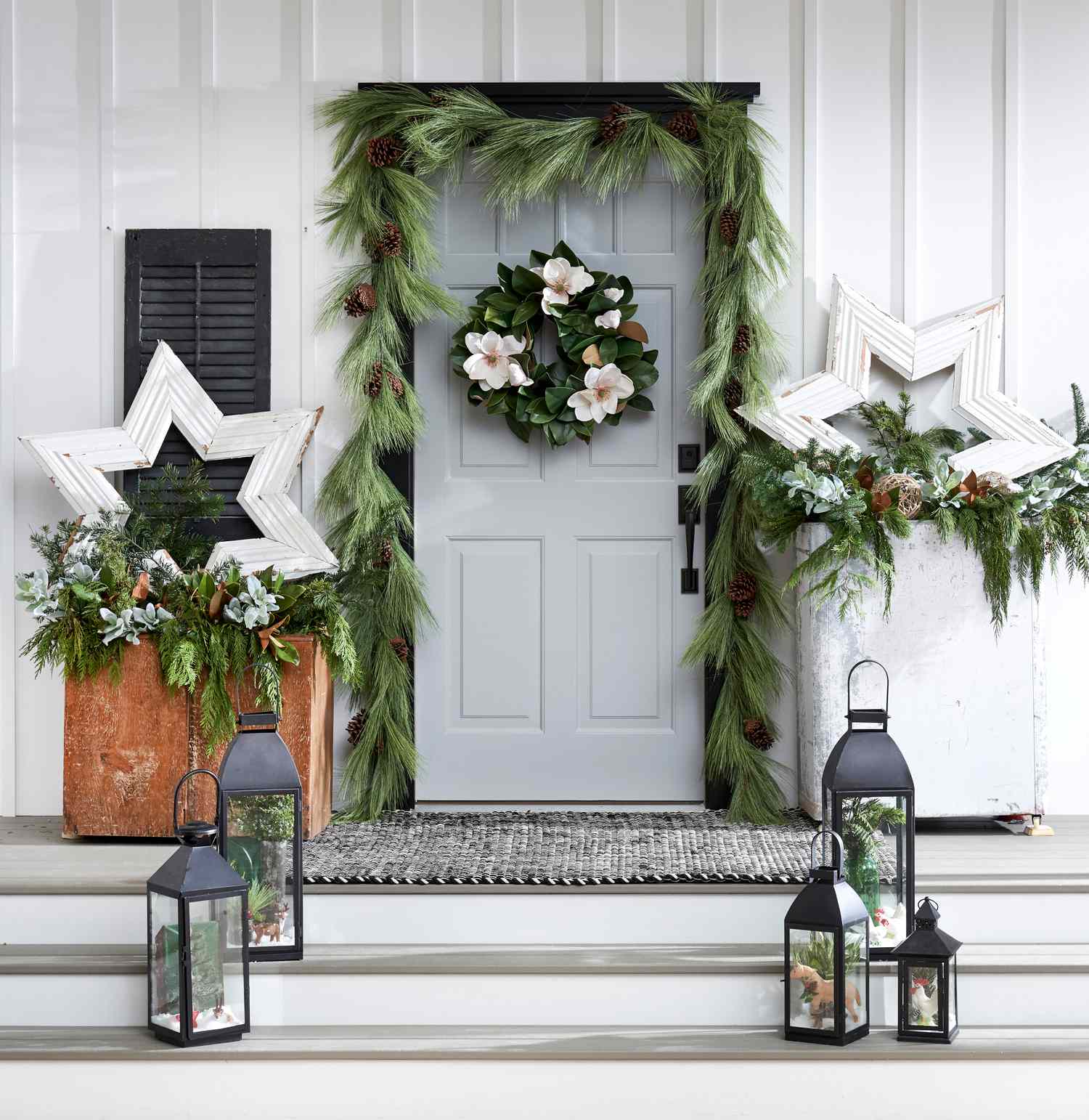
- Two slender artificial evergreens: $50–$130
- Evergreen garland, 9 ft: $30–$75
- Matching wreath: $25–$60
- Copper-toned lanterns (2): $40–$95
- Black and white buffalo check mat: $18–$40
Total: $163–$400. Budget version: $40 of dollar-store garland doubled up, a $12 buffalo check mat from Walmart, and lanterns borrowed from your summer porch gets you 80% of the way there.
19. White Bows and Red-Gold Baubles on a Frosted White Porch
Frosted garland along railings and a door frame wants a porch with real railings — figure 10 feet per side before it looks generous instead of skimpy. Ceiling height matters less outdoors, but step depth does: you need at least 36 inches of landing so the garland on the door frame doesn’t brush shoulders with the garland on the posts. Smaller entry? Keep the full treatment on the door and use single swags on the railings instead.
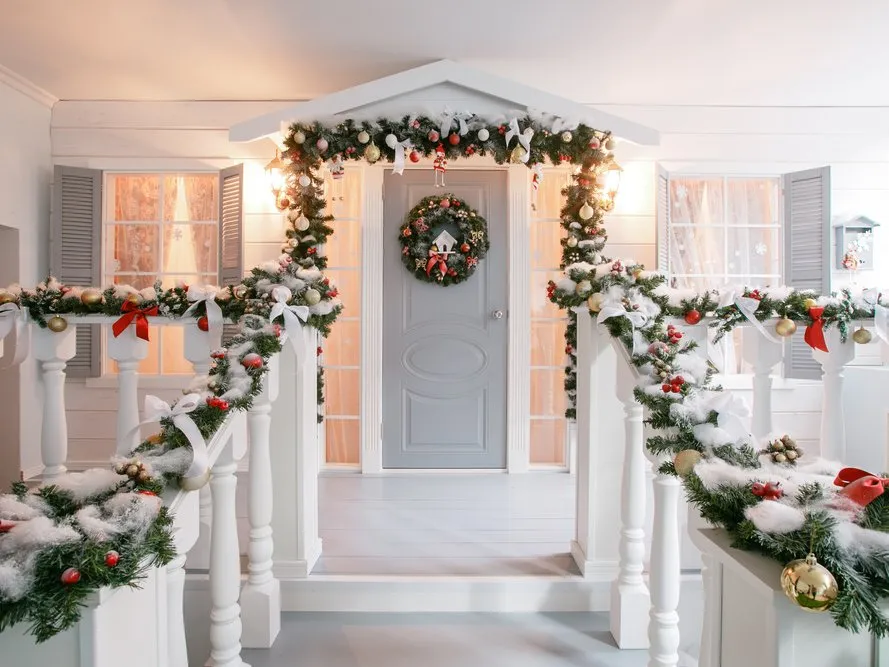
About 50% white — railings, door, flocking — 25% evergreen, 15% mixed red and gold ornaments, 10% light grey door. The flocking is what lets white take the majority without going sterile; without it, all that white paint plus white bows reads cold and flat. Want a different mood? Swap red and gold for red and silver and change nothing else. Same snow, same railings, completely different feeling, zero new purchases beyond the ornaments.
20. Twin Mini Trees Bookending Distressed Metal Lanterns
The whole vignette lands around $60 if you shop it right. Two 3-foot artificial trees: $20 each at Walmart in early November. Two dark metal lanterns: $12–$18 each at Dollar General or a thrift store, spray-painted matte black if they’re the wrong color. White pillar candles: $6 for a pair of LED ones that won’t blow out or melt. Galvanized planters: $10 each at a farm supply store. The one place to spend is the bows — $8 each for real velvet ribbon you tie yourself.
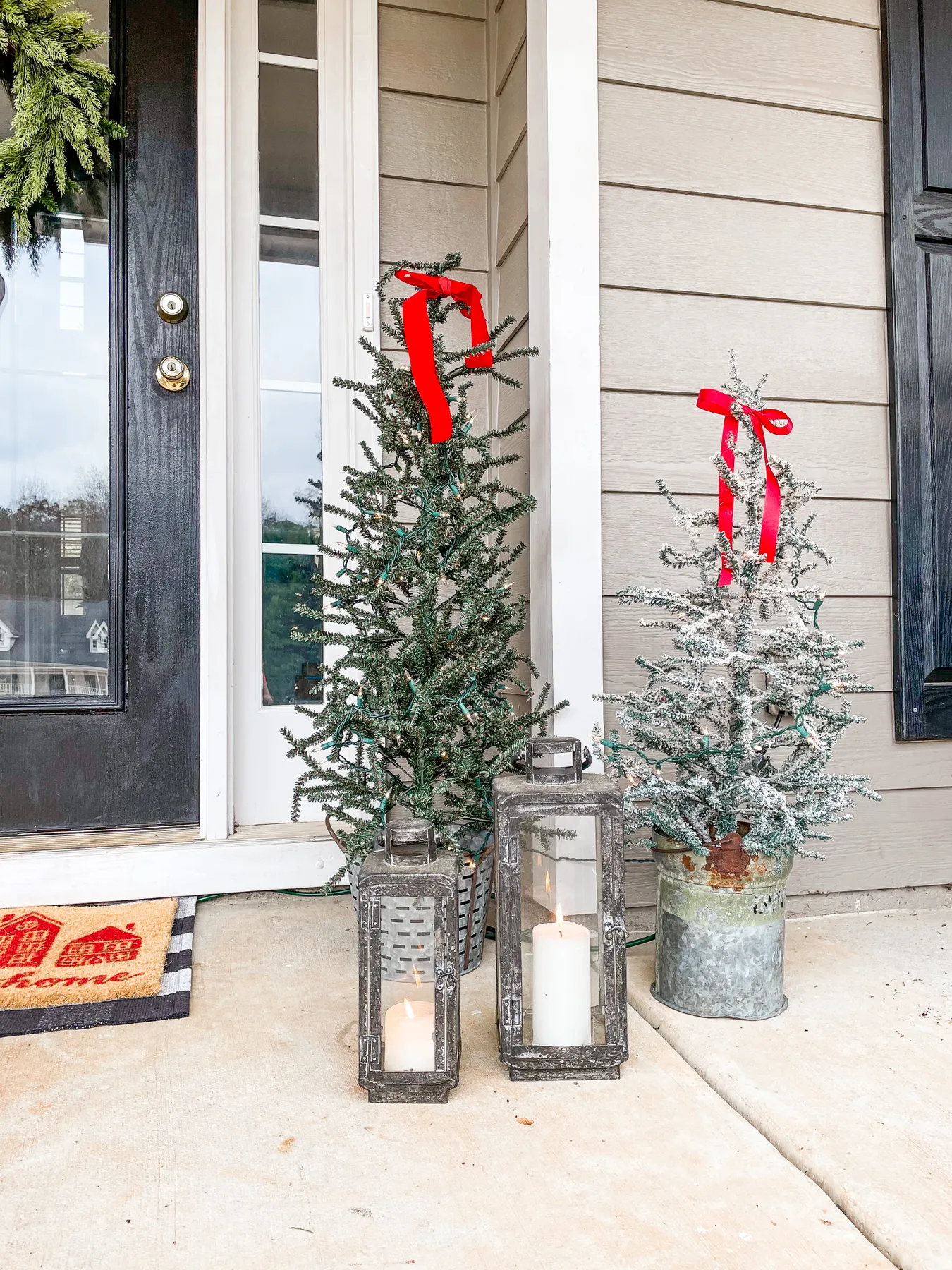
- Set the two lanterns first and space them about 10 inches apart. They’re the anchor.
- Place the trees on either side, roughly 6 inches away, bases on the same line.
- Wrap each tree with one strand of clear mini lights, bottom to top in a loose spiral.
- Tie the velvet bows at chest height on the front-facing side of each tree, not at the top.
Thirty minutes, and $40–$70 if you already own the planters.
21. Stacked Wreaths Tied With Black-and-White Striped Ribbon
Two wreaths stacked on one door instead of one. It costs a second wreath and five minutes of fishing line, and it changes the whole proportion of the entry — a standard wreath on a tall door can look like a dinner plate on a barn door, but two stacked fill the vertical space properly. Matching ribbon on both ties them into one deliberate piece rather than two leftovers. Compare with Idea #22, a white-door entry that solves the same proportion problem with symmetry instead.
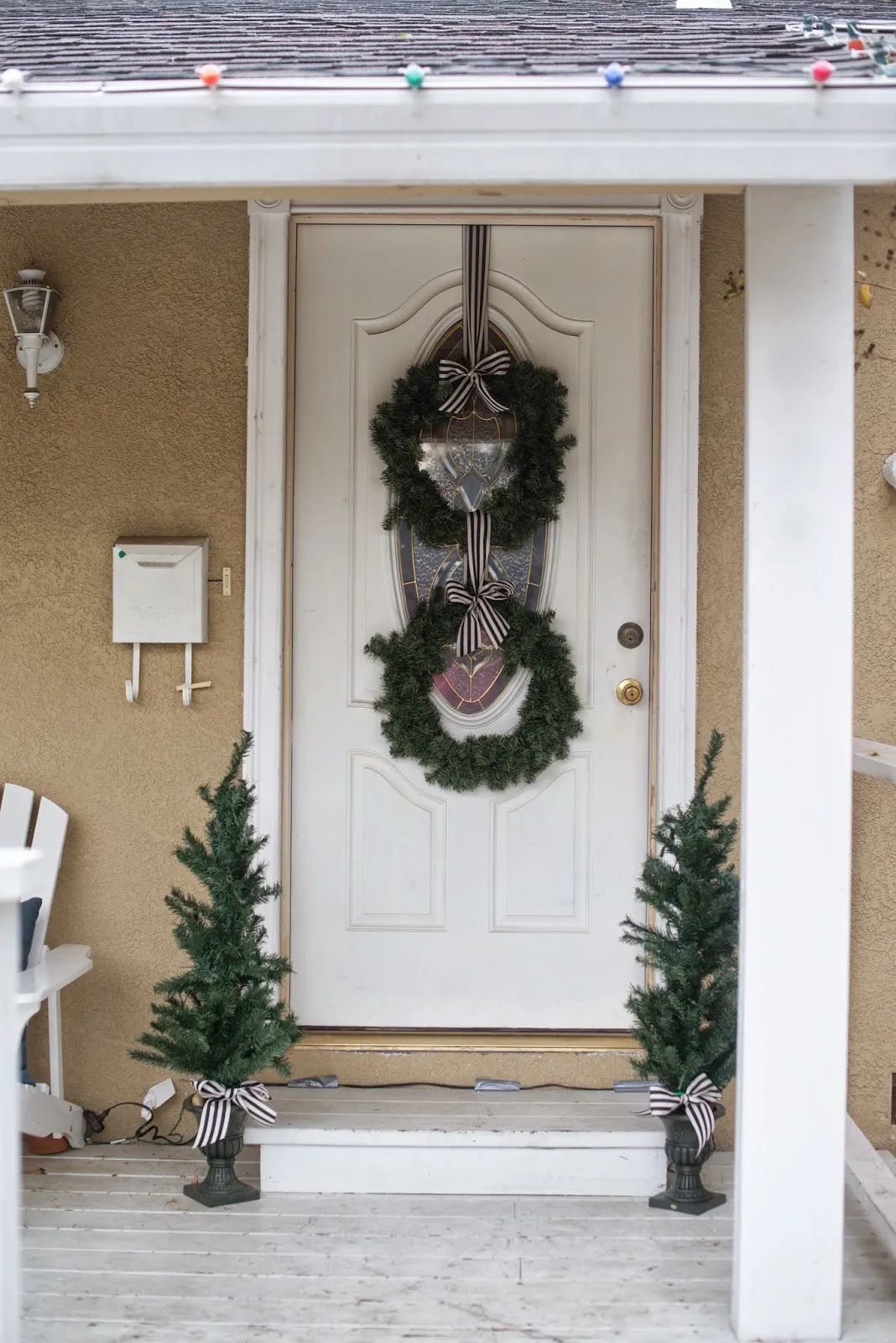
Two things to watch. The wreaths hang on the door itself, so make sure the bottom one clears the handle, knocker, or mail slot when the door swings — and the storm door if you have one. Second, striped ribbon is unforgiving: the pattern has to line up on both bows or it looks like a mistake. Measure and cut both lengths from the same point on the roll. And skip striped ribbon entirely if your door is narrower than 32 inches, because the pattern eats visual width.
22. Symmetry Rules on This White Double-Door Porch
- Two pre-lit evergreen garlands, 9 ft: $70–$160
- Two wreaths with velvet bows: $60–$140
- Black lanterns with LED candles (2): $50–$120
- Potted evergreens with red ribbon (2): $60–$150
- MERRY CHRISTMAS coir doormat: $20–$45
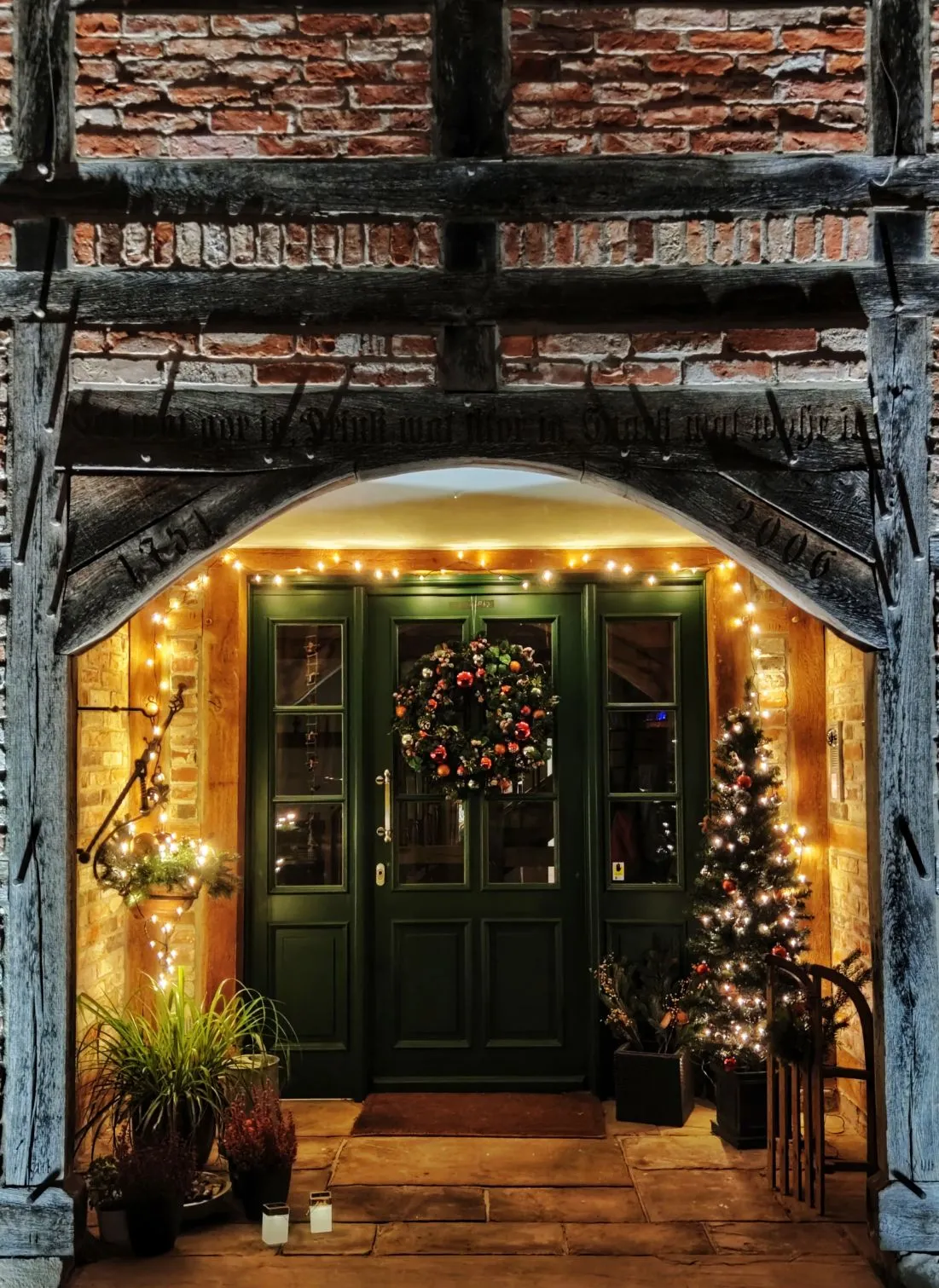
Total: $260–$615. Budget version: buy one 20-foot garland and cut it into two 10-foot runs instead of buying two, and order the doormat off-season for about half price.
On double doors, hang each wreath so its center sits about 14 inches in from the outer edge of the door — not on the center of each panel. That puts the pair at the right visual distance and keeps them from drifting toward the middle seam. Measure from the outer frame, mark with painter’s tape, then hang. Run the garland across the top as one continuous piece rather than two; a break at the center is the fastest way to make an elegant entry look pieced together.
23. Frosted Spruce and Pink Baubles Against Pale Blue Siding
Flocked garland and wreaths shed constantly. Between the fake snow and the pink baubles, plan on sweeping the landing every few days, and don’t hang this where a snow shovel will knock it. Flocked pieces also yellow over time — store them in a cool, dark spot, never a hot attic, or next November you’ll unwrap something beige. Pink ornaments fade faster than red or gold, so keep them out of direct afternoon sun. Real spruce would be prettier and would drop needles within a week; artificial is the honest choice here.
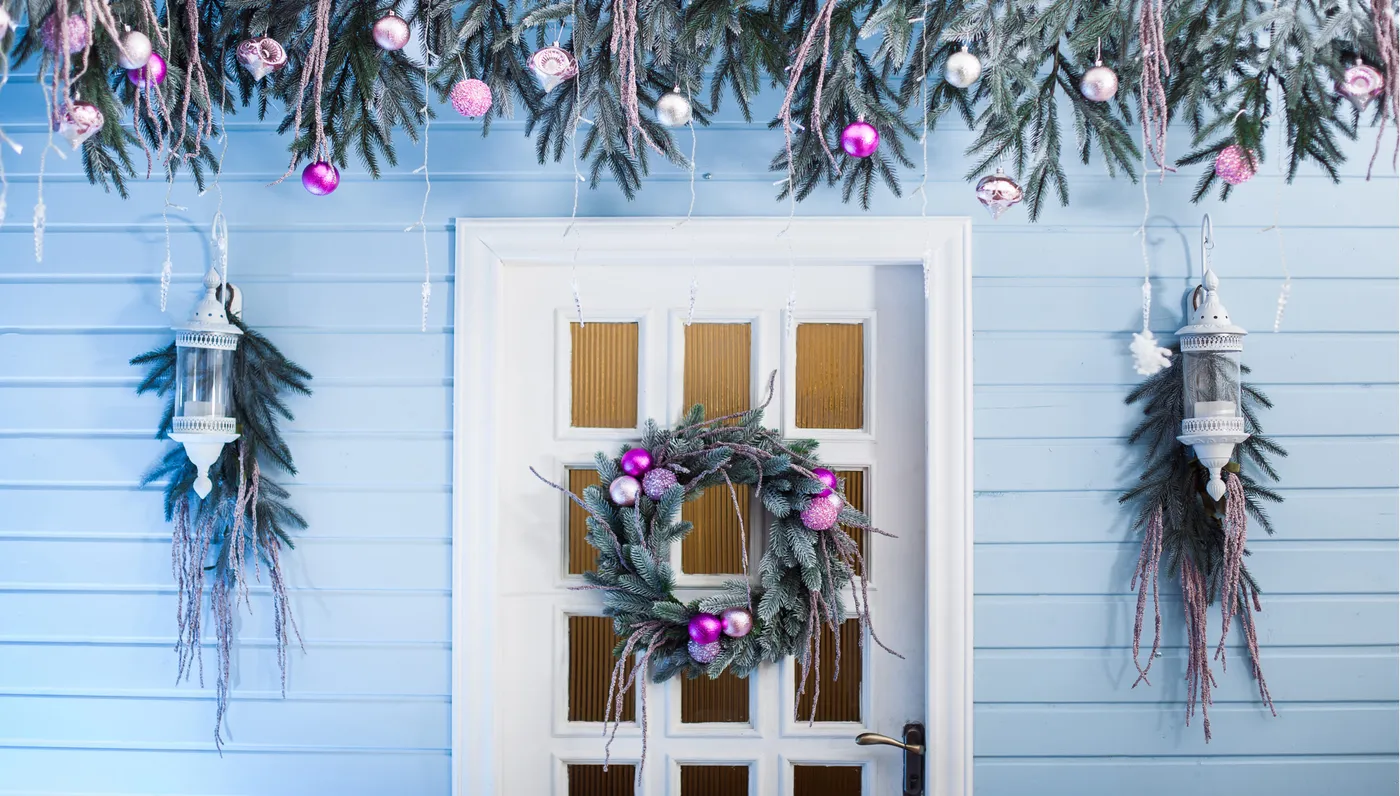
This works on a single 32- to 36-inch door with a landing of at least 4 feet — the white hanging lanterns and the wreath need breathing room, and crowding them kills the airy quality. Pale blue siding needs one strong light source nearby; at dusk without a porch light, the pastel palette goes grey. If your entry is more than 6 feet wide, two white lanterns will look lost — that’s a job for the fuller porch in Idea #19.
24. A Layered Wall of Potted Evergreens, Birch, and Berries
This porch feels abundant instead of cluttered because of staging: potted arrangements sit at three different heights, from ankle-level pots on the ground to arrangement tops at waist height, and the birch logs add vertical lines that break up the mass of green. Nothing is the same size as anything else. That said, this is also where people overdo it. Before you buy a twelfth potted evergreen, read our breakdown of the most common porch decorating mistakes.
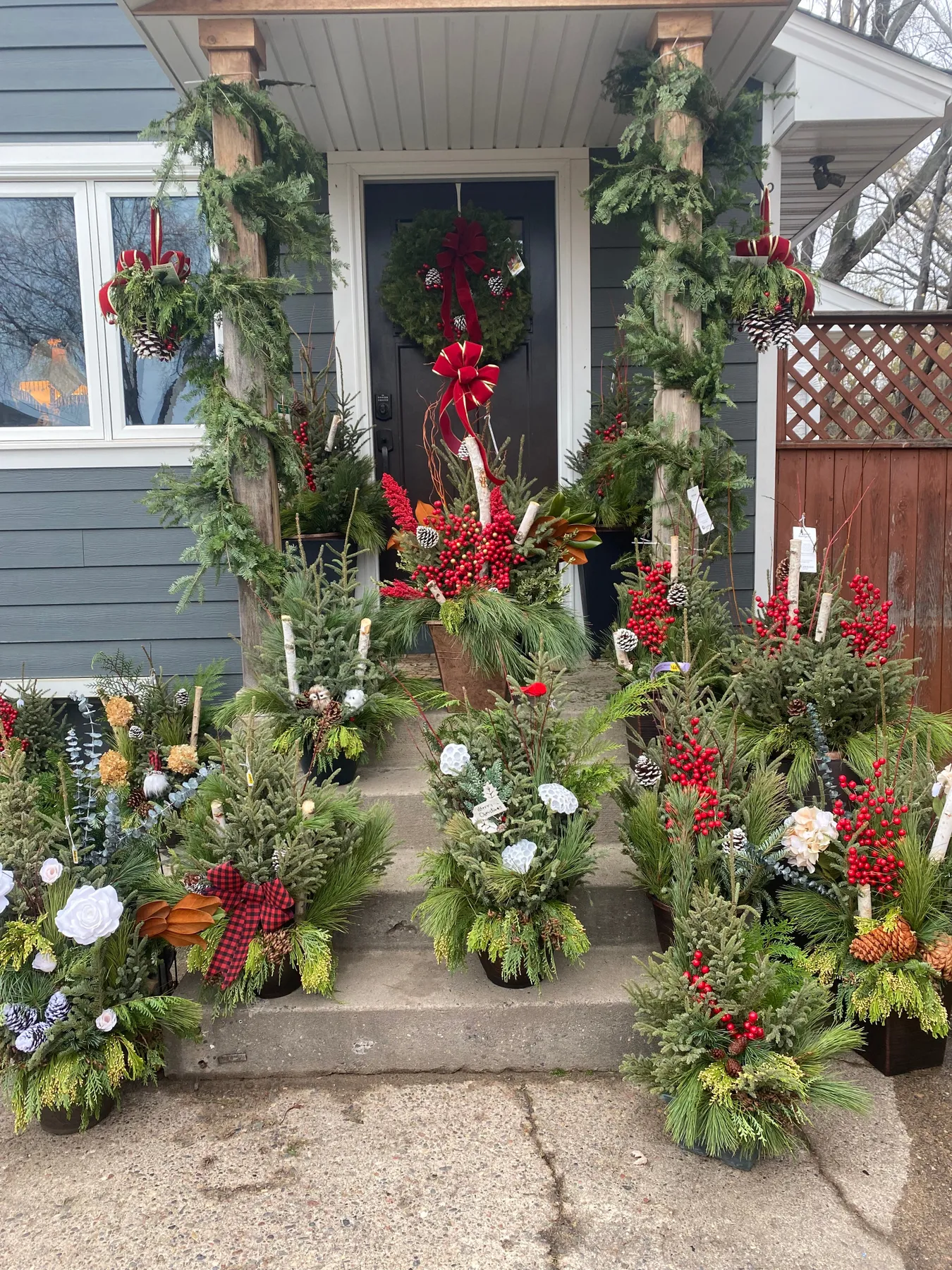
You don’t need twelve matching black pots. Gather every planter you own — terracotta, galvanized, resin — and spray the odd ones matte black for $6 a can. Fill the bottoms with free filler so a single $12 evergreen reads as a full urn: an upside-down nursery pot or crumpled newspaper does the job. Birch logs are free from a tree service in late fall if you ask nicely, and red berry picks are $3 each at Dollar Tree. Most people build this porch for under $120.
25. Navy Velvet Bows and Magnolias Wound Down the Stair Rail
About 60% forest green pine, 20% navy velvet ribbon, 10% cream magnolia blooms, 10% mixed gold and blue ornaments. The velvet is the star — it reflects light differently at every angle, which is why it looks expensive in photos and in person. Swap navy velvet for burgundy and you get a warmer, more traditional staircase; swap it for wide linen ribbon and the whole thing goes quiet and English-country. Gold berry clusters stay either way. Keep your ornament finishes mixed, too: all matte looks dusty, all shiny looks cheap.
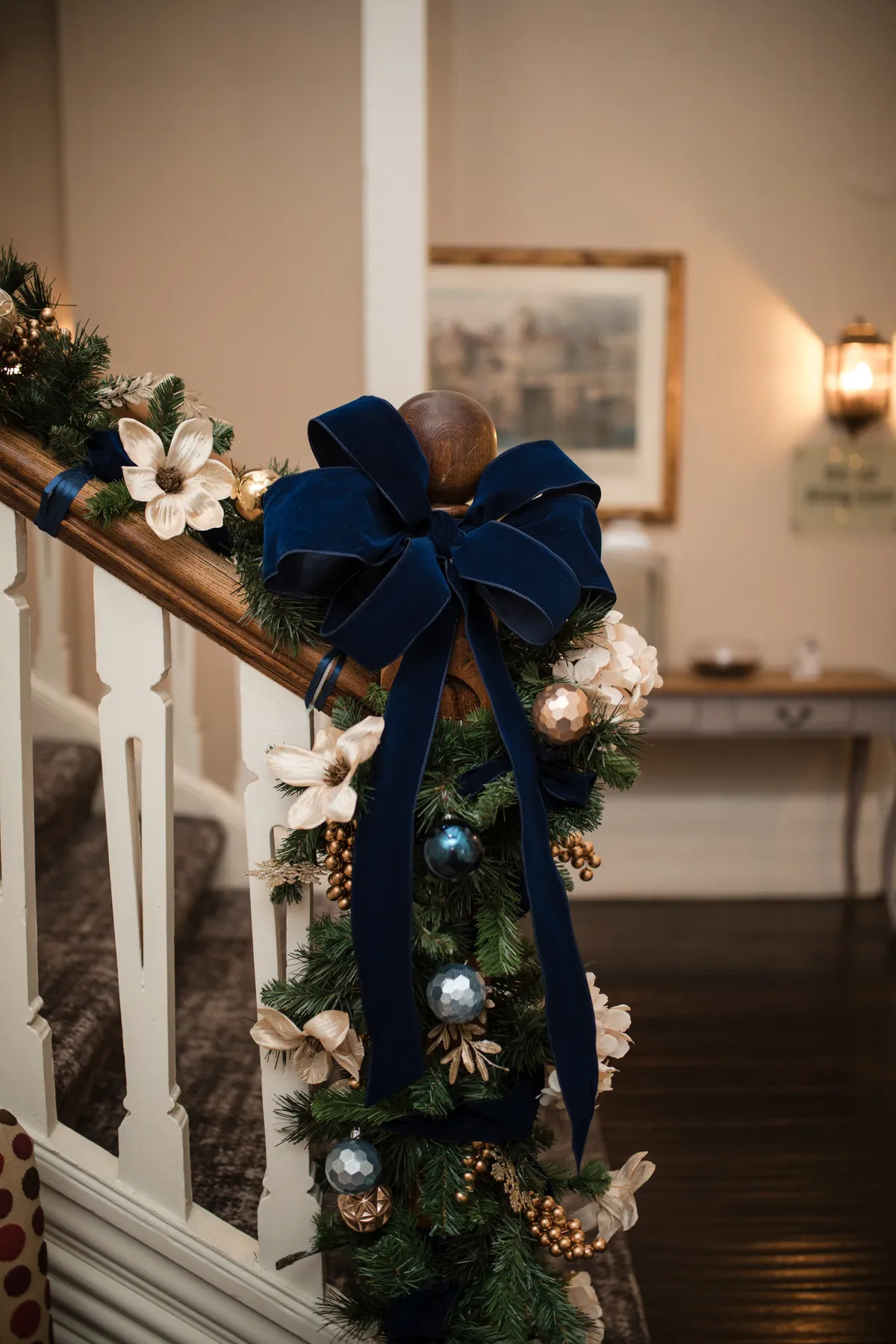
Velvet ribbon has been the most-pinned holiday material for a couple of seasons running, and it’s finally trickling down from $18-a-yard designer options to $5-a-roll craft store versions. Navy in particular has displaced red as the go-to accent in traditional homes, partly because it plays well with the blue-grey walls that have dominated interiors for years. This one has legs — navy and gold has been a dining-room classic for a century.
26. A Heart-Hook Wreath of Frosted Greens and Pale Pink Blooms
Wreath size is the most common miss. For a door 36 inches wide, aim for a wreath about 24 inches across — roughly two-thirds of the door’s width. On a 32-inch door, go 20 inches. Anything smaller floats, anything bigger swallows the door. Hang it so the top of the wreath sits 12 to 15 inches below the top of the door, centered; that puts the visual weight right at eye level when you’re standing on the step. And a simple hook — even a decorative heart-shaped one — beats an over-the-door hanger that scratches paint.
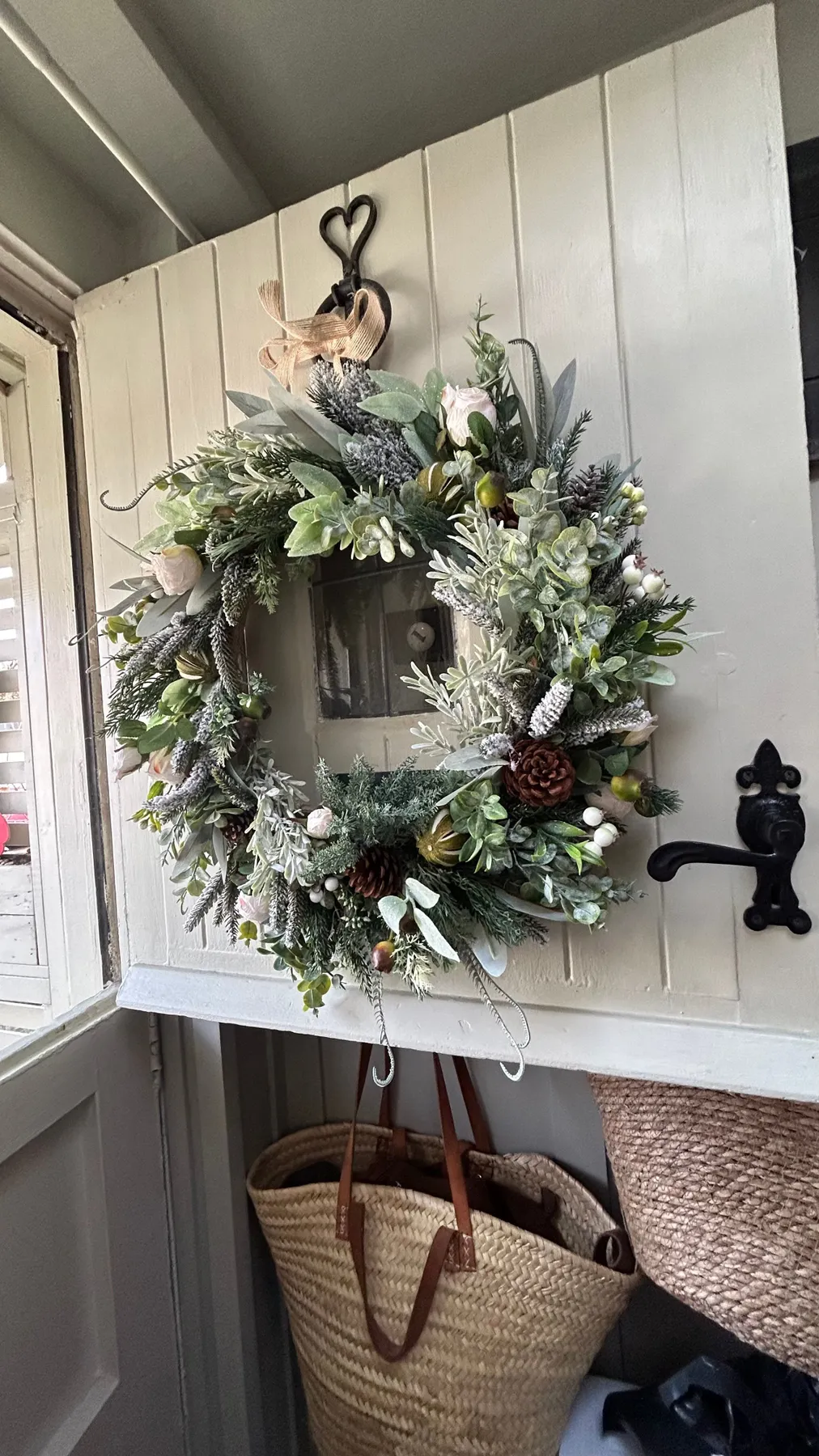
It’s the variety of foliage. This wreath isn’t one kind of green — it’s several, some frosted, some matte, one or two with a blue cast, plus white berries and small pale pink flowers tucked in. That mix reads as gathered rather than bought, and it’s why the wreath photographs well with no ornament shine to carry it. Substitute uniform pine and you’ve got a perfectly nice wreath that people walk right past without noticing.
27. A Rectangular Grapevine Wreath and a Whole Seating Nook
- Measure column spacing before buying light strands — you want one continuous run, not a splice at every post.
- Add up the wattage and confirm your porch outlet can handle lights plus a timer.
- Test throws and cushions for water resistance; an uncovered porch means wet fabric by December.
- Decide where the ladder will stand before it goes up — frozen ground is the real risk.
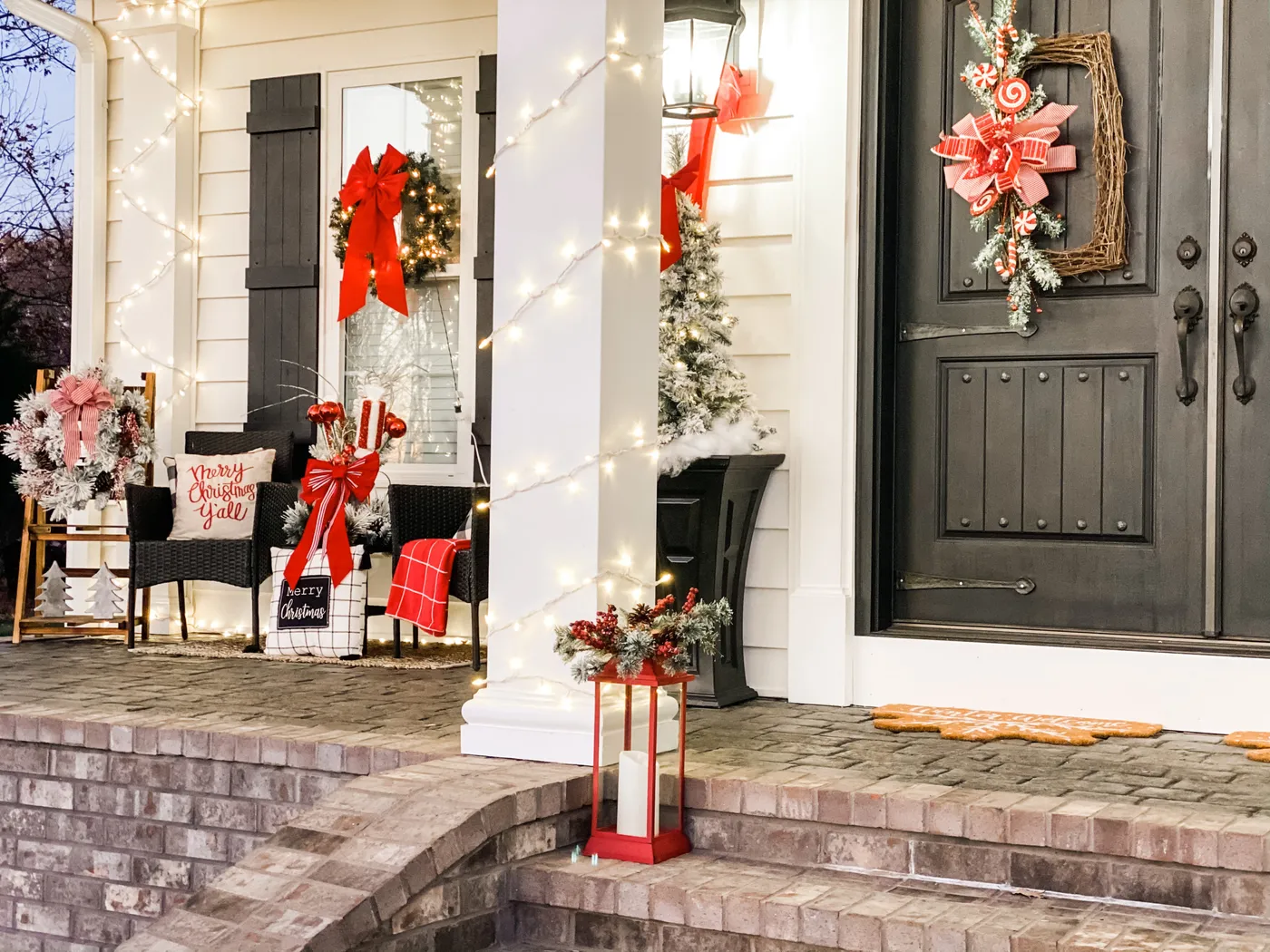
Draped string lights across white columns look effortless and take three times longer than you expect. They also create a specific hazard: cords strung overhead collect snow, and wet cord plus a loose connection is how porch fires start. Use only outdoor-rated strands, plug into a GFCI outlet, and unplug everything before a big storm. If you have kids or dogs, keep the lowest loop at least 7 feet off the ground — anything lower becomes a clothesline for a running nine-year-old.
28. Frosted Red Apples and a Big Striped Bow on Dark Gray
Two deliberate choices make this work. First, a dark gray door makes red look richer than a red door does — red on red flattens, red on charcoal glows. Second, the bow sits off to the left rather than at top center, which breaks the predictable symmetry and makes the wreath feel hand-tied instead of store-bought. The frosted apples add a matte texture next to all that glossy bauble shine. Matte against gloss is doing more work here than the color is.
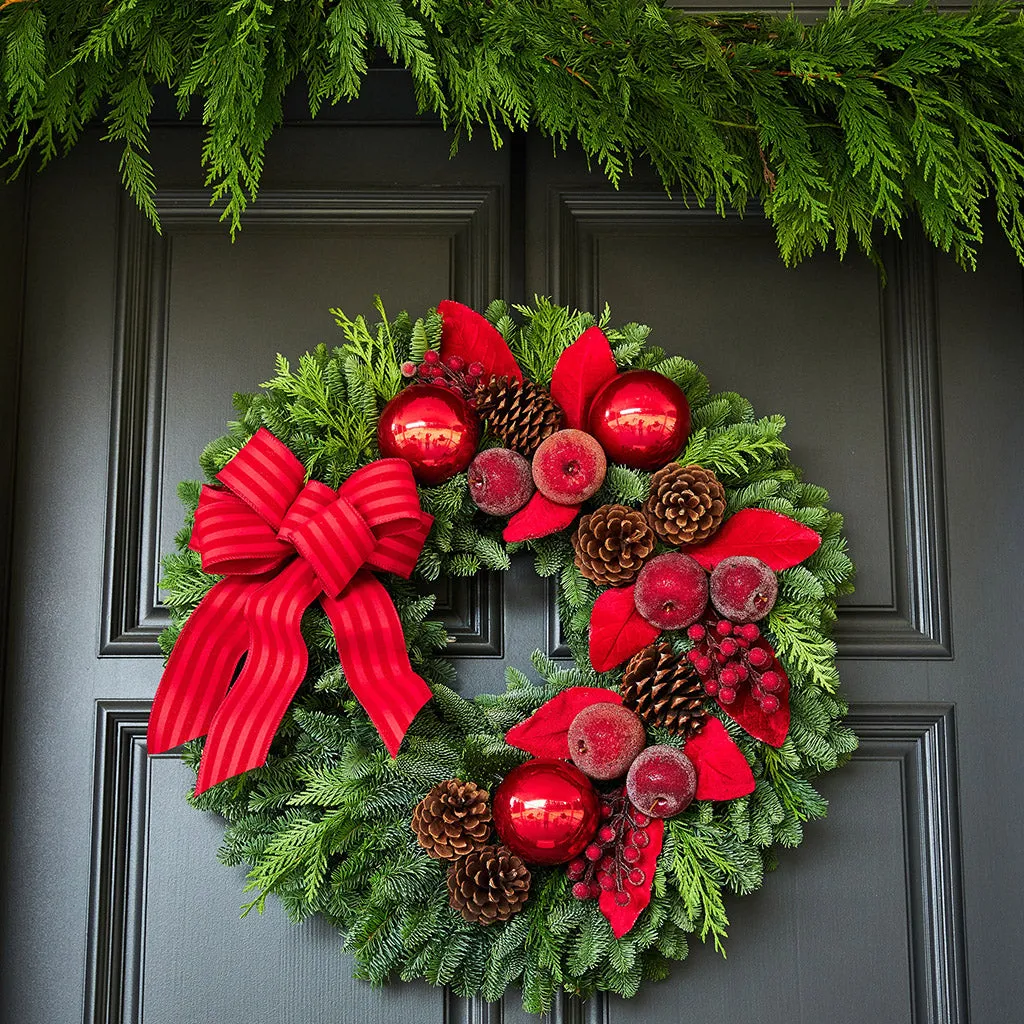
- 26-inch evergreen wreath, undecorated: $25–$60
- Red and frosted ornament set: $15–$35
- Pinecones, bag of 12: $8–$15
- Wide striped ribbon, 3 yards: $12–$28
- Pre-lit garland for above the door: $35–$85
Total: $95–$223. Budget version: build the wreath yourself on a $6 wire frame using clippings from your own shrubs and a bag of dollar-store ornaments, and you’re in for about $35.
29. Cardinal Ribbon and a Golden Twig Wreath Base
This works best on a solid paneled door 36 inches wide or wider — a 28-inch wreath plus a generous bow needs room, and on a narrow door the proportion tips from generous to comical. It also wants a door with some depth or paneling; a flat slab gives the wreath nothing to sit against. On a narrow or mostly glass door, size down to 20 inches and move the bow to the top center instead of the side.
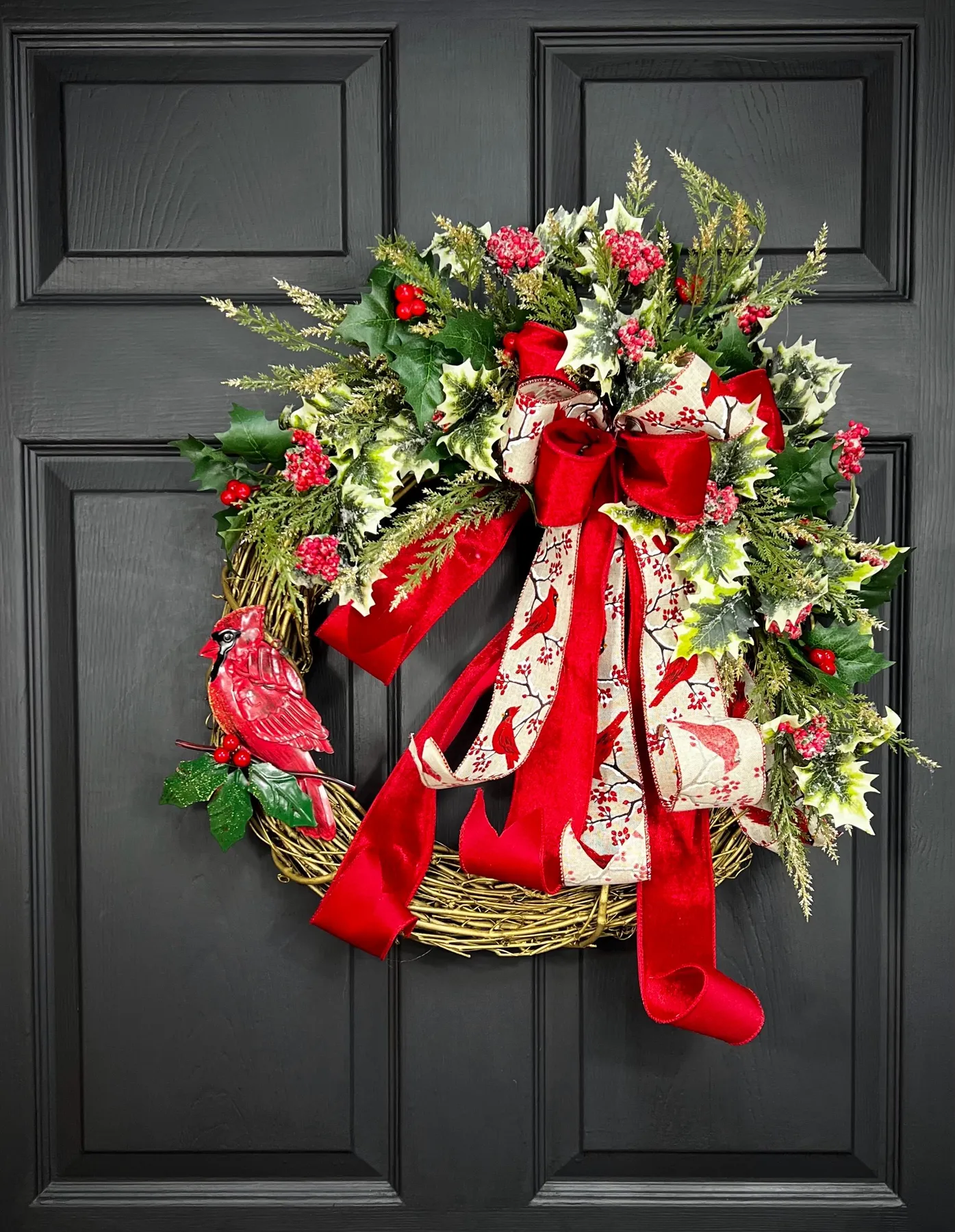
When you’re layering two ribbons, keep the widths different — 2.5 inches for the velvet and 1.5 inches for the printed cardinal pattern. Same-width ribbons fight each other and blur the bow’s shape. Cut the printed ribbon’s tails on a diagonal so they don’t fray, and spot-seal the ends with a lighter held an inch away. Pin the finished bow to the wreath with florist wire through the back, not the front. You want to see ribbon, not hardware.
30. Lime Green and Plaid Layered Bow on a Grapevine Wreath
Lime green and red plaid together is a distinctly 2026 combination — it borrows from the preppy, tartan-heavy look showing up on tabletops and door decor, but the lime keeps it from reading stuffy. The real shift is away from perfectly matched palettes toward bows that look chopped from three different rolls. Saves for layered, wide-ribbon wreaths have been climbing steadily, partly because a statement bow is the single cheapest way to change a wreath’s whole personality.

- Cut three ribbon lengths at roughly 22, 18, and 14 inches.
- Fold each into a loop, pinch the center, and stack them largest at the back.
- Cinch all three with a 6-inch piece of florist wire, twisting at the back.
- Fluff the loops outward and trim the tails on a diagonal.
- Wire the finished bow to the wreath frame and tuck the wire under greenery or moss.
Fifteen minutes and $10–$22 in ribbon. If you’d rather build the whole garland instead of just the bow, start with Idea #14.
Hang It, Light It, and Let the Snow Do the Rest
Thirty porches, and not one of them needed a designer, a permit, or a second mortgage. Start with the door — wreath, garland, warm 2700K bulbs — and let the planters catch up next season if the budget is tight. The snow and the light will handle the rest. 📌 Save this to Pinterest now so next November you’re decorating instead of scrolling.
