
26 diy outdoor christmas decorations 2026 Ideas
Still scrolling through outdoor Christmas photos and saving them faster than you can decide what your own porch should actually look like? The inspiration never runs out — it’s the driveway in November that stays bare.
We spent serious hours browsing Etsy, Target, and The Home Depot to bring you only what’s worth your attention this year, covering everything from $18 window-ledge accents to $1,040 of full-yard light architecture.
Inside you’ll find 26 curated ideas, spanning warm-white minimalism, high-contrast traditional, rustic handcrafted, and full-tilt multicolor. Budget and luxury versions sit side by side, and every idea is shoppable with direct product links.
The mood has shifted this year toward warm white over neon chaos — softer, layered, and far more likely to survive a January photo on your own street.
Pin this guide for later — your future self will thank you when it’s time to actually do this.
1. Paper Luminaria Path Glowing Along a Flagstone Walk
Space luminarias 18 to 24 inches apart — closer and they read as one glowing blob instead of a guiding rhythm. Anchor each bag with an inch of sand or pea gravel so wind can’t tip it, and swap real candles for warm-white LED votives (about $2 each) so nothing scorches the paper or dies in a gust. Stop the run about 3 feet before the door, so the entry stays the focal point rather than the last bag in the line.
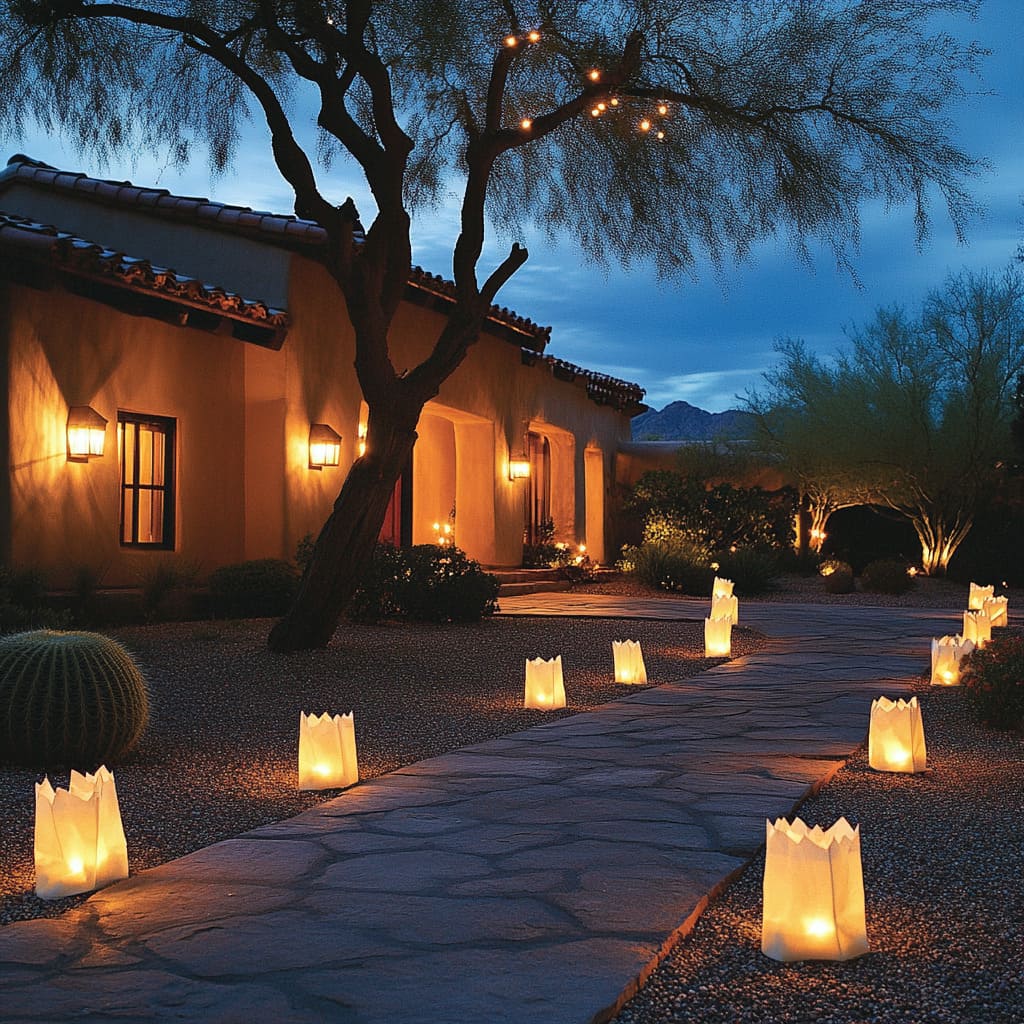
Three things are doing the heavy lifting here. Color temperature comes first: amber glow against a deep twilight-blue sky is the highest-contrast pairing you can get for free, and dusk is exactly when paper luminarias start winning. Second, repetition — a dozen identical bags create a rhythm the eye reads as intentional even though nothing is expensive. Third, echo. The wall sconces and the lights strung overhead through the tree repeat the same warm bulb, so the path, the tan stucco, and the canopy feel like one composition instead of three separate projects.
2. Red and Green Roofline Lights With Lit Reindeer on the Lawn
Here’s the unglamorous truth about a roofline-plus-lawn display: it’s an electrical project before it’s a decorating project. Do the math before you drag out the ladder — a single 15-amp circuit tops out around 1,400 watts of incandescent mini lights, and switching to LED strings cuts that draw by roughly 80 percent. Use outdoor-rated 12-gauge cords for runs over 50 feet, keep every connection off the ground and out of standing water, and put the whole thing on a GFCI outlet with a timer. You want the block to notice the lights, not the extension cords.
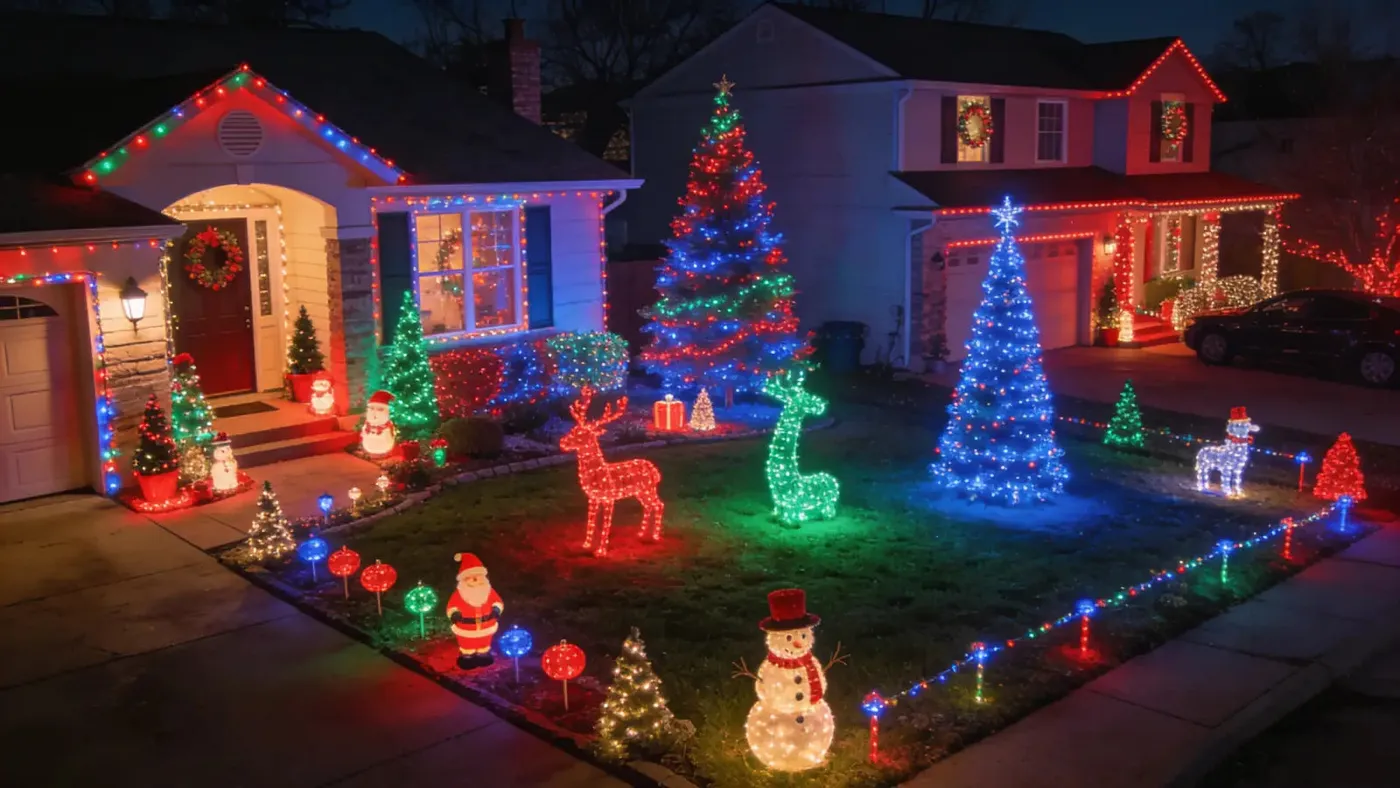
- Roofline string lights, LED, 200 ft: $60–$150
- Lit lawn figures — reindeer, snowman, Santa, mini trees: $120–$400
- Clips, stakes, and gutter-safe mounting hardware: $25–$60
- Outdoor extension cords and power stakes: $40–$90
- Total: roughly $245–$700
Budget alternative: skip the pre-lit figures entirely, hunt Marketplace for used wireframe forms at $15–$30 each, and light them yourself with two strings apiece. Same yard, closer to $180.
3. Weathered Wood Lanterns Stuffed With Ornaments and Polka-Dot Bows
The polka-dot bows are the entire personality of this entry. Without them you’d have two perfectly nice distressed wooden lanterns full of red, silver, and gold ornaments — pleasant, forgettable, the kind of thing every porch has in December. The black-and-white dots introduce a pattern that exists nowhere else in the arrangement, and pattern is what keeps a traditional red-and-gold palette from sliding into catalog territory. It’s a $6 spool of ribbon doing more work than everything inside the glass.
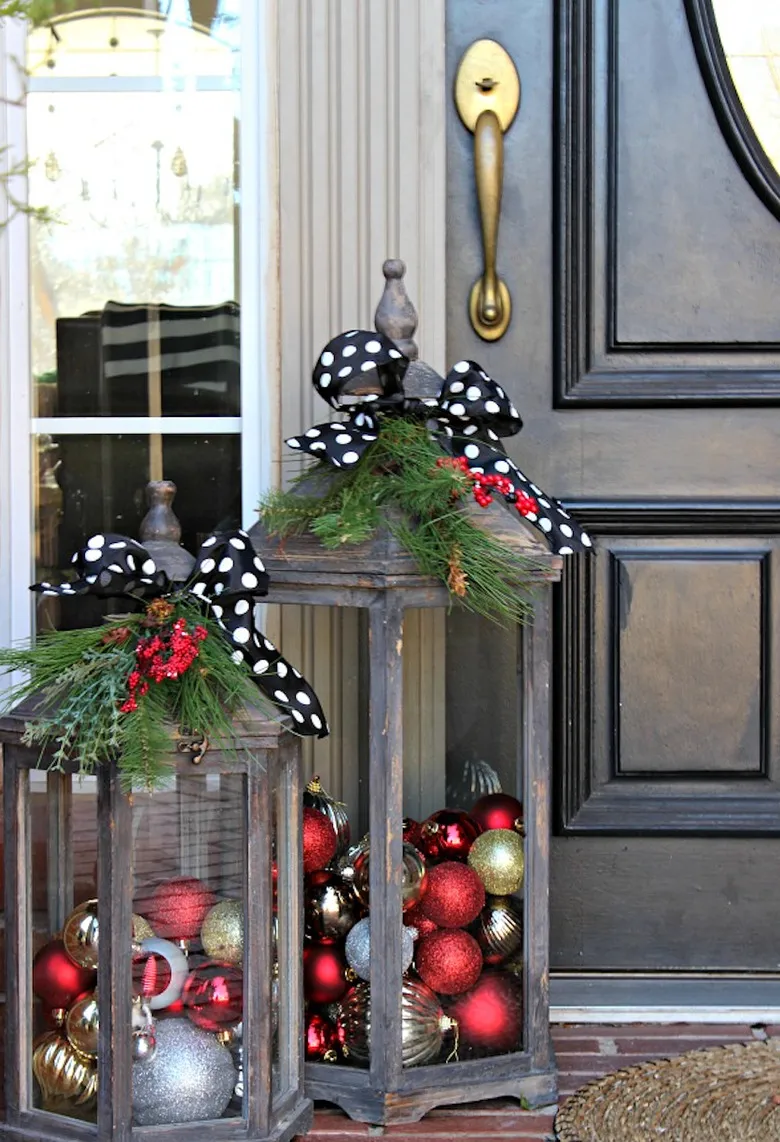
Filling a lantern takes about 15 minutes once you know the order.
- Drop a foam disc or a zip bag of sand in the bottom so glass ornaments can’t roll against the panels.
- Place the largest ornaments first — four in back, three in front, overlapping.
- Tuck pine sprigs at the hinge line and push two red berry stems into the gaps.
- Tie the bow at the handle, tails cut on a diagonal about 8 inches long.
- Set the pair asymmetrically — one on the step, one on the ground.
Cost is roughly $12 in filler, greenery, and berries if you already own the ornaments.
4. Red-and-White Roofline With a Wireframe Reindeer Family on the Lawn
- Red and warm-white roofline LED strings, 250 ft: $80–$180
- Wireframe reindeer family, three pieces: $150–$450
- Lights to wrap one mature deciduous trunk: $40–$90
- Pre-lit porch trees, two or three: $120–$320
- Total: roughly $390–$1,040
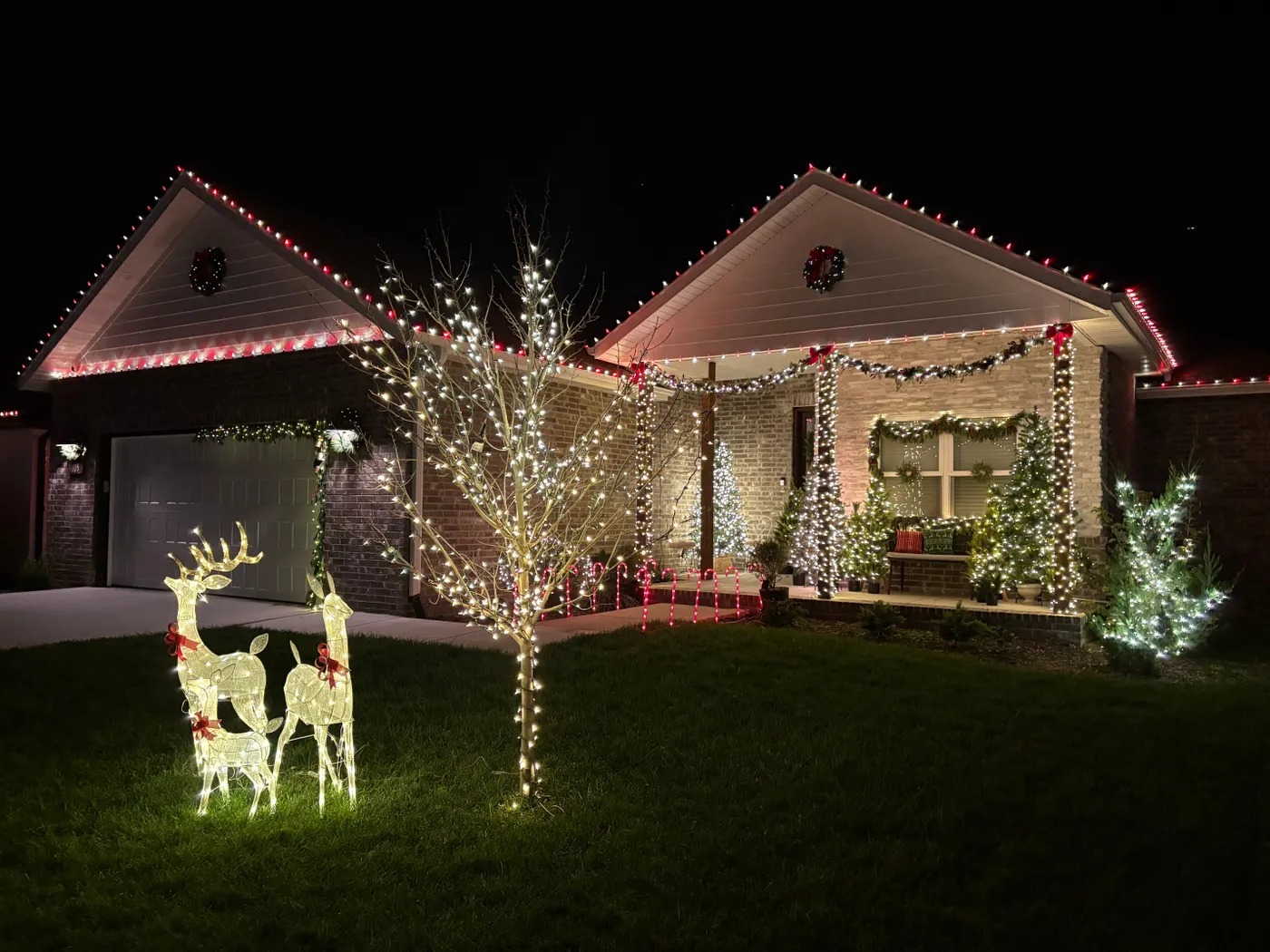
Budget alternative: one wireframe reindeer instead of a family, plus a single pre-lit porch tree, drops this near $260. Nobody walks past a house counting reindeer.
When you wrap the big tree, spiral rather than climb — lights looped straight up and down read as a ladder. Start at the base with roughly 6-inch spacing for the first six feet, then open out to 10 inches as you move into the canopy. A 20-foot tree swallows about 100 feet of light that way, and the narrow-to-wide rhythm makes the whole thing look lit from inside instead of dressed from outside.
5. Lighted Garland Arch With a Glowing Star and Nutcracker Sentries
Warm white light carries about 60 percent of this look. Deep evergreen garland with red accents holds another 25, and the glowing star — the only metallic note on the porch — takes the final 15. That ratio is exactly why the arch reads as classic rather than cluttered: nothing competes with the garland for attention. Trade the star for a matte black iron snowflake and the same installation turns modern farmhouse. Trade the red for burgundy velvet ribbon and it slides into moody old-world without you touching a single light. For a lower-voltage version of the same framing idea, see Idea #10.
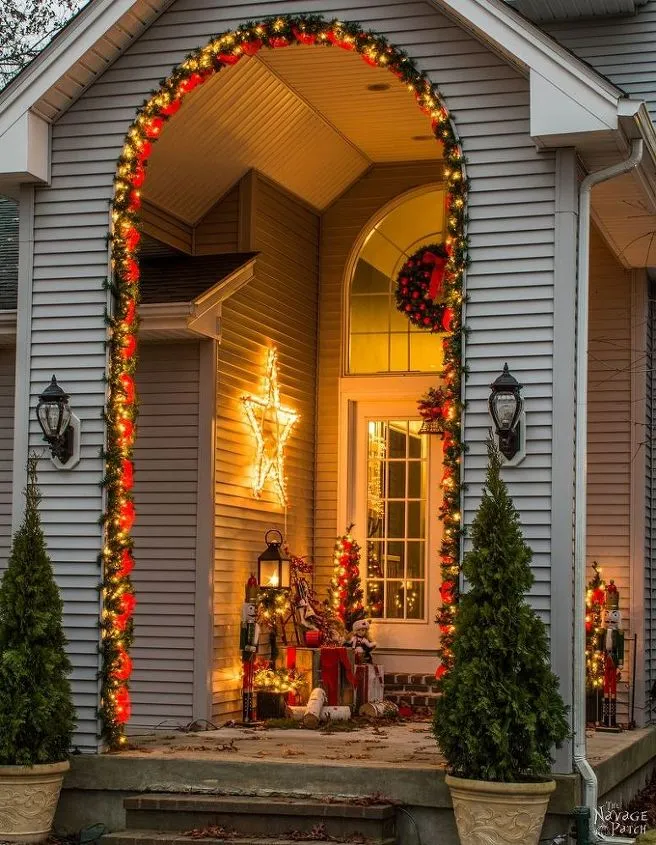
The star is charming and the nutcrackers are fun, but the arch is the design. Because the garland follows the curve of the entryway, the porch gets a literal frame — a doorway-shaped border that tells your eye exactly where to land. Take away the star and the entry still works. Take away the arch garland and you have a porch with decorations on it rather than a porch that’s been composed. That’s the whole difference, and it costs nothing but patience with a ladder.
6. Cool White and Blue Lights Tracing a Snowy Modern Facade
Blue and white against snow is a contrast trick, not a color preference. Snow bounces whatever light hits it, so cool whites and blues stay crisp against the drifts while warm amber goes muddy and yellow. The restraint matters just as much: only two colors means the eye can track the roofline and the tree wraps as a single drawing. And the stone retaining wall in the foreground does quiet structural work — it gives all that floating light something solid to sit against, which is why the composition never feels like it’s levitating over the lawn.
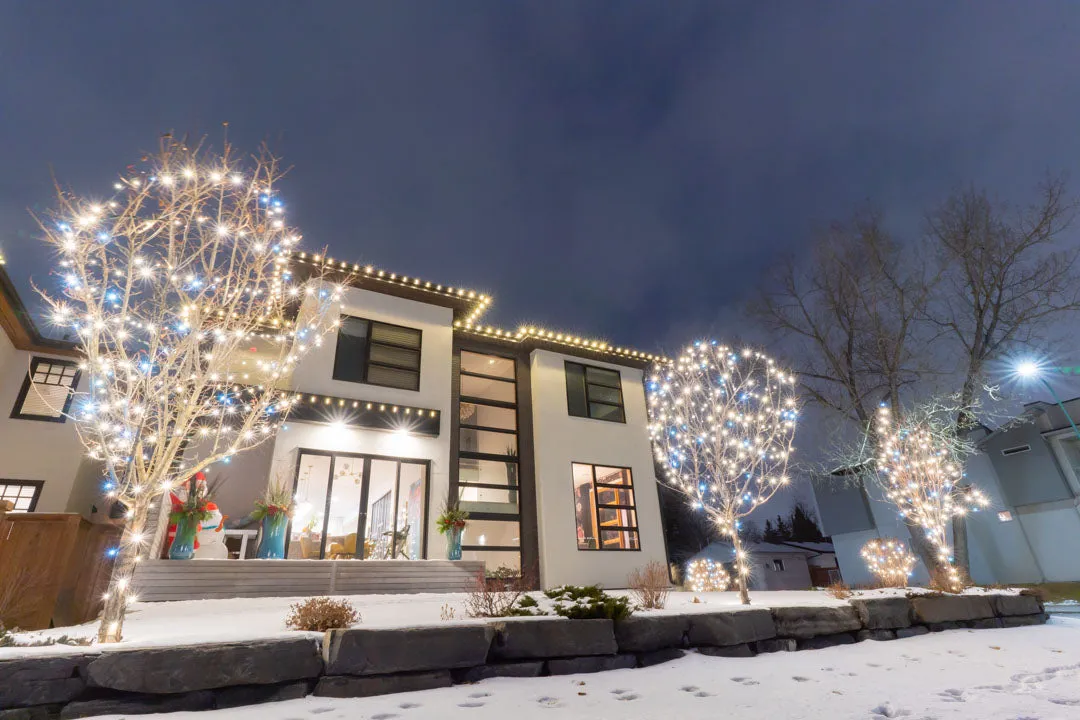
Blue LED strings are the divas of holiday lighting. They run hotter than white, dim unevenly after a season or two, and the cheap ones shift toward violet. Expect three to five winters from a decent set. Inspect every cord for nicks before hanging, because cold makes cracked insulation worse, and don’t leave wrapped trees plugged in during ice storms — the weight of frozen precipitation on a strand can snap small branches. Coil, don’t bunch, when you store them.
7. Red-Ribbon Window Wreaths on a Snow-Dusted White Porch
- Measure each window pane first — a wreath should span roughly one third of the glass width, so most windows want 20 to 24 inches.
- Decide your hanging method before you buy. Suction cups fail below freezing, so over-the-frame hooks or brick clips are safer.
- Check where you’ll plug in. Broad red ribbons hide cords well, but you still need an outdoor outlet within reach.
- Note which way the porch faces — north-facing ribbon stays crisp, south-facing gets sun-bleached by mid-January.
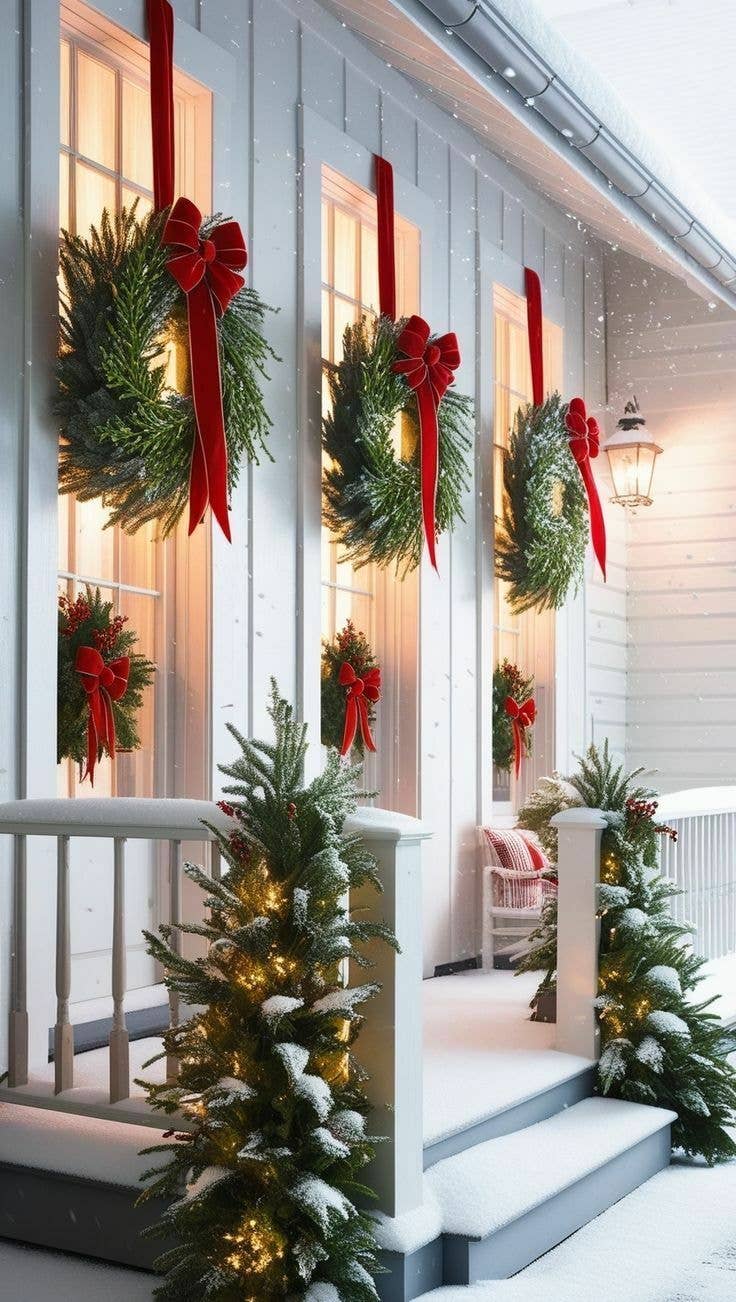
Real evergreen wreaths run $40 to $70 each, which adds up fast across four windows. A plain greenery wreath from a big-box store is closer to $12, and a $9 spool of wide red velvet ribbon tied in a simple loop gets you 90 percent of the look. Wrap the ring in a strand of battery fairy lights and only you will know the difference from the curb. If you want the fuller double-door treatment, Idea #9 shows how to scale it up.
8. A Tiered Christmas Tree Stacked From Clear Plastic Bottles
- Collect 60 to 100 identical clear bottles and strip every label and cap ring.
- Build a cone from chicken wire or an inverted tomato cage, sized so the base tier holds the widest ring of bottles.
- Wire bottles on in overlapping rows with necks pointing inward, so no gaps show daylight through the structure.
- Run two strands of LED inside — red on one side, blue on the other — and check the glow before you close the top.
- Set small lit figurines on the tiers and cap the whole thing with a red star.
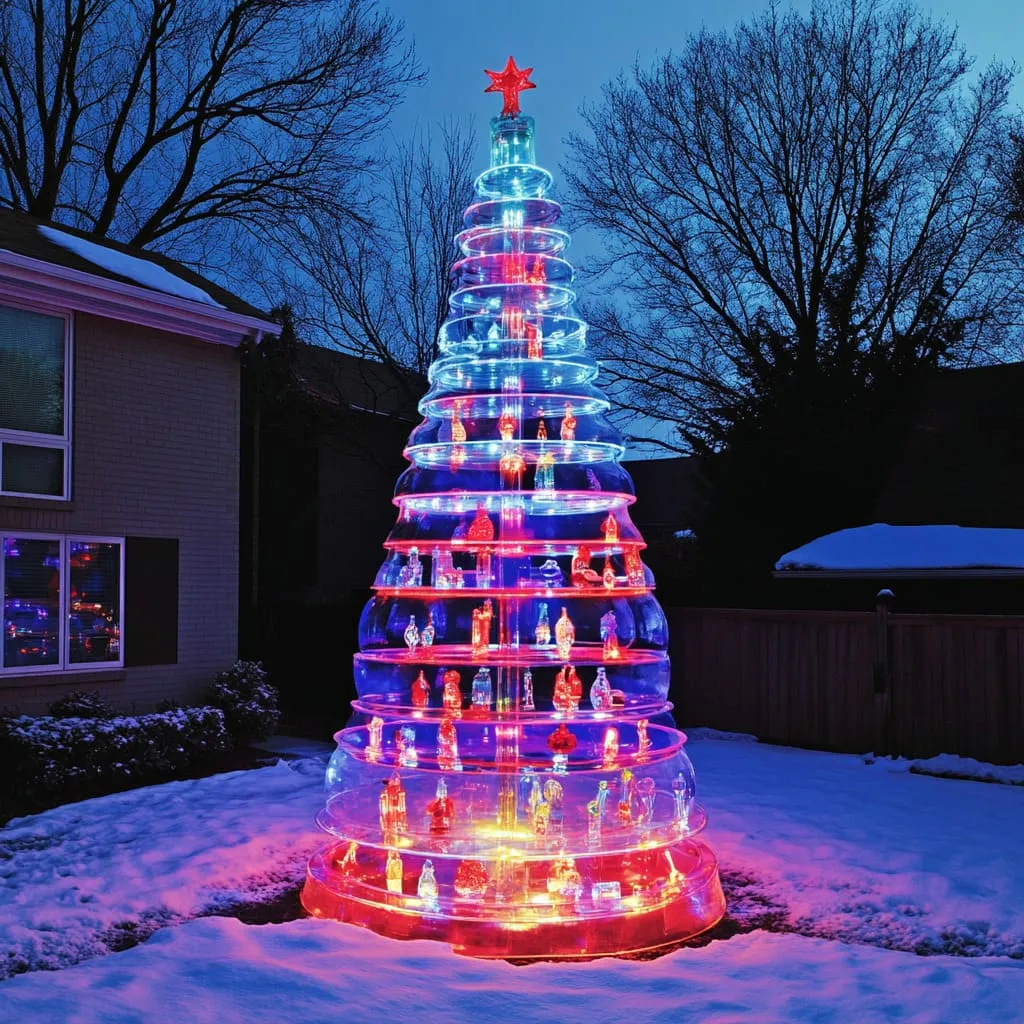
Plan on a full weekend and about $40 if the bottles are free.
Upcycled yard art has been the quiet story of holiday decorating for a few seasons now, and it makes sense: people are tired of buying a new inflatable every year and watching it sag by New Year’s. A bottle tree is the anti-inflatable — it costs almost nothing, it’s the thing neighbors photograph, and it collapses back into the recycling bin instead of the garage. It won’t replace your roofline lights, but it gives the yard a story worth telling.
9. Twin Evergreen Wreaths on Black Double Doors With White Ribbon
Garland should always be fuller than your instinct says. For a doorway, you want a strand at least 1.5 times the opening’s width — an 8-foot span takes 12 feet of garland — and you fluff it before hanging, never after. On the wreaths, the rule of thirds applies to the ribbon: a bow should be about one third the diameter of the wreath ring, so a 24-inch wreath gets an 8-inch bow. Anything wider and the ribbon starts reading as the decoration rather than the accent. White ribbon on black doors is the highest-contrast pairing available, and it costs nothing extra.
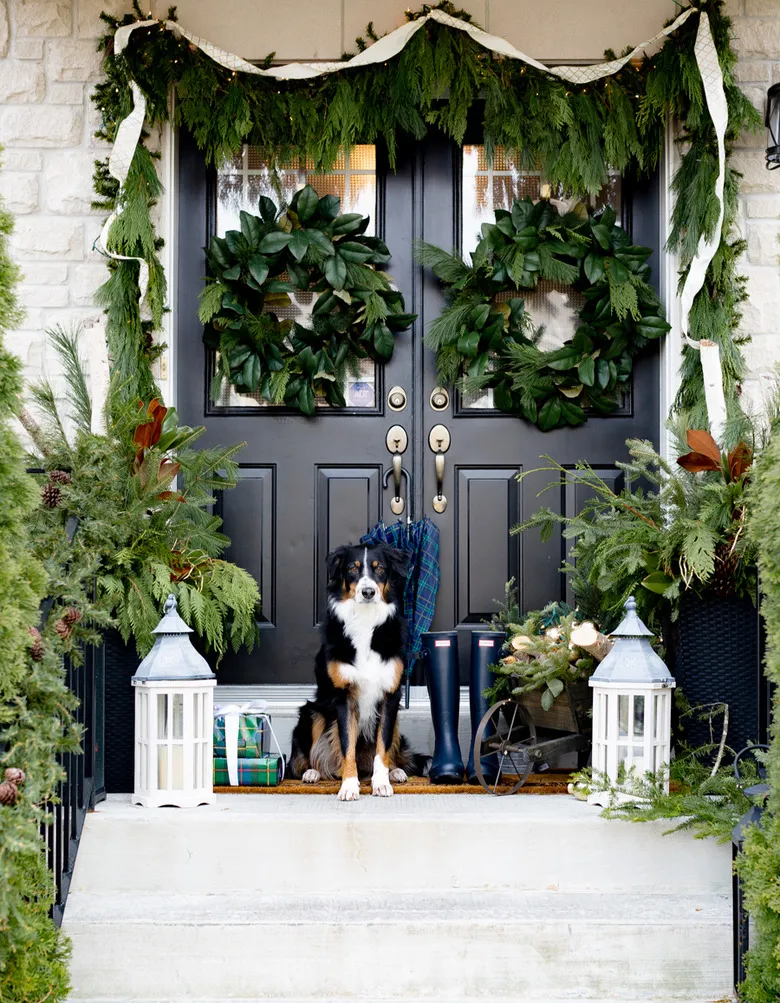
This entry needs a porch at least 6 feet deep and 8 feet wide, with a ceiling high enough that the overhead garland clears head height by a foot. It’s built for a covered porch — the white lanterns sit on the steps rather than floating, so no hanging hardware touches the siding. On a narrow stoop, cut the garland, keep the twin wreaths, and pull the planters tighter to the door. You lose the grandeur and keep the welcome, which is the better trade anyway.
10. Pine Garland Wrapped Tight Around Dark Wood Porch Posts
Wrapping porch posts looks effortless and is quietly fussy. Natural garland on wood holds moisture against the finish, so don’t wrap a freshly stained post, and don’t leave it up past mid-January — you’ll get pale ghost rings where sap and damp sat. Use zip ties, never nails, and hide the ties on the back side. Real garland sheds needles for the first week and drops more every time the wind picks up, so put a doormat where the debris lands. Faux garland with wire-core stems solves all of it, at the cost of some depth up close.
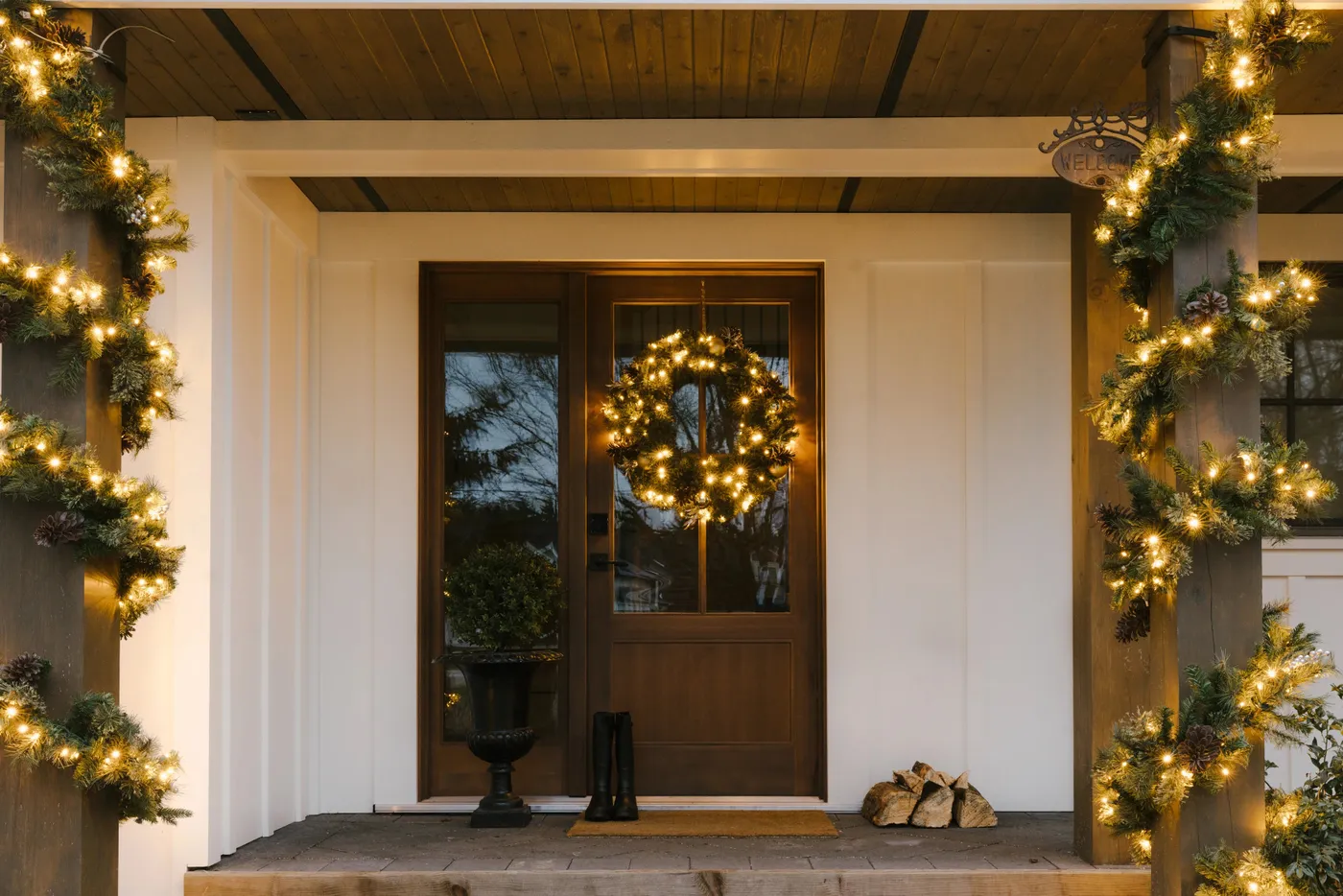
The formula is roughly 65 percent dark stained wood, 25 percent warm white fairy lights, and 10 percent black — the matte door, the urn, the firewood straps. That ratio is why it looks expensive: warm light on dark wood is the coziest contrast in the book, and the black accents keep the whole thing from turning sweet. Swap the urn for galvanized metal and it goes farmhouse. Take the fairy lights away and it turns Scandinavian and stark. If you like the firewood moment here, Idea #19 takes it further.
11. Potted Pines and a Wireframe Bear Beside Navy French Doors
The bear is the hinge of this whole entry. Two potted pines and a few black lanterns would be lovely and completely anonymous — the kind of setup that could belong to any house on the street. Adding a lit wireframe bear gives the scene a character and a scale reference, and it softens what would otherwise read as a stiff, symmetrical composition. Notice it isn’t centered. It sits off to one side, slightly smaller than the pines, which keeps it from looking like a mascot on a leash. One figure, deliberately placed, beats three lined up in a row.
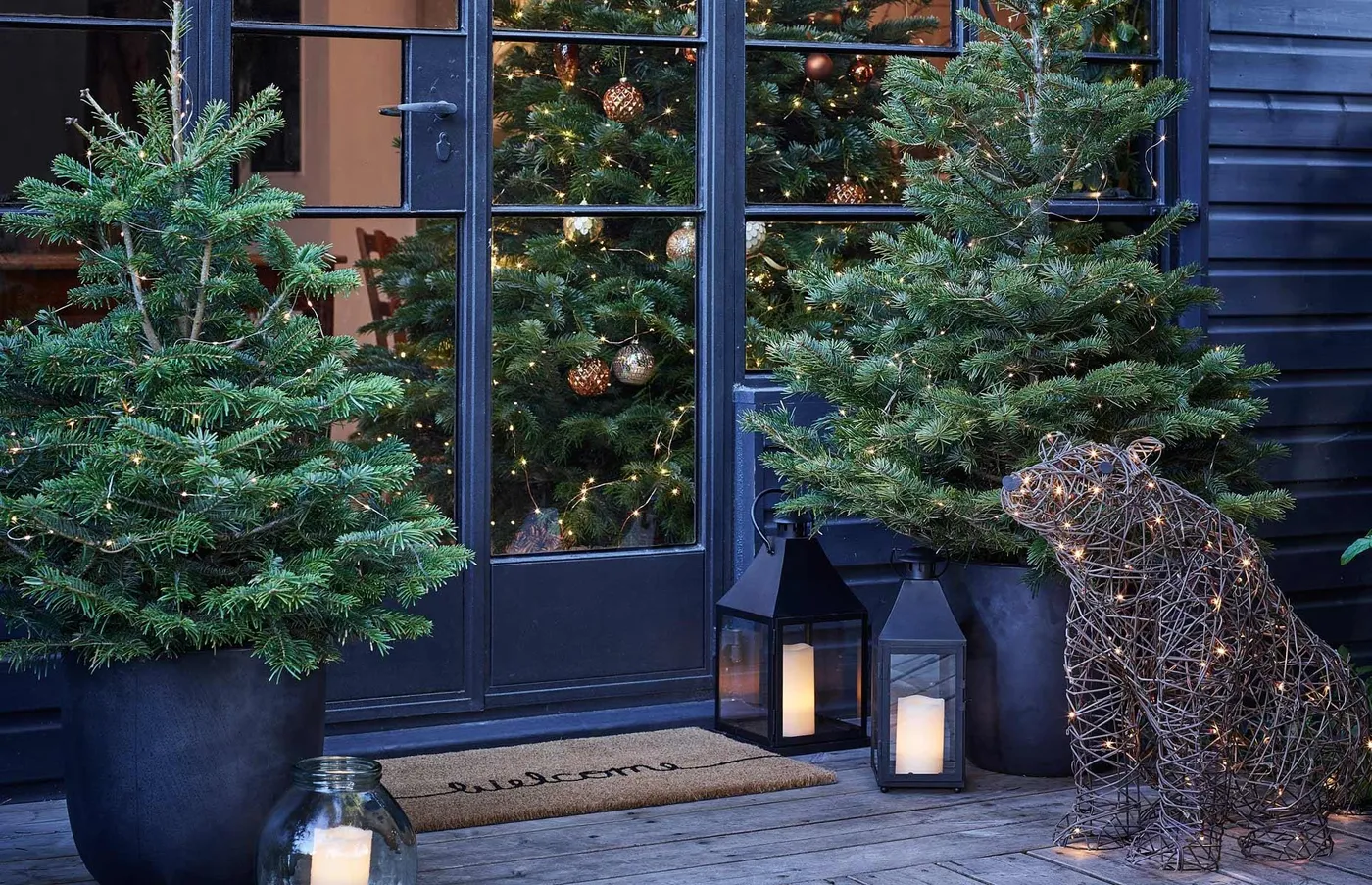
- Potted pines in dark planters, two: $60–$160
- Fairy string lights for the pines: $15–$35
- Lit wireframe bear or similar figure: $50–$180
- Black metal candle lanterns plus LED candles: $30–$70
- Textured welcome mat and outdoor glass jar: $25–$55
- Total: roughly $180–$500
12. Magenta Velvet Bows on Evergreen Wreaths Across a White Porch
Magenta bows look custom and cost almost nothing. A 10-yard spool of 4-inch wire-edge velvet runs about $15 to $25 at most craft stores, and that’s enough for three or four wreaths if you tie simple two-loop bows instead of twelve-loop showpieces. For the planters, boxwood spheres from a discount store are $12 to $18 each versus $60 and up for the nursery version — and inside a white rectangular box, nobody can tell. Total for a porch that photographs like a designer install: under $150 if you reuse wreaths you already own.
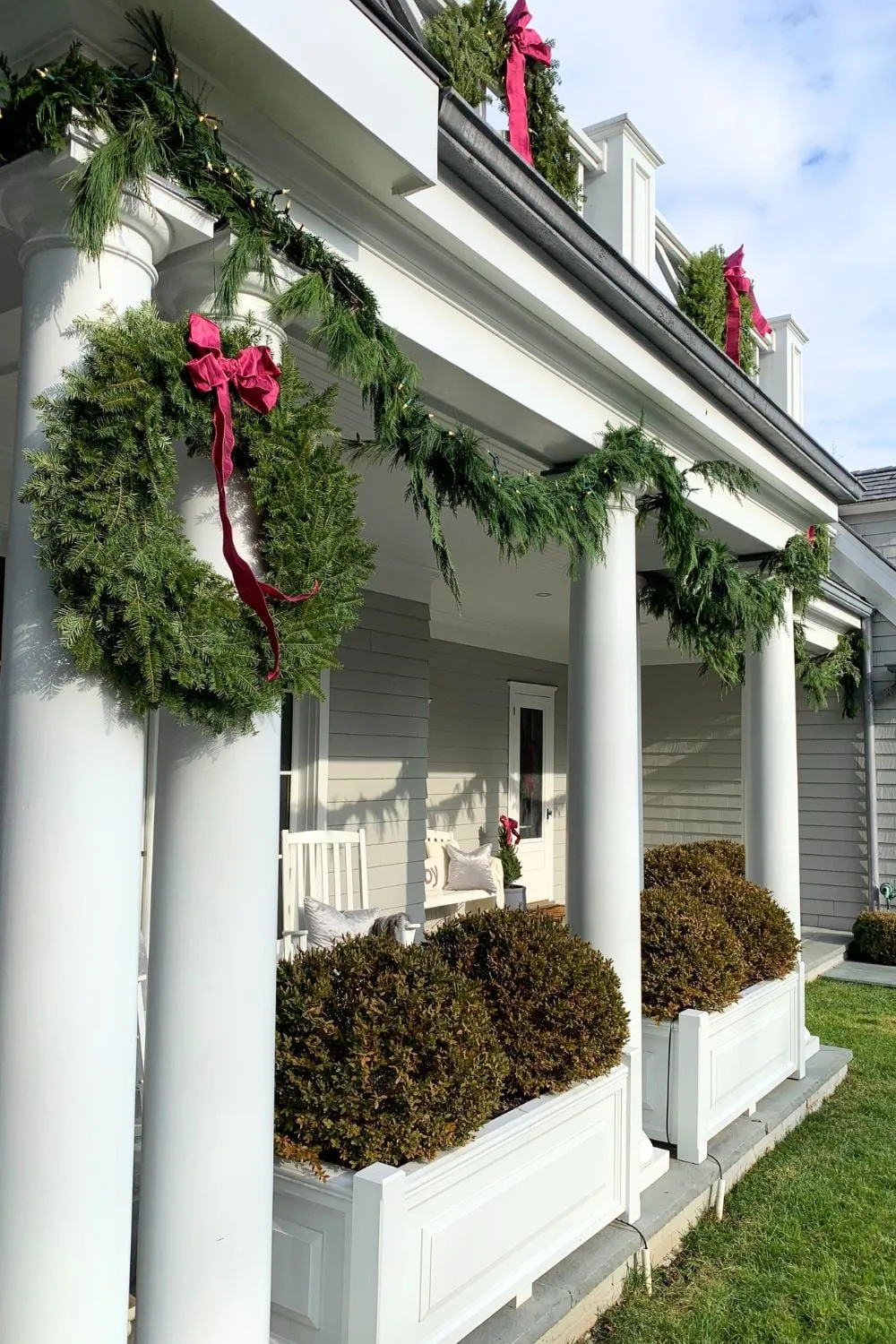
Wire-edge ribbon is what makes outdoor bows hold their shape through weather. Cut tails on a diagonal, seal the ends with a quick pass of a lighter to stop fraying, and always attach with a zip tie behind the bow rather than tying it directly to the wreath — that way you can retie in January without taking the wreath down. On a porch this crisp, skip glitter and skip wired mesh. Matte velvet and matte satin read expensive; anything shiny reads like a party store.
13. Fairy-Lit Outdoor Tree With Hand-Hung Burgundy Ornaments
- Choose shatterproof ornaments. Glass on an outdoor tree is a wind experiment you will lose.
- Twist wire hangers closed around the branch so ornaments can’t lift off in a gust.
- Hang the lower half denser than the top — the base is what people actually see from the path.
- Space large ornaments 10 to 12 inches apart so the fairy lights still show between them.
- Step back to the sidewalk after every six ornaments. Distance is the only honest test.
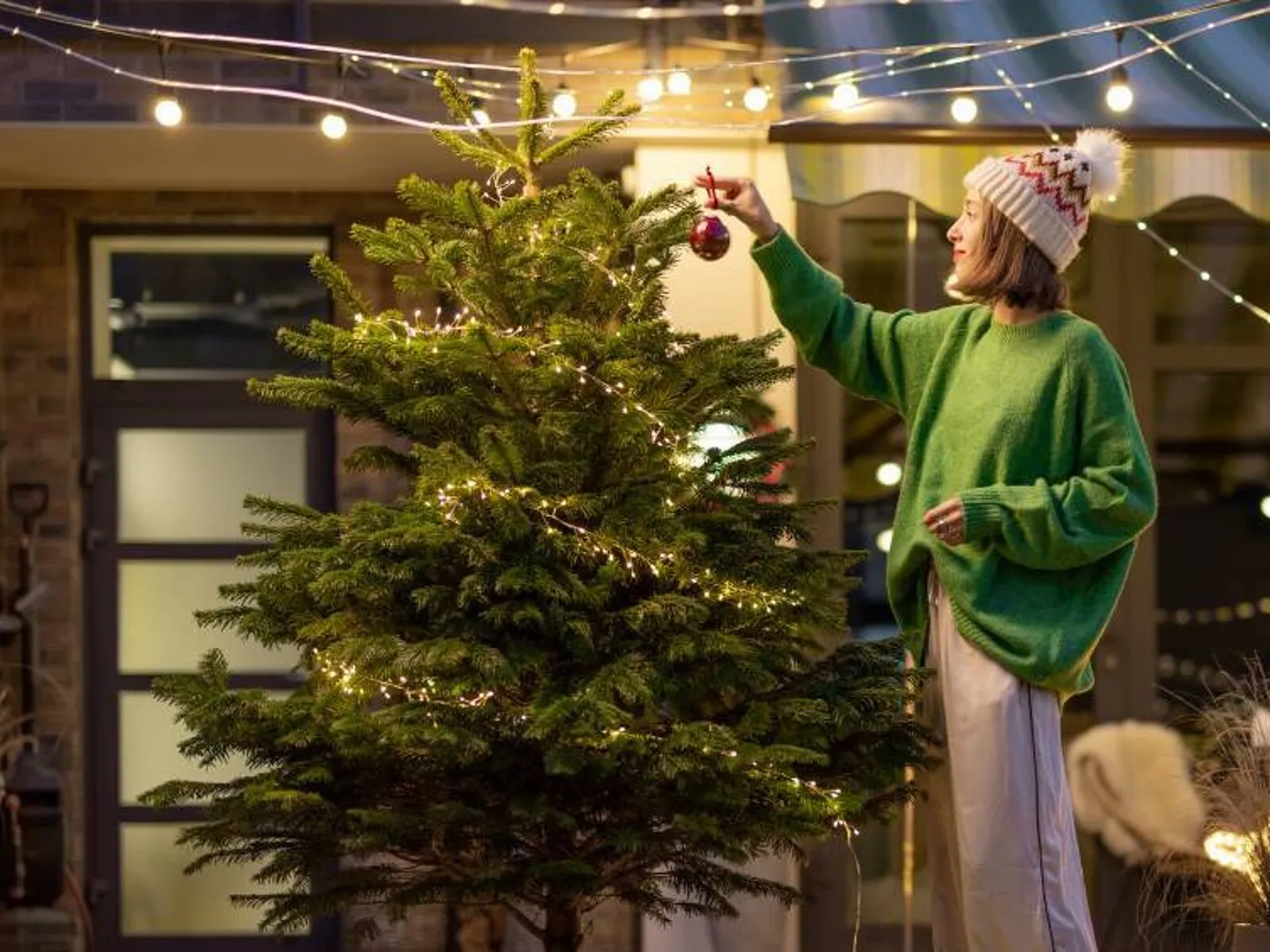
Twenty minutes, about $20 in shatterproof ornaments, and whatever lights you already own.
What makes a tree like this read as designed is negative space. The fairy lights aren’t there to be looked at — they’re there to make the gaps glow, and the ornaments are placed to create rhythm rather than coverage. A tree stuffed solid goes flat; a tree with three or four visible gaps stays dimensional. The best outdoor trees look like someone stopped while they were still enjoying themselves.
14. Icicle Lights and Wireframe Figures Across a Snowy Suburban Yard
Icicle lights are the most regretted purchase in holiday decorating, and it’s never about how they look in December. It’s that 300 feet of them tangles into a single fist-sized knot in storage, and untangling that knot is a two-hour job you will dread every November. Buy the kind that comes on a reel, label both ends with tape, and hang them with gutter clips so you never touch a staple gun near a roof edge. Be honest about the ladder too — if the second story is involved, this is a hire-someone job, not a Saturday project.
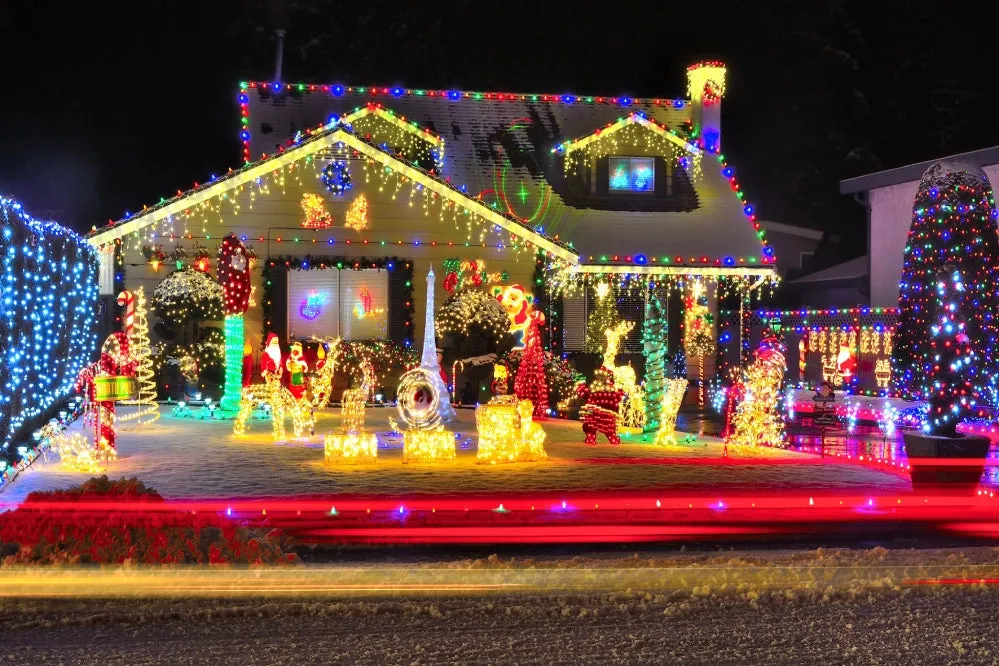
This look needs a facade. Figure on at least 60 feet of roofline and a yard wide enough that the figures don’t crowd each other — a 40-foot frontage with six lit pieces will look like a traffic jam. Snowy ground genuinely helps by reflecting upward and filling dark patches. On a narrower lot, the cool two-color approach in Idea #6 reads bigger than multicolor, because fewer colors travel further at a distance.
15. Red and Green Laser Projection Splashed Over a Brick Facade
Laser projectors are the reason your neighbor’s brick house looks like it’s been sprinkled with confetti, and they are genuinely the fastest outdoor decorating upgrade on the market. One unit covers a two-story facade in about ten minutes with no ladder, no clips, no tangled cord — which is exactly why they’ve moved from novelty to mainstream over the last two Decembers. The catch is that they’re a one-note look. They write a pattern across a surface; they don’t build depth. So they work best as a base layer, with a wreath or a set of planters doing the dimensional work on top.
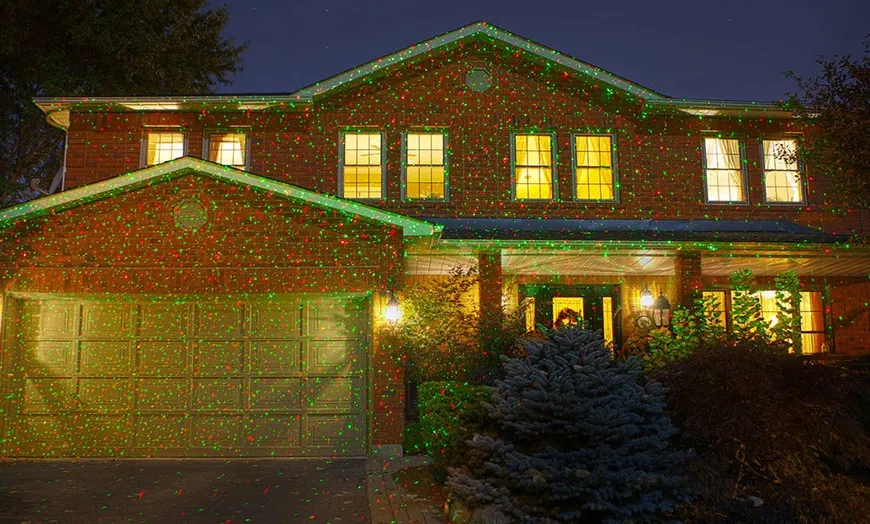
Upkeep is minimal but not zero. Aim the unit so the pattern lands on the facade and not on a neighbor’s bedroom window, and re-aim after any big wind, because these things drift. Cold snaps below zero shorten the life of cheaper units, and the internal fans get audibly loud. Expect two to four seasons before the diode dims. Bring the projector inside when the season ends — a unit left in a damp garage will fog its own lens by next December.
16. A Bold Red Exclamation Graphic as a Cheeky Yard Warning Sign
You don’t need a custom sign shop for this one. A 24-by-18-inch corrugated plastic yard sign printed with a solid red circle and exclamation mark runs about $15 to $25 online, and a plain black foam board from the craft aisle with a hand-cut circle brings it under $8. Stick two wire H-stakes in the back and it stands in a planting bed like any real estate sign. Want it to glow after dark? Trace the circle with a short run of red LED tape and plug it into the same timer as everything else.
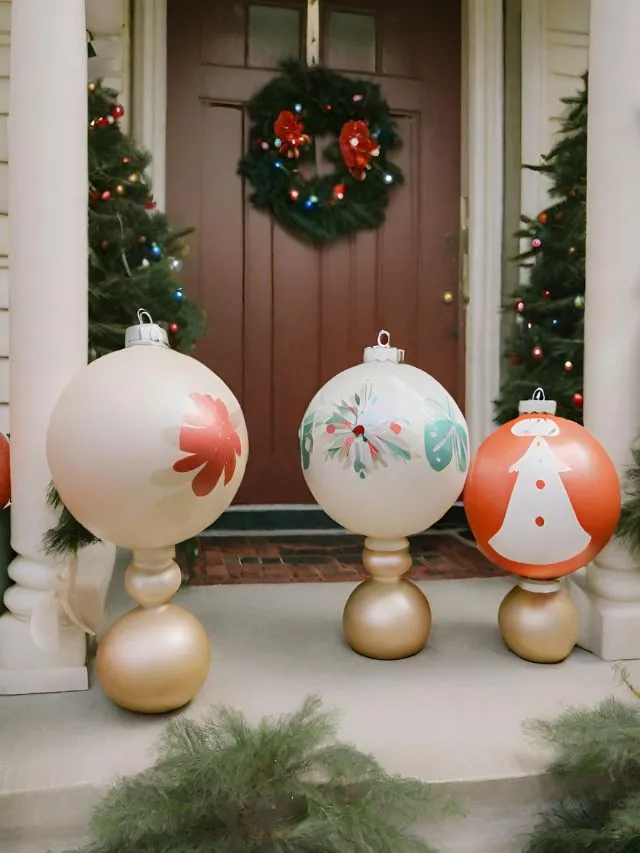
Be careful with tone here, because a red exclamation point is universal shorthand for danger, and some guests — and delivery drivers — will honestly read it as a warning instead of a joke. The fix is context. Pair it with something obviously festive at the base, like a lit wreath or a pair of potted evergreens, so the graphic reads as a caption rather than an alert. Keep it under 2 feet tall, out of the walking path, and check your HOA rules before you commit to signage.
17. Wire Mesh Reindeer Family With Red Bows and Mini Window Wreaths
The red bows are the thread here. Reindeer with red ribbon necks, small green window wreaths with matching red ribbon — same color, two different scales, one visual conversation between the yard and the house. Without that repetition you’d have a reindeer family on the lawn and some wreaths on the windows: two separate projects that happen to share a property. With it, the whole scene reads as one display, and the eye travels from the snow up the gray stone wall without ever stopping. Cheap ribbon, disproportionate payoff.
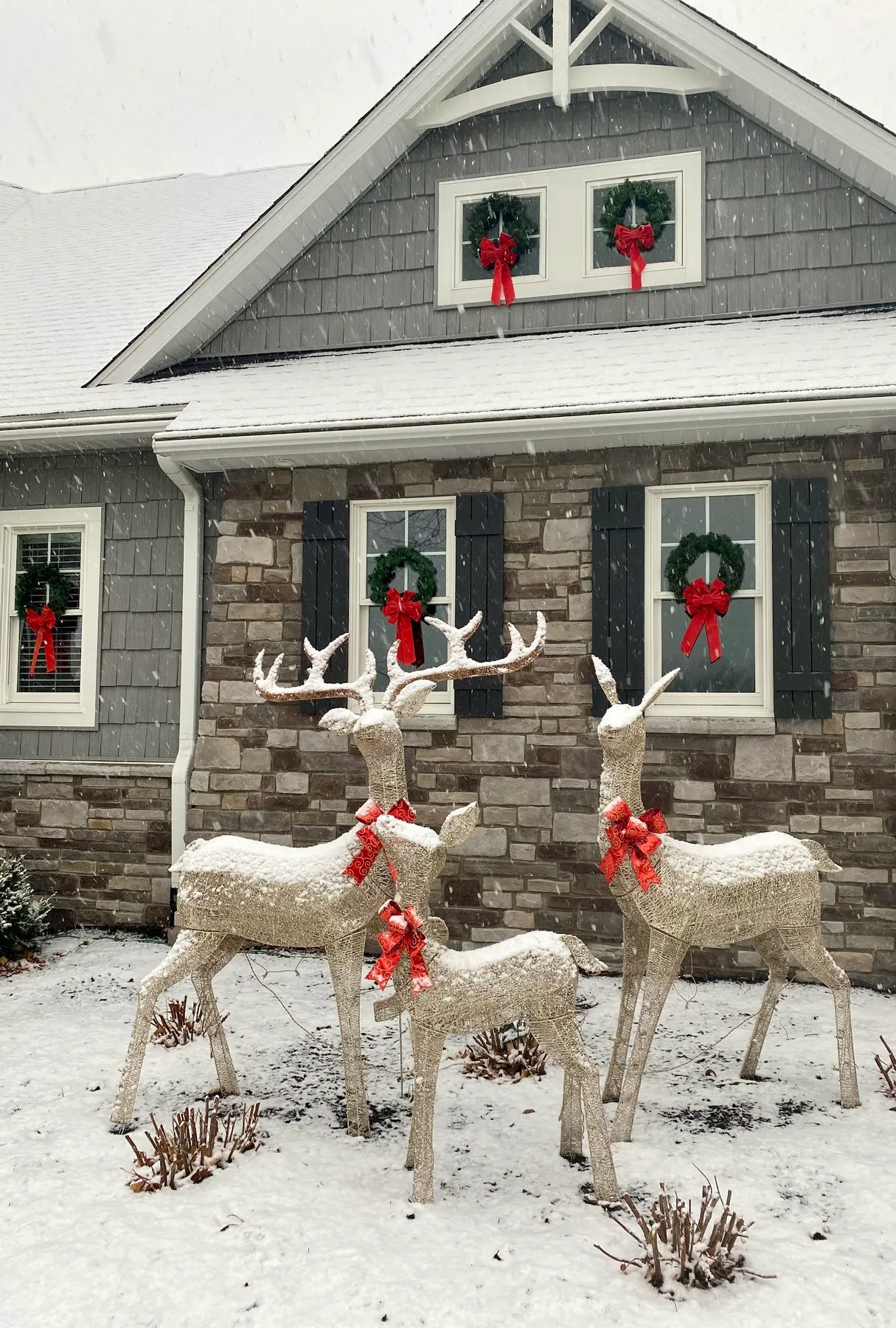
- Measure your window panes before buying — small wreaths want to be roughly a third of the glass width.
- Stake the reindeer family with the included ground stakes and give each figure at least 3 feet of breathing room.
- Confirm cord reach from the nearest outlet to the farthest figure, and grab a 25-foot outdoor extension if you’re short.
- Clear snow away from where cords meet the ground so connections stay dry.
One more thing worth knowing before you commit: a few setups in our mistakes section further down look gorgeous in photos and fall apart in real weather.
18. A Wooden Board Snowman Built From Three Stacked White Plates
- Sand and stain a vertical plank about 5 feet tall, then seal it for outdoor use.
- Mount three white ceramic or enamel plates down the center with exterior-grade adhesive plus a screw in each.
- Attach a dark-stained hat brim — a small round plaque works — above the top plate.
- Add a scarf and mittens using rusty wire or twine so they drape instead of glue flat.
- Set birch log segments and pine branches at the base, then lean the whole thing against the siding.
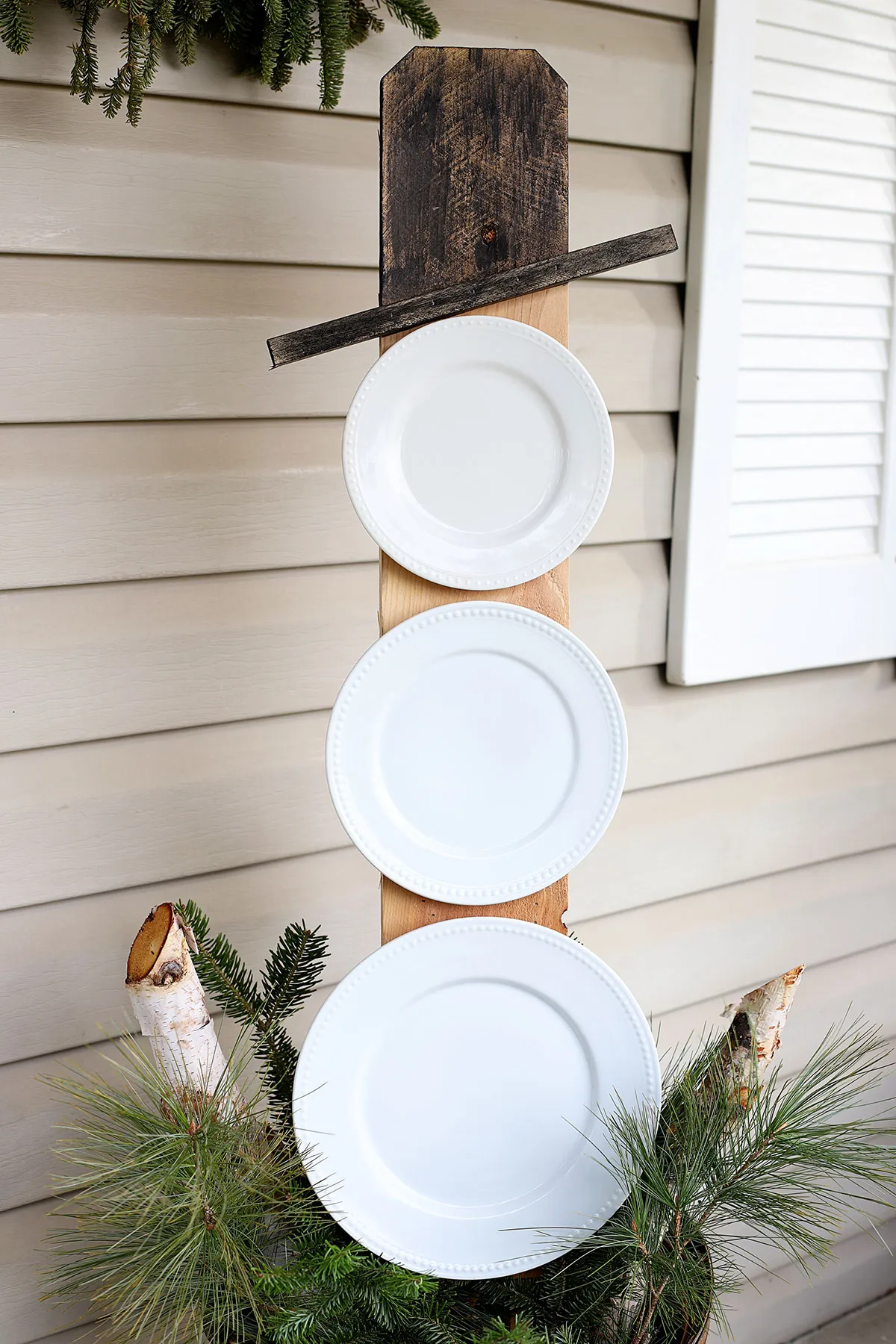
An afternoon and roughly $20 if you already have a piece of scrap lumber.
The palette formula is about 70 percent natural wood, 20 percent white, and 10 percent dark brown with a whisper of green. That heavy wood share is what keeps this from looking like a craft-fair project — the plates read as white buttons on a warm neutral surface, and the dark hat gives the eye somewhere to anchor at the top. Swap plates for pale galvanized metal discs and it turns industrial. Swap the hat for a knit beanie and it goes full whimsical. Either way, keep the wood dominant.
19. Stacked Firewood and a Wooden Crate Dressed With Pine Boughs
Stack your firewood end-grain out, and vary the log diameters so the pile has texture instead of reading as a wall of circles. Keep the arrangement at least 3 feet from the door — firewood near an entry is an invitation to insects, and the same clearance keeps snowmelt from soaking the bottom course. Weave one strand of warm string lights through the top third of the pile rather than wrapping the whole thing, then tuck pinecones into the gaps where logs don’t quite meet. Five minutes of styling turns a woodpile into decor.
- Firewood, one face cord: $80–$200
- Rustic wooden crate or bin: $35–$90
- Fresh pine boughs and pinecones: $20–$45
- Warm white string lights with a timer: $20–$40
- Total: roughly $155–$375
Budget version: free wood from a storm-downed branch, a Marketplace crate at $15, and greenery clipped from your own shrubs. Under $50 if you own lights. It pairs beautifully with the post garland in Idea #10.
20. Cascading Warm White Lights Draped Through a Mature Tree
It’s vertical repetition, and that’s the entire trick. Lights dropping in parallel strands from a canopy create dozens of soft vertical lines, and vertical lines make a space feel taller — which, outdoors, reads as magic. Single strands, evenly spaced, no cross-hatching. Then the warm color temperature does the rest, because there’s nothing else glowing nearby to compete with it. Notice too that the base of the trunk is left dark and the light only begins where the branches do. That darkness underneath is what makes the canopy look like it’s floating above the lawn.
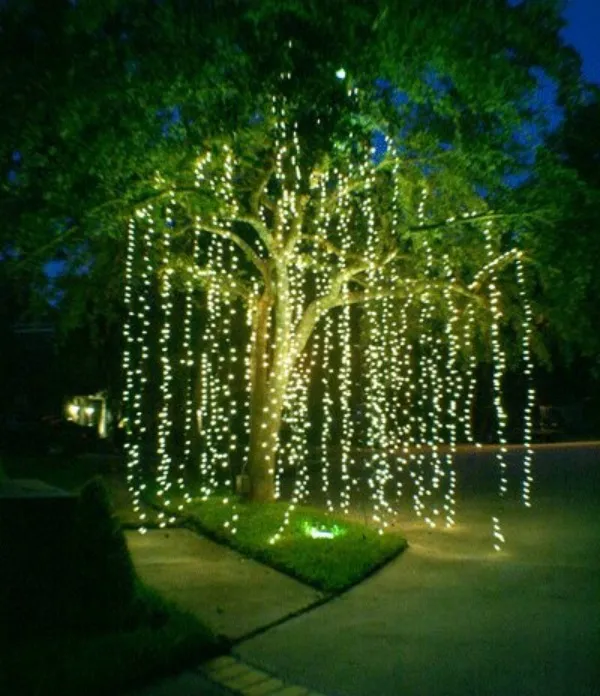
You need a tree at least 15 feet tall with a canopy wide enough to strand — think mature maple or oak, 25 feet or more across. Count on 300 to 500 feet of light for a tree that size, plus some way to reach the upper branches. A pole pruner with a hook handles everything under 20 feet; beyond that you’re renting a lift. On a small lot this idea overwhelms the house, because fewer feet of glow in a tighter footprint feels generous instead of sprawling.
21. A Tiny Potted Pine and Glitter Reindeer on a Window Ledge
Small moments are having a season. After years of maximalism and full-yard light shows, the most-saved holiday photos right now are tiny, tightly edited vignettes — one potted evergreen, a pair of figurines, a wreath, nothing else. Part of that is apartment and rental living, where a yard display simply isn’t an option. Part of it is people decluttering and wanting twelve good objects instead of sixty. A galvanized bucket on a white window ledge delivers the same finished feeling as a decorated porch, at a fraction of the effort.
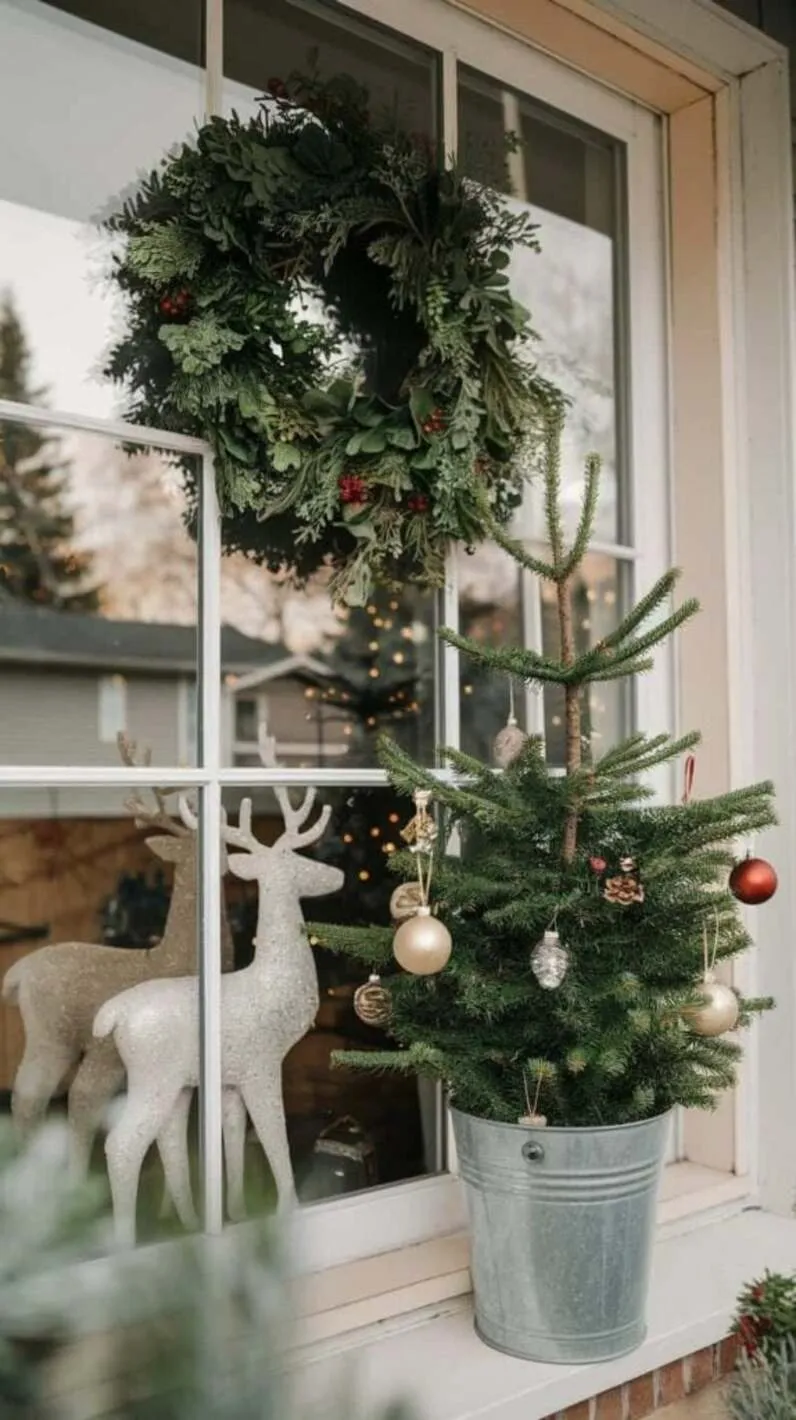
The whole vignette can come in under $40. A small potted evergreen is $12 to $20 at any grocery store in December, and a galvanized bucket runs about $8 at Walmart or a farm store. Glitter reindeer figurines are the easiest thrift-store find of the year — usually $2 to $5 apiece, and two is plenty. Hang a simple green wreath with red berries above for $15 and you’ve built a scene that photographs like it belongs in a catalog.
22. A Light-Strung Cone Tree With Glowing Spherical Bushes
Build the cone tree from an inverted tomato cage and it costs about $15. Zip-tie the three legs together at the top, then wrap from the bottom up with 100 feet of LED string, keeping the coils tight at the base and slightly looser as the cone narrows. For the glowing spheres, bend chicken wire into a ball, stuff it with a 50-light strand, and hang or stake it — a set of three takes an evening and about $30 in materials. Buy lights in bulk spools rather than pre-wrapped sets, or you’ll pay triple for half the length.
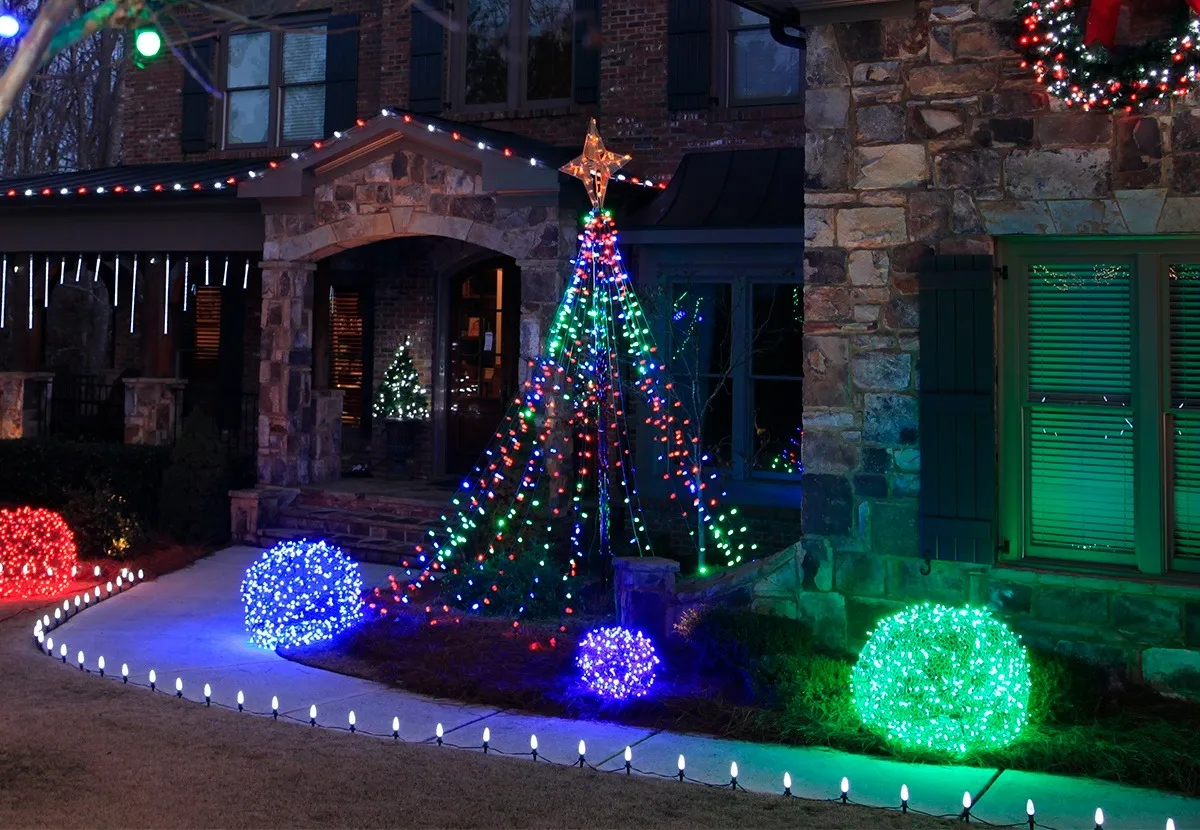
Color is where this yard succeeds: red, blue, and green are distributed evenly instead of grouped, so no single color owns a corner of the property. Roughly 40 percent warm white for the roofline and pathway, then 20 percent each of red, blue, and green through the bushes and figures. To shift the mood, keep the warm white and swap the trio for all-blue for something icy, or all-red for something dramatic. Just don’t add a fourth color. Three reads intentional; four reads accidental.
23. Palm Trees and Log Reindeer Around a Tiered Fiber Tree
Natural wood outdoors is a commitment, not an installation. Log reindeer and fiber trees will grey out within a season unless you seal them — a coat of exterior spar urethane in October buys you two or three winters, and re-coating takes an afternoon. Keep wooden pieces off direct soil contact with a paver or a small deck block underneath, because ground moisture rots the base first. In humid climates, check for insects and mold after rainy stretches. Bring the small figurines and stacked presents inside when the season ends; they’re the pieces that won’t survive a full year outdoors.
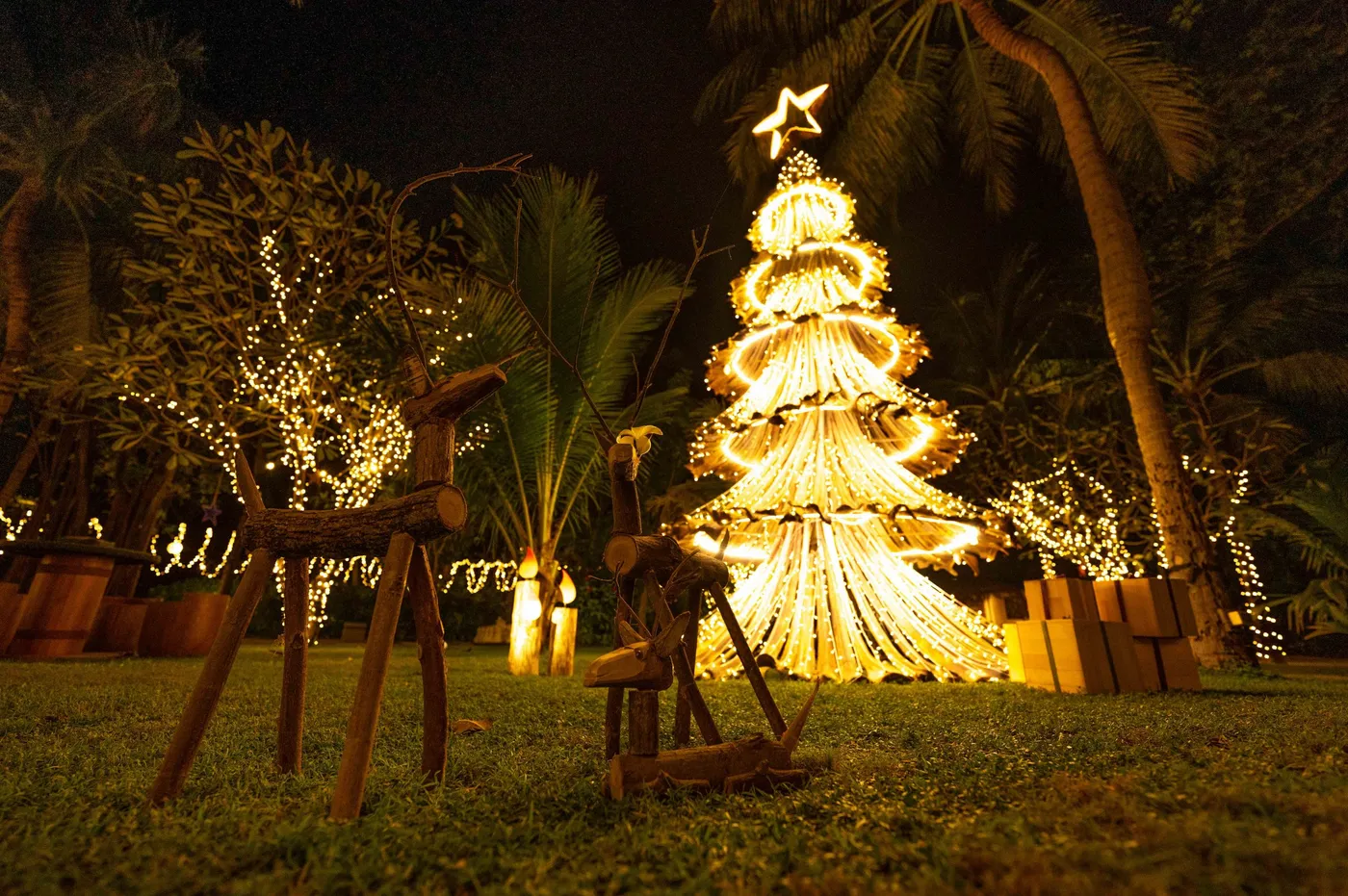
What makes the tropical version work is material contrast rather than color. Everything here is warm yellow light and natural brown wood, and the palm silhouettes behind it are doing the same job a snowdrift would in a colder yard — providing a dark, unfamiliar backdrop that makes the glow feel warmer. Fiber and wood also absorb light instead of reflecting it, so the display reads soft and low-contrast, more like a fire than a show. In a region without snow, that softness is the entire aesthetic.
24. Warm White Rooflines With Multi-Color Wrapped Trees and Bushes
- Warm white roofline LED strings, 200 ft: $60–$150
- Multi-color strings for trunks and branches, 300 ft: $90–$200
- Lights for eight to ten shrubs: $50–$120
- Gutter clips, stakes, and outdoor extension cords: $35–$80
- Total: roughly $235–$550
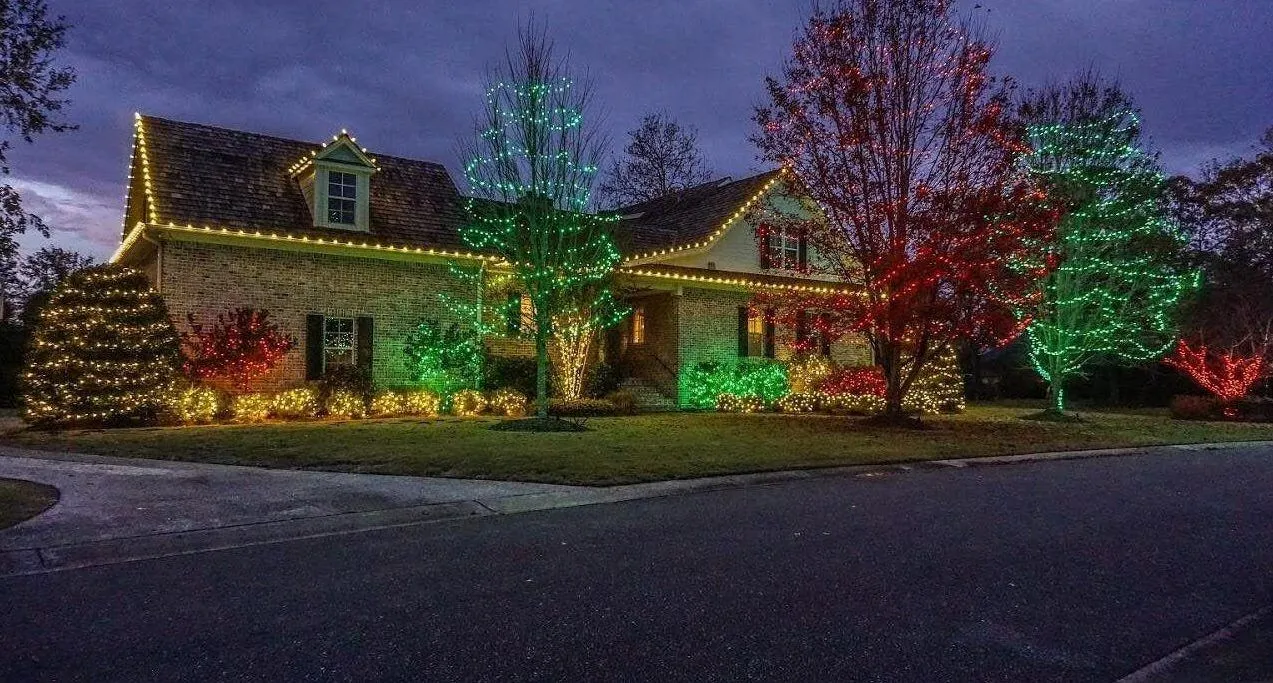
Budget version: buy three 100-foot color spools on clearance in early January for the following year, wrap only the four shrubs closest to the walk, and let the roofline do the rest. Around $120, and it reads nearly the same from the street.
Wrapping shrubs and trunks is a big-facade move. Below about 30 feet of frontage, wrapping everything makes a house look swallowed — pick the two bushes framing the entry and stop there. The roofline is what actually holds a wide house together, so put your money there first and treat the wrapped trees as accents. Gabled and hipped rooflines with multiple planes eat more light than you’d expect, so measure the full perimeter of the eaves, not just the front-facing edge, before you order.
25. Galvanized Buckets of Birch Logs Along Lit Stair Railings
The galvanized buckets are the quiet hero. Garland on a railing is standard; garland on a railing with a matching bucket at every third step is a composition. It’s the repetition that does it — the same silver cylinder, the same birch logs, appearing at a steady interval as your eye climbs. Remove the buckets and the stairs are decorated. Keep them and the stairs have rhythm, which is the thing your eye actually reads from the sidewalk. Three or four buckets is plenty; more and it starts looking like storage.
Railings are where outdoor garland goes wrong, because wind turns a loose strand into a sail. Zip-tie at every baluster, not every third, and use wire-core garland so it holds the sweep of the rail instead of drooping between ties. Real greens will freeze and shed; that’s fine, just keep a broom by the door. Galvanized buckets hold up for years outdoors, but the zinc dulls to a soft gray — which honestly looks better. Skip fresh-cut greens in the bucket if you live in a freeze-thaw climate. The mush is memorable for the wrong reason.
26. Basket-Hung Plate Snowman With Vintage Ice Skates and Wreath
- Confirm the basket can hold weight — hang from a stud or a rated exterior hook, never a nail in siding.
- Check that the wreath and skates land at eye level from the walkway, roughly 5.5 to 6 feet up.
- Verify the plates are glazed ceramic or enamel. Unglazed clay will stain outdoors.
- Plan for wind. Anything hung on siding needs a bottom anchor or it swings and chips.
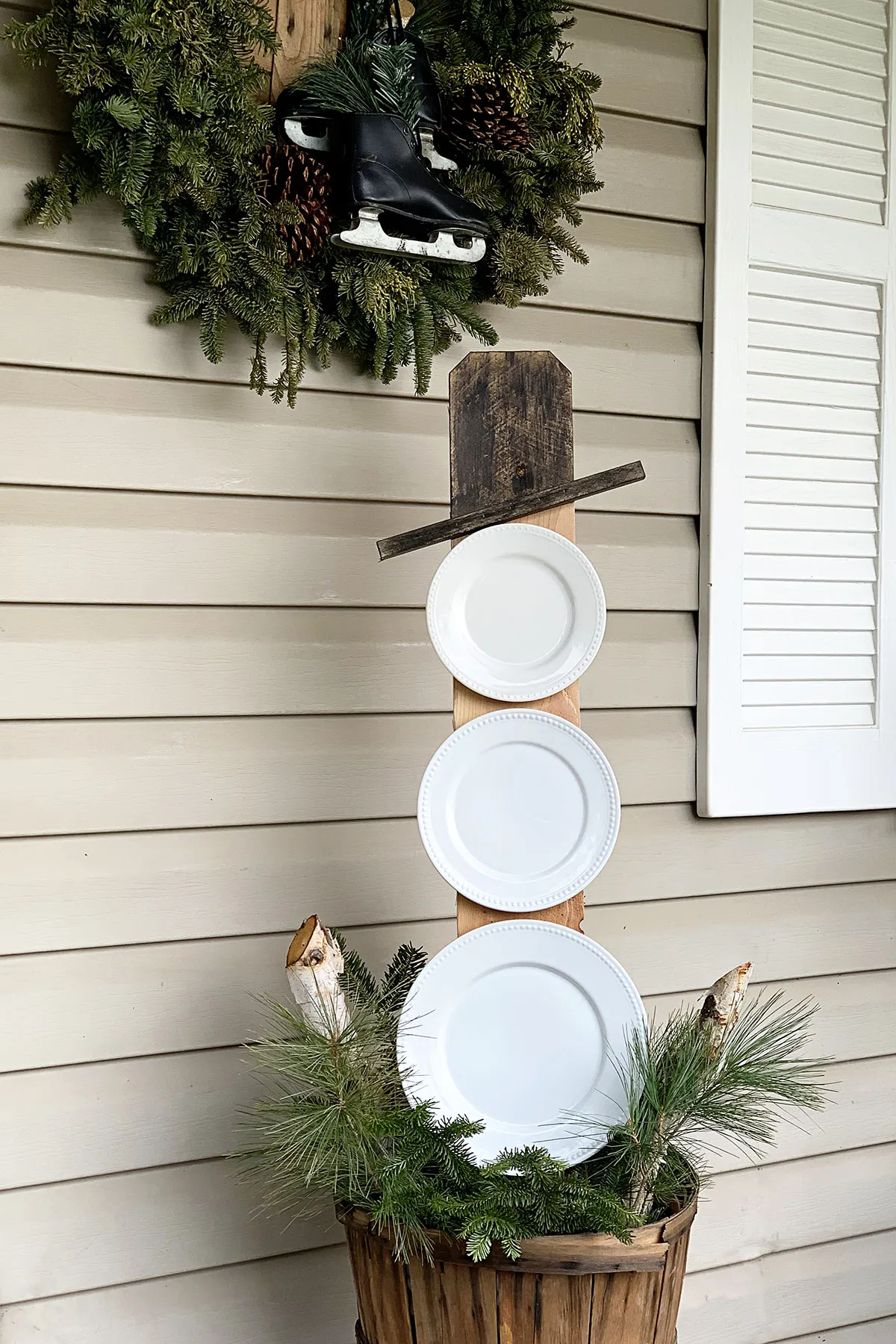
Once the basket is secure, the styling takes about twenty minutes.
- Wire the skate blades together and hide the wire behind the wreath ring.
- Hang the wreath first, then lace the skates through so they cross naturally.
- Tuck pine branches behind the basket rim to blur the hardware.
- Set birch logs upright in the basket and lean one against the wall.
- Zip a small battery fairy strand to the back of the wreath for a soft glow.
Roughly 20 minutes, and about $10 in greenery if the wreath and skates came from a thrift store.
Now Go Make the Whole Block Slow Down
Start with the one spot you see from your own car every night — the walkway, the railing, the porch post — and build outward from there. You don’t need the whole list, and you definitely don’t need the whole budget. You need one idea done properly, on a timer, before the first freeze.
📌 Save this to Pinterest before you start shopping — next November, you’ll be very glad you did.
