
29+ Stunning Quilted Tree Skirt Ideas You Need to See for a Dreamy Christmas 2026
You know that feeling when you finally find the tree skirt that looks exactly right for your space — and then realize it’s the one thing everyone will see in every Christmas morning photo? Quilted tree skirts are having a serious moment on Pinterest right now, and not because they’re trendy in a flash-in-the-pan way. It’s because they’re the rare holiday piece that gets unpacked every December for twenty years and still looks like it was made by someone’s grandmother with excellent taste.
After filtering through hundreds of options across Etsy, Target, Walmart, Pottery Barn, and Anthropologie, we narrowed it down to 29 ideas that actually deliver — from under $30 to just past $400. Some are full-on patchwork heirlooms, others are clean white quilted minimalists, and a few are so specific (equestrian hunt scenes, anyone?) that you’ll want them for the story alone.
You’ll find traditional patchwork, appliquéd botanical prints, rag-quilt texture, scalloped bindings, and velvet panels — with budget and luxury versions compared side by side. In 2026, quilted textiles are the counter-move to mass-produced holiday decor: people want stitching they can see and fabric that lasts. 📌 Save this to Pinterest for later — you’ll want to revisit these ideas.
1. Patchwork Blocks with a Delicate Lace Ruffle
What makes this skirt read as an heirloom rather than a craft-project is the contrast between dense and light. The patchwork body is all small-scale florals and berry prints in red, black, and cream — busy, warm, full of visual texture. Then a white lace ruffle appears at the hem and everything softens. That lace is doing the heavy lifting: it creates a light, scalloped silhouette against a dark wooden floor, so the skirt doesn’t look like a heavy circle of fabric sitting there.
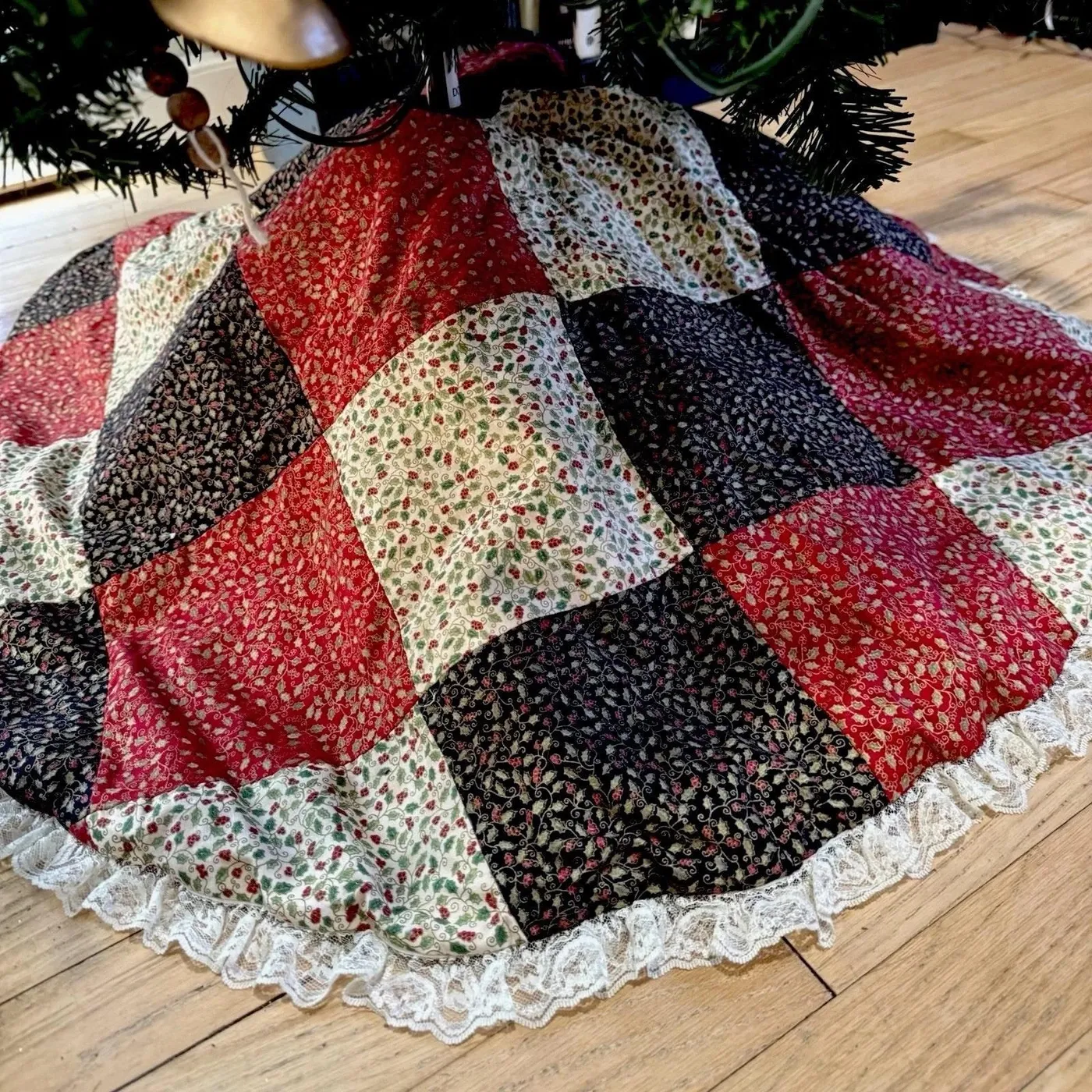
Here’s the practical takeaway for anyone building a patchwork piece: keep your blocks small. Squares roughly 4 to 6 inches across let you mix a dozen different prints without the quilt turning into visual chaos. Bigger blocks need bigger motifs, and holiday prints rarely scale up well.
The lace trim should be the only delicate element in the entire composition. Competing ruffle details at the ties or center opening will fight it and make the whole thing look fussy instead of charming.
2. Holly and Gold Vines in Four Quilted Triangles
Look closely and this is a lesson in restraint. Four triangular patches, each carrying the same holly leaf and berry motif in green, red, and cream — but two sit on black ground and two on red. The gold metallic swirls trace over the leaves and vines, catching whatever light hits them.
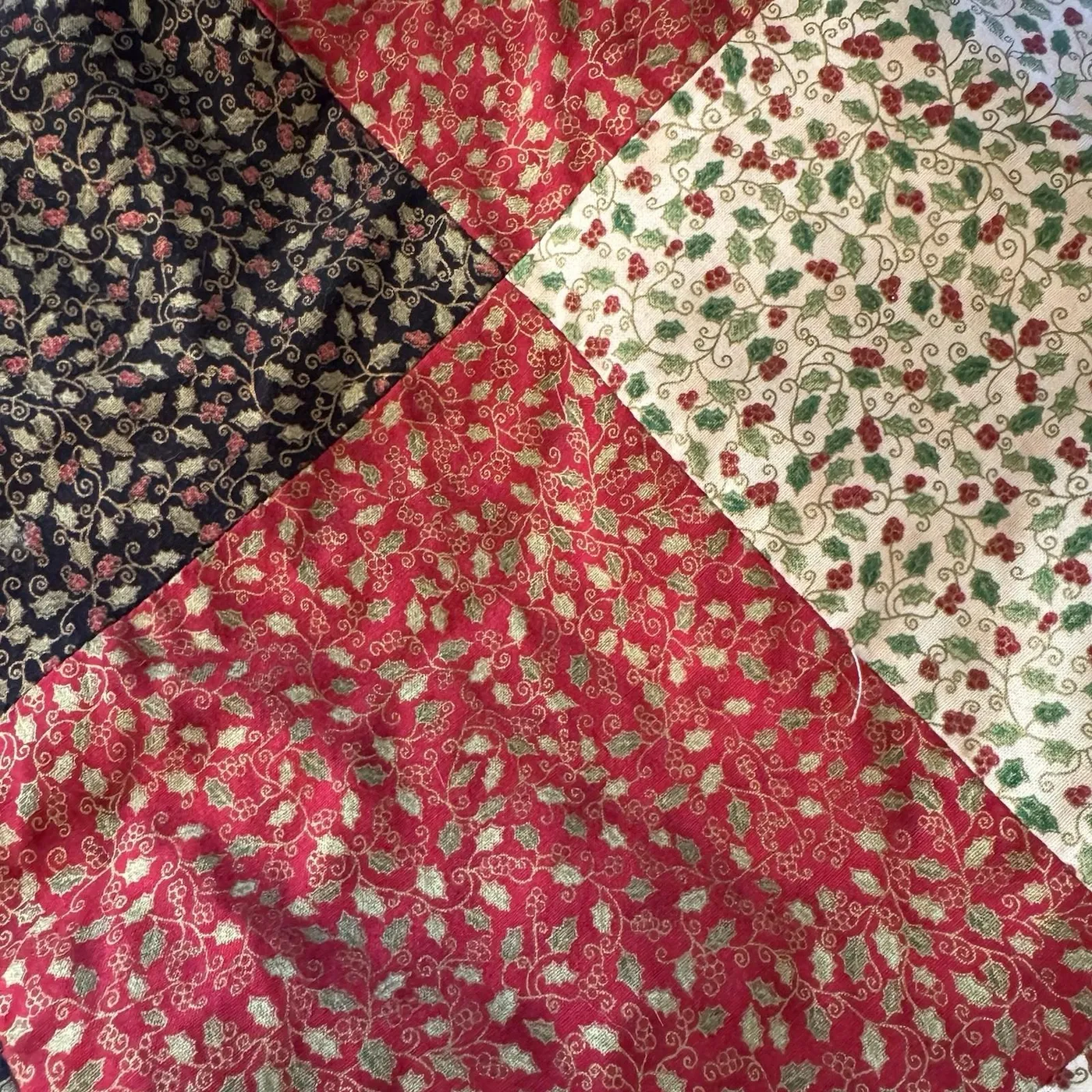
The formula here is roughly 45% black ground + 45% red ground + 10% gold metallic. That’s it. The black keeps the red from feeling sugary, and the gold gives the whole thing a warm shimmer that reads expensive without a single rhinestone. Swap the black for deep forest green and you’d get a softer, more rustic version of the same idea; swap the gold for silver and it turns cooler and more modern.
If you took the gold metallic thread out, you’d still have a perfectly nice quilted holly textile. But it would be flat. The metallic detail is the whole reason your eye keeps moving across the fabric.
3. Pinwheel Patchwork with a Charcoal Ribbed Border
The pinwheel geometry in the center is the star, but the dark ribbed band framing it is what makes the whole skirt look finished. That outer border creates a hard edge that separates the skirt from the light wooden floor — without it, all those cream and olive triangles would blur into the wood grain.
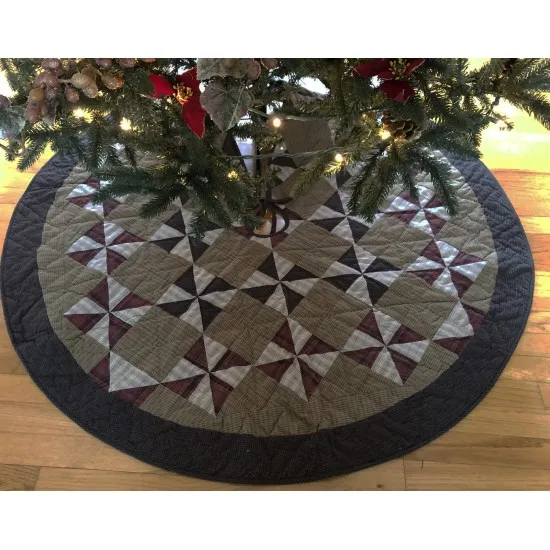
A concrete tip for anyone ordering or sewing a bordered skirt: your outer band should be at least 1.5 to 2 inches wide on a standard 48-inch skirt. Narrower than that and it reads as piping, not a border. Wider than 3 inches and you start eating into the patchwork real estate. Also make sure the ribbed band is cut on the crosswise grain so it holds its shape around the curve instead of rippling.
One honest note: dark charcoal and burgundy fabric on a floor that gets foot traffic will show lint and pet hair immediately. If your tree sits in the middle of a busy room, budget for a lint roller in the same drawer as the ornament hooks.
4. Floral, Geometric, and Car Prints All in One Skirt
There’s a whole genre of Christmas decor that treats the holidays as a maximalist permission slip, and this skirt is firmly in it. Floral motifs, geometric prints, and — yes — a border of little vintage cars all coexist in red, lime green, beige, and white. It shouldn’t work. It works because the color palette stays strict even while the prints run wild.
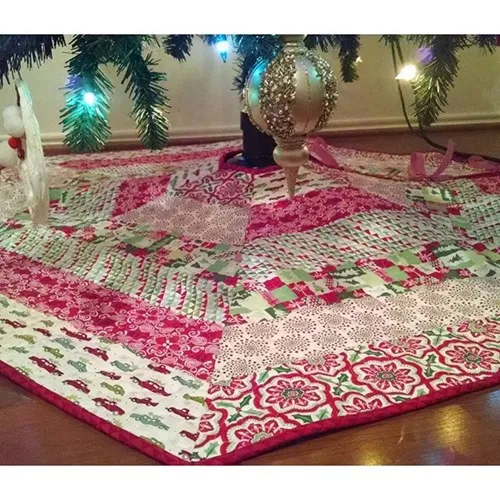
This kind of scrappy, collected patchwork is exactly what’s driving the 2026 shift away from matched sets. Designers are calling it “memory quilt” styling: fabrics that look like they came from different decades on purpose, because that’s what makes a room feel lived-in rather than catalog-fresh.
You can absolutely get this look without the price tag of a custom quilt. Buy a plain quilted skirt in a neutral, then layer a vintage Christmas tablecloth or a thrifted holiday apron over the top and stitch it down at the center opening. Facebook Marketplace and estate sales turn up old holiday fabrics constantly for $5 to $15. Nobody at Christmas dinner will know it wasn’t made that way.
5. Eyelet Ruffle Meets Kraft Paper and Pinecones
The styling around this skirt is as considered as the skirt itself: kraft paper gifts with plaid ribbon, loose pine branches, pinecones, dried orange slices, and cinnamon sticks. The patchwork squares in red, forest green, and cream are traditional, but the white eyelet ruffle at the edge keeps it from feeling like a 1990s catalog page.
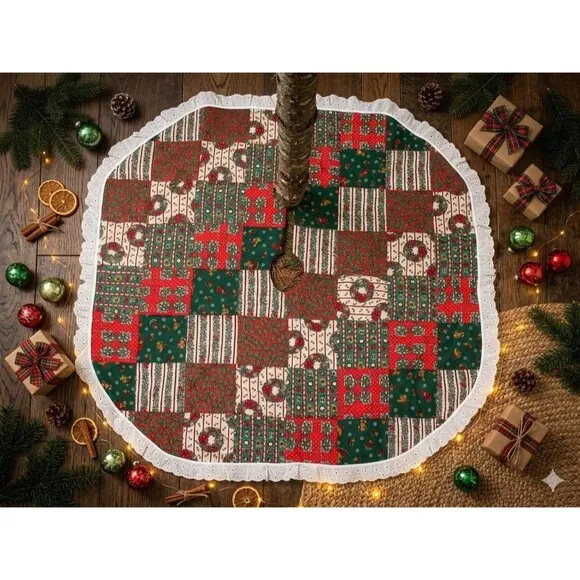
The one element you’d genuinely miss: the eyelet ruffle. Not the patchwork — you can find patchwork anywhere. The ruffle is what turns a flat circle into something with movement and shadow. Remove it and the skirt reverts to a disc on the floor.
For care, machine-wash eyelet on cold and lay it flat to dry. Never tumble — the trim will pucker along the seam and you’ll spend an hour with an iron trying to coax it back. Expect to spot-clean sap with rubbing alcohol on a cotton swab rather than washing the whole skirt mid-season. This square, roughly 4 to 5 feet across, suits rooms with at least 10 by 12 feet of floor space around the tree so the ruffle isn’t crushed against furniture.
6. Concentric Rings of Apple Print and Sage Green
This skirt is built in concentric rings rather than a straight grid, which creates a subtle checkerboard in deep red, bright apple-print red, sage, lime, and off-white. The apple motif squares and the text-print squares are what give it a distinctly country-kitchen personality rather than a generic holiday one.
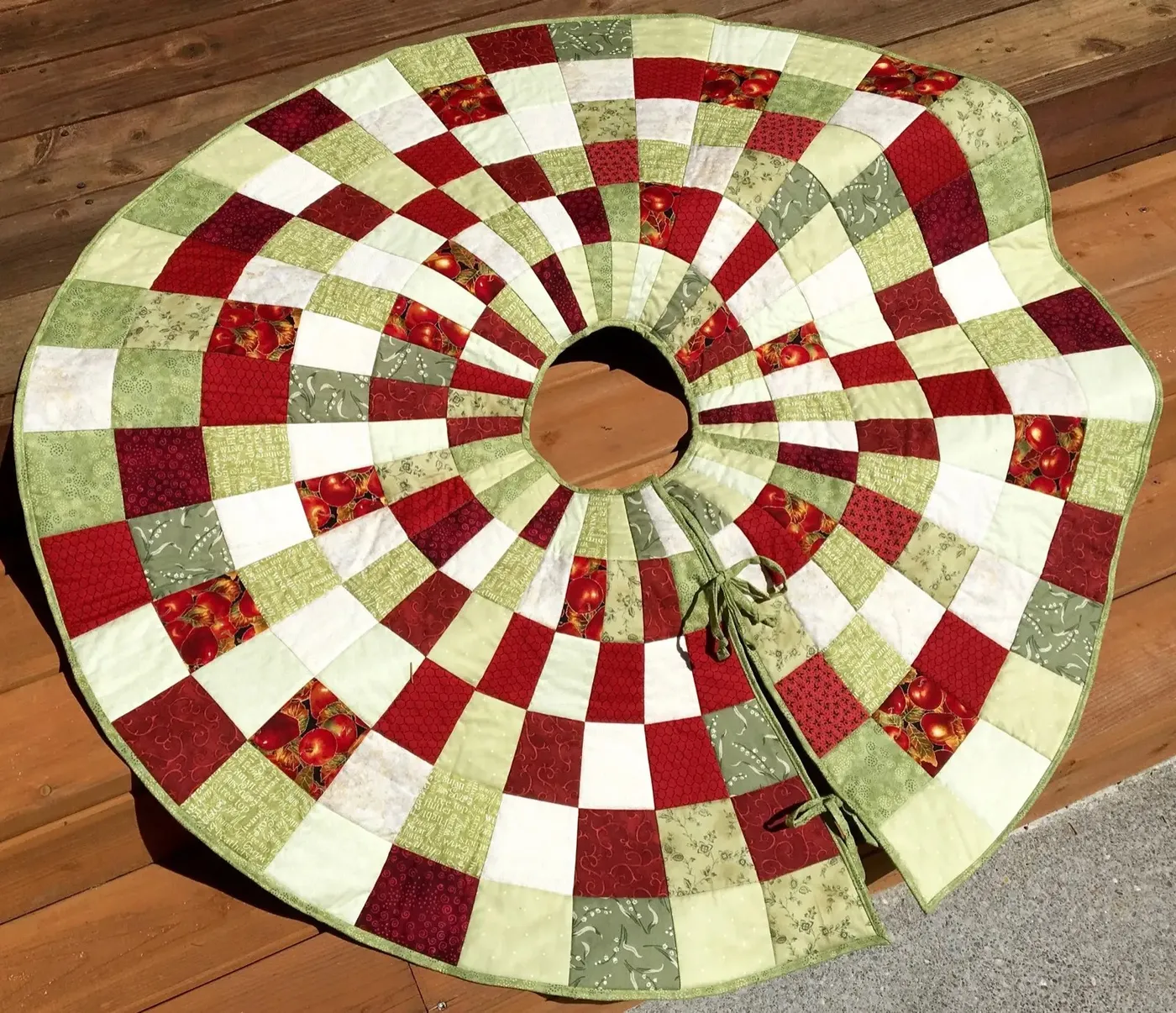
If you want to lay out a ring-based patchwork like this, the method is straightforward:
- Cut a paper template circle the full finished diameter of the skirt.
- Mark your center opening and divide the remaining ring into 12 equal wedges.
- Cut each wedge into 3 concentric arc bands of equal width.
- Cut fabric patches from each band, slightly oversized, and pin to the template.
- Stitch band by band, working outward, pressing seams flat as you go.
- Bind the outer edge and the center opening last with matching bias tape.
Budget about 8 to 12 hours for a 48-inch skirt and $40 to $60 in fabric if you’re buying fat quarters on sale.
The reason it looks cohesive rather than chaotic is repetition of scale — every print in the piece is small. No large focal motif anywhere. That’s the quiet rule that keeps a busy patchwork calm.
7. A Quilted Skirt That Reads as Instant Tradition
Quilted tree skirts like this one are popular for a simple reason — stitched fabric immediately reads as something that’s been in the family for years, even if it arrived in a plastic mailer last Tuesday. The quilting adds thickness too, which means the skirt sits flat and doesn’t slide around on hardwood the way thin cotton does.
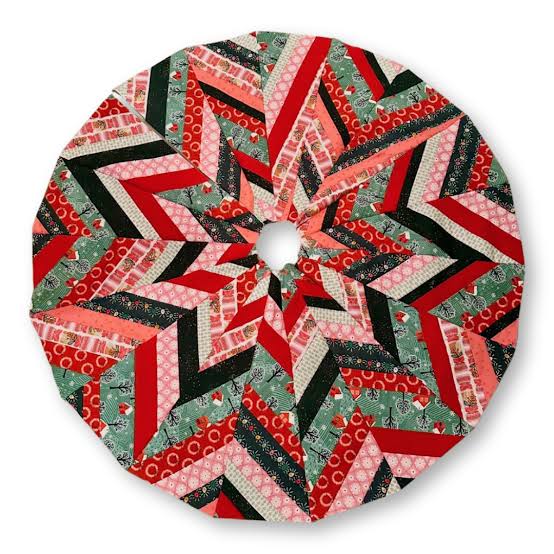
Before you commit, run through this:
- Measure your tree’s base spread and buy a skirt 4 to 6 inches wider so fabric doesn’t bunch at the trunk.
- Check the closure — ties, velcro, or snap. Ties are prettiest but slowest to fasten in a dim room.
- Confirm the center opening diameter clears your stand, usually 4 to 6 inches.
- Look at the underside. A lined skirt grips better and hides any batting puckers.
- Ask if it’s machine washable, then ask yourself if you’ll actually wash it.
One reality check: quilted skirts are heavier and bulkier to store than flat cotton ones. If your ornament bins are already at capacity, plan a spot in the attic for a rolled skirt before it arrives.
8. Reversible Mustard Botanical with Scalloped Binding
Two skirts in one: a mustard yellow botanical print on the outside, a cream ground with royal blue and burnt orange florals on the reverse, tied together by an orange binding and fabric ties. The diamond quilting runs through both layers so the pattern stays crisp instead of shifting.
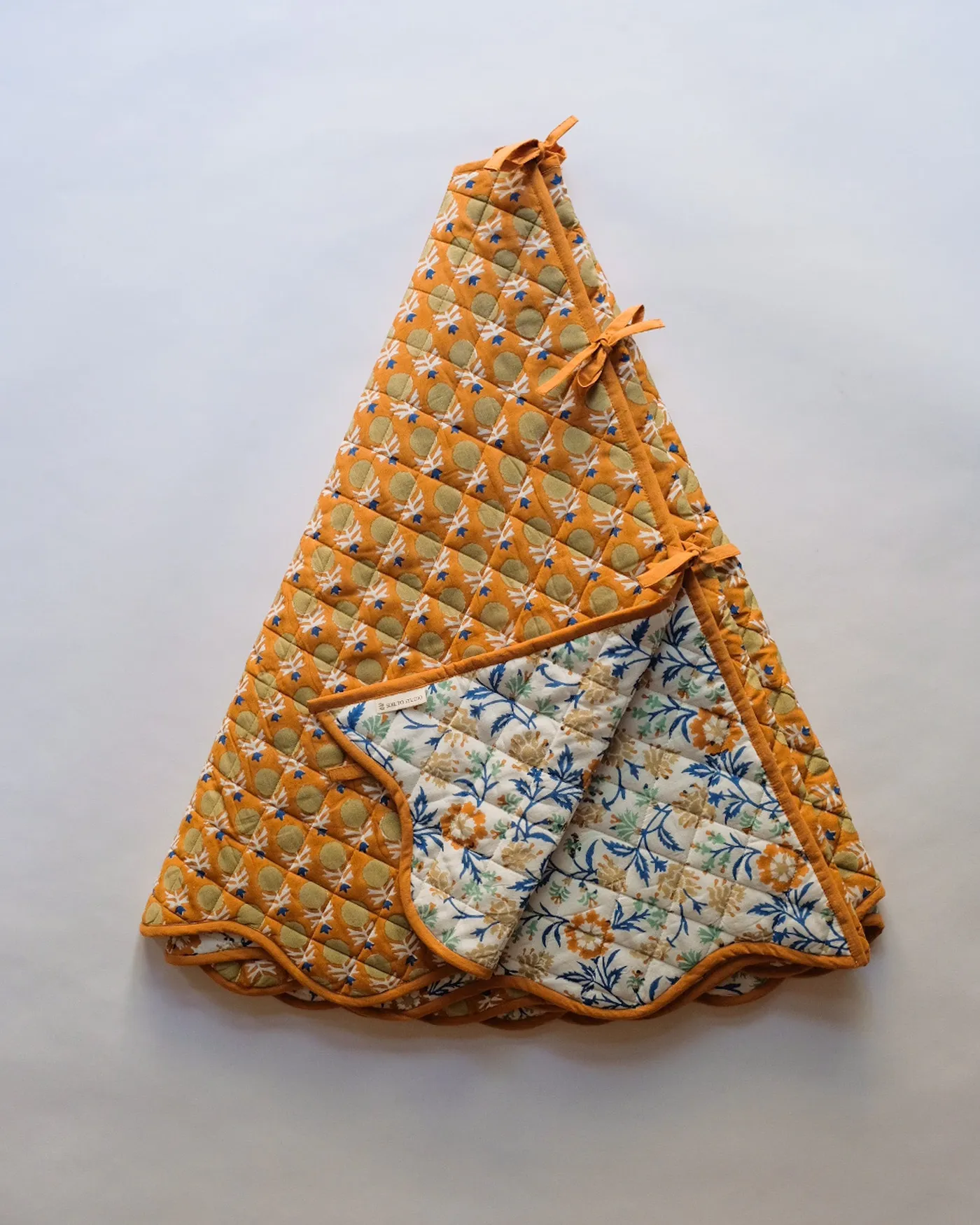
The scalloped edge and orange binding are the details that make this feel artisan rather than off-the-rack. Scallops also solve a real problem — they follow the curve of the skirt without the fabric bunching at the hem, which is something straight binding can fight you on.
A specific tip for anyone binding a curved edge: cut your binding strips on the bias and always stitch the curve with the binding underneath, guiding it gently with your fingers rather than pulling. Pulling stretches it and you’ll get waves you can’t press out. Also press your scallop template with a bone folder or a dull knife edge before turning — it makes a visible difference in how clean the points look.
9. Appliquéd Ornaments with Gold Swirl Embroidery
An off-white quilted ground with radial stitching, then four appliquéd ornaments — two red, two dark green — each finished with gold metallic swirl embroidery. A dark red trim circles both the outer edge and the center opening. It’s clean and traditional at the same time, which is a hard balance to hit.
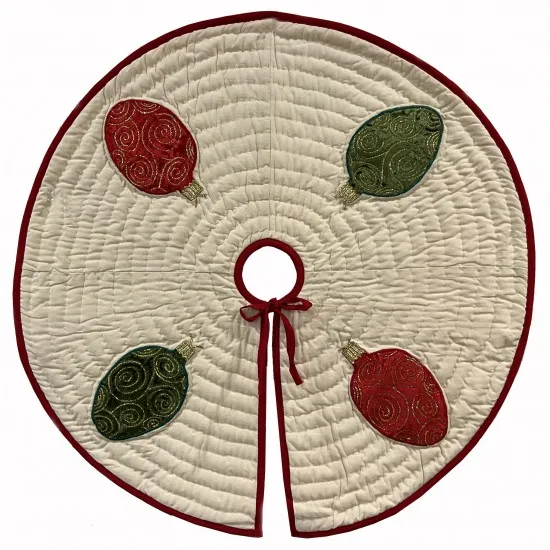
- Fabric and batting (quilted base): $35–$70
- Appliqué fabric scraps and interfacing: $10–$20
- Gold metallic embroidery thread: $6–$12
- Red bias trim and fabric ties: $8–$15
- Labor or commission cost if outsourced: $60–$180
- Total (DIY): $59–$117
A budget alternative: start with a ready-made off-white quilted skirt for around $35 on sale, then add felt ornament appliqués hand-stitched with gold floss. Skip the metallic thread if you’re a beginner — it tangles and frays in a way that makes strong sewists cry.
Reality check on the off-white ground: it will show pine sap. Keep a bottle of plain rubbing alcohol on hand and dab fast.
10. Diamond Quilting on Vibrant Red Floral
Folded to show both sides, this one is a study in how far one accent color can stretch. The outside is a vibrant red scattered with dark grey and pink florals; the reverse is white with a red abstract print. Diamond quilting stitches run through both, and red piping plus fabric ties finish the edges.
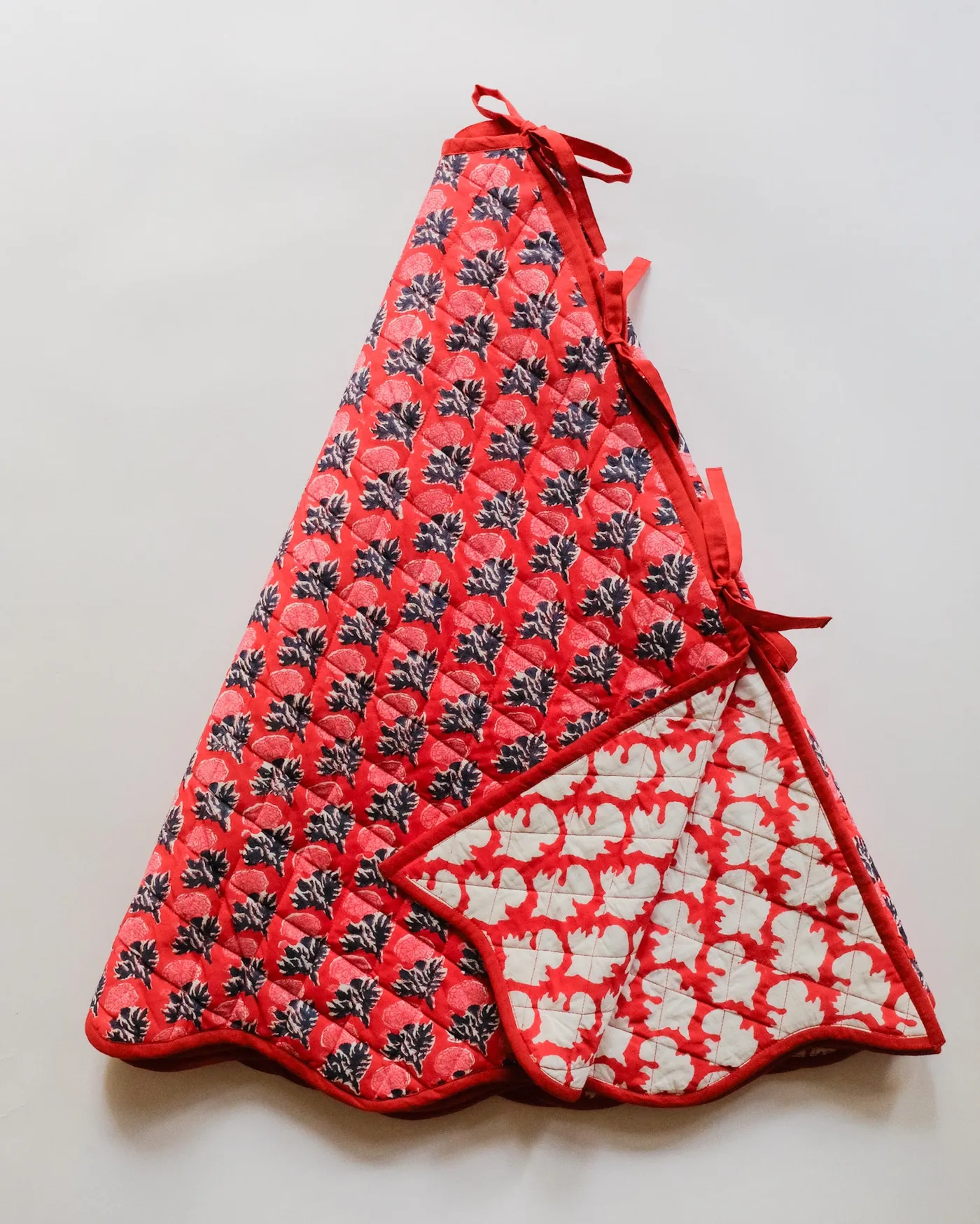
The formula: 70% red + 20% white + 10% grey and pink detail. It’s bold but not loud, because red does the dominant work while the patterns stay relatively small and evenly spaced. If you want a quieter version, flip the ratio — 70% white ground with red floral accents — and you get the exact same decorative energy at half the visual volume.
Red floral quilts are everywhere in 2026 because they’re the least seasonally locked option. Nothing here says December except the context. That means you could use this skirt for Thanksgiving staging, a winter birthday, or even a patio table drape in summer if you’re the type who repurposes. There’s no need to spend $150 on this look — plain red quilted skirts at Target run $30 to $45 and a yard of grey floral cotton is under $12.
11. White Holly Print with a Twin Ruffle
White fabric scattered with a small dark green holly and berry print, a ruffled edge all the way around, and a center slit with two tie closures. Simple, delicate, and much harder to pull off than it looks.
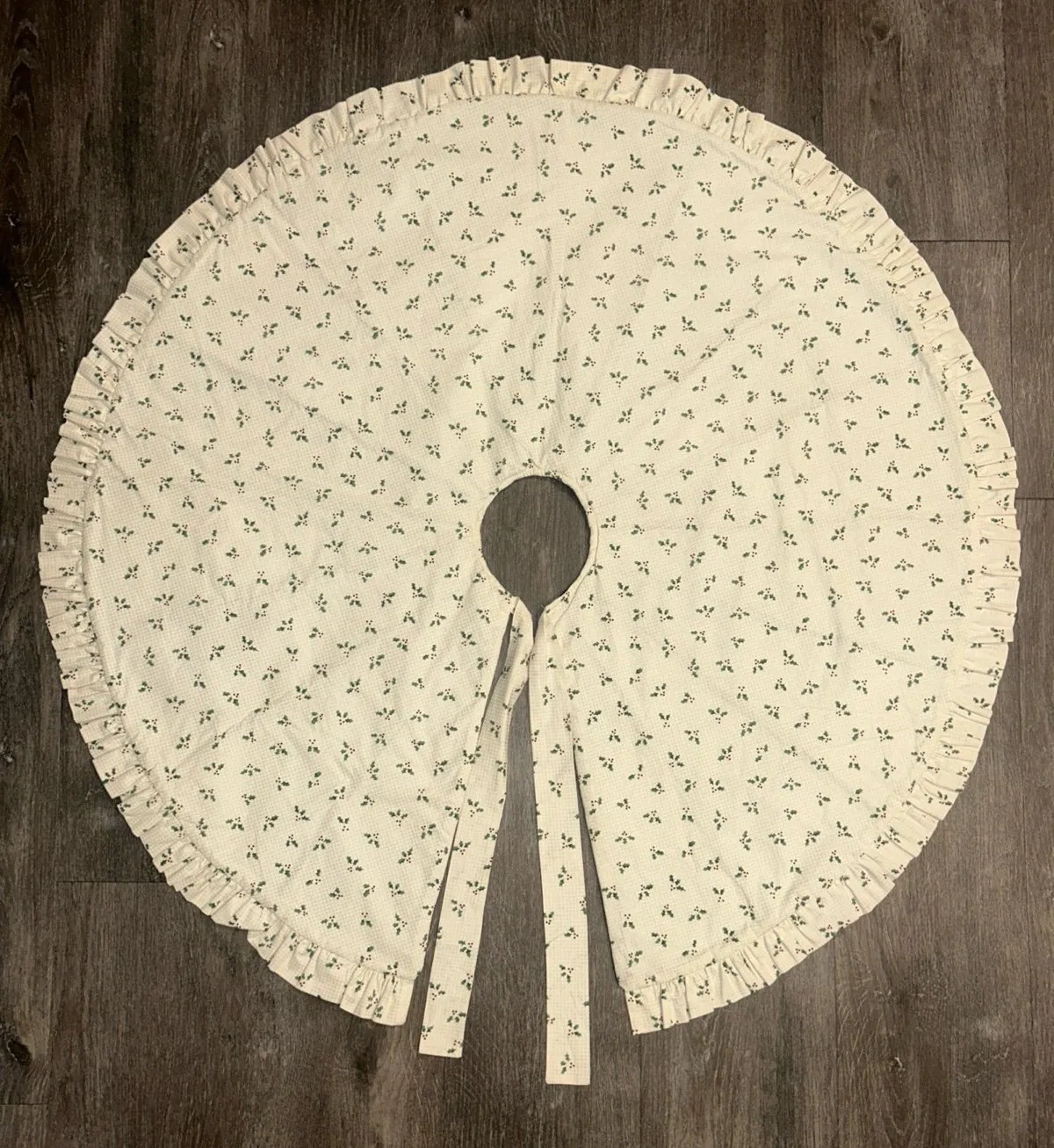
that carries it: the scale of the print. Those holly sprigs are small and sparse, which is what makes the white read as white with a whisper of green rather than as a green-and-white pattern. Scale up the motif by even 50 percent and this becomes a completely different, much louder skirt.
Maintenance is the trade-off. White fabric under a tree catches every needle, and fresh tree sap is a genuine menace — treat it immediately with rubbing alcohol on a cotton swab, not water, and don’t scrub or you’ll spread the resin. Wash cold on a gentle cycle once a season at most, and air dry flat. If a white skirt sounds like too much anxiety with kids or pets, the same ruffled silhouette comes in cream and oatmeal tones that hide far more.
12. Wreaths, Santa Boots, and a Diamond Border
Six alternating segments, a central dark green hexagon, a red-and-white diamond border, and appliqués that alternate between Christmas wreaths and Santa’s boots against red and dark blue polka dot grounds. It’s a lot, and it’s held together by white borders and visible quilting stitches running throughout.
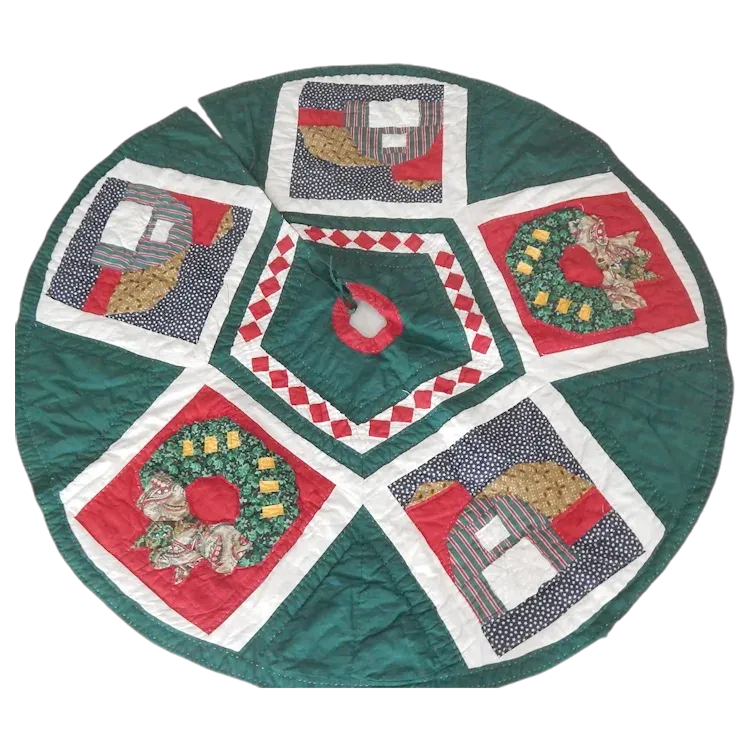
The design principle at work is alternation. Wreath, boot, wreath, boot — the eye gets a predictable rhythm to follow even though the fabrics and colors keep changing. That’s the trick for anyone attempting a heavily appliquéd skirt: let one element repeat on a strict rhythm so the rest of the chaos has a frame.
Practical tip for appliqué placement: trace your shapes onto freezer paper first, iron them to the fabric, cut, then peel and iron onto the skirt. It saves you from the classic disaster of six wreaths that are all slightly different sizes. Pin generously and stitch a scant 1/8 inch from the edge with a matching thread.
13. Classic Holiday Patchwork Under Warm White Lights
A traditional tree with warm white lights, red, silver, and gold ornaments, and a patchwork quilted skirt underneath in deep red, forest green, cream, and gold. Brown paper gifts with red buffalo plaid ribbon sit on the skirt, and the whole thing rests on dark wood planks.
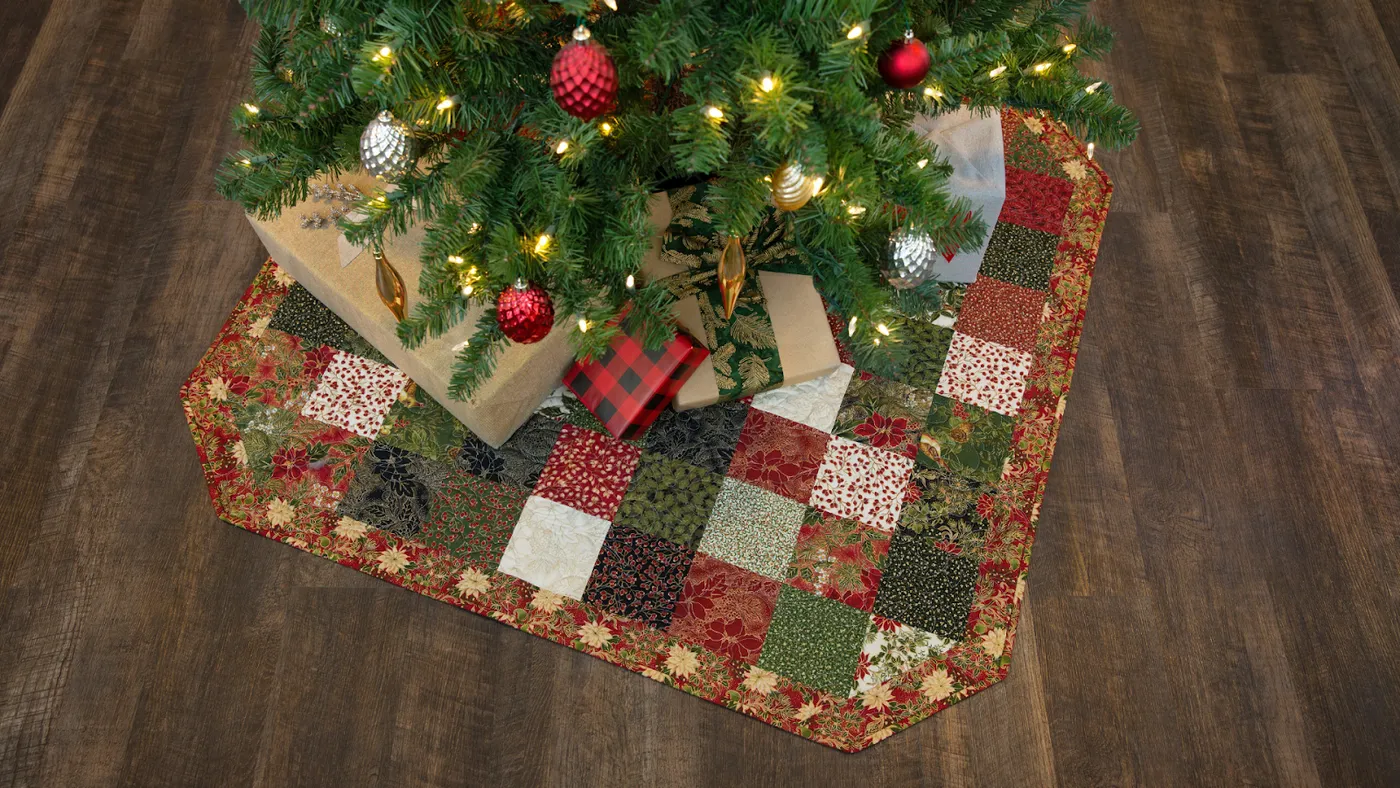
- Ready-made patchwork quilted skirt: $45–$120
- Kraft paper, plaid ribbon, and gift wrap: $15–$30
- Tree lighting (warm white, 300–500 count): $25–$60
- Ornament fill (red, silver, gold): $40–$90
- Tree collar or stand cover: $20–$45
- Total: $145–$345
Budget alternative: skip the ornament fill and shop your own collection first, adding only one new color family per year. Thrift stores and estate sales routinely have boxed vintage glass ornaments for $8 to $20. The patchwork skirt is where the money should go — it’s the piece that photographs in every single gift-opening shot.
One warning: heavy gifts stacked directly on a quilted skirt will compress the batting and leave dents that don’t bounce back until spring. Use a small side table for the big boxes.
14. Radiating Zigzag Strips with a Lime Scalloped Edge
Multicolored fabric strips radiate outward in a zigzag pattern — pink, blue, green, yellow, orange, red — with a white trim at the center opening, green fabric ties, and a bright lime green scalloped binding around the perimeter. This is maximalism with structure, and it’s the direction a lot of 2026 holiday decor is heading: joyful color instead of red-and-green only.
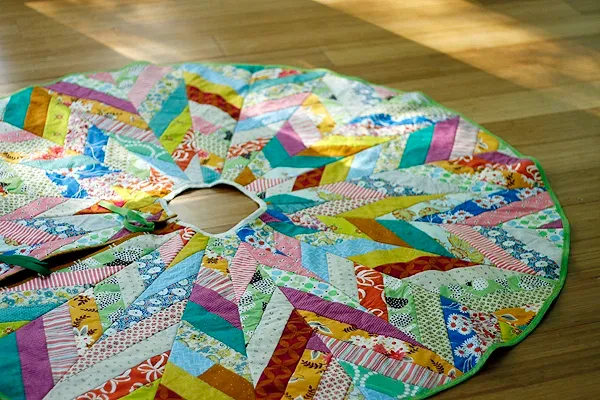
Pinterest searches for “colorful Christmas decor” have been climbing for three straight seasons, and this skirt is the perfect entry point because it doesn’t require repainting a room. If you want to build one:
- Cut 24 to 36 strips, each 2.5 inches wide and 12 to 16 inches long.
- Arrange them on a muslin circle with the center opening marked, fanning outward.
- Pin and stitch each strip in place, pressing seams toward the outer edge.
- Trim the outside to a clean circle and bind with bias tape.
- Finish with a scalloped binding, clipping the curve before turning.
Expect 6 to 9 hours and $35 to $55 in fabric if you’re working from scraps and sale fat quarters.
15. Angel Appliqués on Polka Dot Green
Dark green fabric with white polka dots, four white-and-red angel appliqués, white star shapes scattered between them, and a multi-layered border with a red patterned band finishing in a green outer edge. Black ties close the center opening.
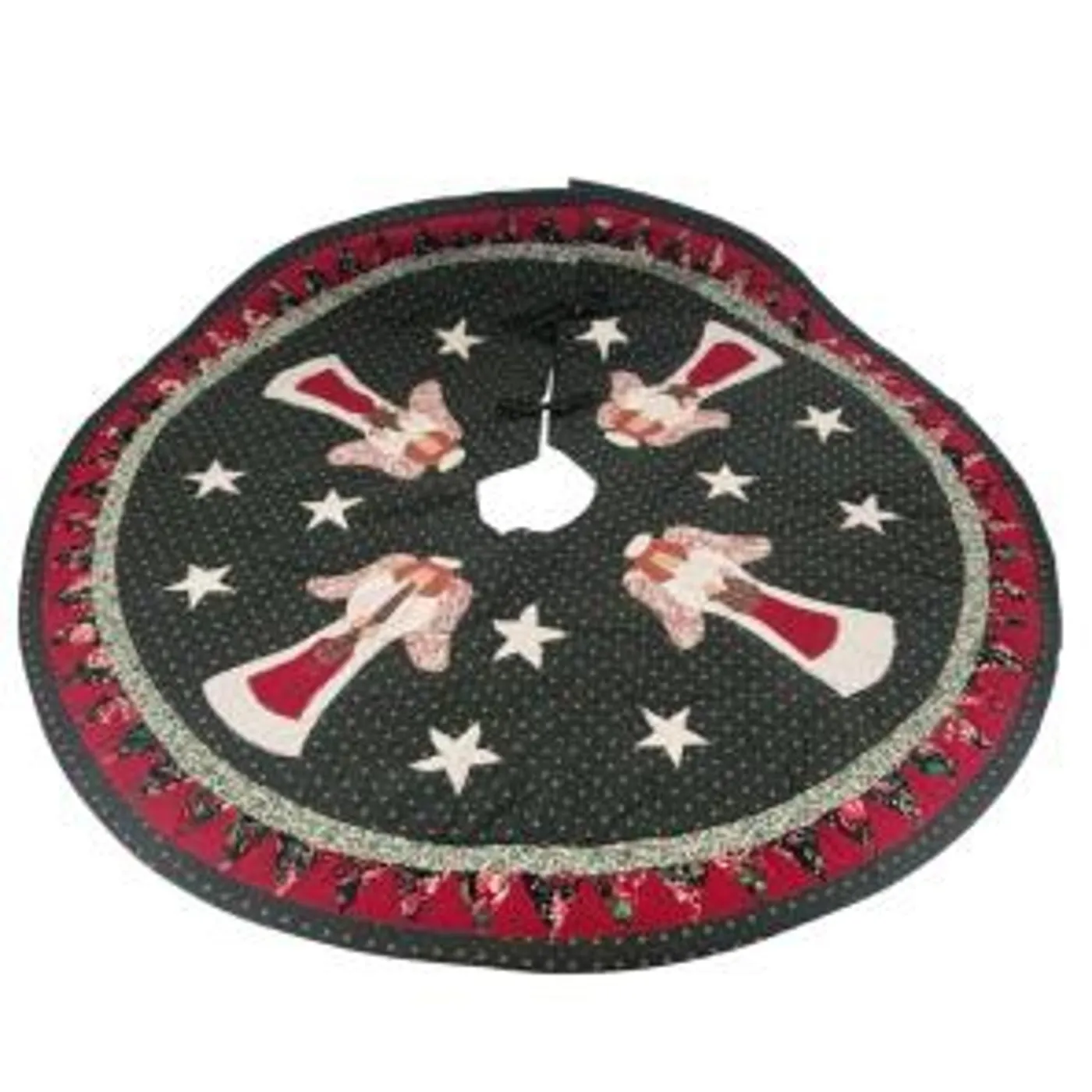
The element that makes this whole skirt work is the polka dot ground. Solid dark green would have been heavy and a little severe. The white dots lighten the field just enough that the white angels don’t look like they’ve been pasted onto a void — they look like they belong in the pattern.
Size-wise, this reads best on a tree that’s 6 to 7.5 feet tall in a room with at least 10 feet of ceiling. On a small 4-foot tabletop tree the appliqués would overwhelm the whole silhouette. If your tree is miniature, look at something with a tighter motif like Idea #10 — same traditional spirit, much smaller visual scale.
16. Rag Quilt Texture with Frayed Seams
Solid red and green squares mixed with assorted Christmas prints, all with intentionally frayed seams along every edge. This is rag quilt construction, and the visible fuzz is the entire point — it’s meant to look soft, worn, and handmade rather than precise.
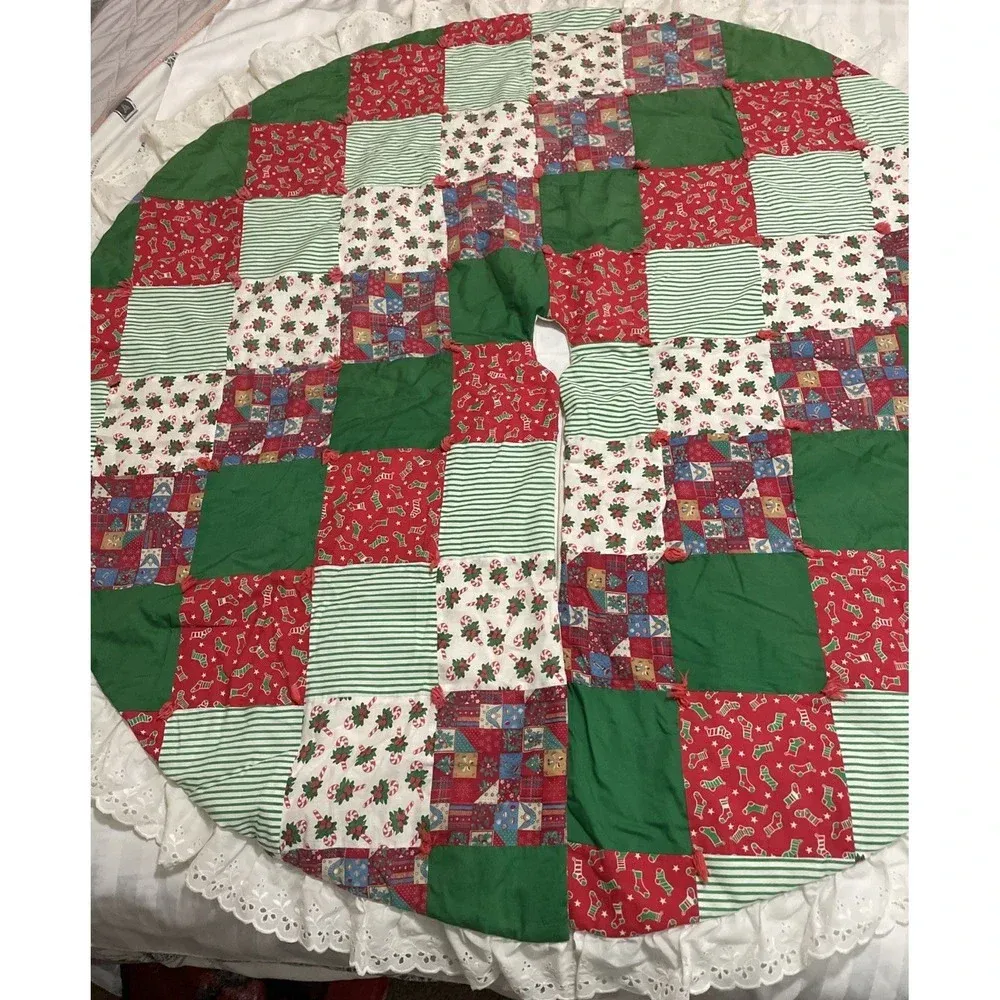
is that the fraying provides texture the eye reads as warmth before the brain even registers the pattern. Flat quilting looks tailored; rag quilting looks like something you’d want to nap under. The red, green, white, and blue palette keeps it from veering into full country-craft territory.
Maintenance honesty: rag quilts shed. Expect loose threads for the first two or three seasons, and expect the frayed edges to collect lint and pet hair more than a bound edge would. Wash cold on gentle, then tumble low with a clean tennis ball to fluff the seams. A bound-edge patchwork skirt like Idea #4 gives you a similar traditional feel with none of the shedding.
17. Equestrian Hunt Scenes in Sage and Light Blue
Four panels of appliquéd hunt scenes — riders on horseback, trees, hunting dogs — divided by quilted sections of light blue and beige, framed with a solid dark brown border, and finished with a sage green quilted outer band sprinkled with appliquéd foxes and dogs. Brown fabric ties close it.
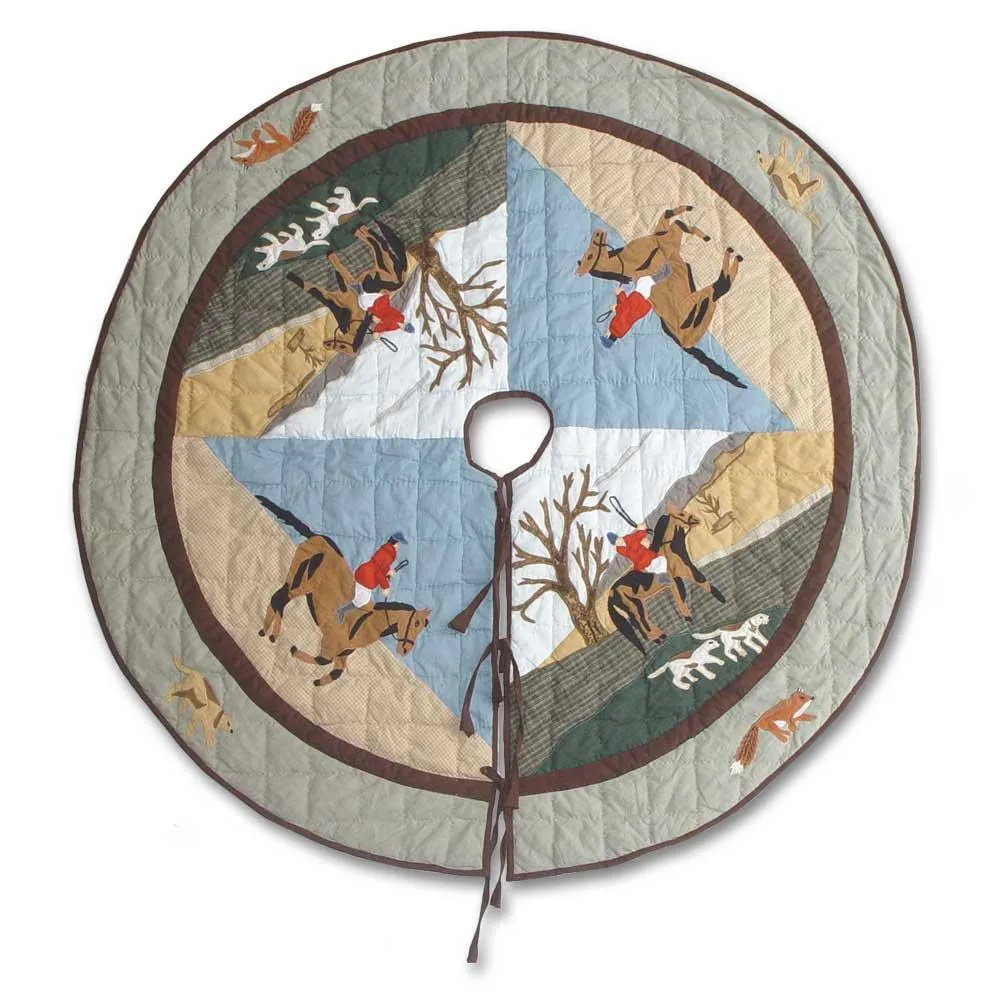
This is niche decorating done right, and niche is exactly where holiday decor is heading in 2026. People are tired of identical trees and want pieces that reflect an actual interest — horses, dogs, cabins, birding, whatever. A themed skirt is a conversation piece in a way an ornament set never is.
The one element worth protecting is the outermost sage band with the small fox and dog appliqués. It’s a tiny detail that most people won’t notice on first look, but it’s what turns the skirt from “hunt scene panels” into a fully composed narrative. If you commissioned something similar, insist on that outer ring.
highly detailed appliqué is dry-clean or hand-wash only, and the light blue panels will show any watermark. Keep the skirt off damp floors.
18. Pastel Tree Panels with Candy-Striped Buttons
Eight wedge panels alternate between light blue and mint green, each carrying an appliquéd Christmas tree — some dotted with ornaments and stars, others with leaf, flower, and heart motifs. Bright lime green binding runs the whole perimeter, and candy-striped buttons secure the opening.
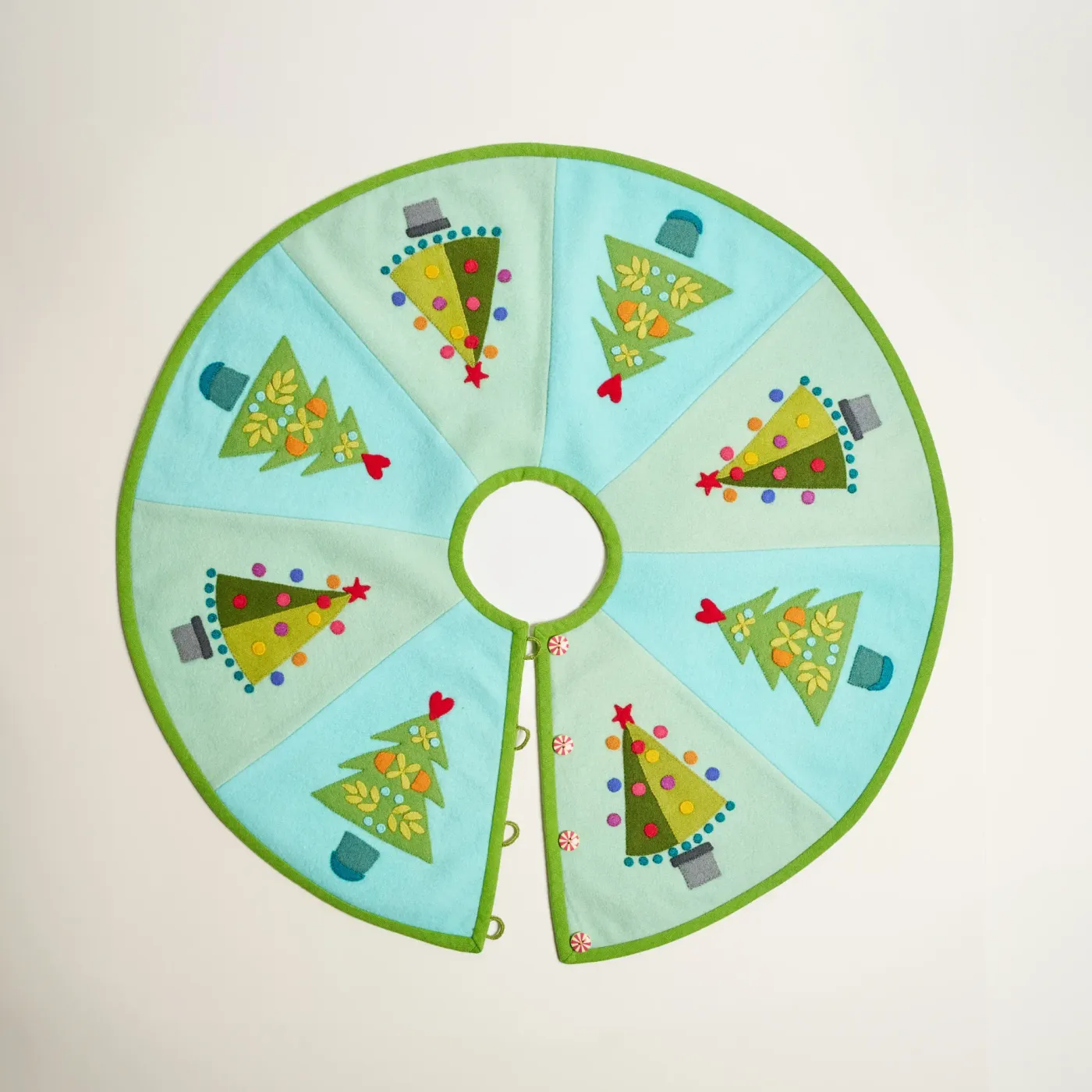
The color formula is the interesting part: 50% pastel blue-green base + 30% bright accent greens + 20% scattered red and warm pastels in the appliqués. That high-contrast binding is what stops the pastels from washing out entirely. Without the lime edge, this would look faded in photos.
for buttons as closures: choose a shank button over a flat two-hole button, and back it with a small square of interfacing on the wrong side of the fabric. Flat buttons on a soft quilted edge pull through within a season or two. Shank buttons hold, and they look intentional rather than improvised.
19. Radial Poinsettia Patchwork with Red Binding
Dozens of fabric pieces arranged radially from a center opening, with poinsettias, stars, and holiday scene prints scattered through deep red, forest green, cream, white, and black. Red binding finishes both the outer edge and the center opening, and green fabric ties close the slit.
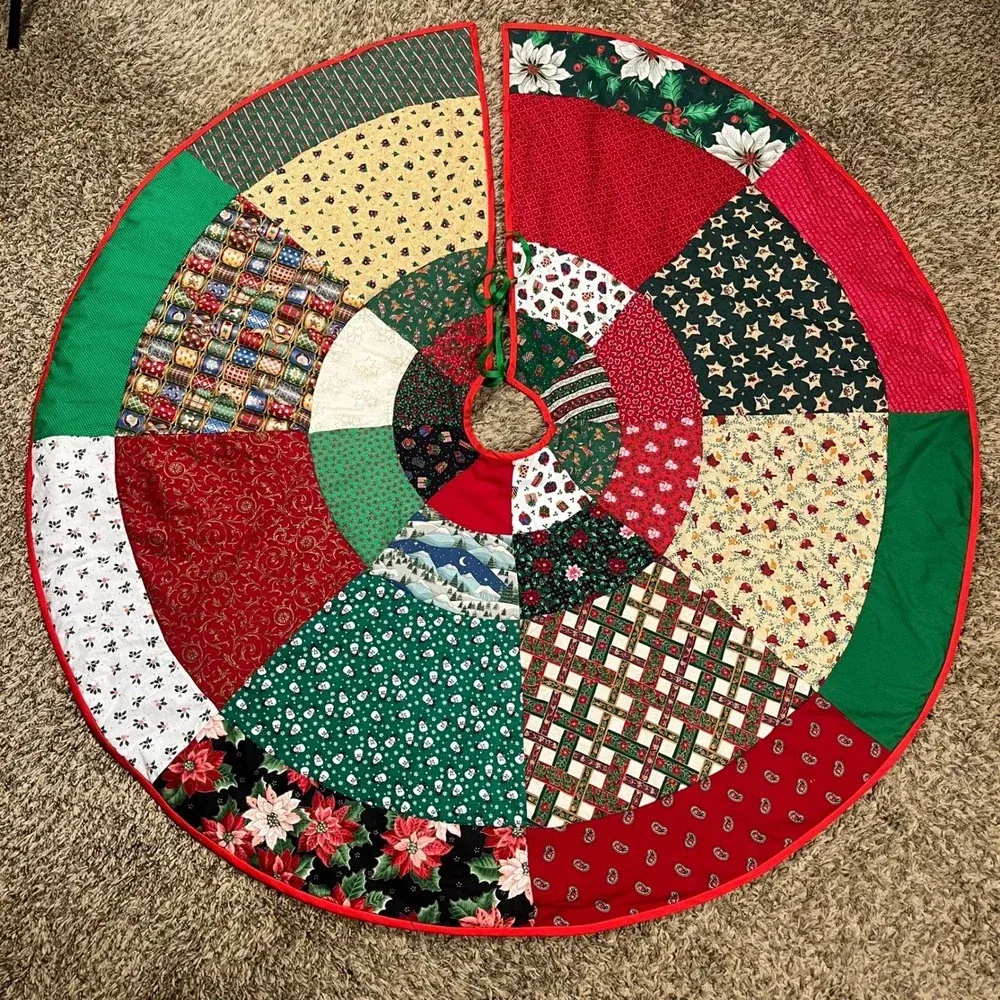
This is the classic large-format patchwork approach, and it’s the one that benefits most from proper proportion. A radial patchwork skirt looks best at 52 to 60 inches across on a tree that’s 7 feet or taller — anything smaller and the pattern gets cramped and the individual prints stop reading. Pair it with a tree in a room 12 by 14 feet or larger, ideally with the skirt visible from more than one angle.
If a custom radial quilt is out of reach, the honest shortcut is a pieced-look printed skirt rather than actual patchwork. Retailers sell printed quilting that mimics the effect for $40 to $70. Compare with Idea #20 — same patchwork spirit in a hexagonal format that reads well at smaller sizes.
20. Hexagonal Strips in Candy Stripe and Snowflake
A hexagonal skirt built from patchwork strips radiating out from a central opening, mixing candy stripes, snowflakes, holly berries, and polka dots in alternating blocks of red, green, white, and light blue. A green dotted binding finishes the edge and green ties secure the slit.
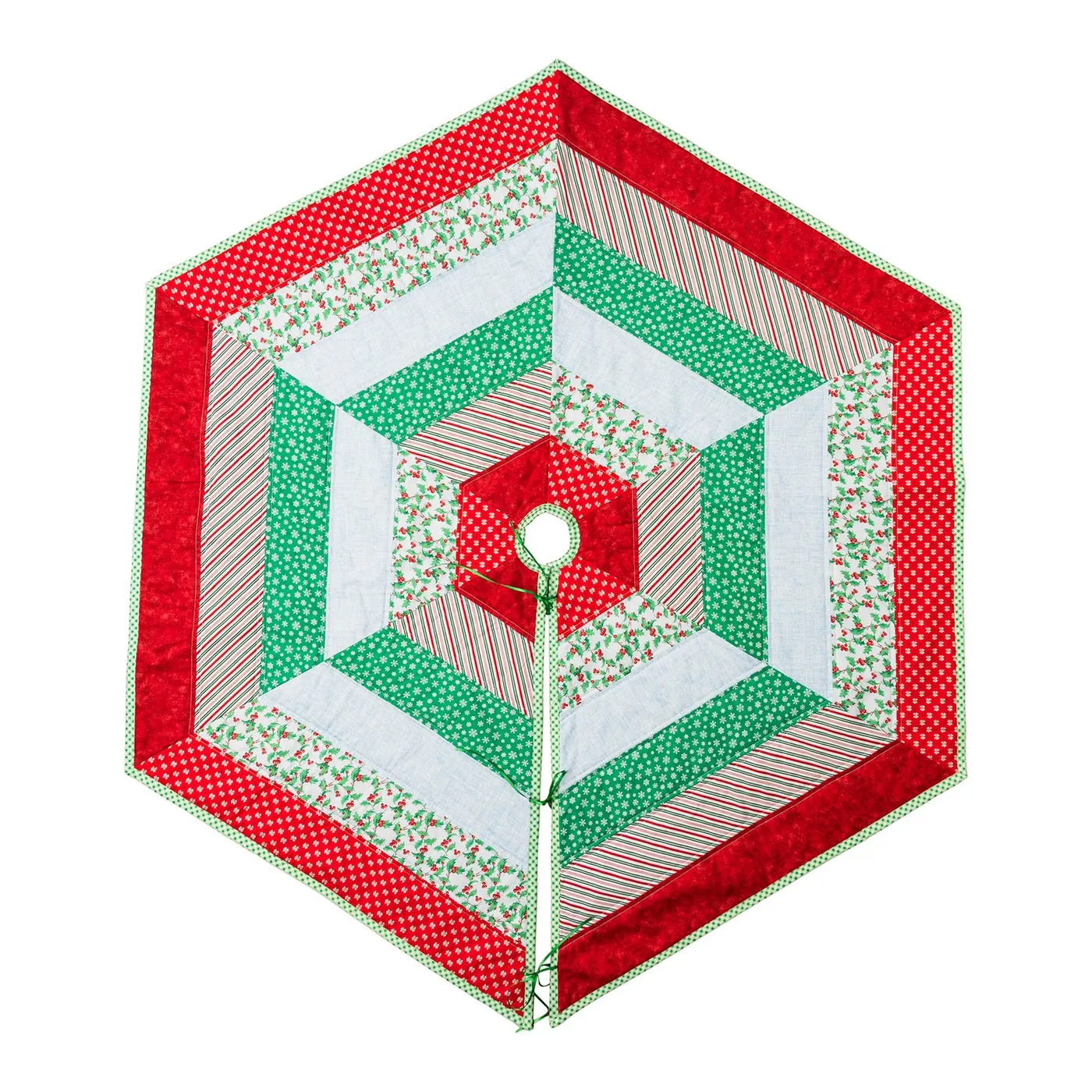
The hexagon shape is a smart choice for anyone sewing their own, because the straight sides are far more forgiving than a perfect circle. Here’s the working method:
- Draft a hexagon template on kraft paper at your finished width.
- Divide into six wedges from the center and mark your center opening.
- Cut strips at 2 to 3 inches wide and lay them across each wedge, alternating prints.
- Stitch strips to a muslin foundation, then join the six wedges.
- Bind the outer edge and center opening, and add ties at the slit.
Plan on 7 to 10 hours and $30 to $50 in fabric.
Before you begin:
- Confirm your tree stand’s footprint fits inside the center opening with room to spare.
- Test your strip widths against your print scale — big prints need wider strips.
- Check that your binding fabric is pre-washed so it doesn’t shrink after the first wash.
- Decide ties versus velcro before you cut the slit.
21. Checkerboard Center with a Cream Swirl Border
An octagonal skirt with a checkerboard of Christmas prints at the center — snowmen, reindeer, mushrooms, snowflakes, stripes — then a wide cream quilted border with a swirling stitch pattern and a thin red binding. A red ribbon ties the center opening closed.
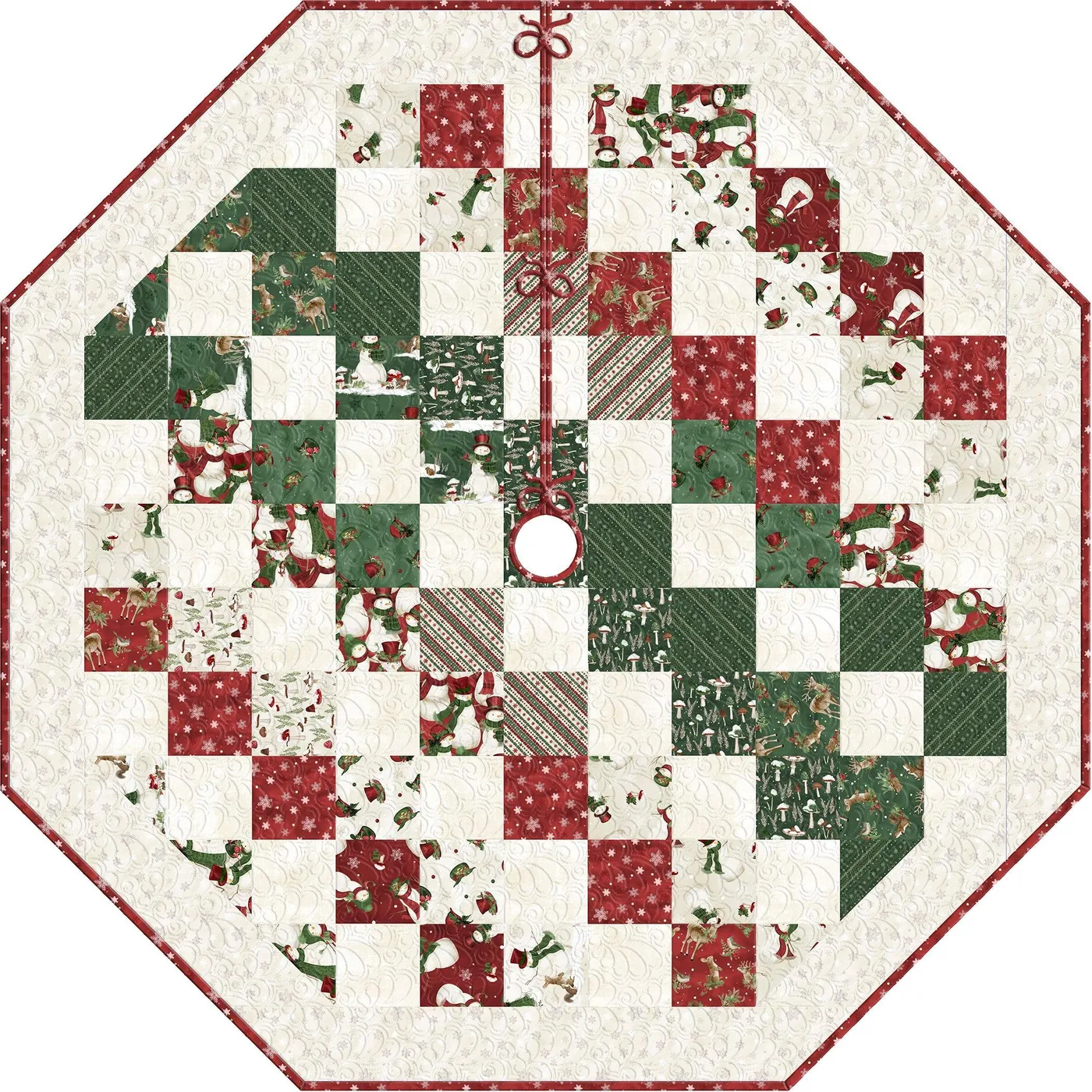
The genius move is the wide cream border. It does two jobs at once: it gives the busy checkerboard a place to stop, and it adds a calm, neutral zone that lets the eye rest before hitting the outer binding. Without it, the skirt would be pattern from edge to edge and would feel exhausting rather than festive.
That border is the one thing you cannot substitute. Swap the cream for another print and the whole composition collapses into noise. If you’re making this, buy the border fabric first and build the checkerboard around it — not the other way around.
22. Plaid Pine Trees on Light Tan Quilting
Stylized pine trees cut from assorted plaids and solids, appliquéd onto a light tan diamond-quilted ground, with a dark maroon binding and matching maroon ties. Forest green, earthy brown, and navy blue appear inside the tree shapes.
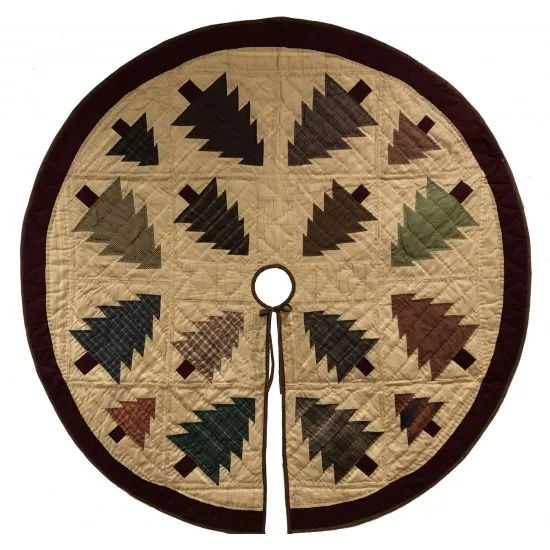
Plaid is doing something specific here: it turns each tree into a mix of angle and grain, so no two trees read the same even though the silhouette repeats. That’s a genuinely useful trick for anyone bored with solid appliqué. Hit the flannel and shirting sections of a fabric store and buy fat quarters — you only need a 6-inch square per tree.
Maintenance note: light tan quilting and maroon binding are both forgiving, but plaid flannel appliqué can pill along the cut edges over time. Zigzag or overcast stitch the raw edges of each tree before you attach it and you’ll add years. A quick vacuum with a brush attachment at the end of the season handles dust without disturbing the quilting.
23. Radiating Star Center Framed in Poinsettia Print
An octagonal skirt with a multi-point star radiating from the center in deep red, olive green, gold, and cream, then circled by a red poinsettia and green leaf border. A slit from the outer edge to the center opening lets it fit around the trunk.
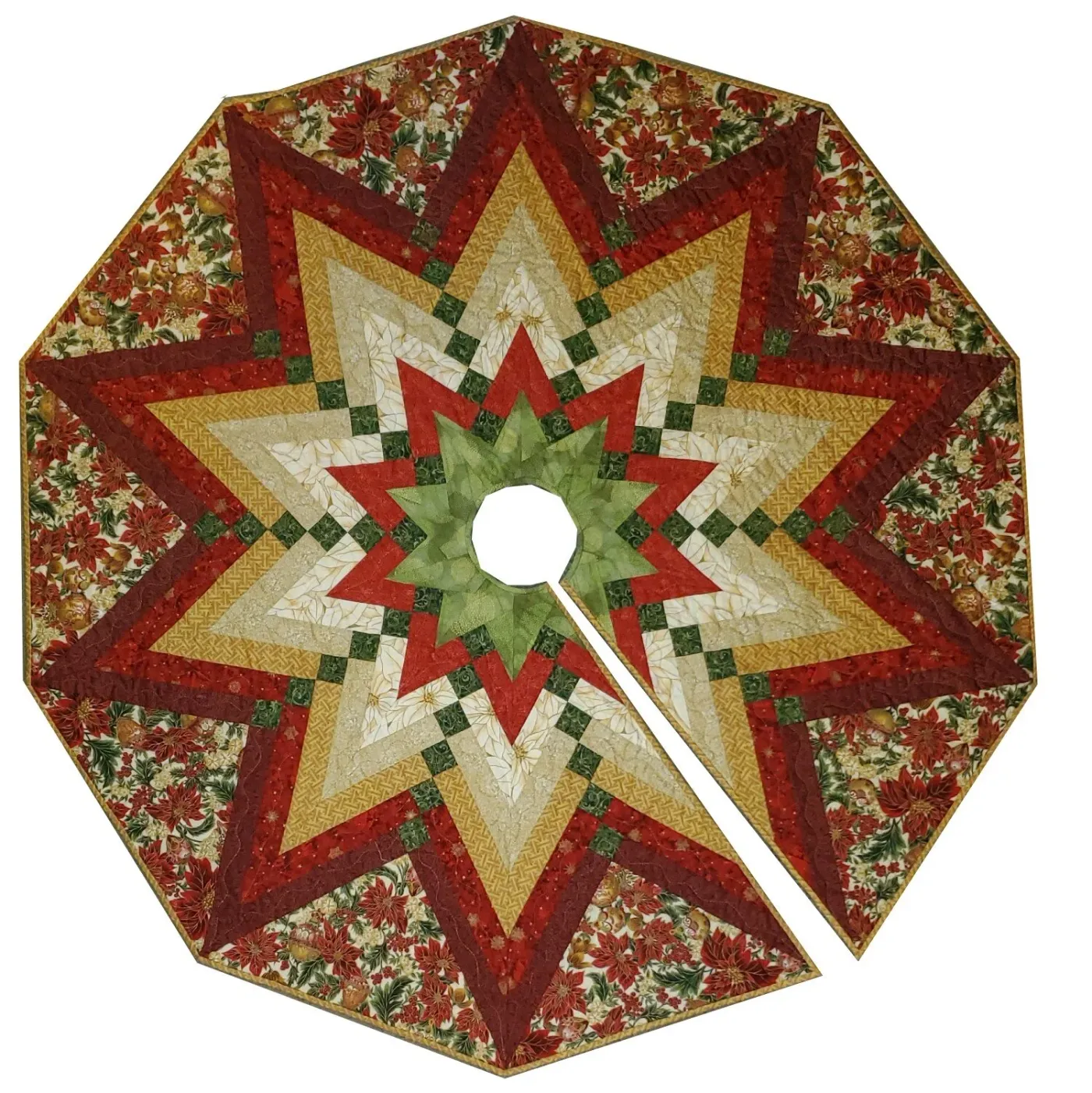
The star works because the wedge strips are cut narrow — roughly 2 inches — so the points stay sharp and graphic. If those strips were 4 inches wide, the star would lose definition and read as a blurry pinwheel instead of a star. It’s a great example of how strip width, not fabric choice, determines whether a geometric design succeeds.
Size guidance: the octagon format is unusually flexible. It reads well on trees from about 6 feet up, and because the corners are straight rather than curved, it doesn’t swallow small floor areas the way a wide circle does. It’s a strong pick for apartments or for anyone placing the tree near a wall corner. Real talk — that poinsettia border print is going to be the hardest fabric to source, so buy extra yardage when you find it.
24. Red Plaid, Gold Snowflakes, and Faux Fur Trim
A red plaid skirt with large gold snowflake appliqués and a brown faux fur trim, sitting under a flocked tree hung with gold ornaments. Red presents with gold ribbon and beaded accents are stacked alongside, and a white shaggy rug layers underneath.
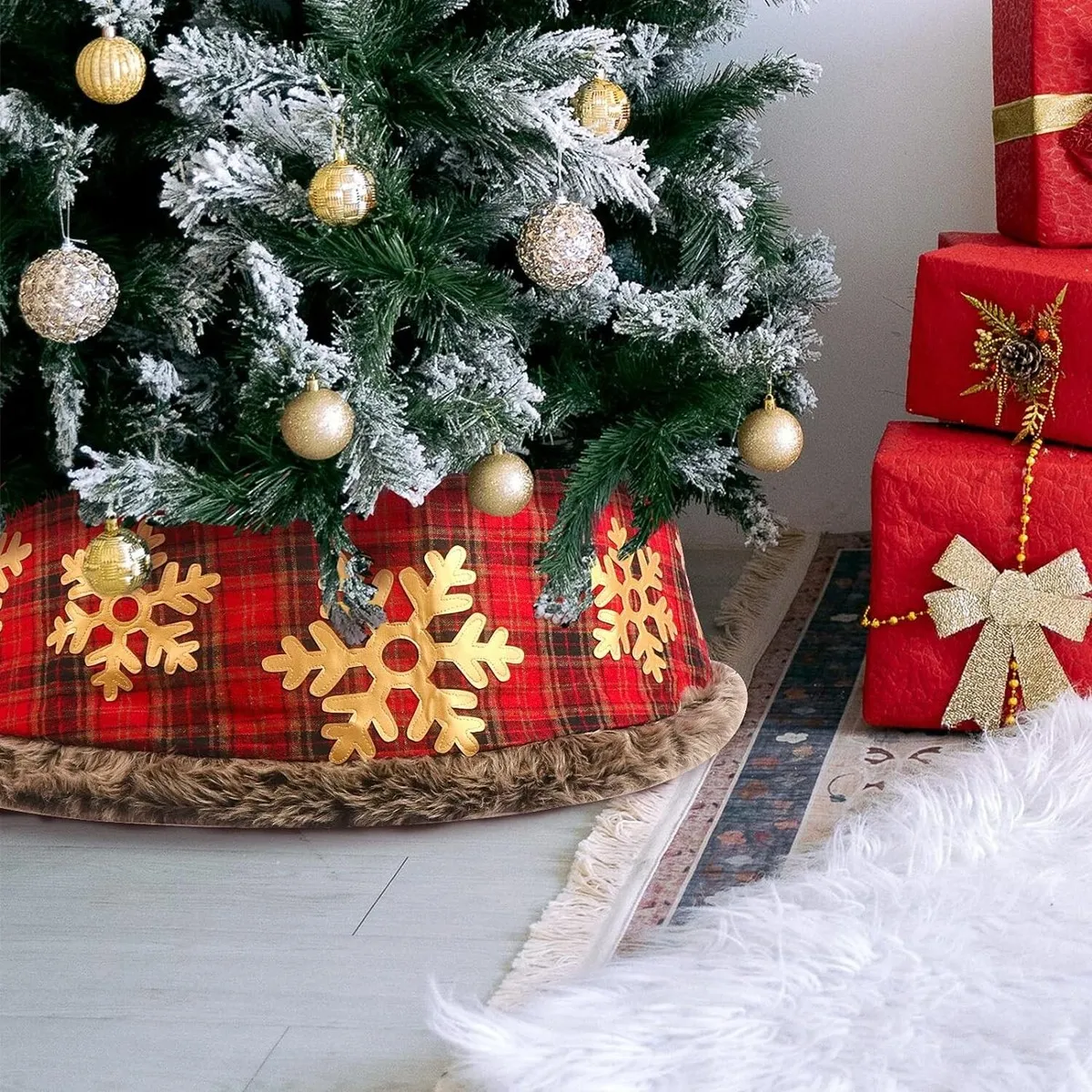
The formula is textbook: 60% red plaid + 25% white and green (from the flocked tree) + 15% gold metallic. The faux fur trim adds warm brown, which is what keeps the whole scene from turning into a candy-cane cliché. Plaid is the dominant pattern; everything else is solid or metallic.
- Plaid quilted skirt or fabric + batting: $50–$140
- Gold snowflake appliqués or embroidery: $12–$35
- Faux fur trim (2 to 3 yards): $25–$60
- Gold ornaments (a start or refresh set): $30–$70
- Wrapping paper, ribbon, and beads: $15–$30
- Total: $132–$335
Budget alternative: use a solid red quilted skirt ($35 at big-box retailers) and layer a plaid throw blanket over the top, tucked under the gifts. Faux fur trim by the yard at craft stores is often under $15. It photographs identically and stores in a quarter of the space.
25. Velvet Panels with Candy Cane Embroidery
Radial panels in deep red, dark green, and cream, alternating around the center opening. Some of the cream panels are embroidered with tiny candy canes and green foliage, and dark green fabric ties sit along one seam.
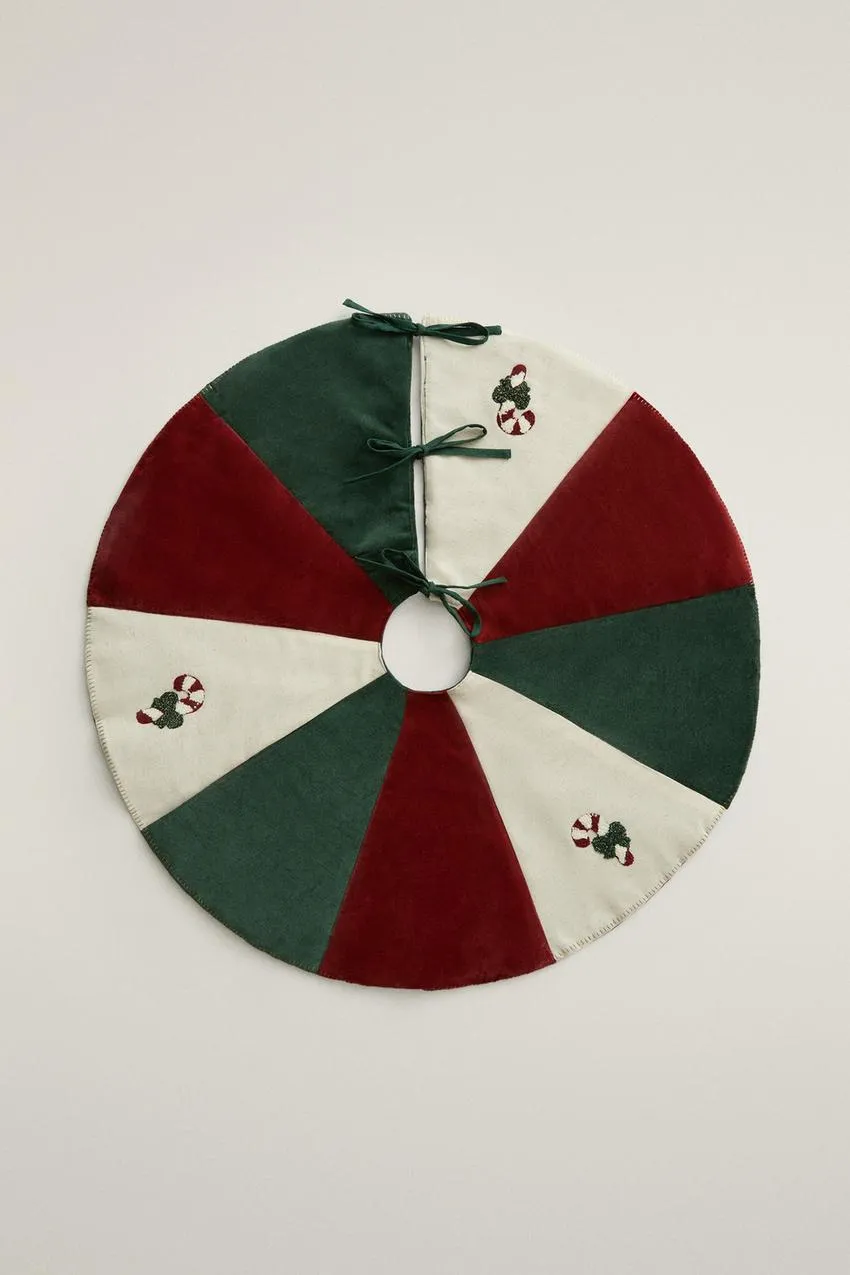
Velvet is what changes everything here. It absorbs light rather than reflecting it, which makes the whole skirt look richer and deeper under tree lights. That’s why a velvet skirt can get away with just three colors while a cotton skirt usually needs pattern to feel interesting — the fabric itself is the decoration.
Working tip for velvet: it’s a nap fabric, meaning the pile has direction, and every panel must be cut in the same direction or the panels will look like slightly different shades under light. Cut all pieces with the nap running down. Also press velvet face-down on a terry towel with low steam, never directly on the pile. And keep the embroidery simple — small motifs on velvet read as luxury, dense ones read as clutter.
26. Pure White with a Diagonal Quilted Grid
A simple circular skirt in white, quilted in a diagonal grid that creates a soft, pillowy texture underfoot. An olive green gift with copper ribbon rests on it, and a branch of green pine dips into frame at the left.
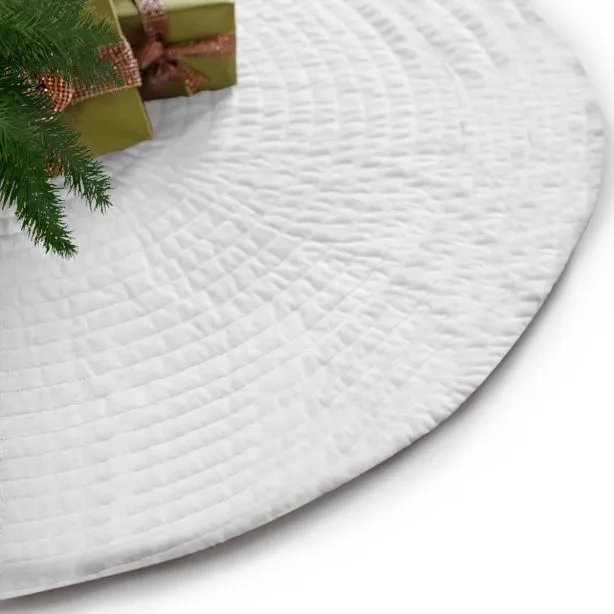
that makes this special is the diagonal orientation of the quilting. A straight grid would have read as plain and a bit flat. Rotating the lines 45 degrees turns a very simple skirt into something with movement and shadow, and it means the stitching itself is the design rather than a background detail.
You don’t need to spend much to get here. Plain white quilted skirts run $25 to $45 at IKEA, Target, and Walmart, and honestly the difference between a $35 version and a $150 version is usually lining and true cotton rather than the look. Check the underside before buying — a lined skirt with diamond or diagonal stitching will hold its shape for years, an unlined one will get floppy fast. Compare with Idea #9 for a bolder take on the same diamond-quilted construction.
27. Wedge Panels of Red, White, and Grey Stripes
Wedge-shaped panels, each built from diagonal fabric strips in red, white, light grey, and dark grey — florals, dots, and solids mixed freely. A solid grey outer border grounds everything and fabric ties close the center opening.
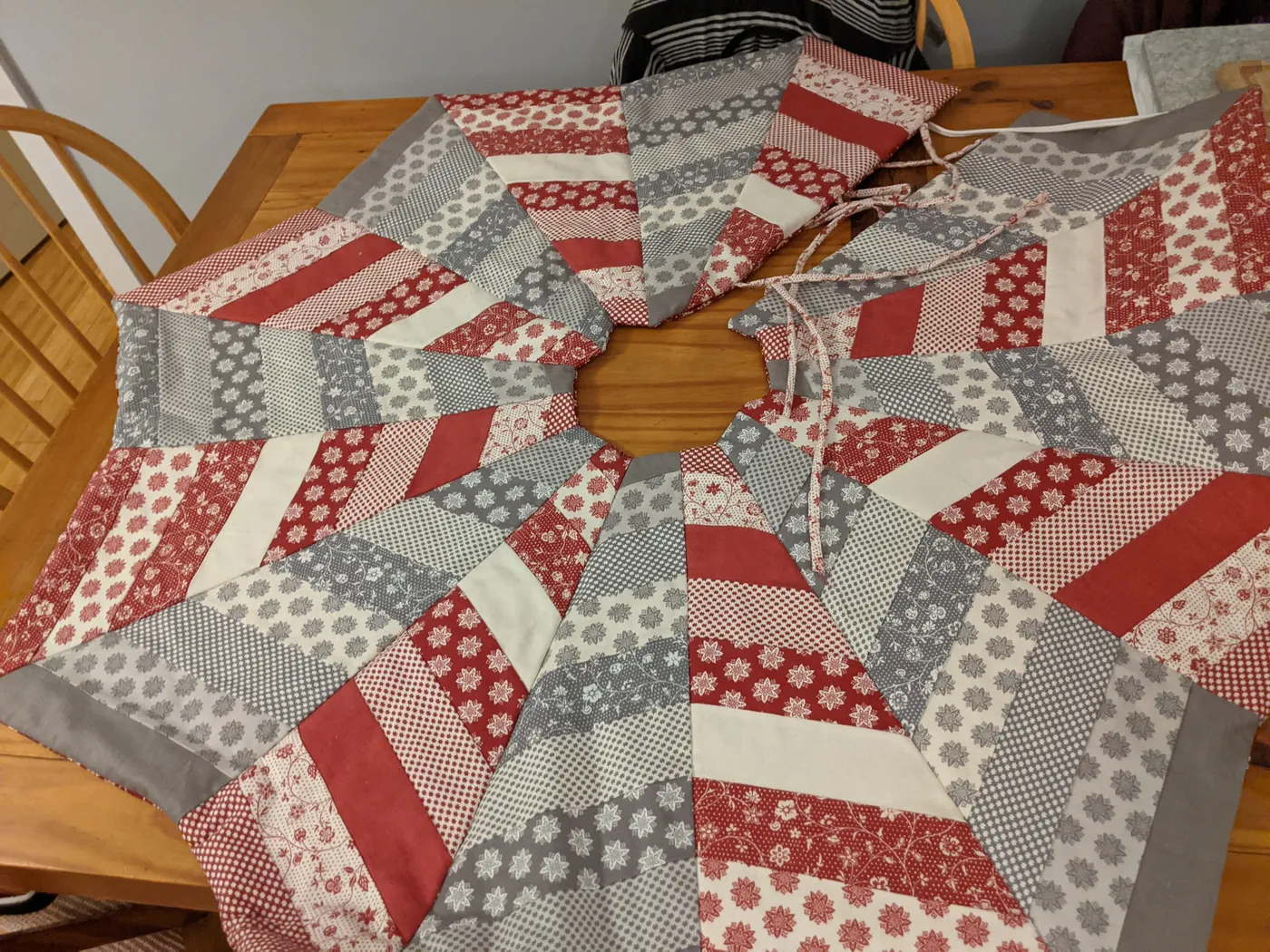
This is a great example of neutral-with-a-pop color math: 50% red + 30% white + 20% grey. The grey is what separates this from a standard holiday patchwork skirt. It cools the red down and makes the palette feel modern rather than expected. Want to shift the mood without changing the composition? Swap grey for navy and it turns more formal; swap grey for sage and it turns rustic.
Practical note on the light grey and white strips: they will pick up pine needles and dust quickly, and diagonal strip piecing means more seams to collect debris. Vacuum with an upholstery attachment at the start and end of the season. Machine wash cold only if the skirt is fully bound — raw or frayed edges need spot cleaning instead.
28. Green Grid Appliqués with a Snowman Motif
A cream or beige quilted ground patterned with a grid of dark green strips, forming square windows. Inside several of those windows sit circular appliqués: a snowman with musical notes, and assorted small colorful figures. A reddish-brown border finishes the outer edge and a white circle marks the center opening.
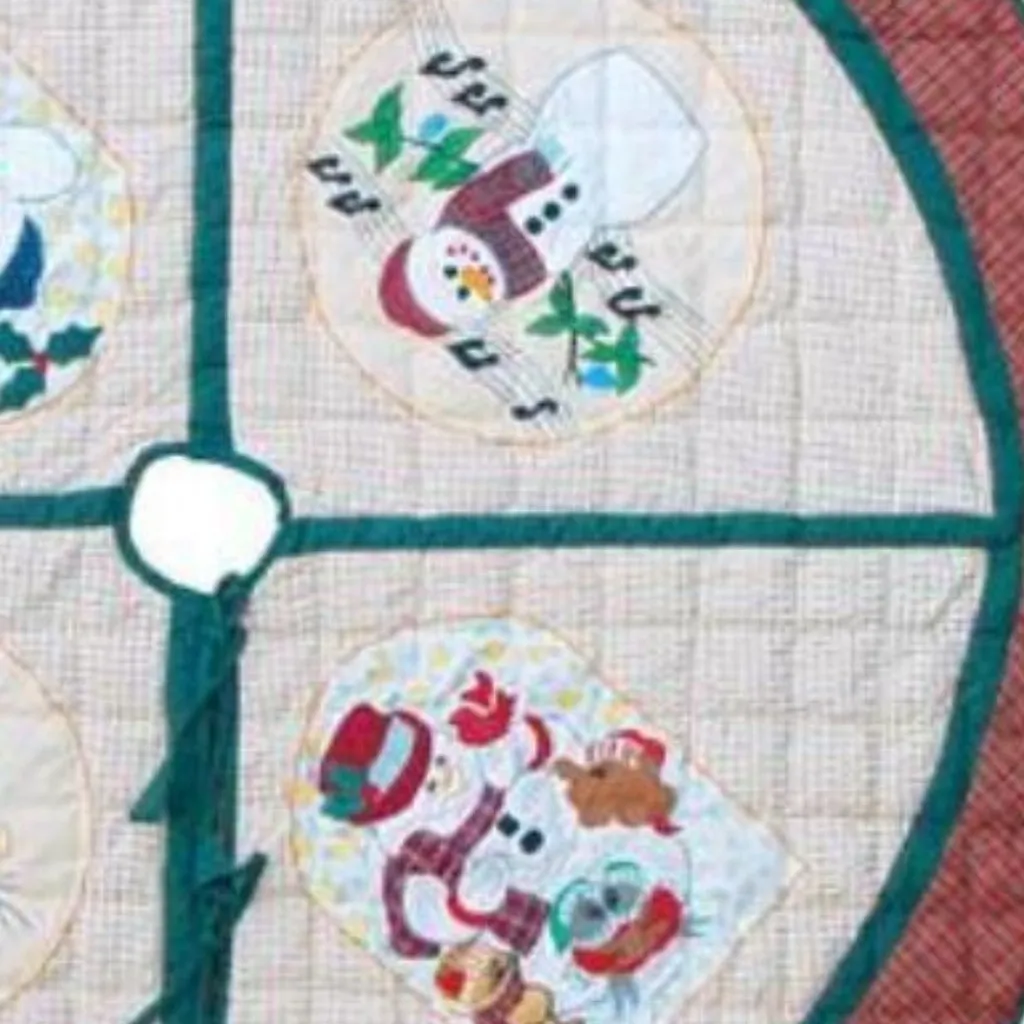
Structuring appliqués inside a grid is the smartest way to keep a whimsical skirt from turning chaotic. Each circle has its own frame, so a snowman and a tiny reindeer can live two inches apart without clashing. If you’re building this:
- Mark your grid lines on the quilted base with a washable marker.
- Stitch dark green strips over the lines to create the window frame.
- Cut appliqué circles slightly larger than the window openings.
- Fuse with lightweight interfacing, then edge-stitch with matching thread.
- Bind the outer edge and center opening last.
About 6 to 8 hours and $30 to $50 in materials.
Honest caution: multiple small appliqués mean multiple raw edges, and busy patterns hide sloppy stitching — which also means you can’t easily fix mistakes later. Do a test circle first on scrap fabric.
29. Bright Red Texture with Raised Snowflakes
A round, bright red skirt with a nubby, textured surface and raised snowflake patterns worked across it. Faux pine branches with clear string lights and red berries rest on top, and the whole thing sits on a light wood floor.
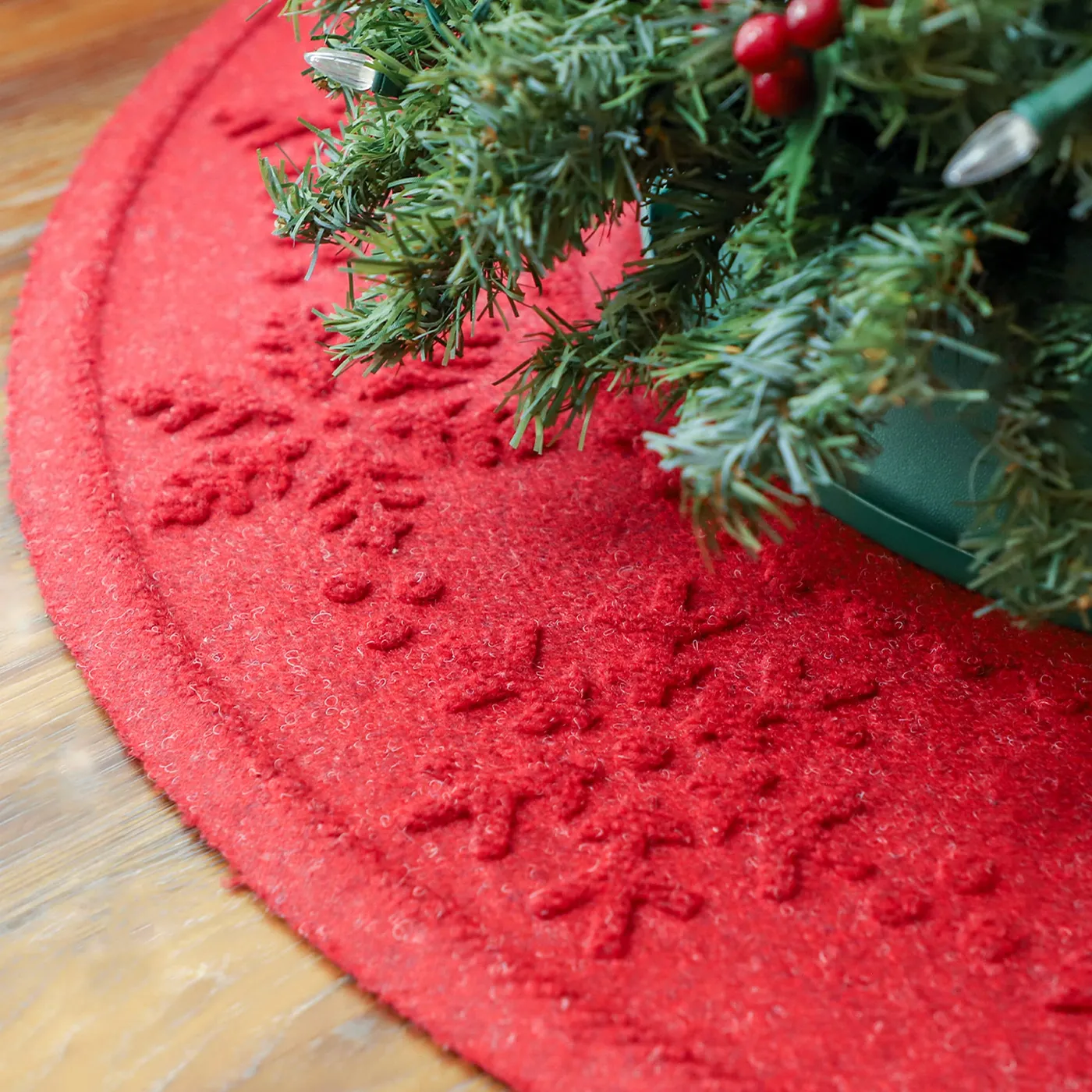
The texture is what your eye catches first — not printed snowflakes, but raised ones that physically stand off the fabric. Under tree lights this casts tiny shadows and makes the red feel dimensional instead of flat. It’s the kind of detail that doesn’t translate in a thumbnail but absolutely does in person on Christmas morning.
Care reality: raised texture and nubby surfaces catch everything. Brush it down weekly during the season with a soft clothes brush rather than waiting until January. Store it flat or rolled loosely — folding along the raised snowflakes will crease them permanently. If you have pets, this is the skirt that will show every hair; a smooth quilted option like Idea #29 will be far easier to keep clean. Size-wise, this reads best on a tree 6 feet or taller where the skirt is proportionally visible.
Your Tree Has Been Waiting for the Right Skirt
Here’s the thing about a quilted tree skirt — it’s the one piece of holiday decor that shows up in every single photo of the season, holding the gifts, framing the tree, catching the light on all that stitching. Pick the one that matches your actual floor, your actual stand, and your actual tolerance for maintenance, and it’ll earn its place in the attic for twenty Decembers. Start with one idea from this list, measure twice, and don’t overthink the rest.
📌 Pin your favorites now — when November rolls around and the good ones are sold out, you’ll be glad you saved them.