35+ Stunning Christmas Greenery Decor Ideas That Will Transform Your Home This Season
Christmas greenery is having a serious moment on Pinterest right now, and almost none of it involves glitter. Searches for mixed-foliage garlands, foraged-looking wreaths, and warm-white lights have been climbing for three seasons straight — and 2026’s crop of branches is the best it’s been in years.
We spent real time browsing Etsy, Terrain, Target, and Walmart to bring you only what’s worth your attention, from $14 berry sprigs to a $420 garland that genuinely looks hand-foraged.
Inside you’ll find 35 ideas spanning traditional red-and-green, rustic natural, gold-and-metallic, and full-throttle maximalist — with budget and luxury versions compared side by side so you can see exactly where the money goes. And stay until the end, because we break down the most common mistakes that quietly ruin these looks.
The 2026 shift is greenery over glitter: fewer ornaments, better branches, arrangements that look like they grew instead of assembled. Pin this guide for later — your future self will thank you when it’s time to actually do this.
1. Evergreen Garland and Red Velvet Ribbon on a Dark Wood Door
Strip away the berries and pinecones and this doorway still reads as Christmas. Lose the wide red velvet ribbon, though, and it becomes just another garland. The ribbon is the thing that carries your eye from the wreath down through the cascade in one unbroken line, tying the two pieces into a single composition instead of two separate purchases. Keep it 3 to 4 inches wide, wire-edged so it holds a soft fold rather than going flat, and let the tails fall past the bottom third of the door.
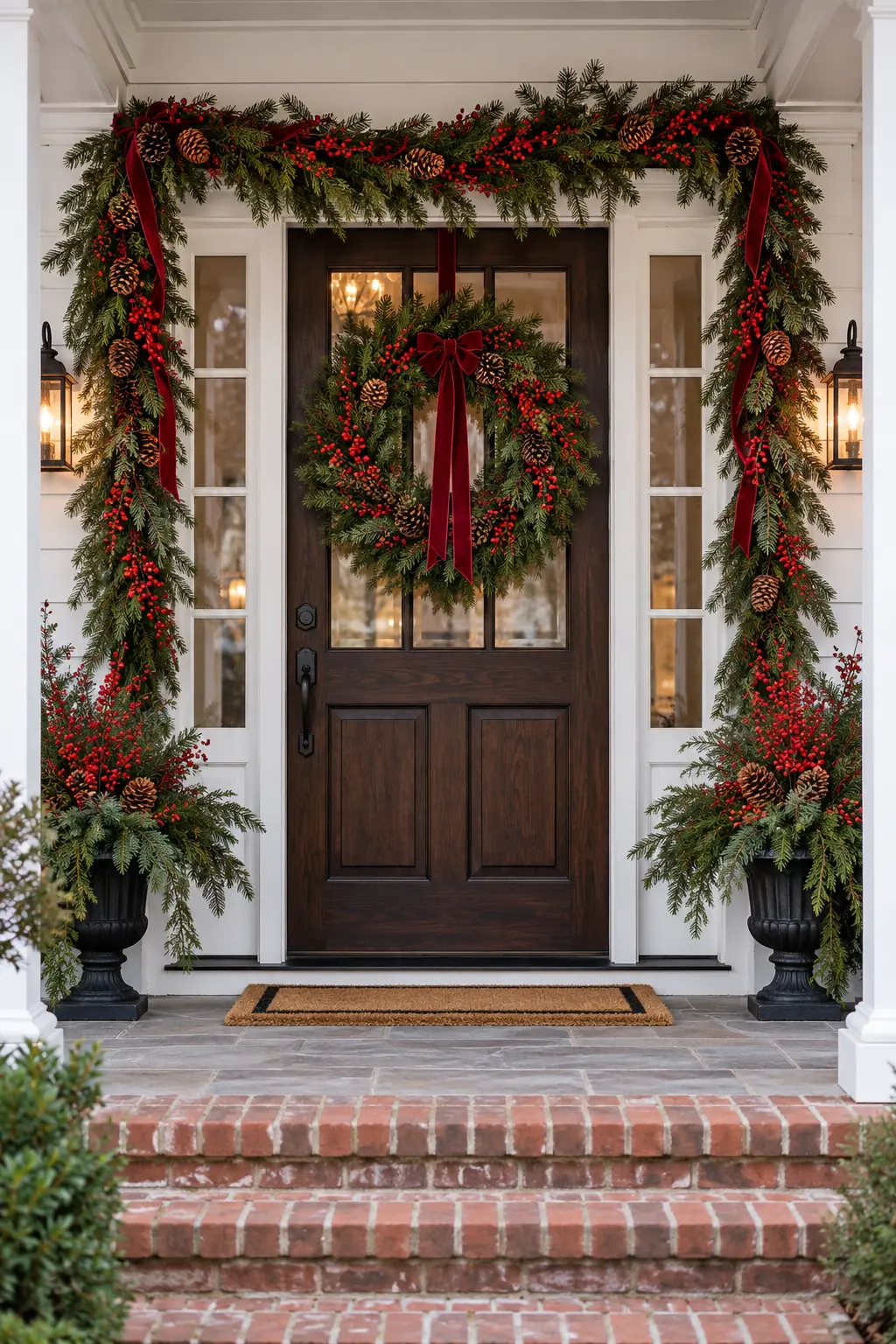
Here’s roughly what the full doorway costs if you’re starting from nothing:
- Main greenery: 9 ft mixed evergreen garland, $60–$140; matching 24 in wreath, $35–$80
- Lighting: two black outdoor lanterns, $50–$120 each, or reuse what’s already there for $0
- Textiles: 4 yards wire-edged red velvet ribbon, $18–$40
- Decor: frosted berries, pinecones, two black urn planters, $55–$130
- Hardware: four to six hooks rated for cold weather, $10–$18
2. Gold-and-Silver Fireplace Garland With a Cascading Left Side
Treat the mantel like a scale drawing. Measure the length, then hang the garland so the long cascade lands roughly one-third in from one end — not dead center, and definitely not in a corner. On the white carved stone mantel here, the left side drops nearly to the floor while the right side stops at the mantel edge, and that two-to-one ratio is precisely what makes the whole thing read as intentional instead of lopsided.
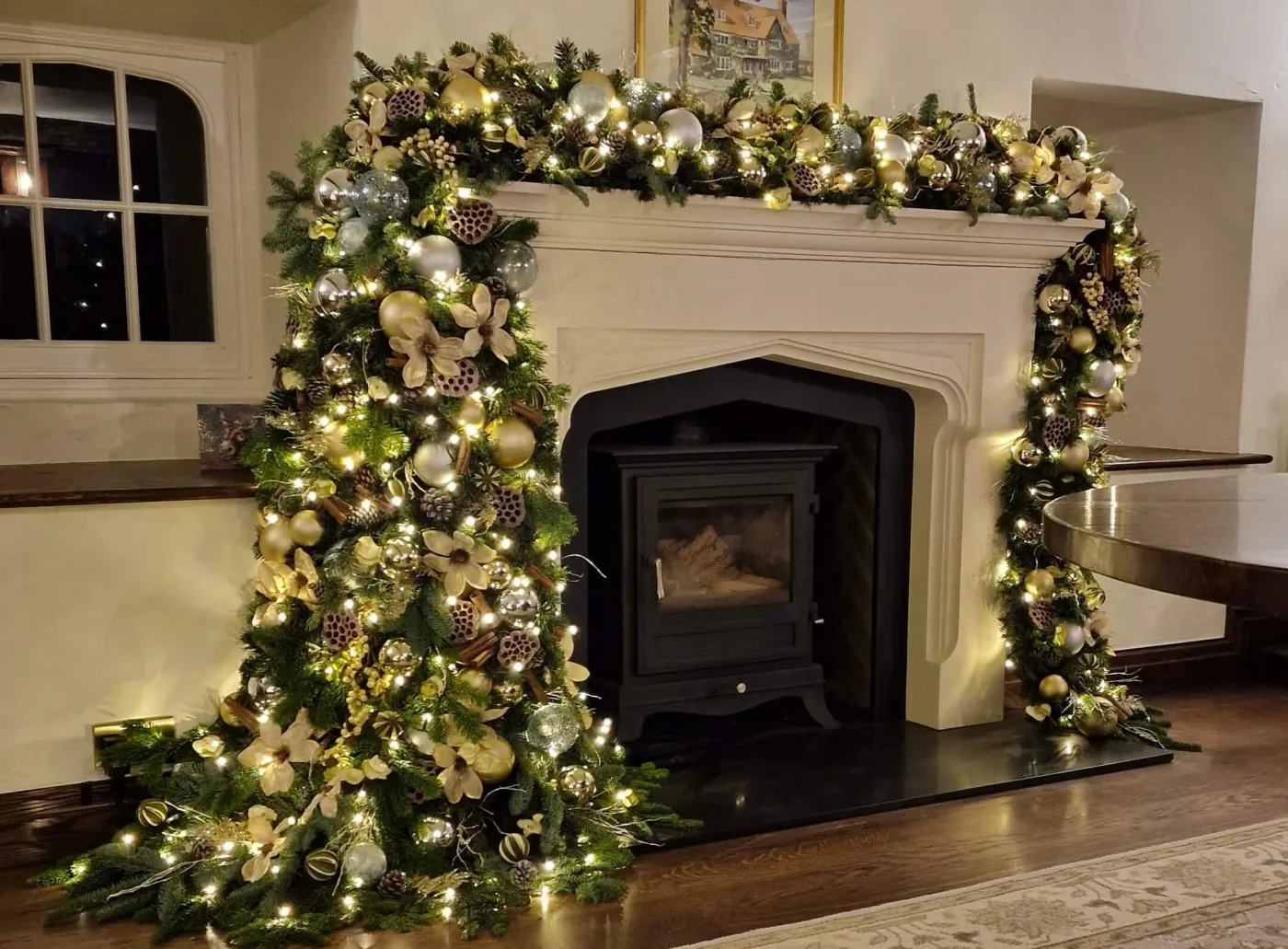
Three things are doing the heavy lifting. Temperature mixing first: warm white lights against cool silver baubles keep the gold from going brassy and cheap-looking. Then scale contrast — three-inch spheres sitting right next to pale berries and dried seed pods. And finally density gradients, because the garland is packed solid along the mantel and thins as it falls, so it looks grown rather than assembled on a table.
3. White Paneled Living Room With a Wreath-Motif Rug
Pull the rug and you’d have a perfectly pleasant white room with a garland on the mantel and nothing memorable about it. That olive green rug, with its oversized wreath medallion, repeats the shape on the mantel at a completely different scale — one motif, two sizes, three feet apart. If you’re rug shopping for this, look for a motif at least three times larger than your wreath so the repetition registers as a decision rather than a match.
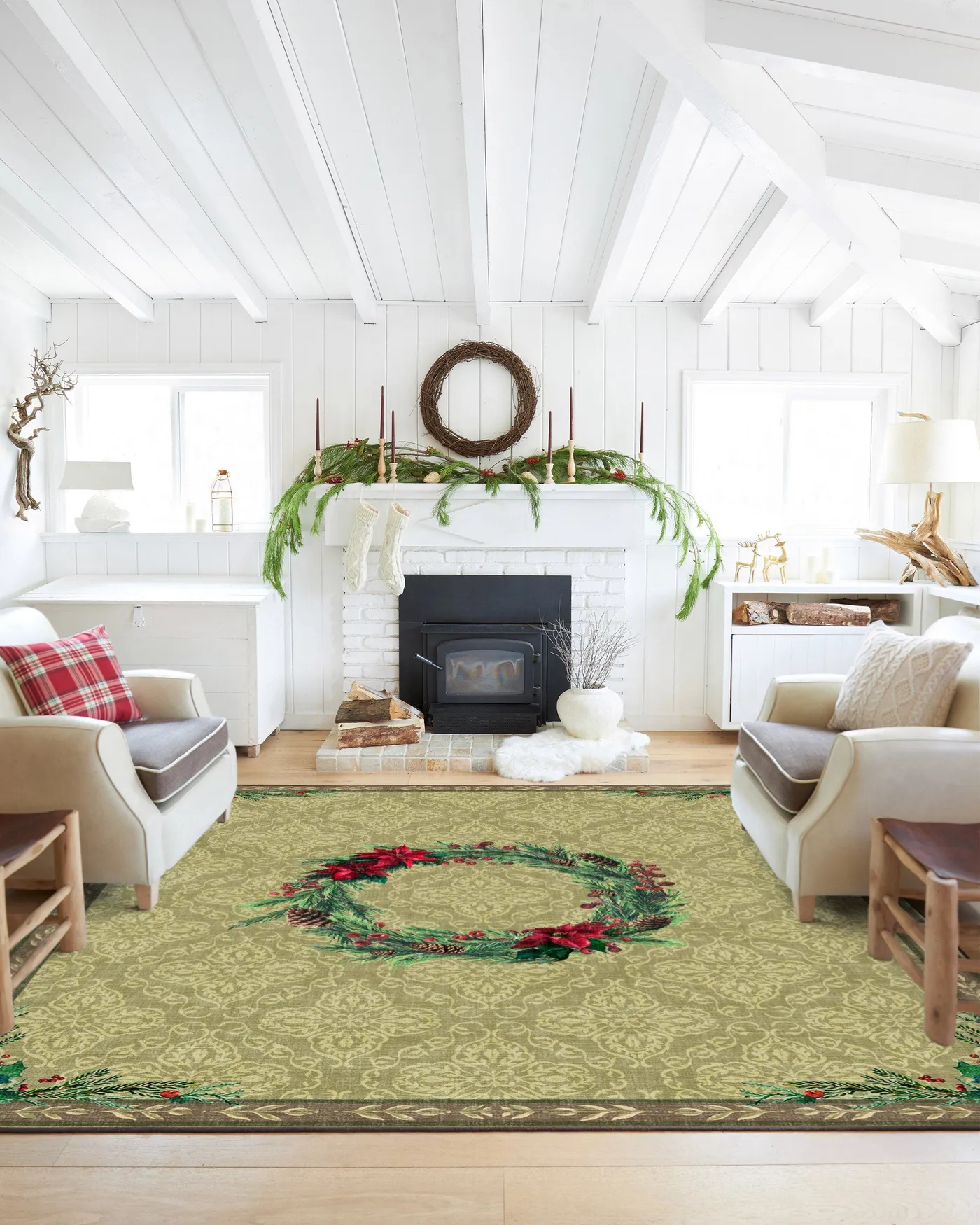
You don’t need the full renovation to steal this. Start with a washable wreath-motif runner over an existing neutral rug ($40–$70 at Target or Walmart), rewire a thrifted grapevine wreath with about $12 of berries, and skip the gold reindeer entirely — a pair of brass candlesticks from Facebook Marketplace does the same visual job for $15. Same white walls, same pine and pinecones, a fraction of the spend.
4. Eucalyptus-and-Evergreen Runner With Powder Blue Napkins
Build the runner in this order and it stays loose instead of turning into a hedge:
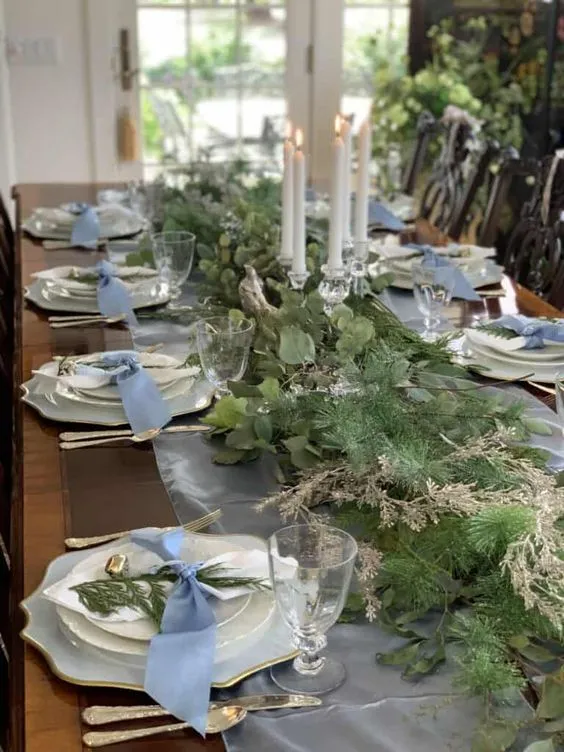
- Lay a 6 ft cedar garland down the center and fluff every branch outward, never upward.
- Weave in four or five eucalyptus stems so they break the outline of the cedar.
- Cluster the candles in threes and twos, spaced about 20 inches apart at the widest point.
- Tuck a single sprig into each napkin last, once the runner itself is finished.
Time: about 40 minutes. Materials: roughly $70–$110 for a fresh garland, one bunch of eucalyptus, and six white tapers.
60% deep evergreens + 25% white and gold at the table + 15% powder blue. That last number is the entire personality of the setting, and everything else is a neutral. Swap the blue for sage and it turns rustic; swap it for cranberry and you get traditional; swap it for black and the table goes moody and modern. Keep the first two percentages fixed and you can restyle this every single year.
5. Birch-Bark Planter Packed With Red Glitter Spheres
The trick to a planter that looks planted rather than stuffed: build it in three layers and let each one overhang the rim by a different amount. Upright cedar at the center, medium fir leaning out at roughly 45 degrees, then trailing branches spilling six to eight inches past the edge. Nothing gets tucked inward — an inward tuck disappears the second you step back to look at it.
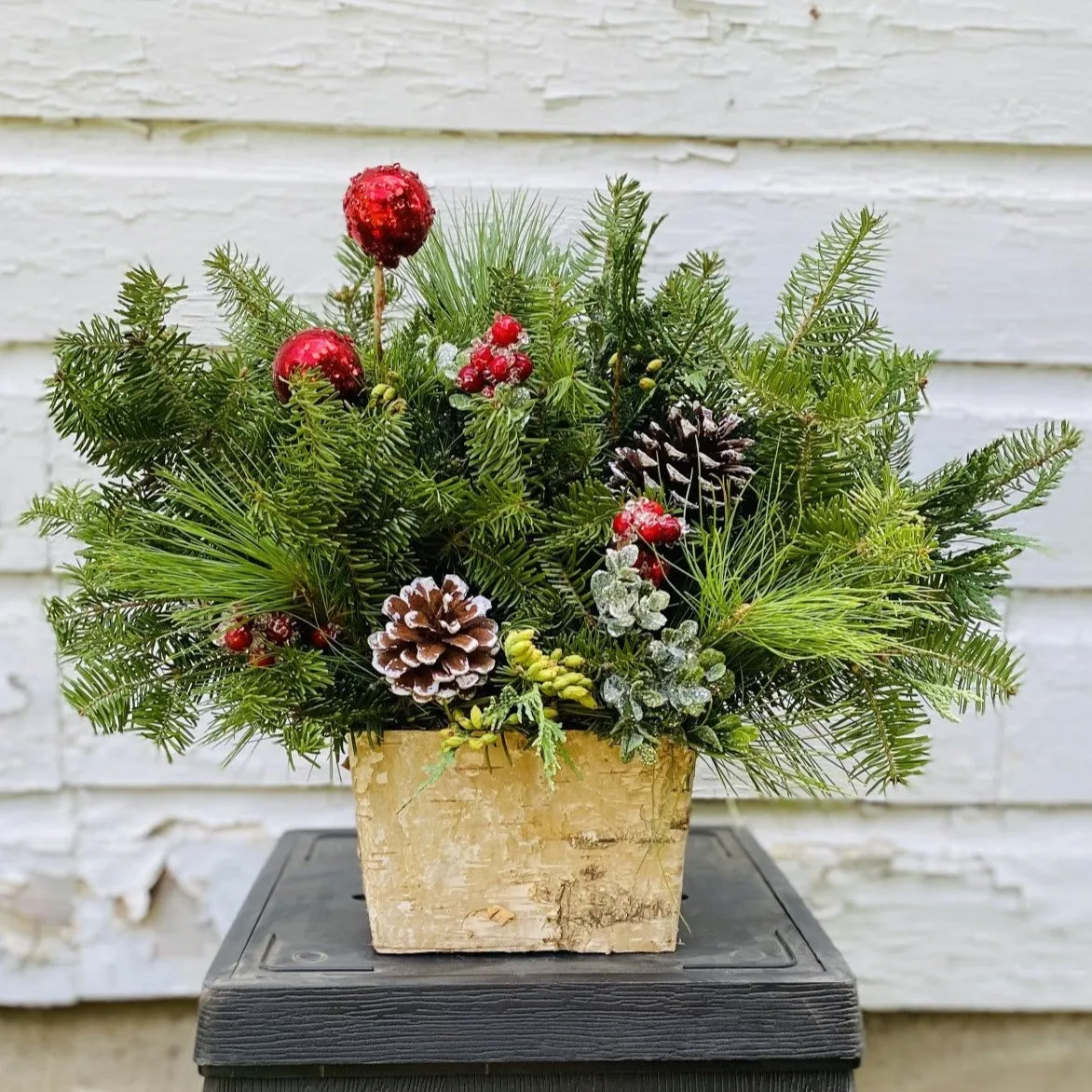
- Birch bark planter: $35–$60 at a garden center, or $8 in birch contact paper over a plain bucket
- Mixed evergreen bundle: $18–$30, or free trimmings from a tree lot
- Red glitter spheres and frosted berries: $12–$25
- Pinecones: free, if you walk a park in late November
That lands around $65 all in, or under $30 with a little foraging. Compare with Idea #23 — same frosted-and-red palette, much fancier vessel.
6. Vertical Evergreen Swag With a Big Gold Bow
A vertical swag is unforgiving in a way a wreath simply isn’t: it’s long, it’s heavy, and it hangs on a door that gets slammed forty times a week. Skip the adhesive hooks — they fail at around 15 pounds once the temperature drops. Use an over-the-door bracket rated for 25 pounds or a wreath hanger with a strap, and keep the finished swag under 12 pounds while it’s still damp from the cold.
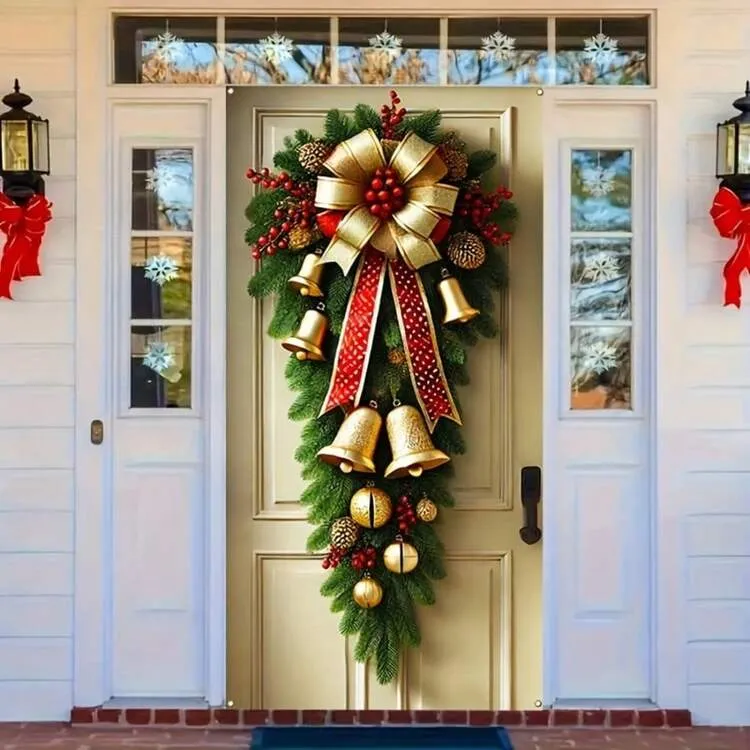
This shape wants a door at least 36 inches wide and 80 inches tall. On anything narrower the swag swallows the panels and reads as a green stripe rather than a decoration. On a standard cream door, keep the swag between 45 and 55 inches long so it ends above knee height — the gold bow should sit at eye level, around 60 to 66 inches from the threshold.
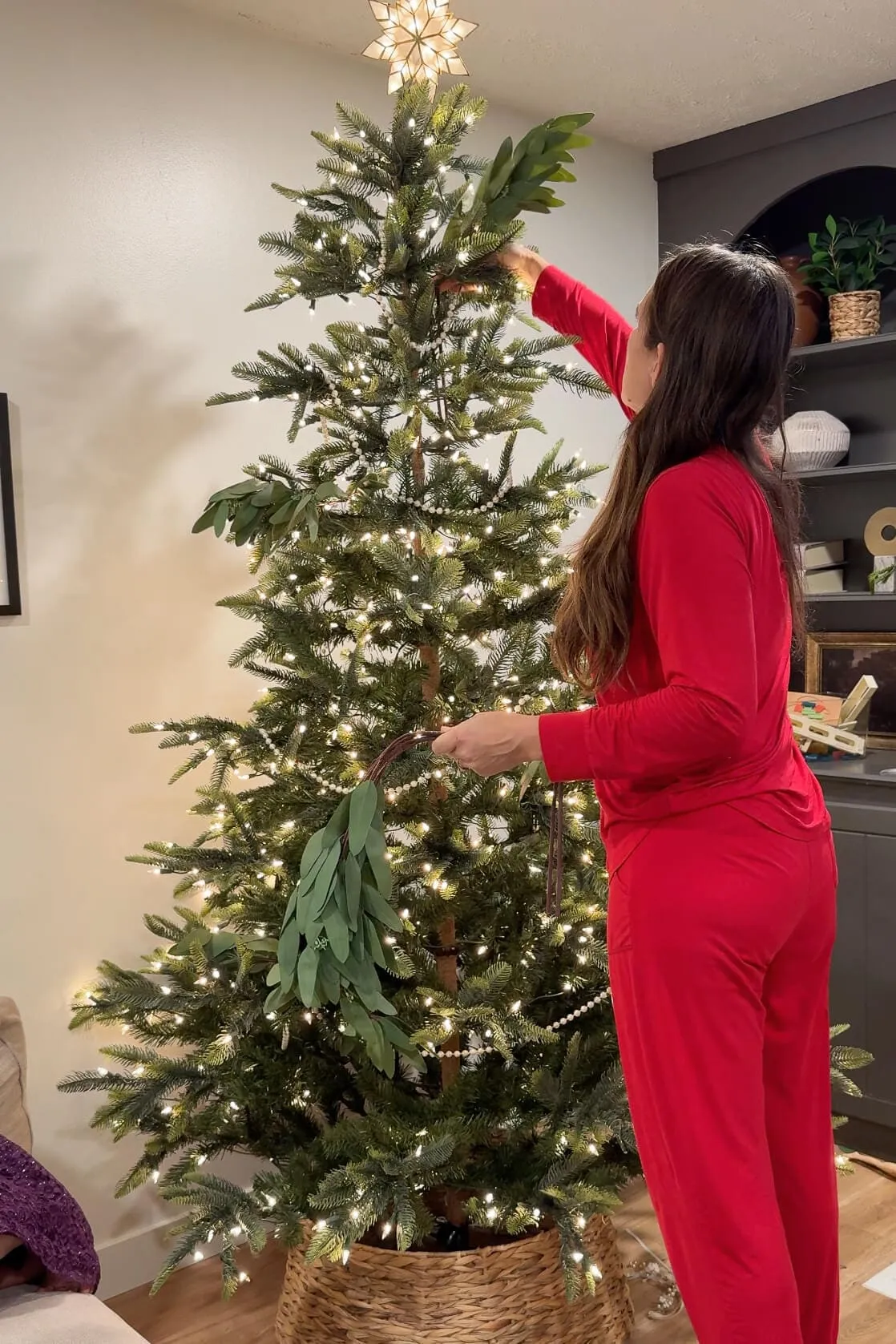
7. Faux Eucalyptus Garland Woven Into a Pre-Lit Tree
Garlands read as garlands when they follow a single direction. Cut your faux eucalyptus into 18-inch sections, twist two sprigs together so the leaves face the same way, then wind them diagonally down the tree, top-left to bottom-right. Stop at the last third — a tree decorated perfectly to the floor looks staged, and the bare bottom branches are what make the woven sections feel deliberate.
- Measure the tree stand’s circumference and add 6 inches.
- Choose a woven basket 2 inches wider than the stand’s legs.
- Cut a 6-inch slit in a heavy canvas drop cloth or an old wool blanket.
- Tuck the fabric around the trunk and pin it at the back.
- Set the basket over the stand and pull the fabric over the rim.
Twenty minutes, about $35 for the basket and fabric.
8. Mini Evergreen Wreaths Tied to Dining Chairs
70% evergreen wreath + 20% crimson velvet + 10% berry mix. The wreaths themselves should stay small — 10 to 12 inches across, no wider than the chair back, or they start knocking into each other when guests pull out their seats. The velvet ribbon needs enough length to hang six inches below the seat rail, because a tight bow reads as a napkin ring while a long tail reads as actual decor.
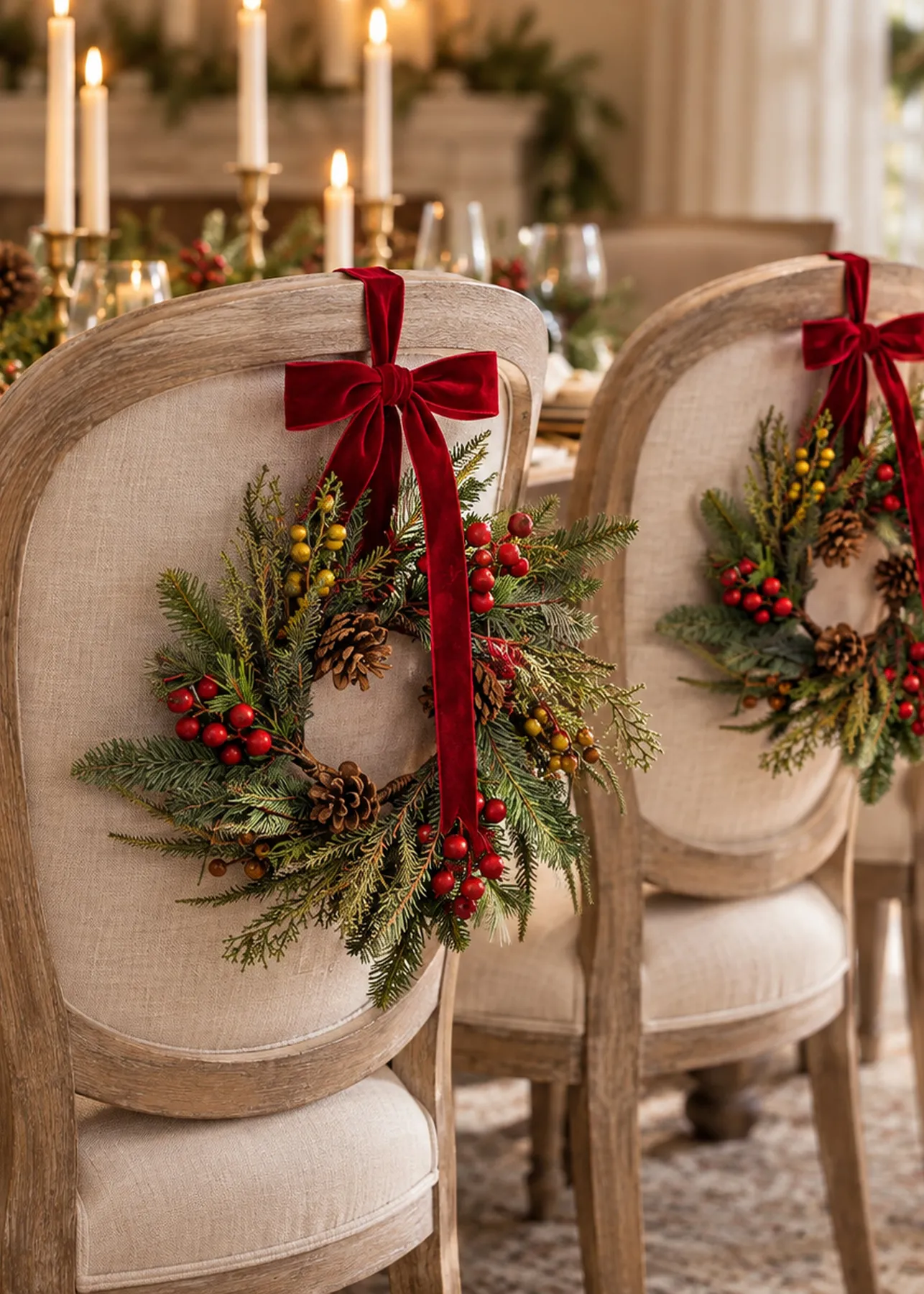
Chair wreaths came back through the tablescape-that-photographs-well wave on Pinterest, where people now style the whole room before anyone arrives rather than just the table. In 2026 it’s less about matching the centerpiece and more about repeating one material around the room. This one will age fine, mostly because changing the ribbon next year costs about $8.
9. Pine, Red Berries, and a Flock of Cardinal Figurines
Cardinals. Take them out and you have a very good, very ordinary pine-and-berry arrangement. The birds add a small narrative — somebody is in there — and they pull your eye through the greenery at a walking pace instead of a glance. Cluster three, not twelve, and keep them at different depths so the flock looks like it landed rather than got glued on.
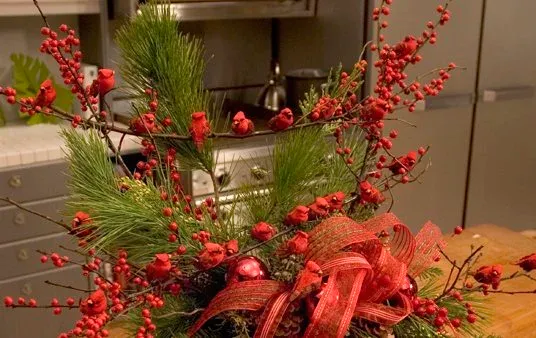
Fresh pine in a warm room drops needles in about ten days, and no amount of water in the container stops it once the room passes 72°F. The cardinals and berries, on the other hand, will outlast the greens by weeks. Plan on replacing the branches once mid-season and keeping the figures — which is exactly why the ornaments are worth buying well and the greenery isn’t.
10. Teardrop Swag With Red-and-Gold Balls on a Black Door
A teardrop swag is the most forgiving front-door shape there is, and it’s cheap to put together:
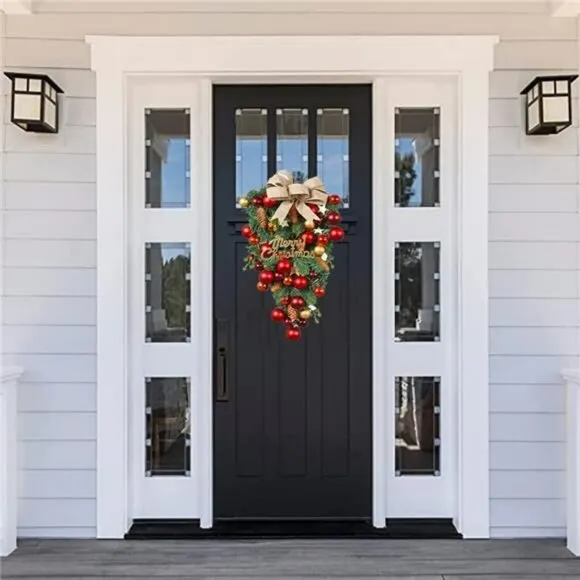
- Teardrop swag, 30–36 inches: $45–$90
- Shatterproof red and gold ornaments, 50-count set (covers two swags): $20–$40
- Beige or gold bow: $12–$25, or $6 if you make it from ribbon
- Pinecones and berry picks: $15–$30
- Small sign or plaque: $10–$20
- Measure the door’s glass panels — a swag that covers them kills all your entry light.
- Watch which way the door swings and whether the swag will catch on the frame.
- Confirm your hanger clears the top of the door by at least an inch.
- Weigh the finished swag: stay under 10 pounds for adhesive, 20 for metal.
11. Loose Mixed-Evergreen Wreath on a Deep Red Door
Mixed wreaths look expensive when the foliage types are visibly different sizes: long pine needles, short boxwood, flat cedar. Buy three small bunches instead of one big one and wire them in alternating bundles of three. Nine bundles makes a 22-inch wreath — count them, because an even number of bundles always reads slightly off, and nobody can tell you why until you point it out.
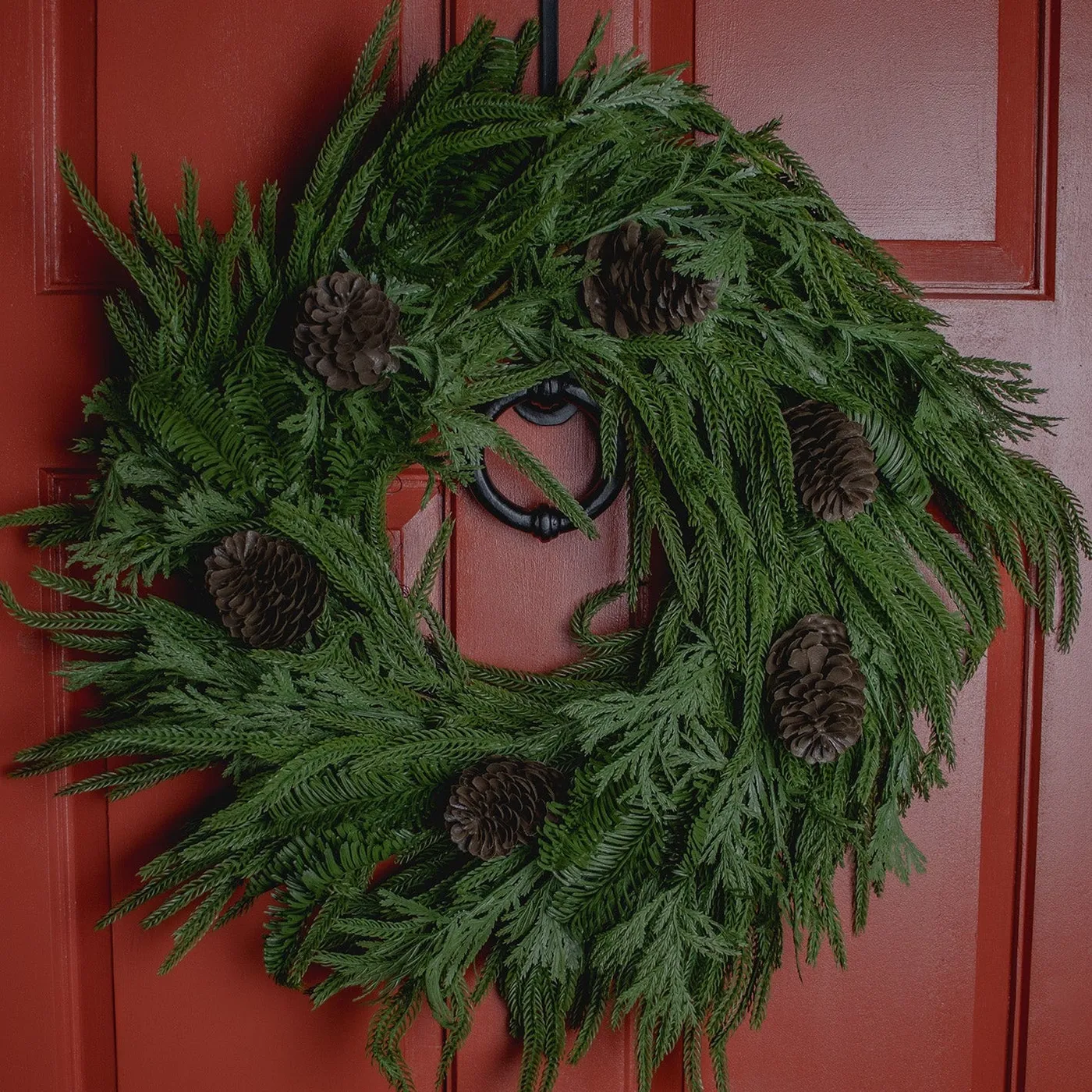
The deep red door does most of the work here, and the wreath knows it. No bow, no glitter, no second color — just evergreen against oxblood with the black knocker peeking through the center. That restraint is a real design decision. When the background is already a statement, greenery’s only job is texture, and adding anything else is how a good door turns into a craft project.
12. Hot Pink and Purple Ribbon Bow in a Maximalist Arrangement
This is the maximalist garden-party branch of Christmas decor, and it is genuinely having a moment — Pinterest searches for non-traditional holiday color have climbed for three straight seasons. The plaid-plus-satin combination nods to 1980s department store windows, which is exactly why it feels new again. It won’t be a five-year trend, but it’s a fantastic one-year statement.
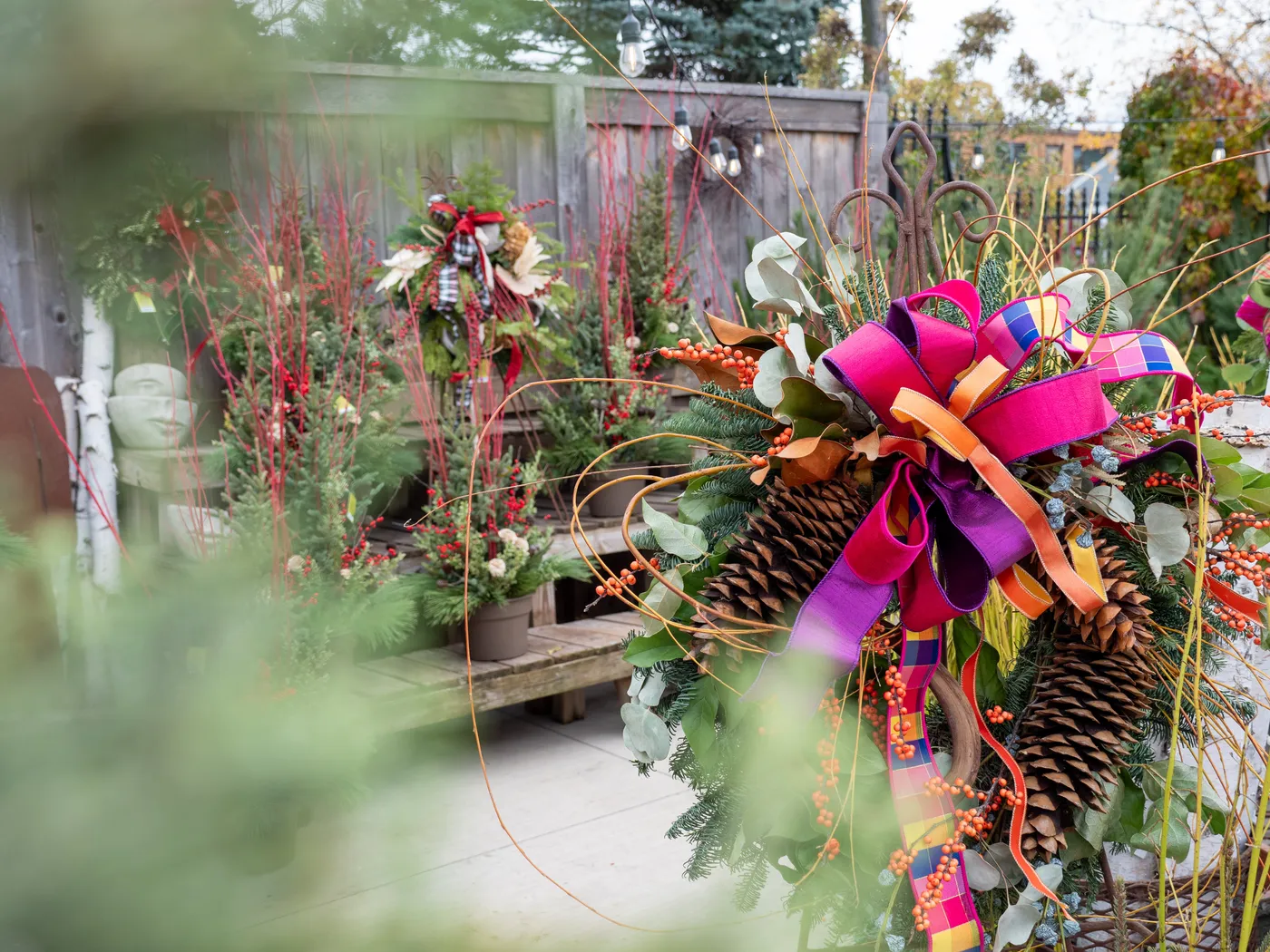
Hot pink satin and orange berries are a commitment, and they will not play nice with a red-and-green room. Keep the backdrop neutral — white walls, wood tones, no competing ribbon anywhere in sight — and pick your one accent family before you buy a single stem. Also, satin shows every crease, so steam the ribbon and store it flat rather than folded in a bin.
13. Green Pillar Candle Holders Nestled in Dried Orange Slices
This one is mostly about build order:
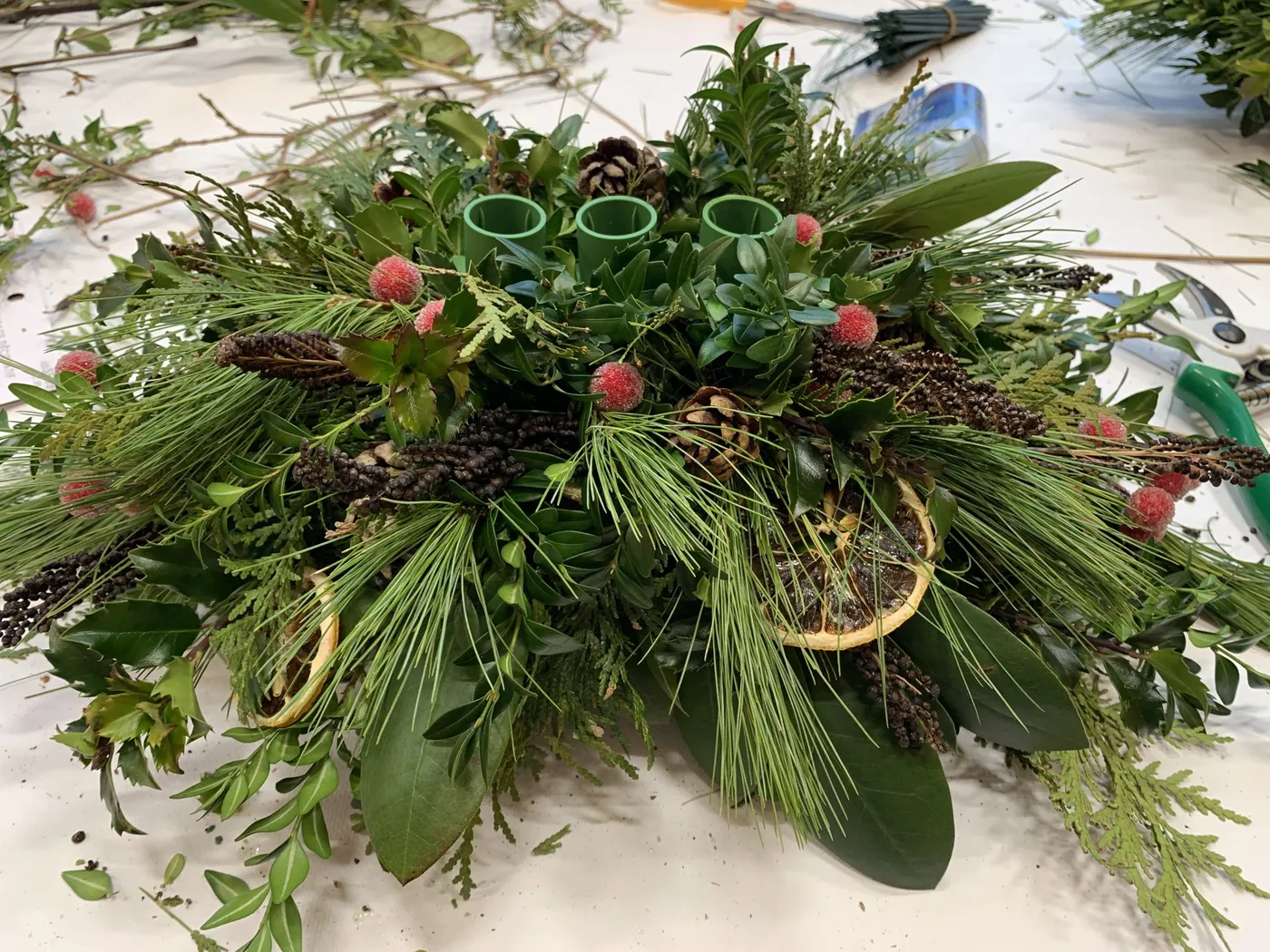
- Soak a block of floral foam for 20 minutes, then cut it to fit a low bowl.
- Push the three green cylindrical holders in first, slightly off-center.
- Fill around them with pine, then cedar, then the fine filler greens.
- Tuck dried orange slices and seed pods at the rim — never in the middle.
- Add the frosted berries last so they sit on top of the foliage, not under it.
Time: 30 minutes. Cost: $35–$55 if your oranges are already dried.
- Greenery bundles (pine, cedar, fir): $25–$45
- Three green pillar holders: $18–$40
- Dried orange slices and seed pods: $8–$18
- Frosted berries: $6–$14
- Low vessel or tray: $10–$30
14. Candlelit Pine Runner Lit by a Brass Candelabra
Open flames and evergreen are a beautiful, slightly flammable combination. Keep tapers at least four inches from any branch, trim wicks to a quarter inch, and never leave the table lit while you’re in the kitchen. Battery pillars inside glass hurricanes get you 90% of the glow with none of the supervision, and honestly nobody at the table is inspecting the flame.
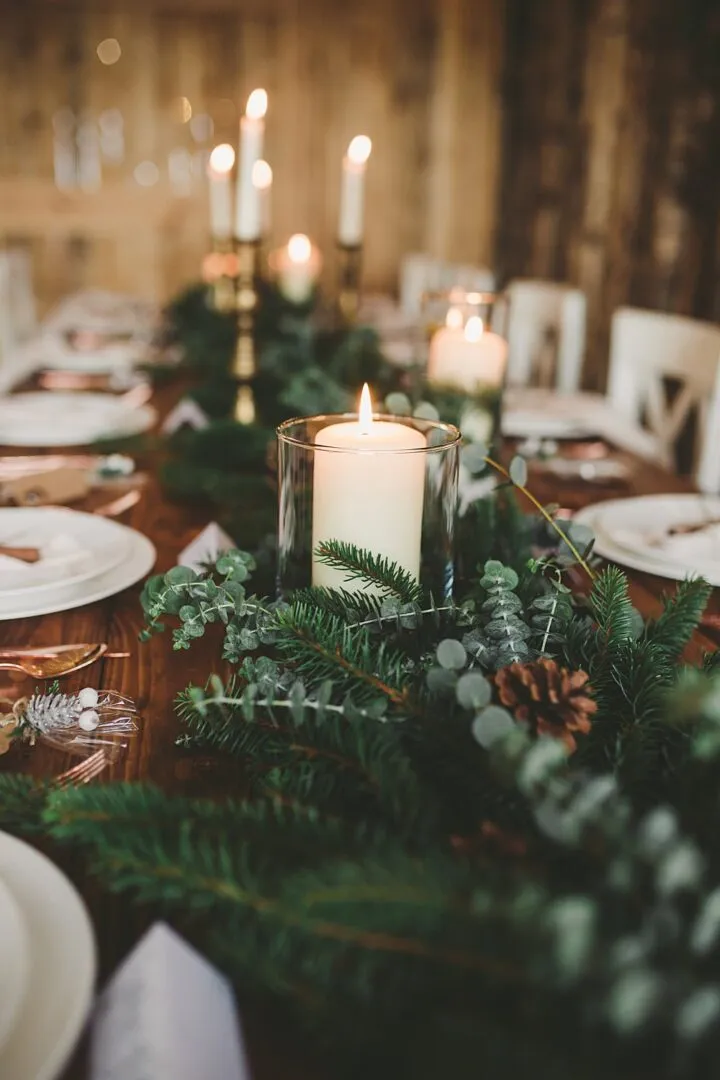
A runner like this needs a table at least 60 inches long. On a 48-inch table the greenery crowds the place settings and people end up eating with a pine branch in their plate. Leave 14 inches of bare table at each end and 10 inches per setting, and check the candelabra height against the chandelier before you commit. For a smaller table, the compact centerpiece in Idea #34 covers the same idea in half the footprint.
15. Glittered Pinecones and Gold Chargers on a Plank Table
A rough plank table actually rewards cheap styling. Gold chargers from Walmart run about $2 each, glittered pinecones are a $6 bag at any craft store, and white potted flowers can be grocery-store kalanchoes at $5 a pot. The runner does the real work — a $20 evergreen garland fluffed wide covers four feet. You can set this table for $60 if you already own the plates. Compare with Idea #16 for the same palette done formal.
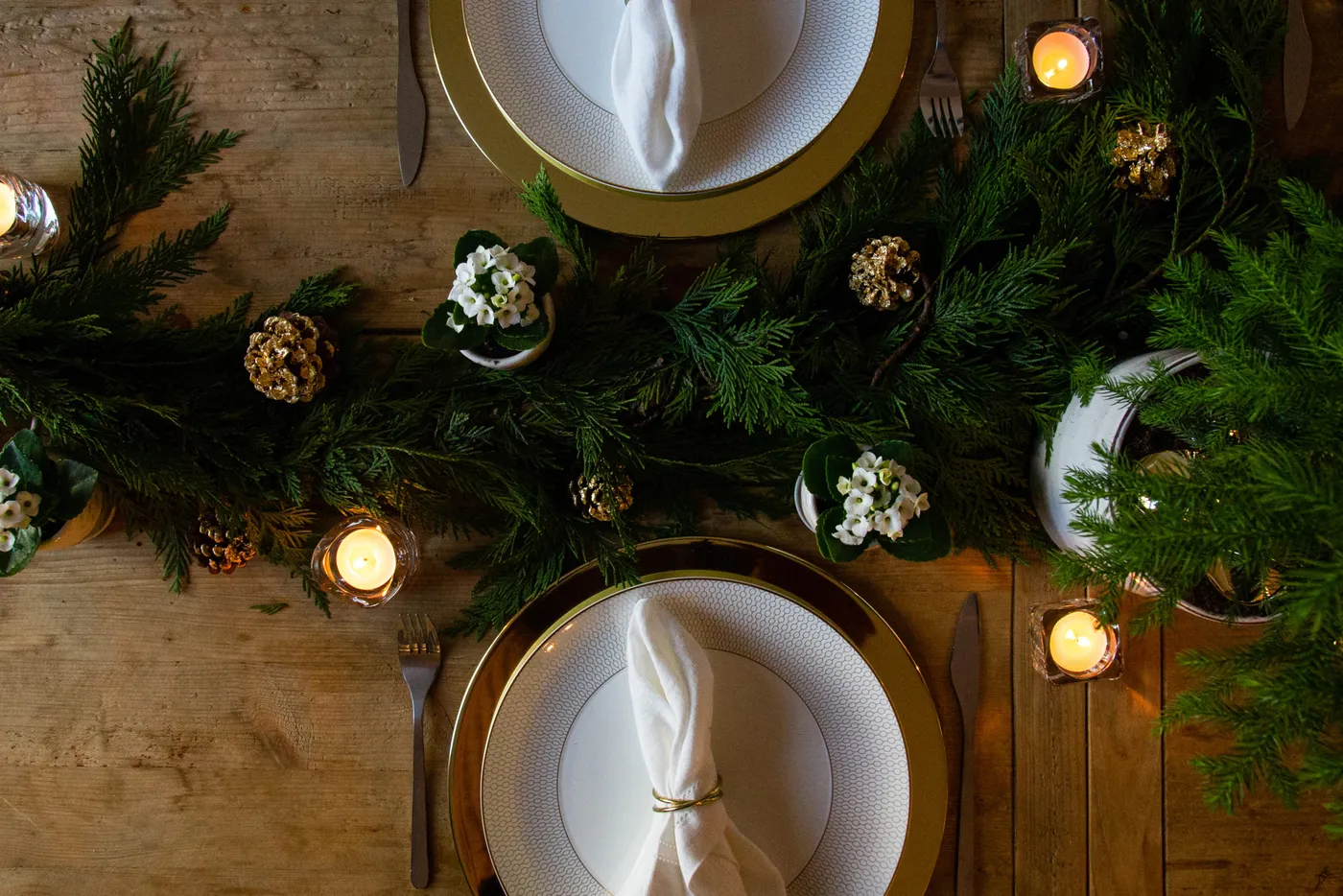
Rough wood and gold shouldn’t work this well, but the contrast is the entire point: polished metallics read as special against something that was never polished to begin with. Then the white flowers give your eye somewhere soft to land between the shine and the grain. Three textures, two metals, one palette — that’s the whole formula, and it’s why this setup photographs better than it costs.
16. Mercury Glass Ornaments Tucked Into a Table Garland
Mercury glass. Without it, the garland is a nice, safe centerpiece. With it, the ornaments catch the chandelier light and throw it back down the length of the table. Mercury glass is the only material that reads metallic from across the room and soft up close, and mixing silver with gold here is what keeps the table from looking like a matched set ordered from a catalog.
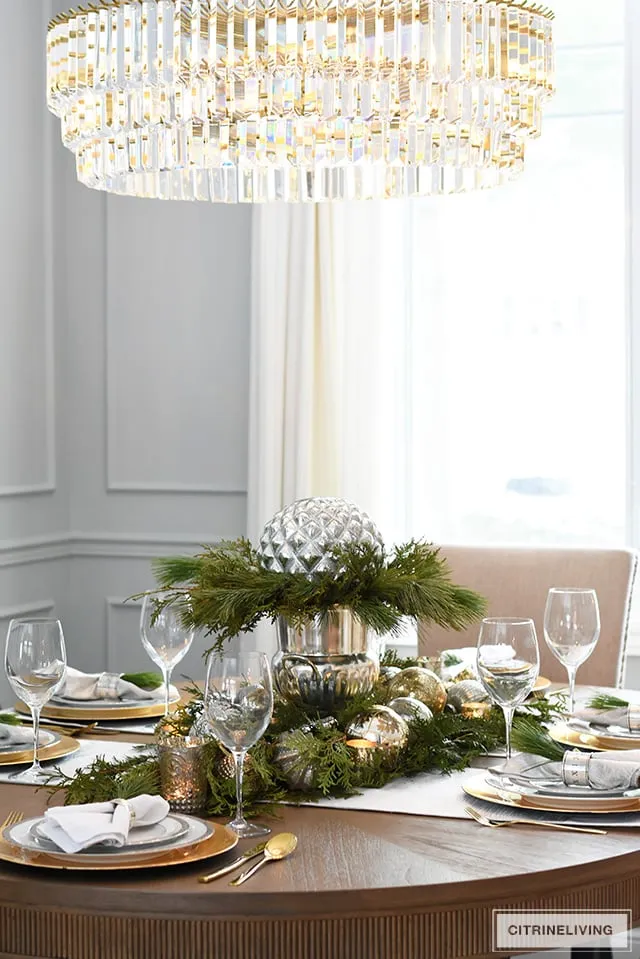
- Evergreen garland, 6 ft: $45–$95
- Mercury glass ornaments, set of 24: $30–$70
- Gold chargers and flatware for eight: $40–$90
- Votives and candles: $15–$30
- Table runner: $20–$40
17. One White Taper Candle in a Ring of Gold-Dusted Pinecones
One candle needs a 10-inch clearing. Anything closer and the flame doubles in height from the draft, drips onto the greenery, and turns your centerpiece into a wax sculpture. Build the entire ring first, then push the candle down through the middle until the base sits on the vessel — not on the branches, because branches compress and your candle will lean by dessert.
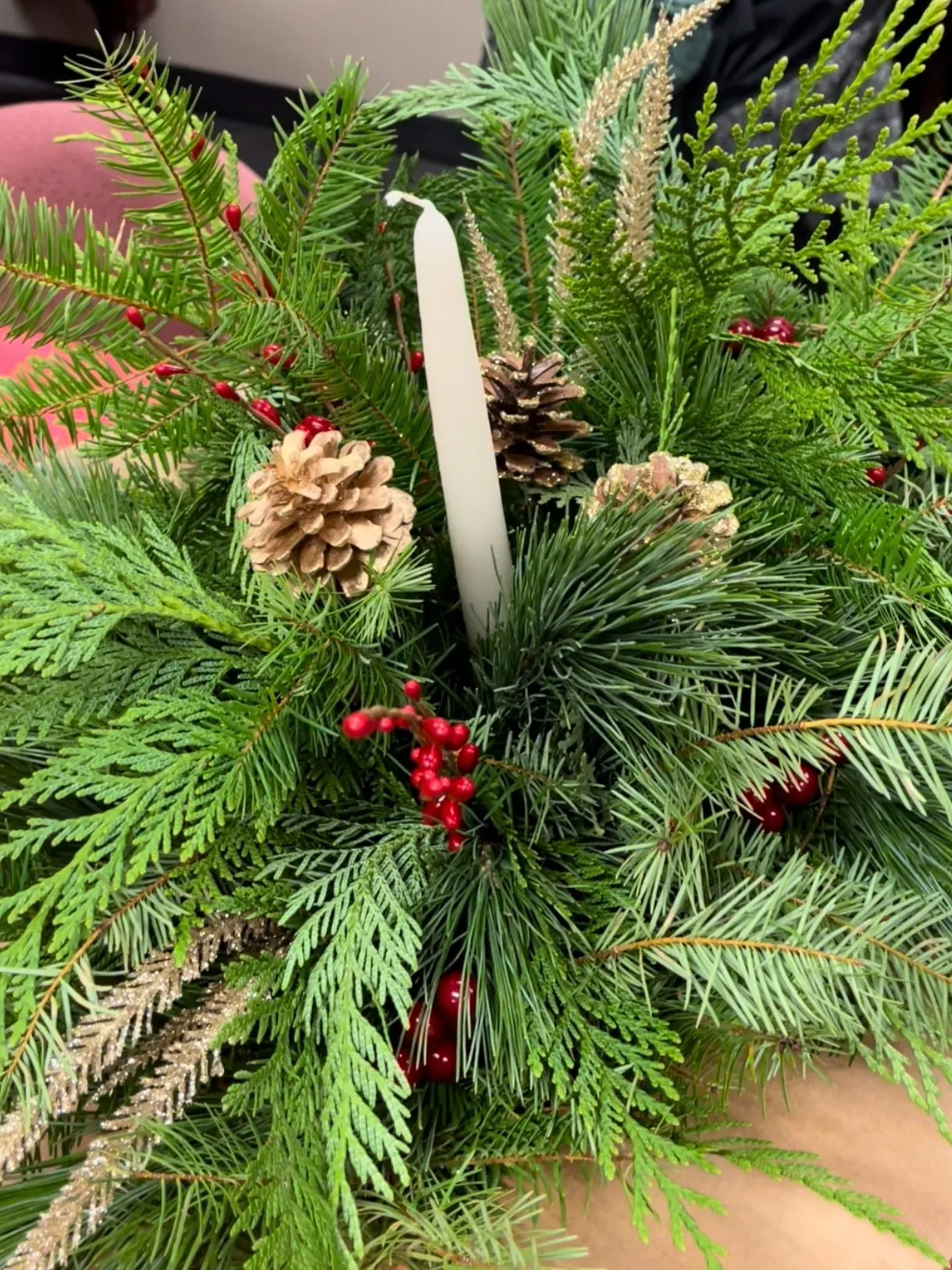
Four materials, one palette: green, red, white, gold. The gold-dusted pinecones do something specific — they make the arrangement look lit even when the candle isn’t burning, because they pick up whatever ambient light is in the room. And the single white taper sets the scale for everything else. One candle, one focal point, zero competition from anything else on the table.
18. Mixed Foliage Wreath With Blue-Grey and Gold Berries
80% mixed green foliage + 15% pale berries and seed pods + 5% blue-grey accents. That last five percent is what keeps this from being a standard Christmas wreath — small blue-grey berries cool the whole thing down and make the greens look deeper than they are. Swap the blue-grey for true red and it turns traditional; swap for white and it reads Scandinavian; leave it as is and it looks like something foraged.
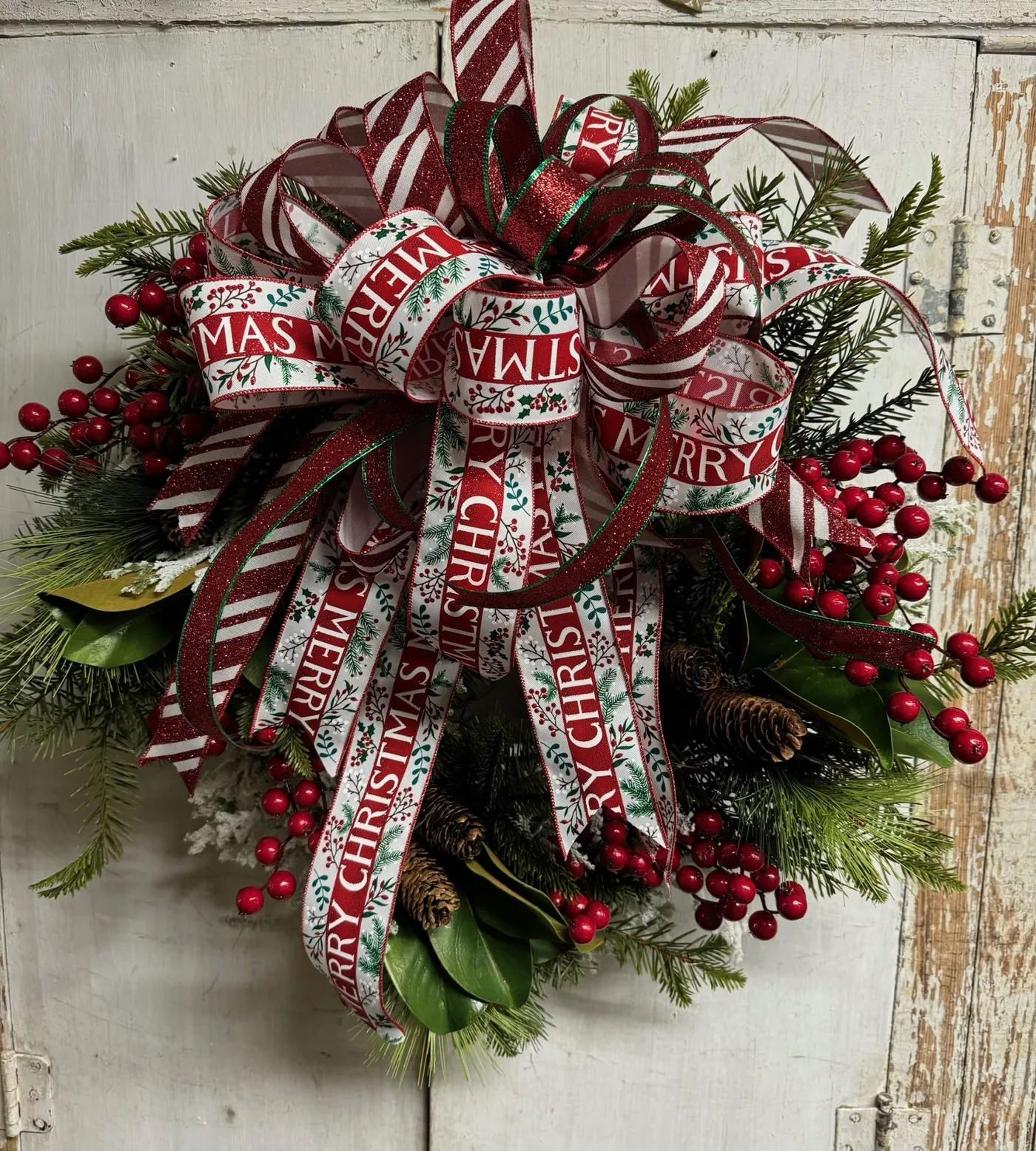
Mixed foliage wreaths are the fussiest thing on this list, because different greens age at different speeds. Cedar dries out first and goes crunchy inside of a week; boxwood holds for three. Mist the wreath daily with cool water and keep it away from heat vents, or simply accept that you’re buying it for a two-week window and enjoy it hard.
19. Layered Patterned Ribbon Bow on a Snow-Dusted Wreath
Build the bow on the wreath, not in your hand. Pinch the ribbon into loops in place, wire each one as you go, and keep the tails two loops longer than feels right — 14 to 18 inches. A three-ribbon bow (patterned, solid, glitter) needs each ribbon cut about four inches longer than the one above it, so all three show at the bottom instead of nesting into a single blob.
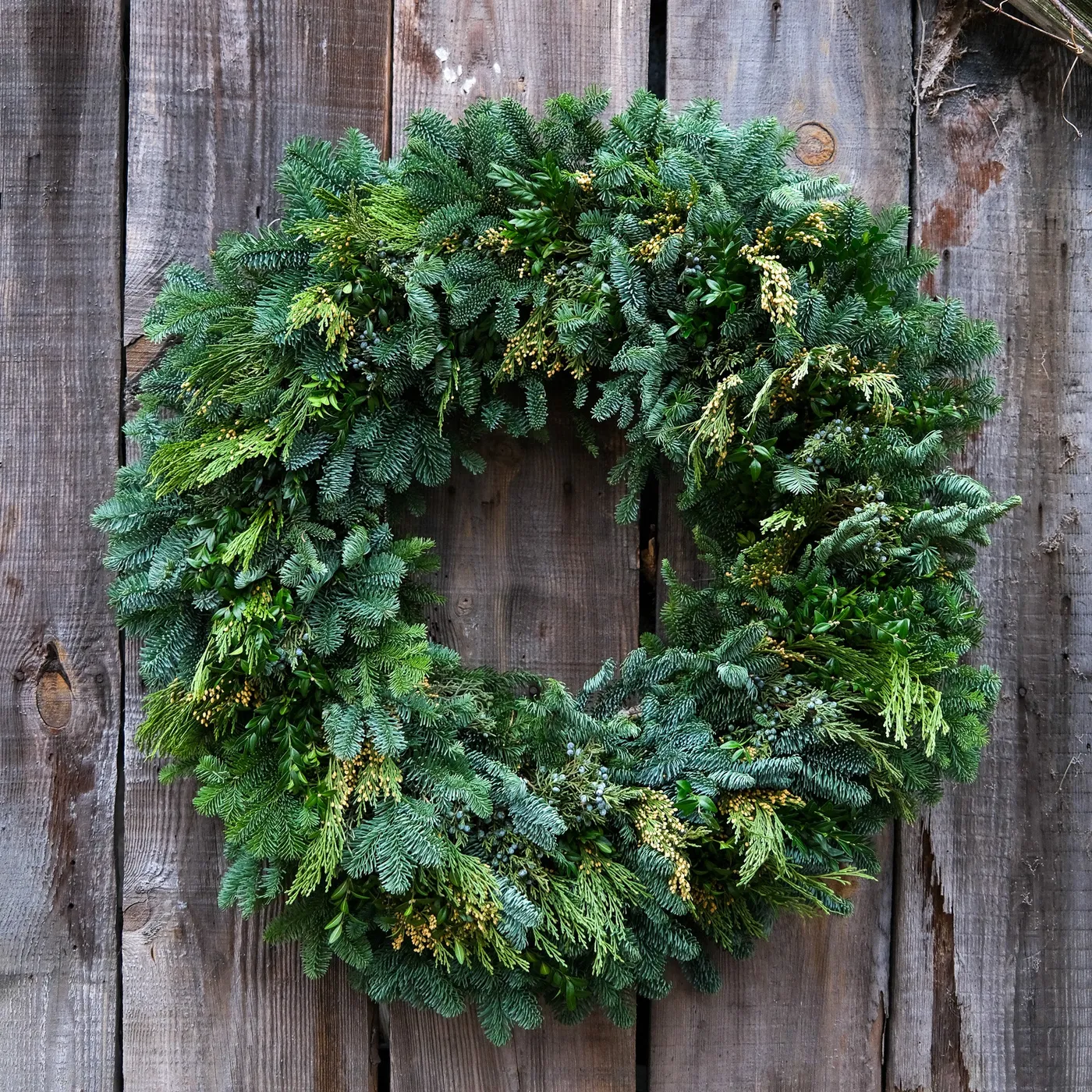
- Measure your door first — a 30-inch wreath disappears on anything over 8 feet tall.
- Check whether the wreath sits against glass or solid wood; tape-backed hooks fail on frosted glass.
- Confirm your ribbon is wide enough to make loops at least 5 inches across.
- Decide up front whether it needs to survive rain — if yes, skip paper-backed ribbon.
20. Red-and-White Ornament Wreath With Candy Cane Spheres
Ornament wreaths are heavy and they shed. A wire-frame version weighs six to ten pounds fully loaded, so hang it on a nail rather than a suction cup, and re-twist the ornament caps every December — those little metal loops loosen in storage and you’ll find balls on the floor by New Year’s. Store it flat in a box with a towel between layers instead of hanging it in the garage.
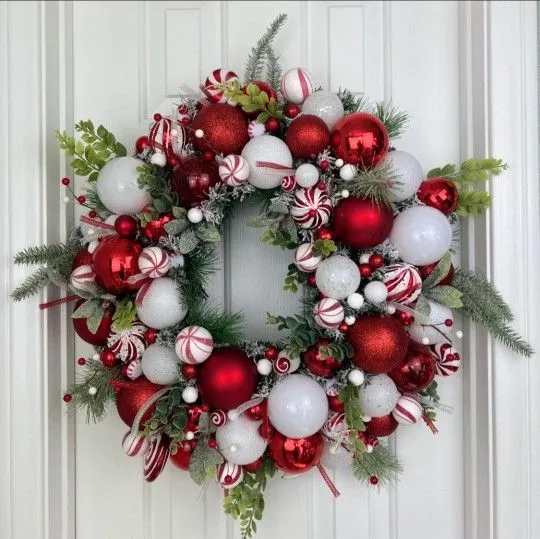
This is the cheapest showstopper in holiday decor if you shop off-season. Shatterproof red and white sets drop to around $8 for 40 after December 26, and wire frames run $6 at craft stores. Two years of post-holiday shopping gets you a wreath that looks like $140 for about $35, and kids and dogs can’t break it.
21. Mandarin Oranges Tucked Into Pine Branches
The fruit. Tangerines in Christmas greenery is an old idea — Dutch and Italian tables have done it for centuries — and it works because the color is warm in a way no ornament can copy. A few rules keep it looking placed rather than piled:

- Nest them in threes, never alone.
- Leave the leaves on at least half of them.
- Tuck low, at the base of the branches.
- Wash and dry them completely — wet skin marks the greens.
Two things make this work. Color temperature first: orange sits directly opposite green on the wheel, so nothing competes. Then scale — a mandarin is roughly the size of a large pinecone, so your eye reads the whole arrangement as one texture before it starts naming individual pieces.
22. Faceted C7 Bulbs on Black Wire in Dark Pine
C7 bulbs are the ones that look like actual Christmas lights, and they’re back after a decade of micro-LEDs. The working ratio for a garland or tree: one bulb every six to eight inches of branch, always run along the inside of the branch so the wire disappears. Black wire vanishes in dark pine; green wire shows up as a visible stripe across the whole thing.
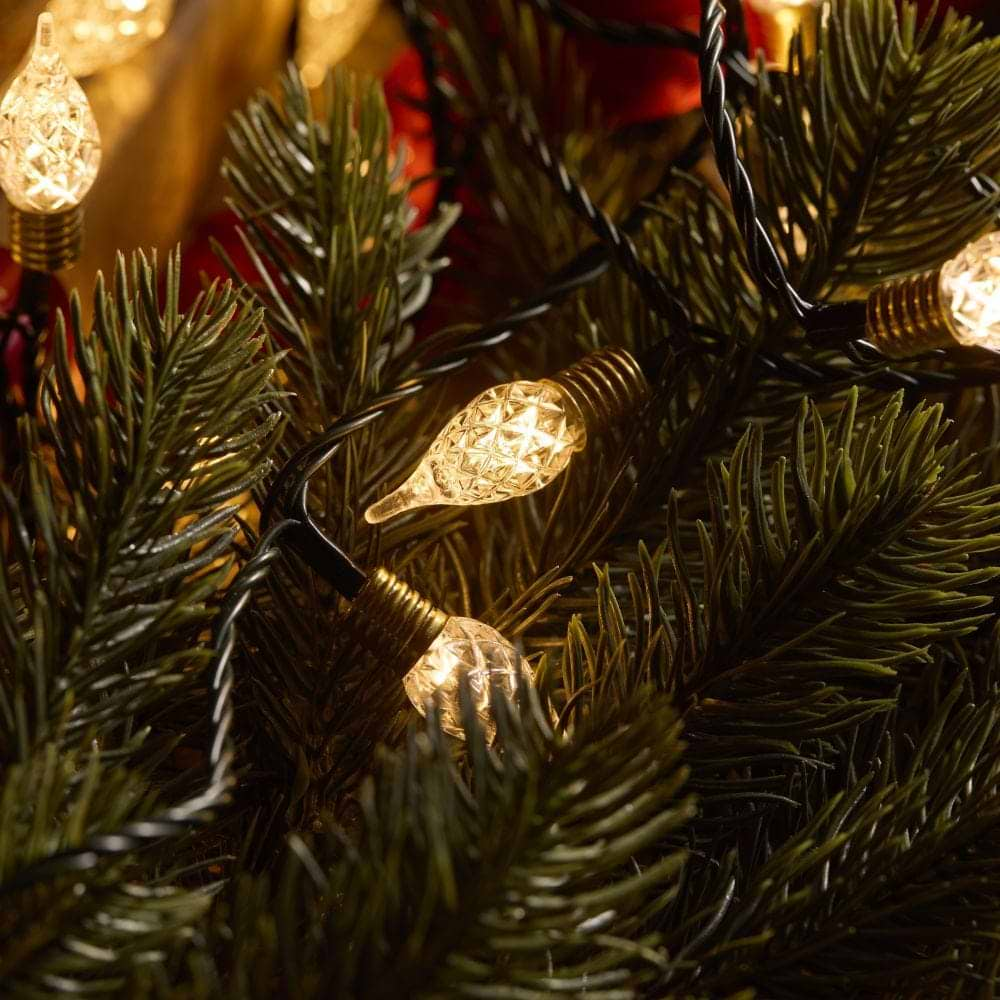
Warm, faceted, slightly glowy lights have replaced the cool-white everything of the 2010s, and it tracks with the broader shift toward amber and candlelight in interiors generally. If you’re buying in 2026, look for 2200K to 2700K. Anything above 3000K reads blue against greenery, and blue lights on green branches is the fastest way to make an expensive garland look cheap.
23. Baroque Gold Tray Filled With Frosted Greenery
50% frosted greenery + 30% antique gold + 20% deep red. The frosting matters more than the gold: a white-dusted branch reads vintage immediately, and it lets you use less ornament because the texture is already carrying the visual weight. Swap the red flowers for cream and it turns wedding-soft; swap the gold tray for silver and the whole thing goes icy.
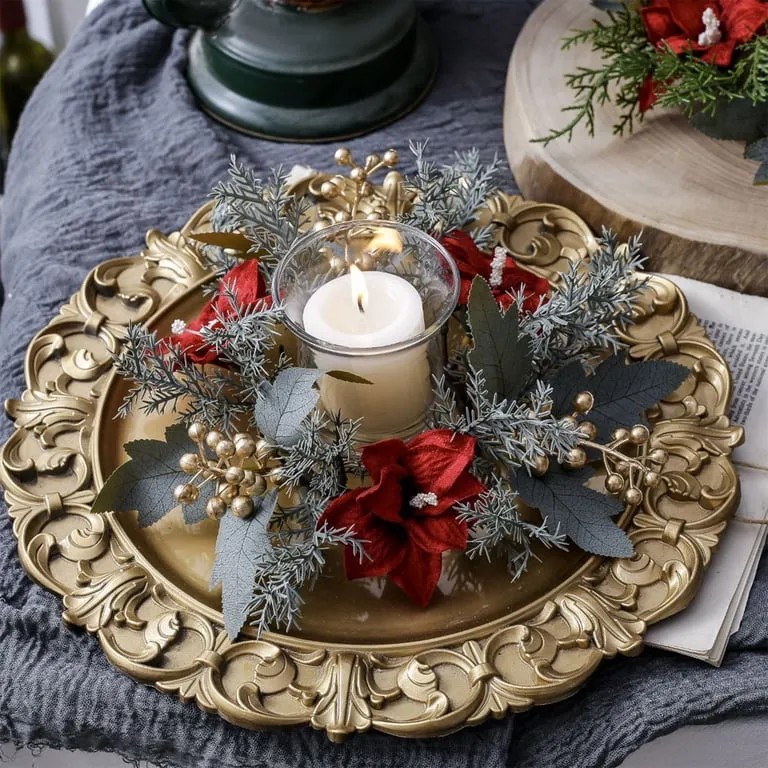
- Ornate gold tray, thrifted or estate sale: $8–$35
- Frosted evergreen stems: $15–$30
- Deep red fabric flowers: $10–$22
- Metallic gold berry clusters: $8–$16
- Glass votive and candle: $6–$14
24. Cypress Sprays and Gingerbread on a Light Wood Table
- Lay cypress and eucalyptus in a loose diagonal across the board.
- Set the candle off-center — never dead middle.
- Plate the gingerbread on the smallest white dish you own.
- Add two or three ornaments in one color only.
- Leave a third of the surface empty on purpose.
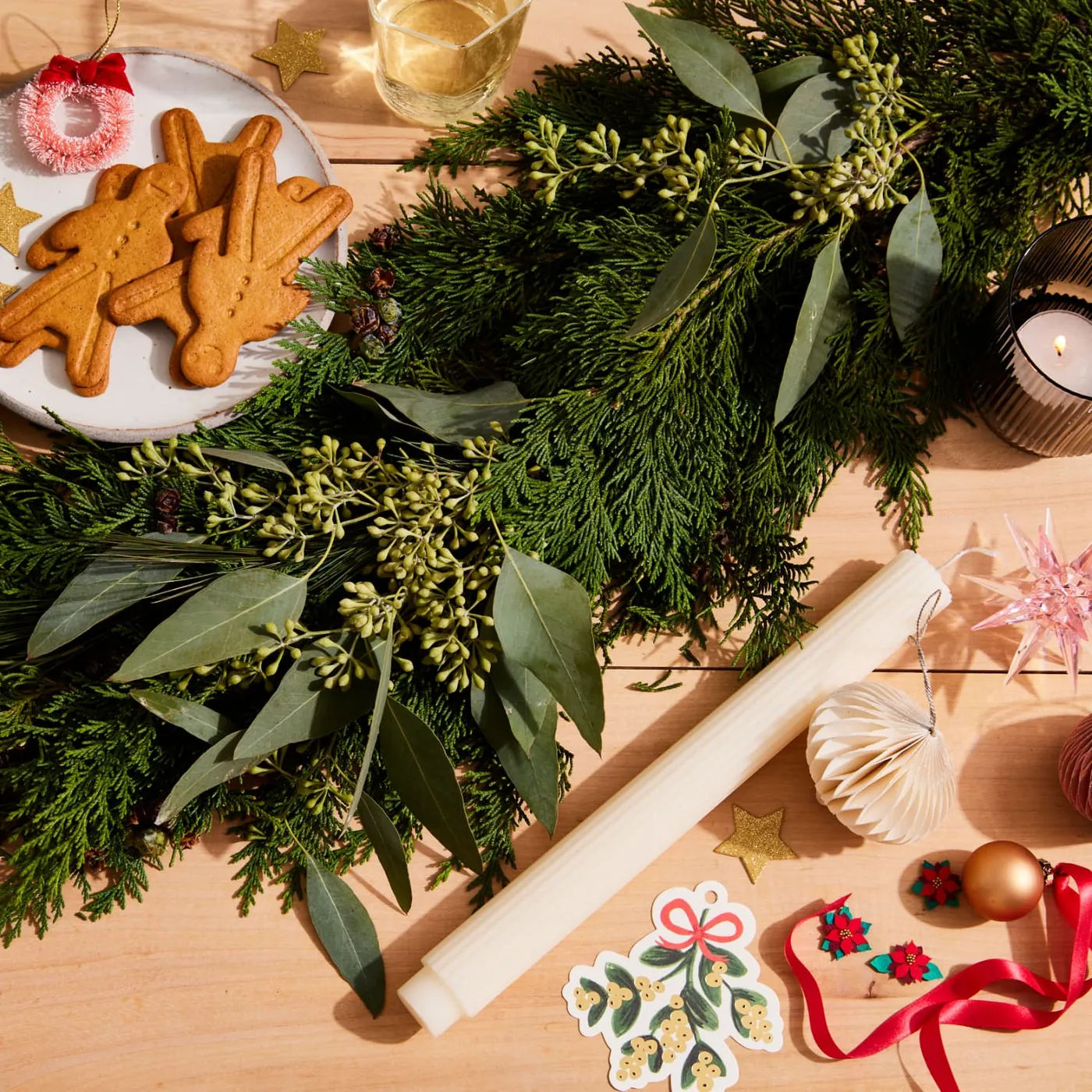
Time: 15 minutes. Cost: $12–$25 if the cookies are already made.
- Pick a surface you can wipe — greenery leaves water rings on bare wood.
- Check your light direction; flat compositions photograph badly under overhead-only light.
- Cut the ribbon before you start styling, not after.
- Clear a full 24 inches of table so the whole thing can breathe.
25. Red Taper Candle Rising Out of a Plaid-Ribbon Ring
The lit red taper. Everything else in this centerpiece is a supporting player — pinecones, berries, gloss ornaments, plaid bow — but that one tall flame is what turns the arrangement into an event instead of a craft project. It also forces the height: greenery sits low, candle goes high, and your eye travels up through the whole thing on the way to the flame.
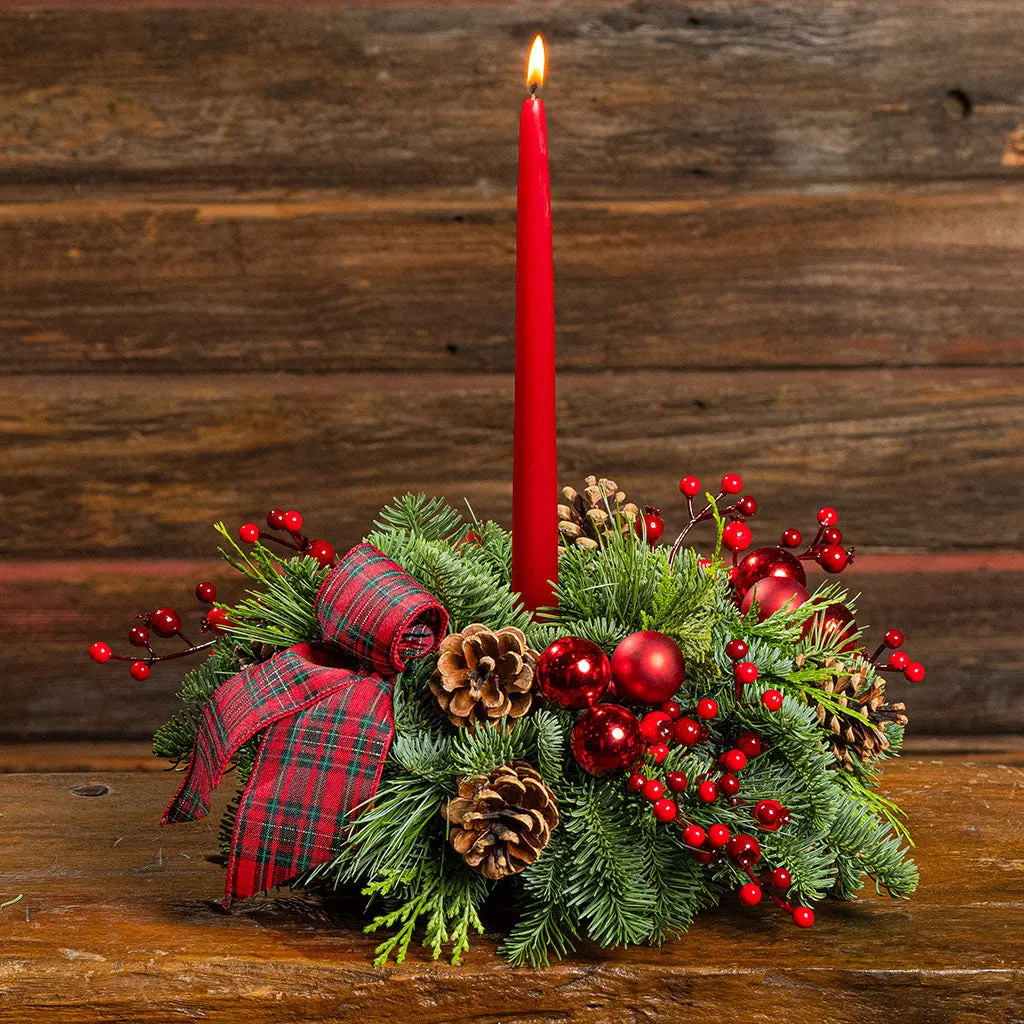
Best on a table 48 to 72 inches long, a sideboard, or a wide mantel — anywhere the base can spread 20 inches without crowding a plate. The arrangement wants 30 inches of clear air above it for the taper, so skip it under a low pendant. For a bigger room, Idea #29 scales the same red-and-green palette across an entire living space.
26. Red Rose Wreath Above a Distressed White Mantel
Roses above a mantel look expensive when the wreath form is completely hidden. Start at the outer edge and work inward, overlapping each stem by half, keeping all the bloom heads facing one direction — outward and slightly up. A 20-inch wreath takes roughly 45 to 60 roses, so count before you buy, and wire into a sphagnum-covered frame so the mechanics never show.
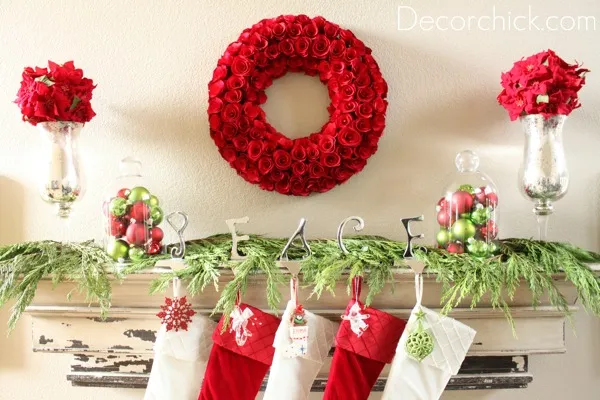
Fresh roses over a fireplace is a two-week investment at best. Heat rises, and a lit fire will brown the lower petals within days. Realistic swaps: dried roses, high-quality faux, or a mixed wreath of red berries that delivers the color without the deadline. If you go fresh, keep the fire unlit for the first week and spritz the greenery daily.
27. Yellow-Berry Evergreen Branches in a Two-Tone Vase
70% deep evergreen + 20% neutral vessel + 10% mustard berries. The two-tone vase is secretly doing the work of a color bridge — the beige base warms up the green while the white upper half keeps it clean. Swap the mustard berries for red and this becomes the most traditional arrangement on the list; keep them yellow and it reads California casual all winter.
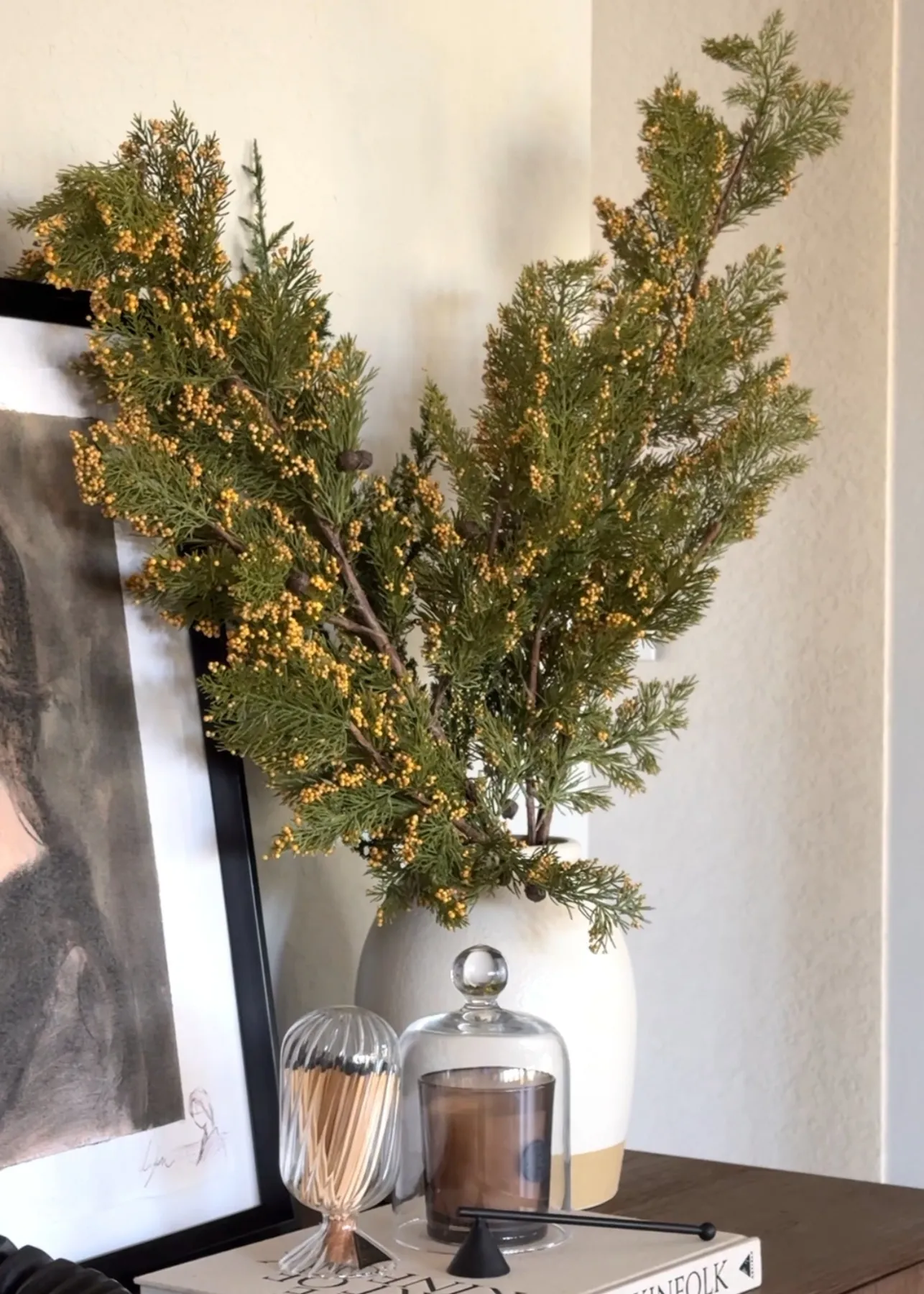
This is the least expensive look in the entire article and probably the most copied. A $12 two-tone vase from Target, three faux evergreen stems at $6 each, and a $5 spray of yellow berries gets you the whole vignette for under $40. Thrifted match holders and candle cloches run $2 to $6 and do the styling work that usually costs real money.
28. Wreath With Gold Acorns and White Stars on Twine
- Start with a 20-inch faux pine wreath and fluff every tip outward.
- Wire pinecones at the 10, 2, and 6 o’clock positions.
- Attach gold acorns in pairs between the pinecones.
- Thread white stars on twine and tie them at 12, 4, and 8 o’clock.
- Hang it, step back, and rebalance anything pulling to one side.
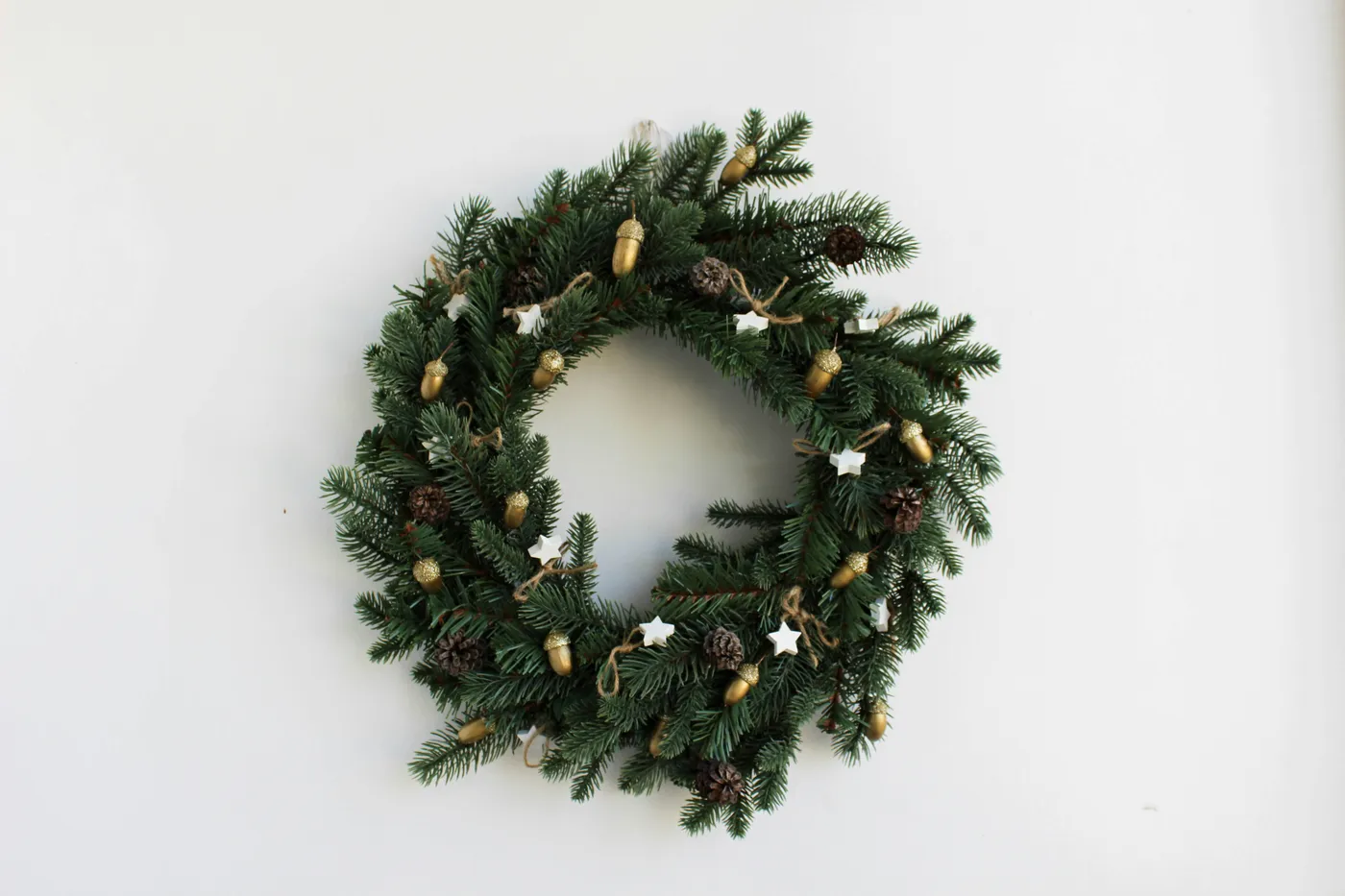
Time: 25 minutes. Cost: $25–$45, and it’s reusable for years.
Faux pine holds up for seasons but collects dust like a furnace filter. Rinse it outdoors with a hose in October, shake hard, and let it dry in the sun before it comes inside. Glitter sheds for the first two seasons — a light matte sealer locks it in. Store in a bag rather than a box so the tips don’t flatten.
29. Deep Green Walls Draped in Garland and Red Berries
Painting a room deep green and then decorating it for Christmas means every single piece has to earn its place. What makes this work: the garlands repeat the wall color instead of fighting it, so your eye reads one continuous field of green with red as punctuation. The octagonal gold mirror then bounces tree light into the corners the lamps can’t reach, which is why the whole room glows instead of just the tree.
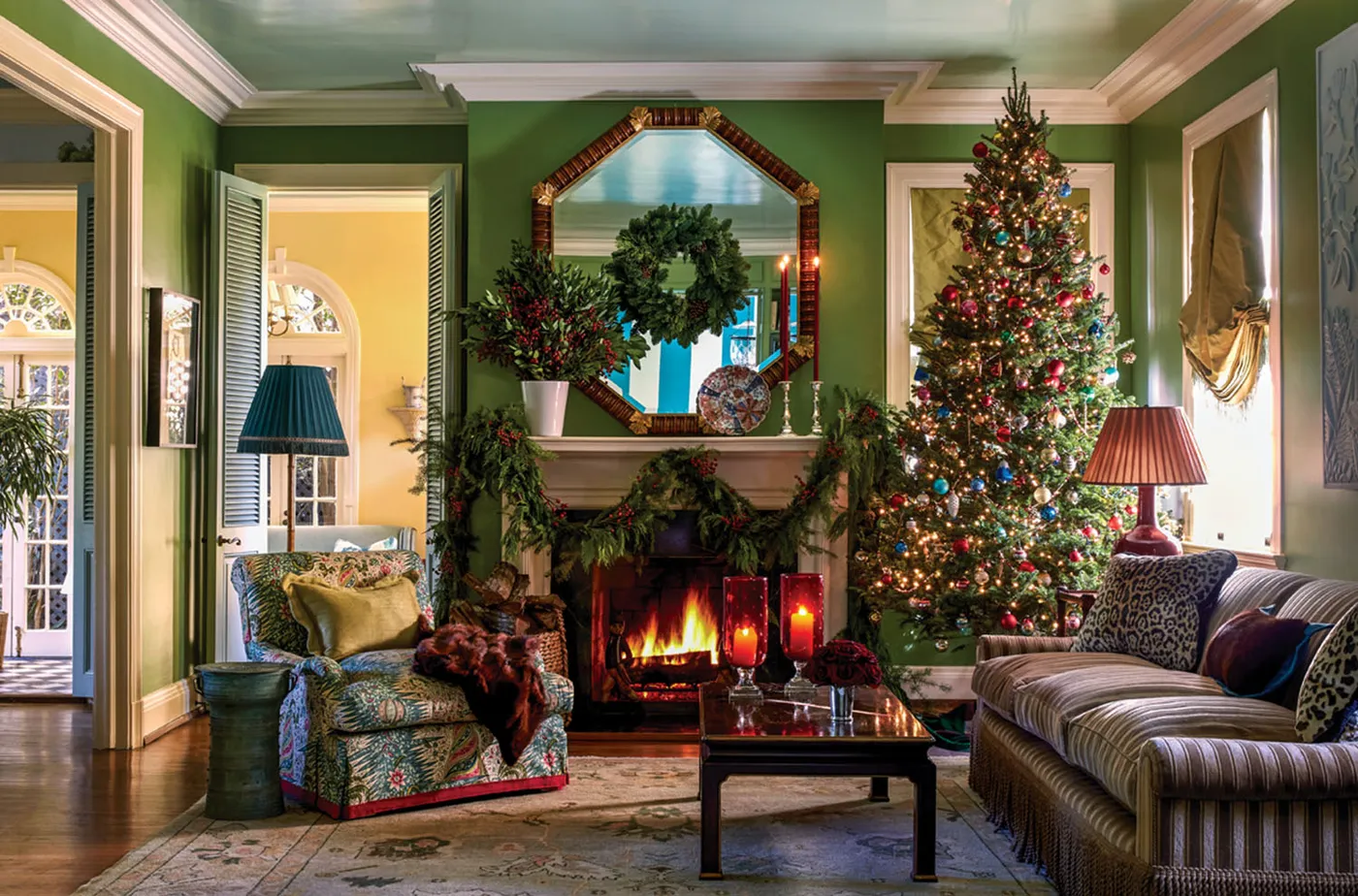
This is a room-scale idea and it needs room scale — at least 14 by 16 feet with a 9-foot ceiling. In anything smaller, the wall color plus two garlands plus a full tree will close in on you fast. Scale it down by keeping the deep green to one accent wall, and choose Idea #19 for a single statement wreath instead of a second garland run.
30. Flag-Patterned Bow on a Dark Evergreen Wreath
A flag bow is a strong opinion, and it will dominate whatever it hangs on. If your entry is already red, white, and blue, this sings. If your hallway is warm wood and cream, it will look like it wandered in from another house. Store it carefully too — fold the bow and don’t crush it, or the flag pattern creases permanently along the stripes.

85% dark evergreen + 10% red and blue accents + 5% cream. The balance is what keeps this from looking like a craft fair booth: keep the ornaments small and sparse, four or five total, and let the bow be the only large element in the composition. Shrink the bow and the wreath collapses into something generic; enlarge it and you get a genuinely door-sized statement.
31. Striped Planter Overflowing With Red and Rose Gold Balls
The price tag on this one depends almost entirely on the planter:
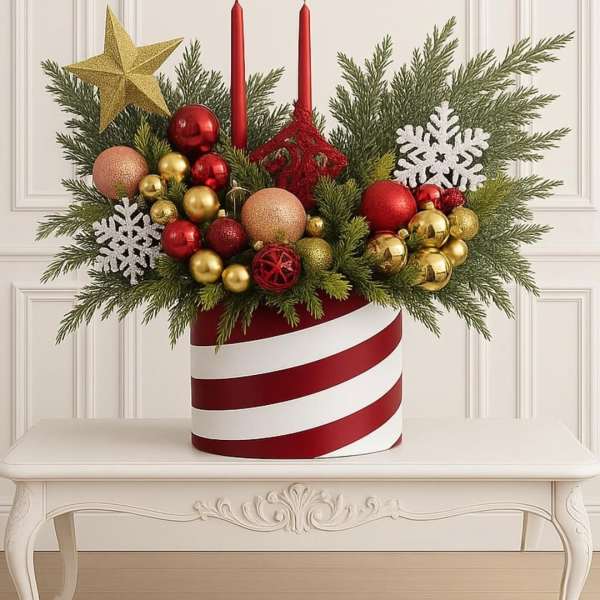
- Striped cylindrical planter: $18–$40
- Faux evergreen bundle: $15–$30
- Red, gold, and rose gold shatterproof balls, 60-count: $20–$45
- Two red taper candles: $6–$14
- Glitter star and snowflake picks: $8–$16
- Push a foam block into the planter and hot-glue it so it can’t shift.
- Insert the tallest branches first and fan them outward.
- Wire the two tapers in the center — never just push them into foam.
- Skewer ornaments on floral picks and push them in at three depths.
- Fill the last gaps with the star and snowflake picks.
Time: 45 minutes, plus about $5 of foam.
32. Lit Evergreen Wreath Glowing on a Dark Paneled Door
Lit wreaths are simple to make and easy to ruin. A few things worth knowing before you plug one in:
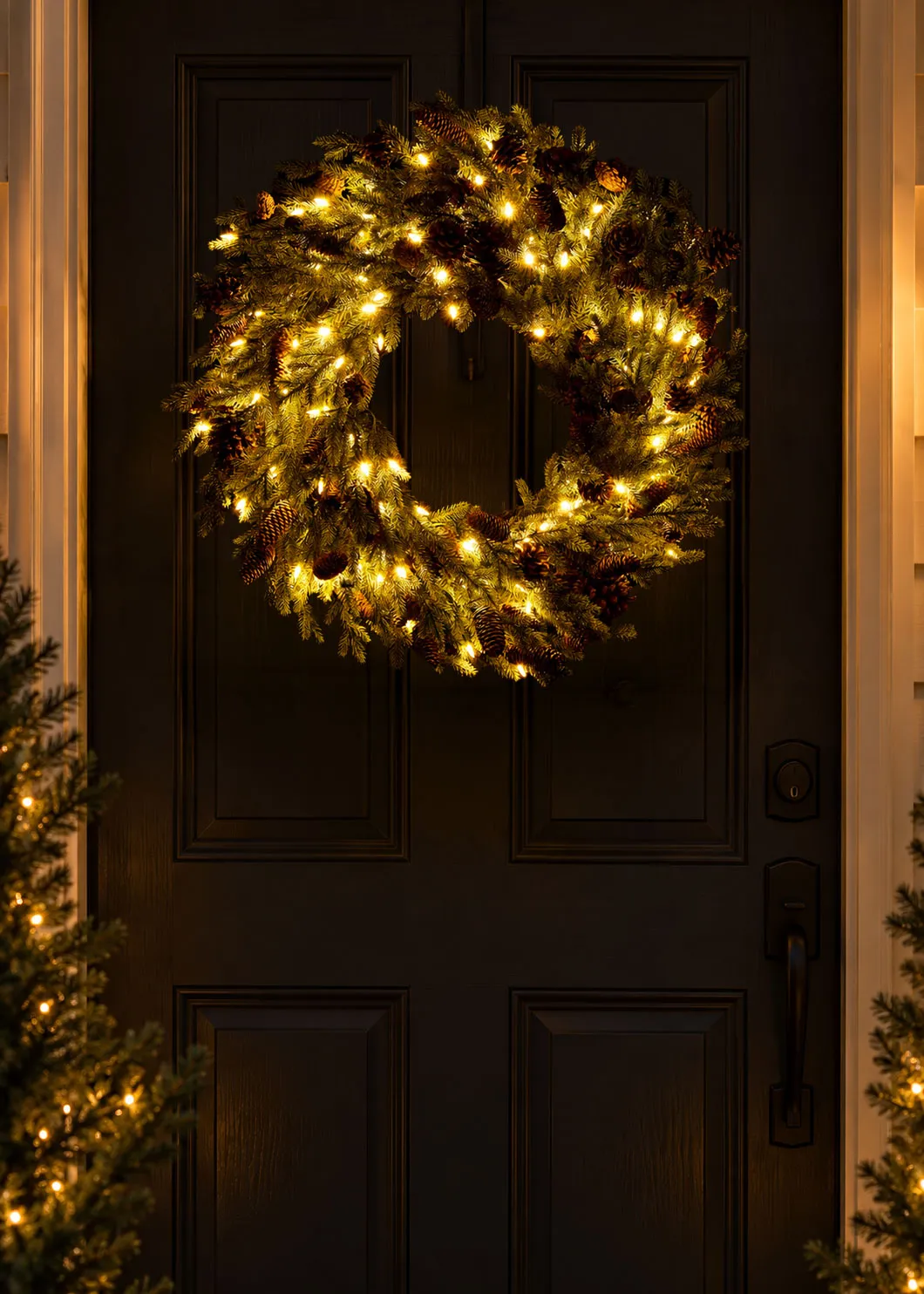
- Use battery packs unless there’s an outlet within 3 feet of the door.
- Run lights along the wire frame first, then hide them under the top layer of greenery.
- Keep bulbs off painted surfaces — heat marks show up after about two seasons.
- Pick warm white, 2200K to 2700K; cool white on a dark door reads blue and cheap.
The lit wreath on a dark door took off because of how it photographs at dusk, and Pinterest has pushed it hard for two seasons running. The 2026 version that’s winning is the restrained one: warm bulbs, pinecones, no ornament color at all. It also happens to be the most neighbor-friendly thing on the block.
33. Red Velvet Bowl With Roses and Two Red Tapers
The velvet container. You could put this exact arrangement in a wicker basket and it would be perfectly lovely and completely forgettable. Crimson velvet against green foliage gives you a color echo and a texture clash at the same time, and that’s the reason the whole thing reads as an heirloom centerpiece instead of a grocery store bouquet. It’s the only element here you can’t substitute.

Velvet containers are pricey new — $60 and up — and almost free secondhand. Look for a velvet-covered hat box or a round velvet storage cube at a thrift store and drop a bowl inside it. Faux roses at $1.50 a stem, a $12 evergreen bundle, and gold balls from last year’s tree gets you the look for about $45.
34. Single White Candle on a Poinsettia Runner
Build this one if your table is small. A 6-inch-wide cutting board, an 18-inch spread of greens, and one candle work on a 36-inch bistro table without crowding a single plate. It also translates to a kitchen island, a sideboard, or a bathroom counter — anywhere you have 24 inches of depth and a little wall behind it.
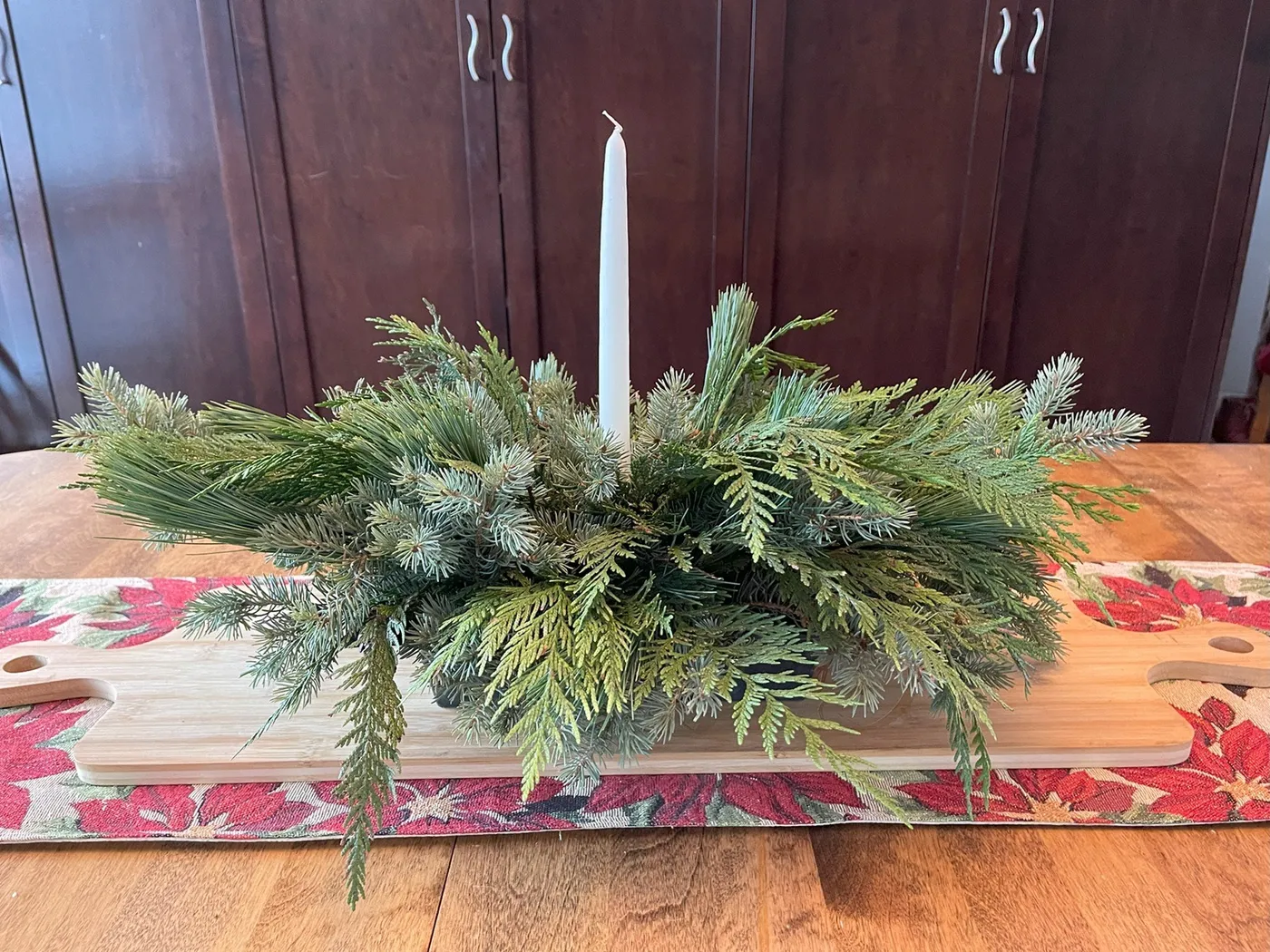
The poinsettia runner is charming and it will show every crumb and every drip of candle wax. If the table gets used daily, set the greenery on a tray you can lift off in one move instead of styling directly on the fabric. Keep the candle at least 10 inches from the runner’s edge — one gust from a doorway and you’re ironing out a scorch mark.
35. Lit Bare-Branch Trees Flanking a Dark Green Door
- Confirm there’s an outdoor-rated outlet within reach of both planters.
- Measure the walkway — planters need to leave 36 inches of clear path.
- Check the door’s swing before placing anything on the hinge side.
- Pick a doormat that won’t slide on tile when it’s wet.
- Decide on one light color and repeat it across every piece.
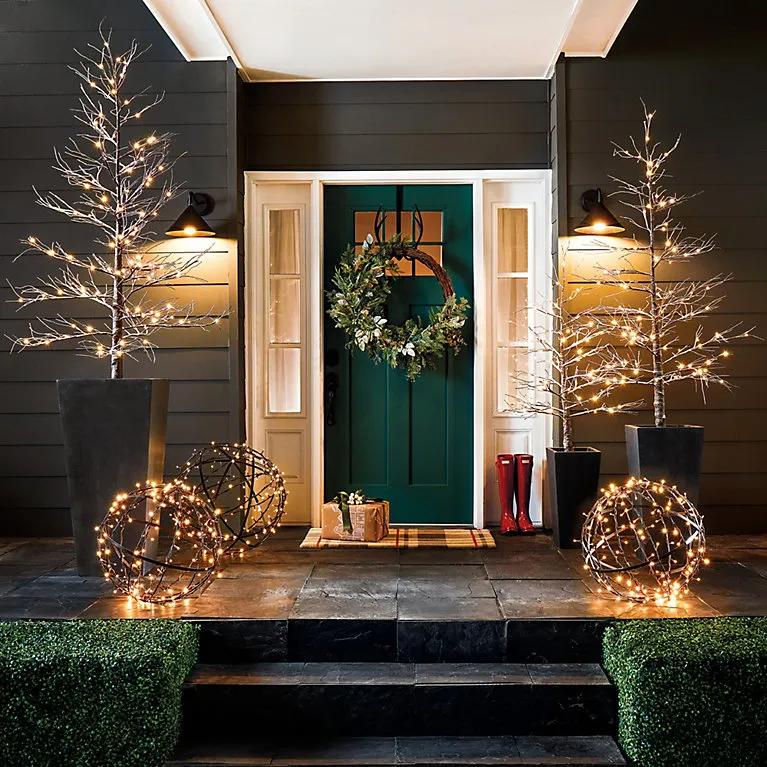
Bare branch trees look pretty bare in daylight, and that’s fine — they’re designed for 5 p.m. The wire spheres repeat the tree silhouette at a completely different scale, and the natural wreath on the green door gives the composition an anchor so the eye knows where to start. Three light sources, one color temperature, and the whole entry reads as a single idea instead of a collection of purchases.
Start at the Front Door, Then Work Your Way In
Greenery is the one part of holiday decorating that gets better the less you fuss with it — better branches, fewer ornaments, and a ribbon you actually like. Pick three ideas from this list, buy the good garland once, and let the pinecones handle the rest.
📌 Save this to Pinterest before you forget which mantel you loved most — next November you’ll want the exact photo, not a vague memory of it.