
35 Stunning Barbie Christmas Tree Ideas That Will Transform Your Holiday Home
Barbie pink Christmas trees are having a major moment on Pinterest right now, and it isn’t just movie nostalgia keeping them alive. Somewhere between the vintage indented glass and the flocked hot-pink firs, pink-and-green quietly became the palette people actually want in their living rooms.
After filtering through hundreds of options across Etsy, Target, Michaels, HomeGoods, and Amazon, we narrowed it down to 35 ideas that actually deliver — from a $3 hand-painted ornament to a full $1,200 styled setup, and everything in between.
Inside you’ll find monochromatic pink living rooms, tulle-draped trees, retro boombox ornaments, beaded tabletop trees, and vintage glass you’ll want to hunt down at estate sales. Budget and luxury versions sit side by side, so you can see exactly where the money goes and where it genuinely doesn’t matter.
Here’s why 2026 is different: pink Christmas stopped being a novelty and became its own genre, with resale sites fueling half of it. And stay until the end — we break down the most common mistakes that can ruin these looks.
📌 Save this to Pinterest for later — you’ll want to revisit these ideas.
1. Green Tree, Pink Tulle, and a Faux Fur Skirt
Here’s the thing about tulle on a green tree: wide strips read as fabric, narrow ones read as cobwebs. Cut 4-inch-wide strips about 24 inches long, pinch the middle, and tuck that pinch deep against the branch so the loop flares outward. No wire, no glue, no spool of ribbon. Twelve to fifteen strips spaced every few branches gives you soft ruffled pink, and you still see plenty of green when the lights are off.
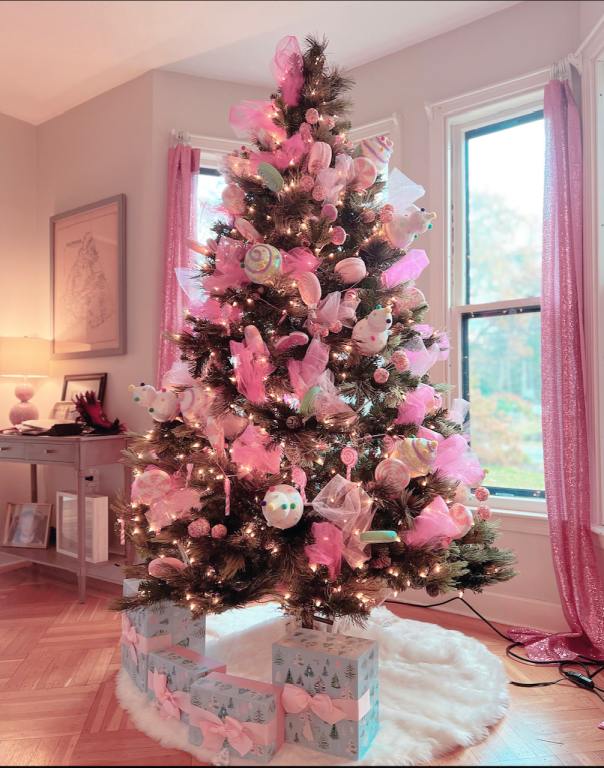
Two things carry this tree. Contrast, first — the forest green never disappears behind the pink, so the tulle bows and pastel candy shapes read as accents instead of an avalanche. Second, scale layering: big tulle loops up high, small pastel ornaments mid-tree, and the stuffed figures tucked low where kids can actually reach them. The white faux fur skirt does quiet work too, turning the base into a snowdrift so the blue winter wrapping and pink ribbons pop instead of blending into the hardwood.
Before you wrap anything, run through these:
- Measure your tree’s widest branch spread — you need about one yard of tulle per 4-inch strip.
- Check what light your windows throw. Cool daylight bulbs will gray out pastel pink in a hurry.
- Decide now whether the stuffed figures stay up all season — they collect dust and need a mid-December fluff.
- Measure your stand’s diameter; faux fur skirts run small, so size up past 24 inches.
2. A Monochromatic Pink Living Room With a Flocked Pink Tree
You don’t need a custom tree to get this room. Target’s 6-foot pink trees land between $80 and $130, and a blush slipcover over the sofa you already own runs $60–$90 — far less than reupholstering anything. Spray a thrifted side table white for about $12. Then shop Facebook Marketplace in the first two weeks of January, when everyone offloads holiday pink at half price. Spend on the fluffy white rug; a $70 washable version reads nearly identical to the $300 one. Want the same palette with a modern edge? See Idea #25.
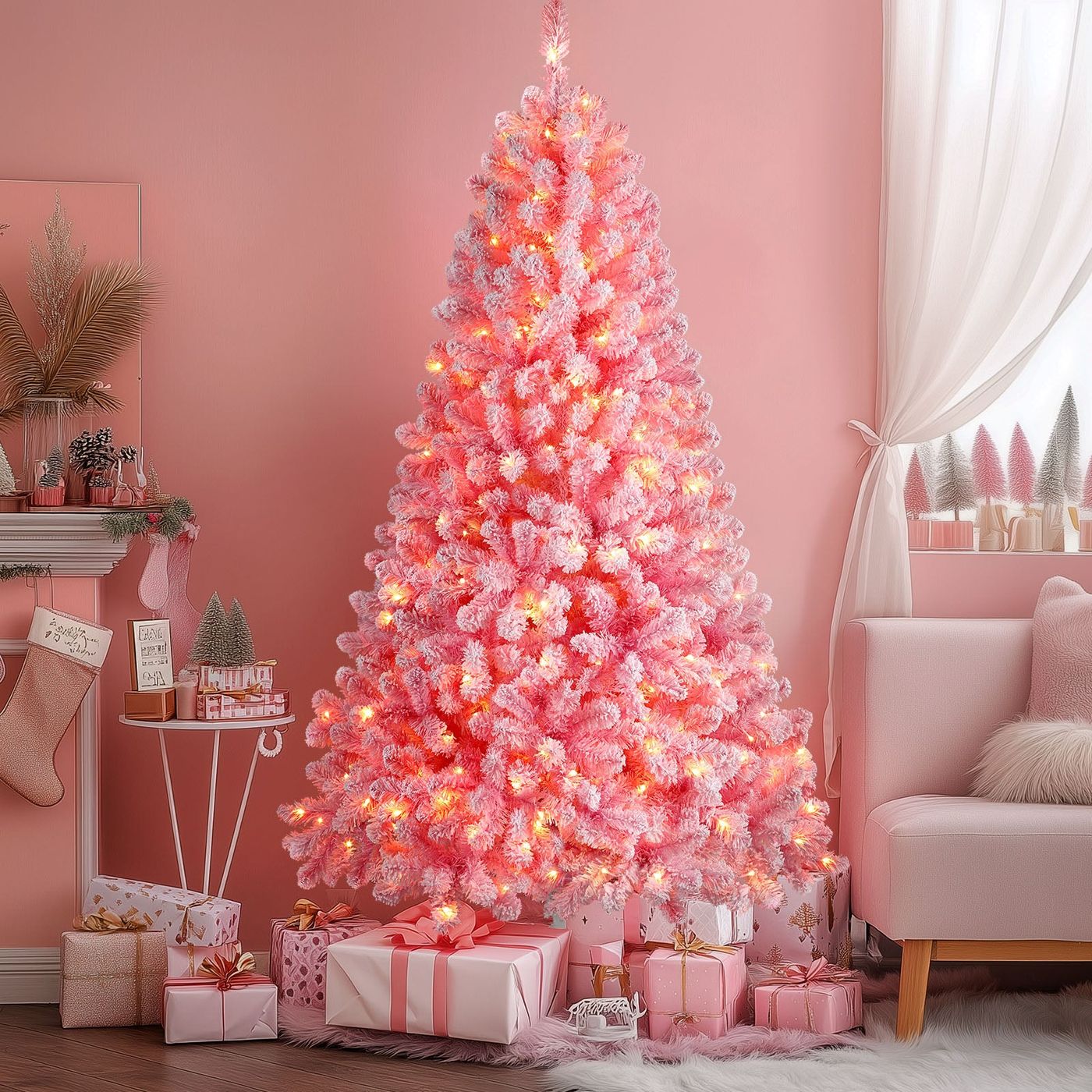
The formula here is roughly 70% pink in three depths, 20% white, and 10% warm gold from the lights and hardware. The trick isn’t more pink — it’s depth. Base pink on the wall, mid pink on the tree and sofa, bright pink reserved for small things like ornaments, ribbon, and gift wrap. Swap mauve for blush or cream for white and the ratio still holds. Just keep every pink in the same undertone family, or the room reads like three different rooms stacked together.
Monochrome pink is unforgiving in bad lighting. Pink walls plus a pink tree plus warm bulbs can collapse into one big blush blur. You need at least one true white element to give the eye somewhere to rest — here it’s the sheer curtains, the white side table, and the rug. If your room takes cool north light, paint a swatch and live with it for a day first. Soft pinks turn dusty purple against blue daylight.
3. Two Trees, One Mirrored Sideboard, Zero Restraint
Take away the mirrored sideboard and half the sparkle leaves with it. The credenza sits across from two tinsel trees, so every light, ornament, and orange glass sculpture gets doubled in the reflection — you’re effectively getting a third and fourth tree for the price of furniture you may already own. It also gives the framed abstract something solid to sit above instead of floating on a blank white wall. If you’re deciding where the money goes in this room, it goes to the mirror.
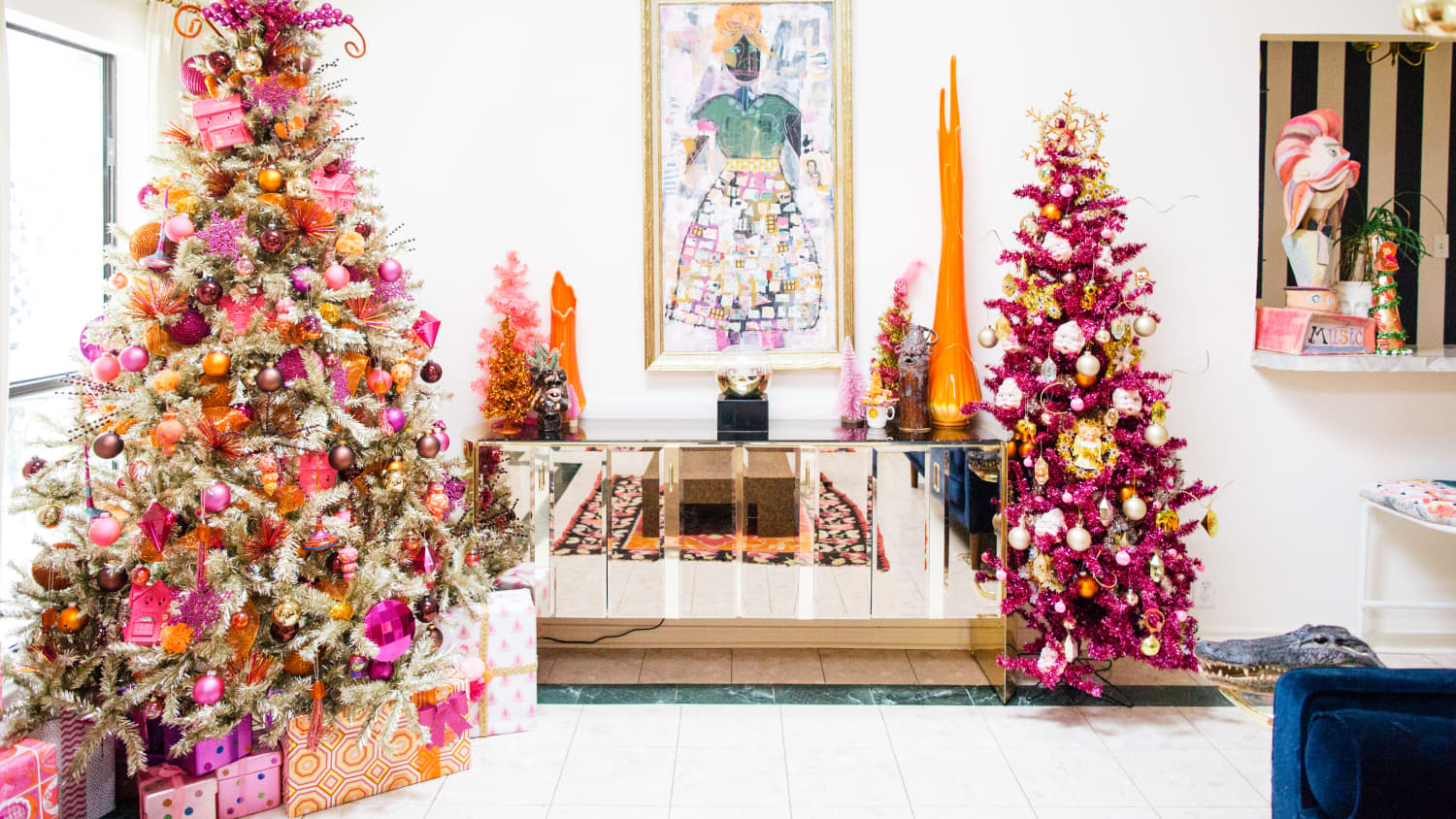
Maximalist holiday decorating has been climbing on Pinterest for three years straight, and 2026 is the year it stopped being a reaction to minimalism and became its own thing. Two trees instead of one. Jewel tones instead of red and green. Art that stays up in January. Tinsel sharing a shelf with orange glass sculpture is the tell — this is a room decorated by someone who isn’t waiting for permission. The palette will shift, but “more is more, done with intent” isn’t going anywhere.
- Mirrored sideboard, thrifted or big-box: $180–$600
- Two tinsel or metallic trees, 6–7 ft: $120–$400
- Jewel-tone ornaments, sprays, glass sculptures: $90–$250
- Framed oversized abstract art: $60–$350
- Wrapping paper and ribbon in pink and orange: $25–$60
Total: roughly $475–$1,660 — about $300 if you already own the credenza.
4. Flocked Tree With Pink Velvet Quilting and Frosted Pinecones
This tree works because three finishes are arguing pleasantly with each other. The flocking is matte and soft, the quilted pink ornaments are matte but textured, and the silver balls and leaf accents are hard and shiny. Without the silver, all that pink velvet goes flat and slightly dusty-looking. Without the velvet, the tree reads cold. The frosted pinecones are the quiet third voice — they tie artificial snow back to something that looks natural, which is what keeps a flocked tree from feeling like a craft store display.
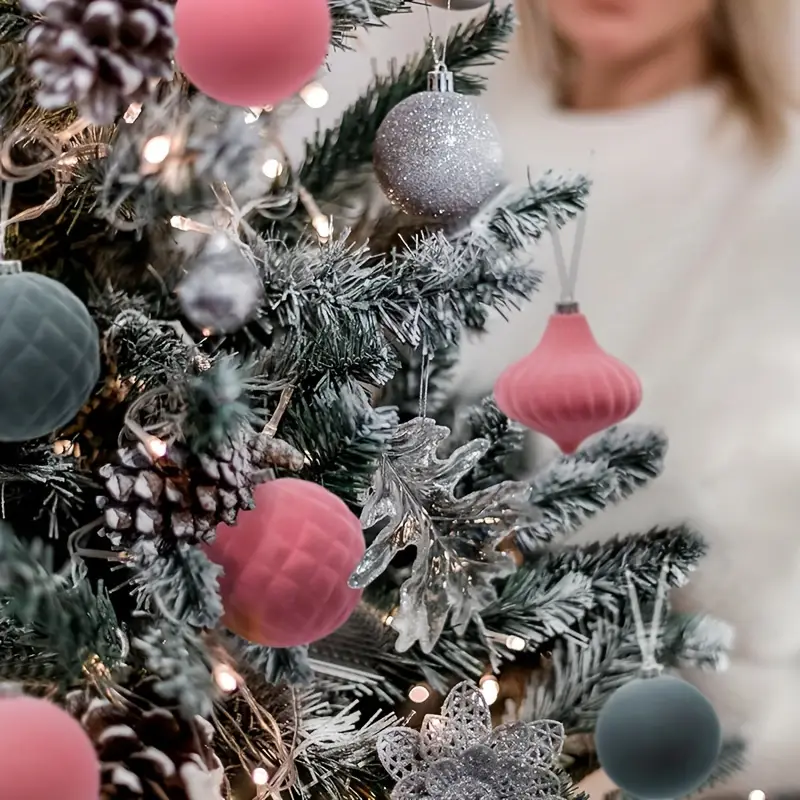
Flocking sheds. Expect a fine white dust on the floor for the first week and a light vacuum after New Year’s. Velvet ornaments are dust magnets, so plan on a soft brush or lint roller pass in early January before they go back in the box. Storing them loose in a bin crushes the quilting permanently — wrap each in tissue or keep the original trays. If you’d rather skip the upkeep, matte-finish glass balls in the same pink give you 80% of the look and wipe clean with a damp cloth.
5. Pink Tree Meets Gallery Wall in a Terracotta Living Room
Hanging a gallery wall next to a Christmas tree means two focal points competing for the same sightline. The fix is center height: hang art at 57 inches on center as usual, but keep frames at least 24 inches from the tree’s widest branch so the two don’t crowd. And resist leaning the bottom row on the console — leaning frames plus a tree plus a floor pouf creates a pileup at exactly the height where your eye wants a break.
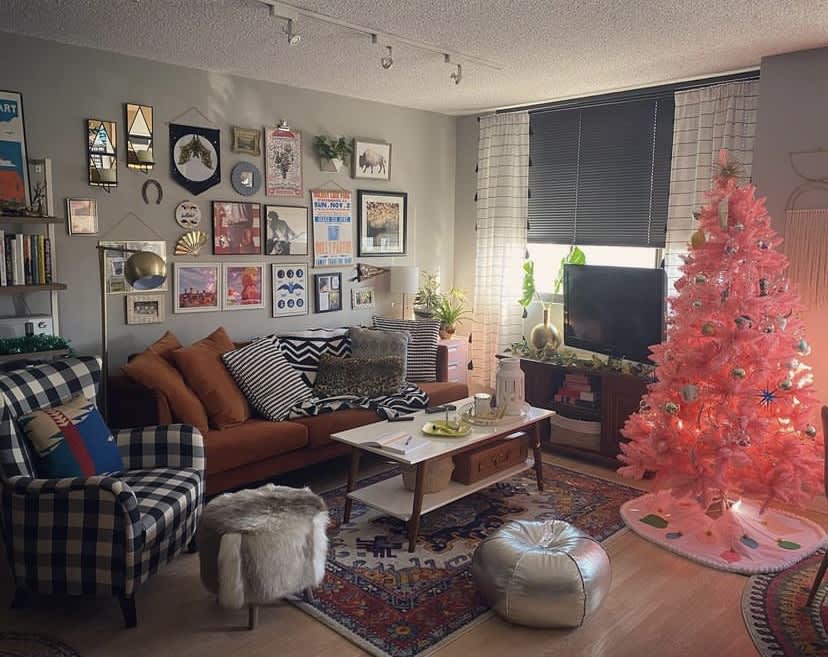
Read this room as 45% terracotta and warm rust, 25% pink, 20% black-and-white pattern, 10% silver. That buffalo check armchair is doing more than it looks — it’s the neutral that lets terracotta and hot pink share a room without either winning. Want a cooler version? Swap terracotta for slate blue, hold the pink at 25%, and move the pattern to the rug instead of the chair. The recipe survives the swap.
The gallery wall alone needs roughly 10 to 12 feet of uninterrupted wall, which usually means a room at least 14 by 16 feet — or a layout that wraps a corner. Ceilings should be 8 feet minimum; below that, keep the gallery to a single row so a full-size pink tree doesn’t feel boxed in. In tighter spaces, a slender silhouette does the same job in about half the footprint.
6. Bubblegum Pink Tree With Silver and White Ornaments
- Bright pink artificial tree, 7 ft: $130–$300
- Silver and white ornaments, 60–80 pieces: $60–$180
- Star topper, silver: $15–$45
- Flocked wreath and garland: $50–$140
- Wrapping paper and ribbon: $20–$50
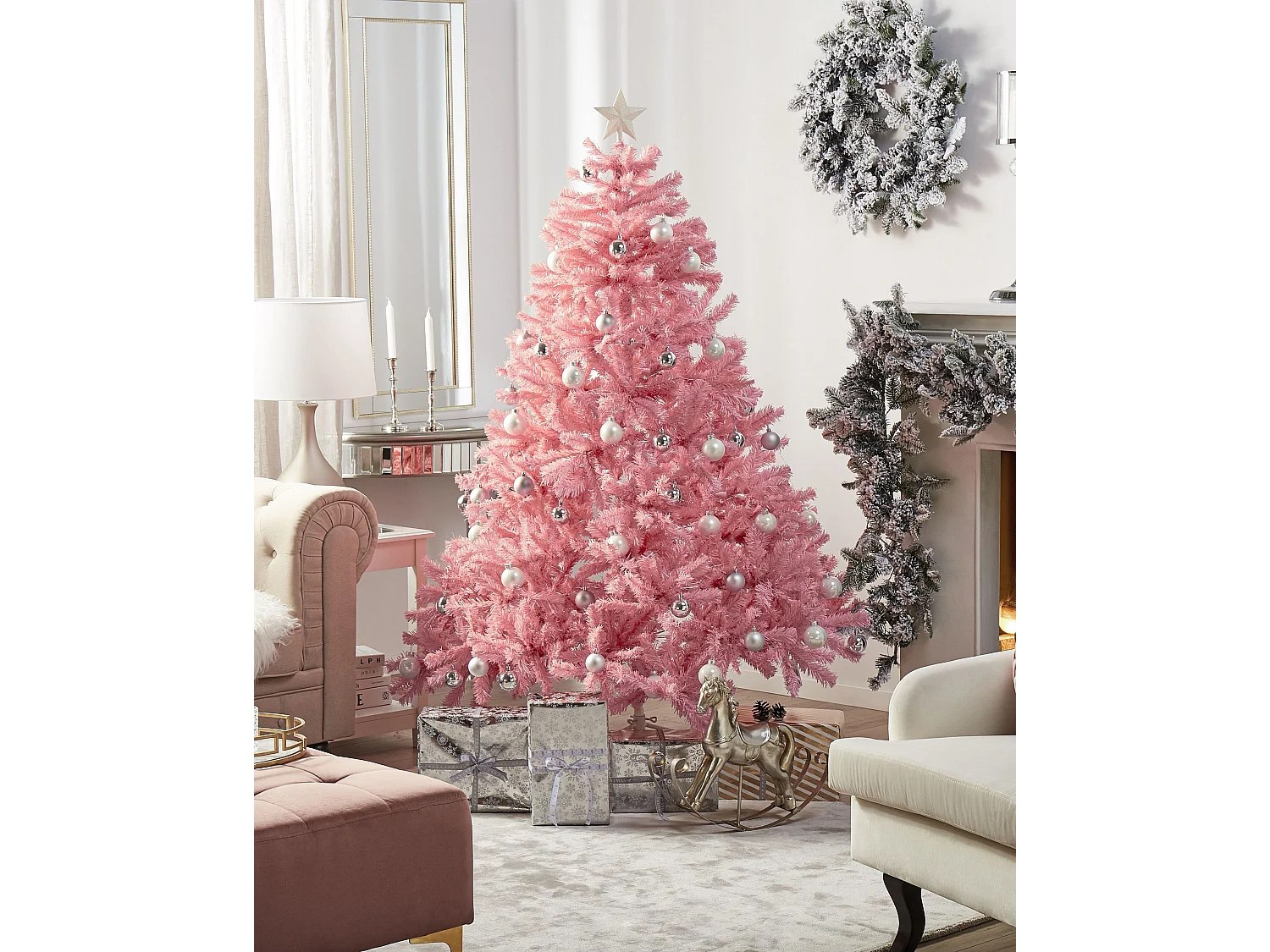
Total: about $275–$715, or closer to $395 if you buy the tree on Black Friday and the ornaments in early December.
A saturated pink tree against beige and off-white furniture is a commitment. In daylight it’s joyful. After dark, with only warm lamps on, that same pink can edge toward red and make a neutral room look tinted. Test it with your actual bulbs before you commit to a spot, and keep a silver or white element near eye level — the star topper and flocked garland do that here. One more thing: pink needle trees show every dusty fingerprint, so keep a microfiber cloth nearby.
7. Cookies, a Pink Sweater, and Tied Ribbon Bows
- Cut ribbon into 6-inch lengths — wired satin holds its shape best.
- Fold into a simple loop, pinch the center, and twist once so the tails sit at 10 and 2 o’clock.
- Thread a 4-inch piece of florist wire through the pinch and twist snug.
- Slide the wired tail behind a branch, pull the loop forward, and twist the wire around the stem.
- Space bows every 10–12 inches — any closer and the tree turns into a gift shop display.

Time: about 45 minutes for 30 bows. Cost: $12–$20 in ribbon.
The tied bows are the whole reason this tree reads homemade in the best way. Untied ribbon spools look purchased; hand-tied bows look like someone stood there with cookies in the oven and did it anyway. They also solve a practical problem — a dark green tree in a dim room swallows ornaments whole. Pink ribbon reflects whatever light is available, so the tree glows even with nothing plugged in. Swap the bows for anything else and you lose that warmth entirely.
8. Light Pink Tree, Red-and-Green Presents, White Picket Fence
The white picket fence around the base is the easiest DIY in this whole article — three 6-foot cedar pickets from a hardware store, cut down, sanded, and painted white comes to about $25 total. The light pink tree is the pricier piece; Walmart and Target both carry 6-foot pink trees between $70 and $120, and the presents are just cheap red-and-green wrap with a ribbon upgrade. If you want that same pink-and-green tension with a deeper green base, Idea #1 is your version.
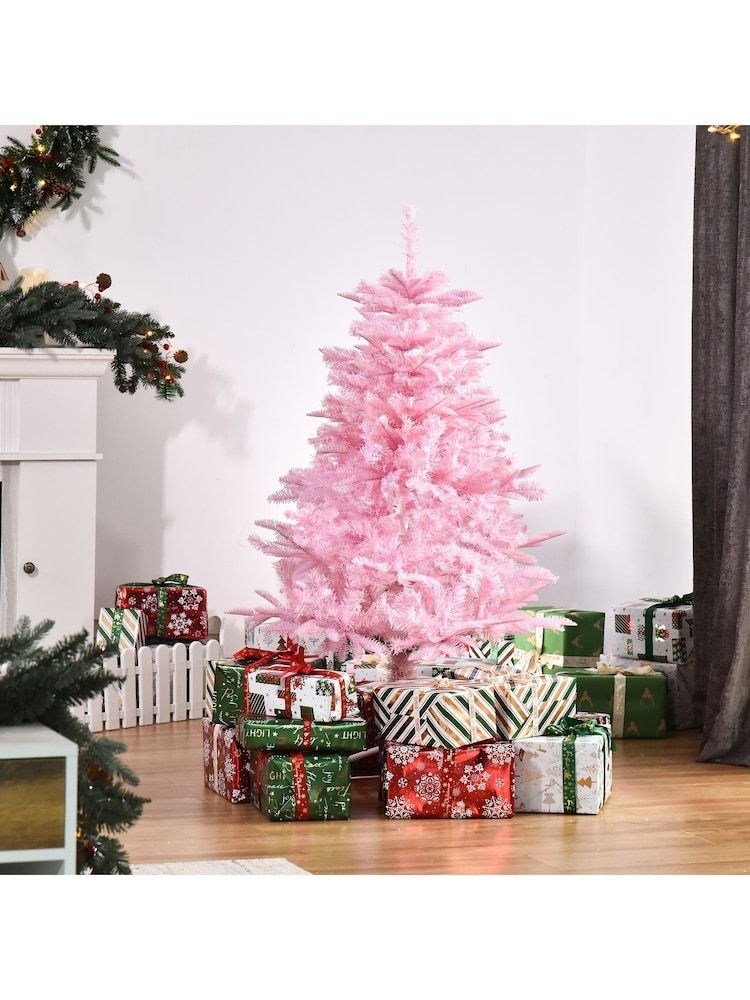
This setup needs about 3 feet of clearance on both sides — the mantel garland and the dark grey curtain are crowding the same zone, and anything tighter starts to feel accidentally cluttered rather than layered. Ideal rooms run 12 by 14 feet up to 16 by 20. With 9-foot ceilings, size the tree to 7–7.5 feet so the star has breathing room; at 8-foot ceilings, stay at 6 to 6.5.
Red and green presents under a pink tree is a deliberate clash, and it works — but only because the wrapping shares a value level with the tree. Swap in neon gift bags or foil holographic paper and the whole thing tips into chaos. Also, that narrow picket fence is a trip hazard in a walking path and a chew toy for teething puppies. If either applies to your house, run the fence back against the wall instead of wrapping it fully around the base.
9. Hot Pink Tree and a Maximalist Doorway Garland
Doorway garland density is where most people undershoot. For a standard 36-inch doorway, plan on 12 to 15 ornaments per foot of garland, plus a bell or bow cluster at each corner where the garland turns. Start with the largest pieces at the bottom corners and work smaller toward the center top — that keeps the eye moving through the doorway instead of stopping at one heavy spot. Wire everything to the garland frame, not the wall; garland sags by day three regardless.
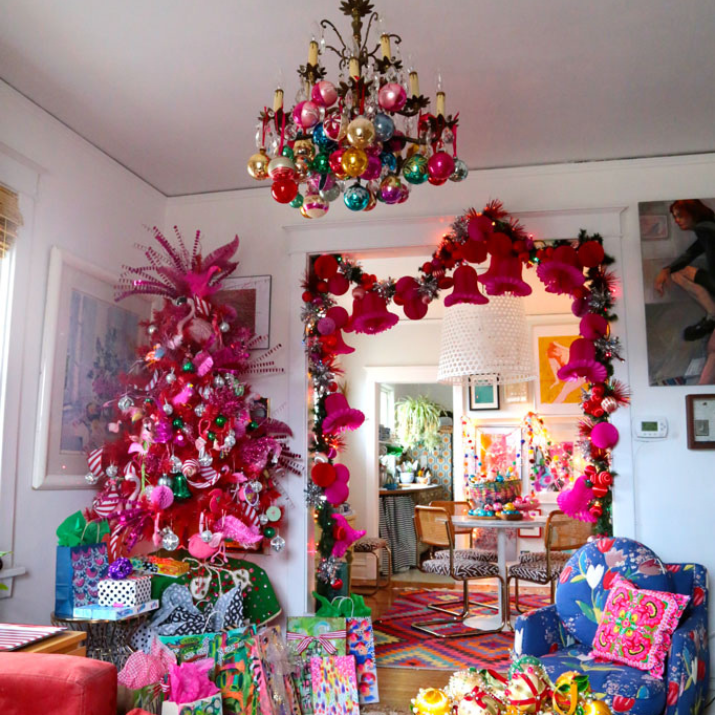
The genius move is that the garland doesn’t just decorate a doorway — it frames a view into the dining room, which is why it feels twice as big as it is. Layered depth does the rest: feather accents at the top of the tree, bell-shaped pink ornaments on the garland, an ornament-hung brass chandelier overhead. Your eye travels tree to doorway to chandelier in one sweep. Nothing matches exactly, and that’s the point — the palette coordinates so the shapes can argue.
10. Glam Pink Tree With Coordinated Ribbon Garlands
Get your numbers straight first:
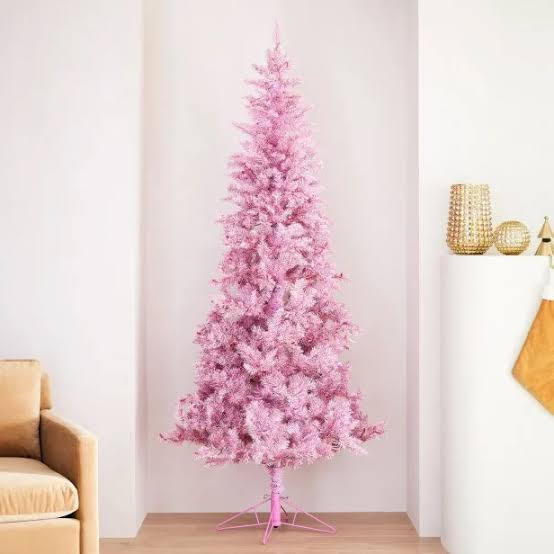
- Measure the vertical run from base to topper before buying garland — you need about 1.5× that length in ribbon for a full spiral.
- Photograph your tree with the room lights on before you start, so you have a reference to compare against.
- Sort ornaments into three piles by size before hanging a single one.
- Check that every strand is the same color temperature — mixing warm and cool white wrecks a coordinated pink scheme.
Coordination here comes down to 60% pink in three values, 25% warm white light and reflection, and 15% ribbon. Ribbon is the piece people skip, and it’s the one that turns a decorated tree into a styled one. Swap the ribbon from satin to a wide matte velvet and the whole tree shifts from glamorous to cozy without touching an ornament. Same math, different mood — that’s how you get two trees out of one ornament box.
11. Pink, Silver, and White: Oversized Baubles and Textured Ribbon
- Start ribbon at the top third of the tree and work down, weaving behind branches rather than across the front.
- Push the ribbon through, pull roughly 10 inches out, and let it loop loosely.
- Pin the loop with a small clip ornament hidden behind a branch.
- Repeat every 14–18 inches on a diagonal spiral.
- Hang oversized baubles at the ribbon loops so the two elements read as one gesture.
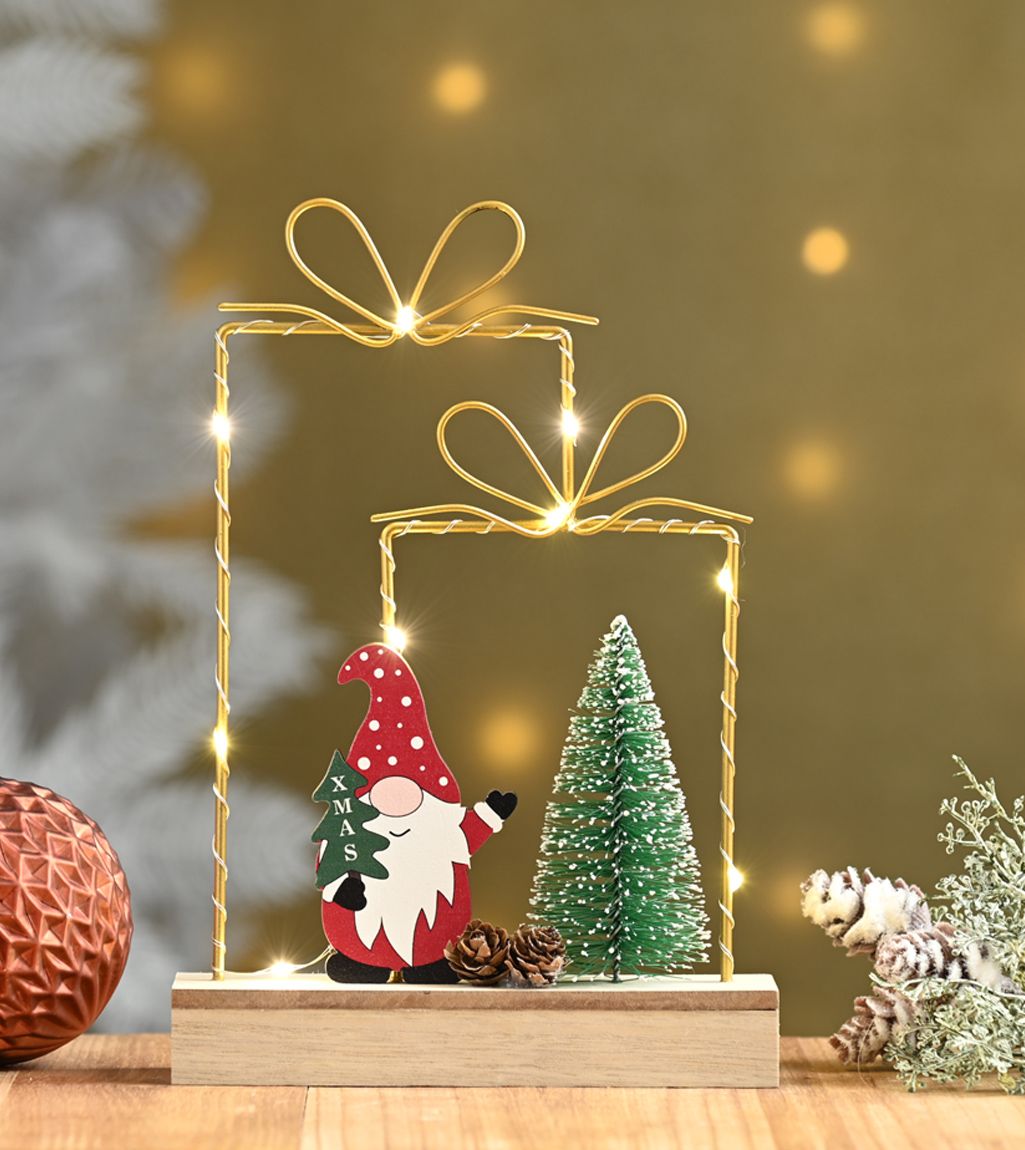
Time: 50–70 minutes. Cost: $18–$35 for 12 yards of ribbon and clips.
Dense branches make this work — an open, sparse tree can’t hold oversized baubles without looking like they’re floating. The pink glass, the silver glitter picks, and the white-and-silver patterned ribbon all sit at different scales, which is why the tree reads rich rather than busy. It’s the same principle as a good outfit: one big statement, one medium texture, one small sparkle, repeated fifteen times.
12. Tall Pink Tree With Copper and Silver Baubles
Pink needles plus copper ornaments is a risky pairing — both lean warm, and under yellow bulbs the tree can read orange by 9 p.m. The silver balls here are doing rescue work, pulling the whole thing back toward neutral. If your living room has warm-only lighting, keep the copper to no more than a third of the ornaments. And pink artificial trees show gaps badly; budget a solid 30 minutes of branch fluffing right out of the box.
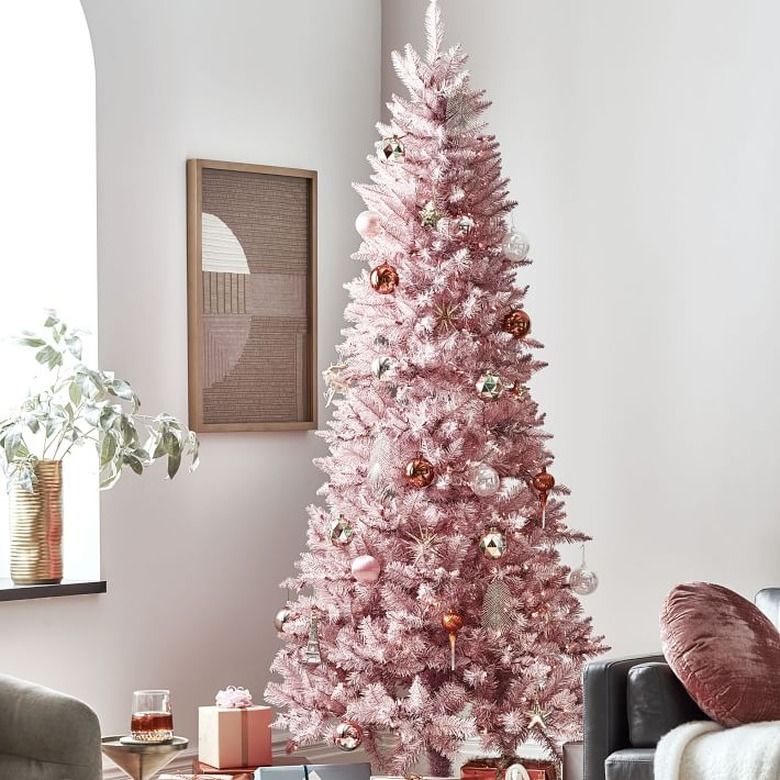
Slender trees are made for tight corners. This one works in a room as small as 10 by 12 feet, and a 9-foot ceiling gives it the vertical run it needs — a pencil tree under an 8-foot ceiling just looks stretched. Pair it with a dark grey sofa and a single gold planter and stop there; the tree is the event. If you have a wider room and want a fuller silhouette, a standard-width tree with proper clearance gives you more presence to work with.
13. Flocked Tree With Reindeer, Peacock Feathers, and Mini White Houses
- Flocked 7.5-ft tree: $200–$450
- Magenta and hot pink baubles, 50 pieces: $50–$130
- Gold reindeer figures, set of 4–6: $30–$90
- Feathered peacock ornament: $18–$45
- Floral picks and miniature white houses: $40–$110
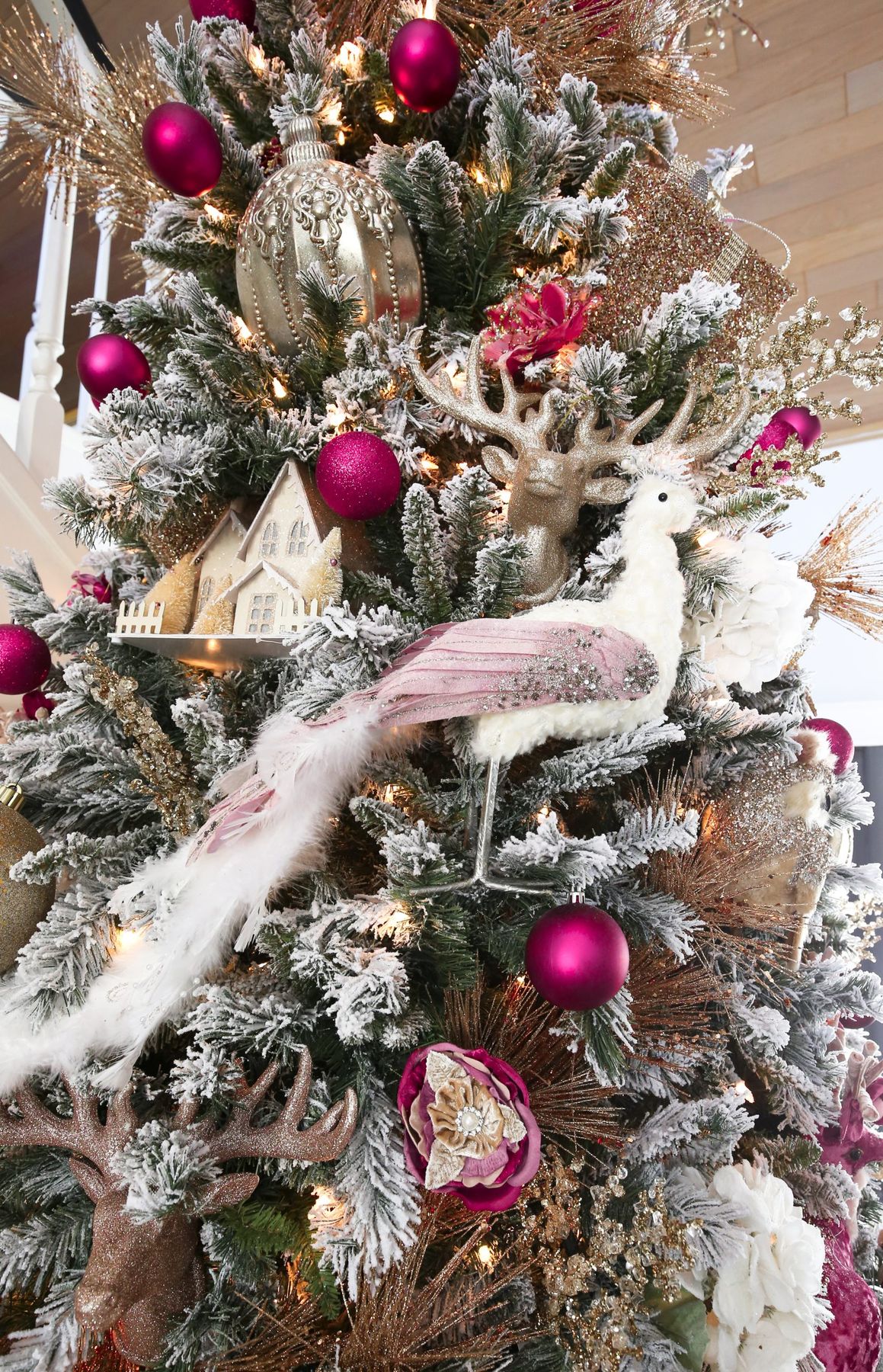
Total: about $338–$825 — and you can cut the ornaments to 30 pieces without losing anything.
If you remove one thing from this tree, make it the feathered peacock with the pink-tipped tail. Everything else — the reindeer, the florals, the little white houses — is beautiful but expected. The peacock is the odd one out, and odd ones out are what keep an ornate tree from looking like a catalog page. Place it at roughly eye level and slightly off-center, not at the top. It needs to be discovered, not announced. For a bolder take on that same rule, look at Idea #19.
14. Plan Your Pink Tree Before You Buy a Single Ornament
Do this before you spend a dollar:
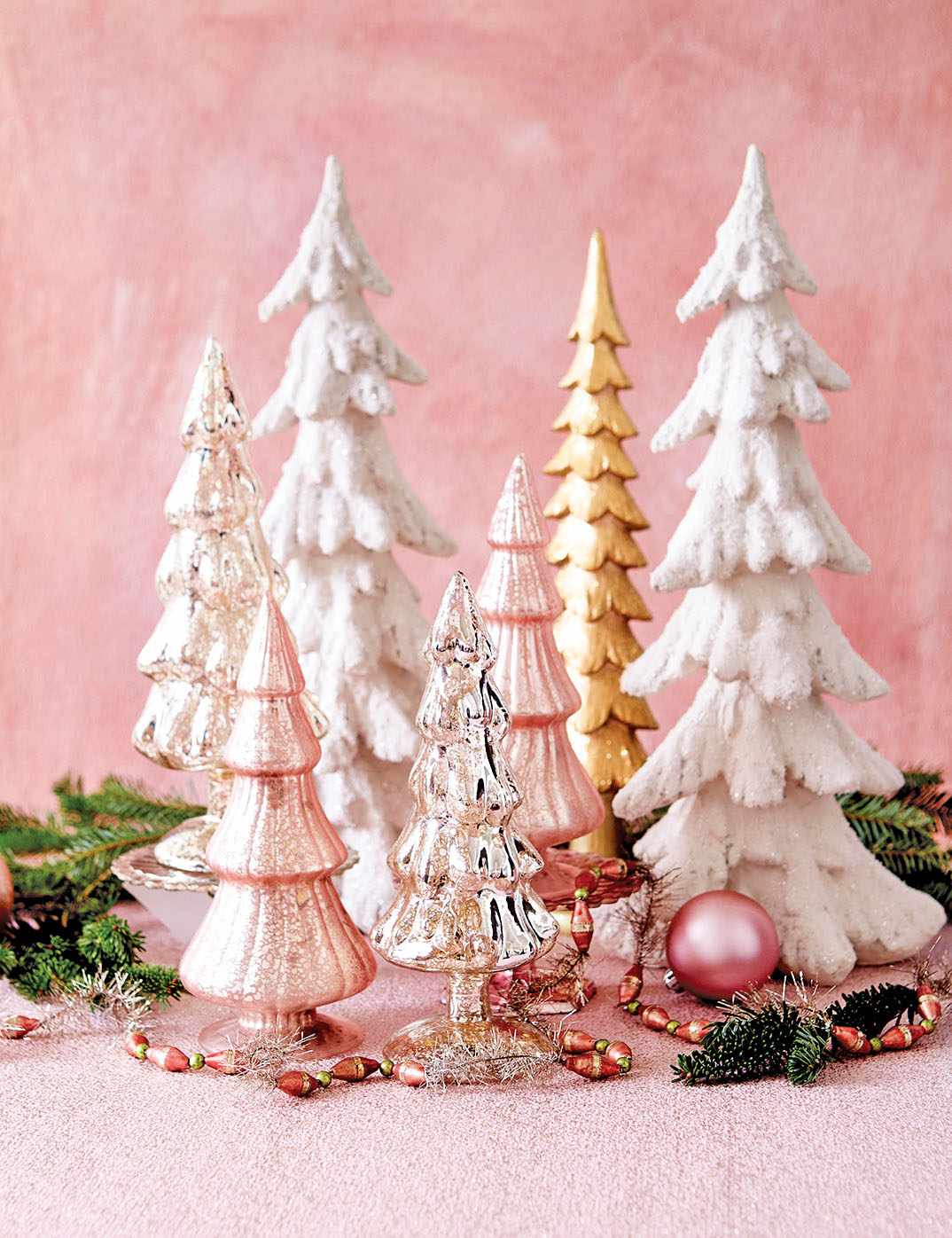
- Measure your tree’s height and widest spread, and write both numbers somewhere you’ll see them while shopping.
- Photograph the corner or wall where the tree will live — at night, with your actual room lights on.
- Commit to a three-color palette before you buy anything. Three is the number that stays cohesive.
- Take inventory of what you already own and pull out every pink, silver, and glass piece you forgot about.
- Set a hard budget ceiling and split it 60% tree and lights, 40% ornaments and skirt.
- Clear a 6-by-6-foot floor space and mark the tree’s footprint with painter’s tape.
- Set up the bare tree and string the lights before a single ornament goes on.
- Place the largest pieces first — sprays, ribbon, oversized baubles — spaced evenly.
- Add medium ornaments in clusters of three, then work the small pieces into the gaps.
- Step back 10 feet, look for bare patches, and fill only those.
Time: 2–3 hours for a 7-foot tree. Cost: nothing but patience.
15. White Flocked Tree Beside a Wooden Piano
Decorating furniture is a commitment, so protect the finish first. Lay a strip of felt or a folded microfiber cloth under the piano garland, and use museum putty — not tape — to hold ornaments on a vertical surface. Swag the garland in three points across a standard upright’s front, no more; every extra drape adds sag and weight. Keep anything glass off the top of an upright piano, where the soundboard vibrates all evening.
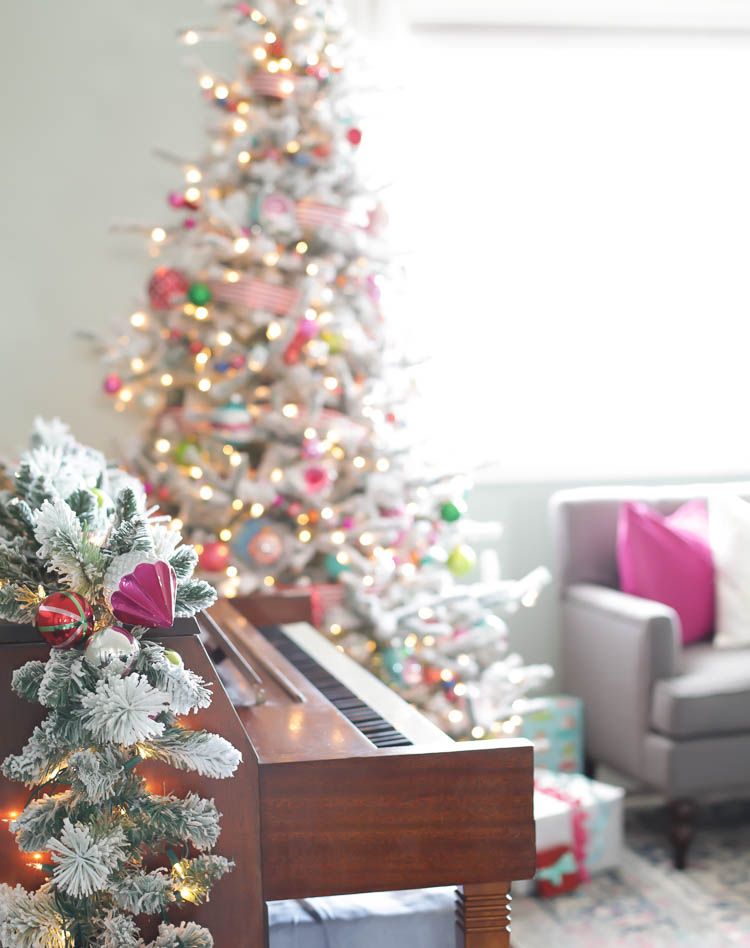
The garland on the piano is what makes the room feel finished. A flocked tree alone reads as one decorated object in a space; a matching garland turns the whole wall into a composition, and the warm wood of the piano is the perfect neutral between white flock and a hot pink pillow. Notice the red and pink ornaments on the garland echo the tree without copying it. Echo, not match — that’s the move.
16. Pink Tree With Disco Balls and Snowflake Accents
Count it out: 50% pink in three finishes, 30% mirrored and metallic, 20% white and ribbon. The three finishes are the trick — matte pink, glossy pink, and glitter pink read as three different colors under fairy lights. Disco balls go on last, and only six to eight of them, placed at varying depths so the reflections don’t line up into a grid. Swap the disco balls for matte white spheres and you’ve got a soft snow-inspired tree from the same ornament box.
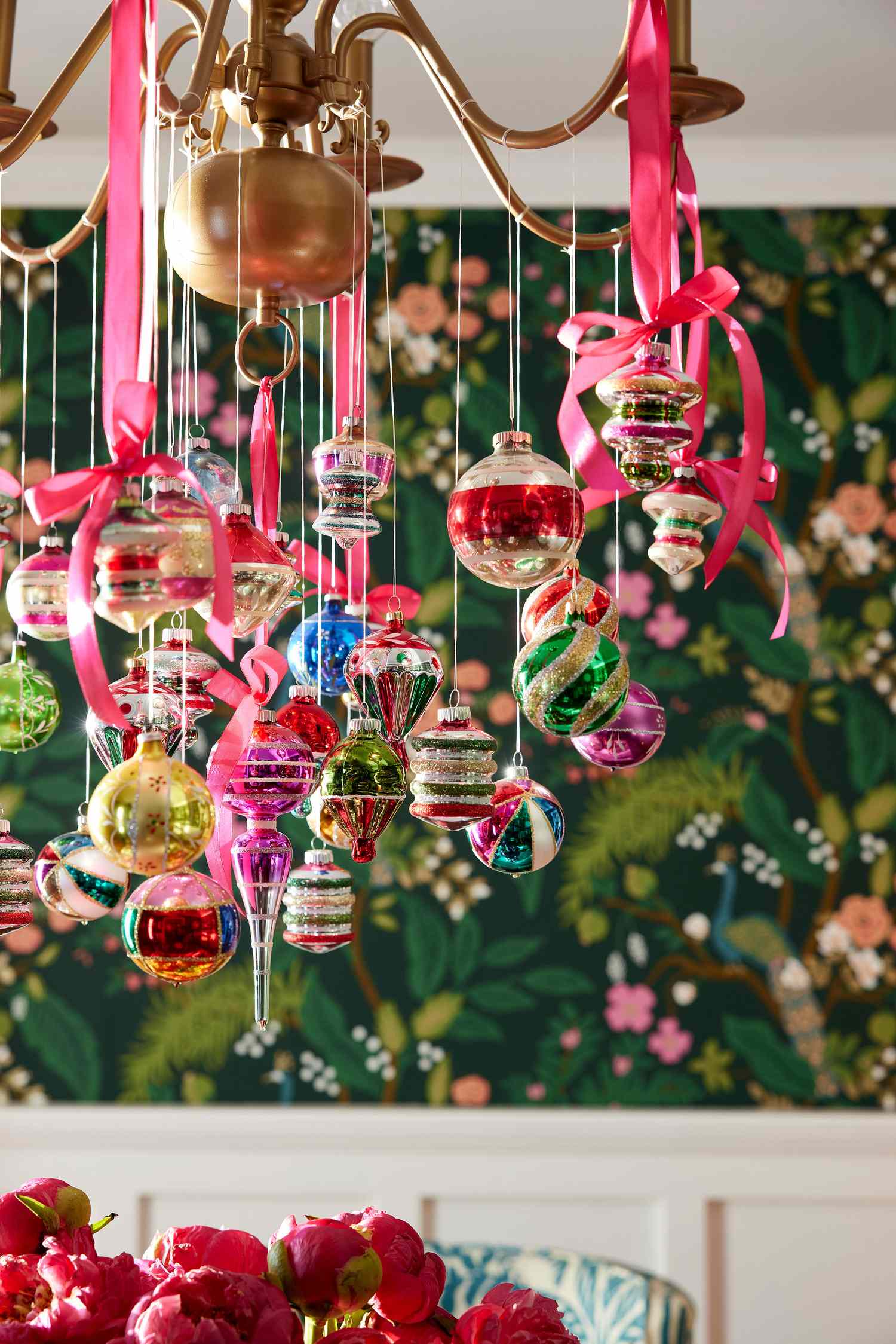
Mirrored ornaments bounce everything, including your television. If the tree sits across from a TV, expect a strobe effect every time a light string blinks. Satin-finish disco balls also show fingerprints, so keep them above the 4-foot mark where hands don’t travel. And true mirror-finish ornaments are fragile — the coating crazes with temperature swings, which is why attic storage over a garage is a genuinely bad idea.
17. Pink Finial Ornament With Distressed Gold on Flocked Pine
- Start with a plain matte pink finial ornament from a craft store — about $3.
- Rub gold wax onto the raised ridges with your fingertip in thin, uneven coats.
- Wipe most of it back off with a dry cloth, leaving gold only in crevices and high points.
- Let it cure 24 hours, then buff lightly with a soft rag for a dull antique sheen.
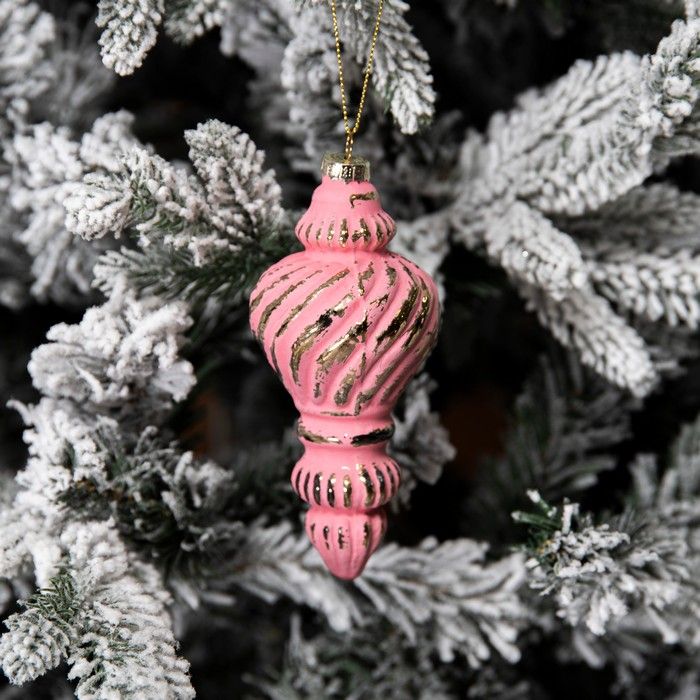
Time: 15 minutes per ornament plus drying. Cost: about $8 for enough wax to do a dozen.
The gold beaded hanging string is doing more than holding the ornament up. Against heavy white flocking, a plain hook or clear line would vanish and the ornament would look glued to the tree. The beaded string gives it a visible tether, so your eye reads “hanging” — delicate, temporary, intentional. Replace it with a wire hook and this same ornament loses its entire Victorian mood.
18. Pastel Candy Canes, Peppermint Swirls, and Turquoise Baubles
Pastels plus turquoise can go nursery-fast if you don’t anchor them. Your anchor is value: keep every ornament in the same light-to-medium range and introduce one darker note — here it’s the evergreen itself. If you’re building this yourself, buy candy canes and peppermint swirls in one shopping trip so the whites match. Different manufacturers’ “white” varies enough to be visible under fairy lights.
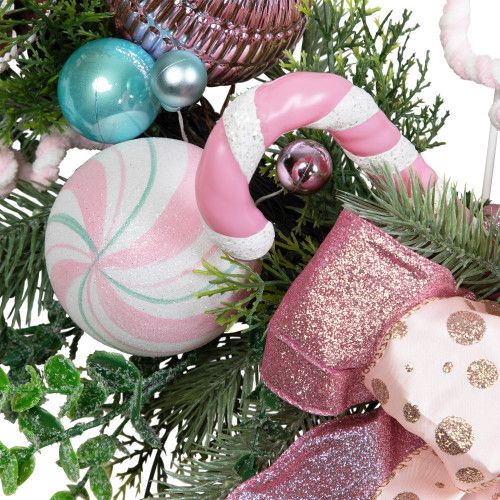
Everything in this cluster is a dollar-store or craft-store find. Pink-and-white striped candy canes run $3–$6 for a set of six at Dollar Tree, peppermint swirl balls are about $2 each at Michaels with a coupon, and turquoise glass ornaments show up constantly at thrift stores for a dollar apiece. The glittery polka-dot bow is the one piece worth buying nicer — cheap glitter sheds everywhere, and the bow is the focal point.
Glitter is a lifestyle, not a decoration. Expect a pink dusting on the floor within a week, and don’t place glittered pieces above a radiator or air vent. Pastel finishes on glass fog when cleaned with anything ammonia-based, so use a dry microfiber cloth only. Real candy canes, if you’re using them, need swapping out after two seasons — humidity turns them soft and sticky.
19. Jewel-Tone Ornaments and a Multi-Colored Ribbon Bow
- Oversized jewel-tone ornaments, 40 pieces: $80–$220
- Multi-colored velvet and satin ribbon: $15–$40
- Emerald-cut crystal ornament: $20–$60
- Glitter berry sprays, set of 6: $18–$45
- Warm white string lights, 300 count: $20–$45
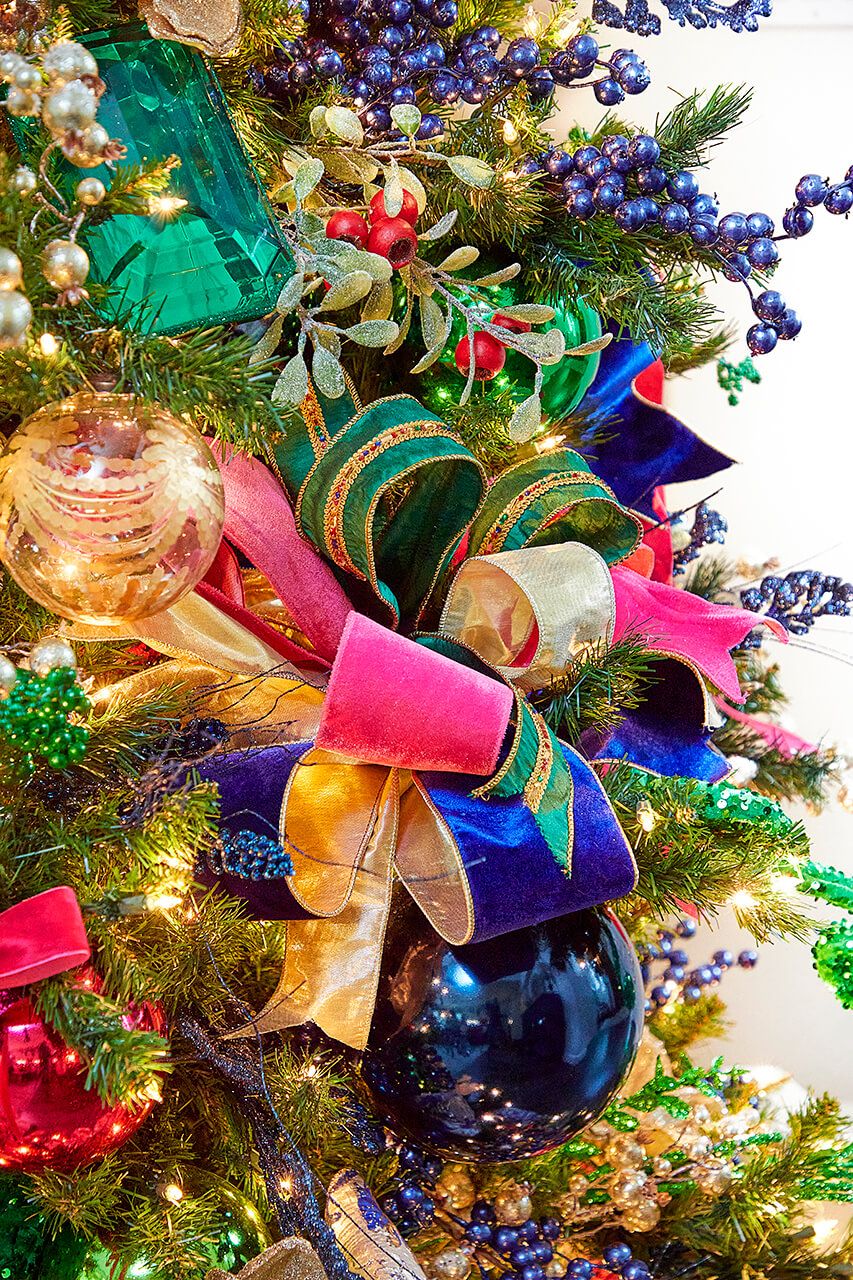
Total: about $153–$410 — buy ornaments in mixed resale lots and you’ll land near the low end.
Jewel tones came back hard in 2026 after a long stretch of neutral holiday palettes, and the reason is mostly photographic: emerald, sapphire, and magenta read beautifully on phone cameras in low light, which is where most holiday decorating lives now. The multi-colored bow rather than a single-color one is the newer detail — it signals “collected over time” instead of “bought as a set.” Expect this one to age well; jewel tones have cycled through Christmas since the 1960s.
20. Green Tree With Pink-Tipped Needles and Paper Honeycombs
- Cut two matching circles of tissue paper — 8 inches is a good starting size.
- Accordion-fold the stack in 1-inch pleats and secure the center with a twist tie.
- Fan the folds open into a circle and glue the first and last panels together.
- Press flat overnight under a book, then reopen slowly.
- Hang with a loop of baker’s twine in a contrasting color.
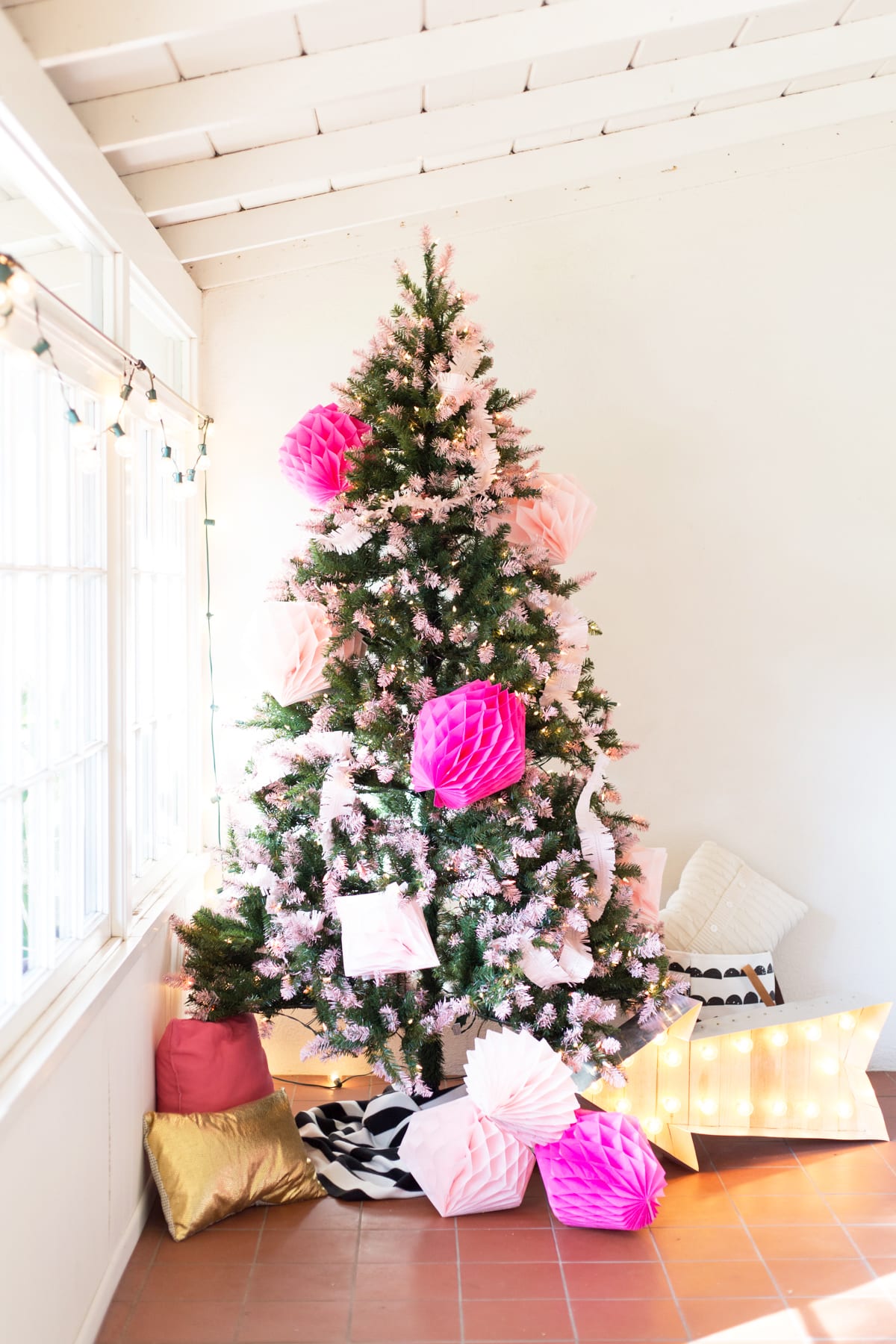
Time: 6 minutes each. Cost: about 40 cents per ornament.
This is the cheapest idea in the article to copy. Tissue honeycombs are pennies each, the marquee arrow sign can be found at discount stores for under $20, and floor cushions in gold, pink, and white are a Walmart or IKEA staple at $15–$30 apiece. The black-and-white striped blanket is the sleeper — a $25 throw gives you the pattern contrast that makes cheap pink paper ornaments look designed. Same maximalist instinct, smaller budget: compare with Idea #9.
Floor cushions around a tree look wonderful and get tripped over constantly. If this is a high-traffic room, keep the cushions to one side rather than ringing the base. Tissue honeycombs are also not waterproof and not cat-proof — a single swipe flattens them permanently. And if you’re using a marquee sign, check whether it takes batteries or a cord; cords near a tree base are the one detail that will annoy you all season.
21. Retro Pink Boombox Ornament on a Pine Branch
Novelty ornaments work best in threes or fives, clustered in one zone rather than scattered. Group your retro pieces — boombox, cassette, roller skate — on one branch arm at roughly eye level, and let the rest of the tree stay quiet. Odd numbers keep a cluster from reading as a symmetrical pair. And hang anything heavy on a wire hook with a plastic safety cap, not a ribbon loop; ribbons stretch and the ornament drifts down by mid-December.
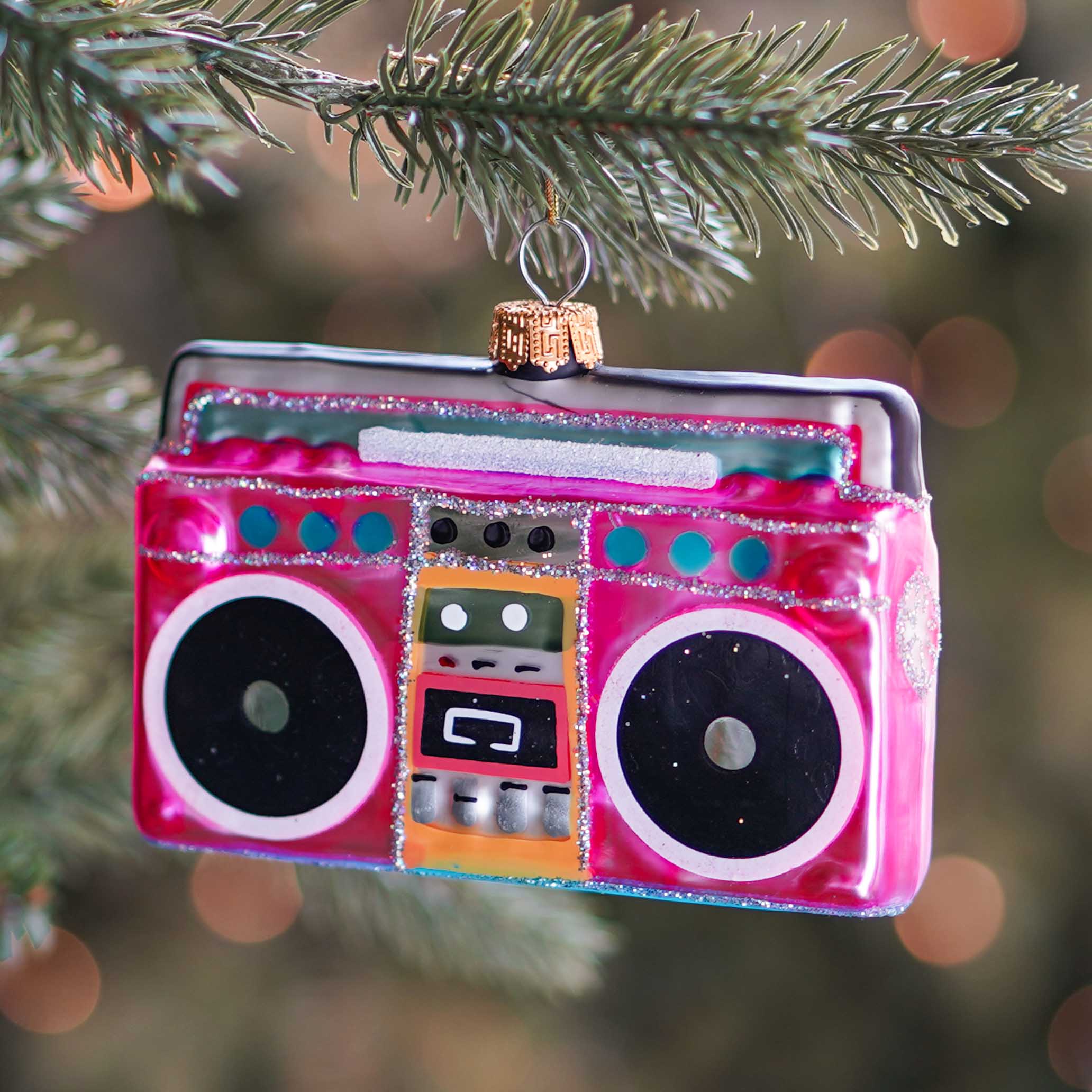
Glass novelty ornaments chip at the paint edges first — the speakers, the glitter trim, the hanger cap. Store them upright in the original box if you kept it, or in a divided ornament case; loose in a bin, that silver glitter flakes onto whatever’s underneath. Hand-wash only, cold water, no soaking, dry immediately. Skip the dishwasher entirely, even on a gentle cycle, unless you enjoy reconstructing a boombox.
22. Candy-Themed Pink Nutcracker on a Wooden Countertop
- Clear the surface and start with the tallest piece at the back — here, the glass apothecary jar.
- Add the mid-height anchor, the nutcracker, slightly off-center rather than dead center.
- Raise the smallest piece on a stand or cake stand so it sits above the nutcracker’s base.
- Tuck in two or three low elements — pine sprigs, small mercury glass — to break the horizon line.
- Step back and remove one thing. Vignettes are almost always one object too full.
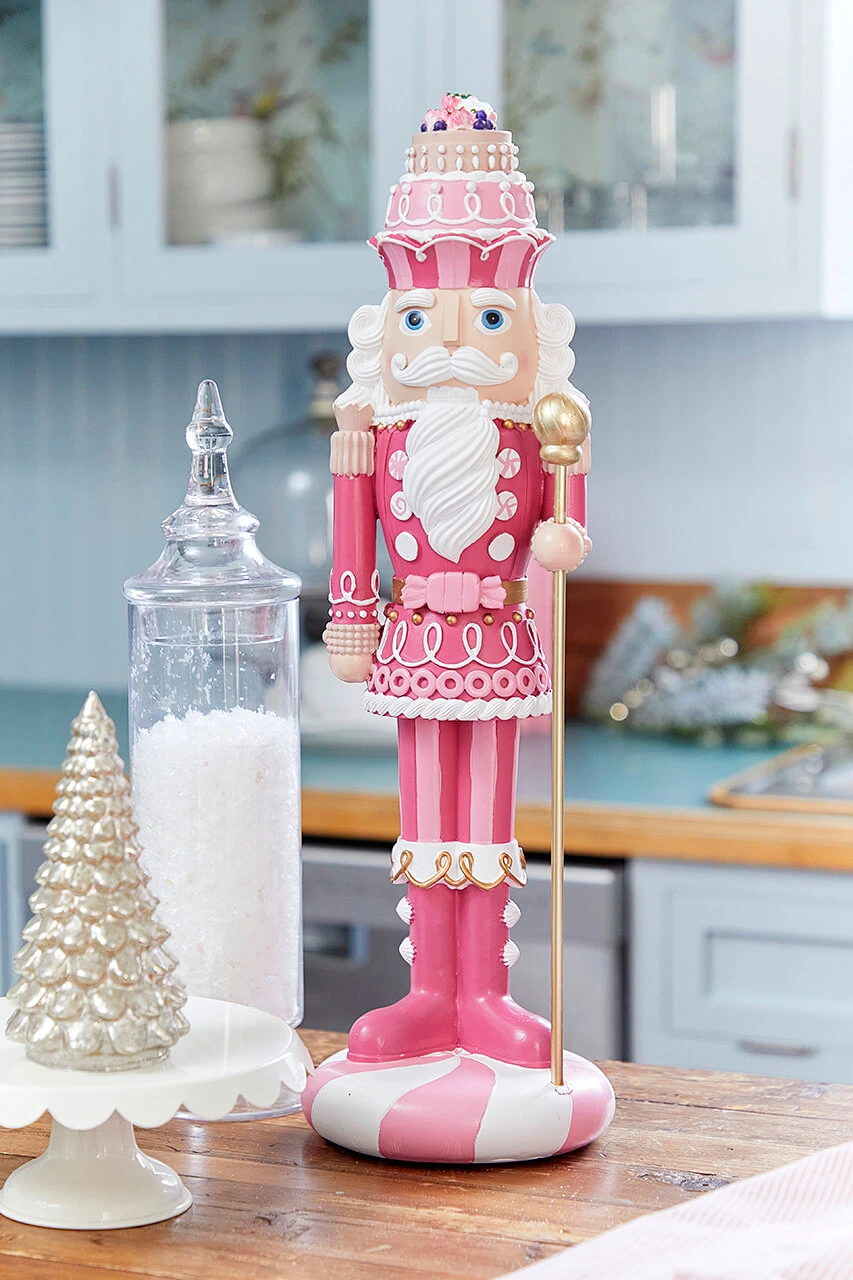
Time: 15 minutes. Cost: nothing if you’re using what you own.
The white scalloped cake stand is why this vignette looks styled instead of just set down. It lifts the mercury glass tree to eye level, adds a soft curved silhouette against all those straight vertical lines, and gives the pink nutcracker a pedestal without making it precious. Remove the stand and you’ve got three objects on a counter. Put it back and you’ve got a scene.
Three heights, three materials, one palette. The nutcracker is ceramic and matte, the tree is glass and reflective, the jar is clear and holds loose faux snow. That mix of finishes keeps an all-pink-and-white arrangement from going saccharine. Warm wood underneath pulls everything down to earth.
23. One Big Pink Glitter Bow Against Dark Pine
A statement bow needs a runway. On a mantel, the bow should be no wider than one-third of the mantel’s total length, so a 5-foot mantel takes an 18–20 inch bow at most. On a doorway, hang it at about 70% of the door height — not right at the top, where it reads like a wreath substitute. This is a large-room gesture; in a hallway under 4 feet wide, a bow this size swallows the entire wall.
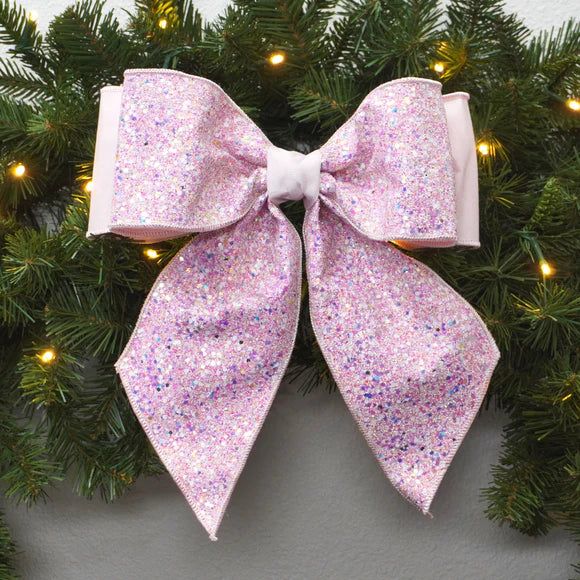
Glitter bows shed, and they shed downhill. Before you mount one, mist it lightly with matte acrylic sealer and let it dry outdoors — two coats if it’s going above a table you actually use. Fluff the loops by hand before hanging, too. Glitter stiffens fabric, and compressed loops never recover once they’ve been pressed flat against a garland for a week.
24. Miniature Beaded Tabletop Tree in a Metallic Pot
- Beaded miniature tree, 10–12 in: $35–$90
- Metallic pot or cachepot: $12–$35
- Round decorative tray: $15–$40
- Faux pine sprigs: $8–$20
- Small gold star topper: $5–$15
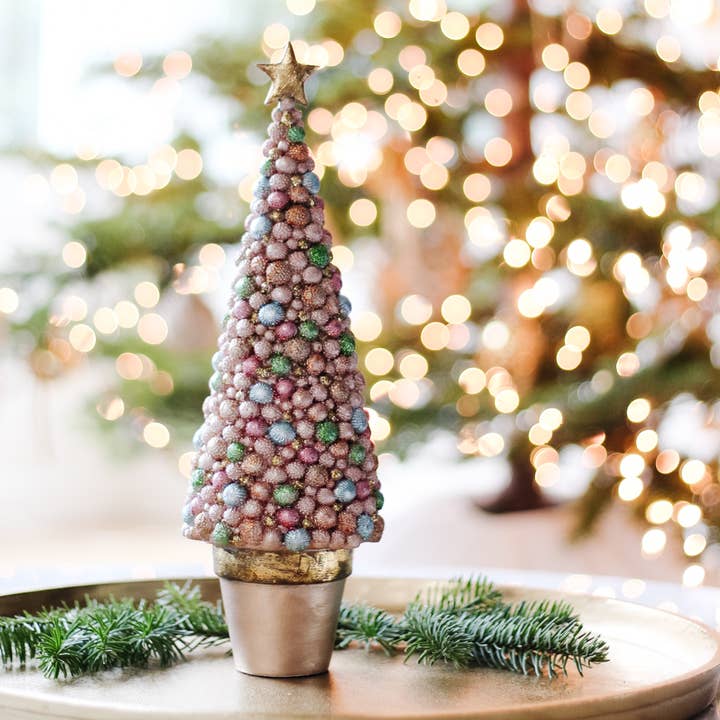
Total: about $75–$200, which is high for the size — but this one gets stored and reused for decades.
You can absolutely make this for a third of the price. Buy a small cone form for $6, a mixed bag of seed beads for $8, and floral pins for $4, then pin beads in overlapping rows from the bottom up — roughly two hours of work. Thrifted metallic sugar bowls and small planters make perfect pots at $2–$5, and the tray can be any shallow bowl you already own. If you’d rather not, ready-made beaded tabletop trees sit around $30 at craft stores.
Small-space decorating is the single biggest driver of holiday Pinterest searches right now, and miniature trees are where people land. They’re also the fastest-growing category in vintage resale — beaded trees from the 1960s and 70s hit estate sales constantly, and collectors have started driving prices up on intact ones with original pots and toppers.
25. Flocked Pink Tree With Oversized Baubles and a White Lamp
This is the cleanest formula in the article: 65% pink, 25% warm white, 10% neutral. That’s it. Only two ornament sizes — oversized and nothing else — which is exactly why it reads modern instead of cluttered. Switch the pink to a deeper rose and the neutral to black, and you have the same tree with an entirely different mood. Add a third ornament size and the restraint disappears.
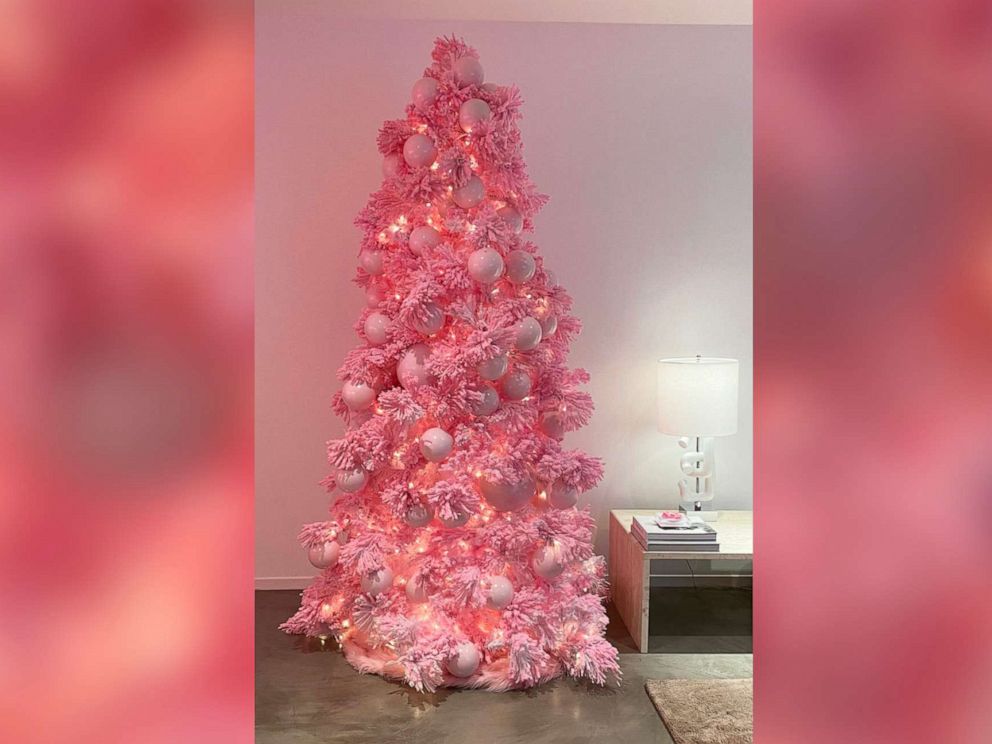
Flocked trees photograph bigger than they are, but they still need real space. This one works in rooms from 10 by 12 feet up to 14 by 16, with 8-foot ceilings as the minimum. Because the room is otherwise minimalist, the tree can be the only decorated object — resist adding a second. For a maximalist version of the same pink flocking, see Idea #13.
Flocked trees are heavy on the vacuum and unforgiving on dark floors. That white dust is very visible on wood, and it sticks to anything with texture. Also, oversized ornaments mean fewer hanging points, so a small tree will look sparse fast — buy bigger baubles than you think you need, and buy extras of the focal size in case one breaks.
26. Pink and Blue Lights on a Tree Framed by a Light Curtain
The curtain of vertical string lights behind the tree is the whole effect. A tree lit with purple and blue bulbs against a plain wall looks like a dorm room; the same tree in front of a sheer curtain laced with lights reads like an installation. Layers do it — dense colored lights close to the branches, a soft vertical wash behind, and no overhead light competing. Add a ceiling fixture and the magic flattens out.

Two sets of colored string lights and one sheer curtain comes in under $60 total. Warm-white curtain lights from IKEA or Amazon run $20–$35, and magenta and blue LED strands are the cheapest lights on the shelf at $8–$15 each. Hang the curtain on a tension rod behind the tree so you’re not patching drywall in January. If you want this glow without colored bulbs, Idea #16 gets you there.
27. Tall Green Tree Anchored by a Glittery Magenta Skirt
- Tall green artificial tree, 7.5–9 ft: $150–$500
- Sparkly magenta tree skirt: $25–$70
- Mixed ornaments, 80 pieces: $70–$200
- Warm white lights, 600 count: $25–$55
- Potted poinsettia: $12–$30
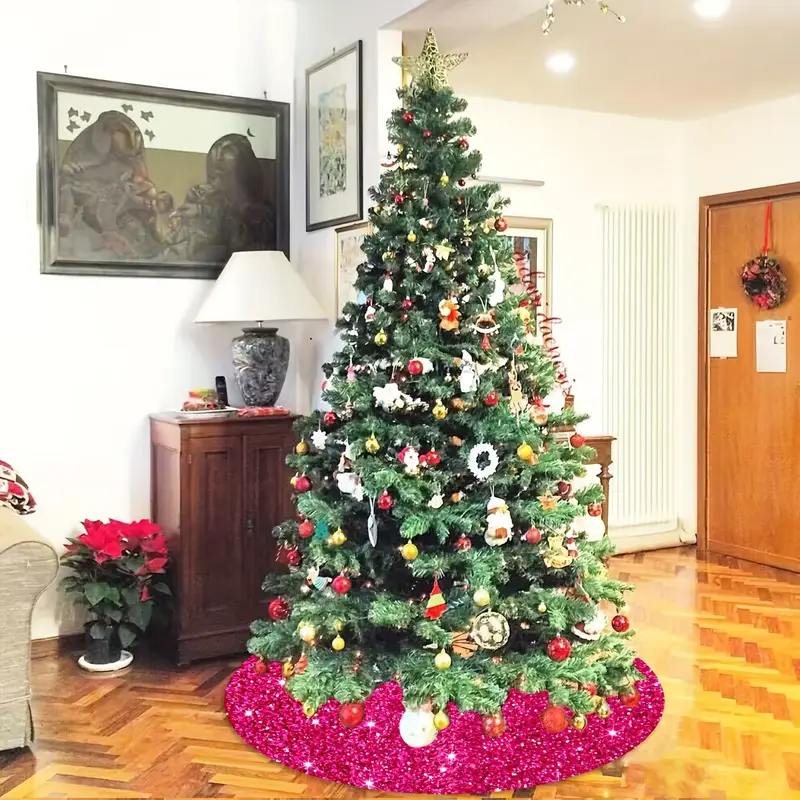
Total: about $282–$855. The skirt is the cheapest upgrade with the biggest payoff — budget for it even if it means 20 fewer ornaments.
Everything in this room is quiet — white walls, dark wood, framed art, herringbone floor — and the magenta skirt is the only thing yelling. That’s precisely why it works. Without it, a green tree on herringbone flooring is a nice, traditional, forgettable setup. With it, the floor becomes part of the decoration and the tree gets a base with actual weight. A cream or burlap skirt here would vanish completely.
28. Pink Speckled Glass Balls Against Dark Evergreen
Speckled and mottled finishes are the easiest way to make inexpensive ornaments look collected. Buy a set of plain bright pink glass balls, then cluster them in threes with about a 2-inch gap between hanging points — closer and the mottling turns into a blur. Hang the largest balls at the widest part of the tree, 3 to 4 feet off the ground, so the light catches the speckle from below.
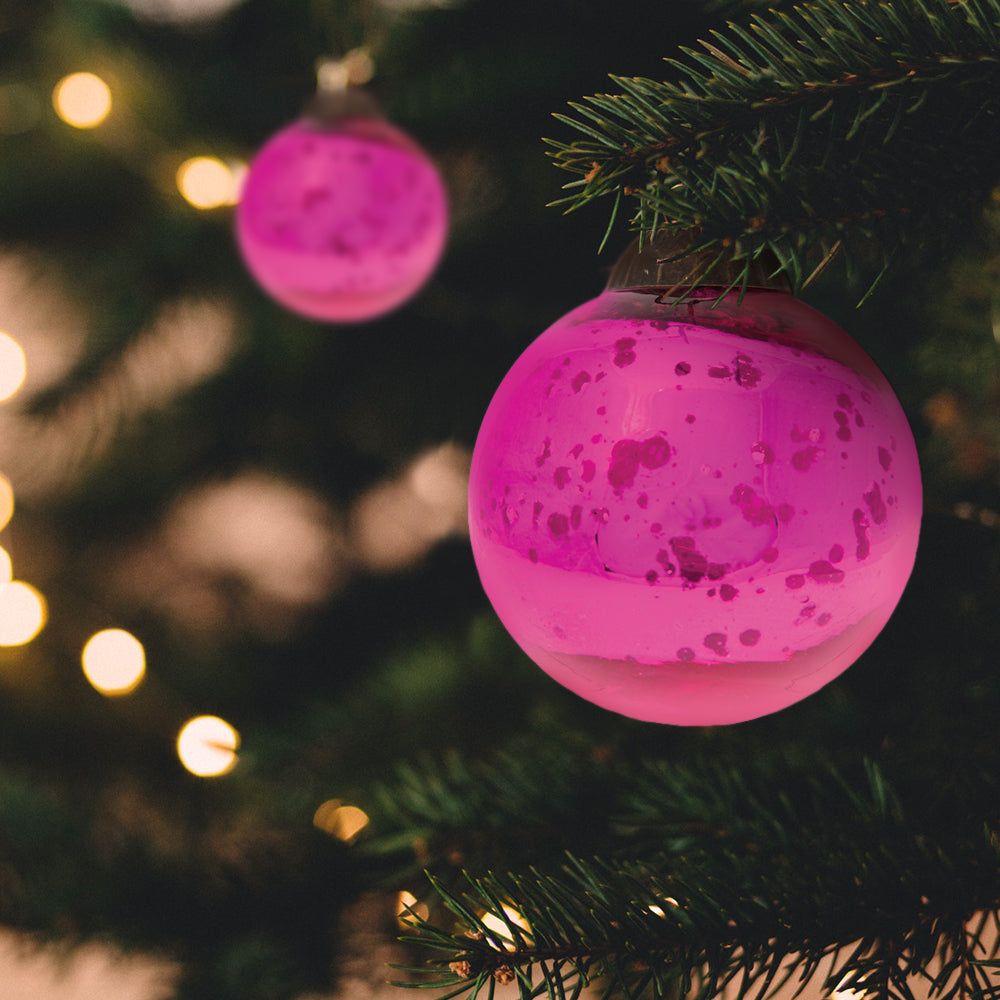
This is tree styling for a standard 6- to 7-foot tree in a room 10 by 10 or larger. Because the ornaments are all one color and one size, you need volume: roughly 60 to 80 balls for a 7-foot tree, which sounds like a lot until you see how much tree disappears once you hang light. Trees under 5 feet need 30–40 maximum, or the branch tips will start to droop.
29. Pink Tree Over a Snowflake-Speckled White Skirt
Two colors, three textures. Pink needles, a plush white skirt, silver foil snowflakes — that’s the entire recipe, and it works because every element has a different finish: flocked, fleece, and metallic. Swap the silver foil for white embroidery and the tree goes soft and quiet. Swap it for gold foil and it goes warm and vintage. Either way, pink holds roughly 70% of the visual weight.
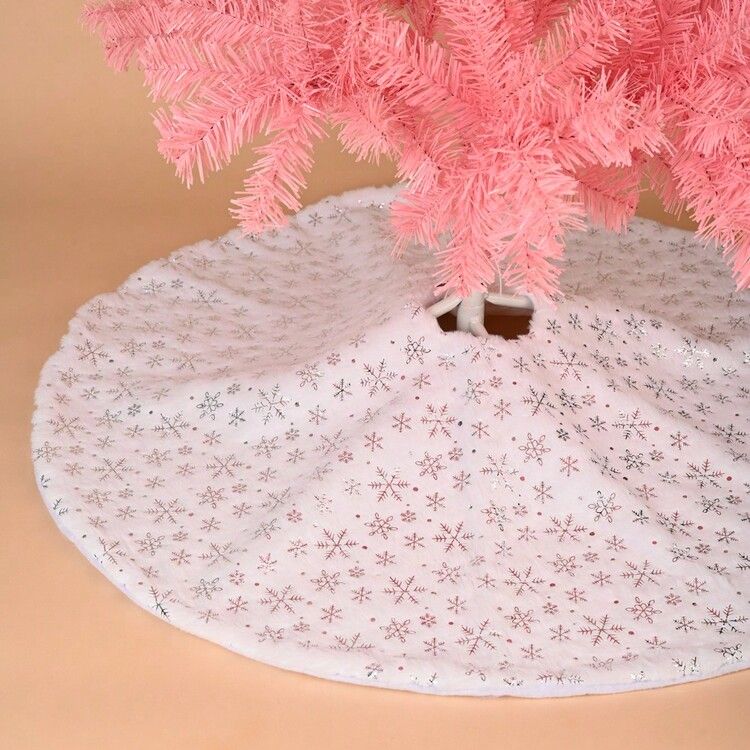
One thing to know: plush white skirts show everything — pine needles, pet hair, glitter, and one dropped piece of chocolate. Look for a machine-washable version and shake it out every few days. Silver foil snowflake appliqué is often glued rather than stitched, so corners can lift after a wash or two. If that bothers you, buy a plain white skirt and pin on separate snowflake ornaments you can pull off before cleaning.
30. Knitted Pink Elf Ornament With Wooden Bead Feet
- Knit or felt a small cone body in pink, about 3 inches tall.
- Add a rolled white faux fur strip around the hood opening.
- Stitch a tiny gold sequin heart onto the front of the dress.
- Thread two wooden beads onto cord for the legs and knot at the top.
- Attach a twine loop at the hat tip and hang low, where the legs can dangle free.
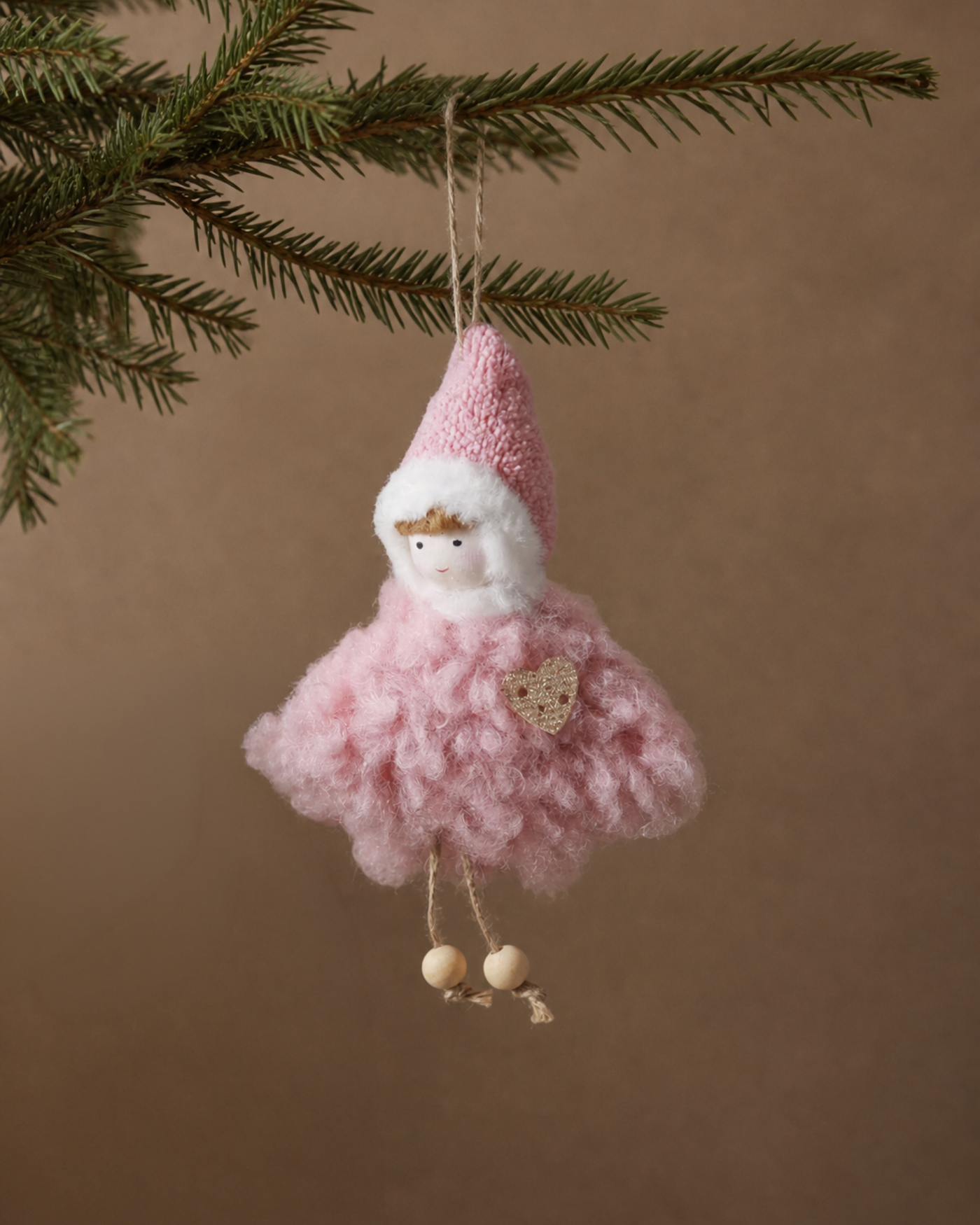
Time: about 90 minutes. Cost: $6–$10 in materials per ornament.
The wooden bead feet are what make this ornament feel like a character instead of a craft project. Dangling legs need open air below them, so hang this one on a branch with nothing underneath — outer edge, low on the tree. Clustered among other ornaments, the dangle disappears entirely and you’ve lost the one thing that made it charming.
31. Vintage Indented Glass Ornaments in Magenta and Teal
Indented glass ornaments — the ones with a recessed center and fluted rays — were a staple from the 1940s through the 1970s, and they’ve become one of the fastest-moving categories in vintage Christmas resale. The color-blocked panels outlined in gold glitter are the giveaway for mid-century production. Prices have roughly doubled in five years, so if you find them at an estate sale in good shape, buy them. Vintage hunters should also see Idea #21 for the retro novelty side of the same trend.
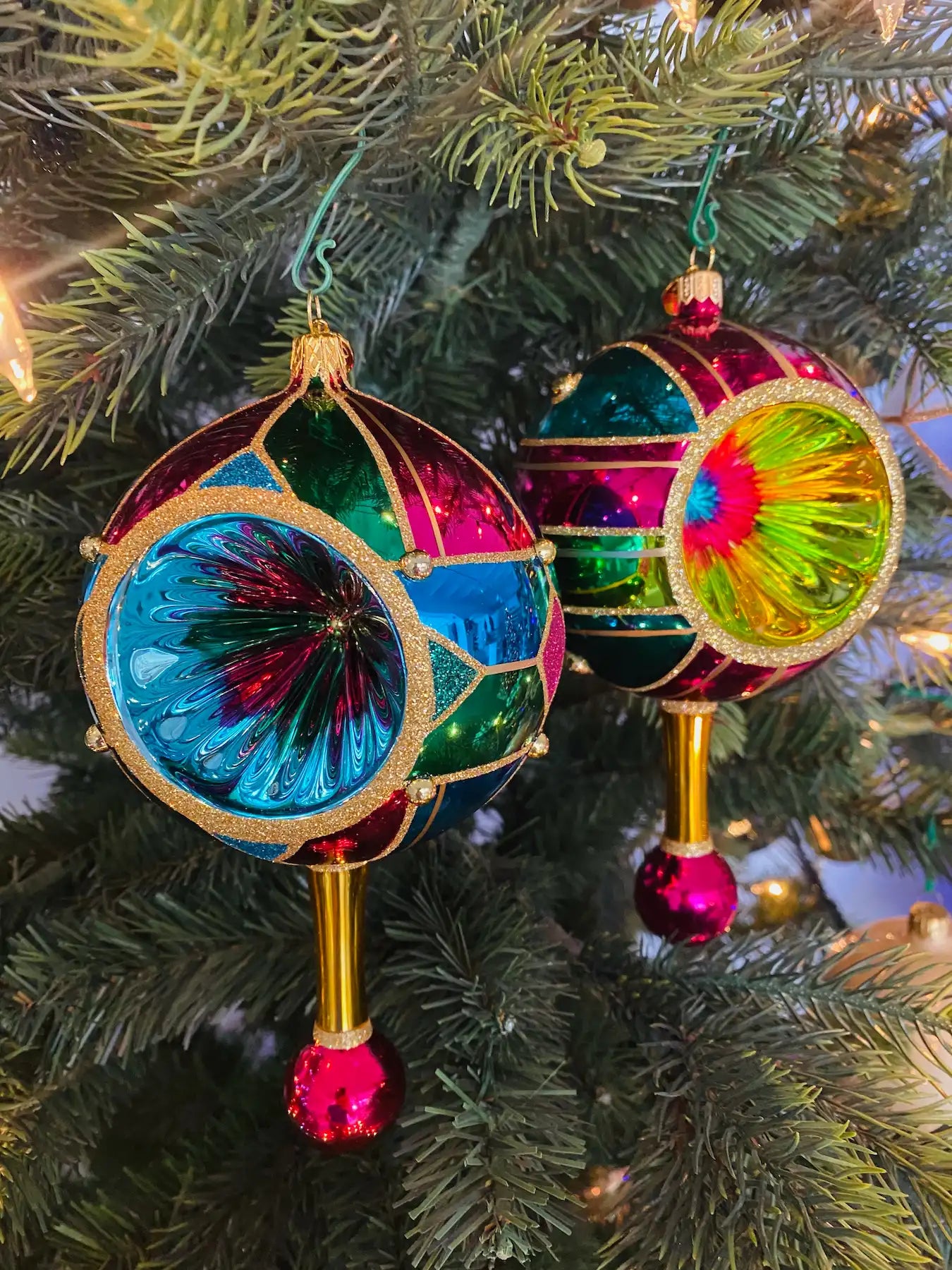
Never hang vintage glass on a wire hook — metal scratches the inside of the cap, and that cap is often the only thing holding a 60-year-old ornament together. Thread a ribbon loop through the existing cap ring instead. Rotate them, too: heaviest vintage pieces go on inner, sturdier branches and outer tips stay for lighter modern ornaments. And never wash them — dust with a dry, soft brush only.
32. Magenta Diamond-Texture Glass Ornament
- Start with a plain glossy glass ball in magenta — about $3.
- Cut a diamond-shaped stencil from contact paper and press it firmly onto the ball.
- Brush on two thin coats of matte clear medium, letting each dry 20 minutes.
- Peel the stencil while the second coat is still slightly tacky, then cure 24 hours.
- Hang with a metallic cap and a narrow satin ribbon.
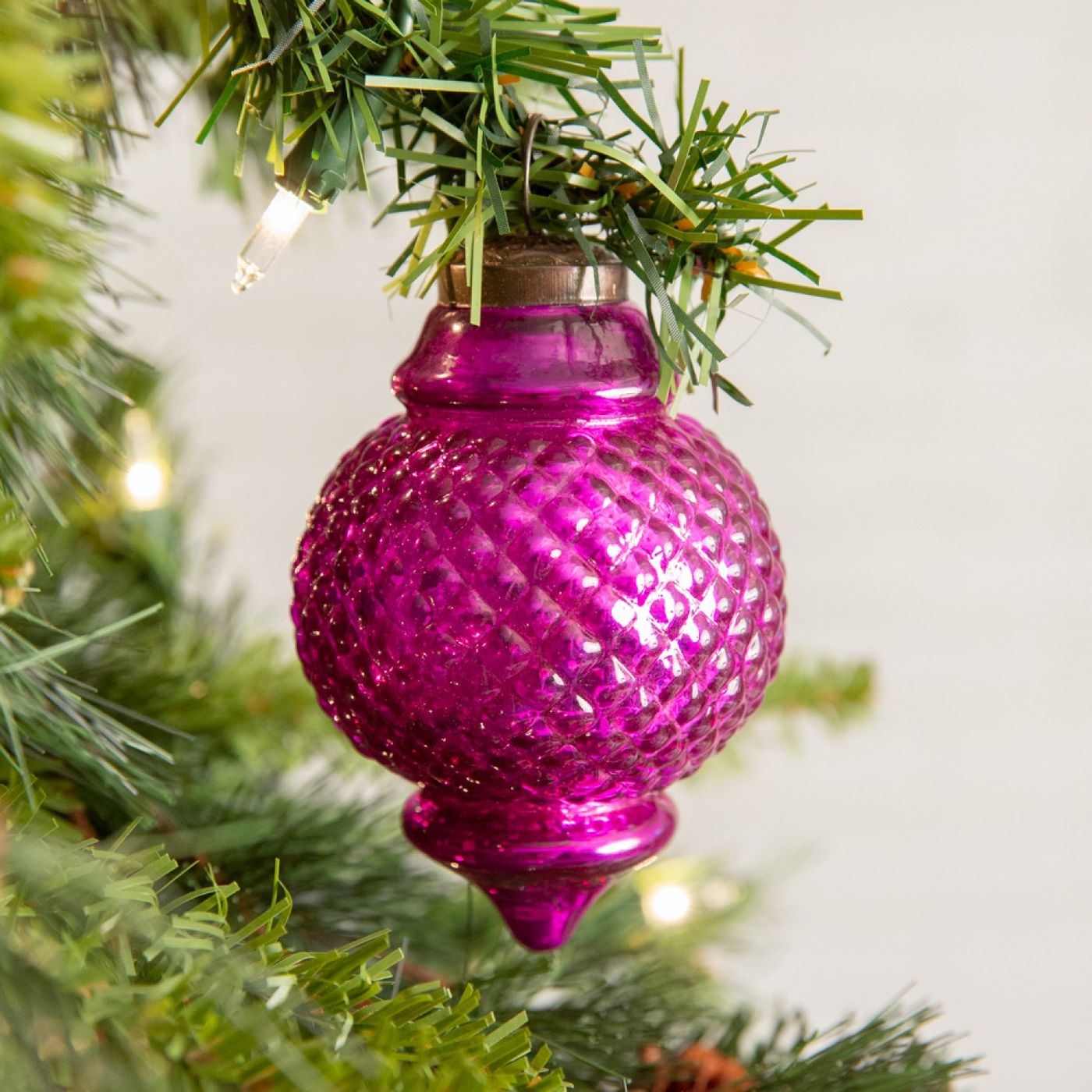
Time: 40 minutes plus curing. Cost: about $10 in materials to do six ornaments.
Texture is what makes a single-color ornament interesting up close. A glossy magenta ball with a smooth surface reflects one big blobby highlight; the same ball with a diamond grid breaks light into dozens of small points, so it reads brighter and more expensive from three feet away. Same reason velvet and satin look different in the same dye lot. Warm string lights behind it push the effect even further.
33. Hand-Painted Abstract Ornament in Pink and Lavender
The color math here is 70% pink base, 20% pastel accents in mint, lavender and white, and 10% silver from the cap and hanger. That ratio is exactly why it looks intentional rather than random — the base does the heavy lifting and the brushstrokes are the seasoning. Try the same formula with a cream base and sage accents, or a pale blue base with peach strokes. The percentages stay, the palette moves.
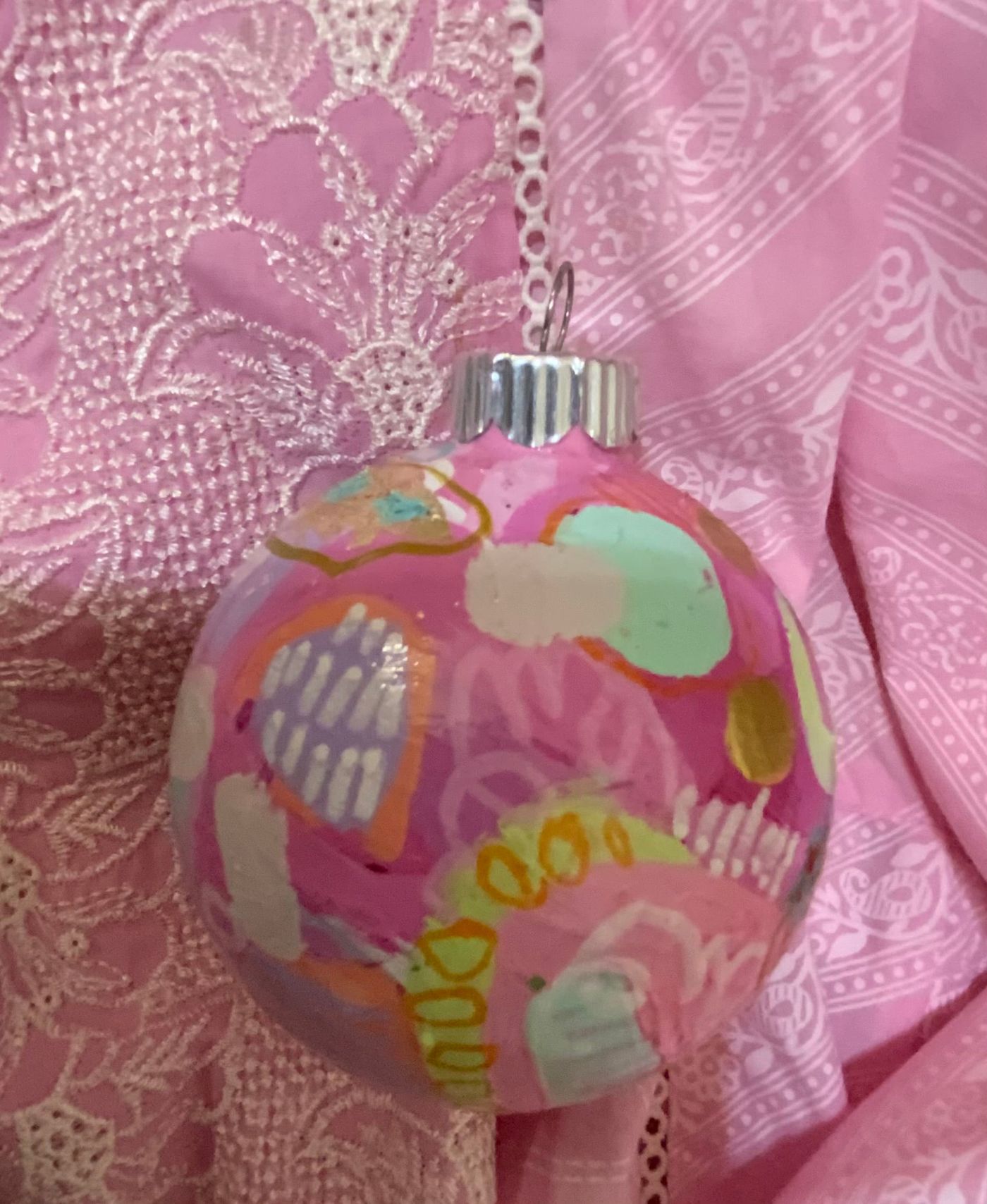
Hand-painted acrylic on glass is durable but not bulletproof. Expect minor chipping if ornaments knock together in storage, so wrap each in tissue or keep them in a divided tray. Never soak them — acrylic edges lift in water. Use a barely damp cloth and dry immediately. If you want the look with zero risk, paint onto a matte-finish plastic ornament instead; the paint bonds better and nothing chips.
34. A Glass Pineapple Ornament in Pink, Mint, and Gold
- Glass pineapple ornament: $12–$35
- Mint-and-gold leaf detailing, if bought separately: $8–$18
- White starburst ornament for contrast: $8–$20
- Gold hanging string or cap: $3–$8
- Faux evergreen filler branches: $10–$25
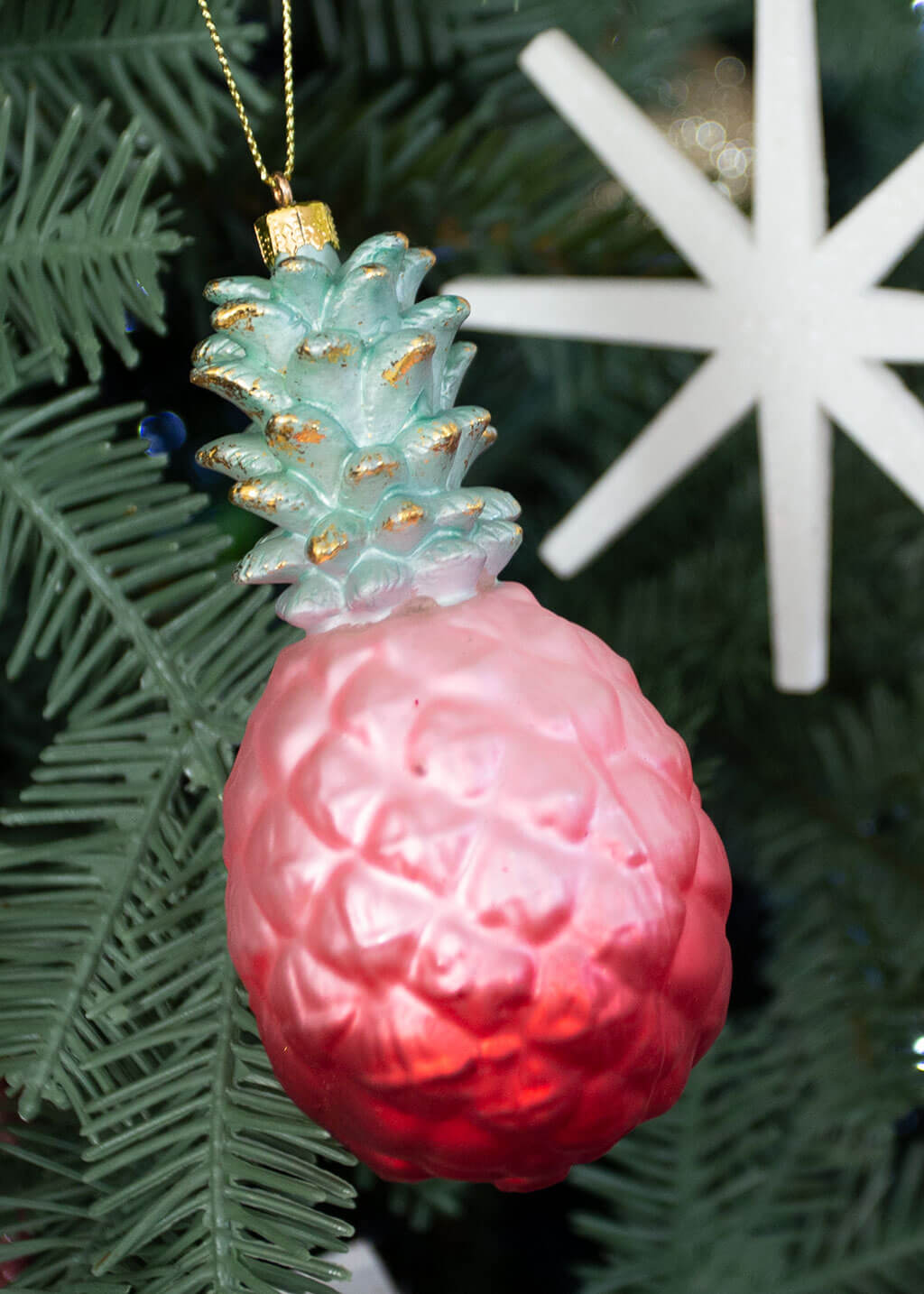
Total: about $41–$106 for a small themed cluster — enough to make one corner of the tree feel like a collection.
Novelty glass ornaments — fruit, food, animals, tiny household objects — have moved from the back of the tree to the front. The shift came with the rise of souvenir trees, where people hang a piece from every trip, and with resale sites making one-off glass shapes easy to find. Pink pineapple, white starburst, gold cap: it’s a color scheme and a joke at the same time, which is exactly what this decorating moment rewards.
35. Red Velvet Poinsettia Pick With Beaded White Trim
The white beaded trim is what separates this from a dollar-store poinsettia. Velvet petals alone are handsome, but heavy beadwork along every edge gives the flower a frosted, slightly vintage look that reads expensive from across the room. The clustered pearl center matters too — it gives the eye a focal point inside the bloom. Skip the beading and you’ve got a red flower. Keep it and you’ve got an heirloom.
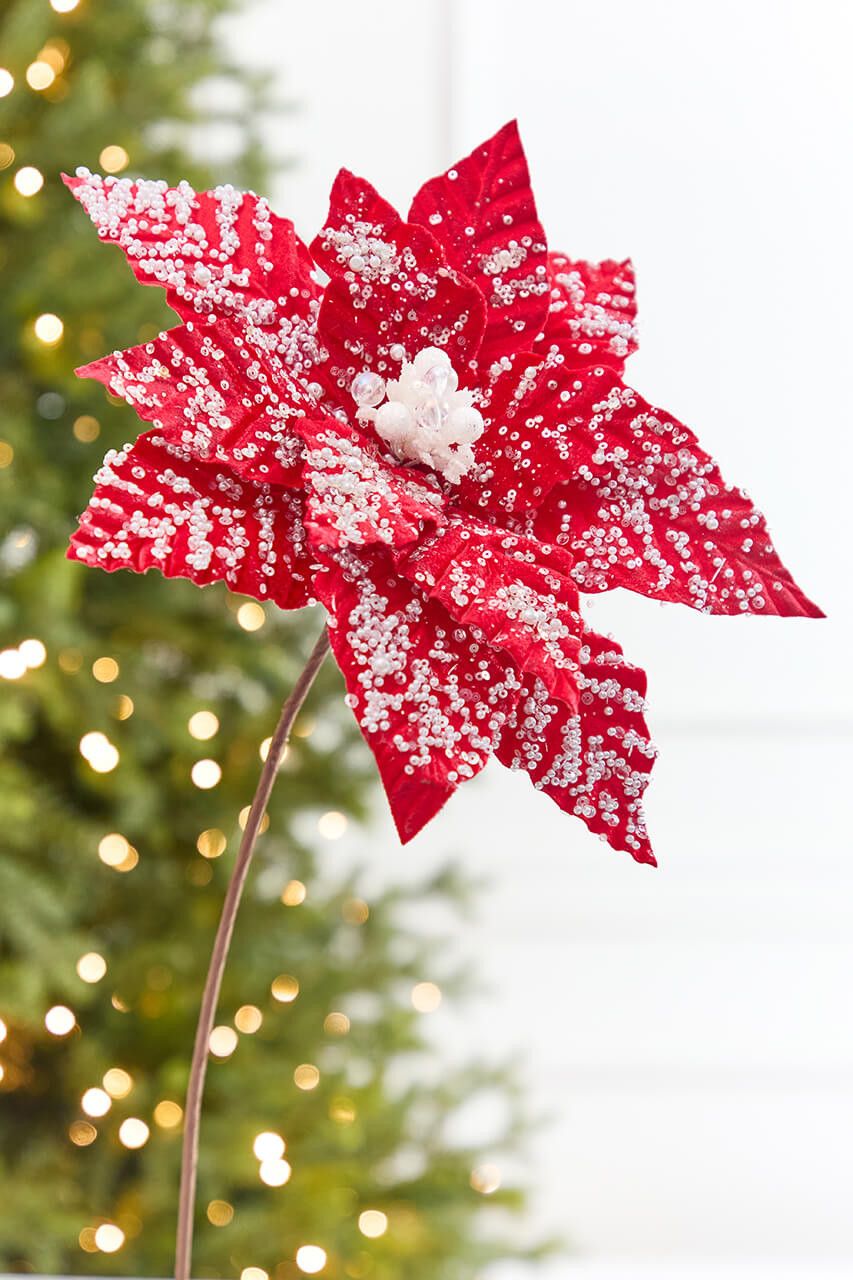
You can build a convincing version for around $8. Buy a plain red velvet poinsettia stem for $3, a strand of tiny white pearl beads for $4, and a tube of clear craft glue for $2. Run a thin line of glue along each petal edge, lay the bead strand into it, and trim the ends. Let it cure overnight. Store-bought stems with this much beadwork run $15–$30 each, so doing five yourself saves you roughly $50.
Your Pink Tree, Your Living Room, Your December
Mix a vintage indented bauble with a dollar-store candy cane. Put a magenta skirt under a green tree. Tie forty ribbon bows because your grandmother did. The best pink Christmas trees in 2026 are the ones that look like someone actually lived with them — and now you’ve got 35 starting points and a shopping list that won’t wreck your January budget.
📌 Pin your favorite three to your holiday board now, before the good ornaments sell out in November.
