
35 Jaw-Dropping DIY Holiday Wreaths You Need to Craft for a Magical 2026 Season
You know the feeling: it is the second week of December, your Pinterest board is stacked three scrolls deep with wreaths, and the door is still bare.
We spent serious time browsing Etsy, Hobby Lobby, Michaels, Target and Amazon to bring you the 35 ideas actually worth your glue gun, with materials running from about $12 to $240 depending on how far you want to take it. Inside you will find four broad directions — rustic pinecone builds, traditional evergreen, minimalist botanical work, and a couple of gloriously extra character wreaths — with budget and luxury versions compared side by side and shoppable links where they make sense.
In 2026 the wreath conversation has split neatly in two: foraged, hyper-natural work on one side and high-personality nostalgia on the other, and Pinterest saves for both are climbing fast.
Pin this guide for later — your future self will thank you when it is time to actually do this.
1. A Dark Green Braided Velvet Wreath With a Gold Satin Bow
Fabric wreaths have quietly replaced the classic evergreen loop for anyone who wants a door that looks considered rather than crafty. The braid is the whole trick: three thick strands of dark green velvet wound together read as texture from the end of the walkway and as softness up close. The gold satin bow is the only glossy element here, and its long tails pull the eye straight down the center of the white paneled door.
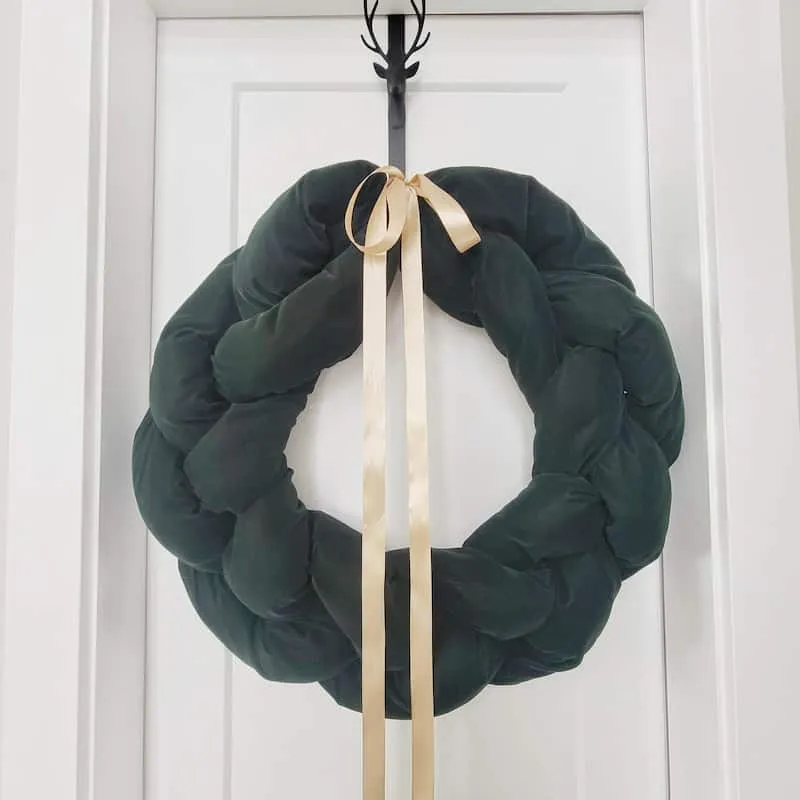
The black metal deer hook is doing quiet work too — it holds the wreath flat instead of letting it swing. When every other surface is matte, one reflective detail is plenty.
- Ready-made braided velvet wreath, 20 in.: $65–$120
- DIY instead: 2.5 yds velvet fabric + 14 in. braid form: $28–$55
- 2 in. gold satin ribbon, 3 yds: $9–$16
- Black metal deer head hook: $12–$24
- Fabric glue and a handheld steamer: $15–$25
Total: $110–$185 ready-made, or $64–$120 if you build it.
Budget alternative: dig through a fabric remnant bin for velvet at $8 a yard, then slice a foam pool noodle into a ring and wrap it — same silhouette for under $45.
2. Mixed Evergreen, Pinecones, and One Big Red Velvet Bow
Pinecones behave like little sculptures, so place them in odd-numbered clusters of three and grade the sizes — a 5 in. cone leading, two 3 in. cones flanking it. Wire each one through the base scales with 22-gauge floral wire instead of gluing it flat, which lets you angle the tips outward so they catch light. On a 24 in. wreath, four clusters placed at roughly 2, 5, 7 and 10 o’clock look intentional rather than scattered.
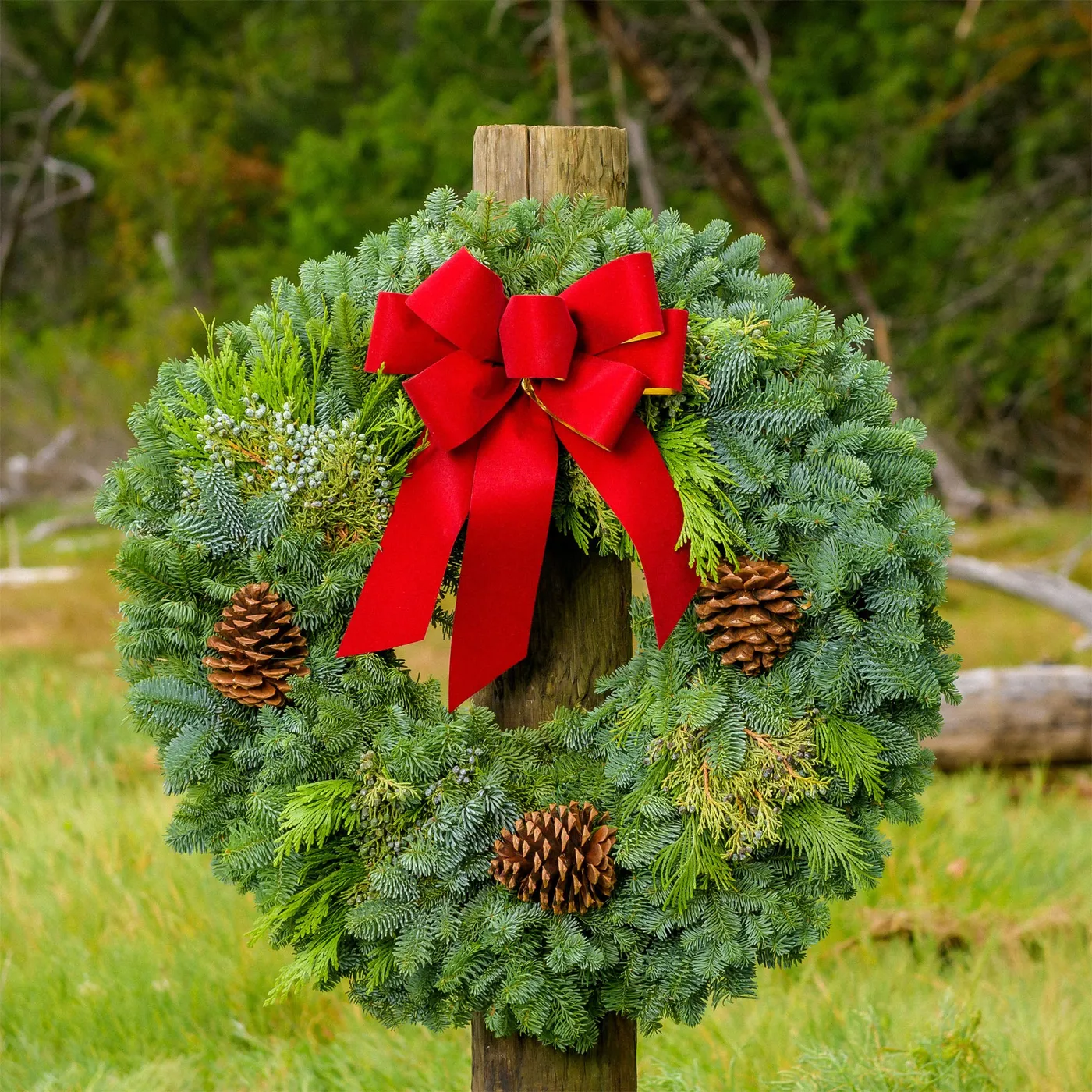
An evergreen wreath on a wooden post takes a beating: sun on one side, wind on the other, rain soaking the ribbon. Real greens dry out in about 10 days outdoors, so mist the back of the wreath every other day or go faux and spare yourself the grief. Check the label for UV resistance on velvet ribbon, because standard velvet fades to a sad pink by January.
3. A Pinecone Wreath Turned Candle Centerpiece
This is the same dense pinecone texture as Idea #5, just laid flat into a tabletop ring.
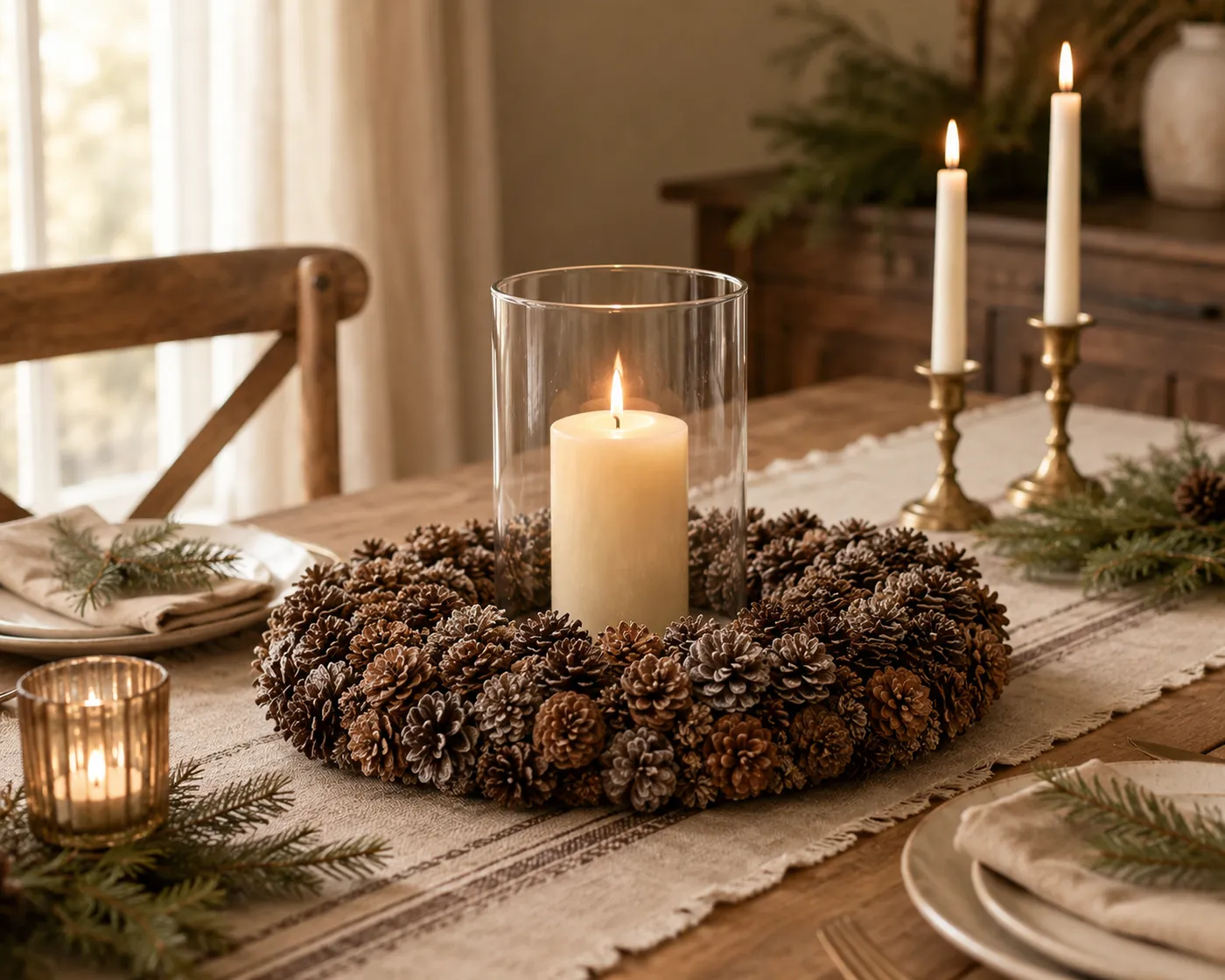
- Set a 14 in. pinecone or grapevine ring on a 90 in. linen runner.
- Stand a 4 in. diameter glass hurricane in the center, leaving at least 1 in. of clearance on every side.
- Drop in a cream pillar candle no taller than 6 in. so the flame stays below the glass rim.
- Tuck evergreen sprigs into the ring at 10 and 2 o’clock.
- Finish with two brass taper holders set about 18 in. apart.
About 45 minutes of work and $35 to $60 in materials.
The formula is 60 percent natural brown pinecone, 25 percent soft neutral (cream linen, clear glass, candle wax) and 15 percent brass. That last sliver is why the arrangement reads warm instead of woodsy-cold. Swap the pinecones for bleached ones and the brass for brushed nickel and the same structure turns frosty. Keep the neutrals at a quarter of the visual field — go higher and the whole vignette turns beige.
4. Pinecones and Hazelnuts Wired Under a Grey Satin Ribbon
It is the hazelnuts. A wreath of pinecones alone is a texture study; the smooth, hard-shelled nuts tucked between them give your eye somewhere to rest, and their gloss catches window light in a way pinecone scales never will. Take them out and you have a perfectly nice pinecone wreath you have seen a hundred times. Leave them in and people lean closer to figure out what they are looking at — the frosted silver cones scattered through only sharpen the contrast further.
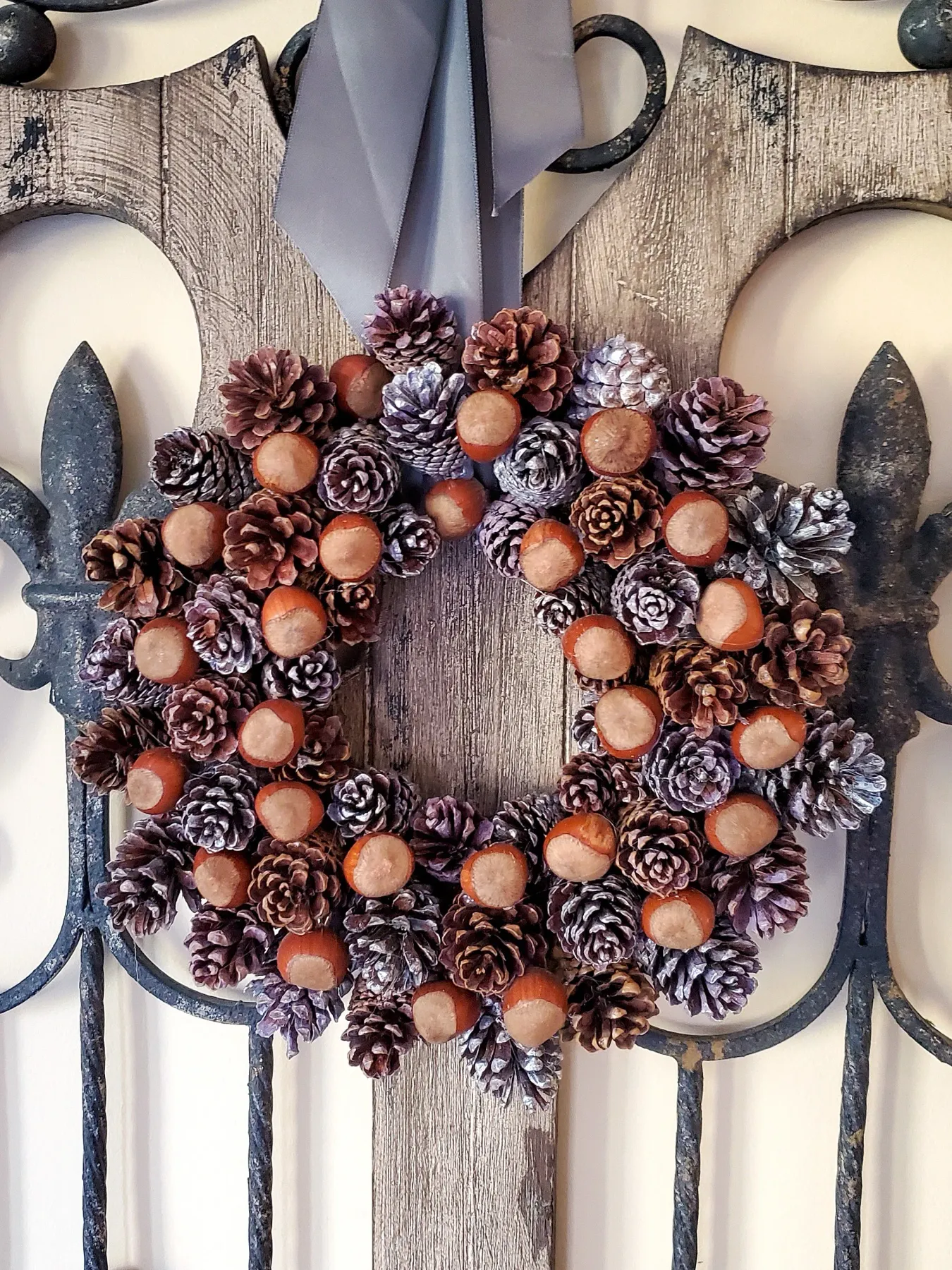
You do not need a $120 handmade wreath to get this. Dollar Tree sells 12 in. wire forms for $1.25, and pinecones are free if there is a park nearby — bake them at 200°F for 30 minutes first to dry them out and evict anything living inside. Hazelnuts run about $6 a pound from a grocery bulk bin, and a wide grey satin ribbon is roughly $6 at Michaels. Under $20 for the whole project, and it photographs like it cost five times that.
5. The Densely Packed Pinecone Wreath With Zero Filler
Density is math, not luck. A 14 in. ring swallows roughly 55 to 70 pinecones at this coverage, so sort your haul into small (2 in.), medium (3 in.) and large (4 in. and up) piles before you glue anything. Place the biggest cones at 10 and 2 o’clock — the two spots the eye hits first — then fill the rest at random. Glue in a spiral from the outer edge inward so nothing gets trapped underneath and the silhouette stays round.
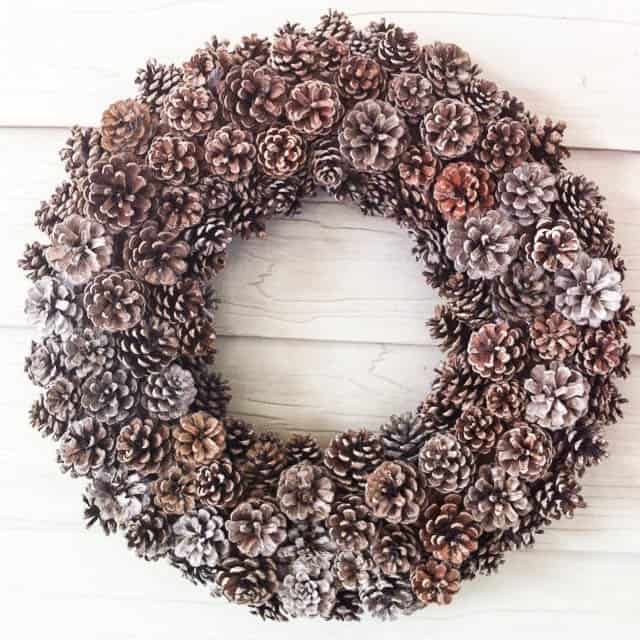
This look needs room to breathe. It works best on doors 32 to 36 in. wide and on walls with at least 5 ft of open space in every direction, since the wreath reads as one solid dark shape. Entryways under 40 sq ft will feel crowded, so drop to a 12 in. version and keep the same packed density. Hang the center at 60 to 66 in. from the floor for the most flattering proportion.
6. A Pinecone Wreath That Turns a Navy Wall Into a Backdrop
Dark on dark is a mood, and it works because the navy wall compresses the wreath into one soft silhouette while the texture does all the talking. Natural brown also warms up a cool blue surface, which is why this pairing reads cozy instead of cold. Hanging matters just as much: a plain woven twine loop disappears entirely against the wall, so the wreath looks like it is floating rather than pinned up.

- Pinecones, foraged or two bags: $0–$14
- 18 in. wire wreath form: $4–$9
- 22-gauge floral wire and hot glue: $8–$14
- Woven twine for the hanging loop: $3–$6
- Navy paint, 1 gallon: $35–$70
Total: $50–$113, and most of that is the paint.
Budget alternative: skip the wall paint entirely and hang this against a dark surface you already own — a navy bookcase, a charcoal interior door, even a black iron headboard. On its own the wreath runs about $15.
7. Reindeer Ribbon and Birch Bark on a Grapevine Base
Nostalgia is the engine behind 2026 holiday decor. Pinterest searches for grandmother-era Christmas motifs — reindeer prints, birch bark, old-fashioned berry clusters — have been climbing steadily, and this wreath is a textbook example. A grapevine base layered with mixed cedar and evergreen gives it the foraged, undone look that reads handmade rather than store-bought, while the printed ribbon keeps it firmly in cozy-cabin territory. This one has staying power because it is less trend than memory.
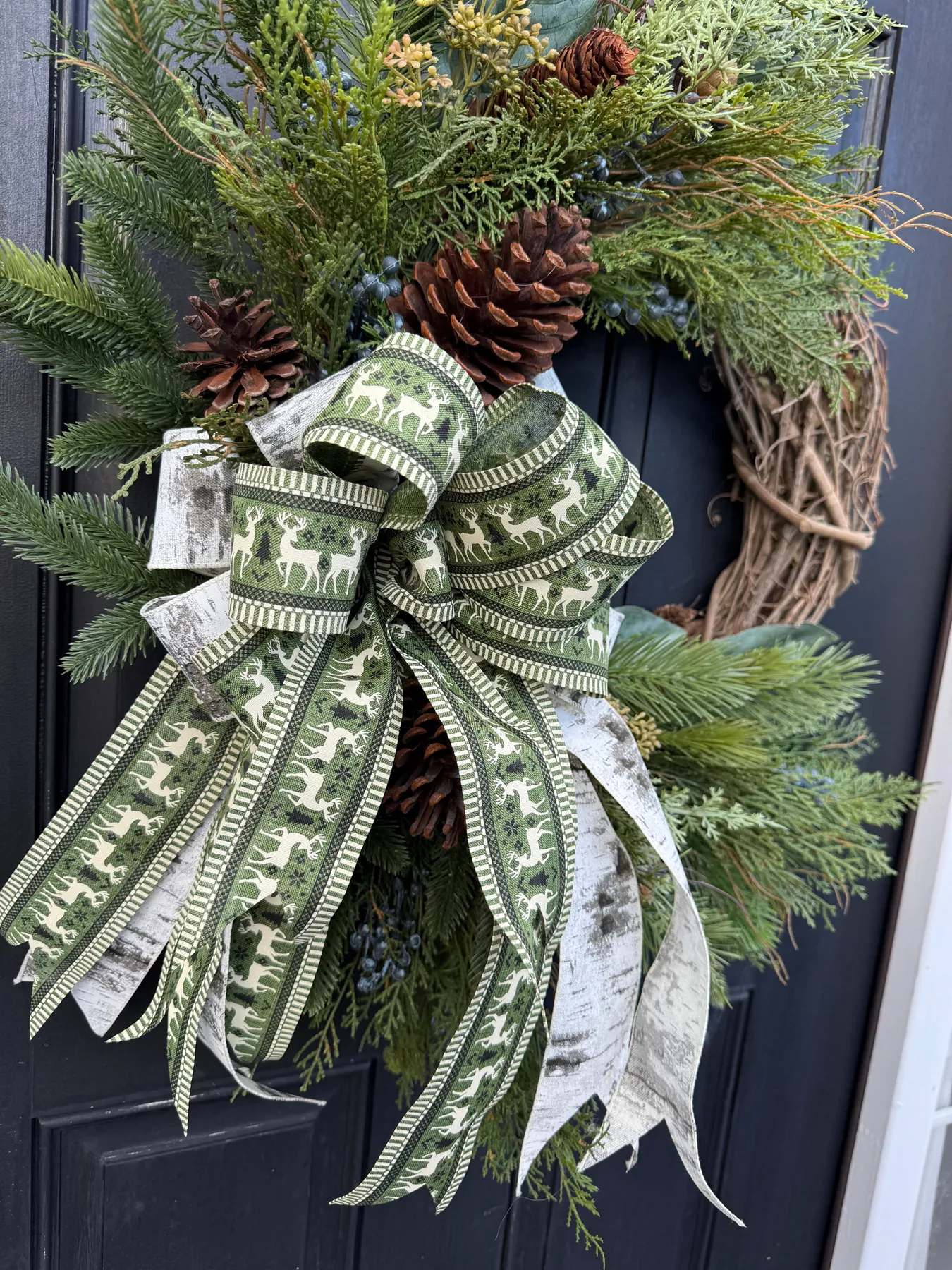
Layering two ribbons is what makes a bow look expensive. Use a 2.5 in. printed ribbon as the base and a 1.5 in. birch bark print on top, pinch them together, and make 8 to 10 loops instead of the usual 4. Fluff each loop by pulling it sideways, not outward. Wire the finished bow to the grapevine base rather than the greens so it never sags, and tuck the tails so they land at 4 and 8 o’clock.
8. Blue and Silver Ornaments on Evergreen, No Red Anywhere
The mix runs 55 percent evergreen, 30 percent glossy blue and silver glass, 10 percent white flocking and painted branches, 5 percent ribbon. Keeping the ornaments glossy is essential — matte balls vanish against needles. Swap royal blue for deep teal and the same formula turns moody; swap it for pale sky blue and it turns frosty and light. The flocked pinecones and pale branches are the thread that holds the cool palette together instead of letting it go icy.
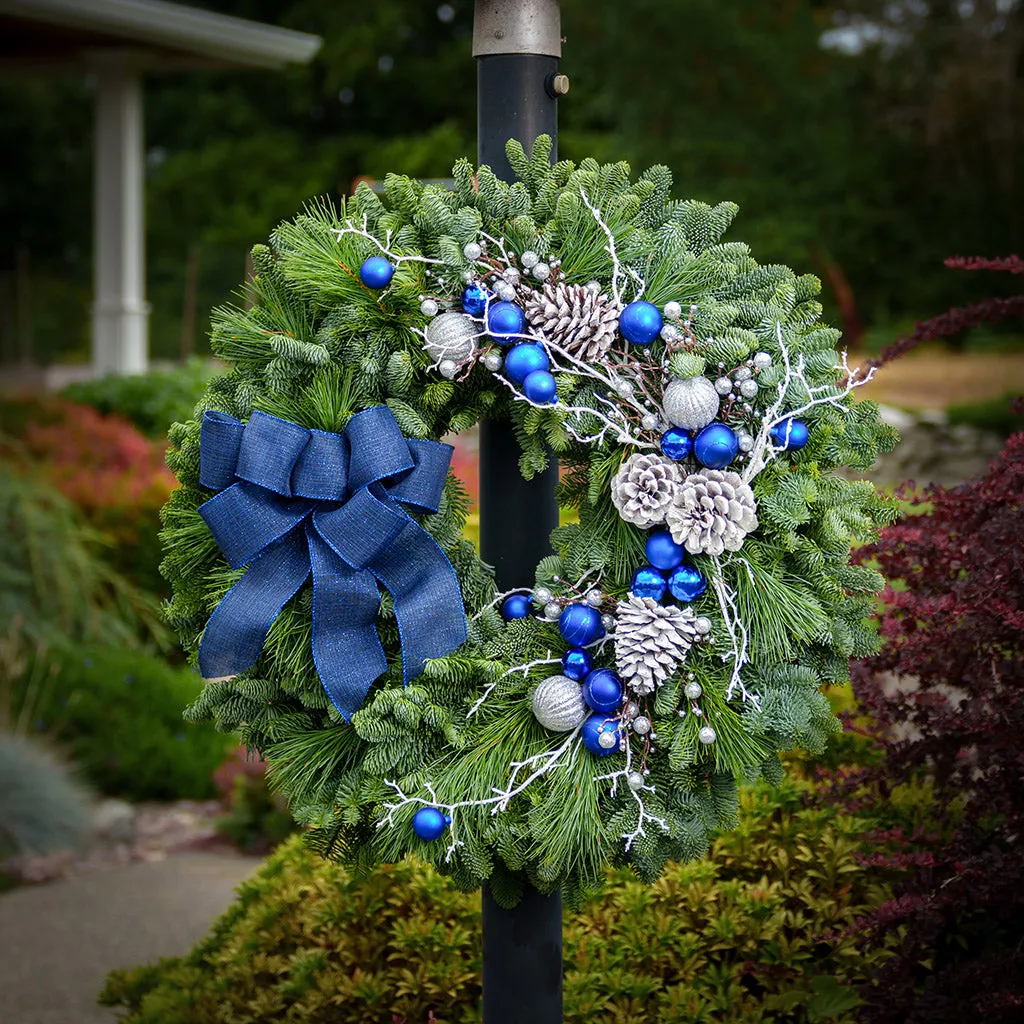
Ornament wreaths are one of the cheapest looks to fake well. Dollar Tree sells 12-count ball sets for $1.25, so 60 ornaments costs about $7. Vintage silver glass turns up at thrift stores for around $4 a bag. A plain 24 in. faux evergreen wreath is about $25 at Target and the fabric bow is another $6, so under $45 total for something that photographs like the $150 version. Compare with Idea #9 — same snowy mood, warmer palette.
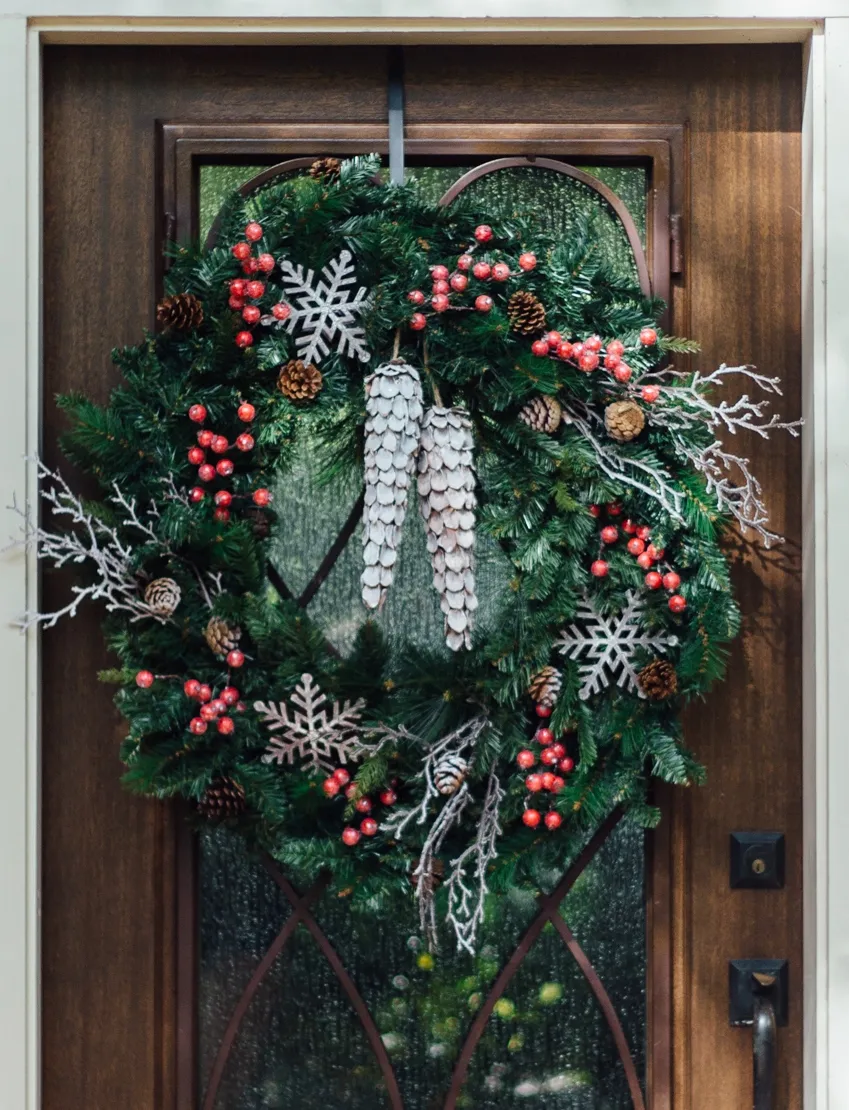
9. Red Berries, Snowflakes, and Frosted Pinecone Clusters
Anything frosted will shed. Expect a fine white dusting on your door and threshold for the first two weeks, and know that flocking yellows over several seasons even indoors. Artificial greenery collects dust fast — rinse it in cool water each fall and blow-dry it on the cool setting to fluff the needles back up. Red berry clusters fade toward orange in direct sun, so rotate the wreath a quarter turn halfway through December to even out the exposure.
Wire your ornaments before they go anywhere near the wreath.
- Cut 6 in. lengths of 24-gauge wire and loop one through each ornament cap.
- Twist the wire ends into a stiff 2 in. stem.
- Push the stem into the greenery and bend it back on itself to lock it in.
- Place the silver snowflakes at 10, 2 and 6 o’clock, then fill between them with berries.
- Angle every snowflake slightly upward so it catches the light.
Roughly 30 minutes and $18 to $30 in supplies.
10. The Brown-Wrapped Base That Saves DIY Pinecone Wreaths
The brown ribbon-wrapped base. It sounds like a throwaway step, but wrapping the form in brown burlap or fabric before a single pinecone goes on is what separates a polished wreath from a craft-fair one. Gaps between cones stop reading as mistakes and start reading as intentional shadow. It also gives hot glue something textured to grab, which means fewer cones popping off in January when indoor temperatures swing.
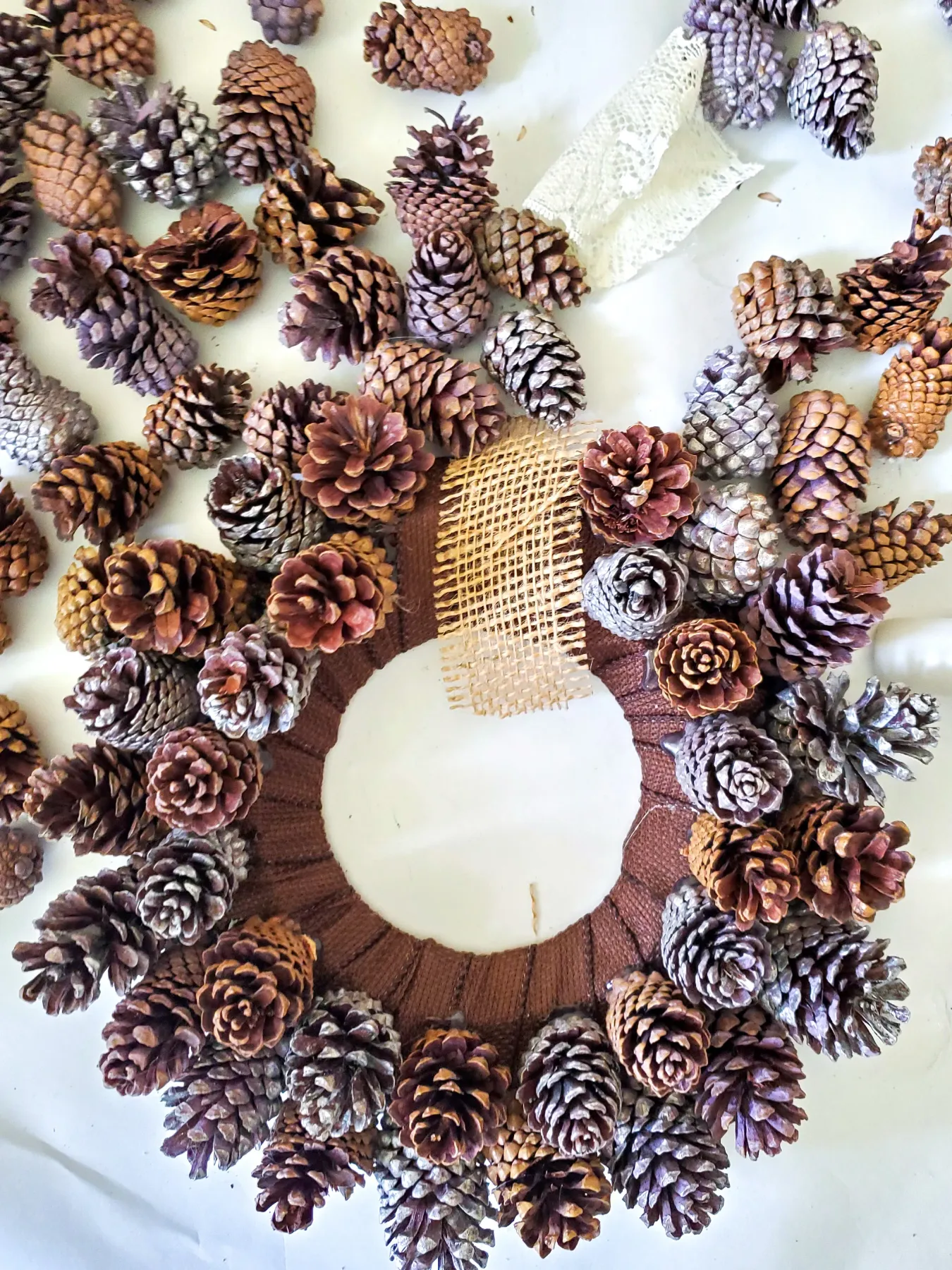
Here the ratio is 70 percent pinecone, 15 percent frosted accent, 10 percent burlap and 5 percent exposed base. That top sliver of visible base is deliberate — it makes the wreath feel hand-built instead of manufactured. For a fully natural version, drop the frosted cones and push burlap to 20 percent. For a winter-white look, flip it: 40 percent frosted, 40 percent natural, and let the base disappear completely.
11. Burlap and Script Ribbon With Just Three Gold Baubles
- 24 in. mixed evergreen wreath, ready-made: $45–$90
- DIY: two bunches mixed greenery: $18–$32
- Burlap ribbon, 10 yds: $6–$10
- Printed canvas or script ribbon, 3 yds: $8–$14
- Three gold ball ornaments plus a small bell: $8–$14

Total: $85–$160 ready-made, or $40–$70 if you build it.
Budget alternative: buy a plain wreath in early November when craft stores run 50 percent off, then add the double bow yourself with ribbon from the clearance bin at $3 a spool. Same layered effect, half the price.
Three ornaments is the rule for a reason. Odd numbers read as deliberate; even numbers read as an accident you stopped fixing. Cluster them in a triangle — one at 4 o’clock, two at 8 o’clock, close enough to touch — and leave the top third of the wreath completely bare so the bow owns that space. Attach each ornament with a short 3 in. wire loop so it sits inside the greenery instead of swinging in front of it.
12. A Minimalist Green Wreath With Nothing but White Berries
Small wreaths are usually hung too high and too sparsely. A 12 to 14 in. wreath like this one is happiest on interior doors 30 to 32 in. wide, powder room doors, or a slim wall panel, with the center at 60 to 66 in. from the floor. On a standard 36 in. front door it can look undersized, and on a textured neutral wall the slender twig base needs a hook that sits flush so the silhouette stays clean. If your door is wider, a fuller build holds the space far better.
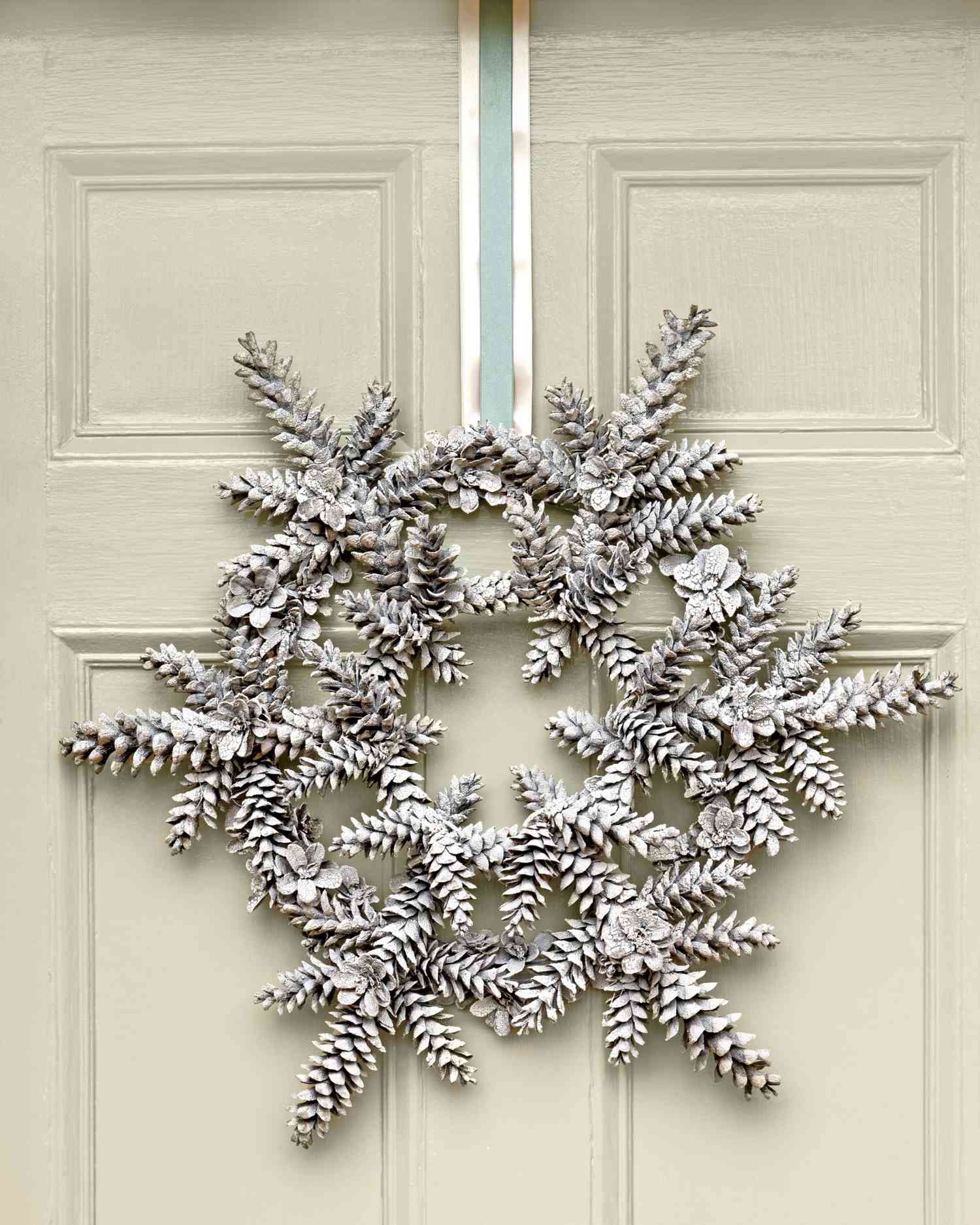
Fresh greenery is cheaper than people assume. A $5 bunch of seeded eucalyptus from Trader Joe’s plus a $4 bundle of leatherleaf from the grocery florist covers a 14 in. form, and white berry sprays run about $4 at Dollar Tree. Wire everything onto a $5 twig base and you are in for under $20. The catch is shelf life — about two weeks indoors before the leaves start dropping. Compare with Idea #14 for the same restraint with a longer-lasting mix.
13. Dried Orange Slices and Eucalyptus Down a Glass Door
Drying citrus is the slow part, and it is worth doing properly.
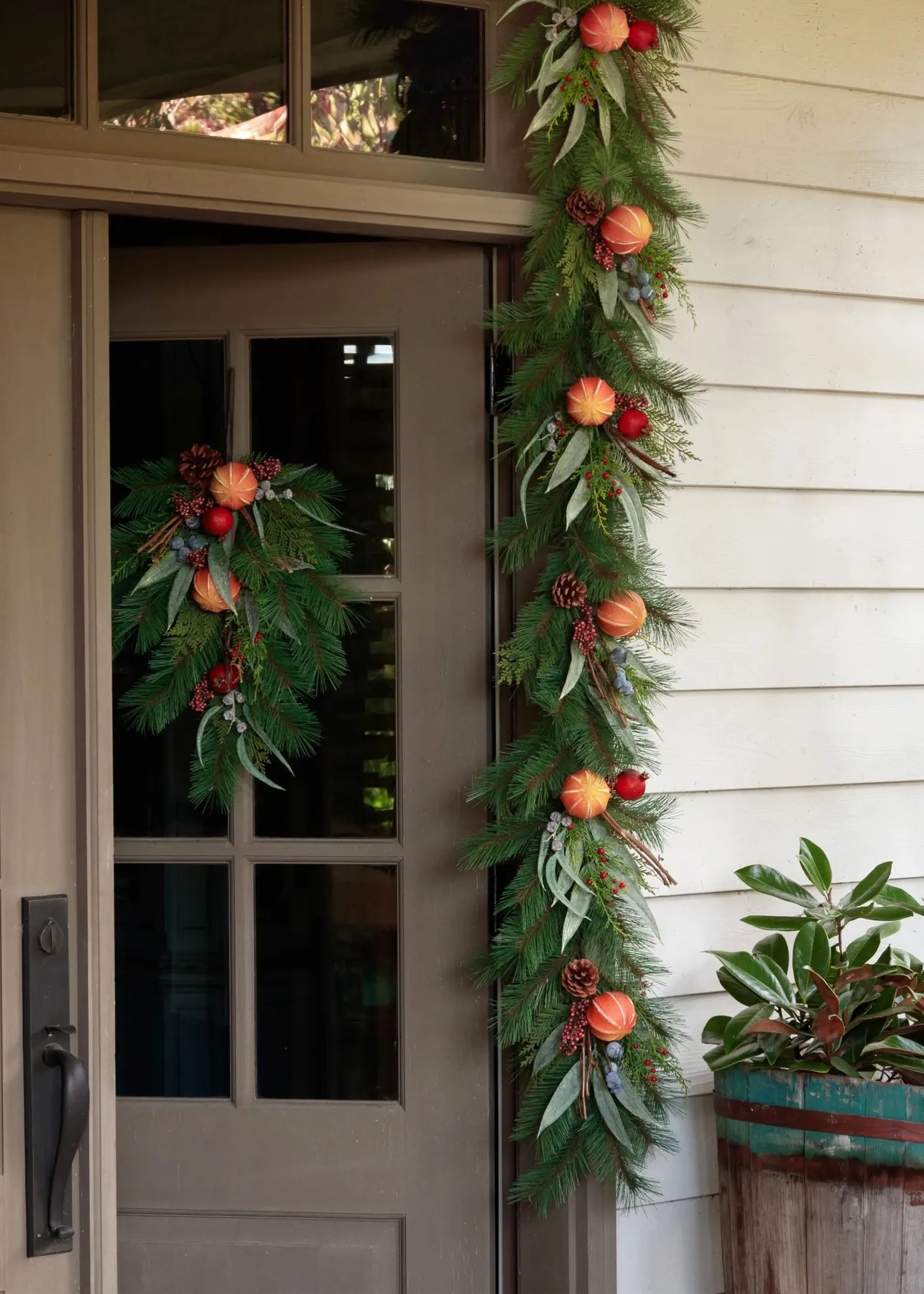
- Slice oranges a quarter inch thick and blot both sides with a paper towel.
- Lay them on a wire rack over a sheet pan, not touching.
- Bake at 200°F for 2.5 to 3 hours, flipping once at the halfway mark.
- Cool completely — they should feel like stiff leather, not brittle chips.
- Poke a small hole near the rind edge and thread 24-gauge wire through.
Three and a half hours, mostly hands-off, and about $12 in fruit.
Dried citrus went from farmhouse cliché to genuine staple because it solves a real problem: it looks beautiful, costs almost nothing and composts when you are done. In 2026 the broader shift is toward decor you can make from the grocery store, and this garland-and-swag pairing is the poster child. The eucalyptus and red berries keep it from reading too kitchen-craft, and the grey glass door gives all that warm orange a cool backdrop.
14. Pine and Eucalyptus for a Quietly Modern Front Door
A few checks before you buy a single stem.
- Measure the hanging surface — a 14 in. wreath needs at least 16 in. of clear width so it never touches the frame.
- Check your wall texture. Limewash and rough plaster defeat adhesive hooks, so plan on a nail or an over-door hanger.
- Decide fresh or faux. Fresh pine and eucalyptus lasts about two weeks indoors; dried eucalyptus lasts years.
- Budget at least $25 in materials if you are building from scratch.
Asymmetry is doing the heavy lifting. The eucalyptus drapes to one side and the pine needles stack on the other, so the wreath never reads as a perfect circle — it reads as something growing. Muted sage against a crisp white wall creates soft contrast that photographs beautifully, and the slightly unruly silhouette is exactly what makes minimalist holiday decor feel human rather than showroom-staged.
15. Red Berries and Variegated Holly Against a Black Door
The balance is 50 percent deep green foliage, 25 percent variegated holly with its pale edges, 20 percent red berry clusters and 5 percent black from the door itself. That variegated leaf is the quiet hero — without it, red and green go flat and Christmas-card predictable. Trade the black door for a cream one and the same formula turns soft and cottagey; trade the variegated holly for plain and it turns formal. Keep berries in clusters of five or more so they read as weight, not confetti.
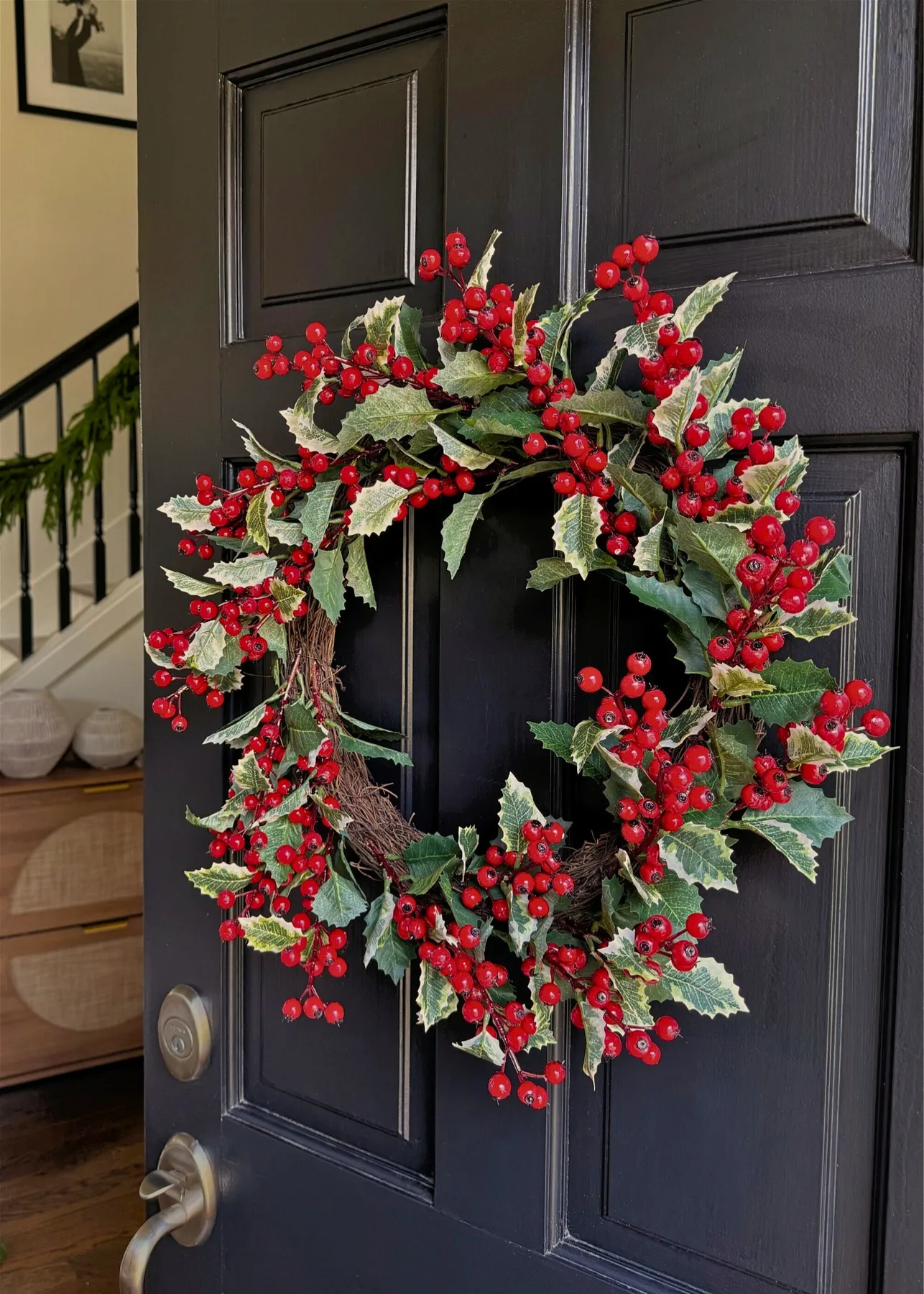
Holly berries are toxic to cats and dogs, and they drop. If you have a curious pet or a polished floor, go faux on the berries and save the worry. Fresh variegated holly also curls within days in a heated entryway — it wants cool air and indirect light, which most doors do not offer. Faux holly solves both problems but can look plastic in direct sun, so keep it shaded or shop for a matte finish.
16. An Off-Center Red Bow and Bells on a Plank Wall
The bow lives at four o’clock, not at noon. That single decision is what makes this wreath feel styled rather than assembled — dropping the bow to the lower right turns the composition into a diagonal, and the pinecones and dark metal bells beneath it pull the eye around the circle instead of stopping it dead at the top. The textured red fabric and the deep wood plank background do the rest. Move that bow back to center and you lose the entire mood.

Against a dark plank wall, size matters more than usual because the greens are competing with a busy background. Aim for a 24 to 26 in. wreath on a wall at least 6 ft wide, and hang the center at 60 in. from the floor — high enough to clear furniture, low enough to actually see the pinecones. On a narrower 4 ft wall, drop to 18 in. or the wreath will crowd the edges and lose its shape.
17. A Tartan Bow and Two Silver Bells on Dense Leaves
Ribbon width should scale with the wreath, and most people guess wrong. For a 22 in. wreath, a 3.5 to 4 in. plaid ribbon is the sweet spot; anything thinner looks like a shoelace next to dense foliage. Buy an 8 yd spool rather than 3 yd, because a proper bow eats 2 yd on its own. Cut the tails on a sharp diagonal and let them land at 4 and 8 o’clock so they frame the wreath instead of covering it.

Tartan plaid is one of the few patterns where the cheap version looks almost identical to the expensive one. Walmart and Hobby Lobby both carry 3.5 in. plaid ribbon around $6 for 10 yd, versus $18 to $24 for designer rolls. The wreath base is friendly too — Target sells dense green leaf wreaths for about $25, and the two silver bells are a $5 add-on. Under $40 for the full look, which leaves room in the budget for a good door hook.
18. Dusty Miller and Wispy Greenery on a Sunlit Door
Dusty miller is gorgeous for about ten days and then it sulks. The silvery leaves want cool air and moisture, and a heated entryway dries them into grey curls by mid-month. Mist the wreath every other morning and keep it out of direct sun; if you want the look to survive past December, buy silk dusty miller instead and it will last a decade. Sun-fading is the other risk — that pale sage shifts toward yellow after one bright season on a south-facing door.
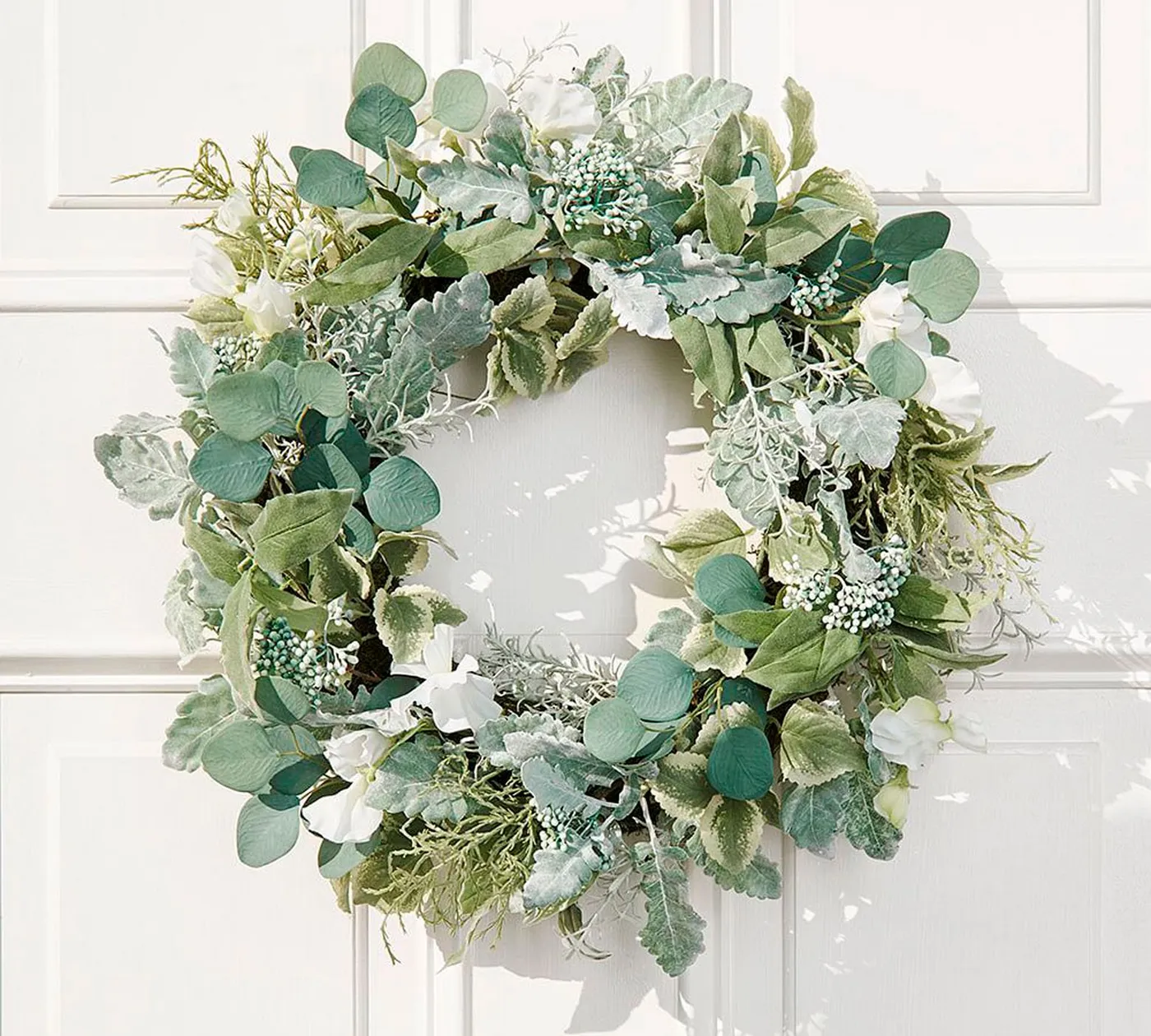
Building a fresh wreath is faster than most people expect.
- Soak a sphagnum moss ring in water for 15 minutes, then squeeze it out.
- Wire the moss ring onto a 14 in. wire frame with 22-gauge wire.
- Bundle 3 to 4 stems and wire each bundle to the frame, all facing the same direction.
- Overlap each new bundle over the previous one to hide the stems.
- Finish by tucking dusty miller and small white blooms into the outer edge.
About an hour and $30 to $45 in materials.
19. Faux Hydrangea and Peonies Wired Into a Full Wreath
Faux flowers need to be cut down before they go on the wreath. Clip each stem to 2 in., bend it at a 45 degree angle, and glue it so the bloom sits above the leaves rather than buried in them. Build in three passes: leaves first, then filler clusters, then the hero blooms. A rough 3 to 1 ratio of foliage to flowers is what keeps a floral wreath from tipping into Valentine territory.

The mix runs 45 percent muted green hydrangea, 30 percent deep red peony, 20 percent white filler blooms and 5 percent plaid ribbon. Placing green as the largest share is what stops this from turning saccharine — the flowers are the accent, not the base. Swap the peonies for burgundy ranunculus and it reads vintage; swap the white filler for cream roses and it turns bridal. Compare with Idea #15 — same red and green, much softer shapes.
20. A Cone-Shaped Evergreen Swag for a Window With Blinds
It is the taper. This is not really a wreath at all — it is a hanging topiary, wide at the top and narrow at the bottom, and that inverted cone is what makes the whole thing read as a deliberate design object rather than a decoration. Without it you would just have a swag. The gold bead garland follows the same line, drawing the eye downward, while the multi-looped bronze satin bow gives the wide top some weight.
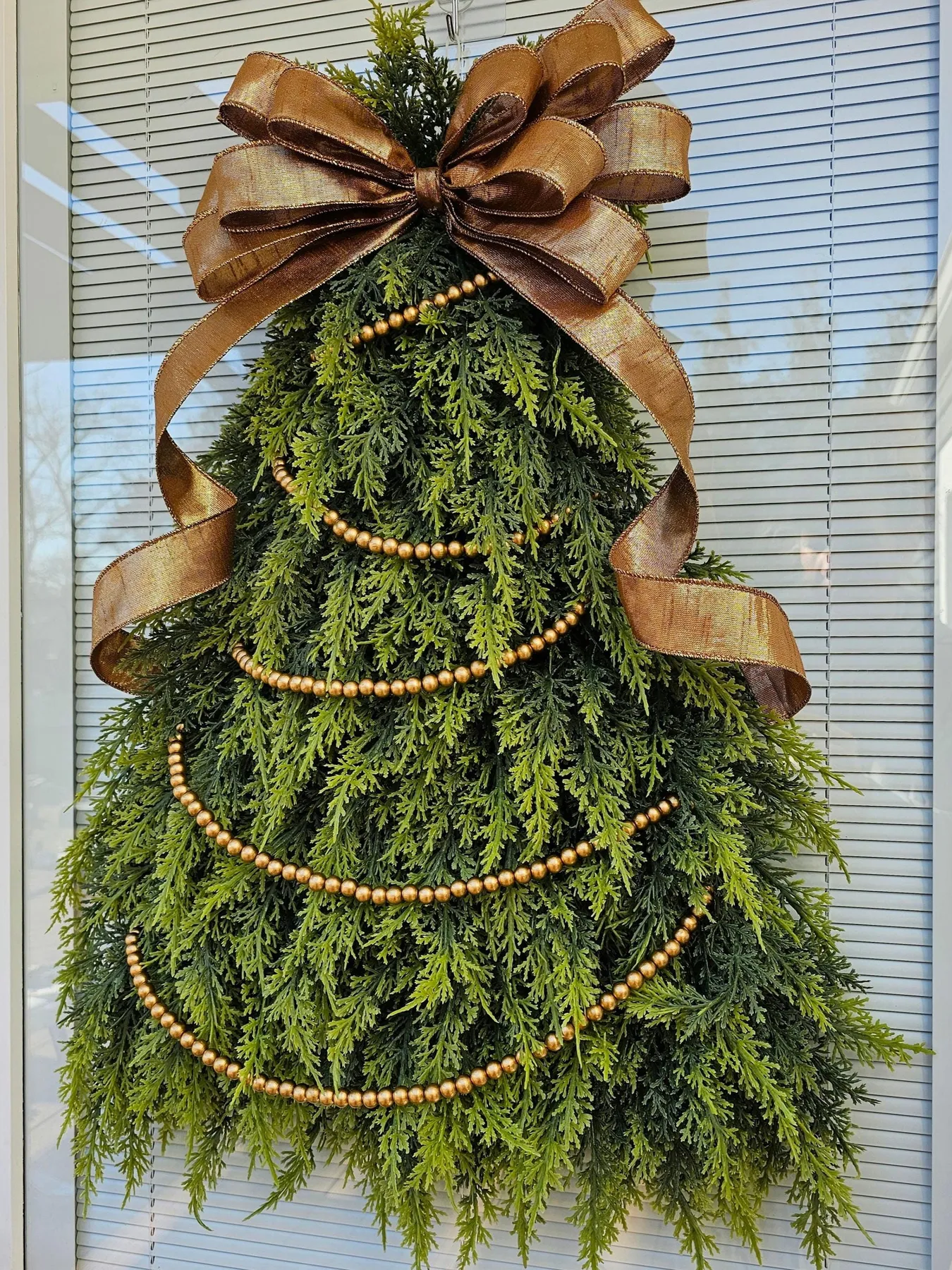
Proportion is everything with a cone swag. For a 36 in. window, use a 30 in. cone; for a standard 30 in. kitchen window, drop to 22 in. Leave at least 2 in. of clearance above the blind headrail so the cords still run freely, and hang the top of the cone level with the top of the window trim. Windows wider than 48 in. can take a pair of these flanking the center rather than one lonely swag.
21. A Tiny Wire-Bound Pinecone Wreath With a Bright Red Bow
- 8 in. wire wreath form: $3–$5
- 25 to 30 small pinecones, foraged or bagged: $0–$10
- 22-gauge floral wire: $4–$6
- 1.5 in. red fabric ribbon, 3 yds: $5–$9
- Hot glue sticks: $4–$6
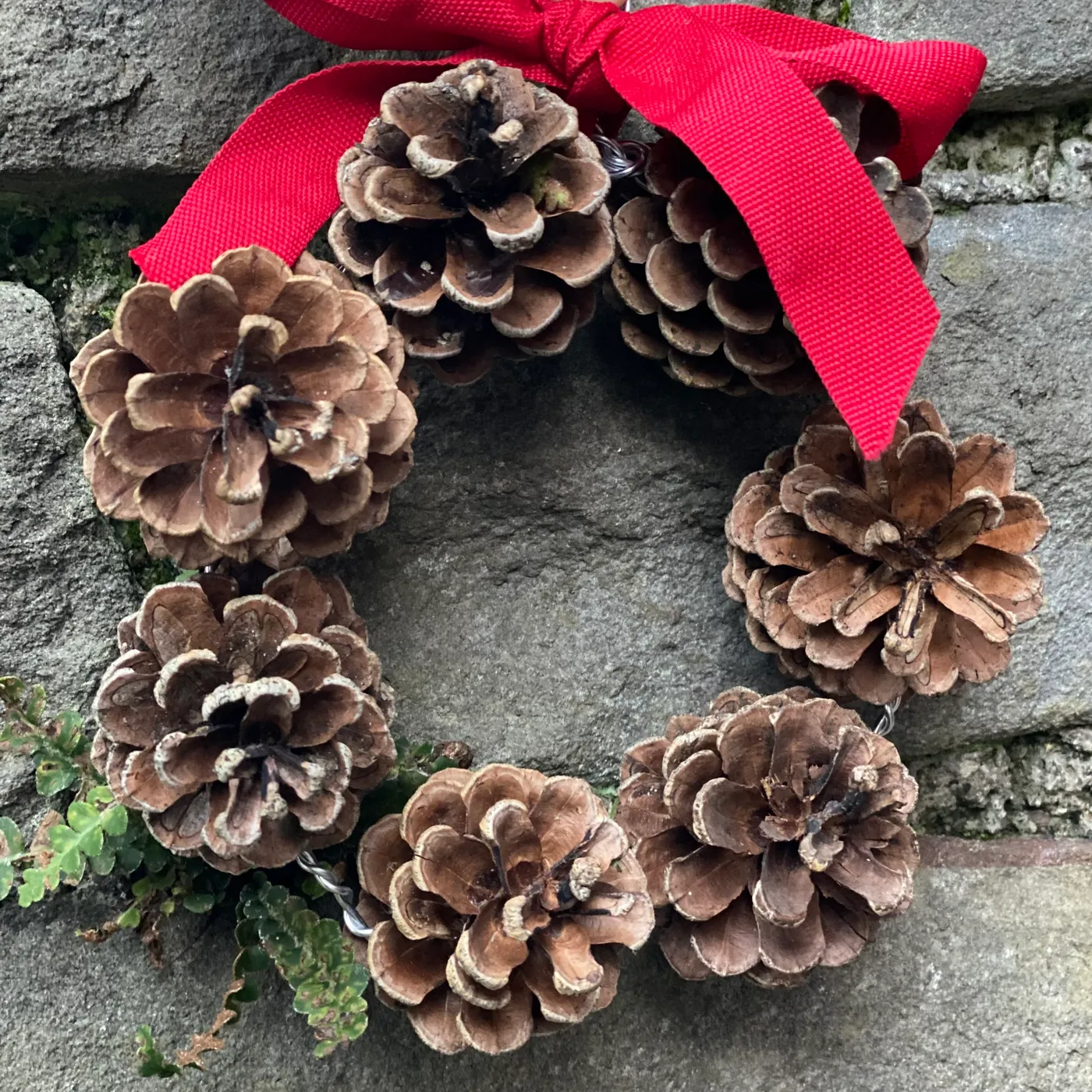
Total: $16–$36.
Budget alternative: skip the craft store and raid the yard. Small pinecones from a park, wire from a hardware store bargain bin, and ribbon cut from an old gift bow bring this in under $10.
Tiny wreaths are tricky because they can look lost. An 8 in. wreath on a 36 in. front door reads like a coaster, so save this scale for cabinet doors, mirrors, stone walls or a gallery arrangement of three. Mounting on stone or brick needs a masonry-safe hook — adhesive strips will not hold. Check that no wire ends poke through the ribbon once it is hung, and trim them flush before it goes up.
22. Pine and Cedar With a Jute Twine Loop, Nothing More
Four quick checks before you start wiring.
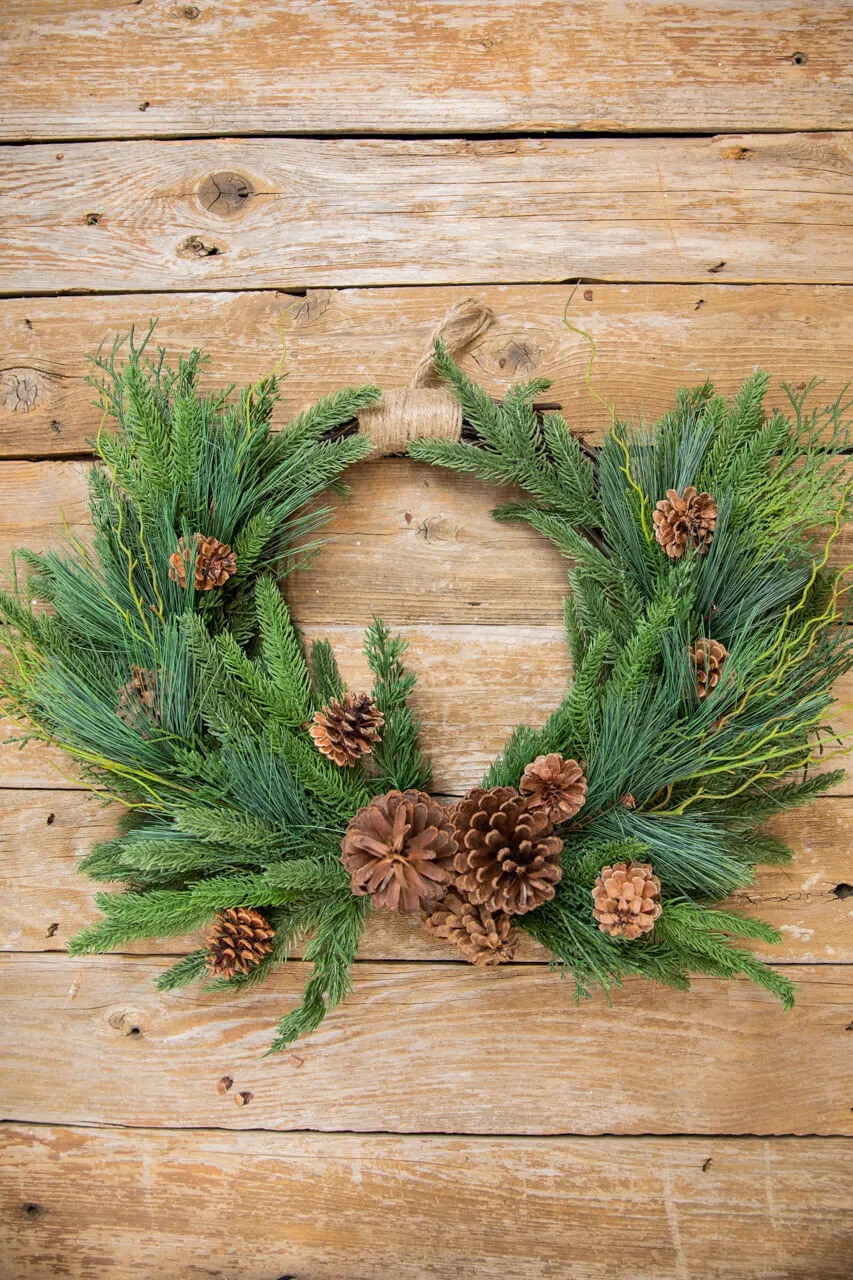
- Confirm your hanging surface can take the weight — a 20 in. mixed-green wreath runs 3 to 5 lbs.
- Decide on a hanger or a loop; twine reads best against rough wood, ribbon against painted doors.
- Count your pinecones. You need roughly 20 to 25 for a 20 in. wreath at this coverage, mixed sizes.
- Set a materials budget of at least $20, or $0 if you are foraging.
Restraint is the whole point. Pine, cedar, pinecones and a piece of twine — four materials, no ribbon, no glitter, no ornament clutter. The weathered plank background does half the work, giving the greens a rough grey-brown counterweight that makes them look brighter than they are. Cedar in particular holds its color longer than fir, so this wreath stays deep green for most of December.
23. Burlap, Gold Baubles, and Ferns Against Teal Wood
Burlap costs pennies and reads expensive, which is exactly why it keeps showing up. A 10 yd roll at Hobby Lobby runs about $5, compared with $14 to $20 for printed designer ribbon — and one roll covers a wreath plus a stair garland. Bundles of mixed greenery and ferns from the grocery florist are $6 to $8 for a large armful, and a pack of small gold ball ornaments is $4 at Walmart. The whole project lands under $30 and looks like a farm-stand find.

Teal and deep blue holiday palettes keep climbing, mostly because people are tired of the same red-and-green door on every house on the block. Anchoring mixed green foliage against a teal plank wall makes the arrangement read as a color study rather than a decoration, and the warm burlap and gold keep the cool tones from going icy. If you want to test the palette before committing, hang a small version over a console first.
24. The Maximalist Frosted Wreath With Mittens and a Reindeer
When everything on a wreath is small, scale up one thing. A 5 to 6 in. gold glitter reindeer in the center gives the eye an anchor, and the forty tiny ornaments around it become texture instead of noise. Follow a rough 1 to 3 to 12 rule: one hero piece, three supporting elements like the velvet bow and the miniature mittens, and everything else as filler. Without that hierarchy, a heavily decorated wreath just reads as clutter.

- 24 in. frosted pine wreath base: $40–$70
- 40 to 50 assorted ornaments in pink, red and gold: $25–$60
- Mini fabric mittens, set of 4: $8–$14
- Gold reindeer figurine: $10–$18
- Deep red velvet ribbon, 2 yds: $12–$20
Total: $95–$182.
Budget alternative: buy ornaments after Christmas and save them for next year, or hit a thrift store for glass balls at $3 a bag. Thrifted ornaments and a dollar store base can bring this in near $45.
25. The Red-Flag Checklist Before You Hang Anything
Nearly every wreath failure comes down to three things: weight, hook and light. A 6 lb wreath on a 1 lb adhesive strip will come down overnight, usually onto something breakable. A wreath on a glass door needs a suction hook rated for twice the actual weight, and sunlight through that glass will bleach ribbon in about three weeks. We walk through the rest of them in the mistakes section below.
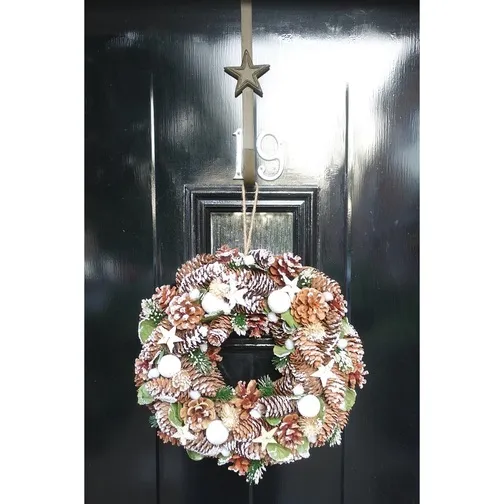
Run this list before the wreath leaves the table.
- Weigh the finished wreath on a kitchen scale and check your hook rating against it.
- Confirm the ribbon or fabric is UV rated if it will face a window.
- Check that no greenery blocks a knocker, mail slot or door gap.
- Verify pets cannot reach hanging berries, bells or wire ends.
26. A Triangular Pinecone Wreath Framed by Lit Garland
The triangle takes longer than a circle, so build it flat on a table.
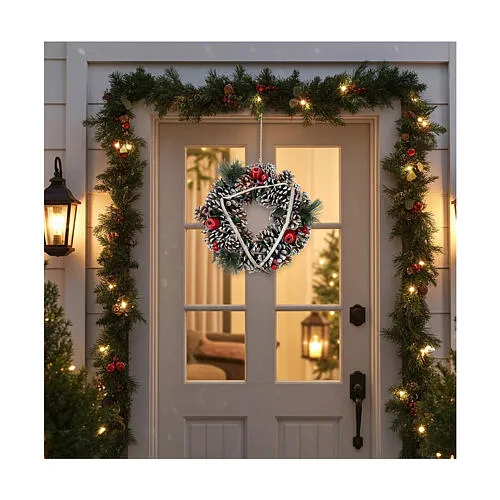
- Bend a 24 in. length of heavy-gauge wire into a triangle with 20 in. sides and twist the corners closed.
- Wrap the frame in brown floral tape so no metal shows through.
- Wire pinecone clusters along each side, packing the bottom corner most heavily.
- Tuck red berry sprigs at all three corners and small greens along the edges.
- Hang from the top corner and fine-tune the side clusters once it is up.
About two hours and $25 to $40 in supplies.
A triangle inside a rectangle is a geometry lesson that happens to look festive. The straight door frame and the angled wreath create tension the eye enjoys, and the lit garland around the perimeter softens the hard edges so it feels welcoming rather than severe. The black wall lantern ties into the frame and grounds the whole doorway instead of letting the decorations float.
27. Five Wreaths, One Red Plank Wall
The recipe is 65 percent fresh greenery, 20 percent ribbon, 10 percent pinecone and 5 percent plaid. When you hang several wreaths together, color consistency matters more than any single ornament — keep every bow in the same red family so the wall reads as one installation rather than a collection. Swap red velvet for buffalo plaid across the whole group and the wall turns farmhouse; swap to cream ribbon and it goes quiet and Scandinavian.
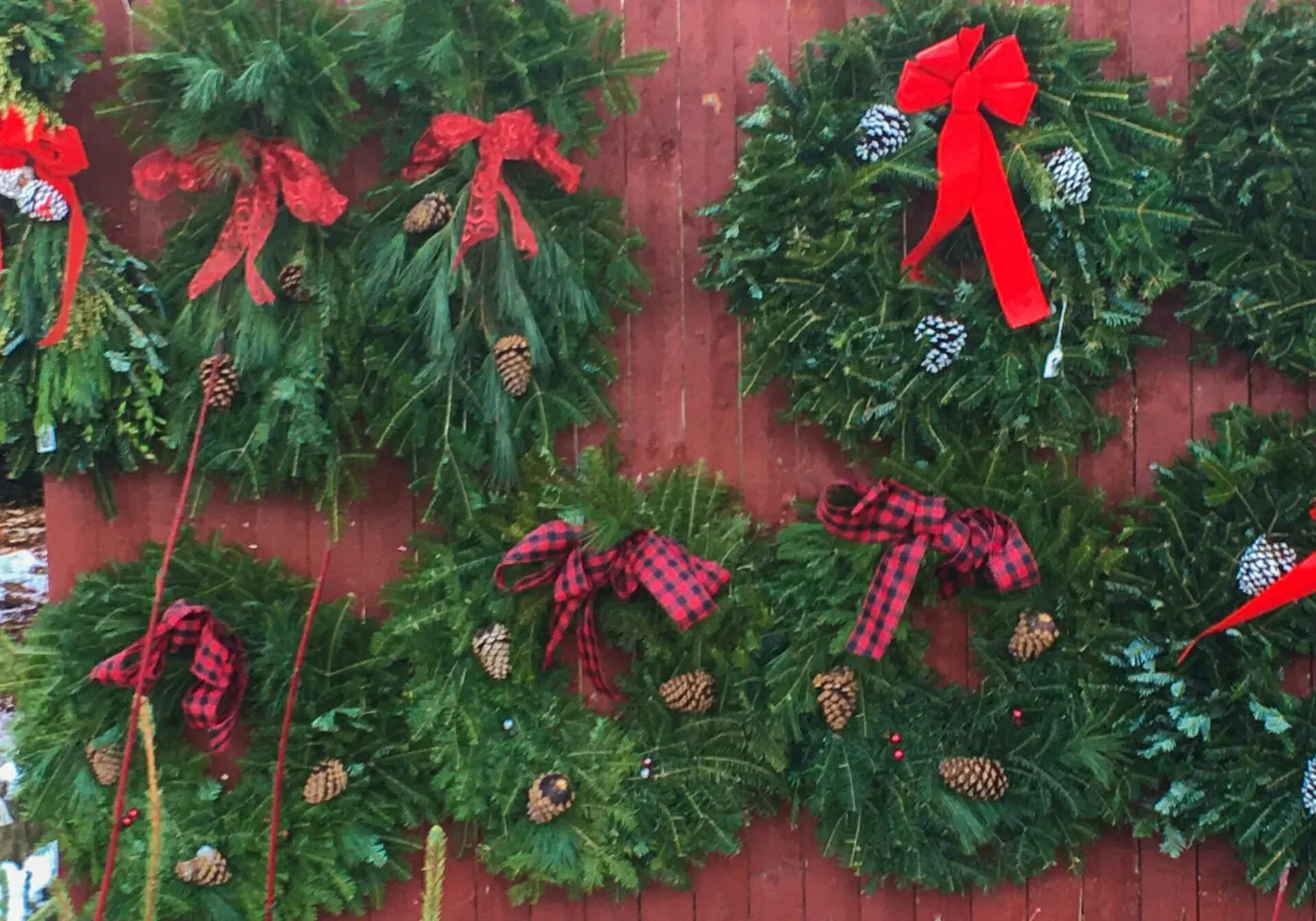
On an 8 ft wall, three 18 in. wreaths spaced 12 in. apart at a 66 in. center height fill the space without crowding. Groups of five work better on walls 10 ft or wider, or stagger them at alternating heights for a looser feel. Keep at least 8 in. between the outer wreaths and the wall edges, and remember that fresh greens are heavier than they look — one hook per wreath, rated for at least 5 lbs.
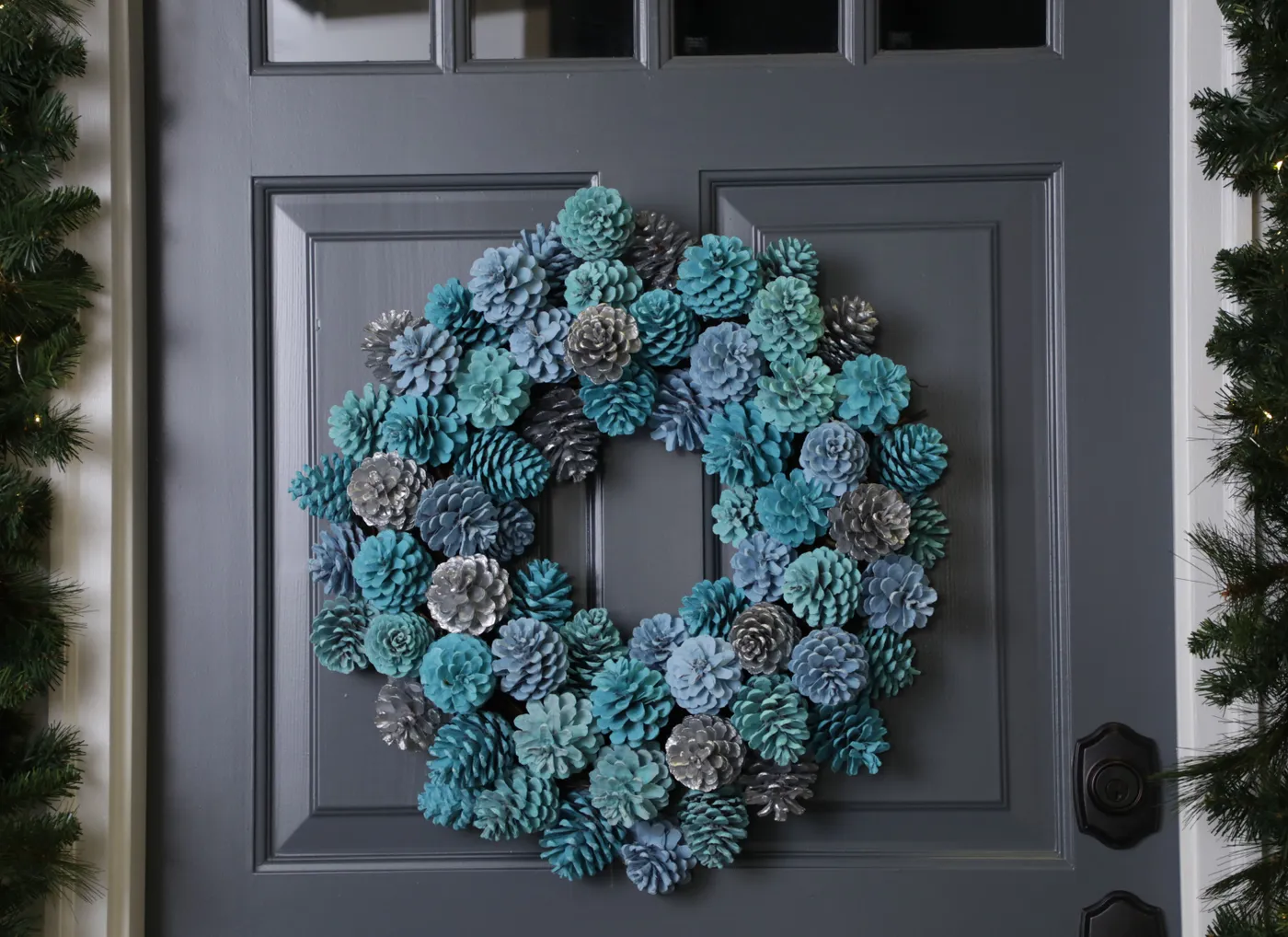
28. Painted Pinecones in Blue and White on a Wood Slice
Painting pinecones takes patience, not skill, and the prep is non-negotiable.

- Bake the pinecones at 200°F for 30 minutes to dry them and open the scales.
- Let them cool completely — warm cones make spray paint bubble.
- Spray in thin coats from 10 in. away, rotating between coats.
- Let them cure 24 hours before handling, then wire each one to a twig base.
Roughly 45 minutes of actual work plus drying time, and $22 to $35 in materials.
A gradient only works if you place the lightest cones where the light hits them. Group the palest cones at the top and the deepest blue at the bottom, then transition through the mid-blues in between. Work in four piles on the table before anything gets glued, and check the arrangement from across the room — ombre reads from a distance, not up close. One silver-tipped cone in the middle adds a sparkle break the eye needs.
29. A Jute-Rope Wreath Styled Over a Console Table
Frosted greenery sheds white dust, and it will land on your console. Plan on a quick wipe-down every few days, and never place a wreath directly above an open flame — a 12 in. minimum clearance from the top of the candle to the bottom of the wreath is a real safety line, not a suggestion. Ribbed pillar candles drip onto wooden holders, so trim the wick to a quarter inch before lighting and they behave much better.
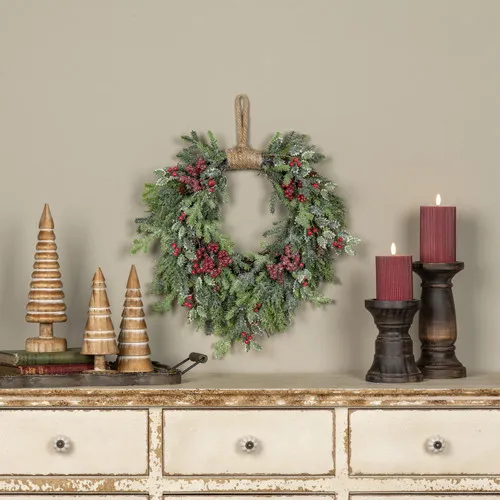
The jute rope is the thing. It would be easy to hang this wreath on a satin ribbon and call it done, but the thick natural rope tells you immediately what kind of room you are in — rustic, warm, unfussy. It also visually connects the wreath to the console below, which is what turns two separate objects into a styled vignette. The carved tree figurines on one side and the burgundy candles on the other finish the balance.
30. Chartreuse Velvet and Fairy Lights on Deep Evergreen
Chartreuse is the unlikely color story of the season. After years of the same red-and-green, designers started reaching for acid green and lime, and it stuck — it reads fresh next to dark evergreen and refuses to compete with wood tones or brass. Velvet ribbon with gold edging seals it. This is one of the few color trends with real staying power, because it works with a palette most people already own.
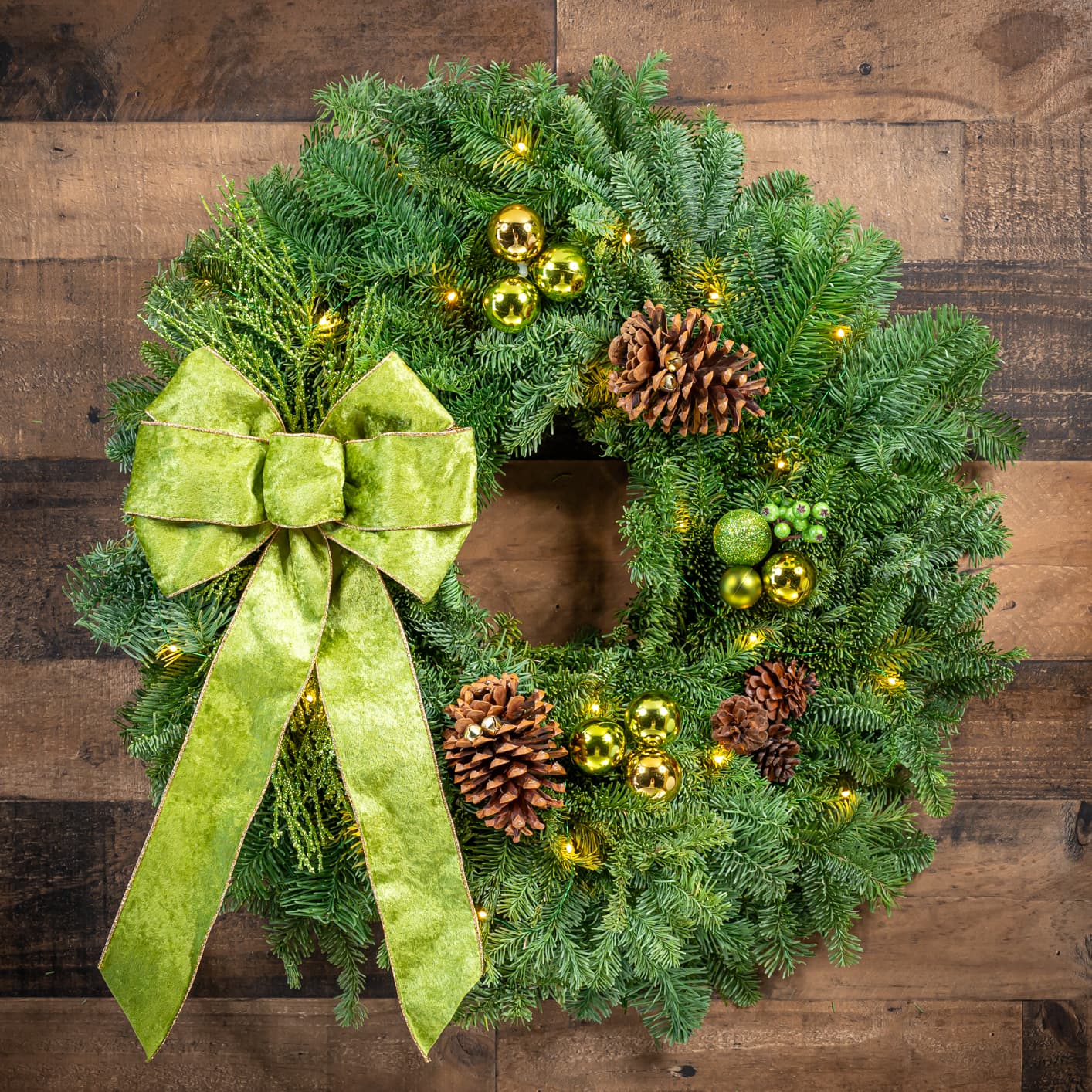
- 24 in. dense evergreen wreath: $40–$75
- Chartreuse velvet ribbon, 2 yds: $14–$28
- Six chartreuse baubles: $10–$16
- Battery fairy lights, 60 count: $8–$15
- Batteries: $6–$10
Total: $78–$144.
Budget alternative: buy a plain wreath in early November at half price and swap the velvet for a $6 chartreuse satin roll from Walmart. Spray-paint dollar store baubles for about $5 and you keep the whole look for under $60.
31. A Snoopy and Woodstock Wreath That Goes Full Nostalgia
Character wreaths are the easiest to source secondhand. Plush Snoopy and Woodstock figures turn up constantly at thrift stores and yard sales for $3 to $8 each, and eBay listings often sit under $15. Print the warm wishes sign at home on cardstock for free, then buy wired ribbon at Dollar Tree for $1.50. The whole thing costs less than $25, and the nostalgia factor is worth more than the materials ever will be.

Novelty wreaths can tip into chaos fast. Cap yourself at three colors — here red, green and white — and let the plush figures be the only distinct shapes on the wreath. Brick needs the right hardware: adhesive strips struggle on textured brick, so use a masonry hook or an over-door hanger instead. And if the wreath lives outdoors, expect plush fabric to fade and fray within a season or two.
32. An Ombre Pinecone Wreath in Blue, White, and Silver
An ombre is really just sorting, so do that part on the floor first.
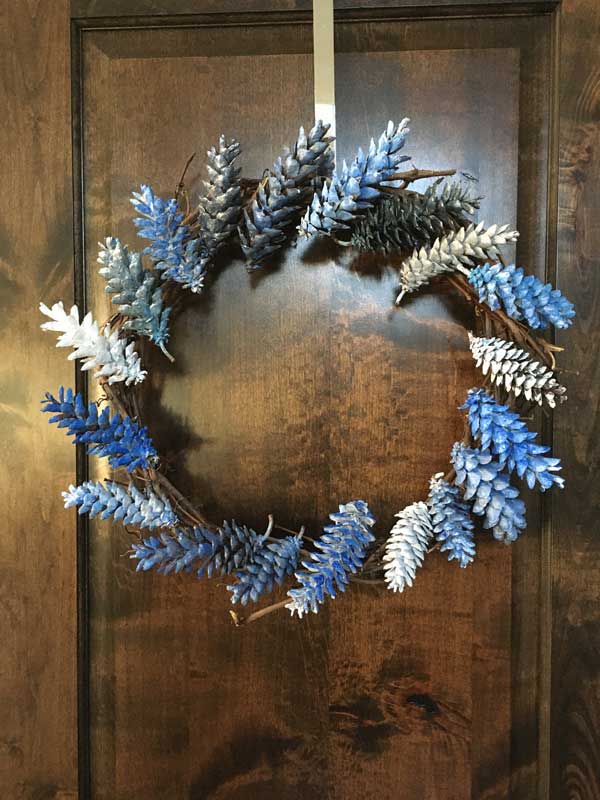
- Paint your pinecones in four batches: deep blue, medium blue, pale blue and white.
- Lay them out in a circle on the floor until the gradient looks smooth.
- Photograph the layout on your phone so you can rebuild it after gluing.
- Wire each cone to a twig base in order, working around the circle.
- Add silver-tipped cones across the top third for sparkle.
About two hours of work plus drying, and $22 to $35 in materials.
Painted pinecones chip, especially at the tips where the scales are thin. Keep a small bottle of craft paint in each color for touch-ups, and handle the wreath by the base rather than the cones. Store it in a box with tissue paper between layers — a plastic bag traps moisture and softens the paint. Outdoors, expect the colors to dull slightly after one full winter, though the fade is usually even enough to look intentional.
33. Three Flocked Wreaths Stacked Down a Black Door
Stacking wreaths works on standard 36 by 80 in. doors, and the math is simple: three 14 to 16 in. flocked wreaths spaced 18 to 22 in. apart, center to center, with the top wreath at about 66 in. from the floor. Go smaller and the spacing looks accidental; go larger and you lose the dark door behind them, which is doing a lot of visual work here. On a door with a transom above, leave a 6 in. gap so the shape does not crowd the glass.
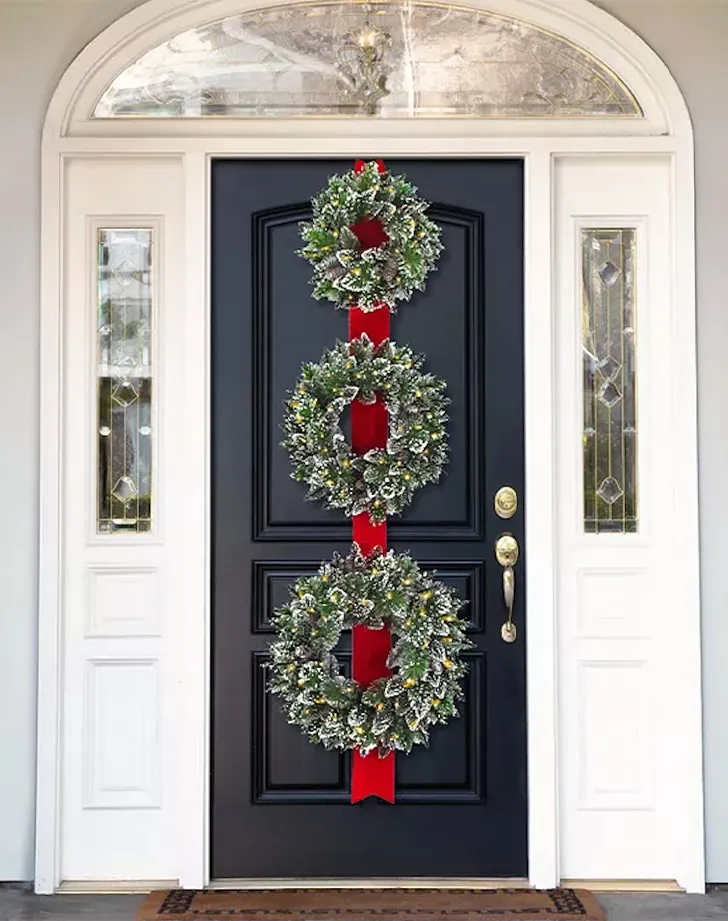
Repetition is the oldest trick in design, and this is it at full volume. Three identical flocked wreaths create a vertical rhythm that makes a standard door feel taller and more architectural, and the warm integrated lights give the arrangement a soft glow that reads beautifully from the street. The wide red ribbon ties the stack into a single gesture instead of three separate objects.
34. A Single Cedar Wreath With Brass Hardware
The brass. A single dense cedar wreath on a dark brown paneled door does not need ornaments, a bow or berries — it needs good hardware underneath it. The knocker, the mail slot and the handle are what make this entry feel established, and the wreath’s only job is not to argue with them. Strip away the brass and you have a plain green circle. Keep it and you have a door that looks like it has been greeting people for a century, with the same restraint as Idea #4.
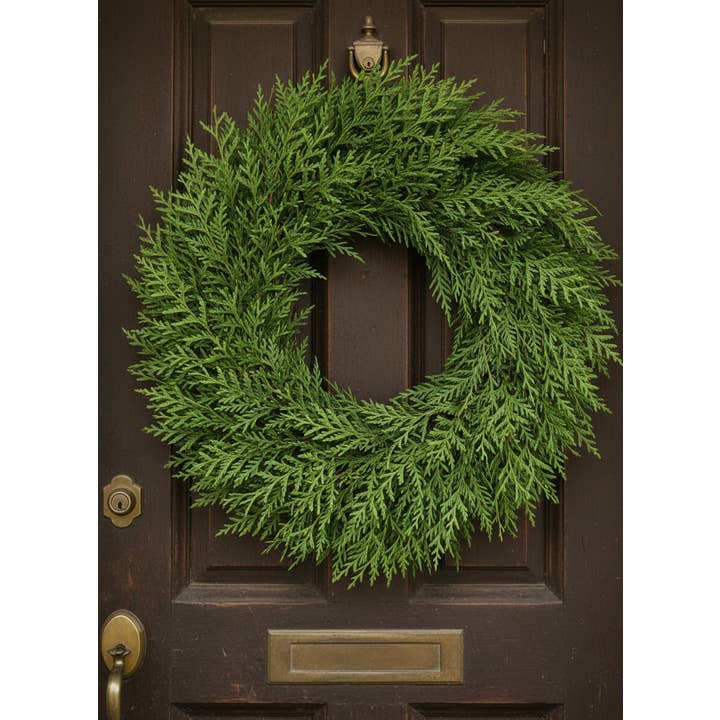
Cedar holds its color far longer than fir after cutting, which is why it is the florist’s choice for winter work. Mist the back of the wreath, never the front — water spots on a wood door are nearly impossible to remove. Indoors, plan on 10 to 14 days before the needles start to drop; if you want the same look from November through January, buy faux cedar and nobody will know the difference.
35. A Mini Frosted Wreath With an Oversized Red Velvet Bow
- 10 in. frosted mini wreath: $12–$25
- 2 in. red velvet ribbon, 3 yds: $6–$14
- Red berry cluster sprays: $5–$10
- Hot glue sticks: $4–$6

Total: $27–$55.
Budget alternative: Dollar Tree carries 10 in. mini wreaths for $3 and velvet-look ribbon for $1.25 a roll. Add a $2 berry sprig and you are at $7 for a wreath that looks nearly identical on a tabletop.
Mini wreaths are styling props, not door decor. A 10 in. version looks right hung on a cabinet door, propped on a bookshelf, layered over a mirror, or laid flat around a candle — anywhere the viewing distance is under 6 ft. If you want it on an interior door, pair two stacked vertically rather than hanging one alone, which always looks like an afterthought.
Thirty-Five Wreaths Later, Your Door Is Ready
Start with one idea that matches the door you actually have — not the door you wish you had — and the rest gets easier from there. Whether you forage pinecones in a park or spend a Saturday wiring cedar, the wreath you made yourself will always beat the one you almost bought.
📌 Pin your favorite from this list now, and tag us when it is hanging — we want to see which one you picked.
