
34 Stunning Neutral Christmas Tree Decor Ideas You Need to Try in 2026
Neutral Christmas trees are quietly taking over every Pinterest feed this December — and it’s not hard to see why. That soft cream-and-champagne decorating makes a room look like it was styled by someone who never panics in December.
We spent weeks digging through Target, World Market, Walmart, Etsy, and Amazon to bring you only what’s worth your attention this year, across every price point from about $8 to $900. After filtering through hundreds of options, we narrowed it down to 34 ideas that actually deliver.
You’ll find woven basket collars, black-and-gold baubles, burlap ribbon, heavily flocked branches, and more than a few oversized velvet bows — plus side-by-side notes on where to spend and where to save. The broader pull toward warm minimalism is driving all of this in 2026: people want trees that feel calm in daylight, not just sparkly at night.
And stay until the end — we break down the most common mistakes that can ruin these looks. 📌 Save this to Pinterest for later — you’ll want to revisit these ideas.
1. A Woven Basket Collar Grounds a Cream-and-White Tree
Before you buy a tree collar, measure the widest branch spread at the bottom third — that’s the number that matters, not the base width. Your woven collar should be 2 to 4 inches larger than that spread, or the branches will mushroom over the rim and you’ll lose the clean basket line. Then swap any cool-white string lights for 2700K warm white. Cool bulbs turn cream ornaments grey-blue, which is the exact opposite of what you’re after here.
Three things make this work. First, texture contrast: the rough weave of the light brown basket against smooth matte baubles gives the eye somewhere to rest. Second, a tight palette — white, cream, light brown, and nothing else — so the collar reads as an intentional object instead of a leftover. Third, all those round shapes repeat, which is why the tree feels serene rather than busy.
2. White Tree, Silver Ornaments, and Garland Climbing the Stairs
The garland. Without it, this is just a white tree standing in a hallway. With pinecones and white berries trailing up the white banister, the tree stops being a piece of furniture and becomes the start of a line that pulls your eye up the staircase. Wrap the garland first, cluster pinecones at the natural curves, and finish with white berry sprays pointing outward. Same palette as the tree, completely different texture.
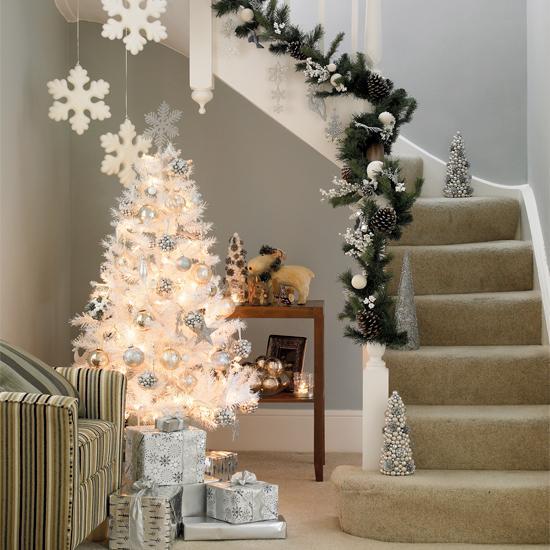
Roughly 70% white — tree, ribbon, snowflakes, and wrapped gifts — plus 20% silver and champagne, plus 10% forest green from the garland only. That green sliver is what keeps the whole thing from reading as a bridal shower. Swap silver for warm brass and the temperature rises; swap white for ivory and it goes soft-vintage. The percentages are the lock, the materials are the game.
Winter-white trees have been quietly climbing since 2022, and 2026 is the year they stopped feeling risky. Pinterest interest in white and flocked trees keeps outpacing classic green in smaller homes, where a white tree reads as light rather than heavy. Staying power? Strong. White and silver were never a fad, they’re a season-neutral palette you can reuse every December.
3. Flocked Branches, Burlap Ribbon, and Gold Baubles
Here’s what this specific look runs:
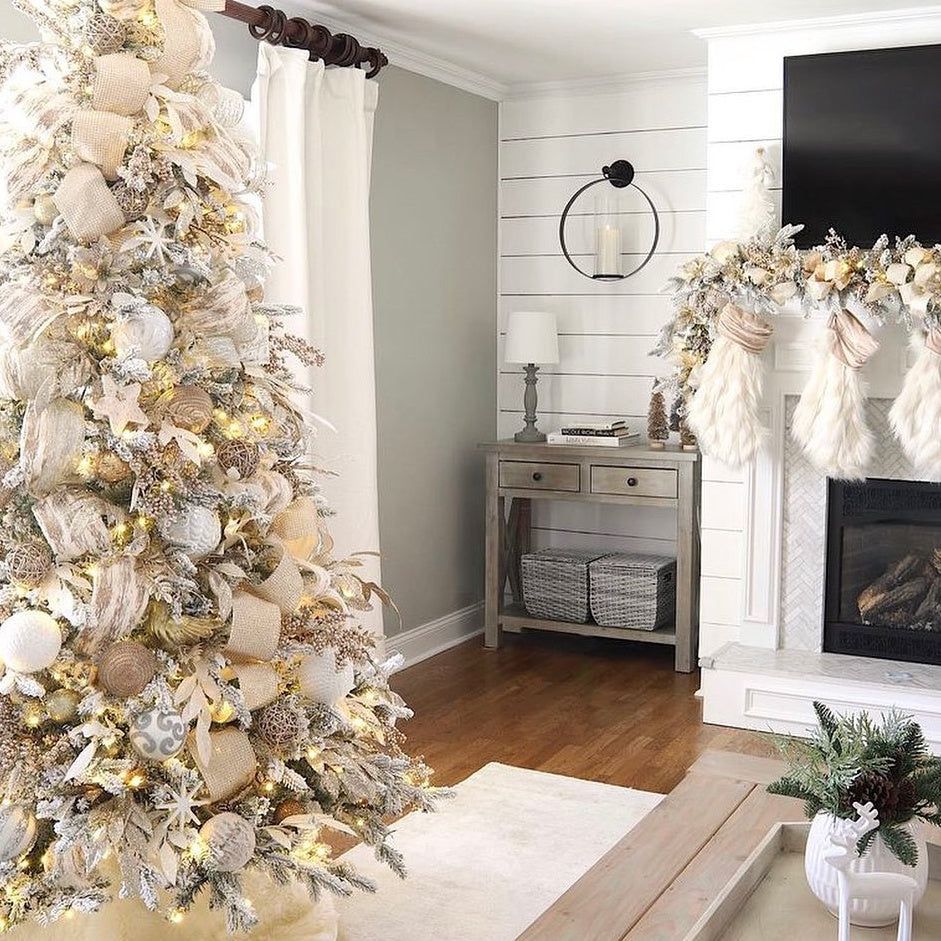
- 7.5 ft heavily flocked tree: $180–$600
- Warm white lights (if unlit): $25–$60
- Wide burlap ribbon, 3 rolls: $30–$55
- Gold, white, and silver baubles, 100+ count: $70–$200
- Frosted mantel garland: $40–$90
- Two white faux-fur stockings: $30–$70
- Tree skirt or collar: $35–$90
Total: roughly $410 to $1,165.
Budget alternative: a $120 unlit flocked tree, or $40 of spray snow on a basic green tree, gets you 80% of the look — and thrifted gold baubles run about 50 cents each.
Flocking sheds. It will dust your floors, and if you have a toddler or a cat, expect to vacuum more than usual in December. Flocked trees also hate damp storage — a humid garage turns the coating gummy and yellow, so keep it in a climate-controlled closet wrapped in a sheet. And be honest about ceiling height: a 7.5-foot flocked tree on a stand is closer to 8 feet once you add the topper.
4. Cream Velvet Bows With Pearl Centers, Floor to Topper
Pearl-trimmed bows eat vertical space because each one needs room to hang without tangling into the one below. This look wants a tree at least 7 feet tall with a wide, full profile — think 48 to 52 inches at the base. Under a 9-foot ceiling, stay at 7 feet and place bows only in the top two-thirds so the lower branches can breathe. Working with a tighter footprint? See Idea #17, where a single dramatic bow replaces a dozen smaller ones.
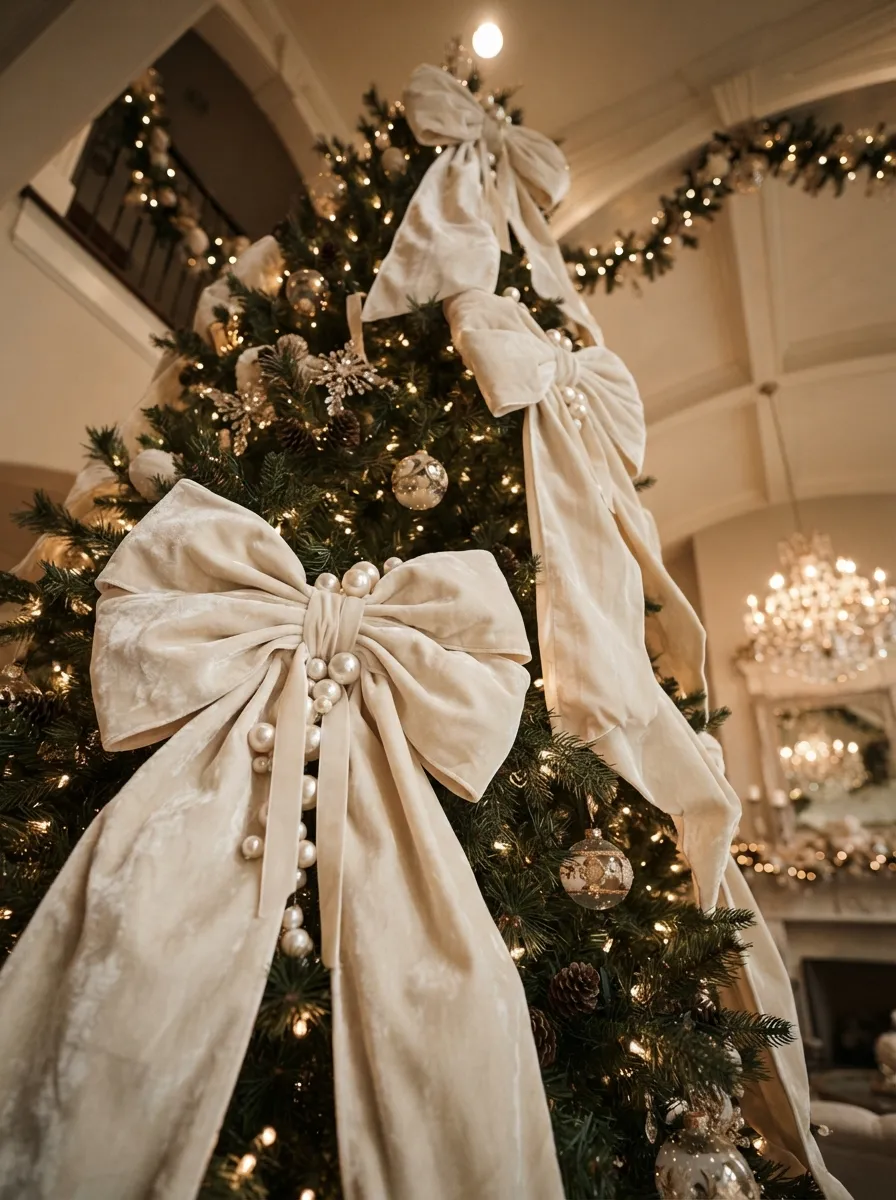
It’s the pearls, not the bows. Cream velvet bows alone are pretty but flat — pearl clusters catch light and give each bow its own focal point, so your eye travels down the tree in a rhythm instead of skimming past. Remove the pearls and you lose the sparkle without adding a single metallic ornament. If you upgrade one thing this season, upgrade the bow centers.
Velvet ribbon is where budgets go to die — designer spools run $18 to $30 a yard. Buy 2-inch velvet ribbon by the roll at Michaels or Hobby Lobby on a half-off week and you’re at roughly $4 a yard. Add a $6 strand of faux pearls and hot-glue small clusters to each bow center. Thrift stores stock velvet ribbon spools constantly in January. Twelve finished bows: about $60 instead of $300.
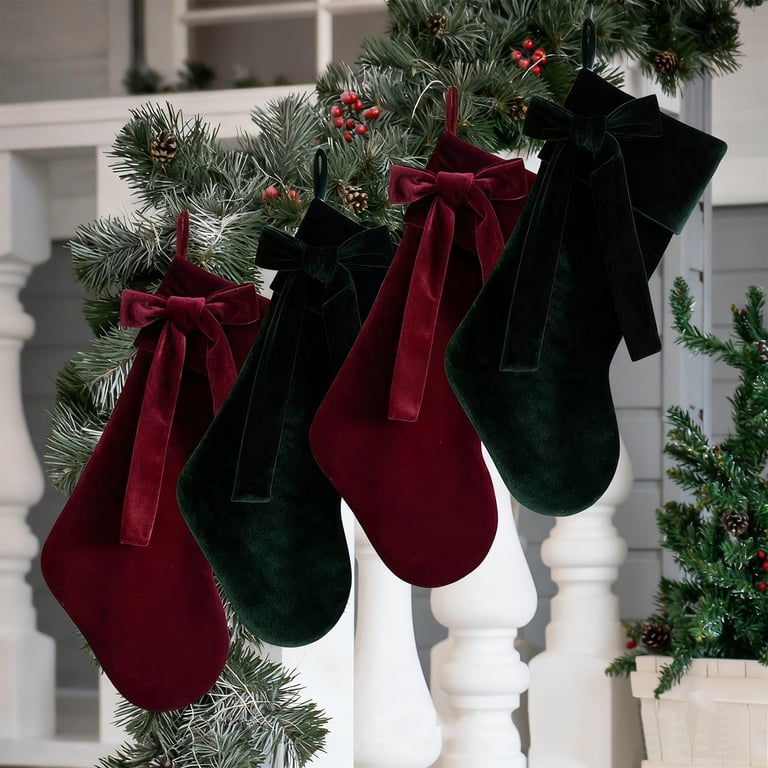
5. Deep Red and Forest Velvet Stockings on a White Railing
Velvet stockings with velvet bows look luxurious and behave like magnets for pet hair and glitter. They also don’t stretch, so if you’re stuffing anything bulky, size up — a stocking that looks generous flat can look strained by December 26. Hang them with removable adhesive hooks rated for 5 pounds rather than nails in painted wood. And if the railing is narrow, keep the garland loose so the stockings actually hang instead of pressing flat against the banister.
Here’s the formula: 60% white railing and wall, 25% evergreen, and 15% deep red and dark green velvet combined. The white does the heavy lifting — it’s the reason red and green feel crisp instead of cluttered. Swap the red for burgundy and it turns moodier; swap white for cream and it goes soft-warm. Keep velvet as the only plush texture in the scene and the whole vignette stays sharp.
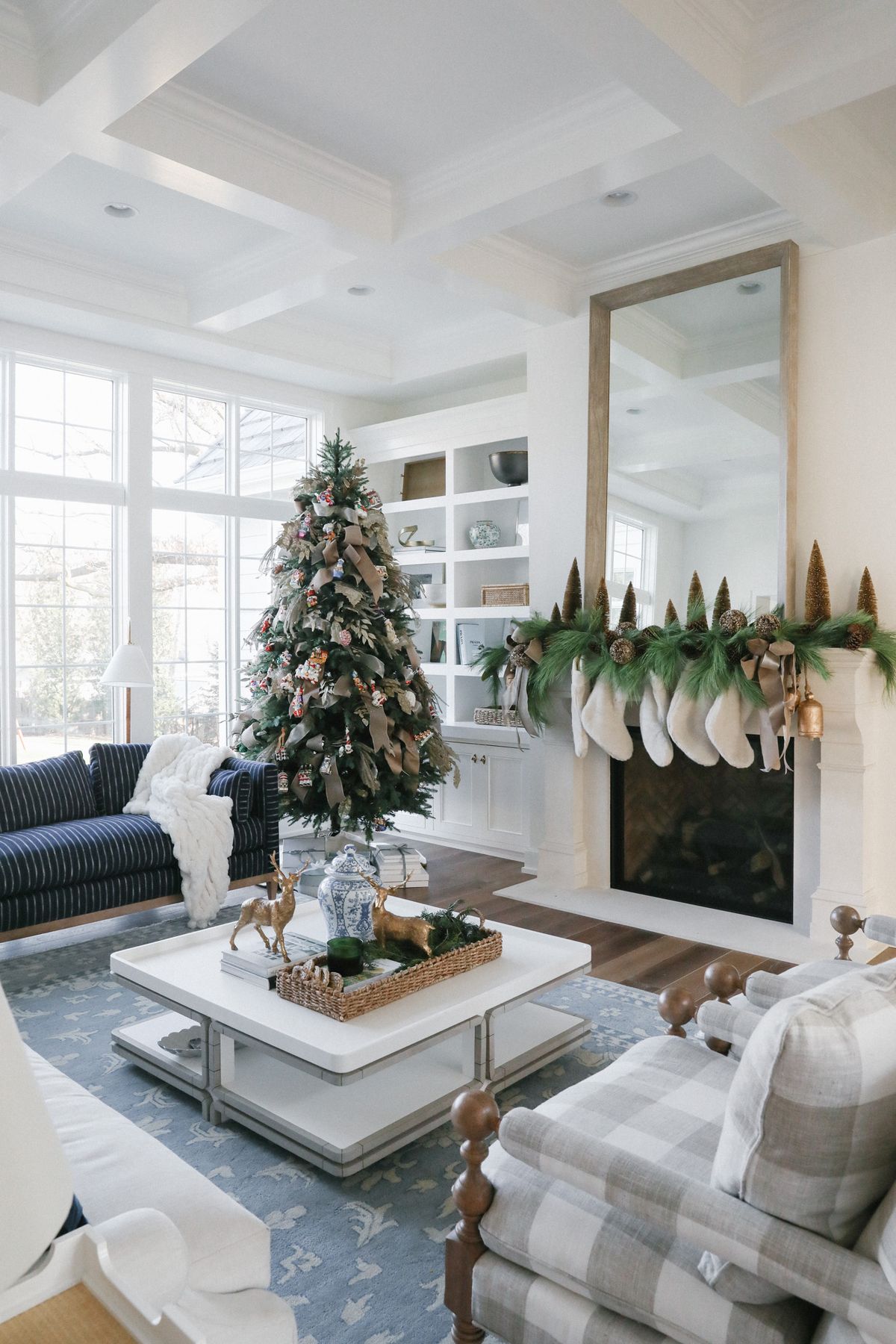
6. Taupe Ribbon and Navy Seating in a Sun-Filled Living Room
This room works because the tree isn’t the loudest thing in it. Taupe ribbon and warm lights sit in the same value range as the walls, so the navy sofa and light blue rug carry the color story instead. That’s a deliberate handoff: the tree supplies texture, the furniture supplies saturation. It also proves you don’t need a dark room for a neutral tree — you need daylight, big windows, and restraint.
Windows change everything here. A tree standing in front of large glass reads smaller than it actually is, so go one size up — 7.5 to 9 feet for ceilings at 10 feet or higher. You need at least 30 inches of clearance on the window side so branches don’t press the glass, and a walkway of 36 inches between the sofa and the tree base. Compare with Idea #20, where paneled walls do the same anchoring job at a tighter scale.
- Measure window width and keep the tree at least 30 inches from the glass
- Watch which direction afternoon light hits — warm white bulbs vanish in direct sun
- Confirm your rug palette first; taupe only sings against cool blues and greys
- Test one strand of lights at night before committing to 1,200 bulbs
7. Frosted Branches With Blue, Silver, and Snowflake Ornaments
Frosting plus glitter plus tinsel equals three shedding surfaces on one tree. Expect to vacuum the skirt area weekly, and never wipe frosted branches with a damp cloth — the coating pills and you’ll see the bare green underneath forever. Store the tree upright in a breathable bag, not a vacuum-sealed one. If dust genuinely bothers you, a plain green tree with silver ornaments and no frosting gives you 80% of this sparkle with about 20% of the upkeep.
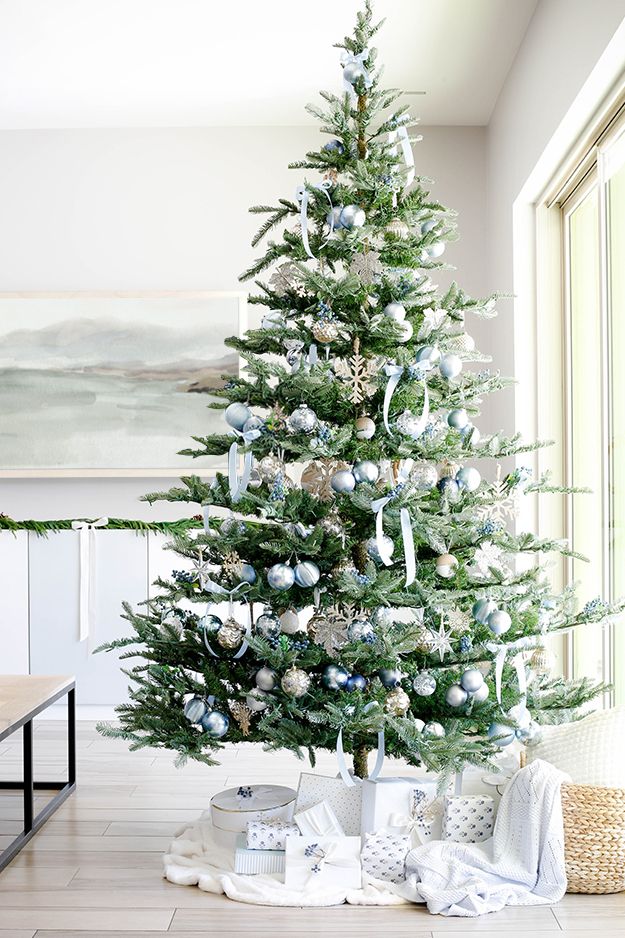
The flat silver snowflakes. The round baubles give the tree mass; the flat ornaments give it silhouette. They catch light differently than spheres do, and because they’re thin they slip between branches without crowding them. Without them this is a blue-and-silver ball tree — pretty, but shapeless. Flat ornaments are the cheapest way to make a full tree look styled.
8. Black, White, and Gold Baubles Over a Grey Patterned Rug
Making black ornaments feel festive instead of funereal:
- Start with matte white and pearl baubles — about 60% of the total count
- Add silver in mixed finishes for 25%, mixing glossy, mercury, and matte
- Place black ornaments in odd-numbered clusters of 3, never scattered evenly
- Push black toward the inner branches so it reads as depth, not pattern
- Finish with white lights only — colored bulbs kill the whole effect
Roughly 90 minutes for a 7.5-foot tree, and you’ll need 90 to 120 ornaments to fill it properly.
Black on a Christmas tree stopped being edgy around 2023 and became a signature of the warm-modern look — the same movement that brought us matte black faucets and fluted sideboards. In 2026 it shows up in baubles, ribbon, and even tree collars. Staying power: moderate. Black ornaments are timeless in small doses but date fast above about 15% of the tree.
Sixty-five percent white and pearl, 20% silver, 15% black — all sitting over a grey-and-black patterned rug. That last detail matters. Repeating the rug’s black in the tree is what makes a room feel designed rather than merely decorated. Swap black for bronze and it warms up; swap silver for gold and it goes glam. Same proportions, entirely different mood.
9. A Cream Bouclé Armchair and Plaid Throw Beside the Tree
This is a furniture-led room as much as a tree room, so the budget splits:
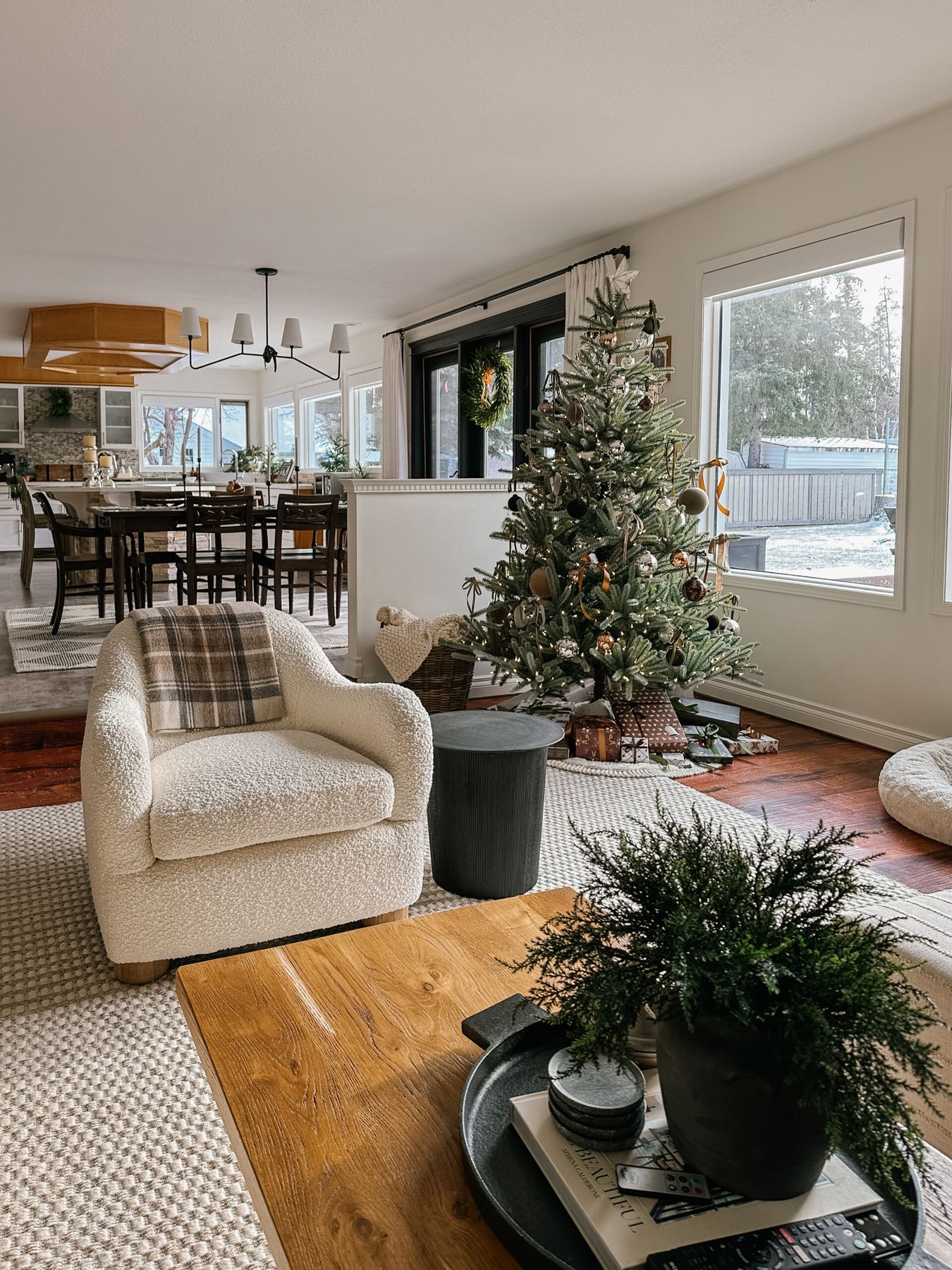
- Neutral 7.5 ft tree: $150–$500
- Neutral ornaments and ribbon: $80–$220
- Cream bouclé armchair: $300–$900
- Textured light grey rug, 8×10: $200–$700
- Black fluted side table: $120–$350
- Plaid throw blanket: $30–$70
Total: roughly $880 to $2,740.
Budget alternative: a Facebook Marketplace bouclé chair at $120, an IKEA rug at $149, and a $35 Target accent table cut the room to about $450.
Bouclé is beautiful and it is a lint trap. If you have a shedding dog, a bouclé chair next to a Christmas tree becomes a fur magnet within a week — keep a rubber-bristle brush on hand and use it weekly. Also think about scale: that chair sits 24 to 30 inches from the tree base at most, so a wide 7.5-foot tree with a big skirt can start to feel crowded in rooms under 200 square feet.
10. Silver Tinsel and a Braided White Skirt Against the Window
Tinsel works with warm white lights, not against them — but only when you use it vertically. Drape it in loose vertical strands that follow the branch lines instead of wrapping it horizontally, and stop about 8 inches from the top so the tree doesn’t read top-heavy. Use one color of tinsel and one only. Mixed silver and gold tinsel is the fastest route to a 1994 basement rec room.
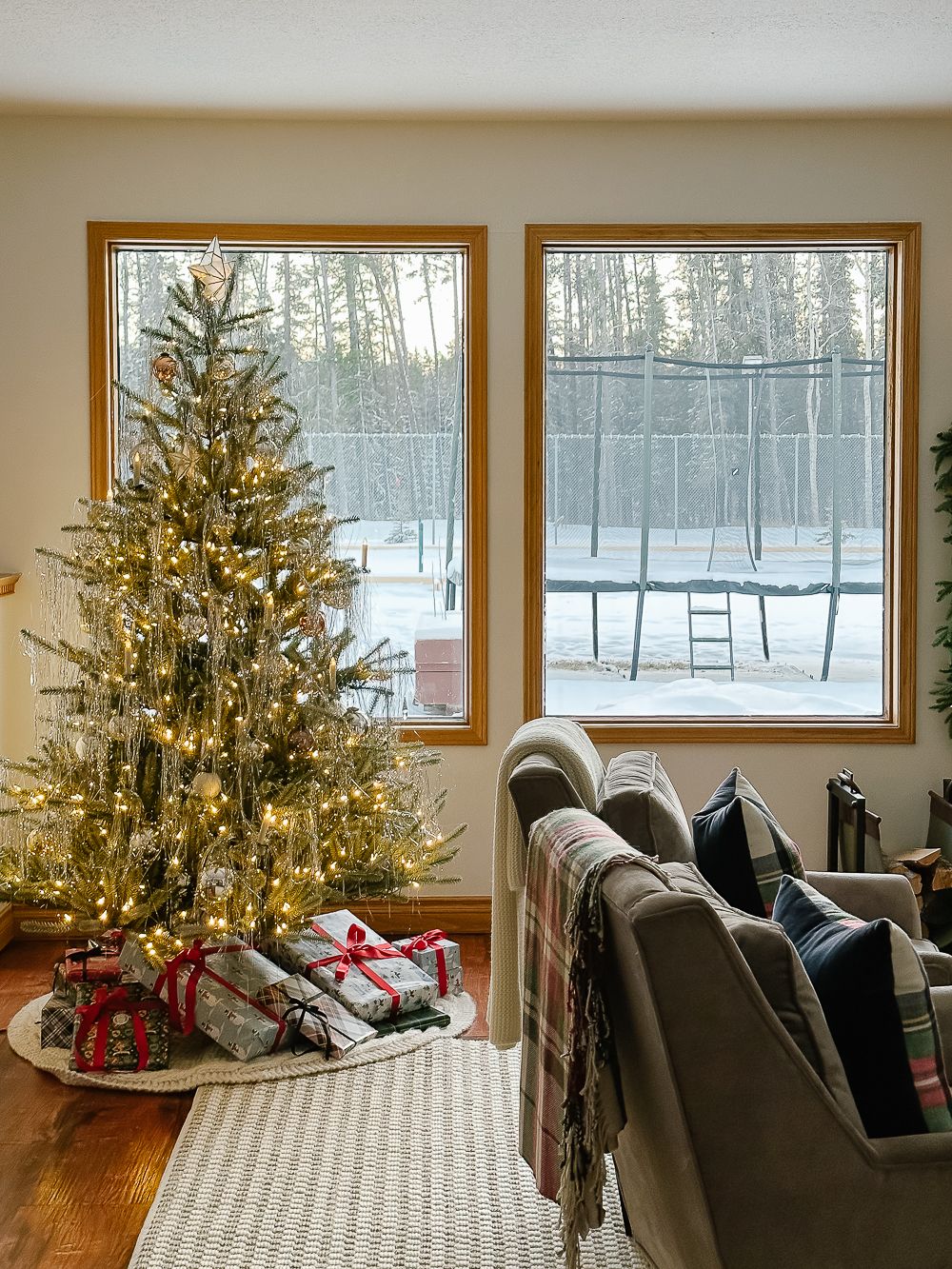
This setup lives on a wall of glass, which means two things: the tree needs to be at least 7.5 feet to hold its own against a wide window, and the sofa needs 36 inches of clear walkway between it and the tree base. In rooms under 12 feet wide, drop to a 6.5-foot tree and skip the tinsel entirely. Windows with snowy views make silver read almost white — one of the rare times reflective decor looks understated.
Silver tinsel is the most affordable shimmer in the holiday aisle — 5 to 8 dollars per strand at Walmart or Dollar Tree. A white braided tree skirt runs $25 to $60, but a plain white flat sheet tucked and pinned does the same job for $8 and looks identical from three feet away. Thrifted silver ornaments go for 25 to 50 cents each in December, especially boxed sets nobody ever opened.
11. Blue Plaid and Brown Textured Ribbon, Layered Branch by Branch
Two ribbons, one matte and one patterned, on the same tree. That contrast does the work: the blue plaid supplies graphic energy, the wide brown ribbon supplies softness, and together they make the tree look collected rather than purchased. The fabric floral ornaments break up all the roundness of the baubles. Layer the brown ribbon first, close to the trunk, then let the plaid ride further out on the branches. It’s the same layering trick as Idea #8, just with pattern doing the work instead of black.
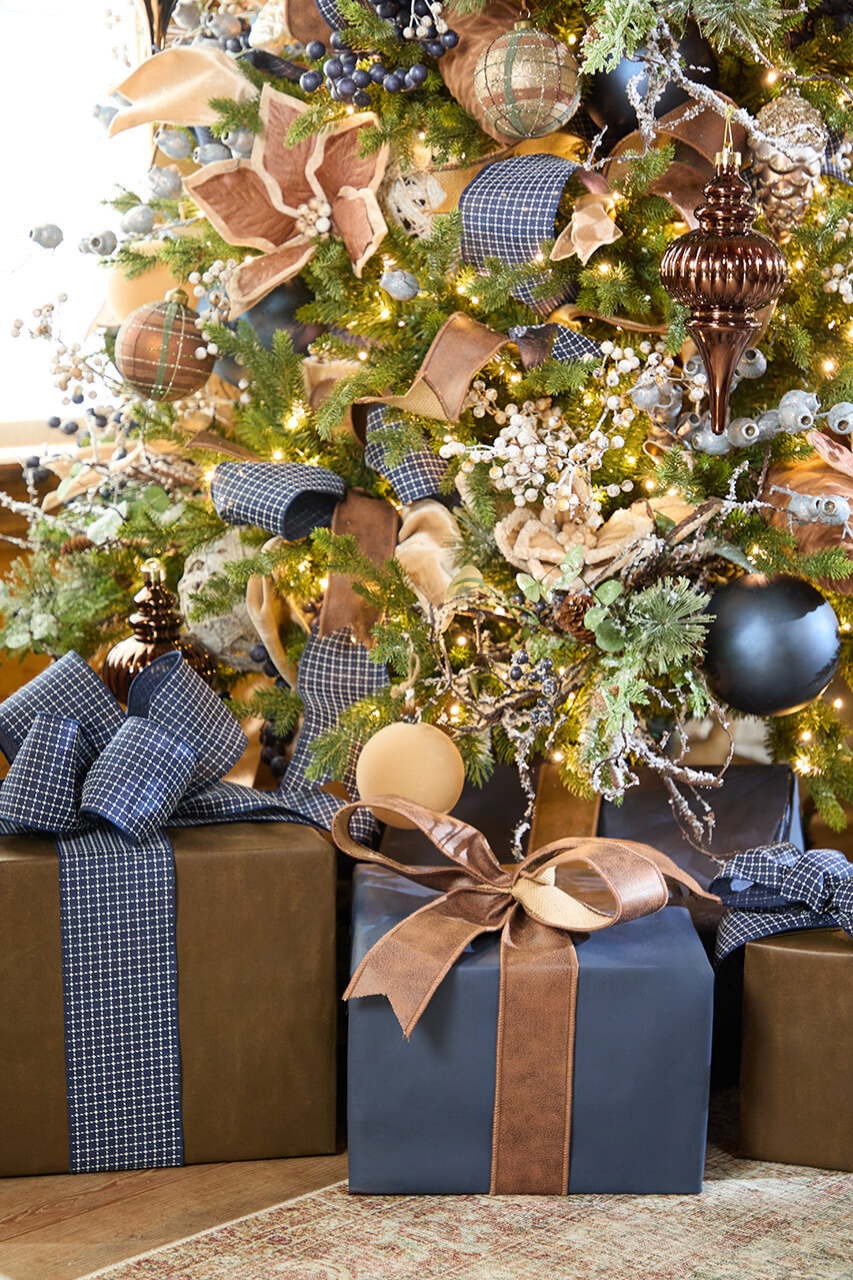
Wire-edge plaid ribbon holds its shape but collects dust like a filter — hit it with a lint roller between seasons. Fabric floral ornaments puff up in humid storage and never quite flatten again, so stuff them loosely rather than compressing them. Frosted berries can flake onto the floor all December. If you want this exact look with less upkeep, swap the frosted berries for matte navy baubles and keep the ribbon.
12. Matte Black Deer and Wood Cone Trees on a White Mantel
This is one of the cheapest vignettes in the entire roundup. Matte black deer figurines run $8 to $18 at Target and At Home. Natural light wood cone trees are $6 to $20 each, or you can cut log slices and stack them. A light wood bead garland is about $12 on Amazon. The two matte black ornaments with white script cost $4 each at a craft store. Whole mantel for under $80, and it photographs like it cost three times that.
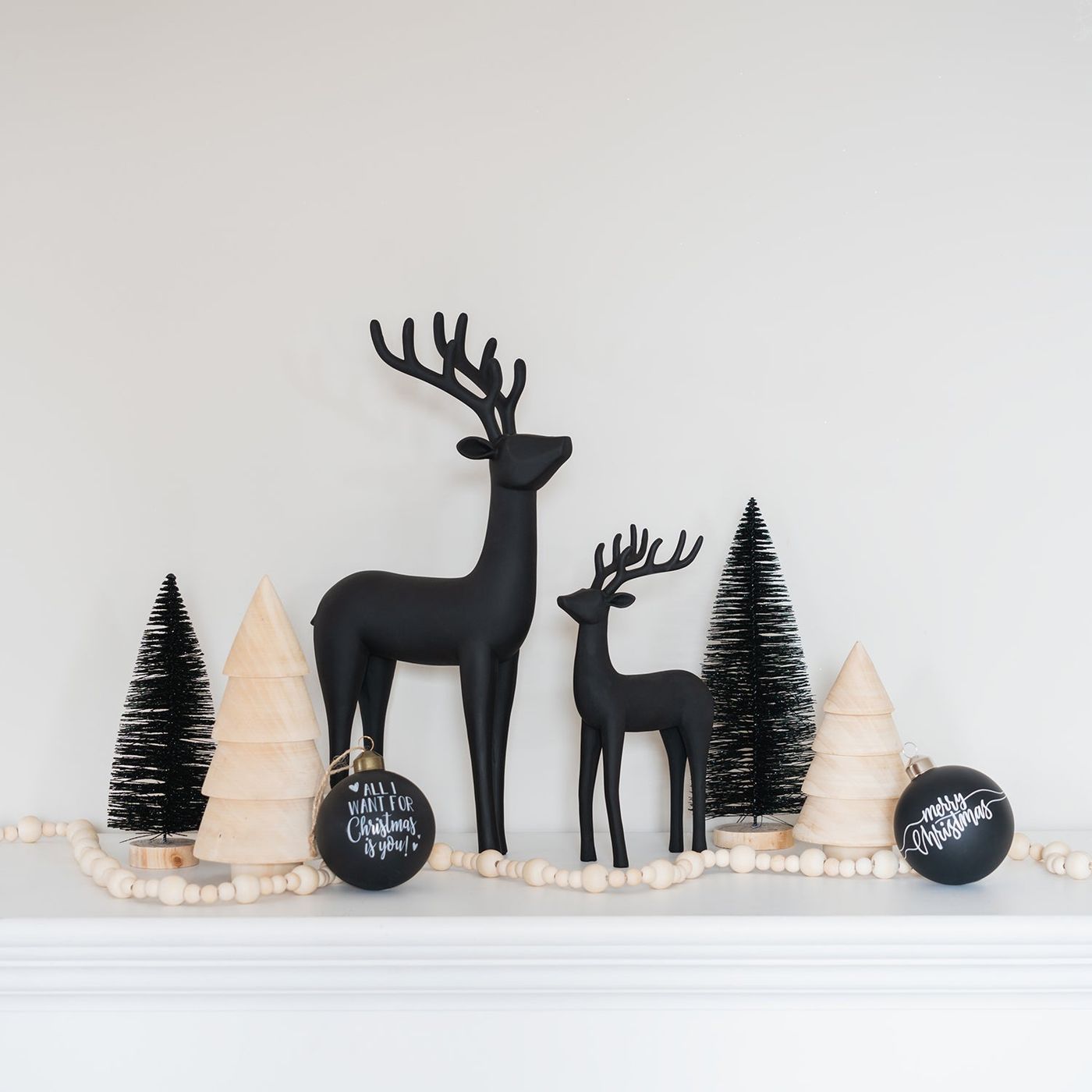
The repetition of the cone shape, in two materials. The wood trees and the black bottle brush trees share the same silhouette, so the mantel reads as a set rather than a collection of objects. Remove the wood cones and you’re left with black deer plus ornaments — a themed display instead of a composition. Repetition is what makes styling look intentional.
Mantel styling has one rule people break constantly: vary heights in a 1:2:3 ratio. Three inches, six inches, nine inches is the classic progression. Keep the tallest element about a third of the way in from one edge, not dead center. And leave 4 to 6 inches of bare white surface on each end — negative space is what makes a symmetrical display feel calm instead of cluttered.
13. Burnt Orange Velvet Ribbon Against Mercury Glass Baubles
Roughly 70% green and warm white, 20% silver and mercury glass, 10% burnt orange. That 10% is doing a disproportionate amount of work — it’s the only warm saturated color in the room, and against a stone fireplace it pulls the whole scene toward amber. Swap burnt orange for rust and nothing changes. Swap it for red and the tree stops being neutral. Swap it for cream and the entire thing goes flat.
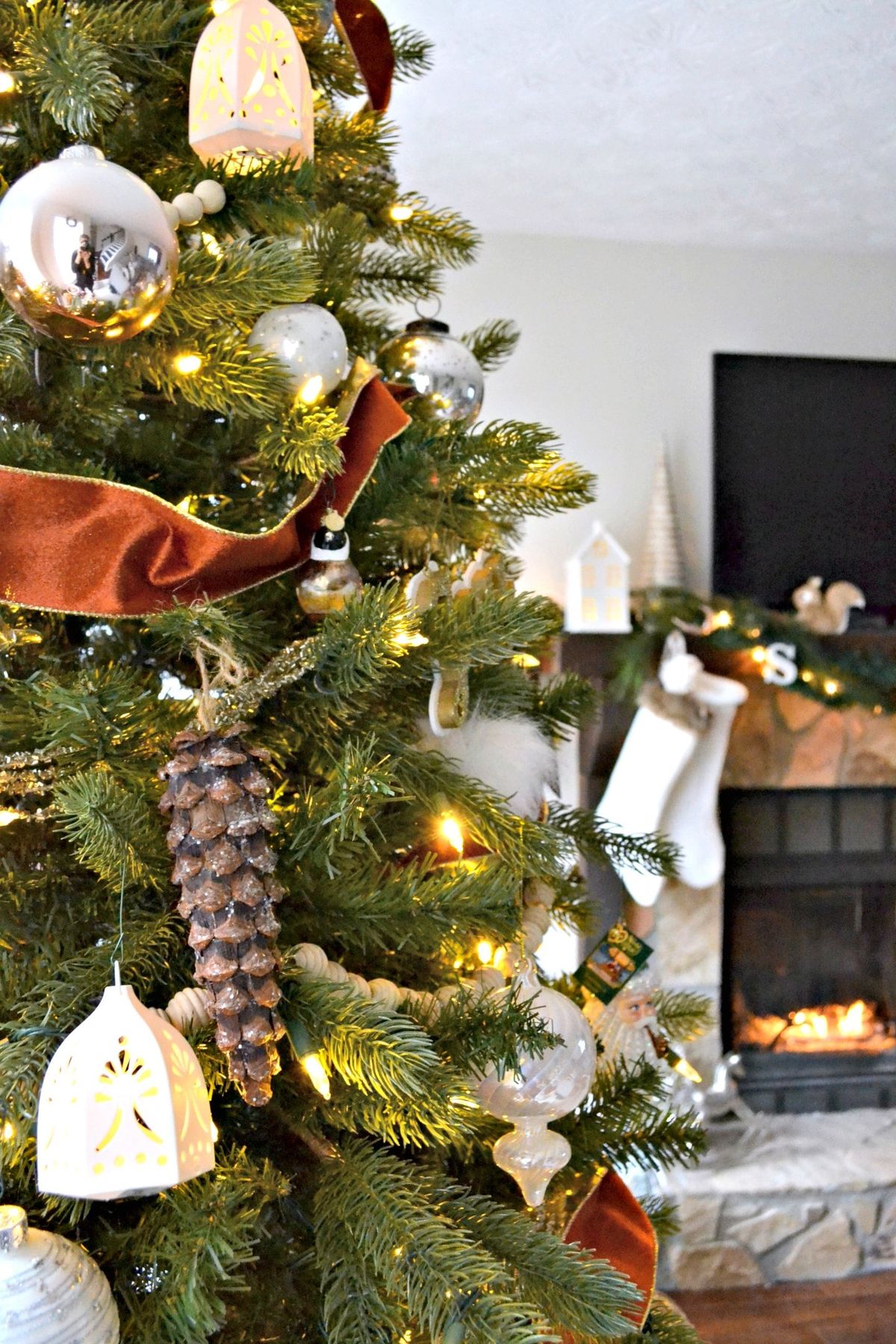
What this costs to recreate:
- 7.5 ft faux evergreen tree: $150–$450
- Warm white string lights: $25–$60
- Mercury glass and silver baubles, 60–80: $70–$180
- Wide velvet ribbon, 3 yards: $35–$90
- Glittered pinecones, set of 12: $20–$45
- White ceramic lantern ornaments, set of 6: $25–$50
- White wood bead garland: $12–$25
Total: about $337 to $900.
Budget alternative: Dollar Tree mercury-glass lookalikes at $1.25 each plus a thrifted spool of velvet ribbon gets you close for roughly $180.
14. A White Tree Full of Silver Balls and Collected Charms
An eclectic tree only works if you’re honest about the count. Novelty ornaments multiply, and past roughly 30 percent of the total they start to swallow the silver base holding it all together. Also worth knowing: a white tree shows every smudge and every dark ornament wire. Spot-clean with a dry microfiber cloth, never wet. And keep this one out of direct sun — white artificial trees yellow faster than green ones.
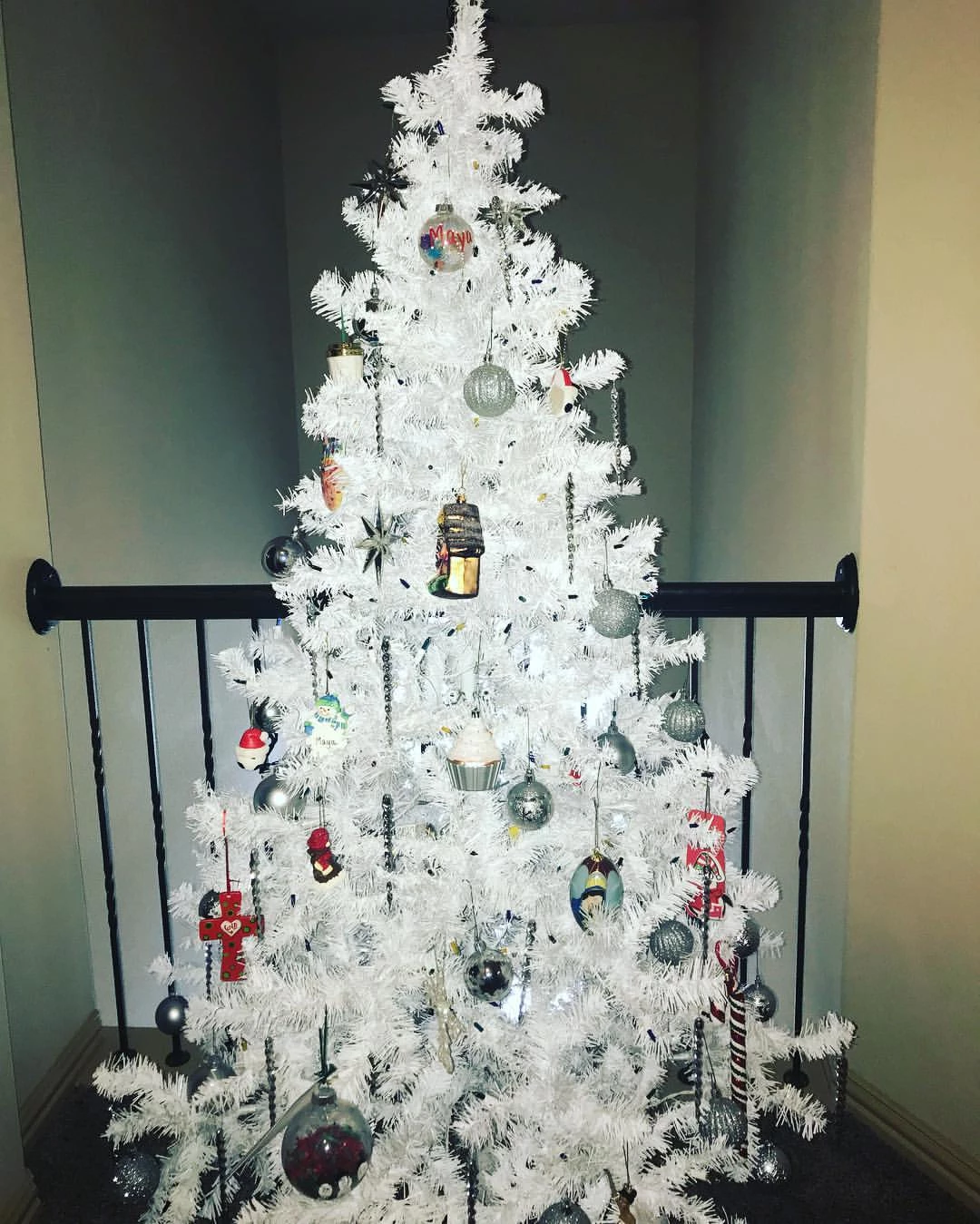
There’s a real pushback happening against the perfectly styled tree. Pinterest boards full of sentimental and memory-tree ideas have grown steadily since 2023, and in 2026 the collected tree is a legitimate design choice rather than a compromise. The trick designers use is keeping the base palette strict so the personal ornaments have a framework to sit inside. Chaos on purpose, not chaos by accident.
This is the cheapest tree in the entire roundup to build. Thrift stores sell bags of silver baubles for $3 to $8 in November, Dollar Tree carries silver beaded garland for $1.25 a strand, and the novelty ornaments are the ones you already own. A 6.5-foot white tree runs $70 to $150 at Walmart. Realistically you can pull this off for under $150.
15. Vintage Ceramic Trees on a Warm Brick Hearth
Styling a brick mantel without losing the brick:
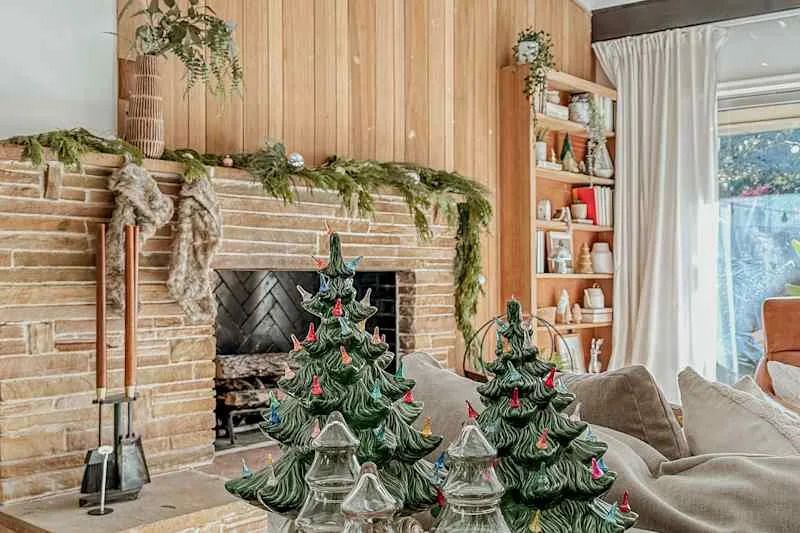
- Clear the mantel completely and dust the brick with a dry brush
- Lay the garland first, letting it overhang 3 to 4 inches on one side for asymmetry
- Add faux fur as a soft layer under the garland ends, never on top
- Place the tall woven vase with greenery at one end as the vertical anchor
- Group the ceramic trees at the opposite end in a 3-and-2 cluster
- Plug everything into one power strip hidden behind the vase
About two hours, most of it untangling lights.
The brick is the star and everything else is a frame. Warm terracotta tones in the brick, light wood paneling above, and dark green garland create a three-tone room without a single painted surface. The ceramic trees with their colored bulbs add nostalgia that keeps the whole thing from feeling over-curated. This is a rare case where matching nothing beats matching everything.
16. Wooden Beads, Brown Satin Bows, and a Skirted Mantel
Satin ribbon needs vertical run to look right — 7 feet is the practical minimum, and 7.5 to 8 feet is better. The fabric-skirted mantel adds visual weight on one side, so this arrangement wants a room at least 12 feet wide to breathe. Under 10 feet wide, drop the skirt and leave the mantel bare. And keep 18 inches between the tree’s widest branch tip and the mantel edge, or the two displays will visually fuse into one blurry mass.
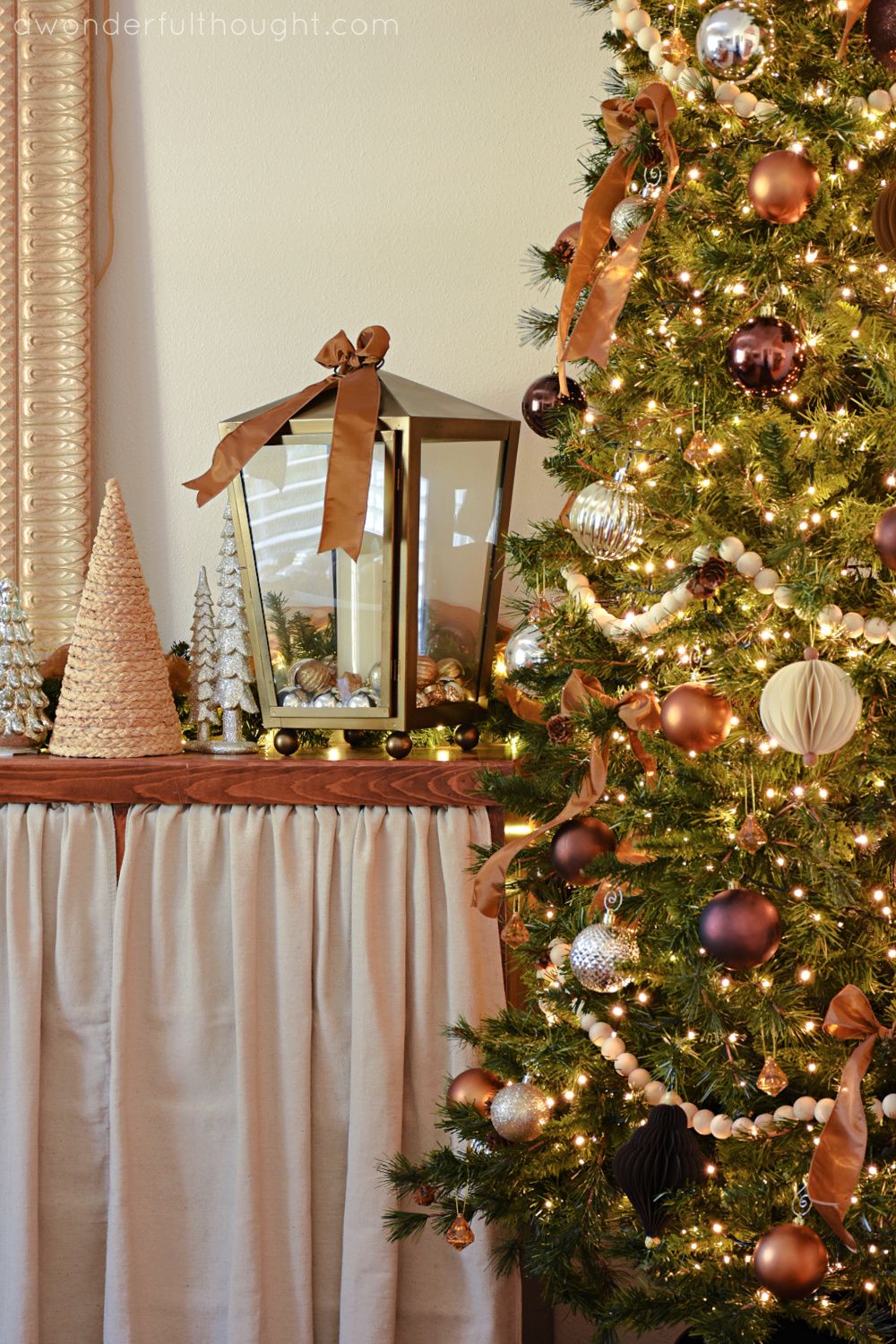
The wooden bead garland. It’s the thread tying a green tree, a brass lantern, and a skirted mantel into a single composition, and it’s the only element that repeats across all three. Beads also soften hard materials — brass, satin, glass — without adding any color. Take them away and you have three separate displays standing awkwardly next to each other.
Brown satin ribbon should be cut on a diagonal with a wood-burning tool, not scissors. Straight-cut satin frays within a season, and a diagonal cut lets the ribbon hang in a soft point instead of a blunt edge. Cut your tails 14 to 18 inches long and let them puddle slightly on the branch — anything shorter reads as an afterthought, anything longer turns into spaghetti.
17. One Oversized Cream Fabric Bow at the Very Top
A bow this size is a $12 project, not a $120 one. Two yards of cream cotton or linen-blend fabric from Joann at $8 a yard, plus a $3 spool of wide ribbon for the core, and you’re done. Skip velvet entirely — a big velvet bow in cheap velvet looks exactly like cheap velvet, while matte cotton reads expensive at any size. Make it 18 to 22 inches wide and wire the loops so it holds its shape all season.
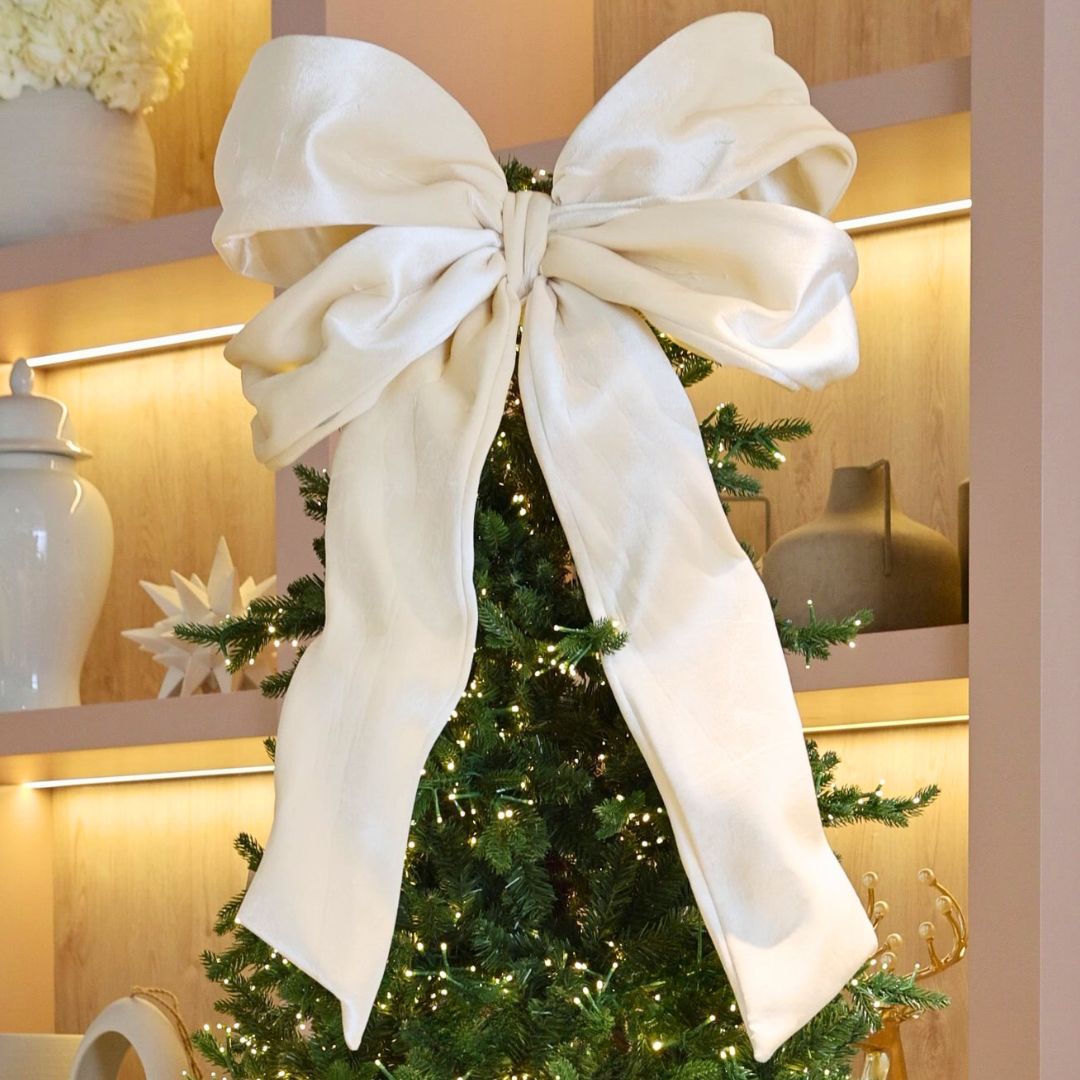
Eighty-five percent green tree, 10% warm white light, 5% cream fabric. That’s the whole formula, and it’s the most stripped-back one in this roundup. It only works because the scale of the bow does the decorating. Swap the cream for pale grey and it goes modern, make it navy and it turns preppy, split it into two 12-inch bows instead of one 20-inch bow and the entire effect collapses.
18. Deep Red Velvet Ribbons Carried From Tree to Table
Velvet ribbon on a dining table is a once-a-season decoration, not a durable one — one gravy incident and it’s done. Velvet can’t be spot-cleaned; it has to be dry cleaned or replaced. Woven charger plates wipe clean easily, but striped napkins and boxwood wreaths on chair backs both shed. Set the table the morning of, not a week ahead, if you’re serving anything with sauce.
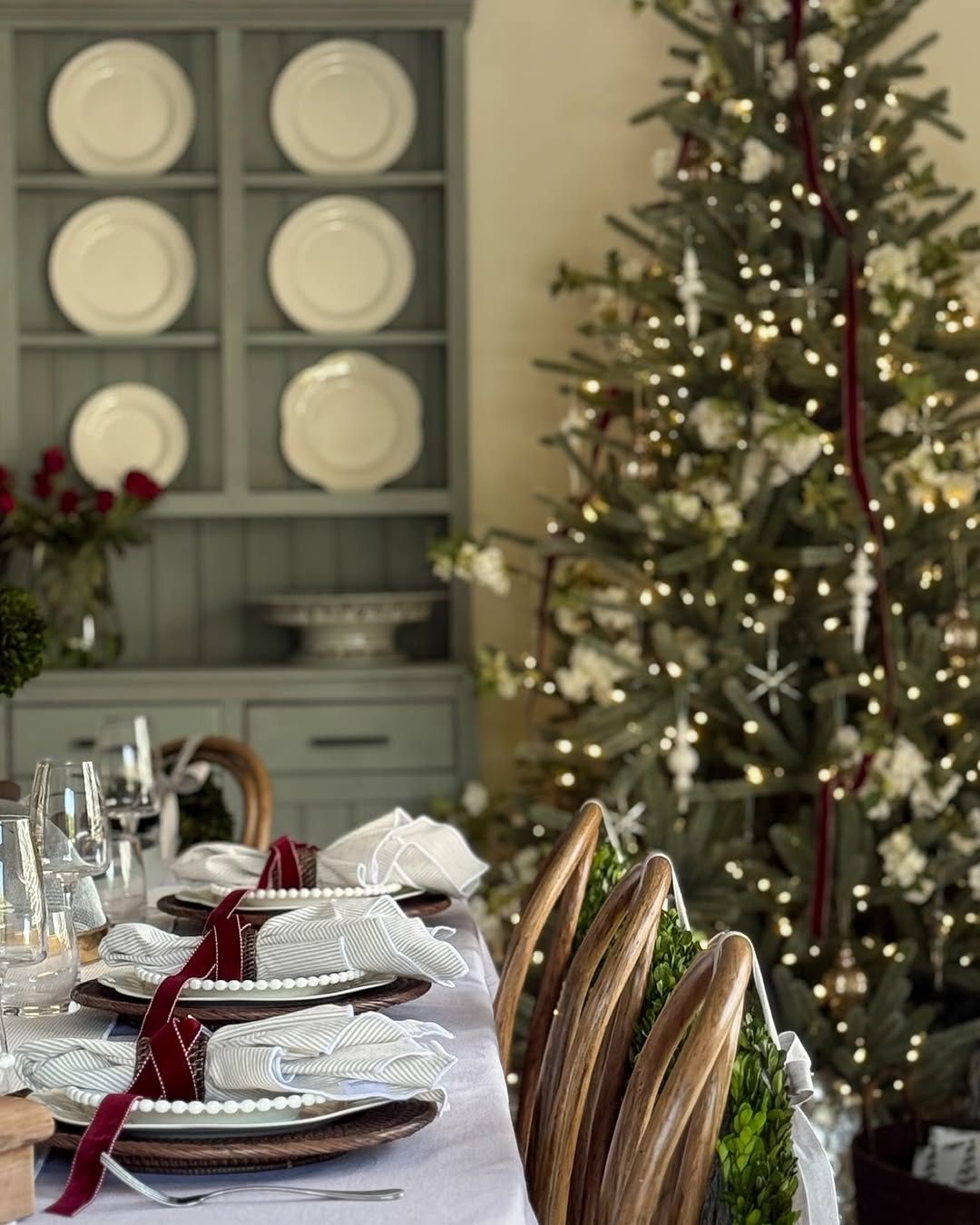
Budgeting the full dining room treatment:
- Tabletop tree, 4–5 ft: $60–$180
- Warm lights and white florals: $35–$80
- Deep red velvet ribbon for tree and table: $40–$90
- Natural woven charger plates, set of 8: $50–$140
- Striped napkins, set of 8: $30–$70
- Boxwood wreaths for chair backs, 4: $60–$140
Total: roughly $275 to $700.
Budget alternative: skip the chargers and use woven placemats you already own — dollar-store boxwood wreaths at $3 each and thrifted velvet ribbon land this near $150.
The honest caveat is chair count. Boxwood wreaths on chair backs look charming in photos with four chairs; with eight, the table starts to feel like a craft fair. Check that wreaths don’t hit the seat when someone scoots in, and expect to lint-roll velvet table ribbon before guests arrive.
19. Champagne Baubles Resting Over a Cream Shag Rug
Champagne is a color temperature, not just a color. True champagne sits around 3,000K to 3,500K — warm but not yellow. If your ornaments look brassy next to your lights, your bulbs are running too warm; drop to 2700K. And when a tree stands on a shag rug, tuck the skirt or collar carefully so it sits flat. A shag pile will push a rigid collar up into the branches within a day, and you won’t notice until you’re taking photos.
The whole palette is one family of beiges at three different values, and the shag rug supplies the low-contrast softness that makes it feel expensive. Nothing here is shiny except the ornaments, and they’re glossy rather than glittery — a distinction that matters more than people expect. Glitter scatters light; gloss reflects it. In a small room, gloss is calmer by a wide margin.
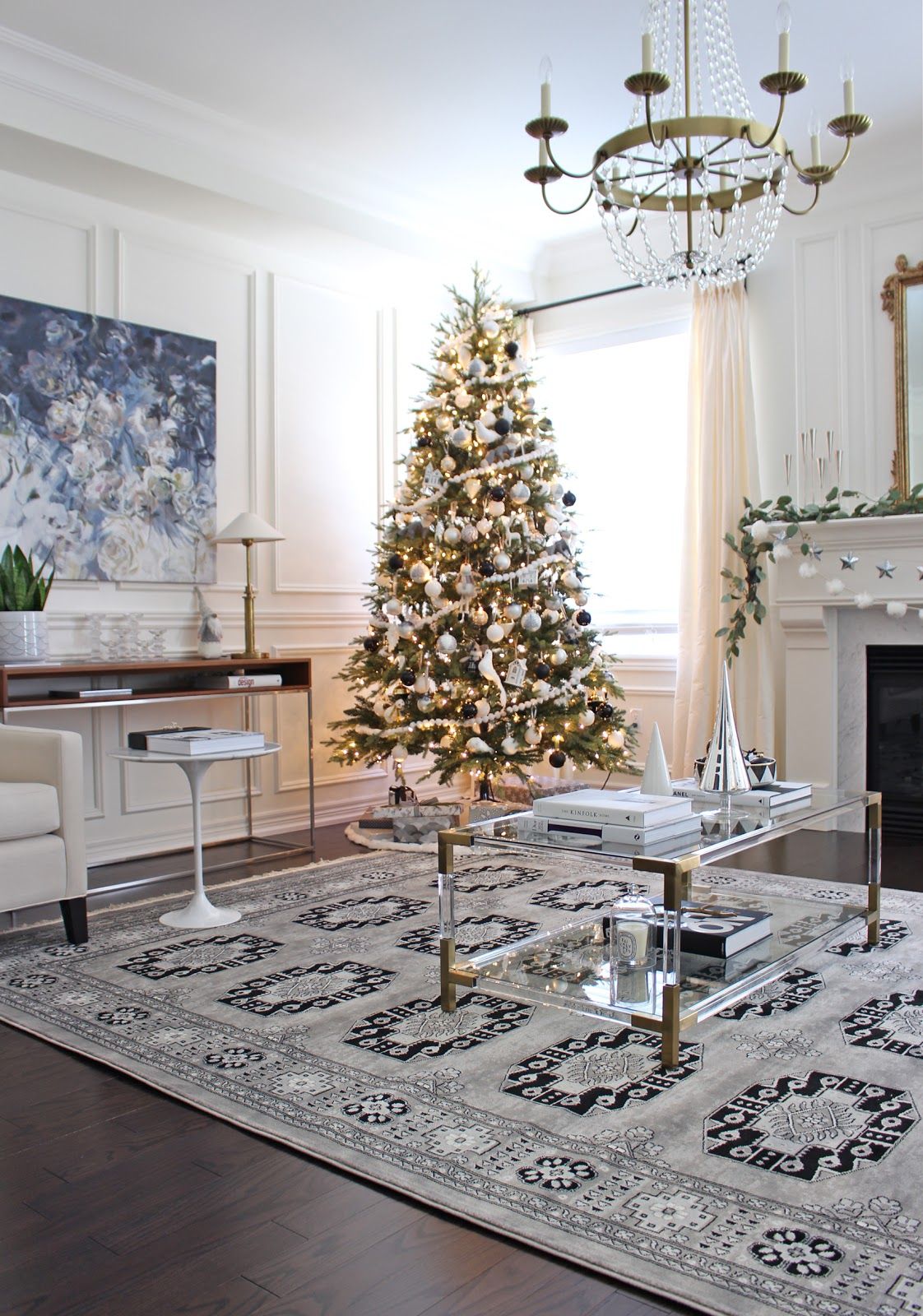
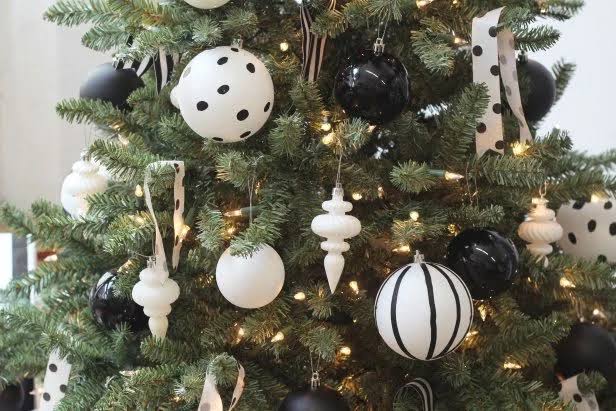
20. White, Black, and Silver Against Deep Wall Paneling
- Confirm your floor tone — white trees with black ornaments look sharp on dark wood and muddy on pale carpet
- Measure the wall for paneling; it needs 8 feet of uninterrupted width to read as a feature
- Choose your art first, since the abstract blue floral sets the whole accent temperature
- Check the mantel outlet situation before buying a garland that needs power
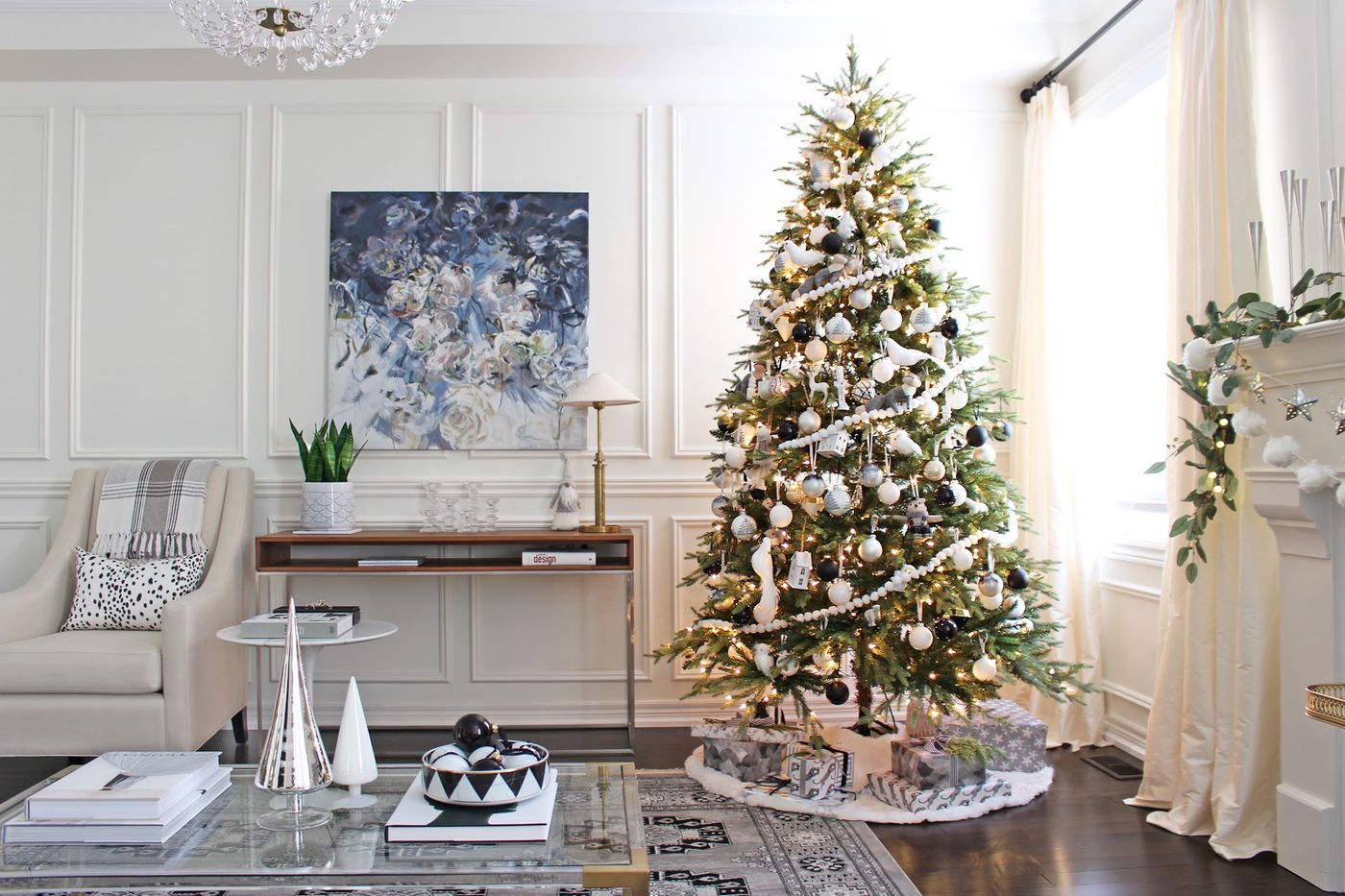
The blue-and-grey abstract painting. It’s the only place blue appears in the entire room, and it quietly justifies the white-and-black palette by proving the walls aren’t afraid of contrast. Remove it and the paneling becomes a blank stage waiting for something. One good piece of art can do more for a holiday palette than another 40 ornaments.
Paneled walls add vertical lines, which make a room feel taller than it is — so a 7.5-foot tree can hold a 12-foot ceiling here without looking small. Dark floors are the catch: they visually shrink a tree, so add 6 inches if you’re choosing between two sizes. This layout wants at least 180 square feet of open floor. In anything smaller, drop to a 6.5-foot tree and move the glass coffee table out of the tree’s shadow.
21. A Chunky Knit Collar and Yarn-Wrapped Ornaments
One hundred percent cream and off-white, distinguished entirely by texture. Roughly 40% matte ceramic, 30% glossy glass, 20% yarn-wrapped, and 10% bare wood. The variation isn’t in color at all — that’s the entire point. Swap the yarn ornaments for more glass rounds and the tree goes generic. Swap a third of the matte for a slightly warmer ivory and the whole thing gains depth without gaining a single hue.
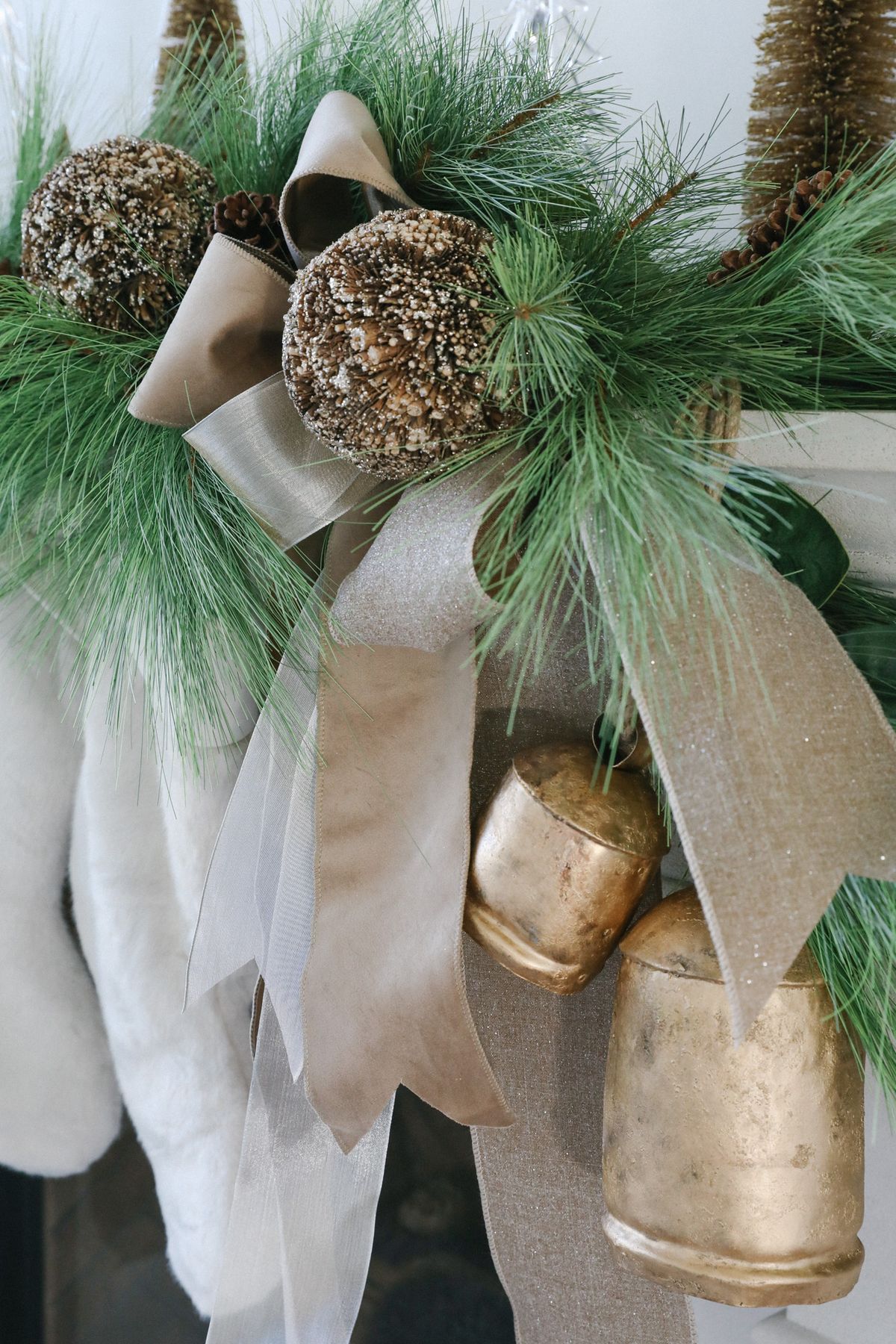
Yarn-wrapped ornaments are $1.50 to $4 each at Target, or free if you already own yarn and foam balls — about 30 minutes per dozen. A knit tree collar runs $40 to $90, but a chunky knit throw blanket from Walmart at $20, folded and wrapped around the base, looks nearly identical at a glance. Total for this whole look: around $110 if you’re patient with a glue gun.
22. Frosted Green With Rust Ribbon and Glitter Stars
Getting rust velvet ribbon to read as intentional:
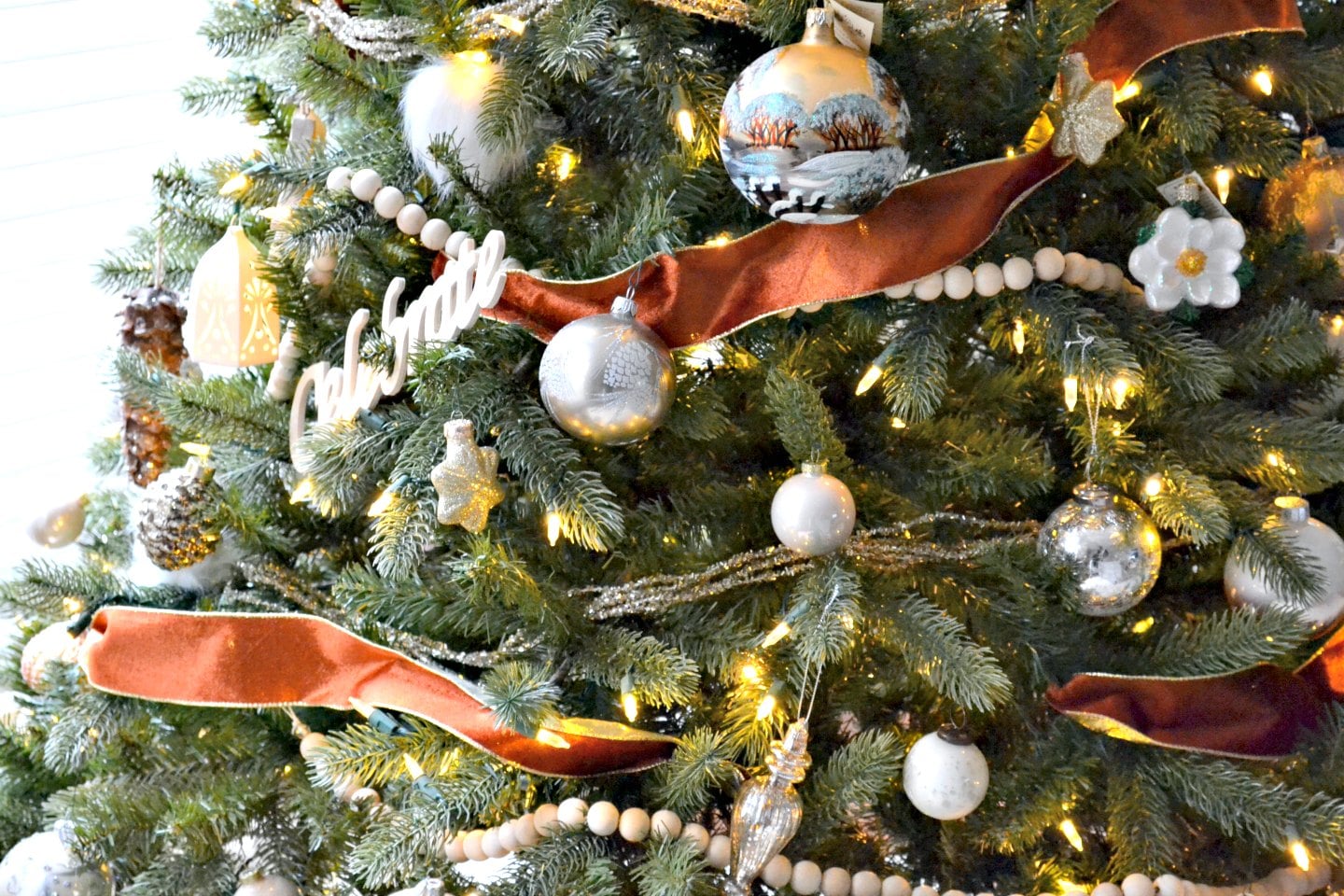
- Cut 4 to 6 ribbon lengths, each about 3 yards
- Weave each one through the branches rather than draping it over the surface
- Anchor with floral wire every 12 inches so nothing sags by week two
- Add the wooden bead garland after the ribbon, following the same path
- Finish with golden glitter stars at the tips and pinecones in the gaps
Plan on 90 minutes and about $60 in materials.
Rust orange next to frosted green is a low-saturation complementary pairing, which is exactly why it feels warm instead of loud. The mercury glass picks up the frost, the bead garland echoes the wood tones of the pinecones, and everything stays inside one tonal band. Compare with Idea #13 — same rust-and-silver instinct, but that one leans into the stone fireplace while this one leans into the frost.
Frosting and glitter stars both shed, and mercury glass tarnishes if you wipe it with anything damp — dry dust only. Velvet ribbon creases permanently if you store it folded, so roll it around a cardboard tube instead. The bead garland is the low-maintenance hero: it can be wiped, stored flat, and reused for a decade. If upkeep is your dealbreaker, keep the beads and skip the frost.
23. Muted Gold and Matte White on Heavily Flocked Branches
Heavy flocking is the least forgiving tree finish you can buy. It shows handprints, it dims your warm lights because the frost reflects some of the glow back, and it makes a 7.5-foot tree look genuinely enormous. In a room under 10 by 12, a heavily flocked tree will dominate everything in it, including the sofa you’re sitting on. It also needs a heavier stand — flocked branches add real weight to the frame.
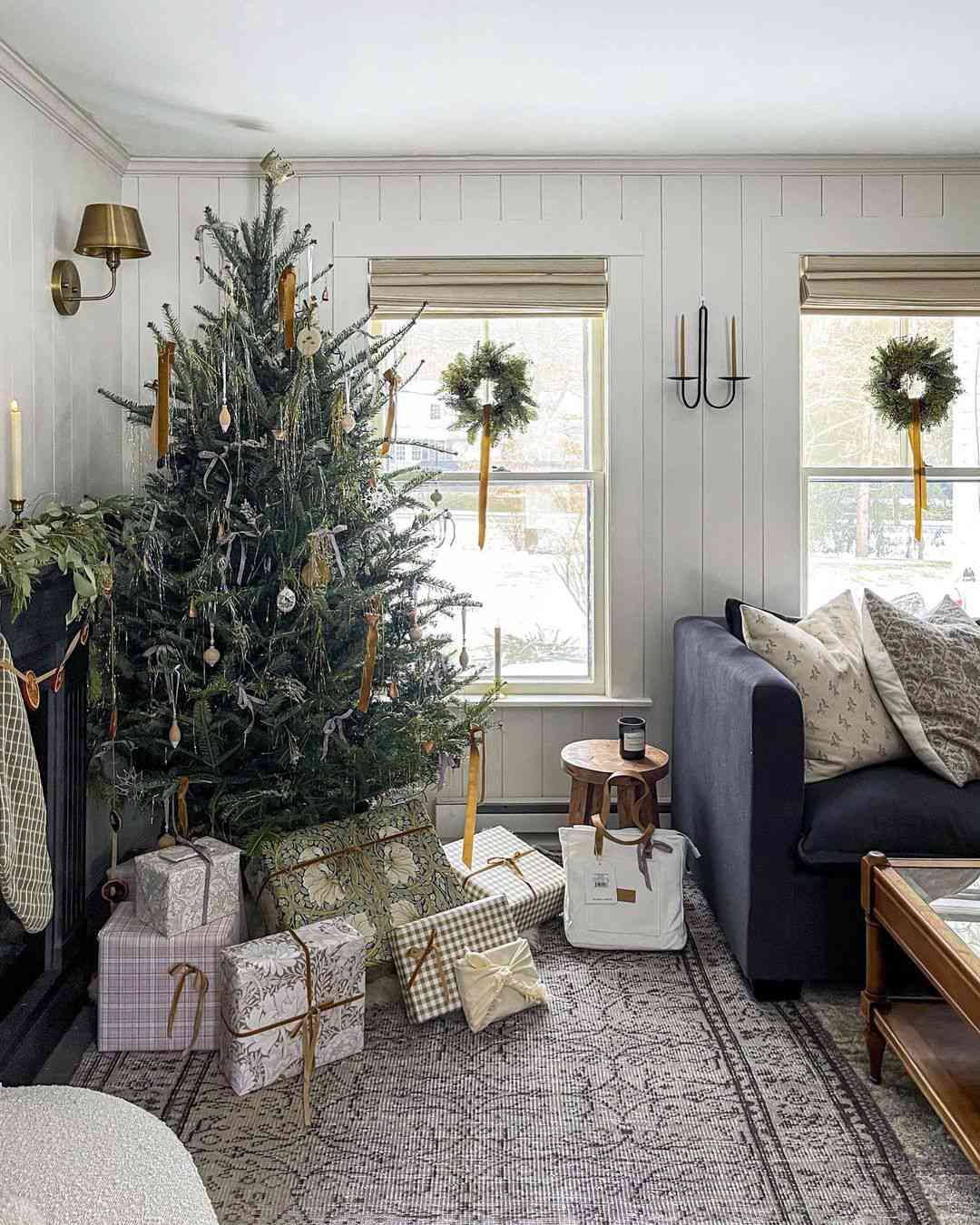
Flocked trees have gone from attic-stored afterthought to mainstream over the last four seasons, helped along by the Nordic-winter aesthetic and a broader move toward white-and-wood interiors. In 2026 they’re the default choice for anyone whose walls are already warm white. Staying power: high. Snow-flocked trees never fully go out, though expect the pendulum to swing back toward plain green by around 2028.
24. Dark Grey Ribbon and Little Wooden Houses in the Branches
Grey ribbon reads as an accent, not a statement, which makes this a great fit for mid-size rooms — 150 to 250 square feet with 9-foot ceilings. A 7-foot tree is plenty here. Pushing to 9 feet would overwhelm both the white paneling and the brick surround. Leave 24 inches of clearance from the fireplace opening, and use a real fire screen if that hearth is functional. Under an 8-foot ceiling, drop to 6.5 feet and skip the ribbon tails.
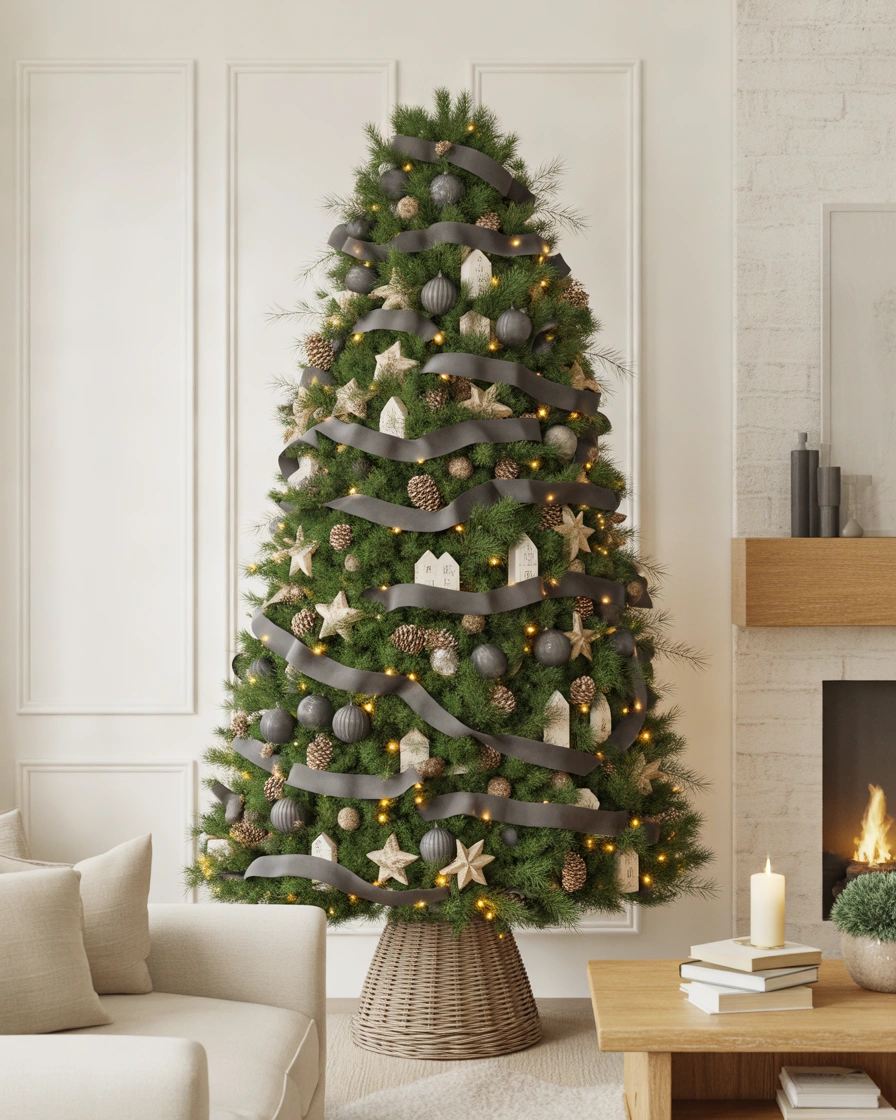
The little wooden houses and stars. They’re the only ornaments here that aren’t round, and they give the tree narrative — a grey-and-pinecone tree is pretty, but a tree with tiny houses tucked into the branches is a story. Because they’re unfinished light wood, they also visually link the tree to the white brick fireplace and the wood mantel behind it.
Wicker collars are sturdy but collect dust deep in the weave — vacuum with a brush attachment, never a wet cloth. Unfinished wood ornaments dry out and can crack in a heated room, so a light coat of mineral oil every other year keeps them from splitting. Grey ribbon shows no stains at all, which is one of its genuinely underrated advantages if you have kids or a cat.
25. Deep Red Velvet Ribbon Trimmed in Gold
Gold-trimmed ribbon is directional — it only looks good when the trim faces outward. Run your ribbon trunk-first and work outward, turning the ribbon between your fingers as you go so the gold edge always faces the room. Also: place velvet ribbon closer to the trunk than your ornaments. Velvet absorbs light, so anything behind it simply disappears. Ribbon in, sparkle out. That’s the order of operations.
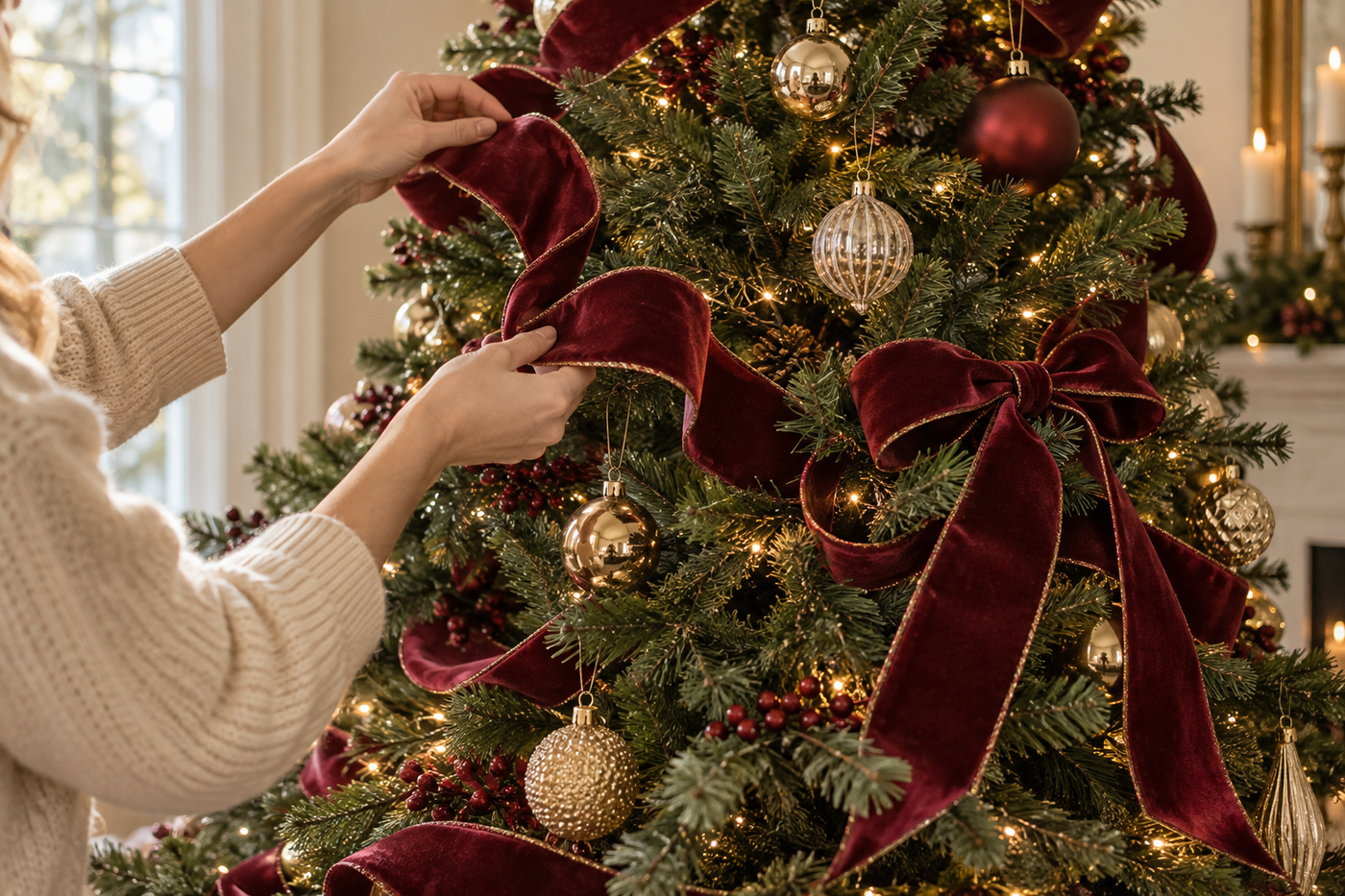
Fifty-five percent green foliage, 25% gold in both metallic and textured formats, 15% deep red, and 5% warm white glow. Deep red at 15% is the upper limit before a tree stops being neutral and starts being traditional Christmas. Swap the red for deep plum and it goes jewel-toned. Swap gold for aged brass and the whole tree cools by about five years.
26. Rusty Red Ribbon Beside a Stone Fireplace
Breaking down this fireplace-and-tree pairing:
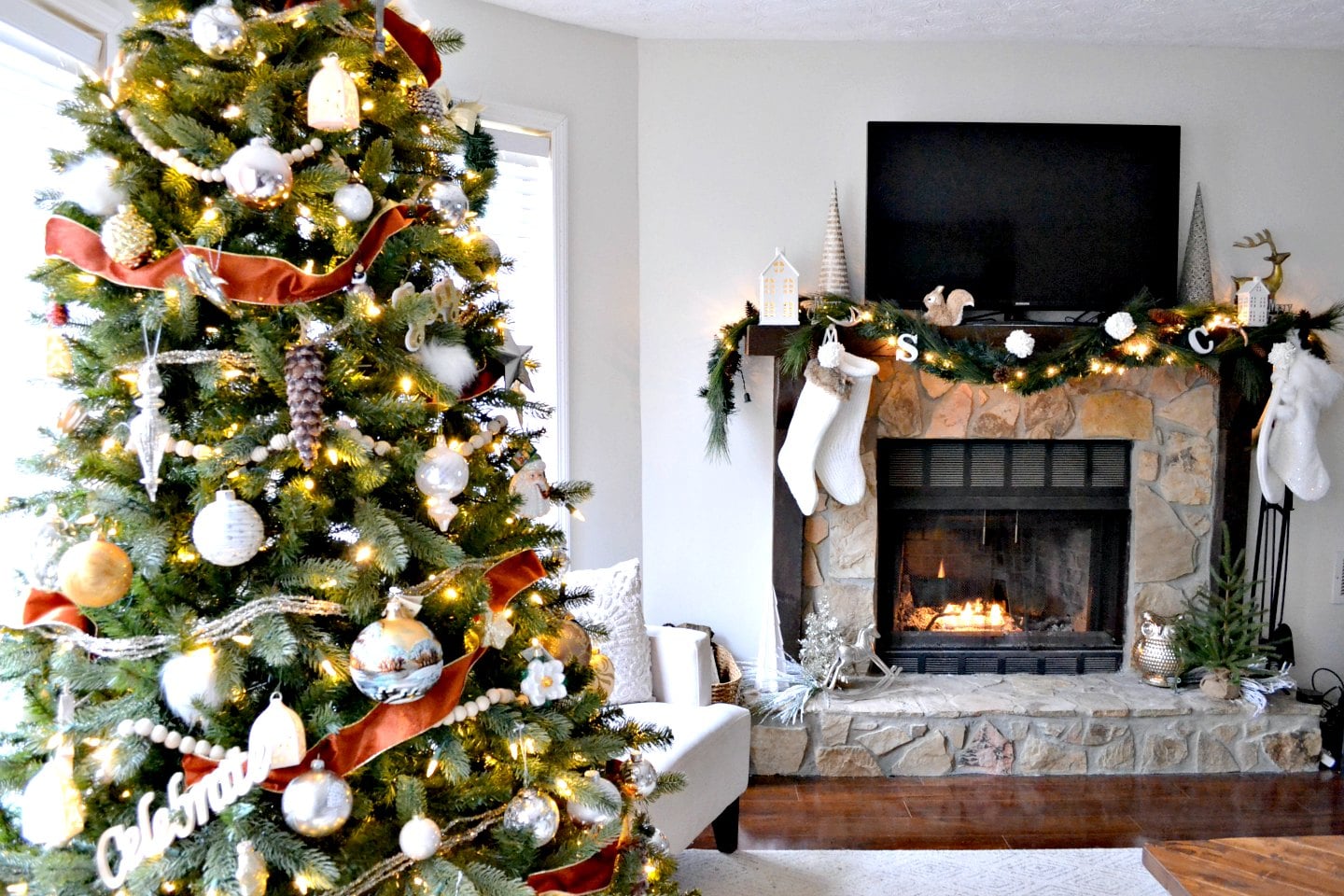
- 7.5 ft artificial tree: $150–$450
- Silver, gold, and white ornaments, 100+: $80–$220
- Wide rusty red velvet ribbon, 4 yards: $45–$110
- Lighted green garland, 9 ft: $40–$90
- White knit stockings, set of 2: $35–$80
- Small white and metallic figurines: $30–$75
Total: roughly $380 to $1,025.
Budget alternative: an unlit garland with a $12 strand of warm whites, thrifted ornaments at 50 cents each, and a $15 clearance stocking set gets you close for around $200.
Stone is a busy texture, and the tree answers it with restraint — no glitter, no flocking, no tinsel. The rusty red ribbon is the single warm note in a cool grey-and-white room, and because it appears only once it reads as deliberate. The white knit stockings soften the stone’s hard edges. Three materials, one temperature: cozy.
Two things to verify before committing. Real stone fireplaces get cold and stay cold — if you’re running a fire, keep ribbon and garland at least 24 inches from the opening, no exceptions. And garland with lights needs an outlet; stone walls hate concealing cords. Run a flat extension cord along the hearth behind the stockings and cover the plug with a cord cover that matches the stone tone.
27. Striped Ribbon and a Hammered Gold Tree Collar
That hammered gold collar. It’s the piece that makes a fairly conventional green-and-gold tree feel modern, because the texture is rough rather than polished — a matte, beaten surface instead of a shiny ring. Remove it and you have a nice tree. Keep it and the tree becomes part of the room’s architecture. Same lesson as Idea #20: texture is the cheapest way to look expensive.
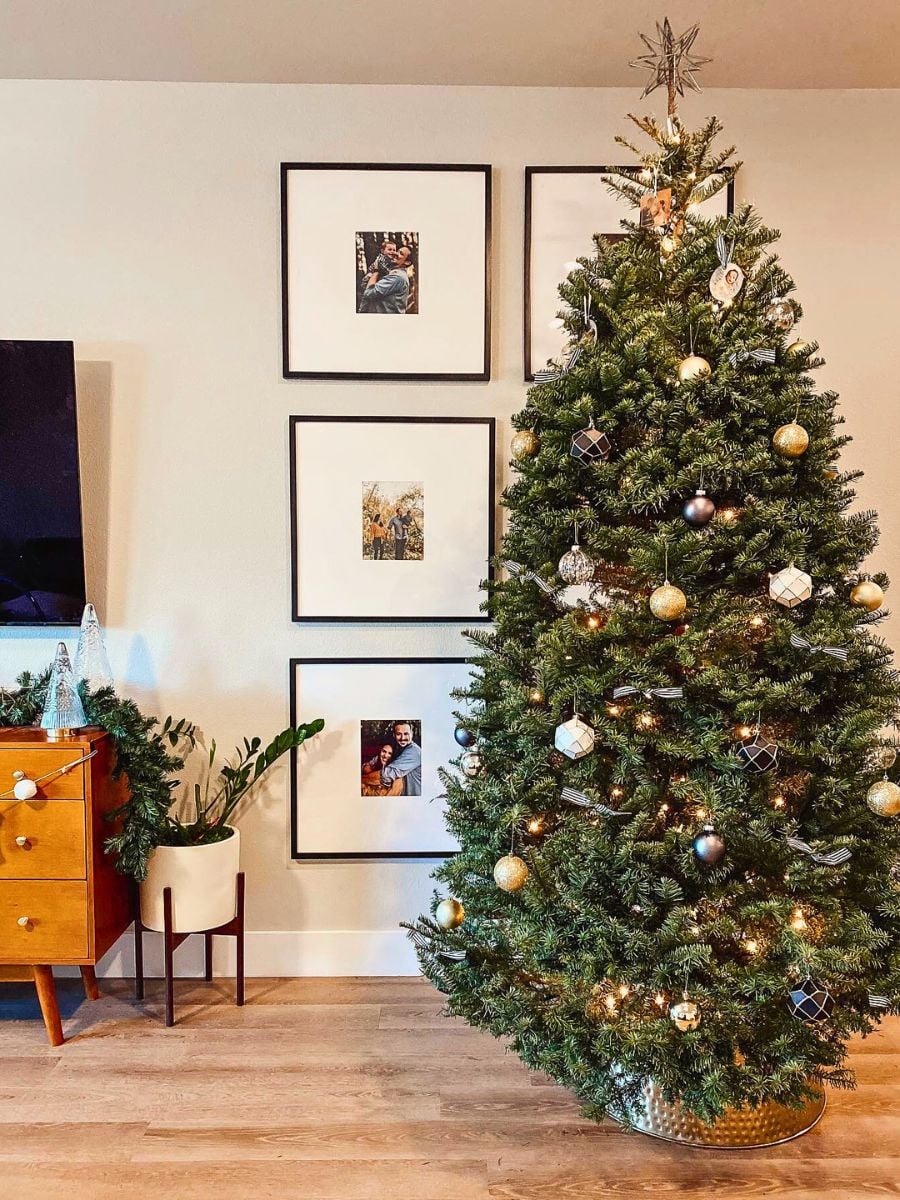
Hammered metal collars run $60 to $150. A plain galvanized or gold-painted metal planter flipped upside down costs about $18 at Home Depot and gives you the exact silhouette for a fraction. Black-and-white striped ribbon is $6 to $12 a roll at Michaels. Thrifted gold and silver ornaments mixed with a $10 bag of white baubles from Walmart fill a 7-foot tree for under $140.
28. Glossy Red Baubles and Sheer Gold Bows
Making conventional red-and-gold feel edited:
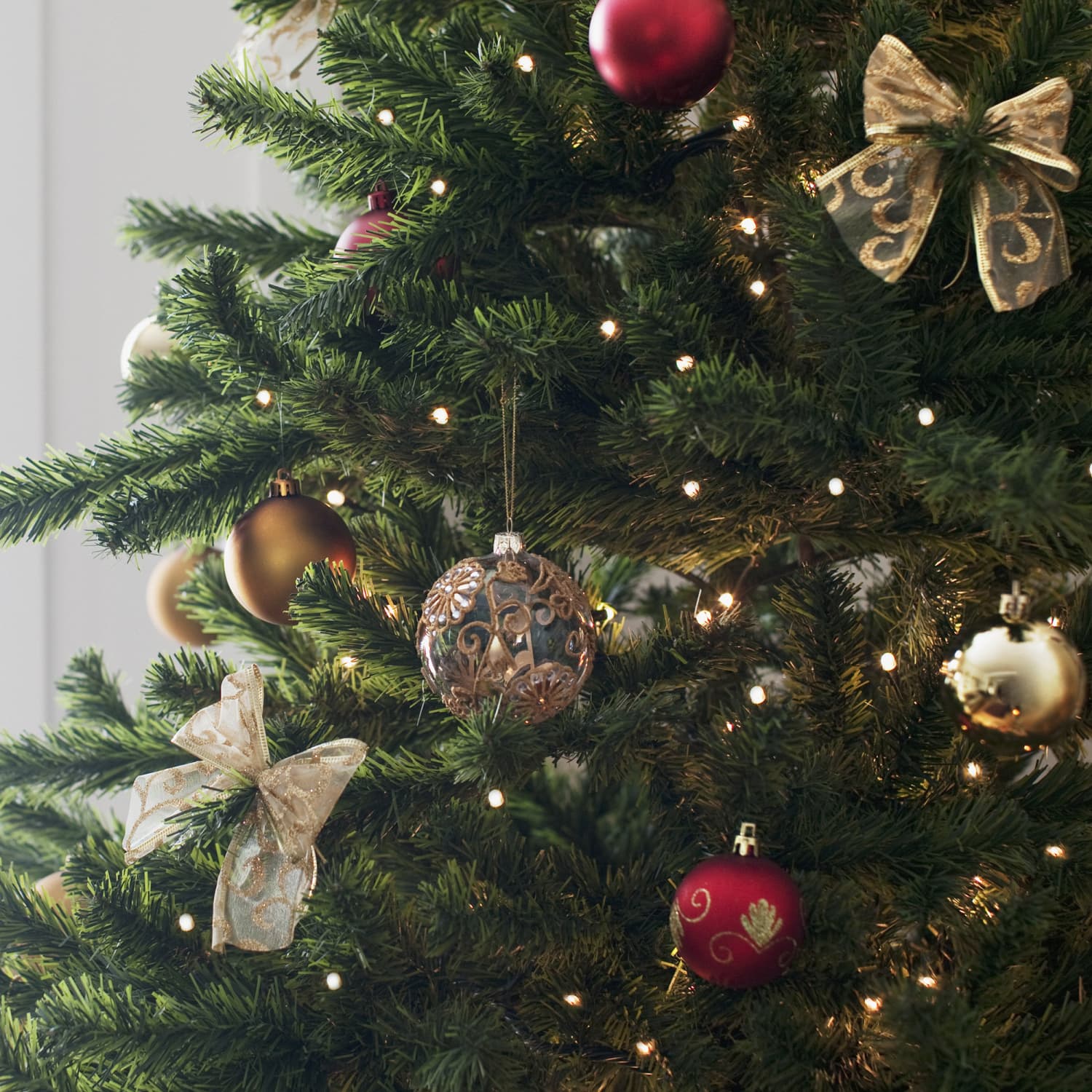
- Use one red — glossy and saturated, no burgundy mixed in
- Add matte gold for about 60% of the count so the gloss has something to sit against
- Place two or three ornate handled baubles near eye level as focal stars
- Tuck sheer gold bows into open gaps, never on top of baubles
- Stop adding ornaments while you can still see branch gaps
Roughly an hour, and about $90 in ornaments for a 7-foot tree.
Red and gold carries a lot of visual weight, so it suits rooms with generous proportions — 250 square feet or more, with ceilings at 9 feet and above. On a 6.5-foot tree it can read heavy; on a 9-foot tree it reads classic. Keep about 20 percent of the branches bare so the eye has somewhere to land. Tighter spaces genuinely do better with lower-contrast palettes.
Sheer gold bows look expensive and cost almost nothing — a spool of sheer glitter ribbon is $5 at Dollar Tree and makes 15 bows. Glossy red baubles are the most discounted ornament color every January, so buy next year’s tree decor this winter at 70% off. Matte gold sets are cheapest at At Home and Big Lots. Realistic total for a full 7-foot red-and-gold tree: $75 to $110.
29. A Layered Brown-and-Blue Bow With Aged Brass Bells
Sixty percent evergreen, 25% brown satin, 10% muted blue velvet, 5% aged brass. The brass bells are the only metallic element, and they’re deliberately not shiny — antique finishes age a wreath instead of decorating it. Swap the blue velvet for forest green and the wreath turns traditional. Swap the brown satin for burlap and it goes farmhouse. The proportions stay identical in every version.
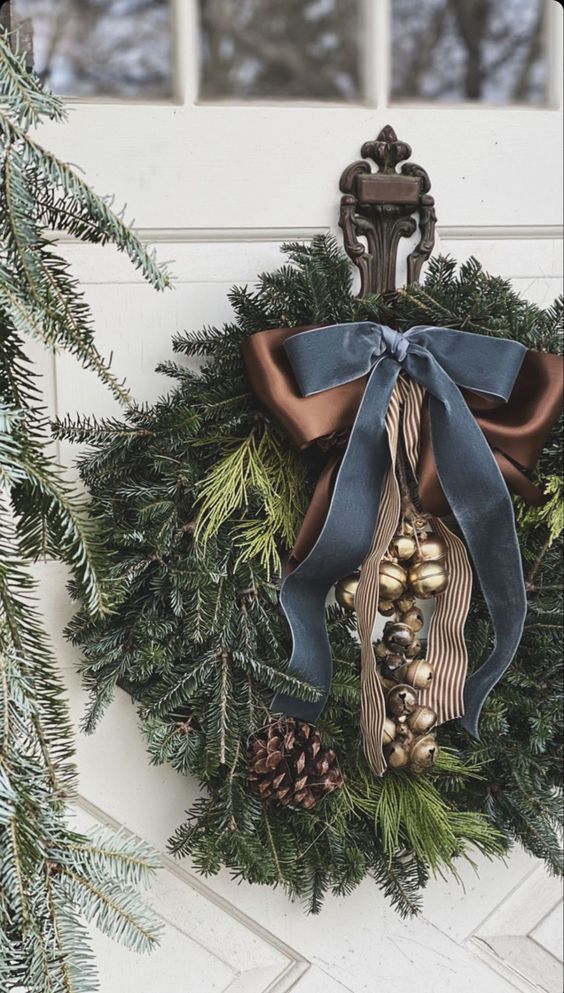
Layered ribbon bows have replaced plain bows on wreaths and garlands over the past two seasons, driven by the broader shift toward collected holiday decor. One ribbon looks bought; two look styled. Aged brass and muted blue are part of the warm-minimalist palette that’s been building since 2024 and is fully mainstream in 2026. This one has real staying power because it’s a technique, not a trend.
30. A Slender Tree Topped With a Golden Reindeer
- Measure your corner or alcove width — slender trees need under 30 inches of floor space
- Confirm the tree has a narrow base collar; a wide stand defeats the whole point
- Check that your topper weighs under 1 pound, or a slender tree will lean
- Plan for 6 to 6.5 feet of height in rooms with 8-foot ceilings
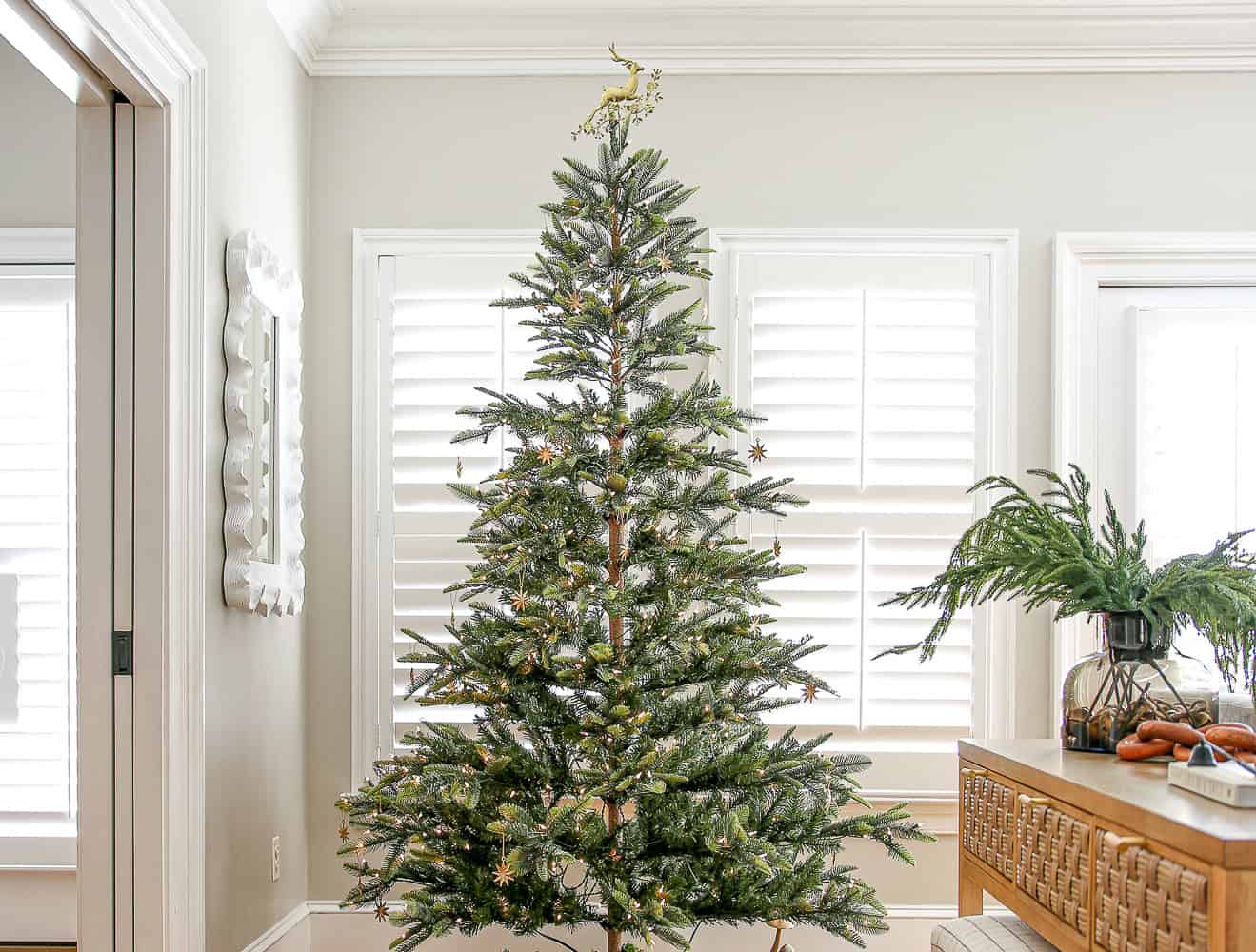
The golden reindeer topper. Most neutral trees top out with a star or a bow, and a reindeer immediately changes the mood from generic holiday to someone actually chose this. It also reinforces the tree’s small gold star ornaments, so the whole thing follows one motif from base to tip. Take it away and you have a nice slim tree. Leave it and you have a signature.
Restraint plus placement. There are only two materials here — gold and green — and every ornament is small, which makes a slender tree look fuller than it actually is. The white plantation shutters give a clean, high-contrast backdrop, and the light wood console echoes the tree’s warmth. Proof that a small tree in a small corner doesn’t need to compensate by being busy.
31. A Wooden A-Frame Tree With Garland Spiraling Upward
This is a build, not a purchase — and that’s the point. Four 2×2 pine boards and a handful of screws cost about $25 at Home Depot. A 25-foot boxwood or fir garland runs $30 to $60. A strand of multi-colored lights is $12. Wrap gifts in brown kraft paper at $8 a roll or use paper you already own. Total: under $100 for a tree nobody else on your street has.
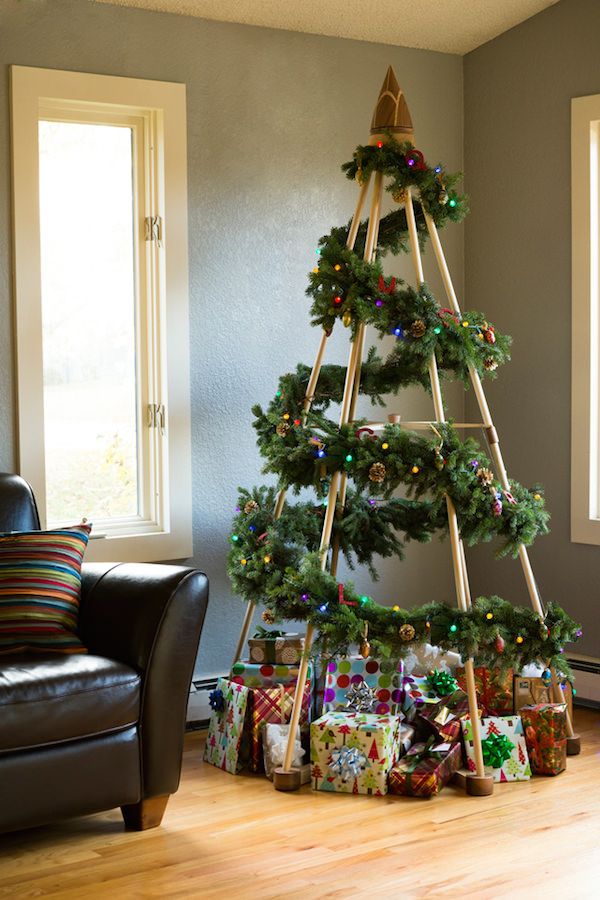
Be realistic about what an A-frame tree is: it’s a display, not a tree. It can’t hold heavy ornaments, the garland has to be re-wrapped every year, and it takes up more floor space than it looks like it will because the base is a triangle. It’s also not stable with a climbing toddler in the house. And if your home leans traditional, a wooden frame tree will read as a craft project rather than decor.
32. Flocked White Branches Against a Black Fireplace
When you place a white tree against a black fireplace, you get maximum contrast — and that means every gap shows. Fill this tree more densely than you would a green one: aim for 12 to 15 ornaments per vertical foot rather than the usual 8 to 10. It also helps to mirror the fireplace’s black in one or two ornaments, so the tree and the architecture share a color instead of fighting.
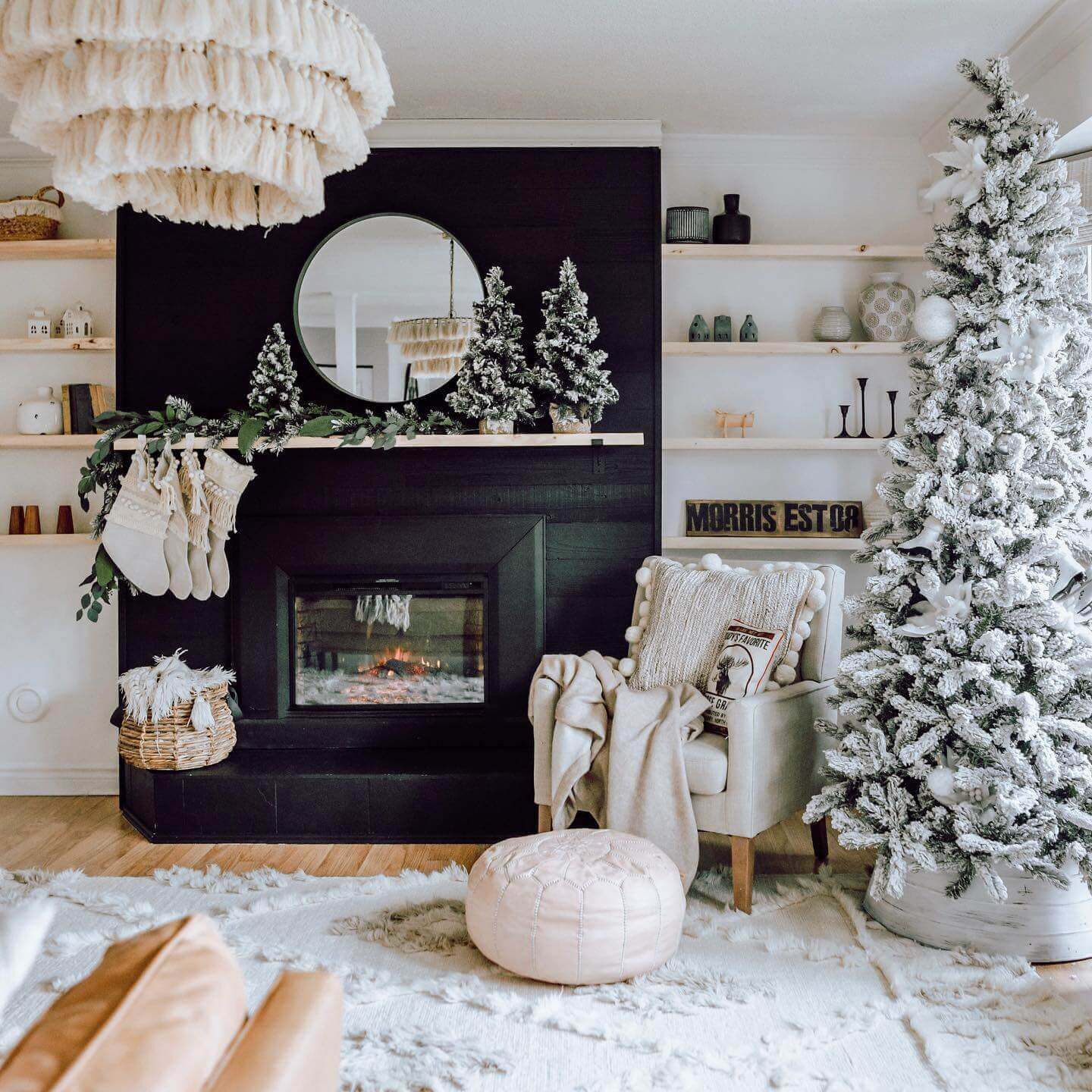
Flocked trees plus a black surround equals visible dust. Both surfaces show everything. Budget one full vacuum and a dry microfiber pass every week through December. The off-white shag rug under this setup needs a weekly rake to keep its pile from matting in the traffic path. The blush leather pouf is the easy win — leather wipes clean in seconds and hides what the rug can’t.
This is a large-room composition. The layered fringe chandelier, the floating shelves, and the generously sized rug all point to at least 300 square feet and 10-foot ceilings, where a 7.5 to 9-foot flocked tree is proportionate. In a smaller space the contrast overwhelms: a white tree beside a black fireplace in a 120-square-foot room reads as a hole in the wall rather than a focal point.
33. Gold Satin, Sage Velvet, and Blush Baubles
Fifty percent green, 25% gold and champagne, 15% blush and rose gold, 10% sage. This is the softest palette in the roundup and the hardest to balance — sage and blush sit on opposite sides of the color wheel, so they only cooperate when the gold holds them together. Swap sage for cream and it goes wedding-soft. Swap blush for terracotta and it warms up fast. Same structure as Idea #4, just with color doing the heavy lifting instead of texture.
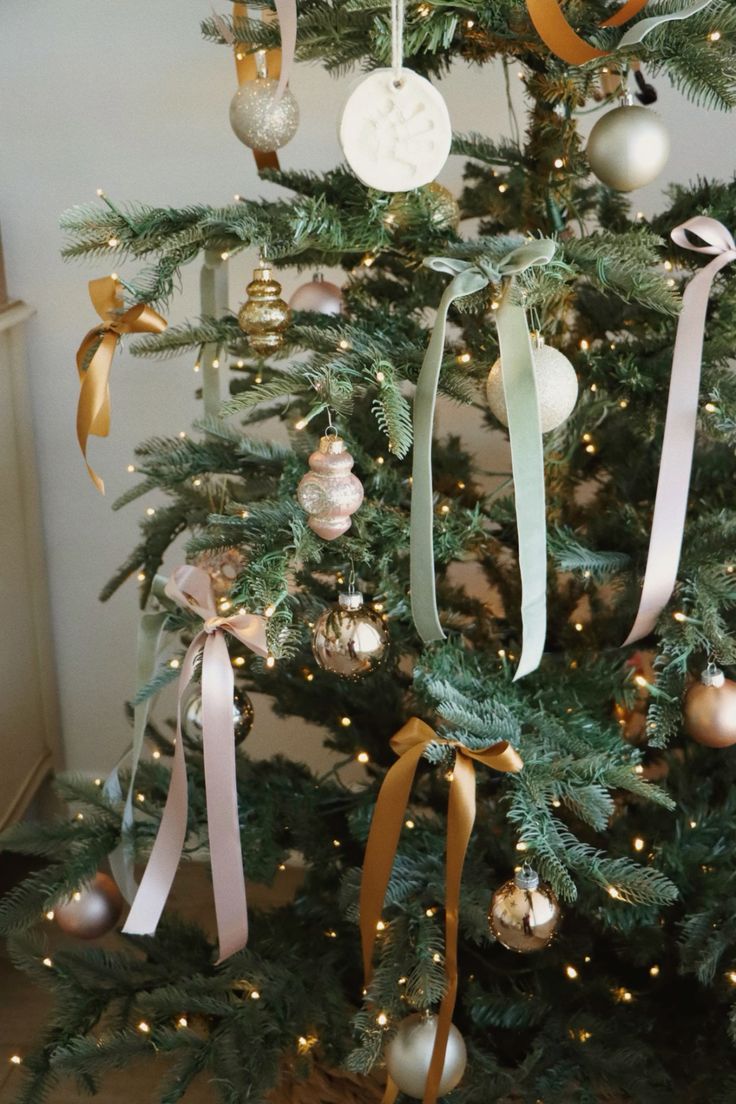
What this soft palette actually costs:
- 7.5 ft green tree: $150–$450
- Gold and rose gold metallic baubles, 70: $70–$190
- Blush shaped ornaments: $25–$60
- Sage velvet ribbon, 3 yards: $30–$70
- Gold satin ribbon, 2 rolls: $14–$30
- White embossed ornaments: $20–$45
Total: roughly $309 to $845.
Budget alternative: Dollar Tree gold and blush baubles at $1.25 each plus thrifted satin ribbon lands the same look near $140.
34. Plaid Ribbons, Burlap Ruffles, and a Vintage Suitcase
Everything here is fabric. Plaid ribbon, patterned ribbon, a ruffled burlap skirt, a plaid suitcase — the tree is dressed, not just decorated. Mixing three patterns works only because they share a palette: red, gold, cream. Change one ribbon to teal and the whole thing tips into chaos. Pattern mixing always needs a color referee.
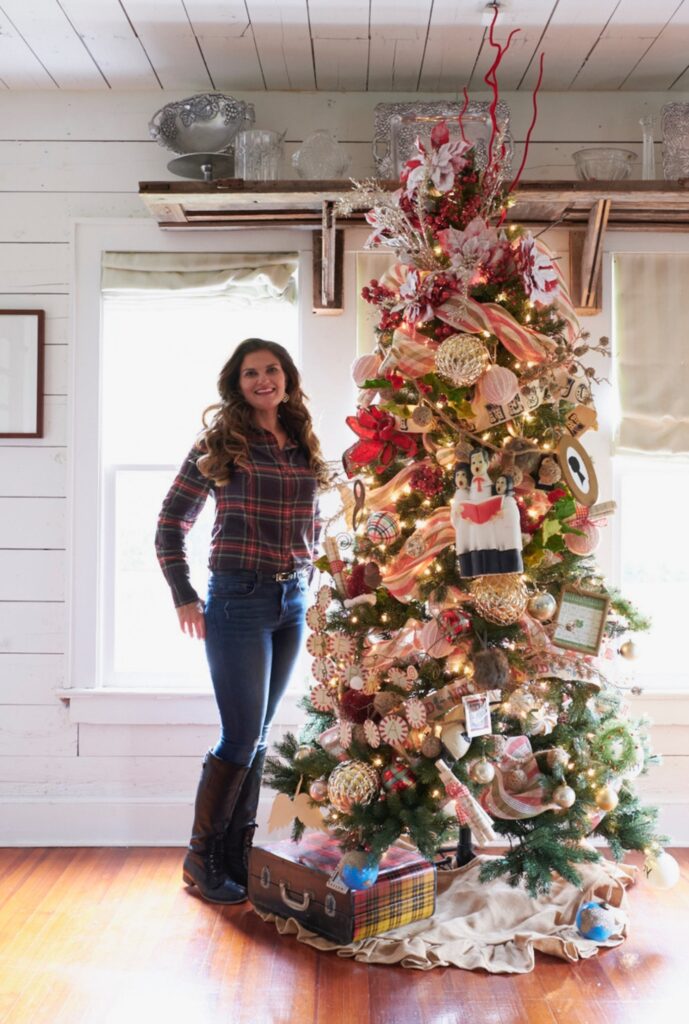
The vintage plaid suitcase at the base. It’s not a tree skirt, it’s not a gift box — it’s an object with a story, and it makes the whole vignette feel like it belongs in a house rather than a catalog. Swap it for another wrapped present and this becomes a generic abundant tree. Put it back and you have a scene.
Maximalist, collected Christmas trees have made a genuine comeback as a counterpoint to the neutral-minimal look dominating Pinterest. In 2026, grandmillennial Christmas and vintage plaid searches are both climbing, and the burlap ruffle skirt is one of the fastest-rising decor categories of the season. This aesthetic isn’t going anywhere — it’s nostalgia, and nostalgia resells every single year.
Now Go Hang the First Bow
The nice thing about a neutral tree is that it forgives you. There’s no wrong shade of cream, no bauble that clashes with champagne, and you can add to it year after year without starting over. Pick one idea above that matches your room, and build it in stages — lights first, then ribbon, then ornaments, then the topper.
📌 Pin your favorite to your holiday board now, and tag us when you finish — we love seeing which one you chose.
