
33 Jaw-Dropping Candyland Christmas Tree Ideas You Need to Try in 2026
You know the feeling — you’ve saved forty candyland tree photos and not one of them looks anything like your living room.
We spent serious time browsing Target, Walmart, Michaels, Etsy, and Amazon to bring you only what’s worth your attention this year, filtering hundreds of options down to 33 ideas that actually hold up in a real home, from $8 candy ornaments to $480 statement trees. Budget and luxury versions are compared side by side, and every idea is shoppable with direct product links.
Inside you’ll find pastel candyland glam, gingerbread nostalgia, pink-and-rose-gold monochrome, and full-on maximalist tinsel — 33 curated looks, each one built from a real decorated tree in a real room.
2026 is the year candyland decor grew up. Pinterest saves for pastel and pink Christmas trees have climbed steadily year over year, and the aesthetic has shifted from novelty-store kitsch to something you’d genuinely leave up through January.
And stay until the end — we break down the most common mistakes that can ruin these looks.
📌 Save this to Pinterest for later — you’ll want to revisit these ideas.
Heads up: this post contains affiliate links. If you buy through them, we may earn a small commission at no extra cost to you.
1. One Pink Glitter Candy Ornament, Zero Chaos
A single candy-shaped glass ornament in glossy pink, ribbed at both ends and glitter-striped through the middle, is doing all the heavy lifting here. The green pine behind it is deliberately plain — no theme explosion, no competing novelty shapes, just warm string lights and needles. Take that one ornament away and you’re left with a perfectly pleasant, completely forgettable tree. The candy isn’t decoration, it’s the entire point.
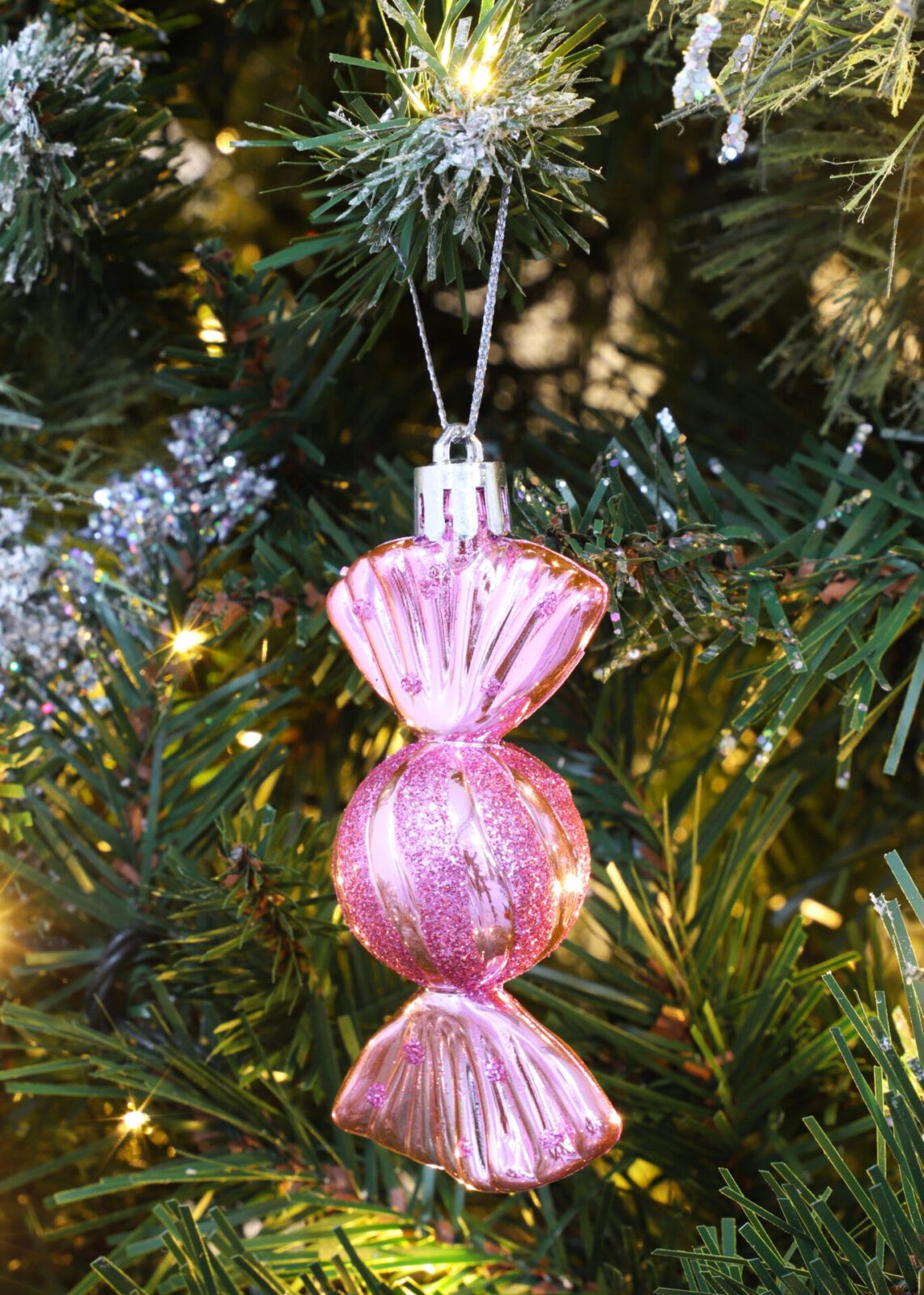
Statement candy ornaments need air around them. Keep 5 to 7 inches between each one along a branch run, and hang them off the branch tip instead of pressing them into the trunk — the silver string should stay visible for at least an inch. Cluster in odd numbers, three or five per cluster, and repeat that cluster along a loose diagonal so the eye travels down the tree rather than stopping dead center.
2. The Tinsel-Drenched Pink and Green Tree
What this specific look runs, retail:
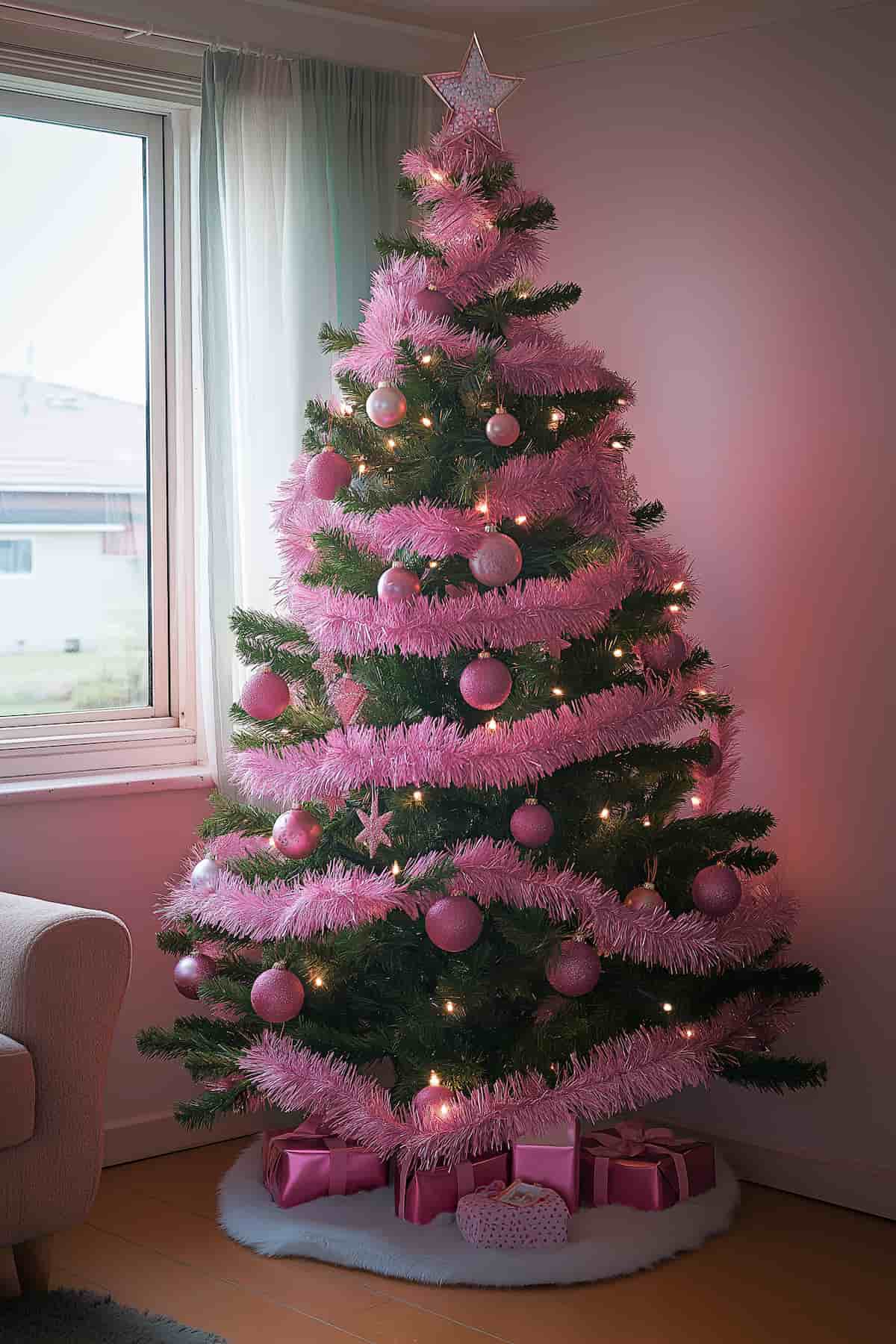
- 7.5 ft green artificial tree: $120–$350
- Thick pink tinsel garland, 2 strands of 30 ft: $18–$45
- 60 pink shatterproof sphere ornaments: $25–$60
- Lighted star treetop: $15–$40
- Fluffy white tree skirt: $20–$50
- 600-count warm LED string lights: $25–$50
- Wrapped pink gift boxes: $15–$35
Total: $238–$630
Budget alternative: dollar-store tinsel and spheres, a skirt you already own, and a tree from Facebook Marketplace gets you 40 to 60% off — roughly $90–$150 for the same tinsel-drunk silhouette.
Two things are working here. Repetition: that exact pink shows up in the tinsel, the ornaments, and the gift wrap, so the tree reads as one confident gesture instead of a pile of separate purchases. Then value contrast — saturated bubblegum against deep green sits close to complementary on the color wheel, which is why it glows even in a dim corner. Swap pink for tangerine or aqua and the formula holds.
3. Flocked Tree, Pink Spheres, and One Pale Blue Pillow
The math is roughly 55% white and cream (flocked needles, neutral sofa, gift wrap), 35% pink in two temperatures — soft blush on the larger spheres, metallic rose gold on the smaller ones — and 10% pale blue borrowed from the patterned sofa pillows. That 10% is the quiet hero. It’s what keeps a pink-and-white tree from looking like it wandered in from another house. Swap the blue for sage or warm grey and the formula still works.
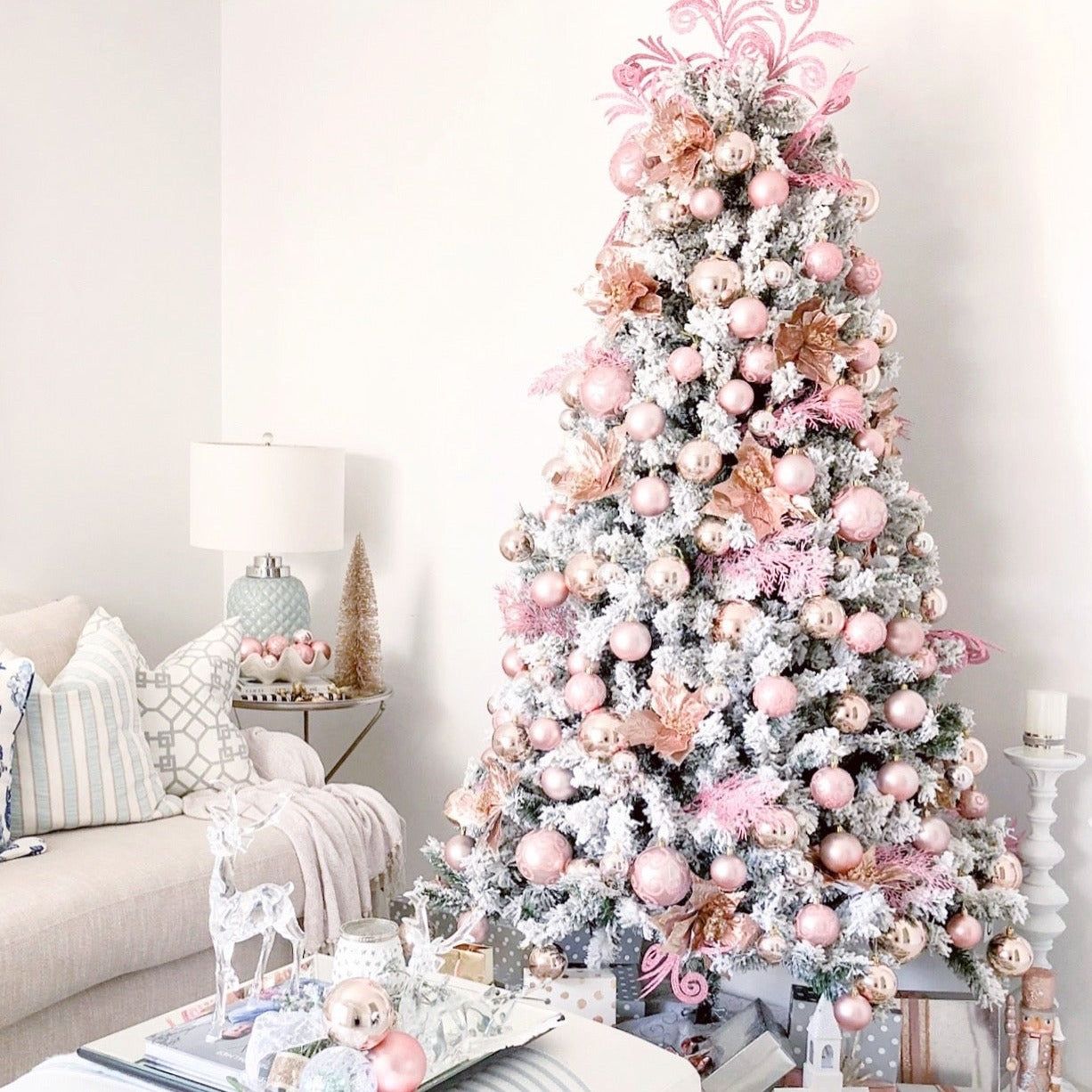
Flocked trees shed. Every time you move it, decorate it, or walk past too fast, you’ll find white dust on the floor — budget for a vacuum with a brush attachment, and expect the flocking to thin out after three or four seasons. Flocking is also flammable and traps heat, so keep the tree at least two feet from a space heater or radiator, and never store it in a hot attic.
4. Purple Swirl Lollipops on a Snowy Tree
Purple is the quiet rebel of the candy palette. Pink and red rule holiday decor because they photograph warm, but purple keeps surfacing in 2026 collections as the shade that makes pink look deliberate instead of default. It also reads slightly vintage — closer to a 1950s dime-store window display than a modern boutique. Crowd-pleasing it isn’t, which is exactly why it feels personal.
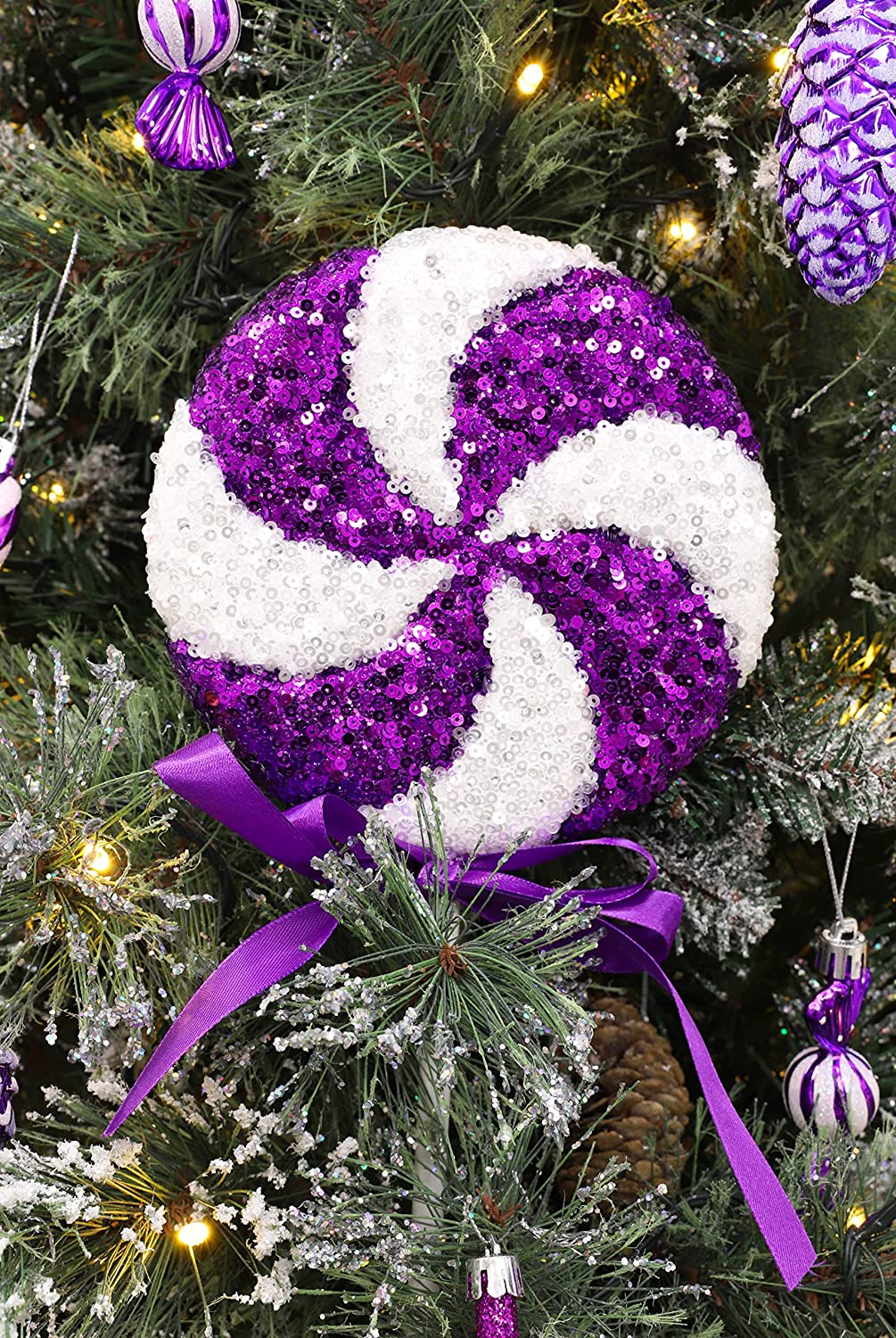
Sequined ornaments eat light. If you’re hanging swirl lollipops on a flocked tree, place them in the top third where the string lights sit closest to the surface — sequins reflect at a specific angle and go completely flat when buried mid-tree. Space them about 8 inches apart so each catches its own pool of light, and skip the purple satin bow directly beneath them. Two shiny things stacked vertically just cancel each other out.
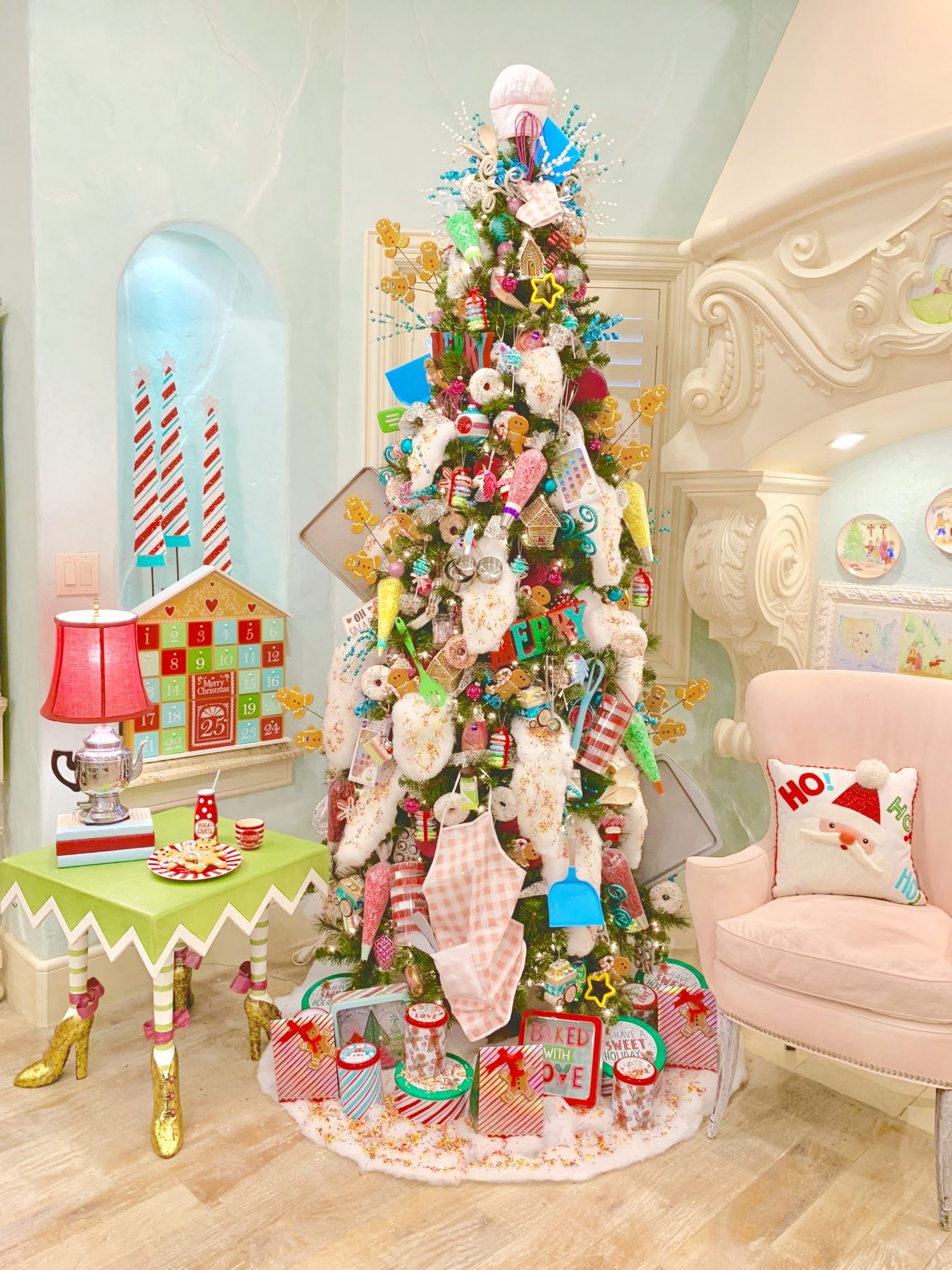
5. The Baker’s Tree With Frosting Garlands and Elf Shoes
Want the frosting-drip garland without paying $80 for one:
- Cut a 6 ft length of 1-inch twisted cotton cord or smooth white rope.
- Thin white craft glue with a few drops of water and brush it along the rope to stiffen it.
- While wet, press small clear acrylic beads into the surface in irregular drips — uneven spacing reads more like real icing.
- Dust with fine white glitter and let it dry flat for two hours.
- Wire the finished rope to branch tips in a gentle swag, not a tight spiral.
About 40 minutes and $12 in supplies for three feet of garland.
The theme is the expensive part, not the tree. Grab a plain 6 ft tree from Walmart for around $40, then build the personality from the baking aisle and a craft store: mini rolling pins, wooden spoons, and cookie cutters run $1–$3 each, and a twelve-pack of gingerbread men is about $8. Thrift stores are goldmines for vintage pastry decor in November. Realistic total: $75–$120.
6. Giant Cupcakes and Donuts on a Pastel Tree
Oversized candy ornaments need a tree that can carry them — 7.5 feet minimum, and honestly 9 feet is where this starts to feel intentional rather than cluttered. Each cupcake or donut runs 5 to 7 inches across, so plan on 15 to 22 pieces for a full-size tree. Ceiling height matters too: leave 12 inches of clearance above the treetop ornament so the tallest cupcake has breathing room. Working with an 8-foot ceiling? Scale down to 3 to 4 inch ornaments and read Idea #12 instead.
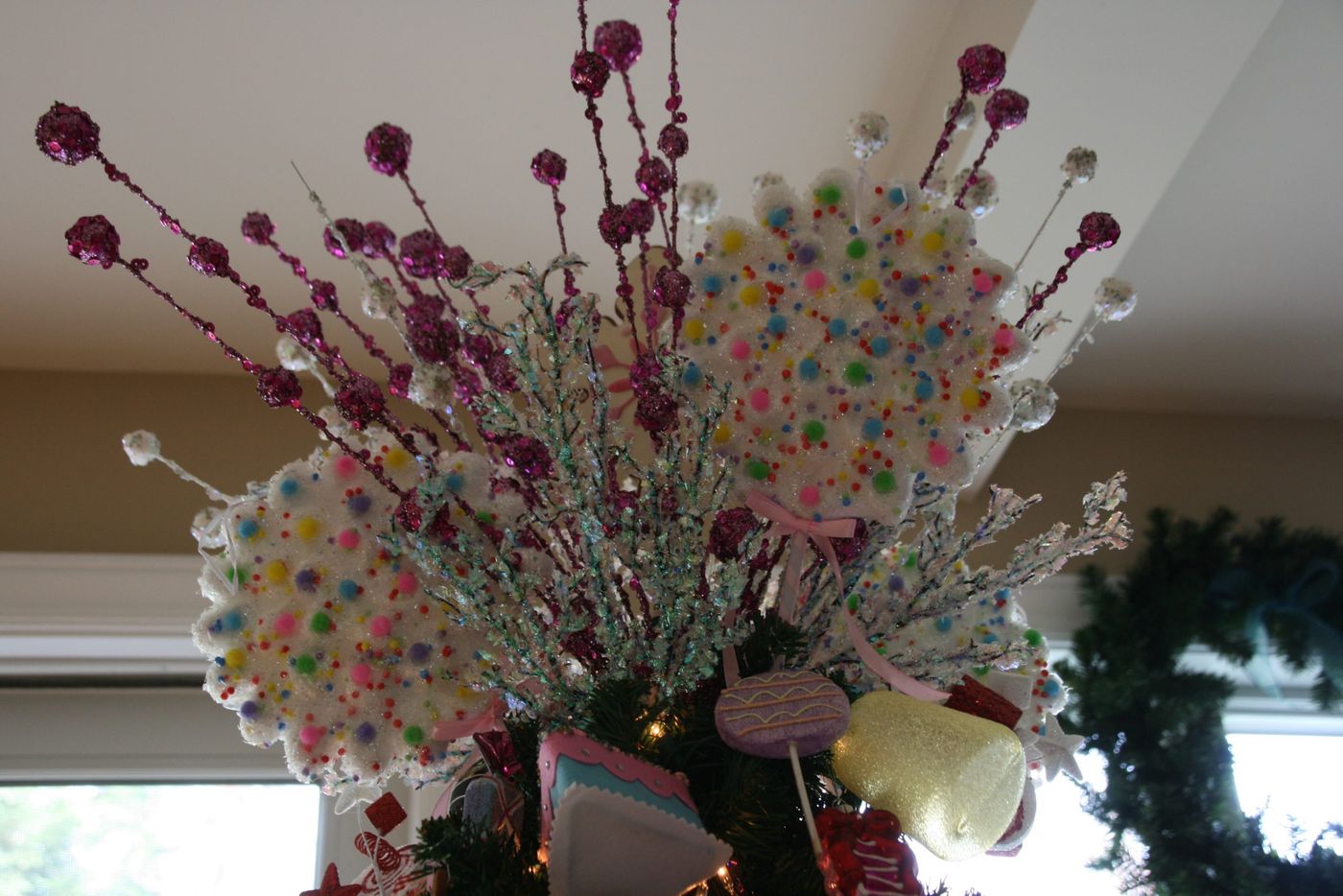
Scale contrast is doing all the work. A real cupcake is three inches wide; these are seven. Blowing a familiar object up to absurd size is the oldest trick in whimsical design, and it lands because your brain recognizes the shape before it registers the size. The second principle is restraint in color — four pastel tones maximum, repeated across cupcakes, donuts, and ribbon. Add a fifth and the sugar rush turns into visual noise.
7. Peppermint Lollipops With Champagne Feather Picks
The lollipops are the headline, but the champagne-colored floral picks are what make this tree look expensive. Those soft, feathery neutrals break up the red-and-white pattern so your eye gets a rest between candy swirls and metallic globes. Pull them out and you’re left with a candy cane explosion — fun, but flat. The neutrals are the line item nobody plans for and everybody notices.
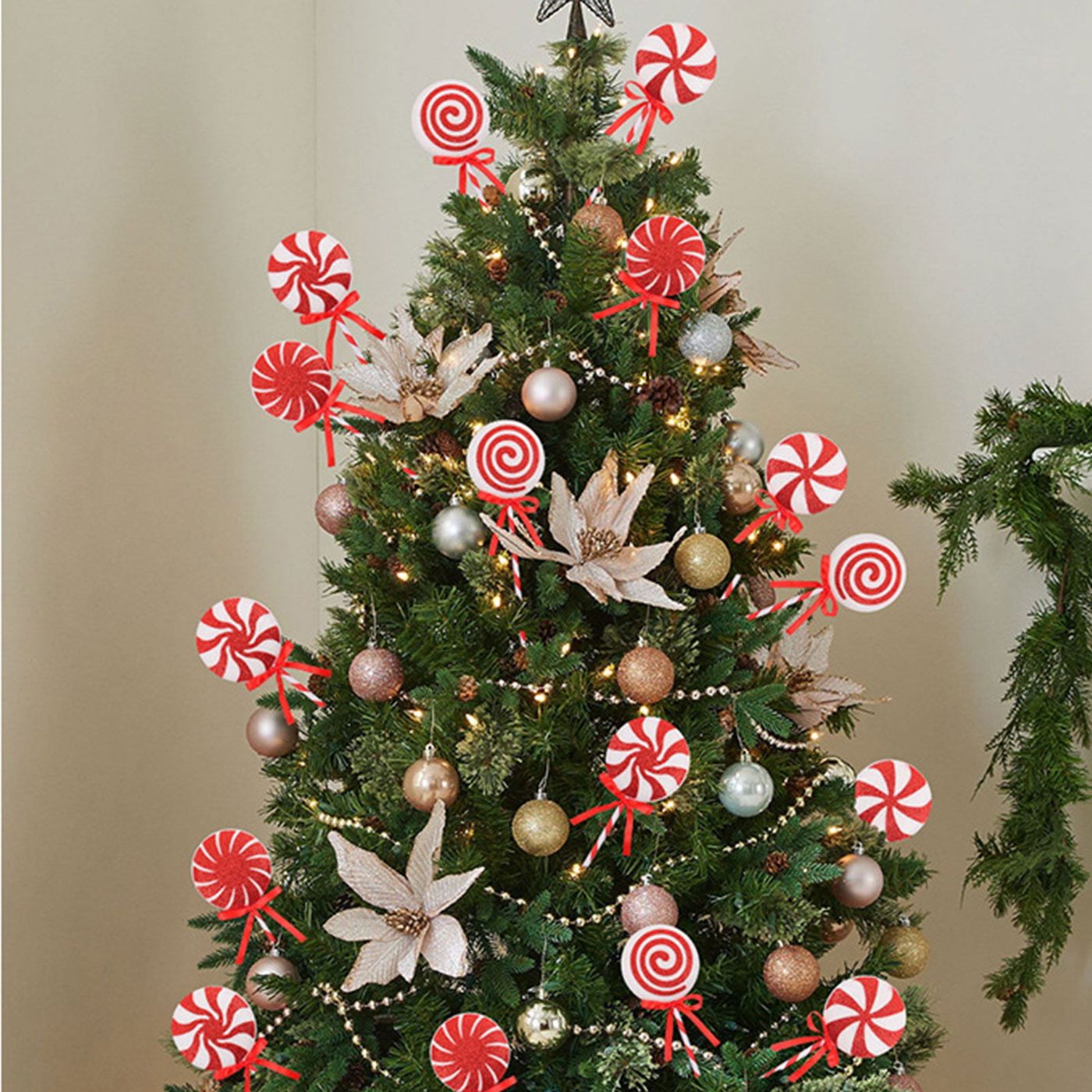
Metallic globe ornaments are the divas of the ornament bin. Gold and silver finishes oxidize and go cloudy after a few seasons, especially in humid climates or a damp basement. Wipe them with a dry microfiber cloth — never water — and store them in acid-free tissue rather than newspaper, which transfers ink. Floral picks shed feathers over time. Expect to replace the champagne stems every two to three years, about $20 a pop.
8. The Slanted Lime Green Whimsy Tree
The color math here is deliberately loud: about 40% lime green tree, 30% oversized baubles split between hot red and bubblegum pink, 20% white polka-dot ribbon, and 10% sky blue as the surprise note. No neutrals anywhere. This is a maximalist formula, and the polka dots are what keep it from turning chaotic — a repeated pattern behaves like a neutral inside a busy composition. Swap the blue for orange if you want a warmer, more retro read.
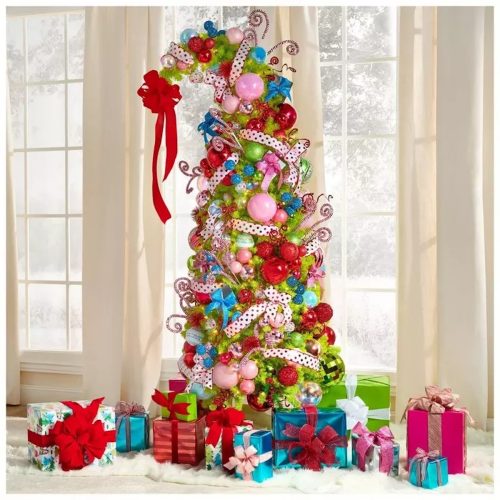
That slanted top is structural, not a styling choice — these trees are built on a curved center pole, so you can’t fix the lean with a topper. Lean in instead: weight the heavy baubles toward the low side of the curve so the tilt looks intentional, and skip the traditional star. A curly twig spray or jester-style hat picks up right at the bend. Keep total ornament weight under 15 lbs so the pole doesn’t bow further.
9. A Sweet Shop Tree You Build Before You Buy
Run through this before you spend a dollar:
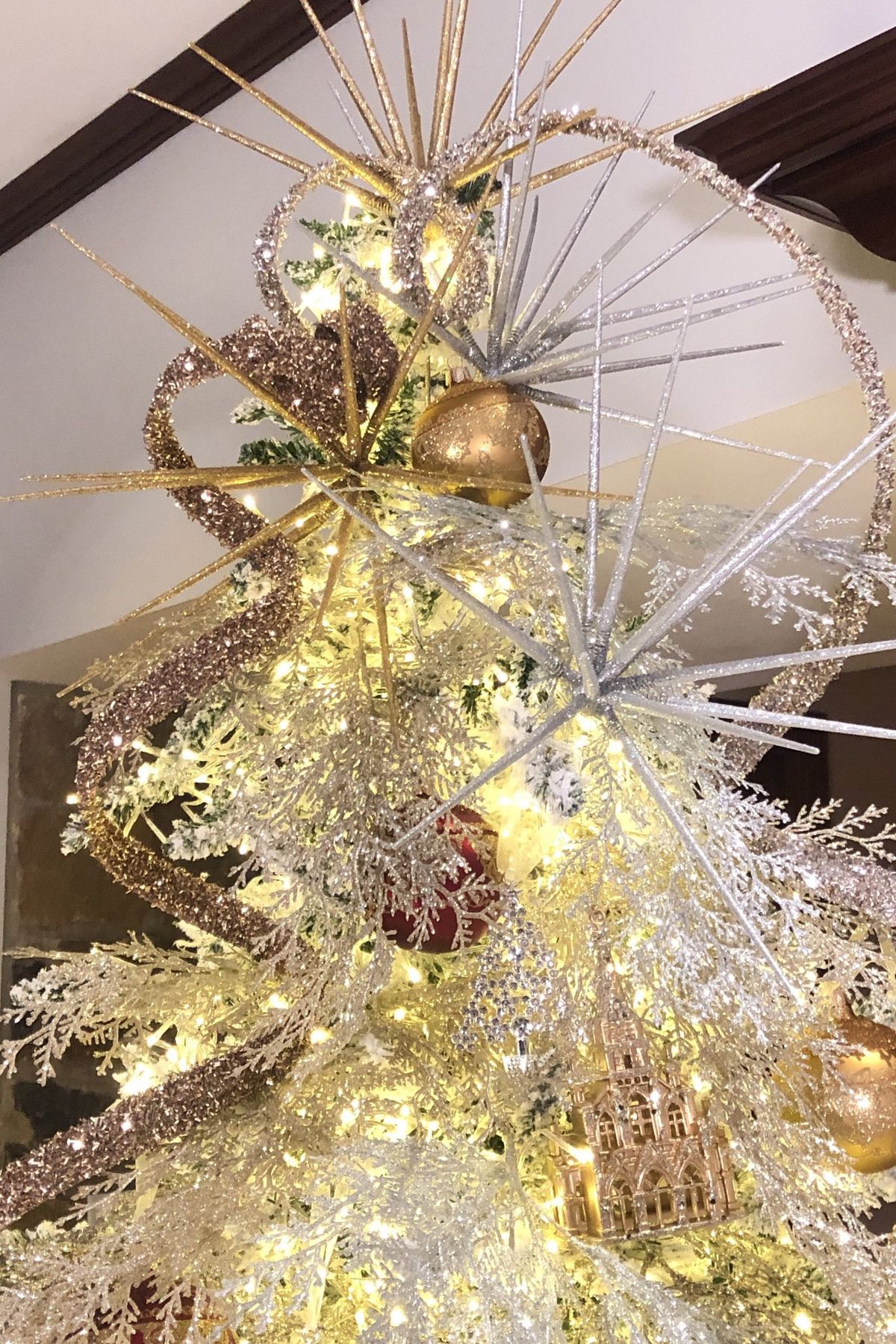
- Measure your tree’s widest span — a sweet-shop theme needs 18 inches of clearance from any wall or furniture or the candy looks crammed.
- Count your outlets. Candy trees want continuous light, and that’s usually two extension cords, not one.
- Decide on ONE candy color family — all pink, all pastel, all red-and-white — before the first ornament comes home.
- Check your hooks. Glass candy shapes need wire hooks, not flimsy plastic loops that pop off.
- Set a hard $100 cap on “one more cute thing” purchases. It adds up faster than you think.
A sweet-shop tree lives or dies on editing. The classic failure is buying every cute candy ornament you see across four separate shopping trips and ending up with red-and-white swirls beside lavender macarons beside neon gumdrops. Lock your palette in October and refuse everything that doesn’t match it. Also worth knowing: small candy ornaments are a choking hazard for toddlers and an irresistible chew toy for cats. If you have either, keep the small stuff above 4 feet.
10. Monochrome Pink Tree With Clustered Bloom Ornaments
The flower clusters — three or four small ornaments wired together into a single bloom shape — are what separate this from a pink tree in a mall. Mass-produced trees hang ornaments one at a time at even intervals. Clustering forces the eye to stop and look. Without them you have a nice monochrome tree; with them you have a composition. It costs nothing extra, just five more minutes per cluster and a spool of floral wire.
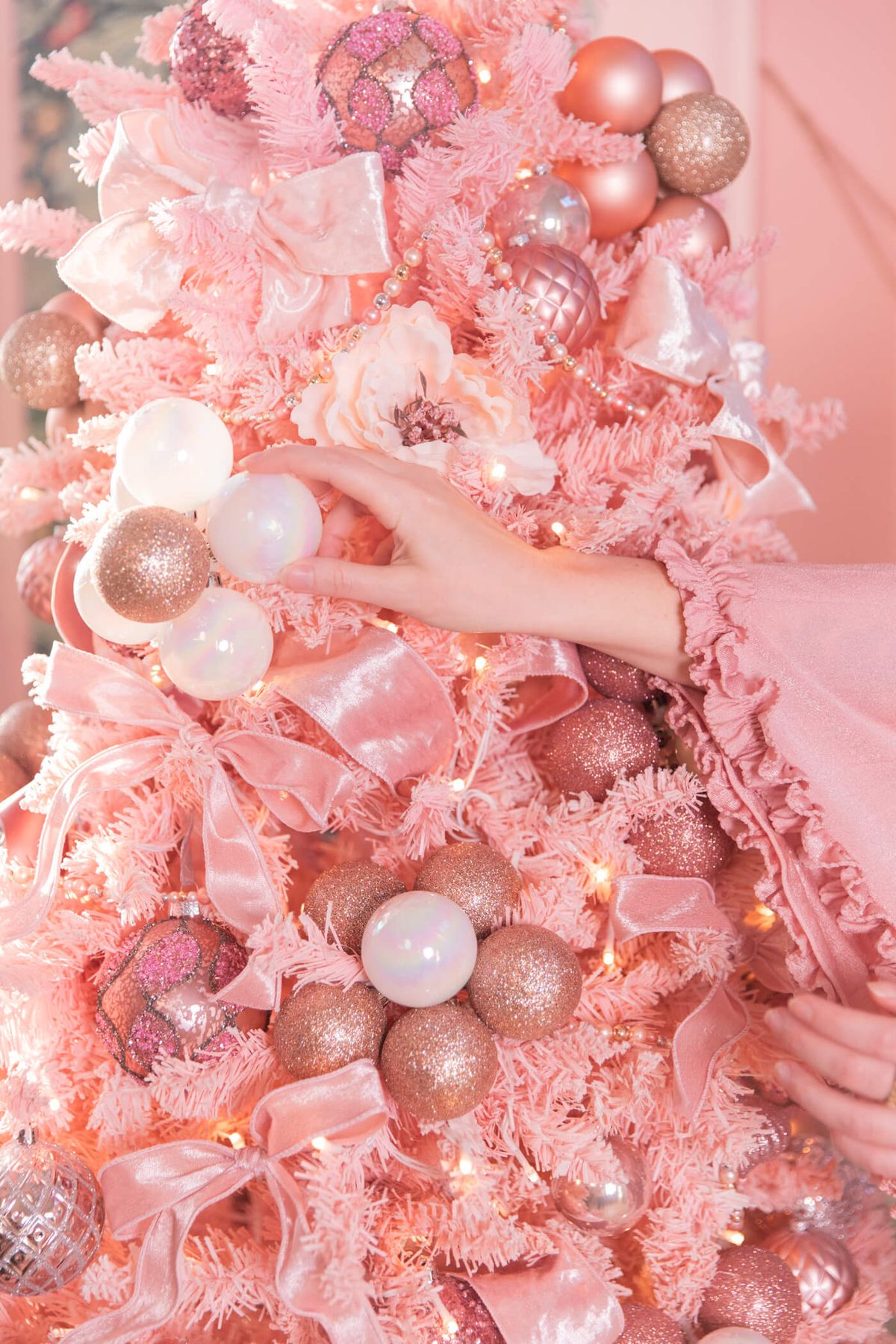
A pink tree doesn’t have to mean a $600 purchase. Walmart and Target both carry 6 to 7 ft pink artificial trees in the $60–$110 range during November, and HomeGoods gets them in around $80. Layer in satin ribbon from a fabric store at $3 a spool instead of pre-tied bows at $12 each, and string faux pearl garland from a craft aisle at $6 for 30 feet. Full monochrome look, under $200.
11. Chocolate and Red Glitter Gingerbread Pair
To make your own chocolate-glitter tree ornament:
- Cut two identical tree shapes from brown felt, about 4 inches tall.
- Blanket-stitch the edges together, leaving a one-inch gap at the bottom.
- Stuff lightly with fiberfill — you want it soft, not plump.
- Run a thin line of craft glue along the branch edges and dip into fine red glitter.
- Add a wire loop and a small red bow at the base. Done.
Roughly 25 minutes per ornament and about $9 in materials for a set of six.
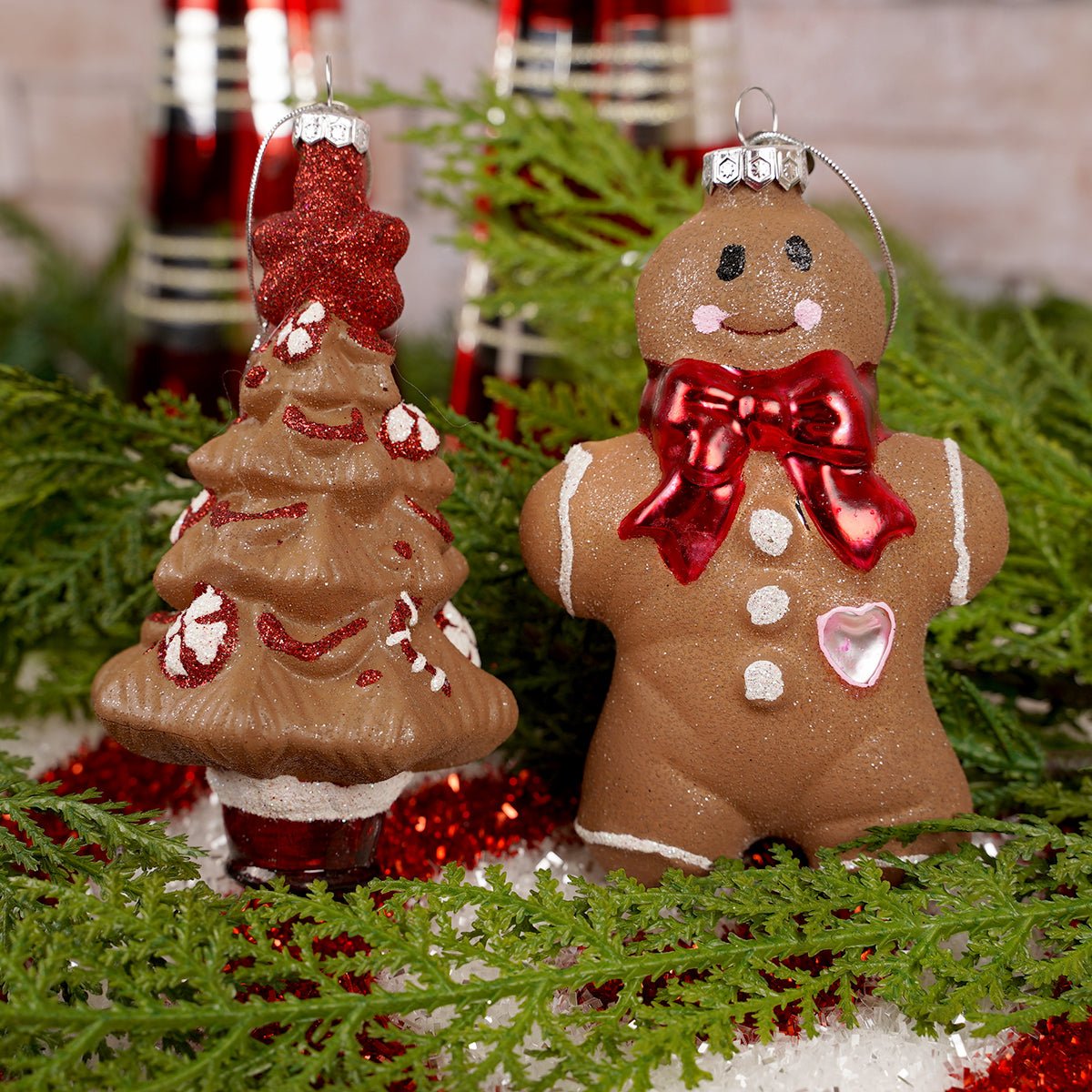
Mixing brown ornaments into a green tree is a color-temperature decision more than a theme decision. Chocolate brown sits warm and slightly muted, so it needs a bright partner — glossy pillar-box red, never burgundy. Hang the brown pieces in the lower third where the tree is densest and the light is dimmest; against darker needles they read as rich texture instead of a muddy blob. Red glitter accents go up top where the string lights catch them.
12. A Mini Flocked Tree With a Big Pink Bow
This one’s for apartments, entryway consoles, and nightstands. A 24 to 36 inch tabletop tree needs about a 15-by-15 inch footprint once the bow’s spread is factored in, and it works beautifully on consoles 14 inches deep or more. It’s the right call if your ceiling is under 8 feet or your room is under 150 square feet. Got the space for something bigger? Pair this small tree with the full-size statement in Idea #2 and let them talk to each other across the room.
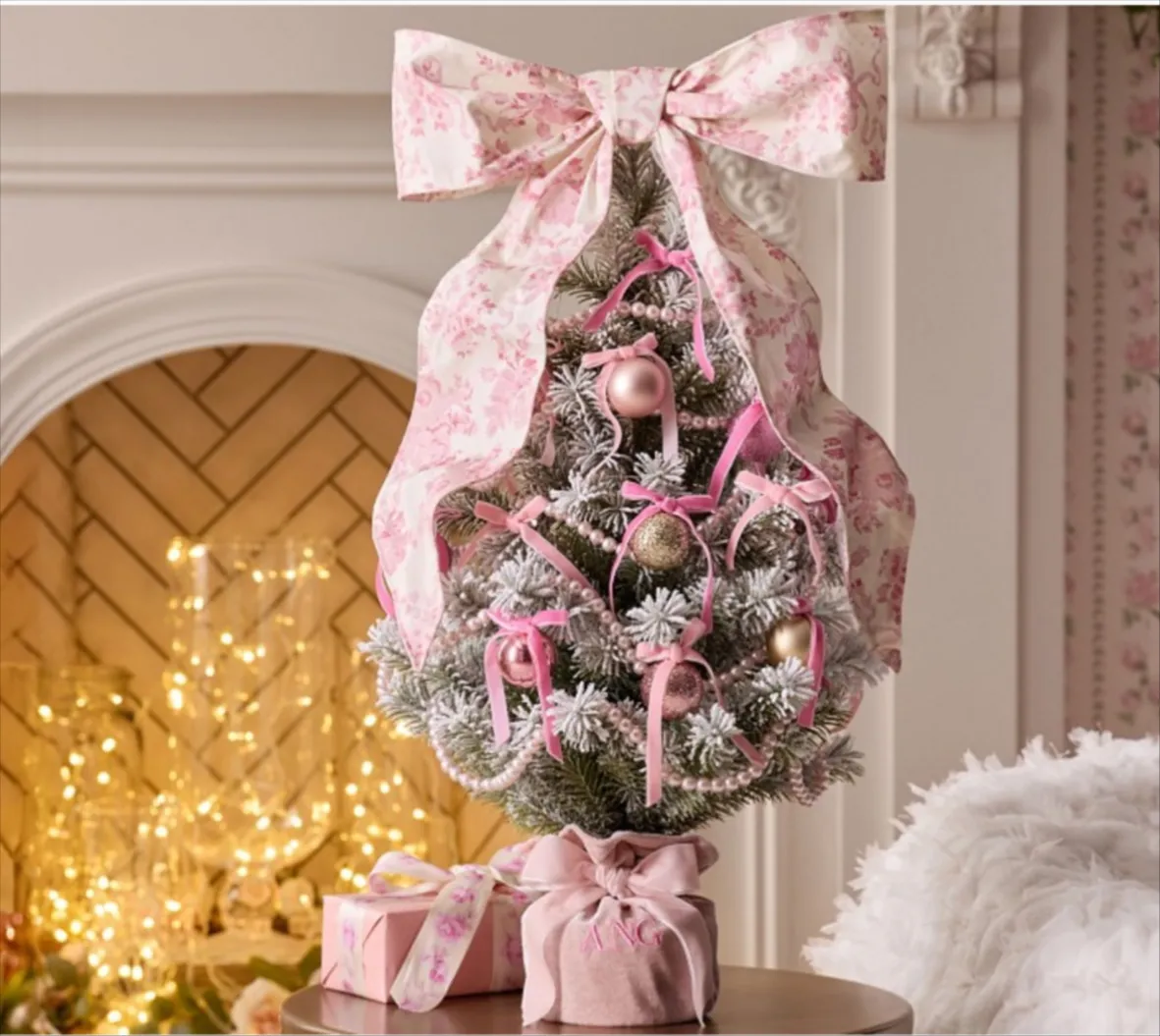
Miniature trees succeed or fail on ornament proportion. A 24-inch tree with 3-inch baubles looks like it swallowed a bowling ball. The rule: ornaments should be no more than one-tenth the tree’s height, so 2 to 2.5 inches max at tabletop scale. Everything else follows — a slim pearl garland instead of chunky tinsel, a big patterned bow standing in for a topper, and a velvet base pouch that reads as a skirt without the bulk.
13. Pink Mini-Tree Ornaments With Retro Radio Styling
Nostalgia is the engine behind 2026 holiday decor. Tiny tree-within-a-tree ornaments, retro radios, and framed vintage wildlife prints all belong to the same “grandma’s house, but styled” wave that’s been building on Pinterest for two years. It’s a reaction to a decade of ultra-minimal holiday styling — people want warmth, and they want objects with a story attached. The upside: this look is cheap to build from thrift stores and estate sales.
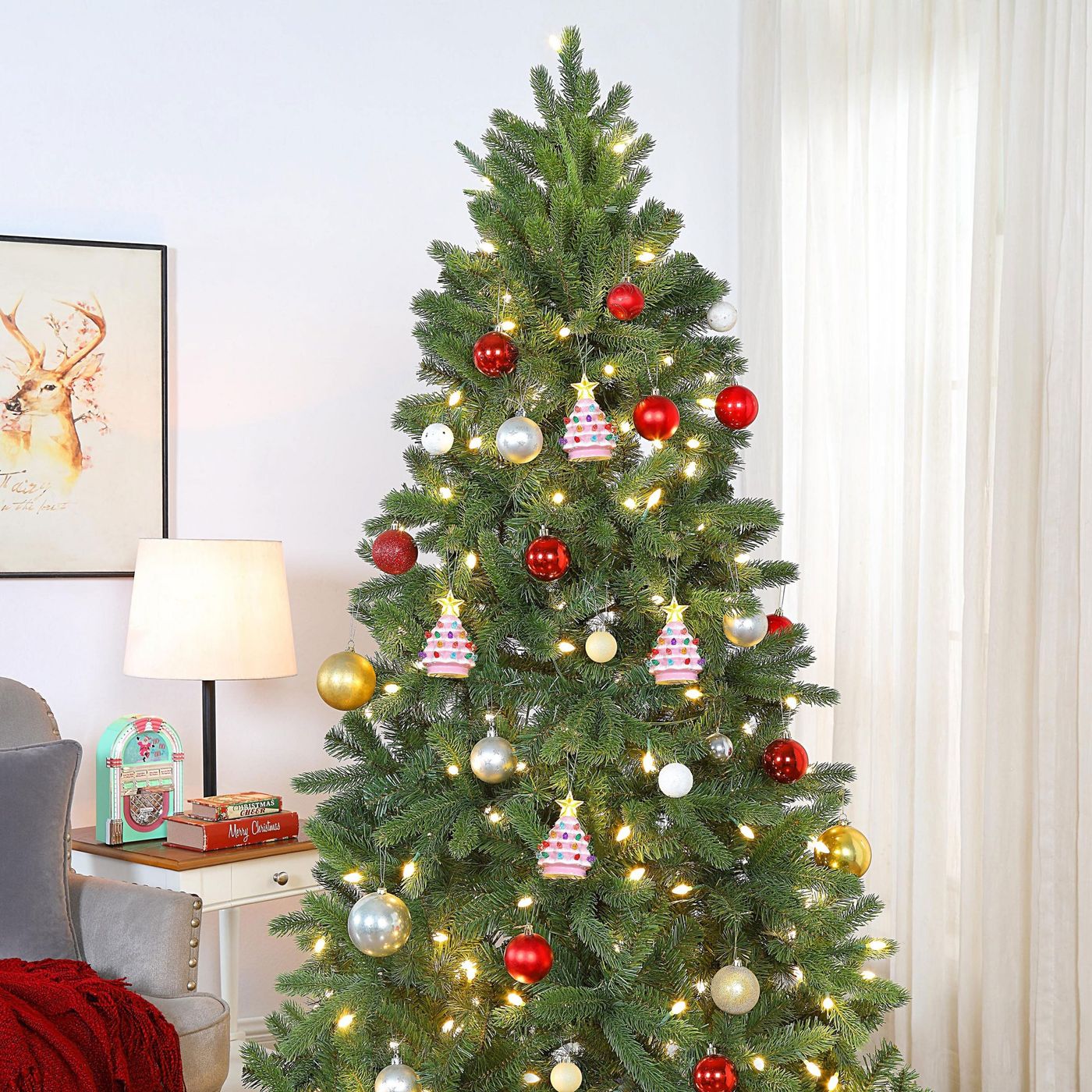
Watch your scale when you mix vintage objects around a tree. A full-size retro radio next to a 7-foot tree reads as decor; the same radio next to a 4-foot tree swallows it whole. Keep non-tree objects under one-third the tree’s height. And that lamp beside the tree is doing real work — without it, the corner goes dark at 5pm in December and the whole vignette dies. Put it on the same timer as your tree lights.
14. Gingerbread House With a Marshmallow Snowman
For a gumdrop-trimmed house that actually survives the season:
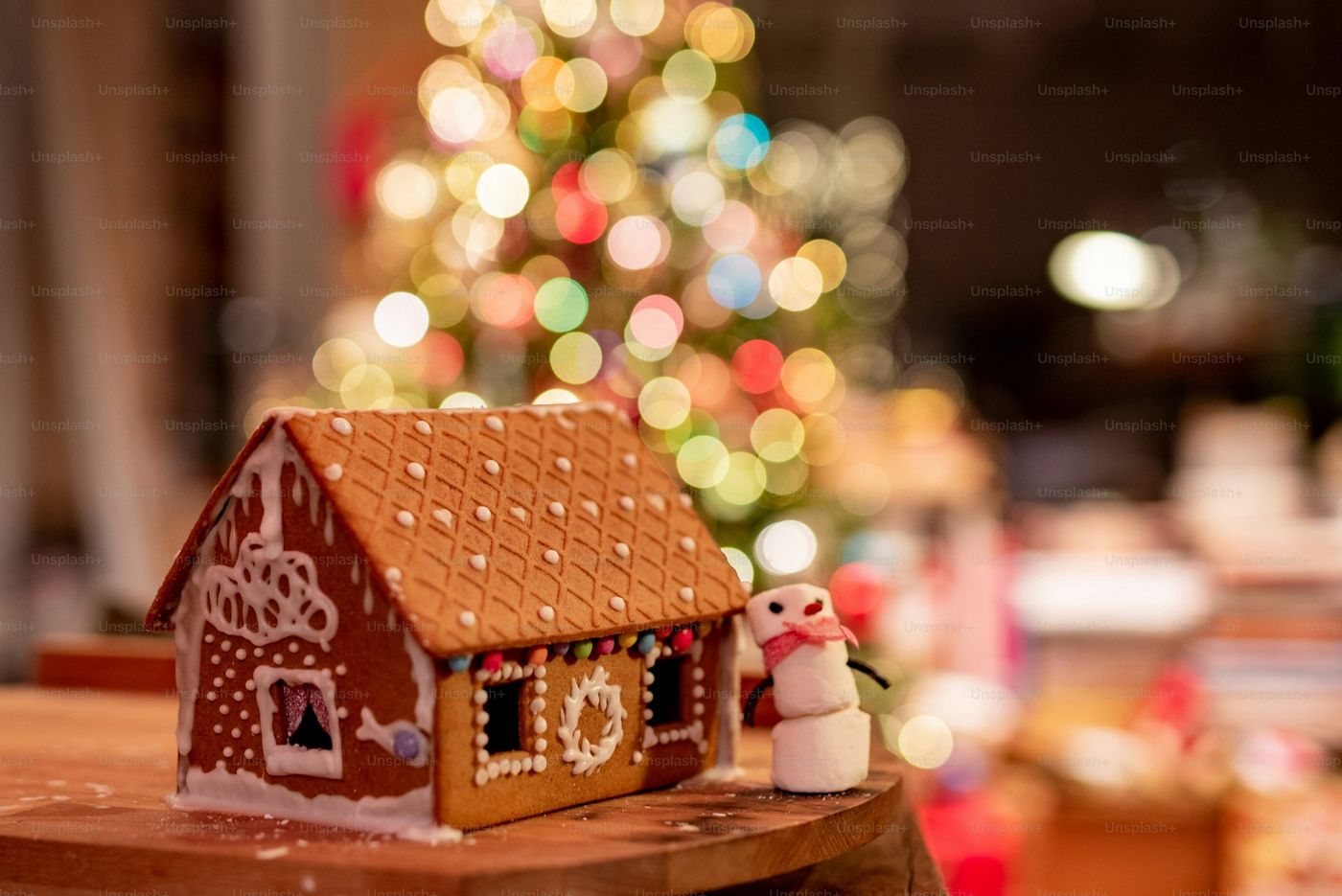
- Build the walls with royal icing, not buttercream — it sets hard in about 20 minutes.
- Let the structure cure a full 12 hours before decorating anything.
- Attach gumdrops with a pea-sized dot of icing each, pressing and holding for five seconds.
- Do the roof last, working from the ridge down so any sliding candy lands on empty roof.
- Seal the finished house with a light coat of clear matte spray if you want to keep it more than one year.
Two evenings of work, about $18 in supplies.
Real gingerbread houses attract real problems. Icing softens in humidity, candy colors bleed, and within two weeks you’ll have ants if there’s so much as a crumb on the board. If your kitchen runs warm, skip the edible version and build a foam-core house with acrylic icing — it looks nearly identical in photos and lasts for years. Go edible only if you’re fine tossing it by New Year’s.
15. Red and White Peppermint Swirls on Snow-Dusted Branches
This is the classic candy cane formula and it’s nearly impossible to break: 60% white (snow-dusted branches, ribbon, peppermint centers), 30% red (swirl discs, candy canes, ribbon stripes), 10% bright green from the feathery plumes acting as the balancing accent. That green is what keeps the whole thing from looking like a toothpaste ad. Run the identical math with aqua and white, or lemon yellow and white — just hold the third color to a strict 10%. Compare with Idea #7 where red and white get the same treatment with neutrals instead of green.
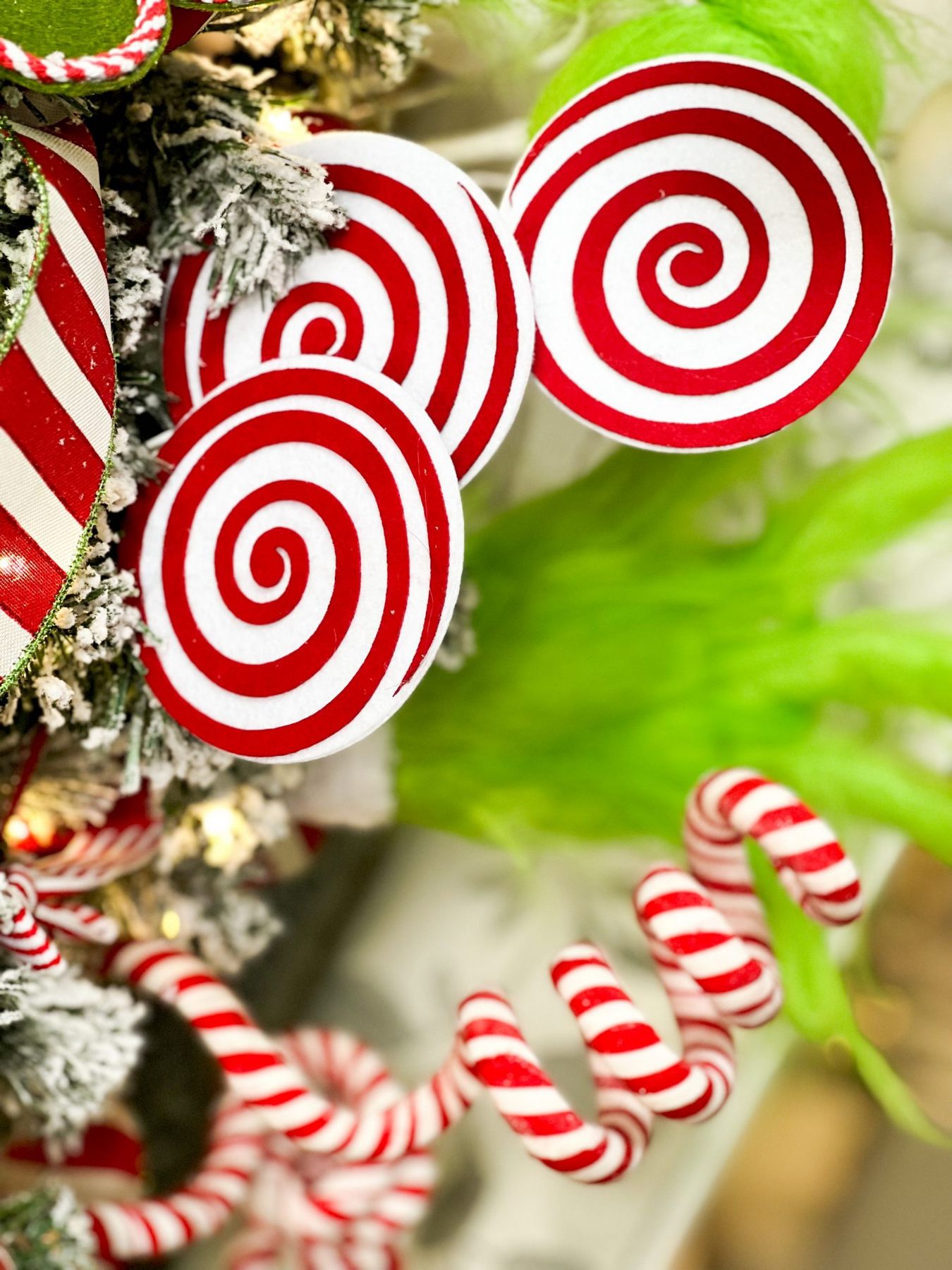
Peppermint is the cheapest candyland theme to pull off. Dollar Tree sells red-and-white swirl ornaments in six-packs for $1.25, and Walmart’s peppermint picks run about $4 for a three-pack. Real candy canes cost $2 a box and look great hung with ribbon — just accept they’ll be sticky by mid-December. Skip the flocked tree entirely and dust a plain green one with spray snow from a craft store at $8 a can.
16. Pink Felt Poinsettias on a Ladder-Framed Flocked Tree
Felt poinsettias are the trick to adding volume without weight. Each one is 6 to 8 inches across but weighs almost nothing, so you can cluster four or five on a single branch without bowing it — try that with glass and you’ll be re-hanging the branch. Space them 10 to 12 inches apart, alternate sides, and put the largest bloom where the tree meets the wall for maximum silhouette. That white ladder isn’t just storage; it’s the vertical element the tree is missing.
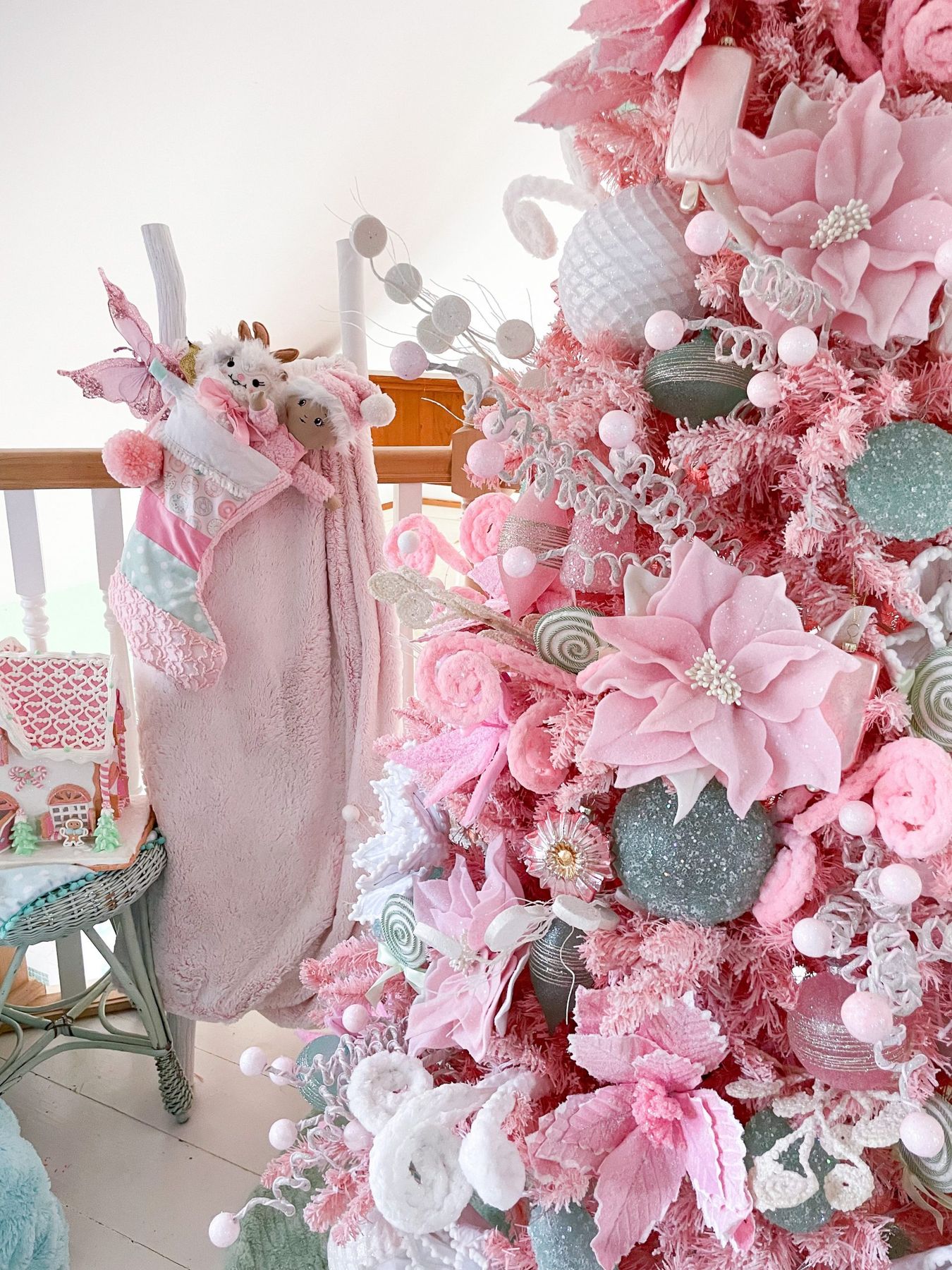
The ladder. A pink flocked tree with felt flowers is pretty. A pink flocked tree with a white wooden ladder draped in faux fur and a stocking is a scene. It extends the candyland palette upward and gives the eye somewhere to go once the tree ends. If you copy one thing from this setup, copy the ladder — flea markets sell them for $25, and a Saturday afternoon of paint gets you there.
17. Fill-Your-Own Baubles Packed With Loose Sequins
Fill-your-own clear baubles are the great budget hack of candyland decorating. A 12-pack of clear plastic ornaments runs $10–$14 at Michaels or Amazon, and a bag of sequins or chunky glitter is about $3. That’s under $20 for a dozen custom ornaments that look boutique. Mix three or four filler colors per ball, leave a little empty space so the contents shift when you touch them, and use a small plastic funnel unless you enjoy glitter in every corner of your kitchen.
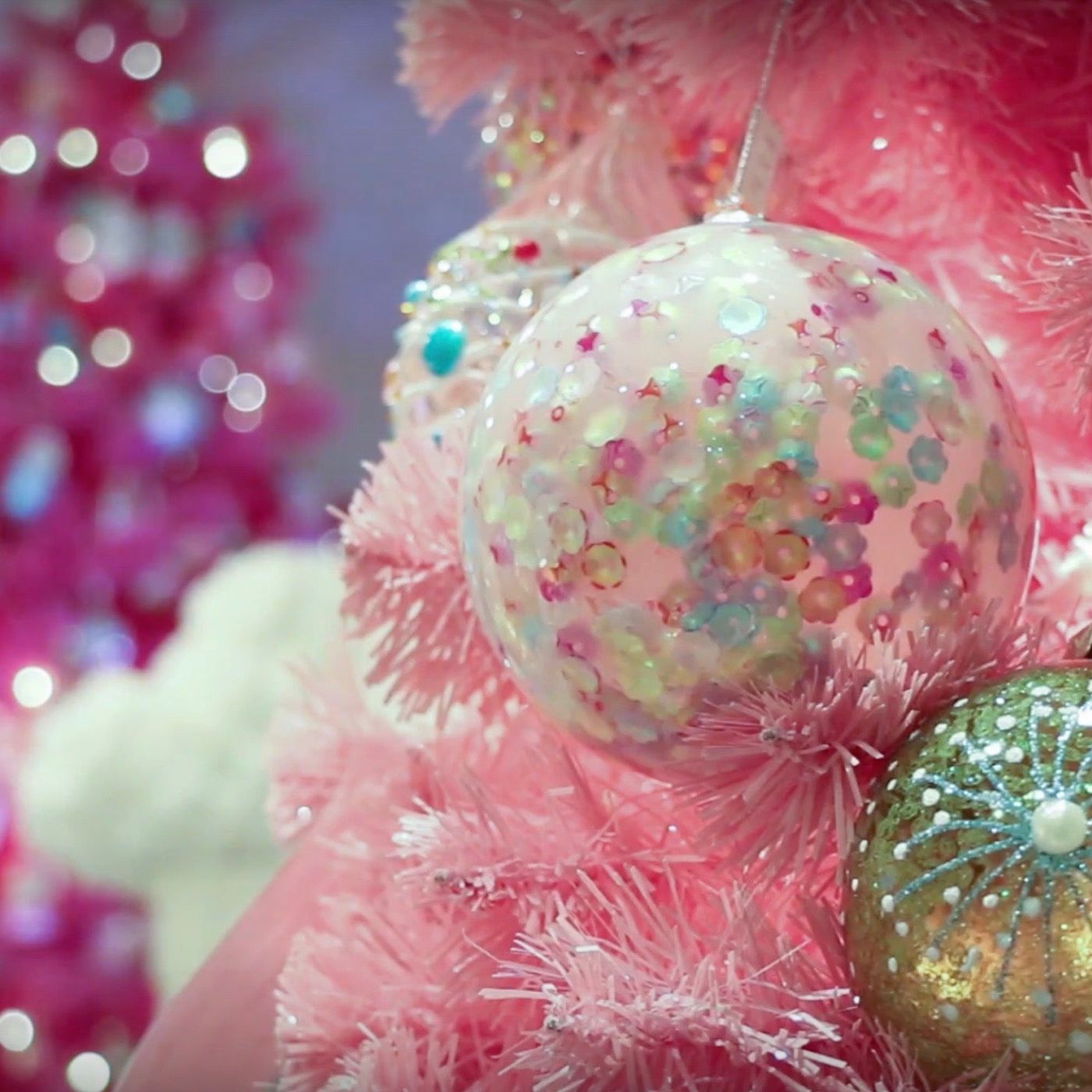
Transparency is the whole point. Because the baubles are clear, the tree’s own pink needles and string lights show through them, which visually merges the ornament with the tree instead of parking it on top. It’s a trick borrowed from glass artists — object and background sharing the same space. It also means the ornaments change appearance as you walk past, catching different angles of light. Texture contrast handles the rest: smooth clear globe against fuzzy pink needle.
18. Pink Nutcracker Guarding a Frosted Tree
Life-size nutcrackers are the surprise of this look, and they need about 8 inches of floor clearance and roughly 40 inches of height. On a 7.5 ft tree with a standard ceiling margin, the nutcracker should top out around two-thirds the height of the lowest decorated branch so it reads as a companion rather than a competitor. Loose rule: divide your tree height by three for the right nutcracker size. Seven-foot tree, 28-inch nutcracker.
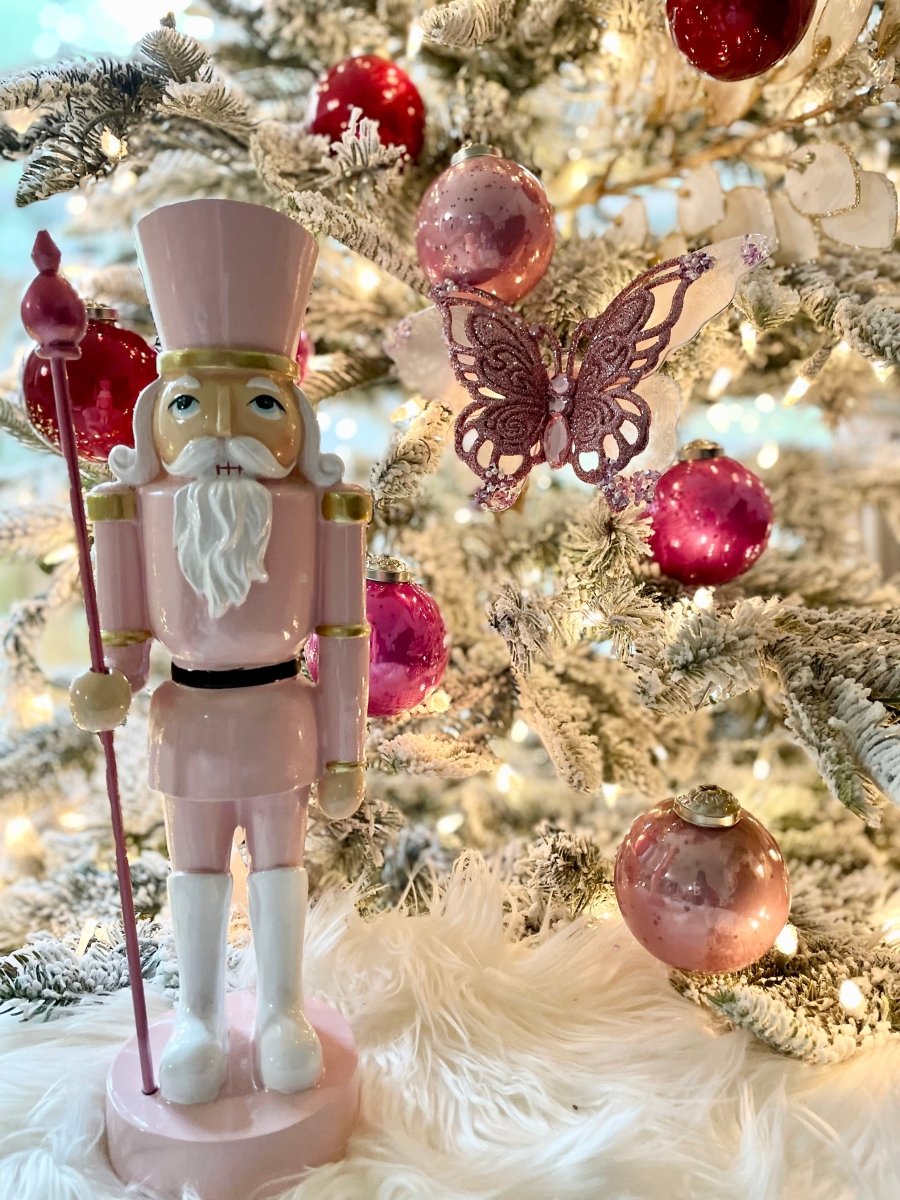
White faux fur skirts look incredible and collect everything. Pet hair, pine needles, glitter, and dust all disappear into that pile and never come out. It’s spot-clean only, and a wet cloth will mat the fibers permanently. Shake it outdoors after the season and store it in a breathable cotton bag rather than plastic, which traps moisture. And if you have a cat, expect it to sleep there daily. That part is non-negotiable.
19. Glitter Poinsettia Picks on Heavily Flocked Branches
Roughly 50% snow white flocking, 35% red split between candy curls and poinsettia accents, 15% warm gold from the string lights. The key move is that red shows up in three different textures — matte candy, glittered petals, and soft fabric florals — which stops a two-color scheme from feeling cheap. Run identical math with cobalt and white, or emerald and white, and you’ll get the same richness without buying a single new ornament.
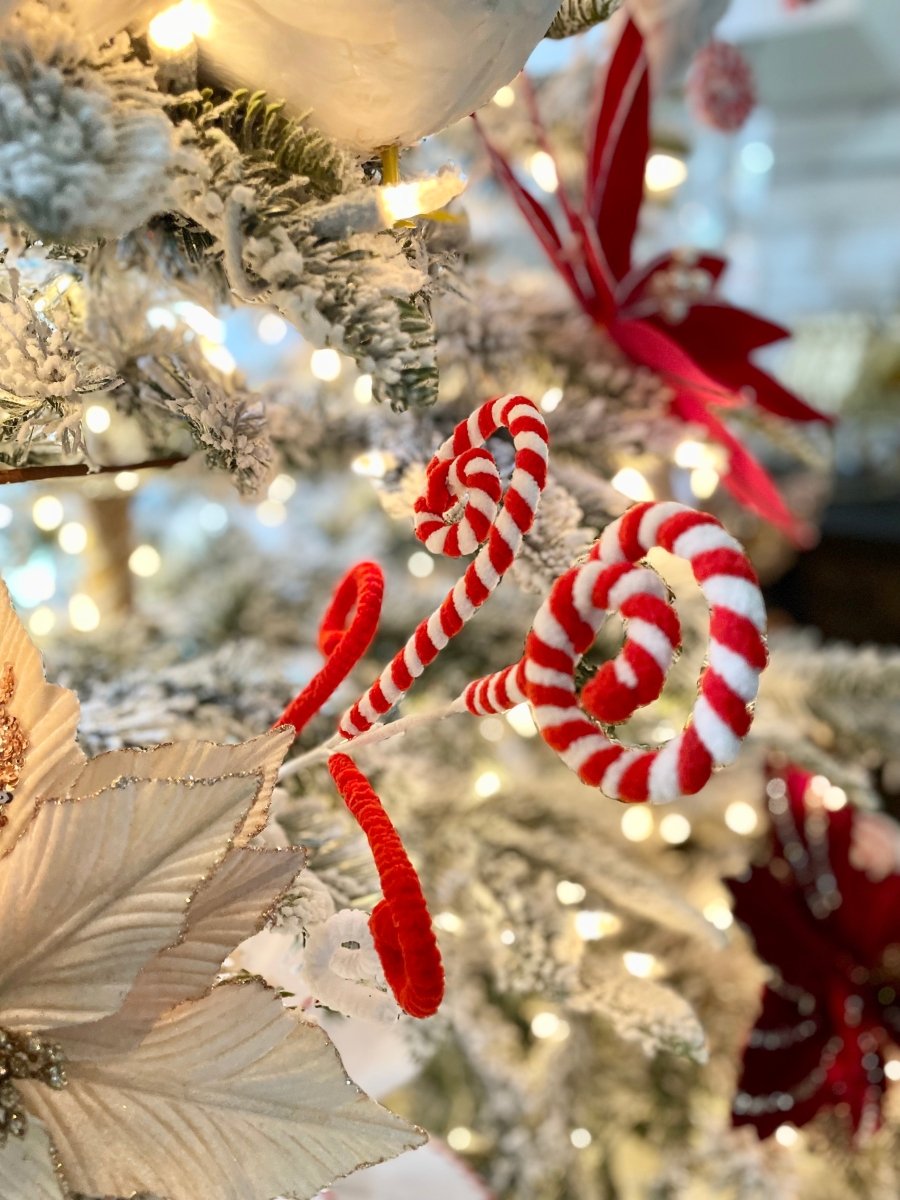
Glitter poinsettias are the messiest thing you will ever own. Expect red and white sparkle on your floor from November through January, and know that glitter migrates to any fabric it touches, including your sofa. A light coat of clear acrylic sealer before decorating cuts shedding by about 70%. Candy curl picks are more forgiving, but flocking yellows if you store the tree in a hot attic. Cool, dry, and boxed is the rule.
20. Keepsake Ceramic Couple Ornament With Velvet Ribbon
To make a personalized keepsake like the ceramic couple:
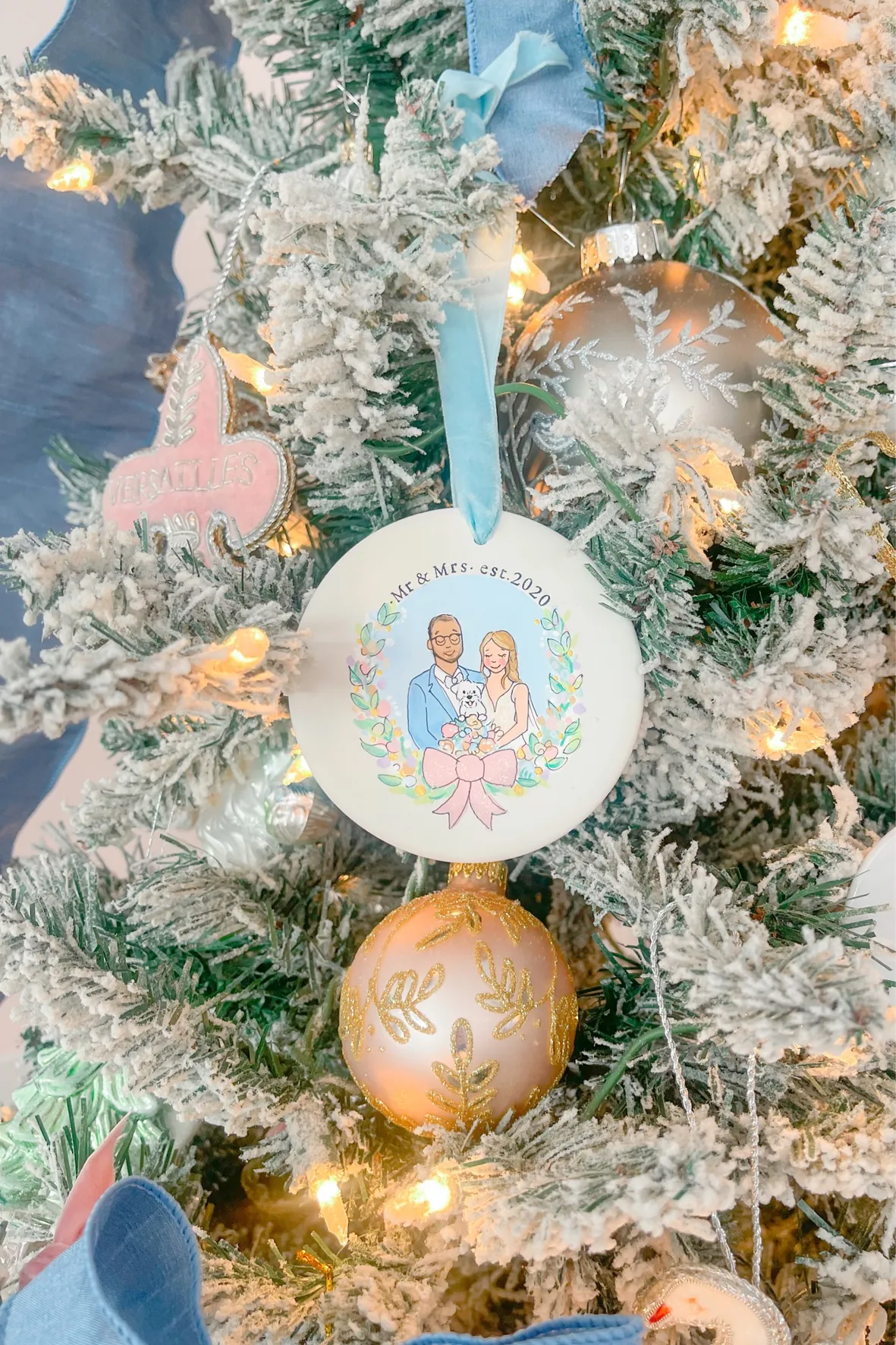
- Order a blank 3-inch white ceramic disc or round ornament blank, $4–$8 online.
- Sketch your illustration in pencil first, then go over it with a fine-tip porcelain marker.
- Bake per the marker instructions — usually 300°F for 30 minutes — to set the ink.
- Let it cool completely, then seal with matte acrylic spray.
- Thread a light blue velvet ribbon through the loop, knot twice, and trim the ends at an angle.
An evening project, roughly $15 per ornament.
Personalized ornaments are where candyland trees get expensive — custom ceramic runs $25–$45 each. Make them yourself for a fraction. Blank ceramic or wooden discs cost $4–$8 on Amazon, a porcelain marker set is about $12 and makes dozens, and velvet ribbon is $3 a spool at Joann. Or order one signature piece from Etsy for the center of the tree and fill the rest with $2 pale blue baubles from Target.
21. A Sequin Lip Ornament Backed by Deep Red Velvet
The red velvet bow behind the lip ornament. A novelty ornament alone on a branch is a gag; the same ornament layered in front of a deep red velvet bow is styling. That backing layer gives the sequins something to contrast against, adds soft texture next to all that hard shine, and frames the shape so it reads as intentional from across the room. Cheap sequined ornaments almost always need a matte partner behind them.
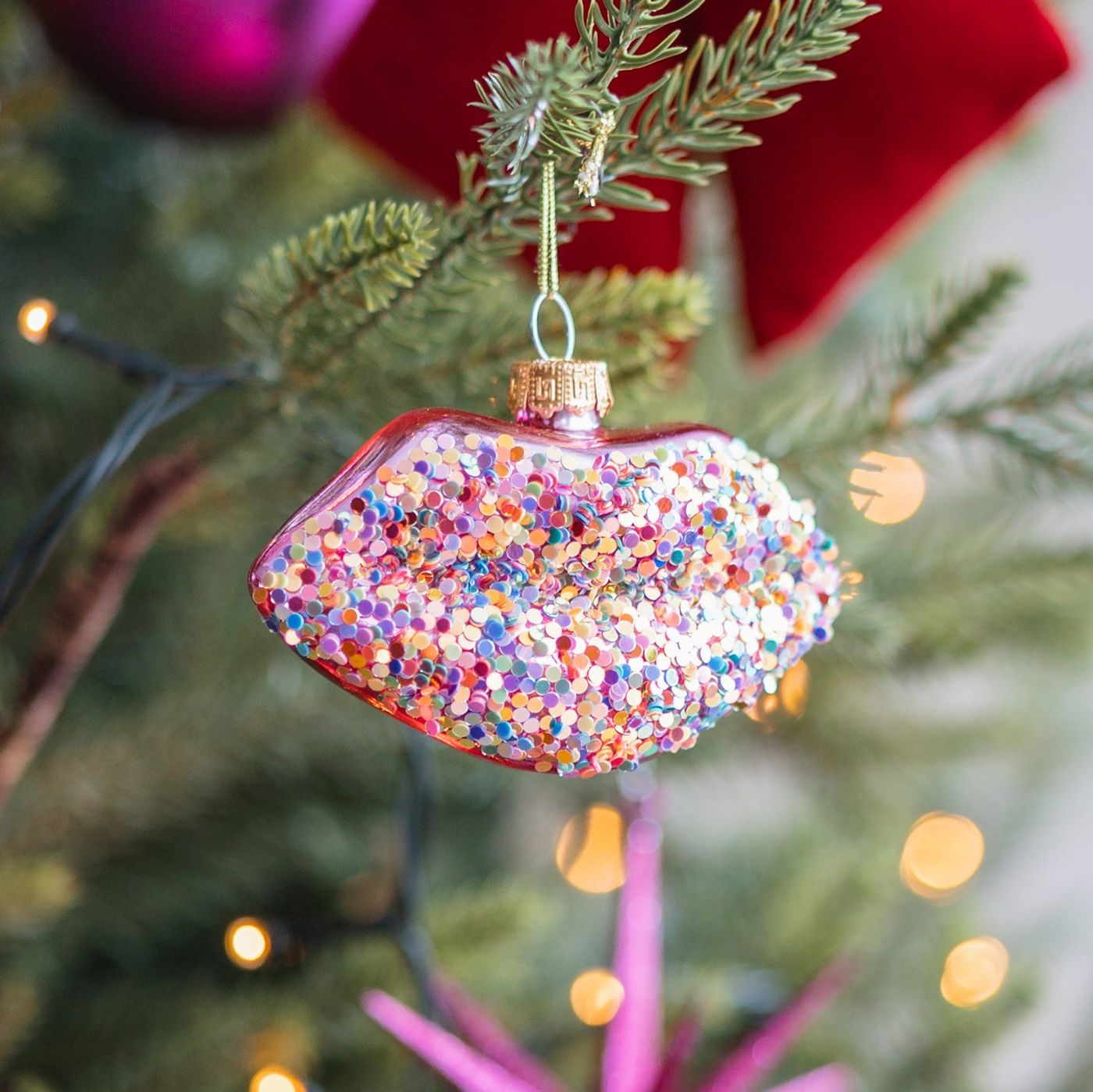
Sequins plus a busy background equals mush. If you’re hanging novelty pieces like this, clear a 10-inch radius around each one — pull the neighboring filler ornaments off those branches and let bare needles show. An empty branch behind a glossy ornament reads as negative space; a crowded one reads as clutter. Hang sequined pieces at eye level too, roughly 60 to 66 inches off the floor, where light hits them straight on.
22. Pink Peppermint Discs Mixed With Metallic Wrapped Candy
Cost to recreate this pink-and-white candy tree:
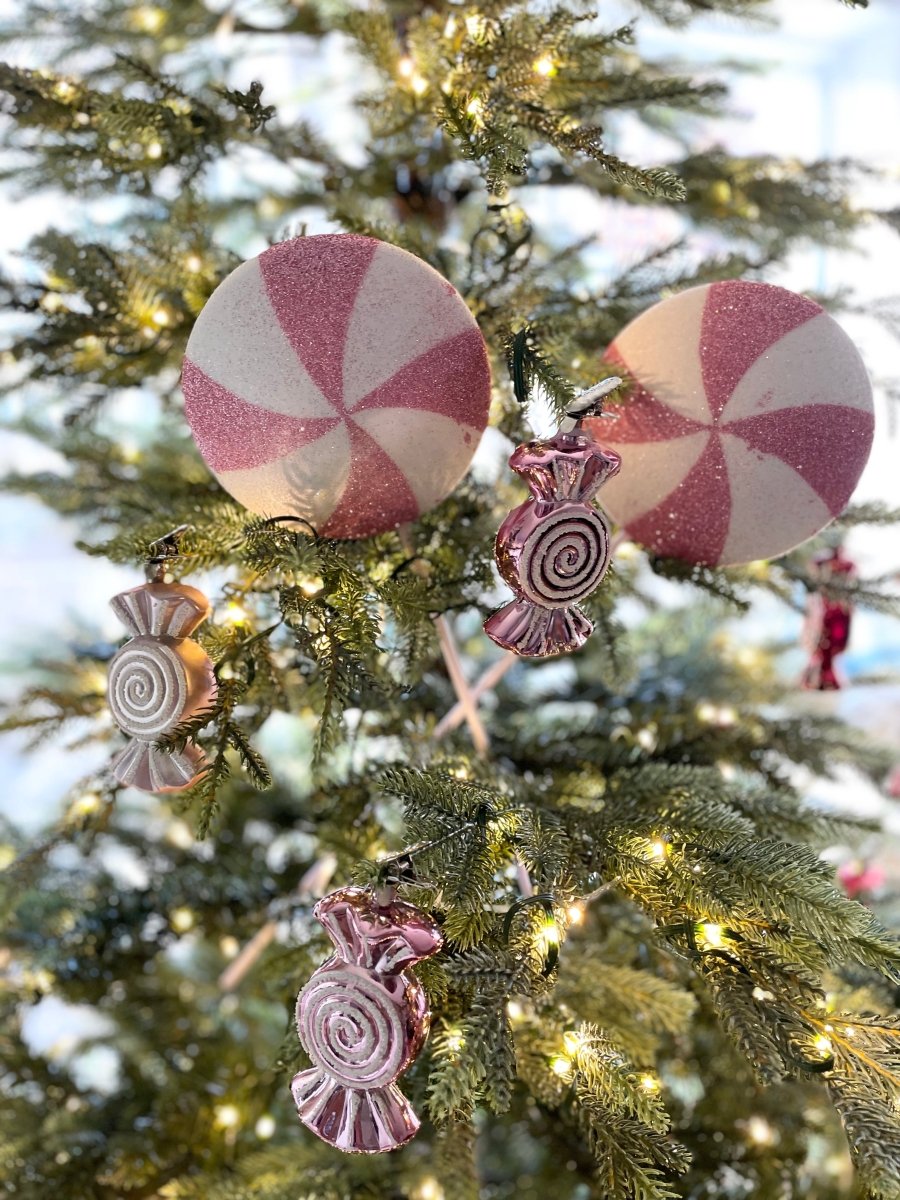
- 7 ft green artificial tree: $90–$280
- 12 glittery pink and white peppermint discs: $24–$60
- 10 metallic pink wrapped candy ornaments: $18–$45
- 400-count warm white LED string lights: $20–$40
- Pink finishing ribbon: $8–$16
- Wire hooks and storage bins: $12–$25
Total: $172–$466
Budget route: dollar-store peppermint discs, Walmart wrapped candy ornaments, and a tree you already own lands under $90. Half the look, a quarter of the spend.
Metallic pink ornaments show every fingerprint. If you have kids or enthusiastic guests, expect smudges by mid-December and a dull sheen by next season. Wipe with a dry cloth only — never glass cleaner on metallic finishes. Matte and metallic pink side by side look gorgeous on the tree and terrible on your carpet when they fall, so shatterproof is worth the extra dollar each.
23. Blue Swirl Lollipop With a Pink Scalloped Sign
This is a 50/30/20 mix: half light blue and white as the base, 30% green from the tree itself, 20% hot pink from the little scalloped “Eat & Be Merry” sign that makes the whole thing sing. The pink is doing something specific — it’s the third color that turns a two-tone ornament into a composition. Run the same trick with mint, green, and coral, or lilac, green, and butter yellow. The sign is the template, not the point.
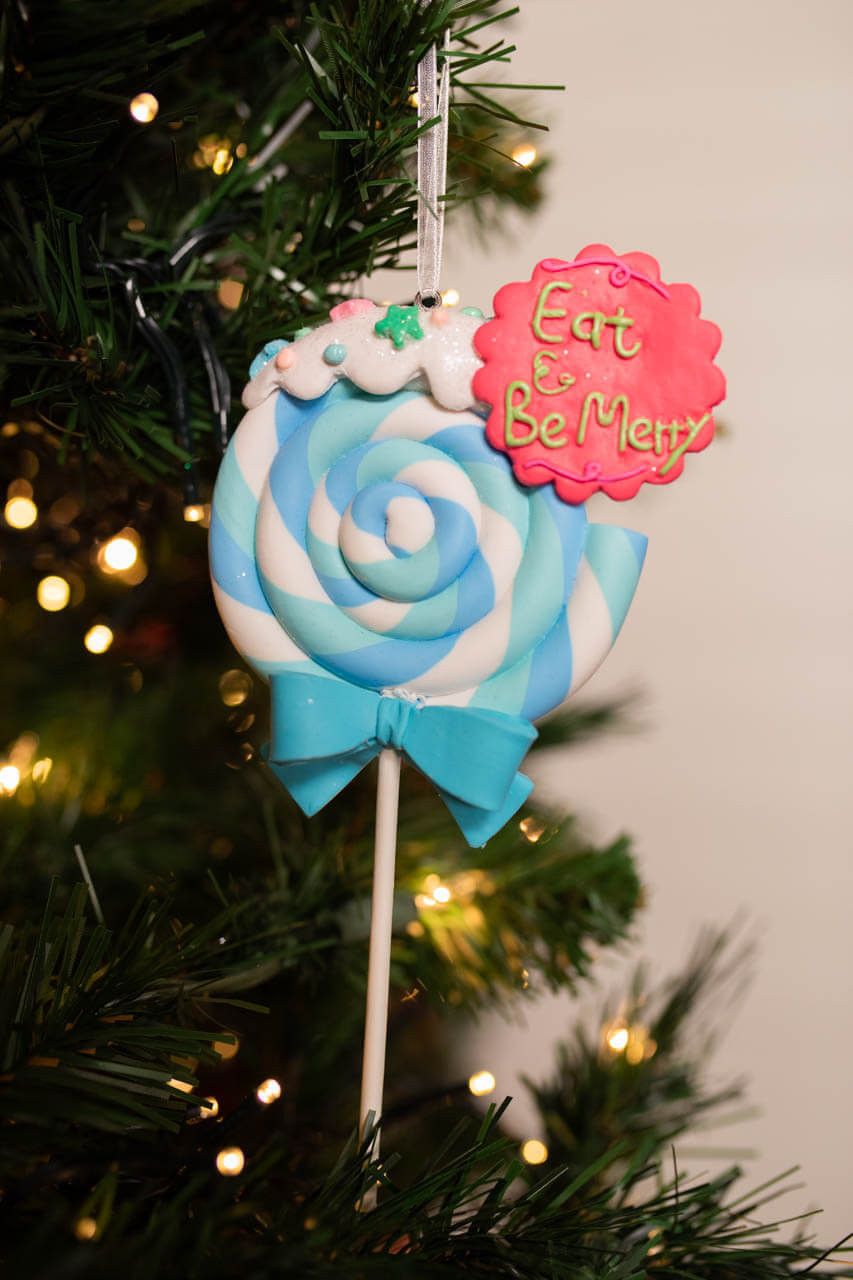
Rule of thirds, applied to a single ornament. The lollipop is the tall vertical third, the bow sits at the base third, and the sign hangs off to the side as the visual third. Your eye travels up, down, then across — a complete loop in under two seconds. That’s why this reads as designed rather than bought. Recreate the structure with any oversized candy pick: something tall, something soft, something with a message.
24. Quilted Velvet Poinsettia With Beaded Pink Center
Quilted fabric flowers need to sit where their texture is visible. That means the outer branches, angled slightly toward the room, never buried two inches in and never directly under a light string — light flattens quilting into a solid pink blob. If you’re using more than three, stagger their sizes so you get a large, medium, small rhythm rather than a uniform row of identical blooms. Predictable repetition kills the handmade look you paid for.
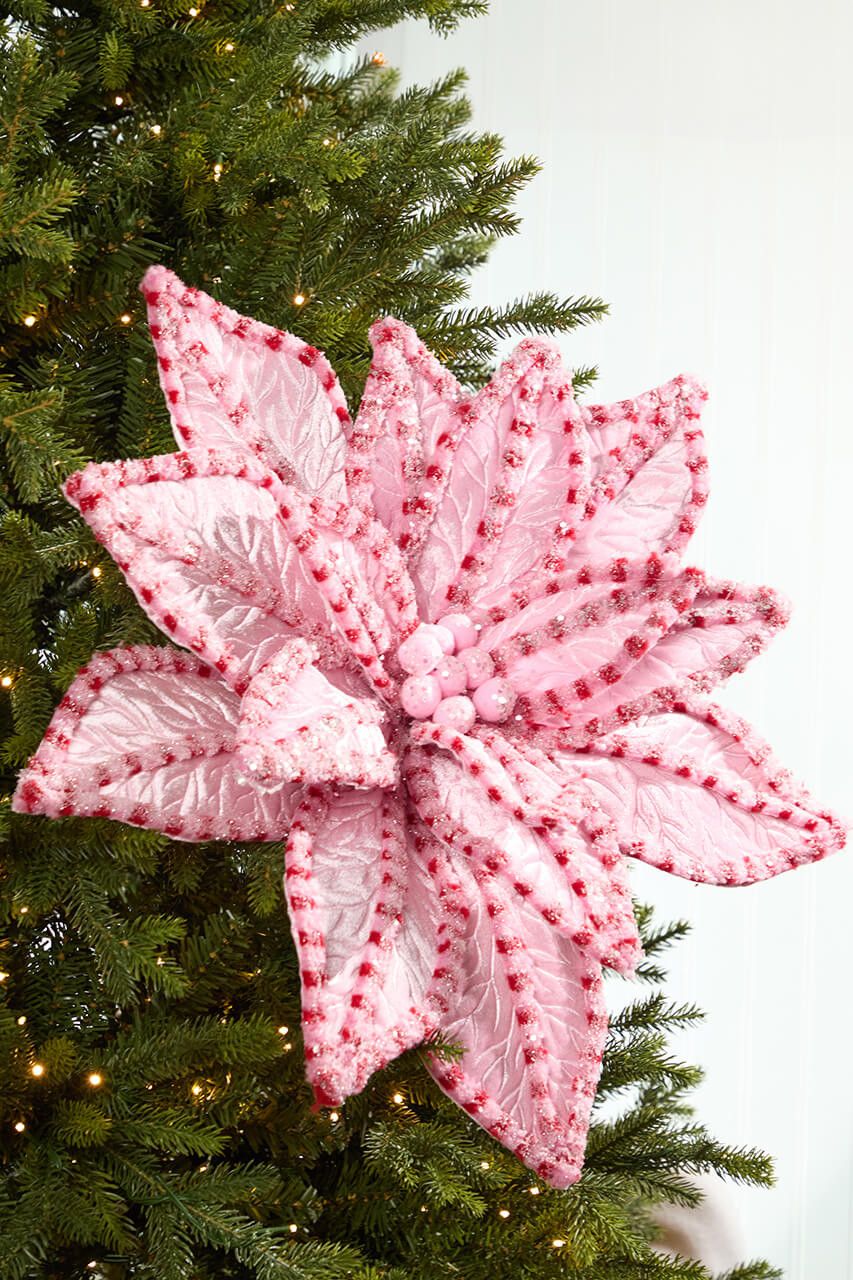
This bloom is roughly 8 inches across, which means it needs a tree of at least 6 feet to feel proportional, and ideally 7.5 feet so nothing crowds. Budget one large flower for every 18 to 24 inches of tree height — three to four on a 7.5 ft tree. On a 12-inch tabletop tree, forget it entirely and scale down to the tiny ornaments in Idea #12. Big florals on small trees is the most common candyland mistake there is.
25. Teal-Bowed Sequin Lollipop With Blue Pinecones
The teal bow. It’s the smallest element in the whole arrangement and it’s the reason this tree doesn’t read as generic green-and-blue. Sequined lollipops are everywhere. A sequined lollipop with a soft, matte teal bow tied at the base is a decision. Without it, the ornament just blends into the sparkle around it. Soft matte accents layered over hard shine is the single most repeatable trick in candyland styling.
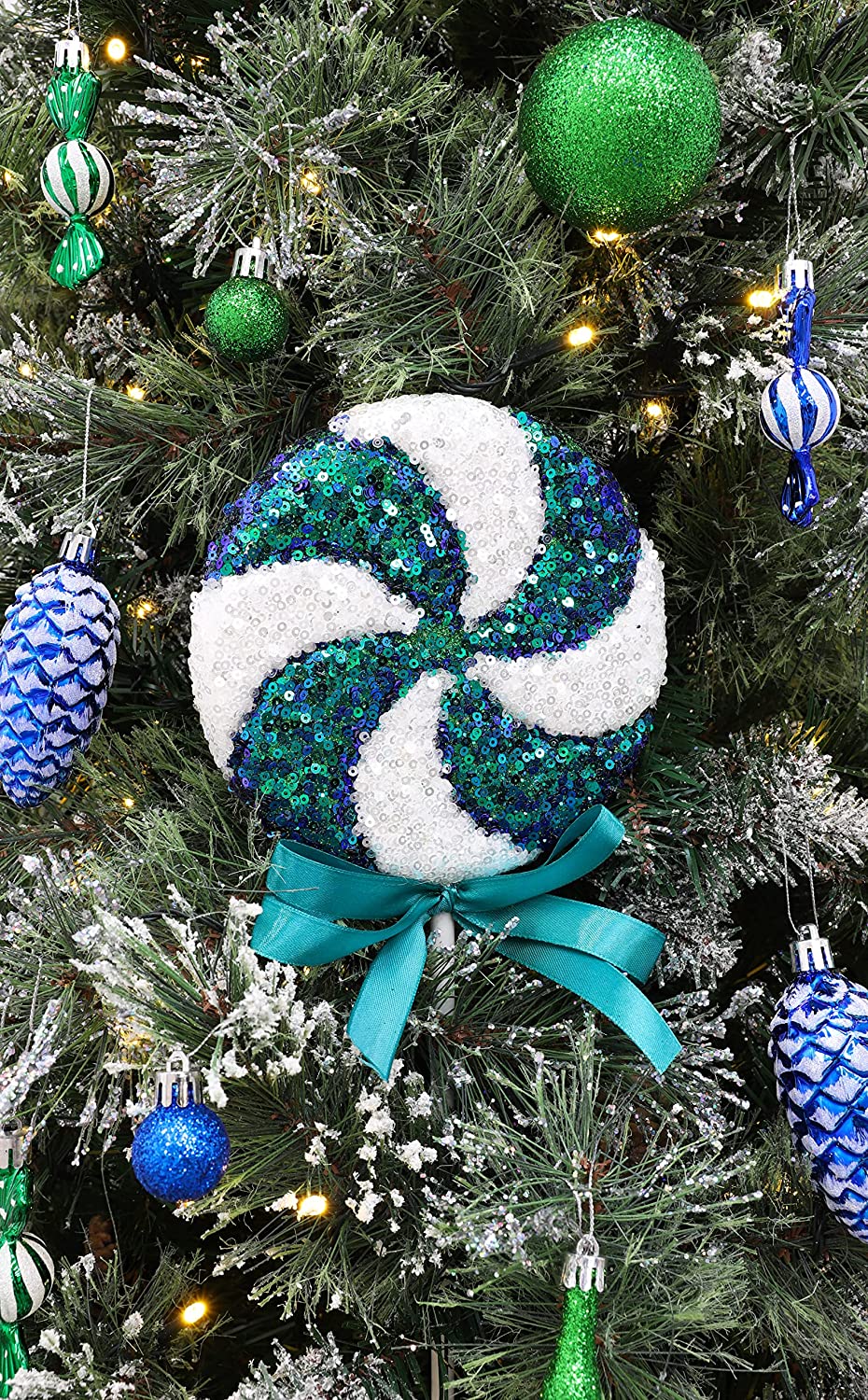
Green-and-blue candy trees are the easiest to build on a budget because blue is the least-shopped holiday color. Target and Walmart discount blue ornaments hard in early December — twelve-packs drop to $6–$8. Pick up plain green pinecones from a craft store for $5 a bag and dip the tips in blue glitter for a custom look. January thrift stores are full of barely-used blue decor. Whole tree, under $130.
26. Pink and Turquoise Striped Velvet Ornament
Two colors, one metallic, and that’s it — but look at the proportions. Soft pink takes roughly two-thirds of the ball’s height, turquoise one-third, with gold braided cord providing under 5% as a separator line. That imbalance is what keeps a two-color stripe from looking like a beach towel. If you’re DIYing this with fabric strips, cut them at a 2:1 ratio, and remember the metallic should never claim more than a thin line of visual real estate.
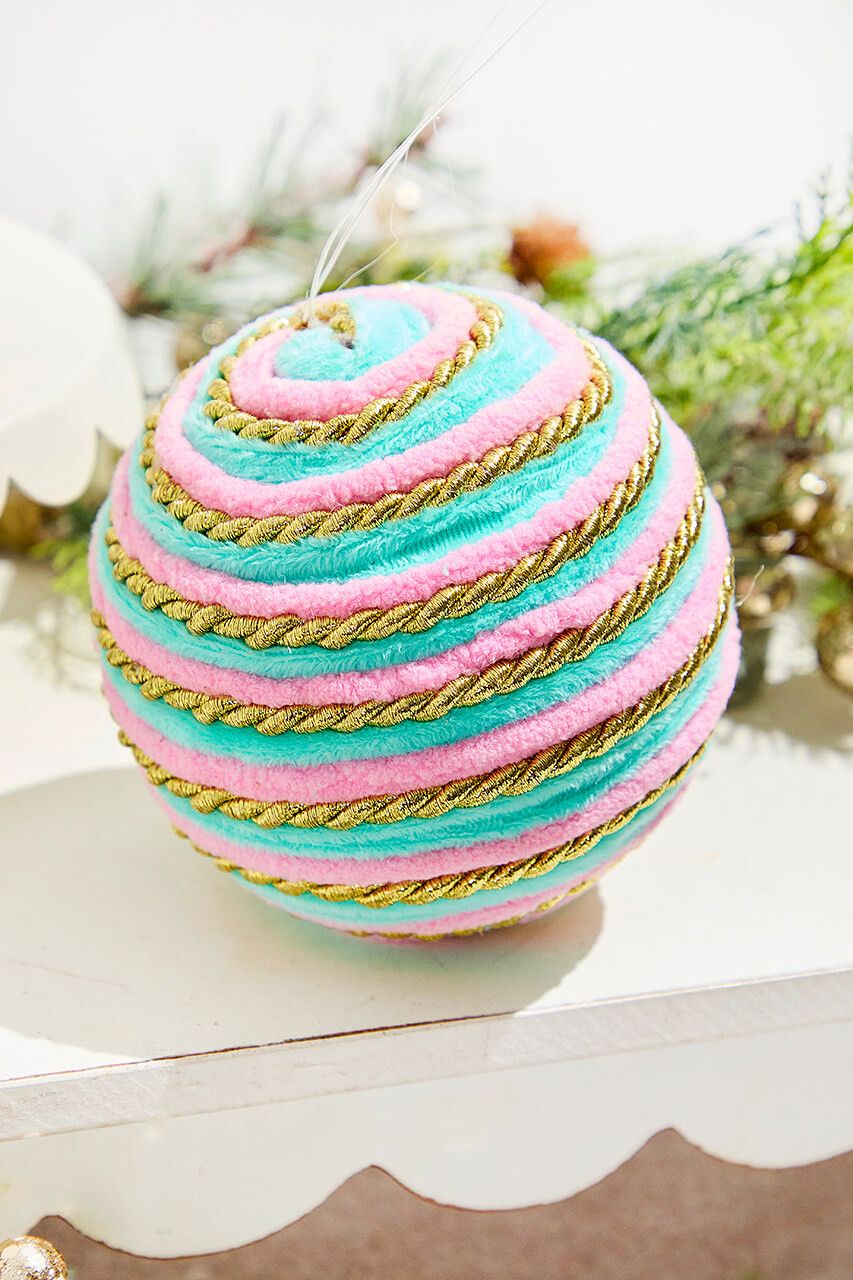
Velvet ornaments in a humid room are a bad combination. Velvet holds moisture, so if you store these in a damp basement you’ll pull out spotted, musty balls next December. Keep them in a climate-controlled closet with a silica packet. They also pick up lint like nothing else — a lint roller with a fresh sheet handles it, but don’t press hard or the pile crushes permanently and shiny bald patches appear.
27. Felt Gingerbread Man With a Santa Hat and Candy Cane
To make a gingerbread man ornament like this one:
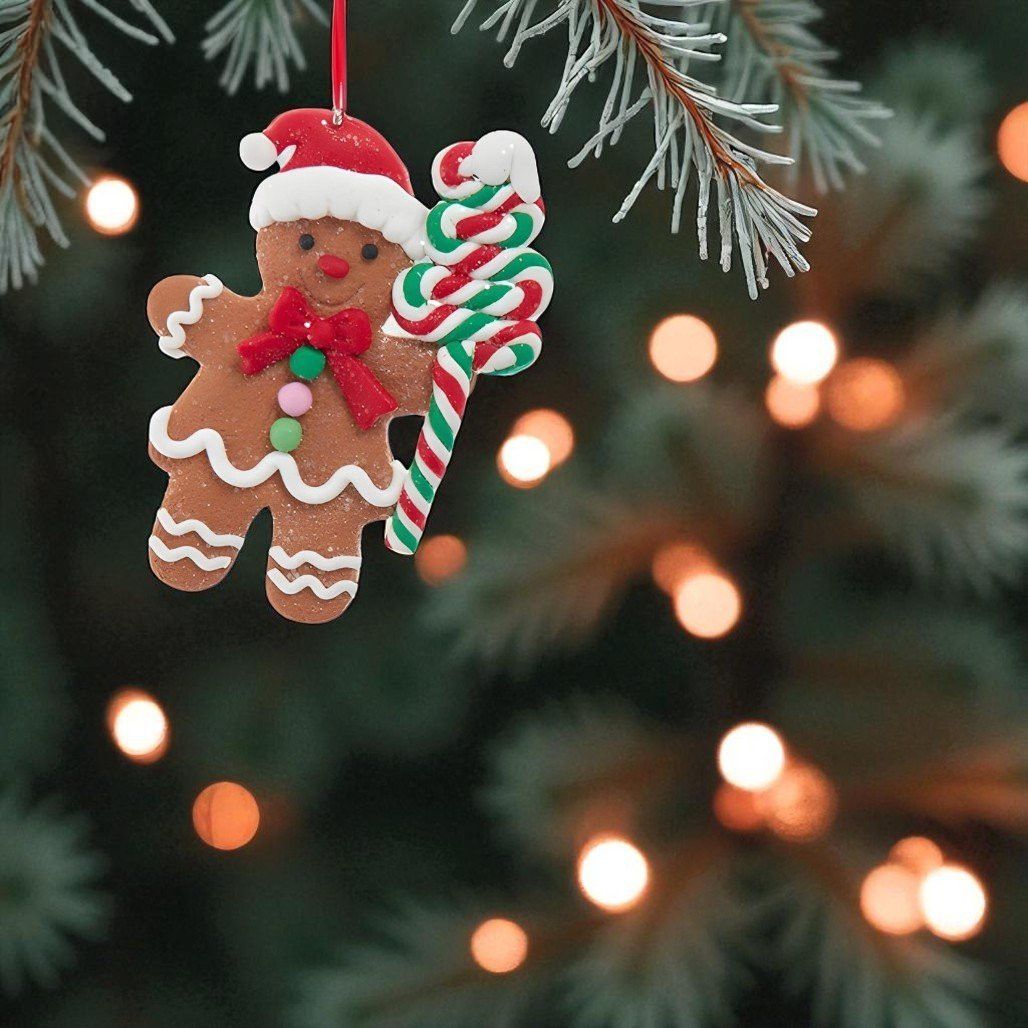
- Cut two matching gingerbread shapes from tan felt using a cookie cutter as a template.
- Blanket-stitch around the edge in white embroidery floss, leaving a gap at the bottom.
- Stuff lightly with fiberfill and stitch closed.
- Glue on a tiny red felt Santa hat and a striped candy cane cut from cardstock or felt.
- Add two black bead eyes and a red ribbon bow at the neck.
About 30 minutes each, roughly $1.50 per ornament in supplies.
Gingerbread ornaments need warm light, not cool. A brown ornament lit by a 4000K daylight bulb looks grey and dead; the same piece under a 2700K warm LED glows like actual baked goods. Check your string light color temperature before you hang anything. Most pre-lit trees in the $150 range ship at 2700K, but cheaper models run cooler. If yours are too white, a $12 strand of warm LED fairy lights stuffed into the branches fixes it instantly.
28. Vintage Gingerbread Man in Polka-Dot Green Pants
Hand-painted figurines chip. The paint on vintage-style ornaments is usually acrylic over resin, and it doesn’t take much — a bump against a neighboring ornament, a tight storage box — to knock a corner off that wide smile. Wrap each one individually in acid-free tissue, store them in a rigid bin with dividers, and never stack. Keep them out of direct sun too, which fades the greens and browns within a couple of seasons.
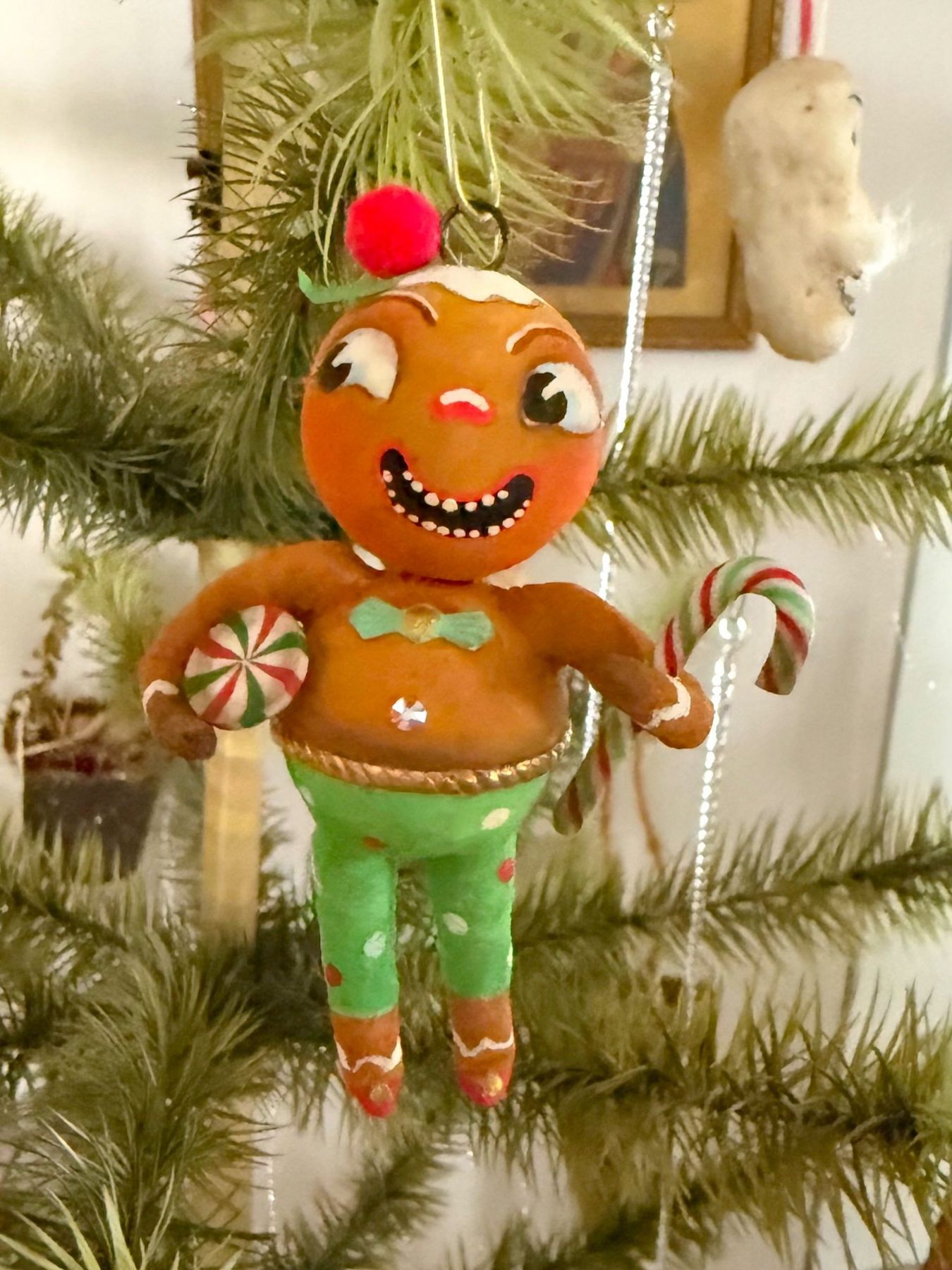
These figurines typically run 4 to 6 inches tall, which is a real commitment on a tree. Anything smaller than 6 feet and they’ll dominate the whole thing; 7 to 9 feet is where they sit comfortably among the other ornaments. Plan on 6 to 10 figurines for a full-size tree, spaced at least 10 inches apart. For a tabletop version of the same nostalgia, look at the miniature set in Idea #14 instead.
29. Fabric Dessert Ornaments Boxed Like Candy
Fabric and felt ornaments are having a genuine moment. They’re part of a wider shift toward tactile, handmade-looking decor that started with the grandmillennial wave and picked up real speed over the past two seasons. There’s a practical driver too: households with toddlers and pets are choosing soft ornaments over glass, and the candy shapes photograph just as festively. This trend has legs because it’s cheap to make and easy to store.
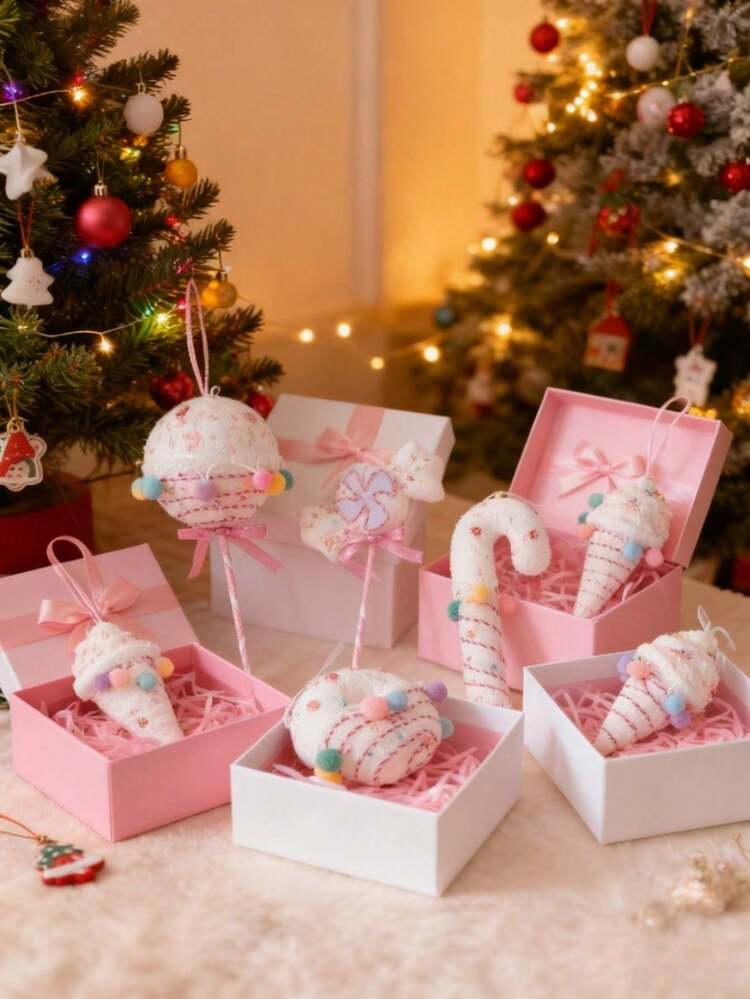
Gift-boxed ornament sets are the most overpriced thing in holiday retail. The same fabric desserts sold in a $45 box can be assembled for around $16: felt sheets run 40 cents each at a craft store, batting is $5 a bag, and embroidery floss is $1 a skein. Amazon sells blank pink and white gift boxes for about $9 a dozen, and shredded paper filler is $4 a bag. Make eight in an evening and box them yourself.
30. Handmade Felt Peppermints on Metal Spiral Hooks
Making the felt peppermint swirl:
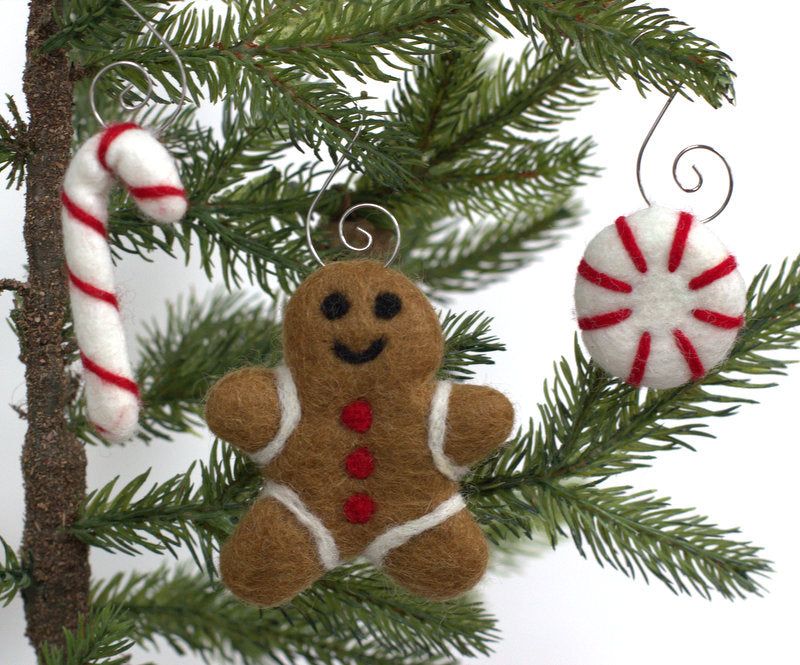
- Cut a 4-inch circle from white felt and another from red felt.
- Cut each into six wedges, then alternate red and white wedges into a single circle.
- Glue the wedges to a second white backing circle so the seams disappear.
- Add a small felt loop at the top, or punch a hole for a wire hook.
- Trim the edges with pinking shears for a clean scalloped finish.
Ten minutes per ornament, about 60 cents in materials.
Metal spiral hooks. Most people use cheap wire loops or plastic caps, and those are exactly what make handmade ornaments look homemade in the bad way. A proper spiral hook — the kind with a coiled end that grips the branch — holds the ornament at a consistent angle, keeps it from swinging into its neighbor, and gives the whole tree a tidy, deliberate rhythm. A pack of 50 runs about $7.
31. Mercury Glass Trees and a Pink Silver Nutcracker
Tabletop groupings like this need a surface 12 inches deep and 24 inches wide minimum — a console, sideboard, bathroom vanity, or deep windowsill. The mercury glass trees here run about 8 and 5 inches tall, which gives you the tall-medium rhythm small vignettes require. Rule of three: one tall, one medium, one oddball. If your surface is narrower than 12 inches, drop to two objects and let one of them be very small. Want the full-scale version of this idea? See Idea #33.
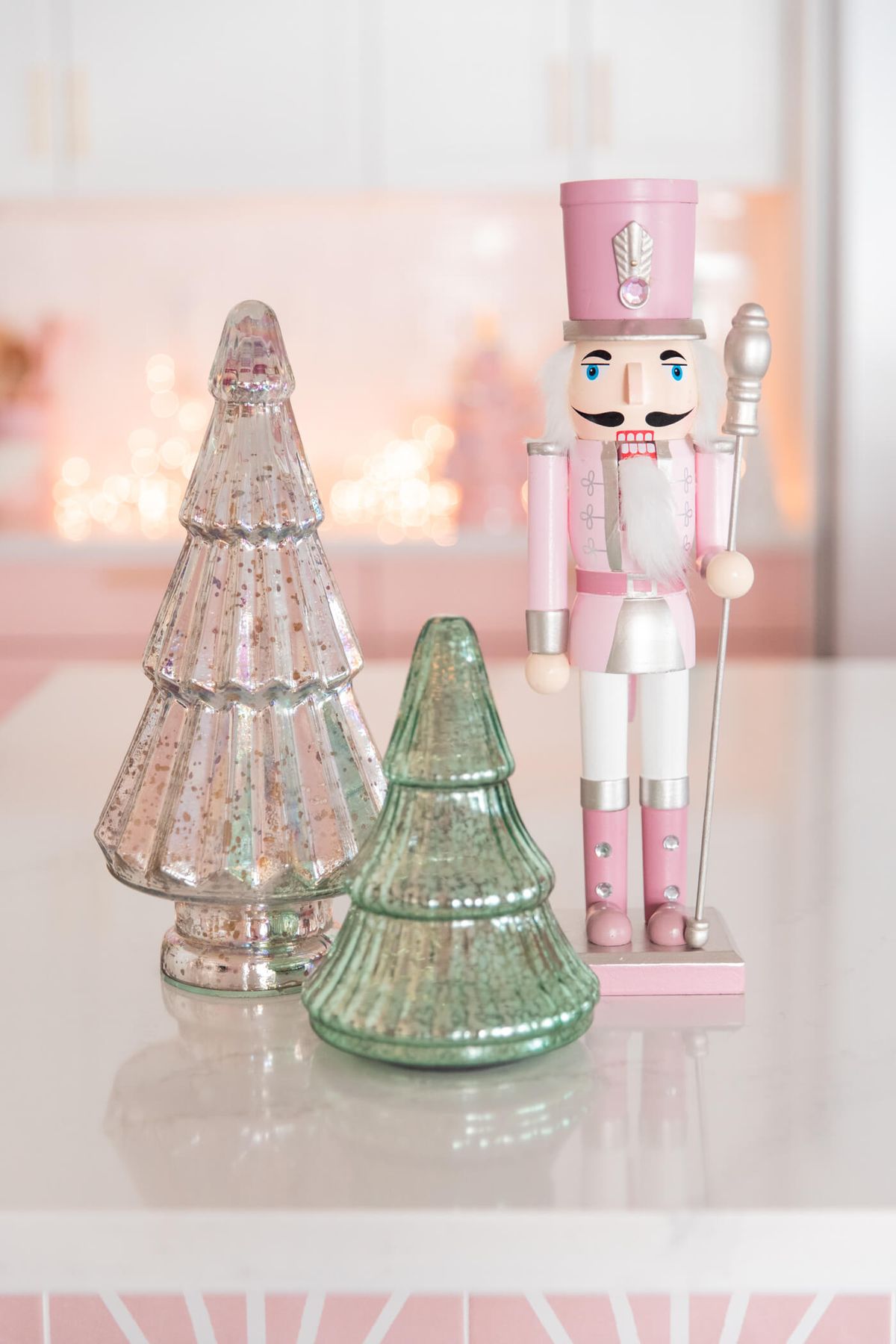
Height variation plus a single metallic is the whole formula. Two trees of different heights give the eye a place to travel, and the silver nutcracker acts as the third point that completes the triangle. Everything else stays soft — pink walls, white surface, hazy background — so the reflective glass has nothing to compete with. When you’re styling a small vignette, the background matters as much as the objects. Keep it blurry, pale, and simple.
32. A Plush Pink Gnome Between Two Tiny Trees
Gnomes read best when they’re the tallest thing in the group. Place the doll on a riser — a stack of two books, a textured block, anything 2 to 3 inches high — so its hat clears the trees beside it. Then vary the tree materials: flocked, bottlebrush, and plain green in one grouping gives you three textures from three objects, which is the maximum visual return for the minimum clutter. Keep the entire grouping inside a 12-inch footprint.
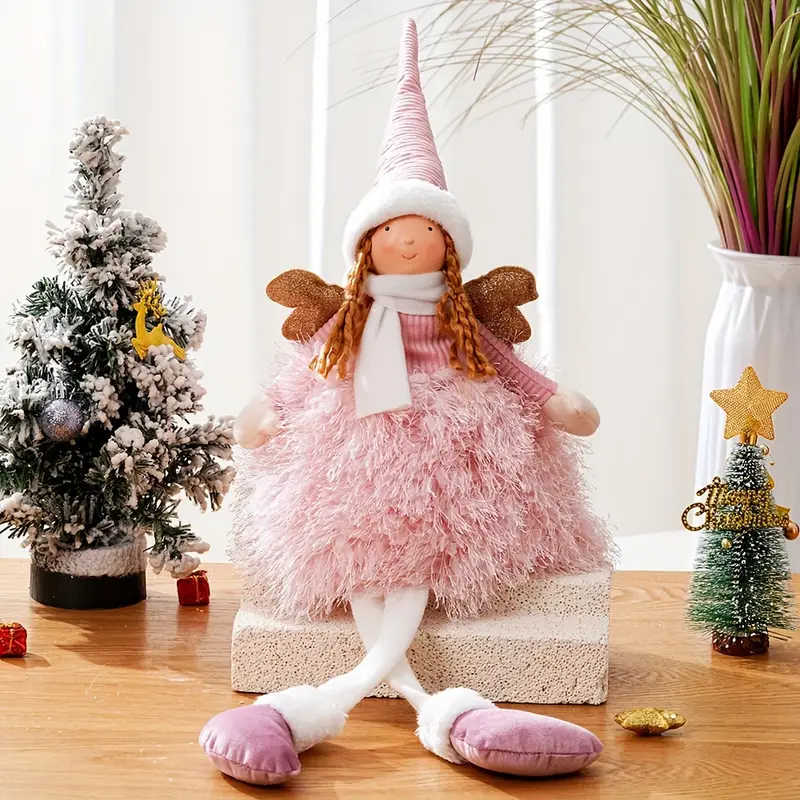
Plush holiday decor collects dust and holds onto it. A pink plush gnome on an open shelf will look dingy by February unless you have a plan — a handheld vacuum on low with a brush attachment once a month is the bare minimum, and never machine wash anything with glued-on hair or a wired hat. If you have shedding pets, put the plush pieces up high and keep the bottlebrush trees at floor level instead.
33. Mall-Scale Candyland, Shrunk for Your Entryway
Retail-scale candyland installations are driving a lot of at-home inspiration right now. Mall displays, hotel lobbies, and pop-up photo spots all lean on the oversized-candy-plus-pink-platform formula, and people photograph them and try to shrink them down. The takeaway for a home version: go big on one element, not everything. A single giant lollipop prop in a hallway beats twelve medium ones scattered around a living room every time.
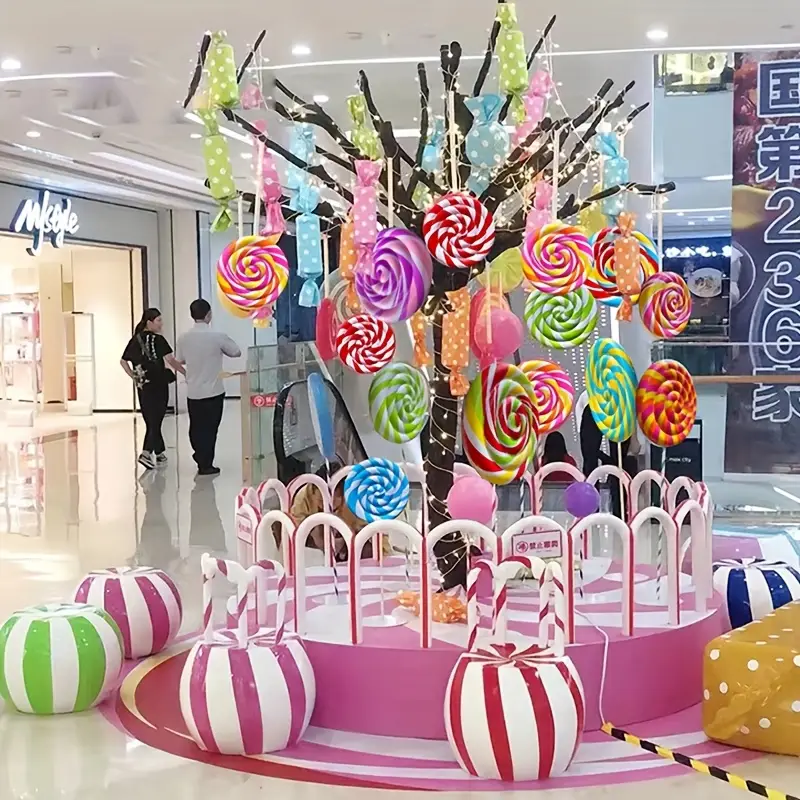
Shrink the big lollipop for your own entryway:
- Buy a 12-inch round foam disc from a craft store, about $8.
- Paint it flat white and let it dry completely.
- Draw the spiral in pencil, then fill it in with gloss red acrylic.
- Glue it to a 36-inch wooden dowel painted white, then wrap the base with wide ribbon.
- Stand it in a weighted urn or a bucket of florist foam topped with faux snow.
One afternoon, roughly $22 in materials.
Time to Hang the First Lollipop
Candyland trees only look effortless when someone made a hundred small decisions first — proportion, palette, light temperature, and what happens below the lowest branch. Start with one idea from this list that fits the space you actually have, not the space you wish you had, and build outward from there.
📌 Pin your favorite look now so it’s waiting for you when the ornament bins come out.
