32+ Stunning Christmas Sideboard Decor Ideas for 2026 That Will Absolutely Transform Your Home
Most holiday sideboard guides get it wrong — they show you a perfectly styled surface and skip the part where you figure out where anything actually goes. So let’s fix that. I went through hundreds of real Christmas sideboard setups from real homes and pulled the 32 that actually hold up under scrutiny, across styles that range from rustic pine-and-pinecone to modern fluted wood to full-on vintage village displays.
You’ll see dark carved wood, distressed white finishes, brass candlesticks, mercury glass, bottle brush trees, and enough greenery to make a florist jealous. And stay until the end — we break down the most common mistakes that can ruin these looks. 📌 Save this to Pinterest for later — you’ll want to revisit these ideas.
1. Wavy Carved Wood Meets Classic Red and Green
The carved wavy front on this dark wood sideboard is doing the heavy lifting here — without it, the garland and candles would read as every other Christmas display on the block. The subtle undulation catches shadow in a way flat-front cabinets never will, which means your greenery and red pillar candles get a textured backdrop instead of a dead-flat one.
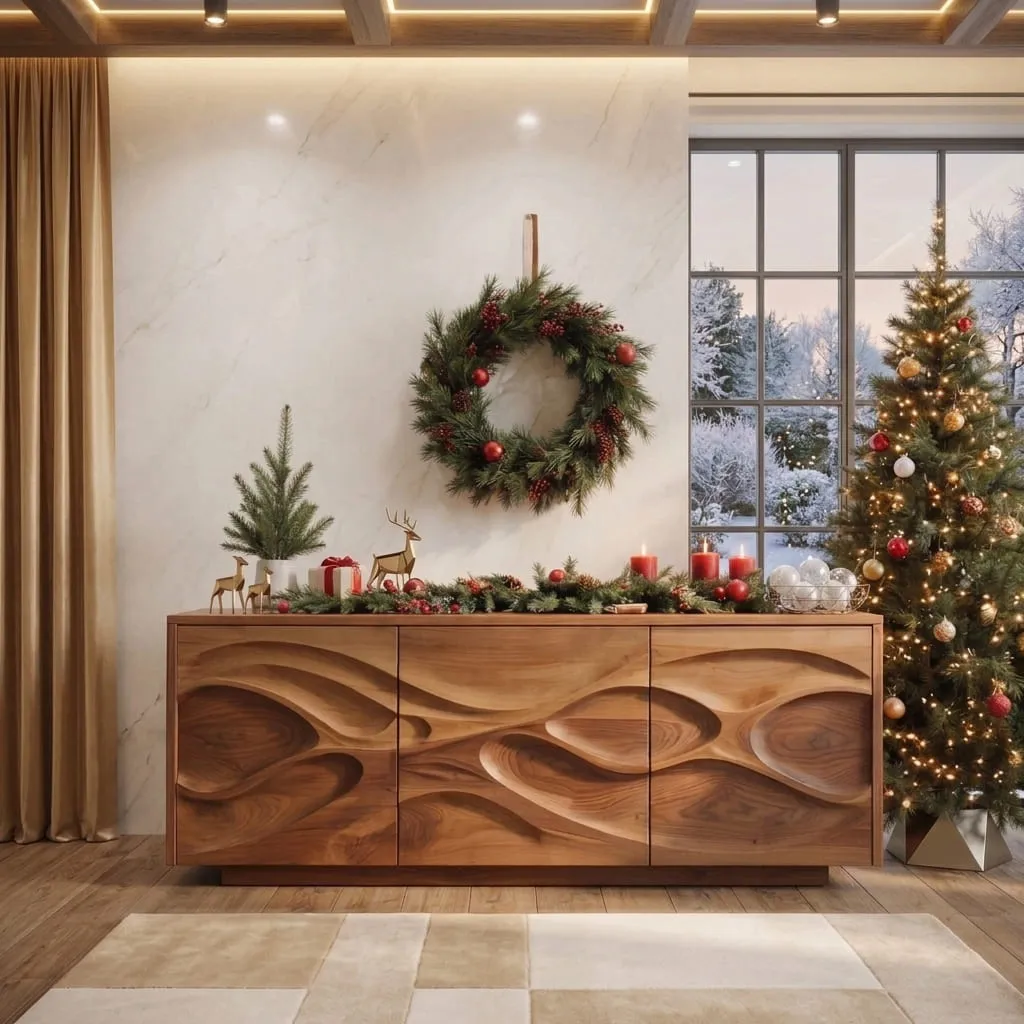
Notice the restraint: crimson candles, gold reindeer, one small potted tree. Nothing competes with the wood grain.
Here’s the trick with a dark sideboard — your greens will disappear against it unless you add a light middle layer. Tuck cream or ivory elements (a stoneware vase, white pillar candles, a pale ceramic bowl) directly between the garland and the wood. That mid-tone separates the two darks and makes the whole arrangement read from across the room instead of only up close.
2. An Illuminated Village on an Antique Sideboard
The miniature illuminated village is the whole story — white and grey houses, a church steeple, dozens of bottle brush trees clustered like an actual town. Pull that out and you’re left with a nice antique sideboard and a garland. The village is what makes people stop and lean in.
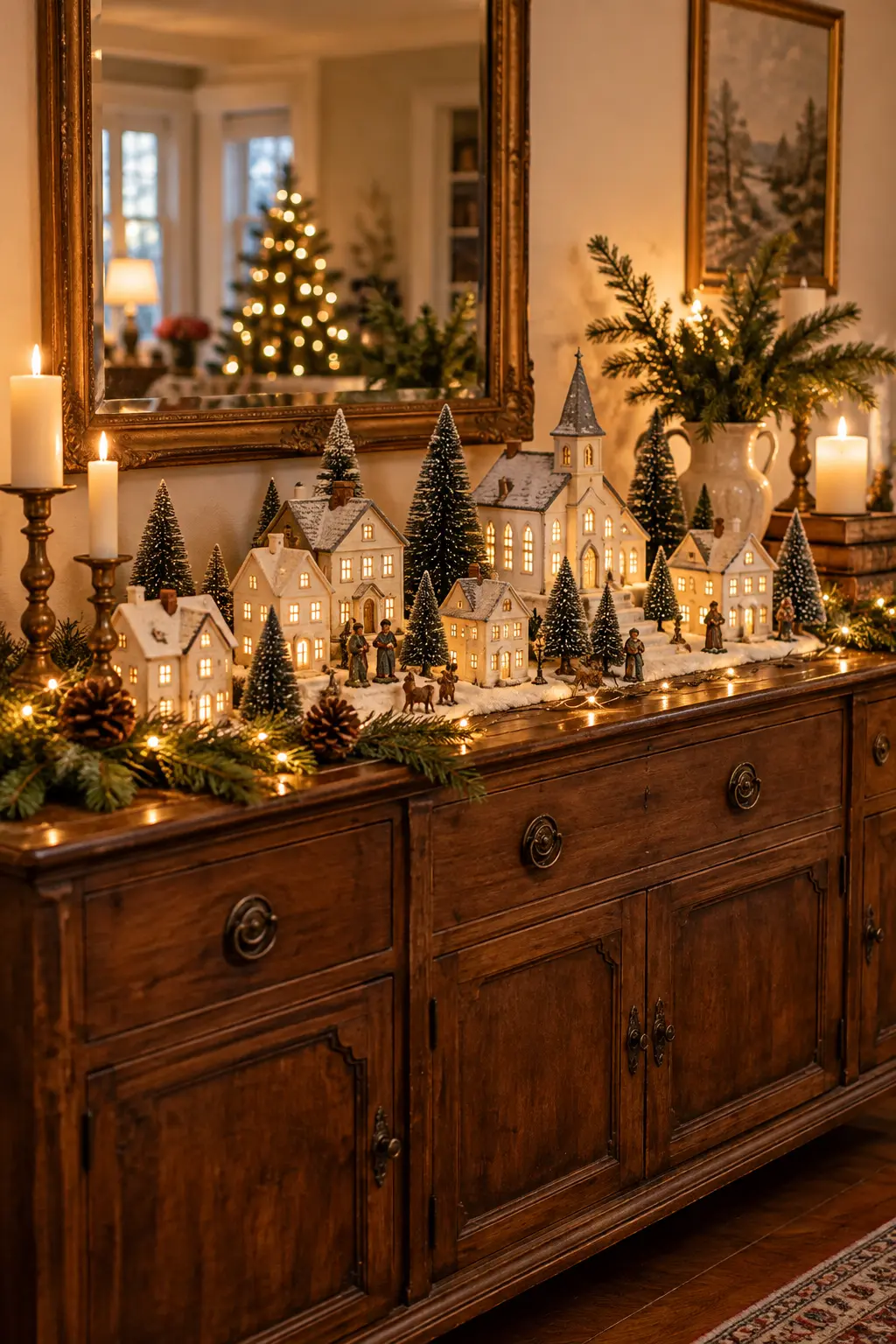
Three things are working in its favor. First, scale contrast: those tiny houses against a large dark sideboard create drama that a single big centerpiece couldn’t. Second, layered lighting — the village glows, the garland glows, and the gold-framed mirror behind bounces it all back into the room. Third, asymmetry, with the tall brass candleholders pushed to one end so your eye travels rather than settling.
That mirror is the underrated hero. It doubles the light and lets you see the tree reflected from the next room.
3. Light Oak Sideboard, Lit Garland, Gifts Below
Draping the garland so it spills just past the front edge of a light oak top is what makes this feel collected rather than placed. Let the pinecones and frosted leaves hang a couple of inches over the edge — it softens that hard horizontal line where furniture meets wall.
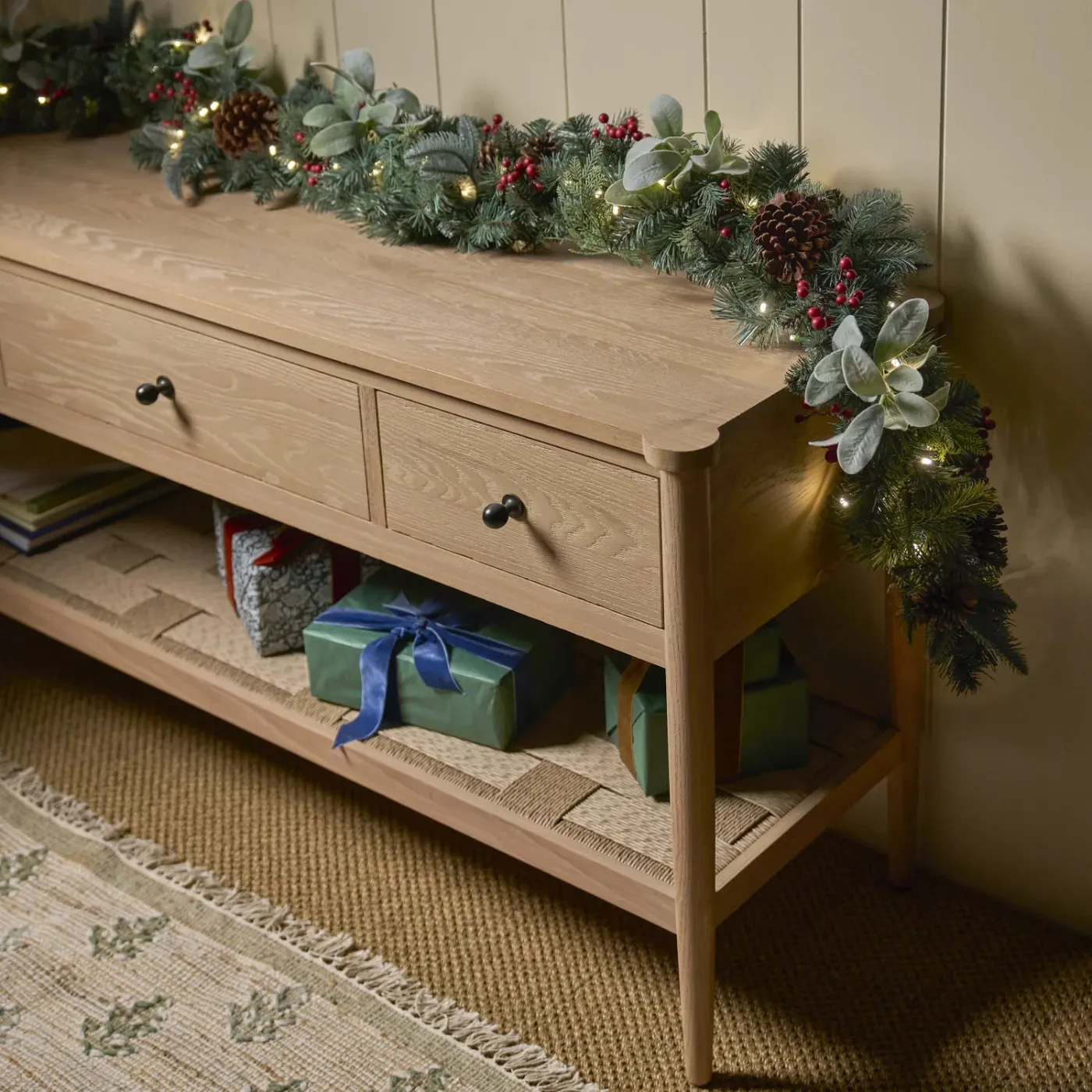
The woven lower shelf holding green and patterned gift boxes is smart because it uses dead space. Most people stop decorating at the top surface and leave everything below the drawer line empty.
One honest note: artificial garlands with built-in lights are convenient, but the wires show when you drape them loosely. Before you style, run a slim green floral wire or zip ties in matching green to bundle the cord along the back of the branches. Takes ten minutes, saves you from a tangle of black cord in every photo you take this December.
4. Brass Candlesticks and a Lantern Full of Glow
Look at the proportions here — this is roughly 60% warm brown wood base and evergreen garland, 30% cream pillar candles in assorted heights, and 10% brass and wooden candleholders plus the metal lantern. That formula is why it feels calm even though there’s a lot happening.
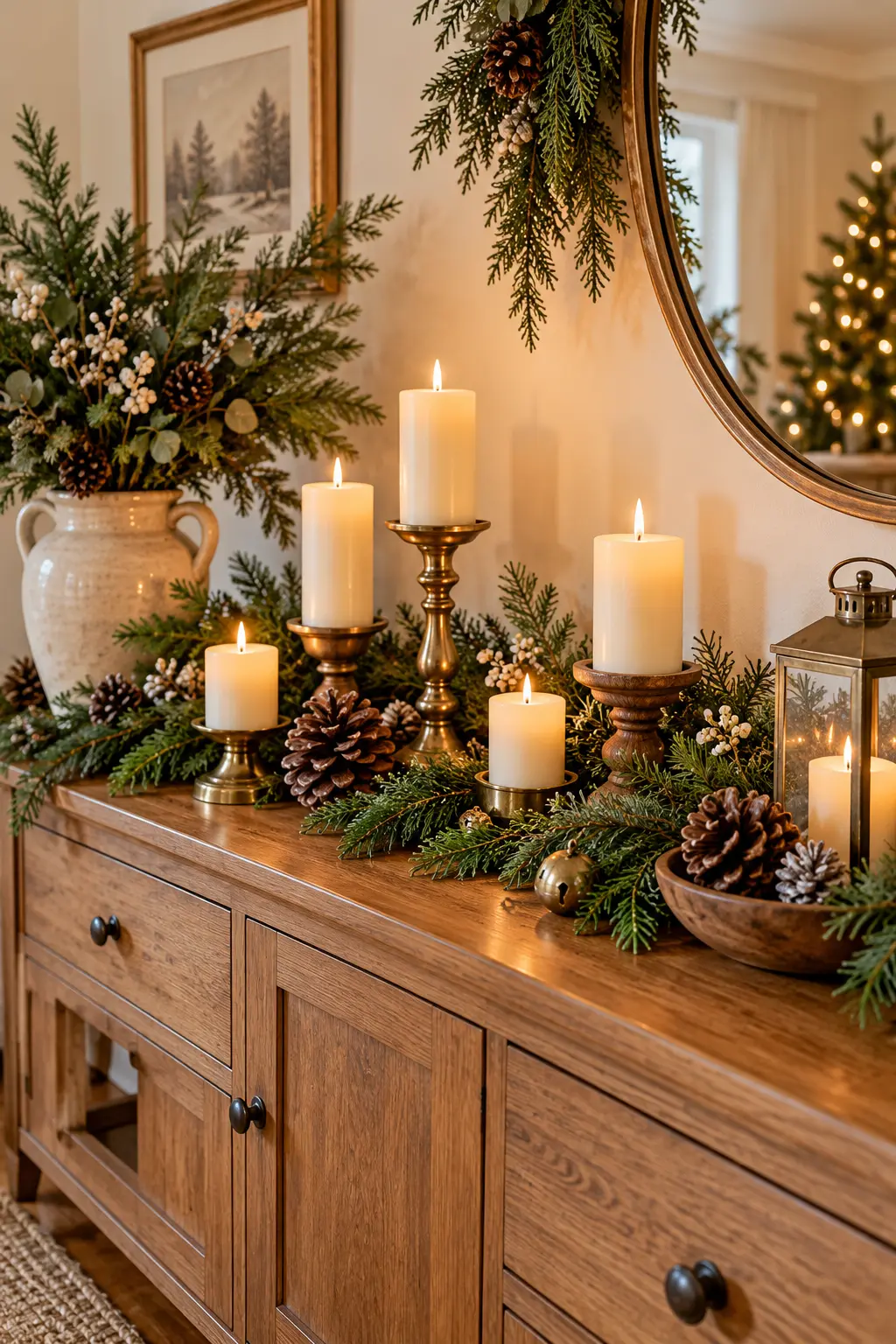
Swap the palette and it still works: keep the 60/30/10 split but trade cream candles for burgundy, and brass for matte black. Same bones, completely different mood.
If the brass candleholders are where your budget balks, know that the visual weight comes from the varied heights, not the metal. Thrift stores are full of mismatched brass candlesticks for two or three dollars each, and a coat of metallic spray paint unifies them in an afternoon. You’ll spend a fraction of what a matched set costs and get a more interesting cluster. Compare with Idea #5 — same brass-and-candle logic, different finish.
5. Dried Citrus, Cutting Boards, and Ribbon Ties
Want the dried orange jar? It’s the easiest thing in this entire article.
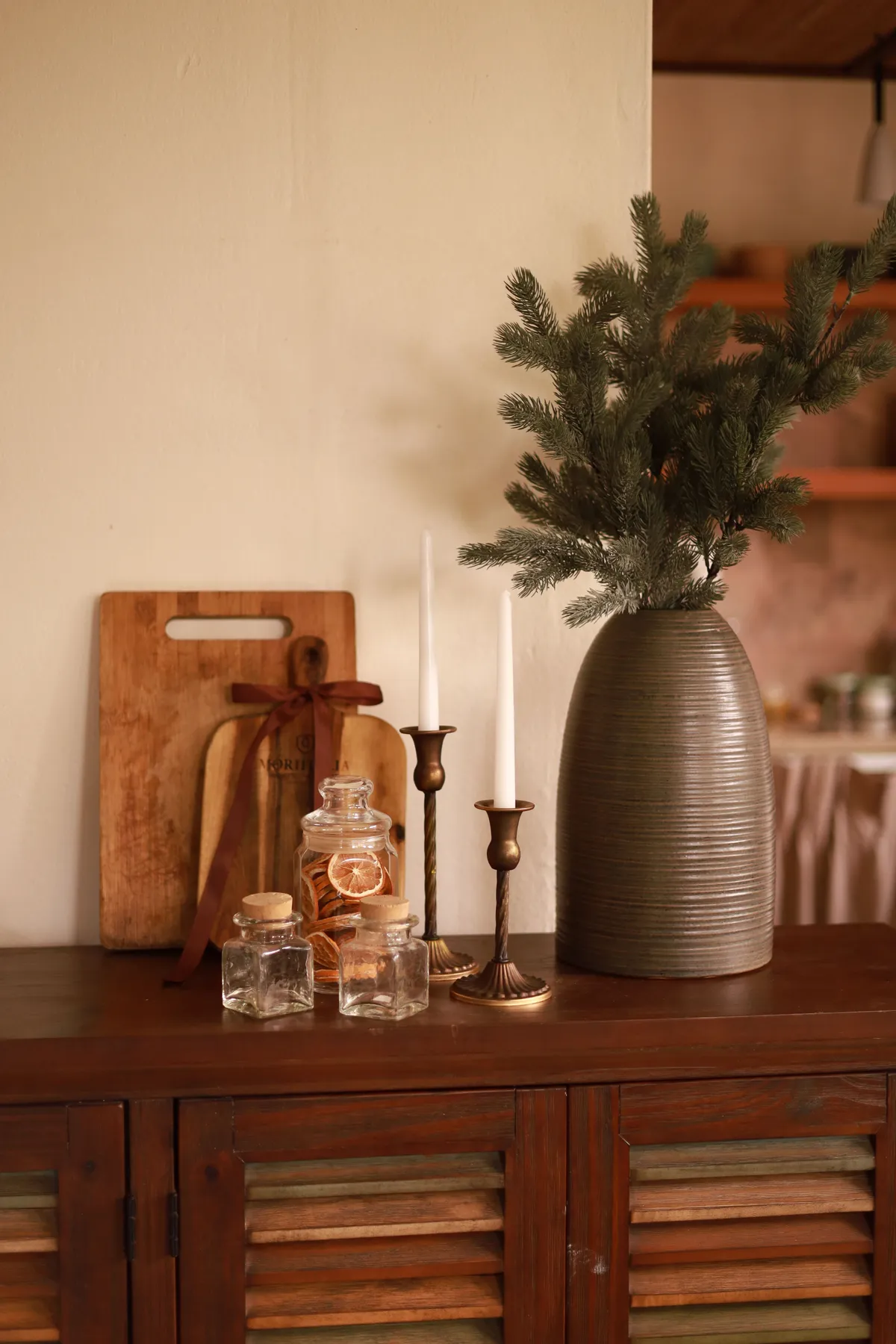
- Slice two oranges about ⅛ inch thick and blot them dry.
- Bake at 200°F for 2.5–3 hours, flipping halfway, until leathery but not browned.
- Cool completely — they crisp as they sit.
- Layer in a clear glass jar with a cinnamon stick or two.
Total cost: about five dollars and one afternoon. The scent fades after a few weeks, but the color holds for years if you keep the jar out of direct sun.
Now the honest part. Those wooden cutting boards tied with brown ribbon photograph beautifully, but leaning them against a wall behind a lit candle is a fire waiting to happen. Keep real flames at least a foot from anything wooden, or switch to battery tapers with a realistic flicker — nobody notices from three feet away, and you stop worrying every time you leave the room.
6. Wavy Doors, Red Berries, and a Matching Wreath
What makes this one land is repetition between the wreath and the garland. Same berries, same green, same density — so the wall and the furniture read as one composition instead of two separate projects. That’s a five-minute decision with an outsized payoff.
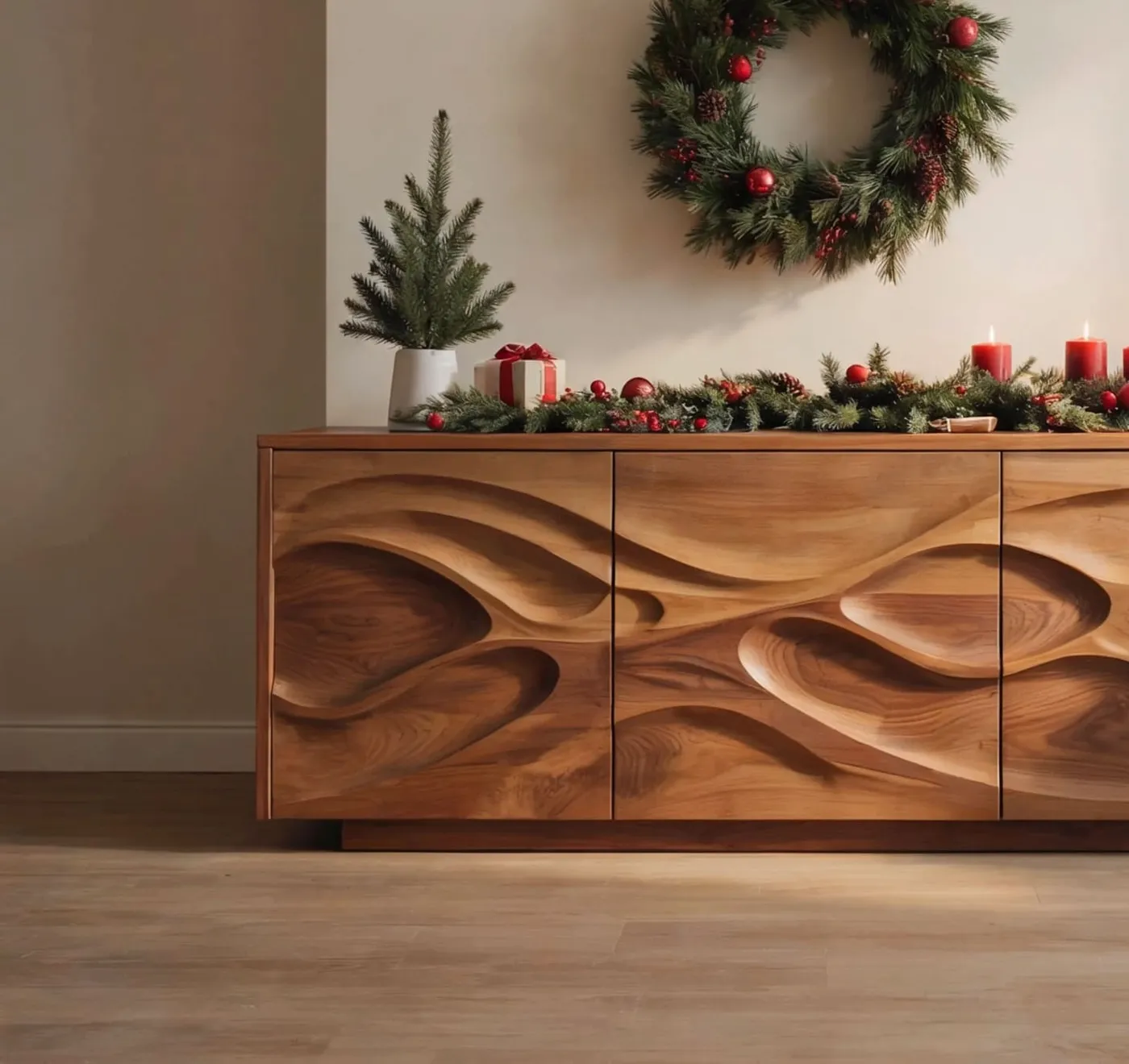
The carved wavy doors add movement in a way flat panels can’t, and the lit red pillar candles pick up the berry color exactly. Everything is echoing something else.
For scale: this setup wants a sideboard roughly 60–72 inches wide on a wall at least 8 feet tall, so the wreath has breathing room above the garland without crowding the ceiling. In a smaller space — say a 5-foot-wide entry nook — shrink the wreath to 18 inches and drop to one candle grouping. If your room is tight, Idea #13 shows a bench-scale version of the same green-and-wood story.
7. Blue and White Ginger Jar Lamp Steals the Show
The navy ginger jar lamp is the unexpected guest at this party, and it’s why the display doesn’t feel like a catalog page. Green and red are the obvious pairing; adding blue is what makes people pause.
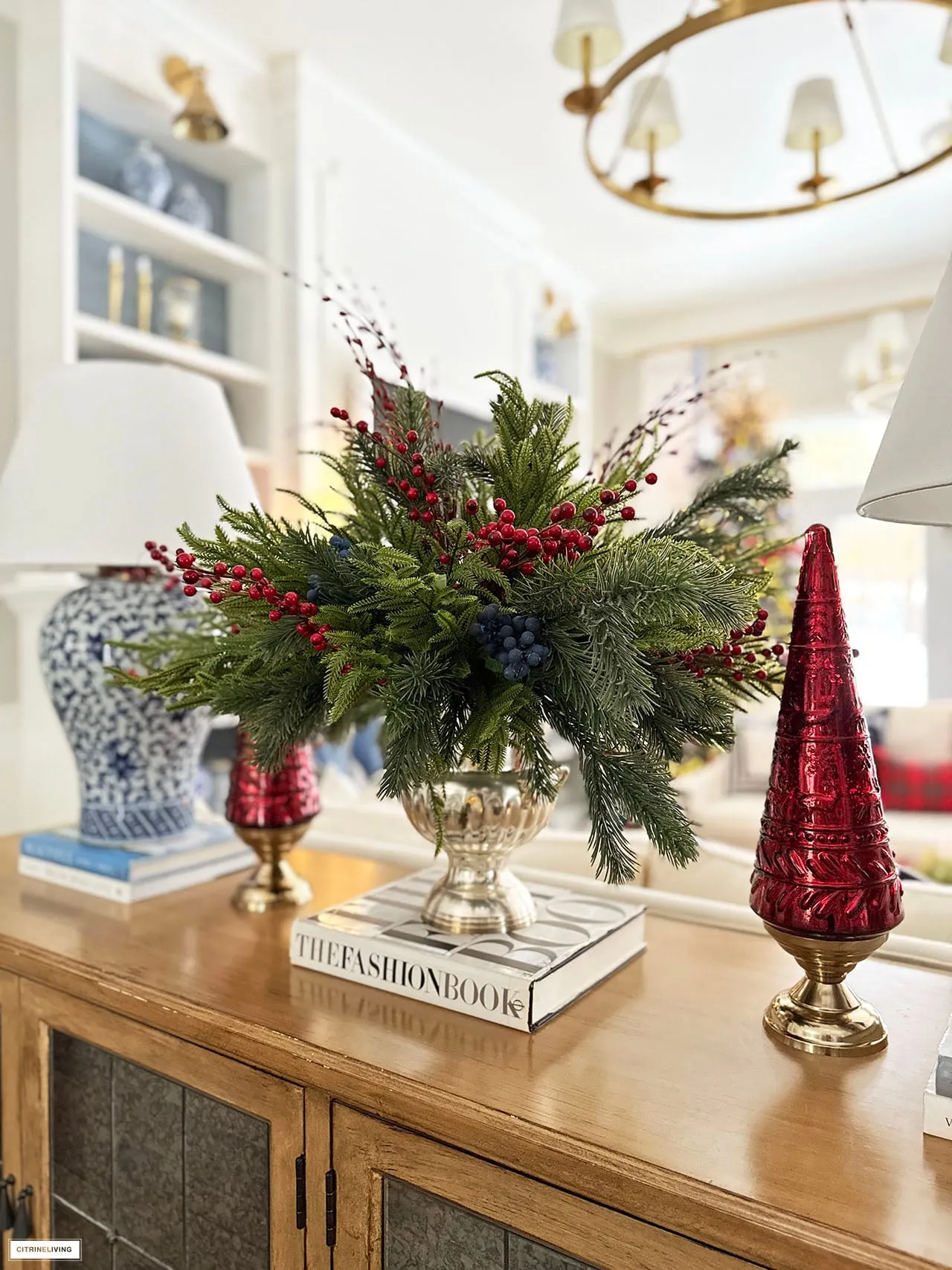
Here’s the professional bit: use books as risers. Those coffee table books under the mercury glass bowl and the red tree elevate each piece to a different height, which is what stops a sideboard from looking like a flat row of objects. Stack two or three, keep the spines facing out, and vary the stack heights by at least three inches.
- Main furniture (light wood sideboard): $400–$1,200
- Lighting (ginger jar lamp): $80–$250
- Textiles and greenery: $40–$120
- Decor (mercury glass, red tree, books): $60–$180
- Paint or wall treatment: $0–$60
Total: roughly $580–$1,810. Budget alternative: shop the lamp secondhand and use a silver spray-painted bowl from a thrift store for the mercury glass look — cuts it by half.
8. Silver Reindeer Under a Round Brass Mirror
A gray-washed rustic sideboard paired with a big round brass-framed mirror is the kind of contrast that keeps a room from feeling one-note. Warm metal against cool wood, hard reflection against soft greenery.
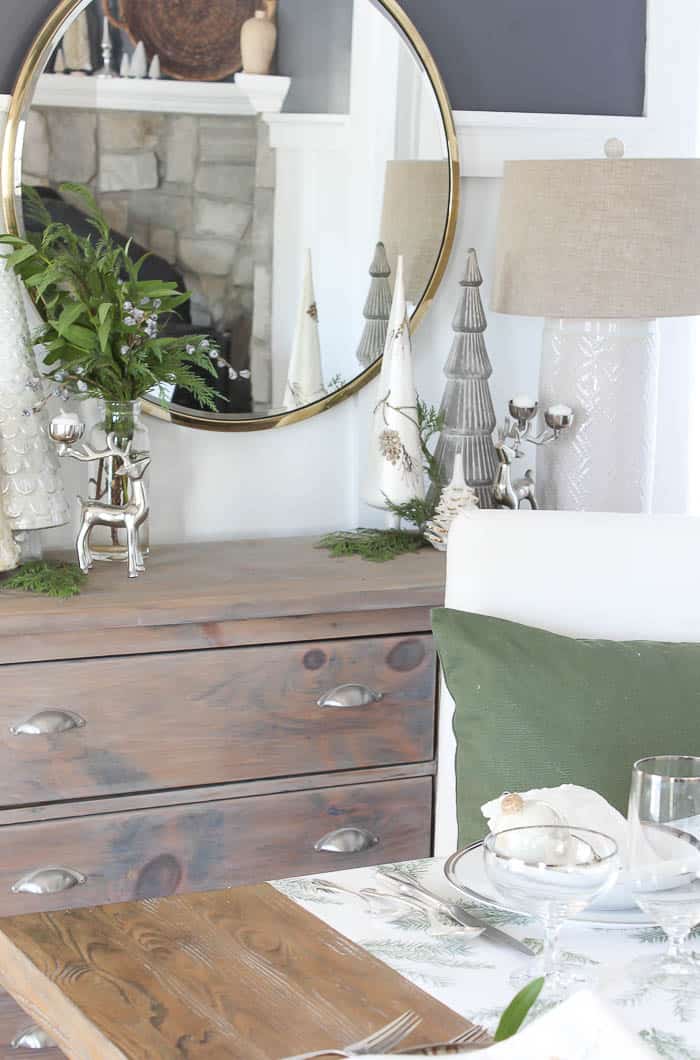
The palette math here is about 55% gray-washed wood and white, 30% silver and gray trees, and 15% brass plus forest green sprigs. The brass is a small percentage but it’s what warms the whole thing up — skip it and the display turns icy.
on silver decor: metallic finishes show fingerprints and dust faster than anything else on your sideboard. If this sits in a high-traffic hallway, plan on a microfiber cloth pass every couple of days during December. Also — the mirror will reflect whatever is directly across from it, so check that angle before you commit. A round mirror facing a cluttered wall undoes all your styling work in one glance.
9. A White Wonderland with Snowflakes on the Wall
The oversized snowflakes mounted on the wall above the sideboard are the element you’d miss most. Without them, this is a white table with white objects on it — pretty but flat. The wall decor gives the display vertical reach and turns a surface arrangement into a full wall moment.
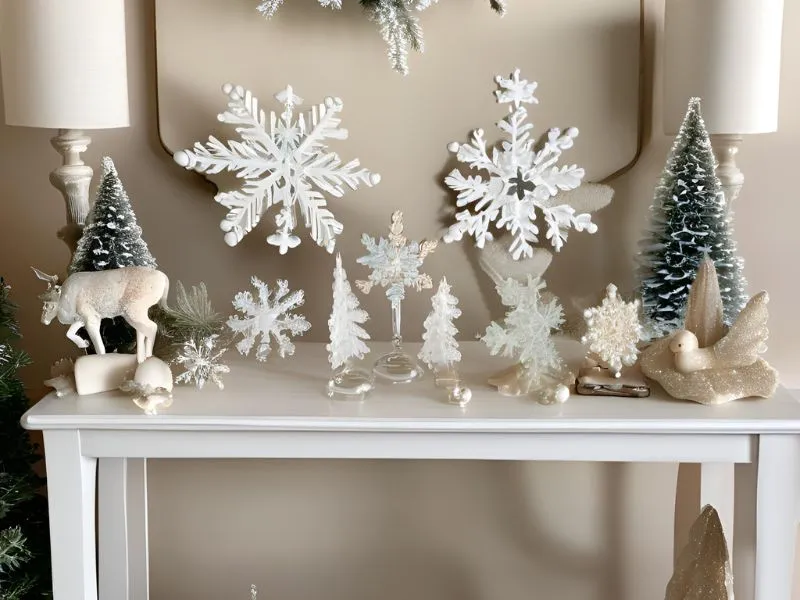
Before you commit to a mono-white scheme, run this checklist:
- Photograph your sideboard in daylight and at night — white reads completely differently under warm bulbs
- Confirm your wall color isn’t cream or yellow-toned, or the white decor will look dingy by comparison
- Count your light sources; all-white displays need at least two to avoid looking gray
- Check that your lampshades are the same white temperature as your tree lights
That last one matters more than people expect. Warm bulbs next to cool white bulbs make one half of your display look dirty.
10. Gold Mirror, Neutral Trees, Charcoal Wall
This is a masterclass in keeping a neutral palette from going boring. The formula: 50% charcoal wall and white wainscoting, 30% light distressed wood and cream, 15% silver and gray decorative trees, 5% gold mirror frame. That thin gold sliver is doing all the warming.
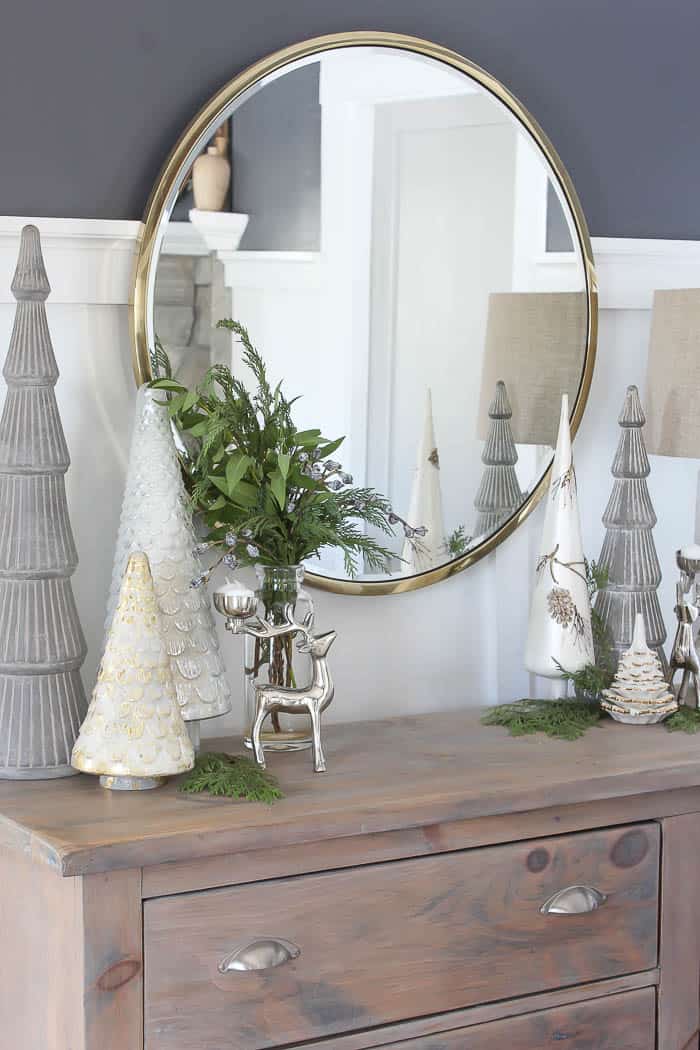
Swap the gold for matte black and you get a modern, moody version. Swap it for copper and the whole thing goes warmer and more rustic. The percentages stay locked; only the metal changes.
On a budget, the decorative trees are where you save. Retail clusters run $80–$200 for a mixed set, but dollar store cone trees wrapped in yarn, sprayed silver, or covered in sheet music cost two to four dollars each and look intentional when grouped at three different heights. The mirror is the one piece worth spending on — it’s the anchor and cheap glass always shows.
11. Rattan Sled, Mini Evergreens, and a Woven Basket
The rattan decorative sled leaning against the lamp is the piece that makes this console feel collected rather than decorated. It’s an odd object, and odd objects are what separate a styled home from a store display.
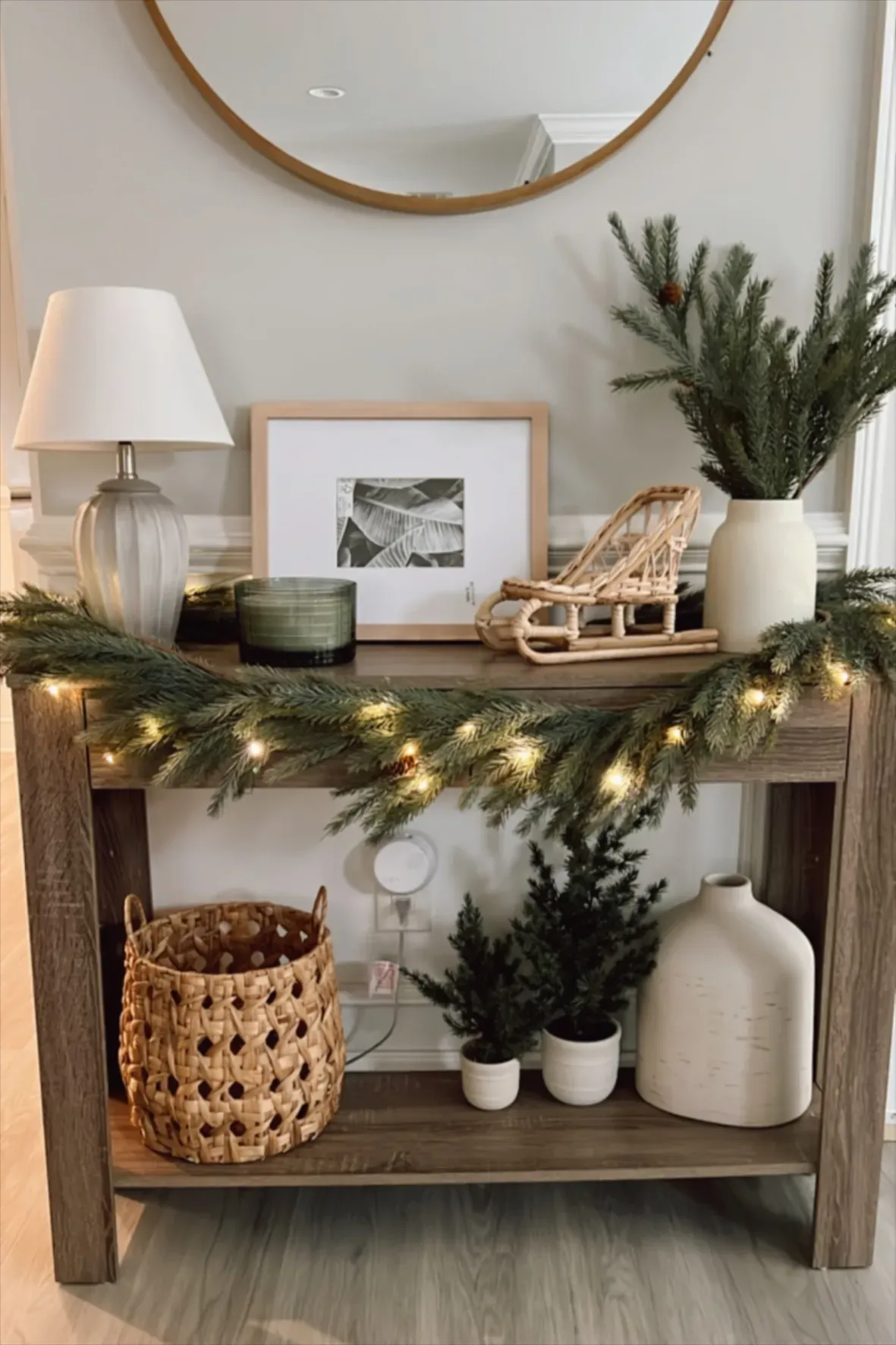
Practical tip for two-shelf consoles: treat the top shelf as your display and the bottom shelf as your texture layer. Here that means a woven basket and two small potted evergreens below — nothing precious, nothing breakable, and it fills the visual gap under the furniture line that most people ignore. Notice the black and white botanical print is unframed-heavy and simple; that restraint lets the garland be the star.
If your console has no lower shelf, a basket on the floor tucked partially under the front edge achieves the same grounding effect. See Idea #30 for a console with the same natural materials at a different scale.
12. Fluted Doors and a Wreath on the Cabinet
Hanging a small wreath directly on the cabinet door instead of the wall above is a small rebellion that’s been spreading across Pinterest for the last two seasons. It works because it breaks the invisible line everyone expects — decor goes up top, furniture stays plain. Once you hang something on the furniture itself, the whole arrangement feels looser.
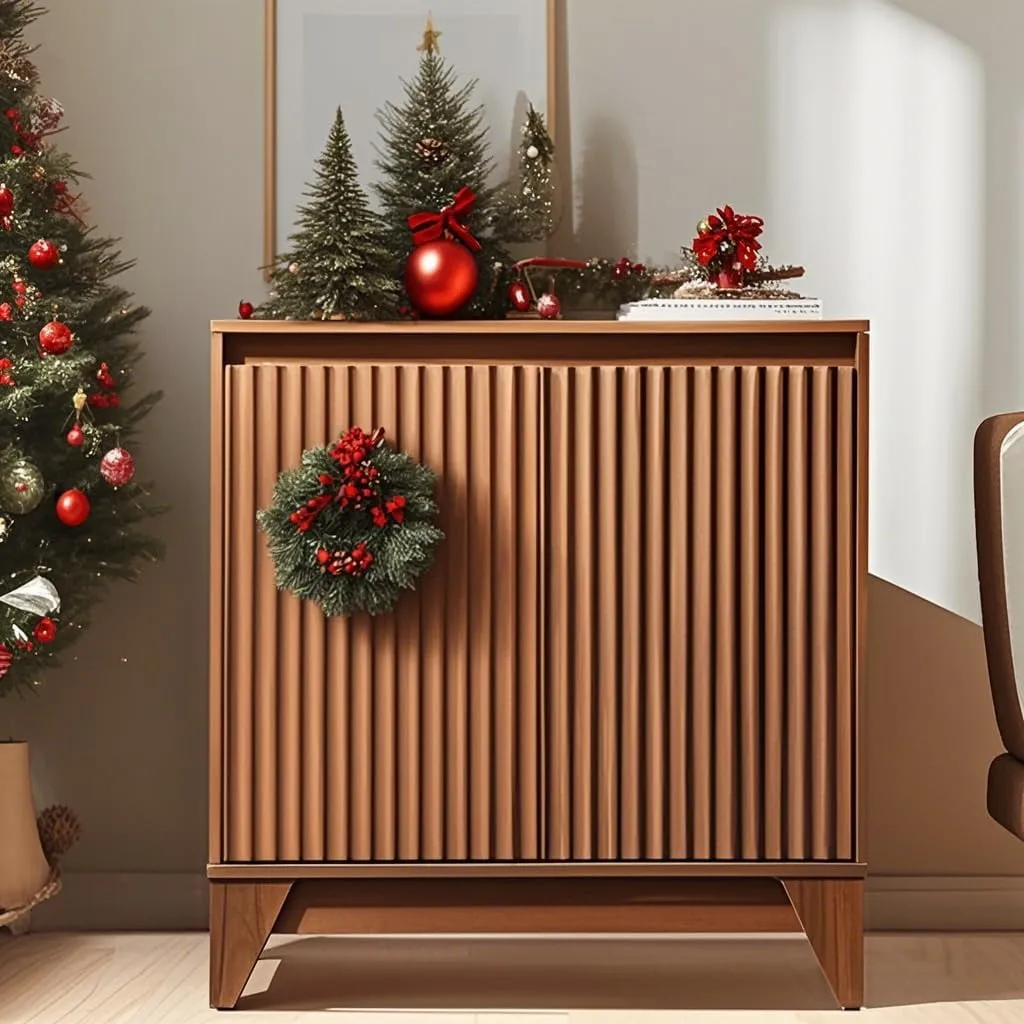
The vertical fluting on this medium-toned sideboard plays the same game as the wavy carving in Idea #1 — texture in the wood itself so the Christmas decor has something to sit against.
Why it holds up: the large red bauble with a bow is the single point of saturated color, and everything else — mini trees, red berry garland — supports it at lower volume. That’s a hierarchy. Fluted-front furniture is also in the middle of a real resurgence, so this sideboard will still feel current when the tinsel comes down in January.
13. A Bench-Scale Entryway with Pine and Pinecones
Proof that a full holiday moment doesn’t require a sideboard at all. This light natural wood bench works in a footprint of roughly 40 by 14 inches — ideal for entryways between 4 and 6 feet wide where a full console won’t fit.
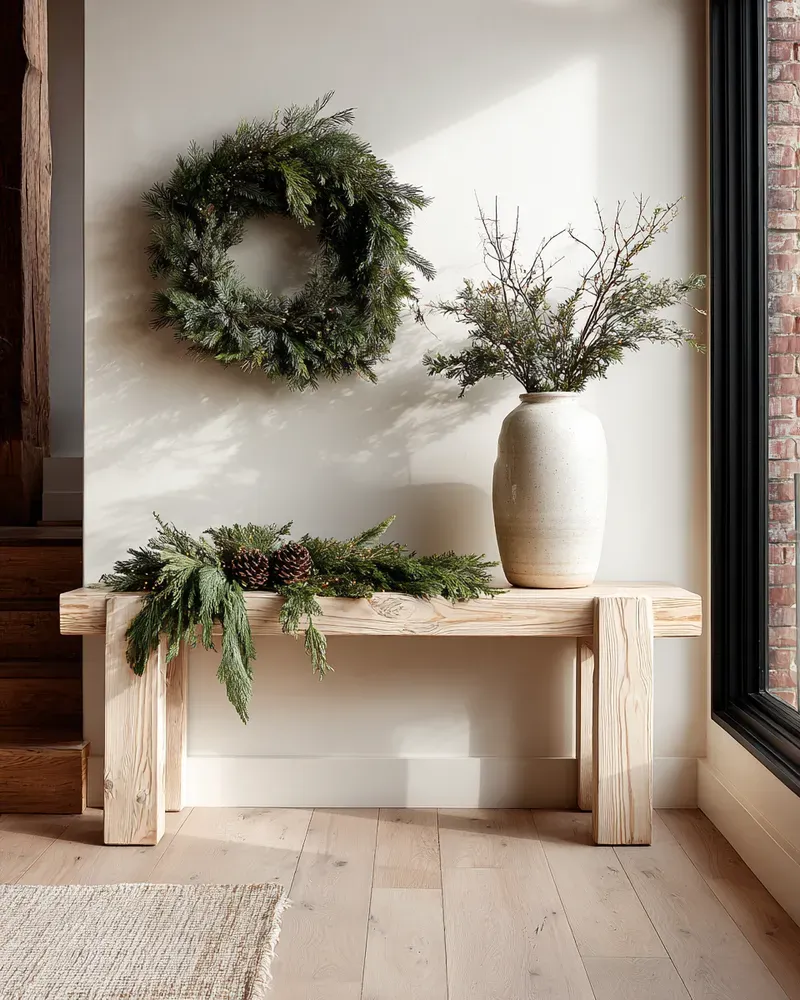
The garland and pinecones sit on the bench seat, which means it’s no longer usable for sitting. That’s fine in a decorative entry, less fine in a mudroom that takes actual traffic. If you need the function, drape the garland over the back rail instead and keep the seat clear.
The tall textured cream vase with sparse green branches softens the corner, and the window light does the rest. If your entry has no window, add a small lamp or a battery puck light behind the vase — flat overhead light will kill the whole effect. Ceiling height of 8 feet is plenty here; the wreath sits low enough that a taller room just means more air above.
14. Tabletop Tree on a Wood Slice Base
Not every sideboard needs a full arrangement. A single miniature evergreen on a natural wood slice can carry a small table, and this one does it with a wide red glitter ribbon and silver berry clusters.
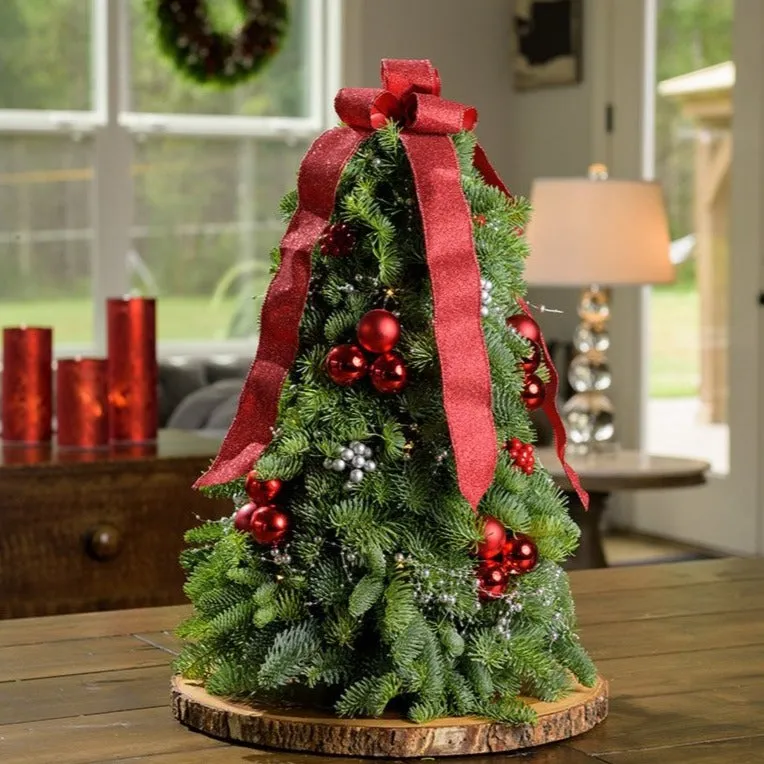
Make the wood slice yourself for about eight dollars:
- Find a fallen branch or buy a 1-inch-thick wood slice online
- Sand the top smooth with 120-grit, then 220-grit
- Rub with food-safe mineral oil and let it dry overnight
- Attach felt pads to the bottom so it doesn’t scratch your furniture
Total time: forty minutes plus drying. Now the budget note — a pre-decorated mini tree like this runs $40–$90 at retail, but a bare 18-inch artificial tree is about $15 and a spool of wide glitter ribbon is $6. Same look, roughly a quarter of the price, and you control the ornament placement.
15. Nutcrackers, Santa, and a Fully Lit Table
The nutcrackers are the detail that makes this table feel like it belongs to a family rather than a showroom. Two of them, mismatched sizes, standing guard beside a Santa figurine with a staff. Collectibles with a little wear on them beat anything new and glossy.
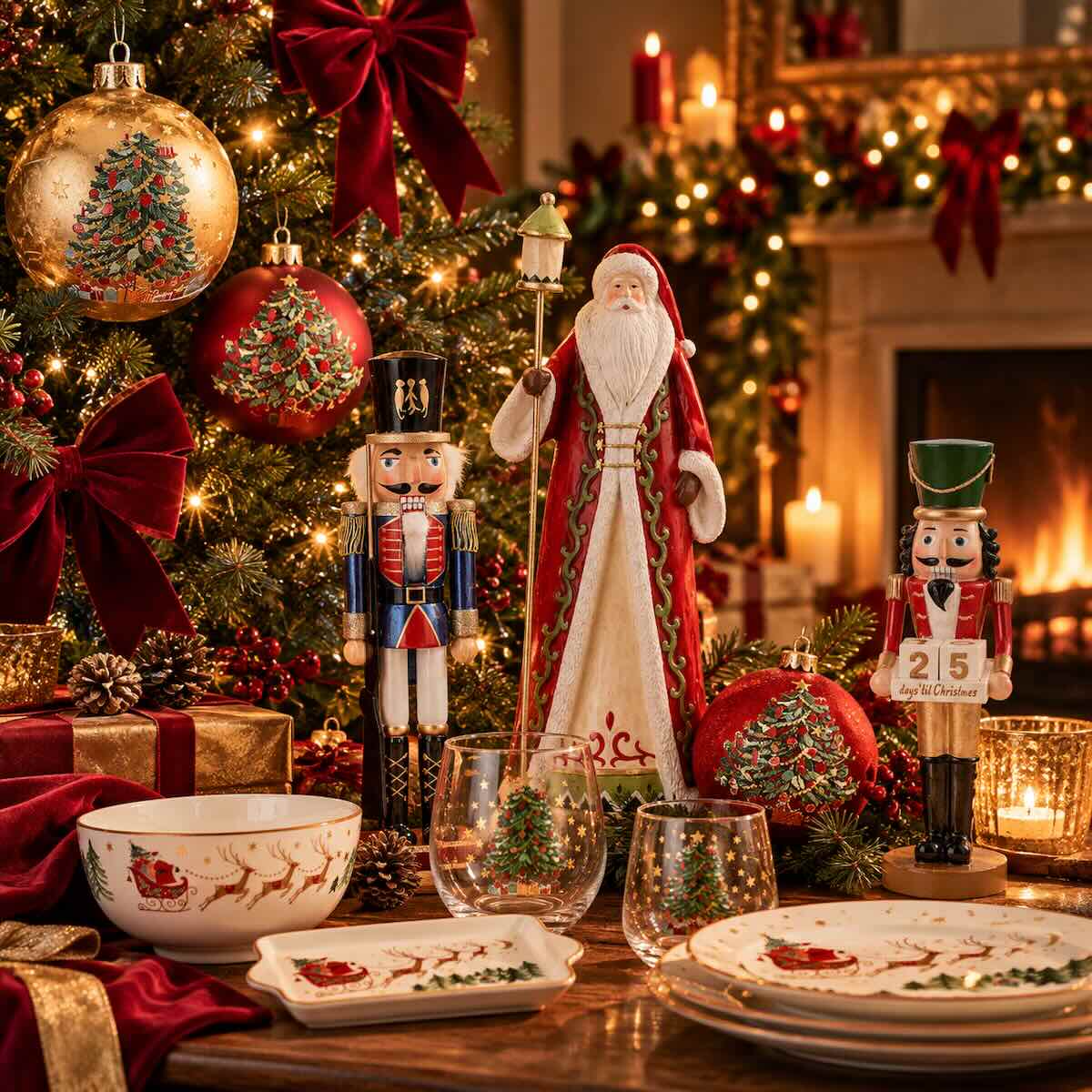
What’s happening behind them matters too — a tree packed with warm lights and red velvet bows, a fireplace with candles, and white ceramic dinnerware with Santa and reindeer motifs. That’s not a sideboard vignette, it’s a whole room committing to one idea.
Traditional nutcracker-and-Santa styling is having a quiet comeback as a counter-reaction to the minimalist neutral holiday look. People who grew up with these objects are pulling them back out of storage and styling them deliberately instead of apologetically. If you inherited any, this is your year.
16. Dark Fluted Sideboard, Brass Pulls, Barely Any Christmas
This is the Christmas display for people who don’t actually like Christmas displays. A dark fluted sideboard with brass pulls, tall dark candlesticks, leaning framed art, a bowl of gold and white baubles, and one small flocked tree. That’s it. And it’s completely persuasive.
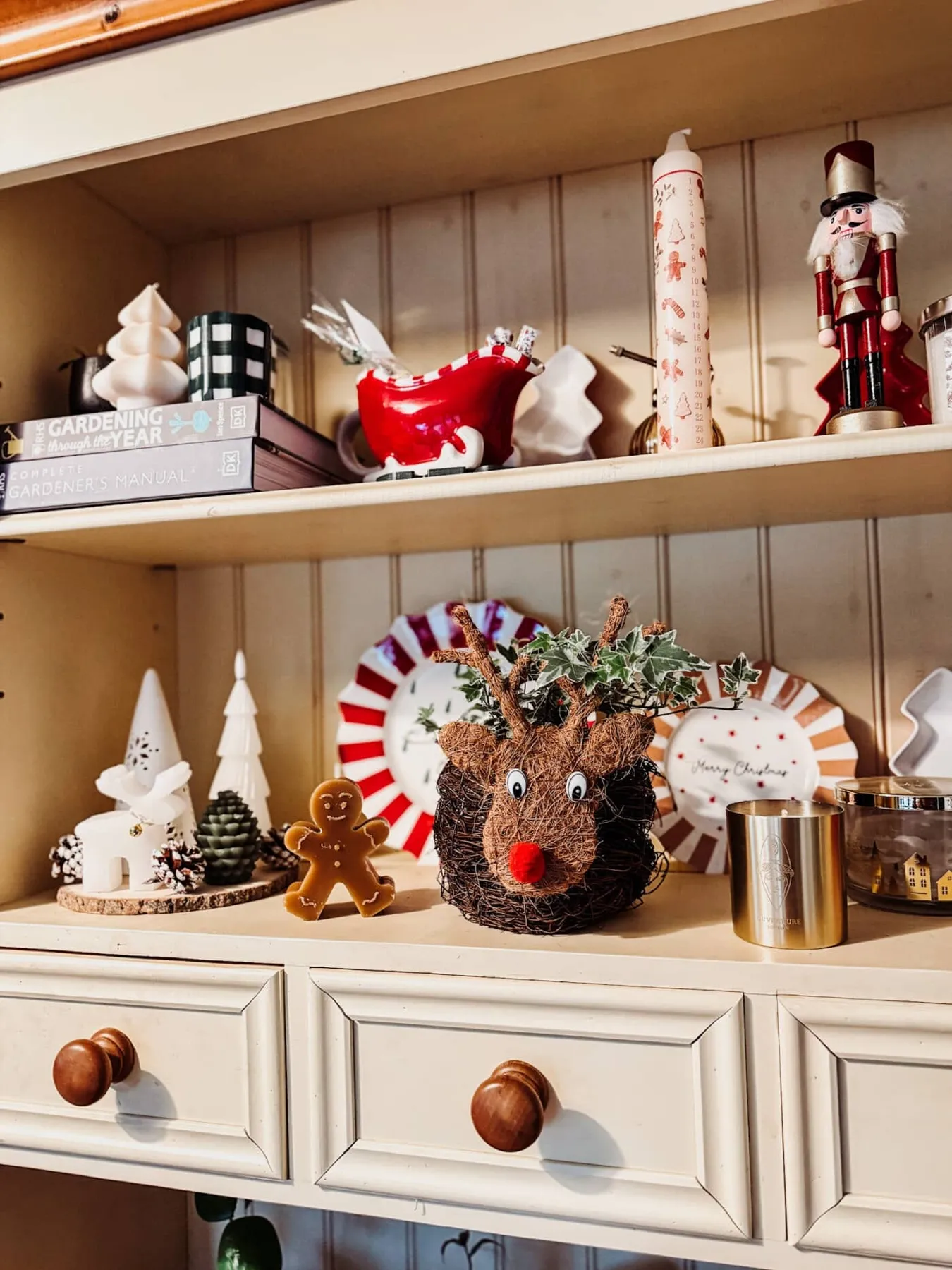
Two principles are at work. First, value contrast — pale baubles and white candles against dark wood create instant focus without adding color. Second, the leaning artwork behind the candlesticks creates depth, so your eye moves back through the arrangement rather than scanning left to right.
The brass tip: match your hardware finish to your decor metals. Brass pulls, brass ornament caps, and brass candlestick bases all speak the same language. Mixing four metals in one small zone reads as accidental, not eclectic. One metal, repeated, always looks expensive.
17. Deep Red Wreath Against Dark Olive Green
Dark olive green walls with a deep red foliage wreath is one of the most confident color pairings you can make in December, and it costs nothing but paint.
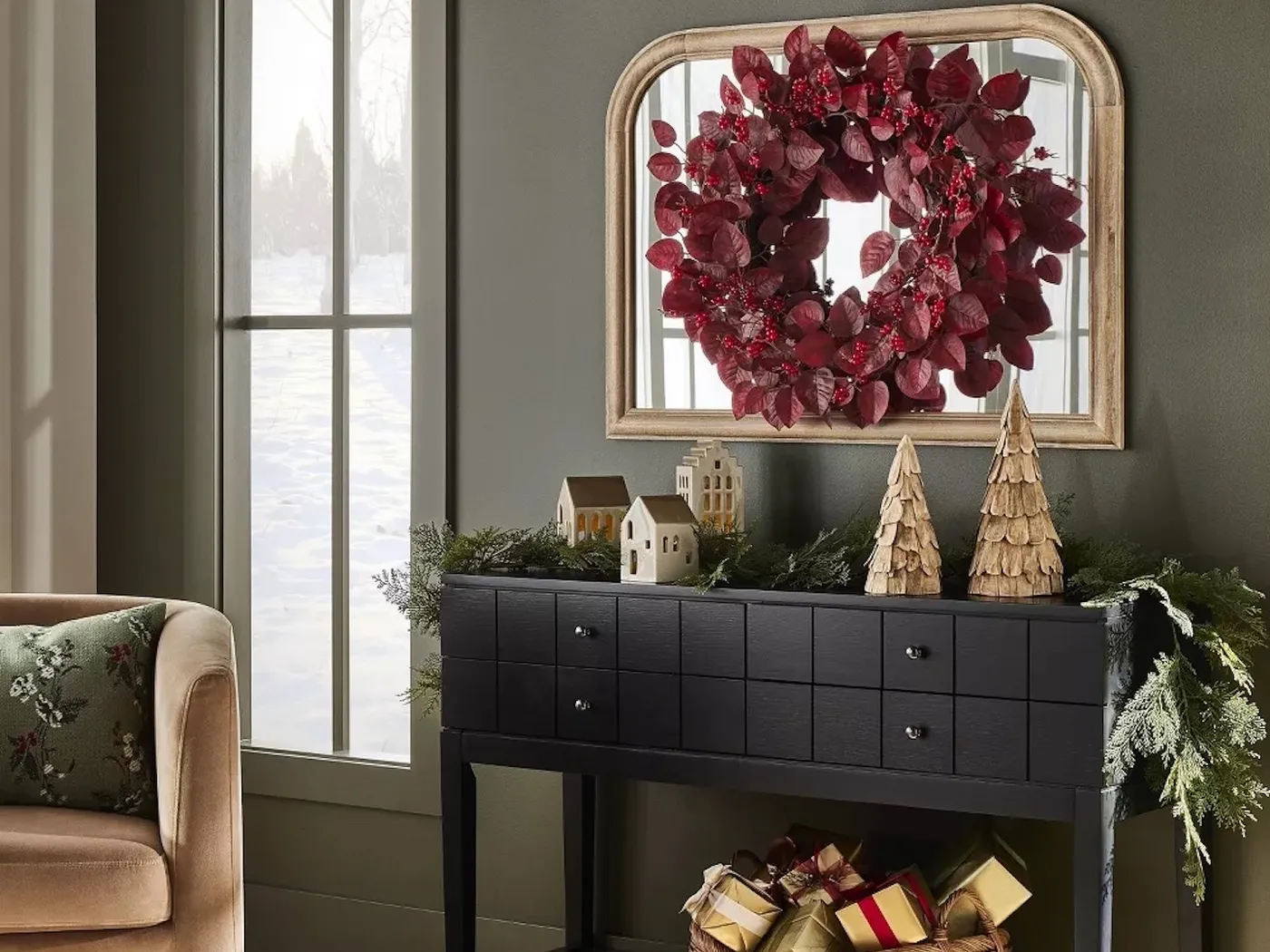
The recipe: 45% dark olive wall, 25% black console and frame, 20% deep red wreath and greenery, 10% light wood trees, 5% gold. Want to shift it? Swap olive for charcoal and red for burgundy and you keep the exact same proportions with a moodier result.
- Console table (black, simple): $150–$450
- Arched mirror: $90–$350
- Faux red wreath: $35–$90
- Garland and white ceramic houses: $40–$110
- Wooden tree decor and gold gift wrap: $30–$75
- Paint for the accent wall: $45–$75
Total: $390–$1,150. The wreath is the piece to splurge on — cheap faux red foliage looks plastic fast.
18. Fairy Light Jars and a Weathered Mirror Frame
Three glass jars, three different sizes, each filled with a strand of warm fairy lights and finished with twine, a pine sprig, and a single pinecone. This is the most repeatable idea in the whole article.
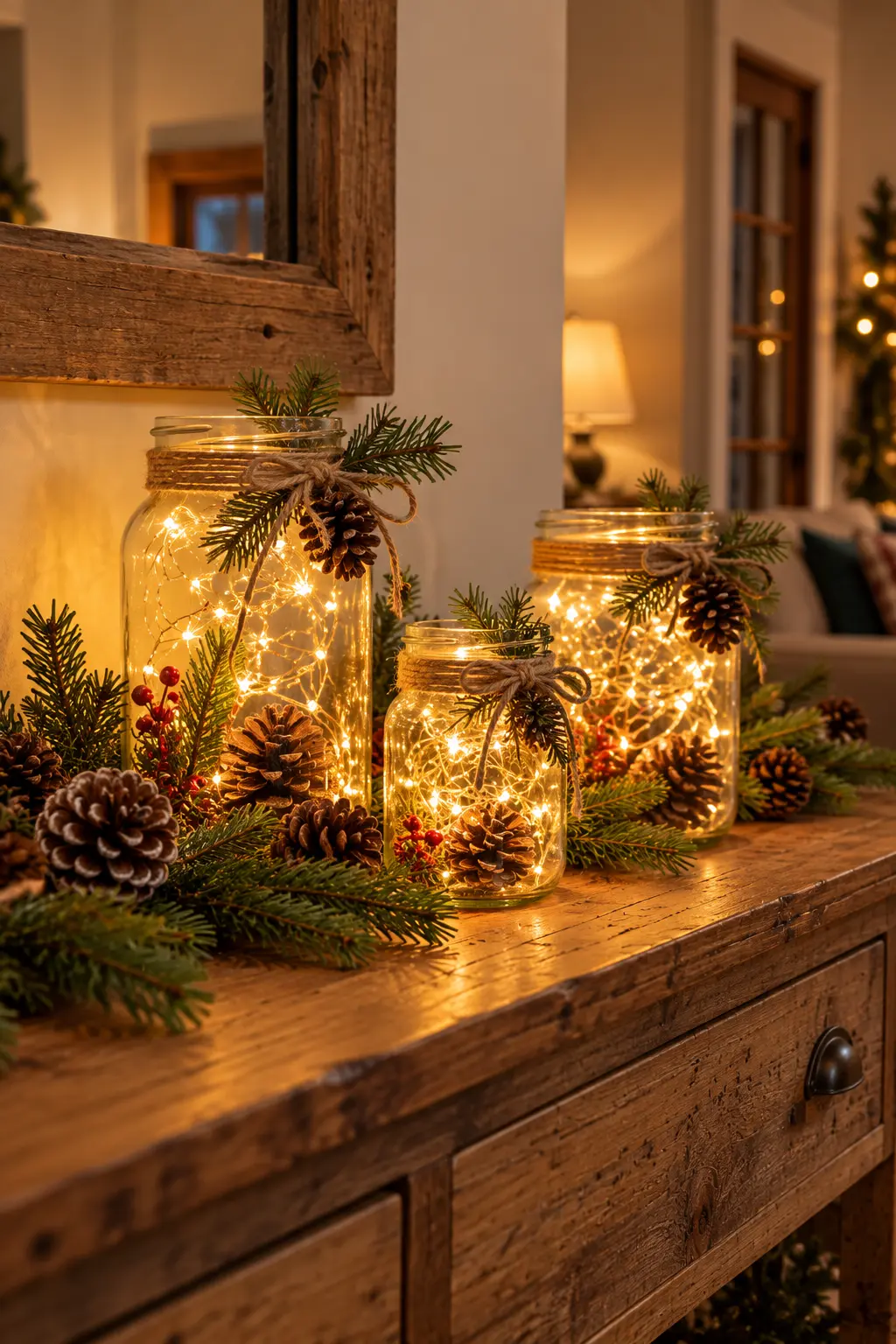
- Collect jars in three heights — a mason jar, a pasta sauce jar, and a small spice jar all work
- Use short battery fairy light strands, 20 to 30 bulbs each
- Coil the strand loosely so the lights cluster rather than clump at the bottom
- Wrap twine twice around the neck and tie a small pine sprig under the knot
- Hot glue a pinecone to the front of the twine
Cost: $15–$30 total if you already own jars. Time: twenty minutes.
Upkeep is the catch — battery strands on a timer run about three to four weeks before they dim, so buy a pack of replacement coin cells now rather than hunting for them on December 23rd. Also keep the jars away from direct sun; the twine will fade and the glass will show every fingerprint.
19. Frosted Bottle Brush Trees in Terracotta Pots
Trio of frosted bottle brush trees in terracotta pots, a speckled bowl of red and gold ornaments, a framed winter landscape, and a lit dark metal lantern. Simple, warm, done.
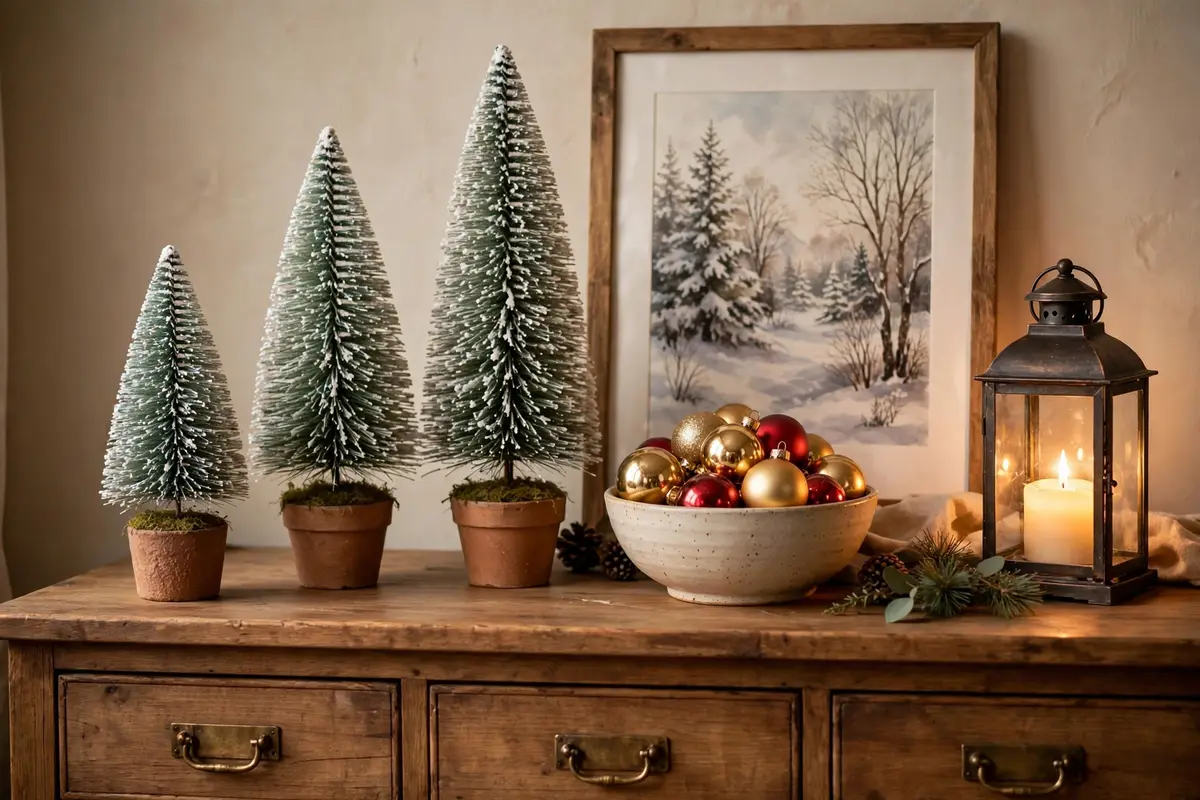
Here’s the tip nobody tells you: terracotta pots are instantly more expensive-looking with a thin coat of matte white paint on the rim only, leaving the lower half raw. It takes five minutes, costs nothing, and turns a garden pot into decor. Do the same to a few spares so you can rotate them.
The honest warning is about the lantern. Dark metal lanterns with real candles get alarmingly hot on top, and the metal holds that heat for a while. Use a candle inside a glass cup, or go battery-operated. Also check that your frosted bottle brush trees aren’t shedding — cheaper ones drop white fibers for weeks, and you’ll find them stuck to everything on the sideboard. A light spray of matte craft sealant when they’re new stops it.
20. Turn the Sideboard Into a Christmas Bar
The black mirrored tray is what turns this from a sideboard with bottles on it into an actual bar. Everything lives on the tray — the crystal decanters, the gold cocktail tools, the shaker — and the tray defines the zone. Remove it and the same objects read as clutter.
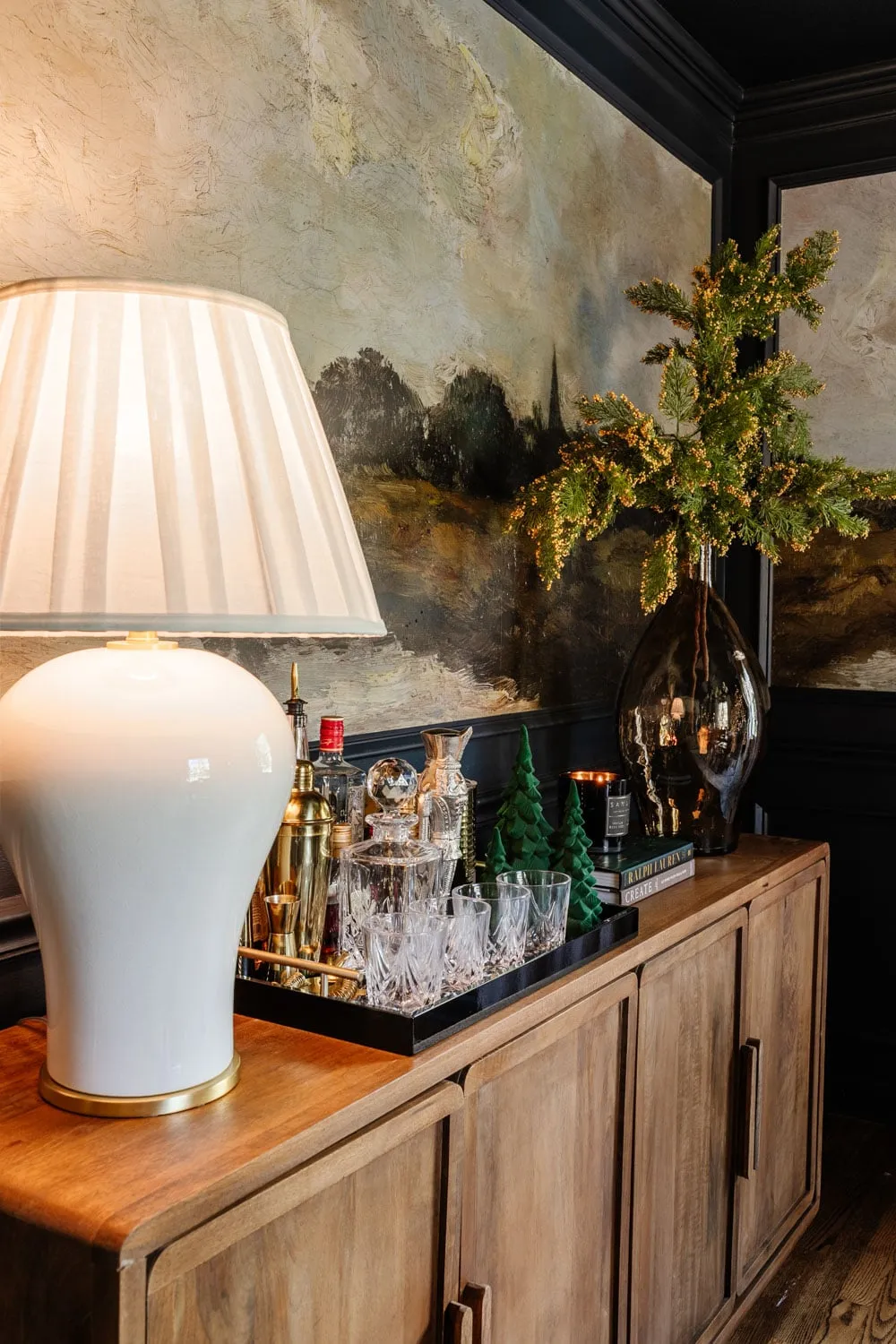
Mirrored trays are the cheat code here because they bounce the room back at you and make everything on them look more considered.
Two details worth copying: the green velvet trees sitting next to a black candle and a stack of books, which gives you a Christmas cue without turning the whole thing into a display, and the evergreen branches in a dark smoked glass vase — dark vase, dark branches, so the greenery reads as texture instead of shouting for attention. Keep the tray’s footprint to about two-thirds of your sideboard’s width so there’s breathing room on each end.
21. A Lit Lantern Centerpiece on the Dining Table
Same idea as sideboard decor, applied to the table — a rustic glass lantern filled with fairy lights as the base, then a lush evergreen and red berry arrangement built up around it.
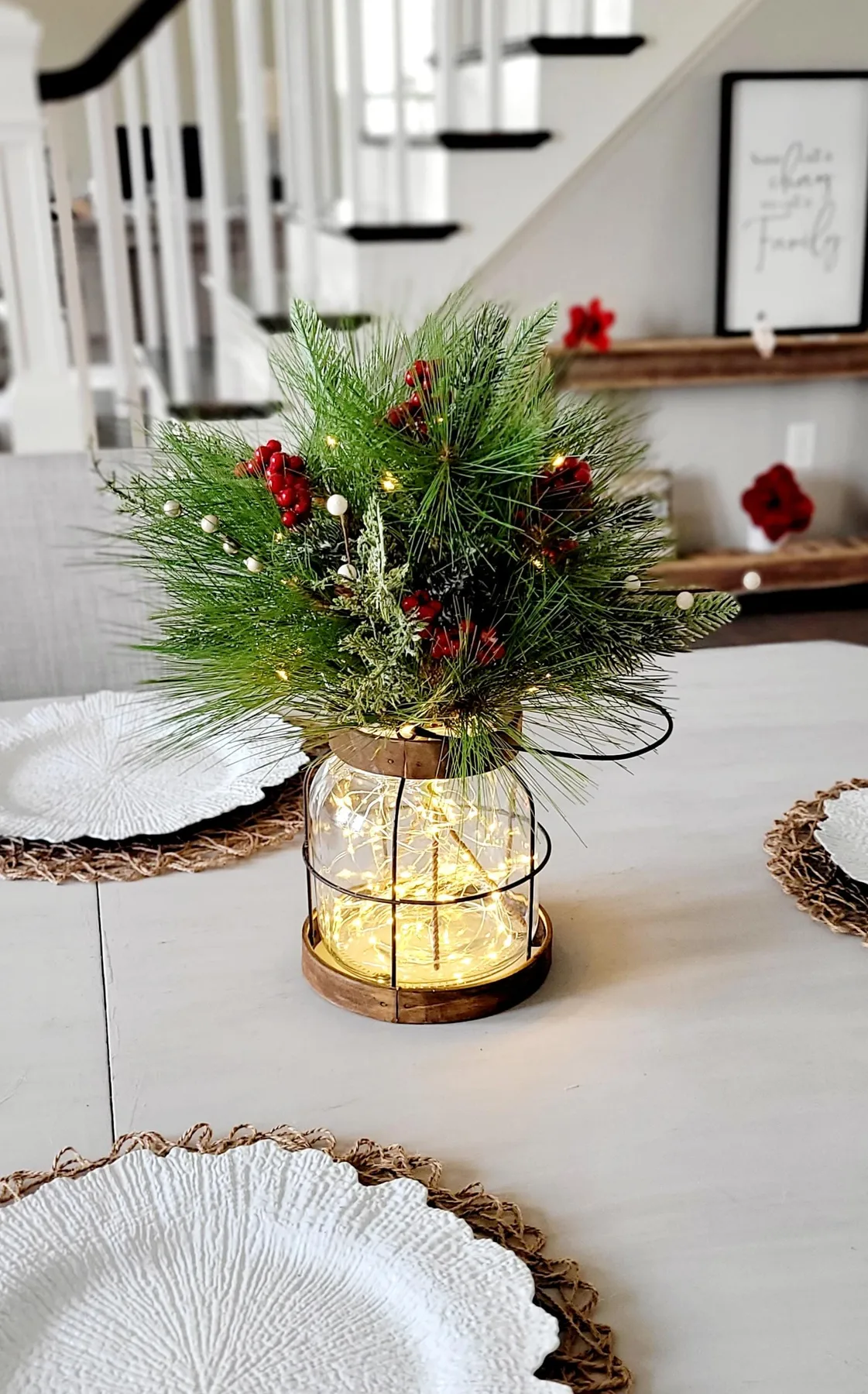
Why it works: the light source is inside the greens, so the arrangement glows from within instead of being lit from above. That’s the difference between a centerpiece that looks alive and one that looks staged.
Scale matters more at the table than anywhere. This centerpiece wants a table at least 60 inches long so each diner has clear sightlines across — anything shorter and people will move it to the side mid-meal, which tells you everything. Keep total height under 14 inches if you plan to eat around it. Compare the density here with the sideboard styling in Idea #3 — same greenery logic, different proportion.
22. Nativity Scene Under a Ribbon-Dressed Wreath
The nativity scene is the point of this display, and everything else is arranged to frame it — the blue and white chinoiserie lamp to one side, the small potted evergreen to the other, and above it all a round studded mirror wearing a wreath with velvet ribbons in teal and black.
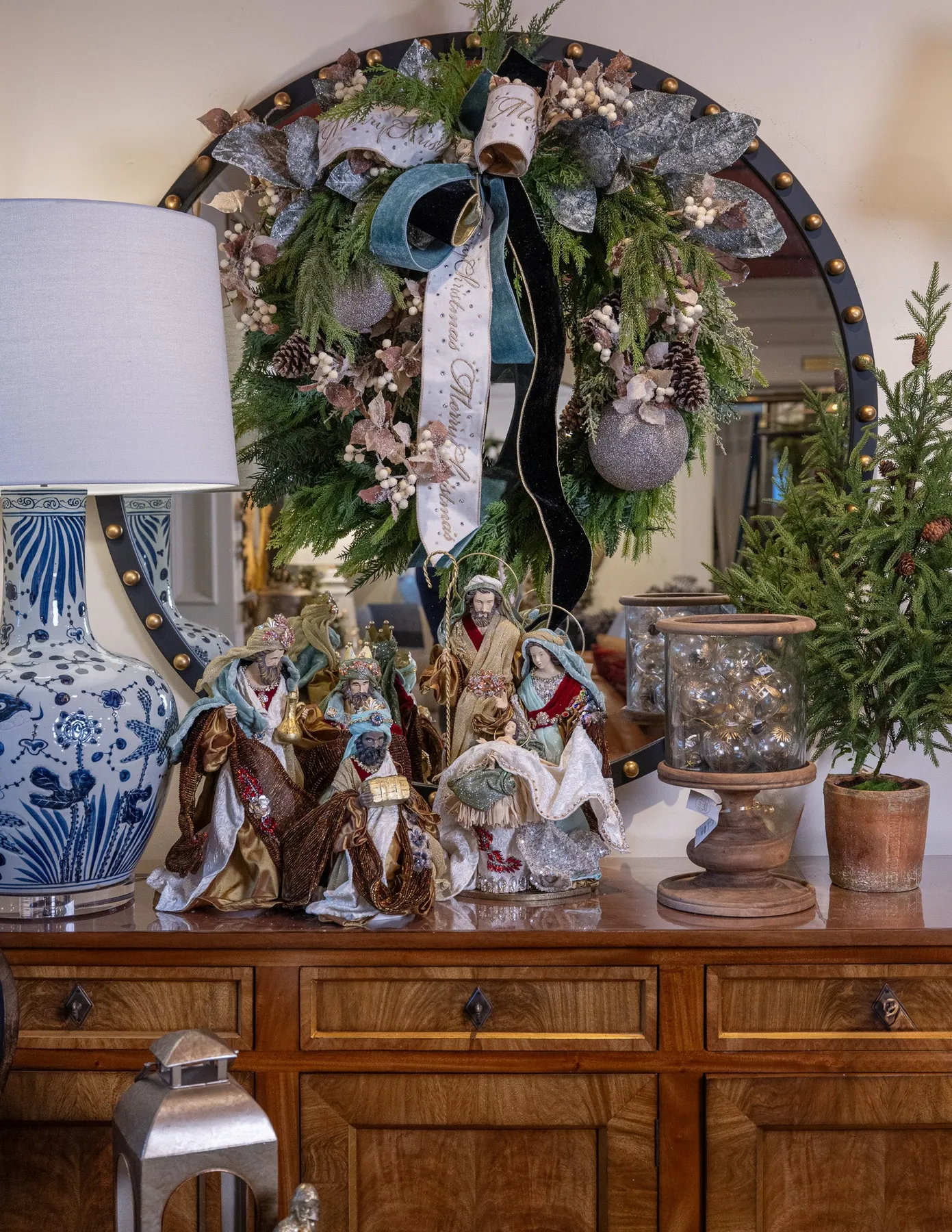
Those ribbons are why the wreath reads as custom. Teal and black is an unusual pairing, which makes the whole thing feel chosen rather than bought. Tie your own with wide velvet ribbon in two contrasting widths and let the tails hang unevenly.
The upkeep note: velvet ribbon crushes and holds creases. If you pack this away each January, wrap the ribbon loosely around a cardboard tube instead of folding it flat — folded velvet develops a permanent line you’ll never press out. And if your nativity figures are plaster or resin, dust them with a soft brush before storing; a damp cloth takes the finish right off.
23. Distressed White Sideboard with Burgundy Accents
Distressed white furniture and deep burgundy is a combination worth stealing. The formula here runs about 50% white and cream, 25% deep green garland and wreath, 15% burgundy, and 10% gold and matte grey.
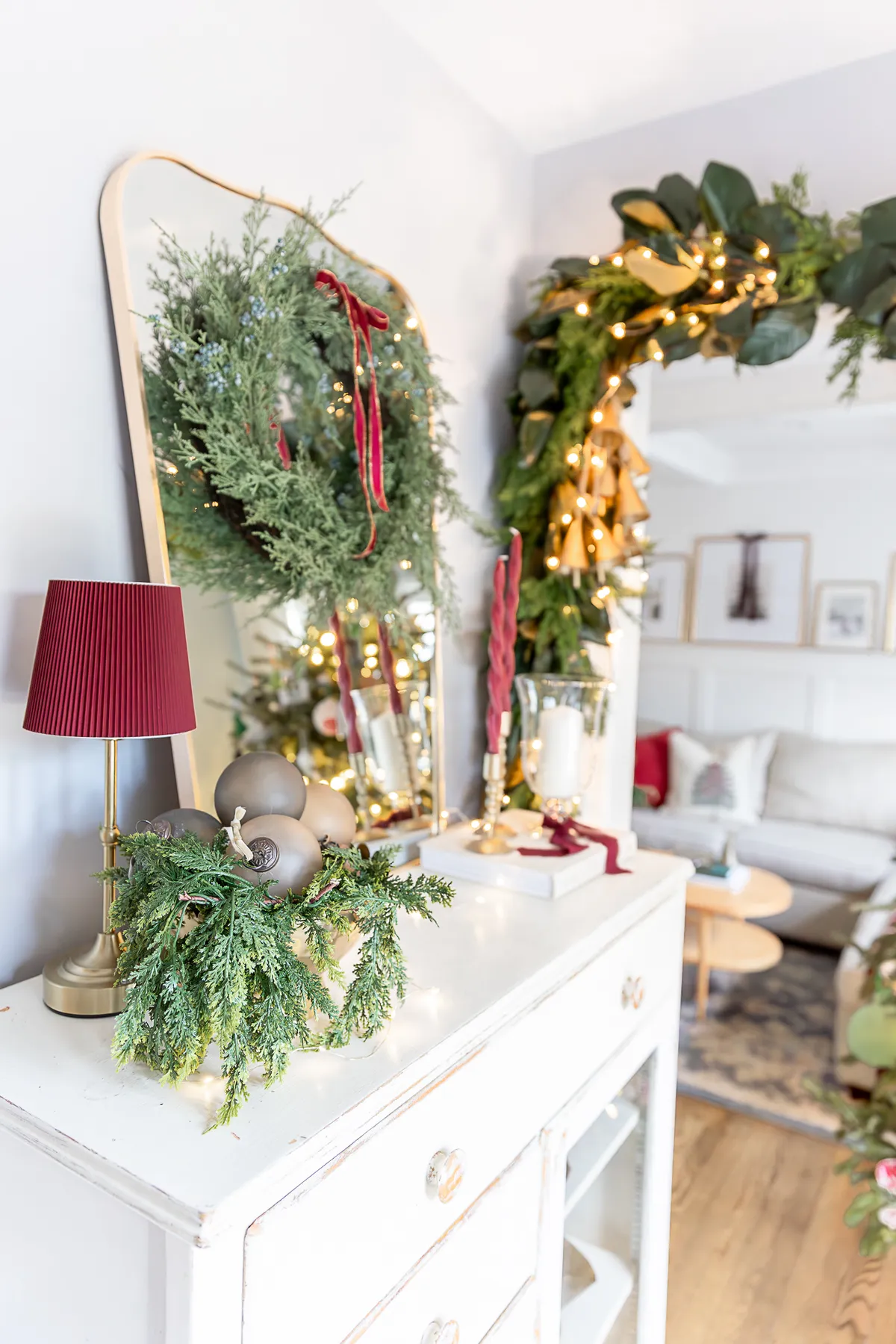
What makes it feel vintage rather than tired is the burgundy pleated lampshade — pleats are a small, specific choice that signals intention. The matte grey ornaments tucked into evergreen sprigs keep the red from getting syrupy.
on distressed white finishes: they photograph beautifully and show every single smudge. If this sideboard sits where kids or pets pass by, the lower half will need a wipe-down weekly. Chalk-painted furniture with a wax finish is particularly prone to ring stains from anything damp — always use a coaster tray. And a lit magnolia garland framing an archway nearby is gorgeous, but magnolia leaves dry out fast indoors; keep it away from heater vents or you’ll be sweeping up leaves by mid-December.
24. Round Table, Three Candles, One Pinecone
Three white candles in gold holders, two dark textured glasses, a pinecone, and a few cinnamon sticks on a small round dark wood table. That’s the entire list, and it feels like a whole holiday.
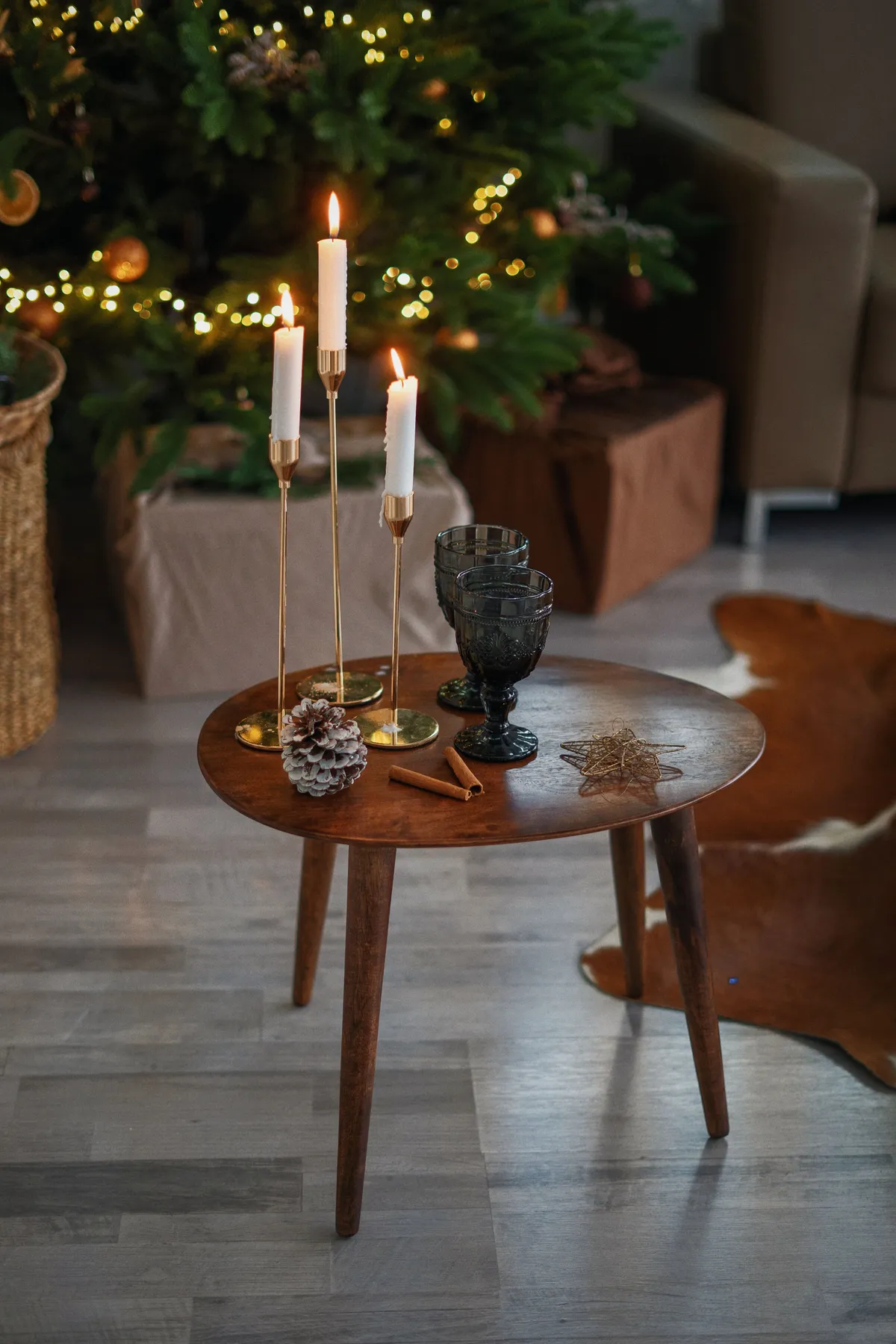
The designer move is the texture mismatch — glossy gold candleholders against matte dark glasses against a rough pinecone. Three finishes, one palette. If everything were polished, it would feel like a hotel lobby.
Cost check: three gold candleholders run $20–$60 at retail. Thrift store brass candlesticks at two dollars each plus a can of gold spray paint get you there for about twelve dollars total. The cinnamon sticks are free if you already cook with them, and a real pinecone from a walk costs nothing — just bake it at 200°F for thirty minutes first to clear out any critters.
25. A Miniature Winter Village in Faux Snow
White and grey houses, bottle brush trees, and small silver ornaments bedded into faux snow, with a round gold-framed mirror behind. Charming and quiet in a way that’s hard to pull off.
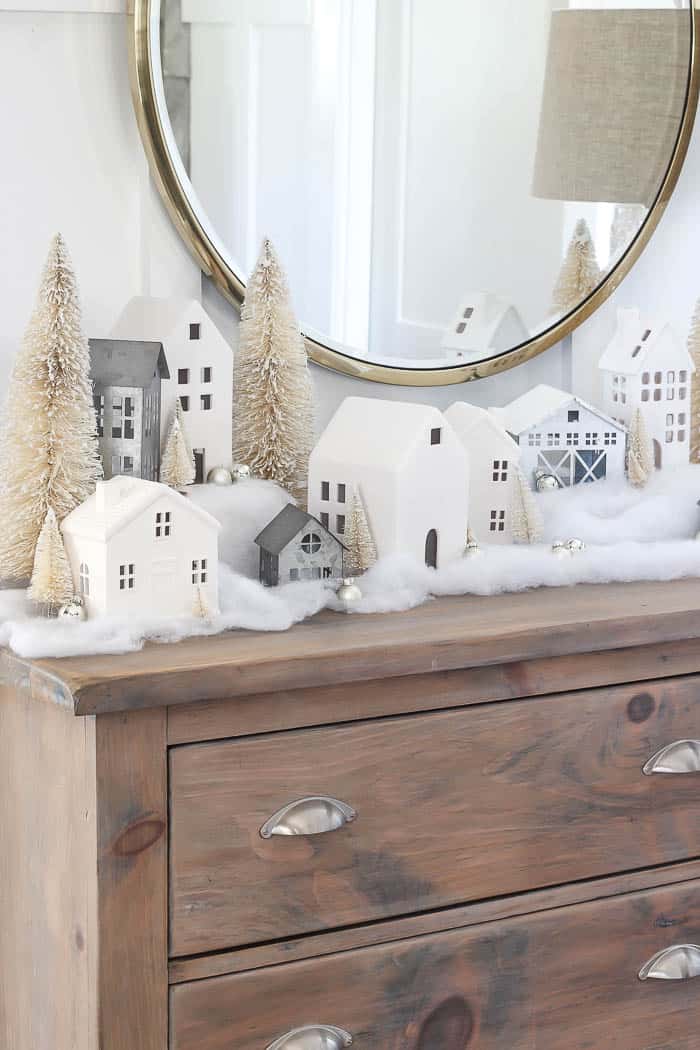
Three things make it read as a scene instead of a collection: a consistent color story (only white, grey, silver, gold), varied heights so the houses step back and up, and the mirror doing double duty as both backdrop and light source. Faux snow is the invisible fourth element — it hides the bases and makes everything look like it belongs together.
Before you build one of these, verify:
- Your sideboard’s surface is deep enough — villages need at least 14 inches of depth to layer
- You have an outlet or battery budget for the tree lights inside the houses
- Faux snow is contained on a tray or runner so it doesn’t migrate across the whole house
- Nothing fragile sits at the front edge where a sleeve will catch it
26. A Modern Side Table Moment
If your space doesn’t have room for a sideboard, a modern side table can carry the same holiday story at a third of the footprint. Think roughly 20 to 24 inches square — enough for one strong object, a candle, and a bit of greenery, not much more.
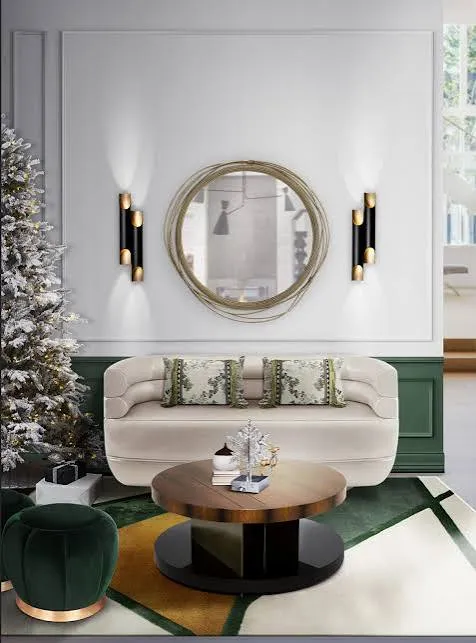
side tables are the hardest surfaces to decorate because everything is at eye level and close to a chair. Anything over 12 inches tall will block the view from the sofa. Go low and wide instead — a shallow bowl, a pair of candles under 8 inches, a small sprig laid flat.
Scale reference: this works in rooms under 120 square feet where a full sideboard would swallow the floor. For larger rooms, jump to Idea #1 or Idea #16 — same festive language, proper furniture scale.
27. Inside a Lit Hutch with a Paper Star
A hutch is the one piece of furniture where interior lighting is worth every penny. This light olive-toned one has warm glow on both shelves, which makes the gingerbread house figurines, nutcrackers, and modern candelabra inside look like a shop window.
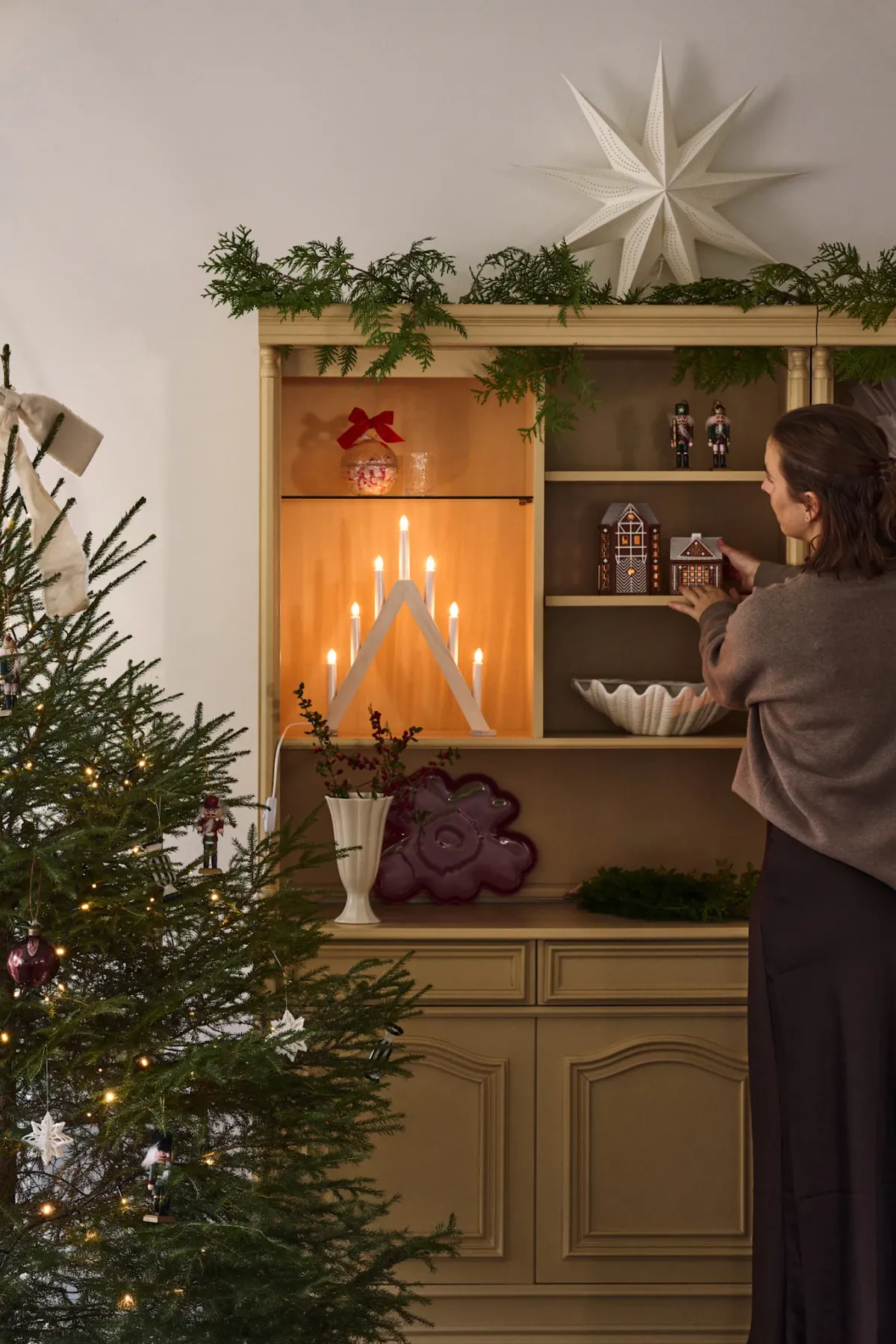
The garland draped across the top and the big white paper star above it frame the whole thing — but the star is the piece that keeps it from feeling dated. Paper stars are having a real moment as an alternative to traditional toppers and wreaths.
Upkeep warning: interior hutch lights run constantly during December, and if they’re incandescent puck lights, they generate real heat. Swap to LED if you haven’t. Also, gingerbread house figurines and nutcrackers with fabric details collect dust inside a hutch faster than you’d think — a monthly pass with a soft brush keeps them from looking tired by New Year’s.
28. A Lighted Metal Village Silhouette
The circular metal silhouette with a cutout village and Santa with reindeer, lit from within by warm fairy lights, is the whole reason this display works. It’s a single object doing the job most people hire five objects to do.
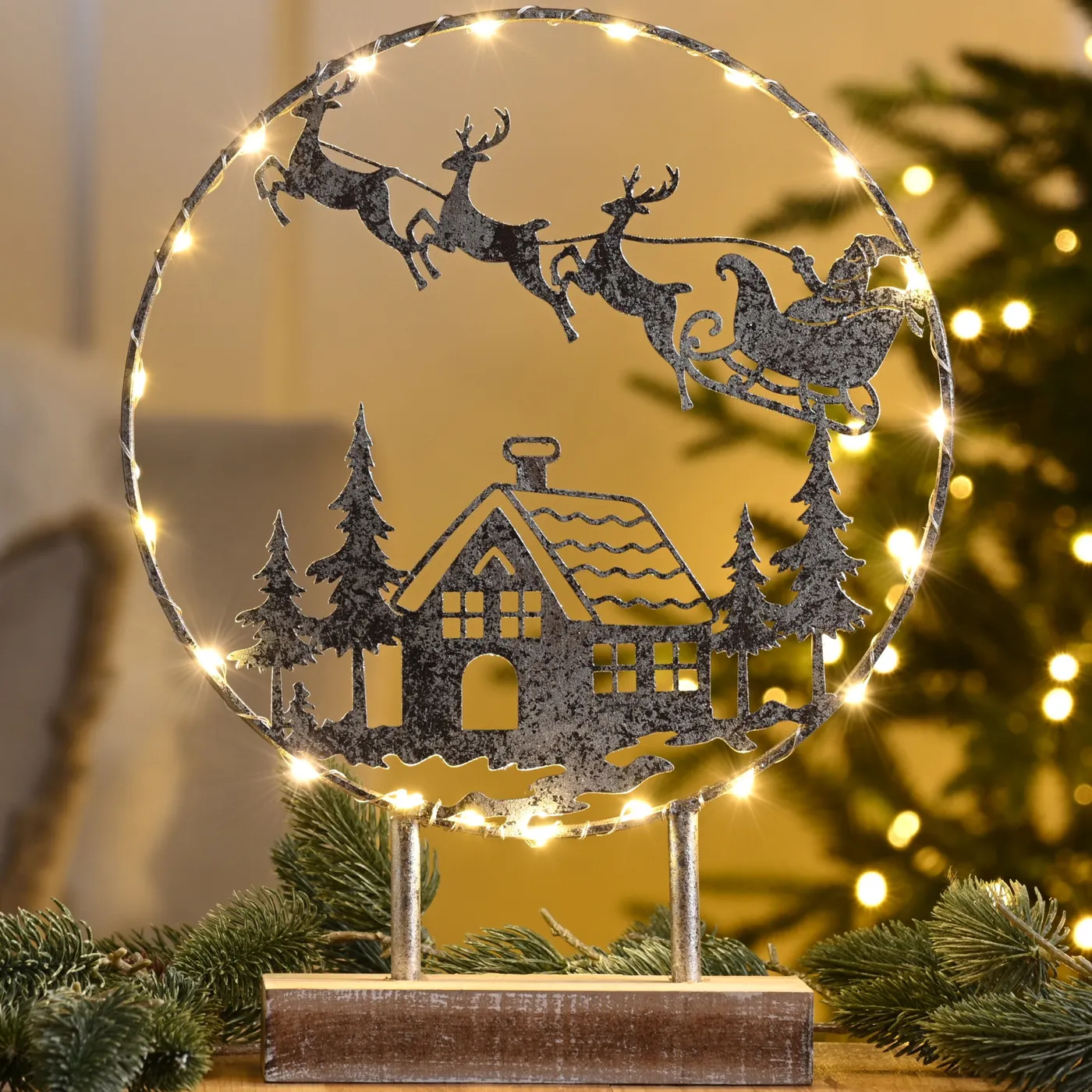
It sits on a distressed wooden base surrounded by faux pine garland — that’s the entire setup, and it’s better for it.
The budget angle: retail versions of lighted metal silhouettes run $60–$150. If that’s more than you want to spend, a plain metal wreath form plus a strand of battery fairy lights and a printed village silhouette on cardstock gets surprisingly close for under twenty dollars. It won’t have the cutout detail, but at three feet away in dim December light, nobody’s counting. The other cheap swap: buy the silhouette and skip the base — set it directly on a stack of two old books.
29. Layered Gold Mirrors Above a Reeded White Sideboard
A gallery wall of ornate antique gold-framed mirrors in mixed shapes above a white sideboard with reeded doors — this is the most sophisticated arrangement in the whole collection, and it has nothing to do with Christmas specifically. That’s the secret.
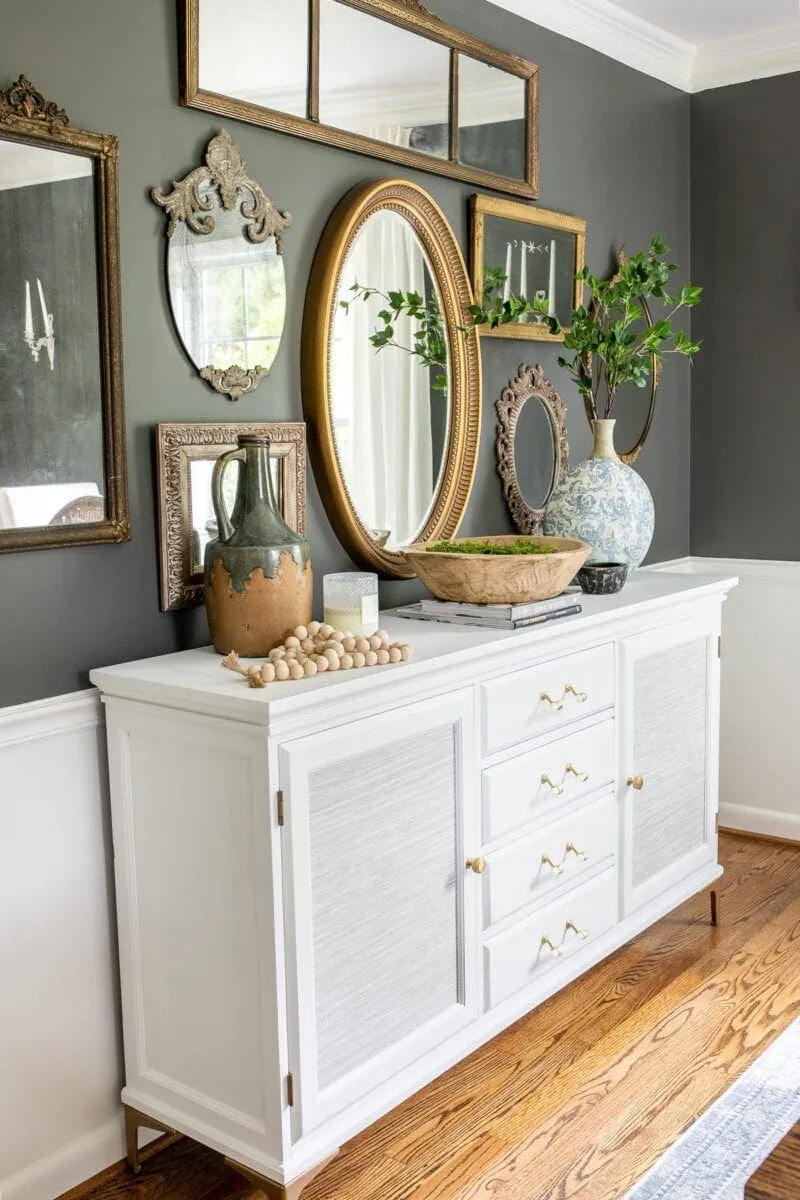
Why it works: the charcoal wall gives the gold frames something dark to glow against, and the white wainscoting below creates a clean horizontal band that stops everything from floating. The reeded texture on the doors catches light and repeats the vertical rhythm of the mirror frames.
If you’re building a mirror gallery, work from the outside in — place the four corner frames first, then fill the middle. And keep at least 2 inches between frames so the wall color shows through. Frames that touch look like a mistake, not a decision.
30. Console with a Garland-Draped Round Mirror
Nearly the opposite of the layered gold mirror wall, and equally good. A light wood console, a single round gold-framed mirror with natural evergreen garland draped over the frame, and a mix of ceramic, wood, and woven pieces on the surface.
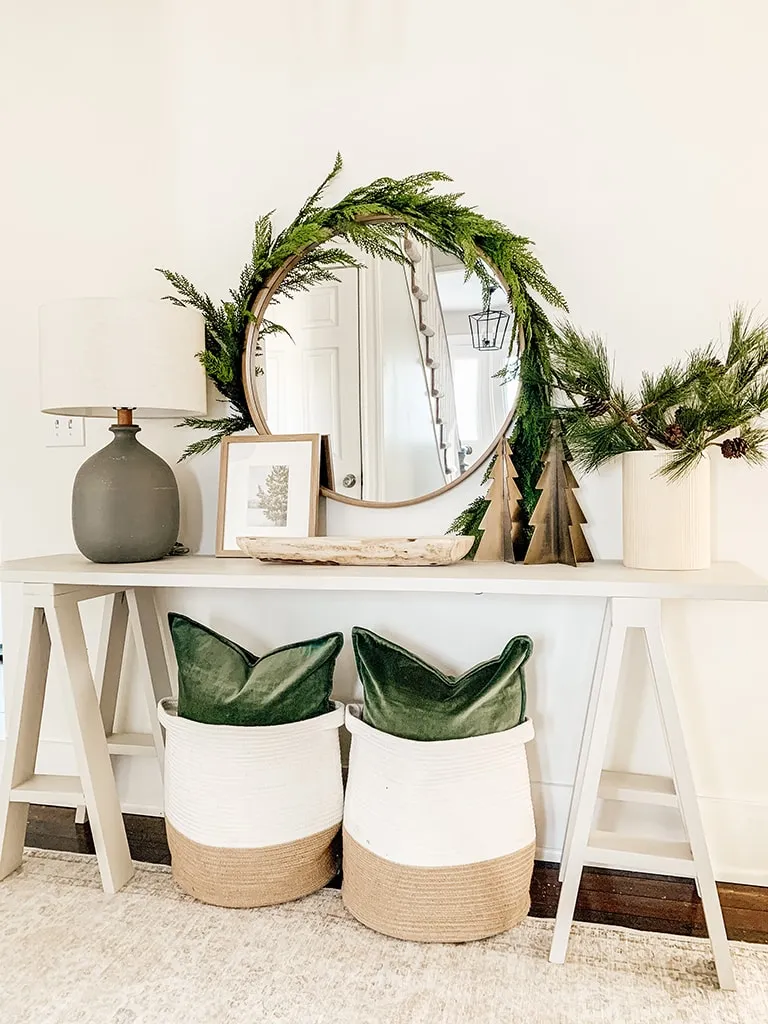
The formula: 60% white wall and light wood, 25% forest green garland and branches, 10% natural jute and rope, 5% brass. Two rope and jute baskets below holding green velvet pillows give you texture and storage at once.
This is the setup for narrow spaces — the console itself can be as slim as 12 inches deep, which is why it works in hallways where standard furniture won’t pass. A minimum hallway width of 36 inches leaves comfortable walking room. If you have more space, look at Idea #12 for a bench version or Idea #16 for the color-forward take.
31. Frosted Tree, Berry Bottle, Ceramic Diffuser
Three objects, one small wooden surface, and a lot of personality. A frosted mini evergreen in a burlap-wrapped base, a clear glass bottle holding red faux berries, and a white ceramic diffuser with a cutout pattern.
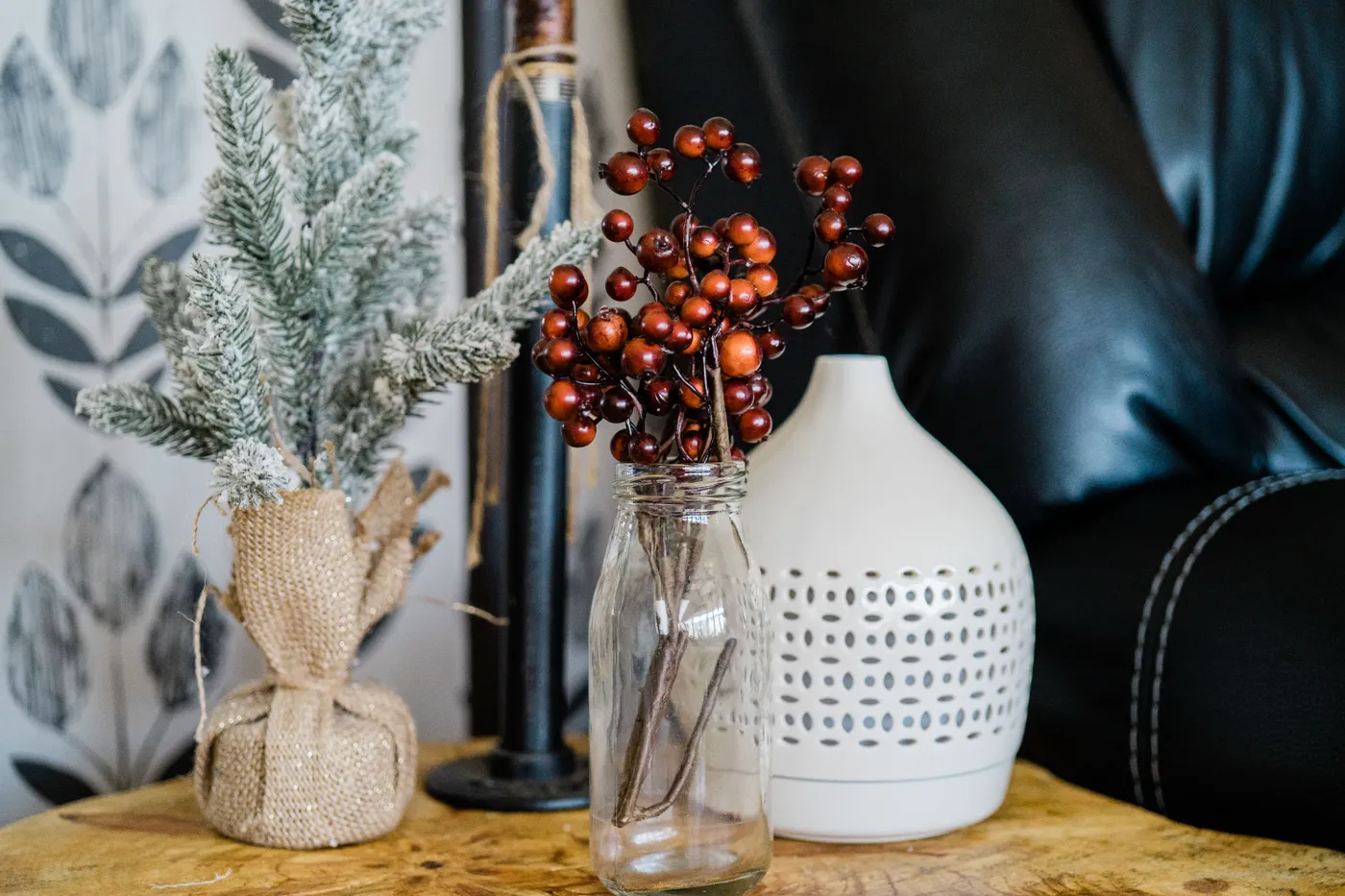
The burlap wrap is doing more work than it looks like — it gives a cheap faux tree a handmade base and hides whatever plastic pot it came in.
Make the berry bottle for under ten dollars:
- Find a narrow-neck clear glass bottle at a thrift store or use an empty kombucha bottle
- Buy a stem of faux red berries and cut into 4-inch sprigs
- Trim sprigs so they sit just below the neck opening
- Fill the bottle one-third with water for visual weight and stability
Fifteen minutes, and it looks like something from a boutique. The white ceramic diffuser, by the way, works just as well empty — you don’t need to actually run it.
32. A White Mantel with Little Wooden Houses
The same logic as a sideboard, applied to a mantel — small wooden and white house figurines clustered in a row, mini bottle brush evergreens flanking them, and a frosted garland with white berries and pinecones draped along the front edge.
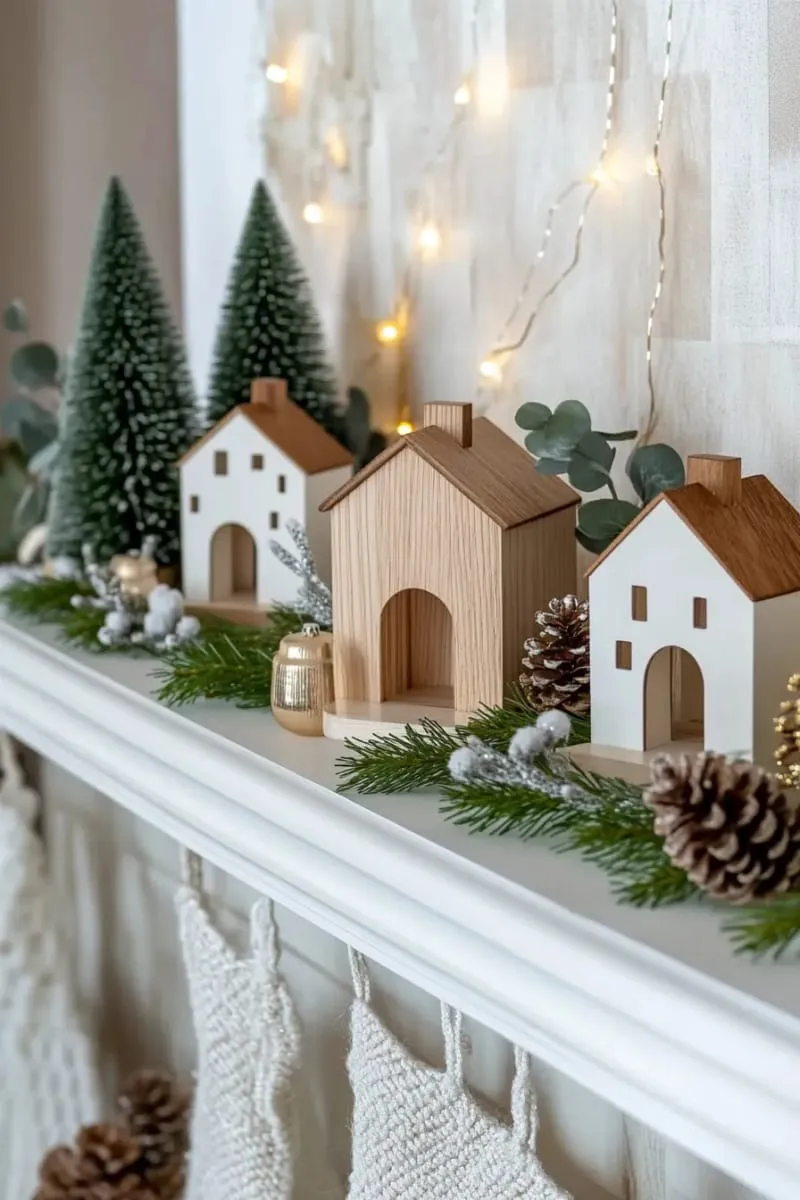
The tip that makes it work: treat the mantel like a stage with three depths. Back row against the wall, middle row slightly forward with the houses, front row dropping over the edge with the garland. Most people build only the middle row, which is why their mantel looks flat in photos.
The frosted element is what unifies it — white berries, frosted pinecones, frosted trees — one finish repeated across every material. Warm fairy lights twinkling behind pull it together without adding another object to the surface. If you don’t have a mantel, this arrangement translates directly to any long, low surface, including the sideboard in Idea #2.
Your Sideboard Has Nine Lives Before Christmas
The best Christmas sideboard isn’t the fullest one — it’s the one where each object has a reason to be there and you can still see the wood grain underneath it all. Start with the one idea that made you stop scrolling, then build outward from there. 📌 Pin this now so it’s waiting for you when the decorations come down from the attic.