
32+ Jaw-Dropping Outdoor Window Wreaths for Christmas 2026 That Will Turn Heads
You know that feeling when a house on your block suddenly looks like the cover of a holiday catalog — and it’s entirely because of the windows? Wreaths are the highest-impact, lowest-cost upgrade an exterior can get. We spent serious time browsing Etsy, Target, and Home Depot to bring you only what’s actually worth hanging this year, and we narrowed hundreds of options down to 32 ideas that deliver — from $18 cedar stems to a $420 lit display.
Inside you’ll find traditional red-and-green classics, quiet natural looks built on pinecones and dried citrus, elegant metallic finishes, and a few color stories that break every rule. Budget and luxury versions are compared side by side, with real ribbon widths, wreath diameters, and hanger ratings instead of vague advice.
Window-level detail is the 2026 story: more homeowners are skipping the full-lot light show and investing in the windows people actually see from the sidewalk. And stay until the end — we break down the most common mistakes that can ruin these looks.
📌 Save this to Pinterest for later — you’ll want to revisit these ideas.
Some links in this guide are affiliate links — if you buy through them, we may earn a small commission at no extra cost to you.
1. Berry-and-Pinecone Evergreen on Weathered Gray Wood
When a wreath has one hero bow at the top, don’t decorate evenly all the way around — you’ll flatten it. Cluster the berries and pinecones at roughly the 10 and 2 o’clock positions and leave 4 and 8 o’clock noticeably sparser. That creates a soft diamond focal pattern, which is what makes the ribbon read as the centerpiece instead of one more thing competing for attention. On a 26- to 30-inch wreath like this one, a 4-inch-wide velvet bow with gold trim is the sweet spot; go wider and it swallows the foliage.

Three things are doing the heavy lifting here. First, saturation contrast: that bright red only sings because the backdrop is washed-out, weathered gray with almost no pigment left in it. Second, texture stacking — slender needles, broad light green leaves, matte pinecones — so the eye keeps finding new surfaces. Third, weight distribution: the dense mass sits at the crown and tapers slightly toward six o’clock, which keeps a round wreath from looking like a flat disc. Hang it so the bow lands just above the window head and the whole thing reads deliberate.
2. Wreaths on Every Window of a Stucco-and-Stone Facade
- Wreaths — 6 windows plus front door at $25–$70 each: $175–$490
- Ribbon and bows — 2.5-inch velvet or satin, 3 yards per wreath: $50–$140
- Hanging hardware — over-sash hooks, brick clips, 8-pound suction cups: $15–$40
- Faux pine garland for the porch seating area: $40–$120
- Accents — red plaid throws, striped porch pillows: $60–$180
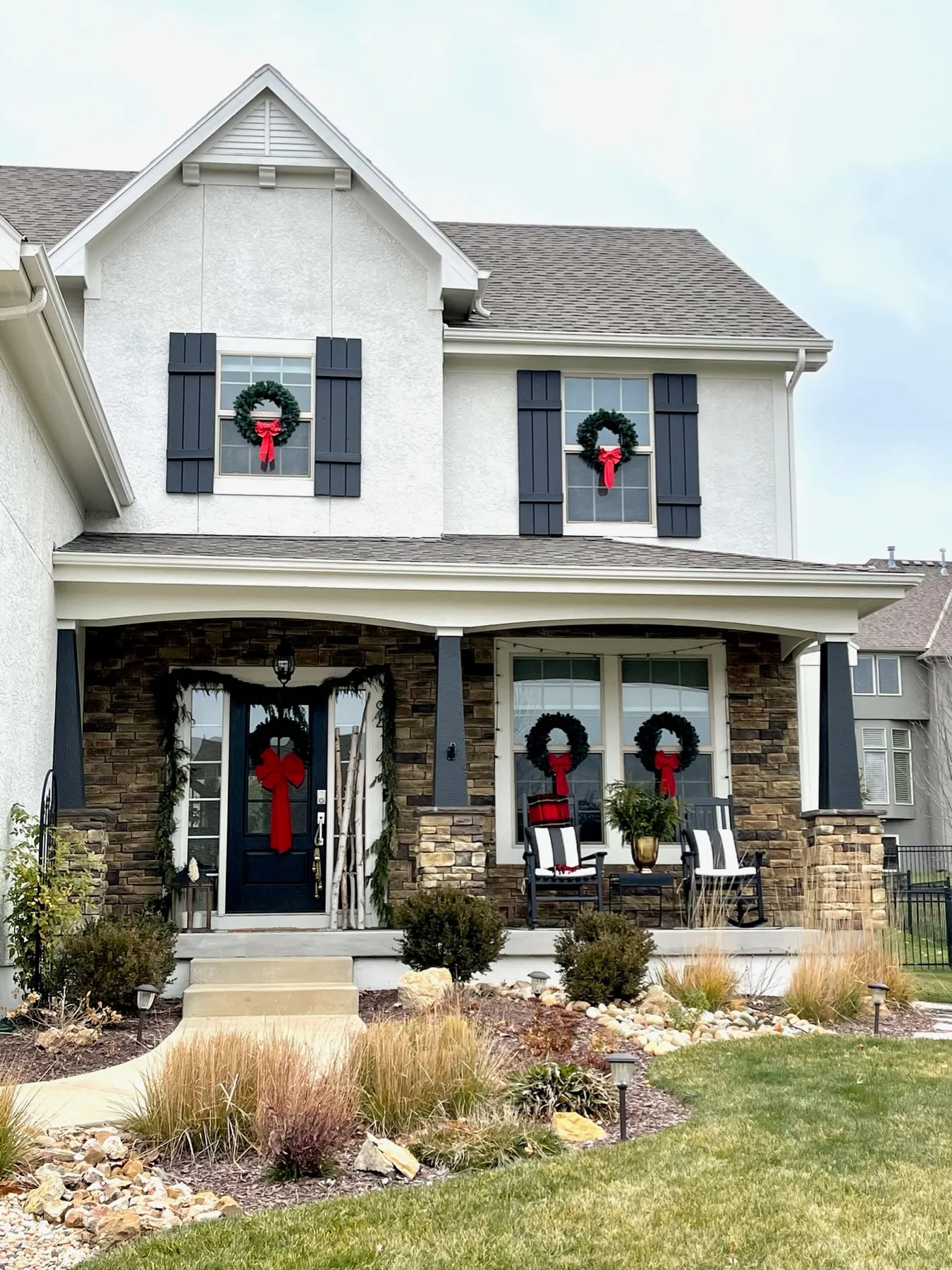
Total: $340–$970
Budget alternative: buy plain wreaths and re-ribbon them yourself. Six unadorned wreaths at $18–$30 each, one spool of good red ribbon, and an afternoon with hot glue lands you around $150–$390 — the same effect for roughly half.
Here’s the honest part: stucco and stone veneer will not take a nail, and a soaked evergreen wreath can weigh five pounds. Standard suction cups fail on textured stone, so use brick clips or over-sash hooks rated for at least 8 pounds, then check them after the first hard rain. Plan your reach before you buy anything — decorating only the windows you can comfortably get to looks accidental rather than layered.
3. White Siding, Red Bows, and One Fiery Red Tree
The formula here is roughly 70% white siding and trim + 20% forest green foliage + 8% bright red ribbon + 2% light gray shutters. The restraint is the point: green appears only as wreaths and garland, red only as bows, so nothing competes. Swap the red for copper or amber ribbon and keep the identical ratio — it reads warmer and a touch more modern against white. Swap the siding for cream and the same green-and-red still works, just softer. Where it breaks is adding a third accent color, which is why the deep red tree in the front yard already counts as your wildcard.
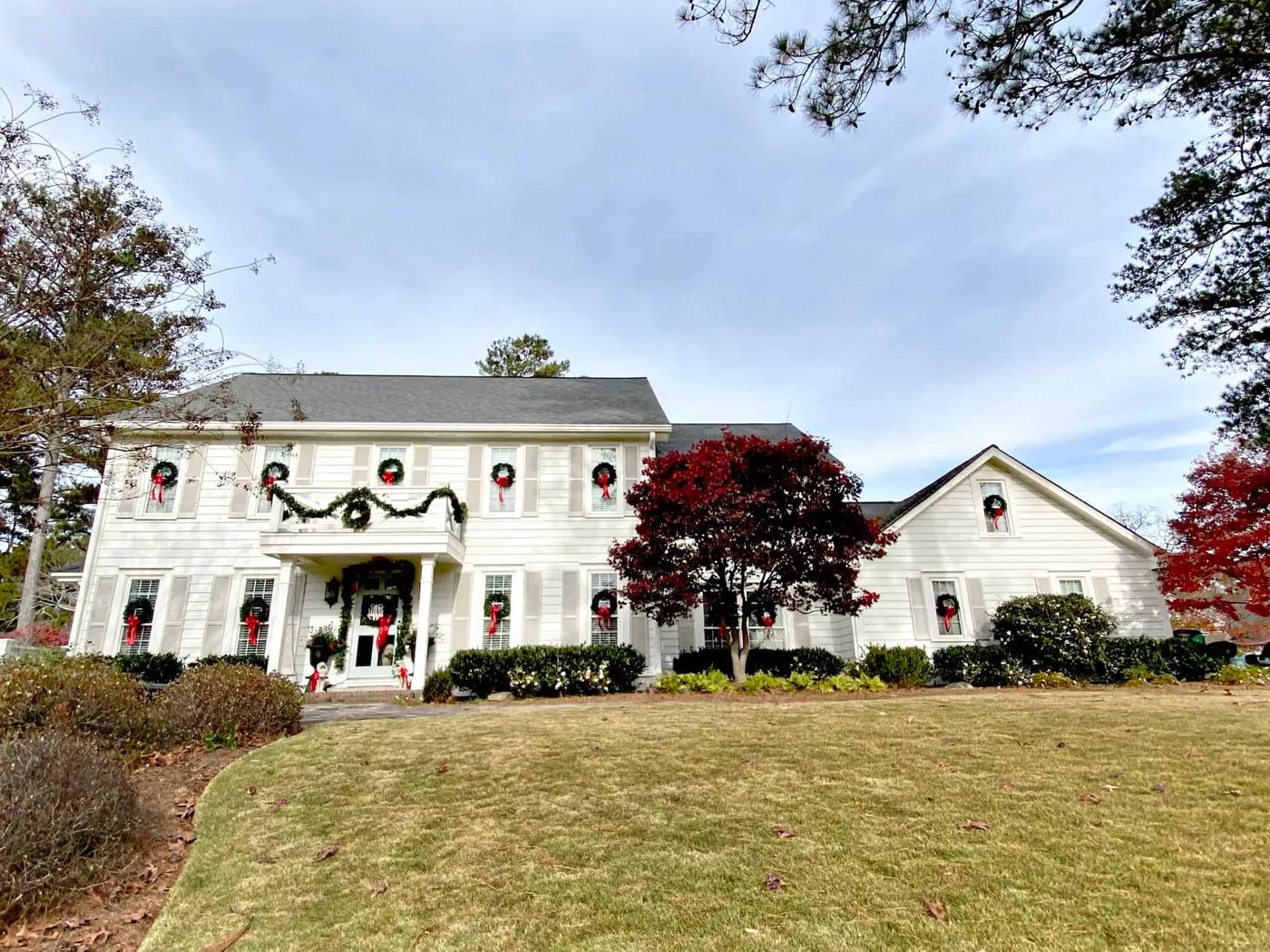
You don’t need a decorator’s budget for this. Plain 24-inch artificial wreaths run $8–$15 at Walmart or IKEA, and a 10-yard spool of 2.5-inch red satin ribbon costs about $12 — enough for six hand-tied bows. Green garland from a big-box store is $15–$25 for nine feet. Facebook Marketplace is full of last-season wreaths in January for $5 each. Total for the whole facade: under $200. This is the budget version of Idea #2 — same idea, half the spend.
4. Monogrammed Door Wreath and Black Topiary Planters
It’s the white monogrammed wreath on the front door. Every other wreath on this house is identical — dark green, red bow, same size — and that repetition is what gives the door its power. The moment the entry gets its own design in a different color, your eye stops there and the rest of the facade becomes a frame. Remove it and this is just a well-decorated house with no front door. Order a 30- to 34-inch wreath for a standard 36-inch door, have the monogram painted, and let it be the only white thing in a sea of green.
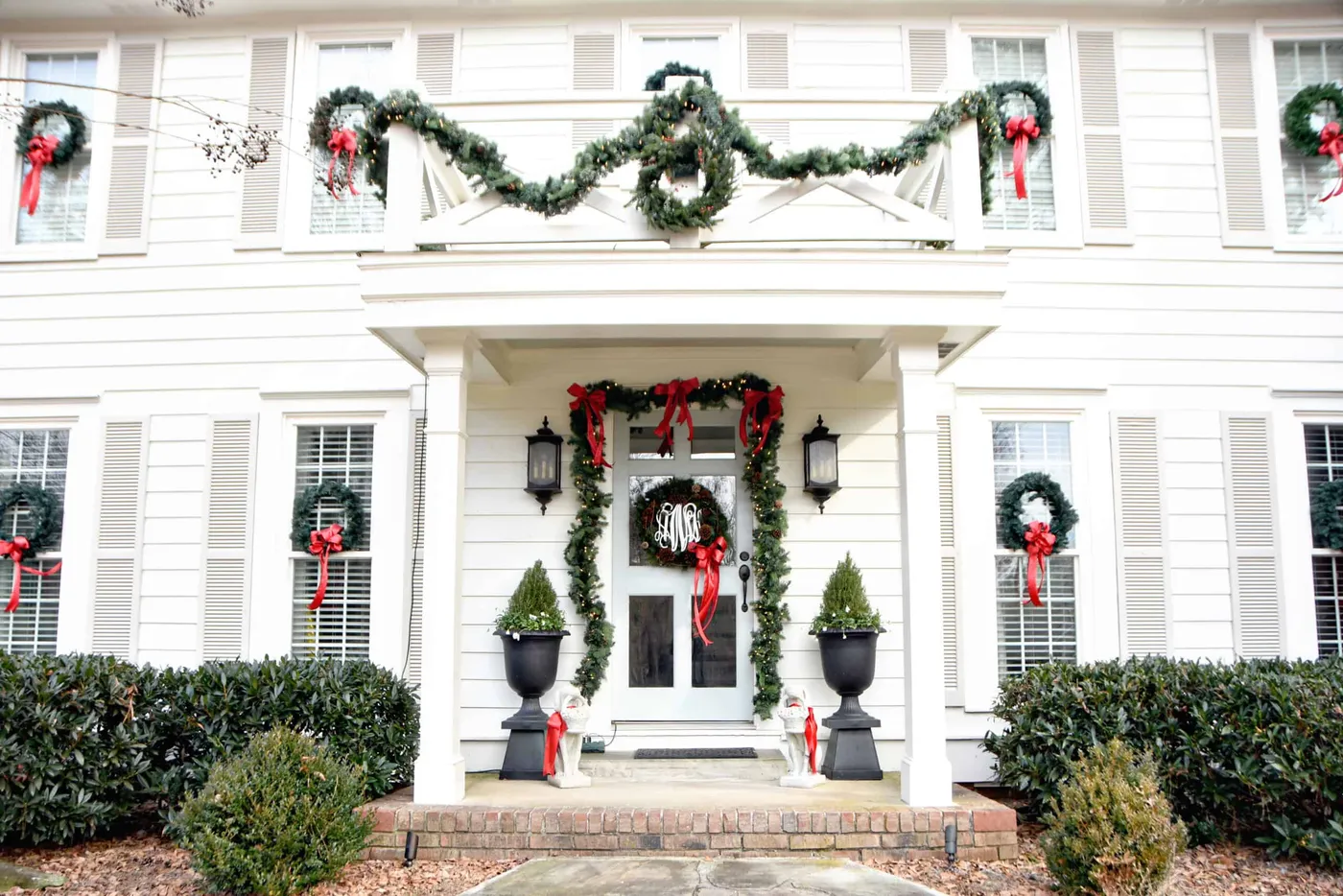
This is a tall-house idea. It works on facades at least 18 feet wide with two full stories of visible windows, where the porch runs 8 feet deep or more and the entry sits under permanent cover. Wreath size should scale with the opening: 22–24 inches on standard single windows, 30–36 inches on the door. On a one-story house under 30 feet wide, all those matching wreaths start to feel like a theme park. A single well-scaled wreath does more than eight crowded ones.
5. Green Wreaths Against a Snowy White House With a Yellow Door
Colored front doors keep climbing on Pinterest, and yellow is the one that photographs best in snow — white clapboard and fresh snow give it a clean backdrop, and the green wreaths tie everything back to the season. It’s part of a bigger 2026 shift: fewer inflatables and drive-by light shows, more window-level detail you can actually see from the sidewalk. Staying power? The wreaths will work forever. The yellow door is a commitment, but it looks just as good in July, which is more than you can say for a nine-foot Santa.
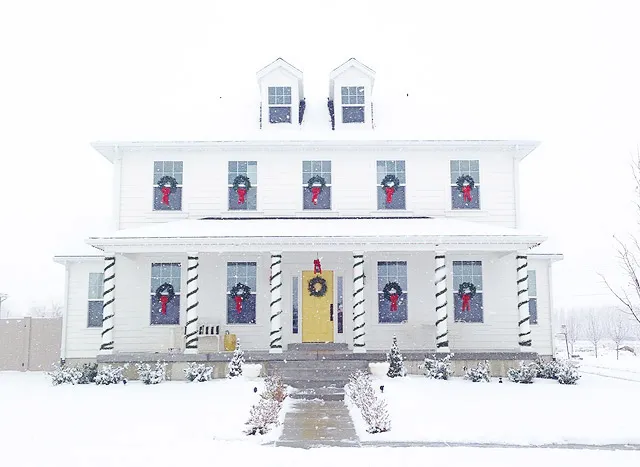
Wrapping porch columns is the detail that separates a decorated house from a decorated home. Don’t run the garland in a straight vertical line — spiral it so it crosses the column face diagonally. Aim for roughly one and a half turns per foot of column height, secure it with 22-gauge floral wire every 8 to 10 inches, and tuck the wire ends behind the foliage. Keep the window wreaths unlit while the columns glow: the contrast between lit and unlit greenery gives the facade depth instead of a flat wash of light.
6. Red-and-Gold Bauble Wreaths Over Striped Drapery
- Two 30-inch green wreaths: $60–$140
- Red and gold shatterproof ornaments, roughly 60 balls: $25–$60
- Wide red ribbon for bows, 6 yards: $14–$30
- Three artificial pines, 4–5 feet tall: $90–$240
- Red-and-white striped fabric panels, 2: $40–$90
- Large red gift boxes with lids, 3: $30–$75
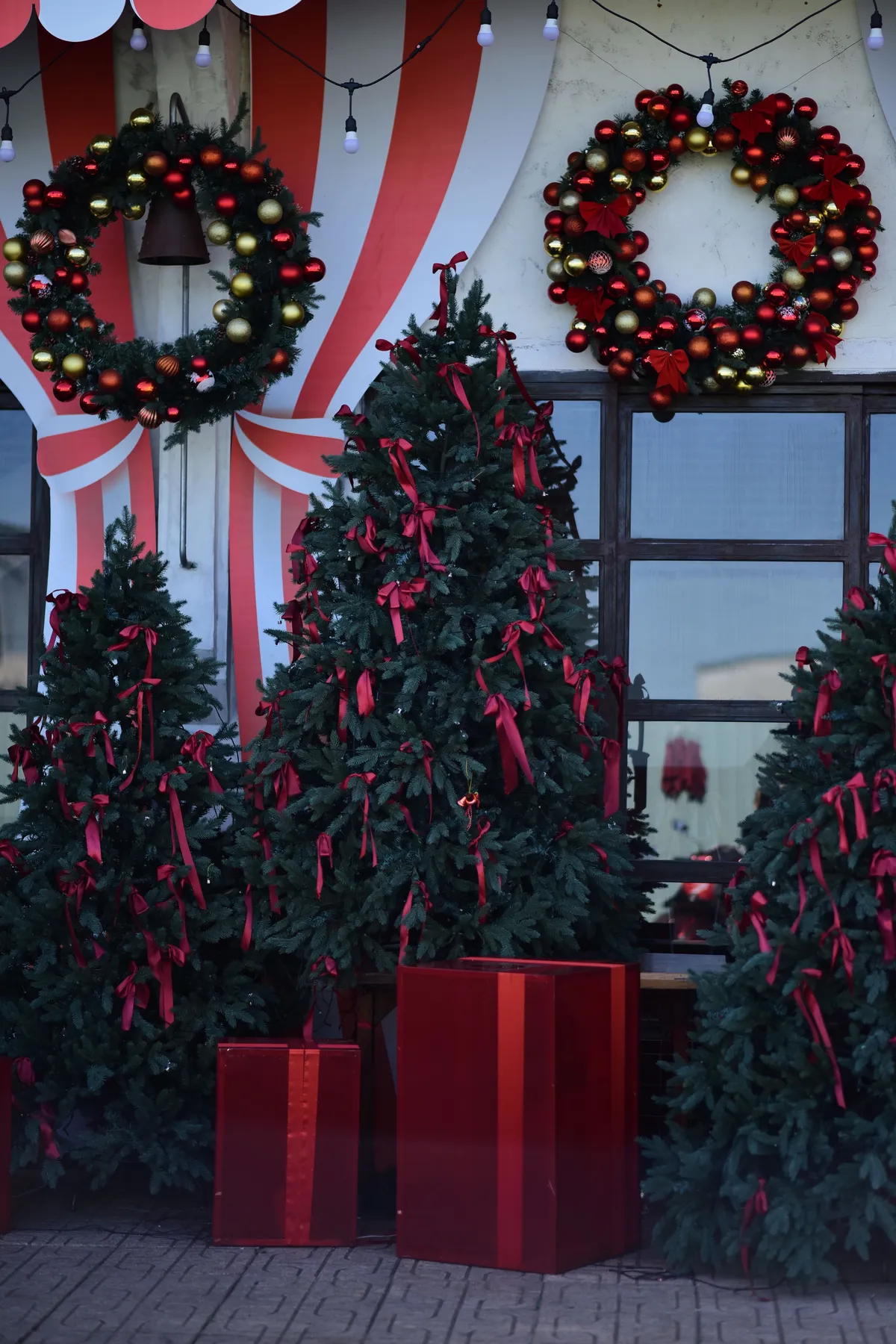
Total: $259–$635
Budget alternative: skip the store-bought pines, borrow or thrift two artificial trees, and put your money into ribbon and ornaments instead — the display drops to about $130–$250.
- Start with a wire wreath form — 24 inches reads well above a standard window.
- Zip-tie ornaments in rows: largest at the outer and inner edges, smallest to fill the middle.
- Aim for 55 to 70 ornaments per 24 inches, and hot-glue the caps so nothing spins loose.
- Wire a wide ribbon bow to the top with 22-gauge floral wire and finish the back with a felt circle.
- Hang on a 12-pound outdoor hook, not a suction cup.
Time: about 45 minutes. Materials: $25–$40 if you shop ornaments after the holidays.
7. Lit Wreaths in Every Window of a Brick House at Dusk
Regularity is the trick. Every wreath is the same diameter, hung at the same height, with the same red ribbon at the same angle — and that repetition turns a brick facade into a rhythm instead of a random collection of decorations. The warm light does the rest: dark red brick is low-contrast at dusk, so a 2700K glow reads as a row of small lanterns. When a display repeats perfectly, the eye reads it as architecture rather than decor. Break the pattern on one window and the whole thing suddenly looks like a mistake.
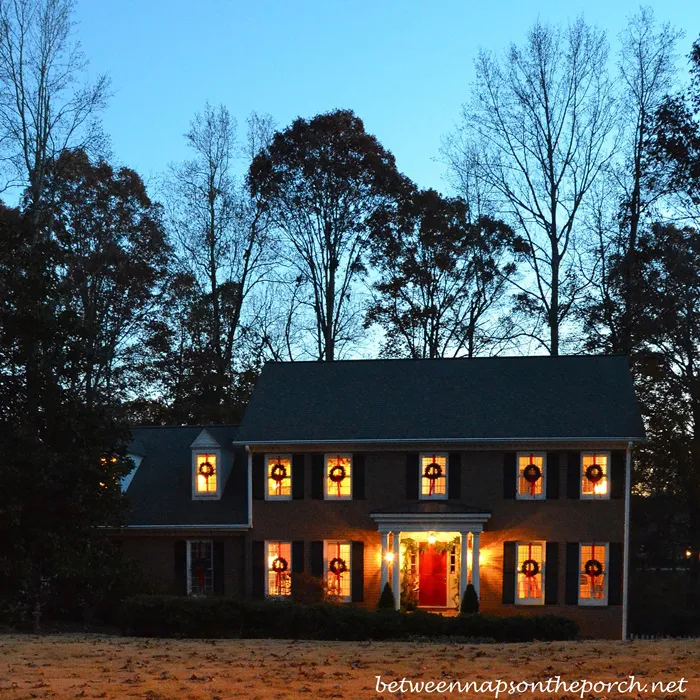
Lit wreaths are the highest-maintenance version of this idea, mostly because of the wiring. Battery packs die fast in cold weather, so go with plug-in strings on a smart plug or an outdoor timer set for 4:30 to 11 p.m. Check every connector after a hard freeze — that’s where strings fail, not in the bulbs. Velvet ribbons fade in direct sun and hold water, so bring them inside after New Year’s. Store wreaths in a labeled bin, bone dry, or you’ll open mildew next November.
8. Garland-Framed Window With Poinsettias and Red Velvet Bows
When you frame a window with garland, keep it off the glass by about half an inch. Garland pressed against a pane traps condensation, and that moisture wicks straight into ribbon and faux flowers. Anchor the garland at the four corners with clear outdoor hooks or zip ties, then wire each faux poinsettia stem at a 45-degree angle so blooms face outward instead of straight up. Space the bows roughly 18 inches apart along the top run and skip the bottom edge entirely if there’s a sill — it reads cleaner and you lose nothing.
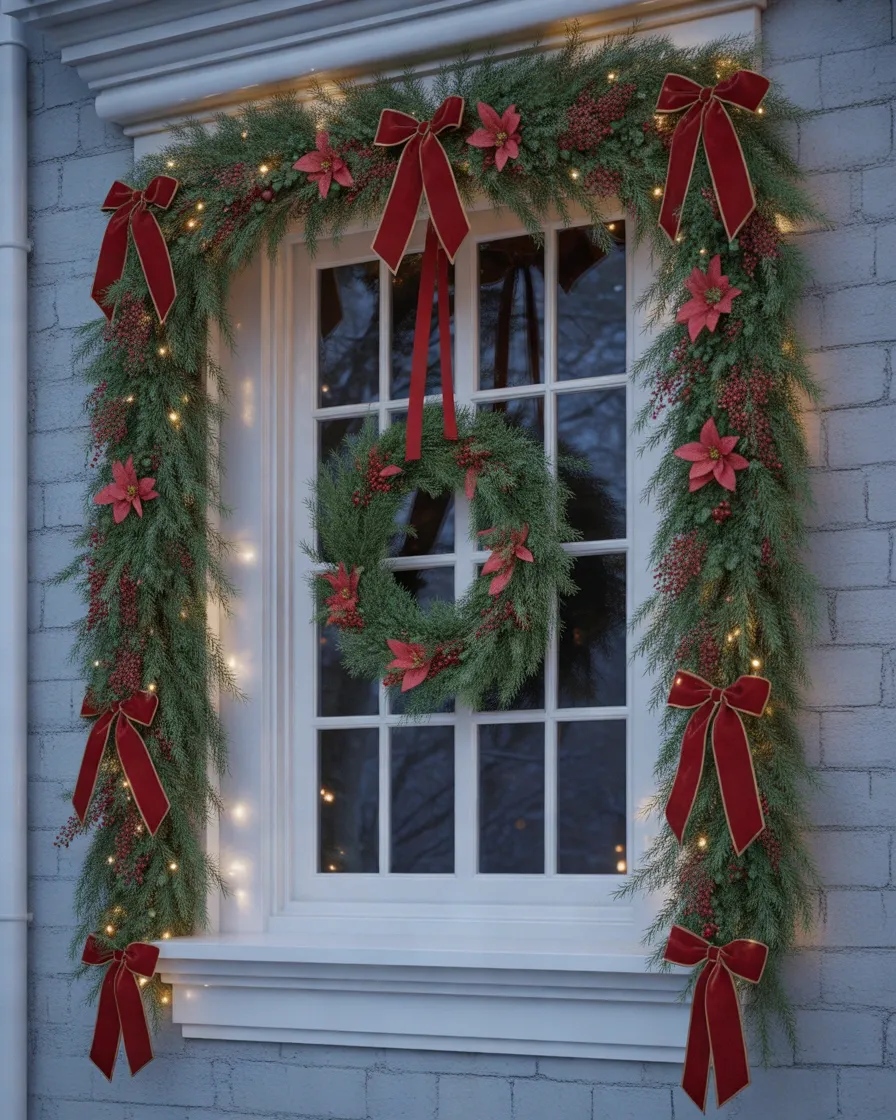
Pre-lit nine-foot garland is $25–$35 at Walmart or Target; the designer version runs $90 and up, and the real difference is mostly fullness. Buy two cheap garlands and twist them together for the same density. Faux poinsettia picks from Dollar Tree are $1.25 each and look fine at four feet away, which is where porch decor lives. Red velvet ribbon from the craft store after December 26 runs about $4 a spool. Whole window: around $60. It’s the direct budget answer to the grand facade in Idea #4.
Two warnings. Cheap red ribbon bleeds in the rain, and it will bleed onto white window frames and light siding — test a scrap with a wet paper towel before you commit. Faux poinsettias fade from red to chalky pink after about one season in direct sun, so buy them knowing they’re semi-disposable. And if your window is a crank-out or casement style, keep garland on the outer frame only, or you’ll be unwiring it every time you want fresh air.
9. A Single Wreath on Rough-Cut Stone
One wreath, one red velvet bow, one white-framed window in a wall of rough stone — and that’s the entire design. What makes it work is the contrast of finishes: smooth painted trim and soft velvet against split-face stone with all its shadow and grit. Remove the wreath and you have a handsome, slightly severe wall. Remove the stone and the wreath is ordinary. Scale matters too — go bigger than instinct suggests, around 24 to 28 inches here, so the wreath holds its own against the texture instead of disappearing into it.
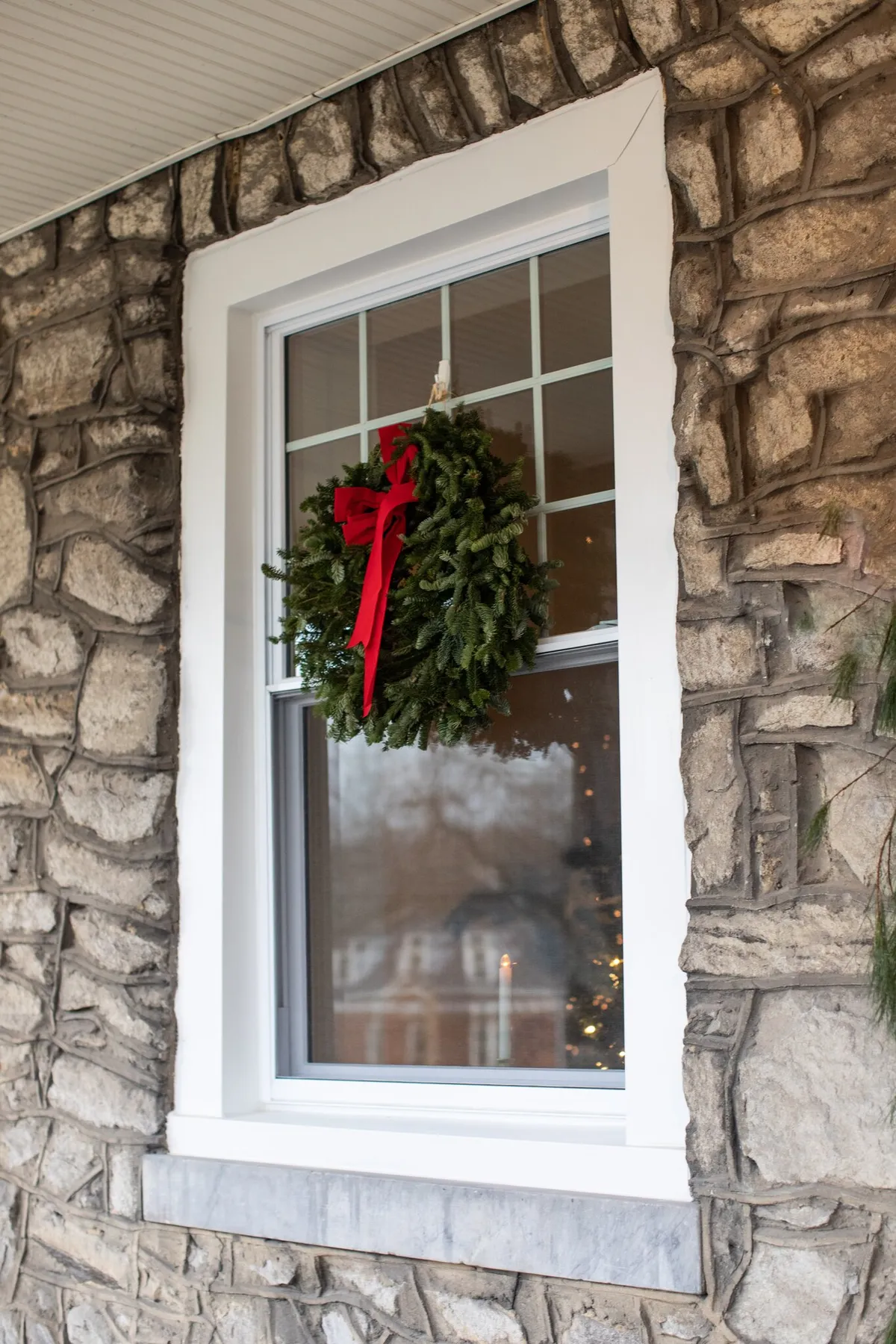
- Identify what your wall is actually made of — real stone and veneer need different anchors than painted wood.
- Measure the window width and aim for a wreath 50–60% of it.
- Confirm the hook rating; wet evergreens can hit 5 pounds and wind doubles the load.
- Test your hanger on an inconspicuous spot first if the stone is soft or the paint is new.
- Check window clearance so the wreath doesn’t block a screen, shutter, or storm panel.
10. Dried Orange Wreath on a Potting-Room Window
- Slice oranges a quarter-inch thick and blot them dry with a towel.
- Bake at 200°F for about three hours, flipping halfway, until leathery — not brittle.
- Cool completely, then wire each slice to a grapevine base with 22-gauge wire, overlapping the edges for fullness.
- Add two or three whole dried oranges as accents near the top.
- Hang with a wide velvet ribbon looped over the sash.
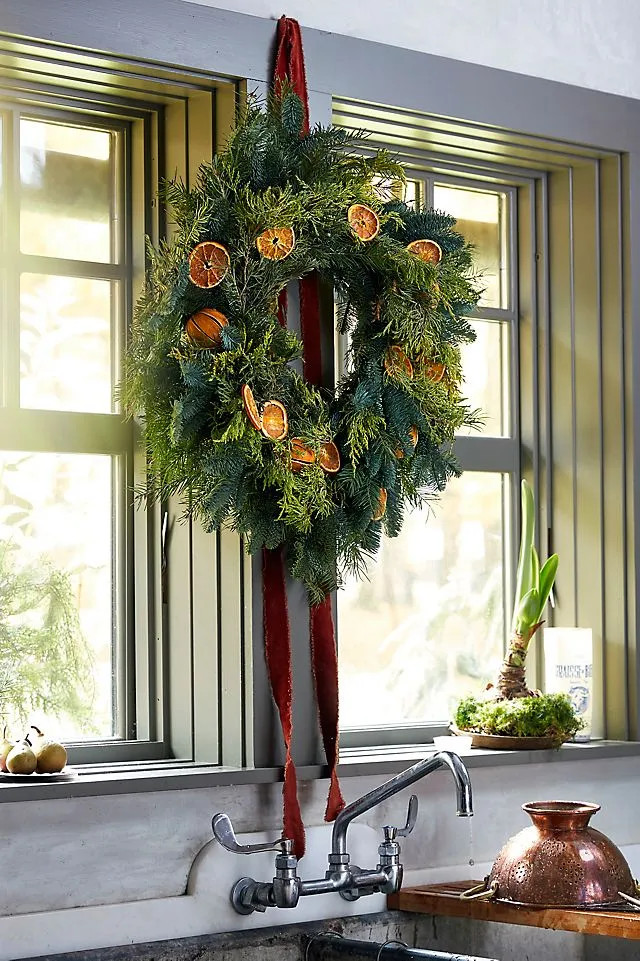
Time: about four hours, mostly oven. Cost: around $18 if you already own floral wire.
Read this one as 60% green conifer base + 25% burnt orange + 10% deep red ribbon + 5% warm metal. The orange is the wildcard that makes it feel like a kitchen rather than a front door, and the copper colander nearby quietly echoes it. Want a different room? Keep the exact same ratio and swap the orange for dried lemon and lime wheels — same warmth, brighter and more citrus-kitchen. Compare with Idea #26: both lean natural, but rosemary goes cool and savory where citrus goes warm and sweet.
11. One Oversized Wreath on a Six-Pane Double-Hung
For a single centered wreath, use 50% to 60% of the window’s width. A six-pane double-hung like this one usually measures 30 to 36 inches across, which puts you at an 18- to 22-inch wreath for a composed look. Here it’s closer to 24, and it works because the vertical siding gives the wall enough height to absorb it. That’s also the size range that suits townhouses and narrow facades where a full multi-window scheme — see Idea #4 — would overwhelm the architecture.
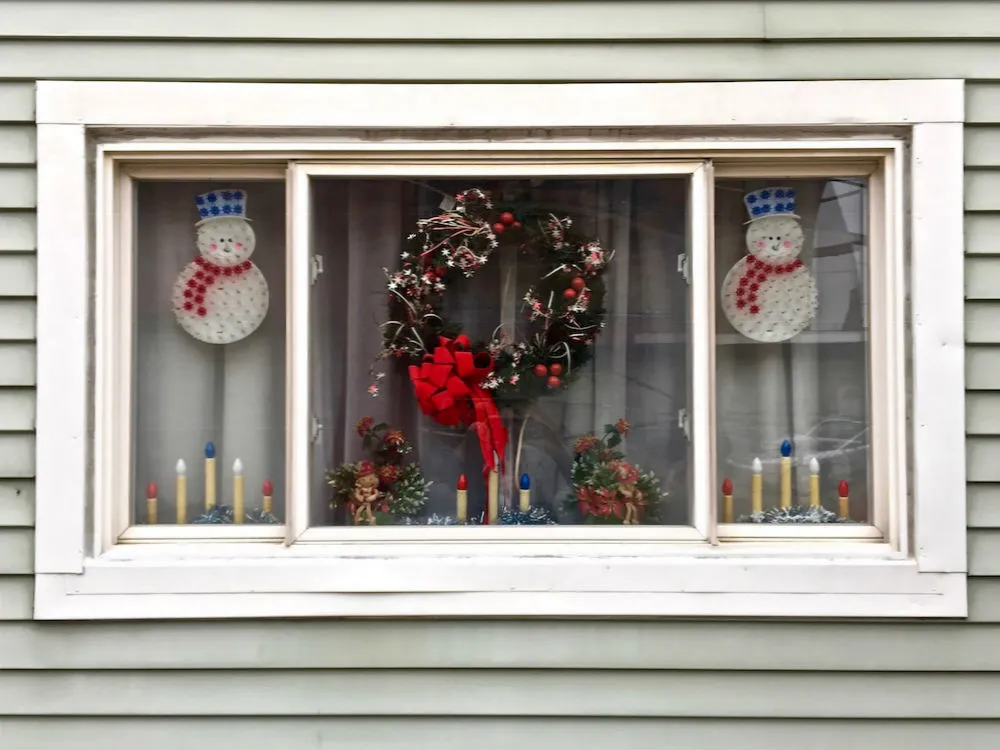
Hang it on the upper sash with a clear adhesive hook rated for at least 5 pounds, positioned so the bow sits just below the top rail. Ribbon looped over the sash is prettier but it will stop the window from closing properly on a double-hung. If you’re renting or the frame is vinyl, use an over-sash hook with a felt pad so it doesn’t scratch, and skip anything that requires drilling. Cream and beige siding shows every smudge, so wipe hanger residue off in spring with warm water and a soft cloth.
12. Plaid Ribbon and Blue Berries on Dark Wood
- 24-inch mixed evergreen wreath: $30–$60
- Red plaid ribbon, 3 yards: $9–$18
- Faux blue-green berry clusters, 4: $6–$14
- Pinecones — gathered from your own yard: $0
- Over-sash hanger or 8-pound outdoor hook: $5–$12

Total: $50–$104
Budget alternative: a $15 wreath from a dollar store, re-ribboned with plaid from the clearance bin, gets you about 90% of the look for $25.
Two tricks are at play. First, a warm-cool clash: the plaid is orange-red and the berries are bluish-green, so each makes the other look richer than it would alone. Second, the dark wood plank backdrop is doing exactly what a dark wall does indoors — it makes light green foliage read almost luminous. On white siding, the same wreath would be pleasant but flat. If you have a dark-stained facade, fence, or door, this is the palette that rewards it.
13. Holly, Variegated Leaves, and a Bow Tied Low
The bow is at the bottom. That single decision changes the silhouette completely — instead of a crown, you get a soft teardrop that pulls the eye downward along the window frame, and the upper pane stays clear if you actually look out of that window. The variegated holly with cream-edged leaves is the second hero; those pale edges catch light and give the wreath a hand-made, slightly imperfect quality that dense uniform evergreens never achieve. Tie the bow loosely and let the tails run long.
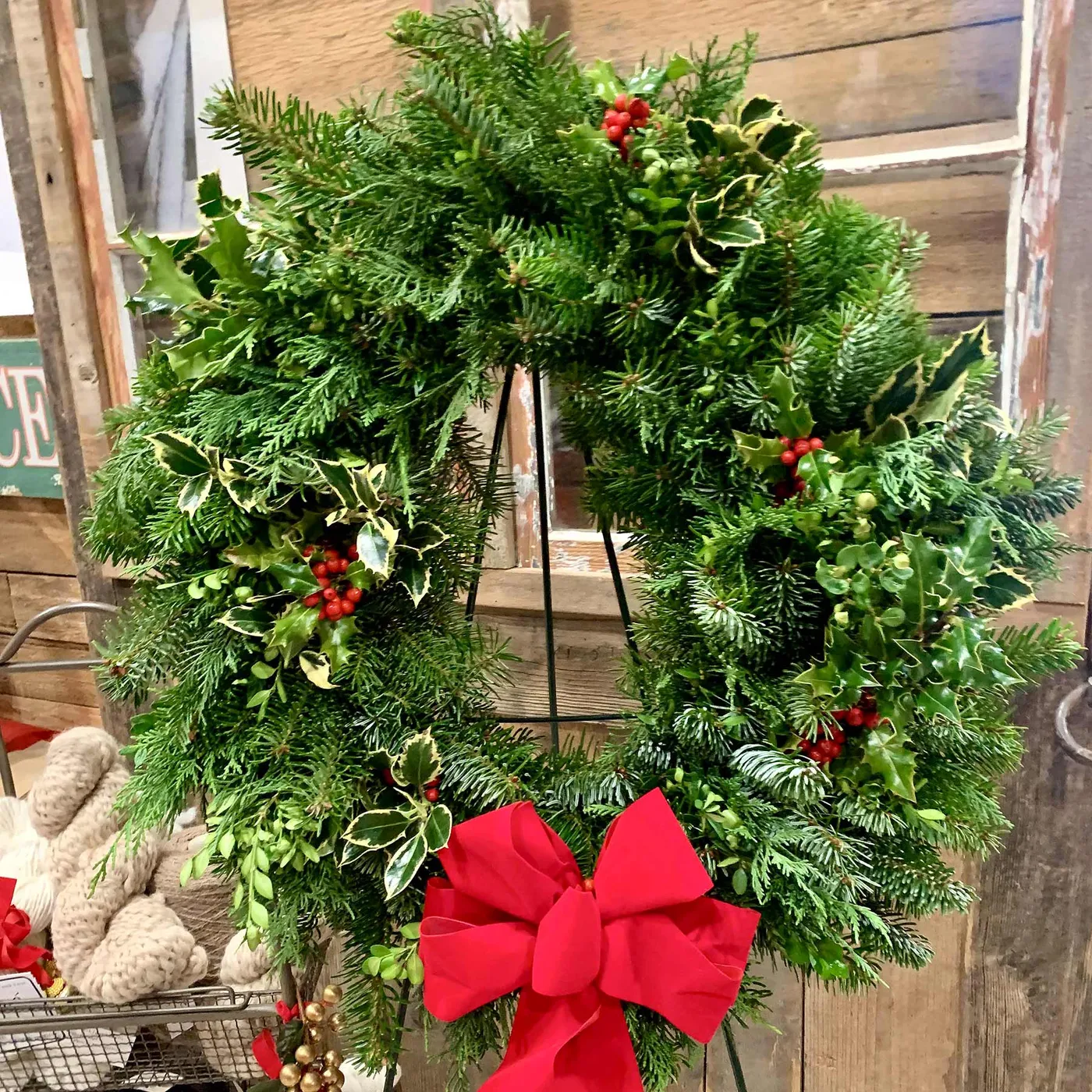
Holly grows everywhere, and most neighbors will happily let you cut some. Ask before you snip, then tuck fresh sprigs into a $6 grapevine base — it’ll hold three to four weeks outdoors in cool weather. Red berries are about $4 a sprig at the craft store, or grab a $2 bunch from the grocery floral department. Ribbon from a thrift store grab bag is often real velvet for under $3. Realistic total: $20 and an hour of your Saturday. Want it to last past December? Mix faux holly in for structure and add real sprigs on top.
14. Hanging Evergreen Spheres on a Wooden Rod
- Soak floral foam balls, then cover each one in sheet moss secured with hot glue.
- Wire 15 to 20 short evergreen sprigs into each ball, working from the bottom up.
- Add a frosted pinecone and a red berry cluster near the top of each sphere.
- Attach a satin ribbon loop and hang the spheres at varied drops — 6, 12, and 18 inches.
- Finish with a small red bow where each ribbon meets the rod.
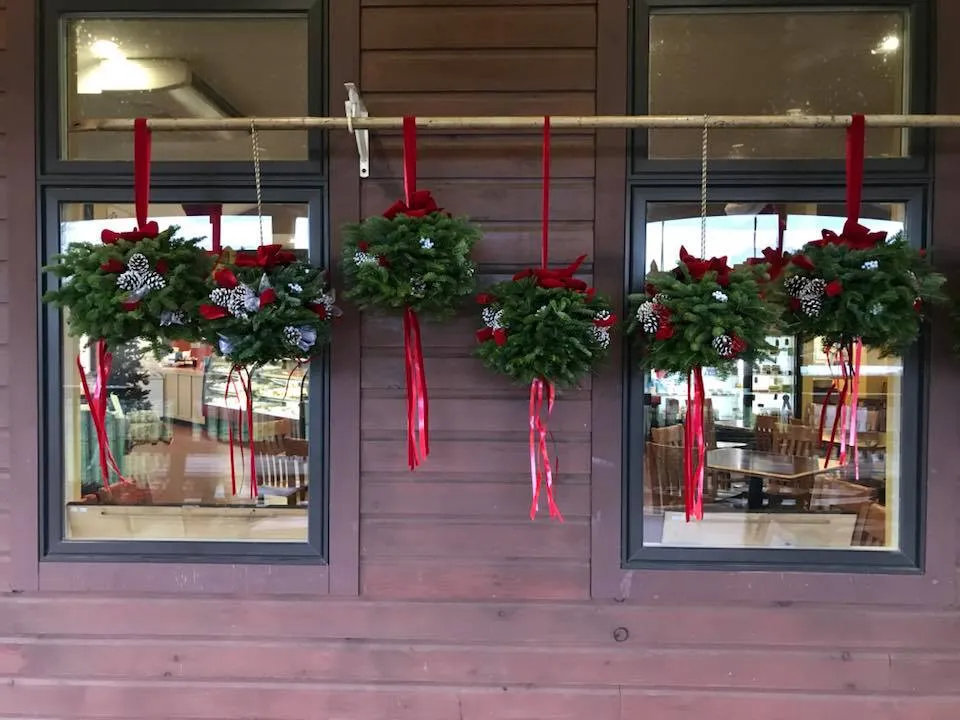
Time: about two hours for five spheres. Cost: roughly $40.
Two things nobody mentions. First, weight — a moss-and-evergreen sphere can hit three to five pounds, and rain pushes that higher, so the rod needs real screws into the siding, not hooks. Second, wind: spheres are basically sails, and they’ll twist until the ribbons knot. Hang them against a protected porch wall or under an overhang. Also check your HOA rules before you drill — hanging decor occasionally falls into a different category than wreaths, and it’s easier to ask first than to take it all down in January.
15. Cool White Crystal Wreath Over a Warm Garland Sill
Layered lighting is the quiet story of holiday decorating right now. Instead of one uniform glow, designers are mixing color temperatures and letting one dominate — cool white on the wreath, warm white on the garland — because the contrast reads as depth through a window. The lit-wreath-with-a-snow-view look resurges on Pinterest every December for the same reason: it photographs like a scene, not a setup. The wreath styles cycle in and out; lights and greenery never do.
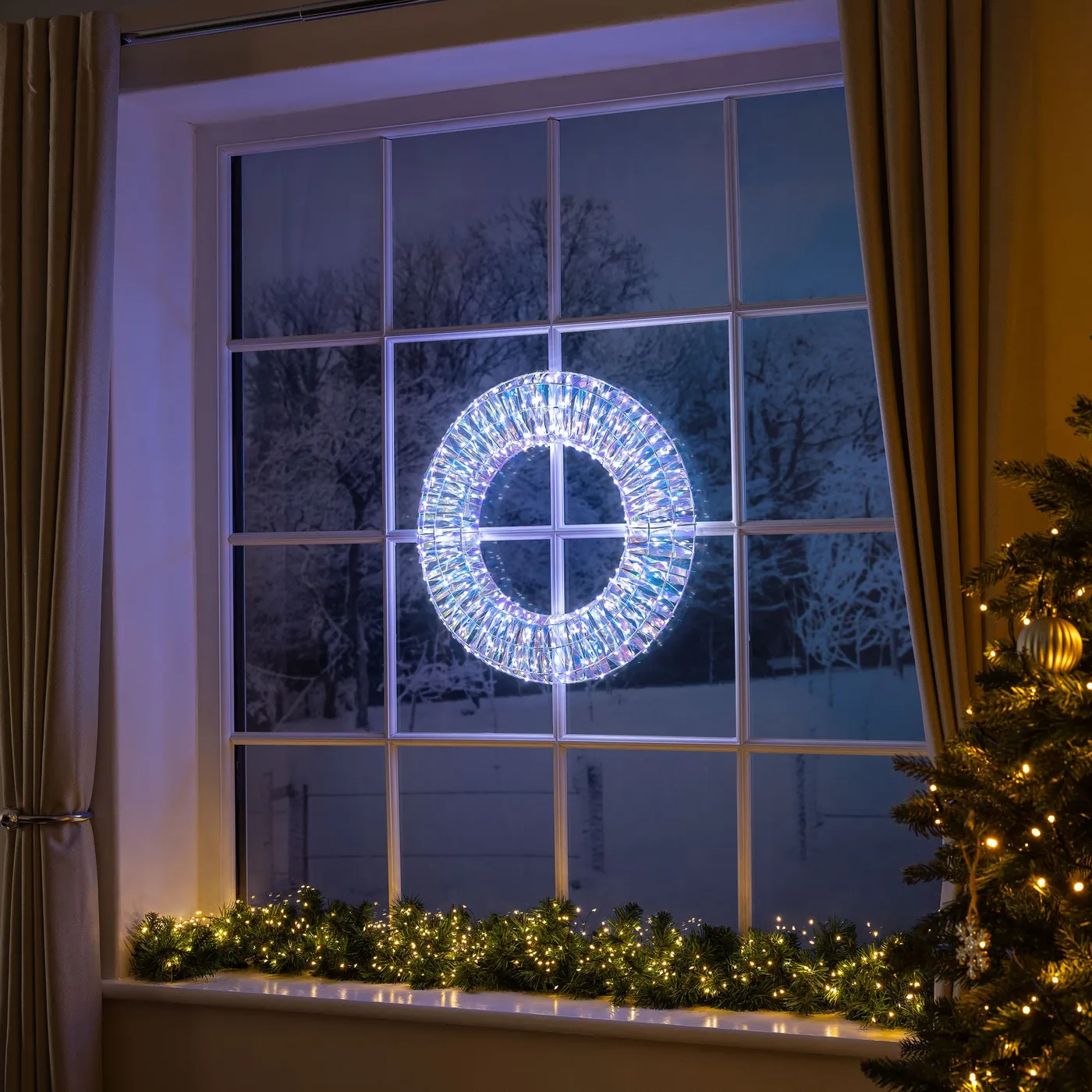
Put the lights on a smart plug or outdoor timer and set it for 4:30 to 11 p.m. — long enough to matter, short enough that the neighbors don’t start counting. Run cords down the inside edge of the garland and secure them with green zip ties so nothing dangles. If your wreath and garland use different plug shapes, a three-way outdoor adapter hides neatly behind the garland at the sill. Plug everything into one circuit so you never come home to a half-lit window.
16. Warm LED Wreath Framed by Gold-Brown Drapes
Roughly 50% dark green + 25% warm light + 15% gold-brown textile + 10% off-white trim. The dark drapes are what make a warm LED glow feel cozy instead of clinical — without that frame, a lit wreath on a winter window can look a little sad. Swap the gold-brown drapes for deep charcoal and the whole thing turns modern and moody; swap them for cream linen and it becomes airy and Scandinavian. Green and warm light stay constant in all three versions. That’s the entire formula.
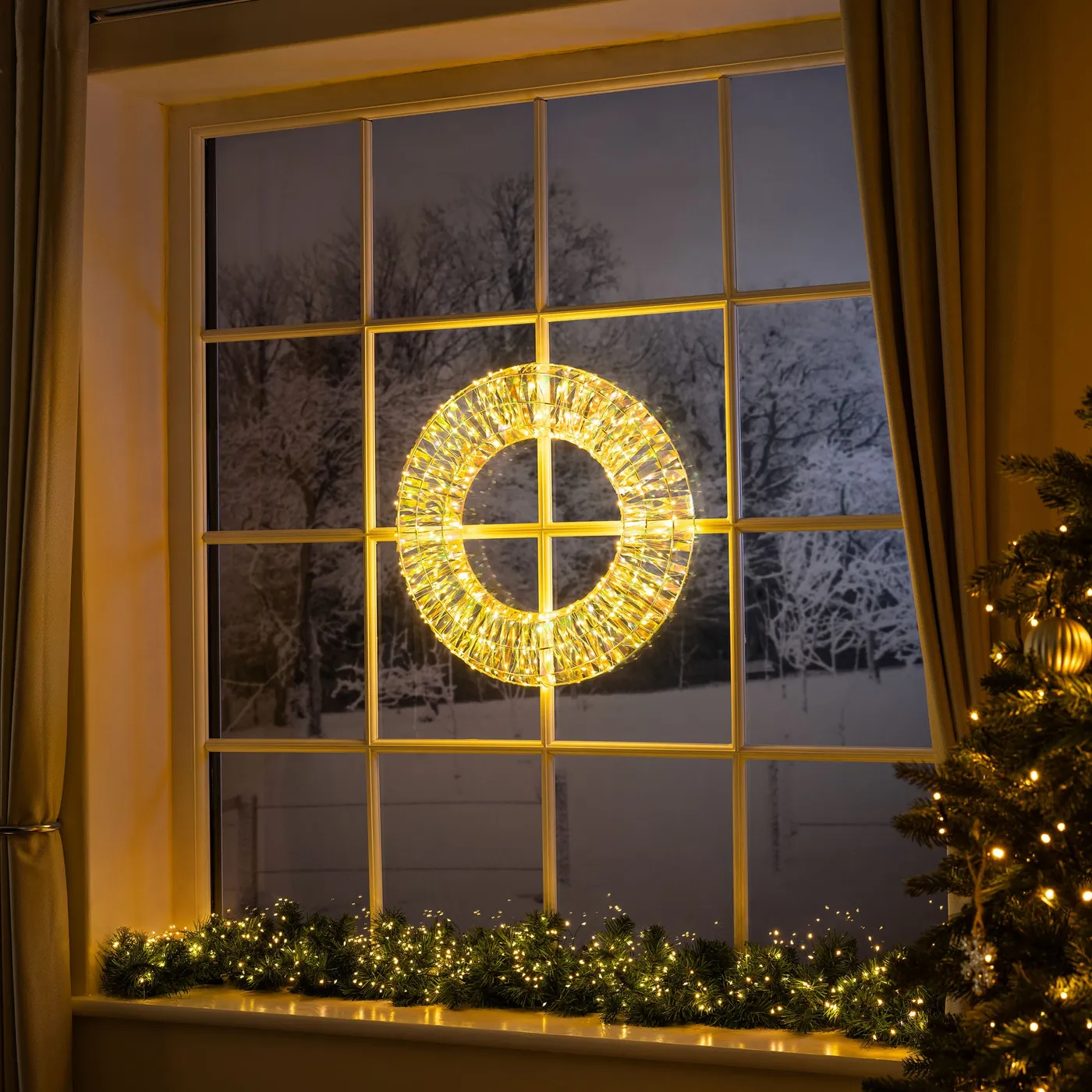
LED strings are rated for cold, but the weak link is always the connector, not the diode. Give every connection a wrap of self-fusing silicone tape before the first freeze and you’ll skip the mid-December troubleshooting session. Battery packs need fresh alkalines every three to four weeks in winter — rechargeables sag badly below freezing. As for the drapes, outdoor-rated fabric is fine on a covered porch, but anything touching snow should come in after the holidays.
17. Poinsettia Garland Porch With Santa and Icicle Lights
- Green garland with poinsettias, 30 feet total: $45–$90
- Faux poinsettia picks, 24: $30–$60
- Illuminated door wreath: $35–$80
- Santa figure, 4 feet: $60–$150
- Icicle lights, 30 feet: $25–$45
- Outdoor timers, stakes, and extension cords: $20–$40
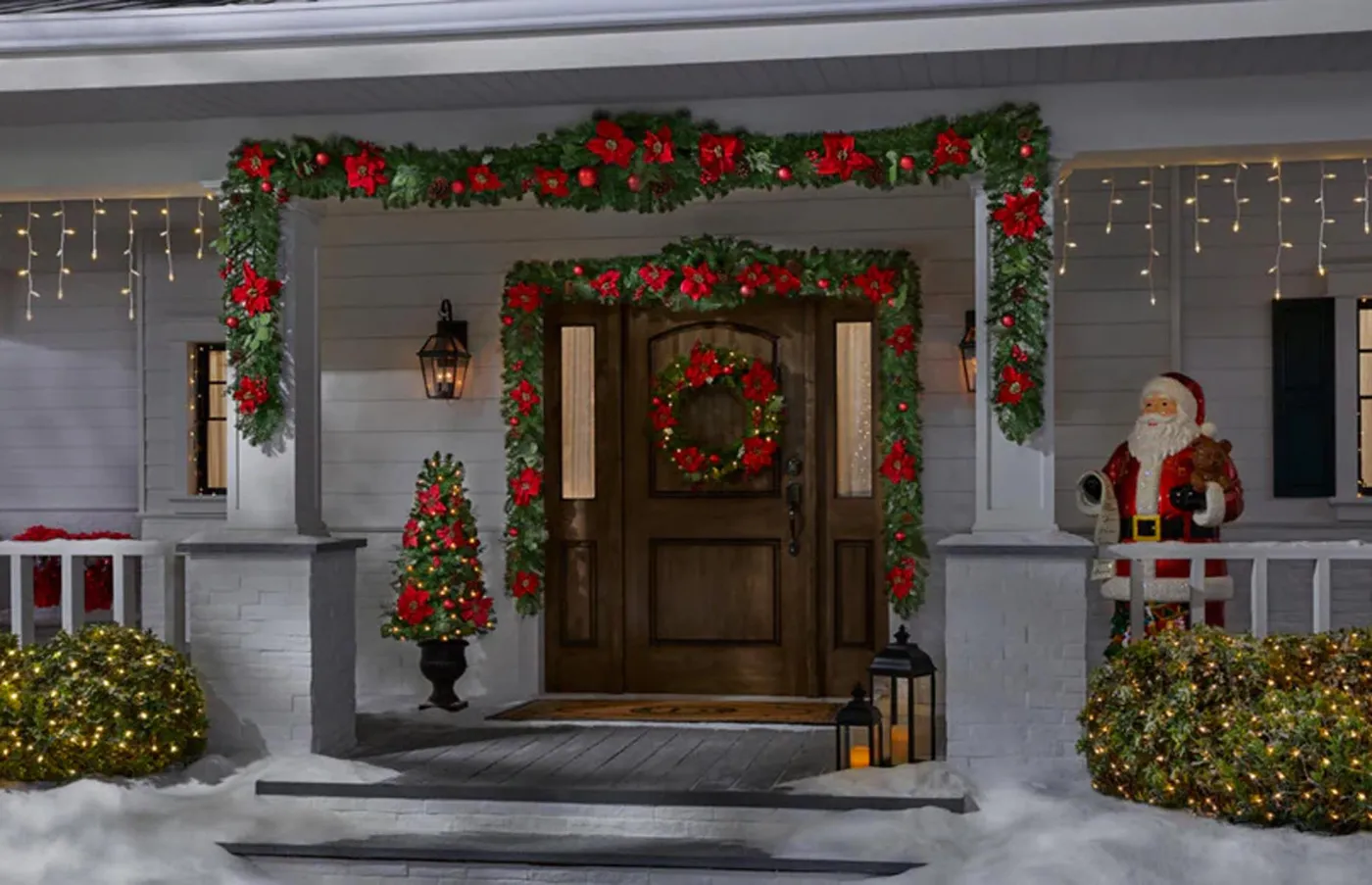
Total: $215–$465
Budget alternative: skip the Santa, add a lit topiary in a planter instead, and you’re at $130–$240 with the same warmth.
This display needs room to breathe. Plan on a porch at least 8 feet wide with a soffit height of 9 feet or more — icicle lights hung lower start to look like fringe. The Santa needs a landing 24 inches deep and should stand beside the door, not in the steps, so nobody trips on him in the dark. On narrower porches, borrow the poinsettia garland and skip the figure; the lit door wreath alone from Idea #7 gives you a similar welcome without crowding the walkway.
18. Berries and Pinecones on a Textured Exterior Wall
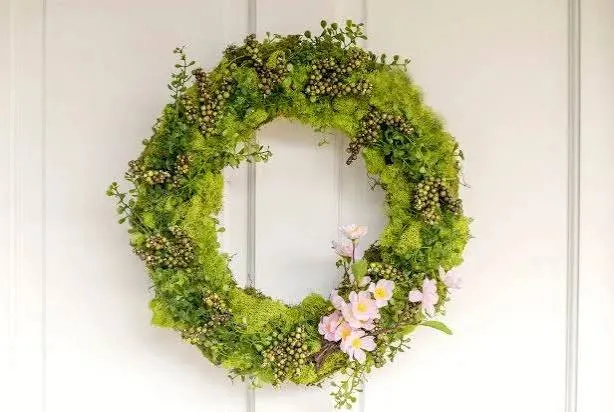
It’s the ribbon scale. On a light-textured stucco wall, everything softens and blurs, so the one crisp thing left is the bow — and it’s generously oversized, roughly a third of the wreath’s diameter. Take that bow away and you have a pleasant but anonymous evergreen circle. With it, the wreath gets a center of gravity and the wall texture reads as intentional rather than busy. Oversized, stiff ribbon with real body is the upgrade here; floppy satin goes limp and disappears at ten feet.
- Measure your window width so the wreath lands between 50% and 60% of it.
- Identify your wall surface — acrylic stucco can peel if you use a heavy adhesive hook.
- Weigh the wreath wet, then pick a hanger rated at double that.
- Decide whether you’re comfortable on a ladder; if not, choose first-floor windows only.
- Make sure the ribbon won’t sit under a spot where roof runoff drips.
19. Candy Cane Tinsel on Dark Gray Wood Paneling
Tinsel garlands shed. Before you hang a candy cane strand on a window, decide how you feel about glitter in your mulch. Loop each end around a small cup hook screwed into the frame — never tape, and never staple into horizontal paneling, since boards split along the grain. Keep the strand above the snow line so it doesn’t get buried, and run it across the middle third of the glass rather than the top, where it fights the bow for attention. A 22-inch strand fits a standard 30-inch window.
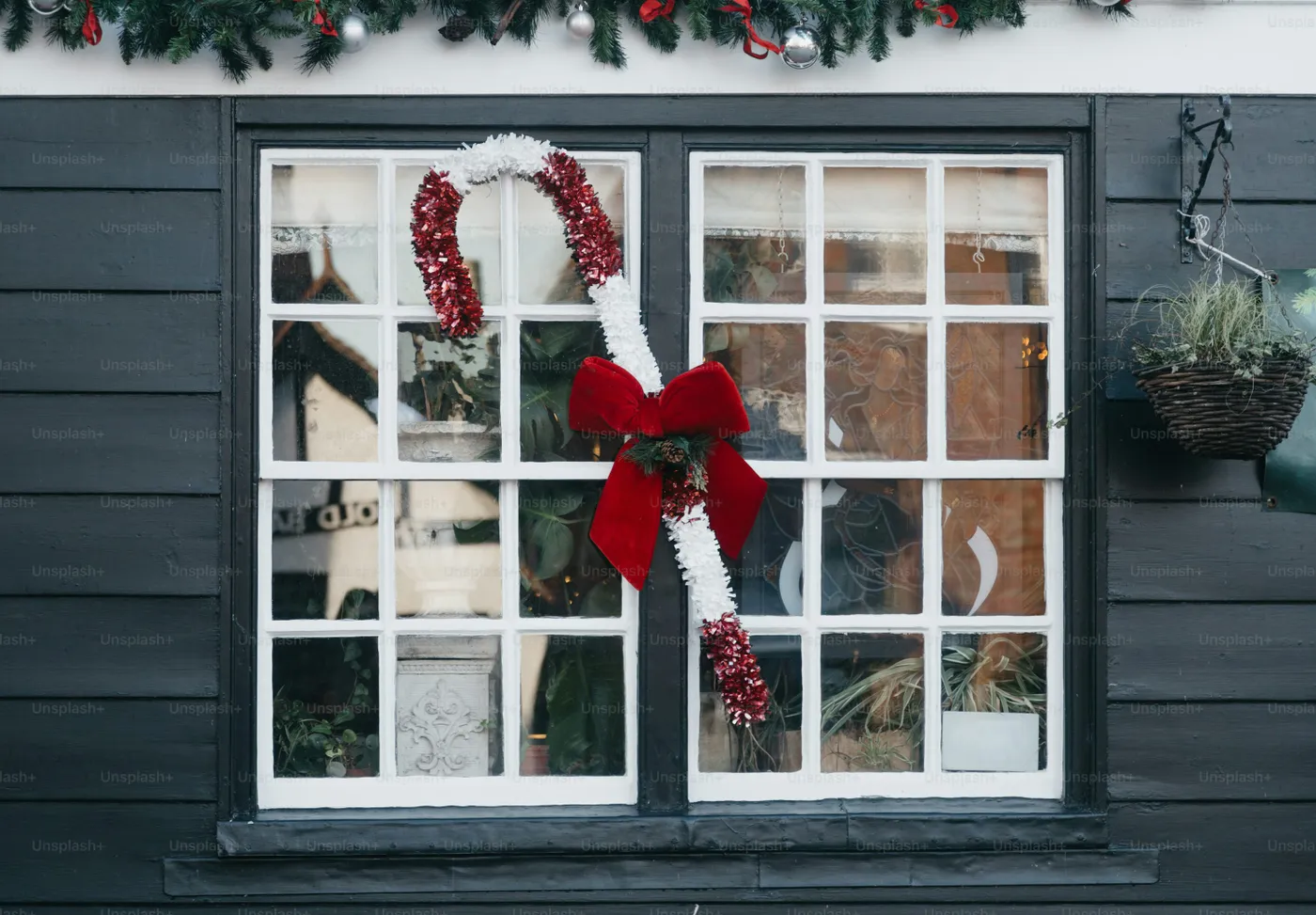
This is a contrast study. Red and white candy stripes against dark gray paneling is about as high-contrast as holiday decor gets, and the silver baubles in the garland above echo the cool tones in the wood so nothing looks pasted on. The dark backdrop also makes the foliage read deeper green than it is. Same principle as the dark-wood palette in Idea #12 — dark walls reward bold graphics and absorb clutter, which is a genuinely nice thing for a maximalist display.
20. Outdoor Window Wreaths, Scaled to Your Siding
The most common outdoor wreath regret isn’t color or style — it’s size. A 24-inch wreath that looks generous on a 30-inch window will look like a coaster on a six-foot picture window, and that same wreath on a narrow sidelight will feel enormous. Before you order anything, pull out a tape measure and write down every window’s width. Also worth knowing: white and cream siding shows every pine needle and every rust stain, so rinse your wreaths in spring and dry them upside down before storing.
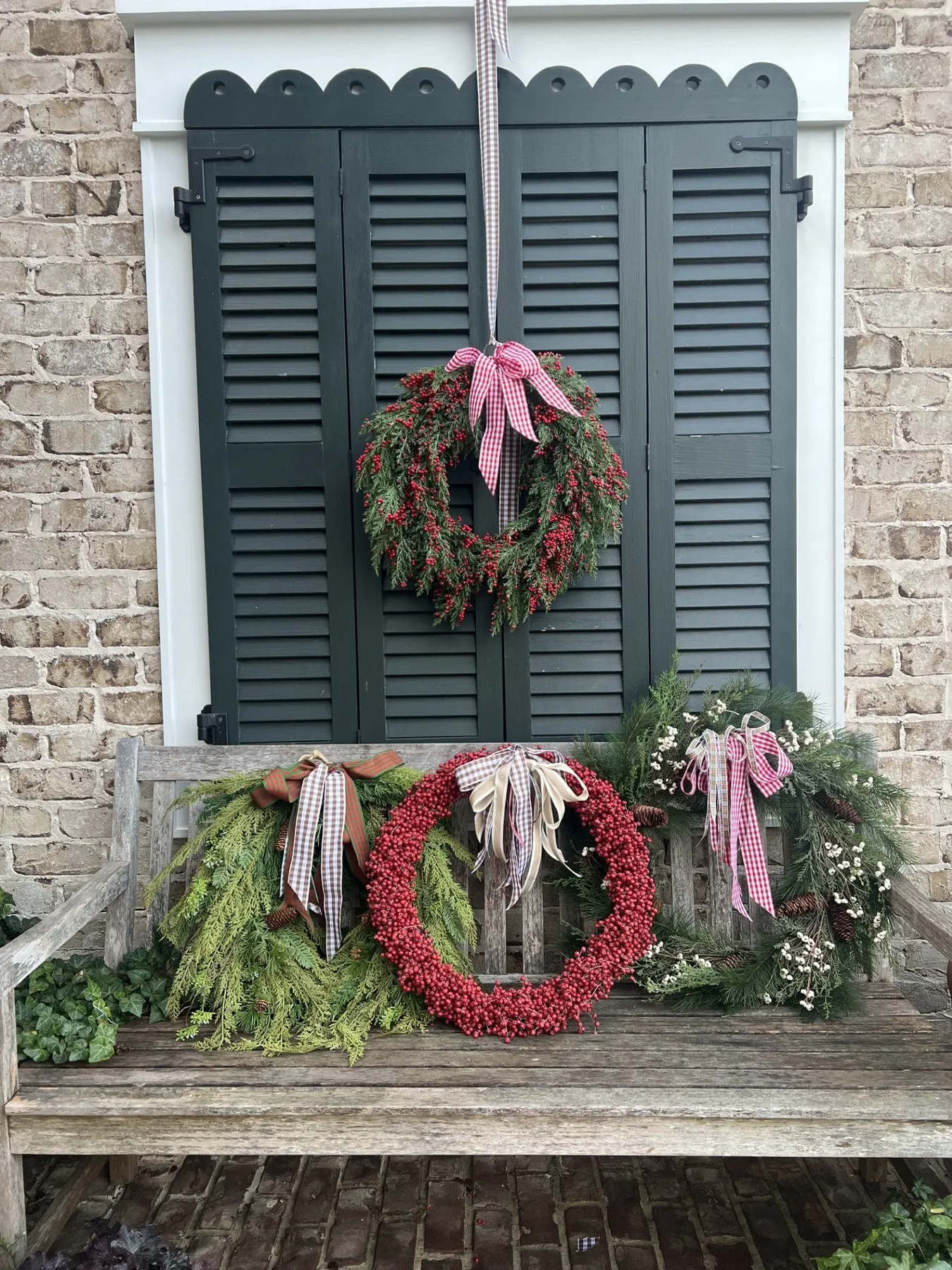
Dollar store wreaths are $5 to $8 and their foliage is honestly fine from the sidewalk — the giveaway is always the ribbon. Spend your money there instead. Three yards of good velvet ribbon is $10 to $18 and can transform four cheap wreaths. Facebook Marketplace in early January is a goldmine: people unload full sets of matching wreaths for $20 total because they’re tired of storing them. Thrift stores in November are hit or miss, but the bare wire frames alone are worth $2 each.
21. Cedar Hanging Wreath, Fresh for the Season
- Cut cedar tips in early December and strip the bottom two inches of needles.
- Wire 25 to 35 tips onto a wire or grapevine base, working in one direction so the wreath looks combed.
- Mist the finished wreath every three days and keep it out of direct sun.
- Hang it with a ribbon loop rather than a hook so the natural drape shows.
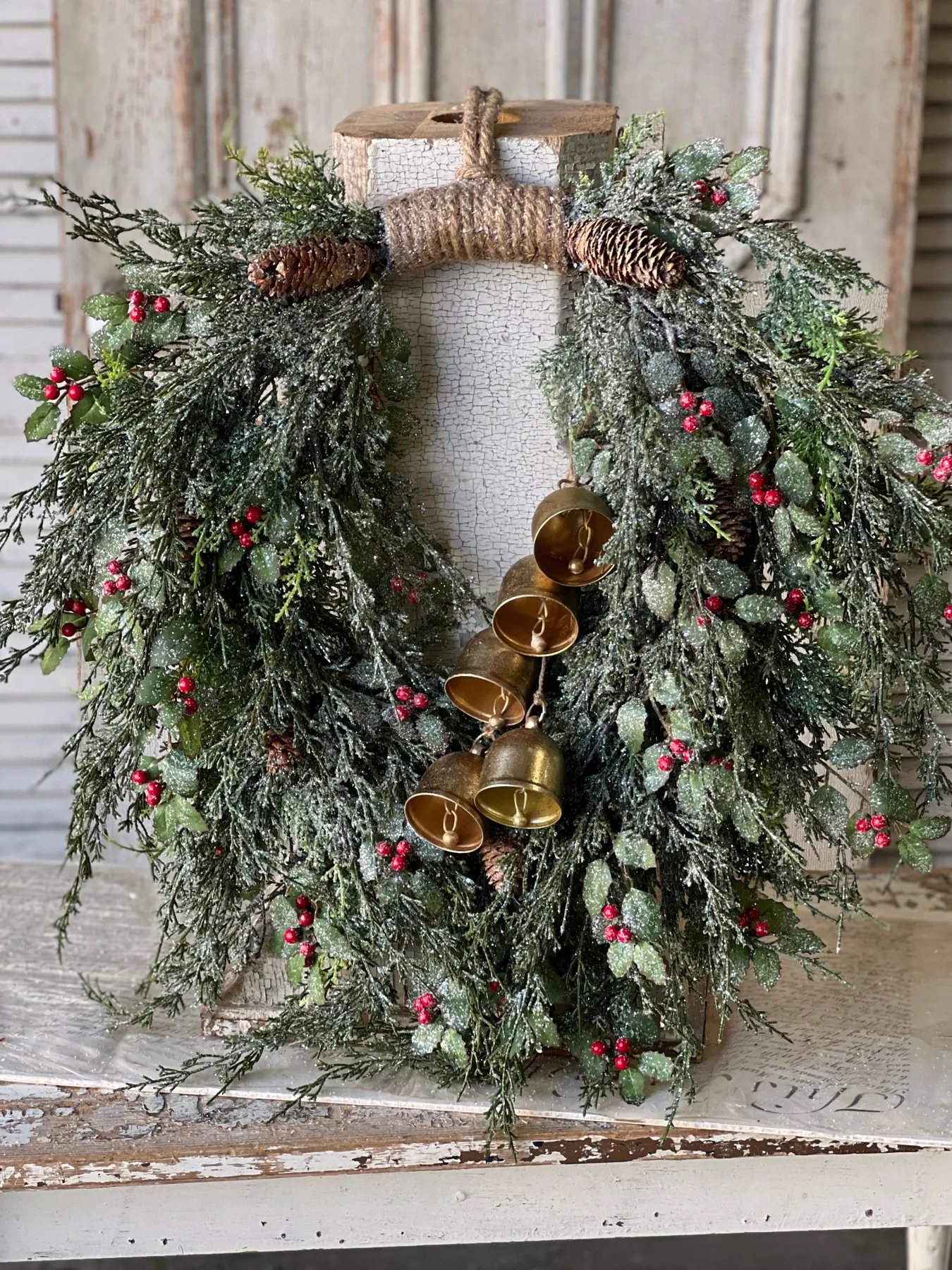
Time: about one hour. Cost: roughly $12 if you’re cutting from your own tree.
A 26-inch cedar wreath suits a standard 30- to 36-inch window; anything smaller gets swallowed by the frame. Cedar hangs loose and tends to measure wider than the form suggests, so weigh it before you trust a suction cup — fresh, wet cedar can run six pounds. This style works best on covered porches and under eaves. On exposed windows, either accept a shorter display or use a mixed evergreen construction, which holds its shape considerably longer in weather.
22. Frosted Wreath Above a Miniature Gingerbread Village
- Frosted evergreen wreath, 24 inches: $30–$70
- Gingerbread houses — ceramic or cookie kits, 4 to 6: $15–$45
- Flocked miniature pine trees, 5: $12–$30
- Artificial snow or batting for the sill: $5–$12
- Red berry sprigs for the wreath: $4–$10
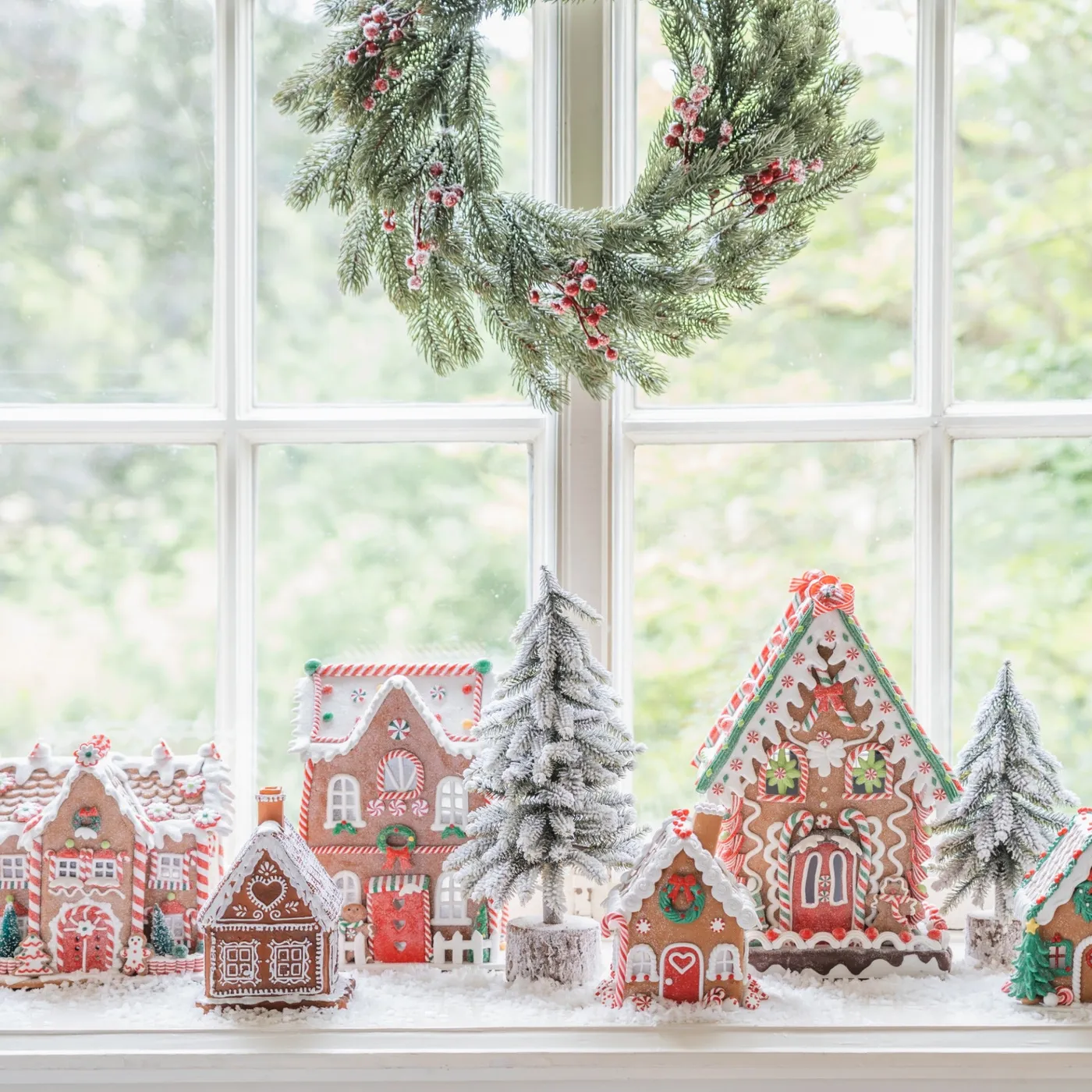
Total: $66–$167
Budget alternative: bake your own houses from a $6 kit and use boxwood sprigs for the trees — under $40 for the entire windowsill.
Nostalgia is running the holiday decor conversation right now, and miniature villages are its most photogenic expression. The appeal is partly generational — people recreating windowsills from their childhood — and partly practical: tiny scenes are cheap, collectible, and easy to store. Flocked greenery fits the same mood, which is why frosted wreaths keep outselling plain ones in the natural-botanical category. It’s a trend with real staying power, mostly because it doesn’t depend on a color of the year.
23. Open Laurel Wreath With a Champagne Satin Bow
The mix is about 65% deep laurel green + 20% metallic (gold and silver in equal measure) + 10% champagne satin + 5% muted olive. The metallics are small and scattered rather than clustered, so they read as sparkle instead of decoration. To shift it warmer, keep the ratios and swap silver baubles for copper; to shift it cooler, trade the champagne ribbon for pale gray-blue. The green and the open shape stay constant, which is what keeps it looking like a designer piece rather than a craft project.
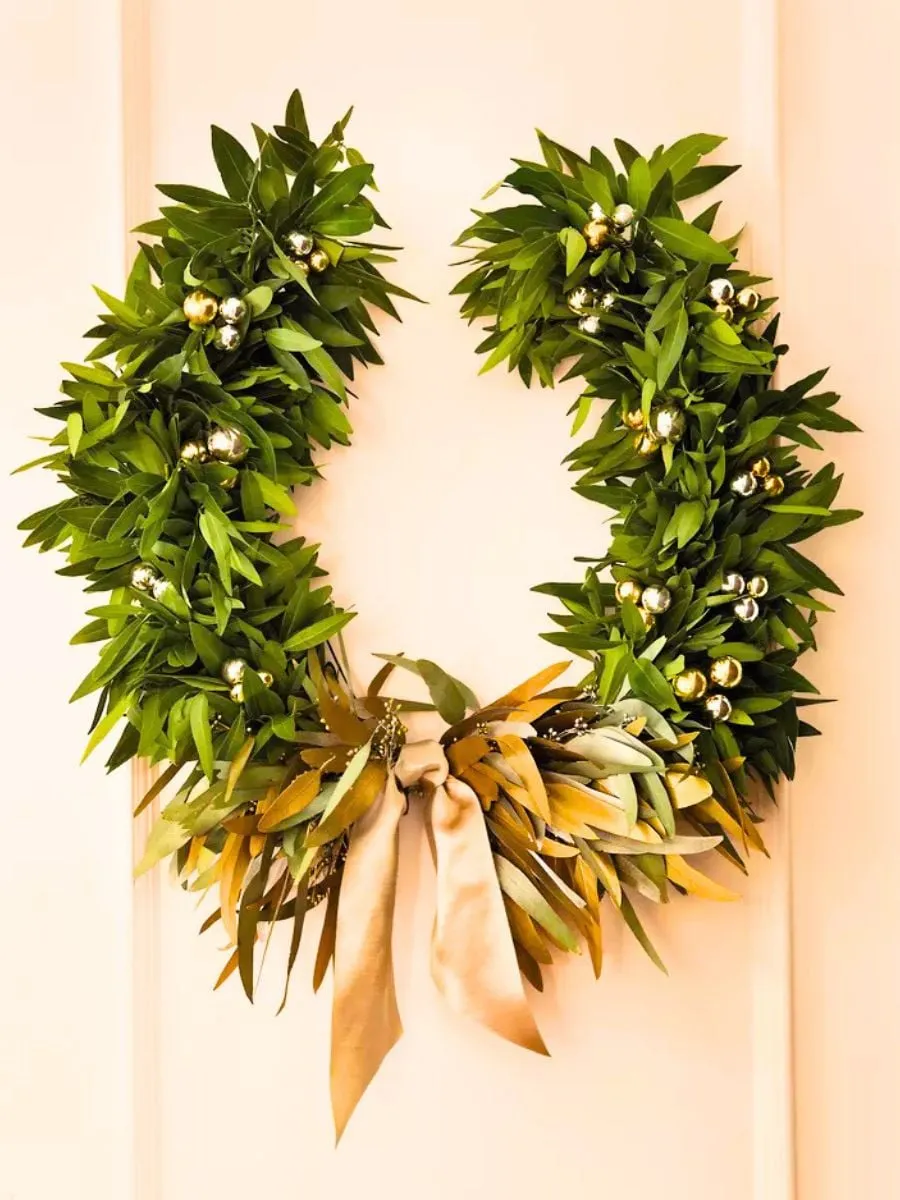
The wreath doesn’t close. That open-ended crescent is the entire personality of this design — it reads as modern, slightly undone, and much less “holiday aisle.” A traditional circle demands symmetry and a top-center bow; an open form lets the bow sit low and off-center and nobody minds. Bay laurel leaves give it a slightly culinary, Mediterranean feel that pairs beautifully with a kitchen window or a formal front door. Fill the gap and you’d lose the whole point.
24. Winter Windows: One Wreath, Clean Lines
A single wreath on a bare window is a proportion exercise. Use 50% to 60% of the window width, hang it so the bow sits level with the top rail, and resist adding garland. If your sash is white, choose a wreath with visible contrast — deep green, or something with berries or dried elements — because plain green on white can wash out in flat winter light. On dark trim, go lighter and looser. Over-sash hooks beat adhesive in cold weather every single time.
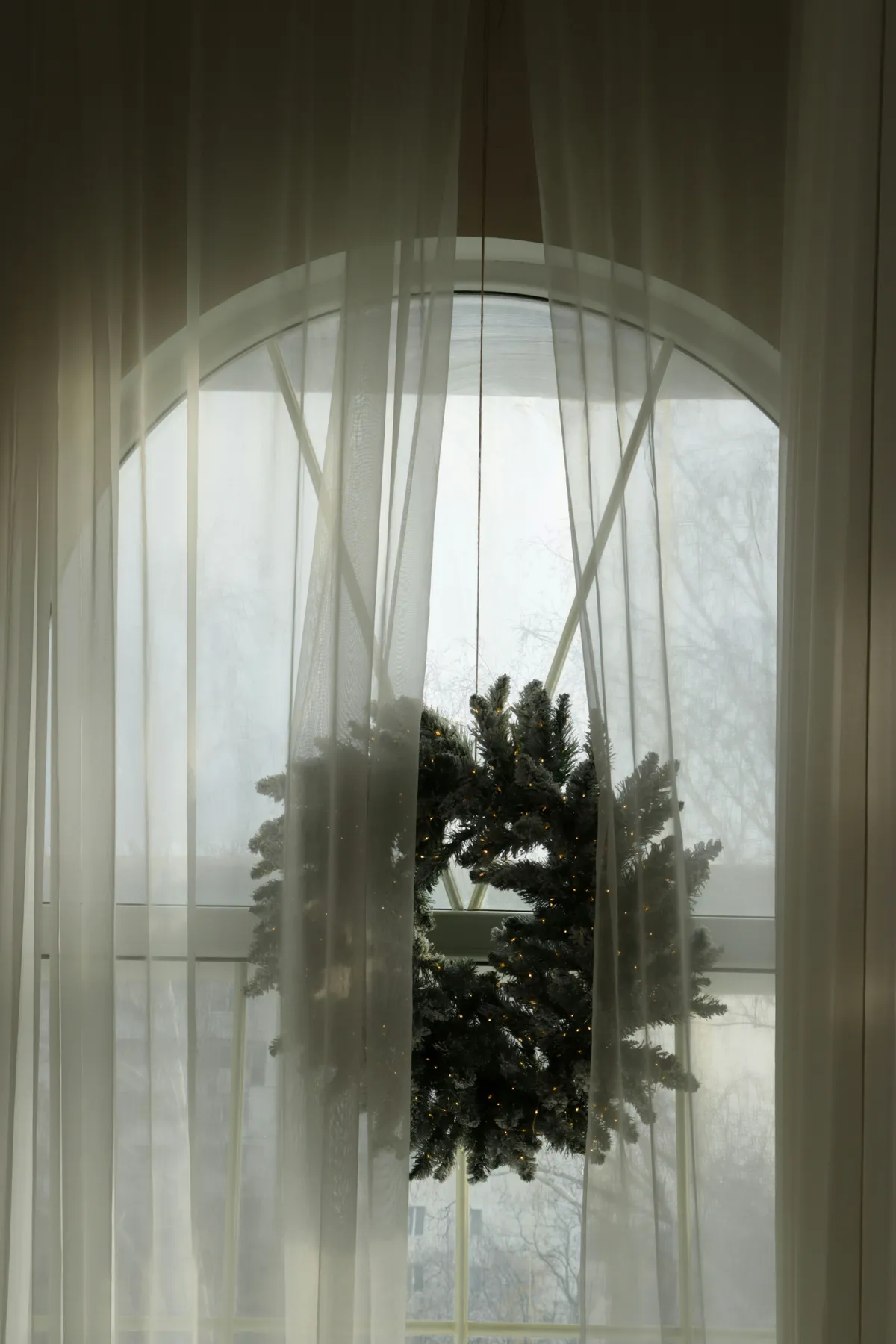
Windows get more sun than people expect, and sun is what kills holiday decor. Artificial evergreen fades to a chalky yellow-green after one or two seasons of full southern exposure; berries crack; ribbon bleeds. Rotate a window wreath to a shaded door after December if you want it to survive to next year. Store everything in a hard bin with a dryer sheet, and never stack wreaths — the shapes flatten permanently and nothing brings them back.
25. Tinsel Wreath With Glitter Reindeer and Gold Poinsettias
- Green tinsel wreath base, 20 inches: $12–$25
- Glitter reindeer picks, 4: $8–$18
- White and gold poinsettia stems, 2: $10–$20
- Patterned white-and-gold ribbon, 3 yards: $6–$14
- Floral wire and a glue stick: $4

Total: $40–$81
Budget alternative: buy a plain tinsel wreath at a dollar store and shop after-Christmas clearance for the picks — most of this can be done for around $18.
- Snip the old bow and any tired picks off the base, then pull out the wire stubs.
- Wire the two poinsettias at 4 and 8 o’clock so the wreath doesn’t get top-heavy.
- Slot the reindeer picks behind foliage at uneven intervals — even spacing looks store-bought.
- Tie your new bow with four loops and let the tails run 8 to 10 inches.
- Fluff the tinsel outward with your fingers and hang.
Time: about 20 minutes. Re-ribboning beats replacing every time.
26. Rosemary Wreath With a Burlap Bow
Fresh rosemary is gorgeous for about three weeks, then it dries, darkens, and starts dropping needles onto your sill. That’s not a failure — it’s just the timeline. Keep it in a cool spot away from heat registers and it holds longer; mist it lightly every few days. If you want the look all season, wire rosemary around a faux base so the greenery thins out gracefully instead of collapsing. And if you have a sunny kitchen window, a potted rosemary plant gives you the same silhouette and survives to next year.
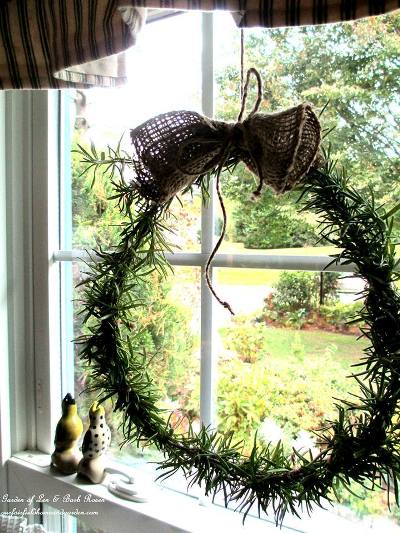
Grocery store rosemary bundles are $3 to $5, and one bundle covers a 12-inch wreath. A wire form is $4 at any craft store, or repurpose the frame from last year’s wreath — strip the old foliage and reuse it. Burlap ribbon runs about $5 for 10 yards and it’s the cheapest way to get texture without shine. Total: around $15, plus the smug feeling of having made it yourself. Thrifted grapevine bases are $2 and last essentially forever.
27. All-Berry Wreath on a Multi-Pane Window
White mullions turn a window into a grid, and a wreath hung dead center on it behaves like a bullseye — which sounds aggressive but is exactly why this reads so cleanly. The wreath is almost entirely one color, so it doesn’t compete with the grid lines, and the small amount of green foliage keeps it from looking synthetic. It’s also a study in negative space: the white panes around the wreath are doing as much work as the berries are. On a window without mullions, the same wreath looks thinner and far less interesting.
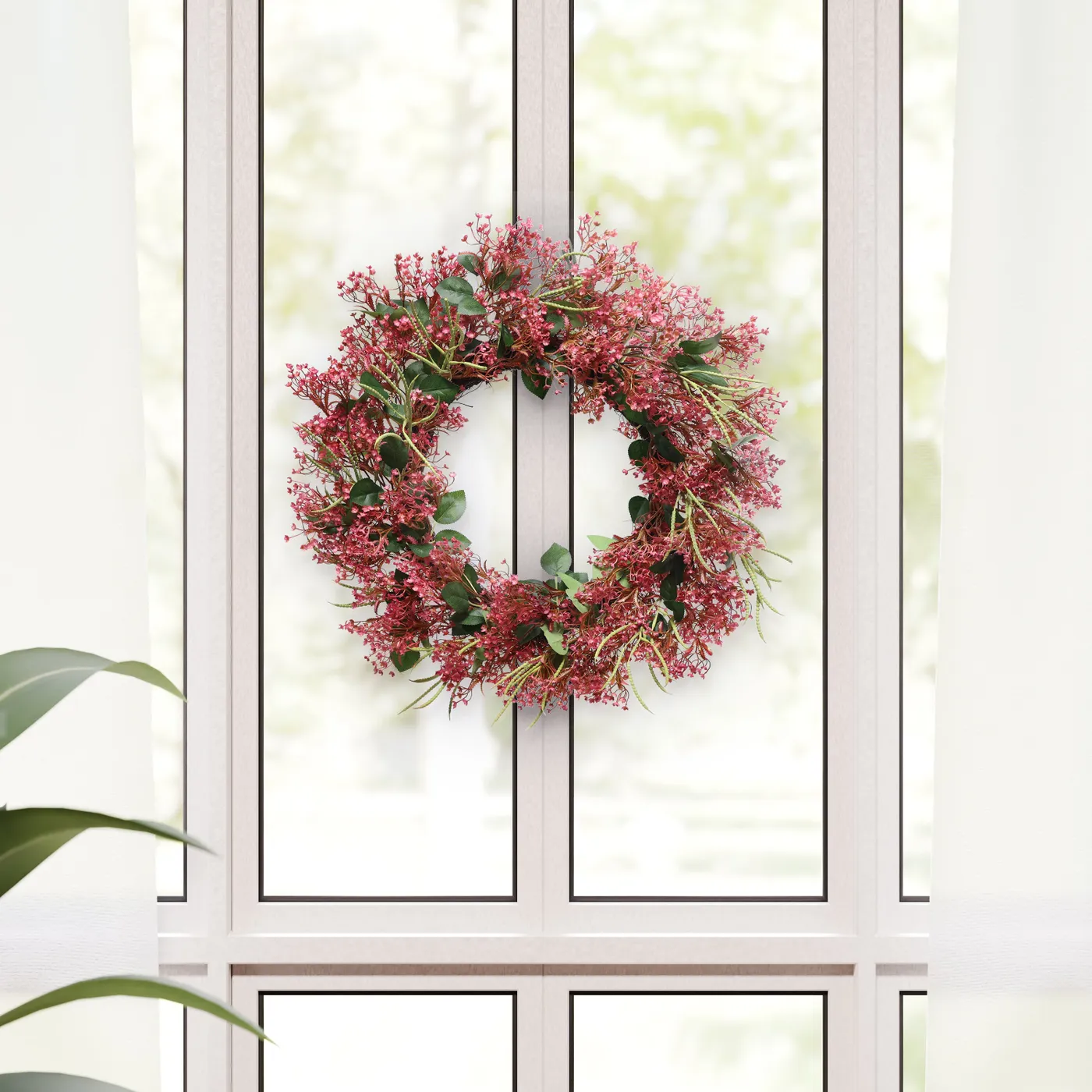
On multi-pane windows, aim for 45% to 55% of the window width — slightly smaller than you’d use on a plain sash, because the mullions already break up the space. A 22- to 26-inch wreath handles most double-hungs. If you have an upper transom over a lower sash, hang the wreath on the upper sash only, and consider a second one below on very tall windows. For the opposite approach — one big statement wreath on a plain window — see Idea #9.
28. Pink Blooms and a Striped Bow
About 60% dense green foliage + 25% pink blooms + 10% white accents + 5% striped ribbon. The pinks here are mixed light and dark, which keeps the wreath from reading as one flat shade, and the striped bow adds the single graphic note. To take this into another season, swap the pink flowers for burgundy or rust and keep everything else identical — the structure carries it. Against dark brown plank siding, the pink pops because the background is warm but low-chroma, so nothing else fights the flowers.
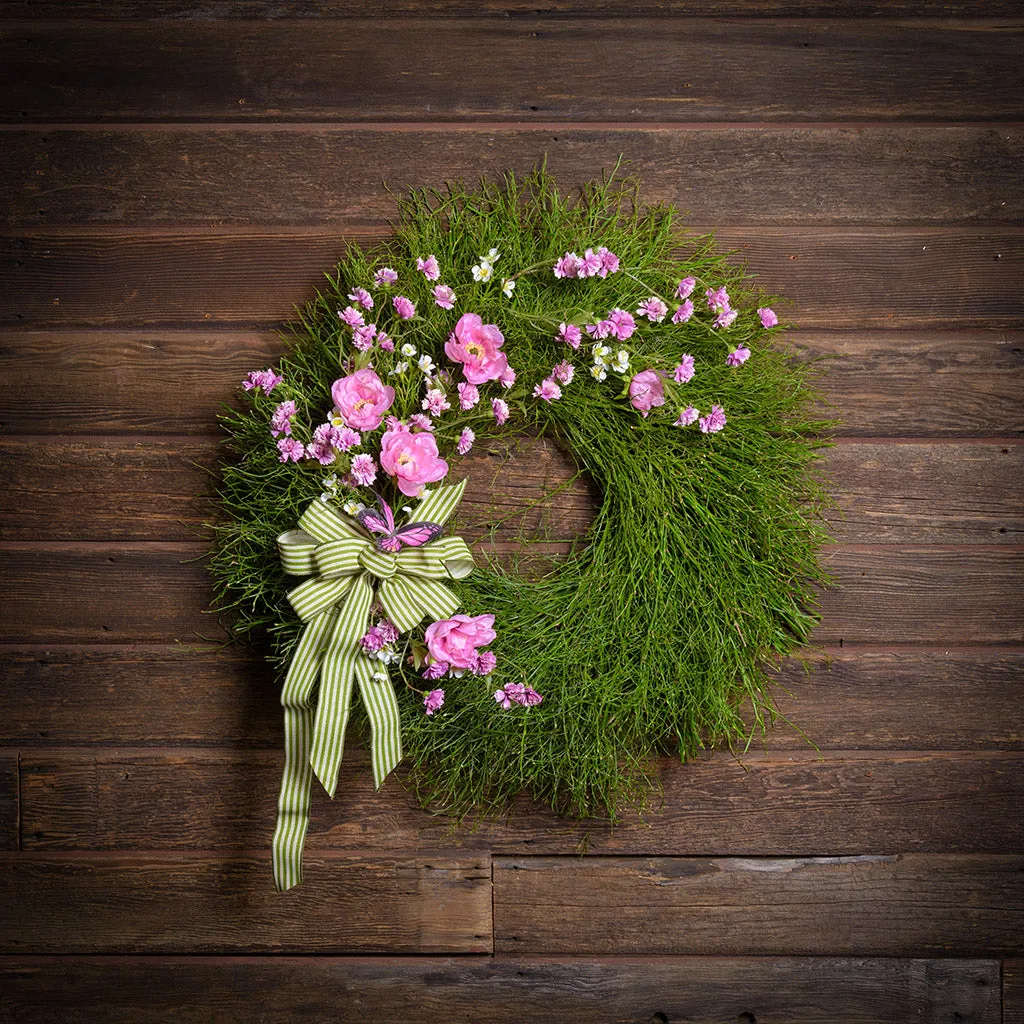
- Hold a pink swatch against your exterior wall in daylight before committing to the palette.
- Check the ribbon stripe scale — thin stripes read as texture, wide stripes read as pattern.
- Decide whether this is a front-door piece or an interior-adjacent window piece.
- Confirm your flower picks are UV-stable, or plan to replace them next season.
- Measure the hanging point so the bow doesn’t cover your window’s hardware.
29. Twin Pinecone Wreaths With Red Satin Bows
When you hang a matched pair, precision is the whole effect. Measure from the top of the window frame to the top of the bow, and keep those two numbers within a quarter inch of each other — the eye catches a one-inch difference from the street. Use identical ribbon lengths for both hangers and line up the centers. If your windows sit at slightly different heights, which happens constantly on older houses, cheat the hangers so the wreaths look level relative to each other rather than to the trim.
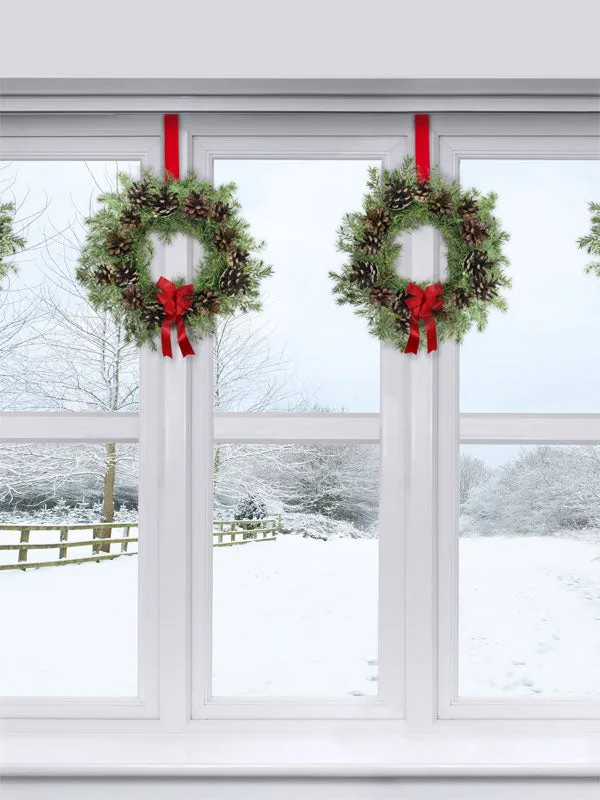
Pinecones. That’s the element that turns a standard green wreath into something with weight and season. They’re matte, textured, and brown — three things greenery, ribbon, and berries are not — and they read as gathered rather than purchased. Ask anyone who collects them in the fall: pinecones from your own yard or a nearby park make a wreath feel like it belongs to the house. Remove them and you have a perfectly nice, completely forgettable evergreen circle.
30. Garlands With Red Baubles Between Dark Shutters
The shutters do half the work. When a garland runs across the middle of a window and dark panel shutters sit on either side, you get a built-in frame — the greenery feels contained instead of sprawling. Shiny red spheres repeat at regular intervals, creating rhythm, while a light metallic ribbon adds a soft sheen so the whole thing isn’t glossy-on-glossy. On a light beige facade, the dark shutters and deep green supply the contrast; without them, the garlands alone would read thin.
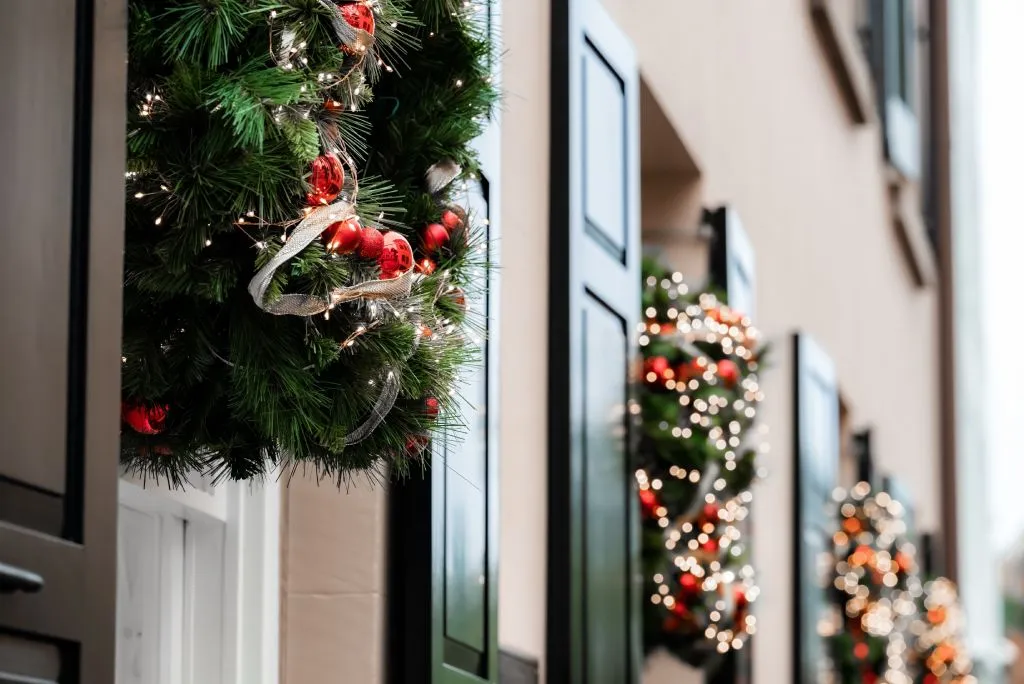
- Pre-lit pine garland, 9 feet per window, 3 windows: $75–$150
- Shatterproof red ornament sets, 3 packs: $30–$60
- Metallic-sheen ribbon, 2 spools: $14–$30
- Outdoor hooks and green zip ties: $12–$25
- Timer and outdoor extension cord: $20–$40
Total: $151–$305
Budget alternative: unlit garland plus a $12 string of warm LEDs per window drops this to roughly $80 total.
31. Norfolk Pine Wreath: The Soft, Feathery Alternative
Norfolk pine looks nothing like a traditional fir wreath — the needles are soft, broad, and slightly drooping, so the whole thing reads quiet and modern. That’s the appeal and the downside: it can look sparse next to a bold red bow, and it doesn’t hold a crisp round shape. Give it simple ribbon and let the silhouette do the talking. Check the sizing before you order, too — a soft-needle wreath measures bigger than you picture, and it may not fit between shutters.
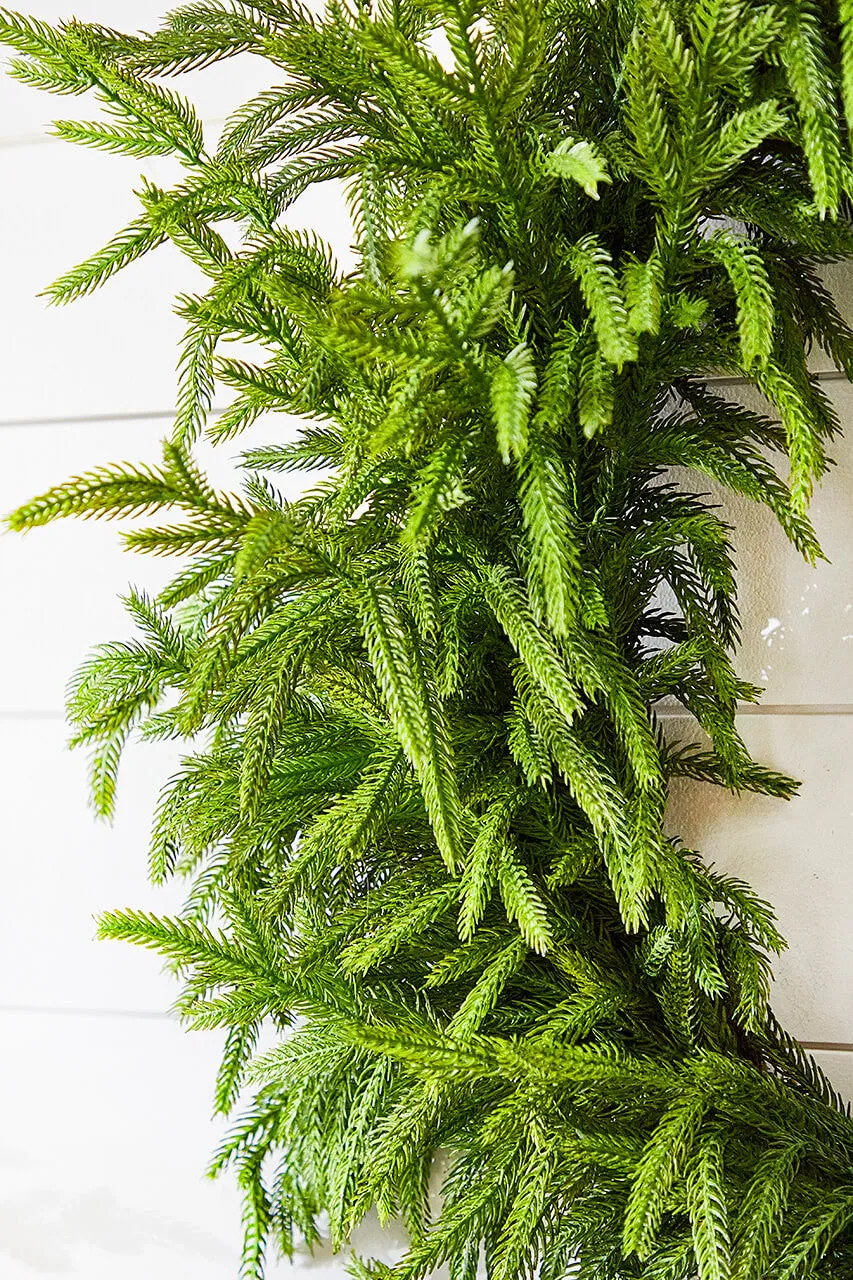
- Measure your window gap first; soft wreaths need an inch of clearance on each side.
- Fluff the branches outward from the center and reshape the circle by hand.
- Choose a ribbon with body — velvet or grosgrain — since limp satin disappears in soft foliage.
- Hang from an over-sash hook so the natural droop shows at the bottom.
- Mist lightly every few days if yours is fresh-cut, and keep it out of direct sun.
Time: about 15 minutes. Cost: nothing if you already own one.
32. A Whole-House Wreath Rhythm
Decorating an entire facade gets expensive fast, so split your budget: spend on the five windows that face the street and leave the rest bare. Plain 20-inch wreaths from a big-box store run $10 to $18, and one 10-yard spool of ribbon covers all of them with bows to spare — around $120 total. Reuse them for three years and the per-December cost drops under $40. If you want a version that costs nothing beyond storage, swap the ribbon color each year instead of buying new wreaths.
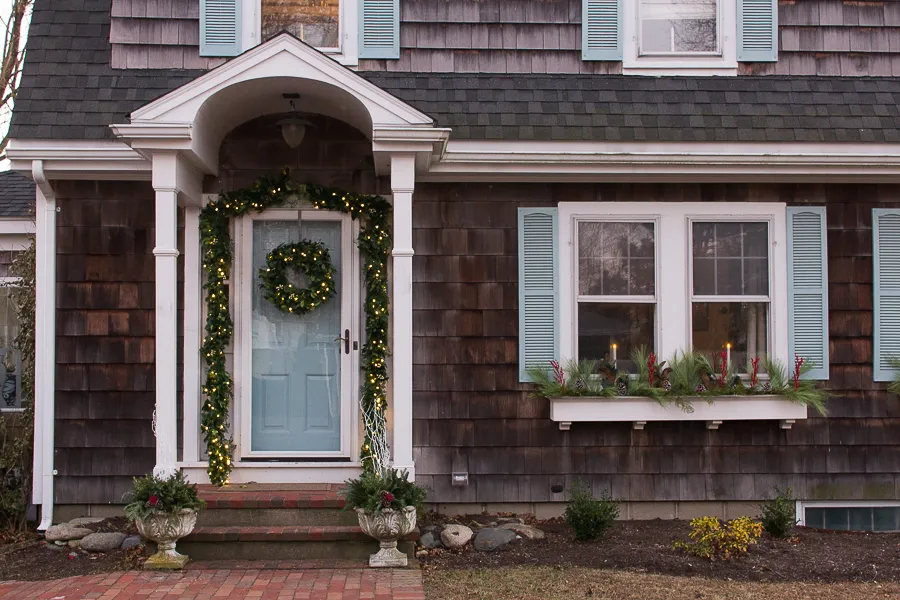
A matching scheme works when your street-facing windows are similar in size and roughly evenly spaced. If they’re not, vary the wreath diameters so each one sits at 50% to 60% of its window width — the difference will read as intentional. Single-story homes under 30 feet wide look best with three to five wreaths and nothing else. Two-story facades can carry eight or more. And if your windows are staggered in height, hang everything at the same height regardless of the trim, which is the trick that makes an uneven facade look composed.
Hang One, Then Hang Them All
Start with a single window — the one you see from the driveway every night — and get the size and the ribbon right before you buy anything else. Once that one looks good, the rest of the facade falls into place fast, and the whole street will notice without ever knowing you spent under $200.
📌 Pin your favorite from this list so it’s waiting for you next December — and if you try one, tag us. We want to see your windows.