
30 Stunning Christmas Tree Color Schemes and Palettes to Try This Year
Still scrolling past the same twenty flocked trees, wondering which one is actually yours? You’re not alone — searches for jewel tone and bronze Christmas palettes have climbed steadily going into 2026, and the saved boards are getting very, very specific about metals, ribbon widths, and how much green you’re willing to hide.
We spent the better part of a month digging through Target, Pottery Barn, Wayfair, Anthropologie, and Etsy to find palettes that hold up in real rooms, not just in a showroom photo. Everything here can be built somewhere between $35 and $1,400, and most ideas come with a budget route and a splurge route side by side.
Inside you’ll find 30 curated schemes spanning flocked-and-metallic, jewel tone, natural neutral, traditional red and gold, and full-on modern glam — from a teal dining corner with burgundy ribbon to a disco-ball tree overlooking a white kitchen.
And stay until the end — we break down the most common mistakes that can ruin these looks. 📌 Save this to Pinterest for later — you’ll want to revisit these ideas.
1. Snowy White Tree With Gold and Silver Spheres
The whole thing rests on one contrast: cool silver against warm gold, both floating on branches that read almost pure white. Pull the silver and leave only gold and the tree goes soft and buttery — pretty, but flat. The silver is what gives it an edge, and the warm white fairy lights keep both metals from tipping cold. The light beige walls and white stone fireplace behind it do quiet work too, because nothing in the room competes.
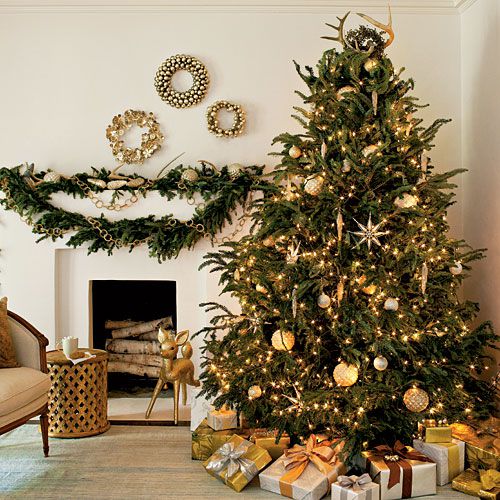
Work in three ornament sizes, not one. On a seven-foot tree, roughly 60 percent of the baubles should be three-inch spheres, 30 percent four-inch, and 10 percent six-inch statement pieces placed low and toward the front where the eye actually lands. Mixing gold and silver within the same size creates pattern; mixing the sizes creates rhythm. Keep each metal to two finishes — polished and satin only — or the sheen starts to look like a clearance bin.
2. Gold and Burgundy Ribbons Against Deep Teal Walls
Read it as 45 percent deep teal, 30 percent gold and bronze glass, 20 percent burgundy ribbon, and 5 percent pale blue-grey. Swap the burgundy for aubergine and you keep the richness but lose the holiday warmth. Swap the teal walls for warm greige and those exact same ornaments suddenly read traditional instead of dramatic. The formula survives the change — the ratio is what holds it together, not the specific shade.
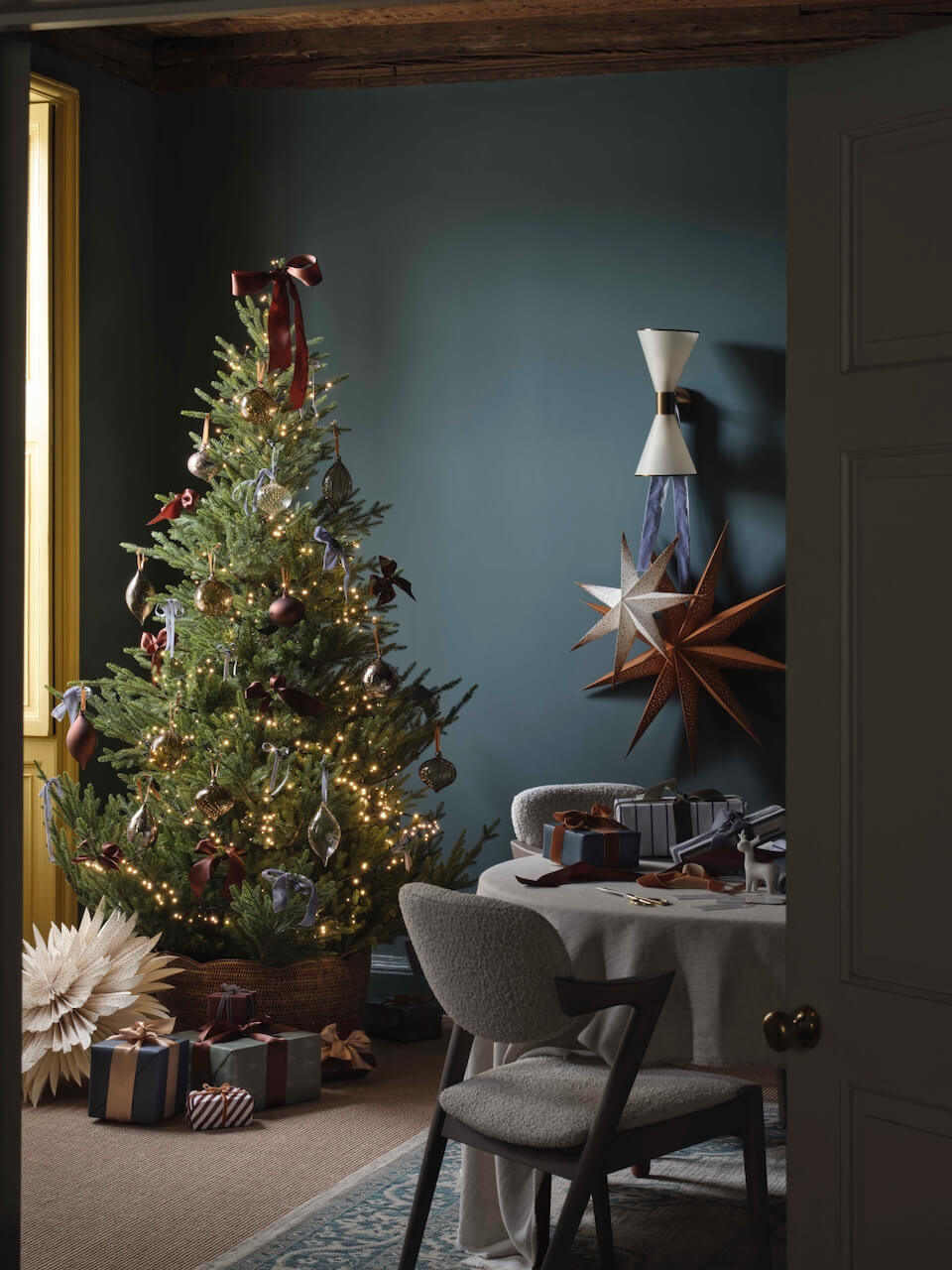
Jewel tones have been creeping back since 2023, but 2026 is the year they stop being ‘moody’ and start being the default for anyone with painted walls. Credit the broader push toward saturated interiors, plus the simple fact that gold glass ornaments look twice as expensive against a dark ground. This one has staying power because it’s a palette, not a gimmick. If you love the direction but can’t commit to paint, Idea #13 moves the teal from the wall onto the tree instead.
3. Green Tree With Pastel and Silver by White Windows
This arrangement needs width more than height. Plan on a wall at least 12 feet across so the two flanking trees have room to breathe, and ceilings of nine feet or better — otherwise the tall center tree crowds the window frames. Drop below 200 square feet and the trio starts to feel like a forest rather than a focal point. Keep the main tree, lose the side pieces, and the pastel-and-silver ornaments still carry the whole look.
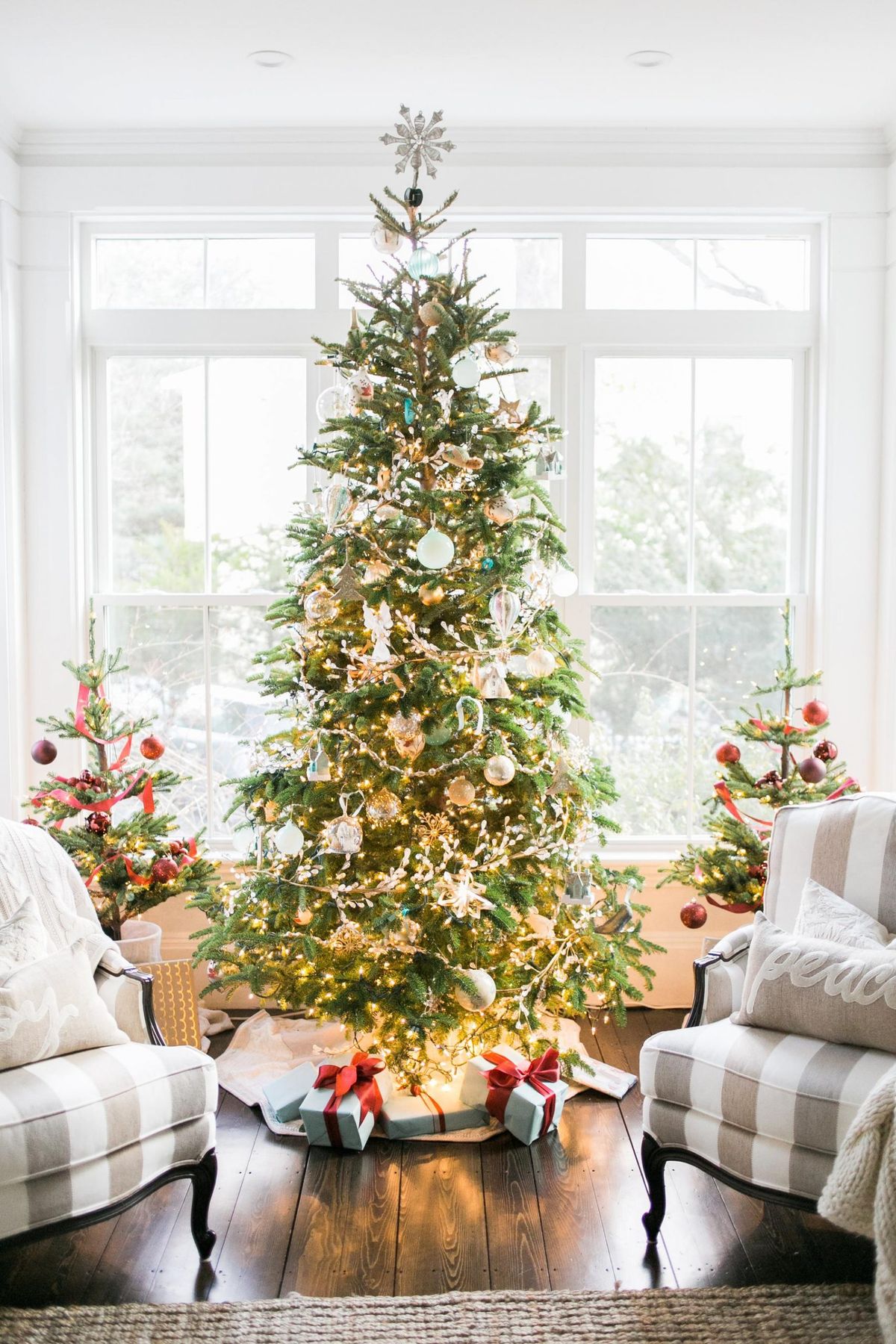
The single element that makes this room is the pair of small secondary trees, red-decorated, flanking the main one. Remove them and you still have a lovely traditional tree. Keep them and you have a composition — the eye travels across the room instead of stopping dead center. They cost about a quarter of what the main tree did, which makes them the cheapest architectural trick in holiday decorating.
4. Pampas Grass Tree in Soft Neutral Gold
- Feathery pampas-style tree or form: $120–$400
- White and light gold sphere ornaments: $40–$90
- Warm white string lights, battery-operated: $15–$30
- Kraft paper, twine, and simple ribbon: $20–$35
- Neutral textured rug and window framing: $180–$600
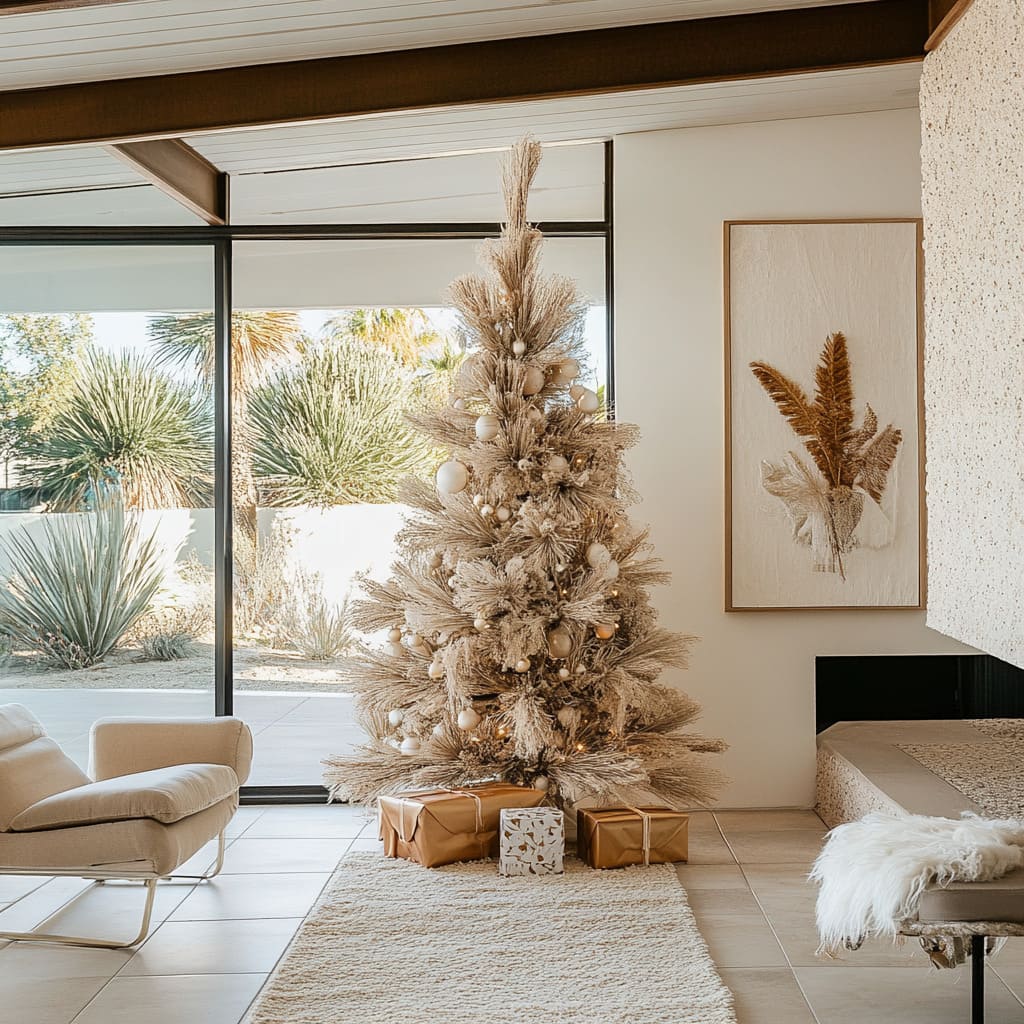
Total: roughly $375–$1,155. Budget alternative: use a standard green tree and add three bunches of dried pampas at the base and into the mid-branches — about $45 all in — for a similar feathery silhouette.
Skip the garland entirely on a feathery tree. Bead strands and ribbons crush the open, airy structure that makes pampas work in the first place — you’re paying for negative space, so let light pass through. Cluster ornaments in threes near branch tips instead and leave the middle third of the tree almost bare. It reads intentional, and it takes half the time. Compare with Idea #30, which pushes the same restraint even further.
5. Warm Gold Stars and Champagne Baubles
The look depends on density, not price tag. Two hundred small champagne baubles from Target or Walmart — roughly $40 in multi-packs — will outshine twenty designer ornaments at $12 apiece. Add a pack of gold star picks from a craft store for $8, and buy the mirror secondhand: Facebook Marketplace turns up ornate gold-framed mirrors for $60–$150 almost weekly. You don’t need a $900 tree to get this warmth; you need volume and one reflective surface.
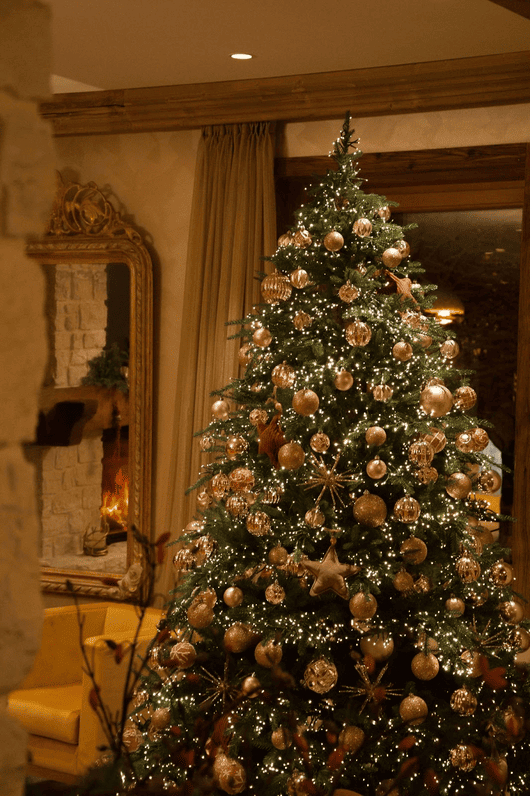
Two principles are doing the heavy lifting. First, repetition — identical gold spheres at consistent intervals read almost like fabric, which is why the tree looks expensive from across the room. Second, reflection. The ornate gold mirror opposite the stone hearth bounces warm light straight back onto the branches, so the gold keeps its glow after the overheads go off. Take the mirror away and the tree still works; the room just goes dim.
6. Flocked Silver Poinsettias Beside a White Fireplace
- Wire three silver poinsettia stems together into one cluster.
- Trim the stems to 8 inches so blooms sit against the branches, not inside them.
- Place clusters at the 12, 4, and 8 o’clock positions, then fill the gaps between.
- Wind champagne wired ribbon through loosely — no more than four passes total.
- Repeat the exact same cluster on the mantel garland and the window wreath.
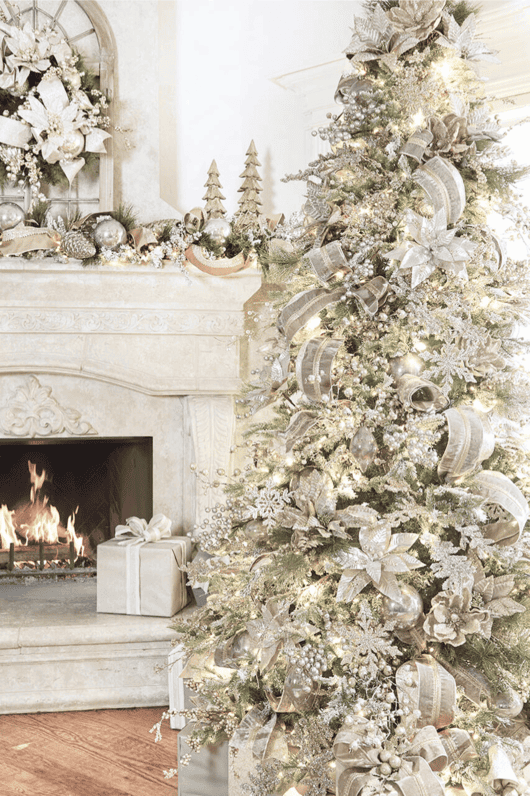
About two hours of work; $45–$70 in ribbons and poinsettias.
here is repetition across three surfaces — tree, mantel, and arched window wreath — using the same ribbon, the same silver blooms, the same berries. Buy enough materials for all three at once, or you’ll end up with a beautiful tree and a mantel that looks like a different holiday entirely. This is the all-white version of Idea #1, same shimmer, cooler temperature.
Flocked trees cost 30 to 50 percent more than unflocked ones at the same height. A $12–$18 can of flocking spray plus a patient weekend gets similar frost onto a tree you already own, and you control how heavy the snow reads. Buy silver poinsettia picks in multiples at dollar stores — at $1.25 each, a full tree costs about $25.
7. Multicolor Matte Baubles Under a Wallpapered Ceiling
Matte ornaments, not shiny, are what keep a multicolor tree from tipping into chaos. Shiny baubles throw hard reflections in every direction at once; matte ones absorb light and hold their color. Buy a bulk mix rather than singles — a 100-count matte assortment runs $30–$50 and gives you variety without the individual price tag. Keep every ornament on the tree the same finish and the colors will behave themselves.
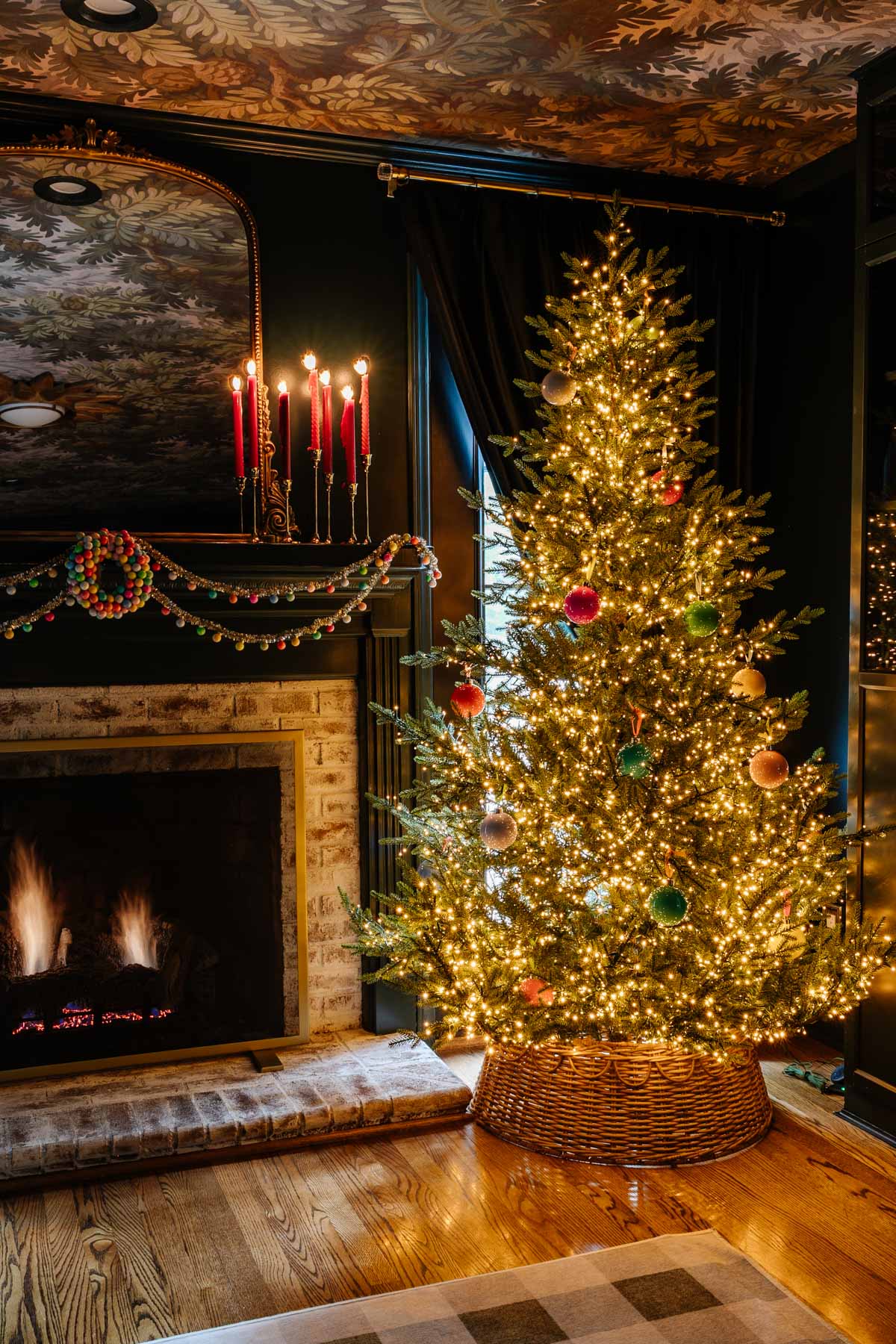
Roughly 50 percent evergreen — the tree plus those dark walls — with 30 percent multicolor matte baubles, 15 percent terracotta and red pulled from the brick fireplace and taper candles, and 5 percent gold on the candelabra. The colors cohere because every one of them sits at mid-saturation. Push any single tone to neon and the room tips. The patterned ceiling wallpaper is the wildcard that makes it feel collected rather than random.
8. Multicolor Glass Ornaments in a Wood-Paneled Room
Dark wood paneling absorbs light, so a multicolor tree here needs roughly 30 percent more lights than the same tree in a white room. Plan on 100 warm white bulbs per foot of tree height, not the 50 the box recommends. Also worth knowing: glass ornaments and small children are a stressful combination. If a kid will be sitting at the base opening gifts, put glass on the top half and shatterproof below.
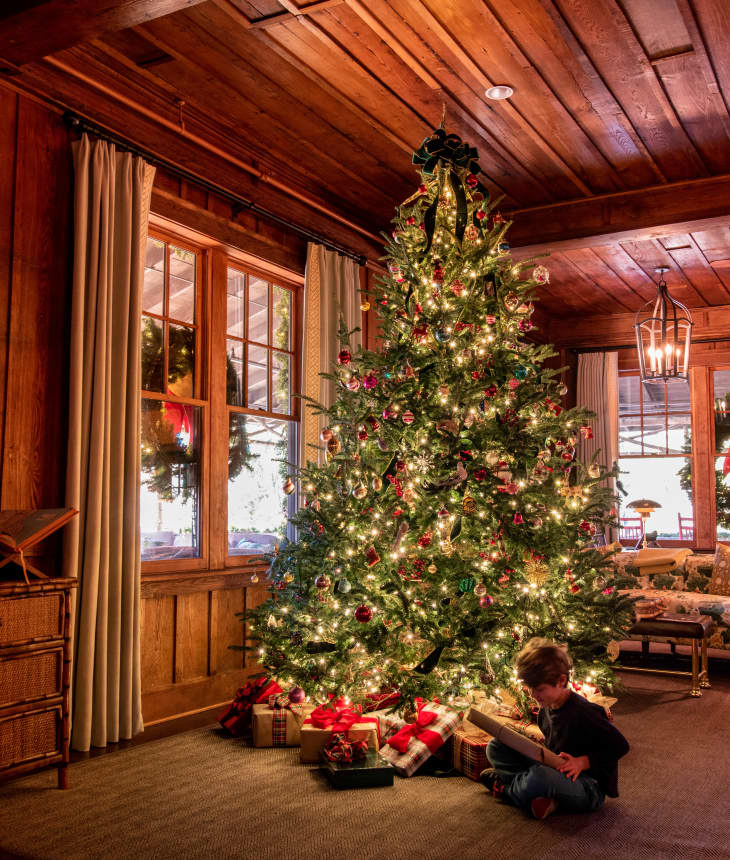
The warmth comes from reflection, not color. Dark wood has almost no sheen, so every bit of glow in that room is coming off the ornaments themselves — which is exactly why multicolor glass reads richer here than it would against white drywall. The light beige curtains act as the neutral that keeps the wood from going heavy, and the patterned carpet softens the floor-to-ceiling brown.
9. Hallway Tree With Blue Ribbon and Silver Tinsel
Hallway trees need different math than living room trees. Measure the walkway first and leave 36 inches of clear path, minimum. A slim 6- to 7-foot tree with a 30-inch base fits most entry corridors; anything wider and you’ll be turning sideways every time you carry groceries in. Under 42 inches of width, skip the tree entirely and put the woven basket collar, lights, and blue ribbon on a garland instead.
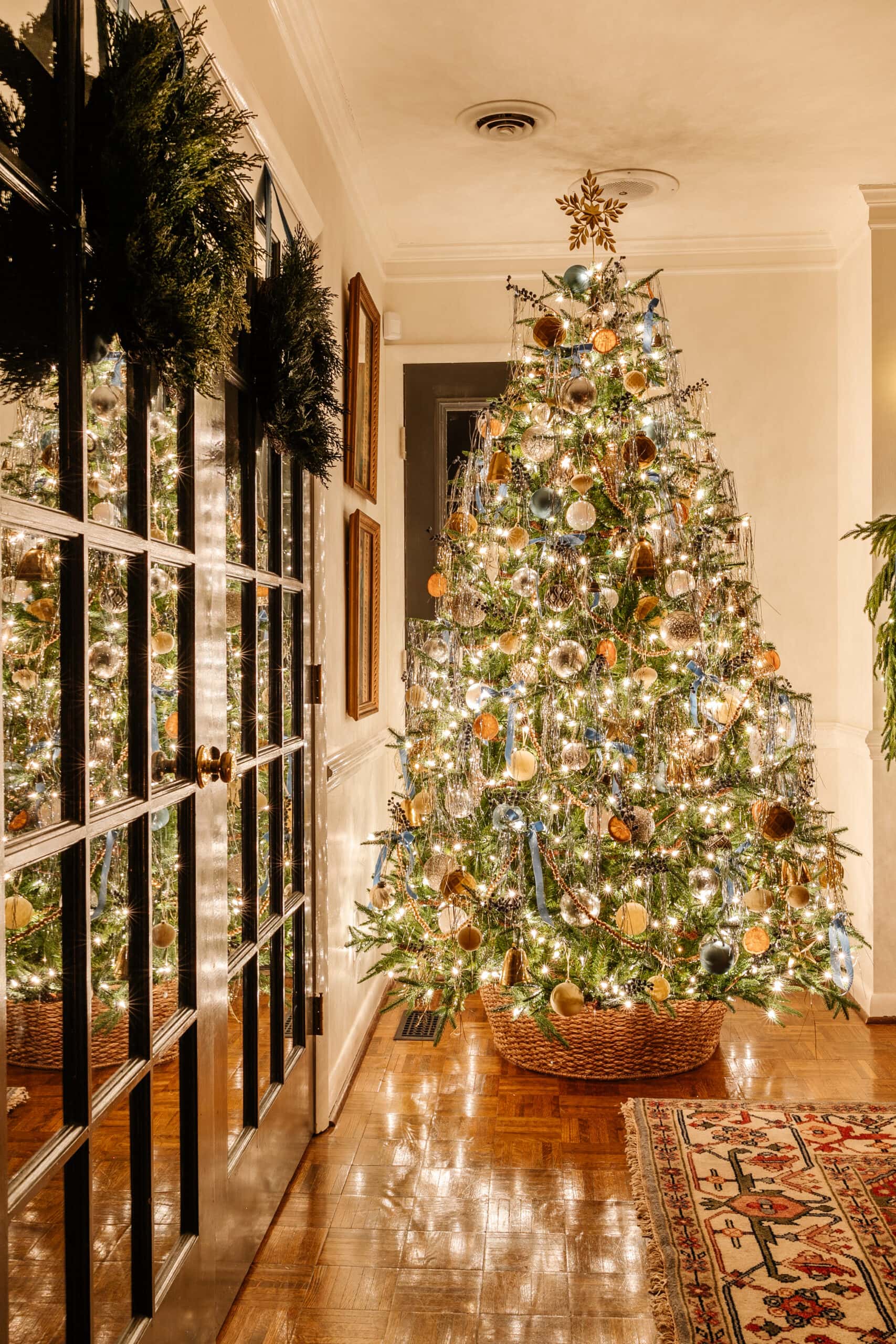
Hallway trees are having a moment because open-plan homes keep stealing wall space from the living room. When the main tree has to live in a corner behind a sofa, the entry becomes the one place you can actually stage. Blue-and-silver with silver tinsel is also the fastest way to nod at the vintage holiday aesthetic without committing to full retro — polished parquet and dark-framed glass doors do the rest of the work for you.
10. Red and Gold Poinsettias With a Beaded Cascade
The gold beaded cascades — those strands of tiny beads falling through the branches — are the element you can’t substitute. Plain red and gold baubles give you a pretty tree; the cascades give it movement, so your eye keeps traveling downward instead of stopping at the ornaments. They also read as hand-decorated in a way ball ornaments never do. Twenty dollars of beaded strands is the difference between nice and genuinely opulent.
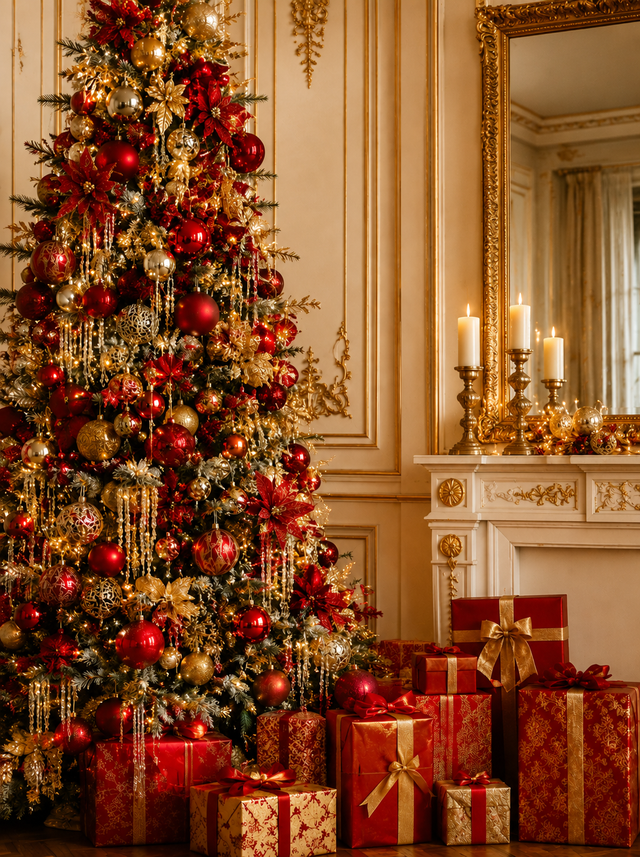
Dollar-store poinsettia stems at $8 and gold beaded sprays at $7 get you 80 percent of this look on a standard tree. Watch for the mirror in January, when ornate gold frames drop about 50 percent — which is unfortunate timing and an excellent reason to plan next year’s scheme in February. Add a red tree topper bow last so it sits above everything else.
11. Striped Gold Ribbon and Frosted Red Berries
Two things to watch. Frosted branches shed — expect a dusting of faux snow on the gifts and floor for the first week, so lay the tree skirt down before you decorate, not after. And wide striped ribbon crushes if you store it wound tight. Wrap it around a cardboard tube at the end of the season or you’ll be ironing it next November, which nobody enjoys.
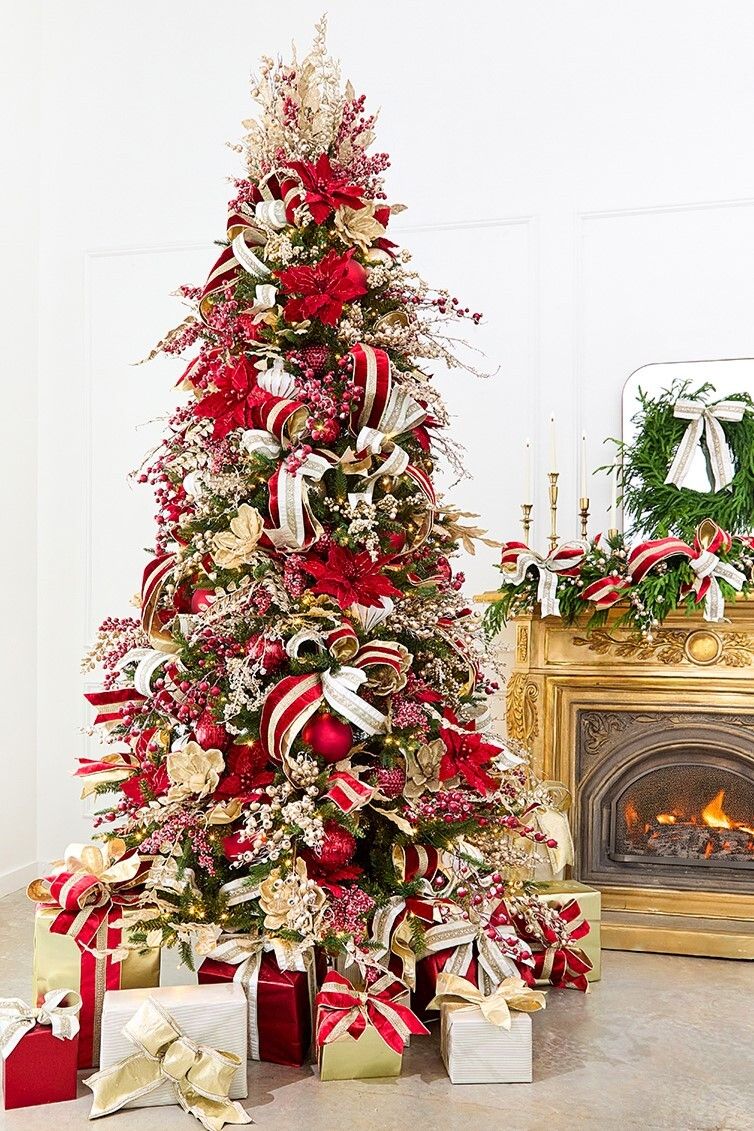
- Cut ribbon into 18-inch lengths, one per loop.
- Pinch the center and fold into a loop with the tails pointing down.
- Twist floral wire around the pinch, leaving a 3-inch stem.
- Tuck the stem into a branch gap, no deeper than two inches.
- Space loops 10 inches apart, alternating with berry picks.
About 90 minutes for a seven-foot tree; ribbon and wire run $30–$50. Repeat the exact same loop on the fireplace garland so the two surfaces match.
12. Towering Gold Satin Ribbons in a Modern Space
Think 75 percent gold — ribbons, baubles, topper, wrapped gifts — 20 percent evergreen, and 5 percent warm white light. That’s the whole formula. The restraint is the point: on a modern tree in a large room, one metal done thoroughly beats three metals done politely. If gold starts to feel too formal, swap the satin ribbon for matte velvet in the same tone and the entire tree relaxes without changing color.
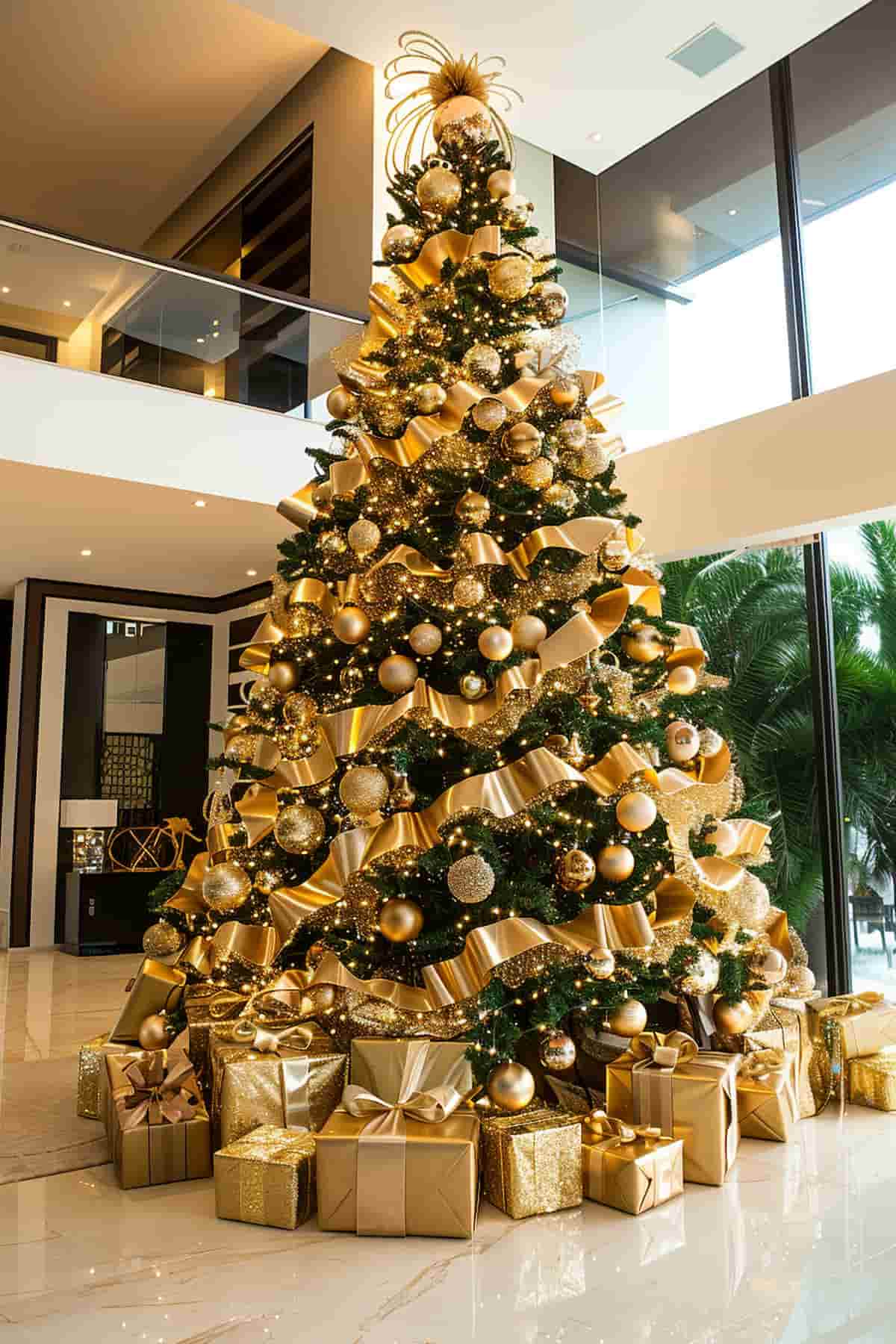
Scale is doing the real work. A wide ribbon on a tall tree reads as architecture; the same ribbon on a six-footer looks like a craft project. The floor-to-ceiling windows and bare modern walls give the gold a clean field to sit against, so nothing in the room argues with it. Notice the gifts, too: all gold-wrapped and arranged as a base, which creates a second surface for the same color story.
13. Teal Velvet Poinsettias on a Frosted Tree
This scheme is built for a big room — think 10-foot ceilings and at least 250 square feet, because both the tree and the mantel garland need visible space around them. In a smaller room, keep the teal-and-gold palette but drop the heavy flocking; frost on a tree in a tight space closes the room in fast.
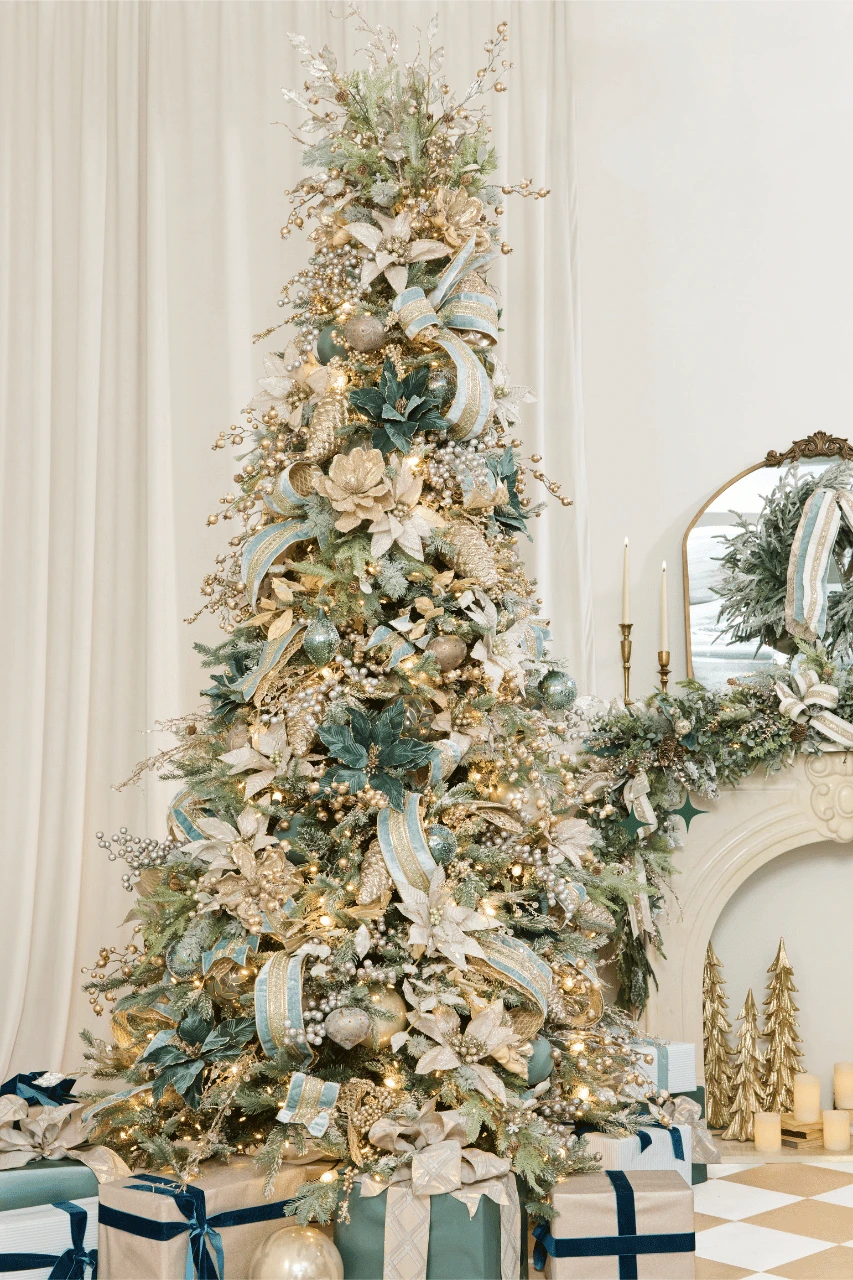
The teal velvet poinsettias are the signature. Frosted trees have a way of looking generic — pretty, but interchangeable with a hundred others. Oversized velvet blooms in teal are what make this one yours. Remove them and you have a perfectly nice gold-and-silver flocked tree you’d forget by February.
Three tones, one temperature. Teal and gold sit close together on the color wheel, so the contrast is lively without shouting, and the cream keeps the whole thing from going dark. Flocking softens the evergreen into a neutral, which is exactly why the teal reads as a decision rather than an accident.
14. Wooden Beads, Feathers, and a Nautical Mantel
Natural-material trees moved from niche to mainstream because people got tired of storing fragile ornaments. Wooden beads, feathers, and paper goods survive a garage shelf, a move, and a toddler with a sippy cup. The nautical undertone — model ships on the mantel, a white slipcovered sofa — is a smaller trend riding along: coastal palettes showing up in Christmas decor, especially in homes with blue, grey, or white rooms already in place.
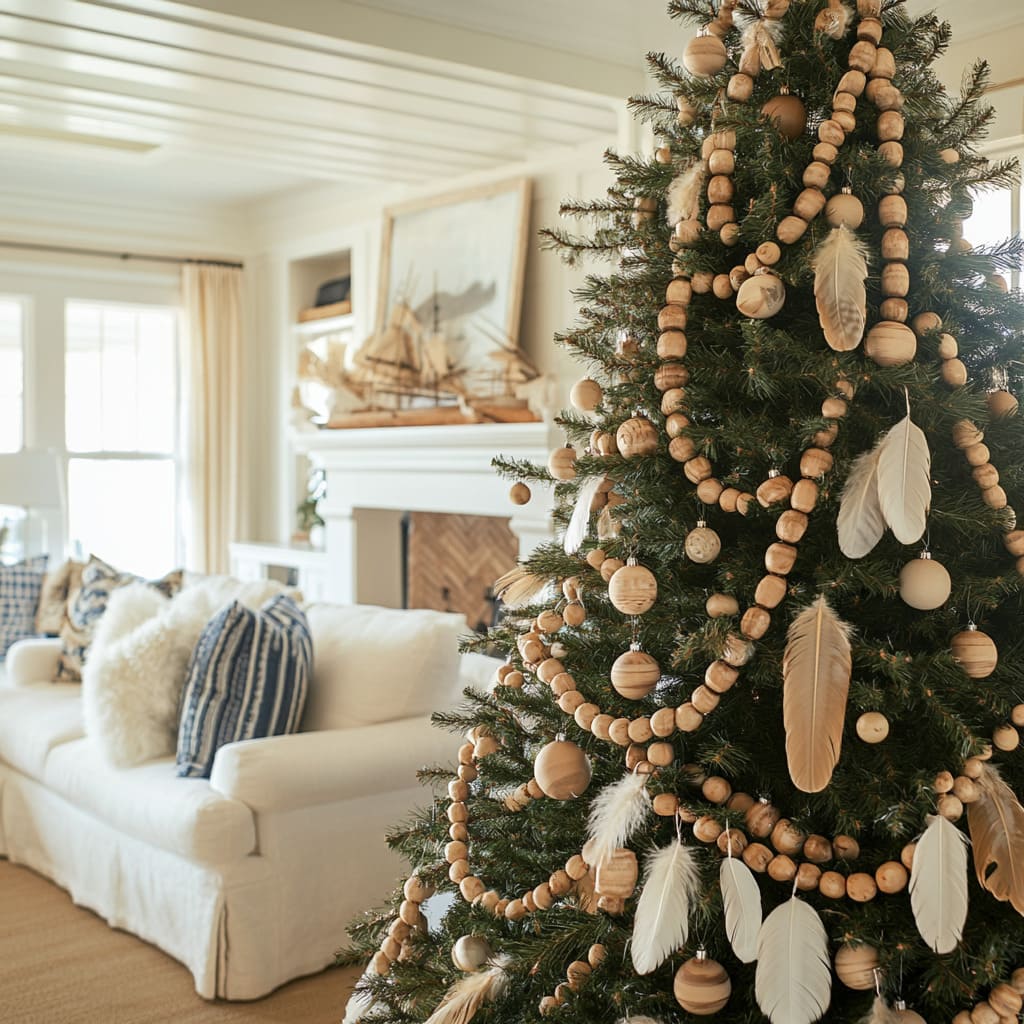
A long wooden bead garland at a craft store runs $10–$18, and feathers are about $12 for a mixed bag. Pair those with plain wooden spheres and you’ve dressed an entire tree for around $60. Thrift stores are goldmines for the ornaments nobody wanted in April — most of what turns up is exactly this palette, and usually under $10 a bag.
15. Blue and Silver With Velvet Armchairs
Repeat your palette on the furniture or it stops feeling intentional. In a blue-and-silver scheme, one large blue textile — an armchair, a throw, even a pair of $30 cushion covers — anchors the tree and makes the whole corner look designed rather than decorated. This is also why a silver star topper beats a red bow here: the topper matches the ornaments, so the tree reads as one object instead of a tree with something on top.
- Brush the brick clean and dry; tape won’t hold on dust.
- Use adhesive hooks rated for 5 pounds on brick, not drywall strips.
- Run the garland in one continuous sweep, never in sections.
- Weave the lights up from below so wires hide behind greenery.
- Add blue and silver picks last, each one facing outward.
About 45 minutes and $40–$120 depending on garland length.
16. Blush Pink and Rose Gold on a Flocked Tree
- Flocked tree, 7–7.5 ft: $180–$500
- Rose gold and blush baubles, 100-count mix: $45–$95
- Warm white string lights: $18–$35
- Pampas and dried floral wall hanging: $60–$180
- Personalized stockings and mantel decor: $40–$120
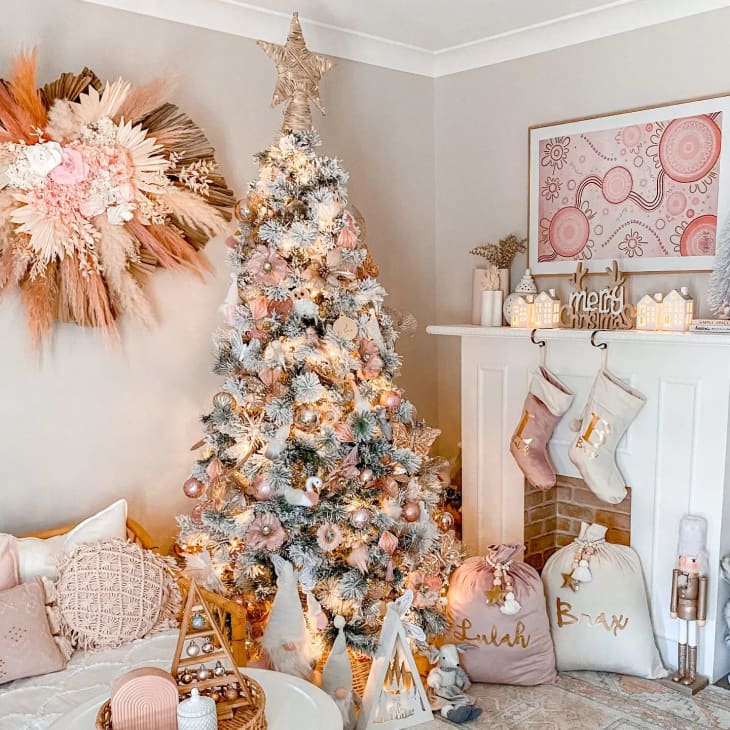
Total: roughly $343–$930. Budget version: skip the wall hanging, buy blush and rose gold ornaments in multi-packs, and let the flocked tree be the one splurge — around $250 all in.
Read it as 60 percent white and flocked base, 25 percent blush pink, 10 percent rose gold, and 5 percent warm neutral pampas. Nothing clashes because pink and rose gold are nearly the same hue — the metallic just adds shine to the same color. Swap blush for soft mint and rose gold for silver and the formula still holds; you’ve simply moved from romantic to wintry. Idea #19 keeps the rose gold and drops the pink entirely.
17. Plaid, Navy Ribbon, and Gold Berry Sprays
Plaid and navy can slide into coastal-prep territory if you’re not careful. Keep the green in the plaid deep and foresty rather than bright kelly, and carry the same ribbons onto the wreath and mantel so the house reads as one scheme instead of three separate shopping trips. Also: velvet ribbon holds a bow beautifully and collects dust beautifully. A lint roller in January solves the second problem.
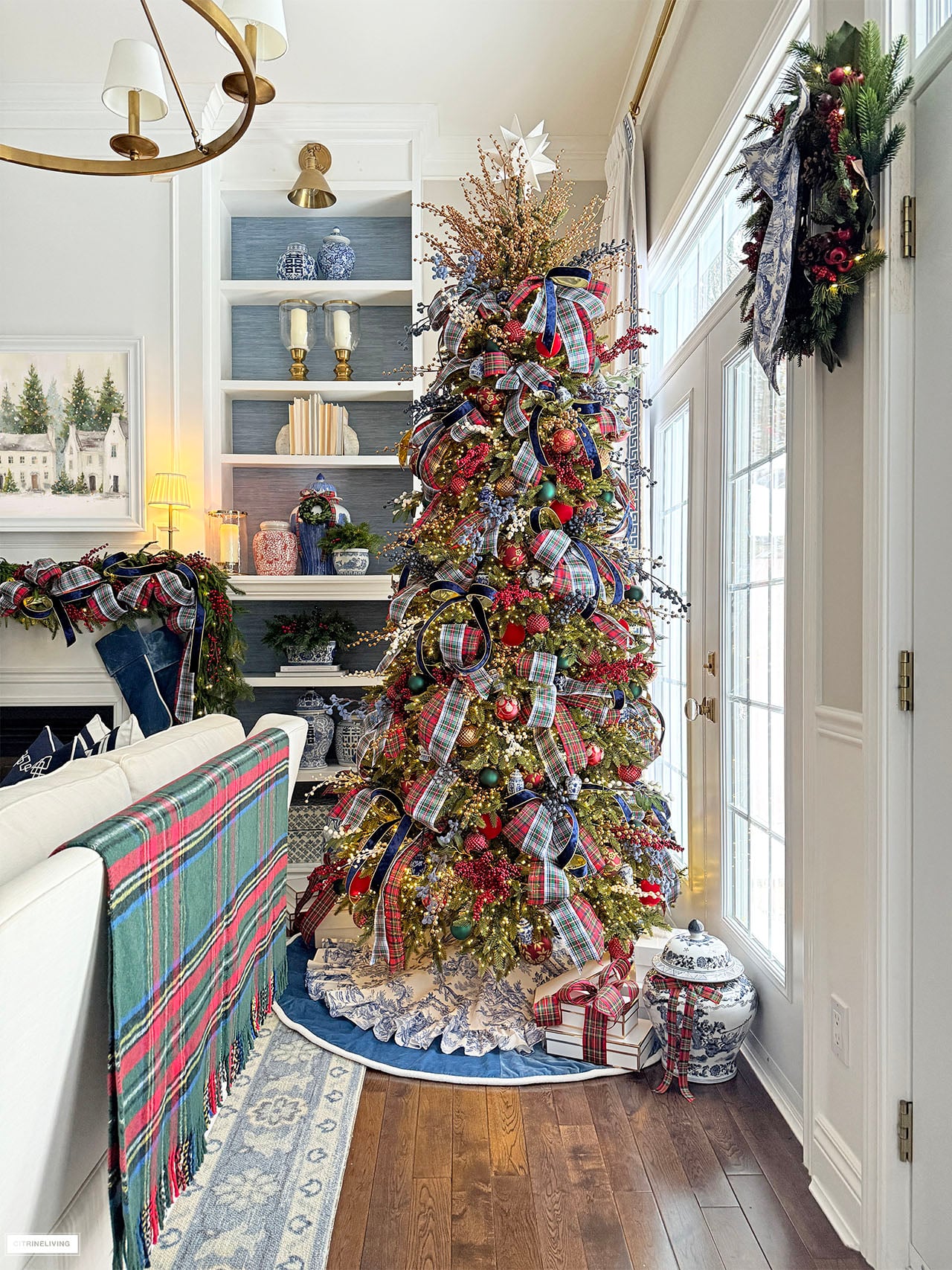
This works because the plaid does the pattern work and the navy does the calming work. Two ribbon widths — one busy, one solid — give you contrast without needing a third color. And the toile tree skirt quietly repeats the blue-and-white from the built-in bookshelves. Small detail, but it’s what makes the room feel collected rather than assembled last weekend.
18. Gold, Rose Gold, and Silver on Flocked Branches
A flocked tree needs roughly 18 inches of clearance on every side, because the flocking is the point and you don’t want it pressed into a corner or smushed against a curtain. This setup — tree beside the window, sofa opposite, mirrored console behind — wants about 200 square feet and a window wall. Below that, keep the flocking and lose the console. The sequined ‘NOEL’ pillow and the tree can carry the room on their own.
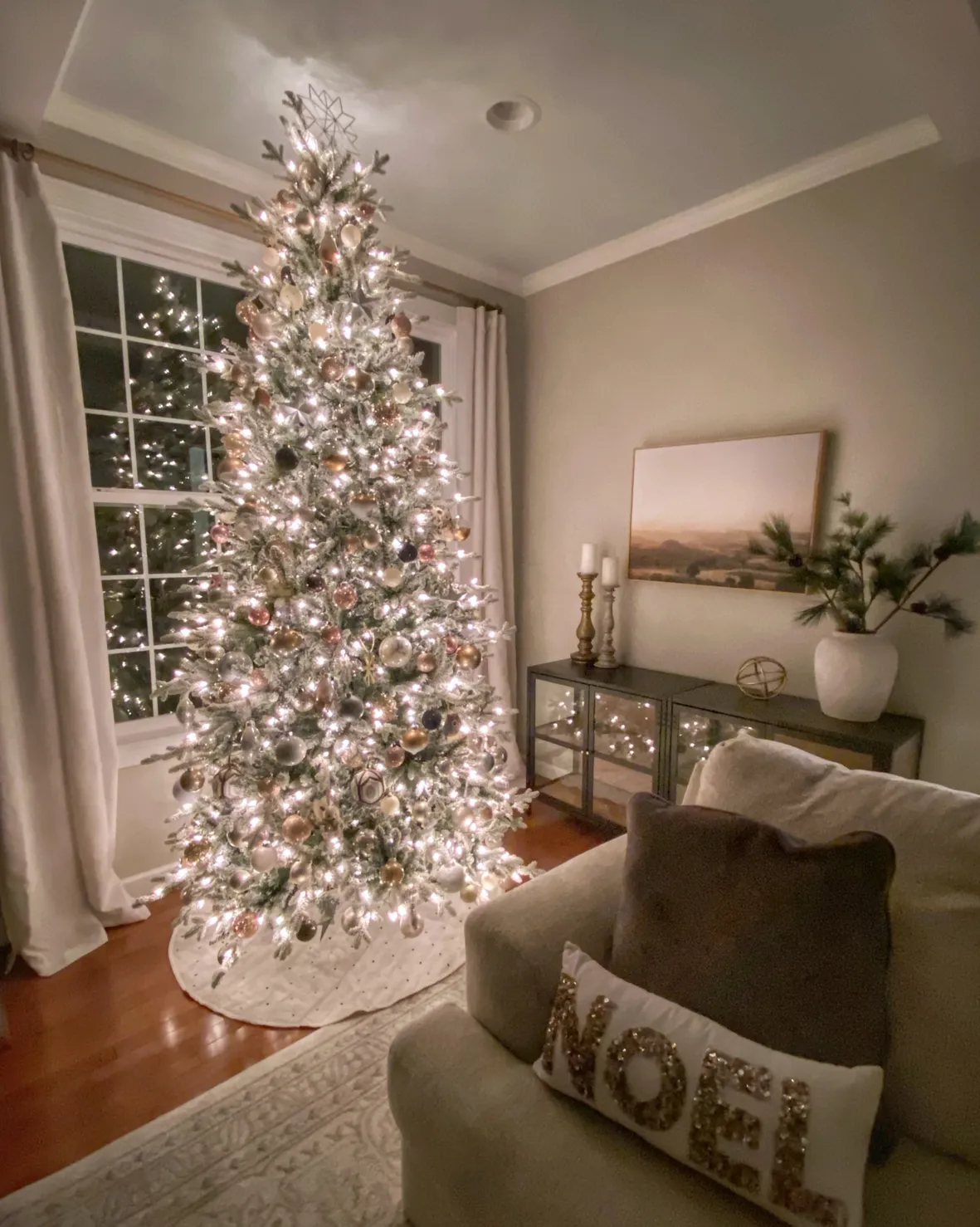
When you mix gold, rose gold, and silver on one tree, hold the proportion near 50 percent gold, 30 percent rose gold, 20 percent silver. Even thirds make the tree look undecided. Buy the metals as one assortment rather than three separate packs — you’ll spend less, and you’ll know for certain the finishes were designed to sit next to each other in the same light.
19. Silver, Champagne, and Charcoal Grey Velvet Ribbon
The whole look rests on one wide ribbon, and that’s the piece worth paying for. Everything else can be budget: silver and champagne baubles run $35–$60 for 100 in multi-packs, mercury-glass lookalikes are $20 a set at discount stores, and wrapping paper with silver bows comes in under $15. A single roll of wide charcoal velvet ribbon at $25–$40 does more for this tree than a $200 ornament haul would.
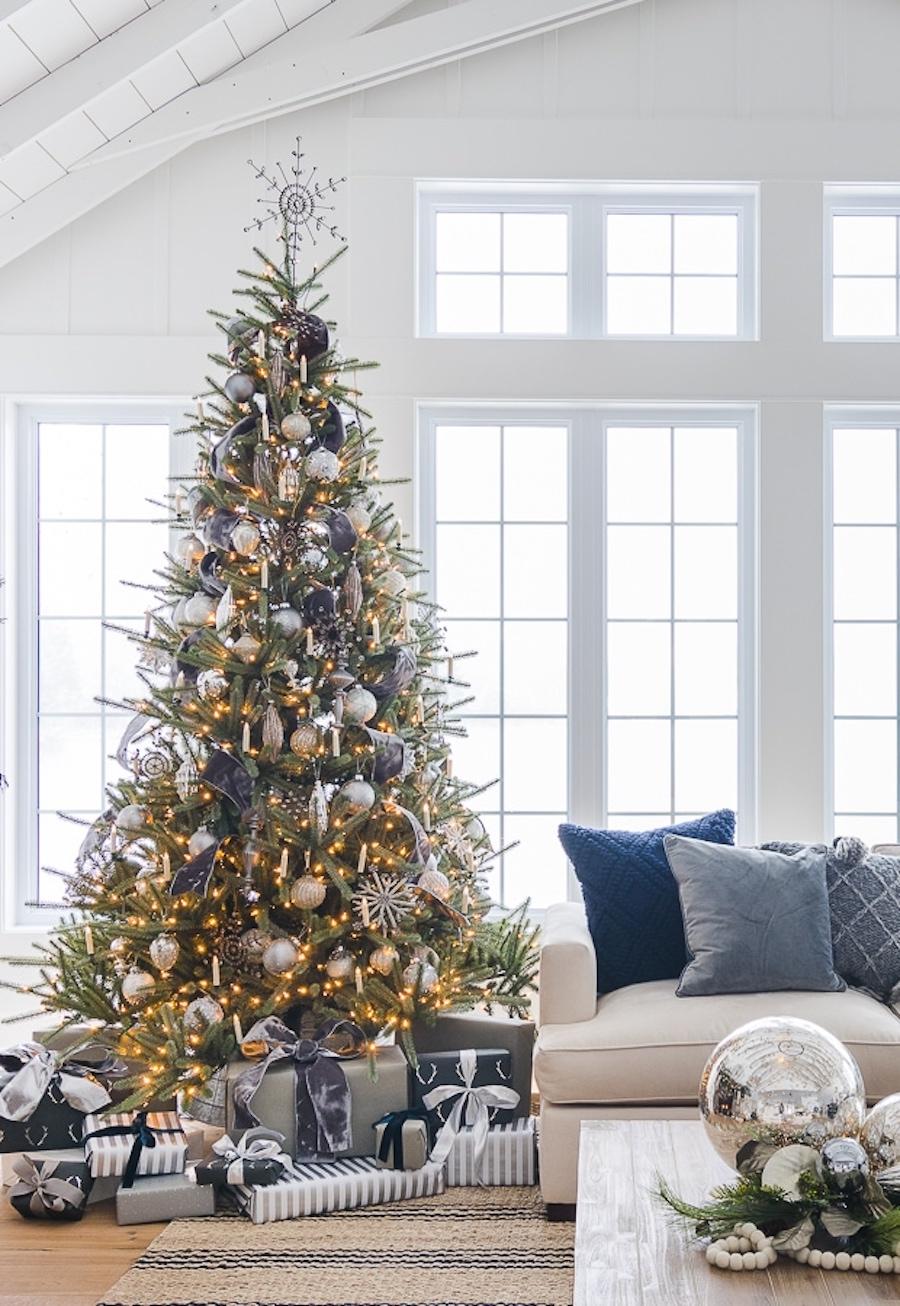
That ribbon is also the one thing worth protecting. Silver, champagne, and white ornaments are a palette you’ve seen a hundred times; charcoal velvet is what stops this tree from being a rerun. It adds weight and shadow to a scheme that would otherwise be all shimmer. Change nothing else and the tree still looks good — just far less interesting.
Cascade ribbon vertically rather than weaving it horizontally. Start at the top, let it fall in loose S-curves down the face of the tree, and secure it every 12 to 15 inches with a discreet wire. Vertical ribbon makes a tree look taller; horizontal ribbon makes it look wider. On a slim tree, that difference is everything.
20. Velvet, Wooden Beads, and Rust on Charcoal Shelves
Warm white incandescent-style strands look warmer but often die after two or three seasons; LEDs last five to seven and look slightly cooler. Either way, buy one spare set in the exact same color temperature or you’ll end up with a visible mismatch halfway up the tree. Velvet ornaments belong in a breathable cotton bag, not a plastic bin — trapped moisture flattens the pile and leaves permanent marks that no amount of steaming fixes.
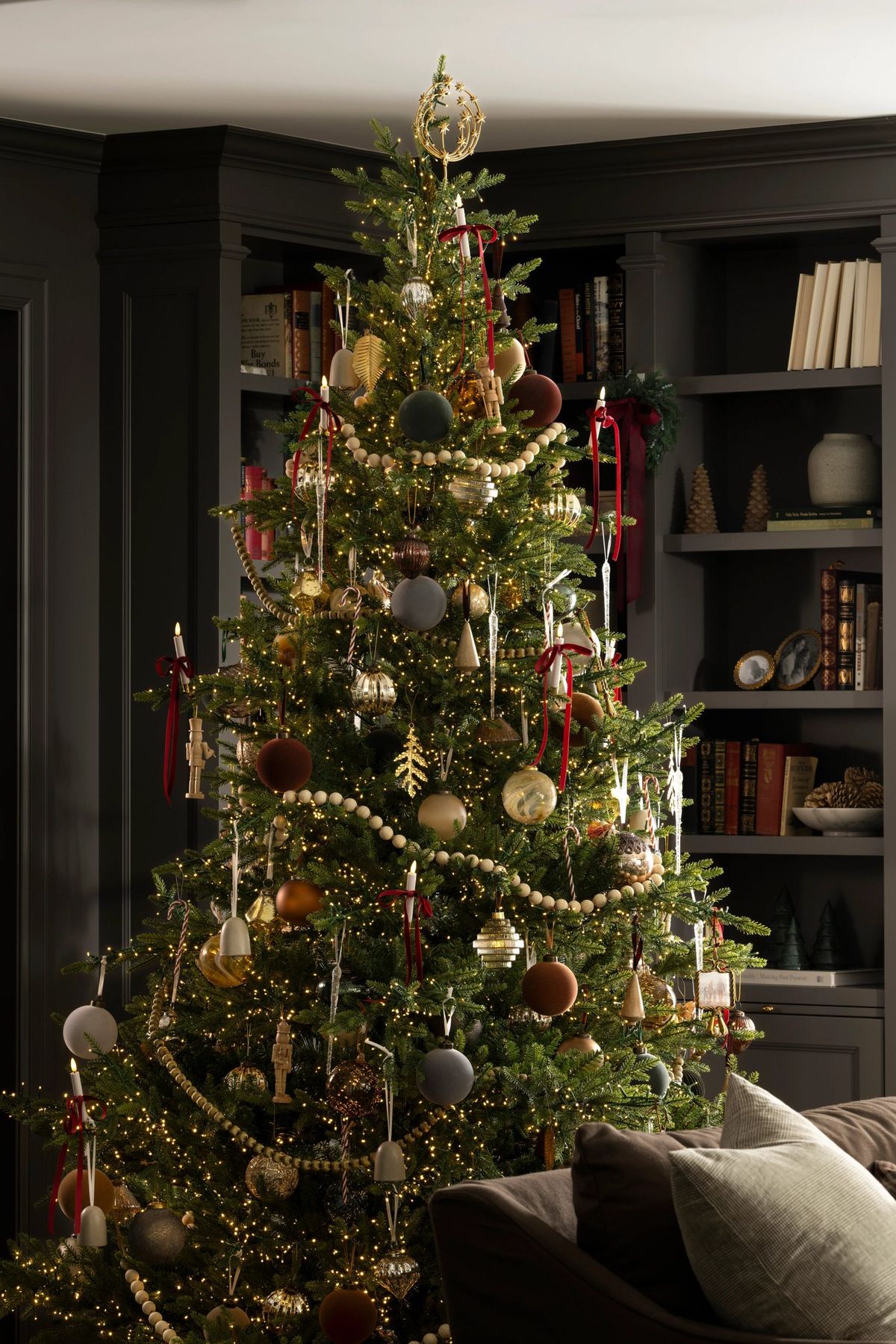
Count it as 45 percent forest green, 25 percent warm gold and brass, 20 percent dark charcoal from the built-ins, and 10 percent rust with cream and red ribbon accents. The rust is the wildcard. Without it you have green, gold, and grey, which is handsome but a little chilly. That last 10 percent is what makes this feel like a home rather than a catalog page.
21. Taupe Velvet Bows and Gold Spheres
Taupe is the quiet hero. It’s a neutral, so it lets the gold ornaments do all the shining, but it’s warm enough to sit comfortably on green branches — where grey would have read cold and cream would have disappeared entirely. Proportion matters just as much: oversized bows at wide intervals create a rhythm that small ornaments alone simply can’t produce, no matter how many you hang.
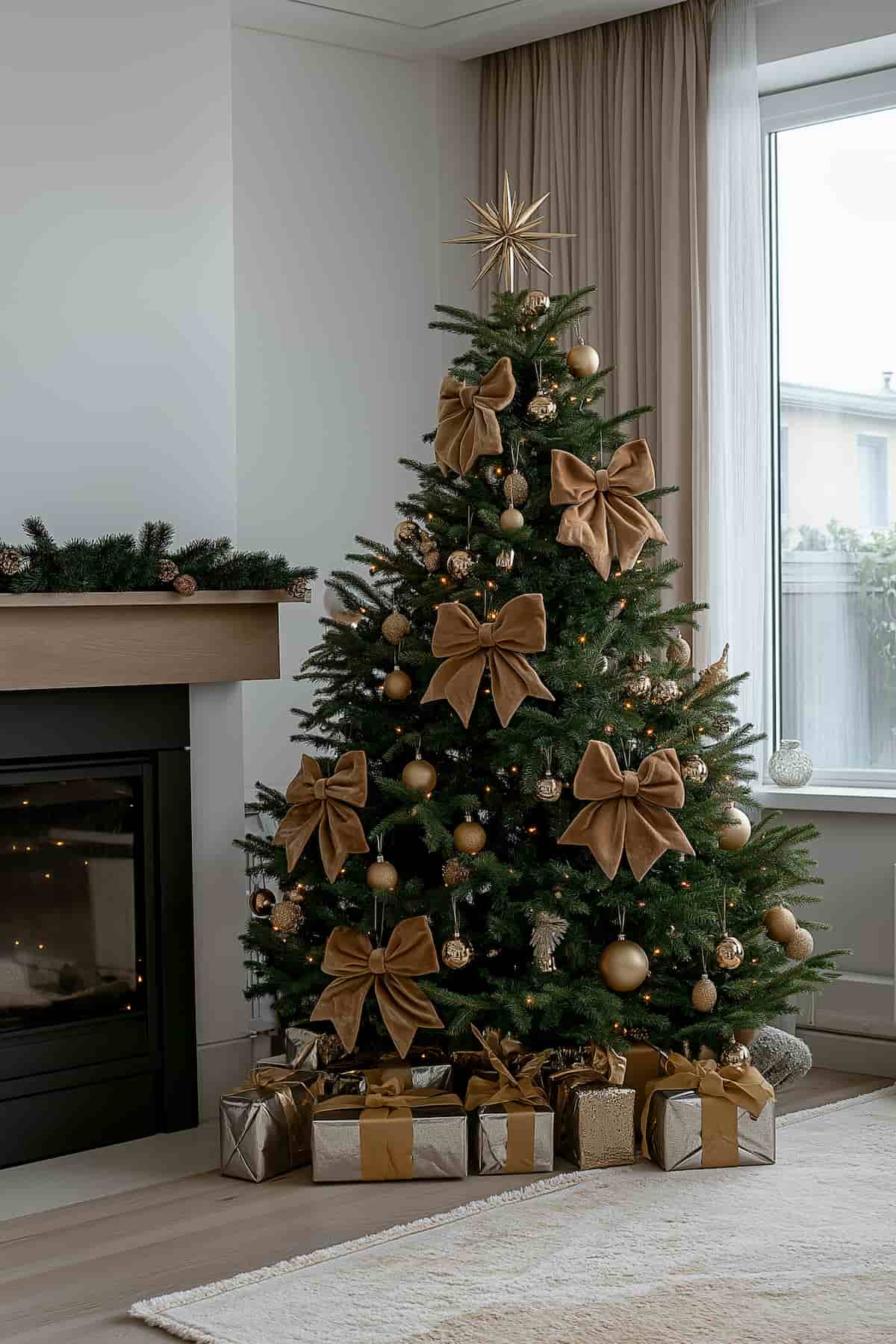
- Cut velvet ribbon to 24 inches for a 6-inch finished bow.
- Fold each end into a loop, crossing them at the center.
- Pinch and wrap with matching wire, then fluff the loops outward.
- Attach to a sturdy branch, never to a light strand.
- Place six to eight bows total on a seven-foot tree.
Roughly 30 minutes; velvet ribbon runs $18–$35 per roll.
22. Classic Gold, White, and Silver by a White Mantel
Gold, white, and silver only work together when each one has a job. Let white be the volume — most of the ornaments, plus the gifts and the flowers. Let gold be the accent, showing up in candleholders and a handful of statement baubles. Let silver be the sparkle, used sparingly. Flip it so the tree is half gold and you get a scheme that looks like three people decorated the same tree without speaking.
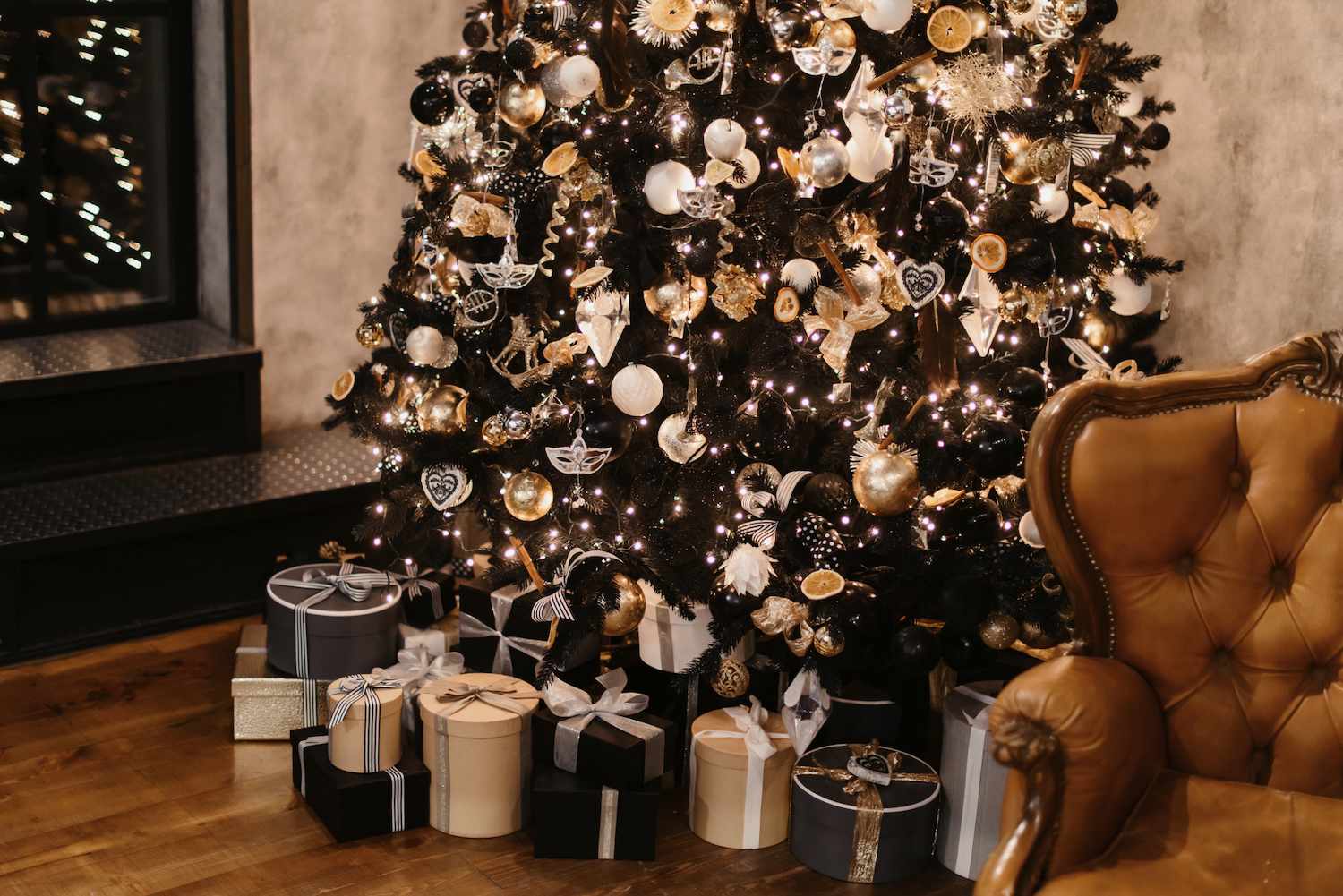
White flowers on a mantel garland are lovely for about nine days. Real ones drop, faux ones collect dust, and both need fluffing every time somebody walks past with a grocery bag. If that mantel is on a main path, consider greenery with gold candleholders instead and skip the white blooms — you’ll get nearly the same brightness with a tenth of the upkeep. Idea #23 is the flocked twin of this palette.
23. Bronze and Silver on Deep Flocking
Dark bronze ornaments are the easiest thing in this whole article to thrift, because they don’t photograph as brightly as gold and shoppers pass right over them. Check Facebook Marketplace in November — $20 often buys a shoebox of mixed metallics. Taupe ribbon shows up at discount stores for $6–$10 a roll. Heavy flocking is the one piece worth buying new, or spray-flock a tree you already own.
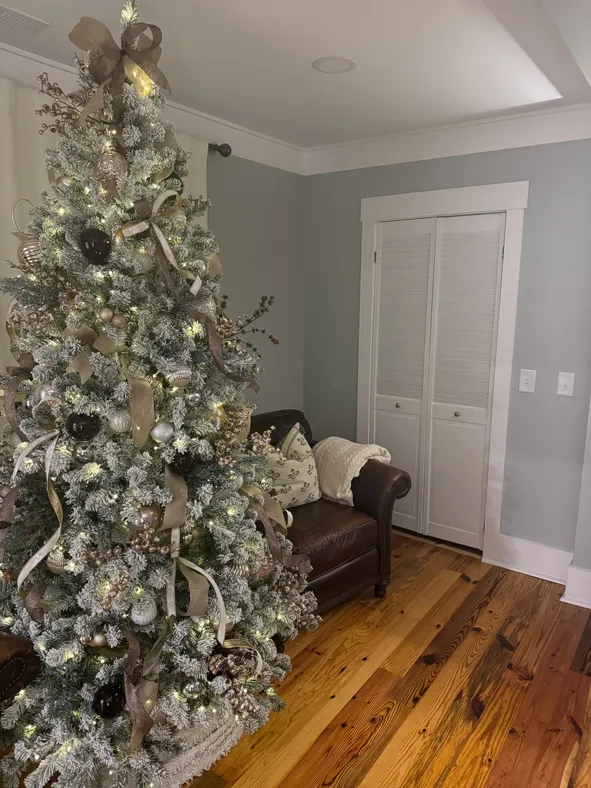
Heavy flocking wants room to breathe. Give this tree a corner with at least 24 inches of clearance and a light grey or white wall behind it — the pale wall is what keeps bronze from going muddy. It works beautifully in a 150–250 square foot living room with standard eight-foot ceilings, especially beside a leather chair that has nowhere else to live.
Flocking and pets are not friends. A tail brushing through the branches sends faux snow onto the floor all season, and it doesn’t vacuum up easily. If you have a cat that climbs, this is the year to skip flocking entirely and put the snow on the mantel instead.
24. Gold and Silver Ornaments in an Elegant Frosted Setting
The white mantel is the one thing, not the tree. Frosted trees loaded with gold ornaments are everywhere, and this one is well done but familiar. What makes the room feel luxurious is the bright white fireplace, the round white wall clock, and the gold-framed mirror — three pale, reflective surfaces bouncing the tree’s warm light across the entire space. Remove them and you have a pretty tree sitting in a dim room.
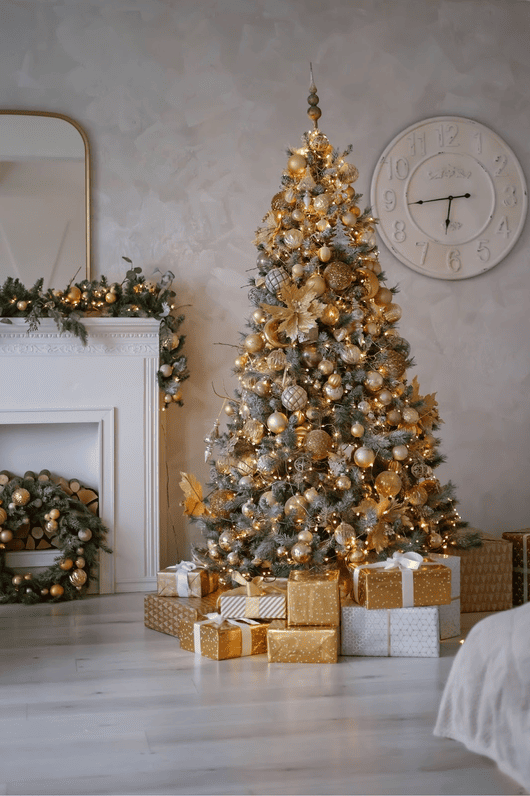
Flocked branches shed for about two weeks and then settle. Vacuum once after setup and leave it alone. The bigger upkeep is the gold: metallic finishes on inexpensive ornaments tarnish wherever fingers touch them, so either handle with gloves or accept that the front baubles will dull by next season. Store everything in a divided box, never a loose bin.
25. Glittered Gold and Ribbed Glass on Heavy Flocking
Ribbed and fluted glass ornaments are the cheapest way to make a metallic tree look expensive. A plain gold sphere reflects one broad highlight; a ribbed one breaks light into six or eight narrow lines, so the tree reads as glittering even in a dim room with no overhead light on. Buy one mixed set of textured drop and icicle shapes and interleave them between your spheres rather than clustering them together.
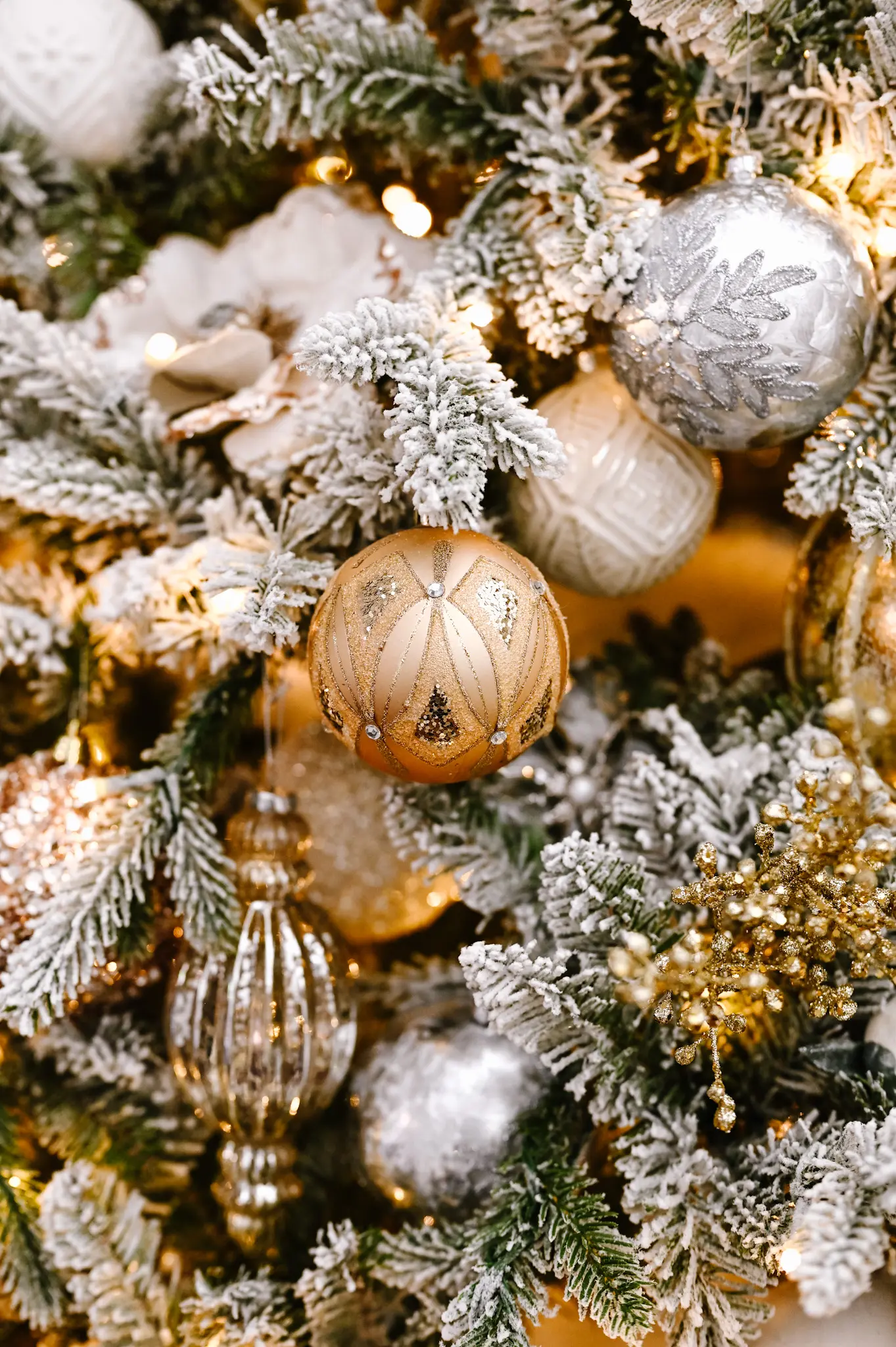
Break it down as 40 percent flocked white branches, 35 percent mixed gold and silver metallics, 20 percent textured clear glass, and 5 percent glitter. The clear glass is the number people skip — it gives your eye somewhere to rest between all that shine. Swap the silver for bronze and you get a warmer, more vintage version of the same tree. The ratio stays exactly the same.
26. Bronze Baubles and Gold Leaf Garland on Frosted Branches
The gold leaf garland is the element that matters. Bronze baubles on a frosted tree are a safe, handsome pairing — you’ve seen it in a dozen catalogs. The leaf garlands woven between branches give the tree texture and movement, catching light in irregular shapes instead of perfect circles. Take them out and the tree is nice. Leave them in and it looks handmade.
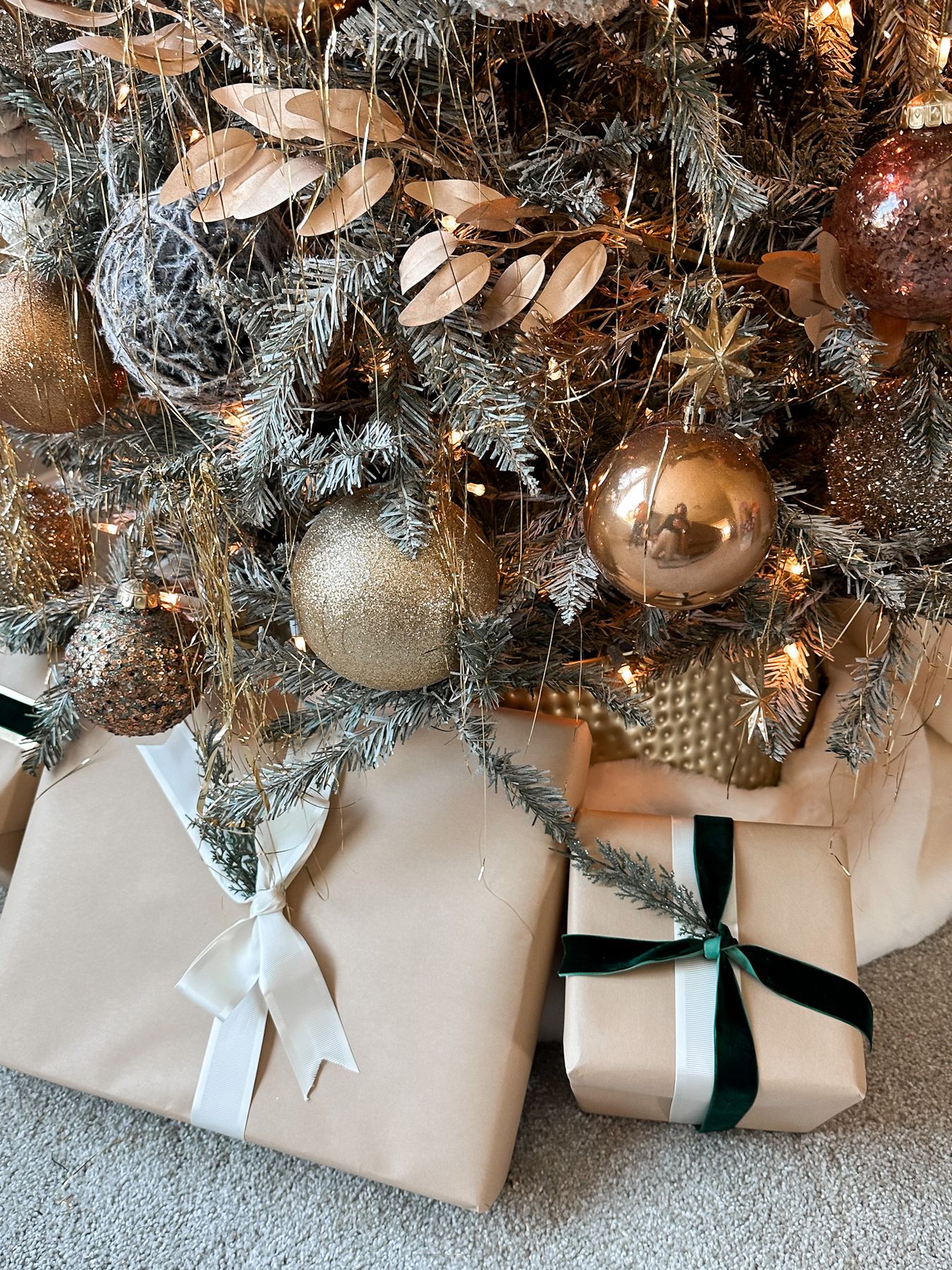
A 6-foot gold leaf garland runs $12–$20 at craft stores, and you’ll want two or three. Bronze baubles are frequently clearanced in early December as palettes shift toward brighter gold, so watch for 40 percent markdowns. Kraft paper plus velvet ribbon for the gifts costs about $25 total, and you’ll reuse that ribbon for years.
Think 60 percent frosted white and deep green, 25 percent gold and bronze, 15 percent white and kraft neutrals. The bronze is what separates this from a standard gold tree — warmer, slightly darker, reads vintage rather than glamorous. Want more contrast? Trade the bronze for copper and change nothing else.
27. Disco Balls, Matte Black, and Deep Red Blooms
The contrast is the concept: reflective silver next to matte black, with deep red blooms as the only saturated color anywhere on the tree. Disco balls throw light in every direction, which makes a densely lit tree look twice as bright as it actually is. The white paper stars and the faux fur skirt are the softeners — pull them and the black starts to turn the whole tree severe.
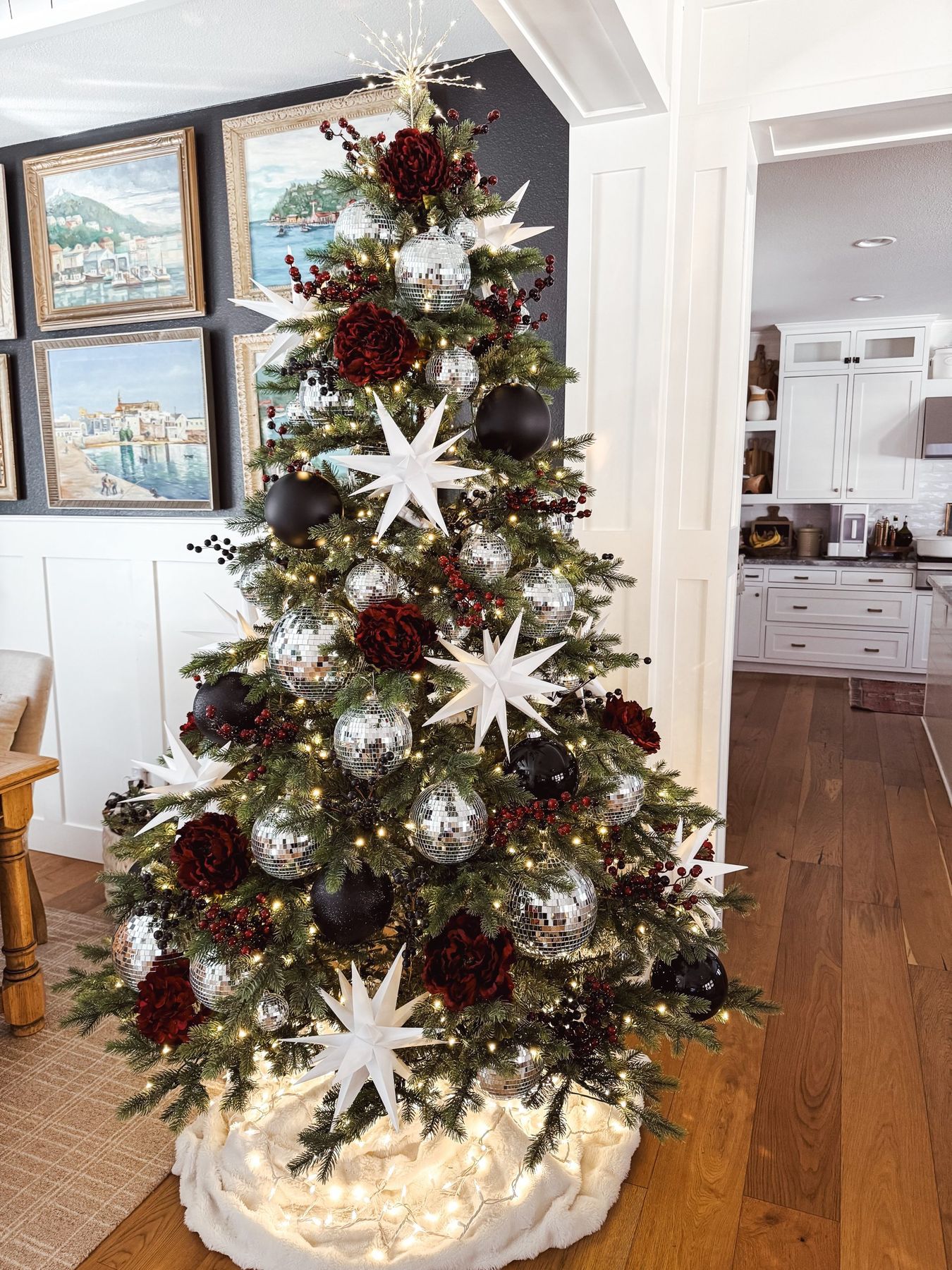
This one needs a wall that can handle it and a room with some distance, because the disco balls want at least 10 feet to bounce off. It works in a 250+ square foot space with a dark accent wall, which is what makes the silver pop the way it does. In a small, bright room, keep the disco balls and drop the matte black ornaments — you’ll get the sparkle without the weight. If the black feels too sharp, Idea #28 runs the same modern high-shine energy in copper and gold.
28. Copper and Gold Ornaments in a Marble Hallway
- Tree, 7.5–8 ft: $200–$650
- Copper and gold ornament mix: $60–$130
- Red leaf picks and sparkling sprays: $30–$60
- Warm white string lights: $20–$40
- Gold-wrapped gifts and ribbon: $30–$80
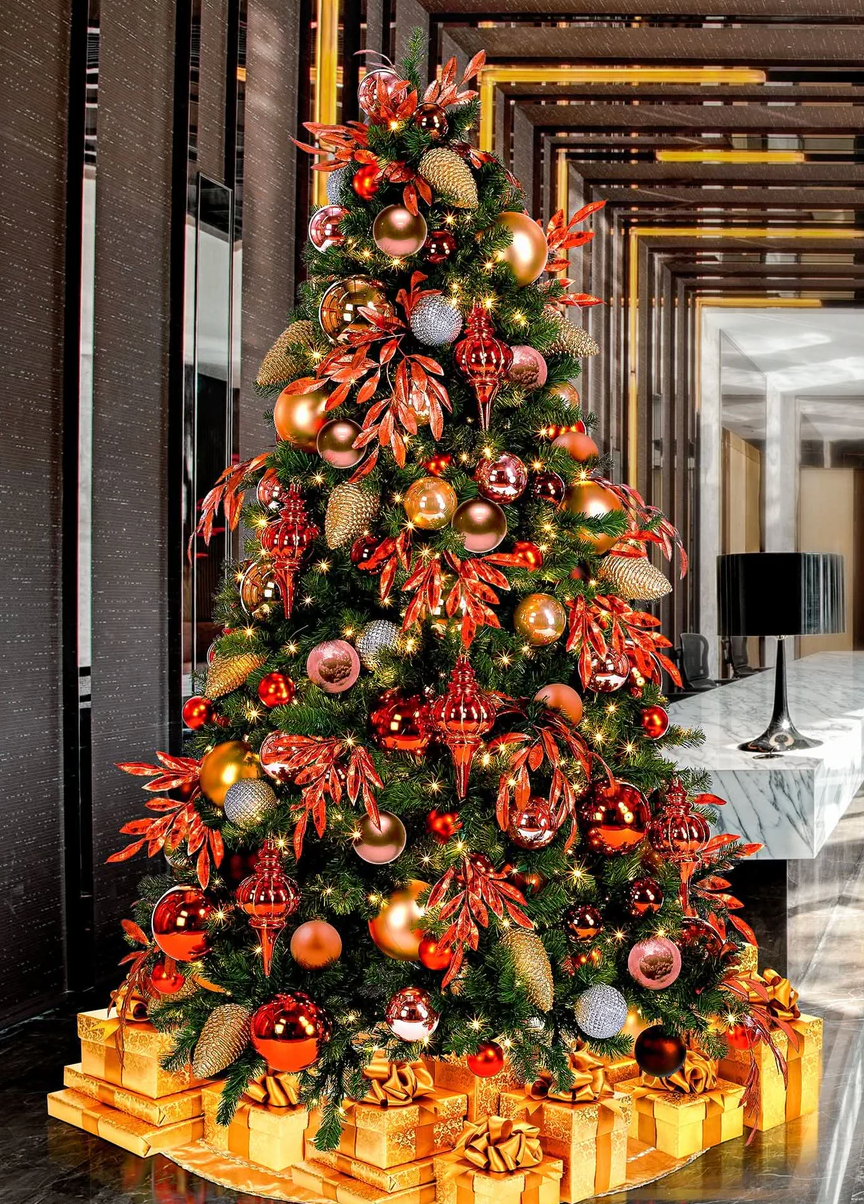
Total: roughly $340–$960. Budget route: copper ornaments in bulk, skip the leaf picks, and wrap gifts in kraft paper with copper ribbon — about $180 for a very similar effect.
In a hallway with dark vertical paneling, keep the tree lights warm and the ornaments reflective. Cool white LEDs against dark wood read grey and flat, and you lose the copper entirely — the whole point of the scheme. If you’re buying new lights this year, look for 2700K warm white. That’s the temperature that makes copper look like copper.
29. Deep Red Floral Garland and Shiny Gold in a Grand Entry
Full floral garlands run $80–$200 each. A plain greenery garland at $30 plus five deep red floral picks at $6 apiece gets you most of the way for under $70, and you can spread those same picks across the tree, the stairs, and the gifts. Shiny gold baubles are the least expensive ornament finish in bulk — 100-count packs drop below $30 in early December, right when everyone switches to silver.
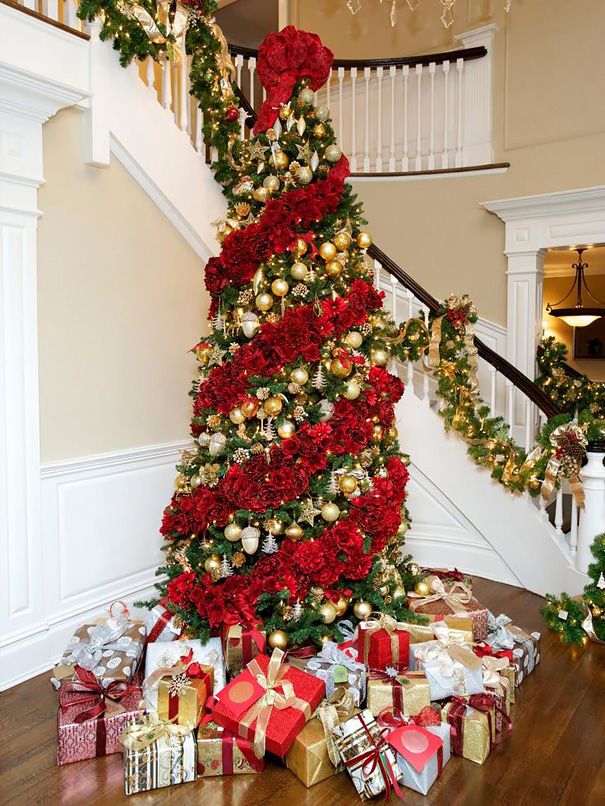
- Measure the banister and add 20 percent for the swag.
- Secure with zip ties under the rail, never over it.
- Sweep the garland in loose curves — never a straight line.
- Add red floral picks at each curve’s low point.
- Finish with warm white lights woven underneath.
About 60 minutes; roughly $70–$150 in materials.
This works because the tree and the staircase garland are visually linked — same red floral, same gold, same warm light. In a grand entryway, a single tree can look stranded. A second swagged surface connects the architecture to the decoration, and the red topper bow ties it off at eye level, which is where you look first anyway.
30. Minimal Warm White Lights Beside a Dark Bookshelf
A minimally decorated tree is not a low-effort tree. With only lights and a few ornaments, every gap shows — you’ll need a fuller, better-shaped tree than you would if you were burying it under baubles and ribbon. Budget $100 more for a quality faux tree, or plan on spending 30 minutes fluffing branches every time you walk past it. The dark wood shelving behind makes gaps read even more clearly.
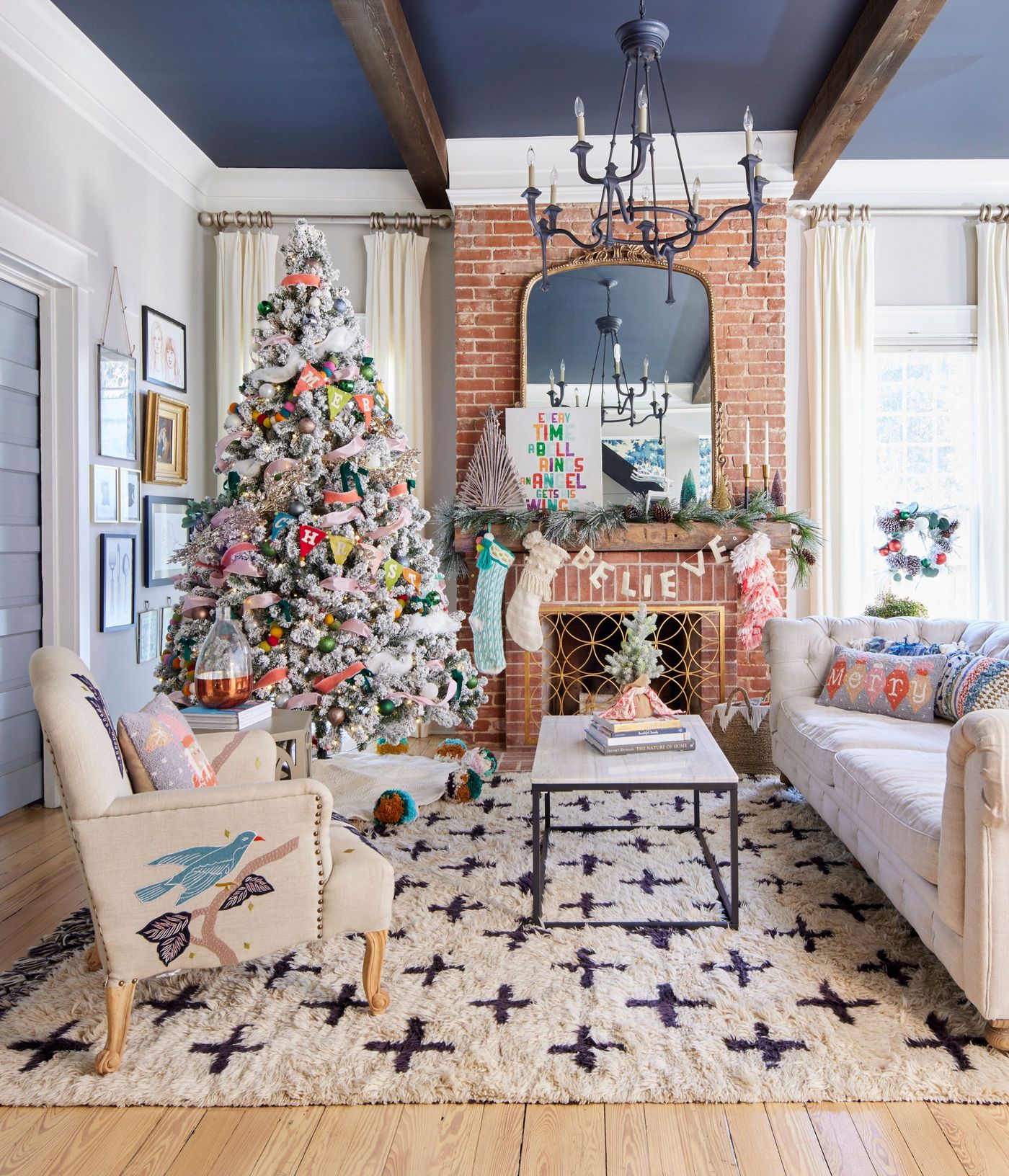
Warm white string lights are the only thing you’ll actually maintain here, and they’re the weak point. LED strands last five to seven seasons; incandescent look warmer but often die in two or three. Buy two identical strands this year so replacements match when one goes. The bookshelf itself needs dusting twice a season regardless — lights and paper collect it fast, especially in a heated room.
Your Palette Is Settled — Go Hang Some Ornaments
Thirty schemes, one truth: the trees that work are the ones with a decision behind them, not just more ornaments. Pick your palette, pick your two or three metals, and let the restraint do the heavy lifting — a tree that knows what it is will always beat a tree that’s trying everything at once.
📌 Pin your favorite scheme now so it’s waiting for you in November, and if you try one, come back and tell us which palette won.
