
29+ Stunning Scandinavian Christmas Decor Ideas You Need to Try This Season
Sometimes the thing that finally makes a room feel like Christmas isn’t the tree — it’s a single cream knit blanket over a sofa arm, a paper star glowing in a window, or a bowl of dried orange slices that smell like a kitchen you wish you had. We went hunting for those small, specific moments and came back with 29 of them, every one pulled from a real home and a real designer.
We spent serious time browsing Target, Walmart, and IKEA — plus a few Etsy makers and a whole lot of Facebook Marketplace — to bring you only what’s worth your attention this year, from about $2 felt ornaments up to $1,200 armchairs. You’ll find cozy Scandinavian minimalism, traditional red-and-green, rustic natural, and monochrome white, with budget and luxury versions compared side by side. It’s trending in 2026 because the pendulum has swung hard toward honest materials and fewer, better pieces. Save this post now — you’ll want it when you’re ready to shop.
1. A Snowy View, a Gray Sectional, and Candles Everywhere
Two light sources are doing the heavy lifting here: the cold, high-contrast daylight pouring through that window, and the low amber pool of candle flames on the coffee table. That temperature split is why the room feels warm instead of merely bright. The gray sectional stays deliberately quiet so the chunky cream knit and the assorted textured pillows read as the soft layer, and the tree’s warm string lights repeat the candle glow on the opposite side of the frame. Nothing in this corner matches perfectly, and that’s precisely the point.

Before you chase this exact view, know that a big window cuts both ways. Cold air pools at floor level after dark, so keep the knit blanket within arm’s reach and consider a lined curtain you can close at night. Open-flame pillar candles on a wood table also need a heatproof tray and a good inch of clearance from the blanket edge. If kids or a tail-wagging dog share your house, switch to flameless pillars with a real wick texture.
2. Flocked Tree, Navy Sofa, and a Big PEACE Sign
The oversized white PEACE sign against the shiplap is the element holding this corner together. Take it down and you still have a lovely flocked tree and a navy sofa — but you lose the thing that tells your eye where to land when you walk in the door. It does quiet structural work too: the white lettering echoes the frosted tree tips and the cream knit, while the garland draped over the frame softens what would otherwise be a hard rectangle of text on a hard wall.
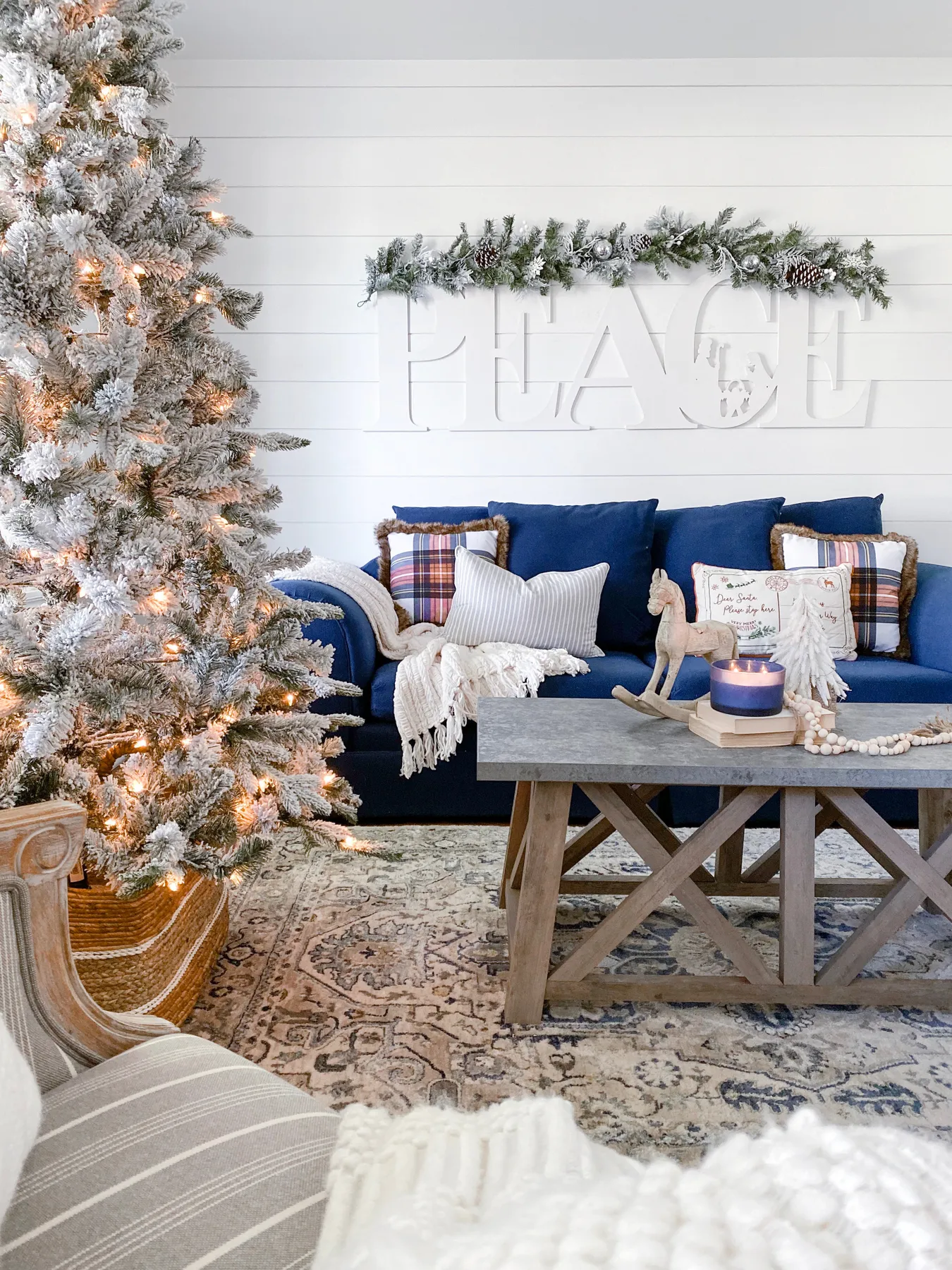
You don’t need a custom sign to get this. Target and Walmart both carry painted wood letter signs in the $25-$45 range all season, and Facebook Marketplace in January is a goldmine — people unload holiday wall decor for $10-$15 because they’re tired of storing it. The shiplap look fakes beautifully with a peel-and-stick panel kit from Home Depot, about $40 for a 4×8 section. For the galvanized-top table, hunt a flea market for a real metal washtub table.
3. Silver, Black, and Natural Ornaments Against Concrete
Read this room as a formula: roughly 55 percent cool neutral (light gray sofa, concrete wall and fireplace, cream rug), 25 percent deep green from the tree, 15 percent matte black through the accent tables, and 5 percent warm sparkle from the ornaments and the fire. To swap it into your own space, keep the percentages and change the players — 55 percent warm white walls, 25 percent a blue spruce, 15 percent aged brass, 5 percent copper. The formula travels; the palette doesn’t have to.
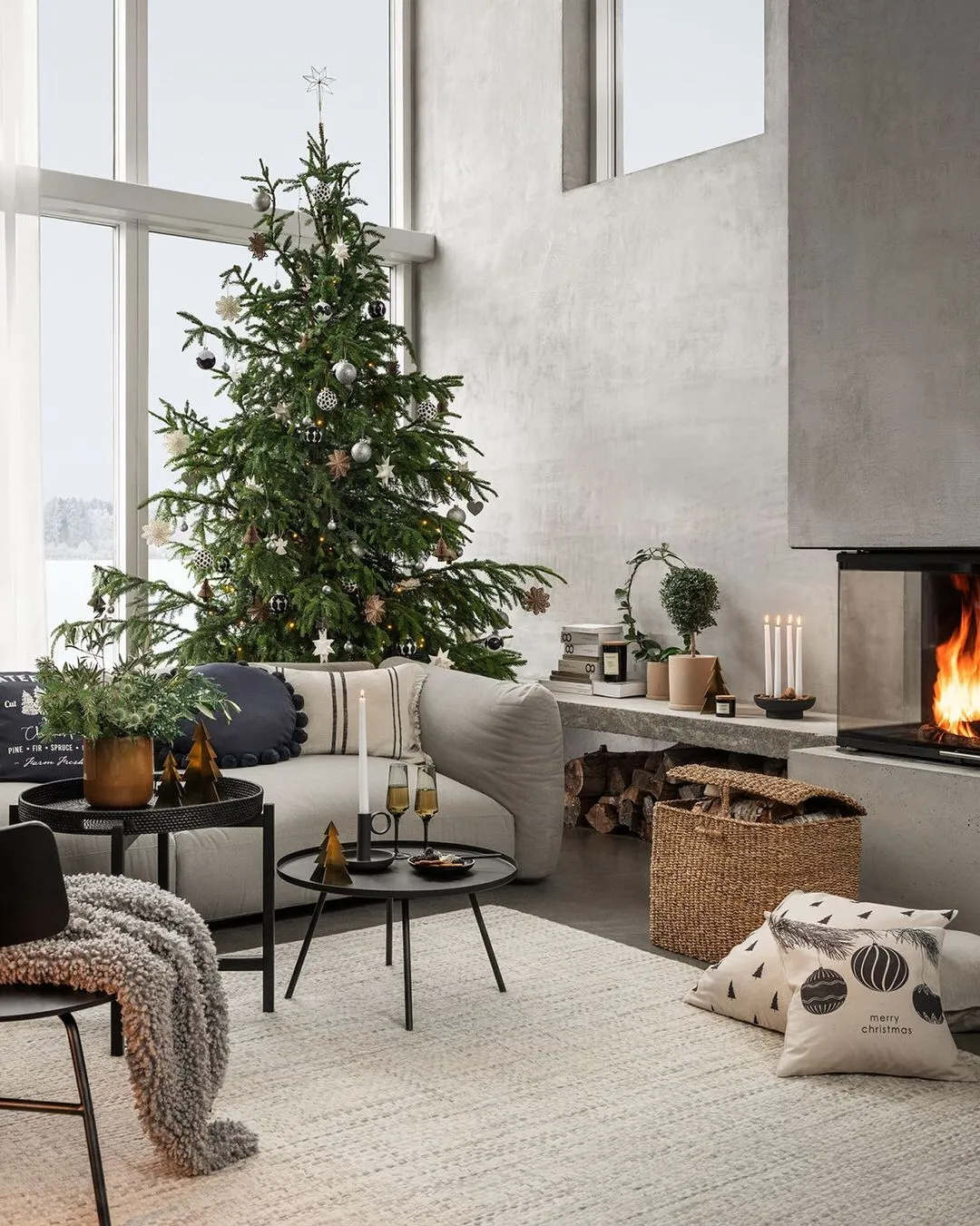
Notice that the ornaments are silver, black, and natural wood — no red, no green baubles. That restraint is what lets a concrete fireplace and a low gray sofa share a room with a Christmas tree without the whole thing turning into a department store display. The fire adds a moving light source at floor height, keeping the eye traveling down instead of parking on the tree. Working with a similar industrial shell? Compare with Idea #1 — same warm-glow strategy, completely different architecture.
4. White Beams, Natural Wood, and Room to Breathe
Measure your ceiling before you buy the tree, and aim for a finished height that leaves 6 to 12 inches of air above the tip. That gap is what keeps a tall tree from looking like it’s pressing up into the beams. In a space with a sloped ceiling like this one, measure at the lowest point of the slope, not the highest — that’s where your eye reads the clearance. A 7.5-foot tree under a 9-foot sloped ceiling almost always beats a 9-foot tree crammed in.
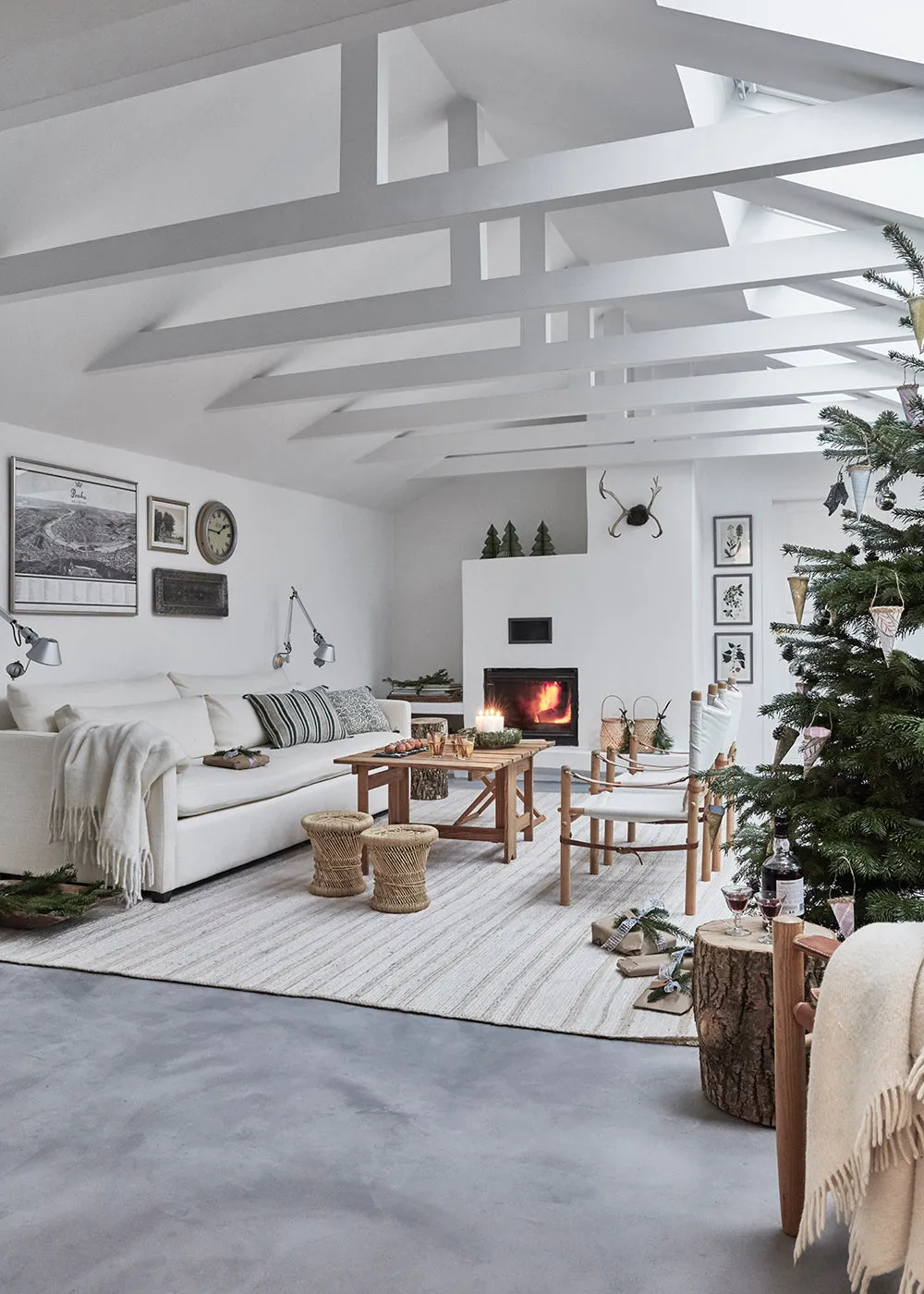
This look wants volume. It works best in a living room of at least 250 square feet with 9-foot ceilings, because the white sofa, the rattan stools, the natural wood coffee table, and the tree all need walking room between them. Under 180 square feet, this exact palette starts to feel crowded. If your ceiling sits at 8 feet, drop the tree to 6.5 feet and skip the second side chair — the room will still read as airy because the beams and white walls carry the light.
5. Deep Green Velvet, Gold Ornaments, Faux Fur
The all-neutral Scandi Christmas is still everywhere, but 2026 is the year jewel tones crept back in and stayed. Searches for deep green velvet sofas have been climbing steadily since 2023, and designers keep pairing them with gold and natural ornaments instead of the traditional red. It’s a look with real staying power because it’s essentially a color story you repeat every December without repainting anything — the sofa is the investment, the tree decor is the seasonal swap.
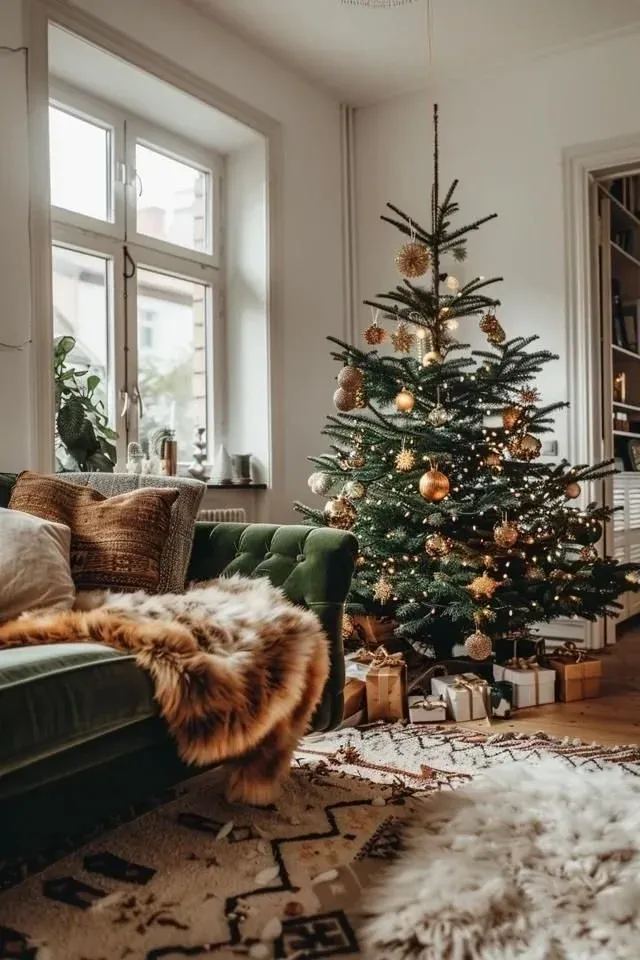
That brown faux fur throw tossed over the dark green tufted velvet is the single best decision in this room. Remove it and you have a gorgeous green sofa beside a gold-dressed tree — pretty, but a little formal, a little showroom. The faux fur adds the one thing velvet can’t give you: a matte, slightly rumpled, touchable texture that makes the corner feel lived in. It also bridges the deep green and the warm gold so they read as one palette.
6. Candles on a Shelf, a Wreath, and the Tiniest Tree
- Hang the largest object — here, the natural evergreen wreath — so its center sits at eye level when you’re standing.
- Flank it with two wooden house lanterns of different heights, 3 to 5 inches apart.
- Fill the gaps with pillar candles in graduating sizes, keeping at least 4 inches between any flame and anything dry.
- Tuck dried botanicals or a small ceramic vase into the last bit of negative space.
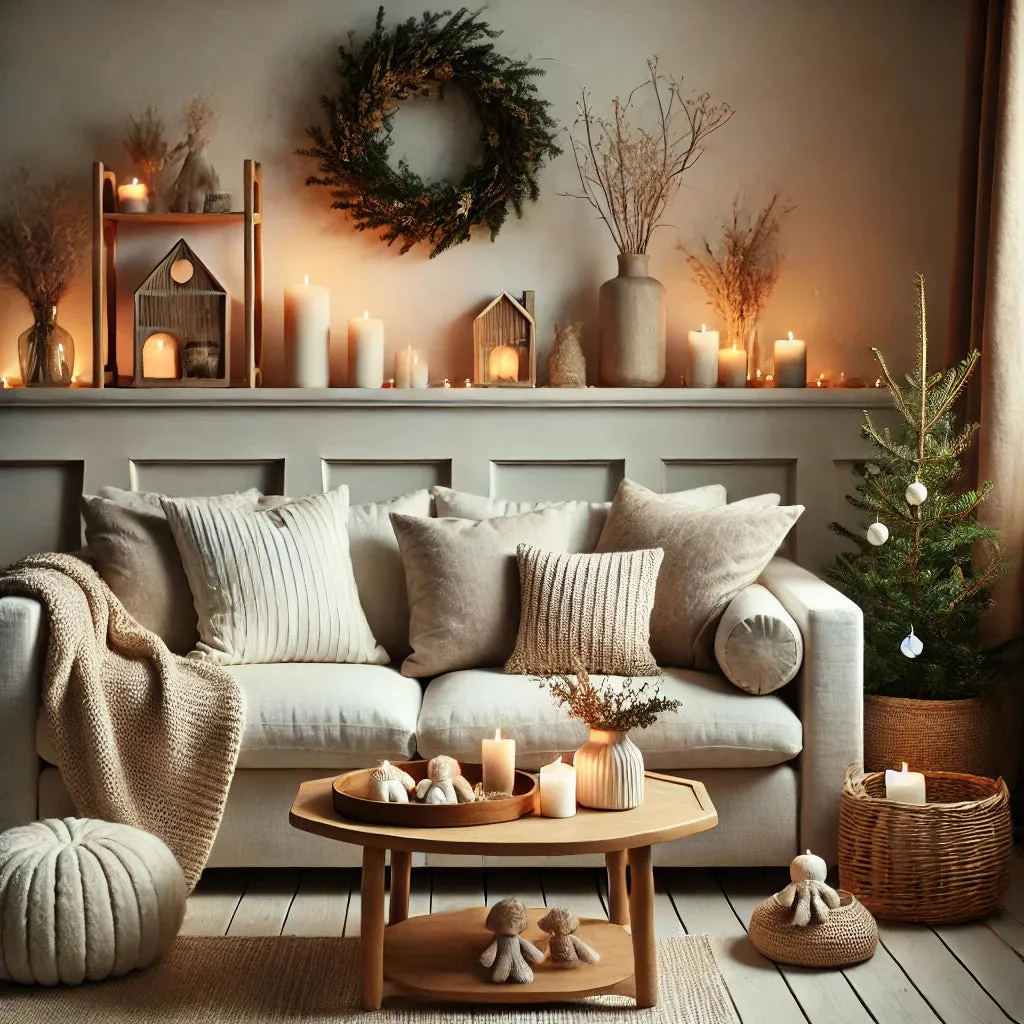
Time: 30-40 minutes. Cost: $0 if you shop your own house before you shop the store.
Real candles are the whole mood here, and they’re also the whole chore. Pillar candles burn down roughly an inch an hour, so a shelf of six or seven needs replacing once mid-season and again after New Year’s — budget $30-$50 in candles if you light them most evenings. Dried botanicals get dusty fast and shed; give them a cool-setting hair dryer pass every two weeks. And trim wicks to a quarter inch, always, or you’ll get soot on a white wall.
7. Dried Oranges, Cowhide, and Black-Framed Armchairs
Sheer white curtains behind a tree look phenomenal in photos and can look thin in real life, especially at night when the room is lit from inside and the window becomes a black rectangle. If you don’t have a view worth framing, add a textured roller shade behind the sheers. Also worth knowing: a black and white cowhide rug plus dried orange slices plus a wire mesh table adds up to a lot of pattern in a small nook. Keep the walls, curtain, and cushions plain or the corner gets noisy fast.
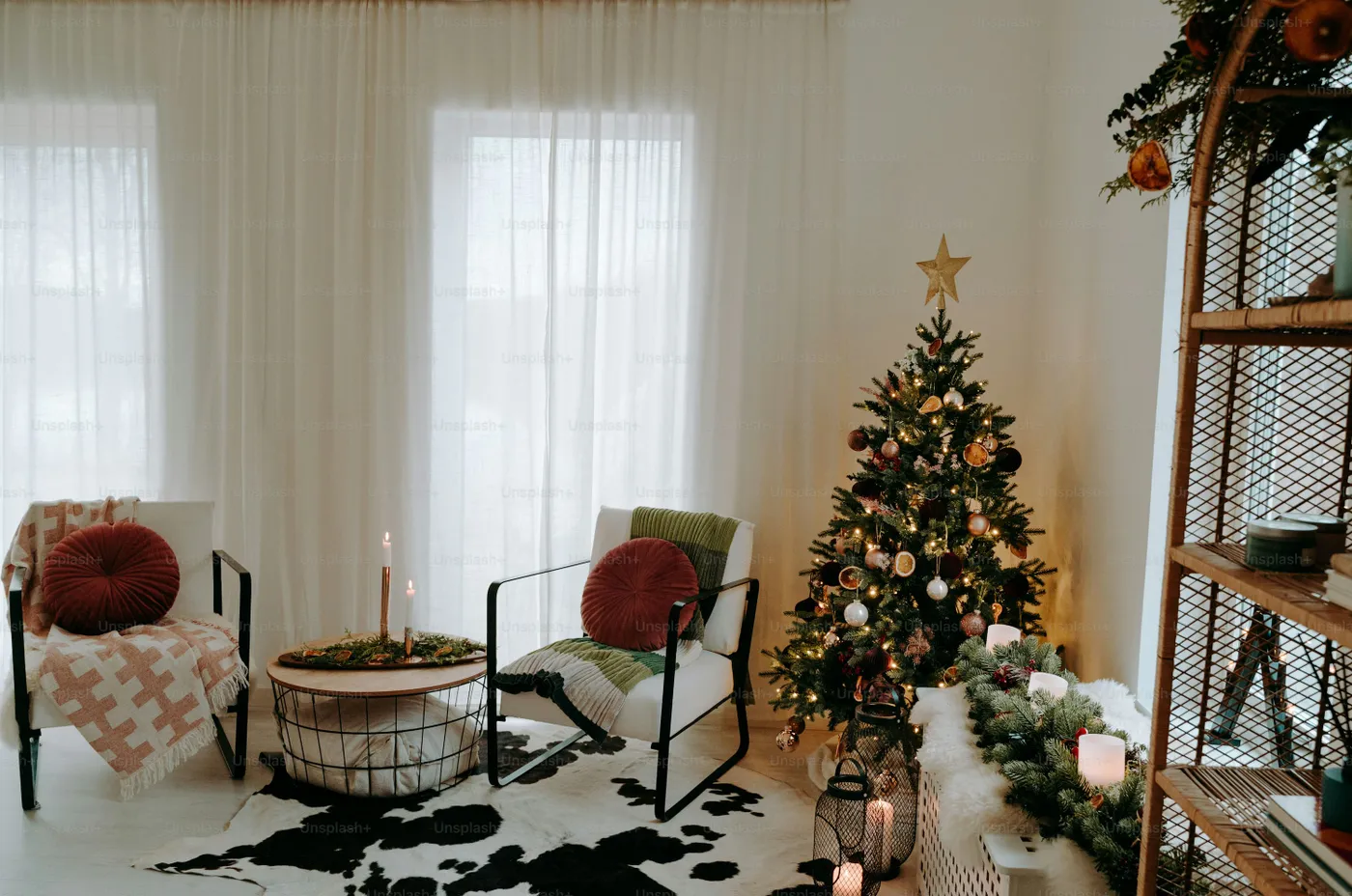
- Two black metal-frame armchairs with plush cushions: $300-$700
- Wire mesh or black metal coffee table: $120-$350
- Cowhide rug, real or printed: $150-$500
- Tree, dried orange slices, ornaments, red velvet pillows: $90-$200
- Sheer white curtain panels and hardware: $60-$180
8. Chunky Knit, White Pillar Candles, Rustic Wood
- Measure the sofa you’re covering — a chunky knit throw needs about 50 x 60 inches to drape convincingly.
- Check which direction your light comes from; this look depends on soft, even daylight, not one harsh beam.
- Count your open flames against the nearest dry textile — three feet is the number.
- Decide whether the knit poufs are seating or footrests. That’s two different firmness levels.
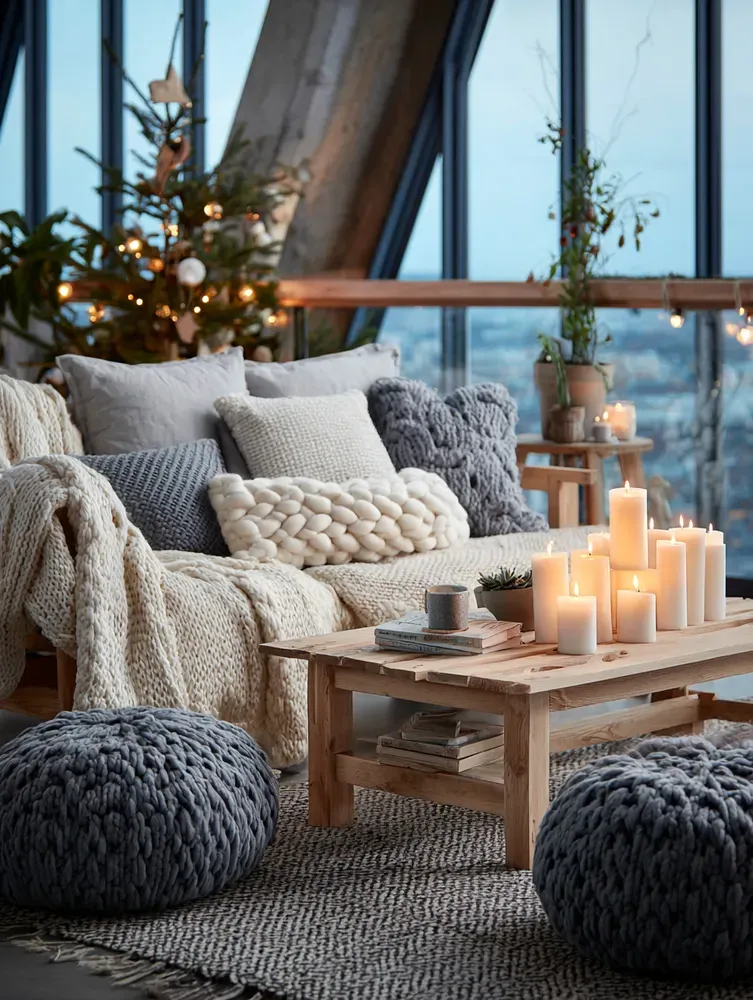
Coffee tables in a knit-heavy room should sit 16 to 18 inches from the sofa cushion edge — close enough to reach a mug, far enough that a chunky blanket doesn’t drag through the candles. Go low, too: a table 16 to 17 inches tall keeps sight lines open to the tree behind it. If your sofa sits on a patterned rug, pull the rug so at least the front legs land on it. A floating rug under a rustic wood sofa makes the whole arrangement look accidental.
9. Red Arched Frames and a Fireplace Full of Presents
- Red arched frames: paint thrifted frames with $8 craft paint instead of buying new; Walmart has arched mirrors from $28.
- Ornate white mantel: a $60 MDF mantel shelf from Home Depot mounted over drywall reads the same from two feet away.
- Red armchair: IKEA slipcovered option, or a Marketplace find at $80-$150.
- Gift wrap: kraft paper and one roll of red ribbon, about $15 total, beats patterned paper you’ll never reuse.
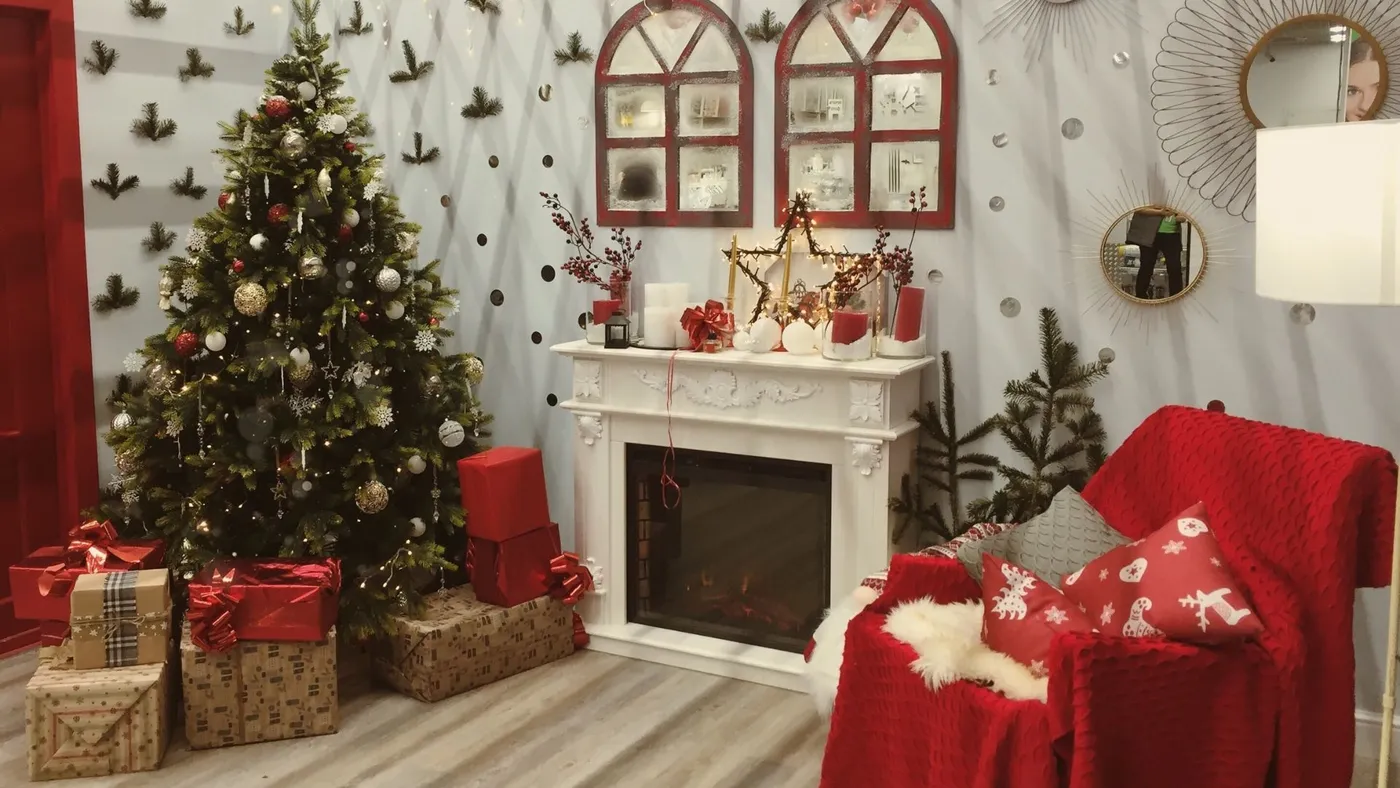
Here’s the ratio: about 50 percent light gray wall and white mantel, 30 percent bright red across the armchair, frames, and presents, 15 percent forest green from the tree, and 5 percent gold in the mirrors and ornament caps. That 5 percent is doing more work than it looks like — without a warm metallic, red and green together can read as a diner instead of a living room. Compare with Idea #2, which keeps the same red-and-white energy but leans navy instead of green.
10. Rattan Chairs, Faux Fur, and Winter Gallery Art
The layered faux fur rugs are the thing you can’t remove. Two of them — one white, one gray — stacked over a brown textured floor rug sounds excessive until you see how they muffle the whole vignette. Without them, natural rattan chairs and a white faux mantel read as a store display: pretty, but hard-edged. The fur is what turns three separate objects into a nest, and it visually connects the white throw on the chairs to the floor so your eye travels instead of stopping.
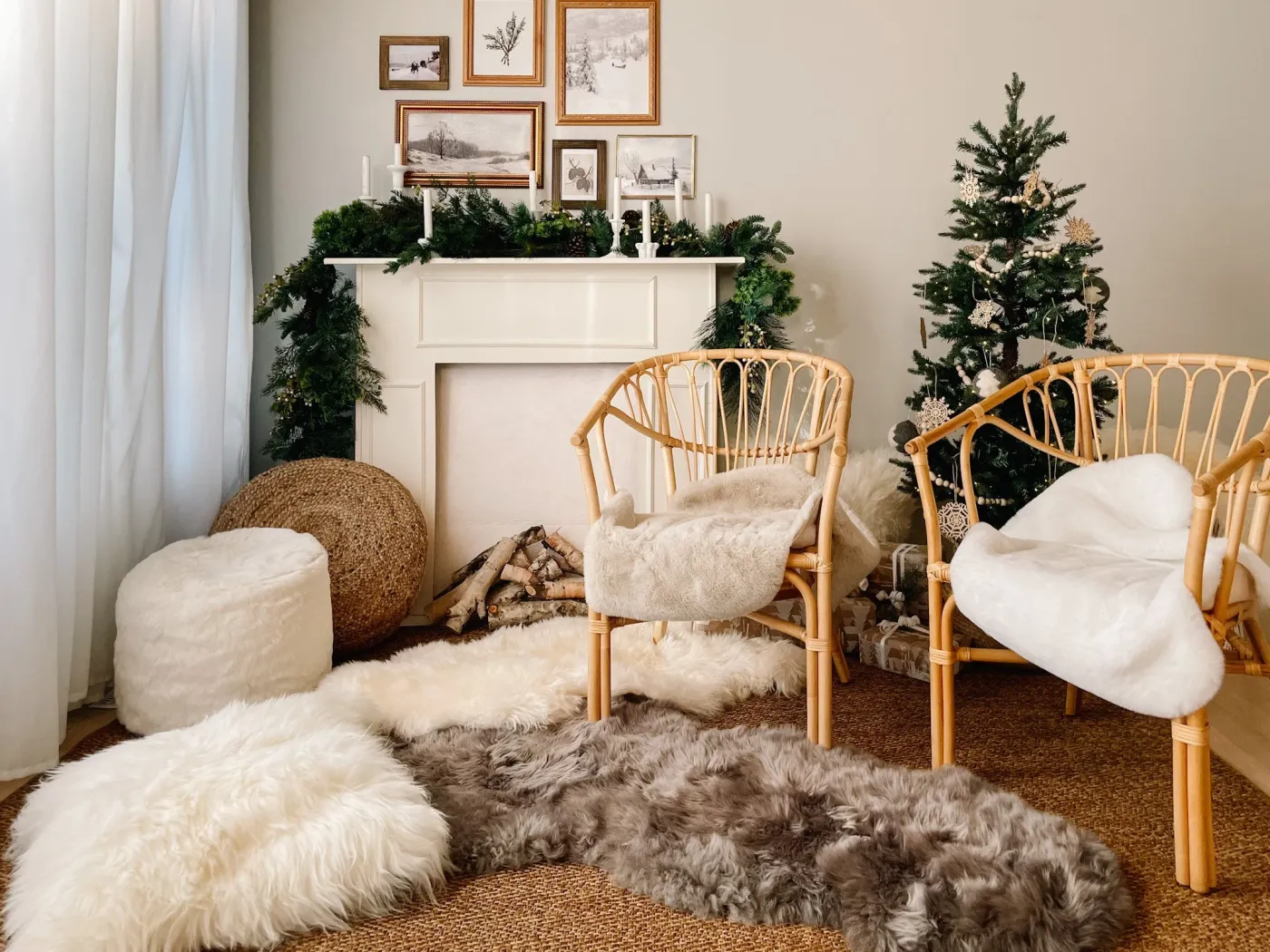
- Lay frames on the floor first and photograph them — phone photos reveal bad spacing instantly.
- Hang the largest piece off-center, roughly a third in from one edge, rather than dead center.
- Keep 2 to 3 inches between frames. No more.
- Hang the lowest frame 6 to 8 inches above the mantel so candles and garland have breathing room.
Time: 1-2 hours. Cost: $0 if you shop your own house; thrifted frames run $5-$20 each.
11. A Sparse Tree, Star Lights, and Red Berry Branches
This is the small-space solution, and it wants a living room of 120 to 200 square feet with a standard 8-foot ceiling. The tree here is deliberately undersized — roughly 4 to 5 feet — so it can sit beside a light wood side table without blocking the sofa. Rooms under 100 square feet should go smaller still, or move the tree onto a tabletop. Larger rooms of 300 square feet and up will make a sparse tree look lost; go bigger and add branches, or borrow the fuller approach from Idea #19.
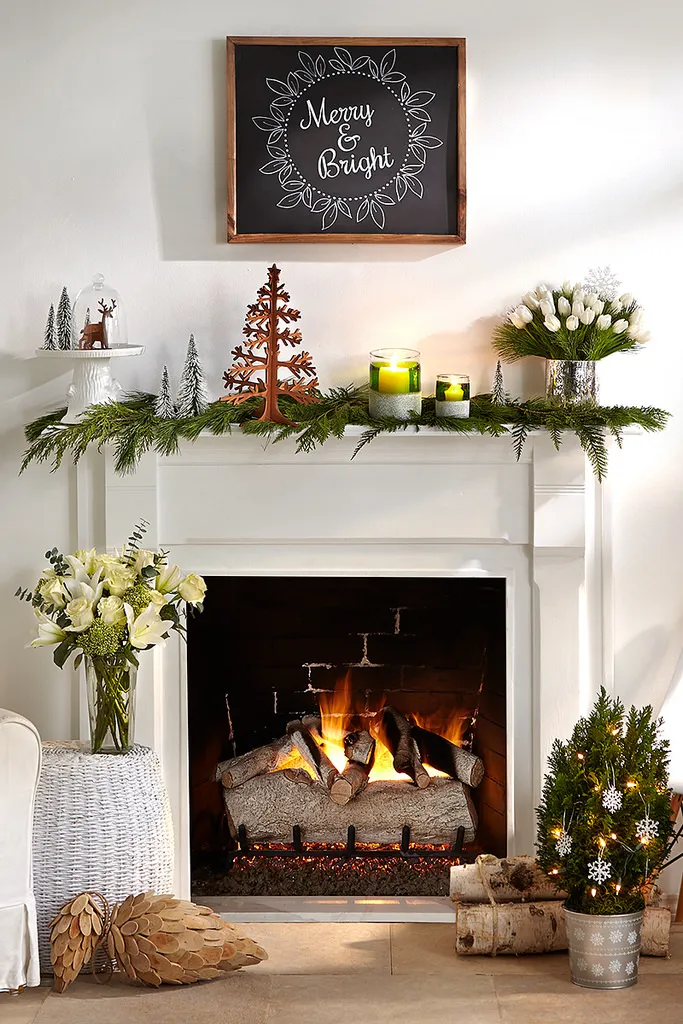
Sparse decorating is a discipline, not laziness. Every ornament on this tree is visible because nothing crowds it — white star string lights, a few muted baubles, a couple of red berry branches. The red is the only saturated color in the entire frame, so a single berry stem reads like a shout. Against a white wall, light gray sofa, and pale wood, the tree’s negative space becomes part of the design rather than something to be filled.
A sparse tree is genuinely cheaper to decorate. Target’s small artificial trees run $35-$70, and warm white star lights plus a spool of thin copper wire lands around $20. Skip the ornament multipacks and buy three or four nice pieces instead — West Elm singles run $6-$12, or hit a thrift store for a dollar apiece. Red berry stems from Michael’s are about $4 each, and two or three is plenty.
12. A Pallet Sofa and a Tree in a Wicker Basket
Light wood floors and bare branches are a beautiful combination and a slightly demanding one. Pallet furniture needs a yearly slat check and a light sanding if it’s lived in a dry room — knots can split. White faux fur throws mat at the edges within a season; a 15-minute air-only tumble in the dryer brings them back. And a tree skirted in a wicker basket means vacuuming needle drop every other day. A rigid woven collar or a cloth skirt catches far more than a basket does.
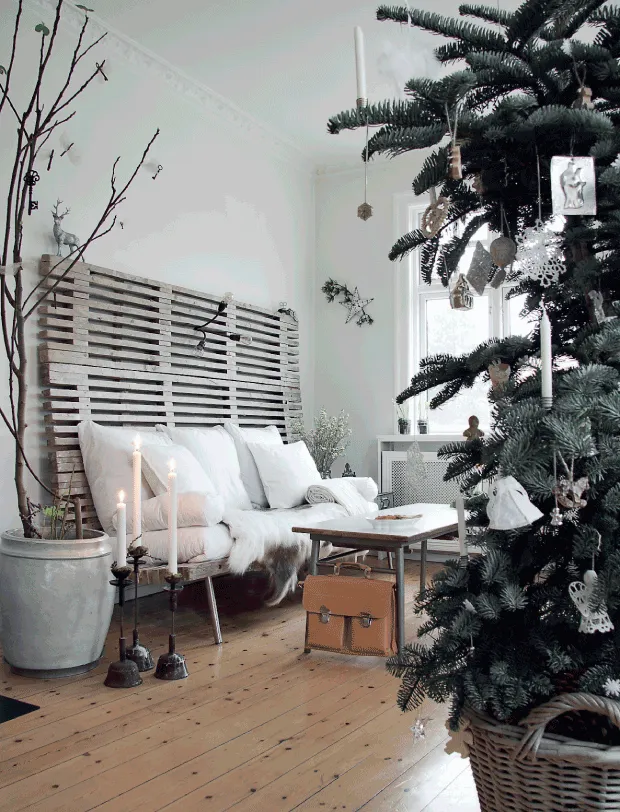
- Pallet wood, stain, and sealer: $60-$140
- White seat cushions and a faux fur throw: $150-$400
- Small tree, white candles, silver ornaments: $80-$180
- Wicker basket tree base and metal pot for branches: $50-$140
- Antique-style candlesticks: $30-$90
13. Gnomes, Plaid Baubles, and Red Berry Clusters
When you’re mixing a dense ornament collection, hang a third of it deep in the branches rather than on the tips. On a full or flocked tree, roughly 60 percent of your ornaments should sit within 6 inches of the trunk and 40 percent on the outer third — that’s what creates depth instead of a flat wall of color. Cluster berries and foliage sprays in odd numbers, and add them last, after the baubles, so they read as organic growth rather than decoration.

The figurative ornaments — gnomes, Santas tucked among the glass baubles — are what grab you when you get close. A tree with only plaid balls and berry clusters is a color story; add a few quirky characters and it becomes a tree with a personality. They also break the pattern in a way no amount of color theory can replicate. Buy one or two a year, dated if you can, and in a decade you’ll have the best tree on the block.
14. A Paper Star Glowing in the Window Bench
Illuminated paper star lanterns are stunning and slightly delicate. They’re paper, they run warm, and they should never sit within a few inches of a curtain — most come with a low-wattage bulb for a reason, so don’t upgrade it. If the lantern hangs in a window, use a simple cup hook into the window head rather than tape. And check that your window bench can handle weight if people actually sit there; built-in storage benches usually can, but freestanding hollow-core versions often can’t.
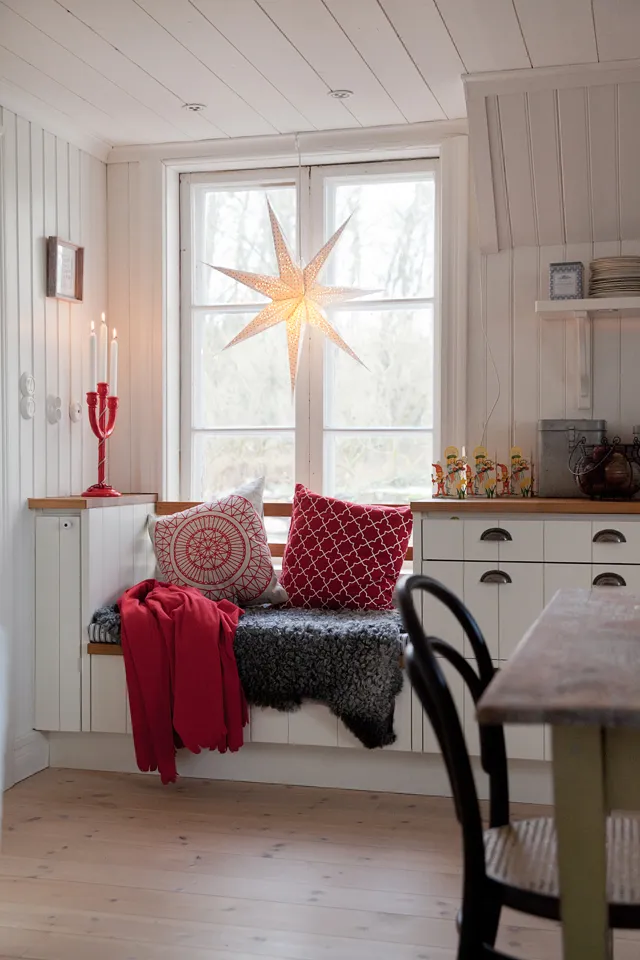
- Ambient neutrals (white paneling, light wood countertop, cream trim): 55 percent
- Red (blanket, candelabra, cushion stripes): 25 percent
- Grey (faux fur throw, soft shadow tones): 15 percent
- Warm glowing light (star lantern, candles): 5 percent, though it reads as a third of the room after dark
Keep that ratio and swap red for rust, and the same window nook works from October straight through February instead of just December.
15. Dried Orange Slices and Wooden Snowflakes Up Close
- Slice oranges a uniform 1/4 inch thick — thicker slices mold, thinner ones crumble.
- Blot both sides with paper towel, then bake at 200°F on a wire rack for 3 to 4 hours, flipping once.
- Cool completely, then poke a small hole 1/2 inch from the edge with a skewer.
- Thread with twine and hang near a light so the slice backlights.

Time: 4 hours, mostly waiting. Cost: about $6 for a bag of oranges.
Dried citrus is the quiet trend that refuses to die. It reads as Scandinavian because it’s honest — real material, real color, nothing shiny — and it plays well with the wooden snowflakes and mercury-glass look that keep showing up in Scandi styling year after year. Warm fairy lights are still the light source of choice over colored bulbs, and 2026’s version of this aesthetic is less about buying a themed set and more about adding two or three handmade pieces each season.
16. Frosted Tips, Straw Angels, and Red Strings
Straw and woven ornaments disappear on a white-flocked tree unless you give them contrast. Here, thin red strings do the work — that single thread of saturated color is what separates a pale angel from a pale branch. If you’re working on a frosted tree, use ribbon or cord at least an eighth of an inch wide and in a tone that appears nowhere else on the tree. Keep your lights warm white, around 2700K; anything cooler turns straw yellow-green.

Straw ornaments are one of the cheapest looks in this entire guide. A set of twelve woven straw stars or angels runs $12-$25 on Amazon or Etsy, and Etsy sellers doing handmade pieces charge about $4-$8 each. Frosted trees cost more than plain ones — expect $80-$200 for a 6-footer — but you can fake the flocking on a tree you already own with a $15 can of spray snow. Red baker’s twine is about $5. For a warm-toned counterpart to this pale look, see Idea #10.
17. Red Ornaments, Knitted Mittens, and a Mustard Chair
- 6-7 foot tree with red and white ornaments and a gold star topper: $150-$400
- Mantel garland with large faux red flowers: $45-$120
- Knitted mittens and small mantel accents: $20-$50
- Mustard yellow armchair: $400-$1,200
- White piano or similar large furniture anchor: varies wildly
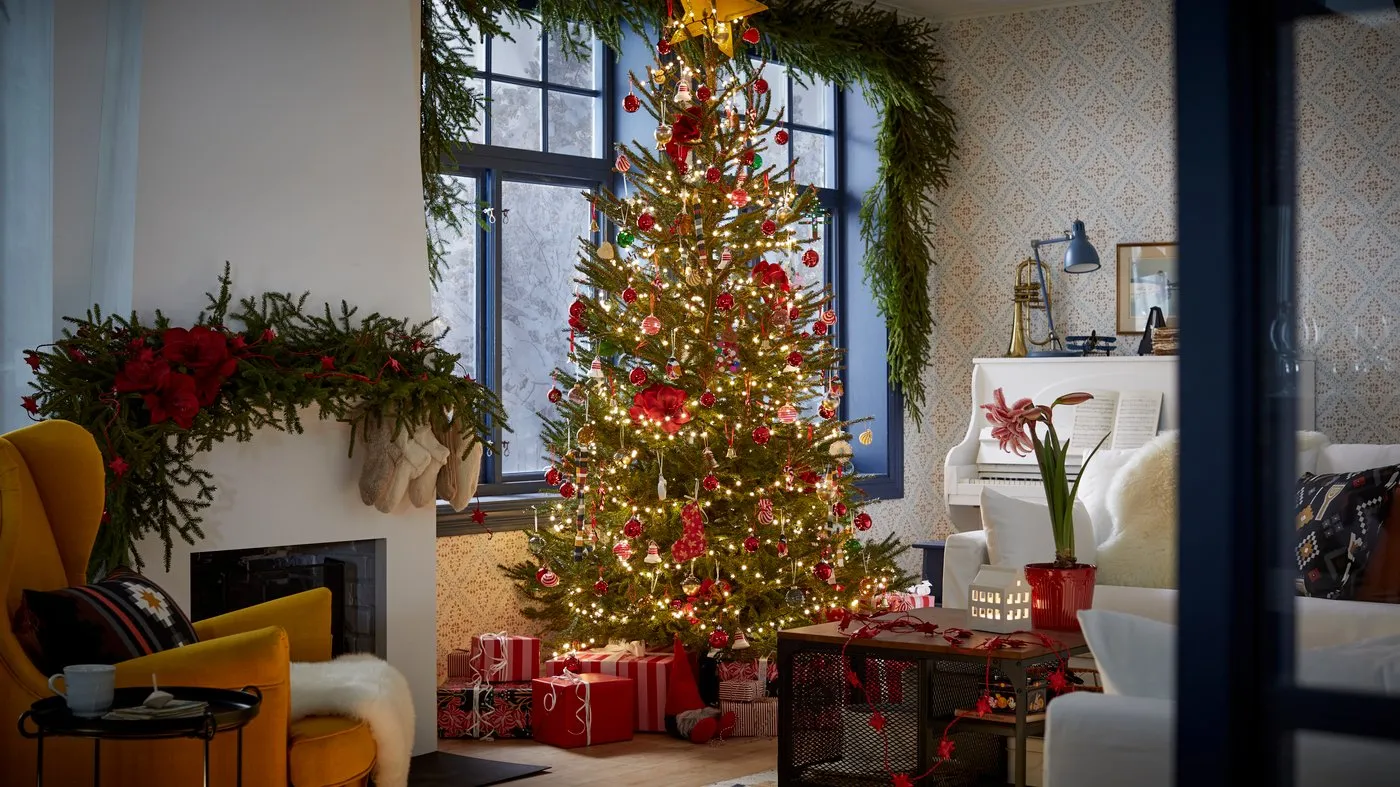
The mustard chair is the reason this doesn’t look like a catalog. Red and green will always work at Christmas, but adding a third warm color — and a slightly unexpected one — gives your eye somewhere to rest that isn’t a holiday cliché. It also repeats the warmth of the wood floor and the gold star topper, so the palette closes a loop. Patterned wallpaper behind it all keeps the white piano from floating.
18. White Floors, a Window Garland, and a Calm Fir
White painted floors and white walls bounce a lot of light, which means this room tolerates a big tree without feeling dark. It works from about 200 square feet upward, and it’s especially good in north-facing rooms where you need every bit of reflected brightness you can get. Ceiling height matters less here than window width — the garland spans the window, so you want a window at least 48 inches wide or the greenery has nowhere to drape.
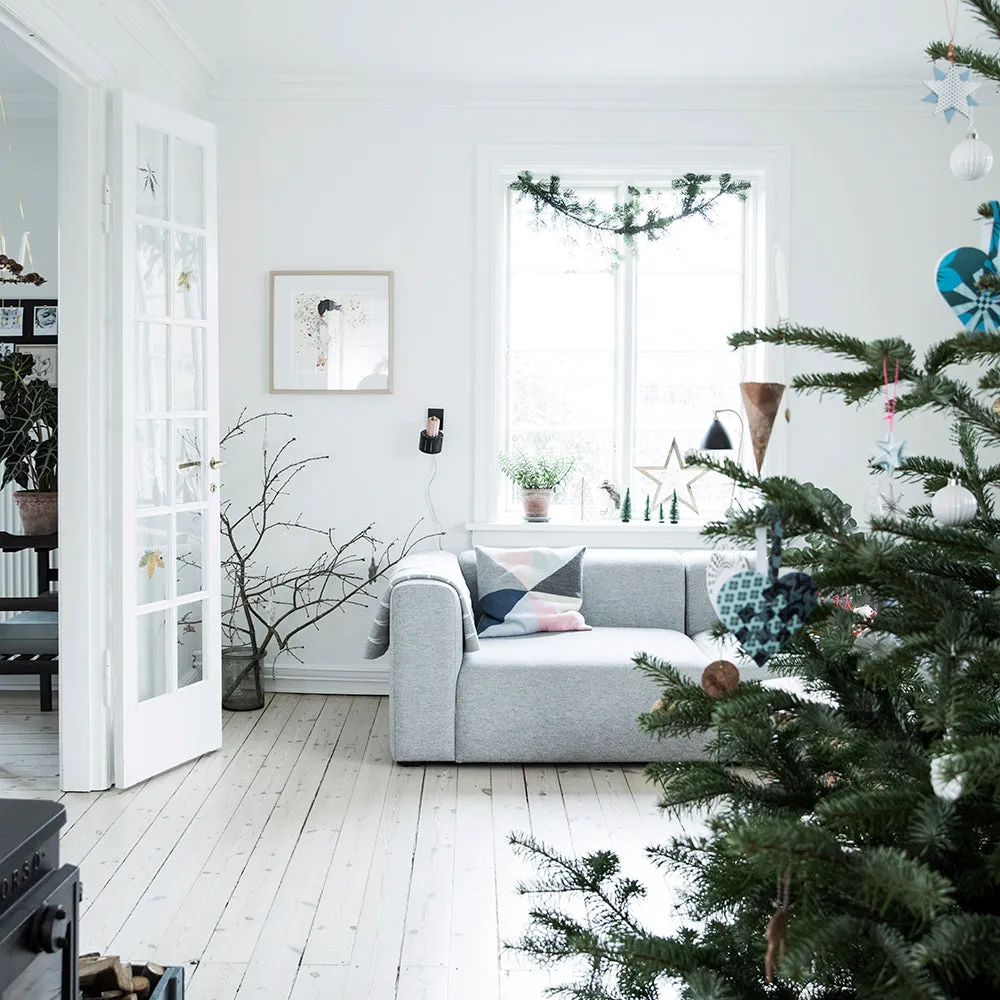
Painted wood floors are beautiful and unforgiving. Garlands shed needles, trees drop sap, and one dragged fir branch can leave a permanent scratch in a soft white finish. Put a felt pad under the tree stand and vacuum rather than sweep. If you’re draping a live garland over a window, know it’ll dry out in a heated room within two to three weeks — mist it every few days, or use a faux garland with a real branch tucked in front for realism.
19. Flocked Branches, White Gifts, and a Lit Curtain
- Confirm the wall behind the tree is light — this look needs a pale backdrop or the flocking turns gray.
- Check whether an outlet sits behind the tree; you’ll need it for both the curtain lights and the tree lights.
- Measure the tree’s widest branch spread plus 12 inches of gift space before committing to the corner.
- Decide if the wreath is hung or leaning — hanging on a sheer curtain needs a tension rod, not a nail.
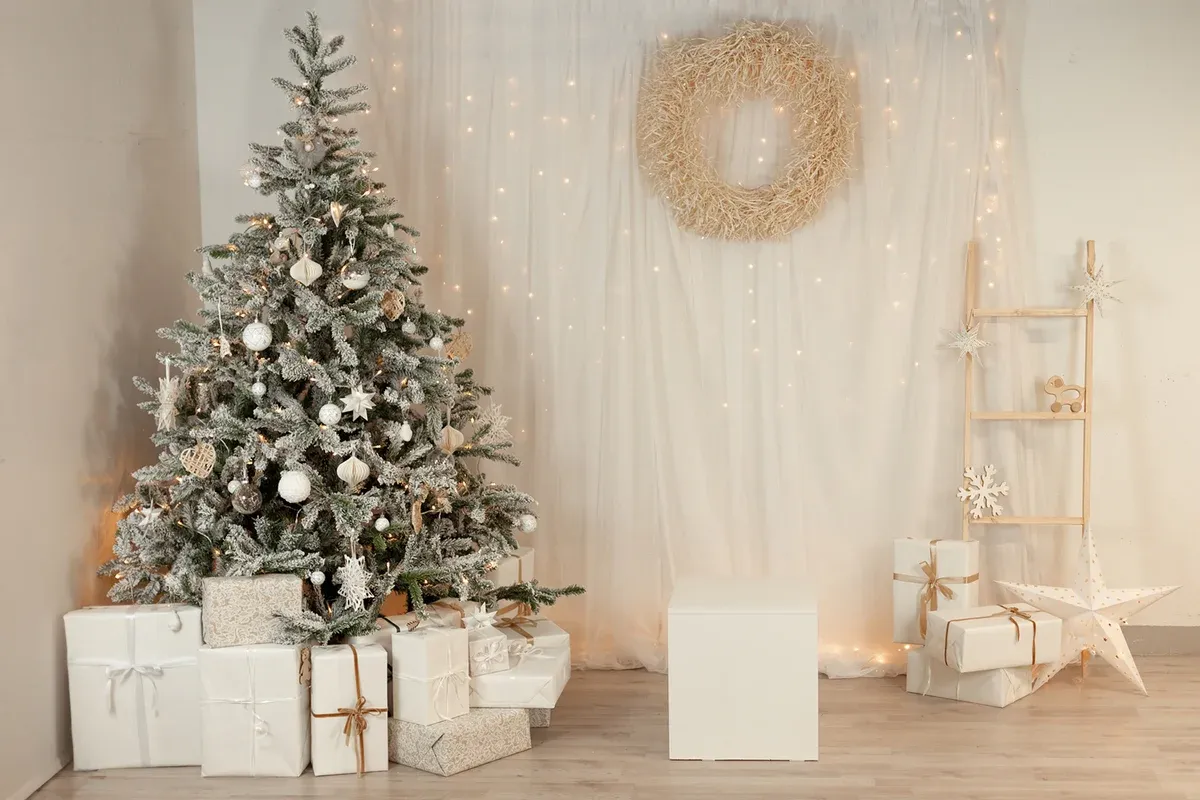
This is one of the more affordable looks here. A 6-foot flocked tree runs $90-$180 at Walmart or Target in early November, and white ornaments are the cheapest color to buy — plain white baubles go for about $10 for a set of twenty. Warm white curtain lights are $18-$30. Kraft paper and white ribbon: $12. The one splurge worth making is the woven wreath, usually $35-$70, which reads handmade even when it isn’t.
The formula is nearly monochrome: 70 percent white and cream, 20 percent light green from the flocking and the wreath’s mossy undertone, 10 percent warm gold light. That’s a tighter ratio than most holiday rooms use, and it’s exactly why this corner feels calm instead of festive-chaotic.
20. Folk Art Felt Ornaments on Pine and Pinecones
The ribbon. It sounds trivial, but red satin ribbon is the single element that makes these felt ornaments look like a collection instead of an assortment. Every shape — the Dala horse, the heart, the star — is tied with the same width and sheen, which creates rhythm across objects that would otherwise have nothing in common. Swap it for twine and they go rustic. Swap it for gold cord and they go precious. Same ornaments, entirely different story.

- Cut two identical shapes from 2mm wool felt — wool, not acrylic, holds an edge.
- Blanket-stitch around the outline with embroidery floss, leaving a one-inch gap.
- Stuff lightly with a pinch of polyester fill; overstuffing makes the shape bulge.
- Close the gap, then stitch the contrasting pattern on the front with a simple running stitch.
Time: about 45 minutes per ornament. Cost: roughly $2 each in materials.
21. An Advent Wreath, a Stone Fireplace, and the Whole Family
The advent wreath is having a genuine resurgence, and it isn’t nostalgia-driven — it’s the ritual. Families who spent years on elaborate calendar apps are gravitating toward something you light once a week and can’t skip. Designers have noticed too: wooden house-shaped advent calendars are outselling flat paper ones, and the lit-candle-on-a-table rhythm is being used as a lighting scheme. Search interest typically doubles in the first week of November and holds through the 24th.
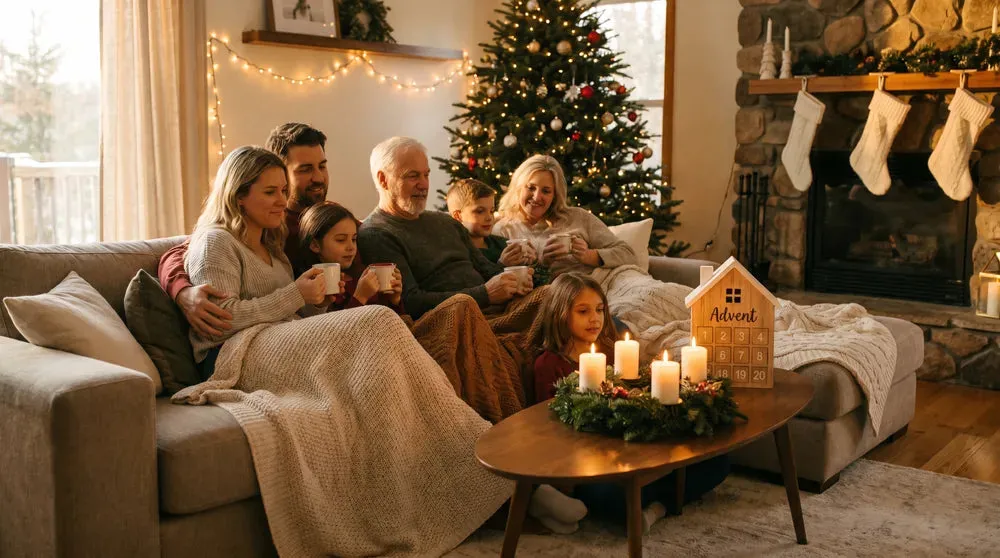
- Best in a living room of 300 square feet or more — an L-shaped sectional, a tree, and a fireplace need the footprint.
- Ceiling height of 9 feet or more keeps the room from going top-heavy once garland and stockings go up.
- At least 6 feet between tree and fireplace keeps two focal points from competing.
- Under 200 square feet, choose one anchor — the tree or the mantel — and let the other stay minimal.
Smaller rooms can borrow structure from Idea #4, which puts the tree by a window instead of a hearth.
22. A Carved Armchair Under a Ram’s Head and a Brass Sconce
Swing-arm sconces exist for exactly this arrangement. Mount yours 60 to 66 inches from the floor — just above seated eye level — and 22 to 26 inches out from the chair’s center so the arm can swing the light over your shoulder for reading without glaring in your face. In a room with a dark wood mantel and a light wood table, choose brass: it’s the only metal that reads warm next to both brown tones without matching either.
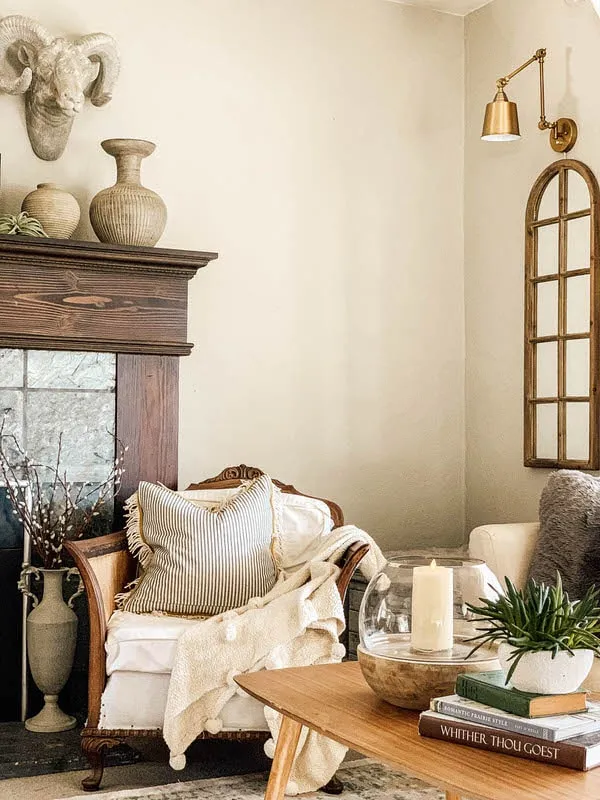
Cream upholstery, a white knit blanket, and a light wood table in one corner is a commitment. Pom-pom trims snag on carved wood arms within a week unless you keep the blanket folded on the seat back rather than draped over the edge. Wool blends pill where elbows rest; a $12 fabric shaver handles it. Textured wall decor collects dust visibly against a pale wall — a soft brush pass every couple of weeks is the whole routine.
- Carved wood armchair with upholstery: $350-$900
- Arch-top mirror and brass swing-arm sconce: $120-$380
- Cream knit blanket and striped pillow: $60-$150
- Light wood coffee table with books, bowl, and plant: $180-$500
- Vases and ram’s head wall decor: $60-$200
23. Pillar Candles in the Firebox and an Autumnal Wreath
Color-wise, this corner runs 60 percent white and warm neutral, 25 percent seasonal green from the wreath, 10 percent dark wood floor and furniture, and 5 percent brass from the candle holders. The trick is that the firebox — the darkest rectangle in the room — holds the brightest thing in the room. Flip that and the whole scene collapses. Recreate the effect by putting your candles where the shadow is deepest, not where the light already falls.
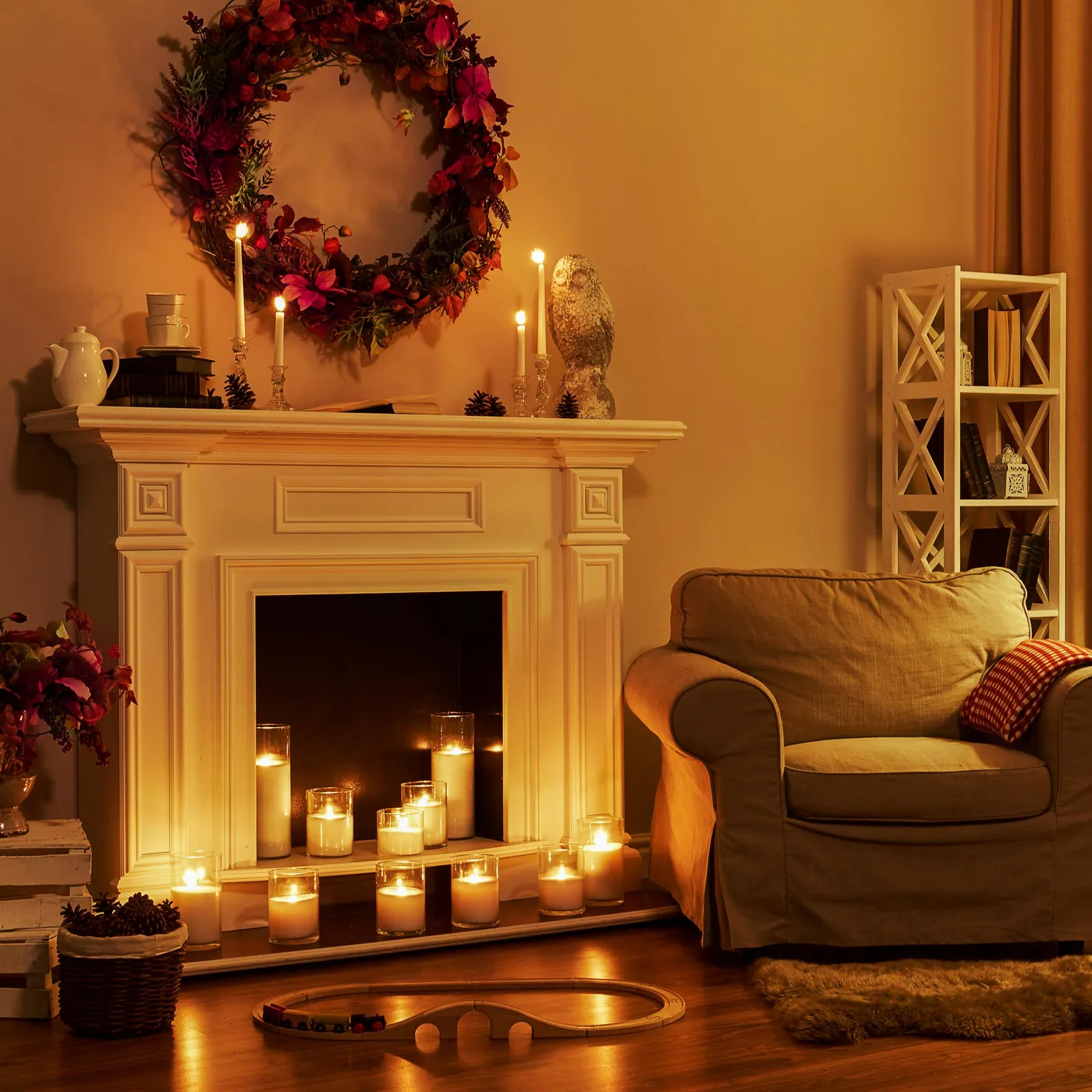
A decorative fireplace is a great solution and also a trap. If the firebox has a real flue, block it before you load in candles, or you’ll get a draft that flickers flames dangerously and pulls soot down. Check clearance: candles need 12 inches of air above them and shouldn’t sit under a mantel edge with garland hanging within reach. The autumnal wreath is deliberate — this vignette spans November and December, so skip red-and-green and it won’t feel dated by January.
24. Stockings, a Nutcracker, and a TV Fireplace
- Small artificial tree with warm white lights: $60-$160
- Two stockings plus hooks and a simple wall mount: $25-$70
- Nutcracker figurine and candle holder: $20-$85
- Dark wood side table or console: $120-$400
- Red-patterned socks, white throw, and a candle: $30-$75
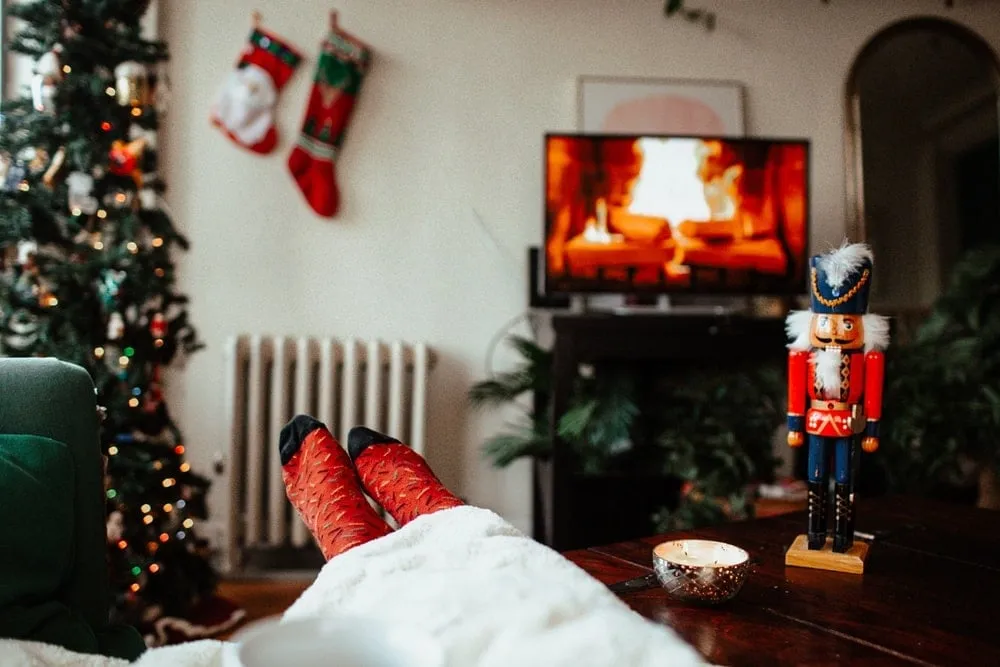
The TV playing a fireplace loop is the honest little cheat that makes this work. In a small or rental living room, a real hearth isn’t happening, and a blank black screen next to a Christmas tree is a dead zone. A warm flickering video turns the biggest rectangle in the room into a second light source. Just drop the brightness to about 40 percent so it reads as ambience rather than a glowing billboard.
25. Red Tapers, Amaryllis, and Olive Linen Napkins
Three things are happening on this table. The tall red tapers pull your eye up and give the setting height, so a flat white cloth doesn’t look like a blank page. The silver candle holder and pitcher add a cool metal that keeps the deep red from turning heavy. And the olive green linen is doing something specific: it’s an earthy green that ties back to the tree behind without being the same shade, which is what makes the palette feel collected instead of matched. Compare with Idea #13, where that same green-and-red pairing reads much denser and more traditional.
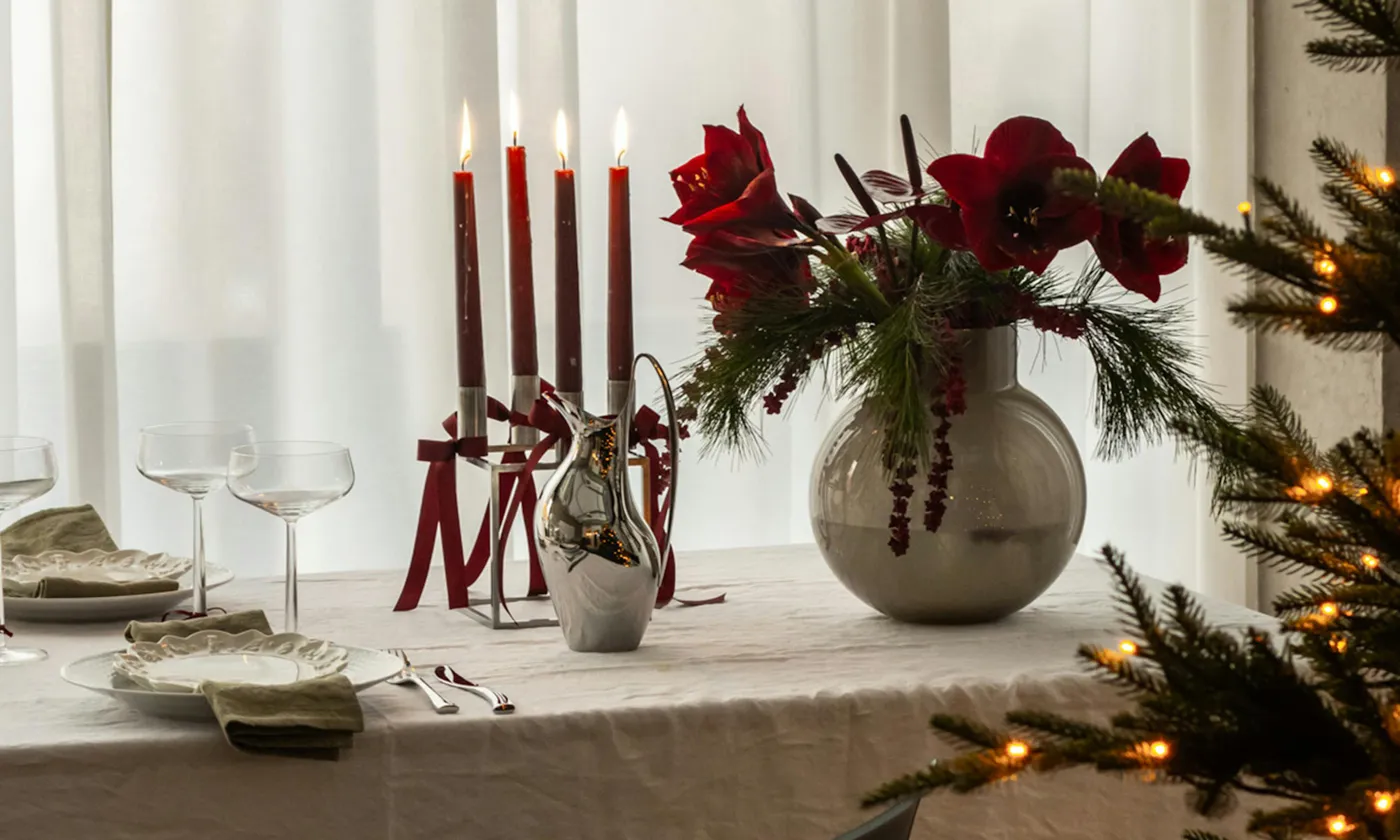
A holiday table is the easiest place in the house to spend $400 on things you’ll use twice. Linens from Target run $6-$8 per napkin; a thrift store will sell you a stack of white scalloped plates for $2-$4 each. Red tapers are about $3 a pair. The amaryllis is the splurge — a potted one from a garden center is $15-$25 and blooms for weeks, which beats a $60 florist arrangement. Silver pitcher? Marketplace, $20.
- Measure the table first; you need 6 inches of clearance between each place setting and the centerpiece.
- Place candles on a tray so wax drips land on metal, not linen.
- Fill the centerpiece with branches at least 8 inches above the plate line.
- Put glasses down last, 1 inch to the right of the knife.
26. An Undecorated Tree in a Woven Collar
An undecorated tree needs more space than you’d think, because there’s nothing on it to give your eye a sense of scale. In a room of 150 square feet or more with 8-foot ceilings, a 5- to 6-foot tree in a woven collar reads intentional. In a tight corner under 100 square feet, it reads unfinished. The warm brown wall is doing a lot of work here too — the tree needs a mid-tone backdrop or the bare green goes flat and sad.
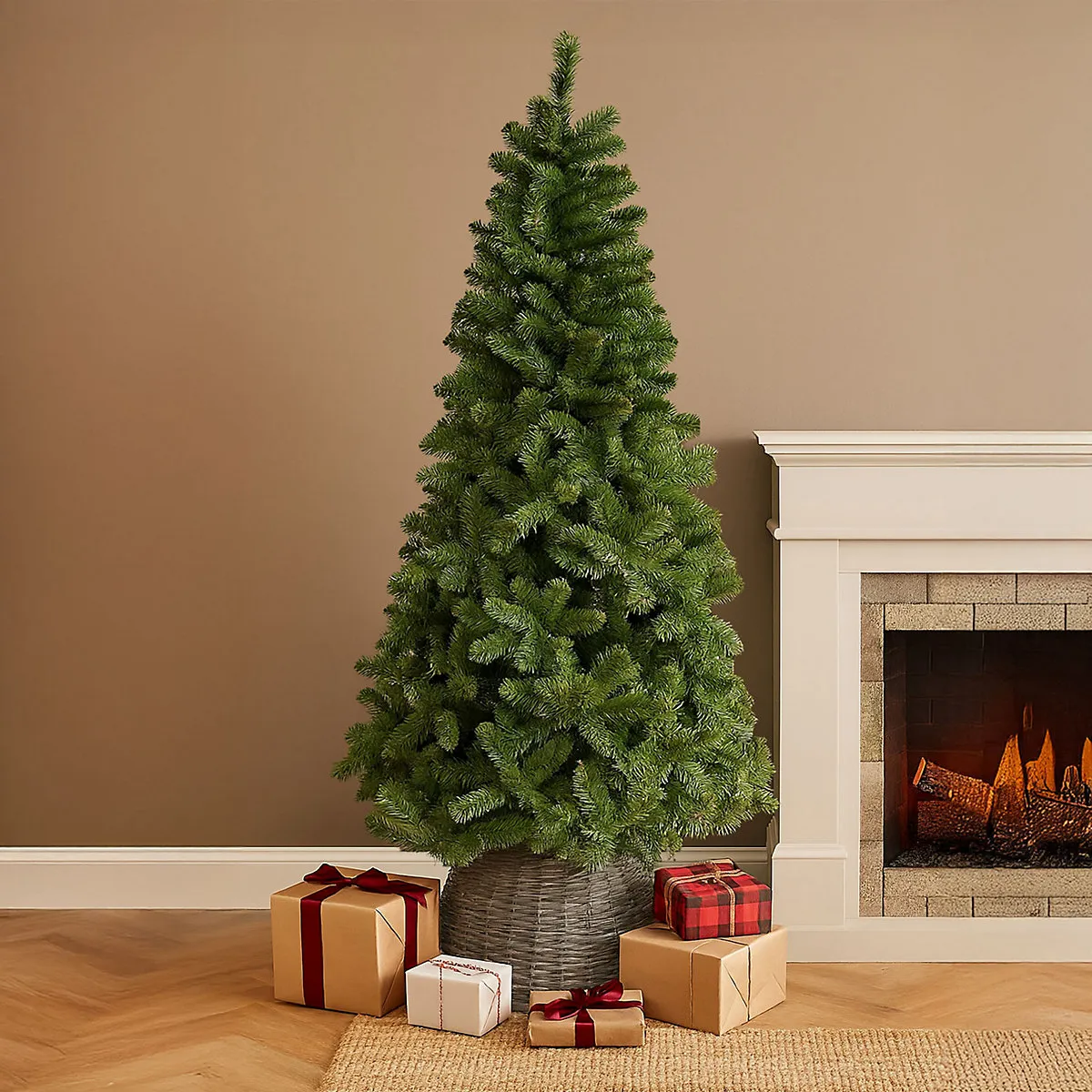
If you’re leaving a tree bare, upgrade everything around it. Swap the plastic stand for a woven collar or a basket; that single change is the difference between “undecorated” and “unfinished.” Wrap gifts in kraft paper with one ribbon color so they act as the ornaments. And keep the tree’s own lights if it has any — a totally unlit bare tree in a heated room looks bleak by week two, even a faux one.
27. Winter Gallery Wall Above a Pinecone Garland
- Decide the garland’s line first — it should run below the lowest frame, not through it.
- Use small clear cup hooks or adhesive strips rated for twice the garland’s weight.
- Drape in three gentle swags rather than one straight line; swags read fuller.
- Place candle holders after the greenery so each flame sits in front, never behind a branch.
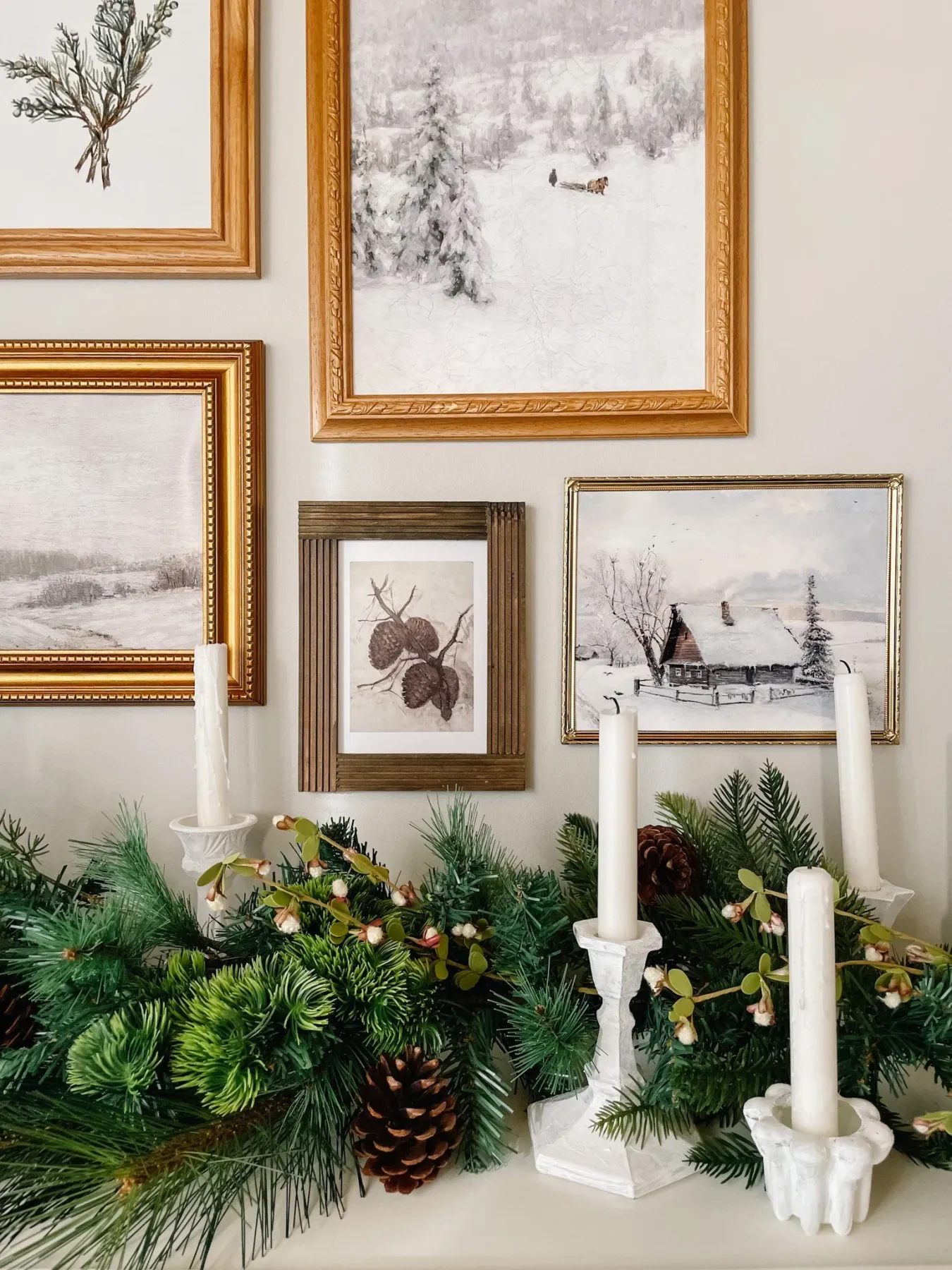
Time: 45 minutes. Cost: $35-$90 for a good faux garland with pinecones.
- Mixed wood and gold frames, thrifted and new: $60-$250
- Winter landscape and botanical prints: $30-$120
- Faux pine garland with pinecones and berries: $35-$90
- Set of three white distressed candle holders: $40-$110
- Tall drippy white taper candles: $12-$25
28. Red Baubles, a Green Sofa, and a Red Star Topper
Red ornaments on a green tree in a room with a green sofa is a lot of the same two colors. What saves it is scale: the tree’s red balls are small and plentiful, the sofa is large and solid, and the warm white wall keeps them apart. If your sofa is a brighter green than this one, go with deeper, more muted reds or the room will visually vibrate. Wooden-framed armchairs are wonderful and hard — add a seat cushion if you actually plan to sit through a movie.
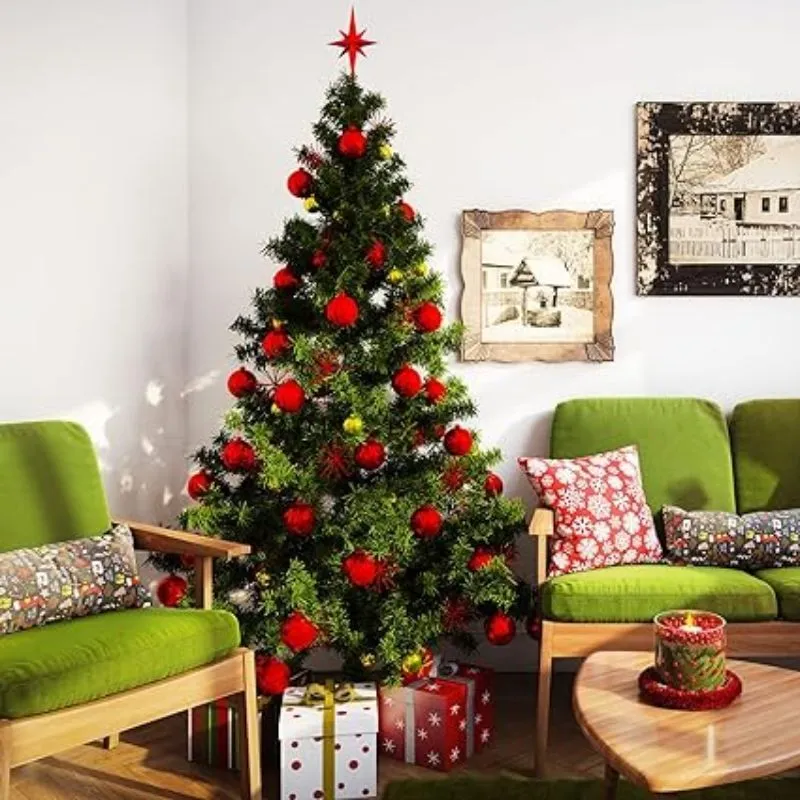
Count it out: 55 percent green across the sofa, armchair, and tree; 30 percent red in the ornaments, gifts, and topper; 10 percent warm wood from the frames and floor; 5 percent white from the wall and pillows. That’s a more balanced ratio than most red-and-green rooms manage, and it works because the green is split between two textures — velvet upholstery and pine needles. Swap the green for navy and you get a completely different, much cooler room.
29. A Basketed Tree with White Stars and a Gold Rabbit
- Check that your basket is at least 3 inches wider than the tree stand and stable on its own.
- Confirm outlet reach for string lights — a 6-foot tree needs roughly 15 feet of cord.
- Test the light temperature before committing; 2700K or lower, or the white stars turn blue.
- Decide where the gold rabbit goes first — small figurines get lost at the base of a full tree.
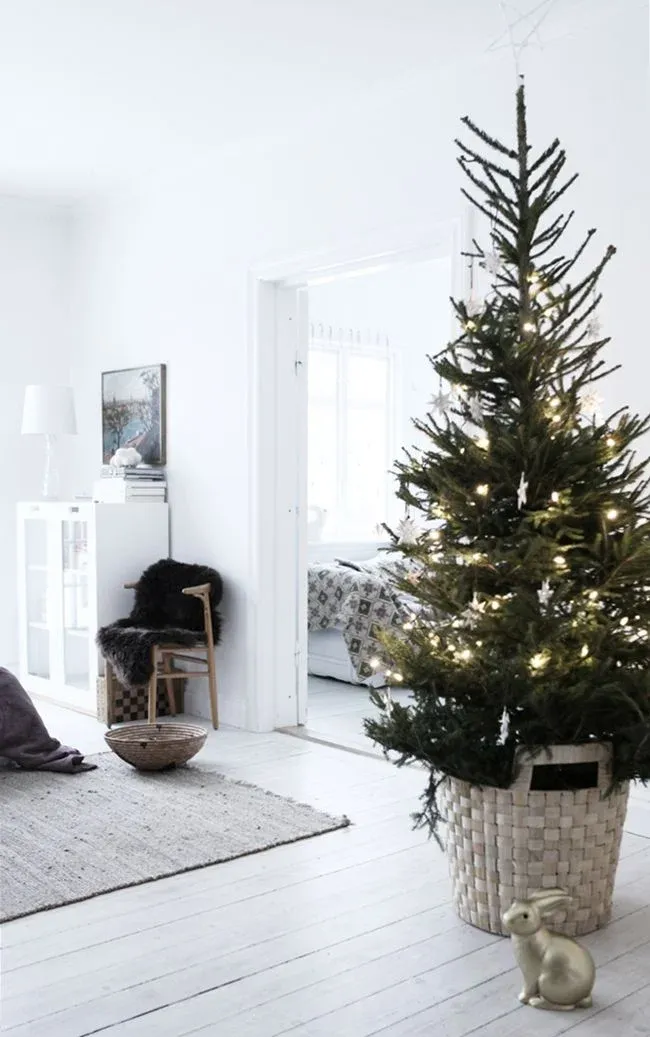
The gold rabbit figurine at the base of the tree. It’s small, it isn’t Christmas, and it’s the reason this corner reads as a real room instead of a display. A little brass or gold animal gives your eye somewhere unexpected to land, and it breaks up the white-on-green repetition that minimalist trees fall into. Pick one small, slightly odd object and give it a place of honor under the branches.
Woven baskets look best when the tree sits in a rigid inner pot first — that way the basket holds its shape instead of leaning. Line the basket with a plastic sheet, then the pot, then cover the gap with a folded white cloth or a piece of sheepskin. It takes ten minutes. Compare with Idea #19, which does the same white look at triple the volume.
One Corner Is Enough to Start
Pick the single idea you can’t stop thinking about and do only that this year — a basket swap, three dried orange slices, one warm-white string. That’s usually all it takes to make a room feel like the season arrived. Pin your favorite to a board named after the room you’re actually working on, and start there.
