29 Jaw-Dropping Outdoor Christmas Tree Ideas You Need to Try This Season
Outdoor Christmas tree displays are having a serious moment on Pinterest right now — and the saves tell the story. People aren’t searching for “a tree” anymore, they’re searching for a feeling: the glow from the sidewalk, the front yard that makes the whole street slow down.
We spent real time browsing Lowe’s, Terrain, Home Depot, and Target to bring you only what’s worth your attention this year, with looks that run from about $18 in string lights to $3,550 for a full architectural showpiece. Inside you’ll find 29 curated ideas — traditional evergreens with layered warm-white light, sculptural light-only cones, natural foliage dressed in dried citrus, and a few grand civic-scale displays worth studying for proportions alone. Budget and luxury versions sit side by side, so you can see exactly where the money actually matters and where it absolutely does not.
In 2026 the shift is toward silhouette over stuff: fewer ornaments, bolder geometry, and ground-level glow that turns a yard into a room. And stay until the end — we break down the most common mistakes that can ruin these looks.
📌 Save this to Pinterest for later — you’ll want to revisit these ideas.
This post contains affiliate links. If you buy through them, we may earn a small commission at no extra cost to you.
1. A Conical Patio Tree With Warm Lights and Oversized Red Ornaments
Strip away the ornaments, the lights, even the patio furniture, and this display would still read as deliberate — because the one thing holding it together is the dark planter pot. A tree this size standing loose on stone pavers looks like it’s waiting to be planted; dropped into a matte black pot, it becomes furniture, anchored and visually married to the black metal dining set beside it. If you copy one detail from this setup, make it the pot.
- Pre-lit conical tree, 7.5 ft: $180–$450
- Extra warm white LED strands: $22–$55
- Oversized red baubles, set of 12: $28–$70
- Matte black planter, 20 in.: $45–$120
- Weighted base or ground stakes: $20–$50
Budget alternative: buy a bare 7-footer for $60 and wrap it yourself with two 100-light strands, then swap the ceramic planter for a black plastic one you spray-paint matte. That lands closer to $150–$220, and nobody at the curb can tell the difference.
2. Gold and Red Ornaments on a Densely Lit Night Tree
Two principles do all the work here. First, density — this tree is wrapped so tightly that the branches read as one continuous field of warm white, which is exactly why it looks expensive from thirty feet away. Second, restraint in color: gold and red only, no third hue, no white balls sneaking in. When your light temperature and your ornament metal sit in the same warm family, the whole thing glows instead of sparkles.
This look wants one tall tree as the focal point, so budget roughly a 10 x 10 ft clear patch of paving or lawn and at least 8 ft of vertical clearance before you hit a gutter or eave line. A 9–10 ft tree is the sweet spot against a two-story facade viewed from the street; anything past 12 ft starts demanding a lift rental for setup and, more painfully, for takedown in January.
3. A Row of Themed Trees Behind Glass, Framed by the City
The multi-tree window is quietly replacing the single statement tree in urban displays, and 2026 is the year it jumped from retail into street-facing lobbies and front rooms. What makes it read as a collection rather than clutter is that each tree commits to one theme — red and white, gold and naturals, branded ornaments — and never borrows from its neighbor. It’s the same instinct behind the layered glow in Idea #24, just on a smaller footprint.
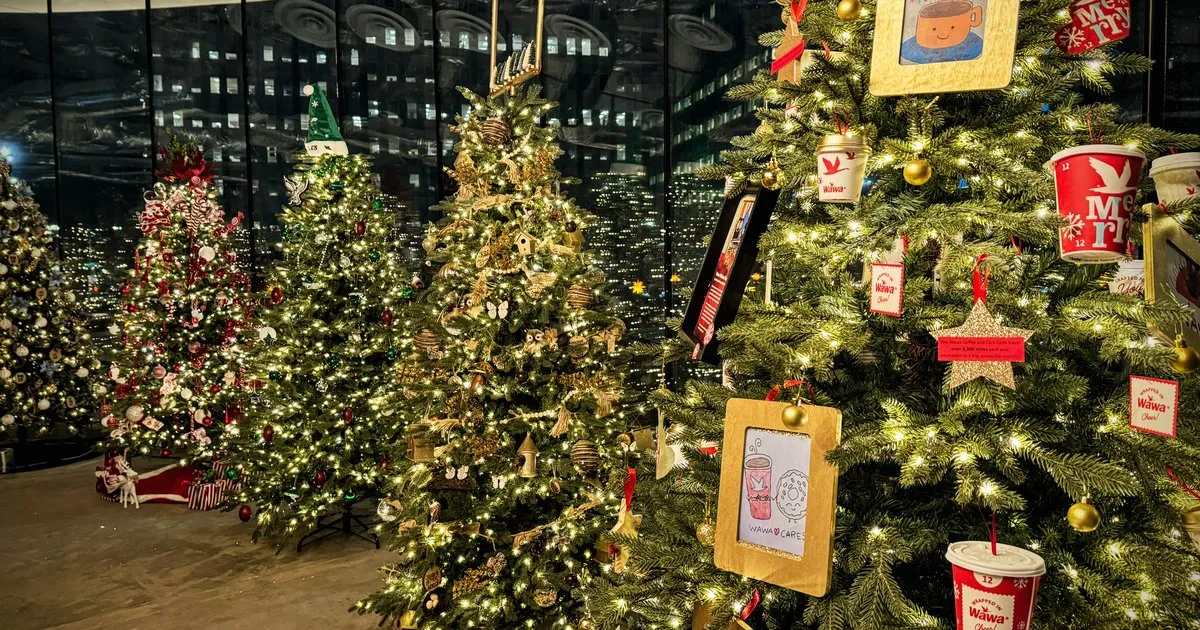
Give every tree in the row the same light temperature and the same height, then change only the ornament story. Contrast that fights on two axes at once — different height, different light color, different ornaments — reads as chaos through glass. One variable, many variations. That’s the whole rule.
60% warm white light + 25% one dominant ornament color + 15% a metallic or natural accent. To swap the mood, keep the percentages and change the players: red and white with silver reads classic, gold with pinecones reads rustic, and a single brand color with matte white reads modern without going cold.
4. The Civic-Scale Tree With Multicolored Lights and a Star Topper
- 40 ft commercial-grade artificial tree: $6,000–$18,000
- Multicolored LED string lights: $1,200–$3,500
- Illuminated star topper: $400–$1,800
- Red protective fencing, 60 linear ft: $500–$1,400
- Lift rental plus install crew: $2,500–$6,000
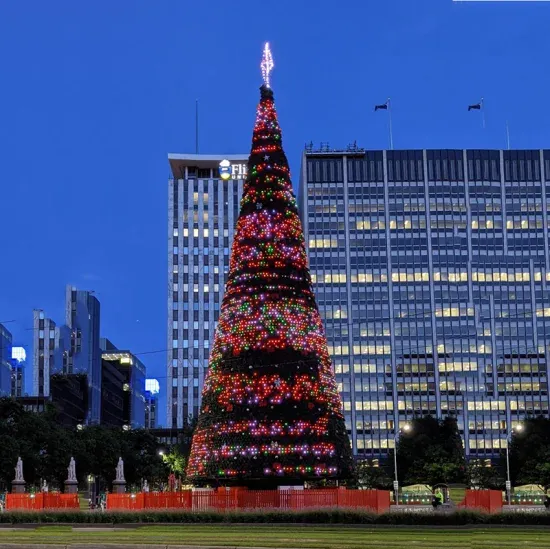
Budget alternative: rent instead of buy. Plenty of municipalities and shopping centers lease a fully decorated tree for the season at 30–50% of purchase cost, delivered, installed, and hauled away.
Multicolored lights on a tree this large only work because of the red fencing — the eye needs a hard edge to land on before it climbs. Without that low red line, the tree looks like it’s floating on the grass. The star then repeats the cone shape in reverse, which is what makes the silhouette readable from a quarter mile away.
5. Bavarian Village Glow: Warm White, Blue-Purple, and Overhead String Lights
That wash of crisscrossing light overhead is the real magic trick, and it’s more engineering than decorating.
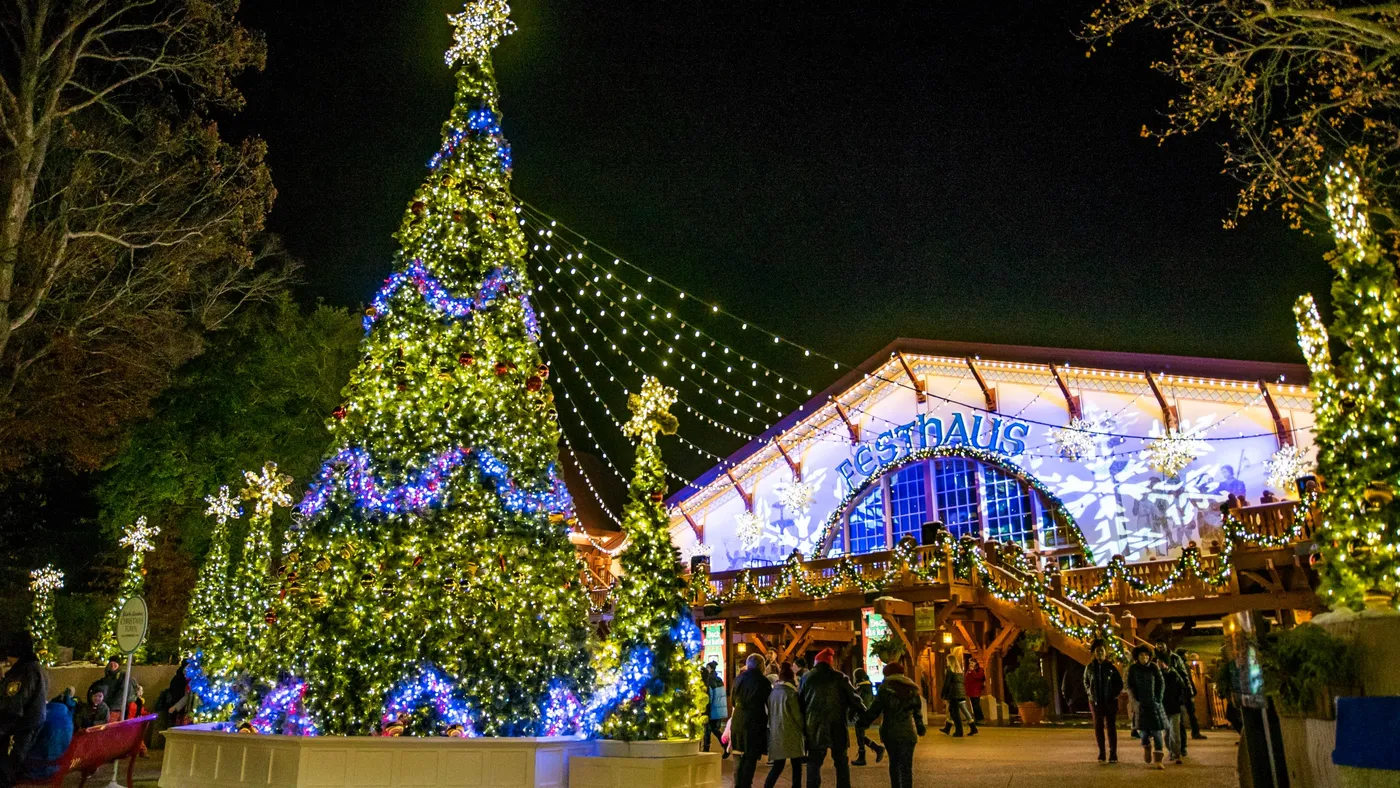
- Map anchor points first — building fascia, two trees, or poles — spaced 15–20 ft apart.
- Attach stainless eye hooks with a 1/8 in. pilot hole; never nail into siding.
- Run a tensioned steel cable between anchors, then zip-tie the light strand to the cable, not to the structure.
- Leave 2–3 in. of slack per span so a wind gust doesn’t snap the wire.
- Plug into a GFCI outlet and hide the run behind a downspout.
About two hours and $90 in cable, hooks, and zip ties for a 40 ft span.
The blue-purple garlands are the one place I’d tell you to go cheap. A $25 cool-toned LED strand from a big-box store next to warm white reads nearly identical to a $200 designer kit at night, especially fifteen feet up. Spend the money on the tree lights instead — that’s where the eye actually lives.
The single element that makes this feel like a village rather than a yard is the star topper. It’s the one warm point of convergence in a scene where light is scattered everywhere. Remove it and the tree becomes just another bright object in a field of bright objects — the star is what gives your eye permission to stop.
6. Bare White Branches, Faceted Stars, and a Snow-Dusted Base
90% negative space + 8% warm light + 2% sparkle. That’s the entire formula, and it’s why three bare-branch trees can hold a whole scene without a single ornament. Swap the white branches for birch-toned ones and the mood warms considerably; swap to black frames with the same lights and you get something more theatrical. Same proportions, different personality.
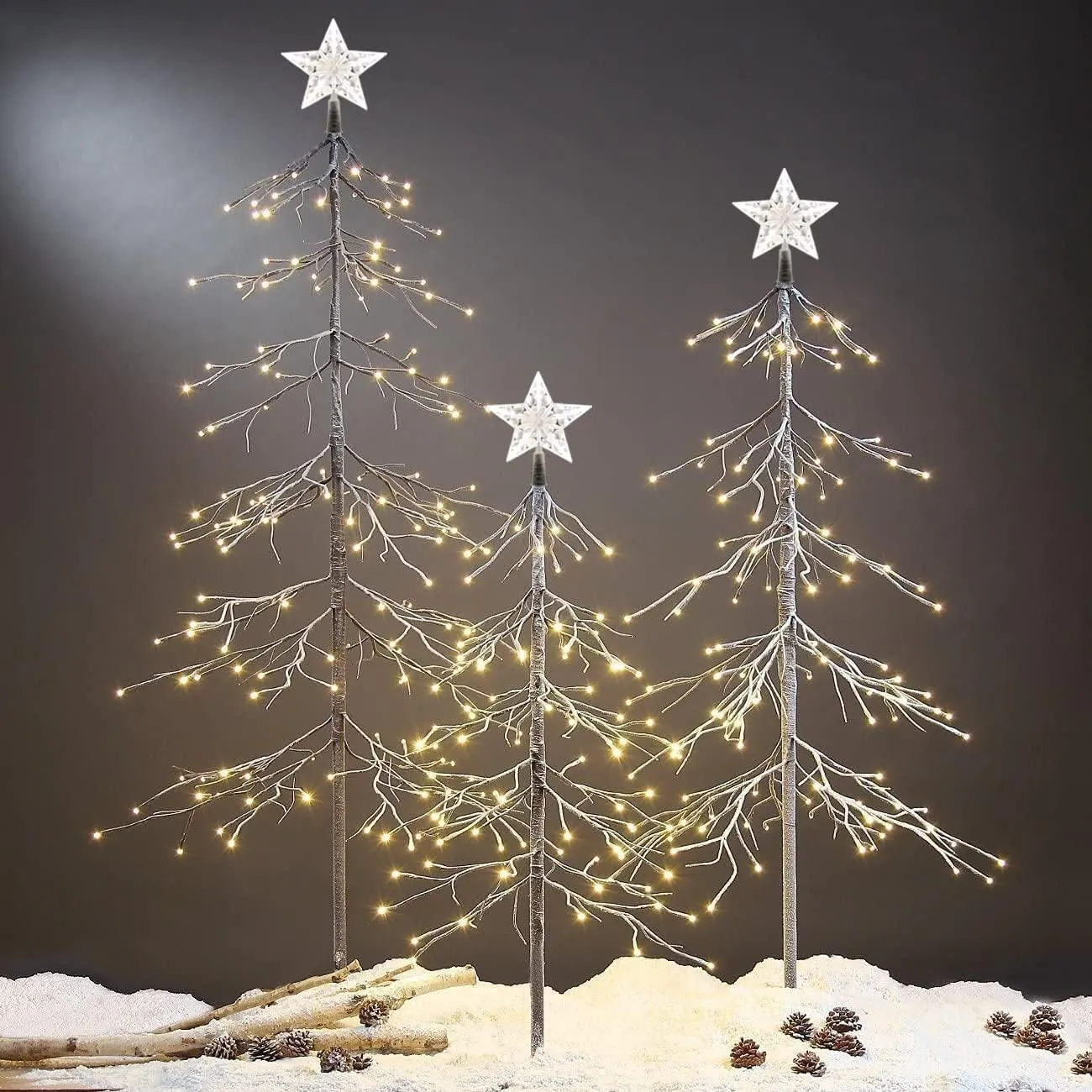
Artificial snow, pinecones, and light wood pieces look pristine for about one season outdoors. Real snow, rain, and freeze-thaw cycles yellow the batting and turn pinecones gray. Plan on replacing the base dressing every year — budget $30–$60 — or skip the faux snow entirely and let actual snowfall do the styling for free. Honestly, the real stuff looks better anyway.
7. Wrapped Evergreens Above a Tiered Brick Retaining Wall
The natural rock and tiered brick wall are doing something no strand of lights can: establishing scale. Wrap evergreens at this size and you need real depth in the yard — figure 20 x 30 ft minimum, plus a grade change of at least 18 in. to build the tiers. On a flat suburban lot, the same wrap along a fence line gets you a very similar glow without any earthwork.
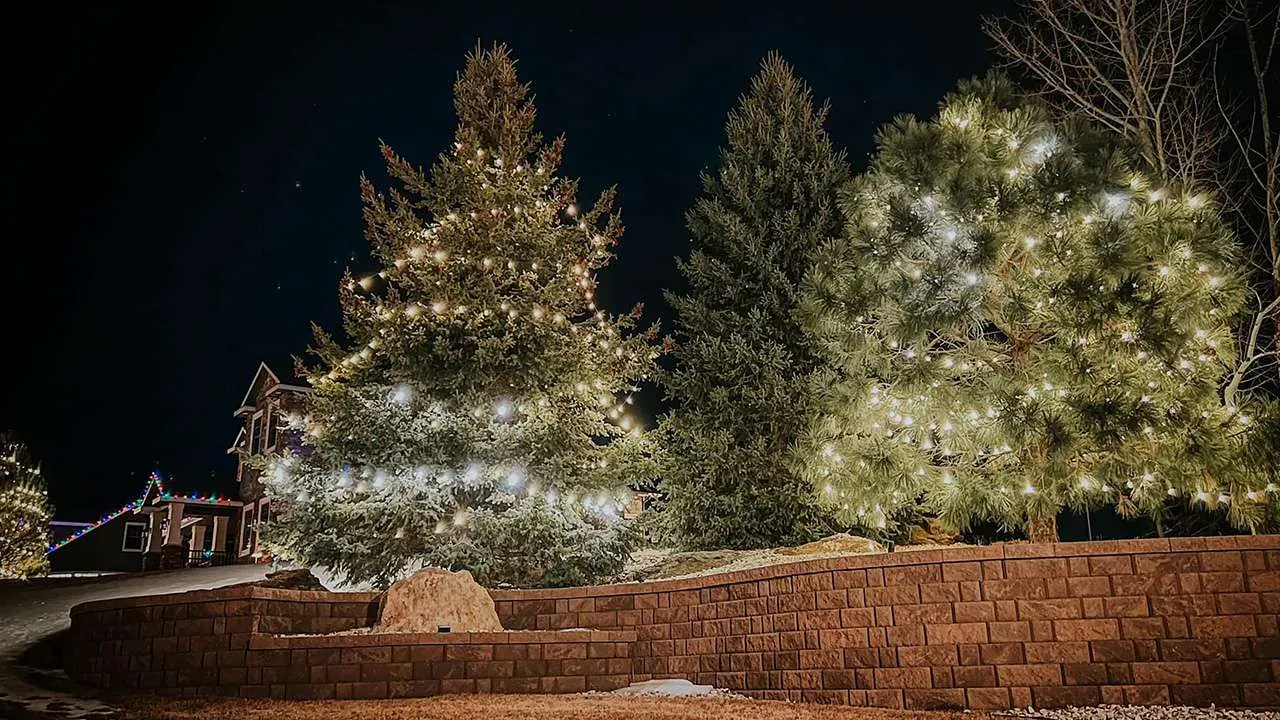
Wrapping a mature evergreen is not the same job as wrapping a shrub. Branches get brittle below 25°F and will snap if you yank on them. Wear gloves, work in daylight, and don’t leave lights on the same tree year-round or you risk girdling the trunk. Anything over 20 ft, hire out — this is the one task where a fall is genuinely likely.
Contrast is the engine: warm white light against a near-black sky, soft foliage against hard masonry. The retaining wall gives the glow something to bounce off, which is why these trees seem lit from below as much as from within. Flat ground would leave the same trees looking stranded.
8. A Cone of Warm White Lights Draped Over the Front Lawn
- Warm white LED strands, 8 x 100 lights: $80–$180
- Steel ground stakes or tomato-cage frame: $30–$90
- Outdoor-rated extension cords: $20–$45
- Timer and GFCI adapter: $18–$40
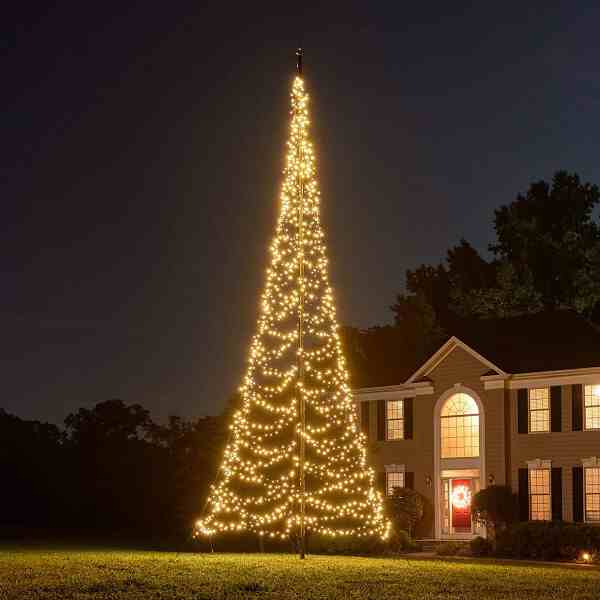
Budget alternative: a $25 pop-up cone frame with two strands of lights gets you 80% of this effect for a fifth of the price. It just won’t swag as gracefully between anchors. Compare with Idea #27 — same silhouette, one saturated color.
Swag, don’t spiral. Wrapping a cone frame in a continuous spiral hides the structure and kills the weepy, draped quality you’re actually after. Instead, anchor at the top and let each strand fall in a shallow loop between two points, spacing loops about 10 in. apart. It takes longer. It is also the entire difference between “light cone” and “Christmas tree.”
9. Light-Only Cone on a Deck, With Multicolor Strings Overhead
You can build this for under $150 and a Saturday. A five-tier tomato cage from a garden center runs about $18, three strands of warm white LED lights around $60, plus a stake driven into the lawn. Big-box stores sell pre-formed versions for $40–$90 after Thanksgiving. The dark patio furniture doesn’t need to match anything — the silhouette is what people remember.
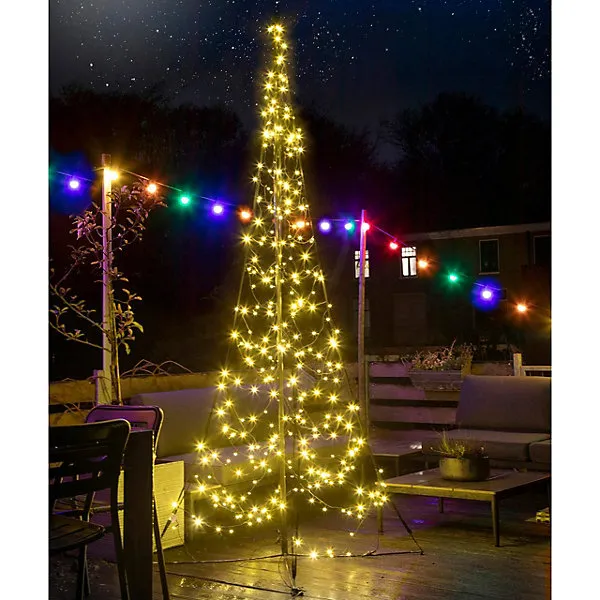
The dark deck is the unsung hero. Put this same glowing cone on light gray composite decking and the effect halves, because the light has nothing to push against. Dark wood, dark stone, or even dark mulch makes the cone read as if it were carved out of the night. If your deck is pale, add a black metal planter base and let it bleed a little shadow underneath.
10. Two Light Cones in Conversation Across the Front Walk
Before you buy a single strand, walk your entry at night with a flashlight and check these:
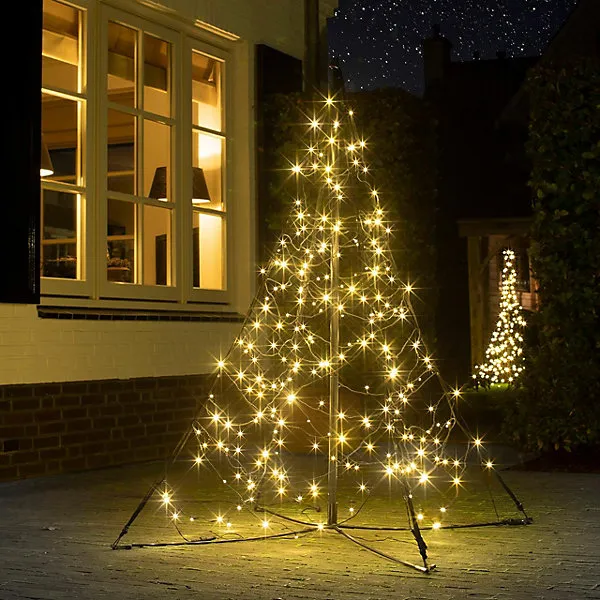
- Measure the facade — two cones look best when one is roughly 60% the height of the other.
- Confirm a GFCI outdoor outlet sits within 25 ft of each location.
- Watch the light path of any porch fixture; a warm porch bulb will fight a cool white cone.
- Verify HOA rules on height and color — many cap displays at 12 ft.
- Note prevailing wind so you can stake the taller cone on the windward side.
70% dark architecture + 20% warm light + 10% cool accent. The cream siding, dark shutters, and blue-black sky are the base; the two cones are the accent. Keep that ratio and swap the cones for lantern-lined paths — the architecture still carries the composition on its own.
11. A White Spiral Tree Anchored by a Potted Evergreen
Three trees, three heights, three textures — and geometry is doing the work. The tall spiral sets the vertical line, the potted evergreen fills the middle band, and the sparse twinkle tree adds the airy top note. Odd numbers, graduated scale, no two elements in the same material. That’s a composition rule you can steal for any entry, with any three objects you already own.
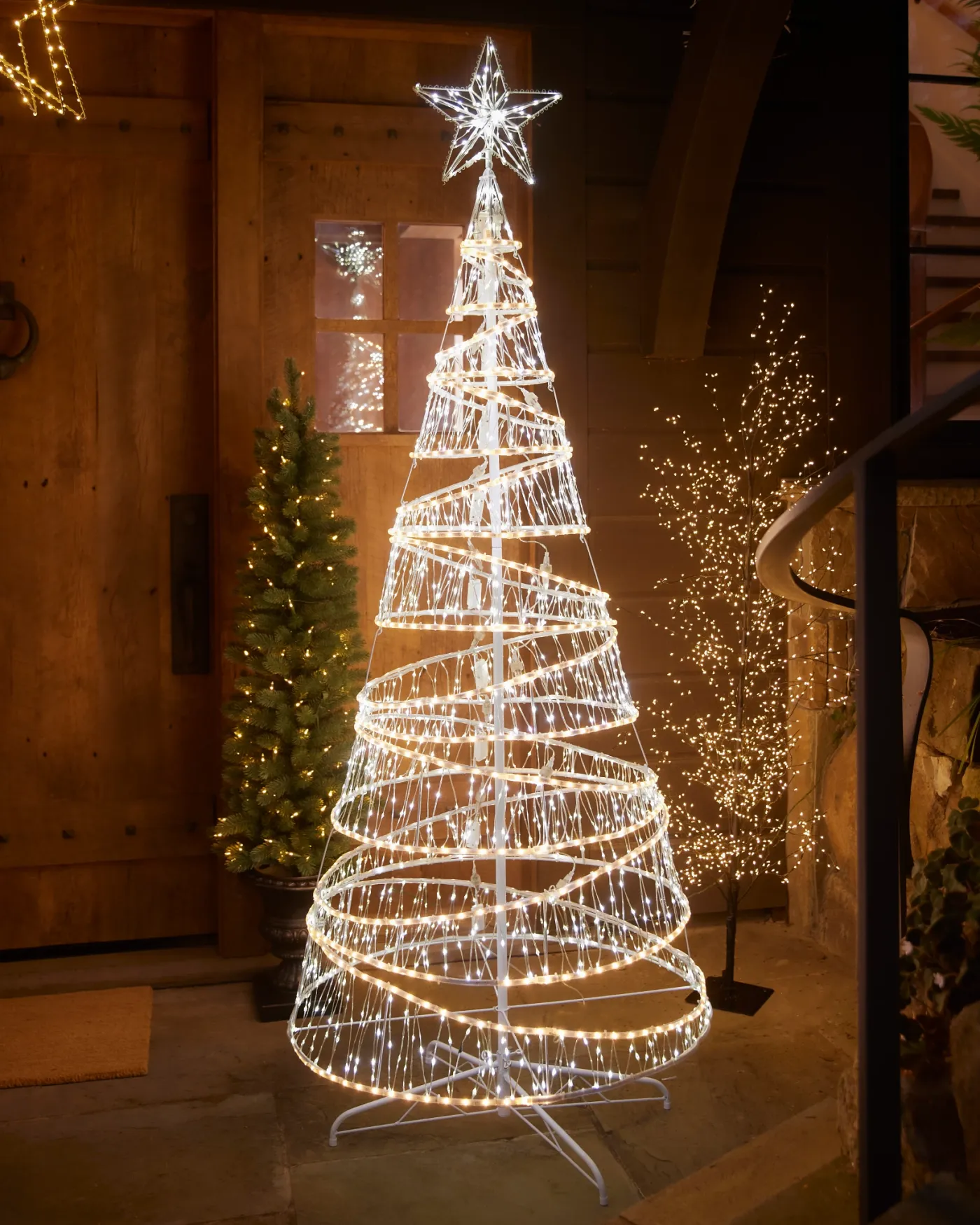
Getting a spiral frame to look this clean is mostly about assembly order:
- Assemble the frame flat on the ground — never build it standing.
- Zip-tie the rope light first, following the frame’s groove with even tension.
- Add the brighter string lights second, running the opposite direction.
- Attach the star while the tree is still lying down; it’s easier on your shoulders.
- Stand it up and weight the base with a sandbag or paver.
About 45 minutes, no special tools.
This grouping needs a landing or porch at least 6 ft wide to breathe. Any narrower and the three trees crowd into one wall of light. On a 4 ft stoop, drop to two elements — the spiral and the potted evergreen — and lose the twinkle tree entirely.
12. The Tiered White Cone That Makes Snow Look Intentional
White LED frames are forgiving about snow but brutal about dirt. Salt spray from a walkway will etch the powder coat over two or three winters, and once it pits, it rusts. Rinse the frame with fresh water after the last snowmelt each spring, dry it completely, and store it indoors. Ten minutes of work buys you four extra seasons.
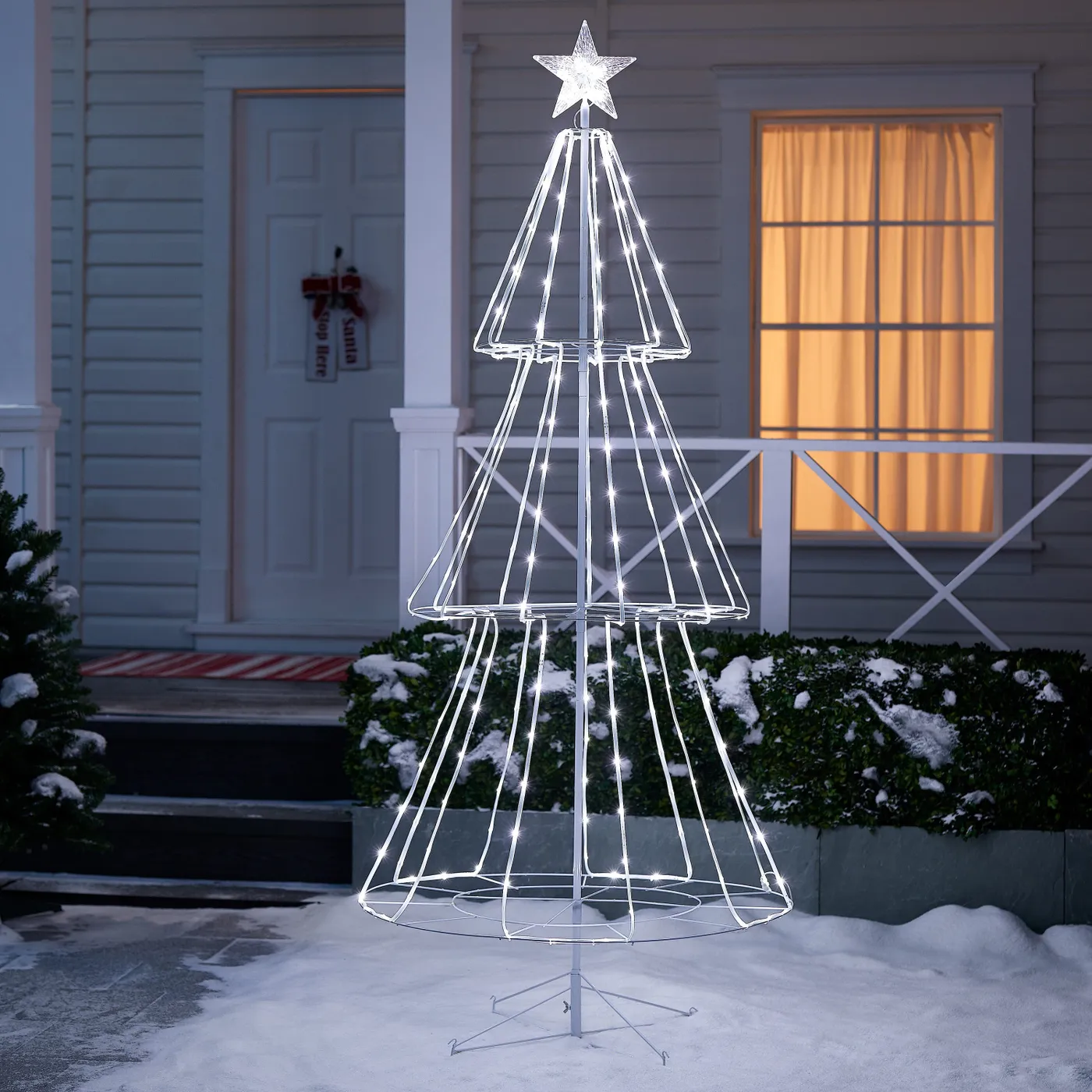
A tiered cone like this retails anywhere from $90 to $400 depending on height. The cheap end uses thinner wire and dimmer LEDs — and at dusk, standing at the sidewalk, you genuinely cannot tell. Put the savings toward the star topper, which is the part people actually photograph. The red bow on the door behind it, incidentally, is doing the same job as a period at the end of a sentence.
13. Multicolored Lights, a Red Starburst, and Glowing Orbs on the Ground
Ground-level light orbs are the detail that separates a 2026 display from a 2019 one. Pinterest saves for globe lights and oversized yard spheres have climbed steadily as people realize that decorating the ground plane makes a display feel immersive rather than merely vertical. It’s the same instinct behind path lighting — you’re building a room outdoors.
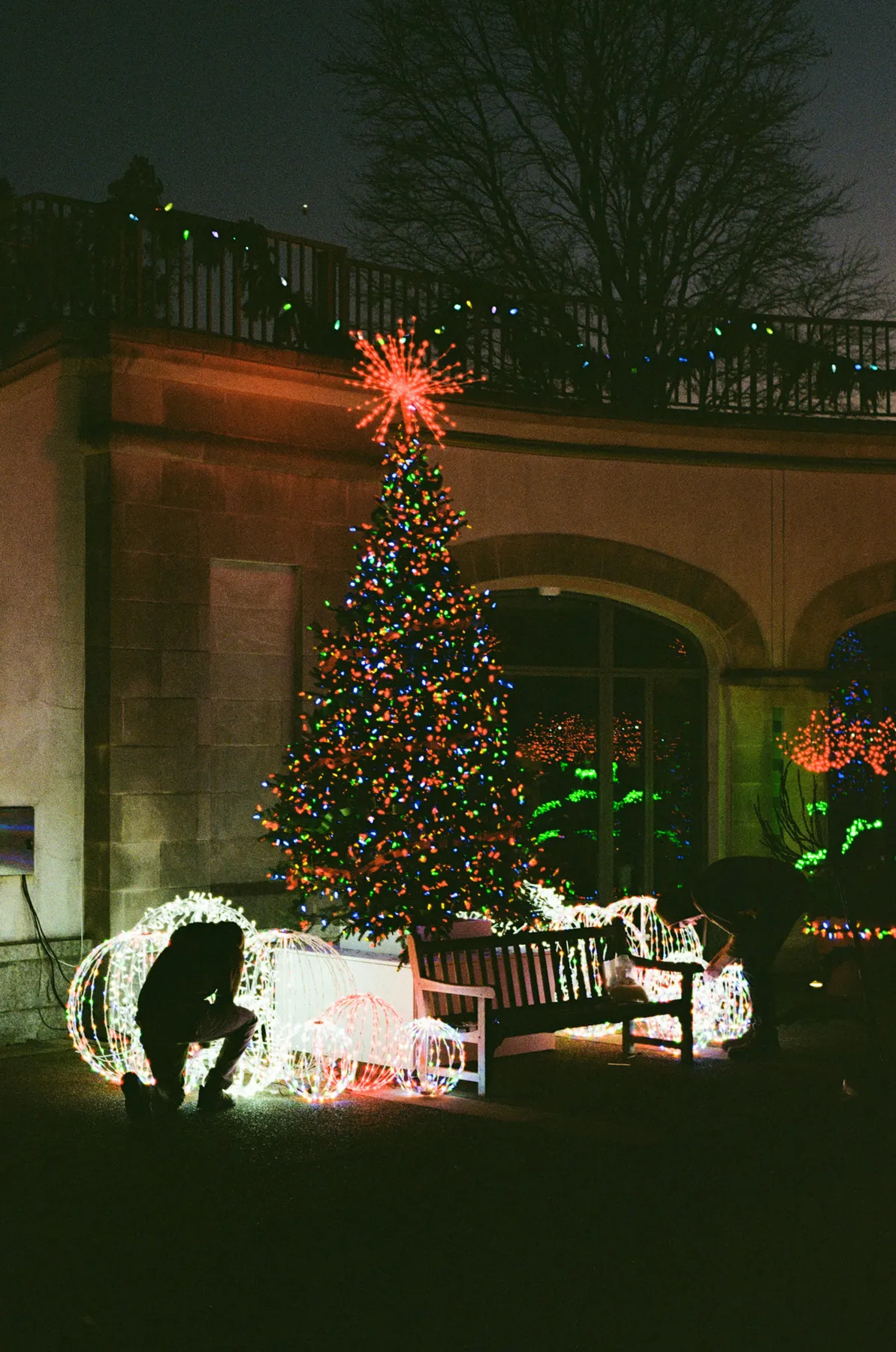
Keep the orbs at least 60% smaller than the tree’s width and never place them in a straight row. Cluster three in a loose triangle on one side of the tree and leave the other side completely empty. Symmetry is what makes yard ornaments look like a store display; a little lopsidedness is what makes them look like a home.
Everything in this scene is multicolored except the topper — and that’s precisely why the red starburst works. It’s the one place your eye can rest in a field of competing hues. Put a multicolored topper on this tree and the whole thing dissolves into confetti.
14. Trees Ringing a Fountain Under a Glass Conservatory Roof
This is a 3,000-plus sq ft footprint with a 30 ft ceiling — the kind of volume that can absorb seven full-size trees without two of them fighting. Most homes can’t, and shouldn’t try. If the many-trees look appeals to you, cap it at three in a space under 500 sq ft, and make sure each one occupies a separate sightline from the doorway.
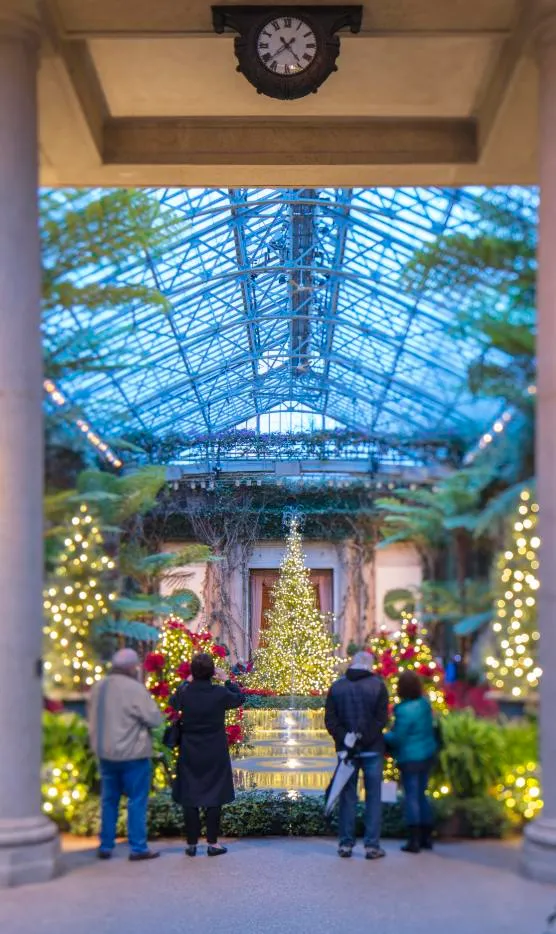
The fountain is the anchor and the trees are arranged around it in a rough ring — a classic radial composition. Every tree faces inward, so the light collects at the center instead of spilling past the glass. It’s the same reason a dining table ringed with chairs feels calm: the arrangement has a gravitational center. Same instinct as Idea #5, just under glass.
15. A Fireworks-Like Starburst Cone on a Backyard Lawn
Starburst lights come as a set with a hub, and assembly order matters more than you’d think:
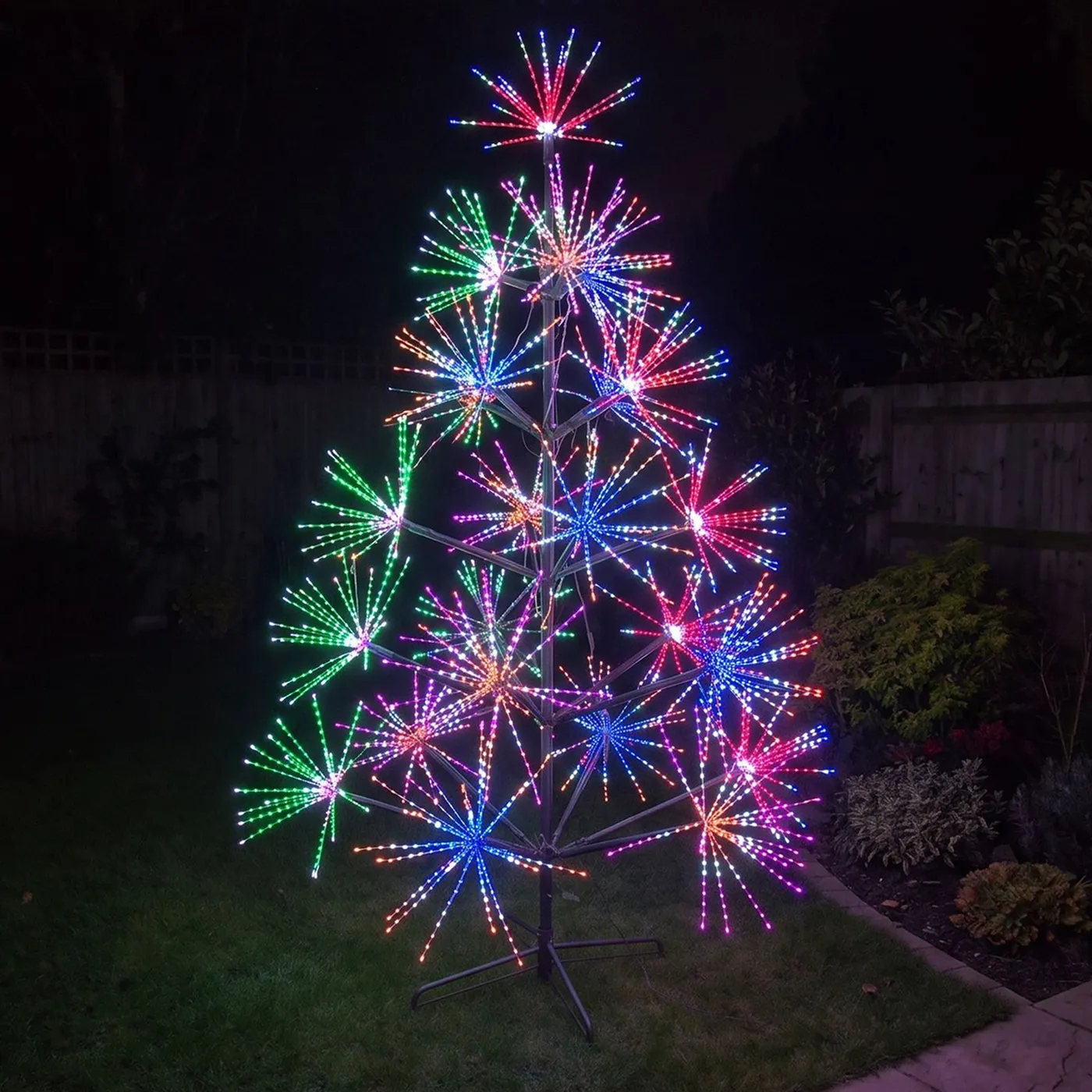
- Stand the cone frame and stake it at four points before attaching anything.
- Mount the hub at the top center of the frame.
- Attach each starburst cluster working from the top ring downward so cables never cross.
- Test every cluster before you close the frame — replacing one later means a ladder in the cold.
- Run a single black cord down the back, never the front.
Roughly 90 minutes, no tools beyond a mallet.
80% dark ground + 15% saturated multicolor + 5% negative space. The dark lawn and fence are the canvas; the lights are the subject. Want it calmer? Swap to all-warm-white starbursts and add two shrubs’ worth of warm net lights behind. Identical composition, entirely different volume.
16. Dried Orange Slices and Pink Baubles on a Stone-Front Lawn Tree
Dried orange slices are the cheapest texture upgrade in outdoor decorating — about $6 of oranges, six hours in a 200°F oven, and a coat of matte polyurethane so rain doesn’t ruin them. Hang them with twine rather than wire, and place them on the outer third of the branches where they’ll actually catch light. Store them dry and they’ll last two seasons.
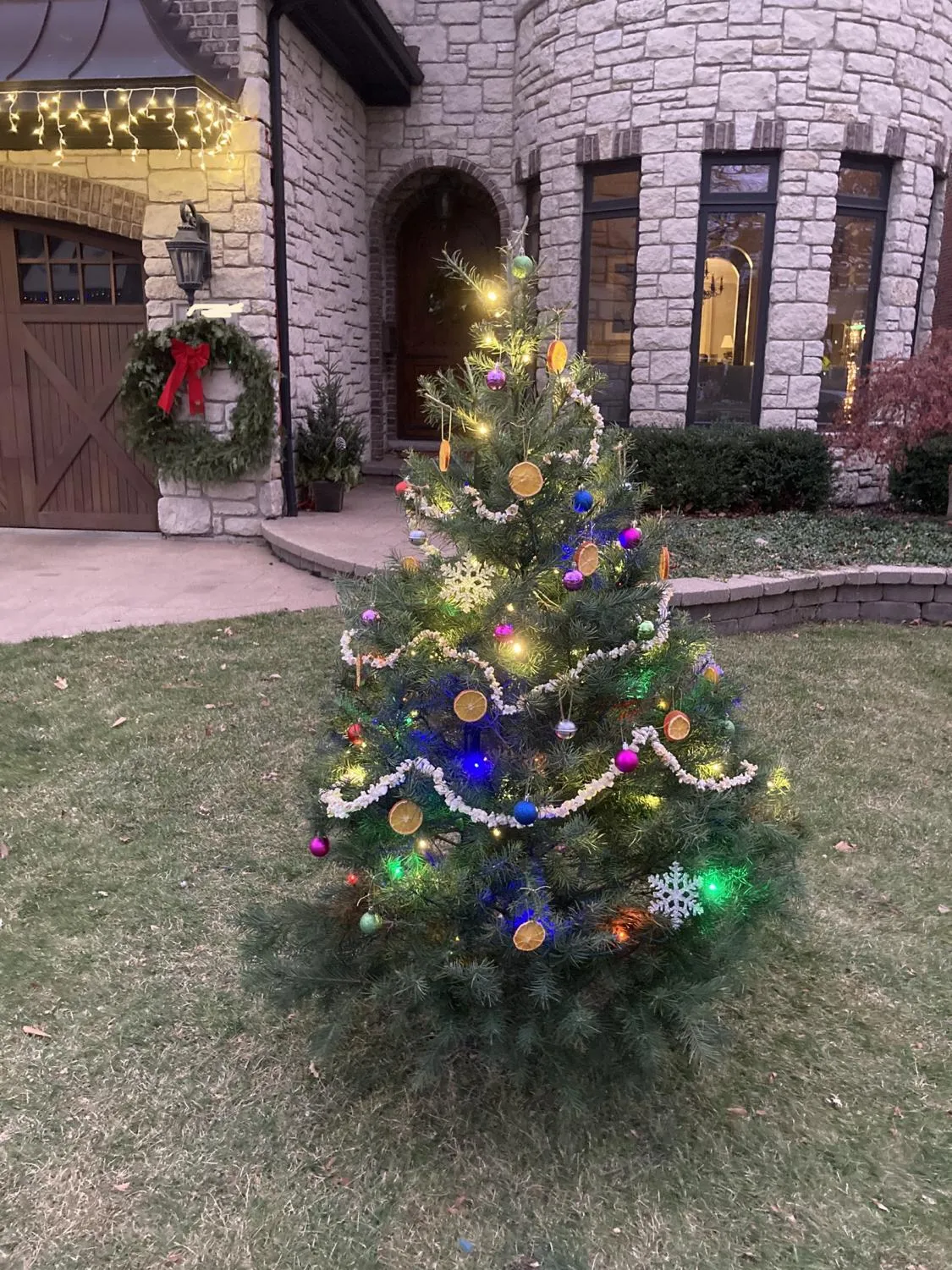
Nothing on this tree came from a showroom. Multicolored LED strands from Walmart, dried citrus from the grocery store, baubles from a thrift bin, and a beaded garland strung from a $4 craft strand. The whole thing runs under $90, and it’s the most photographed tree on the block precisely because it looks collected instead of purchased.
Multicolored lights plus multicolored ornaments is a lot of variety, and this only works because the tree sits against a gray stone facade that mutes everything. Against red brick, the same tree tips into visual noise. If your exterior is warm-toned, cut the ornament palette to three colors and let the lights stay colorful.
17. Metallic Gold Balls and Red Bows Above Snow-Dusted Planters
- 9 ft unlit evergreen: $160–$400
- Warm white LED strands, 4 x 100: $45–$110
- Oversized gold ball ornaments, set of 12: $40–$95
- Weatherproof red ribbon, 3 rolls: $24–$55
- Two evergreen planters: $70–$180
- Stakes, timer, outdoor cord: $45–$95
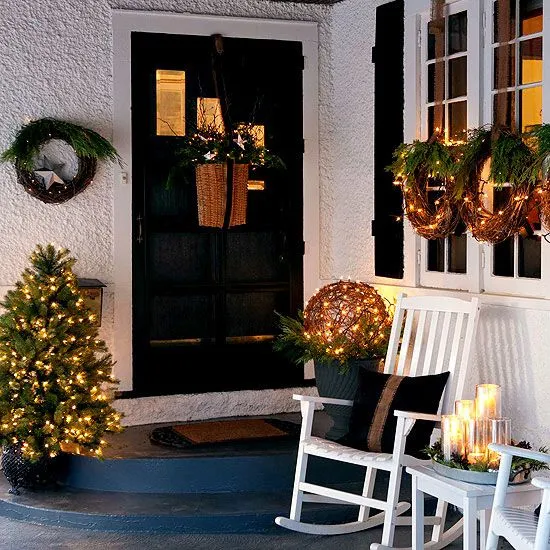
Budget alternative: skip the new planters and fill pots you already own with clipped cedar from the yard. That alone saves $100–$150, and clipped greens look better than anything boxed.
The planters are doing more than you think. They repeat the tree’s cone shape at a fraction of the size, which gives the whole front bed a rhythm. Remove them and the tree stands alone on snow — pretty, but unresolved. Two pots of the same evergreen at a fifth the height is what turns a decorated tree into a designed front garden.
This layout wants about 8 ft of frontage and a tree that clears the bottom of your windows — usually 9–11 ft for a single-story facade, 12–14 ft for two. Anything under 7 ft gets swallowed by a hedge. If your bed is under 5 ft deep, drop the planters and run low evergreen roping instead.
18. A Slender Tree Where Reflective Spheres Do the Heavy Lifting
Reflective spheres are gorgeous and high-maintenance. The mirror finish shows every fingerprint, water spot, and speck of pollen, and the coating on inexpensive ones clouds after two winters. Wipe them with a microfiber cloth and plain water at the start and end of each season, store them wrapped in tissue in a dry bin, and keep them well away from lawn irrigation.
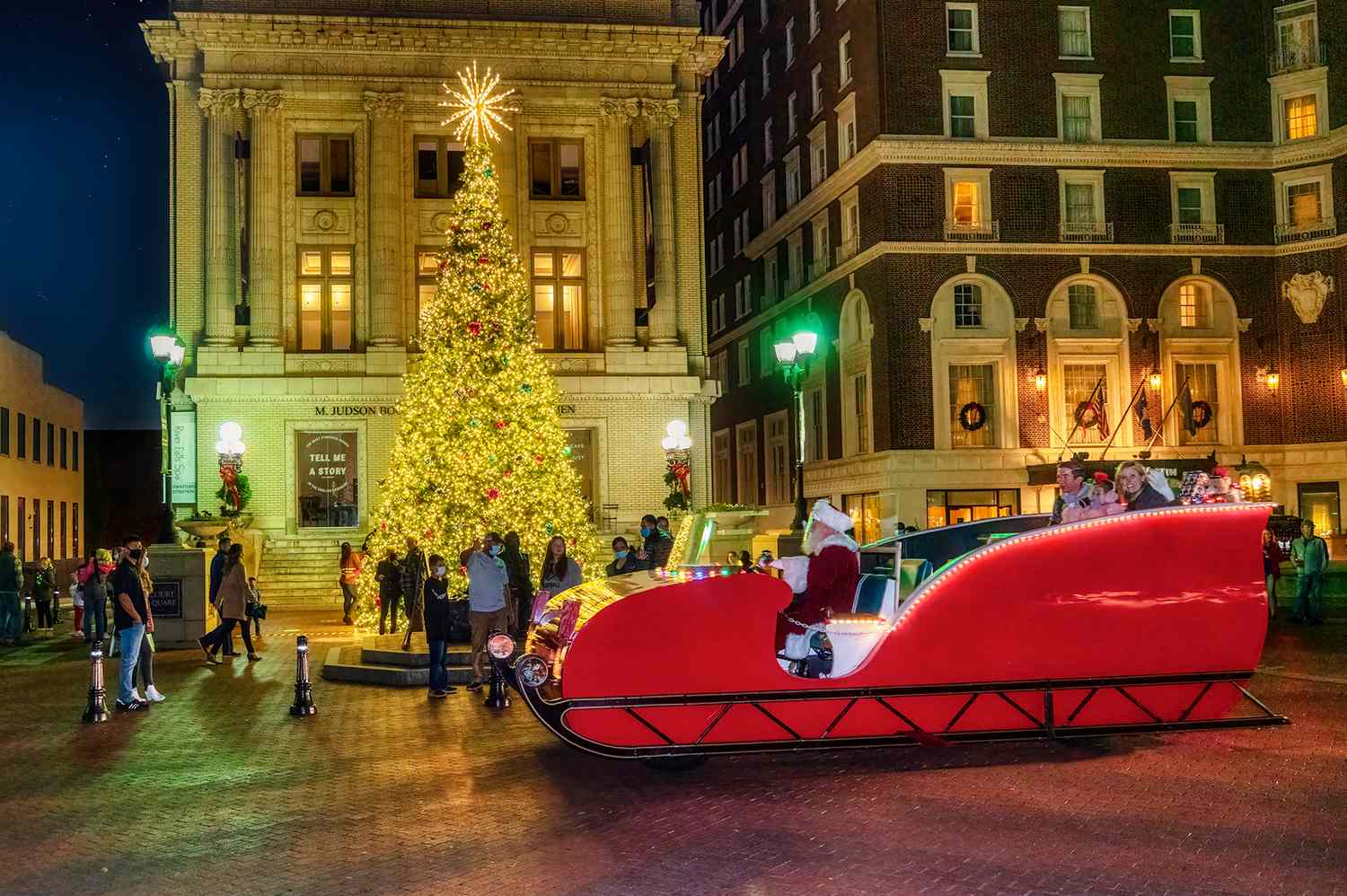
Slender, close-branched trees have quietly become the default for small front yards and townhouse entries, and 2026’s versions lean hard into reflective materials — mercury glass, mirror finishes, silvered metals — because they read bright without needing more lights. It’s a practical answer to rising electricity costs and shorter daylight hours, and it’s why this tree looks loaded even though the ornament count is modest.
19. Terracotta Pots, Red Bows, and a Stone Step Procession
The bows are the entire charm here, so take them seriously:
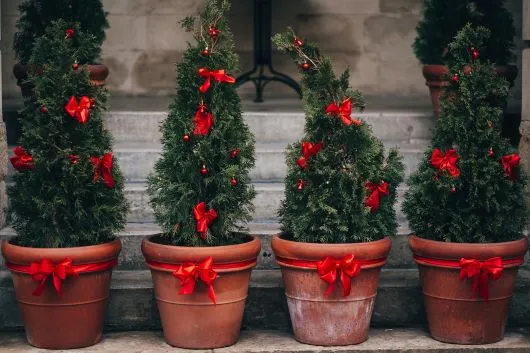
- Buy wired ribbon at least 2 in. wide — flat ribbon looks limp outdoors.
- Cut 24 in. lengths; you’ll lose half of it in the loops.
- Build the bow in your hand, pinch the center, and tie off with floral wire.
- Attach to the pot’s rim with a zip tie, never tape.
- Alternate bow orientation — one high, one low — so the group doesn’t look stamped.
Under an hour for four pots, about $18 in ribbon and wire.
Terracotta pots from a garden center run $8–$20 each; the same size in glazed ceramic runs $40–$90. Plain terracotta is the better choice anyway — the warm orange plays off deep green in a way black plastic never will. Check Facebook Marketplace in late November, when people unload last year’s planters. Pair this with Idea #28, which applies the same red-and-green discipline at the front door.
20. Turn a Flagpole Into a Tree With Swagged String Lights
95% vertical line + 5% light. That’s it — this works because the pole already has the proportions of a slender conifer, so the lights only need to sketch the outline. To change the mood, change the strand color: warm white reads traditional, cool white reads contemporary, and a soft green or red reads playful. The shape never has to change.
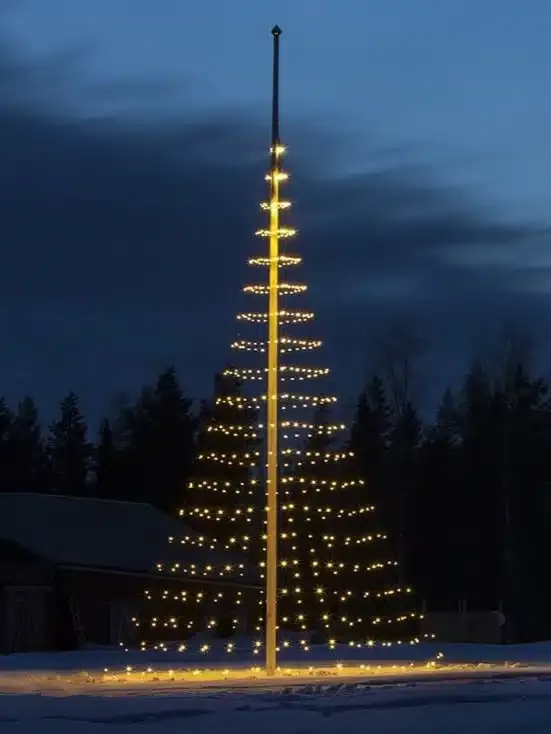
Check these before you haul out the ladder:
- Confirm the pole is fixed, not a retractable flagpole that rotates in wind.
- Measure the base circumference — you’ll need roughly 1 ft of strand per 3 in. of height.
- Verify an outdoor outlet within 30 ft, or plan on a heavy-duty grounded cord.
- Make sure your anchor clips won’t scratch a powder-coated finish.
- Decide up front how you’ll get the top strand back down. That’s the part everyone forgets.
21. One Slender Tree Lighting a Snowy Curve in the Road
Restraint. One tree, one color, one purpose — and it’s more memorable than a yard full of inflatables. The dark winding path gives the eye a line to follow, and the tree becomes the destination at the end of it. That’s basic wayfinding design applied to a front yard: light the thing you want people to look at, and let everything else stay dark.
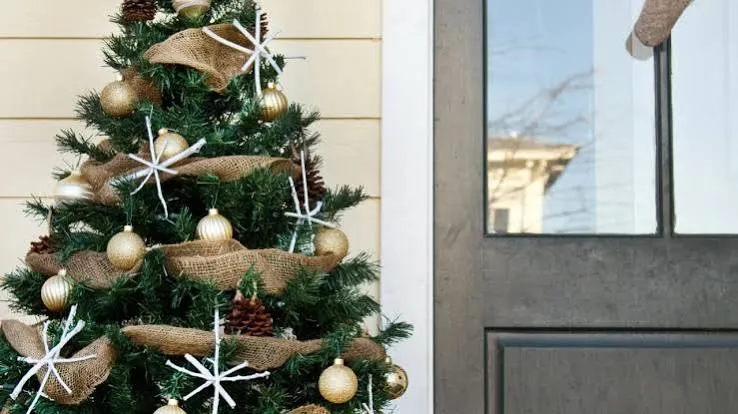
A single tree this exposed will take every bit of wind your property gets. Use a weighted base rated for your region’s gusts, guy-wire it to ground anchors on the prevailing-wind side, and re-check the tie-downs after the first big storm of the season. If your road is a plow route, keep the tree at least 6 ft behind the shoulder or the first big snowfall will relocate it for you.
22. Wireframe Gift Boxes and a Projected Facade of Ornaments
Projection mapping has finally gotten cheap enough for commercial displays, and it’s trickling down fast — a decent outdoor projector now runs under $300 and can wrap a two-story facade in animated ornaments. The wireframe gift boxes and oversized ground ornaments are the physical half of the same idea: props that read as light rather than as objects.
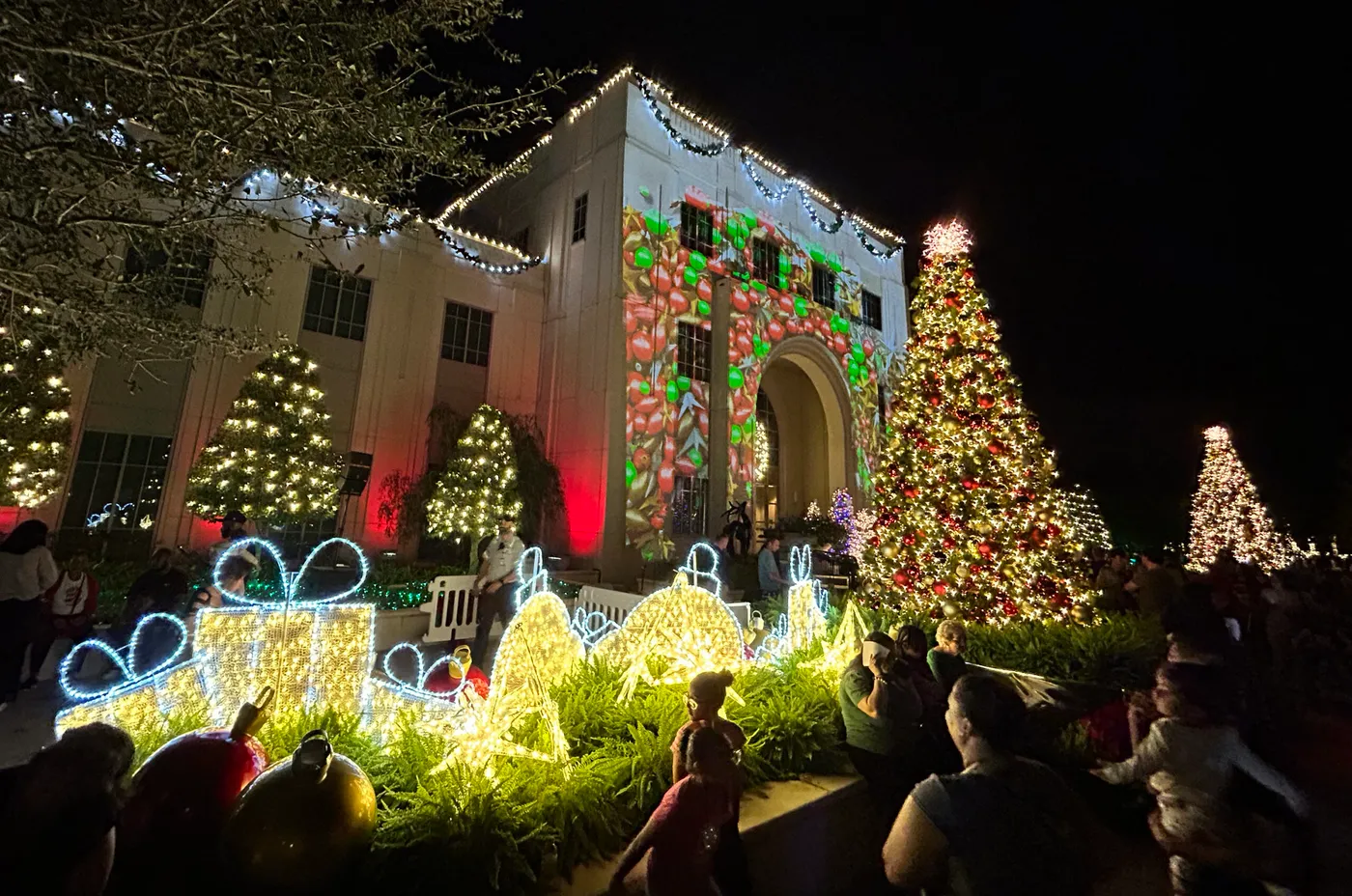
- Outdoor projector with weather housing: $280–$900
- Wireframe gift box set of three: $150–$420
- Oversized ground ornament balls: $120–$380
- Roofline string lights: $90–$260
- Two 8 ft lit trees: $400–$1,200
Budget alternative: rent a projector for a single holiday weekend. Many event rental shops charge $75–$150 per day, which is a lot cheaper than owning one you use twice.
Point the projector from a fixed surface where a car can’t clip it, and aim slightly upward. A 10-degree tilt removes most keystone correction headaches. Test the mapping at the exact hour your display runs — an image that looks striking at 6 p.m. can look washed out at 9 p.m. once ambient light drops.
23. The Full Suburban Spectacle: Santa, Deer, and Candy Cane Lane
Inflatable and illuminated figures are the highest-maintenance items in any display. Motors burn out, fabric mildews, and deer with incandescent bulbs pull real wattage. Expect to replace one figure every other season, budget $40–$80 annually, and store everything bone-dry with a silica packet. LED figures run cooler, last longer, and cost about 80% less to operate.
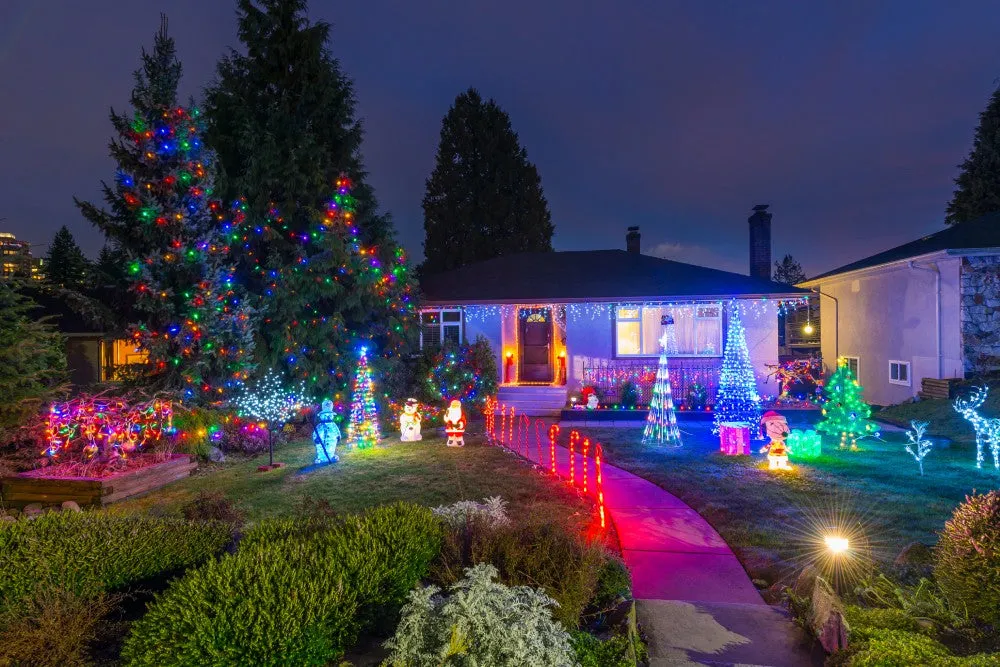
Running power to fifteen separate decorations is where most people give up:
- Sketch the yard and group figures into three zones — left bed, center lawn, right bed.
- Give each zone one 12-gauge outdoor extension cord from a GFCI outlet.
- Use a 6-outlet power stake at the end of each zone cord.
- Plug all three zones into a single smart timer set to come on at dusk.
- Bury or edge-run every cord so the mower and the mail carrier both survive.
One afternoon and $60–$120 in cords and stakes.
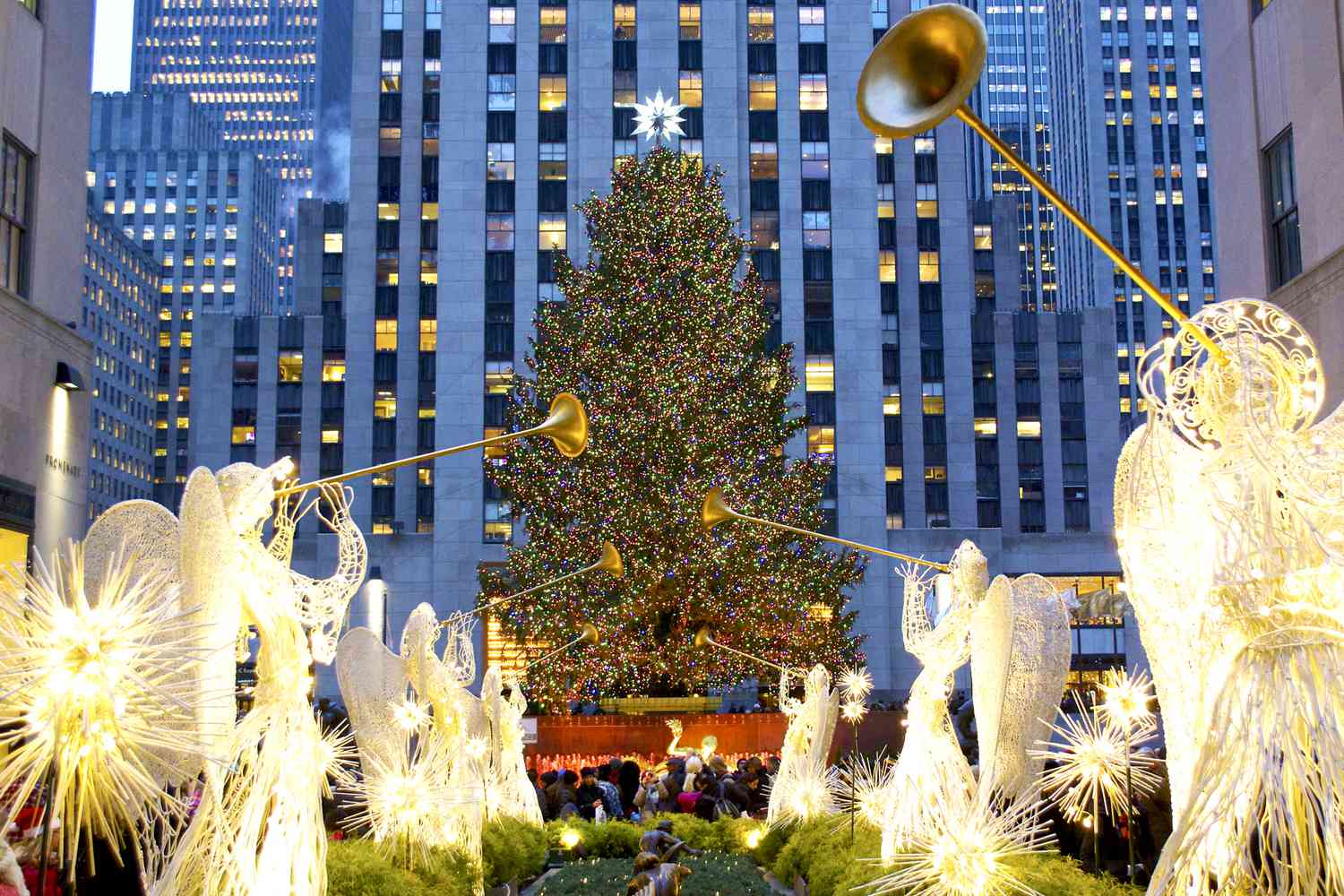
24. Angel Sculptures and Golden Trumpets Flanking a Plaza Tree
Symmetrical sculpture pairs need a plaza-scale void to work — think 40 ft of open paving and buildings at least 20 ft tall. In a residential yard, angels at this height look like they’re guarding a driveway. If you love the idea, go small: two 3 ft lit angel silhouettes flanking a path, spaced about 8 ft apart.
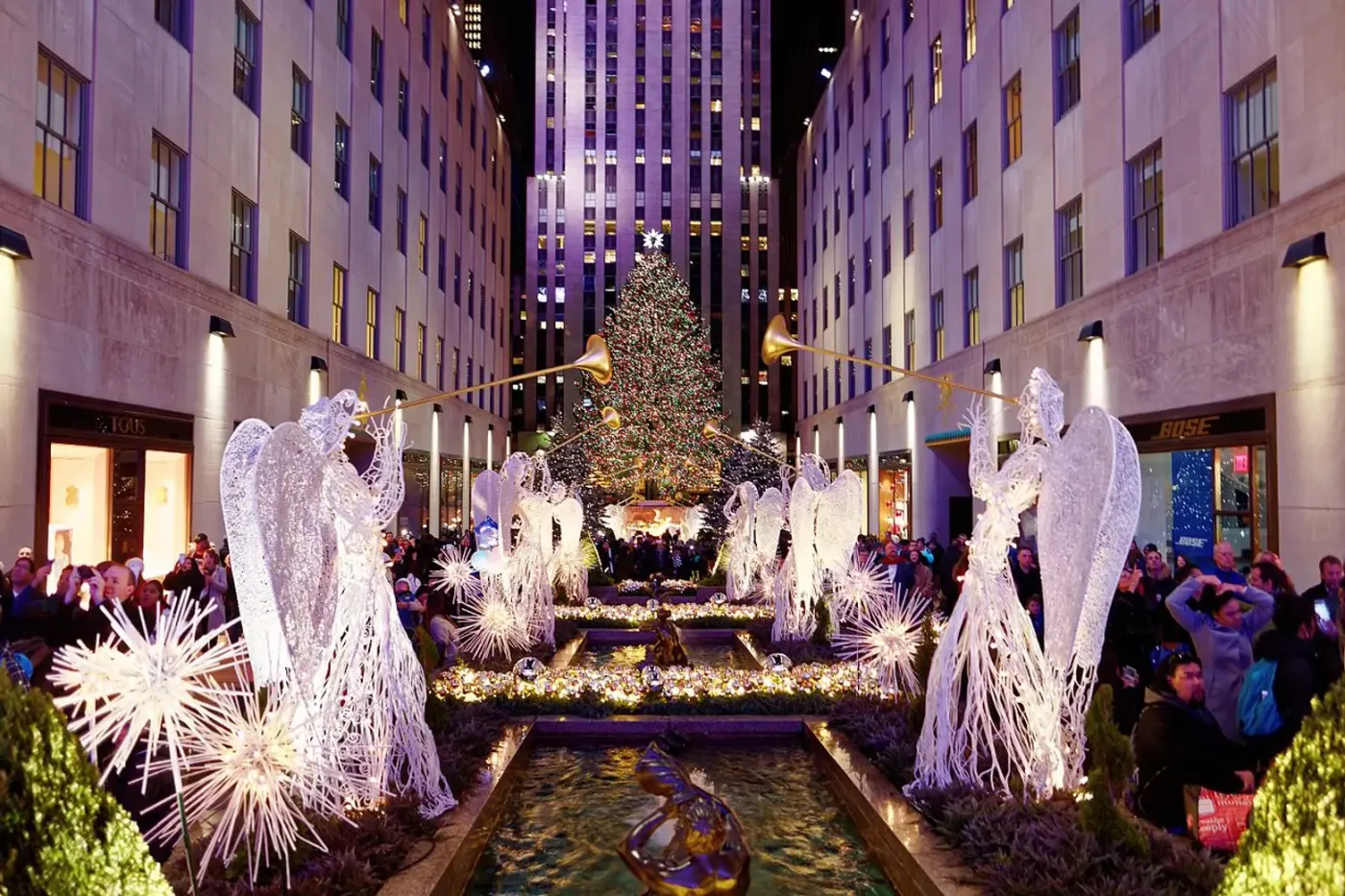
The angels are both symmetry and repetition — two identical figures, mirrored, at equal distance from the tree. That’s what makes the tree feel enshrined rather than merely decorated. And the gold trumpets pick up the warmth of the tree lights while the white figures hold the cool end. Two temperatures, one composition.
Lit angel sculptures run $120–$600 a pair depending on height. The budget play is a pair of 32 in. white wireframe angels at $35–$55 each, staked into low greenery so the bases disappear. Nestle them into shrubs and the $70 version reads like the $600 one. The gold-and-red discipline from Idea #17 carries all the way up to plaza scale.
25. An Enchanted Path Where the Pond Catches Every Light
Water and electricity demand respect. Every cord near a pond needs a GFCI outlet and a drip loop — a deliberate low point in the cord so water runs off instead of into the plug. Keep fixtures at least 10 ft from the water’s edge unless they’re rated for submersion, and check local code before running anything permanent. This is not the place to save twenty dollars on a cord.
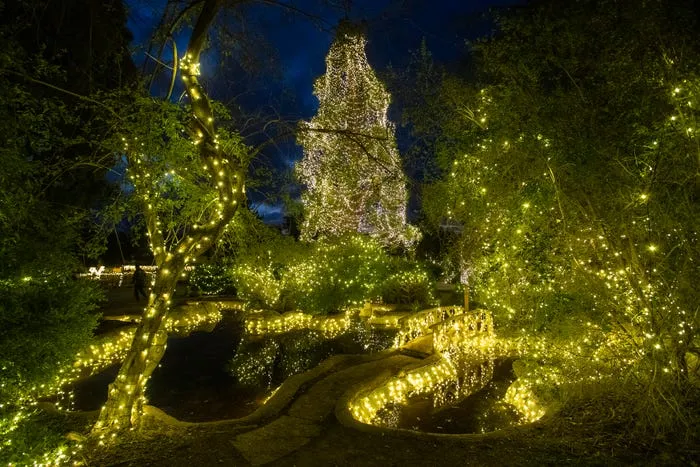
Wrapping trees near water means leaves, algae, and constant moisture. Plan on a spring ritual: unplug everything, wipe the strands with a dry cloth, inspect for cracked insulation, and test each run before storing. Budget two hours every March. Strands that spend the winter over a pond typically last three seasons instead of six.
85% darkness + 12% warm white light + 3% reflection. The pond is doing free work, doubling every source you own. Skip colored lights here entirely — reflection amplifies them into a carnival. And leave a full third of the path unlit so the glow has somewhere to travel.
26. A Barrel Base and a Giant Red Bow Under Red-and-White Lights
- 12–14 ft unlit commercial tree: $700–$2,400
- Red and white LED strands, 10 x 100: $120–$290
- Gold ball ornaments, set of 24: $60–$160
- Barrel-style wooden base: $180–$550
- Custom red fabric bow: $45–$150
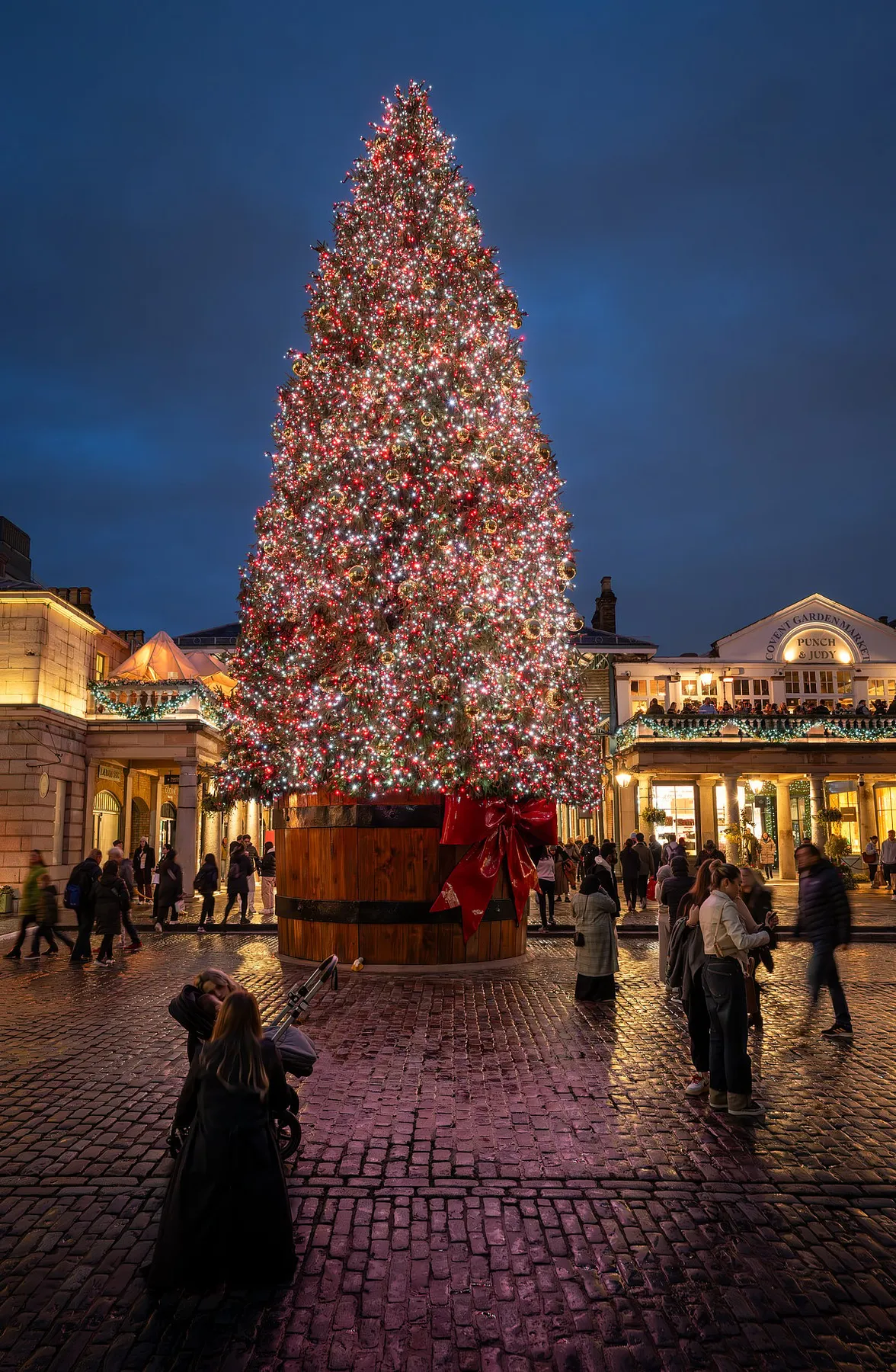
Budget alternative: build the base from a stock whiskey barrel planter ($70–$120) with a coat of dark stain, and tie the bow yourself from two yards of outdoor fabric. Same presence, roughly $200.
Everything above the base is standard-issue Christmas tree. What makes this display memorable is the barrel and the bow — a piece of furniture dressed up as a gift. Without it, a towering tree in a public square is just a tall tree. With it, the whole thing reads as a package someone left behind, and that’s a story people photograph.
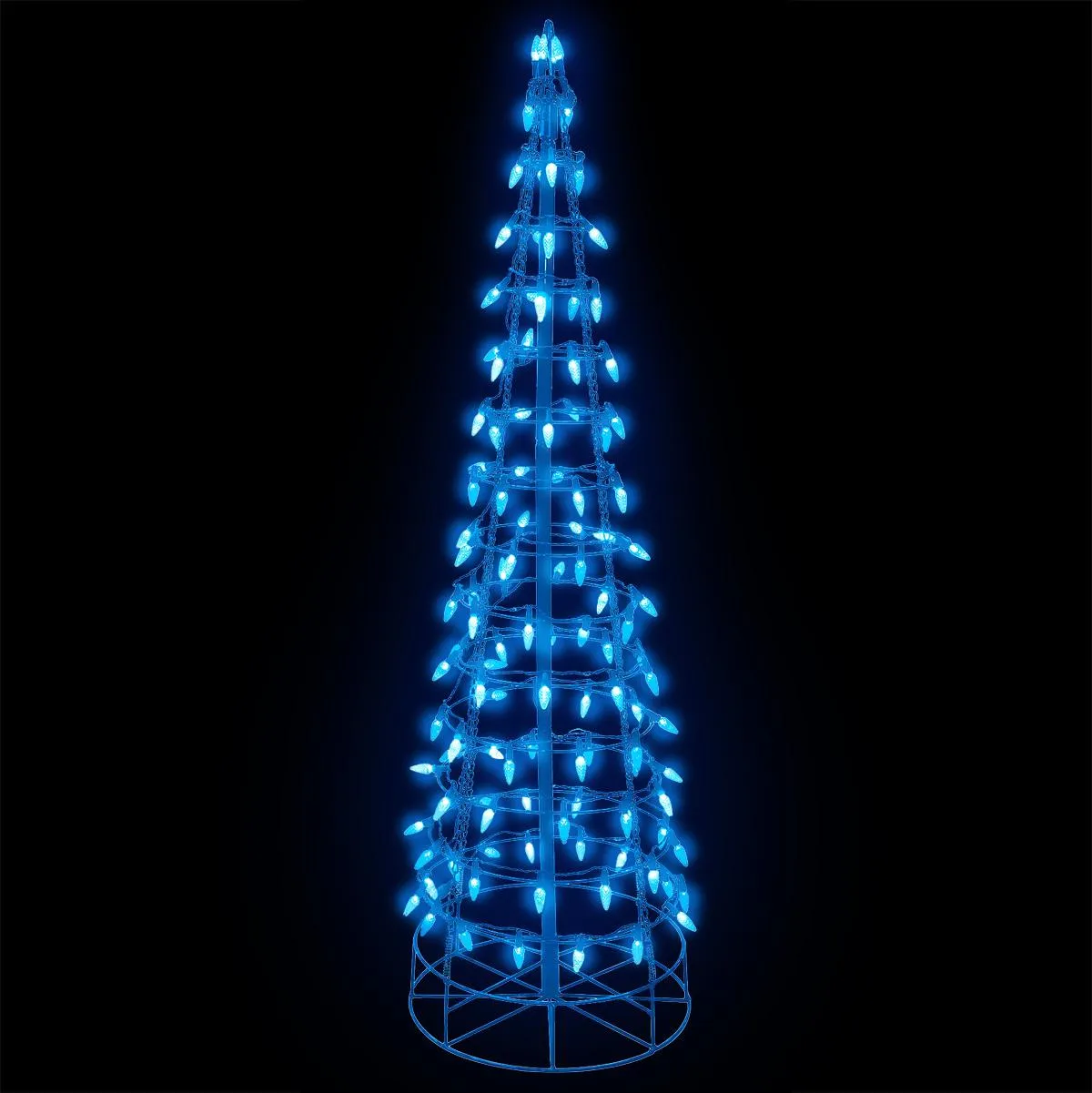
27. An All-Green Light Cone That Argues With the Warm Windows
Deliberate color conflict needs a mediator, and here it’s the lawn. A saturated green cone against warm yellow windows is a bold, faintly uncomfortable pairing — and that tension is the whole point. Anchor it by keeping everything else neutral: no colored wreaths, no multicolored strings, no red accents. One argument per facade. Compare with Idea #9, where the same cone form goes warm white instead.
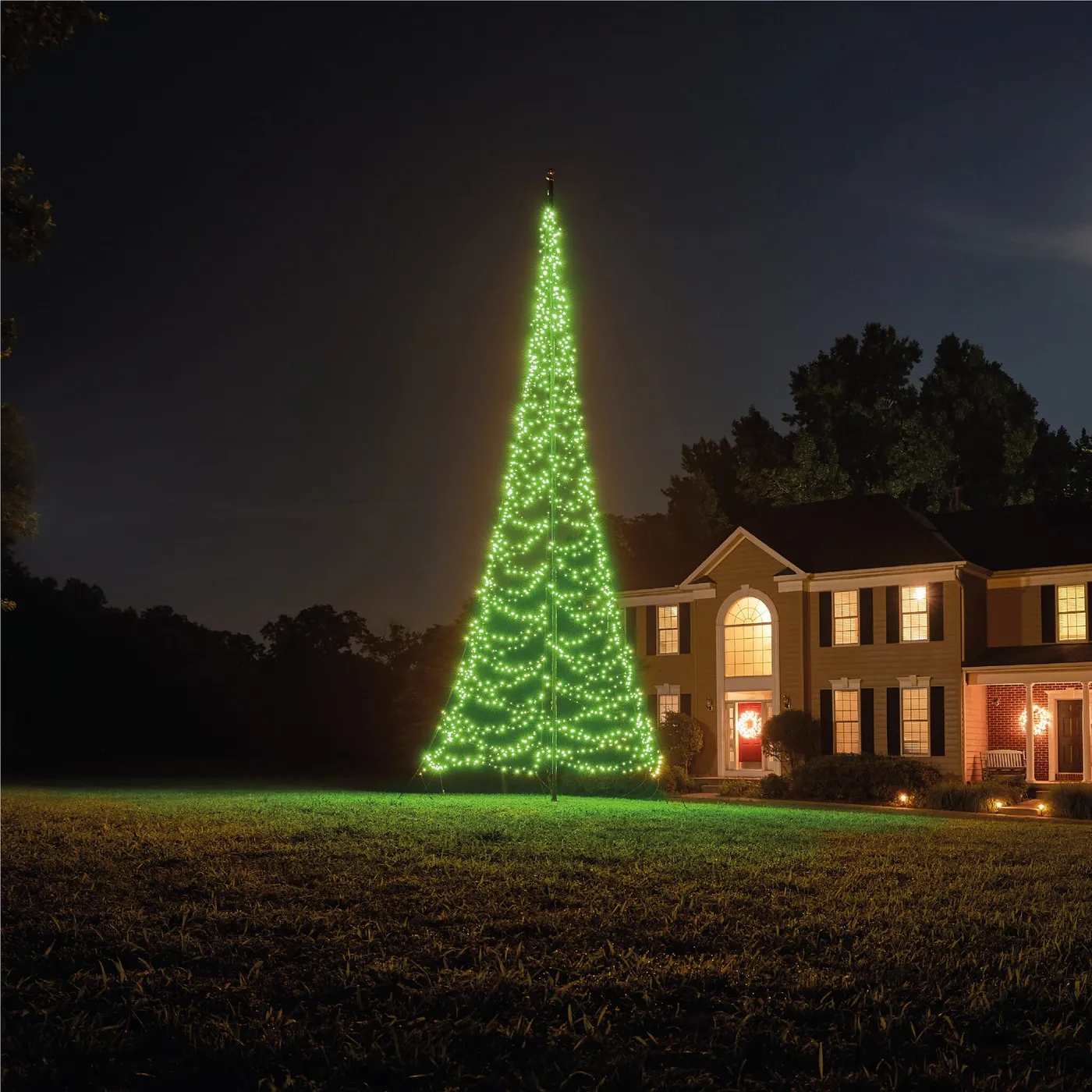
50% green light + 30% warm interior glow + 20% dark architecture. The beige siding and black shutters act as a neutral referee between two very different colors of light. Swap the siding for red brick and this stops working — the green would suddenly have a third voice competing with it.
Green LEDs vary wildly between manufacturers. Buy both strands from the same brand and the same batch, or you’ll end up with a tree that’s half emerald and half lime. Test them together on the driveway before zip-tying anything, and judge the color in actual darkness. Showroom floors make every LED look identical.
28. Frosted Mini Trees and Layered Doormats at the Front Door
Frosted mini trees are usually just spray and glitter, and you can do it better at home:
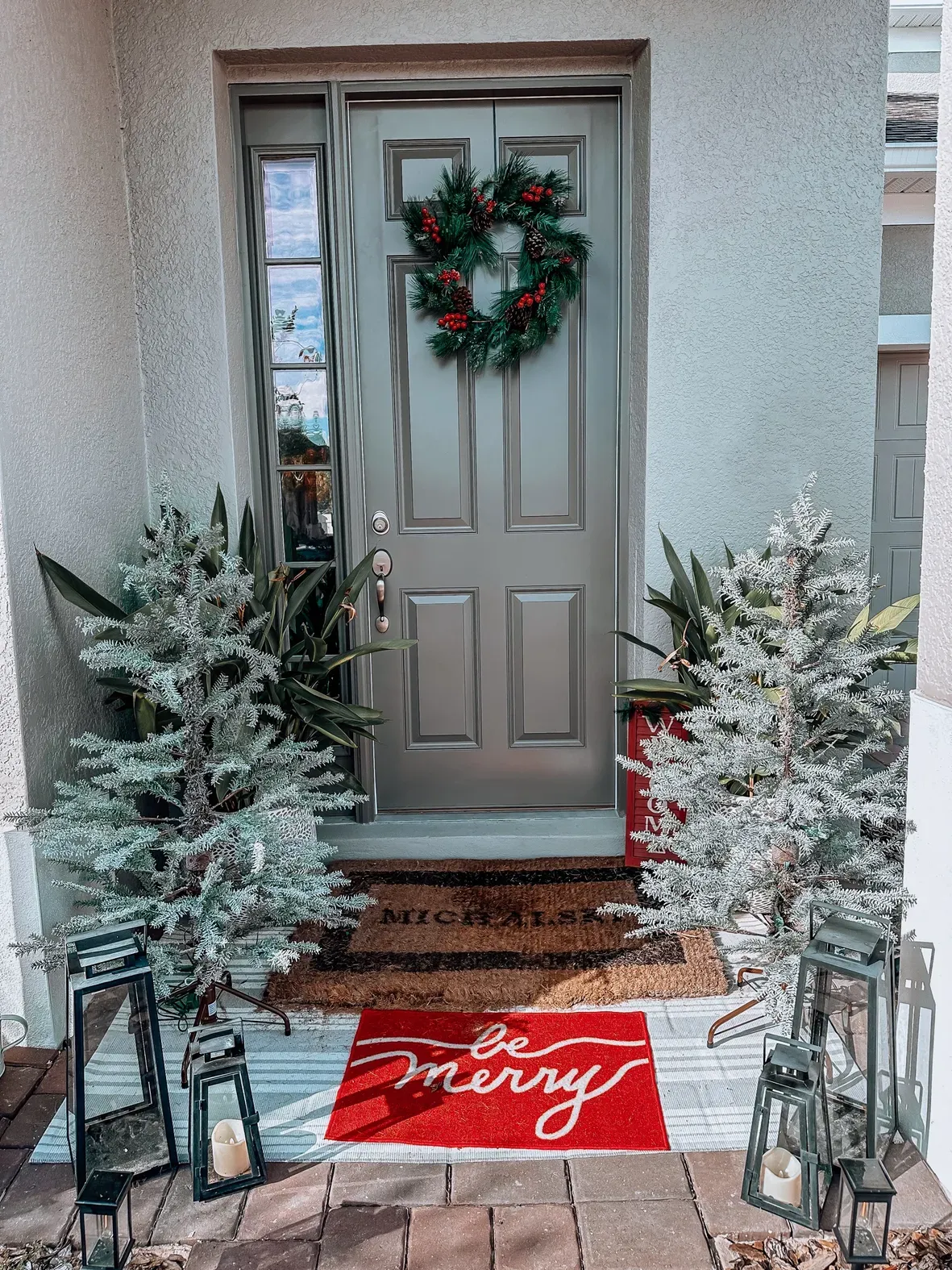
- Start with a $15 tabletop artificial tree, fluffed and shaped.
- Spray in thin passes from 18 in. with white flocking — heavy coats clump.
- Dust with fine craft glitter while the spray is still tacky.
- Let it cure 24 hours in a garage, not indoors.
- Set it in a weighted pot so wind can’t tip it onto the porch.
Two trees for under $45 and one afternoon.
- Measure your door width — mini trees over 24 in. will crowd anything under 36 in.
- Check how much weather your porch actually takes; frosted trees shed in heavy rain.
- Confirm the wreath hanger fits your door thickness before you buy it.
- Count your layered mats — three deep needs at least 40 in. of depth.
- Make sure the lanterns are rated for covered outdoor use.
29. A Geometric Tiered Light Sculpture, Modern and Almost Sculptural
What separates this from a novelty light-up tree is the visible frame. The pale metal outlines each tier and the strands crisscross inside it, so you read structure before you read glow. That’s the same logic as a chandelier with exposed bulbs — the armature becomes the design element instead of something to hide behind fabric or foliage.
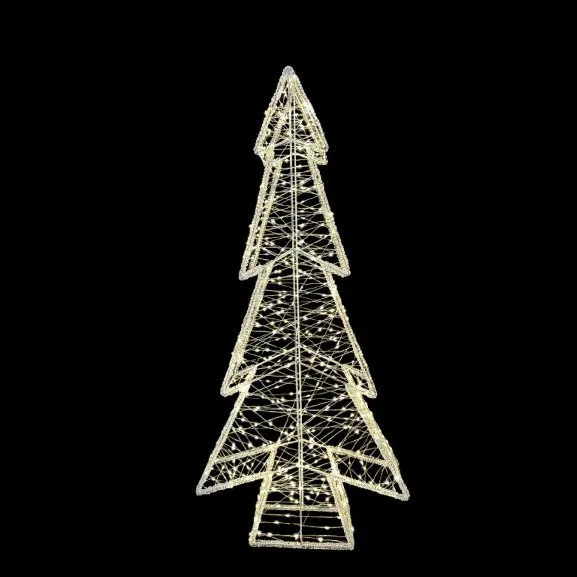
If you build one yourself, keep the tiers on a consistent taper: each level roughly 75% the width of the one below. That ratio is what makes a cone read as elegant rather than wobbly. And space your crisscrossing strands no more than 6 in. apart — wider spacing shows the gaps the moment someone views it from more than 20 ft away.
Light Up the Whole Block (Or Just Your Front Step)
You don’t need a plaza, a projection rig, or a 14-foot commercial tree to get this right — you need one strong silhouette, one honest light color, and a base that looks like you meant it. Pick two ideas from this list, do them properly, and skip everything else.
📌 Pin your favorites now so they’re waiting for you when the extension cords come out.